READING ROOM / 01
Colour and constructed space
From a bar inserted into Turin to Suspiria’s academy and Tenebrae’s pale city: how design, light and the surviving image shape what a place can do.
Read the essay →THE READING ROOM · 11 NOVEMBER 2026
Essays and documentary testimony connect the archive’s films and collaborators through colour, sound, memory and the history of editions. Begin with a question, follow the evidence, then return to an individual dossier.
ACROSS THE FILMS
READING ROOM / 01
From a bar inserted into Turin to Suspiria’s academy and Tenebrae’s pale city: how design, light and the surviving image shape what a place can do.
Read the essay →READING ROOM / 02
Gaslini and Goblin, Emerson’s orchestral timing, Tenebrae’s electronics and Phenomena’s many contributors: four routes beyond the familiar soundtrack name.
Read the essay →READING ROOM / 03
A witness behind glass, a photograph arranged to accuse, a face among pictures and an audience forced to watch: the changing problem of visual evidence.
Read the essay →READING ROOM / 04
Separate the cut, the frame, the language and the mix. Deep Red, Bird, Phenomena and Opera show why a restoration label is only the beginning of an edition’s history.
Read the essay →FOLLOW A SPECIFIC RECORD
The Reading Room’s original chapter routes remain here: technical testimony, publicity, period criticism, production documents and the people behind the image.
COLOUR AND ITS EVIDENCE
GOBLIN IN THE WORKSHOP
PUBLICITY ON PAPER
PERIOD CRITICISM
CONTEMPORARY DOCUMENTS
RESTORATION RECORD
PARTICIPANT TESTIMONY
FOLLOW A CREDIT
EDITION COMPARISON
SOURCE GUIDE / TELEVISION, 1987
Giallo Argento collects interviews, production demonstrations and location reports from the 1987 Rai programme Giallo. The 85-minute compilation brings cameras, props, performers and sound work into view while films such as Opera were still being completed.
Dario Argento’s Nightmares and Night Shift were fiction segments within that larger television programme. This companion compilation ranges across both series and Argento’s feature films.
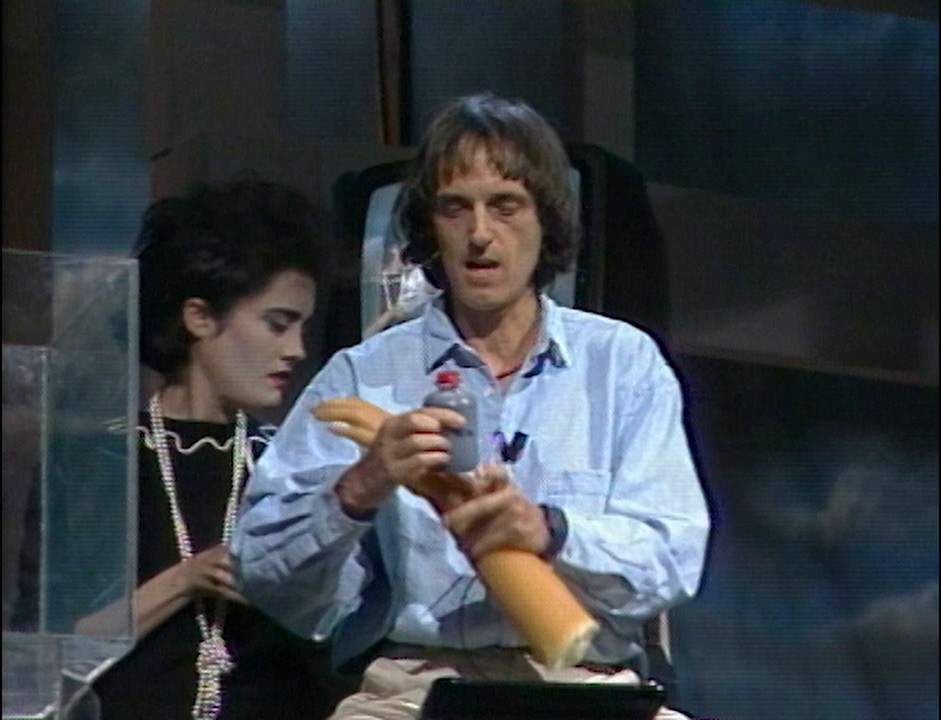
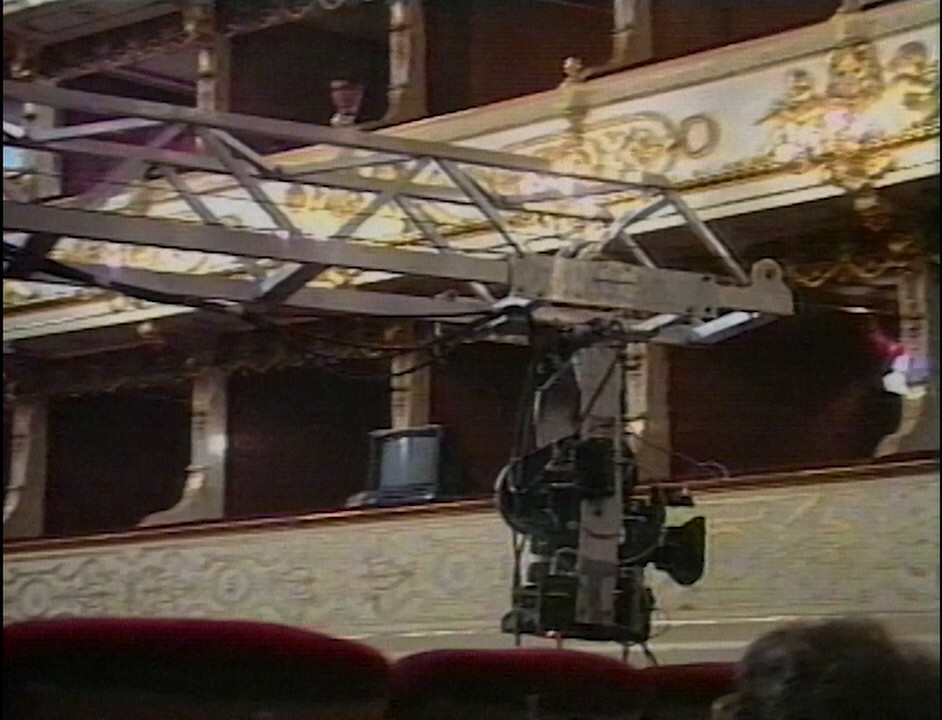
Each study places the production footage and testimony beside the film it discusses, with Giallo Argento identified as the source.
The revolving camera rig, peephole makeup, a mixing session and the Angelotti brothers’ Foley work.
The mechanical hand, insect breeding, a glucose-coated mask and the performers’ accounts of the effects.
The arm prop, blood tubing, D’Angelo and Wendel’s recollections and the Louma apparatus.
The ghost-cab setup and contemporary interviews with the directors and cast.
The reception of Nostalgia punk, the Sammy creature and the giant mouth in Addormentarsi.
00:00–10:59
Argento introduces the mechanics behind a Phenomena hand and a Tenebrae arm effect, naming Sergio Stivaletti during the hand demonstration. Coralina Tassoni joins him with the props. Latex surfaces, moving parts, tubing and coloured liquid become items that the host can handle before the film clips restore their illusion. Anthony Perkins then discusses the separation between performer and character, emphasizing a felt performance rather than a purely technical construction.
11:00–25:49
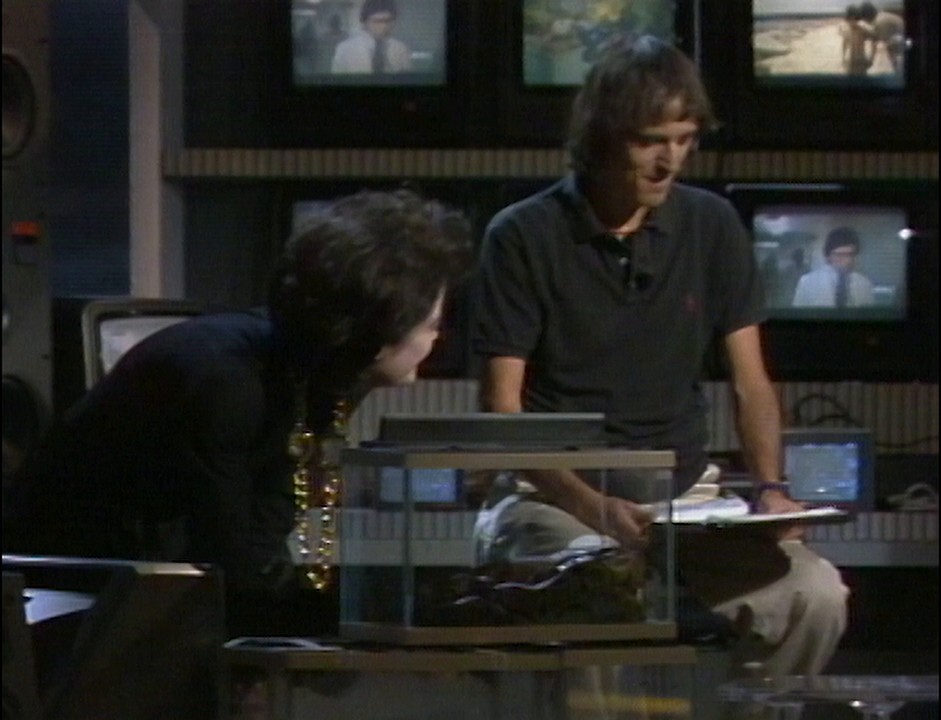
The Phenomena segment discusses the practical problem of obtaining and controlling enormous numbers of insects. Argento describes breeding them and coating a rubber face with glucose to attract flies. The following satellite interview with David Gilmour and Nick Mason considers their new album, concert technology and the difference between making their own music and working within another filmmaker’s project. Their appearance belongs to Giallo’s cultural magazine format; it is not evidence of a new Argento–Pink Floyd collaboration.
25:50–36:40
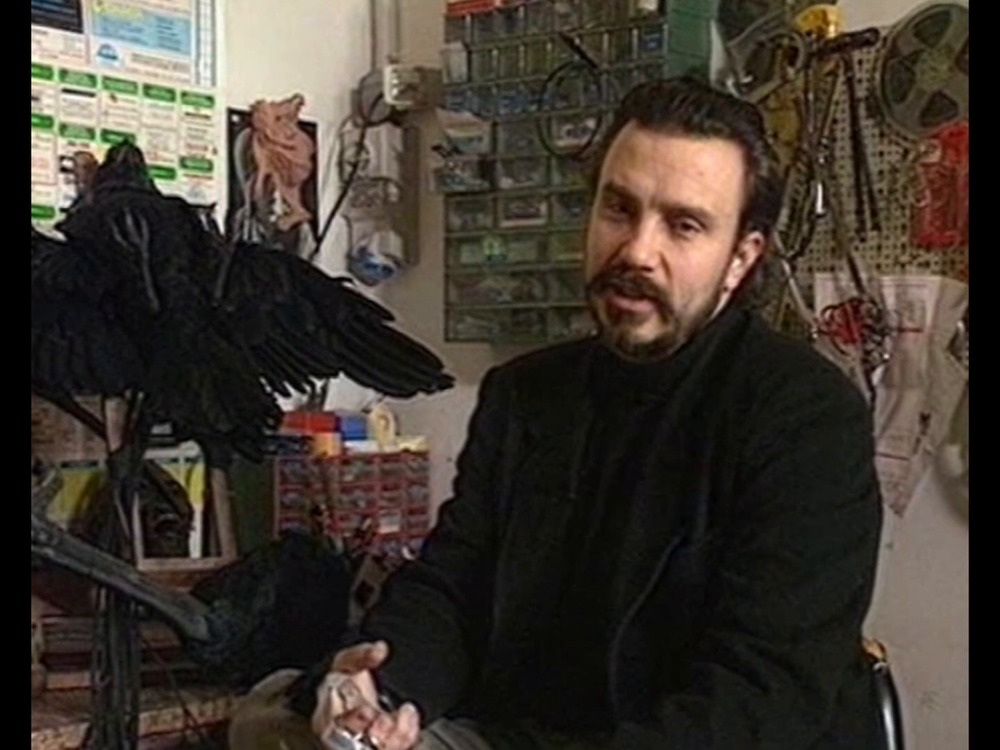
Argento distinguishes live crows from mechanical birds and explains why the camera must simulate a flight rather than ride on a bird. The theatre footage reveals the long rotating structure and suspended camera. Cozzi’s Loch Ness report then shifts to sonar, Adrian Shine and the search for a monster: its investigative language and comic presentation are part of the programme, not independent proof of its more sensational suggestions.
36:40–45:35
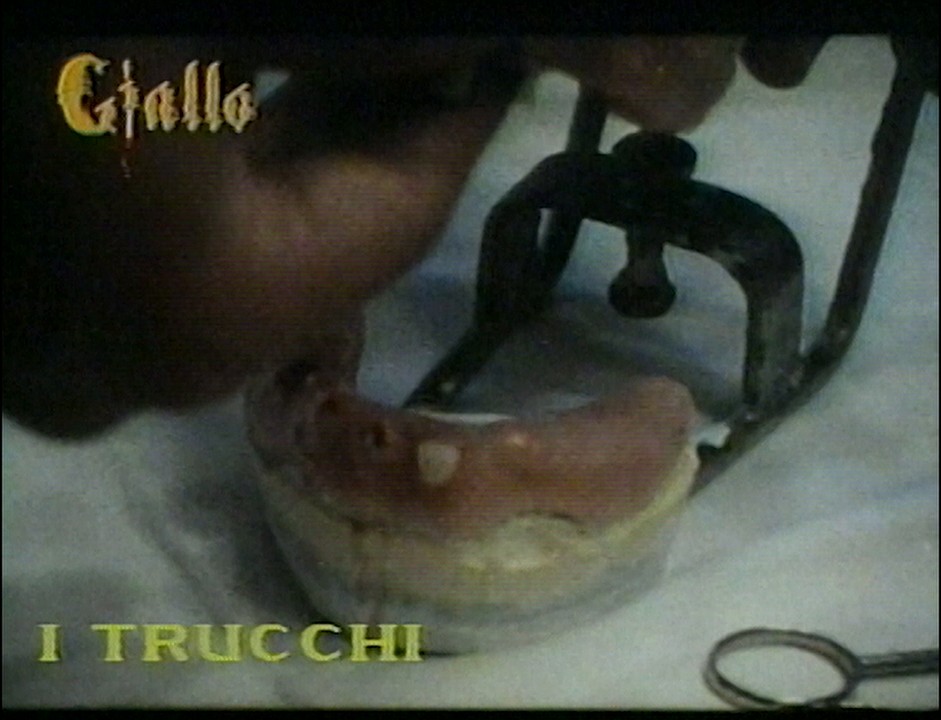
The Demons demonstration exposes a moving jaw and transformation appliances; Argento explicitly identifies Lamberto Bava as the director of the films he produced. Mirella D’Angelo recalls Tenebrae’s blood tubing and the comfort of seeing the apparatus around her. Fiore Argento describes the many instructions involved in Phenomena’s tunnel sequence and says that its imitation glass could still hurt. Explanation does not make the performers’ accounts of discomfort disappear.
45:35–56:30
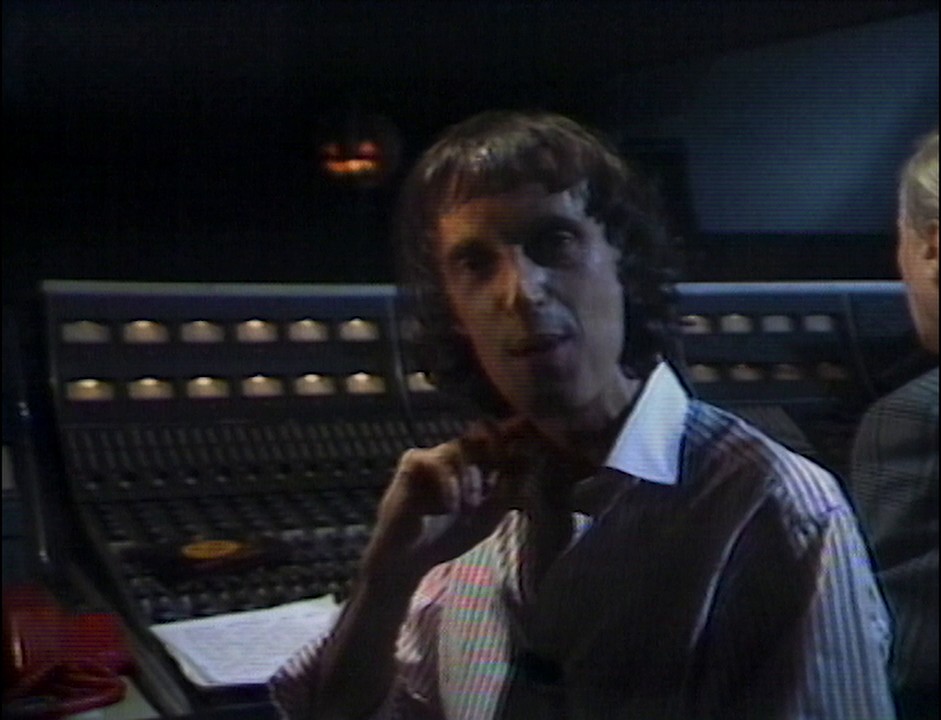
The Opera mixing visit preserves Argento’s instructions about music and voice, including an explicit move from Simonetti to Brian Eno. A café conversation is followed by Tenebrae’s Louma shot and footage of its apparatus. The chapter ends by returning to Nostalgia punk: Argento acknowledges complaints and supportive responses before the programme shows the torso appliance being prepared and filmed. The sequence supplies evidence of the reaction and the effect, without supplying a formal cuts directive.
56:30–66:55
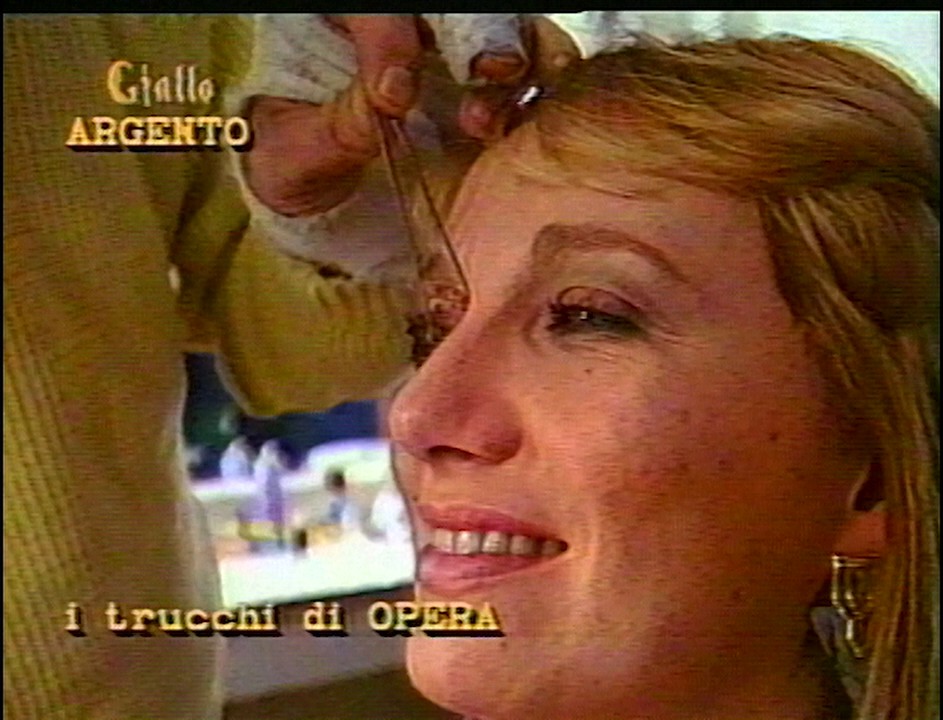
Opera’s peephole killing is broken into makeup preparation, the performer and a filmed bullet effect. Interviews then bring Lara Wendel’s account of Tenebrae’s dog attack together with Fiorenza Tessari’s demonstration of the substitute body used for Phenomena’s spear effect. These are named performers discussing particular setups; their experiences should remain attached to those setups rather than generalized to every scene.
66:55–85:10
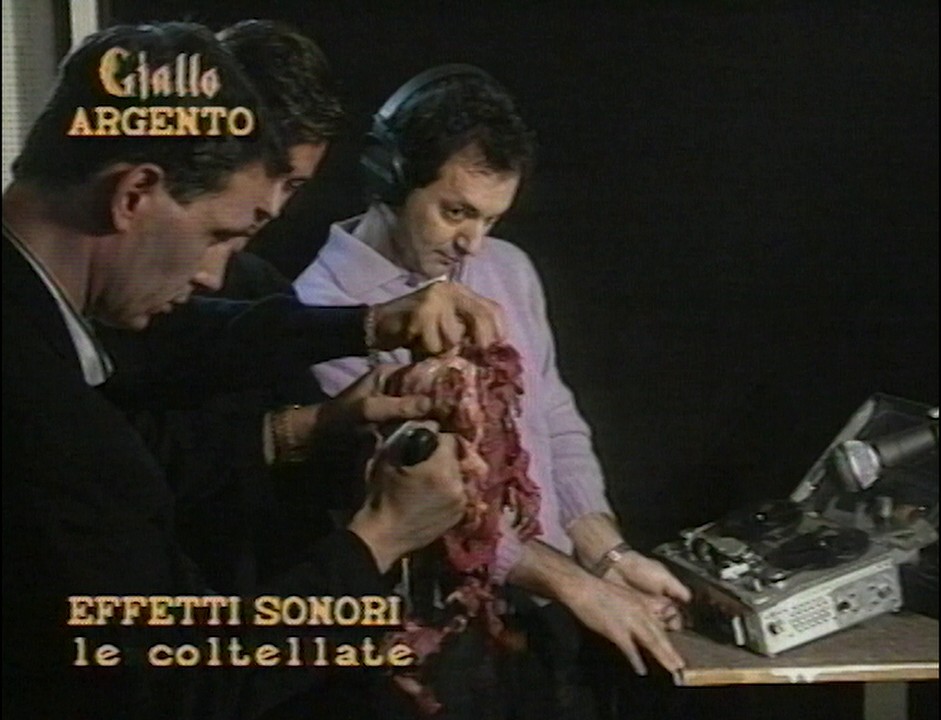
The finale revisits the ghost taxi, Sammy’s bedroom and Addormentarsi’s enormous mouth before demonstrating the Angelotti brothers’ Foley work. The camera shows footsteps made by hand and impact sounds assembled beside a microphone. Contemporary interviews with Bava, Cozzi and the Night Shift cast close the compilation, bringing the makers of the television mysteries into the same production world as the nightmares.
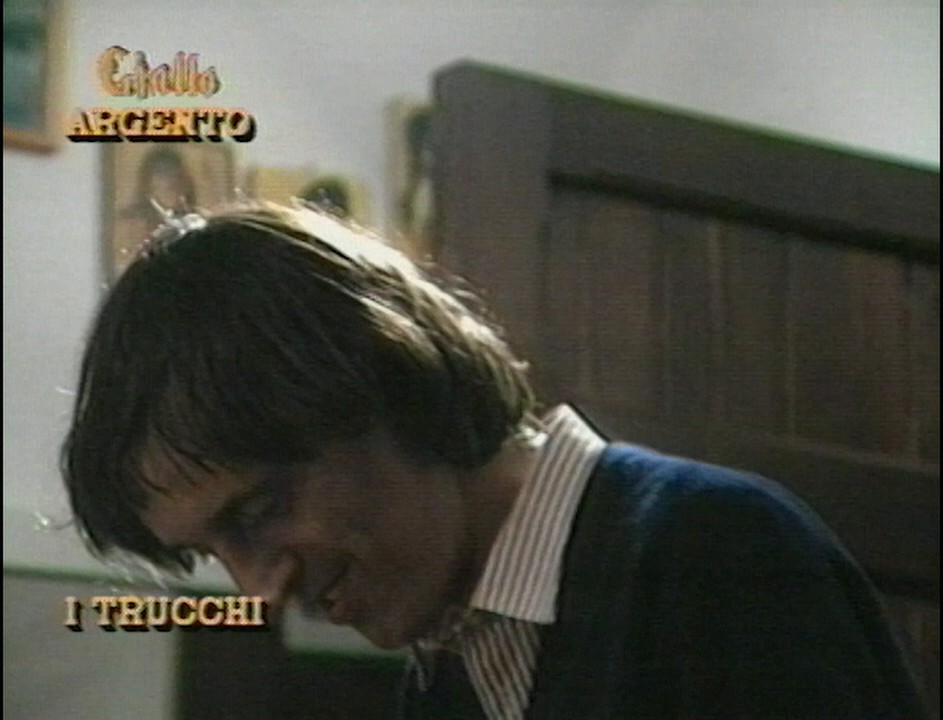
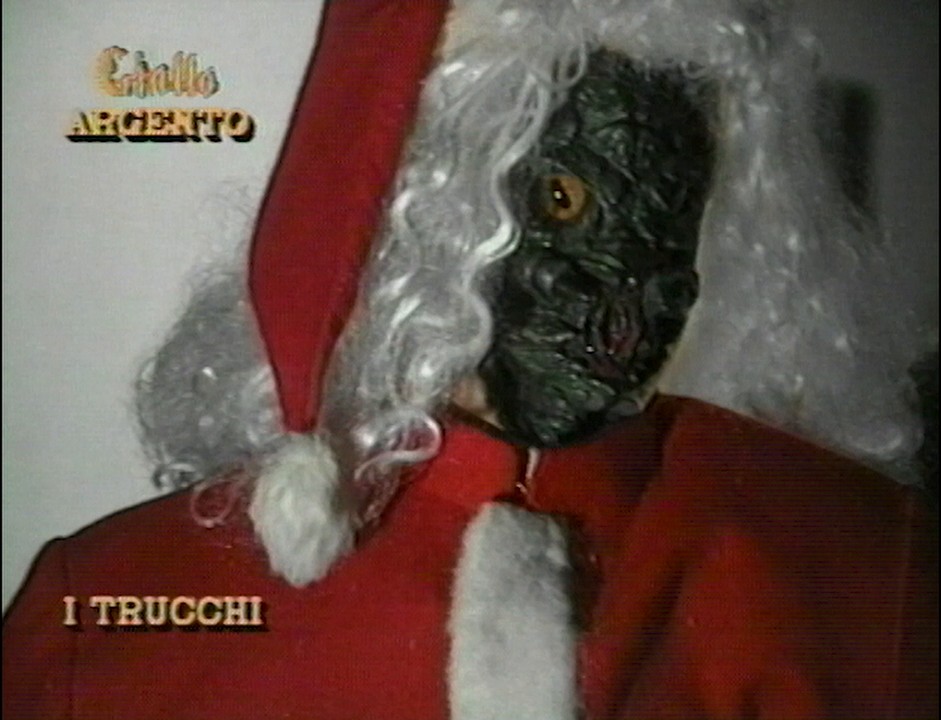
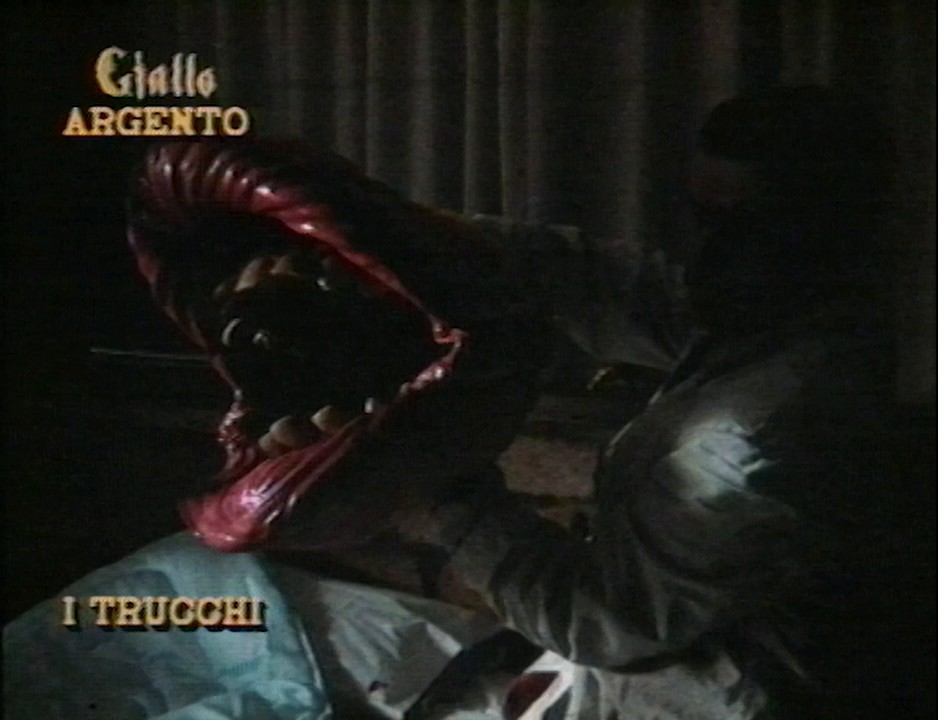
Giallo Argento, a compilation of material from Giallo (1987), presented as a separate extra on Disc 4 of Severin Films’ Dario Argento’s Deep Cuts. This presentation runs 1:25:10. The disc also contains the nine Nightmares shorts.
Passage references begin at the start of the compilation. English paraphrases follow its English subtitles; on-screen identifications and production footage establish the speakers and the work discussed.
Mondo Digital’s disc-by-disc review ↗ · Rai Teche: Argento’s television effects demonstrations ↗
TELEVISION / MAKERS & WORKING PAGES
A new illustrated Night Shift dossier follows all fifteen episodes, with scene studies and expandable suspense galleries. Five interviews bring different kinds of evidence to the series: Argento on presentation and authorship, Cozzi on 35mm production and broadcast deadlines, Sacchetti on constructing a short mystery, Bava on night work and Vitale on Calypso’s character and reception.
The screenplay study compares photographed working pages with Il bambino rapito and the recurring ghost taxi. New connections lead to Opera and Dario Argento’s Nightmares.
Sources: Severin Films, Dario Argento’s Deep Cuts, Disc 3. Episode images, English subtitles, screen credits and five subtitled interviews; individual passage references are given in the dossier.
DOCUMENTARY TESTIMONY / PRODUCTION IN PRACTICE
A camera hangs above an auditorium. A Foley artist works at a microphone. An effects maker explains how a creature combines an actor, a fabricated body and remote movement. Master of Horror brings Argento’s account of filmmaking into contact with the labour and equipment that give its images form.
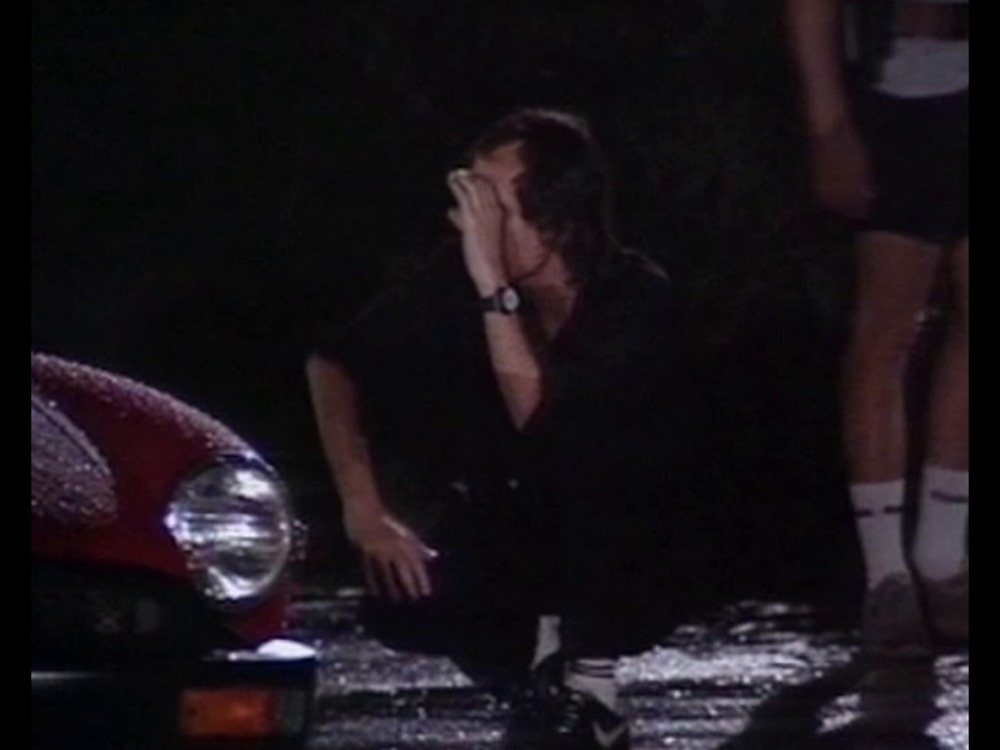
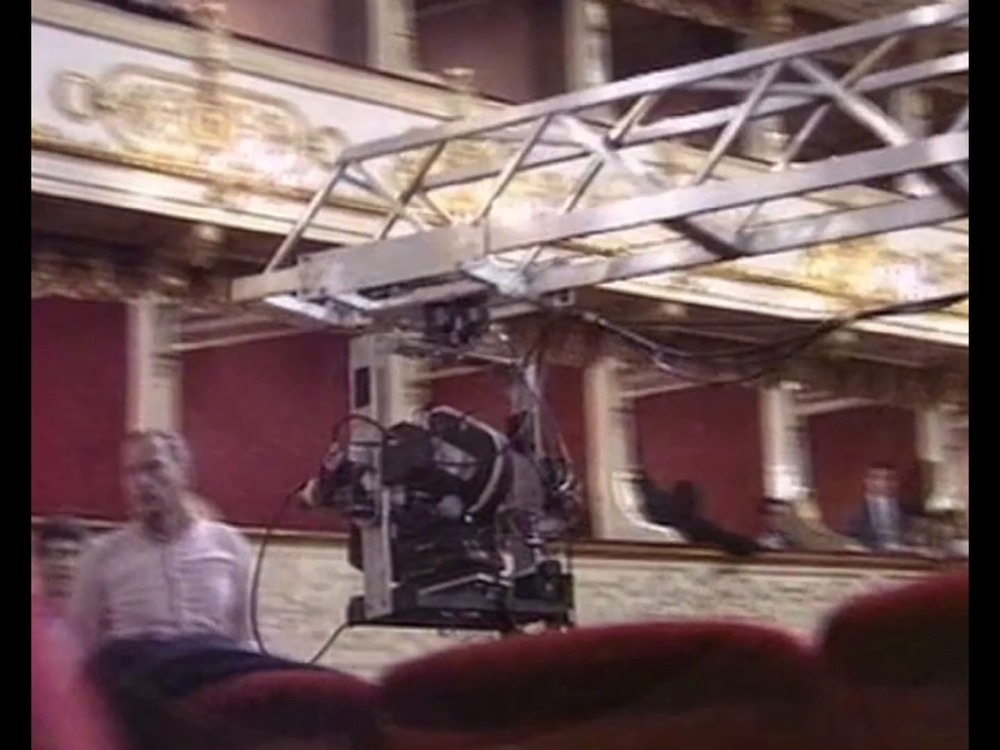
At 11:41–13:50, Argento describes elaborate camera movements as expressions of psychological states, naming Tenebrae, Opera, Suspiria and The Bird with the Crystal Plumage. The documentary then supplies material counterparts: the Louma equipment around the Tenebrae building and the Steadicam and cranes used for Opera. The theatre apparatus is particularly revealing. A floating, circling viewpoint required a large structure and people coordinating its movement.
Tenebrae: movement and psychology → · Opera: the camera above the audience →
Argento, 11:41–13:50; production footage and narration, 14:08–21:58.
The Opera passages follow the needles around Betty’s eyes and the fabrication and application of Daria Nicolodi’s wound, including the enlarged bullet and high-speed photography. These images can be followed beside the dossier’s existing My Cinema production study.
Stivaletti’s workshop opens a route into films Argento produced. He explains the goat-like creature in The Church as a performer in a foam-latex body with remotely controlled facial movement. For The Sect, his discussion joins a false head and mechanical insect to optical work, then turns to the eclipse. The distinction is practical: an effect may be assembled across performance, fabrication, mechanics and a later photographic stage.
Opera makeup and projectile work, 28:27–36:56; Sergio Stivaletti, 37:22–43:03.
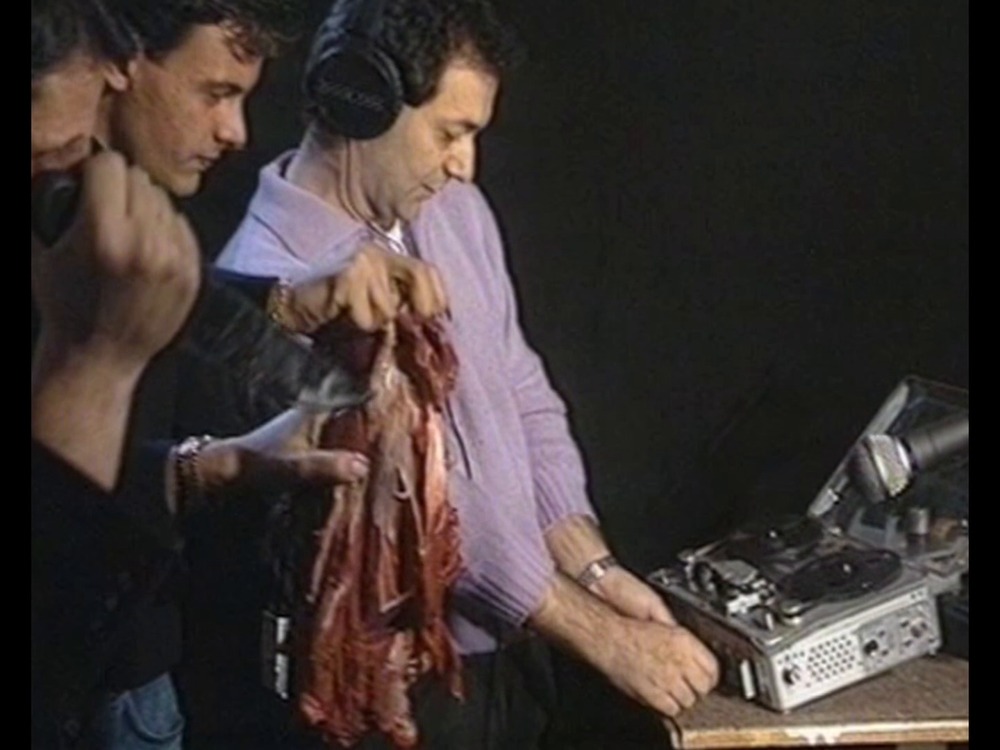
The Foley demonstration shows materials being handled and worked beside a microphone, with repeated actions and the film image guiding the result. Argento’s following discussion offers three timings for a score: before the shoot, during production, or once the picture exists. He favours the first two because they allow music to shape the work more directly.
The later accounts of Suspiria’s unusual instrumentation and Donaggio’s comparison of Two Evil Eyes with The Sect recur in the My Cinema material. They belong to the same body of testimony, rather than constituting a second independent confirmation.
Read the expanded music and sound essay →
Foley workshop, 47:19–49:29; Argento, 49:55–52:57; Pino Donaggio, 53:37–54:13.
Argento distinguishes his own directing from the responsibility of producing someone else’s film, stressing the other director’s personality. The documentary’s effects and production passages make that distinction tangible: films he helped bring into being are not automatically films he directed.
When he turns to Two Evil Eyes, he recalls an initial four-director Poe project reduced to two when the others were unavailable. He and Romero proceeded instead of delaying. His discussion of Poe’s place in his childhood and of making the stories contemporary adds a creative rationale to that practical account of the anthology’s shape.
Argento on producing, 55:37–58:46; Poe and Two Evil Eyes, 1:03:42–1:07:22.
Nathaniel Thompson and Troy Howarth
Nathaniel Thompson and Troy Howarth
Nathaniel Thompson and Troy Howarth
Luigi Cozzi
Dario Argento
Production footage and narration
Dario Argento
Dario Argento; the documentary’s Foley workshop
Luigi Cozzi
Dario Argento and Luigi Cozzi
The 87-minute documentary moves from Argento’s public image and writing into camera movement, Opera production footage, practical and optical effects, Foley, music, producing and the Poe collaboration with Romero. Its final stretch returns to film extracts and the Profondo Rosso museum display. The opening credits name Lewis Coates as director.
Several interviews and demonstrations also appear in My Cinema: the Louma, Nicolodi’s makeup, Cozzi’s high-speed-camera and insect-photography accounts, and portions of the music discussion. The guides connect those recurring passages instead of treating their reuse as new corroboration.
Dario Argento: Master of Horror, 1:27:23, presented on Disc 2 of Severin Films’ Dario Argento’s Deep Cuts ↗. The same disc includes La bambola, Testimone oculare, the Thompson–Howarth commentary, A Streetcar Named Fear (19:51) and On the Other Side of the Door (33:41).
Passage references run from the beginning of each named programme. English paraphrases follow the edition’s English subtitles; production images and on-screen identifications supply the visual context. Retrospective accounts remain attached to the people who give them.
DOCUMENTARY TESTIMONY / TWO PARTS
Interviews meet the work of making a film: cameras suspended over buildings, prosthetics prepared between takes, insects transformed into optical swarms, and composers finding a sound for an imagined scene. The two parts of My Cinema bring Argento’s recollections into contact with the accounts of his collaborators and footage made during production.
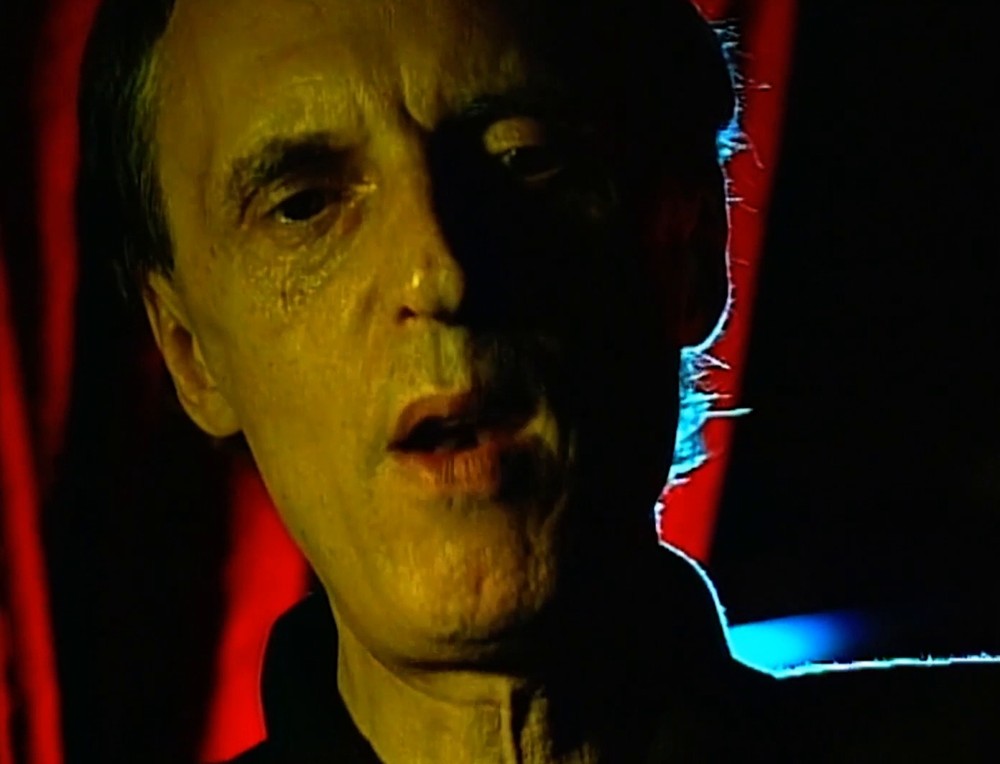
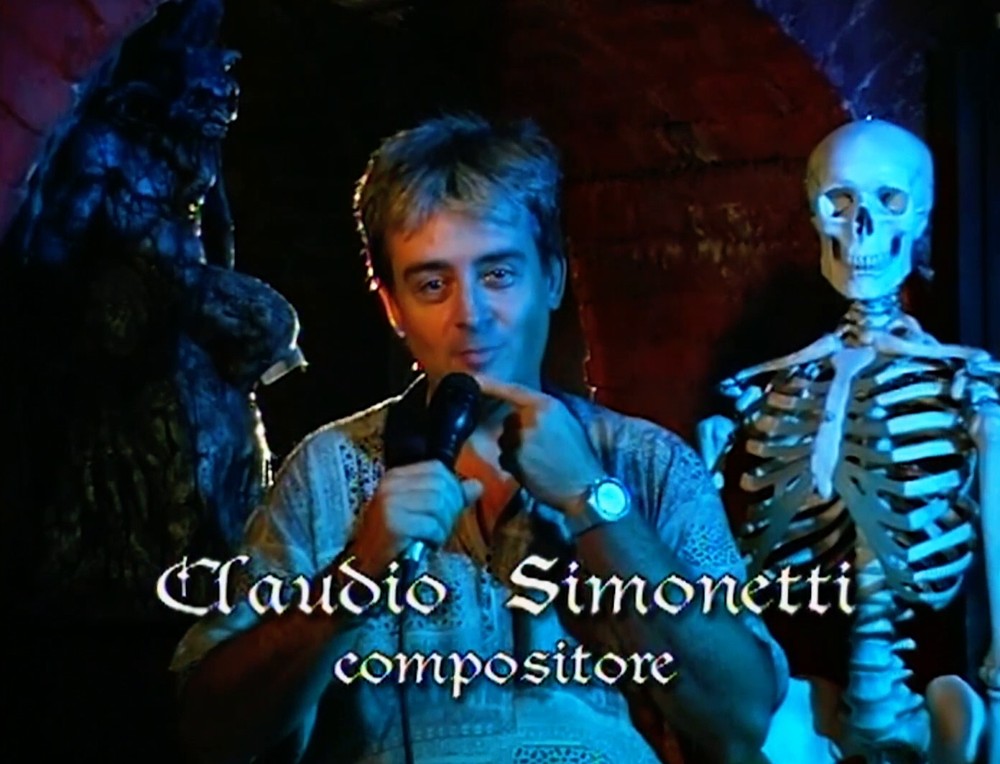
Franco Casagni, Sergio Stivaletti and the documentary’s production footage
The mouth-and-chin prosthetic, the peephole bullet and mechanical crows.
Part Two, 14:46–16:21; 19:35–25:47. Compare Part One, 47:49–49:24.
Read the new study →Luigi Cozzi and the documentary narration
The pool’s surface materials and Cozzi’s account of the school swarm.
Part One, 35:28–35:51 and 45:38–47:20; Part Two, 26:07–27:26.
Read the new study →Luciano Tovoli and Dario Argento
Tovoli explains the Louma while production footage reveals the apparatus.
Part One, 27:47–32:40.
Read the new study →Franco Casagni; Dario and Asia Argento
Casagni’s prosthetics account and the practical pressures at Marmore Falls.
Part Two, 17:37–19:28 and 51:09–53:29.
Read the new study →Luigi Cozzi
The search for a scientific camera and the planning behind the crash.
Part One, 09:17–13:36.
Read the new study →Luciano Tovoli; Dario Argento and Claudio Simonetti
Tovoli’s suspended-camera account and the exchange between music and image.
Part One, 21:54–26:57; Part Two, 29:45–32:41.
Read the new study →Dario Argento
Alchemy, Gothic architecture and Argento’s recollection of Bava’s optical work.
Part One, 19:15–21:14.
Read the new study →Dario Argento
Argento distinguishes the remembered Phantom from the film he later revisited.
Part One, 01:24–04:40.
Read the new study →Dario Argento
Writing in New York, selecting Minneapolis and Aura’s outsider position.
Part Two, 48:33–50:39.
Read the new study →Dario Argento and Pino Donaggio
Argento’s adaptation principle and Donaggio’s account of the score’s dramatic space.
Part Two, 32:54–33:30 and 38:57–41:20.
Read the new study →Dario Argento
Argento remembers an awkward musical brief and the beginning of a collaboration.
Part Two, 1:02:12–1:03:28.
Read the new study →Dario Argento and Claudio Simonetti
Argento’s move beyond the early thrillers and Simonetti’s account of Goblin’s commission.
Part One, 05:02–08:52.
Read the new study →Dario Argento
Argento’s account of accepting the directing role after preparations had begun.
Part One, 14:09–15:16.
Read the new study →Luigi Cozzi and the documentary narration
The audience-guessing structure of Night Shift and the separately presented Nightmares.
Part One, 52:06–58:04; Part Two, 14:46–15:18.
Read the new study →Part One · 58 minutes. Argento’s early thrillers, The Five Days, television, Deep Red, Suspiria, Inferno, Tenebrae, Phenomena and Opera. Cozzi discusses writing and effects; Simonetti discusses the music; Tovoli explains photographic methods. Production footage accompanies the interviews, with a Phenomena music video and a concluding passage on Night Shift and Dario Argento’s Nightmares.
Part Two · 64 minutes. Writing, camera movement, practical and optical effects, sound, composition, producing, Two Evil Eyes, Trauma, The Stendhal Syndrome and The Phantom of the Opera. Casagni and Stivaletti explain particular effects; Donaggio discusses the place available to music; Cozzi and Argento discuss the Profondo Rosso shop and its display of film objects. After the main closing passage, an appendix includes production glimpses from Sleepless, The Card Player and Do You Like Hitchcock?, followed by Argento’s account of his first meeting with Morricone.
Dario Argento: My Cinema, titled Il mio cinema on screen. Both parts are presented on Disc 1 of Severin Films’ Dario Argento’s Deep Cuts ↗, alongside Il vicino di casa and Il tram. The on-screen part titles establish the order. Part One runs 58:23 and Part Two 1:03:32 in this presentation.
English paraphrases follow the edition’s English subtitles. On-screen speaker labels and the accompanying production images identify the people and work discussed. References begin at the start of the named part; they locate testimony rather than a scene in the finished feature film. Specific differences between recollections remain attached to their speakers.
DOCUMENTARY TESTIMONY · 2023
Simone Scafidi’s documentary brings Argento, family members, collaborators and fellow filmmakers into conversation around a return to the writing room. Its value to the archive lies in the particular memories and interpretations each speaker brings. These passages now join the relevant film dossiers.
Follow the people behind the writing, performances, camera work and music. Each link takes you to a new discussion within the existing research.
Lamberto Bava
In Panico: 19:11–19:57
Dario Argento, Marisa Casale
A resemblance remembered by two people →
In Panico: 25:26–26:41
Luigi Cozzi
The director becomes a familiar face →
In Panico: 27:47–28:16
Dario Argento, Claudio Simonetti
Writing in isolation → · The introduction to Goblin →
In Panico: 31:07–31:37; 33:17–34:26
Asia Argento
A daughter remembers two origin stories →
In Panico: 37:17–37:49
Dario Argento, Guillermo del Toro
An enigma is something the film builds →
In Panico: 45:24–47:00; 48:26–48:46
Claudio Simonetti, Nicolas Winding Refn
The electronic pulse travels beyond the film →
In Panico: 50:19–51:51
Franco Ferrini
The family that is missing from the room →
In Panico: 56:57–58:15
Cristina Marsillach, Michele Soavi
The performer inside the apparatus → · A bird’s viewpoint took time to construct →
In Panico: 1:03:13–1:03:37; 1:05:00–1:06:12; 1:10:54–1:11:28
Asia Argento
The actor remembers the language work →
In Panico: 1:15:45–1:16:15
Gaspar Noé
A filmmaker looks back at the unsettled mind →
In Panico: 1:17:35–1:17:54
Dario Argento
Two earlier Phantoms, two different memories →
In Panico: 08:07–08:39
Asia Argento
A casting plan meets another filmmaking career →
In Panico: 1:22:57–1:23:13
Dario Argento Panico (2023), directed by Simone Scafidi. ScreenUK’s documentary record identifies Scafidi, co-writers Giada Mazzoleni, Manlio Gomarasca and Davide Pulici, and co-producer Paguro Film.
The review covers the complete English subtitle record and a machine-assisted speech transcription of the full 1:37:12 soundtrack. Italian, English, French and Spanish passages were compared with the subtitles; selected passages received further language-specific checks, and images establish speakers and archival context. The discussions are English paraphrases. This is a dialogue and testimony review, not a direct listening assessment of delivery, music, effects or surround mixing. Timings locate passages in this presentation.
Participant recollections are distinguished from the critical responses of other filmmakers. Later memories do not replace dated scripts, contracts, equipment records or original production paperwork. The source is used here to extend existing studies rather than to reproduce the documentary’s interview text.
The four essays join twenty-five film and television dossiers and six collaborator studies. Follow an idea across the collection, then explore the individual films in depth.
Major plot revelations appear in the essays. Credits, later recollections, inspected images and our interpretations remain distinct. Read the research method → · Follow the archive journal →
Corrections, contributions and enquiries: argentochrome@rareprintsandposters.com