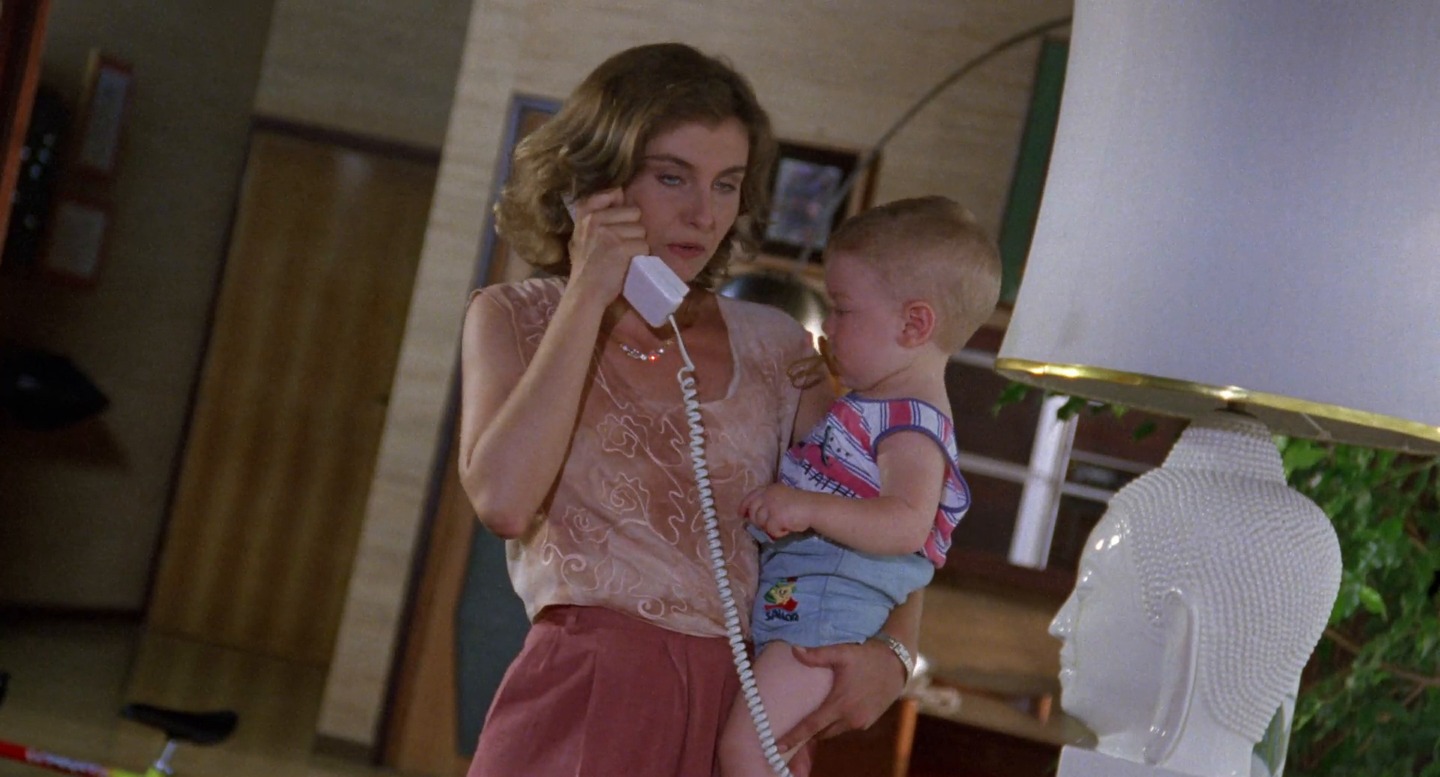
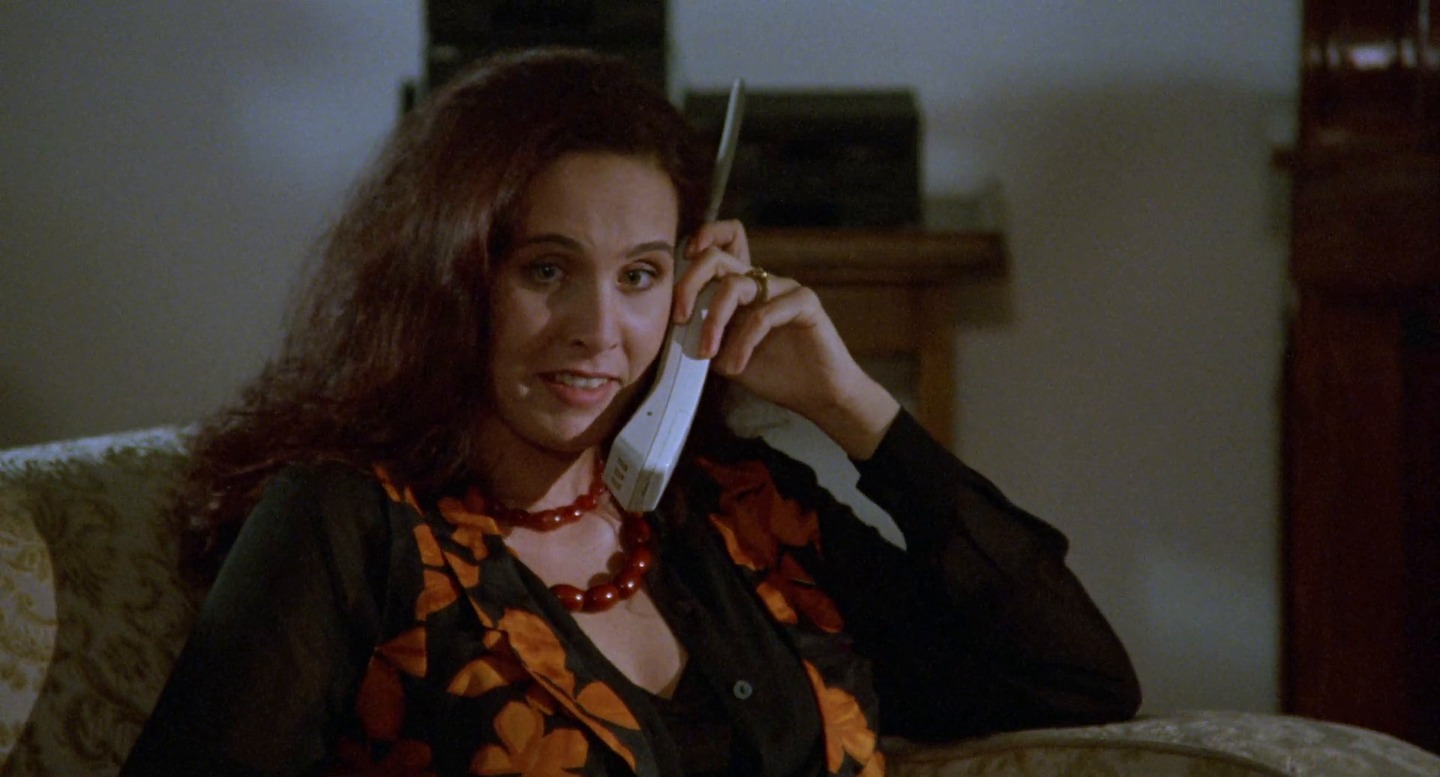
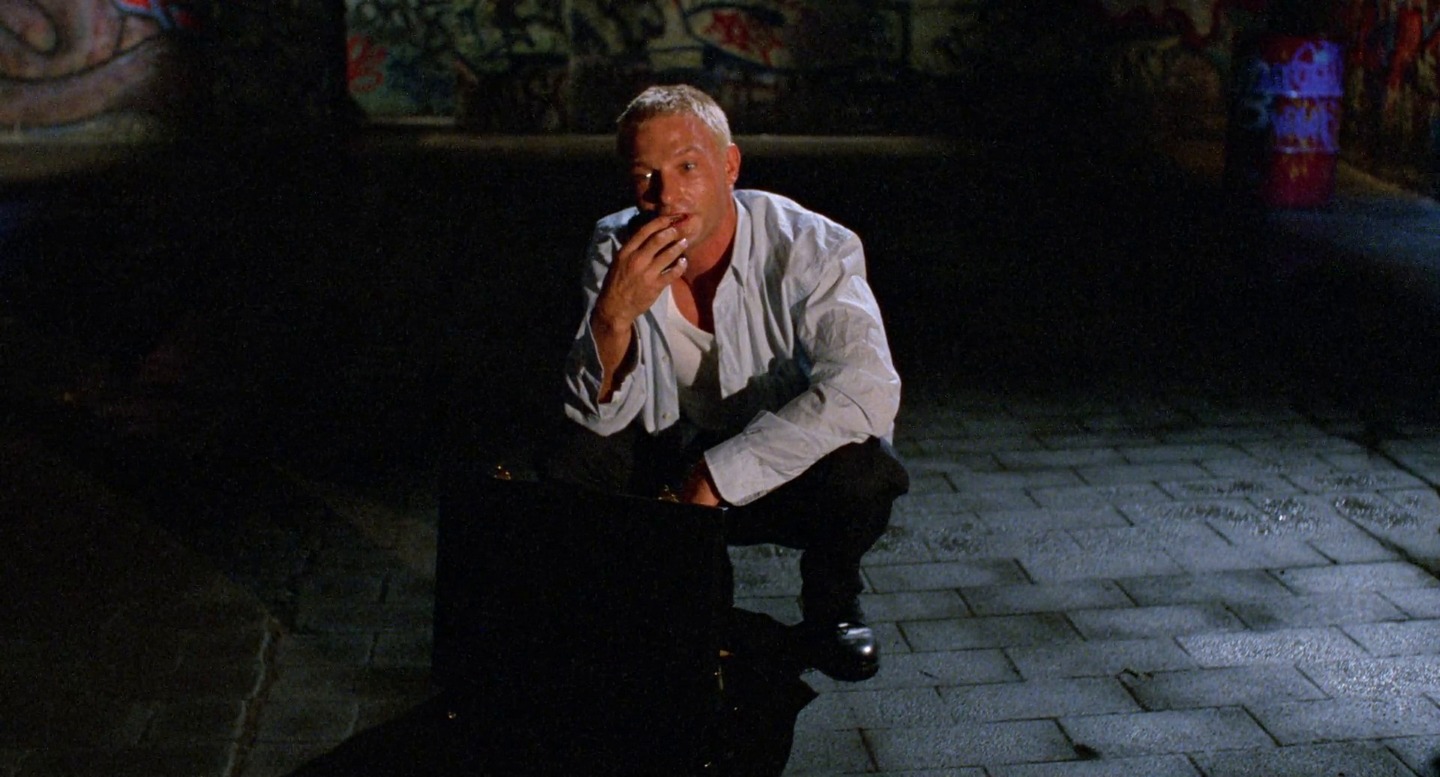
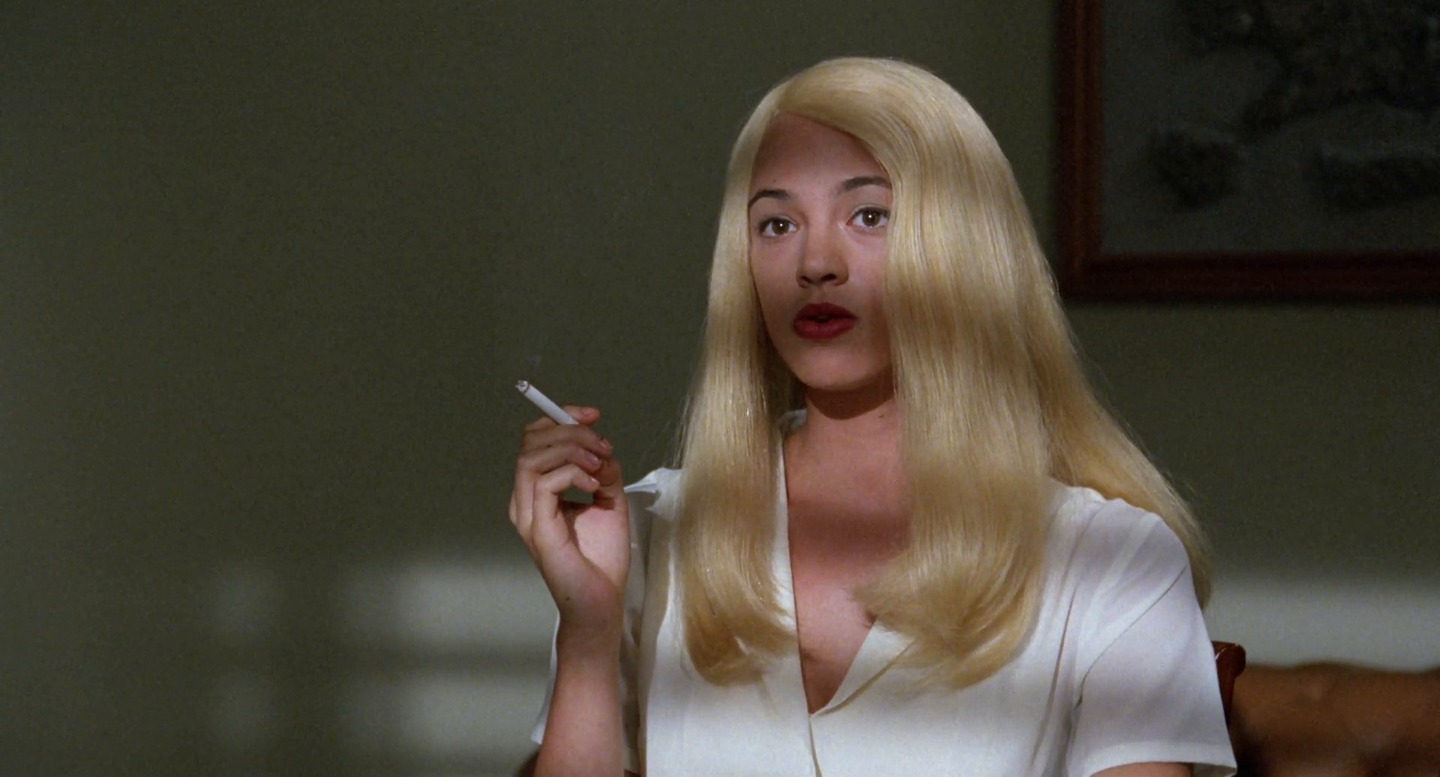
Thirty-two illustrated studies follow Anna through galleries, hotel rooms, painted landscapes and the investigation’s changing aftermath. Follow the images in order or enter a closer sequence study.
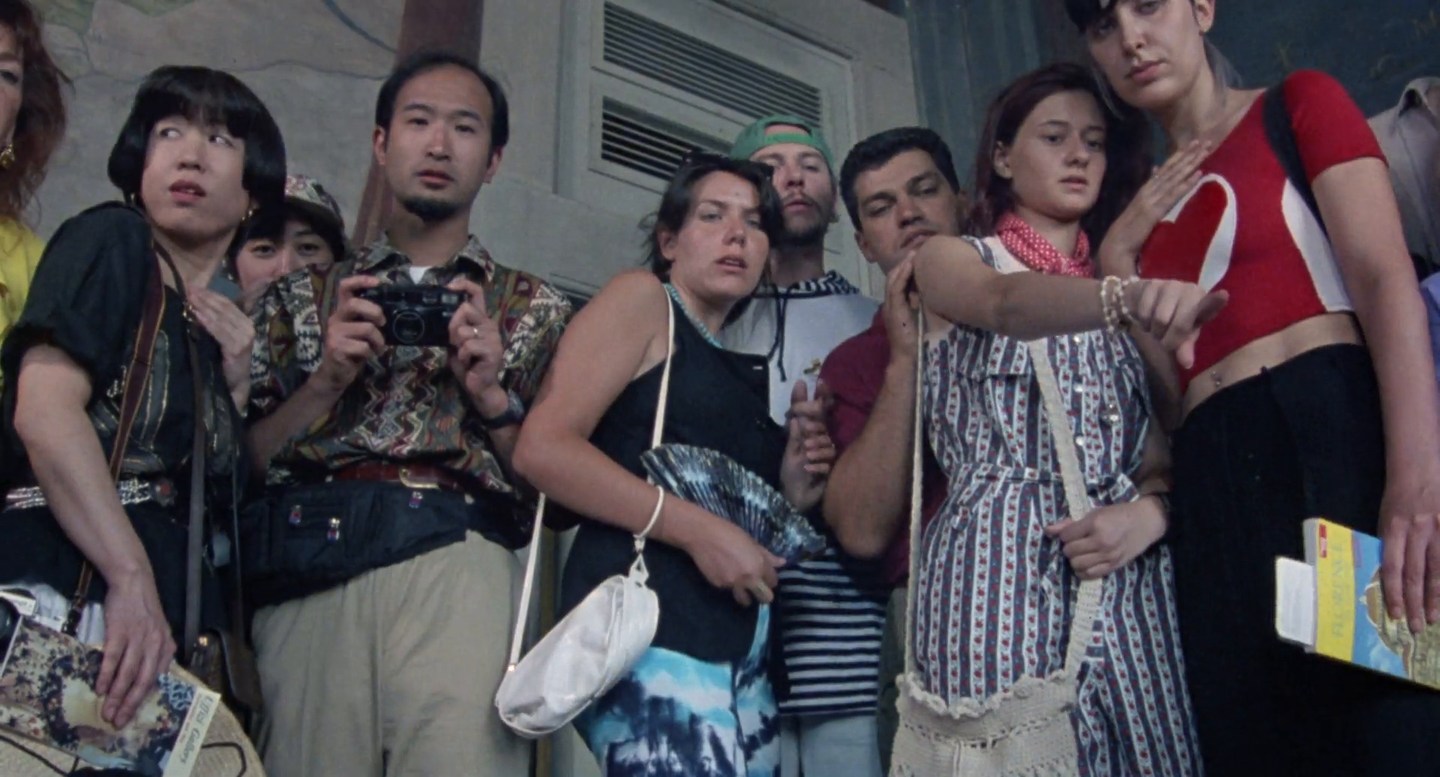
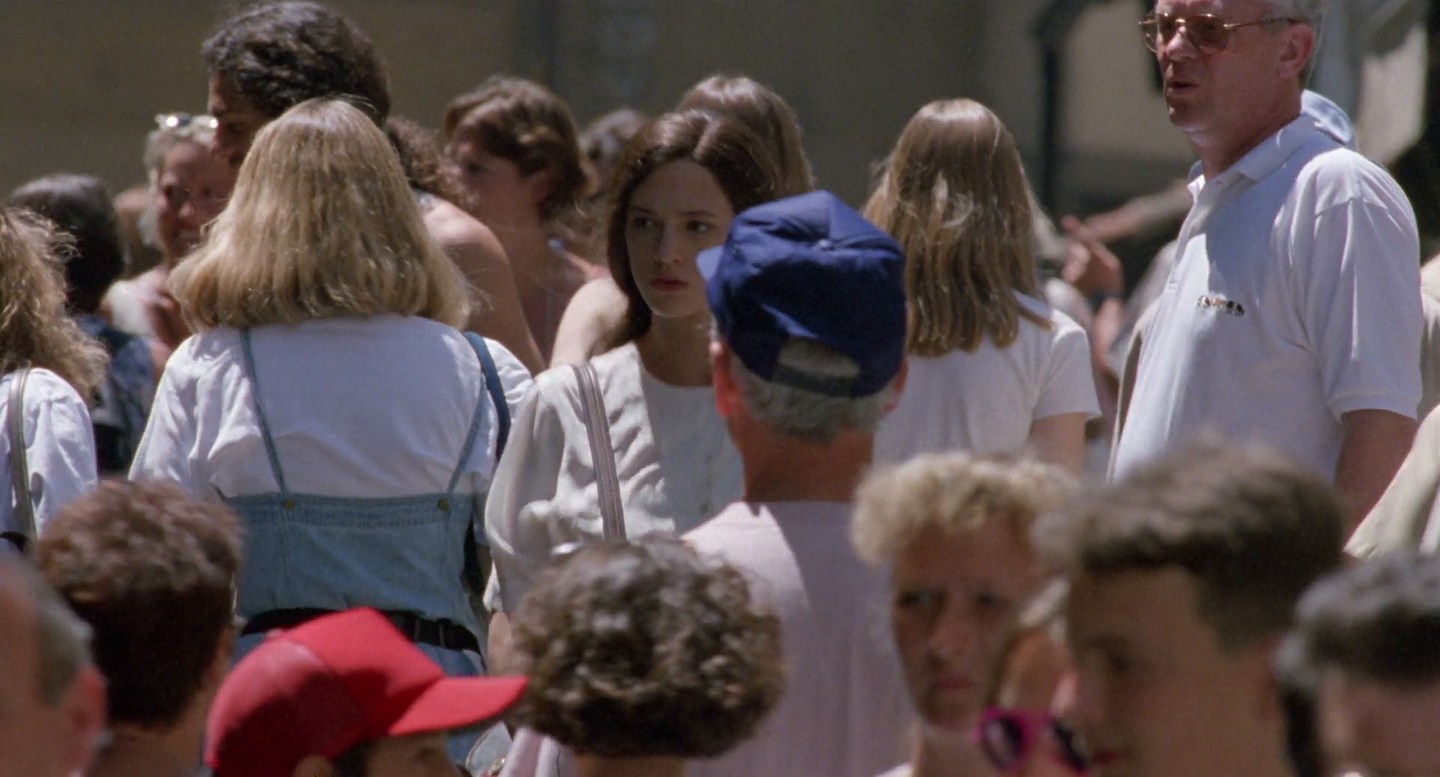
The opening street views make finding one person a problem of looking. Anna is alternately visible and obscured by other visitors. The city presents a moving field of faces before the gallery presents its fixed ones.
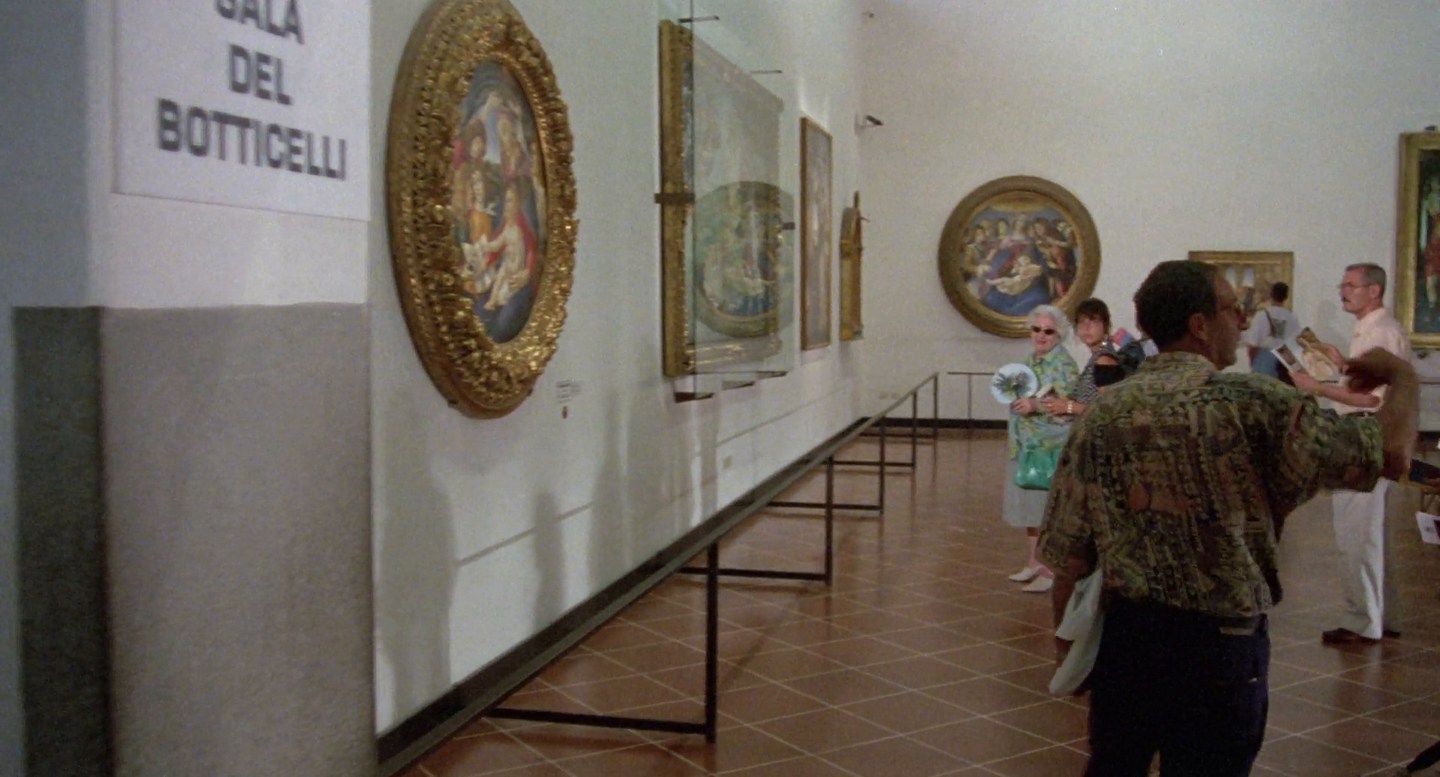
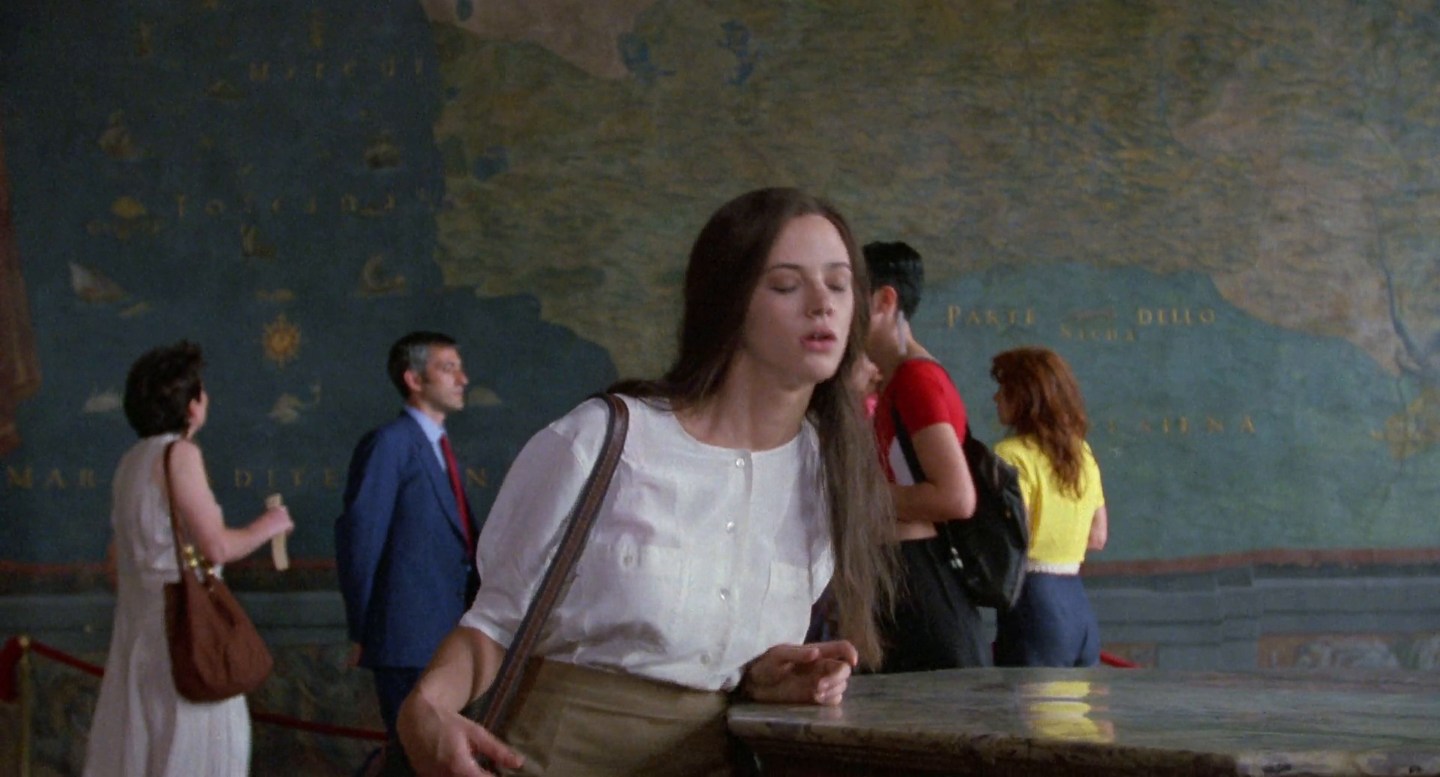
The room supplies a clear route through art, with frames along the wall and people moving through the centre. Anna’s increasing disorientation unsettles that readable arrangement. Looking ceases to be an activity she can simply stop.
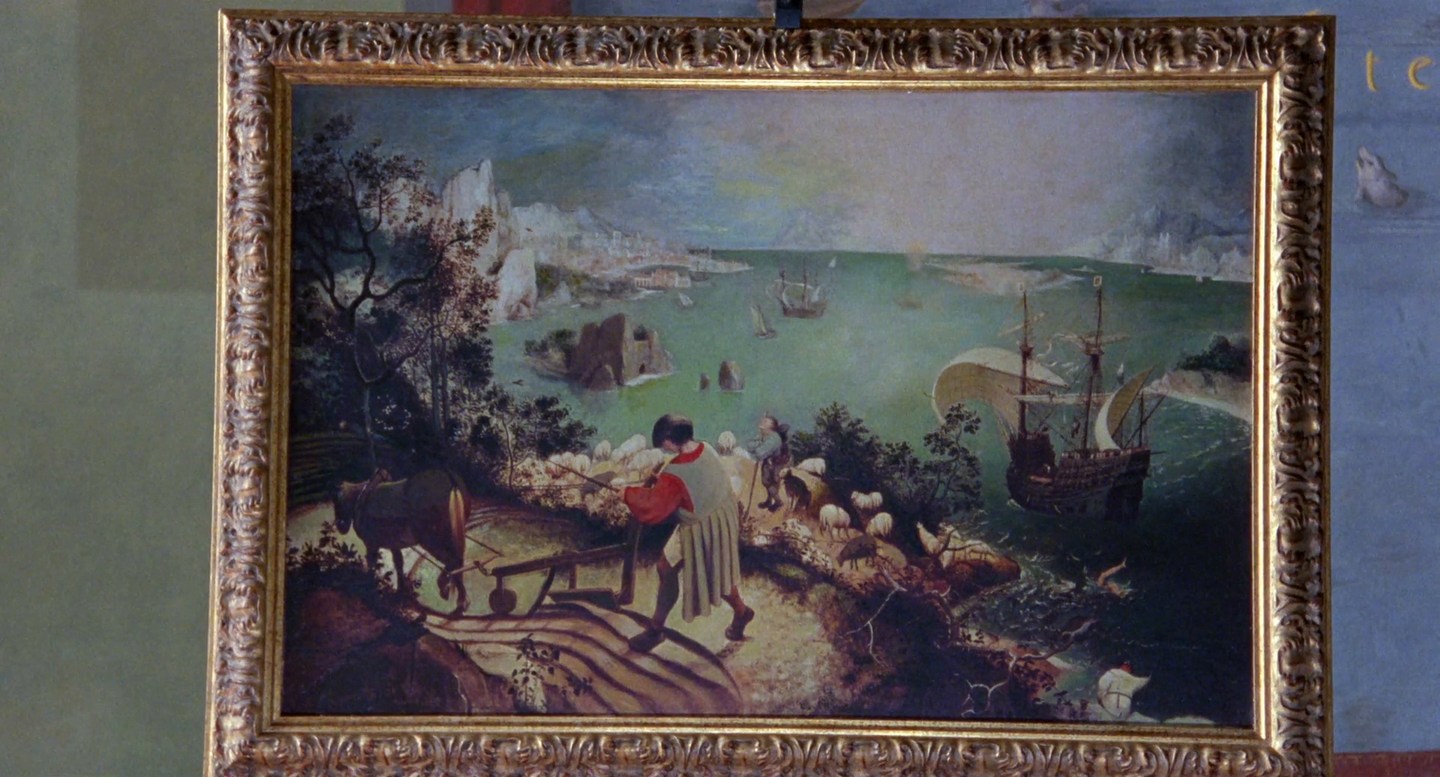
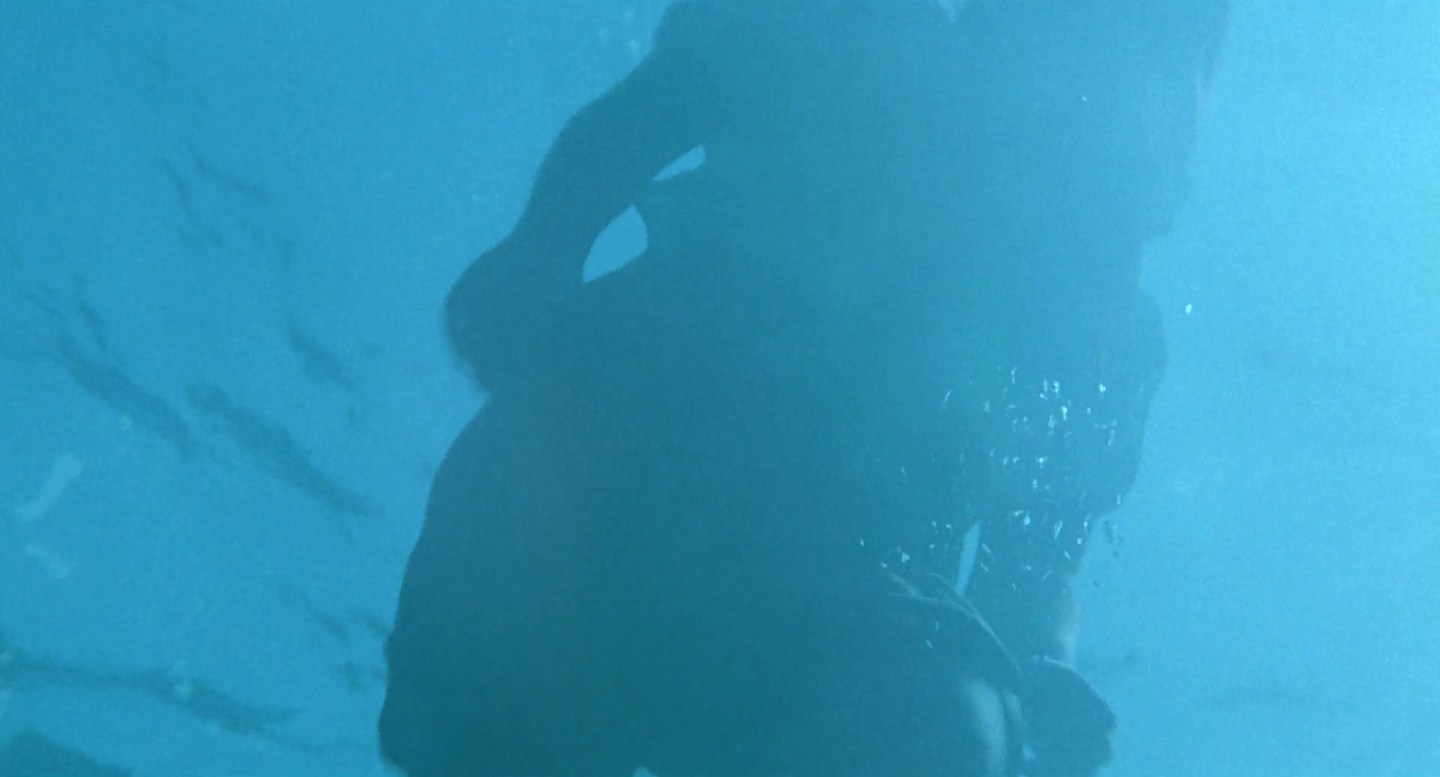
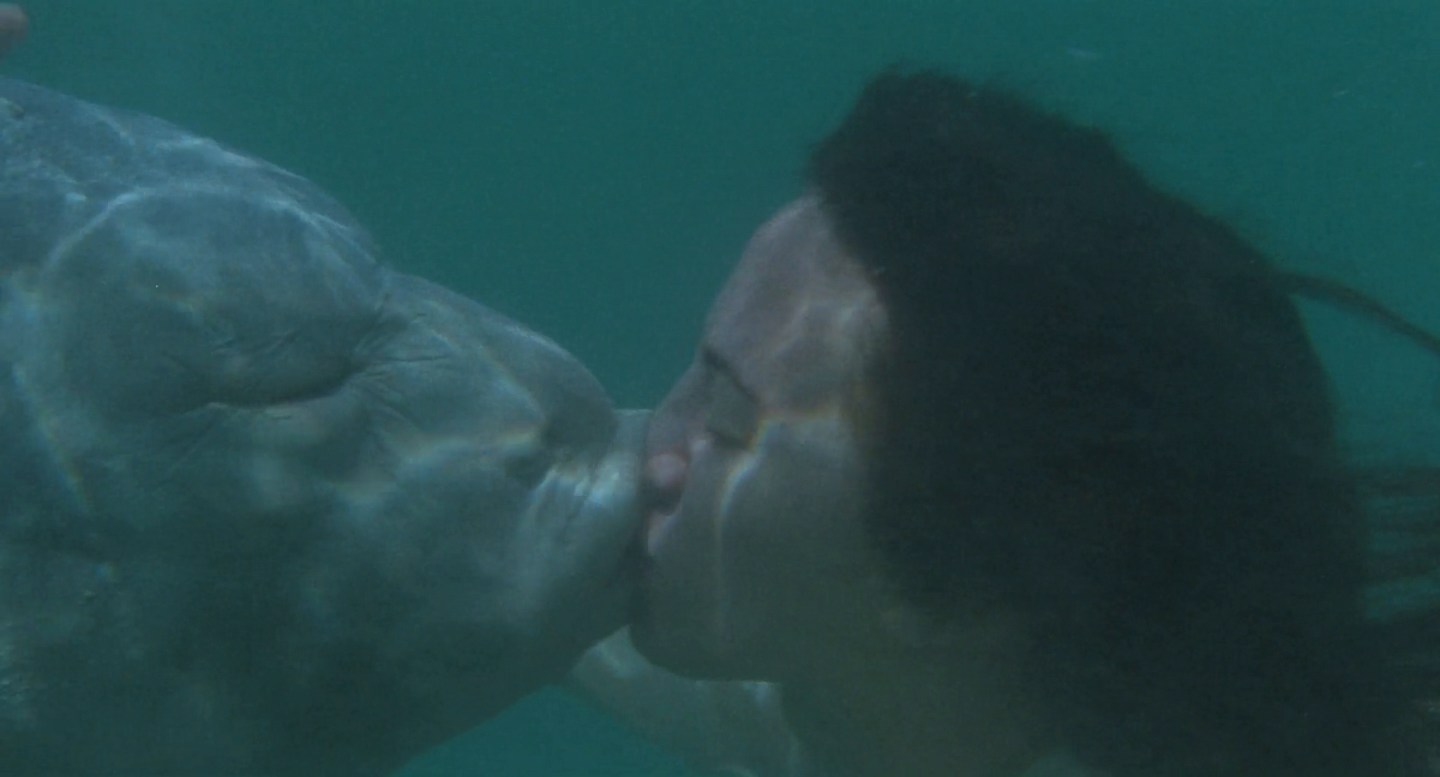
A framed seascape gives way to an underwater encounter. The boundary between spectator and image disappears: Anna occupies the element she was looking at. Her return to the gallery floor makes that impossible passage a bodily event.
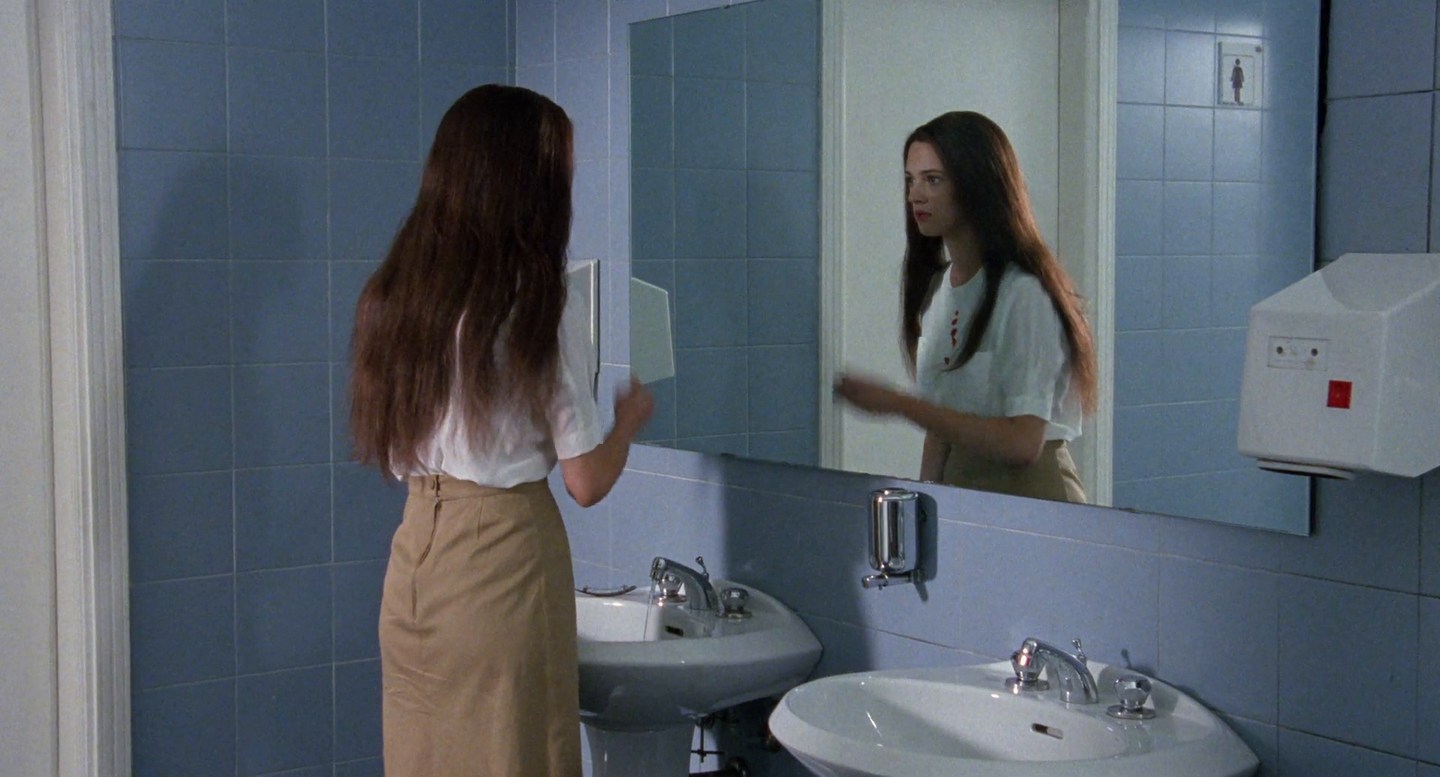
ENLARGE ↗Anna faces herself in the washroom mirror.
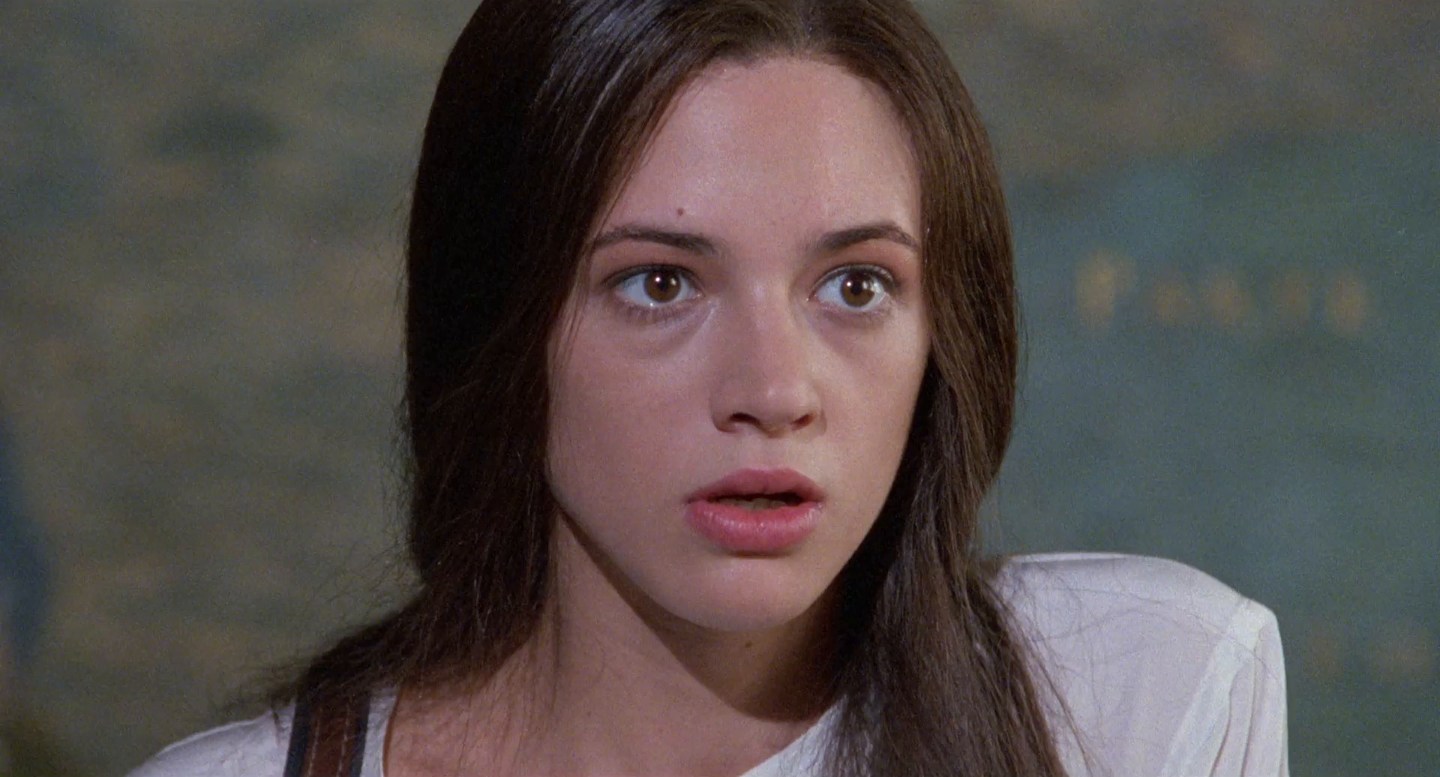
The mirror restores a recognisable room and a visible body after the submerged passage. Yet recognition is now a task, rather than something automatic. Repeated mirror scenes will make changes of hair, costume and expression central to the investigation.
09:15
The helpful stranger
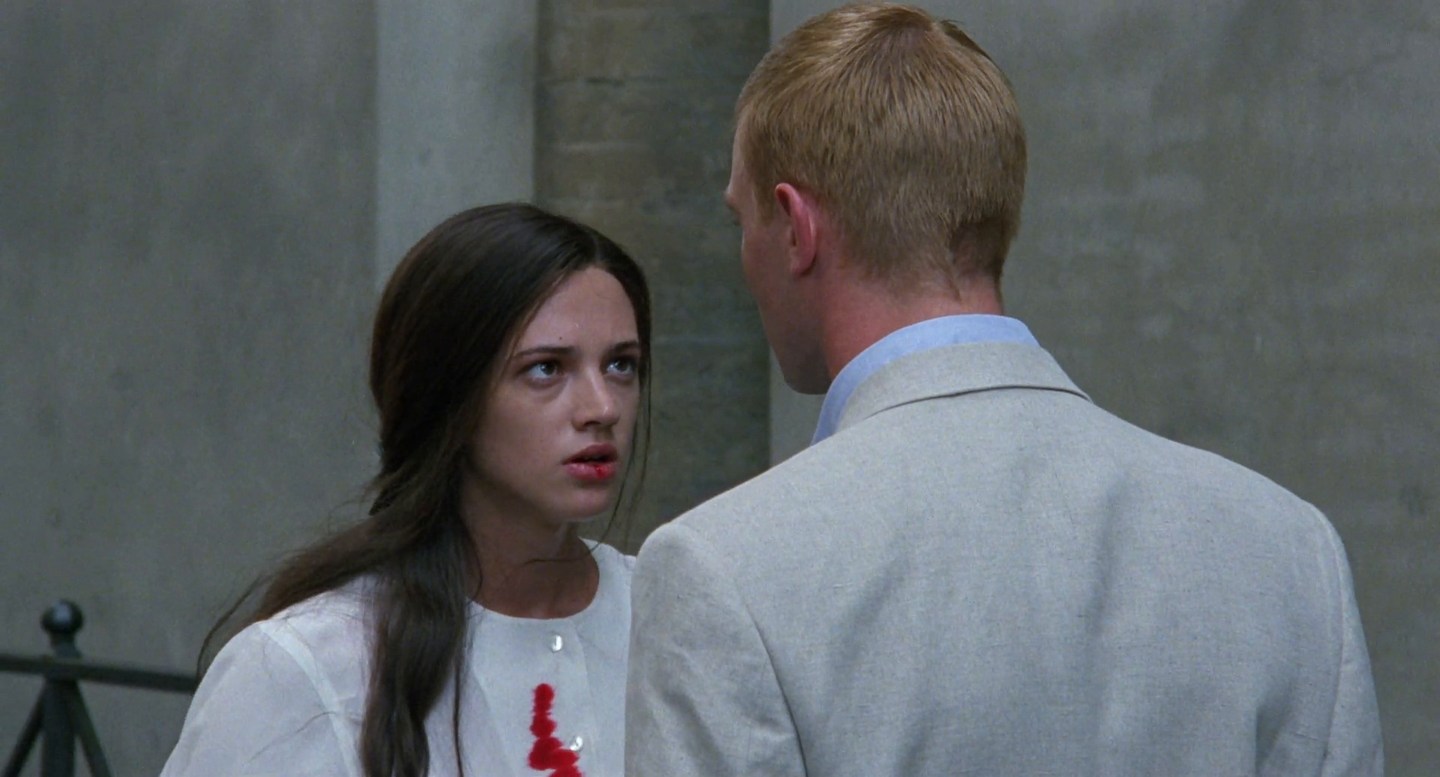
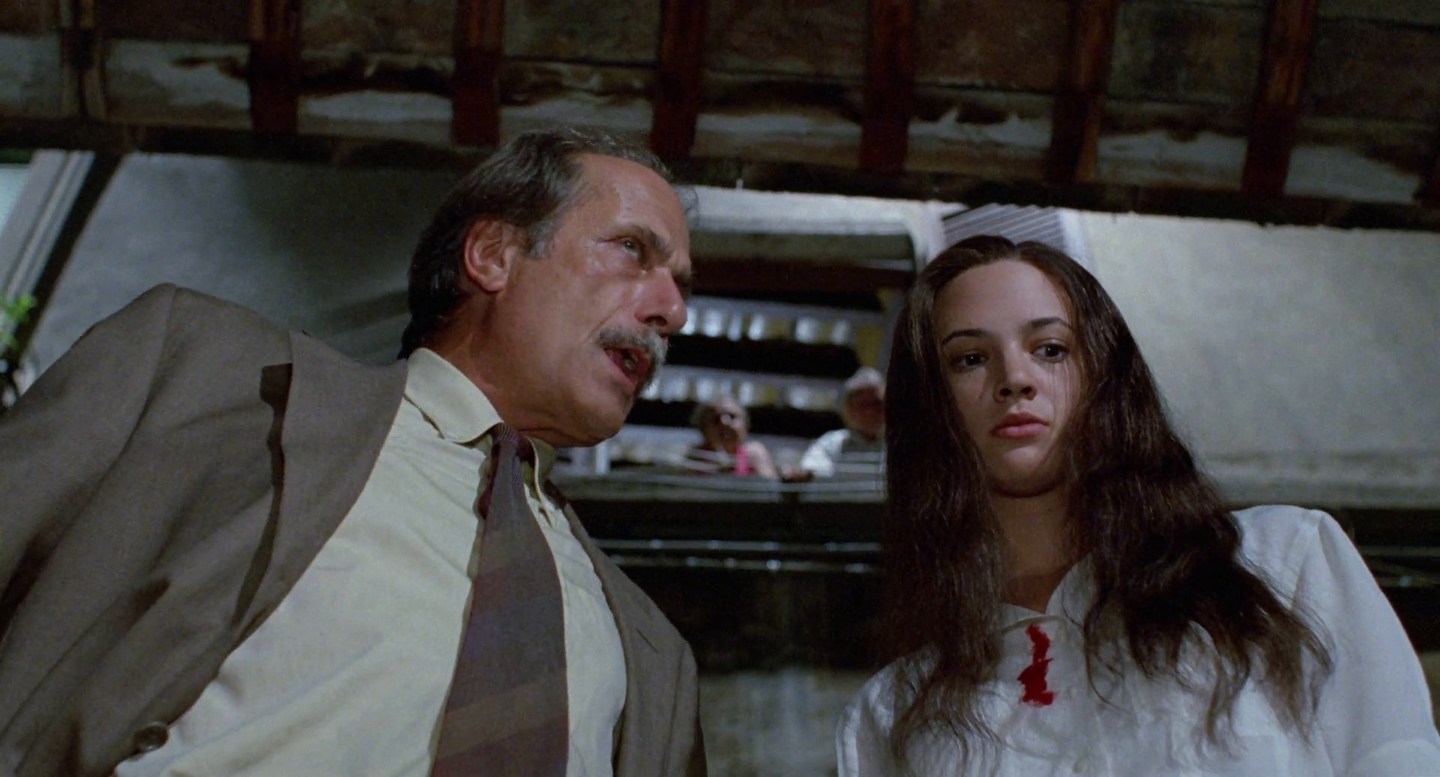
ENLARGE ↗Alfredo stands beside Anna outside the gallery.
The pale suit and open public setting give Alfredo the appearance of ordinary assistance. The later revelation changes the meaning of this first encounter. A face can be visible without becoming intelligible.
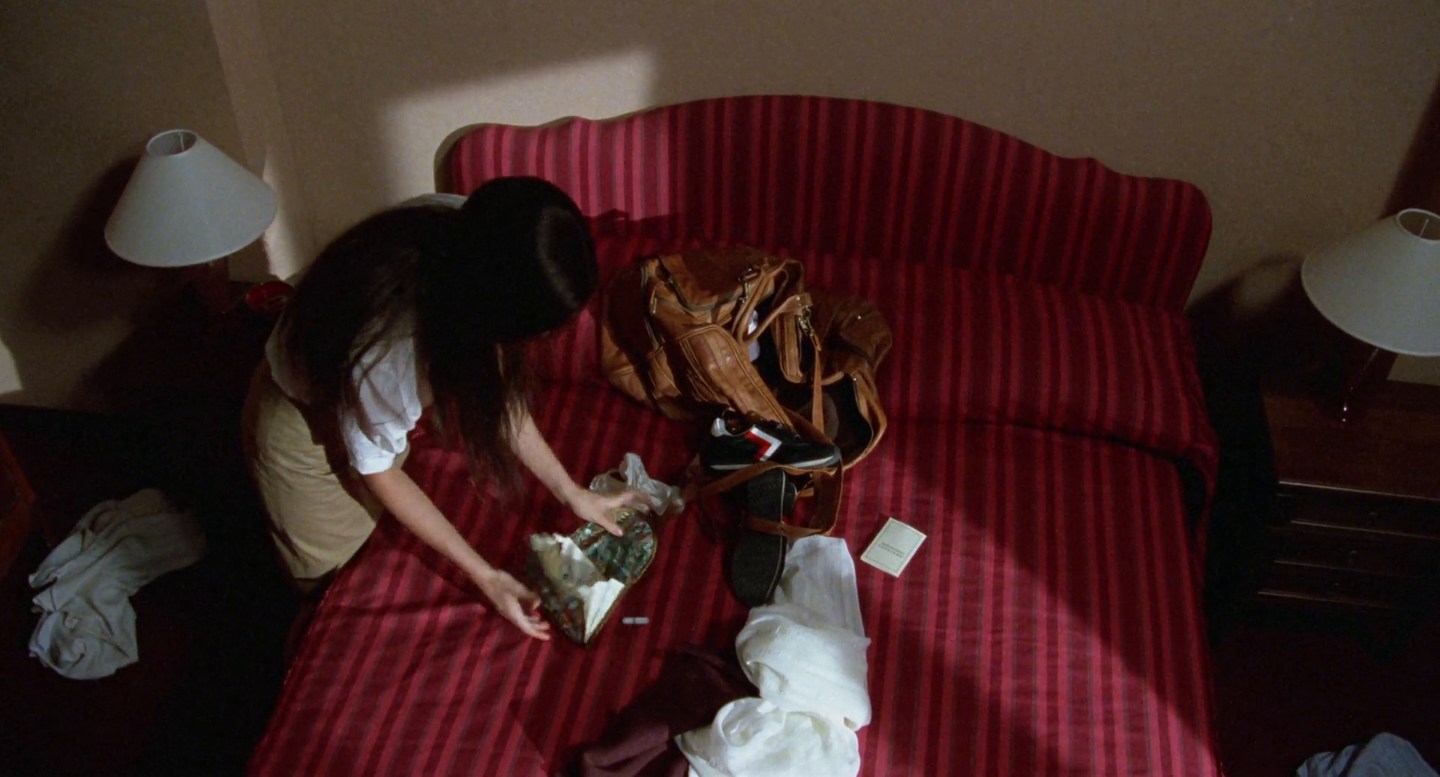
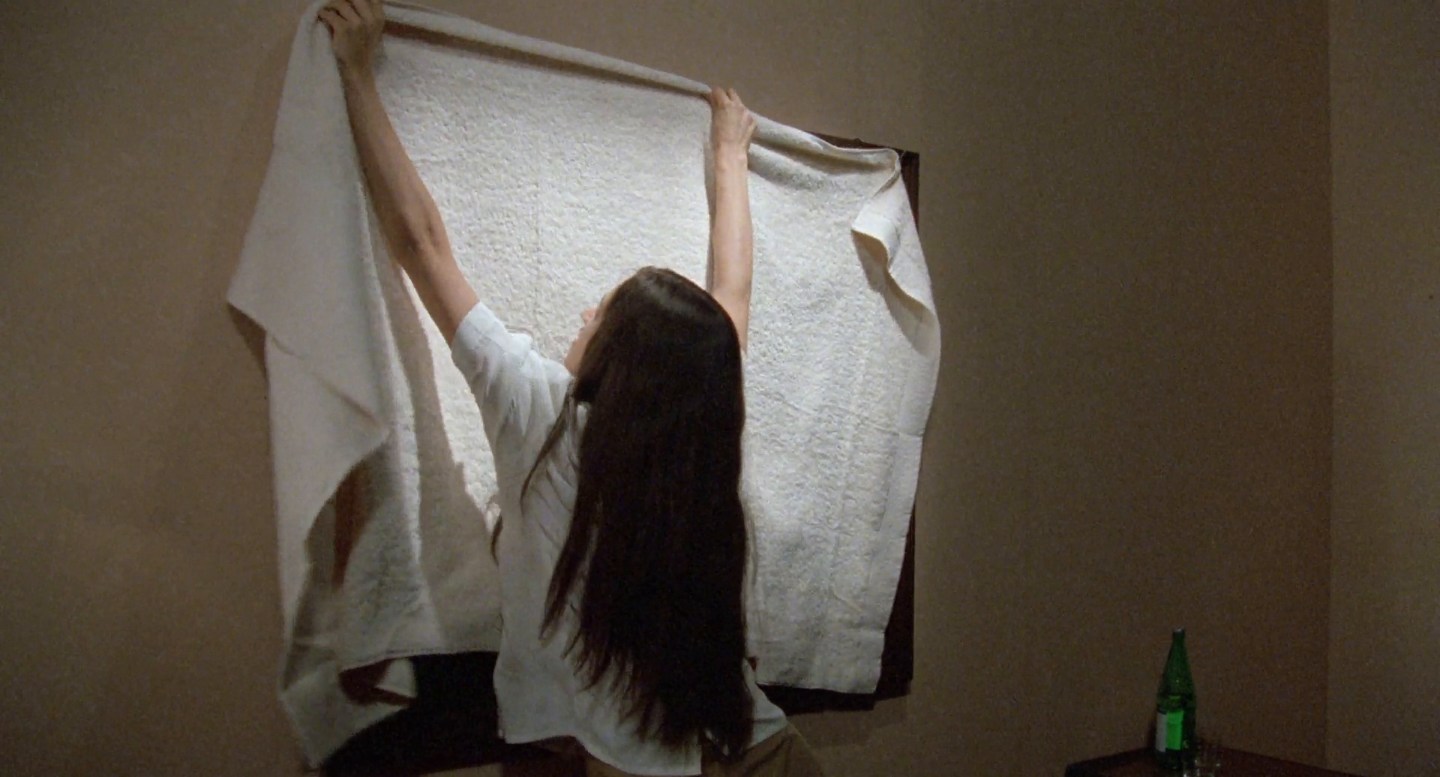
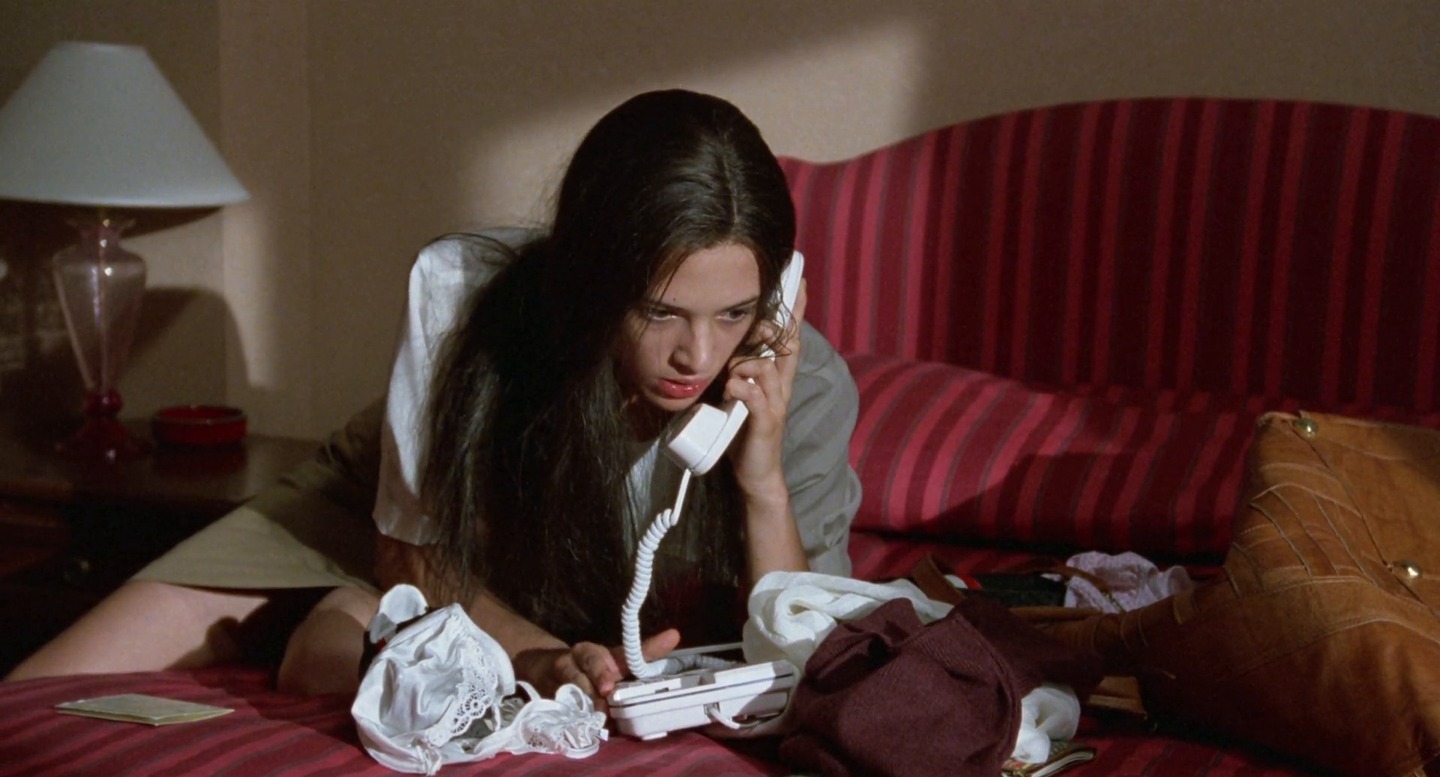
Personal possessions spread across the red bed become clues to identity. The detective’s attention turns towards her own belongings. The arrangement makes the familiar procedures of an investigation strangely intimate.
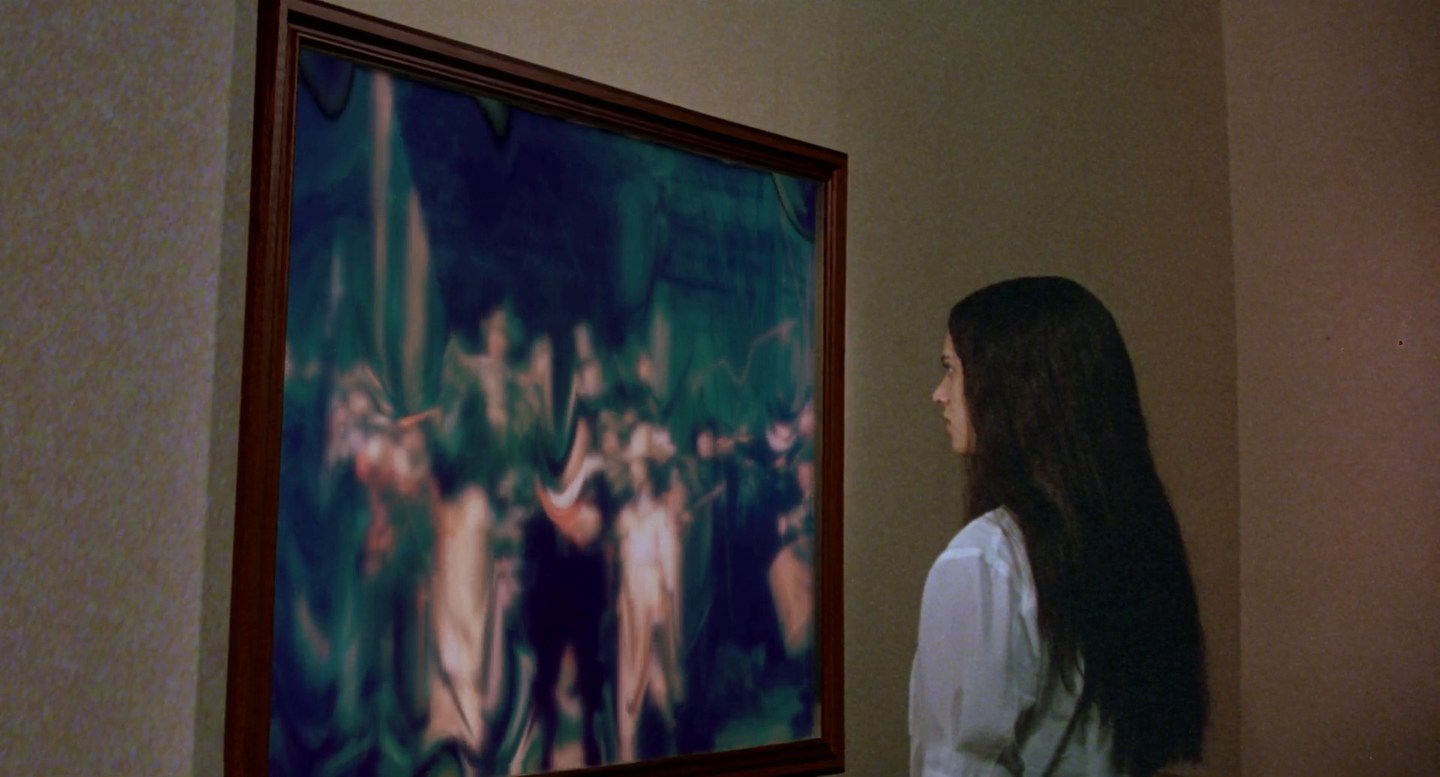
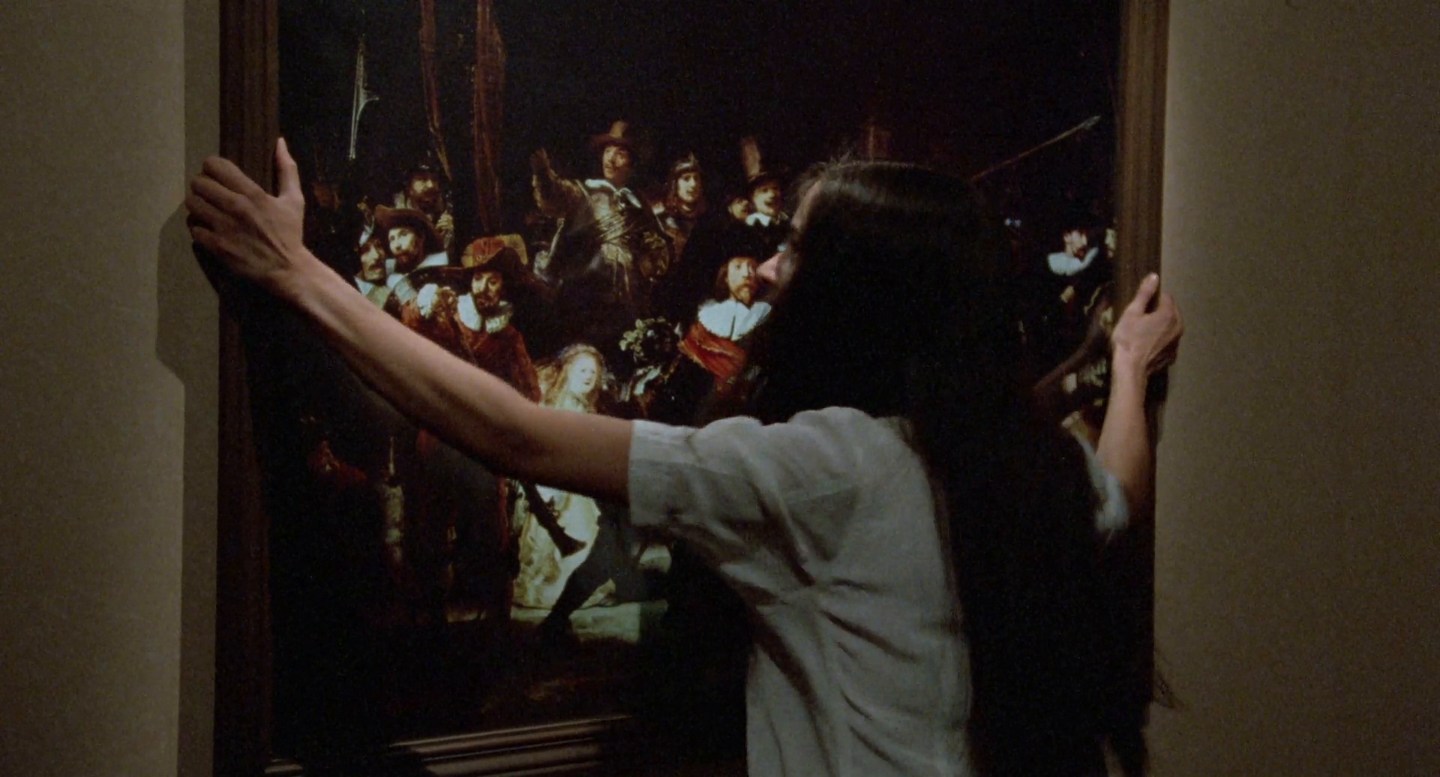
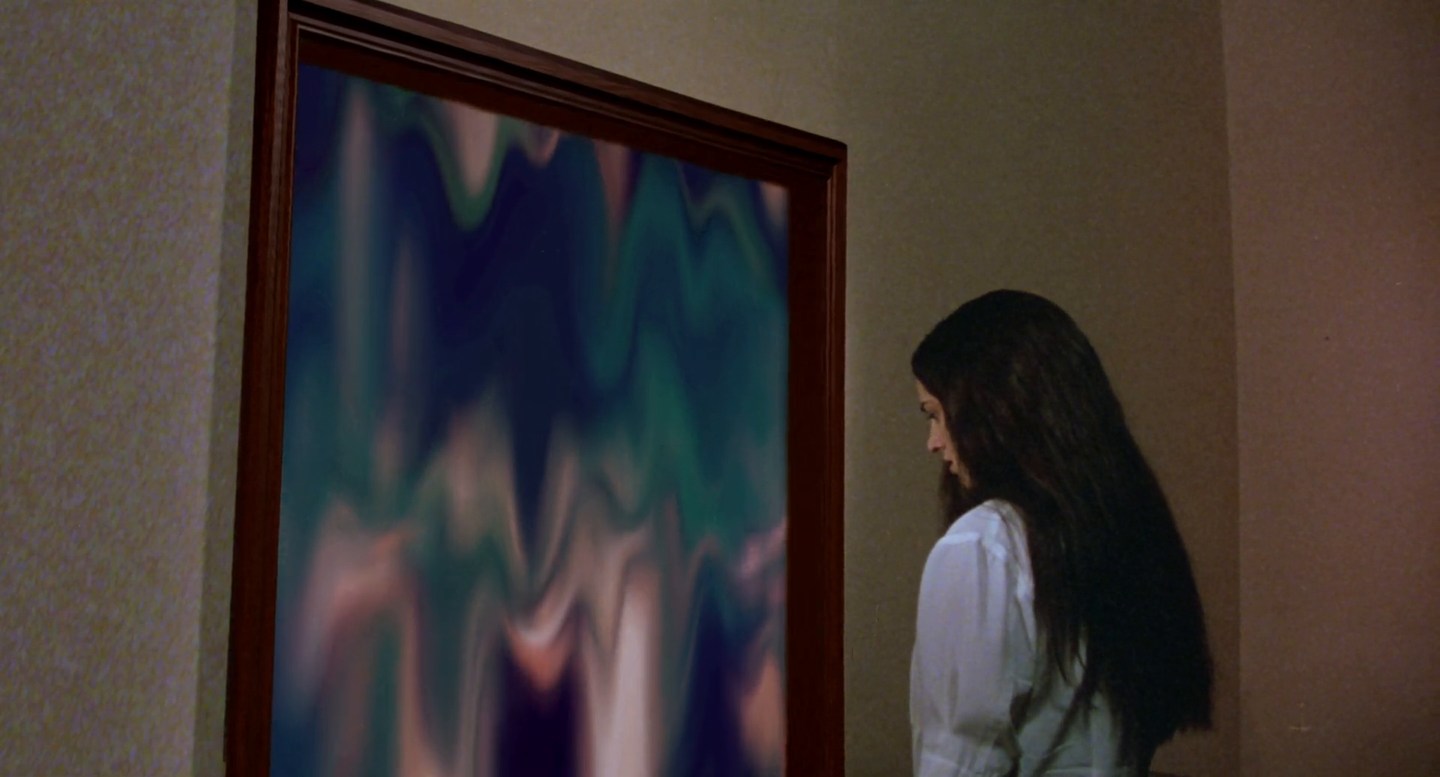
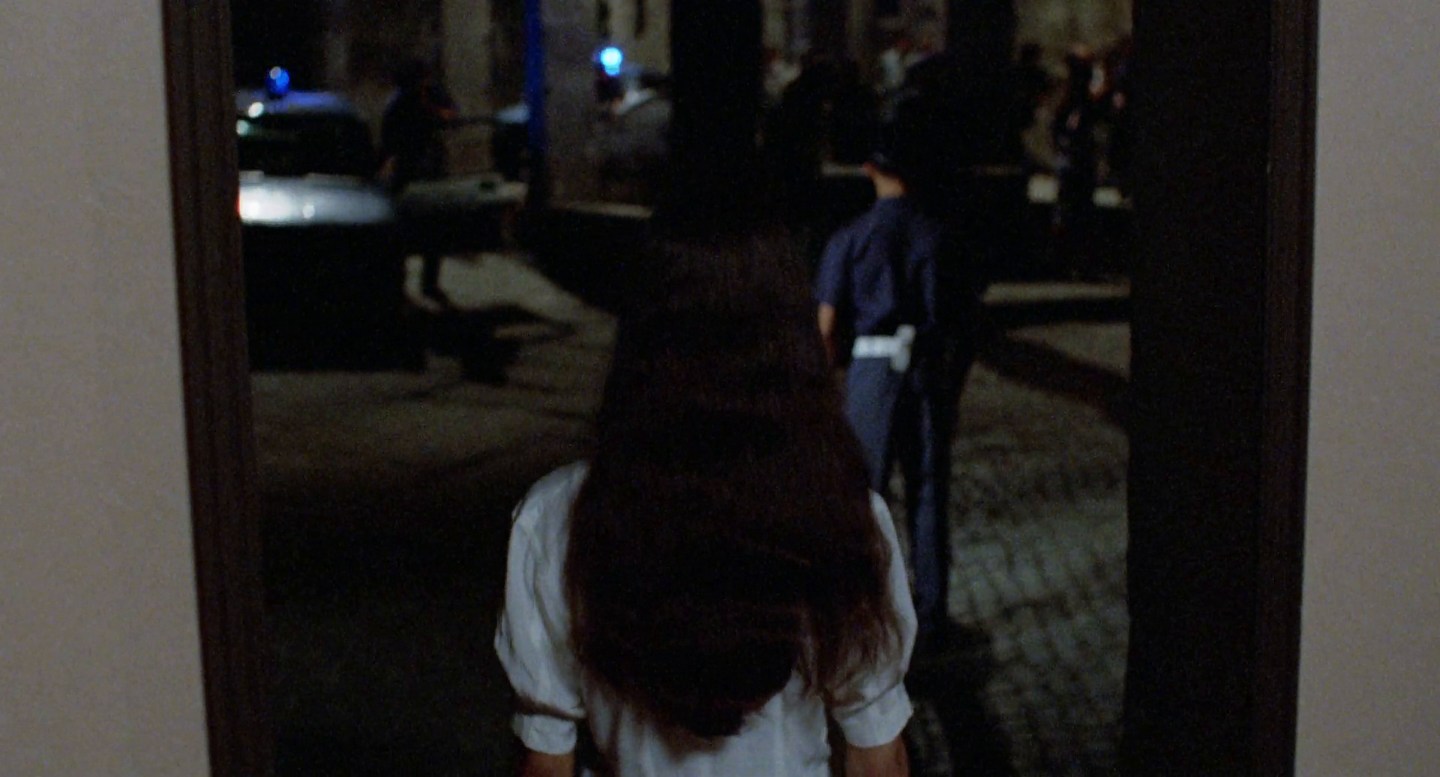
Covering the reproduction does not end its hold on the room. Its surface changes, and Anna’s view passes into a night-time police investigation. The transition links a painted assembly to a contemporary gathering without first restoring a secure present.
ENLARGE ↗Anna and Manetti look towards the recovered evidence.
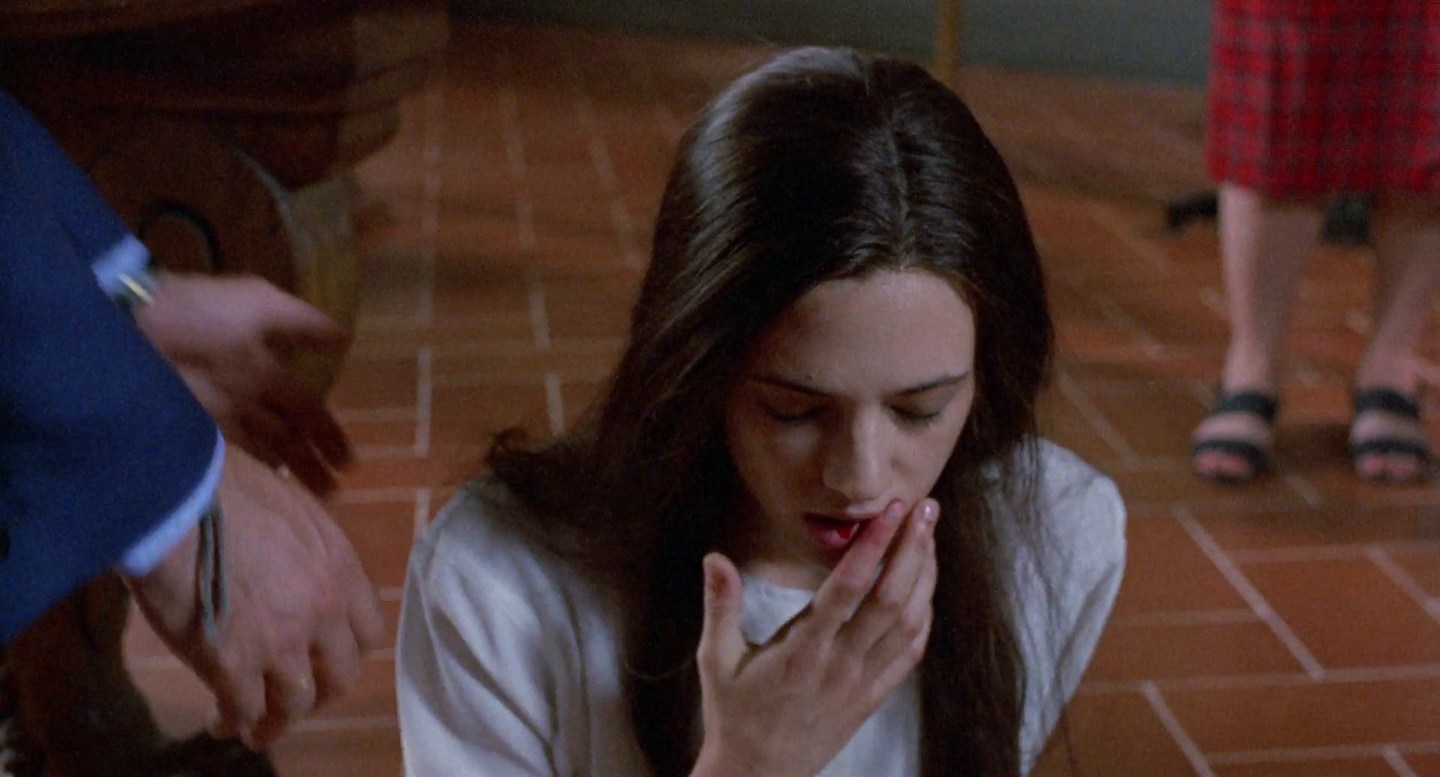
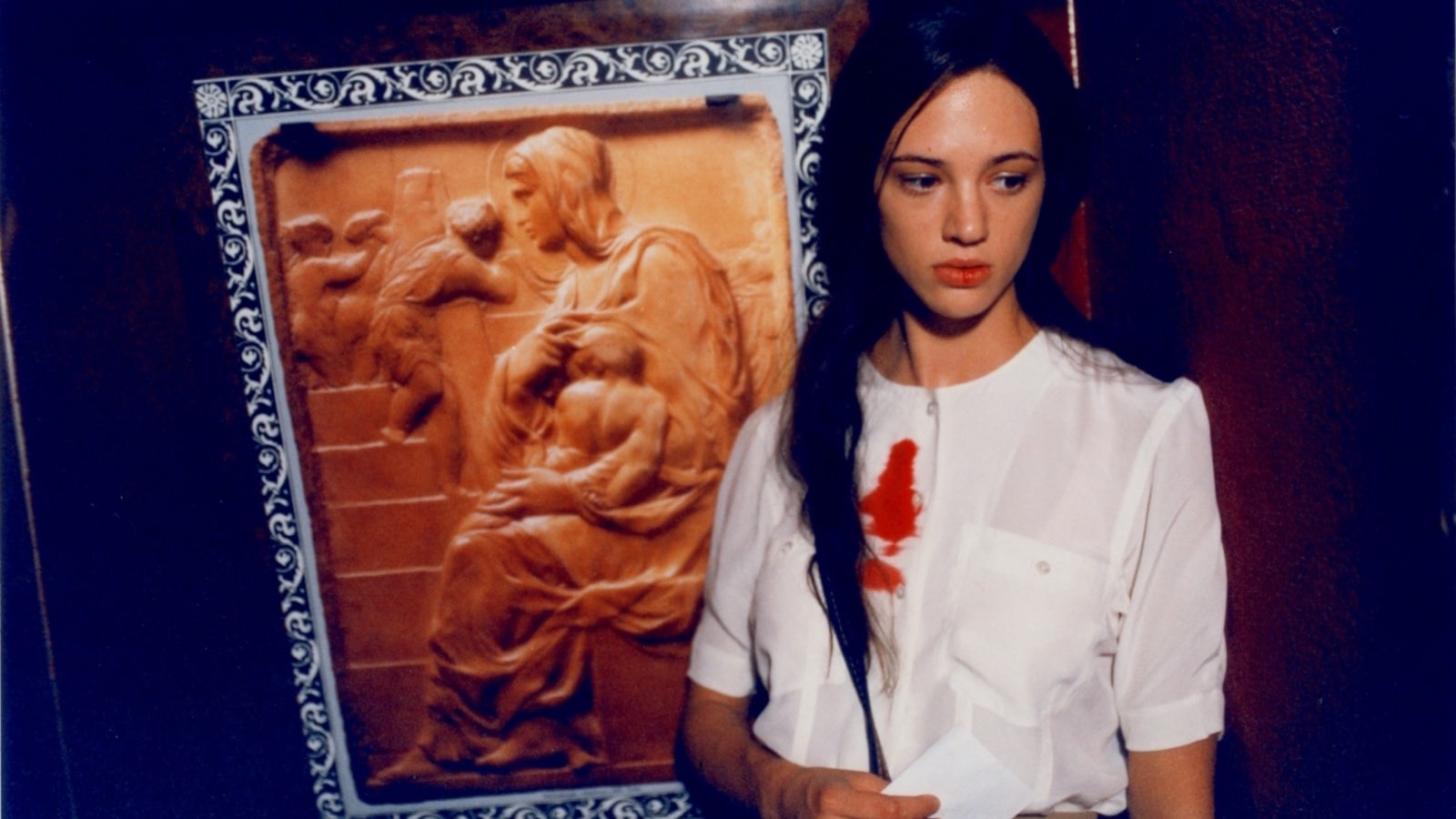
The blood-marked white shirt accompanies Anna into the remembered investigation. Her body carries one time into another. The past becomes accessible, but the route to it remains visibly contaminated by the present.
22:45
A witness reaches the street
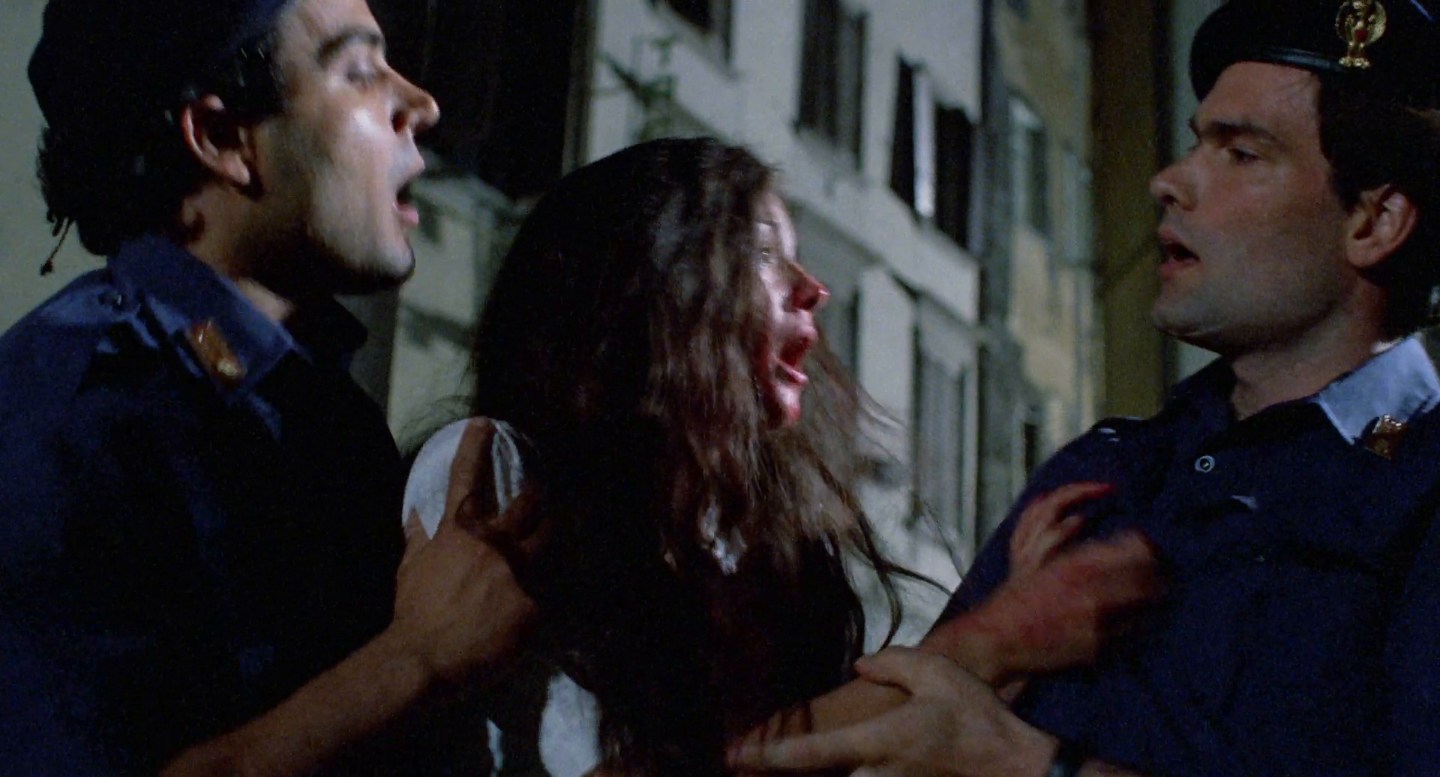
ENLARGE ↗Uniformed officers meet Anna after her escape.
The passage out of the hotel changes the film’s social space. Anna’s account must now pass through police and medical institutions. The public encounter gives her witnesses, but it does not return her immediately to the authority she held before the attack.
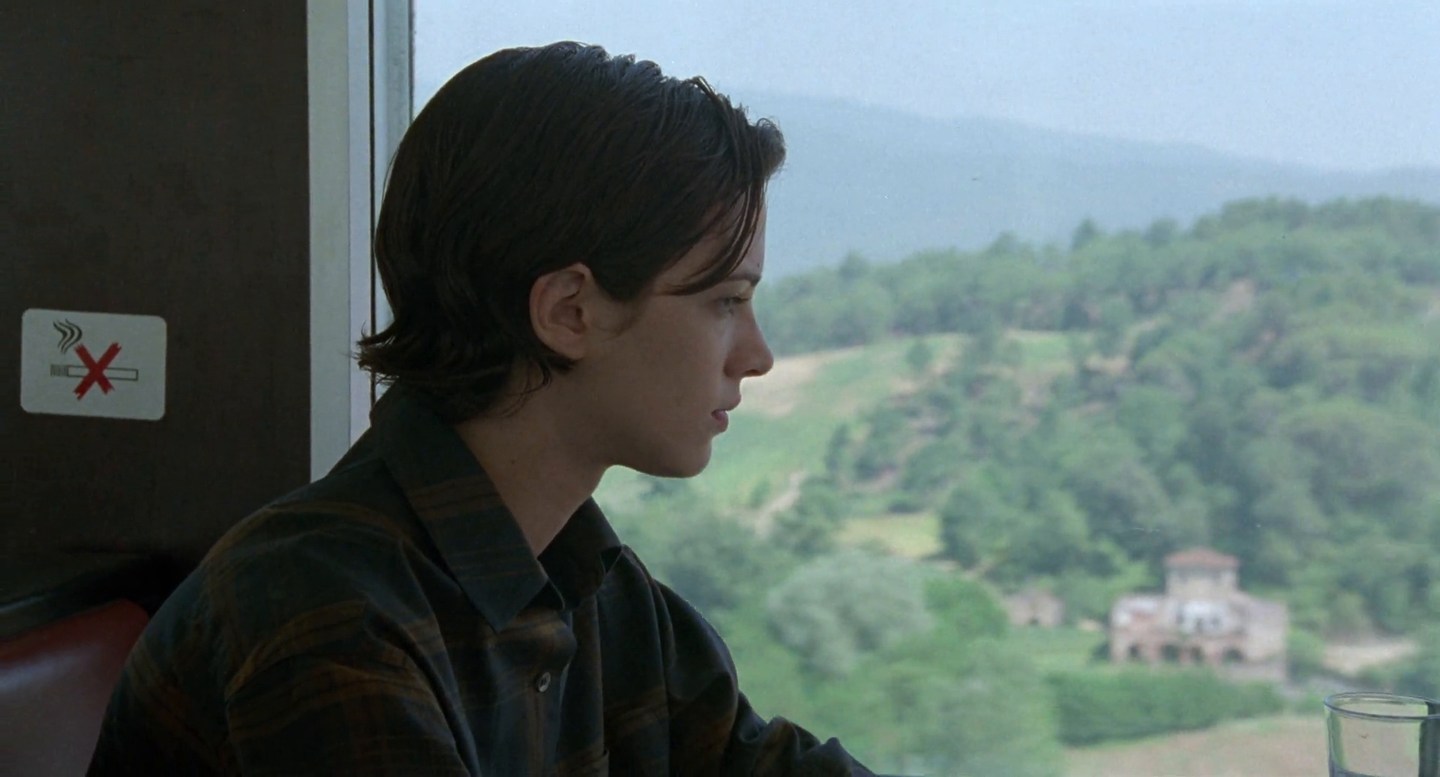
The train window places the landscape beside a changed profile. Hair and clothing make a break visible before it can be explained. The film will repeatedly offer a new exterior without allowing it to settle the question of recovery.
28:45
The landscape opens
ENLARGE ↗A stone enclosure appears within the painting’s frame.
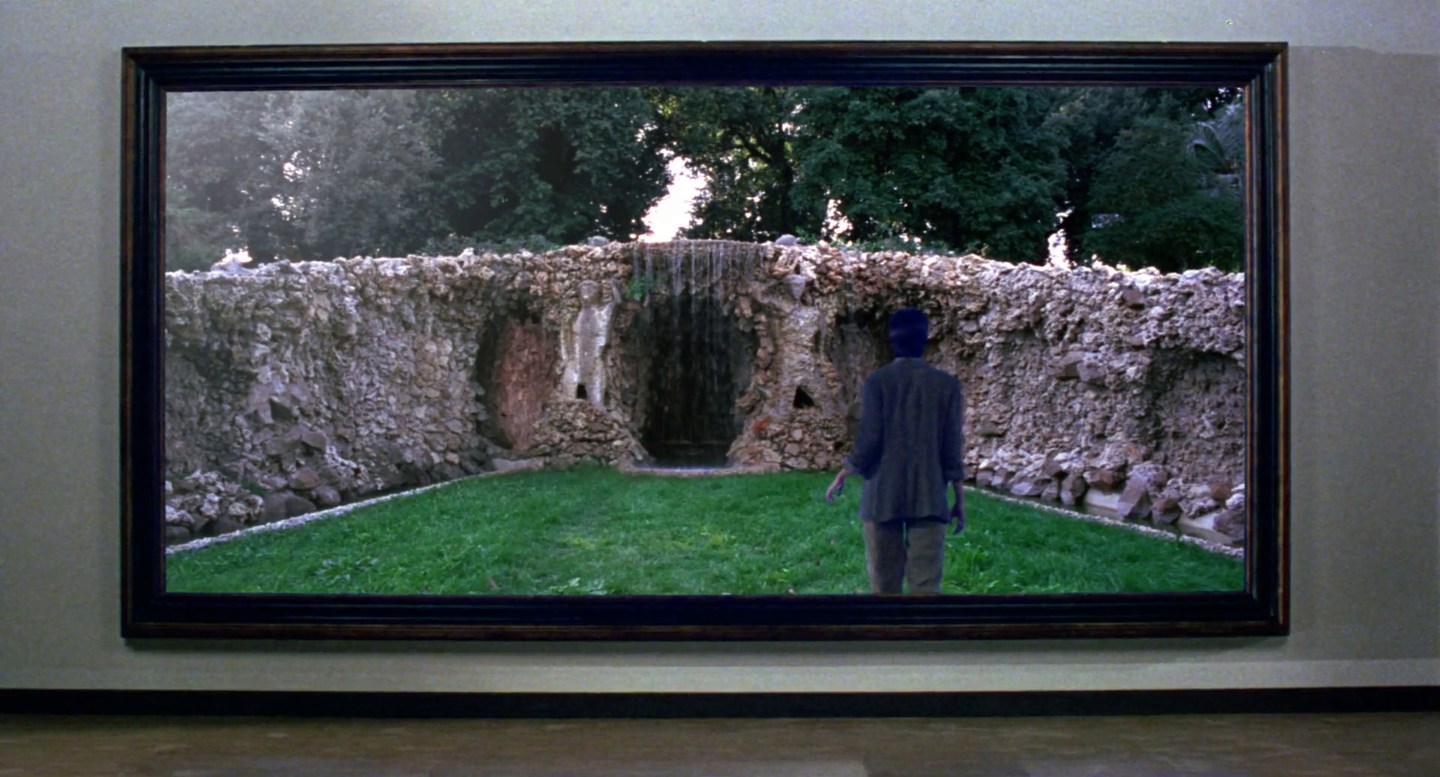
The landscape’s border remains visible while its interior becomes a space to enter. This is a different relation to art from the collapse in the Uffizi: the image offers an enclosed destination. Its apparent depth competes with the surrounding room.
35:15
An explanation across the desk
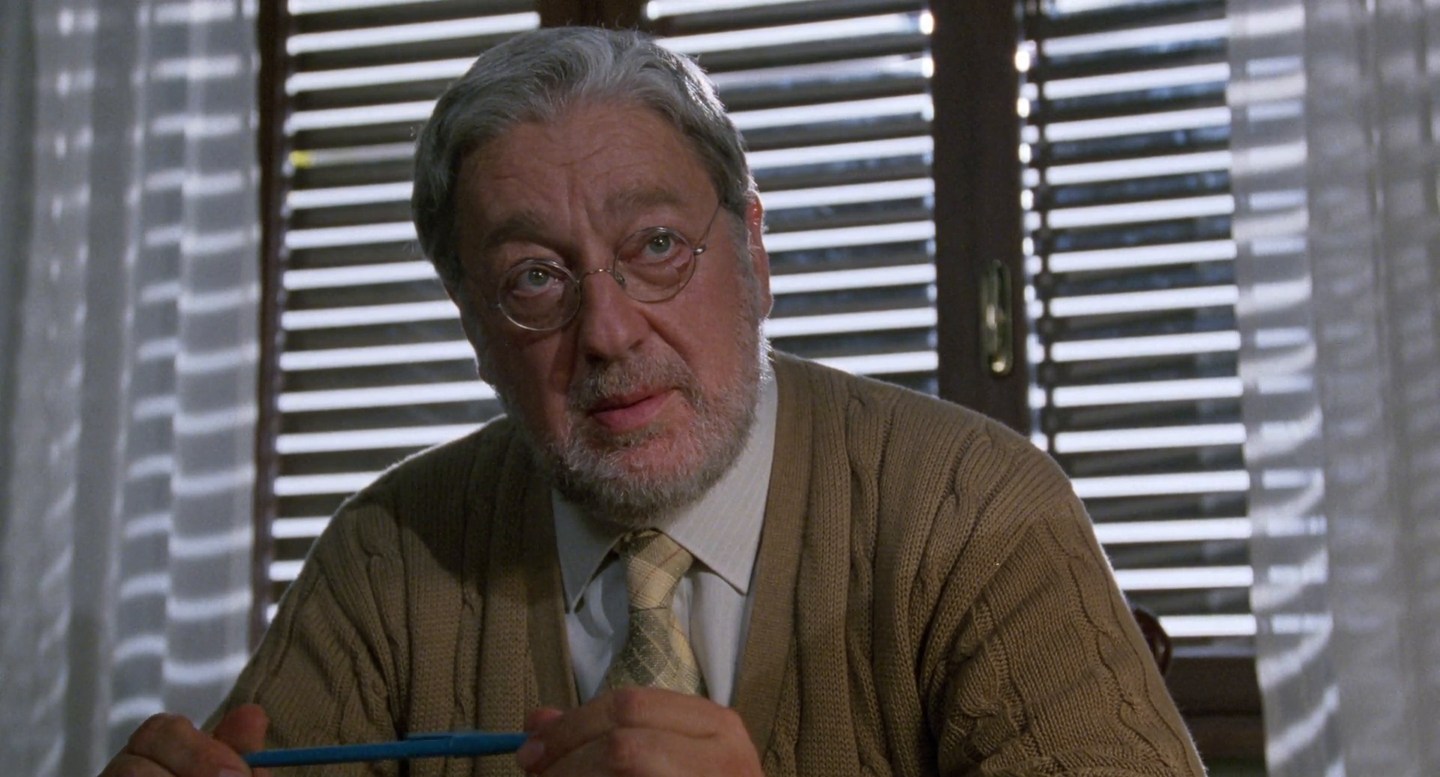
ENLARGE ↗The psychiatrist faces Anna beneath the window blinds.
The desk and alternating faces organise the consultation as an exchange of explanations. Anna’s experiences are brought into the language of another person’s authority. The later return of this setting makes that authority increasingly precarious.
37:45
Closeness under pressure
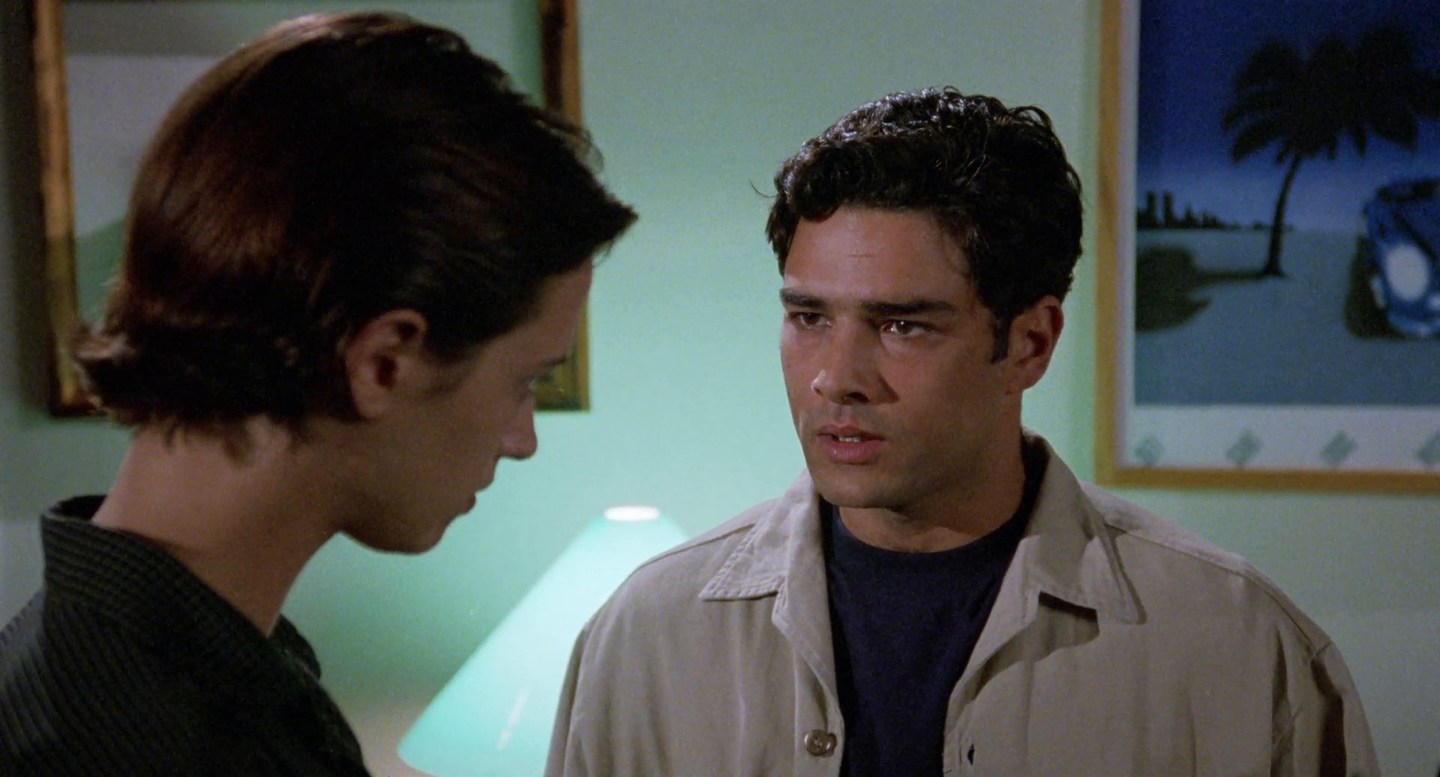
ENLARGE ↗Anna and Marco stand close together in her room.
The domestic room offers a different kind of contact from the police station or consulting room. Their proximity does not ensure mutual understanding. Marco’s attempts to reach Anna become part of the film’s recurring difficulty in distinguishing care from control.
43:45
A place at the table
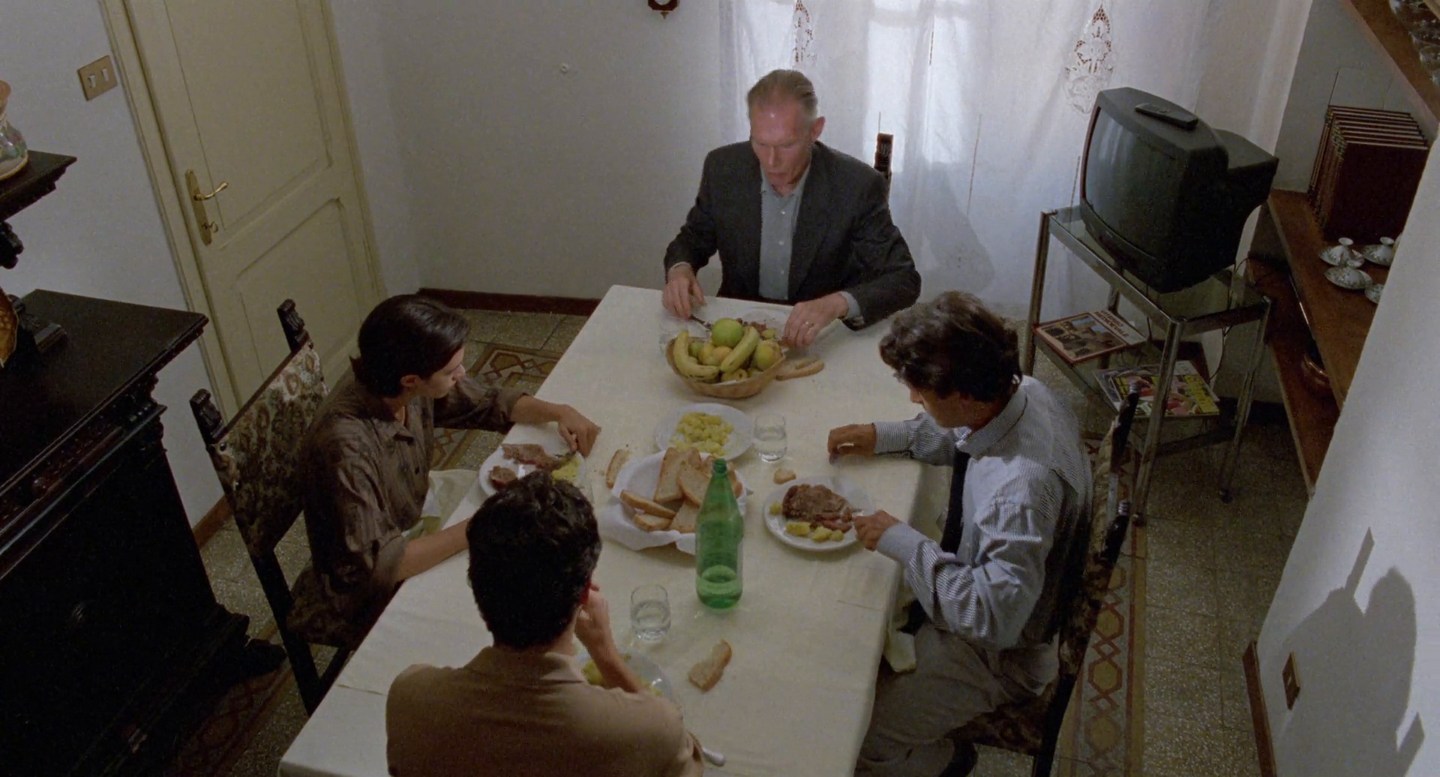
ENLARGE ↗Anna sits with her family around the kitchen table.
The high view gives every person a place within a small shared room. Familiarity promises a return to an earlier life. The formal completeness of the table contrasts with Anna’s inability simply to resume that life.
47:26
Training the body
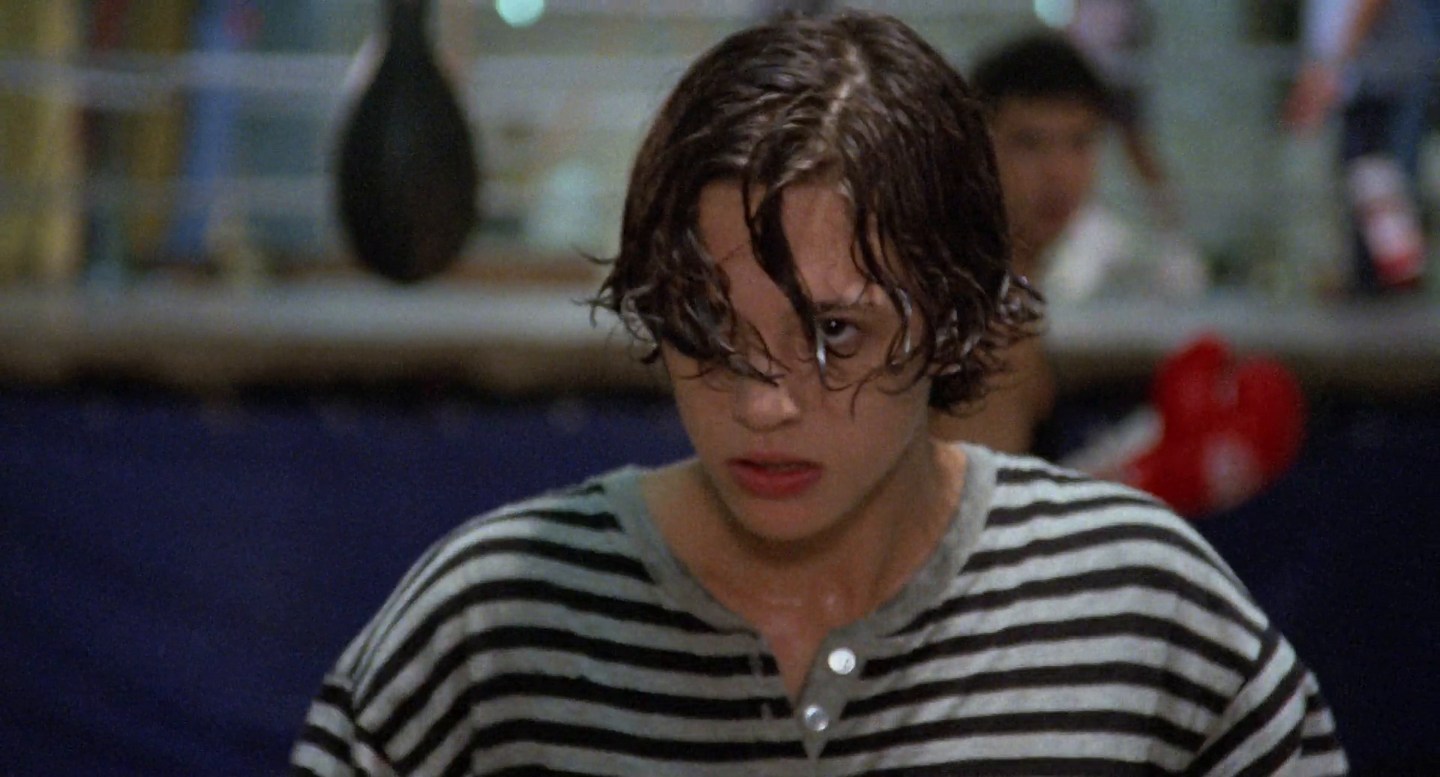
ENLARGE ↗Anna watches from inside the boxing ring.
Gloves, ropes and spectators organise violence as a controlled exercise. Anna’s changed posture belongs to the film’s changing account of her body. The ring provides rules and limits that the attacks elsewhere refuse.
48:30
Another woman, another route
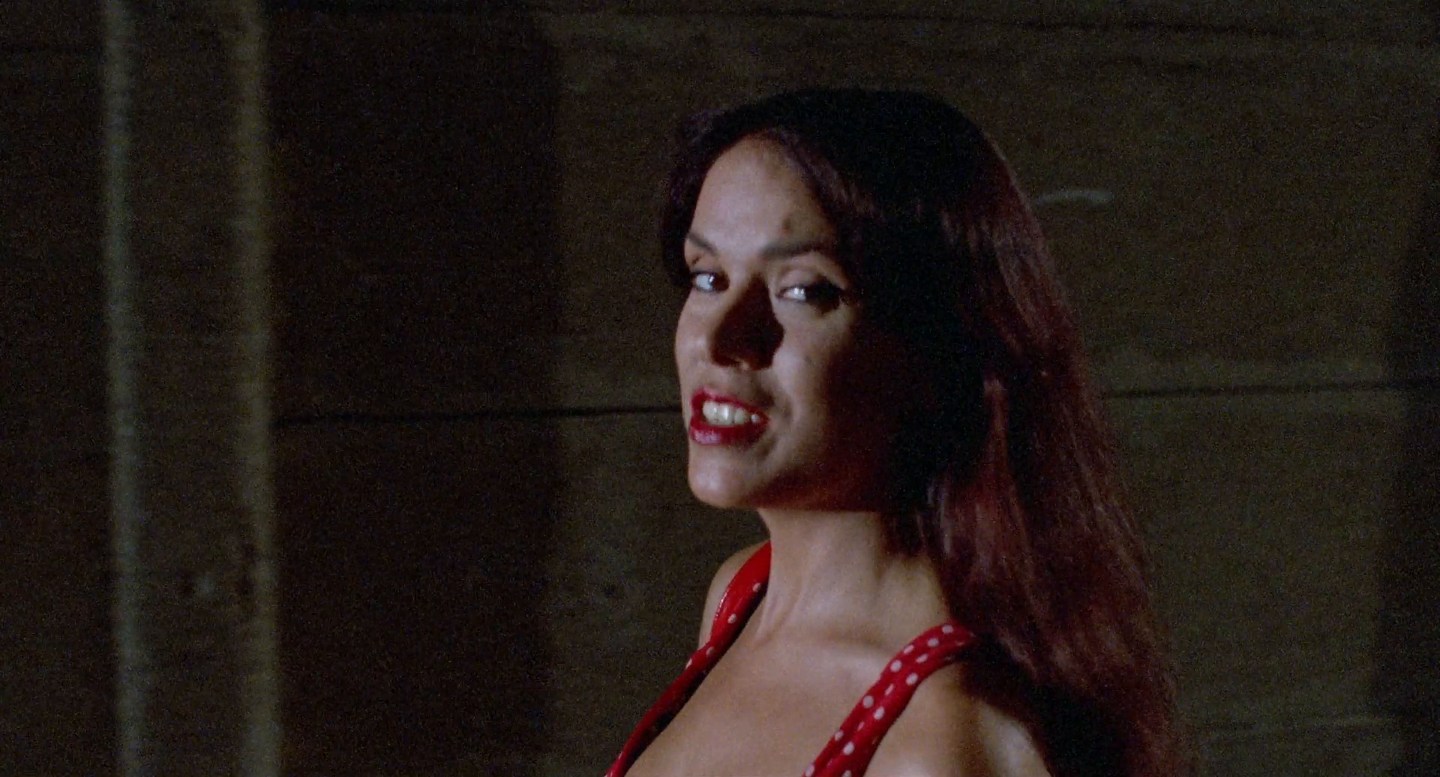
ENLARGE ↗A woman in red turns towards the following figure.
The red dress remains conspicuous as the route moves from shopfronts towards enclosed industrial space. The sequence makes pursuit a problem of access and separation. Its change of setting removes the public witnesses who filled the opening streets.
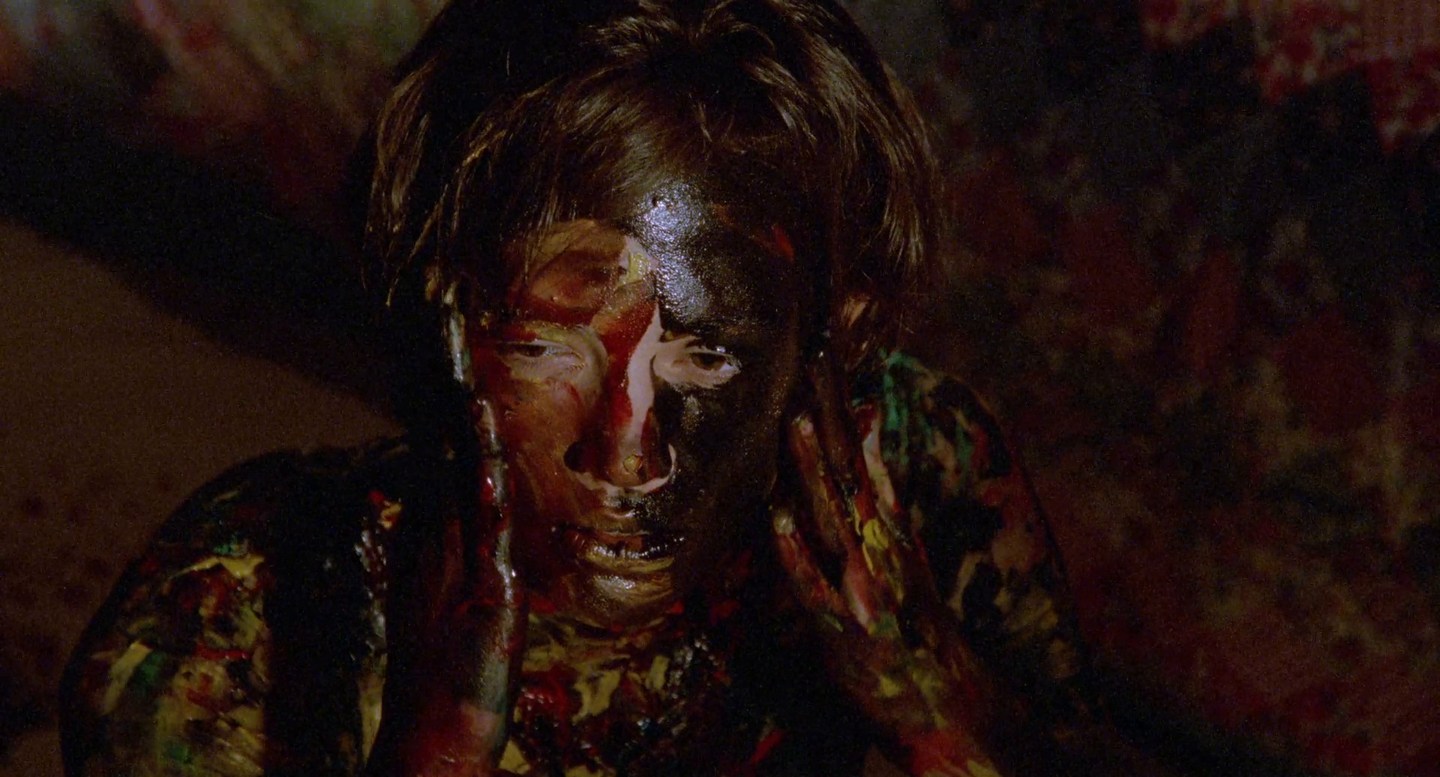
Paint spreads beyond the canvas and onto skin, floor and furnishings. The spectator who could not remain outside the image now makes her own body its surface. The close view concentrates on material colour and touch, rather than treating the room as an orderly studio.
56:30
The telephone reaches inside
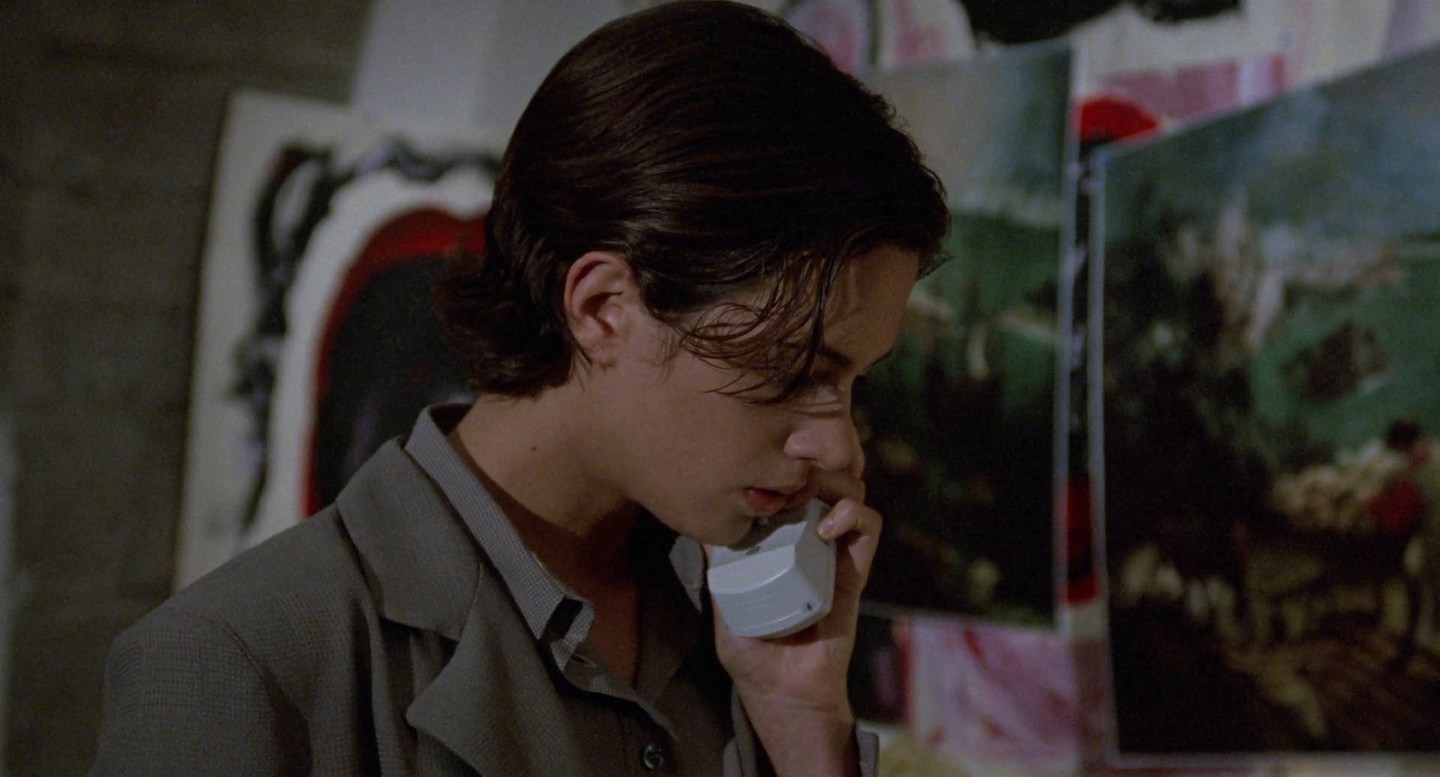
ENLARGE ↗Anna holds the receiver in the quiet room.
The receiver admits a distant speaker into an apparently private space. The caller does not need to be visible to control Anna’s attention. Later telephone scenes will test whether hearing a voice is the same as identifying a person.
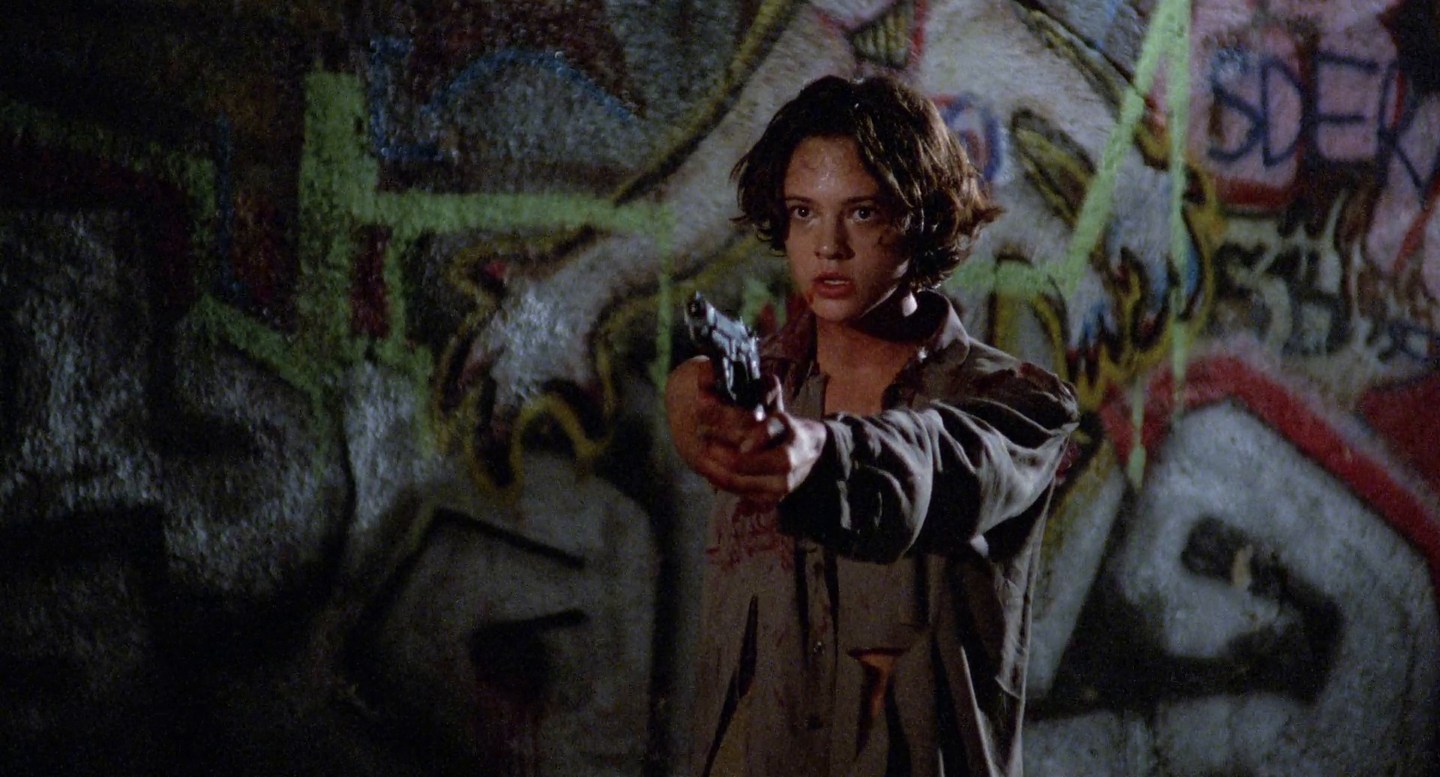
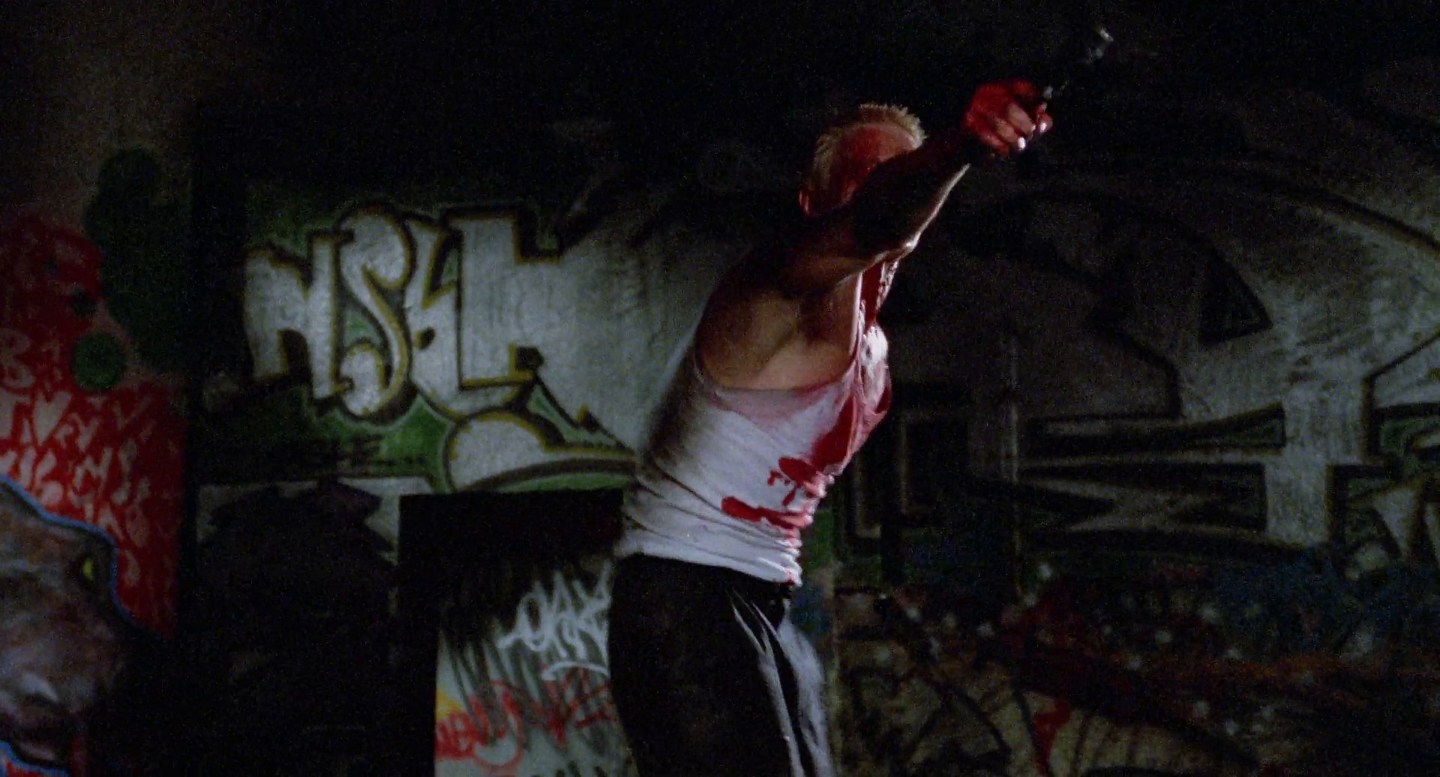
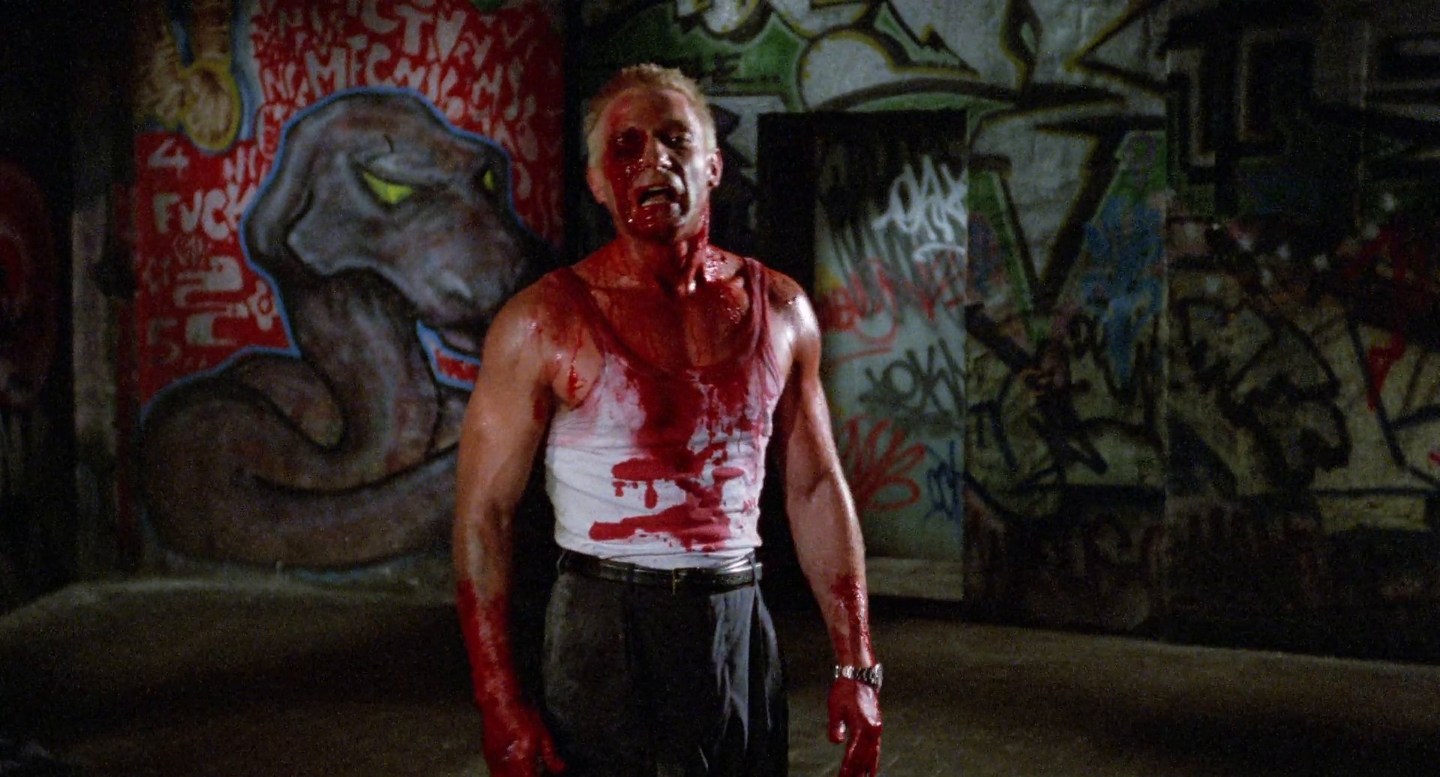
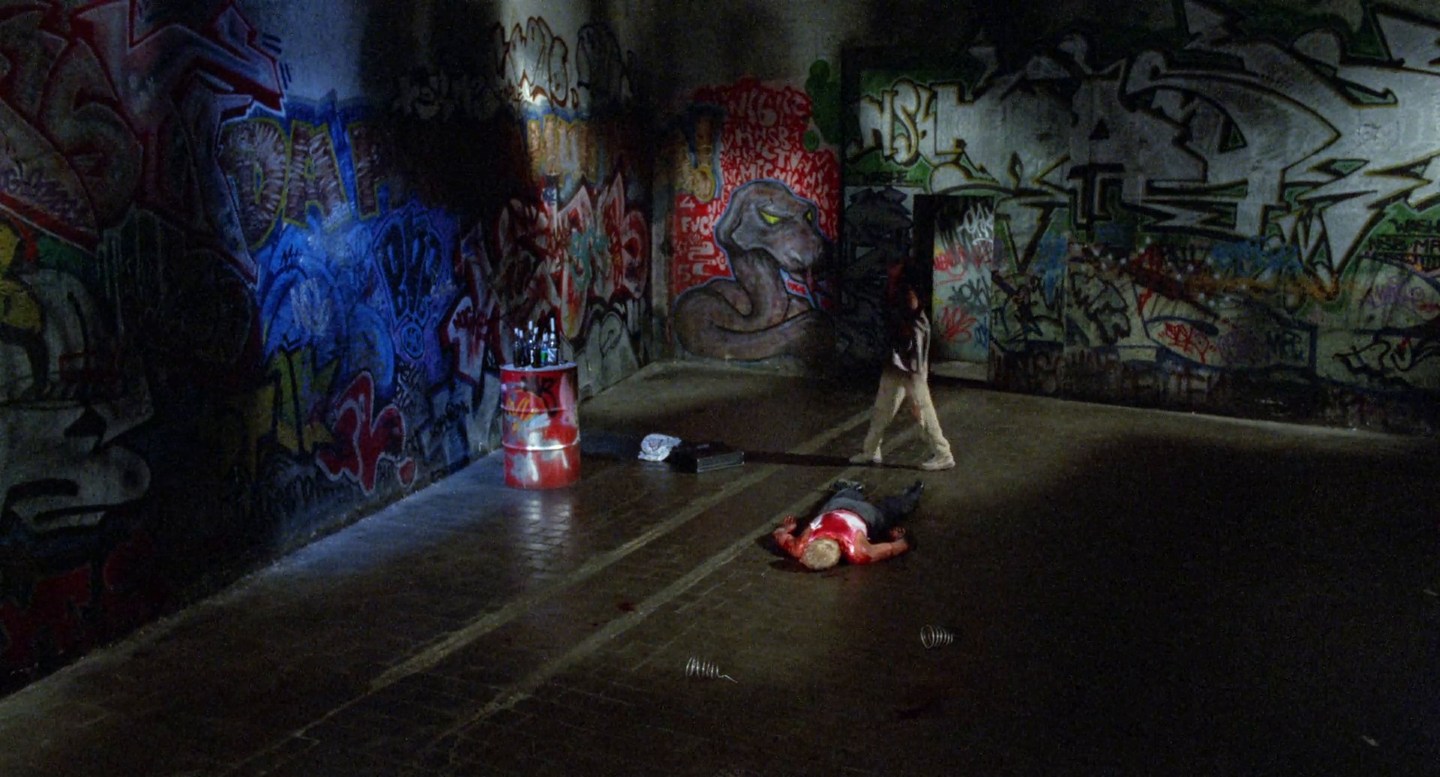
The workshop’s graffiti surrounds a confrontation whose control has changed hands. Anna now occupies the armed position. The sequence continues beyond that reversal, refusing to let a single victorious gesture close the film.
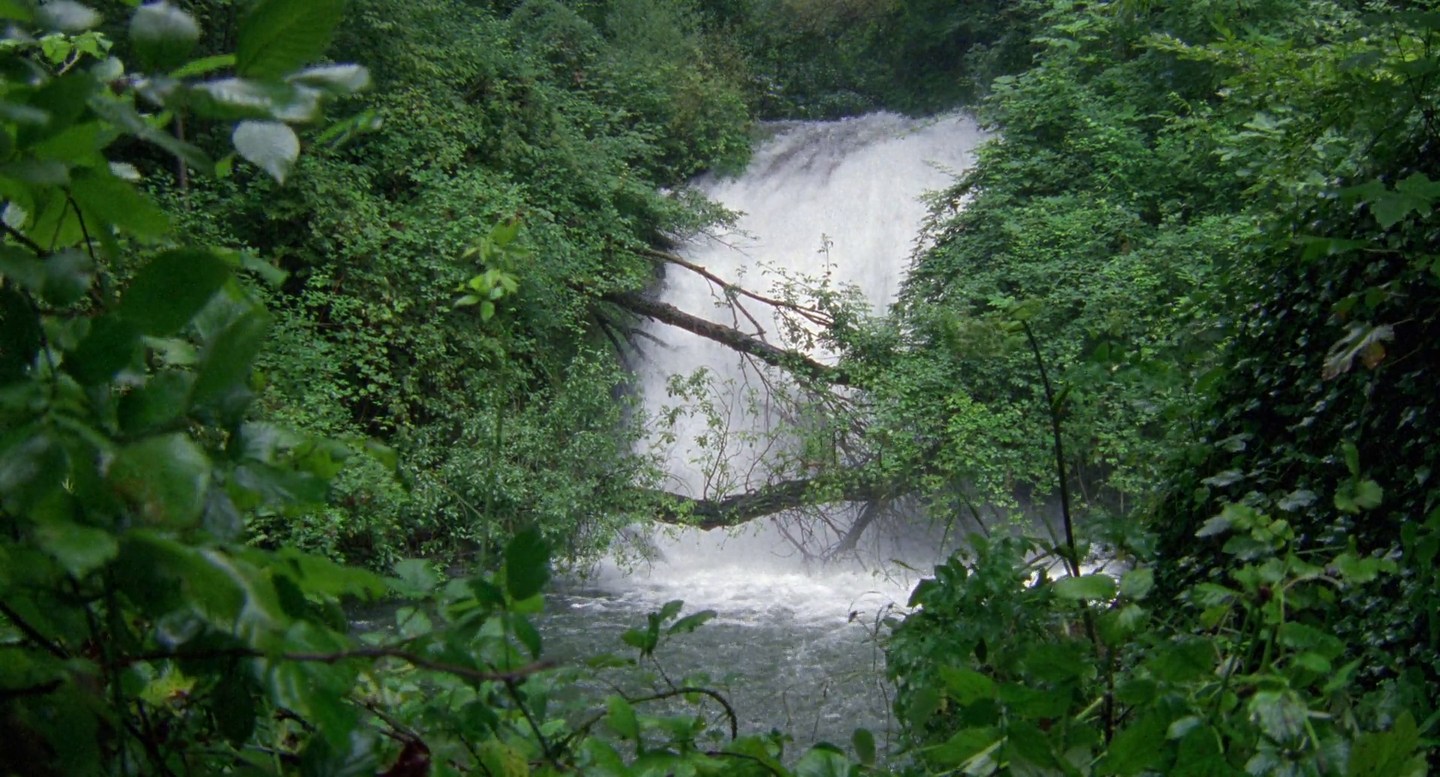
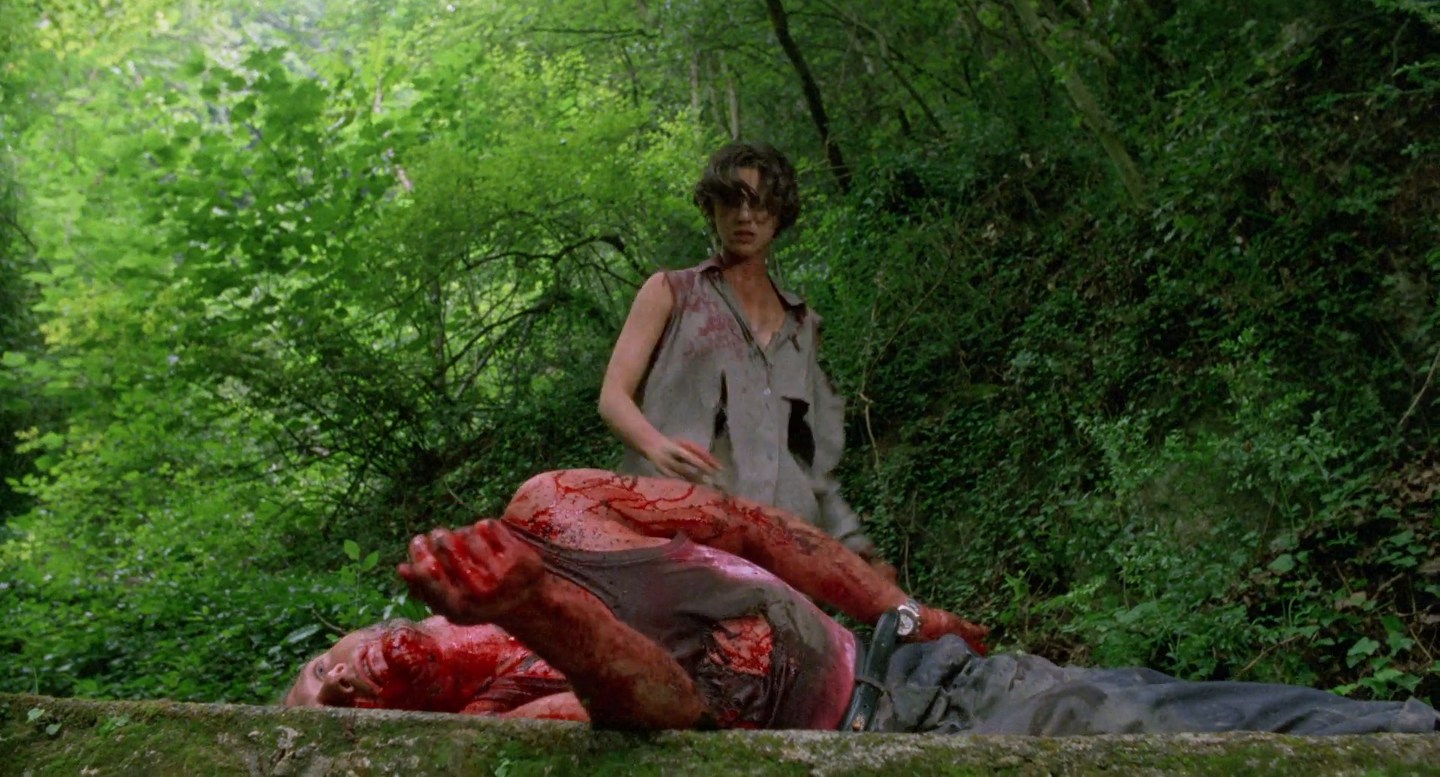
Water returns as a force that can carry a body out of sight. The opening submerged vision and this physical landscape belong to different situations, but both make visibility unstable. What disappears into the river will later return as evidence.
1:14:30
A new reflection
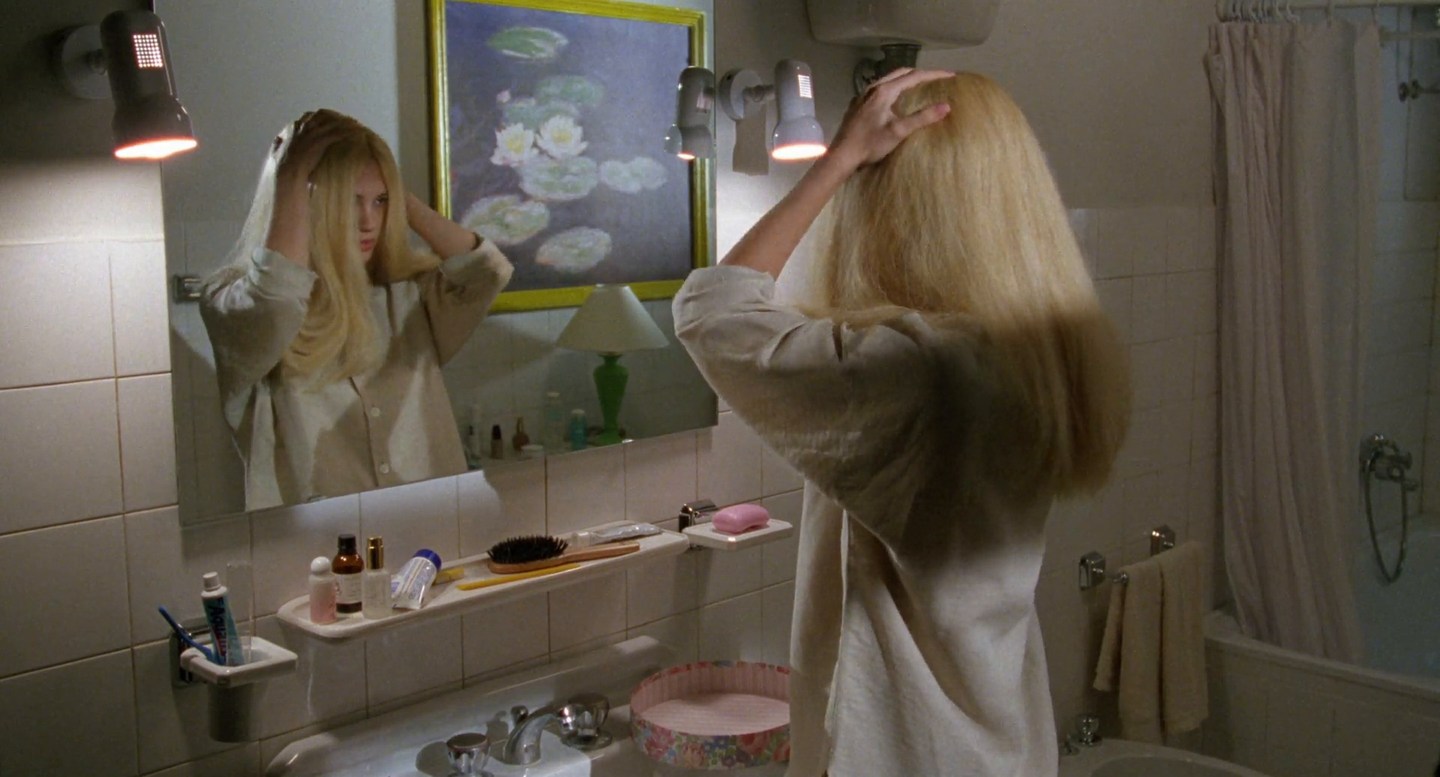
ENLARGE ↗Anna arranges the blonde wig before the mirror.
The mirror presents another transformation as deliberate work. Hair can be put on, adjusted and removed. The new look offers an image of a fresh beginning while making identity visibly dependent on an object.
1:22:00
A lighter movement
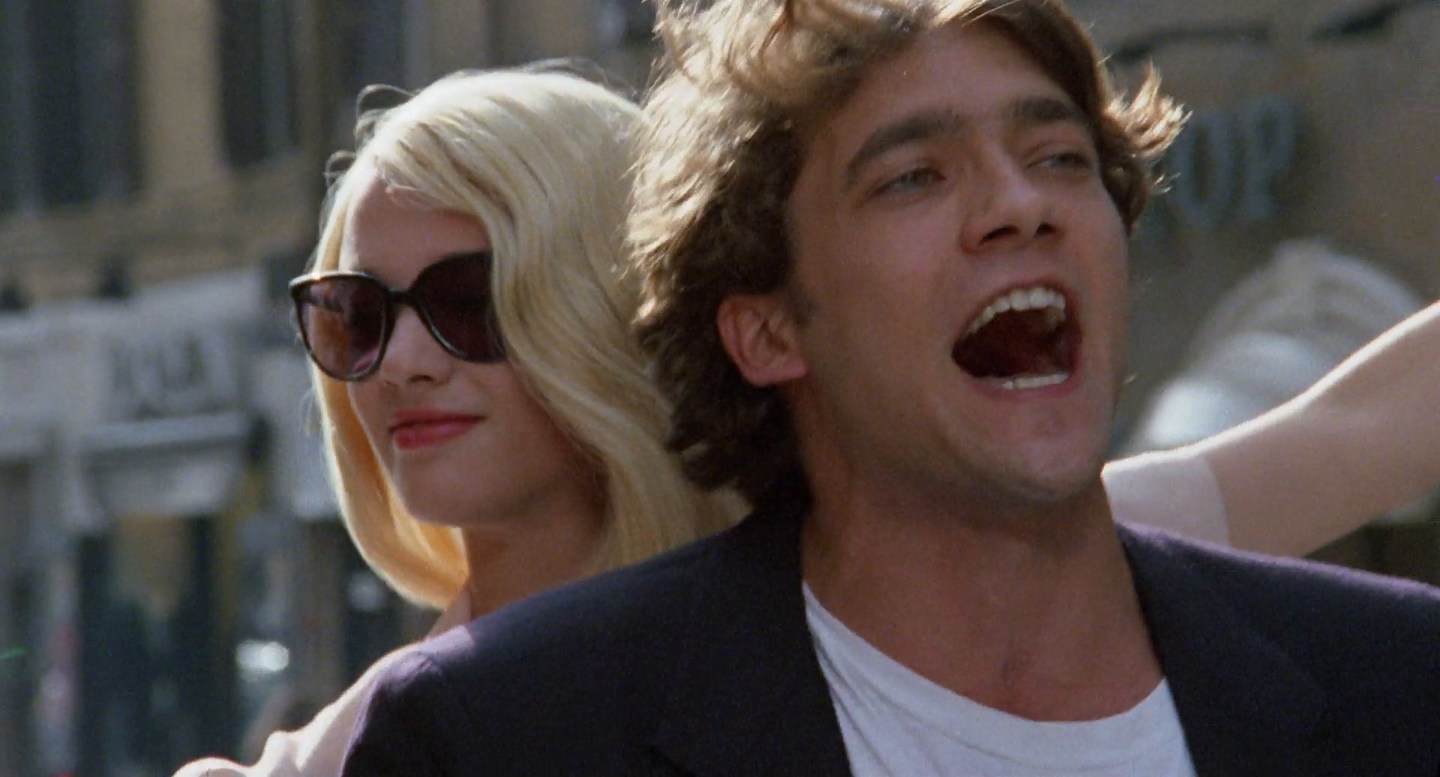
ENLARGE ↗Anna rides behind Marie through the city.
The scooter briefly exchanges enclosed rooms for shared movement. Two bodies occupy the same direction of travel. The sequence offers an ease that the film’s later return to art and investigation will destroy.
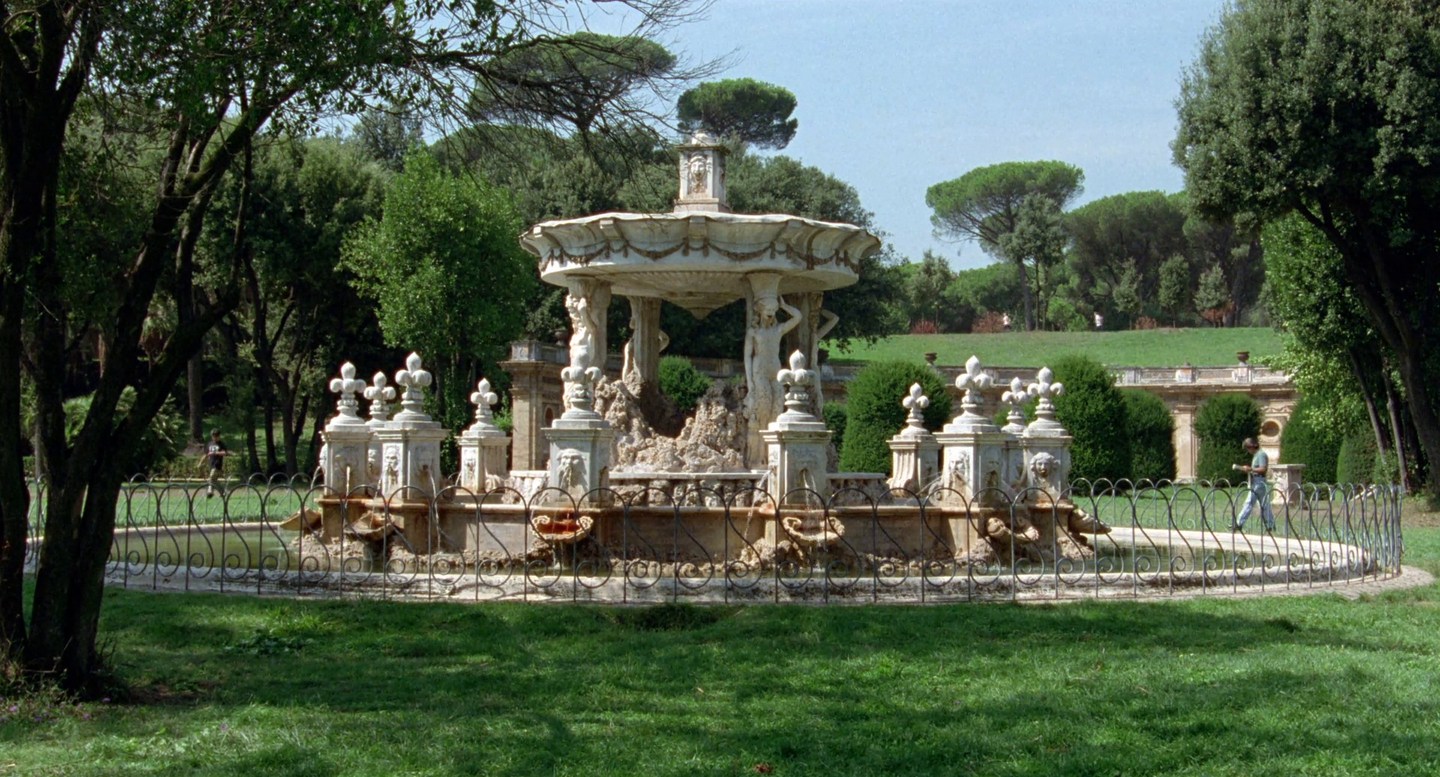
Sculpture, water and landscape now belong to an open public setting. The image recalls the gallery’s combination of bodies and represented bodies without enclosing Anna between walls. Its apparent calm makes the later sculpture-room attack more disruptive.
1:28:45
The voice returns
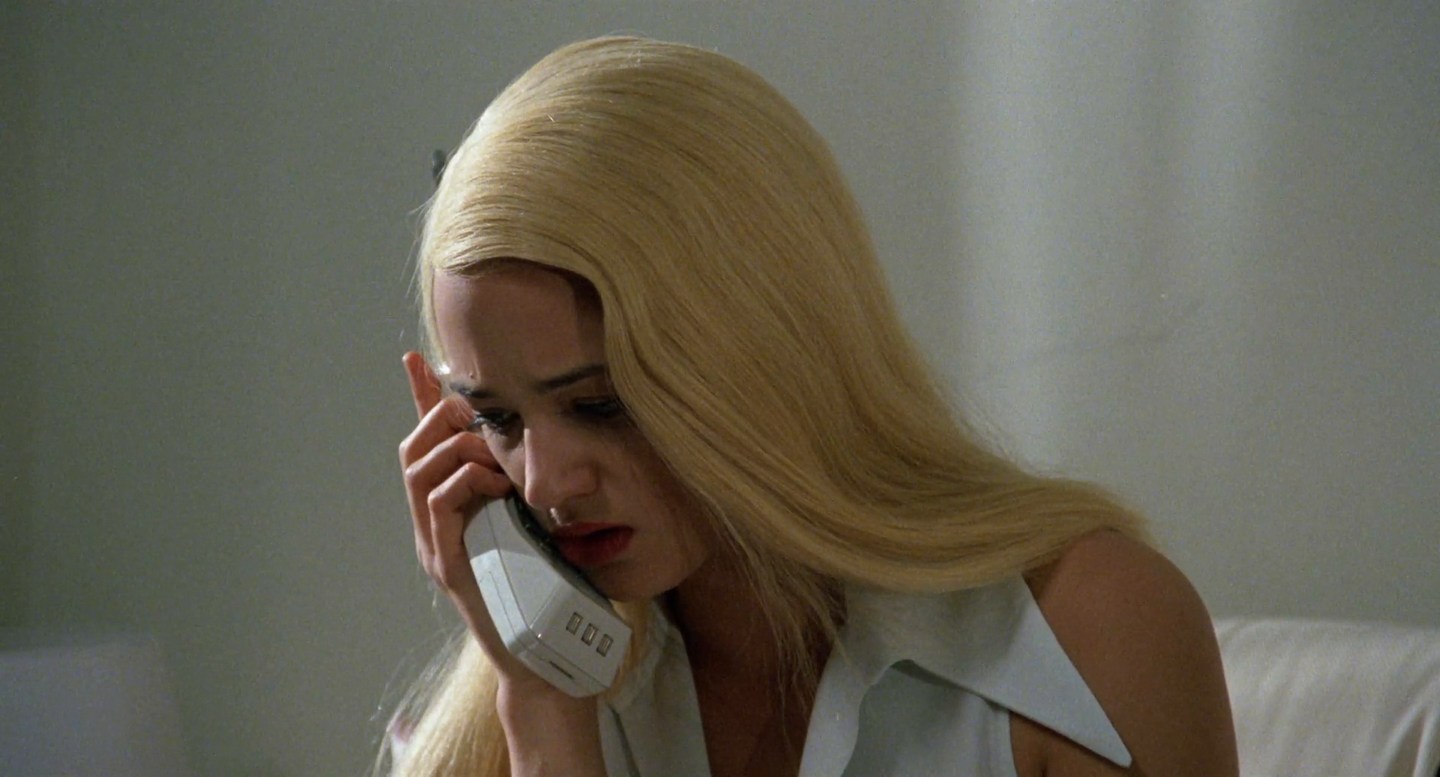
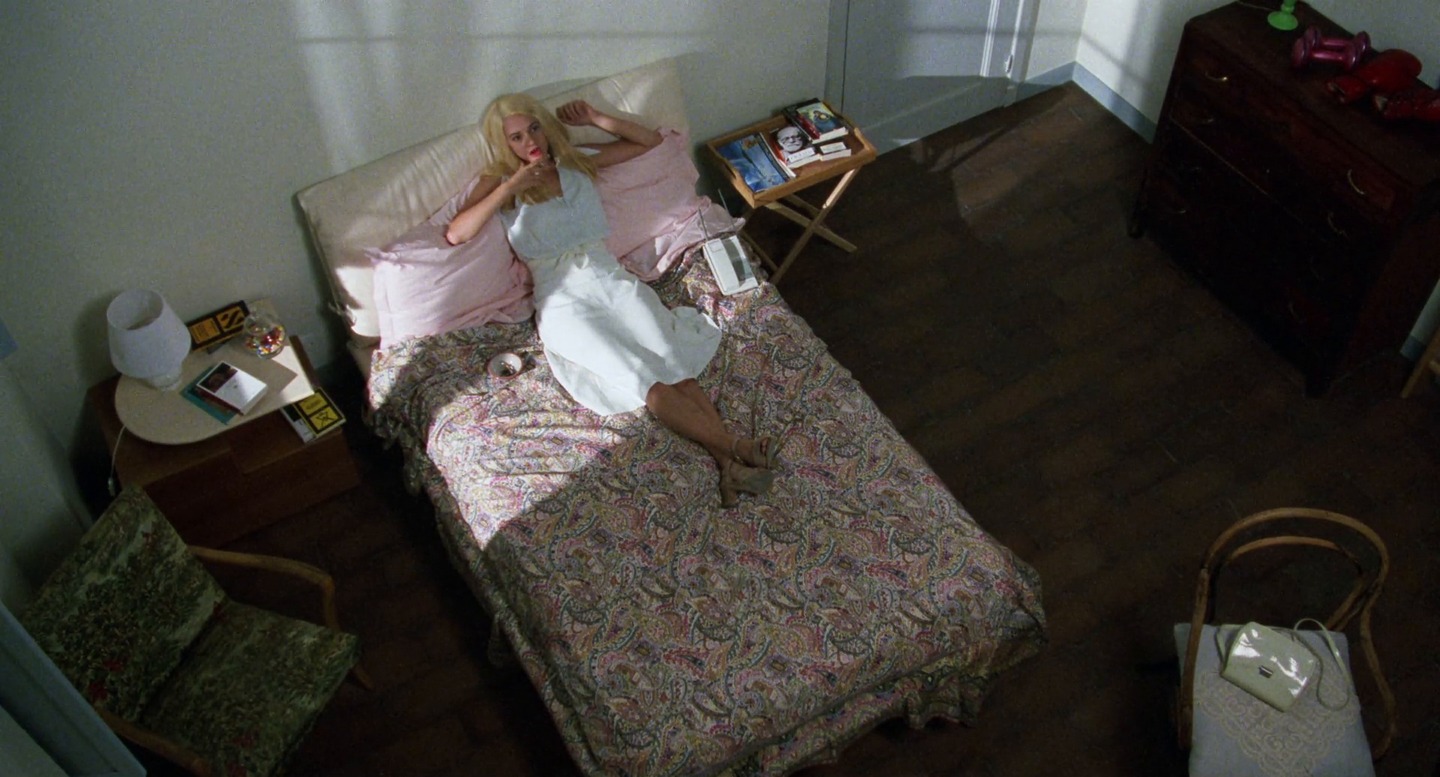
ENLARGE ↗Anna listens to the telephone beside the bed.
The telephone cuts across the new appearance and new relationship. A familiar object restores the earlier pattern of intrusion. The blonde hair changes what the spectator sees, while the call reopens what the story seemed to have settled.
1:35:04
Among enormous faces
ENLARGE ↗Marie works between oversized sculptural heads.
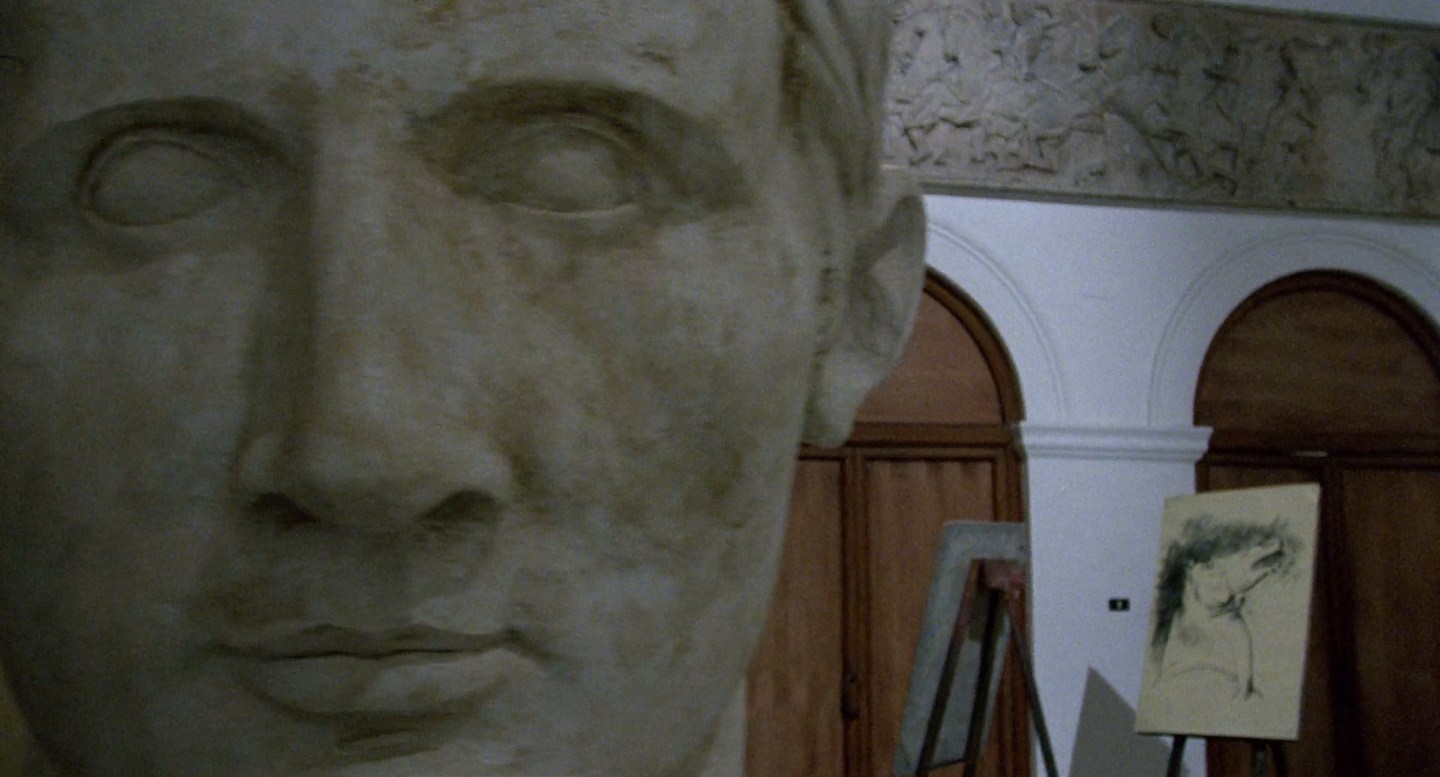
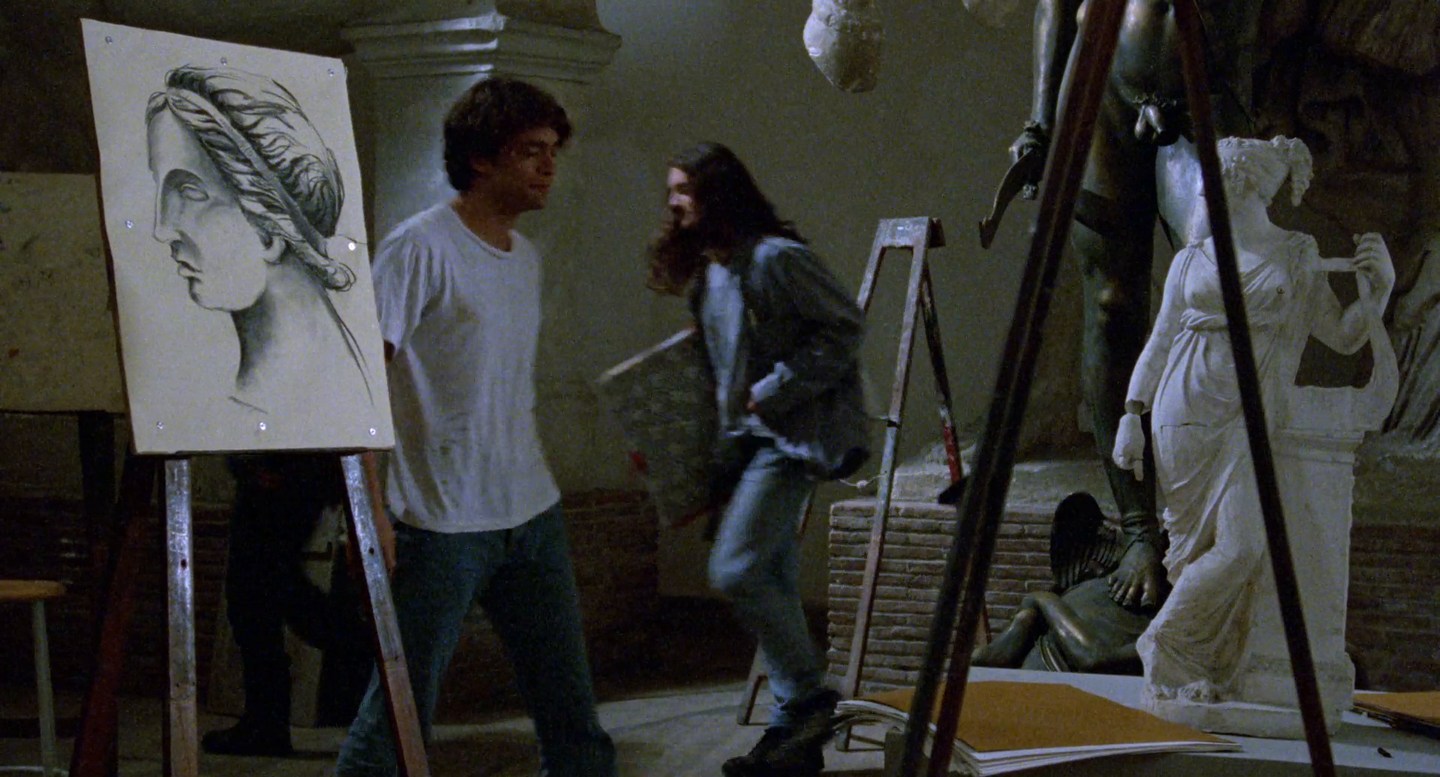
The room surrounds a living artist with faces at incompatible scales. Foreground stone obstructs the view while Marie remains comparatively small. These objects will become both witnesses to violence and surfaces that carry its traces.
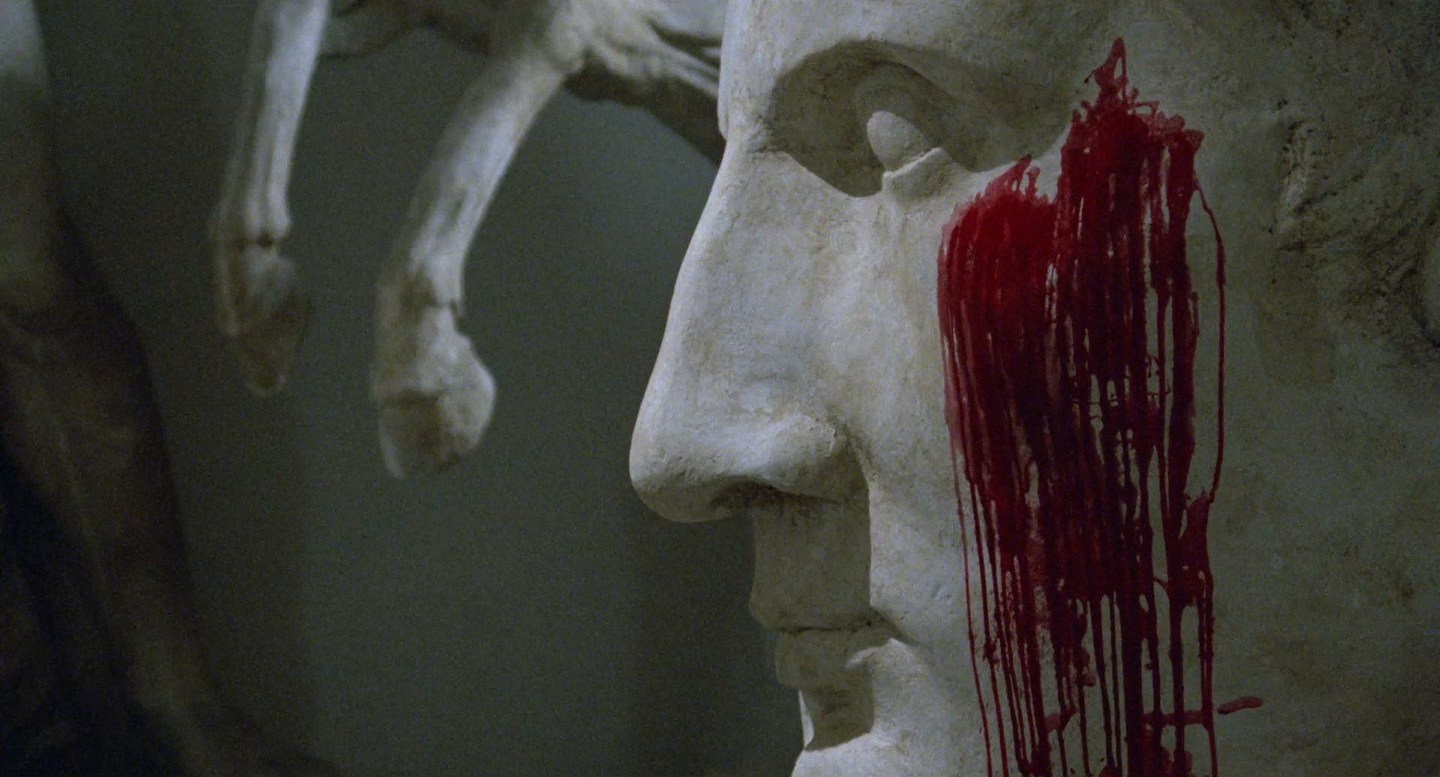
The discovery is staged through displaced evidence. A stain on the sculpture precedes the fuller understanding of what has happened to the person nearby. The film makes a represented body bear the first readable sign of violence.
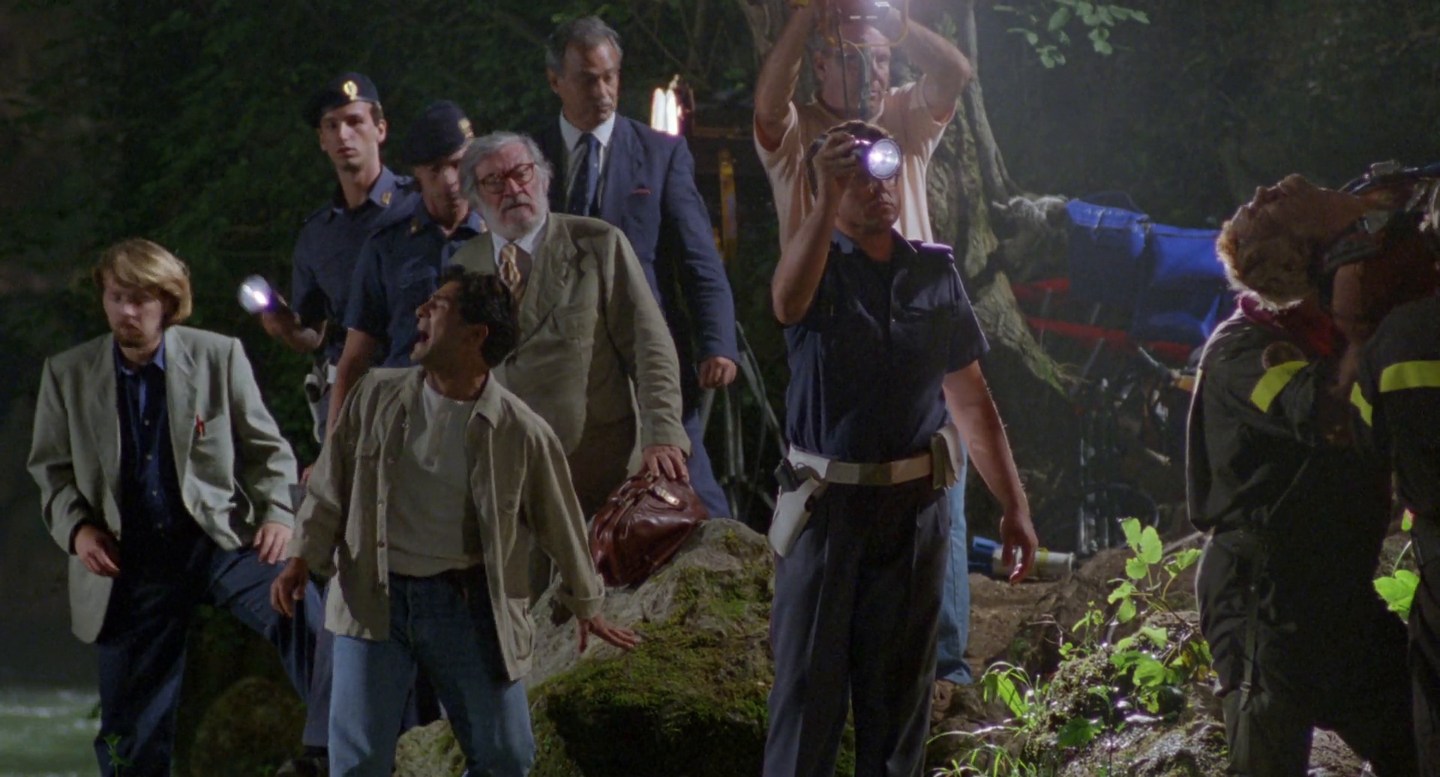
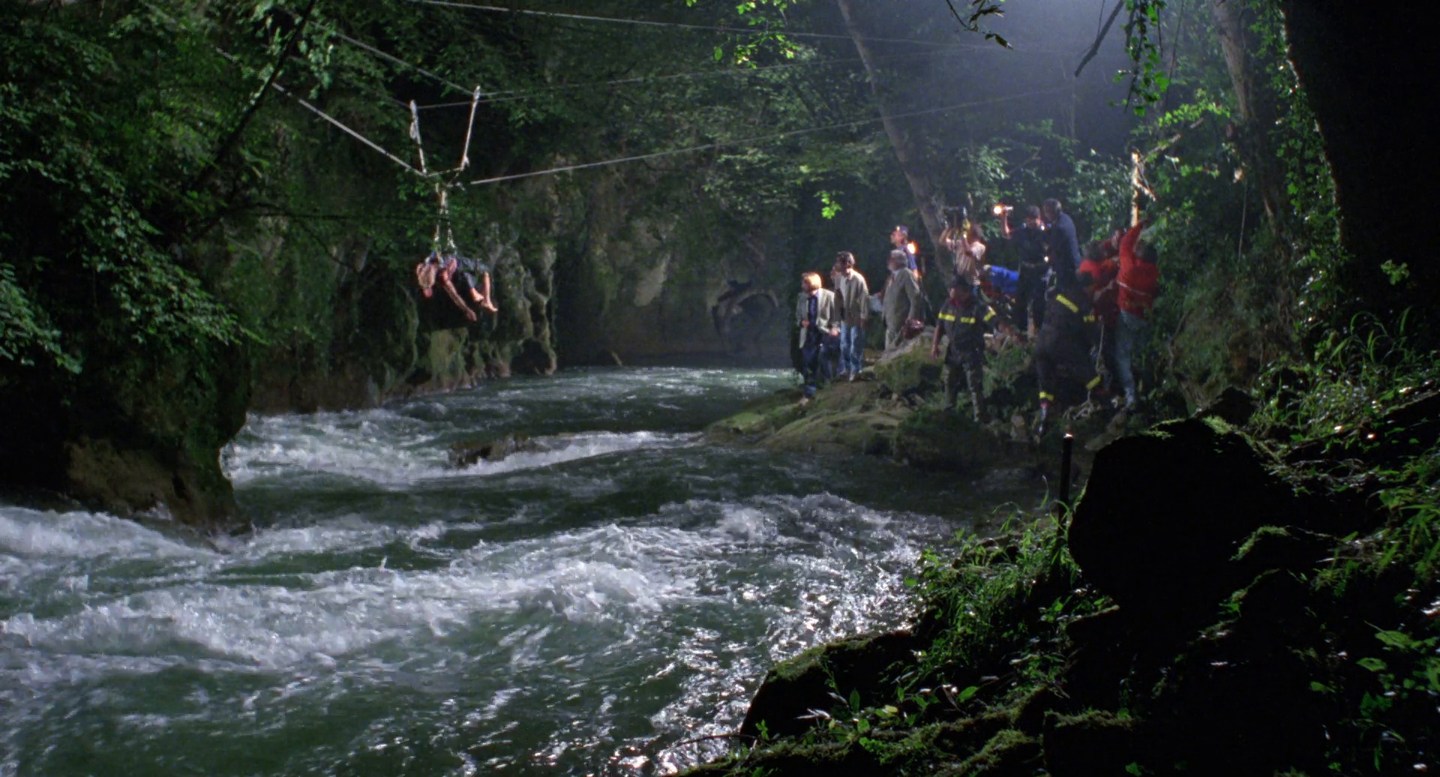
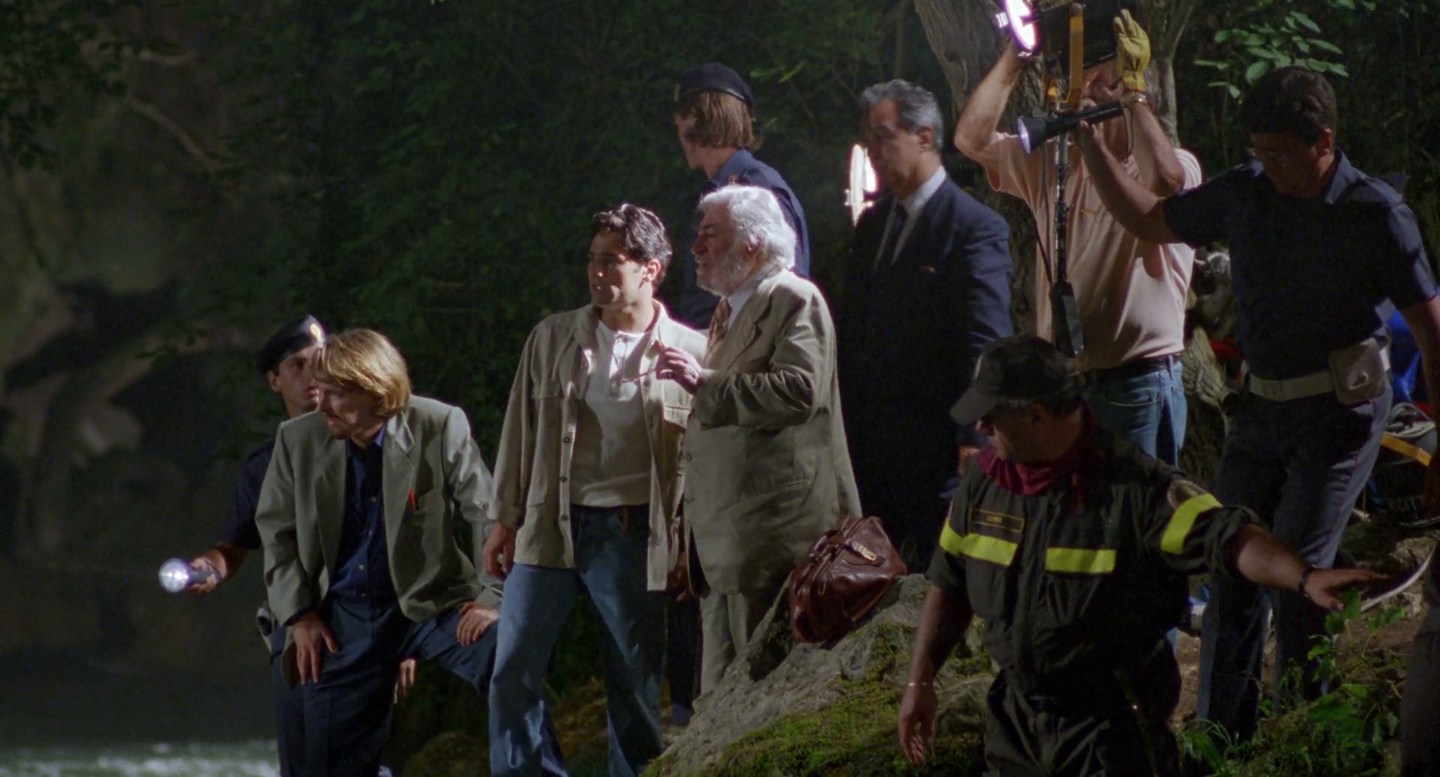
The recovery turns the landscape into an official scene of examination. Several people now look at a body that had been hidden from them. Physical evidence contradicts the explanation sustained by the later appearances and calls.
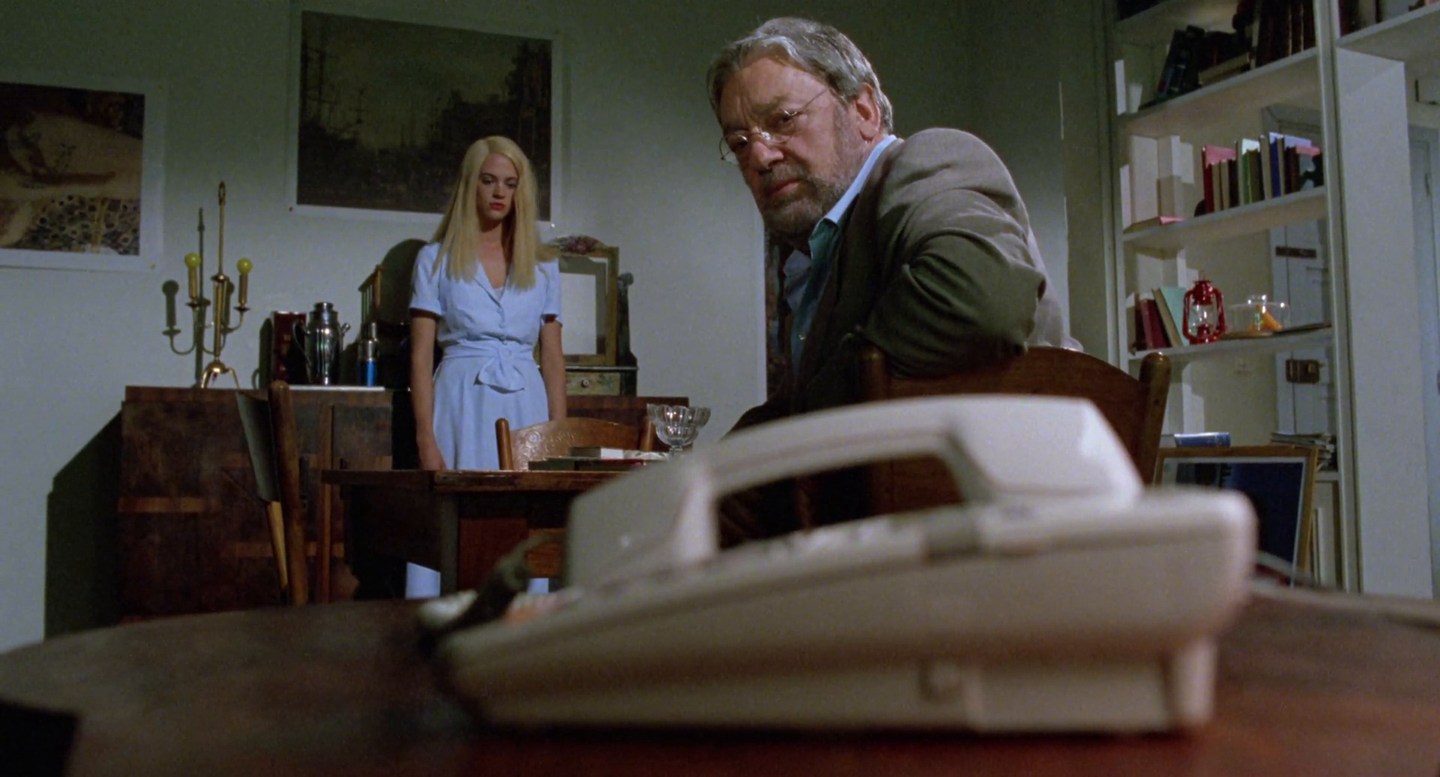
ENLARGE ↗The telephone separates Anna and the psychiatrist.
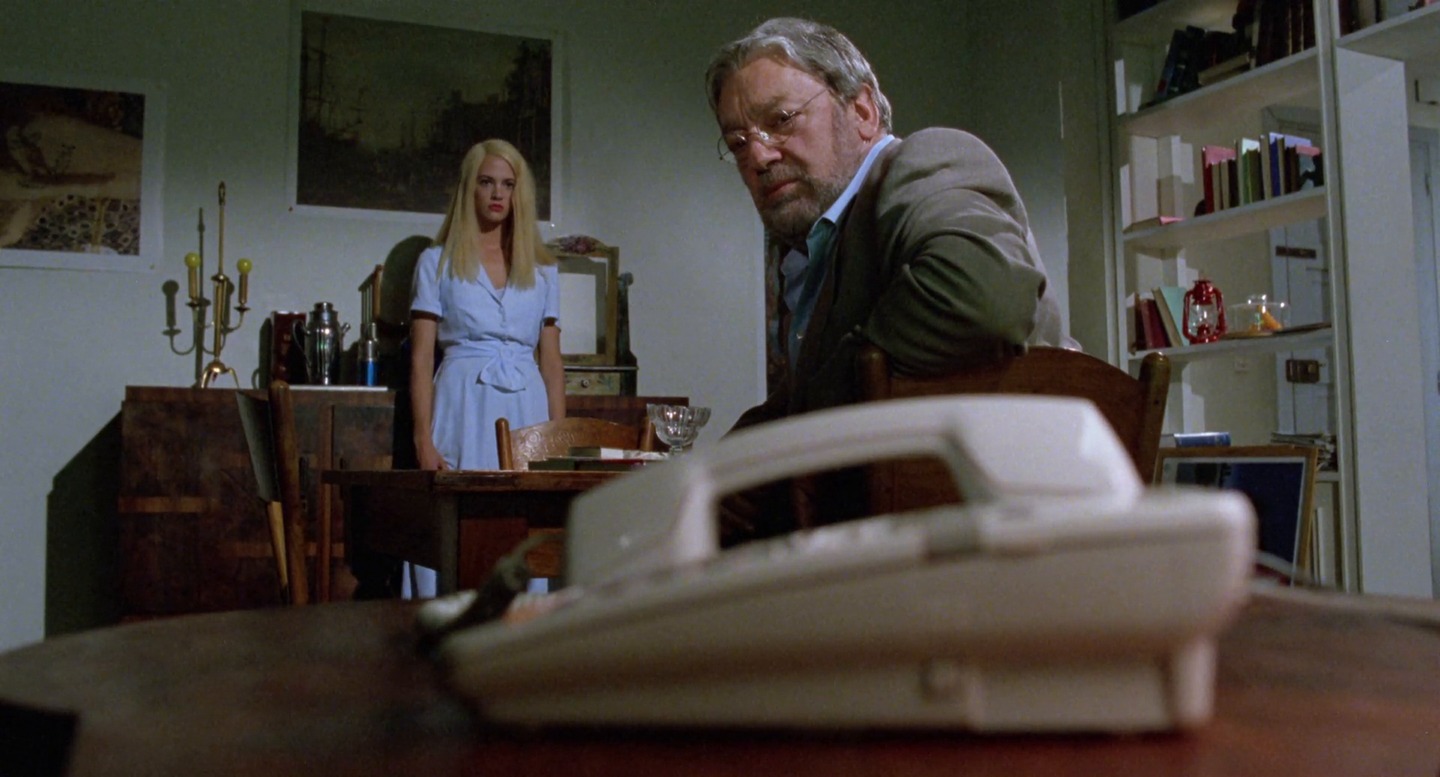
The foreground telephone occupies the space between the two people. A device that has carried uncertainty becomes central to an attempted explanation. The composition makes the conversation vulnerable before the subsequent discovery transforms the room.
1:47:55
The wig comes off
ENLARGE ↗Anna’s dark hair appears beneath the removed wig.
The mirror lets a change of appearance become a visible action. Removing the wig does not restore a stable earlier self. It exposes the distance between what others have been seeing and the person who has been arranging that appearance.
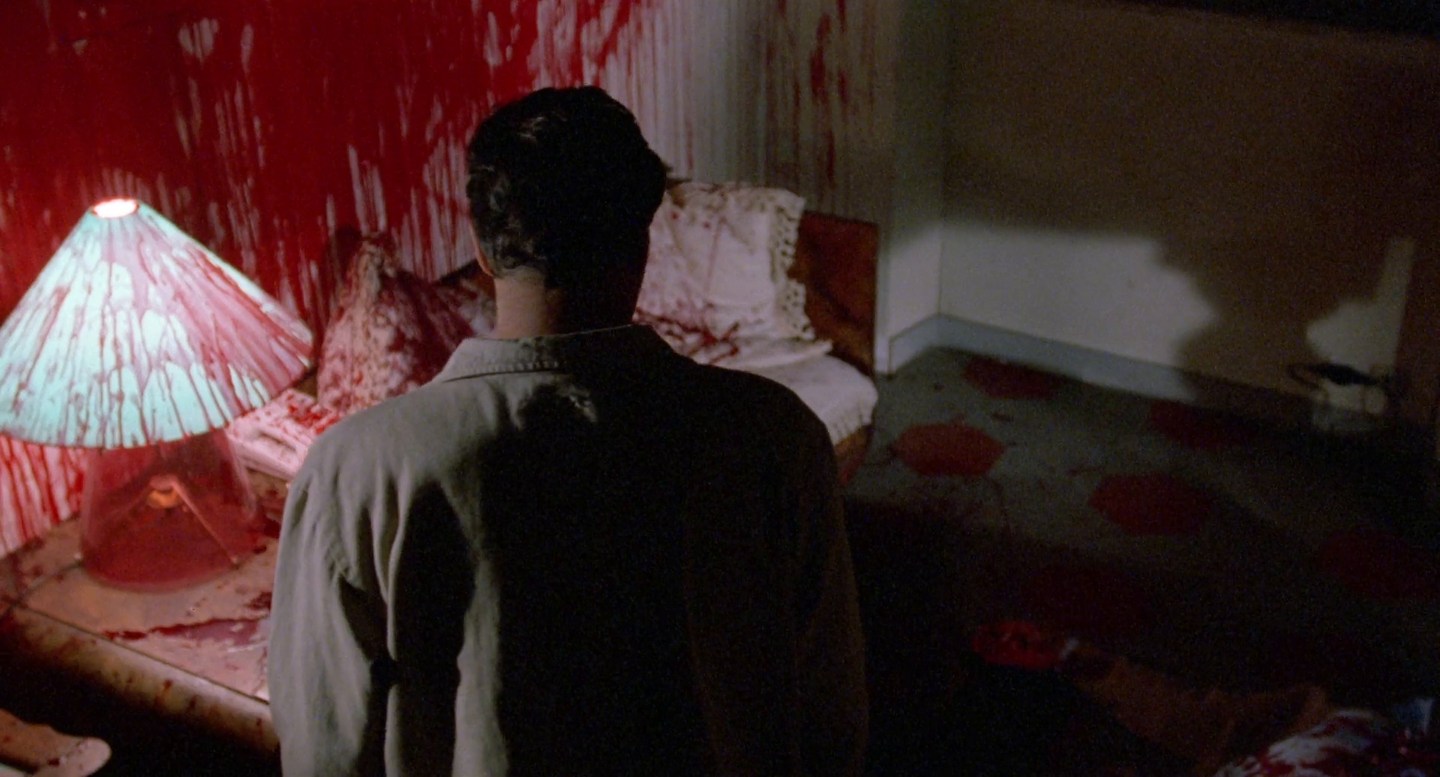
The room is disclosed as an overwhelming field of red. Marco’s reaction gives the spectator a position from which to recognise the discovery. The doctor’s fate is registered through the arrangement of the room as much as through the body.
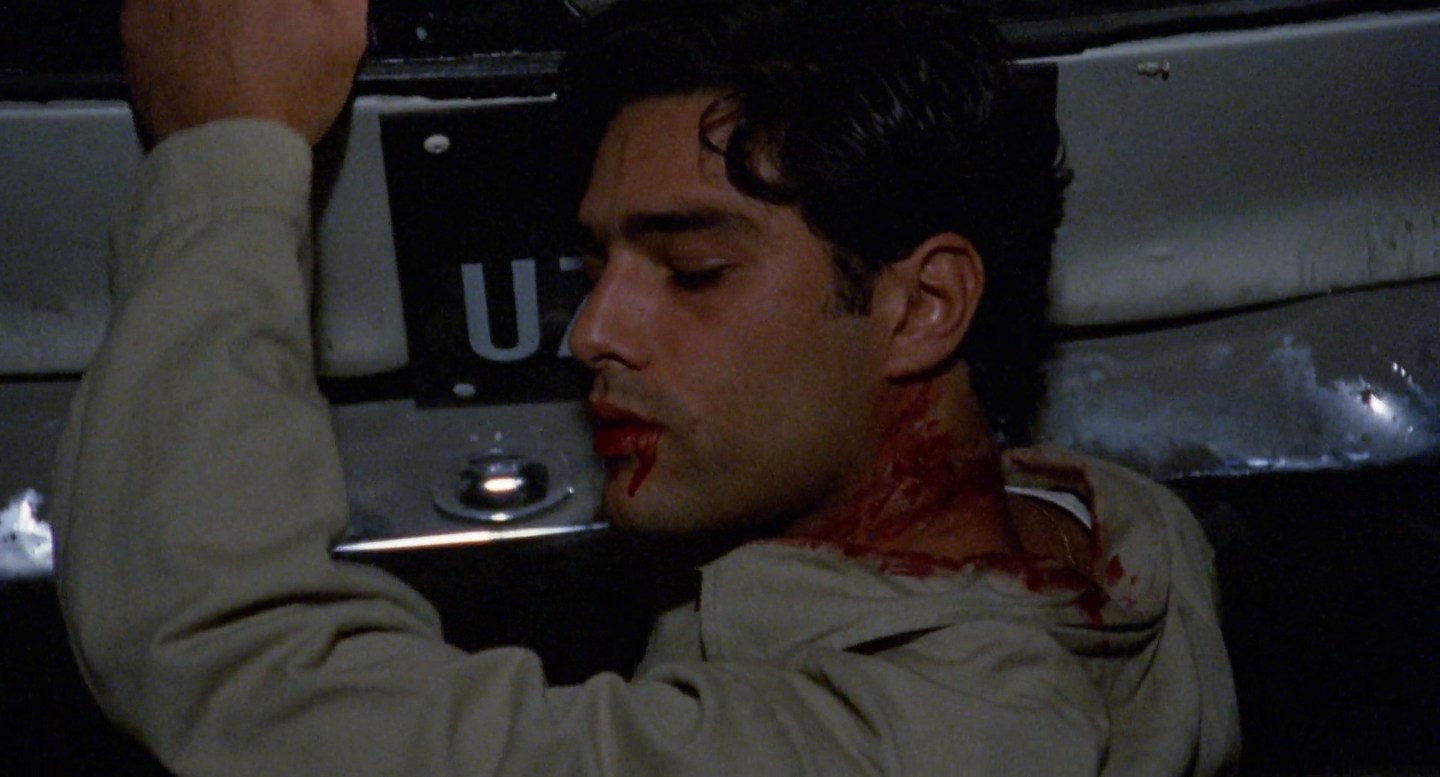
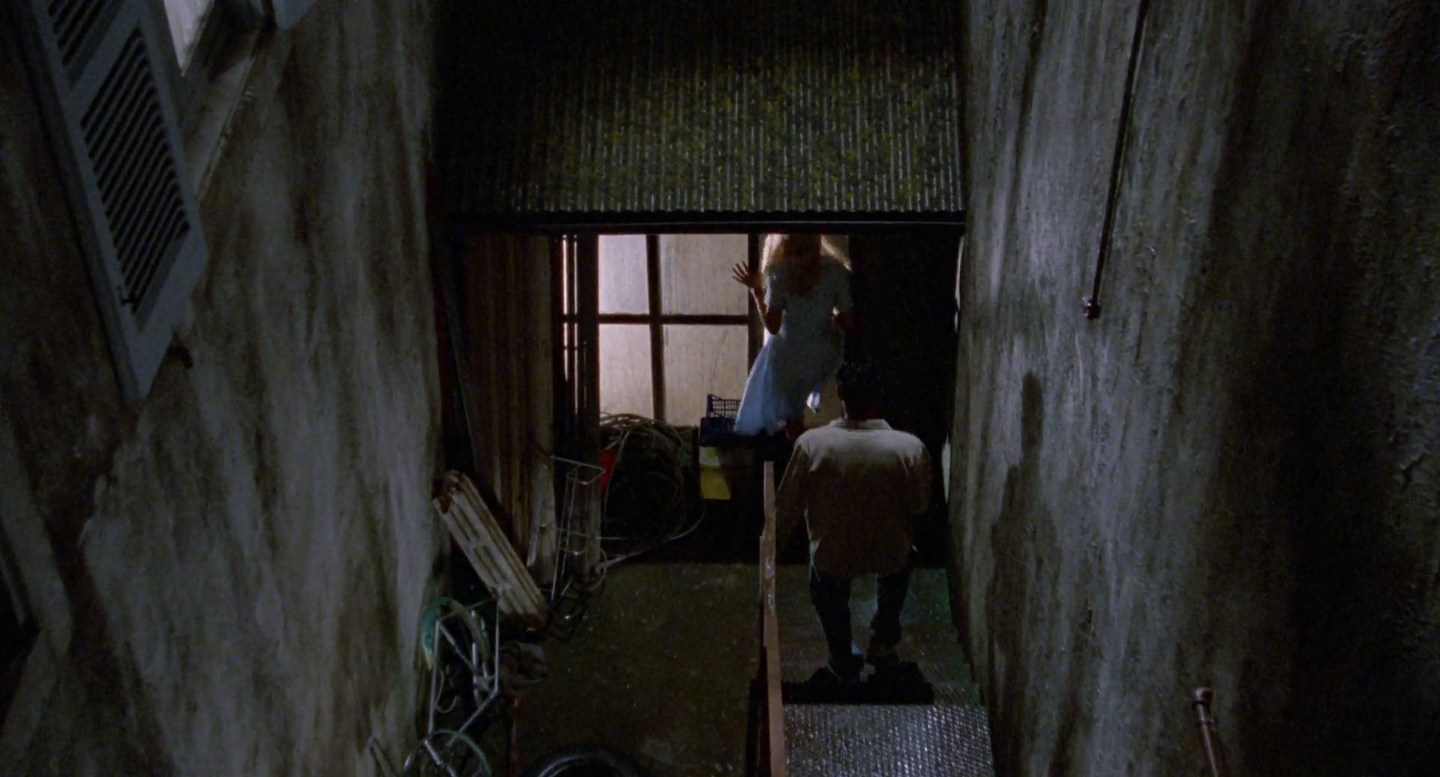
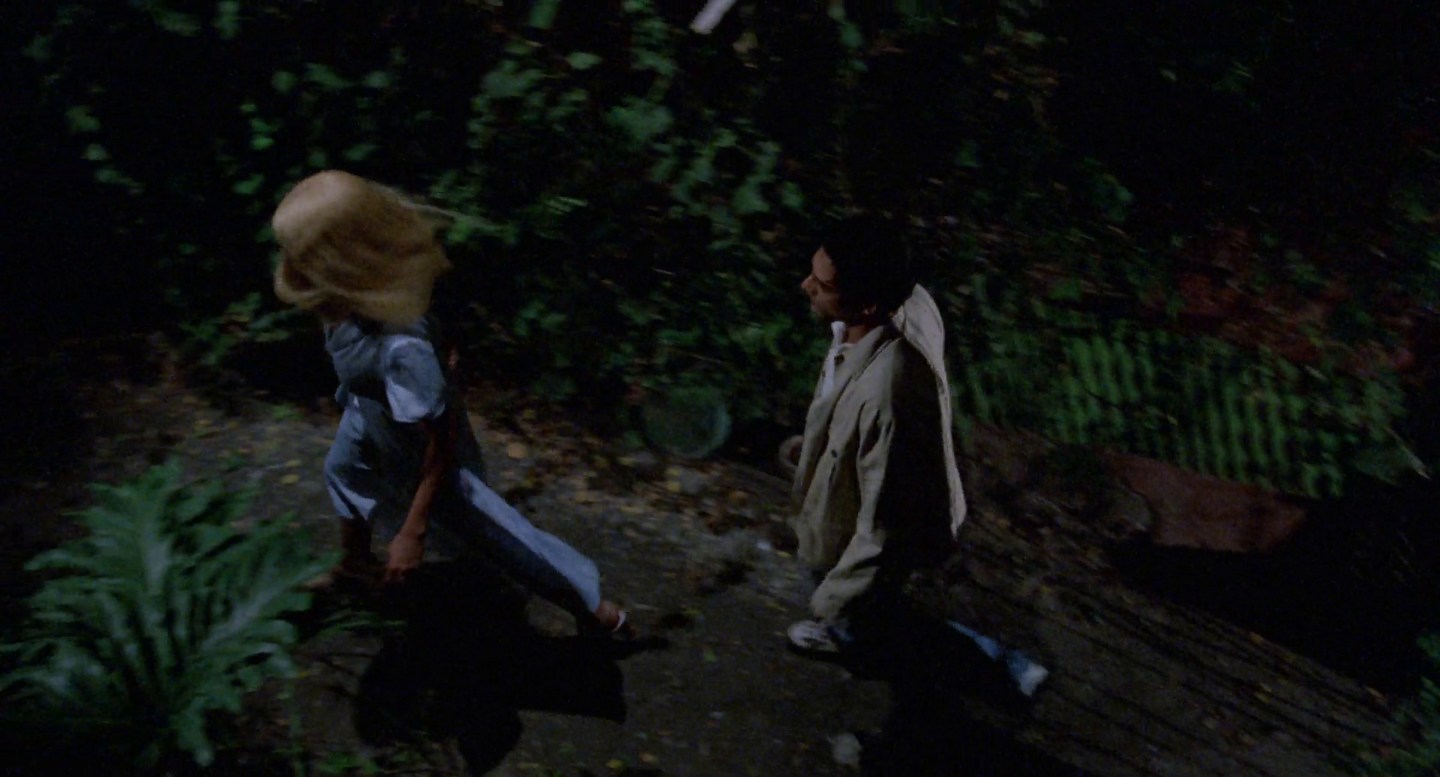
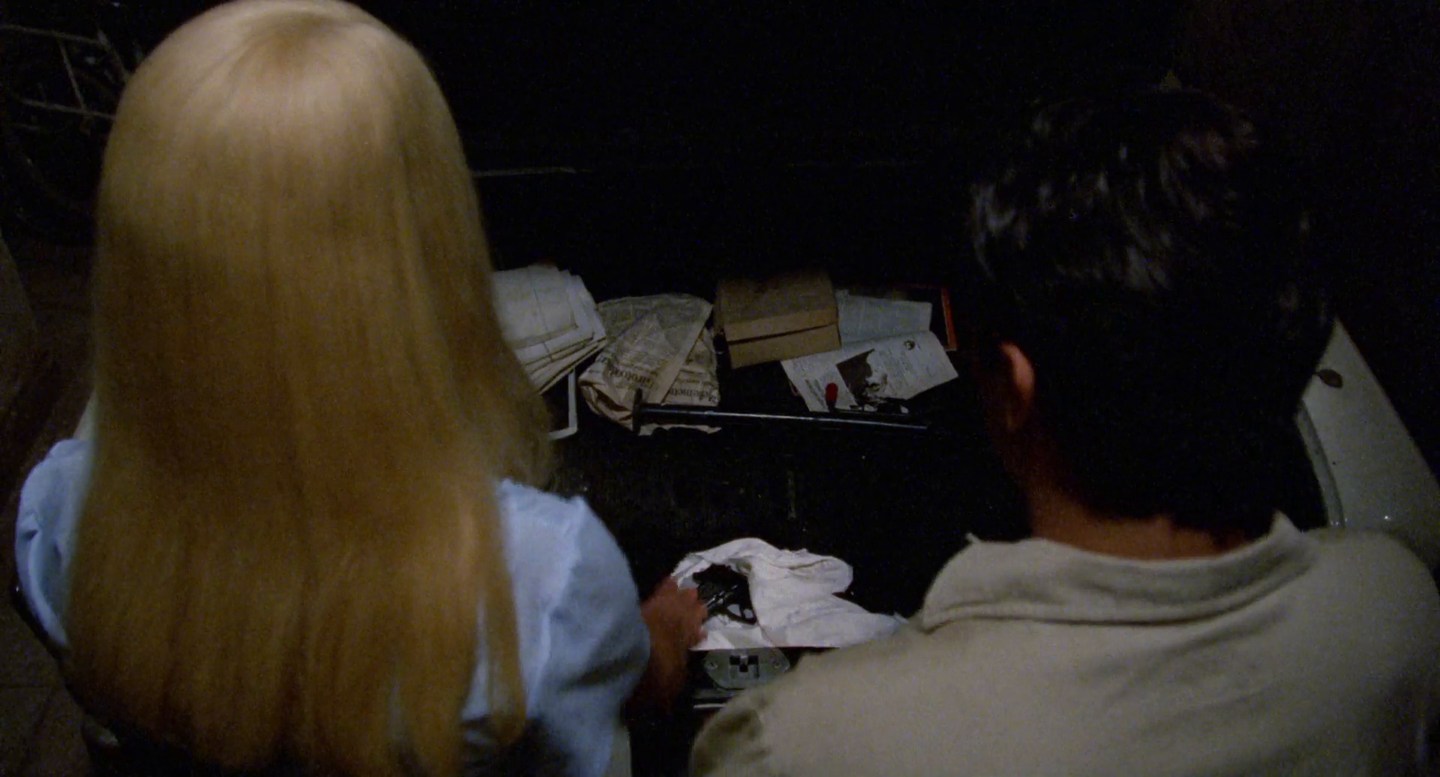
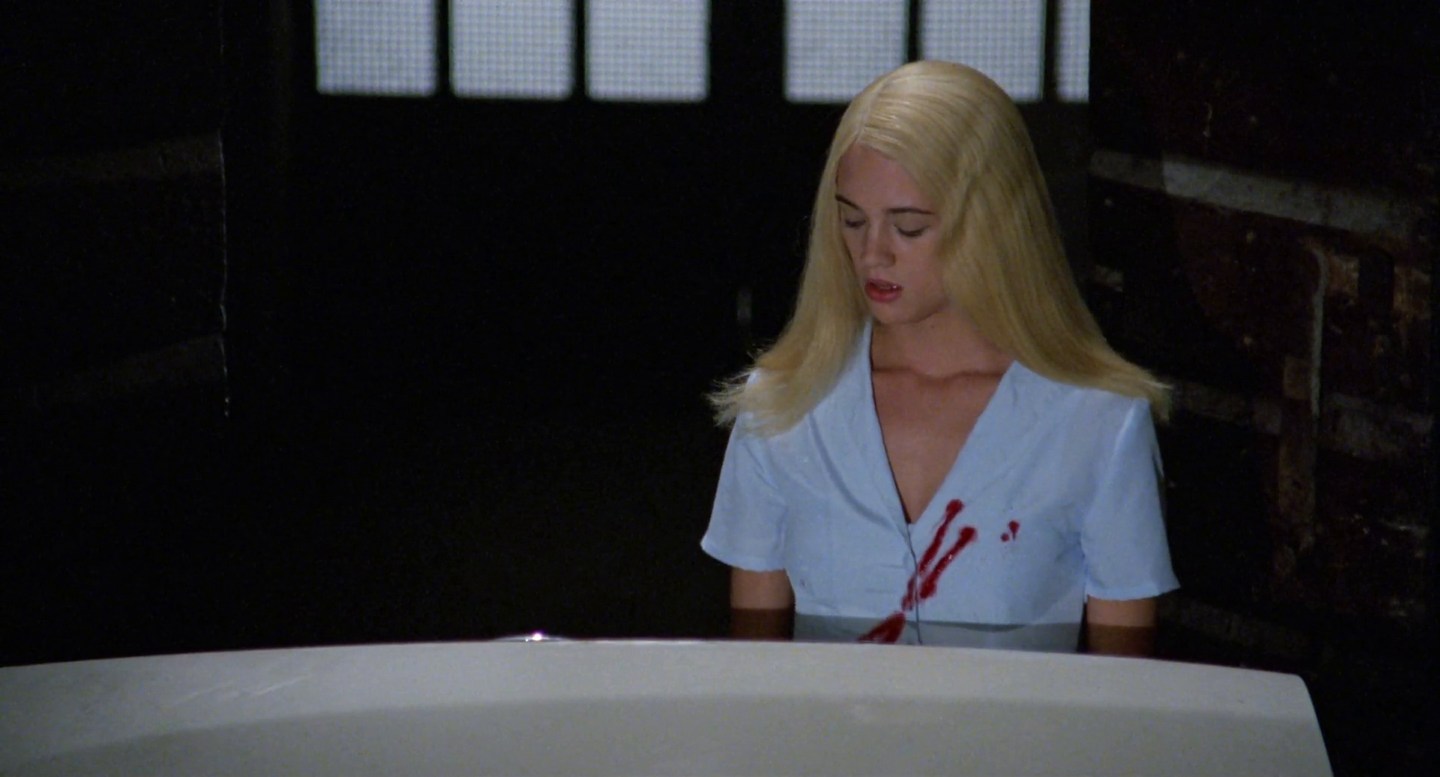
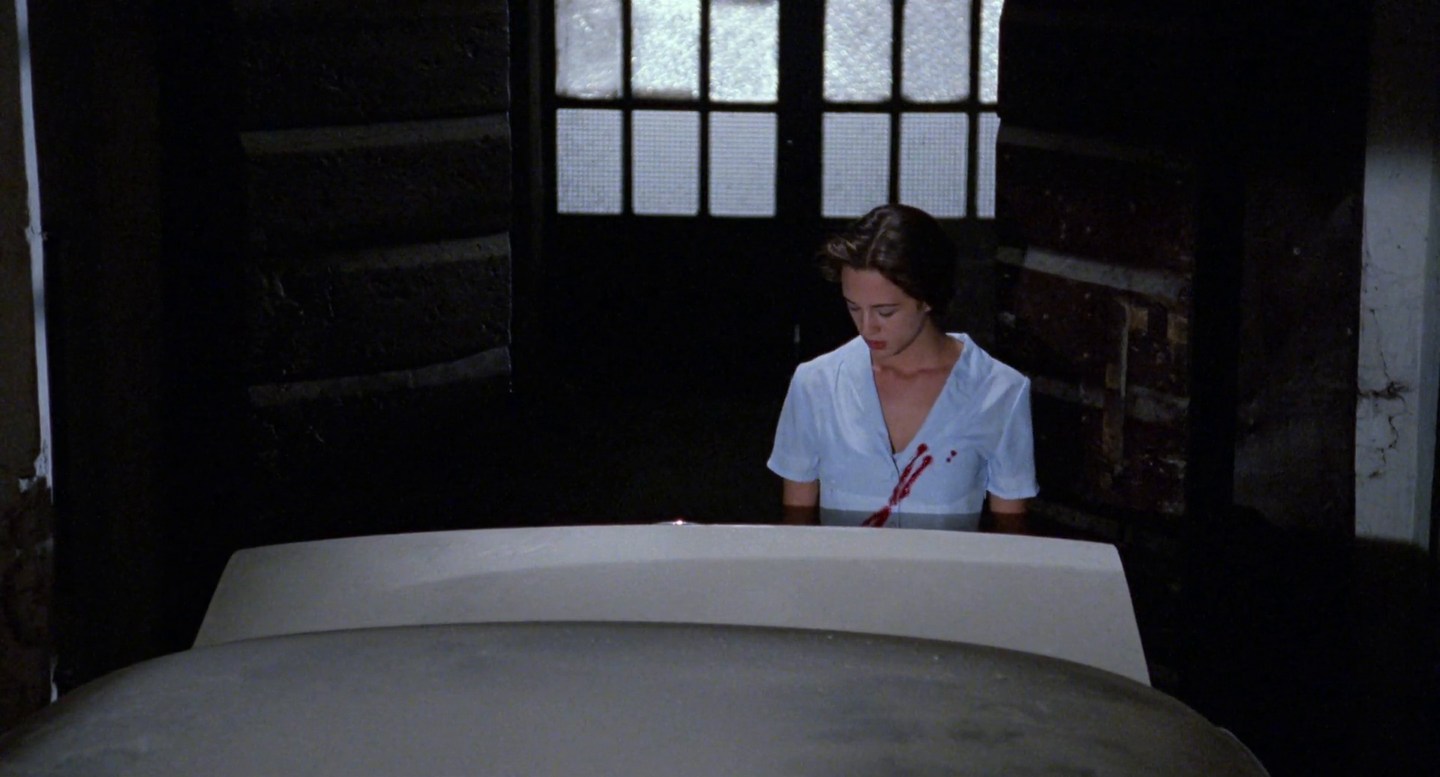
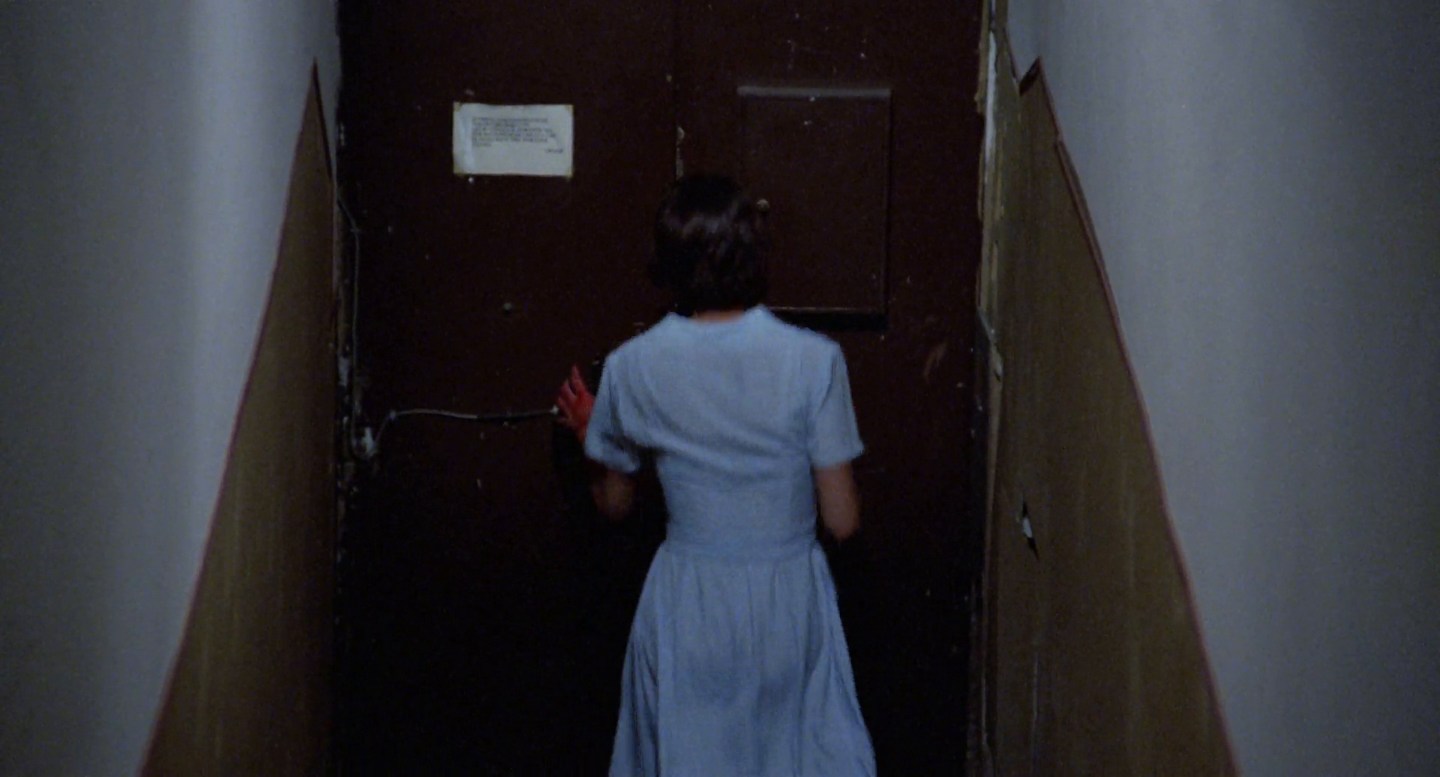
The narrow stairs lead the two figures into a confined exterior. A close encounter becomes violence, and the car provides the hard endpoint of the fall. Anna’s blood-marked clothing then carries the event into the next scene.
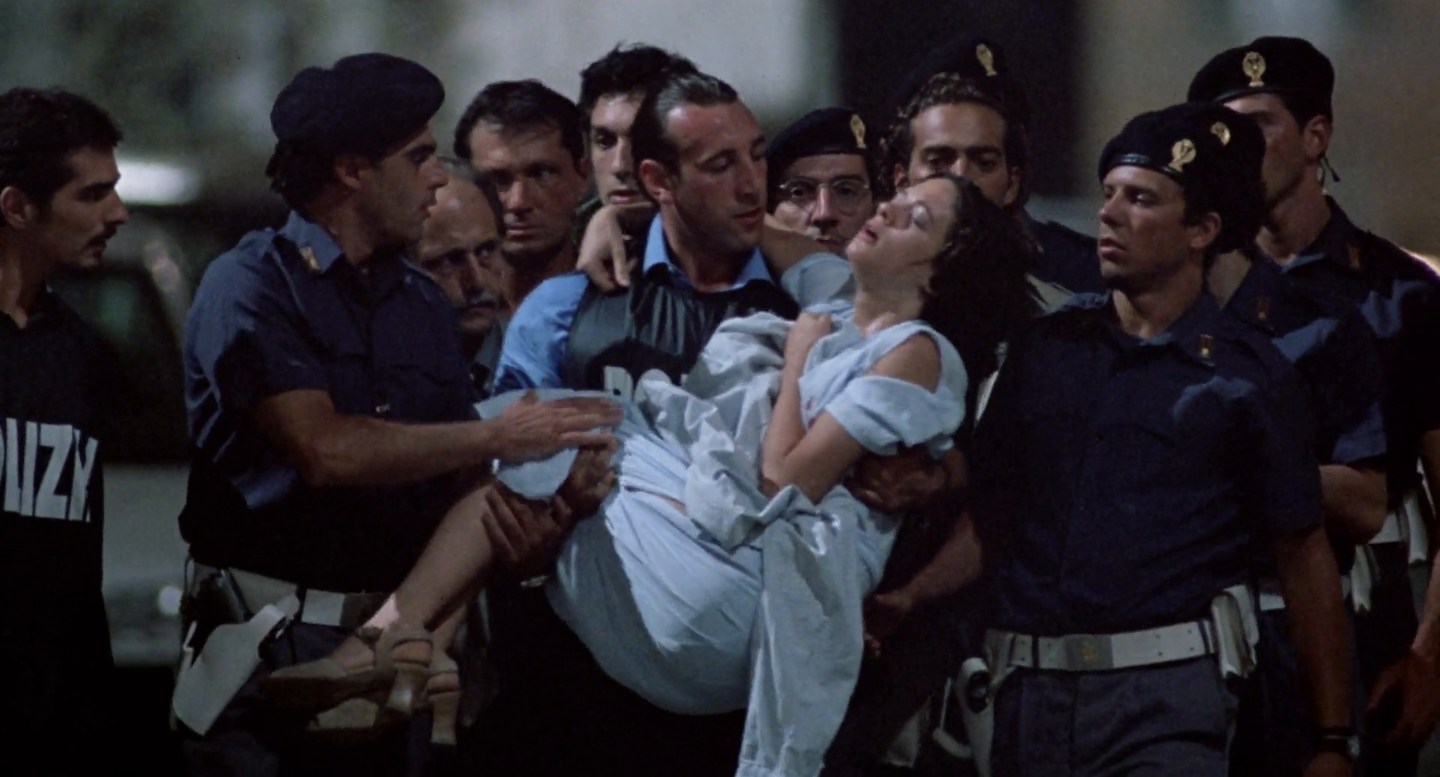
The film ends with Anna surrounded and physically supported by other people. This recalls the public spectators who gathered around her first collapse, but the meanings of help, restraint and custody have changed. The crowd does not give the image a simple resolution.
Six studies follow transformations, confrontations and discoveries. Each has a main image and an optional stage gallery. Open a sequence, then enlarge a frame to move through it.
The passage moves from a framed seascape to a face, a collapsing body and an underwater encounter. Changes of scale and setting make a picture into an environment.
The return reverses the spectator’s position: Anna, who had been looking, lies beneath the people looking down at her. The gallery’s order returns around an injured body.
The reproduction is first a material object on the hotel wall. Anna tries to cover it; its later distortion makes the room’s boundary unstable again.
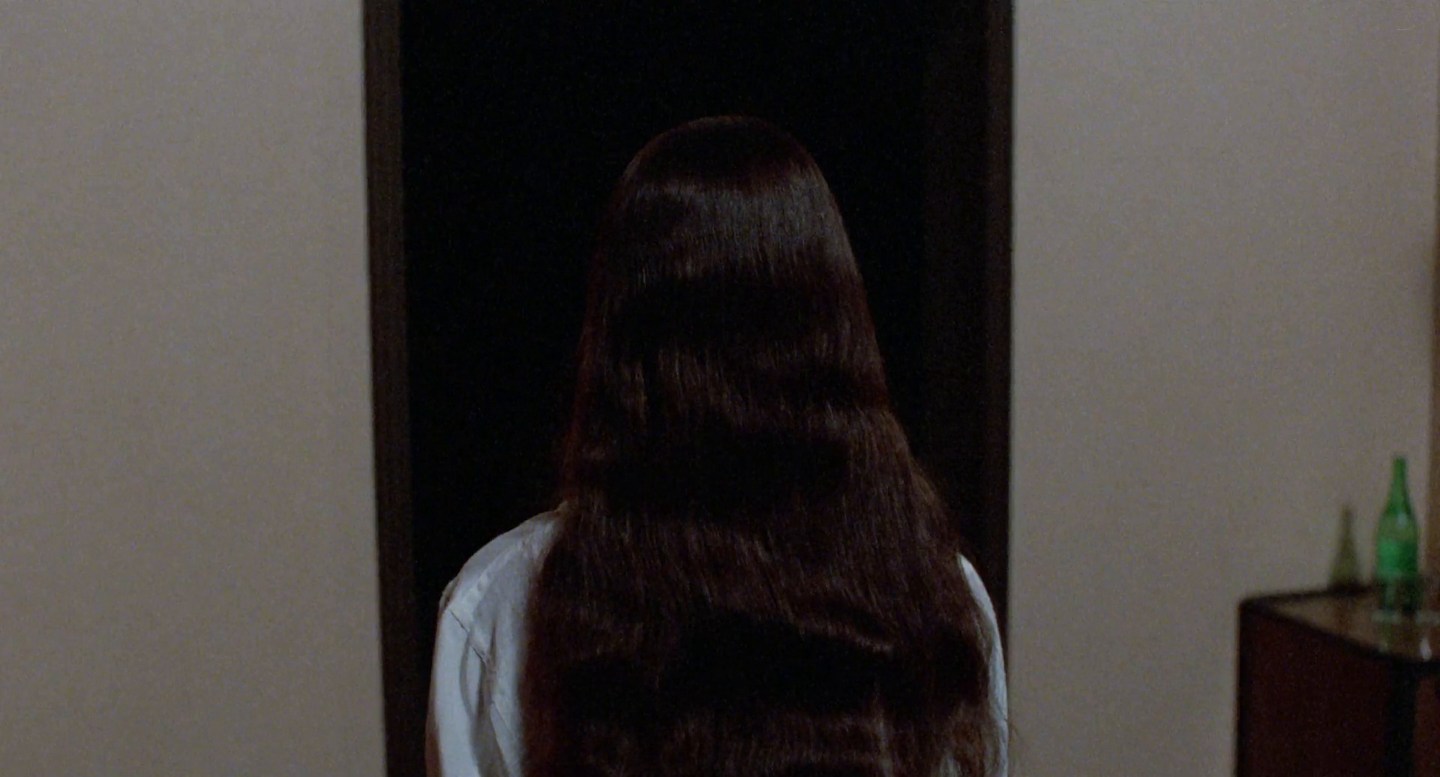
The sequence moves from the altered painted surface into a dark opening and then the police scene beyond it. The gallery below follows that change of space, rather than treating the transition as a single decorative dissolve.
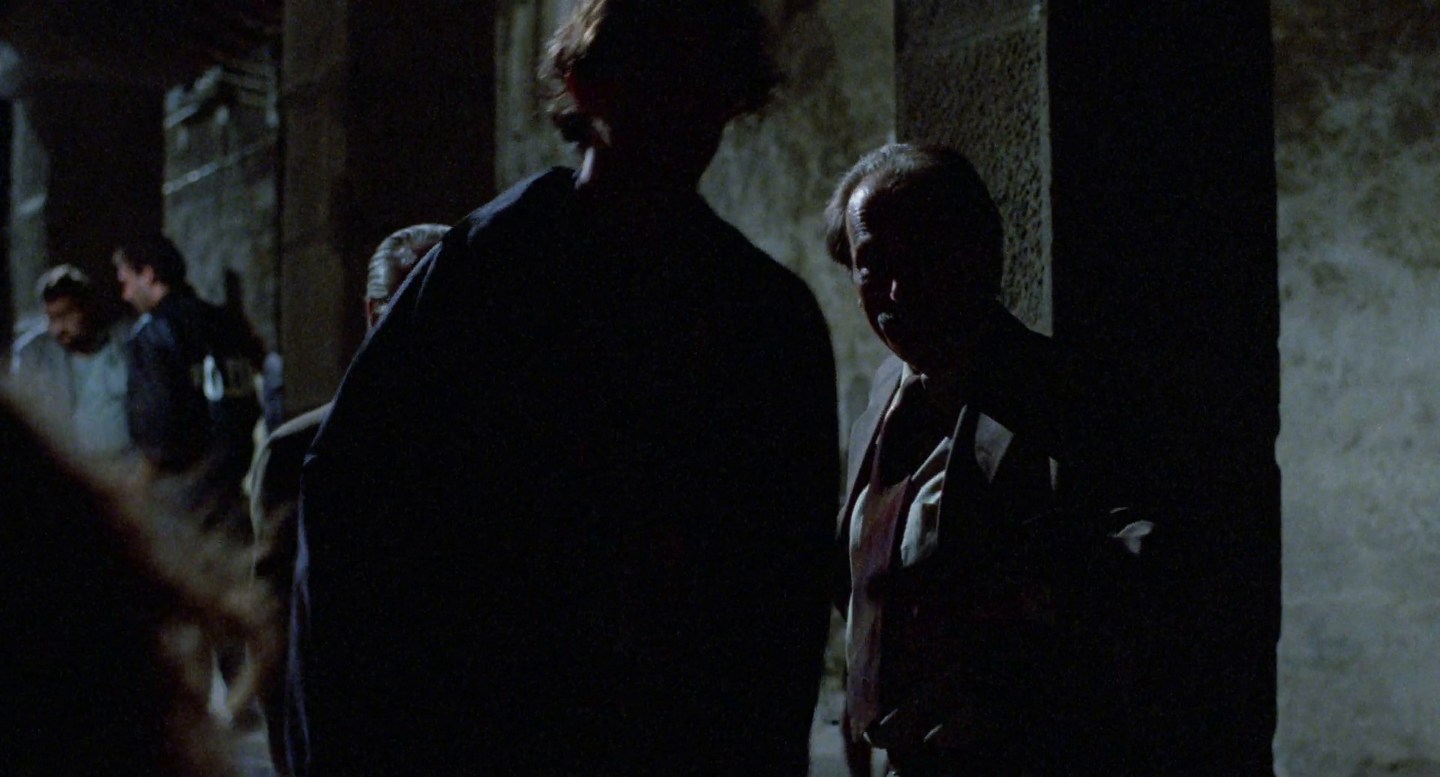
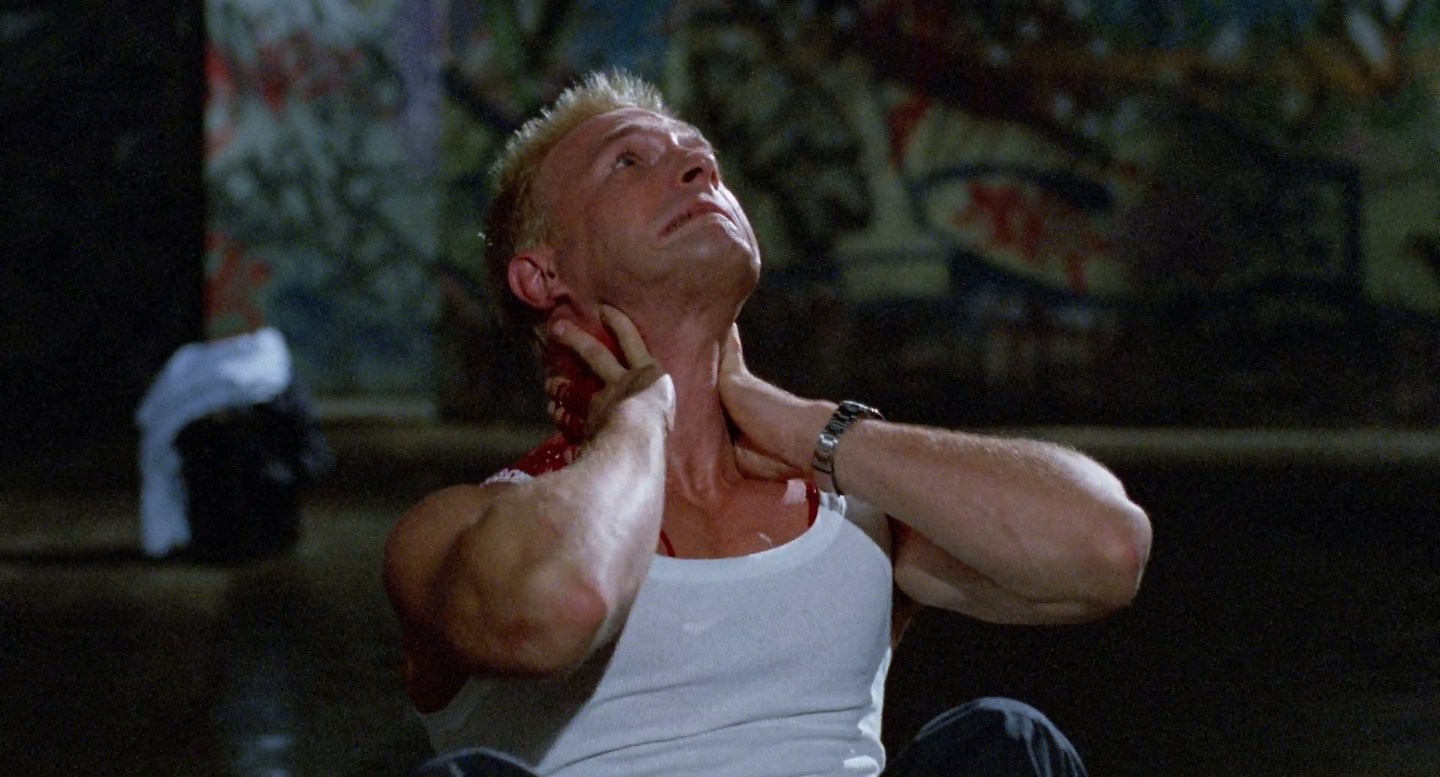
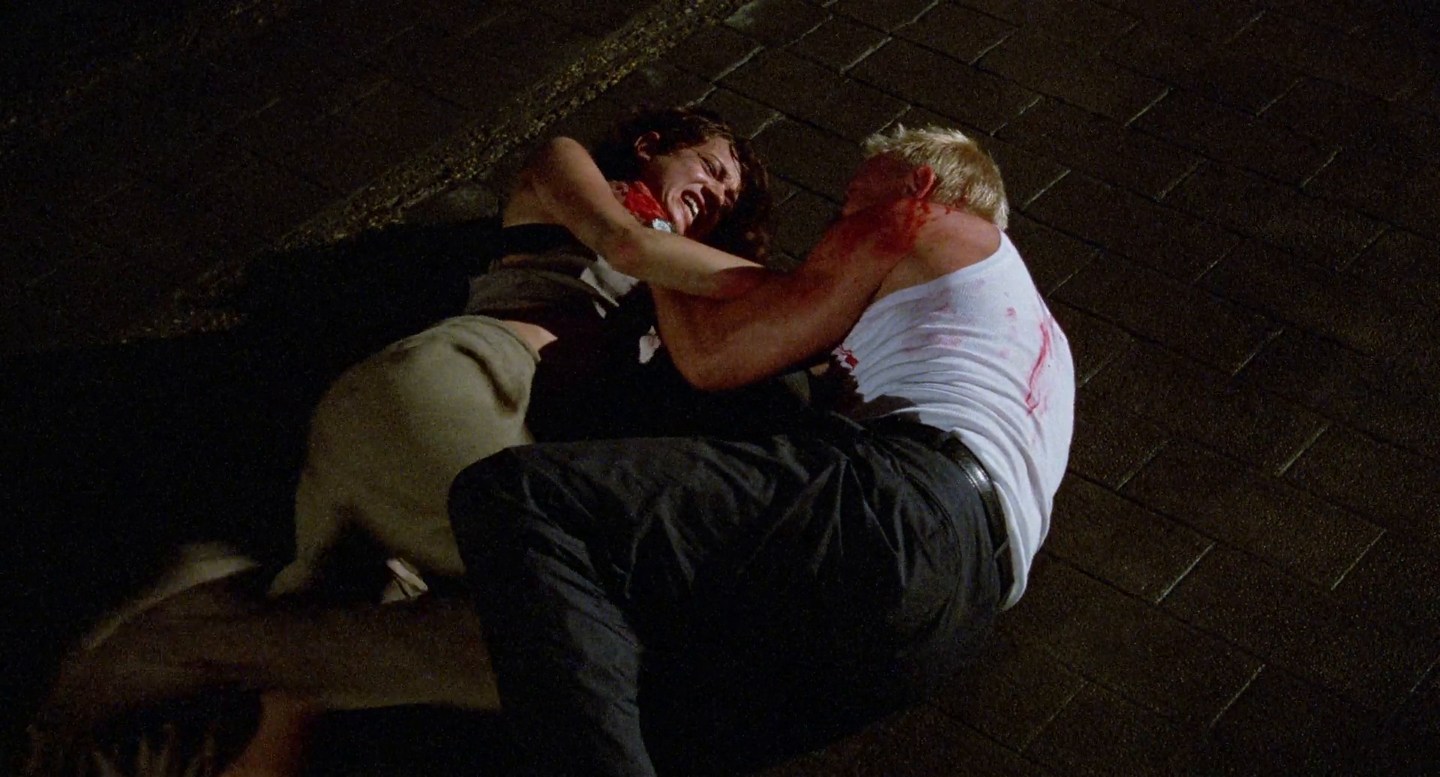
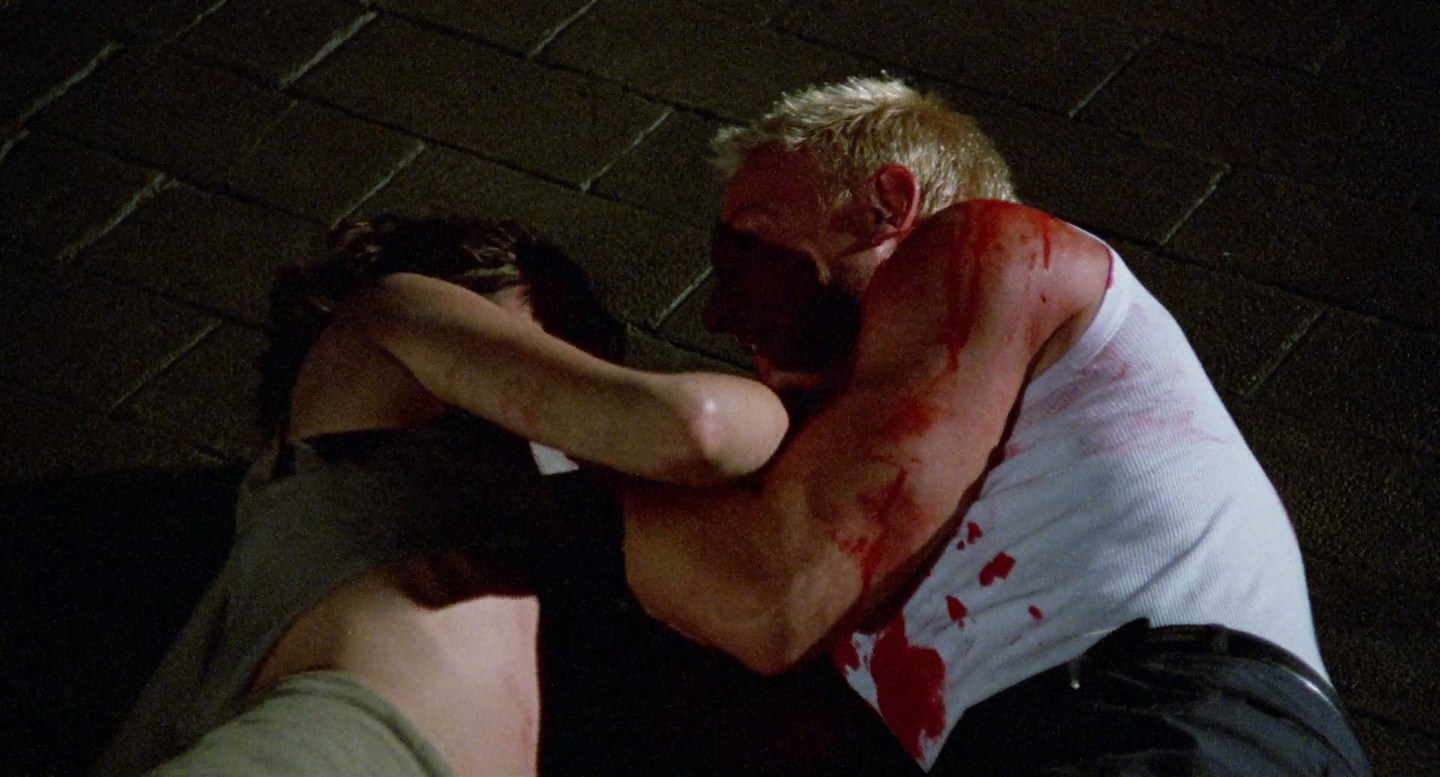
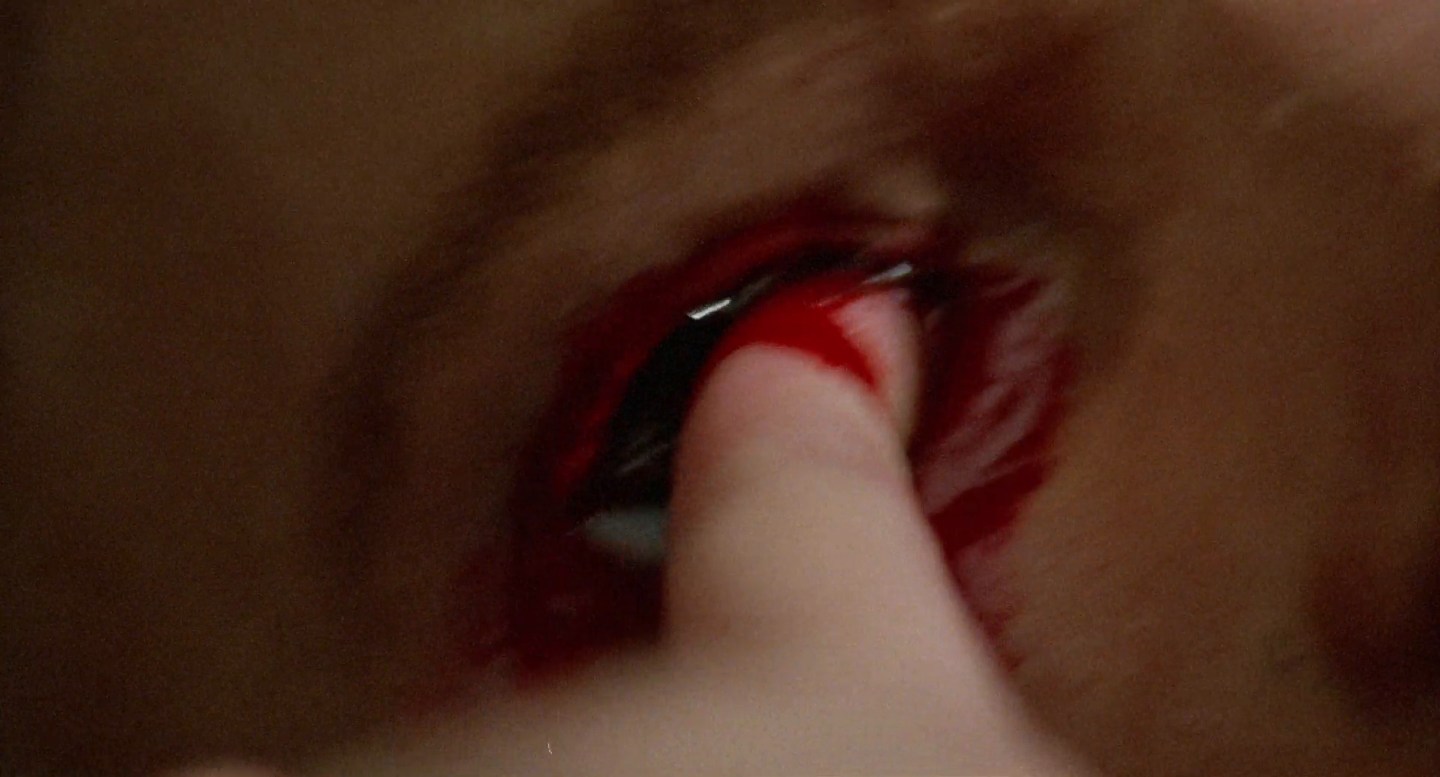
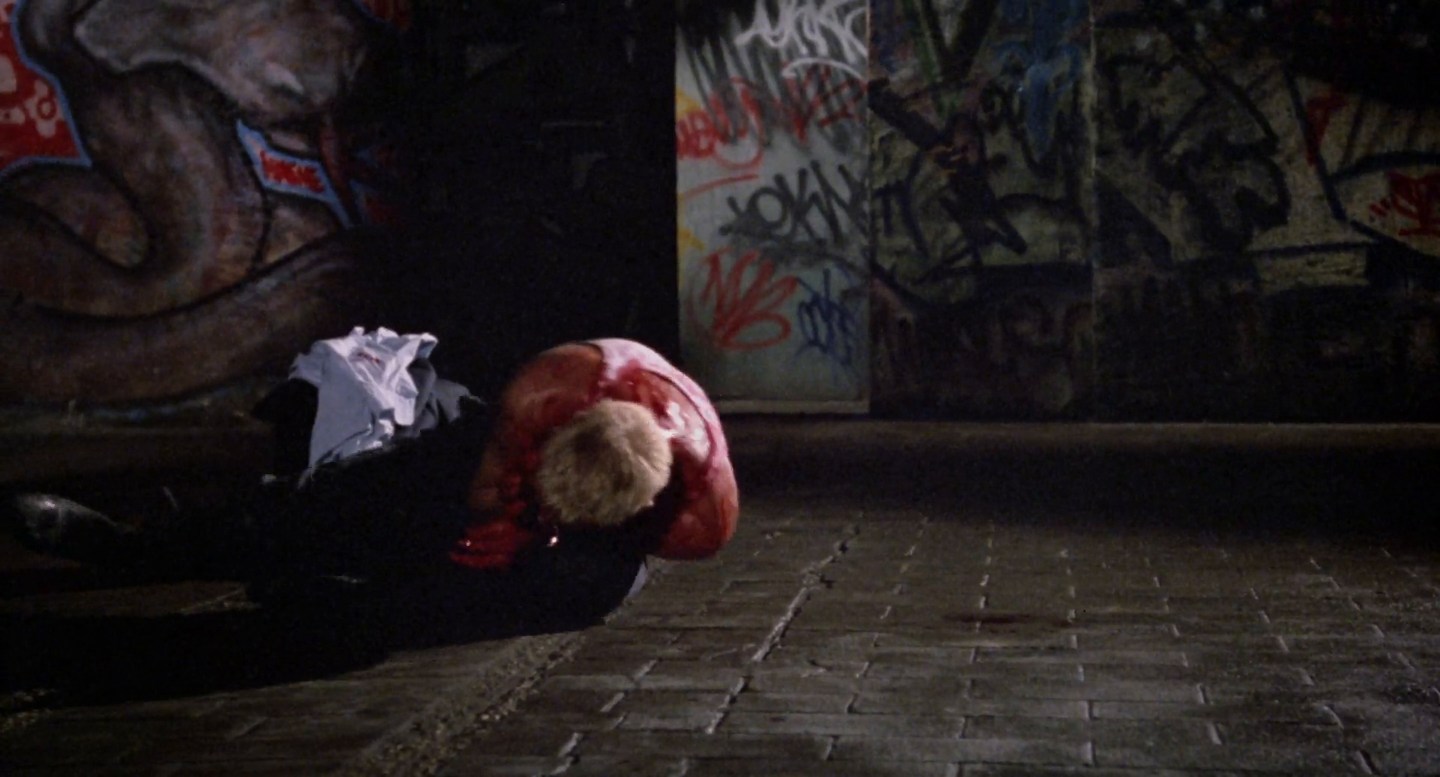
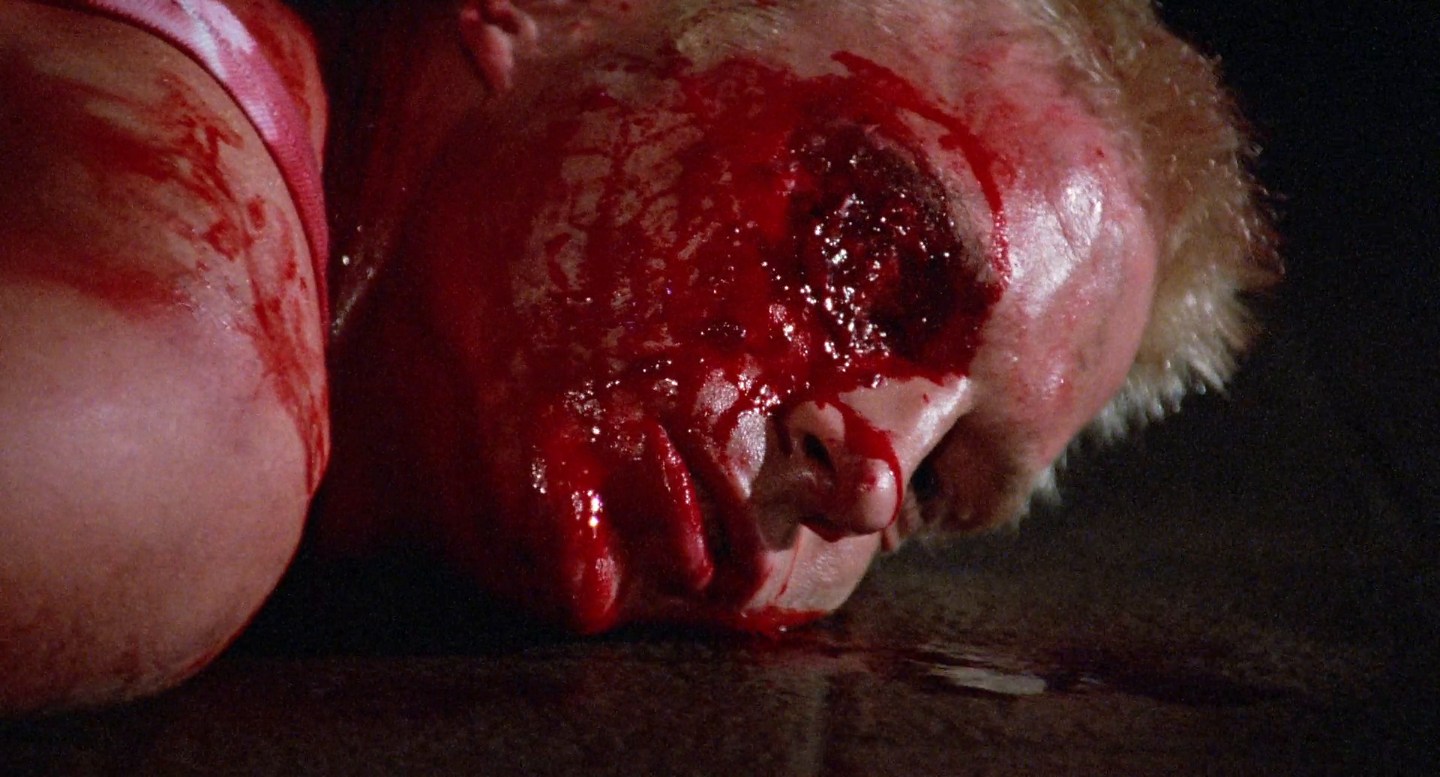
The fight changes the distribution of power through a succession of distinct images: the neck wound, the struggle on the floor, the eye injury, the weapon and the body left behind. Wide views repeatedly restore the distance between the figures.
The workshop’s painted faces remain visible throughout. The final close view of Alfredo’s injured face makes the destruction of the eye part of a film organised around looking. These frames show the screen result; they do not assign each insert to a particular technician.
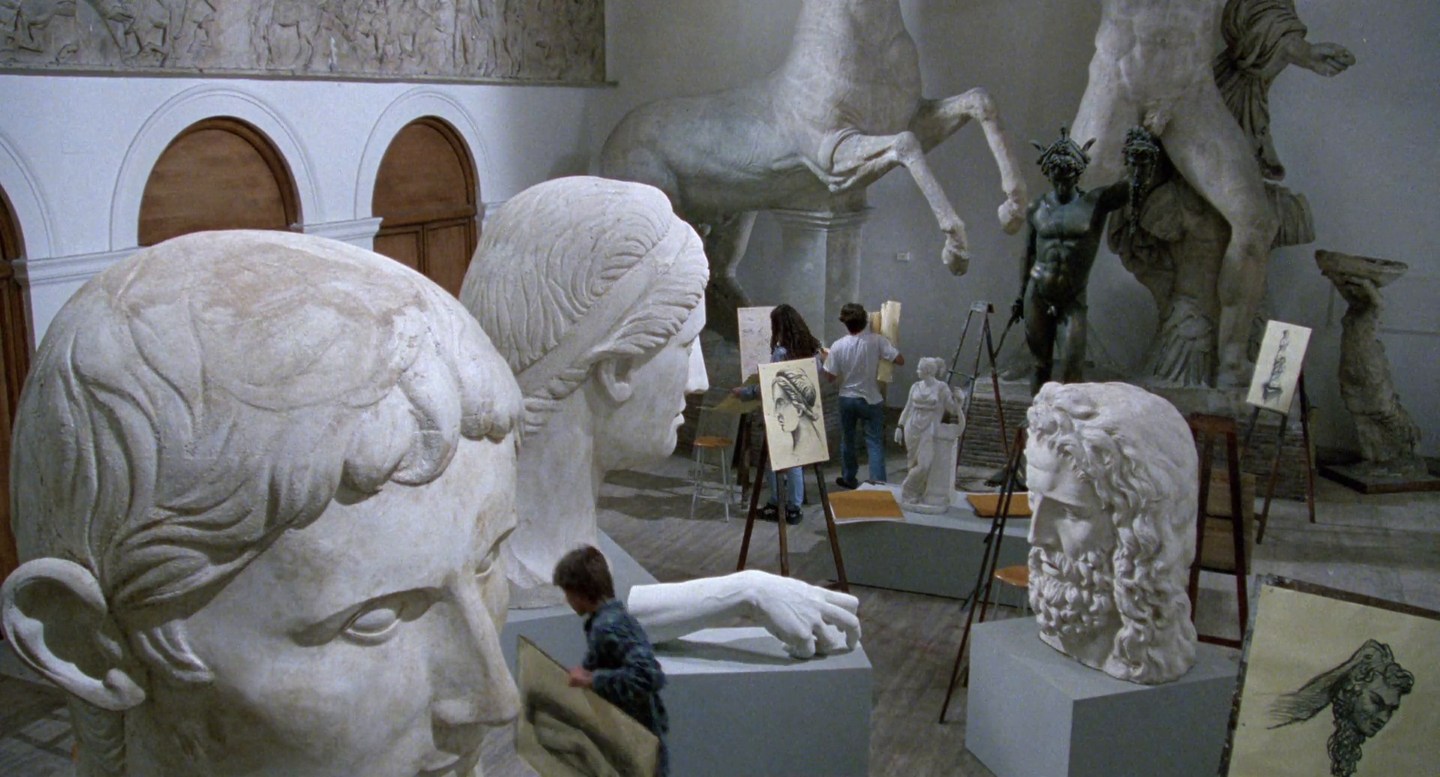
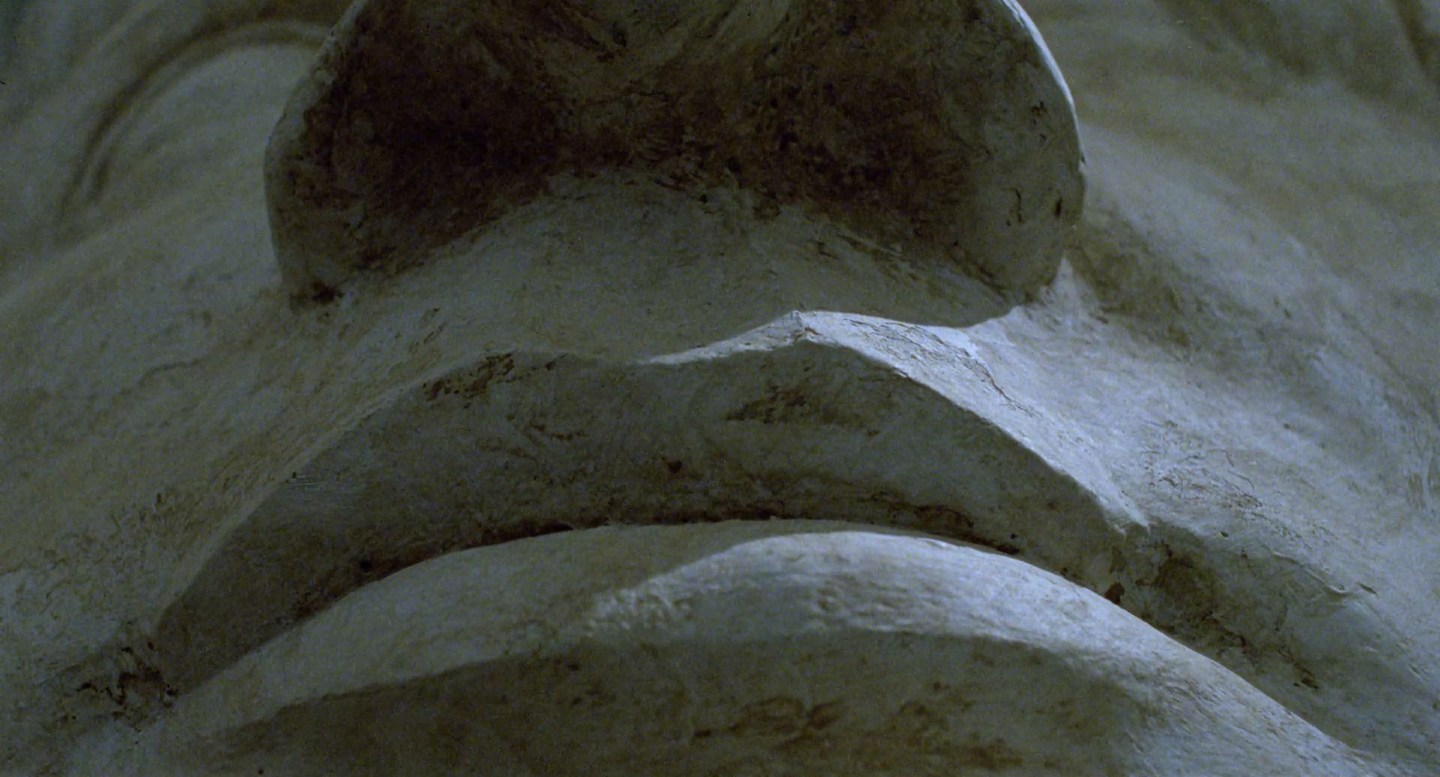
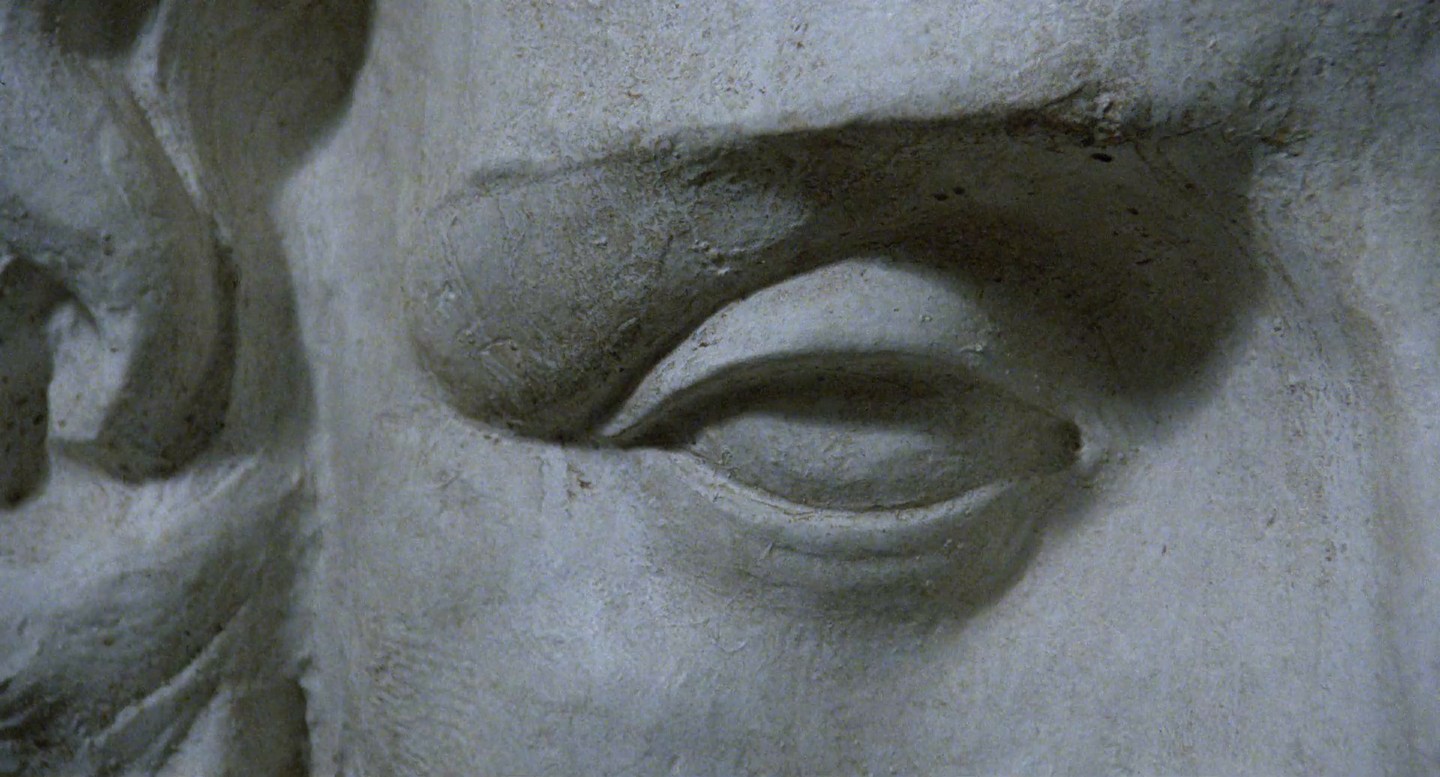
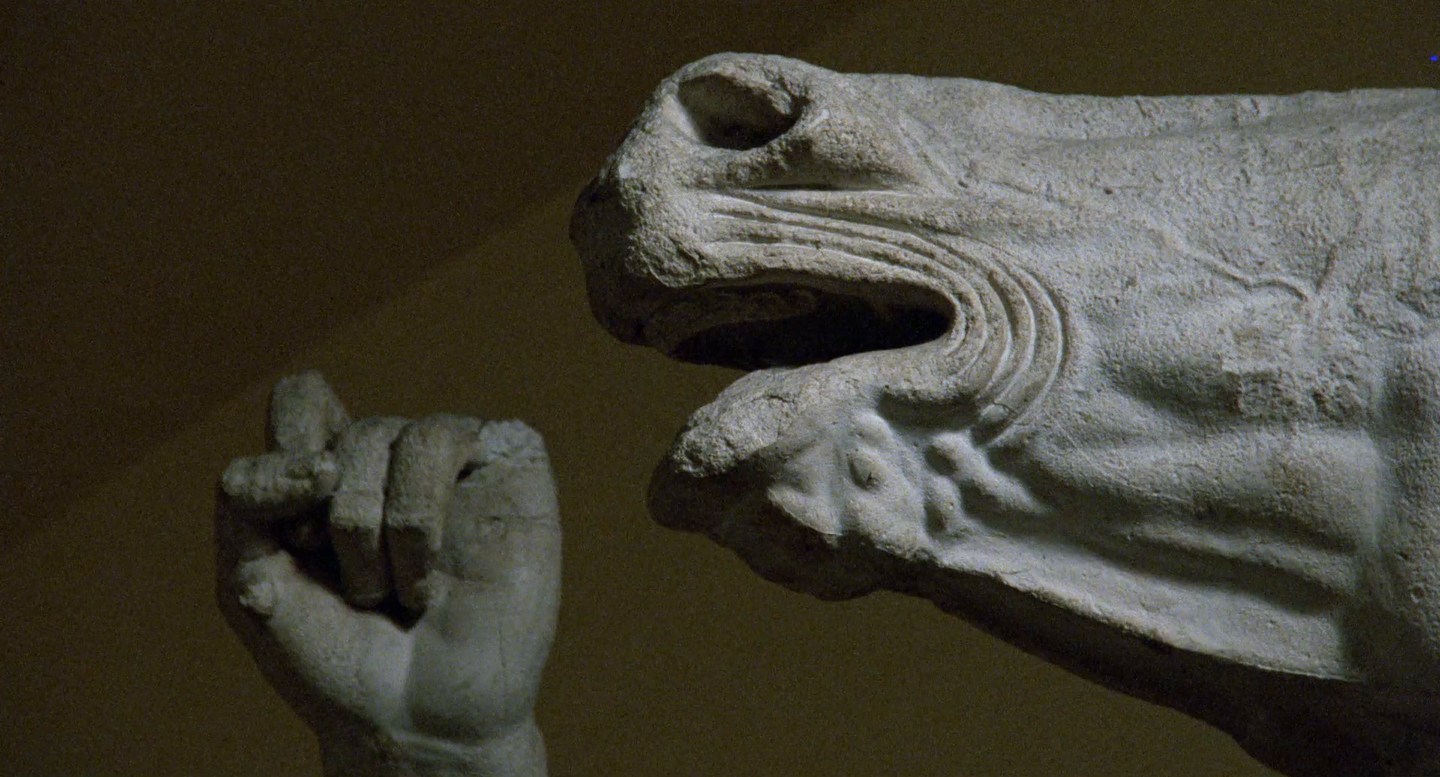
Marie’s figure is repeatedly interrupted by sculptural faces and limbs. Close views of stone lips and eyes turn the room’s objects into a succession of partial witnesses.
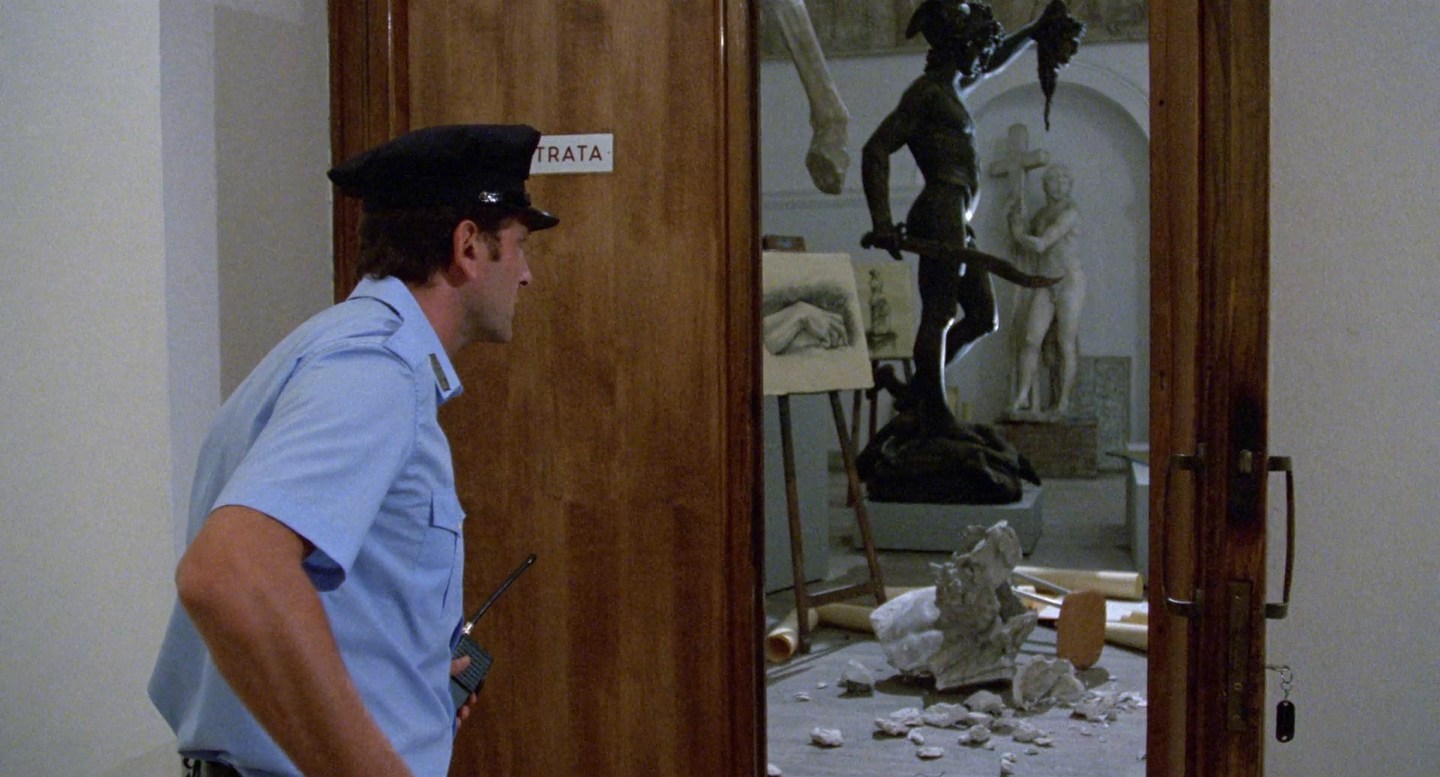
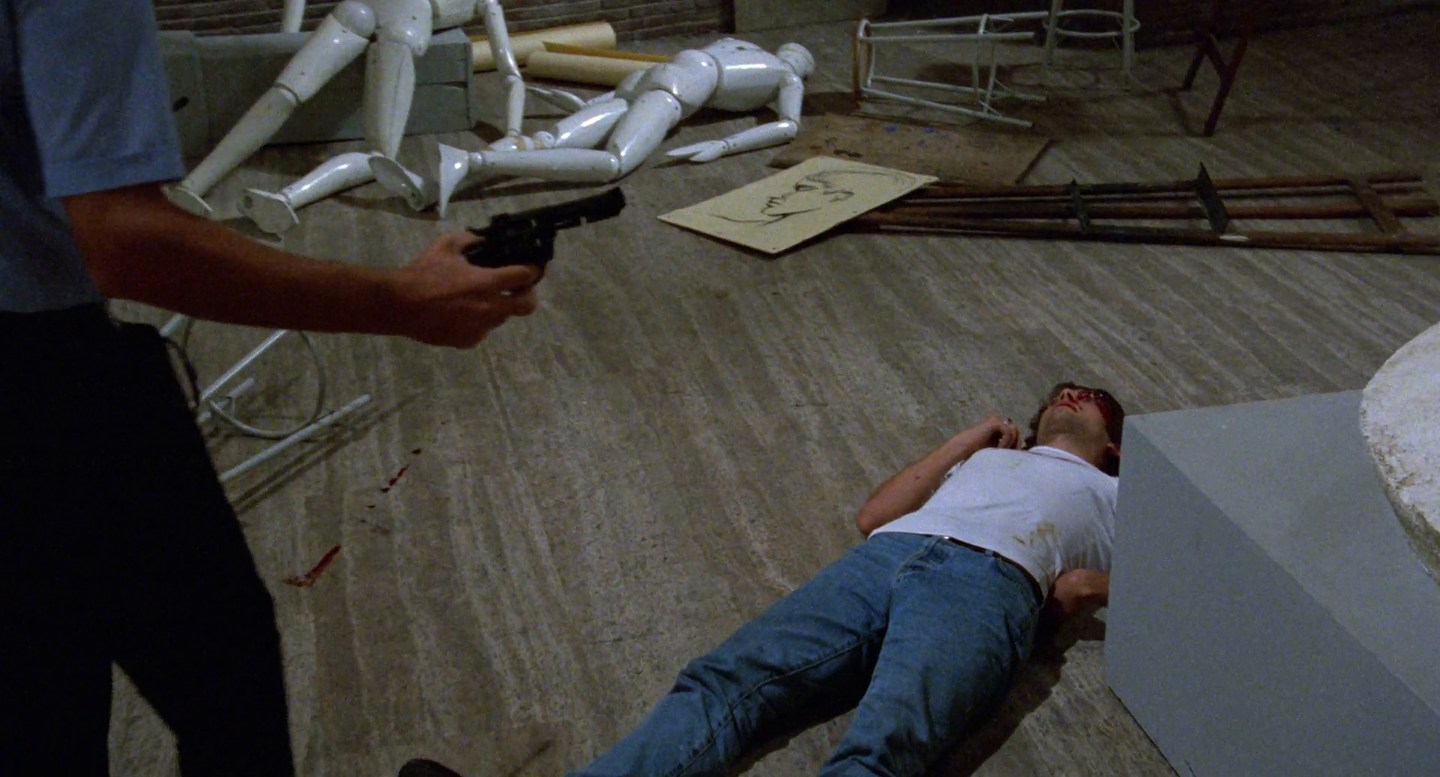
The discovery transfers injury onto the artwork: blood on a pale face announces what the entering officer will find below. The gallery follows the preparation, interrupted view and aftermath without inventing an unseen continuous view of the assault.
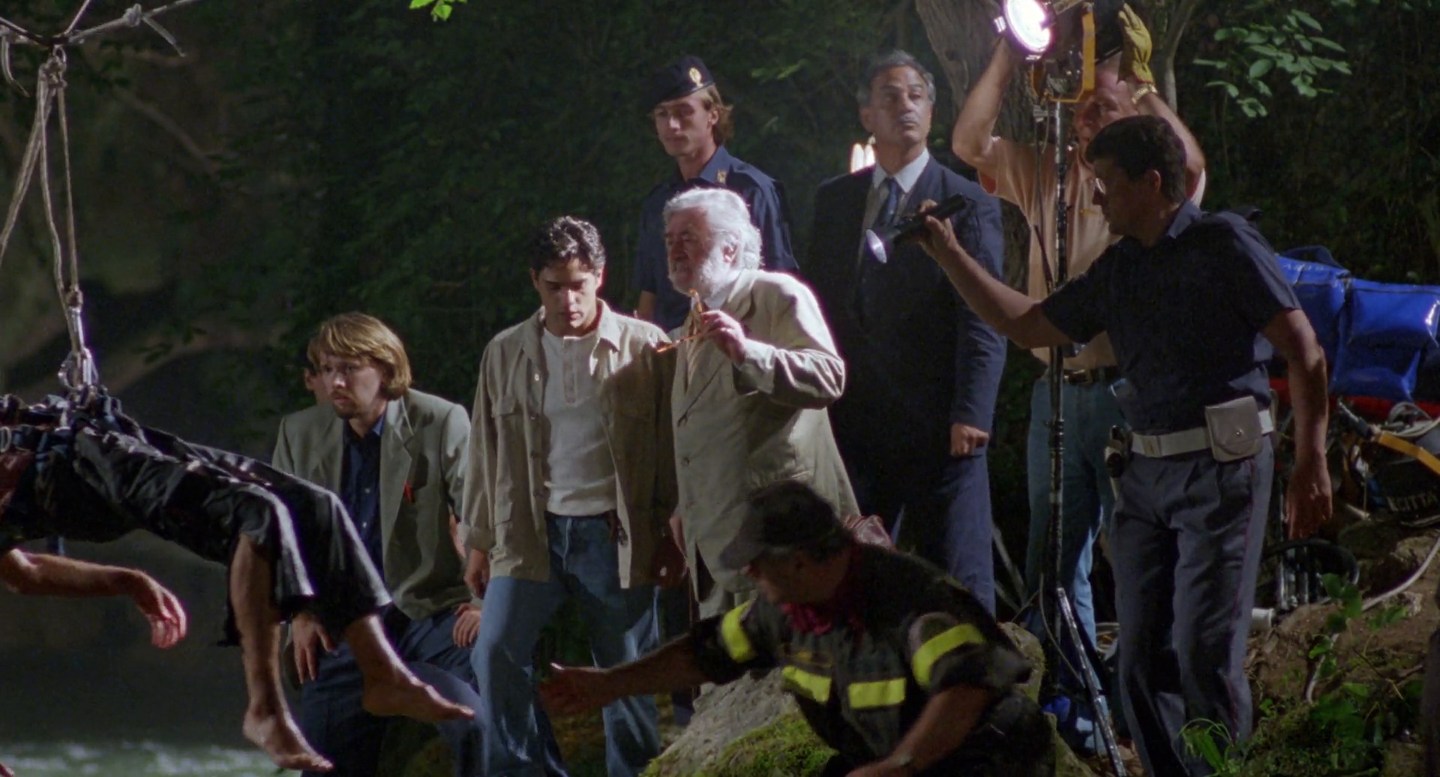
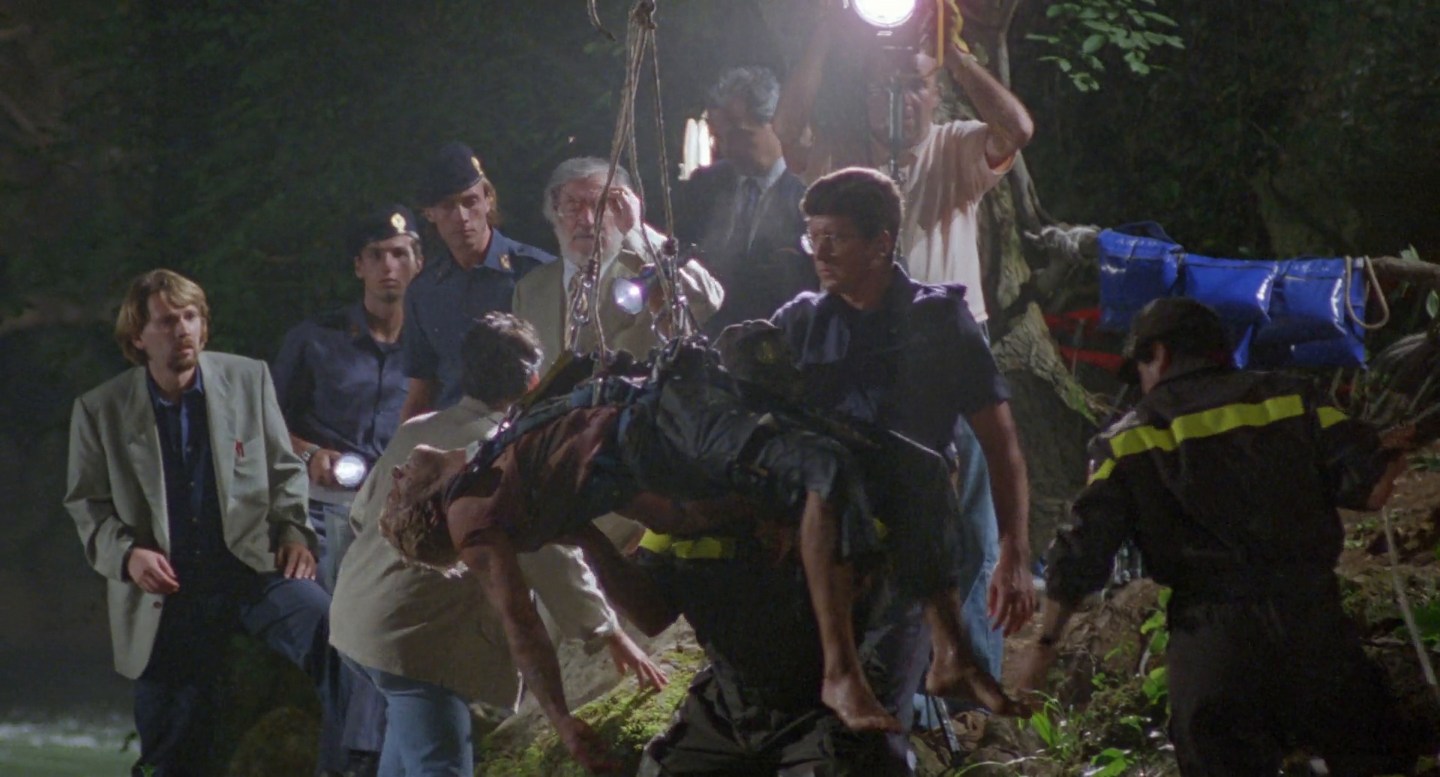
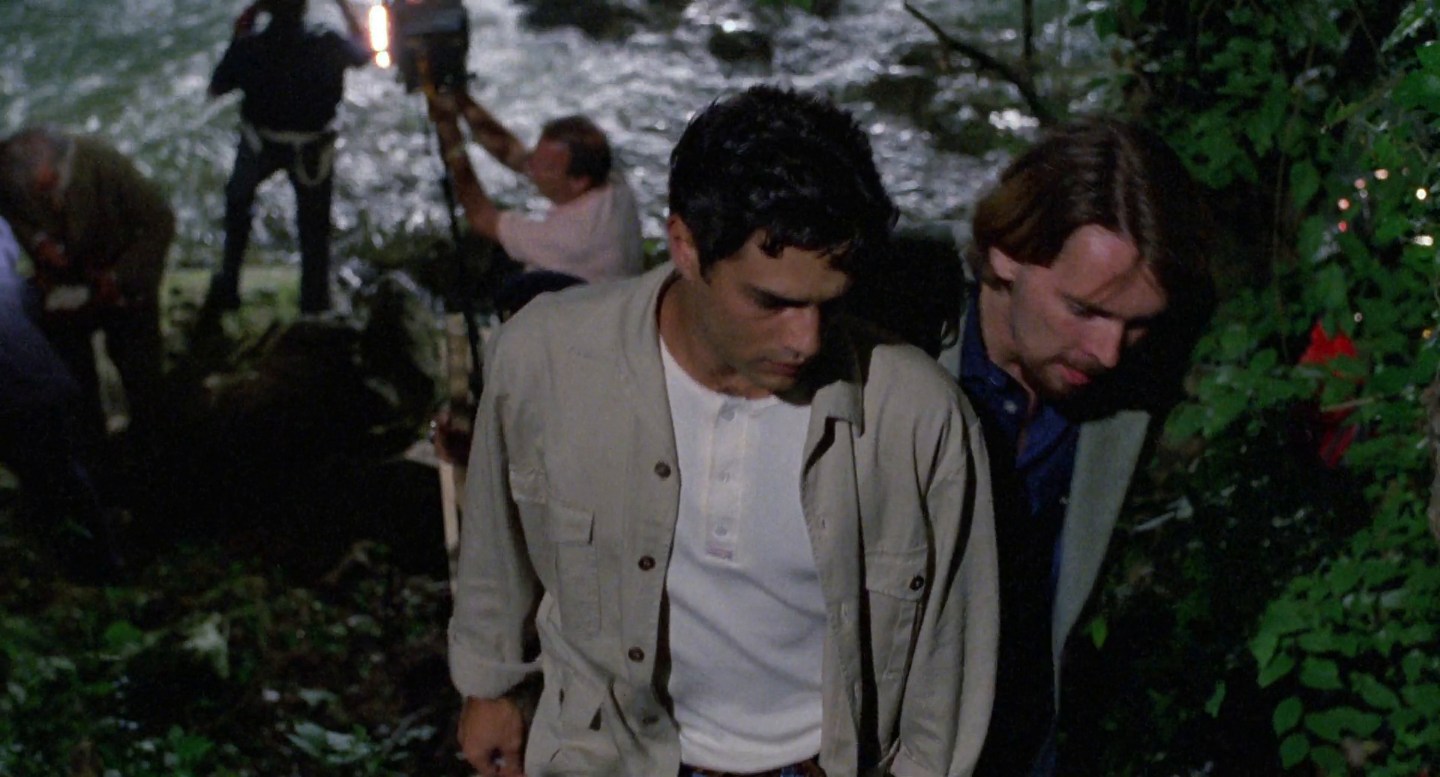
The river recovery separates the damaged body from the surrounding darkness through ropes, lamps and the coordinated actions of several people. Its emergence is a staged disclosure.
The wider landscape establishes the effort of retrieval; closer views connect the material remains with those who must interpret them. The recovered body changes the meaning of the murders that followed its disappearance.
Explore the sequence 6 stages
01 · 1:44:06
ENLARGE ↗The search party gathers beside the water.
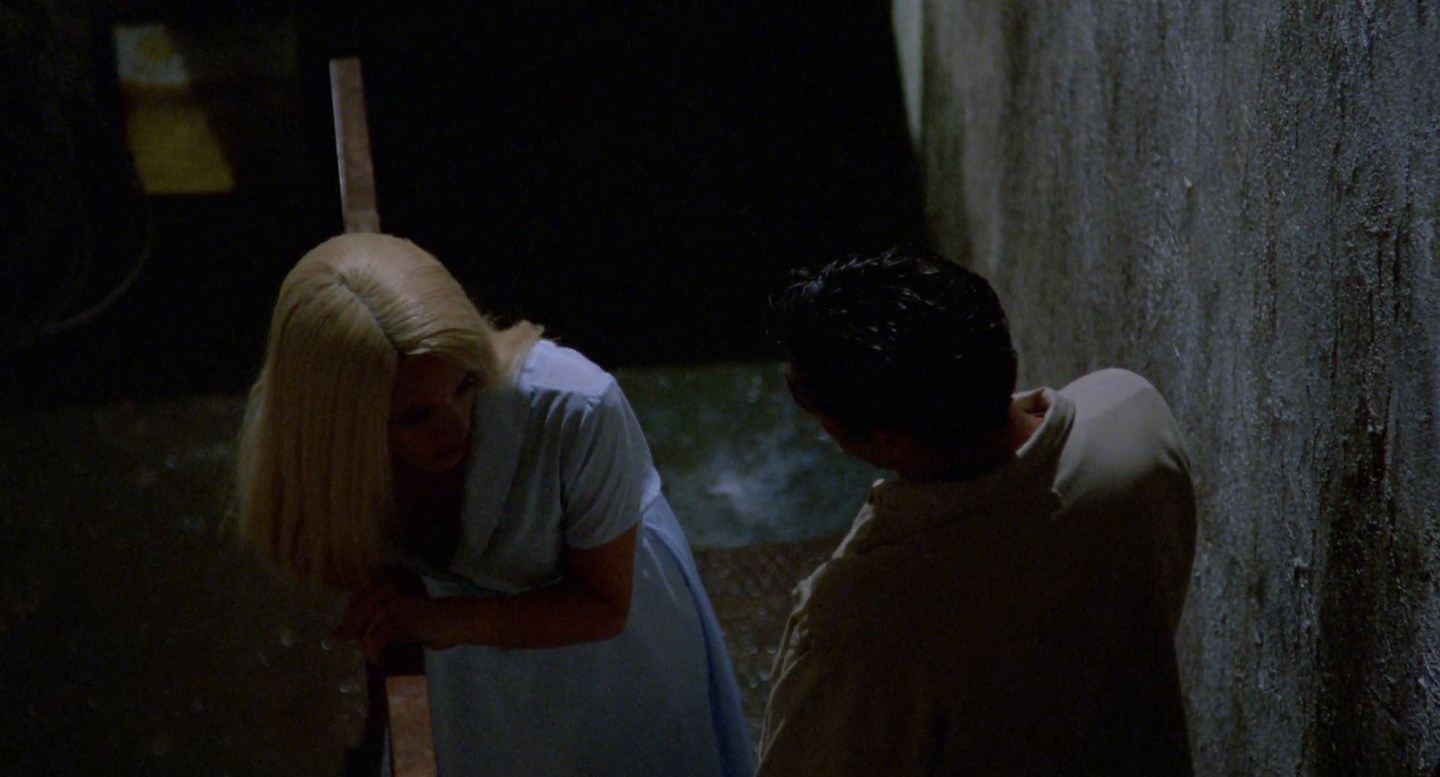
The narrow passage compresses Anna and Marco into a shared route. Their apparent closeness becomes dangerous beside the parked car. The attack is broken into contact, falling movement and the body meeting a hard surface.
Blood on Anna’s pale dress carries the event beyond the immediate struggle. The wig is then removed, making another change of appearance part of the sequence’s aftermath.
Explore the sequence 10 stages
01 · 1:52:50
ENLARGE ↗The two figures enter the narrow stairwell.
The film repeatedly keeps the frame visible while changing what lies within it. The doorway, the landscape and the sculptural room turn looking into a question of physical access.
Follow the visual progression 5 observations
06:16
A gilt border contains the painted sea before Anna’s plunge.
15:34
The Night Watch changes on the hotel wall.
15:44
The dark aperture becomes the route into the police investigation.
28:45
The landscape’s frame contains a space with apparent depth.
1:35:04
Sculptural heads obstruct the real room instead of opening an imagined one.
Hair, mirrors and the constructed self
ENLARGE ↗Anna arranges the blonde wig before the mirror.
Three different silhouettes do narrative work: long dark hair, the short cut and the blonde wig. Mirror scenes make some of those changes observable actions, while cuts present others as already accomplished.
Follow the visual progression 5 observations
07:40
The washroom reflection follows the first collapse.
Colour leaves the picture and occupies bodies, furnishings and sculpture. The film makes surfaces carry evidence while also making that evidence difficult to separate from an image.
Follow the visual progression 5 observations
53:26
Pigment covers Anna’s hands and face.
1:07:51
Blood makes the white vest a changing visual surface.
1:36:56
The sculpture carries the first sign of the murder’s aftermath.
1:49:30
The bedroom becomes a field of red.
1:54:05
The pale dress carries the last attack into the street.
The opening crowd, the spectators around the collapse, investigators and the final gathering organise different kinds of looking. Anna moves between observer, witness, patient and the person being carried.
Follow the visual progression 4 observations
01:56
Tourists repeatedly obscure the searching face.
07:19
The gallery spectators gather above the fallen observer.
1:44:30
The recovery brings several witnesses around material evidence.
1:56:57
The final crowd encloses and carries Anna.
VOICE & DIALOGUE
Who speaks for Anna?
Names, recorded messages, borrowed words and unanswered questions connect the film from the first encounter to the final crowd. Twelve illustrated studies follow the conversations that change what Anna—and the spectator—can know.
Anna’s identity first comes back from outside her: a hotel employee supplies her surname, a medicine label gives her full name, and the telephone returns her own recorded greeting. The answering machine preserves an ordinary, socially recognizable Anna while the woman in the hotel cannot place herself. Its later repetitions make that separation increasingly disturbing.
Follow the dialogue 4 observations
08:41
Alfredo gives his name and asks for hers. His apparent helpfulness conceals a decisive imbalance: he knows whom he is approaching.
10:39
The hotel employee repeatedly addresses Miss Manni. Recognition belongs to someone else before Anna can claim it.
12:27
The prescription label supplies Anna Manni and Rome. She uses the information to seek her own telephone number.
13:00
Her recorded greeting answers. The same introduction returns at 32:16 and 1:45:42, carrying a stable name across radically different situations.
ENLARGE ↗Anna and Manetti look towards the recovered evidence.
The police story initially gives Anna a professional voice and a clear assignment. After the assault, those institutional words turn towards her: she must answer questions, receive reassurance and submit to an assessment. Her badge can be replaced immediately; her relation to the authority it represents cannot.
Follow the dialogue 4 observations
15:51
Inside the remembered investigation, Anna identifies herself as a police officer. The statement places her within the busy crime scene.
16:18
Manetti sends her to Florence because she has followed the earlier cases. The assignment rests on experience and his declared trust.
22:42
After escaping, she gives her profession, city and full name to uniformed officers. Naming herself becomes a means of obtaining help.
30:51
Manetti says the commission found no negligence and gives her a new badge and pistol. The reassurance is followed by instructions to remain at headquarters and see the psychologist.
ENLARGE ↗Anna holds the receiver in the quiet room.
Cavanna introduces a passage attributed within the film to Stendhal: powerful feeling, the soul and a wish to forget. Alfredo later repeats the passage on the telephone and turns its question of memory against Anna. Words offered as an explanation of her experience become a claim that he can enter and control it.
Follow the dialogue 4 observations
35:24
Cavanna rejects Anna’s description of herself as crazy. He begins by offering another vocabulary for what happened in the gallery.
36:10
The quoted passage links intense feeling with the desire to forget. Its wording gives the later telephone scene a precise point of return.
56:35
Alfredo repeats the passage, appropriating the language that had framed the consultation.
57:03
He redirects the wish to forget towards himself. The repetition connects an account of art’s power to the aggressor’s insistence on remaining in Anna’s memory.
ENLARGE ↗Anna and Marco stand close together in her room.
Marco arrives with familiar comforts: comedy videos, food and flowers. Anna says she does not want them; he leaves them anyway. The exchange establishes a small but consequential failure to accept her words before the scene turns into a confrontation over intimacy. Cavanna’s later effort to put her experiences in order offers another kind of authority, one Anna will eventually challenge directly.
Follow the dialogue 4 observations
37:09
Marco proposes Buster Keaton as a way to laugh. Entertainment is offered as a ready-made remedy before Anna has described what she needs.
37:22
Her refusal of the gifts is answered by a decision to leave them. The words acknowledge her response while the action overrides it.
37:48
Anna says she cannot contemplate intimacy. At 38:01, the two subtitle tracks give different formulations of her changed relation to Marco; see the language comparison below.
40:54
Cavanna separates the assault from the shock of the paintings and tells Anna she is not responsible for being attacked. His confidence about their separation becomes part of the film’s contested explanation, rather than a clinical conclusion for the viewer to adopt.
Anna’s calls to other survivors interrupt the usual progress from question to useful clue. One woman refuses to return to the experience; another actively chooses to describe it. A bereaved husband then asks Anna to account for what his wife felt before her death. These conversations expose the distance between gathering a case history and possessing another person’s experience.
Follow the dialogue 4 observations
51:29
Anna requests the women’s numbers because she wants to talk to them. Her inquiry has become personal as well as professional.
52:41
The first woman refuses further questions and places herself in the present with her children. Her refusal is a boundary, not a failed piece of police evidence.
53:40
The next woman asks whether Anna really wants to know, then chooses to speak. Her comparison with her former husband moves violence beyond the exceptional monster pursued by the investigation.
54:31
The bereaved husband challenges the official concentration on murder. His questions about feeling and suffering are precisely what Anna cannot answer on his wife’s behalf.
The anonymous female informant was the premise of Anna’s trip to the Uffizi. Alfredo’s demonstration of an altered voice makes that apparent witness part of his trap. The revelation supplies a missing cause for the opening without making the gallery experience itself any less disorienting.
Follow the dialogue 4 observations
32:59
Anna recalls a woman who knew about the investigation and directed her to the Uffizi. She cannot recover the caller’s name.
33:40
The consultation distinguishes the caller’s information from what Anna independently knew. She went to the museum without contacting the Florence police first.
1:02:06
Alfredo imitates a telephone ringing and claims the earlier call. His demonstration turns an apparently separate character into a performance.
1:02:23
The caption record marks the device click, a high-pitched voice and the return of Alfredo’s voice. The message about the gallery is repeated while the film revisits Anna in the hotel.
When Alfredo loses physical control, he appeals to Anna’s profession and demands arrest. Her reply refuses the authority he suddenly invokes. At the river, she returns his language of clean water and fresh air to him. The reversal is verbal as well as physical: she occupies the position from which he had instructed her how to understand the scene.
Follow the dialogue 4 observations
58:44
Alfredo draws attention to the water and attaches the idea of purity to it. The setting becomes a means of humiliation through his commentary.
1:08:43
Confronted by Anna’s gun, he insists that a police officer must arrest him. The man who violated her invokes the rules of her profession for protection.
1:09:02
Anna answers his demand for rights with a command to stop speaking. The next shot breaks the exchange.
1:10:42
At the river she asks about the water, then returns to the language of cleanliness. The repeated terms connect the retaliation to the earlier abuse without making the encounter a simple restoration of justice.
Anna tells Cavanna about a judge who permits a traveller to use a boat without mentioning the hole that will sink it. The story accuses an authority figure of answering the literal question while withholding the knowledge that matters. It also puts Anna in control of the consultation’s metaphor: she now supplies the example through which his conduct is judged.
Follow the dialogue 4 observations
1:17:22
She imagines another name for herself: Louise in the English SDH text, Louisa in the translation track. Identity becomes something she can propose as well as lose.
1:17:40
Anna challenges the doctor’s habit of saying little. The accusation introduces the parable’s distinction between permission and adequate warning.
1:18:00
The traveller asks to use the boat; the owner consents. Anna’s story makes a technically correct answer carry a disastrous omission.
1:18:25
The judge defends himself because the boat’s condition was never raised. Anna immediately rejects the doctor’s appeal for more time and asks whether Alfredo’s body has been found.
ENLARGE ↗Anna rides behind Marie through the city.
Marie’s introduction makes uncertainty playful. His name prompts a question about gender; a French word for a car becomes an invitation to travel together; the names of painters become an exuberant account of his attraction to Italy. Anna temporarily enters a conversation that is neither interrogation nor diagnosis. Her decision to call herself a law student nevertheless keeps the relationship dependent on an omission.
Follow the dialogue 4 observations
1:20:40
Marie introduces himself and explains the use of his name. The conversation allows a name to be discussed rather than treated as a fixed clue.
1:20:58
The request for a voiture prompts translation and an offer of a scooter ride. A gap in language creates an opening for companionship.
1:21:30
His sequence of artists’ names makes art a shared enthusiasm. Cavanna will later remind Anna that paintings also framed her meeting with Alfredo.
1:22:01
Anna tells the doctor that Marie believes she is a law student. She resists Cavanna’s comparison of the two men and emphasizes that Marie made her laugh.
ENLARGE ↗The telephone and television divide the room.
The television and telephone place different demands on the people in Anna’s room. The caption record alternates television effects with her responses to the call and her attempts to reach Marco. When he finally takes the receiver, the subsequent account depends on what she says the caller told her. The scene prepares the later distinction between a reported voice and a recorded message with independent information.
Follow the dialogue 4 observations
1:27:47
The television programme supplies gunfire and, shortly afterwards, howling wolves. A second fictional threat occupies the domestic scene.
1:28:13
The telephone rings. Anna’s replies establish a threat to Marie while she repeatedly calls for Marco.
1:28:59
Television noise and Marco’s laughter are explicitly identified in the captions between her appeals. Their attention is divided even though they share the same room.
1:29:33
Marco asks what the caller said, then questions whether the reported jealousy fits Alfredo’s behaviour. The investigation now depends on Anna’s account of a conversation he did not share.
ENLARGE ↗The answering machine interrupts the consultation.
The answering machine’s third major appearance changes the balance of knowledge. Anna’s familiar greeting is followed by Marco’s report that Alfredo’s body has been in the water for weeks. Marco proposes an imitator; Cavanna, present in the room, draws a different conclusion. Recording secures the message’s words, but it cannot make the characters agree about what they mean.
Follow the dialogue 4 observations
1:44:15
The recovery scene supplies an external finding: the body has been in the water for at least three weeks. This interrupts Anna’s claim that Alfredo knows everything she does.
1:45:07
Cavanna asks her to examine that claim of complete knowledge. The questioning turns the supposed watcher’s access into a clue about Anna herself.
1:45:42
Her recorded self-introduction returns immediately before Marco’s message. The same routine greeting now precedes information that destabilizes her explanation.
1:45:50
Marco reports the body and suggests another killer. Cavanna responds that Alfredo’s death is no surprise and asks Anna to abandon the lies. The recording becomes a point of conflict between explanations.
Anna’s final account shifts responsibility between herself and Alfredo. She describes him as being inside her, asks why no one stopped her, and later identifies herself with him. Her speech then breaks into the ordinary tasks she must remember: family, clothes, departure, putting things in order. The police pursue her while insisting on her name. The ending holds the demand for an explanation against the difficulty of reaching the person who speaks.
Follow the dialogue 4 observations
1:50:54
Anna locates Alfredo inside herself and says she has become him. These are the character’s descriptions of her experience, not a diagnosis supplied by the dossier.
1:51:12
Her questions about why she was not helped turn into an admission about Marie. The language moves between an external command and her own action.
1:54:39
After the courtyard attack, plans and errands take over. Repetition and self-correction replace the coherent sequence promised by her insistence on putting things in order.
1:55:12
Manetti orders the officers not to shoot and identifies her as Anna. Their later reassurance echoes the earlier language of care while the crowd closes around her.
A guide to the sound events named in the English descriptive captions: public voices, pictures that acquire an environment, a manufactured caller and the devices inside Anna’s home.
03:46–07:23
The gallery acquires an environment
Horse calls, shouting, camera clicks, an alarm, bubbling water and the sea appear in the caption record before crowd chatter reasserts the public gallery. The succession links the painted world to Anna’s bodily disorientation and then to other people observing her.
14:18–16:02
A picture leads into police activity
Chattering voices and military drumming precede the commands, radio traffic and electronic sounds of the remembered investigation. The transition joins the Night Watch’s organized figures to a different group assembling around a body.
1:02:06–1:02:34
The caller is manufactured
Imitated ringing, a device click and a labelled change of voice make the telephone trap explicit. Sound is part of the evidence that revises the opening.
1:27:43–1:29:03
The television divides attention
Music, gunfire, wolves and cartoon sounds belong to the television’s changing programme. They interrupt the captioned sequence of Anna’s call and her attempts to draw Marco into it.
1:40:29–1:46:07
The home becomes a set of signals
Repeated door buzzes, the television’s crash and the telephone lead towards the answering machine’s message. Devices that should connect Anna to other people also announce interruptions she cannot control.
1:55:12–1:59:01
The crowd returns around the voice
Commands not to shoot give way to reassurance, Anna’s cries and captioned vocalizing over the conclusion. The public gathering recalls the gallery, while the final words continue to address her by name.
The presentation carries Italian and English 5.1 tracks, an English translation subtitle track and separate English descriptive captions. The two English texts sometimes put a different emphasis on the same exchange.
38:01 · ANNA & MARCO
A changed self or a changed relationship?
The translation subtitle says Anna feels different. The English SDH wording is more directly relational: “I’m not your woman anymore.” Both follow her refusal of intimacy, but one emphasizes her altered sense of herself while the other explicitly rejects Marco’s familiar claim on the relationship.
1:19:07 · ANNA & CAVANNA
Who receives the credit?
The translation says Anna does not have to thank Cavanna for her recovery from the syndrome; the English SDH wording attributes that recovery to him. This is a substantive textual difference within an already confrontational consultation. The surrounding challenge to his advice remains, but the local statement about his contribution changes.
These are comparisons between the supplied subtitle texts. They do not establish the exact Italian delivery, the preferred translation or a difference in picture editing. The English and Italian audio streams both carry six-channel layouts; that specification alone does not establish how a particular edition uses space or balances dialogue and music.
Morricone on record and on screen
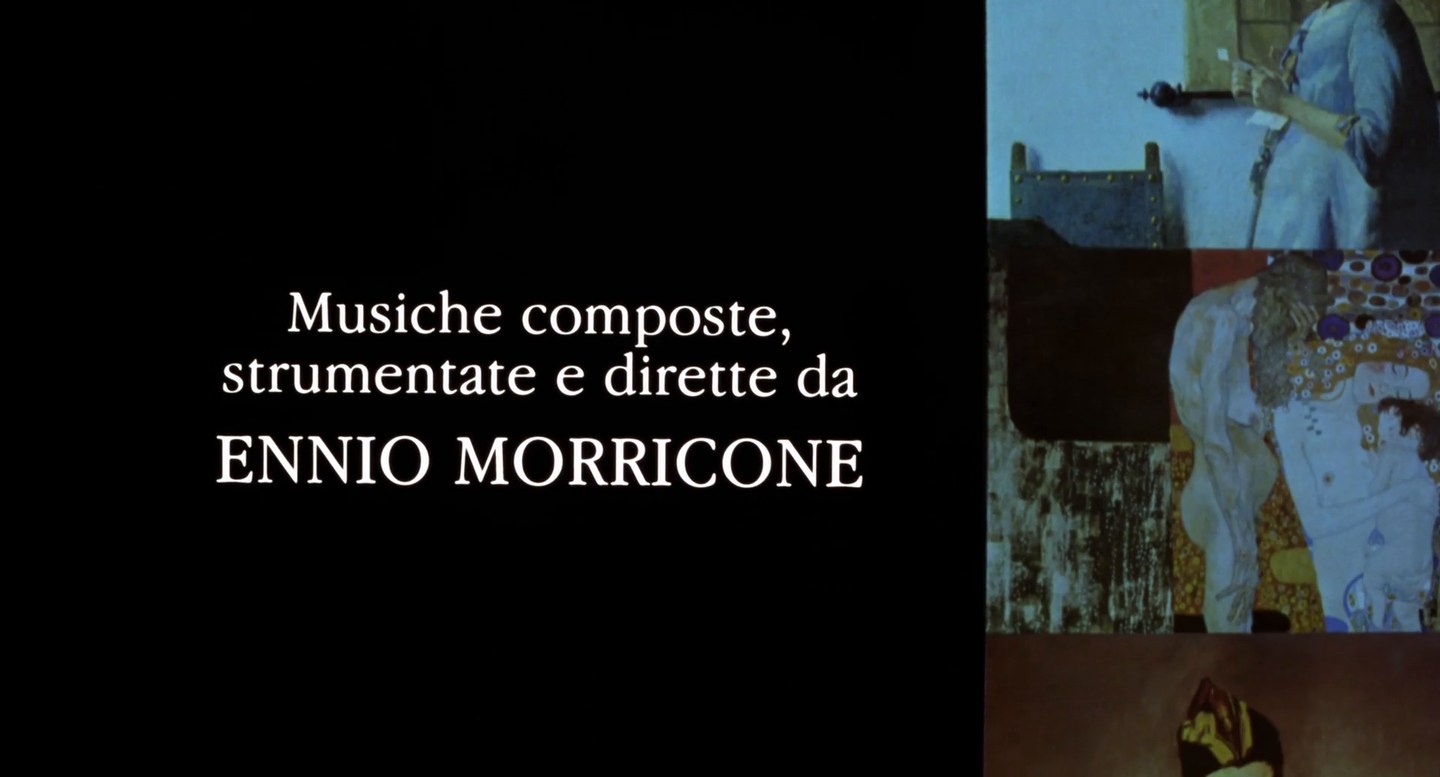
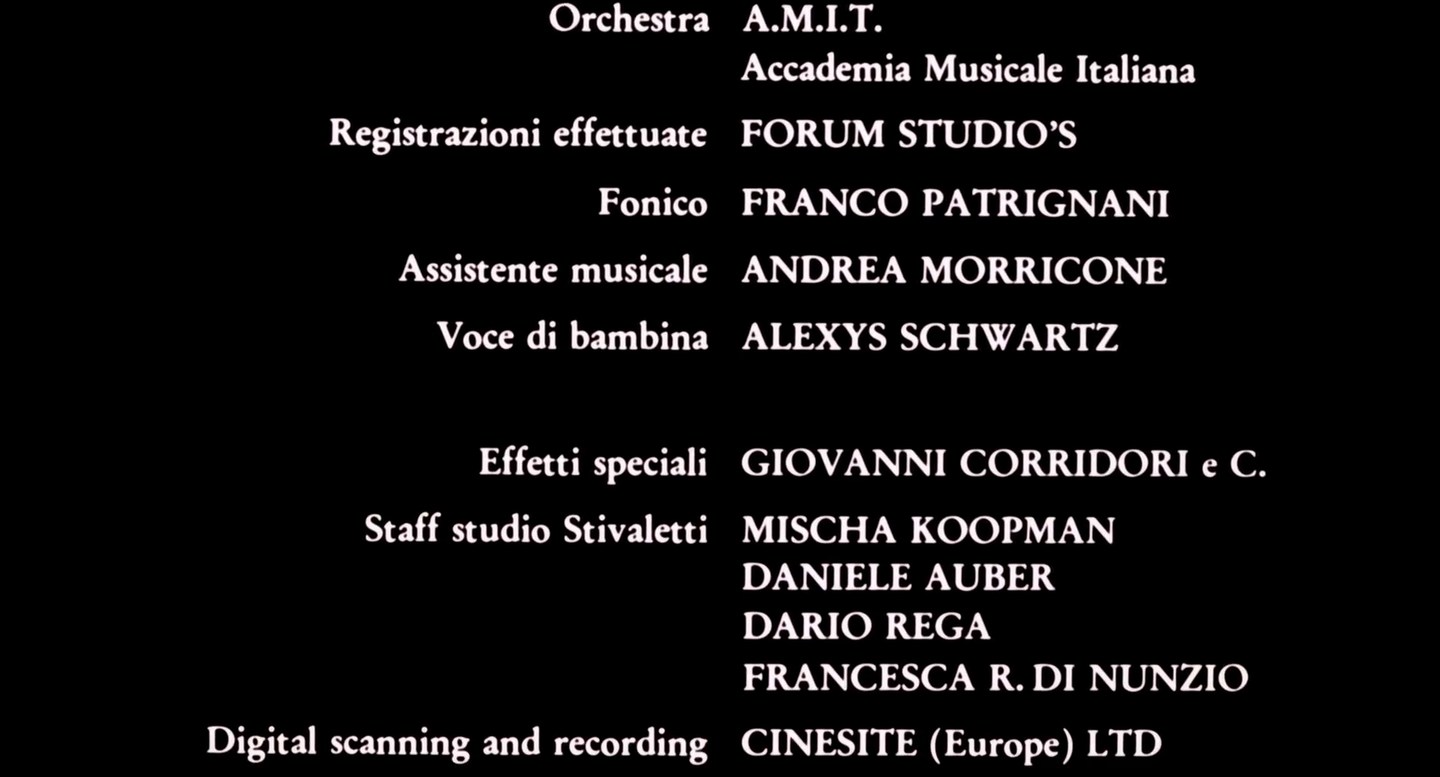
The screen credits identify Morricone’s composition, orchestration and conducting, the A.M.I.T. orchestra, Forum Studios, Franco Patrignani, Andrea Morricone and the child voice Alexys Schwartz. See the credit record →
The DRG album listing on Spotify is dated 21 September 1999 and contains sixteen tracks, totalling 46 minutes 57 seconds. It opens and closes with versions of the main theme and includes two entries titled Canto for Alexis. Those titles provide a route into the album’s organization; they do not by themselves identify the cue heard at a particular point in the film. Soundtrack catalogue →
THE CRAFT RECORD
Names on the screen.
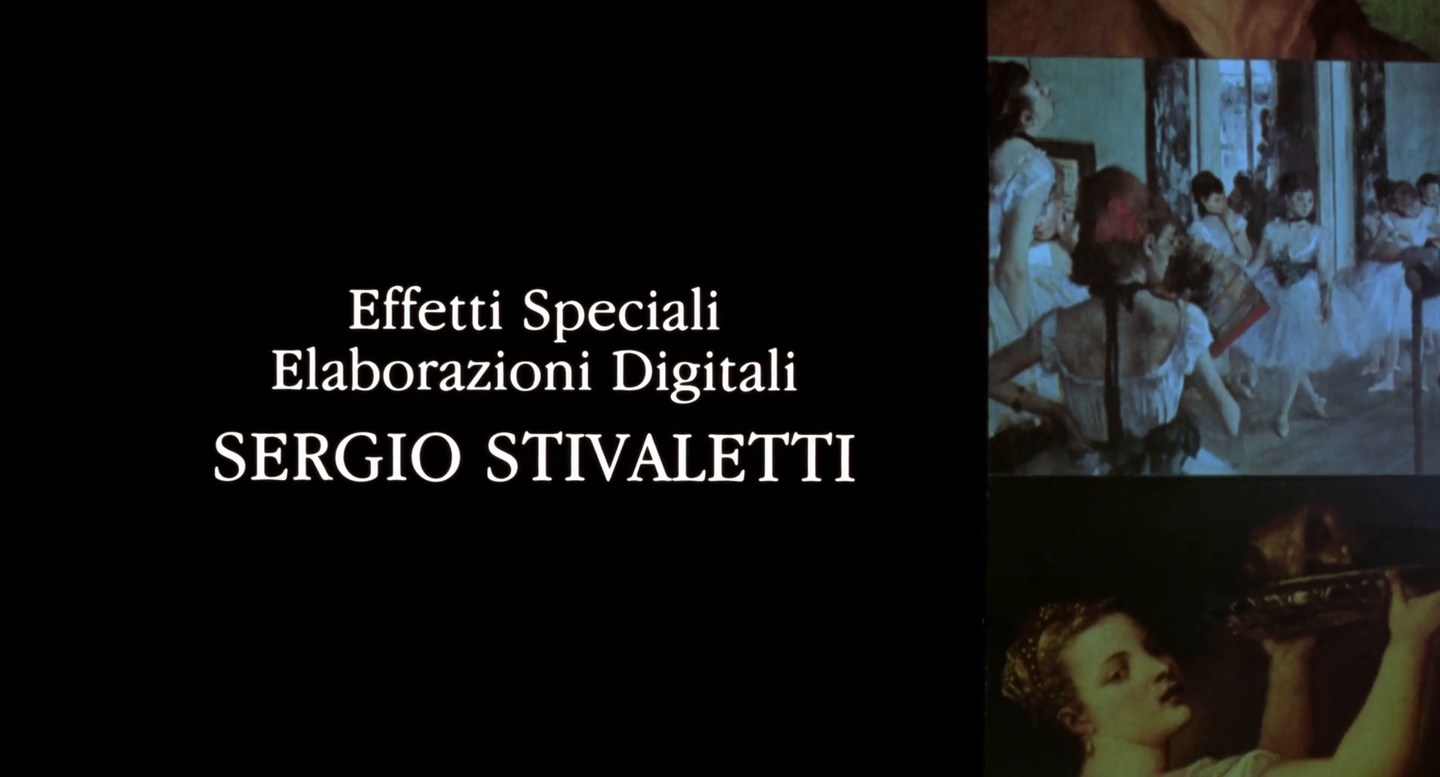
ENLARGE ↗Sergio Stivaletti’s effects and digital-work credit.
Effects and digital work
The opening titles pair special effects and digital elaboration under Sergio Stivaletti’s name. The closing roll separately credits Giovanni Corridori e C. for special effects and lists Mischa Koopman, Daniele Auber, Dario Rega and Francesca R. Di Nunzio as Stivaletti studio staff.
These credits document collaboration without allocating each visible transformation or wound to a named individual. Read the craft study →
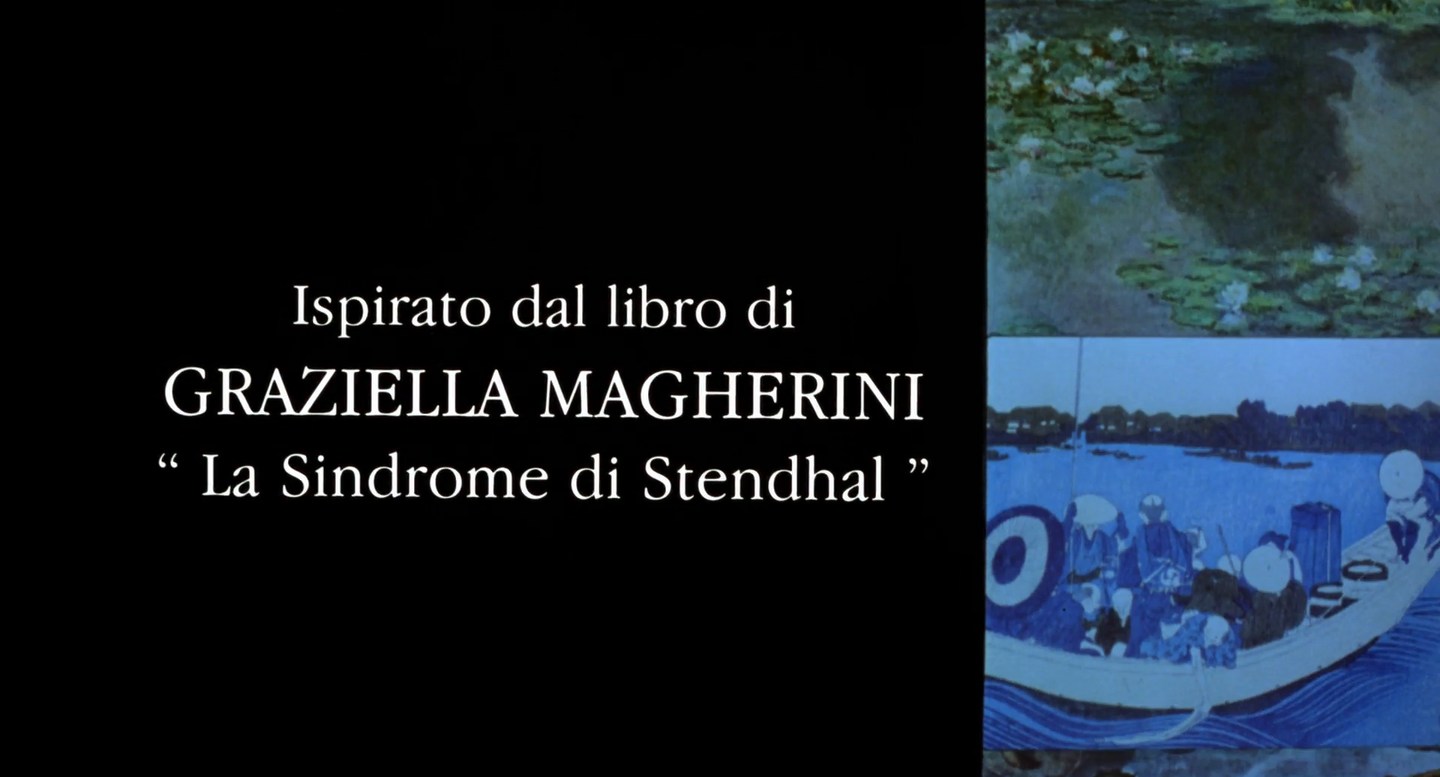
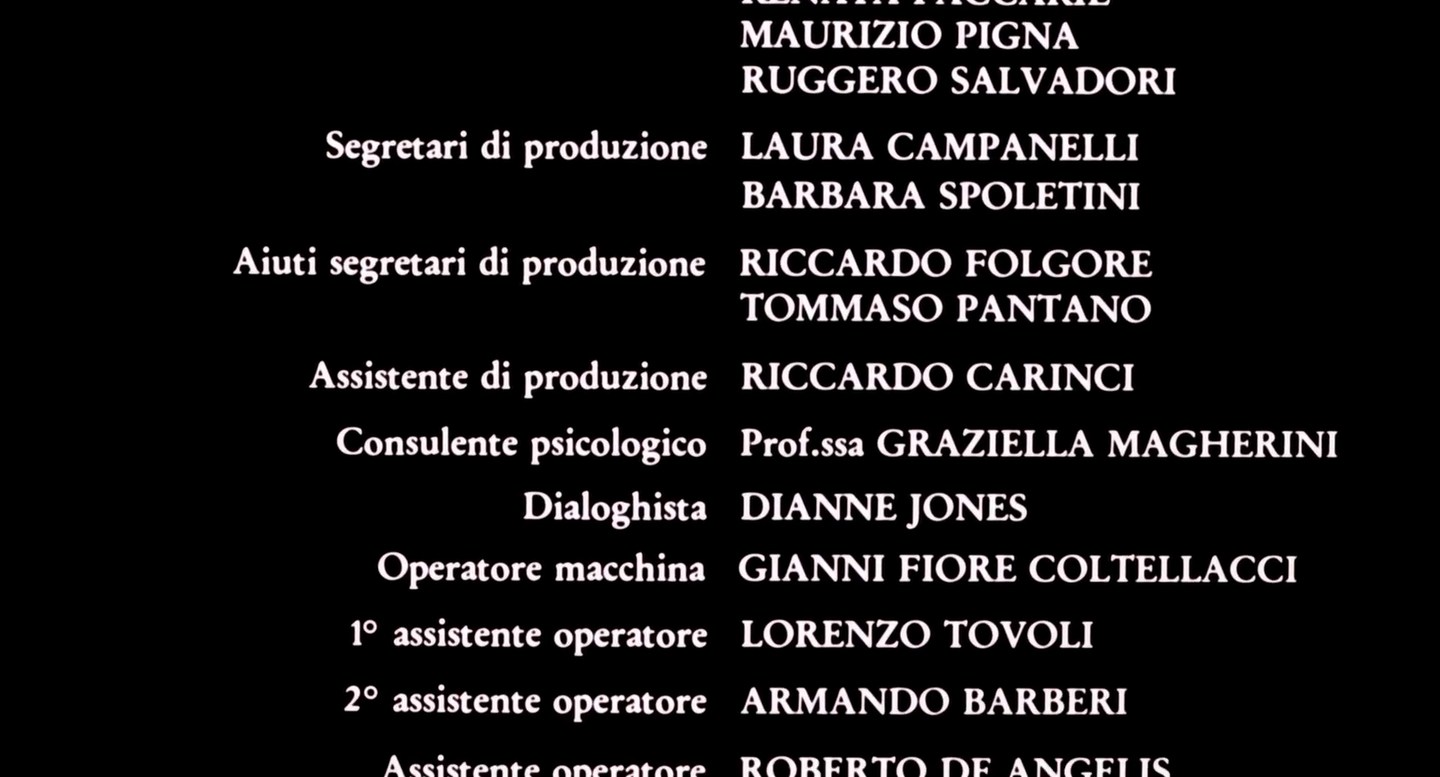
The opening identifies Graziella Magherini’s book as the inspiration. The closing roll also credits her as psychological consultant. That second role gives the book-to-film discussion a further concrete screen-credit reference.
ENLARGE ↗Magherini is also credited as psychological consultant.
ENLARGE ↗Morricone’s composition, orchestration and conducting credit.
Morricone and the recording team
Morricone is credited for composition, orchestration and conducting. The closing roll names the A.M.I.T. orchestra, Forum Studios, Franco Patrignani, musical assistant Andrea Morricone and child voice Alexys Schwartz. The credits connect the score to its performers and recording collaborators.
ENLARGE ↗The closing roll separates music and effects roles.
A divided production record
The closing titles distinguish music recording from effects staff and digital scanning. Cinesite (Europe) Ltd is credited for digital scanning and recording. The separation is useful when discussing a film whose illusions join photographed space, performed action and altered imagery.
The presentation used for the images
ENLARGE ↗The presentation closes with the Vinegar Syndrome card.
The illustrated presentation runs 1:59:44 including the closing distributor card. Its 1920 × 1036 image has been retained at the same proportions in the selected stills, without adding letterbox bars.
Italian and English 5.1 tracks accompany two labelled commentaries: Eugenio Ercolani, Troy Howarth and Nathaniel Thompson together, and a separate Howarth track. The first matches the commentary listed for Vinegar Syndrome’s 2025 edition. The separate track’s label is not proof that it belongs to the same disc release.
The publisher specifies a 119-minute, 1.85:1 edition scanned from the original negative, with Italian and English 5.1 options. Its release specifications and the file’s closing card support the presentation context. Publisher’s edition record →
Art & identity
Art does not remain safely on the wall in The Stendhal Syndrome. This dossier follows Anna Manni through a film in which images alter memory, professional authority breaks down and an apparent ending opens onto a more disturbing aftermath. The source book, Asia Argento’s testimony, collaborative craft, Morricone and the film’s different presentations give that investigation its bearings.
Spoilers: this study discusses the film’s story and ending. Includes discussion of sexual violence.
01 / ART & THE BODY
The spectator cannot remain outside
The image above places Anna beside a framed relief. Its elaborate border contains one set of bodies; her white shirt, marked with red, belongs to another. The composition makes them neighbours. Anna looks away from the artwork, but turning her head does not remove her from its visual field. The frame is a boundary that the film image has already crossed.
This is our reading of Film at Lincoln Center’s supplied reproduction. It does not identify the relief’s maker or establish the surrounding shot sequence. What it does make available is the film’s central problem in a single arrangement: a person who looks at art can herself become something looked at. Her exposed position matters as much as the picture’s subject.
Anna Manni is a police officer pursuing a killer in Florence. Her collapse in the Uffizi disrupts both bodily control and professional certainty. Cinematografo’s account follows her from this encounter to a hotel, where another artwork becomes involved in the recovery of memory. The spectator’s difficulty is therefore also a detective’s difficulty: how can Anna interpret evidence while her own experience is becoming unreliable? Narrative record
Blandine Joret’s study describes paintings acquiring sounds and movement during the opening gallery encounter. Looking becomes an experience that surrounds the observer. This brings cinema’s own resources into the argument: a static image can become an event through sound, editing and a change in the viewer’s position. The gallery in the fiction should not be treated as a literal inventory of everything held by the real Uffizi. Joret, pp. 113–114
A filmmaker looks back at the unsettled mind.
Gaspar Noé begins his Panico recollection by acknowledging that his memory of The Stendhal Syndrome is not fresh. Even so, he identifies it as the Argento film with Asia that affects him most. He finds it almost more cerebral than the openly dreamlike Inferno. Panico: testimony and passage locators ↗
Noé’s comparison offers a useful route between the two dossiers. Inferno gives impossible events a material setting; The Stendhal Syndrome repeatedly unsettles the person trying to perceive that setting. This is a later filmmaker’s critical response, distinct from testimony about the production.
02 / MAGHERINI, ARGENTO & FERRINI
From clinical accounts to a fictional pursuit
Graziella Magherini’s La sindrome di Stendhal is the starting book, but calling it a novel obscures the adaptation’s work. WorldCat records a Florence edition from 1989. The later Google Books description presents a psychiatrist’s investigation of visitors distressed by their encounters with art. Giulio Luciano Giusti likewise identifies the 1989 book as an account drawing on clinical cases. The first edition’s question about its genre can therefore be resolved: this is a nonfiction source, not a ready-made detective plot. Book catalogues · Giusti, p. 8
Cinematografo credits Dario Argento and Franco Ferrini with the story and screenplay. The relationship to Magherini needs to be understood through that act of invention. Taking a condition, a setting or a reported experience as a premise is different from transferring a sequence of fictional events from page to screen. Writing credits
The distinction also protects the reader from a misleading equivalence. Anna’s encounters with a murderer and her later violence belong to the thriller. The film cannot serve as clinical evidence that an overwhelming encounter with art leads to criminal behaviour. Our concern is how the narrative uses an explanation, what authority it gives that explanation and where the fiction moves beyond it.
There is a specific route to the writing history. Mondo Digital’s account of Ferrini’s Prisoner of Art interview reports that he changed the proposed heroine from a lawyer into a police officer. That is a useful lead, not a draft chronology established here. The occupation matters because it turns Anna’s struggle to understand herself into a crisis within an investigation. Comparing the book, a dated draft and Ferrini’s actual testimony could show exactly when that shift took place. Reported writing testimony
03 / PAINTING, EDITING & RECOLLECTION
The Night Watch opens onto another time
The hotel’s reproduction of Rembrandt’s The Night Watch offers more than an ominous decoration. Joret describes a passage in which details of the painting lead into Anna’s police work in Rome: painted footwear and weapons connect with modern equivalents, and the assembled figures become a contemporary gathering. A painting supplies the organisation through which a memory can be reached. Joret, pp. 113–114
Giusti’s illustrated sequence places the boot, trainer, firearm and faces beside their counterparts. The page makes the correspondences inspectable without requiring us to infer them from a plot summary. These reproduced frames support a discussion of the transition’s construction, but not an exact account of its timing or sound synchronisation. Giusti, pp. 10–11 and figures 13–20
Joret also notices the bloodstain carried into this apparently earlier scene. That detail troubles the idea of a clean flashback: the present body does not simply disappear when the past becomes visible. The memory is encountered through Anna’s current condition. This reading helps explain why the film’s visual transformations are part of its storytelling, rather than illustrations added to a story that is already complete.
For a detective, recovering the past ought to make the present easier to understand. Here the route of recovery makes the relation between the two less secure. A useful question is not only whether the recovered information is correct, but what kind of access Anna has to it. The painting behaves like an aperture whose destination cannot be kept wholly separate from the person passing through.
04 / PERFORMANCE & SELF-PRESENTATION
Anna occupies the space between us and the picture
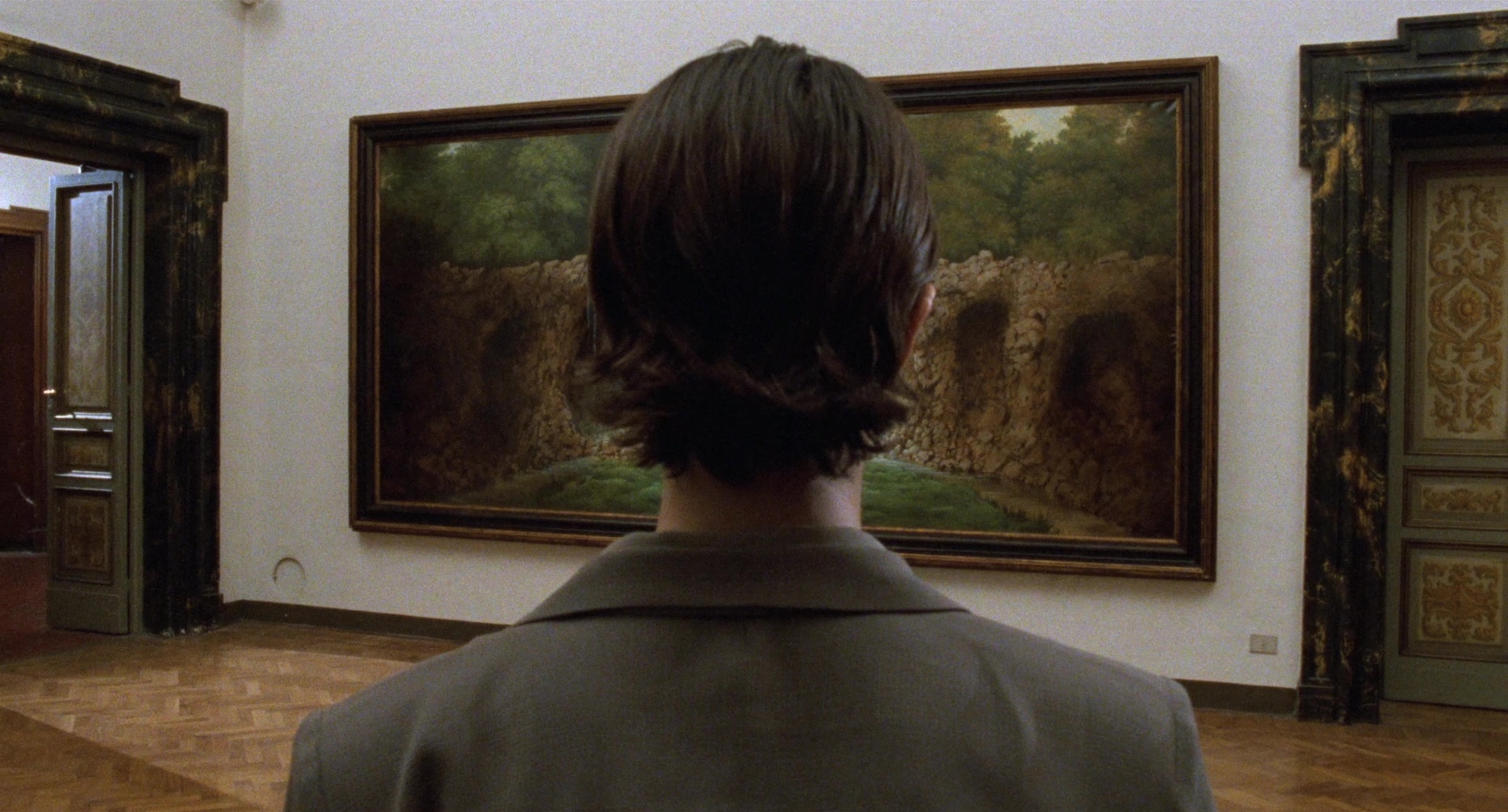
This image prevents a direct exchange of looks. We see the back of Anna’s head, while her body blocks the centre of the landscape. The painting is large enough to offer an imagined space beyond the room, but the person studying it remains insistently in our way. Doorways on either side provide actual routes through the building; the framed landscape offers another kind of passage. This is our visual reading of the supplied still. Image record
The juxtaposition with the opening image is revealing. Long hair and a stained white shirt give way here to short hair and a grey jacket. Costume, hair and posture make a difference visible before any psychological label is applied. These two images show why Anna’s changing self-presentation matters as performance, as well as a clue to the ending.
Asia Argento’s own account belongs in that discussion. In Michael Gingold’s 2002 interview about Scarlet Diva, she recalls the experience of performing Stendhal as distressing but also liberating. The interview presents her as a filmmaker discussing her career, not simply as the director’s daughter. It is retrospective testimony about her experience; it does not settle every question about the production or dictate how viewers should respond to its violence. Gingold interview, originally 2002
The new appearance study follows the changes through the local presentation, from the first mirror to the removal of the blonde wig. The screen-credit record also documents Magherini’s consultant role and the named music and effects teams.
Voice is another part of performance that a still cannot preserve. The English and Italian presentations should not be treated as interchangeable evidence of delivery. A later comparison can examine the same passage in each, separating the visible performance, the voice heard and the wording of subtitles. For this edition, the changing body in the image and the performer’s own testimony provide a sounder starting point than speculation about private family relationships.
05 / PHOTOGRAPHY, DESIGN & EFFECTS
Several crafts make the image unstable
The principal craft credits give this film a specific collaborative shape: Giuseppe Rotunno for photography, Angelo Nicolini for editing, Antonello Geleng for production design, Lia Francesca Morandini for costumes and Franco Casagni for makeup effects. These contributions work on different parts of the transformation between person, room and image. Craft credits
In the gallery still, the white wall and parquet floor give the room material continuity. Dark stone around the doorways echoes the painting’s border. The woman’s shoulders overlap both the represented landscape and the actual wall, tying those spaces together. The effect does not depend on identifying a hidden symbol: the ordinary arrangement of architecture, costume and camera position already makes the spectator’s body part of the artwork’s presentation.
Mondo Digital’s review of the production supplements describes Geleng discussing Caravaggio-like light and shadow, and Sergio Stivaletti discussing the combination of physical effects with digital work. They nevertheless offer a useful corrective to treating every disturbance as the director’s solitary invention. Design and effects interview coverage
A physical object, a cut between images and a digitally altered image can all make a boundary appear permeable. Identifying which method produced an individual effect requires more than recognising that the result is strange. The worthwhile next inquiry is therefore concrete: compare the depicted transition with the effects crew’s explanation and any surviving design or compositing evidence.
06 / MORRICONE & AUDITORY PERSPECTIVE
A returning pattern, an uncertain voice
Ennio Morricone’s score gives this dossier a way to consider repetition alongside transformation. Giusti identifies the recurring main theme as a passacaglia and connects its returns to the film’s circular organisation. The useful implication is formal: a pattern can come back while the person encountering it has changed. Giusti, p. 9
Nia Edwards-Behi describes indistinct voices within the score around Anna’s episodes. Her analysis stresses the uncertainty over whether those sounds belong to Anna’s perception or to the music heard by the spectator. Edwards-Behi, p. 40
The distinction matters because a voice usually promises an identifiable speaker. When its source cannot be placed, it can make the space less intelligible instead. A musical recurrence also carries memory without supplying a literal explanation. Read together, these two critical observations suggest a soundtrack that both organises the experience and makes its boundaries difficult to locate.
The painting sequence asks where an image begins and ends; the sound question asks who is hearing. The dialogue studies follow recorded greetings, altered voices and repeated words across the film, while the captioned sound landmarks connect the gallery, hotel transition and domestic devices. The language and presentation guide places those observations beside subtitle differences and the soundtrack album.
07 / NARRATIVE & RECEPTION
Killing the assailant does not end the film
The plot’s decisive complication comes after Anna overpowers Alfredo. His eventual identification as dead does not stop the murders; Anna has become responsible for subsequent killings. The investigation turns towards the person through whom we have followed the danger. Ending record; spoilers
This creates an uneasy relation between revenge and recovery. Removing the immediate attacker does not restore a stable earlier self. The film makes the aftermath occupy narrative space of its own, so that a moment which could have closed a more conventional thriller becomes a change of direction. Its question moves from identifying the pursuer to understanding what has happened to the person pursued.
That structure also creates an ethical problem for the film. Does its later turn sustain attention to Anna’s experience, or redirect that experience into another spectacle of danger? The reading need not be settled by declaring either the violence or the formal invention automatically justified. The central tension is that a film about the power of images also asks its audience to look at an extensively violated body.
Later institutional presentations have foregrounded Asia Argento’s performance: Film at Lincoln Center’s 2022 retrospective gives it particular weight, as does BFI Player’s description. Those judgements are evidence of later framing, not a survey of how the film was received in 1996. FLC retrospective · BFI presentation
Keeping those histories apart leaves room for a more useful reception study. Contemporary reviews could reveal whether early viewers discussed the unusual narrative turn, the treatment of sexual violence, the acting, or the difference between language versions. Later appreciation and initial response are separate questions; neither should be manufactured from a handful of current endorsements.
08 / VERSIONS & RESTORATIONS
Name the presentation before comparing it
The available records do not give one uniform duration. Each number belongs to a catalogue or edition, with its own level of precision. They are starting points for comparison, not a ready-made list of cuts.
Published presentation records, checked 16 October 2026
Record
Listed duration
What the record establishes
Film at Lincoln Center, 2022
Listed duration113 minutes
What the record establishesItalian with English subtitles; 4K restoration credited to Cinecittà. Programme
Cinematografo
Listed duration117 minutes
What the record establishesFilm catalogue entry. Catalogue
BFI Player
Listed duration2 hours
What the record establishesItalian with English subtitles; duration rounded as displayed. Listing
Vinegar Syndrome UHD / Blu-ray
Listed duration119 minutes
What the record establishes1.85:1; 4K scan from the 35mm camera negative, Dolby Vision; Italian and English 5.1 options. Edition specification
Mondo Digital’s edition history identifies actual differences worth checking: additional material in the Italian presentation, changes in framing across home-video editions, and differences between dubbed English dialogue and translated subtitles. Its review can guide a comparison, but the listed runtimes alone cannot tell us which frames are absent or how a master was timed. Edition history
Nor should the Cinecittà restoration shown in 2022 and the newer Vinegar Syndrome scan be assumed to be the same restoration. A shared “4K” label describes neither a complete provenance nor a common grading decision. A defensible comparison would name the release, framing, language track, subtitle mode and playback basis before drawing conclusions from colour or duration.
The current Vinegar Syndrome supplement list provides a practical return route. It includes interviews with Argento, Asia Argento, Ferrini, Geleng, Stivaletti, Cozzi, Casagni and producer Giuseppe Colombo. These are located resources, not testimony we claim to have watched. Listed supplements
FOLLOW THE CONNECTIONS
Another way in.
Read across films, then return to the evidence for each one.
Casagni recalls making five prosthetic pieces for the wounds inflicted by the bed springs, together with an eye effect. His My Cinema interview locates that work in the practical conditions of the shoot: near Marmore Falls, the makeup trailer was too far from the set, rain complicated the work, and an outdoor rock became a substitute working surface. The account turns the injury from an isolated screen image into a continuity task performed under pressure.
The documentary later places the film’s changes of identity beside Dario Argento’s account of writing for Asia and Asia’s own description of a young policewoman destabilised by the experience in Florence. These are two production perspectives: the director describes the conception and the performer describes the character she has to inhabit. They illuminate the transitions in appearance and behaviour without converting the fiction into a clinical case history.
Source & passage
Dario Argento: My Cinema / Il mio cinema, two-part documentary presented on Severin Films’ Dario Argento’s Deep Cuts, Disc 1. Part Two, 17:37–19:28 and 51:09–53:29.
The discussion paraphrases the English subtitles and distinguishes participant recollections from the documentary’s narration and production footage.
Google Books describes the 2003 edition, 219 pages, as a psychiatrist’s investigation. WorldCat records a 1989 Florence edition. Catalogue descriptions; neither full edition.
Fangoria interview about Scarlet Diva, originally 9 August 2002 and republished in 2024. Stendhal recollection read as the performer’s retrospective testimony.
Modern Languages Open 2025(1):4, DOI 10.3828/mlo.v0i0.336. Relevant pp. 8–12, including p. 11’s reproduced Night Watch sequence. Scholarly interpretation and reproduced frames, not a new continuous viewing.
Amsterdam University Press, 2019, pp. 113–114 (PDF pp. 115–116): gallery sound, the Night Watch transition and the persistent bloodstain. Relevant excerpt, not a claim to have reviewed the entire book.
2010 MA thesis, p. 40 (PDF p. 43), on indistinct voices and subjective listening. This is a critical sound account; no new cue timing or listening verification is claimed.
The Stendhal Syndrome — selected scenes, effects and screen credits
The illustrated studies examine selected frames across a 1:59:44 presentation with Italian opening titles and a Vinegar Syndrome closing card. Time labels locate the illustrated views. Closer sampling follows six effects sequences; this is a guide to selected passages, not a catalogue of every cut.
The screen-credit notes come from the opening titles and closing roll. The dialogue evidence and captioned sound guide extend this visual analysis. The publisher’s edition listing was checked on 5 November 2026.
The Stendhal Syndrome — dialogue and descriptive captions
The dialogue studies draw on the complete English translation and English SDH subtitle tracks in the 1:59:44 presentation, compared with machine-assisted English speech recognition. Selected passages were checked against the original bitmap subtitles. Times locate the exchanges in this presentation.
The sound landmarks document events identified by the SDH captions; they are not a direct listening audit of musical cues, vocal performance or surround placement. The language comparison concerns the two English subtitle texts, not a transcription of the Italian soundtrack. The film’s psychological explanations are treated as elements of its fiction.
DRG Records — Stendhal Syndrome: Music by Ennio Morricone
The licensed Spotify album record lists sixteen tracks, 46:57, dated 21 September 1999, with DRG copyright and phonogram credits. Used for the album’s sequence, titles and catalogue date, rather than film-cue synchronization or an assessment of playback.
Gaspar Noé: 1:17:35–1:17:54. Retrospective documentary testimony, paraphrased from the interview and checked against the English subtitles. Source and review method ↗
 ENLARGE ↗