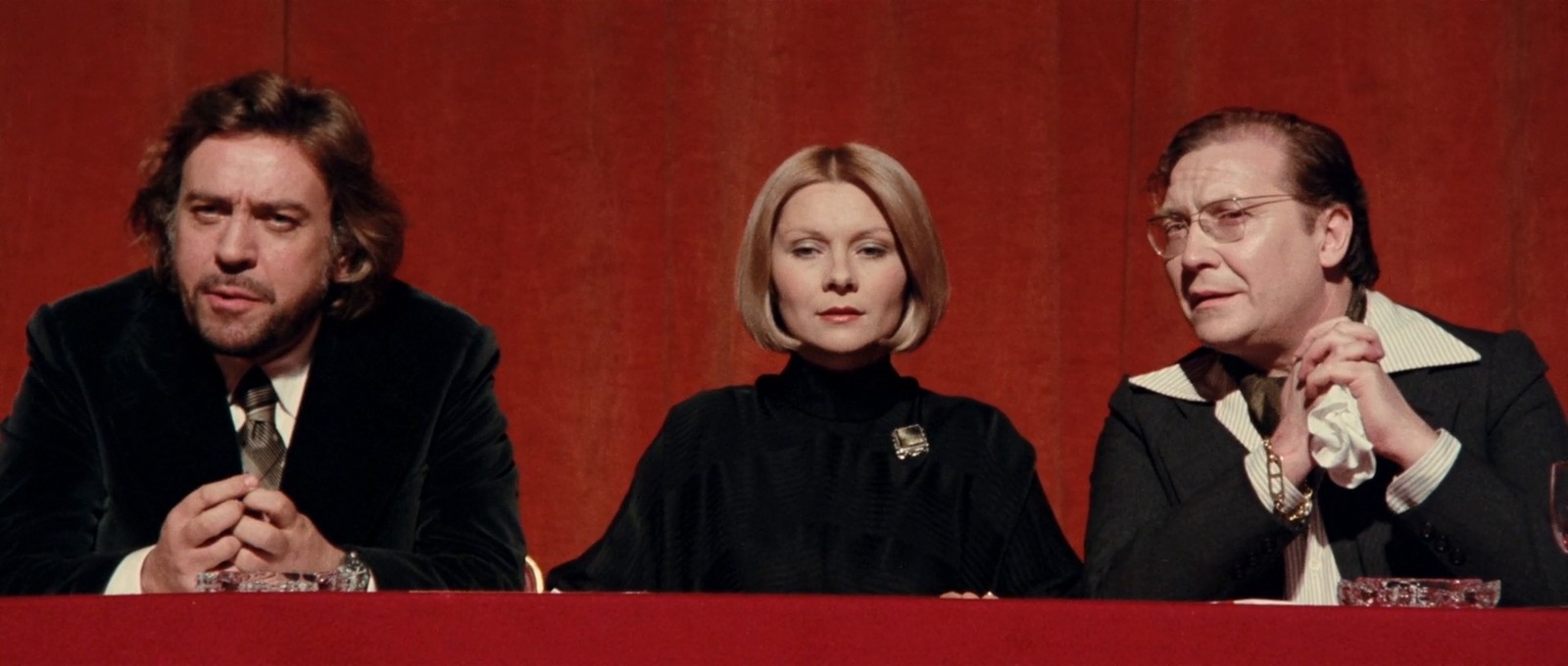
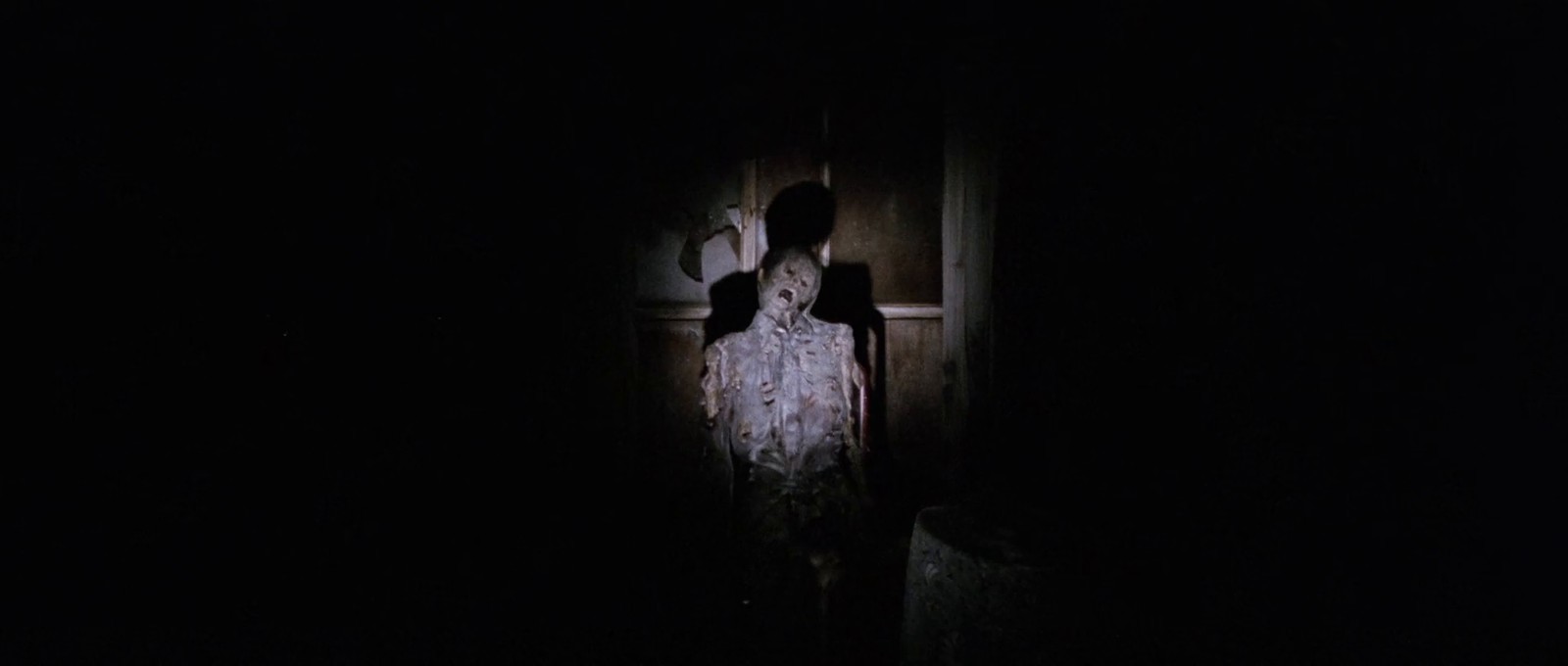
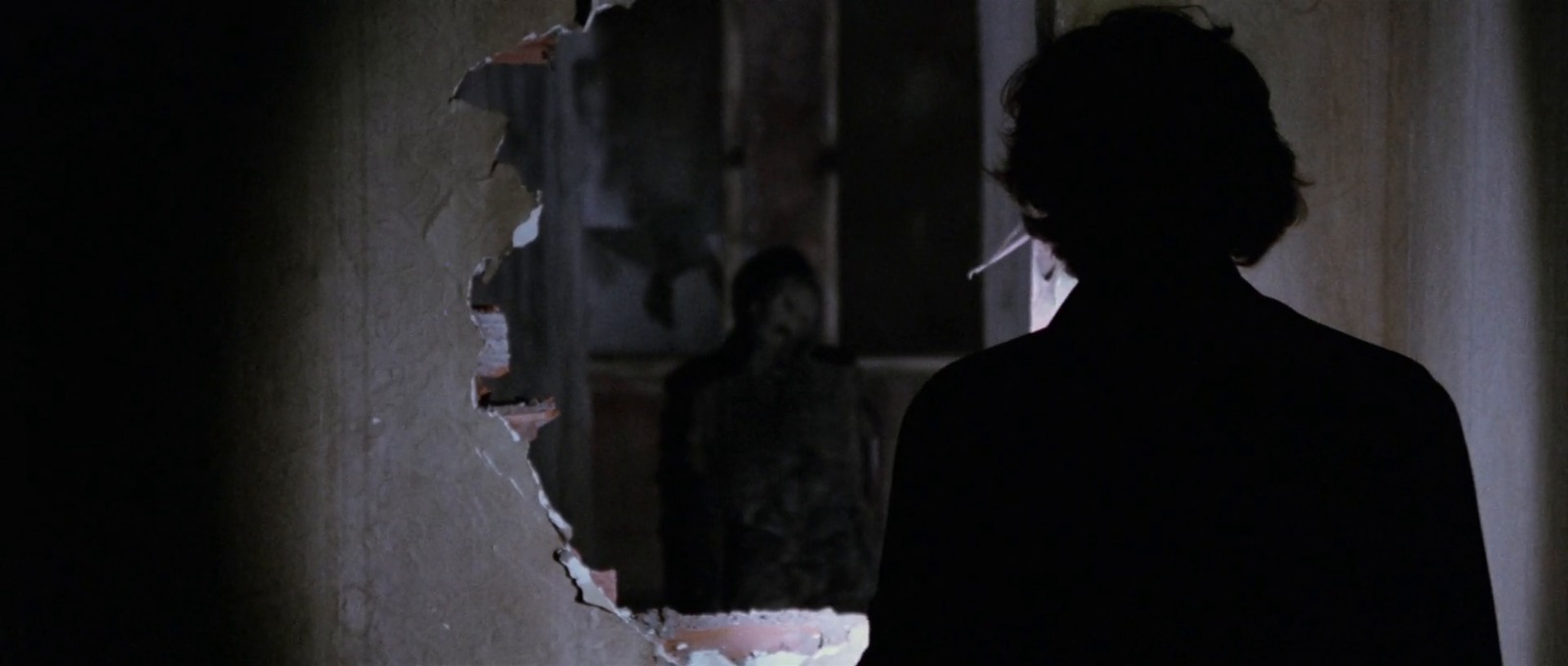
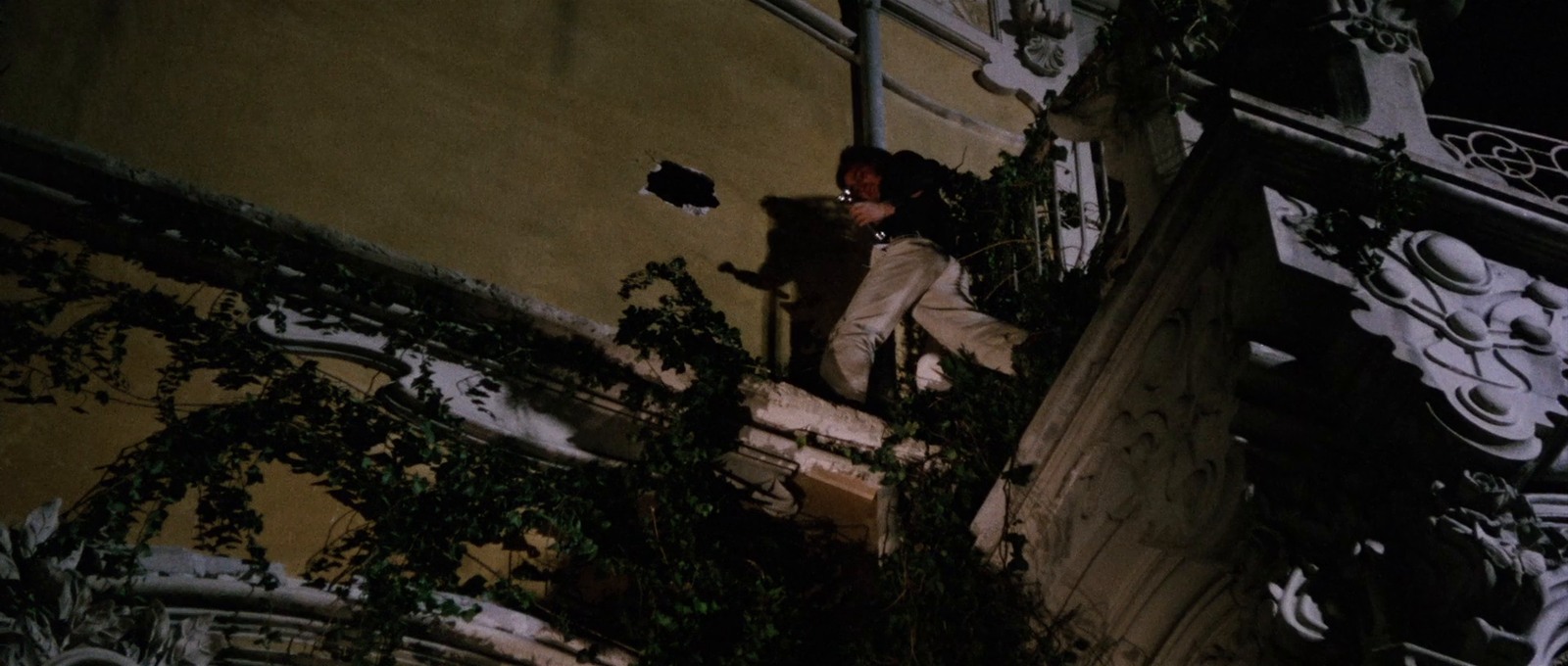
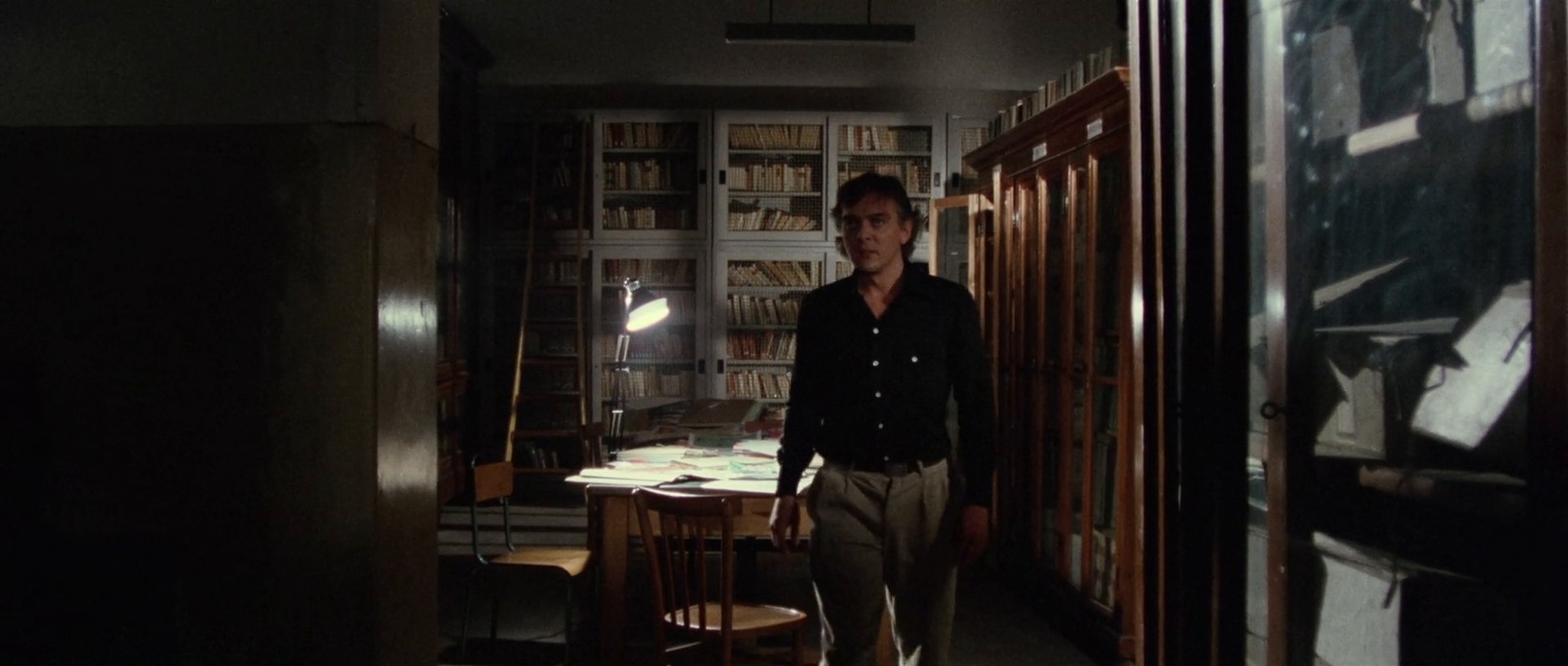
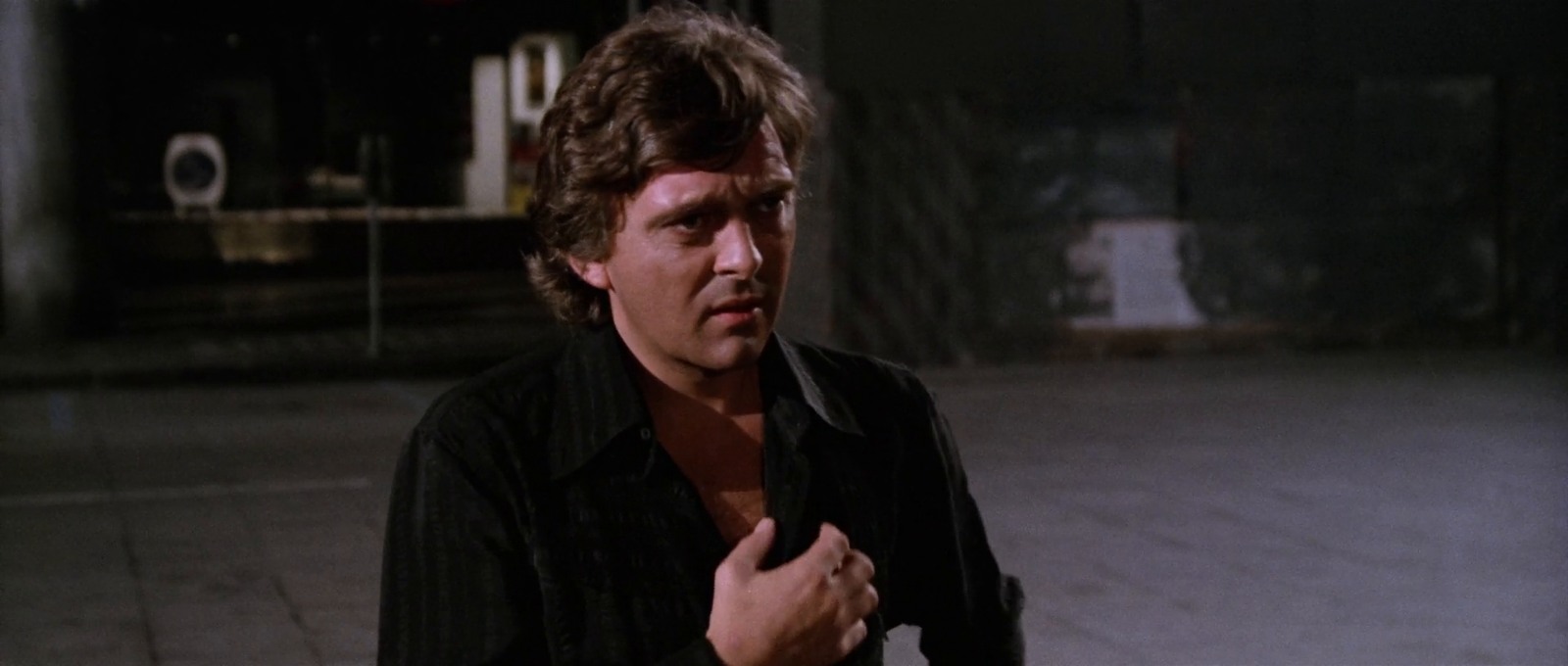
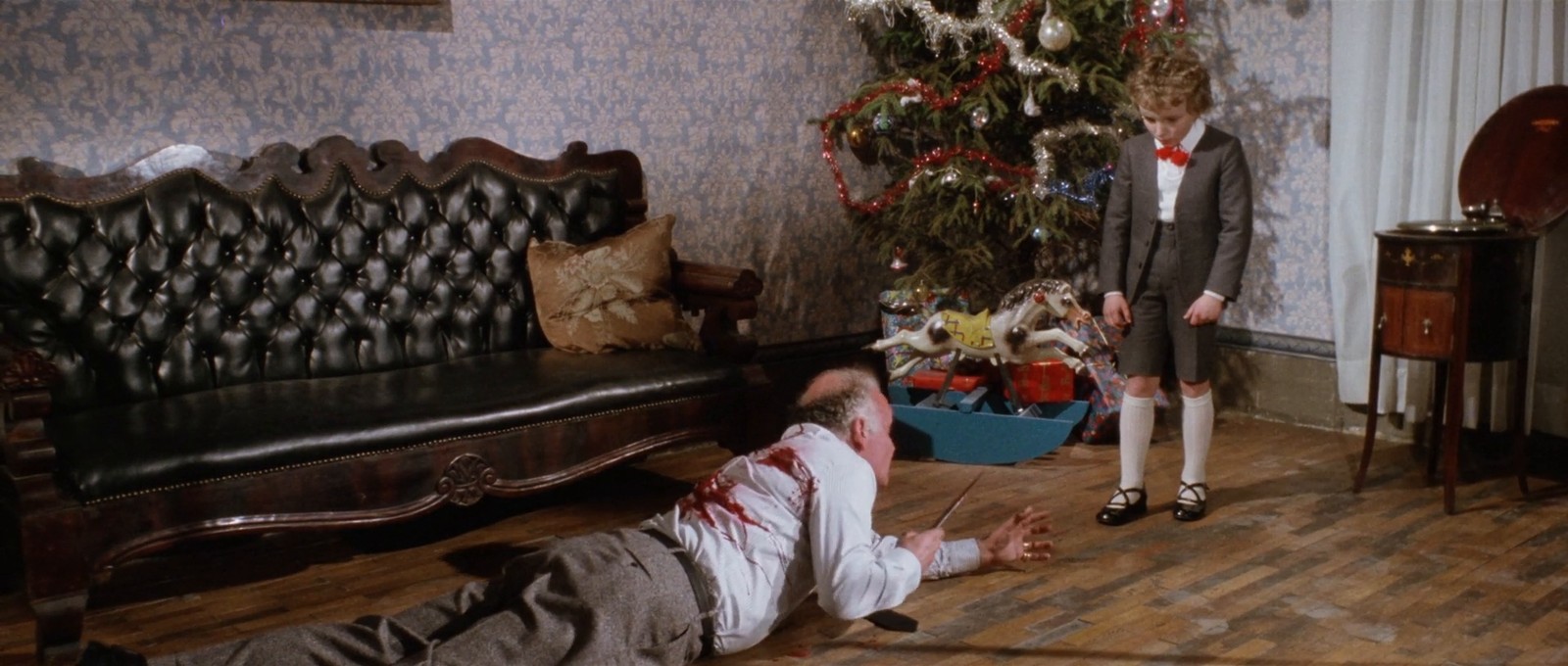
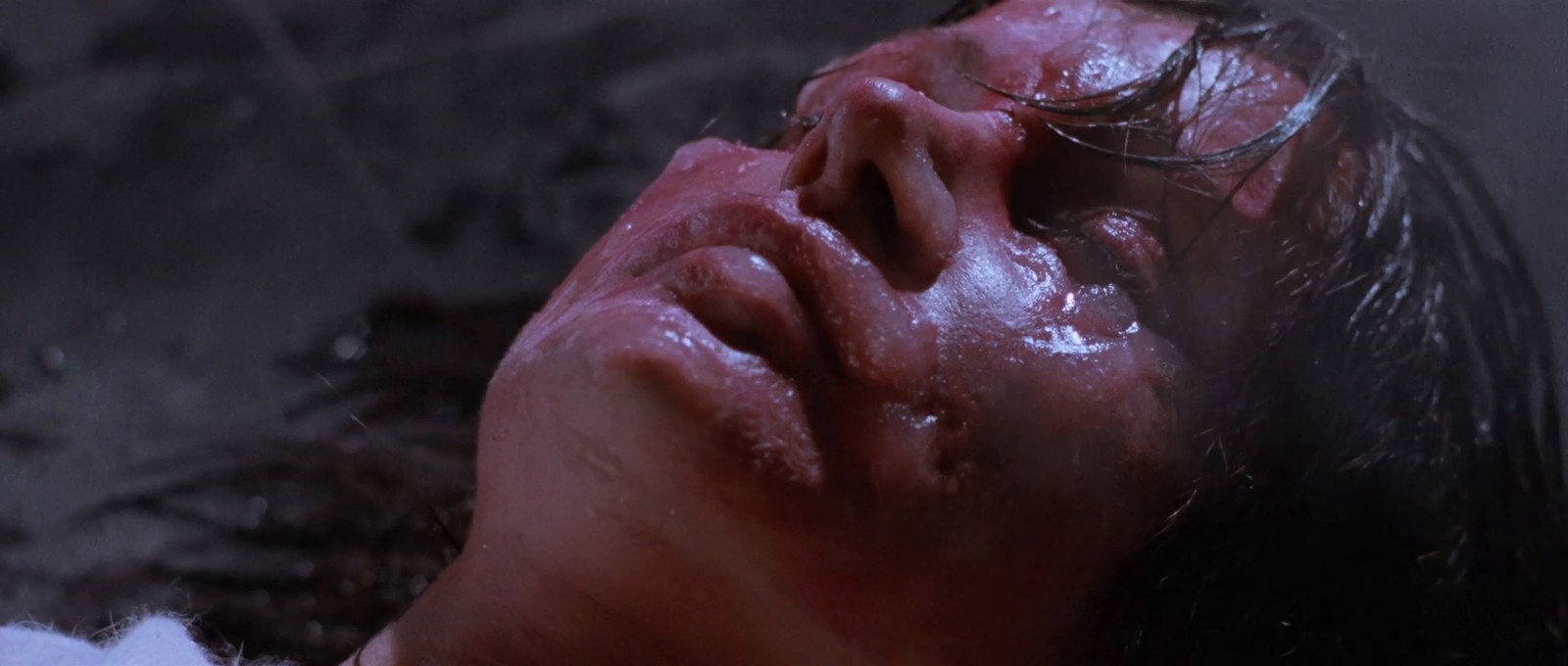
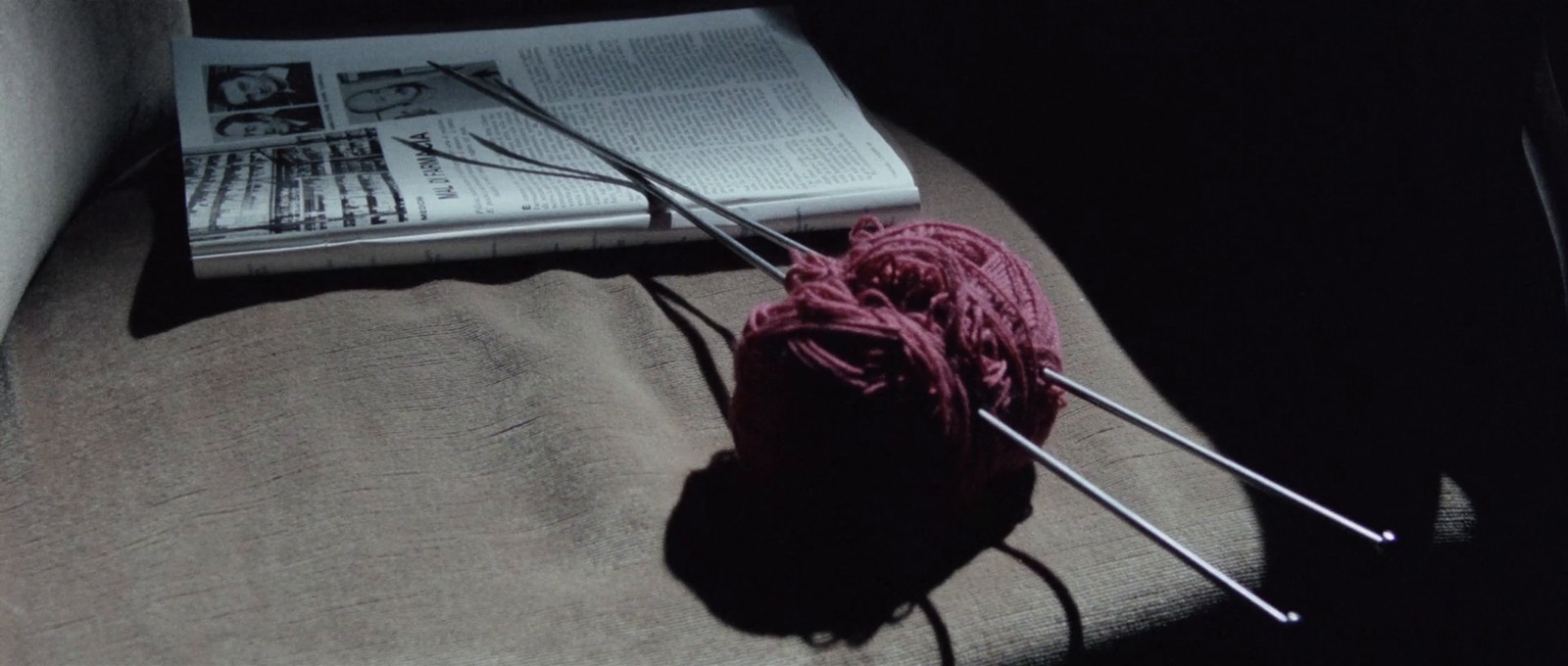
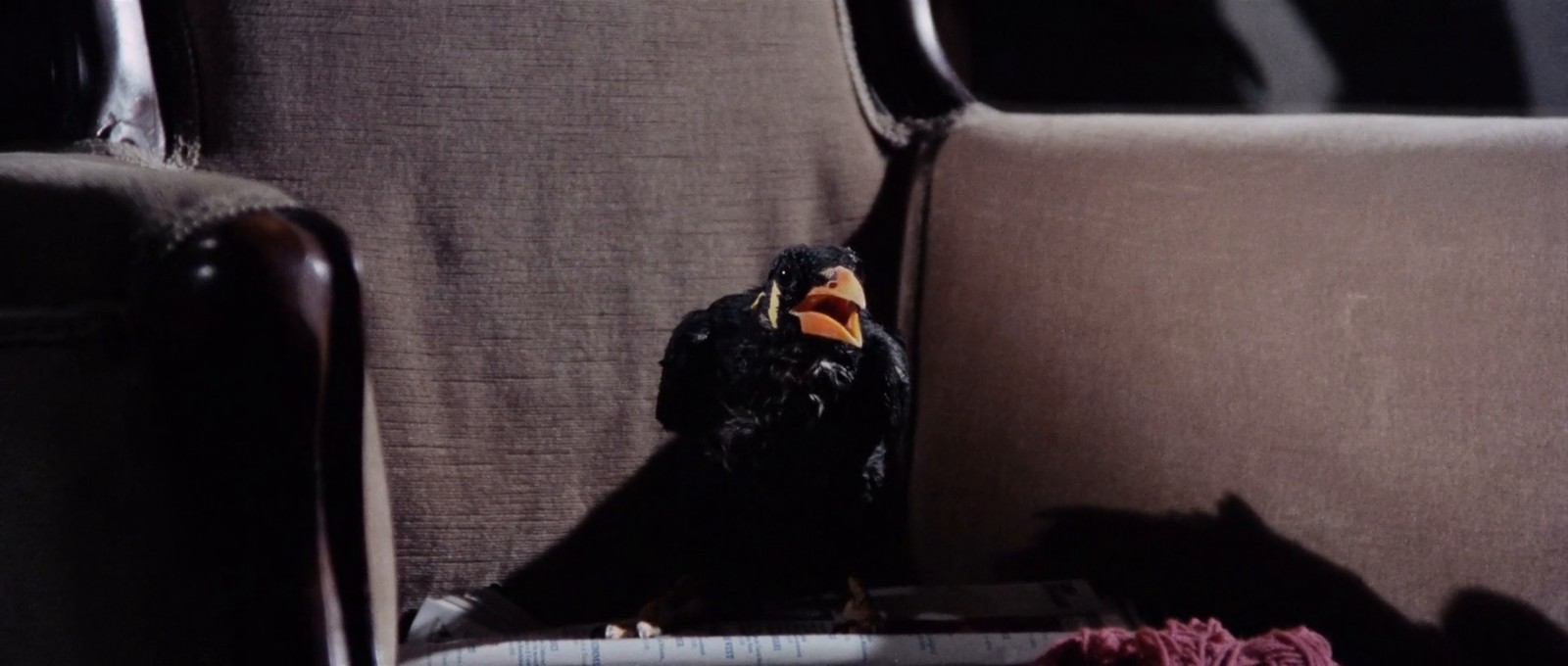
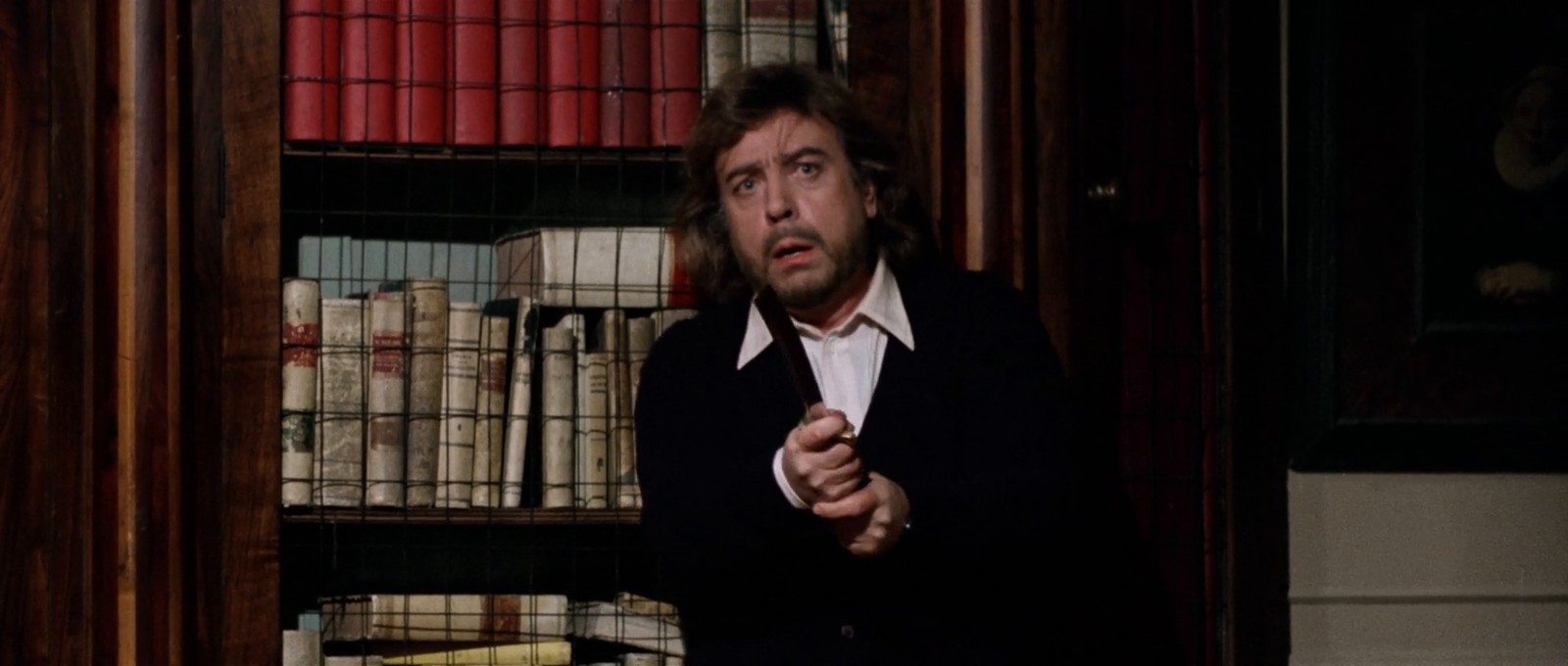
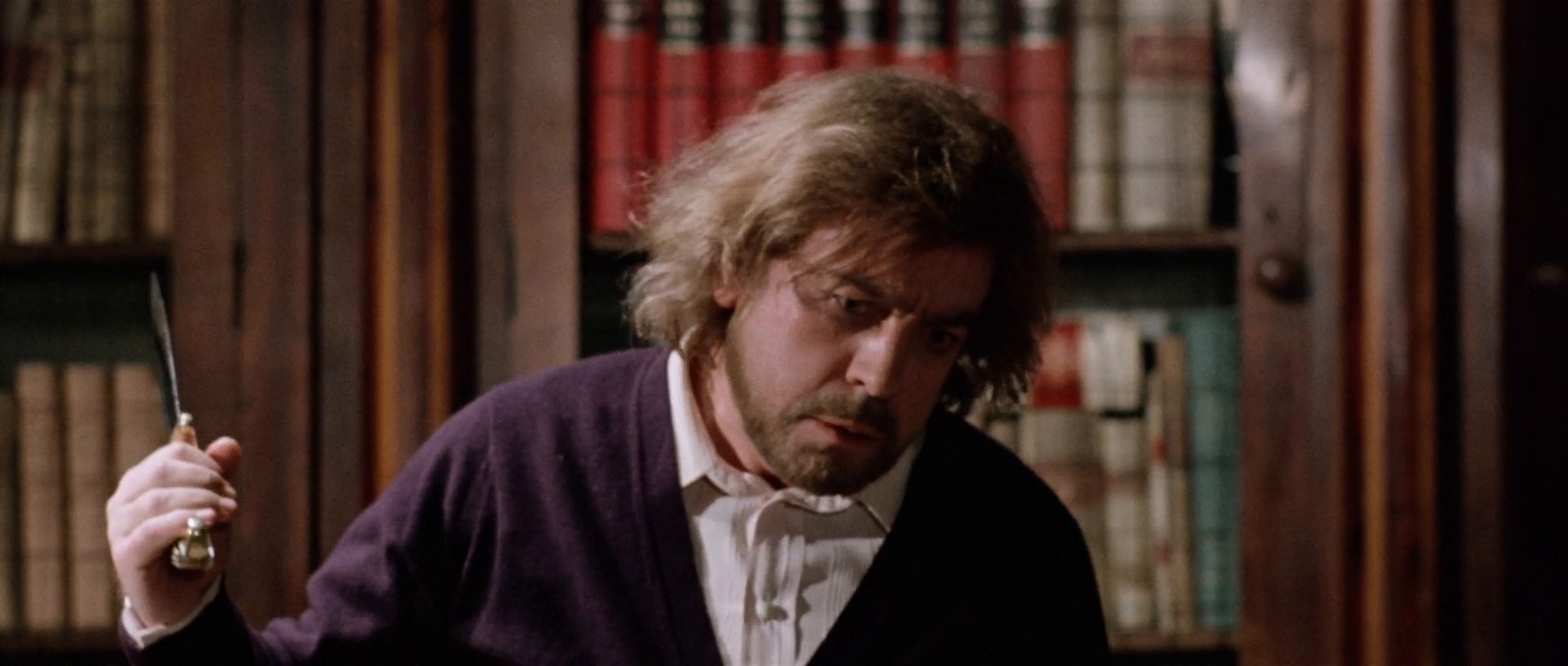
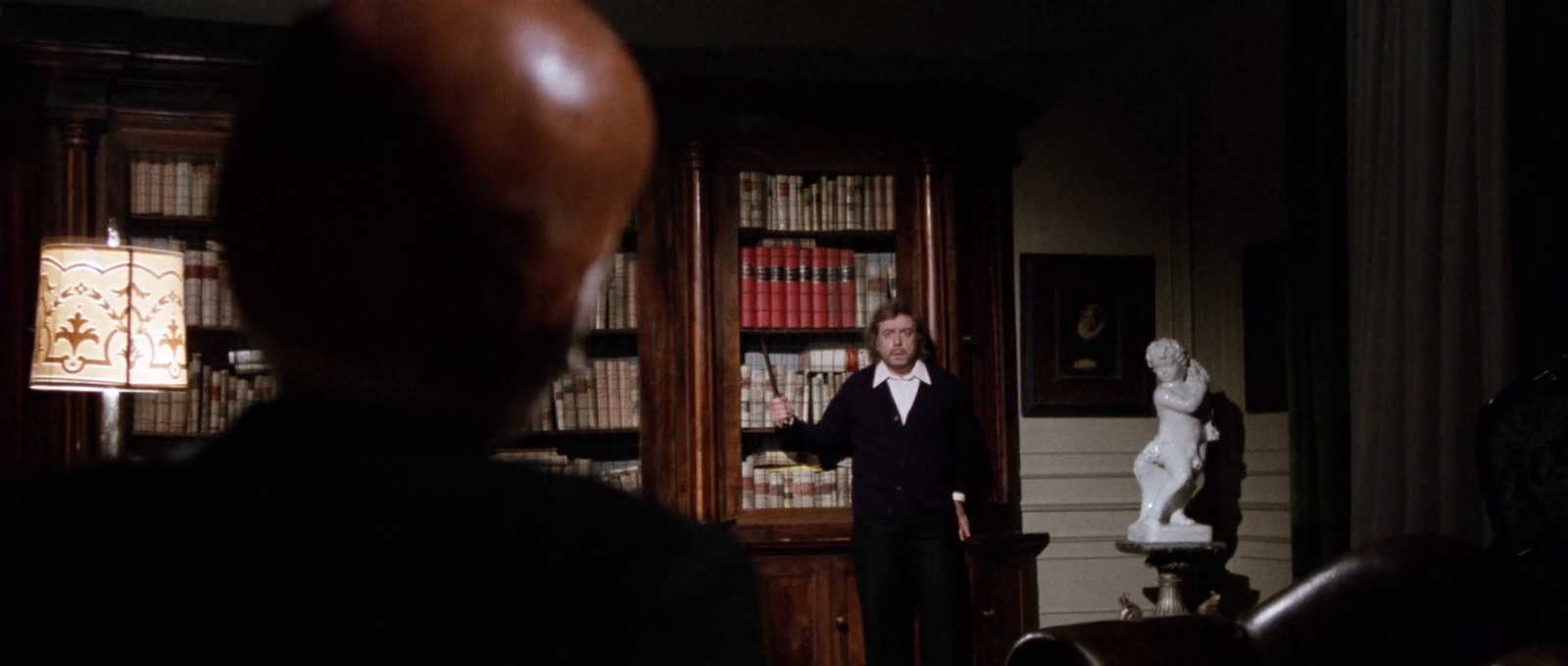
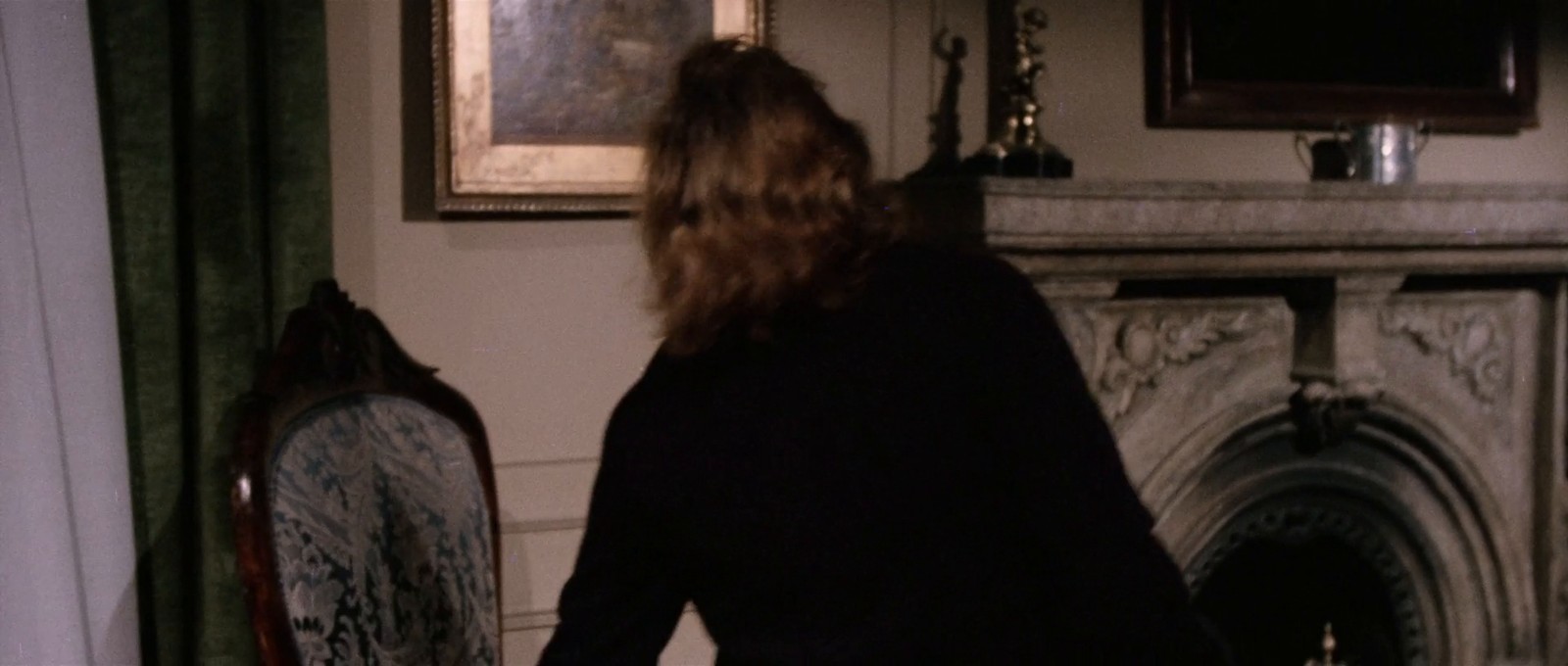
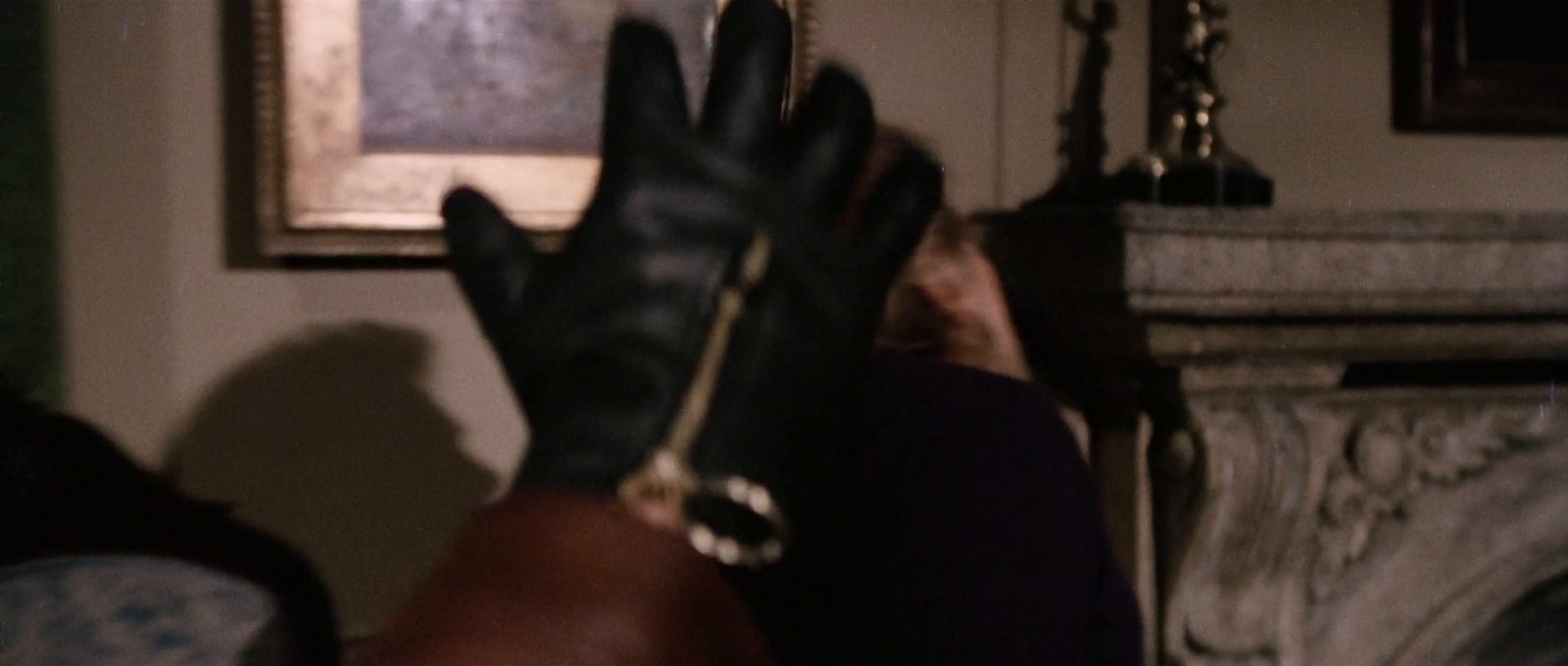
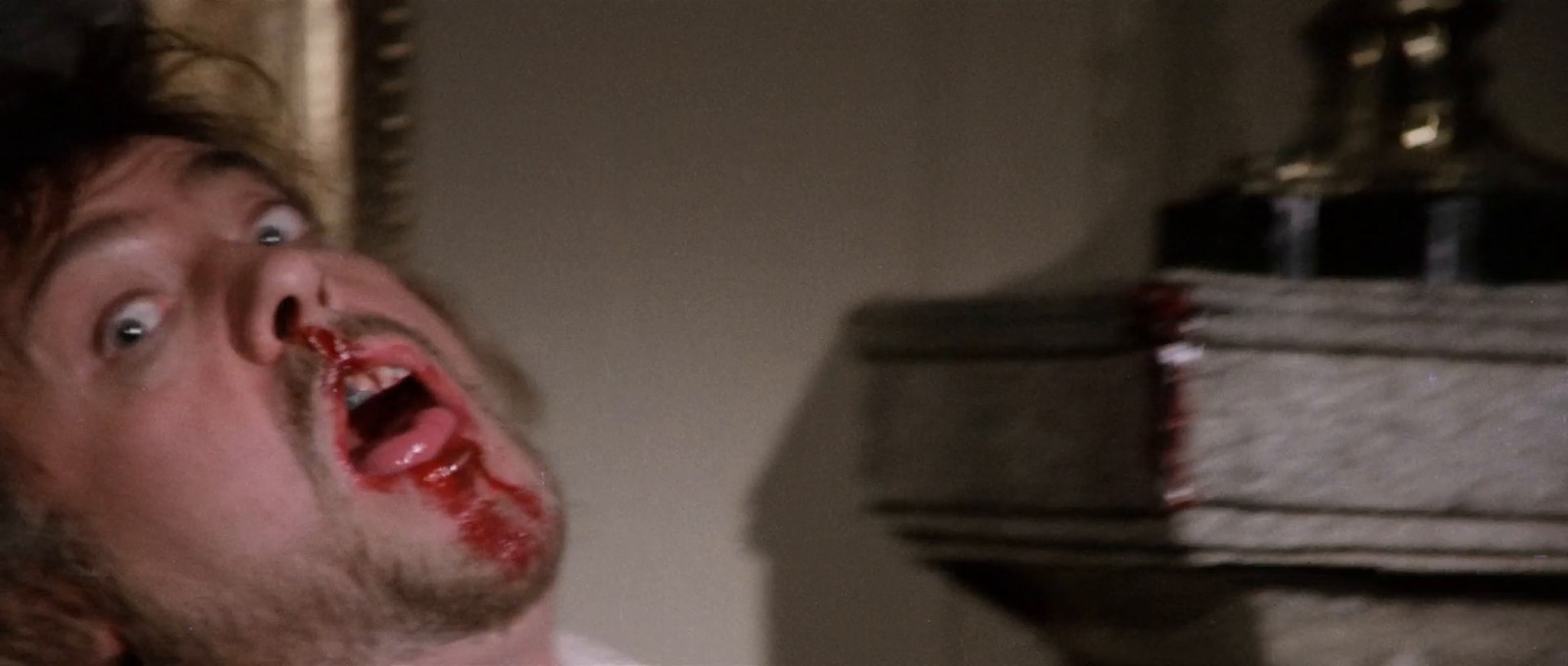
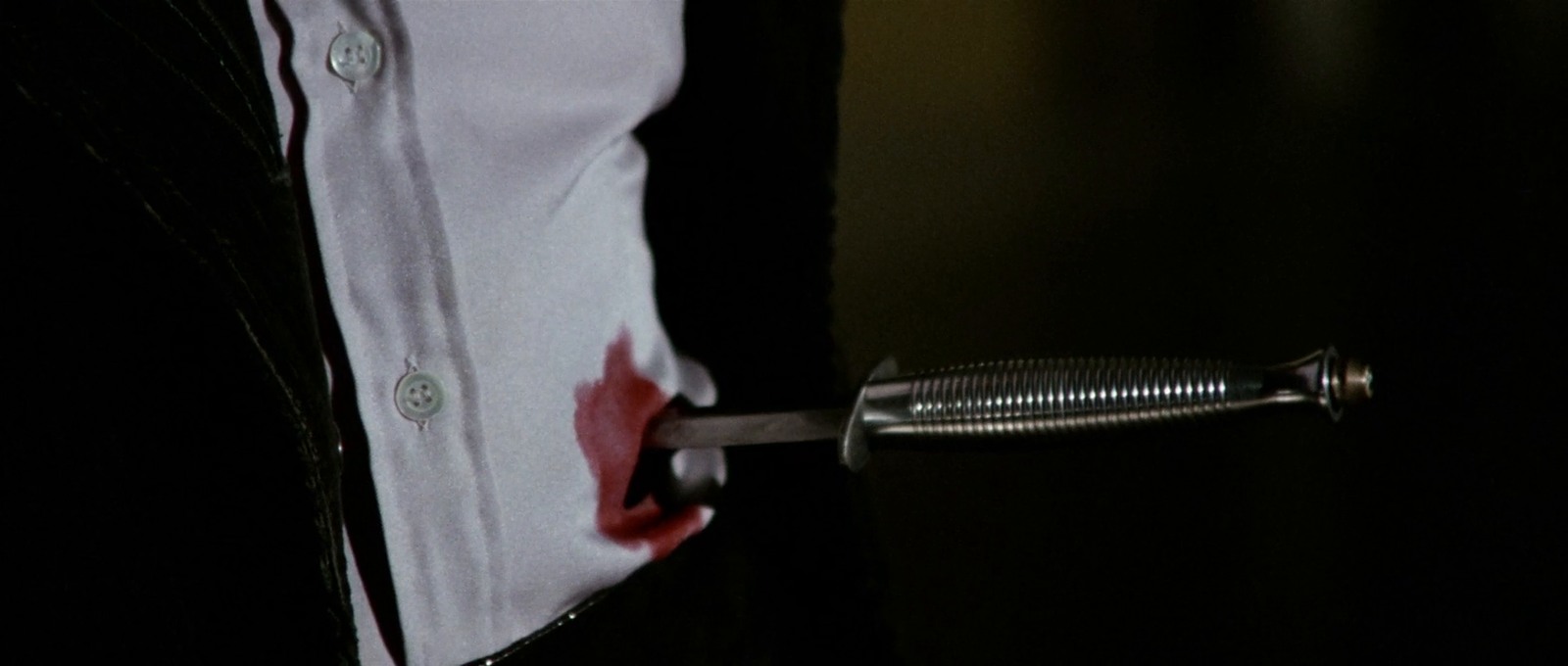
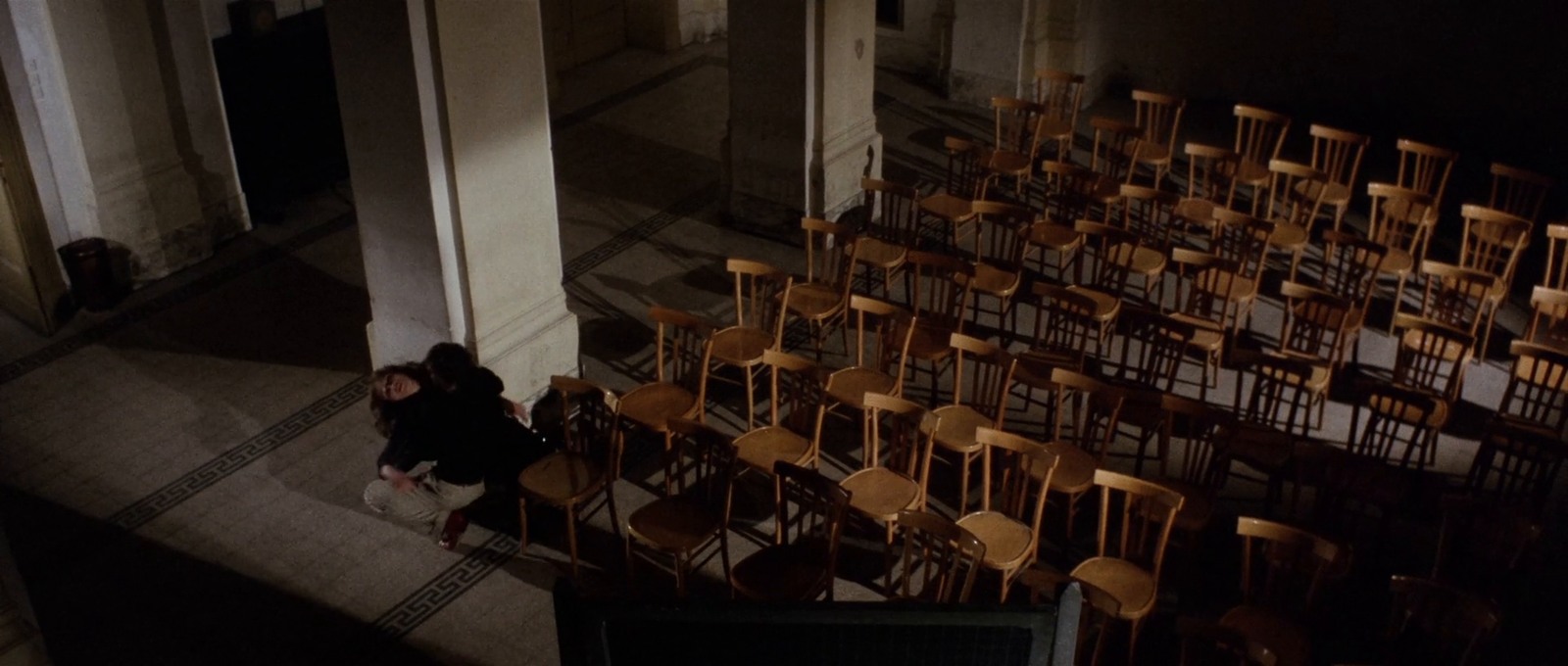
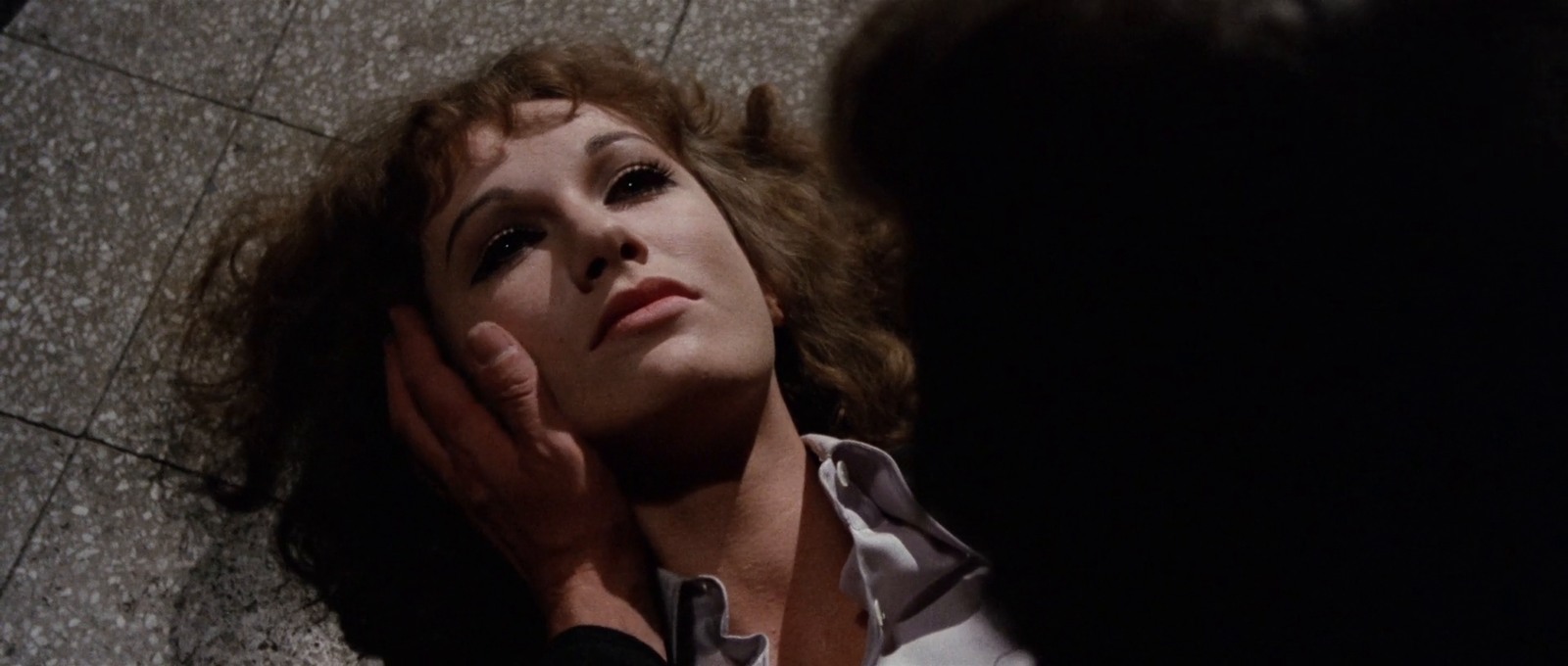
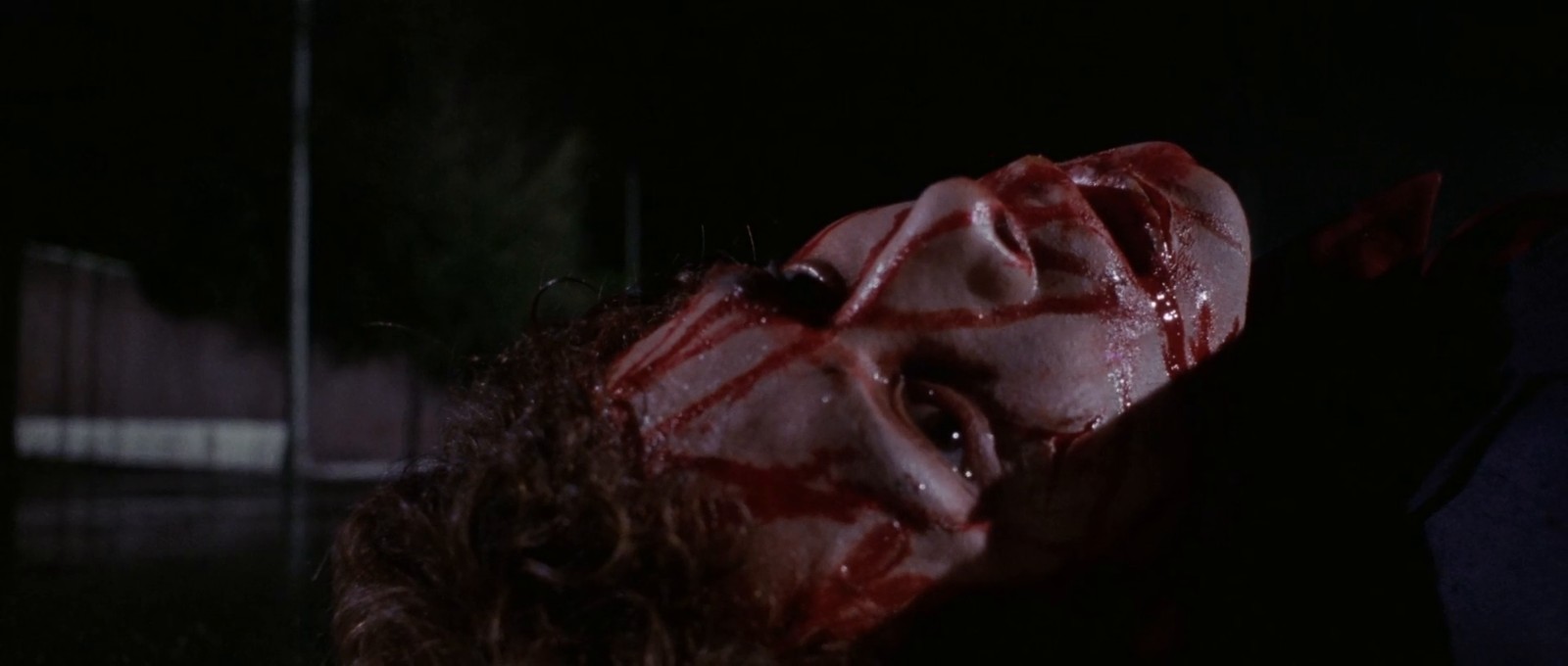
Musician Marcus Daly, played by David Hemmings, sees a woman murdered and becomes caught in an investigation. The familiar witness story becomes an unusually rich meeting of visual evidence, personality and music. Daria Nicolodi’s journalist Gianna is central to the encounter between investigation and everyday life. Arrow: synopsis ↗BFI: Newman review ↗
Spoilers: this study discusses the film’s story and ending.
01 / Seeing & remembering
A face among images.
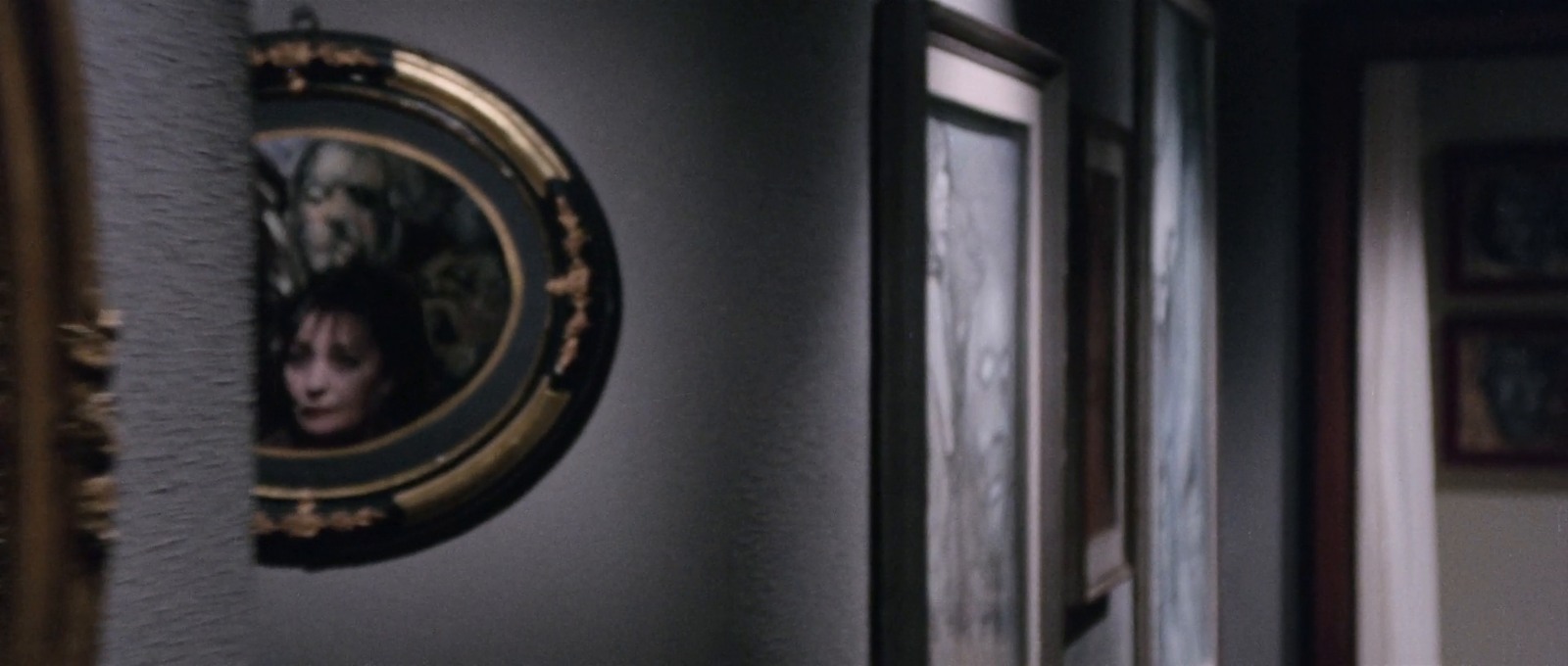
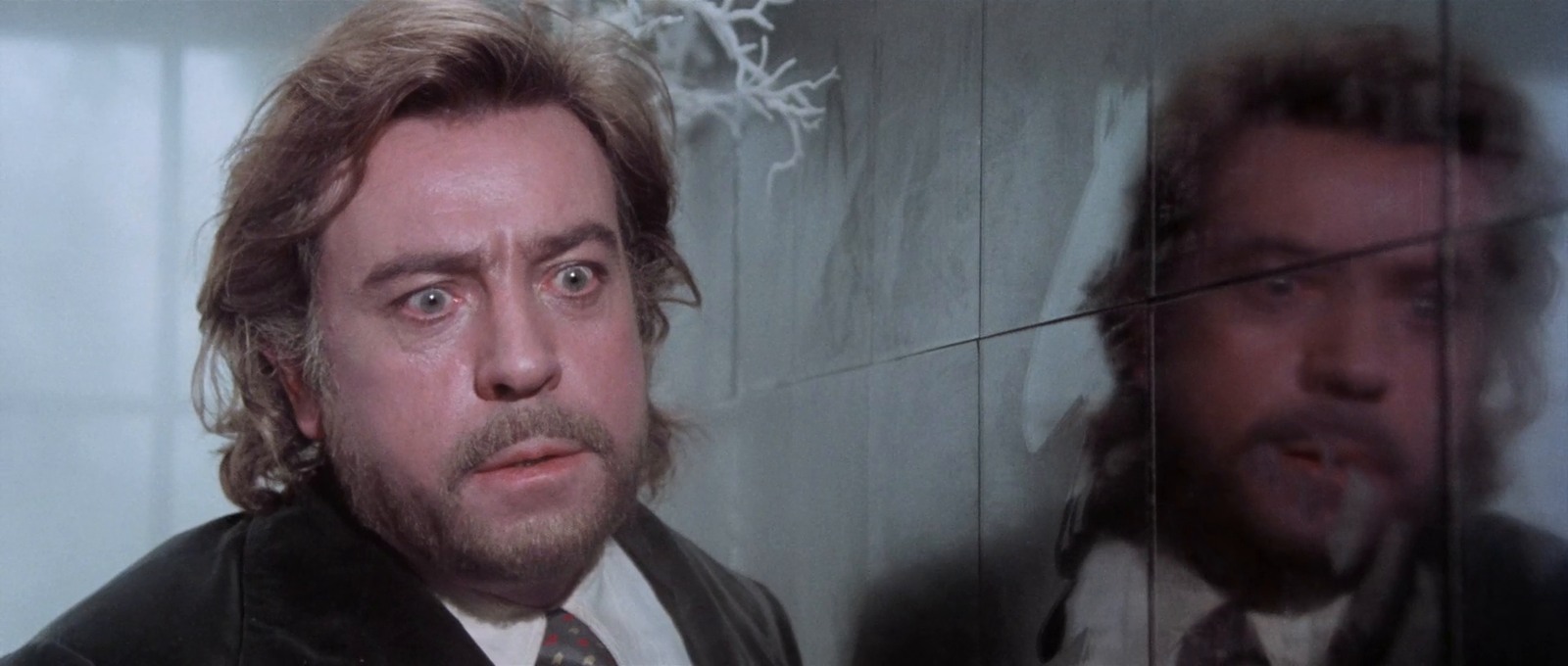
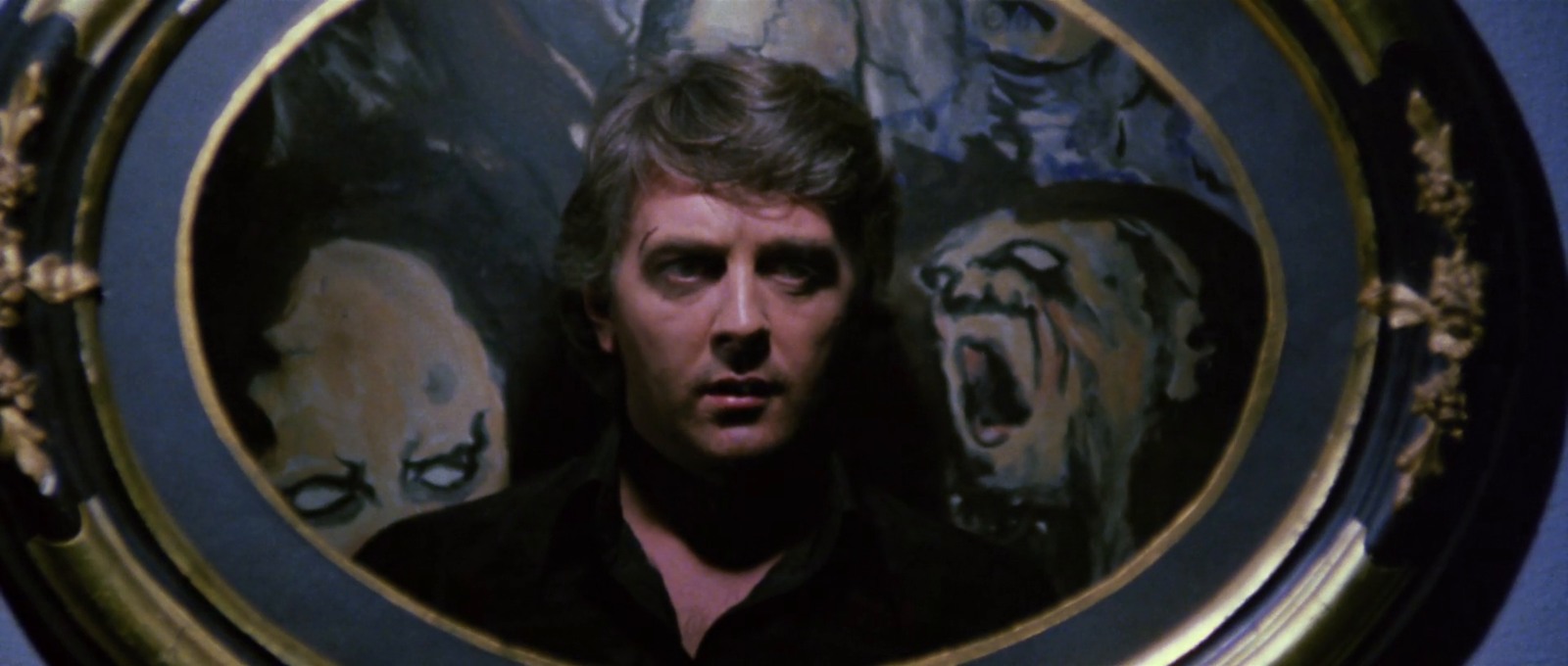
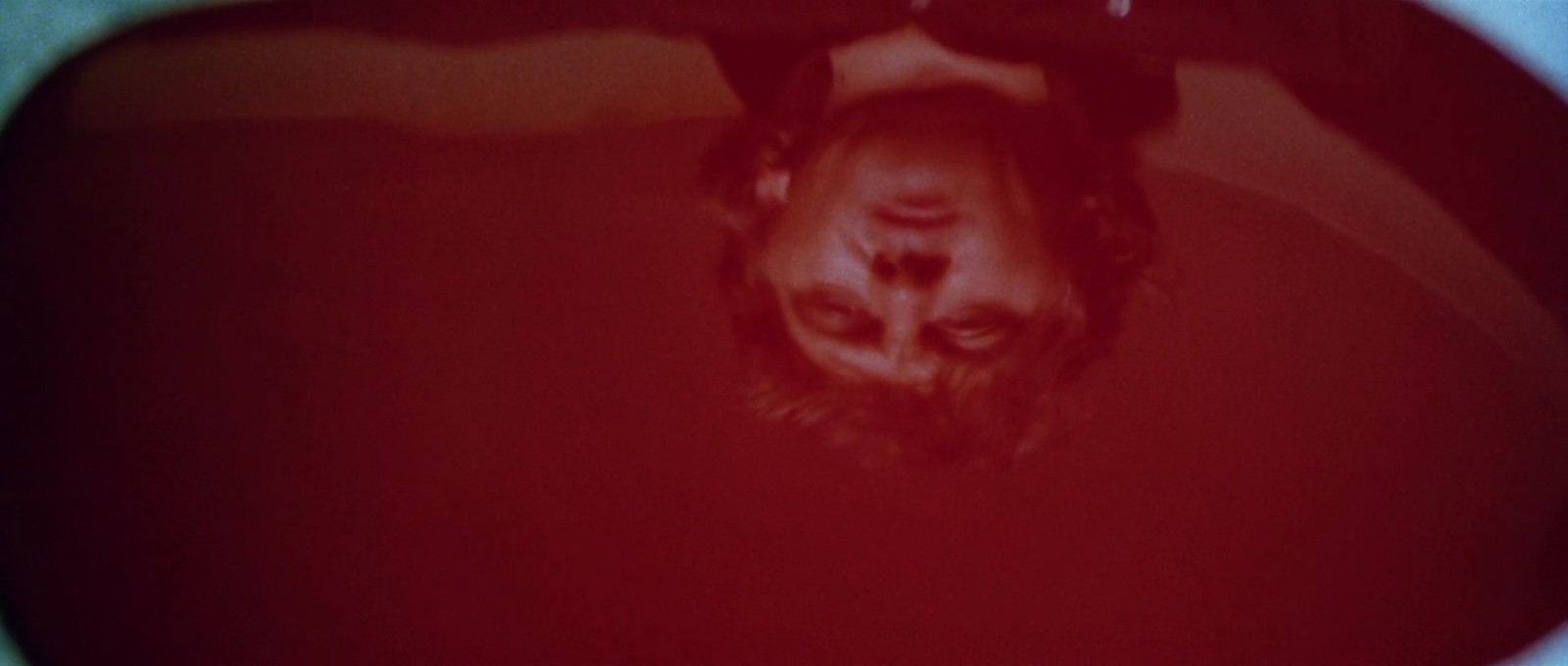
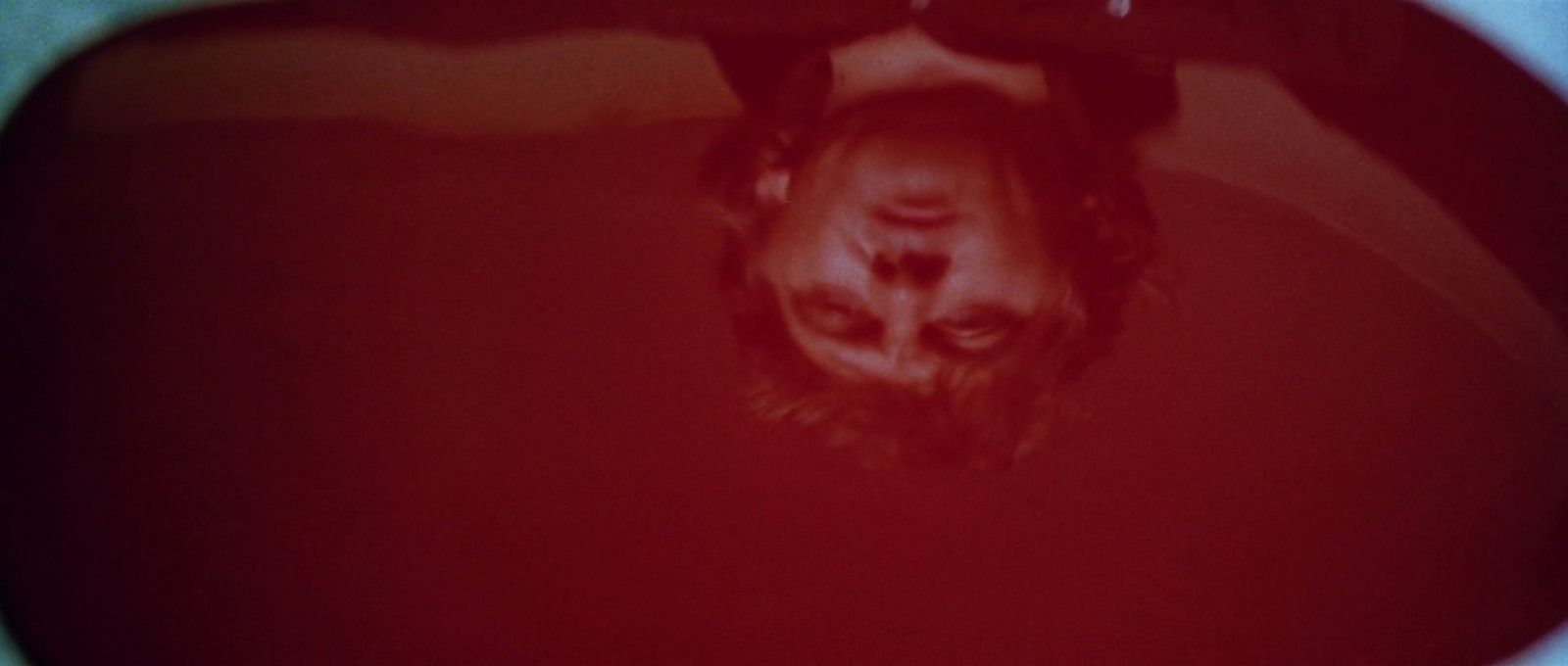
In the mirror image reproduced above, David Hemmings’ face occupies an oval border among painted heads. His raised hand enters the same crowded field. The mirror makes a living person and representations of people neighbours on one surface. Before we ask what a clue means, Deep Red asks a more basic question: what kind of thing are we looking at?
Kim Newman’s November 1984 review observes that the early clue can be recovered on a second viewing. The solution does not require a new object to enter the story; it requires an existing image to be understood differently. Newman: opening paragraph ↗
Our reading is that Marcus’s memory is organised too quickly. He recognises the scene as an arrangement of pictures, then investigates the absence of a picture. His confidence in that category becomes the obstruction. More intense looking need not help if the witness keeps asking the wrong question.
This makes the film’s relation to The Bird with the Crystal Plumage especially productive. Both investigations begin with a witness whose experience contains more than his explanation can accommodate. In Deep Red, the problem also belongs to the spectator: recognising an actor as the story’s observer does not guarantee that his interpretation is ours to trust.
Argento and Bernardino Zapponi share the writing credit. Two accounts of their collaboration illuminate different kinds of audience response. In a 2023 interview, Argento describes seeking familiar physical fears with Zapponi—hot water and sharp edges among them. The imagined violence begins with sensations a spectator can recognise. Argento: collaboration with Zapponi ↗
Zapponi supplies a complementary explanation. In Gabrielle Lucantonio’s interview, published posthumously by Roberto Silvestri in 2016, he says their comic scenes were intended to release tension through laughter and renew attention. The publication context matters: this is an interview text preserved by a colleague, not a dated writing-room transcript. Zapponi: answer on pauses and comedy ↗
Taken together, those accounts suggest that suspense is made through changes in the audience’s state, not just a succession of threats. Comedy allows a body to relax; recognisable pain makes that body apprehensive again. The connection is useful precisely because it does not require every joke to conceal a clue. A scene can contribute by changing how the next scene is received.
This also gives the social encounters a structural purpose. A murder investigation asks for concentrated attention, but Marcus and Gianna keep making room for irritation, vanity and play. Their relationship makes the world feel inhabited by people with aims beyond supplying plot information. The interruptions are part of the experience the film builds.
No inspected draft yet assigns individual scenes to one writer. The joint credit and these recollections support collaboration; they do not divide the screenplay into authenticated Argento and Zapponi pages.
Writing in isolation.
Argento recalls writing Deep Red alone in an unlit country cottage, arriving in the morning and staying until sunset. In Panico, he describes the process as frightening at times: inventing the film meant encountering fears of his own. Scafidi places this recollection within a documentary structured around another writing retreat. Panico: testimony and passage locators ↗
This is an account of the conditions in which Argento worked, not a replacement for Zapponi’s contribution. Beside the co-writer’s explanation of comic relief, it brings two scales of creation into view: the solitary experience of imagining fear and the collaborative task of shaping an audience’s response.
03 / Performance & authority
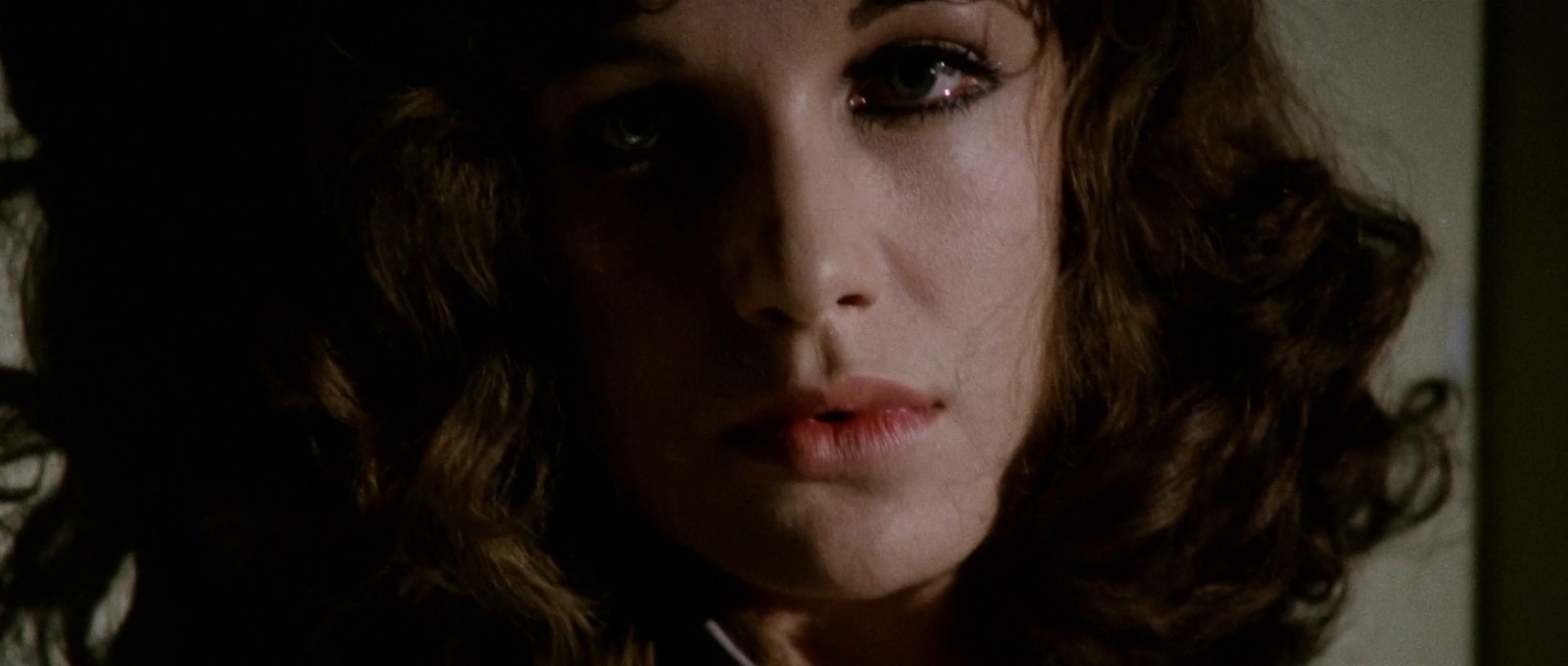
Gianna changes the investigation’s balance.
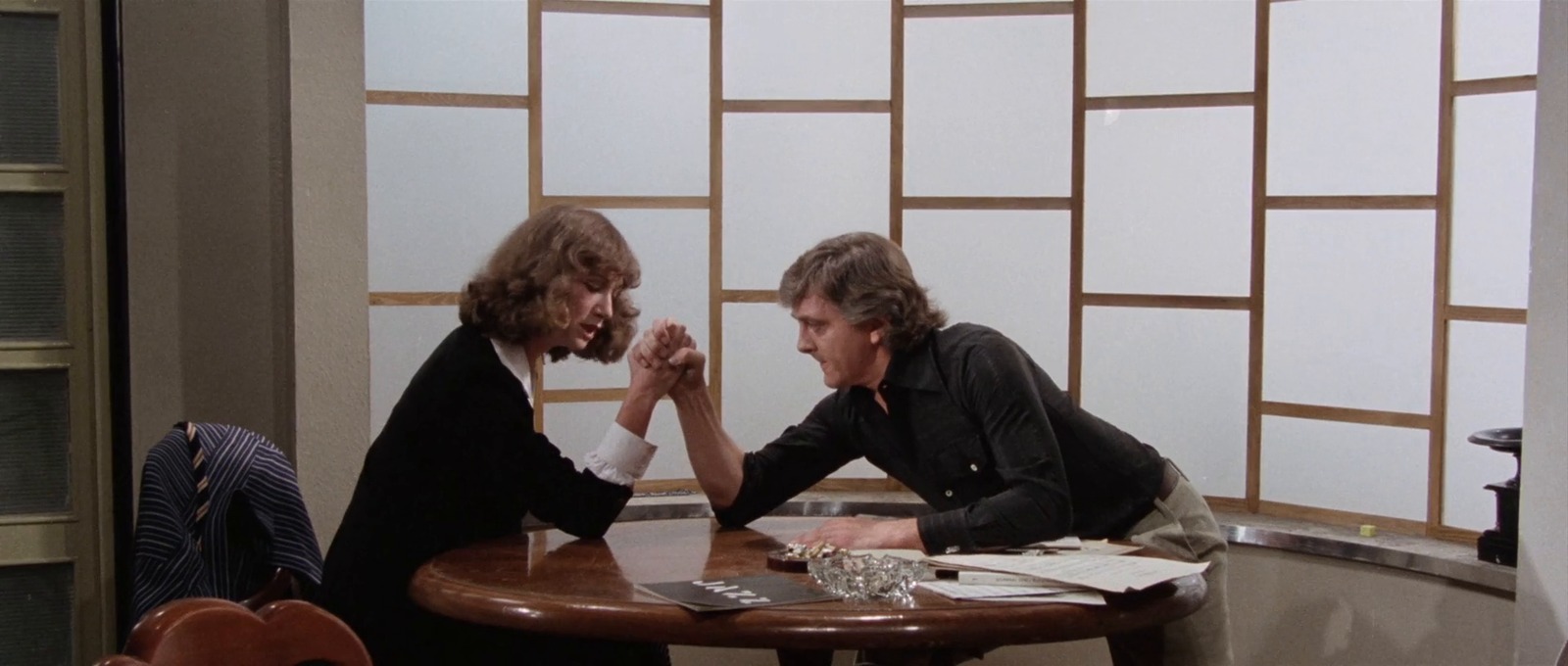
Newman reads Gianna’s arm-wrestling victory as both a challenge to Marcus’s chauvinism and a complication of his assumptions about the killer. Her comic competence and his wounded pride belong to the mystery’s argument about who can act. Newman: Gianna and the contest ↗
Nicolodi’s recollection, quoted by Alan Jones in Arrow’s booklet, stresses the attraction of playing an assertive woman rather than the fragile roles she had previously known. It gives Gianna a performer’s history beyond her position beside the male lead. Jones: Nicolodi, printed p. 17 ↗
The consequence for our reading is substantial. If the witness’s confidence is one of the film’s problems, Gianna’s resistance should not be treated simply as a distraction from detection. She contests his right to set the terms of an encounter. The spectator can enjoy his embarrassment while also reconsidering the authority granted to the person whose memory drives the plot.
Hemmings and Nicolodi are surrounded by characters who offer different ways of knowing: Helga’s psychic recognition, Carlo’s troubled intimacy, Giordani’s expertise and Amanda’s account of a house. The credited performers include Macha Méril, Gabriele Lavia, Glauco Mauri and Giuliana Calandra. Torino Film Festival: cast ↗
Rather than a neutral chain of clues, the investigation becomes a series of encounters with other people’s knowledge. Marcus needs them, yet approaching them does not create safety. The narrative repeatedly exposes the difference between possessing information and controlling what happens next.
The export cut makes performance an edition question as well. The point to retain is that changes to conversational space may alter a relationship as well as a runtime.
04 / Architecture & geography
A public square, a private history.
The location record opens out in two directions. Italy’s official tourism portal identifies Piazza CLN in Turin with the film’s Blue Bar and the protagonists’ buildings. MuseoTorino identifies Villa Scott at Corso Giovanni Lanza 57, designed by Pietro Fenoglio in 1902, as a filming location. These are physical places; they do not supply a complete map of the fictional city or every interior. Piazza CLN ↗ · MuseoTorino: Villa Scott ↗
Argento’s 2023 account explicitly connects the Blue Bar with Hopper’s Nighthawks, including figures held nearly motionless as part of the composition. The relationship is therefore more than a resemblance proposed by later viewers. It remains the director’s retrospective account, not a surviving design drawing. Argento: the Blue Bar ↗
A square promises openness: a person can look across it, locate another window, imagine a route to help. The villa offers the opposite invitation, drawing the investigator toward a history enclosed by architecture. Our comparison concerns how these settings organise curiosity. Public visibility and private access are different forms of uncertainty.
Giacomo Manzoli’s Treccani essay describes a spectral Rome complicated by Turin locations. His formulation helps preserve the difference between a story’s geography and the places used to construct it. Manzoli: the film’s city ↗
The location history connects three kinds of place: the surviving building, the space used for filming and the setting it becomes in the fiction.
05 / Photography, design & editing
The frame contains more than the witness can use.
Luigi Kuveiller’s photography, Giuseppe Bassan’s production design, Elena Mannini’s costumes and Franco Fraticelli’s editing are separately credited. That division matters in a film where a surface, a person’s position and the order of views all influence recognition. Torino Film Festival: crew ↗
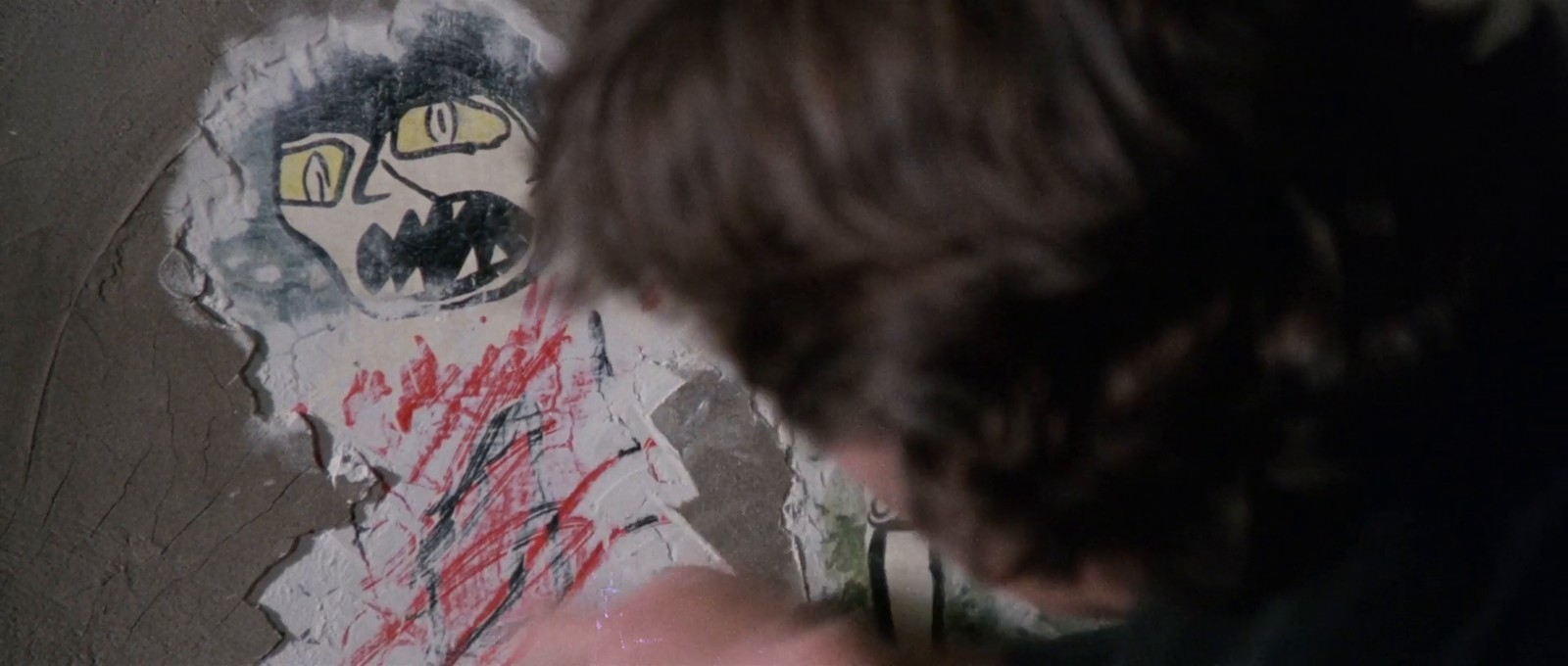
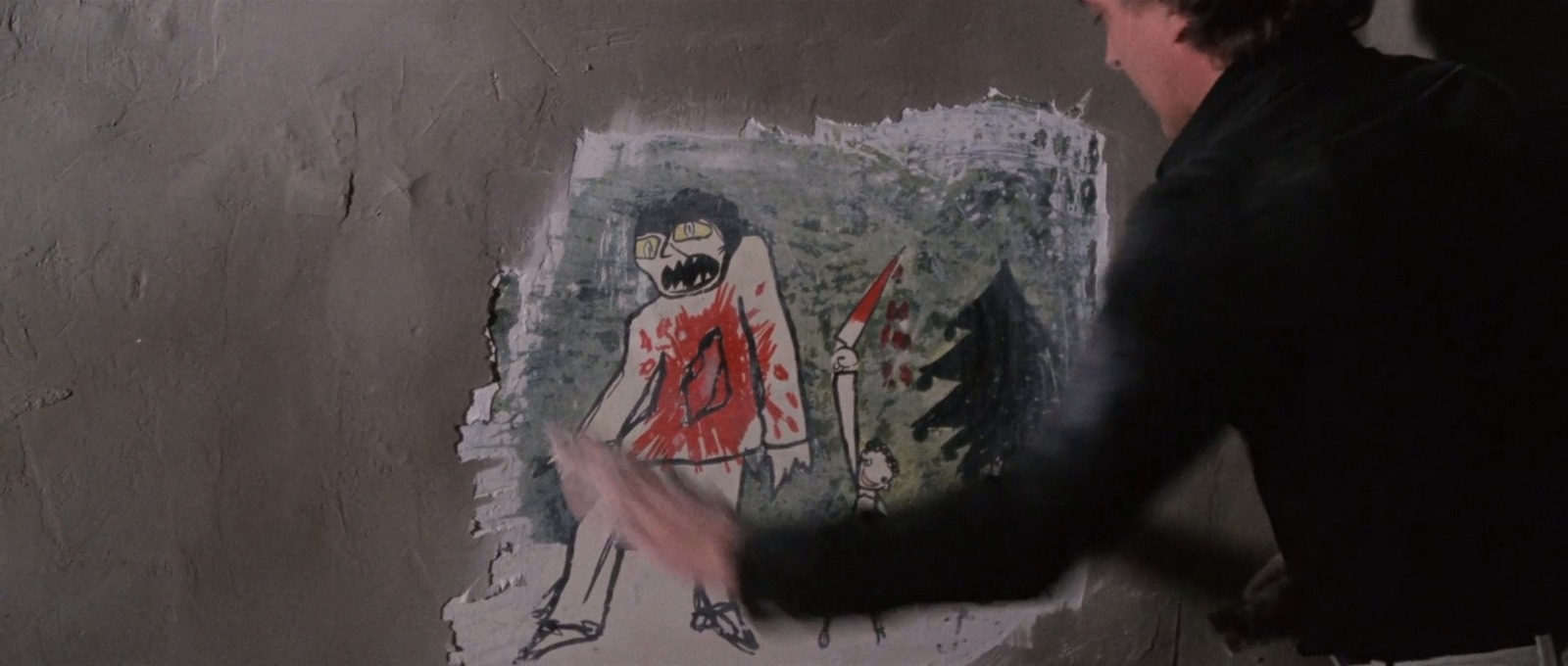
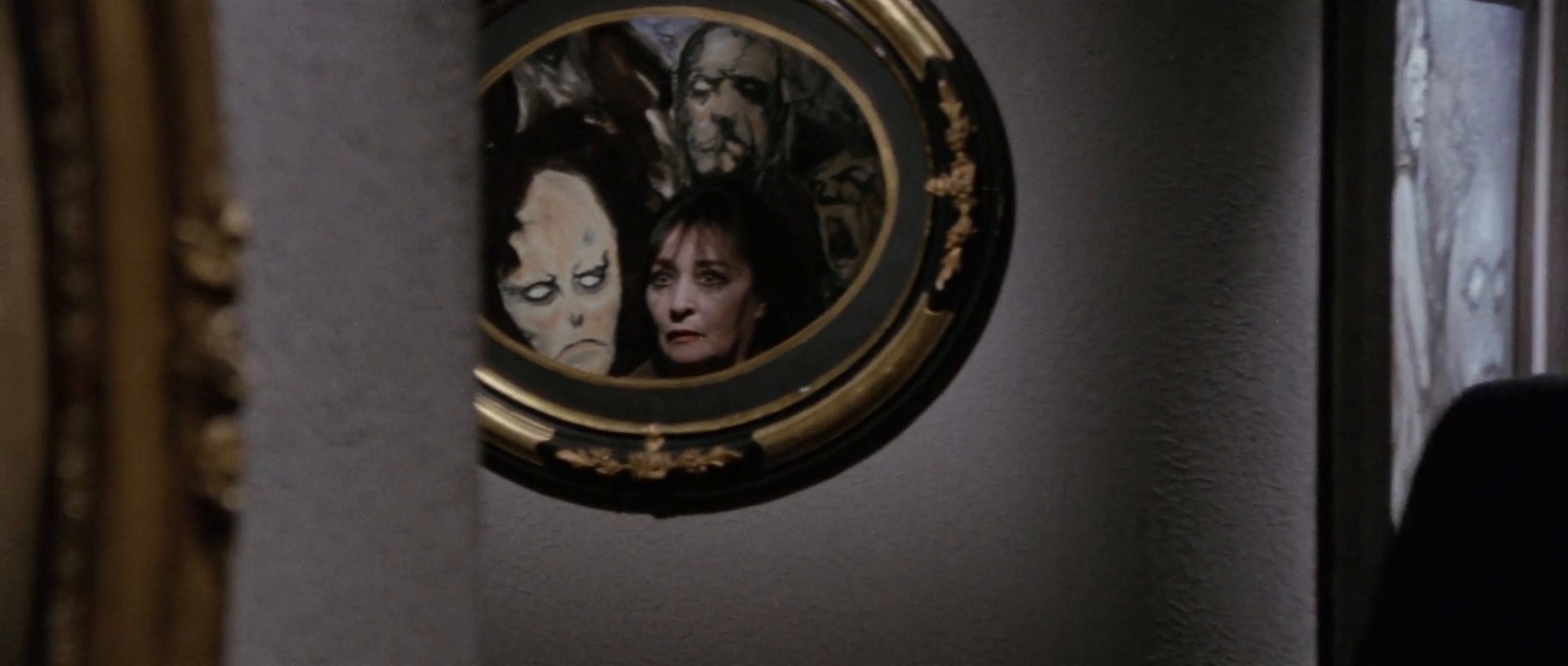
Return to the mirror image. Several faces share the frame, but their presence does not establish a single level of reality. The ornate surround makes the border visible while the reflected face appears to occupy the decorated wall. The design offers an abundance of information and an unstable way of sorting it.
Our interpretation is that the set can assist misrecognition without becoming meaningless ornament. A crowded wall encourages the spectator to see a collection before identifying each member. The image’s intelligence lies in that invitation to generalise.
Fraticelli’s role becomes important at the point where an image is encountered, left behind and returned to. Editing can make recognition a relation between moments rather than a property of one isolated frame. Describing that principle does not require us to pretend to know a particular cut’s duration. The surviving release materials and future continuity comparison will be needed for exact timing.
Arrow’s restoration note identifies a 35mm two-perforation Techniscope negative. That describes the recording material used for its restoration, not the make of every camera, lens or close-up attachment. Restoration note: printed p. 56 ↗ A wide image can carry the body and the surrounding objects together; the historical explanation of a particular movement still needs its own evidence.
The close editing studies now follow the opening, both mirror passages, the doll, the childhood reconstruction and the lift. They show how a sustained view, a rapid reverse angle and a return to an earlier composition produce different kinds of recognition.
The object procession and piano inserts compare movement across a surface with fragmentation through cuts. The arm-wrestling study shows how a return to the wider frame can make an action legible, while Martha’s photographs briefly replace a speaker with the images she describes.
The book photograph, misted bathroom wall and villa interior offer three different forms of evidence: an image carried between locations, a surface whose legibility must be recreated, and a building that has to be explored. The editing changes scale and pace to distinguish each act of discovery.
The newspaper portrait, altered villa facade, school drawing and return to the corridor form a chain of images that need interpretation. The film repeatedly separates possessing a picture from understanding it. The camera’s turn around Marcus and Carlo in the archive makes that uncertainty spatial: the same movement changes the apparent position of the watcher.
Before Deep Red: the palace and the low viewpoint
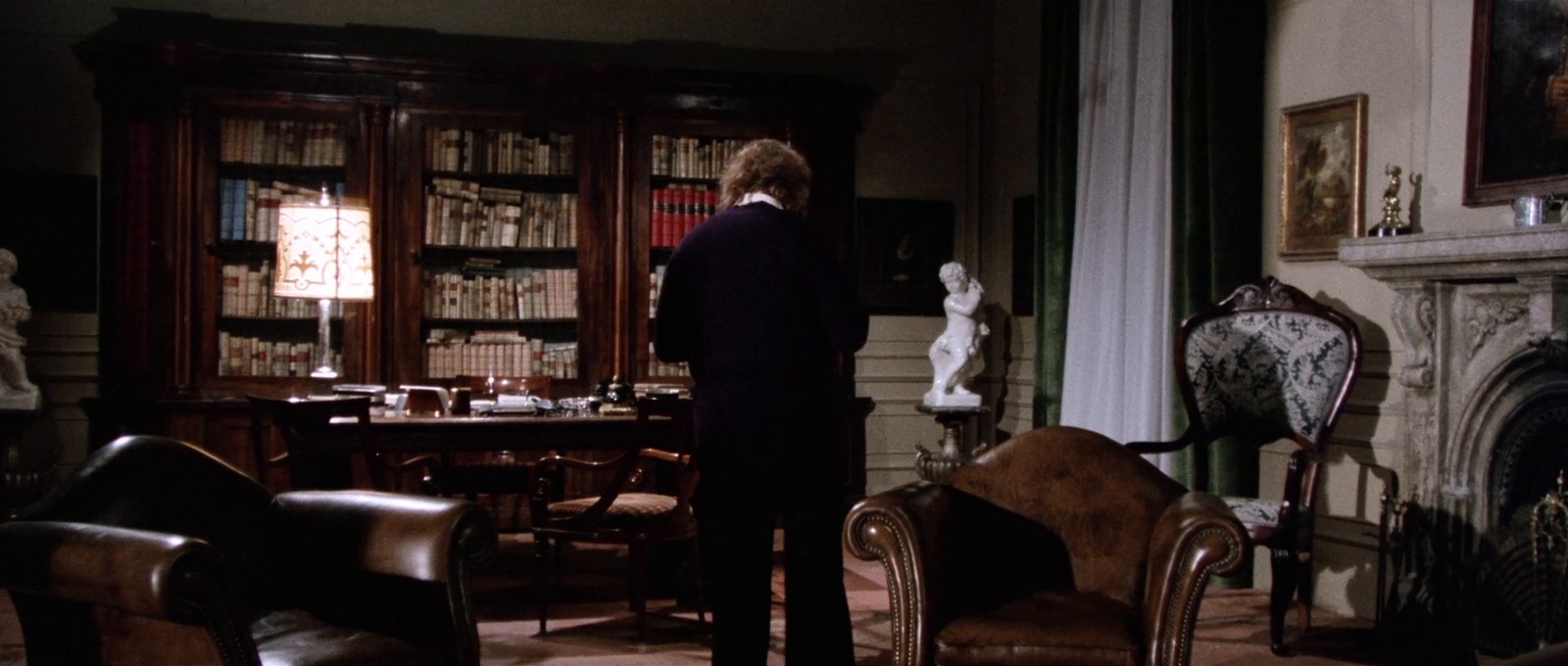
In their commentary for The Five Days, Troy Howarth and Nathaniel Thompson repeatedly connect its palace interiors with Deep Red: Kuveiller’s lighting, heavy drapes, red library furnishings and architectural framing make the historical comedy part of the same visual inquiry. Their later discussion of the banquet, seen beneath a table through shoes and hems, connects it with the low viewpoint of this film’s opening. These are the commentators’ formal comparisons, rather than evidence that a set or object was reused.
The comparison offers two distinct routes through Argento’s work. One follows a cinematographer and a treatment of interior space; the other follows the decision to withhold faces while letting fragments carry information. Explore the palace study → · Explore the banquet →
Source & passage
Troy Howarth and Nathaniel Thompson, commentary on Severin Films’ The Five Days Blu-ray: 46:00–55:20, palace and library comparisons; 1:19:20–1:21:20, low framing and the banquet. Commentary guide →
06 / Gaslini, Goblin & the film
Begin with the joint credit.
Gaslini and Goblin belong in the same history. In Rolling Stone Italia’s 2018 interview, Claudio Simonetti remembers the group initially being asked to perform Gaslini’s music in its own manner. After Gaslini’s departure, he says, the existing material stayed while Goblin supplied the rest. He specifically attributes the child’s song to Gaslini. This is participant testimony, not a recovered cue sheet. Simonetti: Gaslini and the commission ↗
That account is more useful than a simple story in which one composer was replaced by a band. It allows composition, arrangement and performance to be different activities, and suggests why the film’s musical identity need not have a single authorial voice. A familiar credit on the cover of a record should not erase the other work inside the film.
Simonetti also gives a compressed production memory: ten days in one answer and two weeks for writing and recording in another. These may refer to different activities; they do not establish an exact studio calendar. His account names a 7/4 rhythm for the main theme. We retain that as his description, without presenting it as a new transcription or listening result. Simonetti: rhythm and recording timetable ↗
The important interpretive distinction is between music that accompanies investigation and a sound that itself becomes evidence. The festival synopsis places a child’s tune within the killer’s activity. Festival synopsis ↗ A melody can consequently work both as an organising pattern for a spectator and as something characters associate with a past event.
Album order, a film cue’s placement and a later concert performance answer different questions. The next comparison will establish which cut and track are being heard before assigning exact entries or sound bridges.
Choose the soundtrack before following the cue.
The viewing presentation carries two mono options, an Italian-labelled six-channel option and an English two-channel commentary. The commentary’s introduction identifies Thomas Rostock, whose track is also listed by Arrow. The extra pair of channels therefore belongs to a different kind of programme; it does not establish an original stereo mix of the film. Commentary identification and review scope ↗
For a comparison of dialogue, music and effects, keep the selected film track constant. A commentary can lower the film beneath a speaking voice, while a surround option can redistribute material that occupies a single channel in mono. An apparent change in emphasis may belong to the selected track rather than to a new edit.
Arrow’s UHD notes explain that the longer version’s English option switches to Italian in passages for which English dialogue was not recorded. Its earlier Blu-ray listing leaves open both non-recording and loss. These are differently worded publisher accounts of the language changes; the local file’s labels alone cannot resolve the history of an individual passage. UHD note ↗Blu-ray note ↗
Rostock: the false promise of a climax.
In the opening discussion, Rostock treats the Christmas fragment as information given to the spectator before its meaning can be understood. His account of the following jazz rehearsal reads the demand for less formal playing as a way into the film’s own freedom of tone. This is a critic’s interpretation of the sequence, rather than a production instruction from Argento.
At the doll’s entrance, he draws attention to expectations established by the earlier murders: the anticipated child’s tune, the threatening score and the apparent arrival of the attack. His reading centres on the interruption of those expectations and Giordani’s absorption in the broken toy. The shot study follows the visible counterpart: rapid alternation during the approach, a pause over the debris, then a return to the vulnerable space behind the character. Selected commentary passages ↗
The tune becomes a clue.
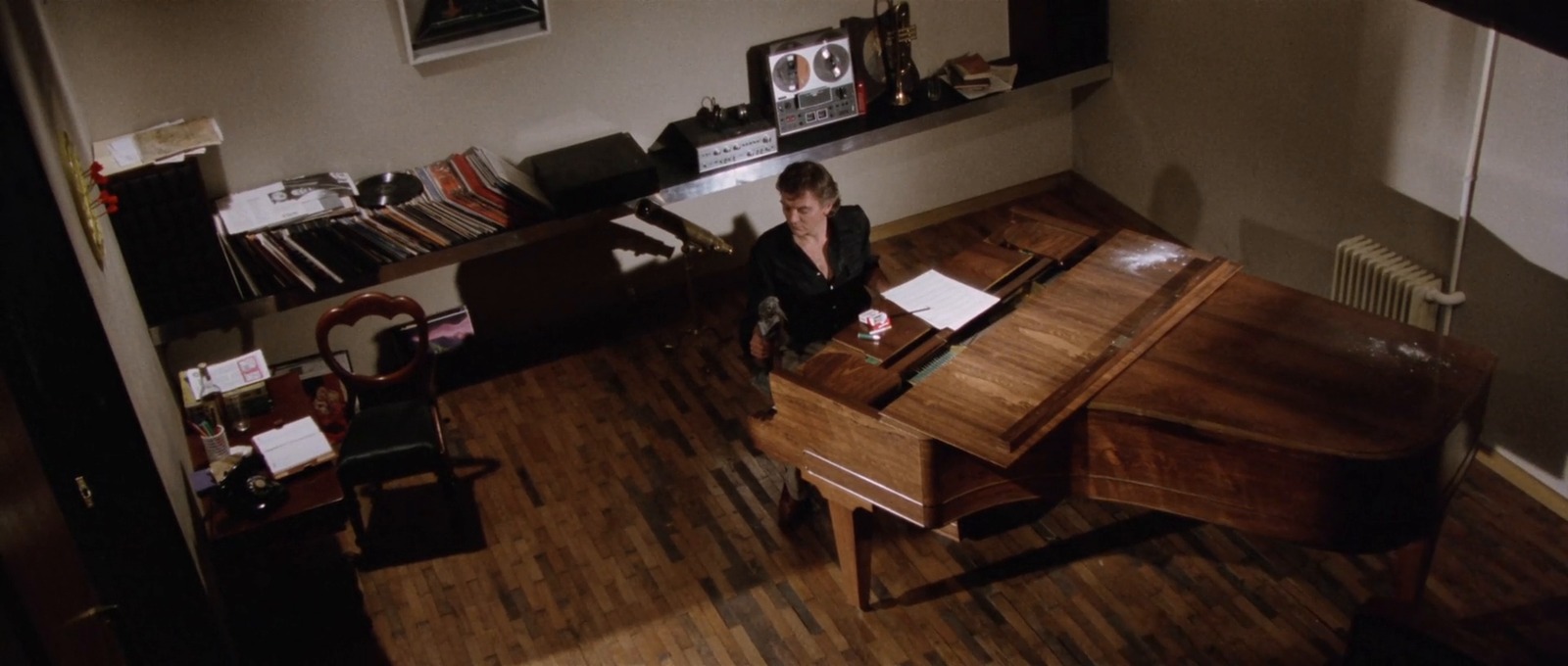
In his account of the apartment sequence, Thomas Rostock follows two interruptions to Marcus’s composing: the approach beyond the skylight and the recorded children’s tune. The shot study traces the visible arrangement—Marcus, glazed passages, the reel, the window—while the commentary explains the unequal knowledge attached to it. A returning listener can recognise a threat before Marcus knows what he is hearing.
Rostock describes the music expanding beyond its apparent source at the recorder, becoming part of the scene’s surrounding score. He reads the intruder as taking control of a musician’s space through a tune the musician did not choose. That interpretation gives the repeated recorder close-ups a function beyond identifying a prop: the machine temporarily displaces Marcus’s piano as the organising object.
Later, Rostock singles out the creaking approach, Marcus’s continued pretence of playing and the telephone’s interruption. The English-track exchange has Marcus appeal to Gianna for help; the camera then takes him to the window. The following shop and record-player views turn the music into something he can buy, replay and investigate. Sound has changed roles—from an intrusion to a line of inquiry. Commentary passages and dialogue review ↗
A voice without a visible owner.
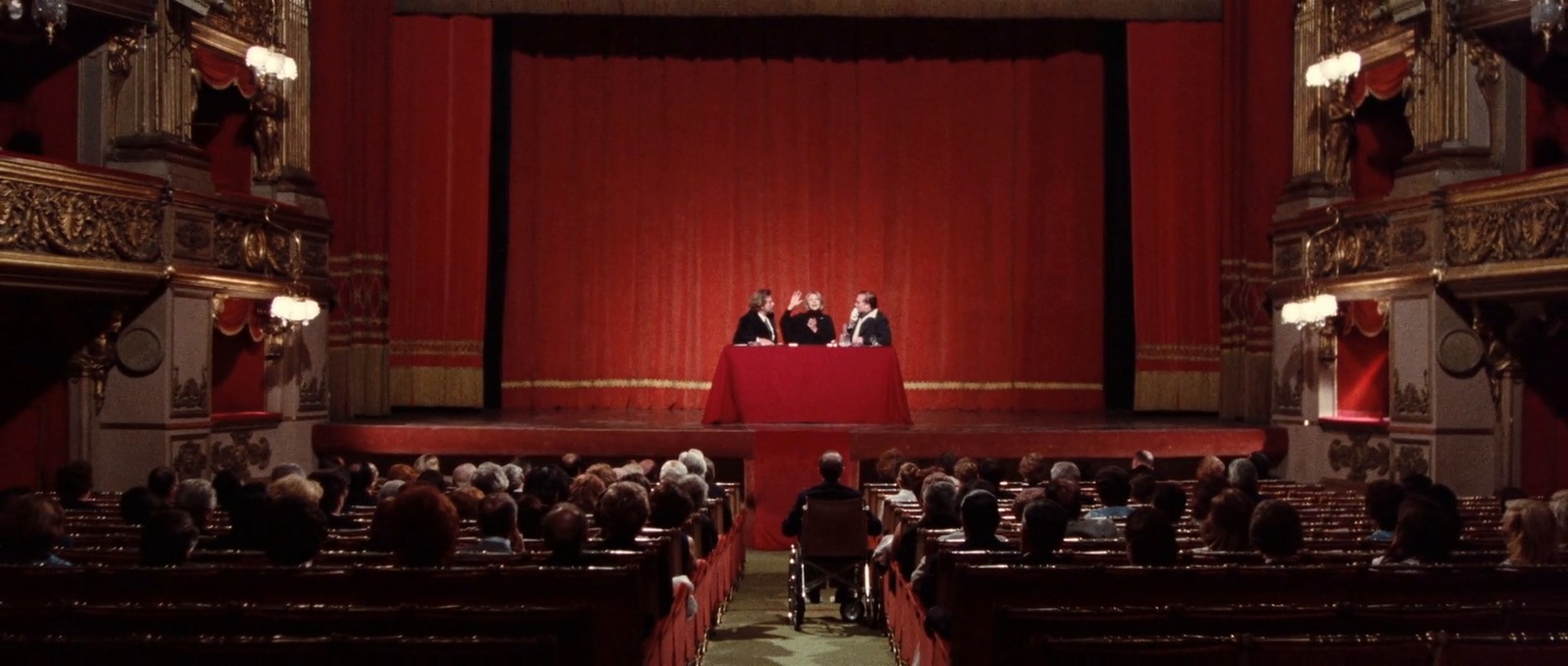
Rostock connects Helga’s speech to the fragment shown during the opening credits: the child’s tune, the house and the remembered violence begin to acquire a shared context. His reading treats the demonstration as a connection between minds, rather than a conventional view of someone physically approaching the stage.
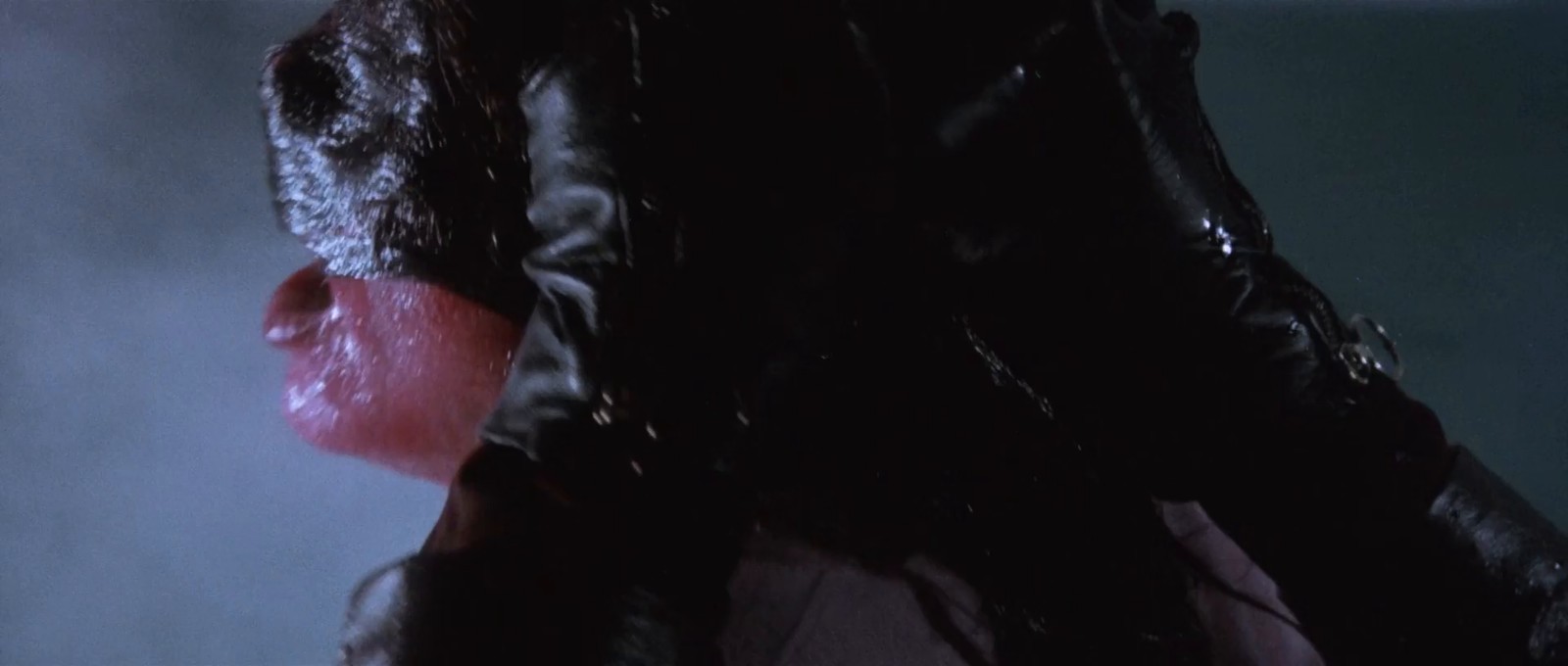
The theatre study shows how the images sustain that uncertainty. Views of seated spectators establish a crowd; the later moving viewpoint leaves it without yielding an identifiable face. The washroom offers a mirror, yet obscures the reflection. Helga can describe a presence that the spectator is still prevented from locating as a particular person. Rostock also relates the close image of her wet mouth to the film’s later bodily imagery. Rostock on the demonstration ↗
One score, different accounts of its making.
Over the wall discovery, Rostock turns to the score’s production history. He contrasts a scheduling account attributed to Giorgio Gaslini with Argento’s account of dissatisfaction and disagreement, before discussing Goblin’s involvement. Those explanations answer different questions: whether a score could be delivered in time, and whether it suited the director’s conception of the film. The commentary preserves the disagreement rather than settling it.
The distinction matters when connecting the drawn image’s gradual exposure with the music accompanying it. A cue’s dramatic effect, its composition credit and the history of the commission are separate lines of inquiry. Rostock’s account can guide that comparison, but it should not turn one participant’s retrospective explanation into an uncontested production chronology. Selected score discussion ↗
The same tune does not give everyone the same knowledge.
The recorded children’s melody links three threatened interiors, but its dramatic function changes with the listener. Thomas Rostock’s commentary connects Helga’s concentrated attention with the melody before the doorbell breaks that concentration. The entrance study shows her attention translated into a corridor, successive entrance views and a lock. The bell then receives its own insert. Sound directs her toward a threshold whose other side the film withholds.
At Marcus’s piano, the recorder introduces a sound he must later identify and investigate. In Amanda’s room, Rostock instead hears recognition: he relates her words about the child and the house to the tune, then draws attention to its abrupt cessation as she reaches for a needle. The camera advances from the recorder toward Amanda. The object and the listener are separated by a cut, but joined by the threat.
Rostock describes the subsequent wait as a withdrawal into silence, broken by the bird’s collision and the other bird’s calls, before the score resumes with Amanda’s movement. His account makes the sequence a pattern of announcement, recognition, pause and renewed attack. The needle and bird provide a false focus; the figure entering behind Amanda redirects the danger again. Selected sound commentary ↗
The scream changes the scale of the square.
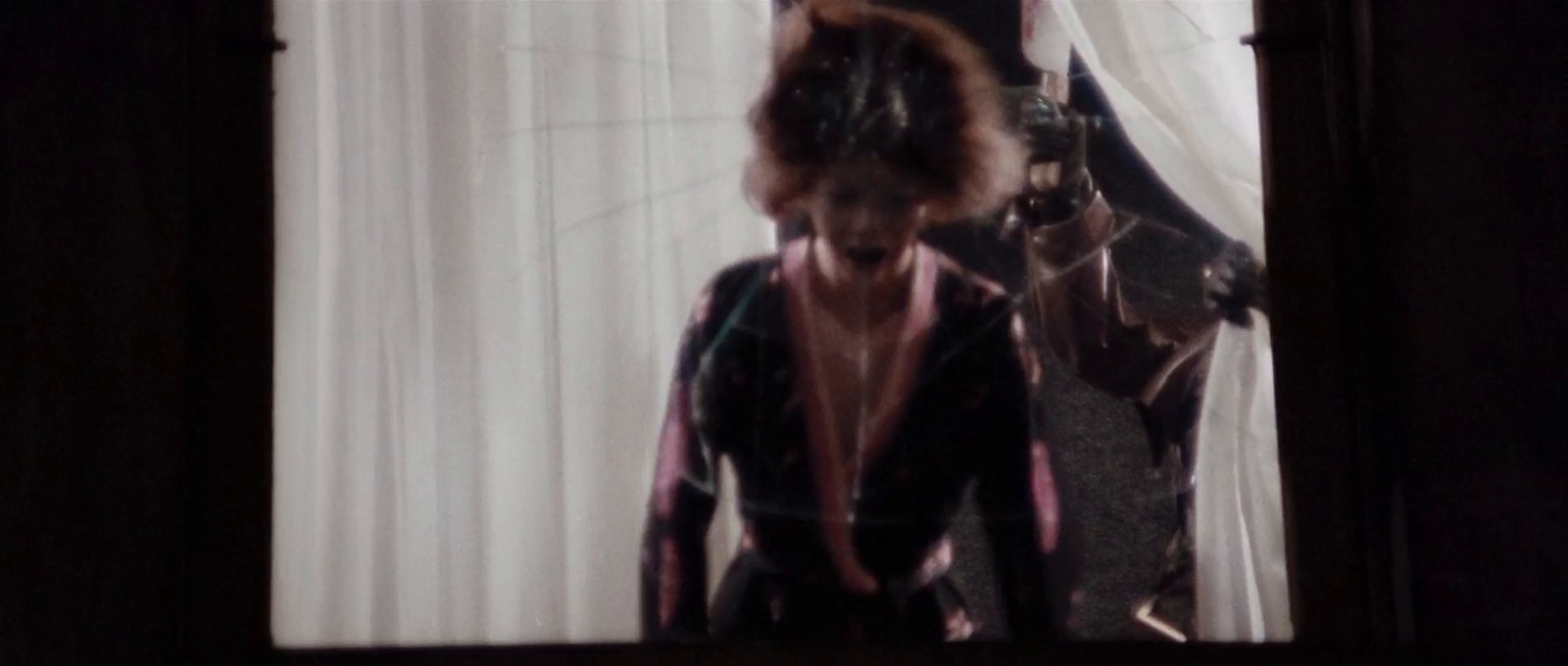
Rostock contrasts the long takes of the square conversation with the rapid cutting when Marcus sees Helga at the window. The timed study follows that acceleration through the illuminated window, Marcus’s face, the high view of his position below and the glass-injury insert. The spectator gains close access to a danger that remains physically distant from the witness.
The distinction is central to the scene’s force: editing can move the spectator across the gap instantly; Marcus must still run to the building and negotiate its interior. The first view of the lift on his route also gives the later climax an earlier, ordinary place within the building. Rostock on the return to Helga ↗
The attack ends; the camera continues.
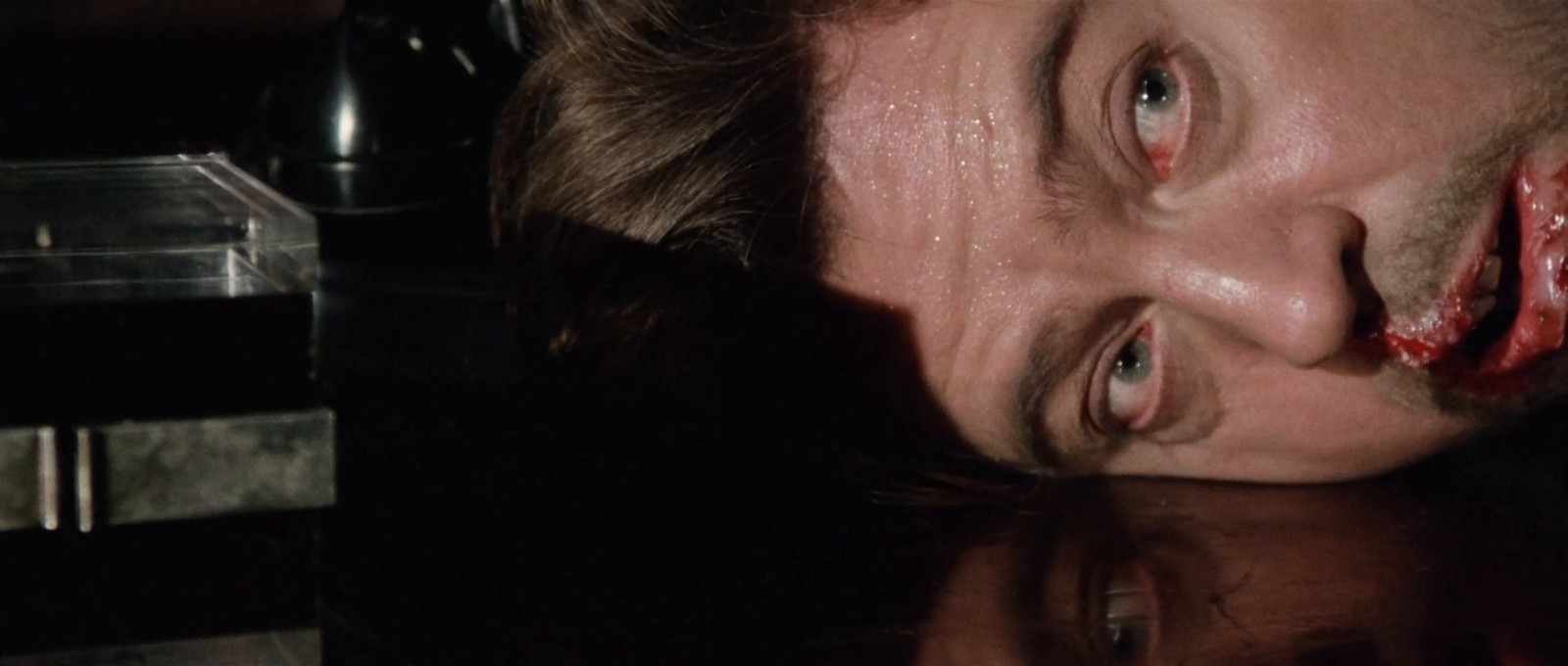
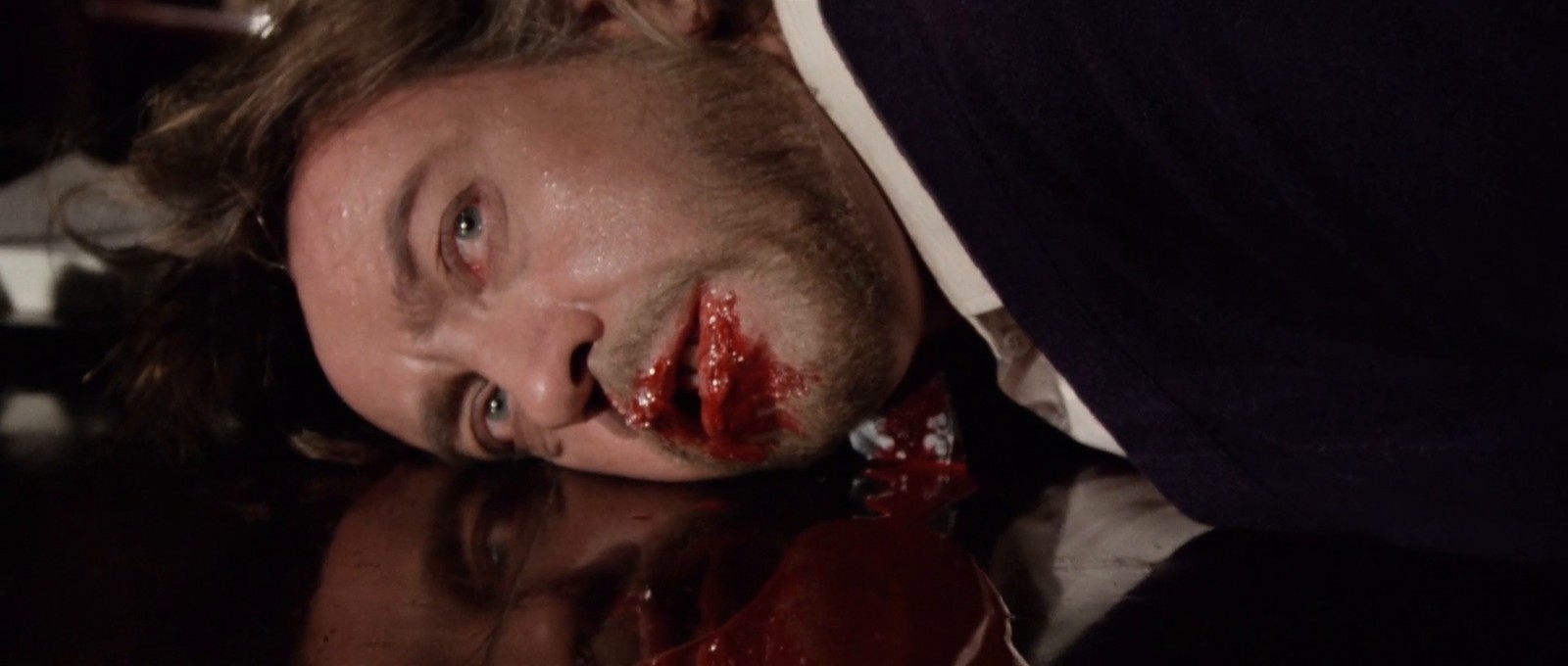
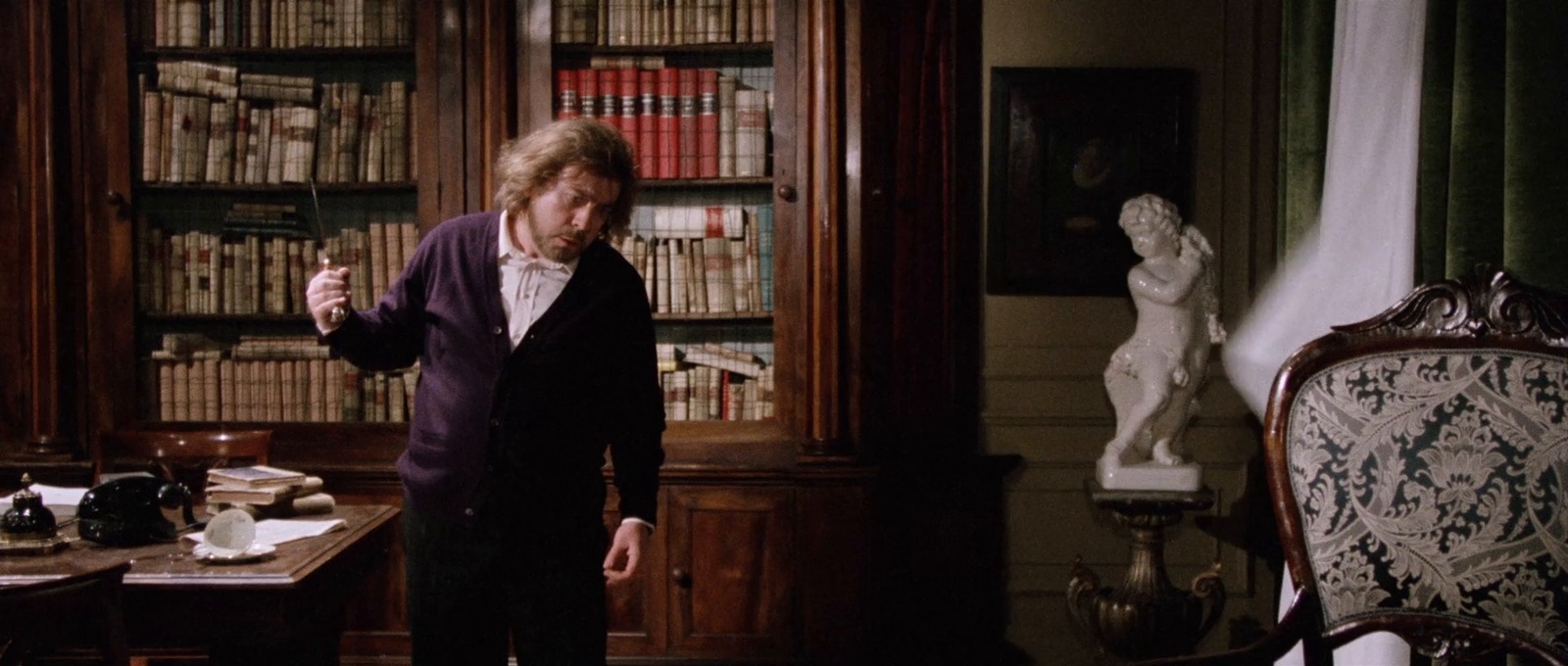
In discussing Giordani’s death, Rostock connects the assault on the mouth with Marcus’s earlier joke about piano-playing and paternal aggression. It is a reading of an echo between dialogue and violence. His larger argument concerns the spectator’s changing position: the doll encourages an expectation of release, then the real attack and the final arrangement of the body implicate the camera in a more troubling act of looking.
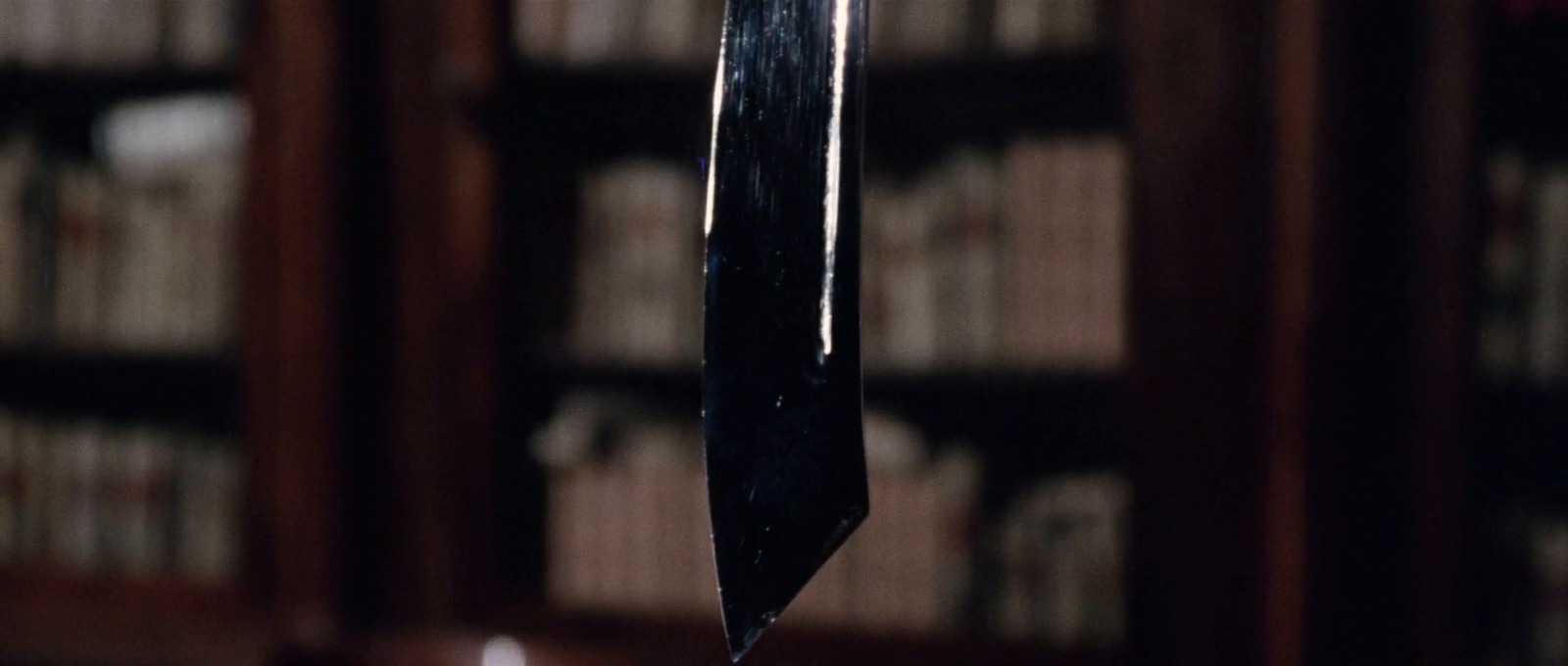
The shot study makes the change of pace concrete. The mouth, stone, wood, blade and reflection are broken into short views during the attack. The aftermath then starts on blood at floor level and rises slowly to the face on the desk. The camera prolongs the encounter after resistance has ended. It does not require another blow to keep the viewer within the scene. Rostock on Giordani ↗
A rescue explained after the image.
The concealed-room study ends with a sudden transfer from the villa’s darkness to Marcus lying outside. The camera rises to Gianna before separate views disclose the burning house. Rostock reads the combination of music, her stillness and her profile against the flames as a moment that briefly unsettles our confidence in her.
The English dialogue then supplies a practical account of the missing action: Gianna describes seeing light in a window, going upstairs and finding Marcus near the flames. He returns to the lost evidence and the body behind the wall. The rescue has occurred across an ellipsis; speech explains what the picture has omitted. Rostock’s suspicion belongs to the atmosphere he finds in the scene, while the exchange gives Gianna a specific account of helping Marcus. Commentary and selected English dialogue ↗
Two pianists, two ways of making a living.
At the fountain, Carlo describes a difference of circumstances between musicians who share a skill: Marcus can play for artistic satisfaction, while Carlo must play to survive. The English dialogue makes this distinction explicit. The square study shows the exchange moving from close reverses to a wider view of the two men upright against the fountain. The conversation is given room to develop before the distant violence reclaims Marcus’s attention.
Thomas Rostock connects the later duet at the bar with a tune Carlo had earlier hummed to Marcus. He also stresses the return of music after the extended conversational passages. The visual study begins the duet with two pairs of hands on one keyboard, then moves past the patrons. Friendship is expressed as a shared activity and placed within a working social space. Rostock’s account of the musical connection offers a way to follow the relationship across the two scenes. Selected dialogue and Rostock commentary ↗
The instrument becomes another collection of objects.
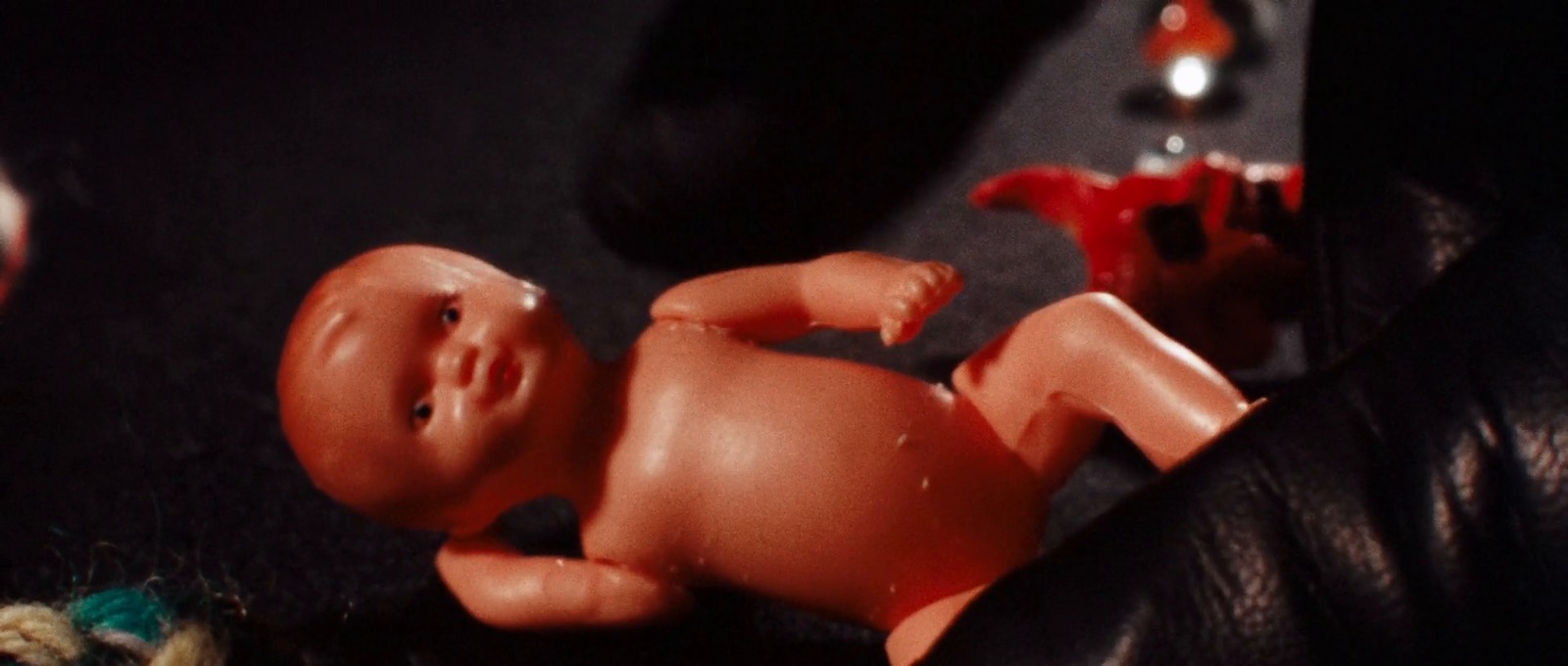
Rostock describes Goblin’s main theme carrying the camera through the killer’s miniature objects, with the music building toward the knives. The object study follows the cradle, yarn figure, drawing, cord, doll and blades as a moving succession of surfaces. The eye close-up then returns those objects to an anonymous human presence.
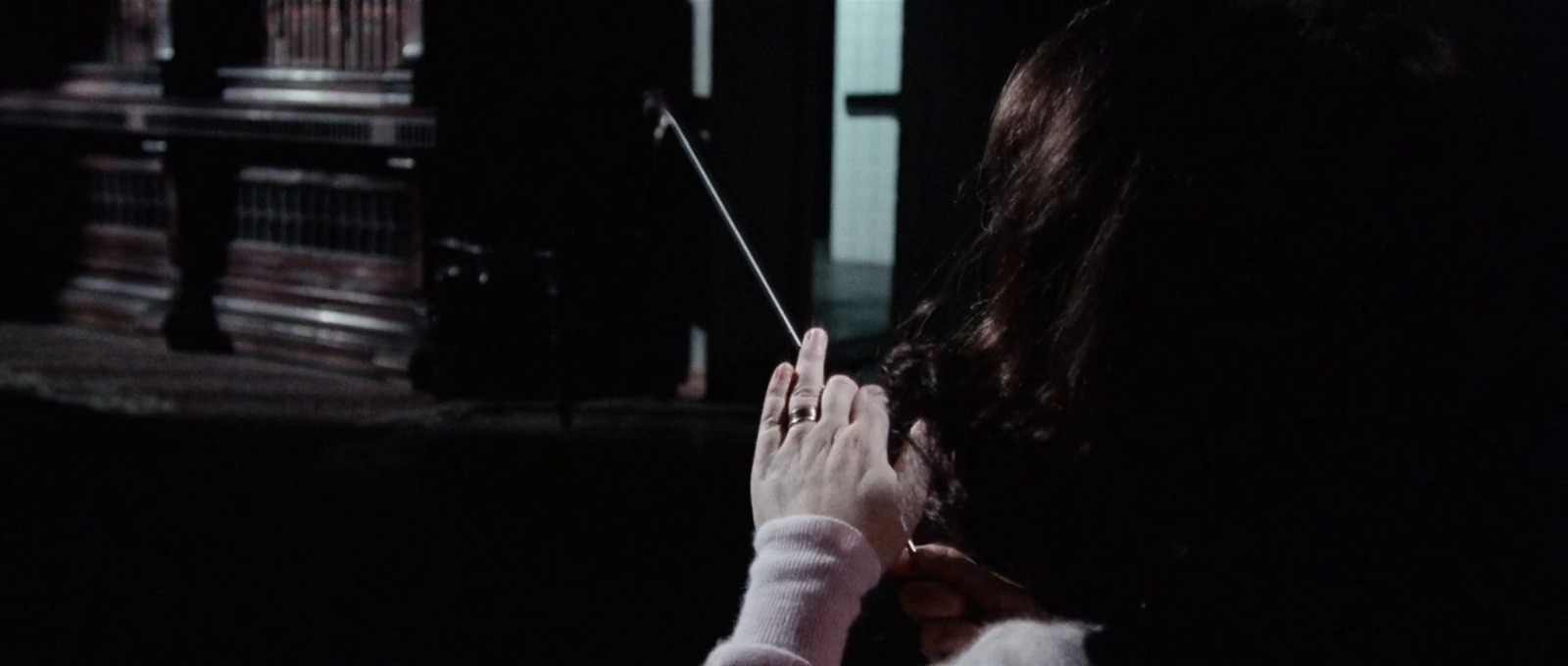
Later, Marcus’s composition scene breaks the piano into fingertips, keys, strings, moving mechanisms and written notation. Rostock explicitly links these extreme close views to the earlier objects. The two passages have a visible formal connection: small things become large enough to organise the whole screen. Their editing differs, however. The collection is largely discovered through travelling movement; the piano passages repeatedly cut between mechanism, notation and musician. Creative concentration becomes an absorbing world of details just before the intrusion into Marcus’s room. Rostock on objects and composition ↗
The argument continues through the hands.
The English exchange around Gianna’s arm-wrestling challenge repeatedly returns to strength, rules, readiness and cheating. Those words direct attention to the action at the table. The close reverses keep the clasped hands between the faces; the wider view makes the elbows and whole bodies available for comparison. The dialogue gives the gestures a contested meaning.
Rostock praises the performers’ vitality within a scene built from relatively stable setups. The study makes that observation tangible: expressions and free-hand gestures animate the close views, while the return to the whole table lets the outcome unfold without dividing every movement into another cut. The comedy also changes Marcus’s position within the film. His confidence is challenged through an encounter he cannot settle simply by describing what he thinks happened. Selected dialogue and performance commentary ↗
A life story interrupts the search.
In the English dialogue, Martha repeatedly mistakes Marcus for an engineer despite his corrections. She identifies herself as an actress, then shifts the claim into the past. The photograph study follows the cut away from the present conversation to a wall display and four individual images. Speech introduces the remembered career; editing briefly gives that career the screen.
Martha says that marriage ended her acting and proposes playing a duet with Marcus. He returns to his urgent wish to find Carlo. The exchange brings memory, performance and music into the same conversation without resolving the visitor’s practical question until its end. Ricci’s subsequent account of Carlo’s drinking supplies a different register: concern for someone whose behaviour has become difficult to manage. Together the visits make the search pass through other people’s accounts of Carlo and their own lives. Selected English dialogue ↗
A song becomes a story, then a telephone message.
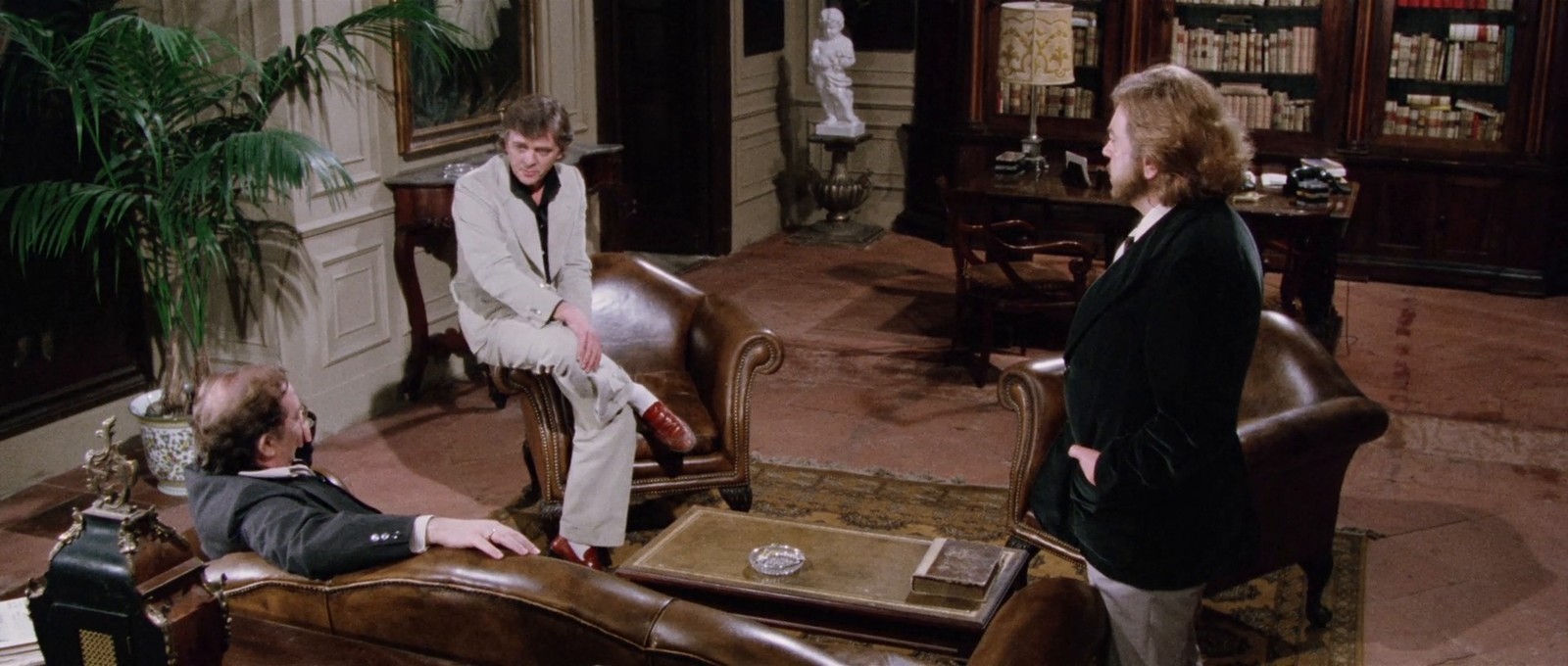
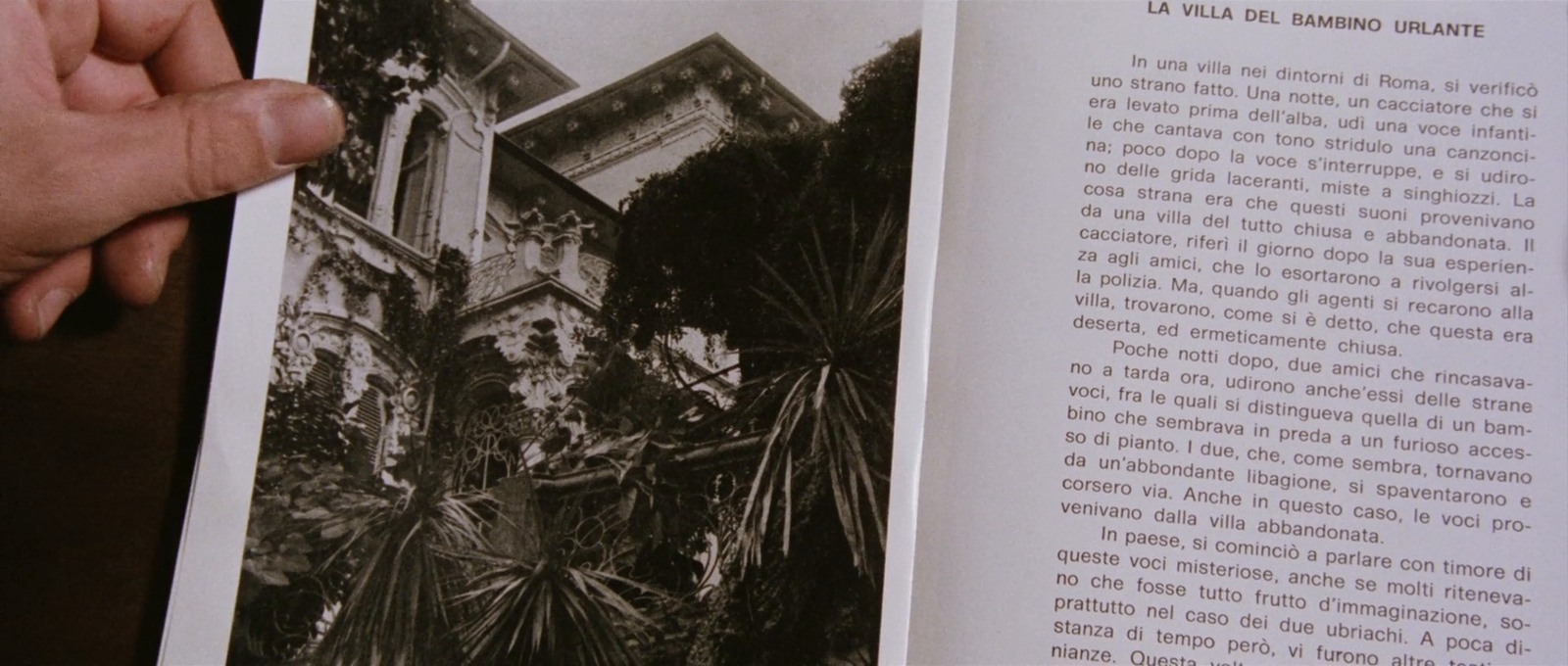
The discussion with Giordani and Bardi gives the child’s song two different functions. Giordani treats it as part of the killer’s recurring behaviour; Bardi recalls a folklore account of a house associated with a child’s singing and an earlier violent event. The English dialogue moves from an explanation of the crimes to a book Marcus can consult. The book and telephone study follows that change from conversation to printed page, photograph and attempted contact with Amanda Righetti.
At the bar, the task is practical: Marcus wants Gianna to locate the author. The English exchange repeatedly breaks around his irritation with the machine beside the telephone and difficulty hearing. Rostock describes the noisy surroundings as an obstacle to communication and reads the burst of hot vapour beside Marcus as an anticipation of Amanda’s bathroom. In the images, the steam shares Marcus’s side of the call while Gianna remains in her office. A clue has been obtained, but transmitting it is another struggle. Selected English dialogue and Rostock commentary ↗
The murder’s material becomes the investigator’s tool.
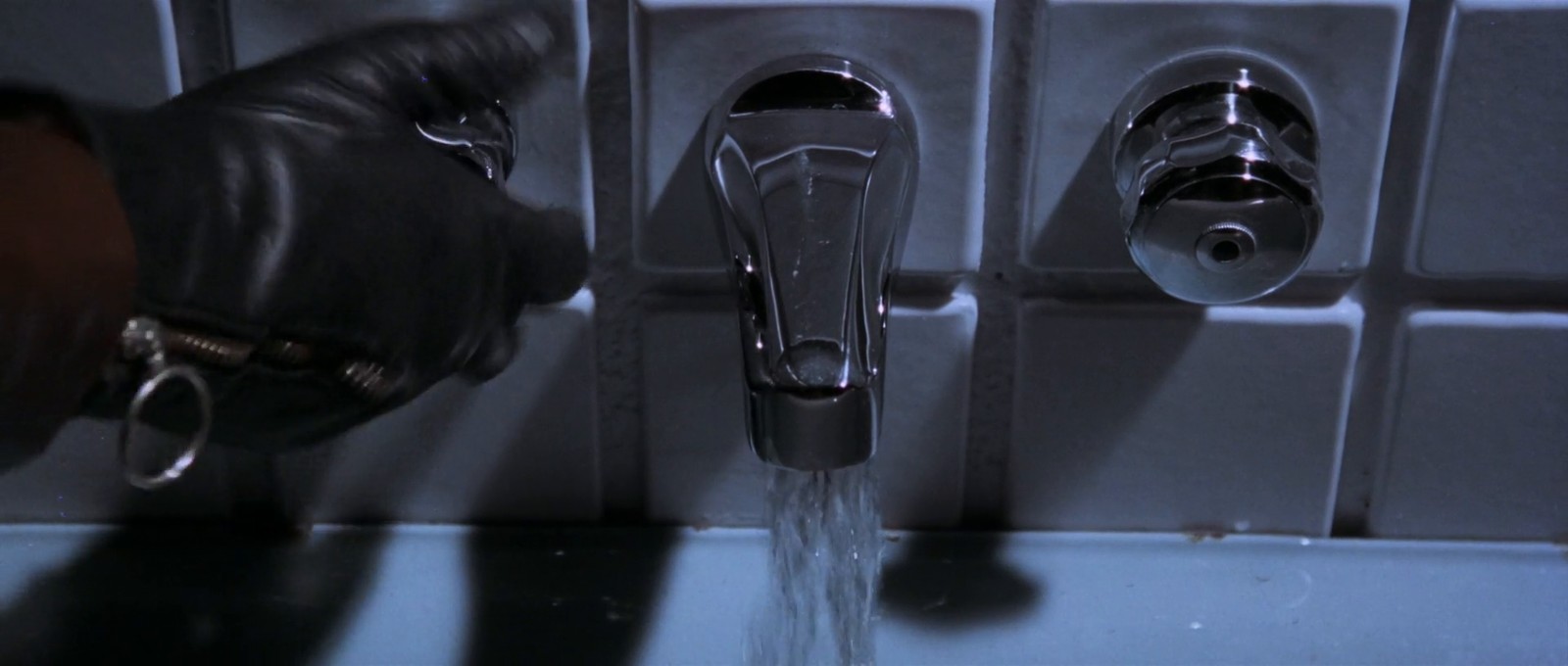
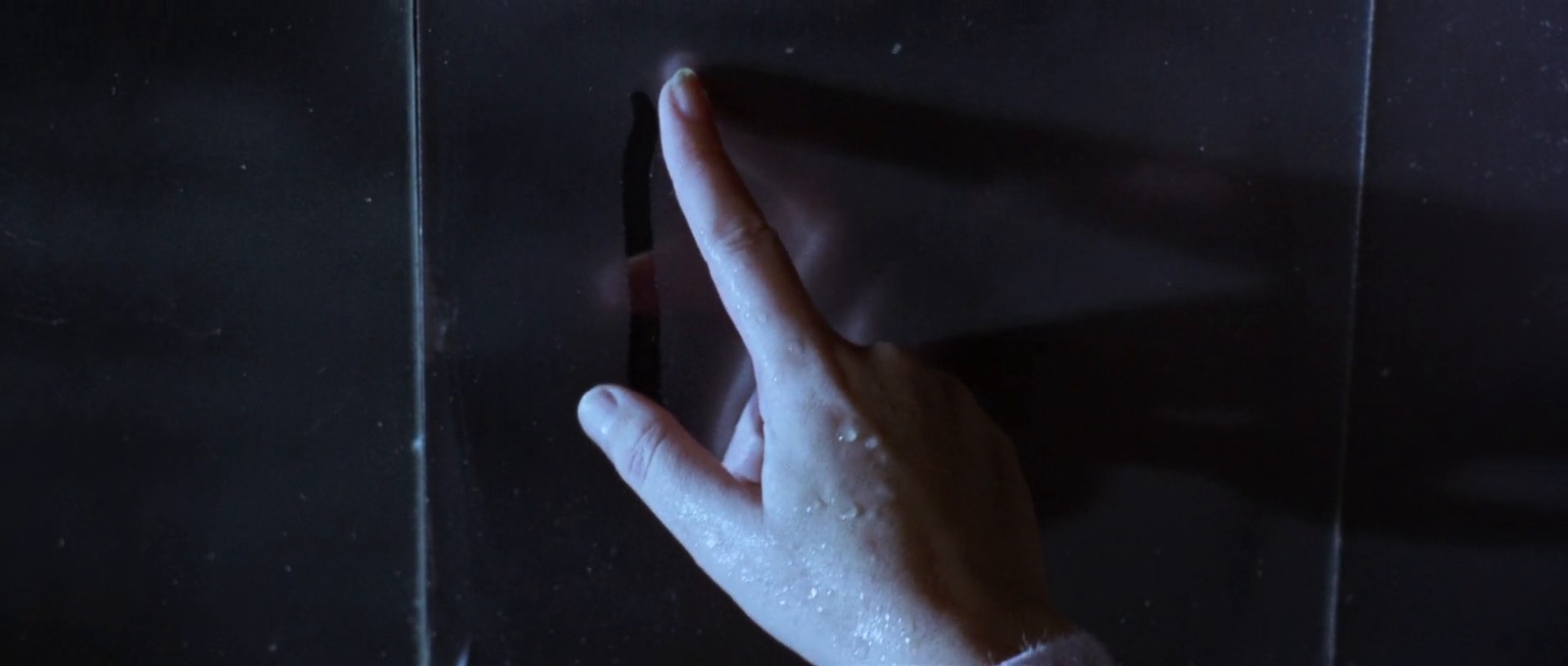
Rostock describes Giordani’s bathroom search as a passage dominated by running hot water, with the telephone drawing Elvira away. He emphasises the reduction of music during the experiment. The visual study connects the body outline, the finger on the round mirror, the taps and the condensation gathering on the tiles. Giordani does not obtain his clue simply by looking harder: he changes the conditions in which the surface can be read.
The film gives his face and reflection prominence while withholding a clearly legible answer from the viewer. The usable English exchange with Elvira connects his discovery with the hot water. The sequence therefore separates recognition from disclosure: his changed expression announces success, but the audience has not yet received the same information. Rostock’s account of the water and restrained scoring helps explain how attention is concentrated on that small physical experiment. Selected dialogue and commentary on the bathroom search ↗
The house has a pulse, then a pause.
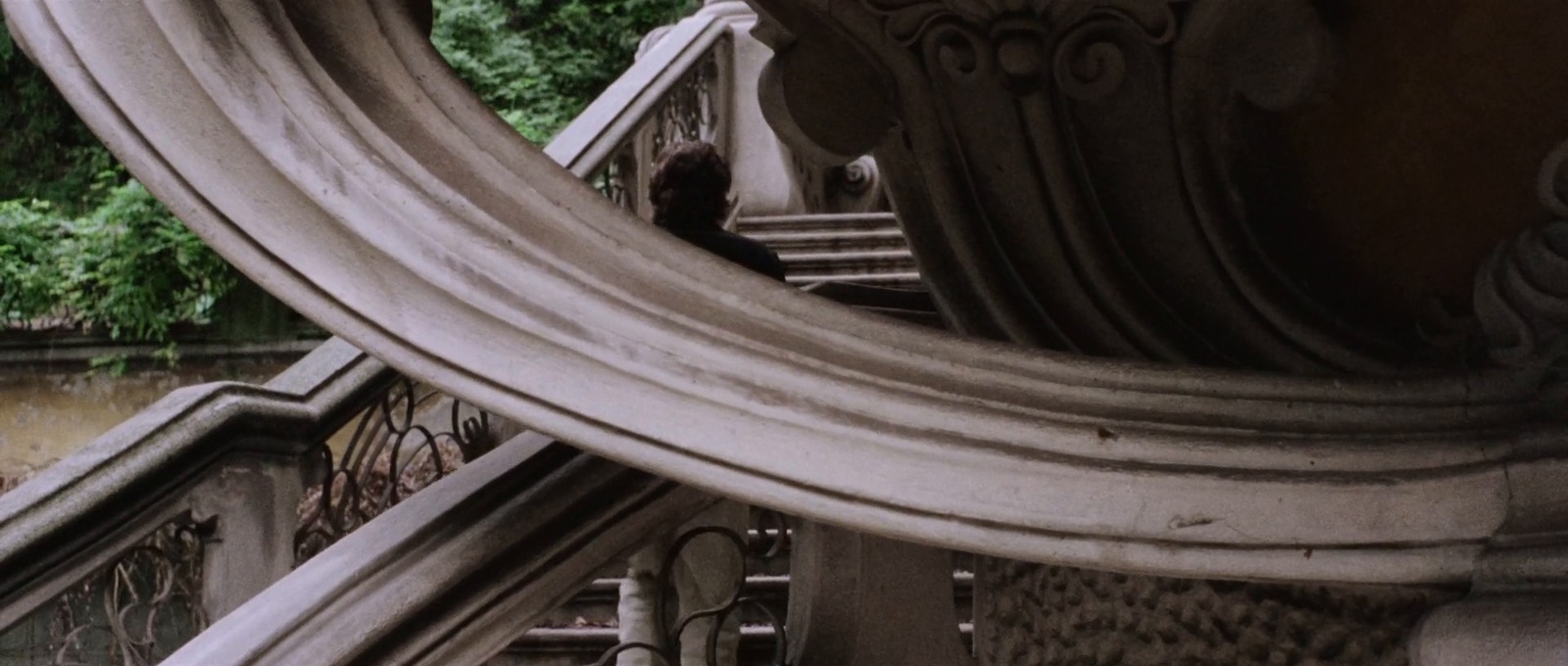
Rostock identifies Mad Puppet with the approach and exploration of the villa. His reading connects its pulse with the camera’s freedom to move through the building. The villa study gives that movement a visible form: successive cuts toward Marcus’s eye, an abrupt expansion into the terrace, the ornamental staircase and an interior explored through changing heights and thresholds.
He also draws attention to the interruption of music when Marcus steps on broken glass and its subsequent return around the window and falling curtain. In Rostock’s account, the alternation makes Marcus newly aware of the sounds his own movements may produce, then restores the momentum of the exploration. These are commentary-based readings of the cue’s function. The linked visual notes follow the feet, floor, shutters and glazed wall without turning the commentary’s speech timestamps into precise musical cue boundaries. Rostock on the villa score ↗
The investigation needs time to change pace.
The city-search study moves from Amanda’s body to the uneven seating in Gianna’s car, then through plants, a busy hall, a telephone box and market stalls. Those changes let the photograph circulate among people and places. They also make the next enclosed, solitary search feel different from the social activity that precedes it.
Discussing the shorter international version, Rostock points to reductions in the Marcus–Gianna conversations, the drinks-machine business and the search for the villa. His account suggests a useful question for the edition guide: how much of the investigation’s comic and exploratory rhythm survives, alongside the more obvious suspense set pieces? This is an attributed account of the editing; it does not substitute for a direct shot comparison of the two versions. His speculation about who authorised particular edits is not treated as established production history. Rostock on the shorter version ↗
From directing a performance to explaining a memory.
The rehearsal gives Marcus authority over a group: the players stop, he turns and addresses them, and the scene holds while he speaks. Rostock reads his dissatisfaction with excessive formality as a statement about performance and the film's own freedom of movement. That is the commentator's interpretation of the scene, rather than a production instruction attributed to Argento.
The post-murder conversation reverses Marcus's confidence. The usable English dialogue has him ask whether the police have moved anything, then tell Carlo that a painting seemed to be present and later absent. Carlo suggests that the disappearance matters. Their distance across the square makes this exchange visually unlike an intimate confession: two separated figures try to give a private perception a shared meaning. Rostock and selected dialogue passages ↗
The call that does not connect.
The unanswered-telephone montage gives an absence a visible structure: Giordani at his desk, the telephone in Marcus's empty room, Marcus in the car. The viewer can connect the locations even though the characters cannot complete their exchange. The cut to the empty room is therefore evidence, not simply a pause between speakers.
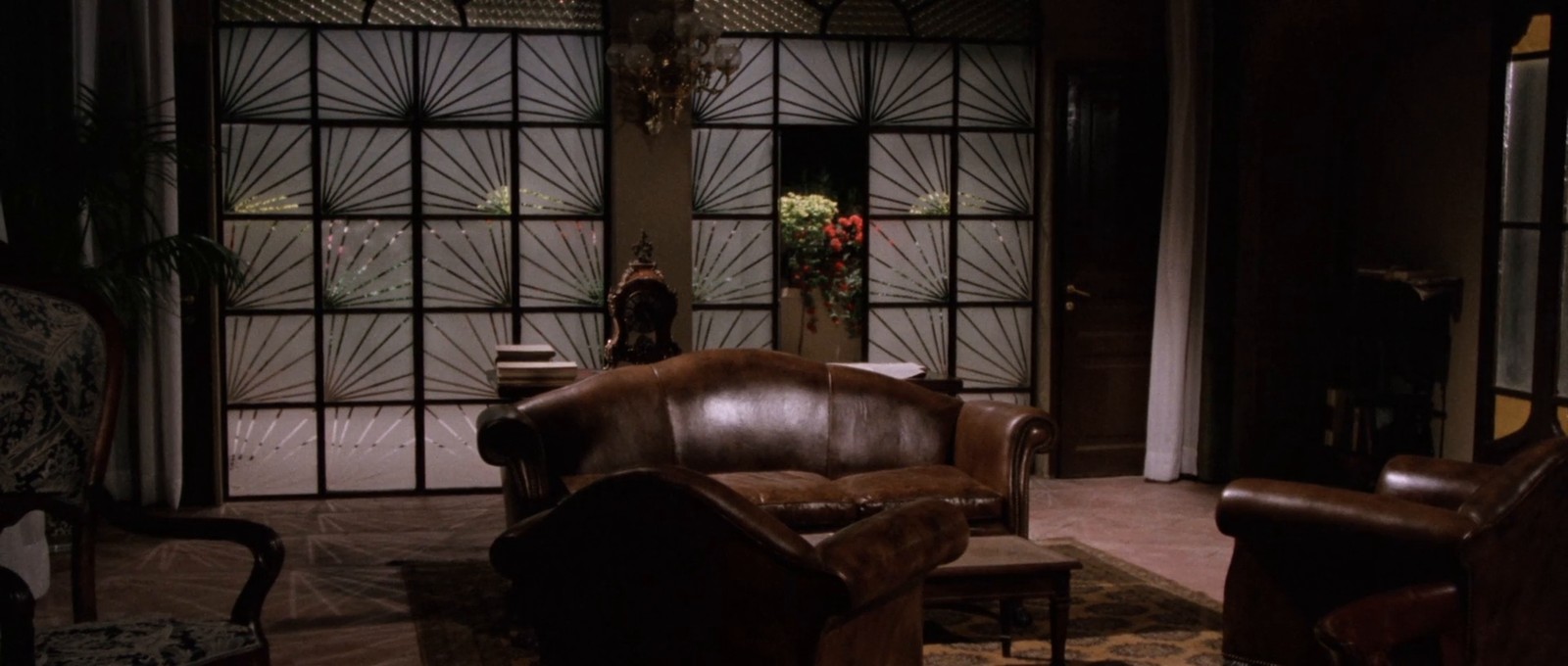
Rostock's commentary treats the subsequent corridor and study as a carefully paced wait before the attack. His discussion connects the room fragments, Giordani's movements and the later voice and music with the postponement of a visible assailant. The image review supplies the sequence of hall, ornament, bedroom, study and frosted divider; the sound interpretation remains attributed to his account. The useful distinction is between something announcing a threat and an image proving where that threat is. Rostock on Giordani's waiting sequence ↗
A shared search becomes two isolated listeners.
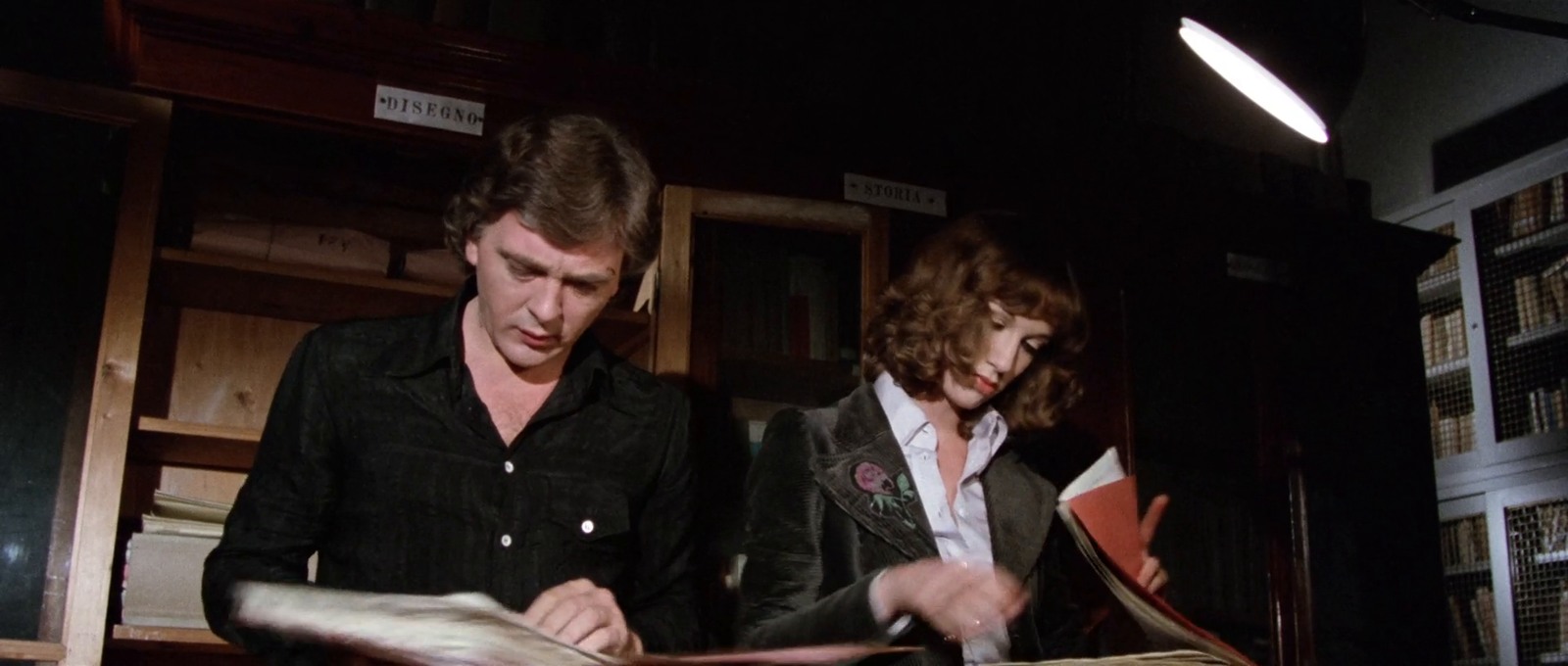
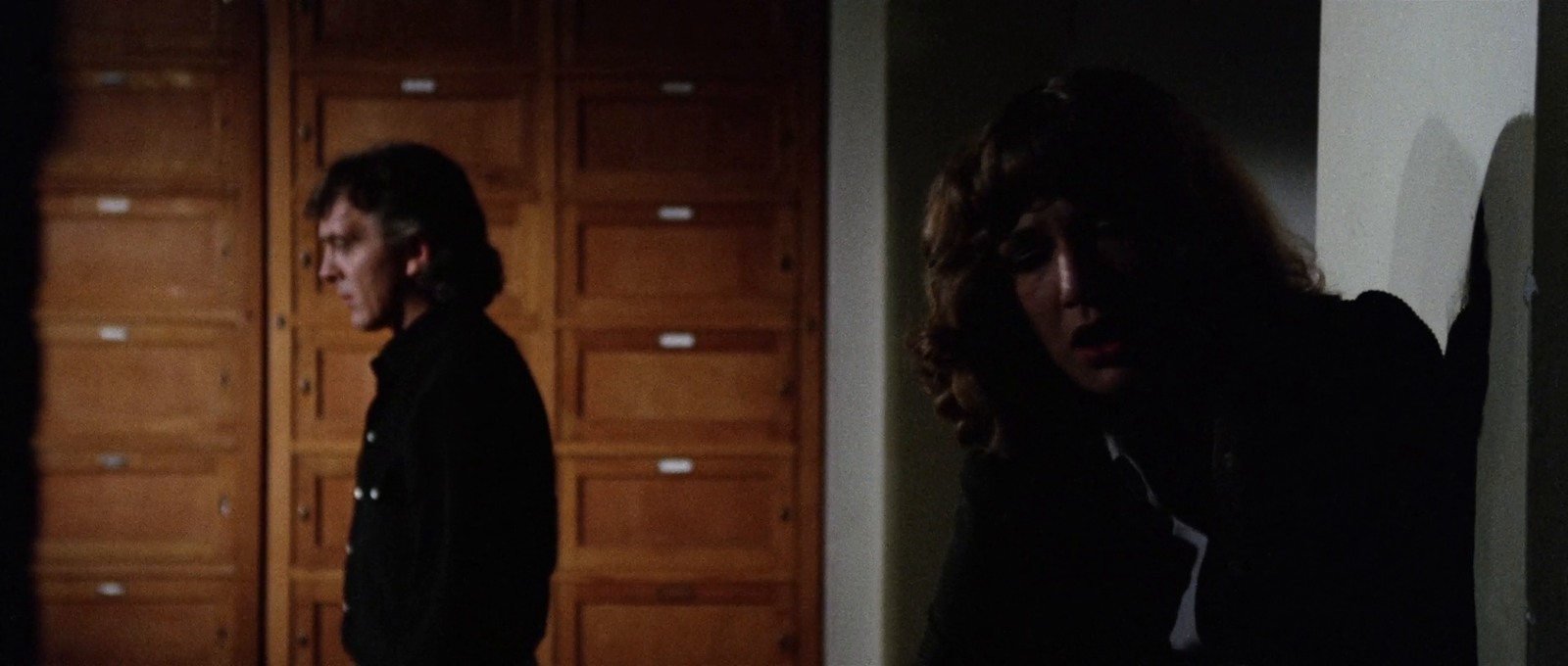
Olga's usable English dialogue connects the repeated violent drawing with old school records. That small verbal explanation opens an entire new location. In the archive study, Marcus and Gianna initially share a desk and lamp; the rapid series of empty spaces then suggests an approach elsewhere in the building. Gianna separates from him, enters a dark office and uses its telephone. The scene repeatedly divides the person who holds the clue from the person responding to the surrounding space.
Rostock identifies Mad Puppet with the school exploration and draws attention to the threatening contrast between childhood objects and the empty institution. His account of voices and scoring provides one reading of the search's pressure. The checked images show how that pressure is redistributed through depth, corridor views and the isolated telephone. Later, Carlo's English dialogue turns his earlier advice to leave into an explicit threat. Familiarity with a voice has become another unreliable form of reassurance. Selected school commentary and dialogue ↗
The remembered voice sends him back to the image.
The hospital exchange supplies a provisional reassurance about Gianna, but the walk across the square undoes the apparent solution to the case. The return of Carlo, Helga and the street figure as brief images makes Marcus reconsider their relation in time. Rostock connects this passage with the remembered conversation about the missing painting and its importance. Words that had offered no usable answer now direct Marcus toward the corridor again.
Martha's later English account says Carlo was protecting her; it must be read as the character's explanation, rather than accepted as an exhaustive independent account of every act. The closing study follows the passage from this speech to the childhood reconstruction, the renewed attack and the reflection beneath the credits. The film's investigation ends by changing what the earlier image means. The observer, finally, becomes the image left for us to inspect. Selected final dialogue and commentary ↗
The introduction that brought Goblin into the room.
Claudio Simonetti recalls in Panico that Argento wanted a stronger rock element than Gaslini’s orchestral approach supplied. The director had Pink Floyd or Deep Purple in mind. Carlo Bixio of Cinevox instead suggested the young group he was producing; Simonetti remembers Argento visiting the studio, hearing their music and accepting them. Panico: testimony and passage locators ↗
The anecdote describes an introduction and a musical brief. Read beside Simonetti’s earlier account of the group initially performing Gaslini’s material, it makes the eventual score a meeting of existing composition, a band’s sound and a director’s search for a different dramatic energy.
07 / Effects & surviving objects
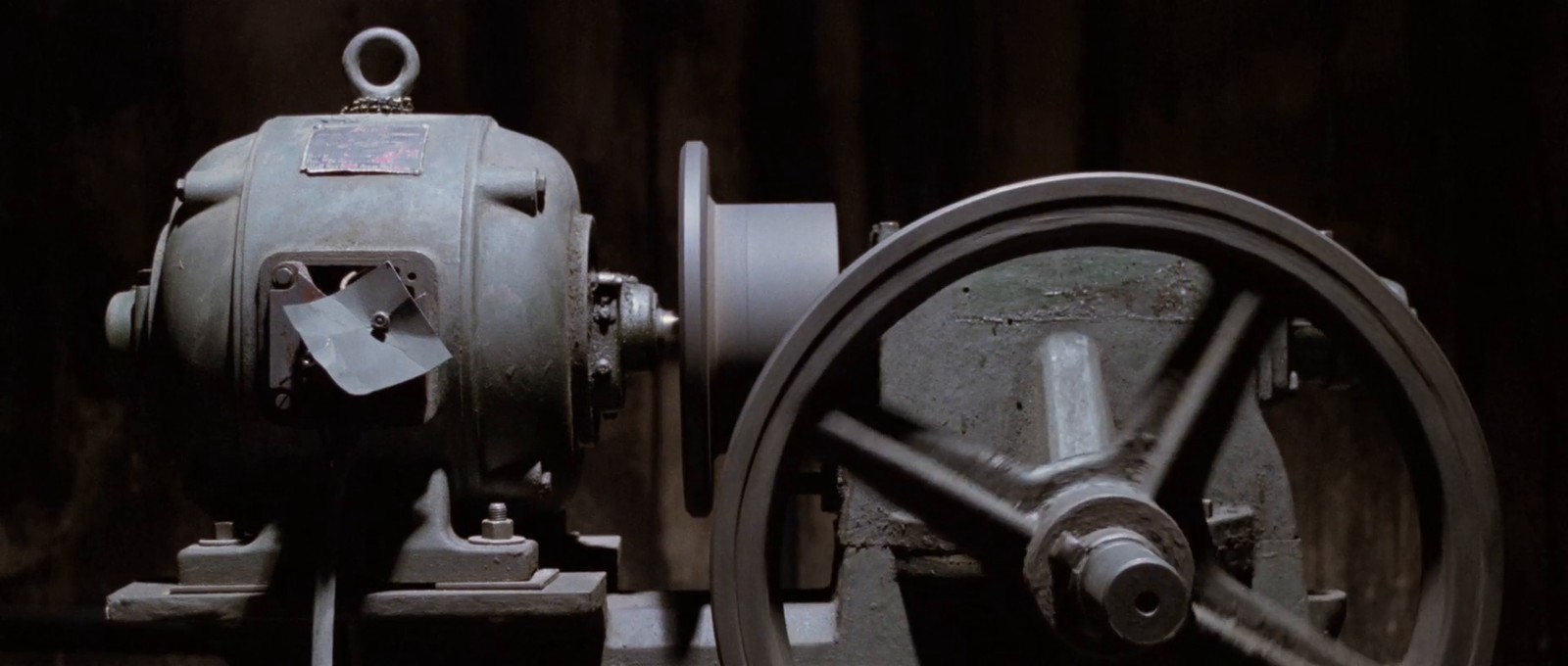
An ordinary object can become a mechanism.
The names on screen.
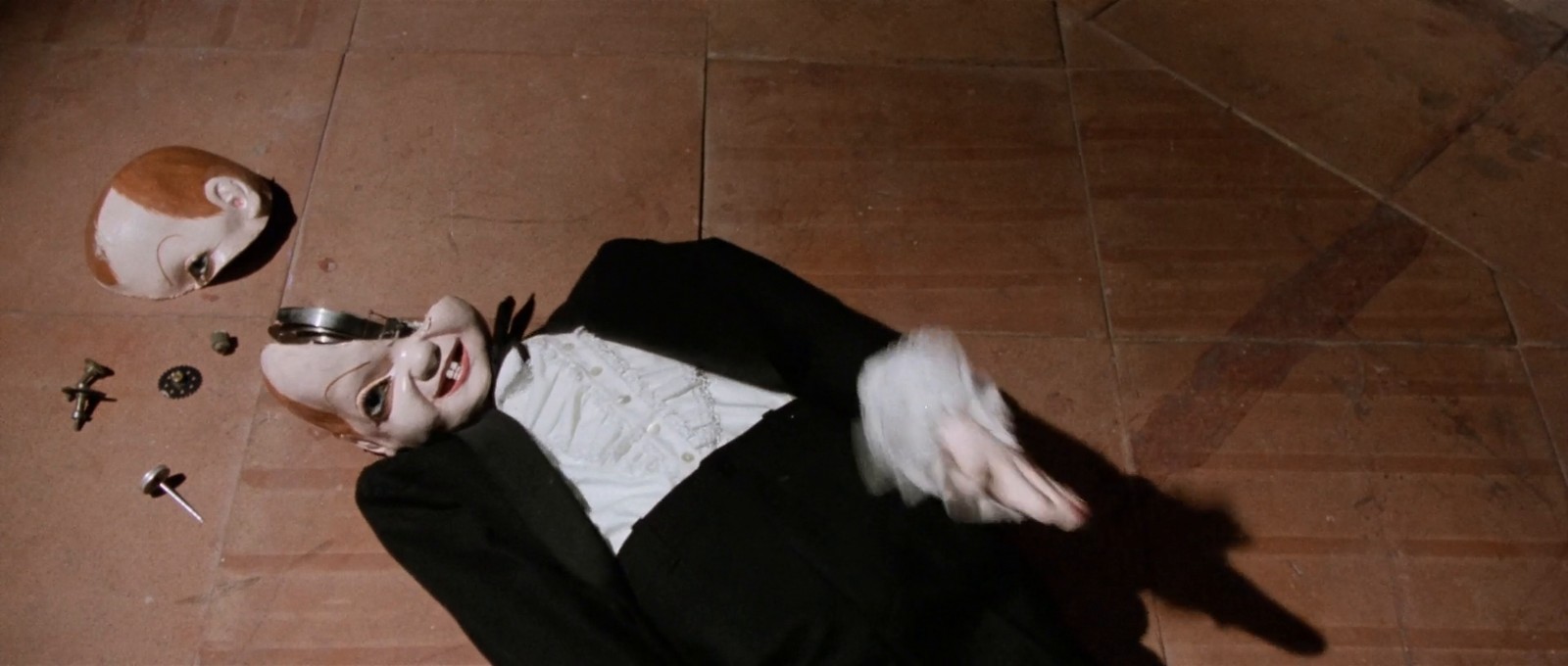
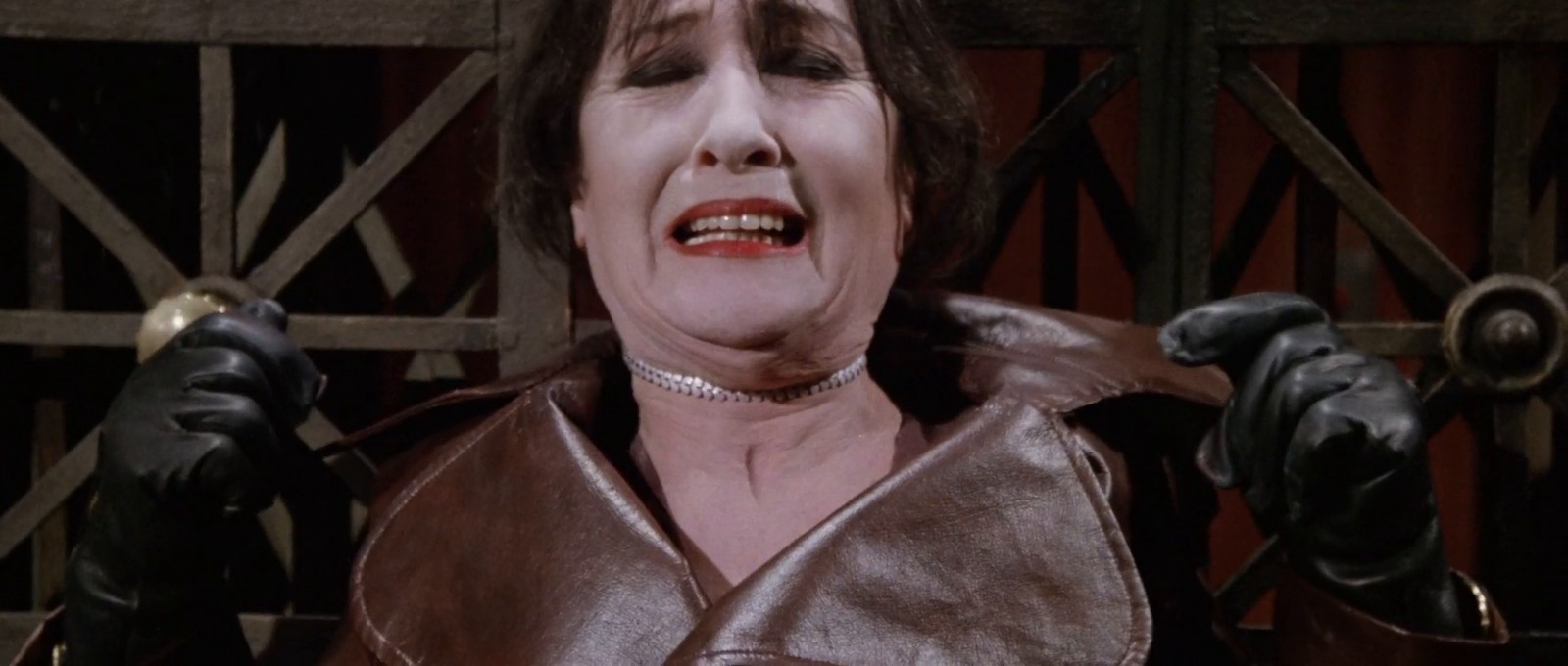
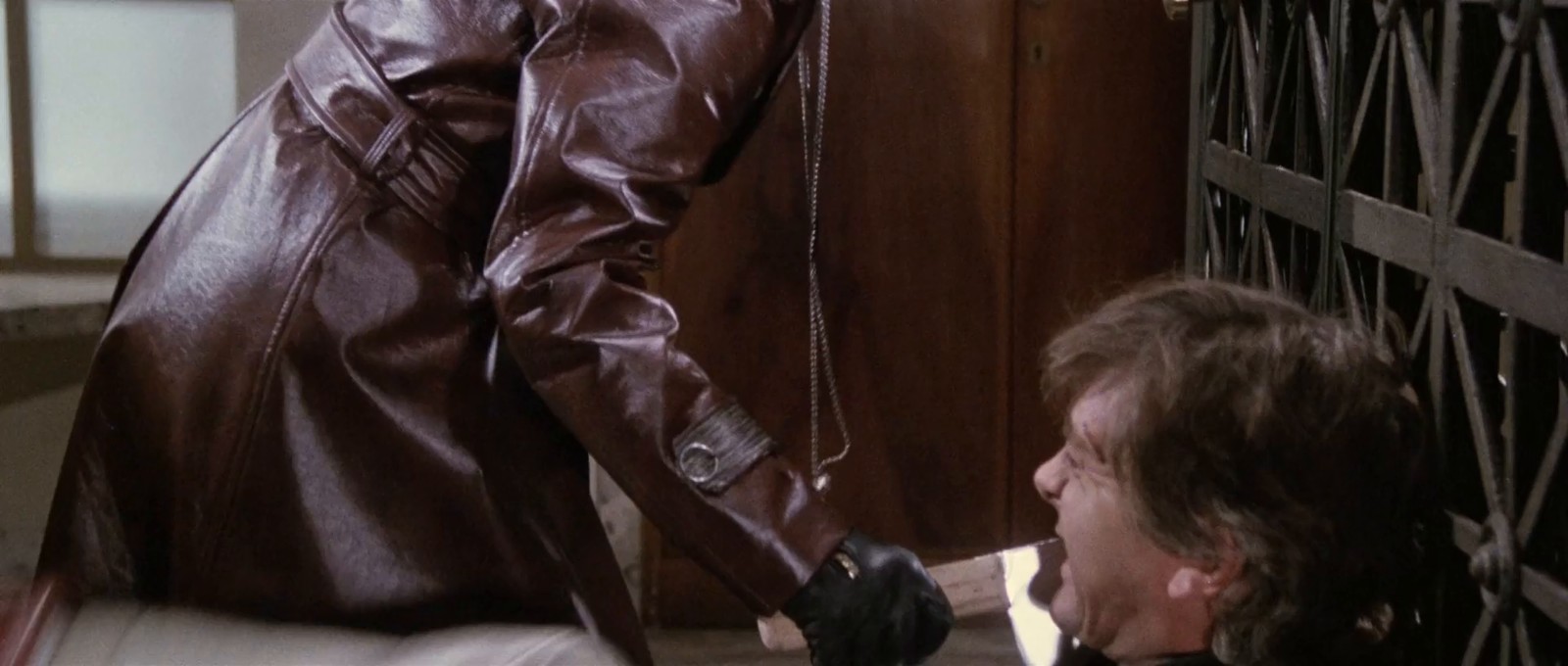
The Italian end credits list Germano Natali and Carlo Rambaldi under special effects. They separately name Giuliano Laurenti as chief makeup artist and Gianni Morosi for makeup. The sequence galleries follow the finished effects; the institutional records below identify particular surviving objects and the mechanical puppet.
ENLARGE ↗Special effects: Germano Natali and Carlo Rambaldi.
The National Cinema Museum’s 2015 ProfondoRossoDay announcement identifies two displayed effects objects: the cleaver associated with Clara Calamai and the table used for Glauco Mauri’s death. It attributes both to Germano Natali and dates their construction to 1974. That is a specific institutional statement, stronger than assigning every effect to whichever name is most familiar. Museum announcement: the two effects objects ↗
The same announcement distinguishes original materials from reproductions in the wider display. It supplies no accession numbers or complete ownership history. The museum’s exhibition record identifies these objects and their makers.
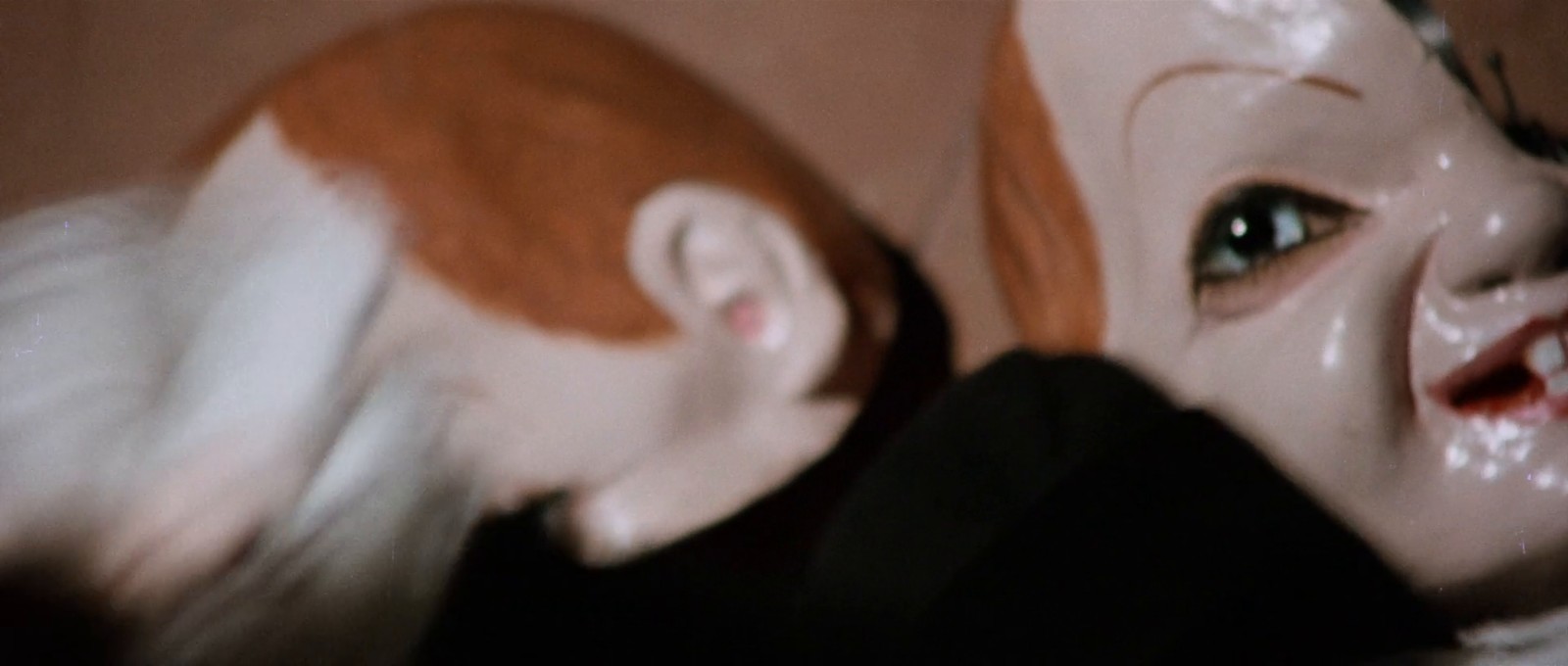
Cineteca di Bologna’s Rambaldi centenary programme separately associates Carlo Rambaldi with the film’s mechanical puppet. Carlo Rambaldi 100 ↗ Keeping these records apart reveals a collaboration across different kinds of physical problem: a tool that must appear dangerous, a furnishing that must permit a staged injury, and a moving figure whose appearance makes an ordinary room unfamiliar.
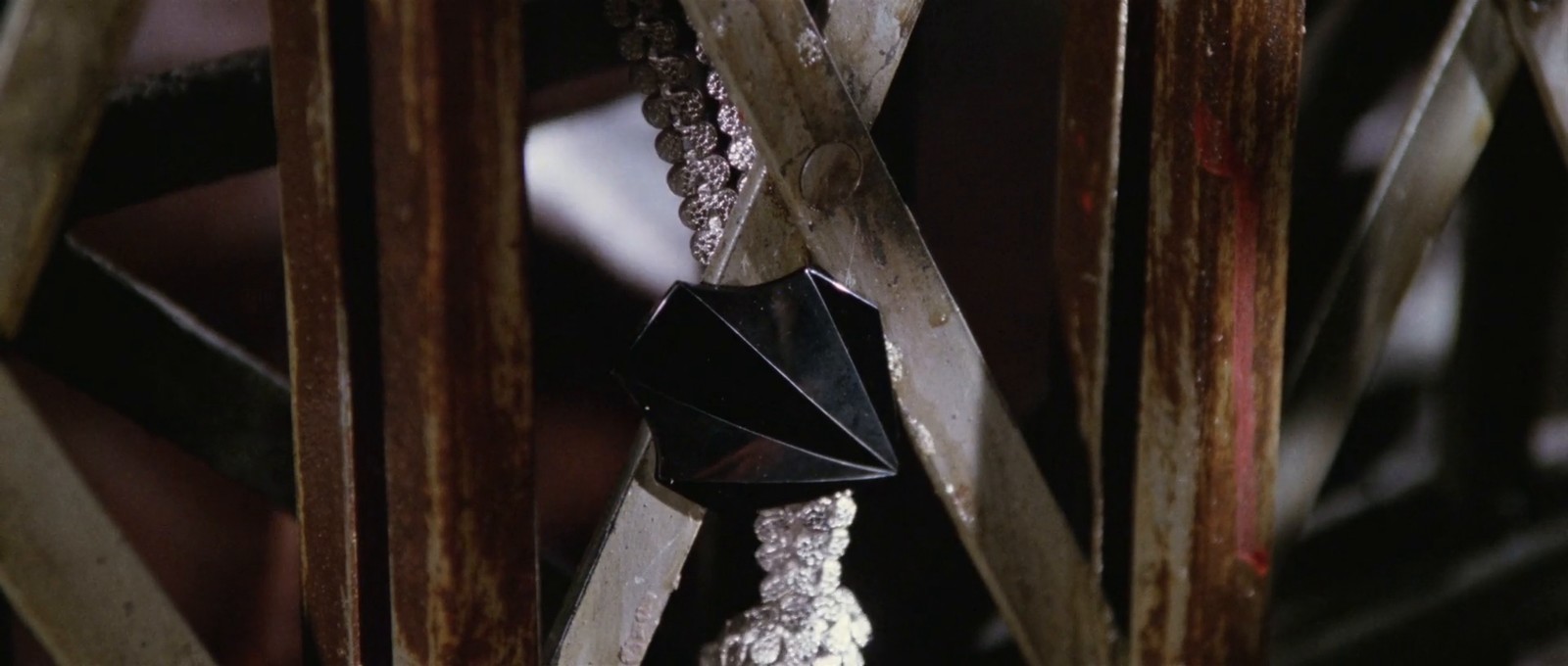
ENLARGE ↗Photograph: Franco Vitale · Fondo Reporters Associati · Archivio Fotografico Cineteca Nazionale, as credited by MAXXI. Not a colour or timecode reference.Archive credit ↗
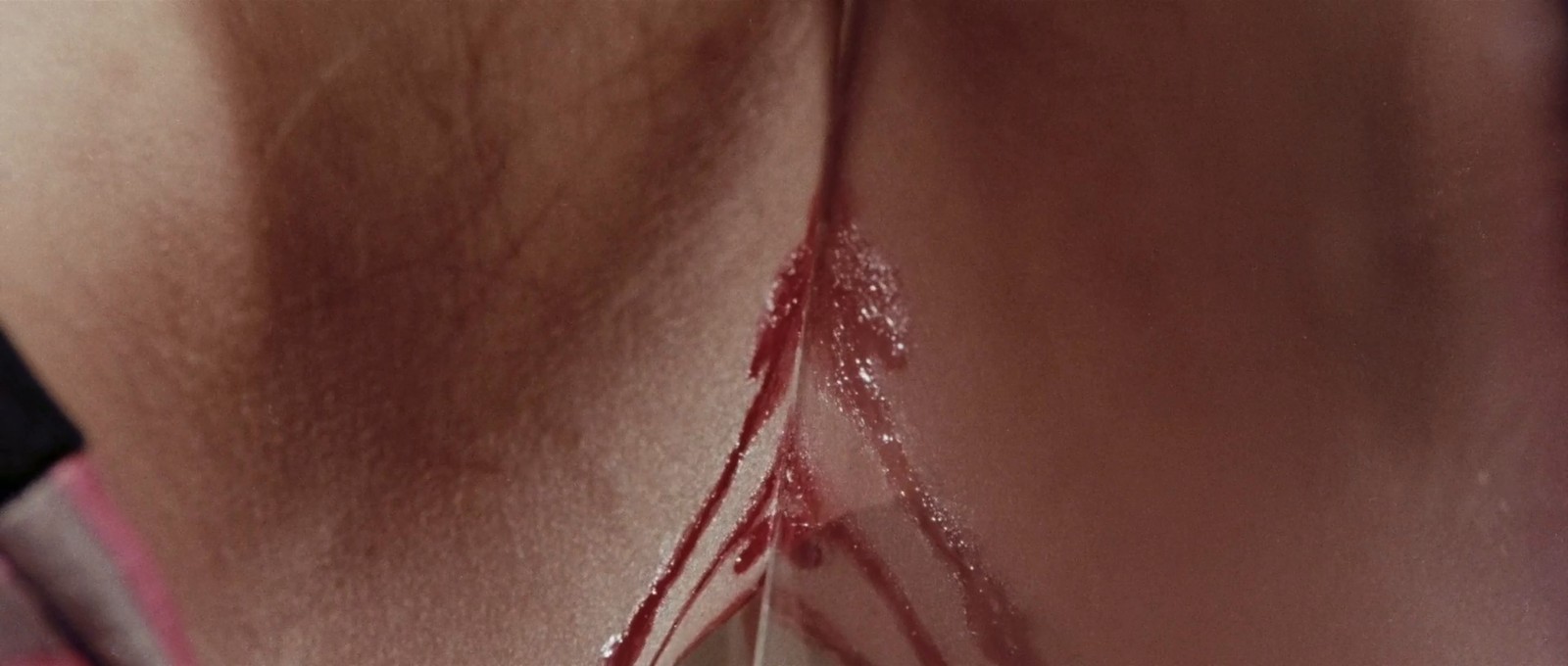
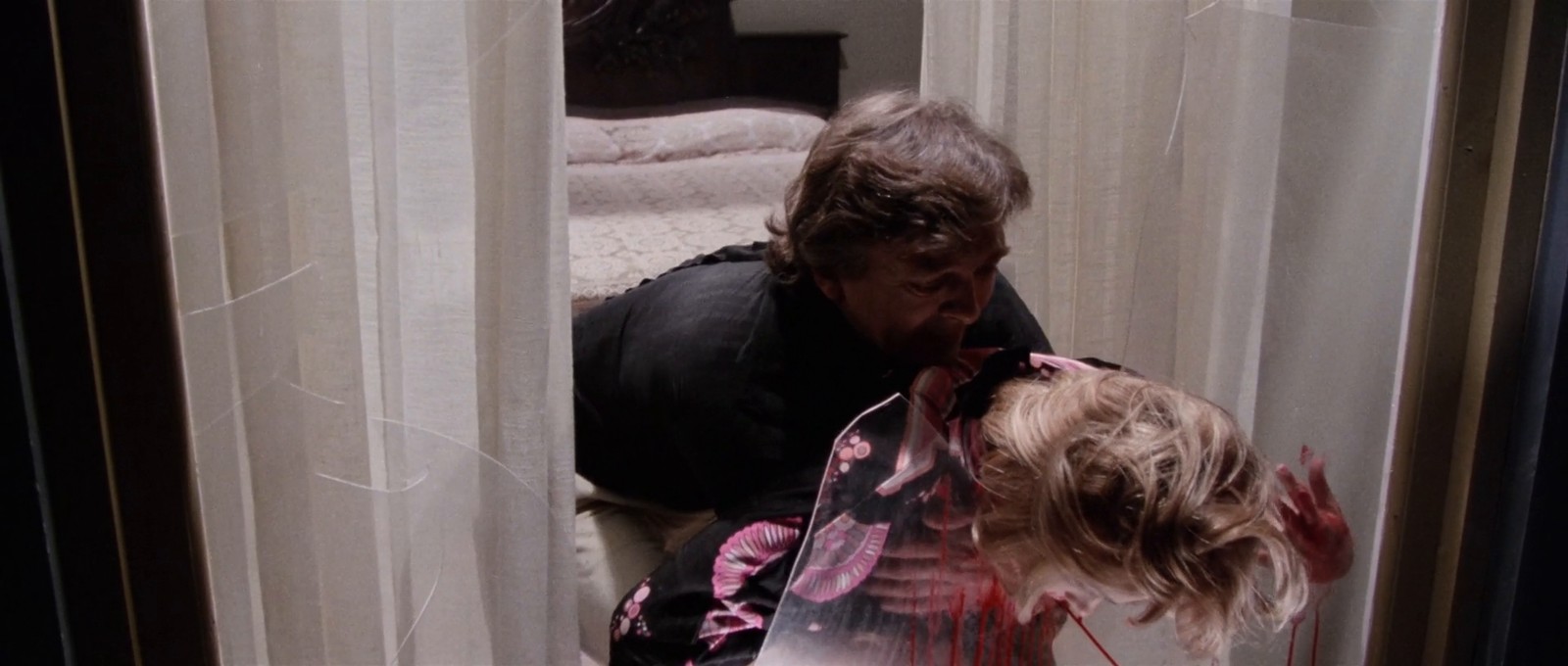
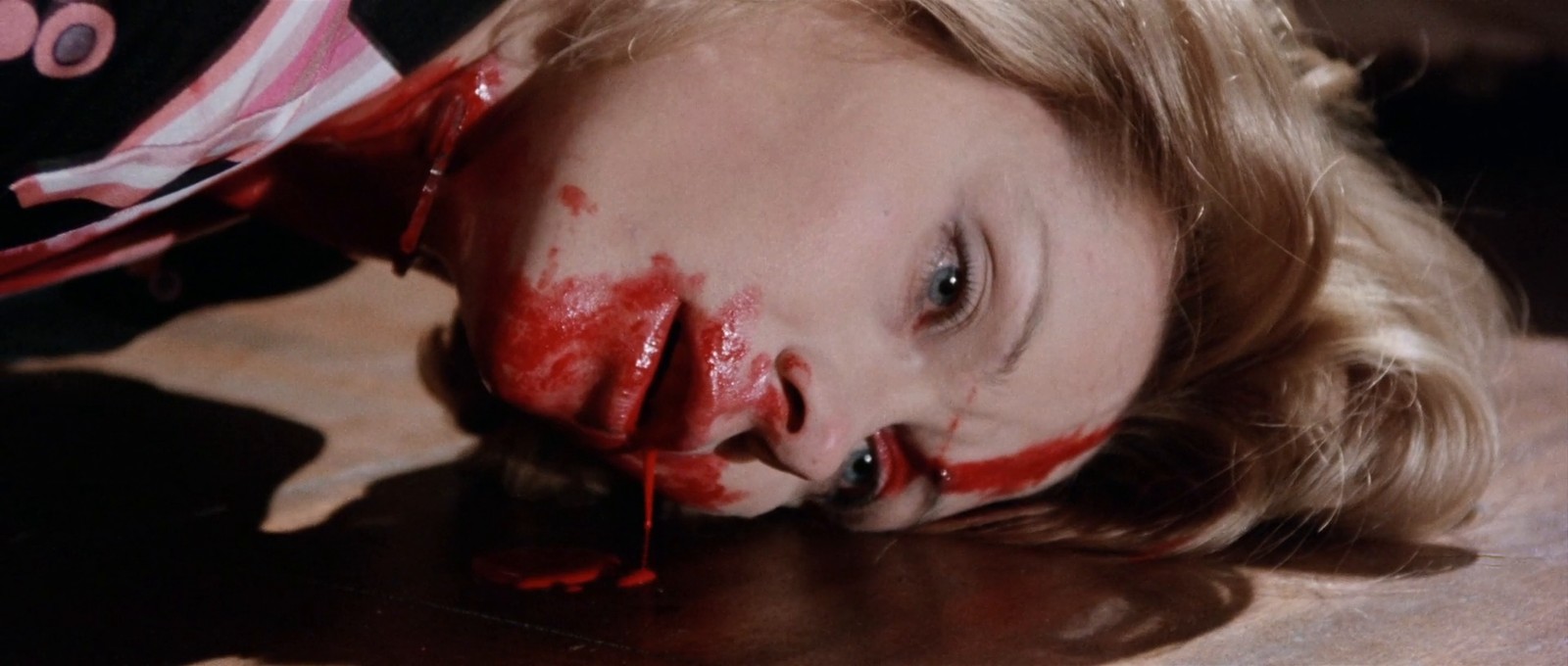
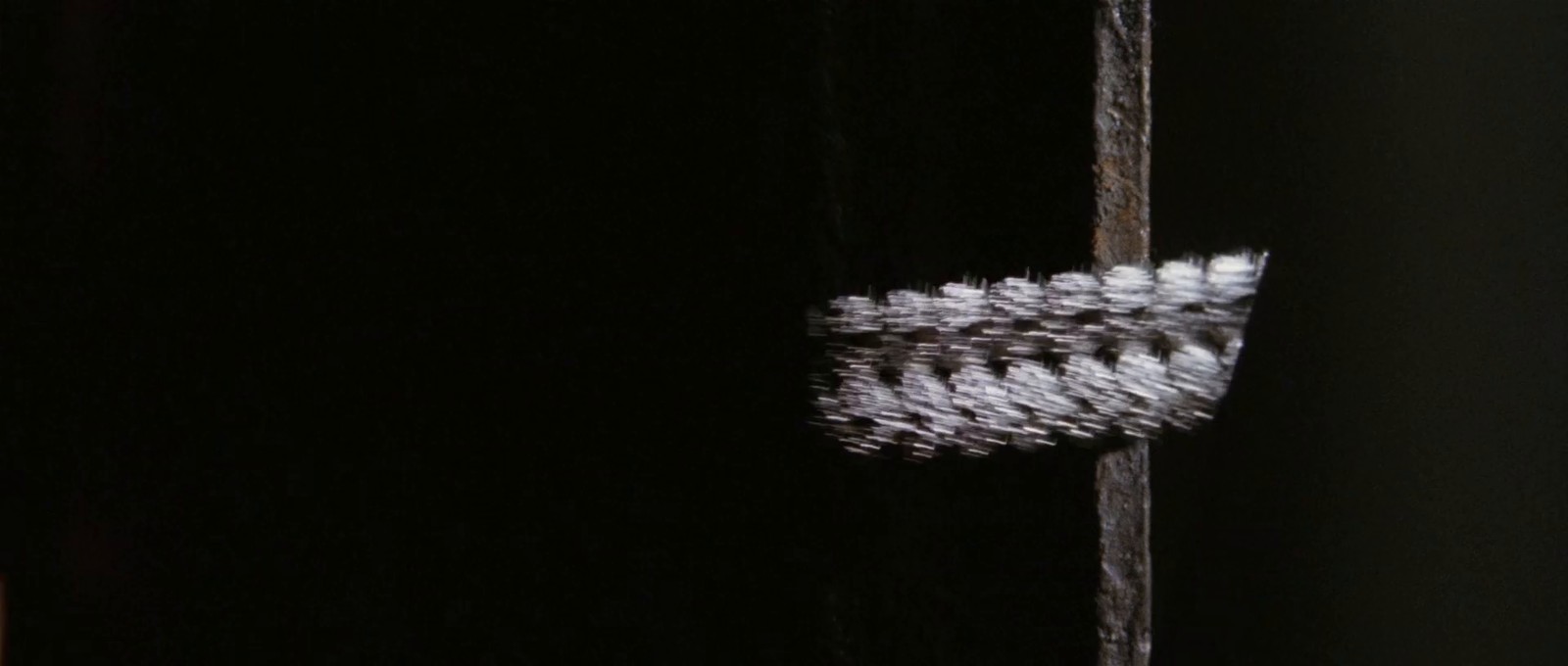
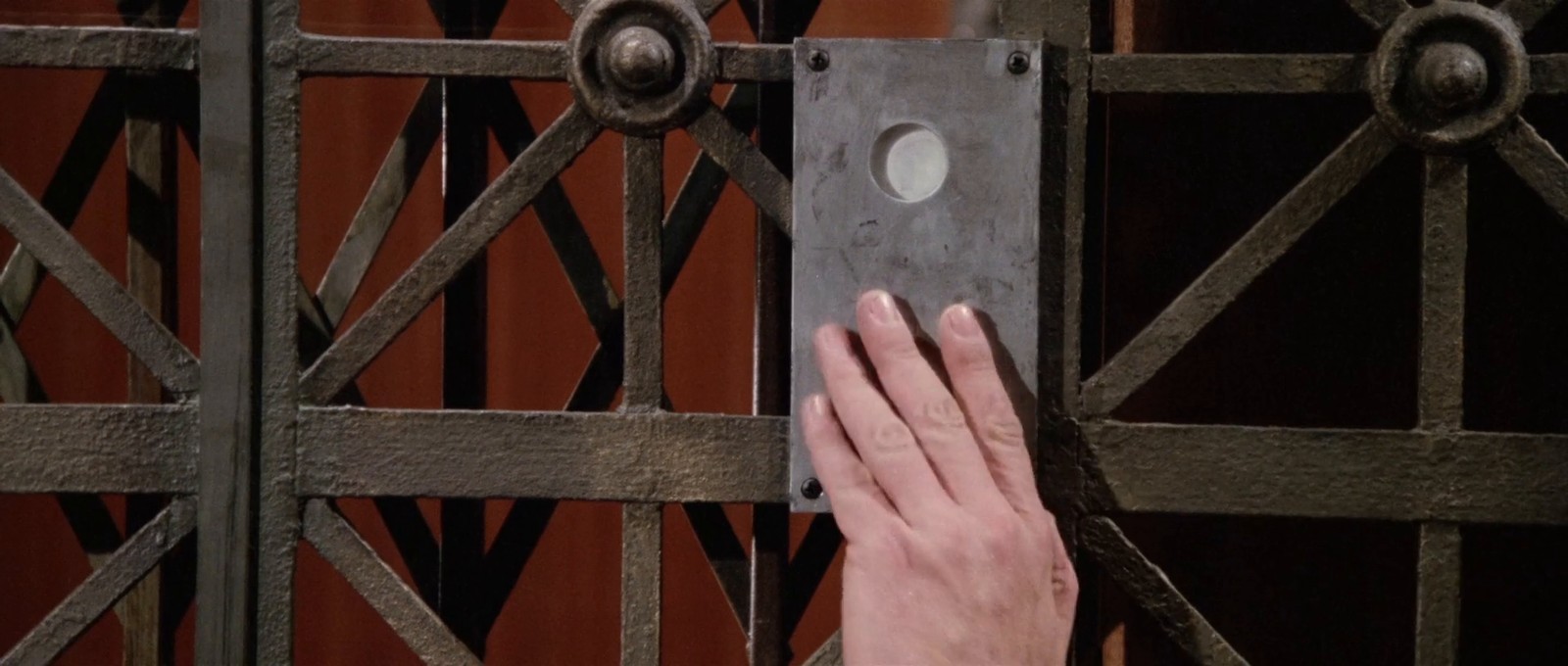
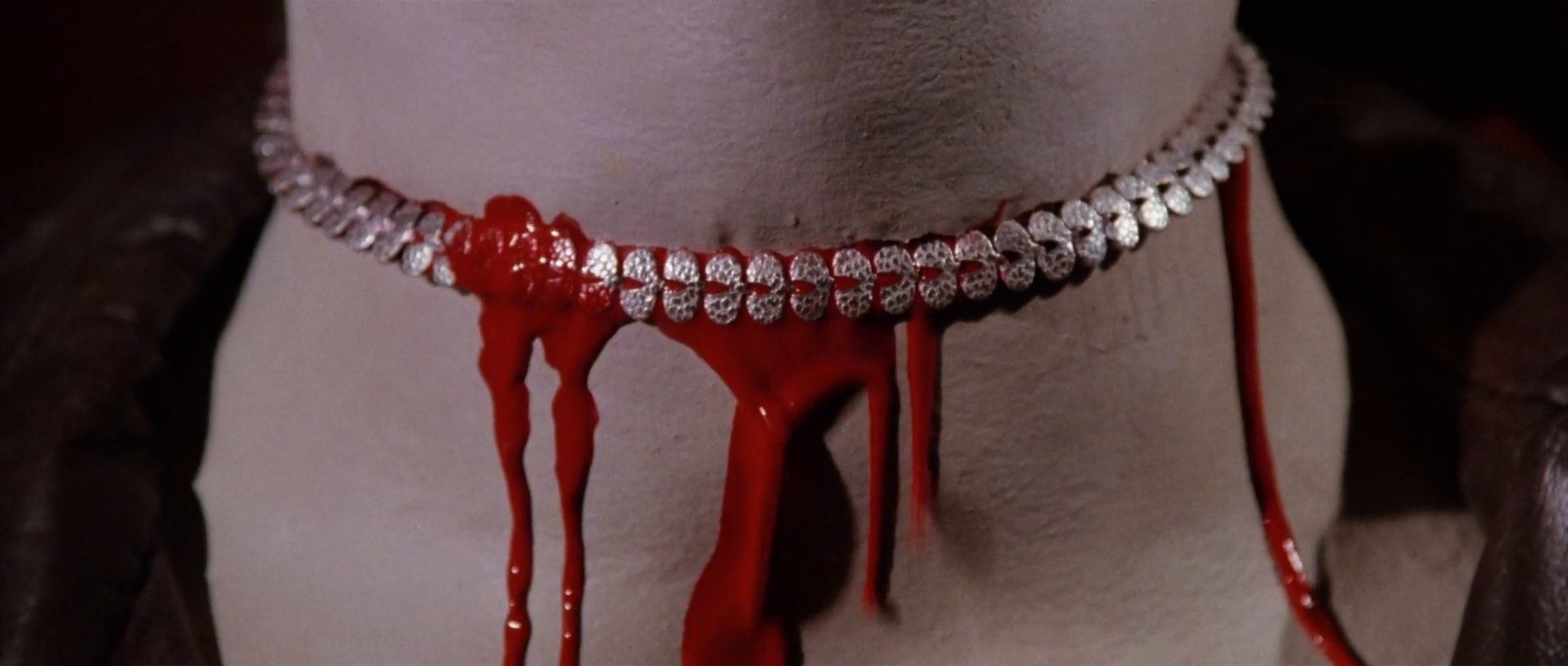
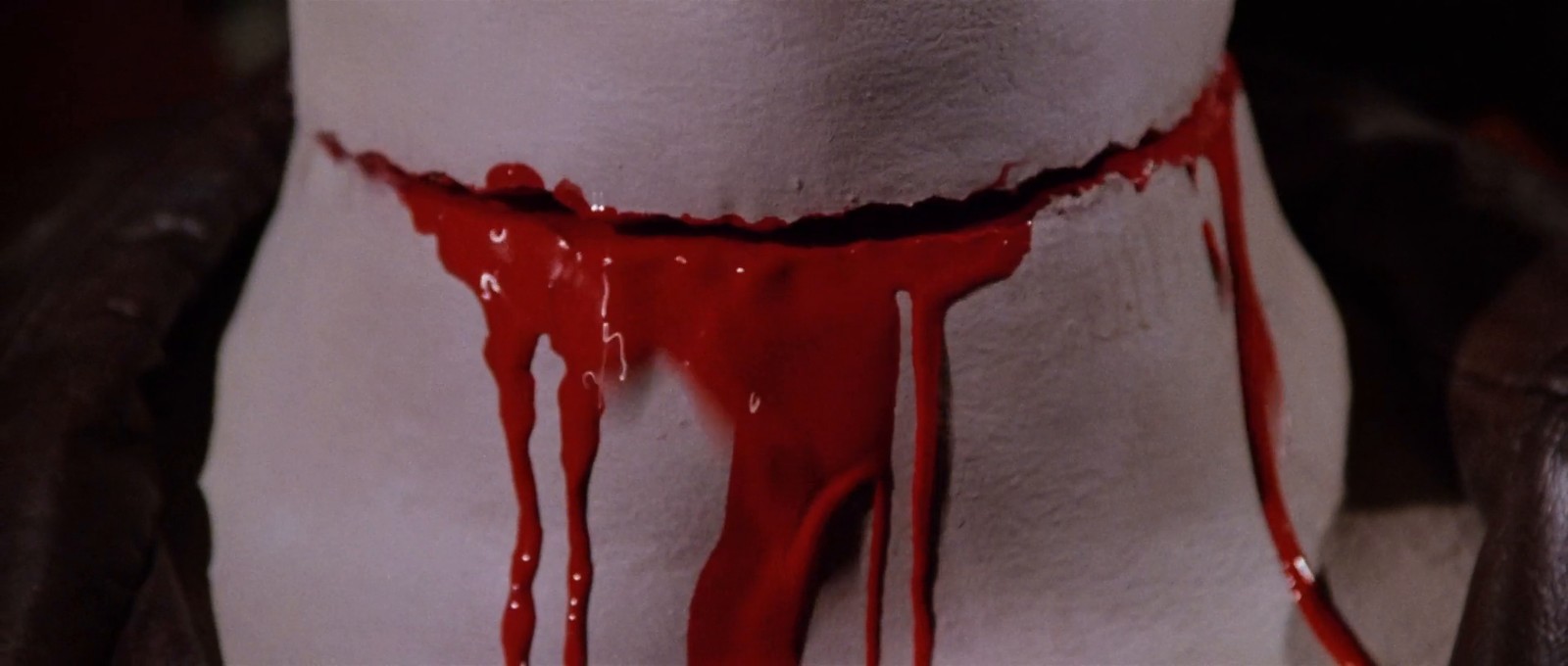
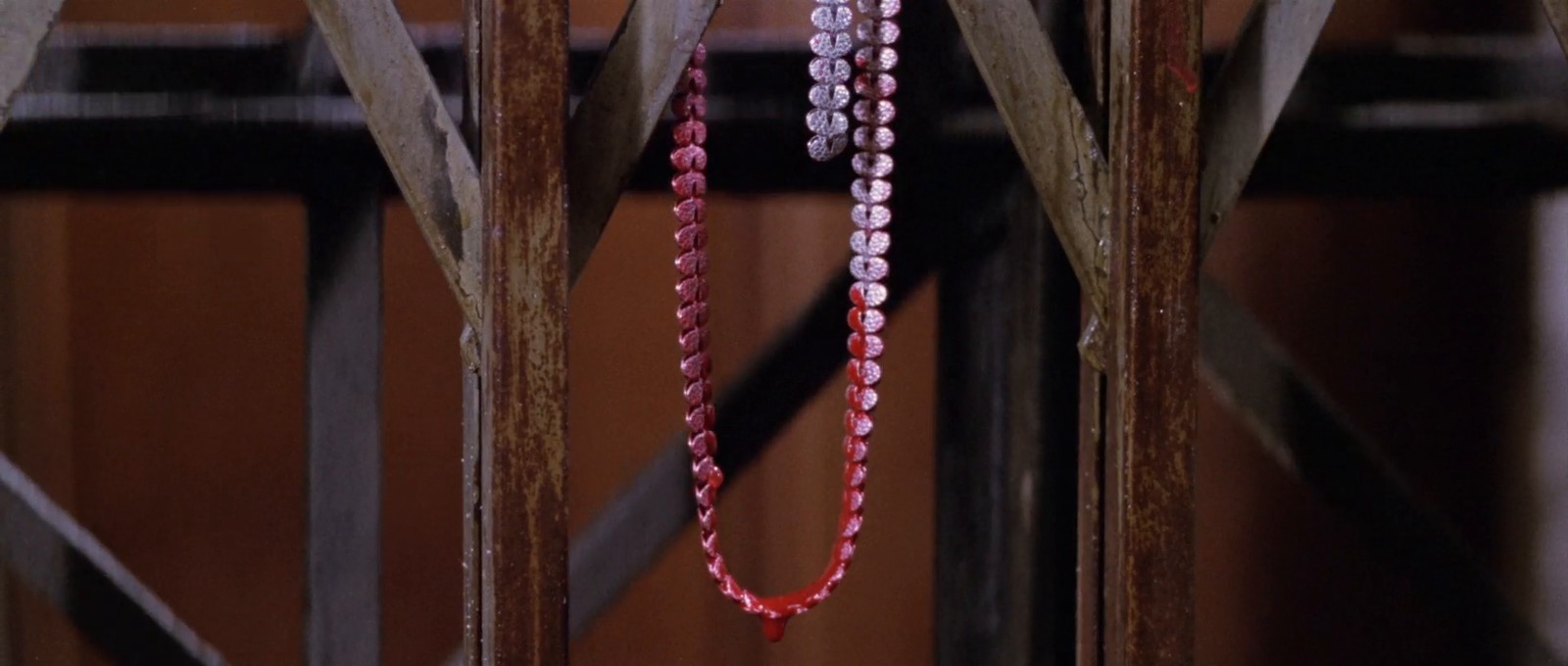
The archive photograph above offers another kind of evidence. A necklace, a rigid grille and a body forced toward the machinery occupy the same tight space. The ordinary ornament has become a connection between a person and a mechanism. The photograph makes that arrangement inspectable, but cannot tell us how the effect was operated or which frame it corresponds to in the release.
This is where object research becomes more than a collector’s catalogue. An object’s dramatic function, its construction and its later survival are related histories that require different evidence. The film makes them feel immediate; the archive must keep their identities clear.
08 / Restoration & release history
Restoration is part of the production record.
Arrow describes a negative physically recut for the English export version and reassembled for the longer Italian version, sometimes joining material separated within a shot. It also explains the longer cut’s switches to Italian: English dialogue was never recorded for those passages. Restoration note: printed p. 56 ↗
This changes what a viewer can reasonably infer. A language change need not be a fault in a disc; a visible fluctuation need not be a deliberate photographic effect. Reconstructing the film means working with materials whose histories have diverged. The evidence is a restoration account, not our own inspection of the negative.
Record
What it establishes
32nd Torino Film Festival
A new digital restoration was presented by Cineteca Nazionale and Medusa. The programme lists 126 minutes. Festival record ↗
Cineteca Nazionale, March 2015
The institution names RTI, L’Immagine Ritrovata and Luciano Tovoli’s restoration contribution. This does not replace Kuveiller’s original photography credit. Restoration announcement ↗
Arrow’s later restoration
The booklet credits supervision to James White and Michael Mackenzie. Printed p. 56 ↗
Arrow standard UHD
The advertised 127-minute version offers Italian and English mono plus Italian 5.1. Those are publisher specifications, not comparative listening results. Edition contents ↗
The practical rule is to name the release before comparing it. Festival durations, disc specifications and a measured playback time do not automatically describe different cuts. Nor should separate restorations be compressed into one story in which every listed collaborator worked on the same version.
Three Arrow editions, different research routes.
The edition name matters as much as the film title. These publisher records describe different packages:
Edition
Version and sound
Research material
Standard Blu-ray
One disc; the longer version at about 127 minutes. Italian and English mono, plus Italian 5.1.
Thomas Rostock commentary; Michael Mackenzie’s Profondo Giallo; interviews with Argento, Nicolodi and Simonetti, and Cozzi’s shop tour. Publisher record ↗
Standard UHD
One disc; the 127-minute version in 4K, with Italian and English mono and Italian 5.1.
Howarth and Thompson commentary alongside the archival Rostock track; cast and crew interviews. Publisher record ↗
Limited-edition UHD
Two discs: the 127-minute Italian version and 105-minute export version. The export disc lists English mono.
The longer-version disc includes both commentary tracks. The export disc includes Profondo Giallo and archival interviews. Publisher record ↗
The limited set’s listed 232-minute total is the sum of its two versions, not the duration of another cut. A scan described as 4K can also supply a 1080p Blu-ray: scanning resolution and the disc’s playback format are separate facts.
The scene studies follow a 2:06:39 presentation accompanied by Thomas Rostock’s commentary. His commentary appears in more than one Arrow edition. A comparison of the longer and export versions still requires both presentations; the advertised 22-minute difference is not a verified list of removed scenes.
09 / Criticism & afterlife
The argument changes with the object being judged.
Newman’s 1984 review treats Deep Red as a transitional work: a recoverable murder puzzle presented through increasingly extravagant images. Monthly Film Bulletin, November 1984 ↗
The Cineteca Nazionale’s 2015 programme reproduces a passage attributed to Grazzini that resists the narrative contrivance while acknowledging the film’s physical force. The page does not supply the original review’s date or issue. We can discuss the preserved passage, but should not turn it into an authenticated 1975 newspaper inspection. Reprinted Grazzini passage ↗
These positions need not be arranged as an early critic’s mistake corrected by later admiration. They give different weights to the experience. One asks how the mystery distributes its information; another measures the unsettling effect even while doubting the construction. Our reading is that the film’s reputation thrives on this tension: an image can be carefully organised and still make reasoning feel inadequate.
The later institutional record is concrete. Turin’s 2015 anniversary brought exhibition objects together with restored screenings; MAXXI’s March 2026 programme presented the restoration in a discussion of genre cinema. Turin anniversary ↗ · MAXXI screening record ↗ These events demonstrate continuing exhibition and curatorial attention. They are not attendance surveys or proof that every audience now agrees.
What remains to deepen is precise: original release advertising, complete contemporary reviews and the routes by which different cuts circulated. Those enquiries can enrich an already substantial dossier. They do not require holding the present edition open indefinitely.
DEEP RED / THE VISUAL STUDIES
Follow what the witness sees.
From the first fragment to the returning face.
The investigation moves through public rooms, private histories and images that have been misread. These studies follow the film’s visual argument in sequence. Select any still to enlarge it, or follow the links into the effects galleries and the research.
ENLARGE ↗Small shoes stop beside the fallen knife.
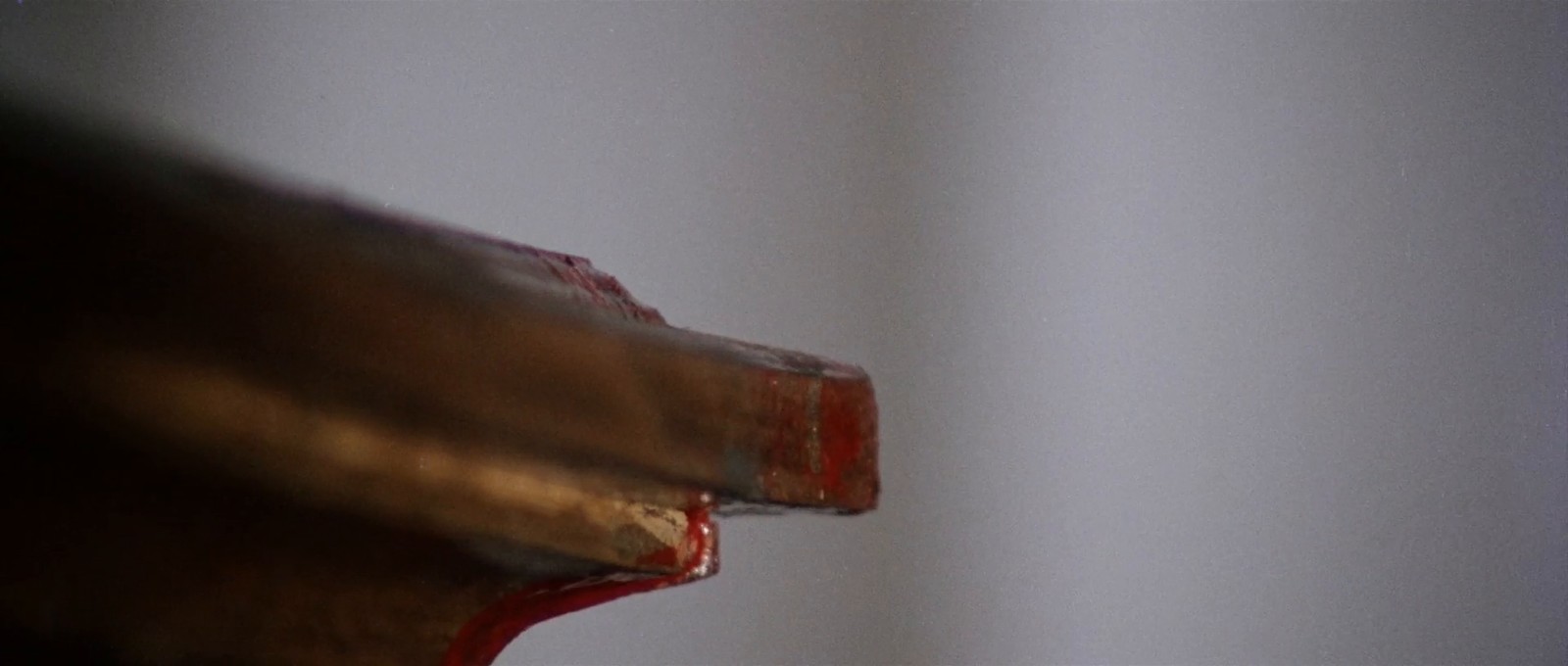
The opening reduces a domestic killing to shadows, a fallen blade and a child’s legs. The low viewpoint withholds the adults’ faces while making the floor unusually important. At the end, the same room returns with the people restored to it: the solution enlarges an image the film has already given us.
The Christmas fragment holds one low composition. The action changes inside it: shadows give way to a physical blade, then to the child’s shoes. These are stages within a sustained shot, rather than a succession of separate inserts. The later flashback supplies faces and reverse angles that this first view refuses.
Before Marcus becomes a witness, the film introduces him as a performer who can interrupt and redirect a group. The transition to the parapsychology congress reverses that arrangement: another group watches, and Helga will recognise something within it that no one else can locate.
ENLARGE ↗A rehearsal introduces Marcus at the piano.
02:01.6The credits give way to a spacious church interior and a white piano. The framing opens onto the rehearsal group.
02:20.2Marcus plays at the piano, with the bass player beside him. The instrument places him within an ensemble rather than alone at a keyboard.
02:21.7Cut to the brass players. The performance is distributed across several faces and instruments.
02:28.8A trumpet occupies the foreground while Marcus remains visible at the piano.
02:30.9The drummer is framed beyond the piano. The film changes the foreground instrument without abandoning the group's shared space.
02:32.8The wider view holds as the players stop and Marcus turns to address them. Action within the shot replaces the preceding alternation of instrumental details.
03:07.7The congress sign announces a new gathering. Its lettering supplies the transition before individual participants are introduced.
03:10.1A moving view passes through the lobby toward the red curtains and auditorium. Entry becomes a small journey rather than an immediate cut to the stage.
03:37.7A high balcony view establishes the panel and the rows of seats. The audience is now a substantial visual subject.
03:42.1The three speakers appear together onstage. Helga is part of a public demonstration, not yet isolated by the film's alarm.
03:57.5The panel remains the focus as the explanation continues; gestures organise attention across the seated figures.
03:58.6A cut turns toward a group of listeners.
04:02.2Another audience view broadens the field. Individual faces are available to inspection without being marked as the answer.
04:04.6Giordani receives a closer view.
04:07.7The film returns to the spectators, setting up a rhythm of explanation and reception.
04:17.1Giordani returns to the frame. The scene's authority remains attached to the speakers.
04:20.7A bespectacled listener becomes prominent among the audience.
04:23.5Cut back to Giordani.
04:26.3The high, wide auditorium view restores the whole arrangement after the closer faces.
04:31.3Giordani is isolated again, maintaining the alternation of speaker and audience.
04:37.7The camera looks from behind the panel toward the spectators. Helga's position is now related directly to the people facing her.
05:01.7A closer profile arrangement draws attention to Helga among her colleagues.
05:19.0The audience returns in a broad view.
05:20.3A closer audience view interrupts the broader scale.
05:21.4The panel reappears before the next turn toward the seats.
05:28.1The audience fills the image again. The following theatre study traces how this public pattern breaks down around Helga's recognition.
The theatre places Helga on display, facing rows of observers. Red upholstery and the curtain connect the stage to the auditorium, but the arrangement is unequal: she is conspicuous, while any individual spectator can disappear into the crowd. Her public demonstration makes looking itself dangerous.
The demonstration first makes stage and audience partners in an orderly exchange. Helga’s distress changes the scale of that exchange: the group gives way to her face and then her mouth. A moving viewpoint finally leaves the auditorium without revealing its owner. The sequence gives the spectator access to a route while continuing to withhold a person.
ENLARGE ↗Helga and her colleagues recede behind rows of spectators.
05:31.4The stage trio replaces the audience. Helga sits between her colleagues against the red curtain.
05:32.6Return to the audience member standing among seated spectators.
05:34.3Another area of the auditorium appears, widening the field of possible observers.
05:35.3The first audience grouping returns.
05:38.0Back to the stage trio; the demonstration retains its formal arrangement.
05:46.6The standing spectator reappears.
05:47.5Return to the three speakers at their table.
05:53.2The audience view resumes, with the seated faces surrounding the speaker.
05:57.3The stage trio returns. Gestures remain contained within the shared composition.
06:01.2The audience member and his neighbours occupy the frame again.
06:07.3A wider stage view begins. Within this sustained shot, the camera rises as Helga becomes distressed; the tabletop and her colleagues acquire a more pronounced downward angle.
06:40.2The auditorium replaces the elevated stage view.
06:41.5A view over the backs of seated spectators turns the audience into a barrier between camera and stage.
06:42.9A closer frontal view restores Helga beside her colleague; the group is being reduced toward an individual face.
07:02.1The framing abruptly tightens as Helga jerks forward. Her face and bodily reaction now dominate the red background.
07:37.4An extreme close-up isolates the glass, fingers and mouth. The space of the demonstration contracts to one bodily detail.
07:44.3Return to Helga’s face, with water on her chin and a hand reaching outward.
08:07.0A second mouth insert interrupts the face.
08:07.8Return to the face as Helga recoils.
08:09.2The view widens to include the colleagues moving toward her.
08:13.2The rear-auditorium view returns. During the shot, the camera turns and moves past spectators toward the exit.
08:23.5A distant frontal view restores the stage across the full auditorium. The retreat continues until curtains occupy the foreground.
08:34.1Cut from red curtains to the pale tiled washroom. The camera advances toward the basin.
08:49.8A close view isolates the basin’s drain.
08:51.1A tighter drain view repeats the object at a larger scale.
08:52.4The running tap replaces the drain.
08:53.7A closer oblique tap view follows.
08:55.0Another tap framing begins a movement upward toward the obscured mirror. A reflection is offered without a readable face.
09:03.5A man enters the washroom. The scene gives another person a body while the preceding observer remains unidentified.
ENLARGE ↗A drawing, red wool and dark objects share the frame.
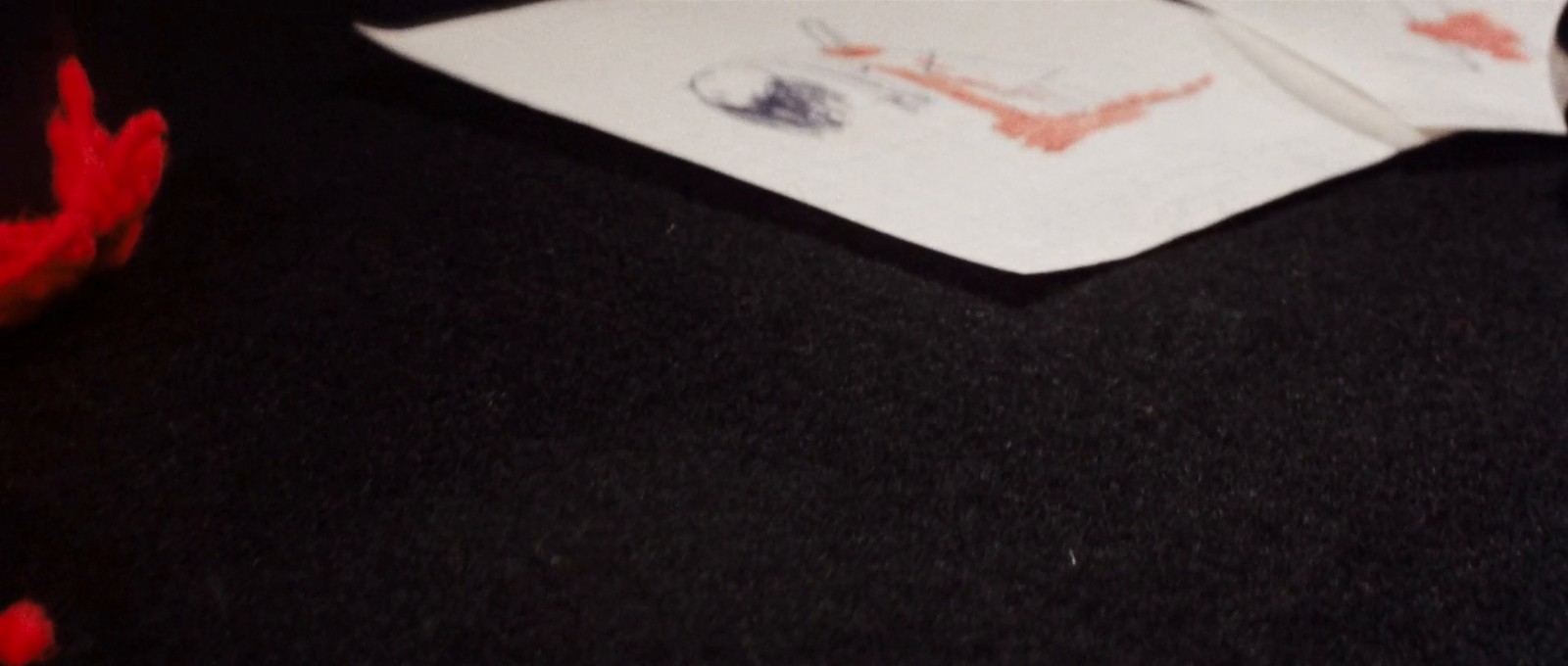
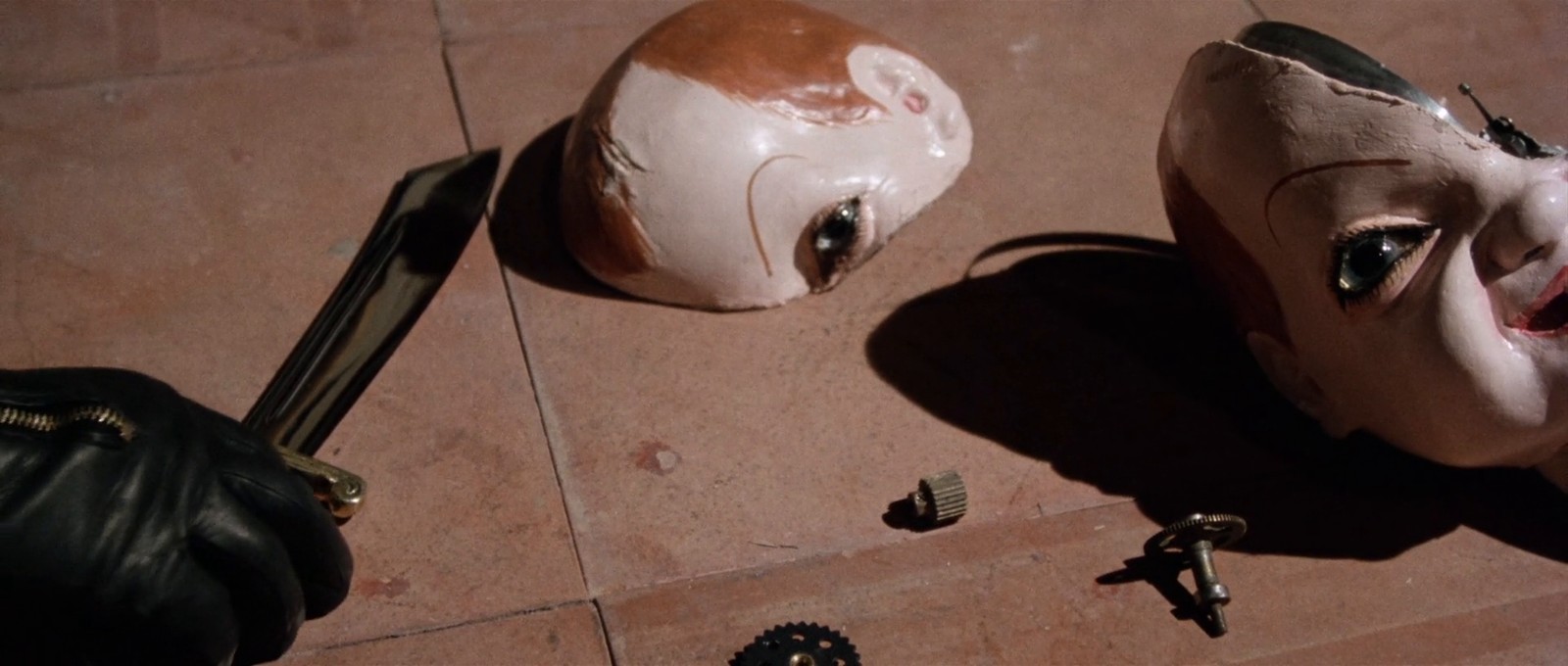
The close views of toys, drawings, wool and a blade interrupt the ordinary scale of the investigation. Isolated objects acquire the force of portraits. These fragments establish a vocabulary that will return in the house, the school and the final recollection.
The camera first crosses a room, then crosses a collection of tiny objects. Distance changes, but movement remains the means of discovery. The black glove and the painted eye supply fragments of a person without revealing a face.
09:13.7The washroom doorway returns the film briefly to an ordinary public interior.
09:16.8An extreme close view isolates a black glove. The zipper and moving fingers fill the frame; the person remains outside it.
09:20.4Cut to the red theatre. Rows of empty seats now replace the audience from Helga’s demonstration.
09:26.0Within the sustained theatre view, Helga and her companions move between the rows. The camera follows the conversation through the emptied space.
10:20.0Their progress brings the group toward the rear doorway; the diagonals of the seats continue to organise the frame.
10:32.0Foreground ornament partly obstructs the departing figures. The camera allows the architecture to pass between us and them.
10:38.0The people disappear from the composition. The movement leaves a red doorway and empty seats behind.
10:42.6A cut changes scale radically: a miniature cradle lies against black cloth.
10:48.0The camera moves past the cradle and its lining. The background gives no room, table edge or human scale against which to measure the objects.
10:51.0A red yarn figure with pins enters the moving close view.
11:00.0The movement reaches a childlike drawing. Red marks and a dark form begin to replace the yarn figure.
11:09.0A round metal base occupies the foreground, drawing the eye away from the paper.
11:15.0The camera reveals the small ornament above the base. Its bright metal and coloured details contrast with the surrounding black.
11:21.0Glass marbles and a braided cord take over the composition. Focus and distance turn their surfaces into the scene’s landscape.
11:30.0The cord leads toward a small plastic baby doll.
11:35.4A gloved hand lifts and turns the doll within the continuing view. The movement is an action inside the shot, rather than a new cut for each change of position.
11:39.0With the doll removed, the camera advances toward a red horned toy and loose marbles.
11:48.0The marbles briefly dominate the foreground before the movement reaches the knives.
11:54.0A blade extends across the black surface. The camera follows it toward its handle.
12:00.0The wider arrangement exposes two knife handles at different scales.
12:02.6Cut to an eye in extreme close-up. Black makeup is applied along the lower lid; the rest of the face is withheld.
12:10.0Cut to Helga at home on the telephone. A recognisable person and room follow the anonymous eye.
12:22.0The camera moves closer to Helga, making the telephone conversation less distant without introducing a reverse speaker.
12:30.0The view turns toward the corridor and its framed pictures. The room’s apparently incidental background becomes a route of possible approach.
12:32.9Cut back to a closer view of Helga on the receiver. Her face and the telephone recover the centre of attention.
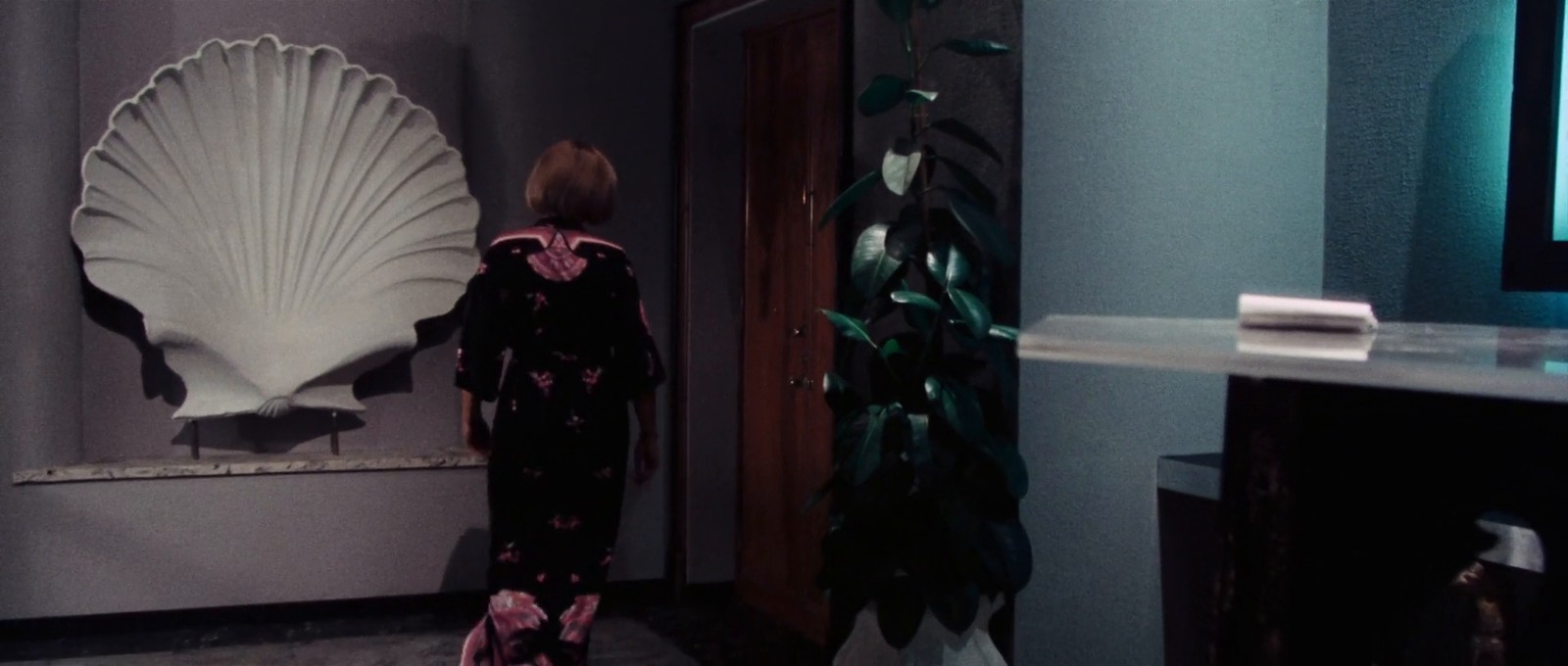
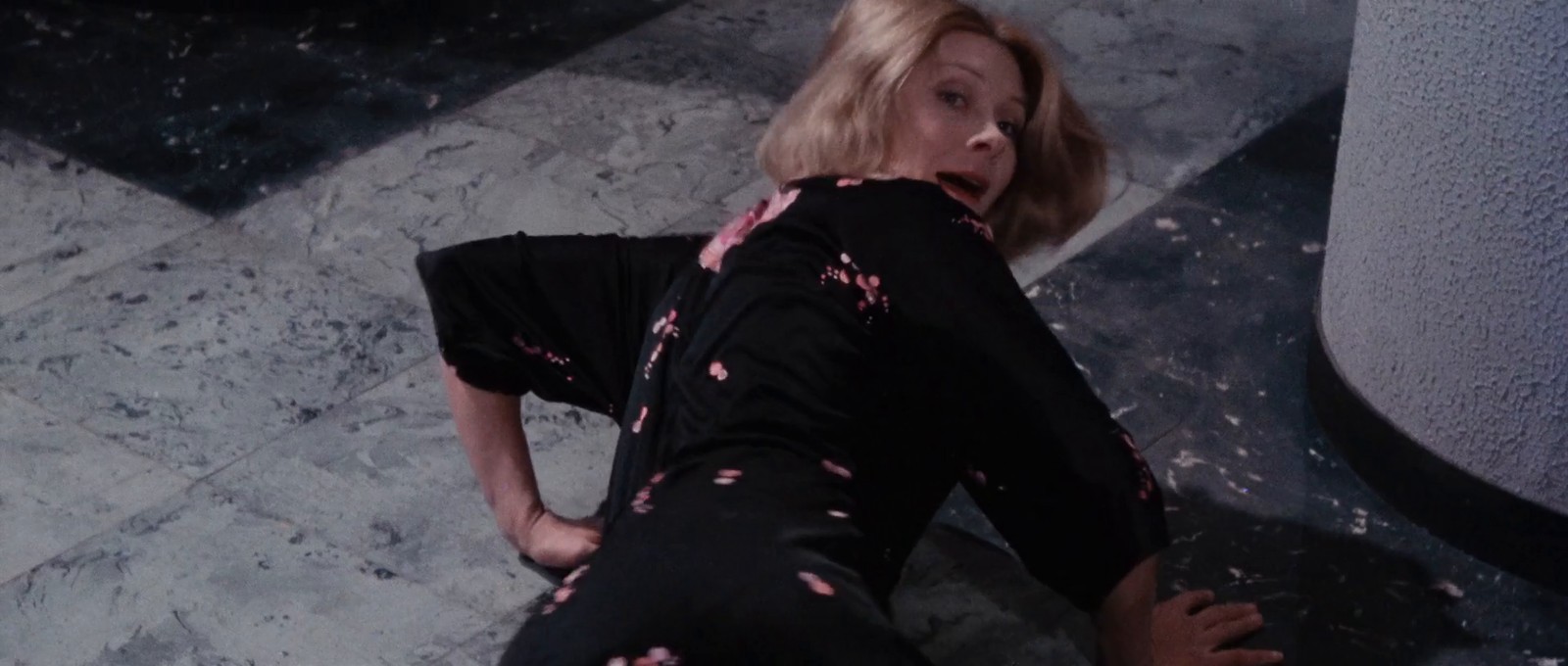
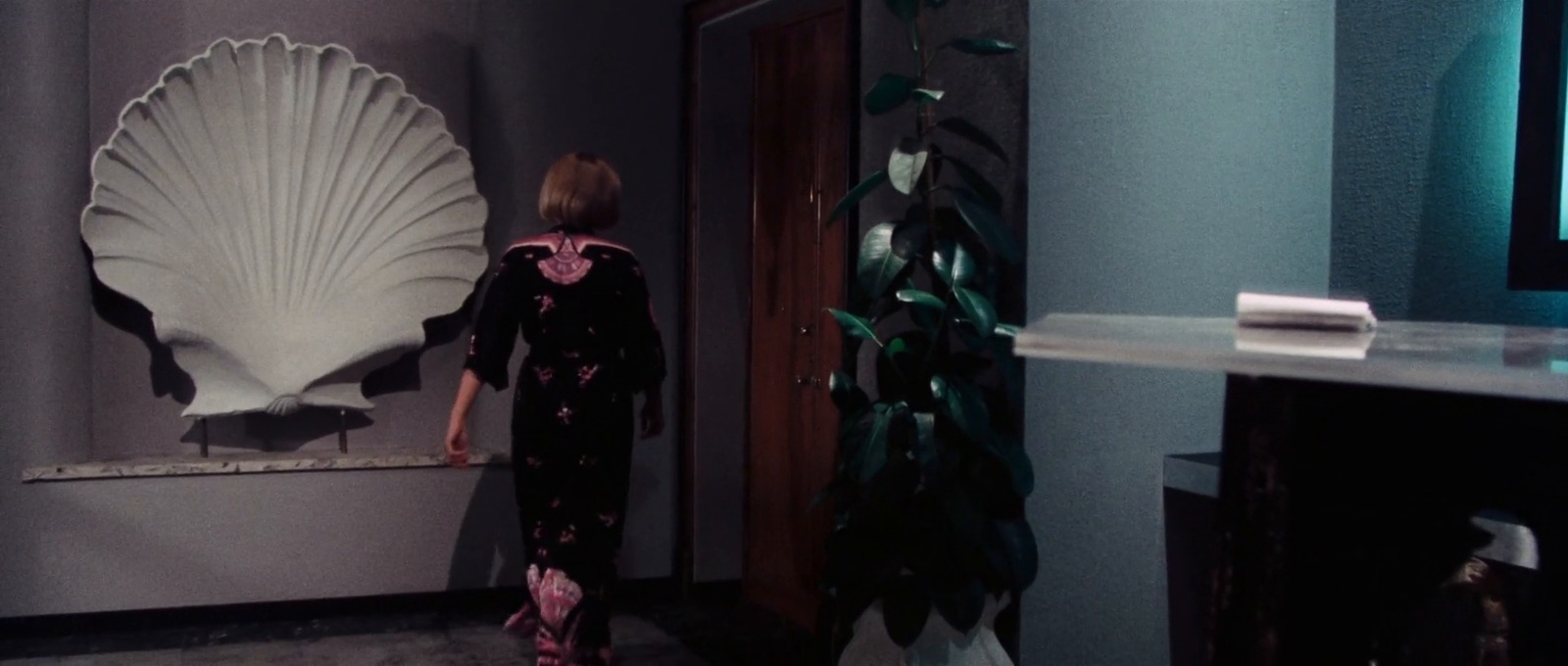
The apartment’s cool geometric wall and shell-shaped ornament give Helga’s movement a precise setting. A door that should separate private space from the outside becomes the entry point for violence. The attack breaks the room into low views, abrupt details and the victim’s face.
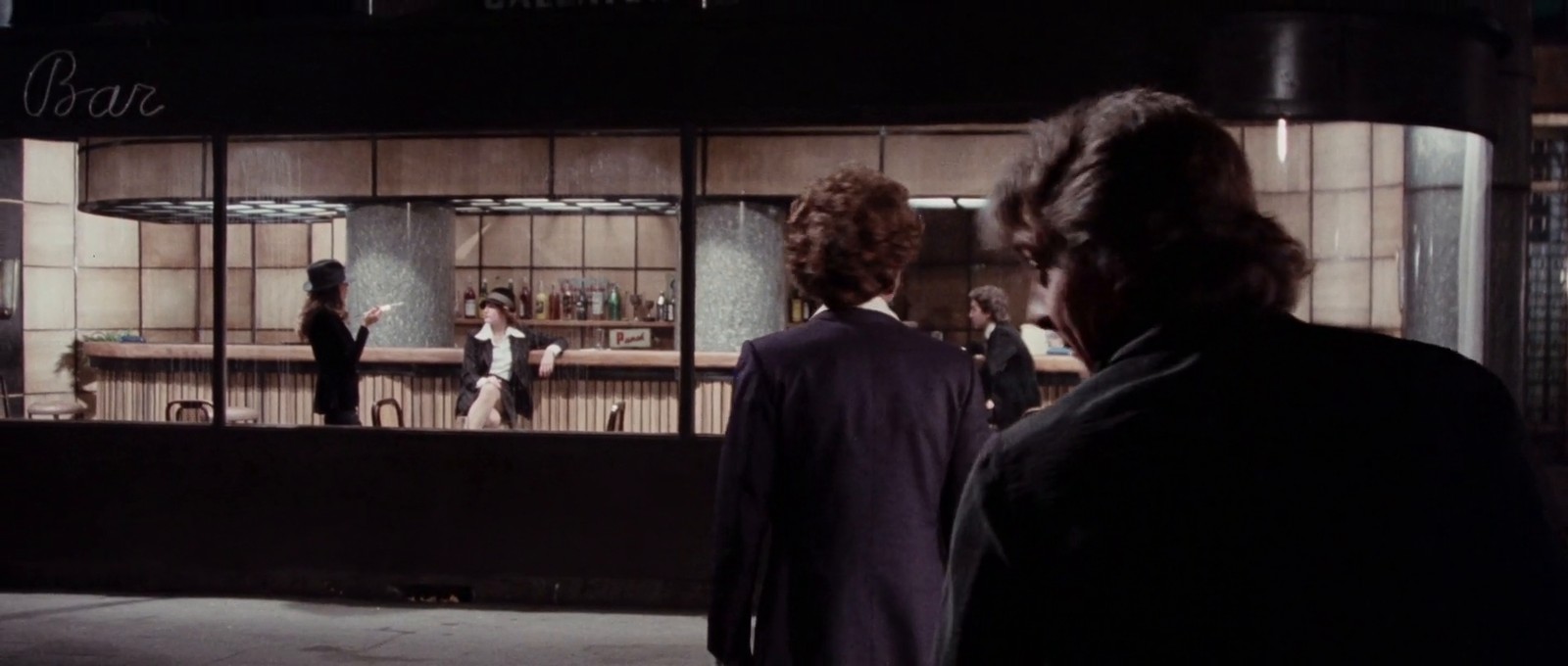
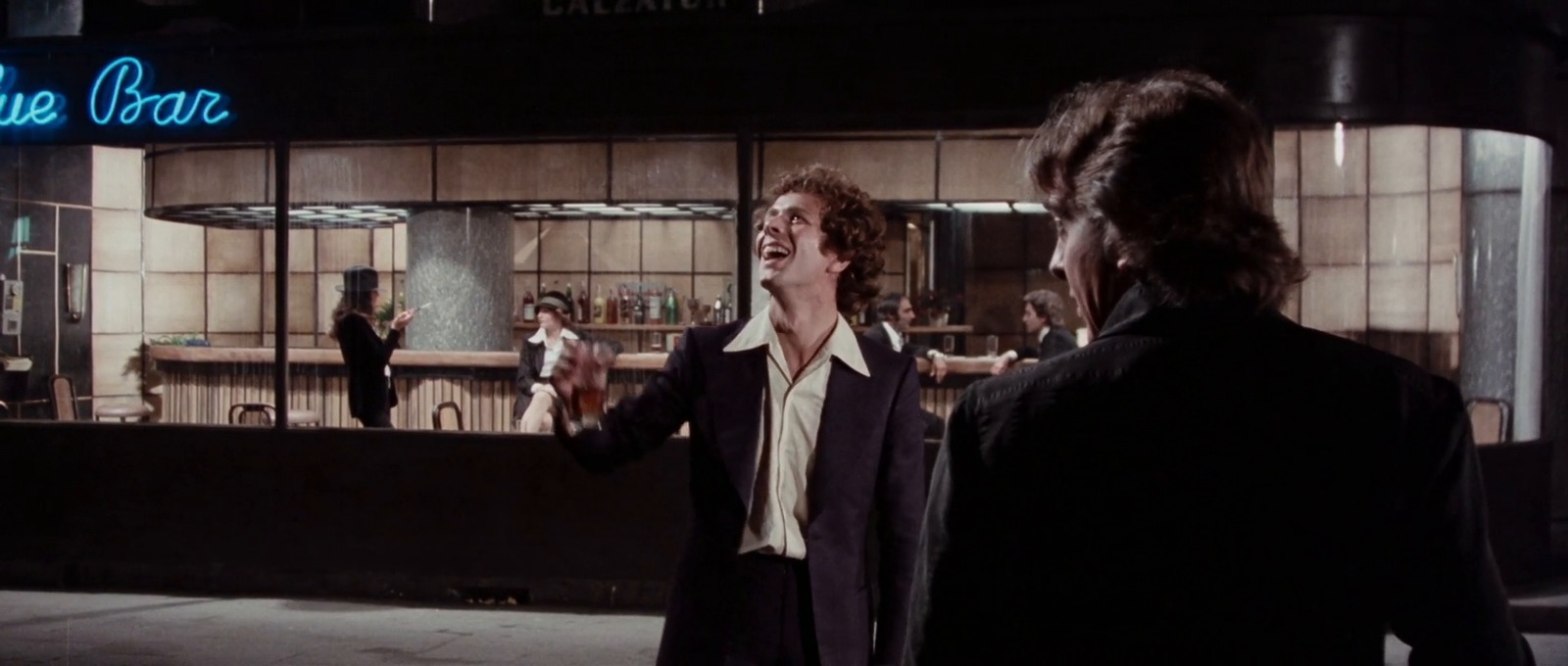
ENLARGE ↗Marcus and Carlo stand before the illuminated Blue Bar.
The lit café stretches horizontally behind the two men, holding its occupants inside a bright display. The square gives their bodies room to move while leaving them exposed. What appears to be an expansive social space becomes a viewing position from which Marcus can witness a crime without being able to prevent it.
Marcus and Carlo occupy the same night-time space, but the film repeatedly changes how much of that space we can see. Long movements establish their surroundings; close reverses give their exchange intimacy. The return to a high view makes the two men small again.
14:21.0The square appears from above, with Marcus a small walking figure between buildings and road markings.
14:34.0Within the moving view, the camera approaches him. His body becomes easier to read while the square loses its overhead geometry.
14:50.0The movement has carried us behind Marcus, facing the illuminated bar across the square.
14:56.0A cut restores a much higher, wider position. The fountain and the open paving surround the isolated figure.
15:01.0Cut closer to Marcus in profile, with the bar behind him.
15:11.4Carlo sits at the fountain’s base while Marcus approaches. The shared composition establishes their unequal physical positions.
15:22.0Marcus settles beside Carlo within the same view. Their exchange now takes place against the massive stone base.
15:53.6A closer reverse isolates Marcus, with Carlo’s hair at the edge of the frame.
15:55.5Reverse to Carlo against the stone. The alternating angles begin to detach their faces from the square.
15:57.3Return to Marcus’s listening face.
16:00.4Return to Carlo, his gaze lowered.
16:01.4Marcus takes the reverse again.
16:03.4Carlo’s face and upper body fill the corresponding angle.
16:05.0The next reverse gives Marcus another brief response.
16:06.8Carlo returns in close view.
16:08.1Another short reverse to Marcus continues the quick exchange.
16:09.5Carlo receives a longer stretch, bringing his fingers toward his face as he talks.
16:28.3Return to Marcus after the held Carlo view.
16:32.3Carlo smiles broadly in the reverse angle.
16:45.0Marcus answers from the complementary position.
16:48.1Return to Carlo, still smiling. The close views make room for the change in expression.
17:02.9Marcus receives the last close reverse before the framing widens.
17:05.9The wider view restores the stone base and both bodies as Marcus helps Carlo stand.
17:22.0The conversation continues with both men upright. Their gestures now operate inside a shared frame.
17:55.3A high angle and rapid widening re-establish the pair’s small size within the square. Motion blur during the movement is not a succession of separate cuts.
17:57.2Cut back to the men at ground level with the Blue Bar behind them.
18:10.0Within the held two-shot, Carlo’s expansive gestures play against Marcus’s more contained stance.
18:34.0The farewell keeps their hands and faces together in the composition, turning contact into part of the scene’s blocking.
18:50.0Marcus moves away from Carlo, toward the column and his cigarette. The shared arrangement begins to break apart.
18:53.3Helga appears at the illuminated window. This cut hands the sequence to the existing window-and-attack study.
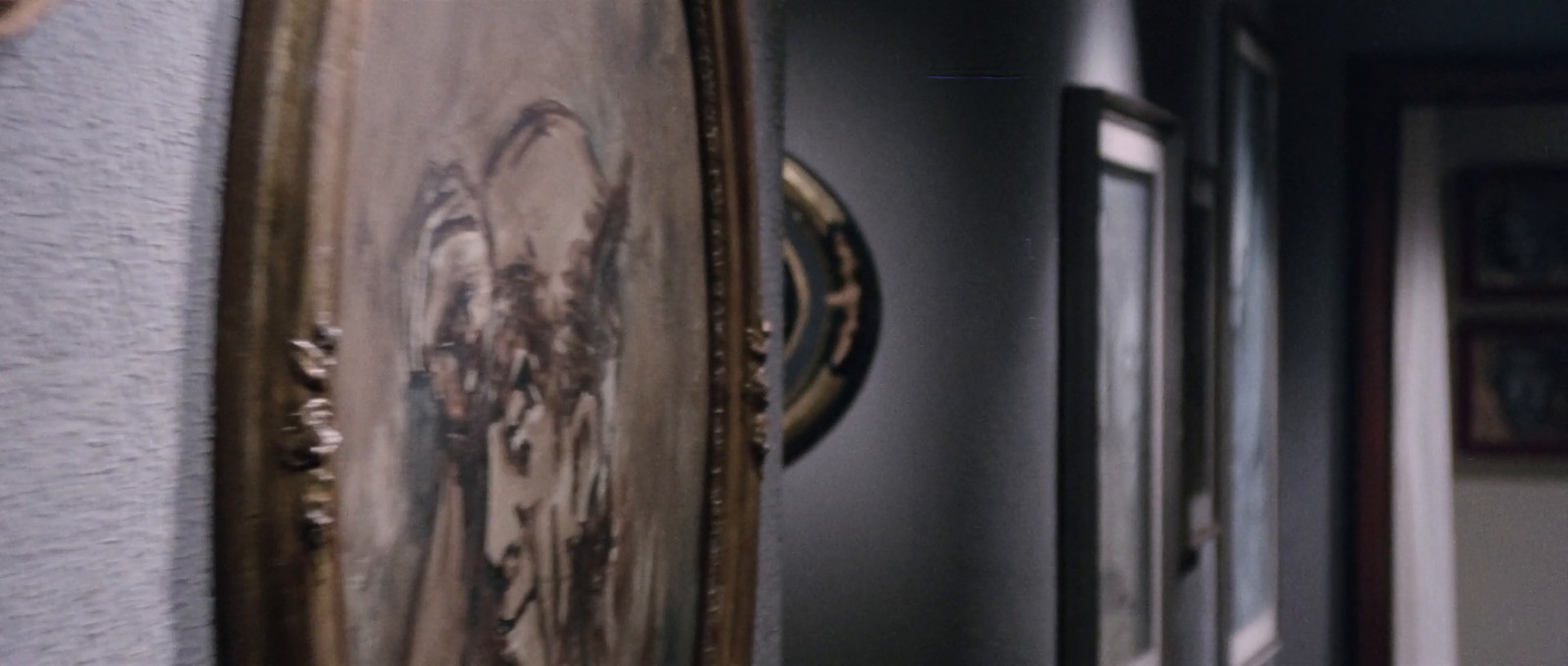
ENLARGE ↗Pictures and an oval mirror line the corridor.
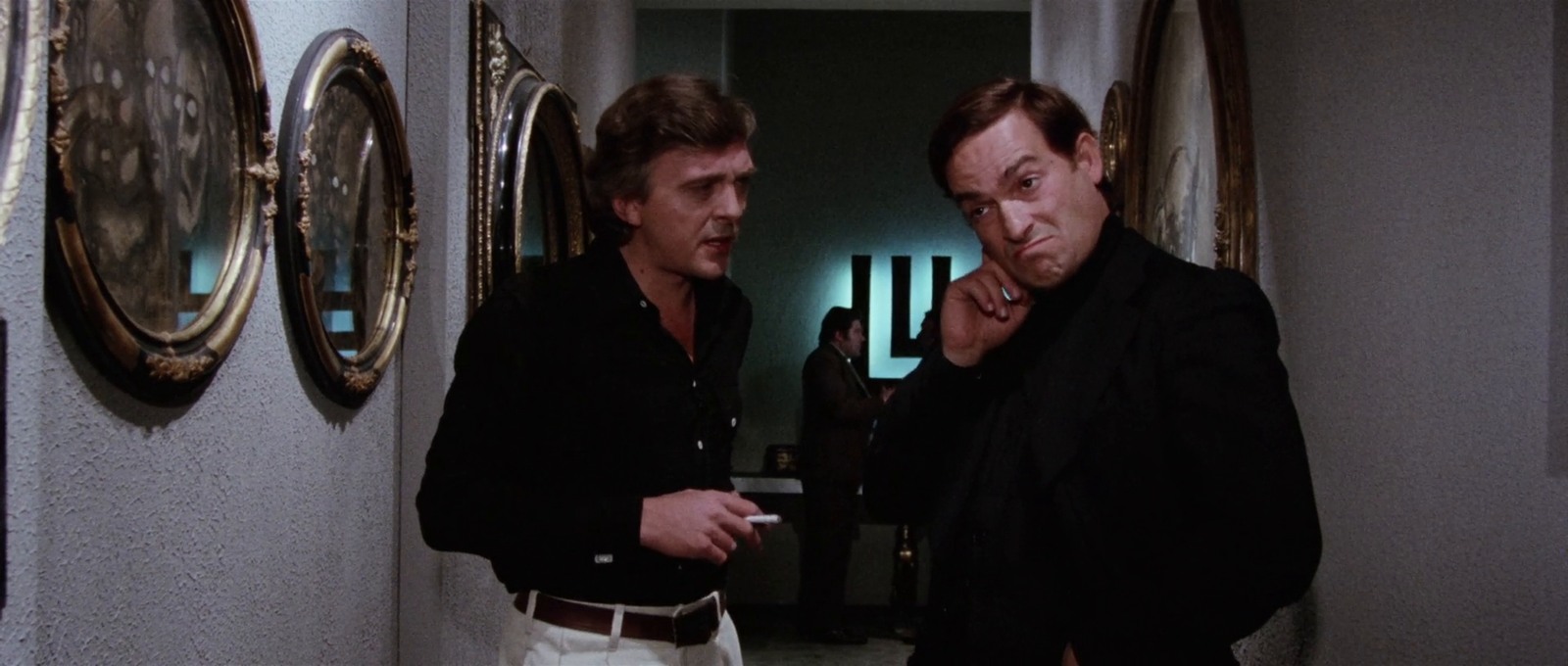
Marcus passes a wall crowded with faces on his way to Helga. The arrangement encourages a quick collective reading—pictures—where the mystery demands a distinction between a painted image and a reflection. The corridor will matter again because the evidence was visible before it was understood.
The approach alternates Marcus with the route ahead. The mirror clue arrives inside a moving view of the decorated wall; the next cut returns to his movement before the face receives an explanatory close-up. Urgency carries the investigation toward Helga, leaving the crucial distinction unresolved.
ENLARGE ↗A face appears briefly among the painted heads.
19:08.2Cut from the lift-side approach to the apartment doorway; Marcus enters the room.
19:13.7A floor-level view isolates the corridor and its blood marks.
19:14.9Return to Marcus in the entrance room. His movement supplies the connection between looking and the route ahead.
19:18.4The low corridor view advances along the floor.
19:20.4Marcus moves past the crowded wall of pictures.
19:23.9Cut to the oblique view along the frames. The camera passes them until the oval mirror and Martha’s face become visible.
19:26.6Return to Marcus. The briefly exposed face is left behind rather than isolated as a recognised clue.
19:27.6The decorated corridor fills the frame again.
19:29.2A low view leads into Helga’s room, with part of her body visible beyond the threshold.
19:29.8Return to Marcus approaching the window.
19:32.0A higher view reveals Marcus beside Helga at the window. The immediate emergency takes over the sequence.
The immediate aftermath turns Marcus into several different kinds of evidence: an interviewed witness, a face in Gianna’s viewfinder and a man trying to explain his memory to Carlo. The missing image is already present as a problem before the investigation has a plan.
ENLARGE ↗Marcus returns to the corridor with the inspector.
19:41.2Marcus's face follows the violence at the window.
19:42.2The blood-marked glass receives a separate view.
19:42.9Helga's head lies on the floor. The scene changes from an attack seen across a square to its material aftermath inside the room.
19:47.2Marcus looks out from the window.
19:49.1A high view finds a departing figure in the street. Distance prevents the view from becoming a reliable identification.
19:52.7Cut back to Marcus at the window.
19:55.8People occupy the street below, widening the scene beyond the single departing figure.
19:58.4Vehicles arrive. The private interior is about to become an official investigation.
20:02.4An overhead view shows people attending to the body.
20:09.0The interview begins against a blue geometric wall. The changed background separates official questioning from the corridor's crowded pictures.
20:28.0The inspector receives a close view while eating.
20:32.2A reverse arrangement brings Marcus and the inspector together.
20:39.3The inspector returns in close view, making his bodily business part of the questioning's rhythm.
20:43.8A side view holds the inspector leaning toward Marcus. Their different levels and movements complicate the apparently routine exchange.
21:16.2Another man writes. Marcus's spoken account is being converted into a record.
21:19.4A photographer and the flash interrupt the questioning space.
21:21.9Marcus and the inspector move into the picture-lined corridor. In the sustained movement, Marcus looks at the wall while the English exchange raises whether anything has been moved.
22:05.0Within the corridor passage, another man joins them. The inspection continues around Marcus rather than stopping to validate his impression.
22:28.5The doorway and the white fan-backed chair establish a different threshold as Gianna enters the investigation.
22:47.7The inspector addresses Gianna.
22:50.4Gianna receives a close view. Her position is independent of the official questioning.
23:12.6Marcus appears separately in the conversation's alternating views.
23:19.2Gianna becomes the active observer while Marcus remains the object of attention.
23:31.5She raises the camera toward him.
23:33.7The viewfinder isolates Marcus inside a dark border. The film briefly makes the camera's framing explicit.
23:34.3The flash punctuates the portrait.
23:35.4Gianna smiles. She has obtained an image that Marcus does not control.
23:36.8The scene opens out to the street and police activity.
23:53.4Marcus appears in the police car before the film returns him to the square.
23:58.5He finds Carlo slumped against the wall and helps him. Their relation begins through physical assistance, not a formal interview.
25:19.4A wide view places the two men apart near the fountain. The distance lets their conversation spread across the square.
26:25.0The sustained wide arrangement holds the separated figures. The account of the missing painting is now a conversation about perception, with no new visual evidence supplied to settle it.
ENLARGE ↗Gianna meets Marcus across an arm-wrestling table.
The locked hands give the comic contest a clear visual centre. Gianna’s relaxed confidence works against Marcus’s effort, turning a conversation about strength into an observable result. Her competence challenges the authority the film has initially handed its male witness.
The frosted panels give the conversation a stable geometric background. Changes of scale, alternating faces and a return to the whole table organise the contest. The wider view is decisive because it lets both bodies—and the disputed action—occupy the same frame.
Close study · The newspaper, the car and the empty theatre
Gianna’s photograph circulates before Marcus has understood what he saw. The burial, cemetery walk, awkward car journey and return to the theatre give the investigation a public and social life. Long movements let the pair negotiate space together; isolated inserts show how an image becomes a claim.
ENLARGE ↗The newspaper turns Marcus into a public witness.
27:04.2A wide cemetery view introduces the mourners among trees and graves.
27:08.0Marcus and Gianna stand together beside the burial.
27:10.4The mourners are seen from behind.
27:12.6Giordani appears separately among the gathering.
27:14.2The film returns to Marcus and Gianna, placing their developing conversation inside the public ritual.
27:22.8A closer view concentrates on the pair.
27:28.5Two other mourners interrupt their exchange.
27:30.9Marcus and Gianna return to the frame.
27:41.5Giordani is isolated again before the view widens to the crowd.
27:47.7A low angle brings the shovels and the mourners into the same composition.
27:50.8An insert isolates earth on a shovel.
27:53.0The low view restores the people around the grave.
27:56.6Another shovel detail turns the ritual into a repeated material action.
28:02.1The burial is held from below, making the figures loom above the work.
28:06.8The pair reappears as the sequence prepares to leave the graveside.
28:12.9The gathering disperses.
28:20.0The cemetery aisle offers a new corridor, this time lined with memorials rather than paintings.
28:23.7Marcus and Gianna are framed together from the front.
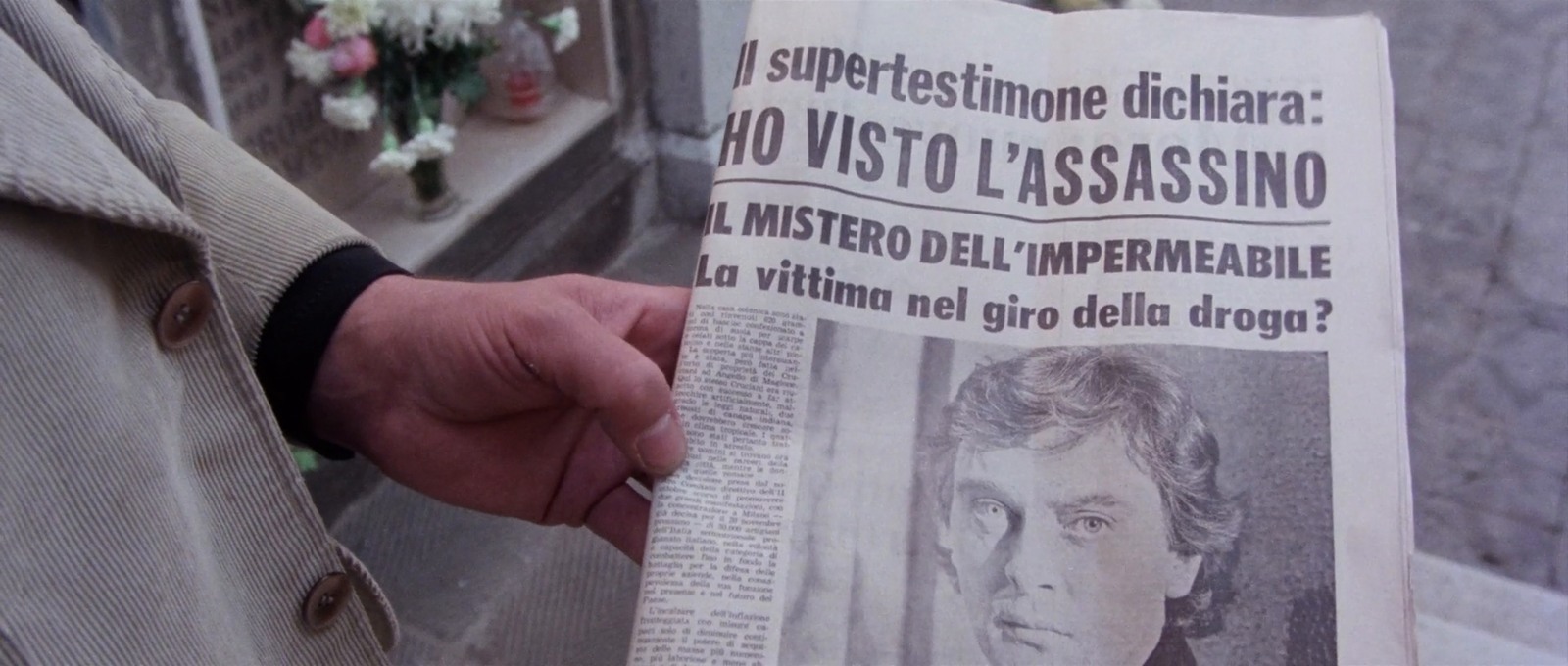
28:28.6The newspaper fills the frame: Marcus's photograph accompanies the headline “HO VISTO L’ASSASSINO.” His uncertain observation has become a public assertion.
28:31.0Their faces replace the newspaper. The photographed subject is now reacting to his published image.
28:34.8The long-lens cemetery walk lets flowers pass across the foreground. The changing obstructions belong to a continuing walk, not a sequence of new locations.
29:55.6A closer view brings the pair together before they leave the cemetery.
30:02.8They pass through the gate toward Gianna's small car. Marcus's attempt to fit himself inside extends the scene's physical comedy.
30:21.7A street view includes a cyclist carrying a large Italian flag.
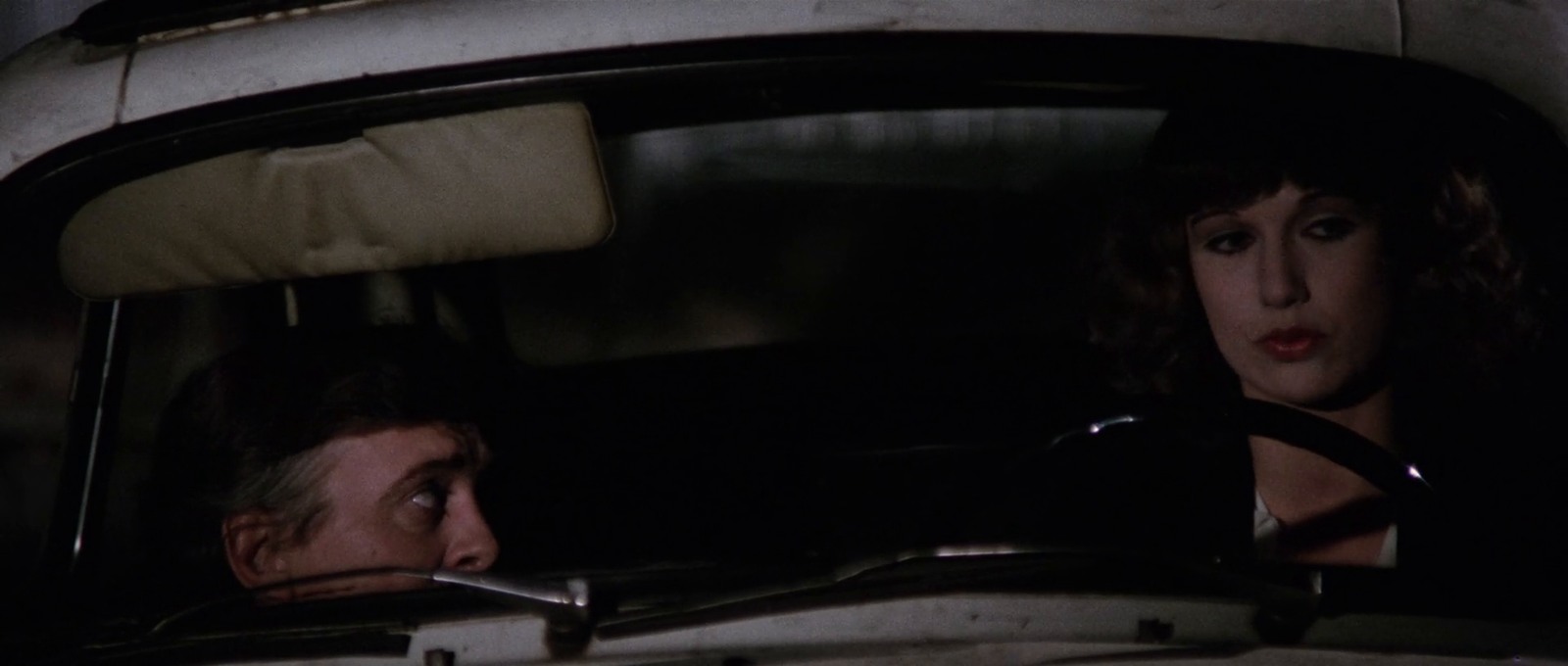
30:24.7The windshield frames both occupants, but their seating levels are conspicuously unequal.
30:28.6Marcus appears low in the passenger seat.
30:30.2Gianna's side view answers his uncomfortable position.
30:34.4The shared front view makes the height difference the organising feature of the conversation.
30:41.6Marcus raises an arm in the cramped compartment. The car shapes the performance rather than serving as a neutral background.
30:47.0The front view catches Gianna's reaction before the conversation returns to alternating closer angles.
31:05.2Both are framed through the windshield again.
31:10.8From inside the bar, the camera sees the car stop beyond the glass. Marcus emerges through the roof; the sustained composition keeps foreground customers and the street action together.
32:04.7Giordani stands on the darkened stage, reconstructing the earlier demonstration through gesture.
32:17.6A wider view places the investigating group onstage.
32:34.4The empty red seats replace the earlier audience. The room remains available, but the people who might explain Helga's reaction have gone.
32:36.8Marcus is isolated as the reconstruction continues.
32:43.0Giordani returns to the frame.
32:45.9Gianna's reaction forms another part of the discussion.
32:49.6Bardi receives a separate view. Testimony is now distributed across the group instead of concentrated in Helga's demonstration.
32:58.6The film returns to Giordani before the investigation gives way to the later contest between Marcus and Gianna.
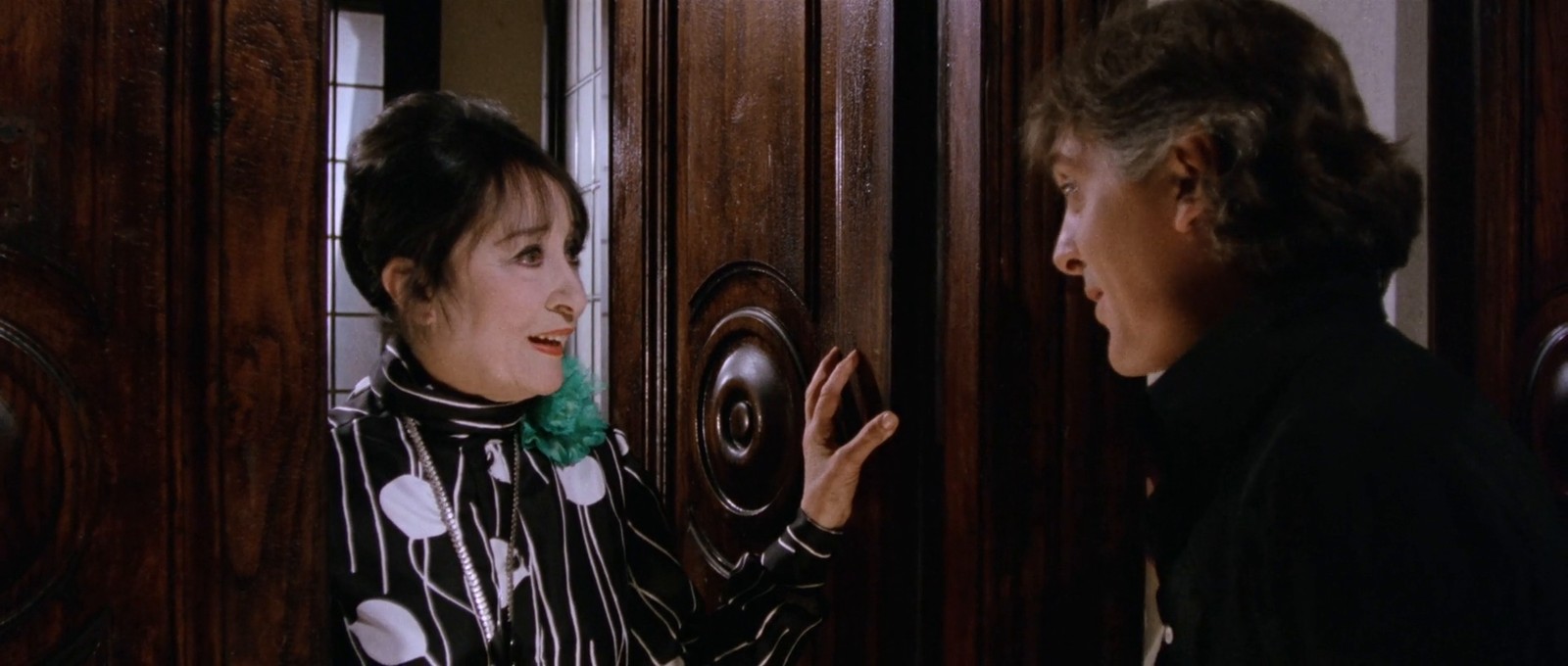
ENLARGE ↗Martha and Marcus meet beside the open doorway.
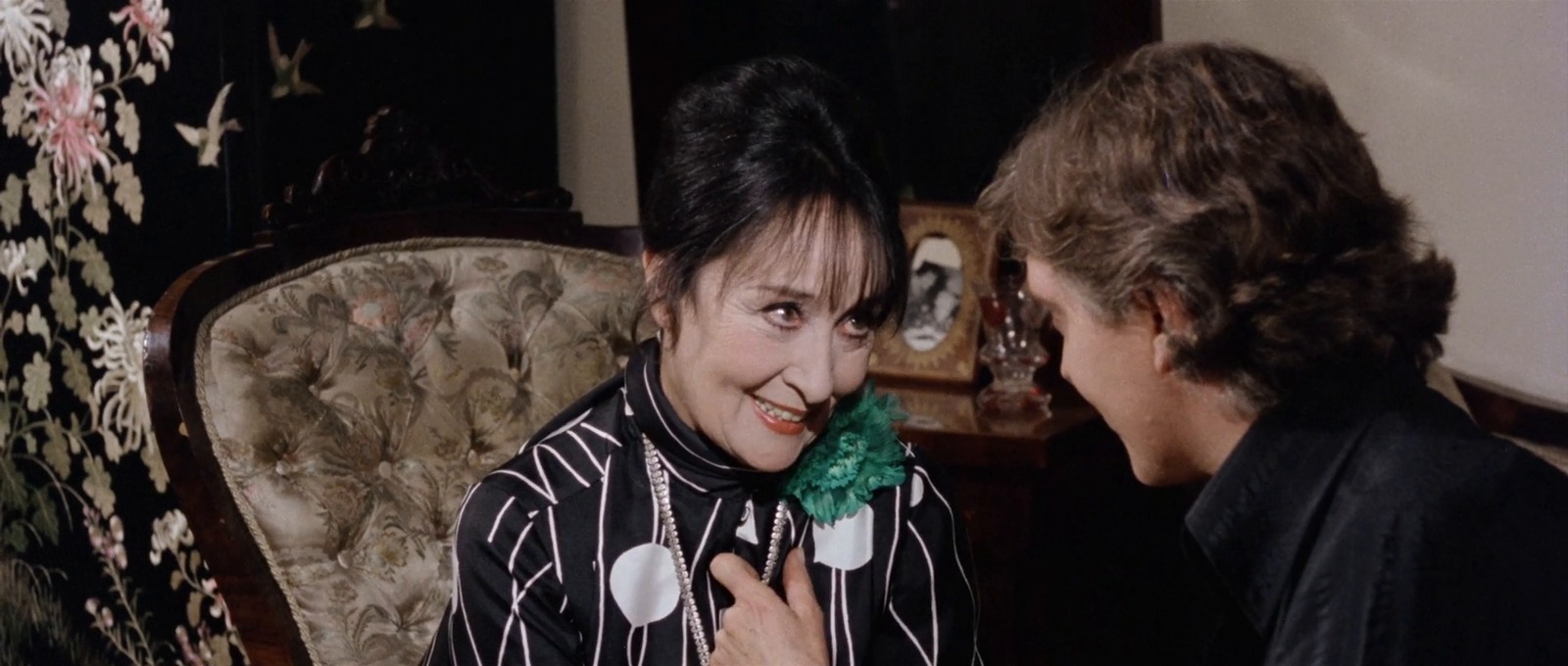
The meeting places the investigation within a domestic social world. Martha first appears as a person who receives visitors and speaks about Carlo, rather than as an isolated ominous face. The later revelation therefore changes a relationship already established in ordinary space.
The visit introduces Martha through hospitality, misunderstanding and images of her former life. A brief run of photographs interrupts the two-person conversation. The photographs are visible evidence, but the account that gives them meaning comes from Martha herself.
ENLARGE ↗Martha receives Marcus in her crowded room.
38:56.0Martha meets Marcus at an ornate wooden door. Both faces share the first composition.
39:04.3A reverse two-shot follows him inside and opens the room behind her.
39:20.0Within the interior movement, photographs, furniture and a large doll accumulate around the visitor.
39:28.7A new paired angle places Martha and Marcus beside the doll and the crowded furnishings.
39:44.0Martha gestures toward a seat. The visitor’s progress through the room remains tied to her movements.
39:52.0She takes his arm and brings him toward the settee.
40:00.2The seated pair are shown from across the room.
40:04.1A closer reverse places Martha against the patterned chair and screen, Marcus beside her.
40:09.7Cut away from the pair to a wall arranged with framed photographs.
40:11.3An individual photograph fills the image, bringing the younger face out of the wall display.
40:12.5A different still shows the woman with a man. The sequence changes pictures rather than returning immediately to the present conversation.
40:13.7A portrait provides another isolated view of the younger face.
40:15.0A smiling portrait completes the brief sequence of photographic inserts.
40:16.1Return to the seated pair. The film puts the present face beside the remembered career.
40:27.3The reverse gives Marcus’s response within the two-shot.
40:30.4Return to Martha’s side of the conversation.
40:32.8The composition changes as the pair get up; the doorway and the visitor’s departure regain importance.
40:34.4A closer view holds Martha facing Marcus.
40:35.8The reverse gives Marcus’s raised hand and explanation.
40:39.0Martha takes the next reverse.
40:45.2Marcus gestures again from the complementary angle.
40:53.5A wider view restores their bodies and the nearby furniture.
40:55.7Martha turns toward the furniture to look for something, with Marcus waiting behind her.
40:59.7A dark transitional image breaks the room’s continuity before the next visit.
41:01.5Marcus stands at another threshold. His search has moved from Martha’s recollections to Carlo’s present whereabouts.
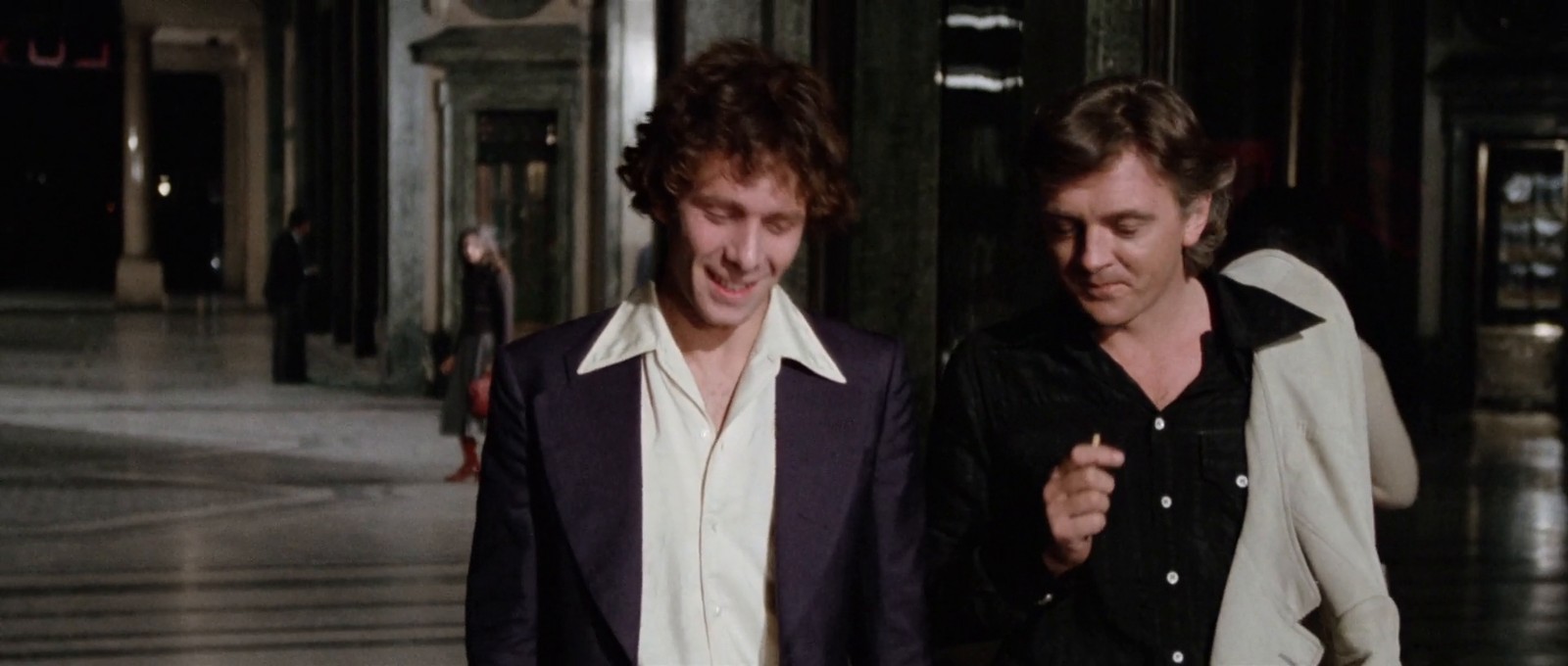
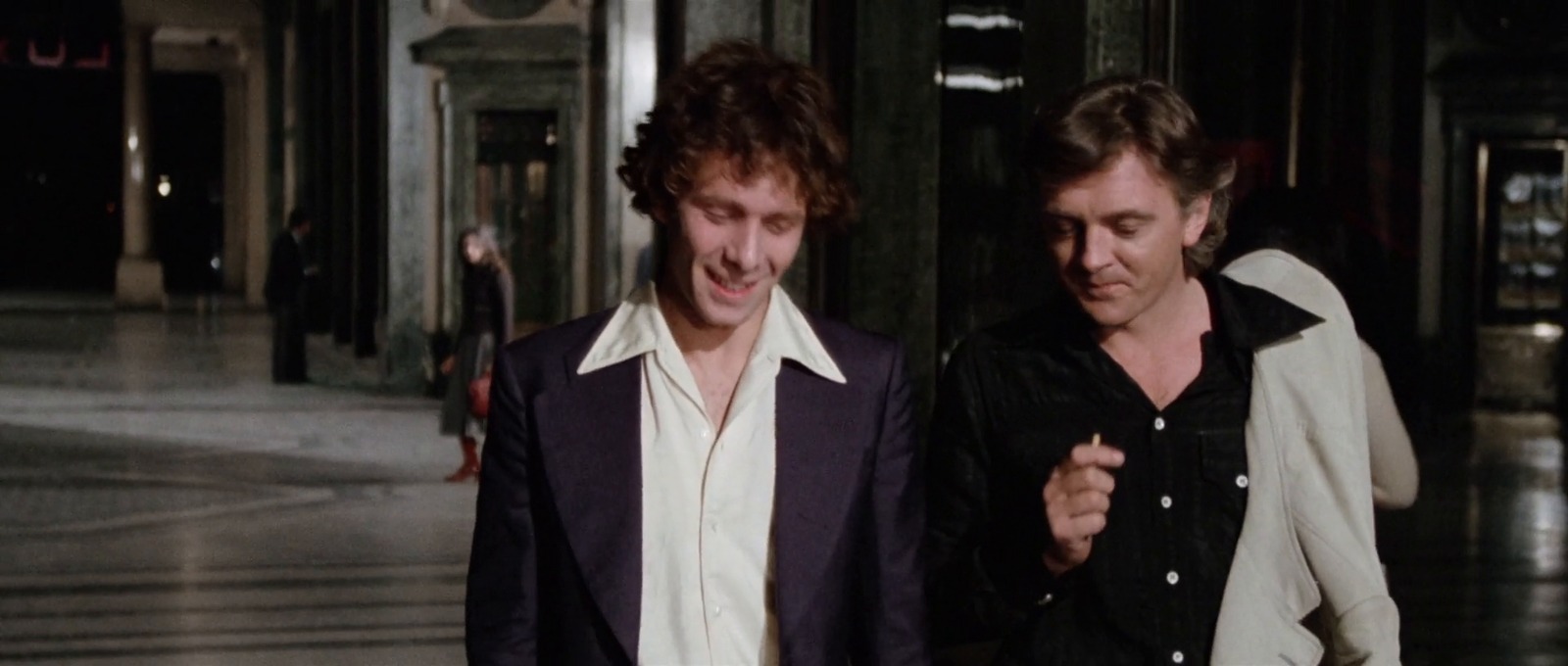
ENLARGE ↗Carlo and Marcus return to the monumental square.
The men’s contrasting clothes remain conspicuous against the stone architecture. Repeated meetings make Carlo part of Marcus’s everyday life before suspicion becomes explicit. The square accumulates familiarity, so their eventual confrontation destroys an existing intimacy.
A visit, a long walk and a duet hold Marcus and Carlo together before the film returns Marcus to his own instrument. The sequence moves from alternating faces to shared spaces, then fragments the piano into keys, mechanisms and written notes.
ENLARGE ↗Marcus and Carlo cross the city together.
41:01.5Marcus waits at the entrance with one arm raised against the wall.
41:02.8The reverse reveals Massimo Ricci inside the apartment.
41:04.3Return to Marcus at the door.
41:10.5Ricci holds the corresponding view and gestures toward the visitor.
41:13.2The camera turns toward the doorway wall, momentarily leaving the faces.
41:18.5The name RICCI is isolated on the brass plate.
41:20.3Marcus returns in close view.
41:23.2Ricci takes the reverse.
41:24.2A short Marcus response continues the exchange.
41:27.5Return to Ricci inside the room.
41:30.9Return to Marcus at the entrance.
41:33.6Ricci appears over Marcus’s shoulder, linking the two positions before he enters.
41:35.2Both figures share the entrance view.
41:38.9The camera follows the interior route past reflective surfaces and framed images.
41:58.9Ricci is shown from deeper inside the apartment.
42:01.6Marcus approaches from the doorway in a wider reverse.
42:05.7Carlo is revealed reclining on the bed. His stillness contrasts with the visitor’s progress through the apartment.
42:13.8Marcus takes a close view beside the framed prints.
42:15.0Reverse to Carlo against the pillows.
42:28.8Marcus returns, cigarette smoke visible beside his face.
42:31.9Carlo answers from the bed.
42:43.4Return to Marcus’s angle.
42:46.6Carlo receives another reverse.
42:49.8Marcus briefly returns before attention shifts to Ricci.
42:50.7Ricci is framed separately within the room.
42:51.8A wider composition reconnects Marcus with the room as Carlo begins to get up and move.
43:04.0Ricci and Marcus occupy the foreground during Carlo’s preparations. Conversation and movement now share the depth of the room.
43:28.0Carlo dresses farther back in the same arrangement. The foreground exchange does not require his removal from view.
43:44.0Carlo puts on his jacket while the other two remain nearby.
43:51.8A wider departure view places all three around the doorway.
44:20.0The image changes to a rapid vertical passage of bright horizontal lights against dark stone. Successive bright bands arise from movement within this shot.
44:30.0Marcus and Carlo are together in a street-level tracking view, walking toward the camera.
44:48.0Their conversation continues in the shared frame as pedestrians and columns pass behind them.
45:18.0The men slow and turn more directly toward each other within the continuing view.
45:36.0Their faces come closer; a gesture near Marcus’s cigarette becomes part of the exchange.
45:54.0Carlo turns outward while Marcus continues addressing him. The camera keeps both responses available at once.
46:12.0The conversation draws toward the dark entrance ahead.
46:24.0The men pass into the doorway, with Carlo nearer the foreground.
46:36.0An older woman and a television occupy the next interior view. The screen’s moving images form another small frame within the film.
46:54.1Cut to two pairs of hands at the piano. The shared instrument gives the friendship a physical form.
47:06.0The widening view includes the players behind people seated in the bar.
47:12.0Foreground patrons and cigarette smoke pass across the sightline. The music-making remains visible farther back.
47:24.0The movement reaches the bar staff and a patron, carrying attention away from the keyboard without immediately leaving the room.
47:27.7An exterior architectural view begins the return toward Marcus’s apartment.
47:36.0The camera advances through the pale curtain and toward Marcus at his piano.
47:43.2Fingers on the keys fill an extreme close-up.
47:43.7Cut inside the instrument, where strings and moving mechanisms replace the player’s face.
47:45.0Pencil and musical notation become a separate insert.
47:48.5Return to the instrument’s mechanism.
47:49.7Return to fingertips pressing the keys.
47:51.5Another interior angle shows the piano’s strings and wooden structure.
47:52.5Marcus’s face returns beside the instrument and recorder, reconnecting the details with the working musician.
47:58.7A view out through the window framework reveals the street and a small yellow vehicle below.
48:01.5The notation returns in close-up.
48:04.3Fingers on the keys begin another run of mechanical detail.
48:05.8The piano’s internal mechanism takes the next insert.
48:06.8A wider interior detail follows the strings into the body of the instrument.
48:07.5Return to the keys and fingertips.
48:08.5A side view restores Marcus and the piano together.
48:32.0The skylight enters the sequence, opening the room upward before the existing approach-and-threat study.
The sequence cuts between equipment, Marcus and the apartment’s barriers. The recorder makes the threat an organised intrusion into his room. Doors and shutters divide the space into surfaces that can be watched without revealing who is on the other side.
Marcus’s room is connected to an unseen approach through a succession of different viewpoints. The tape recorder receives its own close examination; a later camera movement abandons Marcus to show the entrance. When the film returns to him, the floor and doorway become separate fields of attention. The threat is assembled from spaces before it is resolved into a visible attacker.
ENLARGE ↗Marcus waits beside the piano, seen from above.
48:40.0The passage is already moving across the piano and sheet music toward Marcus. His work and the room share the same view.
48:50.1Cut to a moving, low view of the concrete passage and its glazed surfaces.
48:57.3A further passage view advances around a corner toward a frosted door.
49:06.7Return to Marcus at the piano. His lifted attention connects the approach with the room below.
49:10.2The skylight is isolated overhead.
49:11.8A wider view returns Marcus, the piano and the doors to one composition. He resumes his work before looking away again.
49:33.7A close view of the tape reel interrupts him. The object supplying the threat receives a distinct visual presence.
49:36.1Return to Marcus; the camera follows him as he gets up and moves toward the curtained window.
49:50.7The recorder returns. The view moves across the reel and the machine’s surface, extending the object’s prominence.
50:09.0Marcus is seen by the window and moves back toward the piano. Later in this sustained passage, the camera leaves him, travels through the interior and reaches the opening entrance door.
51:00.7Cut back to Marcus beyond the piano. The movement toward the entrance has supplied information outside his immediate view.
51:05.7A floor-level view tracks across the boards toward the room.
51:16.5Return to Marcus watching from the piano.
51:18.7The low floor view resumes, making distance itself part of the threat.
51:21.3The doorway and telephone are shown without an identifiable intruder.
51:23.5Marcus remains framed beyond the piano; his attention is held toward the entrance.
51:38.5A strip of light and an approaching shadow cross the floor beside the door.
51:41.6A high view places Marcus and the entire piano inside the room. The framing gradually closes toward him.
51:59.1An extreme close-up isolates the side of his face, interrupting the room’s geography with bodily tension.
52:05.1The telephone fills a separate insert.
52:05.7Return to Marcus. He leaves the piano and crosses quickly toward the door.
52:11.8A tighter view follows him at the door, holding the wooden surface and his reaction together.
52:27.3The composition changes to his profile beside the door. The telephone receiver brings a new connection into the enclosed space.
52:45.6The window is shown from outside as Marcus comes to look through it.
52:51.0A high view follows a departing figure on the street below.
52:54.1A daylight exterior introduces Marcus leaving a music shop with a yellow record sleeve.
52:57.1The sleeve becomes the centre of the framing; its illustrated children contrast with the night-time threat.
52:58.5A moving close view travels across the playing record toward the pickup.
53:13.3The record and sleeve are re-established on the table. A threatening sound has become an object of inquiry.
ENLARGE ↗Marcus listens in a room lined with books.
Shelves and conversation give the search a different texture from the night streets. Information now has to be located in accounts of a place and its history. The movement from witness to reader links the film’s visual puzzle to the problem of interpreting a surviving record.
A conversation produces a book; the book produces a photograph; the photograph sends Marcus in search of its author. Between these acts of inquiry, the killer’s objects return. The passage shifts from a public reading room and a crowded bar to Amanda’s increasingly enclosed home.
53:20.0Giordani stands against the pale geometric window; the framing opens out to include Bardi on the sofa and Marcus opposite. The three positions give the discussion a stable geography.
53:48.3The cut isolates Giordani as he develops his explanation of the murders.
53:53.9Marcus receives the explanation in a close reverse; the listener becomes as important as the speaker.
53:58.8Back to Giordani, keeping the exchange on the same visual axis.
54:01.6Marcus’s reverse interrupts the longer account.
54:05.3Bardi receives a separate frame before the argument moves toward the remembered book.
54:09.8Marcus looks across the room; the sequence continues to distribute attention among all three men.
54:11.2Giordani briefly returns, followed by Marcus at 54:13.9.
54:15.6Bardi’s framing includes Marcus at the edge. His recollection reconnects the child’s song with a particular house.
54:22.7Marcus’s reverse turns that recollection into a lead he can pursue.
54:31.5Bardi continues; the scene allows the remembered story to develop before changing location.
54:47.1Giordani re-enters the cutting pattern; Bardi returns at 54:50.8 and Marcus at 54:52.4.
54:55.0The wider three-person view restores the room before the book becomes the next object of attention.
55:07.2A close view of the book cover replaces the conversation. Hands begin opening it.
55:11.2Marcus sits at the library table. The search has moved from remembered speech to a physical document.
55:21.2The printed heading names the villa of the screaming child. Text occupies the frame as evidence within the story.
55:34.5Marcus reads; the cut reconnects the page with the person trying to use it.
55:37.3The open spread places a photograph of the villa beside the account. Architecture now has a recognisable shape.
55:40.3The library’s gondola and pale colonnades widen the visual field beyond the book.
55:47.2Marcus looks away from the page.
55:49.4A wider view introduces the approaching attendant and the distance across the reading room.
55:52.2Marcus looks toward the attendant; the subsequent reverse keeps the two figures at different depths.
56:02.9The table returns in a wider framing before another insert of the illustrated page at 56:04.9.
56:05.6Marcus walks away through the marble hall. The photograph can travel with the investigation even after the book is left behind.
56:30.6The cut puts Marcus at a telephone beside the bar’s equipment.
56:37.6Gianna answers in a busy office. The two spaces are joined by the call rather than by shared geography.
56:41.0Marcus’s reverse includes the bar’s steam; the surrounding activity competes with his attempt to pass on a name.
56:46.6Gianna remains at her desk while Marcus’s location becomes more disruptive.
56:55.8Back at the bar, Marcus’s attention shifts between the receiver and what is happening beside him.
57:03.4Gianna’s reverse resets the other end of the conversation; shorter alternations follow at 57:06.3, 57:10.0 and 57:12.7.
57:14.6A brief view of nearby men interrupts the telephone alternation, bringing another piece of the bar’s activity into the sequence.
57:23.5The last bar view precedes a sharp change of scale and setting.
57:29.7A marble against black begins another procession of the killer’s objects.
57:32.0A doll with a cord around its neck fills the frame. The familiar collection has become a concentrated series of details.
57:44.3Black gloves and a zipper lead back toward the anonymous figure associated with the objects.
57:55.3An eye appears in extreme close-up; the image changes orientation before the next location arrives.
58:01.0The eye and a country road alternate in a burst of very short views. By 58:03.6 the road holds the screen.
58:08.8Amanda and Elvira appear outside the house. The transition has carried the threat into the space of Marcus’s next lead.
58:27.9A high view follows Elvira along the road, separating the two women spatially.
58:32.2Amanda returns through the front door.
58:34.9The framing draws back from Amanda and the wall map to reveal a hanging doll closer to the camera.
59:04.6Amanda looks outside. Views of the departing bus extend the separation from Elvira.
59:18.6Back at the entrance, Amanda turns into the house; the empty route around her begins to matter.
59:31.9A pale door opens into the dark interior.
59:33.8Amanda is initially a silhouette. The later change in illumination reveals the room without requiring a new location.
59:46.3The hanging doll occupies the foreground while Amanda remains farther down the passage.
59:54.4A bedroom doorway redirects attention into another room.
1:00:00.7Amanda’s position in the hall reconnects the rooms before she approaches the wardrobe.
1:00:20.2Amanda holds the doll; the insert at 1:00:23.1 isolates its head.
1:00:25.1Lamp, birdcages and wall telephone pass in quick succession. The household objects lead directly into the existing study of Amanda’s attack.
ENLARGE ↗A gloved hand holds Amanda beside the bath.
The assault turns taps, steam, tiles and water into a sequence of concrete threats. Before the bathroom, Amanda’s attempt to defend herself with knitting needles redirects attention toward a bird and then away from the attacker. The scene makes misdirected attention and bodily vulnerability part of the same construction.
The murder leaves an image that Marcus cannot yet read. His arrival reconstructs the house from scattered objects, then the film changes pace through Gianna’s car and a series of public encounters. The photograph of the villa connects these otherwise separate places.
ENLARGE ↗Gianna and Marcus between two investigations.
1:05:11.3Moisture and broad wiped marks cover the blue-lit tiles. The surface is visible, but its message is not legible.
1:05:20.6Amanda lies on the floor. The cut separates the body from the wall that may still hold a trace.
1:05:27.1Headlights approach along the dark road, bringing another visitor toward the house.
1:05:46.8The blue interior waits before Marcus enters. Familiar rooms are being revisited after the attack.
1:06:00.5The doorway is shown from inside; Marcus appears at 1:06:01.7.
1:06:13.7A dead bird becomes an isolated detail in Marcus’s route through the room.
1:06:14.4Marcus examines what is on the floor.
1:06:19.5The doll’s head receives a separate insert, joining the bird as a fragment of the preceding violence.
1:06:20.2Marcus’s reaction returns the object to the investigation.
1:06:21.6The bathroom opens in a wide view with Amanda on the floor.
1:06:23.5At floor level, Amanda’s face occupies the foreground and Marcus stands at the door. The body and discoverer share one deep composition.
1:06:34.2A low reverse changes their relation to the room; the discovery is unfolded through several positions.
1:06:47.6The close view of Amanda’s injured face makes the consequences of the attack explicit.
1:06:48.9An overhead view follows Marcus beside the body. His movement develops within the view before the sequence leaves the house.
1:06:59.1Gianna’s car appears outside a building, beginning a sustained change in tone and scale.
1:07:20.0Through the windscreen, Marcus sits markedly lower than Gianna. Their uneven positions make the car another comic arrangement of bodies.
1:07:50.2The view moves behind the pair; Marcus and the photograph share the interior space with Gianna.
1:08:45.4A closer view gives Gianna the frame while Marcus remains at the edge.
1:08:51.9Marcus’s reverse answers her. His raised hand and changing posture animate a relatively fixed setup.
1:09:03.0Gianna returns; the conversation continues through facial reactions rather than new surroundings.
1:09:17.0Marcus receives another close reverse.
1:09:21.3Gianna’s reaction is followed by Marcus at 1:09:27.4.
1:09:31.4The alternation quickens: Gianna, Marcus with the bottle, then Gianna again at 1:09:34.3.
1:09:36.4A series of short reverses follows the continuing exchange, passing between Marcus and Gianna through 1:09:41.6.
1:09:45.0The camera looks through a side window; Marcus’s low seat becomes prominent again.
1:09:49.1The opposite window gives Gianna a corresponding view.
1:09:55.5The side view returns before the windscreen framing at 1:09:57.0 reconnects the pair.
1:09:59.2The window framing holds the conversation within the car’s physical restrictions.
1:10:19.3The windscreen view returns, followed by a wider exterior at 1:10:23.6 as the encounter breaks up.
1:10:36.6The villa photograph lies on a desk among plants. The document becomes a question posed to another person.
1:10:39.6Marcus and a man in a cap are framed in the greenhouse.
1:10:51.5A different position keeps the discussion among the plants before a foliage detail fills the image.
1:10:56.8The man’s close view and Marcus’s reverse establish a new conversational pair.
1:11:00.1The exchange returns to the man, then Marcus at 1:11:05.8.
1:11:14.3A wider view follows movement through the plants, restoring the surrounding space.
1:11:25.9A busy institutional hall introduces another stop. A drinks machine and passing people interrupt the straight line of inquiry.
1:11:53.0The reverse places the conversation within that hall rather than isolating it from the traffic around it.
1:12:16.2Marcus uses an outdoor telephone box. Passing cars repeatedly obscure the view without necessarily marking cuts.
1:12:34.6A crowded market supplies the next encounter; people and merchandise fill the available space.
1:12:40.1A reverse faces the customers before the vendors return at 1:12:49.7.
1:12:54.9Marcus speaks with a man at the market. The sequence has made research a succession of social contacts.
1:13:07.7A brief exterior with dogs bridges the market passage and the drive toward the villa.
ENLARGE ↗The villa rises through the surrounding foliage.
The upward view lets ornament and vegetation compete for the frame. Finding the building solves a problem of location while opening a new problem of access. Its elaborate exterior promises history, but entering it means moving from daylight into uncertain interiors.
Marcus finds the building in the photograph while Giordani returns to the bathroom. The film alternates an expanding search through roads and gates with a narrowing search across mirror, outline and tile. One clue is recognised at a distance; the other must be made visible again.
Close study · The eye, the staircase and the empty villa
Approaching the house becomes an encounter between a face and an architecture. The film repeatedly changes scale, fragments Marcus’s gaze, hides him behind ornament and follows him through rooms that refuse to yield a simple plan. His eventual return to the wall begins before he knows what lies beneath it.
ENLARGE ↗Marcus is dwarfed by the villa’s staircase.
1:19:56.4Marcus and Olga stand behind the gate.
1:19:58.7The bars divide Marcus’s close view.
1:20:03.6The gate’s pointed upper edge is isolated against the sky.
1:20:06.5The wider view restores the two figures before the low garden view of the villa.
1:20:17.2Ornament fills the high foreground above the gate. The building’s details make the visitors appear small.
1:20:19.5Marcus climbs beside the curved stonework.
1:20:25.8Olga remains at the bars; the following reverse shows Marcus climbing from behind.
1:20:32.2Olga looks upward.
1:20:34.0Marcus turns back from the steps.
1:20:35.3Olga’s reverse sustains the exchange across the difference in height.
1:20:38.5Marcus holds his place on the stairs, looking back toward her.
1:20:46.5Olga smiles before Marcus resumes his ascent.
1:20:49.4He rises behind the railing.
1:20:55.5The building fills the upward-looking frame.
1:20:59.8A closer architectural view increases its scale.
1:21:01.9The back of Marcus’s head returns his looking body to the sequence.
1:21:07.4The facade appears again.
1:21:09.0Marcus’s face becomes the starting point of a stepped approach.
1:21:12.4A closer face view removes more of the surroundings.
1:21:15.2The eyes occupy a still tighter frame.
1:21:17.5A single eye fills the extreme close-up. Looking itself has become the subject.
1:21:21.1The cut releases the image back into space: Marcus is seen through foreground architecture.
1:21:26.0The terrace appears from above; another view at 1:21:29.3 continues the abrupt spatial expansion.
1:21:31.6The curved railing directs the eye downward.
1:21:35.7Marcus climbs within the elaborate staircase. Curves of stone pass across and around him as the camera changes its relation to the ascent.
1:21:46.0The frosted entrance glass interrupts the architectural sweep. Marcus’s silhouette and raised hands press against a surface that obscures him.
1:21:57.7From inside, the entrance is set at the far end of a deep view. The house is given a position from which to receive him.
1:22:17.2The silhouette returns at the frosted door.
1:22:21.6The dark hall takes over as he enters.
1:22:29.6Marcus’s face appears beside the curved doorway glass.
1:22:32.9The camera directs attention upward into darkness, chandelier and upper structure.
1:22:48.2A curved interior opening and the tall windows reorganise the room into layered shapes.
1:22:53.3Debris on the floor receives a separate view.
1:22:56.6Marcus moves through the larger room.
1:22:57.6His feet cross the debris. The insert draws attention to contact with the floor.
1:23:06.8He approaches shuttered windows among covered furniture.
1:23:30.2Seen through patterned glazing, his face is fragmented by the surface between him and the camera.
1:23:34.3A wider side view places him at the tall window.
1:23:45.1The camera follows him along the curving glazed wall. The route is discovered through movement rather than a single establishing view.
1:23:56.2A more distant view holds his figure within the luminous window at the end of the room.
1:24:02.4A door opens, leading toward the room he will later examine more closely.
1:24:09.5Broken furnishings and a damaged standing mirror occupy the room beyond.
1:24:11.4Marcus pauses at the doorway; at this stage the room receives only a passing inspection.
1:24:14.3His face sits unusually low in the frame beneath the doorway’s decorative shapes.
1:24:15.8The ceiling and hanging fixture replace the face.
1:24:17.3An ornamental detail becomes a close, almost abstract surface.
1:24:23.8The staircase returns with Marcus moving upward in the dark interior.
1:24:42.4A door surface precedes the view into another narrow passage.
1:24:44.9The corridor runs toward the telephone at its end.
1:24:46.2Marcus looks down it.
1:24:49.7The corridor returns; Marcus’s reverse follows at 1:24:51.8.
1:24:59.5The telephone and damaged walls become more prominent as the framing advances along the passage.
1:25:05.0Marcus’s close reaction interrupts the approach.
1:25:06.2A tear in the wall covering receives an insert.
1:25:07.1Marcus turns away; the next cut takes him outside.
1:25:07.8The curved exterior staircase gives the exit a long, visible route. His hesitation and change of direction develop through the sustained view.
1:25:51.9A high position beside an open window looks down toward the stairs.
1:25:59.6His fingers move in close-up, recalling the film’s repeated attention to hands and tactile thought.
1:26:02.9The back of his head faces the windowed interior again.
1:26:09.1Marcus re-enters the room. The next study follows his investigation of the drawing beneath the plaster.
ENLARGE ↗Marcus uncovers a child’s drawing beneath the wall surface.
The wall becomes something to read by touch. Marcus’s scraping changes small coloured fragments into a scene of violence, reversing the earlier mistake in the corridor: here he recognises that an image is present before he can understand all of it. The physical work of uncovering delays the answer.
The discovery alternates the man looking with the small marks that attract him. Once Marcus reaches the wall, longer views let scraping become an action with duration. Short inserts then divide the growing drawing into a weapon, a child and a face. The film reveals the image’s components before it allows the whole scene to settle into view.
ENLARGE ↗Marcus reveals the drawing beneath the plaster.
1:26:15.7A wall view shows two small breaks in an otherwise opaque surface.
1:26:18.3Return to Marcus at the doorway, studying the marks.
1:26:19.8The wall is shown more closely.
1:26:21.2Marcus’s face returns, tightening the relation between looking and the isolated patches.
1:26:24.8A closer wall view enlarges the fragments of colour.
1:26:25.4An insert singles out the red-and-dark diagonal beneath the plaster.
1:26:25.8A wide view places Marcus at the wall and establishes the physical distance he must cross.
1:26:29.7Over his shoulder, he begins removing material around the coloured patch. The extended view allows partial forms to emerge through repeated hand movements.
1:27:01.8His face briefly replaces the drawing.
1:27:03.6A side view shows his work against the wall and his search among the debris at his feet.
1:27:11.1The over-shoulder view resumes. A drawn hand and blade are becoming legible.
1:27:30.0The side view returns, connecting the newly exposed detail with the person uncovering it.
1:27:32.8A closer view follows the clearing of a large, distorted face.
1:27:35.5Return to Marcus working against the wall.
1:27:37.3The drawing returns as red marks below the face emerge.
1:27:40.0Marcus’s close-up registers his attention.
1:27:41.2An insert isolates plaster and debris on the floor beside his shoes.
1:27:42.4The drawing resumes, now connecting the red-marked figure to the weapon and smaller figure.
1:27:44.6Another floor insert gives the falling material its own space.
1:27:45.6Return to the expanding image.
1:27:47.7The debris is shown again. The sequence measures discovery through what has been removed.
1:27:48.6A wider side view holds Marcus at the wall before he steps away.
1:28:00.4The uncovered area remains alone in the frame.
1:28:03.7The film follows Marcus out into the adjoining cluttered space and back again.
1:28:42.9A tight insert reconnects the red-marked body and raised blade.
1:28:43.8The smaller drawn child receives a separate insert.
1:28:44.7The large face is isolated.
1:28:45.5Marcus resumes clearing around the figures, making the relationship between them easier to read.
1:28:52.6A side view shows him rubbing across the surrounding surface.
1:28:54.0The wider drawing returns with Marcus beside it.
1:28:57.7His close-up interrupts the work as his attention turns elsewhere.
1:29:01.2The film leaves the lit wall for the dark stairway. A recovered image gives way to another uncertain space.
ENLARGE ↗The mechanical doll advances with a fixed grin.
The doll enters a room prepared for an adult intruder. Its rigid grin and formal clothes make it both recognisable and wrong in scale. Giordani destroys the apparent threat, but the broken object draws his attention toward the floor and leaves another part of the room unguarded.
Two discoveries fail to meet. Marcus leaves the villa before the wall reveals more of its image; Giordani tries to reach a man who is elsewhere. The film grants the viewer information through an emptied frame, then makes a telephone and a series of rooms stand for the missing connection.
ENLARGE ↗Giordani’s face meets its reflection on the desk.
The assault links the fireplace edge, a desk corner and a blade through a succession of close views. Familiar furniture is no longer a background for work: its hard edges determine the action. A reflection doubles the wounded face at the very moment the victim loses control of the room.
ENLARGE ↗A small opening reveals the concealed body.
Breaking through the wall converts a building into an archive of a crime. The view through the breach is constrained, with light discovering a figure inside darkness. The house has preserved a body where the investigation expected an architectural explanation.
The concealed room is disclosed through physical effort, a restricted beam and a succession of distances. The camera first watches Marcus make an opening, then takes a position on the other side. The corpse is visible before he can safely absorb what it means. The later firelight reverses the discovery: the building that has preserved evidence becomes the object of its destruction.
1:43:02.4The exterior climbing view tightens around Marcus and the villa’s ornament.
1:43:09.8Cut inside to a moving beam on the wall. Marcus enters as a silhouette.
1:43:15.9A reverse view gives his face to the darkness.
1:43:21.3The wall fills the image as the light searches its surface.
1:43:27.4Seen from behind, Marcus approaches and inspects the wall.
1:43:33.8His face returns in a close view.
1:43:36.5The wider silhouette view shows his arm testing the surface.
1:43:41.9Return to his attentive face.
1:43:48.4A sustained view begins with him striking the wall. The opening grows as he breaks and removes material; its changing shape records the work without repeated cutaways.
1:44:18.8The viewpoint moves to the dark side of the breach. Fragments fall toward the camera while Marcus clears the opening.
1:44:35.4A narrow circle of light explores the concealed room. The beam travels across objects before finding the seated body.
1:44:50.5A closer image isolates the corpse.
1:44:51.5Return to Marcus and the light directed into the opening.
1:44:55.7The corpse’s head fills the frame.
1:44:57.5Marcus reacts in close view.
1:44:59.9The body returns at a distance inside the small area of illumination.
1:45:01.5The view returns behind Marcus at the breach. The body remains visible beyond him as he draws back.
1:45:11.5His turn is interrupted by the attack from behind. Finding the hidden object has left the space behind him unguarded.
1:45:13.2The next view begins with Marcus on the ground outside. Its upward movement reveals Gianna looking toward the house.
1:45:43.2The burning villa is shown separately.
1:45:45.2Gianna’s profile is held against the firelight.
1:45:50.6Marcus lies in a closer view on the ground.
1:45:53.2Return to Gianna’s profile.
1:46:00.8The house burns in a wider view.
1:46:05.4Gianna’s profile returns against the blurred flames.
1:46:13.9Marcus is shown again from above.
1:46:15.3Gianna receives another close profile view.
1:46:18.0Return to Marcus on the ground.
1:46:21.5A wide exterior reunites the two figures in front of the fire. The discoveries inside the house are now physically beyond their reach.
Close study · Eyes on paper, a missing window and the climb
The film places a small drawing of eyes beside a much more consequential photograph. One is discarded during a personal encounter; the other sends Marcus back to the villa. Reading a picture now means comparing it with a changed building, then putting his body against the wall.
ENLARGE ↗Marcus searches the facade for a way inside.
1:35:55.0Marcus appears at the telephone after Giordani's murder.
1:35:56.8Gianna answers from the newsroom.
1:35:59.6Marcus returns in the telephone alternation.
1:36:02.0The wider newsroom surrounds Gianna with activity before the next scene brings them together.
1:36:05.4Marcus and Gianna share the piano-room doorway.
1:36:23.7Gianna receives a closer view.
1:36:25.6The shared frame restores their physical distance.
1:36:34.2They move within the room. The conversation is shaped by approach and withdrawal as well as by cuts.
1:36:50.1Marcus stands near the curtain.
1:36:51.7The two-person view returns.
1:37:04.3Gianna occupies the foreground with Marcus beyond her.
1:37:08.5The pair move into an embrace. Their relation briefly takes priority over the clues.
1:37:35.9Gianna goes to the desk.
1:37:37.7Marcus is isolated before her next discovery.
1:37:39.9Gianna holds the drawing of two eyes. A face has been reduced to its instruments of looking.
1:37:45.5The drawing remains part of her exchange with Marcus rather than becoming an investigative insert.
1:37:49.3Marcus responds in close view.
1:37:58.3He appears again as their exchange approaches its end.
1:37:59.3Gianna discards the paper.
1:38:00.0The eyes fall into the wastebasket. The film gives the rejected image its own brief view.
1:38:07.3Gianna leaves through the door.
1:38:14.6Marcus remains inside.
1:38:23.5The wider piano room contains Marcus and the telephone. The investigation resumes in the space of the interrupted encounter.
1:38:56.6Martha answers a white telephone.
1:38:58.4Marcus appears on the other end of the call.
1:39:04.3Martha returns to the image.
1:39:06.1The film returns to Marcus before his attention shifts toward the photograph.
1:39:22.7The photograph lies on the desk.
1:39:28.0Marcus's reaction precedes a closer examination.
1:39:31.6He holds the photograph up. It has become an object to be compared rather than merely carried.
1:39:37.3A chain at the gate reintroduces the villa through a small obstruction.
ENLARGE ↗Marcus searches between cupboards and glass-fronted shelves.
The empty school makes collected information physically imposing: cabinets, records and long sightlines dwarf the investigator. The separation of Marcus and Gianna allows a shared search to become two vulnerable movements through the building. Evidence is available here, but companionship no longer guarantees protection.
The school joins paper evidence to physical danger. Empty rooms interrupt the search before the threatening figure is identified. Gianna’s injury breaks the partnership, and a sustained camera movement then changes the apparent ownership of the view as Carlo enters the foreground.
ENLARGE ↗Marcus and Gianna search the school records.
1:46:34.4The burning villa fills the wide view.
1:46:36.6Gianna uses a telephone outside.
1:46:40.8Rodi's home replaces the ruined building.
1:46:44.0Marcus attends to himself after the fire, with a cloth and pale clothing prominent against the dark interior.
1:46:47.2The wider room brings Rodi into the exchange.
1:46:59.2Marcus receives a closer view.
1:47:02.0The child's room is visible beyond the adults.
1:47:03.2Olga peers out. Another child's image is about to redirect the investigation.
1:47:14.5The violent drawing on the wall repeats the composition found at the villa.
1:47:15.5Marcus approaches it.
1:47:23.7Olga holds the drawing while Marcus questions her about its origin.
1:47:27.7Rodi appears in the doorway, dividing the discussion between the child and the adults.
1:47:40.6The shared view sustains the questioning. The usable English dialogue connects Olga's copy with older drawings kept at her school.
1:48:03.9The school exterior appears at night.
1:48:14.5The Leonardo da Vinci school sign identifies the new location.
1:48:15.6Silhouettes approach the glazed entrance.
1:48:31.0An empty toilet room interrupts the approach.
1:48:32.2Graffiti receives a separate view.
1:48:33.3The dirty sink is isolated.
1:48:34.4The taps complete the brief series of neglected surfaces.
1:48:35.5The figures return at the doorway. Their entrance is now surrounded by images they have not been shown inspecting.
1:48:42.9Movement continues through the darkness.
1:48:50.4The wider stairs and halls establish a building larger than the pair's immediate field of view.
1:49:18.4A high gymnasium view includes suspended ropes and balls.
1:49:30.3The camera follows the pair along the corridor.
1:49:33.5The “PRESIDENZA” sign is isolated.
1:49:37.0Marcus and Gianna continue through the hall.
1:49:42.7The “ARCHIVIO” sign gives their search a destination.
1:49:50.3A view into the archive replaces the corridor.
1:49:54.1Skulls and specimens occupy a cabinet. The building's educational objects also furnish its threatening atmosphere.
1:50:00.6The pair enter among books and records.
1:50:04.6A view through the shelving holds their approach. Foreground obstructions remain active even after they have found the right room.
1:50:30.9The lamp is isolated before it is switched on.
1:50:31.9The bright lamp creates a small working area inside the darker archive.
1:50:43.1A school-year volume dated 1951–52 receives a close view.
1:50:45.1Another volume is dated 1950–51. The evidence is being placed within an institutional sequence.
1:50:46.1The pair search at the desk.
1:50:51.2Hands turn through the drawings.
1:50:56.5Children's landscapes fill the frame before the film abruptly leaves the papers.
1:50:58.0The exterior starts a rapid sequence of spaces away from the desk.
1:50:59.6The stairs follow.
1:51:01.4The gymnasium replaces the stairs.
1:51:02.8An empty classroom appears.
1:51:04.2The entrance lobby is shown.
1:51:05.4The corridor narrows the spatial sequence.
1:51:06.4A closer corridor view continues the apparent approach.
1:51:07.2The film returns to Marcus and Gianna at the desk. The montage has suggested movement through the building without supplying a visible walker.
1:51:36.8Gianna receives a separate close view.
1:51:44.8She stands at the doorway while Marcus remains seated far behind her.
1:51:50.3A landscape drawing returns the film to the search material.
1:51:52.4Gianna becomes a silhouette beyond the glass.
1:51:56.4Marcus looks around from the desk.
1:51:58.4Gianna appears in close view, separated from his pool of light.
1:52:00.8The empty office establishes the space she has entered.
1:52:03.2The telephone is isolated.
1:52:03.8Gianna uses it with her face lit against a largely black background.
1:52:13.2A long view finds Marcus still seated in the archive.
1:52:32.8The violent drawing finally appears among the papers.
1:52:34.4Marcus's eyes rise above its edge. The witness and the picture share the close composition.
1:52:36.4The drawing is isolated, exposing its blade, blood and arranged figures.
1:52:37.8The wider view from behind returns Marcus to the room around the clue.
1:52:50.3A dark doorway interrupts his apparent progress.
1:52:55.6Marcus stands in the wider room.
1:53:10.9The long corridor reopens the problem of where danger might be located.
1:53:15.4Marcus turns toward the surrounding rooms.
1:53:27.0An empty classroom receives its own view.
1:53:44.1Marcus is framed across a doorway as he moves into the next space.
1:53:45.8A chalk hangman appears on the board.
1:53:49.0A closer view enlarges the chalk figure.
1:53:50.4The drawn face is enlarged again. Successive changes of scale turn a schoolroom mark into an immediate threat.
1:53:52.2Marcus's face answers the drawing.
1:53:56.0Gianna enters behind him at the classroom door. Depth within the frame reveals danger before he has turned toward it.
1:54:07.4A short insert isolates the knife and blood against her pale blouse.
1:54:10.0Her face carries the reaction after the wound detail.
1:54:11.3A high view places her and Marcus among the desks.
1:54:12.9Gianna's face is isolated again.
1:54:14.0The two-person view restores their relation across the room.
1:54:15.0From above, Marcus catches and lowers her. The film changes the effect's emphasis from penetration to the handling of an injured body.
1:54:21.7Gianna lies on the floor. The close view holds the aftermath rather than repeating the wound insert.
1:54:38.8Marcus receives a close view beside her.
1:54:39.8Gianna answers in the alternating close views.
1:54:50.4Police arrive outside the school.
1:54:56.1The doorway restores the building's interior route.
1:54:58.8Marcus's face is isolated before the next movement.
1:55:00.3A long view looks through the archive.
1:55:01.3Marcus stands near the shelves. The following camera movement follows his attempt to conceal himself.
1:55:16.0Within the movement, shelving and a wall pass across the foreground as Marcus moves toward the window side of the room.
1:55:25.0The view turns away from the window and toward the filing cabinets, changing the apparent direction of observation.
1:55:37.0Carlo occupies the near foreground while Marcus remains farther back. The same movement has rearranged who appears to be watching whom.
1:55:52.5A reverse view gives Marcus the frontal position, with Carlo at the edge.
1:56:00.4Carlo is isolated as the confrontation becomes explicit.
1:56:03.4Marcus answers him.
1:56:05.5Carlo returns in close view. The usable English dialogue turns his earlier warning into a direct threat.
1:56:21.3The wider arrangement makes the gun and the men's opposition clear.
1:56:24.6Carlo and the gun receive a closer view before the existing escape study takes the action outside.
ENLARGE ↗Carlo is dragged beside the moving vehicle.
The chase moves from the school’s enclosed passages to a wet roadway. Cuts between the vehicle, the body and the approaching traffic join different scales into one accelerating danger. The sequence removes the apparent answer to the mystery before Marcus has tested whether it explains what he saw.
ENLARGE ↗Martha’s reflection returns within the oval mirror.
Marcus revisits the corridor and sees his own face where another face had been. The repeated framing turns recollection into a comparison between images. The decisive discovery is a change in classification: an apparent portrait becomes a reflected person.
On the return, the film gives Marcus time to examine what the first passage rushed past. His reflection establishes what kind of surface he is looking at. The recollected face then receives the closer scrutiny it was denied earlier. Recognition is built across several views, not delivered by the discovery of a new object.
2:00:50.2The wall and oval frame are surveyed at close range.
2:00:56.0Return to Marcus among the pictures as he examines their arrangement.
2:01:05.6A separate view holds him beside the densely populated painting. His look and movement have room to develop.
2:01:27.0Marcus is seen frontally inside the oval mirror. A living face now occupies the border directly.
2:01:31.9The film recalls his earlier passage past the wall.
2:01:34.7The remembered corridor view moves toward the oval frame as Martha’s face emerges.
2:01:39.2The face is isolated more closely and enlarged, making the clue available for sustained inspection.
2:01:41.0Cut back to Marcus’s reflection, his raised hand entering the mirror. The comparison joins the remembered face to the surface he now understands.
2:01:49.8Return to Marcus outside the reflected view. The reasoning gives way to a new encounter in the corridor.
The apparent resolution gives way to another act of recollection. Marcus returns to the square, and remembered images interrupt his walk. His correction is not a new object arriving from outside the story: it comes from placing two things he already saw into the same chronology.
ENLARGE ↗Marcus questions the story he thought was finished.
1:58:37.3A doctor speaks with Marcus at the hospital. The usable English dialogue reports Gianna's successful operation.
1:58:47.0Marcus walks into the square as the camera follows and opens the space around him.
1:59:23.4The continuing movement takes him from a rear view toward a frontal one. His walk becomes a visible process of reconsideration.
1:59:50.9A remembered image returns Carlo to the Blue Bar area.
1:59:52.1Marcus's present-day face interrupts the recollection.
1:59:54.3The memory returns to Helga at the window.
1:59:55.0The figure seen in the street reappears. The film supplies the components of Marcus's correction as separate images.
1:59:56.3Marcus walks and works through the contradiction. Carlo's earlier presence cannot simply be absorbed into the apparent solution.
2:00:03.2He runs toward the building. Recollection changes into renewed physical investigation.
2:00:11.0The sealed doorway marks the apartment as a closed official scene.
2:00:15.3Marcus approaches the door.
2:00:17.4He pulls at the sealing strip. The case's apparent closure becomes a literal barrier he removes.
2:00:20.1He enters.
2:00:26.7The white chair returns as an interior landmark.
2:00:29.6The picture-lined corridor is shown in depth.
2:00:30.6Marcus appears within it.
2:00:33.0The hallway returns to the frame, renewing the old field of visual information.
2:00:34.3He inspects the pictures rather than merely passing them.
2:00:40.9A painted surface is isolated.
2:00:41.9Another group of painted faces follows.
2:00:43.0Marcus and the frames are reunited in the image.
2:00:45.9The closer view concentrates on his renewed attention. The mirror-return study follows the recognition that finally separates a reflected face from a painted one.
ENLARGE ↗The child stands beside his father’s fallen body.
The flashback restores the people, the record player and the domestic conflict to the opening’s fragmentary room. The child’s reaction and the knife’s return make the earlier floor-level view newly legible. Knowledge arrives by seeing the arrangement again with the missing relationships supplied.
The reconstruction begins with an action at the record player, then allows a comparatively long view of the adults before breaking the violence into action and reaction. It returns to the opening’s floor, knife and shoes only after supplying the child’s face. The repetition changes the meaning of an arrangement already seen.
ENLARGE ↗The child reacts beside the Christmas tree.
2:02:26.2The flashback begins with the child at the record player beside the Christmas tree.
2:02:31.4The adults appear across the kitchen table. This view holds their exchange and movements for roughly forty seconds.
2:03:11.8Cut to the adjoining room as the adults enter its space; the Christmas setting links it to the opening.
2:03:15.8The child’s reaction receives a close-up.
2:03:16.7Return to the adults as the knife is brought down.
2:03:17.3Back to the child, whose face carries the immediate reaction.
2:03:21.8A wider view places the fallen father and the standing child together.
2:03:23.5Return to the child looking downward.
2:03:24.6The body and child share the room again, allowing the aftermath to continue.
2:03:32.4The child’s close-up resumes.
2:03:33.3The low view returns to the knife and shoes, recalling the opening’s withheld perspective.
2:03:34.2The child’s face is restored to the sequence; the framing rises with his attention to the blade.
2:03:45.4The film returns to Martha in the present, raising her weapon. Recollection becomes renewed danger.
ENLARGE ↗The lift mechanism takes over the struggle.
A piece of jewellery catches in the grille and connects Martha’s body to the lift. Close views of the catch, chain, controls and machinery make the accident legible before the fatal effect. The building completes the violence through an ordinary mechanism.
ENLARGE ↗Marcus is reflected in the pool of blood.
The final reflection answers the oval mirror with a second surface. Marcus has identified the killer, but the film ends with his own image immersed in the consequence. The solution does not return him to a neutral position outside what he has witnessed.
Martha’s appearance gives the remembered image an owner. Her account leads into the earlier childhood reconstruction; the attack then carries Marcus back into the lift sequence. After the mechanism has stopped dominating the edit, the closing image leaves the witness looking at himself in red.
ENLARGE ↗The witness returns as a reflection in red.
2:01:50.0Marcus is held in close view after the reflection has become legible.
2:01:53.0Martha appears behind him in coat and hat. The hidden figure is now a body occupying the corridor.
2:01:56.0Marcus turns toward the revelation.
2:01:59.0The blade receives an isolated view. Recognition does not remove the immediate threat.
2:02:02.0Martha is shown directly.
2:02:05.0The wider composition places her opposite Marcus.
2:02:08.0Her closer account holds the scene before the childhood flashback. The usable English dialogue identifies Carlo's action as an attempt to protect her; the claim belongs to Martha's explanation.
2:02:26.0The scene approaches the childhood reconstruction, which the linked study follows through the gramophone, Christmas setting and family violence.
2:03:46.0Back in the present, the blade strikes and fractures the oval frame beside Marcus's face. The reflective object that solved the case becomes part of the assault.
2:03:49.0Marcus escapes toward the doorway.
2:03:52.0Martha follows with the blade. The lift study continues the fragmentation of body, grille, necklace and machinery.
2:04:37.6The cut leaves the hanging necklace for Marcus's face reflected in the pool of blood.
2:04:43.0The credits begin over the reflection. The image remains as text takes over the frame.
2:04:46.0The film's Italian title appears against the red field.
2:04:49.0Argento's directing credit follows. The witness's image continues beneath the naming of the film's makers.
2:05:42.0The technical credits advance over the held closing image. The reflection functions as an extended coda, not a final instant immediately replaced by black.
2:06:18.0Further sound and production credits pass across the same visual conclusion.
2:06:31.0The image gives way to black at the end of the presentation. No new narrative scene follows the reflected face.
A door, a bath, a desk, a road and a lift become instruments of violence. Each study follows how framing, performance, editing and practical effects turn a familiar space into a threat. Open the galleries to compare the stages, then enlarge a still to move through the sequence.
The first assault begins at a locked threshold, fragments into weapon and reaction shots, then gives way to the conversation in the square. When the violence returns at the window, Marcus becomes a distant witness. The close view of the neck injury and the later discovery complete an effect whose force depends on changing distance as much as on the wound itself.
Helga’s murder is divided by the conversation in the square. The first passage moves from her attention to the door, then breaks the attack into weapon, wound and reaction. The resumed violence places Marcus below the window before taking the spectator close to the glass. This change of distance makes his helplessness visible. The two passages below connect directly to the existing corridor study.
ENLARGE ↗Helga pauses at the locked apartment door.
13:02.0The corridor appears as a separate field of attention, with pictures receding toward the far end.
13:03.6Return to Helga’s eye and upper face. The narrow framing separates her attention from the telephone conversation.
13:05.1A new view isolates the shell ornament and the entrance area.
13:06.2The entrance is reframed in an abrupt lateral jump.
13:07.4A further jump brings the door nearer the centre. The room is being traversed through cuts.
13:08.3A close insert isolates the lock and fastening.
13:09.2Return to Helga seated with the receiver. The film restores the ordinary scale of the conversation.
13:16.8Her eye receives another close view.
13:17.8The bell above the door occupies its own insert.
13:19.5Helga looks toward the entrance while still holding the receiver.
13:25.3The telephone fills the frame as she tries to replace the receiver.
13:27.6The wider room returns. The camera follows her rising and crossing toward the shell ornament and door.
13:35.6Her hand and the door fastenings are isolated.
13:36.6Cut to her face reacting at the threshold.
13:37.6The wider entrance view restores her position beside the door.
13:39.4The fastening returns in close view, turning the barrier into the immediate point of danger.
13:40.9A low view presents the raised cleaver and gloved hand without identifying the attacker.
13:41.6Helga’s reaction interrupts the weapon view.
13:41.8The effect is shown close against the patterned fabric, separating contact from the wider action.
13:42.5An extreme close-up of her open mouth replaces the wound detail.
13:43.2The raised weapon returns.
13:43.4Another tight view isolates the blade and blood against the fabric.
13:44.2Her mouth and face return at a scale that excludes the room.
13:44.9A wider high view finds her crouching beside the curved wall.
13:47.2The floor and the open doorway are shown without a face.
13:48.4The attacker’s shoes enter the low composition.
13:51.6The weapon is lifted again in the low-angle view.
13:52.0Helga looks up from the floor.
13:52.7Return to the raised blade.
13:53.1The next contact is isolated against her clothing.
13:54.0The cleaver is raised once more.
13:54.2Helga struggles on the floor in a wider view.
13:56.7A new overhead view begins on the marble floor. The camera travels toward the star-shaped glass table and the papers beside it, carrying attention away from the body.
18:53.3After the intervening square conversation, Helga suddenly appears behind the window. The attack resumes at a different distance.
18:54.1A high view places Marcus below, separated from her by the architecture.
18:55.1His close reaction establishes him as the witness.
18:55.8Return to Helga behind the glass.
18:56.3The window becomes a small illuminated opening in the dark façade.
18:56.9Marcus’s face returns.
18:57.6The distant window is shown again.
18:57.8A closer view brings the assault back toward Helga.
18:58.6The broken-glass injury fills a separate close-up. The spectator is taken much closer than Marcus’s position allows.
18:59.6Return to Marcus reacting.
19:00.6The high view shows him running toward the building.
19:02.4The lift grille introduces the interior route. This leads into the first corridor study.
The sequence begins with a possible defensive weapon. The bird diverts Amanda’s attention, the red lamp briefly illuminates the attack, and the bathroom supplies its own instruments. Inserts of the tap and steaming water establish the danger before the immersions; the changes visible on Amanda’s face carry the effect after the movement stops. Her reaching hand then returns the scene to the unfinished business of leaving a clue.
Objects keep changing their function around Amanda: the knitting needle becomes a defence, the lamp becomes an instrument of attack and search, and the bath becomes a weapon. The sequence alternates cramped reactions with spaces seen from floor level, then delays the immersion through inserts of water and steam. Its final gesture transfers attention from bodily damage to a clue on the wall.
ENLARGE ↗Amanda waits with a knitting needle raised.
1:00:32.8The birdcage receives a separate insert.
1:00:33.4Return to Amanda in the room, with the cage in the foreground.
1:00:34.4The lighting changes within this view. Familiar furniture becomes harder to read.
1:00:43.2The camera follows Amanda’s sudden dash across the room.
1:00:44.7She reaches the door and drops to her knees.
1:00:47.4A close view isolates her hand at the door.
1:00:52.4The gloved hand and tape recorder occupy a close-up. The camera moves toward the turning reel.
1:01:02.2A distant view returns Amanda to the room and moves closer to her.
1:01:05.7A nearer frontal view finds her beside the chair.
1:01:08.9Her profile and the stacked books share the frame.
1:01:14.4The knitting needles and red wool become a separate insert: a domestic object is now a possible defence.
1:01:15.3Return to Amanda looking toward them.
1:01:18.3The frontal view follows her reaching for a needle.
1:01:24.1Seen from behind, she holds the needle before her face.
1:01:27.6The wider room exposes the distance around her.
1:01:29.5Return to the over-shoulder position with the needle projecting outward.
1:01:30.2A bird suddenly crosses the close view. The rapid movement culminates at the point of the needle.
1:01:33.6Return to Amanda’s position after the collision.
1:01:34.7The fallen bird is isolated on the floor.
1:01:38.7A wider floor view includes the needle and Amanda’s reaching movement.
1:01:41.0The chair returns as another bird descends into the frame.
1:01:41.6Amanda looks down.
1:01:42.9The living bird is shown on the chair beside the wool.
1:01:47.1Return to Amanda. Her attention remains directed toward the disturbance beside her.
1:01:49.3She rises into a closer frontal composition. A shadow and a figure behind her enter the same sustained view before the blow.
1:02:03.3The red lamp moves across the room and books in a separate searching view.
1:02:14.1A floor-level view finds Amanda crawling through the bathroom doorway.
1:02:17.0The bathroom is shown from low down, placing the bath and tiled surfaces ahead of her.
1:02:19.5Return to Amanda at the threshold.
1:02:21.7The low view of the bath advances the route she is attempting to cross.
1:02:23.5Amanda struggles upward, using the room’s fixtures for support.
1:02:32.5The framing follows her toward the window; the attacker’s hands interrupt the attempted escape.
1:02:38.2The assault is shown close against the tiles.
1:02:46.7Her face falls out of the close composition.
1:02:47.1A blood mark remains on the tile after her movement has left it.
1:02:49.0Her face rests sideways on the floor.
1:02:52.4A gloved hand opens the tap.
1:02:55.8The water fills the insert after the hand has withdrawn.
1:02:59.2Return to her motionless face.
1:03:06.9The running tap is shown again.
1:03:09.8Steam enters a wider view of the bathroom.
1:03:13.2A closer wall view holds the hanging plant and gathering vapour.
1:03:16.6The agitated water occupies the frame.
1:03:25.8The rim of the bath and the steaming space above it restore the object’s larger shape.
1:03:29.3Return to Amanda on the floor. The attacker moves into the composition and raises her.
1:03:42.2A downward view anticipates the immersion with the water’s surface.
1:03:42.9A side view briefly restores her body at the rim.
1:03:45.0The overhead bath view holds the gloved grip, her shoulders and the water. Much of the repeated struggling unfolds within this sustained composition.
1:03:59.0A closer side view now shows her face lifted above the water.
1:04:01.0The view returns above the bath as she is forced down again.
1:04:03.0Her face is lifted into the side view once more.
1:04:06.0The overhead view resumes and holds the further immersion, lifting and collapse through the steam.
1:04:16.8A wider floor view shows the body after the bath passage.
1:04:23.5Her face fills the frame, making the altered makeup legible after the action.
1:04:28.0Return to the body beside the tiled wall.
1:04:34.0The face is shown close again.
1:04:42.3The wider view gives her raised arm room to reach toward the wall.
1:04:53.4The finger and damp tile are isolated. The scene’s last action becomes an attempt to leave information.
1:05:00.6The window opens in a separate view.
1:05:06.7A closer detail of the damp tiled surface closes the passage.
The doll appears at the far side of the room, crosses into a close view and breaks apart. Its fixed expression makes the approach uncanny; the shattered face changes the object from a visitor into debris. Giordani’s reaction supplies a brief release, while the fragments keep his eyes directed downward. Cineteca di Bologna identifies the film’s mechanical puppet with Carlo Rambaldi’s work. The institutional attribution ↗
The approach is built from alternating views of the doll and Giordani, with progressively shorter intervals near the blow. After the head breaks, the film keeps returning to the object on the floor. The apparent release becomes a new concentration of attention, leaving the rest of the room available to the attacker.
ENLARGE ↗His face lies against the reflective surface.
The real attack arrives from behind after the doll has absorbed Giordani’s attention. His mouth is driven against hard edges, with reaction shots alternating with closer views of contact and blood. The blade is recovered beside the broken doll, joining the two attacks within the same floor space. The reflected face and the blood falling below the desk prolong the aftermath rather than ending the scene at the blow.
After the mechanical doll, Giordani’s attention remains on the floor while the actual attacker approaches from behind. Short changes of scale isolate the mouth, furniture and blade. Once the assault ends, a slower camera movement follows the blood upward and returns to the face on the reflective desk. The room becomes both the instrument and the final arrangement of the violence.
ENLARGE ↗Giordani stands between the desk and the fireplace.
1:34:51.1The wider room places Giordani between the desk and fireplace after the doll’s destruction.
1:34:51.8A closer view follows his attention downward.
1:34:52.9The view turns behind him toward the fireplace.
1:34:54.3A gloved hand enters from the foreground. The threat occupies the space he has stopped watching.
1:34:57.3The fireplace edge and his mouth are isolated together.
1:34:57.9A wider view briefly restores the attacker’s grip behind his neck.
1:34:58.5The mouth and stone edge return in extreme close-up.
1:34:59.6His bloodied face recoils beside the mantelpiece.
1:35:01.6The desk becomes the next hard surface. His body is forced toward its corner.
1:35:02.7The angle changes as he is hauled away from the edge and back toward it.
1:35:04.6A much closer view turns the wooden corner into the dominant shape beside his mouth.
1:35:06.1The blade lies beside the doll’s broken face. A gloved hand retrieves it, linking the apparent threat and the actual attack within one floor insert.
1:35:11.8Giordani’s face lies against the reflective desktop.
1:35:12.5The knife hangs in a separate close view.
1:35:14.0Return to his face and its reflection.
1:35:14.7The blade descends in its own shot.
1:35:15.0The side of his neck receives a close insert.
1:35:15.5Return to his face on the desk.
1:35:18.7The blade at his neck is shown again.
1:35:19.8A floor-level view starts on the falling blood. The camera gradually rises along the desk until the face and reflection return. The aftermath is connected by movement rather than assembled from another rapid series of impacts.
1:35:48.5Cut away to Marcus at a telephone. The long aftermath has ended.
ENLARGE ↗Gianna’s expression registers the attack.
Gianna appears behind Marcus before the brief wound insert explains her movement. The cut isolates the knife against her pale blouse, then returns to her face and the room's larger arrangement. The high angle turns the desks into an obstacle course around the injured body.
The effect's force comes from the transition between scales: a small area of contact, Nicolodi's expression, Marcus catching her and the stillness on the floor. The aftermath restores the relationship that the insert momentarily fragments. This passage shows what the finished effect does through framing and performance; the images alone do not establish its concealed construction.
The road sequence distributes the action between a moving vehicle, a dragging body and oncoming traffic. Wider shots establish the route while close views keep returning to Carlo’s face. Once the first vehicle has passed, the headlights of another become the next threat. The final head effect is prepared through this succession of positions, not through a single uninterrupted view of the stunt.
The confrontation initially holds Carlo’s face and gun for comparatively long intervals. Escape replaces that stability with short reversals: weapon and target, body and vehicle, face and approaching headlights. Repeated returns to the lorry’s cab interrupt the view of Carlo on the road. The effect depends on this assembled geography as well as the individual impact images.
ENLARGE ↗Carlo crosses the wet road in front of the lorry.
ENLARGE ↗Martha pulls at the constricting necklace.
The necklace first appears as a trapped connection between Martha and the grille. Separate close views identify the snag, the line under tension and Marcus’s hand at the control. The moving machinery turns that connection into a lethal force. The throat insert, reaction and bloodied necklace complete the effect before the film exchanges the mechanical detail for Marcus’s reflection in red.
The necklace is established as a physical link before Marcus operates the lift. Once the machine starts, the editing alternates mechanism and body, reducing both to increasingly tight details. The final reflection arrives only after a prolonged view of the bloodied necklace.
2:03:54.8The necklace catches against the lift grille in close view.
2:03:55.3Martha pulls against it; the wider view connects the jewellery to her body.
2:03:56.3An insert isolates the pendant trapped in the metalwork.
2:03:58.6Marcus is seen through the grille, watching.
2:04:00.1The caught necklace is shown under tension.
2:04:01.0A tighter detail isolates the stretched strands.
2:04:02.3Return to Marcus as his attention shifts upward.
2:04:03.7Martha continues struggling beside the grille.
2:04:04.4The pendant and grille return in close-up.
2:04:05.4Marcus looks toward the controls.
2:04:06.1His hand reaches the button panel.
2:04:06.9A view of the lift grille establishes the mechanism’s movement.
2:04:07.8The wider struggle reconnects both people with the moving structure.
2:04:08.6The motor and wheel appear.
2:04:09.2A second angle brings the turning wheel closer.
2:04:09.8Return to Martha caught against the grille.
2:04:11.5The machine’s shaft and belt fill the frame.
2:04:11.9Martha’s face replaces the machinery.
2:04:12.5The turning wheel returns in an even tighter detail.
Returning to the mystery by changing its boundaries
Dario Argento and Claudio Simonetti
Argento describes feeling that his first three thrillers had exhausted one line of work. In My Cinema, Deep Red becomes a return made possible by loosening the boundary between everyday reality and fantasy and by trying new relations between image and sound. This is his retrospective account of the change, rather than a claim that the earlier films contained no fantasy. It explains why the return could also feel like a departure.
Simonetti’s adjoining interview again identifies the initial assignment as performing and reshaping Gaslini’s music, followed by Goblin contributing compositions of its own. The two accounts should be read together: a director’s search for a different expressive world met a band whose role expanded during the commission. The more detailed and sometimes conflicting explanations for Gaslini’s departure remain in the music and commentary studies.
Source & passage
Dario Argento: My Cinema / Il mio cinema, two-part documentary presented on Severin Films’ Dario Argento’s Deep Cuts, Disc 1. Part One, 05:02–08:52.
The discussion paraphrases the English subtitles and distinguishes participant recollections from the documentary’s narration and production footage.
The visual studies follow a 2:06:39 presentation with Italian opening and end credits. Time locators refer to this presentation. The stills retain the widescreen composition; the separately credited BFI and MAXXI images remain in the research essay. Screen credits checked at 2:05:48–2:05:54 distinguish makeup and special effects.
The close studies add inspected cut transitions and within-shot action in thirty-one studies. Audio inspection confirms two one-channel streams, a six-channel stream and a two-channel commentary. Language labels are retained as metadata; the samples do not establish the provenance of the mixes. The shot lists and commentary notes have different review scopes.
The current visual pass closes with studies of the remaining selected connective passages and the ending. The timed notes include both edits and developments inside sustained shots; their number is not a count of independently identified shots in the complete film. A direct comparison with the shorter export version remains separate from this presentation’s visual study.
Publisher’s disc-by-disc contents: 127- and 105-minute versions, commentary and interview allocation, sound options and combined runtime. Checked 4 November 2026; no export-cut playback comparison claimed.
One-disc 1080p edition, 4K-scan description, mono and 5.1 specifications, Rostock commentary and supplement list. Its language note gives non-recording or loss as possible explanations for the Italian passages. Checked 4 November 2026.
The English two-channel track in the viewing presentation introduces Rostock at approximately 00:17. Selected passages at 00:03–03:45 and 1:34:00–1:34:45 were reviewed through machine-assisted speech transcription, with the described images checked against the film. The identity is corroborated by Arrow’s commentary listing. The account above paraphrases his critical reading; it is not a verbatim transcript, a full commentary review or an independent listening verification of cue timing. No original screenplay was inspected for claims made within the commentary.
Further selected commentary passages: 05:30–09:10 (the demonstration and washroom), 48:40–53:15 (the approach, recorder, telephone and record), 1:26:10–1:29:10 (the wall and score history), and 1:56:30–1:58:30 (Carlo’s confrontation and pursuit). These were examined through machine-assisted transcription. The English mono film track’s telephone exchange at approximately 52:35–52:45 was examined by the same method. The published discussion paraphrases the usable speech passages and distinguishes Rostock’s interpretation from the checked images; it does not claim a complete listening pass or independently verified music-cue boundaries.
Additional selected passages: 13:00–14:10 and 18:30–19:15 (Helga and the window), 1:00:30–1:05:10 (Amanda), 1:34:50–1:35:55 (Giordani), and 1:43:00–1:46:30 (the concealed room and fire). Commentary speech was examined through machine-assisted transcription and compared with the inspected images. The usable English mono dialogue at 1:45:57–1:46:21 supports the rescue discussion. Interpretations of silence, music and cue function are attributed to Rostock; a full listening comparison of the mixes and independently checked cue boundaries remain outside this review. Production anecdotes within these passages have not been adopted as independently established credits or on-set facts.
Further selected commentary passages: 09:10–13:00 (theatre exit and objects), 14:10–18:54 (the square), and 33:00–48:40 (Gianna, Martha, Ricci, the walk, duet and piano). The published additions use Rostock’s critical observations on music, scale, performance and visual parallels. English mono dialogue samples at 17:05–17:55, 34:30–36:40, 39:00–40:55 and 43:00–44:00 were also examined through machine-assisted transcription. These provide paraphrased dialogue context; they are not a verbatim transcript or independent listening verification of every word, cue or mix. The commentary’s screenplay quotation, casting and rehearsal anecdotes, and wider historical interpretations were not adopted as independently verified findings.
Further selected commentary passages: 53:15–1:00:30 (Bardi, the book, telephone and Amanda’s house) and 1:05:10–1:26:10 (the aftermath, city search, bathroom experiment and villa). These were examined through machine-assisted speech transcription and compared with the inspected film images. Usable English mono dialogue samples at 53:28–55:07, 56:30–57:29 and 1:16:30–1:18:30 supply paraphrased context. The attempted car-conversation transcription at 1:07:20–1:09:20 was unreliable and was excluded. Commentary statements about music, silence and version differences remain attributed; musical cue boundaries, a full listening comparison and an independent export-cut comparison have not been completed. Production and biographical anecdotes in these passages have not been adopted as independently verified facts.
Final selected passages: 01:30–05:30 (rehearsal and congress), 19:40–33:00 (the witness, photograph, funeral and theatre), 1:29:10–1:34:00 (drawing, telephone and Giordani), 1:35:55–1:43:00 (the return to the villa), 1:46:30–1:56:30 (school) and 1:58:30–2:00:50 (the reopened case). Commentary speech was examined through machine-assisted transcription and compared with the inspected images. Usable English film-dialogue samples at 21:25–22:25, 25:00–26:10, 1:47:00–1:48:06, 1:55:50–1:56:33, 1:58:37–1:58:46 and 2:01:50–2:02:28 supply paraphrased narrative context. The rehearsal transcription and the later Italian portion of the fountain exchange were unreliable and excluded. These selected studies do not establish a complete commentary transcript, independently heard musical cue boundaries or a listening comparison of the mono and surround mixes.
Dario Argento: 31:07–31:37; Claudio Simonetti: 33:17–34:26. English paraphrases of retrospective documentary interviews. Source and viewing notes ↗
Simonetti’s Italian description of Bixio uses editore (publisher); the supplied English subtitle renders the role as “sound engineer”. The discussion follows the publishing role indicated by the Italian passage. This recollection does not assign Bixio a sound-recording credit.
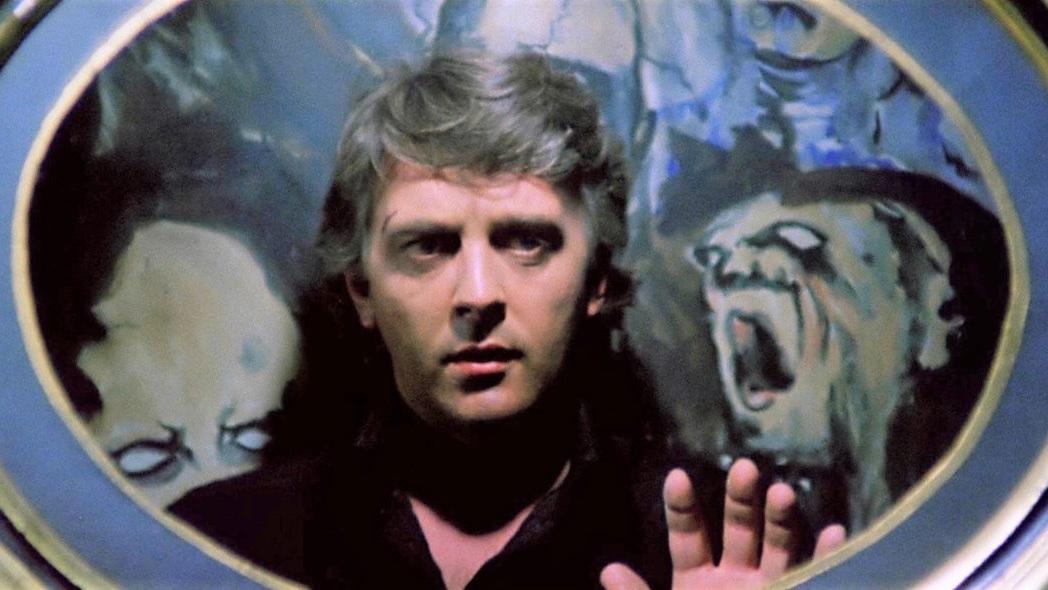
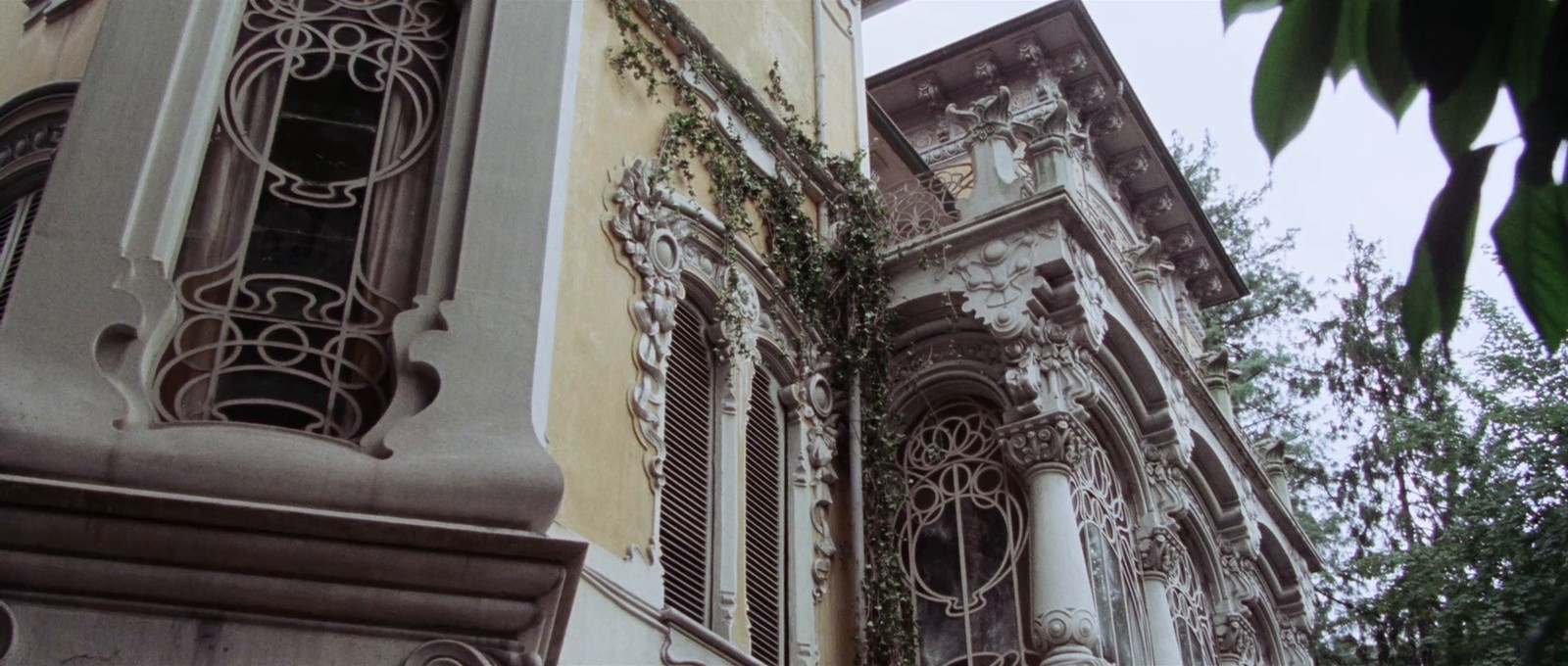
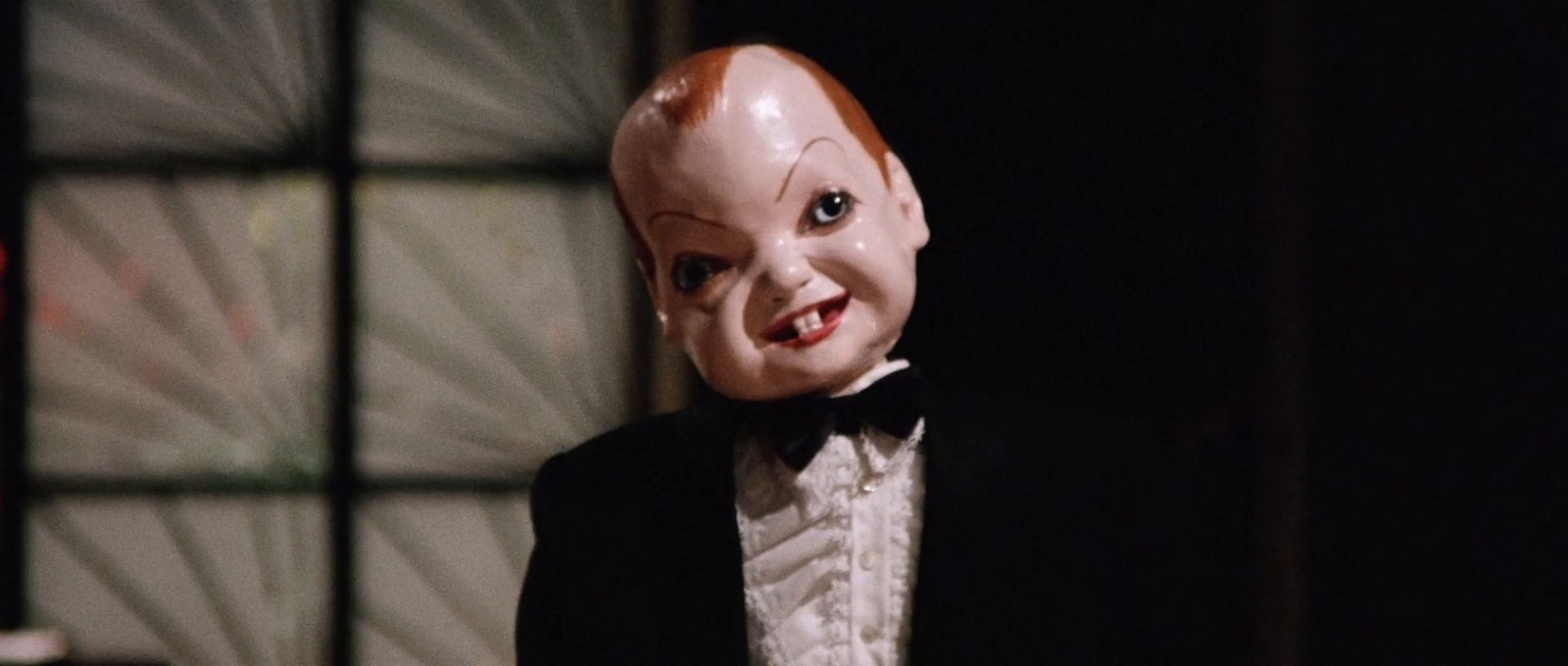
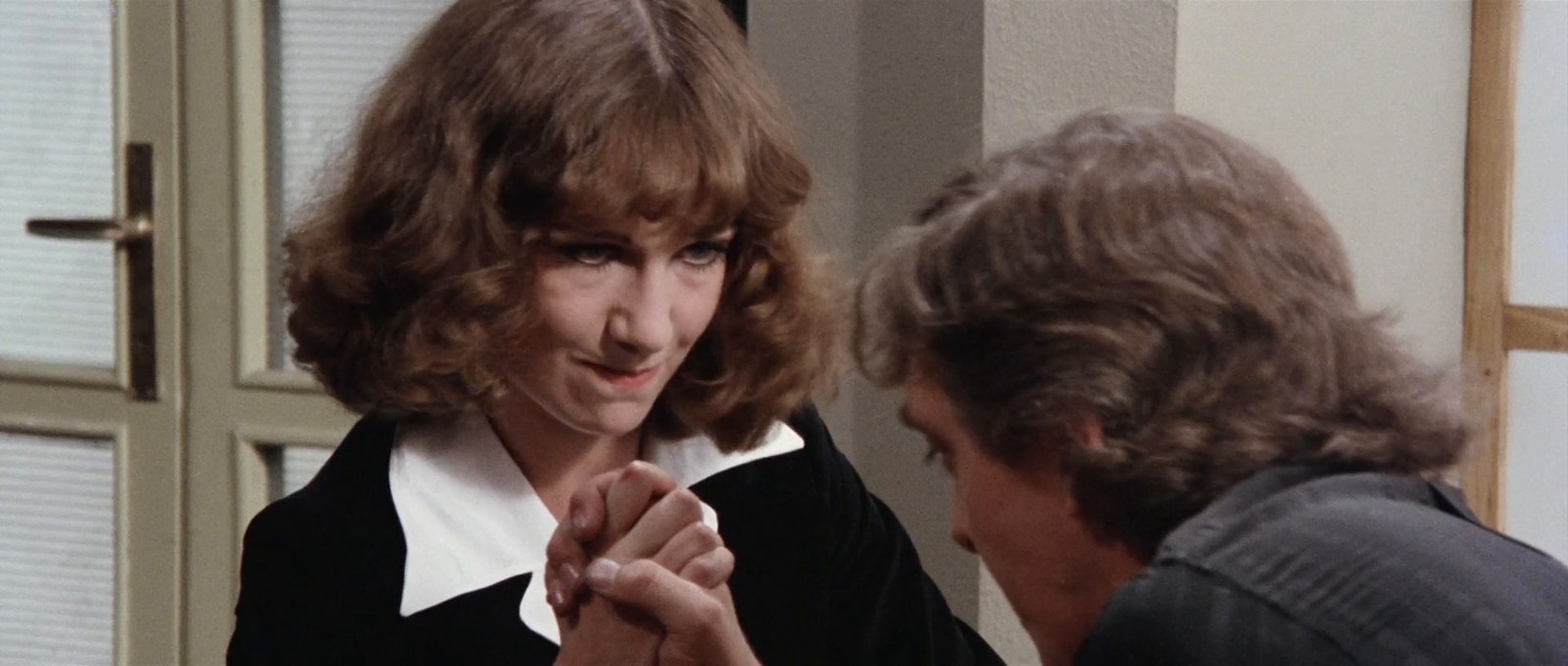
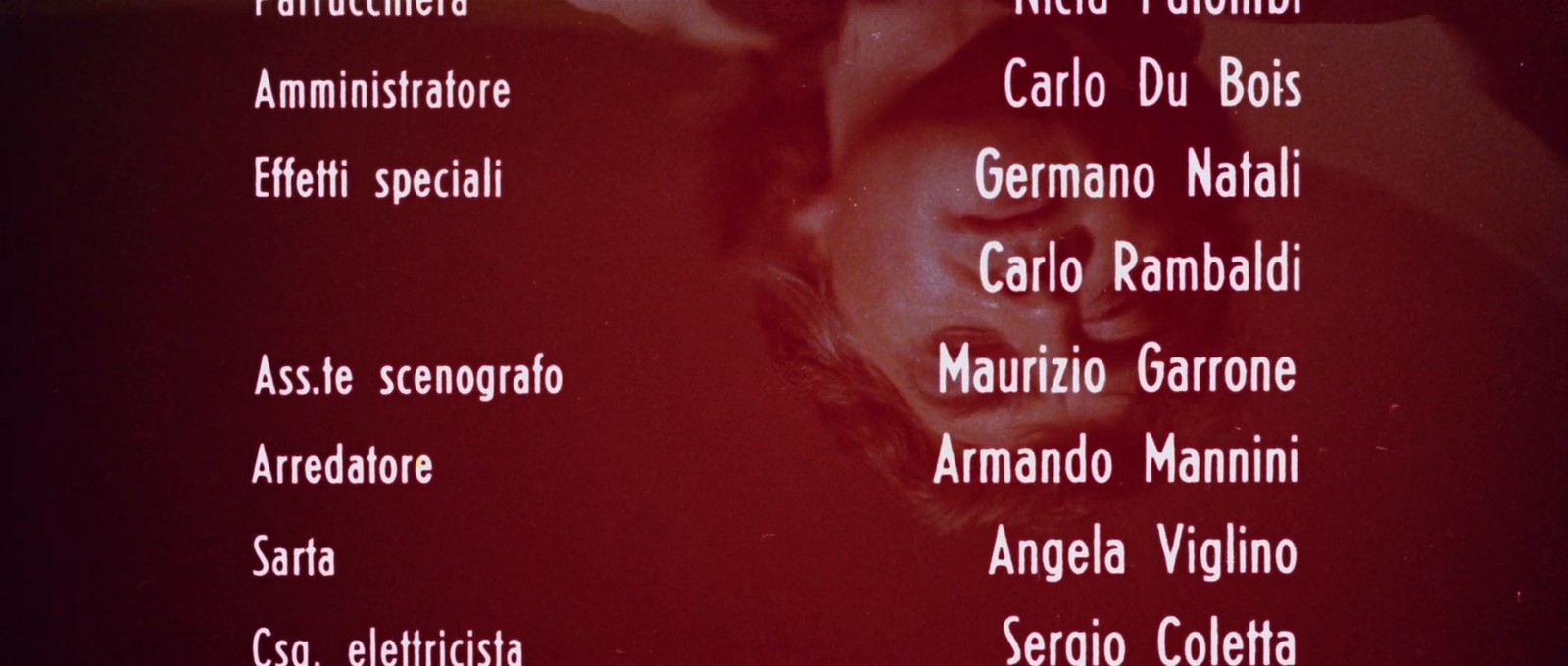
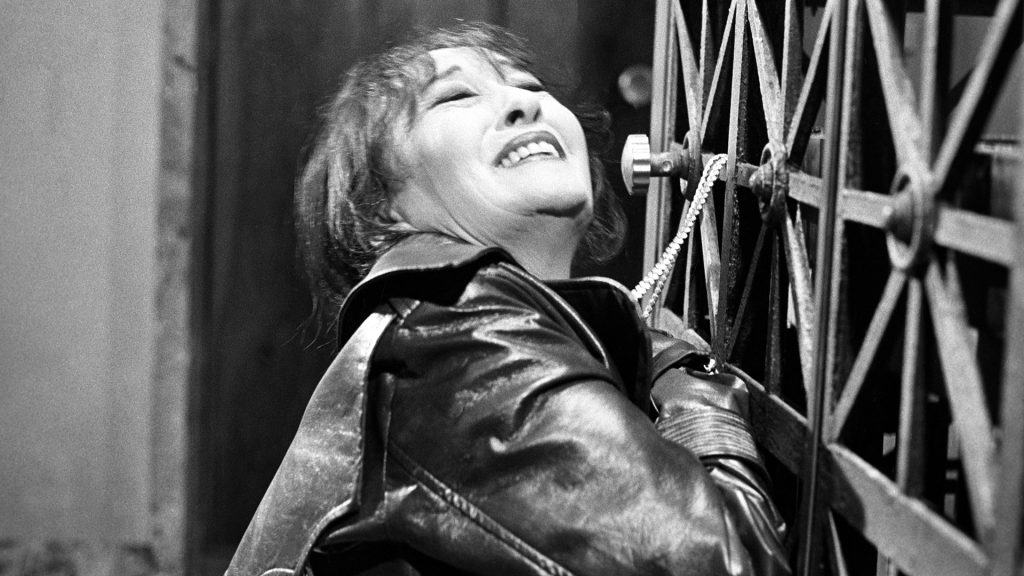
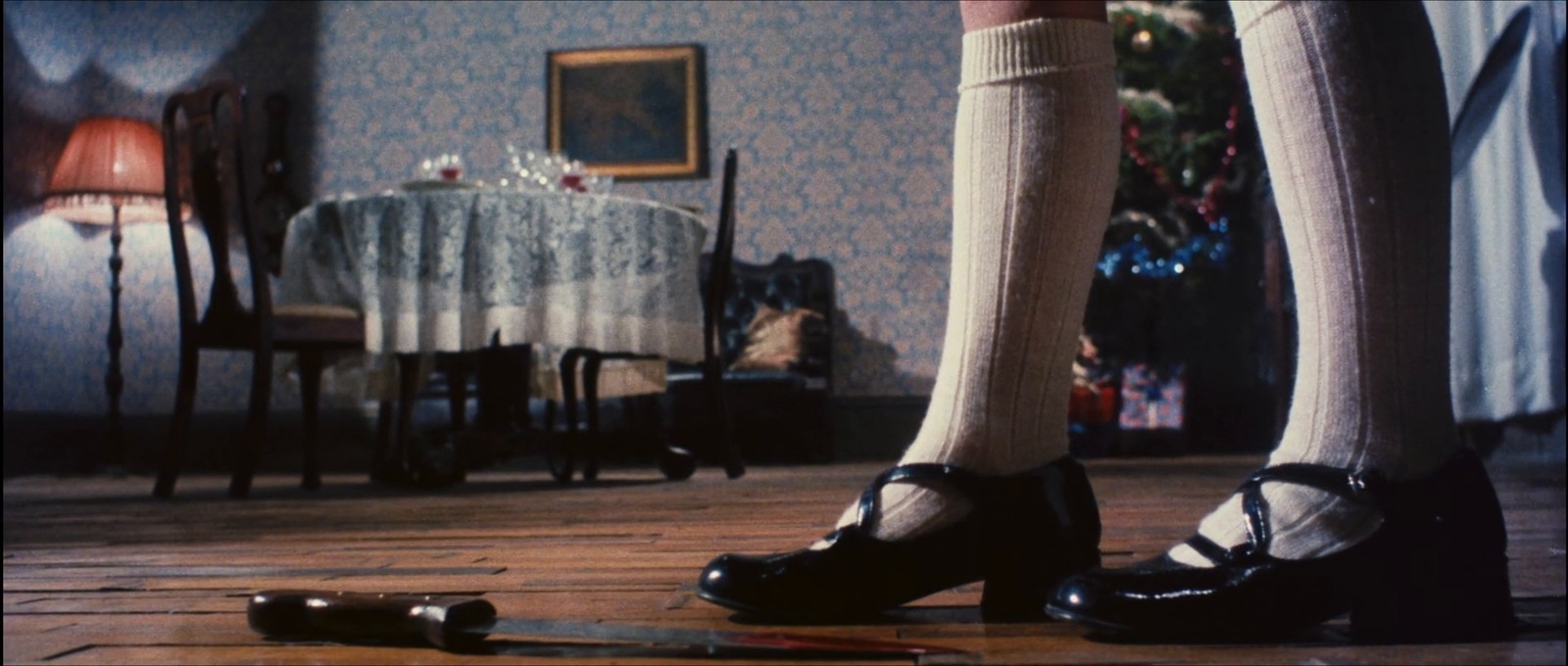 ENLARGE ↗
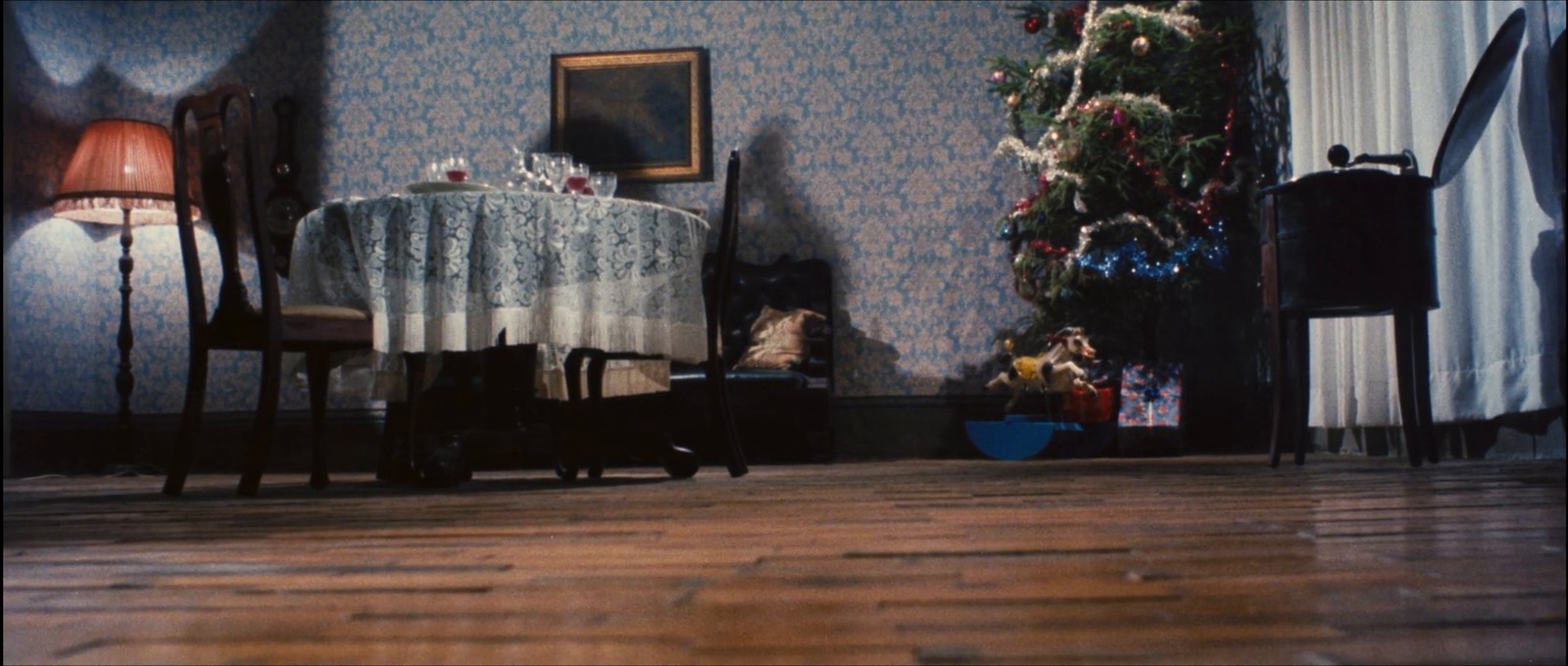 ENLARGE ↗
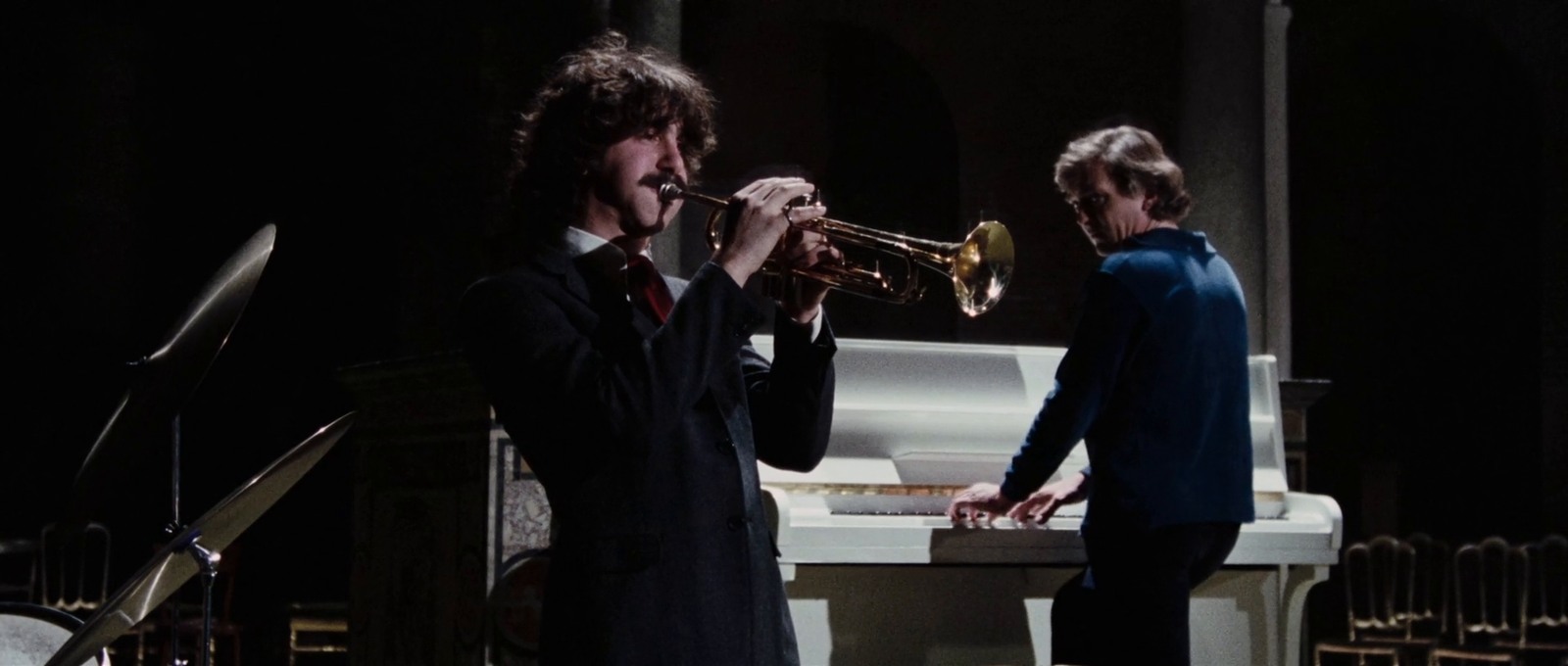 ENLARGE ↗