1977 · DARIO ARGENTOWRITTEN BY ARGENTO / NICOLODISCREEN & DOCUMENT INVESTIGATION · 16 OCTOBER 2026
LOOK CLOSELY
A school promises refinement. Its rooms deliver something much harder to name. Suspiria makes colour, architecture and sound part of the danger—and part of the means by which that danger can be understood.
Follow the making of its world through the screenwriters’ accounts, the performers’ recollections, the camera and laboratory, and the painted surfaces that become clues.
Spoilers: this study discusses the film’s story and ending.
A young American travels to a German ballet academy and discovers that its teachers belong to a coven. That is enough plot to enter Suspiria. The more difficult question is how a school makes obedience feel ordinary before its violence becomes undeniable. Education, hospitality and medical care give authority a reassuring vocabulary. The film turns that vocabulary into a threat. This is the organising interpretation of our dossier; the film’s basic situation is documented in Cannes: synopsis ↗.
The story and screenplay are jointly credited to Dario Argento and Daria Nicolodi. That shared authorship matters: the academy should not be explained solely through a director’s biography. ANICA AG4427: soggetto / sceneggiatura ↗.
In the accessible French Mad Movies profile, Nicolodi says she proposed a film about magic, brought in her grandmother’s account of a piano school near Basel, drew on De Quincey’s Three Mothers and suggested the title. These are her claims about the creative process. The grandmother’s account is a family story, not corroboration of a historical coven. “Souvenirs d’enfance”, final complete paragraph ↗.
De Quincey’s “Levana and Our Ladies of Sorrow” offers personifications of sorrow, not a ballet-school screenplay. His Mater Suspiriorum belongs to an imaginative company with the Ladies of Tears and Darkness. The useful comparison is a transformation of scale: an abstract affliction acquires rooms, routines and people who administer it. “Levana and Our Ladies of Sorrow”: the three sisters ↗.
Those ranges are not three independently examined drafts. None of the dated scripts behind them has been inspected here. The durable insight is therefore spatial and performative: adult bodies can inhabit an environment that makes them seem small, while their arguments retain the disproportionate intensity of a childhood quarrel. The exact ages remain an archival question. A photographed fragment of a script catalogued as 1976 appears in the paper trail.
Source relationship. Giusti’s discussion of the proposed children (p. 159) cites Alan Jones, p. 81, and Fabio Maiello, pp. 111–112. It is not another independent production witness. Those underlying book passages are located but not inspected for this revision. p. 164, notes 22–23 ↗
A daughter remembers two origin stories.
Asia Argento describes Suspiria in Panico as a film about which her parents told different stories. She associates the witchcraft books, magical interests and great-grandmother’s story particularly with Daria Nicolodi’s world. This is family testimony about the film’s origins, adding a perspective to Nicolodi’s own published account rather than independently verifying the ancestral story. Panico: testimony and passage locators ↗
Her recollection keeps the jointly credited screenplay in view. The academy’s supernatural life can be connected to Nicolodi’s imaginative interests without turning the remembered school story into a documented historical event or assigning every invention to one writer.
02 / Bodies, clothing & authority
A dance school that takes possession.
The most revealing contrast is between training a body and taking control of one. In the published rehearsal photograph, a dancer lies on the floor while two standing figures occupy the space above her. In the bedside frame, hands converge on Suzy while her body is horizontal. These are different scenes, yet the arrangement poses the same question: who is permitted to act, and who becomes the object of attention? Our reading starts from the photographs, rather than assigning a motive to a performer from a cast list. See the body study.
Magnolfi describes Olga as a recruiter for Madame Blanc, says her dresses were her own, and remembers both a survival scene and a dance scene that were never filmed Her account connects costume and movement to a character’s social power. It does not establish surviving deleted footage. introduction; answers on character and audition ↗.
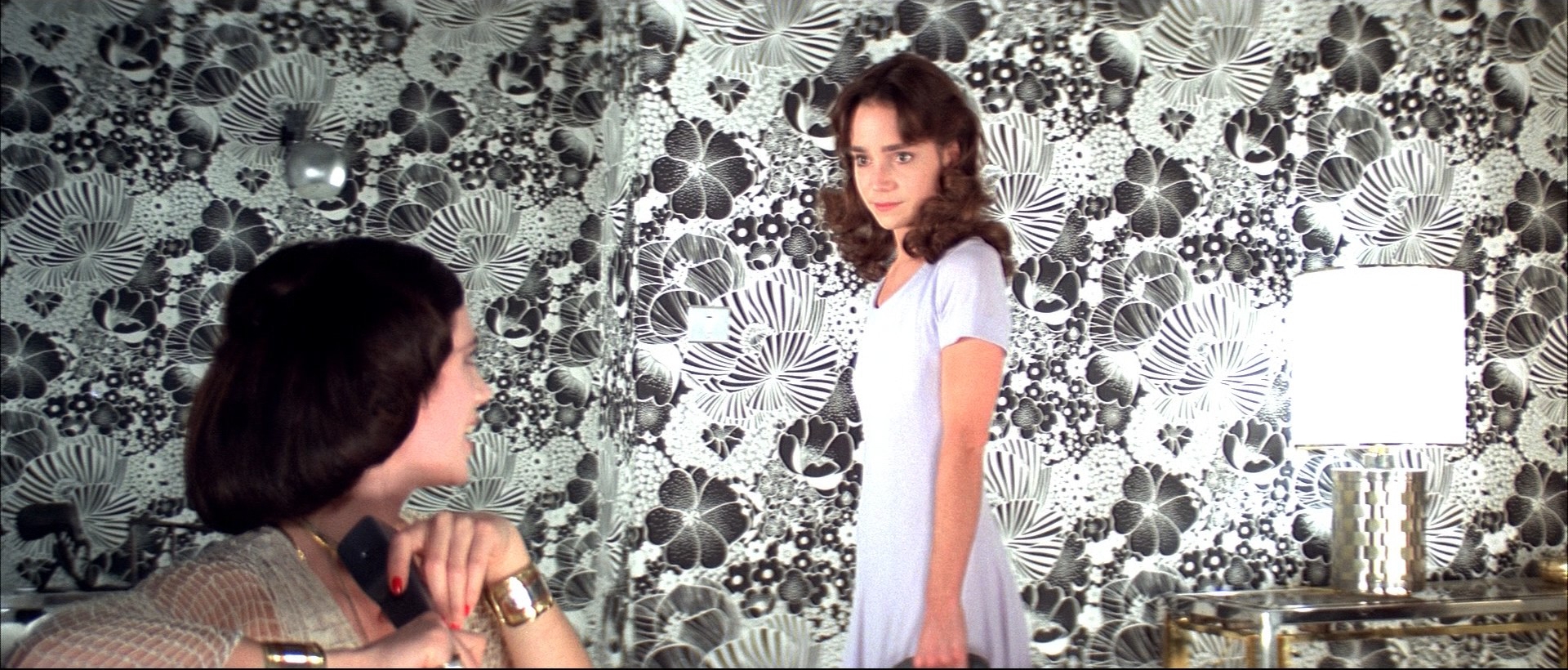
This makes Olga a useful complication within the apparent division between pupils and teachers. In the room study, the standing figure has height, space and an emphatic vertical dress; the seated figure has a smaller territory. Floral pattern surrounds both. The conversation can be read as a negotiation over belonging before the viewer knows what membership might cost. Magnolfi’s account illuminates that reading, but it should not replace the ambiguity of the image with a definitive off-screen biography.
A performer remembers the material
Casini tells Francesca Bruni that the first makeup design was rejected in favour of something closer to her everyday appearance. She recalls the wire-room scene working on the first take: the wire was not barbed, although it pinched her. For Sara’s return at the end, she remembers false eyes that prevented her from seeing, and fear of carrying a real kitchen knife. These are retrospective production recollections, not an authenticated inventory of the props. answer to the Suspiria question, 20 December 2023 ↗.
The distinction between the wire’s fictional danger and its production material is especially valuable. A screen image can depict a body being cut without proving that the photographed wire had cutting barbs. Conversely, a softened prop does not make the performer’s physical discomfort imaginary. Casini’s testimony lets the dossier ask about bodily labour as well as the finished illusion.
Costume credit and garment provenance also answer different questions. Cinematografo credits Pierangelo Cicoletti with costumes and Enrico Fiorentini with furnishings. Magnolfi’s personal wardrobe account concerns one performer; it neither cancels the department credit nor identifies every dress. The dancers named by ANICA are preserved in the people register. No choreography breakdown, costume plot or fitting book has been inspected. Scheda film: costumi / arredamento ↗.
The visible-credit ledger now supplies direct frame anchors for the costume and dancer credits, plus costume assistant Tiziana Mancini, seamstress Bertilla Silvestrin and Sartoria Anna Mode.
ENLARGE ↗Production photograph · ASC gallery, Suspiria-Tovoli001.jpg. The production photograph shows the blocking and work space. American Cinematographer ↗
03 / Rooms, artworks & clues
The ornament is doing something.
The academy’s rooms offer abundant information and little reassurance about how to use it. A door, a flower or a painted stair can be read first as decoration and later as an instruction. Giusti’s architectural study is useful because it treats design as an active part of the narrative, rather than an attractive surface laid over a simple story. His distinctions between curving organic decoration and angular geometry suggest different kinds of authority within the school. pp. 159–162, figures 11–25 ↗.
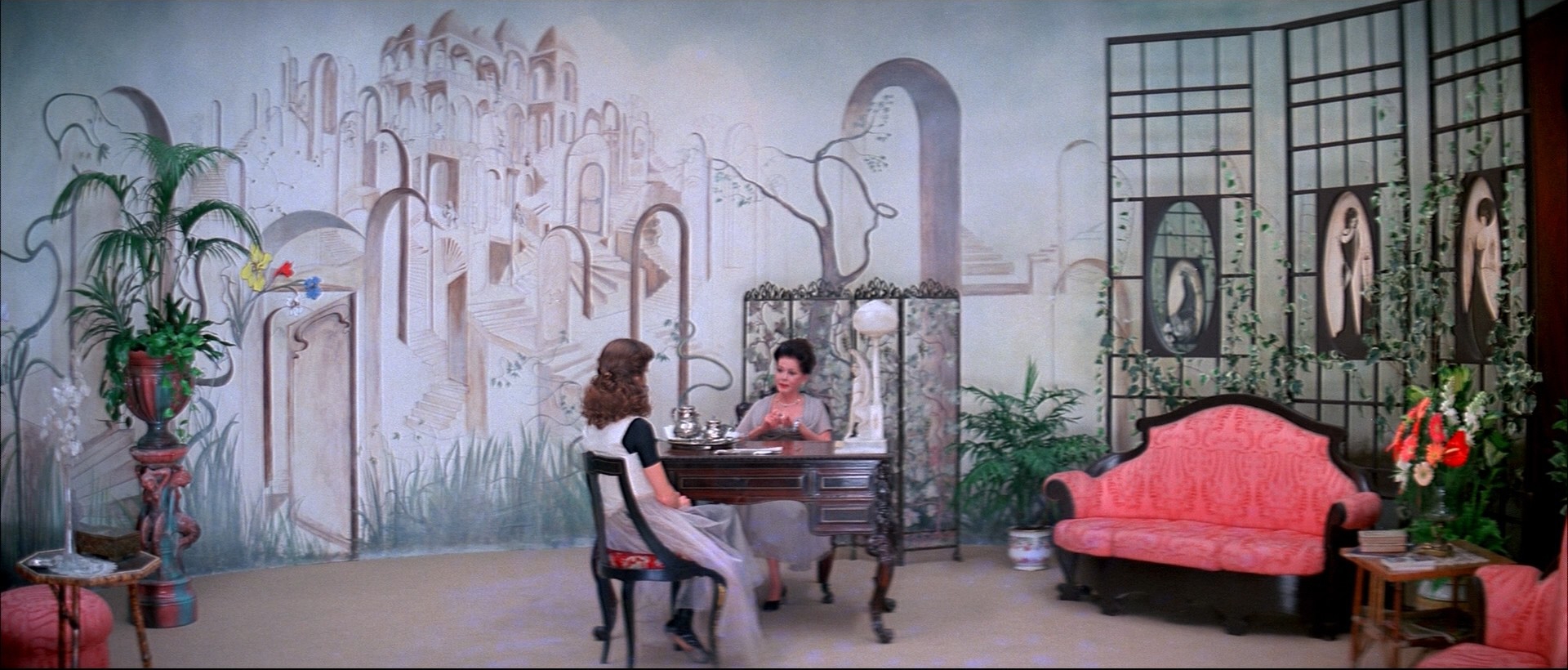
In Madame Blanc’s office, furniture, plants, floral panels and a mural compete within the same field. The wide frame reproduced below shows a recognisable reception room whose background refuses to settle into ordinary architectural depth. In contrast, Giusti’s rehearsal-room comparison stresses straight lines, squares and bodily discipline. These are critical descriptions of relationships visible in the images, not recovered instructions issued to Bassan. pp. 160–161, figures 13–19 ↗.
Escher: an influence is not an object label
Giusti places the office mural beside Relativity (1953), and the bird-and-fish bathroom pattern beside Sky and Water (1938). The reproduced comparisons make the connection inspectable. They also reveal why “an Escher on the wall” is too loose: the academy’s wall is a scenic composition with vegetation and architectural fragments, not simply the rectangular lithograph reproduced at its original scale. The bathroom, in the opening apartment sequence rather than the academy, expands interlocking silhouettes into a room-sized pattern. See the new scene investigation. The distinction between artwork, adaptation and scenic execution is the research subject. pp. 162–163, figures 22–25 ↗.
Our reading is that these two transformations do different jobs. The bathroom pattern makes figure and background exchange places; the office mural makes a wall suggest impossible depth. Both teach the eye that a surface may support more than one organisation. When the iris becomes a mechanism, attentive looking gains a practical consequence. Ornament has not stopped being decoration: it has become usable.
Giusti follows Suzy’s use of Sara’s notes and the teachers’ footsteps to the office, where the raised blue iris opens the concealed entrance. A written record, an audible route and a visual detail cooperate. This is a striking model of investigation inside a film often described as indifferent to reason. Reason does operate here; it works locally, against an institution that controls the larger explanation. p. 162, paragraphs on the labyrinth and iris ↗.
What the images cannot settle. The specific mural painter, wallpaper supplier, iris mechanism builder and glass ornament maker remain unverified. Department credits provide leads; they do not authenticate those individual objects. See the material index.
ENLARGE ↗Film image · ShotDeck 0BSL0DO7, 1920 × 820. Catalogue time 00:56:13 Argentochrome composition study. ShotDeck source record ↗
04 / Story geography & physical places
One academy, several kinds of address.
A film location can mean the place named by the story, a building used as a design reference, a place where a camera stood, or a set assembled elsewhere. These categories overlap only when evidence establishes the connection. A viewer cannot reconstruct Suspiria’s production geography by entering the fictional school’s address into a map.
Place ledger: geography without false precision
Place
What is established here
What remains separate
Freiburg / the Tanzakademie
Story setting; Giusti discusses the fictional Escher Strasse address. p. 162 ↗
A fictional address does not locate a surviving academy.
Haus zum Walfisch, Freiburg
The official local record identifies Franziskanerstraße 5 and late-Gothic architectural features. description and address ↗
Giusti connects its façade with the film (p. 158). That does not identify which exterior shots used the building or a reconstruction.
Königsplatz, Munich
Tovoli identifies the square for Daniel’s night sequence. p. 76 ↗
A camera location does not move the fictional academy to Munich.
Studio-built academy spaces
Published production photographs show the work of constructing and lighting interiors.
The important effect is not a hidden continuity error waiting to be corrected. The film gives the school the authority of an address while allowing its interiors to behave like a changing system of obstacles. The façade promises an institution; the rooms determine what a person can know. Our argument does not depend on every threshold belonging to one physical building.
Checked and unresolved. Local building documentation, Giusti’s façade discussion and Tovoli’s square account were checked. Accounts of revoked bank permission and the precise division between German exterior photography and Rome reconstruction have not been established from production records here. They remain outside the factual location ledger.
05 / Camera, laboratory & practical effects
How a room becomes an image.
“Technicolor” can name a visual reputation while concealing several different technical stages. A coloured lamp affects what reaches the lens; a negative records it; a print or digital master presents a later interpretation of that record. Suspiria rewards keeping those stages separate. Its surfaces were made by coordinated work in front of the camera, behind it and in the laboratory.
Technical ledger: Tovoli’s retrospective testimony, published February 2010
Stage
Bounded production evidence
Locator
Capture
The ASC account identifies 100-ASA Eastman 5254, Mitchell BNC / Arri 2-C cameras and Technovision lenses. The inspected end credit instead names Eastmancolor 5247; stock identification is unresolved. Compare the evidence.
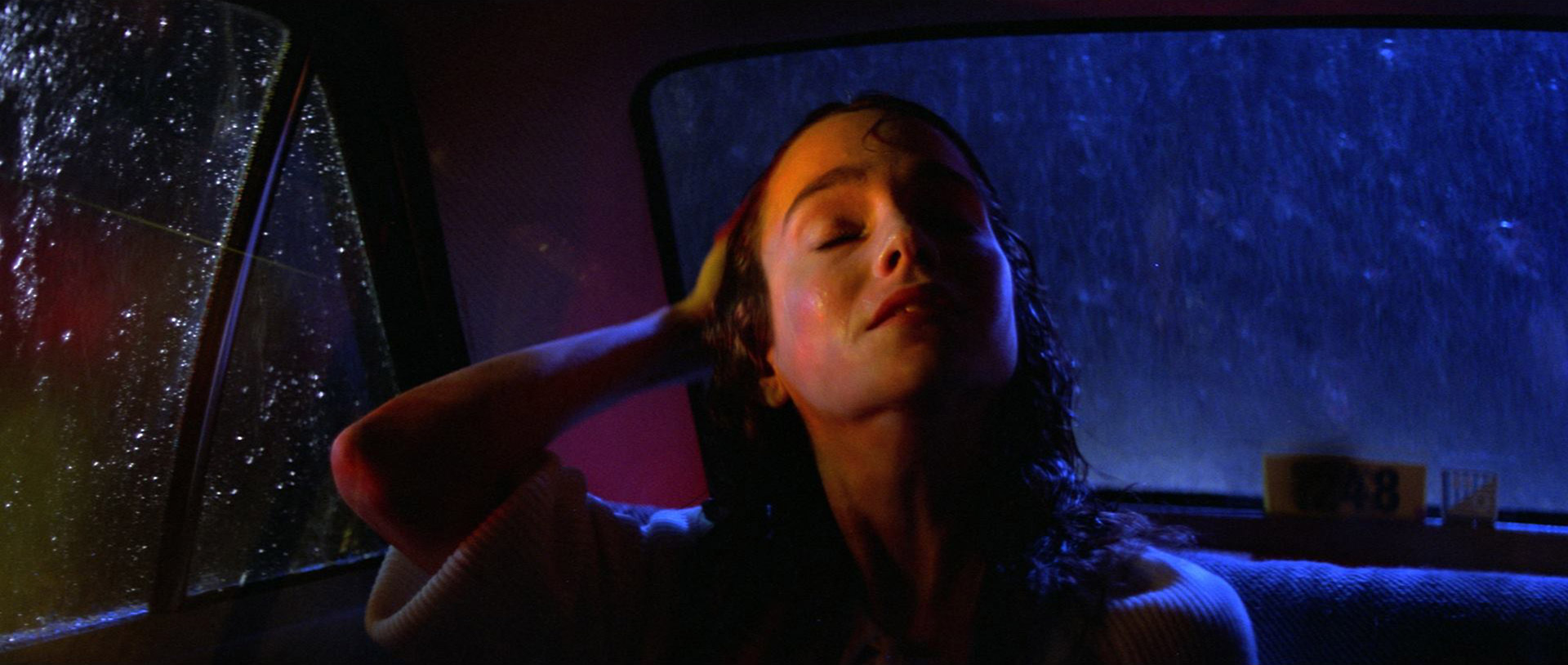
For the taxi, Tovoli’s separate email testimony describes two counter-rotating cylinders outside the car, with coloured openings and fixed Fresnel lamps inside. Heller-Nicholas identifies her 2014 correspondence as the source in endnote 3. It gives moving colour a specific mechanical explanation. taxi passage and endnote 3 ↗.
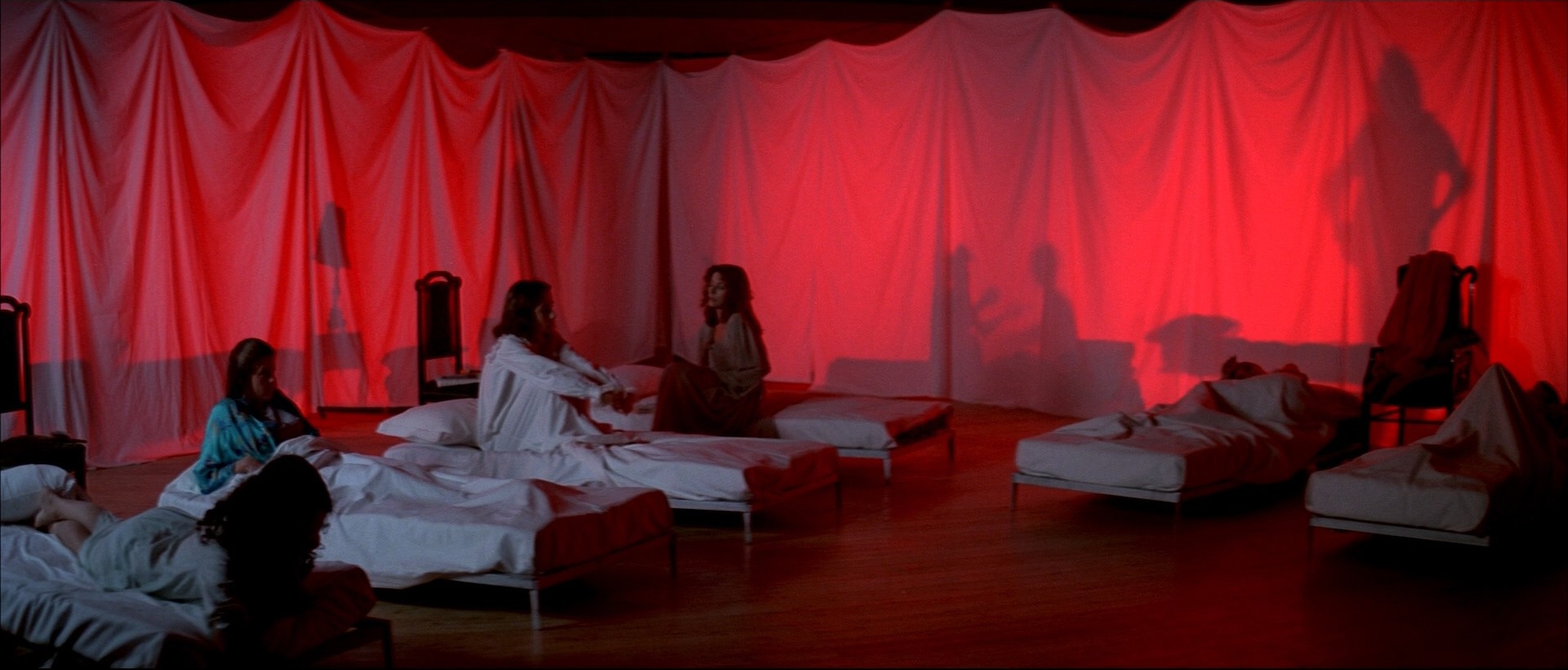
The aesthetic consequence is more interesting than a catalogue of equipment. In the taxi frame, the face and window become surfaces on which change is registered. The passenger travels, but visual stability does not arrive with movement. In the academy, the red sleeping-room partition produces a silhouette without delivering a full body. Practical construction can therefore withhold information as effectively as it produces spectacle.
A correction within the scholarship
Giusti’s p. 155 conflates IB terminology with the camera stock and gives a 30–40 ASA description. The technical ledger preserves the ASC account as attributed testimony. The newly inspected 5247 end credit means its 5254 identification cannot be treated as settled. This does not invalidate Giusti’s visual argument; it prevents a useful critical source from becoming the authority for an incompatible technical claim. p. 155 ↗.
Cinematografo credits Germano Natali with effects. That credit alone does not allocate the heart insert, the dog attack, the wire-room apparatus or each optical trick to him. Casini’s account addresses the material she encountered; Tovoli’s addresses lighting and camera mechanisms. A satisfactory effects history must connect those accounts with effect-specific drawings, photographs or workshop testimony. Scheda film: effetti ↗.
The new credit-roll investigation also distinguishes makeup, hair, scenic assistants, construction, furnishings and suppliers. The names strengthen the production map without assigning an individual effect to a worker by inference.
The dog returns in Dark Glasses
In Occhiali neri: Backstage (04:00–04:30), Sergio Stivaletti explicitly describes the later film’s dog attack as a return to Suspiria and discusses supervising that sequence’s effects. The extra shows a furred dog head and workshop detailing. The dramatic relation is reversed: Daniel’s protector turns against him here, whereas Nerea attacks Diana’s aggressor in Dark Glasses. Stivaletti’s testimony concerns the 2022 production, not work on this film. Explore the workshop evidence → · Follow the attack in stages →
06 / Editing, time & the withheld reverse
A route is also a sequence.
A still can establish that a corridor encloses a figure. Those are crucial distinctions for Suspiria: fear can reside in the delay before a reverse angle as much as in the decorated room. Our frame studies are therefore an analysis of composition, not a substitute for a shot-by-shot viewing.
Franco Fraticelli is credited with editing in both the Cannes and Italian records. In Sparti’s interview, Argento describes extensive rehearsal, little coverage and a precise storyboard and shooting list as reasons the assembly was straightforward. The question proposes fourteen weeks of shooting and ten days of editing; those numbers are the interviewer’s premise, not an inspected schedule. Cobb’s article separately quotes Argento giving sixteen weeks. Credits: editing ↗; question on fourteen weeks / ten days ↗; paragraph beginning “We wanted to recreate” ↗.
This disagreement changes what can responsibly be said about the film’s apparent precision. A planned image does not imply a fully predetermined sequence. Decisions about when to withhold a view, how long to sustain a movement and where to return to a face remain editorial decisions even when coverage is limited. Treating assembly as merely attaching planned scenes would erase the editor’s work without examining it.
With an identified copy, each cut can be logged against movement, colour and sound. A second passage—the return from Sara’s notes to the iris—would test whether discovery is organised differently from pursuit. The new scene log now supplies reproducible navigation anchors from sampled picture inspection. Exact cuts, shot durations and sound bridges still require continuous viewing; navigation windows are not substituted for them.
Fraticelli in print.
There is now a specific route beyond director-centred recollection. Stefano Masi’s Treccani entry cites his conversation with Fraticelli in Nel buio della moviola (1985), pages 151–164; the Istituto Cinematografico dell’Aquila lists the volume among its publications. Masi’s bibliography ↗ · Institutional publication record ↗
It is a targeted next source for testing how the editor describes selection, rhythm and collaboration. It supplies no evidence yet for the disputed schedule or the authorship of a particular cut.
Evidence needed. The Tubi presentation has a recorded runtime, encoding description and sampled log. Its transfer ancestry, full continuous viewing and direct listening remain open. A continuity script or cutting record would distinguish the planned sequence from the released sequence. The bibliographic lead above makes the search for Fraticelli’s testimony more specific; it does not yet resolve it.
07 / Music, voices & acoustic space
The school can be heard before it is understood.
Simonetti distinguishes script-based demos played on set from the score reworked after the images were complete. He recalls three months of work, tabla and bouzouki, and Felice Fugazza’s help with the large Moog. In the same interview, he disputes Maurizio Guarini’s participation in the final recording. That is Simonetti’s position; a session ledger has not resolved it here. The new Goblin workshop study compares additional recollections of the schedule and Argento’s contribution. Twells interview: demos through Moog passages ↗.
His account of Argento’s brief is a particularly useful explanation of the score’s function: the witches should remain a felt presence when they are not visible. Recorded voices and the word “witch” contribute to that effect. paragraph beginning “Argento wanted Goblin’s score” ↗.
The result suggests a different way of reading the building. A sound need not identify a visible person to make a room feel occupied. A whispered word can supply knowledge before the protagonist understands it; a repeated musical phrase can make a space feel governed by something already in motion. Our interpretation is that the spectator’s difficulty is less “Is there a supernatural threat?” than “How does that threat reach this body, here?”
Goblin is not the whole sound department
Cannes names Luciano Anzellotti and Mario Dalimonti under sound; the Italian record uses Dallimonti. The credits establish a department history worth investigating. They do not identify the maker of each footstep, scream or atmospheric layer. Credits: sound ↗; AG4427: sound credit ↗.
There are at least four different objects to study: an early demo, an album recording, the film’s sound mix and a television performance They share music without being interchangeable documents RAI dates its Discoring item to 27 February 1977. The archive page has been inspected; the audiovisual programme has not been analysed here. programme description and original broadcast date ↗.
The edition comparison below preserves the original English 4.0 option separately from later mixes. A future listening study should note the selected track before describing a sound’s position. It should also record whether speech is dubbed, without assuming that an actor’s nationality establishes the language or voice heard in a particular release. Music-session papers, dubbing records and the actual tracks remain the appropriate evidence.
Direct inspection of the Italian roll now extends this department map: see the credit ledger. The scene and sound investigation indexes caption-described cues, including footsteps and the two hidden-sleeper passages.
A classification date, a first screening, a restoration premiere and a disc street date are different events. Keeping them in one undifferentiated “release date” field creates false contradictions.
A circulation timeline with the event type kept intact
“4K restoration” describes the source workflow; this object is a Blu-ray. format specifications ↗
CultFilms CULT802 (2026)
Region-free UHD-HDR / Dolby Vision; 98 minutes; Blu-ray extras disc.
Public retail date 30 March 2026. A separate edition from the older 1080p release. specifications ↗
ACMI holding 311527
English-language VHS access copy; 99 minutes in catalogue.
A holding and access lead, not an online viewing copy. Holding details ↗
The 2026 set also supplies concrete leads for under-documented departments: its extras list interviews with makeup artist Pier Antonio Mecacci, still photographer Franco Bellomo and foley artist Massimo Anzellotti, plus a book by Alan Jones. The foley interview listing does not resolve the separate catalogue credit to Luciano Anzellotti; the names must not be silently combined. bonus-disc features and enclosed book ↗.
Runtime arithmetic alone cannot prove censorship. Playback speed, logos, credit lengths, measurement conventions and genuinely different material can all affect duration. Nor does a restoration make the negative and a historical release print equivalent: they occupy different stages in the image’s history. The unresolved task is a comparison of identified copies, recording both picture and sound before naming a cut, colour change or missing line.
An archive route for colour comparison
FilmColors distinguishes photographs of a faded Eastman print at the Library of Congress from three BFI Technicolor V dye-transfer safety prints Its captions include BFI item numbers C-165399 and C-165400, with photography credited to Olivia Kristina Stutz; the faded-print photographs are credited to Barbara Flueckiger. These descriptions identify physical source material more precisely than an unlabelled online frame. The records have been checked here; the photographs have not yet been compared. gallery introduction and item captions ↗.
The next comparison can therefore name a print, identify the photographic method and distinguish ageing from intended colour design. A photograph of film is itself another reproduction, so even an archive image should not be treated as a neutral colour measurement. This is a research method supported by the identified holdings, not a verdict that one digital master is correct.
09 / Reception, publicity & the archive
From a violent spectacle to an object of study.
Cinematografo reproduces a 1977 Segnalazioni cinematografiche response that attacks the violence and the apparent absence of narrative or psychological development. Its separate 1978 extract, attributed to S.B., likewise treats effects as an impediment to critical engagement. Critica: Segnalazioni vol. 82 (1977); S.B. (1978) ↗.
Giusti’s later argument gives colour and décor precisely the organising force the earlier response finds missing from character psychology. This is not a simple march from critics being wrong to critics being right. It is a change in the object of attention: are images judged by how well they explain a person, or can space and sensation themselves carry the drama? Suspiria makes that disagreement unusually productive. p. 163: conclusion ↗.
Selected photographs of a US pressbook appear in the publicity study The Heritage listing is a mixed pressbook lot, not a page-by-page scan A stronger institutional lead is now available: the Library of Congress finding aid lists Suspiria, 1977 in the Unshredded Nostalgia collection, Series II, box-folder 322/42, p. 459. The collection consists of publicity photographs. Its introduction requires advance notice for research access. The folder has not been examined, and its individual images are not identified here. finding aid, pp. 2–3 and 459 ↗.
This distinction makes an archive lead actionable. Inspection could establish which images were selected to sell the film, what captions accompanied them, and whether production stills were presented as though they were frames. It cannot be replaced by counting modern poster listings. A campaign is a set of choices about what prospective viewers should expect.
Modern artist editions are another kind of evidence. Harper’s 2018 interview discusses fan artwork drawn from the original film; those artworks belong to its reception history. The shop identifies modern prints separately from theatrical paper and a home-video carrier. None is offered as a screen-used prop. discussion of fan artwork ↗.
Cannes’s 2007 restored-print programme and Turin’s 2022–2023 Argento exhibition give institutional markers for this afterlife. They demonstrate programming and collecting interest, not a universal critical consensus or proof that any particular prop survives in a named museum. The next step is item-level documentation. 2007 Classics entry ↗; exhibition dates and contributing collections ↗.
A complete later campaign document is now available: the 2024 reissue pressbook, examined in the paper trail. Its date and purpose are kept separate from the original-release materials still sought.
10 / The paper trail
The film on paper.
The film’s paperwork tells a story that its colour alone cannot. A certificate measures a submitted object; a script records an intention in a particular language; a pressbook teaches a prospective audience how to value what it is about to see. Reading them together means asking what each document was made to do.
Two approvals, two different objects
The December document concerns an avampresentazione, a promotional presentation, with 60 metres declared and verified. It is not an earlier certificate for the complete feature. The January duplicate names SEDA Spettacoli, carries an under-14 prohibition and includes a plot synopsis through the ending. 69625: heading, measurements and date ↗; 69766: measurements, synopsis and restriction ↗.
Readings of the two scanned certificates
Document
Date on certificate
Declared / verified length
69625 · promotional presentation
24 December 1976
60 / 60 metres
69766 · feature
26 January 1977
2,700 / 2,690 metres
The feature’s linked database record reverses those measurement fields. The scan is the evidence for the table above. Neither the discrepancy nor the ten-metre difference establishes a censor’s cut: a cut order or other file document would be needed to explain it. record 47983: feature row ↗.
The supernatural as a classification argument
Italia Taglia’s expanded note says the commission heard Argento and a producer named Bregni request a restriction limited to under-14s. Its majority rationale connected the witches and magic with an unreal subject and imagery, and favoured that age limit. Italia Taglia transcribes the committee’s minutes.
That is a revealing counterpart to the film’s artistic use of unreality. Within the recorded administrative argument, the distance from everyday life becomes a reason for a particular classification. The same distance can be read aesthetically as intensifying the spectator’s uncertainty. These are different judgments made for different purposes. The certificate settles the recorded restriction; it does not settle the film’s emotional effect, nor prove what every print contained.
An English agency script fragment
Royal Books catalogues item 75 as a 1976 SEDA agency draft prepared in Rome for American use, attributing the English translation to Lawrence O’Sullivan. Its illustration shows a title fragment and an annotated passage describing Markos’s death. One typed word is struck through and a replacement is handwritten above it. The photograph establishes an alteration on this copy, without identifying the hand or when it was made. catalogue 57, PDF p. 84, item 75 ↗.
This is a stronger lead than an unattributed dialogue transcript, but the dealer’s date is not a date read from a complete title page. Nor can this fragment resolve the proposed children’s ages or Olga’s unfilmed material. The useful next object is the complete copy: title and translator pages, pagination, revision dates and the relevant scenes. A translation also needs its own place in the script history; it cannot automatically stand for an Italian shooting draft.
What the reissue wants us to see
The six-page Cat People/Videa pressbook identifies itself as 2024 distribution material. Its second page assembles Argento quotations from Fabio Maiello’s 1996 book and Paura (2014); they are not a new interview conducted for this campaign. On page 4, restoration is part of the sales argument: a preferred presentation is contrasted with an unnamed earlier one. PDF pp. 2, 4 and 6 ↗.
The same page gives a 20 ISO stock account that conflicts with Tovoli’s specific description discussed in the camera study. We retain the pressbook as evidence of the reissue’s rhetoric, not as a replacement for that technical testimony. This distinction matters because publicity can preserve valuable voices while introducing a new explanation around them. It also makes the campaign an object of criticism: what is sold is an opportunity to see the film correctly.
Access has improved; inspection remains bounded. Tubi’s complete playback media has now been obtained. Image samples across its full runtime, targeted credit/detail frames and the accompanying captions have been examined in the scene and sound investigation. Continuous audiovisual viewing and direct listening remain incomplete. open the accessible presentation ↗.
Archive enquiries sent · 15 October 2026. Requests have been sent to Italia Taglia, Royal Books and Turin’s Museo Nazionale del Cinema; the Library of Congress confirmed submission of the publicity-folder enquiry. Replies and the requested records remain pending.
11 / Scene guide
The route Sara leaves behind.
The most useful map in Suspiria is made by a student who does not survive to use it. Sara notices a discrepancy between the teachers’ apparent departure and the direction of their movement. Her observation becomes a written route; Suzy later turns that route into action. The academy can be read, but only by keeping fragments that its authorities dismiss or remove.
Picture and English-caption references for the Tubi presentation. Times are approximate navigation points. Sound descriptions in this guide come from the English captions.
Two thresholds, two ways of finding a route
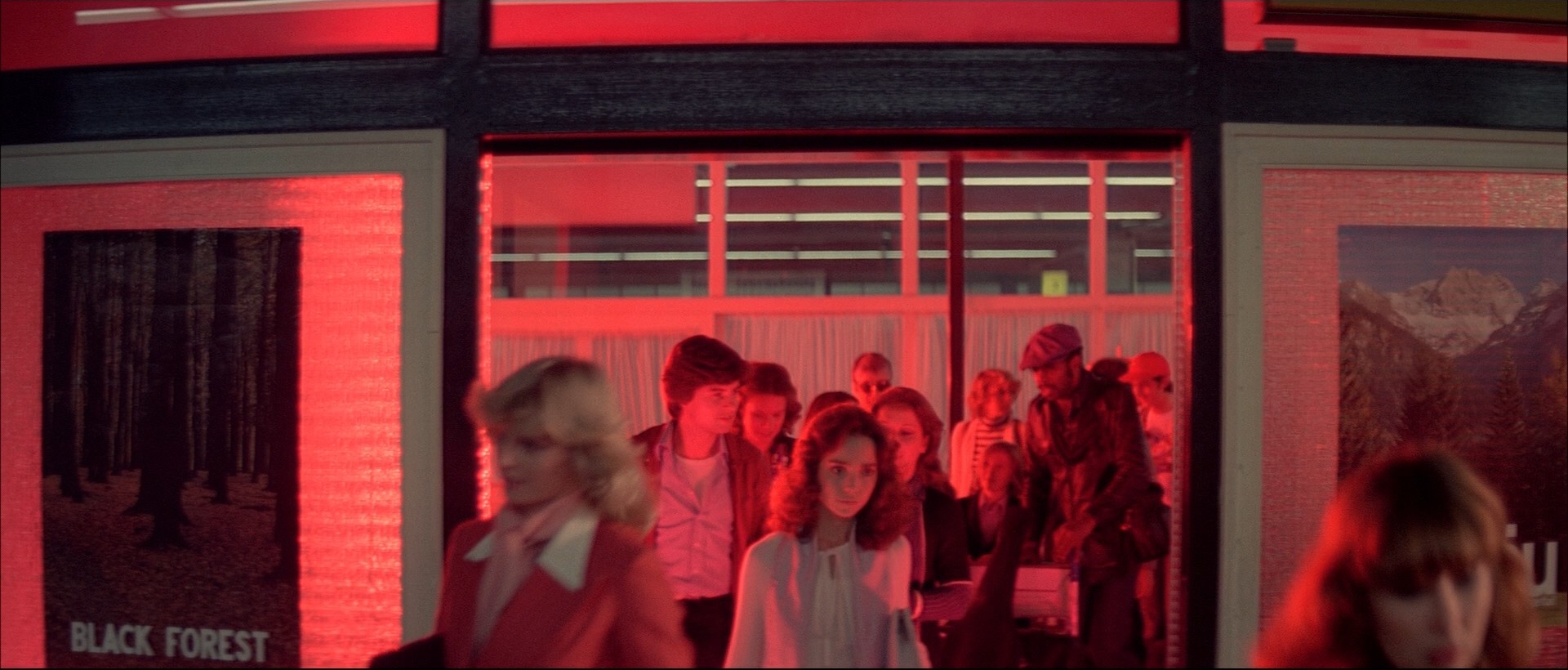
The airport opening gives Suzy a route before it gives her reassurance. The arrival board and the red-lit passenger doorway yield to a cooler terminal. Views of her approach alternate with the glass exit, then with passing taxis. Outside, the white costume and wet paving register sharp changes in illumination. The visual sequence makes an ordinary departure feel uncertain; the direct sound review must still establish how the soundtrack participates in that uncertainty.
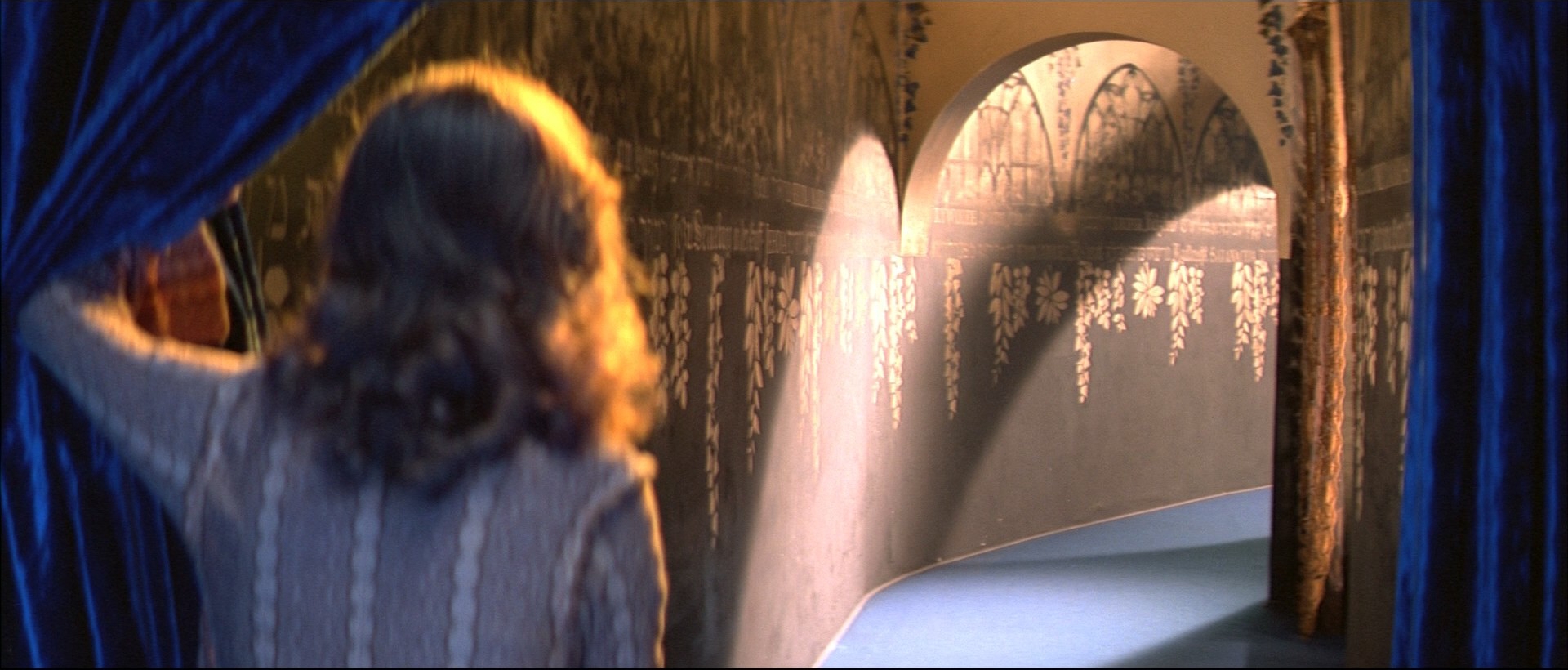
The late discovery reverses the problem. Suzy is already inside the institution but cannot find its exit from the ordinary plan. The mirror isolates the painted flowers before the film returns to Pat’s speaking face and mouth. The caption track repeats the blue-iris instruction; the inspected images then show Suzy’s reach, contact with the flower, the blue-lit wall opening and a further curtain. The revelation comes in stages: recognition, physical action, concealed doorway, then a second barrier and the passage beyond. This is a reading of the sampled picture order and the separately attributed captions.
Detailed check: 122 additional picture samples, at one-second intervals for the airport and two-second intervals for the iris sequence. Times below are approximate navigation windows in TUBI-20261015, not measured cut boundaries. ShotDeck times in image captions belong to a separate presentation and are not interchangeable with this review clock. Picture source ↗ · Caption source ↗
DV-01 · 01:30–01:42 · Airport threshold
Picture. The arrival board gives way to a red-lit passenger doorway flanked by travel posters. Suzy emerges among the travellers.
Captions. Caption cues 8–9 label intercom speech and an announcement.
Picture. A wider terminal view and closer views of Suzy alternate with views toward the exterior doors. The route out is presented before she crosses it.
Captions. Caption silence is not evidence of acoustic silence.
Picture. Outside, Suzy carries two cases across reflective wet paving. Her white clothing alternates between darker and brightly illuminated appearances; she raises an arm toward approaching cars.
Captions. Cue 10 displays a thunder label at 02:16.550–02:19.340. This is caption display time, not measured thunder duration.
Picture. Suzy stands by the office mural. The samples then show rain on exterior architectural details, the entrance inscription and the academy façade before returning to the office.
Captions. The captions do not give a complete account of this interval.
Picture. An oval mirror frames the painted flowers. Successive samples make the flowers larger until the blue flower and neighbouring colours occupy the image.
Captions. This establishes a visual selection, not the sound accompanying it.
Picture. Suzy’s face is followed by Pat at the earlier doorway, then progressively tighter views of Pat’s speaking face and mouth, before returning to Suzy.
Captions. Cue 793 labels thunder at 86:52.540–86:54.620. Cues 794–797 repeat the instruction about the secret and the blue iris in two successive caption pairs.
At the pool, the captioned dialogue describes Pat’s months of observations and their transfer to Sara. Those notes are then reported missing. The small sheet that survives is a different document: Sara says she kept it on her and wrote it the previous night beside Suzy. She holds a folded sheet at 60:25; Suzy unfolds a handwritten sheet at 80:55. The dialogue identifies the surviving directions more securely than the distant handwriting does. English captions 59:26 ↗; English captions 60:17 ↗; TUBI-20261015 60:25 ↗; TUBI-20261015 80:55 ↗.
This distinction changes the role of Sara. She is not simply a messenger handing on Pat’s discovery. She contributes a new observation and records it. Suzy’s eventual success is therefore collaborative even after the collaborator has been killed.
A carpet explains a disappearance
The captioned conversation around 47:27–49:02 turns ordinary footsteps into a spatial problem: the teachers move in the wrong direction for the exit. Later, Suzy’s reasoning identifies carpet as the reason the footsteps cease. The visible office floor and her search supply the material context; the captions supply the verbal explanation. English captions 47:27 ↗; English captions 85:19 ↗.
The useful distinction is between a supernatural threat and a practical method of investigation. Suzy does not need to explain all the academy’s impossible spaces before proceeding. She needs one testable relation between a surface and a sensory clue. The blue iris extends that method: remembered words identify a decorative detail that can be acted upon. The sampled reach and opened passage can be located around 87:10–87:40. TUBI-20261015 87:10 ↗.
The school’s control enters through ordinary arrangements
Suzy initially refuses the offered room. After her collapse, the captioned bedside conversation tells her that her luggage has already been moved and her payment returned. Her prescribed routine includes red wine. Much later she empties the wine into the sink; the coven’s captioned discussion notices that she has not eaten or drunk. The sequence connects residence, treatment and consumption without identifying a drug, chemical formula or dose. English captions 25:18 ↗; English captions 31:11 ↗; TUBI-20261015 78:20 ↗; English captions 90:11 ↗.
This gives the school’s ordinary transactions a role in the horror. Accommodation and care become instruments of dependence. The effect is reinforced by the other exchanges already visible in the narrative: Olga’s rent, the proposed shoe sale and Mark’s explanation of work in return for room and board. These details warrant their own study alongside the spectacular deaths.
Correcting the room before interpreting the pattern
The bird-and-fish bathroom is in the opening apartment sequence, where Pat seeks refuge; it is not an academy bathroom. The office’s impossible-architecture mural belongs to the school. Keeping those spaces separate strengthens the earlier Escher comparison: related visual uncertainty operates both outside and inside the institution. TUBI-20261015 09:00 ↗; TUBI-20261015 37:00 ↗; pp. 162–163, figures 22–25 ↗.
Scene navigation across the presentation
Expand a scene for its sampled image evidence, attributed caption evidence, critical reading and the next continuous-viewing check. The intervals partition the research notebook; they are deliberately not labelled scene starts, shot lengths or complete sound coverage.
SC-01 · 00:00–01:30 · Credits before arrival
Picture. White Italian titles on black; separate writing, design, costume, camera, editing and music cards.
Captions. Opening caption cues identify percussion, then a music-box description; narration places Suzy’s journey in the ballet-school story.
Reading. The collaborative credits are production evidence within this particular presentation.
Listen to the relation between percussion, melody and narration; compare title variants across editions.
Picture. An older woman and child beside a trolley of reflective objects. At 26:50 a bright flare extends from the hand-held object; by 26:52 a long reflective implement is visible. Suzy shields her face.
Captions. The caption file labels music-box music and chanting, then a witch chant at 26:44.760.
Reading. A workaday cleaning tableau becomes a point of bodily interference.
Do not call the object a tray without a closer identification; compare the visible result with Tovoli’s mirror-and-dust account.
Picture. Yellow practice room, luminous patterned panels, Suzy beneath converging floor shadows; she is on the floor at 29:47 and carried along the corridor at 30:00.
Captions. Tanner insists on continued practice; the file marks music stopping at 29:46.360.
Reading. The academy’s training discipline persists as the pupil’s capacity fails.
SC-24 · 57:40–60:00 · Pool conversation and Pat’s notes
Picture. Sara and Suzy at the pool; overhead/underwater views show a strongly geometric floor.
Captions. Sara says she was the intercom speaker. She describes Pat’s months of notes and their transfer to her; soon afterwards the notes are reported missing.
Reading. The investigation has a prior history and a fragile chain of custody.
Do not merge Pat’s missing notes with Sara’s separate surviving route note.
Picture. A door opens; Sara advances with a blade. A bright outline of a seated figure is visible at 94:30, followed by Suzy holding a pointed piece and close views of Markos.
Captions. The voice names Helena Markos and invokes the living dead; laughter, growling and groaning are captioned.
Reading. Visibility becomes a practical opportunity for Suzy’s attack.
Log lightning, outline, strike and collapse continuously; do not infer effect technique or duration from isolated frames.
SC-42 · 97:20–98:27 · Credits over the burning façade
Picture. Italian rolling credits over the burning entrance; later black. Department roles, suppliers, studio, sound facilities and negative-stock label are legible.
Captions. The caption file has no comprehensive account of the final music.
Reading. The credits complicate an auteur-only account and reopen the stock-identification question.
Compare the roll with another authenticated release; credits name responsibilities, not individual prop provenance.
The local notebook indexes 106 captioned events. The selection below identifies the most consequential listening tasks. None is promoted into an independently heard event.
Selected sound descriptions from the English captions
The burning academy does not end the film’s evidence. Over it, the Italian closing roll names the people and firms whose labour made the image possible. Reading those titles directly changes both the contributor map and one of this dossier’s technical claims.
Two records of the camera negative
At 98:16, this presentation prints Negativi EASTMANCOLOR 5247. The 2010 American Cinematographer article identifies Eastman 5254 in its account of Tovoli’s work, including an editorial bracket on p. 72 and the stock description on p. 74. The earlier dossier followed that article too decisively. The new film evidence requires both readings to remain visible. TUBI-20261015 98:16 ↗; pp. 72 and 74 ↗.
A streamed credit roll is evidence of what this copy credits; a retrospective interview article is evidence of the account it publishes. Neither licenses an invented reconciliation. Camera reports, laboratory records or authenticated negative-edge evidence could establish whether a credit error, an editorial error, more than one stock or another explanation accounts for the difference. No one of those possibilities is selected here.
Beyond a single costume or sound credit
The opening names Pierangelo Cicoletti for costumes. The roll adds Tiziana Mancini as costume assistant, Bertilla Silvestrin as seamstress and Sartoria Anna Mode under costumes. Furnishings are distributed across Enrico Fiorentini, assistant Massimo Garrone and a supplier list. These credits make more specific archival questions possible. They do not identify which firm supplied the blue iris, which worker made Olga’s dress, or whether a surviving sale object appeared on screen. TUBI-20261015 01:00 ↗; TUBI-20261015 98:00 ↗; TUBI-20261015 98:08 ↗.
The sound roll distinguishes Mario Dallimonti, microphone operator Corrado Volpicelli, studio sound personnel Federico Savina and Sergio De Santis, and sound-effects credit Luciano Anzellotti. It also names International Recording in Rome. The separate modern supplement listing for Massimo Anzellotti remains a separate lead. The Moog model 55/Monzino lettering identifies a credited instrument and company, not an instrumentalist or a particular cue. TUBI-20261015 97:52 ↗; TUBI-20261015 98:14 ↗; TUBI-20261015 98:16 ↗.
The still-photography credit reads Francesco Bellomo. The later supplement listing uses Franco Bellomo. Both name forms appear in the cited records. Likewise, printed Giuseppe Tinelli is kept alongside Peppino Tinelli in the ASC account. TUBI-20261015 97:48 ↗; supplement listing ↗; p. 72 ↗.
Visible-credit ledger
The table transcribes the selected readable credit frames, with Italian role labels retained. It is a bounded transcription of this presentation, not a claim to have recovered every uncredited worker. Names alone do not establish a biography, a particular object’s provenance or responsibility for each effect.
Selected opening and closing credits read directly from TUBI-20261015
Frame anchor
Printed role
Name / company and qualification
00:05
Presenta
Salvatore Argento
00:10
Un film di / regia di
Dario Argento Director card also visible at 01:25.
00:20
Opening cast billing
Jessica Harper
00:25
Opening cast billing
Stefania Casini
00:35
Opening cast billing
Flavio Bucci
00:40
Opening cast billing
Barbara Magnolfi · Susanna Javicoli · Eva Axen
00:45
Opening cast billing
Alida Valli Only Valli’s card expressly names Tanner; other character assignments are separate evidence.
00:50
Opening cast billing
Joan Bennett
00:52
Direttore della fotografia
Luciano Tovoli A.I.C. appears below his name.
00:55
Scenografia
Giuseppe Bassan
01:00
Costumi
Pierangelo Cicoletti
01:02
Montaggio
Franco Fraticelli
01:05
Direttore di produzione
Lucio Trentini
01:10
Prodotto da
Claudio Argento
01:12
Una produzione
SEDA Spettacoli s.p.a., Roma
01:15
Scritto da
Dario Argento · Daria Nicolodi
01:20
Musica / collaborazione
Goblin · Dario Argento The band is the music credit; Argento follows as collaborator. No individual instrumental allocation appears on this card.
raphael salato Lower-case lettering beside a logo; spelling preserved as displayed.
98:10
Gioielli
Lembo - Caracciolo Hyphenated credit retained without deciding whether it denotes one trading name or separate suppliers.
98:10
Valigie - Borse
Fendi
98:10
Mezzi tecnici
E.C.E. - Roma
98:10
Trasporti internazionali
U.T.I. - Roma
98:10
Trasporti
Romana Trasporti Cinematografici
98:12
Teatro di posa
De Paolis Incir - Roma
98:12
Effetti sonori
Luciano Anzellotti
98:14
Sonorizzazione negli stabilimenti
International Recording - Roma The roll adds collaboration of C.D.; the abbreviation is not expanded here.
98:14
Ufficio stampa
Nino Vendetti
98:14
Edizioni musicali
Bixio C.E.M.S.A. s.p.a.
98:16
Colonna sonora realizzata con
MOOG mod. 55, ditta Monzino A credit for an instrument/company does not identify the player or a particular cue.
98:16
Negativi
Eastmancolor 5247 Conflicts with Eastman 5254 in the 2010 ASC account. No resolution inferred from a streaming transfer.
98:16
Process / format lettering
Technicolor · Technovision
13 / Responses from 1977
What should a nightmare explain?
Contemporary responses make disagreements visible that a later reputation can obscure. The question is not simply whether Suspiria succeeds, but what sort of achievement a critic expects from it—and what else was available on the cinema programme. The original Italian newspaper page added here extends the two English-language reviews already examined in later republication.
Giovanni M. Rossi: what else could an audience choose?
In l’Unità on 16 February 1977, Giovanni M. Rossi places Suspiria inside a survey of Florence’s cinemas. He recognises its visual ingenuity but finds its effect short-lived. His larger objection concerns the programme surrounding it: commercial spectacle dominates while alternative exhibition struggles. He also reports enthusiasm among young viewers, without supplying attendance figures. Original scan: printed p. 13, PDF page 18 ↗
Read in that context, his response is about access and choice as well as taste. This adds a different question to Meek’s narrative tension and Jameson’s Gothic analogy: what place does the film occupy in the cinema-going experience available to a particular city?
Scott Meek: the script interrupts the display
In the October 1977 Monthly Film Bulletin review republished by the BFI, Scott Meek recognises technical assurance but finds a conflict between narrative obligation and spectacular set pieces. He hears the score as overpowering and considers the explanatory pause an interruption. His complaint is not simply that the film lacks a conventional story: he thinks its residual commitment to one inhibits its visual momentum. BFI republication: Suspiria, section 9 ↗
Richard T. Jameson: explanation can arrive later
Writing in Movietone News 56 in November 1977, Richard T. Jameson finds a productive analogy in Gothic fiction: an unsettling effect can precede, and exceed, its explanation. His account treats spatial disorientation and forceful colour as reasons to accept the film’s irrationality. The accessible text is the review’s 2011 Parallax View reprint. Jameson: Gothic analogy and colour ↗
The comparison changes our research question. Instead of asking only whether a scene supplies information efficiently, we can ask what kind of attention it solicits while information is withheld. Does a passage invite prediction, immersion, suspicion or the search for an explanation after the event? Those possibilities need not exclude one another. A close study can describe their changing balance without settling the value judgment in advance.
A review is evidence of a response
Jameson guesses that Twentieth Century Fox may have added the opening narration. He supplies no production evidence for that conjecture. It belongs to his account of encountering the film, and must not become a factual statement about who commissioned or recorded the voice. Resolving that question requires version comparison and documentary evidence. Opening paragraph: explicitly speculative attribution ↗
This distinction is useful beyond one sentence. A period critic can preserve something difficult to reconstruct later: the expectations brought to a first encounter. That makes the review valuable even where its interpretation is debatable. It does not make every description a reliable credit, technical specification or report from the production.
Scope of this study. One original Italian newspaper column and two English-language review republications provide situated responses, not an international consensus. Original pages for Meek and Jameson, further territories and the versions encountered remain open. The new newspaper work adds no continuous audiovisual viewing or direct listening.
14 / Publicity on paper
A nightmare, ready for the newspaper.
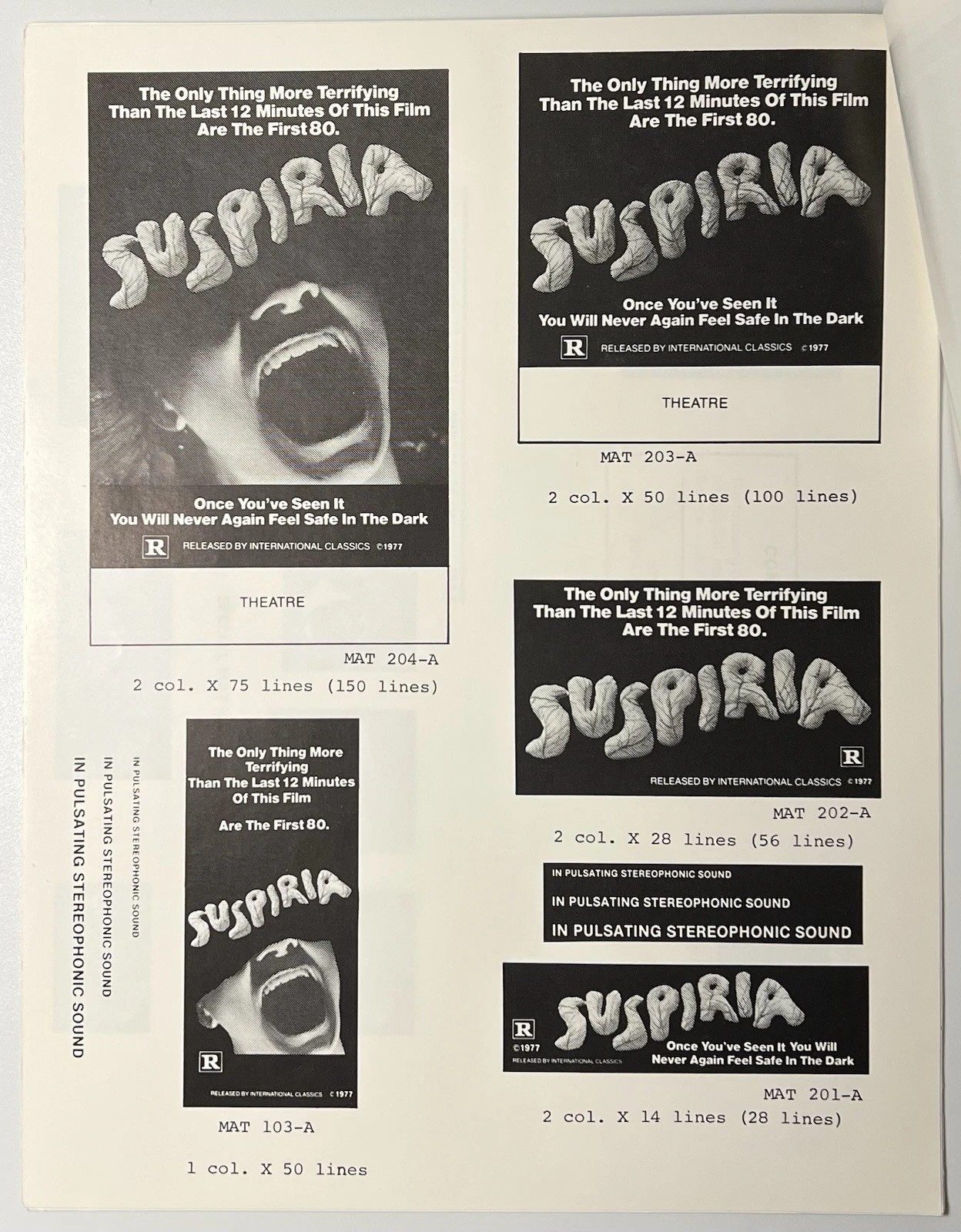
A pressbook addresses a different reader from a film review. It gives exhibitors material with which to present a film to the public. Four seller photographs now let us inspect selected pages of an object advertised as the original US Suspiria pressbook. The visible printing names International Classics and carries a 1977 copyright mark. The reproduced pressbook pages show the American campaign. Object and access record ↗
ENLARGE ↗Seller’s photograph · advertising-layout page. Printed mat identifiers supply the locators; page number not established.Photograph source ↗
The image can shrink; the promise persists.
The layouts vary by column width and line count. Some retain the screaming face; smaller variants concentrate on the title and a threat of terror. Blank theatre spaces allow local information to be added. Sound is separately promoted with the phrase “IN PULSATING STEREOPHONIC SOUND”. Photographs 1–2: cover and layouts ↗
A supplied design and a published advertisement answer different questions. The photographs show material available for circulation; dated newspaper pages show what was actually printed. The Italian listings examined below begin the second inquiry, without establishing use of these US designs. Read them beside the period responses: publicity sets expectations, while a review records an encounter.
From a supplied design to a dated cinema listing.
The Italian newspaper record now gives this investigation specific places and dates. On 6 February 1977, l’Unità lists Suspiria at the King and Metropolitan in Rome, the Principe in Florence and the Alcyone in Naples. These are advertised engagements, not verified performances or a complete release map. Three local editions: printed p. 9; PDF pages 9, 14 and 16 ↗
By 25 February, the Principe’s entry promotes the “magia del suono stereofonico”—the magic of stereophonic sound. It also describes the engagement as a world preview, although the same cinema advertised the film nineteen days earlier. That wording belongs to the sales pitch; it cannot date a premiere. Principe: printed p. 13, PDF page 18 ↗
Alongside the photographed US pressbook, this gives us two documented settings in which stereo was used to attract an audience. It does not show that the Italian wording derived from the US material, or establish the equipment and mix heard in either territory. The next comparison needs an identified print and cinema records. Promotion tells us what exhibitors promised; it cannot supply the missing listening evidence.
A shortened credit changes the visible collaboration.
The photographed credits panel gives writing and direction to Dario Argento alone. Daria Nicolodi is absent from that panel. The film credit already read for our collaborators study names both writers. Photograph 3: lower-left credits ↗
A publicity credit and an on-screen credit serve different purposes and can carry different information. Those questions require the complete item and distribution records. It does establish why an authorship history should consult more than one surviving surface.
What remains open. Authenticate and inspect the full US pressbook; locate dated uses of its designs; compare territorial campaigns, print formats and cinema installations. The Italian listings close a narrow documentary gap, not the whole campaign history. The still-caption page was inspected previously, but no complete transcription or rights clearance for the pressbook is claimed.
15 / Goblin in the workshop
Before the finished image.
A score’s production history has several clocks: first ideas, demonstrations, recording, revisions and the final relationship to the film. New readings of interviews with Fabio Pignatelli and Massimo Morante enlarge the account already supplied by Claudio Simonetti. They also leave differences that should remain visible. These are retrospective statements, not newly recovered production records.
The screenplay starts a process; it does not date its completion.
Pignatelli remembers beginning from the screenplay about a year before filming, submitting demos and then waiting through a long silence before Argento returned to the band. Pignatelli: Suspiria answer ↗ In John Twells’s 2014 FACT interview, Simonetti also describes demos made from the script, but says they were replaced after the finished film revealed a different mood. Simonetti: demos and revision ↗
These statements make the early music a distinct research object. A demo can influence the atmosphere on set without surviving unchanged in the release. Establishing that relationship requires dated recordings and identifiable passages. Agreement about a general sequence does not tell us which surviving track belongs to which phase.
Inside the recording workshop.
Morante describes a specially tuned bouzouki recorded for its natural resonance, handmade effects and a 16-track Studer. He recalls approximately six months composing and recording at Trafalgar. FACT’s account gives three months for the band’s work. Morante: instruments and sessions ↗FACT: duration ↗
The discrepancy is useful because it identifies a testable question. We cannot assume that one number includes preparation and the other excludes it; neither interview supplies a securely matching calendar. Studio bookings, tape boxes, session sheets and dated correspondence could distinguish elapsed development from days actually recording. Until then, the durations remain attributed estimates.
Collaboration has more than one meaning.
Morante objects to Argento’s collaboration credit and says the director supplied neither musical work nor references. Simonetti describes Argento offering suggestions and playing records, while distinguishing that participation from being a musician. Morante: credit dispute ↗Simonetti: participation in the studio ↗ These recollections disagree about a concrete activity; they should not be blended into a unanimous band account.
The inspected film credits establish what the released work names. They do not, by themselves, measure the labour behind the wording. A production history must distinguish proposing a dramatic effect, selecting a reference, composing, performing and negotiating a credit. Asking which act each witness means is more informative than deciding authorship from the billing alone.
The next evidence. Locate dated demos, recording documentation and credit agreements; establish the interviews’ dates and compare additional participants. This advance concerns testimony and its conflicts. It adds no continuous audiovisual viewing or direct listening, which remain core Published work.
16 / Colour and its evidence
The room is already an event.
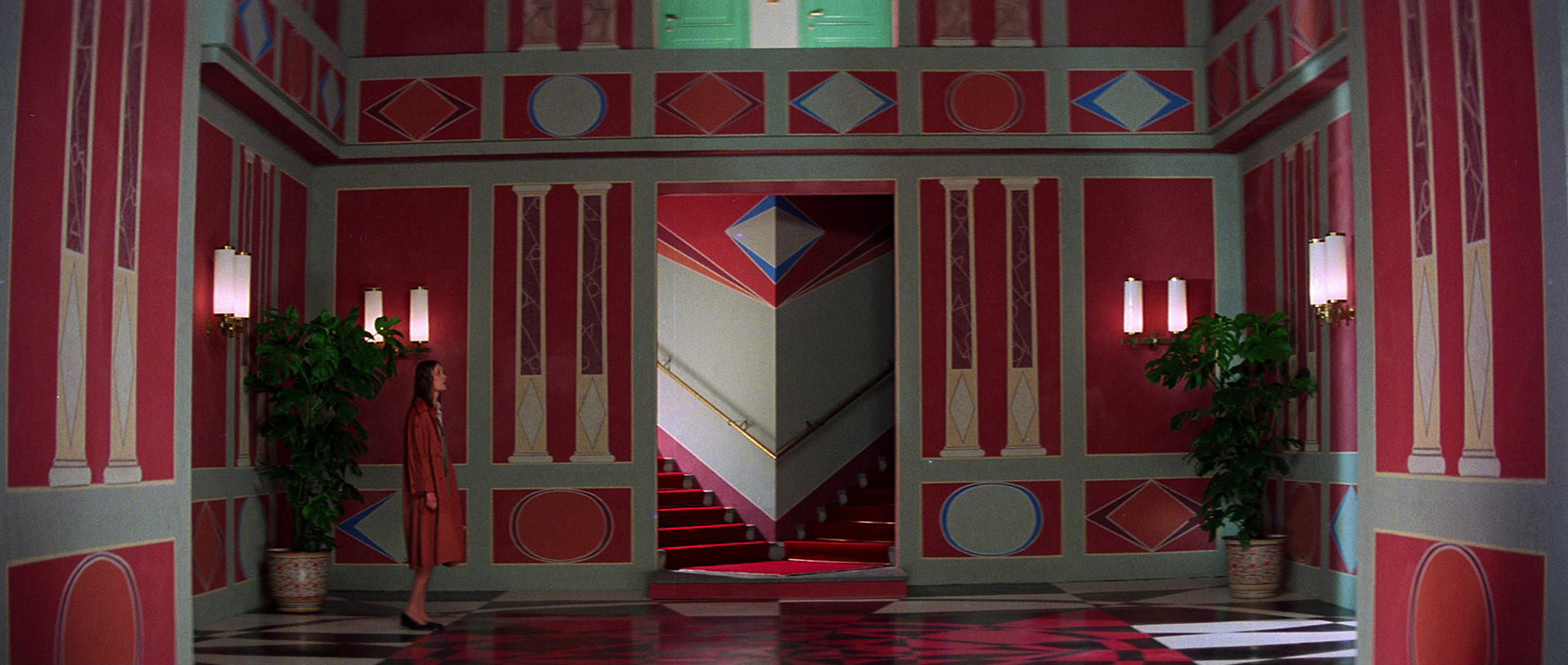
The red interior in the opening image offers more than a richly decorated background. Pale vertical strips divide the walls into narrow intervals; circles and diamonds interrupt that repetition. In the centre, the staircase directs the eye inward while the diagonal bands pull it across the opening. The red coat echoes the surrounding surfaces, allowing a human figure to belong to the room’s pattern without disappearing into it. This reading concerns the visible arrangement in one published image, not the duration or movement of the shot. Inspected image and provenance ↗
The newly supplied reproduction makes those relationships easier to examine. It also prompts a correction: the earlier header’s description of an “academy entrance” was too specific for its documented source. We now describe the visible red geometric interior. A building’s identity, its place in the story and its actual filming site are three separate claims.
Artifice can be an intention.
In Valentina D’Amico’s 2018 interview, Tovoli describes wanting the blood to look artificial and painterly. He also connects Suspiria’s colour thinking with his discussions with Antonioni. Tovoli on colour ↗ These recollections support a production question more precise than “is the colour realistic?” Which elements were meant to announce their construction, and how did paint, lighting, makeup, exposure and printing cooperate to produce that result?
The answer cannot be read directly from a modern file’s saturation. What appears red on a display is the end of a chain that includes the photographed materials, the original laboratory work and the later transfer. The existing camera study and credit investigation preserve evidence about that chain without treating every stage as settled. Comparative viewing should begin with identified editions and matched moments; otherwise a difference in reproduction can be mistaken for a decision made on set.
Tovoli on joining the film.
Tovoli also recalls Dario Argento securing his appointment over Salvatore Argento’s objections. Tovoli on being hired ↗ That account gives the personnel history a concrete question. Correspondence, contracts and preparation records could establish when the choice was made and which discussions preceded it. The interview alone does not supply a chronology of those exchanges.
The same restraint applies to an image library. Its tags are useful for finding candidate frames, but a catalogue entry is not a camera report. We retain ShotDeck’s image identifier and its platform time separately from our own observations. Neither a stock label nor a location tag resolves the conflicting evidence already recorded elsewhere in this dossier.
The next evidence. Identify the image’s source master; match the composition to an identified viewing copy; pursue preparation and laboratory records. Continue the full audiovisual viewing and direct sound log. This chapter adds a visual reading, participant testimony and a corrected image description; it does not close those core Published gaps.
VISUAL STUDIES
Look at the construction.
Frames and production photographs are different kinds of evidence.
These are composition studies of published images. Caption times identify ShotDeck catalogue entries; shot durations and mastering comparisons are not implied. Open a frame for the larger source image; the caption remains attached.
ENLARGE ↗Film image · ShotDeck 6DYFZGNA, 1920 × 820. Catalogue time 00:01:37 Argentochrome composition study. ShotDeck source record ↗
COMPOSITION 01
The airport threshold
Automatic doors and an aggressively coloured exit turn a functional public space into a boundary. In this frame, colour makes the outside feel less like a destination than another set of rules. Notice the broad entrance geometry before the film begins to favour more elaborate enclosures.
ENLARGE ↗Film image · ShotDeck ABPQFJPS, 1920 × 814. Catalogue time 00:03:39 Argentochrome composition study. ShotDeck source record ↗
COMPOSITION 02
The cab as a moving chamber
The window encloses Suzy’s face as a surface for shifting illumination. Her travelling body is visually held in place. The taxi mechanism is discussed in the camera study; this single image cannot show its temporal cycle.
ENLARGE ↗Film image · ShotDeck 90EI9QE3, 1920 × 814. Catalogue time 00:05:18 Argentochrome composition study. ShotDeck source record ↗
COMPOSITION 03
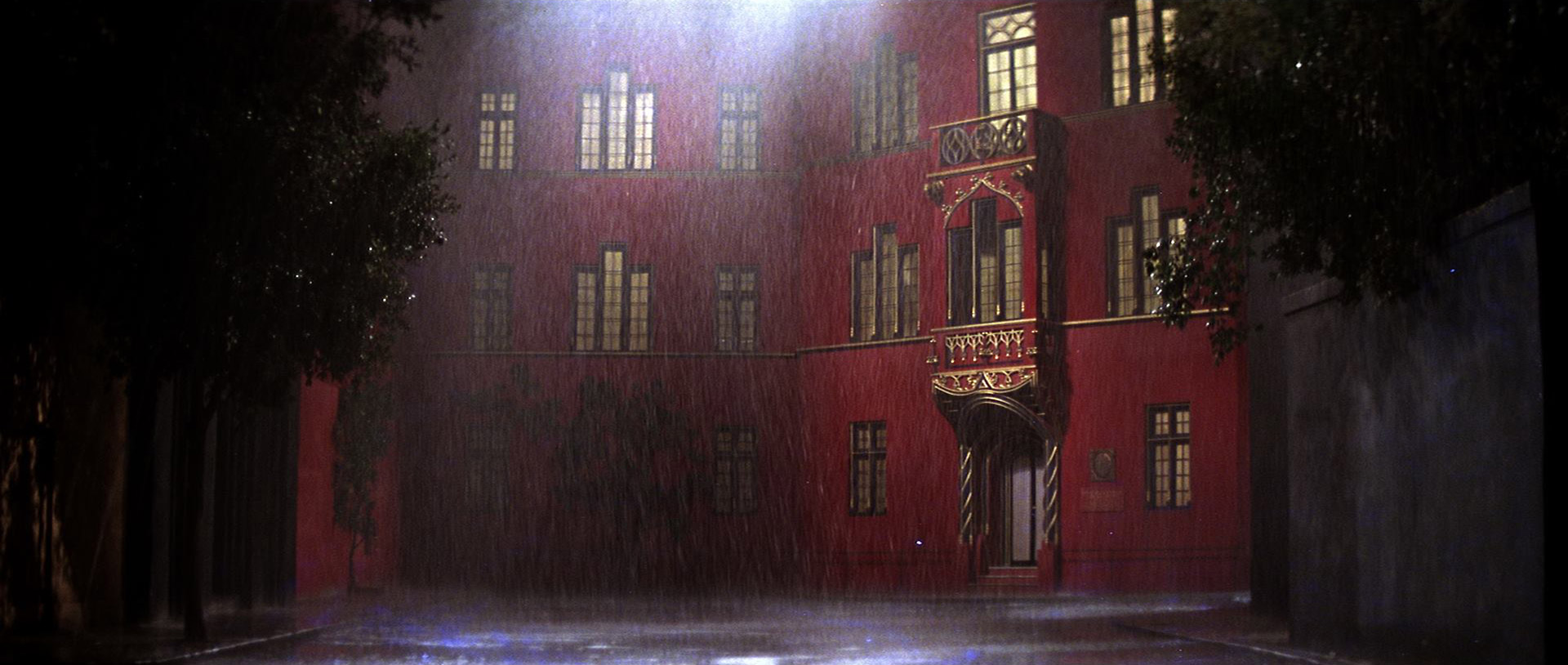
An exterior that announces a world
The façade is already a theatrical image before anyone enters. Its scale and decorative articulation make the figure at the doorway a small participant in a much larger design. The exterior’s visual promise should not be confused with a measured plan of the interiors.
ENLARGE ↗Film image · ShotDeck 1W0YIX2J, 1920 × 820. Catalogue time 00:22:52 Argentochrome composition study. ShotDeck source record ↗
COMPOSITION 04
Olga’s room
The dense floral background gives conversation an almost ornamental setting. Figures occupy different positions within a patterned field rather than a neutral domestic room. A study of performance can ask how posture, dress and spacing establish social power before treating the wallpaper as background.
ENLARGE ↗Film image · ShotDeck IA99D66I, 1920 × 820. Catalogue time 00:44:30 Argentochrome composition study. ShotDeck source record ↗
COMPOSITION 05
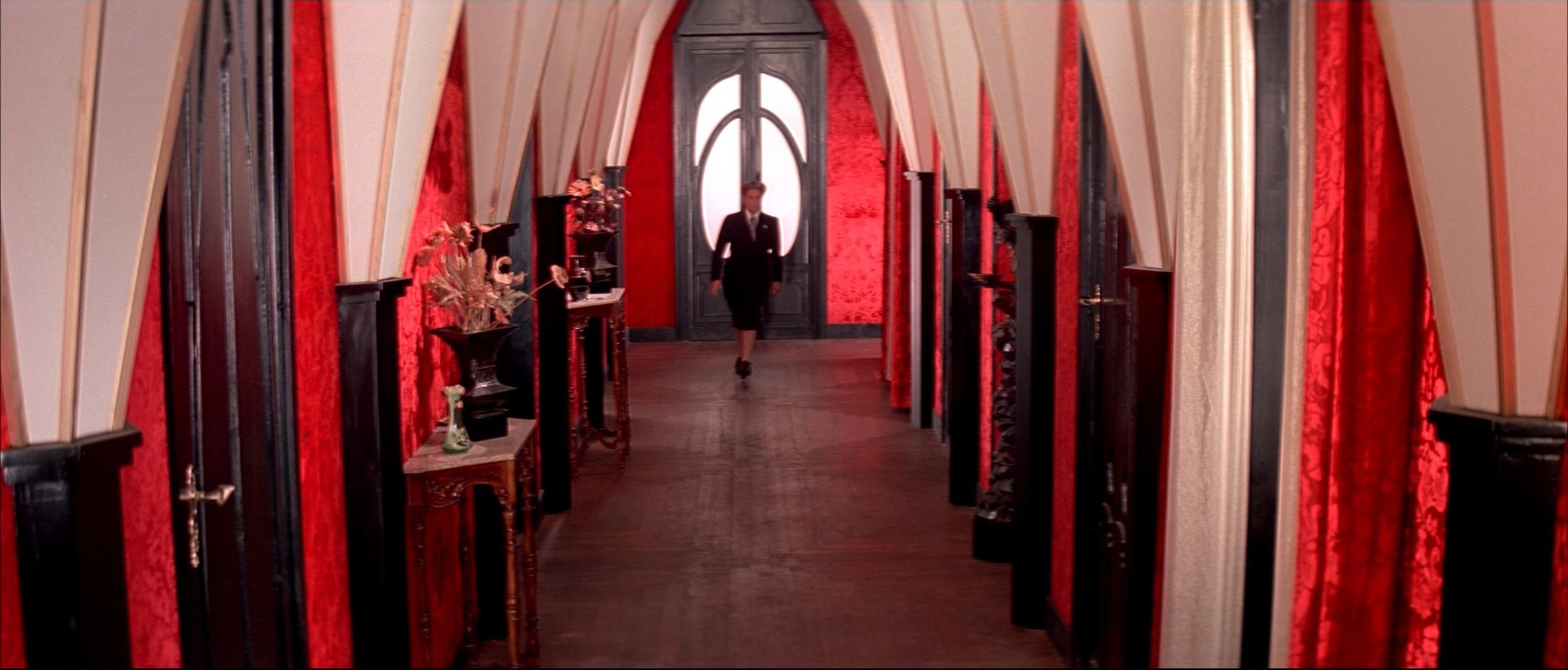
The corridor as a measuring device
Repeated openings pull the eye towards a central figure. Symmetry appears reassuring, yet the distance and enclosing edges reduce the body to a small component. The corridor produces a direction of travel without promising a safe end to that journey.
ENLARGE ↗Film image · ShotDeck 0BSL0DO7, 1920 × 820. Catalogue time 00:56:13 Argentochrome composition study. ShotDeck source record ↗
COMPOSITION 06
A room full of almost-matching things
Furniture, plants, pictures and the mural compete for attention. The image makes it hard to decide which detail is merely decorative. This is the right place to begin an object-by-object inventory, keeping visible descriptions separate from later identifications.
ENLARGE ↗Film image · ShotDeck X77YBSCE, 1920 × 820. Catalogue time 00:38:30 Argentochrome composition study. ShotDeck source record ↗
COMPOSITION 07
A red partition
The practice room has become a communal sleeping area, divided by fabric. People can share a room and still fail to see who occupies it. The hanging sheet is both an ordinary temporary arrangement and an effective screen within the screen.
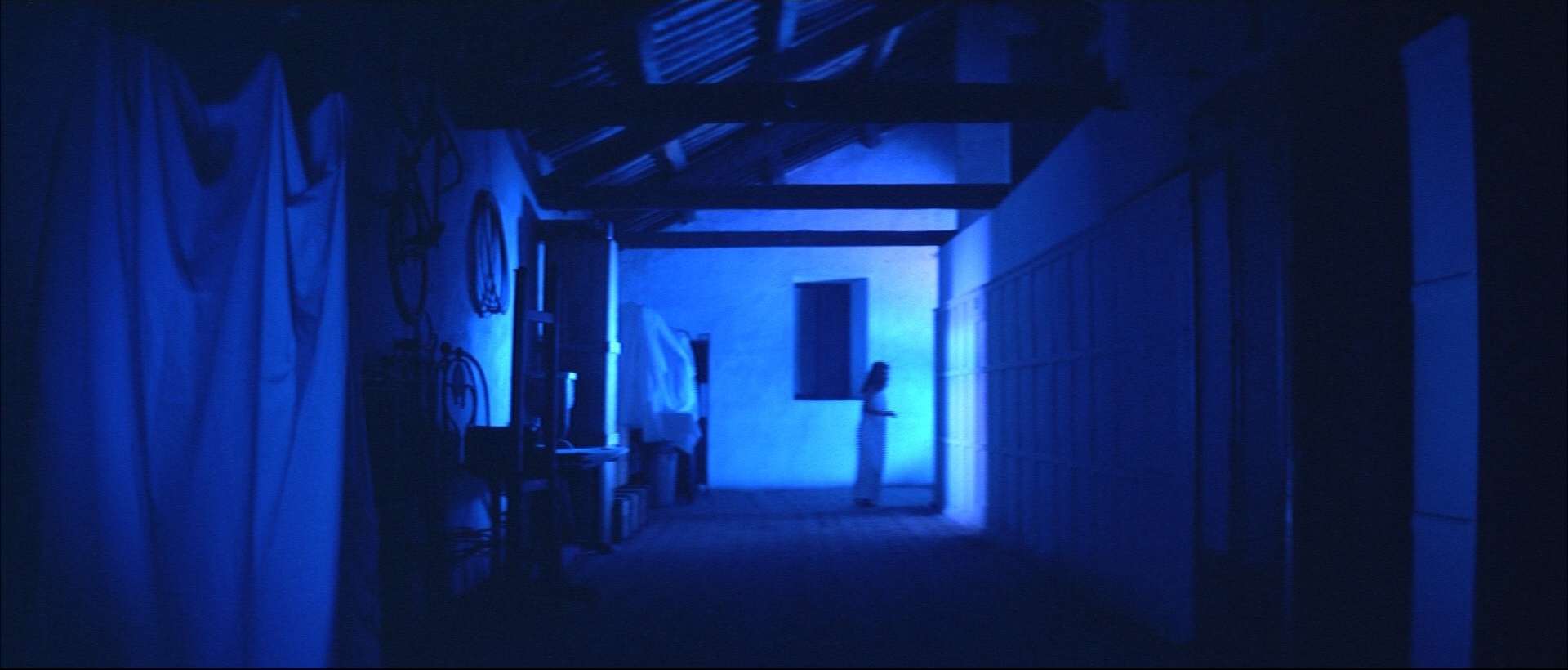
ENLARGE ↗Film image · ShotDeck 99KQMON1, 1920 × 820. Catalogue time 01:04:16 Argentochrome composition study. ShotDeck source record ↗
COMPOSITION 08
The geography of pursuit
Blue takes possession of the passage while a distant opening promises continuation. A route can look clear and still be a trap. The composition makes the difference between seeing an exit and being able to reach it the central problem.
ENLARGE ↗Film image · ShotDeck CRDEC74Z, 1920 × 820. Catalogue time 01:27:52 Argentochrome composition study. ShotDeck source record ↗
COMPOSITION 09
The surface becomes a clue
Suzy’s reach turns the wall into something that can be operated. Ornament is no longer just an atmosphere around the action; it becomes the action. The image rewards an exact look at an object while withholding a complete explanation of the house.
A WORKING OBJECT INVENTORY
What is it? Who made it?
Screen function, source relationship and physical provenance kept distinct.
MAT-01 / Wall ornament / concealed-door control
The blue iris
Giusti’s pp. 157 and 162 describe its function; the published reach frame can be inspected.
Still open: Maker, workshop drawing and survival unknown.
Giusti’s figures 24–25 compare the enlarged pattern with Sky and Water. Located in the opening apartment sequence in the Tubi picture samples, around 09:00–11:40.
The inspected credit at 98:16 names Eastmancolor 5247; the ASC account names 5254. Capture stock and release printing remain separate questions. The stock discrepancy is unresolved.
The primi ballerini roll at 97:32–97:36 names Alessandra Capozzi, Salvatore Capozzi, Diana Ferrara, Cristina Latini, Alfredo Rainò and Claudia Zaccari. Choreographic assignments are not supplied by these names alone.
The two Italian catalogues differ between Giovanna and Giovanni Di Bernardo. Preserve the discrepancy until a credit frame or original document resolves it.
The closing roll reads Effetti sonori LUCIANO ANZELLOTTI at 98:12. This does not resolve the separate modern supplement lead naming Massimo Anzellotti.
The previous preference for the ASC 5254 identification is qualified by the visible Eastmancolor 5247 credit. Camera or laboratory documentation is needed; both readings are retained.
Jameson uses a Gothic analogy to value narrative irrationality. His conjecture about Fox and the opening narration does not establish production authorship.
The photographed page supplies differently sized ad mats, including a one-column layout and two-column variants. It documents proposed campaign materials, not proof of placement in a particular newspaper.
Separate sound strips advertise stereophony. The slogan records the campaign’s promise; it does not establish a particular cinema’s installation, mix or playback.
The photographed credits panel names Dario Argento alone for writing and directing. Nicolodi is absent from that panel, unlike the writing credit read in the inspected film. This is a documented difference, not evidence of the reason for it.
Pignatelli places initial script-based work about a year before filming, followed by demos and a pause. This dates an early phase in memory, not the final sessions.
Morante recalls roughly six months composing and recording at Trafalgar; FACT reports three months in its Simonetti interview. Their time spans are not securely aligned.
Morante disputes Argento’s musical contribution and reference-giving. Simonetti describes suggestions and records brought by Argento. The credit alone cannot decide between these accounts.
In 2018 Tovoli described visibly artificial blood as painterly, and connected Suspiria’s colour thinking with conversations with Antonioni. This is an account of intention, not a formula or laboratory record.
ShotDeck G37XXXP0 supplies a 1920 × 814 view of the red geometric interior. Its platform time is 00:07:27. Catalogue tags cannot resolve the dossier’s stock or filming-location questions.
The closer-spaced airport samples alternate Suzy’s approach with views toward the glass doors and passing taxis. The route is shown before she crosses it. The exact cut rhythm and sound transitions still require continuous review.
The mirror’s flowers precede Pat’s remembered speaking face and mouth. Captioned instructions lead to Suzy’s contact with the blue flower, an opening in the mural and a further curtain before the passage is revealed.
Rossi’s February 1977 column situates Suspiria’s striking but transient effects within a criticism of restricted programming choices. His report of young audiences is not an admissions count.
Listings name Rome’s King and Metropolitan, Florence’s Principe and Naples’s Alcyone. They establish advertised engagements on that date, not a complete opening map or proof of attendance.
The Principe listing of 25 February promotes stereophonic sound. Its premiere language cannot establish a first screening: the same venue already advertised Suspiria on 6 February.
No records match. Try another term or reset the filters.
THE MATERIAL AFTERLIFE
Suspiria, in circulation.
Modern artist editions, theatrical paper and a home-video carrier.
Retailer descriptions and images identify the sale objects. These are not authenticated production props. Availability remains the retailer’s responsibility; the catalogue snapshot is dated 14 October 2026.
Luciano Tovoli; Dario Argento and Claudio Simonetti
Tovoli describes another practical route to an apparently disembodied view in My Cinema: a camera suspended from a long steel cable, released into a movement that could suggest an unseen force. His account treats the movement as a dramatic presence, not simply an efficient way of crossing the set. The mechanical method matters because the resulting view seems to possess an intention of its own.
The documentary also gives two complementary accounts of the score’s unusual palette. Simonetti describes combining electronic and older instruments, including Moog, tabla, sitar and bouzouki. Argento recalls bringing a bouzouki from Greece and responding to its deep metallic character while imagining scenes. Beside the more detailed recording histories elsewhere in this dossier, these passages show music participating in the conception of images rather than merely arriving to accompany them.
Source & passage
Dario Argento: My Cinema / Il mio cinema, two-part documentary presented on Severin Films’ Dario Argento’s Deep Cuts, Disc 1. Part One, 21:54–26:57; Part Two, 29:45–32:41.
The discussion paraphrases the English subtitles and distinguishes participant recollections from the documentary’s narration and production footage.
Passage-level citations in the studies. Source scope and access limits below.
Sources read or checked across 14–16 October 2026. Translations are English paraphrases unless quotation marks indicate otherwise. Publisher specifications, catalogue holdings and first-person testimony remain labelled. Films, supplements and archival folders are not described as inspected merely because their listings are linked.
Original February 2010 article, pp. 68–76, checked as PDF text; technical locators in the ledger. Published production photographs and film images. The web republication is the same account, not independent corroboration.
Read the taxi account and endnotes. Note 3 identifies the author’s 2014 email correspondence. Other passages quote earlier publications; those passages are not independent witnesses.
Archive description and broadcast date. On 16 October 2026 the player displayed a notice that streaming is available in Italy only. The description remains accessible; the audiovisual item has not been analysed for this edition.
Read the 12-page PDF, pp. 154–165; rendered figures on pp. 160, 161 and 163. Interpretation adapted and extended with attribution under CC BY 4.0; technical-stock statement corrected against Tovoli. Underlying sources in the notes are not all.
Inspected the Italian answer to the question beginning “Anche il maestro Dario Argento”. Makeup, wire and eye appliances; retrospective testimony, paraphrased in English.
Inspected the publicly accessible opening and “Souvenirs d’enfance”, through the subscription boundary. Original interview date is not established by the visible extract.
The site identifies two pieces reprinted from Il Mucchio. Read the interview, especially questions on travel, shooting/editing and décor. The original issue/date is not supplied in the accessible introduction.
Read the article. Separate its dramatized 1976 opening from the quoted retrospective interview. Used here for the childhood conception, high handles and conflicting schedule/date reports.
Gallery descriptions and print identifiers. The photographs and physical prints have not been compared here. This is an edition-specific research route, not a completed colour comparison.
Search by certificate 69766; open Suspiria and the feature’s dettagli. Record 47983, including its transcribed decision. The two feature measurements are reversed relative to the linked scan.
PDF p. 84 inspected as text and image. Cover/title fragment and one annotated passage visible; the full script and translator’s credit are not visible. Dating, draft description and translator attribution are the dealer’s. Current site search did not return this script.
TUBI-20261015: complete playback media obtained; 591 picture samples at approximately ten-second intervals across the 98:27 runtime and 82 targeted full-resolution frames. Italian credit cards/roll and selected details read directly. No continuous audiovisual viewing or direct listening completed. English-labelled AAC stereo and 1280×542 picture at 24000/1001 fps describe this encode, not the original mix. Player duration 1:38:27.063; container approximately 1:38:27.11. Availability varies by territory/date.
This revision adds 122 closer-spaced picture samples in two bounded sequences; the detailed log separates visual observations, caption evidence and uncompleted listening checks.
All six pages; layout and cited passages inspected visually. Page 6 identifies the 2024 distribution. This is not the 1977 pressbook. Page 2 identifies older published sources for Argento’s quotations; page 4’s technical account is not accepted as independent production evidence.
Complete accompanying English SRT read: 833 cues. Its dialogue and sound labels support the attributed caption record. 106 entries containing non-dialogue descriptions indexed for listening. Caption timings are display timings; labels can omit, simplify or misidentify sounds. Names and foreign-language spellings are not treated as authoritative. Same presentation as the film source, not independent corroboration.
Italian Q&A: Suspiria answer inspected and paraphrased in English. Interview/publication date not established. Recollection, not dated session documentation.
Italian Q&A: Suspiria instrumentation, recording and collaboration passages. Interview date not established; technical and credit recollections remain attributed.
Ten selected originals inspected through the signed-in catalogue: the header and nine composition studies, each 1920 pixels wide. Still IDs and platform times accompany each image. These times are separate from the Tubi review clock.
Printed p. 13, Firenze–Toscana; PDF page 18. Complete signed column read visually, including its argument about exhibition. English paraphrases are ours; OCR was checked against the scan.
Complete entry and bibliography. Cites Masi’s conversation with Fraticelli in Nel buio della moviola (1985), pp. 151–164. The conversation itself has not been; its Suspiria coverage is unknown.
Lists Stefano Masi’s Nel buio della moviola (1985) in the Mestieri e tecniche del cinema series. Read as an access lead, not confirmation that the volume or a research copy is currently available.
First published 14 October 2026. Research expanded 15–16 October; editorial revision 18 October 2026. Giusti’s interpretive contribution is credited throughout under Creative Commons Attribution 4.0; our adaptation includes English exposition, synthesis and new comparisons. Film-image rights remain with their owners.
Film images: ShotDeck. Production photograph: American Cinematographer. Object images: the named affiliated stores.