THE READING ROOM / 003 · EXPANDED ESSAY
Seeing and misrememberingThe image was there.
A witness behind glass, a photograph arranged to accuse, a face among pictures and an audience forced to watch: the changing problem of visual evidence.
ACROSS THE FILMS
Argento’s witnesses often have something to remember before they know what they saw. The distance between an image and an explanation gives these films more than a device for delaying a solution. It makes looking an activity with consequences: someone selects the view, arranges the event or decides which details belong together.
01 / The Bird with the Crystal Plumage
Visibility is not comprehension.
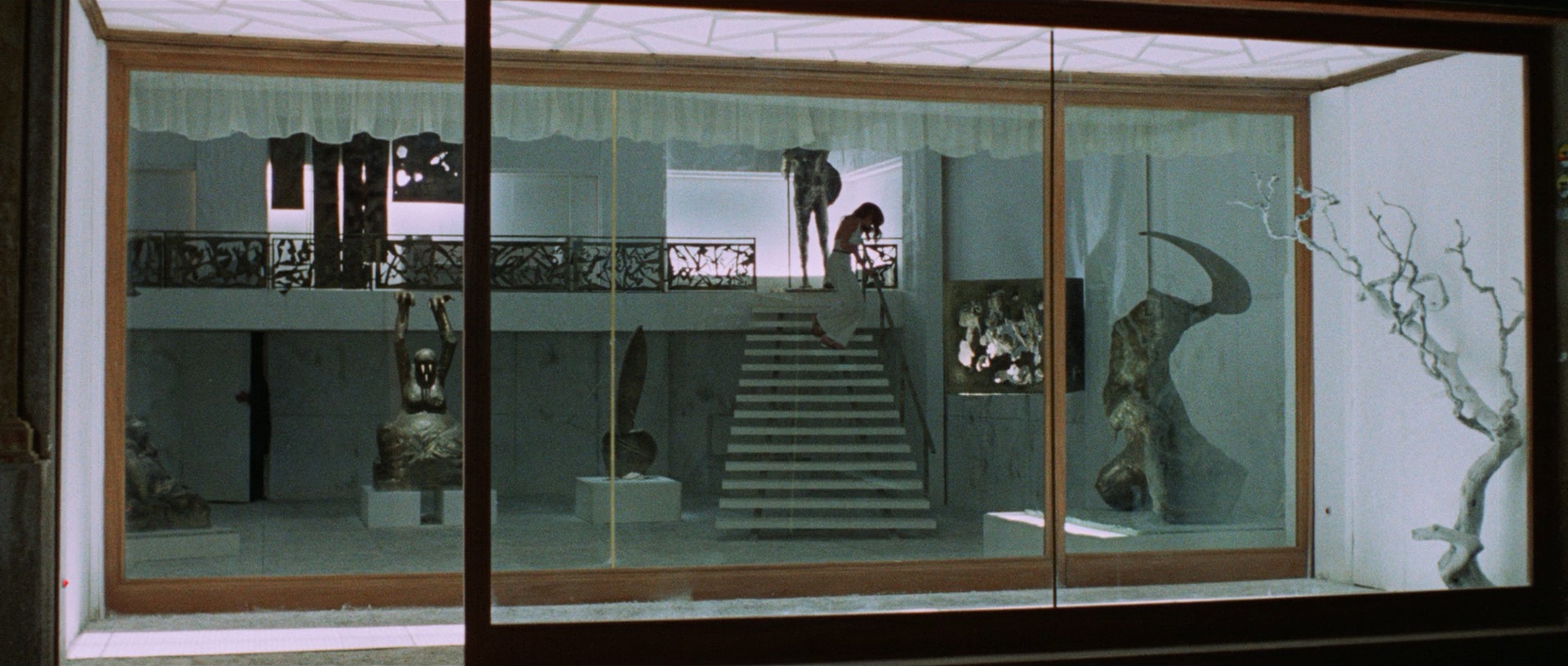
The gallery frame above presents a brilliantly illuminated interior divided by glass and strong architectural lines. Sculptures occupy the foreground; a central staircase organises the depth. There is much to see, but the frame alone cannot tell us the sequence of actions or the relationship between the people involved. Sam’s witness position becomes the film’s central problem: observation arrives before an adequate explanation.
In his 2014 conversation with Michele De Angelis, Argento describes exploiting the convention that associates a darkly dressed man with threat and a woman in white with innocence. The account concerns a reversal of assumed roles, rather than a hidden object finally made visible. Argento on recollection and visual conventions ↗
Our interpretation is that the glass does two jobs in the scene’s conception. It separates the witness from the event, and it makes seeing appear unusually well-defined. A transparent boundary seems to promise access. The film turns that promise into a problem: a clear view can still be organised by a false assumption. The Bird dossier follows the narrative and the image’s later framing history.
02 / Four Flies on Grey Velvet
An image can record a staged event.
Kevin Lyons’s account, republished in the BFI programme, describes Roberto’s apparent killing in the theatre and the masked figure photographing him. The apparent killing is staged. The resulting image threatens its subject because it seems to carry the authority of a witnessed action. BFI programme: Lyons’s narrative account ↗
This gives Four Flies a different relation between image and deception. A photograph does not need to be retouched to mislead. The event placed before the camera may already have been arranged. Roberto is more physically involved than Sam, yet participation does not give him secure knowledge of the design surrounding him.
The comparison distinguishes two kinds of uncertainty. In Bird, the witness assigns the wrong meaning to what he sees. In Four Flies, the image is part of an operation designed to make a participant and potential witnesses accept a particular story. Looking harder at a single photograph cannot recover everything that happened outside its frame.
03 / Deep Red
A face belongs to the wrong category.
The inspected BFI reproduction used in our Deep Red dossier places Hemmings’ reflected face inside an oval border among painted heads. The image groups a living reflection with representations of people. It lets us examine the visual conditions under which a spectator might see a collection before distinguishing its individual members. The published mirror image ↗
Manzoli’s Treccani entry supplies a separate critical account of the film and its narrative organisation. The dossier keeps that account distinct from the reproduced frame: a plot explanation can identify the function of a clue, while the frame gives us something narrower to inspect about its presentation. Manzoli’s critical entry ↗
Read beside the gallery and theatre, the mirror shifts attention from whether an image is true to how its contents are classified. A surface can contain information that is available but assigned to the wrong kind of object. Remembering it as decoration may be enough to lose its importance. This is our interpretation of the visible grouping, not an assertion that one named collaborator independently invented the arrangement.
04 / Opera
Seeing can itself become the threat.
The BFI Player synopsis identifies the pins that force Betty to watch violence in Opera. The premise gives looking a coercive dimension: closing the eyes is made painful, and the spectator within the story is denied the ordinary option of turning away. BFI’s account of the forced spectator ↗
This does not simply repeat the earlier witness problem. The films can be connected through the control of attention while preserving their differences. Sam cannot intervene adequately; Roberto is manipulated into an incriminating position; the Deep Red image encourages a mistaken grouping; Betty’s watching is imposed. The question becomes who controls the conditions under which an image is received.
Our critical comparison is that evidence and power meet here. A person who sees may acquire knowledge, but may also be trapped, accused or harmed by the act of seeing. The Opera dossier develops the film’s relation to performance, the camera and the spectator.
05 / Reading the evidence
Leave room for the second interpretation.
These cases offer different mechanisms, not a universal key that unlocks every Argento film. Recollection, staging, misclassification and compulsion can overlap without becoming the same narrative device. A comparative essay earns its value by keeping those differences visible.
It also has to identify its own viewing conditions. A frame catalogue can help us inspect a composition, but cannot tell us how quickly the spectator was asked to read it. A synopsis can settle a narrative relation without reconstructing the cut that delivers it. The Franco Fraticelli study follows the editing work that makes attention unfold in time; Versions and restoration asks which surviving presentation we are discussing.
The next useful step is consequently a small, named comparison: a specific reveal, an identified version and a question about how information changes. The present essay supplies a connected account of the mechanisms.
FOLLOW THE CONNECTIONS
Another way in.
Follow another theme, then return to the film dossiers and collaborator studies.
THE READING ROOM
Return to the source.
A synthesis of the completed dossier research. The notes identify the evidence and the scope of its earlier examination.
- 01
Dario Argento with Michele De Angelis / Keyframe ↗
Questions on first-day preparation, memory and colour conventions, and the later 2:1 presentation. Retrospective testimony.
Return to the essay ↑ - 02
BFI Southbank — programme essay and compiled credits ↗
Used for narrative situations, opening and ending descriptions and crew; not a 1971 review or our viewing log.
Return to the essay ↑ - 03
Chris Gallant / BFI — Where to begin with giallo ↗
Existing mirror reproduction inspected and preserved locally.
Return to the essay ↑ - 04
Giacomo Manzoli — Profondo rosso, Treccani (2004) ↗
Signed critical entry; used for narrative and fictional/physical geography, not an edition-specific viewing record.
Return to the essay ↑ - 05
BFI Player — Opera ↗
Synopsis, Rigoletto origin account and broad soundtrack description. Listing.
Return to the essay ↑
KEEP EXPLORING
One film opens another.
Explore the films and collaborators → · Visit the Reading Room → · Find a piece for your collection →