1985 · DARIO ARGENTOPhenomenaEXPANDED EDITION · 16 OCTOBER 2026
Animals & evidence
Jennifer Corvino’s ability to communicate with insects brings an extraordinary form of knowledge into a murder investigation. This dossier follows the outsider, the specialists who built her world, and the different versions through which that world reached its audience.
Spoilers: this study discusses the film’s story and ending.
01 / Jennifer and the school
The outsider has another way of knowing.
A school ought to help a young person find a place in the world. In Phenomena, it becomes the setting in which Jennifer’s difference makes her vulnerable. She is an American newcomer, a sleepwalker and an inconvenient witness. Arrow’s synopsis places a murder she witnesses during her nocturnal wandering at the centre of her danger. Jennifer’s arrival and the murder ↗
These circumstances complicate the usual question of whether a witness can be trusted. Jennifer does not simply possess a fragment of visual information that she must remember correctly. Her unusual experience affects how other people judge her before she can explain what she knows. Our reading is that the film makes the social standing of the witness part of the mystery.
The comparison with Suspiria begins with the school but becomes more revealing when we follow the heroine’s alliances. Jennifer finds a collaborator in McGregor, and a connection to insects that gives her access to a world beyond the institution’s authority. Those relationships offer an alternative to belonging through conformity.
Calling this a fantasy of empowerment does not remove its cruelty. Kevin Lyons’s essay, reprinted by the BFI, describes the students’ taunting and the school’s response to Jennifer’s behaviour. Lyons on the hostile academy ↗ The pleasure of an outsider acquiring extraordinary power depends partly on how thoroughly ordinary social protection has failed her.
Connelly’s performance also deserves an account beyond the familiar anecdotes about the production.
02 / Insects and evidence
A clue can be alive.
Jennifer’s relationship with insects lets Phenomena bring two kinds of knowledge together. McGregor studies them; she communicates with them. The distributor’s premise gives scientific expertise and supernatural affinity a shared investigative purpose, without making them the same thing. The collaboration with McGregor ↗
In his Total Film conversation with Jamie Graham, Argento recalls hearing a radio report about a German murder case in which insects helped identify the killer. He says this led him to work with an entomologist. Argento’s account of the story’s inspiration ↗ This is evidence of the inspiration he remembers. Argento presents the news story as an inspiration for the film’s fantasy.
The distinction is productive rather than disappointing. A conventional witness can decide to speak, hide something or lie. An insect’s presence does not have to answer to those human motives. The film imagines an investigator able to cross that boundary, turning an apparently insignificant creature into a source of direction.
Our interpretation is that this shifts the emphasis from the reliability of sight to the possibility of attention. In Deep Red, an observer struggles with something already seen. Here the investigator must recognise significance in a form of life others may dismiss or recoil from. Knowing depends on whom—or what—one is prepared to notice.
That does not make nature uniformly benevolent. Insects can be companions, evidence and instruments of terror within the same imaginative world. The film’s disturbing force lies partly in allowing those roles to coexist, instead of assigning animals a single reassuring symbolic meaning.
The family that is missing from the room.
Screenwriter Franco Ferrini recalls Phenomena as his first screenplay collaboration with Argento. He remembers a long writing process and an early instruction from the director: family must be part of the film. Ferrini describes Jennifer’s situation as an absent family, with the protagonist looking for a father and a mother. Panico: testimony and passage locators ↗
That recollection gives Jennifer’s encounters a writing context as well as a supernatural one. Her connections with McGregor, the academy and the insects answer different needs for guidance and belonging. The insects’ usefulness as witnesses coexists with the heroine’s need for relationships beyond the family that is physically absent.
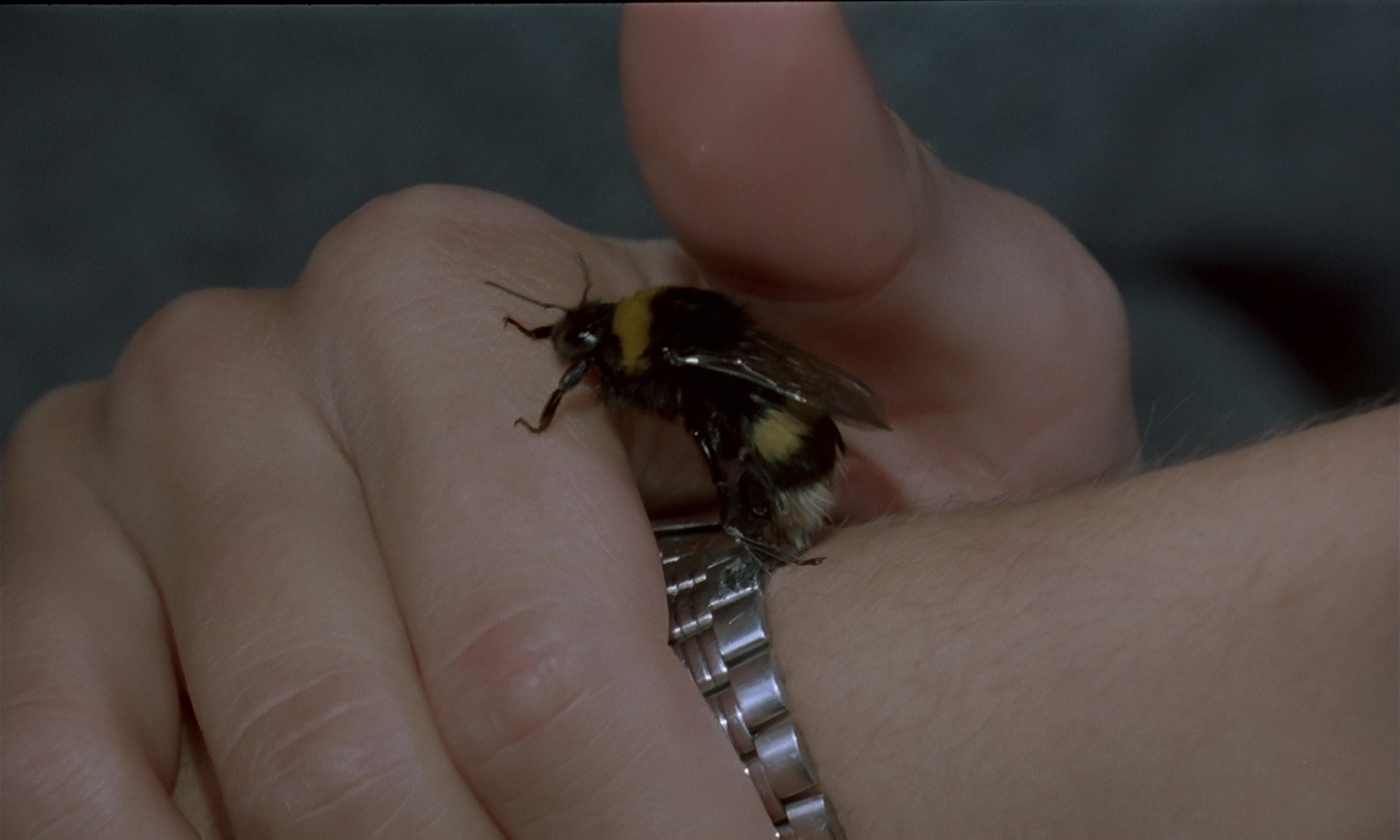
The insect occupies the centre of this frame, between fingers and a wrist. At this scale the small creature is no longer peripheral. The bracelet supplies another measure: an everyday human object becomes a bright, segmented surface underneath the insect’s body.
The image makes contact visible without telling us everything about it. We can describe the proximity of skin, metal and wings. ShotDeck catalogue locator: 00:13:35. The two inspected frame records ↗
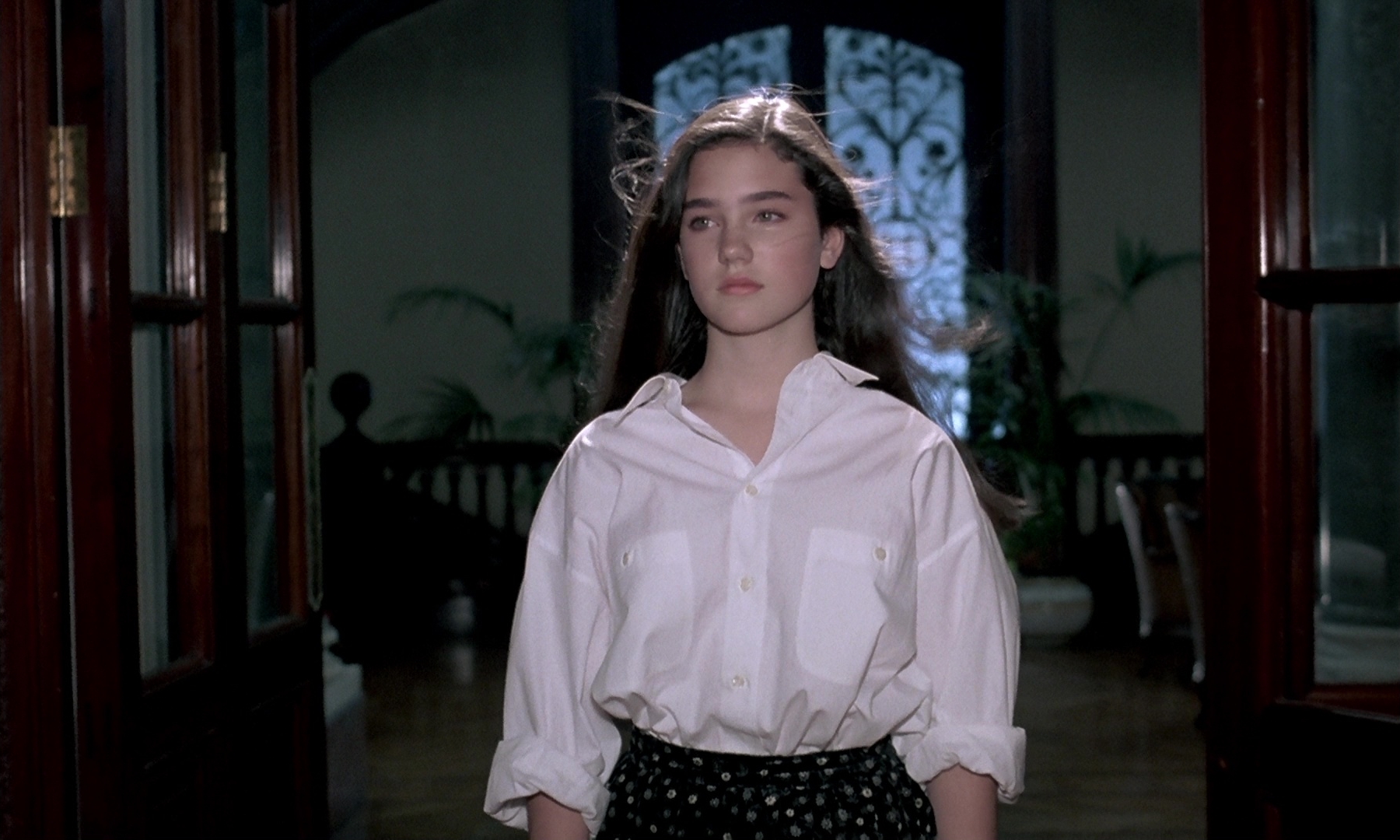
The opening image above establishes a different relationship of scale. Jennifer’s pale shirt stands out against a dark room, while the doorway frames her within another frame. The decorative glass behind her offers intricate pattern, but the clearest point of attention remains the human figure. Her hair catches the light beyond the more rigid outlines of the architecture.
Read together, the images make a useful visual proposition: a person can dominate one composition and become a landscape for another living creature in the next example. It gives concrete form to the dossier’s central question about who is allowed to occupy the centre of attention.
Romano Albani’s cinematography connects Phenomena with Inferno, giving another route through the visual worlds of the two films. The photography credit ↗
04 / The people behind the insects
Live creatures and manufactured swarms.
The BFI’s compiled credits distinguish Ferdinando Armati’s special entomological photography, Enrico Stella’s entomological consultation, Luigi Cozzi’s optical effects and Sergio Stivaletti’s special makeup effects. They also name Gianlorenzo Battaglia for underwater photography and Daniel Berquiny as Tanga’s trainer. Specialist departments ↗ These names prevent a single phrase such as “Argento’s effects” from obscuring the different kinds of work involved.
Argento tells Graham that the insects were not trained: the camera had to catch behaviour when it occurred. He contrasts this with the trained chimpanzee. Argento on filming animals ↗ The recollection describes a difference in working methods; it is not a complete account of animal handling or the conditions of every setup.
Stivaletti’s 2015 Nocturno interview supplies an unexpectedly domestic ingredient. He recalls washing coffee grounds, placing the particles in a thin aquarium and filming them against white with high-contrast stock. Optical printing turned the moving particles into a swarm, including the image of flies obscuring the moon. The coffee-particle account ↗
His 2017 conversation with Valentina D’Amico also describes live flies and the aquarium technique. But the origin story changes: in 2015 he recalls noticing grounds in the sink; in 2017 he recalls a story about Mario Bava, while acknowledging Lamberto Bava’s disagreement about having told it. The later account ↗ The repeated method is better supported than a tidy, single story of invention.
The important distinction is between a living insect photographed at close range and a mass assembled through effects. One method gives the camera unpredictable detail; the other permits collective movement that cannot simply be directed on command. The film’s impossible world emerges from their combination. A department credit and a later interview still do not allocate every finished shot to an individual technician.
05 / Performance and creature design
An effect is also a representation.
Stivaletti recalls arriving to make corpses, then expanding his contribution after showing Argento an animation test and creature designs. He says medical photographs informed the face he devised for the child. Designing the makeup ↗ This establishes a reported design process, not a diagnosis of a fictional character or a scientific explanation for violence.
Davide Marotta plays Frau Bruckner’s son; Daria Nicolodi plays Bruckner. The performers’ credits ↗ Naming the performer matters. The figure on screen is not just a mask available for technical admiration. A body, a performance, makeup, lighting and editing together produce the encounter that viewers experience.
Our critical reading keeps the troubling implication visible. Horror can turn physical difference into a shortcut for danger. Explaining how that image was built does not require accepting the association. Indeed, tracing a design to medical imagery makes the representational choice more important to examine, rather than rendering it neutral.
The chimpanzee Inga brings another kind of animal performance into the film. Her activity combines trained behaviour with the fantasy of an animal becoming a resourceful participant in the story.
These distinctions make the production account more precise without draining the film of its strangeness. Practical ingenuity, an actor’s labour and an unsettling narrative idea can all be present in the same image. None is adequately explained by calling the result merely realistic or merely absurd.
06 / Composers, songs and sound work
The soundtrack has more than one author.
Synapse names Goblin, Motörhead, Iron Maiden, Andi Sex Gang, Bill Wyman and Simon Boswell in its soundtrack description. The soundtrack contributors ↗ That list is a useful warning against treating the film as the product of a single musical voice. It includes several musical identities whose relationships to the picture need to be distinguished.
Claudio Simonetti places Phenomena among his work as a solo composer after Goblin. In Michele Savoldi’s OndaRock interview, he also remembers it as his first film project using a computer, dating that work to 1984. Simonetti on his working methods ↗ The recollection opens a route into the production of the music; it is not a verified inventory of instruments and recording equipment.
Simon Boswell, speaking with Gavin Schmitt in 2008, calls Phenomena his first film and recalls Argento’s enthusiasm for heavy metal. In discussing licensed music more generally, he distinguishes the composer’s work from choices made by directors and music supervisors. Boswell on composing and selected songs ↗ His account helps explain why authorship cannot be read directly from an album’s most prominent name.
There is a parallel history of sound work. The BFI lists Piero Bozza as music editor, Danilo Sterbini for re-recording, Nick Alexander as sound editor and Studio Anzellotti for stereo sound effects. Music editing and sound credits ↗ A composed cue still has to meet dialogue, effects and the timing of an edited scene.
The critical question is how different kinds of music alter our relation to the action. A recognisable song can bring an identity from outside the fiction; an instrumental passage can establish a different continuity. This edition investigates those conditions through credits and testimony. Exact entrances, balances and transitions remain for listening to a named film version and track, rather than being inferred from the soundtrack album.
07 / Phenomena and Creepers
The title on the box is only a beginning.
Arrow’s limited-edition specification identifies three presentations: a 116-minute Italian version, a 110-minute international version and the 83-minute Creepers cut. It also describes a hybrid English/Italian track for the longest version. Version labels and language options ↗ A viewer’s experience can therefore change through both the picture edit and the selected soundtrack.
Record
What it establishes
Arrow limited-edition Blu-ray
Italian 116 minutes; international 110; Creepers 83. A distributor’s edition labels, not timings measured here.
Synapse two-disc UHD, 2023
116/110/83-minute specification and a 1.66:1 presentation; English and Italian audio options.
The BBFC record confirms that the 1986 submission underwent changes, but its public entry does not specify the individual scenes. Runtime differences alone cannot explain which material was removed. They can also reflect presentation speed or a different submitted version, so subtracting one catalogue duration from another is not a reliable censorship history.
Restoration credits need similar precision. Arrow describes a restoration from the original camera negative for its listed edition. FLC identifies its 2022 presentation as a Cinecittà 4K restoration. Arrow’s restoration statement ↗The theatrical restoration credit ↗ The shared word “4K” does not establish that the same master, grading or sound elements were used.
For a later comparison, the useful unit is a named disc or file, its version label, language and audio selection. The substantive question is what each edit lets us understand about Jennifer, the school and the investigation. A longer running time is a starting fact, not an argument about how those relationships change.
08 / Criticism and circulation
Strangeness is part of the argument.
Lyons’s 2018 essay combines strong reservations about the plotting with an affection for the film’s eccentricity. The retrospective critical position ↗ Martyn Conterio’s 2023 BFI introduction places Phenomena within Argento’s return to supernatural fantasy, emphasising the collision of insects, heavy metal and an Alpine setting. Conterio’s route through the films ↗ These are later readings, not a representative sample of reviews from 1985.
FLC’s 2022 retrospective supplies a concrete record of renewed exhibition, including a scheduled Argento Q&A moderated by Maitland McDonagh. The retrospective screening ↗ It shows the film being presented as an object worth revisiting. It does not, by itself, prove a unanimous critical reassessment or explain its original commercial reception.
Our reading takes the apparent incompatibilities seriously. The forensic inquiry, the school story, supernatural affinity and creature horror are not easily reconciled into one stable tone. The attraction may lie in how that instability changes the audience’s expectations: a clue can become an ally, and something initially repellent can acquire another meaning.
This does not require treating every awkward transition as a hidden intention. The film remains open to disagreement about whether its ingredients intensify or undermine one another. A useful dossier should make that disagreement more specific, with attention to versions and working methods, rather than settle it through reputation.
The next connection is Opera: another investigation in which the human observer does not have a monopoly on evidence. The shop’s Phenomena objects offer a different route, through the titles and images used to circulate the film.
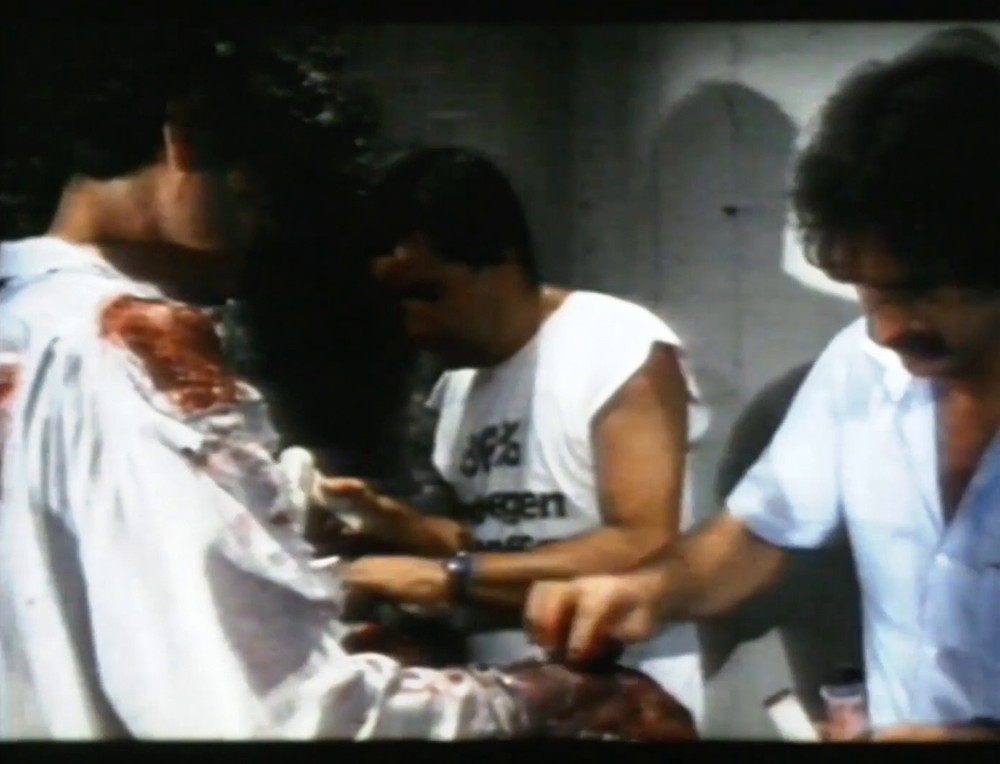
The production footage in My Cinema makes the pool’s repulsive surface a material design. Its narration describes heated water covered with treated, coloured vermiculite, the moving mineral particles standing in for worms. Yogurt, mint and chocolate helped build the surface, with bones and bodily remains completing the scenic arrangement. Images of the performer and crew around the pool show how the finished impression of contamination was prepared around a working actor.
Cozzi supplies a second participant account of the school swarm. He names Stivaletti as his collaborator and describes filming coffee grounds suspended in water, then superimposing that movement over a view of the building. This supports the process already described in Stivaletti’s interviews while identifying the school image as a particular application. It does not settle the differing later stories about how the idea first occurred.
The documentary also distinguishes controlled live-insect photography from the optical swarm, including preparation around the car and insects confined between panes of glass. The film’s power to make insects seem everywhere depended on several separate kinds of work. A moving surface, a live creature photographed close and an optically added cloud should not be treated as the same effect.
Source & passage
Dario Argento: My Cinema / Il mio cinema, two-part documentary presented on Severin Films’ Dario Argento’s Deep Cuts, Disc 1. Part One, 35:28–35:51 and 45:38–47:20; Part Two, 26:07–27:26.
The discussion paraphrases the English subtitles and distinguishes participant recollections from the documentary’s narration and production footage.
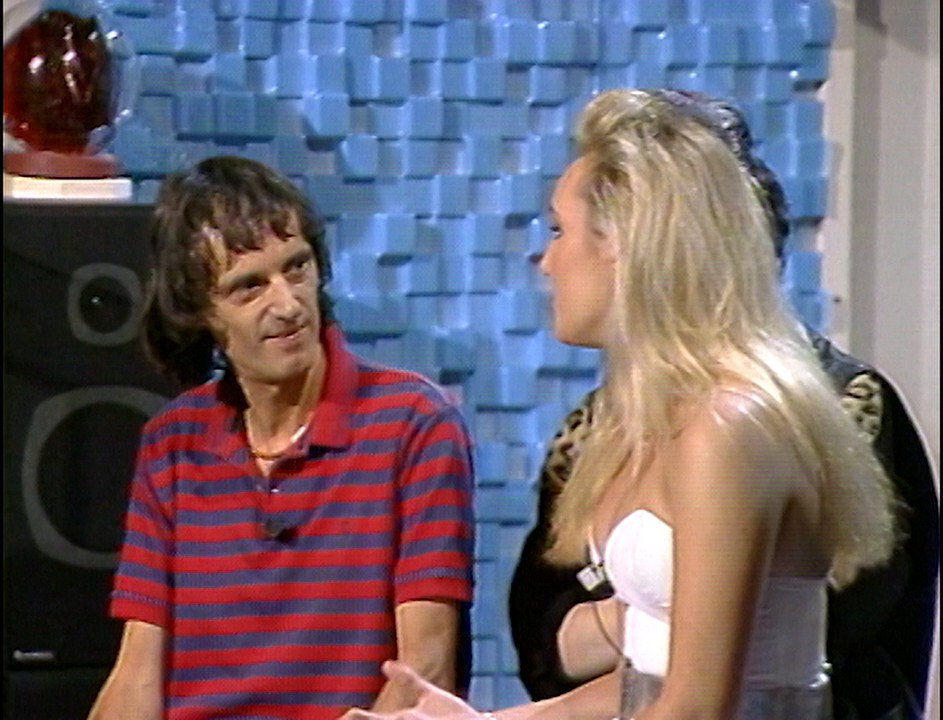
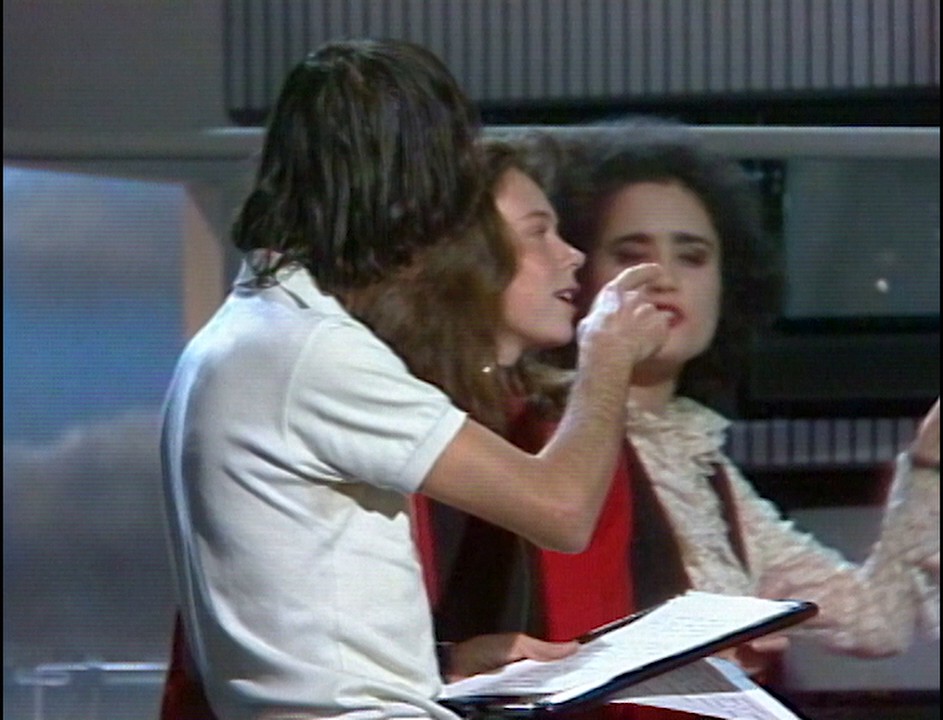
From Giallo Argento, the compilation of interviews and production demonstrations from Giallo (1987).
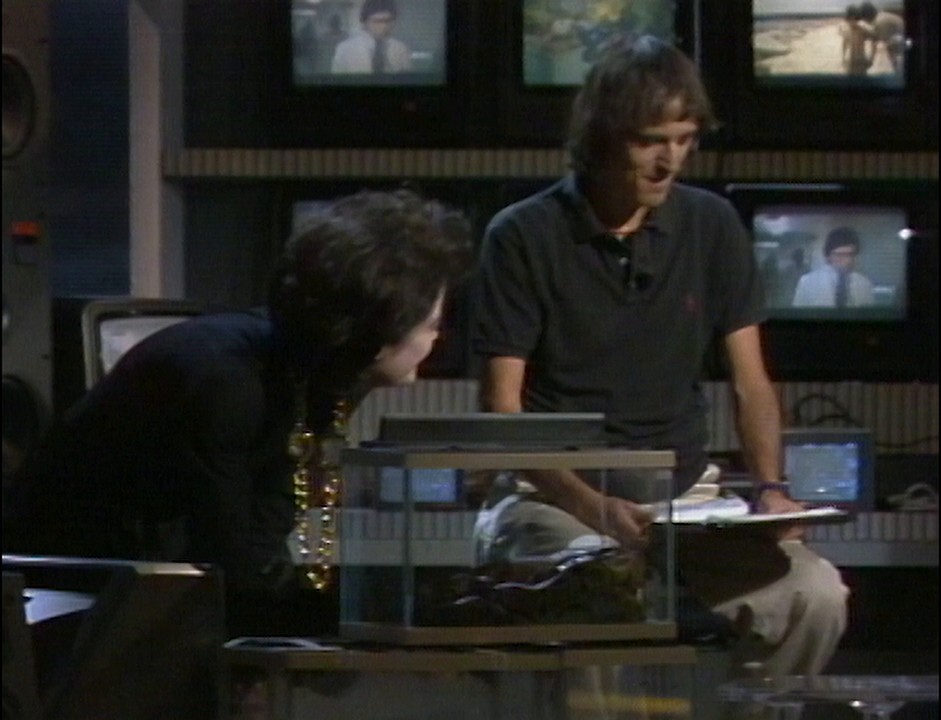
The television demonstrations connect Phenomena’s impossible images to mechanisms that can be handled, explained and rehearsed. Argento names Sergio Stivaletti during the mechanical-hand material; that explicit attribution belongs to this demonstration rather than automatically to every object shown elsewhere in the compilation.
Inside the mechanical hand.
Articulation beneath the surface
The close view exposes the interior construction of the hand. The host alternates the mechanism with the completed film image, letting the viewer understand the object’s movement without confusing the demonstration with an unaltered body.
Attracting the insects
Argento describes the scale of breeding required for the swarm and a rubber face coated with liquid glucose to draw flies onto it. The account distinguishes a mass of live insects from a mask designed to receive them. His recollection of how they were subsequently released remains his account of the production.
Argento introduces the insect display.
Fiore Argento: too many instructions at once
Fiore recalls the tunnel work as a demanding combination of movement and instructions. She also says that the imitation glass could hurt. Her remarks complicate the easy assumption that knowing an effect is artificial makes its performance physically effortless.
Fiore Argento recalls the tunnel sequence.
Fiorenza Tessari: the body built for the spear
Tessari explains the substitute upper body placed at the window and the route of the spear through the head and mouth. The demonstration shows how a seemingly continuous attack is organized around a prepared object. Her account of bruising and a glass fragment belongs alongside that technical explanation.
Fiorenza Tessari discusses the substitute body.Source & passages
Giallo Argento, 04:00–05:35; 12:40–15:50; 43:50–45:35; 63:20–66:40. Severin Films, Dario Argento’s Deep Cuts, Disc 4. The study draws on the programme footage and English-subtitled testimony.
May 2023 programme, credit compilation and Kevin Lyons’s essay dated 27 October 2018. Credit roles and selected narrative/critical passages; not a new screen-credit transcription or contemporary review.
Conversation at Cartoons on the Bay, 17 April 2015. Passage on coffee particles, the aquarium and optical printing read in Italian. Paraphrased here; no exact shot allocation or independent production test.
26 April 2017, section on Phenomena: makeup design, live insects and optical work. Compared with the 2015 account; the differing origin anecdotes remain attributed. Medical imagery is discussed as design history, not clinical evidence.
2 September 2008. Passages identifying Phenomena as his first film and discussing Argento’s musical preferences and licensed songs. General practice is not treated as a film-specific contract.
24 April 2023. Later critical introduction and the first edition’s Cinecittà-credited image reference. Its external image failed to load during this update and has been replaced.
Signed-in records YTHOOK2O (00:54:42) and CEST9S8X (00:13:35); 1800 × 1080 downloads retained. Times are catalogue metadata. Account access may be needed. No camera, lens or colourist metadata is adopted as shot-specific production proof.
Franco Ferrini: 56:57–58:15. English paraphrases of retrospective documentary interviews. Source and viewing notes ↗
Ferrini uses the title Phenomena in the Italian interview; the English subtitles substitute Creepers. His recollection concerns writing the film, not a specific shortened release. The title substitution is therefore kept in this source note rather than used to identify a cut.