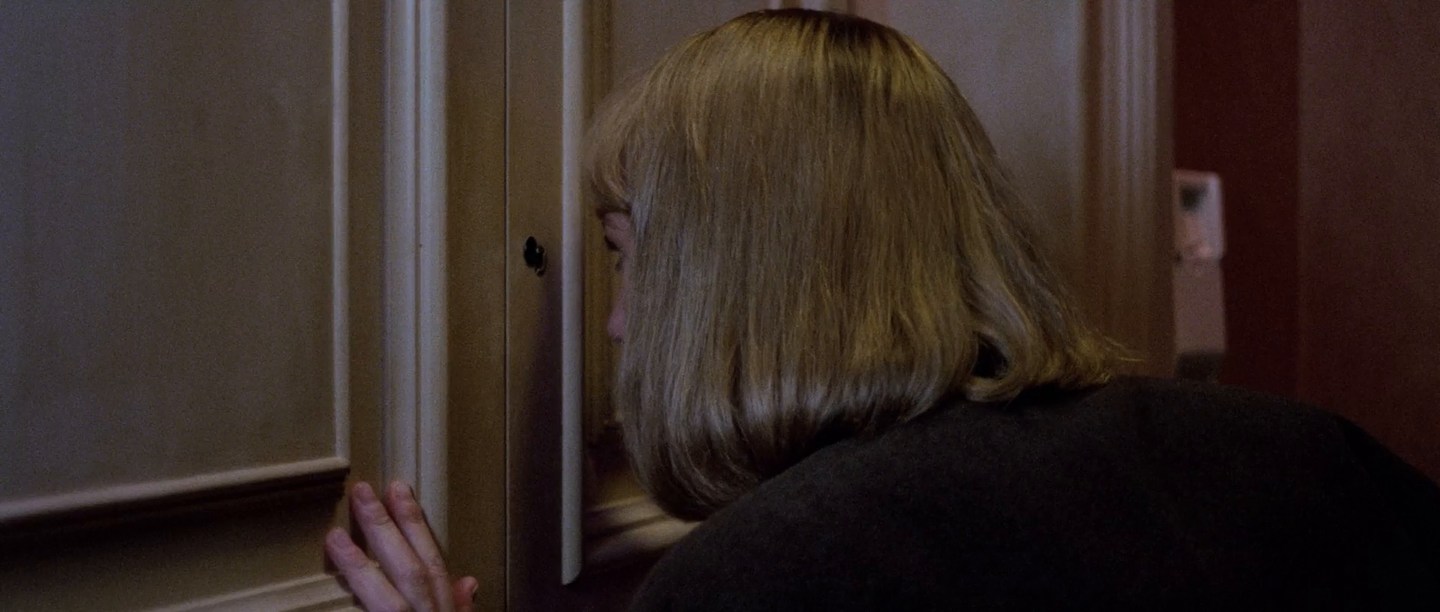
Thirty illustrated studies follow the film’s changing spaces and points of view. Begin with the reflected auditorium, enter the backstage rooms, and follow Betty into the open landscape.
01 / 00:02
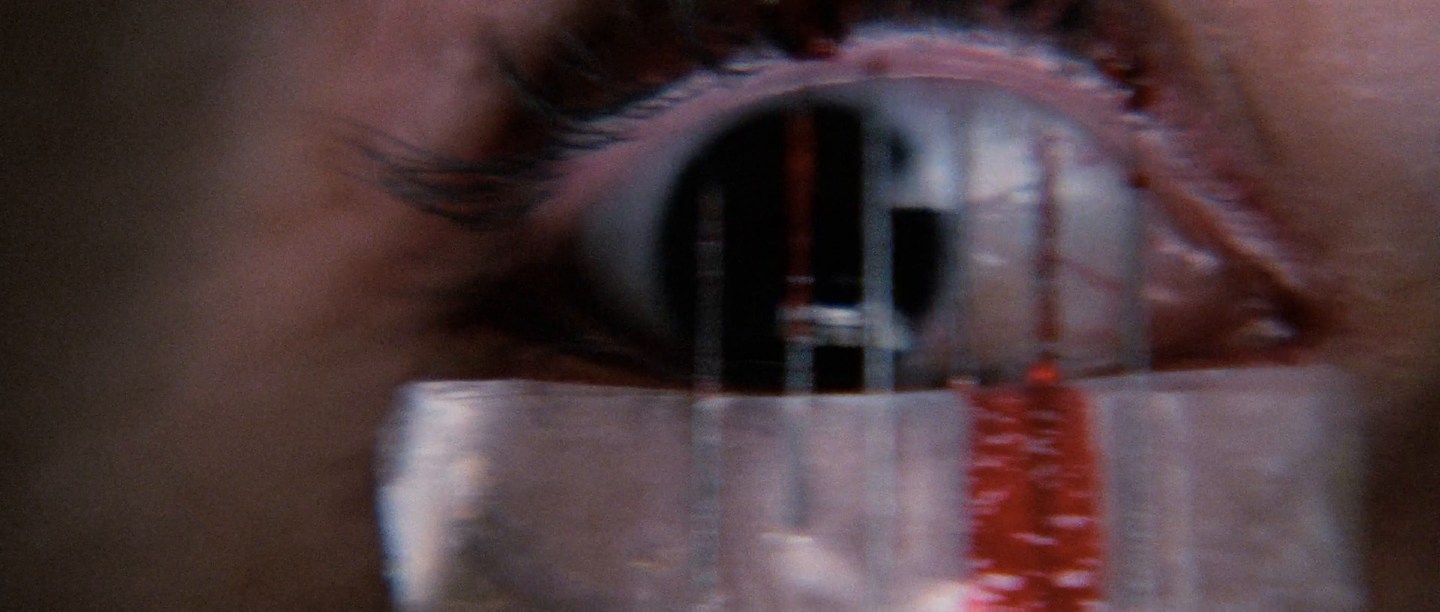
A theatre inside an eye
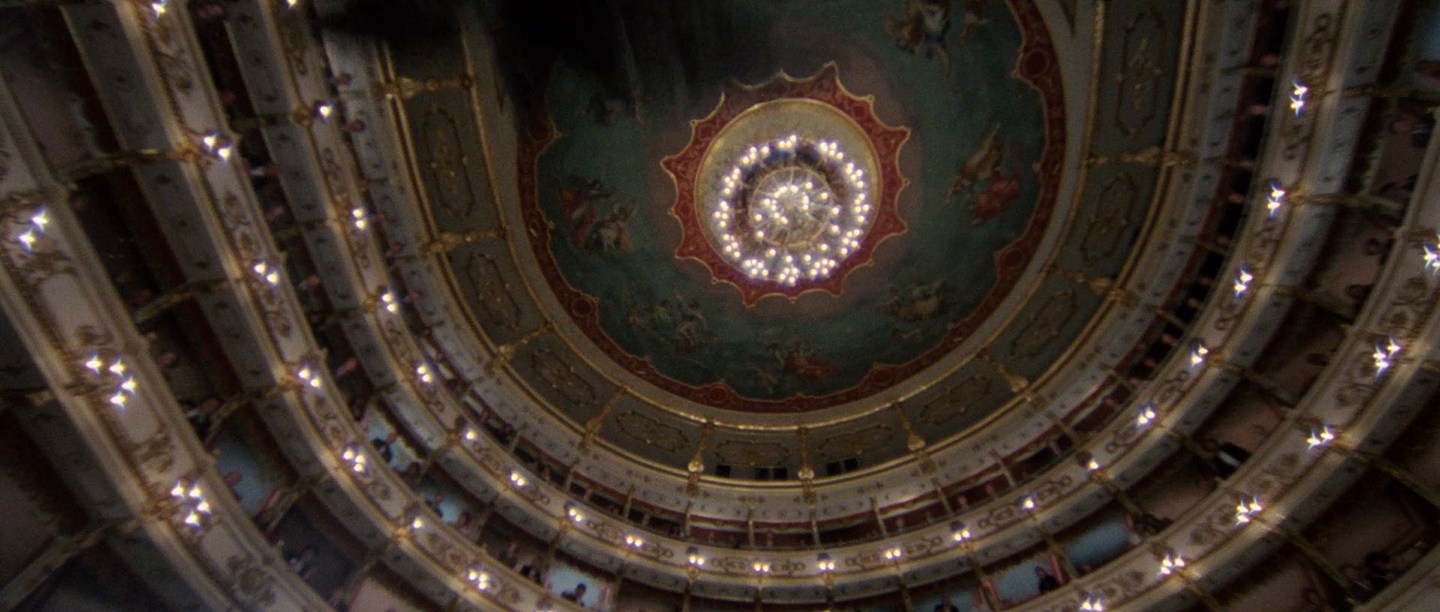
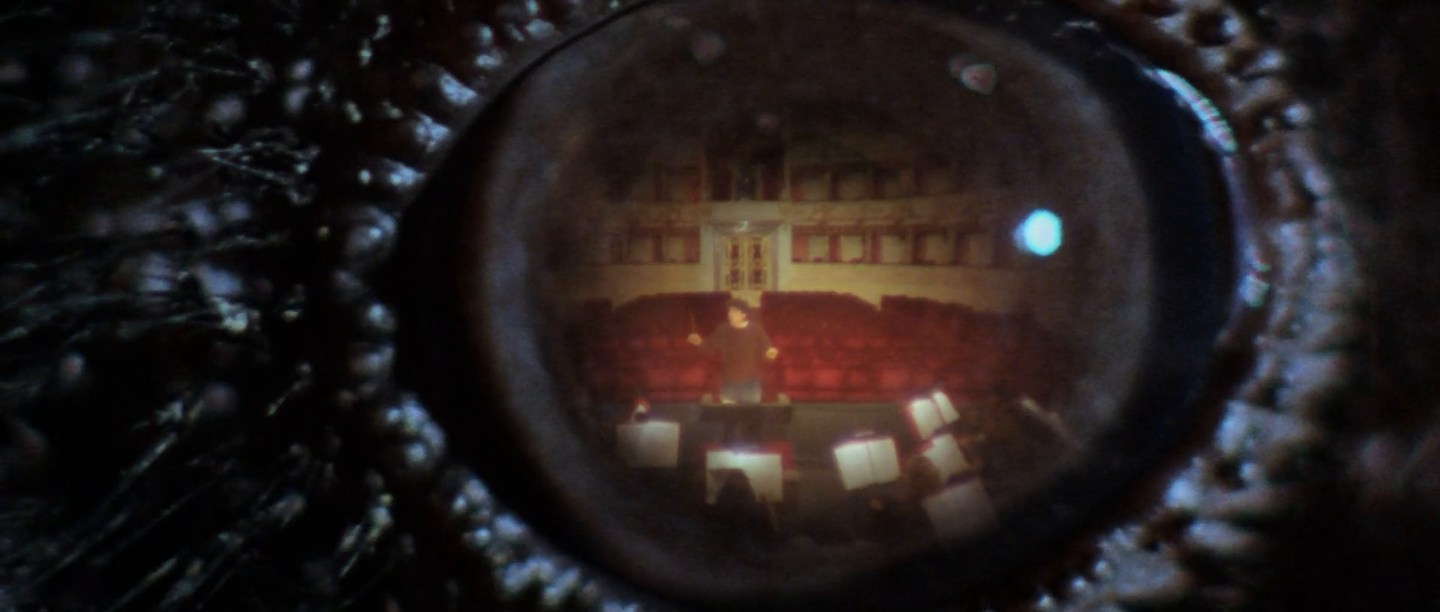
ENLARGE ↗The auditorium reflected in a raven’s eye.
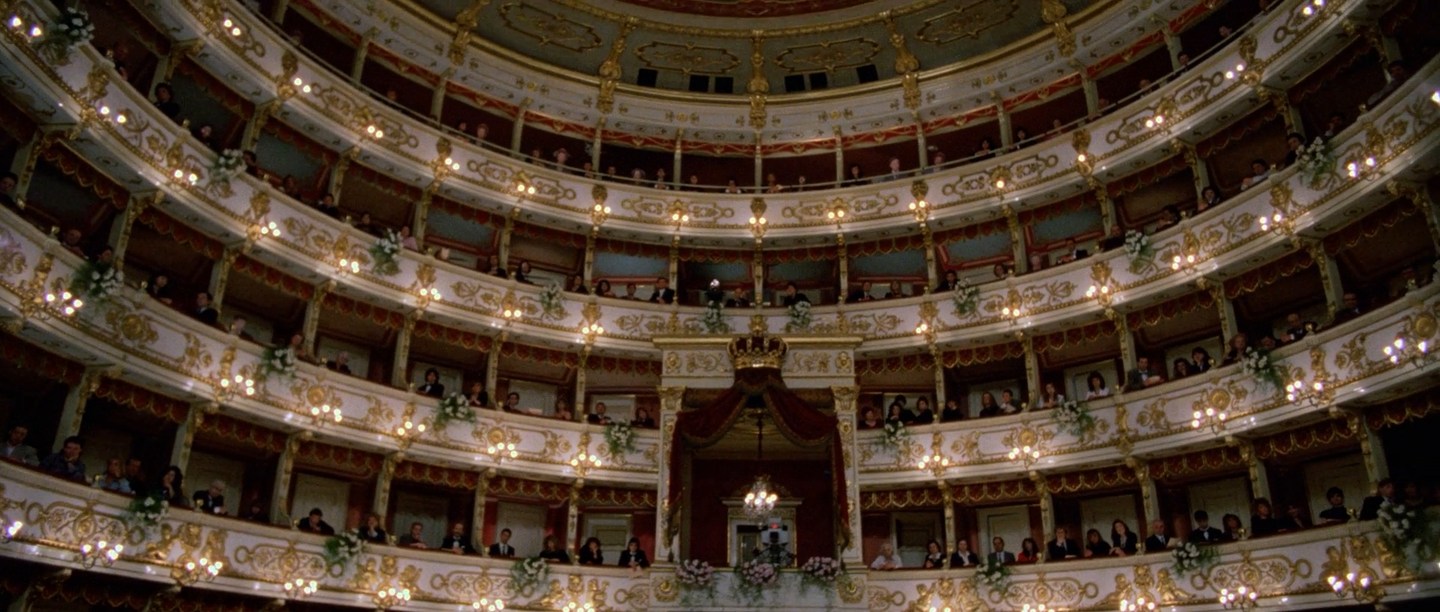
Before the theatre becomes a building to explore, it appears as a miniature reflection in an animal eye. The extreme close-up makes vision a material surface: a curved, glistening image that contains another image. The later flight through the auditorium will reverse this arrangement, releasing the viewpoint that the opening holds still.
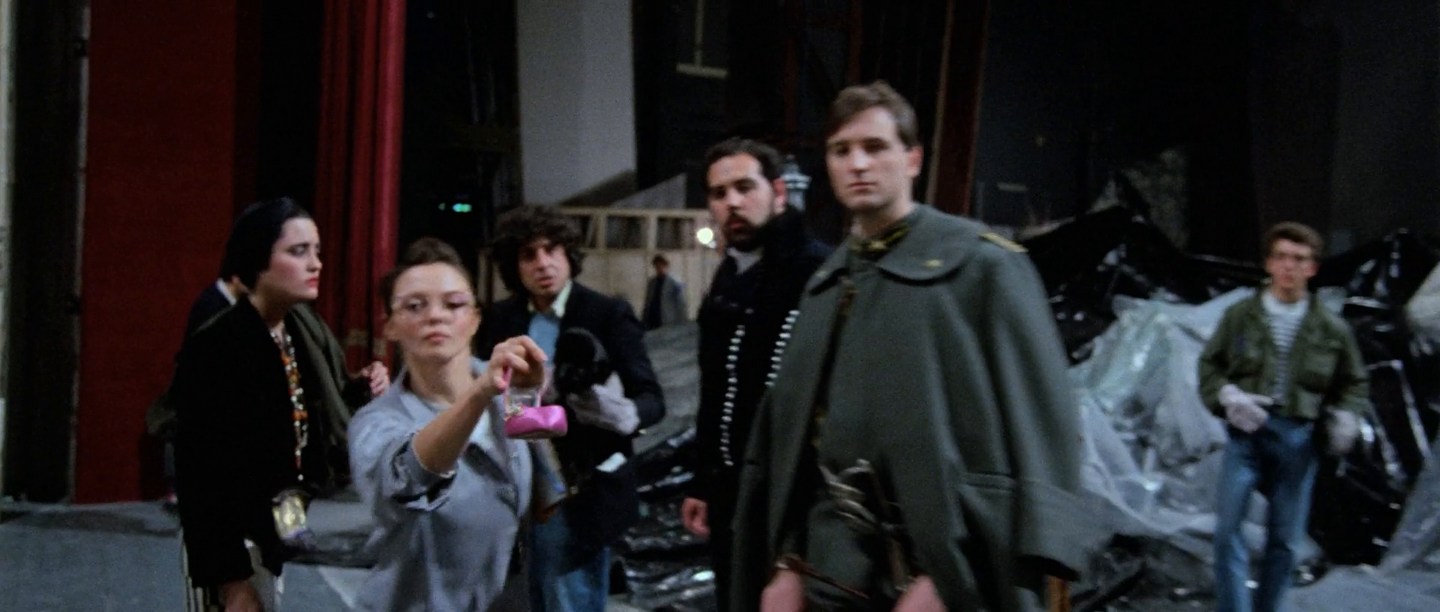
The rehearsal introduces the opera through the people obliged to keep it running. Performers and crew face an agitated viewpoint rather than occupying a self-contained stage picture. This gives the production a social geography before Betty takes over: a star can leave, but the company and the performance must continue.
03 / 06:30
A role arrives at home
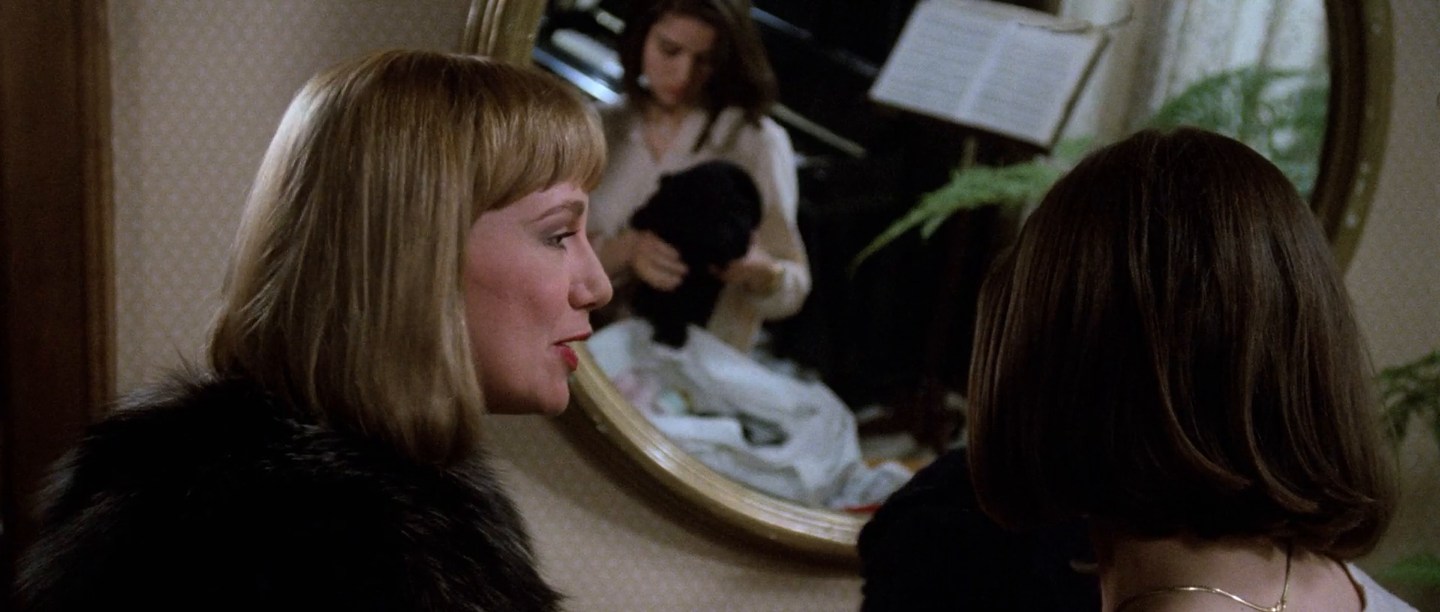
ENLARGE ↗Betty and Myra beside the bedroom mirror.
The bedroom’s mirror multiplies the encounter between Betty and Myra. The prospective singer is surrounded by everyday belongings before she is surrounded by stage machinery. The mirror also establishes a recurring distinction between a person and an image of that person, a distinction the killer repeatedly tries to erase.
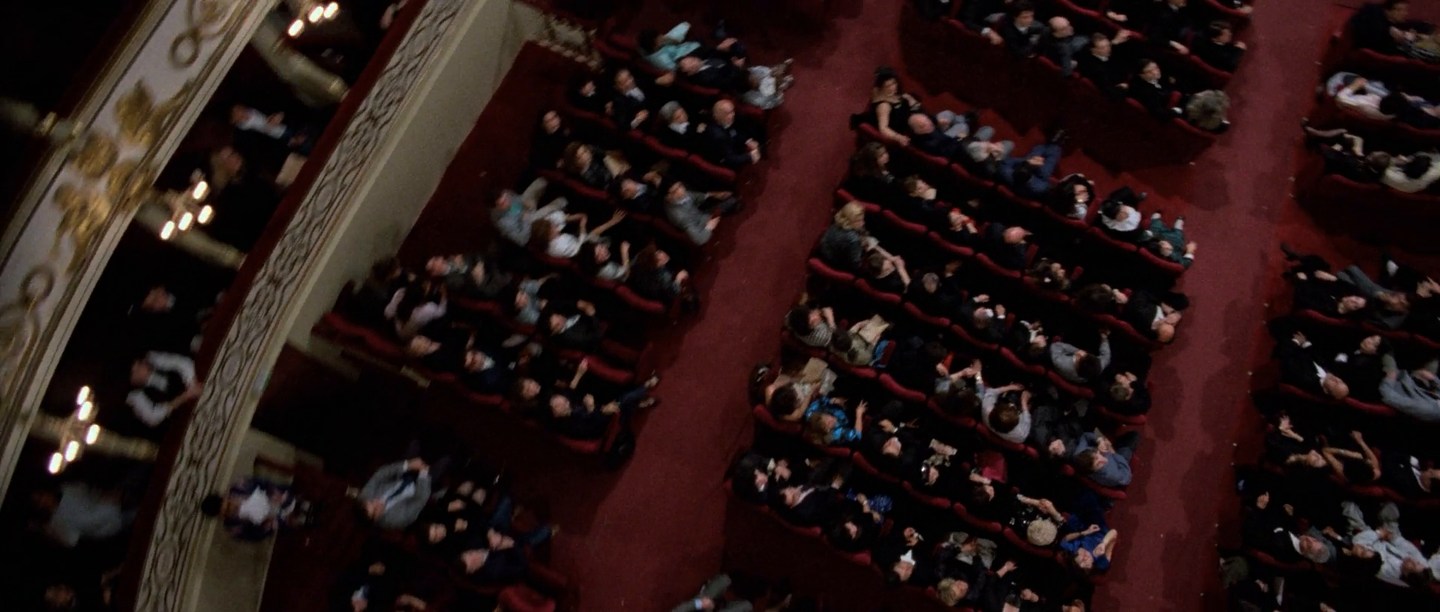
The tiers arrange spectators as a multitude of framed faces. From the stage, the audience is an architecture of observation, rising far beyond a single eye line. This view is essential to the later raven sequence: the film first establishes the regular pattern that the flying viewpoint will disrupt.
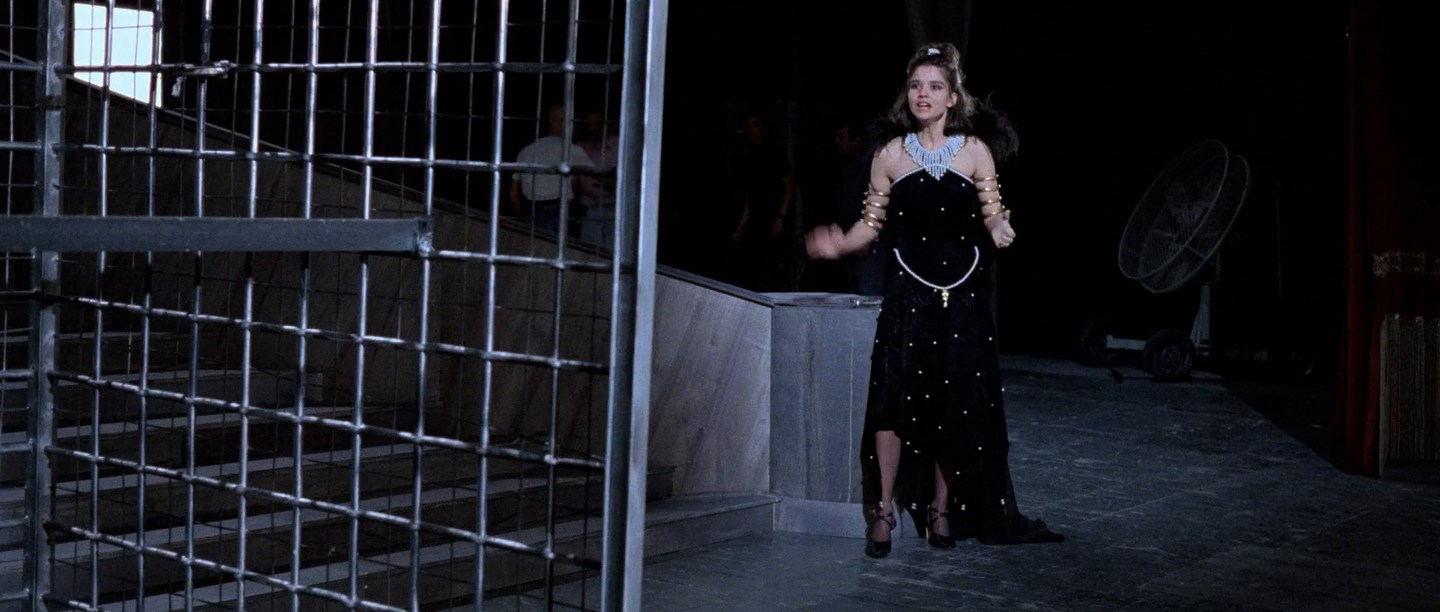
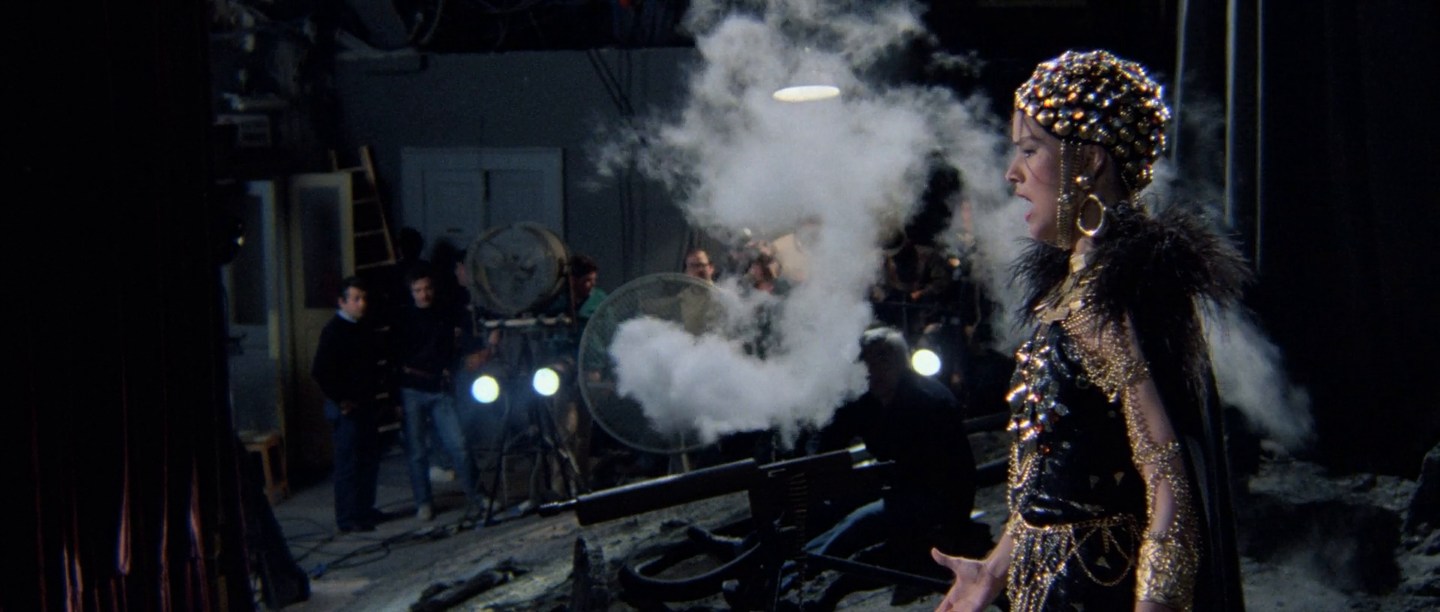
Betty’s reflective costume sits against an austere, damaged-looking stage world. Smoke, exposed machinery and jagged scenery make this Macbeth a constructed environment rather than a reassuring classical tableau. The frame also keeps the work beside the performance visible: lights and waiting bodies belong to the spectacle’s edges.
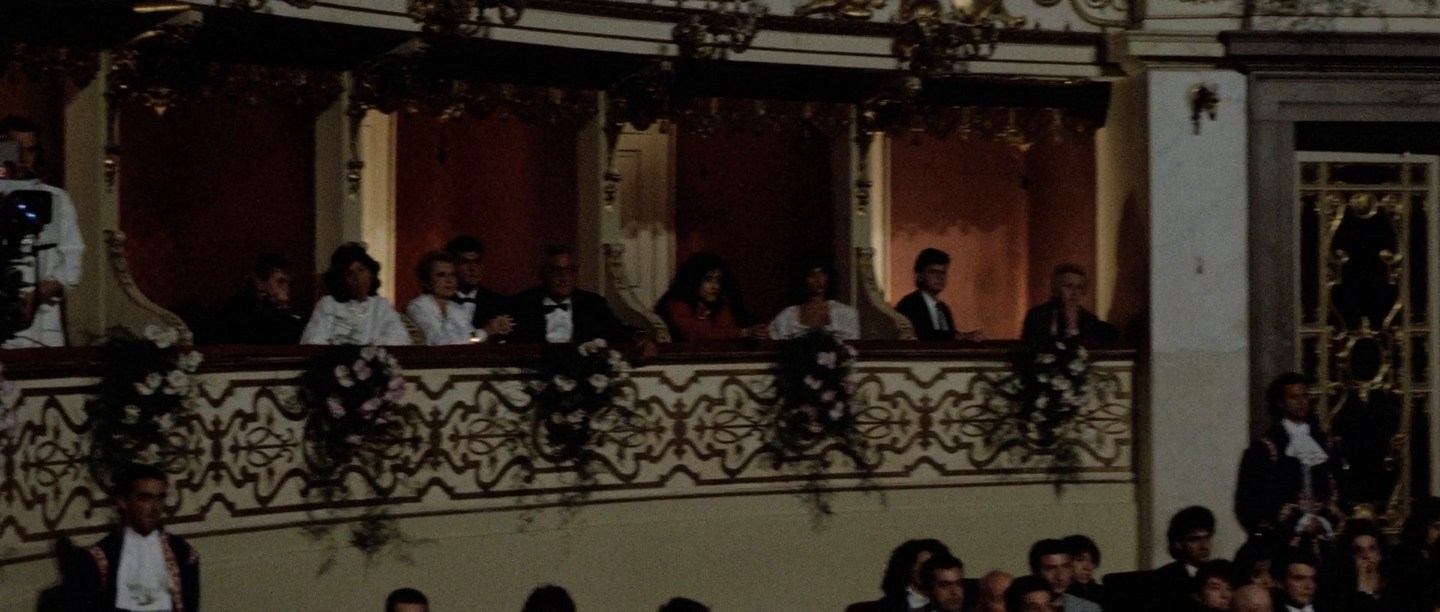
The box separates a small group from the larger auditorium and gives its occupants a decorative border. Opera repeatedly singles out observers before explaining what they know. A beautiful frame can therefore also serve as a hiding place: a watcher appears socially ordinary because watching is what everyone here is doing.
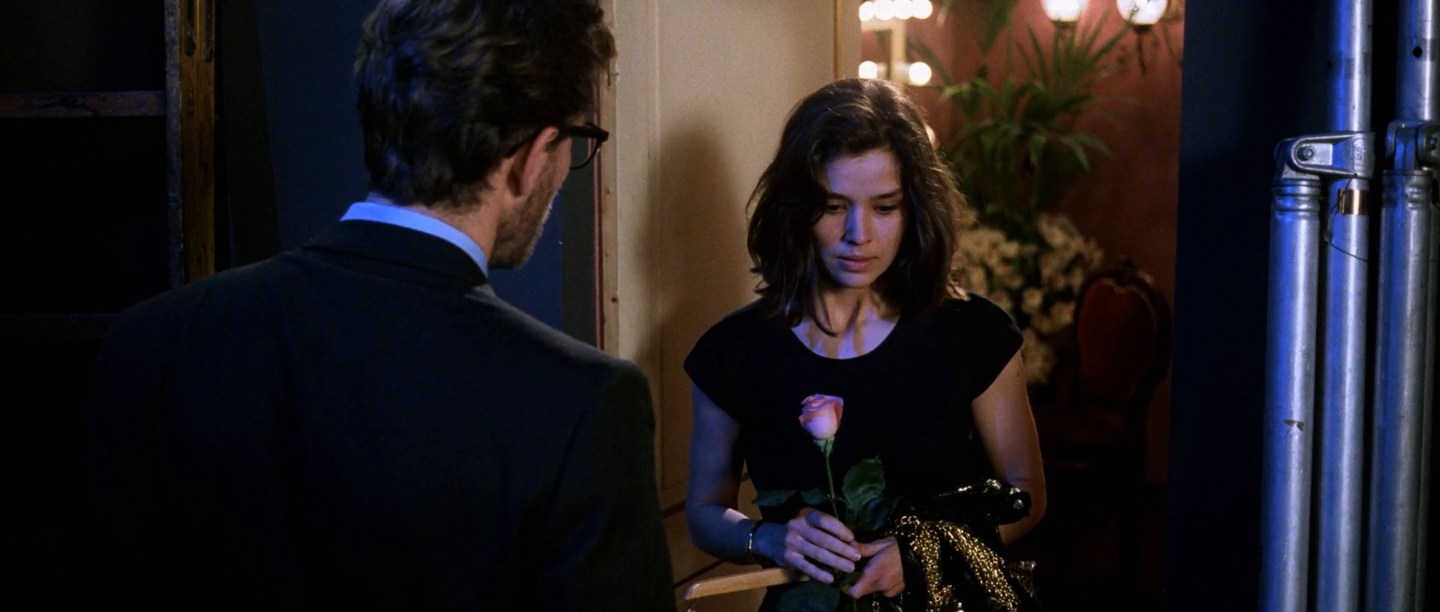
A flower and a costume carry the public performance into a narrower backstage passage. Betty is no longer isolated at the centre of a stage, but she remains the object of attention. The corridor brings admiration, professional conversation and private approach into the same confined space.
08 / 22:45
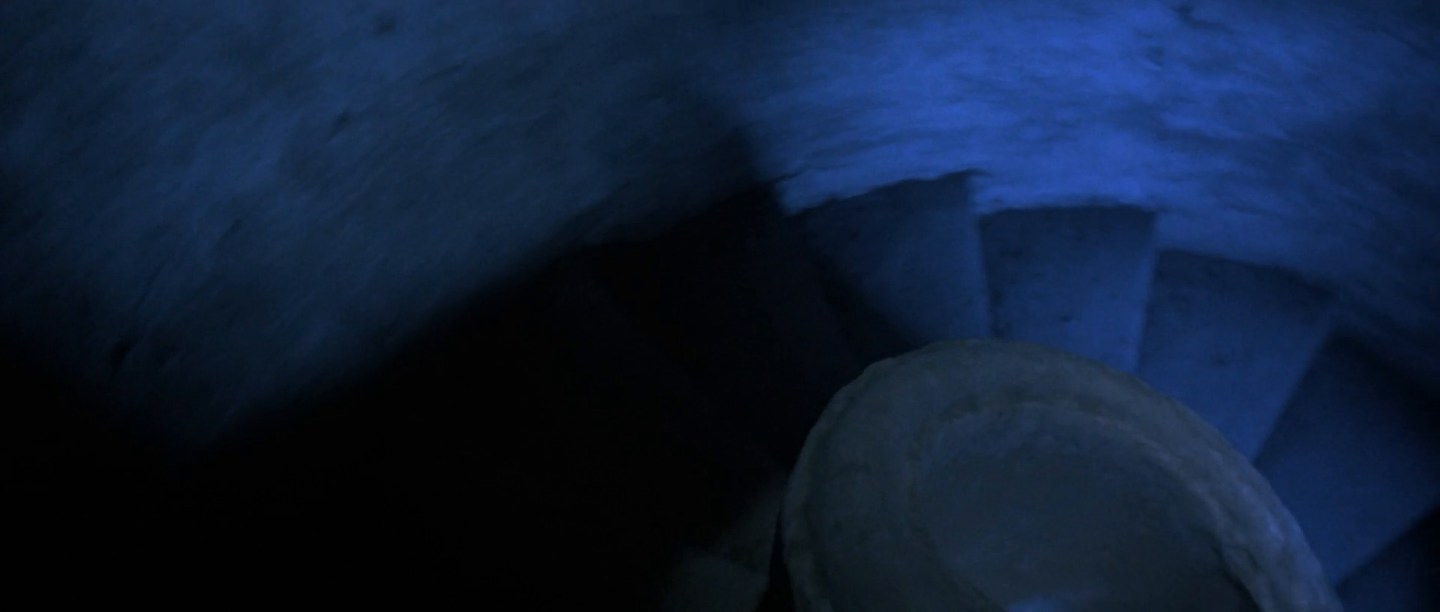
The theatre becomes a spiral
ENLARGE ↗Blue light falls across a spiral staircase.
The staircase turns the theatre into a route through shadow and curvature. Its enclosing geometry differs sharply from the auditorium’s symmetrical frontal view. A passage that ordinarily connects working areas becomes an image of descending into spaces the audience never sees.
09 / 27:15
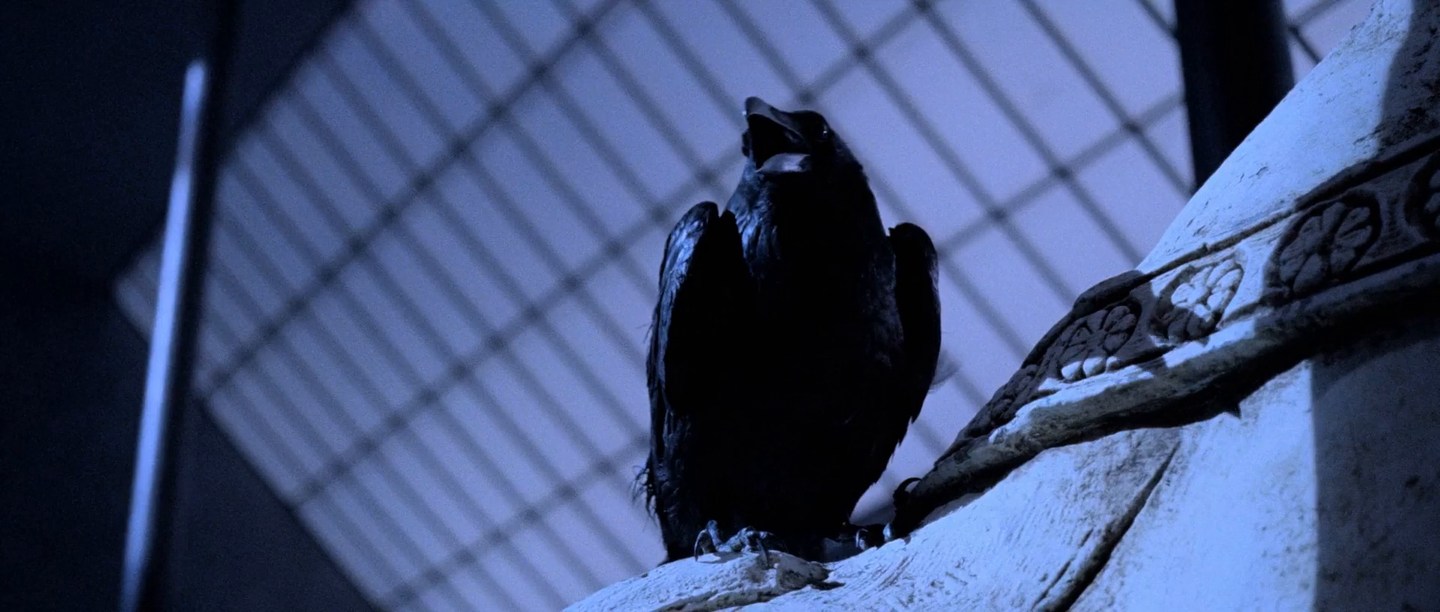
A witness above the floor
ENLARGE ↗A raven perches against the blue-lit skylight.
The low angle gives the bird a commanding position in an otherwise empty space. Bars, window divisions and the branch form competing lines around its body. The film treats an animal’s presence as more than atmosphere: the bird occupies a vantage point that the human investigation cannot easily reproduce.
10 / 29:30
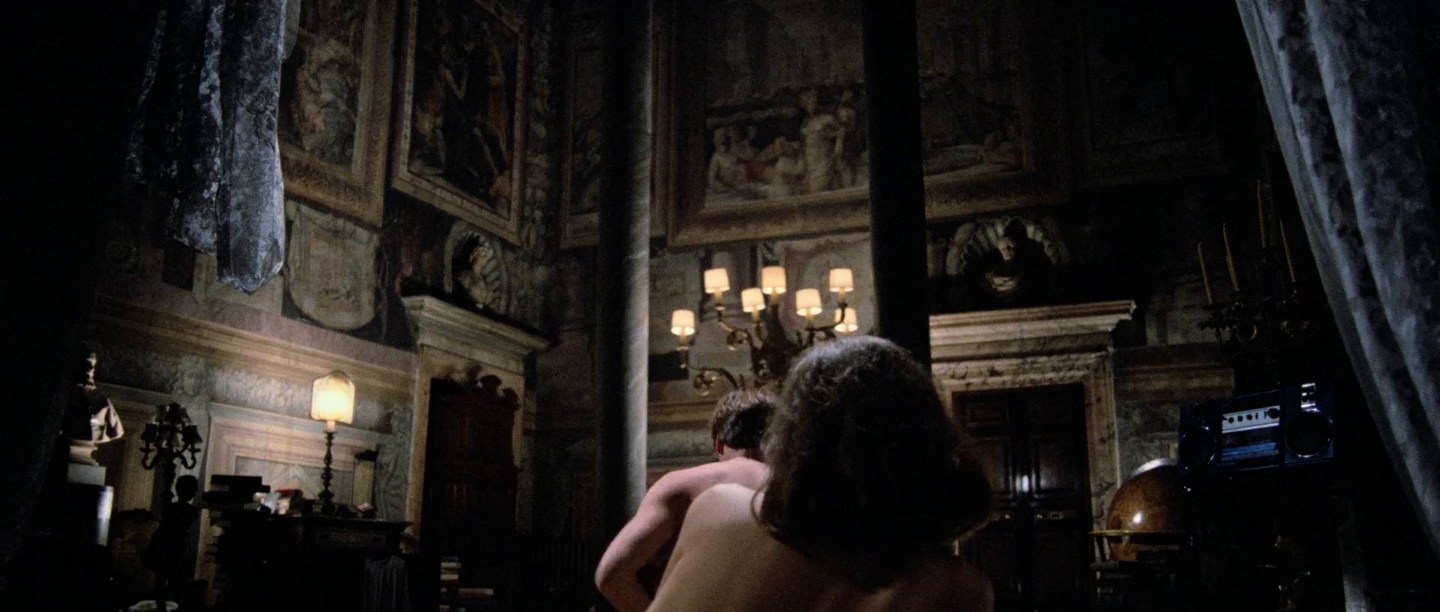
A bedroom too large for privacy
ENLARGE ↗Stefano and Betty beneath the painted ceiling.
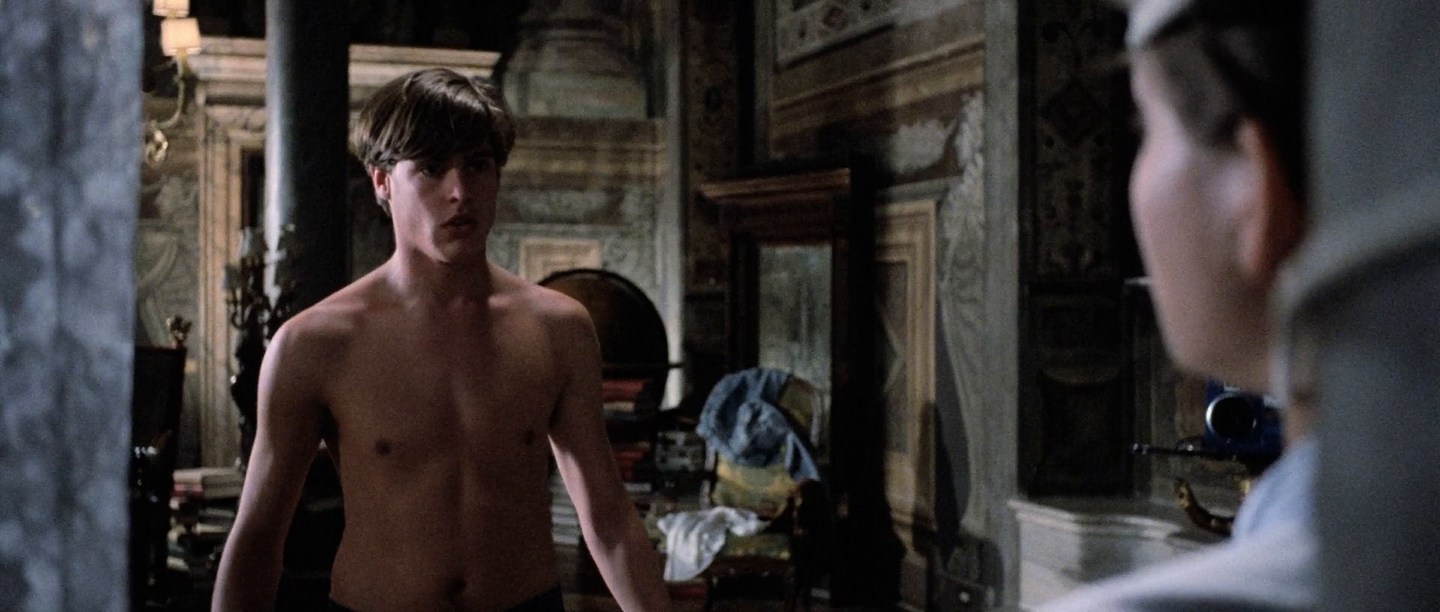
The room’s columns, paintings, globe and piled books make intimacy look exposed. Its depth leaves more space than the two people can occupy or monitor. The later attack will exploit exactly this imbalance, turning an expansive room into a place where Betty cannot move.
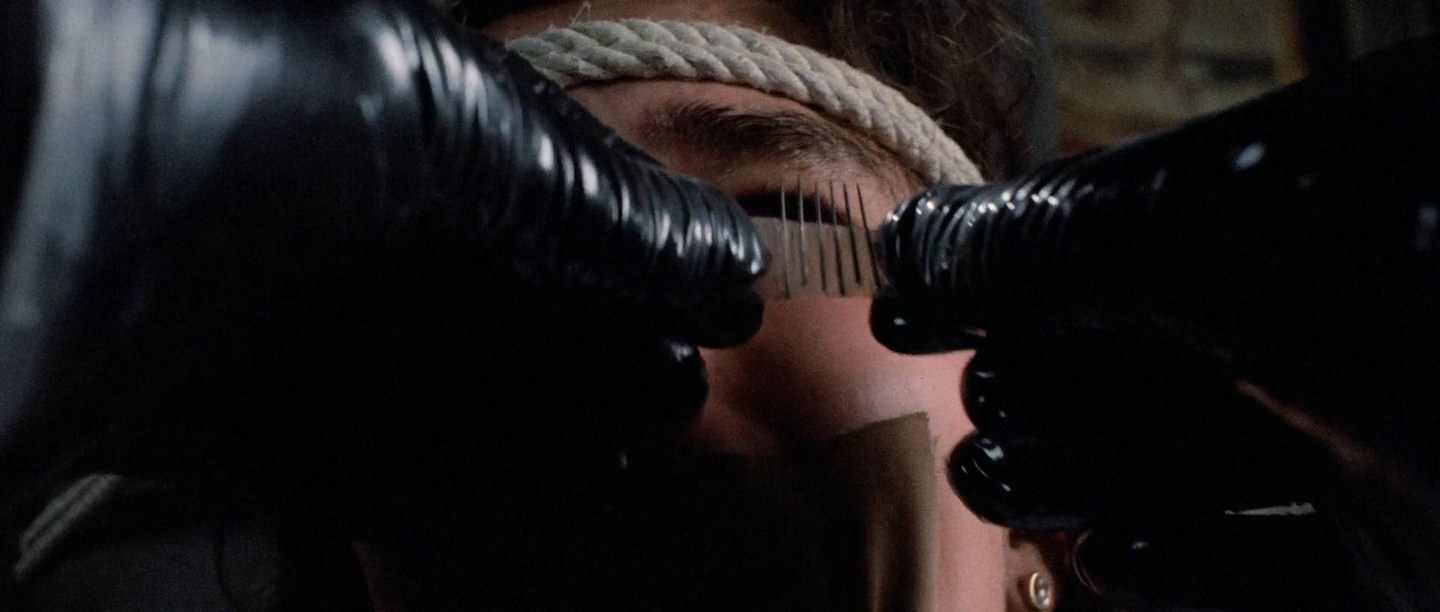
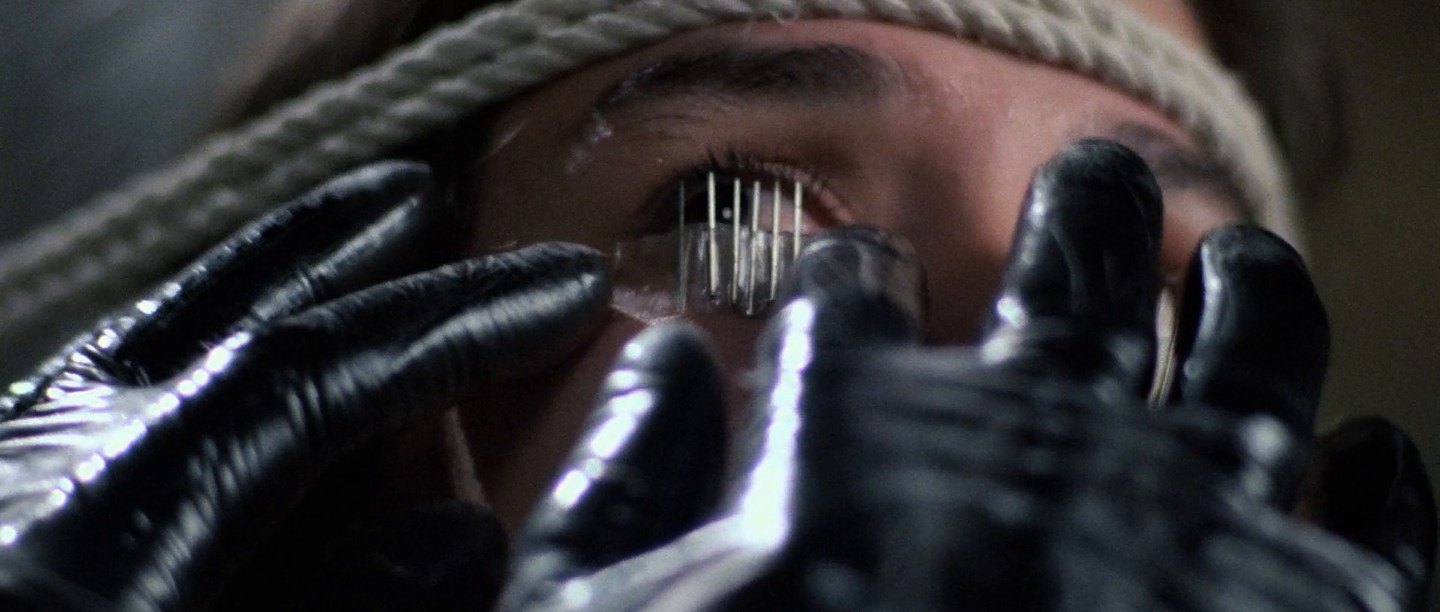
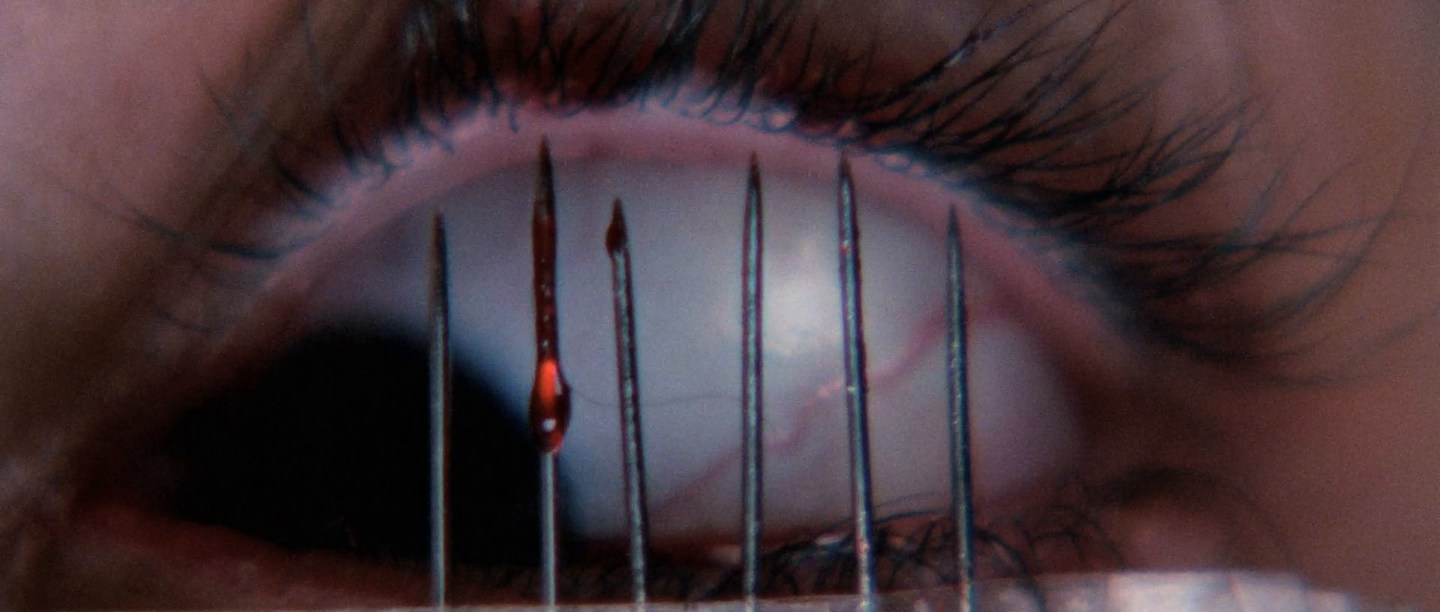
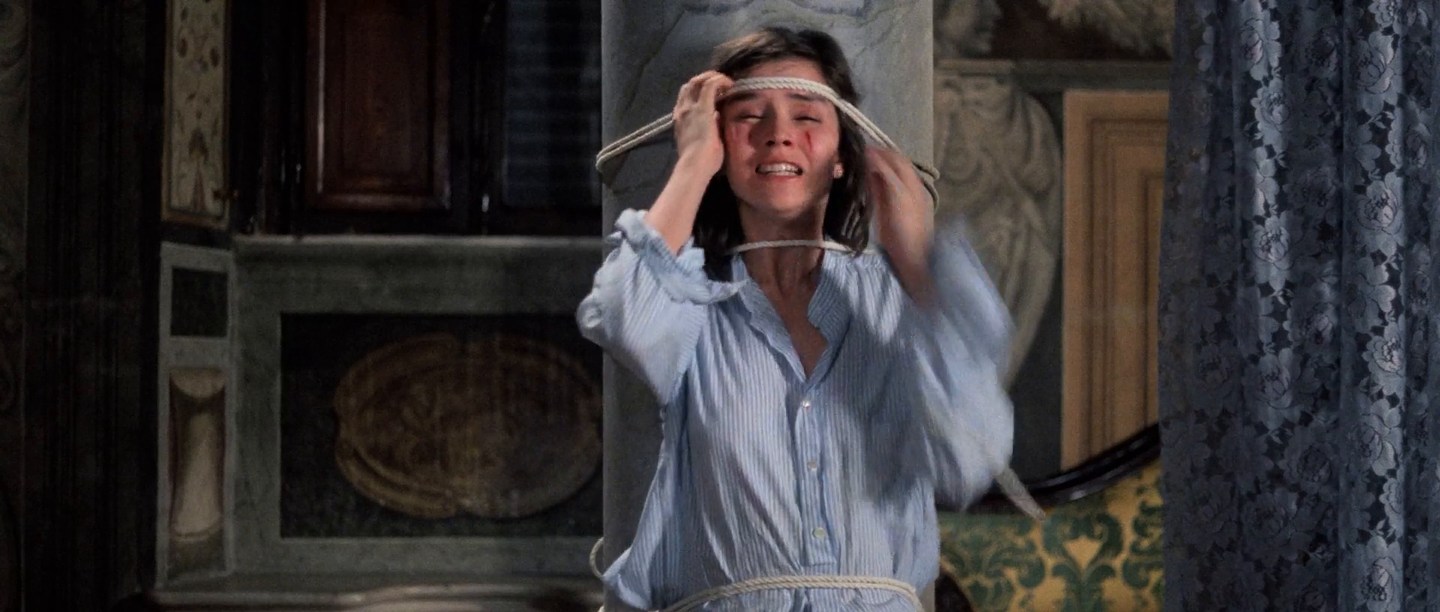
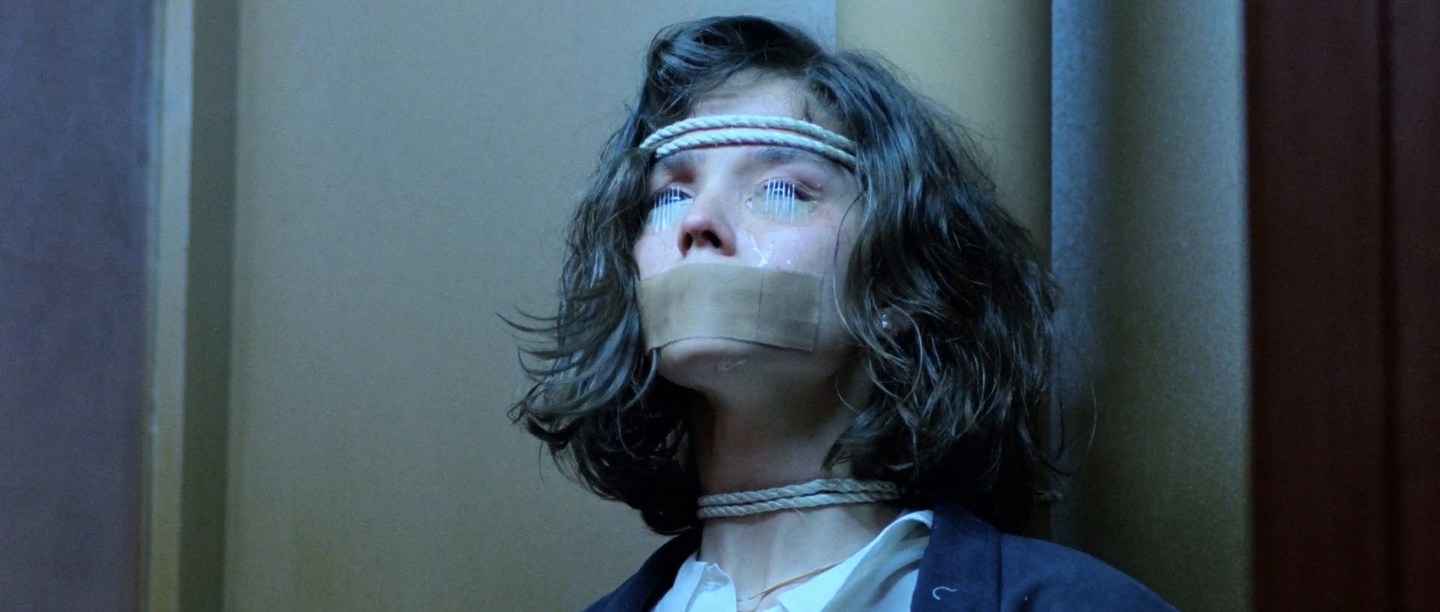
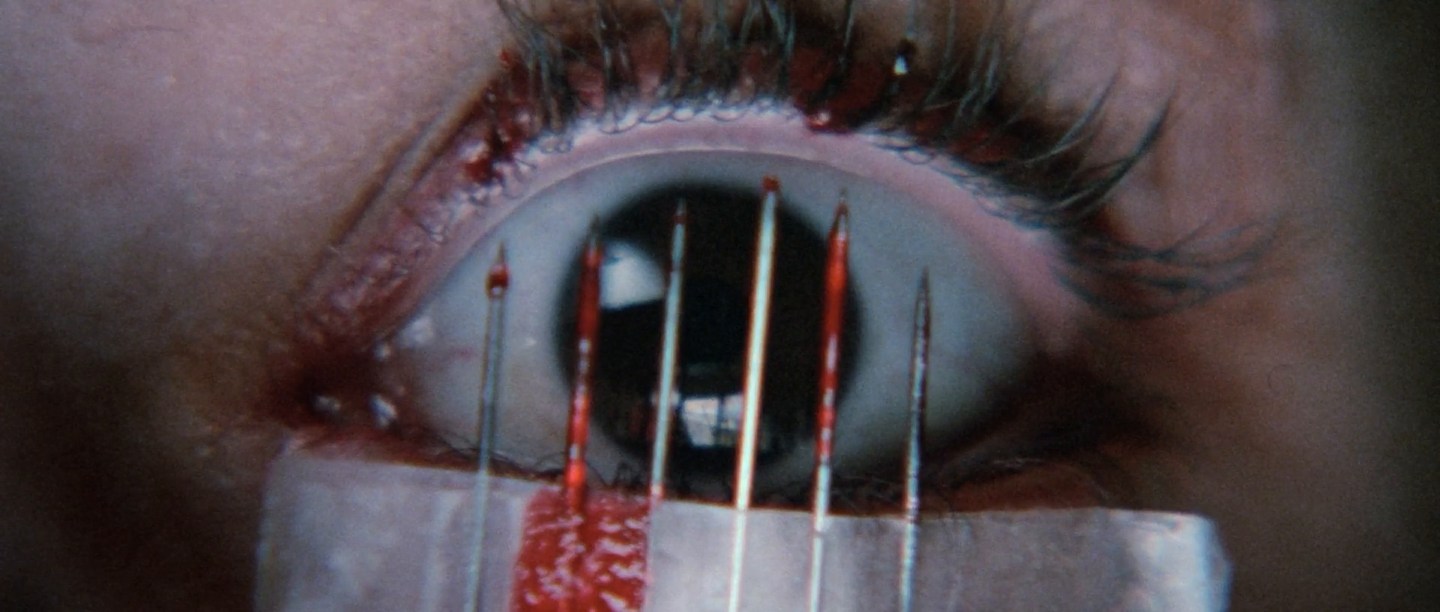
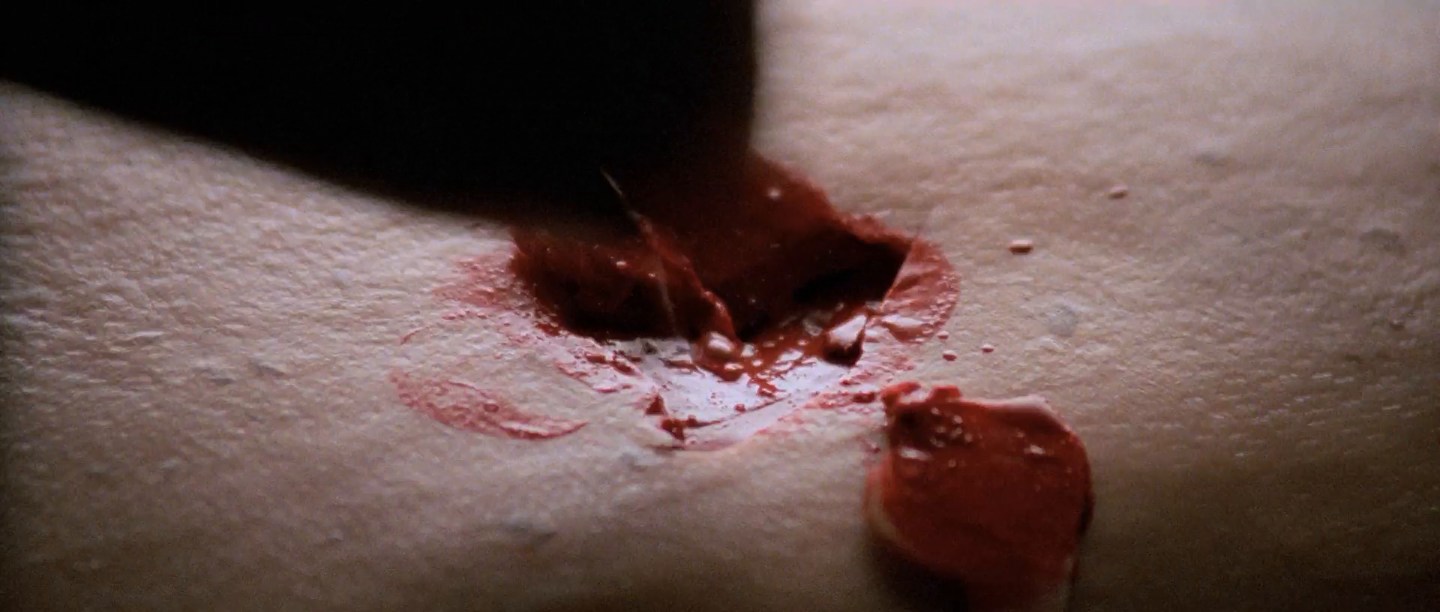
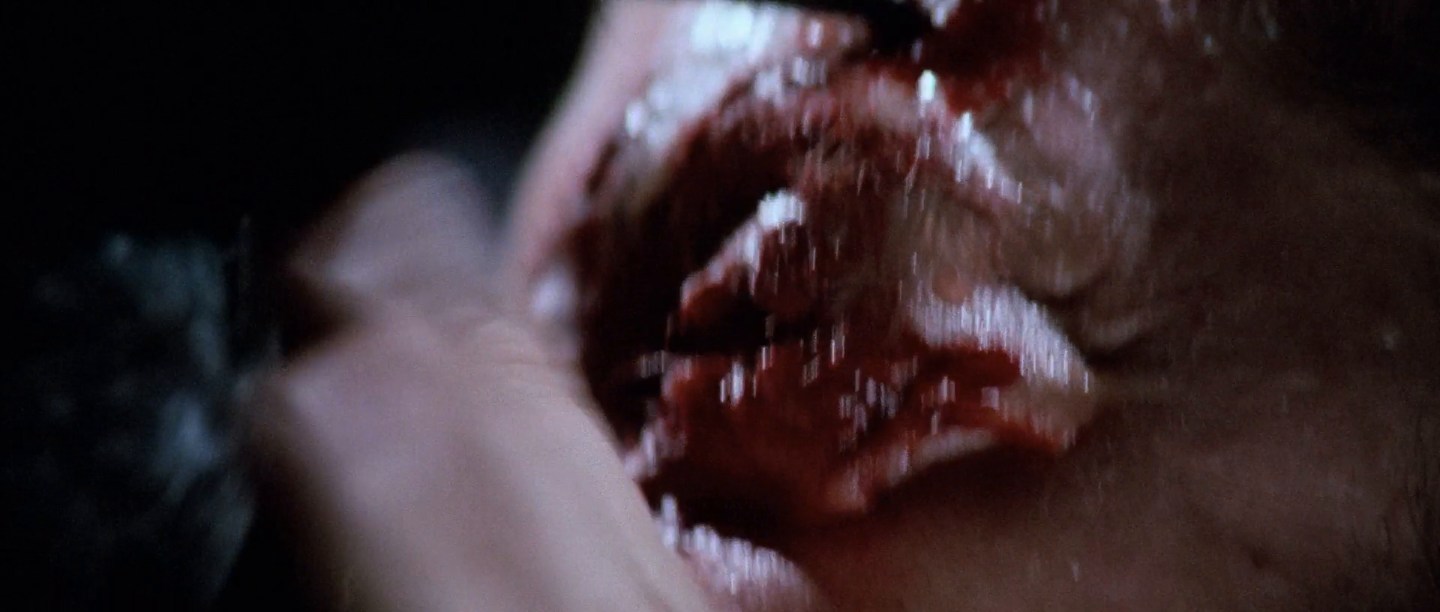
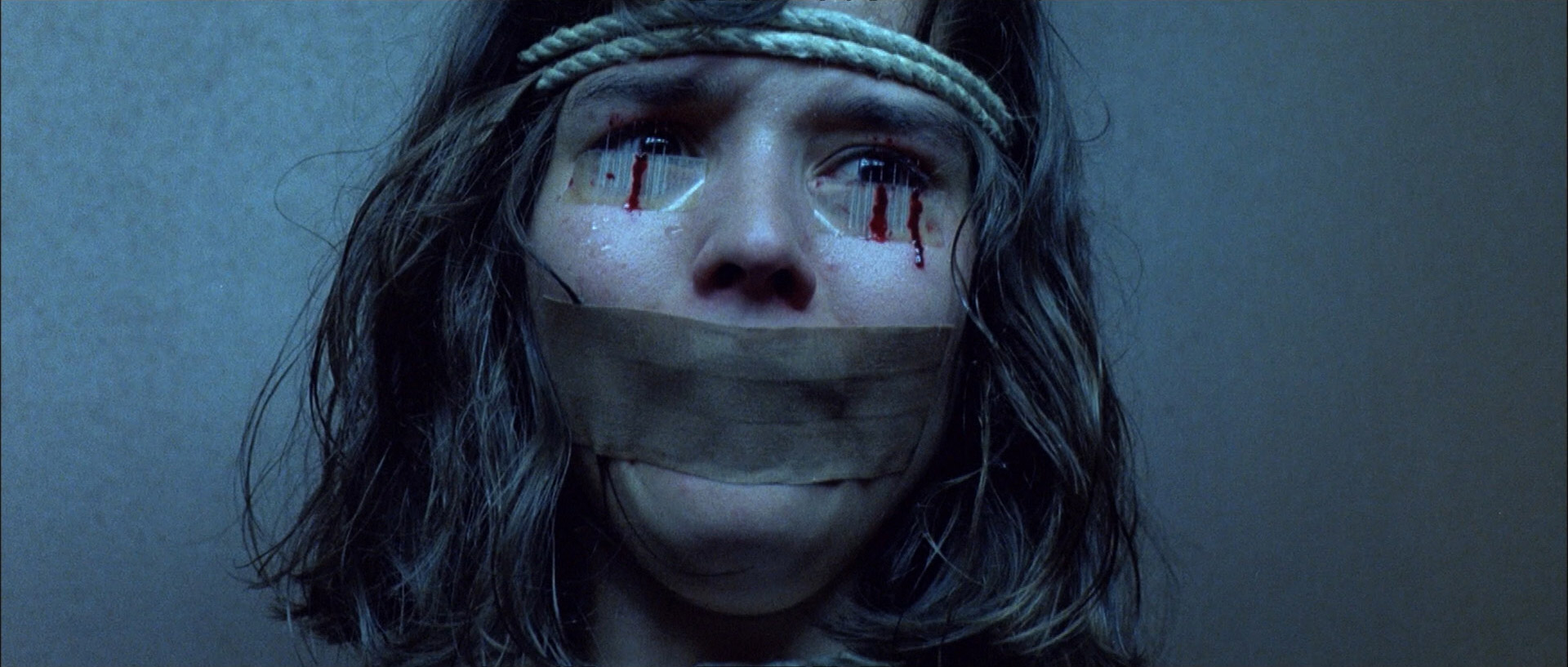
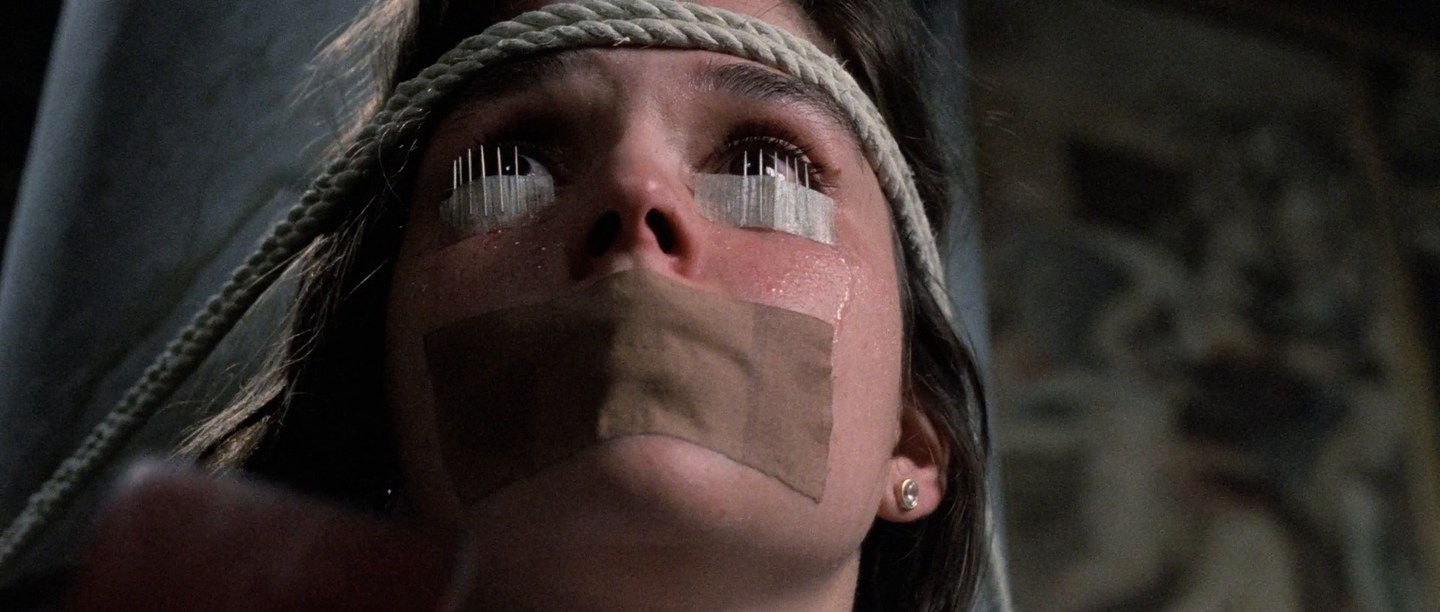
Rope, adhesive tape and the aligned needles divide the face into controlled zones. The mouth is blocked while the eyes remain forcibly available. The nearby gallery follows the assembly, the extreme close-up and the eventual removal, showing how the image is built through scale as well as makeup.
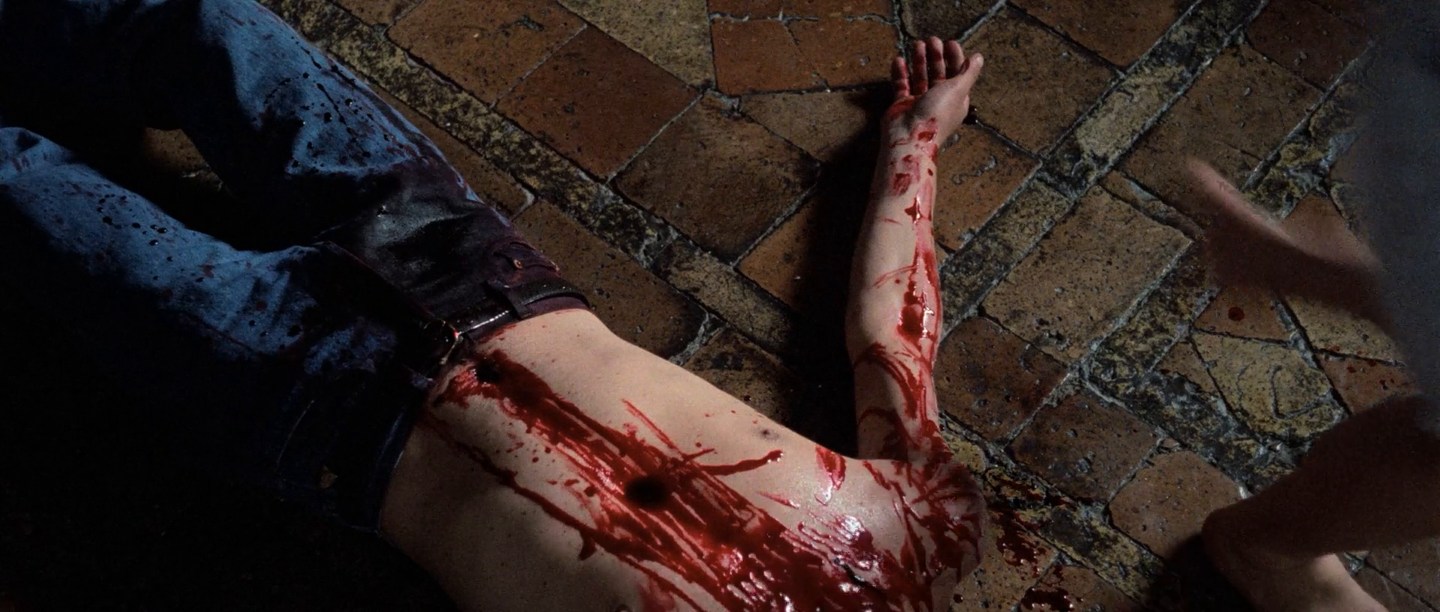
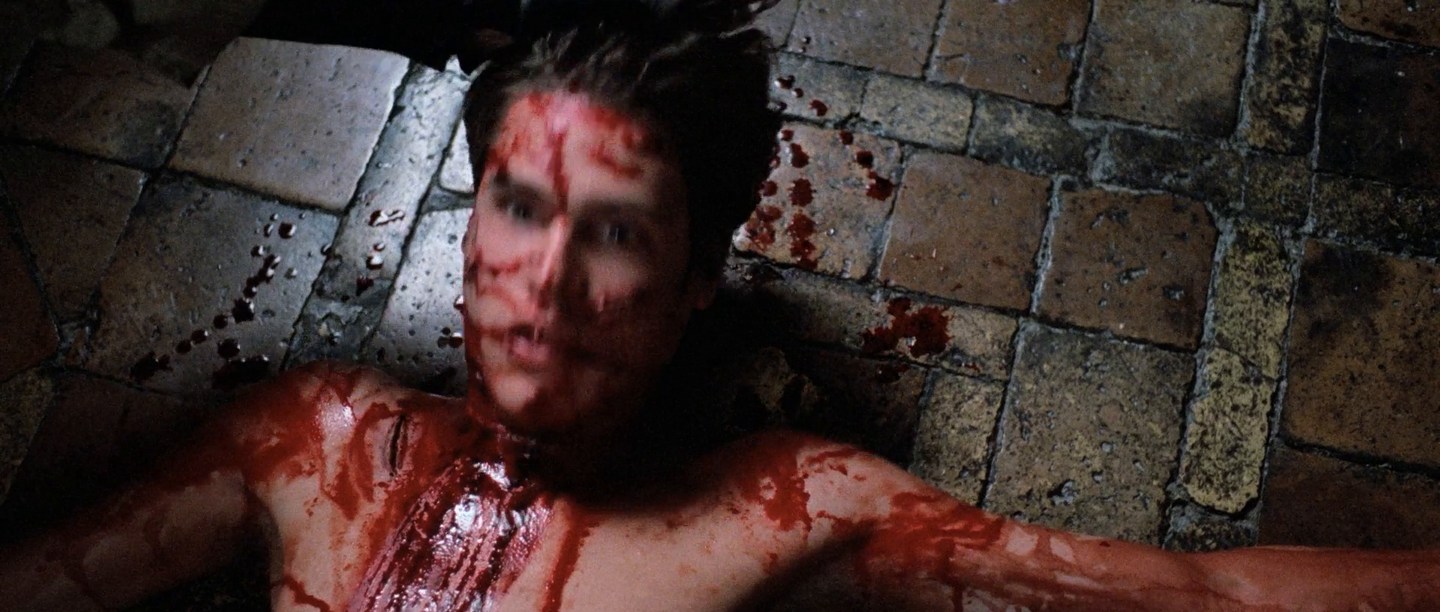
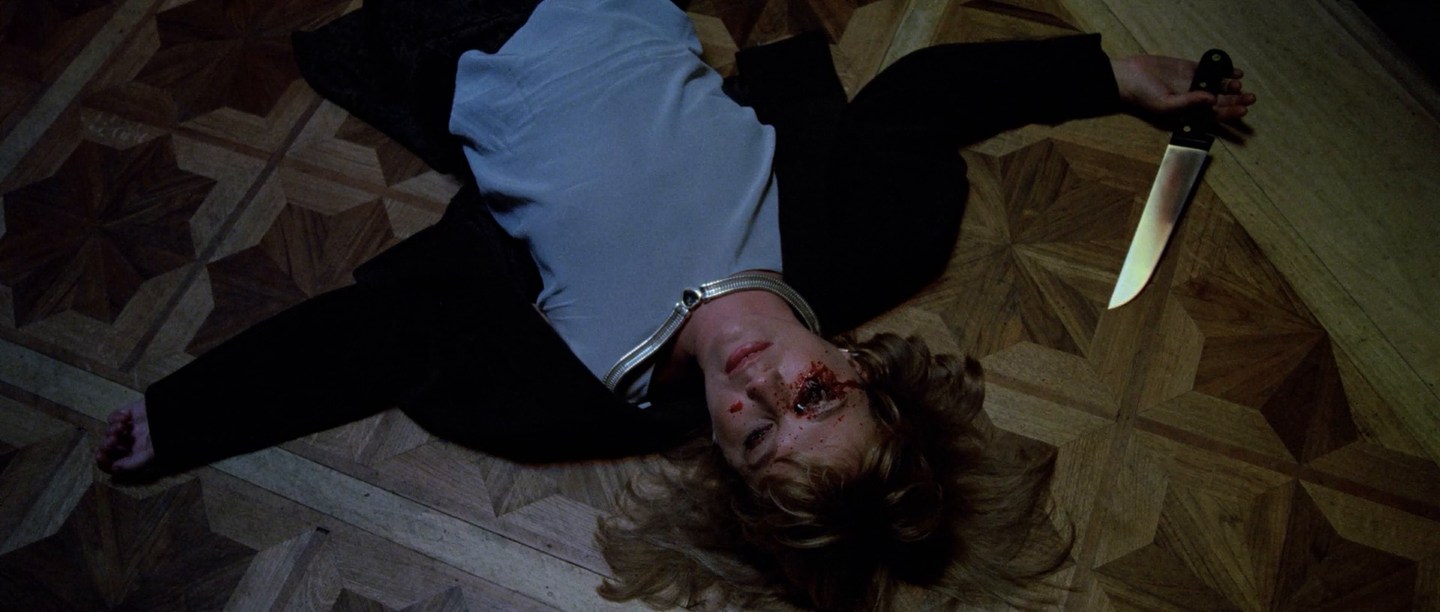
The aftermath returns the victim’s body to the room’s floor. During the assault, close-ups separate the wound, the attacker’s hand and Betty’s eyes; this wider physical consequence reunites them within one space. Betty’s later movement away from the chair does not undo what she has been forced to witness.
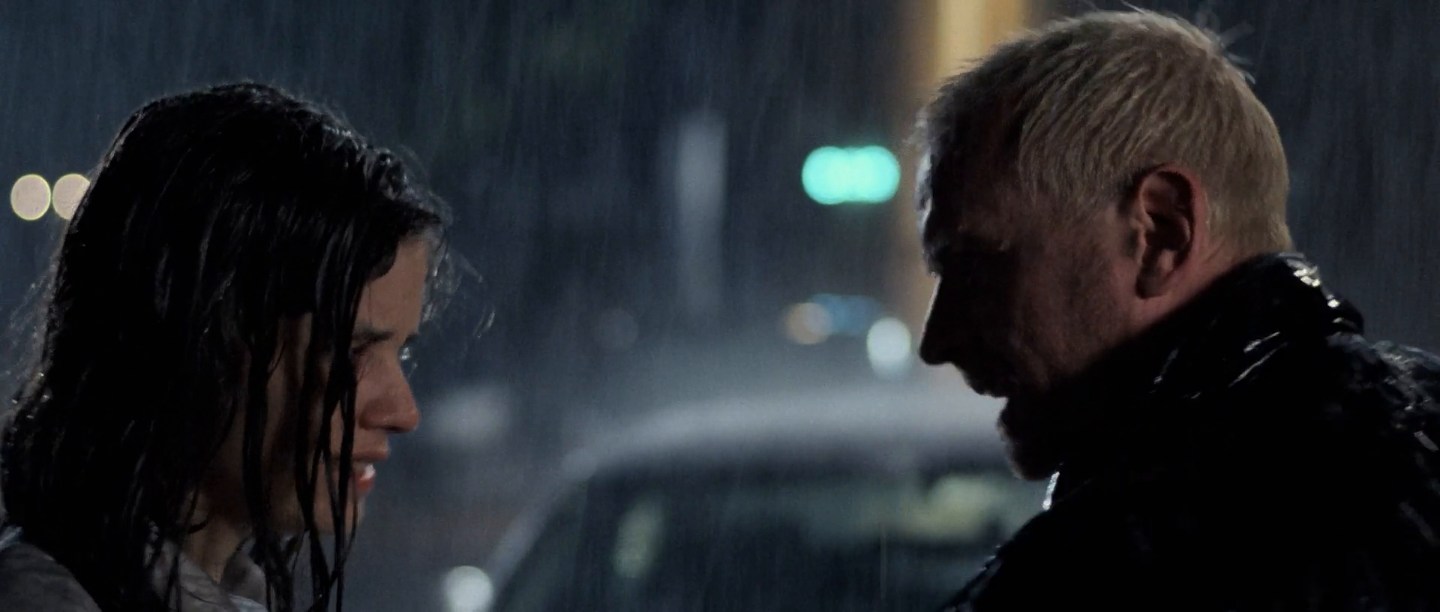
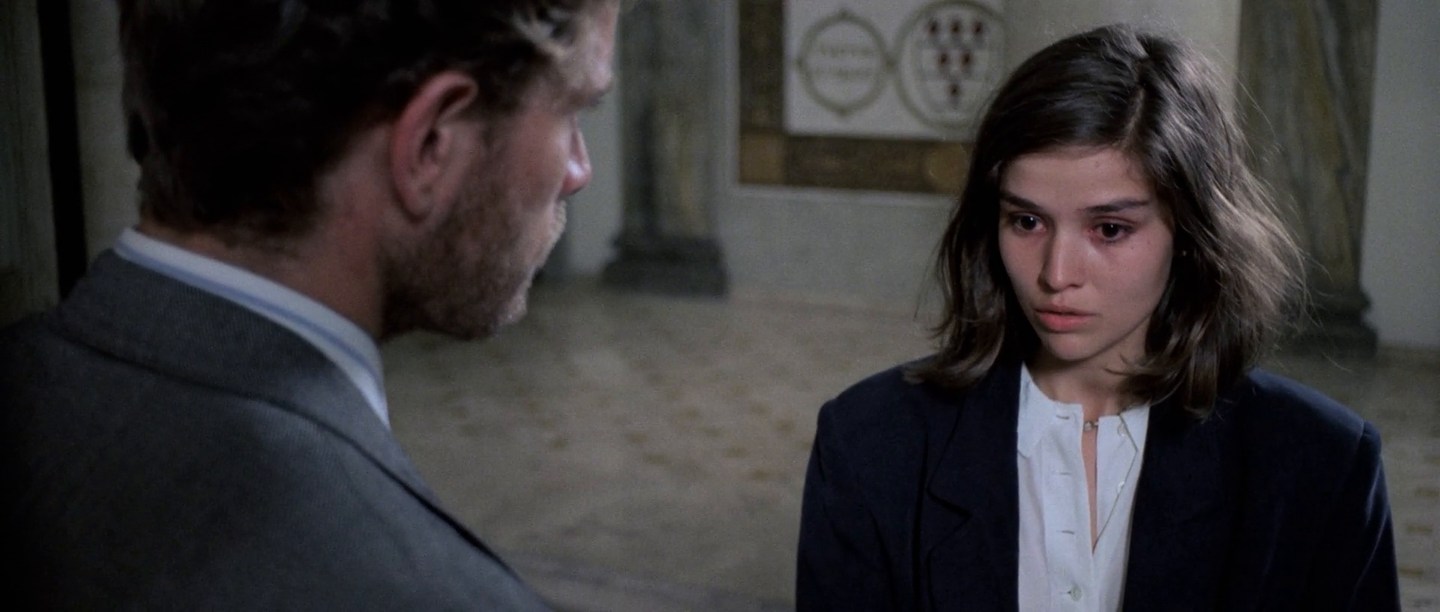
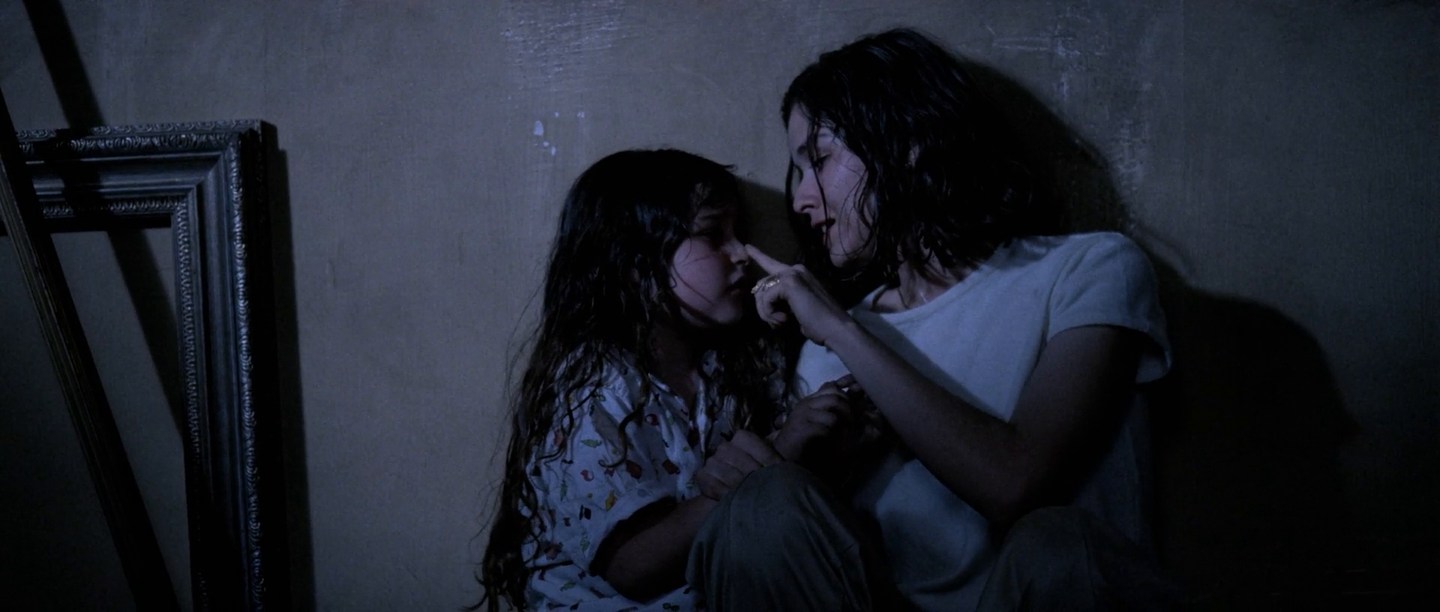
Wet hair, reflective pavement and the car’s enclosing frame move the film out of the ornate interior without offering relief. Betty now faces another person at ordinary conversational distance. The difference between that encounter and the preceding forced close-ups makes the act of telling someone feel precarious.
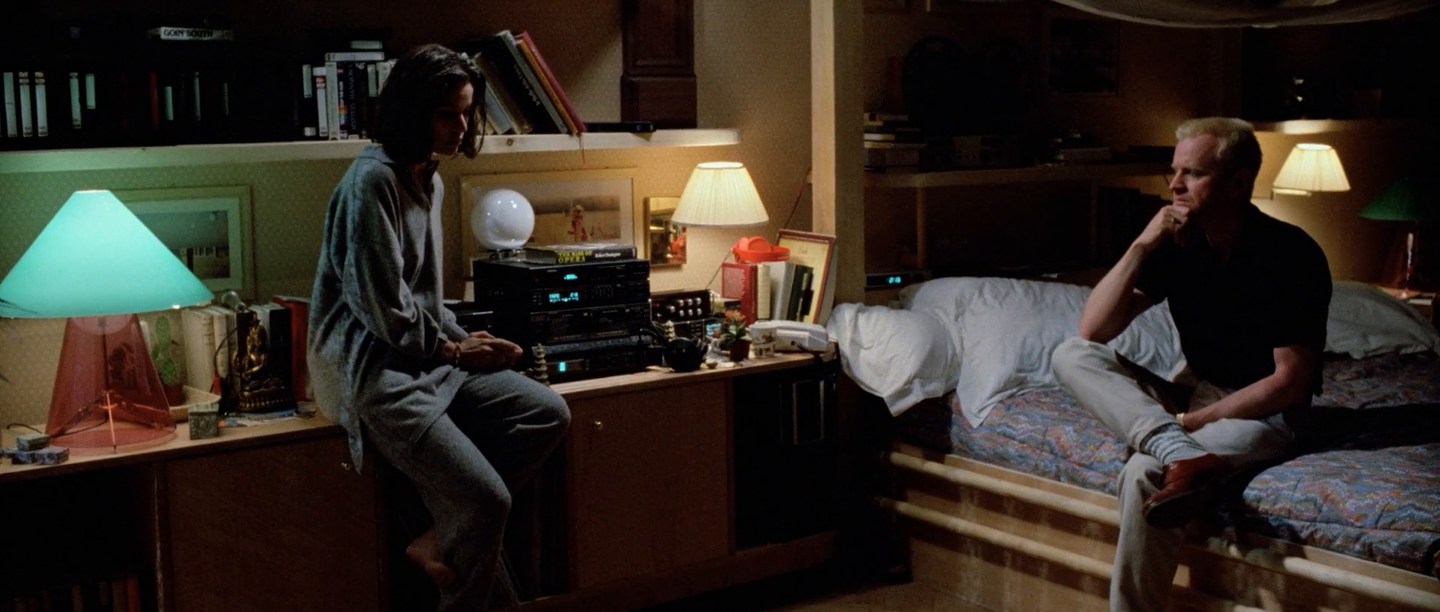
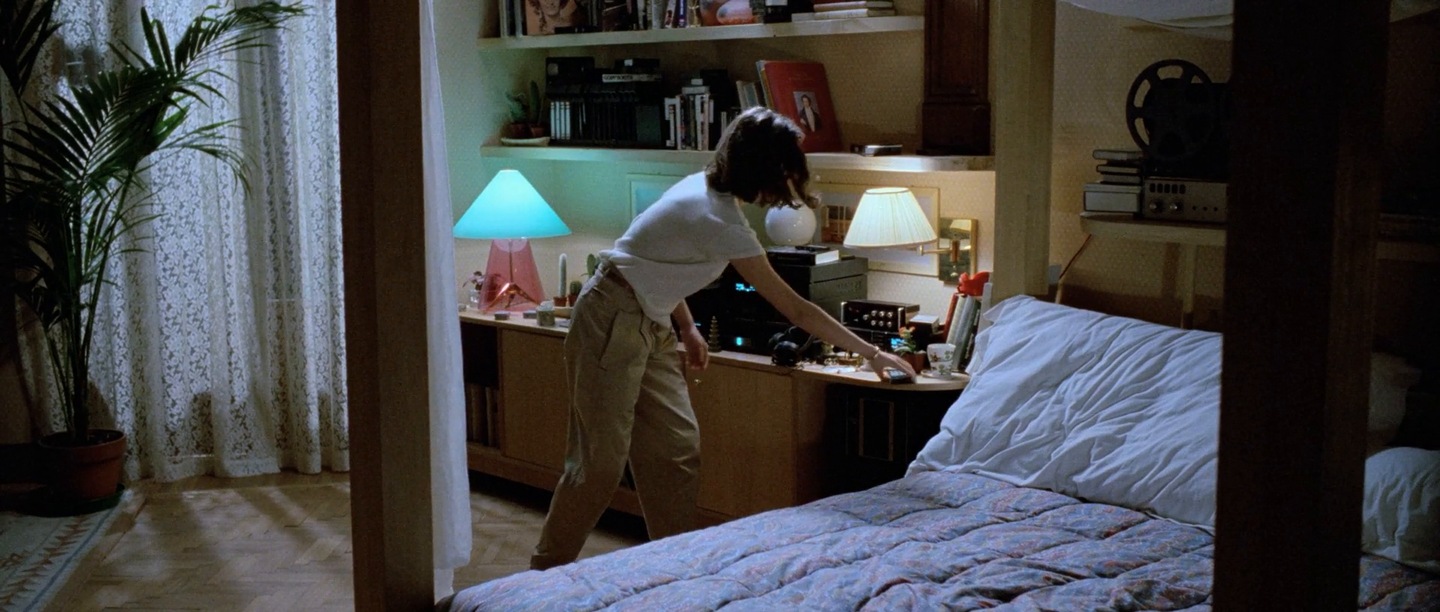
Books, audio equipment, lamps and bed linen give the home a recognisable scale. Yet the open doorway and the spaces behind the figures remain active parts of the composition. The everyday room becomes a place where Betty must try to organise an experience that the murder sequence rendered as fragments.
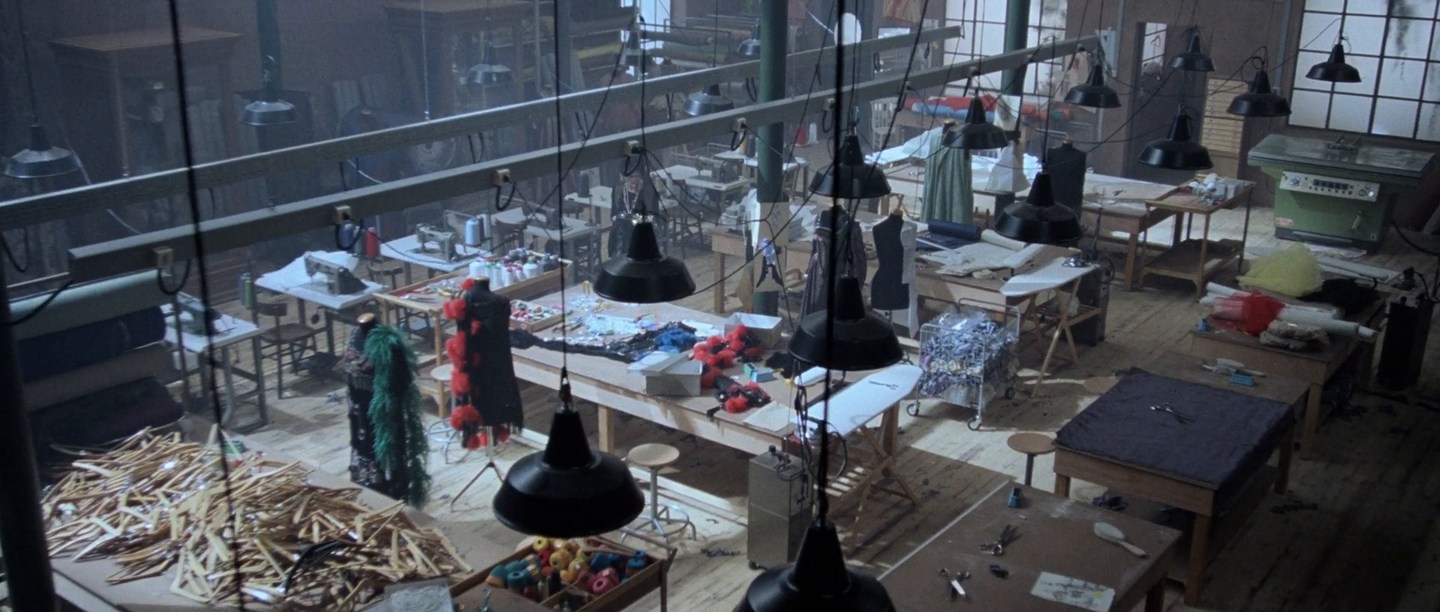
Tables, fabric, mannequins and lamps disclose the labour behind the stage image. The overhead view maps the room before the next attack breaks it into hiding places and partial views. A dress is simultaneously a performance object, something to repair and a surface on which evidence can catch.
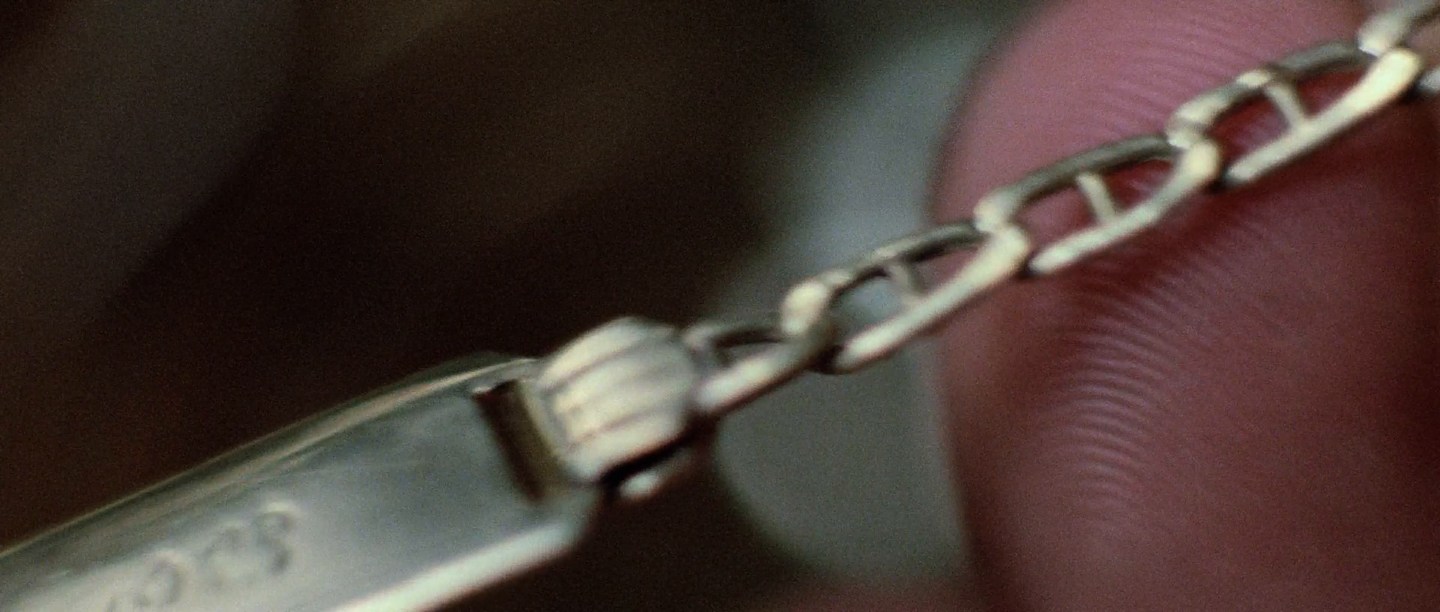
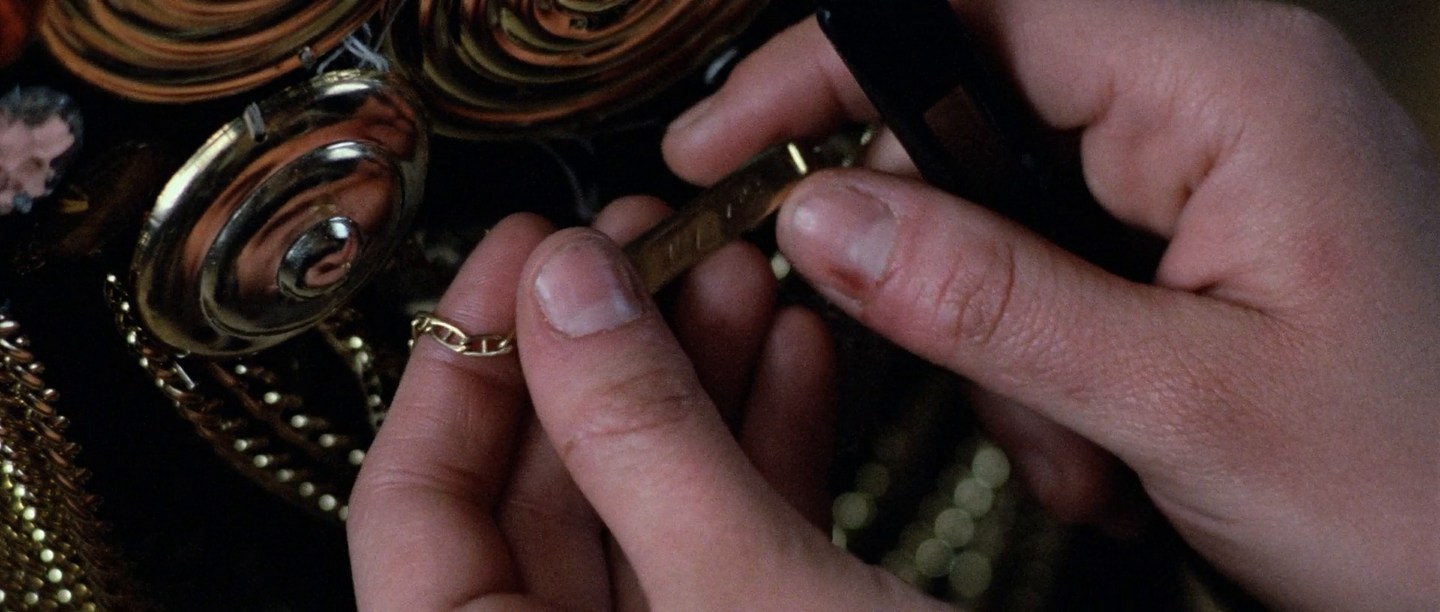
The scale changes from an entire workshop to a tiny chain and clasp. Handling the object briefly creates a shared act of scrutiny between Betty and Giulia. The subsequent violence is organised around controlling this discovery: an incidental ornament becomes a reason for another spectacle.
17 / 55:00
A second captive audience
ENLARGE ↗Giulia looks upward from the workshop floor.
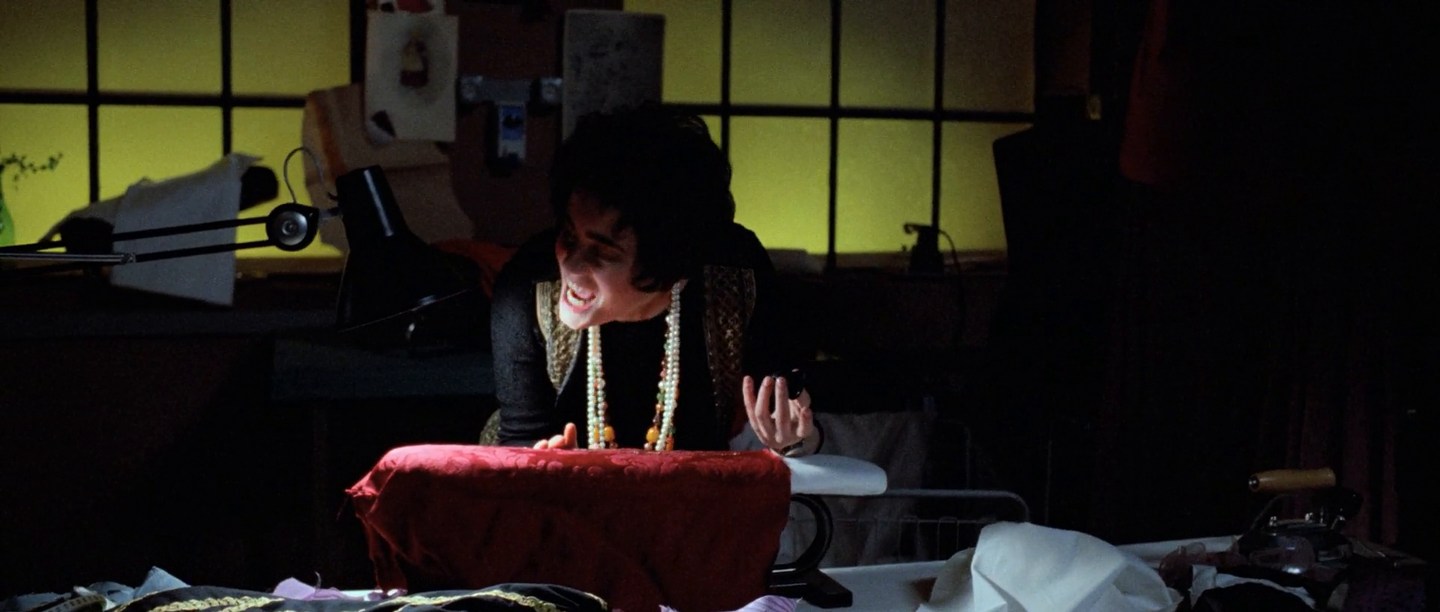
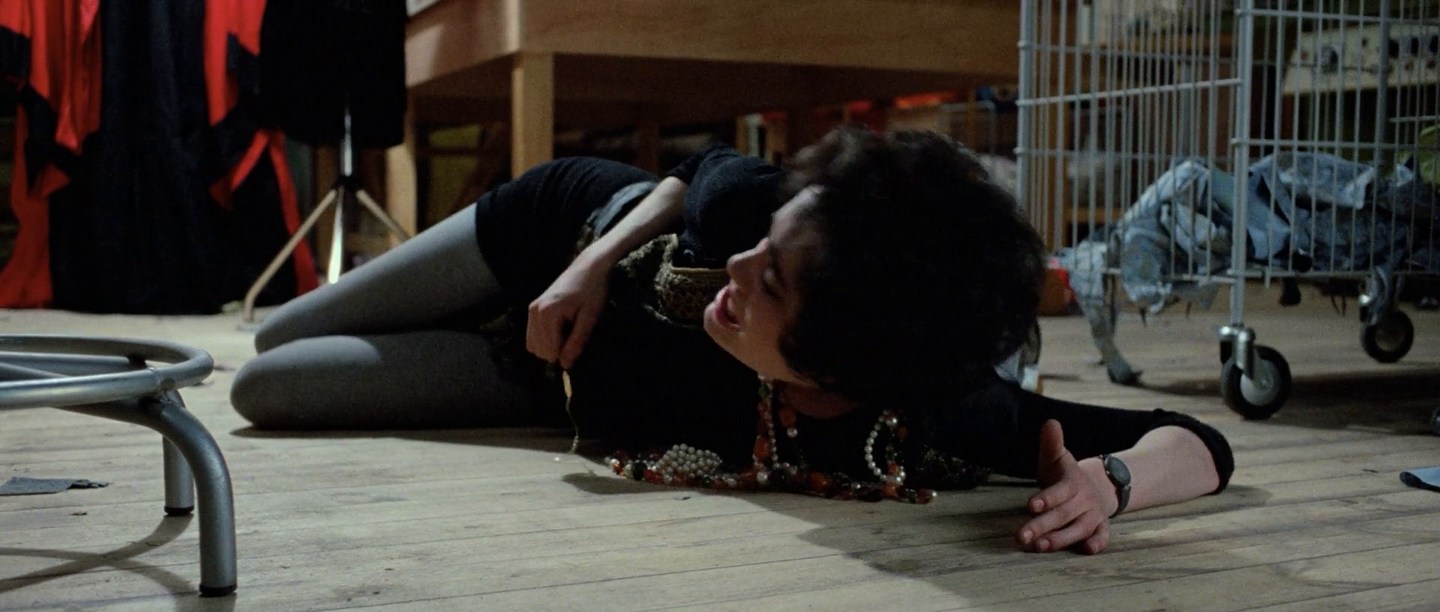
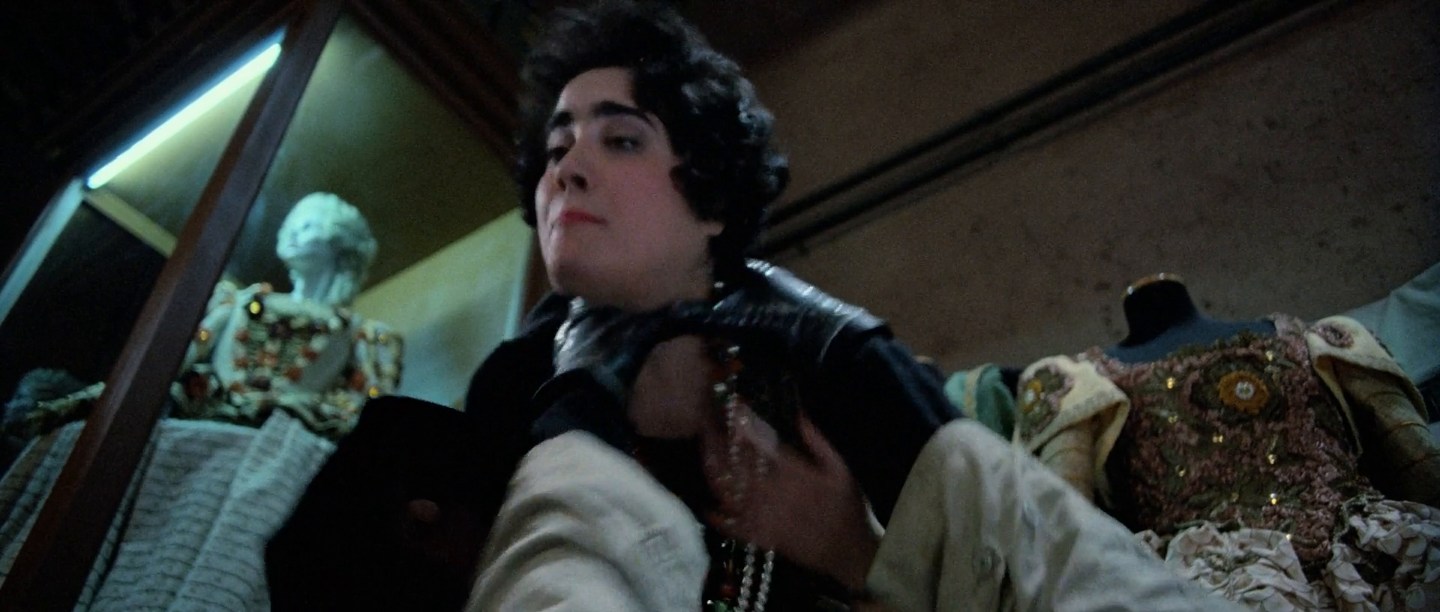
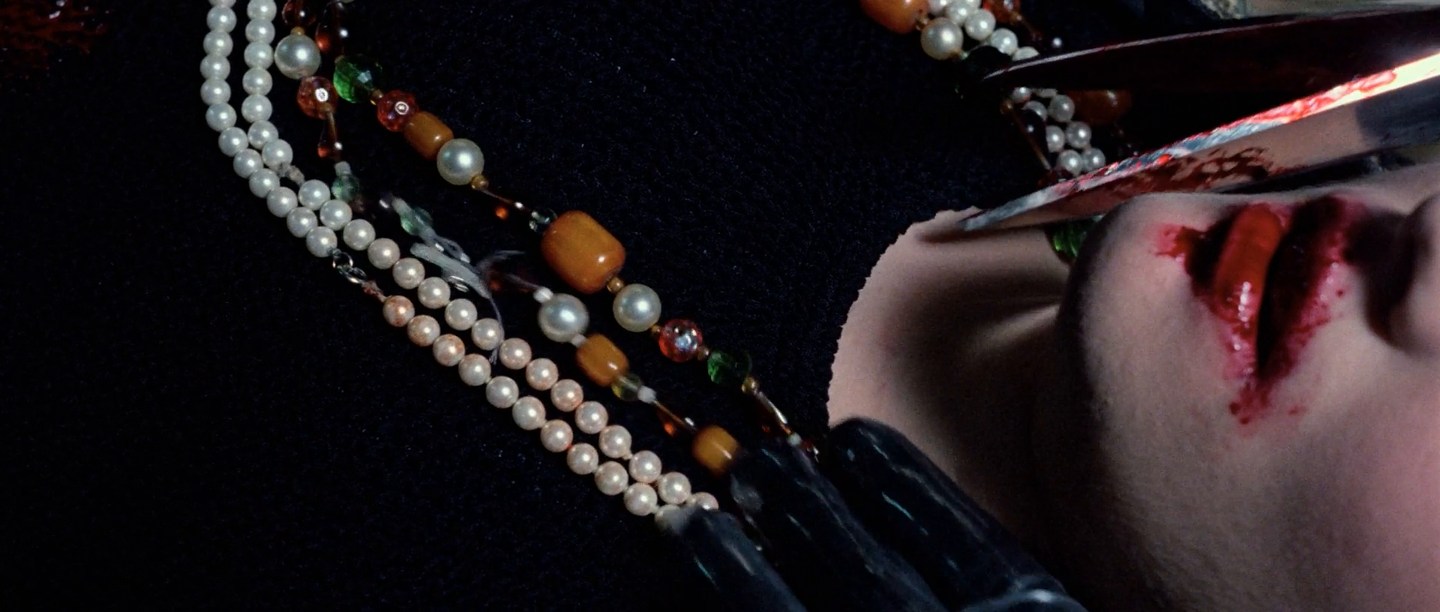
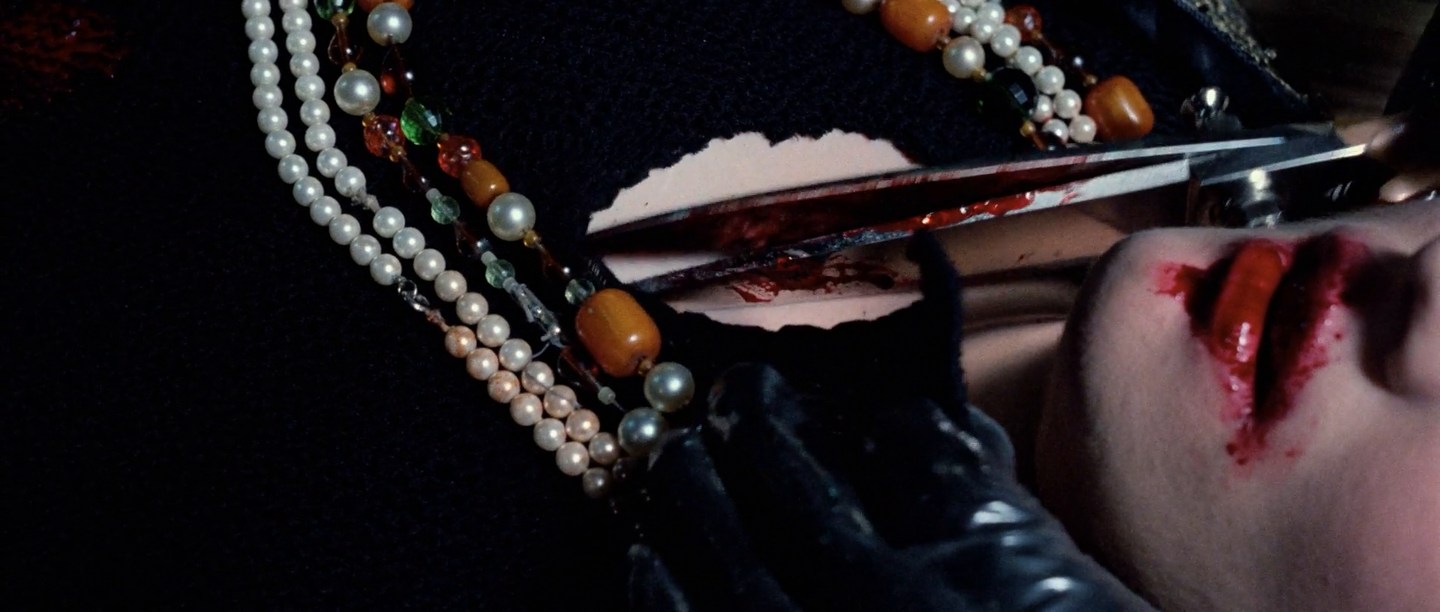
Giulia’s face, costume jewellery and the killer’s gloved hand become a second arrangement of body and ornament. Betty is again held apart from the action and made to watch. The repetition is not simply another killing; it confirms that the witness’s immobility is part of the killer’s design.
At conversational distance, Santini occupies the familiar position of a reassuring investigator. The ordinary framing is important to the deception. Opera does not mark every dangerous person with a distorted lens or theatrical light; social roles can conceal as effectively as darkness.
19 / 1:05:15
The apartment becomes a trap
ENLARGE ↗Betty and Myra shelter beside the doorway.
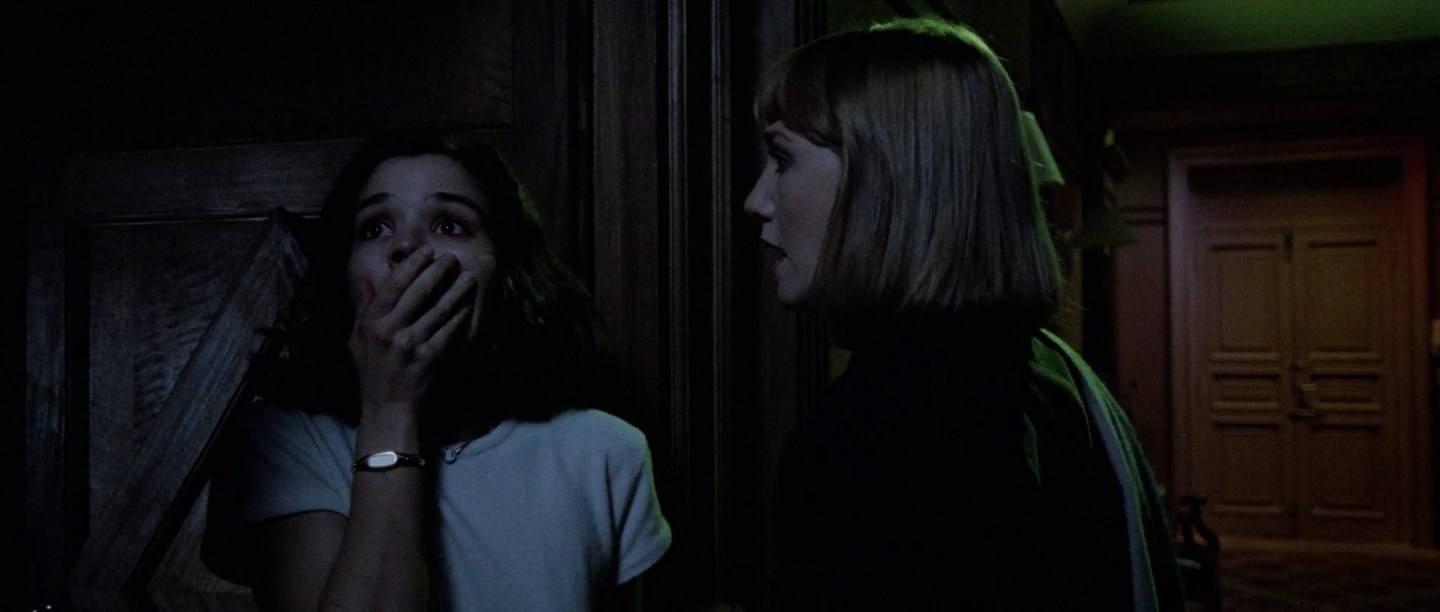
The women’s proximity does not make the rooms legible. Darkness, coloured light and the intervening doors divide their knowledge of the apartment. A threshold becomes a place to listen, wait and look, preparing the peephole’s terrible conversion from a protective device into an exposed line of sight.
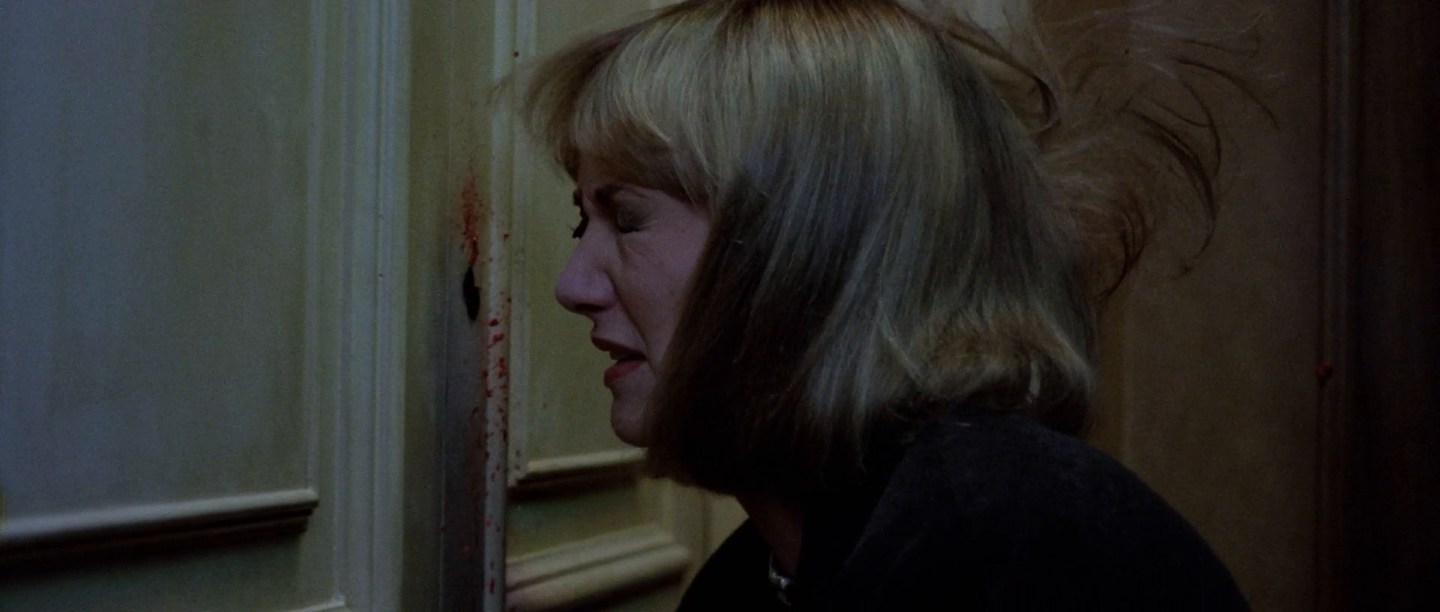
The door no longer separates observer and threat. The sequence moves from a face at the peephole to a magnified optical passage, then returns to the body at the door. The effects gallery holds these stages together so the transition between architectural detail, impossible viewpoint and impact can be examined.
ENLARGE ↗Alma and Betty inside the service passage.
The escape depends on a different knowledge of the building: narrow cavities, grilles and routes outside adult sight lines. Alma is a guide rather than a miniature spectator. The dark passage makes Betty’s movement awkward and restricted, but restriction now contains the possibility of getting away.
22 / 1:19:45
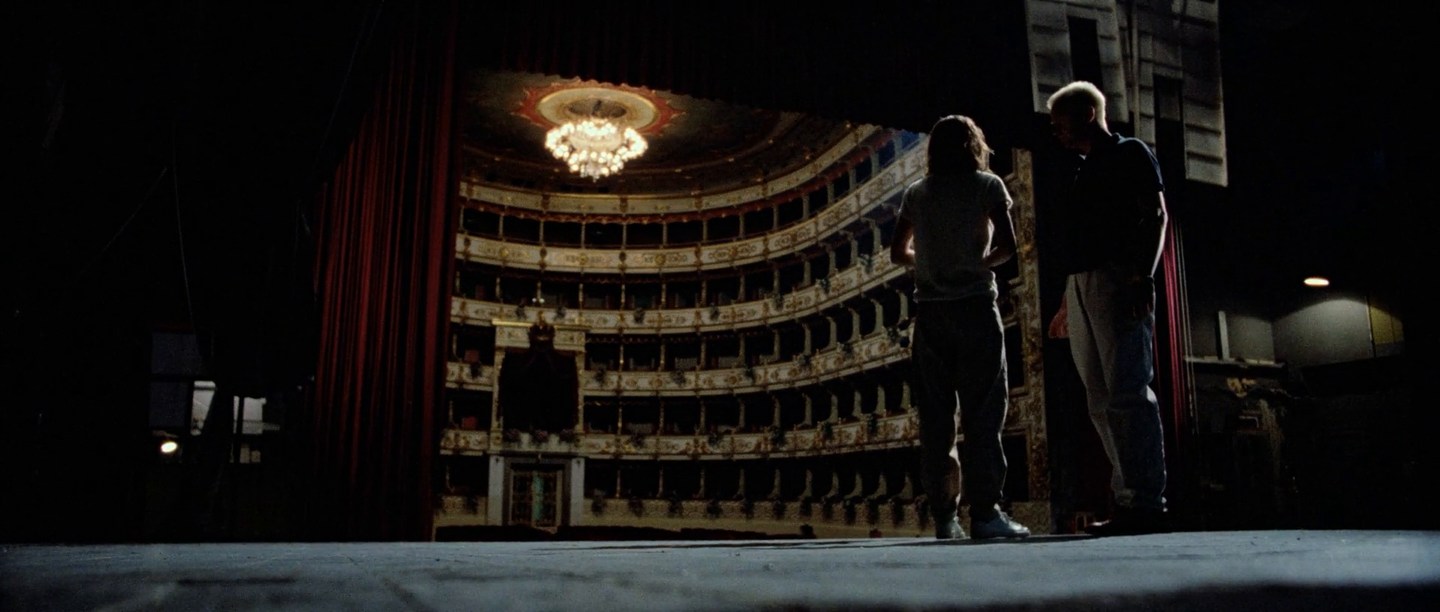
Return to the empty theatre
ENLARGE ↗Betty and Marco face the empty auditorium.
The theatre becomes a place to plan rather than simply to perform. Seen from the stage opening, its ordered tiers resemble a vast instrument awaiting activation. The return changes Betty’s relationship to the space: the people who produce a spectacle are now attempting to expose someone hidden within its audience.
23 / 1:23:30
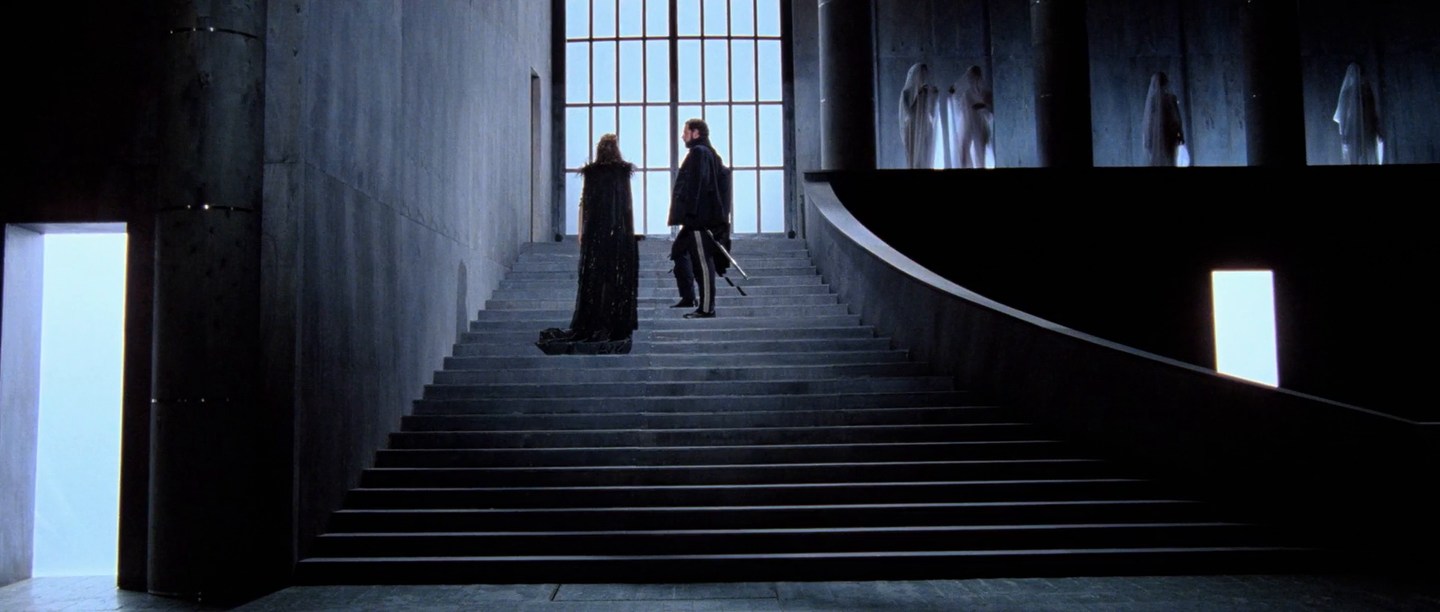
A colder Macbeth
ENLARGE ↗Two figures on the monumental stage staircase.
The pale vertical window and broad staircase establish a more austere stage image. Figures are reduced against clean architectural planes. This arrangement supplies a clear spatial framework before the birds and the crowd rupture the boundary between stage action and audience response.
24 / 1:26:36
The auditorium loses its horizon
ENLARGE ↗Rows of spectators tilt beneath the flying viewpoint.
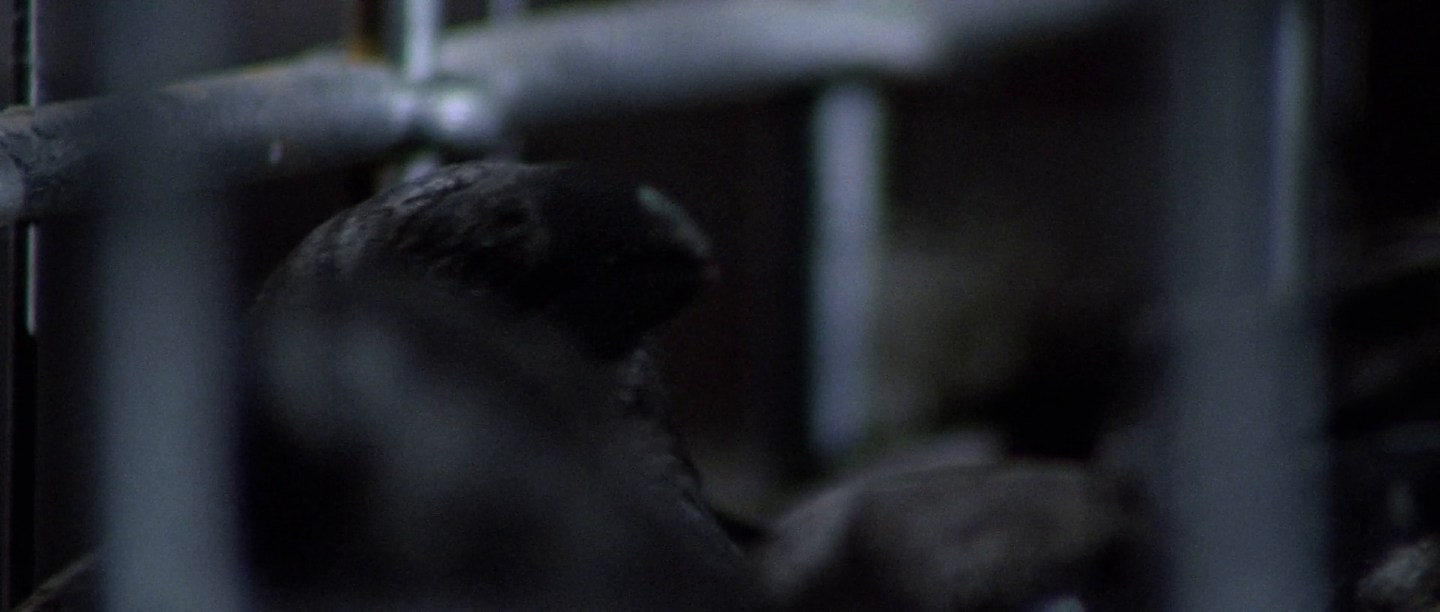
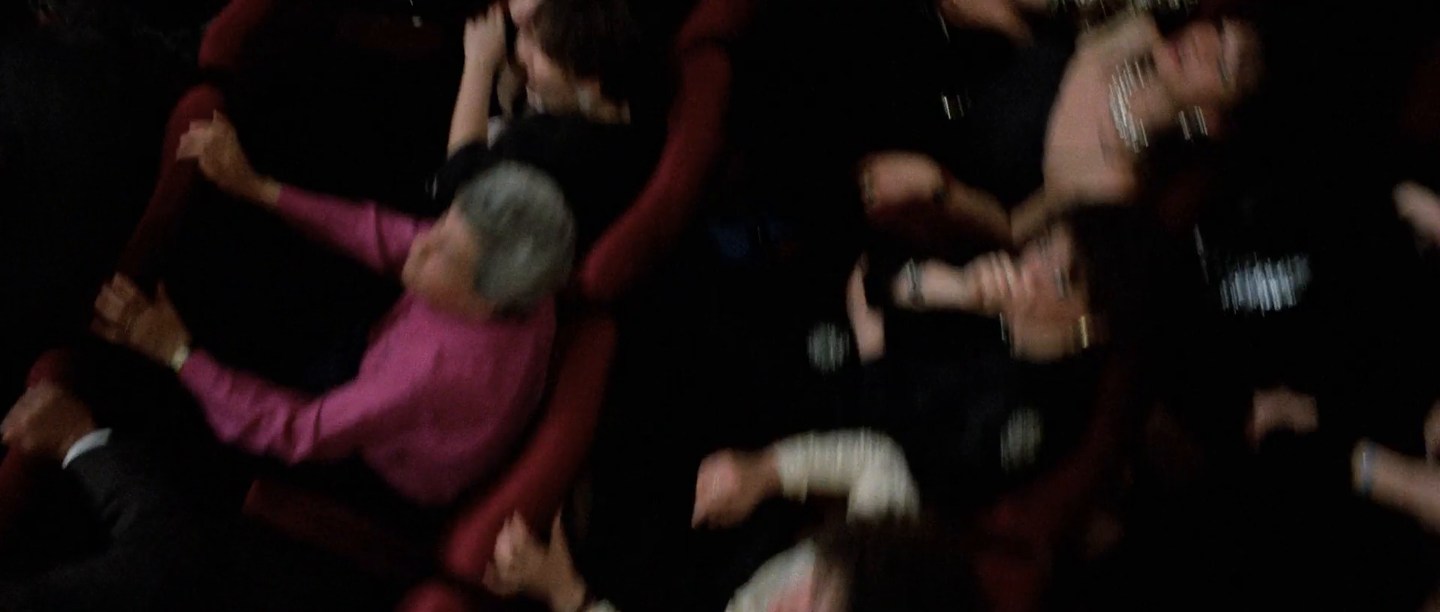
From above, the seats become a pattern of red lines and turning heads. As the angle tilts, the previously stable architecture becomes unstable. The close study below compares the caged eye, the aerial view and the approach to the crowd without attributing a specific camera rig on visual evidence alone.
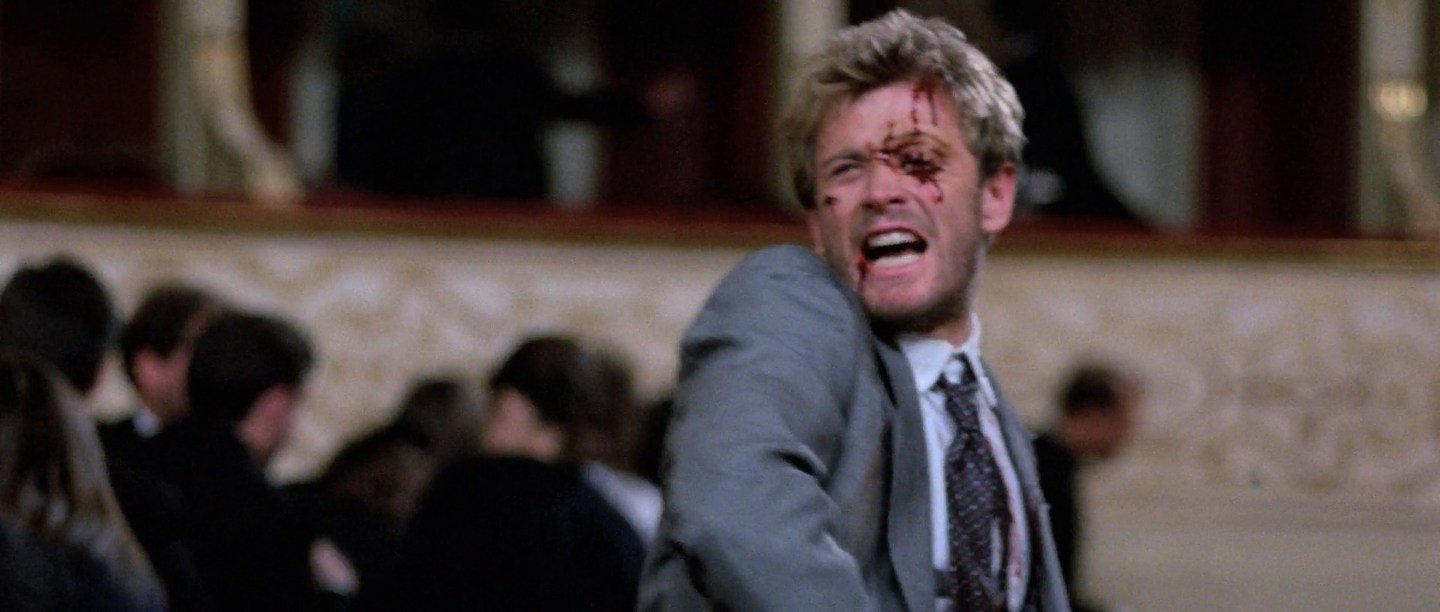
ENLARGE ↗Santini stands with blood across his face.
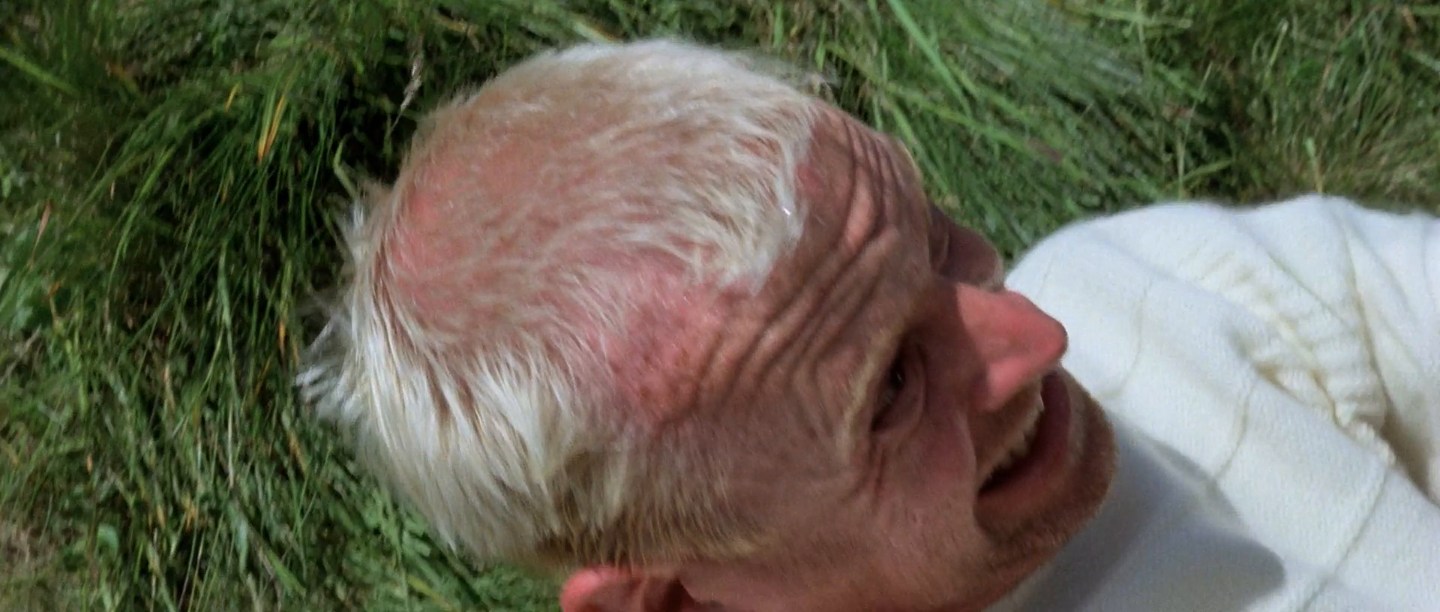
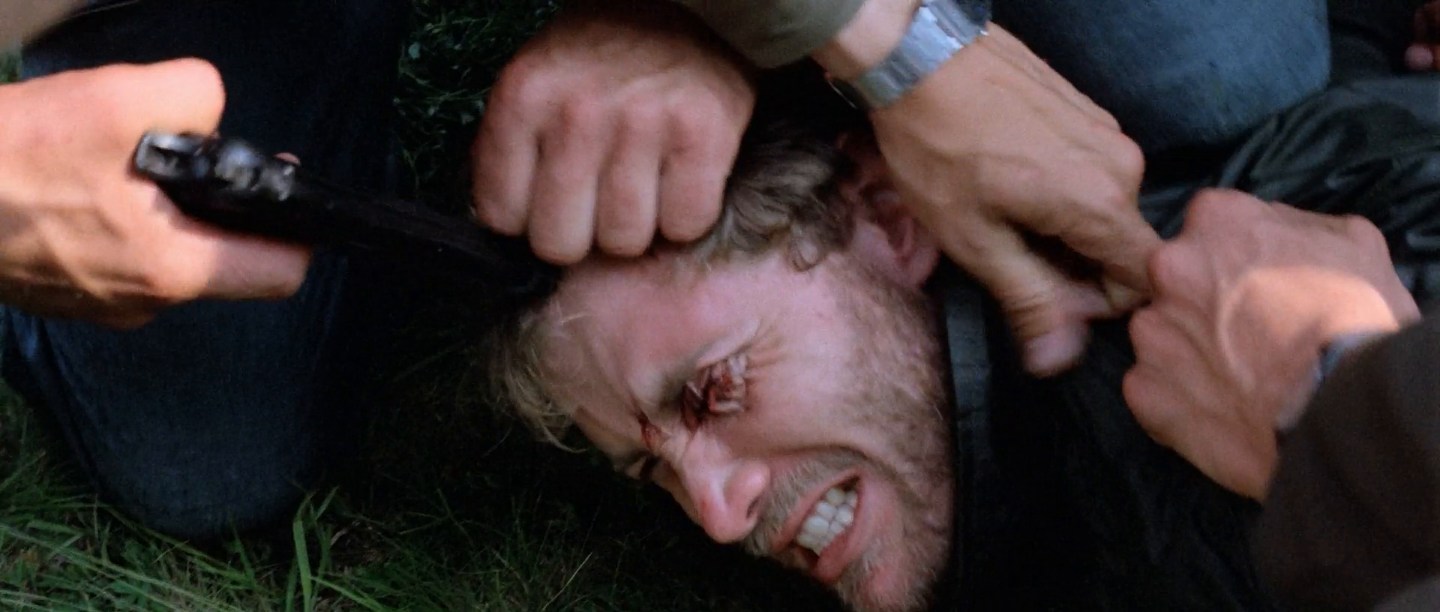
The attack makes Santini visible as a particular injured body within the crowd. The eye wound is both an effects image and a narrative disclosure. Betty’s forced watching is answered by a reversal: the man who arranged the spectacle can no longer remain a protected spectator.
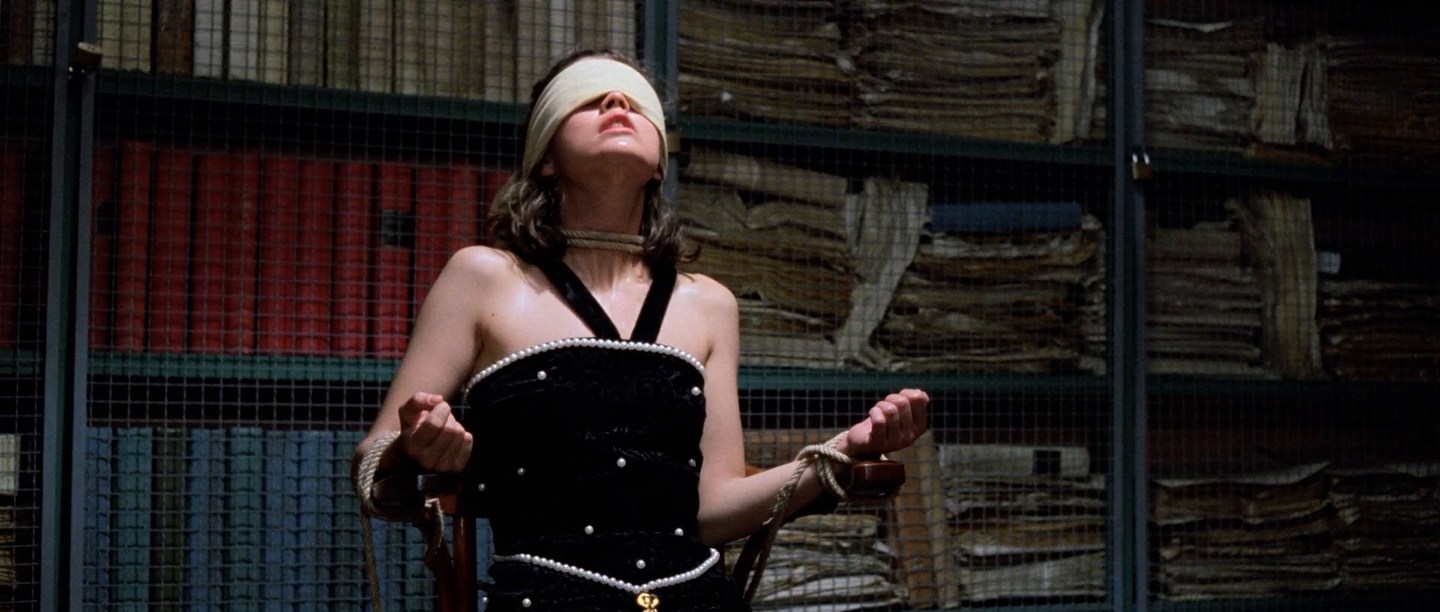
ENLARGE ↗Betty is blindfolded in the archive room.
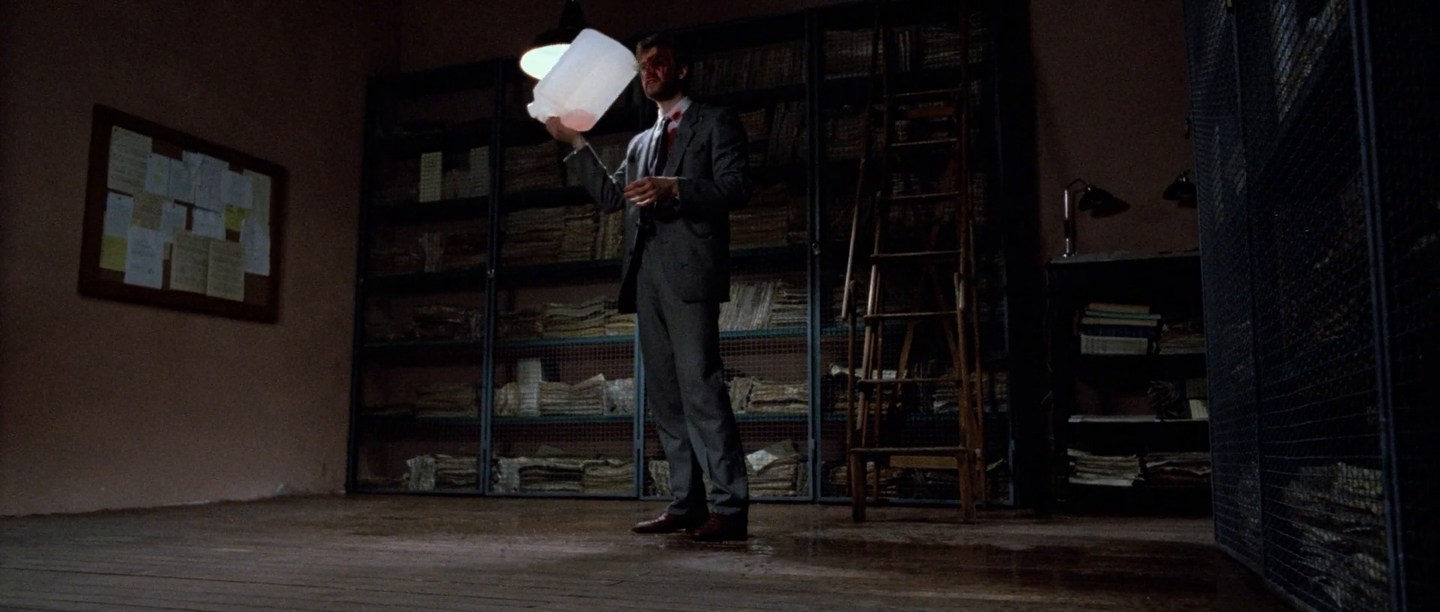
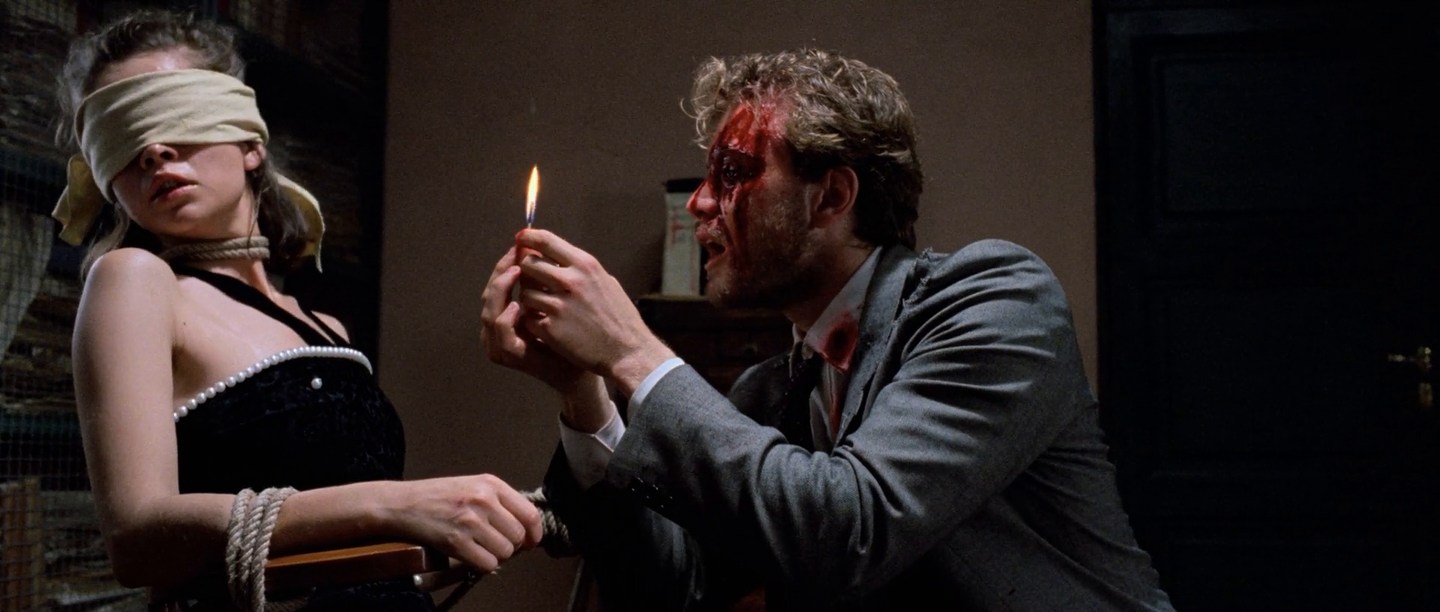
The cloth over Betty’s eyes reverses the needle apparatus. Both devices regulate her access to events, even though one forces vision and the other prevents it. Shelves of papers surround the chair, turning a store of records into another carefully arranged private theatre.
27 / 1:35:50
A death made to be believed
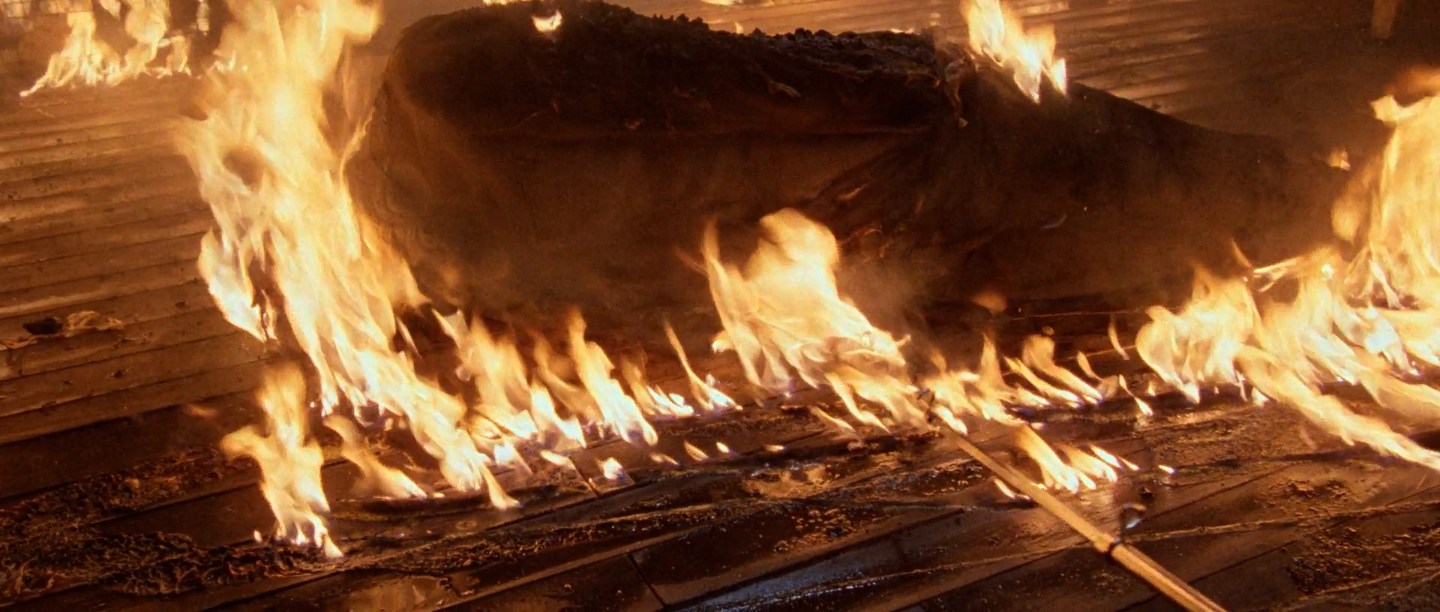
ENLARGE ↗A burning figure lies across the wooden floor.
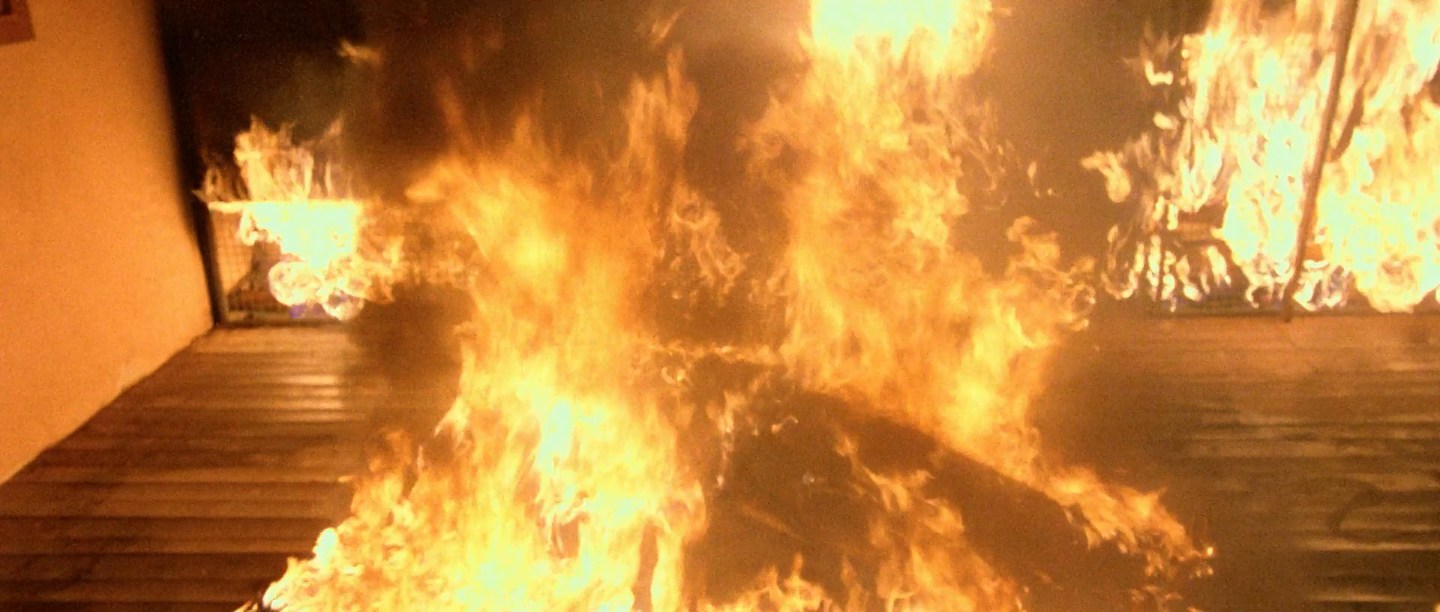
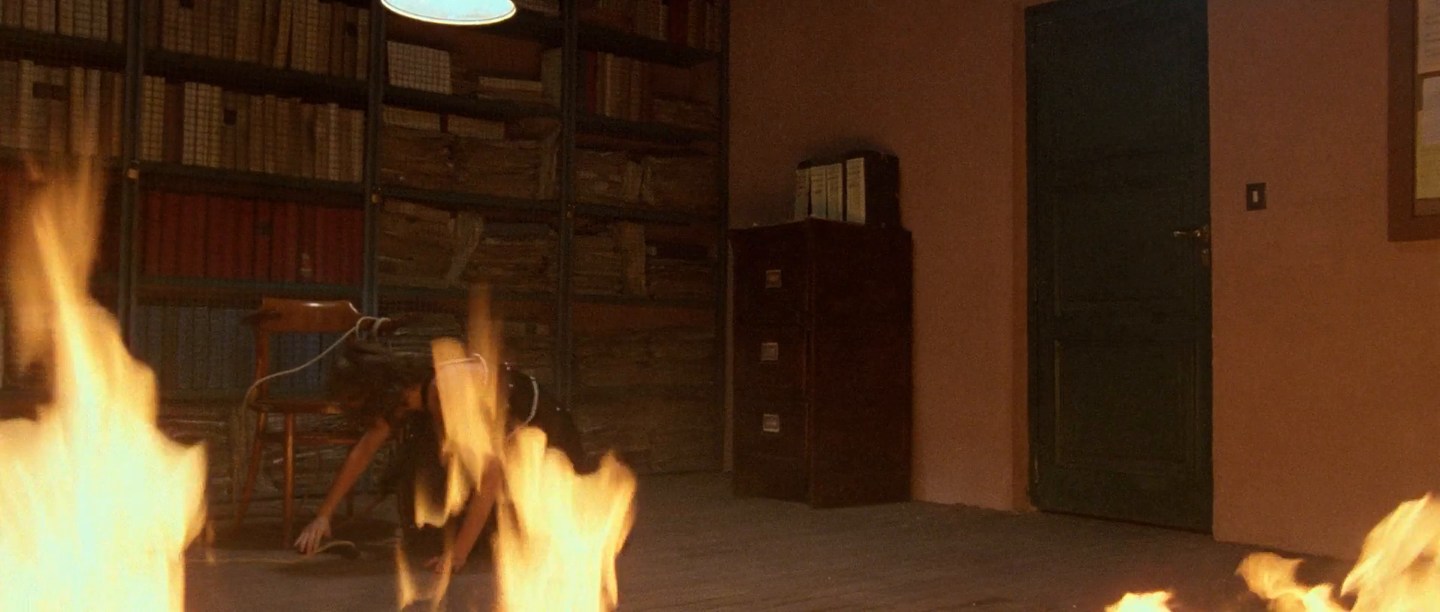
Fire fills the room with a seemingly decisive image. Betty’s restricted viewpoint and the later return of the killer make that image unreliable as proof. The sequence’s power lies in the conflict between visual intensity and evidential certainty: a spectacular body does not necessarily establish whose body it is.
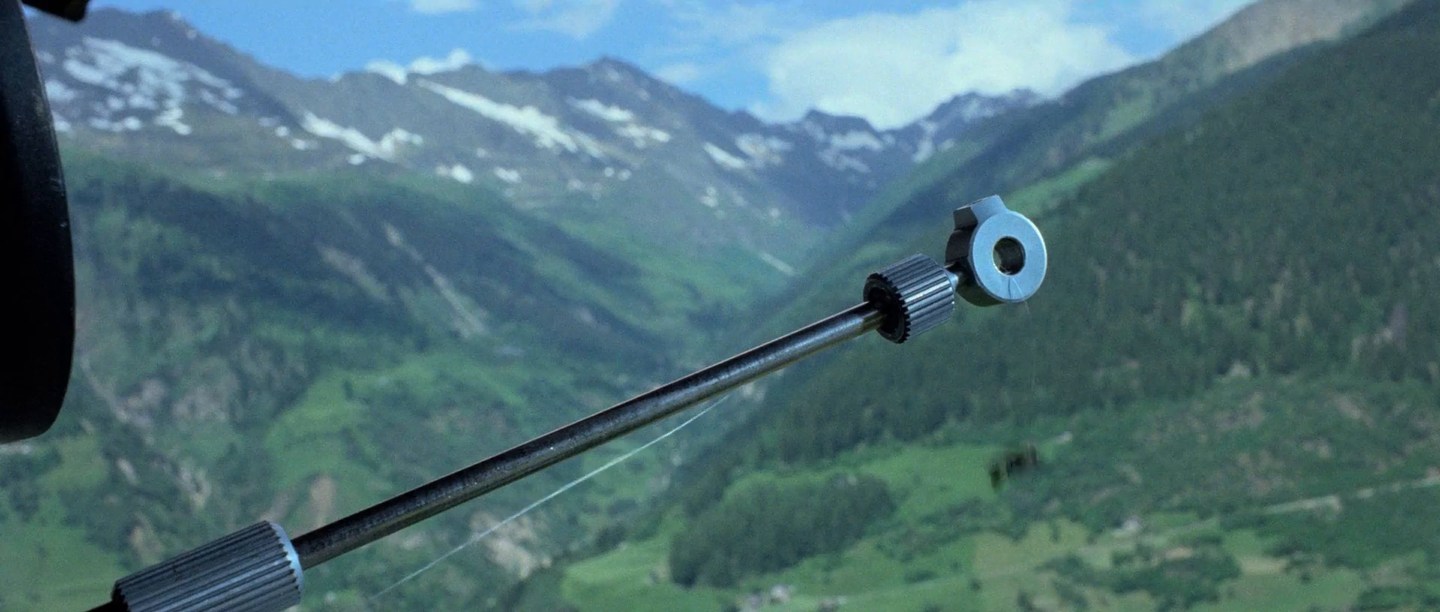
ENLARGE ↗A telescope points toward the Alpine peaks.
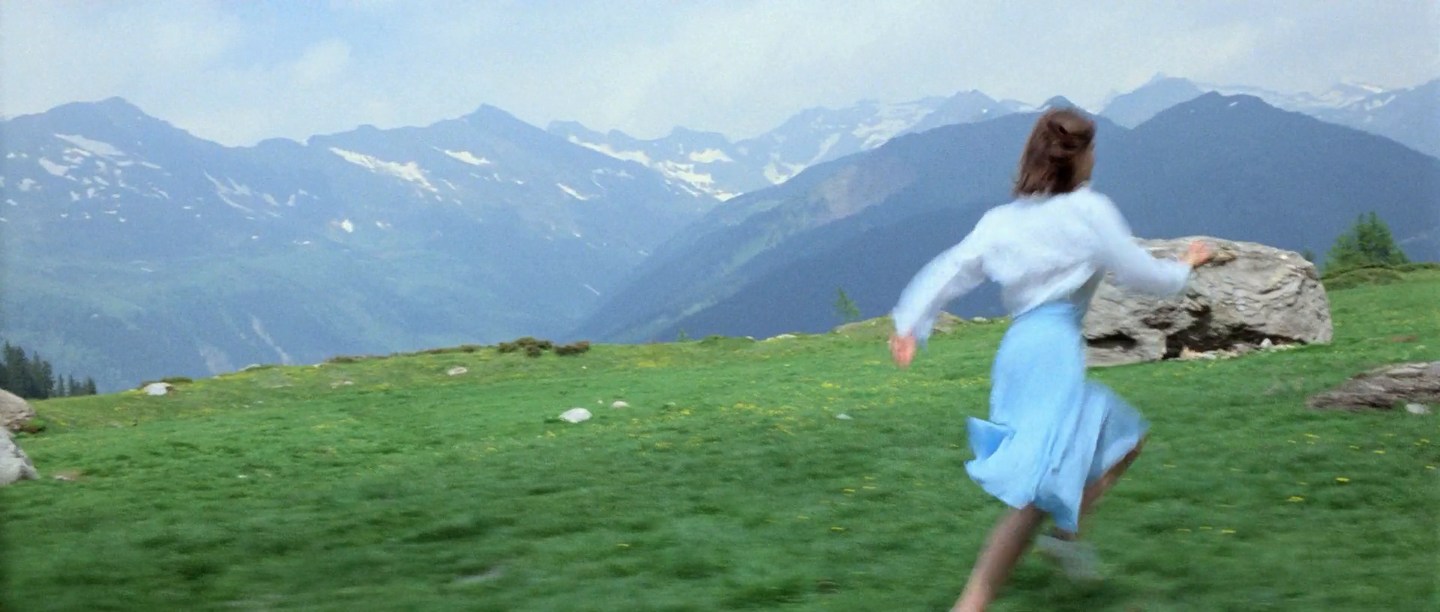
The mountain panorama seems to replace confinement with distance and light. Yet the telescope introduces another instrument of looking into this apparent release. The wide landscape changes the film’s scale without abolishing its concern with watchers, objects of vision and the danger of trusting a reassuring view.
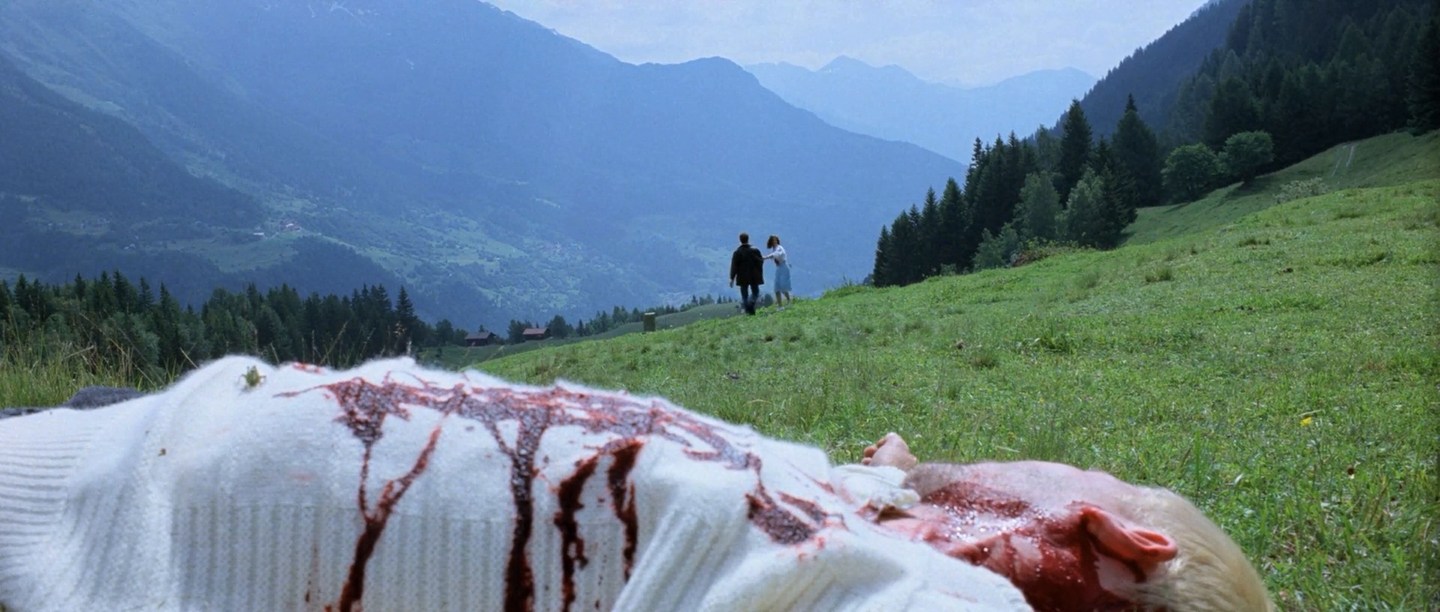
ENLARGE ↗Marco lies in the grass beneath the mountain view.
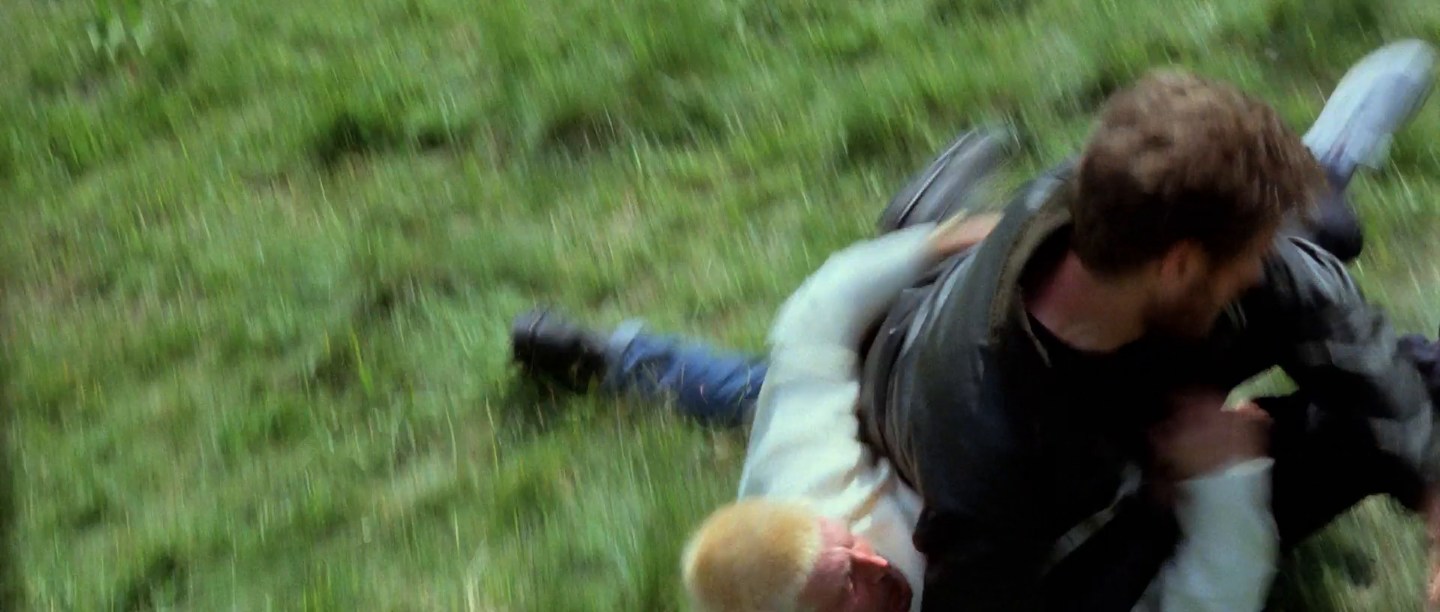
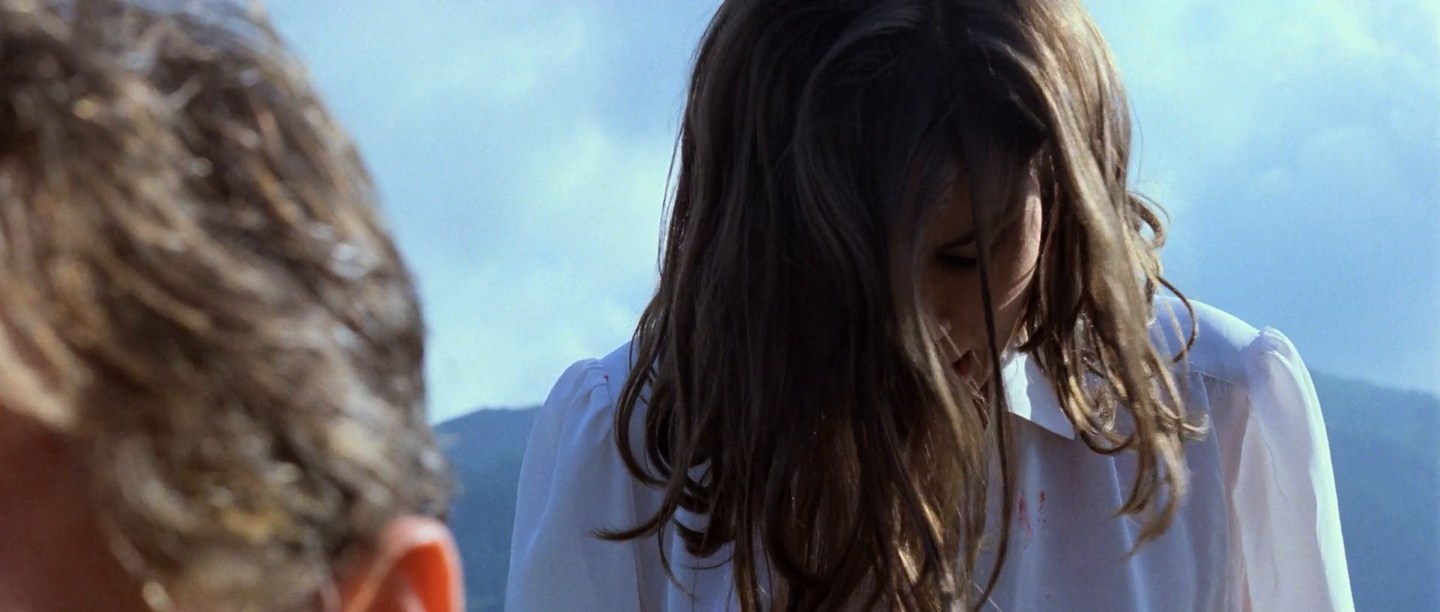
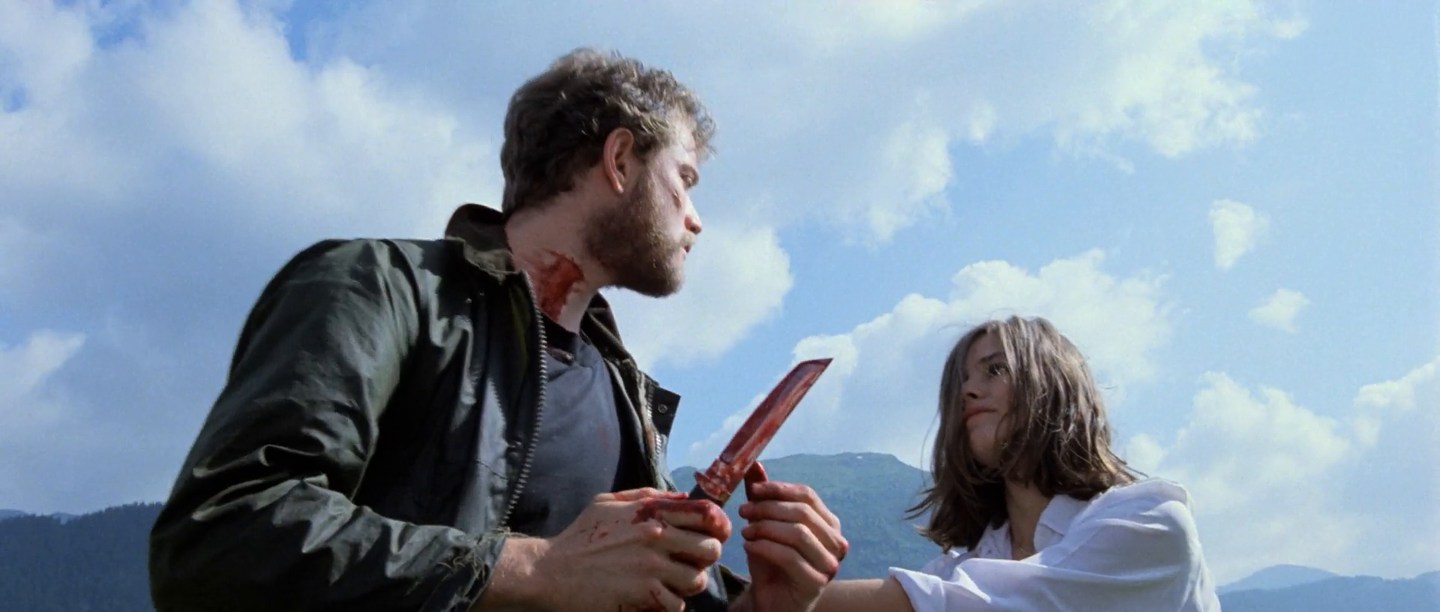
The pale sweater carries the wound into bright daylight, far from the blue interiors and theatrical shadows. The distant figures and the foreground body share a single panoramic composition. Landscape does not neutralise violence; it can make the body seem newly exposed and isolated.
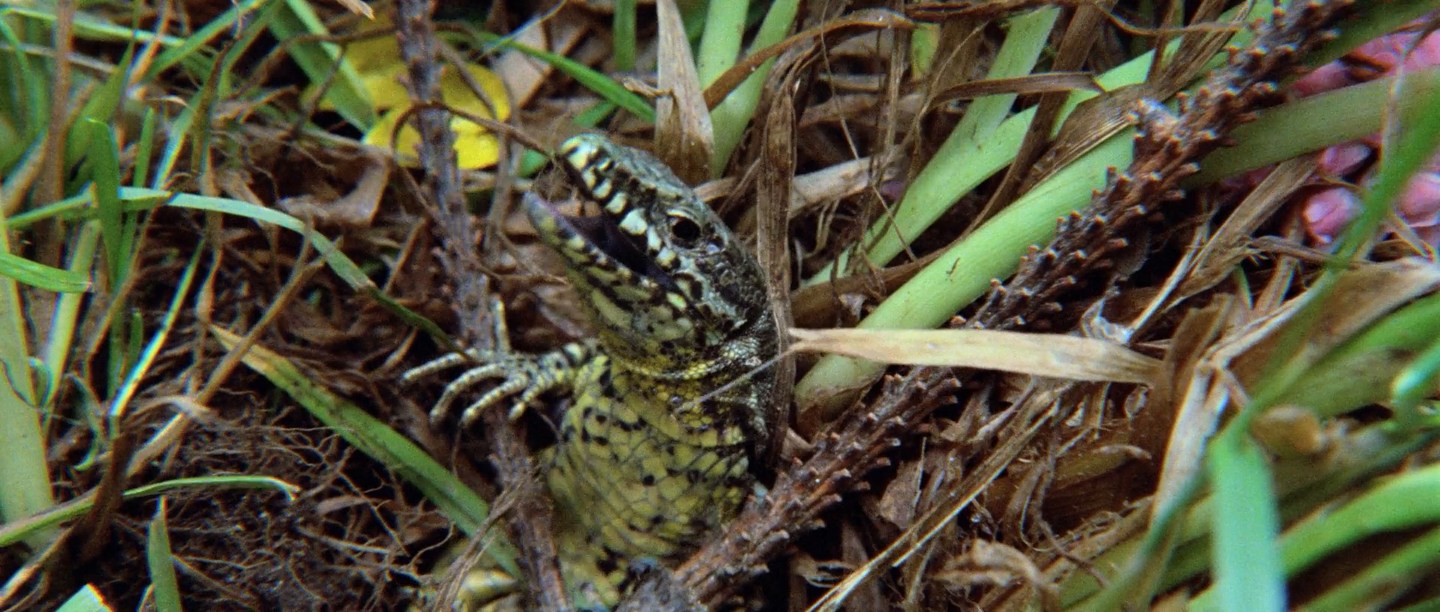
The ending lowers its attention from mountains and police to a small animal in the grass. Betty’s hand enters the frame to help rather than restrain. This gives the final image a precise relationship to the earlier needles and cages, while leaving the psychological meaning of her withdrawal open to interpretation.
Seven studies follow the preparation, impact and aftermath of the film’s effects. Open a sequence to compare its stages, then select an image to move through the enlarged gallery.
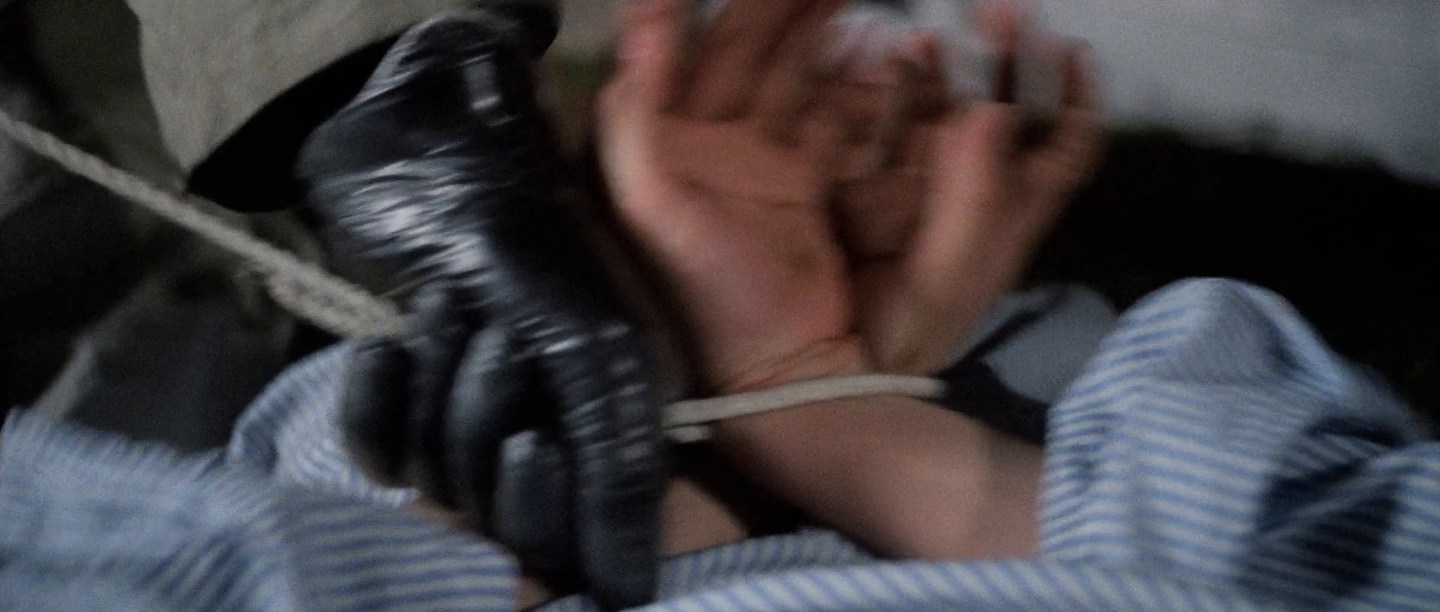
The threat is assembled before it becomes a signature image. Close framings isolate rope, tape, gloved fingers and the eye itself; the extreme insert makes the small clearance between eyelid and points feel enormous. Removal supplies an essential final stage: the face is a person’s face again, not a fixed arrangement for another viewer.
The gallery follows the illusion on screen. It does not infer that the visible points touched the performer’s eye, or identify a particular fabrication method without production evidence.
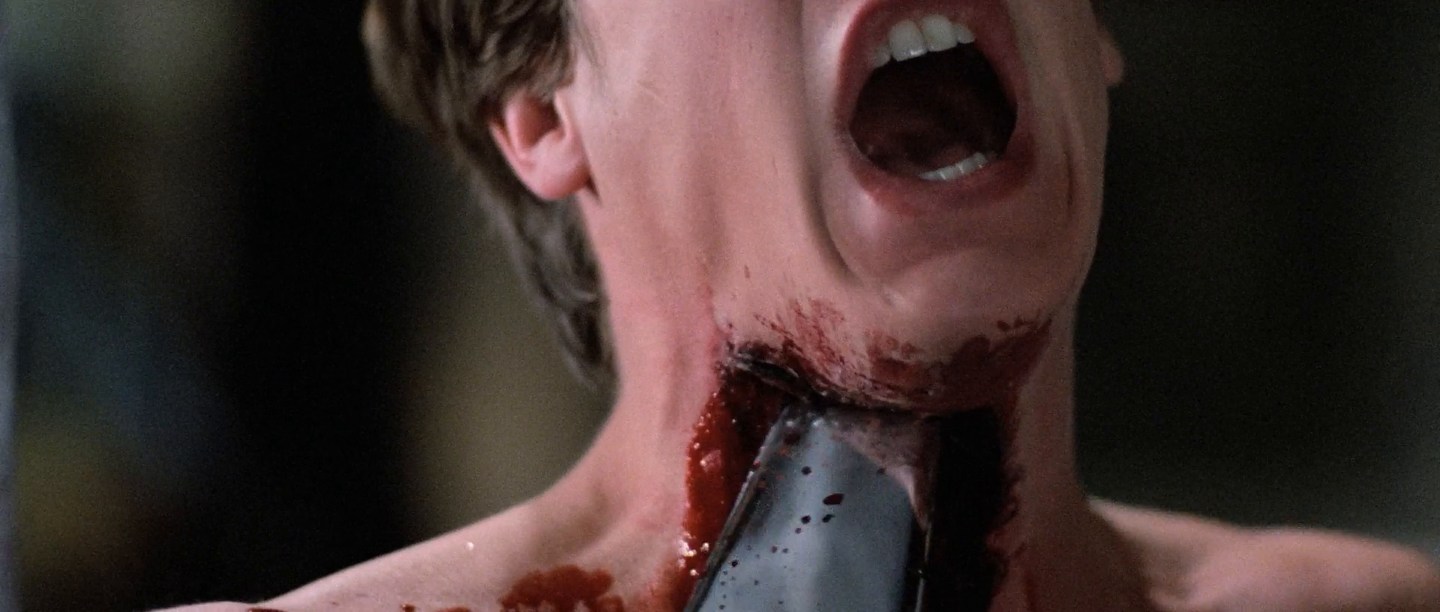
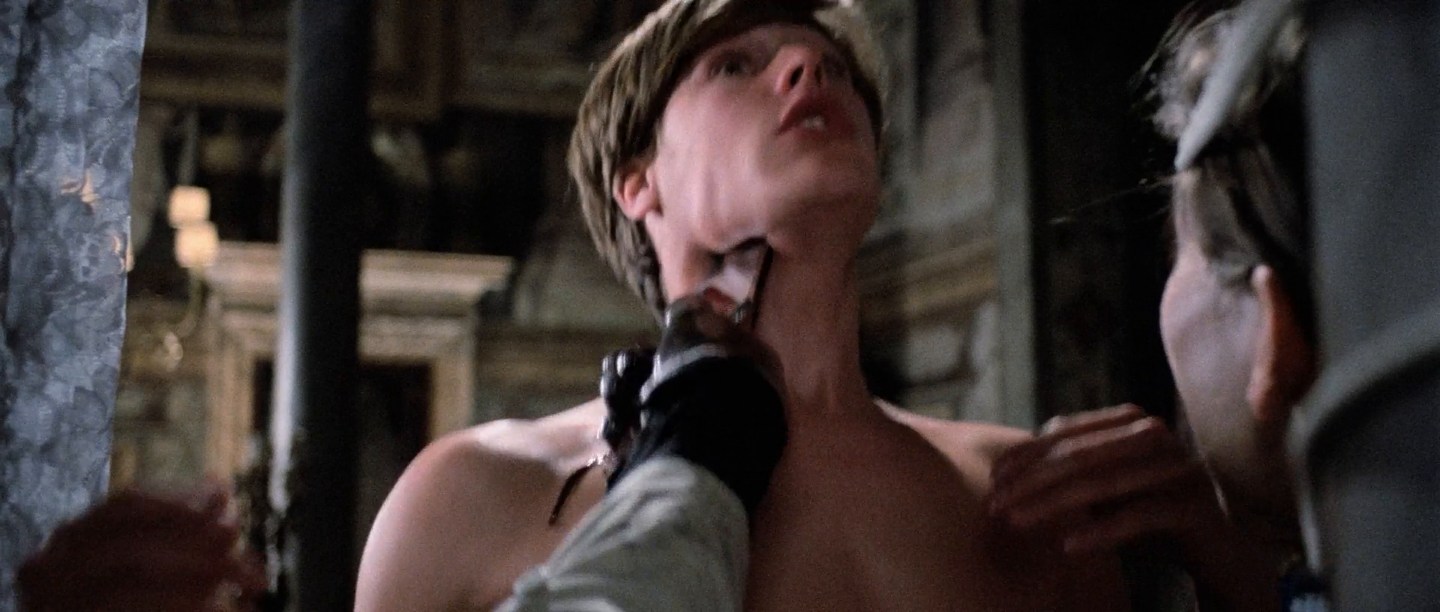
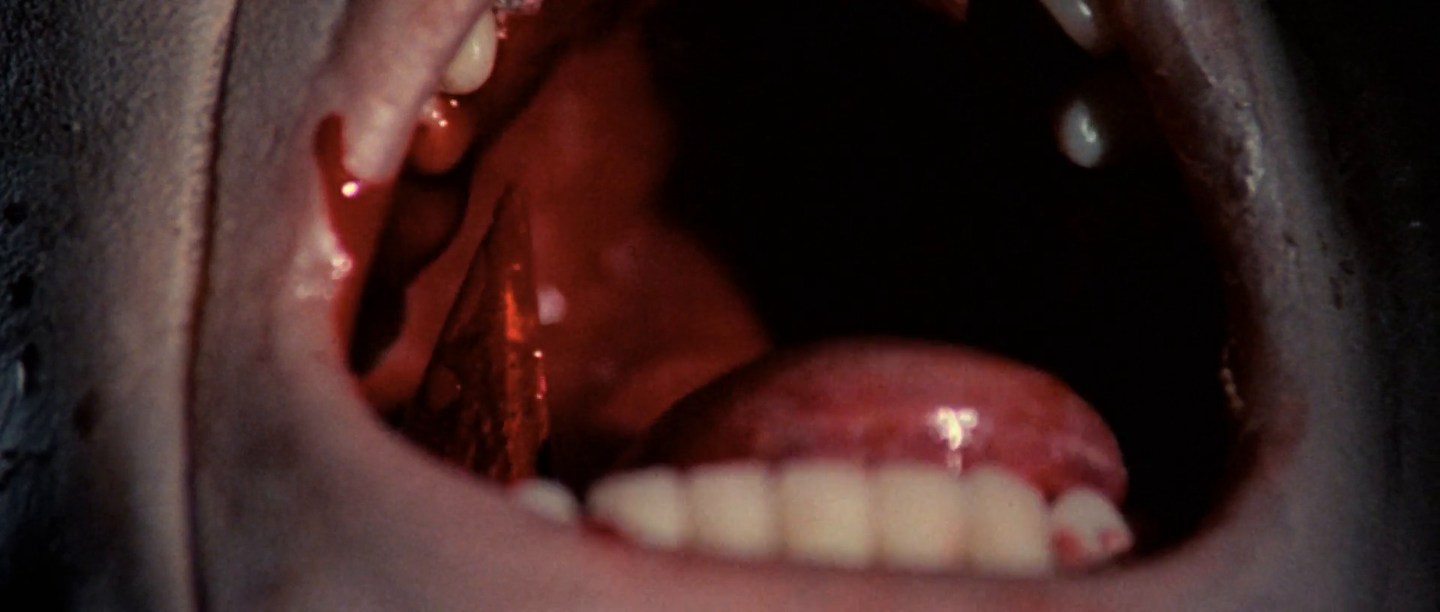
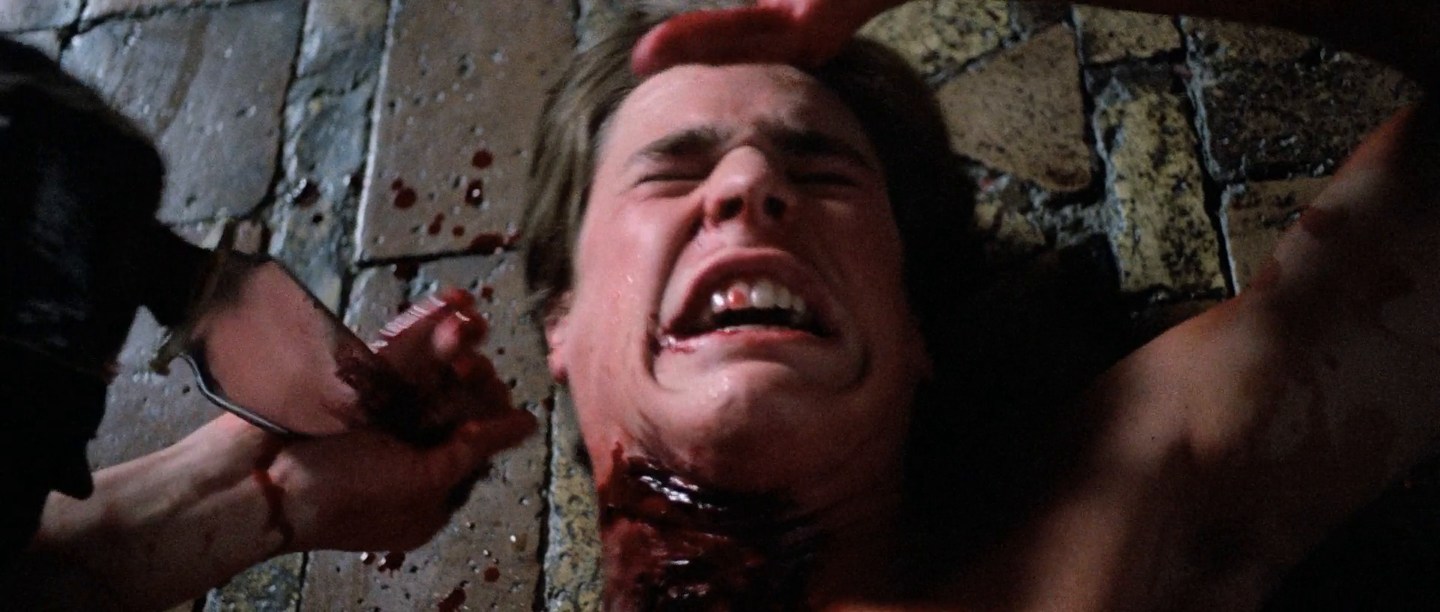
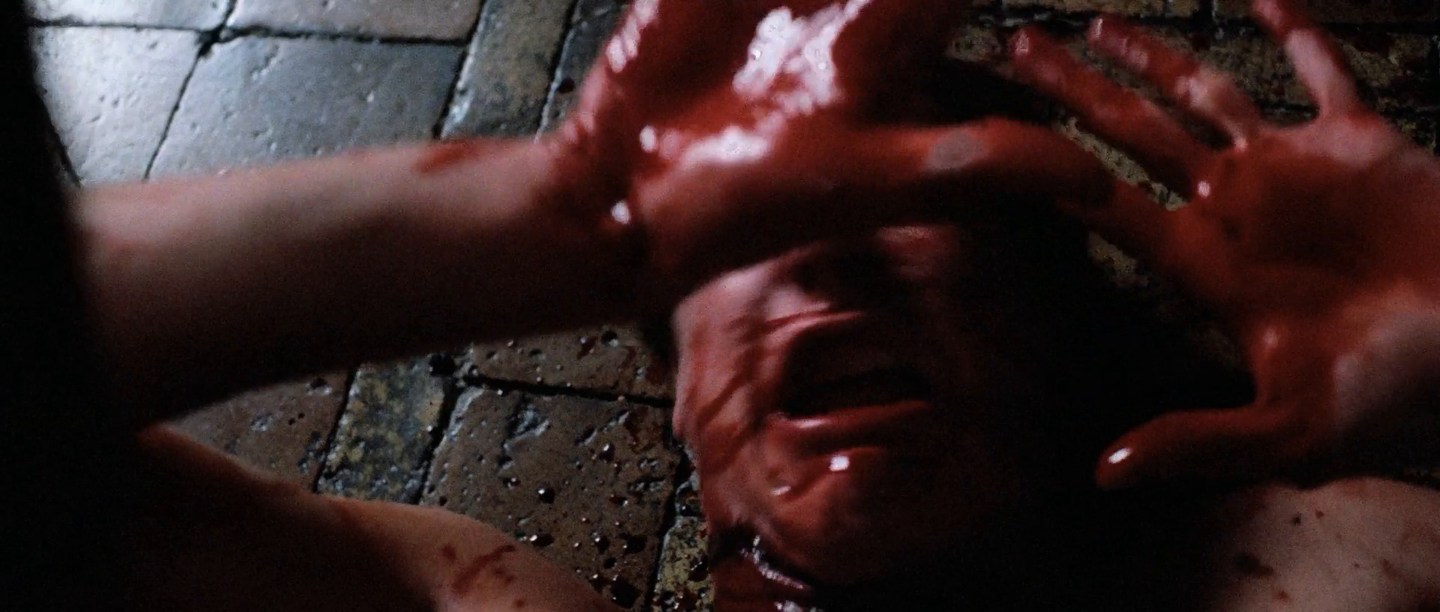
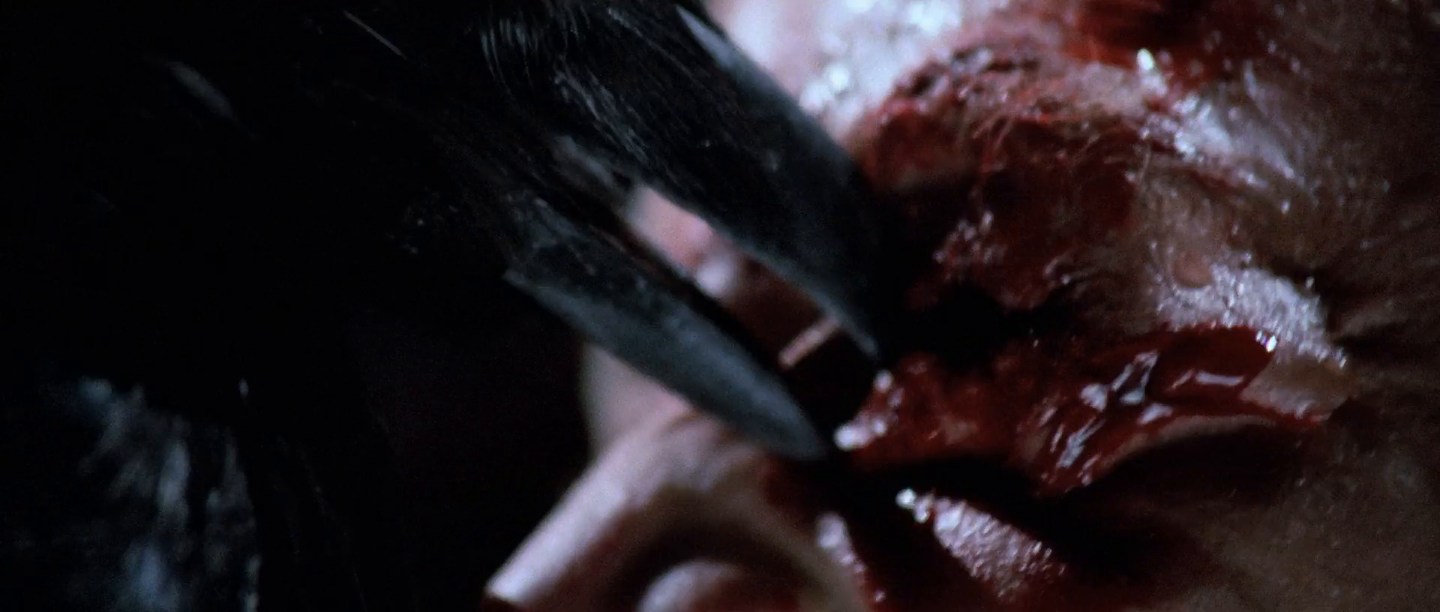
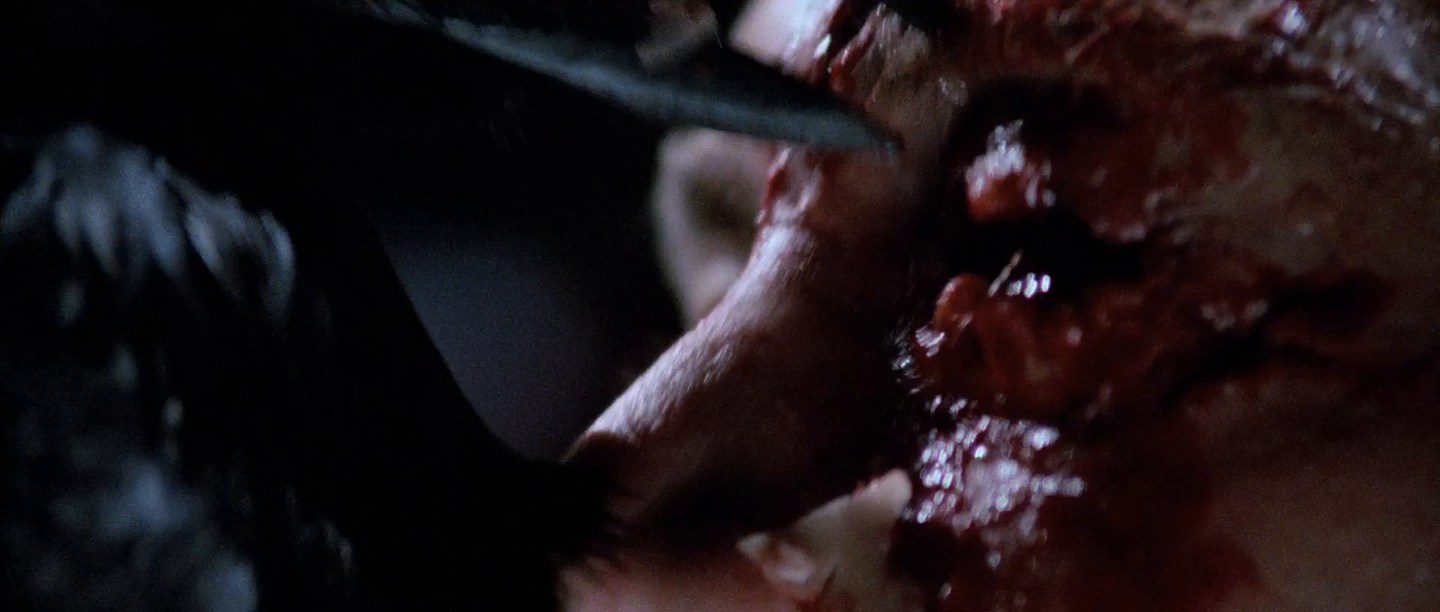
The killing alternates two forms of helplessness: Stefano’s body under attack and Betty’s inability to close her eyes. The blade’s appearance inside the mouth gives the wound an impossible intimacy, while the cut back to Betty prevents the image from becoming an isolated effects demonstration. The floor-level struggle and final body re-establish the room after the succession of inserts.
Compare the weapon beneath the jaw, the interior-mouth view and the exterior wound. These images construct continuity across different scales; the screen sequence alone cannot assign every insert to a named technician.
ENLARGE ↗Giulia looks upward from the workshop floor.
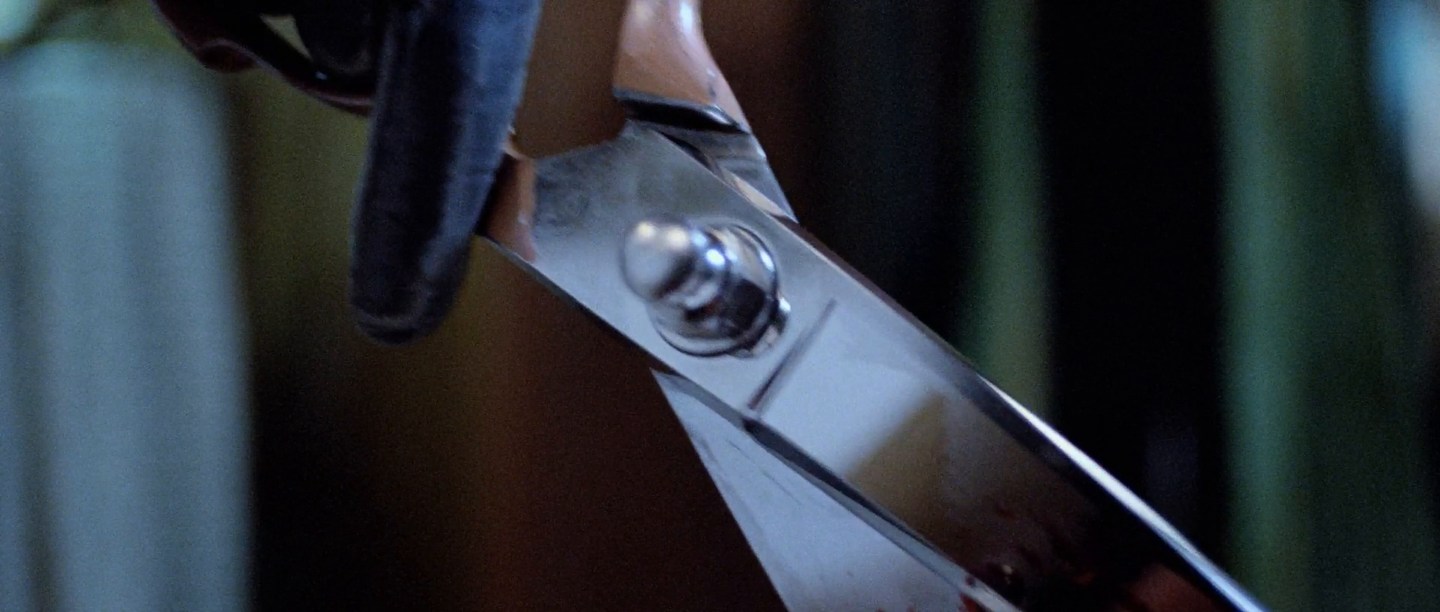
A dropped piece of jewellery becomes the centre of the murder. The workshop’s objects change function: a costume carries a clue, the floor becomes a fighting space and large scissors enter the close-up as a weapon. Betty’s face repeatedly interrupts the killer’s search, joining the practical problem of recovering the bracelet to the imposed spectacle of suffering.
The sequence builds through discovery, attack, the search at Giulia’s mouth and the cut at her throat. The final blood-marked scissors give an ordinary workshop object a new visual identity.
Explore the sequence 12 stages
01 · 49:48
ENLARGE ↗The bracelet is found among the costume ornaments.
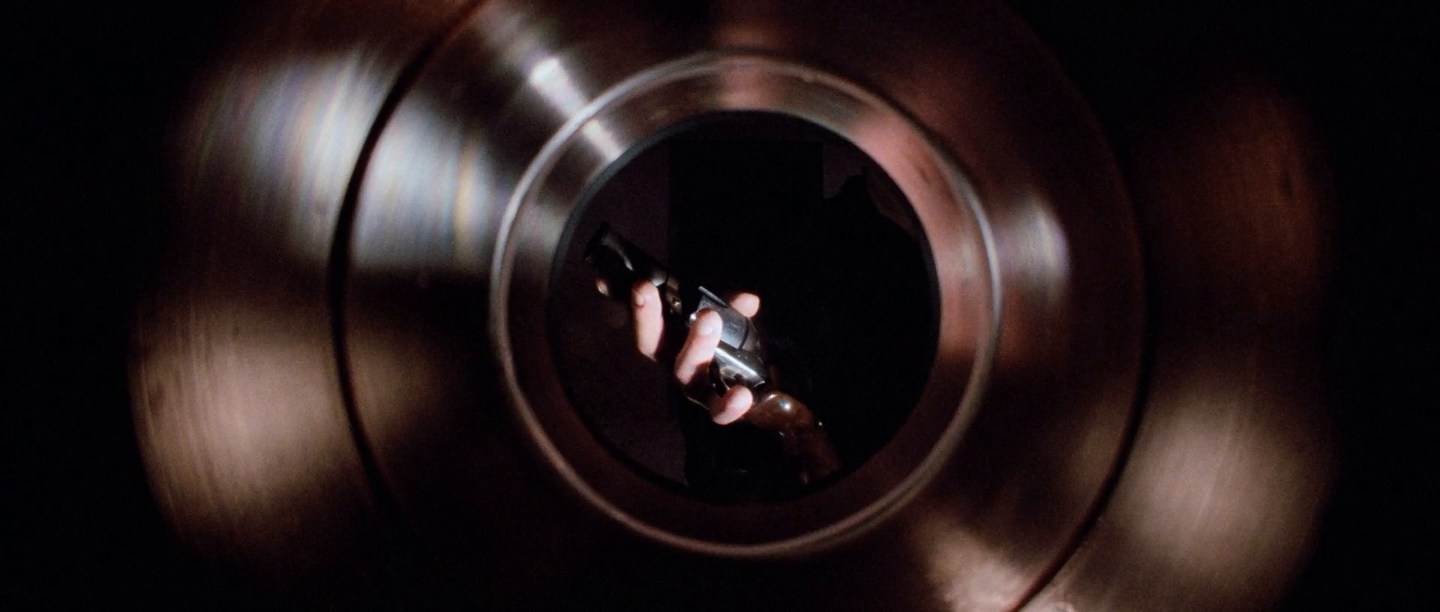
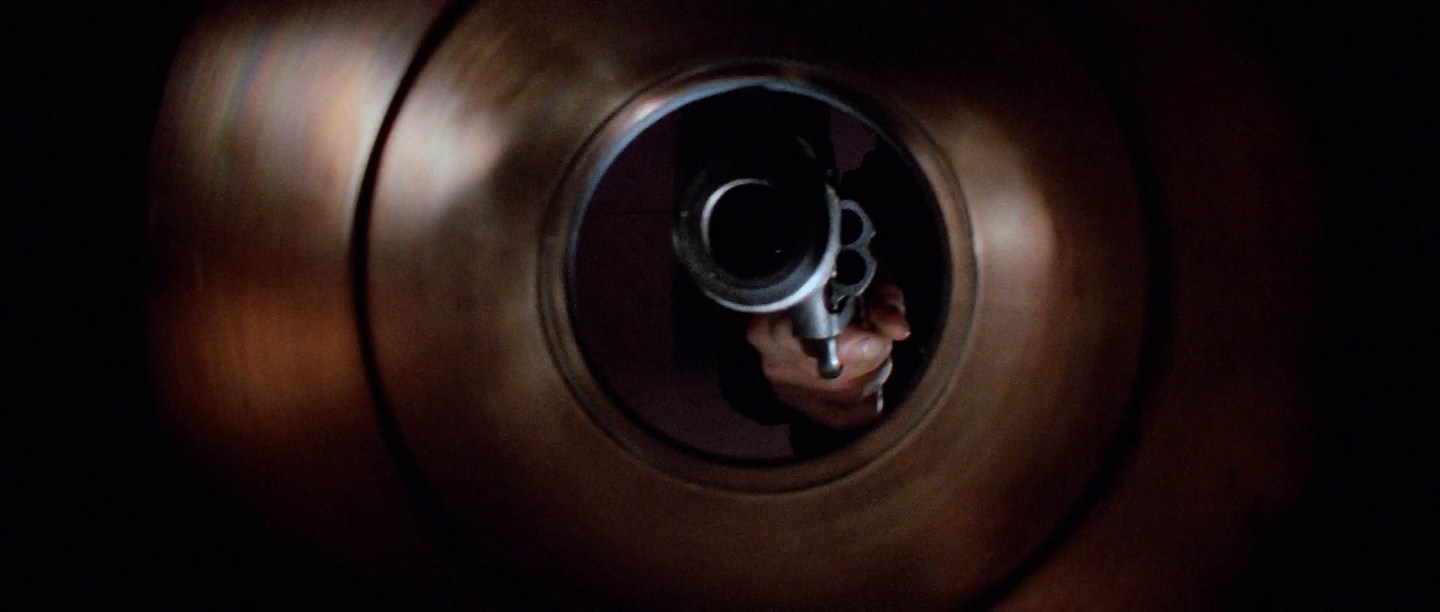
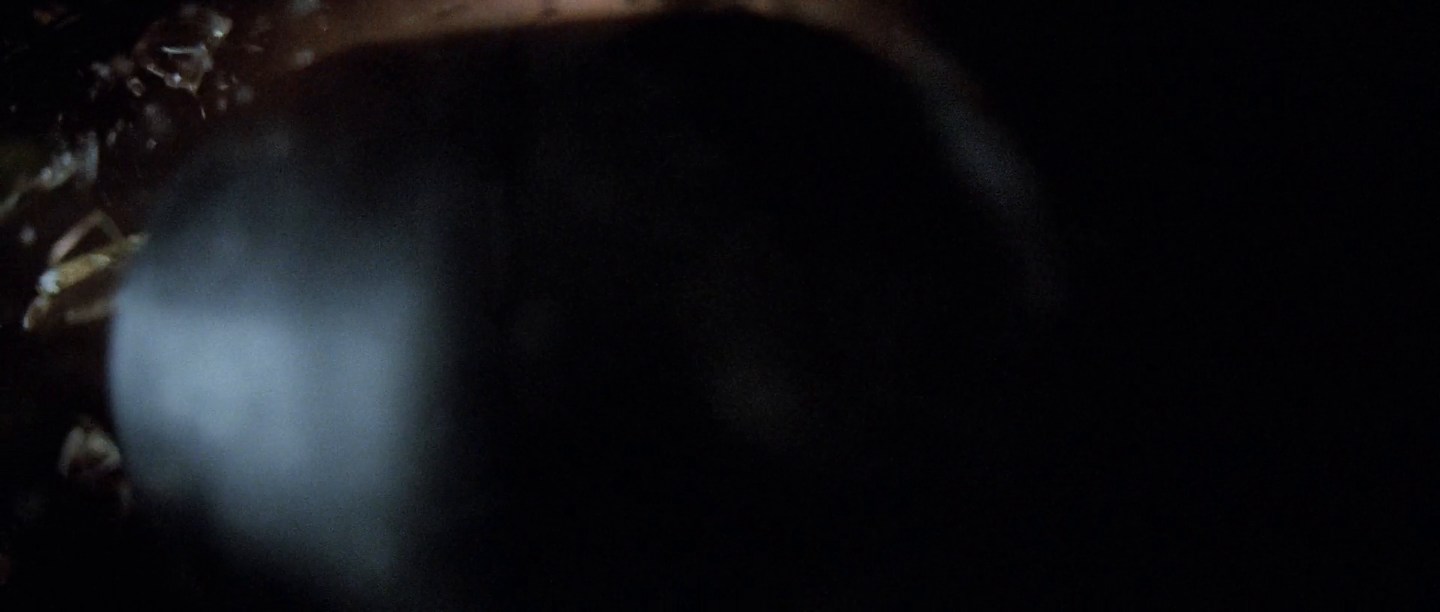
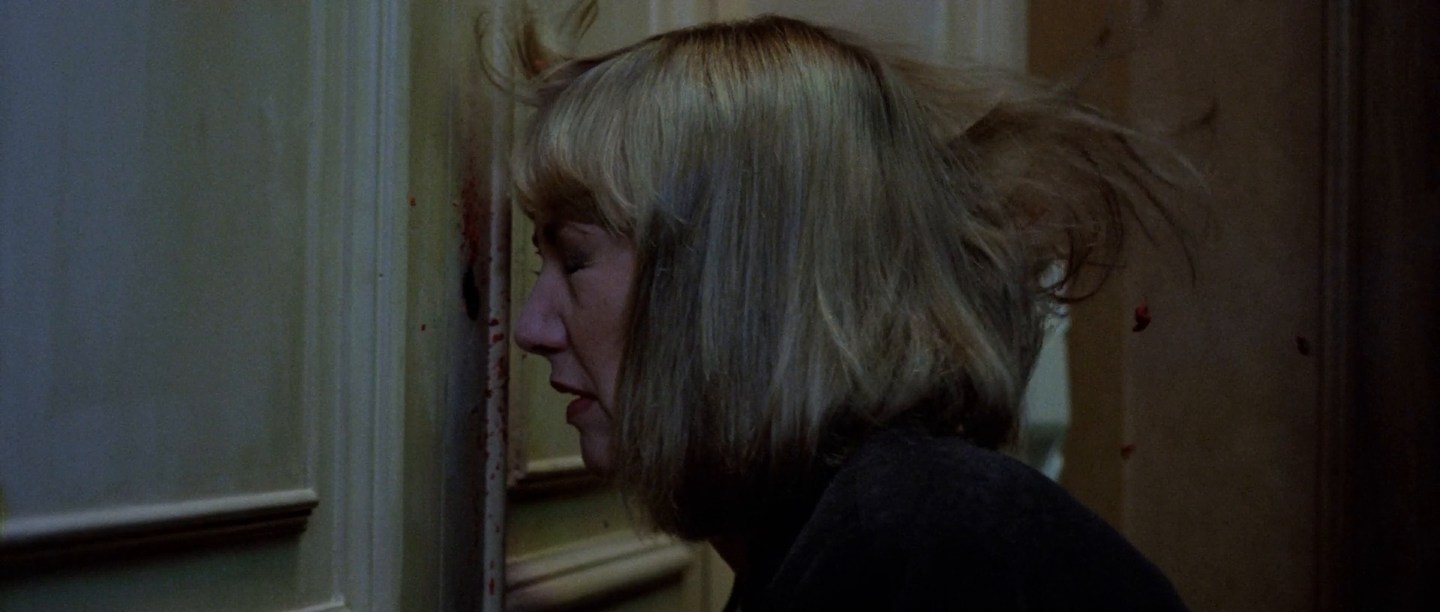
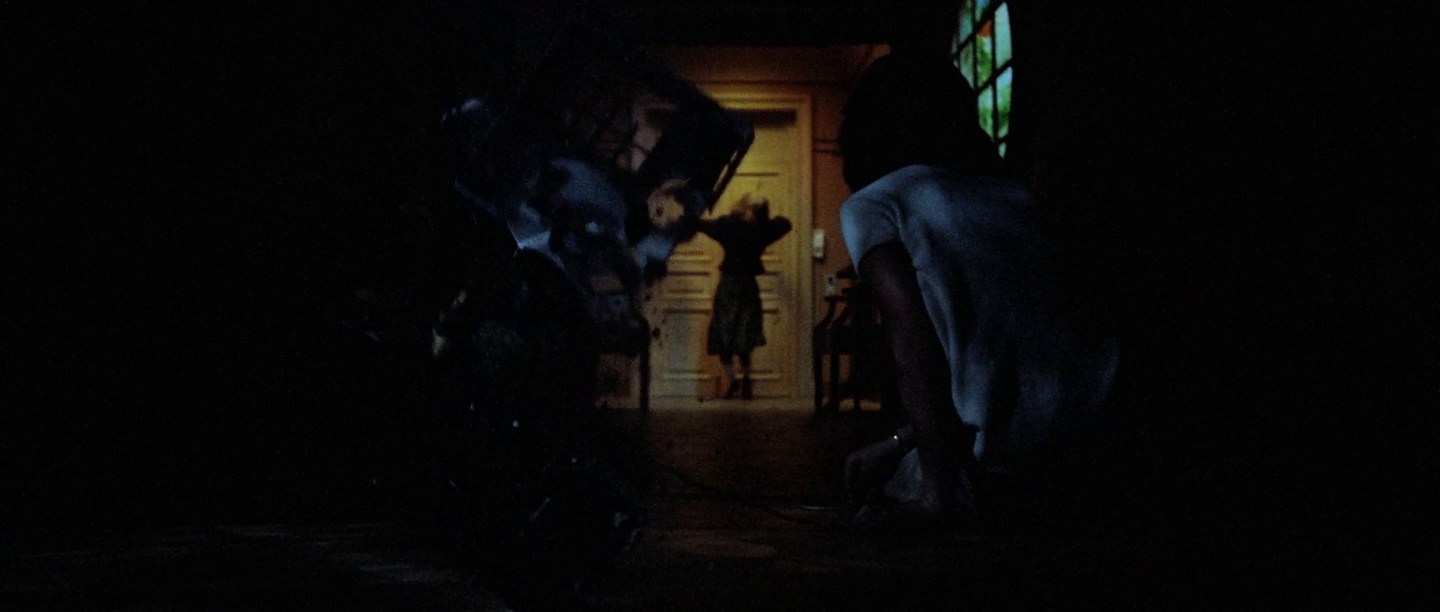
A door viewer promises a safe inspection of the other side. Argento turns its optical tunnel into the route of the attack. The sequence expands a fraction of a second into several distinct spaces: the gun beyond the door, the magnified tube, the breaking surface, Myra’s profile and the room behind her.
The effect depends on the join between these views. The gallery preserves the progression from an ordinary act of looking to an impossible interior vantage and its violent consequence.
ENLARGE ↗Santini stands with blood across his face.
The birds transform an audience into an exposed field of bodies. High views and tilting rows establish disorientation before the attack settles on Santini’s eye. An injury that might have served only as a shock also identifies the person who has concealed himself in the role of investigator.
Watch the sequence change scale: a bird in its cage, the patterned auditorium, panic among the seats, the eye insert and the bloodied figure standing up. The distinction between animal performance and effects work remains visible as a production question, not a claim to have reconstructed every mechanism.
ENLARGE ↗A burning figure lies across the wooden floor.
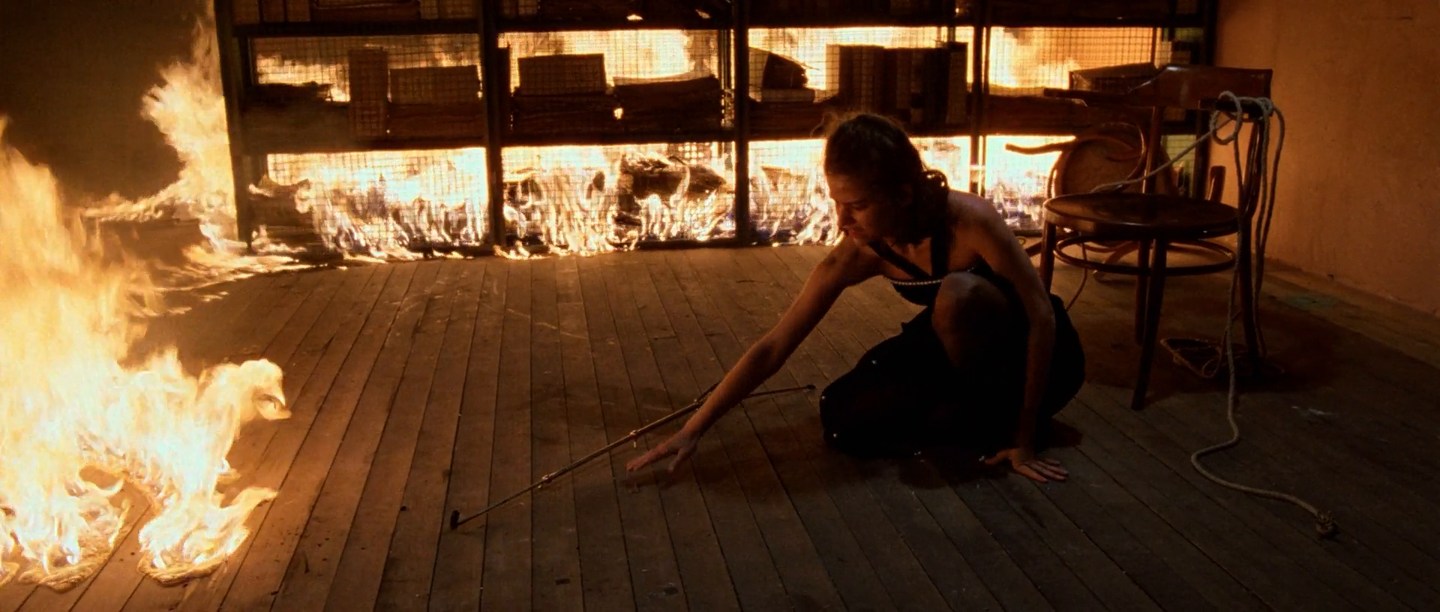
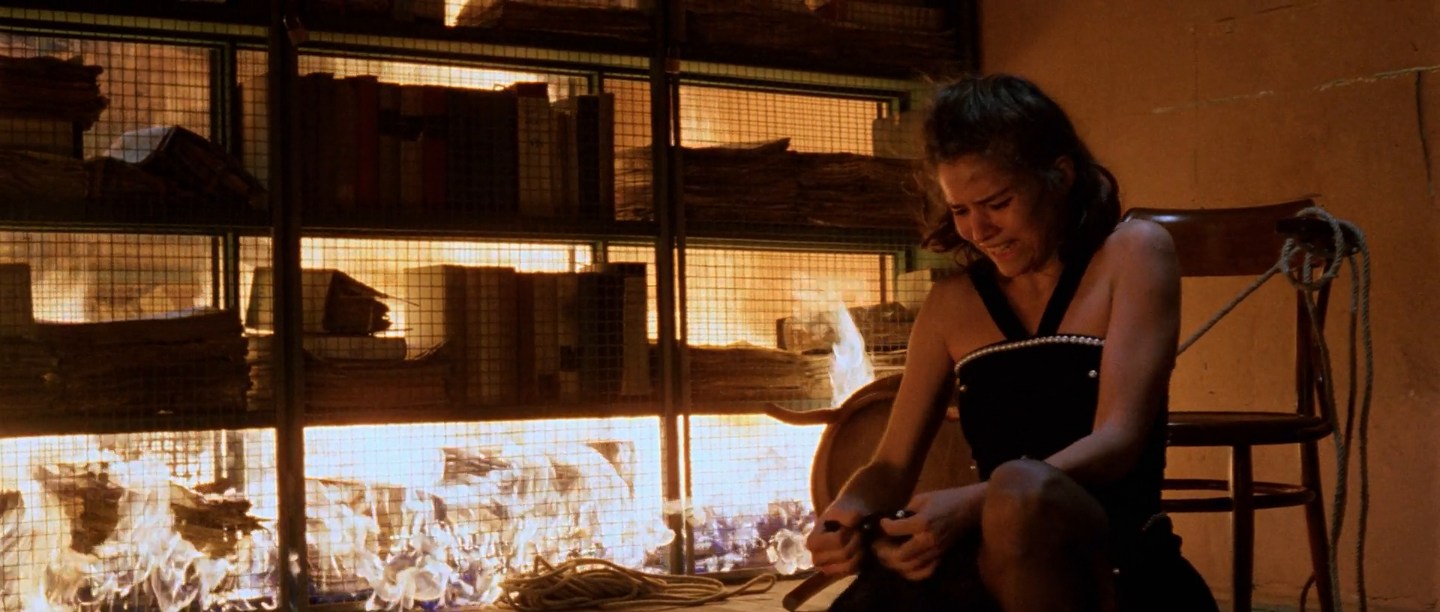
The archive room turns from confinement into an image of destruction. A blindfold, a fuel container and a small flame prepare an apparently conclusive death. The later Alpine return changes the status of the burning figure: a spectacular image has been used to manufacture a conclusion.
The gallery follows preparation, ignition, the body in the flames and Betty’s struggle to get free. It keeps the apparent death and the escape within the same sequence rather than treating the fire as a detached stunt image.
The final attack exchanges dark rooms for open grass and brilliant mountains. Marco’s white clothing makes the blood especially legible. The aftermath then uses depth: a body occupies the foreground while the surviving figures recede into a landscape too large to feel protective.
This is also a sequence about misreading performance. Betty’s apparent intimacy with Santini follows the attack, but the subtitle text later identifies her words to him as a deception. Her actions should not be reduced to an unqualified declaration of complicity.
Follow a visual idea across changes of scale, framing and point of view. The timed observations connect the stills to the selected sequences.
The eye as an enclosure
ENLARGE ↗The auditorium reflected in a raven’s eye.
The opening reflection and the needle close-ups make eyes into spaces that can contain, distort or imprison an image. The raven’s eye contains the auditorium; Betty’s eye is surrounded by an apparatus designed to deny her a normal response. Their resemblance matters because their positions within the story are so different.
Follow the visual progression 7 observations
00:02
The auditorium appears within the curved surface of the raven’s eye.
08:30
The actual auditorium expands the miniature reflection into architectural space.
30:48
Gloved hands introduce the needle strip at face scale.
31:12
The extreme close-up removes almost every surrounding landmark.
31:54
Stefano’s approach supplies the object of Betty’s forced attention.
32:00
The eye insert interrupts the attack rather than merely introducing it.
33:12
Removal restores a gesture Betty can perform herself.
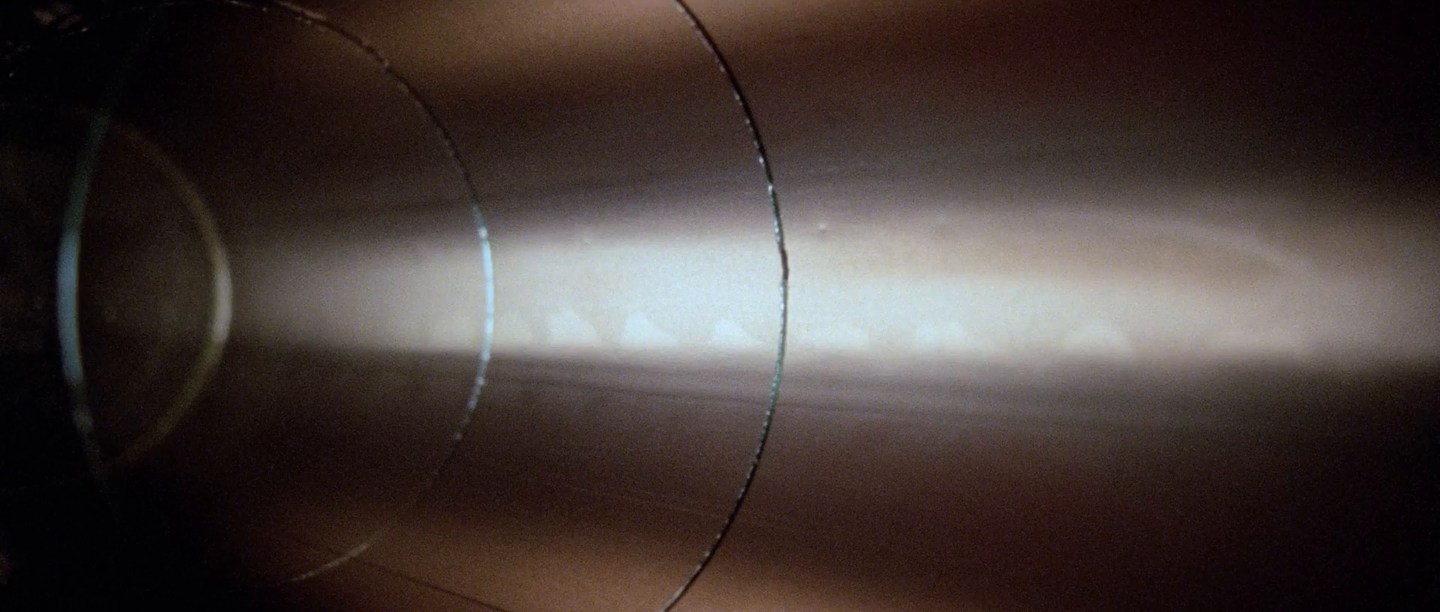
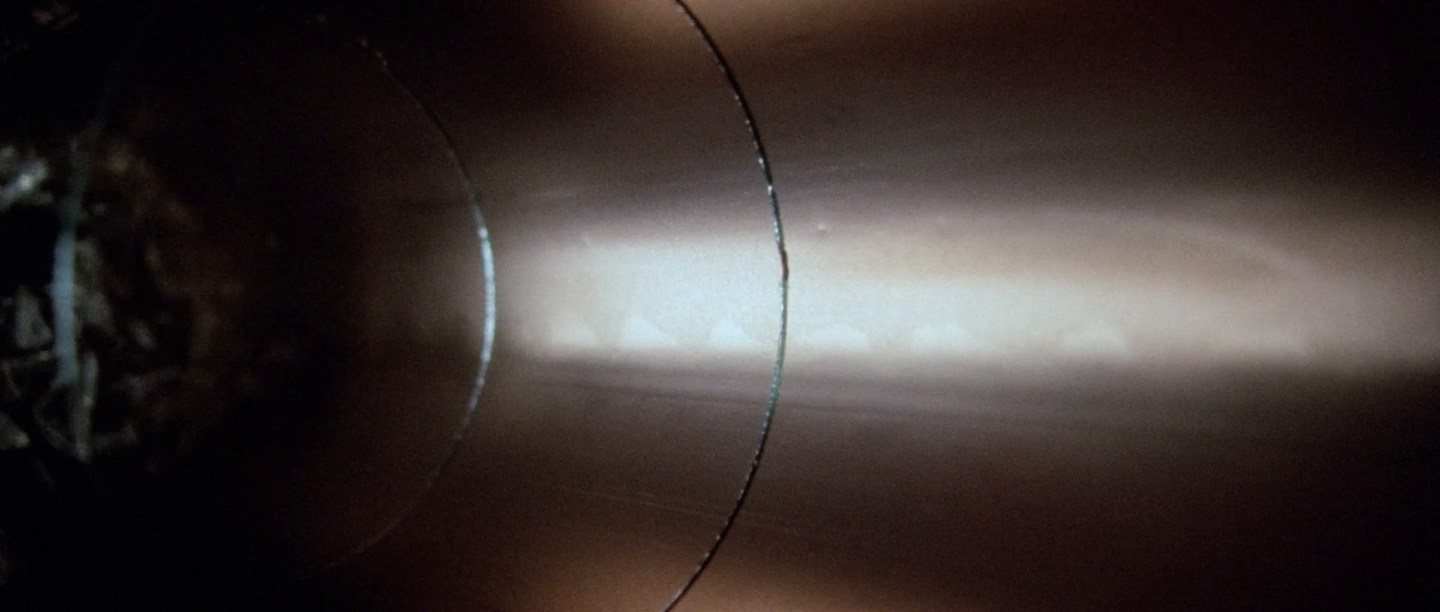
The sequence joins ordinary observation to an impossible interior view. Its design makes the door viewer resemble a miniature cinema: an opening, an image at the far end and a spectator whose safety depends on the separation between them. The shot destroys that separation.
Follow the visual progression 8 observations
1:07:33
Myra’s face and the door establish the normal viewing position.
1:07:59
The small circular image reveals the figure beyond it.
1:08:10.5
The gun aligns with the viewing axis.
1:08:10.75
The film enters a magnified tube rather than remaining beside the face.
1:08:11.25
The breaking surface gives the projectile a visible threshold.
1:08:13.25
The return to Myra’s profile gives the optical journey a bodily destination.
1:08:15.75
The reverse view extends the force across the apartment.
1:08:30
The body at the doorway fixes the final spatial result.
From ordered seats to an animal’s attack
ENLARGE ↗Rows of spectators tilt beneath the flying viewpoint.
The bird sequence does more than offer a spectacular view of the theatre. It turns the place organised for looking into a place where everyone is looked at. Alternating the animal, the tilted architecture and human reactions allows the film to turn a moving viewpoint into an accusation.
Follow the visual progression 7 observations
1:25:54
The bird is held within the cage’s grid.
1:26:36
The rows of seats are viewed along a steeply tilted axis.
1:27:12
The audience’s orderly seated pattern breaks into defensive movement.
1:27:45.7
The bird crosses beneath the chandelier and curved ceiling.
1:27:52.7
The movement narrows to the attack on a particular eye.
1:28:03.9
Santini becomes recognisable through the injury and his movement within the crowd.
1:28:06
Betty watches from beside the cage, separated from the earlier arrangement of forced captivity.
The Alpine coda changes the film’s visual scale twice: from an enclosed theatre to a mountain panorama, then from the panorama to a lizard in the grass. The final hand can be read against the hands that tightened ropes, positioned needles and searched a victim’s mouth. The comparison is formal; it need not turn Betty’s uncertain ending into a simple cure.
Follow the visual progression 7 observations
1:32:30
A blindfold controls Betty’s access to the apparent conclusion.
1:35:50
Fire offers a seemingly decisive body image.
1:37:00
The telescope places another viewing instrument against the open landscape.
1:40:45
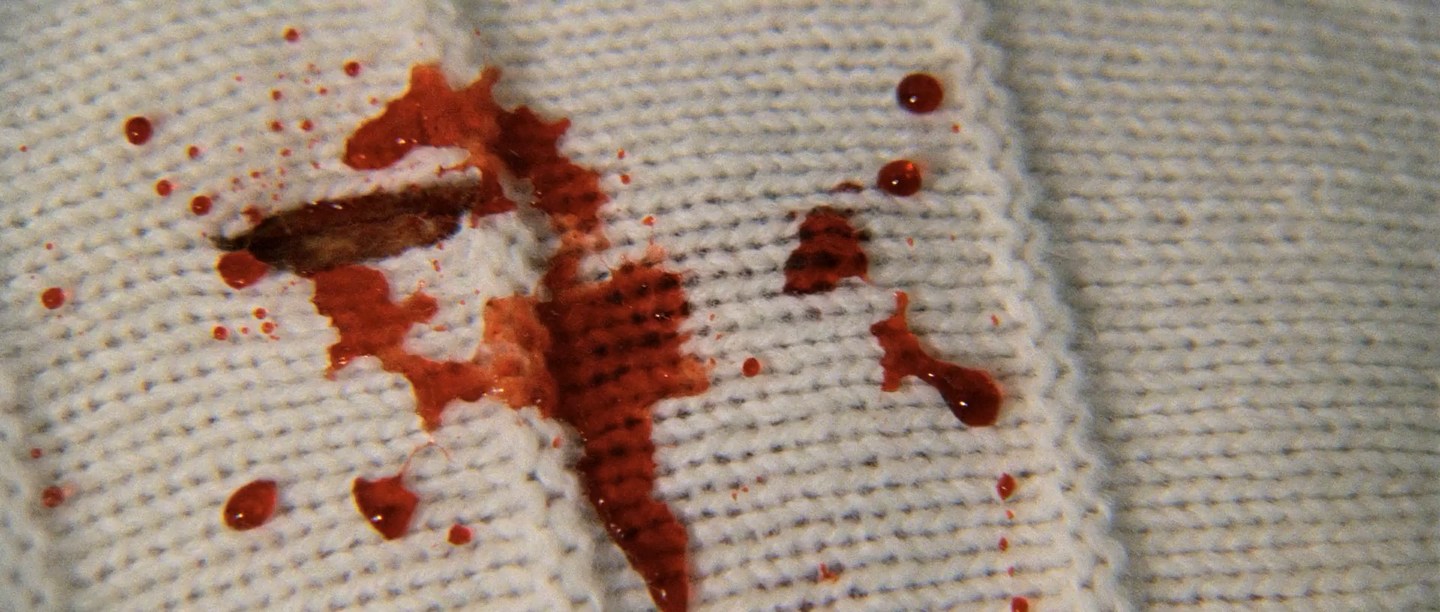
The wound on the white sweater brings violence into daylight.
1:41:30
The body and the distant mountains occupy one deep composition.
1:44:10
The lizard becomes the centre of attention at ground level.
1:44:30
Betty’s hand enters the small animal’s space without repeating the earlier grasp of restraint.
THE CRAFT RECORD
The people behind the effects.
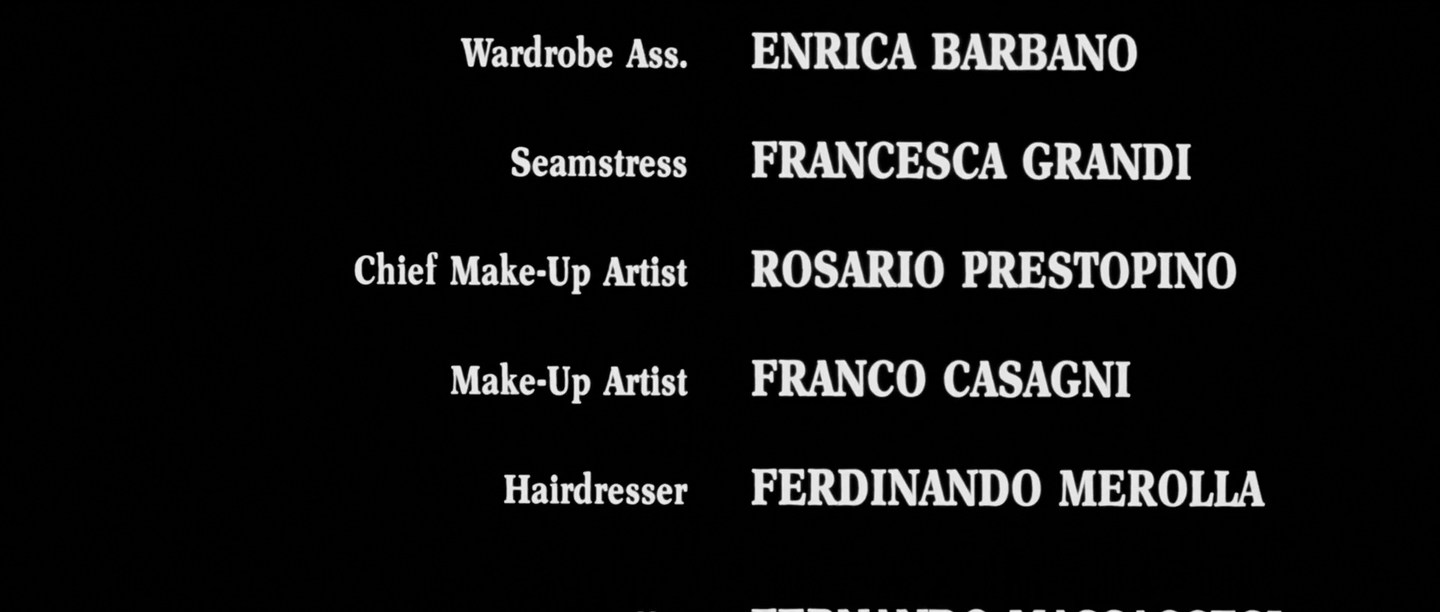
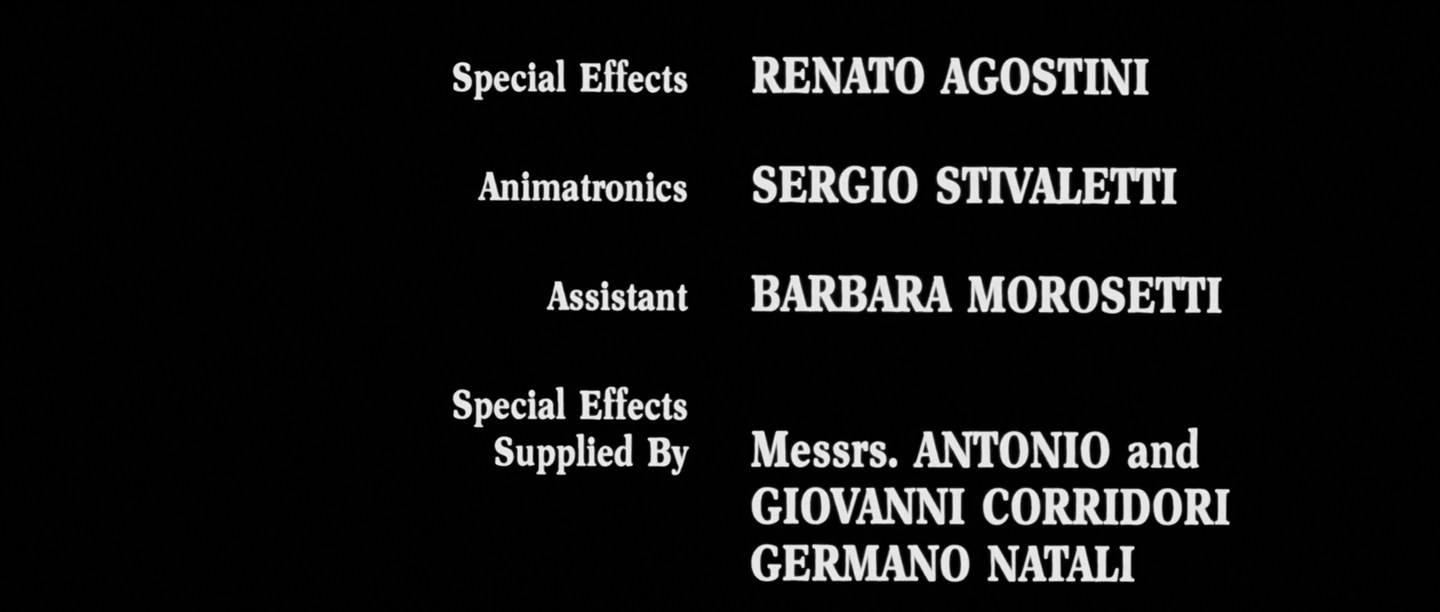
The closing roll distinguishes makeup, animatronics and special effects. Keeping those roles separate gives the sequences a firmer production context without assigning individual shots to a technician on appearance alone.
A celebrated voice does not guarantee that anyone will listen. Eight studies follow the film’s arguments, anonymous calls, recorded instructions and competing accounts of Betty’s identity.
ENLARGE ↗Betty and Myra beside the bedroom mirror.
Before Betty becomes a spectacle, her voice is a disputed professional instrument. The departing diva objects to the ravens and the staging; Betty worries that Lady Macbeth is wrong for her age and vocal range. The company answers those practical doubts with an opportunity, a destiny and the example of her mother. Her first appearance is already surrounded by other people’s accounts of who she ought to become.
Santini’s introduction as a fan continues that process. His unfinished response to her voice acquires a different meaning after the confession: recognition has preceded any relationship with Betty herself. The later comparison with her mother makes the early compliment part of the film’s structure of mistaken possession.
Follow the dialogue through the scene 4 moments
00:32–03:10
The diva’s complaints turn birds, theatrical machinery and vocal performance into competing claims on the stage.
03:51–04:09
An unidentified caller announces Betty’s debut; she cannot establish who is speaking.
05:18–07:30
Vocal doubts are answered with reassurance, ambition and the example of her mother.
19:03–19:54
The autograph exchange introduces Santini as both admirer and policeman.
ENLARGE ↗Stefano and Betty beneath the painted ceiling.
Stefano connects operatic singing to a sexual stereotype. Later, Marco starts from a similar assumption when he tries to understand Betty’s distress. Betty recognises the repetition and refuses it. Her replies matter because the killer will impose a much more violent version of the same equation: a woman who performs desire must want the scenario he has prepared.
The film does not make those positions equivalent, but it allows their language to rhyme. Betty’s account of herself repeatedly has to push through an interpretation supplied by someone else. Her inability to explain the attack immediately is therefore more than a device for delaying the investigation: the available conversations keep steering her away from what she needs to say.
Follow the dialogue through the scene 4 moments
28:27–29:06
Stefano invokes the supposed sexual habits of opera singers.
31:03–32:48
The attacker makes watching compulsory and supplies his own sexual interpretation of the captive spectator.
35:27–36:20
Betty challenges Marco’s assumptions and turns the stereotype back toward movie people.
36:59–37:31
Her account reaches the childhood hood and the limits of what she has told the police.
When Betty telephones Myra, professional triumph and personal danger briefly occupy the same conversation. Her agent hears demand from other theatres; Betty needs advice about a man who is following her. The interruption exposes the distance between being wanted as a performer and being heard as a person.
The conversation with Santini is more disturbing in retrospect. Betty explains that she wants to erase the experience, while he presents himself as the person who can help her describe it. His official role gives him access to the testimony produced by his own violence. The scene links forced looking to controlled disclosure: he can make her watch and then question her about what she saw.
Follow the dialogue through the scene 4 moments
48:02–48:34
Bookings and a plea for help compete within the telephone call.
50:29–50:42
The bracelet is introduced as writing that is too small to decipher: a date and inscription need closer inspection.
58:42–60:24
Betty describes avoidance and fear; Santini offers protection and asks for cooperation.
60:29–60:43
He gives her the assistant’s name, preparing the next crisis of identification.
ENLARGE ↗Betty and Myra shelter beside the doorway.
The apartment sequence makes identification an argument conducted through barriers. A visitor can supply the expected name, but Myra’s account puts that same name elsewhere in the building. Once the contradiction appears, each explanation can be reversed: the danger might be inside, outside, or wearing the authority meant to protect them.
At the peephole, voice, identification and weapon each fail to settle the question. Myra wants another look at the face. The extraordinary visual effect then destroys the very device that promises verification. The sequence’s logic begins in dialogue: the name has ceased to guarantee the person, so a closer view becomes both necessary and fatal.
Follow the dialogue through the scene 4 moments
61:08–61:49
The announced name allows the visitor to enter.
64:11–65:29
Myra and Betty discover incompatible accounts of where Soave is.
66:02–66:09
The suggestion that a singer can summon help is defeated by the apartment’s thick walls.
67:27–68:06
The argument at the door moves from a name to identification, a weapon and finally a demand to see the face.
Betty introduces the relaxation tape as a way to regain control. Its instructions organise attention around calm, breathing and music. Later, the same recorded routine returns after the attack. The words do not adapt to what has happened in the room. Their continued reassurance makes the difference between a repeatable recording and a living response painfully clear.
This is a precise use of sound within the story: the tape is identified as a tape in the dialogue, so its return has an established source. It can be read alongside the needle apparatus as another instruction about where attention should go, although Betty chooses the recording and the attacker imposes the restraint. The distinction in agency is essential.
Follow the dialogue through the scene 4 moments
1:02:04–1:02:22
Betty introduces her method of relaxation.
1:02:22–1:02:53
The recorded instructions begin; she explains that the voice is coming from a tape.
1:08:45–1:09:06
The threat at the doorway continues after Myra’s death.
1:09:28–1:09:49
The instructions to relax and breathe return in the changed room.
ENLARGE ↗Alma and Betty inside the service passage.
Alma also watches Betty, and she also admires her voice. Yet her knowledge of the building leads to rescue rather than possession. Her explanation places domestic violence behind her own escape into its passages. The film briefly joins two people seeking a way out of rooms controlled by others.
Back at the theatre, Marco’s plan turns an audience into a field of suspects. The spoken count and release cue make the birds’ intervention part of a planned performance. A remark about an eyewitness becomes literal in an unexpected way. The birds are witnesses within the film’s fiction; their function here does not require treating the characters’ claims about animal memory as scientific evidence.
Follow the dialogue through the scene 4 moments
1:13:27–1:14:37
Alma guides Betty through the passage and explains why she comes there.
1:14:10–1:14:15
Her admiration for Betty’s singing complicates the film’s association between watching and threat.
1:19:57–1:20:50
Marco explains that he has an eyewitness, then turns Betty’s desire to sleep into a Hamlet quotation.
1:24:22–1:25:30
Counting and a release instruction connect the trap to the mechanics of staging.
ENLARGE ↗Betty is blindfolded in the archive room.
Santini’s explanation is an attempt to make Betty inherit a part. He connects her voice and body to her mother, then describes his own violence through the language of love, dependency and a game. Those are his claims. The film gives them dramatic importance without requiring the dossier to adopt his account as an independent history of the mother.
The reversal of the command to look is decisive. He now wants Betty’s eyes closed and directs her actions while concealing the apparent conclusion. The confession does not end his performance; it helps him stage another one. The later discovery of the mannequin shows why neither his explanation nor his theatrical exit should be accepted at face value.
Follow the dialogue through the scene 4 moments
1:29:40–1:31:40
Santini compares Betty with her mother and tries to impose continuity between them.
1:32:02–1:32:04
The command changes: he no longer wants her looking at him.
1:33:27–1:34:20
He directs the gun and tries to provoke Betty with a further claim about her mother.
1:34:59–1:36:46
Calls for escape and the apparent death lead into an unstable resolution.
The news report dismantles the apparent ending with information supplied through a broadcast: the remains were those of a theatrical mannequin. The revelation does not depend on Betty seeing a new piece of physical evidence. A public account of the investigation changes the meaning of the fire, and Marco’s warning immediately turns that knowledge into action.
Betty then uses the killer’s preferred story against him. She momentarily claims the resemblance he wants, but later calls her words lies and rejects that identification. Read beside her earlier objections to other people’s assumptions, the deception becomes an act of survival rather than an admission of inherited desire. The final turn toward the small animal offers a different relation to a vulnerable body: attention without captivity.
Follow the dialogue through the scene 4 moments
1:38:42–1:39:24
The broadcast identifies the burned substitute and announces the continuing search.
1:40:50–1:41:24
Betty temporarily adopts Santini’s account of her resemblance to her mother.
1:42:27–1:43:23
She rejects the resemblance and identifies the preceding statements as deception.
1:43:31–1:44:28
The closing account of withdrawal leads to the release of the lizard.
The closing roll distinguishes the singers, the opera recordings, the composed music and the people who assembled the soundtrack. These credits give Betty’s public voice a production history beyond the face on screen.
The Macbeth performers
The film names Elisabetta Norberg Schulz, Paola Leolini, Andrea Piccinni and Michele Pertusi under its Macbeth singing credits. It also credits the Arturo Toscanini Symphonic Orchestra of Emilia and Romagna, the Parma theatre chorus directed by Giovanni Veneri, and lyrical music consultants Francesco Miracle and Gianfranco Plenizio.
These are performance credits, distinct from Cristina Marsillach’s screen role. The roll does not provide a scene-by-scene allocation of every sung phrase.
The recorded arias
Maria Callas is named in the music list alongside selections from Verdi and Bellini; Mirella Freni is credited for Un bel dì vedremo from Puccini’s Madame Butterfly. The film’s musical world therefore extends beyond the production of Macbeth visible on stage.
The source list identifies performers and repertoire. Locating a particular recording within every scene requires a separate cue comparison.
Composed pieces and rock groups
The roll names Brian and Roger Eno with White Darkness, Balance and From the Beginning; Claudio Simonetti with his contributions; and Bill Wyman and Terry Taylor with Opera Theme and Black Notes. Steel Grave is credited for Knights of the Night and Steel Grave, and Norden Light for No Escape.
A credit is not the same thing as a verified cue sheet. This record keeps authorship separate from the question of which passage is audible at a specific moment. Read the existing study of opera, metal and the film’s musical contrasts.
Recording, effects and dubbing
The roll credits Giancarlo Laurenzi as production sound mixer and Stefano Rossi as boom operator. It separately names Romano Pampaloni as dubbing mixer, Federico Savina as Dolby Stereo consultant, M. Anzellotti for sound effects and Robert Rietty as A.D.R. director—the spelling displayed in this copy’s English credits.
Those distinctions matter: a screen performance, a singing performance, replacement dialogue and the final mix are different contributions. The film closes with a Dolby Stereo credit, which does not identify the encoding or history of every later home-video track.
The 107-minute copy used for the scene studies contains Italian and English two-channel soundtracks, an English subtitle file, and separate commentary tracks labelled Nathaniel Thompson and Troy Howarth. Their spoken introductions identify the two commentators. Both film soundtracks contain differing left and right information; neither is simply two identical channels.
That technical finding does not establish the original theatrical mix or a preferred listening version. The embedded subtitles also differ from the English dialogue in wording and grammatical perspective, so they should not be treated as a verbatim record of the dub.
Severin’s three-disc release
Severin’s official listing separates English 5.1, English stereo, Italian stereo and Cannes English mono options for the 107-minute director’s cut. It also lists English 5.1 and stereo for the 96-minute US cut. These choices belong to a particular release, rather than to every copy bearing the film’s title.
The release’s Thompson–Howarth commentary is a joint track. Its other commentaries pair Cristina Marsillach with Ángel Sala and Alan Jones with Kim Newman. They must not be confused with the two solo commentaries examined for this dossier. Official release specification
Nathaniel Thompson and Troy Howarth approach Opera through performance, musical choices, spectatorship and the ending. These guides select useful passages from their separate solo recordings and connect them with the dossier.
These are critical readings and recollections. For Marsillach’s own account, continue to the performance chapter; for the distinction between these recordings and Severin’s later joint commentary, see the edition guide. Review scope and sources.
Nathaniel Thompson
Thompson places the film’s music within a complicated history of dubs, mixes and soundtrack albums. His account is especially useful for separating the force of a sound from the amount of violence visible in an image.
Explore Thompson’s reading 6 passages
07:28–08:32
English dubs and a preference for Italian. Thompson distinguishes the earlier Cannes English dub from a later English treatment, and favours the Italian track. His account makes the choice of voice and mix part of interpretation, rather than a neutral language switch. The preference is his; the current release options are checked separately against Severin’s specification.
23:06–27:00; 35:38–38:14
The soundtrack album is not the film. His discussion moves between Wyman and Taylor, the Eno material and Simonetti, then separates album contents from music actually used in the film. This is a useful warning against assembling a cue list from an album track list. The closing credits remain the firmer basis for the authorship record above.
55:54–58:55
What the image leaves to the sound. During Giulia’s death, Thompson stresses the sound effects rather than the amount of explicit detail visible. He is broadly receptive to metal during the attacks, but less persuaded by some transitions. His distinction adds a listening question to the gallery: how does the sequence continue to act on a spectator who turns away?
63:13–64:10; 71:10–71:33
The apartment as a nightmare. He connects Betty’s attempts to calm herself with the apartment sequence’s failure of reassurance, and singles out the use of opera music in its suspense. The dialogue study pursues a related question through the tape and the competing claims to Soave’s identity.
75:26–76:15
Alma and the damaged childhood. Thompson reads Alma as an echo of young Betty and argues that the domestic material gives the rescue a significance beyond escape mechanics. His discussion of its absence from the US version is a commentary account of the cut, rather than a new frame-by-frame comparison here.
87:20–87:51
An alternative cue is a suggestion. Thompson proposes trying Simonetti’s Crows/Craws material over the raven sequence. He presents this as an alternative he prefers. It should not become evidence that this was the released cue, or proof of a documented original scoring plan.
Troy Howarth
Howarth repeatedly returns to performance: small gestures, vocal replacements, humour and the question of whether Betty changes. His account helps connect the soundtrack to character rather than treating it only as accompaniment.
Explore Howarth’s reading 8 passages
05:15–06:00; 19:04–20:47
A voice is part of the performance. Howarth values the English track’s preservation of some performances while questioning other vocal replacements. He specifically distinguishes the re-recording of Santini’s dialogue from replacing the whole English track. This gives the language comparison a more precise focus than simply calling one version the English dub.
17:37–18:21
An uncertain glance at Myra. He singles out Betty’s search for Myra’s approval after the performance as a small but expressive acting detail, and argues that Marsillach deserves more credit than she is sometimes given. Read that assessment beside Marsillach’s own retrospective testimony, rather than allowing older accounts of the production to speak for her.
24:36–24:49
Violence before the wound. Howarth isolates the knife scraping the television screen as a disturbing sound that needs no bodily injury to make its effect. The observation expands the sound study beyond music: an ordinary material contact can anticipate the violence that follows.
32:33–35:20
A score built from contrasts. Howarth treats the change from operatic music to metal as an intensification of brutality, then considers the contributions of Simonetti, Wyman and Taylor within a soundtrack assembled from several musical voices. It is a critical account of the contrasts; the credit record above separately identifies the composers and performers.
35:54–39:09
Humour complicates Marco. He reads Betty’s objection to the sexual stereotype alongside Charleson’s use of humour and tenderness. This offers a useful distinction within the dialogue study: Marco’s assumptions can be challenged without reducing every encounter in the film to the same relationship of force.
55:05–56:24
The shears and the withheld close-up. Howarth draws attention to the contact between shears and teeth, then argues that sound and the body’s movement carry the later violence without an explicit view of the incision. Read this alongside Thompson’s account and the Giulia effects gallery: both critics locate part of the scene’s force outside the isolated still image.
71:00–73:27
Betty takes control of the music. Howarth identifies Callas recordings from Norma and La traviata in the apartment sequence, then reads Betty’s use of the volume control as a brief act of directing. His interpretation reverses the earlier arrangement: the captive spectator begins to shape the conditions of the scene.
101:44–104:41
The ending has a language question. Howarth favours a reading of the coda as a release, while acknowledging its ambiguity. He also identifies Betty as the closing narrator in English and Argento as the voice in Italian. That comparison raises a consequential question for the ending: are we receiving the character’s own account or an outside voice telling us about her? Return to the final dialogue study.
Performance & spectatorship
A young singer’s opportunity becomes an ordeal of forced watching. Opera brings the theatre, the horror audience and the work of performance into the same troubled space. This dossier follows Betty’s gaze, the people who constructed the spectacle, and the different forms in which it has reached its audience.
Spoilers: this study discusses the film’s story and ending.
01 / The captive spectator
The freedom to look away.
Betty’s ordeal reverses the usual privilege of a horror audience. We can shut our eyes. She cannot. The killer binds her and places needles beneath her eyelids, turning the ordinary reflex of blinking into a threat. Martyn Conterio’s BFI introduction identifies this image as central to Opera’s place in Argento’s cinema. Conterio on the needle image ↗
Argento gives the idea a disarmingly direct origin. In his conversation with Jamie Graham for Total Film, he recalls being irritated when viewers closed their eyes during frightening scenes. The apparatus made that frustration into a story situation. Argento’s retrospective explanation ↗ His recollection explains a provocation; it does not determine how every viewer must respond to it.
Our reading begins with the difference between attention and consent. Betty is made to see, but seeing does not make her an accomplice. The killer attempts to control the circumstances of her experience as well as the people around her. The image therefore gives physical form to a problem that a detective story can leave abstract: a witness may possess information acquired through an act of violence against the witness herself.
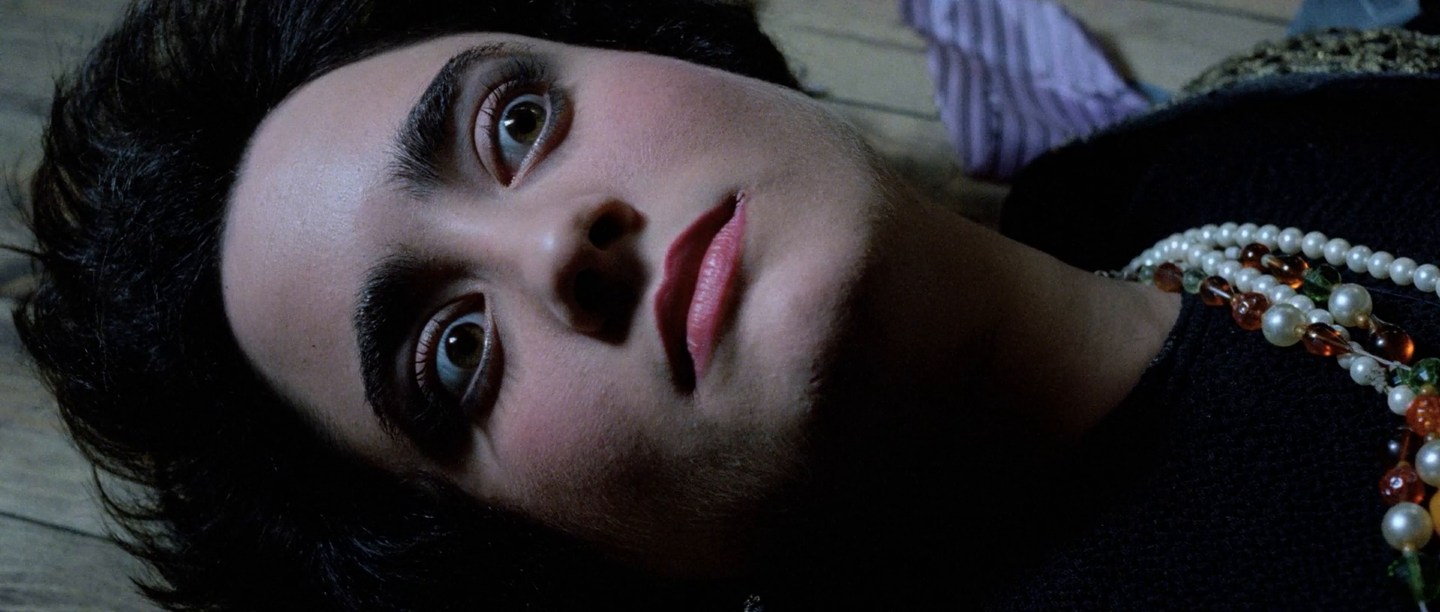
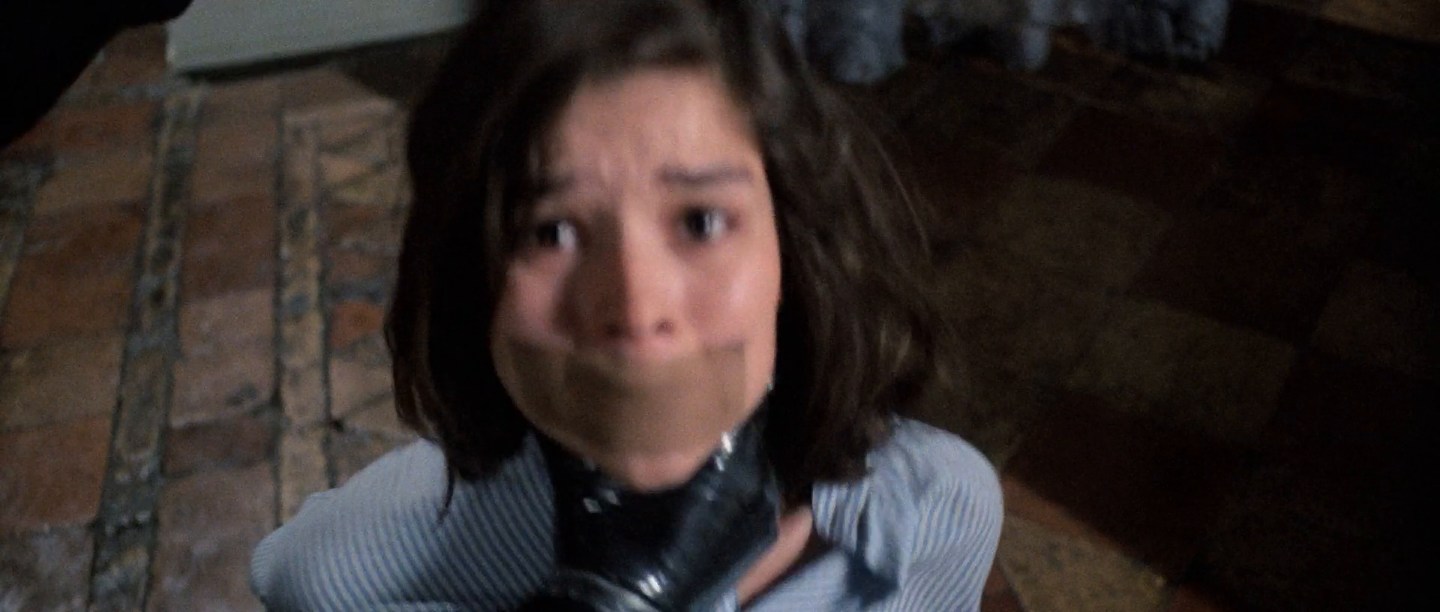
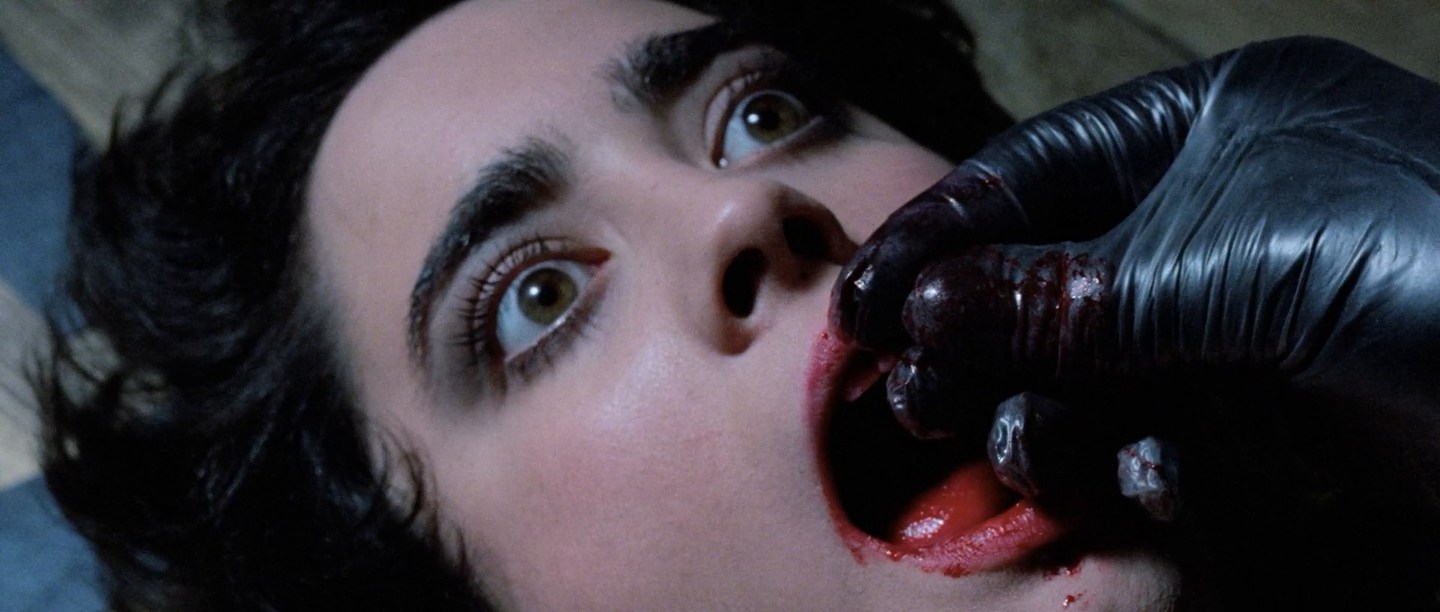
The inspected frame concentrates that violence in three horizontal bands: rope, eyes and tape. The eyes remain exposed while the mouth is covered. Hair fills much of the surrounding space, and the close framing supplies little room into which Betty might escape. Unlike the expansive gesture in the header image, this face is being arranged for somebody else’s purpose.
02 / The opera inside the film
Macbeth on stage; an uncertain origin story.
The opera being staged in the film is Verdi’s Macbeth. Film at Lincoln Center describes Ian Charleson’s Marco as a horror filmmaker directing the production, and traces Argento’s inspiration to an unsuccessful attempt to stage Rigoletto. BFI Player gives the same origin account. The retrospective programme ↗The BFI Player account ↗
There is a discrepancy worth preserving. Kevin Lyons’s essay, reprinted in the BFI’s 2023 programme notes, instead names Macbeth as the abandoned project. The conflicting account ↗ These texts agree about the film’s stage production while disagreeing about the remembered project behind it. Two matching summaries do not constitute independent production documentation. The original proposal, theatre correspondence or a dated draft would resolve more than another repetition of the anecdote.
The uncertainty does not prevent a useful reading of Marco. A horror director entering the opera house carries the supposed distinction between disreputable entertainment and respectable culture into the story. His profession makes the staging itself an argument about who is allowed to interpret a canonical work. The film can play with Argento’s public identity without becoming a transparent record of his life.
That is also why the opera should not be treated as an elegant backdrop interchangeable with any other spectacle. Lady Macbeth is a role Betty performs before an audience; it is not her personal confession. The distinction between a performer and the character she plays becomes especially important when another person insists on reading the performance as a message addressed to him.
03 / Cristina Marsillach
The image also required a performance.
In Mary Beth McAndrews’s 2024 interview, Cristina Marsillach recalls the discomfort of the eye apparatus, lengthy periods wearing it and a residual sensation after its removal. She describes the physical experience as feeding into Betty’s terror, and remembers Argento’s exacting attention to details of the restraint. The published conversation was facilitated by translator Alicia Lopez and edited for clarity. Marsillach on the physical work ↗
This testimony changes the emphasis of the familiar origin anecdote. The director remembers a way to confront an audience; the actor remembers working inside the image. Both perspectives belong in its history.
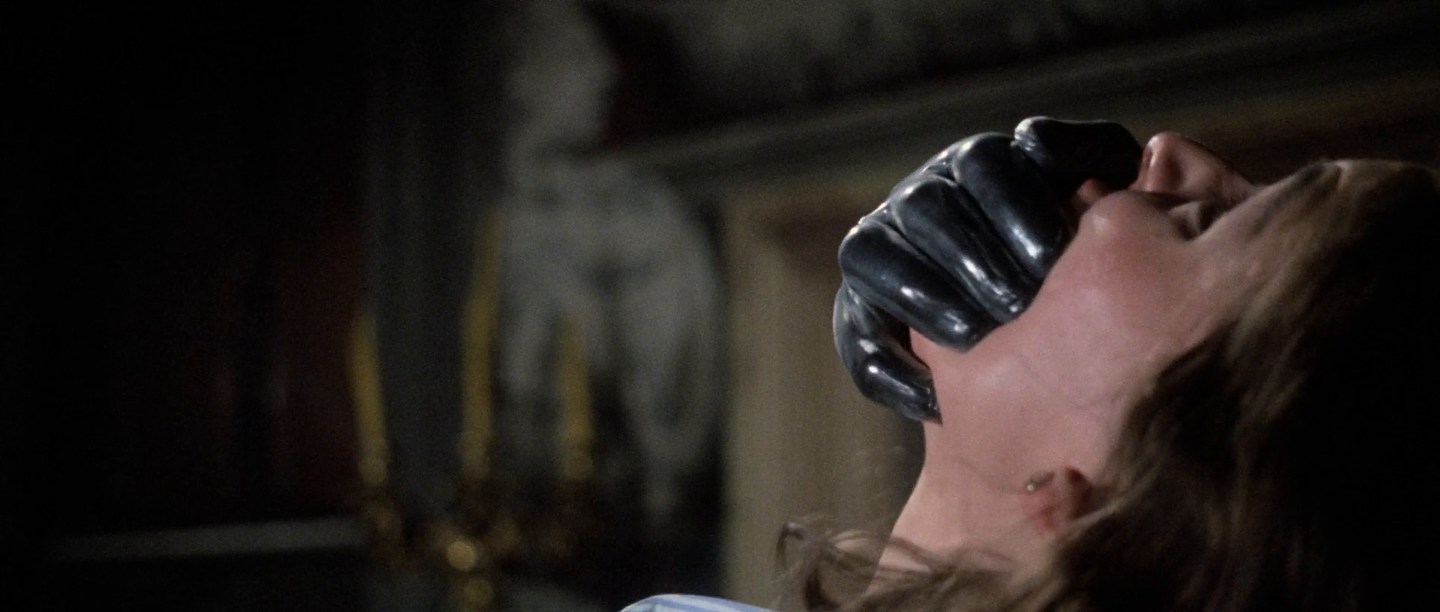
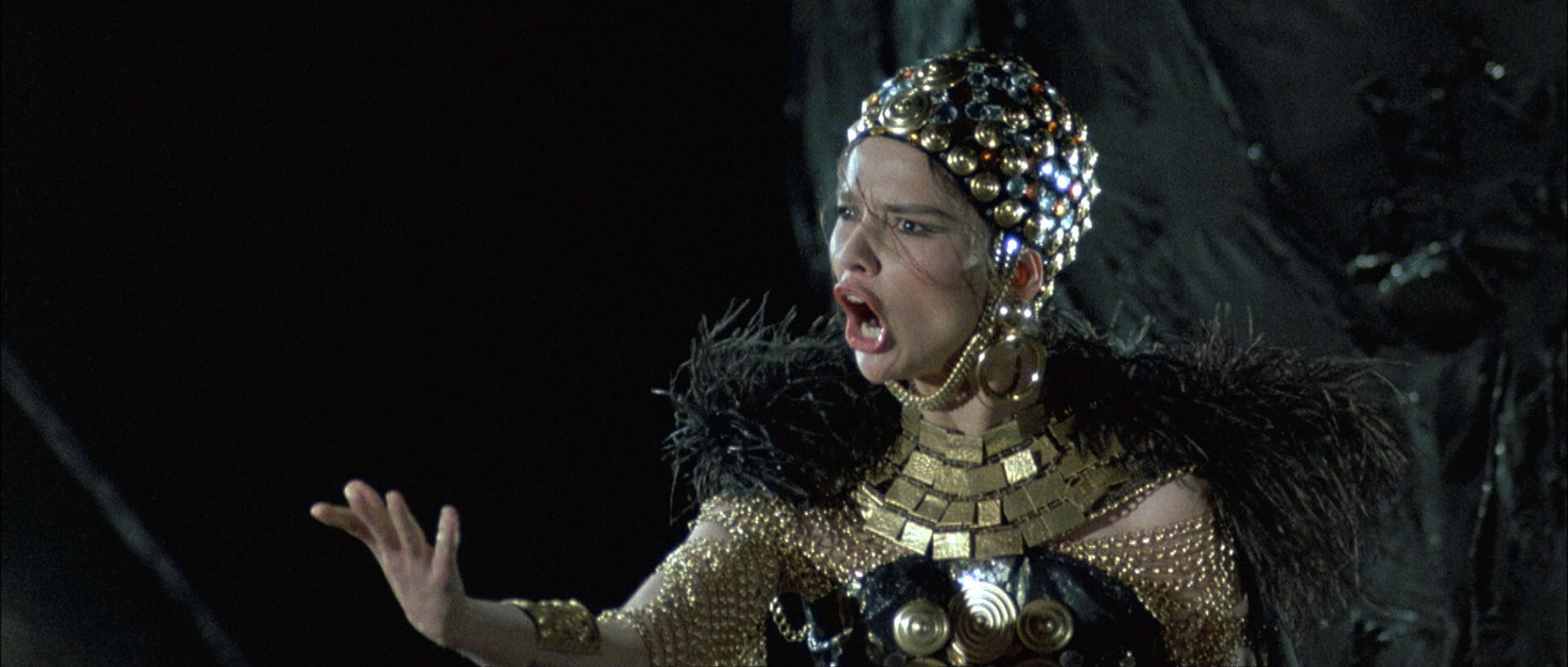
The header frame offers the other half of the contrast. Marsillach’s mouth is open, one hand reaches into the dark left side of the image, and the bright headpiece and collar give her face a ceremonial setting. The gesture travels outward. In the restraint frame, the mouth is sealed and the face is confined. Reading the images together makes the loss of expressive freedom legible without reducing Betty to the apparatus attached to her.
A photograph cannot tell us whose recorded singing voice we hear. The screen performance, the vocal recording and any dialogue replacement are different contributions to the finished character. The sound credit record now identifies the credited singers, recordings and dubbing roles. It keeps those contributions separate from the unverified allocation of each sung phrase.
The performer inside the apparatus.
Marsillach’s interview in Panico adds a specific working memory to her later published account: adhesive patches carrying the pins were applied for the relevant scenes, and Argento came over to check their attachment. She recalls restricted eye movement and discomfort. The remembered fastening procedure gives the familiar close-up a practical history alongside its meaning as forced spectatorship. Panico: testimony and passage locators ↗
Elsewhere in the interview, Marsillach recalls the director’s coldness and distance while also describing the collaboration as helpful to her performance. She explicitly leaves open whether that effect was intentional. Her account permits both physical difficulty and creative value to remain in view; it does not establish a deliberate psychological directing method.
04 / Camera and animal witnesses
The gaze moves when Betty cannot.
Argento singles out the bird’s-eye flight around the theatre and the bullet through a door’s spy-hole in his Total Film recollection. He connects his enthusiasm for camera movement to watching Sergio Leone at work. Movement in the director’s account ↗ This supports an account of his stated interests, not a shot-by-shot identification of the equipment.
The tension with Betty’s confinement is productive: the spectator’s viewpoint can travel where the character’s body cannot. A camera that moves freely does not necessarily give freedom to the person being filmed. Its exhilaration can sit beside her helplessness, asking us to enjoy a formal invention while recognising the coercion around which it is organised.
Dieter Merlin’s study describes the ravens’ attack as the exposure of Inspector Santini, the investigator who is also the murderer. Merlin, pp. 155–158 ↗ The witness is therefore outside the official system that has failed Betty. Our reading is that the theatre’s arrangement reverses: the watching audience becomes a field to be searched, and the person who would control the spectacle becomes visible within it.
This offers a connection with Phenomena that goes beyond the recurrence of animals. Both films challenge the assumption that useful witnesses must be human. Live birds, effects work, editing and camera movement require their own production account. That account remains a targeted investigation rather than a reason to postpone the supported interpretation.
A bird’s viewpoint took time to construct.
Michele Soavi remembers the ambition behind the theatre’s aerial viewpoint in Panico: a remotely controlled camera descending from a mechanism attached above the auditorium of Parma’s Teatro Regio. He estimates three weeks of construction and testing and recalls that the apparatus did not work especially well. His account adds the difficulty of the attempt to the director’s recollection of the desired image. Panico: testimony and passage locators ↗
The recollection concerns a proposed and tested camera arrangement. It is not a technical diagram of every raven shot in the completed sequence. The finished effect still needs to be understood through the combination of camera movement, live birds, effects work and editing.
05 / The people behind the spectacle
The theatre is a collective construction.
The BFI’s compiled credits identify Franco Ferrini alongside Argento on the screenplay; Ronnie Taylor as director of photography; Antonio Scaramuzza as camera operator; and Franco Fraticelli as editor. They separately name Davide Bassan for production design, Gian Maurizio Fercioni for the Regio Theatre art direction, and Francesca Lia Morandini for costumes. Effects and makeup credits distinguish Renato Agostini, Sergio Stivaletti, Rosario Prestopino and Franco Casagni. Compiled production credits ↗
Those distinctions matter to the images on this page. A composition includes the clothes and objects in front of the lens as well as the lighting and camera position. A spectacular movement must be staged, performed, photographed and joined to the surrounding shots. Describing everything as the director’s vision is useful shorthand only if it does not erase the work that makes the vision possible.
The header is a particularly clear example. Its visual force depends on the opposition between the glittering costume and the dark field around it. The exposed hand, the face and the reflective surfaces compete for attention. We can examine those relationships directly in the reproduction; assigning a particular accessory to a designer, or a lighting decision to a single crew member, would require more specific evidence.
Severin lists an archival Conducting Dario Argento’s Opera featurette involving Taylor, Nicolodi, Barberini, Stivaletti, Simonetti and Argento, as well as a Ferrini interview. Listed participant testimony ↗ These are concrete leads for the return pass. Their advertised presence is not treated as testimony already examined.
06 / Music, voice and address
More than a contest between opera and metal.
BFI Player foregrounds the collision between Verdi and heavy metal. The soundtrack’s conspicuous contrast ↗ That contrast is an inviting starting point, but it does not account for everyone involved. Merlin’s study also identifies Bellini and Puccini, Steel Grave and Norden Light, Brian and Roger Eno, Bill Wyman and Terry Taylor, and Claudio Simonetti. The musical contributors, p. 154 ↗
Thinking in terms of several musical functions is more useful than assigning the film one genre. Stage music belongs to a performed work within the story. Other material may organise our experience of fear, memory or movement. The same passage can also complicate that separation: something audible to a character can be shaped for the cinema audience as forcefully as a conventional score.
Merlin makes precisely such an argument about the approach to the theatre box. He reads Verdi’s music as both situated in the performance space and closely coordinated with the camera. He also connects Lady Macbeth’s aria with Santini’s confusion of Betty, her role and her mother. Merlin’s analysis, pp. 160–163 ↗
Our interpretation follows the problem of address. An audience hears a singer performing words written for a character; a stalker can imagine that those words reveal the singer’s own desire. The violence lies partly in that appropriation. Opera, as an art of heightened expression, makes the gap between performing an emotion and personally authorising another person’s actions especially sharp.
The BFI credits also name Luciano Anzellotti for sound effects, Robert Rietti for ADR direction and Romano Pampaloni for dubbing mix. Sound production credits ↗ A soundtrack history therefore needs dialogue and effects as well as composers. Exact cue placement, vocal identities and differences between the available mixes remain documented follow-ups.
07 / Cuts, framing and classification
Which Opera are we discussing?
An edition can change more than the duration. A different cut changes the sequence of events; a different frame changes their visible arrangement; a different mix changes the relationships between voices, music and effects. Naming one of those differences does not settle the other two.
Severin’s three-disc edition: published specifications
Version
Listed duration
Picture and sound options
Director’s cut
Listed duration107 minutes
Picture and sound2.35:1; additional 1.85:1 presentation. English 5.1, English stereo, Italian stereo, Cannes English mono.
US cut / Terror at the Opera
Listed duration96 minutes
Picture and sound2.35:1. English 5.1 and English stereo.
Edition specifications ↗ These are the label’s descriptions. They establish what the release offers, not a definitive judgement about the original framing. Its restoration claim is a 4K scan of original camera negatives at Cinecittà. The material scanned and the decisions made during presentation should remain separate questions.
The BBFC record adds a territorial history. It records a 95m 18s cinema submission classified on 5 January 1990 and a 91m 4s video submission on 30 January 1991, both flagged for cuts or alterations. A 102m 52s submission classified on 24 December 2002 has no such flag in the displayed listing. The dated classification entries ↗
Those durations are not a ready-made cutting list. They do not by themselves tell us how much difference comes from an edit, a transfer speed or the submitted material. Nor does the title Terror at the Opera identify one universal version across countries. The useful next comparison will name the actual copies and their playback conditions before drawing conclusions about missing scenes.
For the restoration question, Severin’s July 2024 podcast identifies its Opera discussion and guest colour supervisor Karim Hussain at 1:45:03. A precise return point ↗
08 / Ending and reputation
Let Betty’s ending remain a question.
The final movement into an Alpine landscape changes the scale of the story’s enclosure. Lyons’s account describes Betty’s encounter with a lizard and her appeal to nature, while noting that the coda was absent from early English-language versions. Lyons on the coda ↗ Its exact presence in each release still needs a copy-specific comparison.
Our reading is that an exit from the opera house need not constitute a settled recovery. Leaving the architecture of performance does not automatically undo what has happened within it. The encounter with a small creature can be read as a search for a relationship outside the killer’s coercive interpretation of her. It can also feel like an uneasy withdrawal. Those possibilities are more revealing than treating the ending as a mistake simply because it resists a conventional resolution.
Reputation has its own framing effect. Conterio positions Opera at the end of Argento’s classic period; Film at Lincoln Center presents it as a major work of his middle career. A career overview ↗The 2022 retrospective framing ↗ These are later critical judgements. They tell us how the film is organised in accounts of an auteur, not how its first audiences uniformly received it.
Calling a film a last great work can direct attention toward what came before and make everything after it appear predetermined. Argentochrome’s approach is to keep that judgement open to comparison. Here, Opera rewards attention as a specific argument about watching, performing and being misread. The next dossiers can develop their own questions without having to inherit a verdict of decline.
Franco Casagni, Sergio Stivaletti and the documentary’s production footage
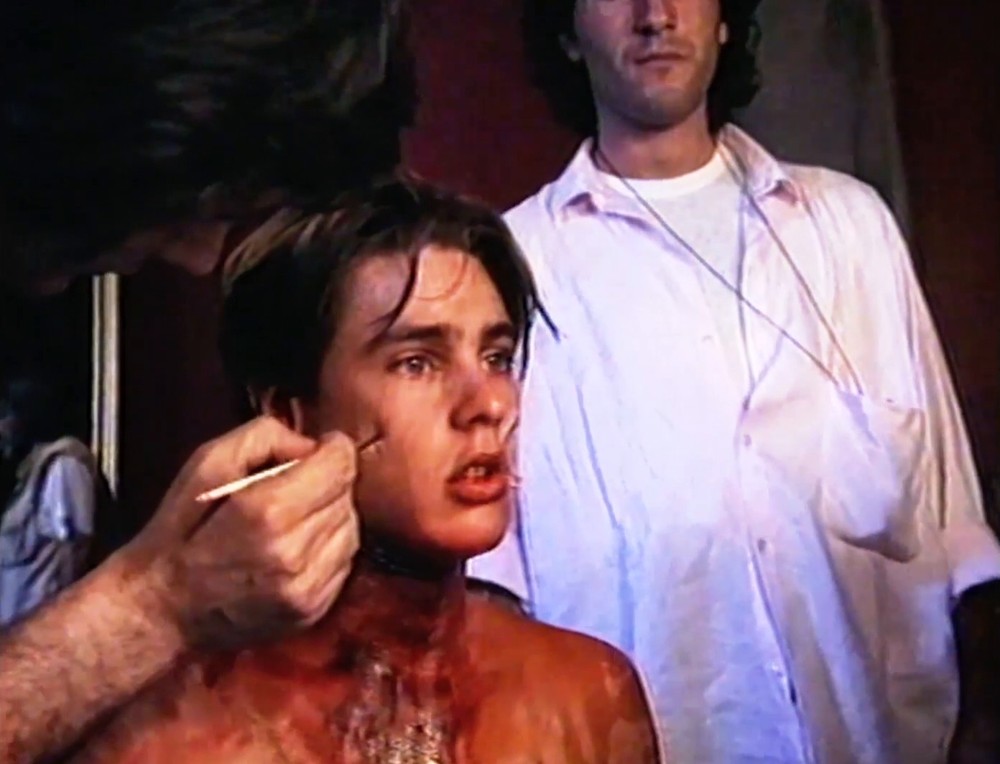
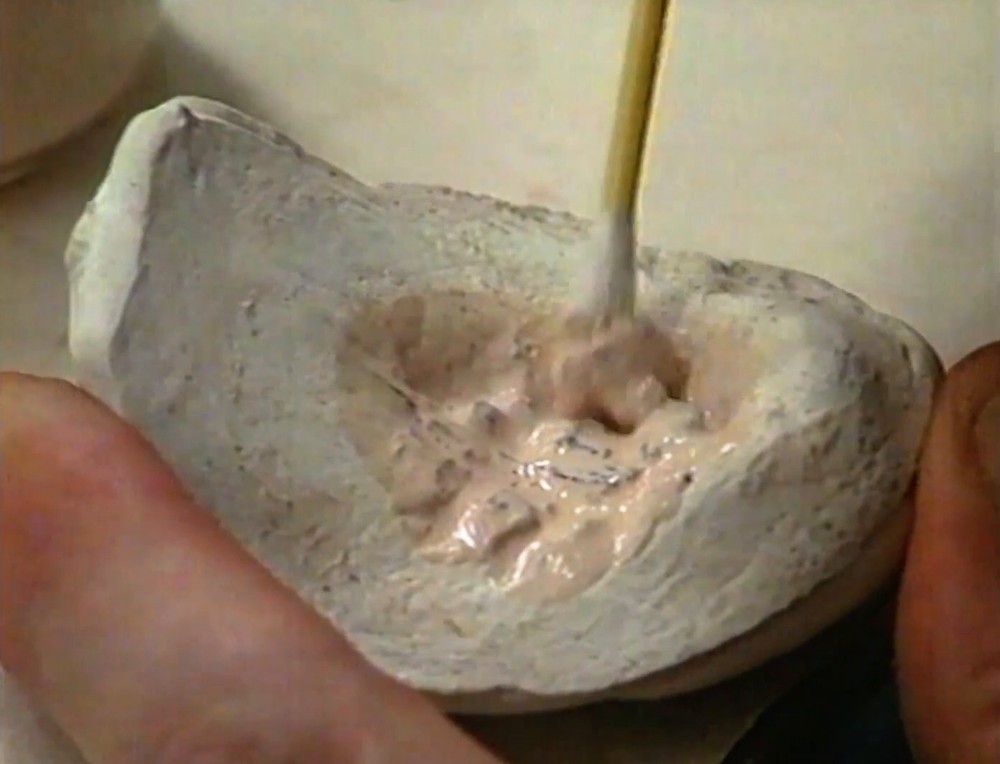
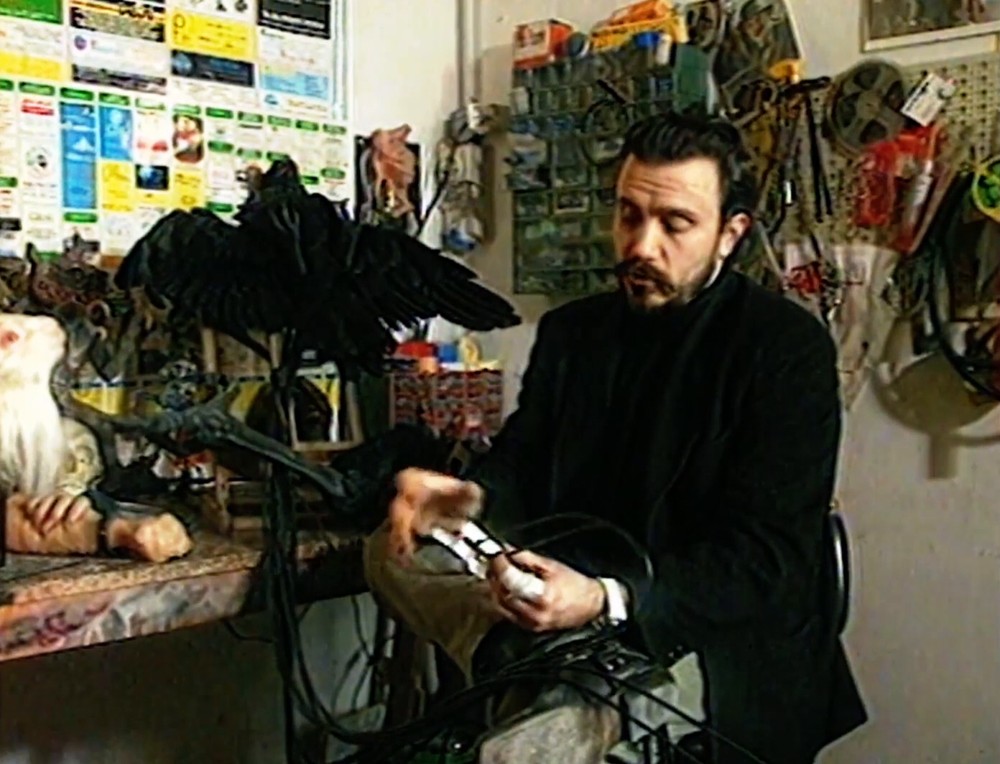
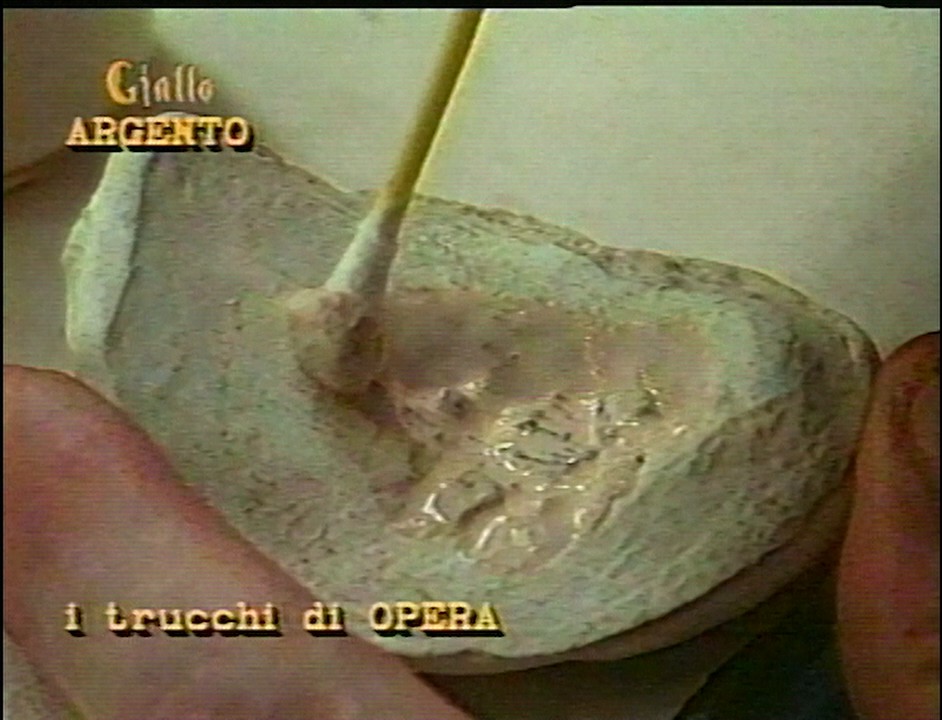
Preparing Stefano’s makeup between takes.A mould is filled in the effects workshop.Stivaletti demonstrates a mechanical crow.
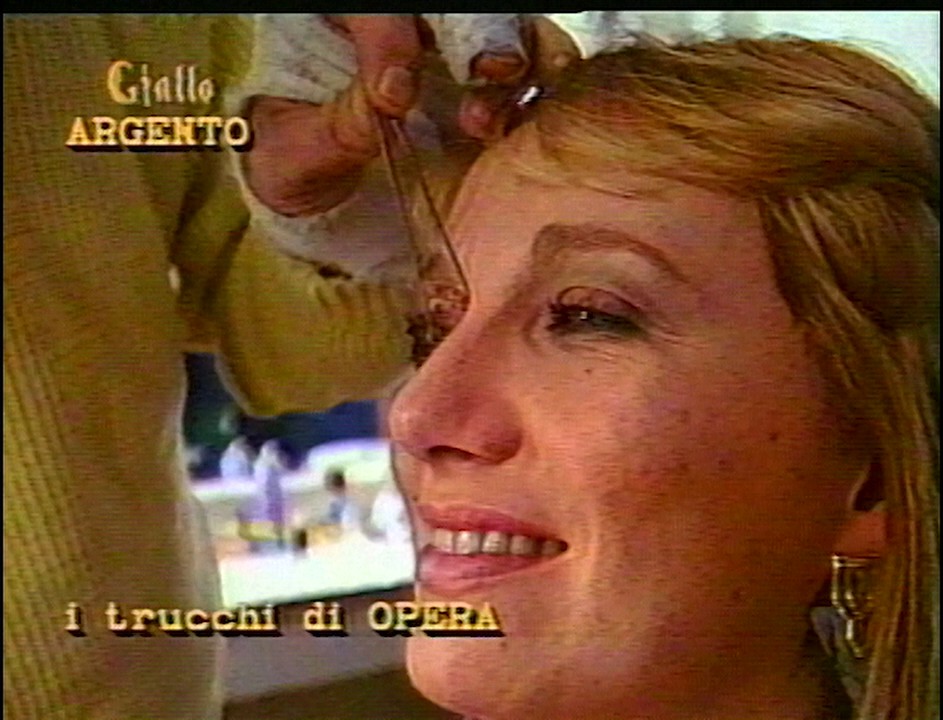
Franco Casagni gives Stefano’s death an effect-specific construction history in My Cinema. He describes a mouth-and-chin prosthetic supplied with small tubes, pumps and syringes for the blood, then identifies the retractable knife and the actor’s performance as the other parts of the illusion. His account connects the visible injury to a coordinated action between makeup, prop and performer. The documentary separately shows the makeup work and identifies the team led by Rosario Prestopino; the individual recollection should be read within that collective labour.
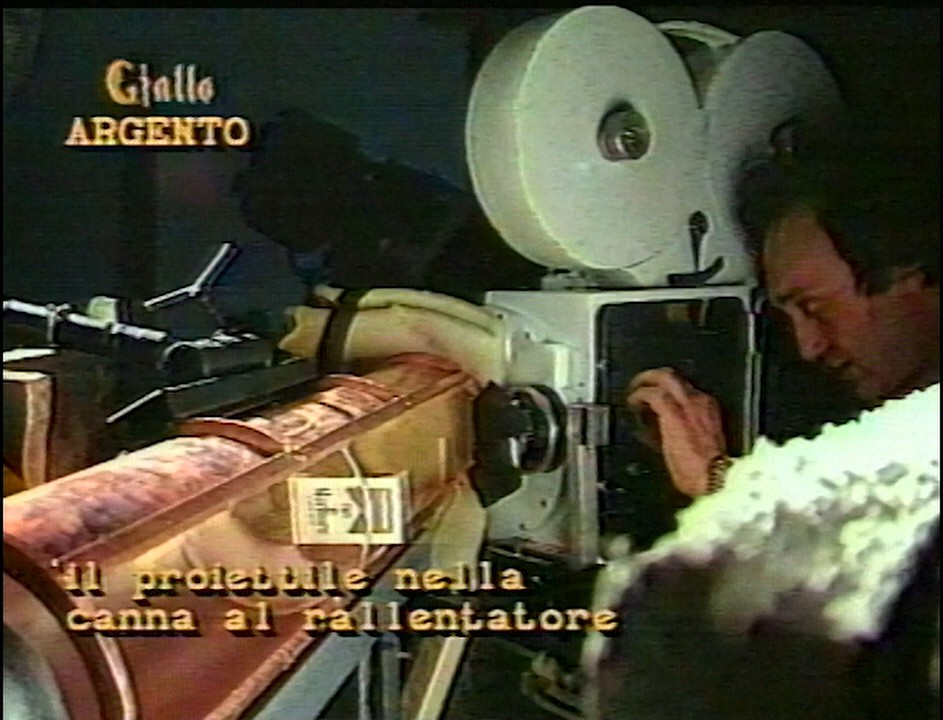
The peephole sequence receives a different kind of record. Workshop and set footage follow the eye wound, the exit wound at the back of the head, the hair concealing the explosive effect, and the final adjustments before filming. The documentary also shows the enlarged bullet prop and explains the use of a scientific high-speed camera. What becomes a sudden passage through a head on screen was assembled from objects and actions made at different scales.
Stivaletti explicitly describes mechanical crows for the attack on the killer, explaining that the required movements could not be obtained from live birds. This makes a useful distinction within the documentary itself: Argento’s broad recollection in Part One presents the birds as real, whereas Stivaletti identifies a particular mechanical solution in Part Two. Live-bird photography and manufactured attack effects belong in the same production history; the effects artist’s specific account prevents the whole sequence being reduced to either one.
Source & passage
Dario Argento: My Cinema / Il mio cinema, two-part documentary presented on Severin Films’ Dario Argento’s Deep Cuts, Disc 1. Part Two, 14:46–16:21; 19:35–25:47. Compare Part One, 47:49–49:24.
The discussion paraphrases the English subtitles and distinguishes participant recollections from the documentary’s narration and production footage.
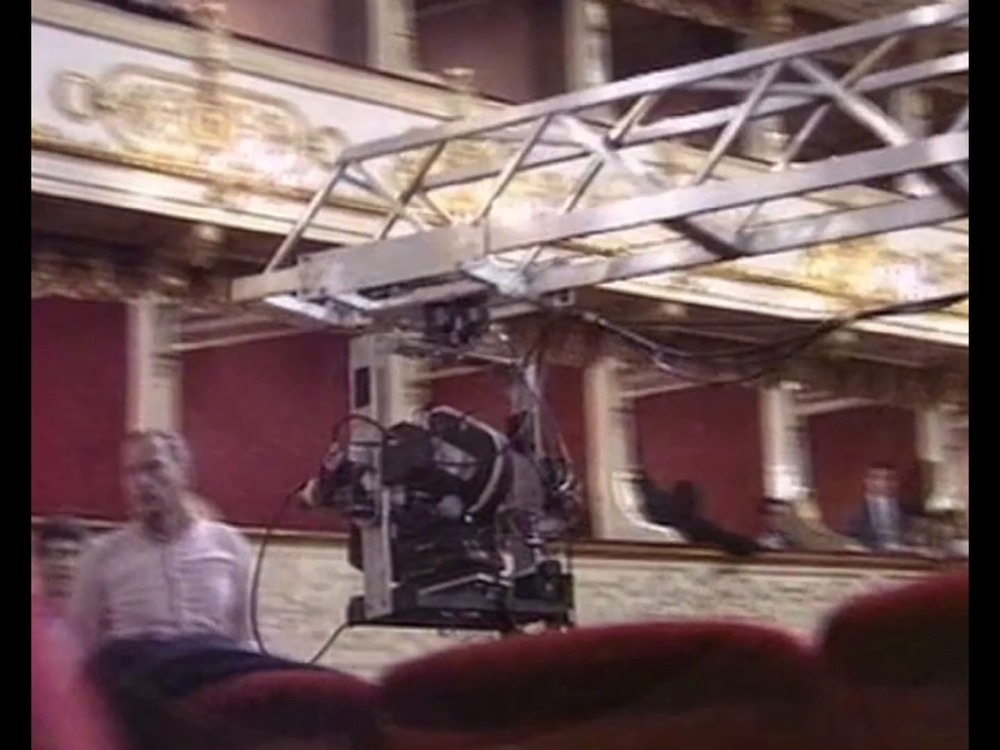
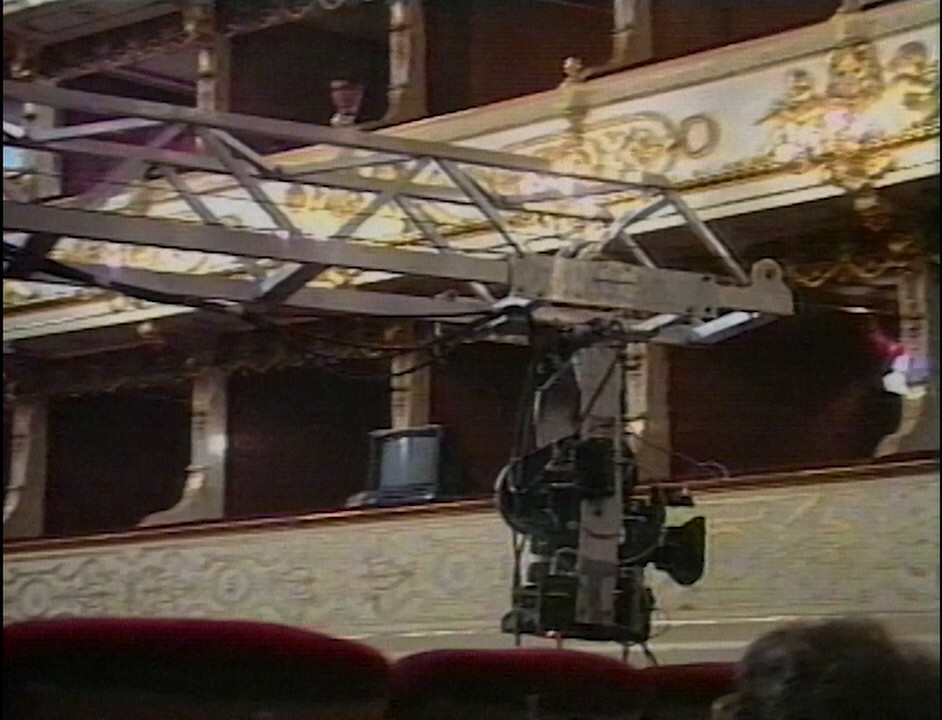
The documentary moves from the opening Steadicam passage to exterior crane work and the large apparatus used above the auditorium. Its production images expose the steel structure, suspended camera and crew behind a viewpoint which the finished film makes feel airborne. This extends the dossier’s account of forced looking: the spectator’s apparent mobility was designed and built, just as Betty’s immobilisation was staged. The footage gives a physical counterpart to Soavi’s later recollection in Panico of the time needed to construct the bird’s viewpoint.
Source & passage
Dario Argento: Master of Horror, 16:41–21:58. Presented on Disc 2 of Severin Films’ Dario Argento’s Deep Cuts.
Opera continues in the sound room while television begins.
In TV Nightmares, Dario Argento places Opera’s audio postproduction among the demands competing for his time during Giallo. He distinguishes his own Nightmares shorts and presenting duties from Night Shift, whose detective stories he entrusted to Lamberto Bava and Luigi Cozzi. This is a specific recollection of overlapping work, not a new directing credit for the television episodes.
Antonella Vitale supplies a performer’s connection. In Calypso 9, she recalls moving from her small part in Opera to the recurring taxi-driver investigator. The television role gave her a continuing character: a student earning her tuition through night work, whose observations repeatedly help solve the crime.
The camera, the wound and the sounds made afterwards.
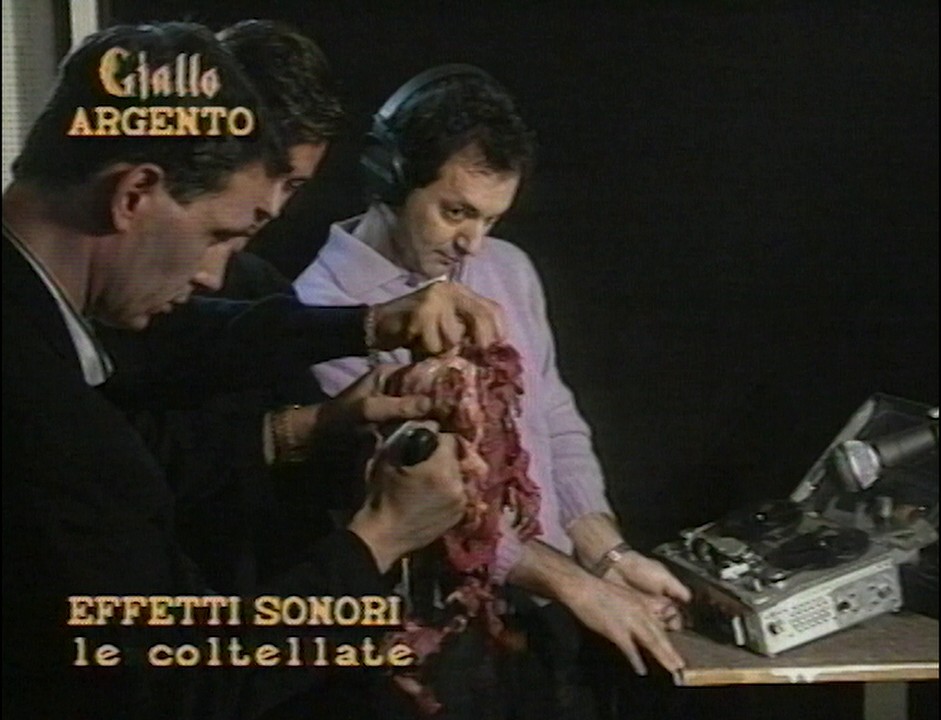
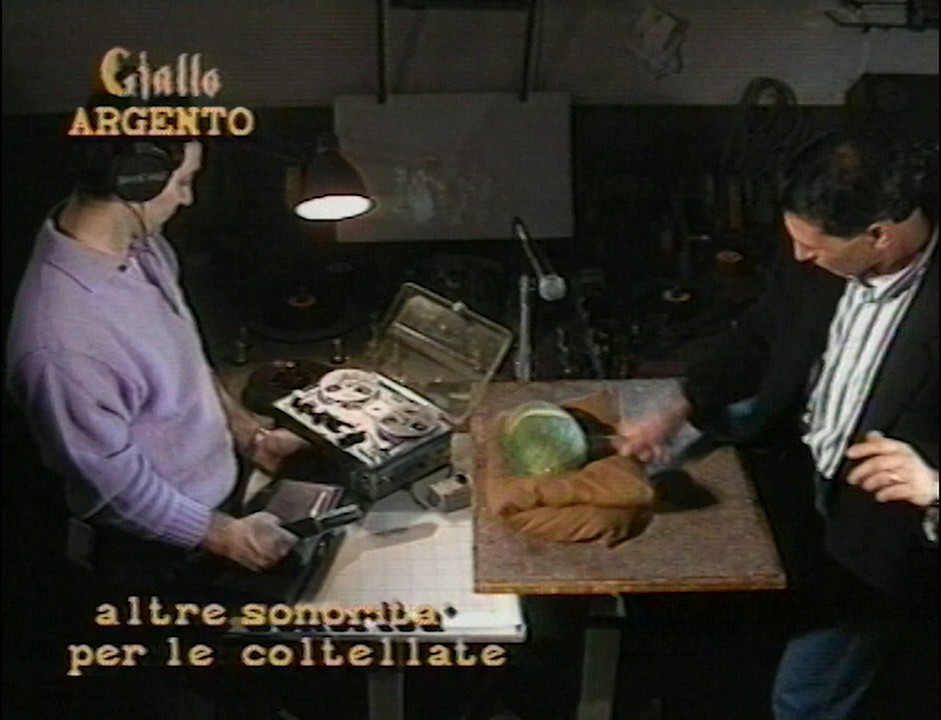
From Giallo Argento, the compilation of interviews and production demonstrations from Giallo (1987).
The 1987 television programme catches Opera while it is still being completed. Its demonstrations supplement the later recollections with images of the working equipment and Argento’s instructions at the mixing desk.
A bird’s flight made by a camera rig
Argento describes live crows alongside mechanical birds, then explains the problem of giving the spectator their movement. A camera cannot simply be attached to a bird. The auditorium footage shows the alternative: a long rotating structure carries the camera above the seating. The flight image emerges from the relation between performers, birds, theatre architecture and a separately controlled machine.
The camera hangs beneath the revolving rig.
The peephole killing as separate tasks
The programme moves from the finished shot to wound-appliance preparation, Daria Nicolodi between setups and the equipment used to photograph a bullet at reduced apparent speed. Seeing these tasks separately clarifies how the sequence makes a single violent trajectory from materials prepared at different scales.
Explore the makeup and bullet workshop · 3 images
Preparing the wound appliance.Daria Nicolodi between setups.The bullet filmed in slow motion.
Voice, music and an explicit transition
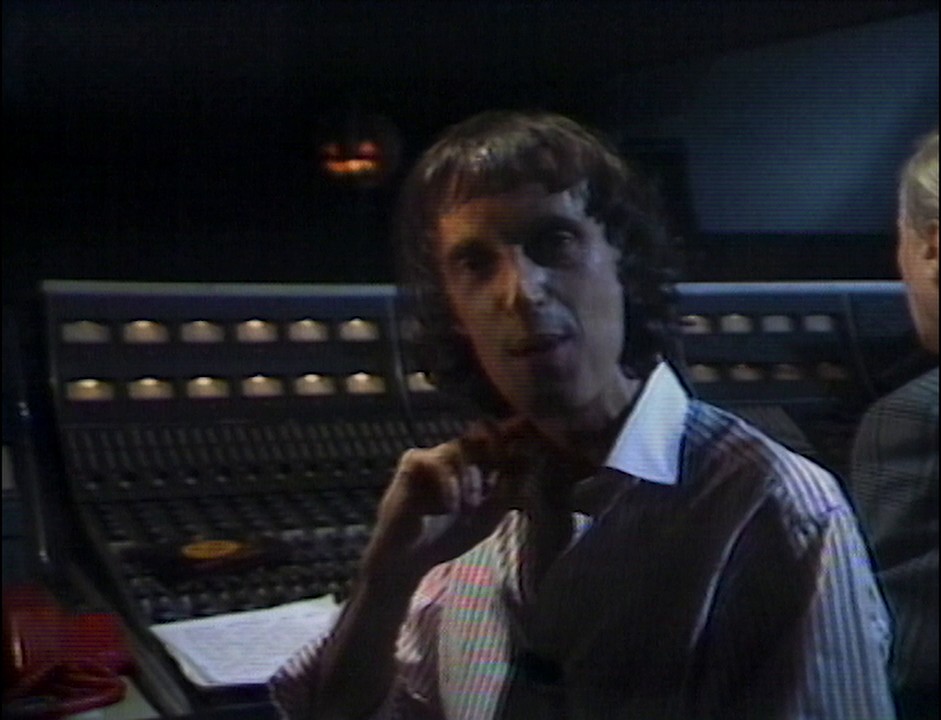
At the mixing desk Argento asks for changes in the balance of music and voice. The passage then names a transition from Simonetti to Brian Eno. This is unusually concrete production evidence: the soundtrack is being decided as a relation among elements, rather than described afterwards as a single continuous mood.
Opera at the mixing desk.
The Angelotti brothers make the body audible
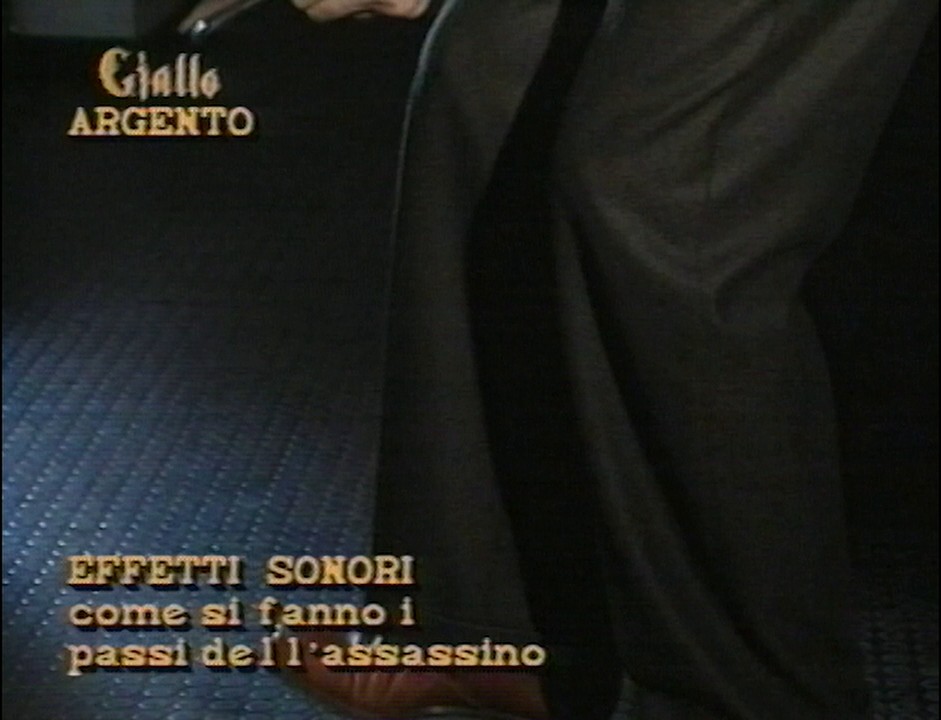
The final programme demonstrates footsteps and stabbing sounds. Shoes are worked by hand against a surface; blades, a piece of meat and a melon are brought close to a microphone. The pictures make visible the separation between the screen action and the objects used to give it weight. The spoken direction asks for changes in emphasis while the Foley performers repeat the action.
Explore the Foley demonstration · 3 images
Footsteps made by hand.A blade and a close microphone.A melon supplies another impact.
Source & passages
Giallo Argento, 27:30–31:45; 46:30–48:55; 57:00–59:20; 73:35–75:35. Severin Films, Dario Argento’s Deep Cuts, Disc 4. The study draws on the programme footage and English-subtitled testimony.
Research, visual studies and dialogue readings are documented below. Recollections, criticism, edition records and direct observations remain distinct.
8 May 2023 programme, reprinting Kevin Lyons’s 27 November 2020 essay. Credits, ending and a conflicting Macbeth origin account. Compiled credits are not production paperwork.
Kieler Beiträge zur Filmmusikforschung 11 (2014), pp. 154–166; analysis consulted on pp. 154–163. German-language scholarship, paraphrased here in English. Its references name an Arrow 2003 DVD; findings are not our direct viewing/listening record. Text in the repository carries CC BY 4.0; image rights are separate.
The new visual studies use a 107m 21s copy containing the Alpine coda, presented at 1920 × 816 pixels. Frame selections and closer sequence sampling support the observations and galleries; timings locate images in this copy rather than defining every shot boundary. The closing credit roll supports the craft record. English subtitle text informs the account of Betty’s final deception. The dialogue and commentary source note describes the subsequent transcript-assisted review and its limits. The file labels Italian and English stereo tracks and commentaries by Nathaniel Thompson and Troy Howarth.
The dialogue studies combine a complete reading of the embedded English subtitles with speech-recognition-assisted examination of the complete English soundtrack and the previously inspected scenes. The two separately identified Thompson and Howarth commentaries were examined in machine transcription. Unclear speech and proper names were checked against the subtitle or credit record where possible; no verbatim dialogue transcript is published. The analysis does not claim direct listening, a complete Italian dialogue comparison, or verification by ear of instrumentation, vocal identity and spatial mixing.
The sound credit record comes from the visible closing roll. Track measurements describe this copy only. Timings locate passages in the reviewed copy and are not universal edition timecodes. Commentary observations are attributed critical readings or recollections, not substitutes for production documents. Severin’s official edition listing and Discape’s edition catalogue support the release comparison.
 ENLARGE ↗