Twenty-eight illustrated studies. From the book to the fire.
Follow the film chronologically, enter a sequence gallery, or move from an image to the production research. Each study follows a particular gesture, object or arrangement of space. Spoilers throughout.
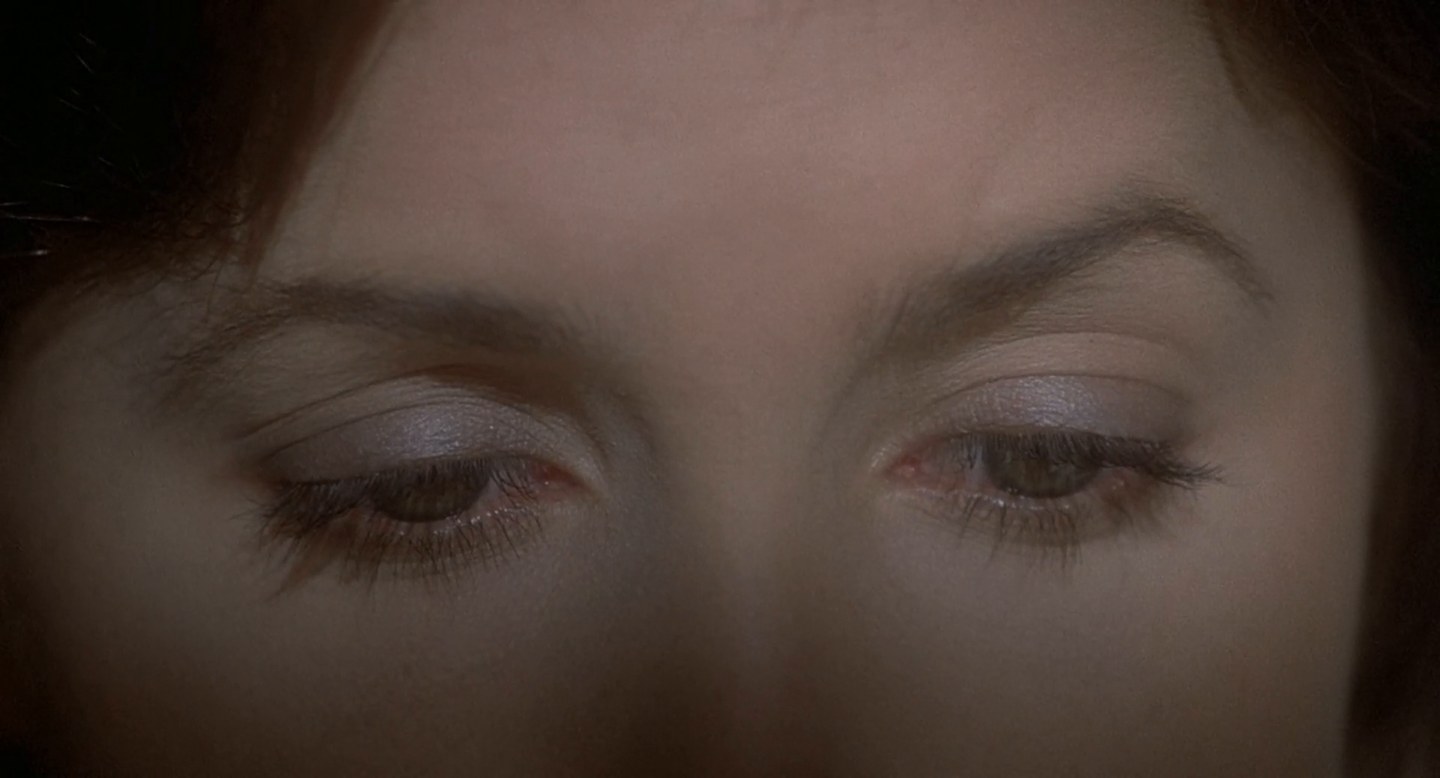
The opening moves from printed words to a reader’s eyes. The text is an object in the room before it becomes a map of the film. Rose’s concentration establishes investigation as an action: she reads, writes and follows what she has found.
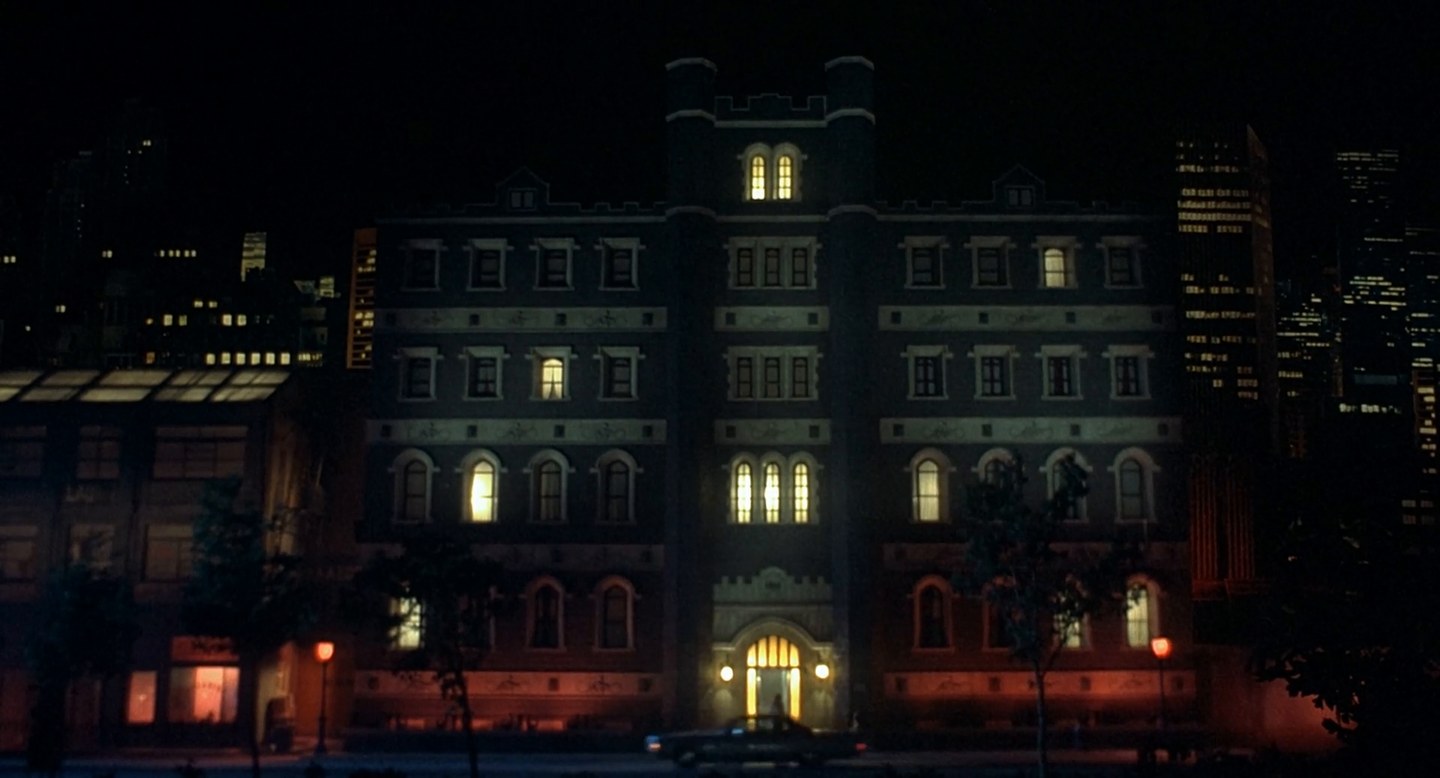
ENLARGE ↗The illuminated house stands against the night skyline.
The façade is presented as a complete, imposing object, with isolated windows and its entrance picked out against darkness. Later passages break that apparent completeness into service spaces, holes and concealed rooms. The building’s first legible outline becomes a promise the interior will repeatedly frustrate.
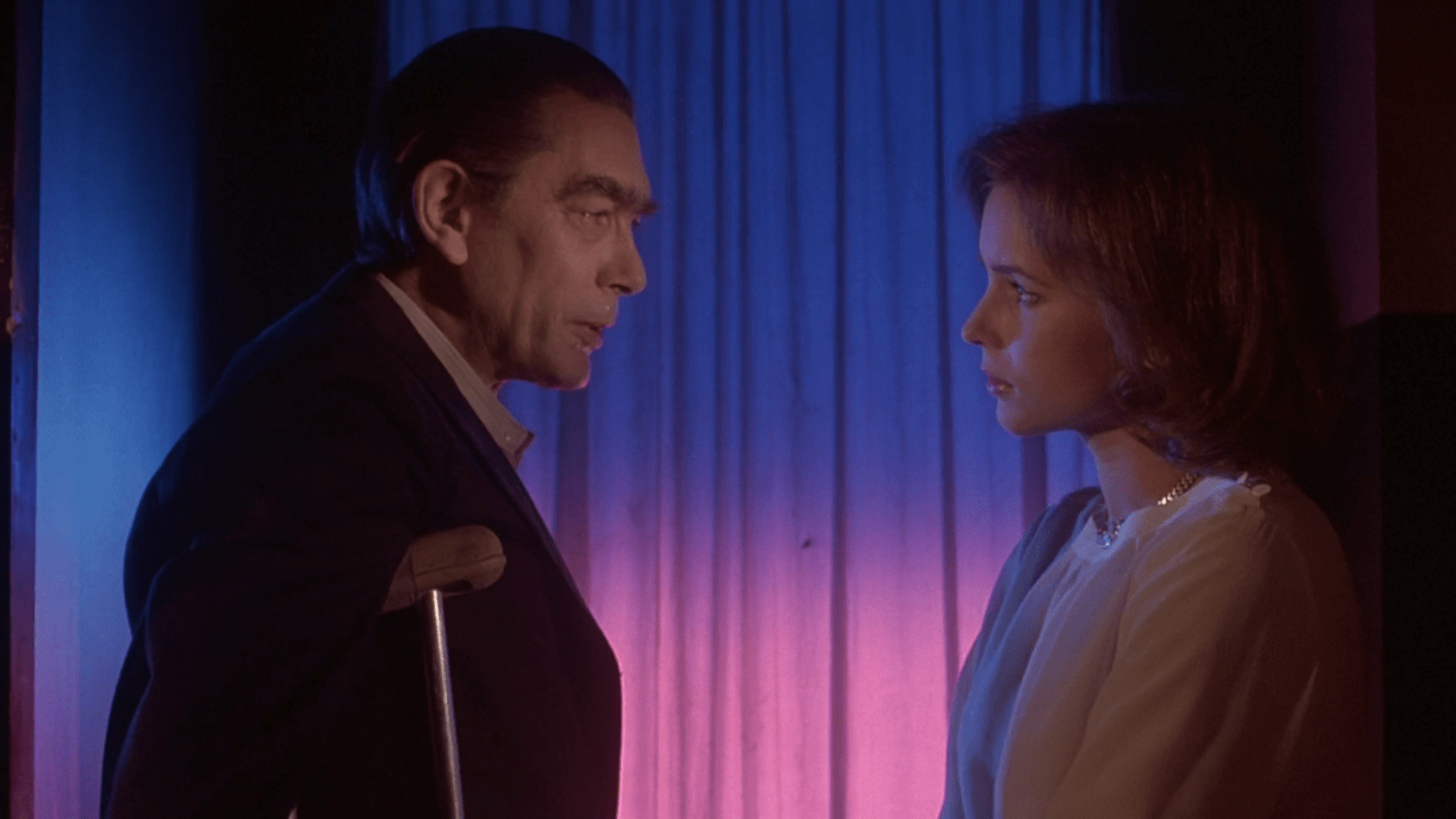
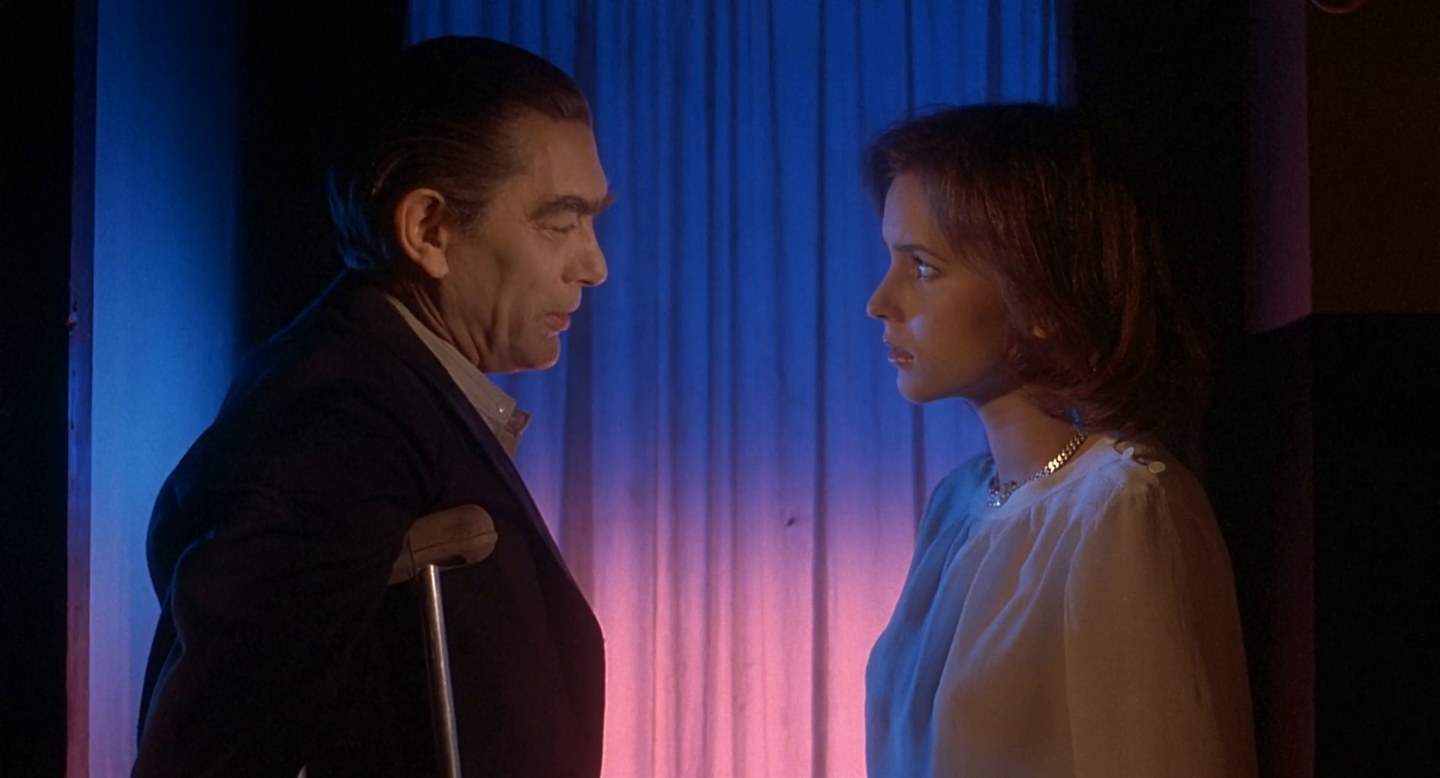
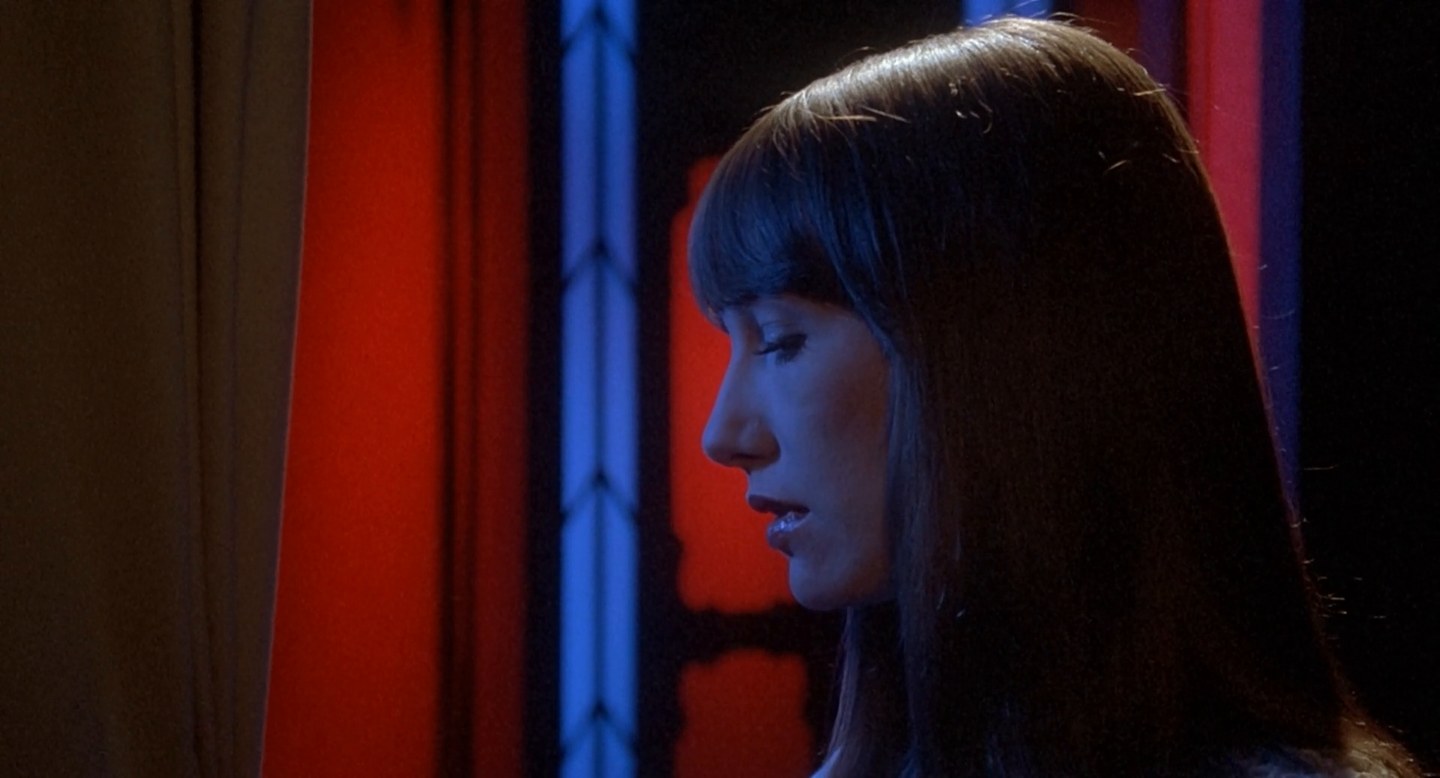
ENLARGE ↗Rose faces Kazarian beside the blue curtain.
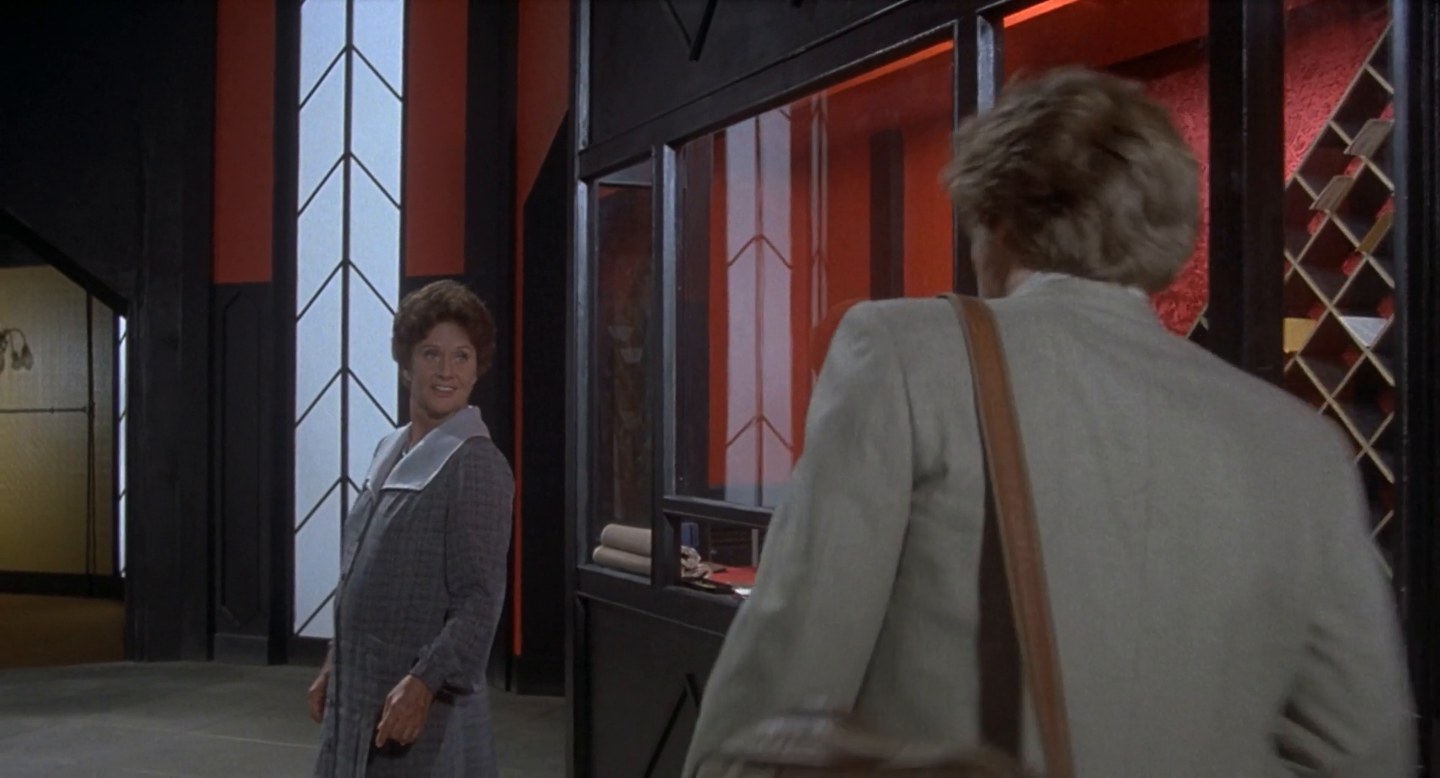
Rose and the bookseller share a close space, but the curtain and coloured light remain active between them. The encounter joins the circulation of books to the neighbourhood around the house. Information has a custodian, and that custodian offers little reassurance.
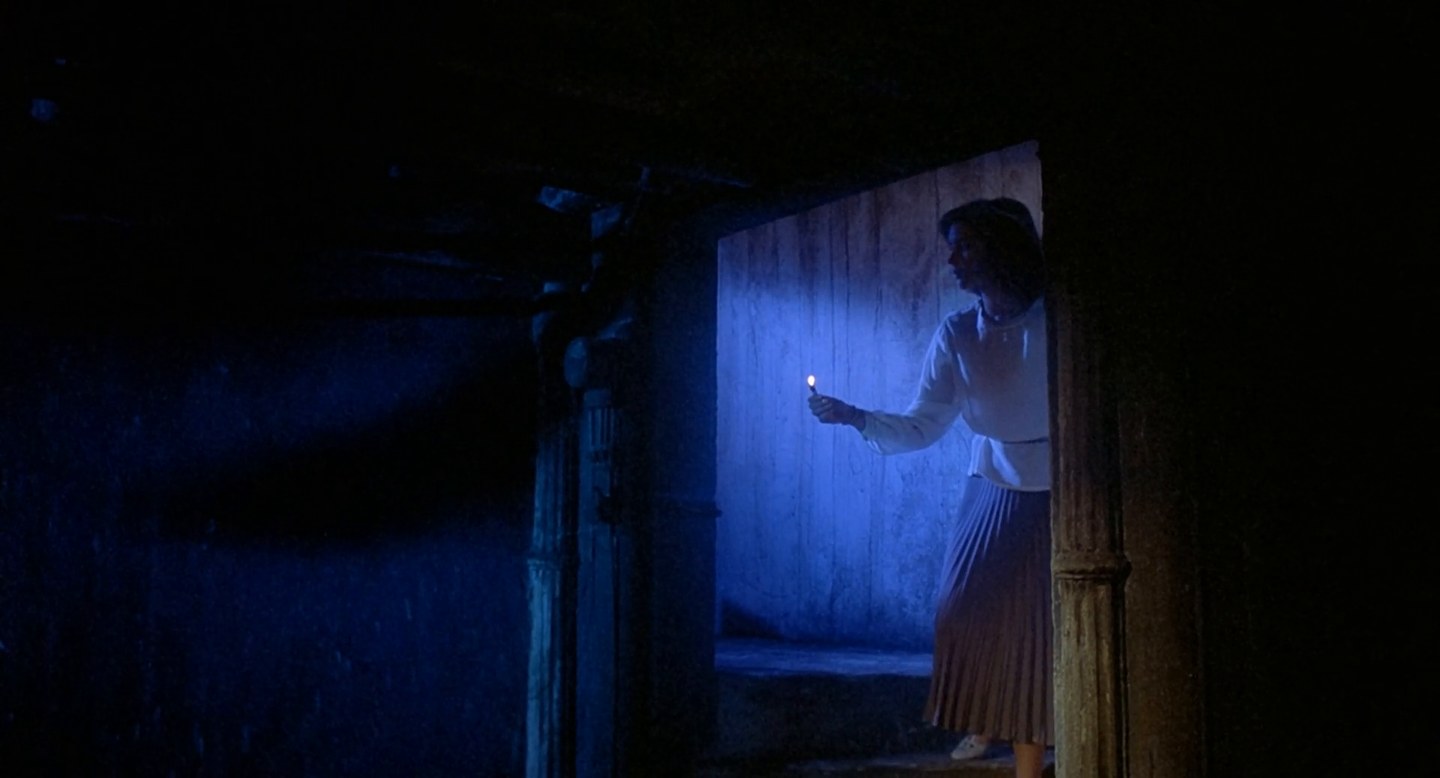
A small light and a single body provide the measure of the basement. Timber, masonry and shadow obstruct the view ahead. The route is assembled in pieces, so the next discovery can exceed the space the preceding image seemed to promise.
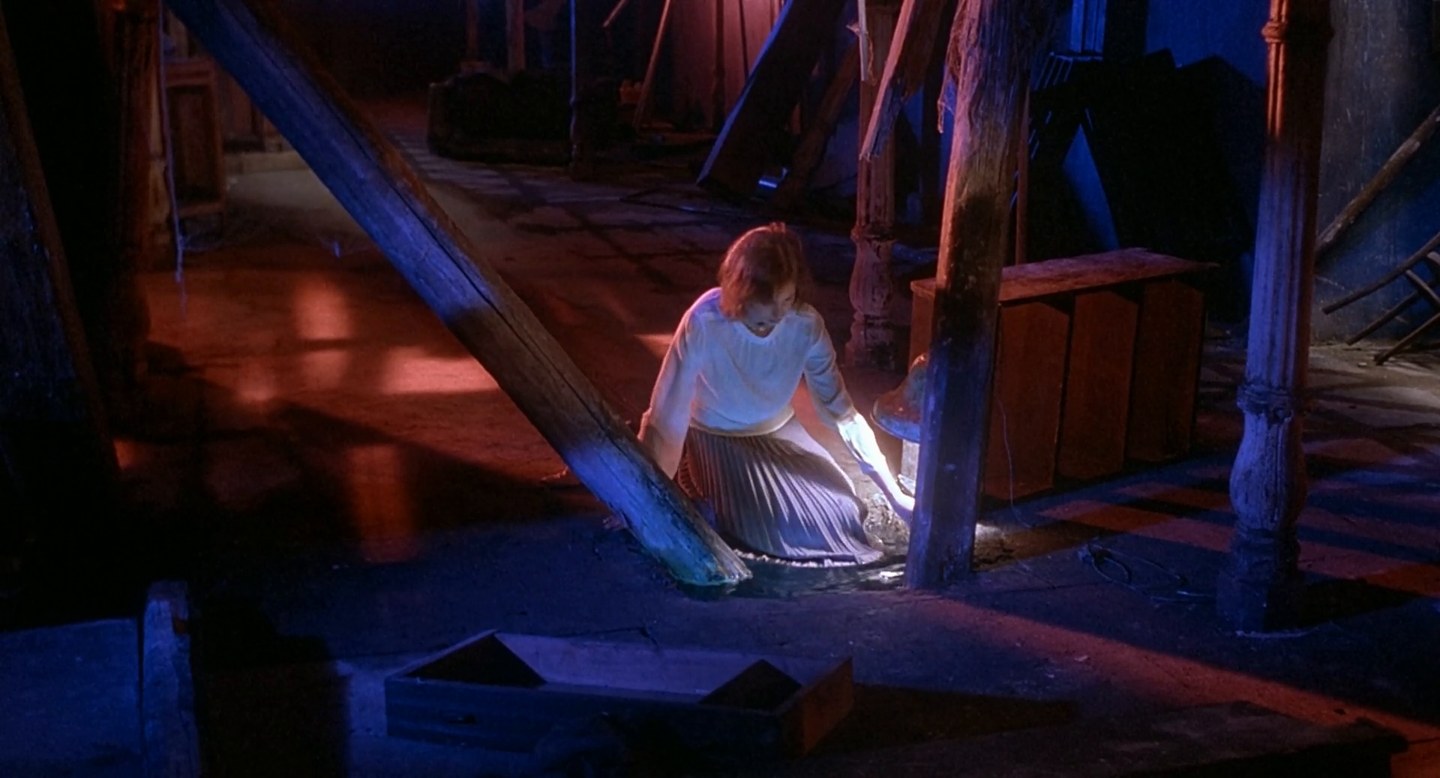
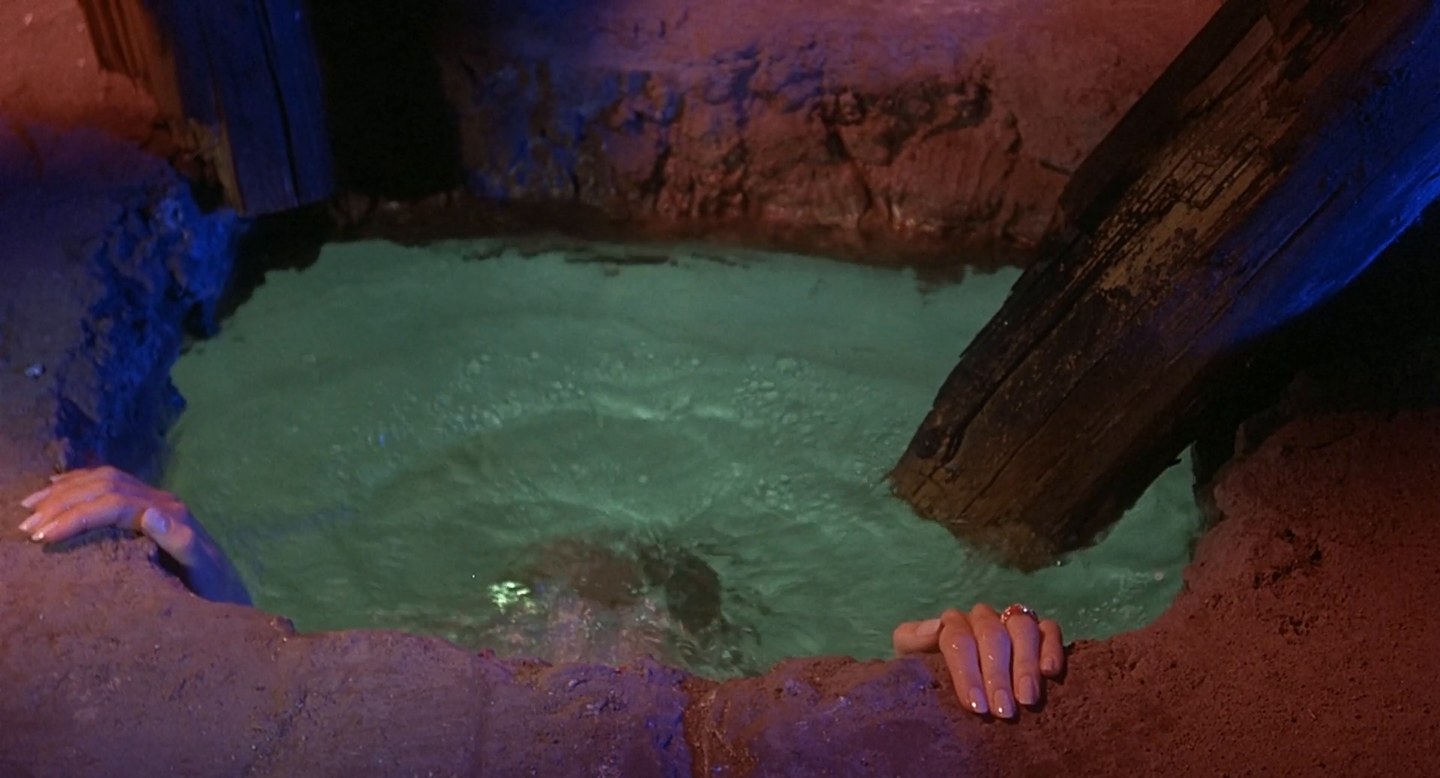
ENLARGE ↗Rose kneels beside the submerged chamber.
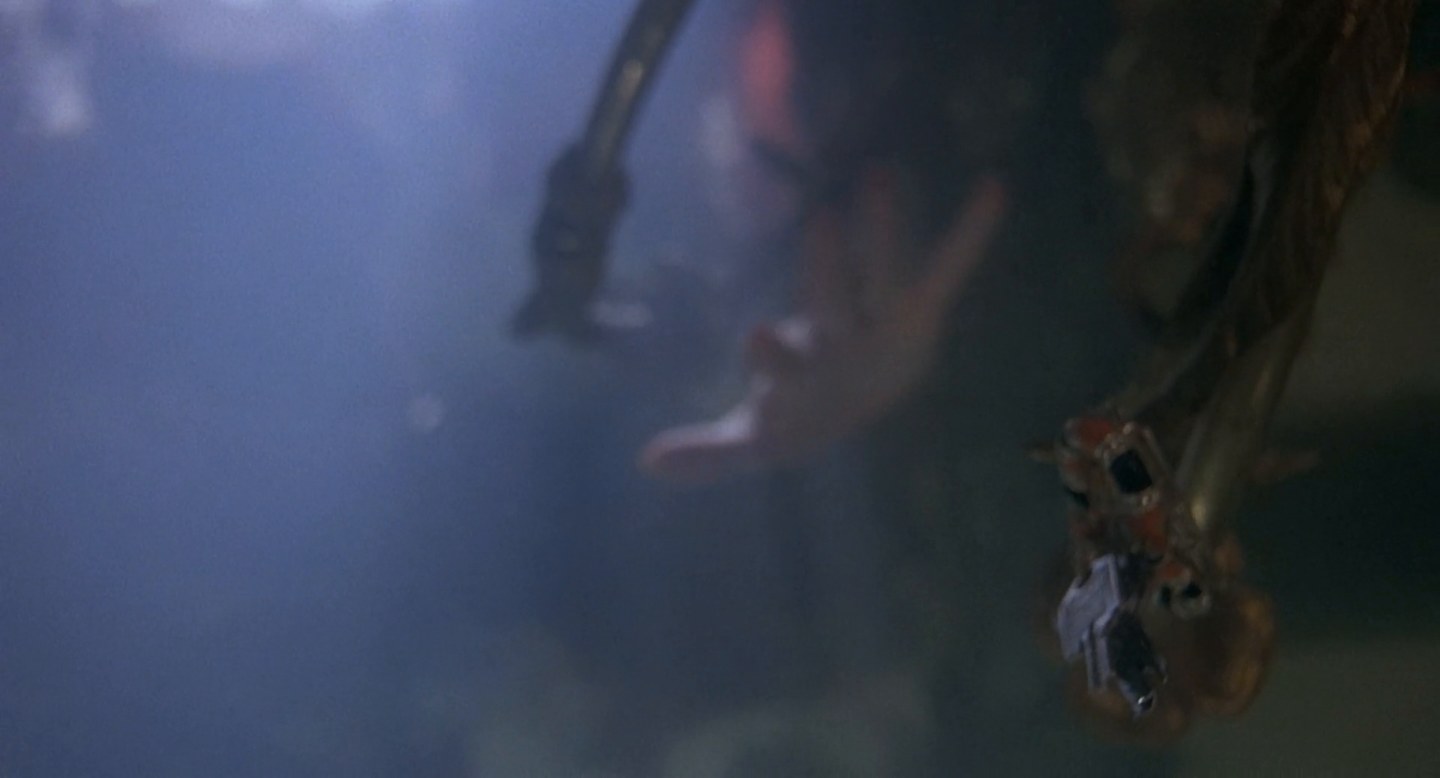
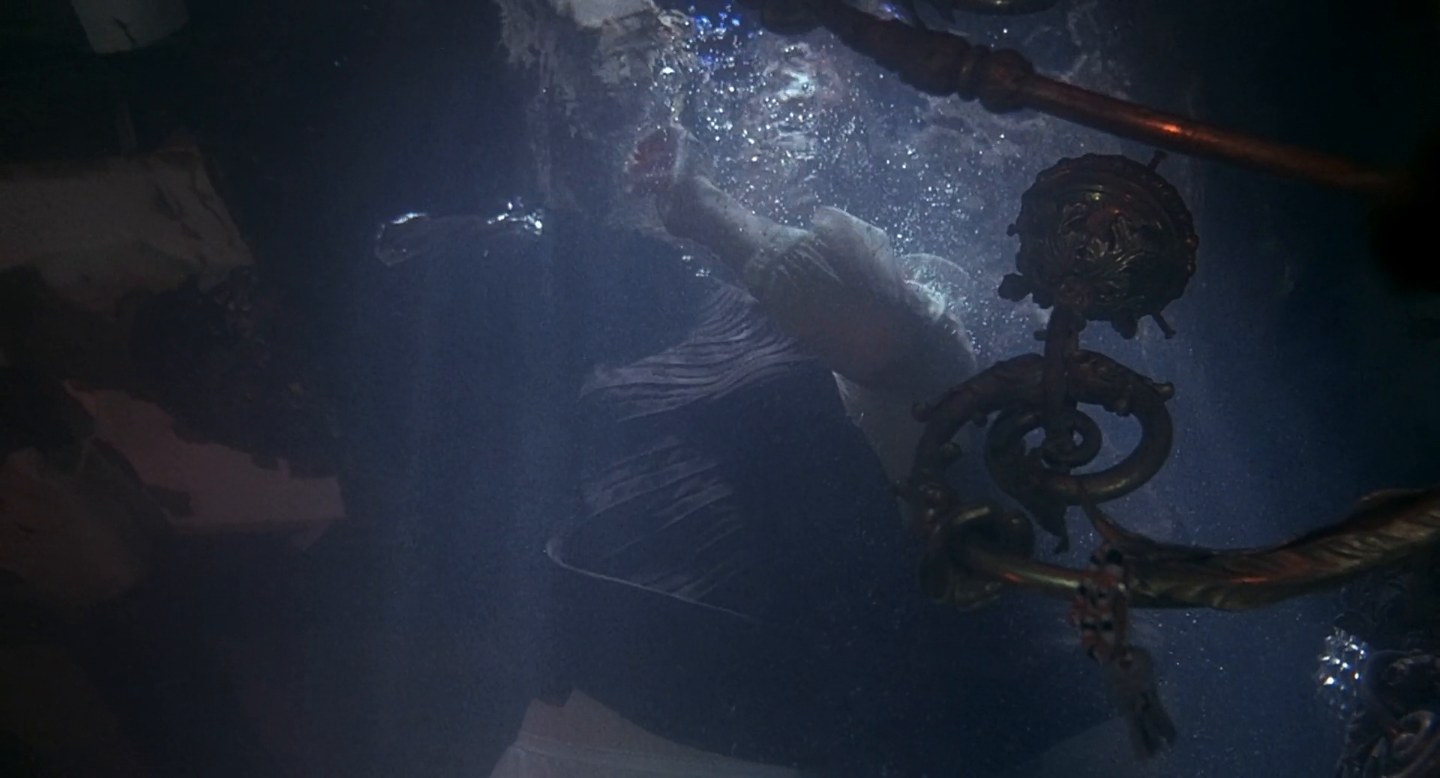
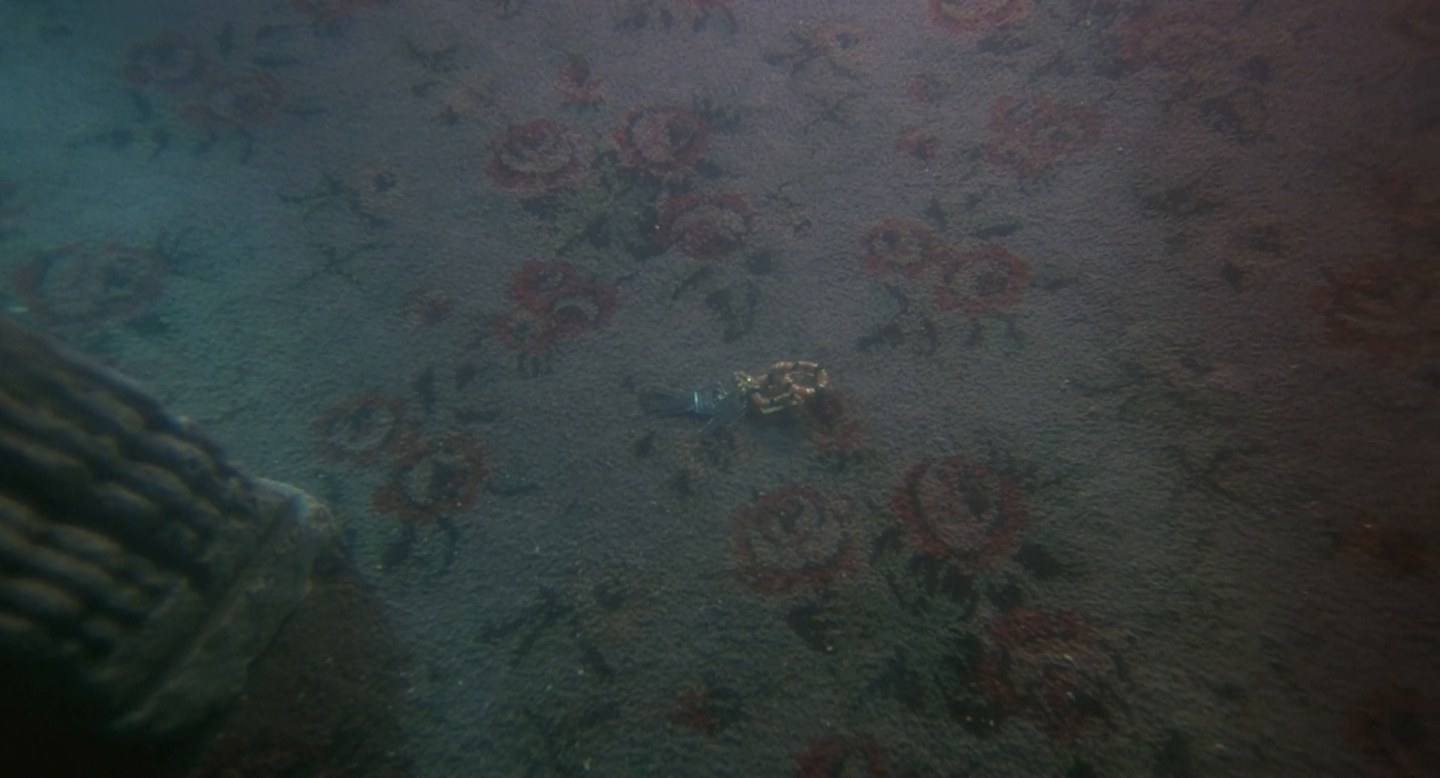
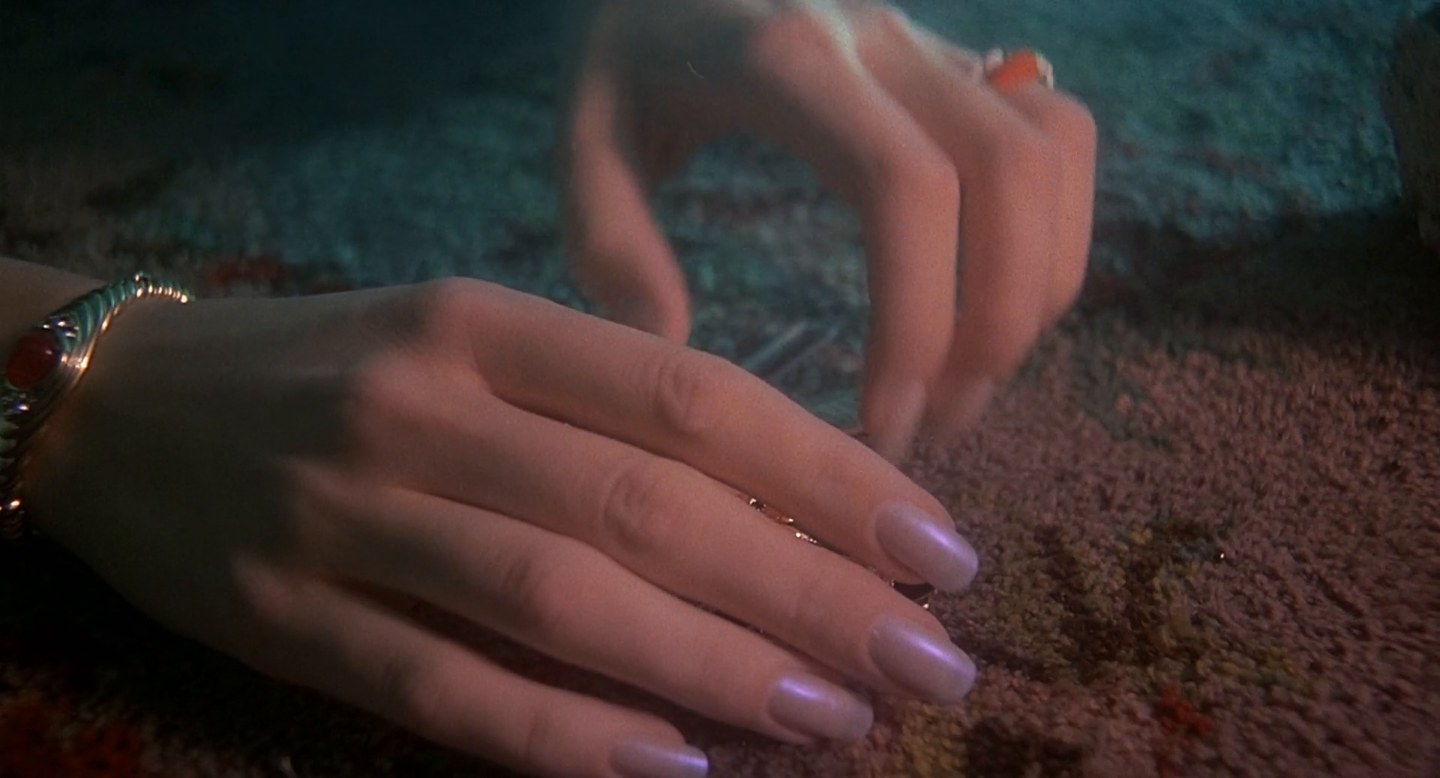
An opening in the floor becomes the entrance to another furnished interior. The chandelier supplies an unmistakable domestic reference, while water changes every movement around it. The dropped keys turn curiosity into a practical task that requires Rose to cross the surface.
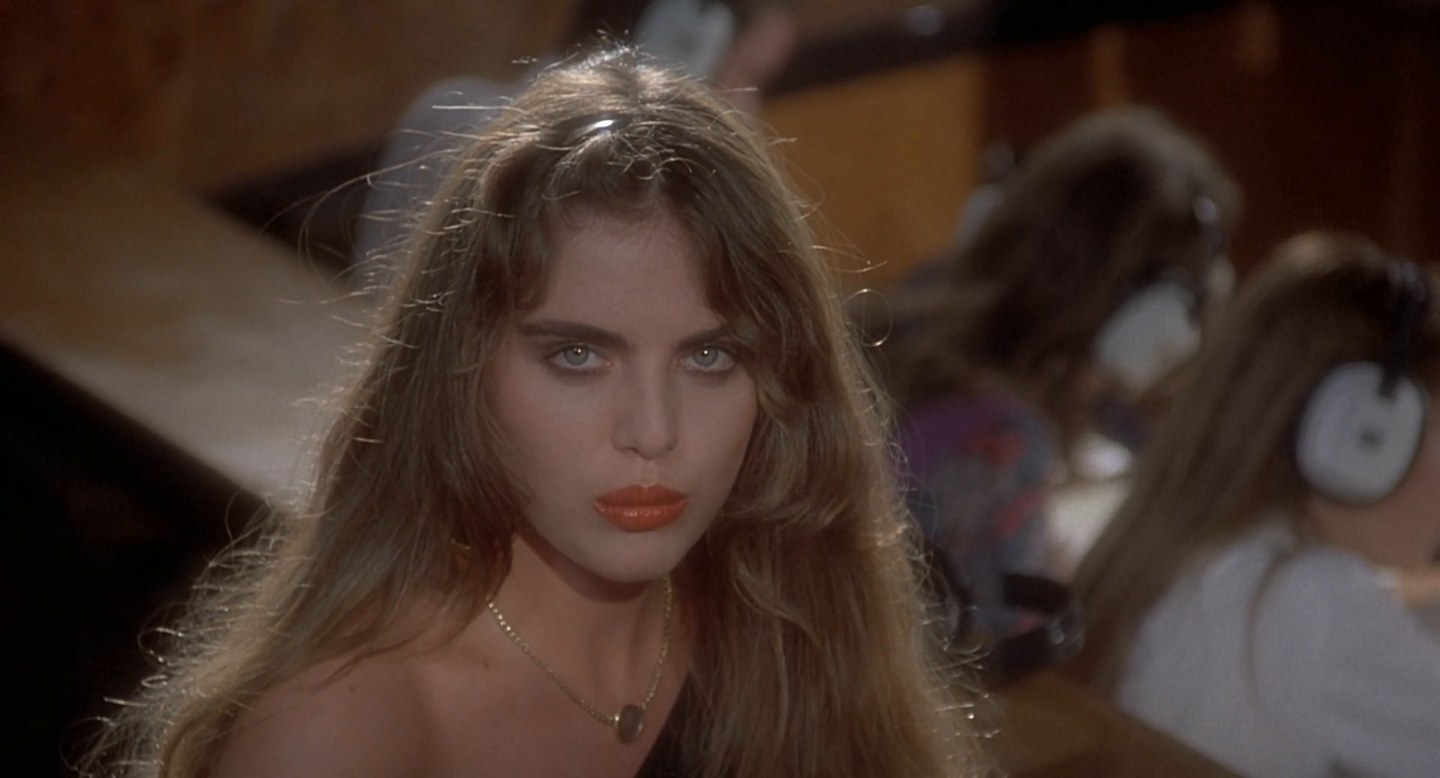
ENLARGE ↗The woman with the cat looks across the lecture hall.
The ordered rows of students and headphones offer a controlled setting for attention. Mark’s gaze breaks away from that arrangement towards a woman holding a cat. Close views isolate her eyes and the animal, giving an unexplained encounter the force of a private summons.
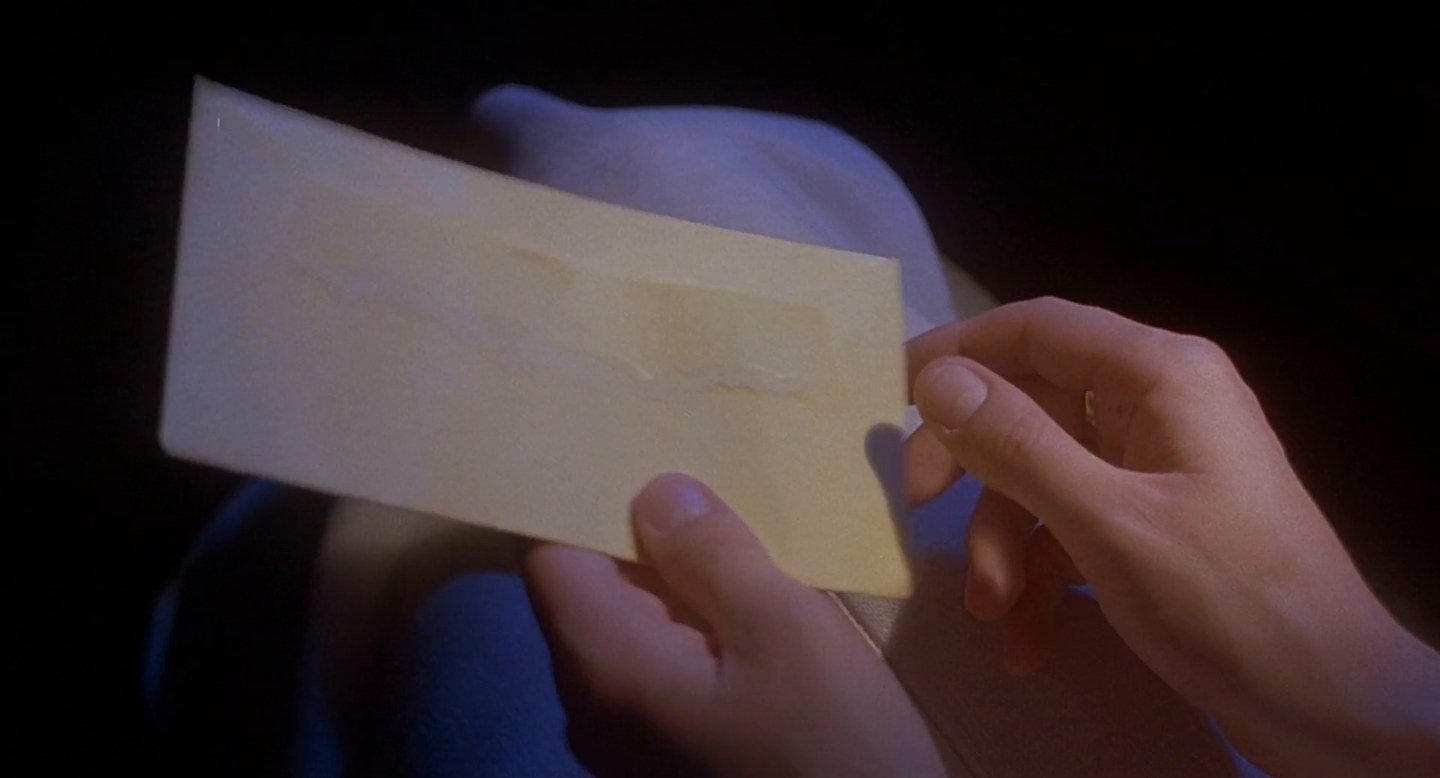
The letter is repeatedly handled and examined, but its physical arrival does not secure its intended communication. Sara becomes another reader and another investigator. The film’s route branches through the person who takes the warning seriously.
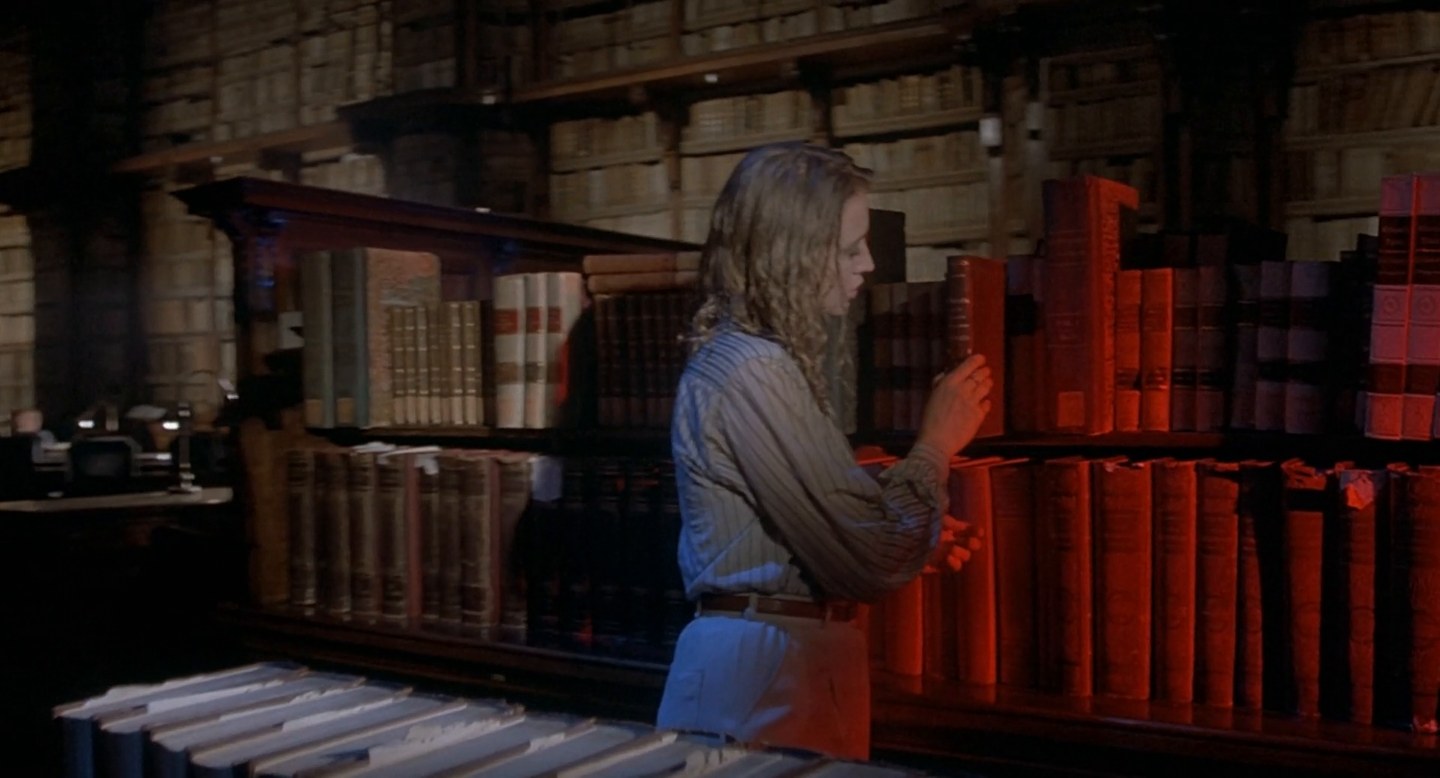
ENLARGE ↗Sara searches the shelves in red and blue light.
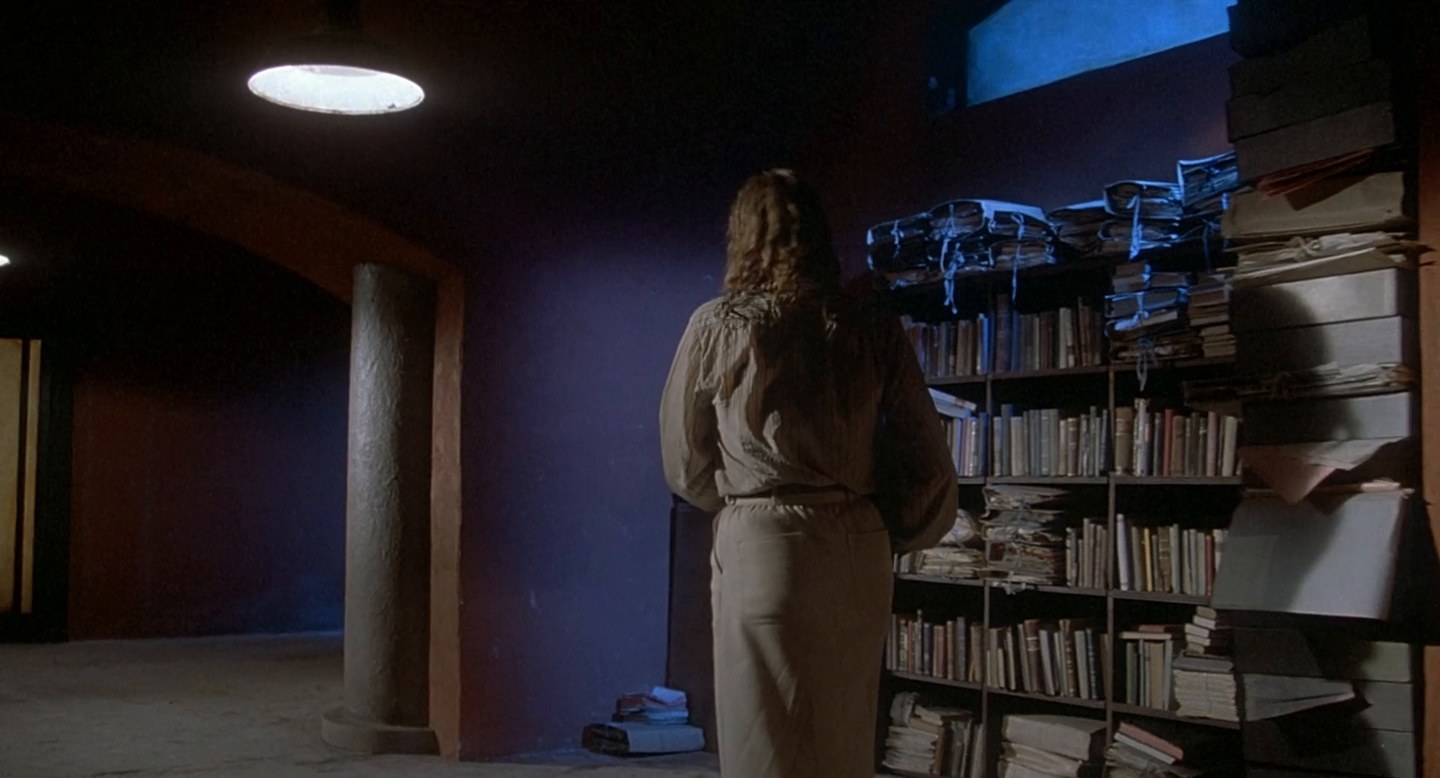
Shelves, rails and pools of colour divide a place devoted to knowledge into narrow routes. The book belongs here materially, yet the building does not offer a neutral setting in which to read it. Inquiry carries Sara farther inside.
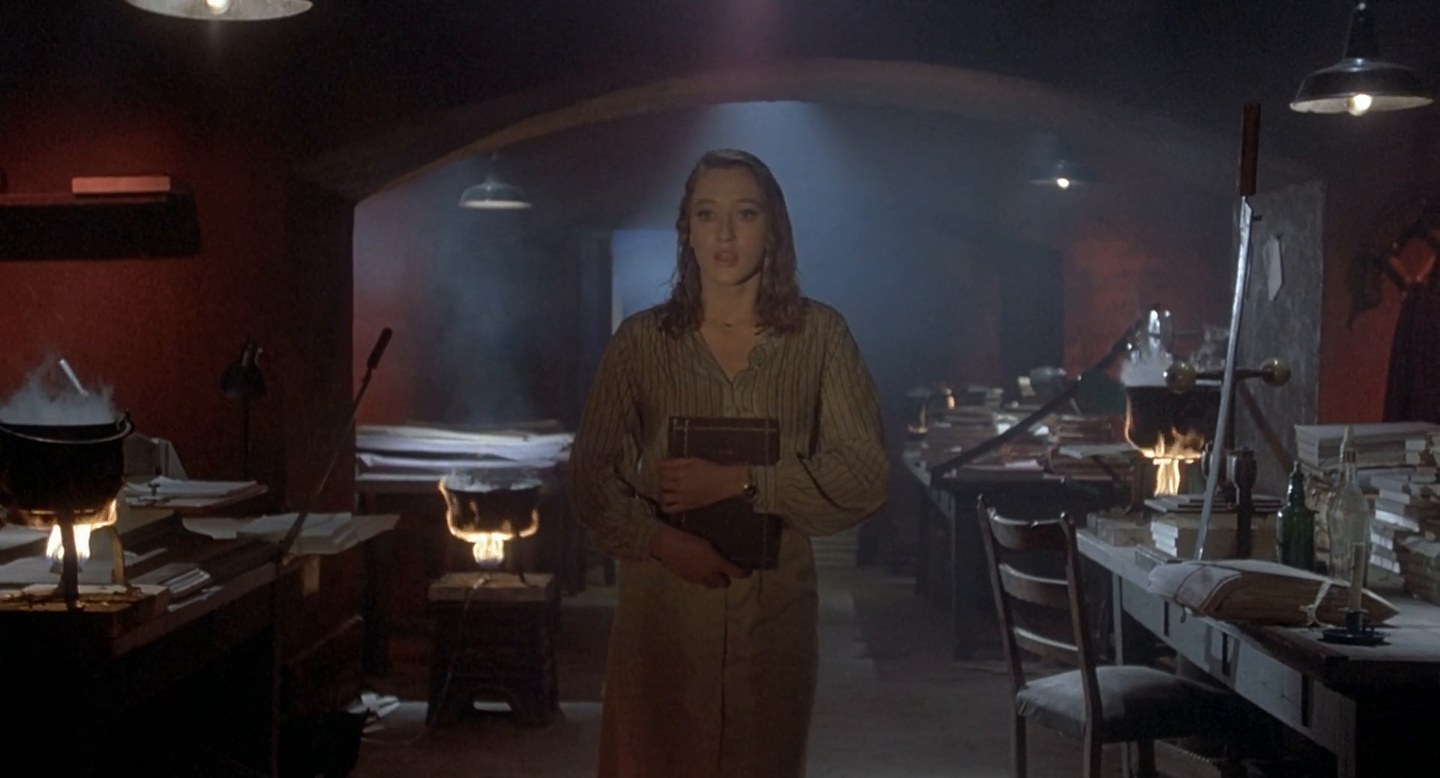
ENLARGE ↗Sara holds the book in the candlelit workroom.
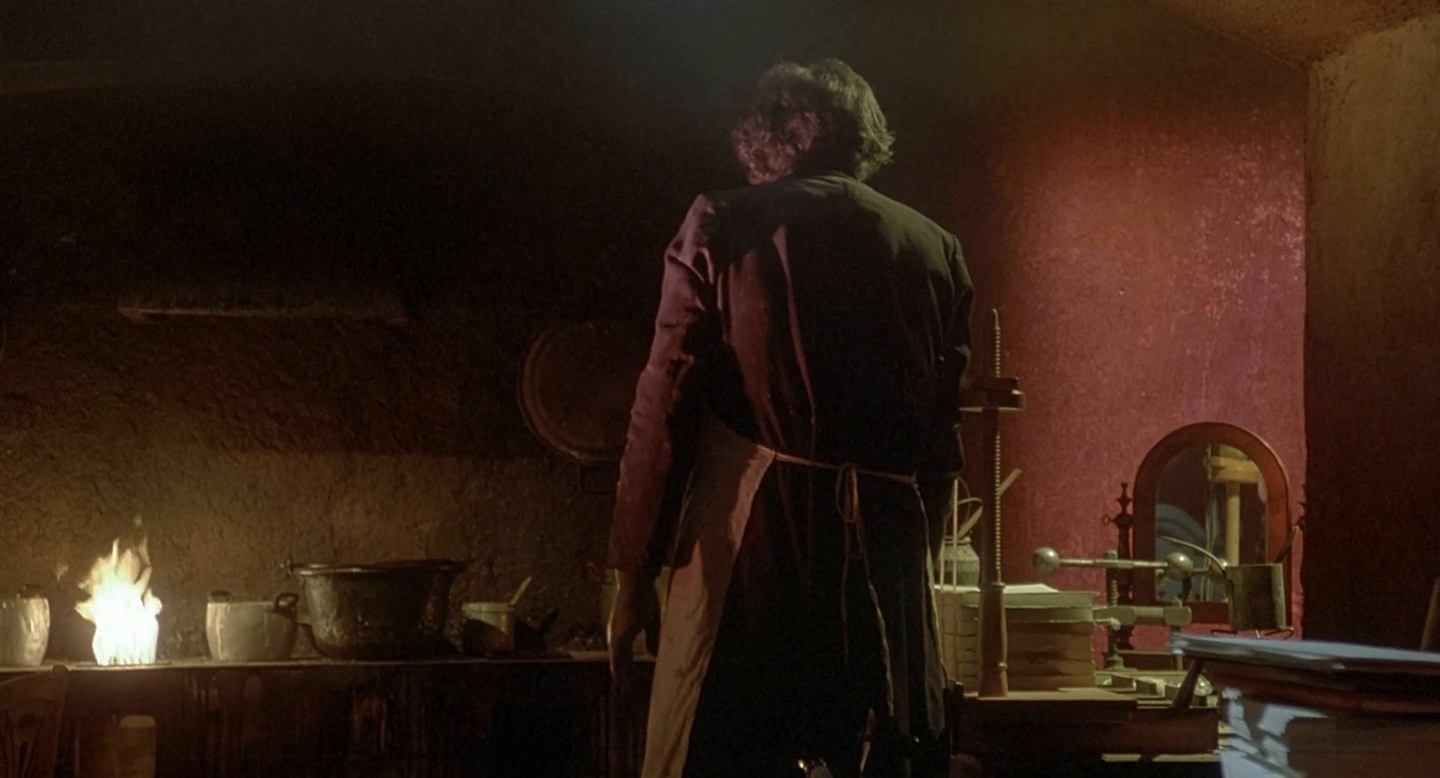
Benches, vessels and flames turn the library’s back rooms into a workshop with an uncertain purpose. Sara’s frontal position leaves the figure deeper inside the room difficult to read. The book she carries shifts from evidence to the object over which a physical struggle takes place.
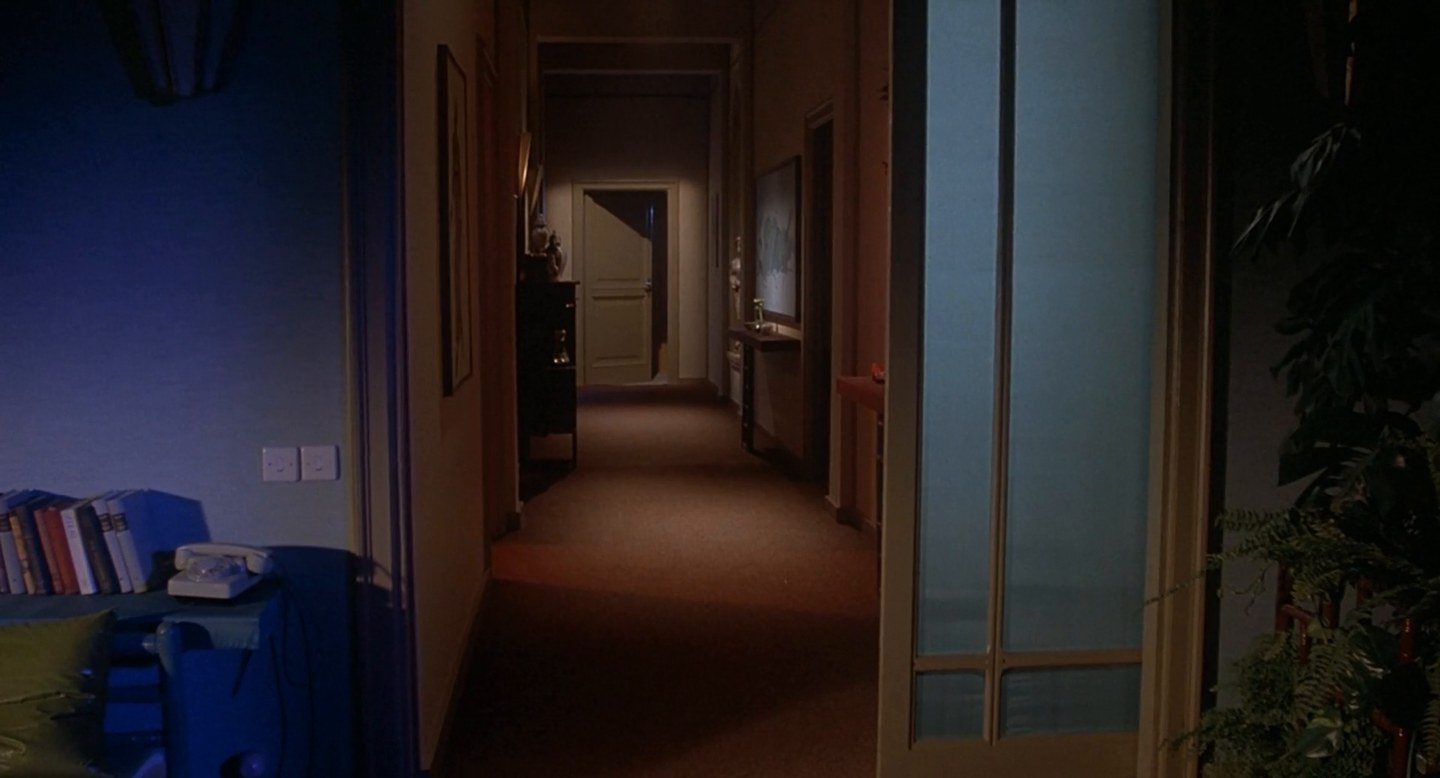
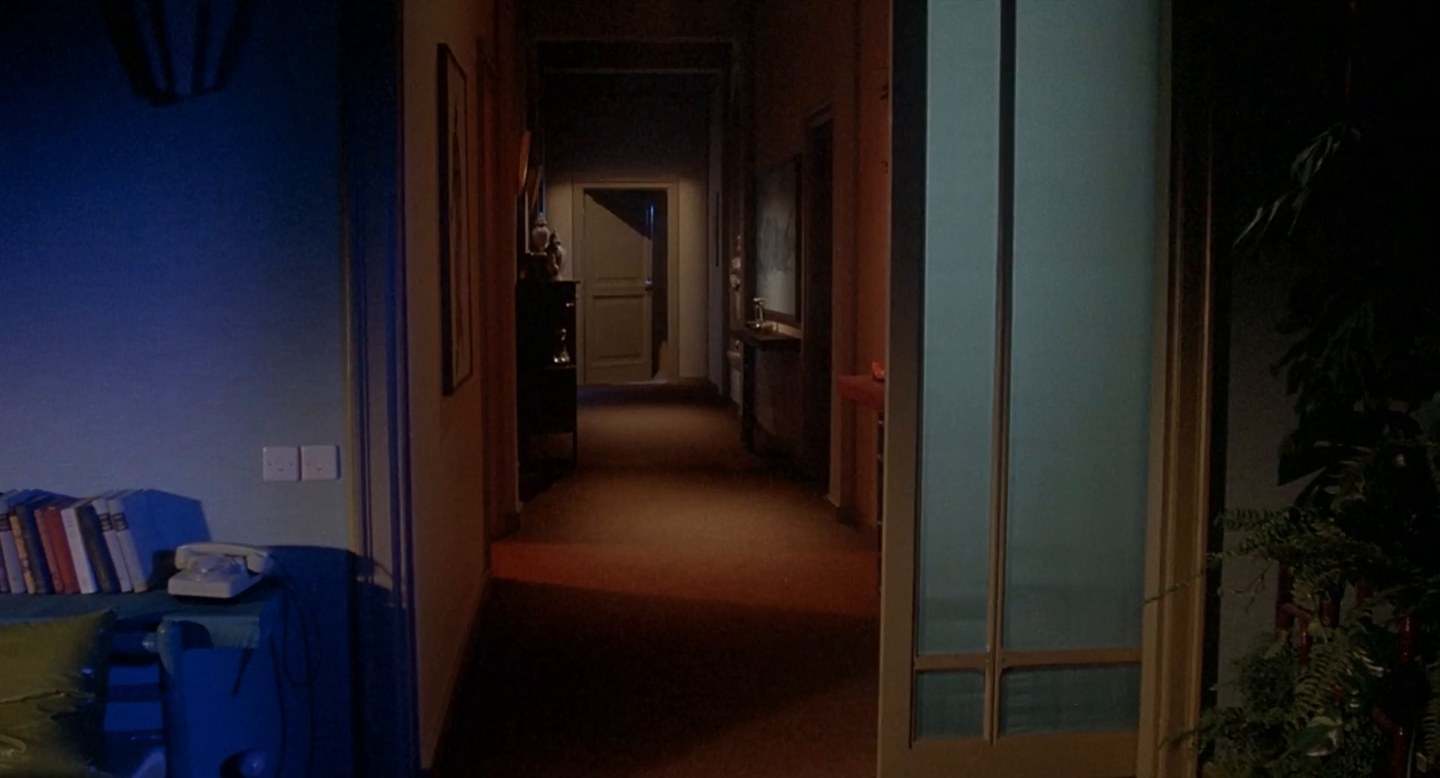
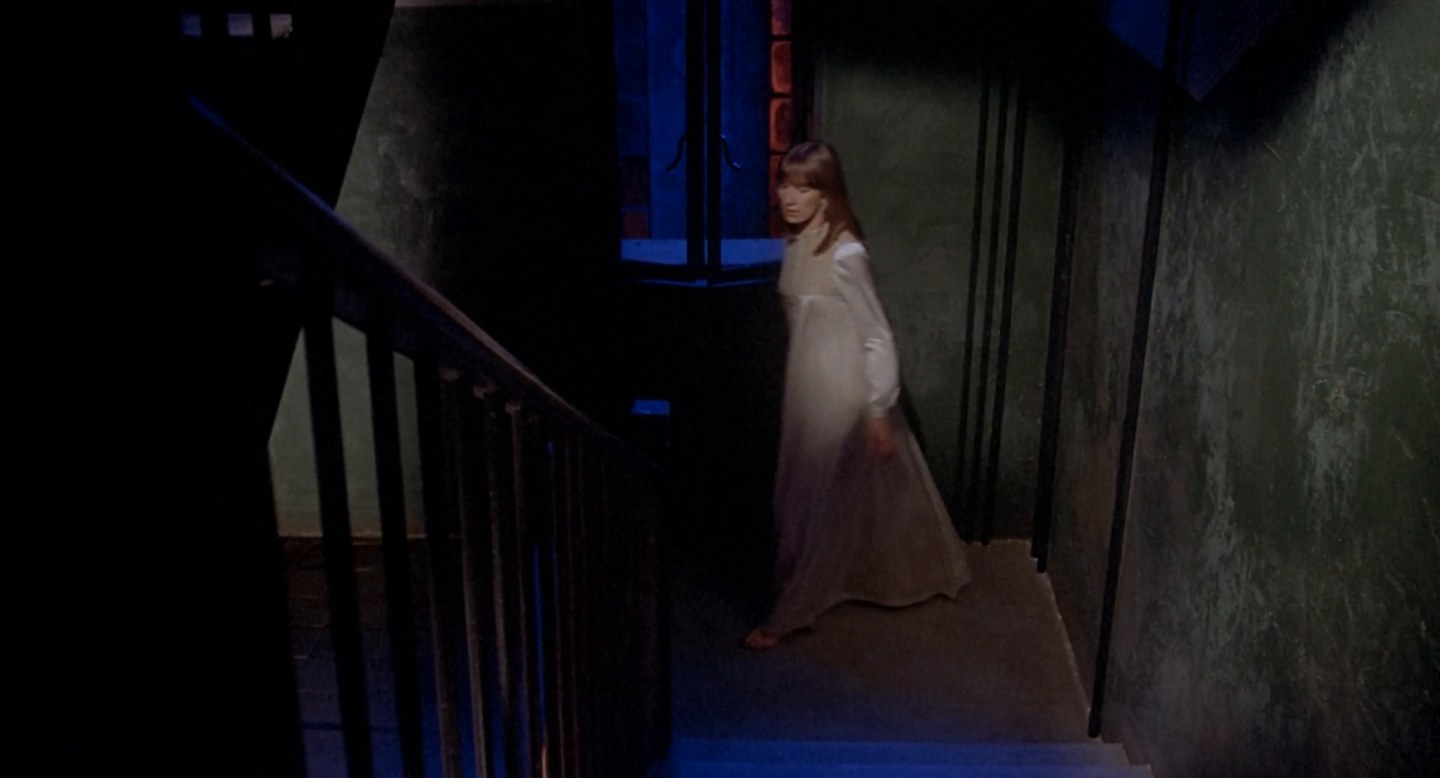
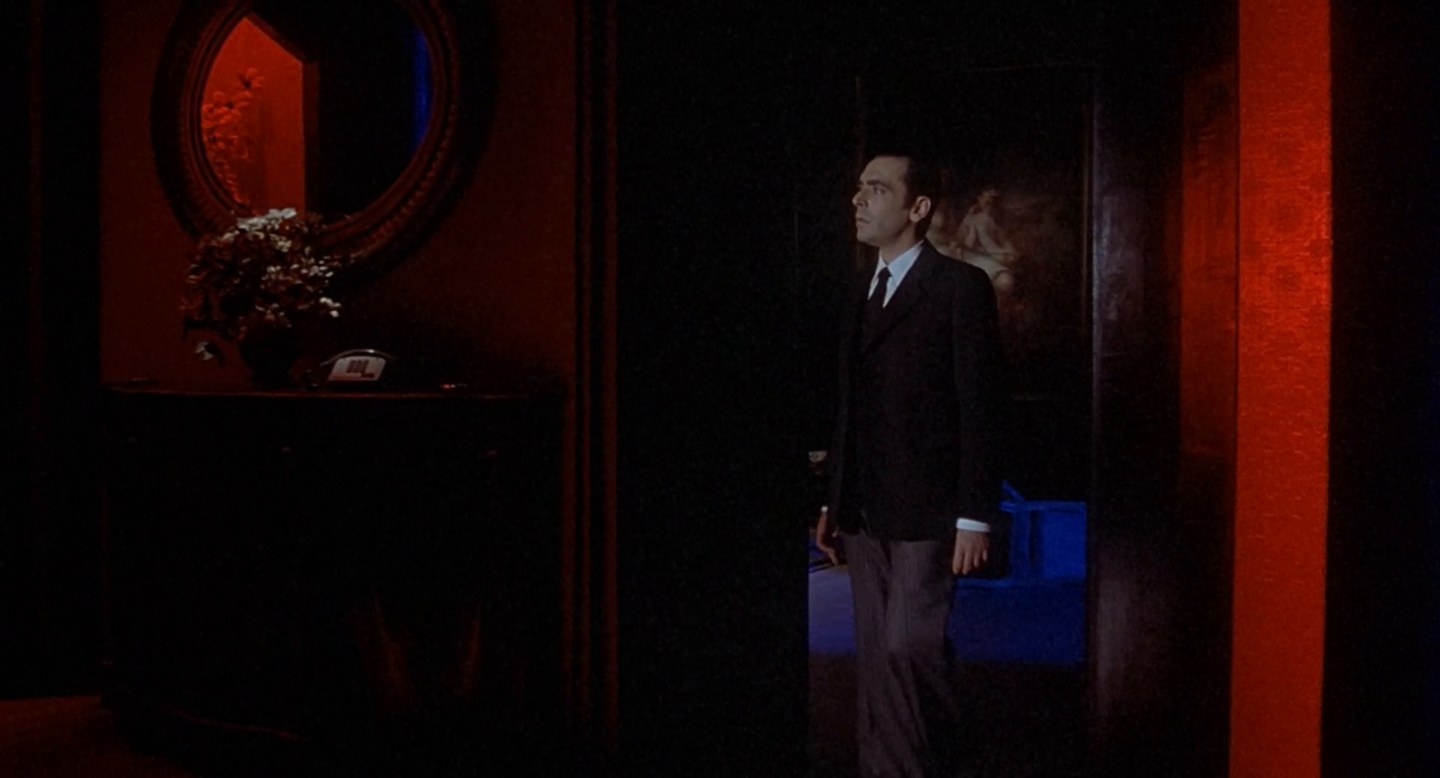
ENLARGE ↗A long corridor opens beyond Sara’s blue room.
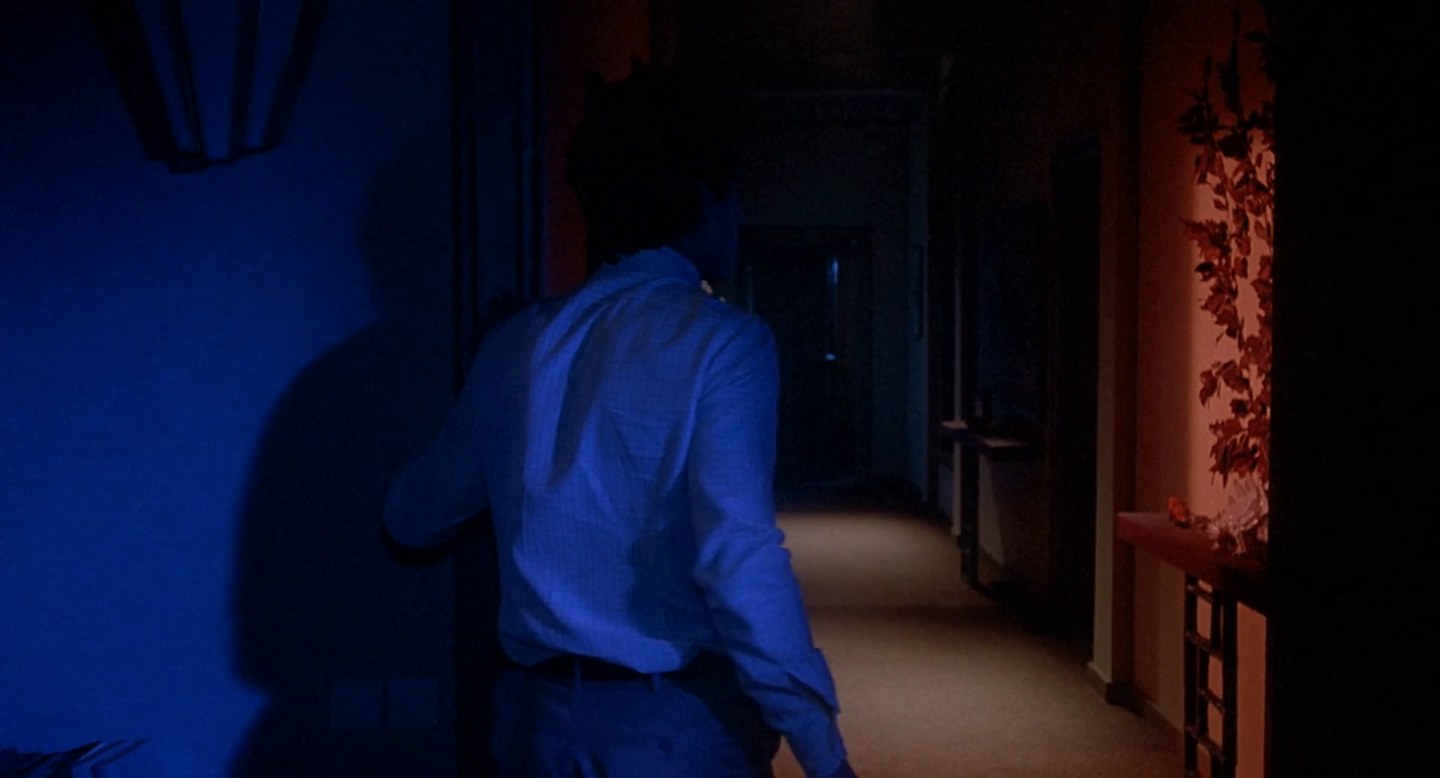
The apartment initially separates a blue sitting area from a warmer corridor. The open doorway keeps the distance between the two visible. Once Carlo moves into that passage, the composition becomes a test of how long an apparently familiar interior can remain readable.
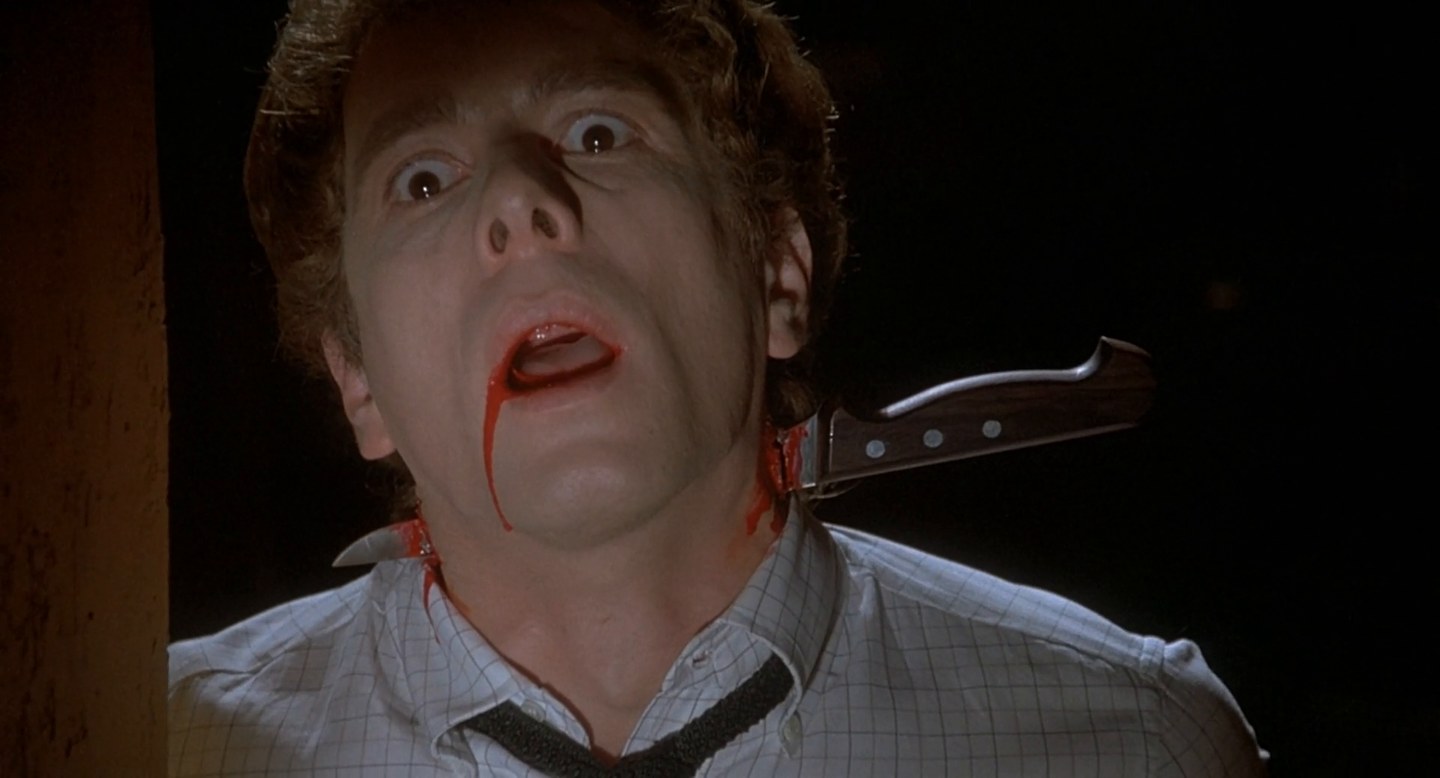
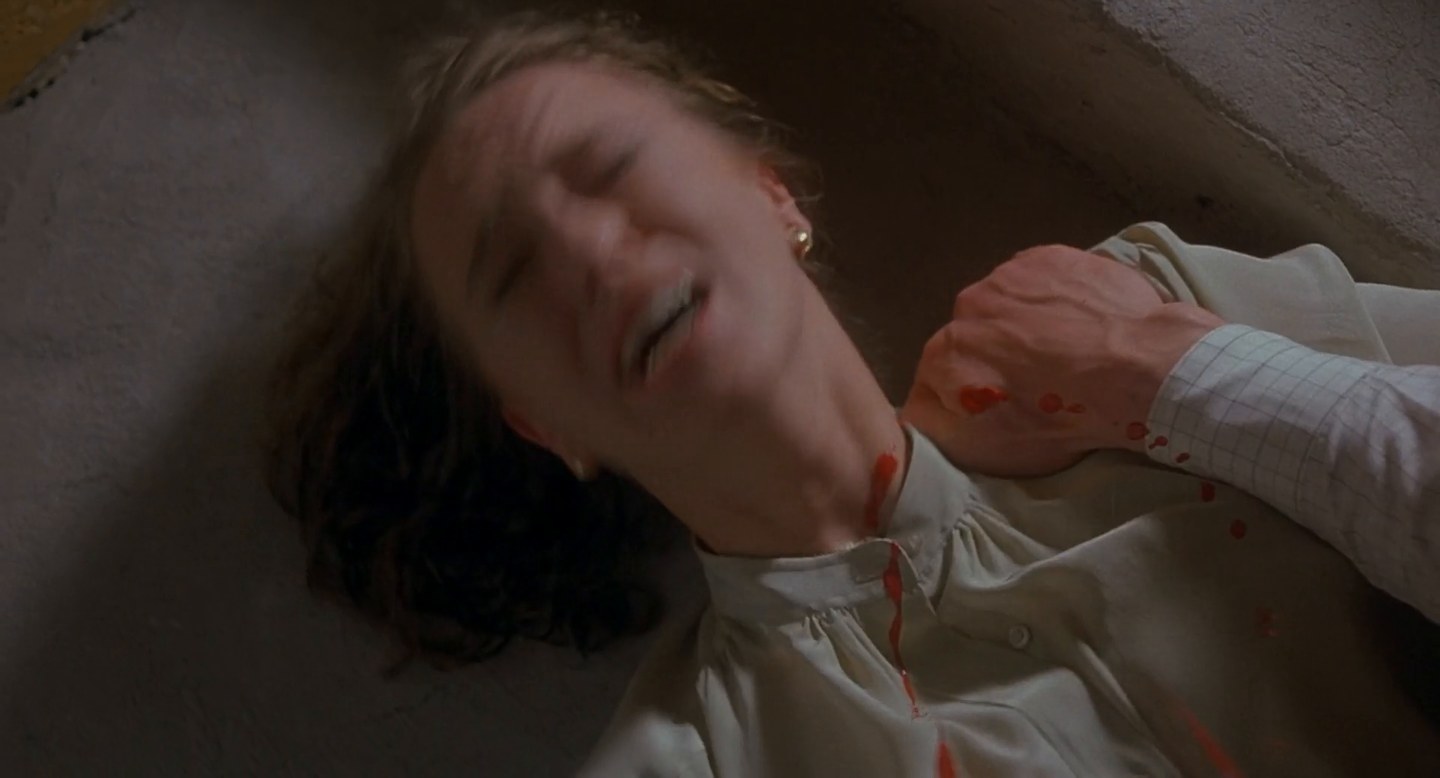
ENLARGE ↗Carlo appears with a knife lodged in his neck.
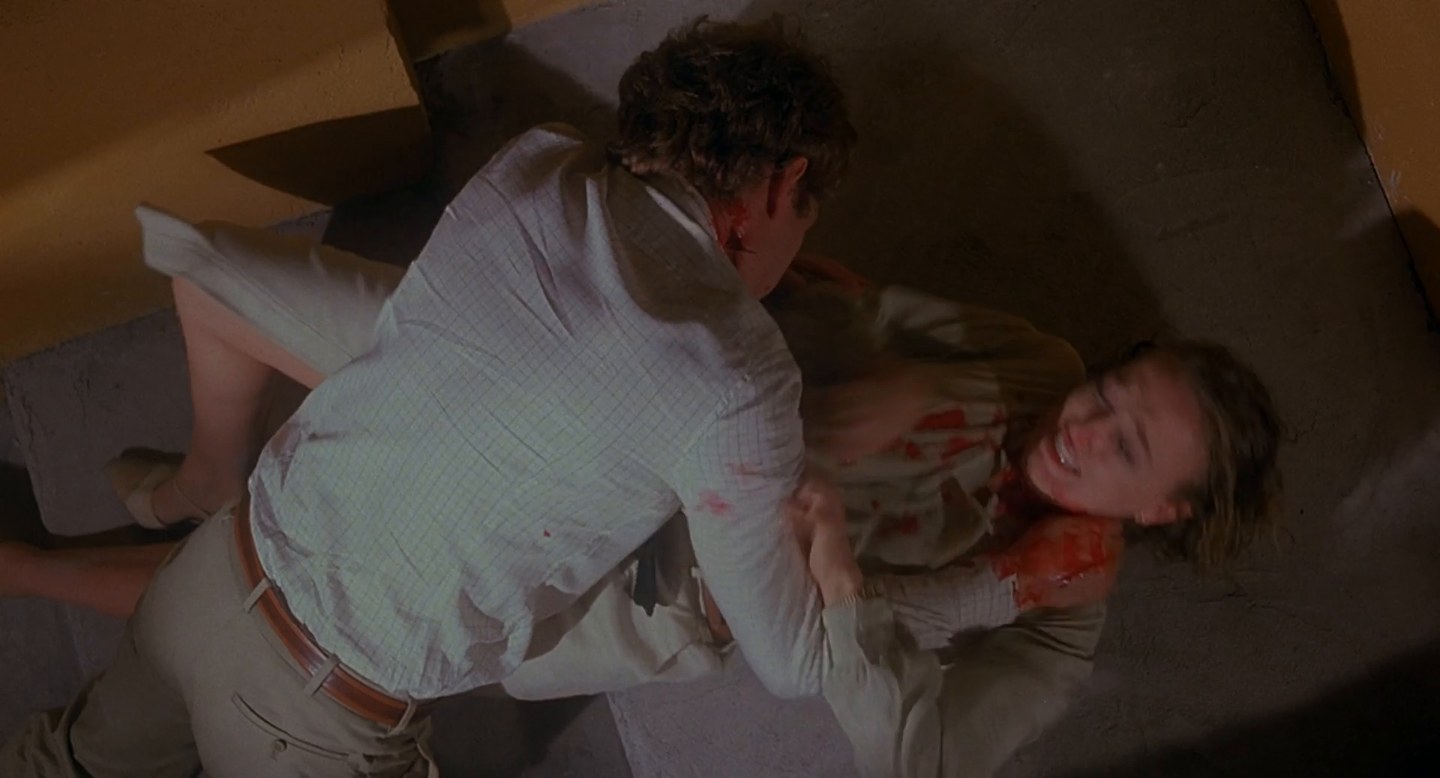
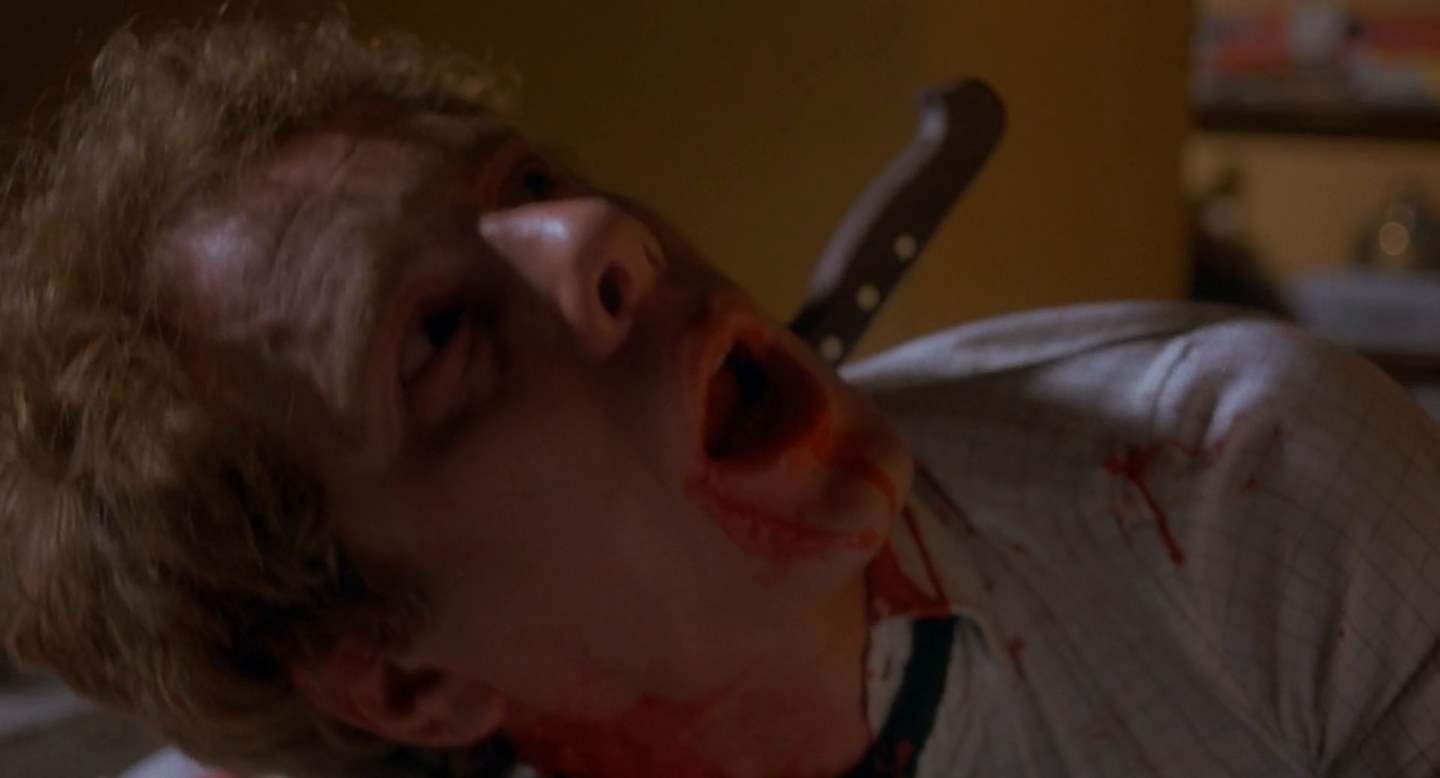
Carlo’s return overturns the expectation that another person can make the apartment safe. The wound is revealed before the killer is explained. His collapsing body then occupies the same floor space as Sara, turning protection into an obstacle to escape.
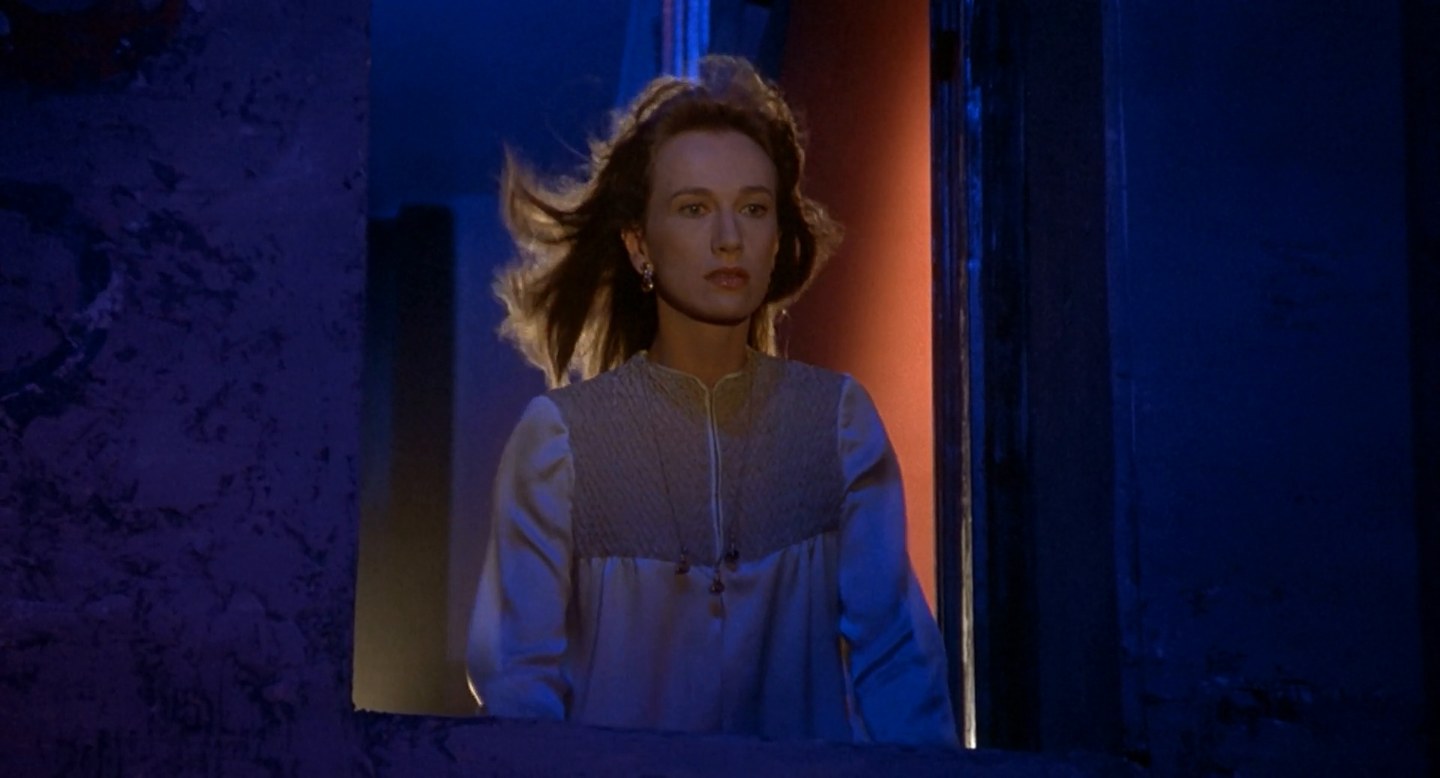
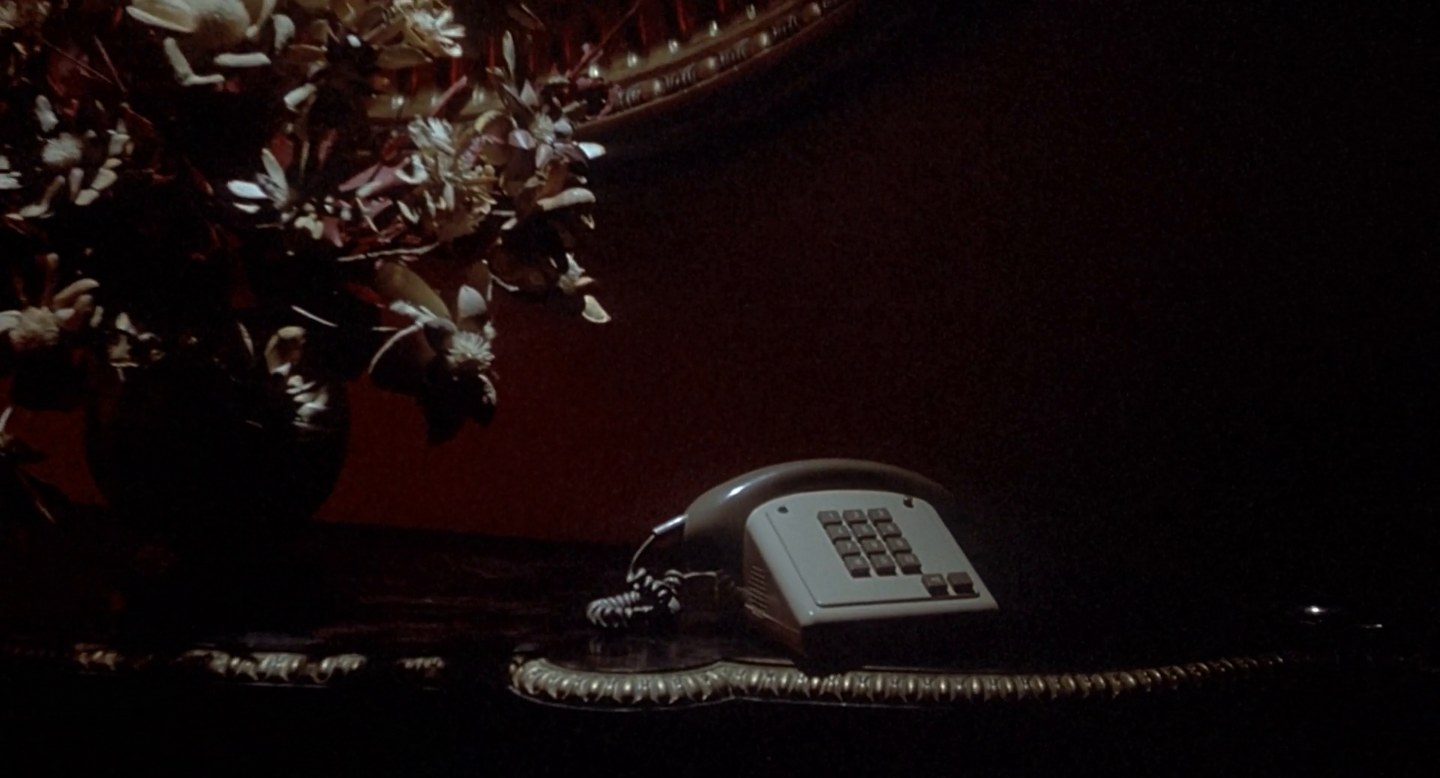
ENLARGE ↗Rose stands beside the telephone in New York.
The cut back to Rose makes the separation between the cities concrete. A telephone can connect rooms without joining their physical circumstances. The composed domestic view cannot protect her from the spaces beyond it.
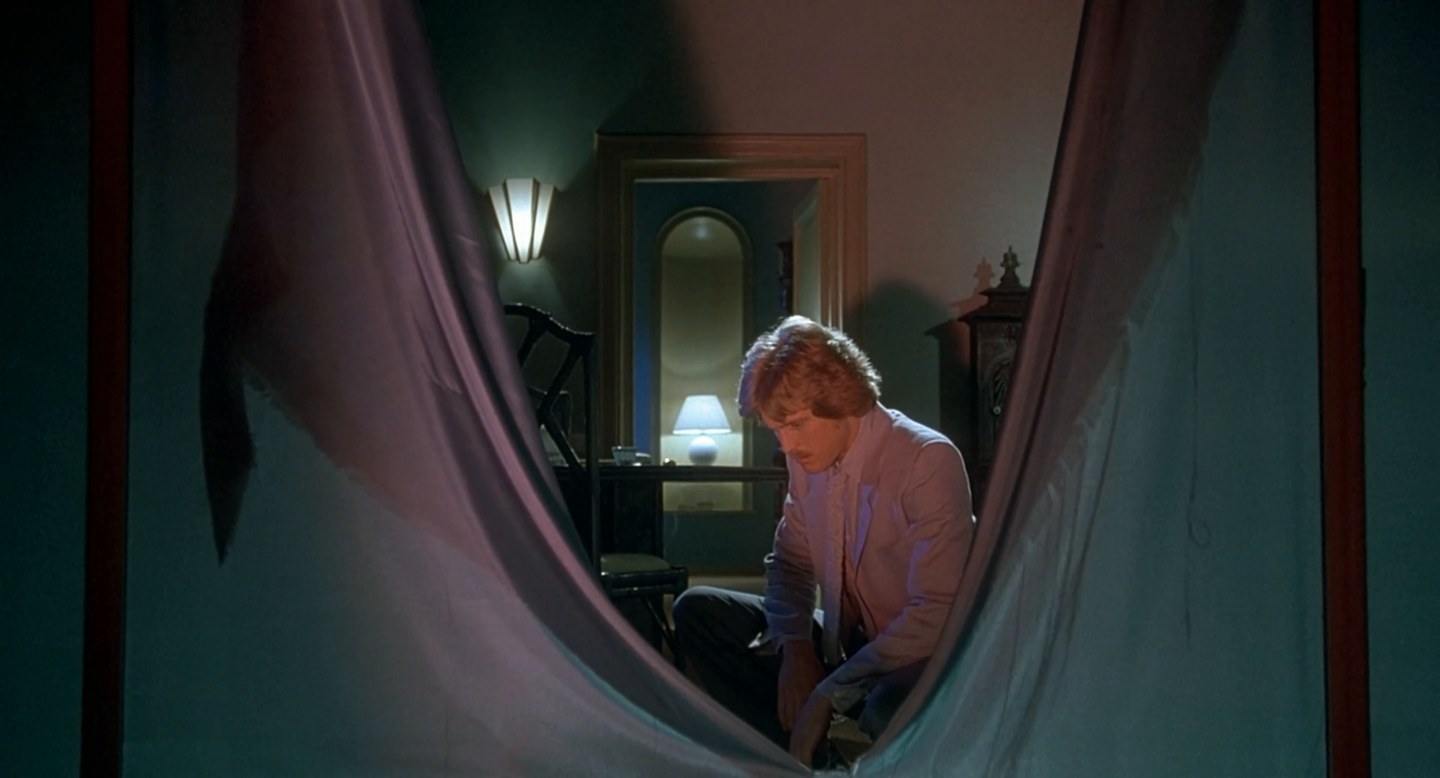
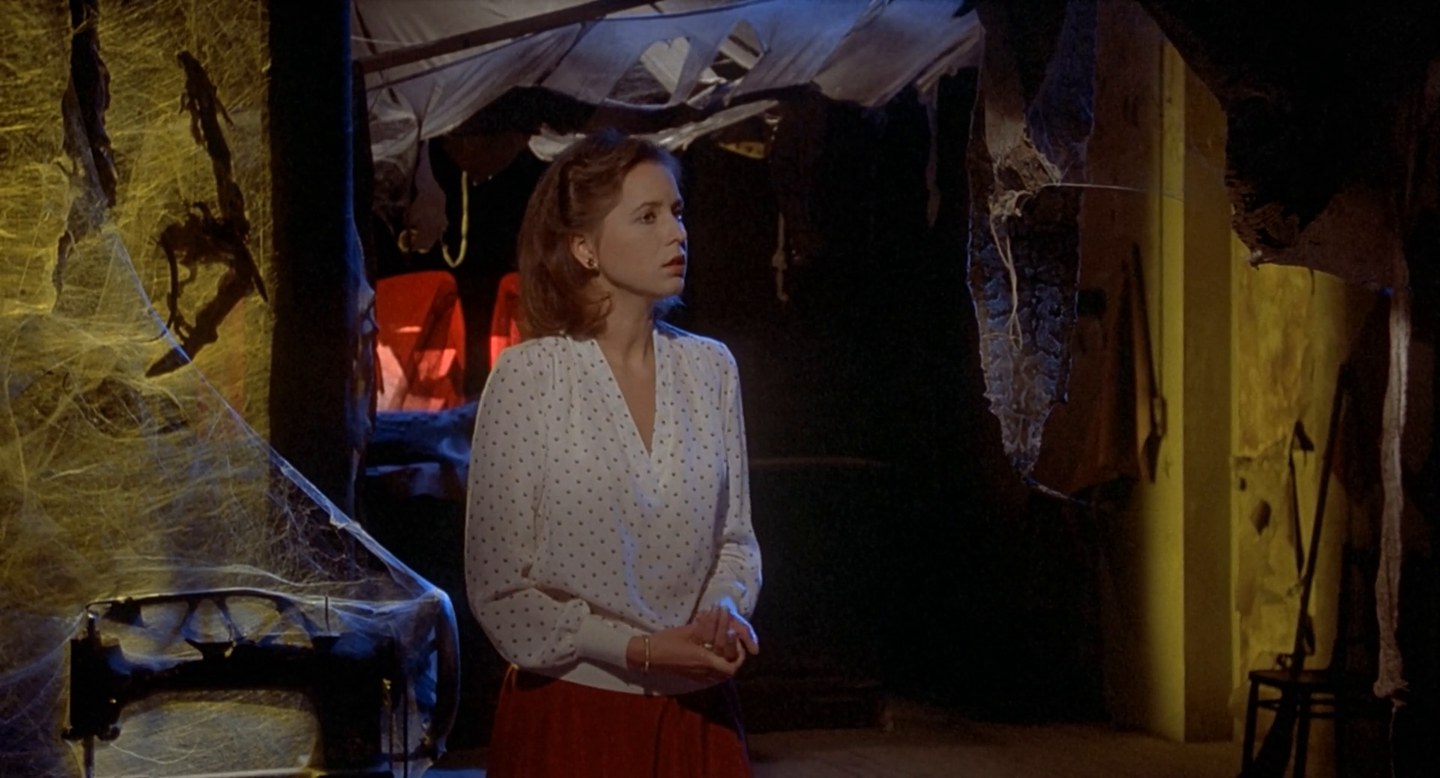
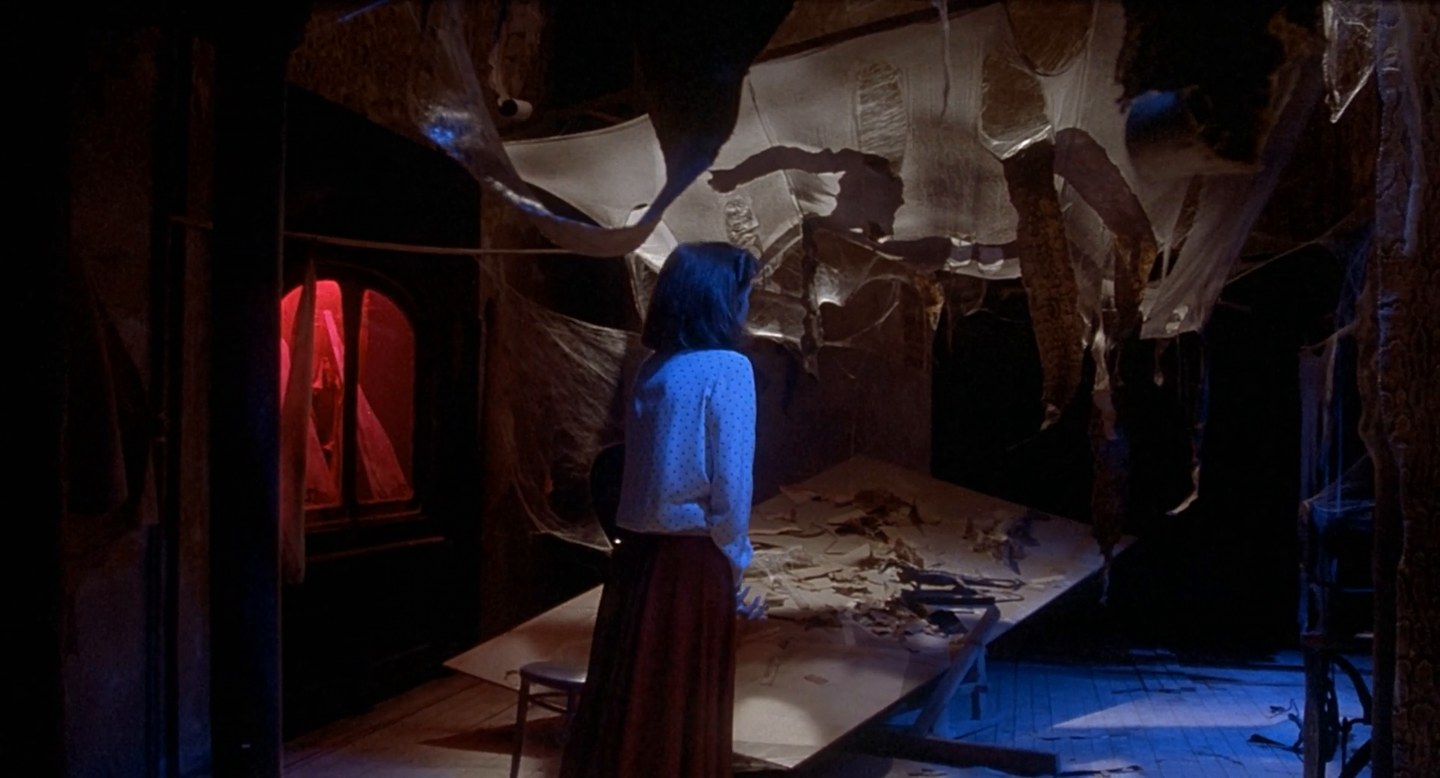
ENLARGE ↗Rose stands among torn fabric and broken furnishings.
The house becomes a series of exposed surfaces and damaged objects. Torn material hangs above Rose; a table and chairs remain recognisable below it. Domestic form survives inside ruin, making the room stranger than a wholly unfamiliar cavern would be.
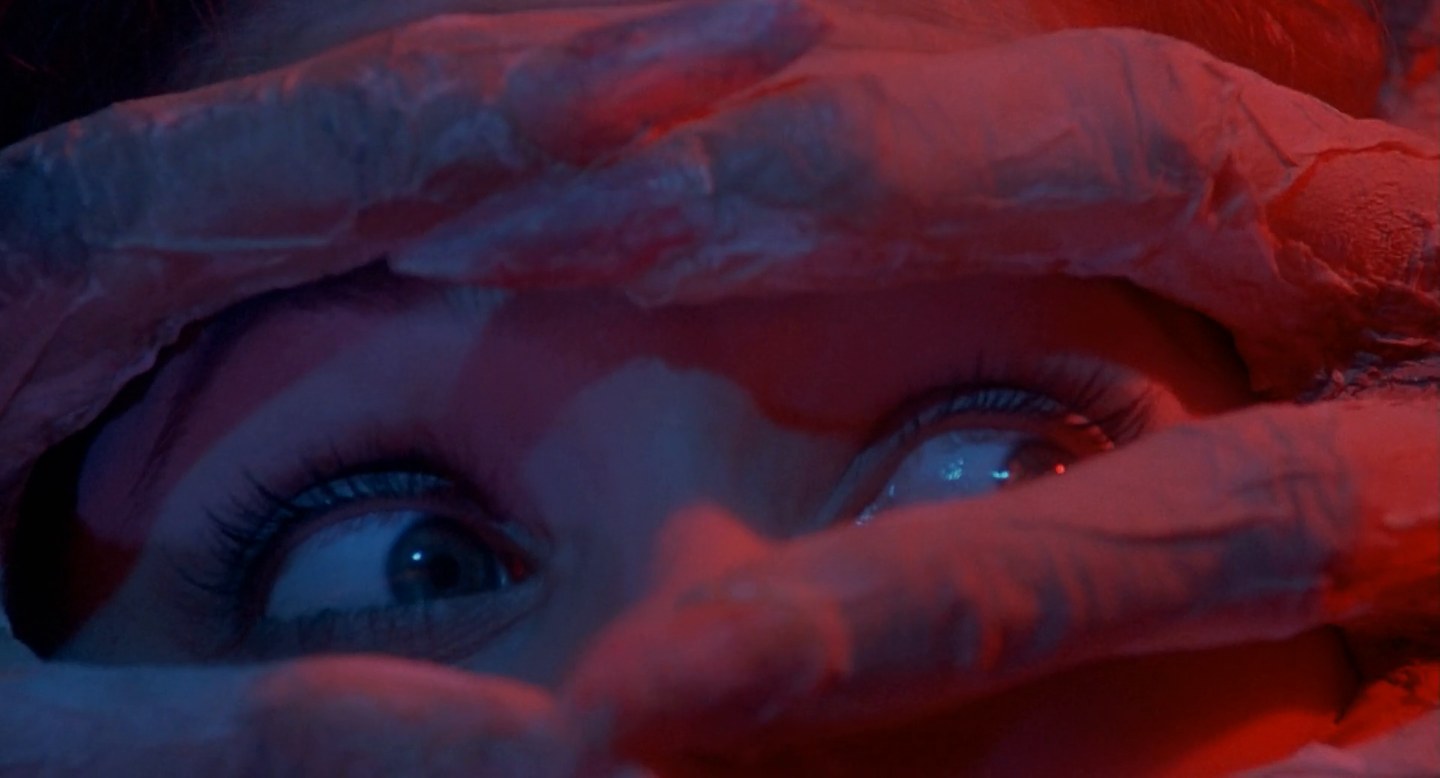
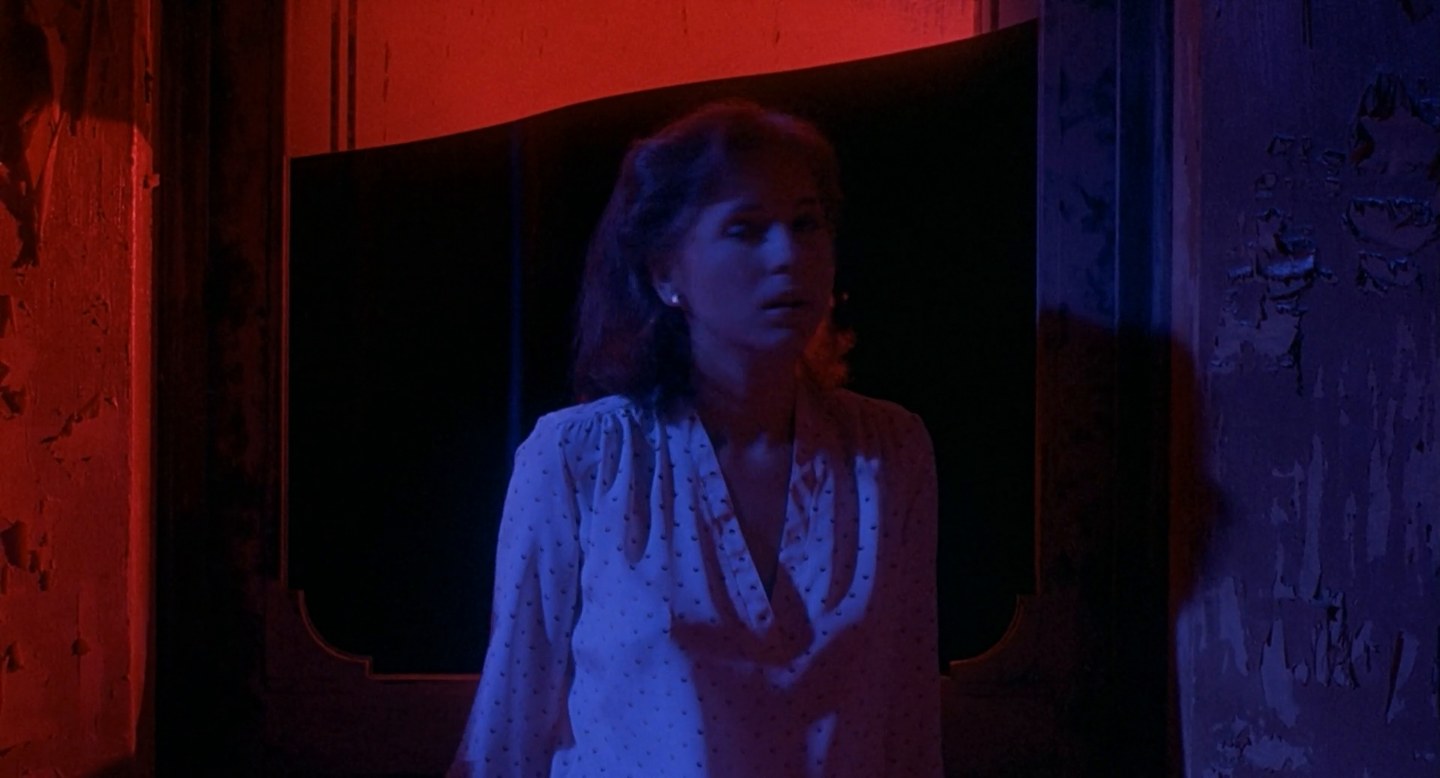
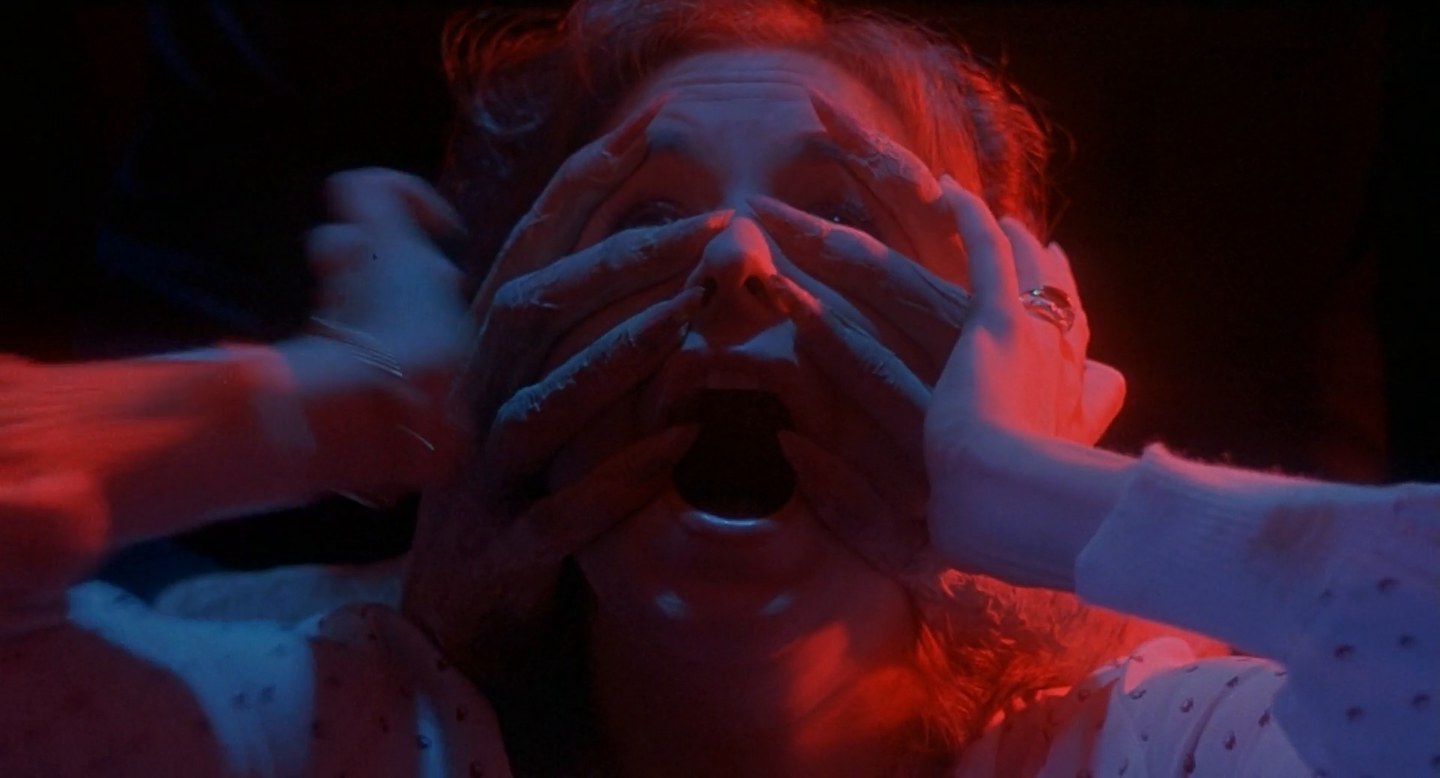
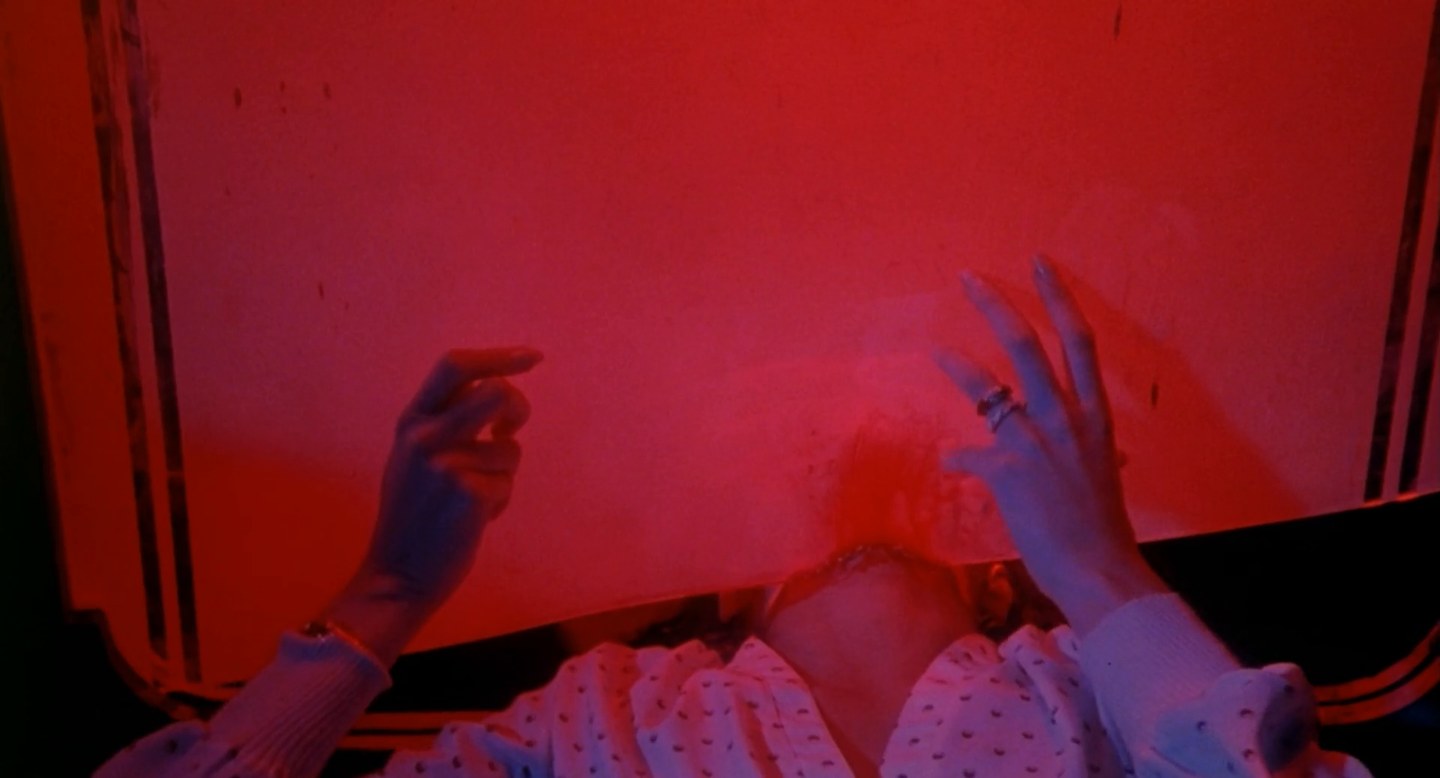
ENLARGE ↗Hands cover Rose’s face in red and blue light.
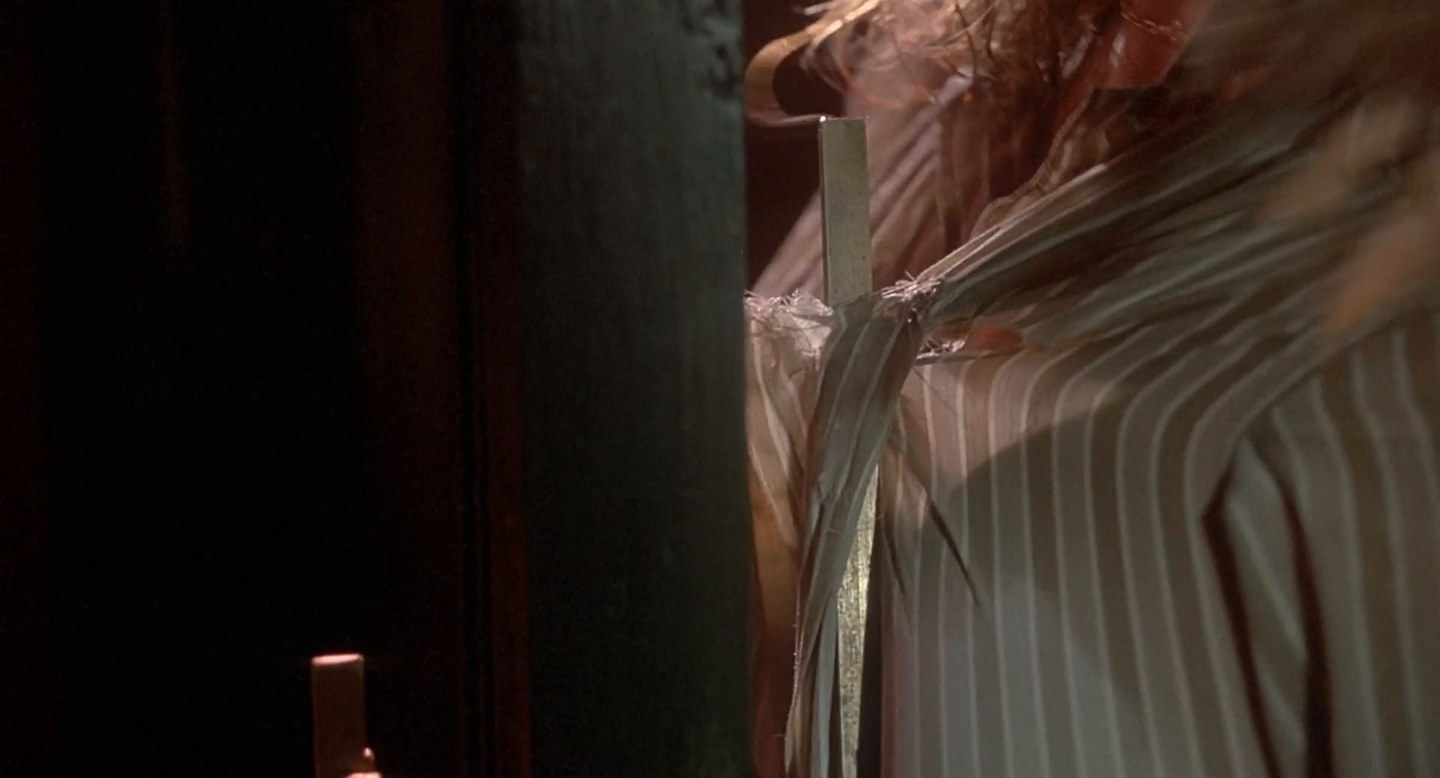
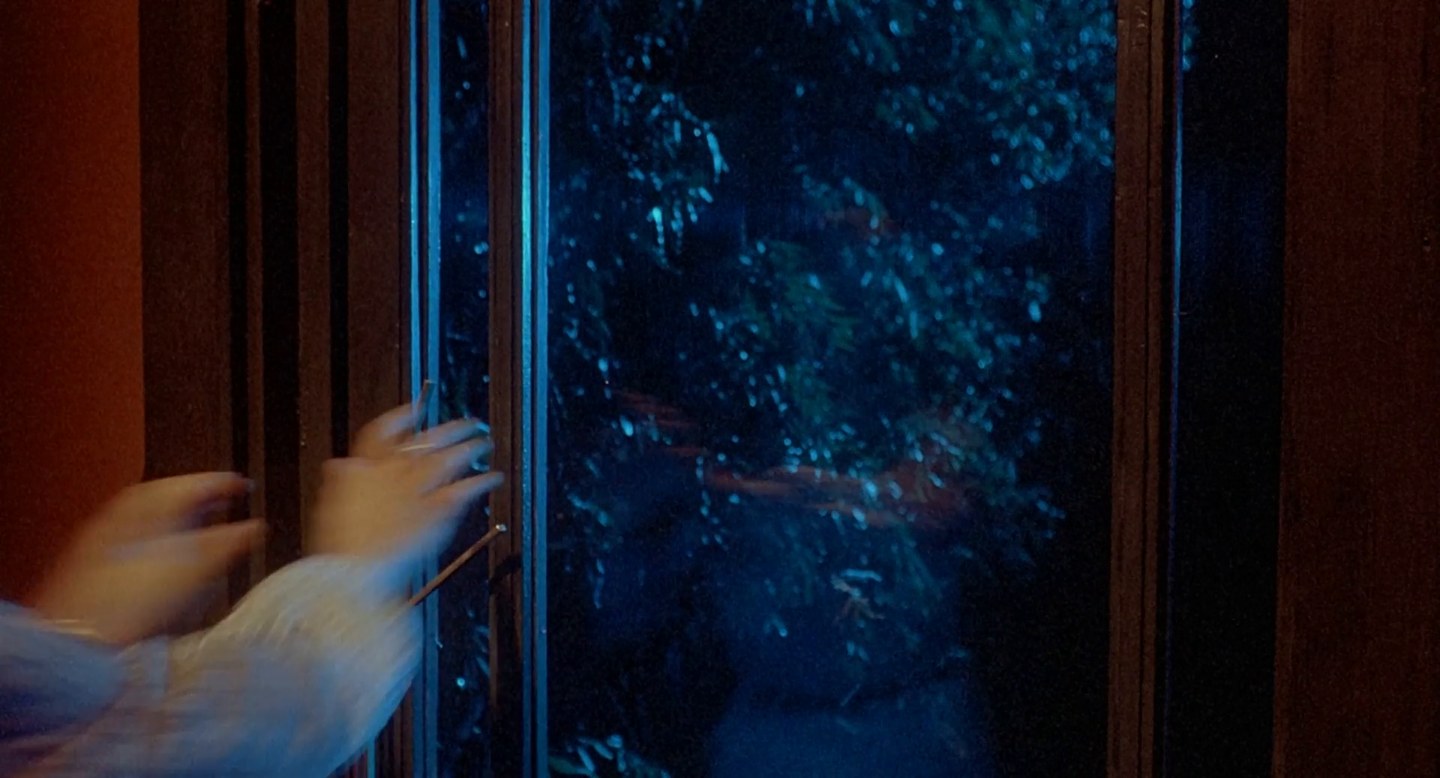
The doorway concentrates the colour system into an instrument of violence. Blue falls across the attacker’s hands while red fills the panel behind Rose. The sequence breaks her struggle into eyes, fingers, edges and pressure.
ENLARGE ↗Mark enters the house’s red and blue lobby.
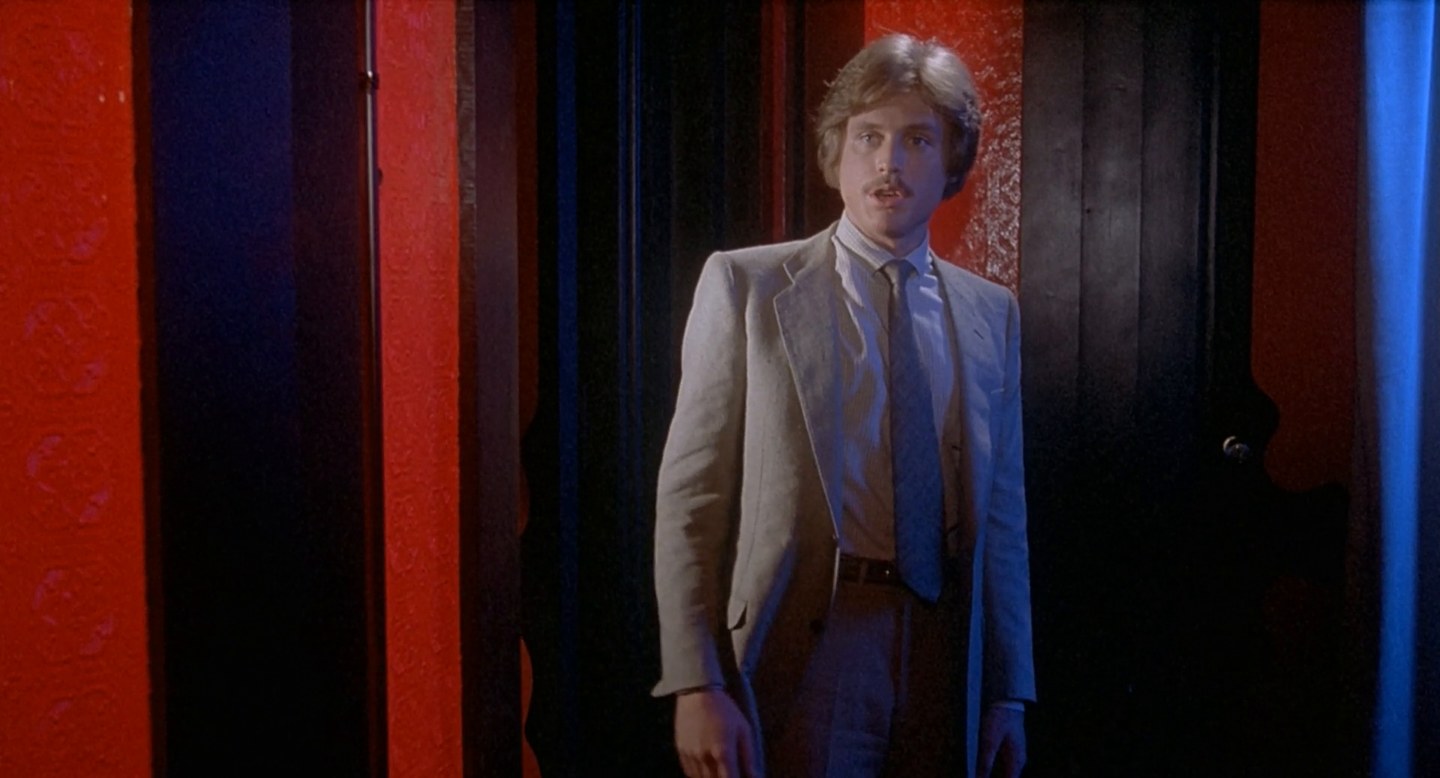
Daylight outside gives way to the lobby’s highly divided colour. Mark enters an environment already established through Rose’s investigation, but lacks the experience through which the audience has learned it. His arrival restarts the search without restoring the earlier investigator.
ENLARGE ↗Mark stands at the doorway of Elise’s room.
The doorway stages a tentative alliance before the investigation extends into other rooms. Mark and Elise are separated and rejoined by doors, curtains and changes in level. Their proximity is temporary; the house keeps finding ways to isolate a body.
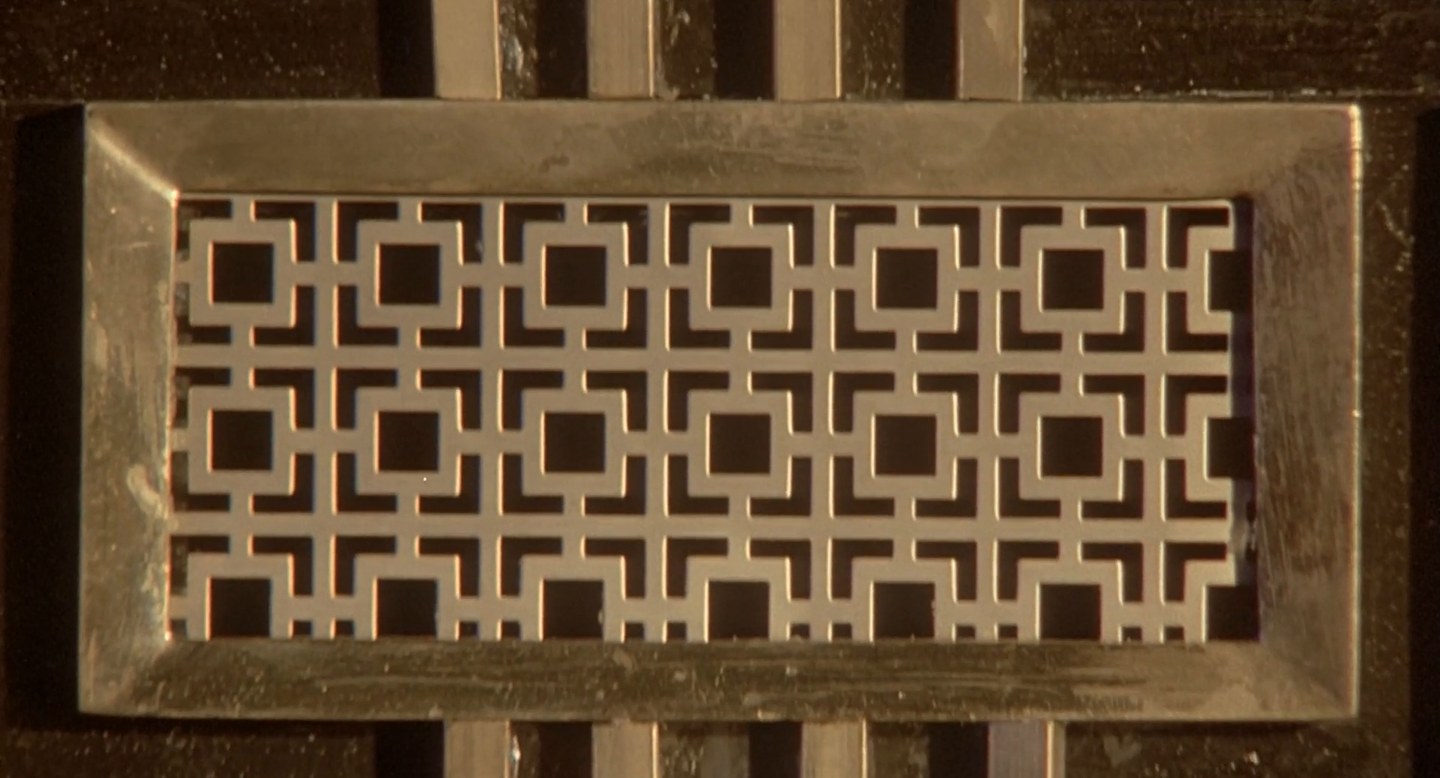
The grille offers a small geometric face for a much larger concealed system. A feature that should circulate air instead becomes a threatening opening. Its regular pattern contrasts with the damaged, irregular spaces beyond the finished rooms.
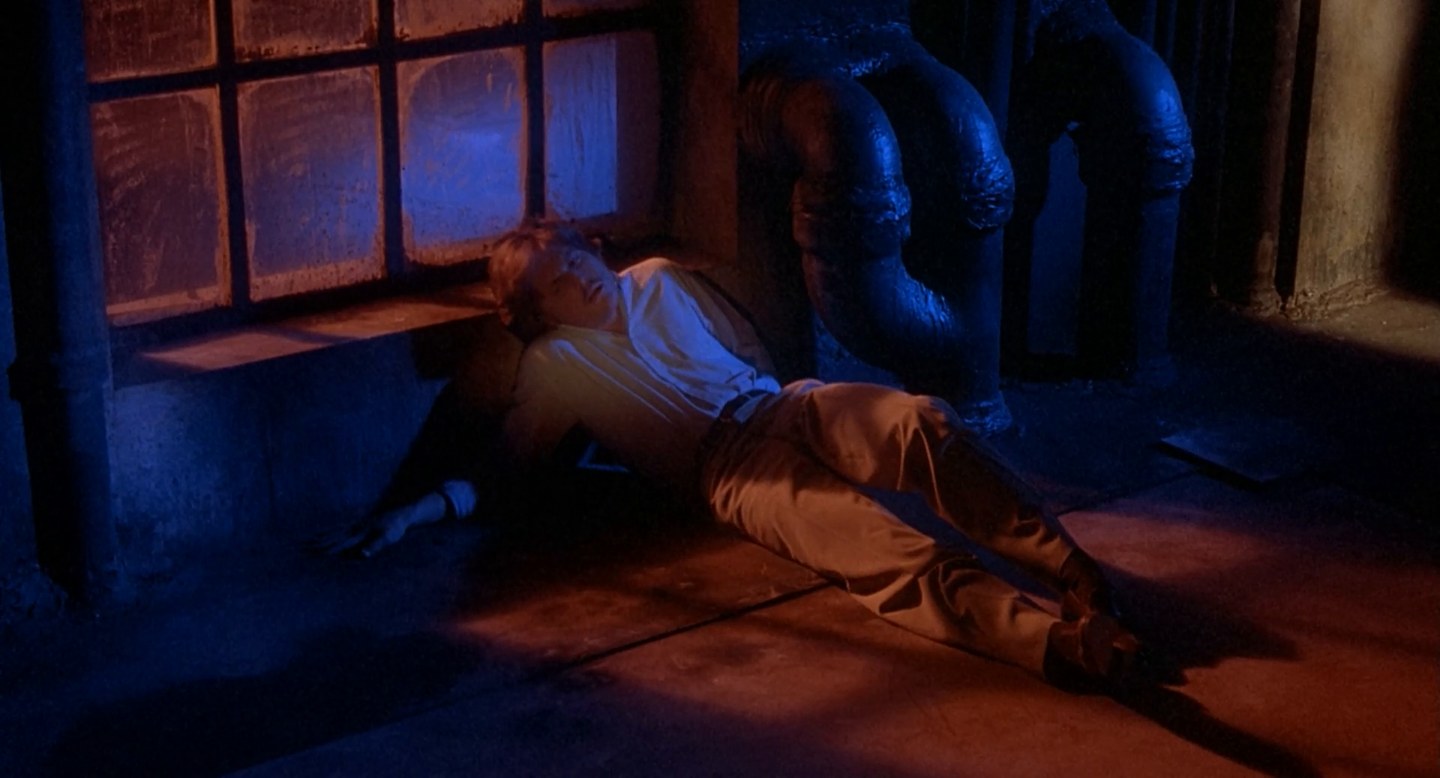
Mark’s collapse removes the apparent rescuer from the route. Elise must move through the stairways and rooms on her own. The film makes the separation spatially visible before the next attack begins.
ENLARGE ↗Elise raises her arms as the cats attack.
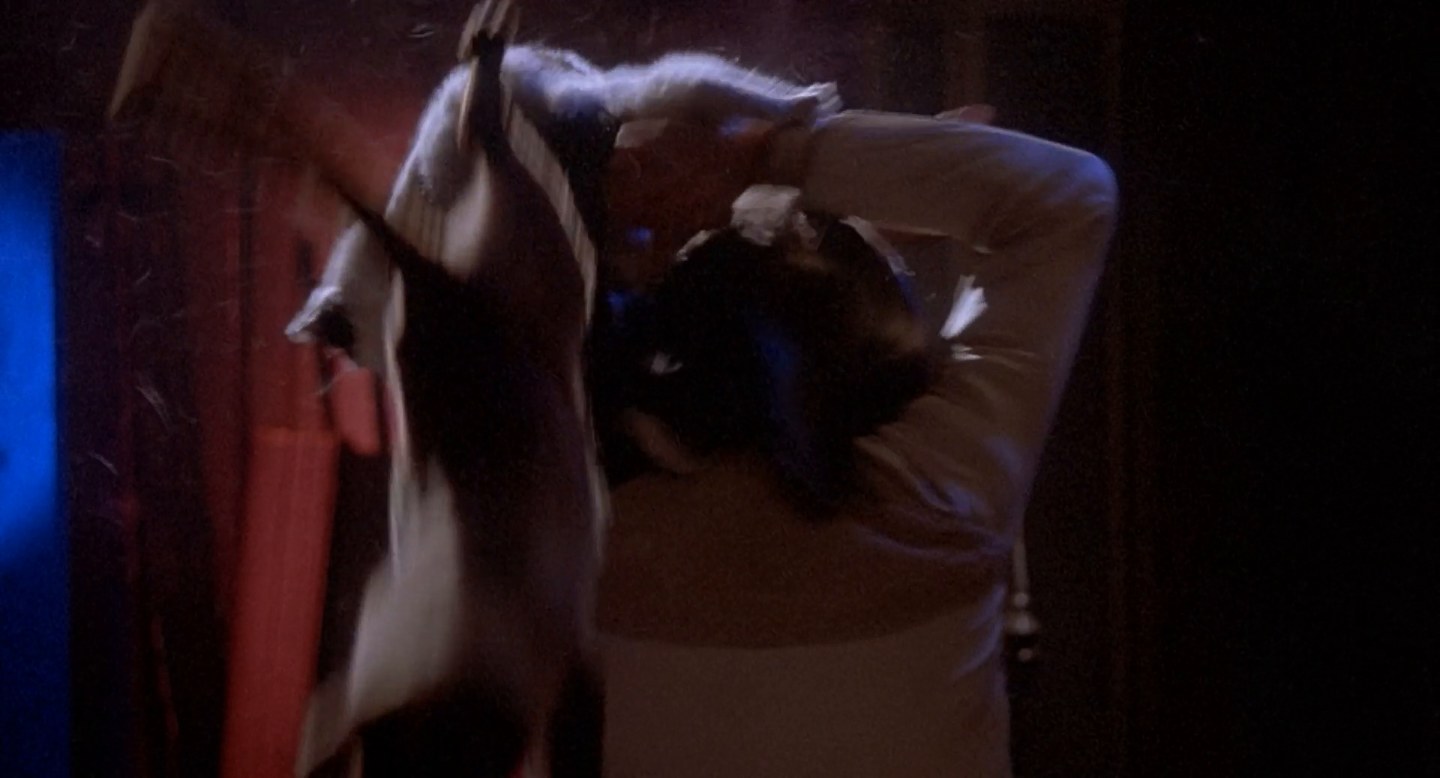
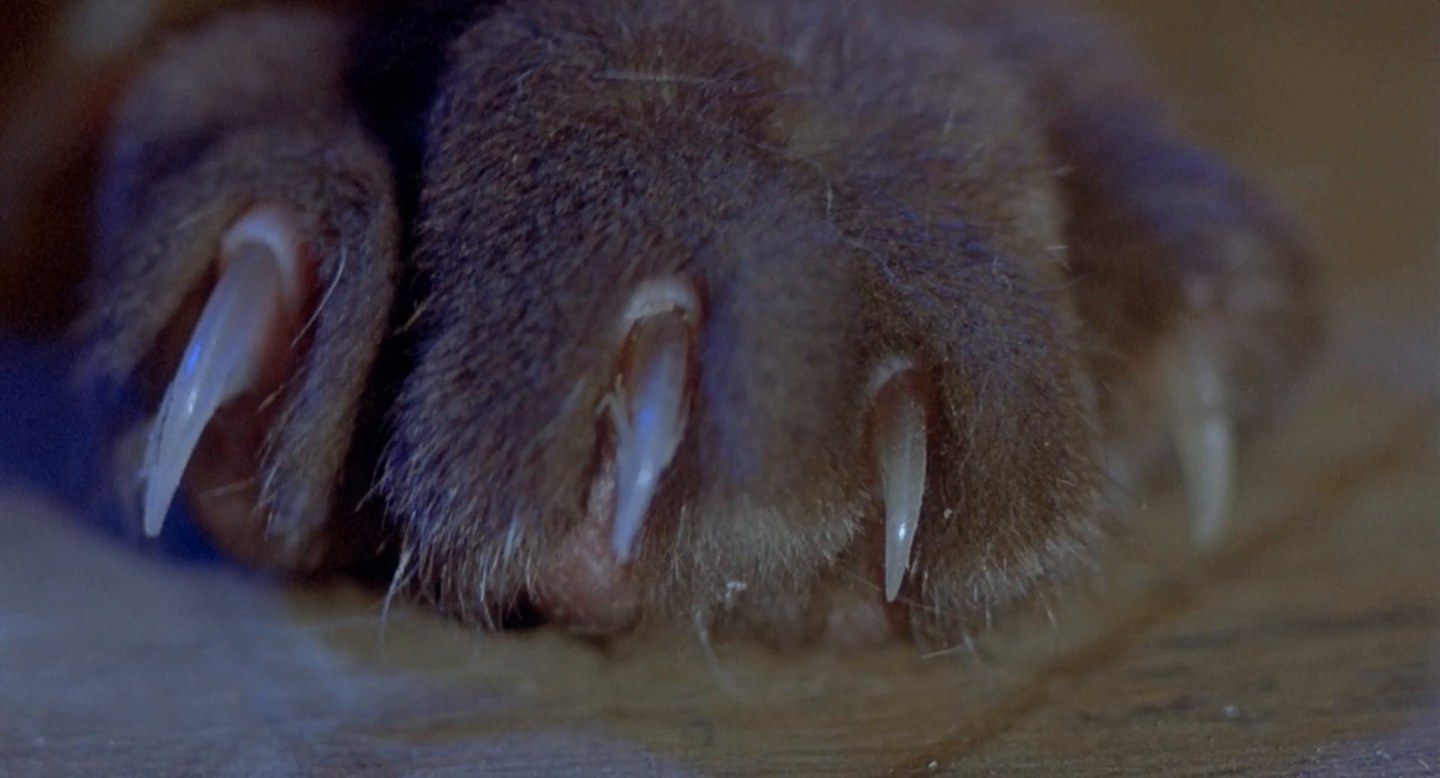
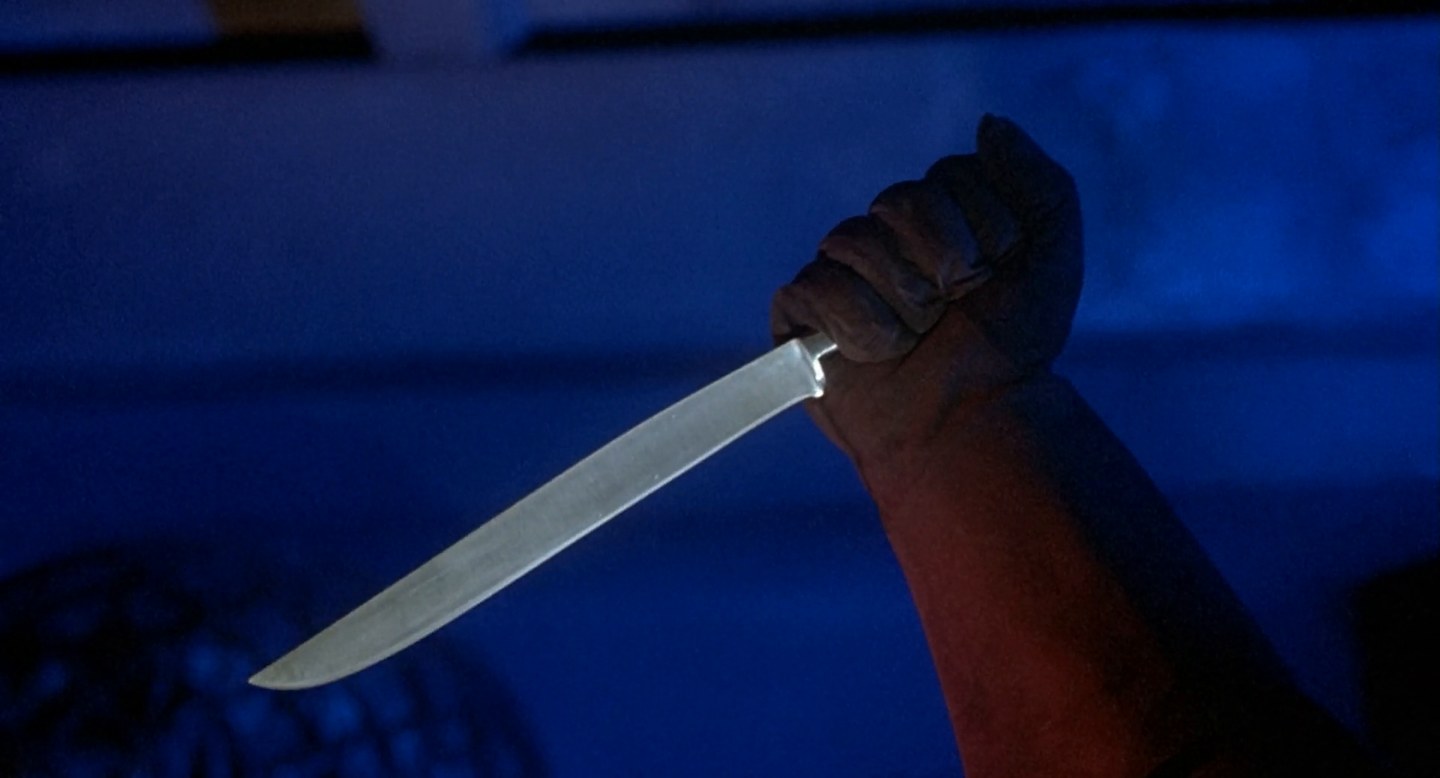
The attack is built from different scales: a body in a room, animals against clothing, a mouth, a claw. Those changes in scale make the force seem to come from every direction. A later raised knife adds a human-shaped threat to the animal assault.
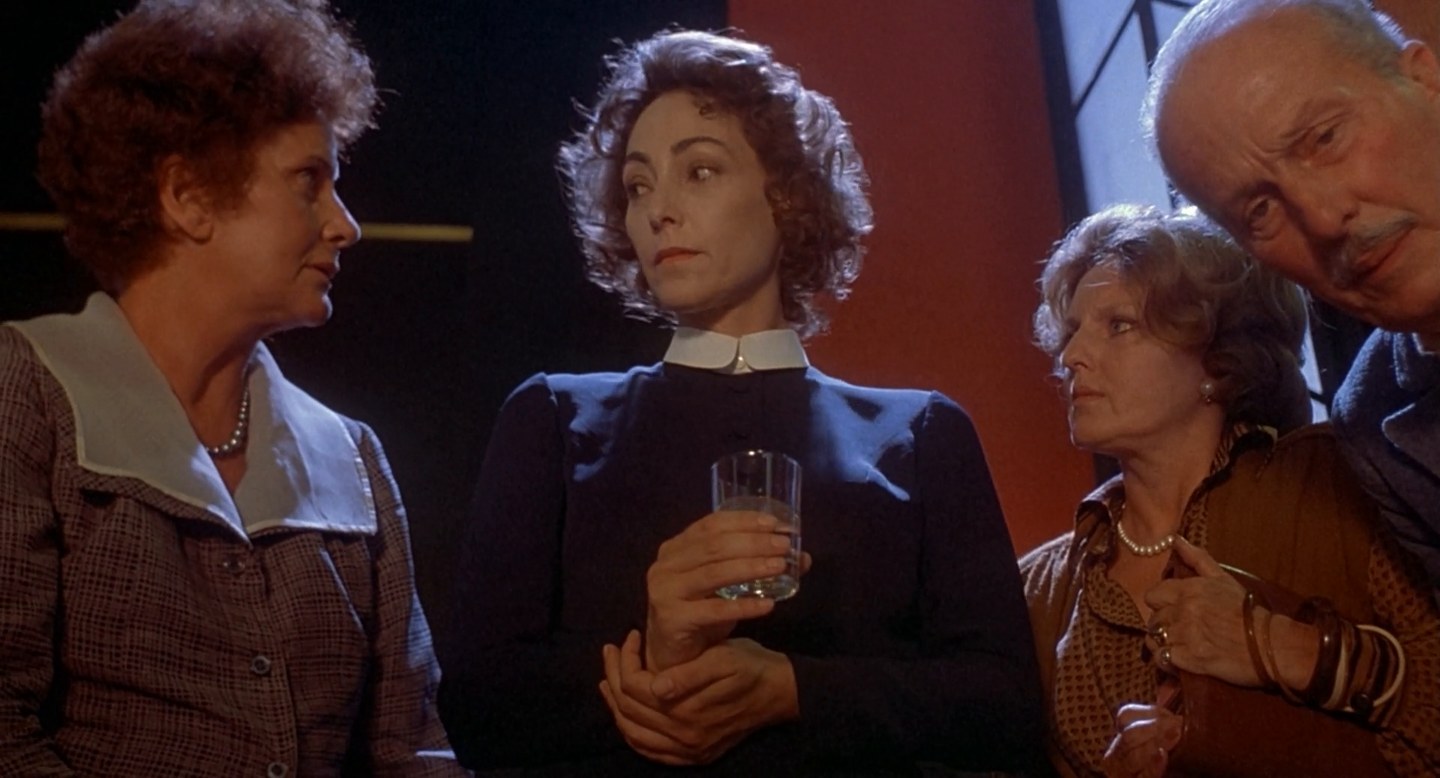
After the disordered attack, a cluster of people and a formal interior restore an appearance of ordinary social life. The return to conversation does not undo what happened in the hidden rooms. It makes the building’s public face feel more unsettling.
ENLARGE ↗Kazarian works among the objects in his shop.
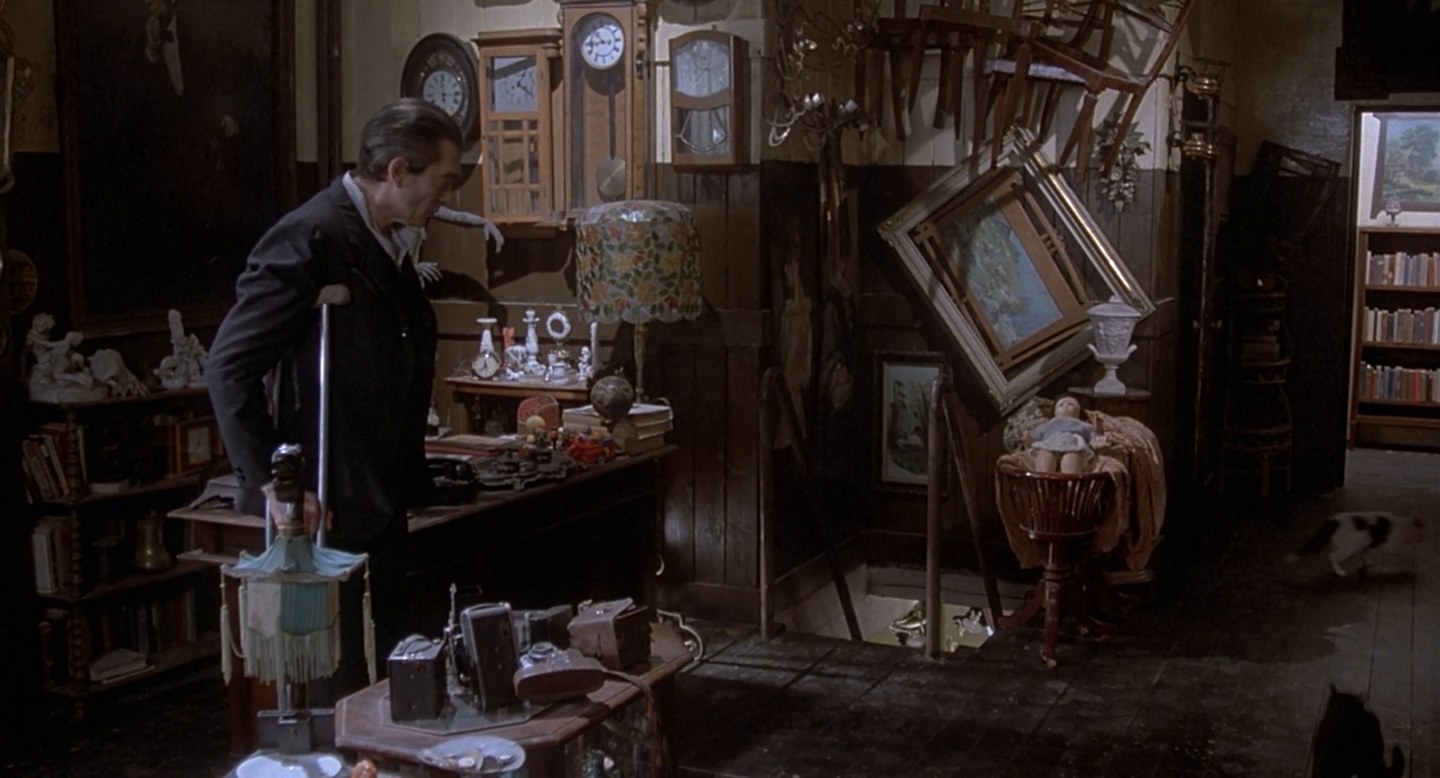
Books, pictures, furniture and small valuables crowd the frame. The shop presents a second interior organised around accumulation. Its density of possessions makes Kazarian’s movement towards the open park a striking change of setting, but not a release from danger.
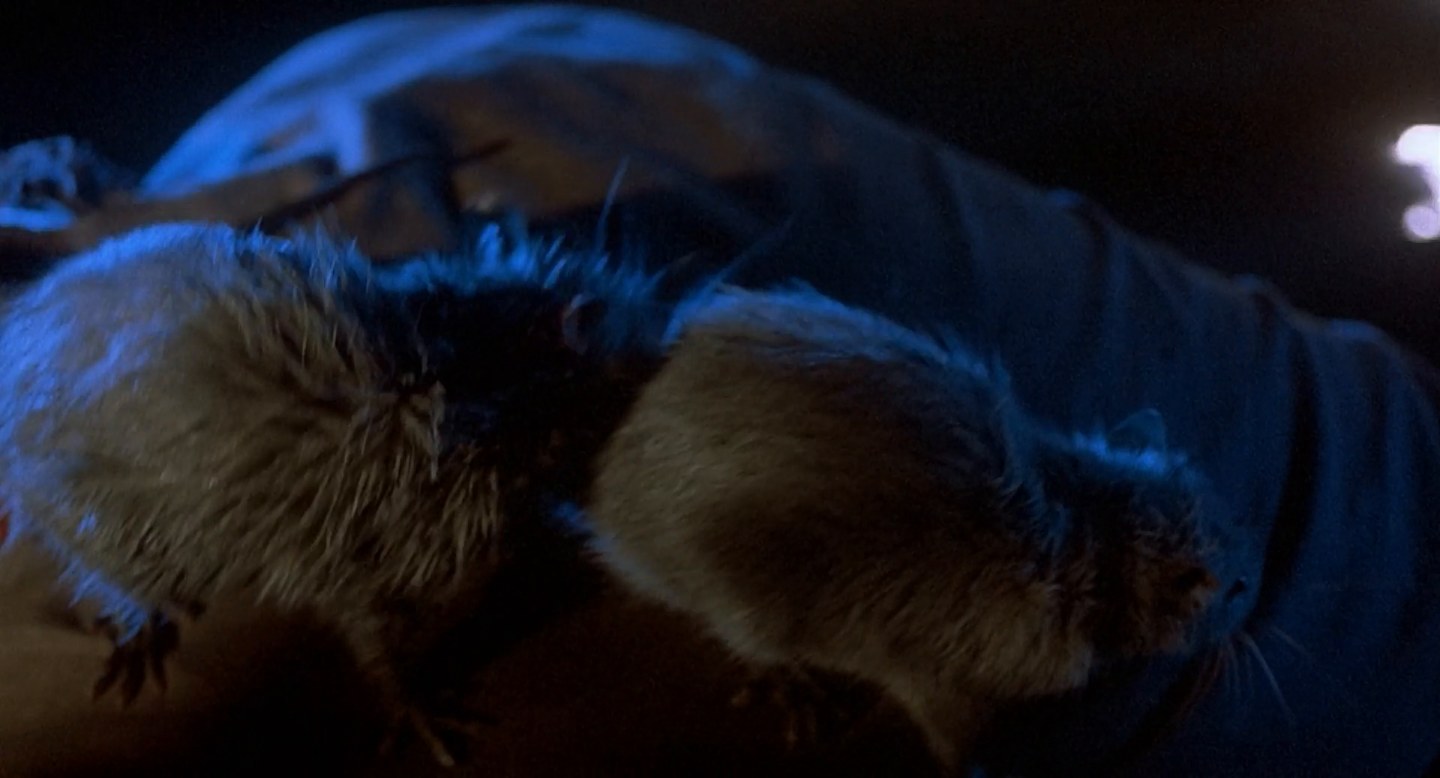
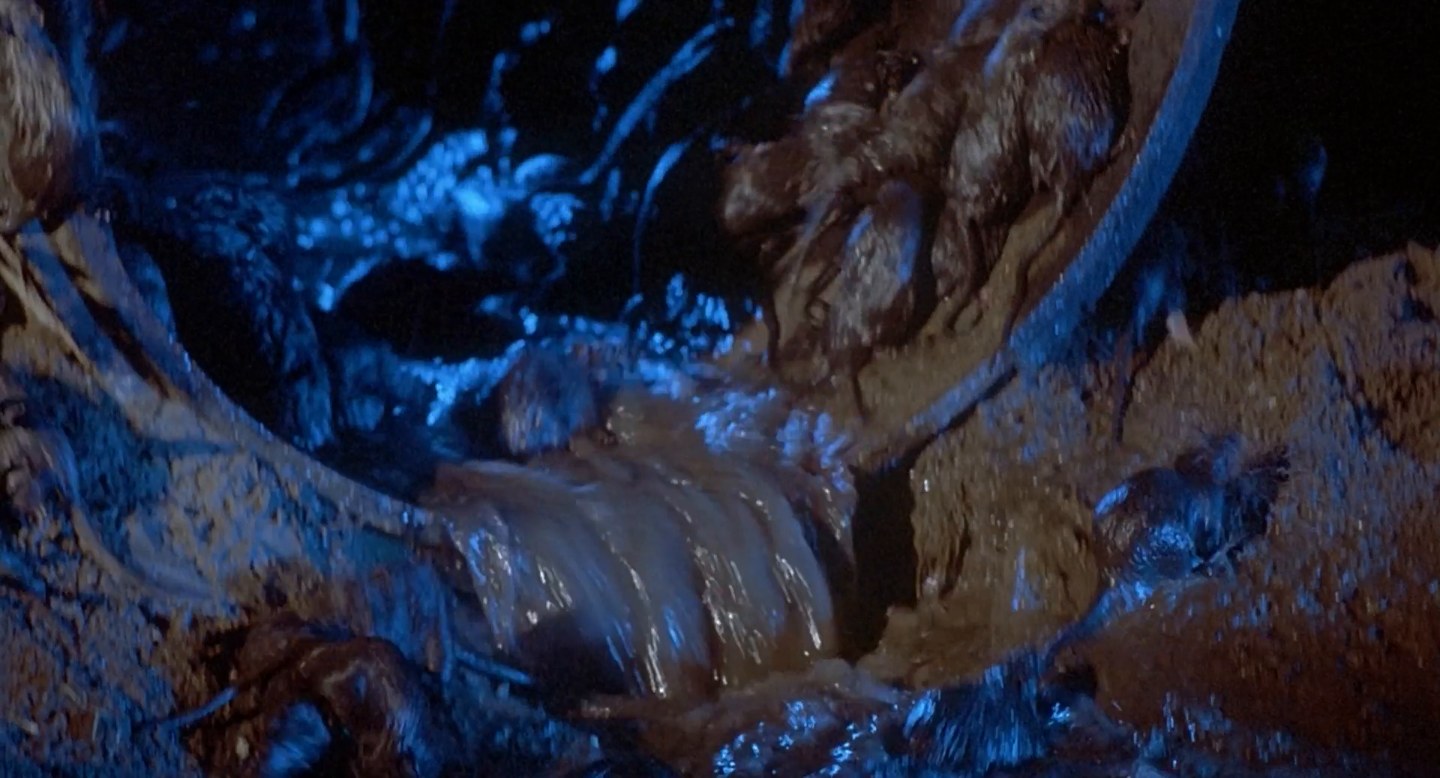
ENLARGE ↗Rats swarm around Kazarian at the water’s edge.
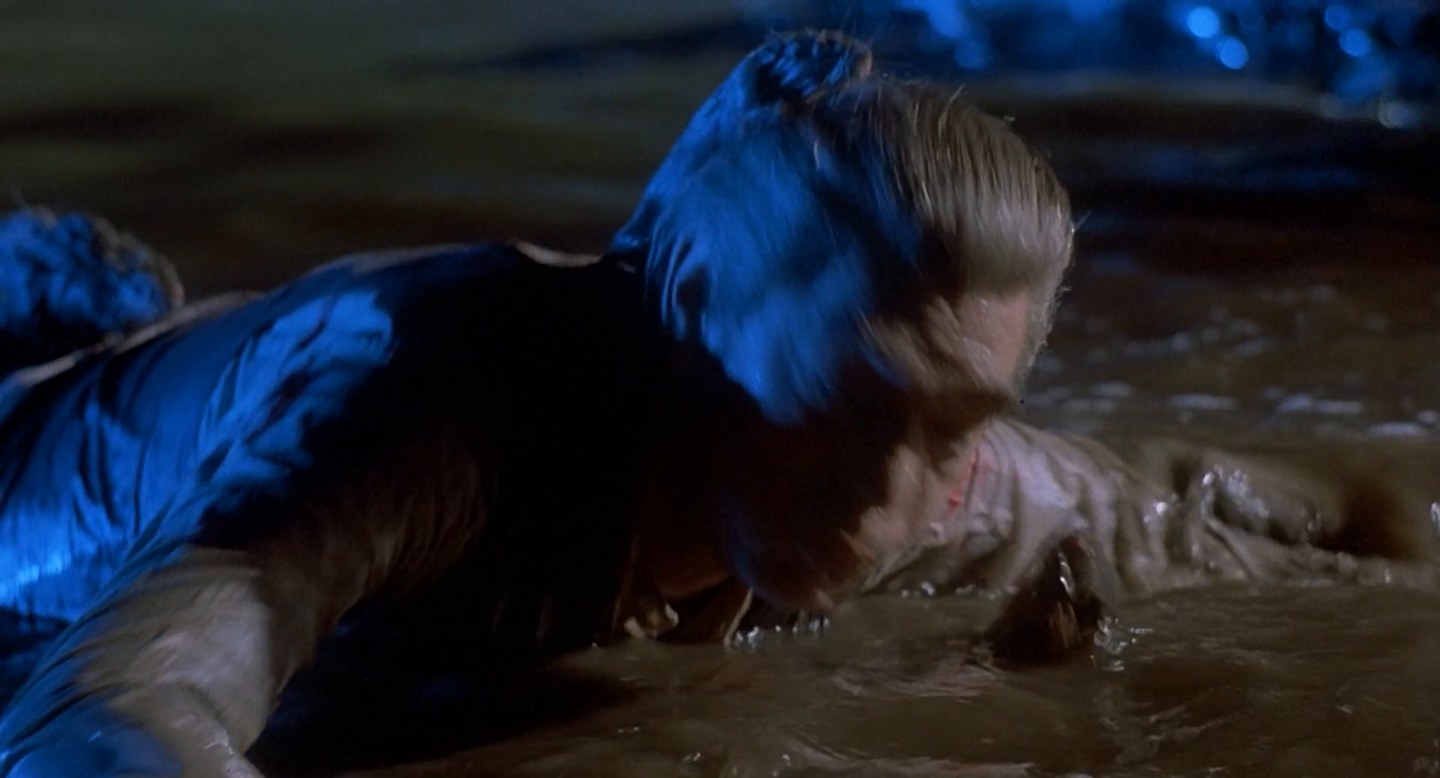
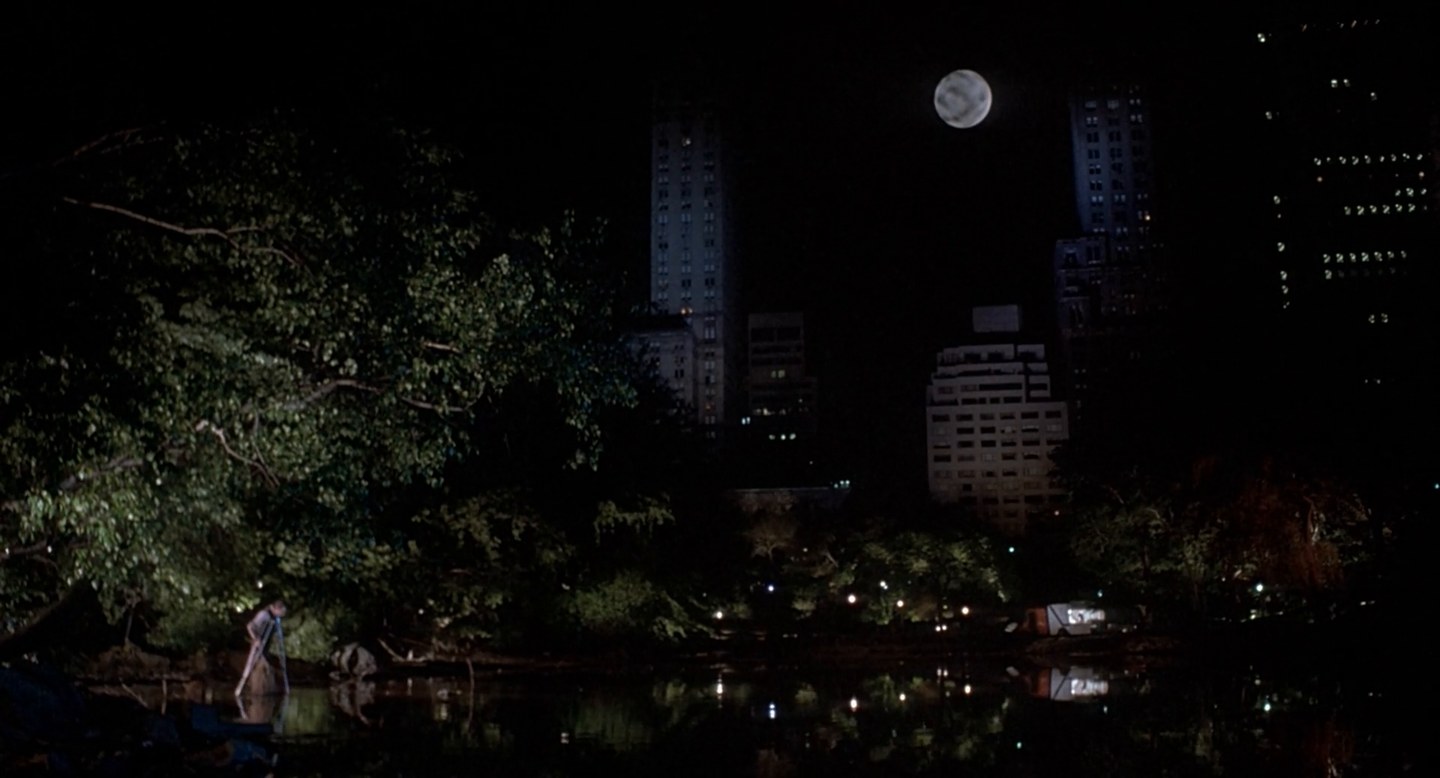
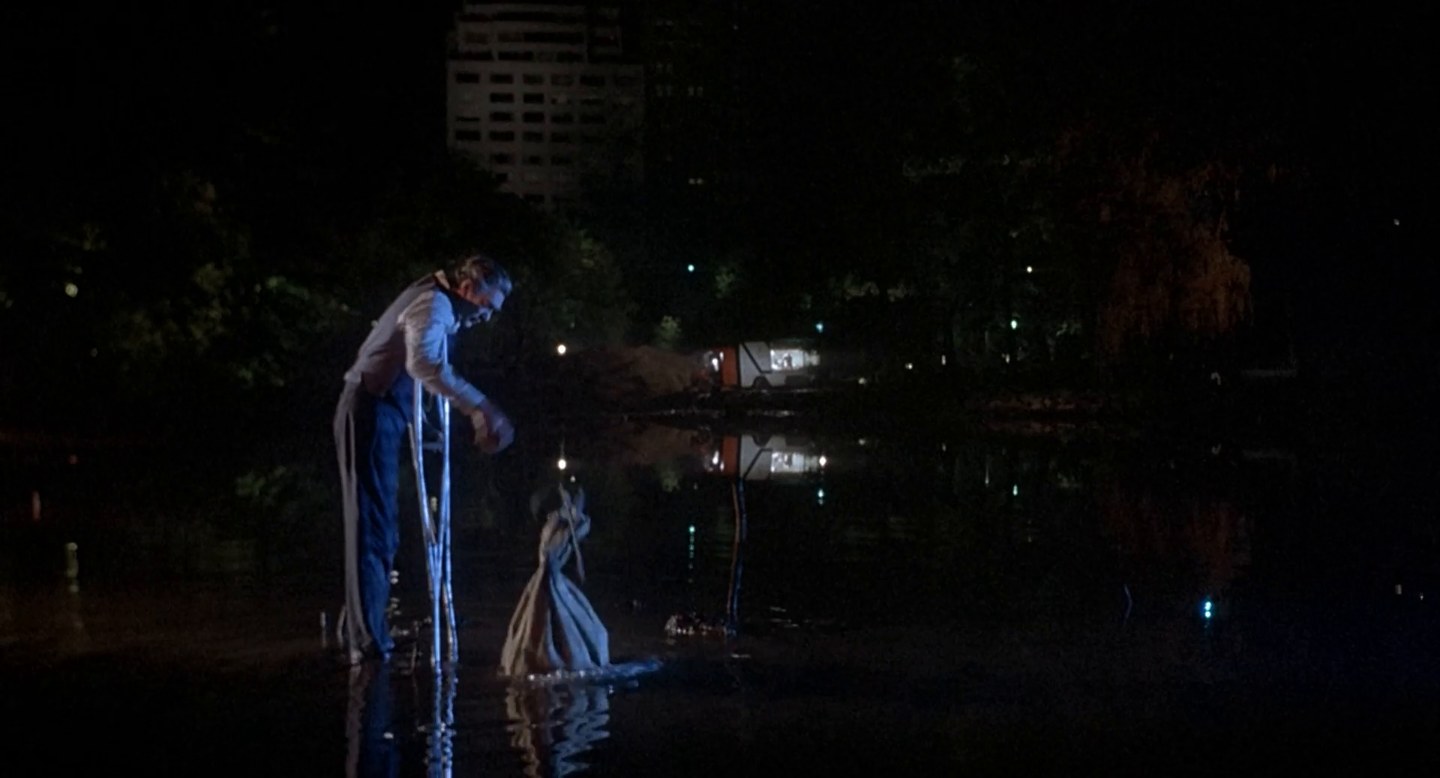
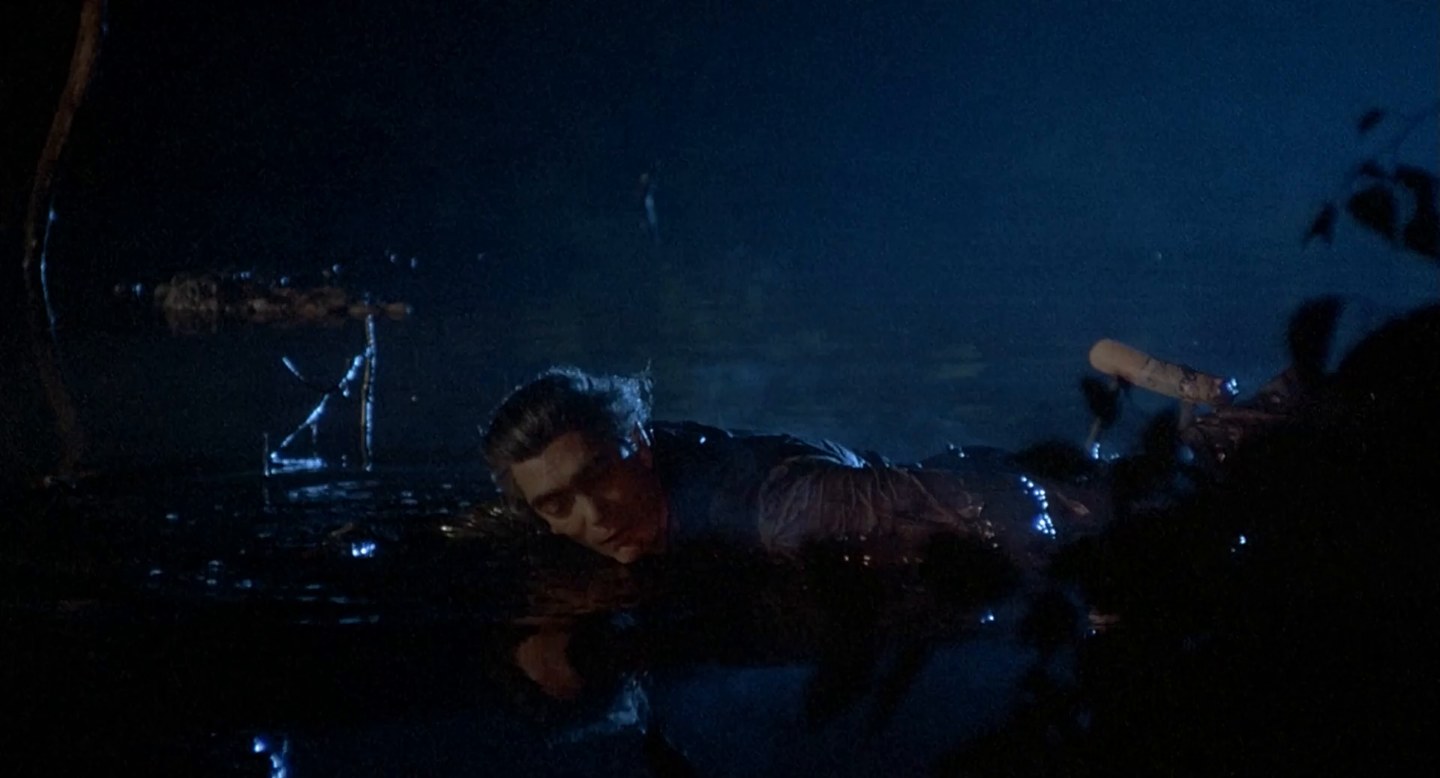
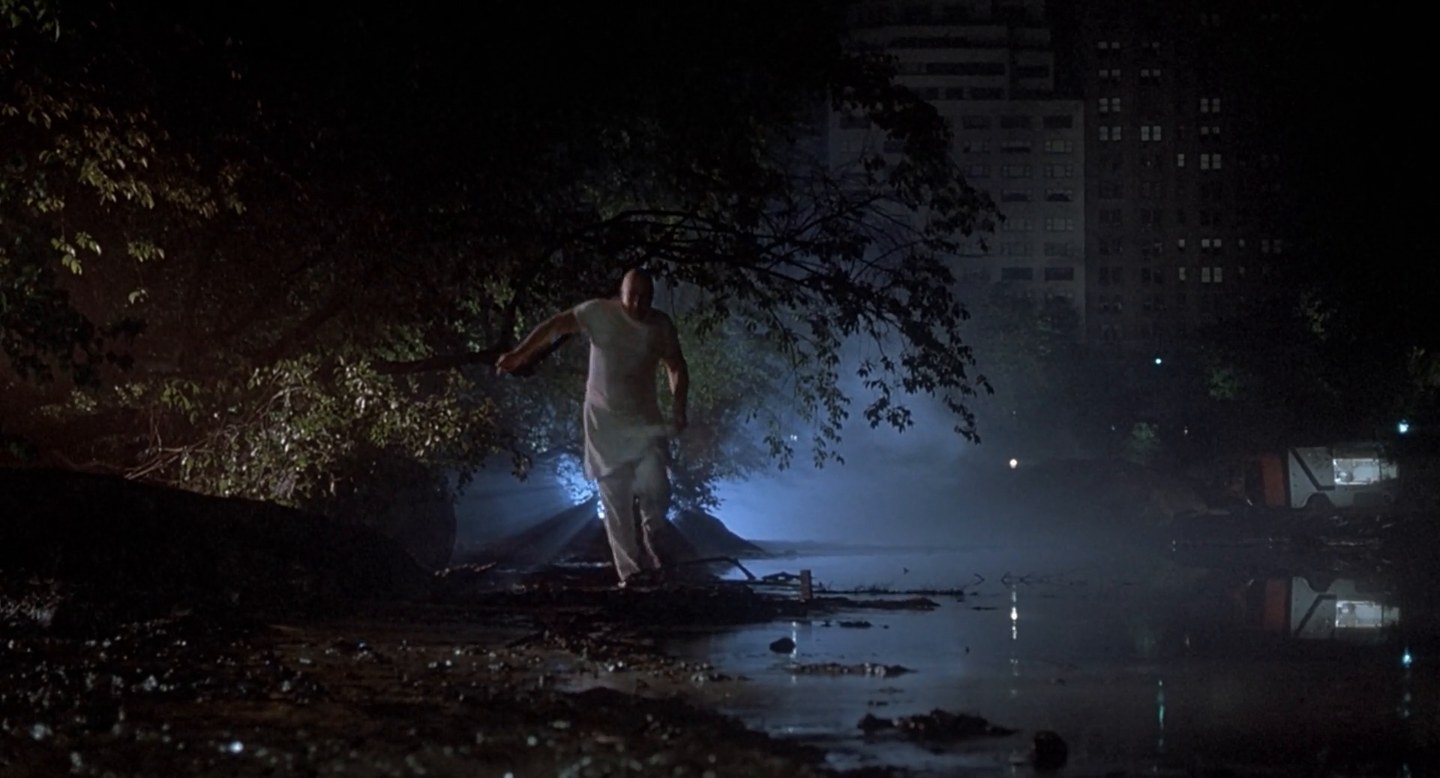
The park seems to offer the opposite of the enclosed house: open water, a skyline and space to call for help. The attack defeats that promise. Wide views establish the distance to possible assistance; close views make the ground and water into immediate threats.
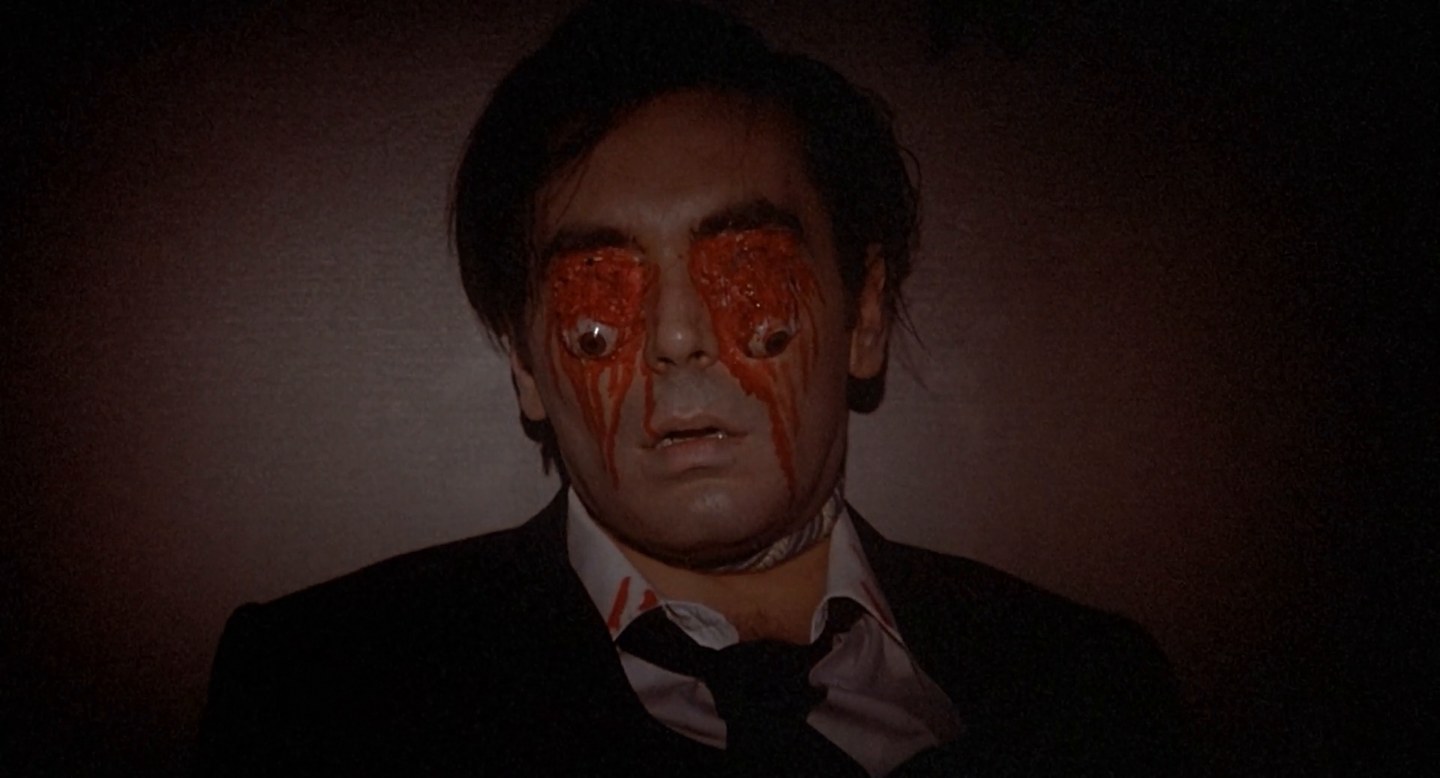
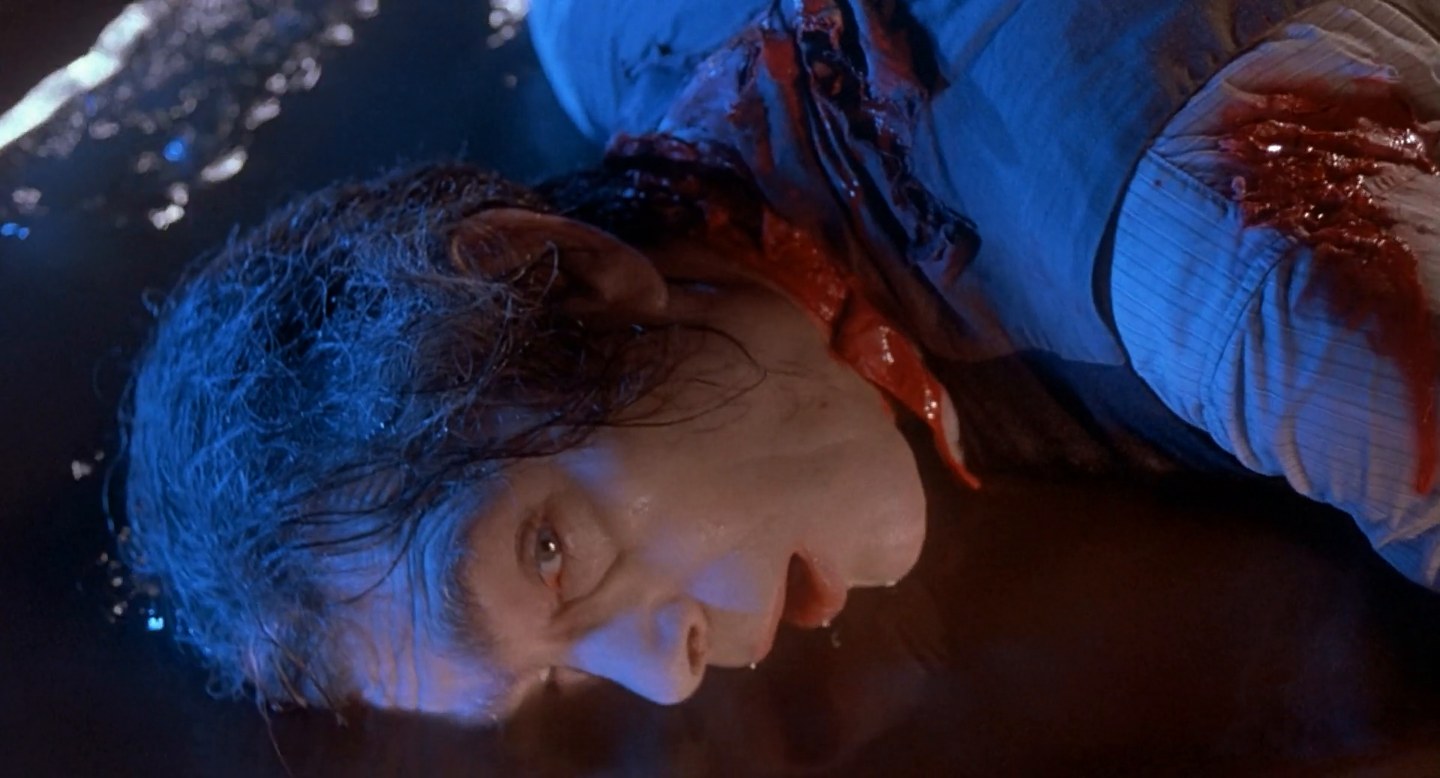
ENLARGE ↗The caretaker’s bloodied eyes are revealed.
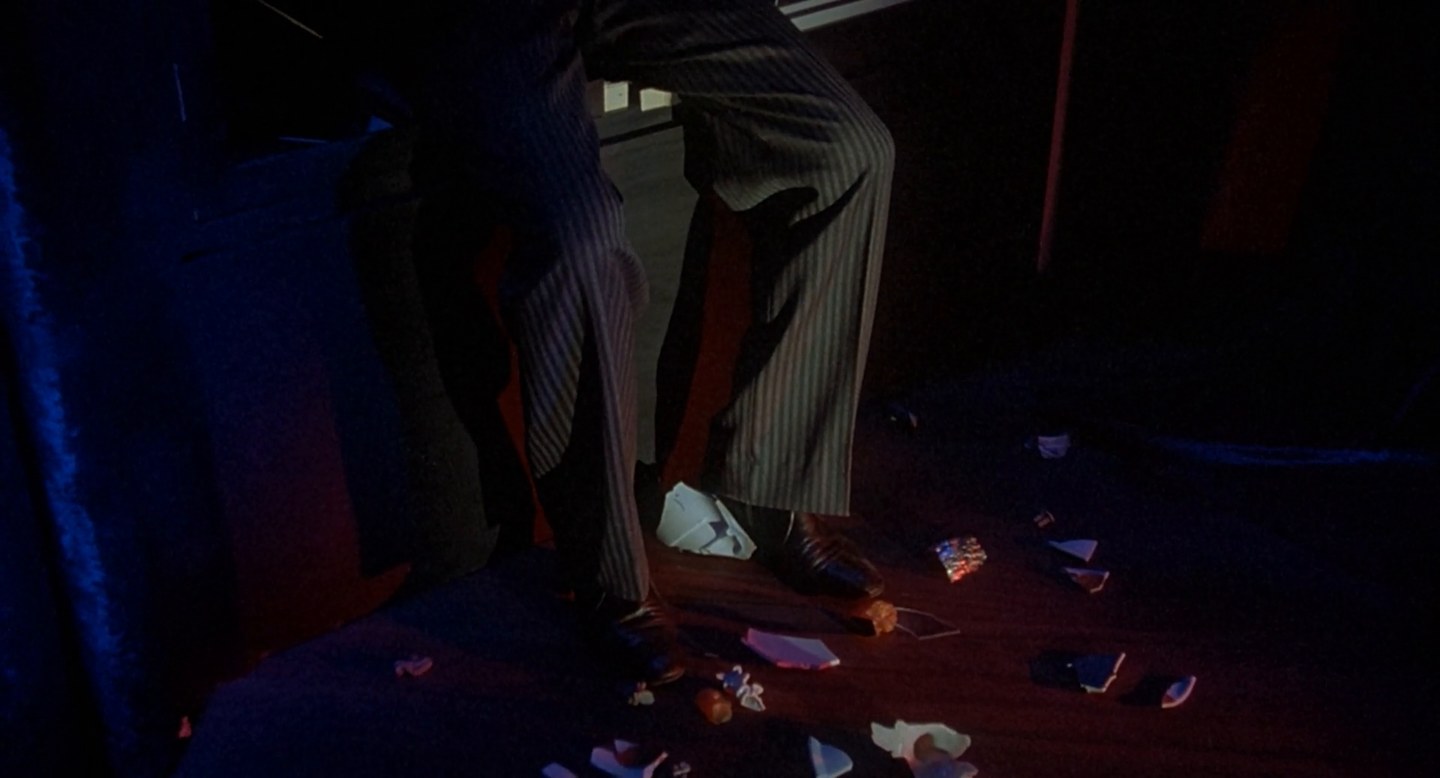
A curtain conceals the result of an attack rather than the attack itself. Carol’s approach delays the reveal through steps, cloth and scattered fragments. The sudden frontal view of the face supplies the missing event as an aftermath image.
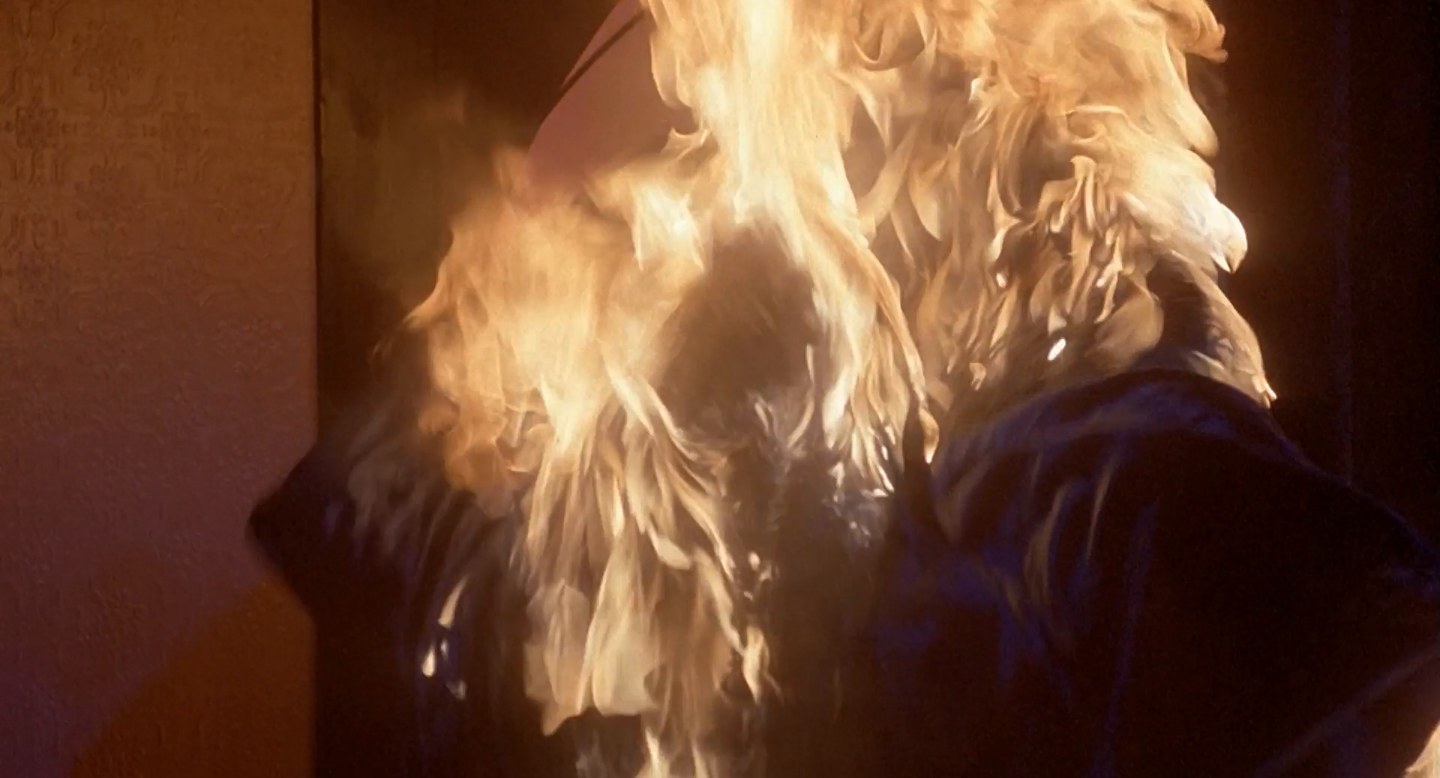
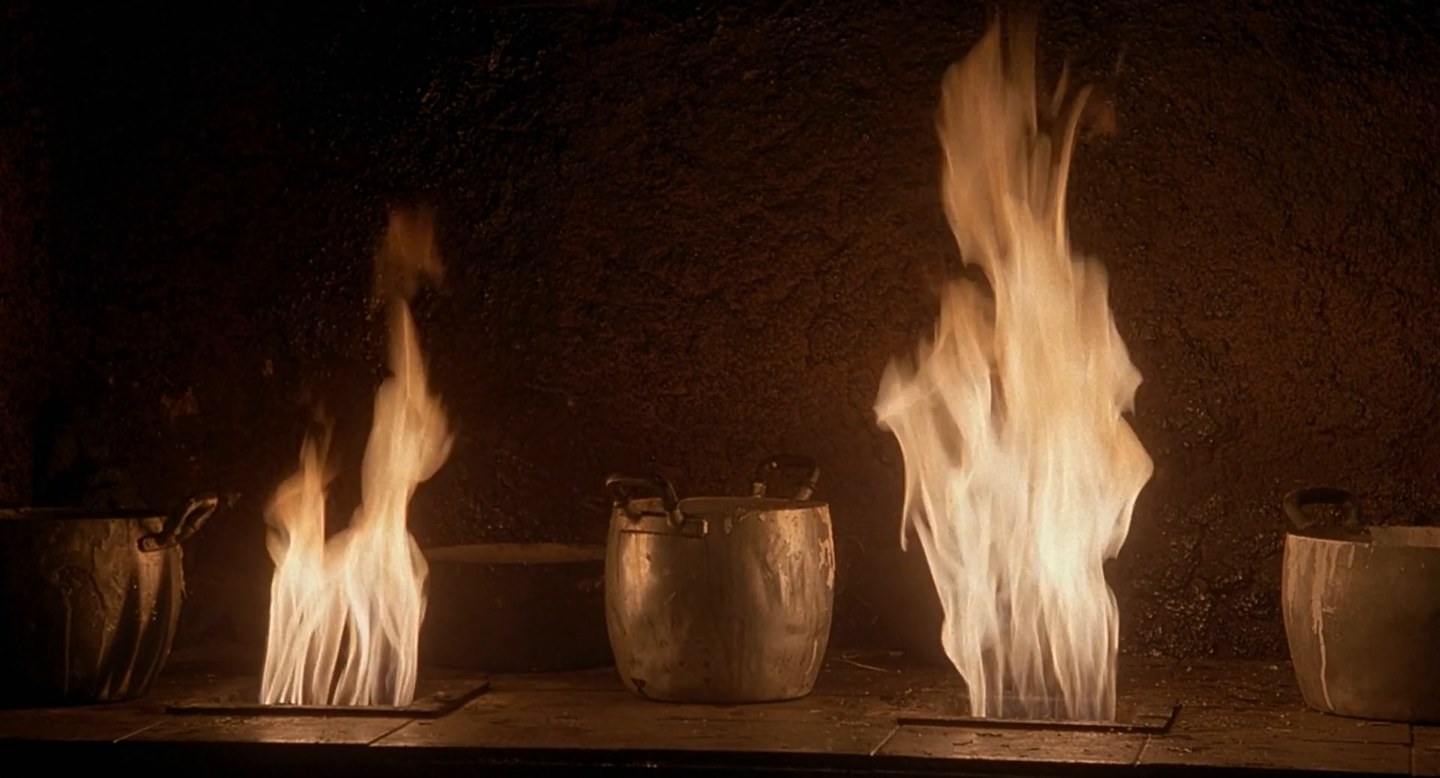
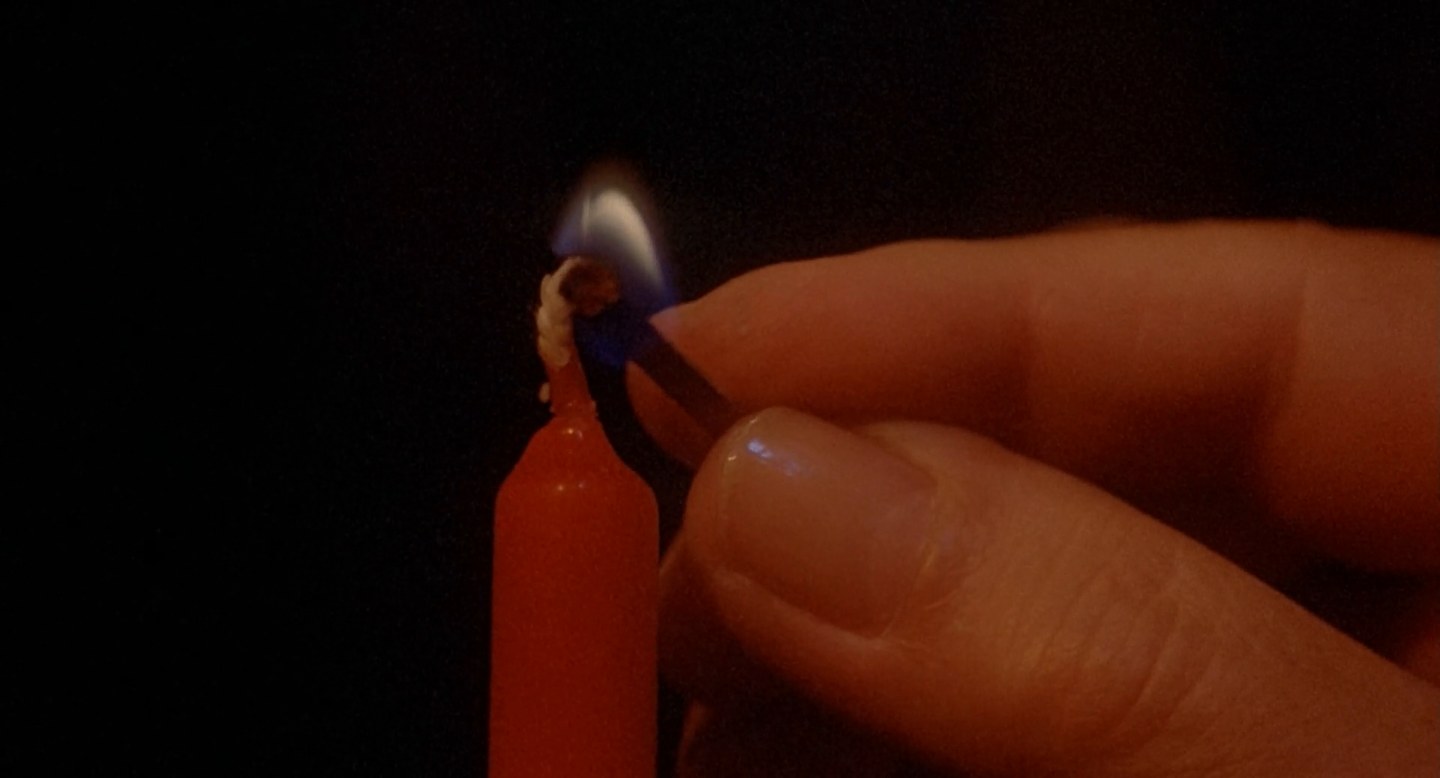
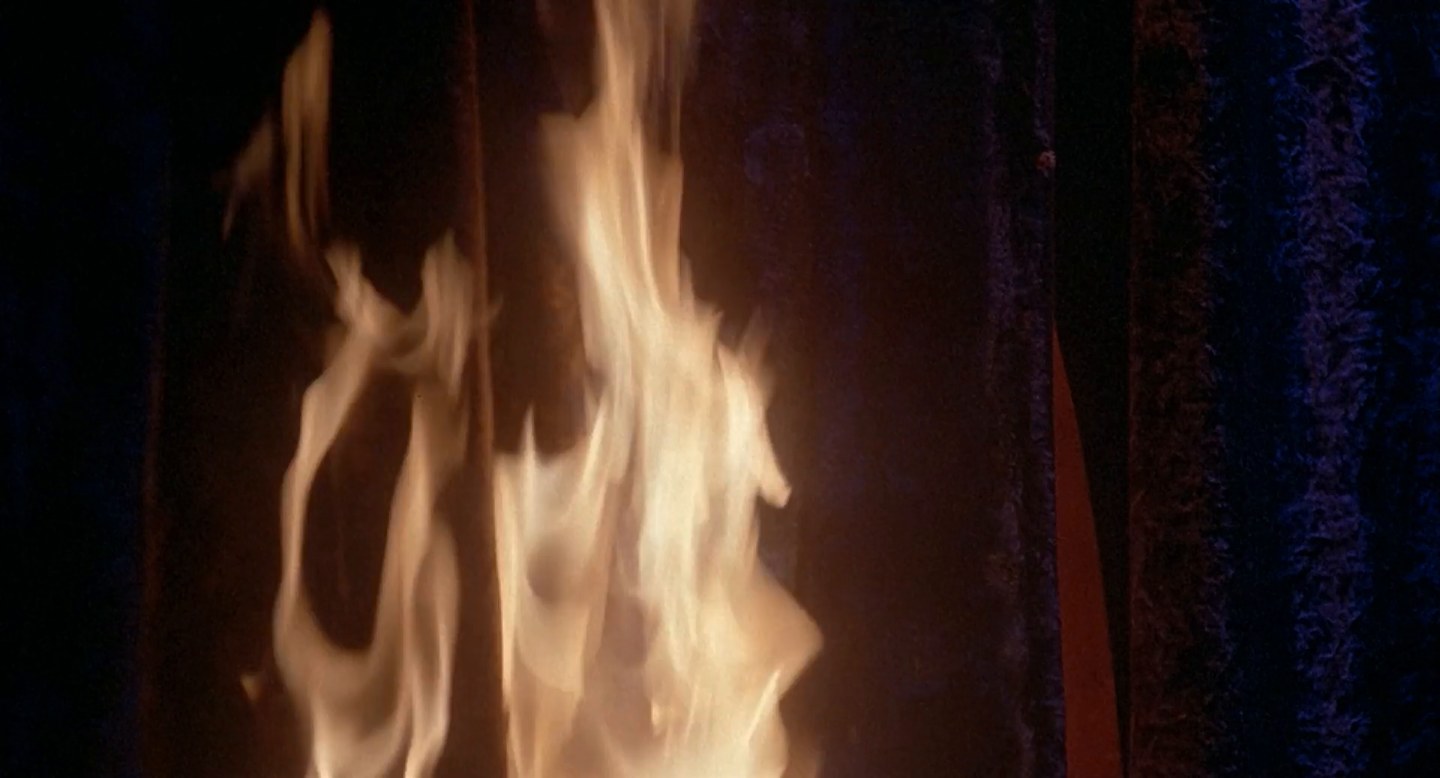
The candle begins as an aid to inspection and becomes a source of destruction. The sequence enlarges the flame from a small practical light to fire filling a body-sized space. This change of scale prepares the building’s final transformation.
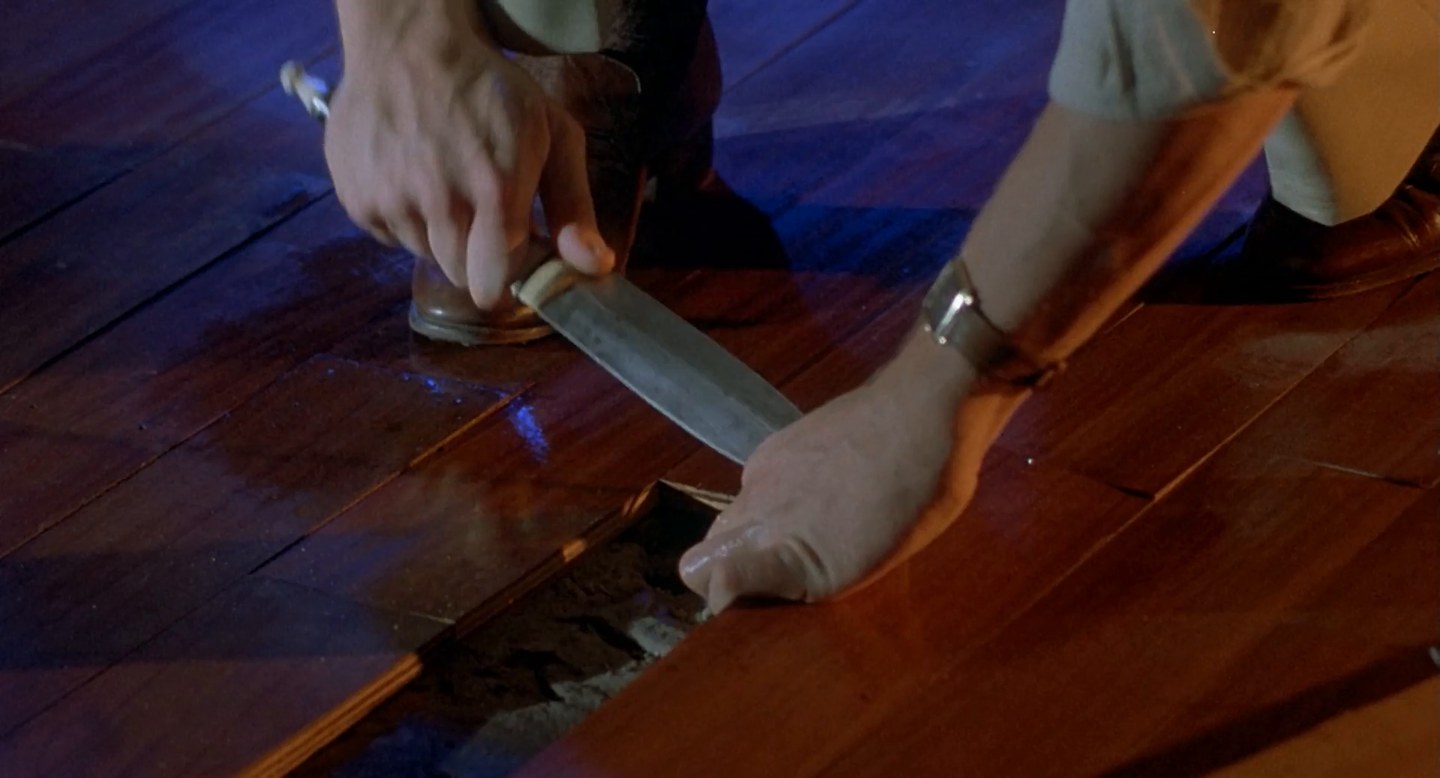
The finished surface of a room becomes something to measure, strike and lift. Mark’s search takes the house apart by hand. Where Rose entered water beneath the floor, he enters a dry network of cavities and passages.
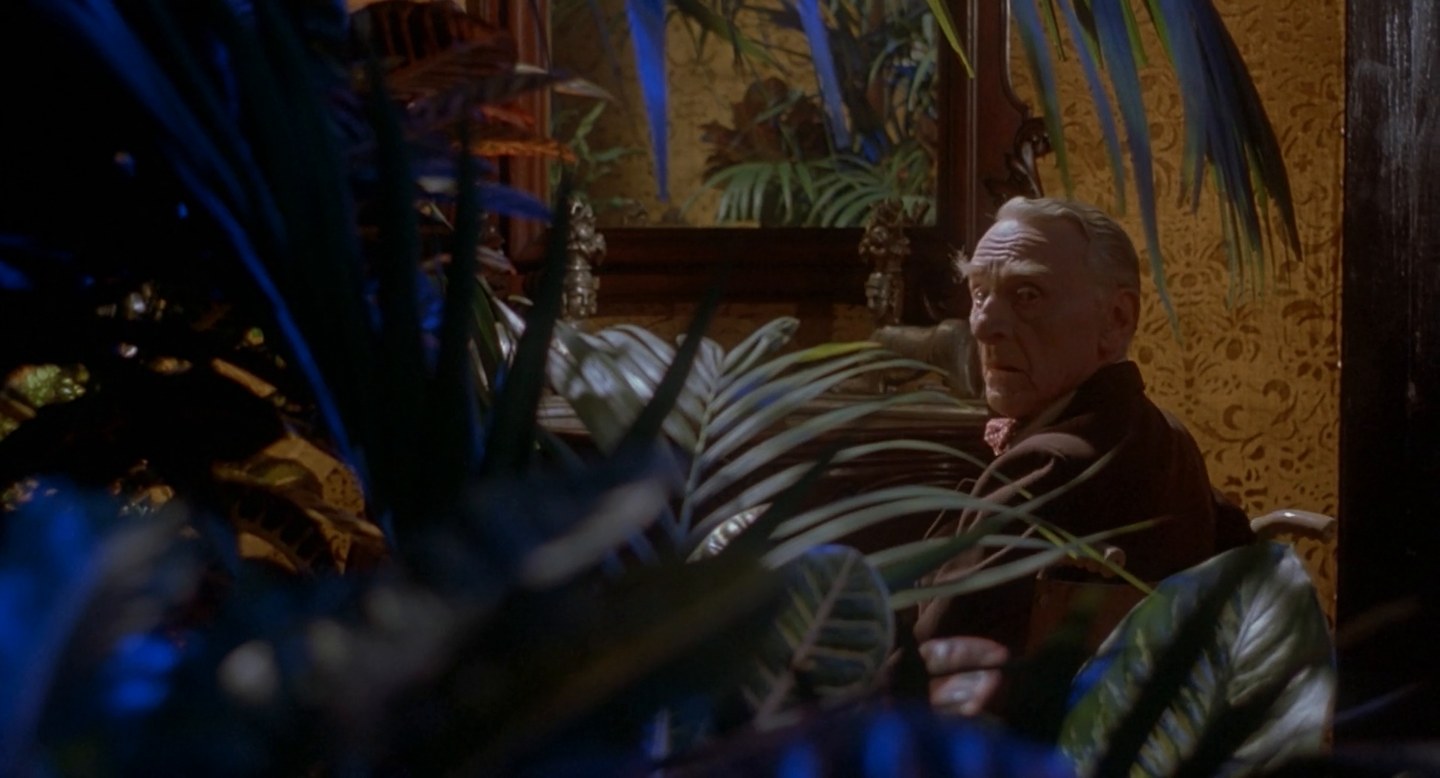
The encounter gives the architecture a human witness. In the English subtitles, Varelli describes the house through the language of his own body and identifies himself as its builder. The image surrounds him with apparatus and vegetation, making explanation another enclosed encounter rather than an escape.
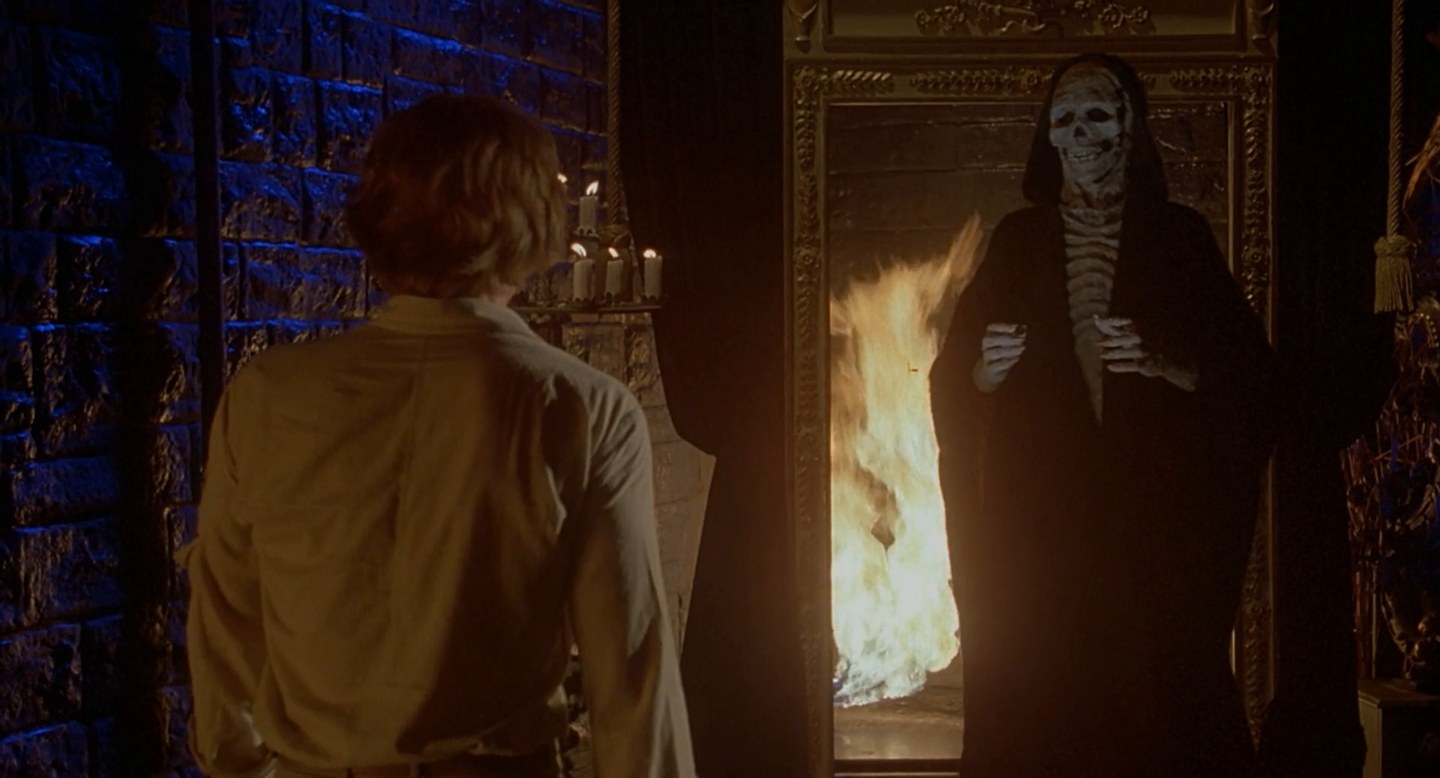
ENLARGE ↗The skeletal figure appears in the mirror frame.
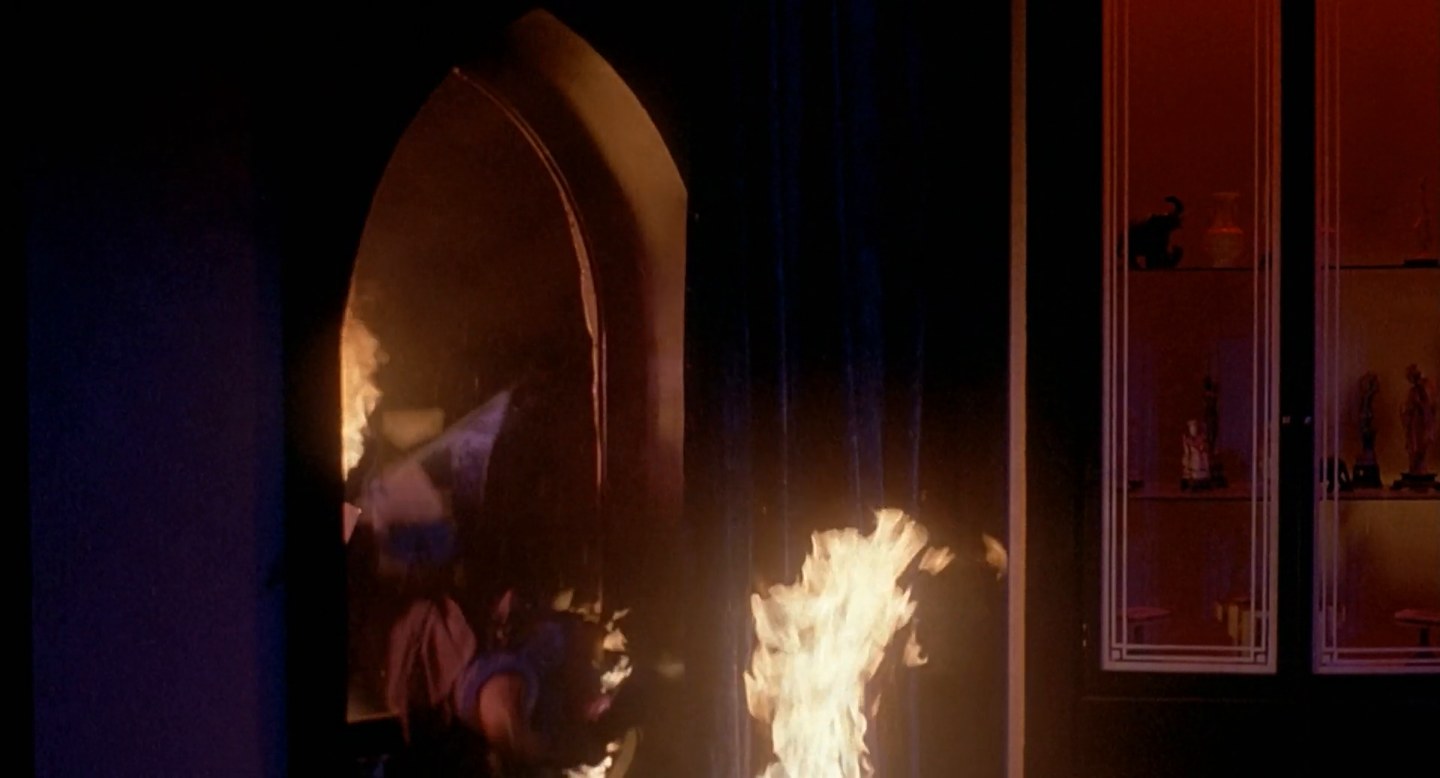
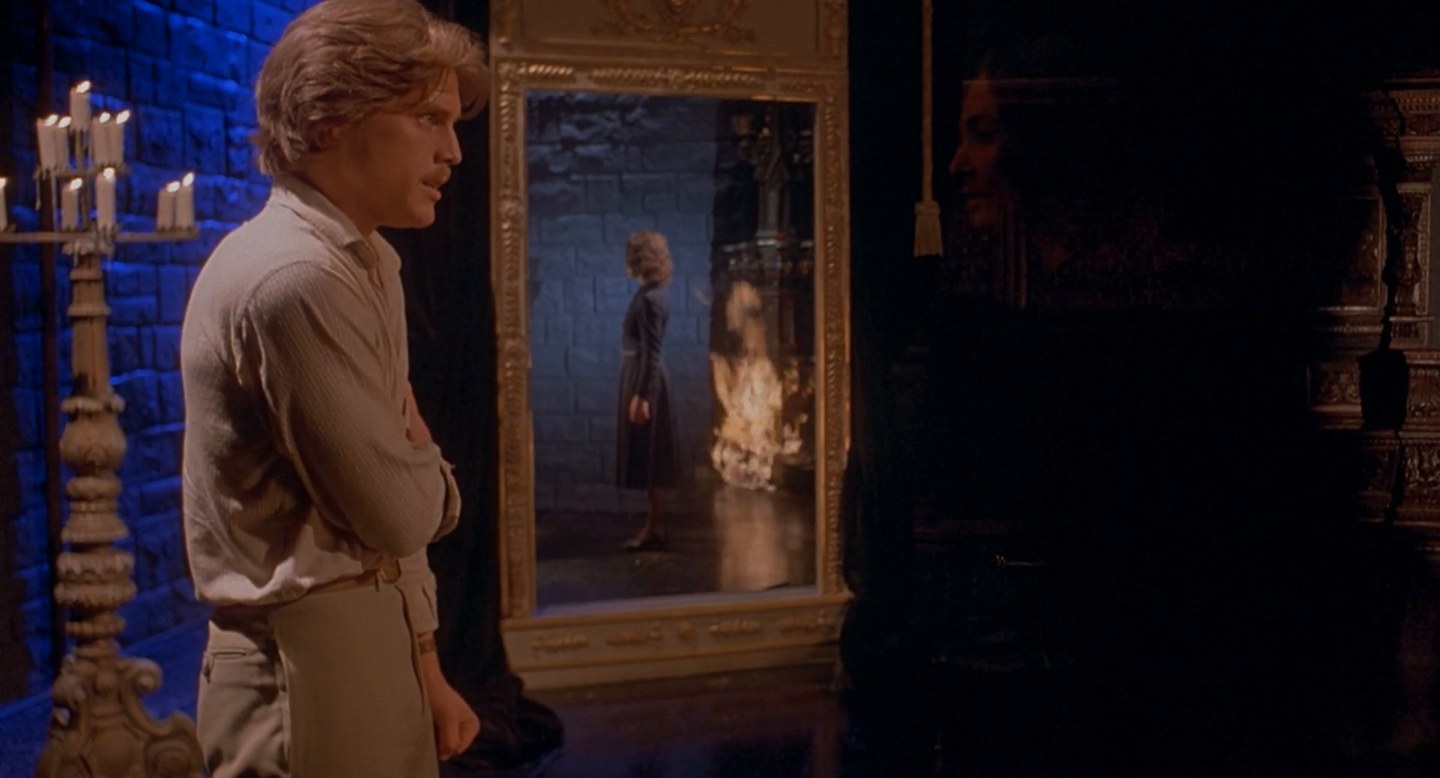
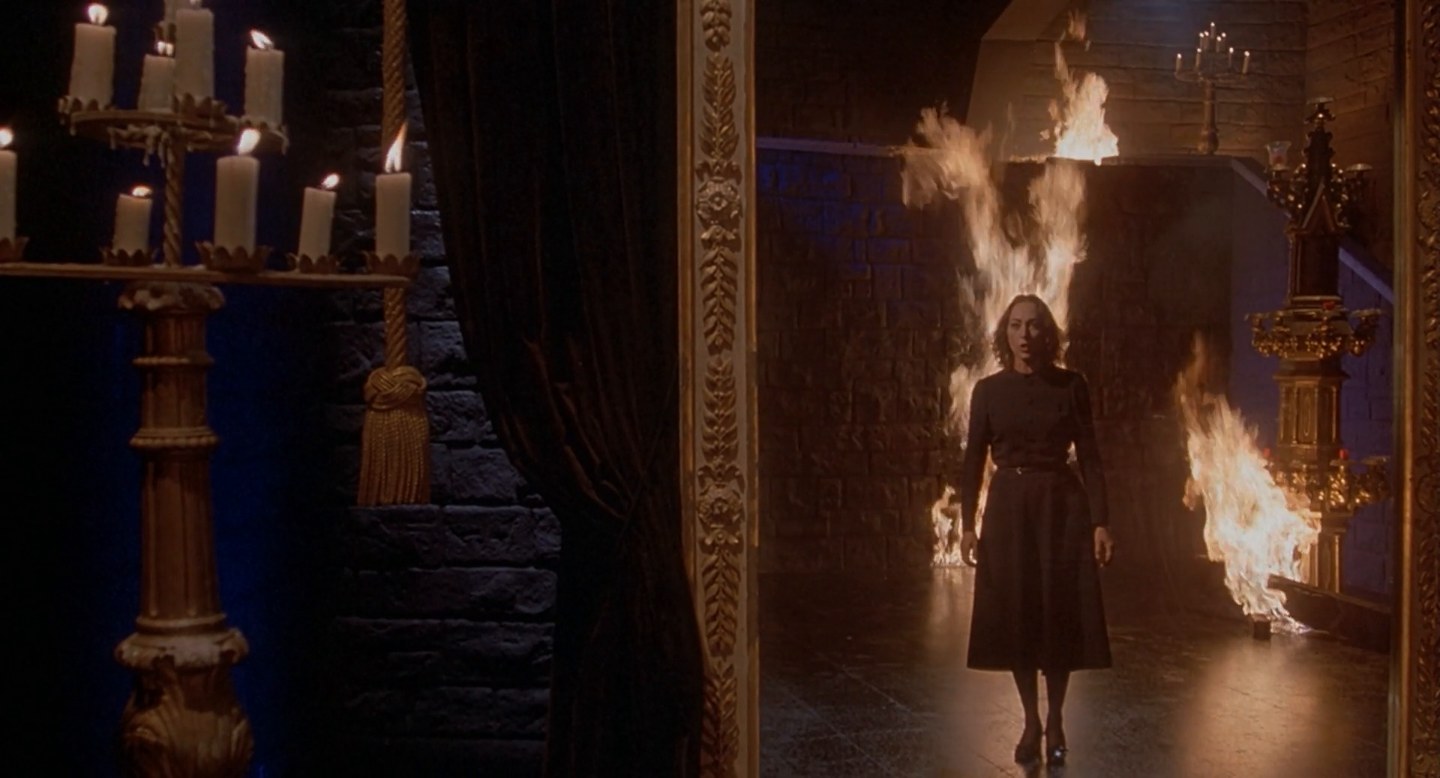
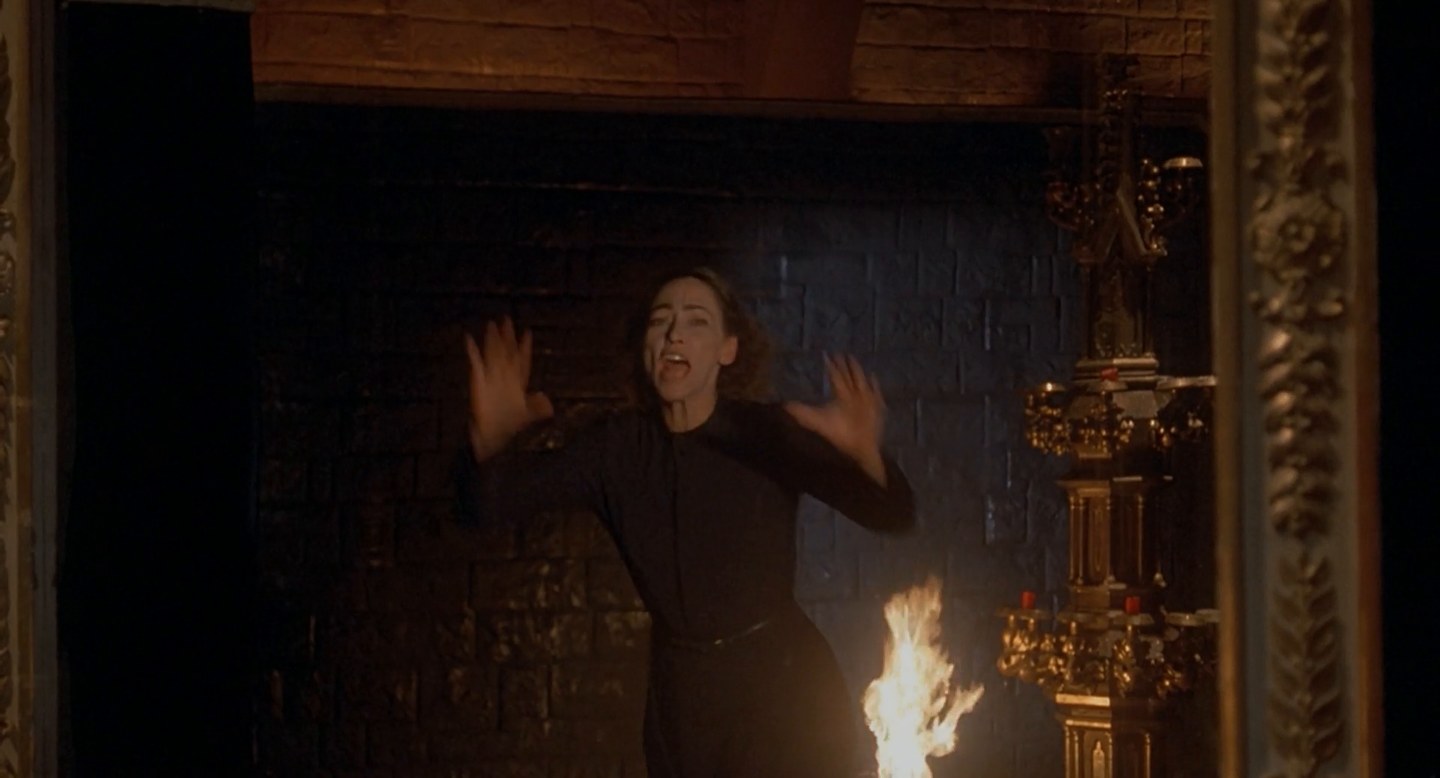
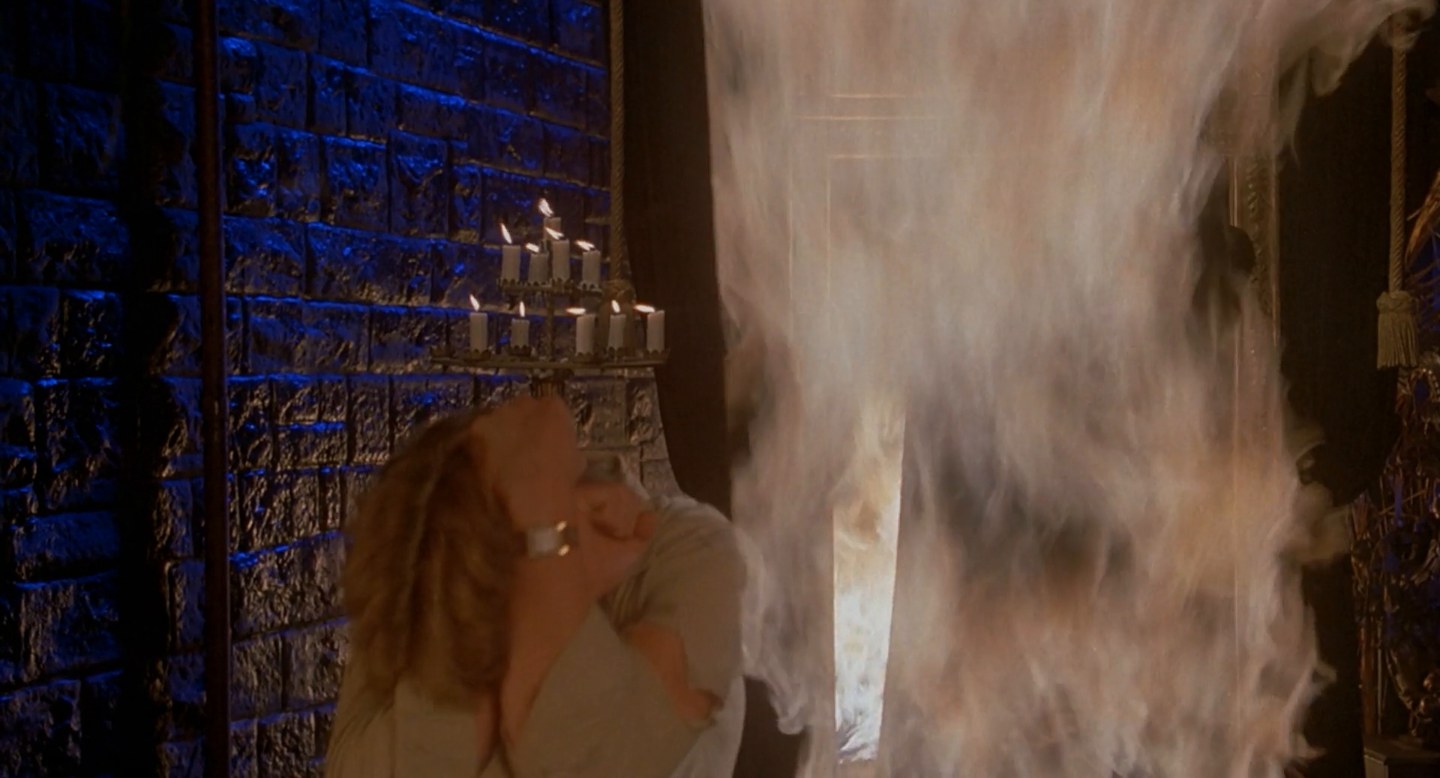
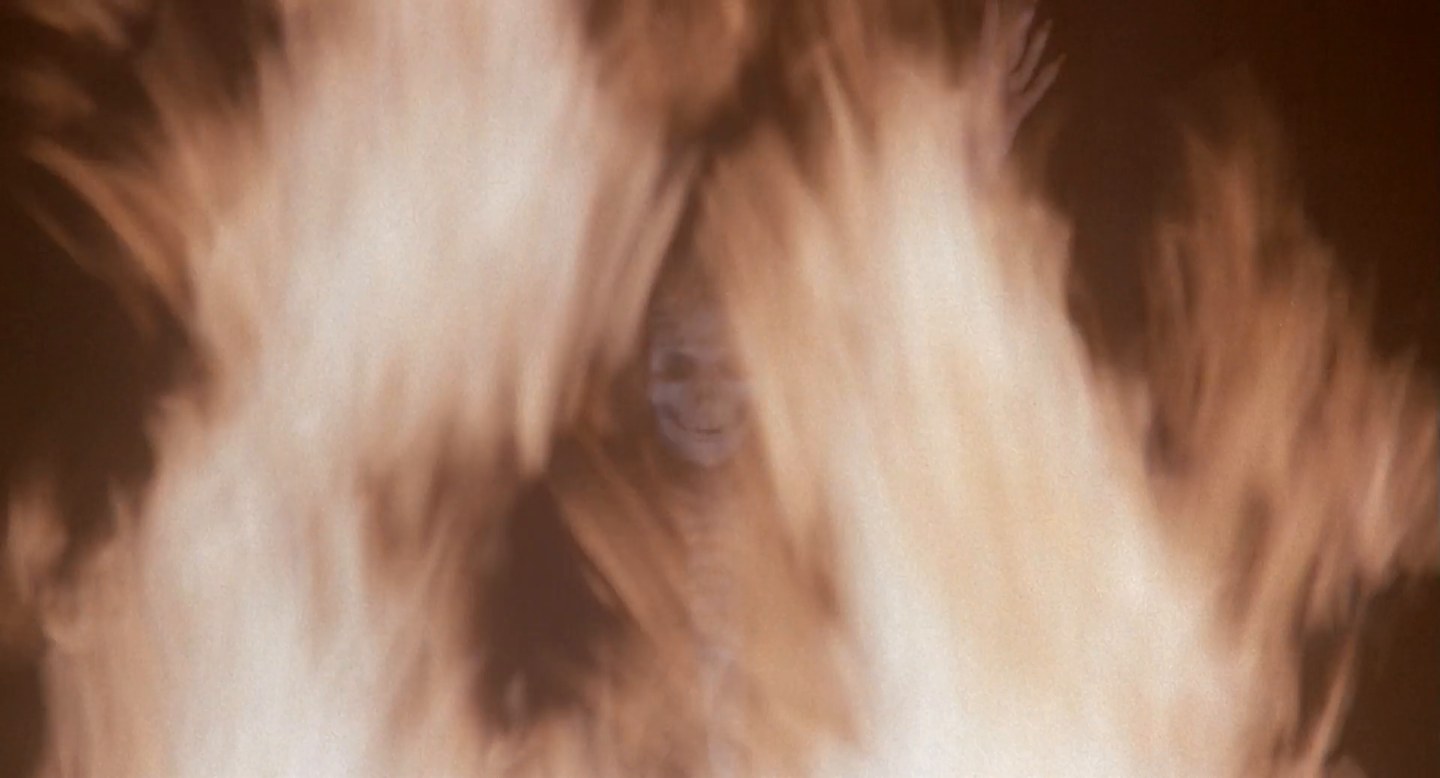
The elaborate frame promises a reflected image, then becomes a theatrical opening for a new figure. The human face yields to the skeleton while fire occupies the surrounding space. The reveal makes the house’s figurative threat into a literal apparition.
Emergency vehicles and people return the film to a recognisable street. Mark’s gaze nevertheless leads back towards the interior and the burning apparition. Leaving the building does not give him a final explanatory view of everything it contained.
A furnished room under water. A doorway used as a weapon. A mirror that becomes an entrance. Each lead image opens a study of the sequence, with an optional gallery tracing its changing stages. Enlarge a frame to move through the gallery.
The sequence first establishes the opening and the keys, then allows the underwater room to become familiar through repeated views of Rose, the chandelier and the furniture. Her return to the surface briefly restores an orientation. The second descent makes the same space threatening: the object she can retrieve shares the room with a body she did not expect. Water carries both performer and apparition through the frame. Argento’s account of a studio pool and Irene Miracle’s swimming ability belongs beside this visible physical performance.
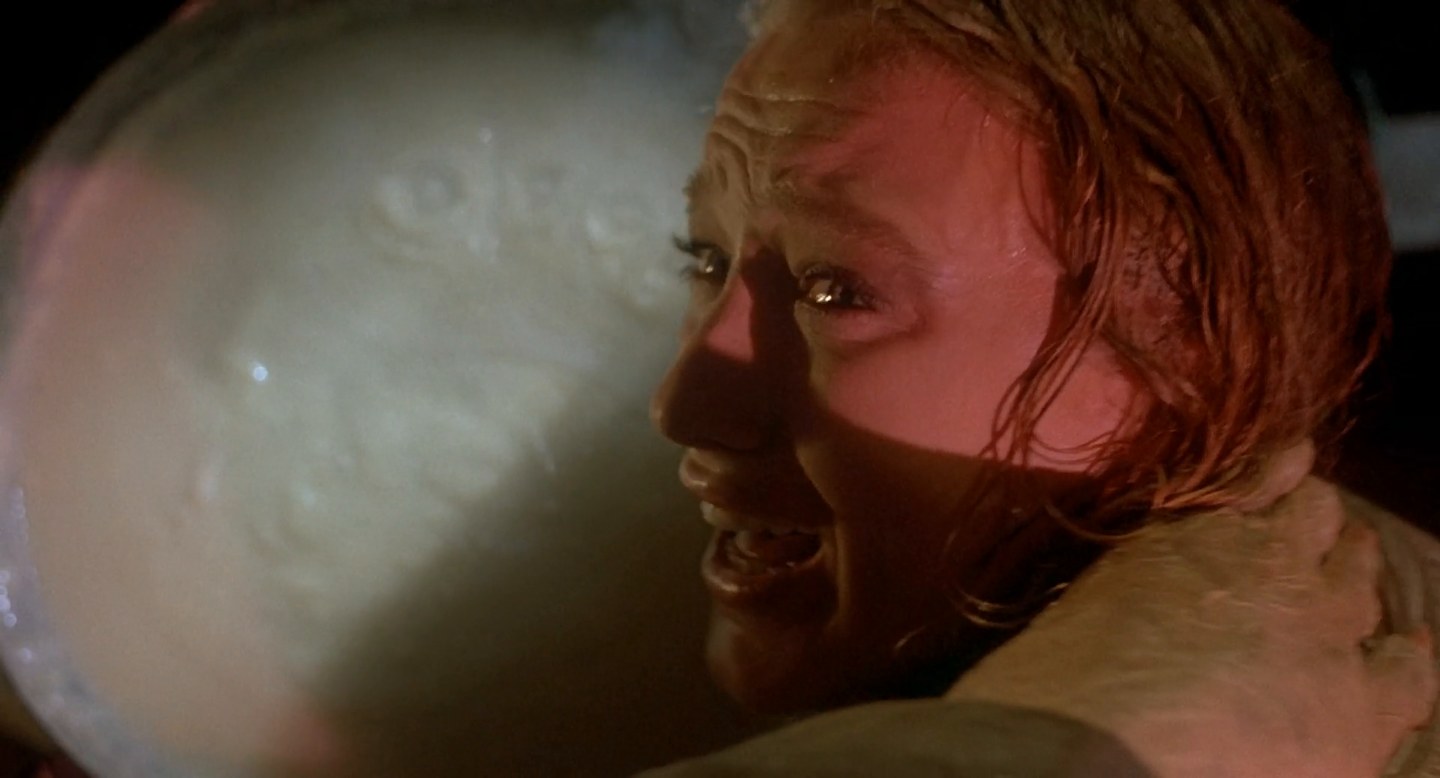
Flames, workbenches and a figure with his back turned turn a request for directions into an uncertain encounter. Sara holds the book against her body; the attack then compresses the space into reaching arms, wet hair and a doorway. The exit does not restore an ordinary library. It moves her into the rain, with the book and the attacker still governing the movement.
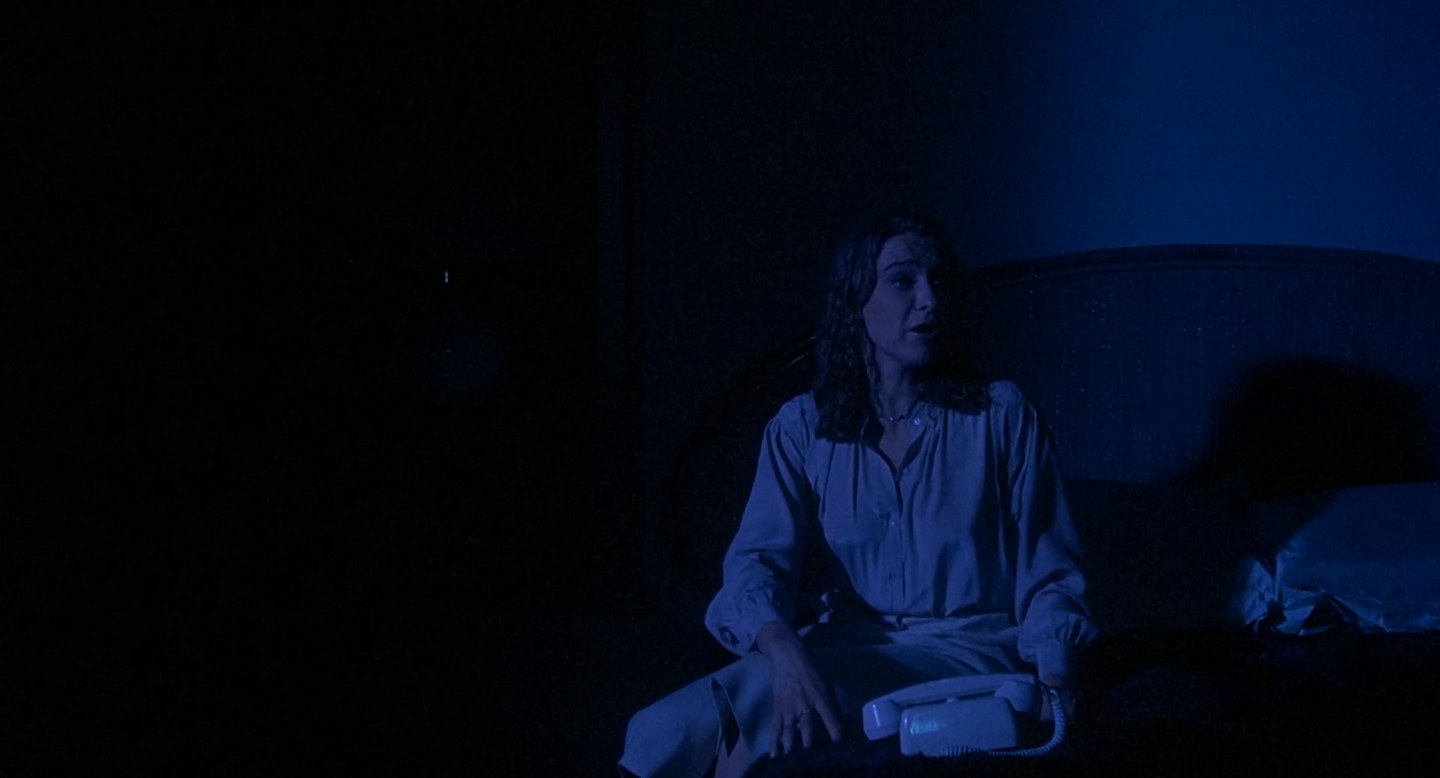
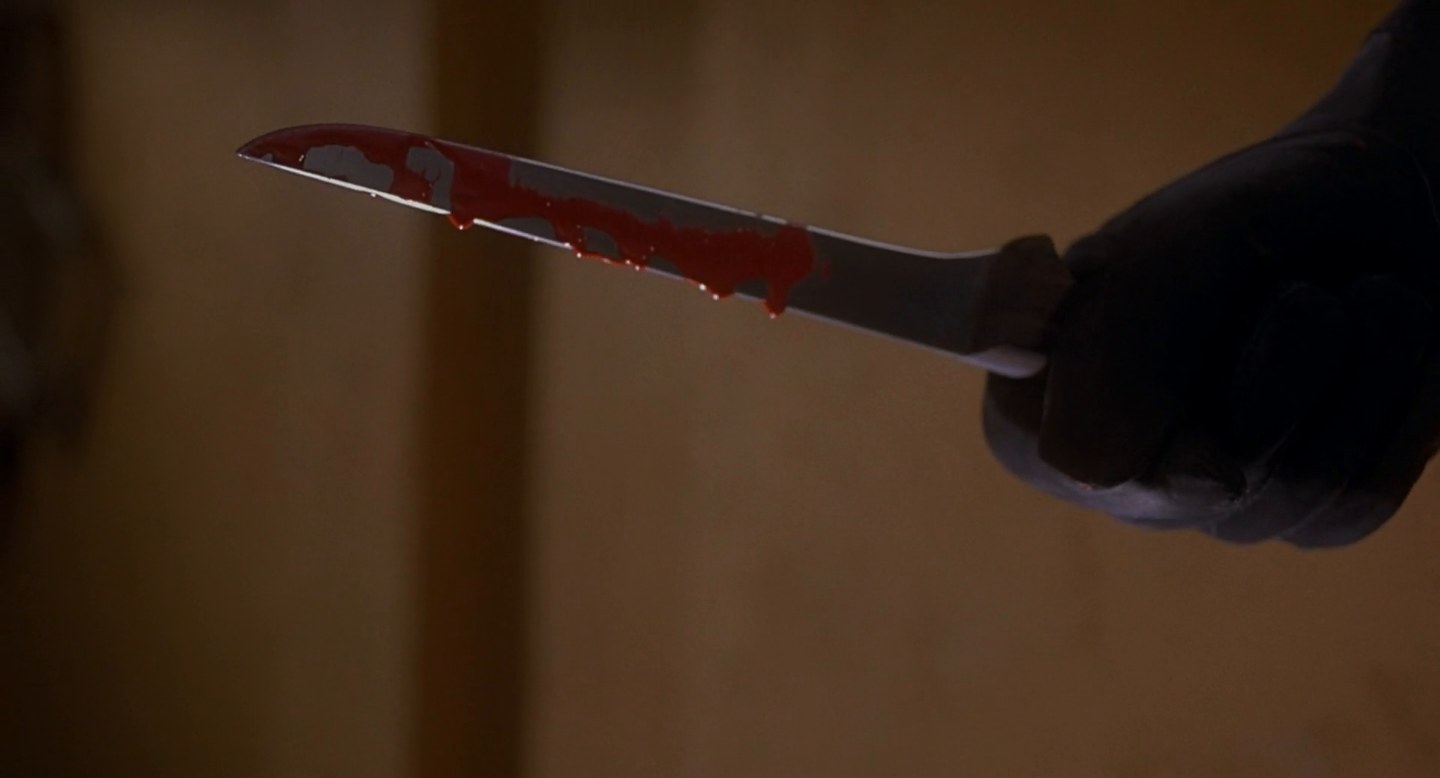
The corridor is visible well before the attack. Alternating views of Sara, Carlo and the empty passage build a geography of waiting. Carlo reappears carrying the wound into that geography: the embedded blade and the blood at his mouth are presented in close view. His fall traps Sara beneath the very person whose presence had offered reassurance. The bloody blade then becomes a separate image before the attack turns fully on her.
ENLARGE ↗Her eyes remain visible between the fingers.
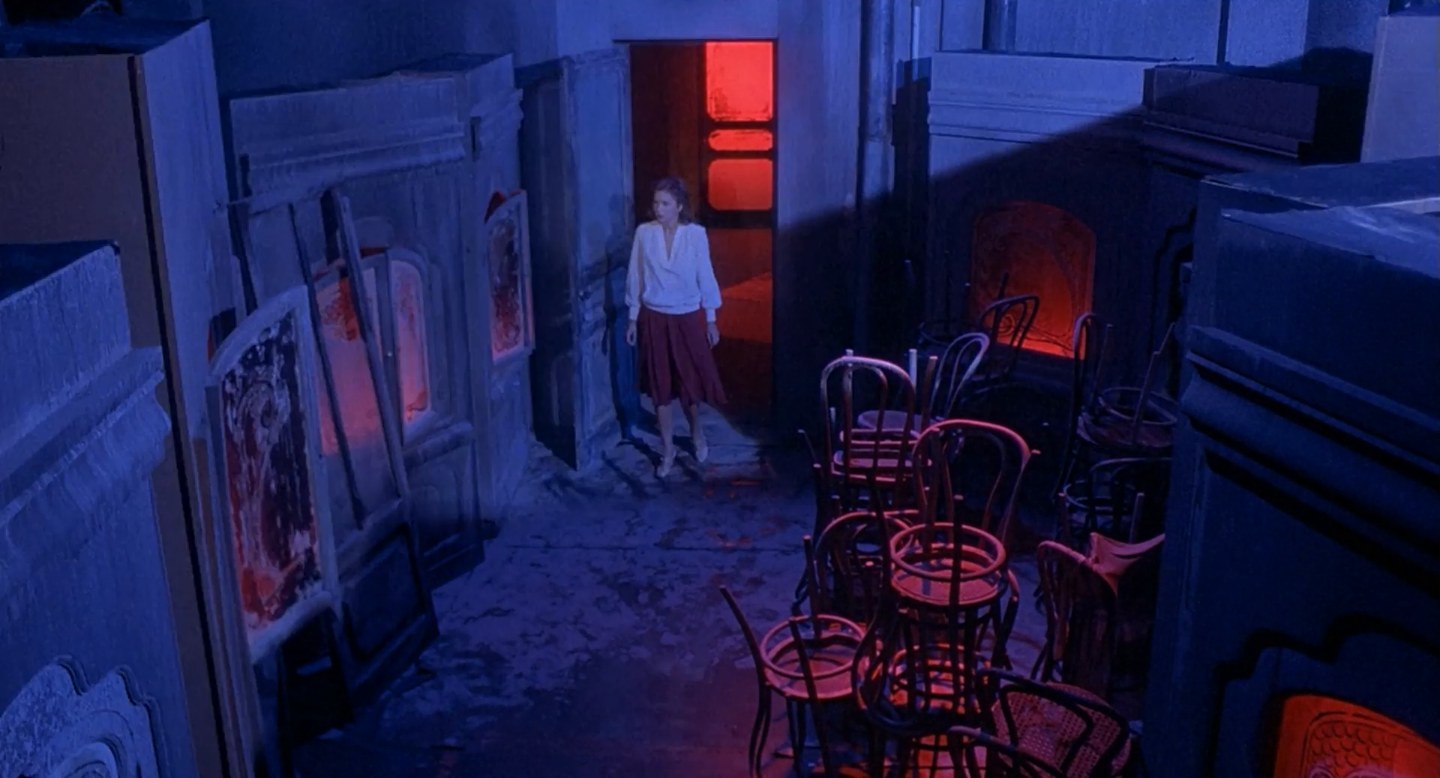
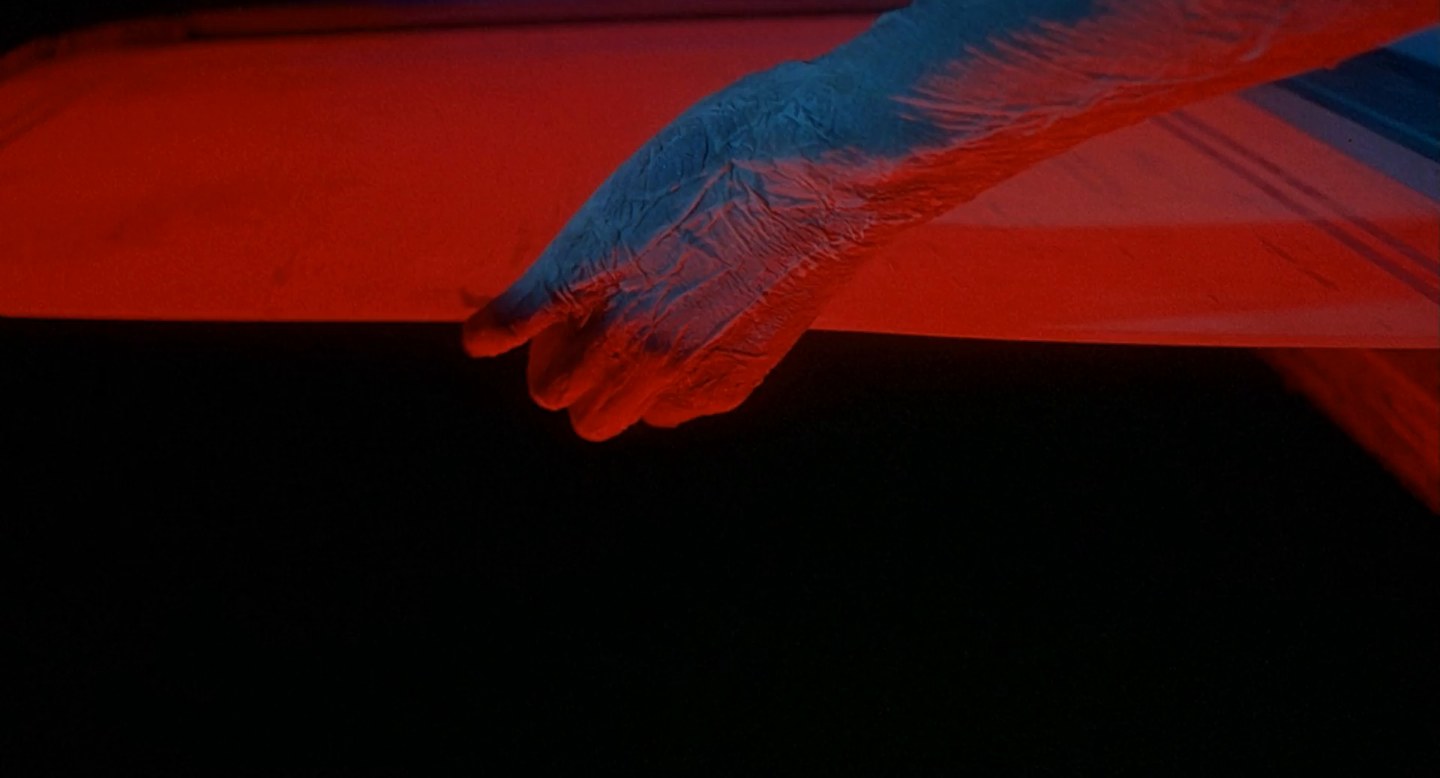
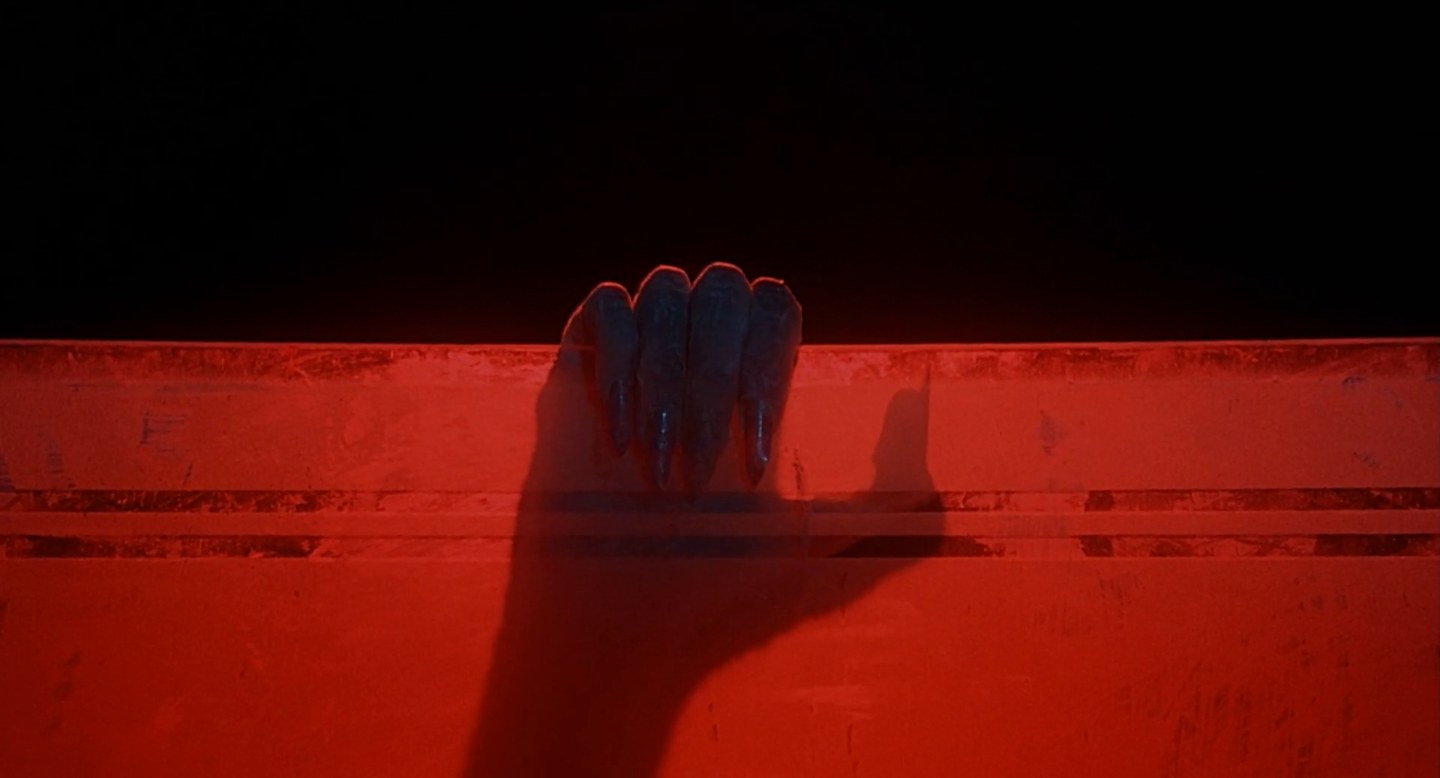
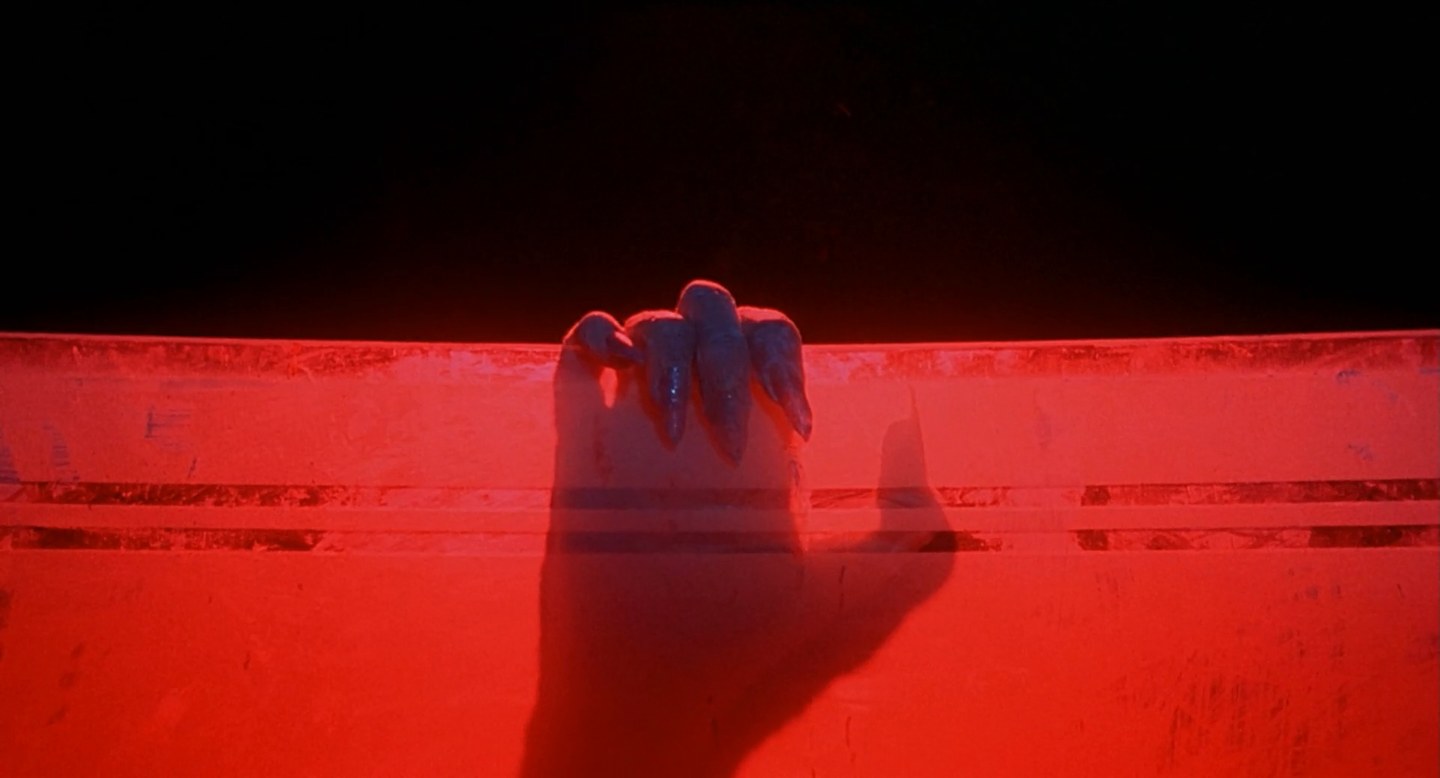
The ruined rooms establish exposed material and broken surfaces before the attack concentrates on a single red panel. Hands close across Rose’s face; the view then divides her struggle into eyes and fingers. Repeated views of the panel edge make its movement legible without supplying a comfortable overview of the killer. The final image leaves the red architecture and the injured body in one composition.
The staircase supplies a route but not a secure destination. Elise repeatedly looks up or across barriers before the attack starts. Wider images of animals against her clothing alternate with isolated teeth and claws, splitting the assault into incompatible scales. The raised knife near the end changes the threat again. A viewer can follow the escalation without attributing every insert to one continuous viewpoint.
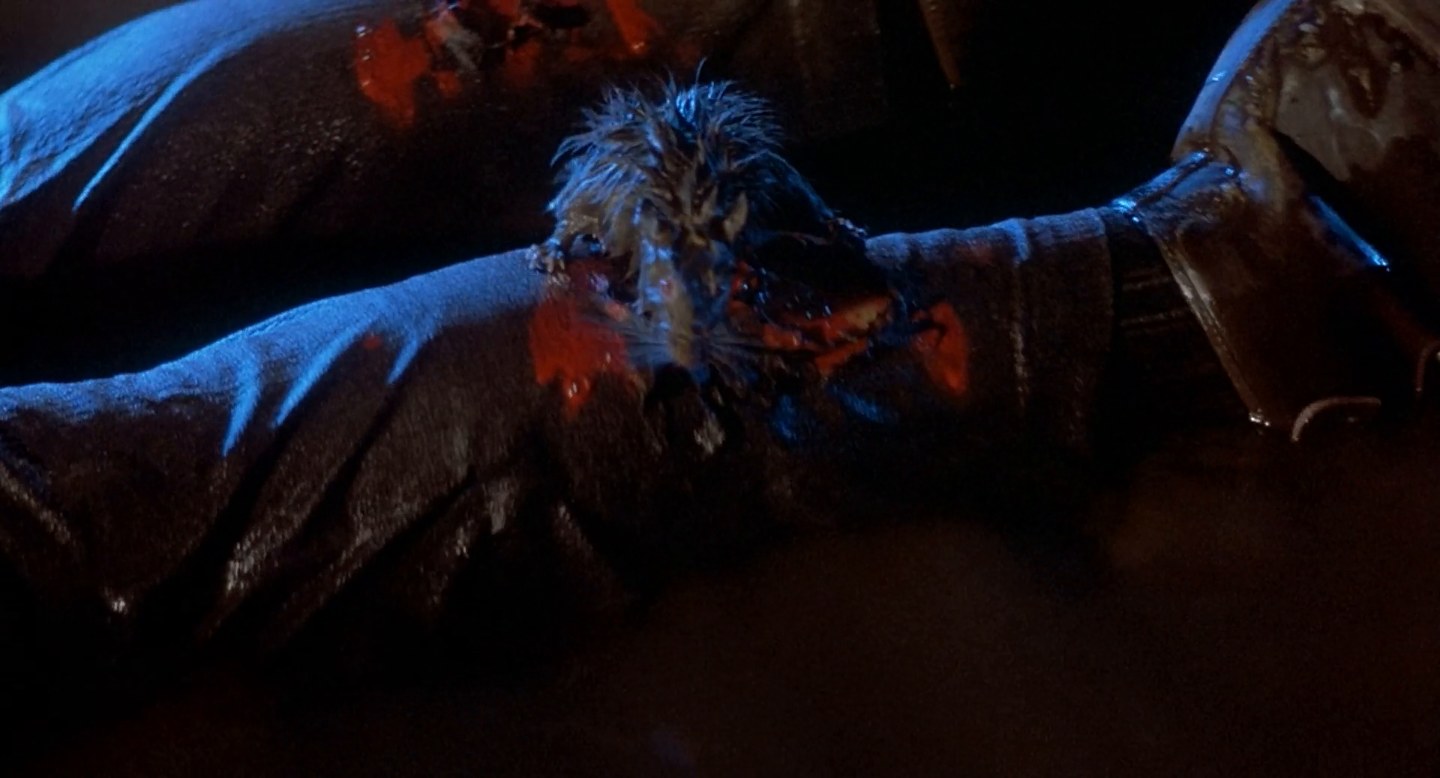
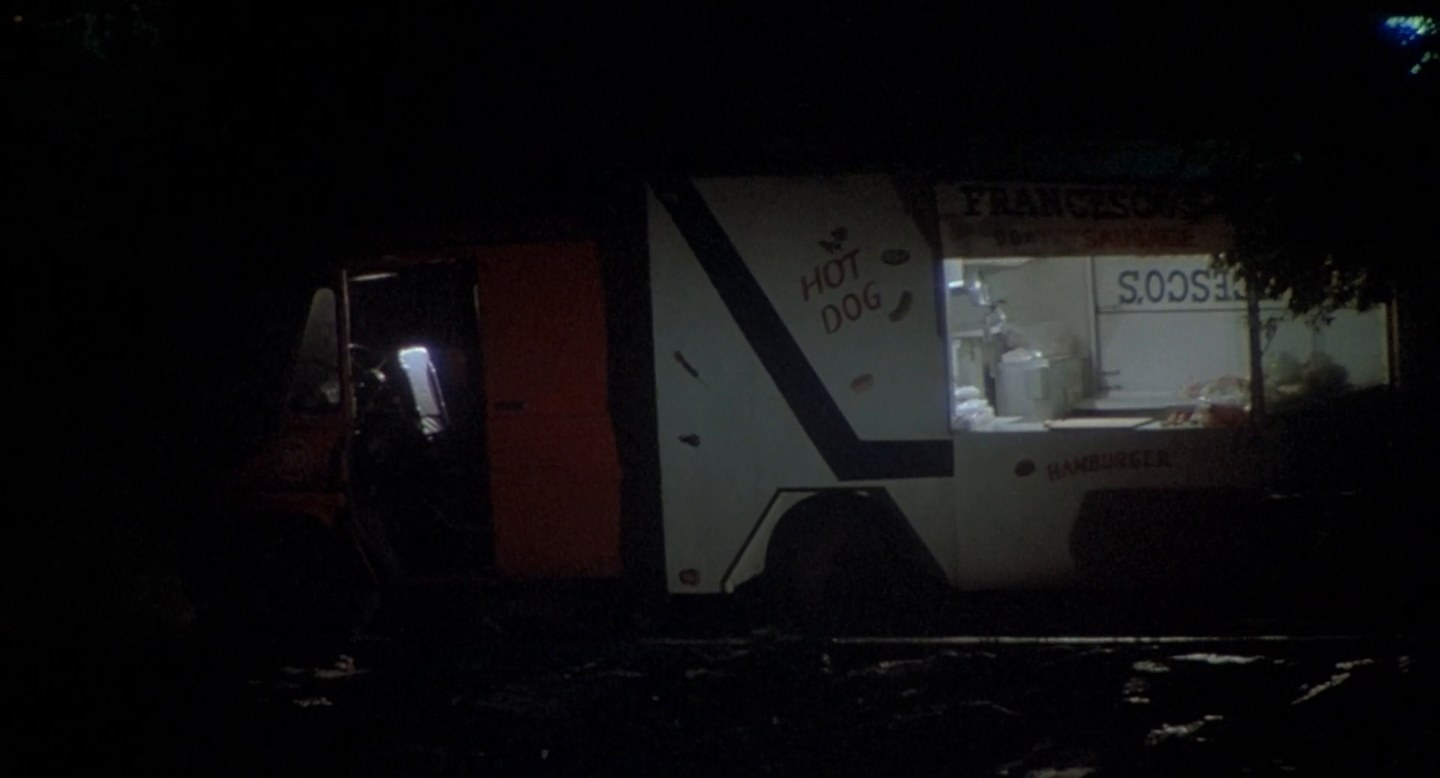
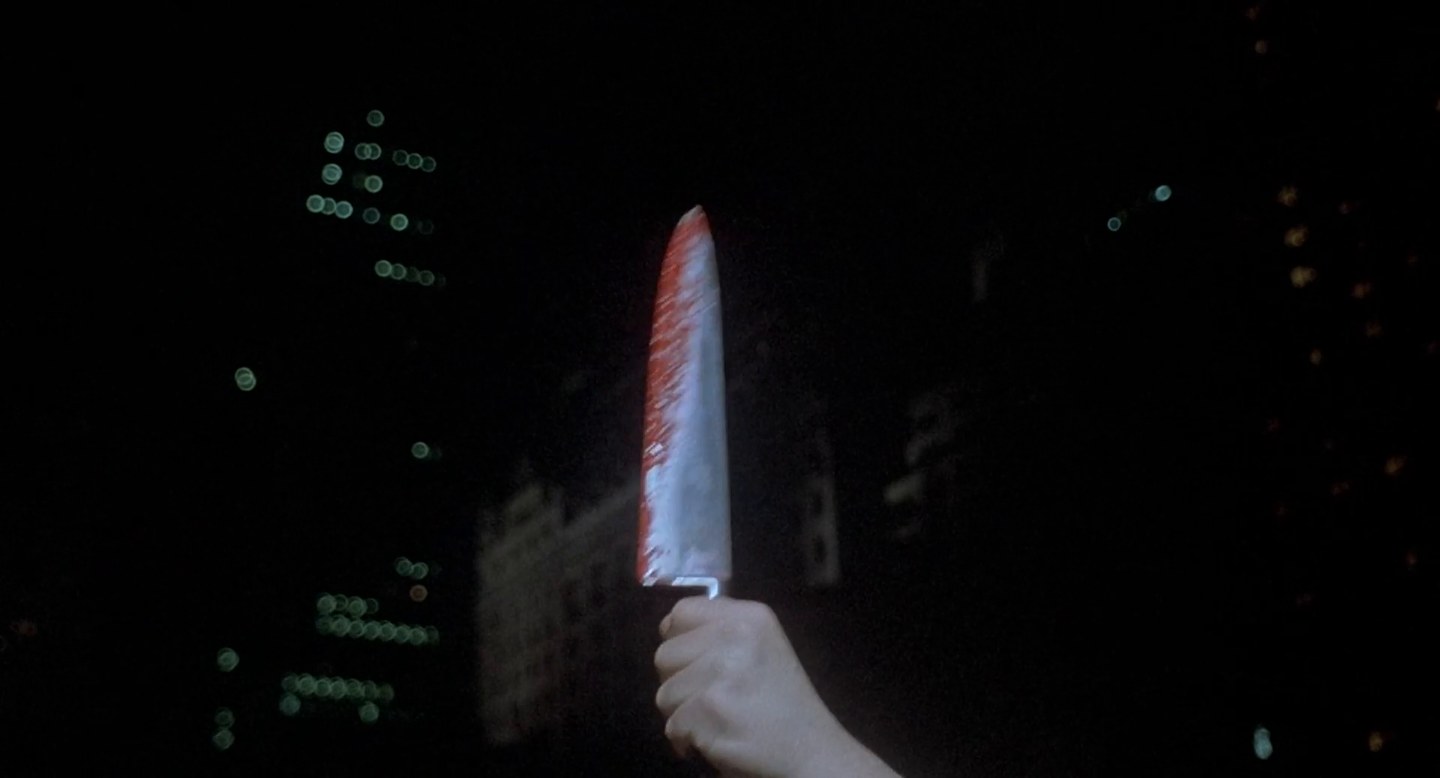
The sequence moves from the apparent freedom of the park to a body unable to leave the water. The crutches and the long view across the bank make escape a matter of physical distance. Rat inserts reduce that distance to contact with clothing and skin. When the vendor approaches, the promise of help is briefly embodied in another person; the raised cleaver reverses it. The film’s final close views present injury rather than an explanation of the force directing the attack.
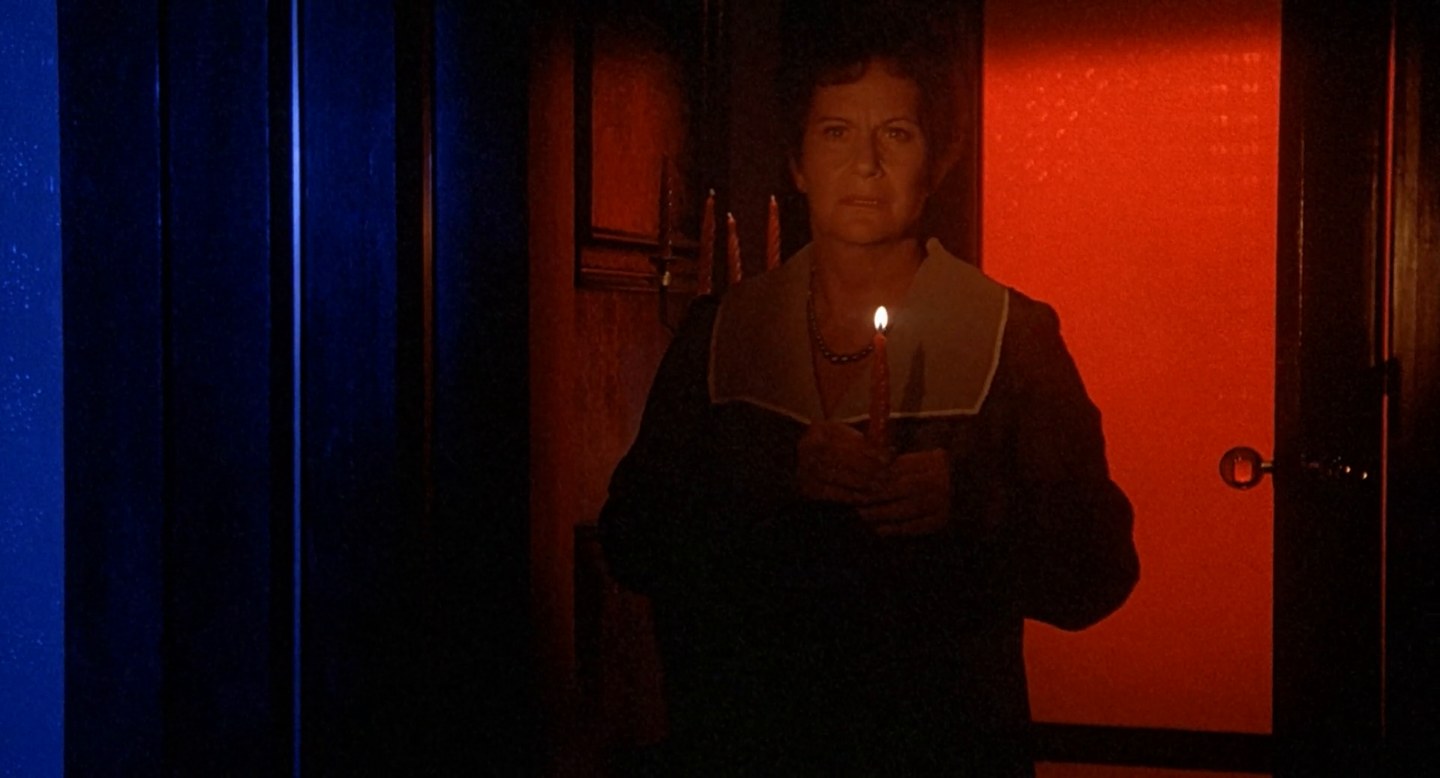
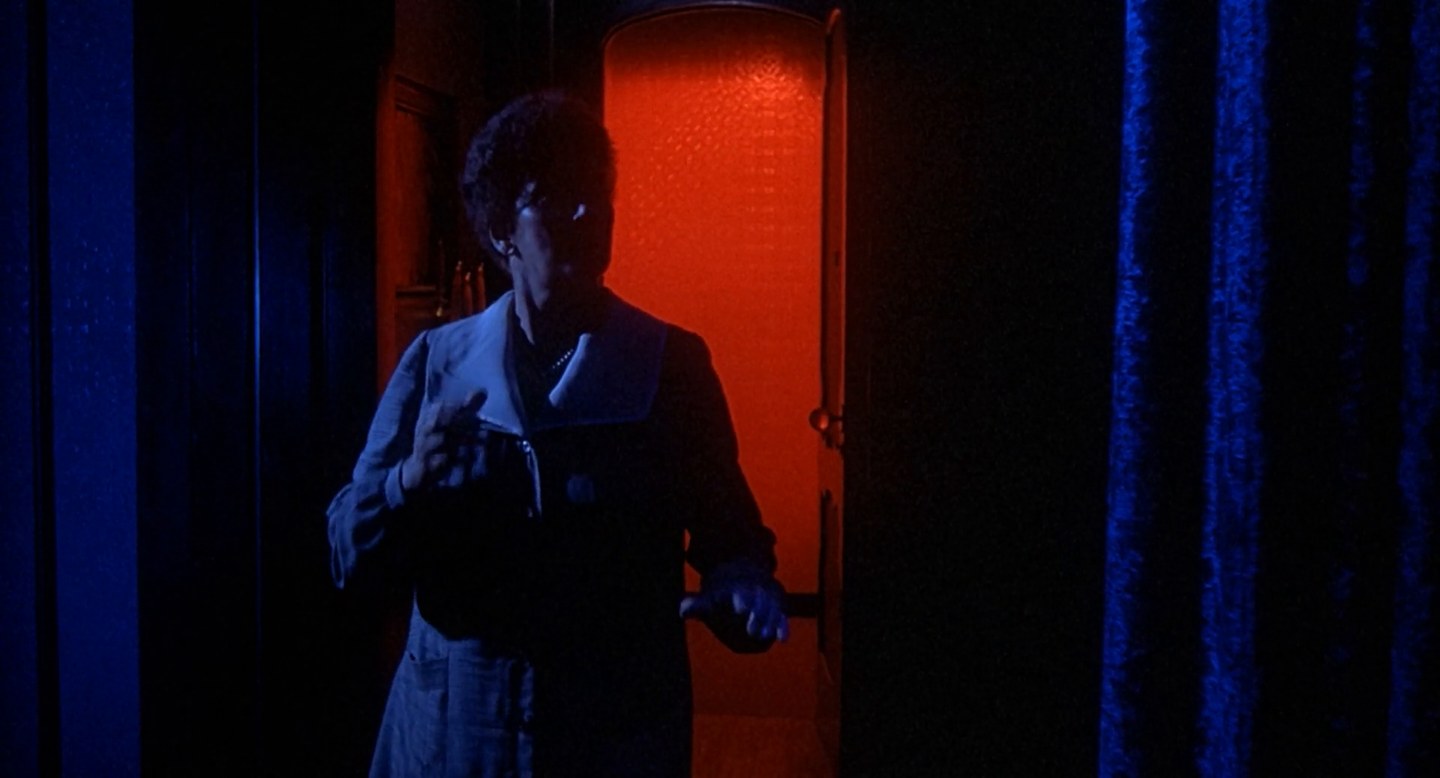
The caretaker’s last movements are broken across a telephone, doors and drapery. Carol subsequently inspects the space, and the film postpones the face by showing feet and fragments first. The mutilated eyes arrive as a frontal reveal. The candle she carries then transfers attention from a completed killing to an unfolding fire, joining a makeup image to a separate sequence of physical movement and flames.
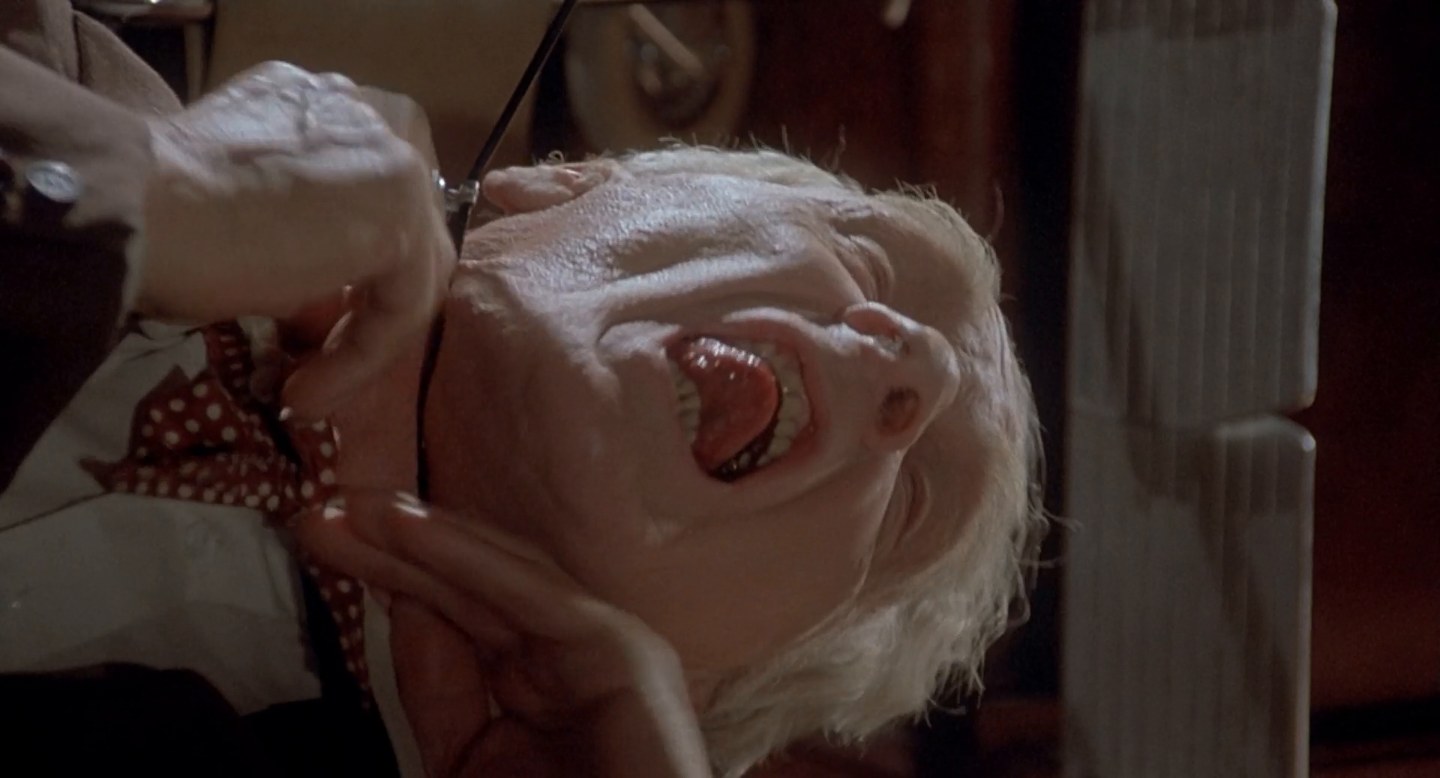
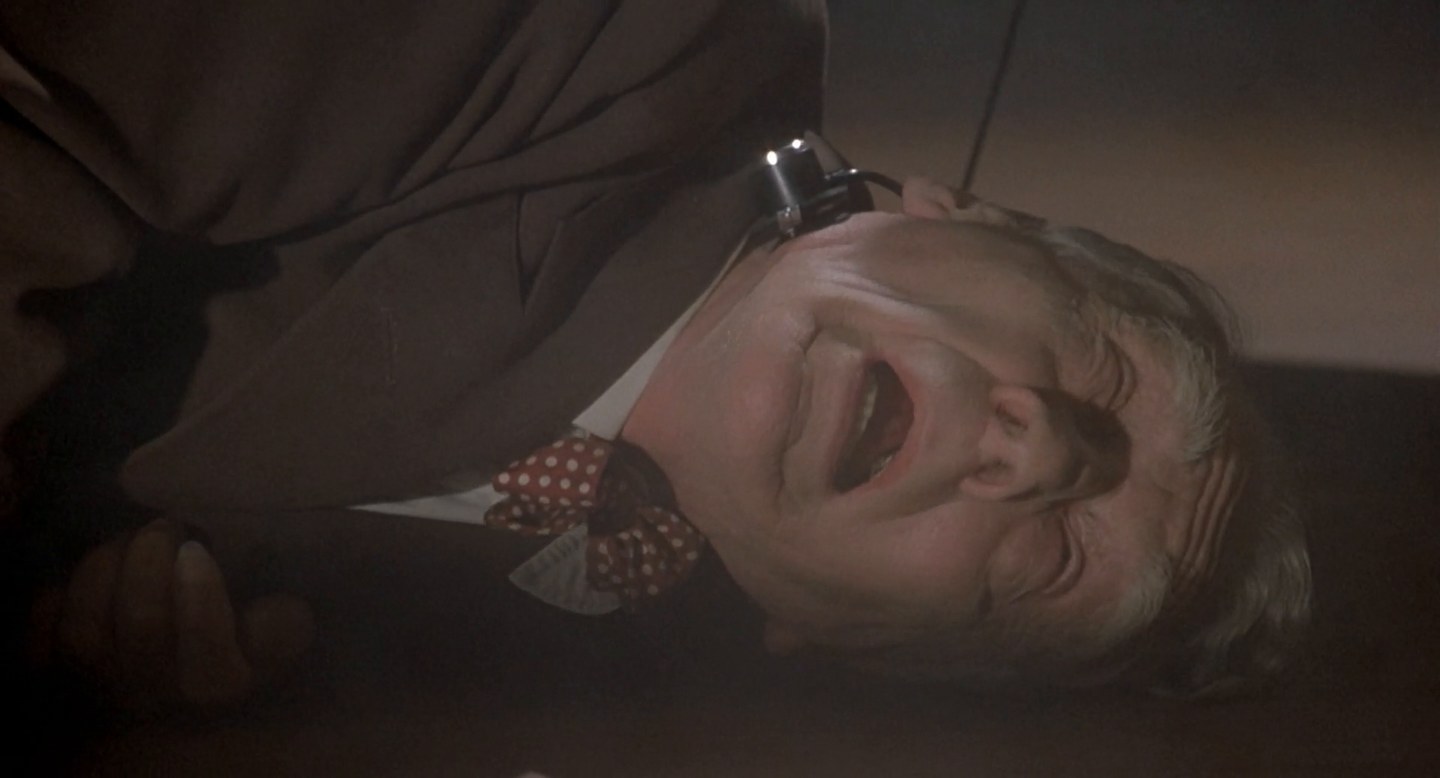
ENLARGE ↗Varelli struggles against the cord at his neck.
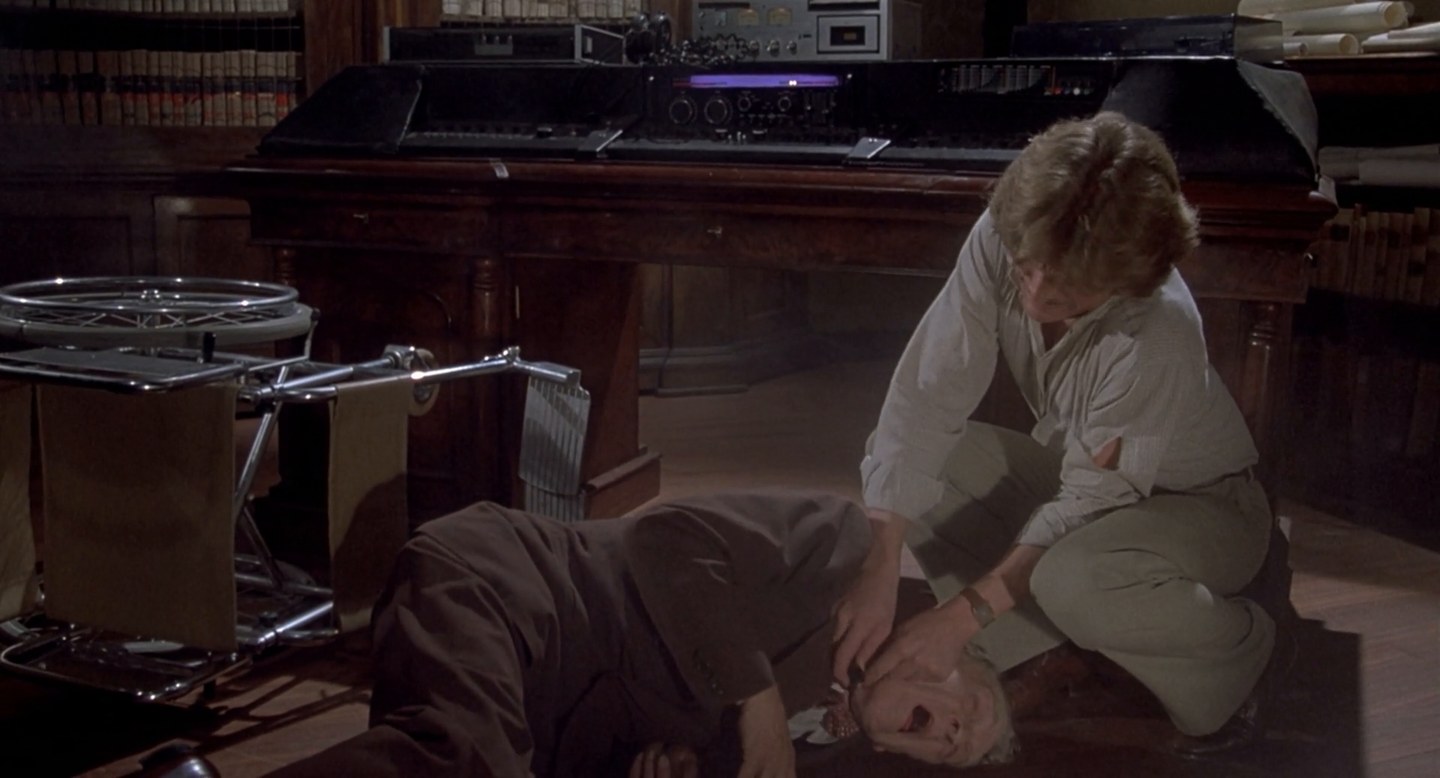
The room of plants and machinery gives the meeting an appearance of controlled explanation. Its physical apparatus then becomes part of the danger. Close views of Varelli and Mark’s injured arm break the conversation into bodily details. When Mark kneels beside the fallen man, the apparatus remains in the background: the source of information is still inseparable from the room that contains him.
ENLARGE ↗The skeleton appears in the mirror frame.
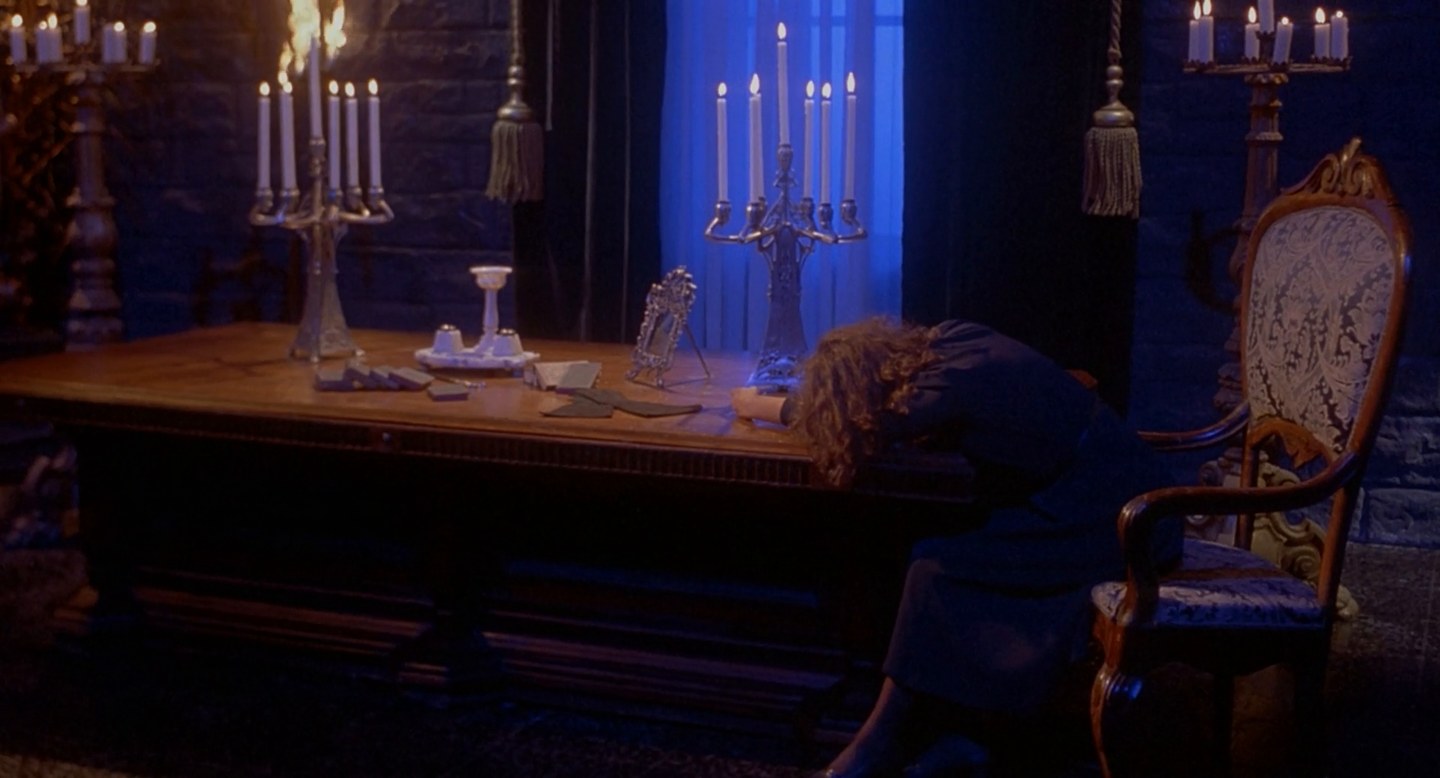
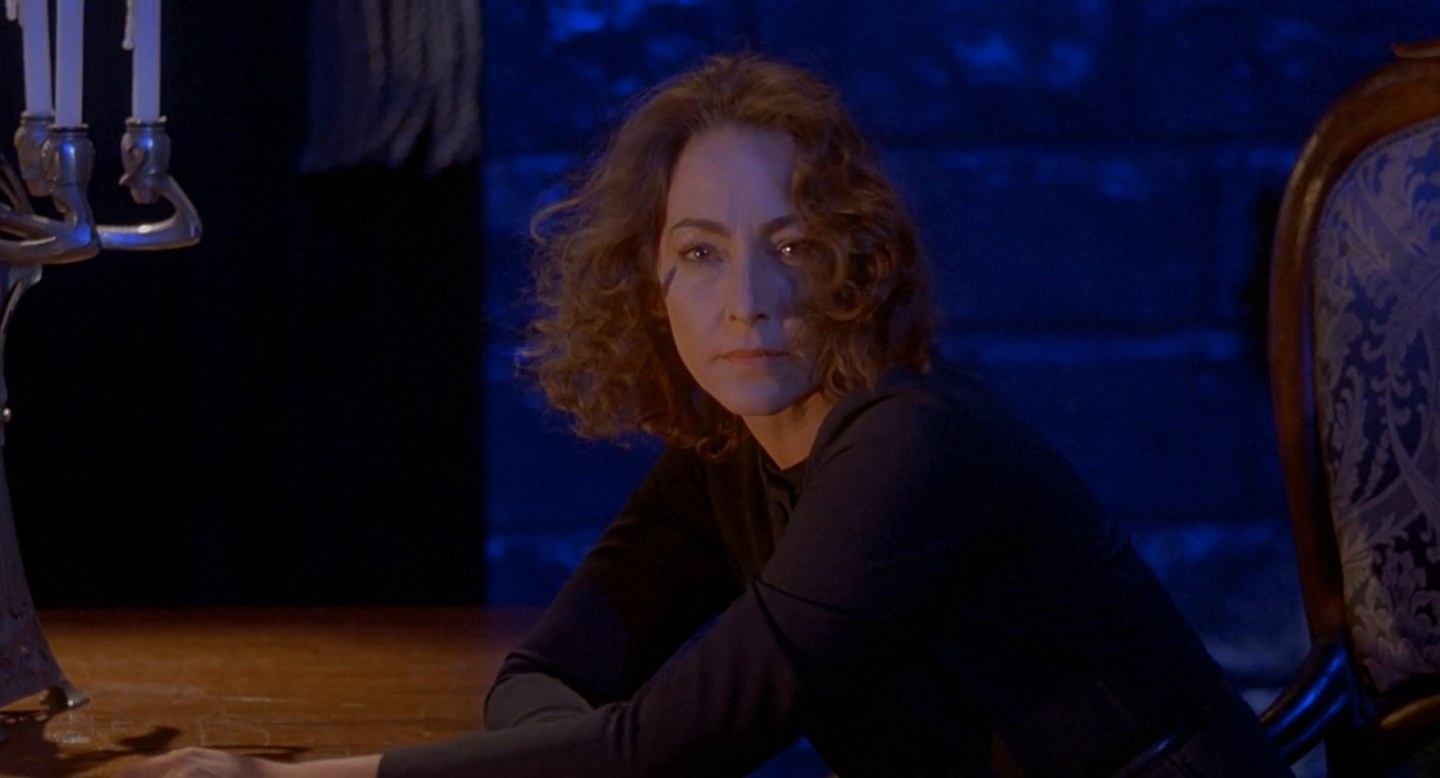
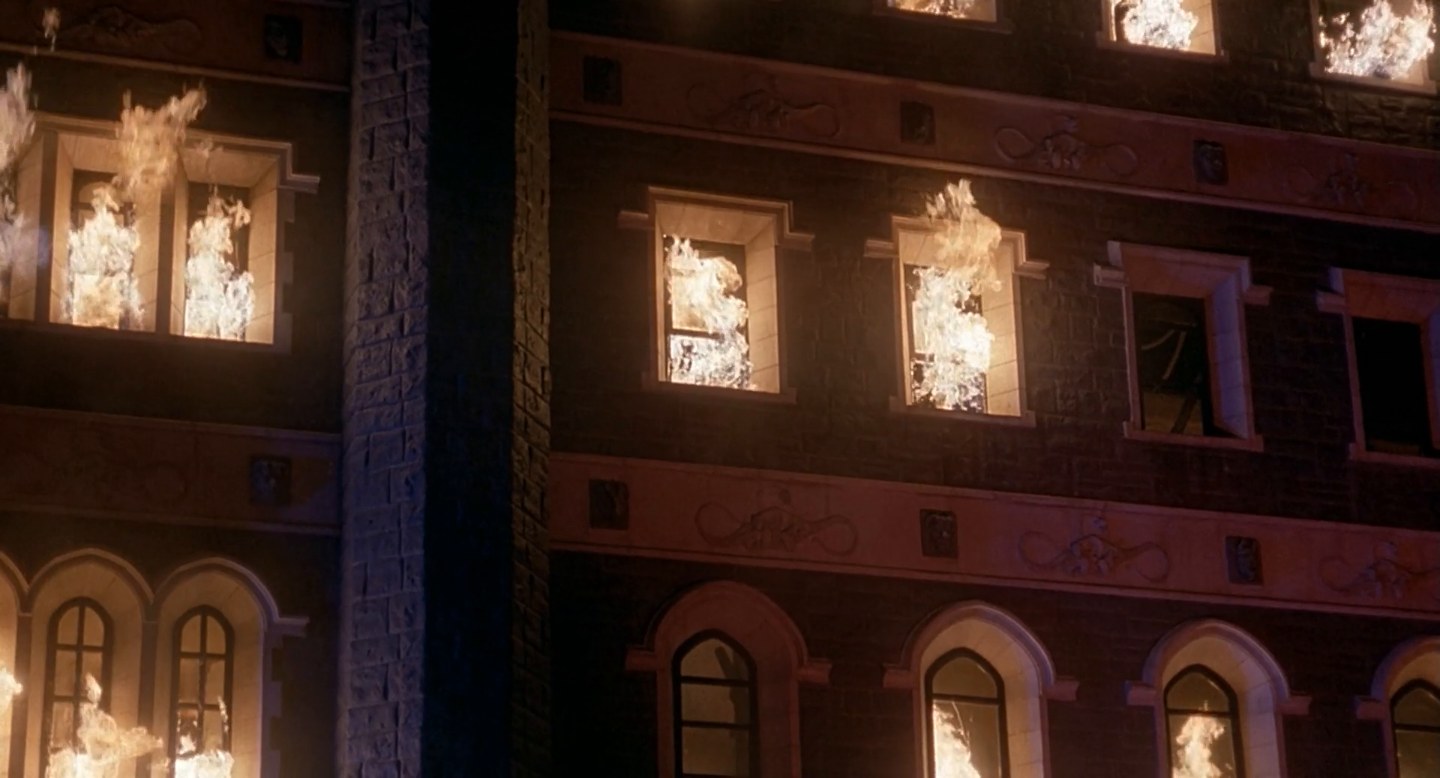
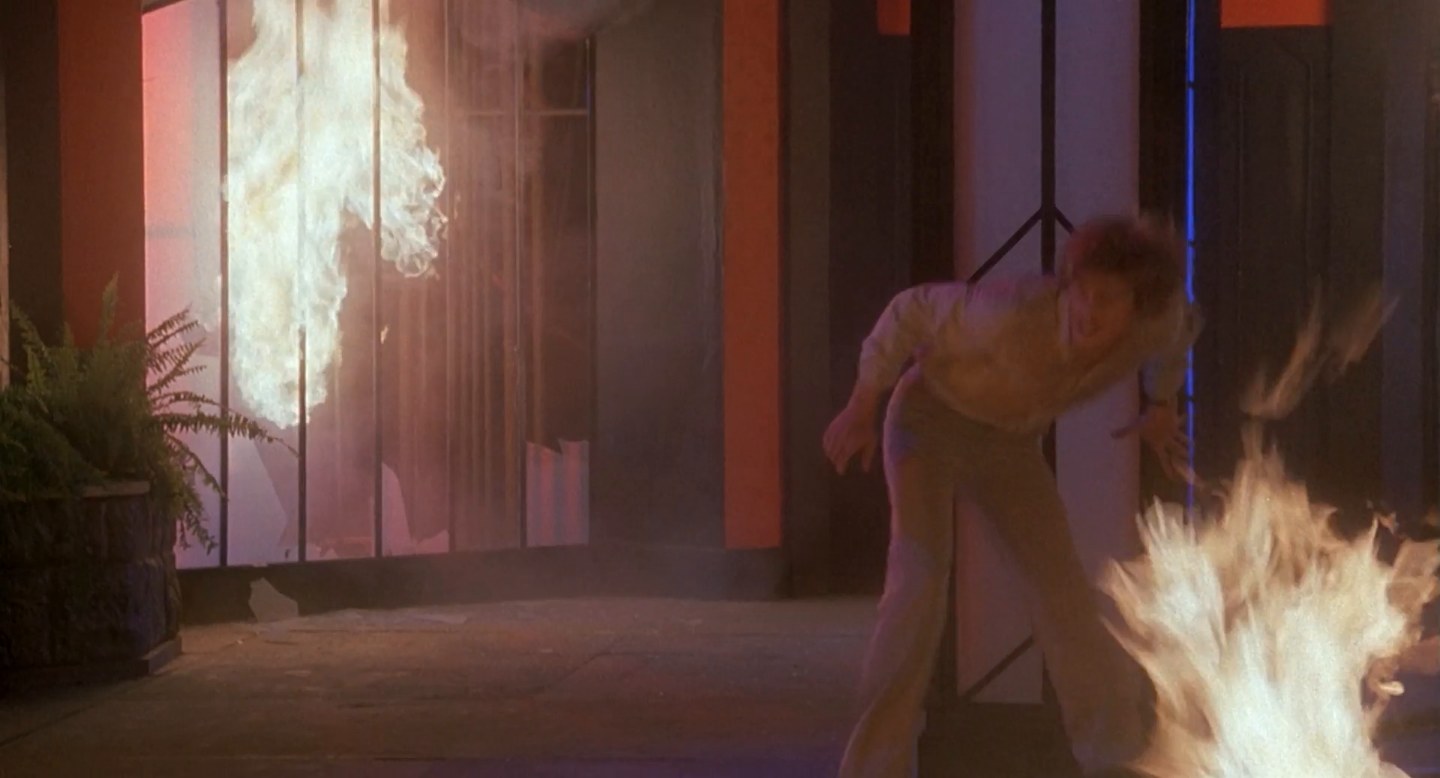
The nurse is first folded over the table, a human figure within an ornate room. Her upright stance, the mirror and the surrounding fire successively reorganise that image. The skeletal reveal uses the frame as a threshold rather than a neutral reflector. The escape then alternates a burning interior, the building’s façade and the emergency response outside. Those changes of scale turn an enclosed apparition into a city event, while the final return keeps Death inside the flames.
Six close studies. Follow a letter, a doorway, a reflection.
A warning is never just a message
ENLARGE ↗The woman with the cat looks across the lecture hall.
The film gives communication physical obstacles: paper must be opened, a reader can look elsewhere, and a telephone connects people who cannot see the danger around one another. Following these objects reveals a structure more precise than the label “dream logic” suggests.
Follow the visual progression 7 observations
03:15Rose writes beside her keys.
18:40The address appears on the envelope above the score.
19:10Mark wears headphones in the lecture hall.
19:30The unknown woman’s face interrupts that setting.
20:30Sara handles the letter beside Mark.
22:00The envelope becomes an object of inspection.
39:15Rose is framed beside the telephone in New York.
The first descent teaches the viewer how to read the underwater room. The second changes what can occupy it. Repeating the route makes the unexpected body an intrusion into an already established environment.
Follow the visual progression 7 observations
11:10The floor opening establishes the surface boundary.
12:20The chandelier locates Rose below that boundary.
13:20Her face and the light fitting share the view.
13:40Hands on the rim reconnect the two levels.
13:50The keys establish the target of the next descent.
14:40The recovering hand provides a close measure of success.
15:20The floating body displaces the practical task.
ENLARGE ↗A long corridor opens beyond Sara’s blue room.
The route from sitting room to entrance remains visible through the doorway. The attack works by changing what returns along that route. The killer can remain withheld because the injury, then the falling body, carry the event into the frame.
Follow the visual progression 7 observations
32:30The apartment corridor stretches beyond the blue room.
34:55The corridor is shown without a figure.
35:30Carlo approaches the entrance.
36:00Sara remains separated from him.
36:30The wound appears before a clear view of the attacker.
The house is first a complete image seen from outside. Mark later uses its surfaces as evidence, inspecting a picture, the floor and the gaps beneath it. The investigation makes architecture tangible without producing a reassuringly complete map.
Follow the visual progression 7 observations
04:08The night exterior supplies a coherent façade.
1:27:15Mark studies a picture of the building.
1:28:45The floorboards become a field of clues.
1:31:00A blade opens the wooden surface.
1:33:15Mark crawls through the space below.
1:34:45A stairway extends the route.
1:36:15Varelli occupies another concealed interior.
Distance is the organising device in the park. The van promises human activity beyond the immediate attack; movement towards Kazarian looks like assistance until the cleaver changes its meaning. The reversal depends on the approach being readable before the weapon becomes dominant.
Follow the visual progression 7 observations
1:17:50The skyline establishes open space beyond Kazarian.
1:18:26The fall pins the action to the waterline.
1:19:20The rats reduce the frame to physical contact.
1:20:32The van gives help a visible location.
1:20:56The approaching figure closes the distance.
1:21:02The raised cleaver redirects the expectation.
ENLARGE ↗The skeleton appears in the mirror frame.
The final revelation uses an object designed to repeat a room to introduce something that changes it. The mirror’s border remains a stable shape across the transformation, while the figure within it changes from woman to skeleton and the fire expands around both.
Follow the visual progression 8 observations
1:40:30The nurse’s folded body initially faces away from Mark.
1:41:24Her face becomes the centre of the confrontation.
1:41:42The ornate mirror frames the encounter.
1:42:24The human figure is contained within that frame.
1:42:30Raised hands mark the last human gesture.
1:42:32The skeletal figure occupies the same framed opening.
1:42:36Fire intervenes between Mark and the apparition.
1:44:36The skeleton returns after the escape to the street.
Twelve dialogue studies. Words that guide, reassure and deceive.
A letter travels without being read. A telephone connects without making everything clear. A pipe carries a voice beyond the speaker’s room. Follow the film’s language from Varelli’s opening warning to the name behind the final apparition.
Varelli’s opening account supplies three locations, three Mothers and three keys. Its speaker claims the authority of someone who built the houses, but also confesses that he recognised their purpose too late. The warning comes from inside the system it describes. Reading is already a dangerous collaboration: Rose accepts instructions from a compromised guide.
The final key is a sentence that will survive after much of the surrounding explanation has disappeared. Repetition carries it from book to letter to Mark’s investigation. The words do not make the architecture transparent; they tell someone where to begin looking.
Kazanian answers Rose’s concrete observation of a strange smell by discussing the supposed credulity of women readers. Later, Carol treats Rose’s poetry as a suitable feminine pastime and mistakes Mark’s musicology for toxicology. These exchanges make condescension part of the house’s defences: knowledge can be dismissed by dismissing the person who brings it.
Kazanian nevertheless closes his conversation with a maxim about the dead governing the living. His speech oscillates between reassurance and menace. He is neither a simple sceptic nor a dependable interpreter of the book.
The lecture identifies Verdi’s Va, pensiero from Nabucco. Carlo names the same music in Sara’s apartment. The repetition connects the academy’s formal musical knowledge with the apparent safety of an ordinary interior. Sara is a music student; Mark studies musicology. Musical education does not grant either of them command of the nightmare.
Carlo’s earlier answer to Sara is equally important: he trusts what he can see and touch. The apartment sequence will make both forms of reassurance unstable. Verdi’s named presence belongs to this dramatic structure; Emerson’s composed score has its own history and contributors. Read the composer and soundtrack record →
The library text insists on the status of a recovered diary, invokes an architect and alchemist, and offers to explain Varelli’s disappearance and death. This is a claim made by the book inside the film. Its apparent documentary authority becomes less secure when Varelli eventually appears alive.
Sara is then redirected by spoken instructions: closing time, a search for the exit, another door. Language that should help a visitor find her way leads towards the workroom and a demand for the book. The institution offers access to knowledge without guaranteeing a safe route out.
When the lights fail, Carlo offers an electrical explanation and goes to the fuse box. Sara asks him to keep talking and identify his location. Their exchange establishes a practical substitute for sight: a voice can maintain contact across the corridor while the person speaking remains out of view.
The sequence turns that arrangement against her. Carlo’s assurances lead towards the visual revelation of his wounded body. The critical relationship is between what Sara is told and what the doorway finally shows. The claim that the fault has been fixed cannot repair the danger.
Rose asks whether Mark has received her letter. He has, but has not read it. The call then becomes a succession of requests to speak louder, confirmations that words cannot be heard, and a plea for him to come to New York. Communication succeeds just enough to move the story across the Atlantic.
The letter and telephone fail in different ways. Written information has reached the right person without being absorbed; speech reaches him incompletely. Rose secures a promise to travel, but cannot transfer the knowledge that might prepare him for the house.
Elise explains that an opening in the wall connects to pipes running through the rooms and amplifies speech. What first seems an uncanny voice therefore acquires a material route. The explanation does not domesticate the building: it reveals that apparently separate private rooms are connected.
When Mark later calls for Elise, the same means of communication offers no conversation in return. A demonstrated connection becomes a way to register an absence. Varelli’s later account of passages as veins gives this earlier domestic discovery a more disturbing bodily meaning.
Elise attempts to relay Rose’s account of the Mothers but hesitates over its credibility and the architect’s name. The exchange also asks whether a laugh has been heard, without producing an agreed explanation. The film makes uncertainty part of the conversation itself, rather than simply withholding a final answer from the audience.
After Mark’s collapse, the people around him describe a heart problem and administer medicine. Later he says he has never had heart trouble. Their account gives his experience a ready-made diagnosis; his response leaves its adequacy in doubt. The dialogue does not establish what substance he receives or prove a particular medical cause.
Kazanian’s speech contracts into bodily need: his crutch, his legs, the rats, a request for someone to hurry. The distant vendor appears within this appeal for rescue. The subsequent attack reverses the expected answer to a plainly intelligible request.
This matters beside the earlier failed messages. Here the danger does not depend on a difficult book, an obscure riddle or a broken connection. Even an urgent appeal that can be understood does not guarantee help. Emerson’s interview singles out the cats-and-rats episode as the part of the script that drew him in. Read his account →
Mark repeats the clue about the soles of his shoes to Kazanian. The bookseller calls it a riddle and shifts the discussion towards the coming eclipse. The exchange supplies another subject to attend to while refusing the interpretation Mark needs.
When Mark returns to the sentence on his own, its emphasis changes from an enigmatic saying to an instruction about where to search. The later exploration gives the words material consequences. A repeated phrase can organise movement through the film even when it does not explain the Mothers.
Varelli explains that he can speak only through the device he uses. His account transforms the building into his body: bricks become cells and passages become veins. This speech retrospectively connects architecture, communication and bodily dependence. The house’s hidden routes are no longer merely spaces Mark has crossed.
He invites Mark closer, ostensibly to speak without being overheard. The promise of privileged information precedes an attack, and the apparatus that enables speech becomes entangled in the struggle. His last insistence that he is a servant, rather than the master, limits the authority claimed by the opening narration.
The nurse speaks first of the burning building and an earlier occurrence, then addresses Mark’s journey, darkness and extraordinary light. Reassuring language and threat occupy the same speech. Her announcement of coming to get him turns an answer into another assault.
The naming of the three Mothers returns to the opening’s withheld collective name. The answer is Death. It completes a verbal pattern, but does not identify every agent or explain every killing. The final revelation is powerful precisely because the great name is broader than the particular mysteries that led Mark there.
The English translation accompanying Keßler and Stiglegger’s German commentary offers a sustained reading of Inferno as a series of nested worlds. Six routes below connect their arguments to the images, dialogue and production research. Commentary source and attribution →
03:18–15:58
Nested worlds and the submerged room
Keßler and Stiglegger propose that the film repeatedly enters a strange world contained within another. Around 14 minutes they describe the underwater sound design as selectively reduced and organised around particular sonic elements. This is their listening interpretation, useful beside the visual study of the opening; it is not a technical account from the sound crew.
Their discussion links the classroom’s Verdi to Sara’s apartment and describes ordinary settings turning into nightmare spaces. They compare the difficulty of communication with Antonioni’s cinema. That comparison is a critical reading, rather than evidence that a specific shot or sound cue was copied.
The commentators single out the sparing soprano and orchestral expansion around Rose’s descent, then discuss the relationship between choral writing and rock rhythm. Their enthusiasm is part of the film’s critical reception. Cinevox independently credits Linda Lee on the recorded track Mater Tenebrarum; its album listing does not identify the vocalist of every individual film passage.
The pipe system becomes a central example of the house seeming alive. The discussion also brings in the travelling telephone connection in Four Flies on Grey Velvet. It offers a productive comparison between communication shown as a route through machinery and communication built into inhabited space.
They interpret the vendor’s violence as evil spreading to an apparently uninvolved person. Later they compare the house with the unstable geography of Fulci’s The Beyond. These readings describe the films’ effects on the spectator; neither establishes a literal explanation of the vendor’s motive or a documented production influence.
The discussion joins the architect’s speech device to his bodily identification with the house, then reads the mirror transformation against Rose’s earlier entry through water. The ending is understood as an escape that leaves evil in existence. Their account helps connect the film’s recurring forms without turning its last image into a complete solution.
The reviewed presentation contains English and Italian film tracks and a German commentary. Its English dialogue subtitles and the English commentary translation are separate texts.
English and Italian
Both film tracks are labelled stereo. Full-track signal analysis finds substantial differences between the English left and right channels, while the Italian channels are almost identical. This describes the presentation examined here; the labels alone cannot establish an original theatrical mix or a particular remix.
Words on screen and words in the track
The English subtitles are not a verbatim record of every phrase in the English track. The studies therefore paraphrase dialogue rather than treating the subtitle file as a definitive dubbing script. Latin names, distorted speech, cries and music require particular care; automated speech output is not used to settle uncertain words or identify performers.
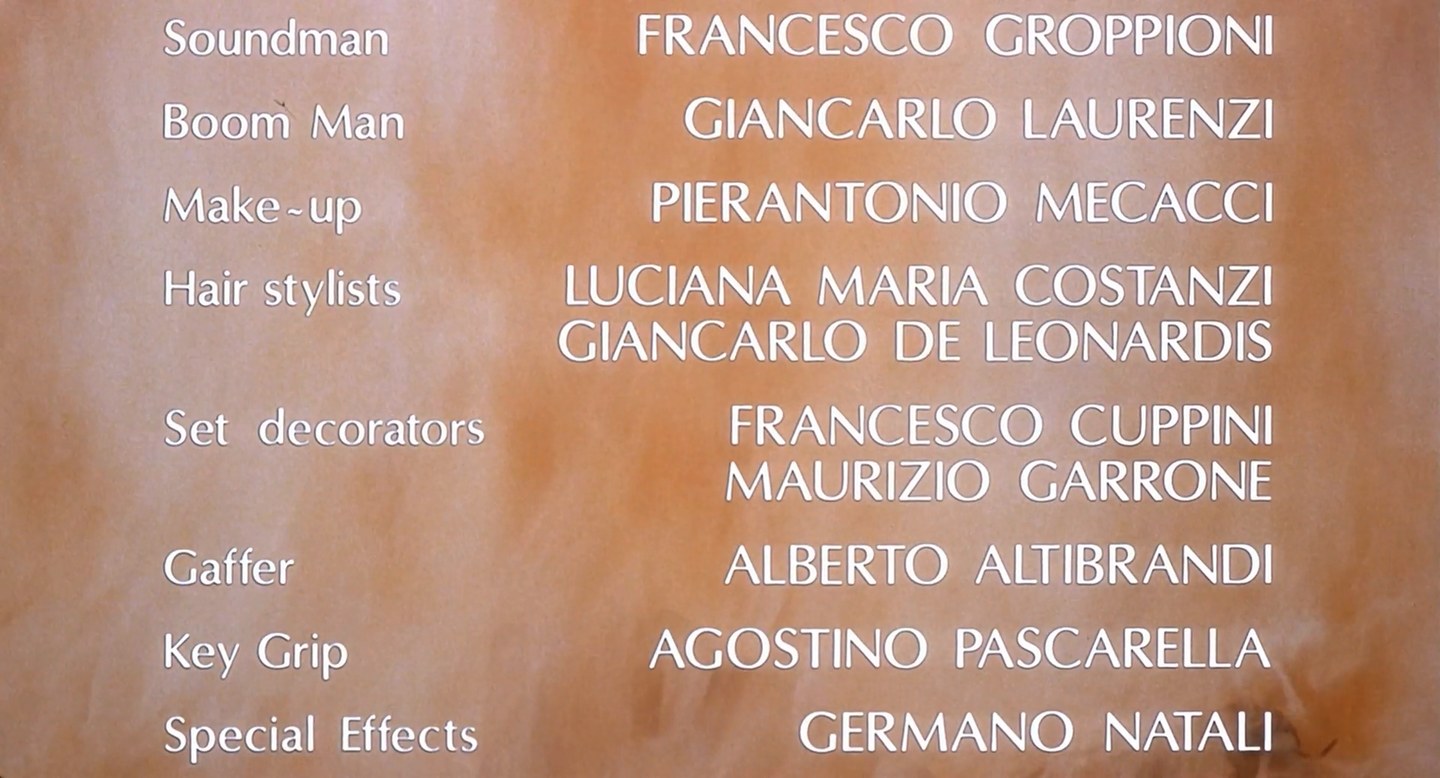
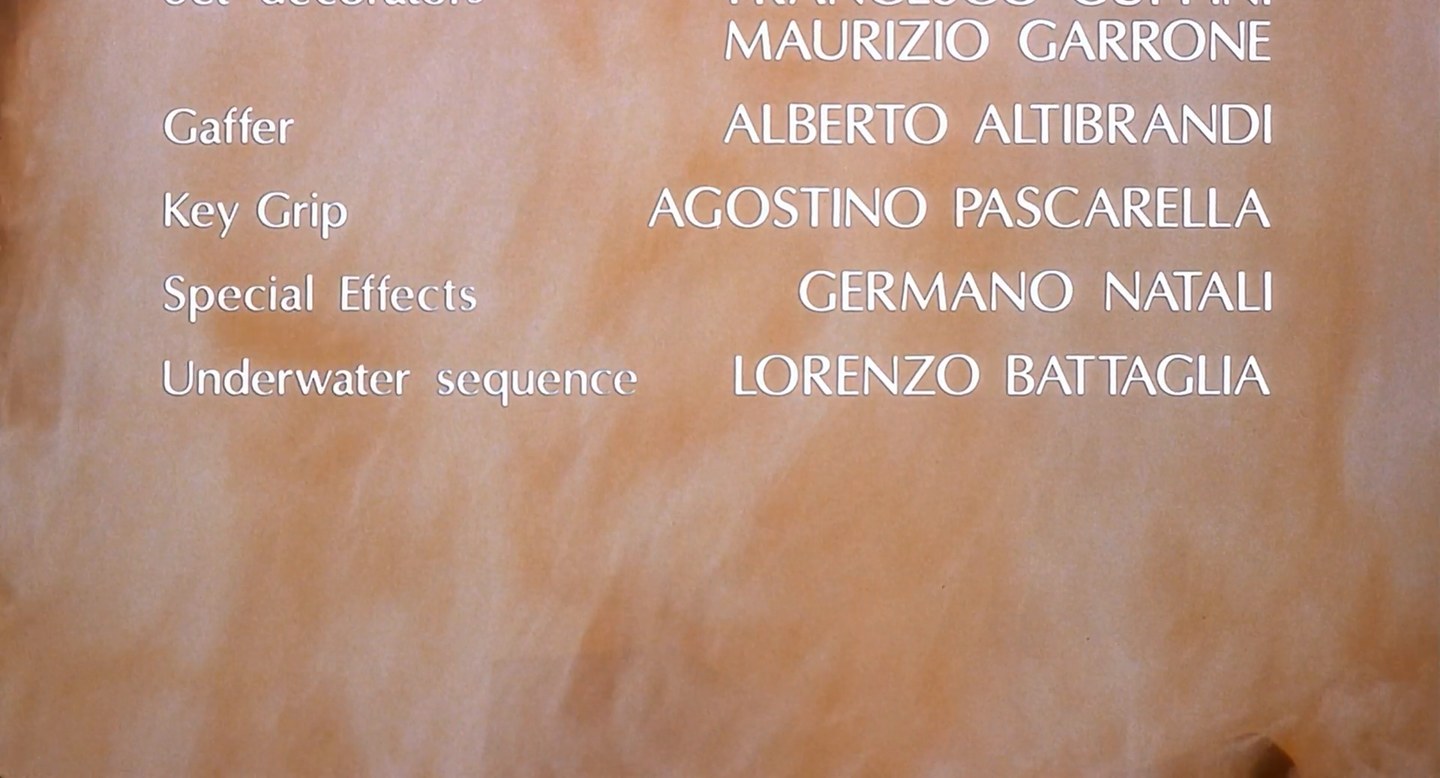
The English end titles credit Pierantonio Mecacci for makeup and Germano Natali for special effects. A separate line credits the underwater sequence to Lorenzo Battaglia. Keeping those lines visible gives the wounds, physical effects and submerged performance their own production context.
These credits sit alongside the research on Mario Bava’s optical work and constructed city. Tim Lucas distinguishes the tank sequence from Bava’s work on the façade, skyline and final building fire; the director’s account emphasises Irene Miracle’s performance in the studio pool. The film’s illusions draw on several kinds of labour, with no reason to collapse them into one name.
Read the underwater credit End-title detailENLARGE ↗Special effects and underwater-sequence credits.
Rose Elliot writes from New York to her brother Mark in Rome after discoveries beneath her apartment building. The exchange joins distant places before either character can securely explain what connects them. Inferno extends the Three Mothers cycle begun by Suspiria, turning a building into an object that must be read from within. MUBI: synopsis ↗Film at Lincoln Center: programme ↗
Spoilers: this study discusses the film’s story and ending.
01 / Reading & architecture
A book makes the familiar building strange.
Rose does not begin with an inexplicable apparition. She begins with a text. The Cinémathèque québécoise’s synopsis identifies the antique book Le tre madri: its author claims to have built homes for the Three Mothers in Freiburg, Rome and New York. Rose begins to suspect that she lives in the New York house. The book and the three houses ↗
The premise reverses the reassuring promise of research. A book usually makes an unfamiliar place more legible; this one makes a familiar address harder to inhabit. Knowing something about the building does not put Rose outside its power. It draws her farther into the space she wants to understand.
Her letter to Mark, a musicology student in Rome, carries that uncertainty across the Atlantic. MUBI’s synopsis connects the message to discoveries in her basement. Rose’s letter to Mark ↗ A letter can describe a room without making it safe. It can request help without transporting the recipient into the writer’s experience. This gap between communication and understanding is our starting point for the film.
The house therefore has two interiors: rooms that bodies enter, and a history into which readers are drawn. The phrase “a house within a house,” recalled by composer Keith Emerson, neatly captures the sensation of an ordinary enclosure concealing another order. Emerson recalls the script ↗ It need not be a complete floor plan to be a powerful dramatic idea.
Compared with Deep Red, the problem has shifted. There, interpreting an image differently can restore a chain of explanation. Here, an explanation can open another threatening space. Knowledge is an invitation to proceed, with no guarantee of mastery at the end.
An enigma is something the film builds.
Argento recalls spending months working on Inferno in a New York hotel during winter, repeatedly dissatisfied with the writing. He describes the film as alchemical and enigmatic. In the same documentary, Guillermo del Toro approaches its unexplained spaces as a source of its power: the submerged room need not receive a practical explanation before it becomes compelling. Panico: testimony and passage locators ↗
These are different kinds of testimony. Argento remembers making the work; del Toro offers a filmmaker’s critical response to it. Together they sharpen the distinction between following Rose’s investigation and expecting it to yield a complete account of the house. The building can draw a viewer onward while withholding the reassurance of a solved plan.
02 / Literature & mythology
The Three Mothers begin as different kinds of sorrow.
Thomas de Quincey’s Levana and Our Ladies of Sorrow gives the three figures distinct powers and manners. Mater Lachrymarum is associated with tears and bereavement; Mater Suspiriorum with sighs and the dispossessed; Mater Tenebrarum with an overwhelming, violent darkness. Their kinship does not make them interchangeable. De Quincey: the three portraits ↗
A small detail is particularly useful beside Inferno. In the prose, the first two sisters carry keys. The youngest, Tenebrarum, needs none: she forces entry. Doors and access are already part of this imaginative vocabulary before they become the film’s architectural problem.
The transformation into cinema is substantial. De Quincey’s narrator tries to give words to powers experienced through signs and dreams. The film’s book assigns its Mothers homes in identifiable cities. What was a meditation on the reach of sorrow becomes a geography that characters can investigate—and enter.
That distinction keeps two books apart: the real literary work and Le tre madri, the object within the fiction. The latter is part of the film’s machinery of persuasion. Its authority is something the story puts to use, not a historical source that the viewer must accept.
The transcription consulted here does not identify its underlying printed edition. It supports this limited comparison; precise wording, translation choices and screenplay borrowings remain for a later textual collation. Suspiria supplies the earlier cinematic encounter, while Inferno expands the network around it.
03 / Authorship & performance
A writing credit is one part of the record.
The Spanish ICAA catalogue names Dario Argento for story and screenplay, Romano Albani for photography and Keith Emerson for music. It also records an ensemble including Irene Miracle, Leigh McCloskey, Eleonora Giorgi, Daria Nicolodi, Sacha Pitoëff, Alida Valli, Feodor Chaliapin and Veronica Lazar. ICAA file 539451: credits ↗ These are useful identifiers, but a catalogue is not a complete account of collaboration.
In Barend de Voogd’s interview, Luigi Cozzi remembers Nicolodi as having written Suspiria and Inferno with Argento. He links that history to her later approach to him about making a Third Mother film, a project he says he substantially changed. Cozzi on writing with Nicolodi ↗ His recollection gives an explicit reason to keep her creative contribution visible alongside the formal credit.
We should preserve the difference without turning it into a falsely precise division of labour. Cozzi’s statement supports the history of collaboration; it does not allocate individual scenes or settle every account of the writing process. Dated drafts and Nicolodi’s own complete interviews would let that question become more exact.
The performer’s place is different again. Nicolodi plays Elise; Miracle plays Rose; Giorgi plays Sara. Cast and character record ↗ Grouping them simply as women endangered by the same supernatural force loses their different positions in the investigation. Rose’s written warning makes her an initiator of knowledge. The cast’s changing relationships to information deserve attention alongside the spectacular deaths for which the film is often remembered.
Our reading of Rose starts with that agency: she investigates and communicates before she can be securely protected. The next comparison of performances will retain those distinctions instead of treating each character as a stop on a single hero’s route.
04 / The submerged room
An impossible room requires a very physical performance.
The submerged chamber makes a domestic interior unfamiliar without abandoning its recognisable form. A room that should support ordinary movement becomes a space through which a person must swim. Recovering an everyday object now demands a different relation to weight, breath and direction.
In his retrospective Total Film conversation, Argento recalls selecting Irene Miracle for her swimming and diving ability, and filming in a pool inside a studio. He stresses the difficulty of the work and the naturalness of her underwater acting. Argento: the underwater sequence ↗ The testimony makes performance a condition of the illusion, rather than an incidental presence inside an effects shot.
It also helps correct a familiar attribution shortcut. Bava biographer Tim Lucas explicitly separates the chamber from Mario Bava’s optical work, identifying Gianlorenzo Battaglia as the person who photographed it in a tank. Lucas: final sentence on the chamber ↗
The distinction changes how we appreciate the sequence. A painted extension and a body moving through real water solve different cinematic problems. The first constructs an apparently larger world; the second asks a performer and crew to make an altered physical environment convincing. Both belong to the film’s invention, but they should not be assigned to one celebrated name.
The supported account is already substantial: the impossible room joins design, photography and embodied skill, with a clearer separation of the contributions than the blanket label “Bava effects” allows.
05 / Models & optical construction
New York can be built in layers.
Argento’s 2009 interview with Juan Sánchez describes bringing Bava into Inferno for complicated effects and recalls reproducing New York through glass work and rear projection. Argento on Bava and the constructed city ↗ The city on screen is therefore not simply a location that the camera happened to find.
Lucas gives a more detailed account: a partial house set at De Paolis was extended with a model, while small skyscrapers covered with photographs enlarged the surrounding city. He also attributes a painted moon and the model building’s final fire to Bava’s work. Lucas: set extensions, skyline and fire ↗
The relationship between miniature and building echoes the story’s own nested spaces. The physical set is incomplete, but the image persuades us to imagine its continuation. The spectator supplies a coherent city across materials and scales that do not themselves form one walkable place.
This is why a location guide alone cannot reconstruct Inferno. An address may identify what stood before the camera in one view, while another view adds a model or an optical element. A useful production map must distinguish a New York location, a Roman set, an extension and the fictional route that editing creates between them.
Argento and Lucas describe the work at different levels of detail. Their accounts can coexist without proving every setup.
06 / Colour & thresholds
The doorway divides more than rooms.
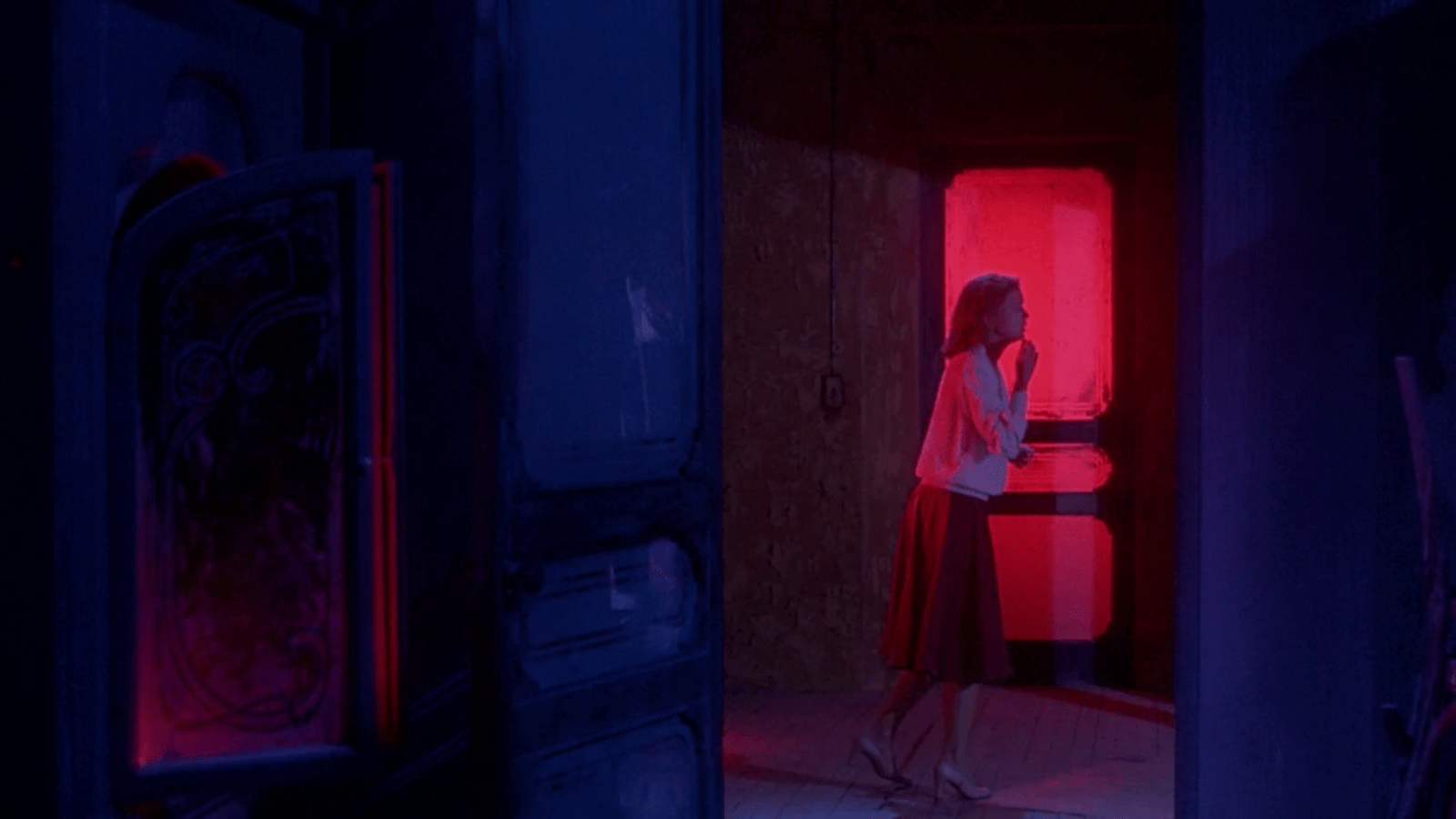
ENLARGE ↗Published film image · Film at Lincoln Center, 2022 gallery. Full source composition retained; no master or timecode identified.Image source ↗
In this reproduction, the red opening is nested inside a much larger blue field. A figure stands near that opening, while the foreground screen and wall panels occupy much of the frame. The image offers several kinds of border before it offers a clear route through the room.
Our reading is that the colour makes the threshold feel active. Red does not simply tint the same space that blue describes; it gives the smaller opening a separate pressure and depth. The figure is caught between those zones. The surrounding darkness keeps architectural detail partly available, encouraging inspection without allowing a complete survey.
Compare the opening image of the conversation. The two faces share a relatively close view, but the blue curtain and pink light remain strongly present between and behind them. Even an exchange between people cannot reduce the room to neutral background. Architecture and illumination continue to organise the encounter.
The ICAA record credits Albani’s photography. The contemporary l’Unità review separately names Giuseppe Bassan’s sets when discussing the visual achievement. Photography credit ↗ · Sets in the 1980 review ↗ Keeping both contributions visible gives us a better starting point than treating colour as the director’s unaided signature.
These are readings of published images, not calibrated samples of the original release print. Their usefulness lies in visible relationships—figure, opening, foreground, colour field.
07 / Music & recorded objects
A composer enters the house by another route.
Emerson’s account begins with a wish to write for film, rather than a special commitment to horror. He recalls manager Stewart Young connecting him with Argento and a subsequent meeting in Rome. The confusing script interested him through one particular event: the riverside episode involving a man, cats and rats. Dome’s interview: the Inferno answers ↗
That is a useful description of creative entry. A composer need not solve every mystery before responding to an action, a change of scale or a reversal of power. The episode he singles out turns an attempted act of cruelty into a threat to the aggressor. It offers a dramatic shape even when the larger supernatural system remains elusive.
Cinevox’s own record for CDMDF306 credits Linda Lee as the singer of Mater Tenebrarum. Its page also identifies the CD as a reissue with previously unpublished material. Cinevox: performer and reissue record ↗ This restores another contributor to an account often reduced to Emerson’s name, and reminds us that a soundtrack album is a separately assembled object.
The track’s identification with one Mother gives the music a naming function in the recorded catalogue. That does not tell us, by itself, where a cue enters the film or what a particular language track contains. Album sequence, composition, vocal performance and final mix should remain distinct questions.
Emerson also recalls the audience reacting intensely at the Rome premiere. It is valuable as his memory of encountering the completed film, not a count of walkouts or a survey of reception. The interview was republished in July 2026.
08 / Classification & exhibition
Different records answer different questions.
We now have a firmer release record than a list of running times. The BBFC identifies a British cinema classification dated 20 March 1980 and explicitly records cuts or alterations. It also flags cuts for the 1987 and 1993 video submissions. Its 2010 Arrow entry is separately dated and carries no such notice on the page. BBFC: classification history ↗
Record
What it establishes
BBFC, 1980
Cinema submission: 106m 15s; distributor 20th Century Fox; cuts or alterations recorded.
BBFC, 2010
Arrow submission: 102m 15s, dated 8 June. This is a distinct classification record, not our measurement of a disc.
ICAA, file 539451
Original-duration field: 107 minutes; separate 1987 and 2015 video records: 110 minutes. The zero-minute top-level field is not a usable runtime. Separate ICAA fields ↗
Lincoln Center, 2022
106-minute 35mm presentation. Language metadata says Italian and Latin with English subtitles; the prose says English dub. The conflict remains open. Screening record ↗
A classification date, a screening announcement and a duration printed in a catalogue are different pieces of evidence. None is automatically an opening date for every territory. A difference in listed minutes cannot, without identifying the carriers and playback conditions, tell us which scenes are missing.
The cuts notices establish that interventions occurred in particular submissions; the displayed record does not supply their full shot-by-shot content. That is a useful boundary. The next edition comparison can begin with named records, rather than treating every circulating duration as proof of another cut.
09 / Criticism & the unresolved riddle
The nightmare was an argument from the beginning.
The review headed Un reportage dall’Inferno, signed “d. g.” in l’Unità on 8 February 1980, offers a more complicated response than either dismissal or uncomplicated praise. It admires the camera work, red-and-blue lighting, Bassan’s sets and Emerson’s music, while finding serious weaknesses in the writing and dialogue. Original review, printed p. 8 ↗
Its closing reservation is especially productive: if everything is infernal, where is the contrasting state that would make the difference traumatic? This is criticism of the film’s distribution of experience, not merely a demand that the plot be easier to summarise.
Argento later describes the riddles as deliberate and recalls defending the absence of complete solutions to Sherry Lansing. His aim, in that account, was to make the audience think with him. Argento: riddles and the studio screening ↗ This is his retrospective explanation, not a surviving record of the studio meeting or proof of why a distributor acted.
These positions leave a real question open. Withholding an answer can keep a spectator imaginatively active. It can also make distinctions between one danger and the next harder to feel. Our reading is that Inferno gains its particular force from placing those possibilities together: the house invites interpretation while continually changing the conditions under which interpretation might help.
The film’s later repertory life gives that argument new settings. The 2022 New York and Montréal programmes present it within Argento retrospectives, placing the work in conversation with a broader career. Those screenings establish continued curatorial attention. They do not erase the original objections, or require every viewer to arrive at the same verdict.
Argento links Inferno’s conception in My Cinema to alchemy, Gothic cathedrals and a desire to build enigmas. In the same passage he remembers Mario Bava’s contribution through large pieces of glass and mirrors used for optical effects. The account brings the film’s ideas and its practical image-making into the same discussion: an architecture of secrets could also be an architecture assembled through reflection and illusion.
His recollection of the American distributor finding the result incomprehensible describes a disagreement about what kind of film had been made. It is a participant’s account of that response, not a substitute for the release correspondence. Its critical value is the connection Argento makes between the enigma he wanted and the resistance it met.
Source & passage
Dario Argento: My Cinema / Il mio cinema, two-part documentary presented on Severin Films’ Dario Argento’s Deep Cuts, Disc 1. Part One, 19:15–21:14.
The discussion paraphrases the English subtitles and distinguishes participant recollections from the documentary’s narration and production footage.
Cozzi recalls Vincenzo Ungari proposing several stories during the development of Door into Darkness. One involved a submerged house and someone diving to recover an object. He says it was rejected as too costly for television, and connects it to the later underwater sequence in Inferno. This retrospective account gives the scene a possible development history before the Three Mothers film, without turning a recollection into evidence of a surviving screenplay page.
Source & passage
On the Other Side of the Door, 05:37–06:39. Presented on Disc 2 of Severin Films’ Dario Argento’s Deep Cuts.
Question about Bava’s Inferno contribution read in Spanish. Short attributed paraphrase of glass work and rear projection; no full effects breakdown implied.
Printed p. 8, review signed d. g. Original page and full review; short paraphrase, no article reproduction. Search-extract errors were checked against the scan.
Inferno — film images, titles and selected visual sequences
The scene guide and galleries use a 106-minute presentation with English opening and end titles. The stills retain the complete 1920 × 1038 source composition, resized for display. Selected observations span the film, with denser frame review of the nine sequence galleries. Time locators follow this presentation and identify observed moments rather than exact cut boundaries.
The English subtitles support the paraphrase of Varelli’s account of the building. The end titles supply the makeup and effects credits around 1:45:30 and the underwater-sequence credit around 1:45:35. The existing Film at Lincoln Center photographs retain their separate published source.
The complete English film-subtitle text was reviewed alongside a full-duration automated English speech pass, with focused checks of difficult passages. The studies use paraphrase and scene locators, not a certified dialogue transcription. All three audio streams were decoded through their approximately 106m 41s duration; the language-track comparison concerns measured channel relationships. Direct listening was not available for this pass. Vocal delivery, exact cue entrances, spatial effects and the Italian dialogue have not been independently assessed by ear.
Music interpretations attributed to the commentators come from the supplied English translation of their German commentary. Cinevox’s album credits and Emerson’s interview remain separate sources.
Stiglegger lists an Inferno commentary with Christian Kessler for Koch Media. The supplied commentary’s opening also identifies Keßler and Stiglegger. Its complete English subtitle translation was reviewed through the closing remarks; the six routes above paraphrase selected arguments. The German speech and translation accuracy were not independently checked. Speaker changes are not consistently identified in the subtitles, so observations are attributed to the commentary jointly. This primary contributor credit supports the attribution without identifying the exact carrier of the supplied film.
 ENLARGE ↗
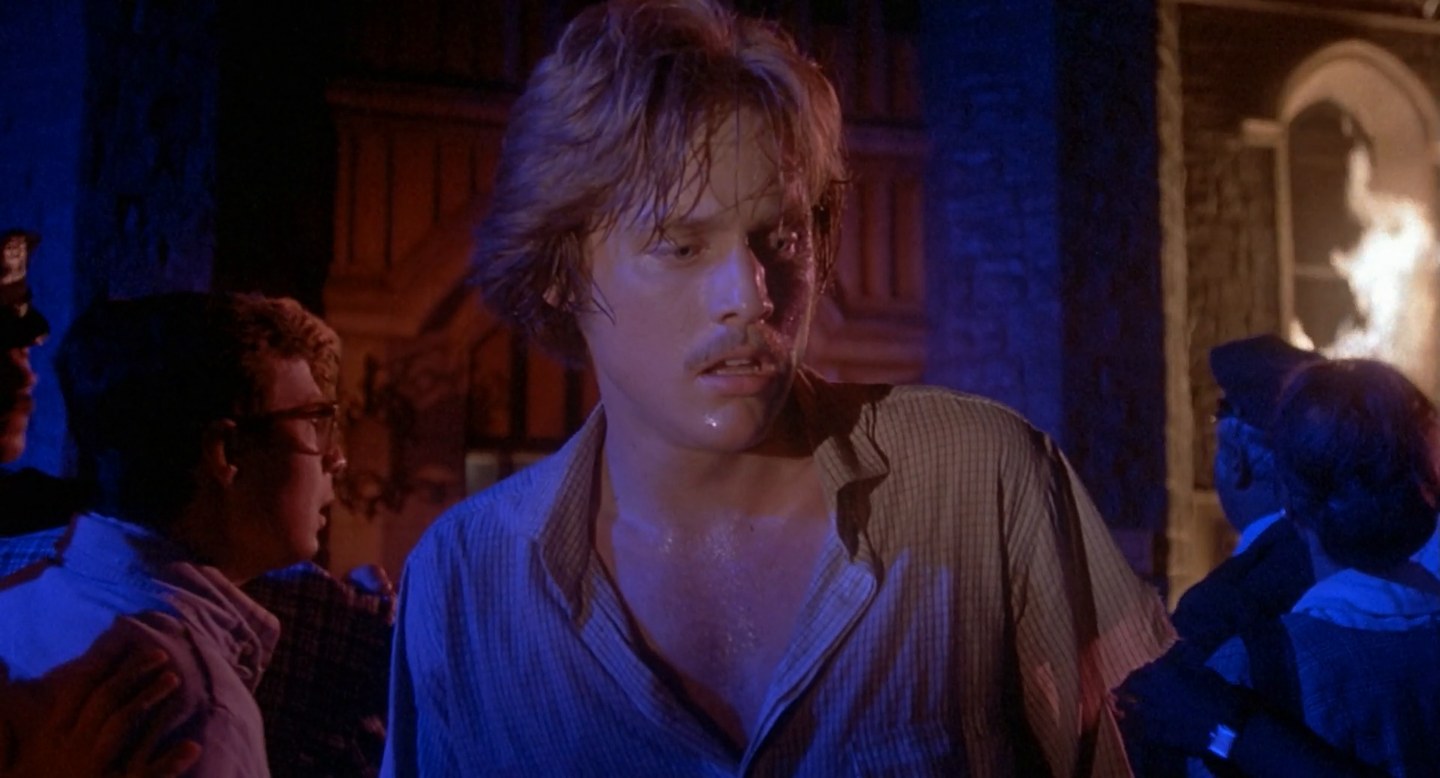
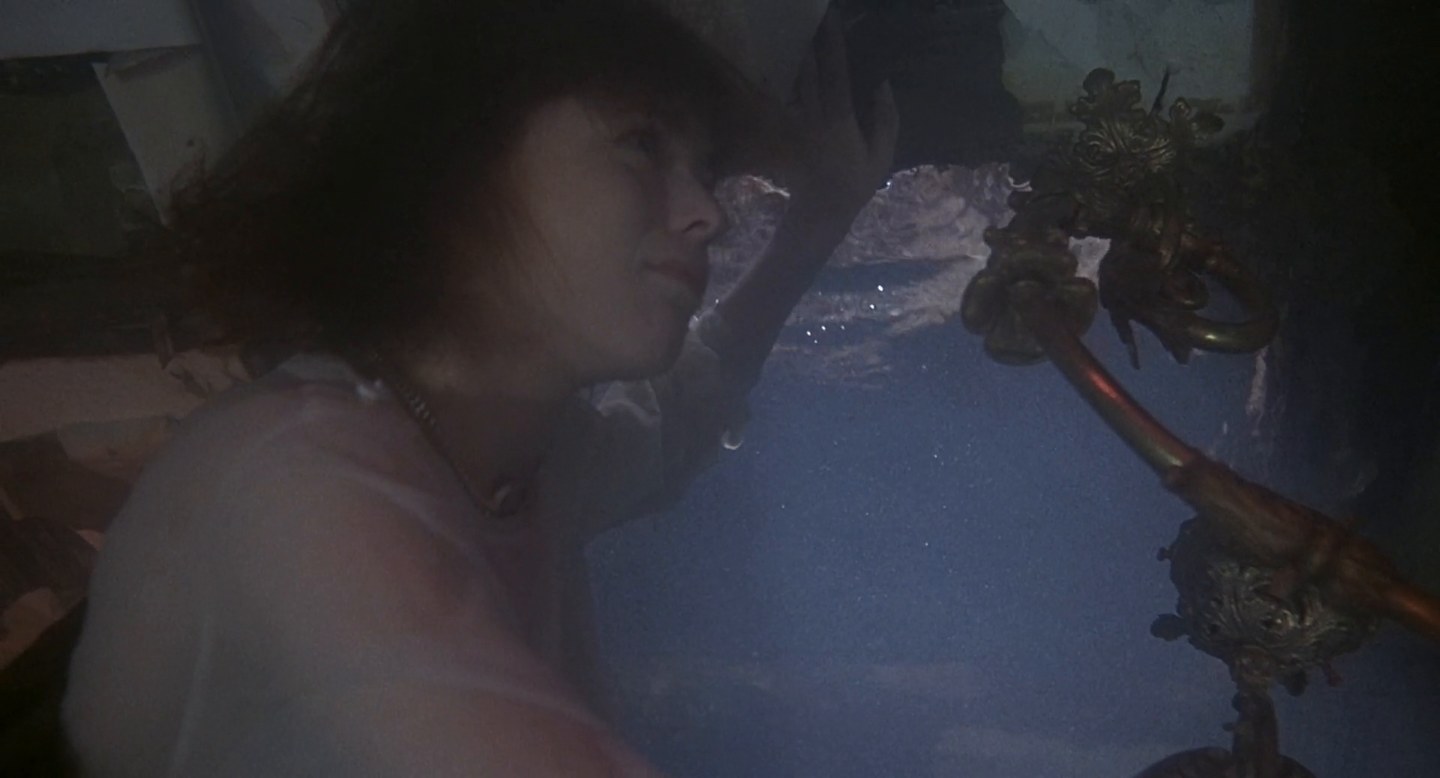
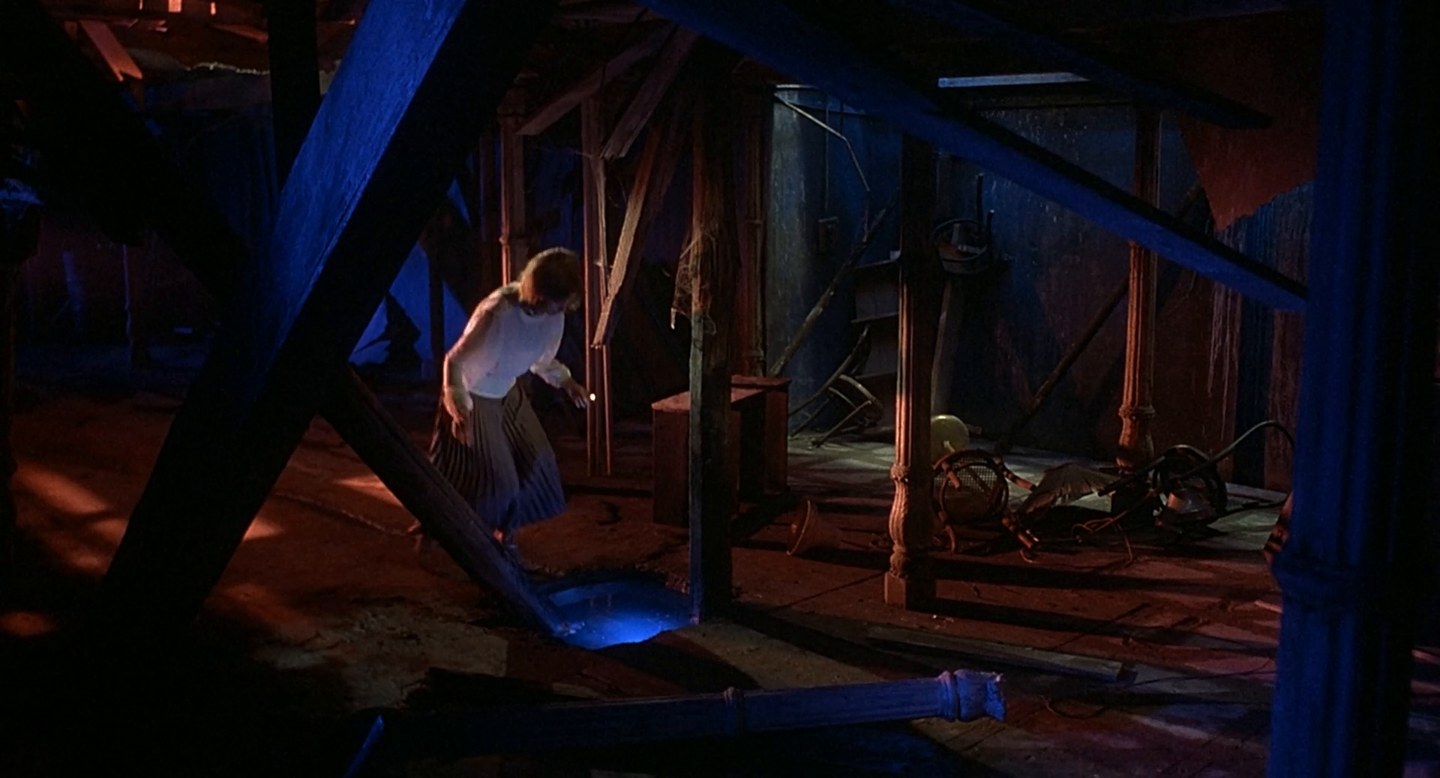
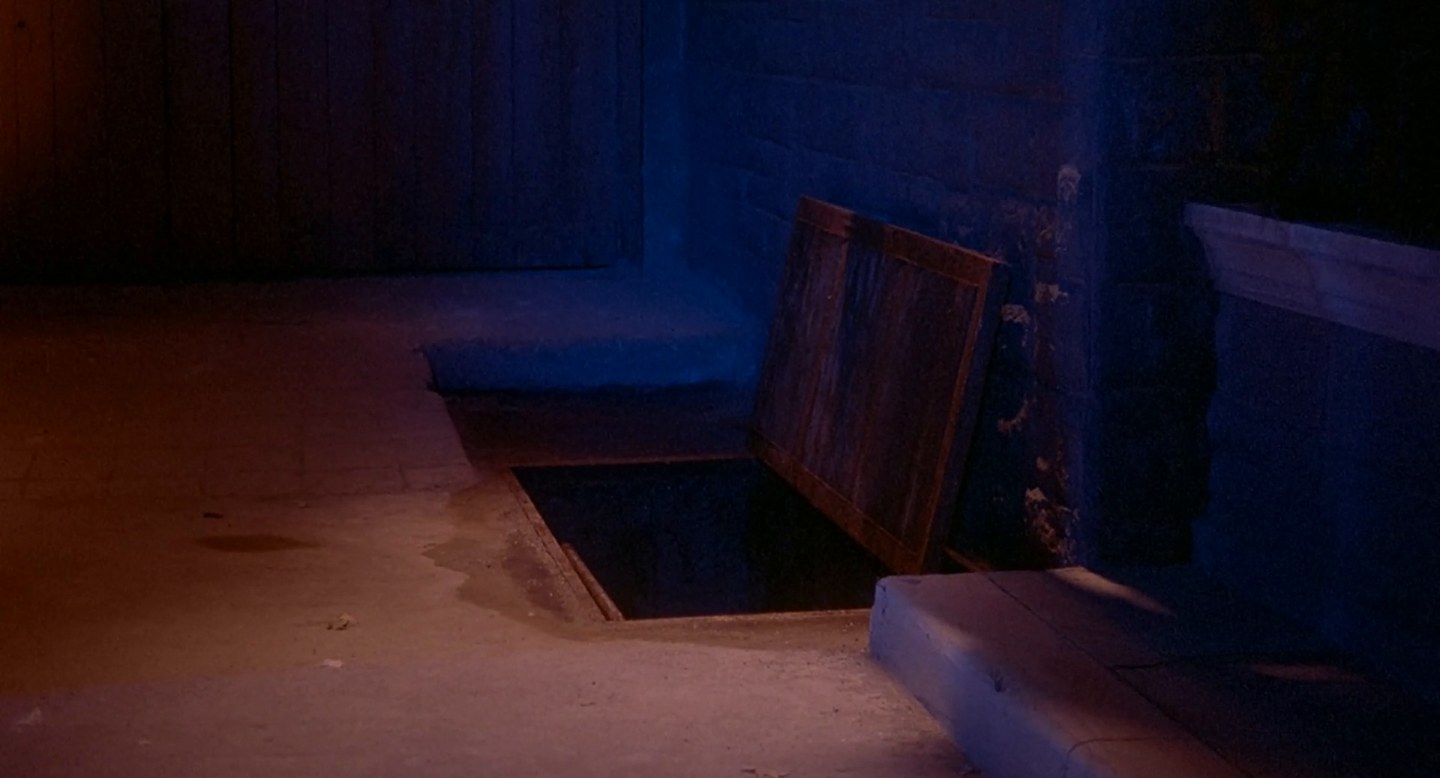
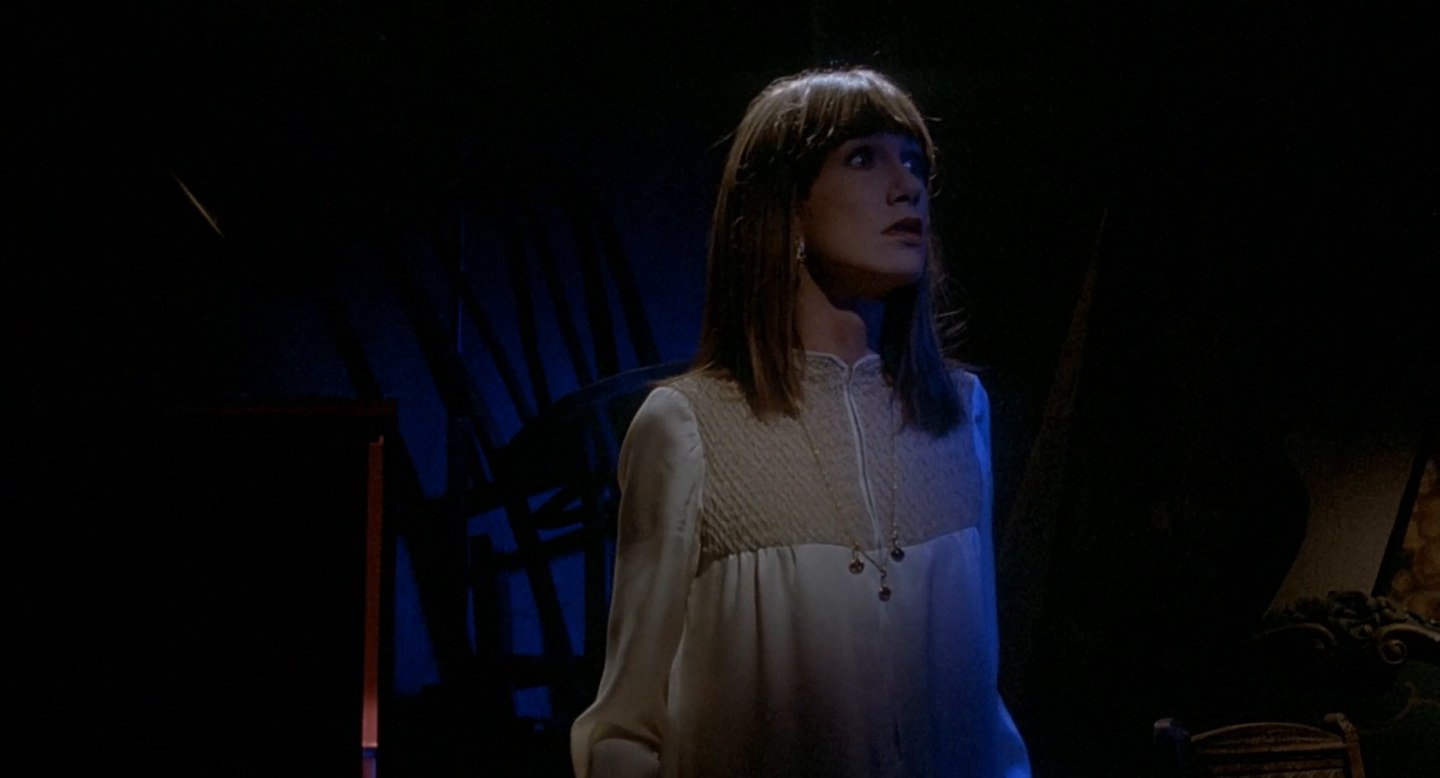
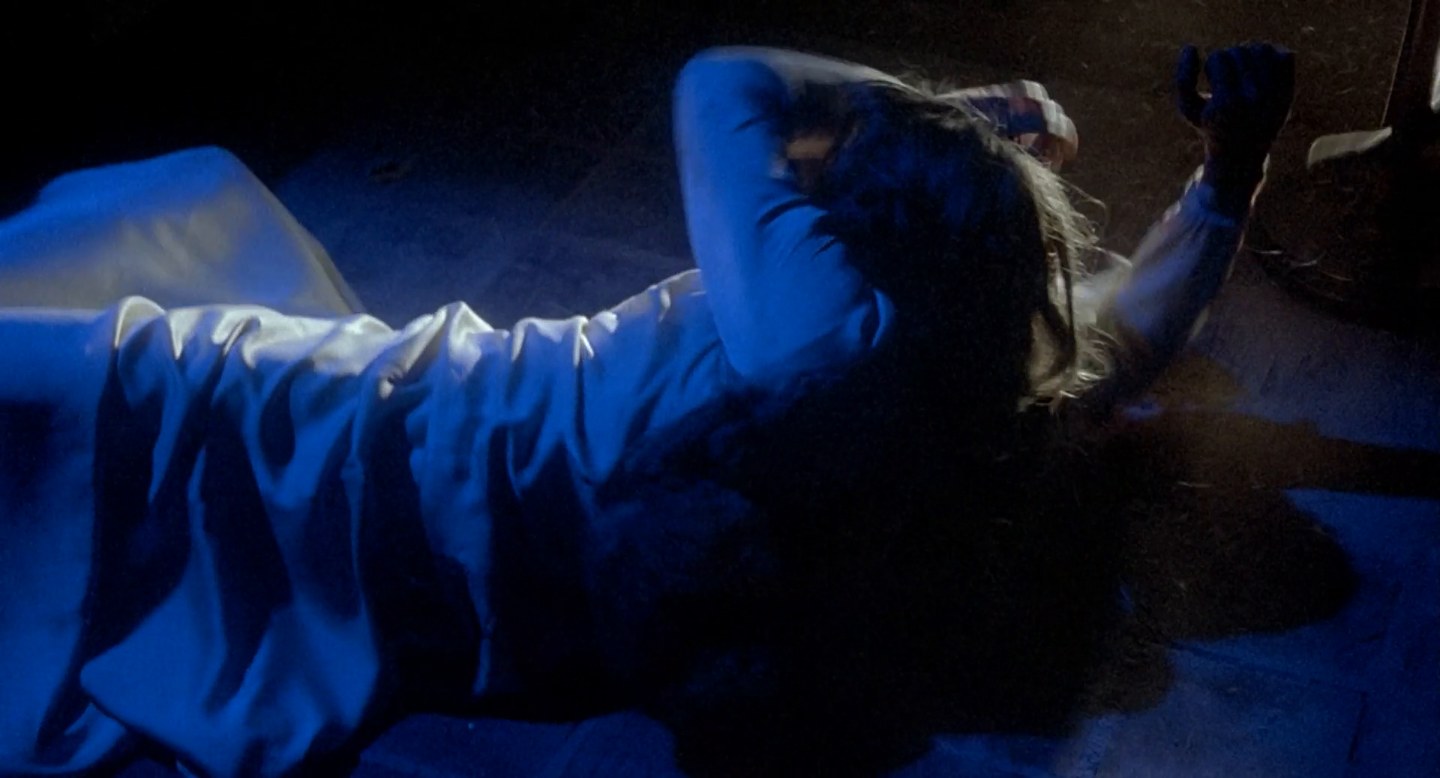
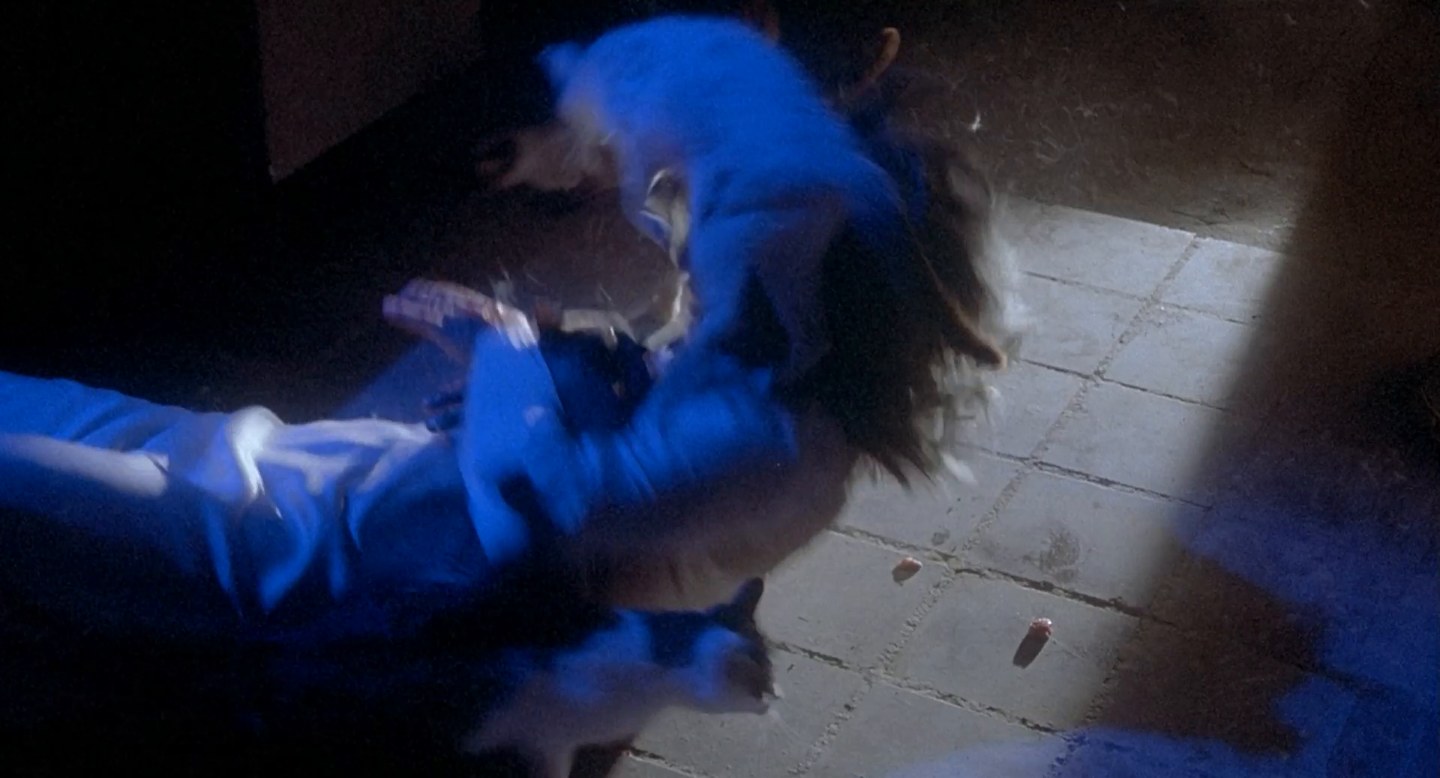
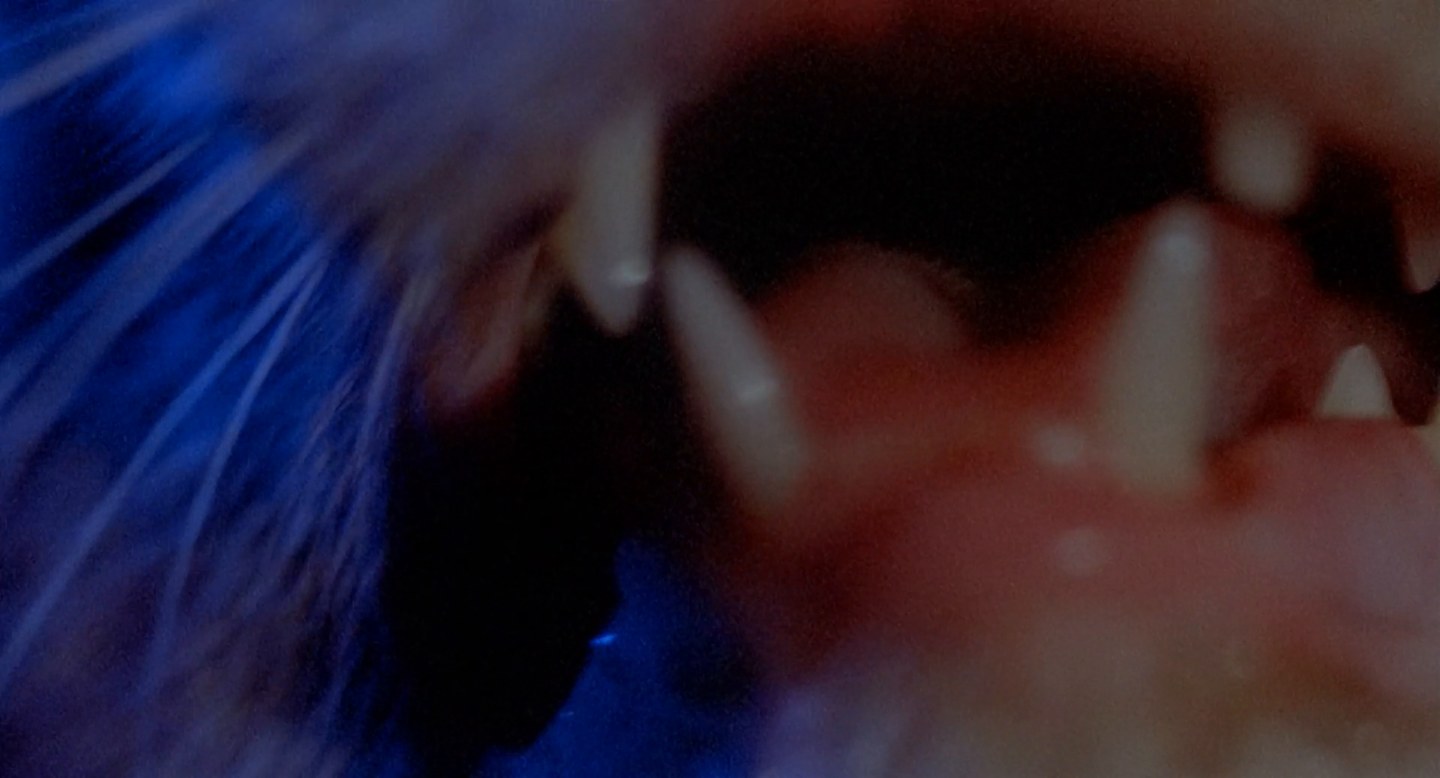
03:18–15:58
Nested worlds and the submerged room
Keßler and Stiglegger propose that the film repeatedly enters a strange world contained within another. Around 14 minutes they describe the underwater sound design as selectively reduced and organised around particular sonic elements. This is their listening interpretation, useful beside the visual study of the opening; it is not a technical account from the sound crew.
The submerged room →17:44–20:39 · 32:58–38:25
Verdi, communication and the unstable interior
Their discussion links the classroom’s Verdi to Sara’s apartment and describes ordinary settings turning into nightmare spaces. They compare the difficulty of communication with Antonioni’s cinema. That comparison is a critical reading, rather than evidence that a specific shot or sound cue was copied.
Verdi and the apartment →44:16–47:09
The score’s contrasting forces
The commentators single out the sparing soprano and orchestral expansion around Rose’s descent, then discuss the relationship between choral writing and rock rhythm. Their enthusiasm is part of the film’s critical reception. Cinevox independently credits Linda Lee on the recorded track Mater Tenebrarum; its album listing does not identify the vocalist of every individual film passage.
Emerson and the recorded soundtrack →54:55–55:44 · 1:01:48–1:02:18
Pipes as acoustic pathways
The pipe system becomes a central example of the house seeming alive. The discussion also brings in the travelling telephone connection in Four Flies on Grey Velvet. It offers a productive comparison between communication shown as a route through machinery and communication built into inhabited space.
Voices through the building →1:20:02–1:20:44 · 1:27:01–1:28:19
Contagion and impossible geography
They interpret the vendor’s violence as evil spreading to an apparently uninvolved person. Later they compare the house with the unstable geography of Fulci’s The Beyond. These readings describe the films’ effects on the spectator; neither establishes a literal explanation of the vendor’s motive or a documented production influence.
The promise of rescue →1:35:28–1:45:05
A borrowed voice and an apparent ending
The discussion joins the architect’s speech device to his bodily identification with the house, then reads the mirror transformation against Rose’s earlier entry through water. The ending is understood as an escape that leaves evil in existence. Their account helps connect the film’s recurring forms without turning its last image into a complete solution.
Varelli and the final revelation →