COLLABORATORS / 003 · EXPANDED STUDY
Giuseppe BassanThe room is part of the story.
A bar inserted into Turin, an academy organised by colour and a pale city of surfaces: constructing the places in which Argento’s films can happen.
THE COLLABORATOR STUDY
Giuseppe Bassan’s work makes place an active part of an investigation. These spaces can borrow from a painting, change the scale of a body or turn an apparently ordinary surface into something a spectator must read again.
01 / DEEP RED
A constructed bar inside a real city.
Gianni Pittiglio’s Italy for Movies essay describes Deep Red’s Blue Bar as a temporary construction between the columns of Turin’s Piazza C.L.N., associated with Bassan’s production design and modelled on Hopper’s Nighthawks. The important distinction is between a real square and a film-built element inserted into it. Location and art account ↗
That combination complicates the search for “the location.” A visitor can find the urban framework without finding the film’s complete space. Design can make a recognisable city feel like a composition prepared for a particular encounter. The bar’s art reference is therefore useful as a question about the relationship between figures, glass and public space, not just an item in a list of visual quotations.
02 / SUSPIRIA
Geometry makes the body measurable.
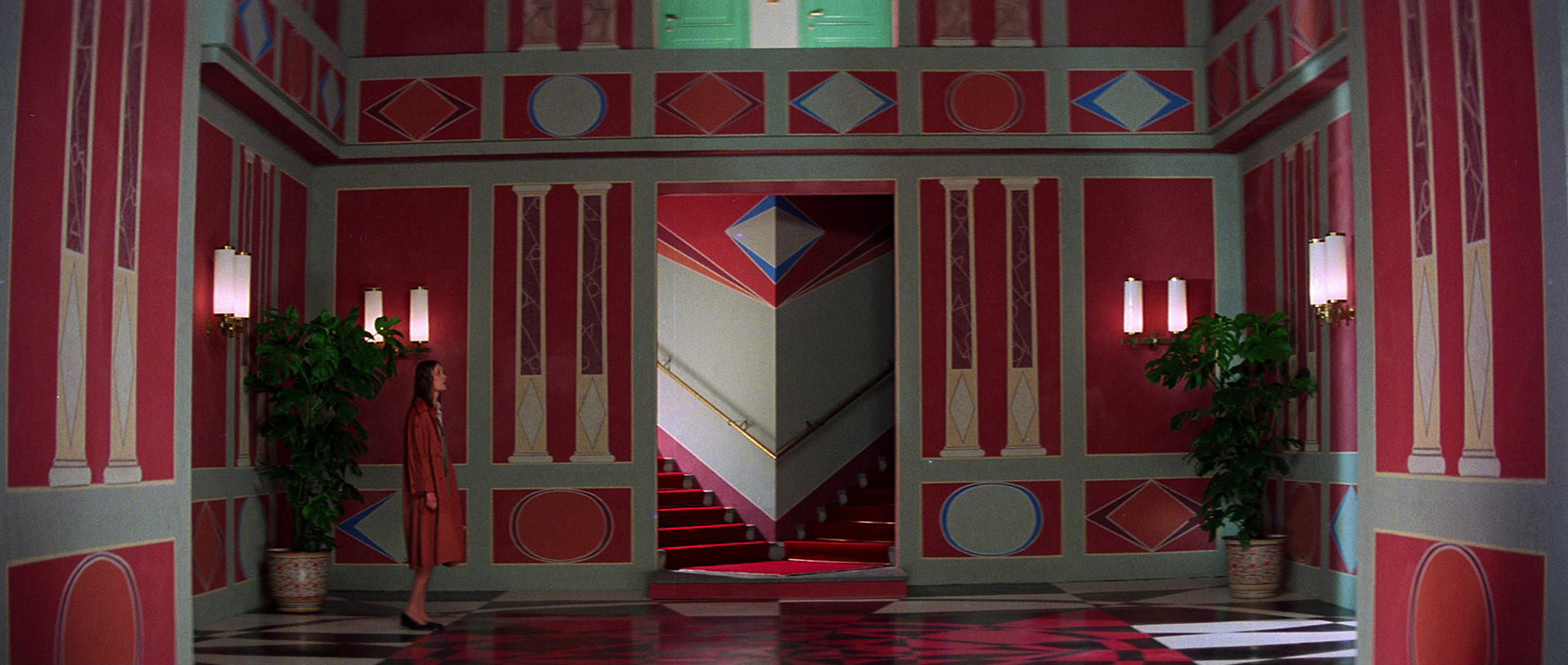
The entrance image above places the figure beside repeated vertical bands, a central stair and tightly ordered wall shapes. The body supplies a scale against which the room’s geometry becomes emphatic. This observation belongs to the visible frame; it does not identify who drew or fabricated each pattern.
In the Sparti interview, Argento recalls enlarged doors and raised handles associated with a child’s perspective, alongside his interest in Art Nouveau and labyrinthine space. Those remarks explain a design intention, without giving a construction specification for every room. Argento on scale ↗
The effect is worth separating from literal realism. An academy can be legible enough to navigate while refusing to feel proportionate to its occupants. That tension is one reason the design remains narratively useful even before a hidden room or passage becomes a plot point. Continue into the architectural studies →
03 / A SHARED IMAGE
A set changes when it is lit.
Tovoli’s American Cinematographer account describes his exchange with Bassan under Argento’s direction as an ongoing production process. The Cannes record separately names Bassan’s production design and Tovoli’s cinematography. Participant account ↗ · Credits ↗
This gives the image two connected histories: the surfaces arranged before the camera and the light falling across them. The photographed red is not simply a paint sample. A reconstruction based on a finished still would have to account for lighting, exposure and reproduction as well as physical decoration. Tovoli’s study follows those photographic decisions →
04 / TENEBRAE
Design can work through restraint.
The later palette of whites and beiges discussed by Argento offers a contrasting design problem. Tenebrae’s credits distinguish Giuseppe Bassan’s art direction, Davide Bassan’s first-assistant role and Maurizio Garrone’s set decoration. Palette recollection ↗ · Department credits ↗
A pale room still directs attention. Its edges, openings and interruptions establish relationships for the camera to disclose or withhold. Read beside the academy, this suggests a collaborator adapting to different dramatic requirements, rather than a single decorative signature reproduced across films. The colour contrast is supported; an exact division of decisions among the department remains a separate historical question.
05 / ATTRIBUTION
A department contains more than one name.
Deep Red’s compiled credits identify Armando Mannini as set decorator alongside Bassan. Pittiglio’s essay also distinguishes the corridor pictures’ relationship to Enrico Colombotto Rosso from Francesco Bartoli’s reported work reproducing them from photographs. Neither a departmental head credit nor an art resemblance establishes the maker of every object. Crew record ↗ · Painting attribution ↗
The surname needs equal care: Opera credits Davide Bassan for production design and Gian Maurizio Fercioni for the Regio Theatre’s art direction. Those are not Giuseppe’s credits. The archive should make a career visible without extending it through a shared surname. Opera credits ↗
| Film / role | Follow the work |
|---|---|
| Deep Red · production design → | The constructed city and the separate histories of its painted objects. |
| Suspiria · production design → | Scale, geometric enclosure and the relationship with light. |
| Tenebrae · art direction → | Pale surfaces and an explicitly credited department. |
| Opera · a credit distinction → | Davide Bassan’s work: a connected route, not a Giuseppe Bassan attribution. |
FOLLOW THE CONNECTIONS
Another way in.
Follow the people across films, then return to the evidence for each contribution.
THE READING ROOM
Return to the source.
Source record reviewed 18 October 2026. Credits, recollections, criticism and material evidence retain their different scopes.
- 01
Dario Argento between Renaissance and twentieth-century art ↗
Gianni Pittiglio, Italy for Movies, 3 April 2026. Institutional art/location essay read: the temporary Blue Bar, Hopper and the corridor paintings. A later account, not construction drawings or a commission record.
Return to the study ↑ - 02
Suspiria (1977) — Dario Argento in conversation ↗
Rosario Sparti interview, republished 5 September 2018 from Il Mucchio. Answers about scale, Art Nouveau, storyboarding and cutting.
Return to the study ↑ - 03
Suspiria: Terror in Technicolor ↗
David E. Williams, American Cinematographer; original February 2010 article, web publication 10 January 2018. Tovoli’s written technical recollections. Later testimony, not camera reports or laboratory timing records.
Return to the study ↑ - 04
Suspiria — Festival de Cannes credits ↗
Official record for the 2007 Cannes Classics presentation of the 1977 film. Screenplay, cinematography, production design and editing credits; not an original production document.
Return to the study ↑ - 05
Dario Argento — the Tenebrae colour discussion ↗
Gaspare Baglio, Rolling Stone Italia, 23 January 2019. Opening answers about pale colours, Tovoli and Rome’s EUR district.
Return to the study ↑ - 06
Deep Red — BFI programme credits ↗
BFI Southbank, May 2023. Compiled crew credits, including Giuseppe Bassan, Armando Mannini, Franco Fraticelli and Pietro Bozza.
Return to the study ↑ - 07
Tenebrae — BFI programme credits ↗
BFI Southbank, May 2023. Compiled credits, including Giuseppe and Davide Bassan’s distinct jobs, Tovoli, Fraticelli and assistant editor Pietro Bozza.
Return to the study ↑ - 08
Opera — BFI programme credits ↗
BFI Southbank, May 2023. Compiled credits checked: Davide Bassan, production design; Gian Maurizio Fercioni, Regio Theatre art direction; Fraticelli, editing. The cast list uses Myra; the accompanying synopsis uses Mira.
Return to the study ↑
KEEP EXPLORING
One film opens another.
Explore the films and collaborators → · Visit the Reading Room → · Find a piece for your collection →