Peter Neal, an American crime writer played by Anthony Franciosa, arrives in Rome to promote a novel. A killer makes his book part of a series of murders. Tenebrae places interpretation inside the crime: reading is something its characters do to one another, with consequences that escape the author’s control. Synapse: synopsis ↗
Spoilers: this study discusses the film’s story and ending.
01 / The writer and his reader
The book becomes an alibi for looking.
Peter Neal arrives in Rome to promote a crime novel. Someone turns its violence into a pattern for real murders and draws the writer into the investigation. The premise makes a book circulate in two economies at once: publicity sells it, while a killer claims to discover instructions in it. The distributor’s synopsis ↗
A writer confronted with that reading can insist on a distinction between fiction and action. But authorship gives him no automatic authority over the reader. A book can outlive the circumstances in which it was written; it can be quoted selectively, treated as a confession, or made to justify something its interpreter already wants to do.
The film then makes the apparently reassuring position of the author unstable. Kevin Lyons’s essay, republished in the BFI programme, identifies the transfer of guilt to Neal and the revelation that he has killed before. Lyons: the reversal of the investigator’s role ↗ The novelist is therefore more than a professional observer who has wandered into somebody else’s nightmare.
Our reading is that the reversal changes the question. It is no longer enough to ask whether a reader has misunderstood an innocent work. We must also ask what the author’s public identity allows him to conceal. The difference between explaining violence and committing it remains essential, even as the plot makes one person occupy both positions.
Beside Deep Red, this is another crisis of interpretive confidence. Here the person who seems best equipped to assemble a story also has an interest in controlling which story is told. A solution can expose a crime while revealing how effectively we have trusted the wrong narrator.
02 / Criticism and performance
Tilde gets to argue with the author.
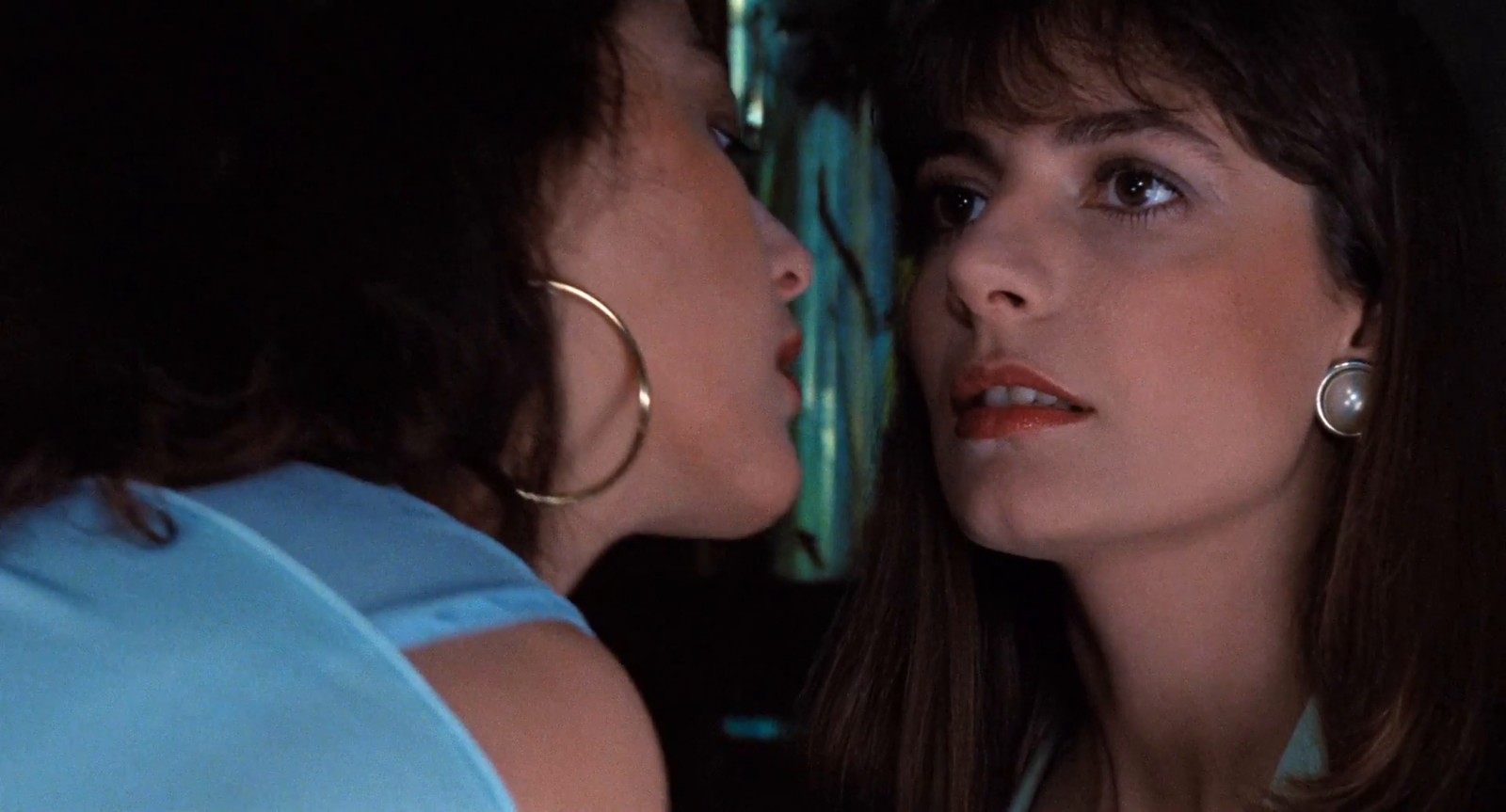
Lyons draws attention to Tilde’s challenge to Neal over sexism in his writing. The critical exchange ↗ This matters before it becomes evidence for a claim about Argento. A character questions a writer’s treatment of women; the scene gives criticism a place inside the fiction instead of leaving it entirely to reviewers outside the cinema.
That does not settle the argument in the film’s favour. A work can anticipate an objection without answering it. Nor does a critic’s fate within a thriller invalidate the objection. Our interpretation keeps both possibilities open: Tenebrae makes the dispute part of its machinery while remaining available to criticism for the images it asks an audience to enjoy.
Mirella D’Angelo’s own account offers a different kind of evidence. Speaking to Roberto Attanasio for Terra di Goblin, she remembers accepting Tilde after an enthusiastic meeting with Argento and working in harmony with him. She singles out Tovoli’s light for the pleasurable sensation it gave her on the set. D’Angelo: casting and the experience of filming ↗
This recollection restores the working performer to a discussion easily dominated by the director and the killer. It describes a creative relationship; it does not tell us how every spectator experiences the finished sequence. Good working memories and troubling representations can coexist. Each deserves to be considered on the evidence appropriate to it.
03 / Rome and the pale palette
A real district can become an invented city.
In his 2019 interview with Gaspare Baglio, Argento describes a deliberate departure from Suspiria: he and Luciano Tovoli wanted whites and beiges, approaching the impression of monochrome. Rooms had to belong to that pale scheme. He identifies Rome’s EUR district, its marble and unusual buildings, as central to the choice of locations. Argento on colour and EUR ↗
The decision joins photography to design. A bright room does not become this kind of image through lighting alone. Walls, clothing, surfaces and the objects left in view determine what that light can reveal. The BFI credits separately identify Giuseppe Bassan’s art direction and Franco Fraticelli’s editing. Design and editing credits ↗ Keeping those roles visible helps explain why the city feels organised rather than merely found.
Argento’s later Total Film conversation links EUR to de Chirico and to his wish for an atmosphere suspended between reality and dream. The Tenebrae passage ↗ That is a participant’s account of a desired effect, not a map proving the origin of every composition.
The resulting question is more interesting than whether Rome looks realistic. Recognisable places can be arranged so that familiar urban cues offer little reassurance. Pale surfaces invite inspection; open space need not provide social protection. The city becomes legible as geometry while remaining difficult to read as a network of people who might help.
The frequently repeated account of a depopulated future is retained as an attributed idea in later programme writing. An exact fictional date would claim more than this evidence establishes.
04 / Images and memory
A red shoe interrupts the pale world.
ENLARGE ↗Published film image · Film at Lincoln Center, 2022 gallery. Full composition retained.Image source ↗
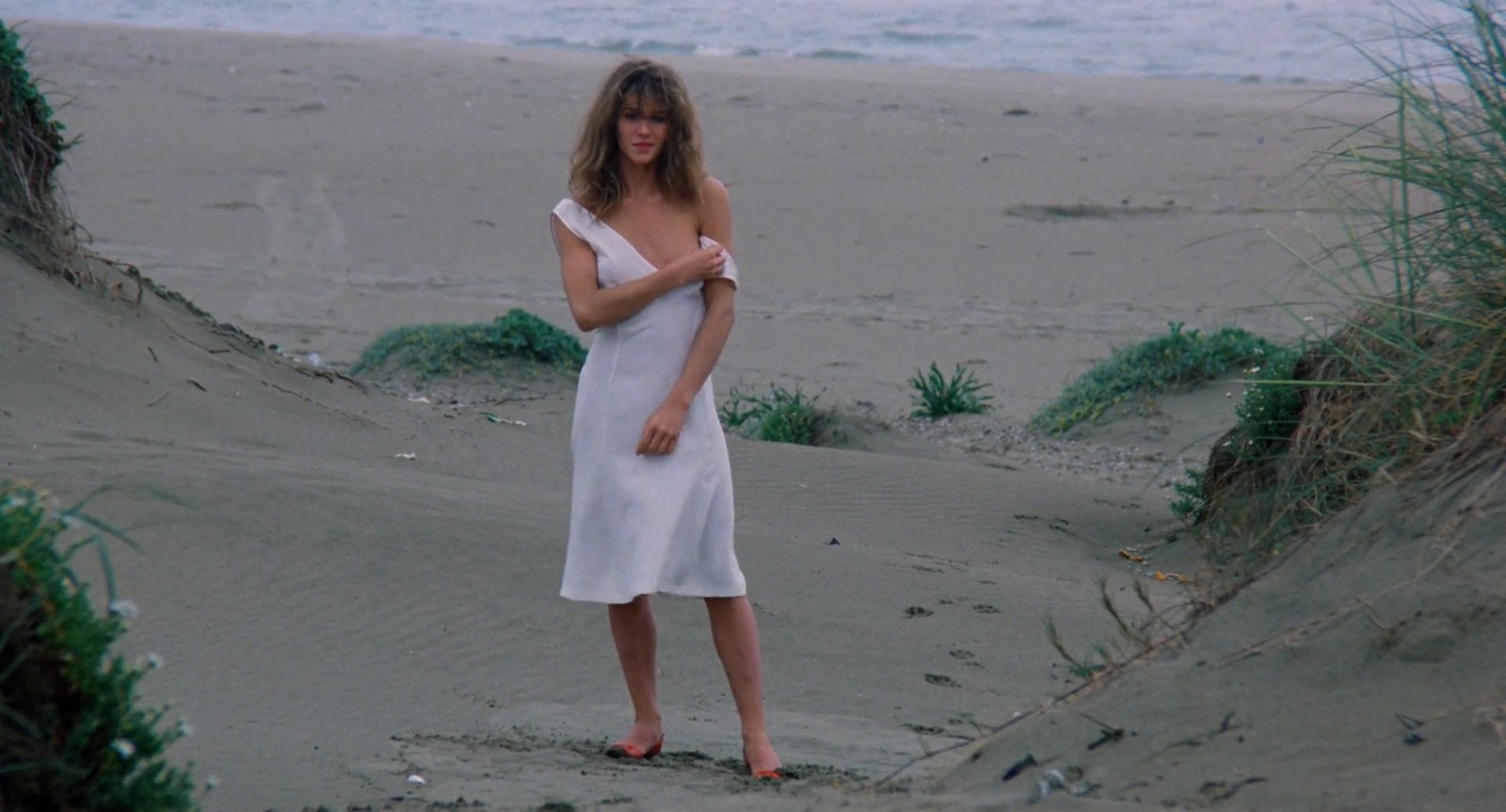
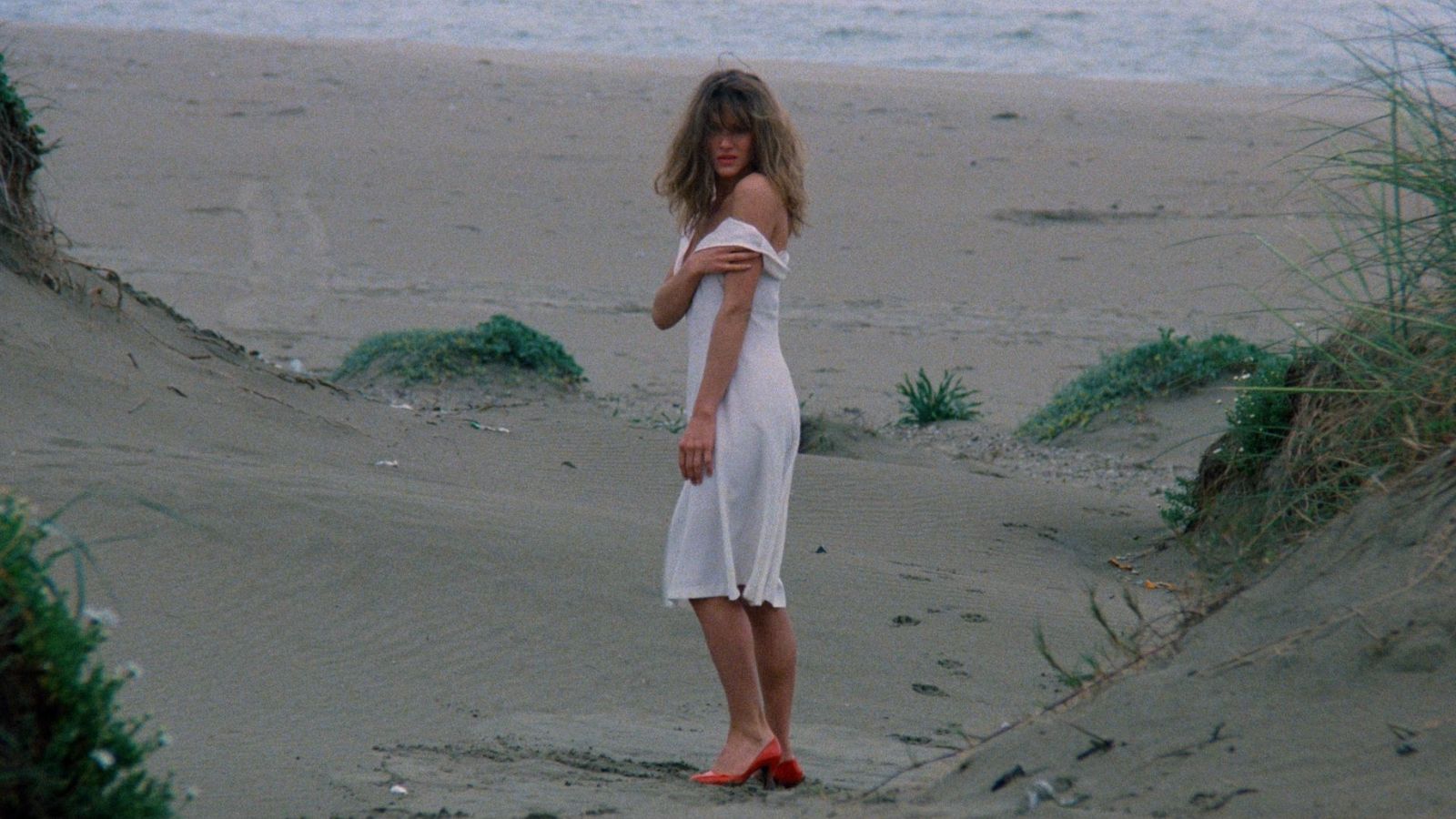
In this published reproduction, a pale dress sits within a broad field of sand and muted vegetation. The red shoes occupy very little of the image, but they are difficult to overlook. The surrounding space gives that small patch of colour disproportionate force.
It is a useful qualification to any shorthand description of the film as colourless. A restrained field can make an accent more insistent. The point is not to count hues but to ask which objects the image teaches us to retain. Lyons connects the red shoes to Neal’s remembered humiliation and earlier murder. The shoes and the disclosed past ↗ Our visual reading concerns how an object can become memorable before its narrative significance is secure.
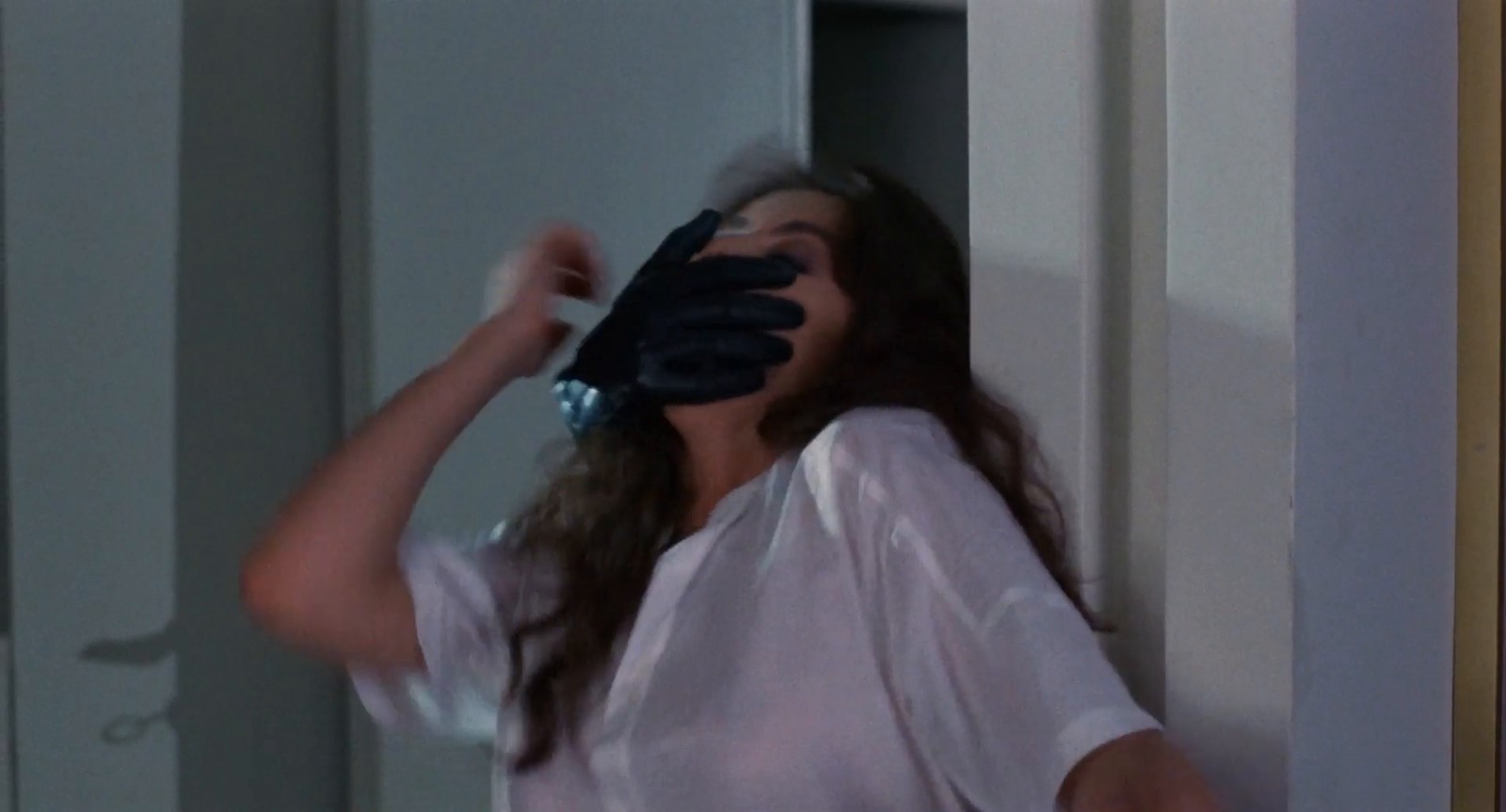
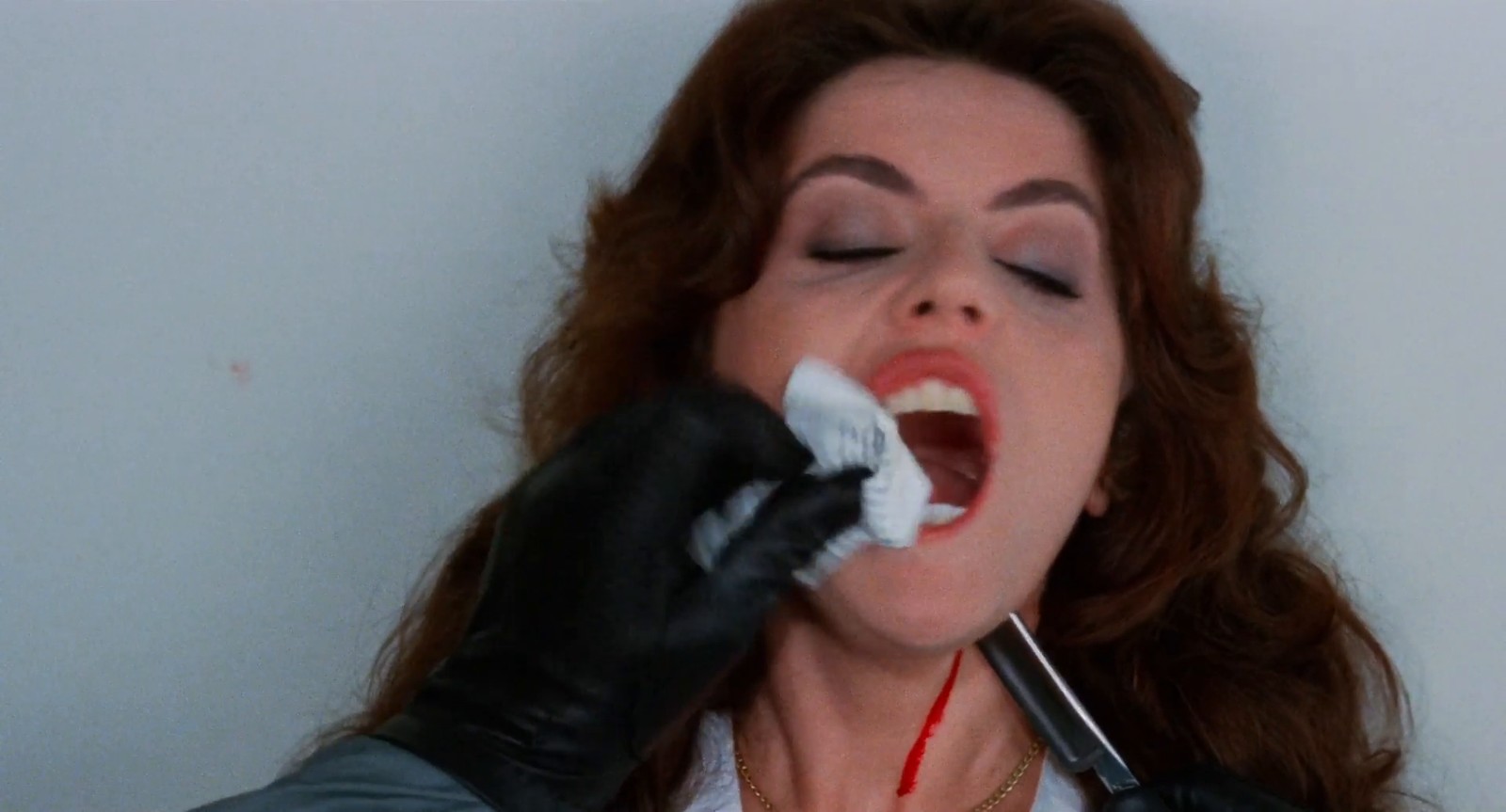
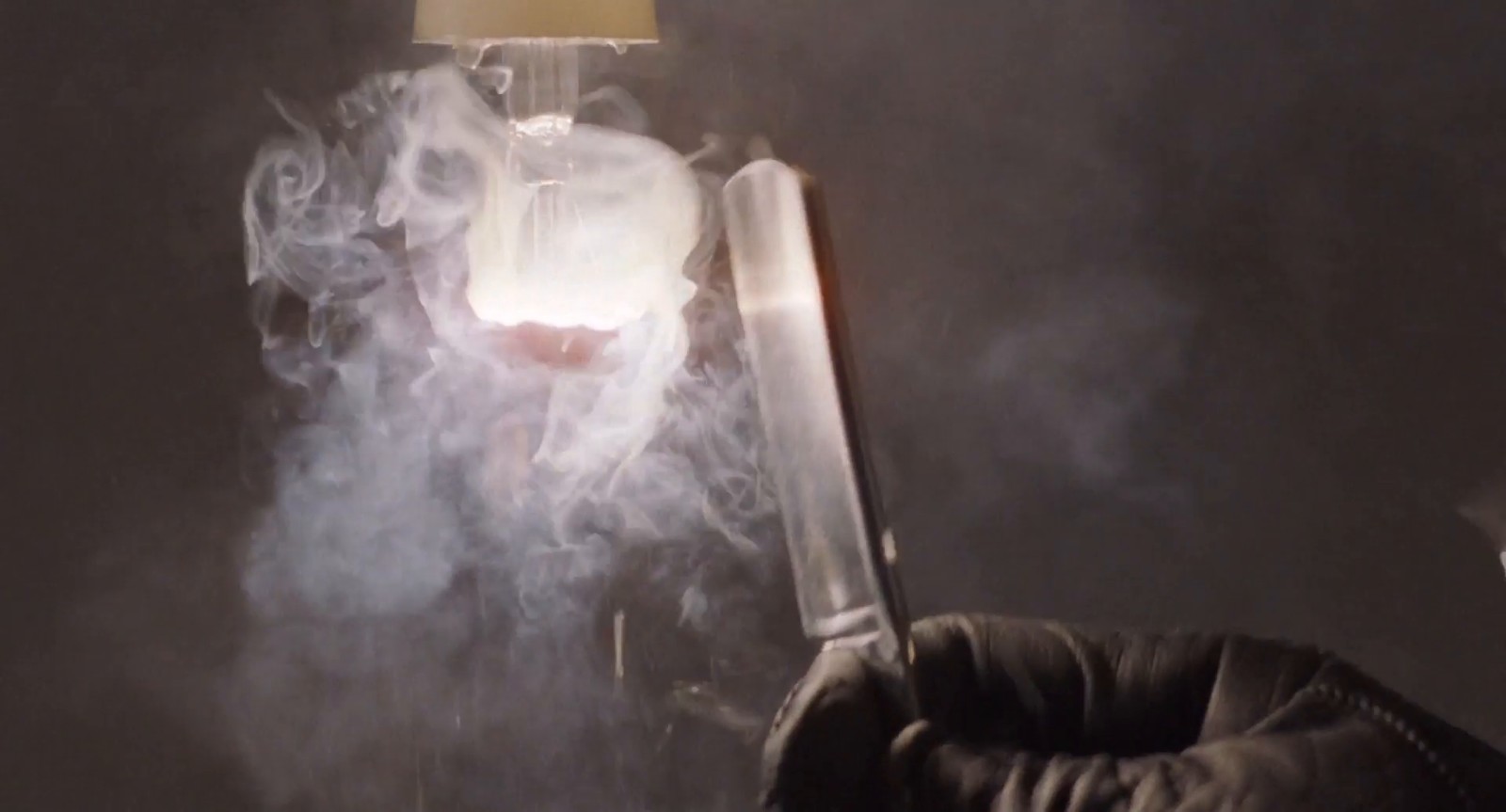
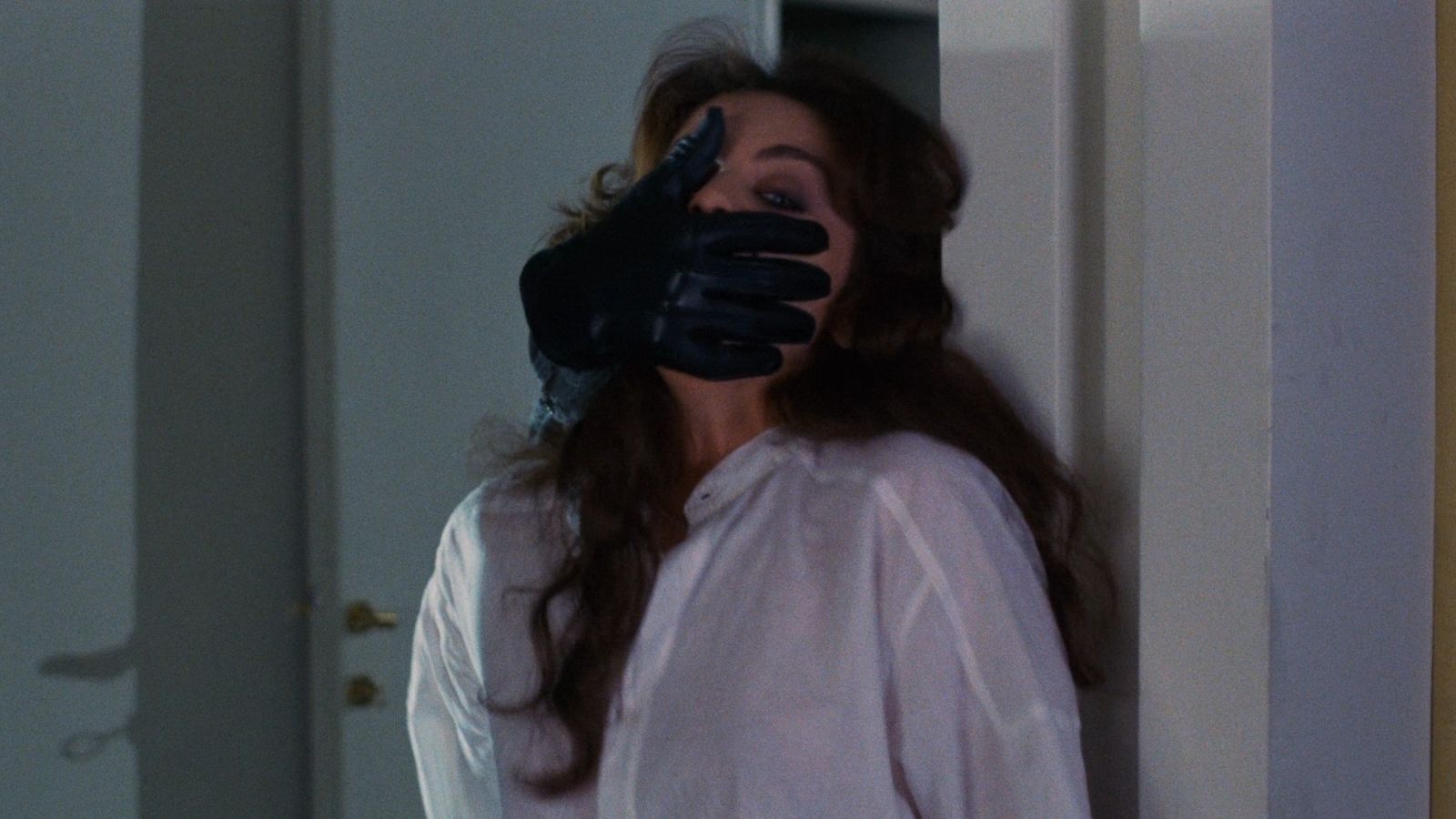
The opening image above works differently. A dark glove cuts across a woman’s face against pale doors and clothing. We see an obstruction with great clarity, while the person responsible remains outside this reproduction. Exposure and explanation are separate achievements: a clear image can still withhold the relation we most need to understand.
The first edition’s BFI-published face-and-fabric image offered a related interruption of visibility. The earlier image reference ↗ These examples give the dossier a concrete visual argument without treating a publicity reproduction as a calibrated sample of a release print. No shot order, camera movement or exact timing is inferred from the stills alone.
05 / The house and the camera
The camera’s freedom was collective work.
D’Angelo recalls an excited crew at the villa used for Tilde’s house, waiting for a special camera setup. She identifies the occasion with the Louma sequence and remembers being its human participant. D’Angelo: waiting at the villa ↗ Her recollection puts a performer inside the history of a shot usually discussed as an abstract technical feat.
Argento, in the Total Film interview’s discussion of Opera, singles out the camera travelling around the Tenebrae house as an example of the freedom he values in movement. Argento: the movement around the house ↗ These accounts establish the importance of the sequence without providing a complete record of its execution.
The BFI’s credit compilation names Tovoli as cinematographer, Giuseppe Tinelli as camera operator, Francesco Giulivi as gaffer and Mario Moreschini as key grip. The camera and lighting crew ↗ A credit identifies a production role; it does not by itself prove who controlled a particular movement or how a rig was configured.
Our interpretation begins with the difference between access and protection. A camera able to move around a home makes its boundaries seem permeable to looking. That apparent freedom belongs to the spectator’s encounter with the image; it offers no corresponding escape to the people inside the story.
This is the productive connection with Inferno. One film makes a house impossible through layers of construction and illusion; the other turns the act of inspecting a house into an event.
A window, a roof, another window.
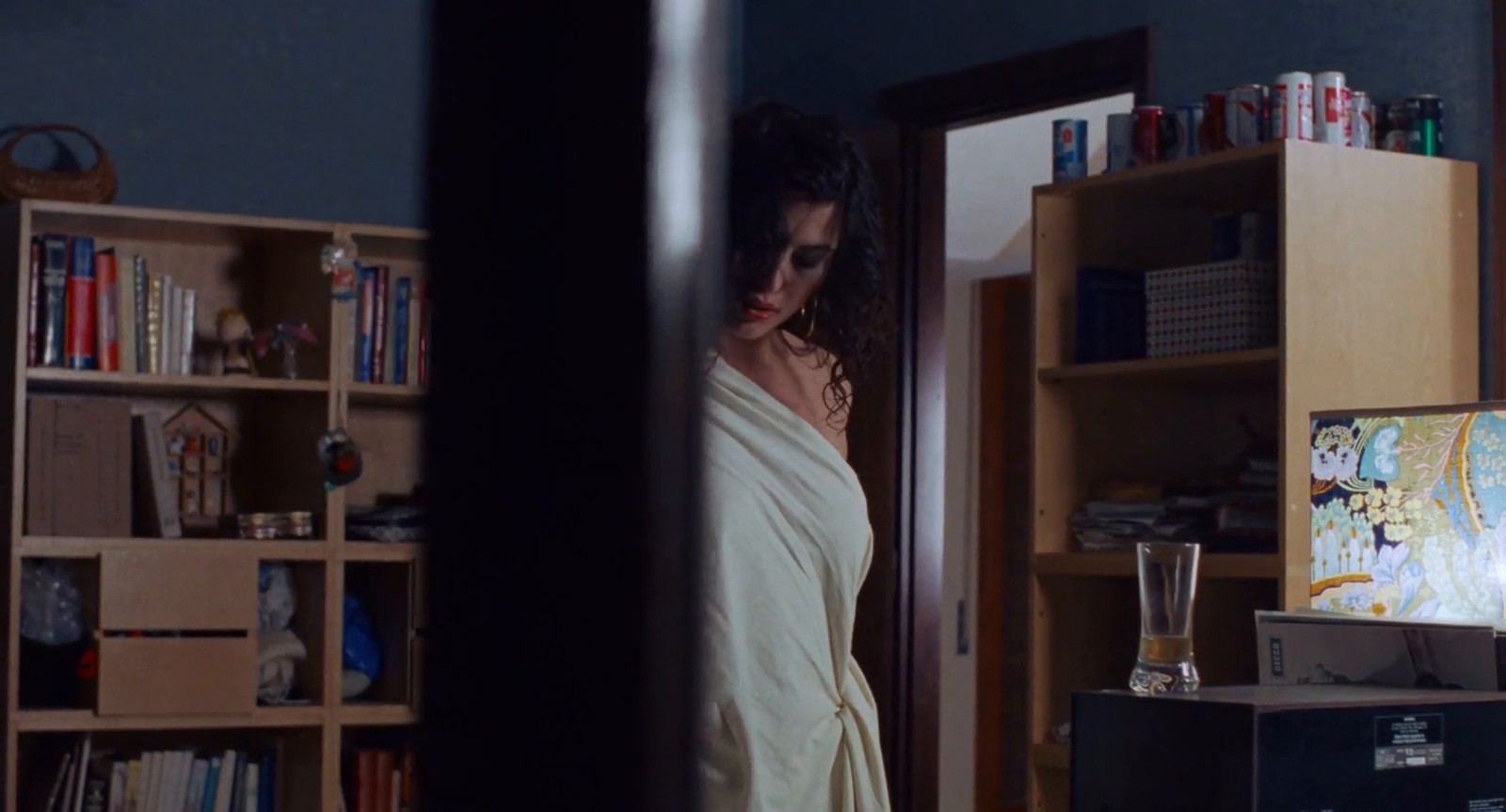
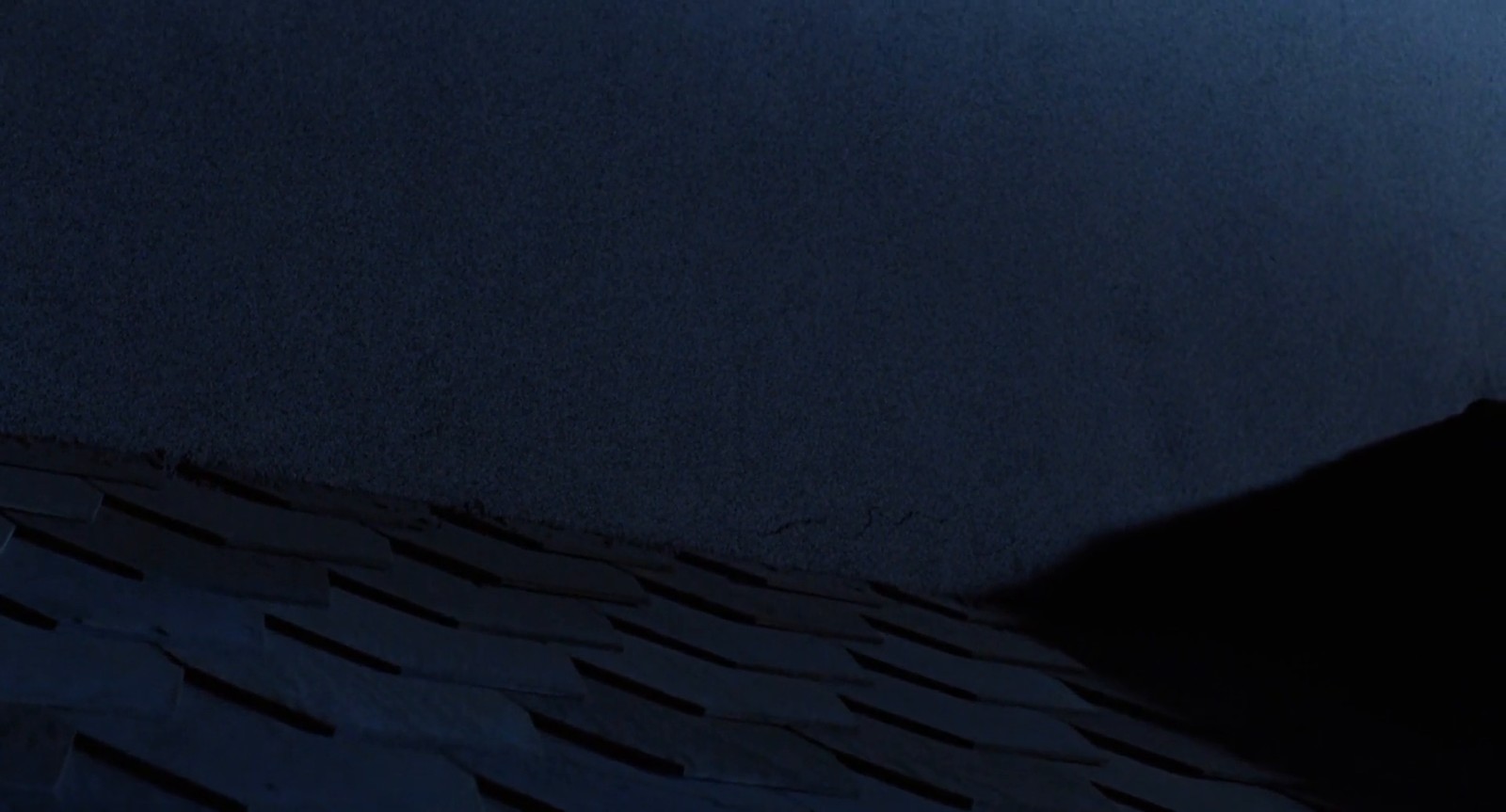
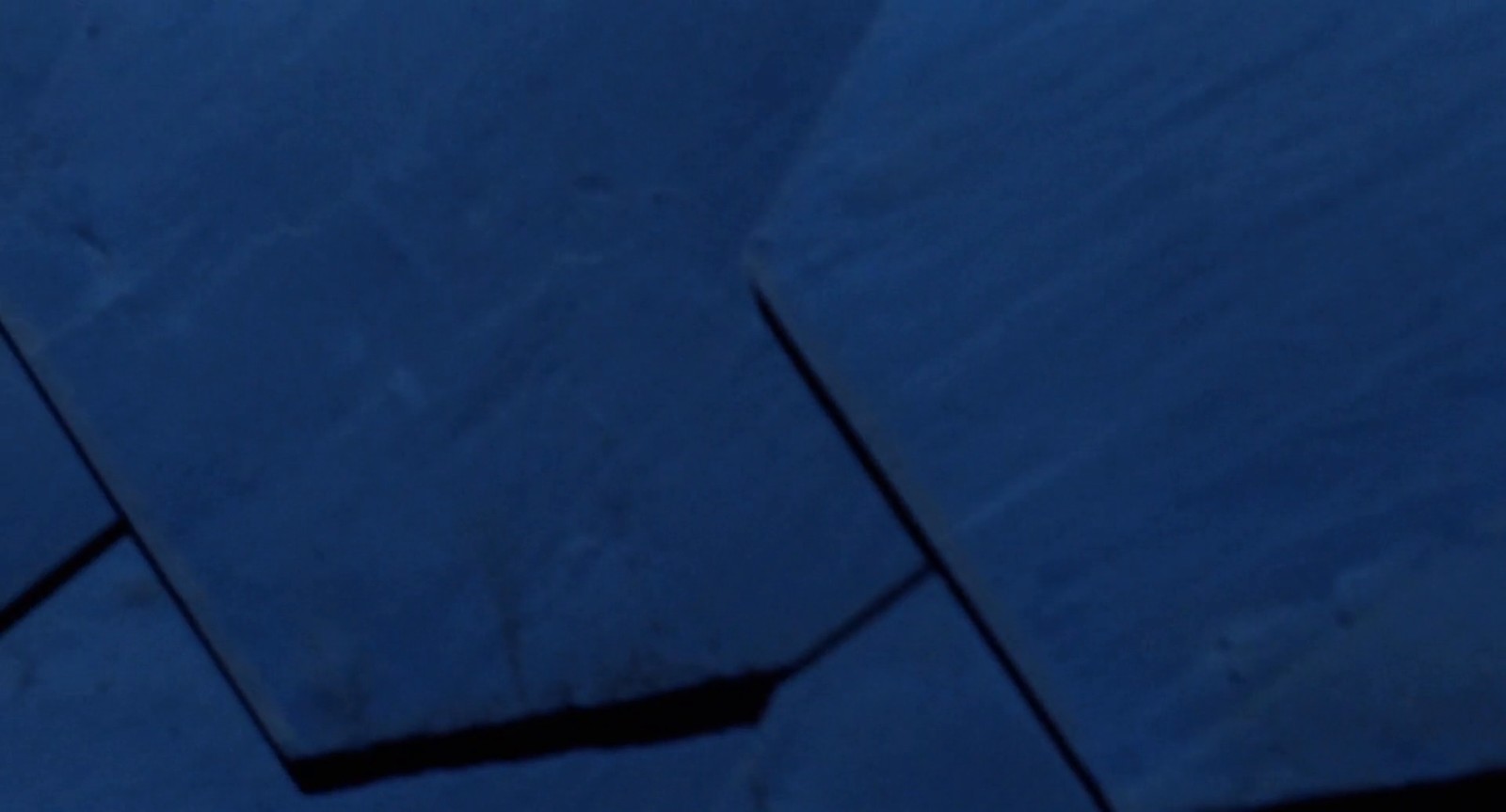
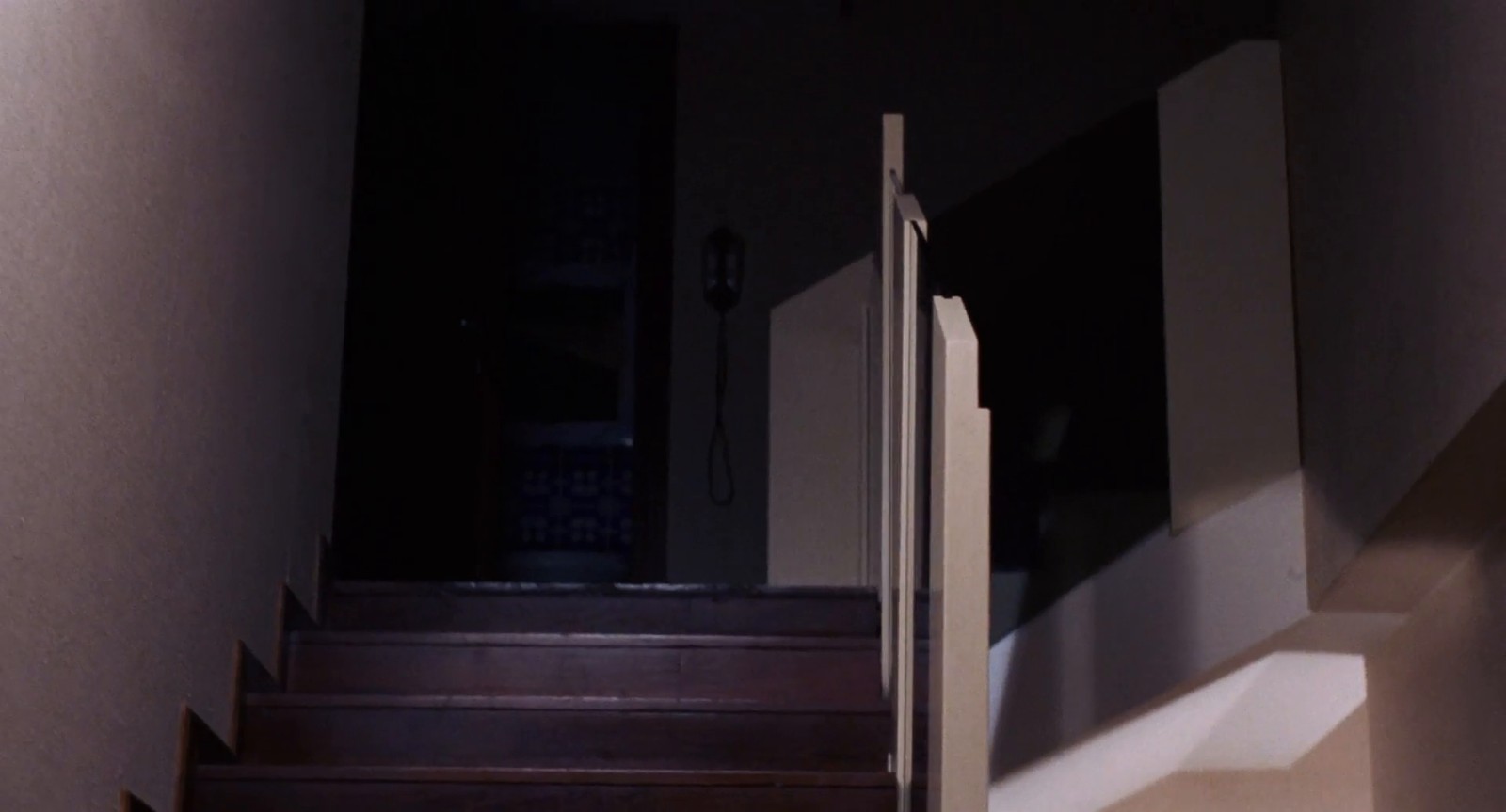
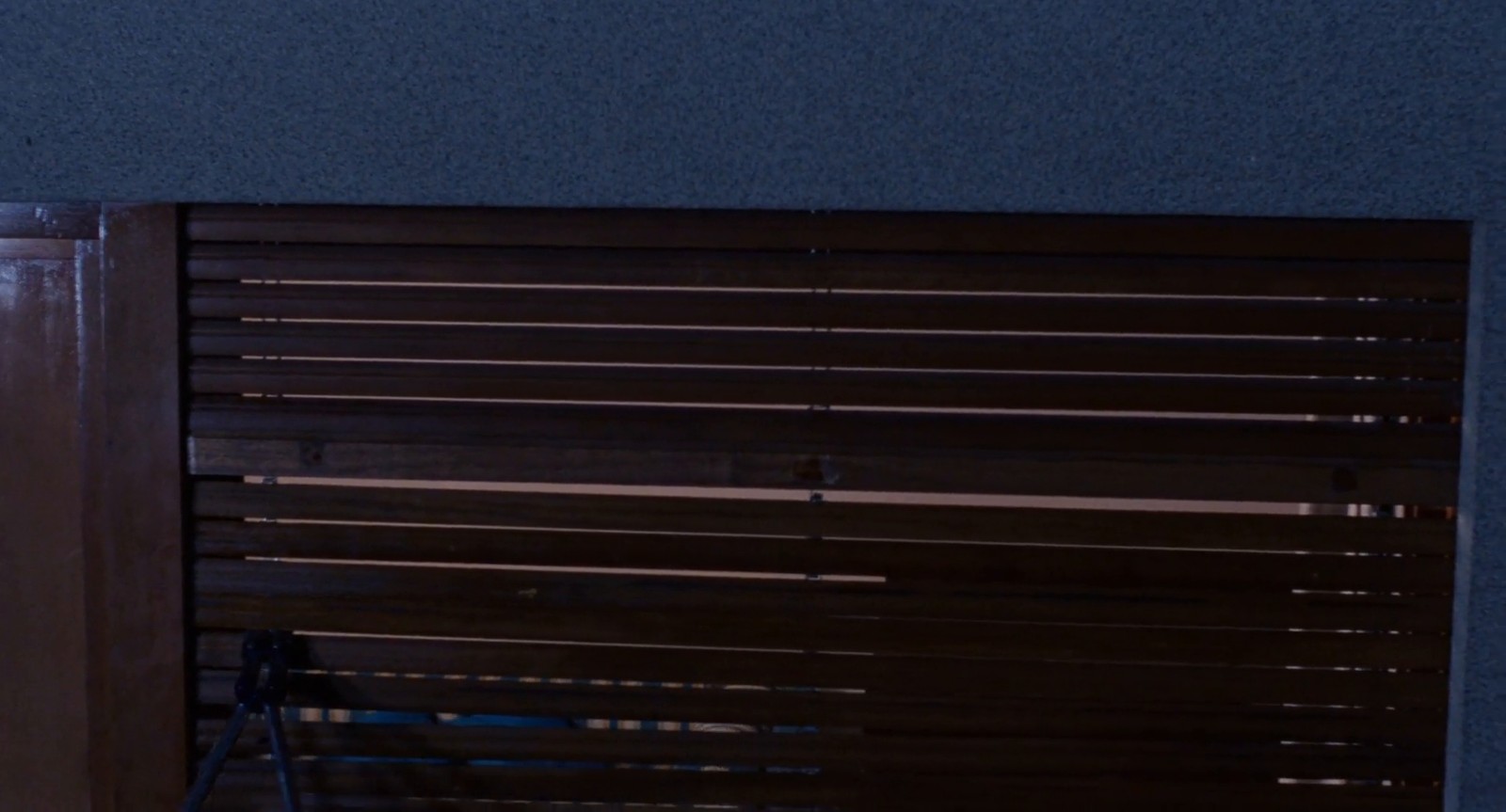
From the exterior view of Tilde at 28:00 to the cut back inside at 30:37, the camera’s route occupies roughly two minutes and thirty-seven seconds. It rises away from her window, finds Marion in another room, crosses the roof and descends toward the staircase and shutter. The interval lets unoccupied surfaces hold the screen: concrete, tiles and shutters become part of the suspense.
The movement does not settle into one character’s eyeline. It grants an inspecting freedom that the later attacks fracture into short, tightly bounded views. Compare the duration of the house passage with the cuts around Tilde’s face.
Trace the camera around the house 6 images
01 / 28:02.0ENLARGE ↗Tilde at the first window.02 / 28:42.0ENLARGE ↗Marion crosses another room.03 / 29:18.0ENLARGE ↗The camera leaves the lit interior.04 / 29:42.0ENLARGE ↗Blue roof tiles fill the frame.05 / 30:10.0ENLARGE ↗The staircase comes into view.06 / 30:30.0ENLARGE ↗A shutter closes the route around the house.
06 / Three names and an electronic pulse
The score’s credits tell a history of their own.
Simonetti, Pignatelli and Morante are the names used in the BFI’s music credit. In Michele Savoldi’s OndaRock interview, Claudio Simonetti explains that Fabio Pignatelli had continued using the Goblin name with another line-up, so the three musicians worked under their own names for Tenebre. He describes electronic drums, with orchestral timpani played by Walter Martino, and links the sound to his dance-music experience. Simonetti: the name and the rhythm section ↗
His account gives a useful alternative to hearing every collaboration as a continuation of the same band. The personnel overlap, but the organisation and musical priorities have changed. Naming the trio and Martino makes the contribution more specific without denying the larger Goblin history.
At the 2004 Red Bull Music Academy in Rome, Simonetti also describes combining electronics and rock and using a vocoder. Simonetti with David Nerattini: the Tenebrae discussion ↗ These are descriptions by a participant. The transcript’s precise equipment names are not adopted as a verified session inventory.
The creative tension is suggestive: dance music organises movement and anticipation, while a thriller organises fear and delay. A forceful pulse can lend momentum to looking even when the images make that pleasure uncomfortable.
The score album and the film mix offer different listening experiences. The film places music in relation to speech, impacts and pauses; an album presents tracks in its own order and duration. Later concert arrangements add another history of performance.
Mono is a mix, not a channel count.
Arrow identifies its restored English and Italian film soundtracks as mono. Synapse’s specification gives English and Italian 2.0 audio. Those descriptions need not conflict: a mono signal can be carried in two channels. The number of channels alone cannot establish a stereo soundstage. Arrow’s soundtrack specification ↗Synapse’s 2.0 listing ↗
Measurements of four passages in the English-language viewing copy—opening credits, the publicity interview, the house interior and the ending—found almost identical left and right signals. This supports treating those passages as effectively mono. The music’s force should therefore be discussed through rhythm, timbre and its relation to the image, without inventing left-to-right movement.
The two channels across the full film.
A comparison across the complete 1:41:04 viewing copy extends the earlier four-passage check. The left and right signals remain very closely matched, supporting an effectively mono presentation throughout this copy. This finding concerns the film soundtrack carried by this file; it does not establish the spatial mix of a soundtrack album.
How the channel comparison was made
Both channels were decoded and resampled together to 12 kHz for comparison. The difference between them was about 47.8 dB below their shared signal across the complete track. In five-second windows above the analysis floor, left/right correlation remained at least 0.993. Near-identical channels support the mono assessment; these measurements do not identify instruments, verify dialogue or establish the timing of individual sound cues.
In the published 2004 Red Bull Music Academy conversation, Simonetti recalls a Linn 9000 while discussing the electronic drums in Tenebrae. Roger Linn’s own product history dates that model’s release to 1984, two years after the film. The recollection supports the importance of electronic rhythm, but it does not securely identify the machine used in the 1982 sessions. Simonetti’s recollection ↗ · Roger Linn’s chronology ↗
The same product history dates the LinnDrum to 1982. That makes it a chronological possibility, not evidence that it was used here. A session record or contemporary studio photograph would be needed to settle the model.
The electronic pulse travels beyond the film.
In Panico, Simonetti again connects Tenebrae with his move into dance music and a wish to leave the earlier rock sound behind. Nicolas Winding Refn supplies the other side of that history: he identifies the film’s electronics and disco pulse as an influence he later drew on, and describes its murder mystery becoming a surreal fashion show. Panico: testimony and passage locators ↗
The testimony extends the score’s afterlife beyond records and concerts. Refn remembers a model of rhythm, design and stylisation that could enter another filmmaker’s work. His enthusiasm is evidence of reception and influence; it does not settle the session history or the disputed identification of the drum machine.
07 / Cuts and restorations
A cut flag does not always mean a cut to violence.
The BBFC record makes an unusually useful distinction. Its 1983 cinema submission and 1999 video entry carry cuts notices. The 2022 Unsane entry also carries one, but explicitly says that the required removal was a misleading non-BBFC rating symbol. Classification history and the stated 2022 change ↗ The same label therefore needs to be read at the level of the particular decision.
Record
What it establishes
BBFC, February 1983
Cinema submission, 100m 51s; cuts or alterations recorded.
BBFC, August 1999
Nouveaux Pictures physical-media entry, 96m 19s; cuts or alterations recorded.
BBFC, January 2003
Anchor Bay physical-media entry, 96m 24s; no cuts notice displayed.
BBFC, March 2011
Arrow physical-media entry, 96m 50s; no cuts notice displayed.
BBFC, 12 May 2022
Arrow cinema entry, 101m; no cuts notice displayed.
BBFC, 18 July 2022
Unsane, 90m; the specified compulsory change concerns the rating symbol.
Synapse, July 2022 set
Tenebrae and the alternate U.S. theatrical cut Unsane; a restoration made with Arrow, 1.85:1 presentation and English/Italian 2.0 audio. The named three-disc edition ↗
The film title is not enough to identify the object being discussed. A review of Unsane, a modern screening of Tenebrae and an English-language disc track need not expose the same material. Conversely, differing running times do not alone establish missing scenes: the carrier and playback conditions matter.
The two restoration credits are preserved separately. A catalogue description supports the identity of an offered edition; a comparison of masters requires different evidence.
Version differences belong to named releases. Unsane is a distinct alternate cut; a censorship decision is a dated intervention; a restoration describes work on surviving materials. Keeping those histories separate makes the film’s circulation easier to follow.
The same title does not mean the same contents.
The named Synapse three-disc set includes the alternate U.S. theatrical cut Unsane. Arrow’s current single-disc 4K listing instead specifies the Unsane end-credit sequence among its supplements; that listing does not promise the complete alternate cut. An end-credit extra and a second version of the film are different additions. The three-disc set ↗The single-disc contents ↗
Arrow also lists Italian and English front and end titles and insert shots. Language selection can therefore affect words within the image as well as the dialogue track. Its listed commentaries pair Alan Jones with Kim Newman, alongside separate tracks by Thomas Rostock and Maitland McDonagh. These are edition contents, distinct from claims made within a commentary.
A runtime difference is not a cut list.
A useful control is playback speed. A 101-minute film at 24 frames per second takes about 96 minutes 58 seconds when the same frames run at 25. That is a mathematical example, not a finding that any particular BBFC submission uses that conversion. It explains why the 96-minute records cannot be subtracted from a 101-minute listing to produce a list of censored scenes. The 1983 and 1999 notices establish alterations, but the public record does not enumerate their individual shots.
08 / From the listings to the retrospective
A film’s public life leaves different kinds of trace.
The Rome listings in l’Unità on 12 November 1982 place Tenebre at the America, Ariston II and Empire cinemas. Each listing identifies Argento and carries the paper’s horror label and an under-18 restriction. The original printed page, including the date and venue entries, has been visually inspected. Rome listings, printed page 18 ↗
This is modest but concrete evidence of circulation. It places the film in an ordinary day’s choice of public entertainments, with named venues and an age boundary. A listing is valuable precisely because it answers a narrower question than a later reputation.
By June 2022, Film at Lincoln Center was presenting the film in an Argento retrospective, with an introduction by the director advertised for 17 June. Its programme frames the work around interpretation and the limits of seeing. The retrospective and its framing ↗ The critical setting has changed: the film is now approached alongside a career, not only as a new thriller on a local bill.
Those two public moments should remain distinct. The BFI’s later programme and the participant interviews add further perspectives without forming a single, unanimous account.
Our central argument is that Tenebrae turns interpretation into a dangerous privilege. The writer, critic, camera and spectator can each make something visible while concealing another relation. That makes the film rewarding to revisit—and makes it necessary to preserve disagreements about the pleasures it offers.
THE FILM IN IMAGES
Every image has an afterlife.
Follow the story through twenty-four scene studies, or go straight to the effects sequences.
Books, photographs, windows and bodies become things to read. This visual guide follows the film from its opening pages to its final reversal. Select a still to enlarge it; follow the linked studies for the sequence, the craft and the research. Viewing copy & credits ↗
Includes the film’s ending and graphic effects imagery.
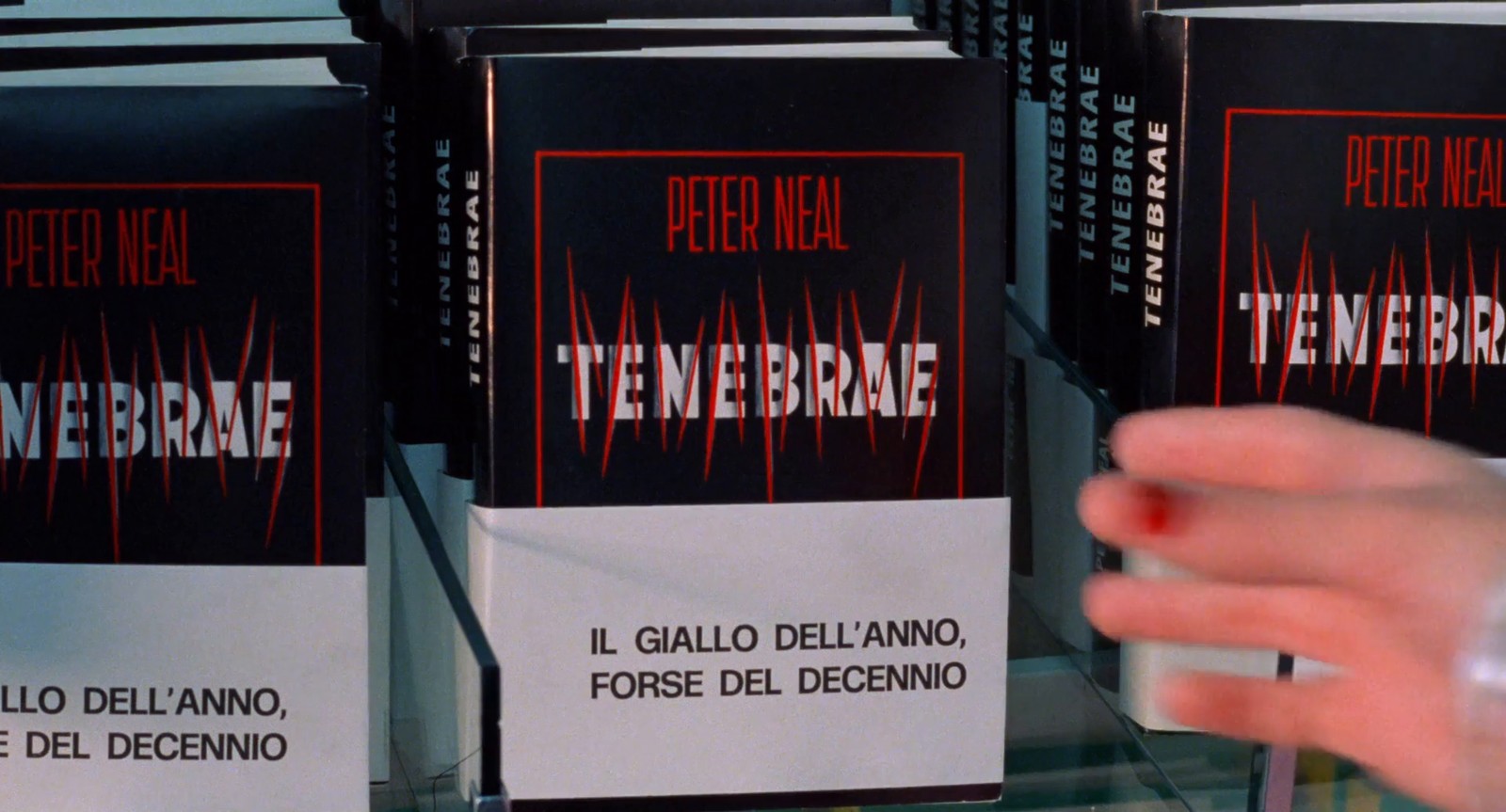
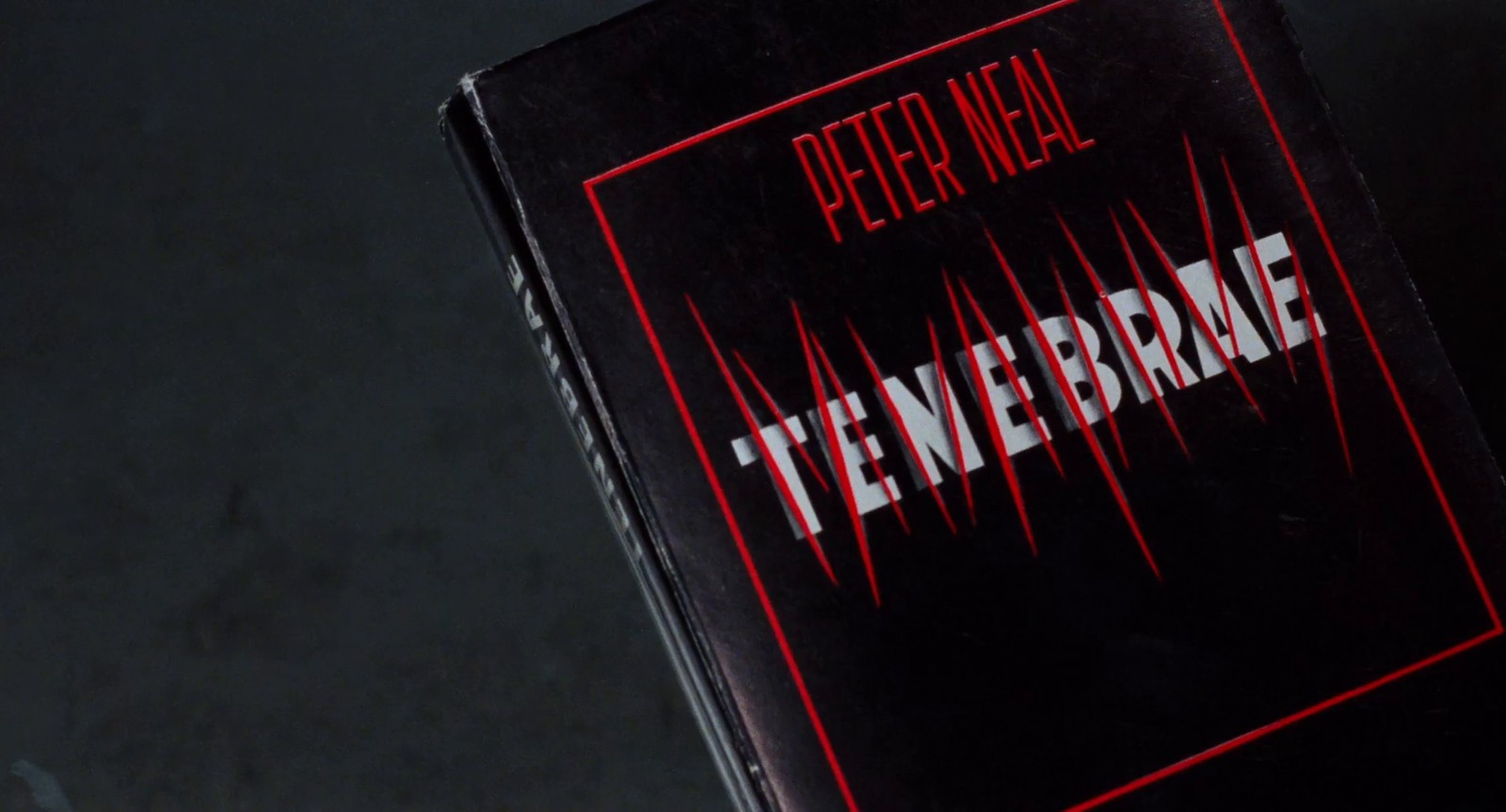
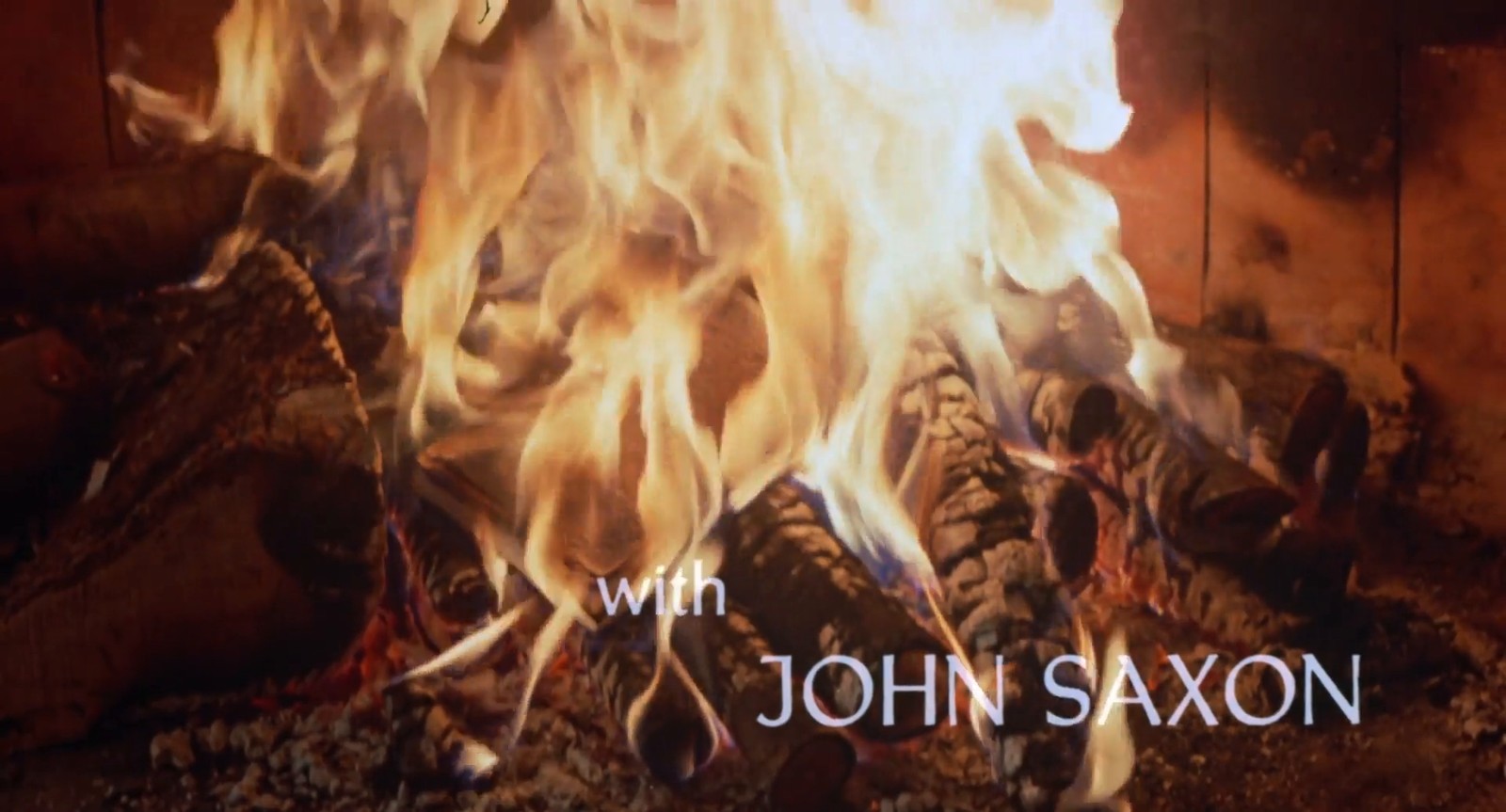
The opening makes text into material: tightly framed print gives way to pages burning beneath the credits. The novel will circulate through shops, interviews and threatening messages, but the fire has already introduced reading as an act of destruction.
The opening alternates the book as a physical object with enlarged fragments of print. Its seven views lead into the fire beneath the credits; changing titles and flickering flames occupy the same held composition.
00:01.0A black-gloved hand holds Neal’s novel in front of the fire, then opens it.
00:05.5An extreme close view isolates the printed passage. The camera moves along the lines.
00:16.2The book and hand return against the flames.
00:21.5The film cuts back into the printed words.
00:29.9The wider book view restores the surrounding fire.
00:35.5A third close passage fills the screen with print, continuing toward the word “Murder.”
00:48.8The fireplace replaces the page. The title appears over the flames and the book is thrown in; the credits continue over the fire until the cut to the bridge at 02:09.4.
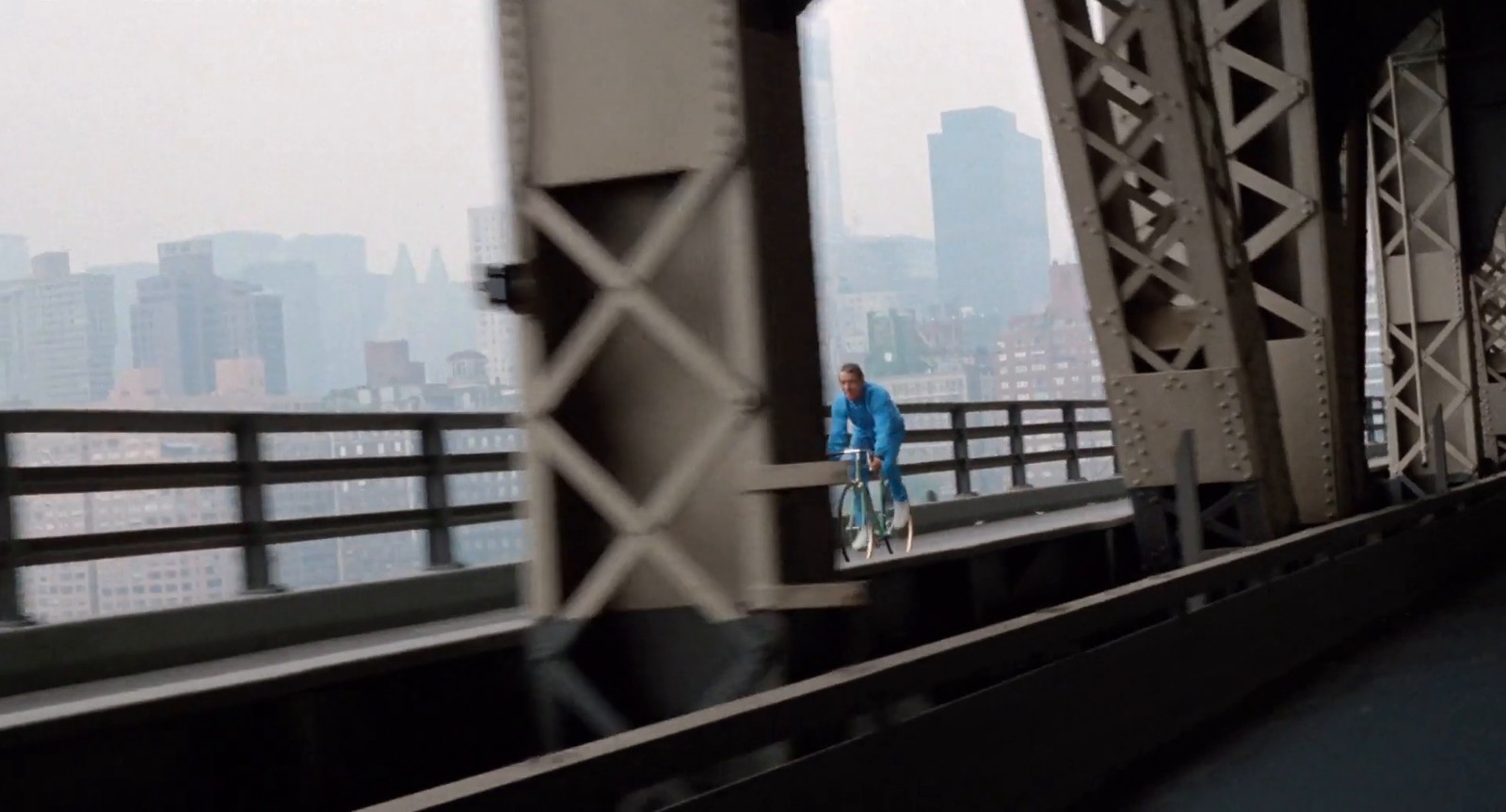
The bicycle, airport roads and terminal establish Neal through movement before the Rome publicity begins. Red accents and figures at the edge of the departure scenes acquire weight when the film later returns to Jane and the shoes.
The journey begins with lateral movement across the bridge and ends with Neal leaving the terminal. In between, a red telephone and alternating views at the counter separate his attention from Jane’s presence nearby.
02:09.4The fire gives way to the bridge’s metal framework. The moving view finds Neal on his bicycle.
02:20.4A more distant side view keeps Neal beyond the passing bridge supports.
02:33.4A frontal road view places him between the moving vehicles.
02:41.5The camera moves closer to Neal and the handlebars.
02:47.1Road signs redirect the journey toward the airport.
02:49.6The terminal approach begins with the roadway and traffic; the moving view reaches the building and taxis.
03:23.6Inside, Neal enters the view beside the glass wall.
03:25.6A wide view establishes the terminal’s sweeping architecture and stairs.
03:27.1Neal changes clothes beside the washroom mirror.
03:33.9Now in a pale jacket, he moves through the concourse past the escalator.
03:48.8The counter view places him among the waiting passengers.
04:03.5A closer counter view brings the red telephone into the exchange.
04:17.1Jane appears among the travellers, with Neal’s bag on the floor nearby.
04:20.4The film returns to Neal at the telephone and the attendant beside him.
04:31.9A lower view isolates the bag and the travellers’ legs as people cross the foreground.
04:34.4A wide return to the counter follows Neal as he leaves the telephone.
04:41.8The view shifts toward the telephone booths and finds Jane.
04:48.8Neal is back at the counter before collecting his bag.
04:53.2Jane receives a closer view against the booth’s orange background and puts on her sunglasses.
04:57.8Neal walks away down the narrow passage with his bag.
05:00.2Jane and another woman stand at the terminal window, looking toward the aircraft.
The book first appears as a commodity that can be handled, read and stolen. Elsa’s encounter with the store detective places the respectable author’s name inside a scene of coercion, anticipating the more literal violence done with its pages.
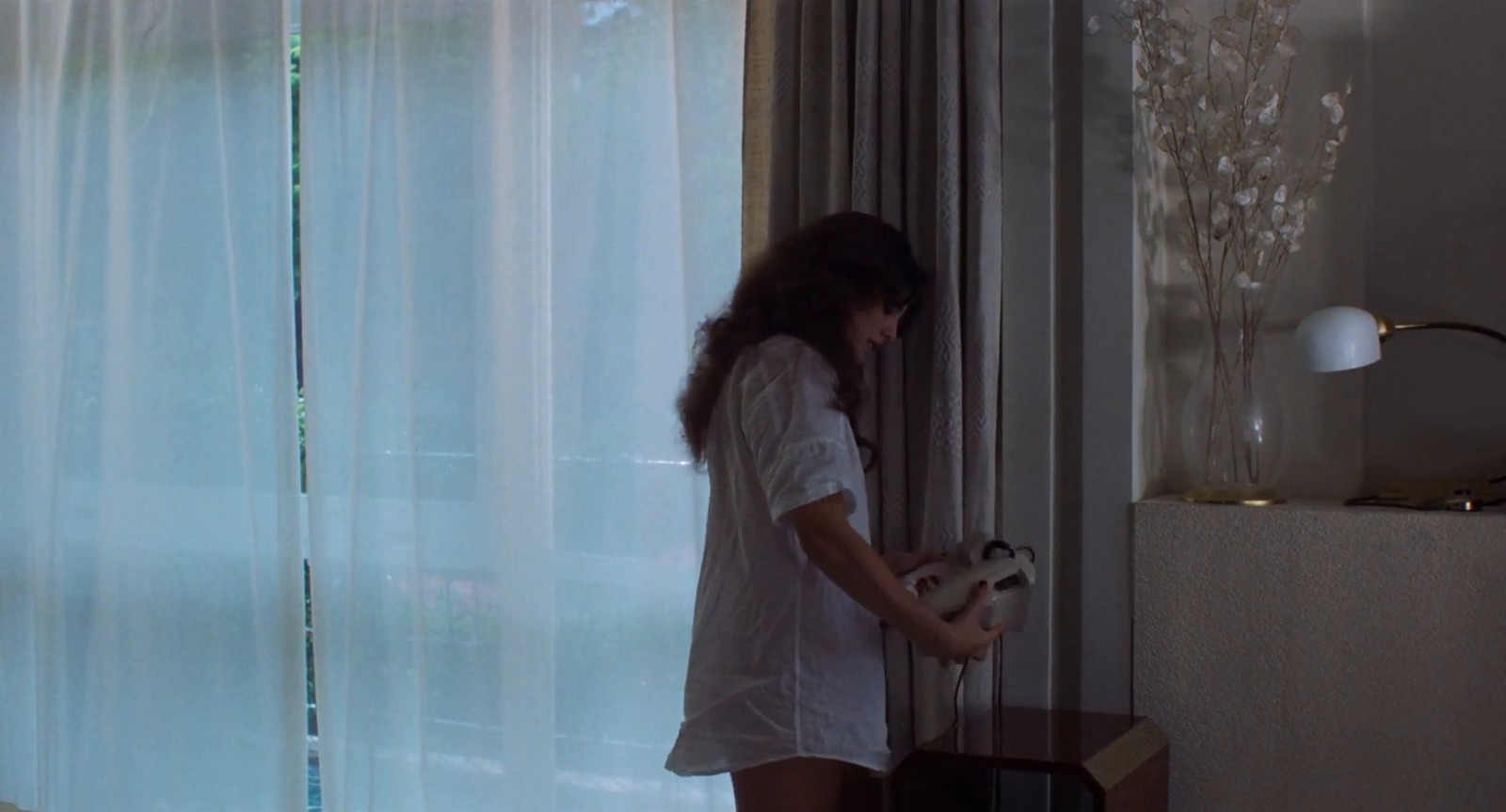
The apartment’s curtains, doors and pale surfaces establish a space that seems available to inspection. The attack breaks this assurance into isolated details: glove, page, blade and face. Outside, another watcher supplies a competing line of sight.
ENLARGE ↗Tilde questions Neal during the publicity visit.
The interview setting gives the writer an audience and a professional identity. Tilde’s presence matters because criticism enters the film as an exchange between people. The later violence must not be treated as an answer that settles her challenge.
ENLARGE ↗Germani questions Neal in the hotel room.
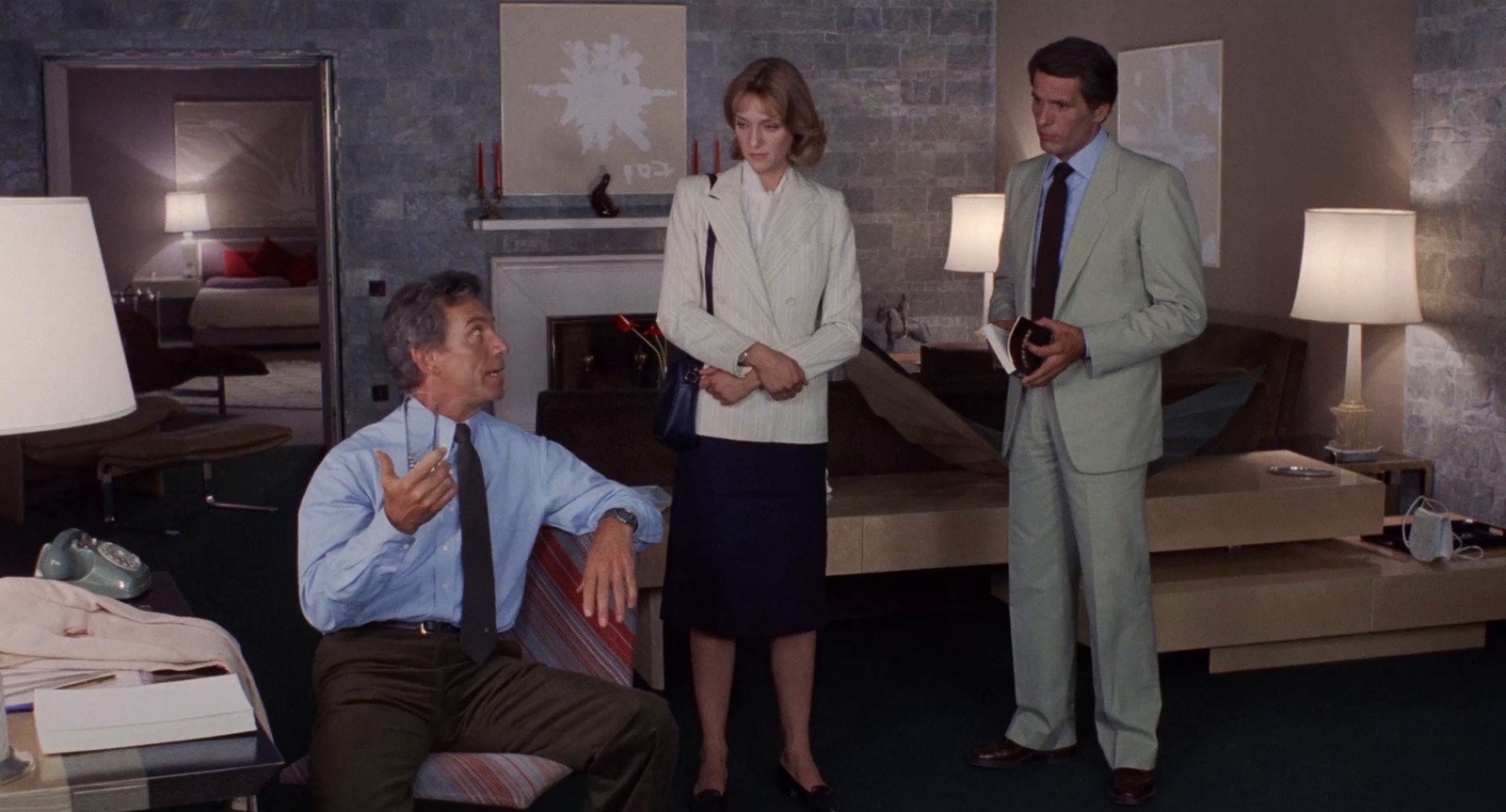
The hotel room becomes a place where stories are received and tested. Neal, Anne, the assistants and the detectives occupy a shared space, but their different positions within it do not guarantee shared knowledge. Letters and photographs begin to stand in for absent events.
ENLARGE ↗The pale dress stands out against the dunes.
The beach passages interrupt the urban story with a different landscape and a concentrated colour accent. The red shoes become a persistent object before the full relation between memory and murder is disclosed. Read their recurrence beside the dossier’s discussion of Neal’s past.
The evening gives the women a social and domestic world before the camera turns their home into a field of inspection. Their conversation, separation into different rooms and eventual movement through the stairs make the later geography matter.
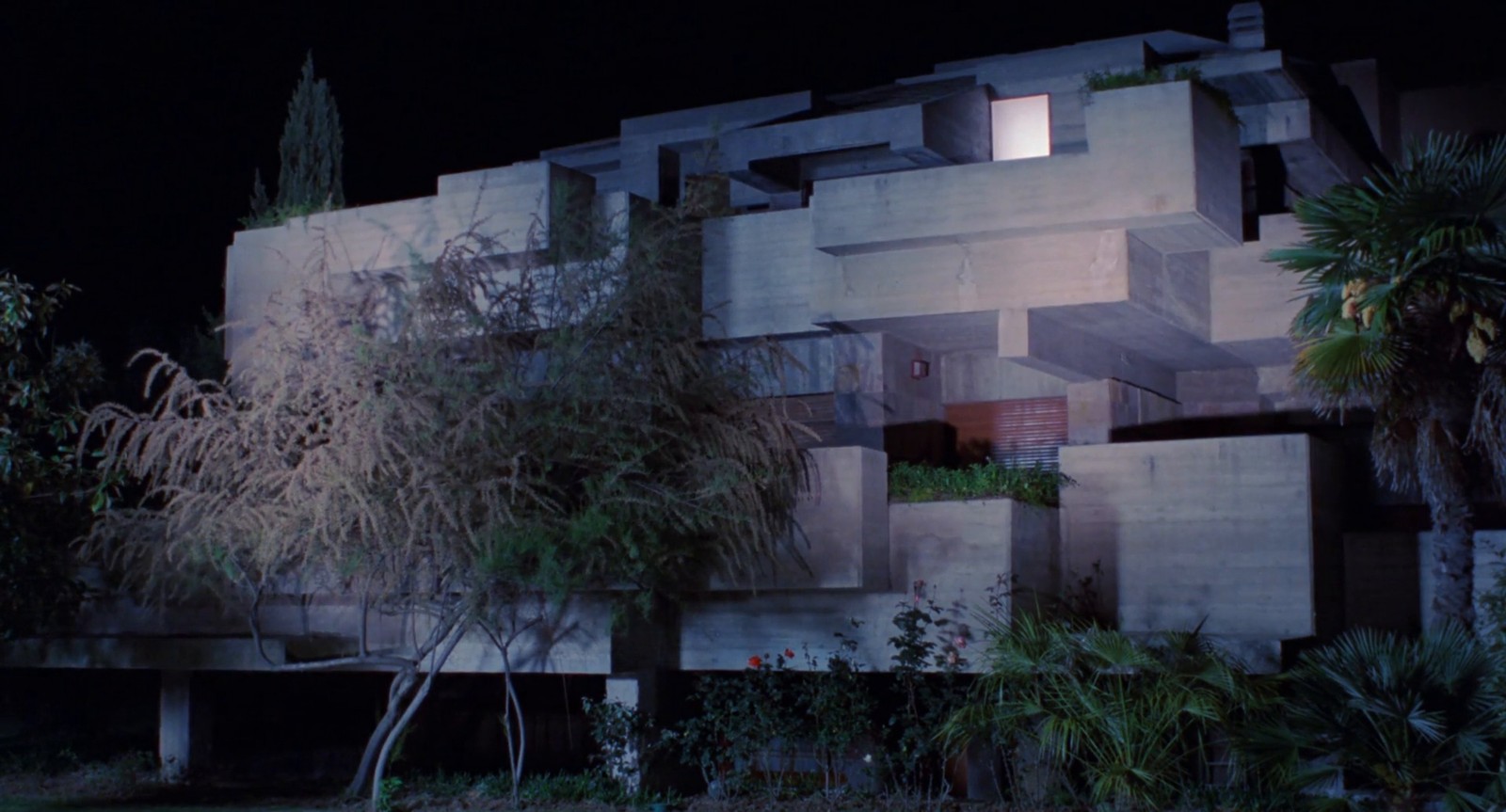
ENLARGE ↗The modernist house rises into the blue night.
The house passage links windows, rooms, walls and rooflines through a viewpoint that exceeds an ordinary pedestrian route. Looking seems able to cross domestic boundaries. The effect is not protection: the extraordinary access granted to the viewer leaves the people inside exposed.
ENLARGE ↗Tilde looks through the torn white fabric.
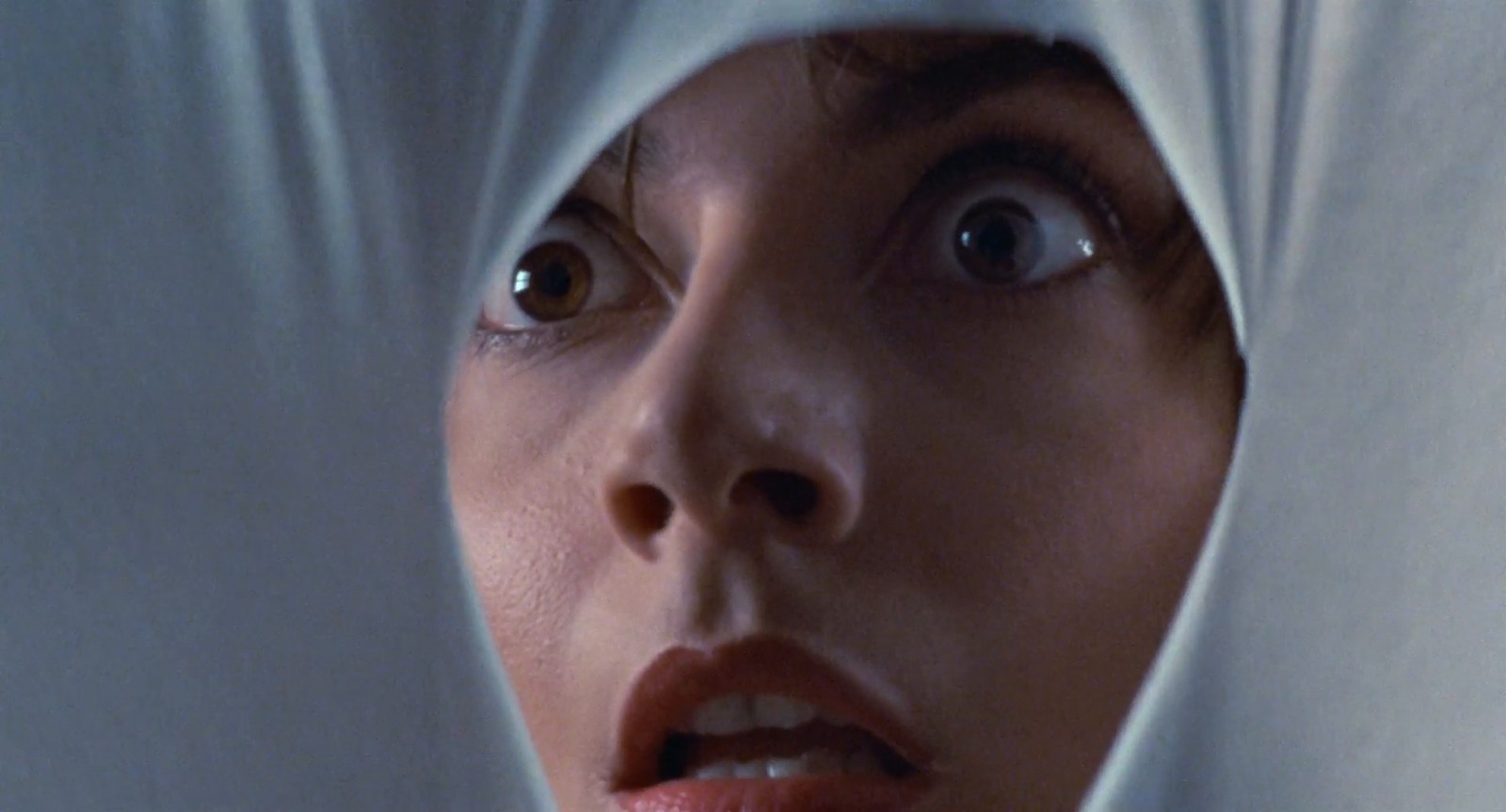
Tilde’s attack compresses the image around a face inside cloth. Marion’s death turns the staircase and landing into a frame for an inverted body. The paired galleries follow how fabric, light, furniture and cutting give each killing its distinct shape.
ENLARGE ↗Photographs become another private archive.
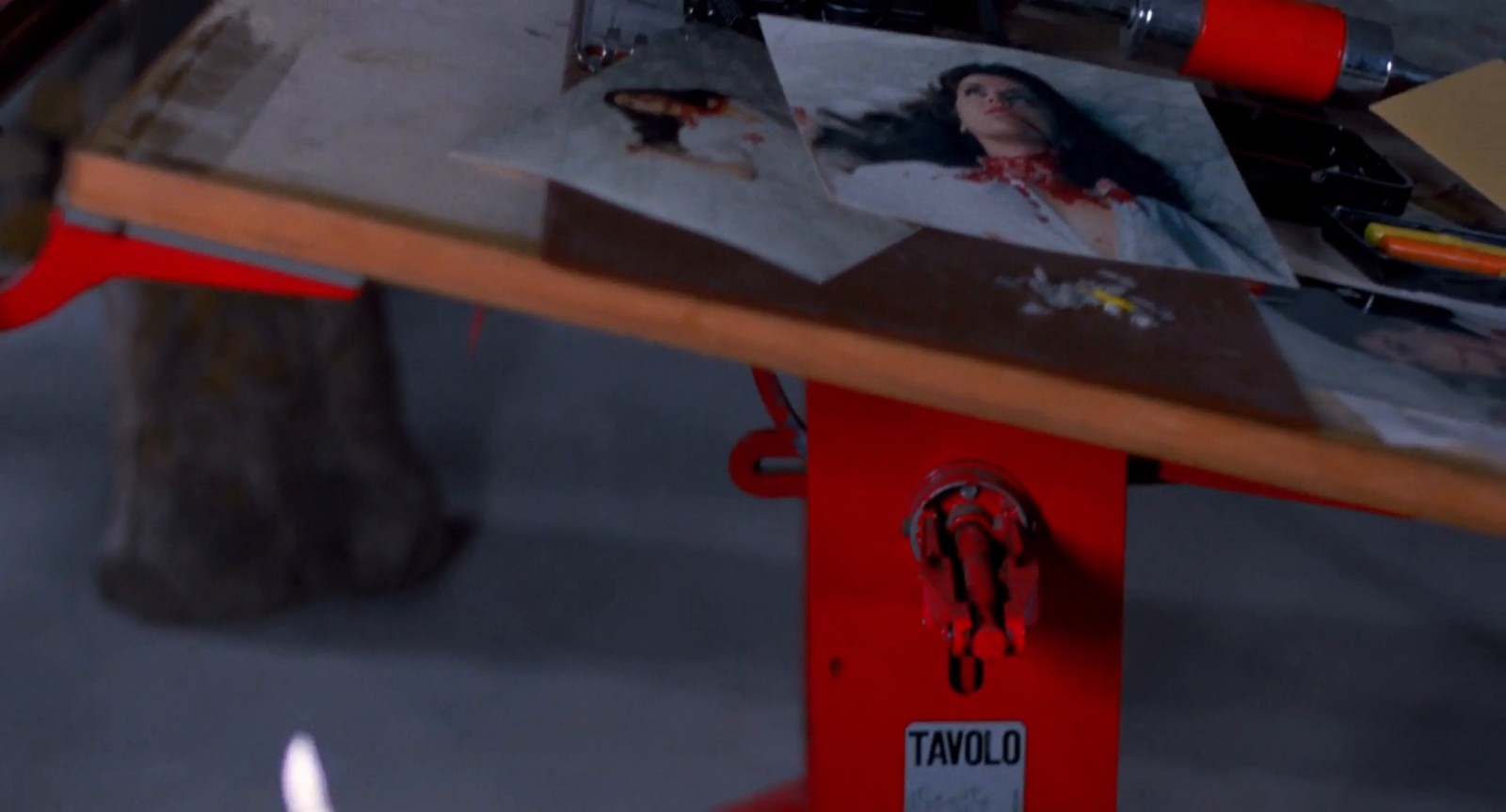
The film moves from the bodies to photography and stored images. This makes looking a continuing activity after the attack: an event can be arranged, kept and revisited. Maria’s later discovery of the photographs gives the private collection a dangerous second viewer.
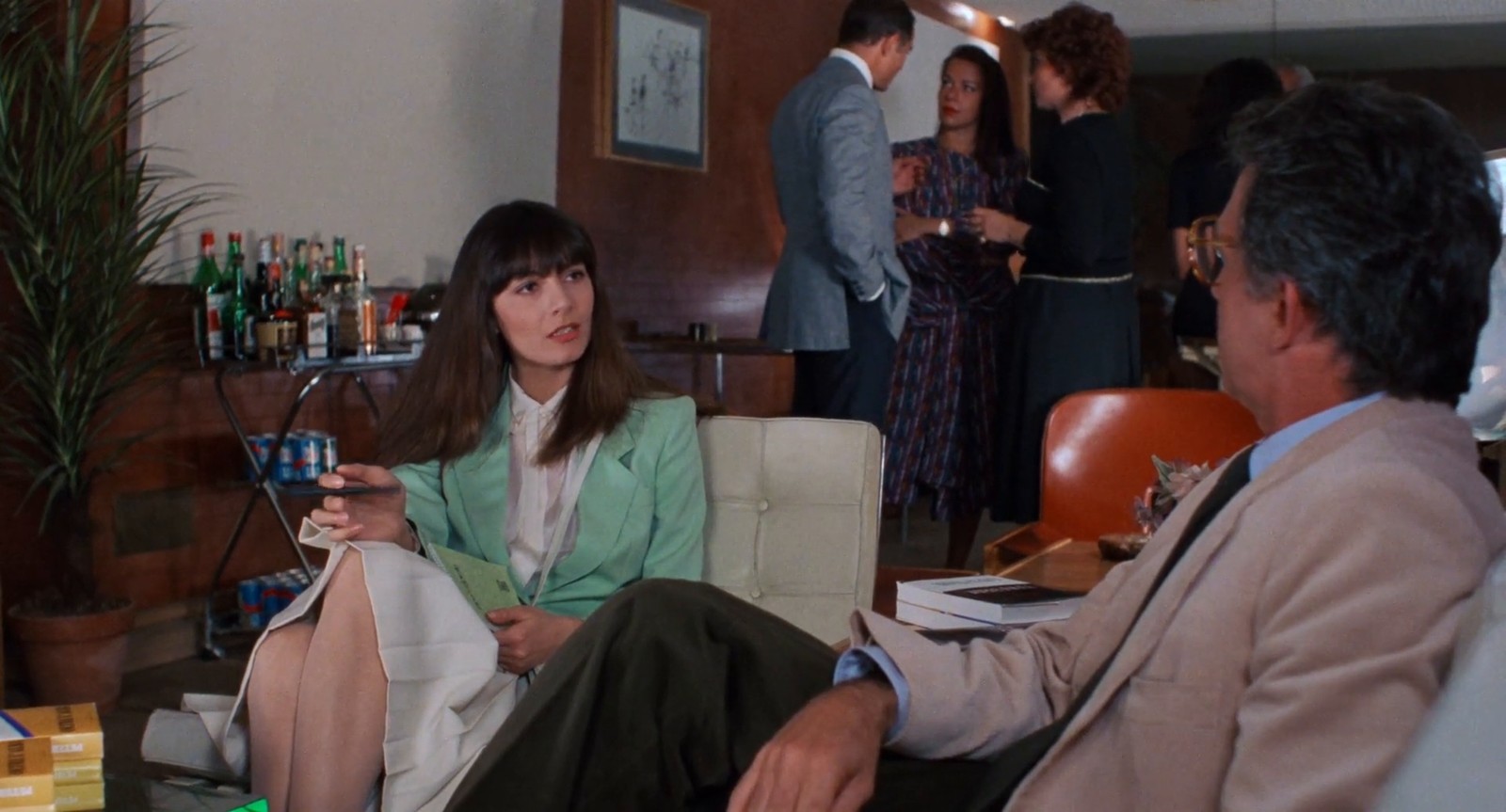
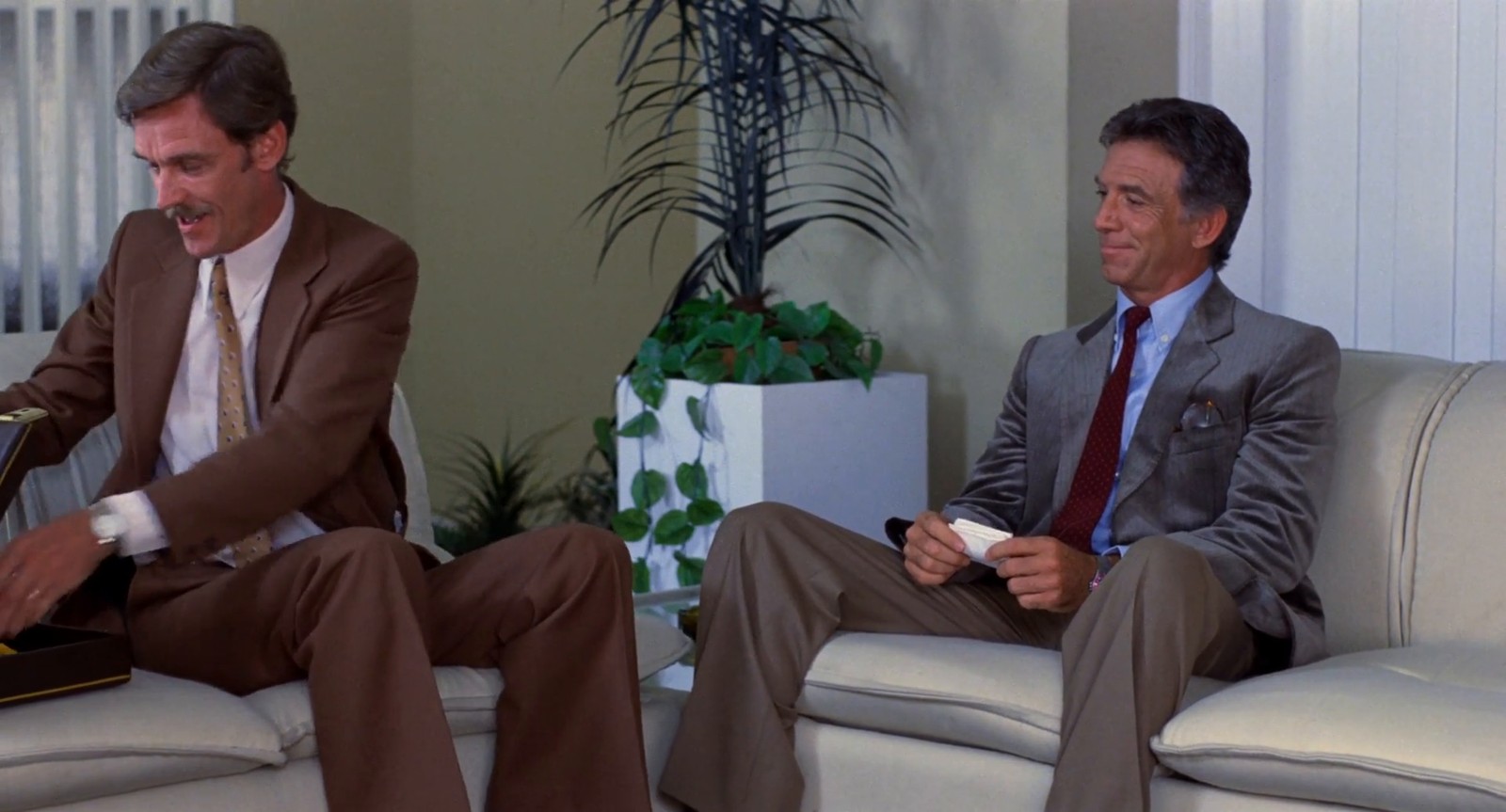
ENLARGE ↗Neal and Berti face each other on pale sofas.
The interview builds its confrontation from faces, books and the pale studio setting. Television turns interpretation into a performance for an unseen audience. Later events make the interviewer’s attention to the author look very different.
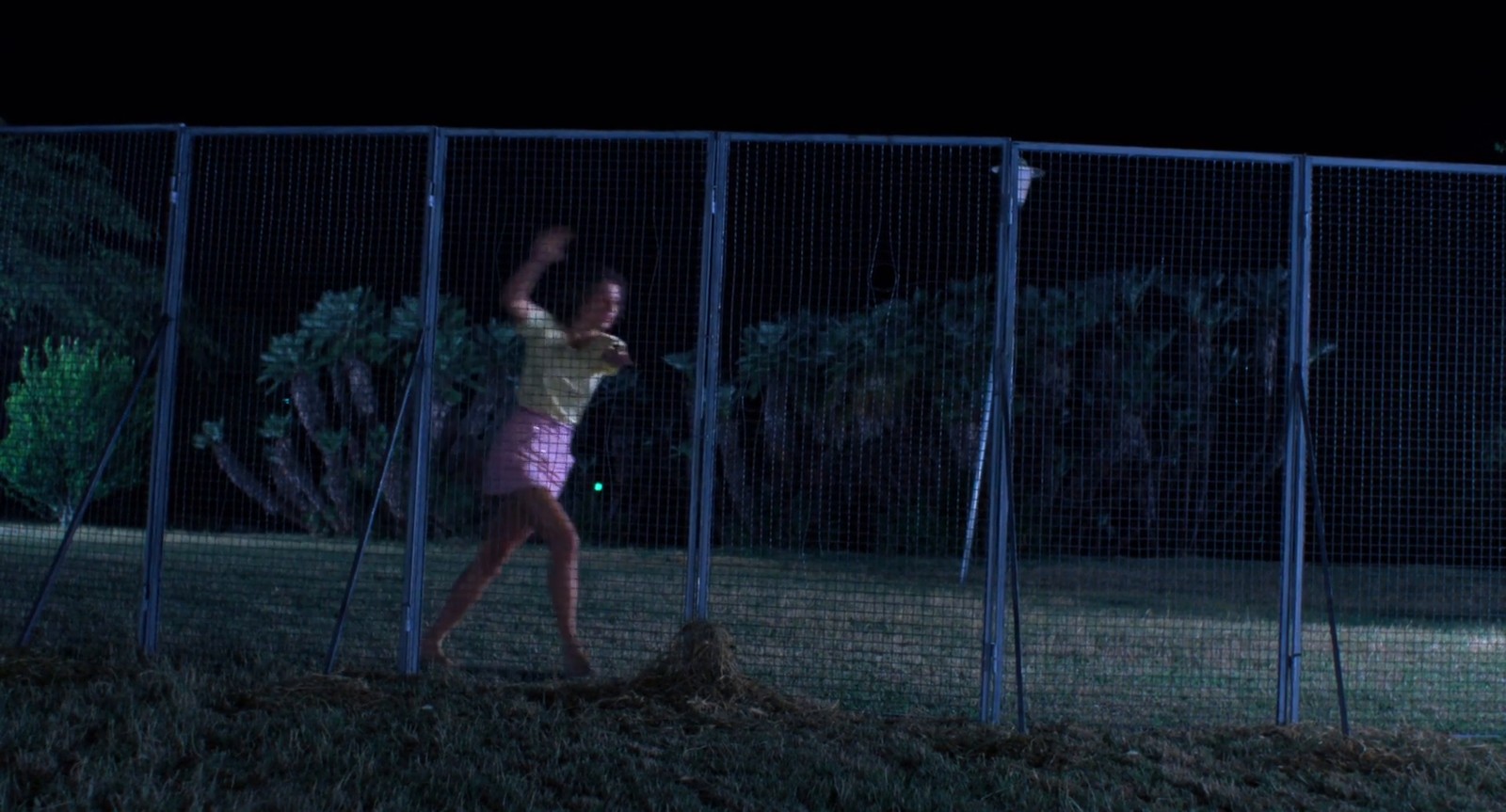
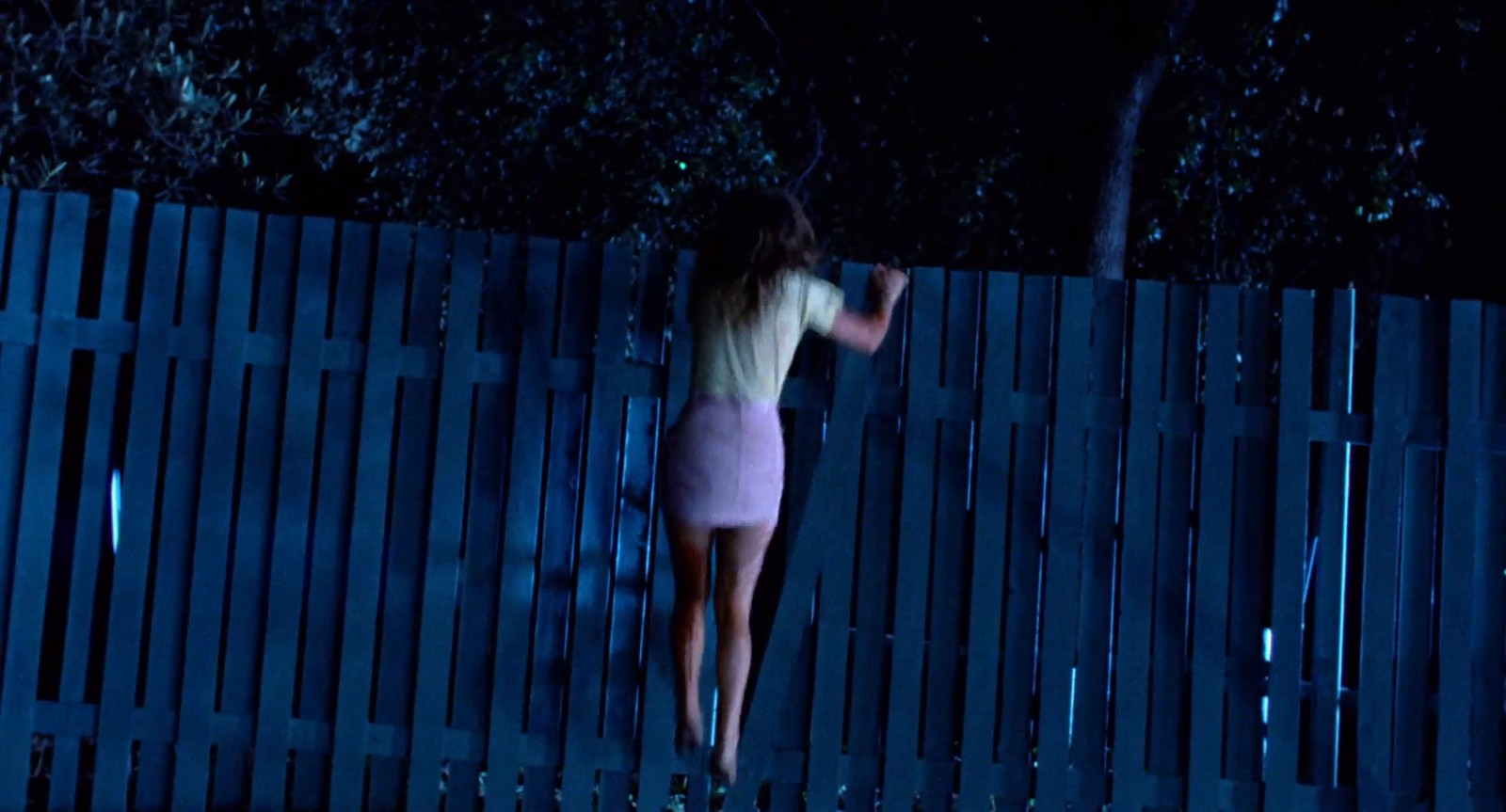
The pursuit stretches across streets, fencing, trees and garden levels. Wide views repeatedly place Maria against an obstacle or a route she cannot safely complete. Her eventual refuge in the house shifts the danger from an animal outside to evidence and a killer within.
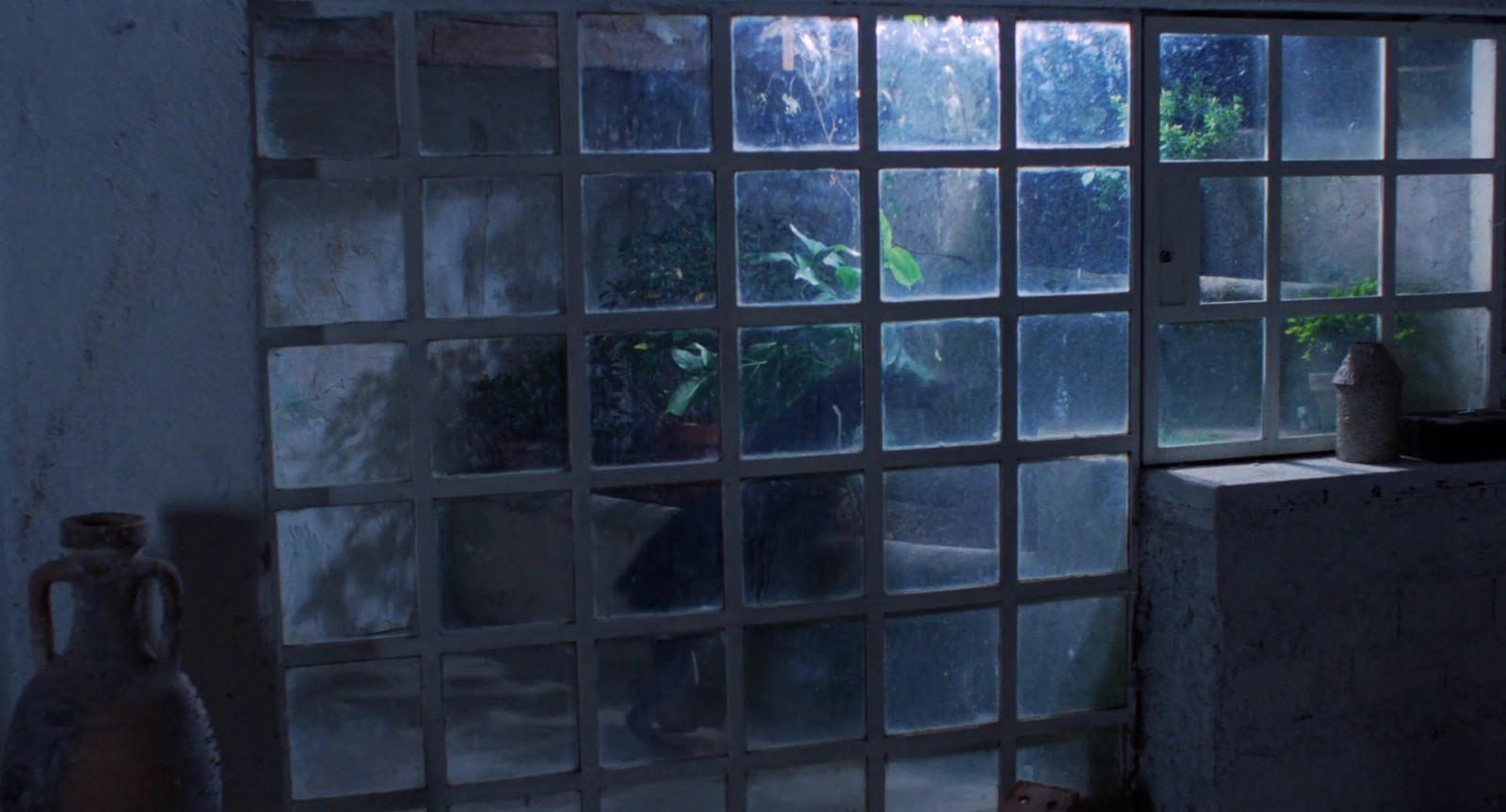
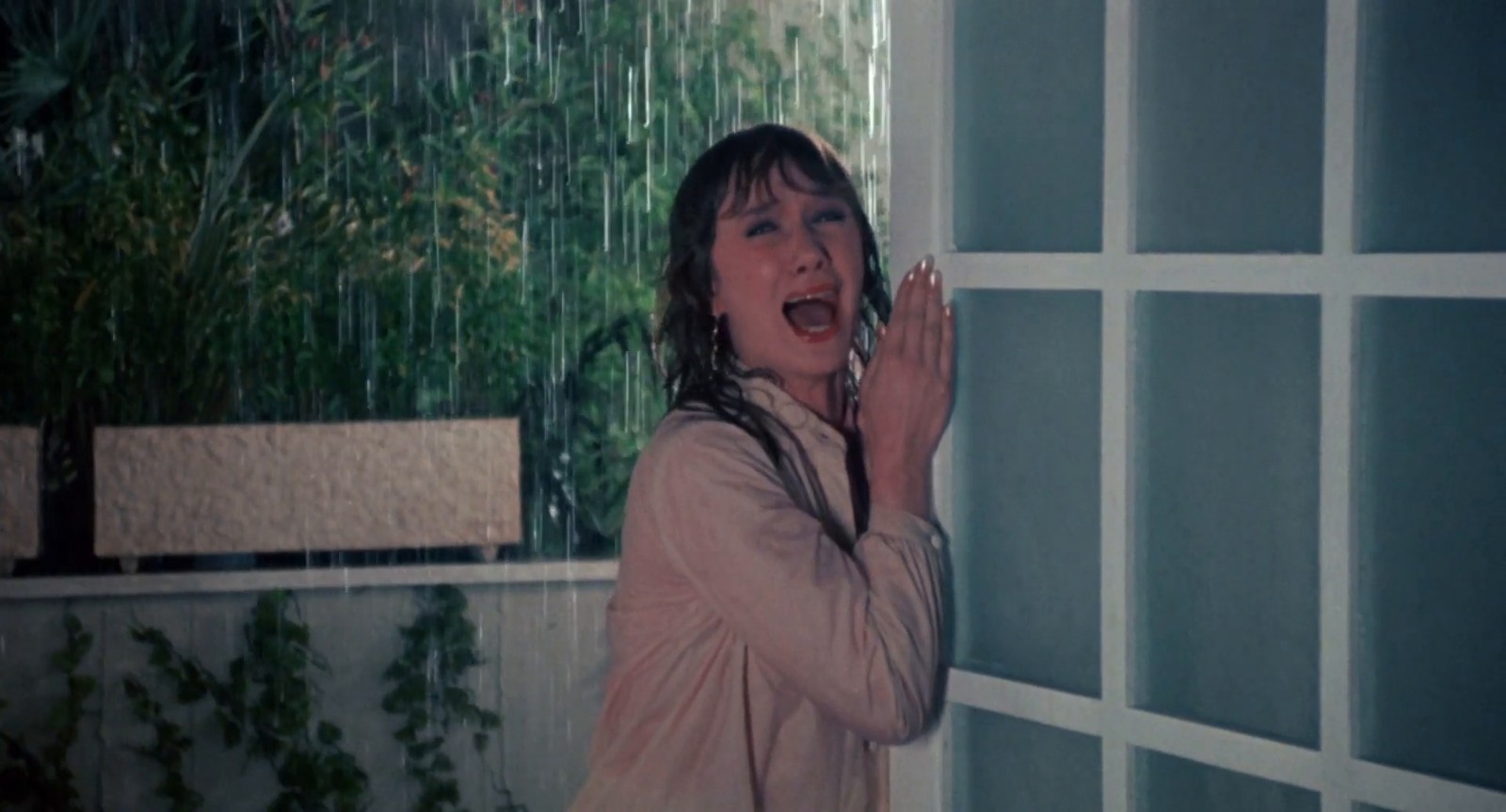
ENLARGE ↗Glass blocks separate Maria from the night.
The glass-block wall offers a striking boundary between the workroom and the garden. Photographs, newspaper cuttings and marked pages give Maria something to read, but discovery also delays escape. The architecture makes visibility and security different things.
The escape moves toward the fence, then collapses into the grass. The switch from distant movement to a bloodied close-up compresses the space that previously seemed open. Daylight later transforms the garden into an evidence scene.
Gianni watches Berti from outside while the interior action breaks apart. The axe blow removes the apparent centre of the investigation, and the witness can see only from his particular position. The house remains visible while the relation between its occupants becomes harder to understand.
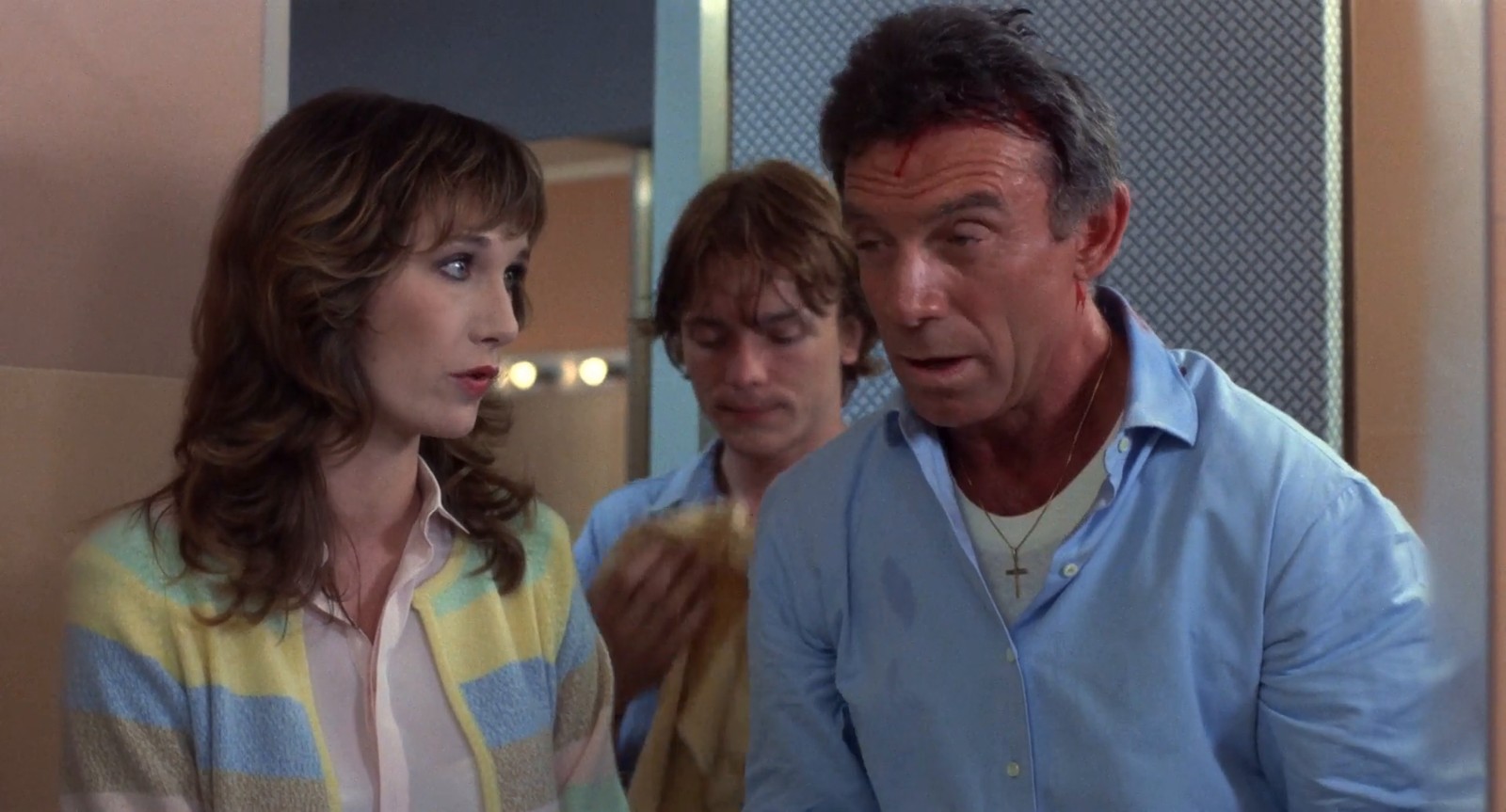
ENLARGE ↗Anne and Gianni stand beside Neal at the basin.
The group returns to the familiar hotel room with a visible injury and an account of what happened. Faces, hands, mirror and basin make care and examination share the same cramped frame. Physical evidence is present; its explanation remains dependent on the storyteller.
The returning shoes connect colour, memory and violence. Later inserts make the earlier beach imagery part of a history the apparently helpful novelist has concealed. The object’s recurrence joins separated passages rather than supplying a complete chronology on its first appearance.
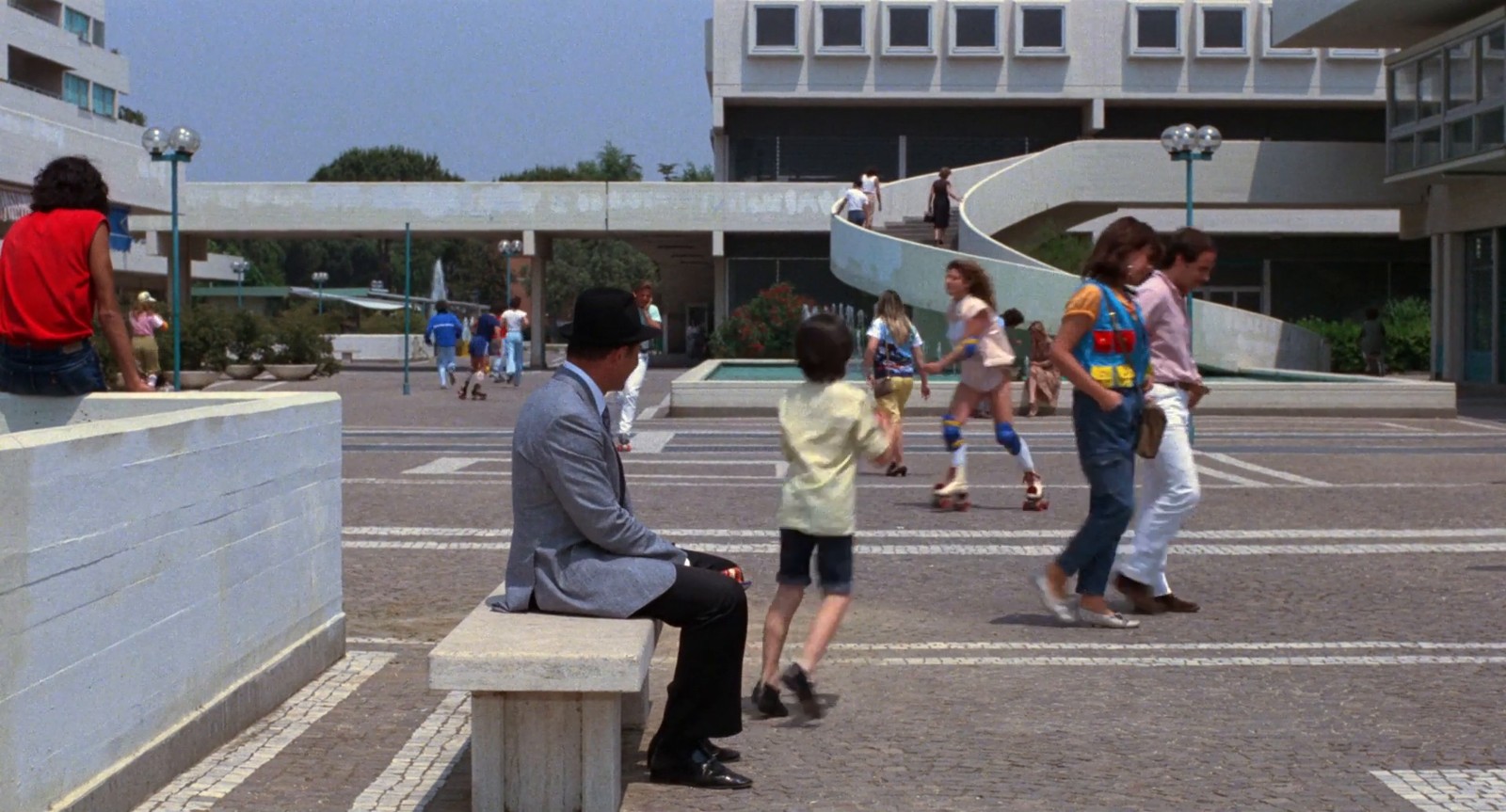
The square turns ordinary activity into a field of possible signals: passers-by, a nearby disagreement, benches and open paving. The stabbing is framed against this public visibility. An open city space does not prevent a private encounter from becoming fatal.
ENLARGE ↗The cord catches Gianni in the driver’s seat.
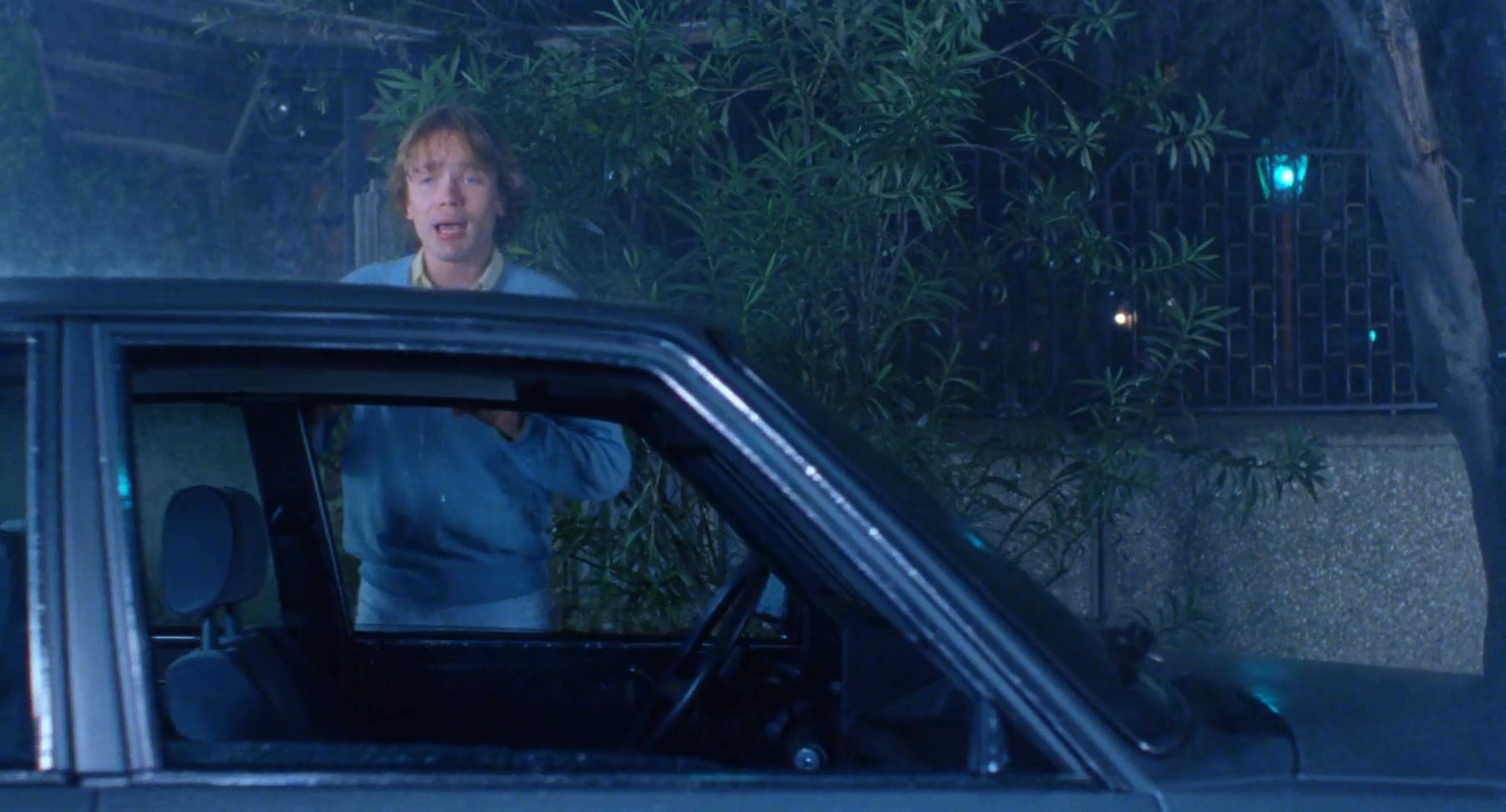
The return to the house leads back to a familiar car. Rain and flashes of light break up the blue night while the seat, wheel and narrow frame restrict movement. The gallery follows the transition from routine departure to entrapment.
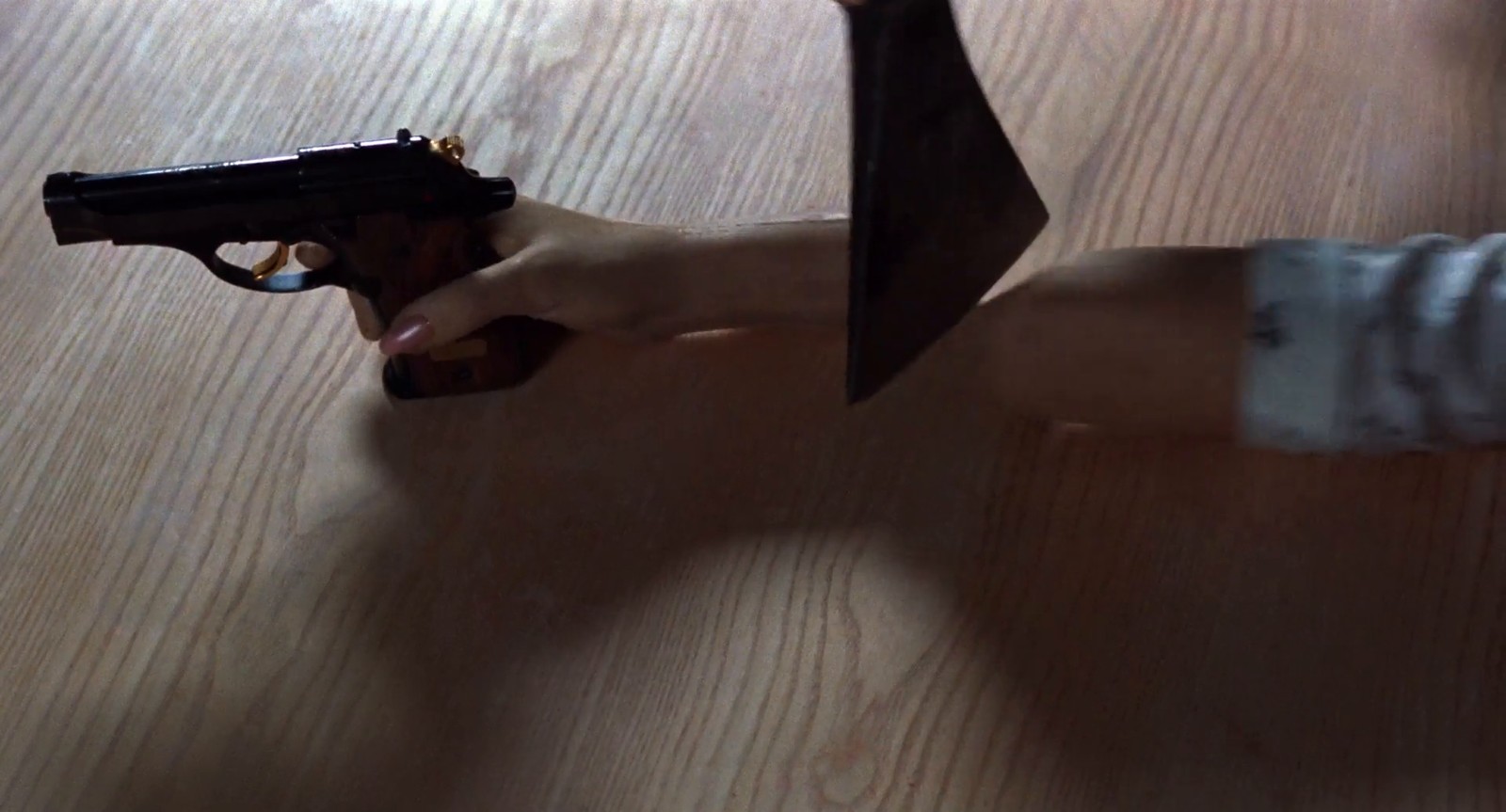
ENLARGE ↗Jane waits with the gun beside the window.
The extended arm gives the composition a clear line before glass, axe and blood break it. The white wall becomes a record of the attack’s movement. The following gallery separates the window entrance, severing, spray and aftermath into distinct stages.
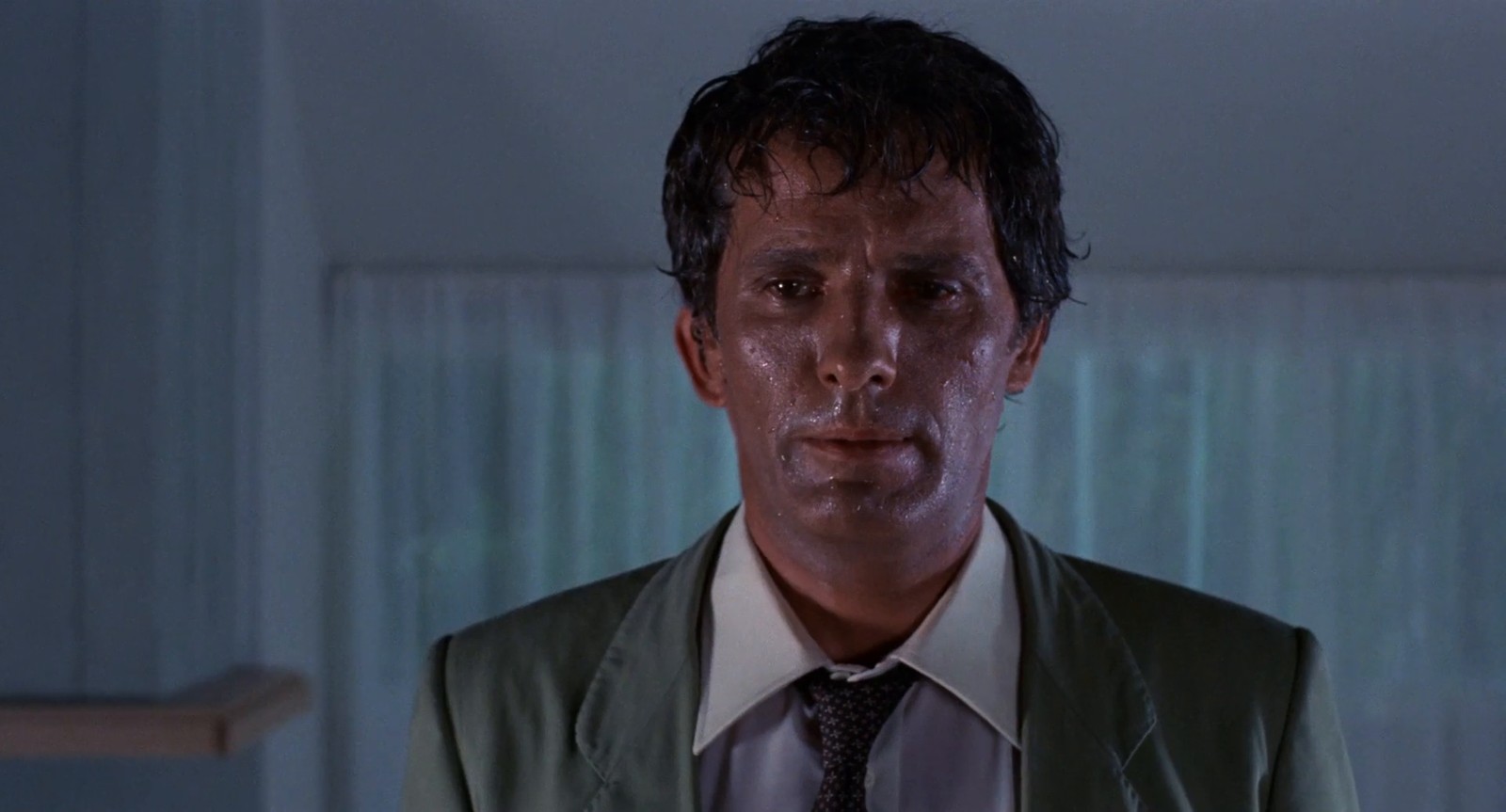
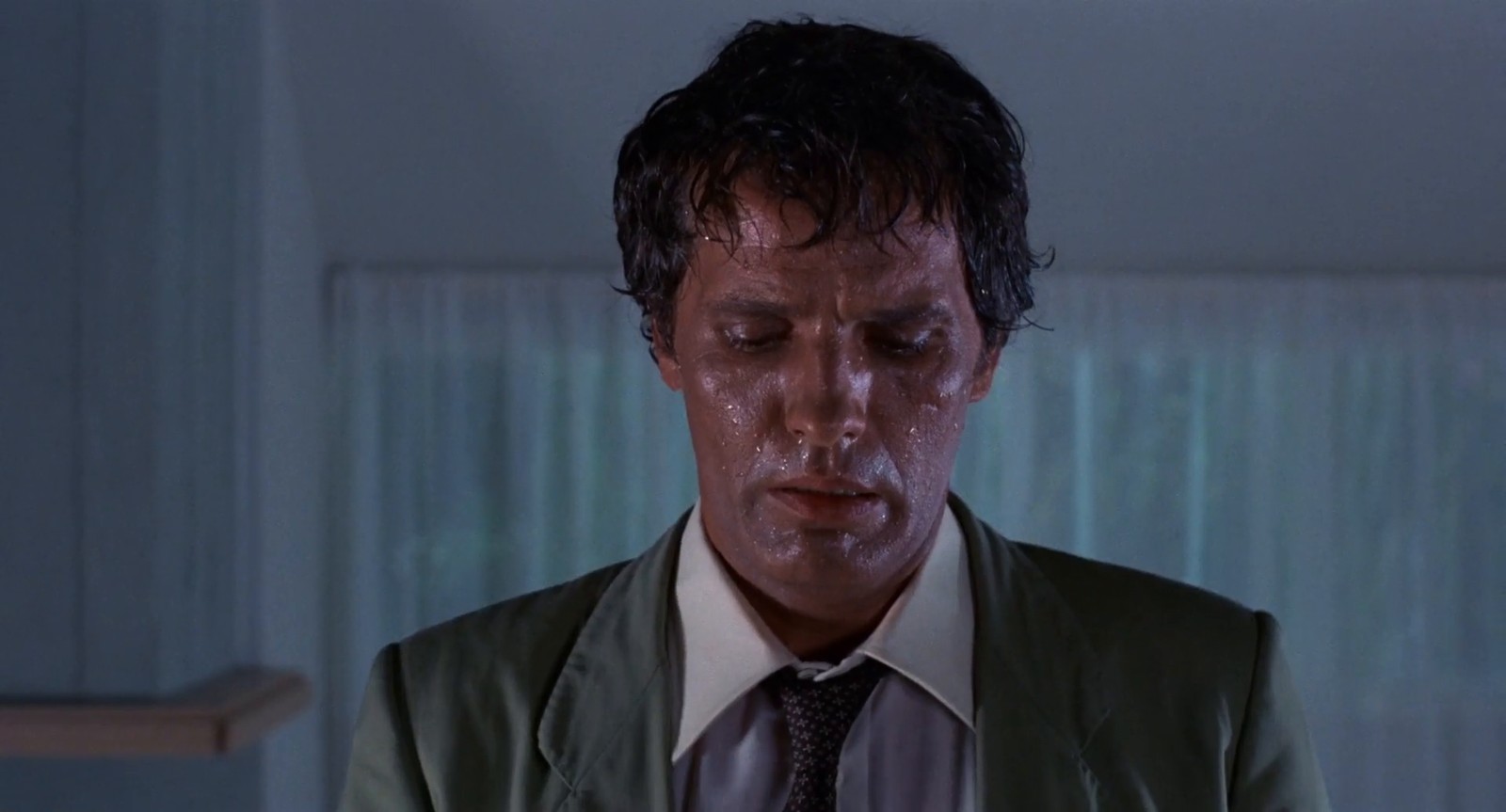
A low view offers legs and an axe before it yields the face. Neal’s appearance reorganises the story around a person whose professional and investigative roles have encouraged trust. The recognition follows Altieri’s collapse rather than preceding it.
The razor and blood seem to supply an ending, reinforced by Anne’s reaction and Neal’s collapse. Germani’s return then makes an object on the floor revise what the audience has accepted. The scene puts the credibility of a visible wound at the centre of its deception.
ENLARGE ↗The metal point emerges through Neal’s shirt.
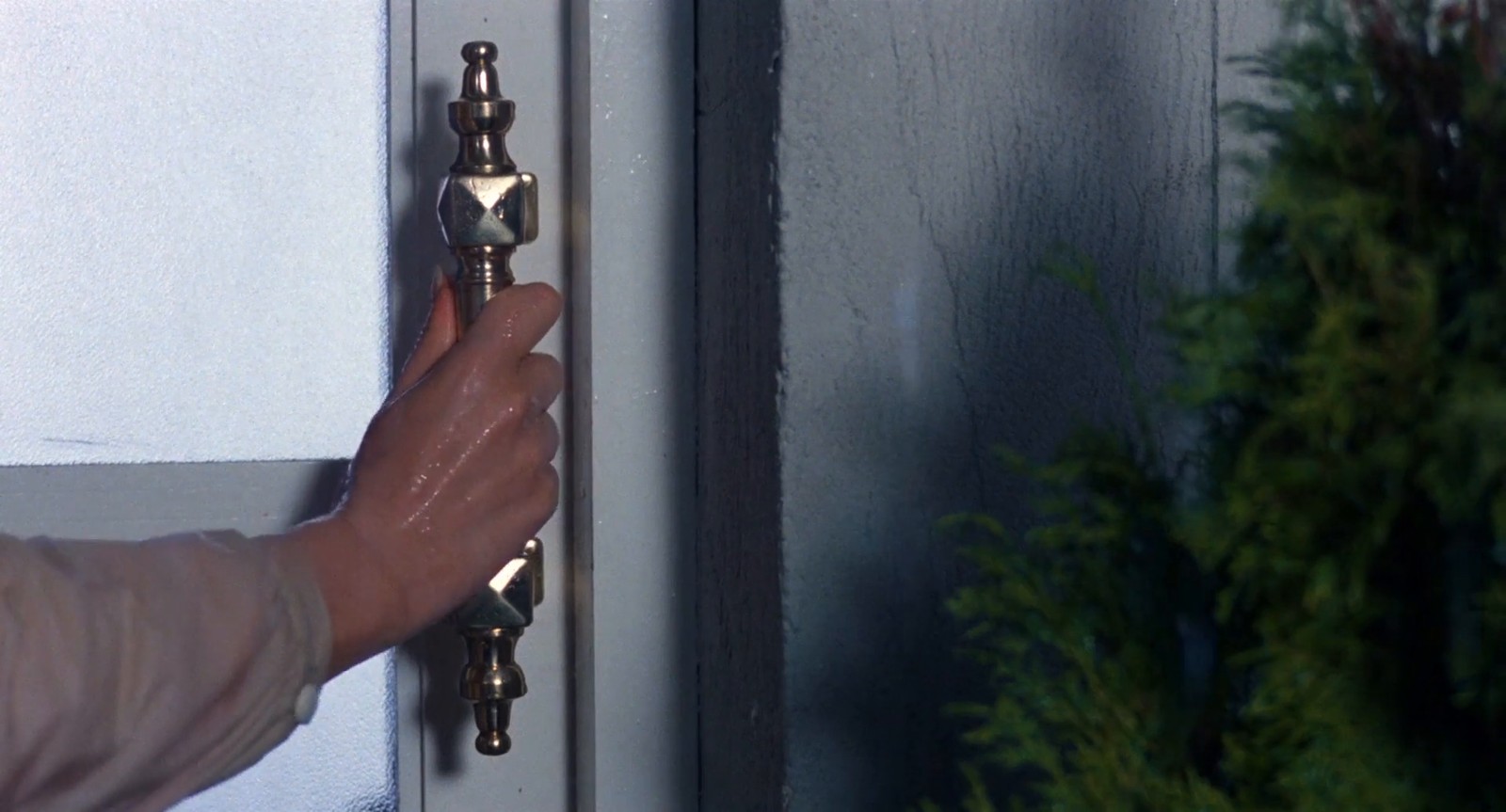
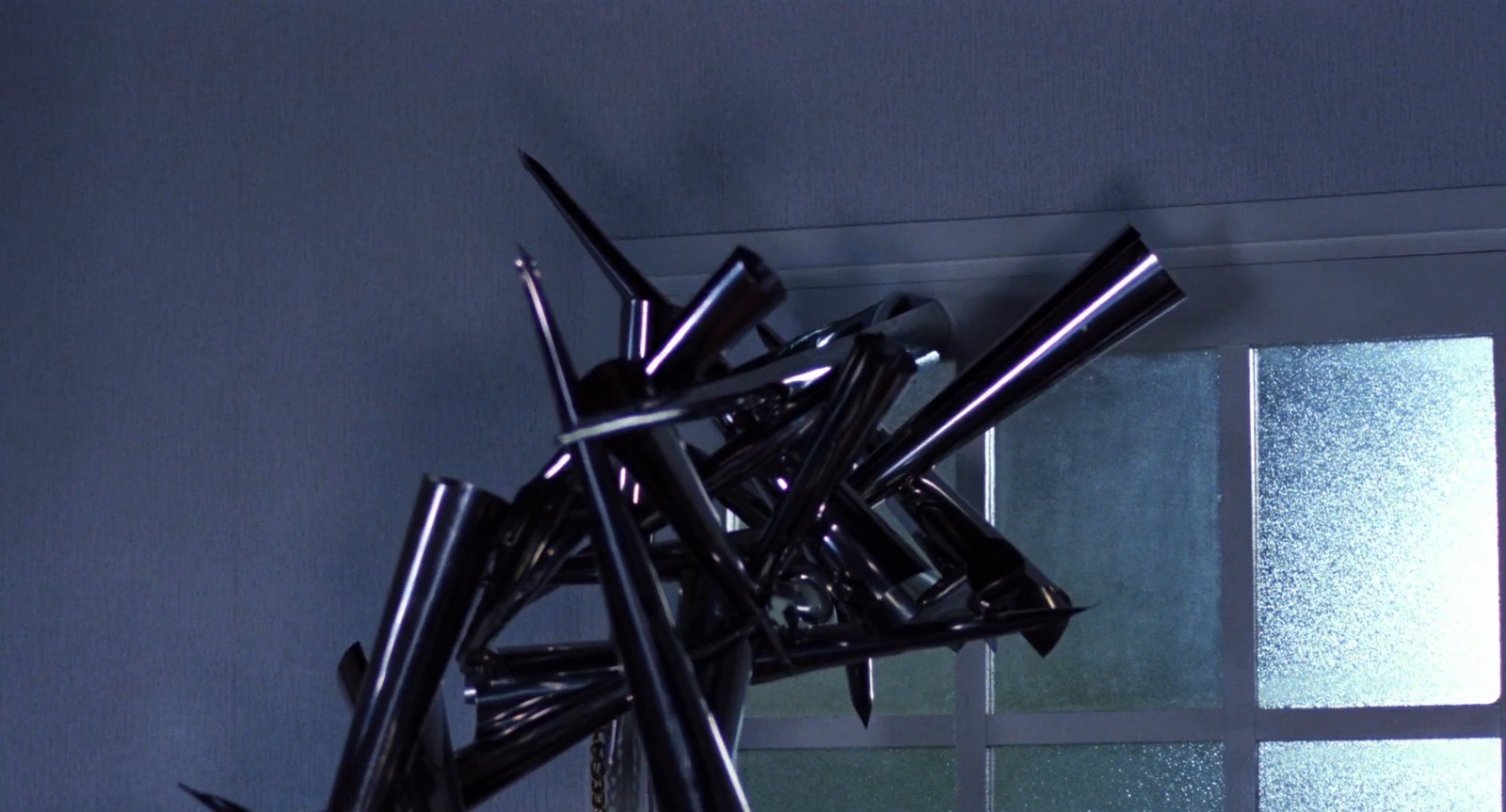
The final movements turn concealment and decoration into threats. Germani’s position hides Neal, and the sculpture beside the door becomes an instrument of the last injury. Anne’s return does not restore calm: the closing image leaves her at the doorway in the rain.
From the first blade to the last sculpture: twelve sequences, each with a gallery of the effect’s stages.
The effect lives across the cut: a hand, a prop, a wound, a reaction and the space around them. These studies follow the visible construction of the sequences. The end credits name Giovanni Corridori for special effects and Pierantonio Mecacci as makeup artist; the BFI credit record corroborates those roles. Film credits ↗ · BFI credits ↗
EFFECTS STUDY 01 / 10:58–11:31
Elsa: the book becomes a weapon
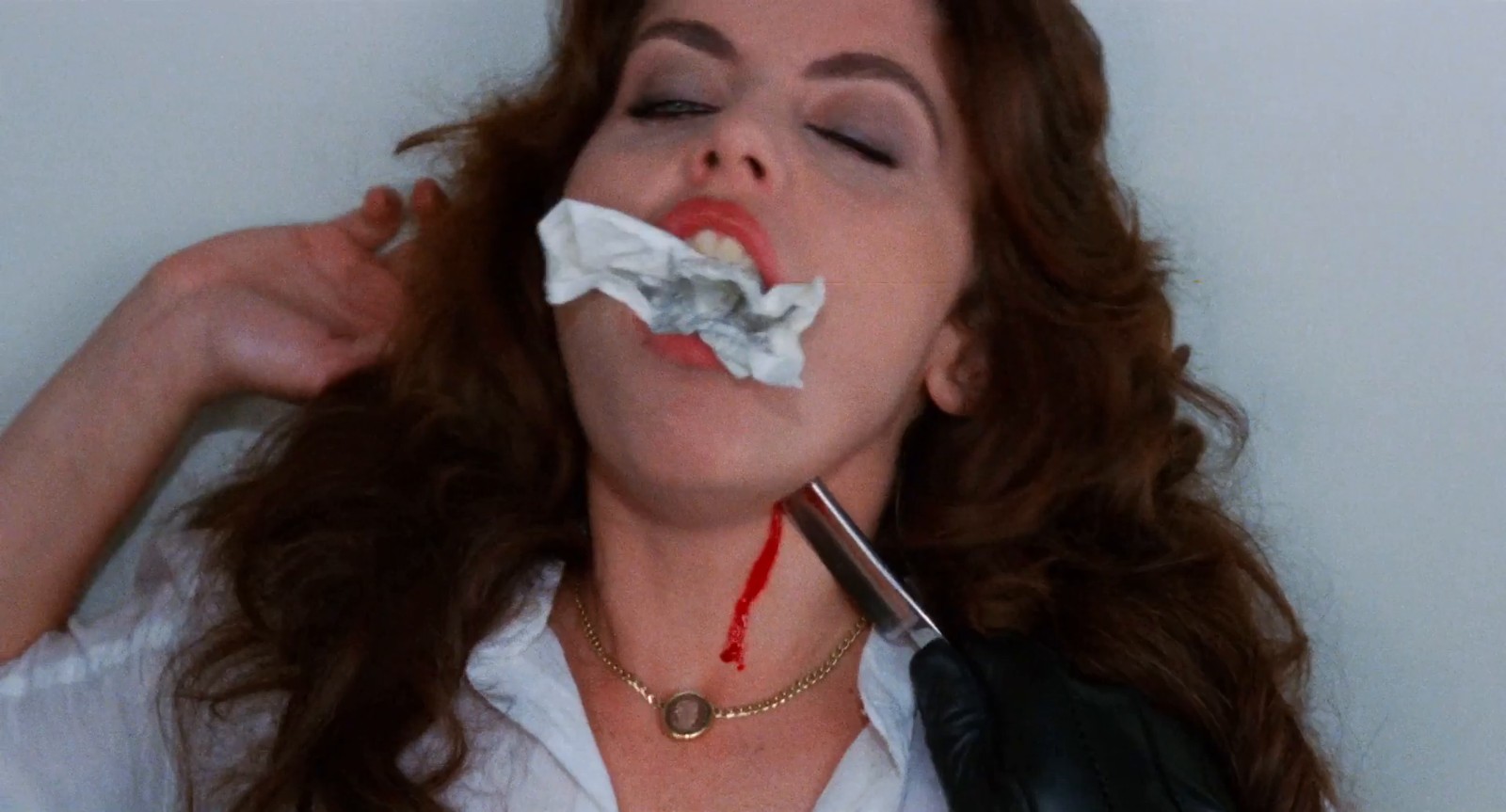
ENLARGE ↗Paper, blade and face share the close-up.
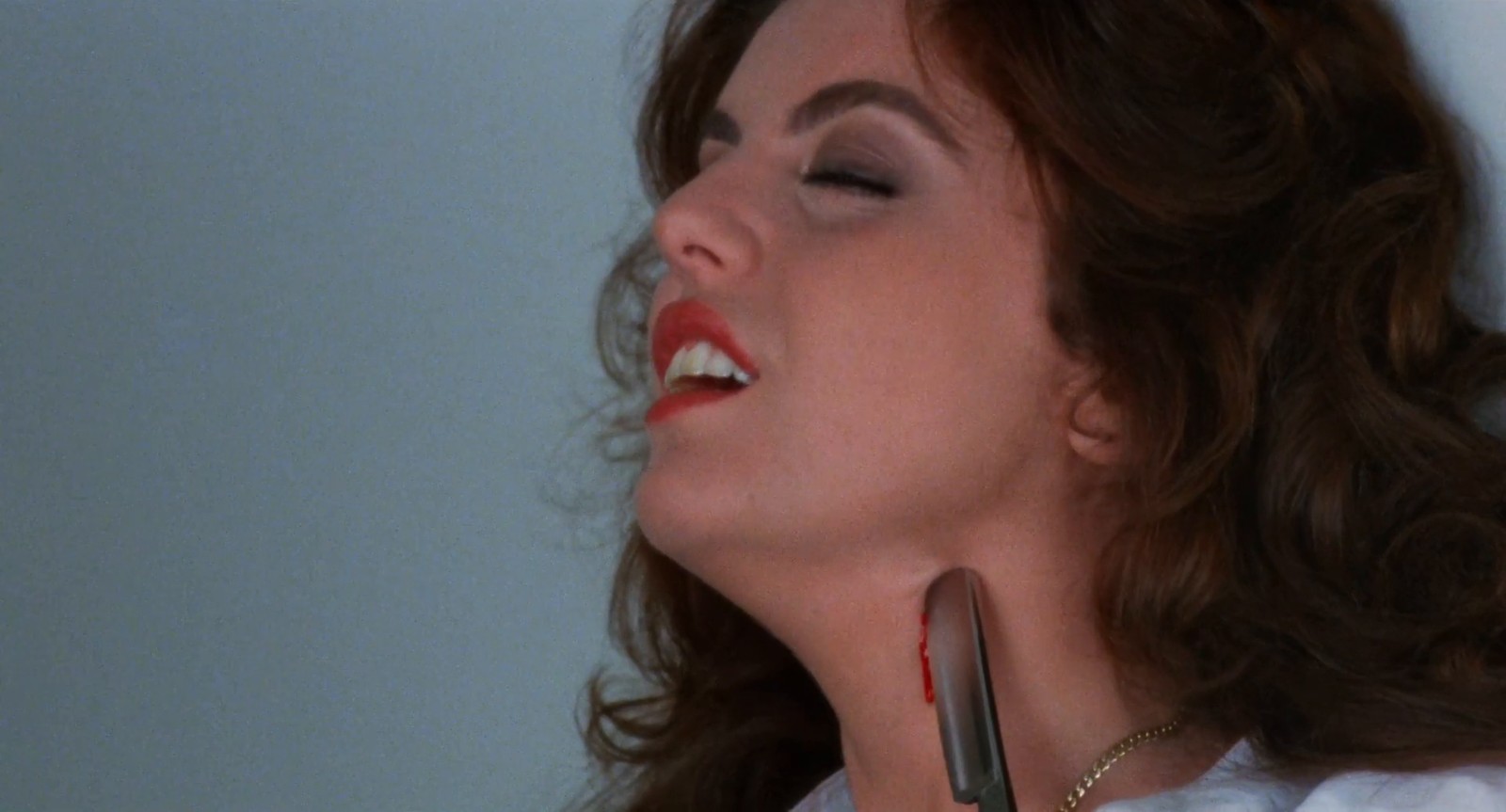
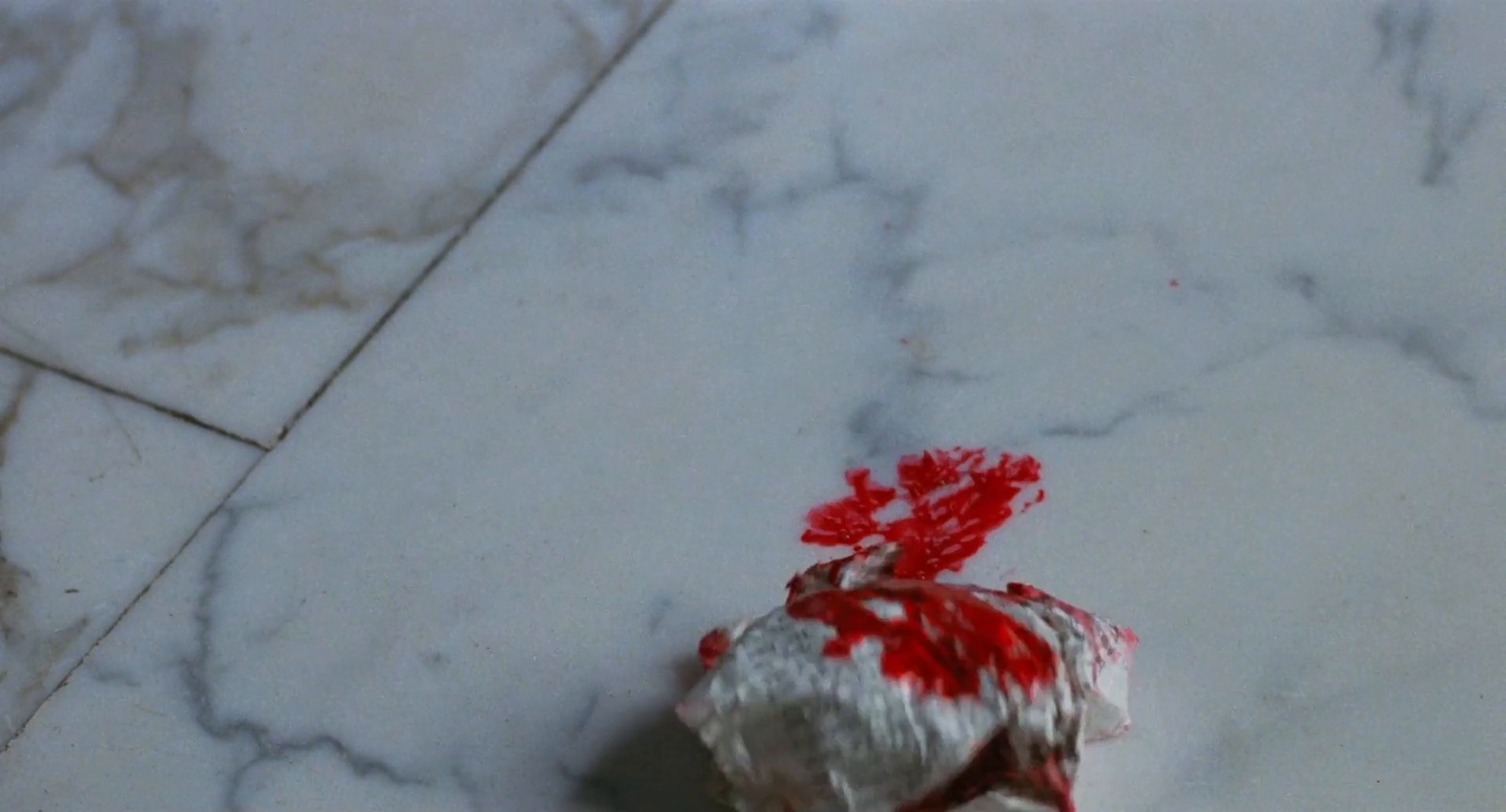
The attack moves between Elsa, the razor and torn pages. A thin line of blood appears before the book fills her mouth; the final violence is displaced into a blade insert, her eyes and bloodied paper on pale marble. The sequence makes reading a physical assault, while editing supplies actions that no single image contains.
The cutting gives the watcher, the attacker and Elsa different fragments of the same event. Repeated returns to the torn novel turn an ordinary object into the centre of the assault; the camera and flash then transform the body into another image.
10:52.7The man outside watches through the curtains.
10:53.6The view returns to Elsa inside, beside the curtains and telephone.
10:55.0A closer view follows Elsa near the doorway.
10:55.8The outside watcher reappears.
10:56.4Back inside, a black glove catches Elsa within the held view.
10:59.3The watcher looks through the blue-lit curtain.
11:00.0A reverse view shows his hands against the window.
11:01.9Elsa is restrained against the pale wall.
11:03.6The curtain frames the watcher once more.
11:04.6Elsa’s profile and the razor are brought together.
11:05.8Neal’s book fills the image. The glove opens it and tears the pages.
11:08.8A thin red line is visible at Elsa’s neck as paper is brought toward her mouth.
11:11.5The cutting returns to another tear in the book.
11:12.3Elsa appears with paper in her mouth.
11:14.9Another book insert renews the action of tearing.
11:16.1More paper is pressed toward Elsa’s face.
11:17.6The glove returns to the book again.
11:18.5Back on Elsa, the hand pushes more paper into place.
11:20.5A narrow opening in the curtain isolates the watcher’s eye.
11:22.1The view returns to Elsa’s face and the hand at her throat.
11:25.1The raised razor is isolated against the arch.
11:26.3An extreme close view isolates Elsa’s eye.
11:26.7The razor returns, then drops out of the image.
11:27.3Bloodied paper falls onto the pale marble within the floor-level view.
11:28.3Elsa’s face fills the image before her head sinks away.
11:30.5The curtains interrupt the attack’s close views.
11:31.7A high view finds Elsa on the marble floor.
11:32.8A masked photographer holds a camera and flash.
11:33.4Elsa’s body returns under the changing light of the flash.
11:34.4A close insert isolates the camera’s control dial.
11:35.0The curtains close the sequence before the cut to the publicity gathering at 11:36.0.
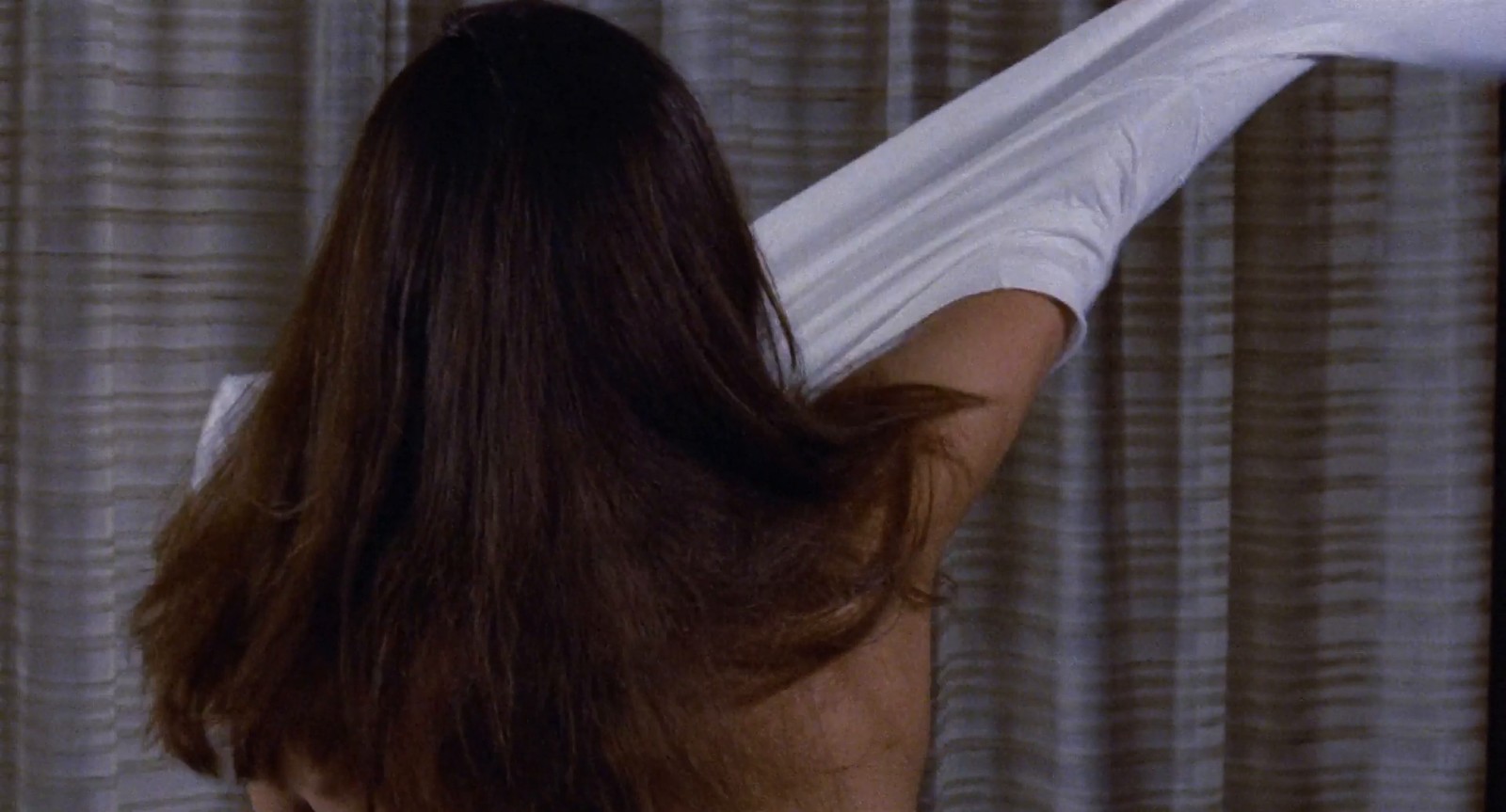
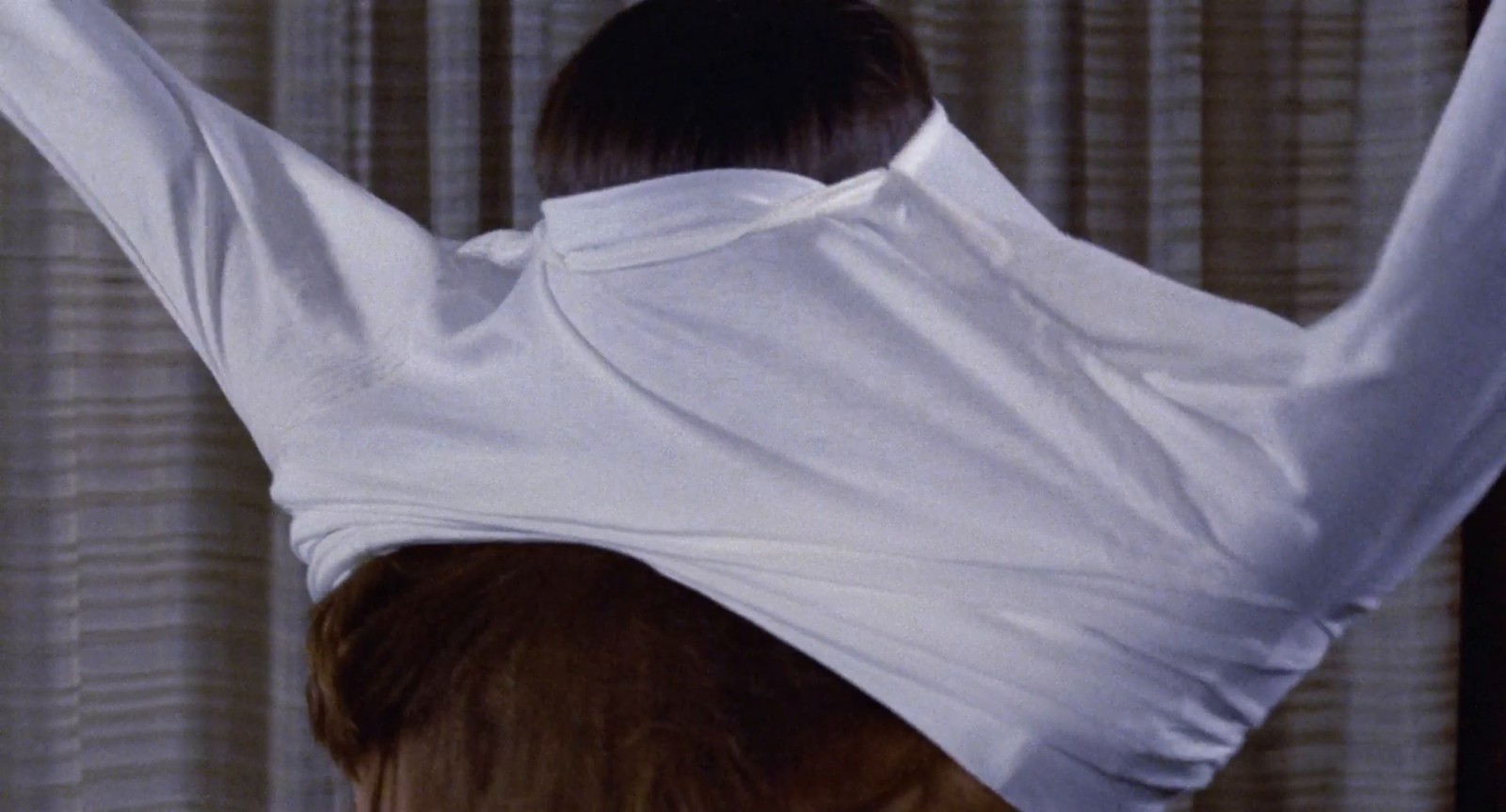
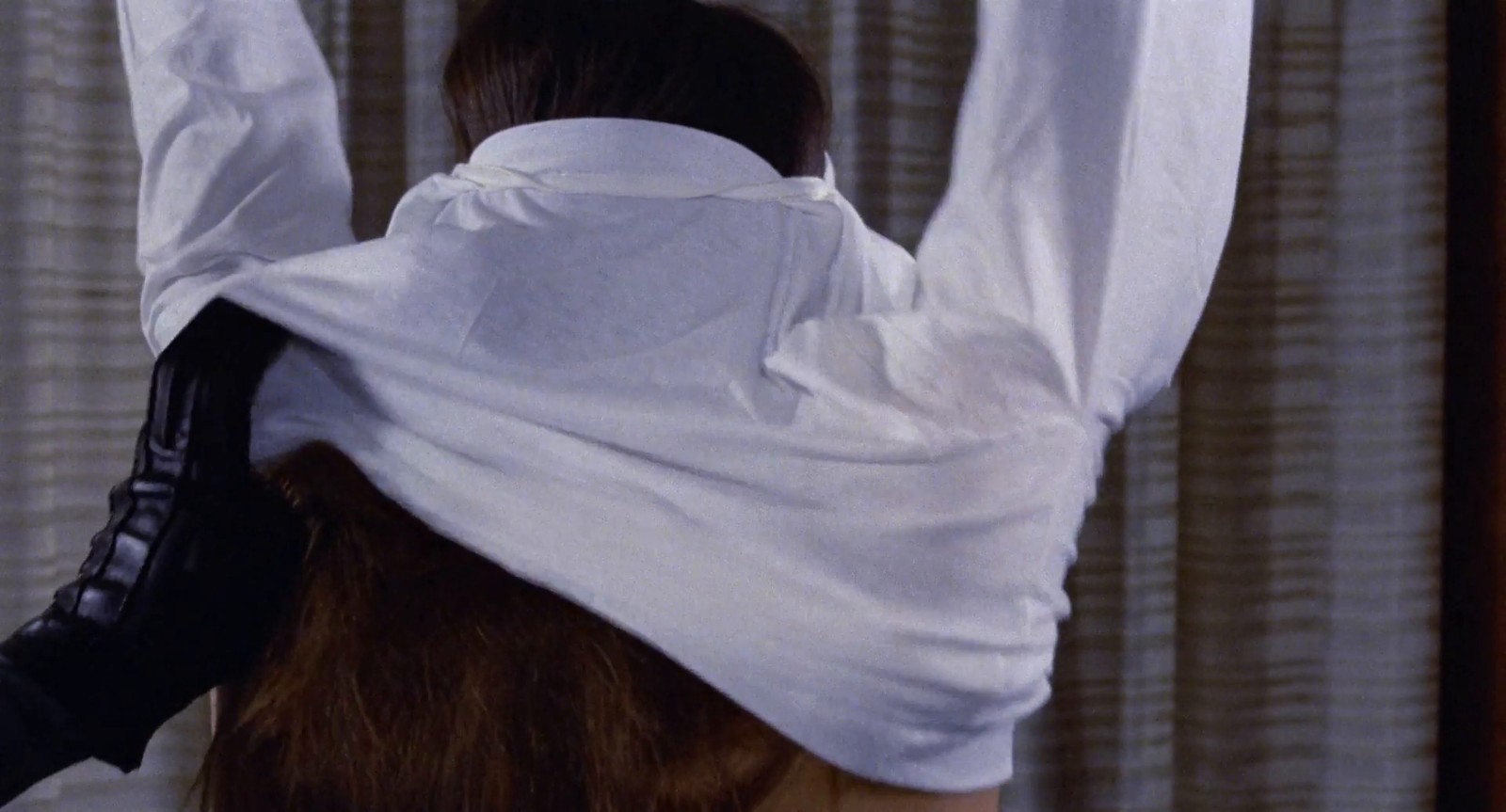
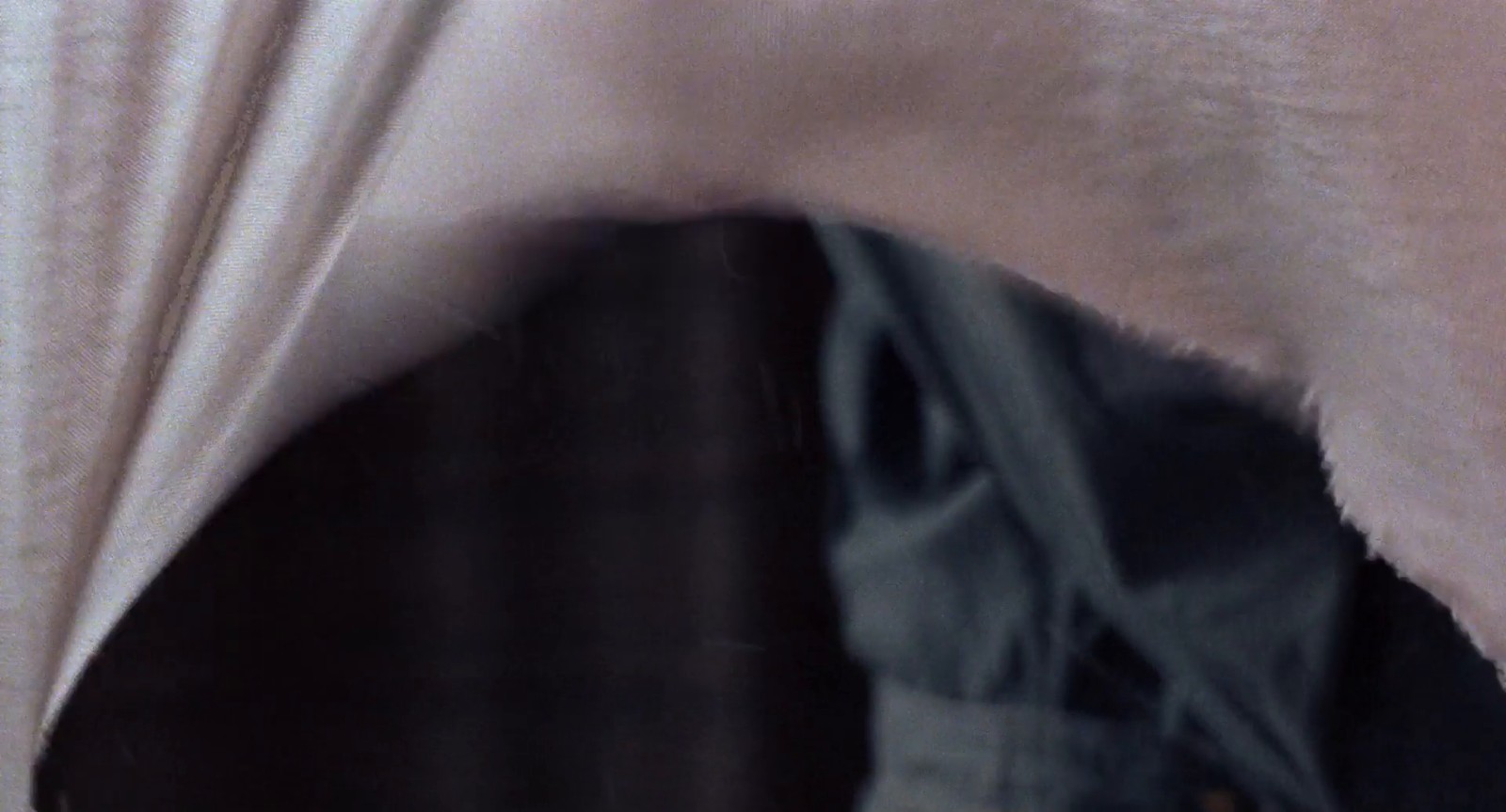
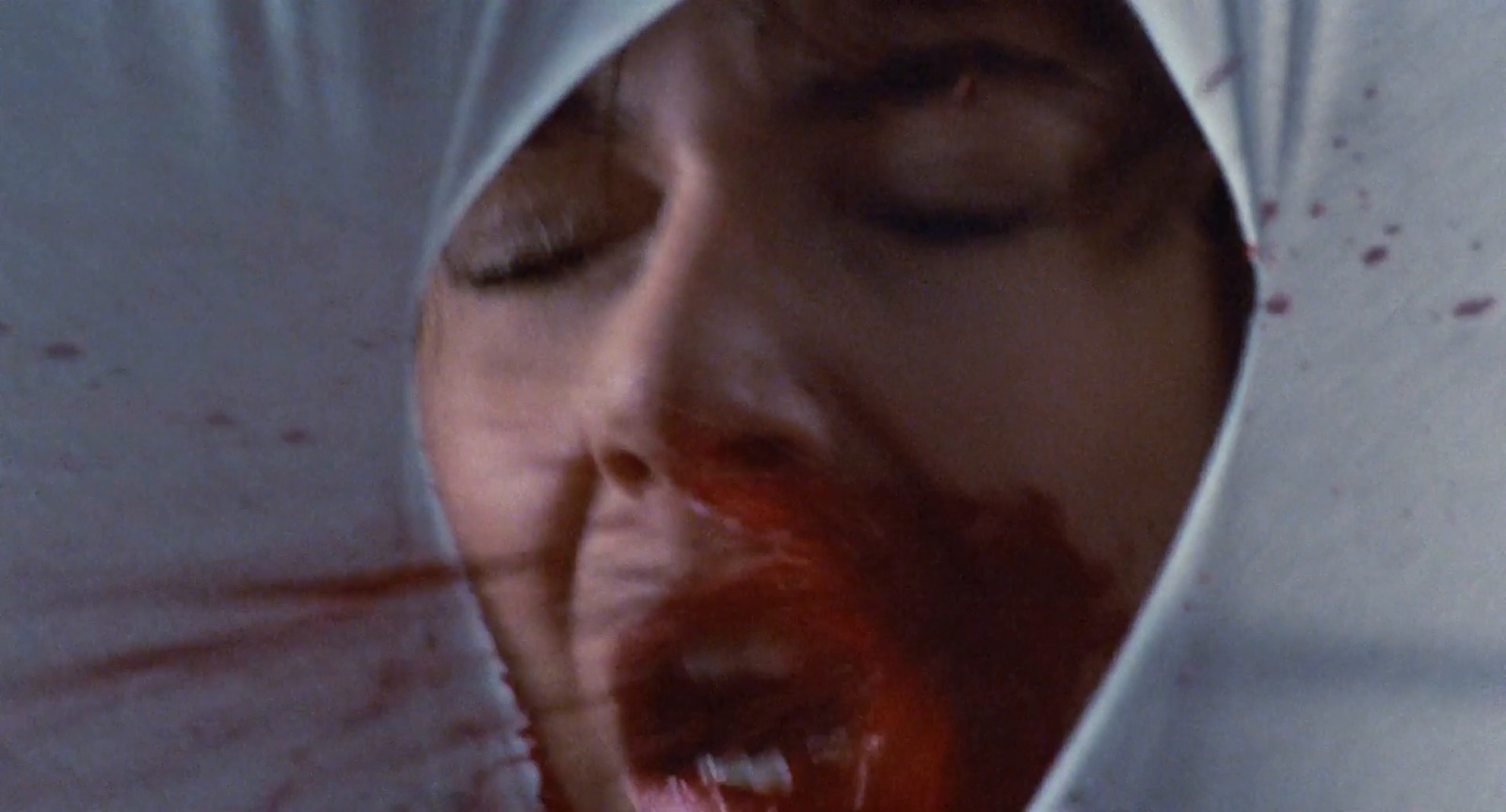
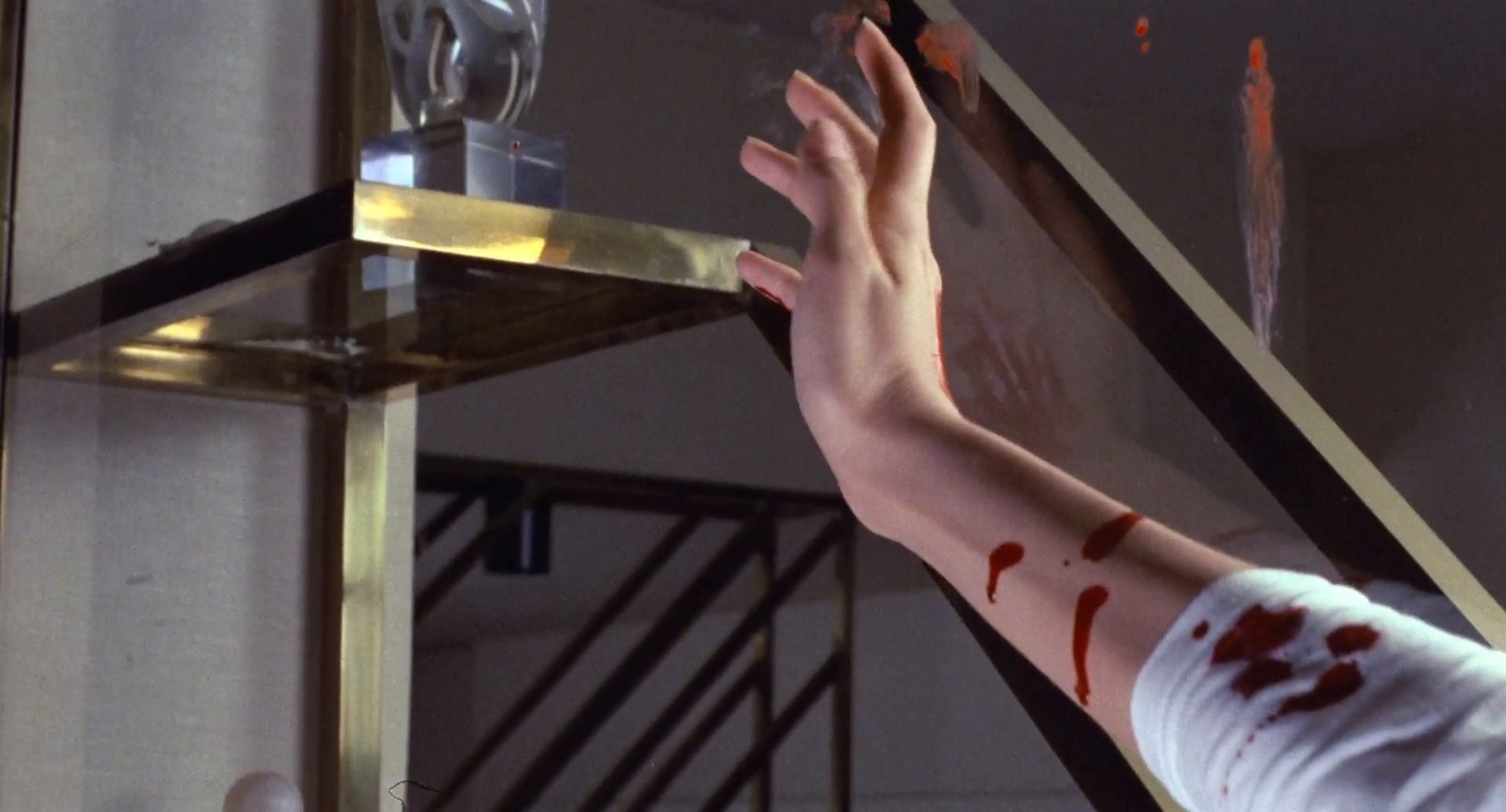
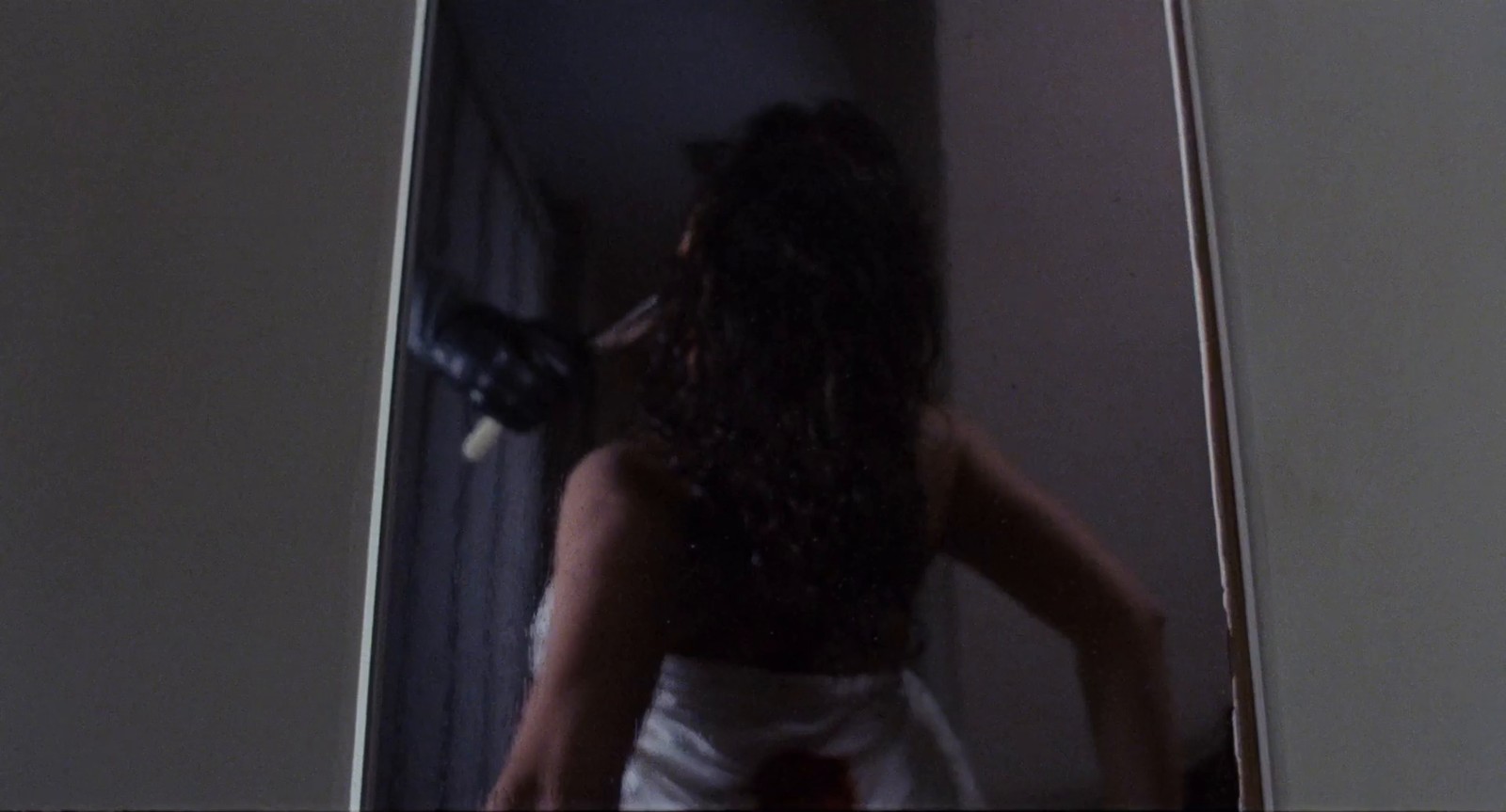
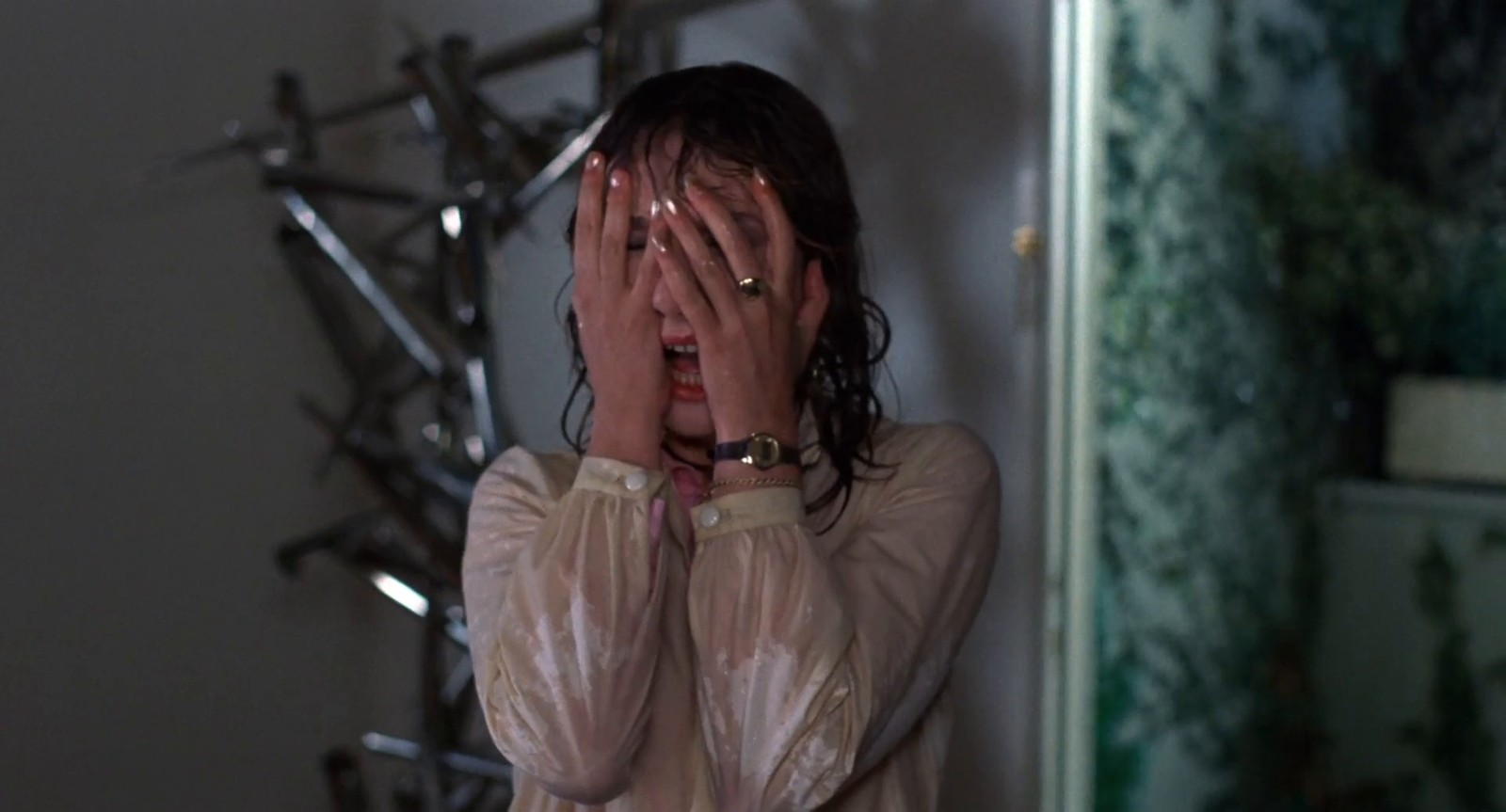
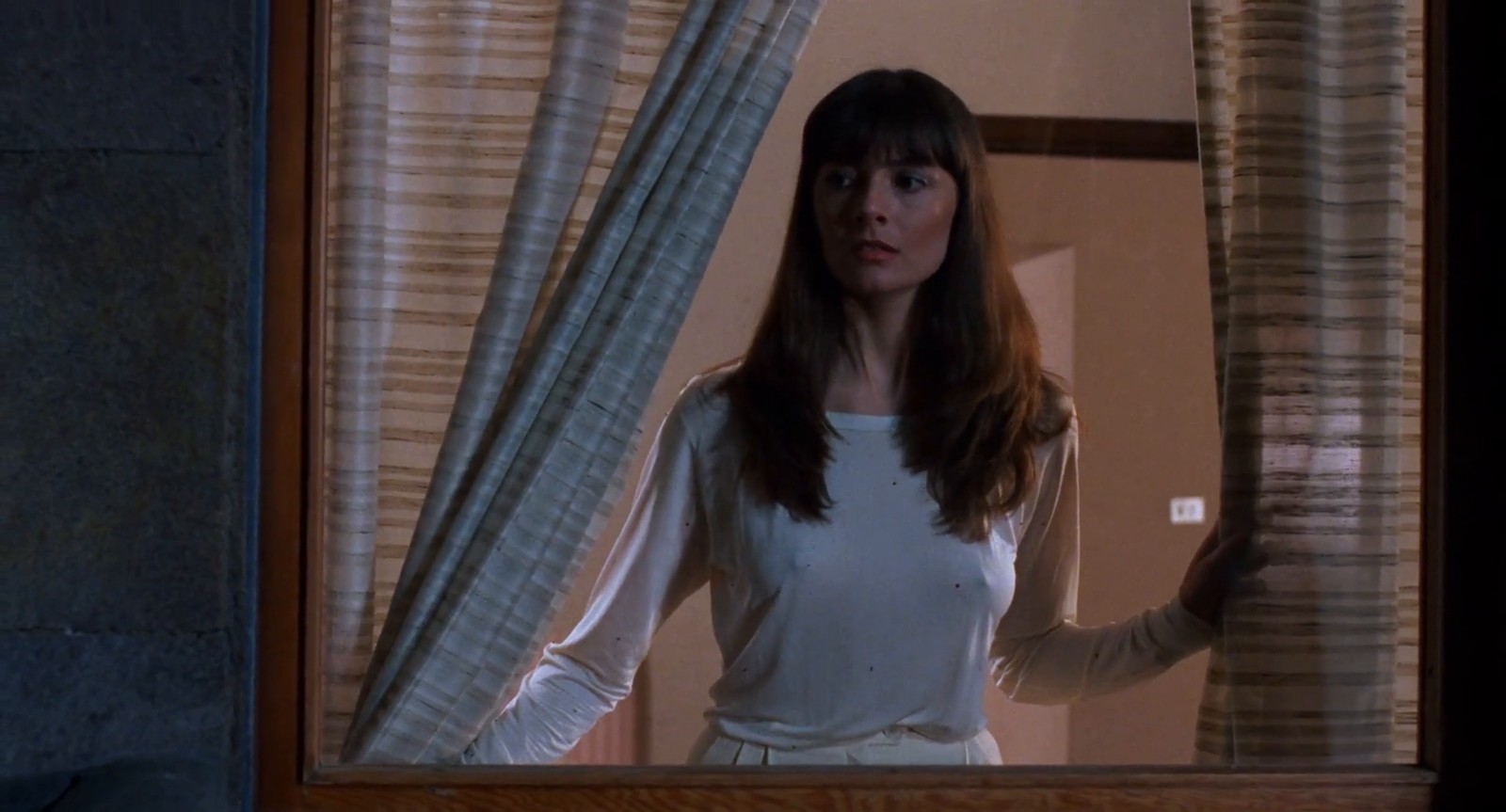
The white top first conceals Tilde’s face, then becomes a small screen around it. Inserts of the razor interrupt the rear view; a cut in the fabric exposes her eyes before blood crosses the opening. Her reaching hand and the bright metal furniture extend the action beyond the face. Cloth, performance and the succession of close-ups make the effect legible.
The sequence changes sides of the torn fabric before it shows the wound. The cut makes a fragment of cloth function like a miniature screen.
30:37.5Tilde beside the curtains. The held view follows her turn and the removal of the white top; the glove catches the fabric before the first blade insert.
31:12.0The razor opens against the wooden floor.
31:12.7A low angle returns to the covered head and raised arm.
31:13.6The open razor occupies another isolated insert.
31:14.1The cloth fills the image, then opens onto the black-clad figure: a view from within the fabric.
31:14.6The reverse view gives Tilde’s face its own opening in the white material.
31:15.3The image returns through the tear toward the attacker. The blade supplies the approaching action.
31:15.8Back on Tilde, blood crosses her mouth and the cloth within the shot.
31:16.6The bloodied hand reaches along the metal-and-glass shelving. The camera follows downward as the ornaments are displaced.
31:22.5A separate downward view catches the falling white vase and its breakage.
31:23.3The wider room view restores Tilde’s body to the domestic space after the concentrated face-and-blade montage.
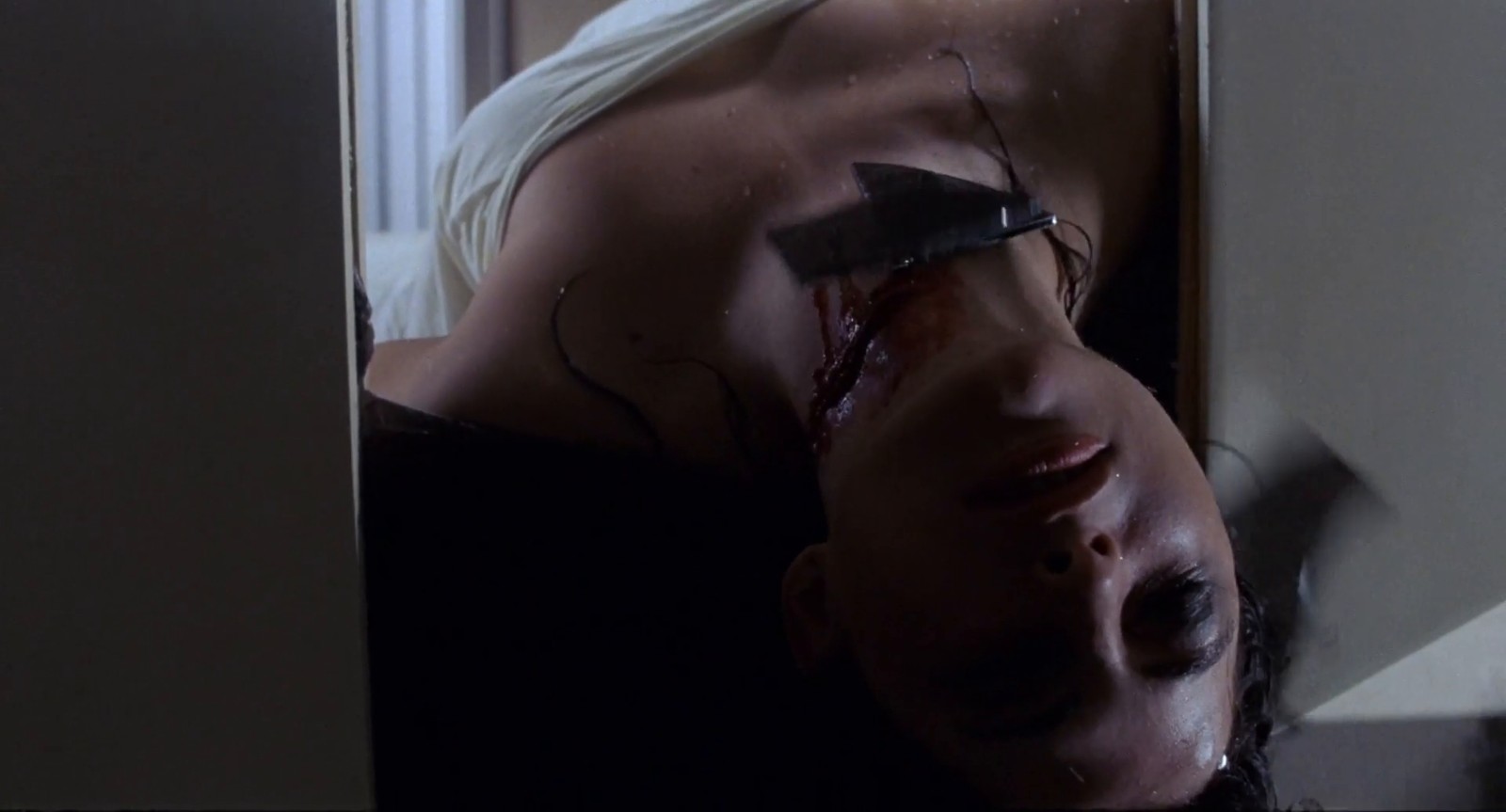
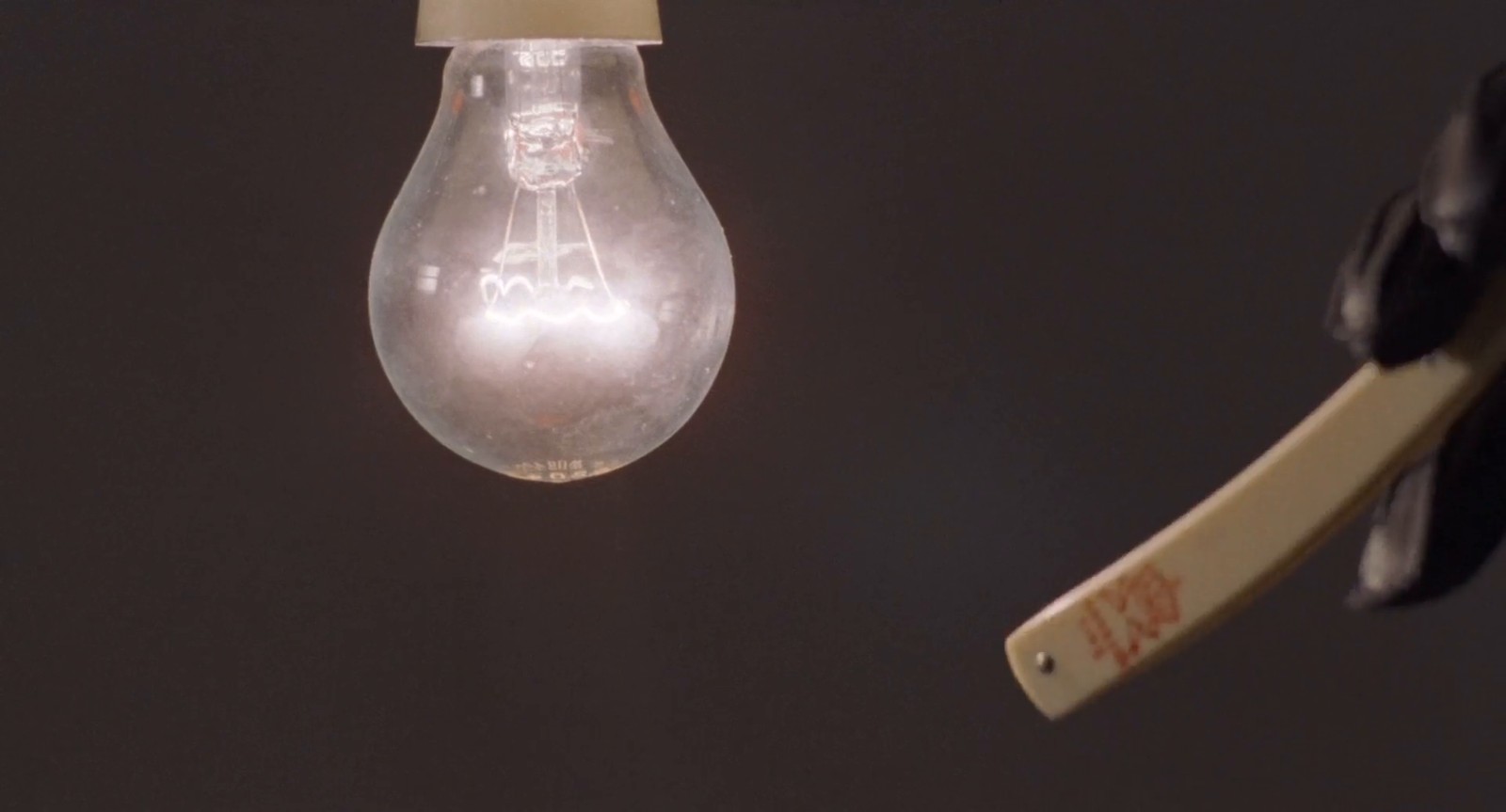
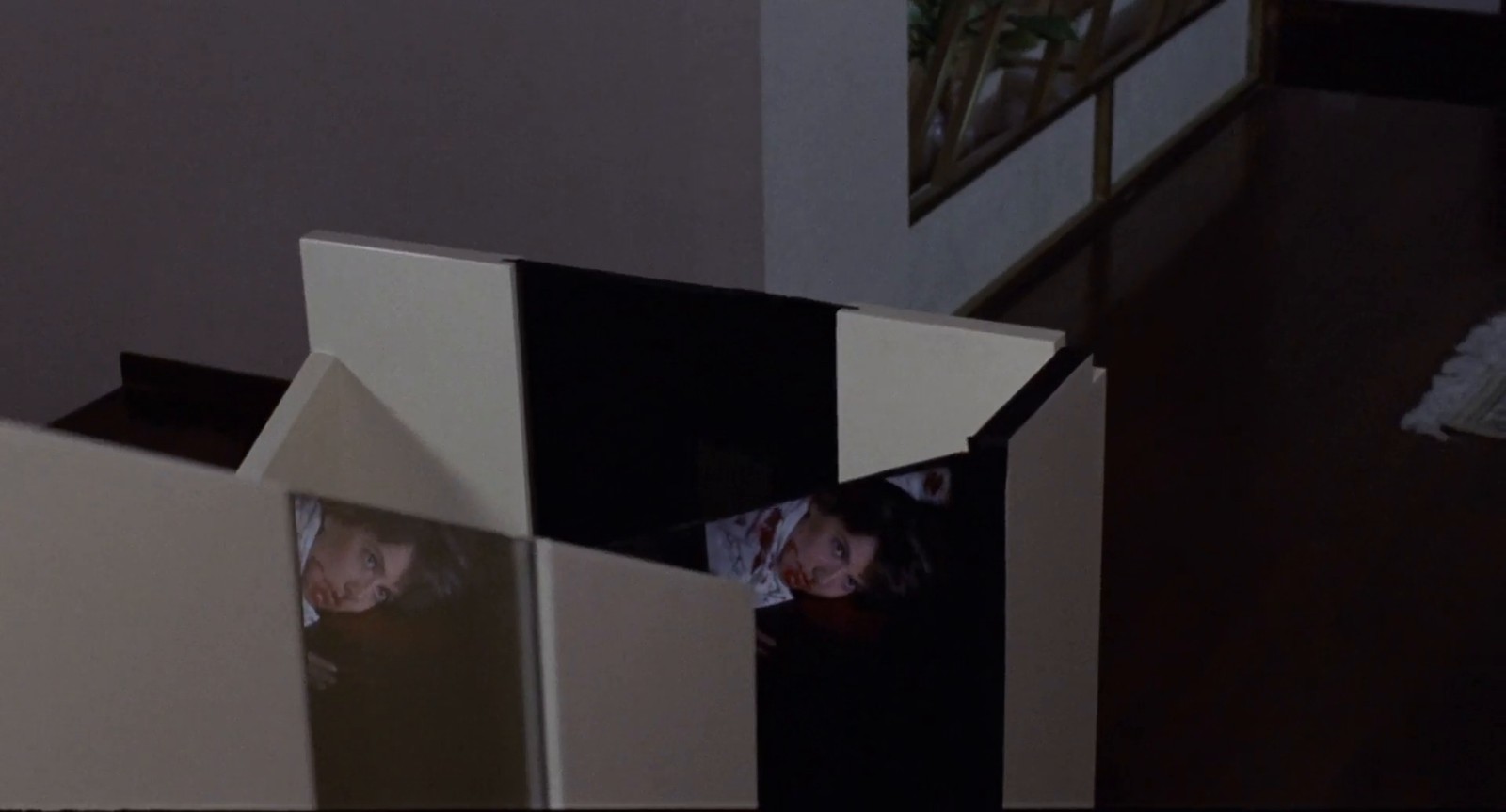
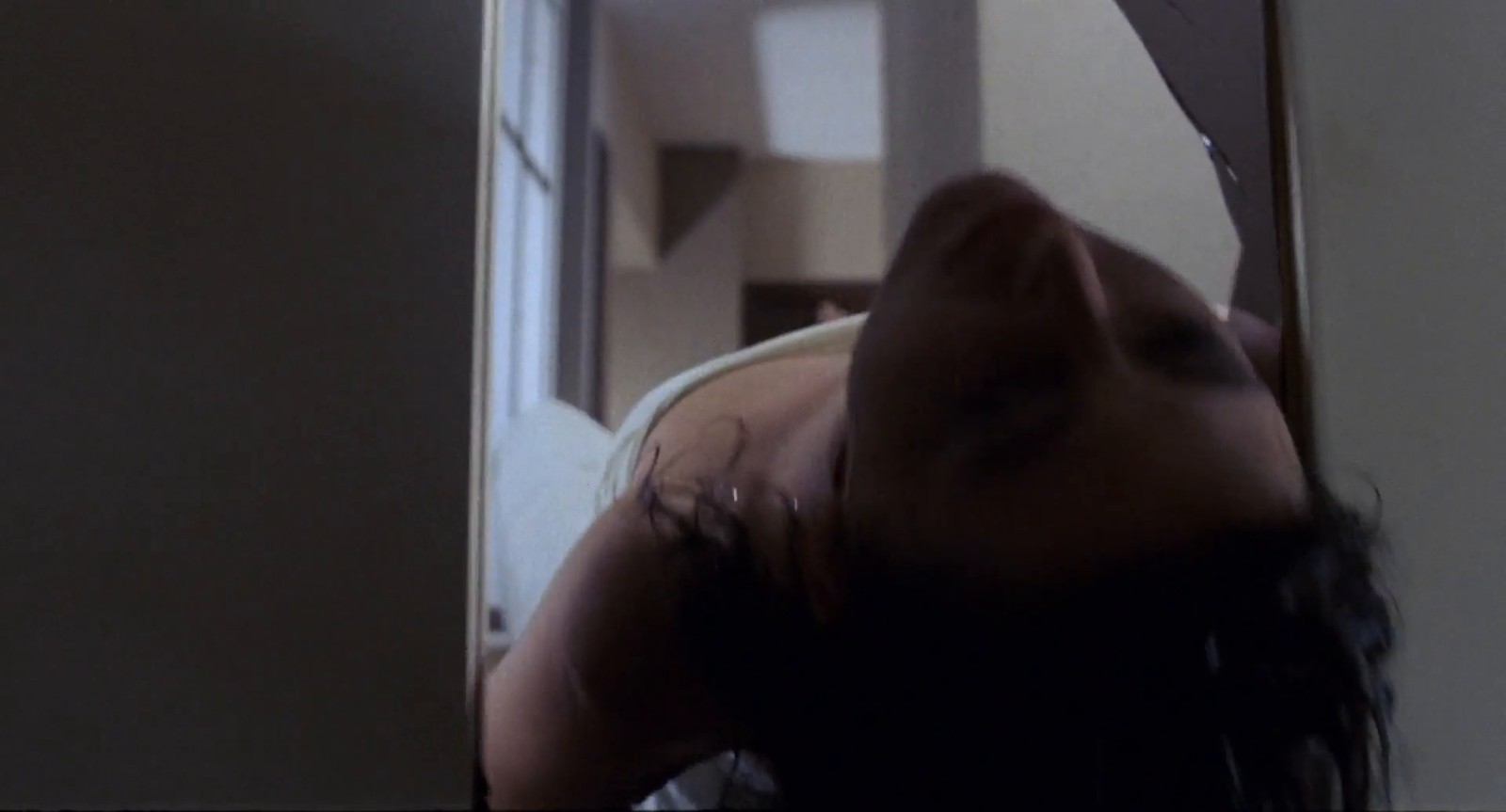
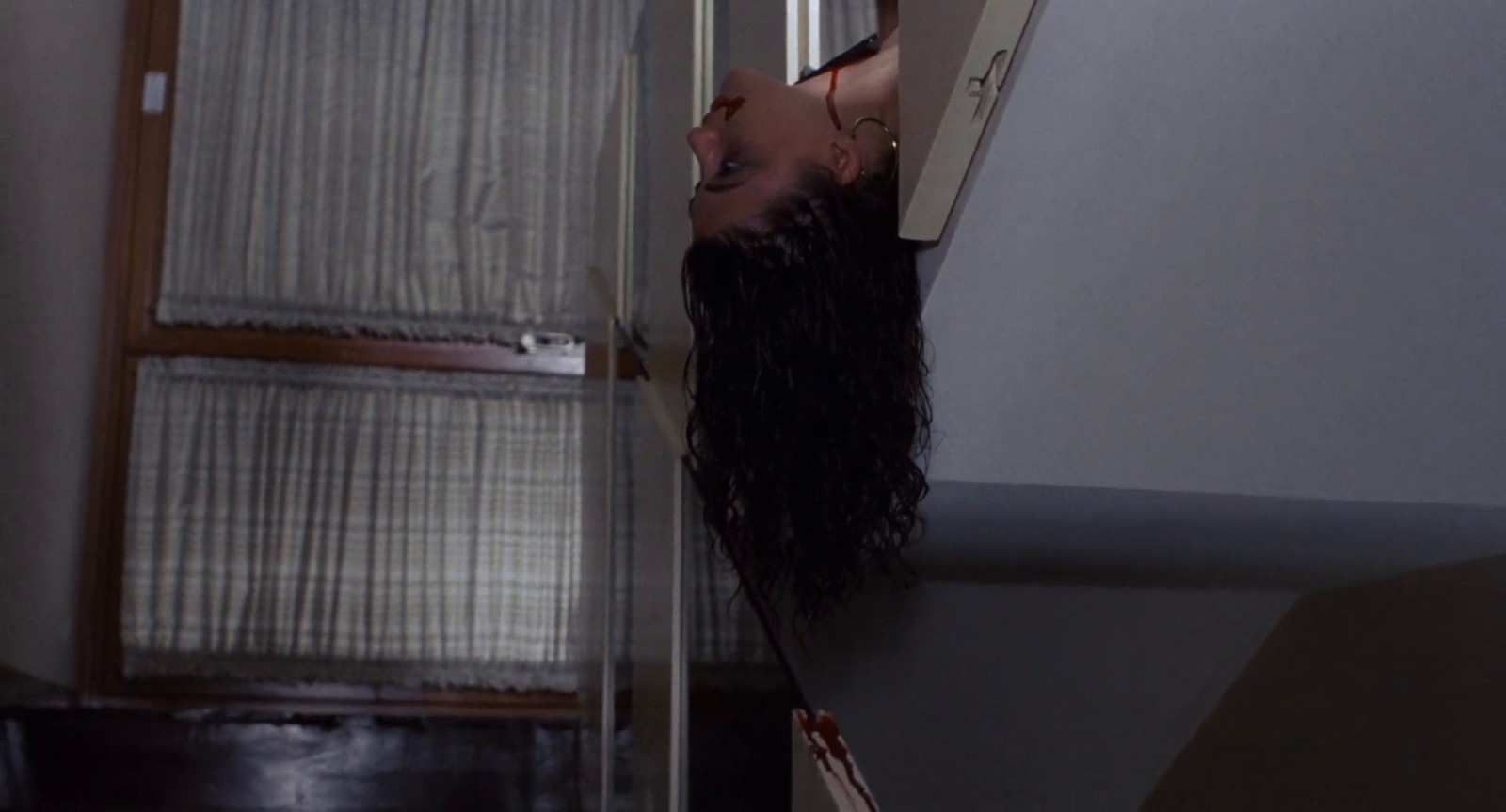
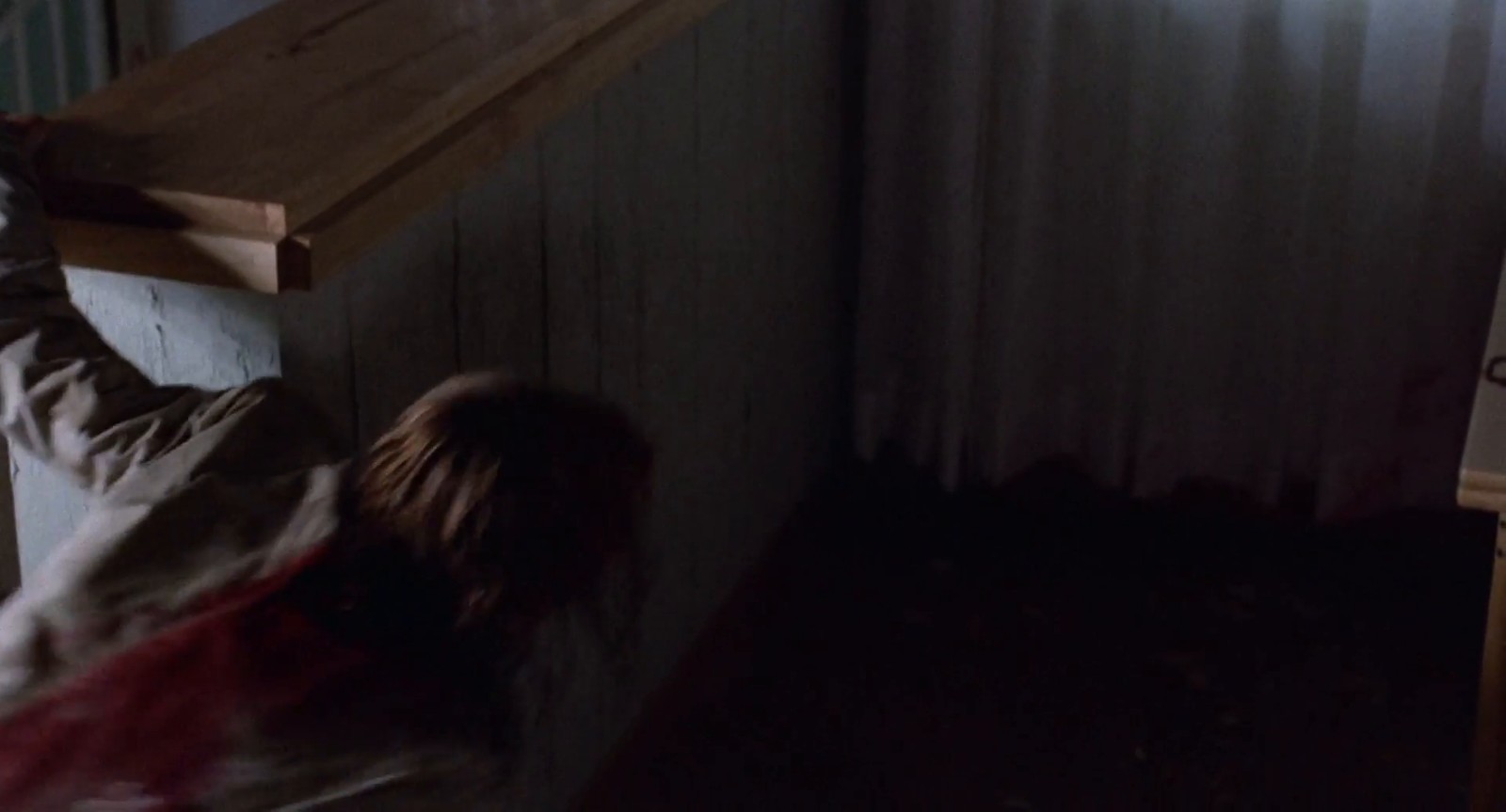
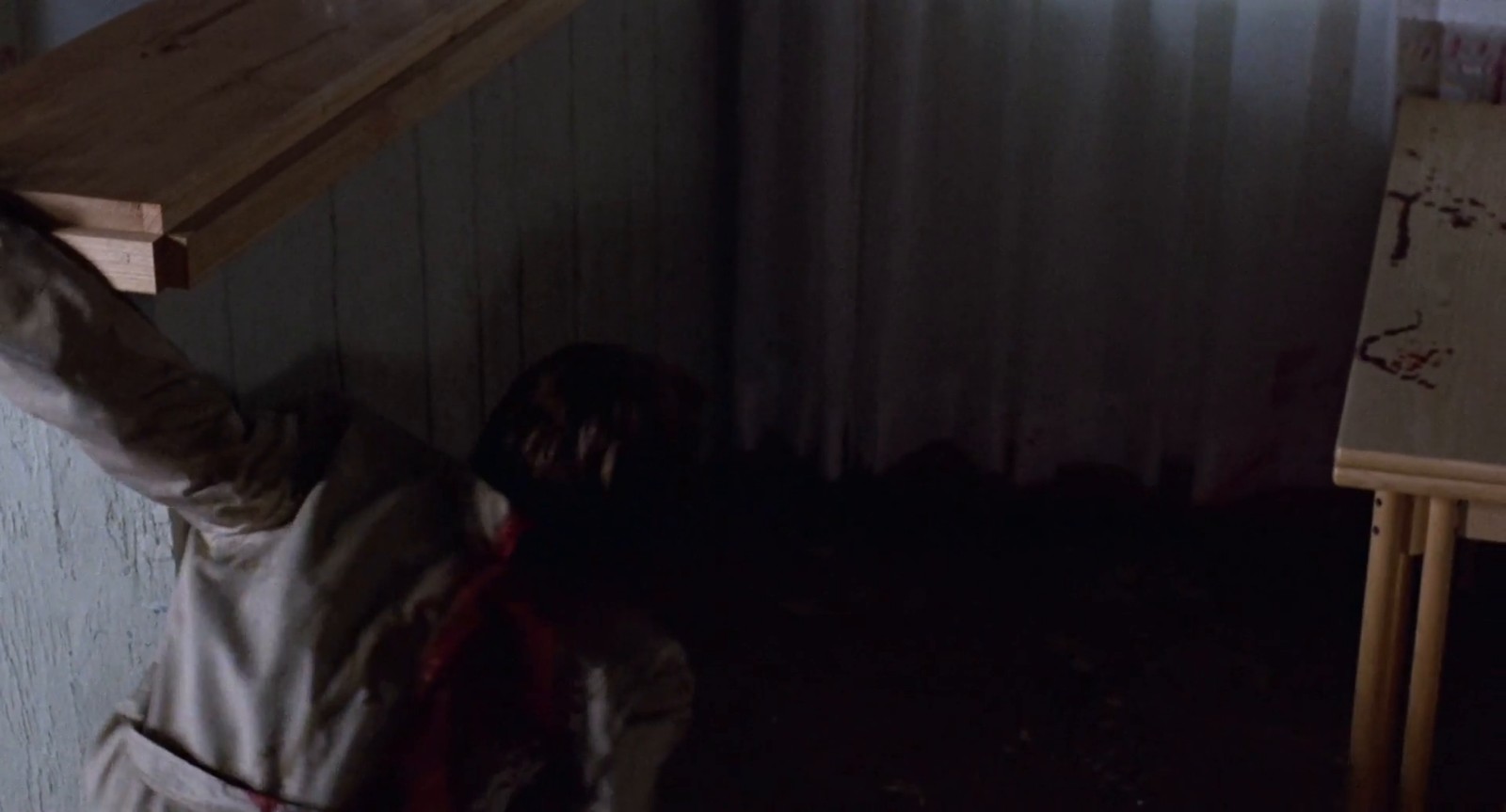
The razor breaks the light bulb before the stairwell becomes the site of the attack. Marion discovers Tilde, recoils and is pulled across the landing edge. The framing changes the body’s orientation: her head hangs upside down, exposing the neck to the camera. A closer view of the wound gives way to the longer architectural view, with blood descending into the staircase.
Marion’s movement through the house is interrupted first by a broken bulb, then by views of Tilde above her. The attack turns the landing into a series of reversals: approach, retreat, capture and an inverted face. The final camera inserts connect the two deaths through photography.
31:46.9The stairwell replaces the bookcase view and follows Marion’s movement into the house.
32:05.3A bulb and razor occupy a close insert; the bulb breaks within the shot.
32:08.7Marion reacts on the stairs.
32:19.1An upward view reveals Tilde through the structure of the landing.
32:23.0The film returns to Marion facing the discovery.
32:24.2Tilde’s body appears again above the stairs.
32:25.5Marion turns away.
32:26.4A closer view follows her retreat until a glove catches her hair.
32:30.7A higher frontal view shows Marion pulled back against the landing.
32:33.0The reverse view follows the pull over the edge. Her head rolls back within the shot, bringing the throat and razor into view.
32:38.7A wider view places Marion’s inverted head against the landing and window.
32:43.8A camera dial replaces the stairwell.
32:44.5The next view moves from the doorway down to Tilde’s body.
32:46.9Gloved hands hold the camera and flash.
32:48.3A closer insert isolates the flash unit.
32:48.8Tilde’s body returns beneath the flash. Changes in brightness remain within the shot.
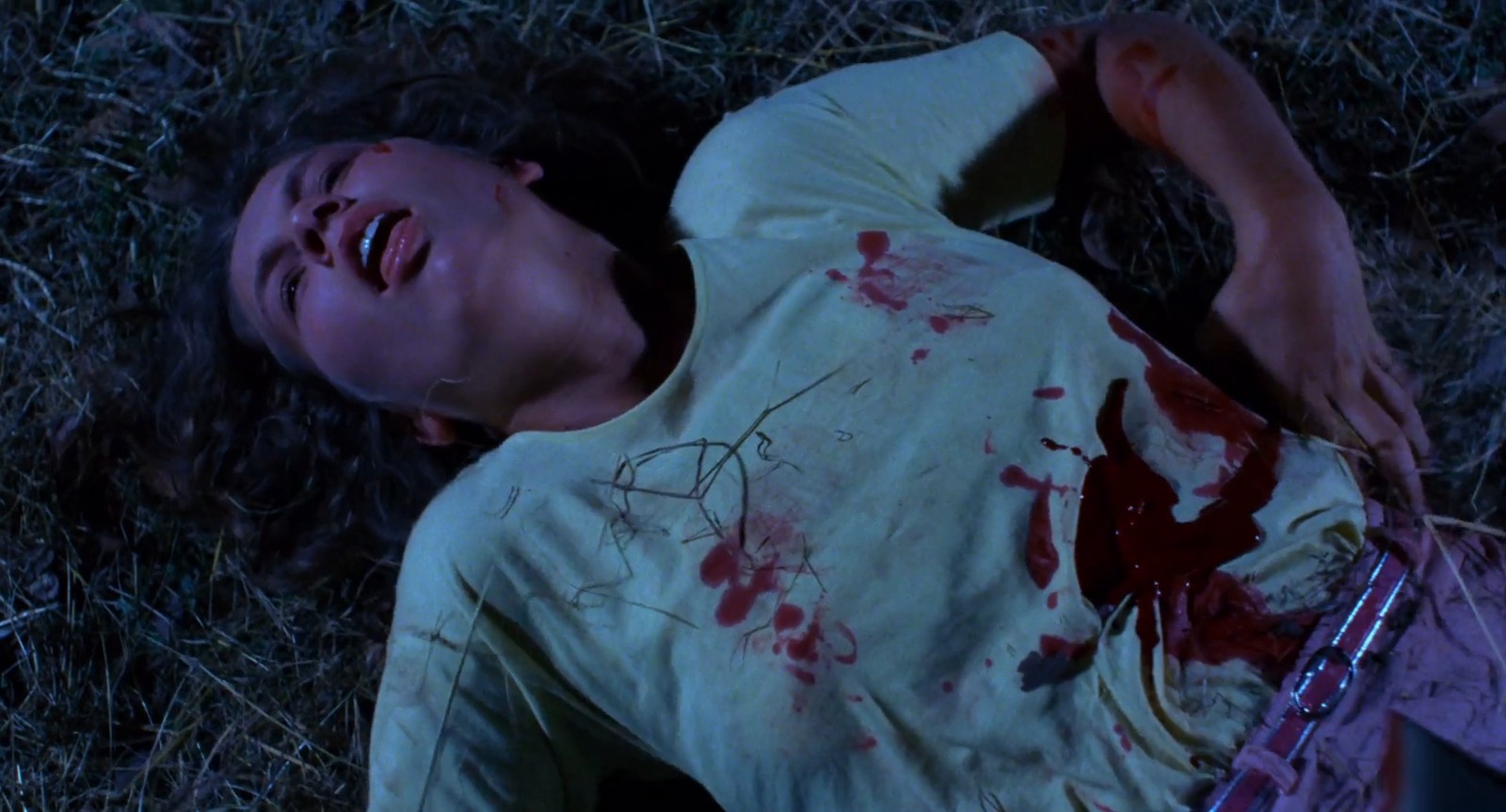
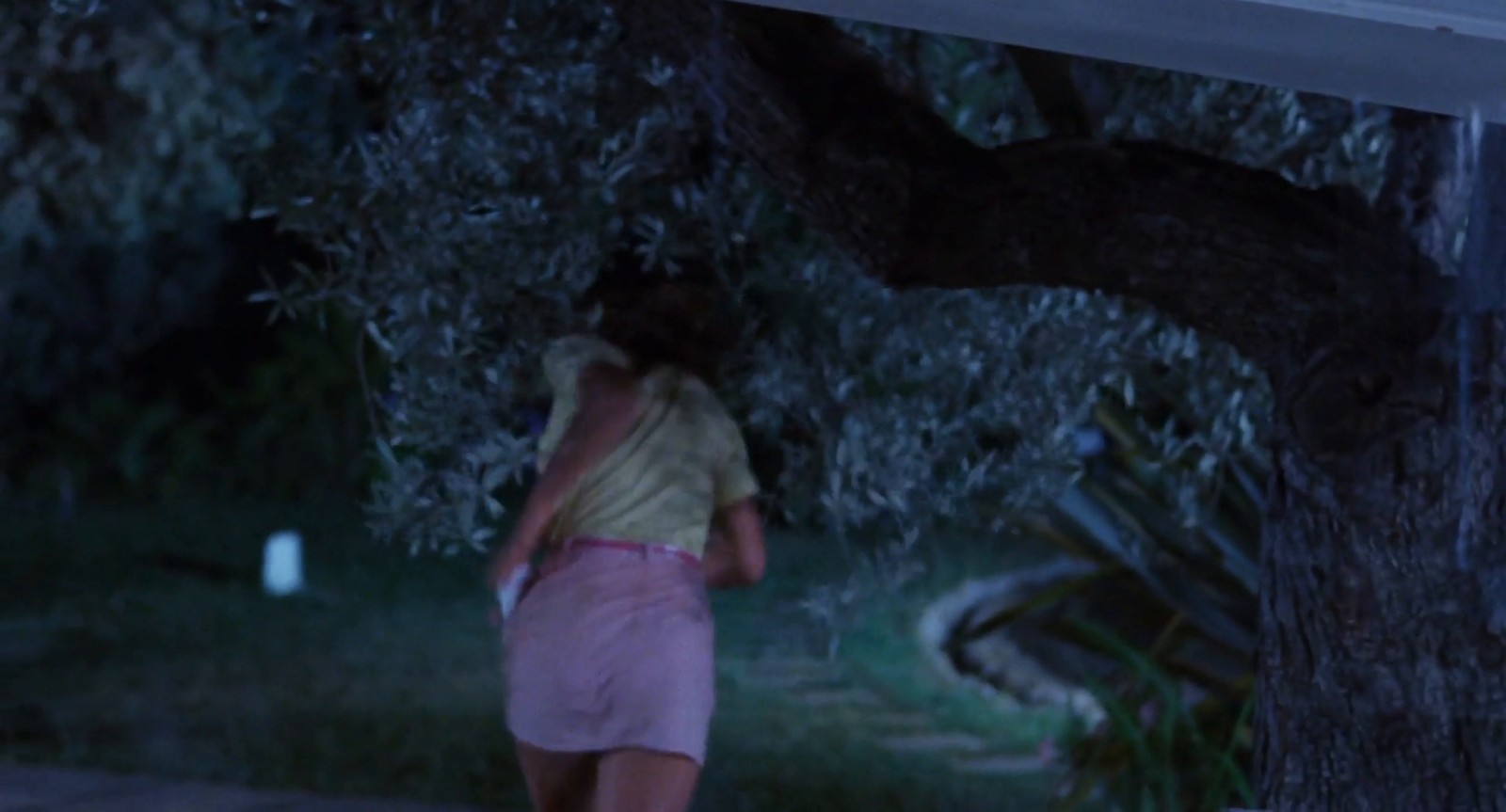
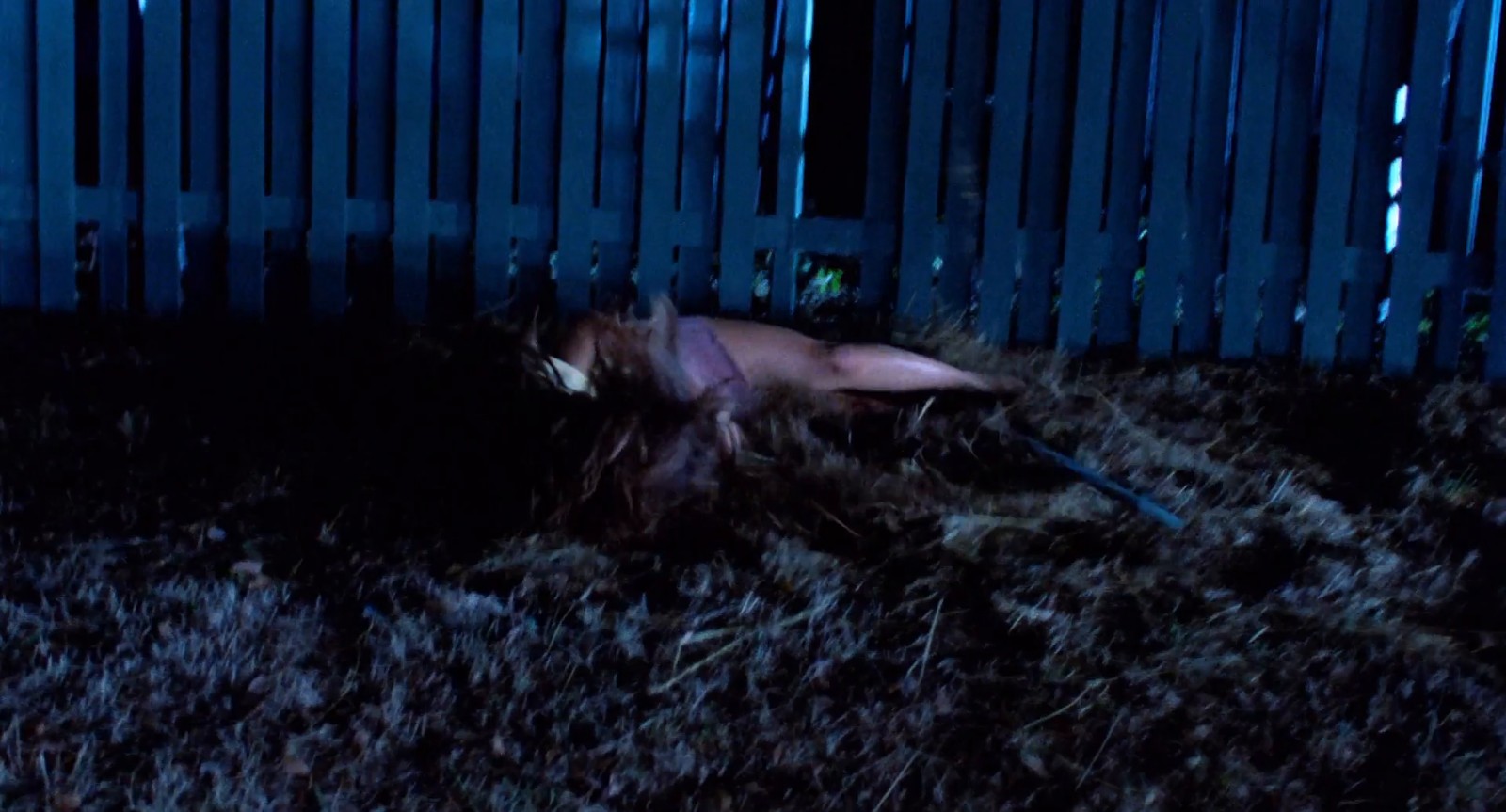
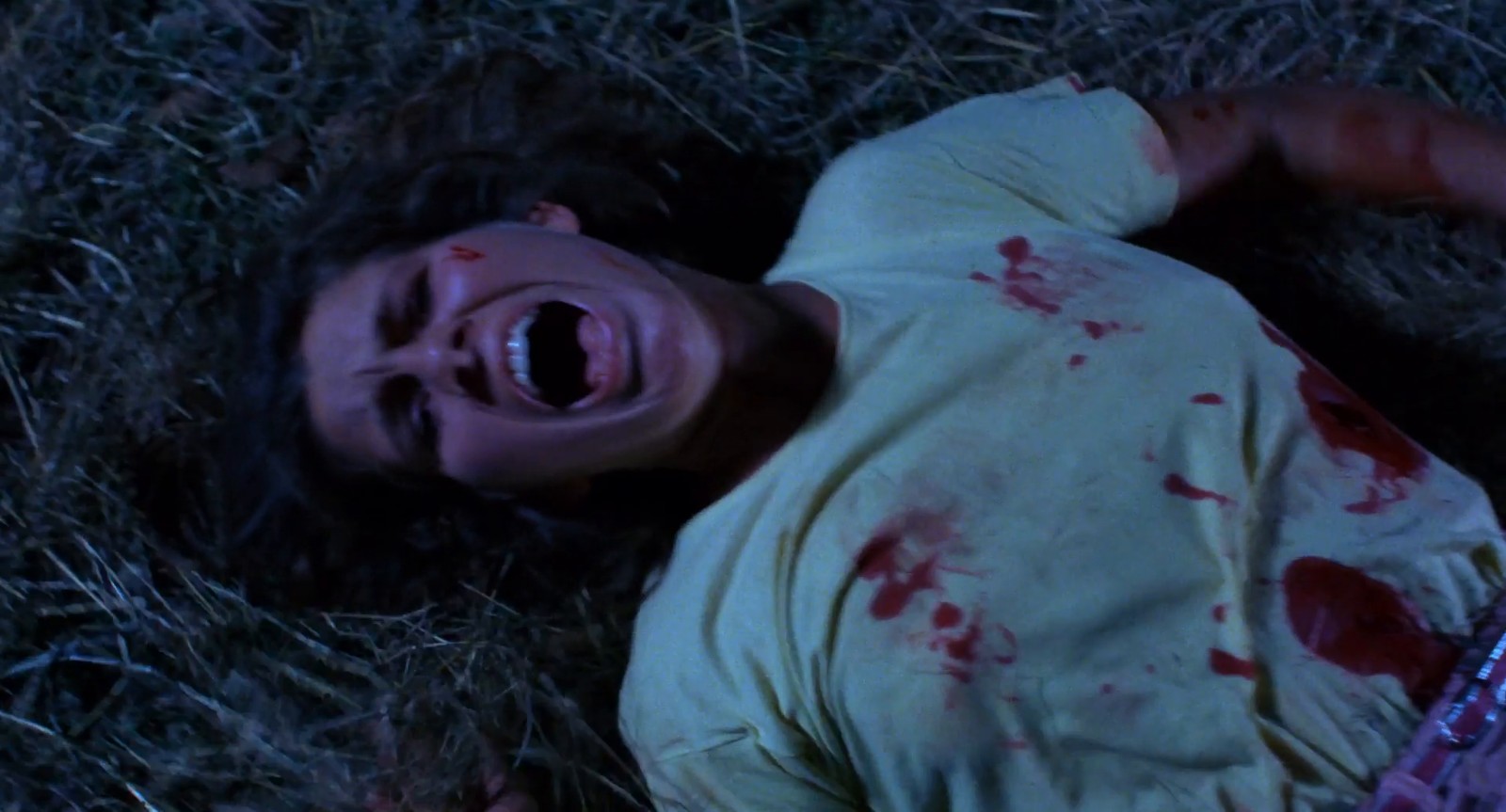
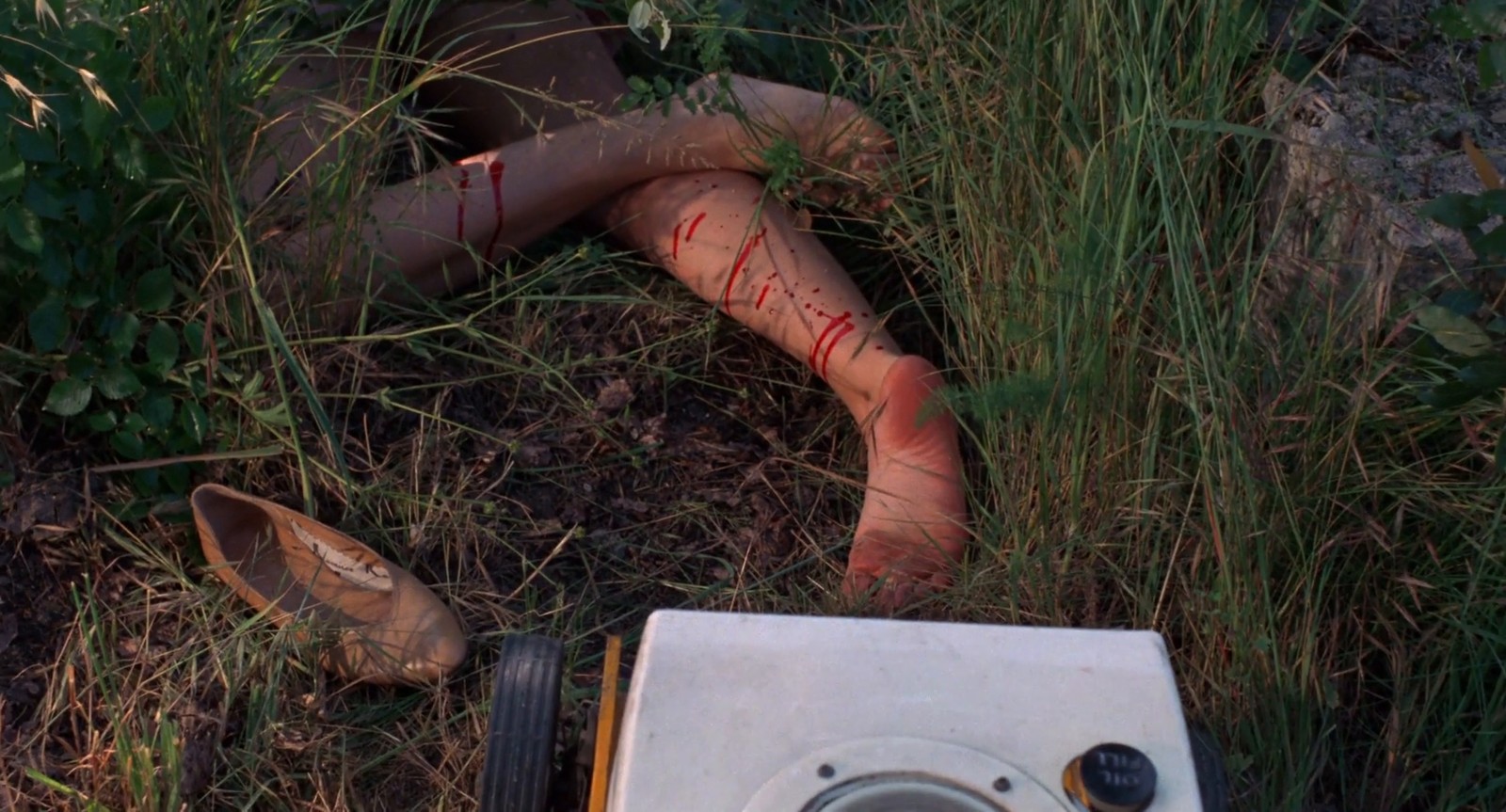
Maria’s escape is first organised through the garden’s steps, vegetation and fence. The pursuit repeatedly returns to the axe handle, then moves from her fall to a tight view of blood spreading across her yellow shirt. The following daylight passage replaces the struggle with discarded photographs and the discovered body. The effect depends on the contrast between movement and the still evidence left behind.
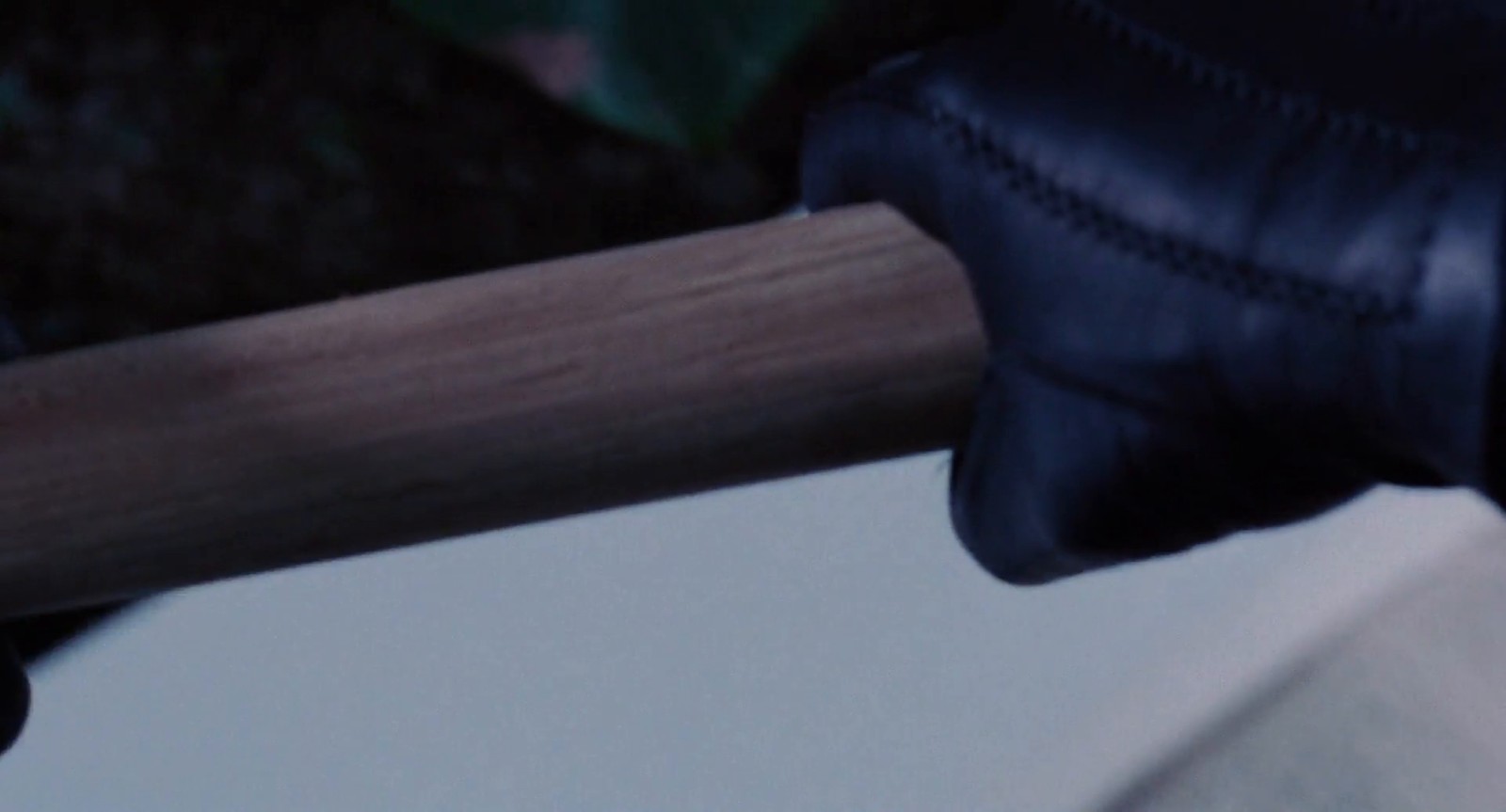
The axe is repeatedly separated from its user. Long views of Maria’s escape are punctuated by brief weapon inserts, then compressed into her wounded body and face on the grass.
55:21.1A black glove rests against the white window frame.
55:22.2Outside, Maria reacts in her yellow shirt.
55:22.7A close view isolates the gloved hand and axe handle.
55:24.3Maria turns to run.
55:26.1A wider terrace view follows her flight.
55:43.5The axe and glove interrupt the escape.
55:45.7The garden view follows Maria across the open space toward the fence and her fall.
56:08.3A raised axe appears in another isolated view.
56:11.5Maria lies injured on the ground.
56:12.3The axe is raised against darkness.
56:12.8The return to Maria makes the blood on the yellow shirt visible.
56:15.1A closer view of her face on the grass closes the attack before the daylight scene.
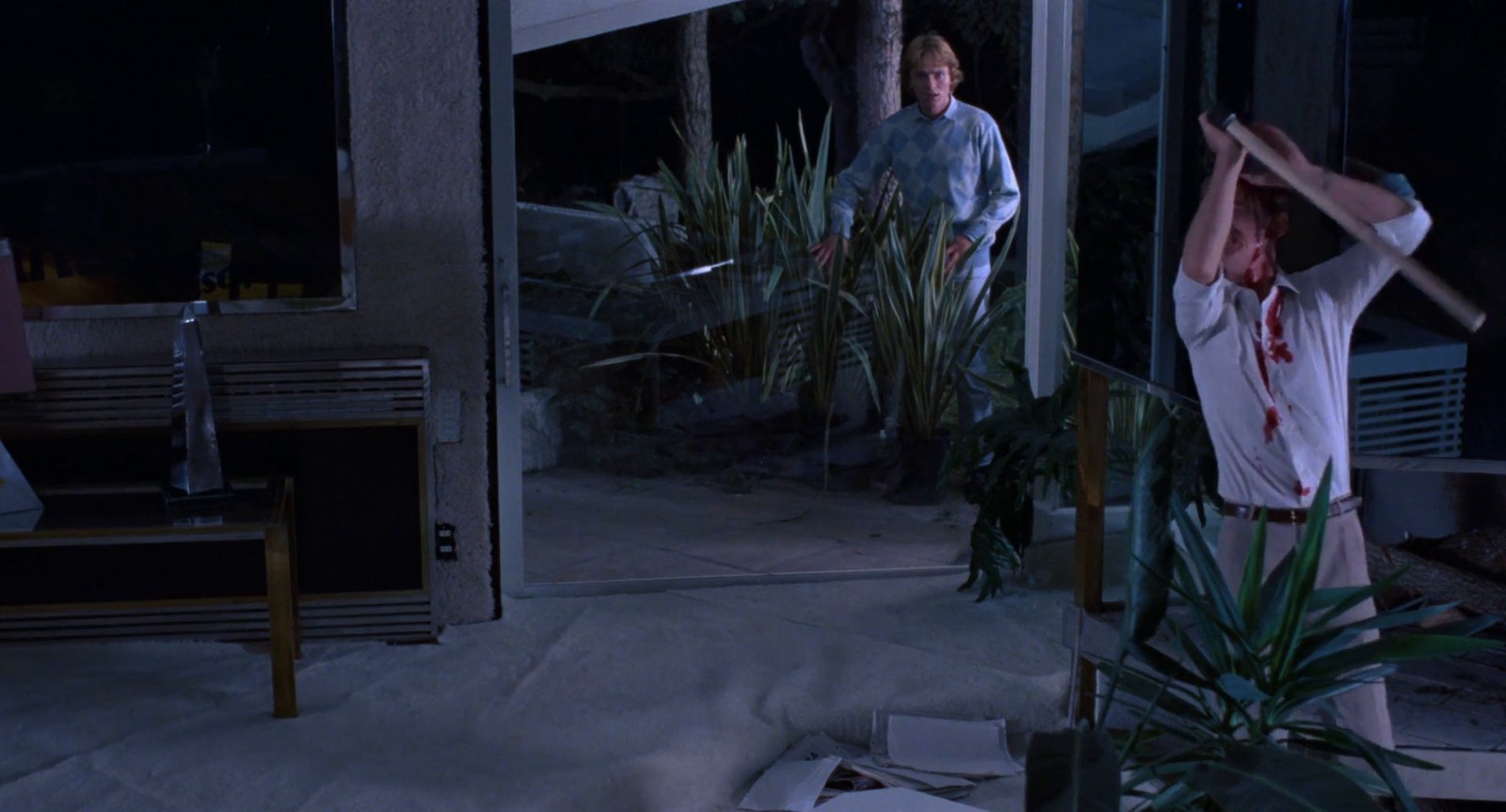
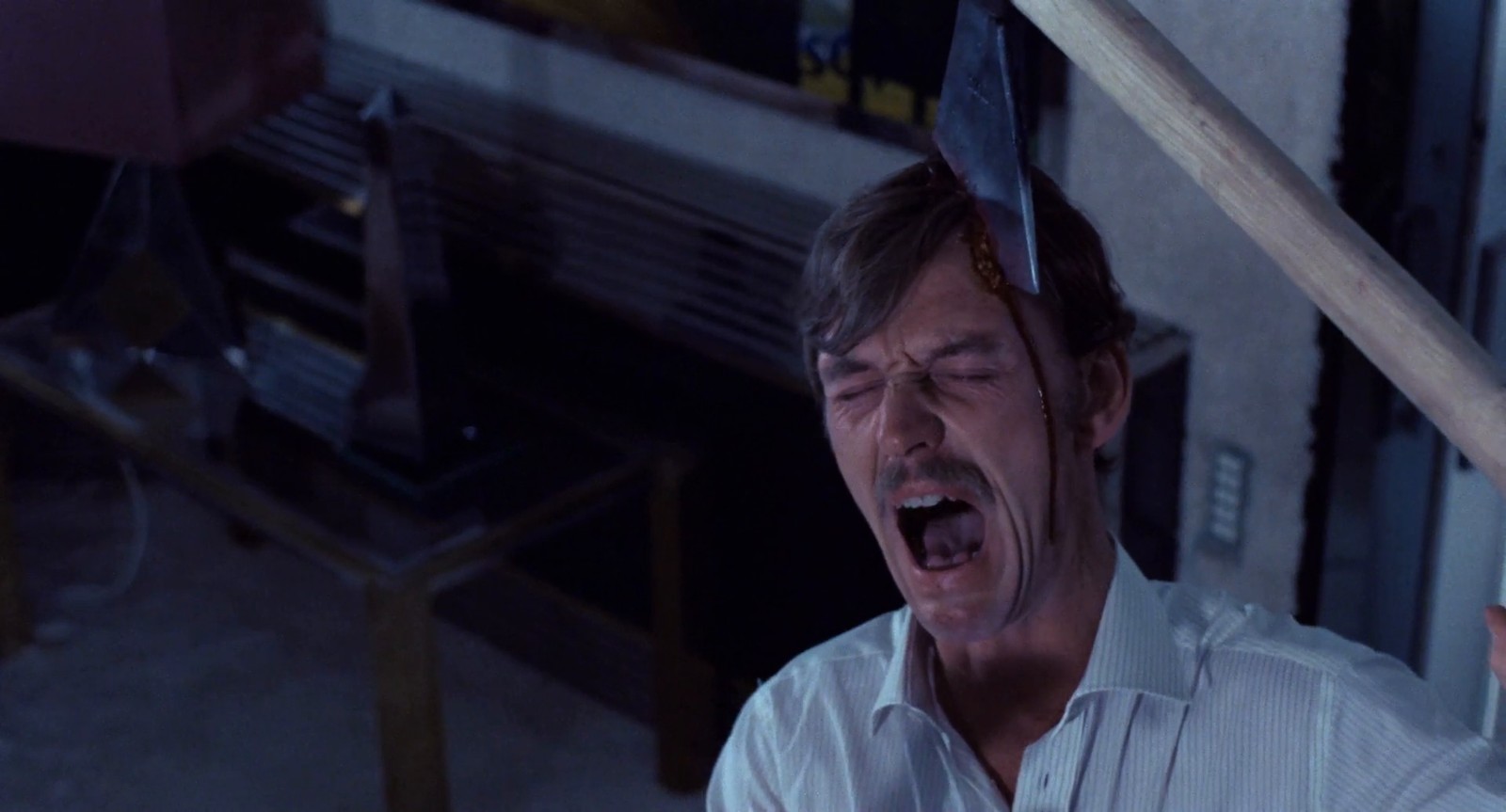
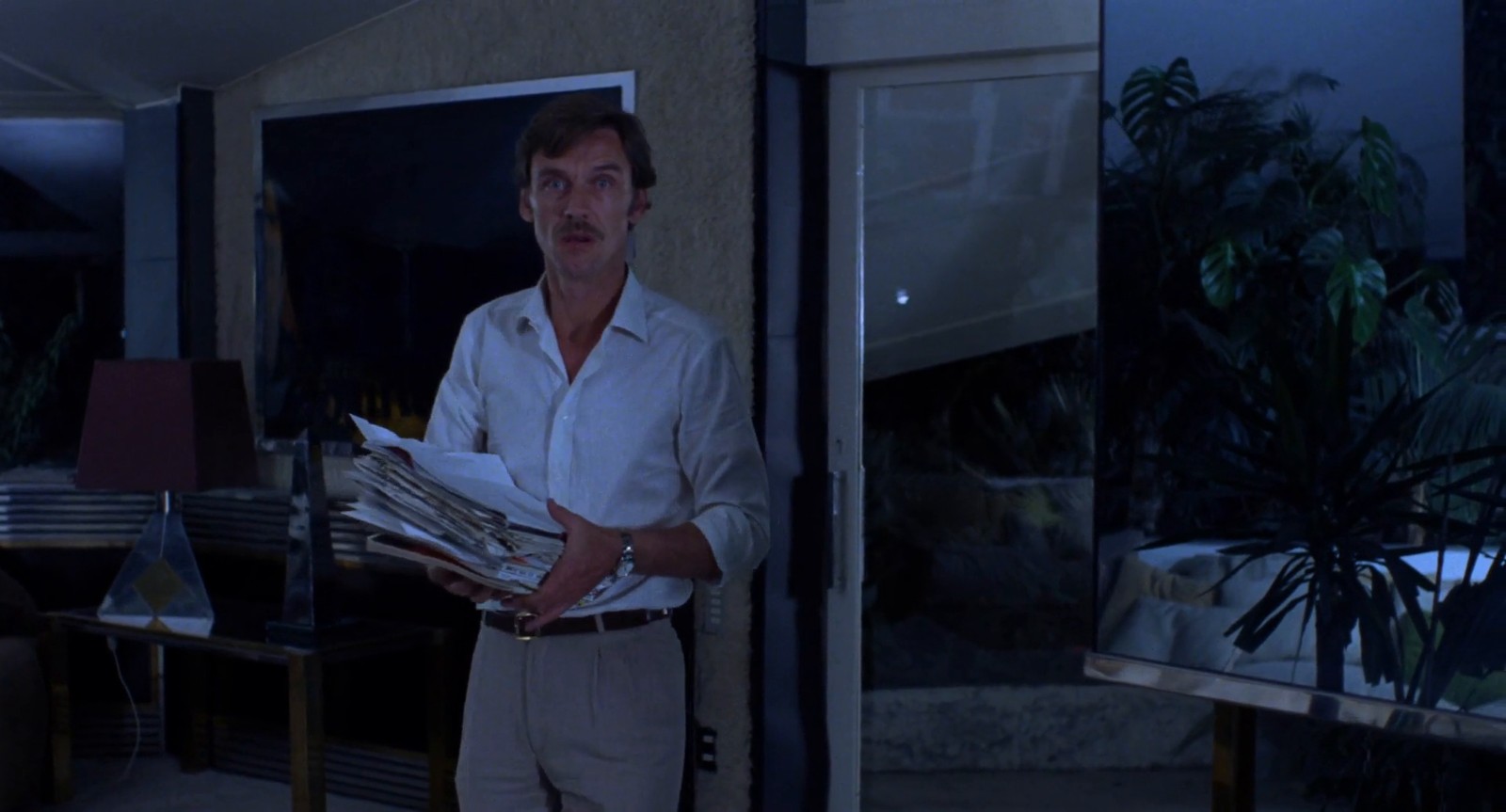
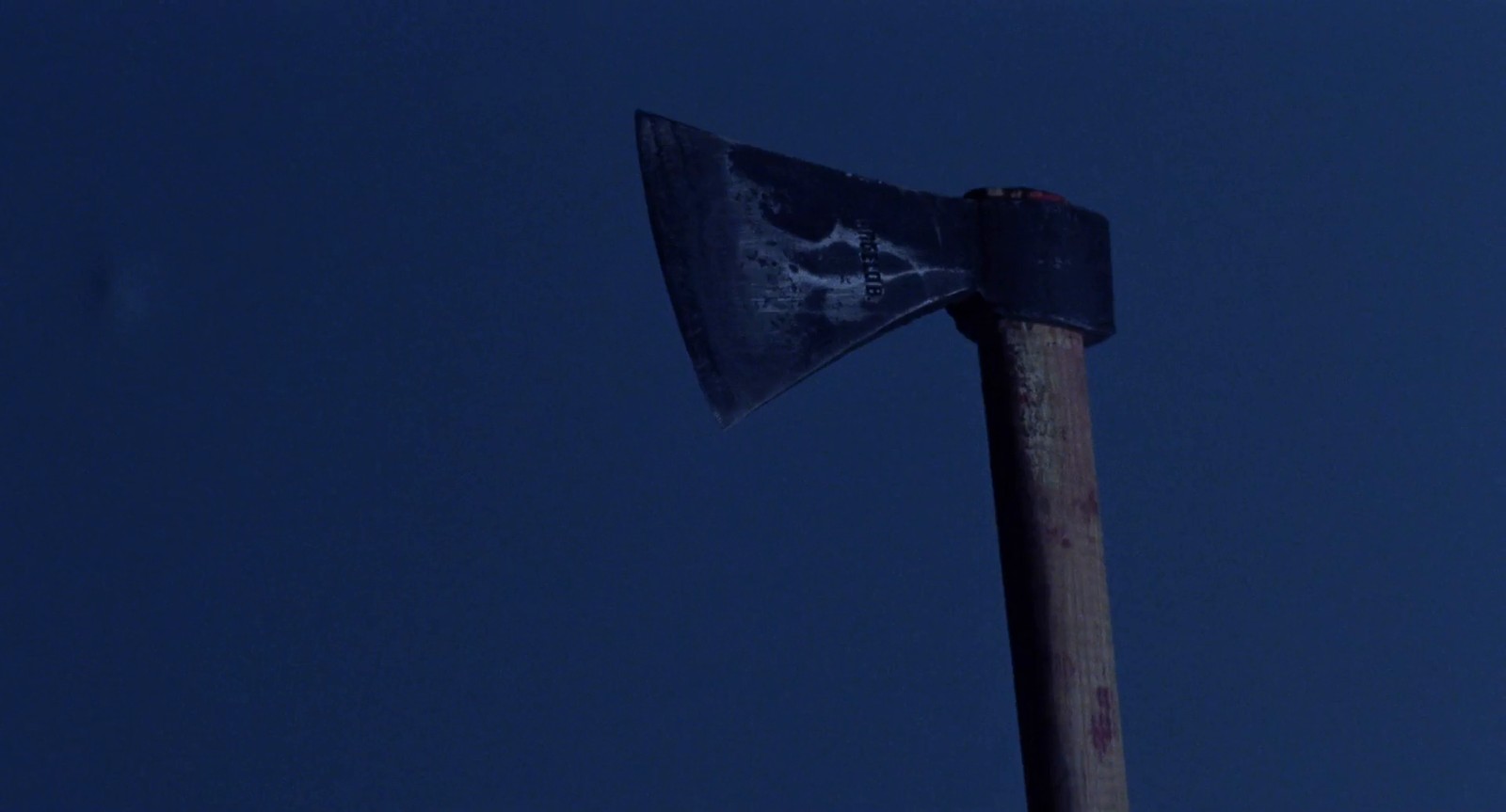
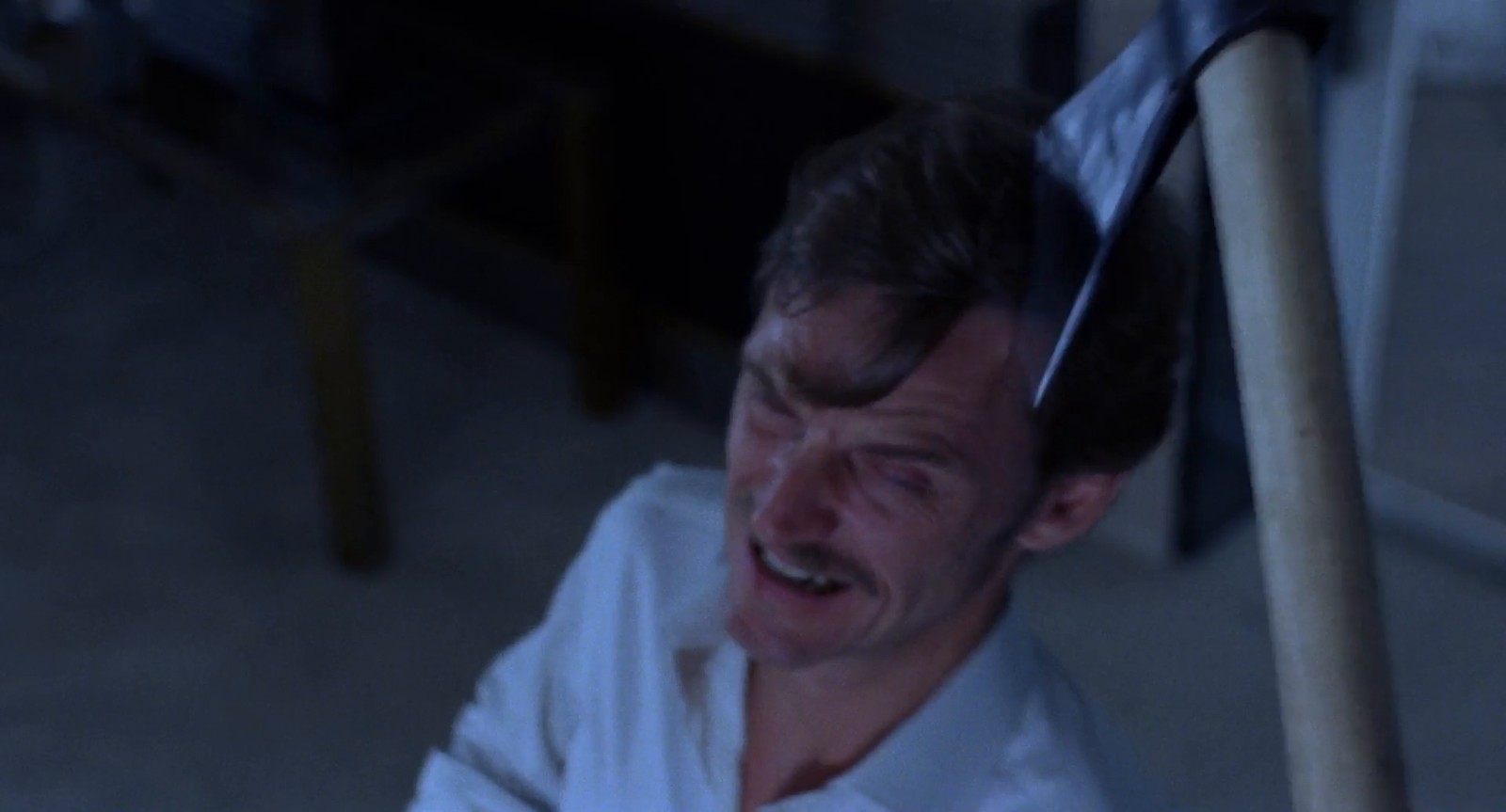
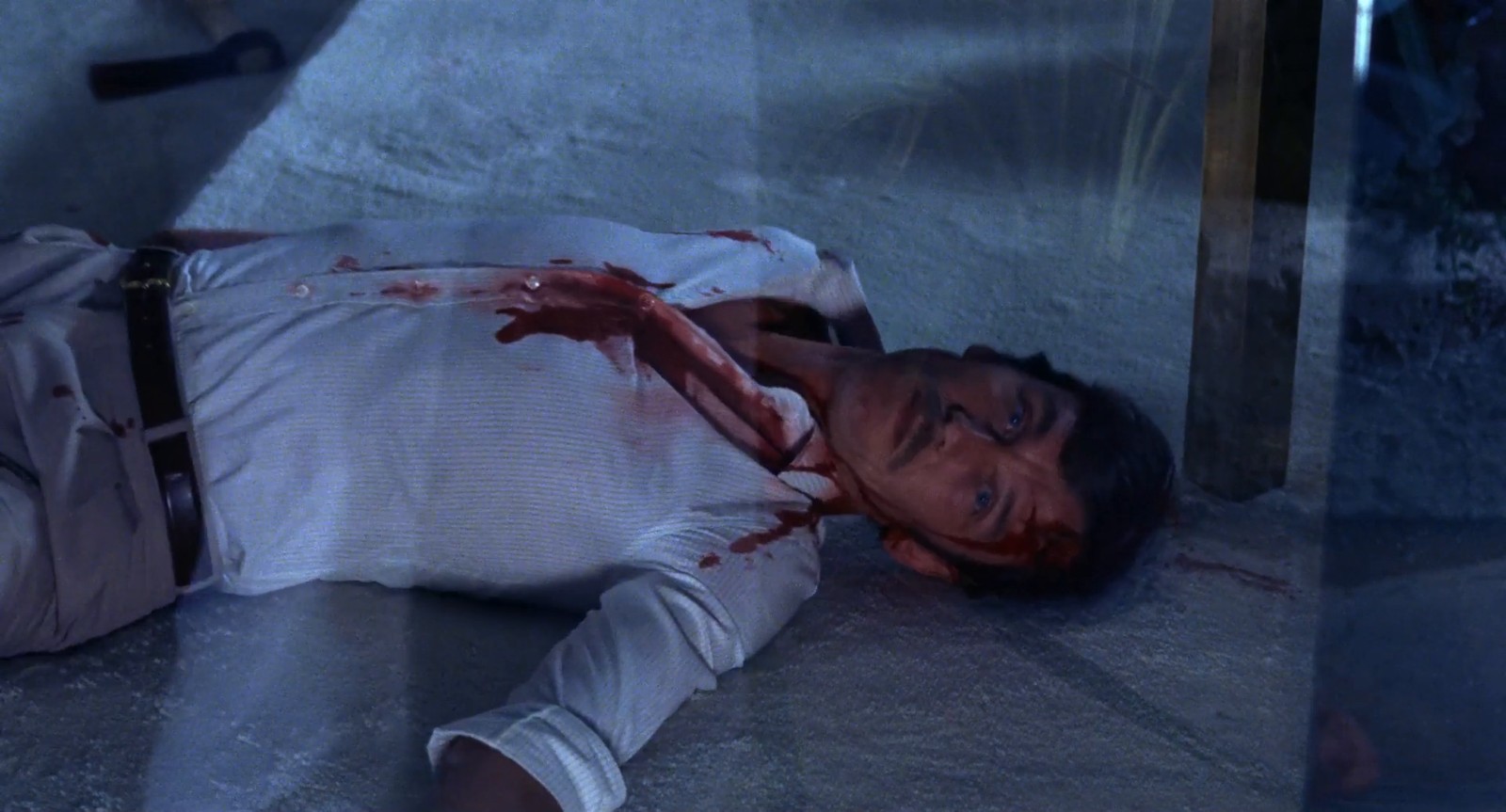
Berti stands in the glass house with his papers while Gianni watches from the garden. The raised axe is isolated against blue darkness before the film returns to the head wound. The handle remains visible as Berti staggers and falls. Gianni’s reaction is part of the construction: the murder reaches us as both a physical blow and an event witnessed from an incomplete position.
The glasshouse lets Gianni witness the attack while keeping him outside it. The montage alternates axe, wounded head, witness and falling body; the window becomes a barrier the violence can cross.
1:04:11.7Berti stands inside with papers in his hands.
1:04:17.3A wider reverse view places Gianni outside the glasshouse.
1:04:19.7The raised axe is isolated against a blue background.
1:04:20.4A high frontal view shows the axe strike Berti’s head.
1:04:20.7Gianni reacts outside.
1:04:21.8The embedded axe and Berti’s raised arm return in a closer view.
1:04:22.9The room widens as Berti falls, with Gianni visible beyond the glass.
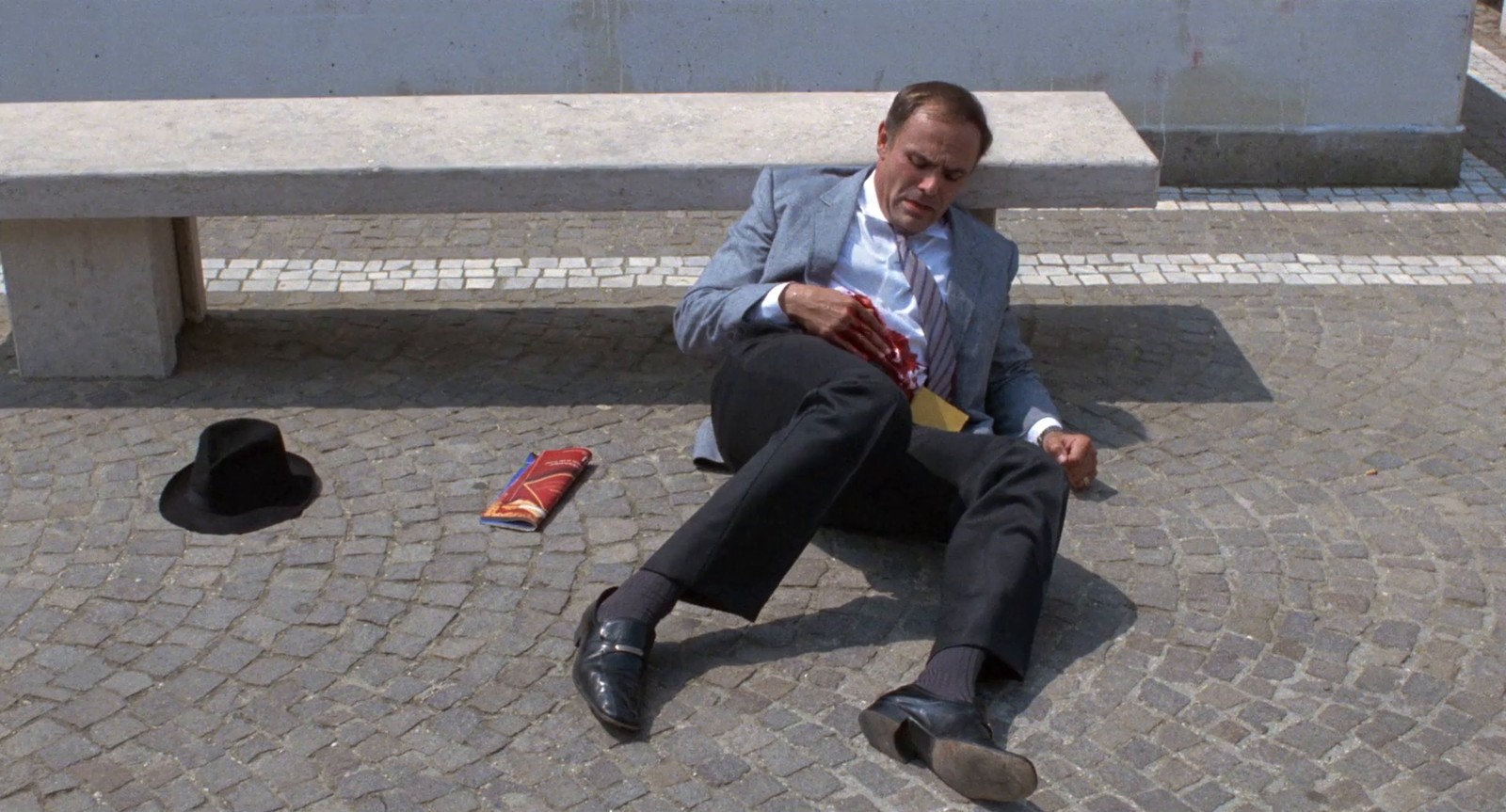
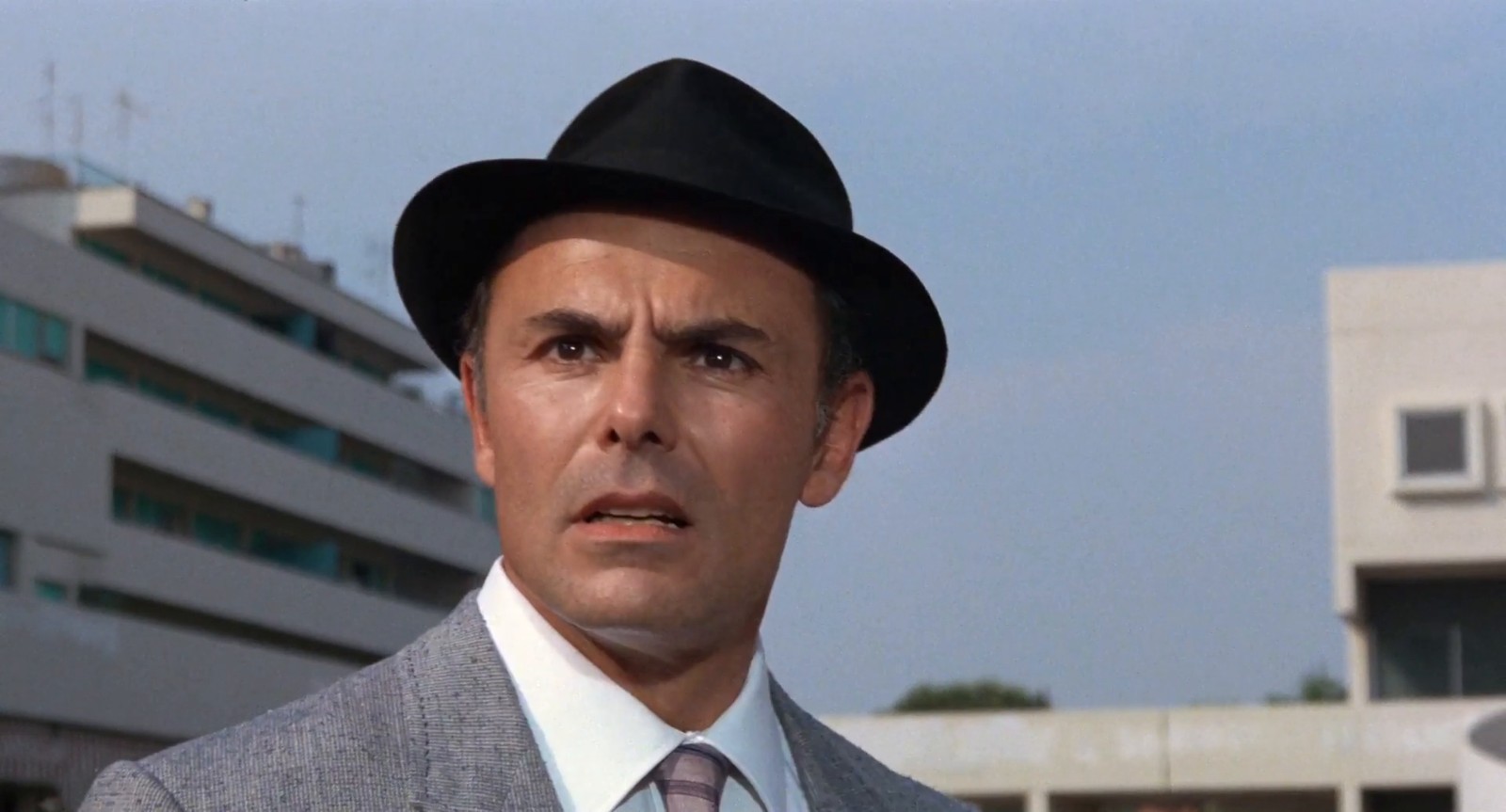
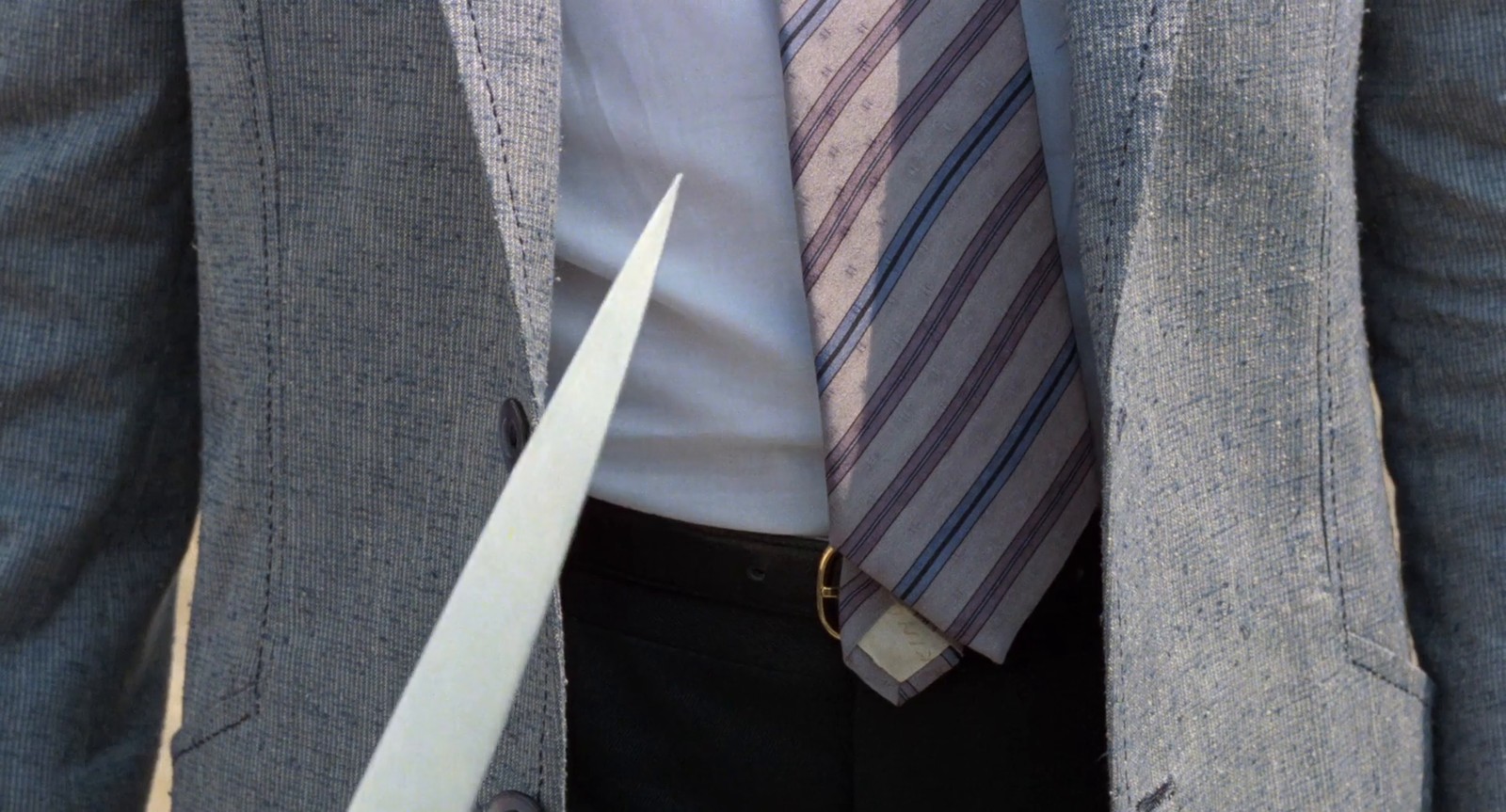
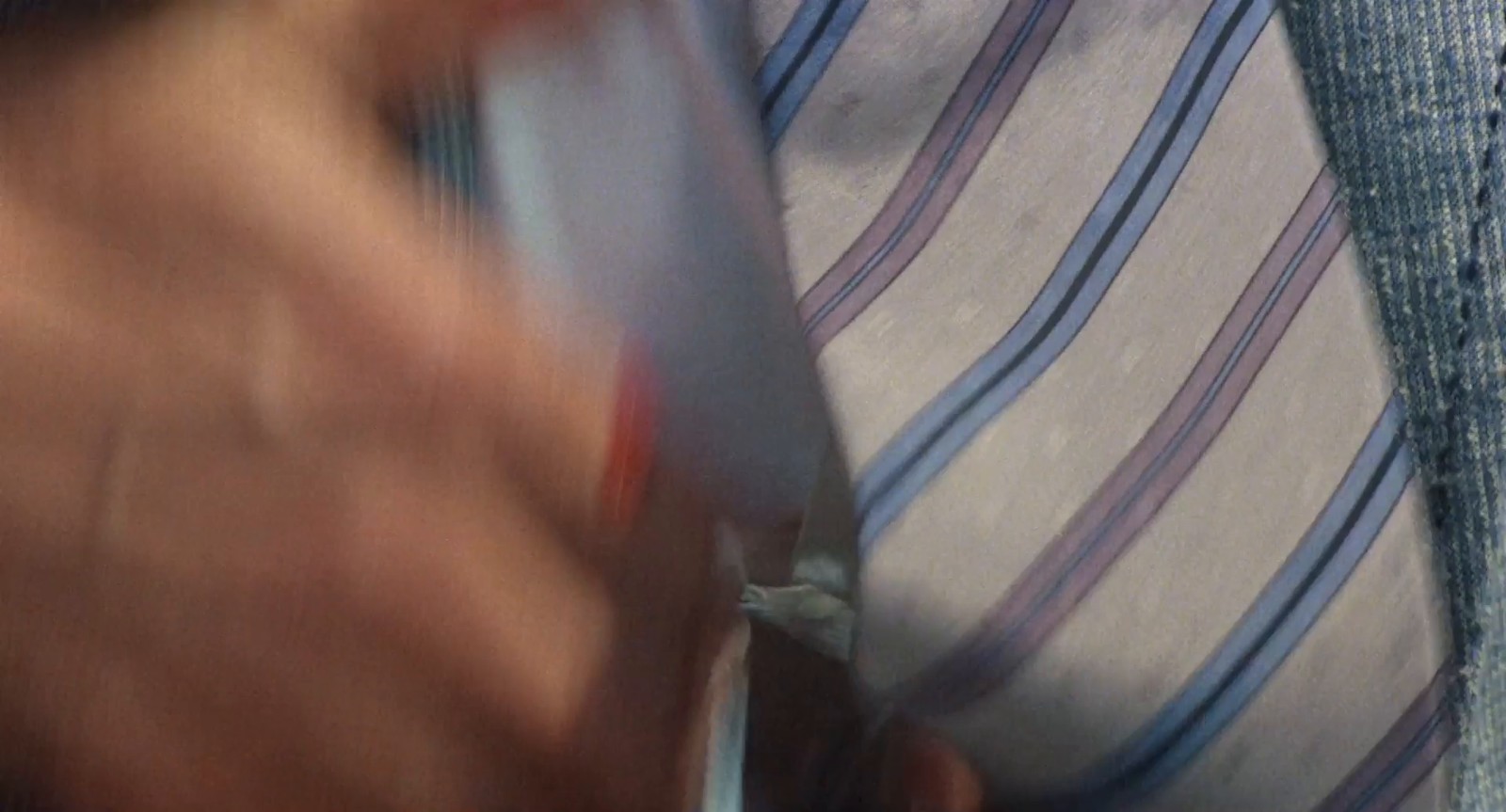
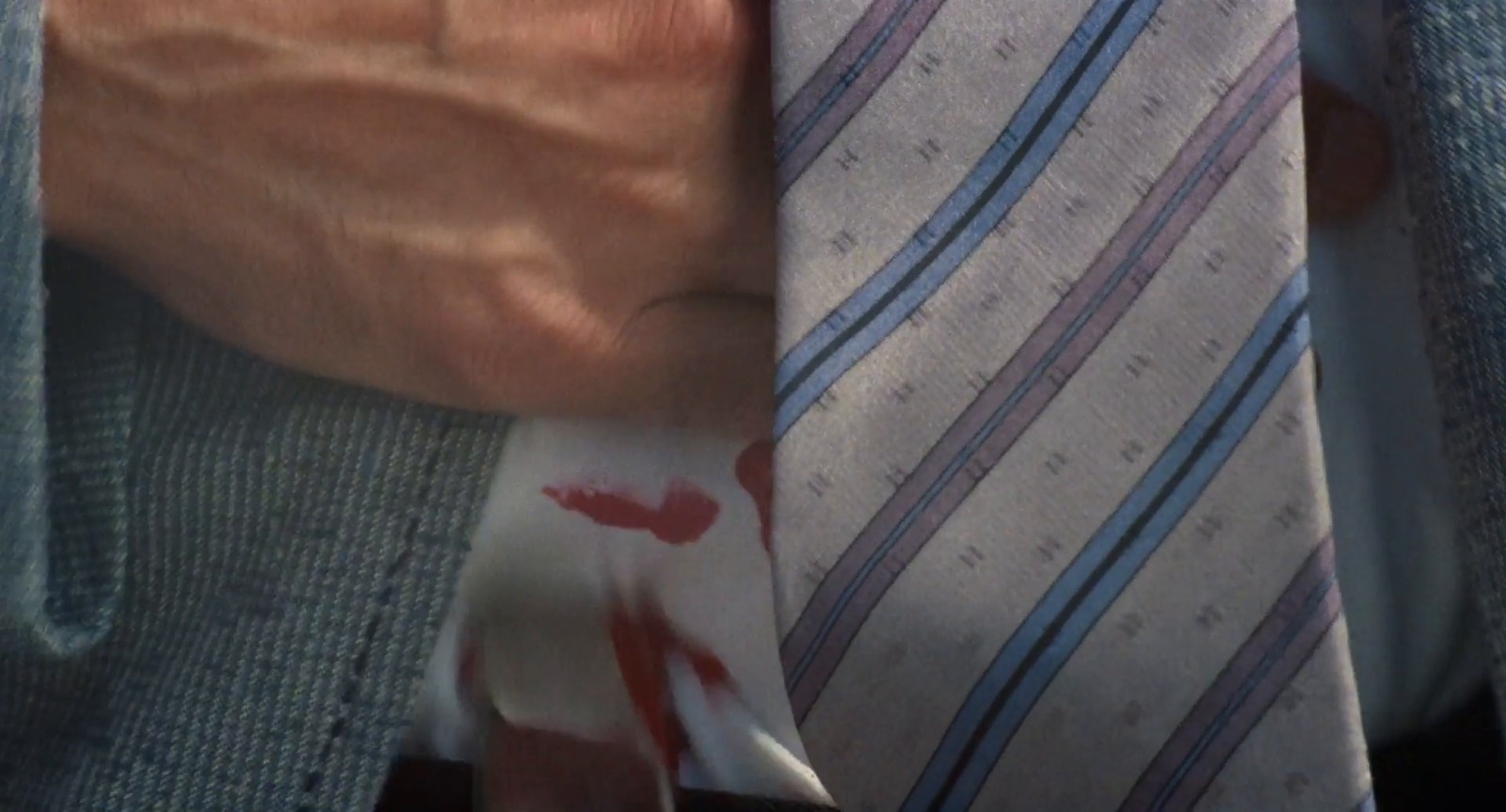
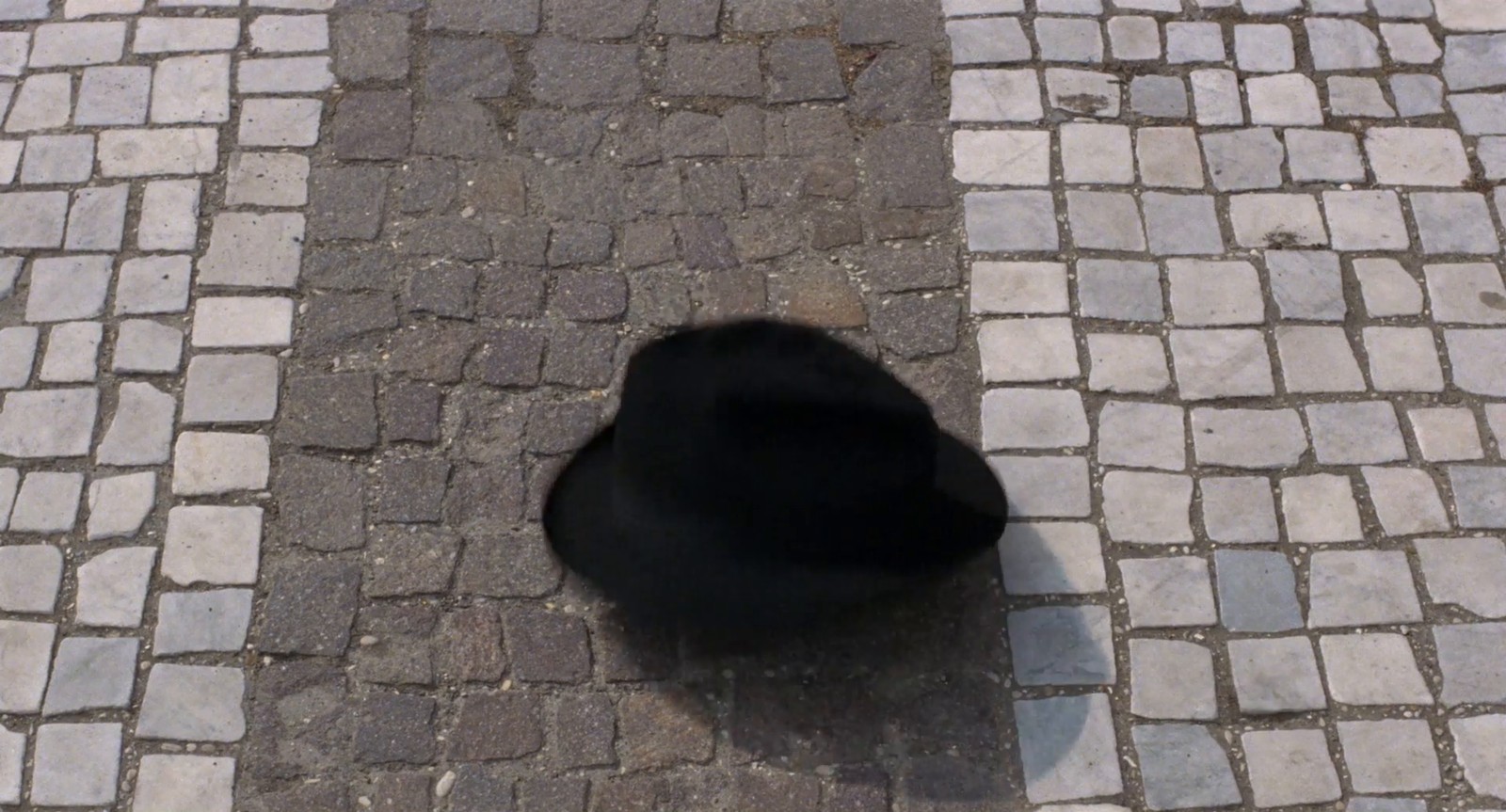
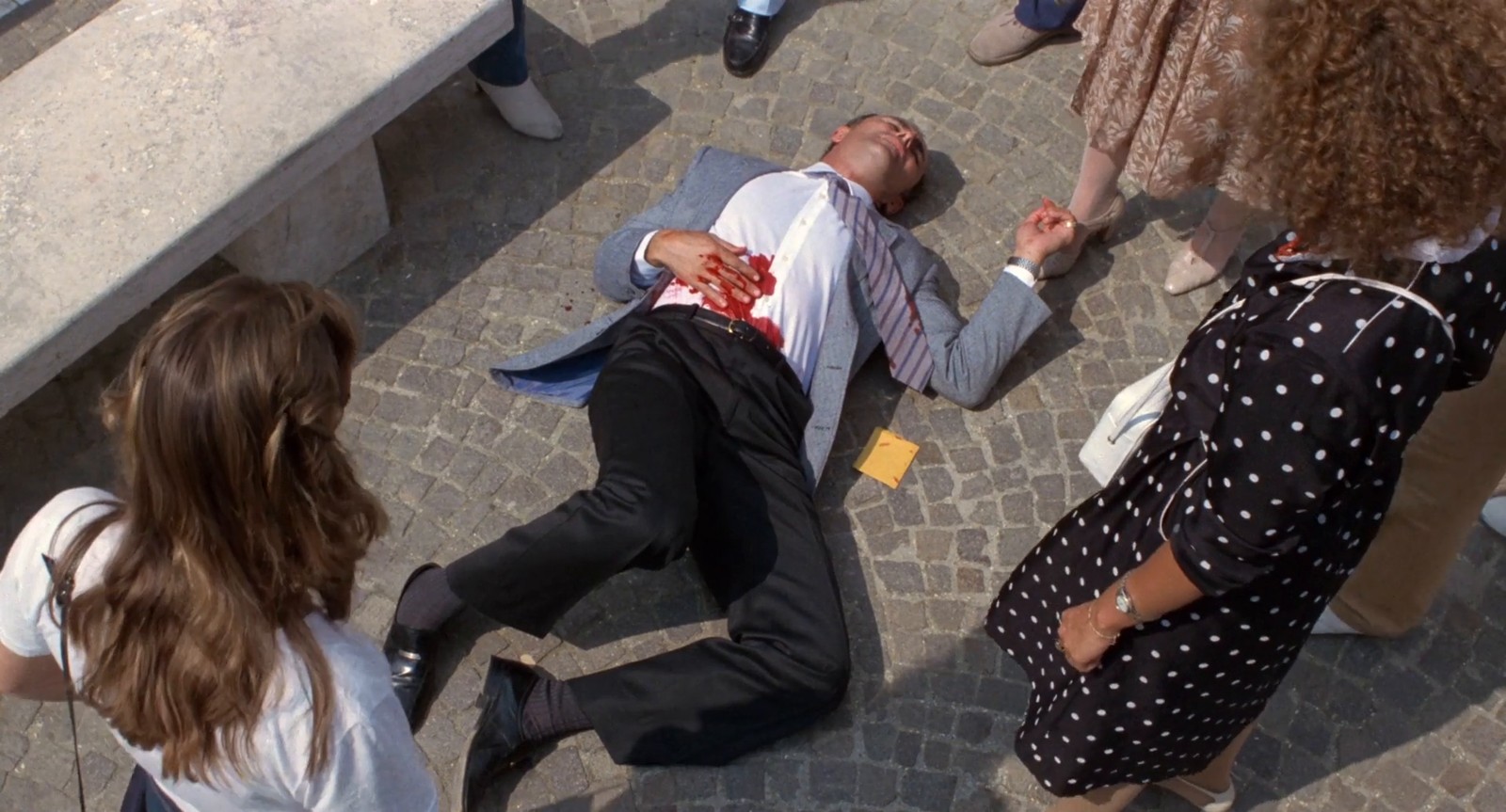
The square offers an unusually open setting for a murder. Bullmer recognises someone outside the frame; a close view of his jacket and tie introduces the knife. The contact is brief, but the bloodstain, falling hat and collapse extend its consequences. The wide view then returns him to the everyday pedestrian space, where recognition by others arrives after the attack.
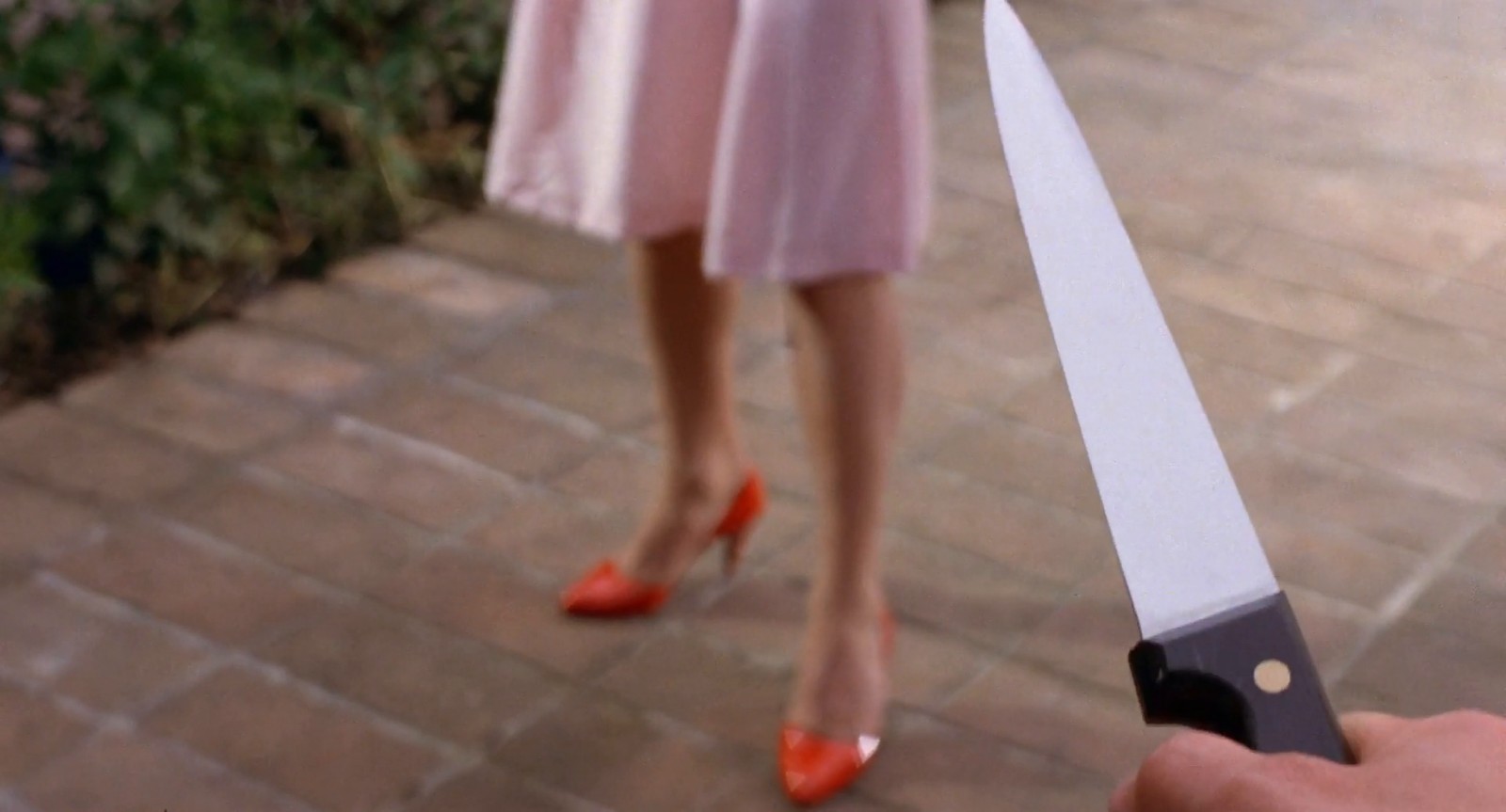
The public setting offers no immediate protection. The film alternates Bullmer’s face with the knife at his jacket before widening to the woman and gathering bystanders. A view of red heels interrupts that newly assembled crowd.
1:19:51.7A woman approaches across the open square.
1:19:53.5Bullmer turns toward someone outside the frame.
1:19:56.7An insert at the jacket and tie brings the knife into view.
1:19:57.5Bullmer’s face supplies the first reaction.
1:19:58.3The knife and hand return at his jacket.
1:19:58.9His face registers the next blow.
1:19:59.5The return to the jacket reveals the blood and knife.
1:20:01.2Bullmer’s head tilts back.
1:20:01.6His hat falls onto the paving within a separate downward view.
1:20:02.3An angled view catches his fall beside the bench.
1:20:05.8The approaching woman returns.
1:20:07.3A wide view places Bullmer on the ground beside his hat and book.
1:20:09.5The woman raises a hand toward her mouth.
1:20:11.1Bullmer reaches upward.
1:20:14.9A low angle isolates the woman’s face.
1:20:15.4Bullmer falls back near her legs.
1:20:18.1The view widens as other people gather.
1:20:21.8Red heels cross the paving in a moving close view of feet and legs.
1:20:28.8A high, wide view returns to the crowd surrounding the body.
EFFECTS STUDY 07 / 1:24:11–1:24:55
Gianni: the car becomes a trap
ENLARGE ↗Fingers search for space beneath the cord.
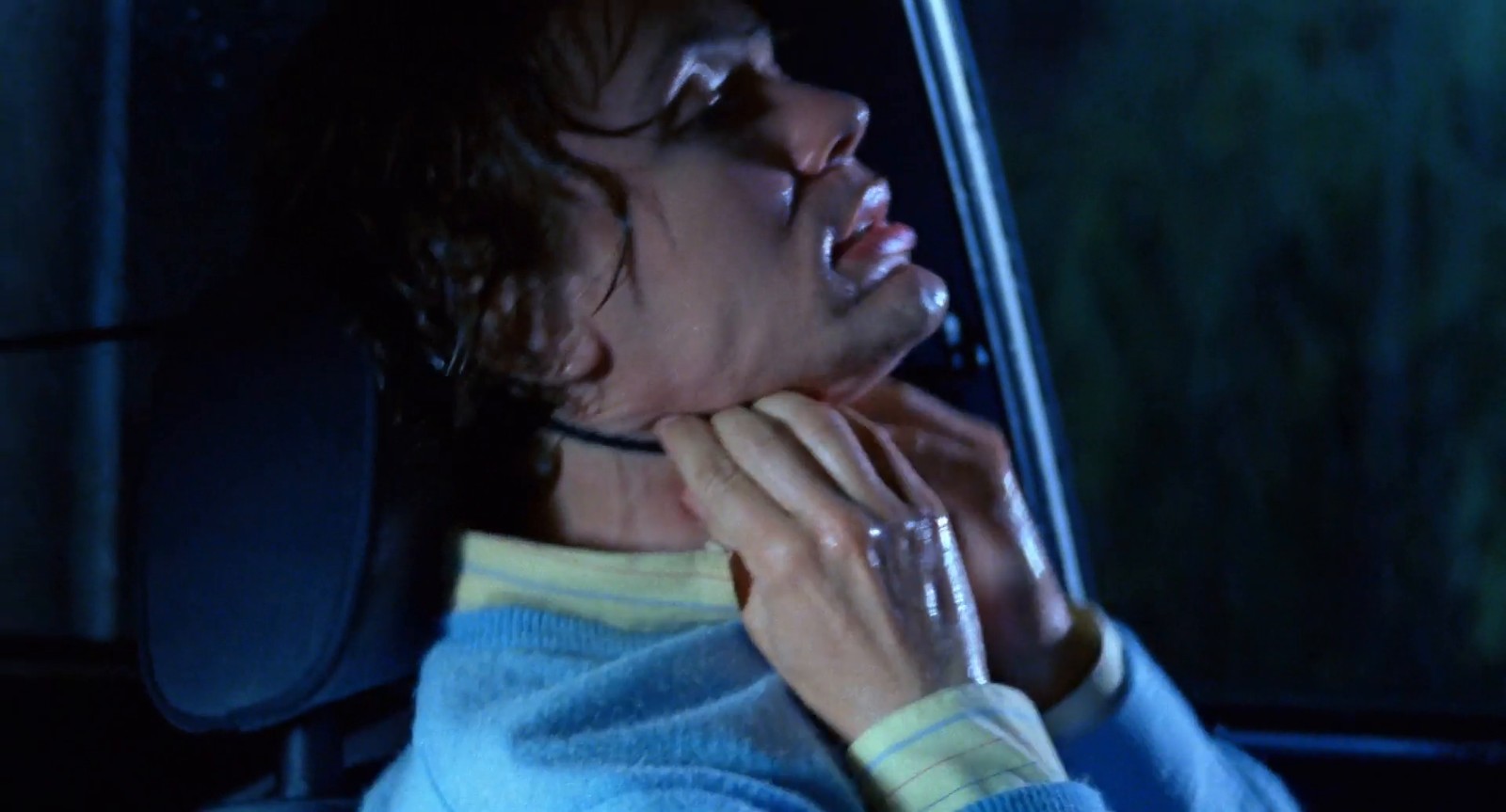
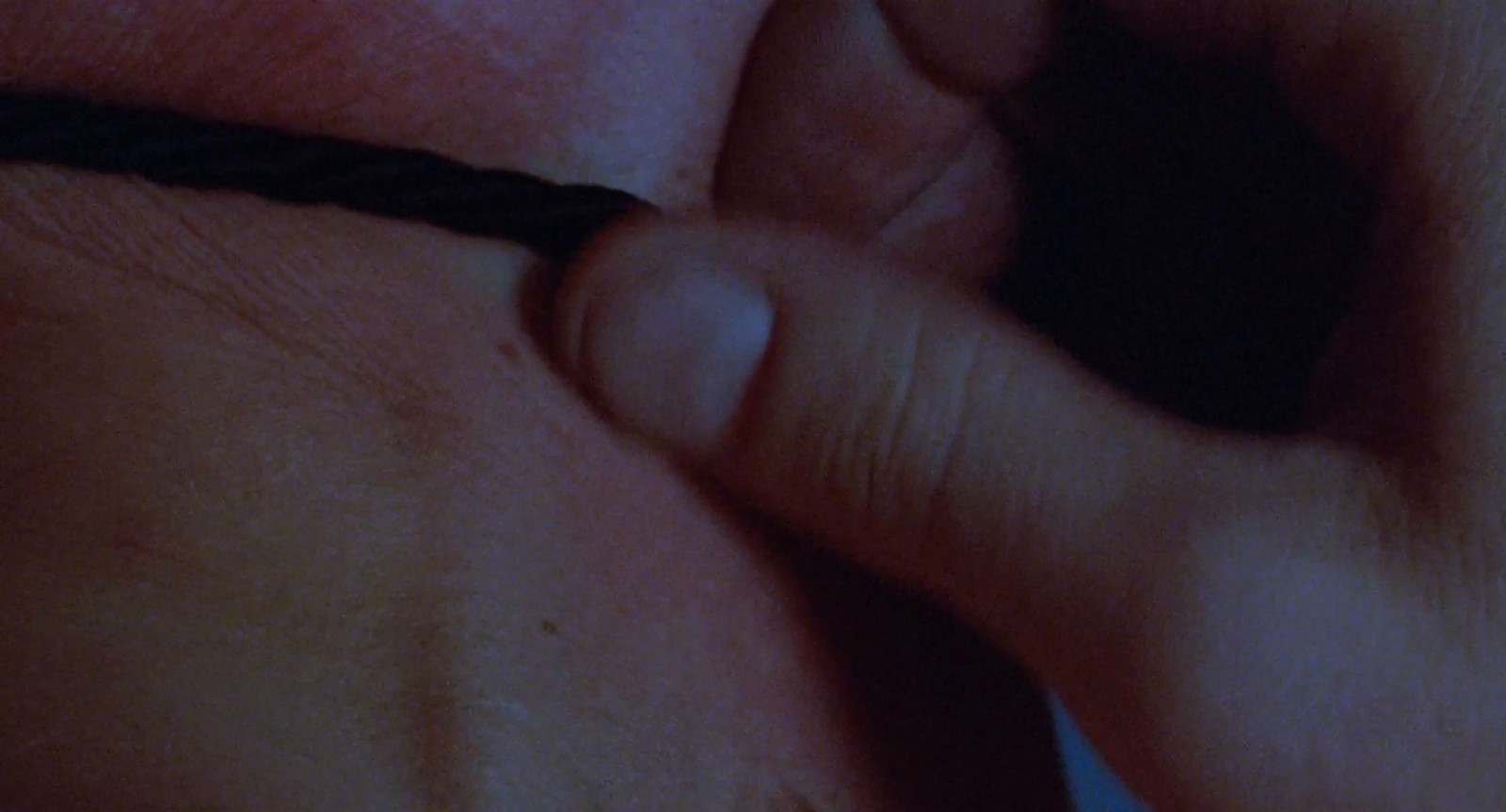
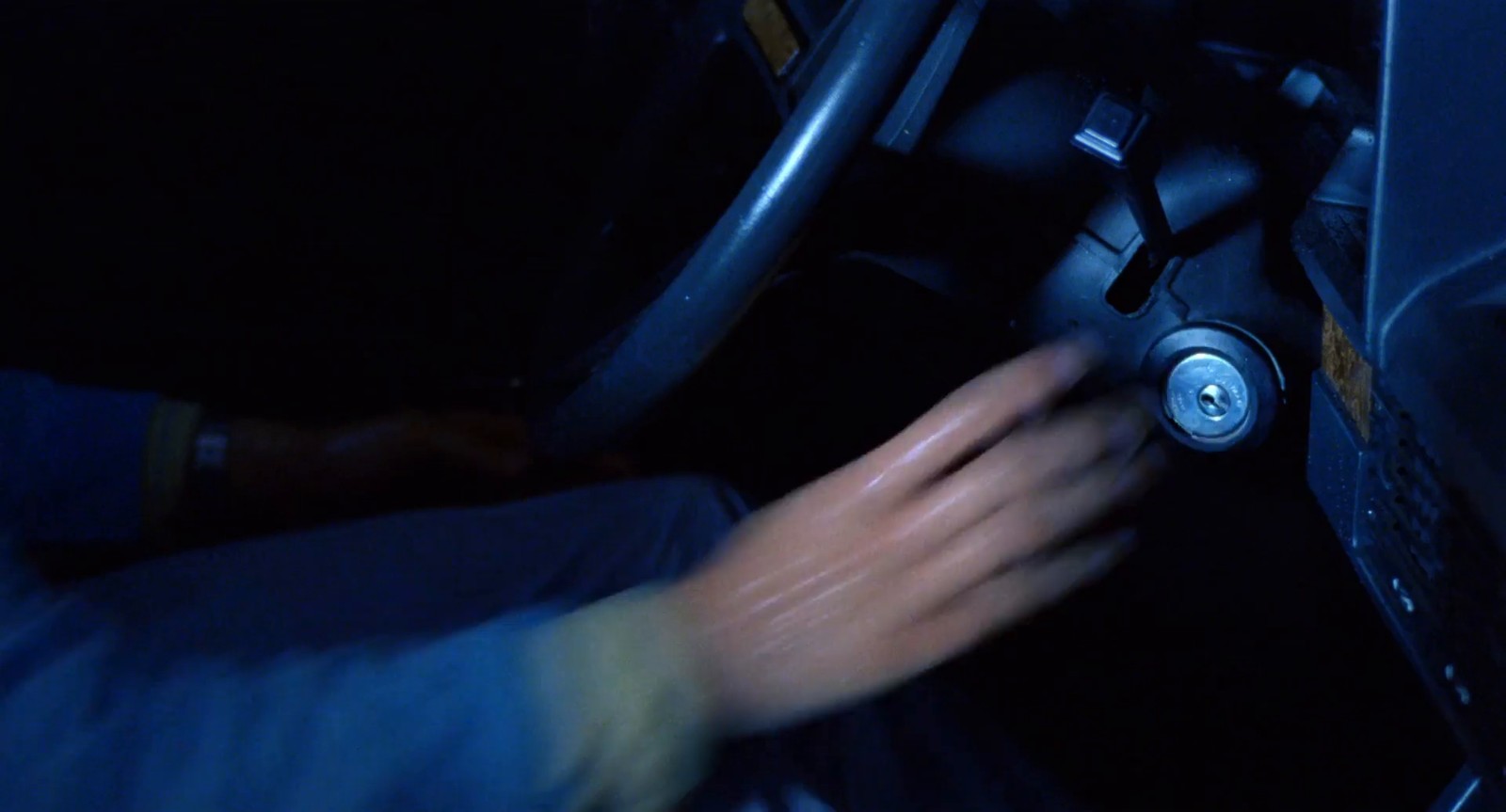
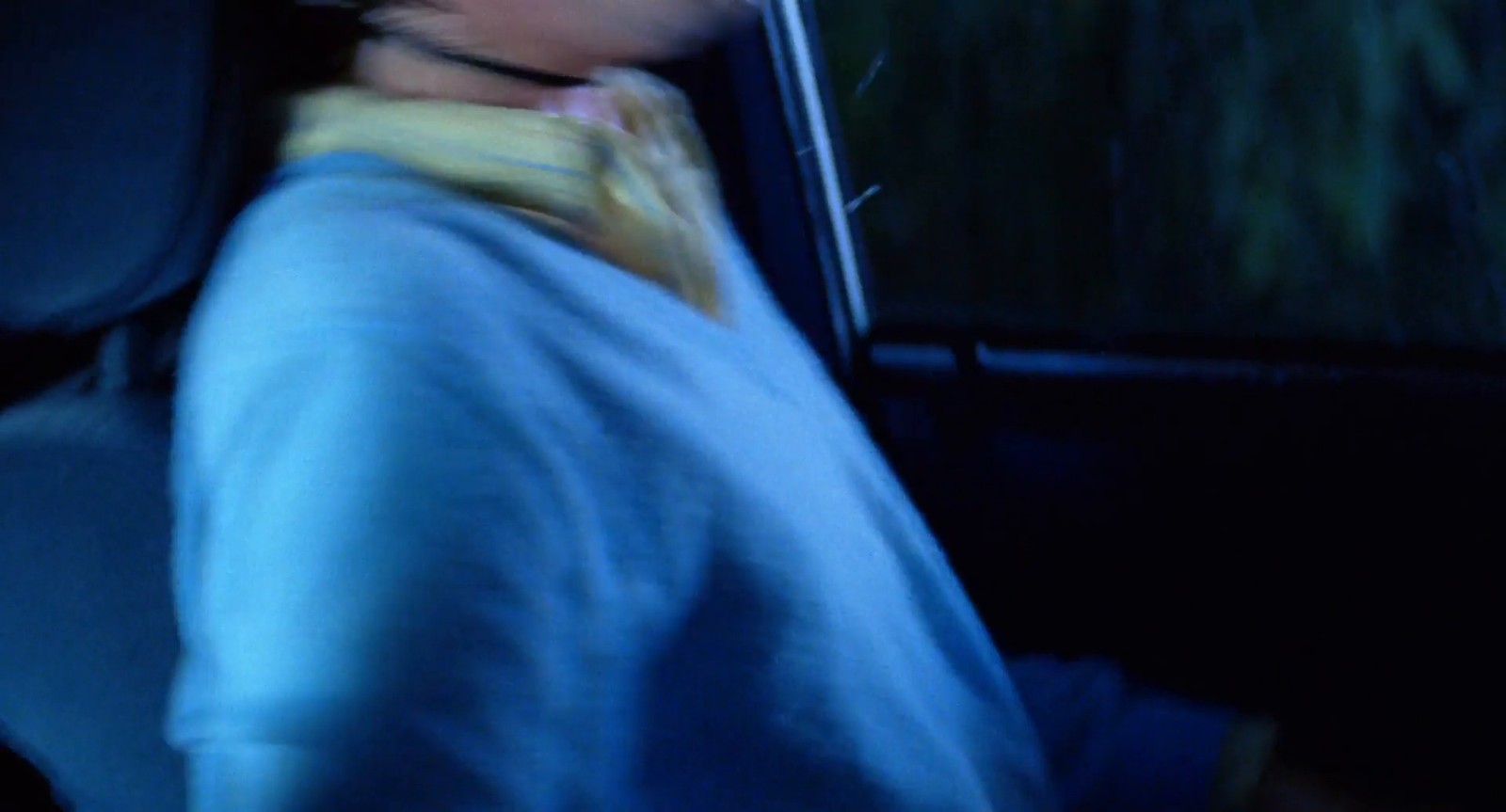
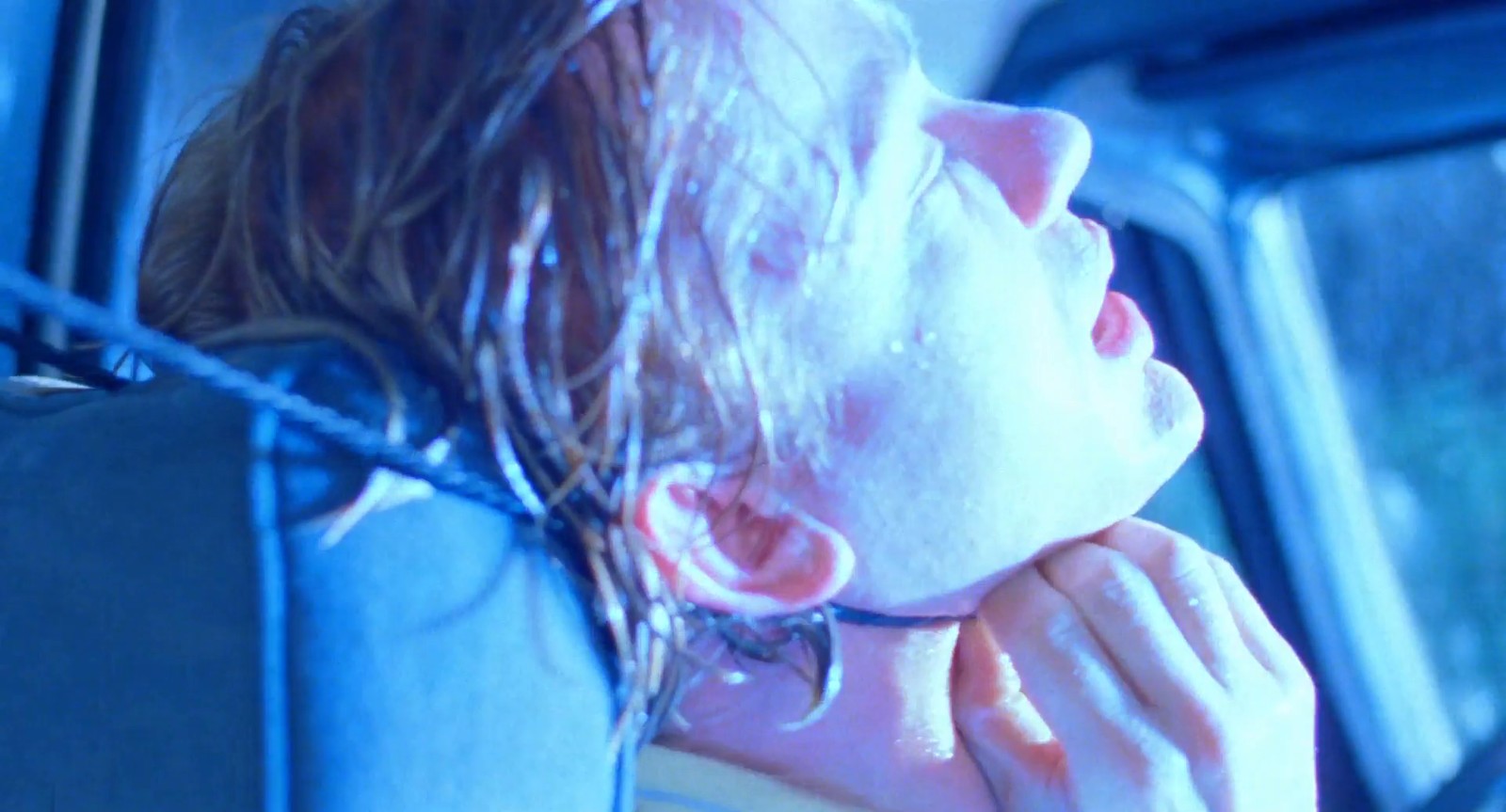
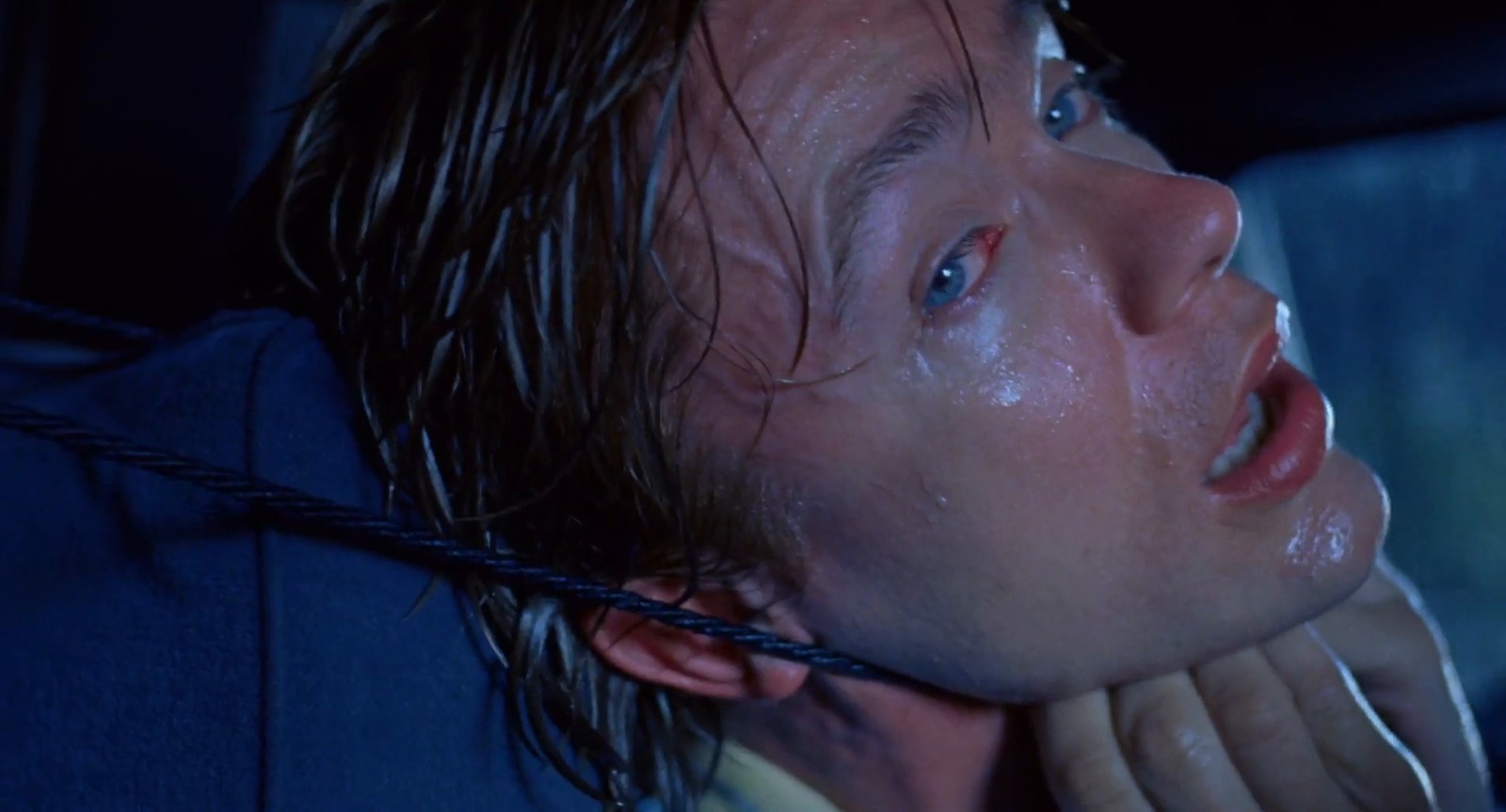
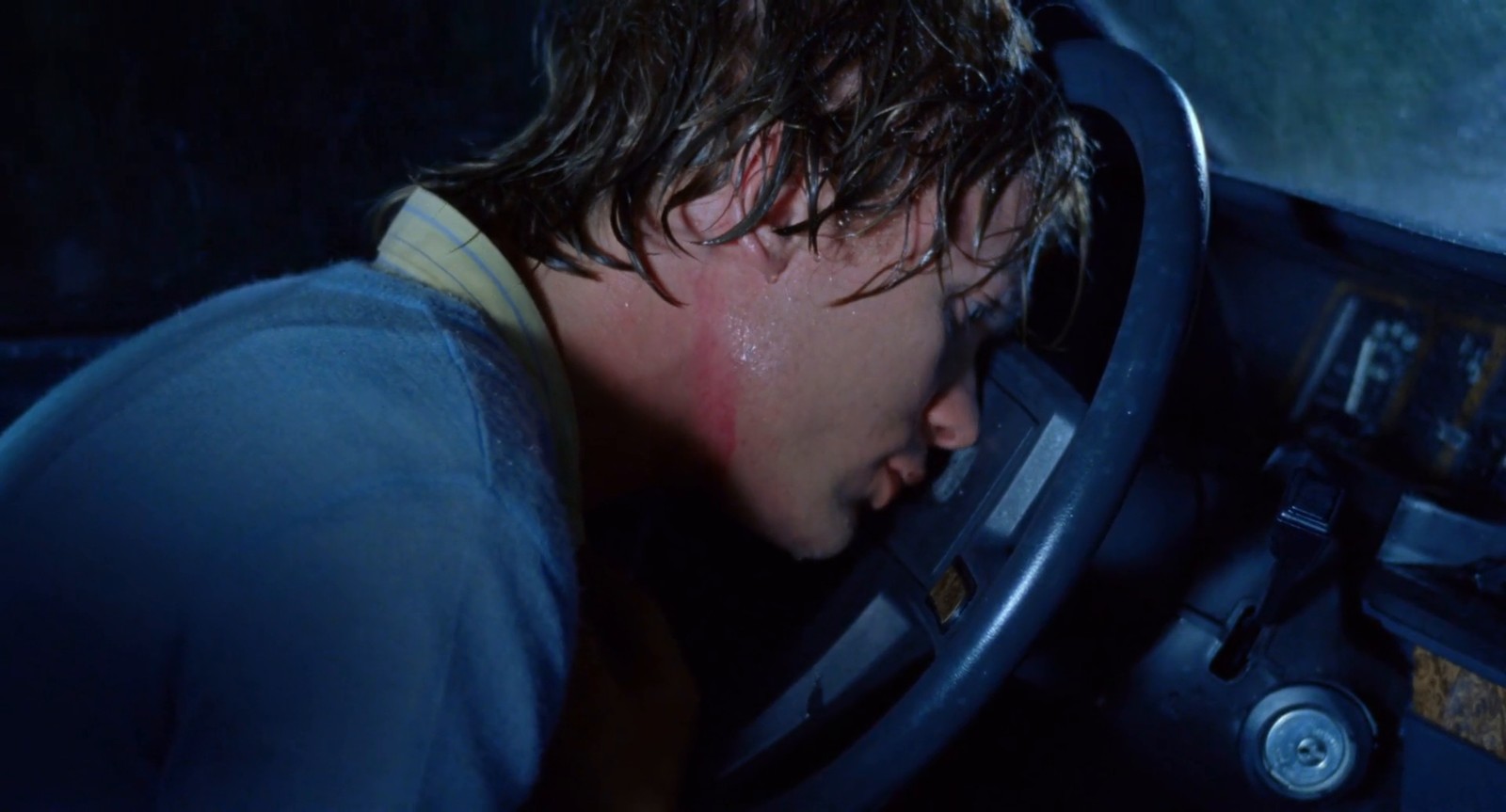
This murder pares the spectacle down to confinement and performance. Gianni returns to the driver’s seat and searches around the ignition and his clothes. A cord from behind draws his head against the seat. Close views of fingers at the neck interrupt the wider struggle; flashes of light expose the rain-soaked face before he folds onto the wheel.
The car attack concentrates on duration. The first held view moves from Gianni’s hands to the restraint at his neck; a tighter insert interrupts it before the film returns to his face and finally widens to the steering wheel.
1:24:16.0Hands and ignition begin a view that rises with Gianni. The cord catches his neck within the same shot.
1:24:27.7An extreme close view isolates hands and cord at his neck.
1:24:35.8The film returns to Gianni’s head against the seat; the struggle continues through changing light.
1:24:51.0A wider profile reconnects him with the steering wheel as he falls forward. The cut away to foliage comes at 1:24:57.0.
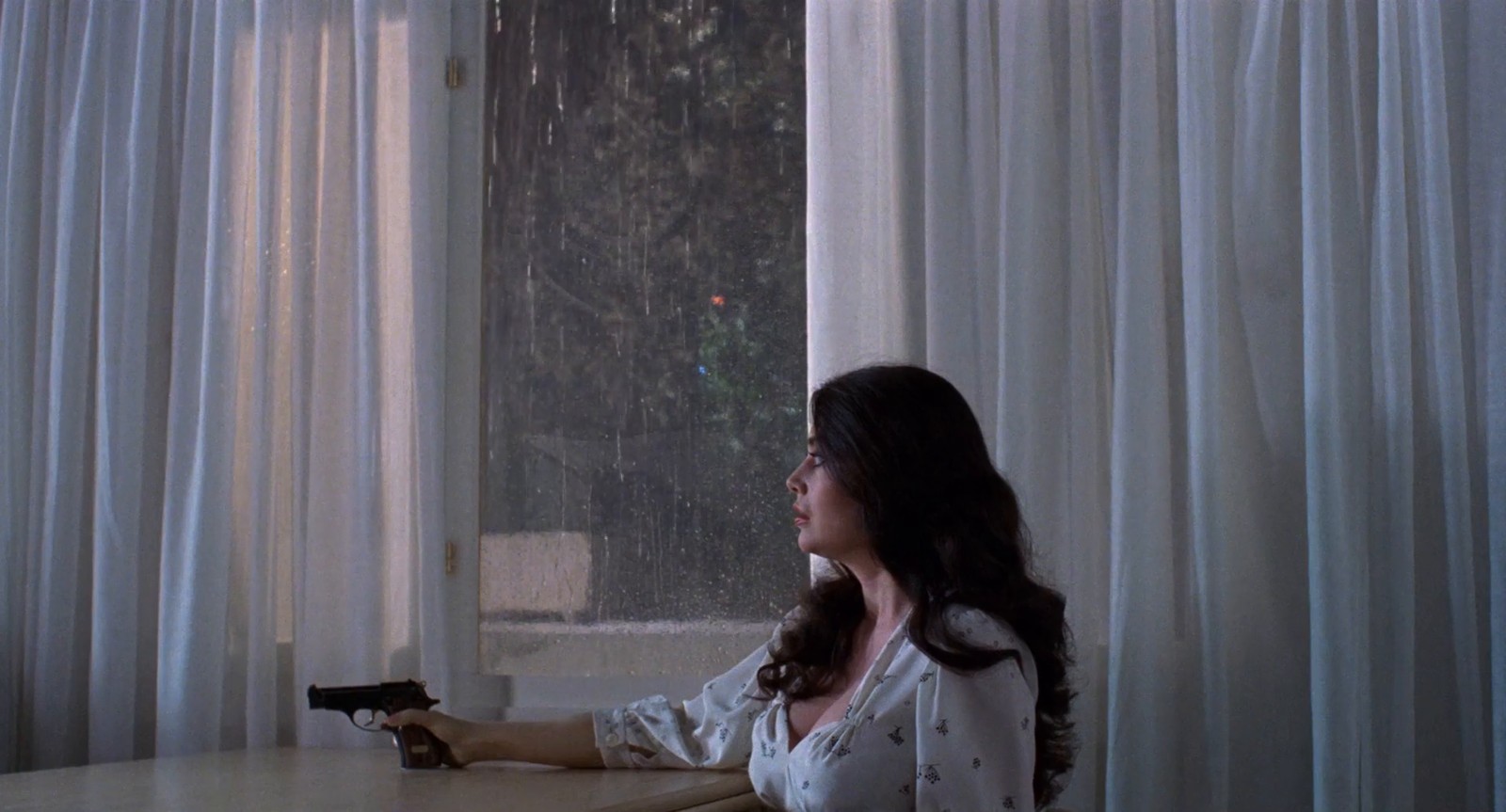
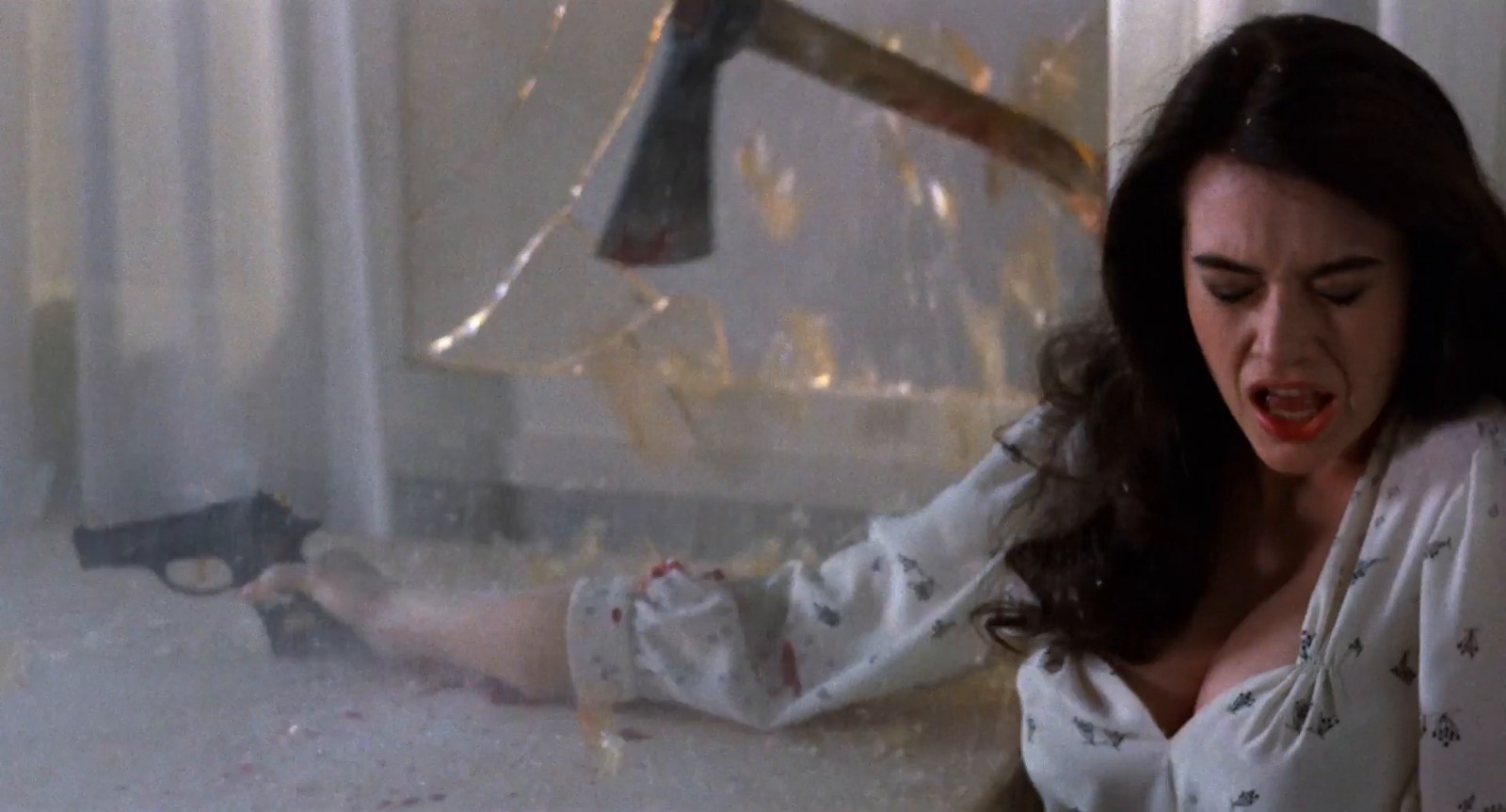
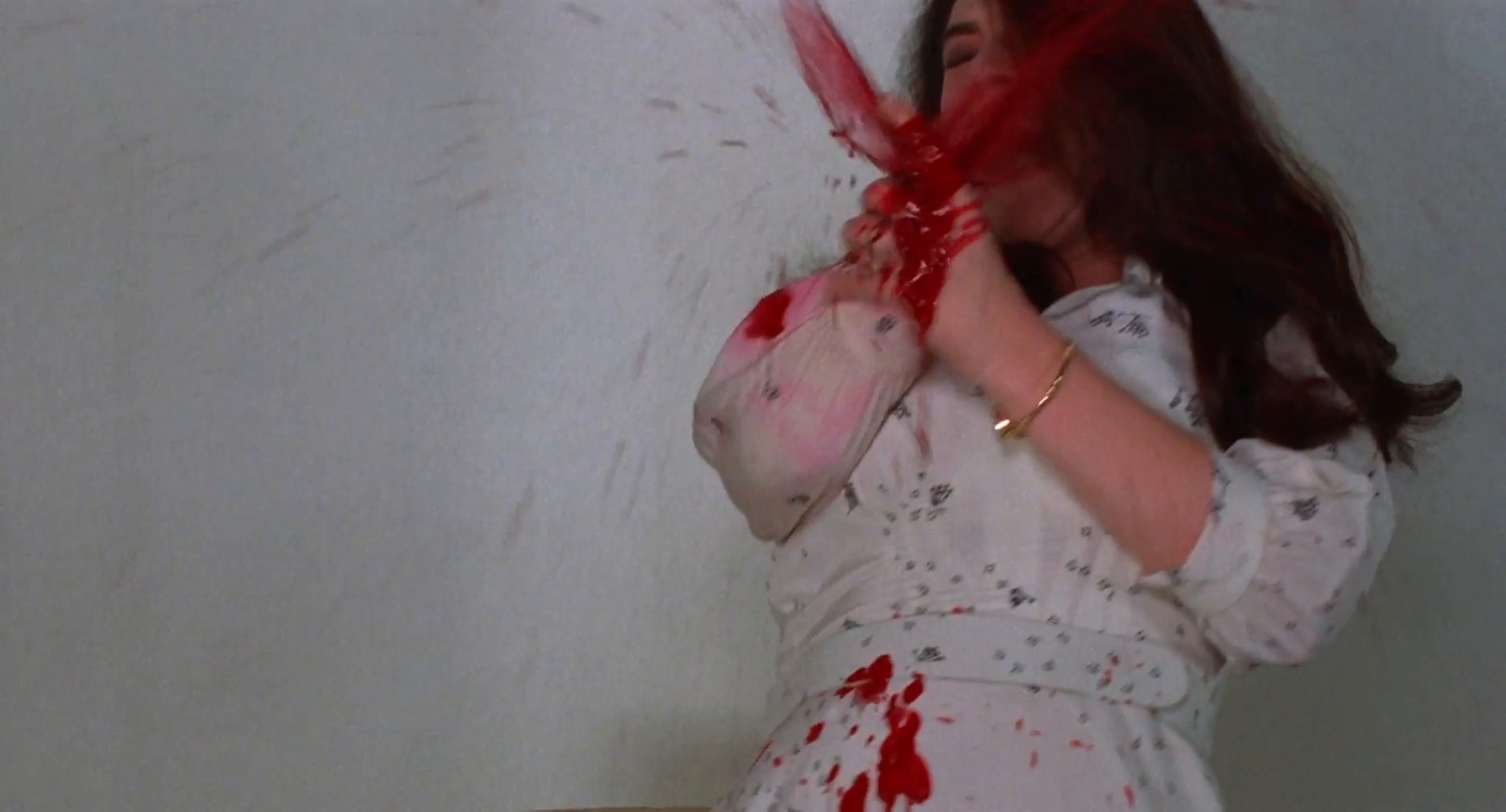
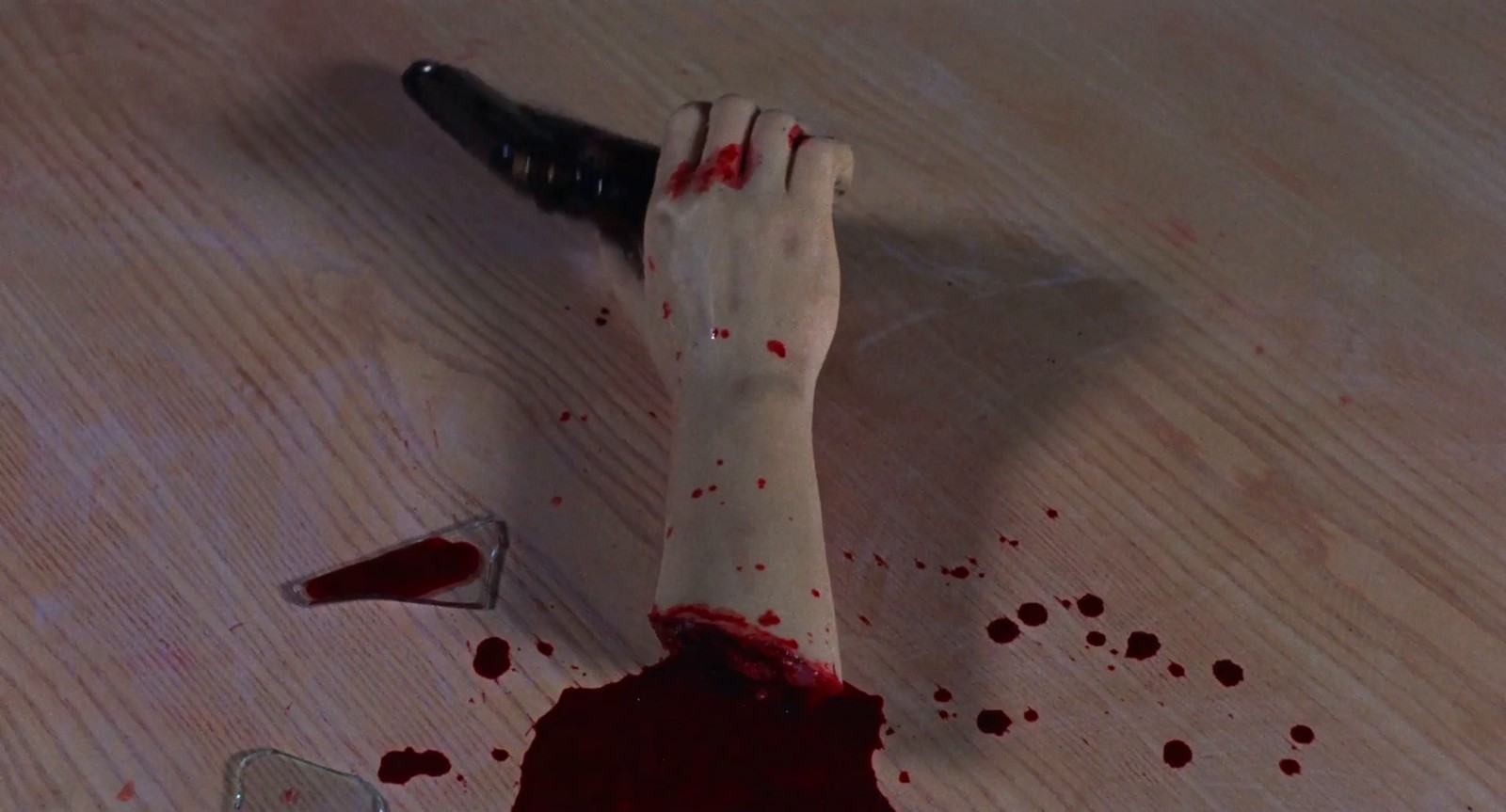
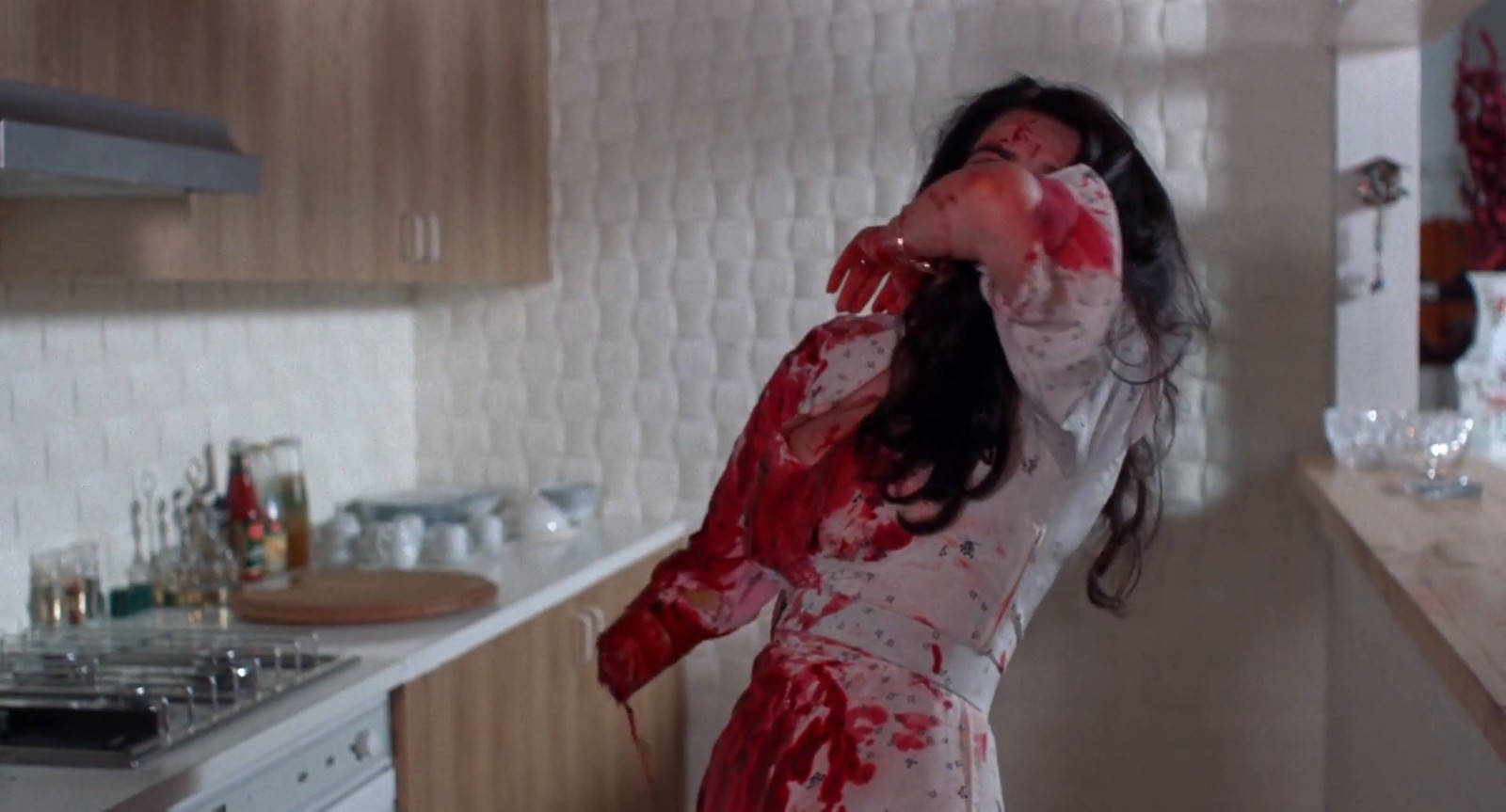
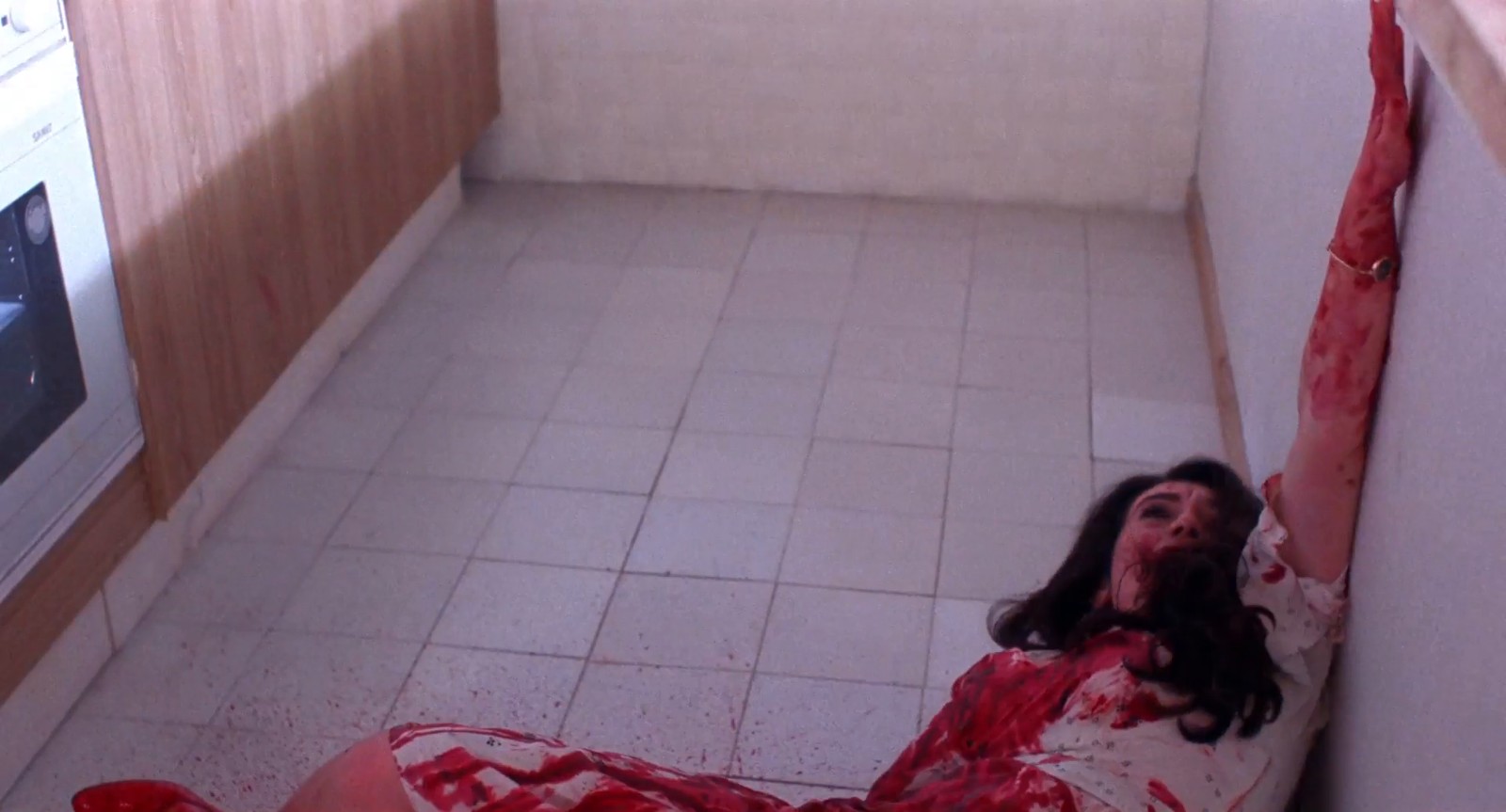
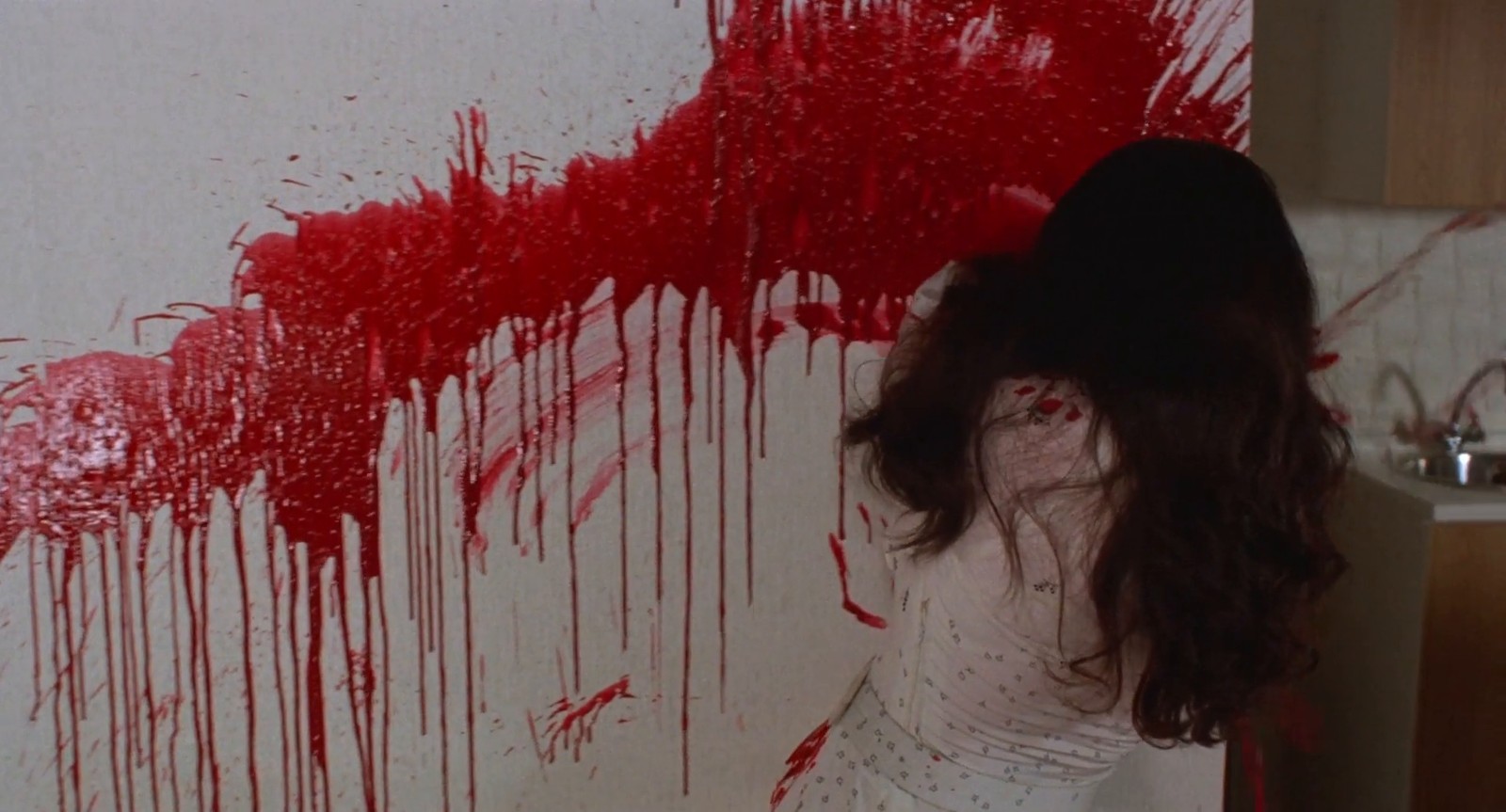
The sequence begins with Jane’s gun arm extended beside the window. Breaking glass and the axe interrupt that horizontal line; a tight insert isolates the severing before the wider image turns the blood spray into a red band across the wall. The detached hand, further blows and her fall continue the effect through several distinct views. The pale set records the movement of the attack.
The severing, detached hand and blood spray occupy separate views. The kitchen retreat then changes the rhythm before the final alternation between face and shadow.
1:28:47.7Jane waits at the window with the gun held across the sill.
1:28:53.7A tight view of the pane isolates the breaking glass.
1:28:54.0The view widens to Jane as the curtain and fragments cross her.
1:28:54.6Her recoil is isolated against the pale wall.
1:28:55.1The arm and gun fill the frame as the axe severs the wrist.
1:28:55.9Jane’s movement draws a stream of blood across the white background.
1:28:58.7The detached hand remains on the sill, still gripping the pistol.
1:28:59.2A return to Jane extends the red arc across the wall.
1:29:01.7A torso insert shows the next axe impact through the patterned blouse.
1:29:03.6A longer moving view follows her retreat through the kitchen and down to the floor. Its roughly fifteen seconds interrupt the preceding rapid alternation.
1:29:18.9The axe appears as a shadow on the tiles.
1:29:19.7A close view returns to Jane’s face on the floor.
1:29:21.0The shadow of the weapon returns.
1:29:21.5The film returns to Jane once more, then cuts to black at about 1:29:23.
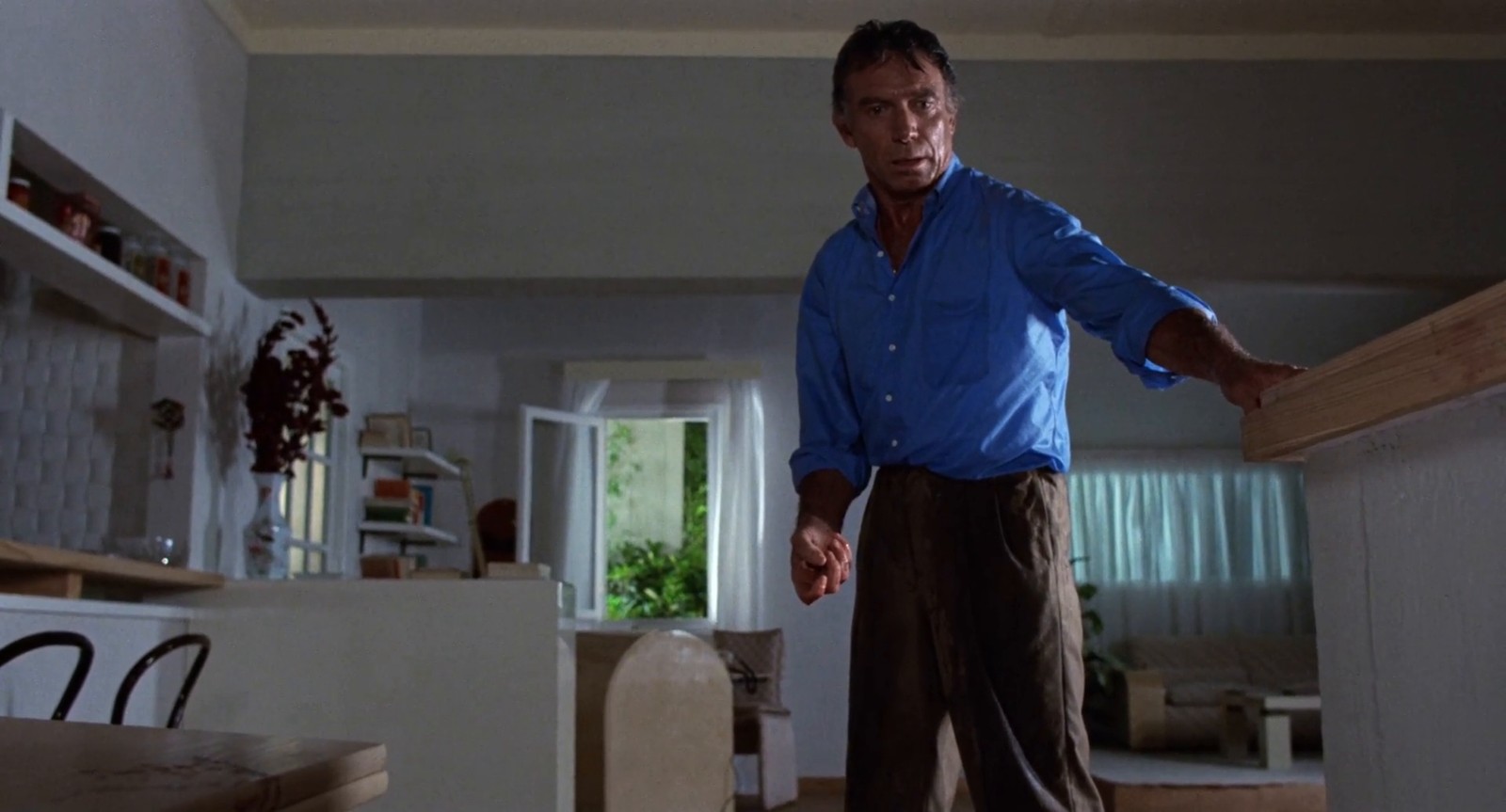
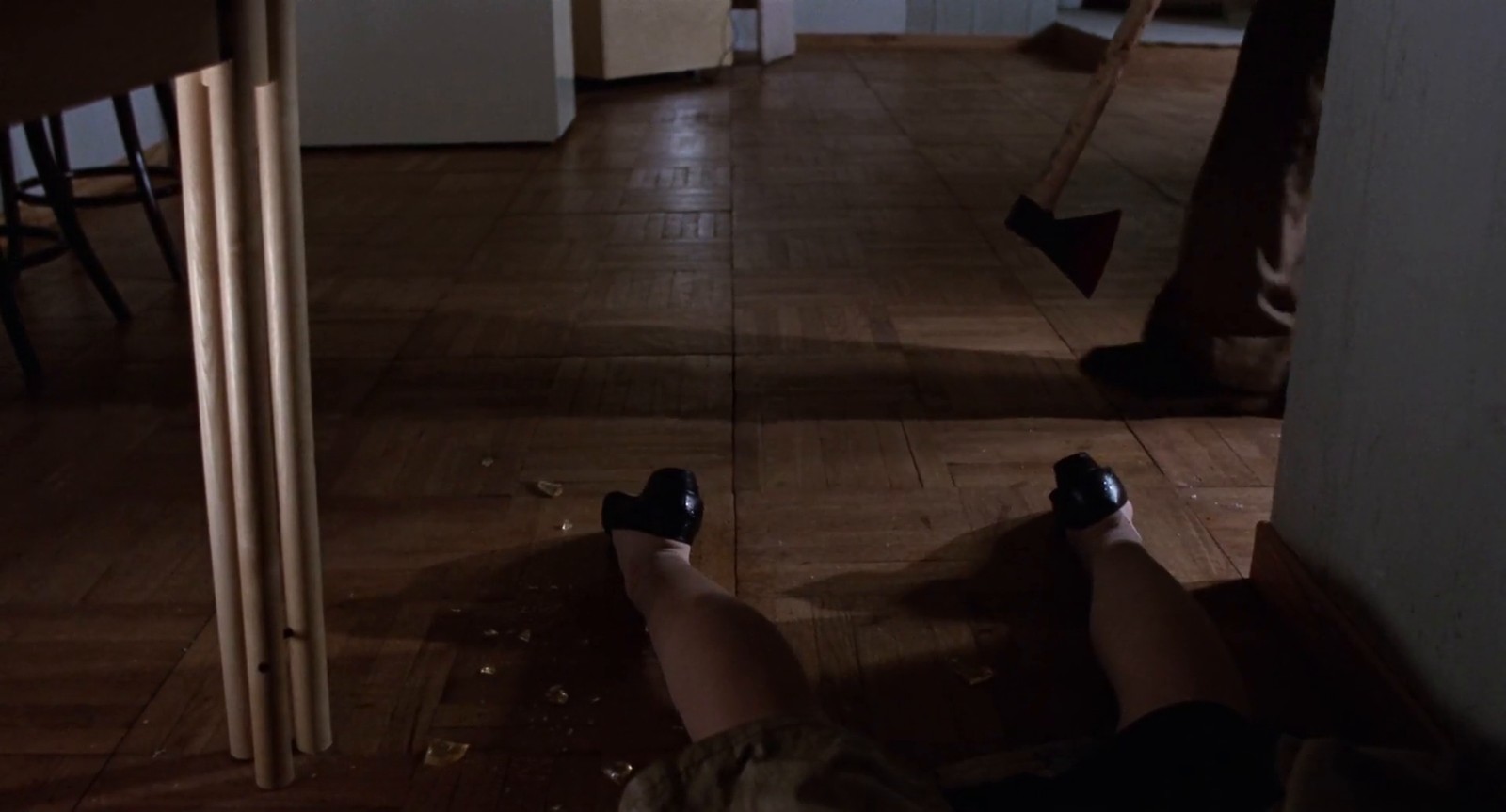
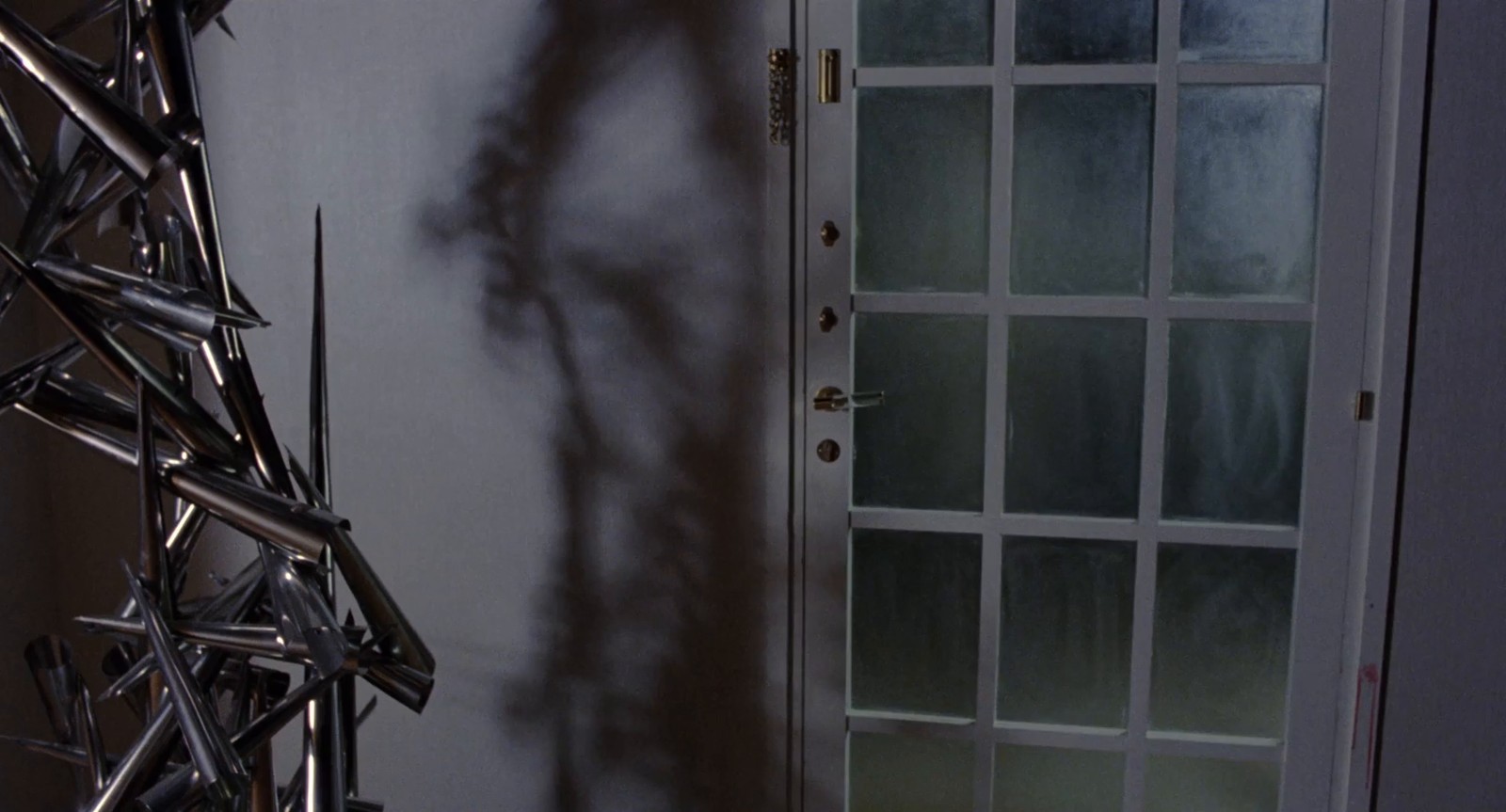
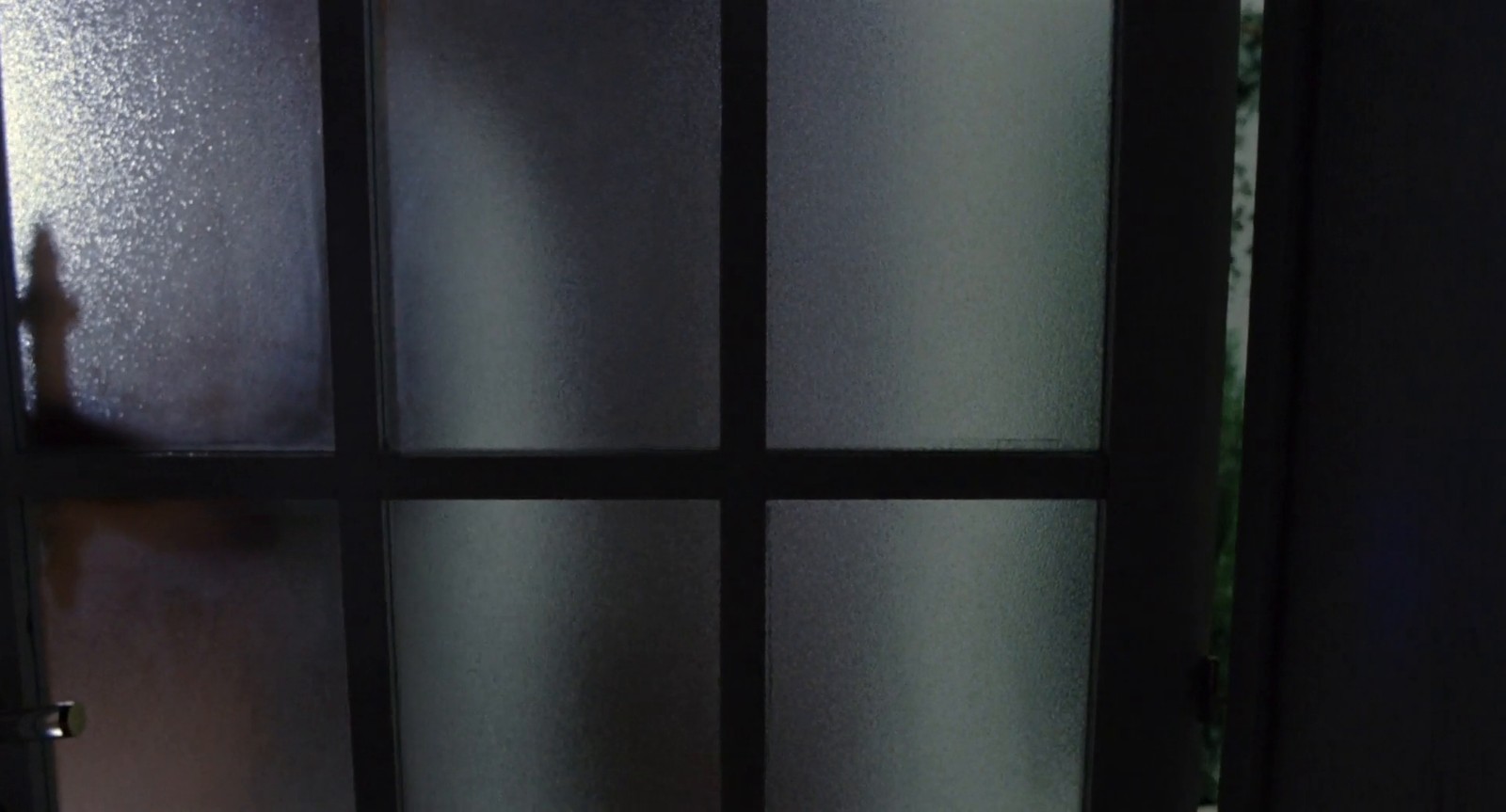
The frosted door gives a silhouette before it gives an identity. Altieri’s arrival is followed by her bloodied collapse inside, while the framing withholds the attacker’s face. An axe and trouser legs enter the low view before the film finally discloses Neal. The reveal joins an effects aftermath to a change in narrative knowledge: the body and the killer become readable at different moments.
Altieri enters a space whose danger is visible to the viewer before its source is named. After the blow, a low view holds long enough for the camera to reveal Neal; his identification belongs to that movement within the shot.
1:30:09.9The sculpture and frosted door frame an approaching silhouette.
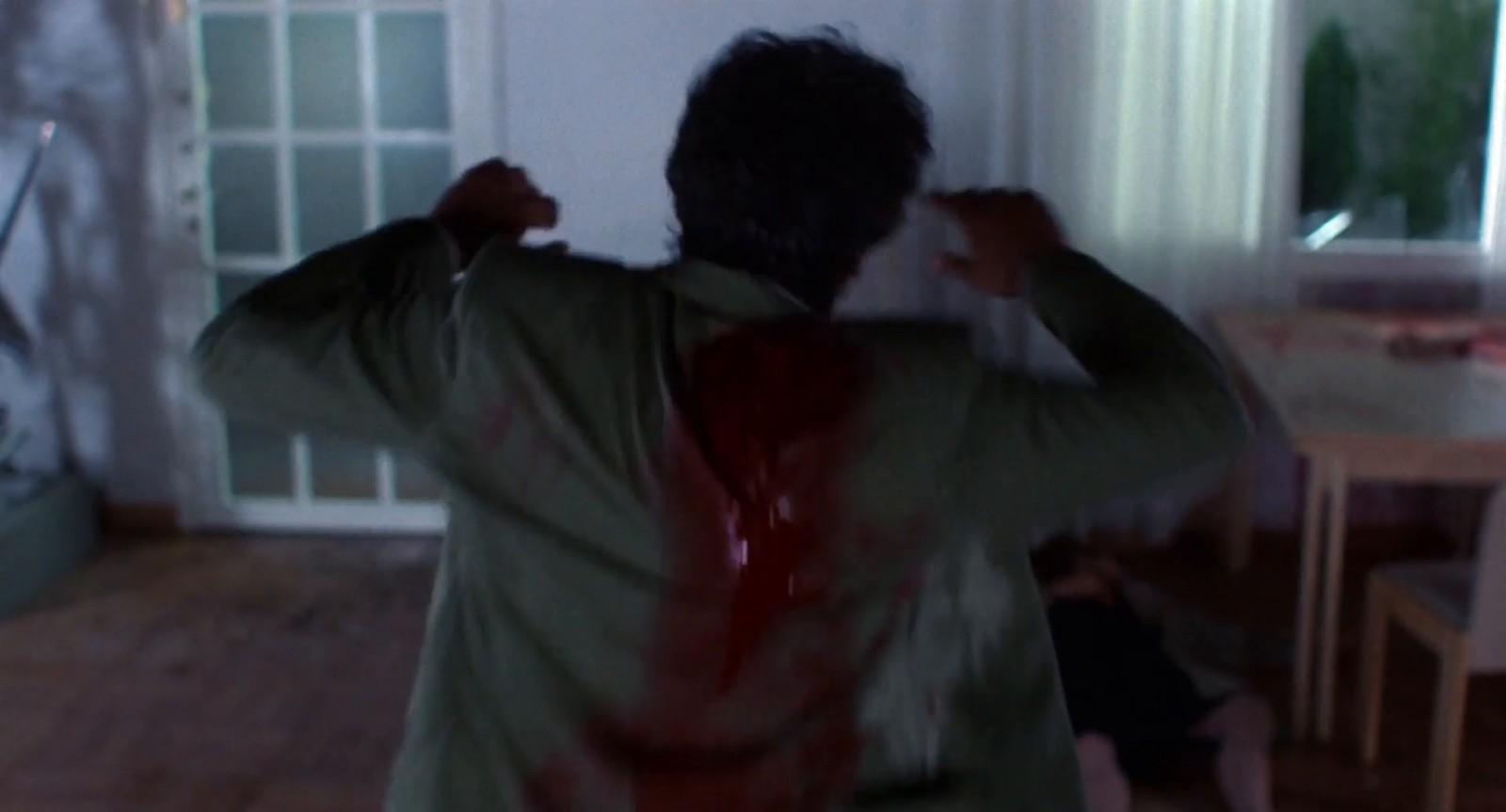
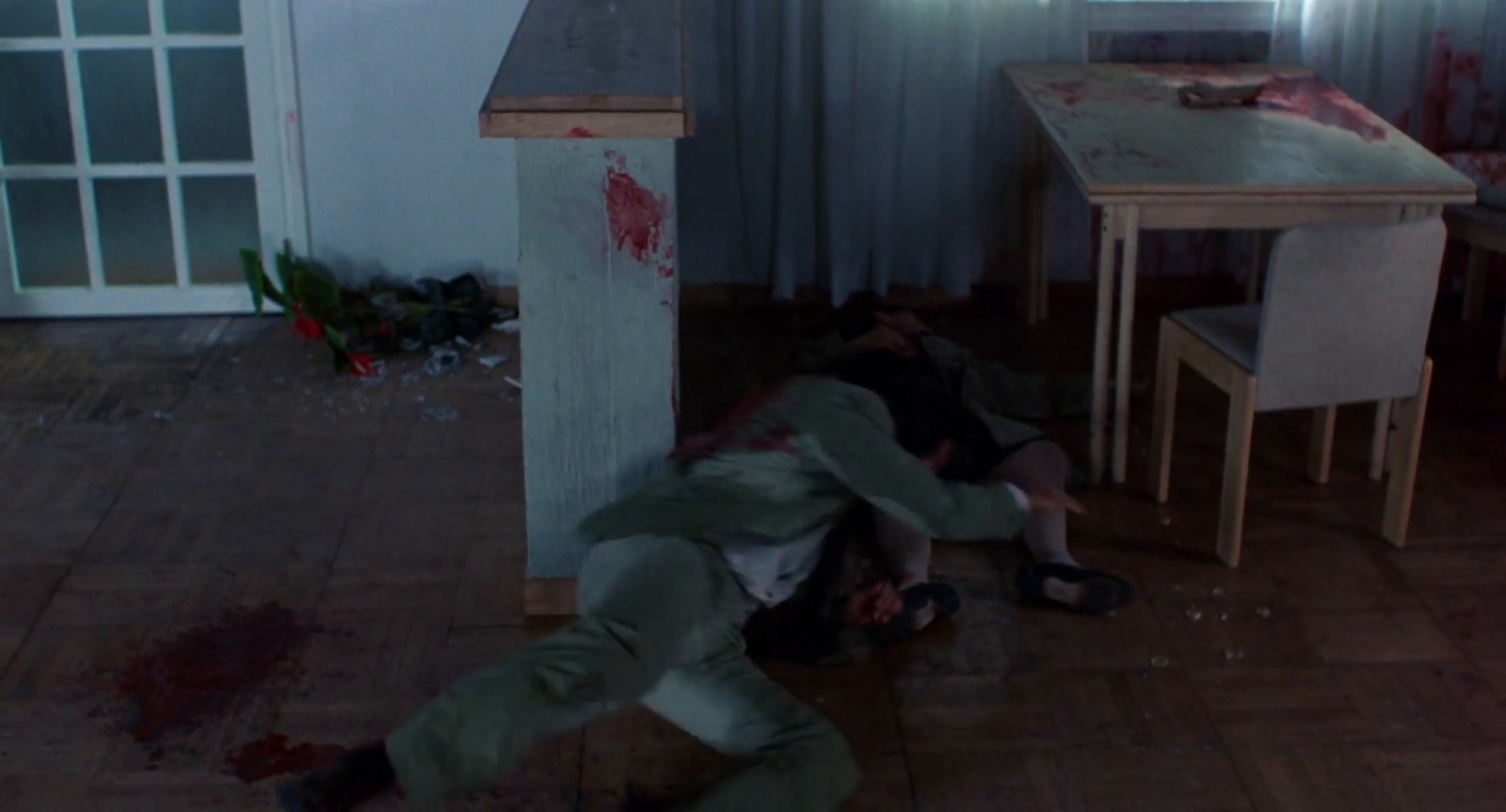
1:30:25.2Altieri is seen from behind as the axe strikes.
1:30:25.8A higher angle follows her fall beside the kitchen counter.
1:30:35.1A low view begins with legs and axe, then rises to disclose Neal’s face.
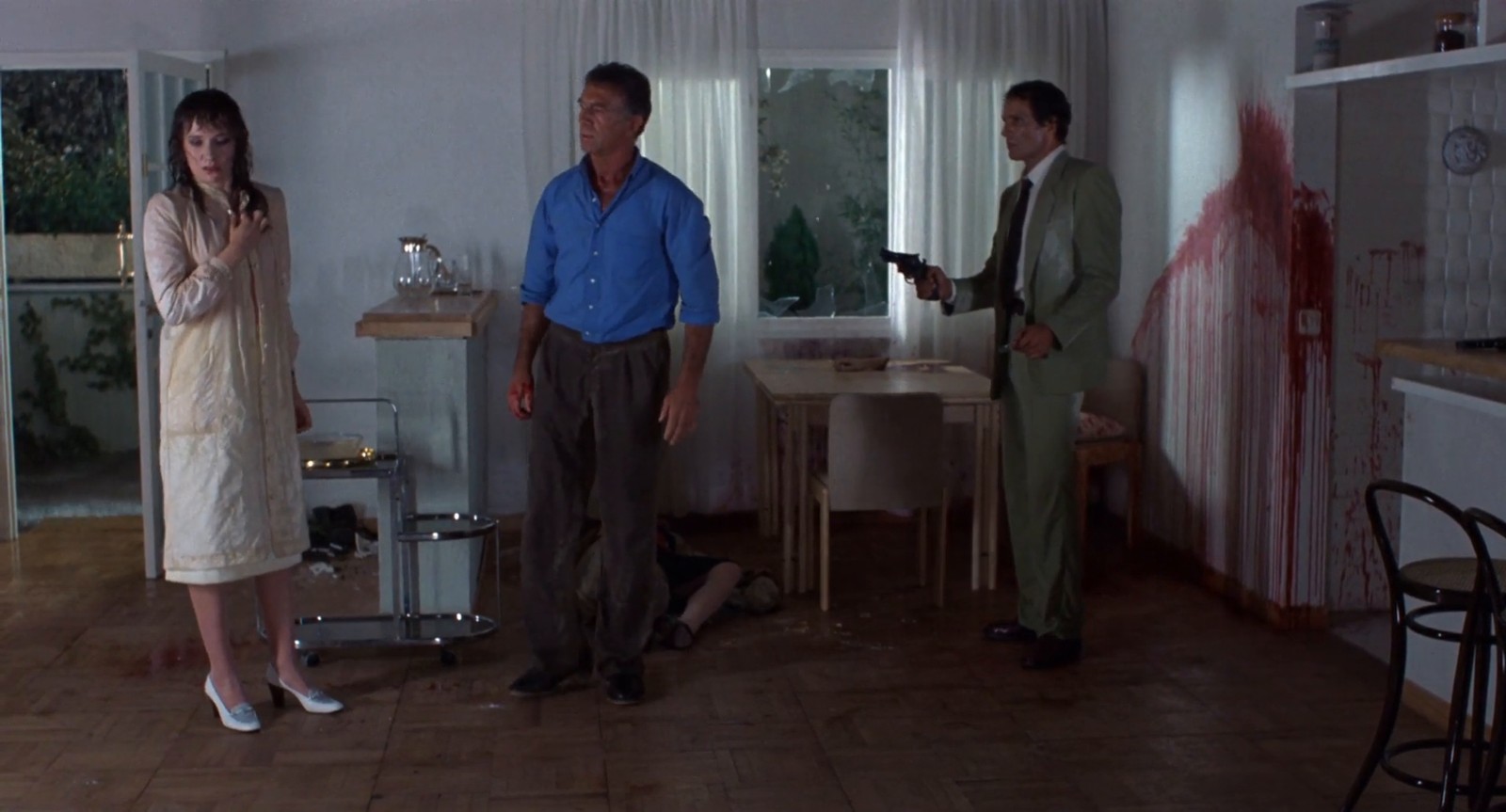
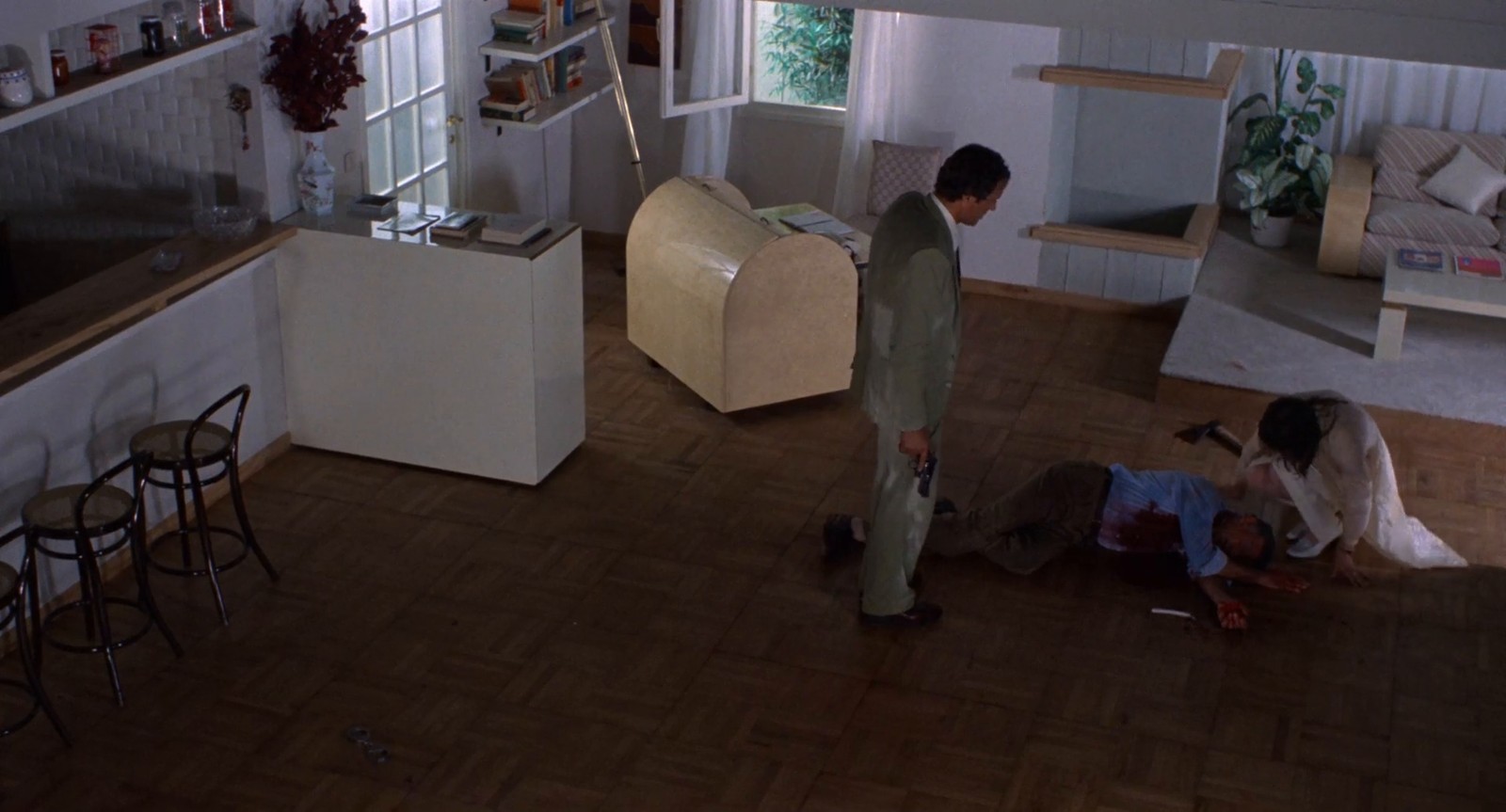
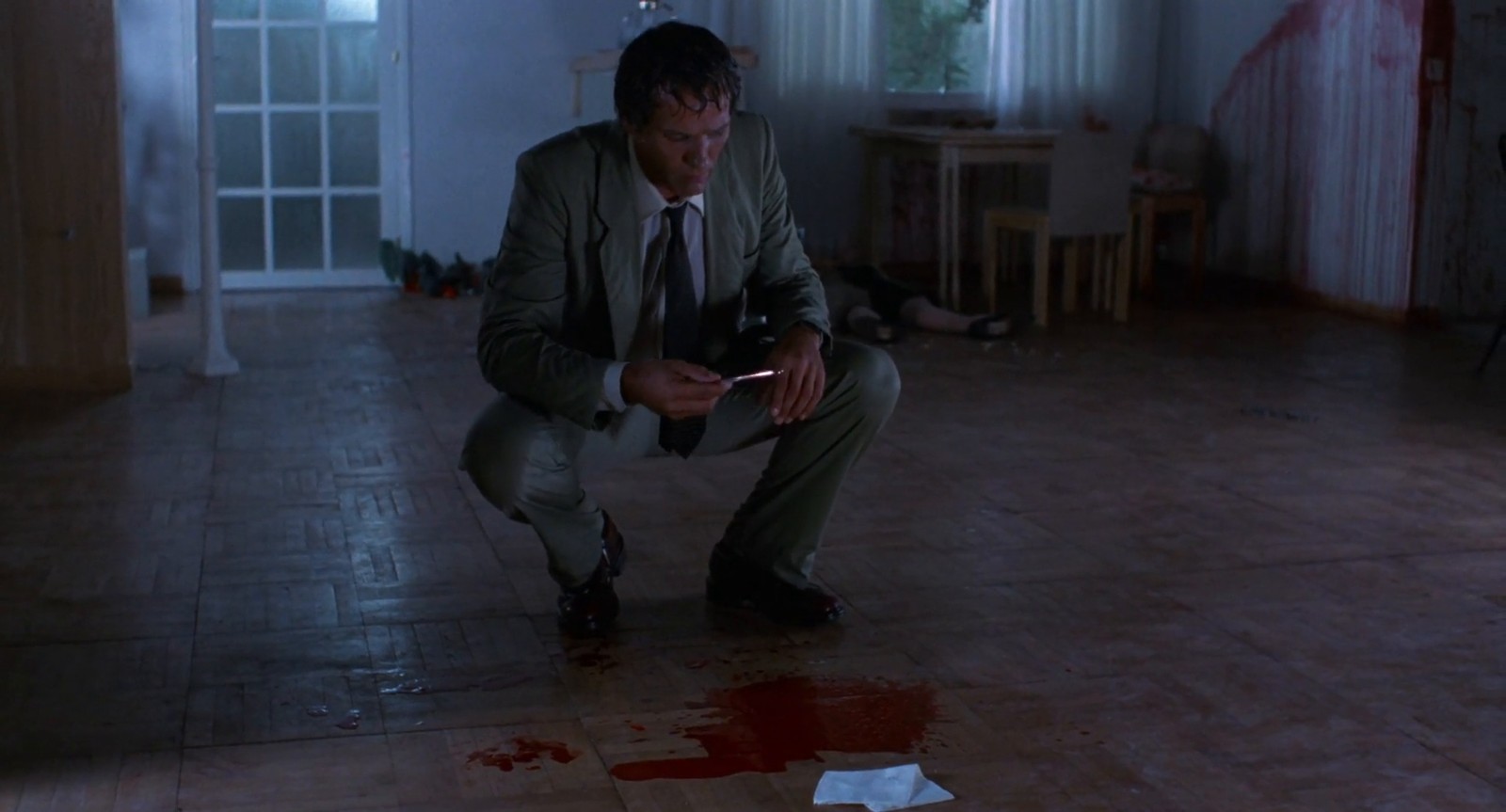
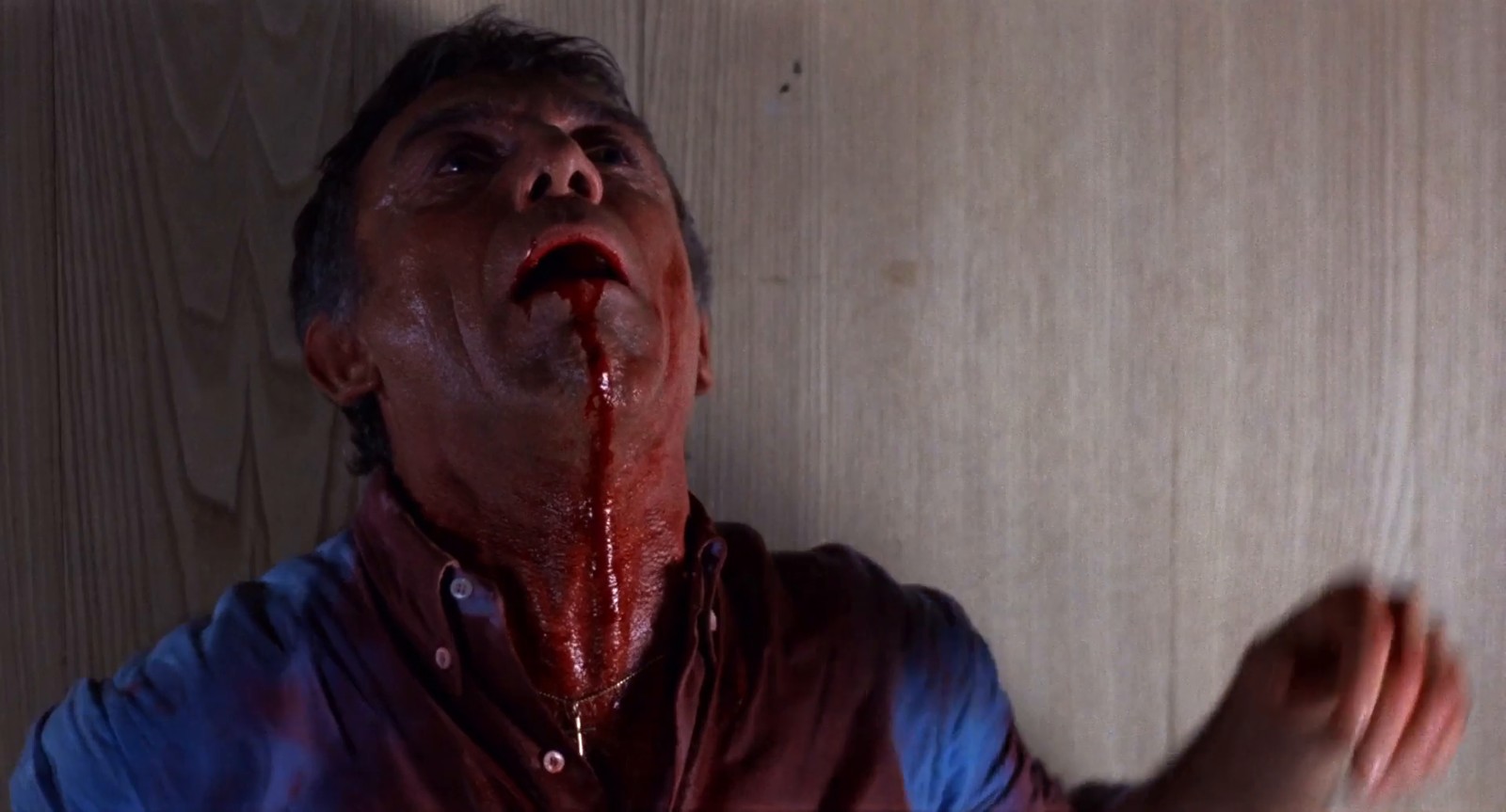
Neal’s apparent suicide repeats the film’s earlier dependence on the razor, the throat and a reaction shot. Blood and collapse briefly make the action look conclusive. Germani’s return to the room changes its meaning: the abandoned prop becomes evidence that a wound can be staged within the story. The deception turns the audience’s trust in a visible effect into part of the final trap.
Neal’s performance is assembled from the group, the razor at his neck and Anne’s reaction. The overhead conclusion appears to settle the positions of all three people, giving the later absence of his body its force.
1:33:56.1A wide view places Neal, Anne and Germani together.
1:34:05.7A closer profile follows Neal’s turn.
1:34:07.4The group view returns with the razor held between the figures.
1:34:09.4Anne receives a separate reaction shot.
1:34:11.8Neal turns with the razor at his throat.
1:34:13.7A closer view joins his face, blood, hand and razor.
1:34:17.2Anne covers her face.
1:34:17.9In the wider view Germani approaches as Neal falls.
1:34:21.0An overhead view places Neal on the floor beneath the two standing figures.
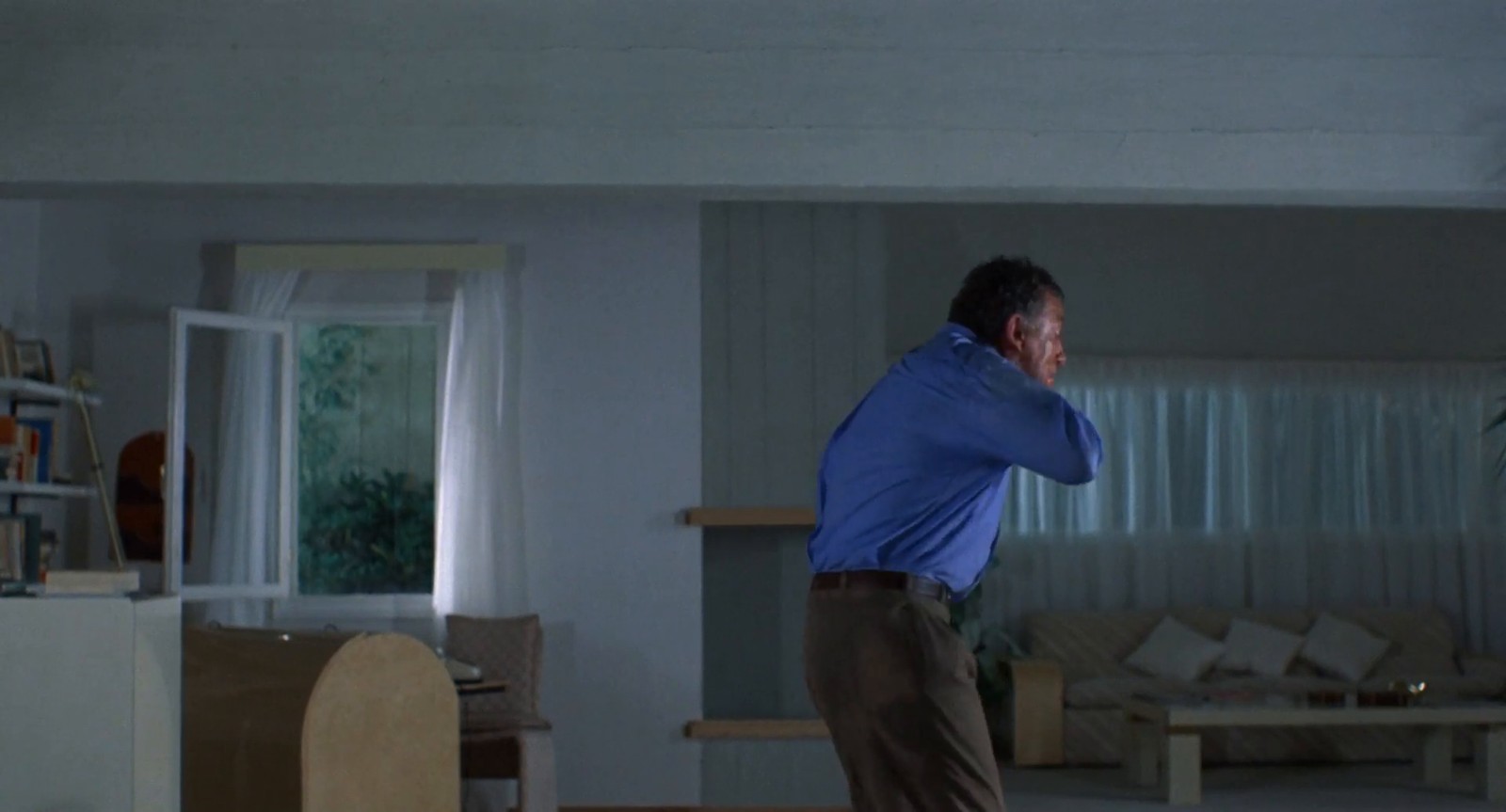
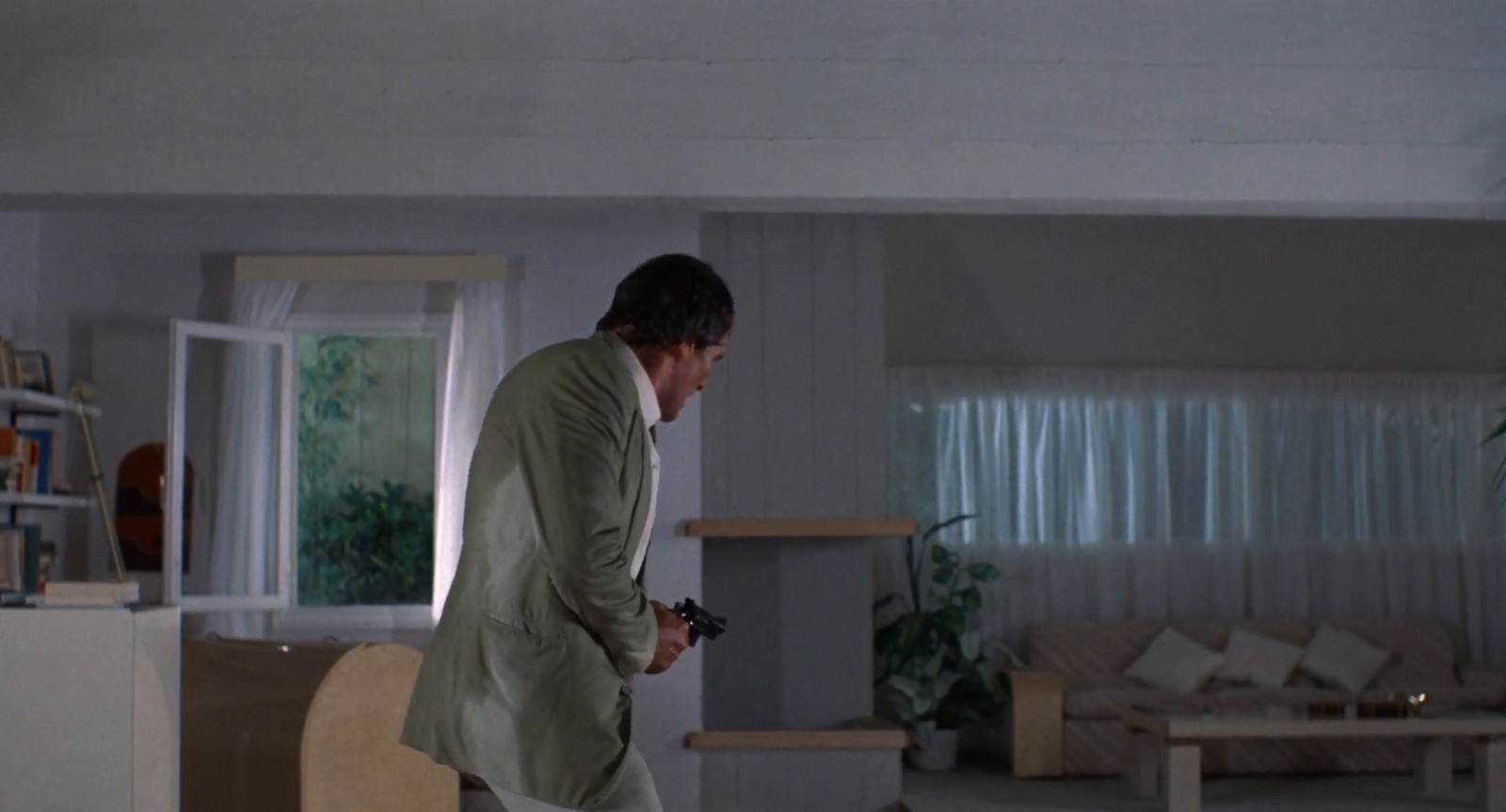
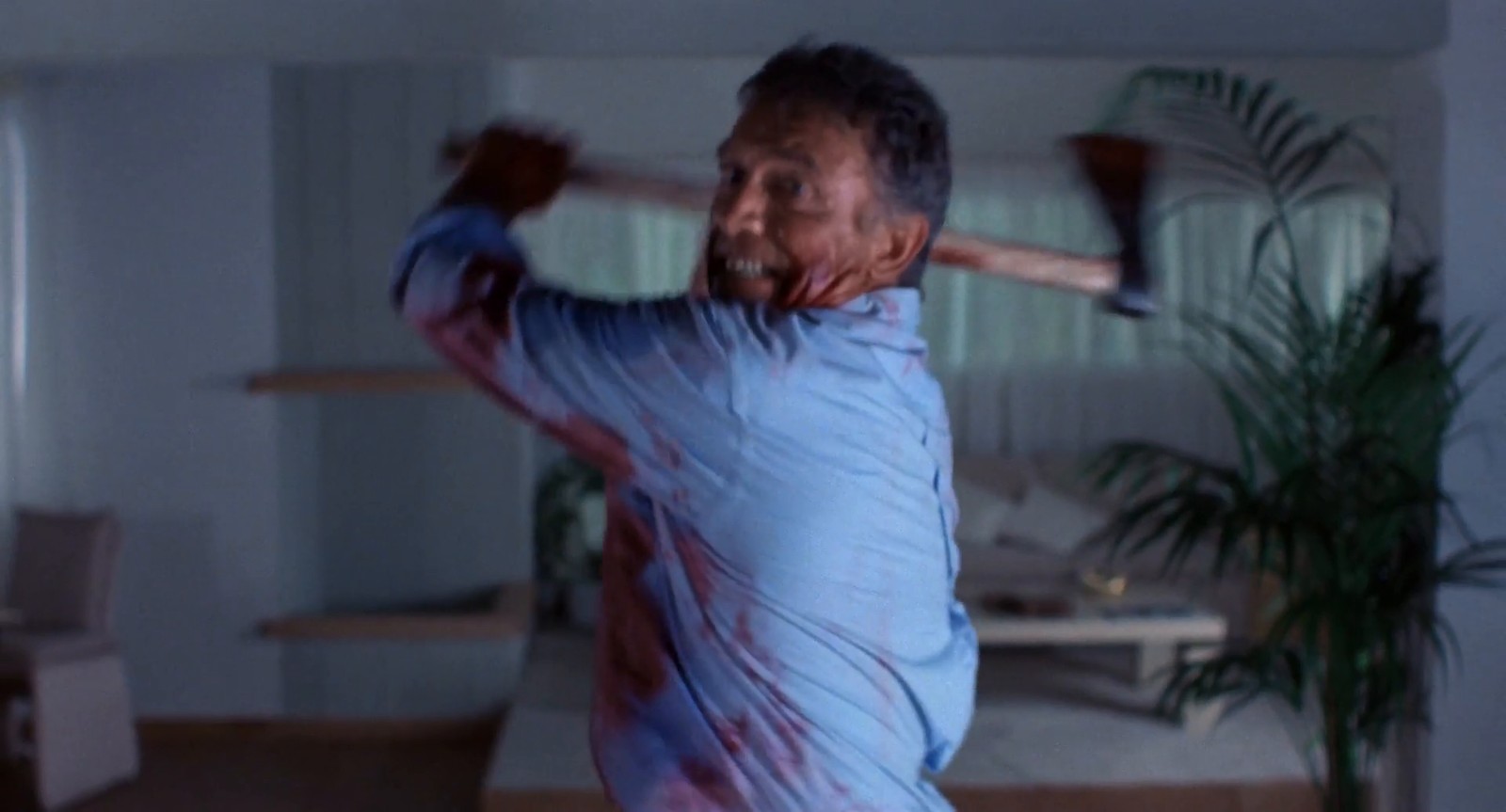
Germani’s body hides Neal along the camera’s axis. When he dips, Neal appears directly behind him; when he rises, the image briefly closes again. The attack follows this revelation with the axe swing and its consequences. Spatial alignment performs the first shock, before the blood effect supplies the second. The staging makes the apparently empty room unreliable once more.
At 1:37:37 the film faces Germani, then cuts to the paper on the floor. The return to his face at 1:37:42 begins the crucial held view: his lowering body uncovers Neal directly behind him, and his rise covers Neal again. The attack is cut into separate views only afterward. The revelation works through the actors’ alignment with the lens, before the axe montage begins.
Follow the concealment and the axe montage
The held reveal described above gives way to a more fragmented attack. The cutting moves between front and back, then brings the sculpture and Anne’s position outside into the same chain of consequences.
1:37:37.1Germani faces the camera.
1:37:40.4A separate view isolates the paper on the floor.
1:37:42.4The frontal view returns. Germani lowers out of Neal’s way, revealing him, then rises to conceal him again.
1:37:53.7Neal begins the axe movement.
1:37:54.5A rear view shows the impact on Germani.
1:37:54.9His reaction is seen from the front.
1:37:56.6The reverse wound view moves with his stumble.
1:37:58.1The sculpture sways in an isolated view.
1:38:00.7Anne reacts inside the car.
1:38:05.9Germani returns wounded in the room.
1:38:07.8A closer view isolates Neal.
1:38:08.9A wider view follows Germani’s collapse.
1:38:11.9The action returns to Anne outside the car.
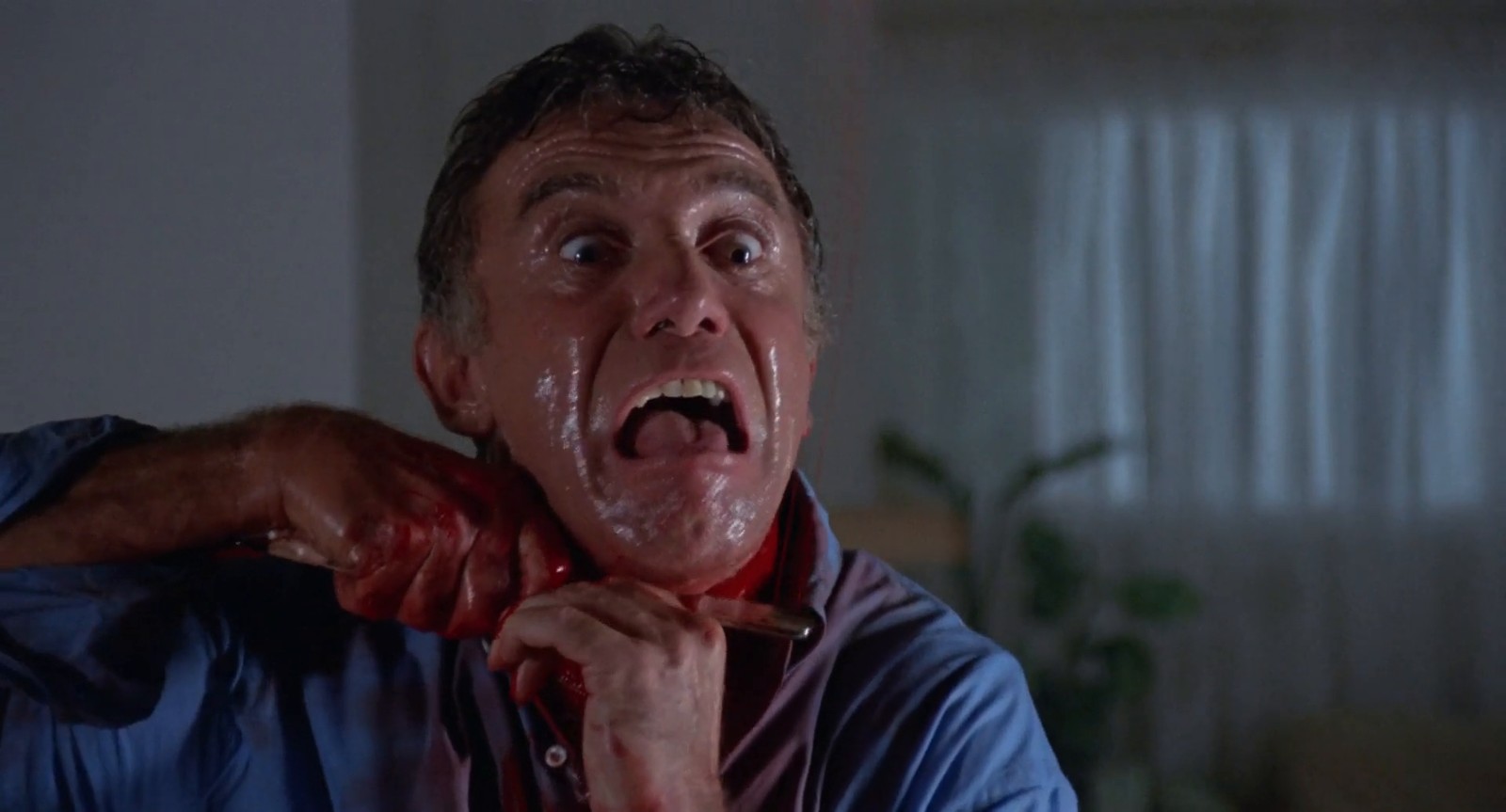
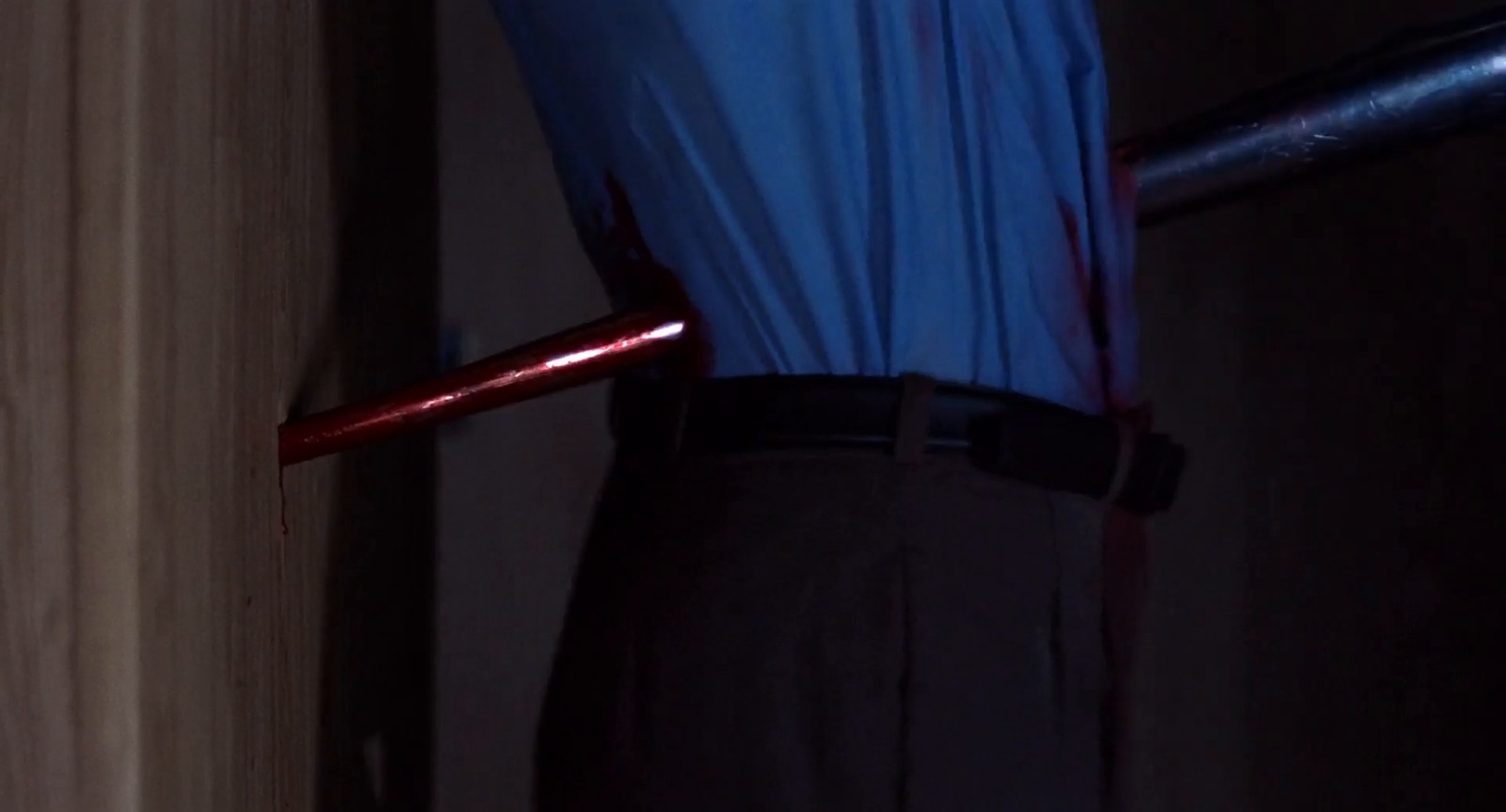
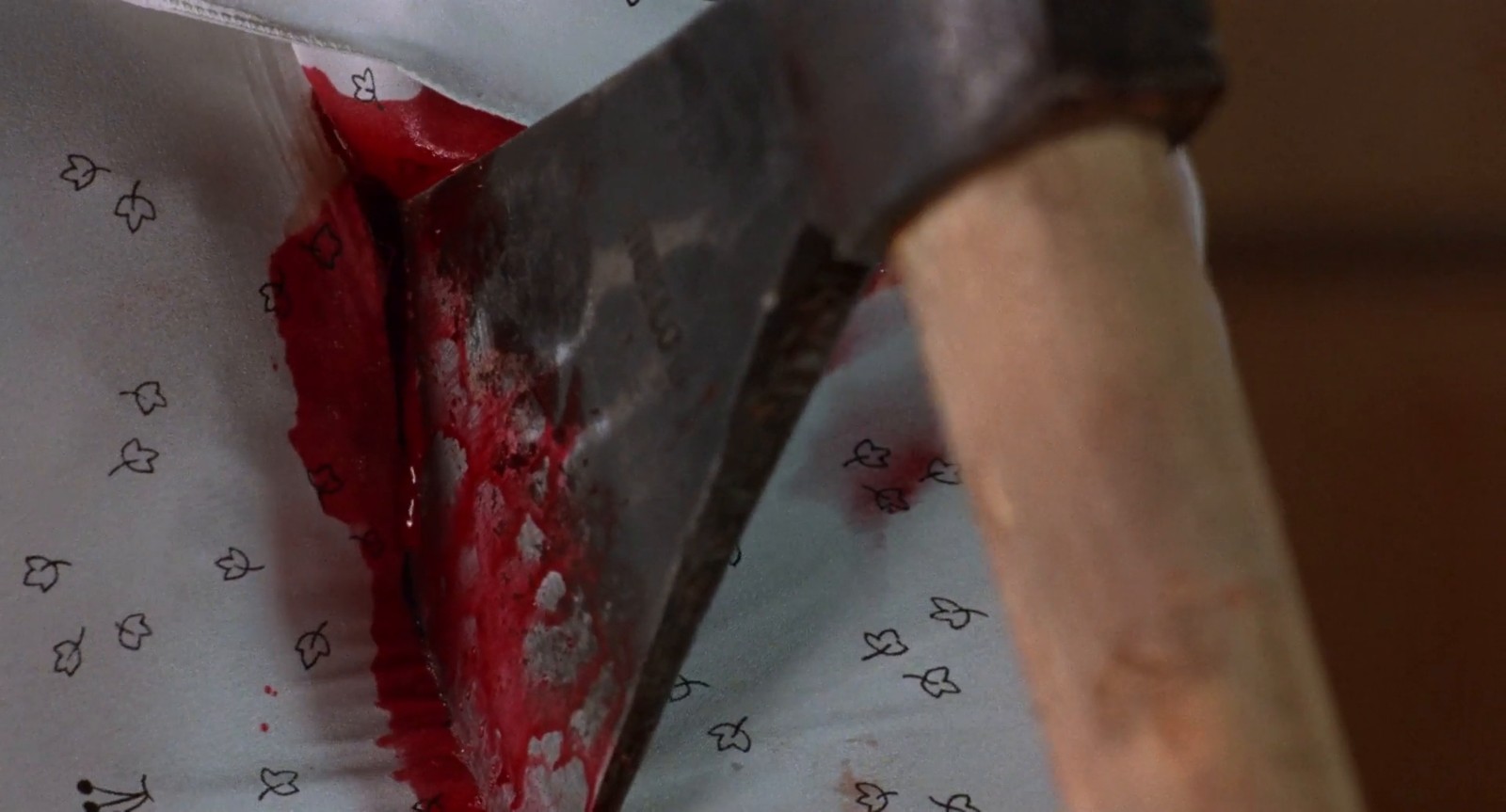
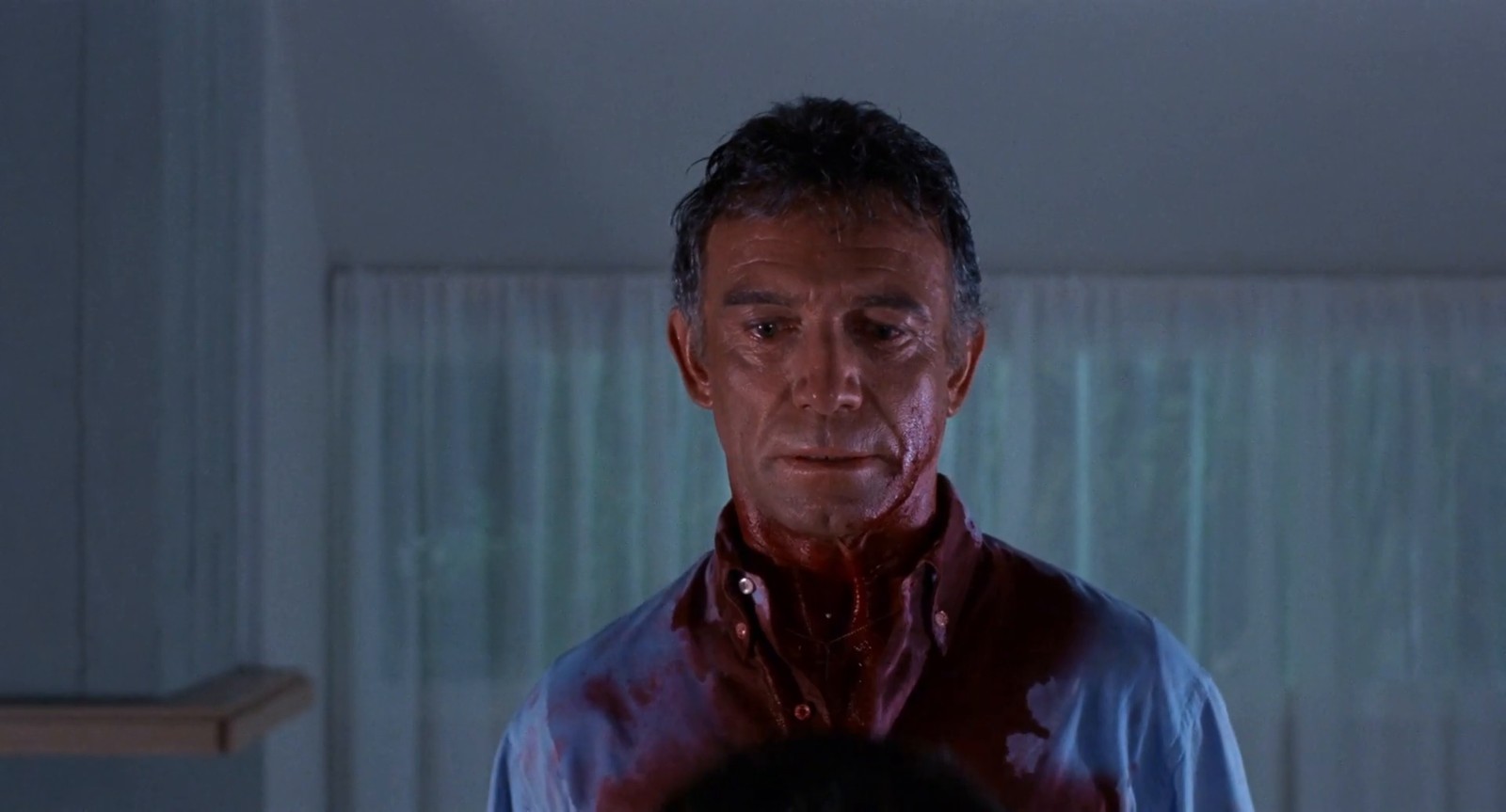
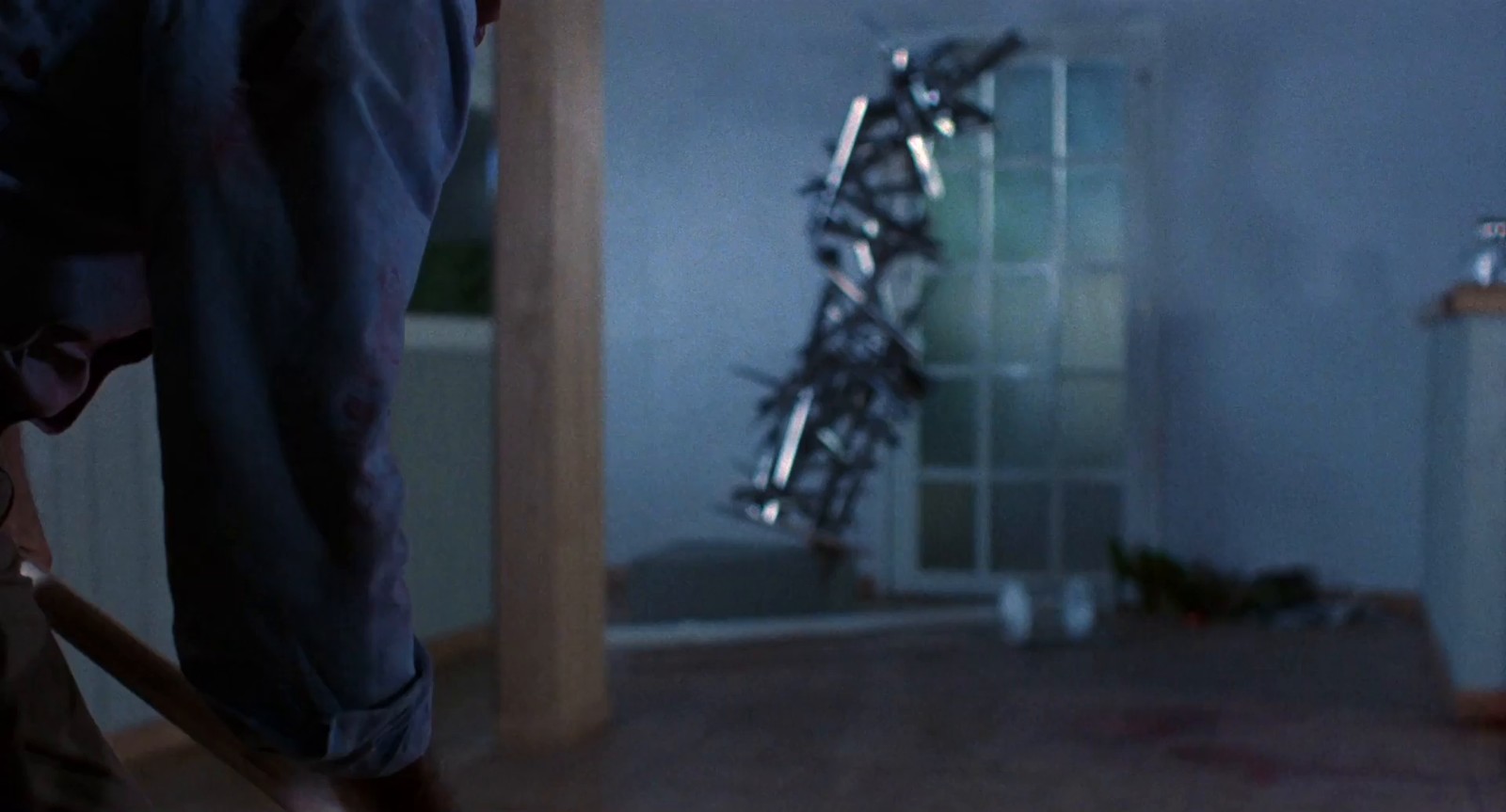
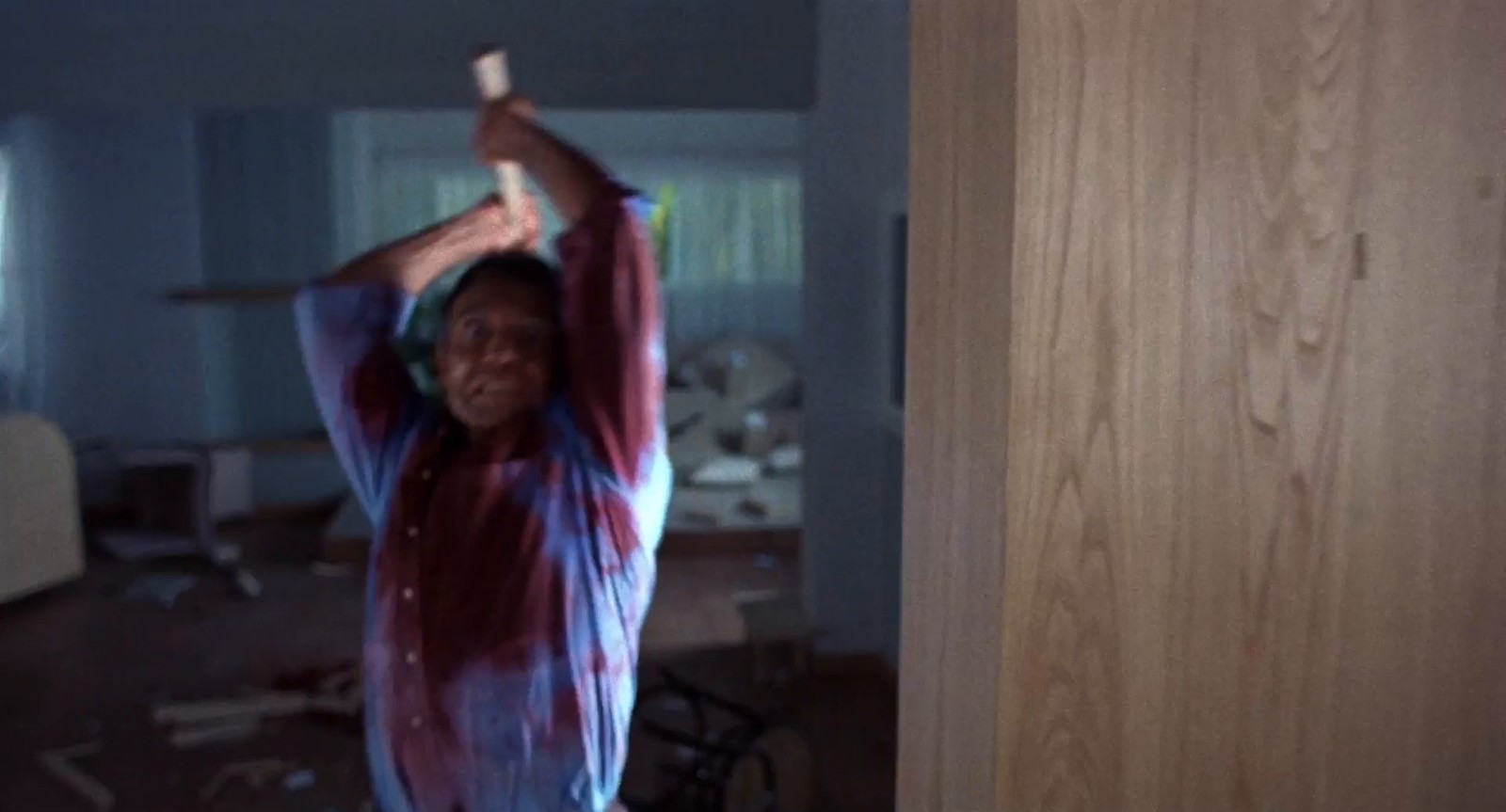
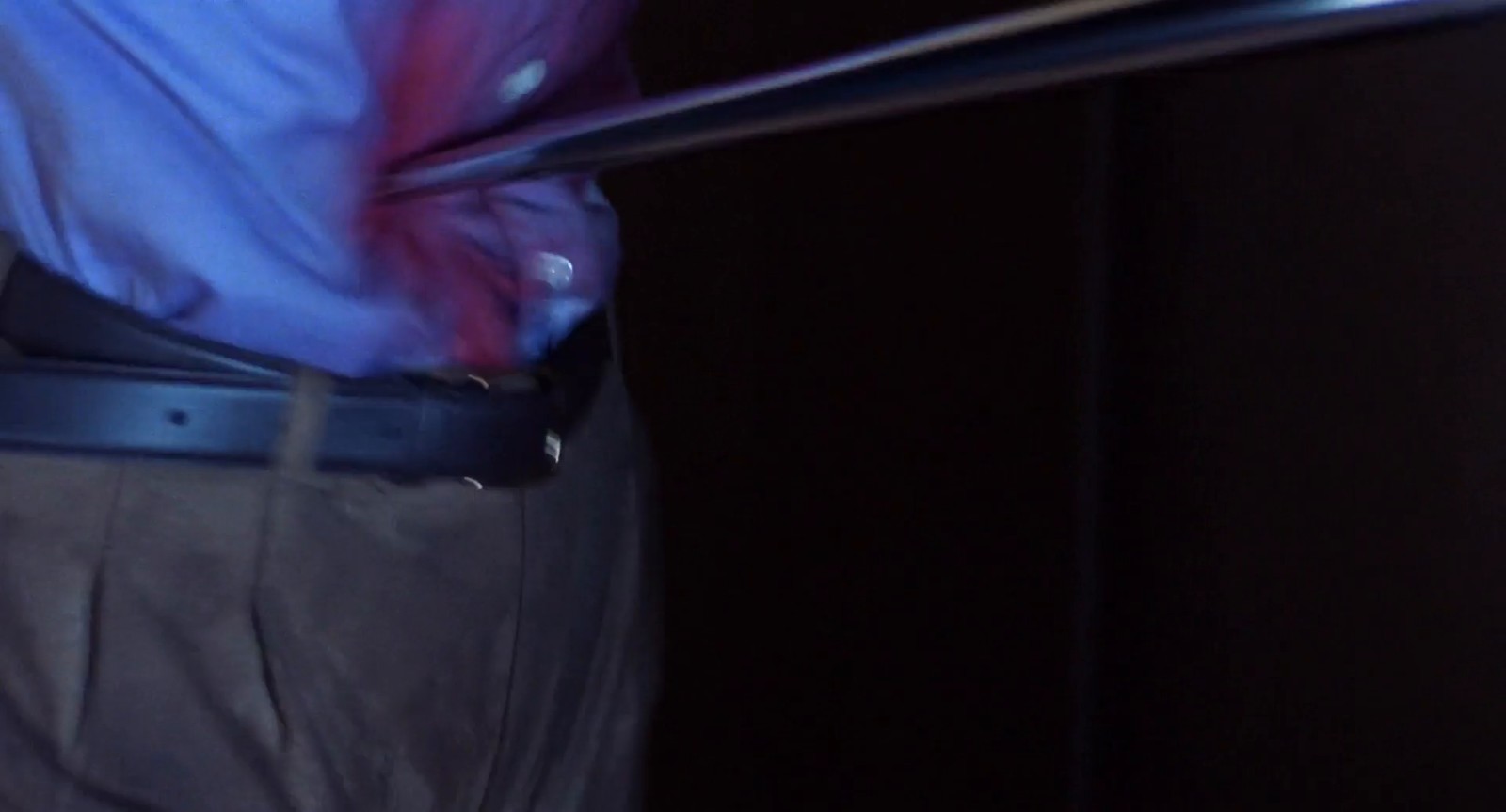
The metal sculpture has already occupied the entrance in earlier views. Anne’s return sets the door and object in motion as Neal waits inside with the axe. Separate views connect her hand, the shifting metal and the advancing body; close inserts show the point entering and emerging through the blue shirt. The final reaction belongs to Anne, left at the threshold after another apparent ending has failed.
The last reversal is built from the door, the sculpture, Neal and Anne. These shot openings trace the passage from an ordinary entrance to the final reaction.
1:38:37.3The sculpture stands beside the door, still part of the room’s décor.
1:38:38.1Anne’s hand works the handle.
1:38:38.7A closer view isolates the interlocking metal.
1:38:39.6Anne pushes at the door from outside.
1:38:40.1Neal advances with the axe; the sculpture remains in the depth of the room.
1:38:41.0Anne continues pushing the door.
1:38:41.5The metal structure shifts toward the camera.
1:38:42.0Neal raises the axe.
1:38:42.4An extreme close view turns the sculpture into pointed edges.
1:38:42.8A side view of the blue shirt shows the point entering the body.
1:38:43.1Neal’s face supplies the reaction between the two wound views.
1:38:43.4The reverse torso view shows the point emerging at the back.
1:38:44.1A medium view reconnects face, raised arms and wounded torso.
1:38:44.9Anne reacts in the doorway.
1:38:46.6A closer view of Neal’s face carries the aftermath of the impact.
1:38:48.4The image widens as he reaches down toward the metal.
1:38:51.8Hands, shirt and wound become the centre of the image.
1:38:54.6The projecting point is shown from the back.
1:38:55.8The film returns to the hands at the front of the wound.
1:38:57.6Anne remains at the threshold. Flashes alter the brightness within this held view.
1:39:01.0Neal is seen against the wooden partition.
1:39:02.5The doorway view returns to Anne.
1:39:03.9Another close view isolates Neal’s hands at the metal.
1:39:08.3A medium view shows his weakening posture.
1:39:10.1The final close view of Neal’s face ends his part of the exchange.
1:39:11.6Anne takes over the closing image, alone in the rain-framed doorway.
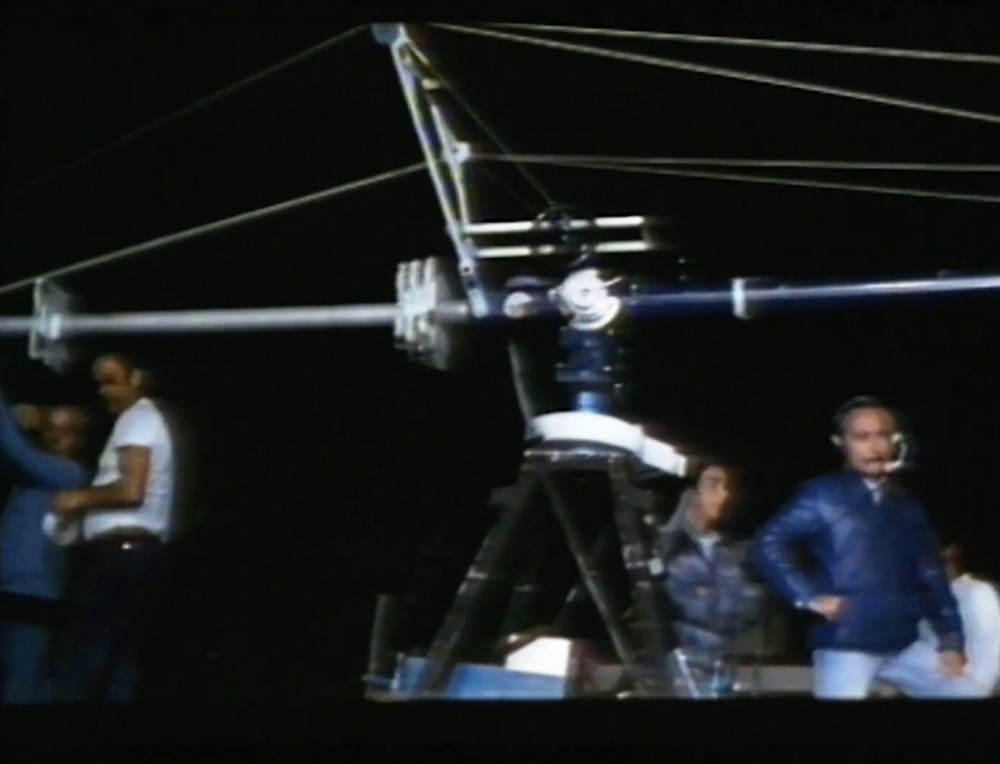
In My Cinema, Tovoli describes the Louma as a French crane system that suspends and controls the camera at the end of an arm. The accompanying production footage shows the equipment and crew before returning to the movement around the building. His explanation gives the famous passage a concrete mechanical basis: the camera’s viewpoint can travel where an operator’s body could not accompany it.
That separation matters to the scene’s uncertainty. The travelling view can approach a window, leave its occupants behind and explore another surface without revealing a person who owns the look. The apparatus helps create an apparently independent observer, extending the film’s problem of looking beyond what any character can presently see.
Argento’s adjacent interview describes the film as an ironic response to the assumption that an artist who makes disturbing fiction must share its violence. Read beside the crane demonstration, his account connects two forms of separation: the author from the crime, and the camera’s journey from the physical position of a human watcher.
Source & passage
Dario Argento: My Cinema / Il mio cinema, two-part documentary presented on Severin Films’ Dario Argento’s Deep Cuts, Disc 1. Part One, 27:47–32:40.
The discussion paraphrases the English subtitles and distinguishes participant recollections from the documentary’s narration and production footage.
Argento discusses the camera’s psychological movement.
Argento names Tenebrae among the films whose elaborate camera movements he understands in psychological terms. He rejects movement whose only purpose is to impress and instead relates the camera’s journey to states of mind. Read beside Tovoli’s Louma demonstration, the passage joins an account of the apparatus to Argento’s account of what its freedom should express. It does not require the camera to occupy a character’s literal viewpoint.
Source & passage
Dario Argento: Master of Horror, 11:41–13:50. Presented on Disc 2 of Severin Films’ Dario Argento’s Deep Cuts.
The blood apparatus and the camera outside the house.
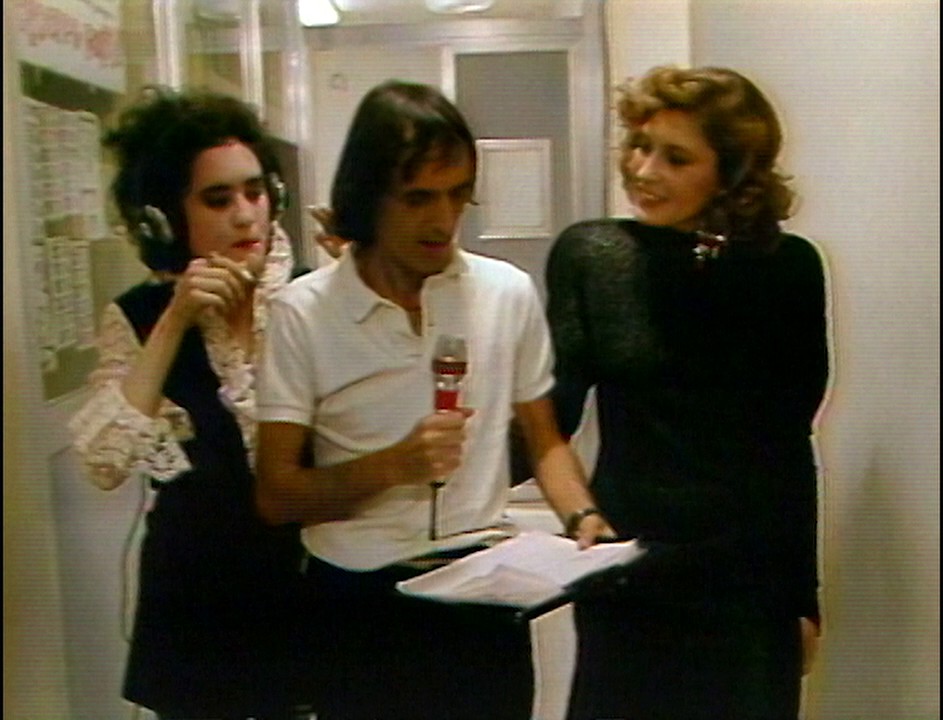
From Giallo Argento, the compilation of interviews and production demonstrations from Giallo (1987).
An arm becomes a demonstration object
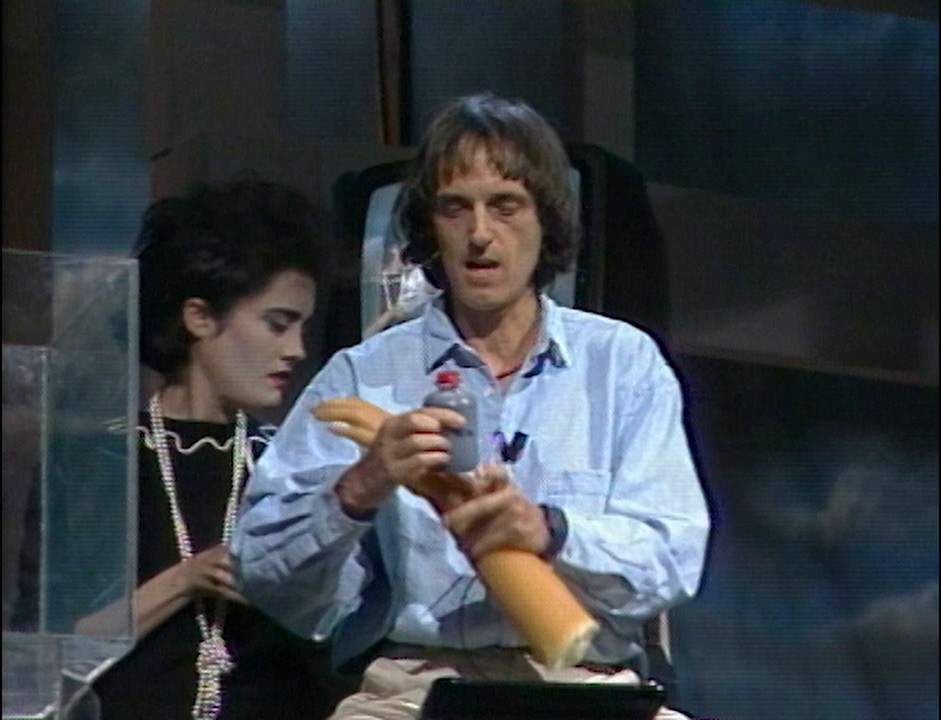
Argento handles a latex arm and a bottle of coloured liquid, explaining the combination of surface, tubing and fluid before the programme returns to Tenebrae’s severed-arm image. The presentation lets viewers see the prop as an object before editing restores its place in an apparently living body.
Argento demonstrates the prop arm.
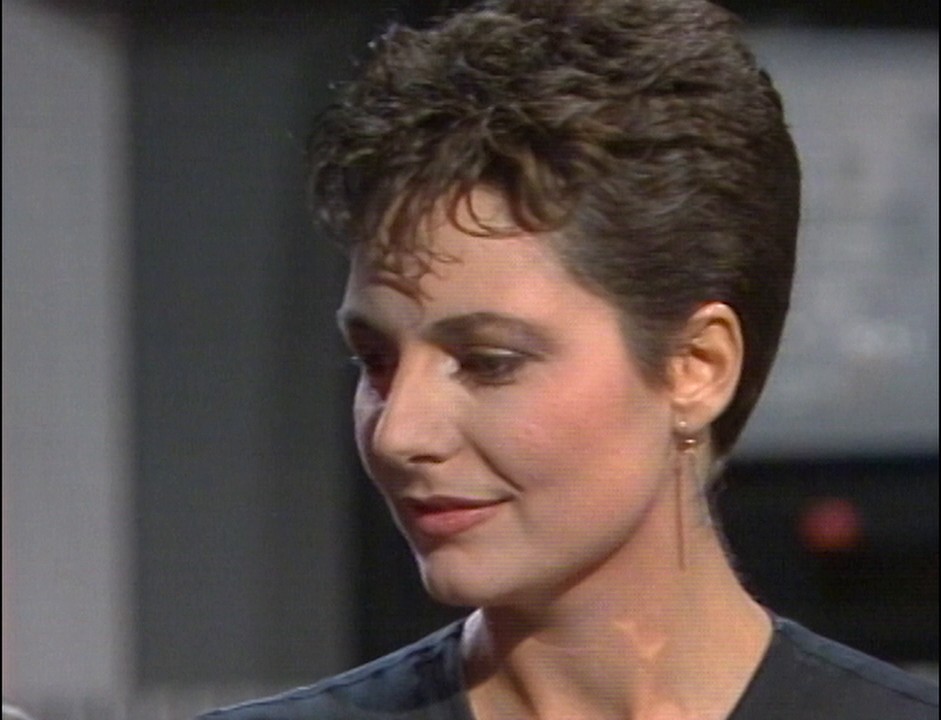
Mirella D’Angelo: the apparatus can be reassuring
D’Angelo recalls a white shirt fitted with blood tubing. Seeing the mechanism and crew around her made the setup feel controlled to her rather than frightening. She also remembers rehearsing the throwing of a glass accurately enough for Argento to warn that she must not hurt the other performer. Her recollection is specific to the scenes she discusses.
Mirella D’Angelo recalls Tenebrae.
Lara Wendel: fear within a planned scene
Wendel’s account offers a different emphasis. Discussing the dog attack, she points to a mark and recalls being afraid, while also describing the wider experience of making the film positively. The two interviews should be read together without smoothing their different experiences into a single story about the set.
Lara Wendel recalls the dog sequence.
The Louma beyond the finished movement
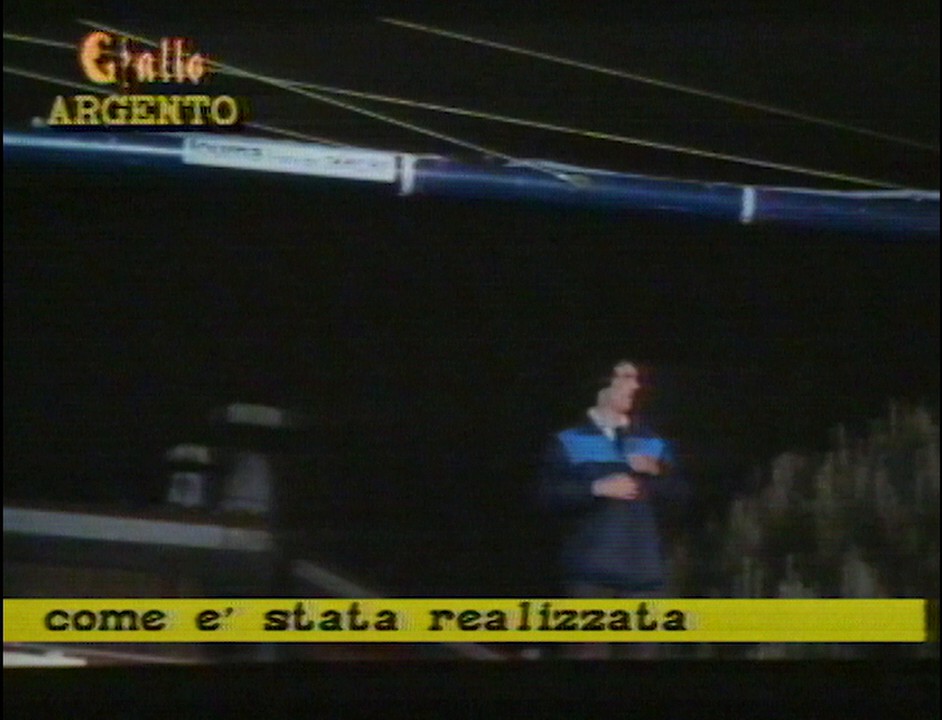
Argento identifies the French Louma and recalls spending a week on the celebrated exterior movement. The programme follows the film excerpt with the rig and camera crew outside the house. This contemporary demonstration gives the later documentary accounts a concrete counterpart: the apparently wandering gaze depends on a large apparatus working beyond the shot.
The Louma reaches across the house.Source & passages
Giallo Argento, 05:35–06:45; 40:30–43:30; 51:35–53:45; 60:30–62:40. Severin Films, Dario Argento’s Deep Cuts, Disc 4. The study draws on the programme footage and English-subtitled testimony.
Credit compilation and Kevin Lyons’s essay (27 October 2018), republished for May 2023. The cited 1983 interviews remain secondhand; no exact shot duration adopted.
Synopsis and the named set’s cuts, restoration collaboration, framing and audio specifications. Discs and supplements not viewed; no current stock claim.
Casting and Tenebre filming answers read in Italian, including the villa, Louma and Tovoli’s light. English paraphrase; publication date not established.
Original page and enlarged America, Ariston II and Empire entries visually inspected. Establishes advertised exhibition on this date, not a premiere, box office or review.
The scene guide, editing studies and effects galleries use an English-language viewing copy running 1:41:04. Time references locate images and shot openings in that copy, rounded to a tenth of a second. The closing credits name Giovanni Corridori for special effects, Pierantonio Mecacci as makeup artist and Pierino Mecacci for makeup. Department credits do not assign individual effects to a particular technician.
The single-disc listing identifies the camera-negative restoration, mono language tracks, alternate titles and inserts, three commentary options and the Unsane end-credit supplement. Consulted 3 November 2026.
The instrument designer’s product history dates the LinnDrum to 1982 and the Linn 9000 to 1984. It provides the chronology against which Simonetti’s later equipment recollection is assessed.
 ENLARGE ↗