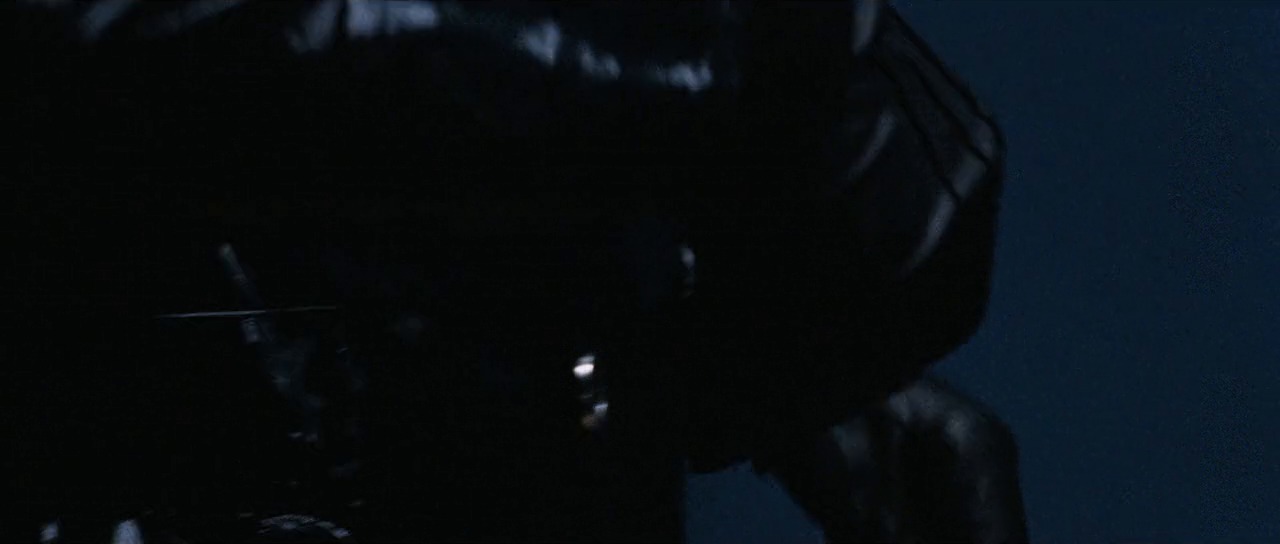
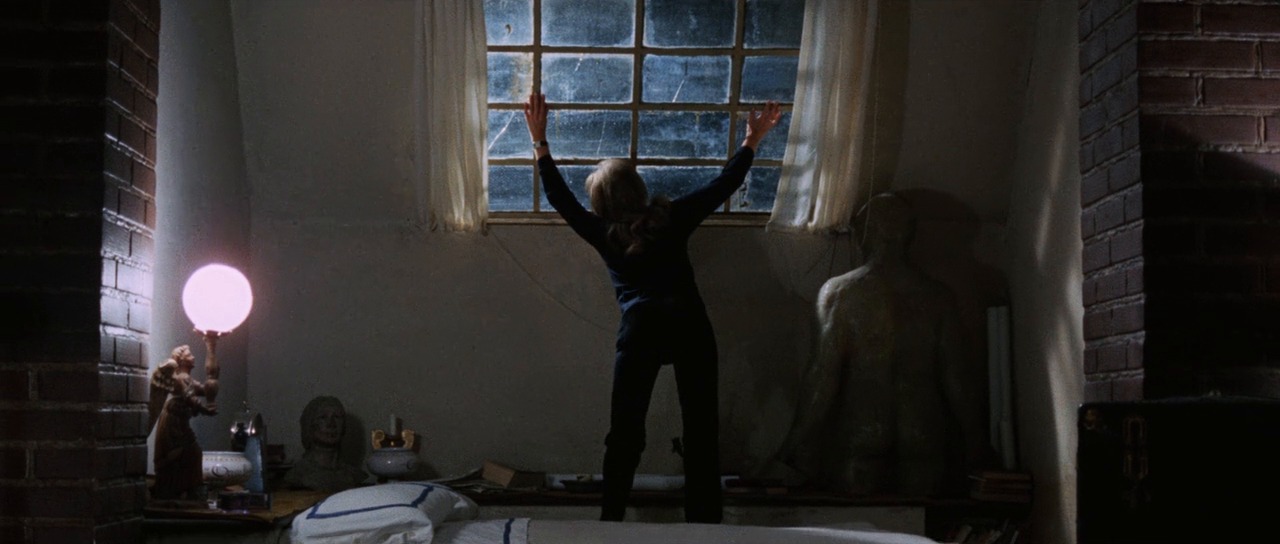
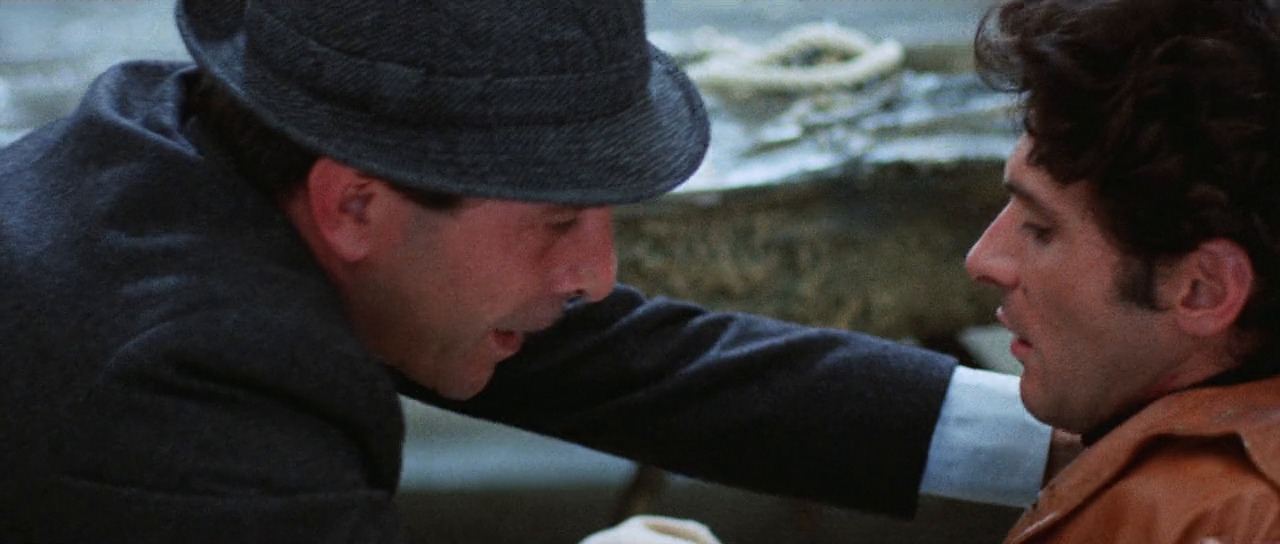
A writer witnesses a struggle and cannot stop returning to it. Argento’s debut turns an art gallery into a test of perception, then extends the investigation through paintings, recorded sound and the stories people tell about what they have seen. This dossier follows the film’s images, its collaborators and the changing frames through which it reaches us.
Spoilers: this study discusses the film’s story and ending. Includes discussion of sexual violence.
01 / THE GALLERY
Seeing is already an interpretation.
Sam Dalmas, an American writer in Rome, witnesses a struggle in an art gallery. Trying to intervene, he becomes trapped between its glass doors. The incident gives him something to investigate and prevents him from simply standing outside the story. Tony Musante plays Sam, Suzy Kendall his girlfriend Giulia, and Eva Renzi the woman he believes he has helped. Synopsis and cast ↗
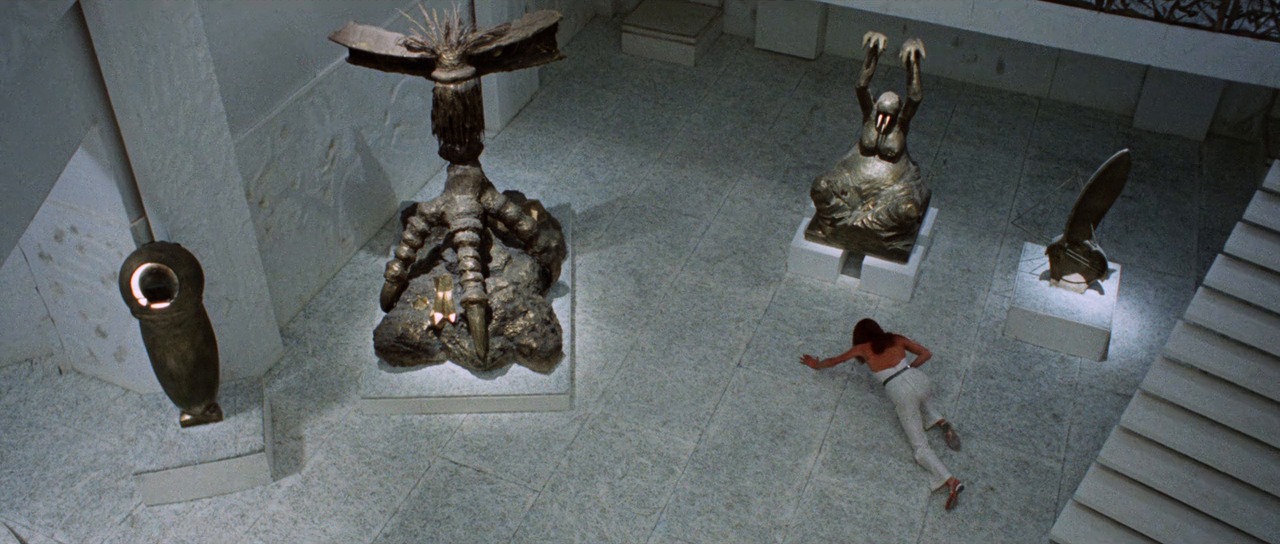
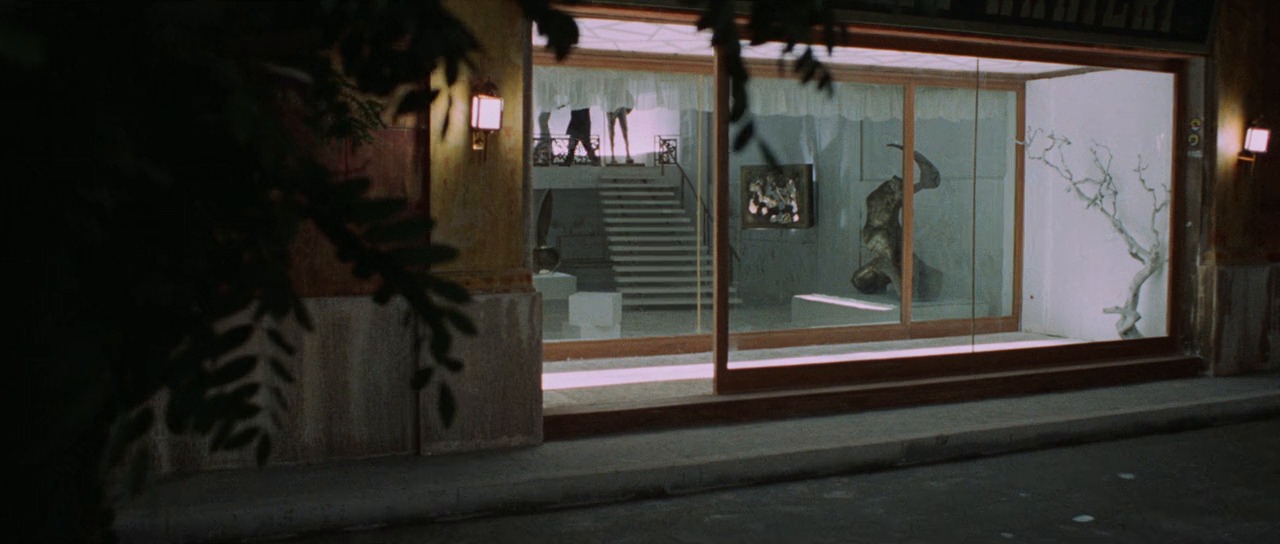
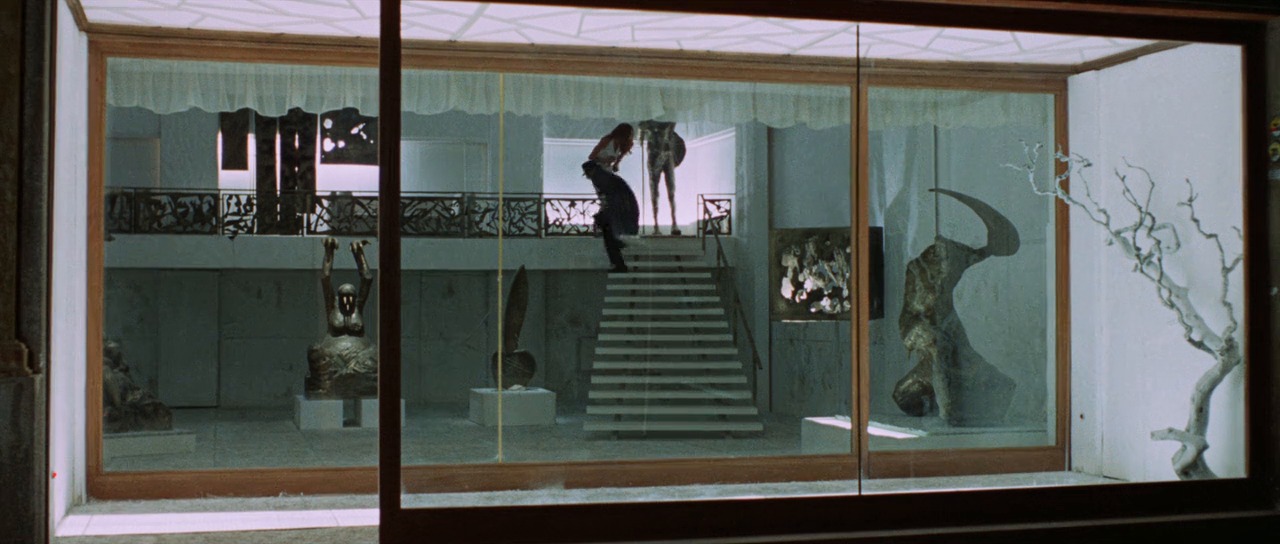
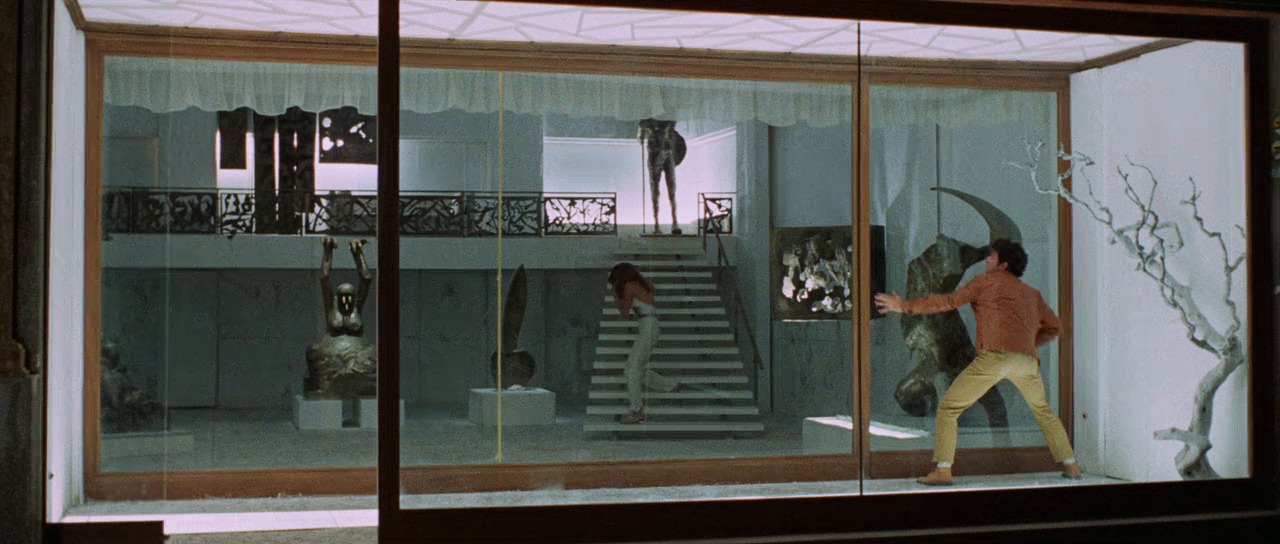
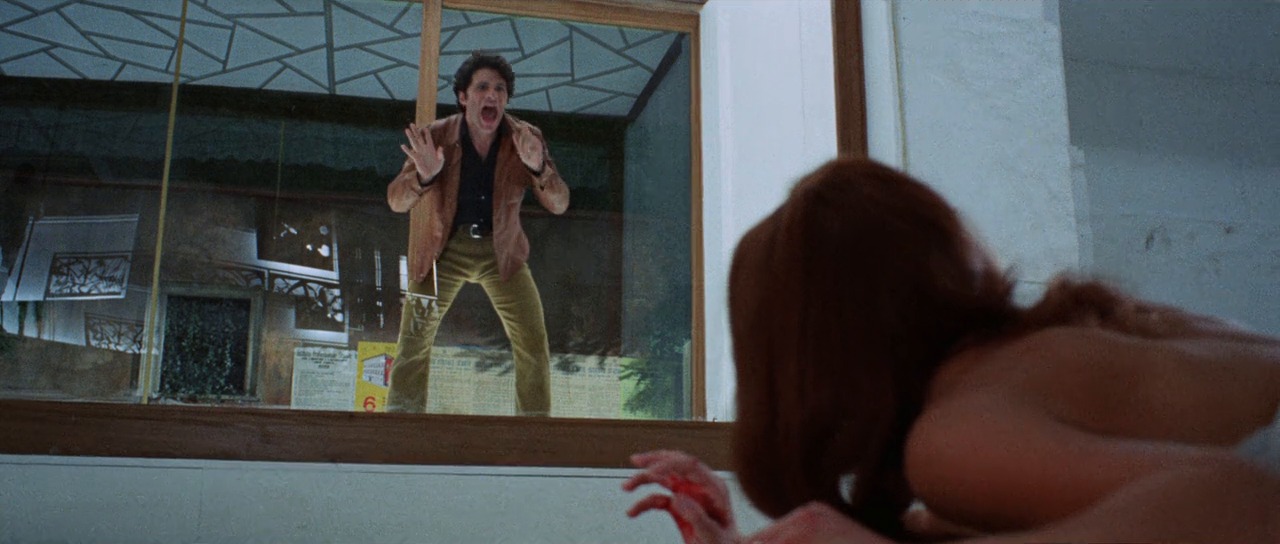
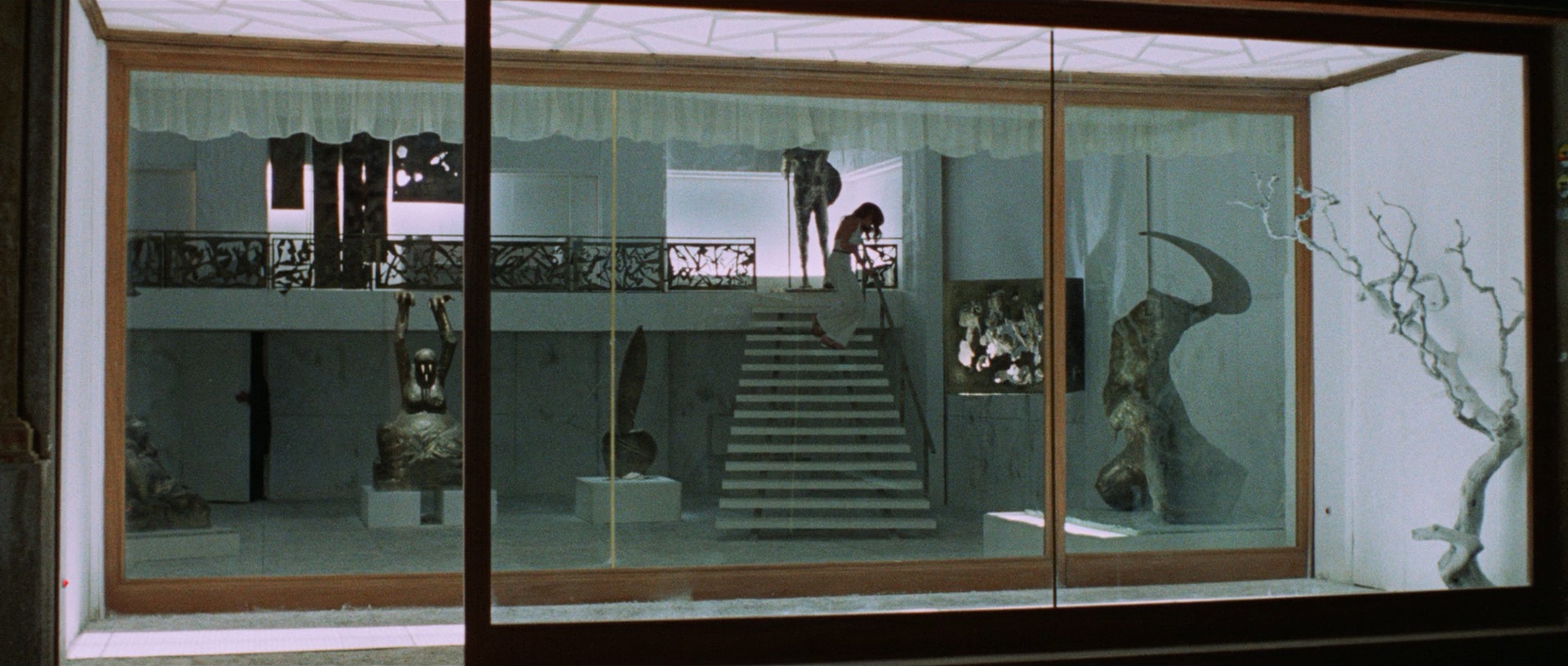
The wide frame above makes the gallery look unusually available to inspection. A bright ceiling, pale walls and a central staircase promise an orderly view. Yet the window’s vertical divisions cut across that view, and the people occupy a small portion of a room crowded with sculptural forms. We can see a great deal without knowing which relationship matters.
The barrier is physical, but the more consequential barrier is the story Sam gives the scene. In his 2014 conversation with Michele De Angelis, Argento describes deliberately reversing familiar associations: the dark-clothed man reads as a threat and the woman in white as a victim. The error is a culturally prepared interpretation, not simply a missing detail. Argento on the reversal ↗
That gives the gallery a double purpose. It displays art and stages a test of spectatorship. Sam believes that looking closely should bring him closer to knowledge; the film asks whether he must first change the assumptions that organise his looking. The viewer’s advantage over the witness is consequently unstable. We may have the same evidence and make the same mistake.
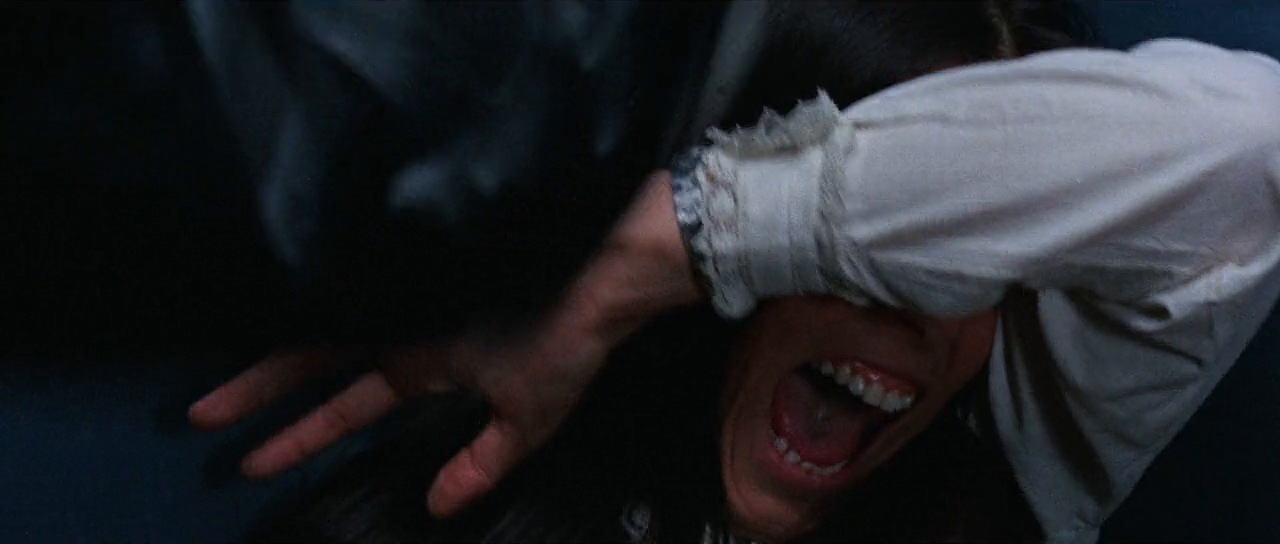
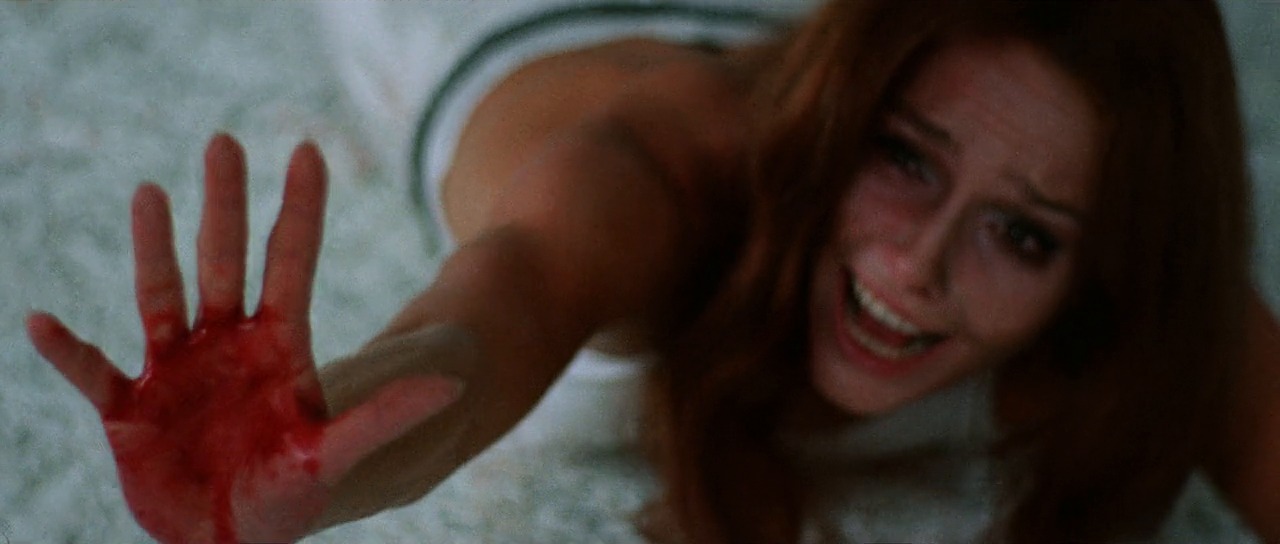
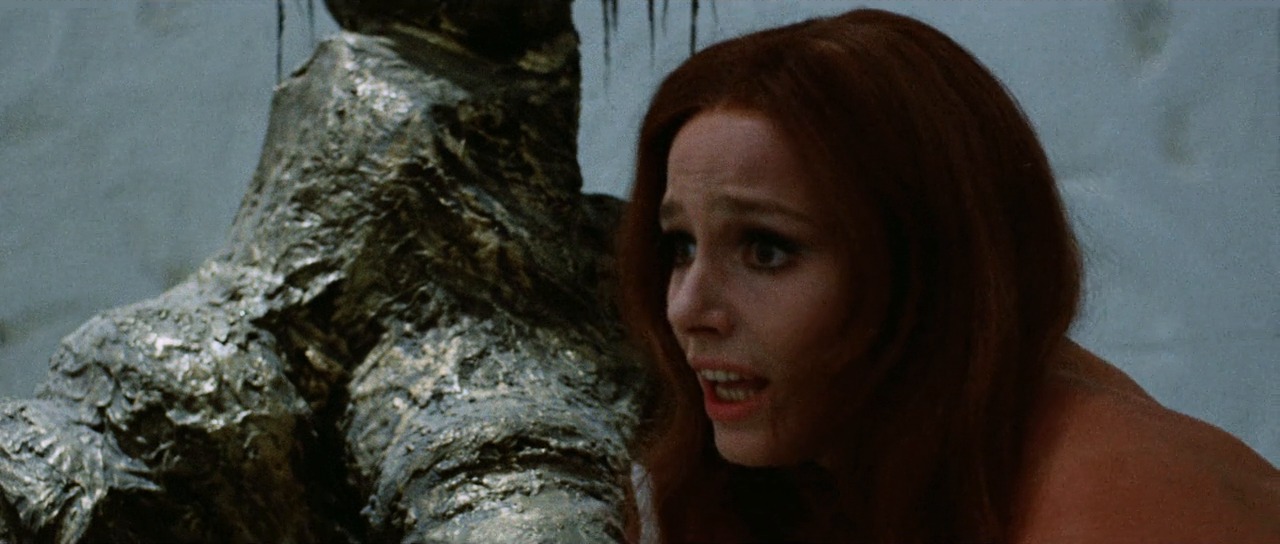
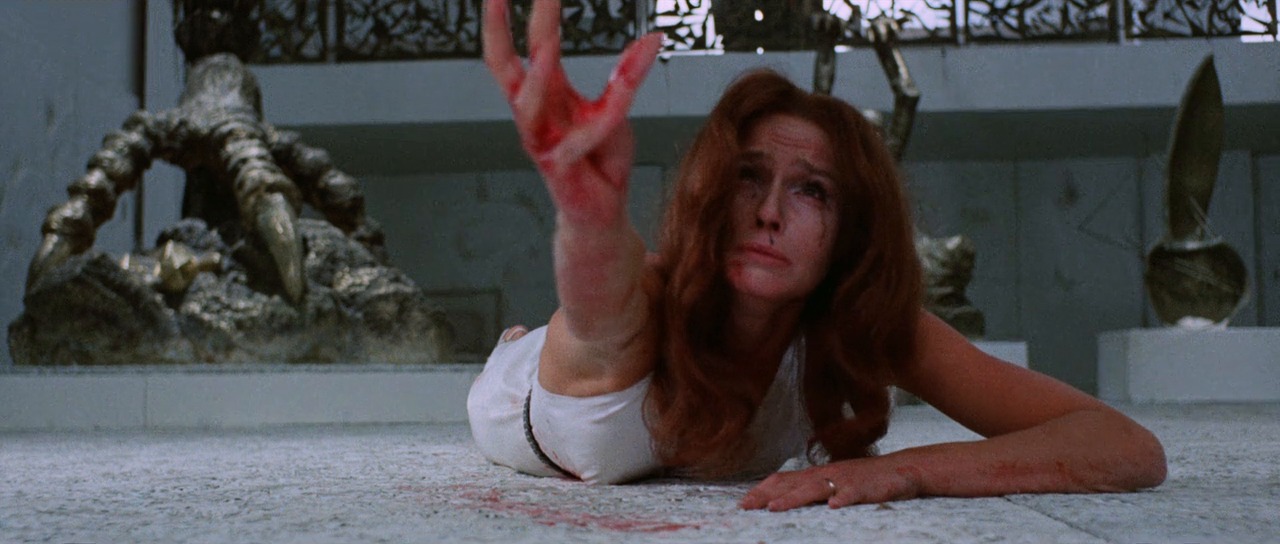
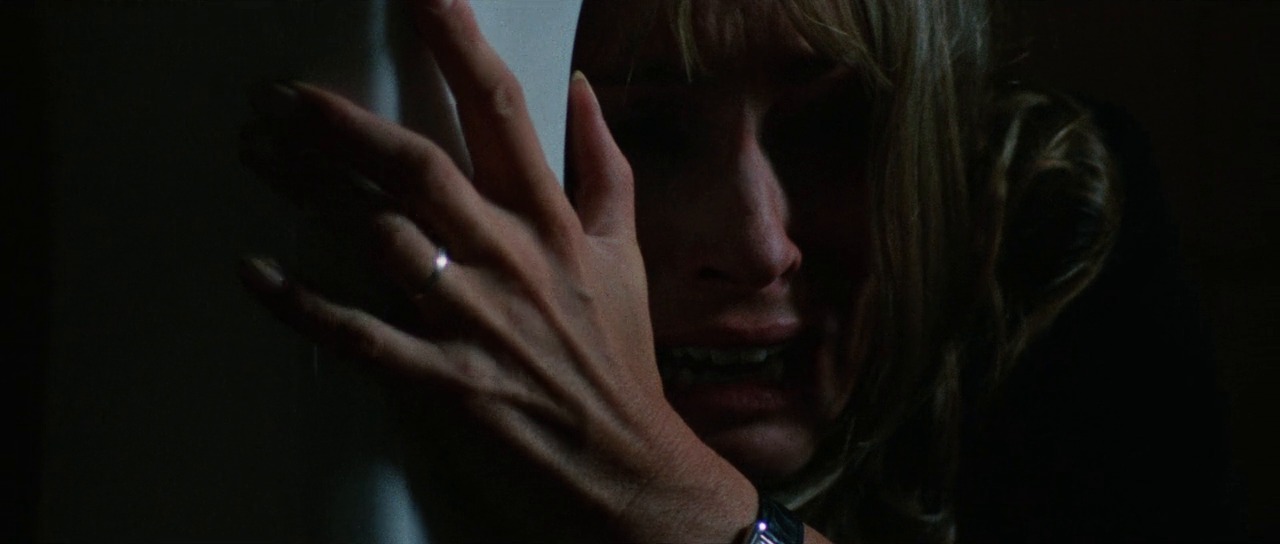
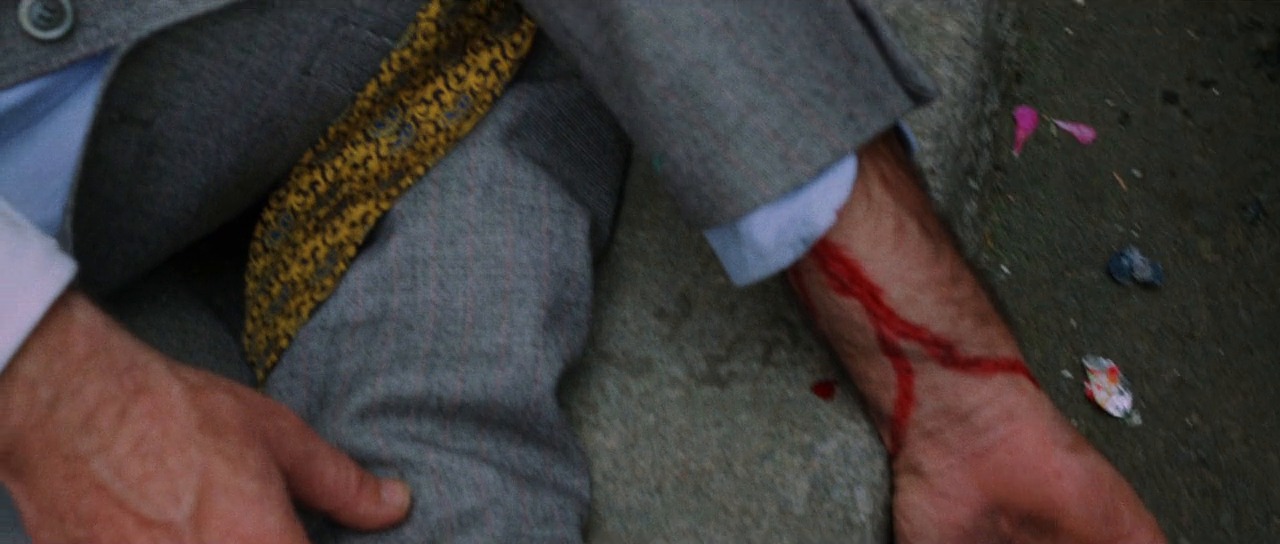
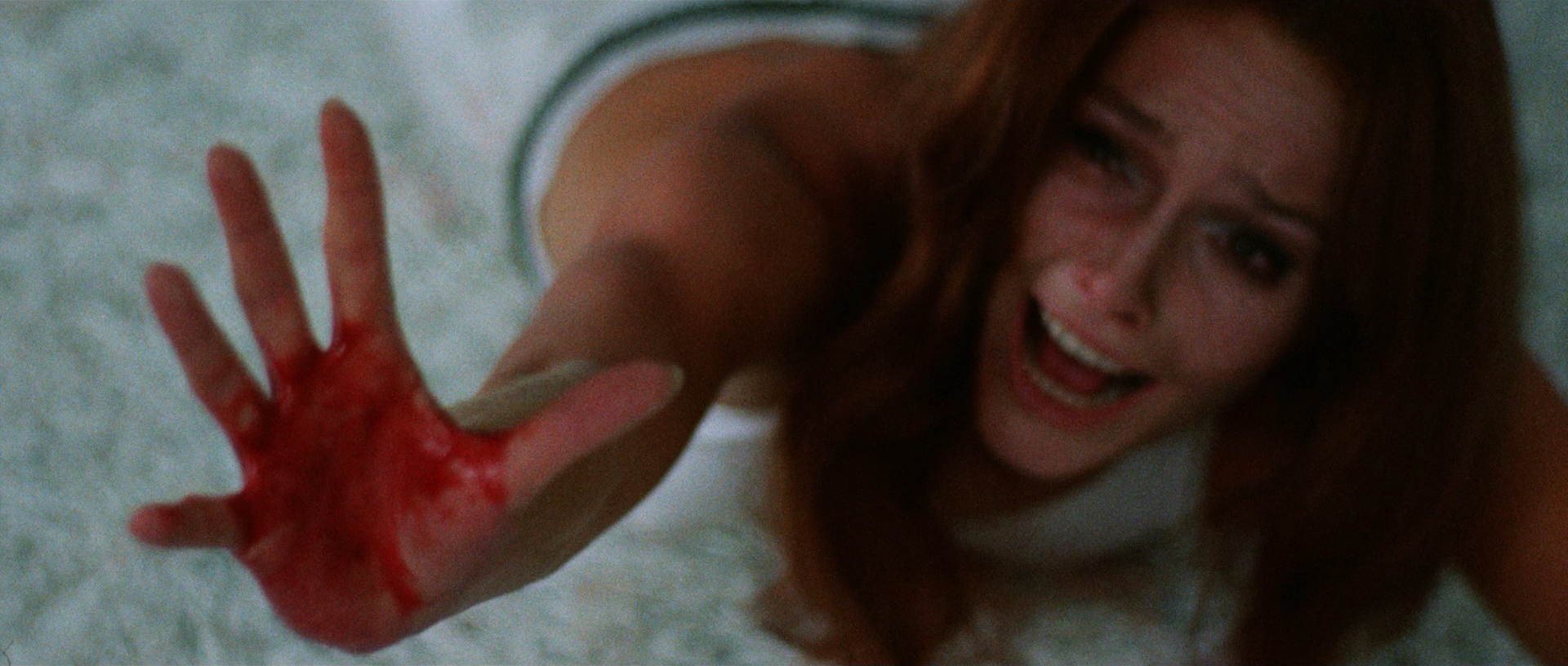
In this close-up, Monica’s hand reaches across much of the image. Her face and open mouth make a powerful appeal, while the pale ground gives the red palm a striking prominence. The image solicits a response before it supplies an explanation. Recognising that appeal does not make the wound unreal; it makes our inference about its cause open to revision.
Xavier Mendik’s study describes the final reclassification: Monica was attacking Alberto, her husband, in the gallery. It also traces the painting that reconnects her with an earlier assault and the closing explanation that she identifies with the aggressor represented there. Mendik reads the gallery through psychoanalytic accounts of spectatorship, sexuality and threat. Mendik, pp. 26–27 ↗
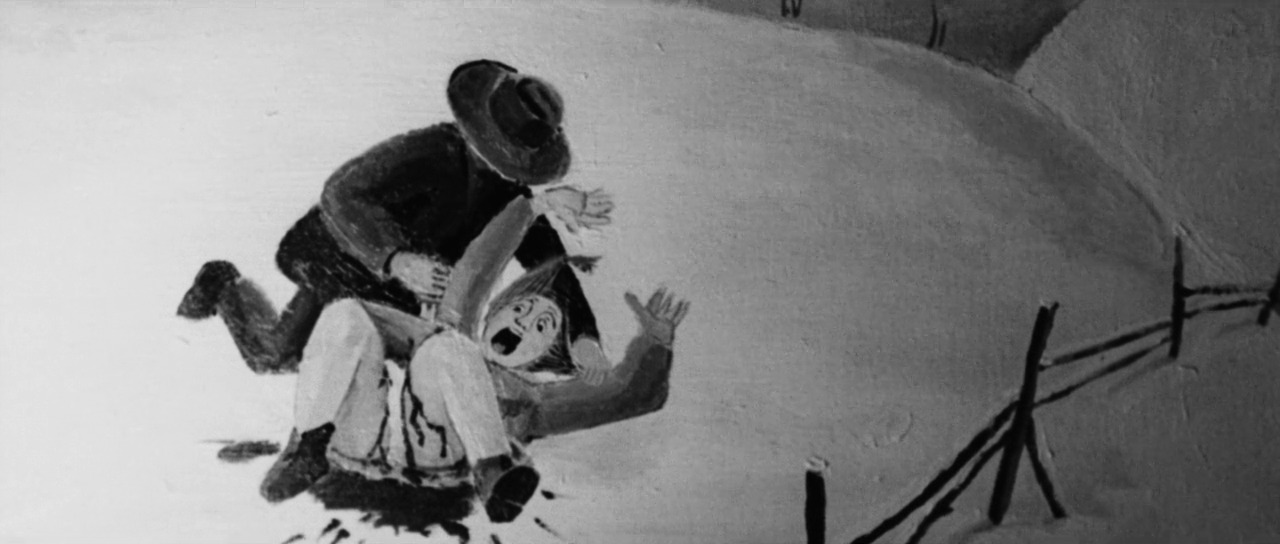
Our reading is that the painting and Sam’s memory form a troubling pair. Neither is a neutral container of information. Each image gains its force through the story attached to it, and each can be returned to without being understood in the same way. The painting is therefore more than a decorative clue: it makes interpretation part of the chain of events.
The reversal also deserves scrutiny beyond admiration for its ingenuity. Revealing a woman as the aggressor unsettles Sam’s assumptions, but the film’s explanatory language still binds female violence to a sensational account of trauma. Those two effects can coexist. Reading the ending critically means keeping its challenge to the witness alongside the limits of the explanation offered for Monica.
03 / A DEBUT & ITS COLLABORATORS
The first film did not begin from nothing.
Argento arrived at directing through criticism and screenwriting, including work with Bernardo Bertolucci on Once Upon a Time in the West. The BFI’s programme places his debut within an existing giallo tradition associated with Mario Bava, while recognising its role in expanding the genre’s audience. Calling it a beginning for Argento is more accurate than making it the invention of giallo. BFI: career and genre context ↗
The production was Italian–West German. Filmportal records Seda Spettacoli and CCC Filmkunst, producer Salvatore Argento and co-producer Artur Brauner, with filming in Rome and the I.N.C.I.R. studios from August to October 1969. Its record gives the Italian premiere as 19 February 1970 and the German title as Das Geheimnis der schwarzen Handschuhe. These are institutional catalogue records, not production files inspected here. Production and release record ↗
Vittorio Storaro’s cinematography, Franco Fraticelli’s editing and Dario Micheli’s design work deserve to remain visible within any account of an emerging directorial style. Filmportal lists Micheli under sets and costumes, with Anita Schwandt also credited for costumes. The BFI compilation uses set dressing and costume design for Micheli. We retain the difference in those labels rather than turn it into a verified hierarchy of responsibilities. Crew credits ↗Compiled credits ↗
This matters especially in a film where clothes, rooms and the arrangement of bodies carry the mystery. A viewer’s classification of danger is made through a collective construction. The director’s recurring themes do not erase the work that gives those themes a visible form.
Bava recognises an audience.
In Dario Argento Panico, Lamberto Bava recalls a telephone conversation between Sergio Corbucci and his father, Mario, after The Bird with the Crystal Plumage became successful. Corbucci raised its resemblance to The Girl Who Knew Too Much. In Lamberto’s account, Mario welcomed the audience Argento was bringing to the kind of cinema they valued. Panico: testimony and passage locators ↗
The remembered exchange gives the genre relationship a personal dimension. Alongside the BFI’s account of Argento building on an existing tradition, it places the debut’s success within a filmmaking community whose earlier work had helped make it possible.
04 / STORARO & THE POINT OF VIEW
A visual signature made under pressure.
In an interview conducted in 2018 and published by Revus & Corrigés in 2020, Storaro recalls being introduced to Argento by Goffredo Lombardo. He describes budget pressure from the production and says that he proposed filming murders from the killer’s viewpoint to reduce the number of setups. He also recalls disputes over camera placement and an exhausting shoot, while describing his lighting and composition as serving Argento’s vision. Storaro’s retrospective account ↗
This is a valuable account of a practical decision acquiring expressive force. Restricting the viewpoint can withhold the killer’s identity, put the audience in an uncomfortable position and economise on coverage at the same time. Production necessity and artistic purpose need not be separate explanations.
It is also one participant’s memory, recorded decades later. The specific claim concerns a proposal made in response to constraints. Fraticelli’s contribution to the eventual arrangement of images remains part of the history.
Argento, in the De Angelis interview, remembers arriving with storyboards and a shooting list. Read together, the accounts suggest planning followed by negotiation, rather than a choice between a fully predetermined film and spontaneous invention. The drawings, schedules and camera reports would tell us more about that process; their absence does not require us to choose a winner between the recollections. Argento on preparing the shoot ↗
A falling viewpoint returns in Cat
Discussing The Cat o’ Nine Tails in Nine Lives (12:20–13:19), Argento says he threw the camera to create the falling view and explicitly recalls having used the approach in The Bird with the Crystal Plumage. His comparison connects the two films through a practical way of making the viewpoint itself seem endangered. It does not establish that every fall shot used an identical rig or camera. Follow the account of the rooftop effects →
05 / BROWN, WALLACE & THE CREDIT RECORD
One film, two literary trails.
The literary attribution is less tidy than a single “based on” line suggests. The BFI’s compiled credits name Bryan Edgar Wallace, while separately identifying Fredric Brown’s The Screaming Mimi as an uncredited loose source. Filmportal likewise carries both names. The two entries preserve a distinction that a simplified credit would conceal. Literary credit entries ↗Source listings ↗
These records establish that the competing attributions circulate in institutional catalogues. They do not identify the supposed Wallace novel, explain the contractual arrangement, or prove what every territorial print displayed. Nor does the German co-production by itself settle the issue. Marketing identity, onscreen credit, legal rights and narrative borrowing are related questions with different kinds of evidence.
Arrow’s edition includes Kat Ellinger’s discussion of the Brown relationship, Black Gloves and Screaming Mimis. We therefore stop short of attributing an argument to Ellinger or presenting a scene-by-scene comparison with the novel. Located adaptation study ↗
The unresolved credit does not prevent a clear account of the film’s central operation. It does change how confidently we can describe its literary origin. A later comparison should examine what happens when an earlier story becomes this particular world of galleries, recorded evidence and unreliable seeing, as well as recovering how the adaptation was credited and sold.
06 / MORRICONE, NICOLAI & RECORDED EVIDENCE
Listening has to become interpretation too.
AMS Records describes Morricone’s score as alternating recognisable melodic material with abstract, modernist writing, connecting the latter to his experience with the Gruppo di Improvvisazione Nuova Consonanza. Its ten-track album listing places Piume di cristallo alongside titles such as Fraseggio senza struttura and Silenzio nel caos. AMS: score and album ↗
The contrast suggests a useful way to approach the film: musical familiarity can offer an apparent foothold while less predictable material destabilises it. That is a reading prompted by the label’s description. It should not be mistaken for a claim about exactly when a cue begins, which instrument produces a particular effect, or how a passage differs between language versions.
The credits distinguish Morricone’s composition from Bruno Nicolai’s musical direction. The BFI also records Alberto Bartolomei for mixing and Luciano Anzellotti for sound effects. Keeping these roles separate prevents “the soundtrack” from becoming an indiscriminate credit to the composer. Music and musical direction ↗Sound credits ↗
Sound also enters the detective story as evidence. Tim Dirks’s scene account identifies the bird call in a recorded telephone conversation as the clue that leads the investigation to the zoo and the nearby Ranieri apartment. A background noise becomes useful only when someone recognises its source. Recorded call and location clue ↗
That is an illuminating companion to the gallery. A recording can preserve information without explaining it. The film’s title points toward the eventual value of listening, but neither seeing nor hearing solves the case unaided. Finally, AMS’s stereo album presentation and Arrow’s mono film tracks are different objects: an album’s sound and running order cannot stand in for the film’s mix.
A framing dispute matters here because the gallery’s margins, divisions and figures belong to the argument. In 2014, De Angelis asks Argento about presenting Bird at 2:1 instead of 2.35:1. Argento describes that change as a joint decision with Storaro. The response establishes his stated participation in that later choice; it does not make the revised ratio evidence of the original theatrical presentation. The 2:1 discussion ↗
Record
What it specifies
What it cannot settle
Filmportal
35mm Techniscope, 2.35:1, mono; separately catalogued original, distribution and digitised versions.
Whether the listed durations describe cuts, speed differences or catalogue discrepancies.
2014 Argento interview
Participation with Storaro in a later 2:1 presentation.
A complete restoration history or a shot-by-shot account of the reframing.
Arrow UHD listing
Original-negative 4K restoration; 2160p Dolby Vision/HDR10; 2.35:1; Italian and English lossless mono.
Our own assessment of the disc, its grading, sound or supplements.
Arrow’s clearly identified UHD entry replaces the ambiguous format listing used in the first edition. Filmportal’s different version records remain a reason to check the underlying material, rather than derive a censorship history by subtracting one running time from another. UHD specifications ↗Version records ↗
The two ShotDeck frames retain their complete downloaded compositions at 1920 × 816 pixels. ShotDeck catalogue times provide locators for the two images. Frame provenance ↗
08 / 1970 & AFTER
Before the reputation became a monument.
Roger Ebert’s review, dated 14 October 1970, values the film’s suspense while distinguishing its comparatively basic scares from Hitchcock’s. He describes the audience straining to see into dark spaces and singles out Giulia’s isolation during the attack on the apartment door. His account locates the film’s force in anticipation and helplessness rather than in violence alone. Ebert’s contemporary review ↗
The Monthly Film Bulletin review from November 1970, reprinted by the BFI, is also favourable but qualified: it praises the camerawork, performances and Morricone’s contribution while acknowledging plot weaknesses. These are two contemporary responses, not a representative survey of the Italian, German, British and American releases. Contemporary review ↗
Read beside the gallery, that reception gives helplessness a wider reach. Sam cannot get through the glass; the audience cannot enter the apartment to protect Giulia. The film’s spaces organise the distance between knowing there is danger and being able to do anything about it. Critical attention to suspense brings Kendall’s endangered character into an account too easily dominated by the final solution.
The return to the gallery ends with Sam immobilised beneath a sculpture, as the BFI account notes. Our reading is that a room first presented as a place to look becomes a mechanism acting on the spectator’s body. Art has moved from setting and clue to threat. That connection makes Bird a productive companion to Deep Red’s misread image and Opera’s captive spectator, while keeping this debut’s own construction in view.
THE BIRD WITH THE CRYSTAL PLUMAGE / VISUAL STUDIES
Look again.
A face. A room. A clue. An image given the wrong meaning.
The enquiry moves through glass, photographs, paintings and recordings. Follow its changing viewpoints in these scene studies, then open the sequence galleries to see how anticipation becomes violence.
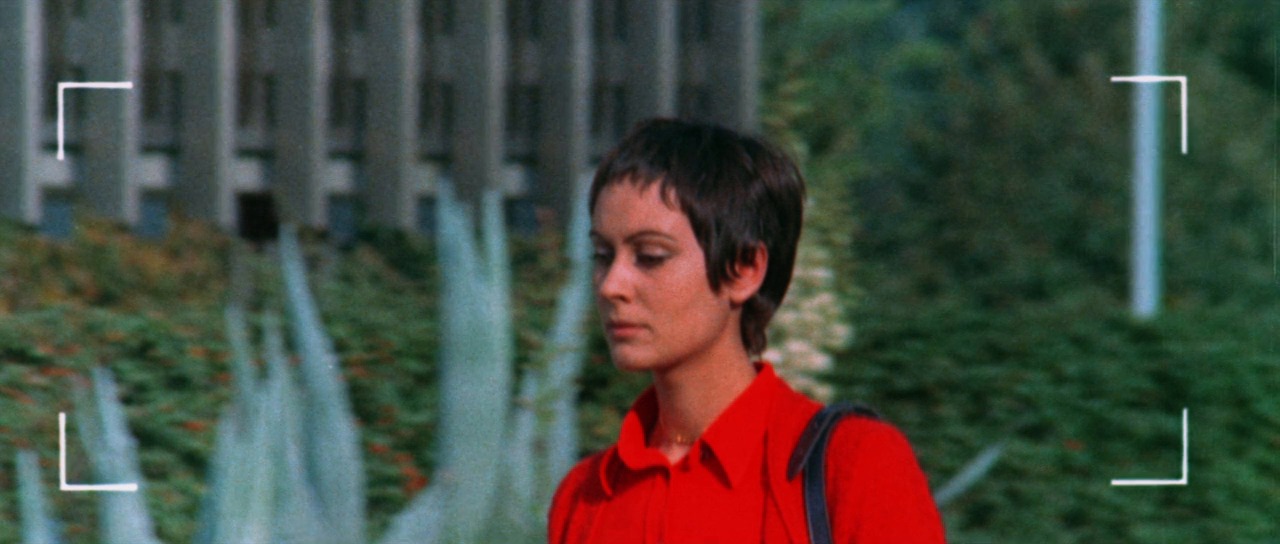
The opening surveillance reduces a woman in the street to an image that can be selected and retained. A viewfinder supplies its own frame inside the film’s frame. Before Sam appears as the principal witness, looking is already an activity with an unseen purpose.
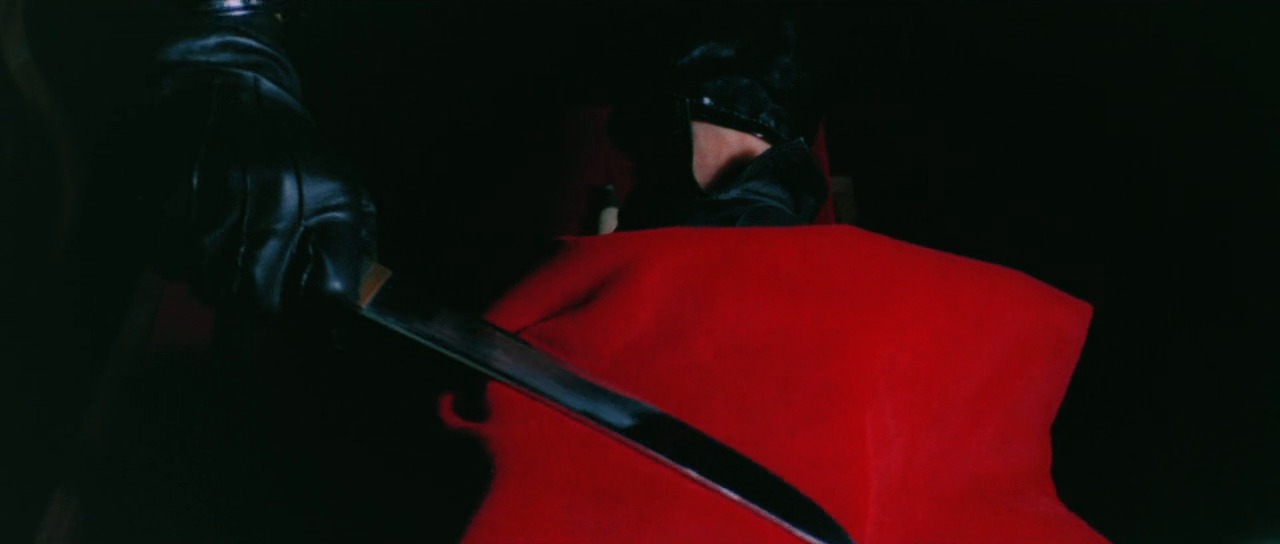
ENLARGE ↗Black gloves arrange a blade on red cloth.
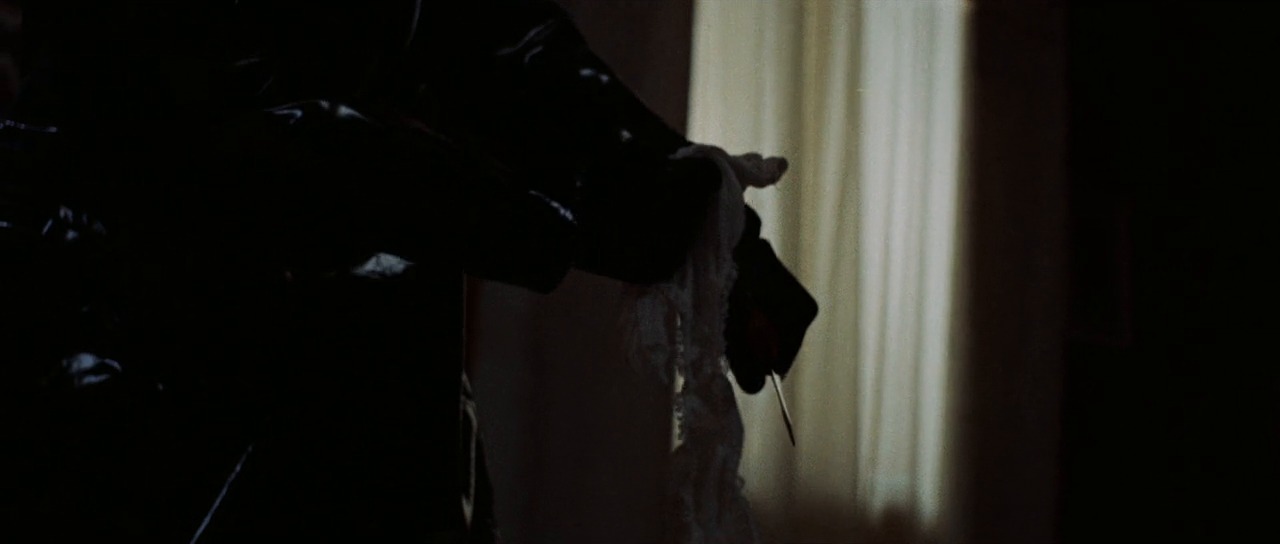
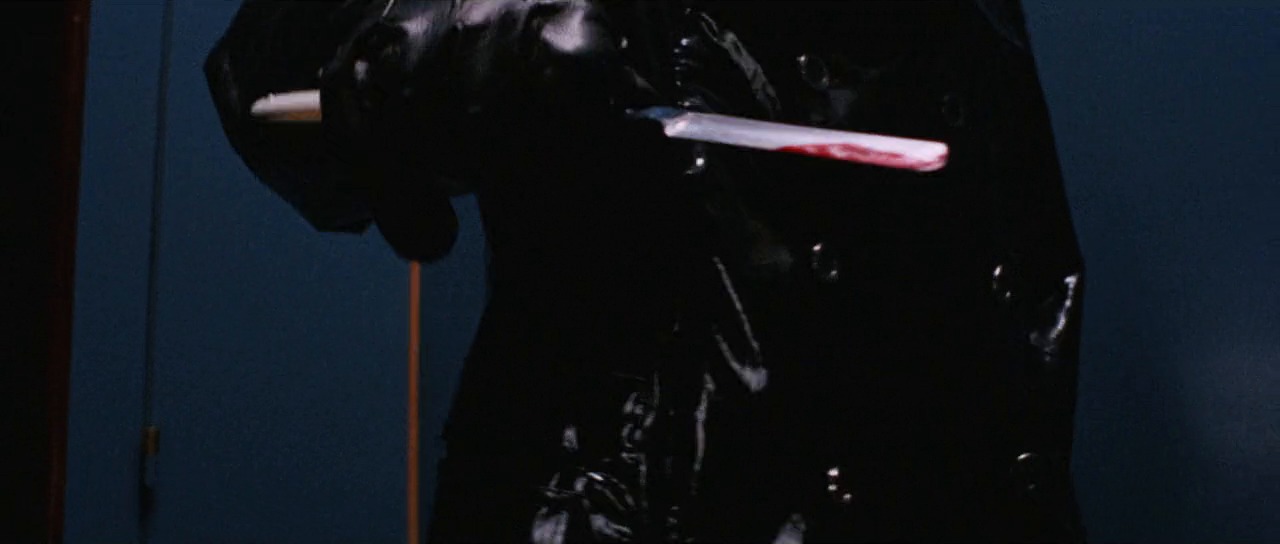
The gloves and polished blades are presented as a collection of objects. Their orderly arrangement gives menace the appearance of preparation. These details establish a recognisable figure without providing a recognisable face: the costume becomes an identity that the investigation will have to question.
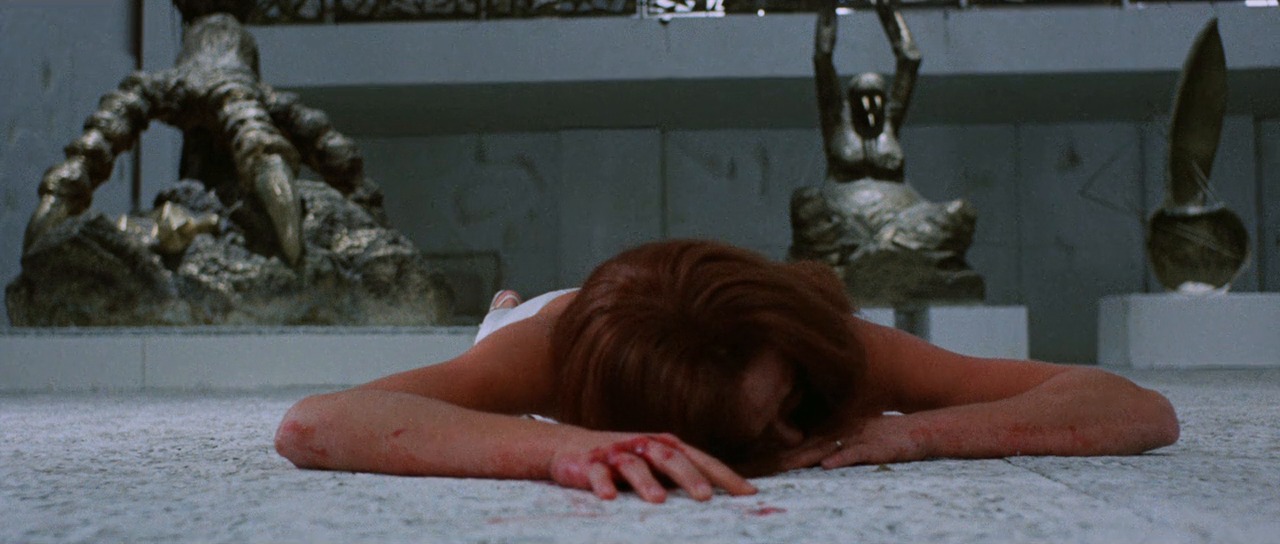
ENLARGE ↗Monica lies among the gallery sculptures.
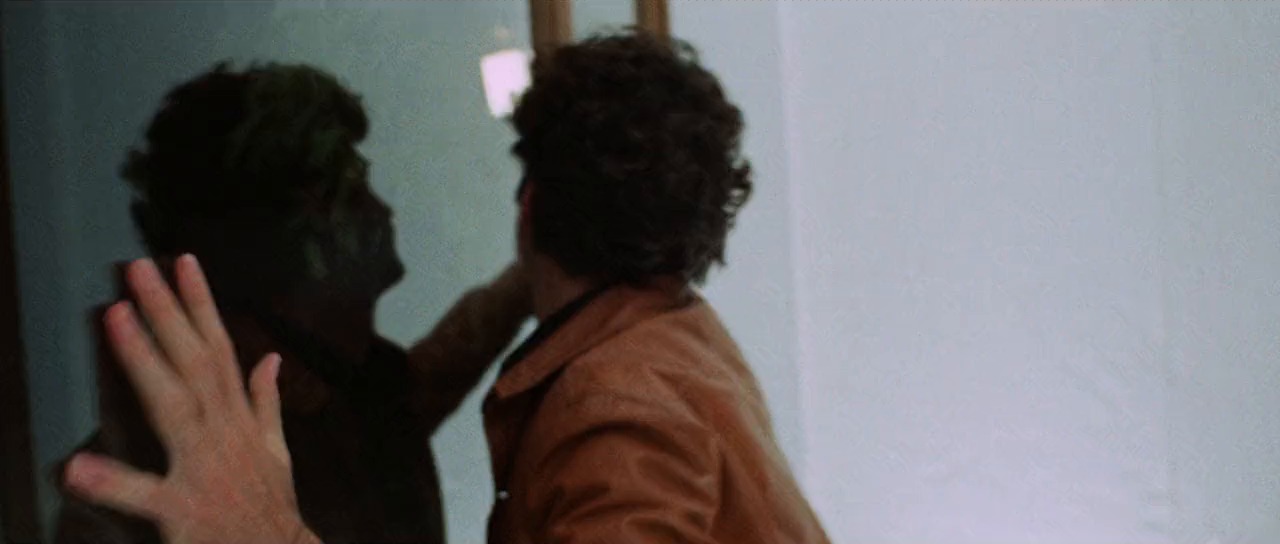
The brightly lit gallery seems to offer an unusually complete view. Yet the struggle is small and distant, while the doors become another obstacle once Sam tries to help. The scene keeps moving between the room as a whole, Monica’s wounded body and Sam’s powerless gestures. Visibility does not give him either access or understanding.
Questioning moves Sam from the street into the police’s system of evidence. The man who wants to report what he has seen must also submit himself to inspection. The procedural spaces replace the gallery’s sculptures with desks, forms and equipment, but they retain its question: what can a witness reliably establish?
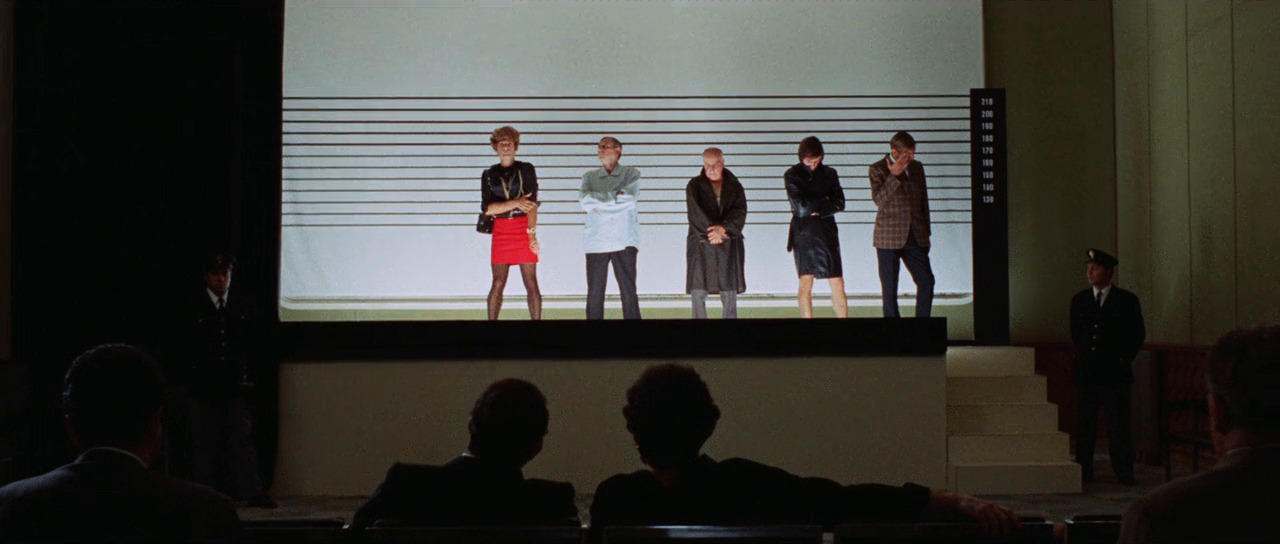
The lineup turns human figures into a row of candidates. Sam is asked to recognise something, but the film has already shown the uncertainty of his original encounter. Putting faces in a clear line does not resolve the ambiguity of the distant figures in the gallery.
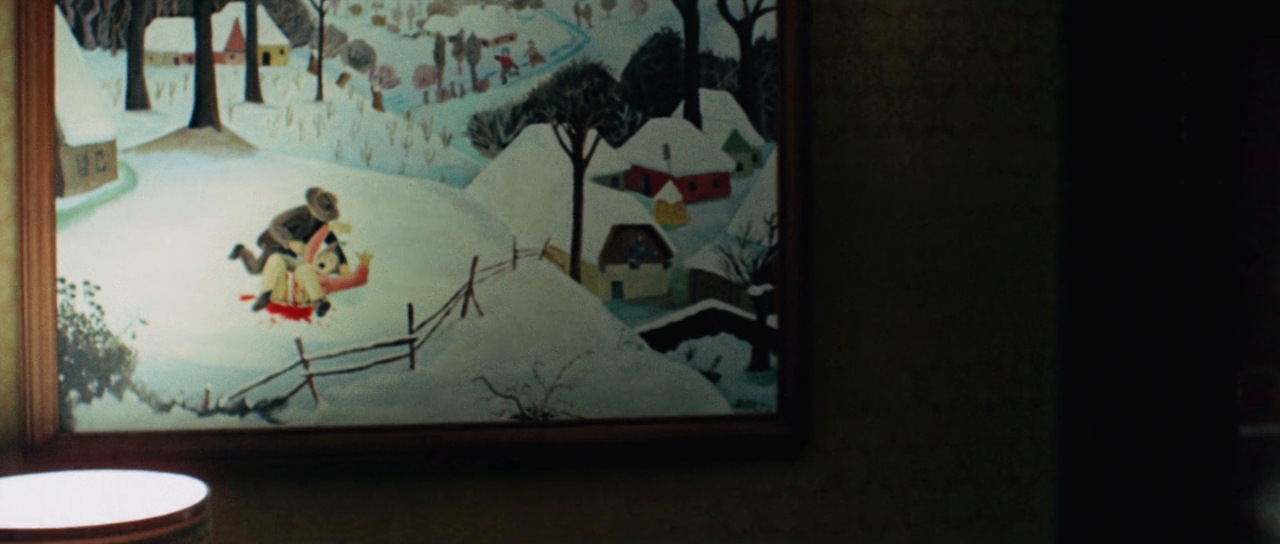
ENLARGE ↗A painted assault becomes an investigative clue.
Sam’s enquiries about a murdered woman lead through an antiques shop to a painting. Once its reproduction is pinned inside the apartment, the investigation acquires an image that can be revisited at leisure. Its significance comes from the history attached to it, rather than from discovering an object hidden in the picture.
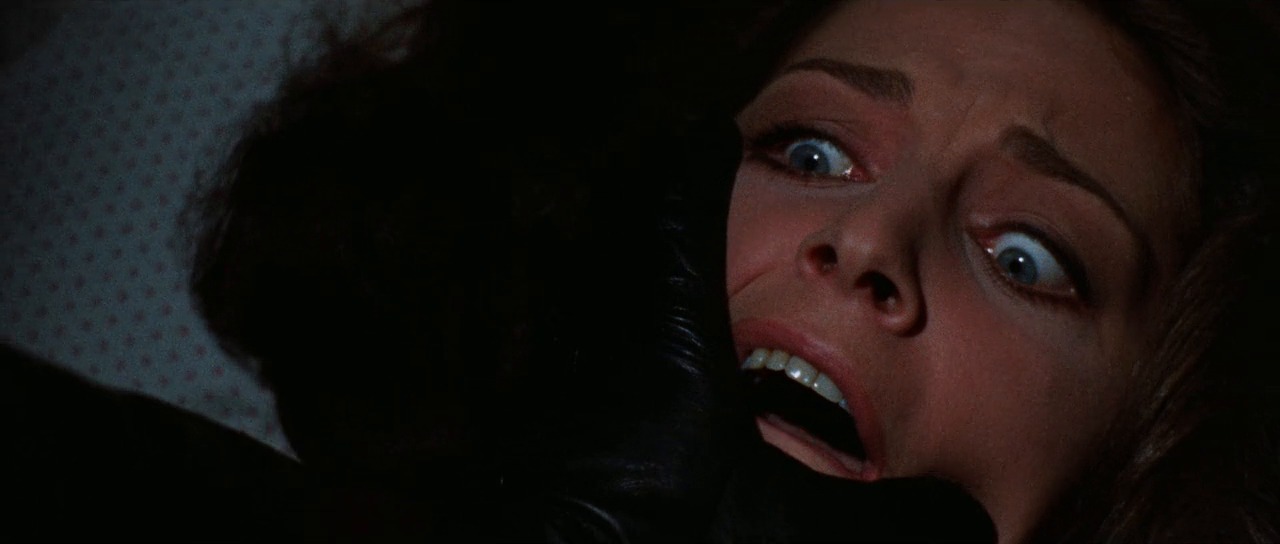
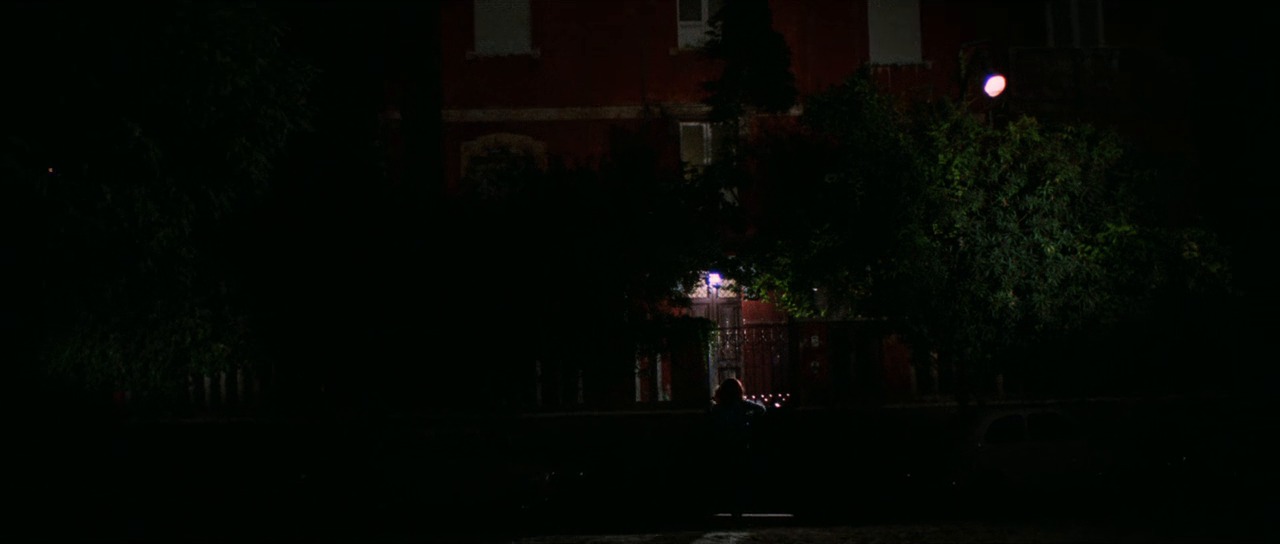
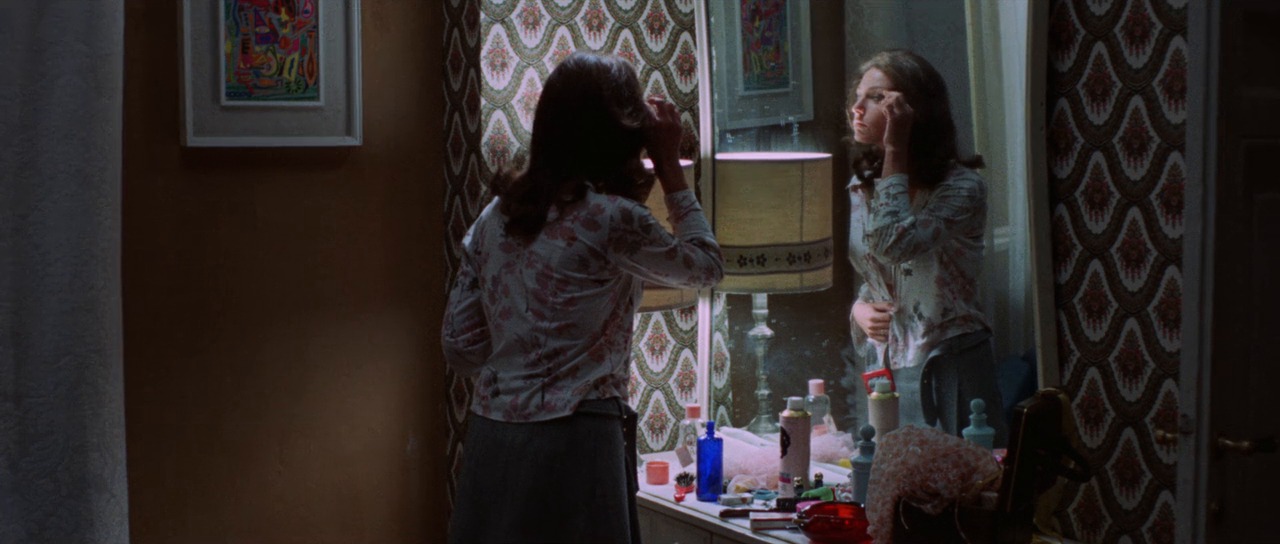
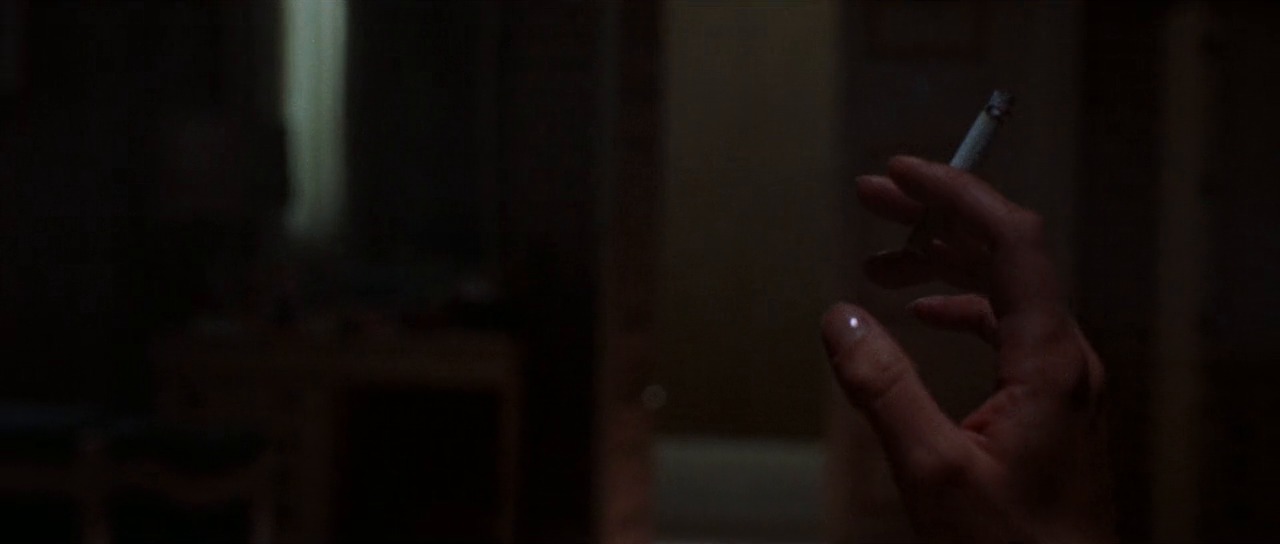
The sequence begins outside, with a lit window suspended in a dark building. Inside, an ordinary bedtime routine makes the doorway and the space beyond it increasingly important. The attack breaks that arrangement into fragments: face, gloved hand, blade and the hand tightening on the bedspread.
ENLARGE ↗A recorder sits between Sam and the inspector.
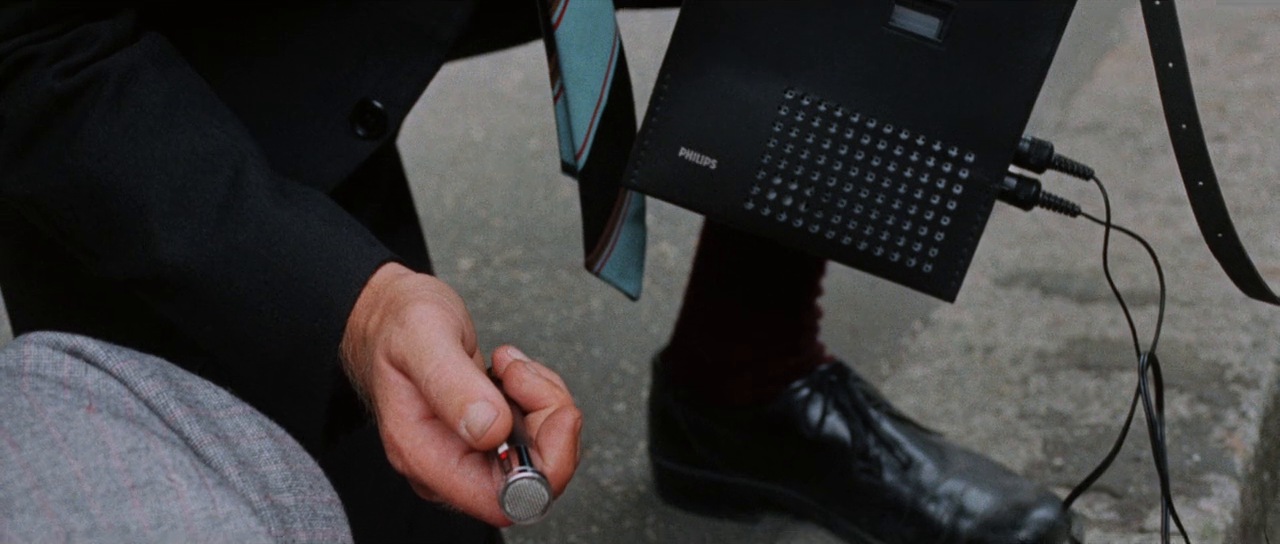
The telephone threat is brought into another kind of frame: a recording that can be examined. The machine occupies the shared space between witness and investigator. Like the remembered gallery scene, preserved information can be returned to without immediately yielding its meaning.
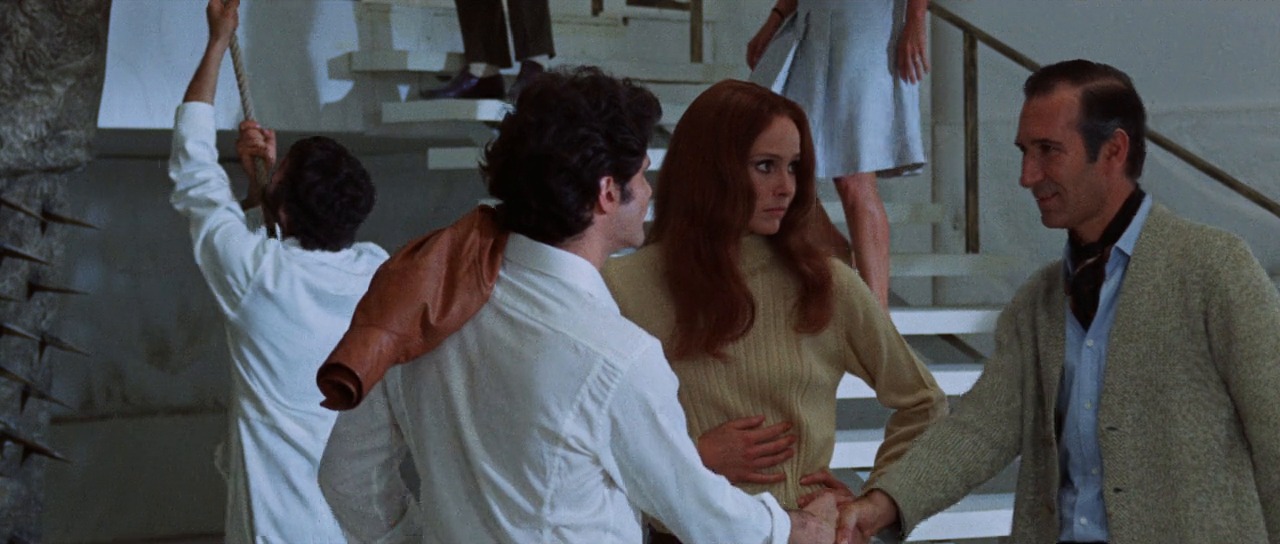
ENLARGE ↗Monica greets Sam as the gallery is rearranged.
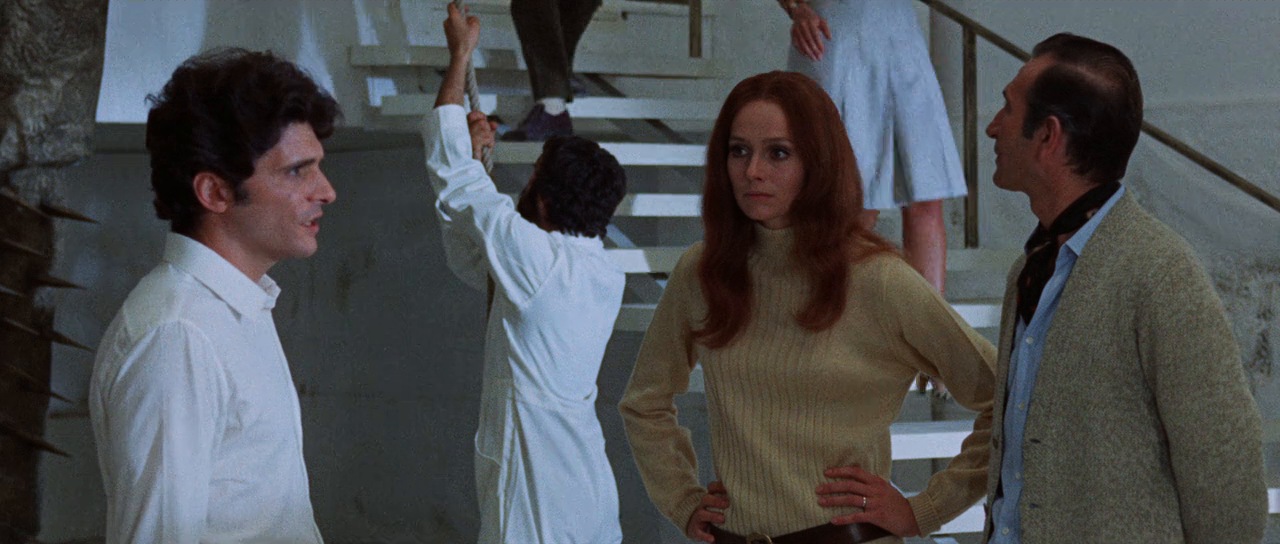
The gallery visit shows a familiar room being prepared for another exhibition. Monica thanks Sam, reinforcing his understanding of the first encounter as a rescue. Around them, workers handle the sculptures: the conversation about their position and weight gives ordinary gallery business an ominous significance when the room returns in the climax.
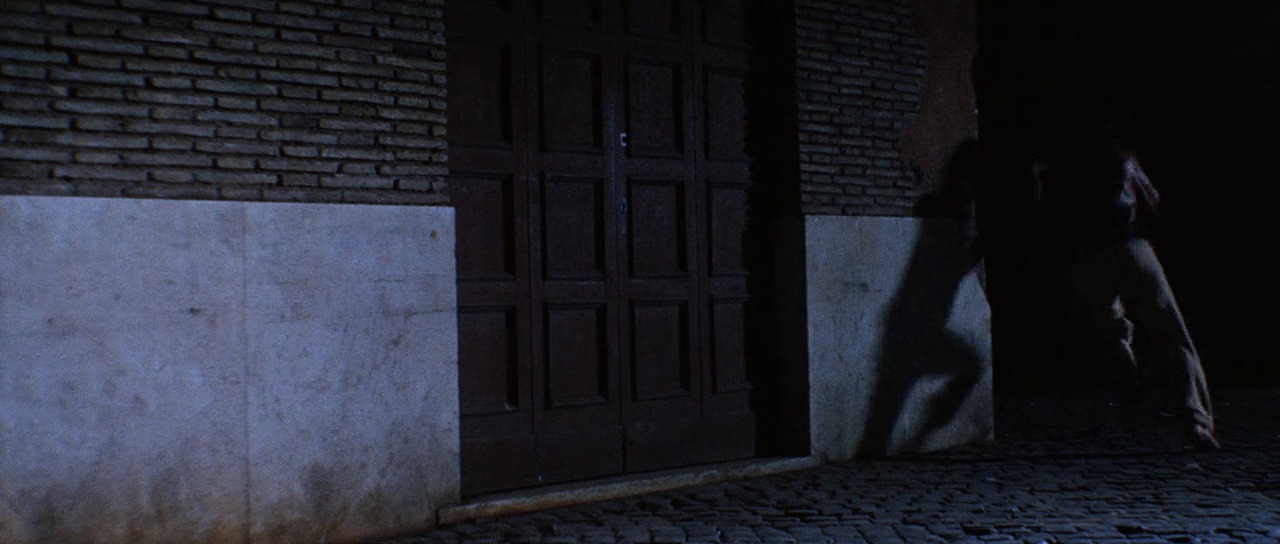
ENLARGE ↗Sam grapples with an attacker in the street.
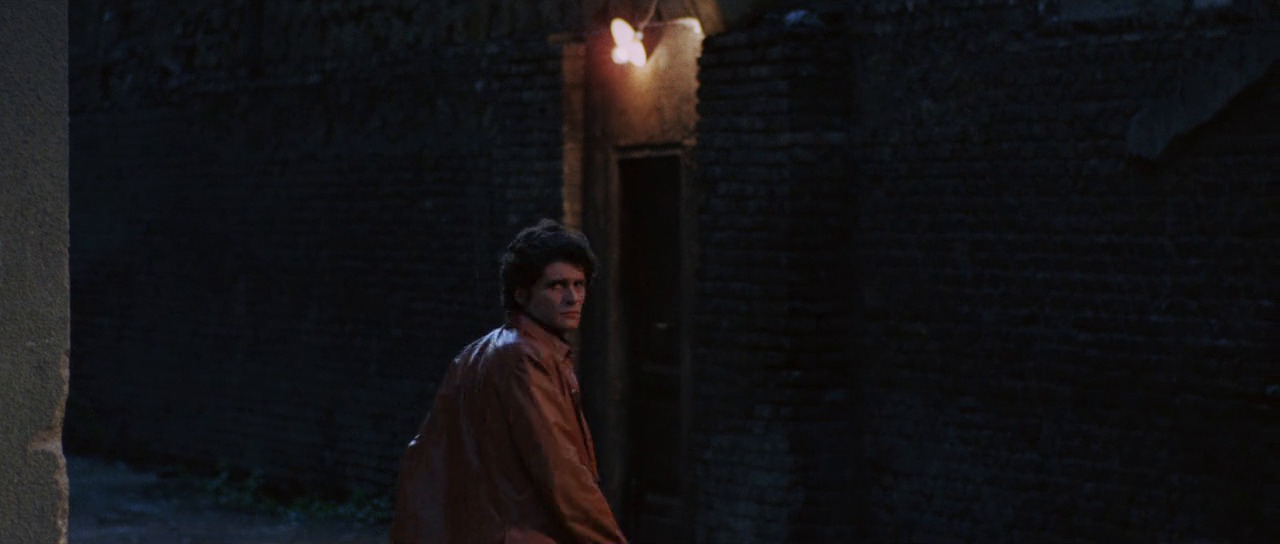
Sam’s search makes him a target. The night street offers walls, cars and recesses in which the pursuer and the pursued can vanish from each other’s sight. The action converts the problem of incomplete knowledge into a physical contest over where a body can hide.
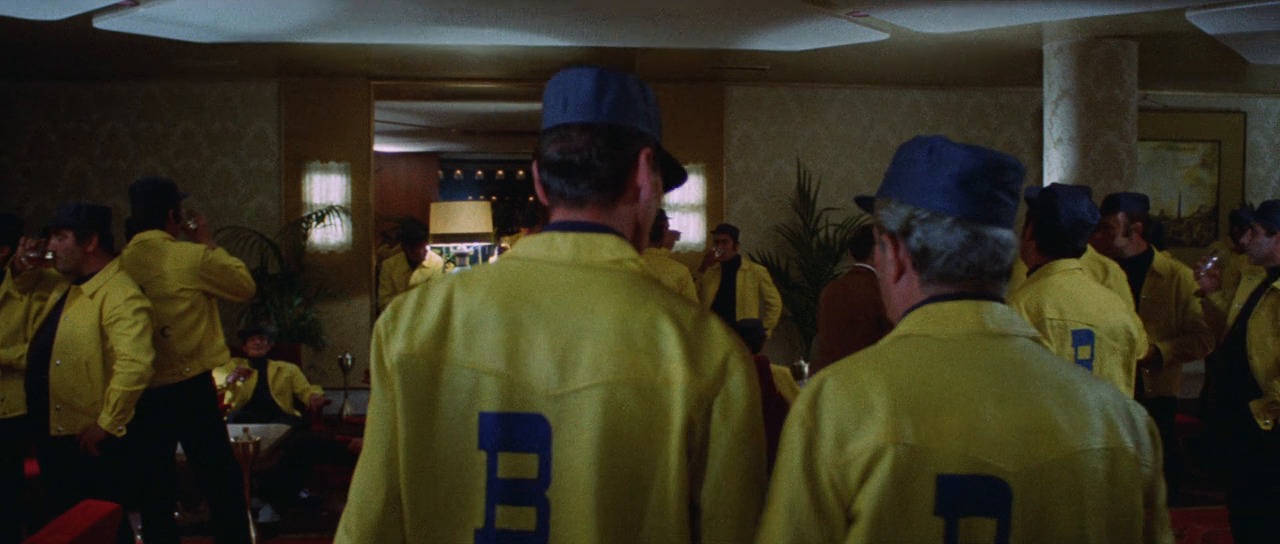
ENLARGE ↗Yellow jackets and blue hats fill the room.
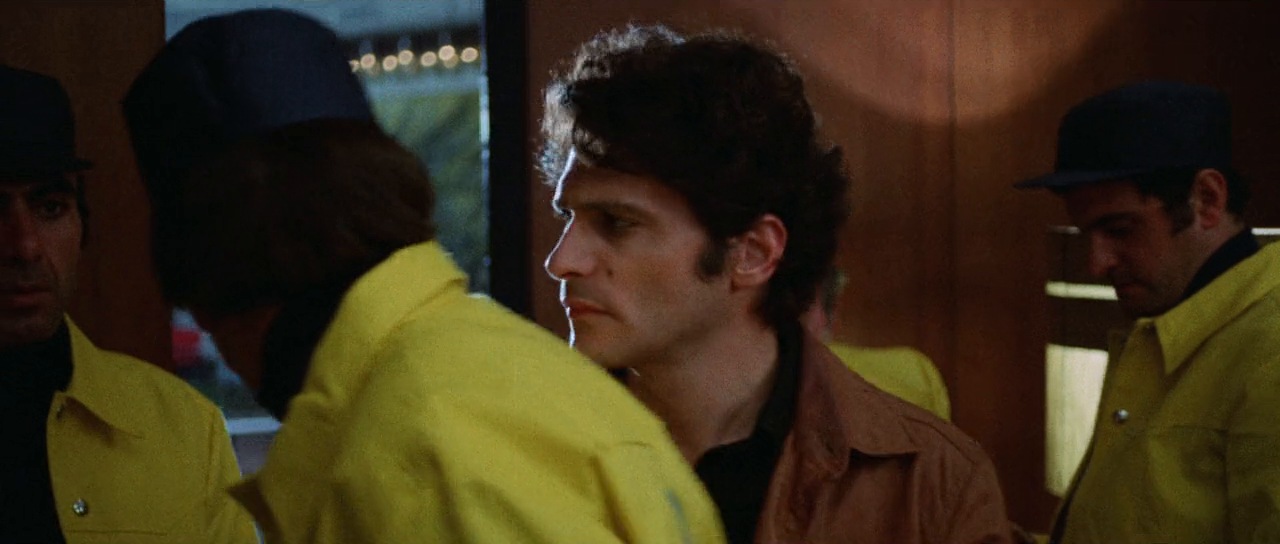
A distinctive outfit should make a man easy to follow. The room full of matching jackets and hats turns that expectation into a joke at Sam’s expense. Identification fails through repetition: an apparently useful visual sign becomes useless when almost everyone carries it.
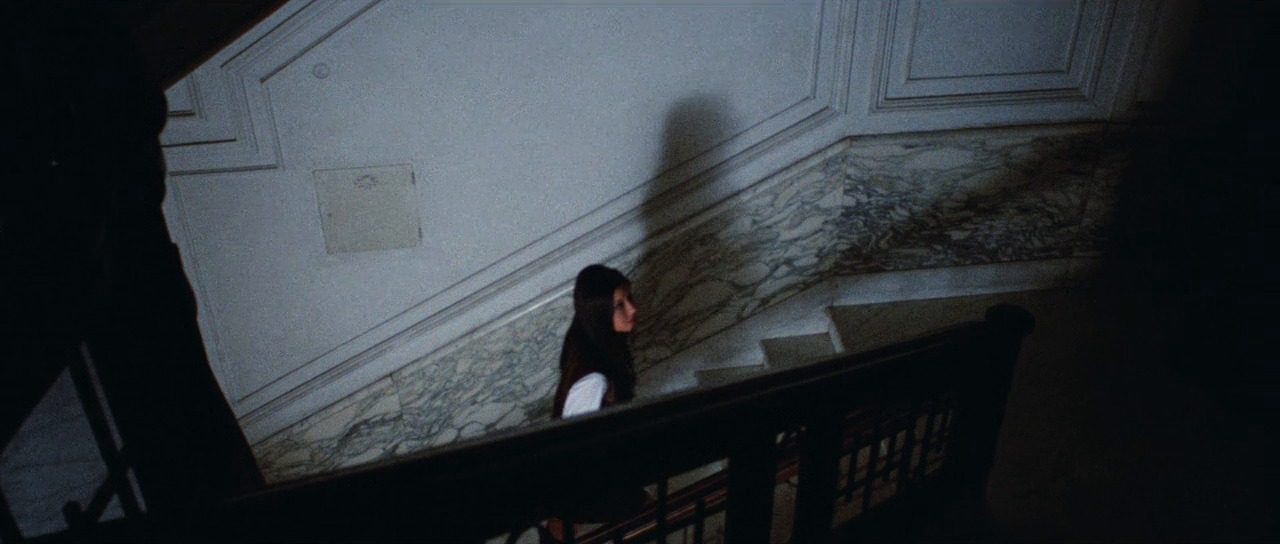
ENLARGE ↗The staircase folds around an ascending figure.
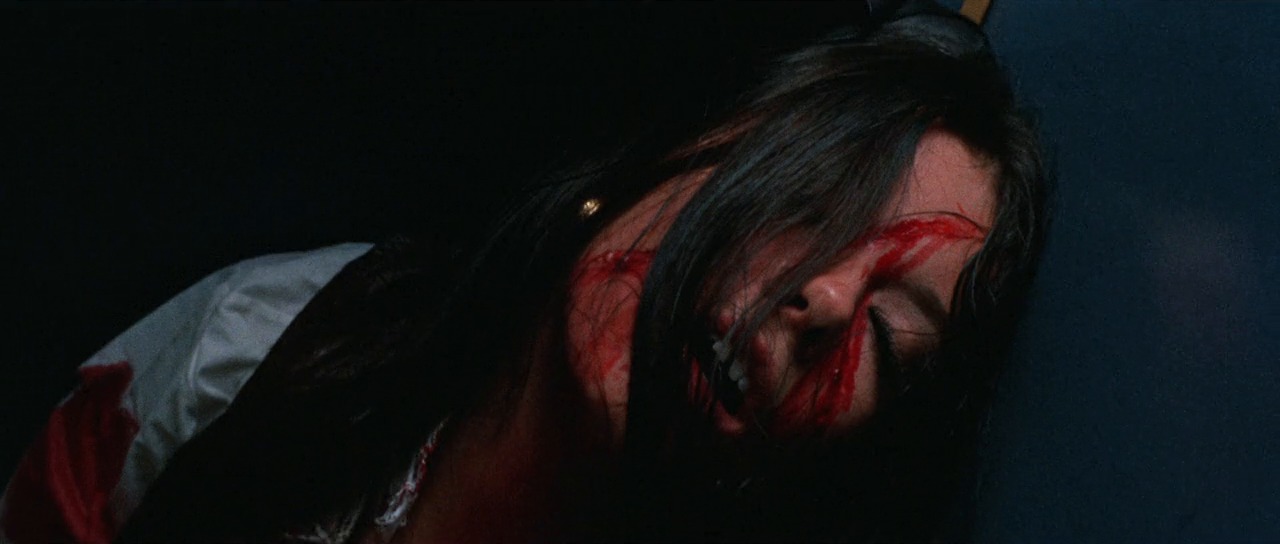
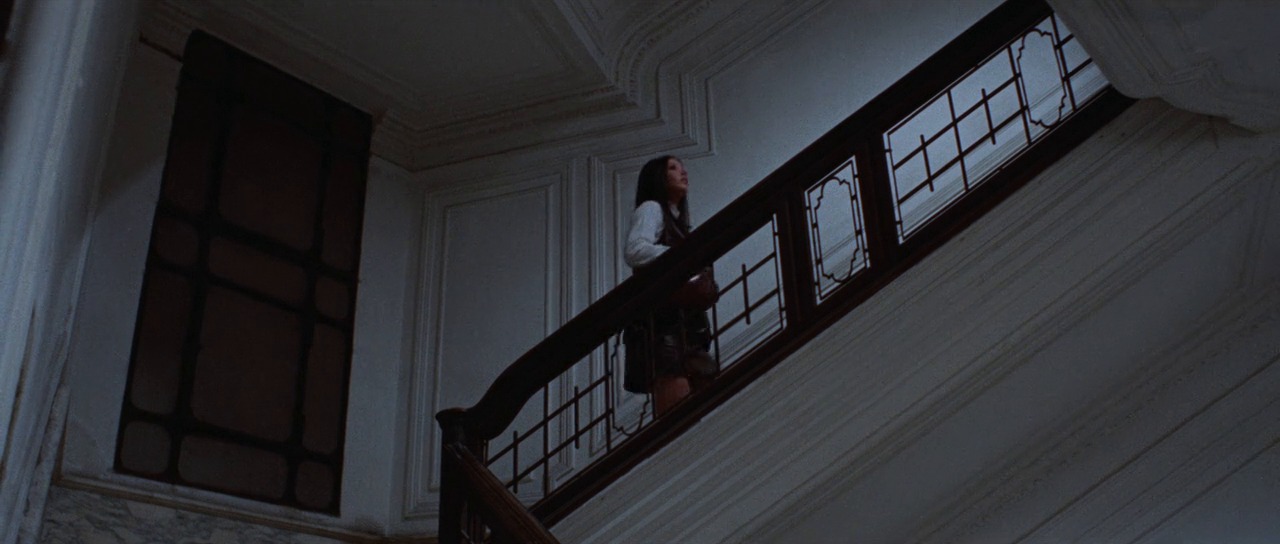
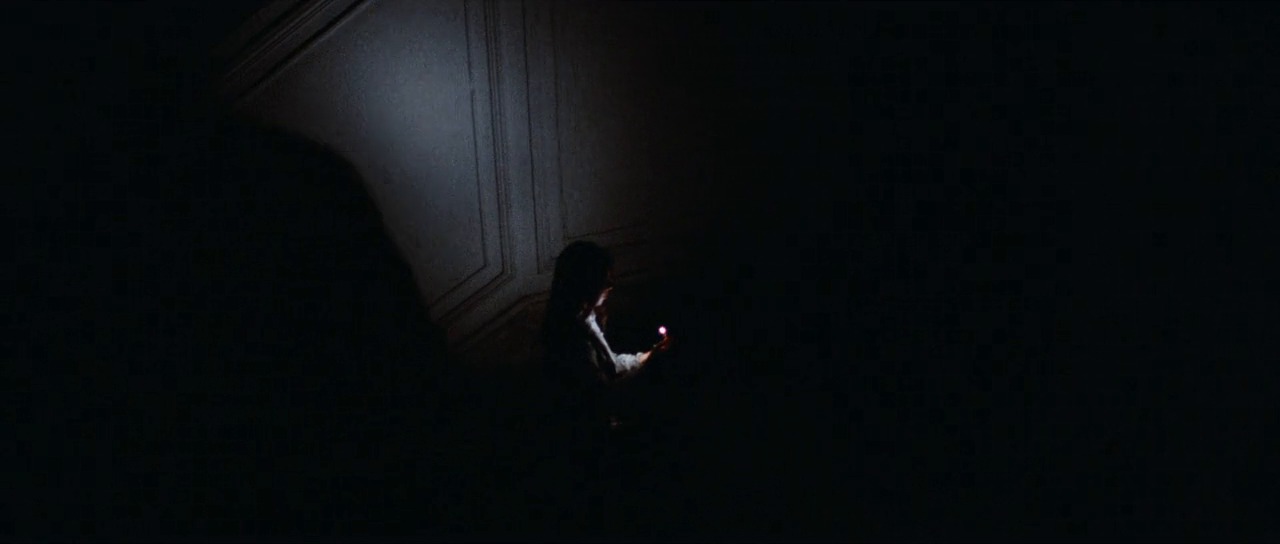
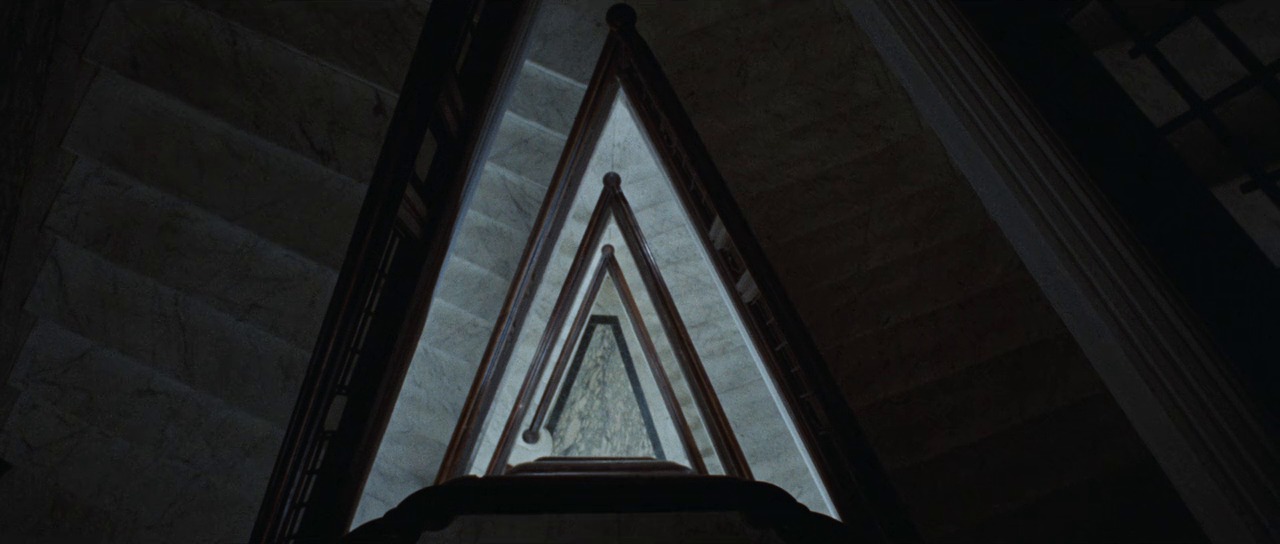
The ascent first offers strong lines and successive landings. High and low viewpoints make the staircase readable as an architectural structure. Darkness then removes that overview; the woman’s isolated face becomes the remaining point of orientation before the blade and blood arrive in abrupt details.
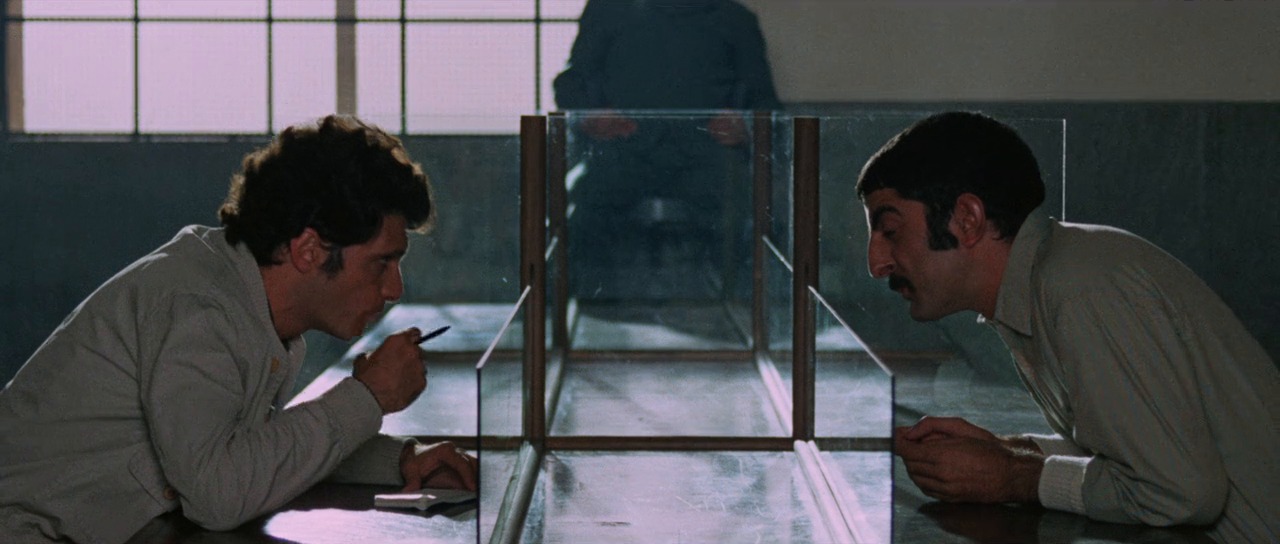
ENLARGE ↗Sam questions a man through the visiting-room glass.
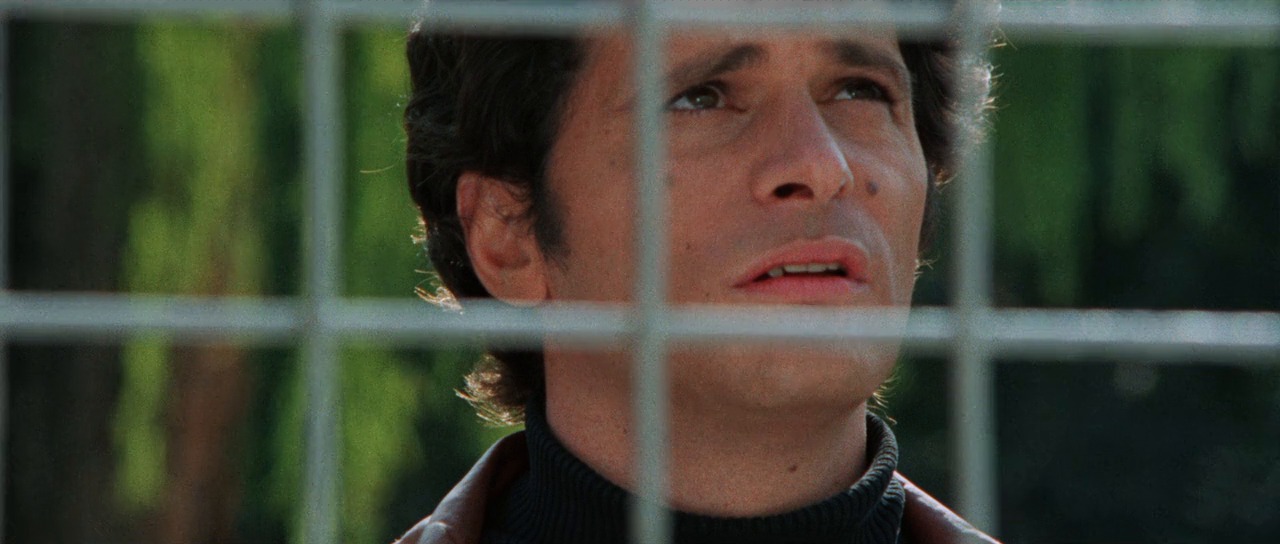
The visiting room gives a procedural form to the opening’s barrier. Two people can face one another while a pane separates their bodies. Sam has moved from appealing through glass to conducting an enquiry through it; the motif follows him beyond the art gallery.
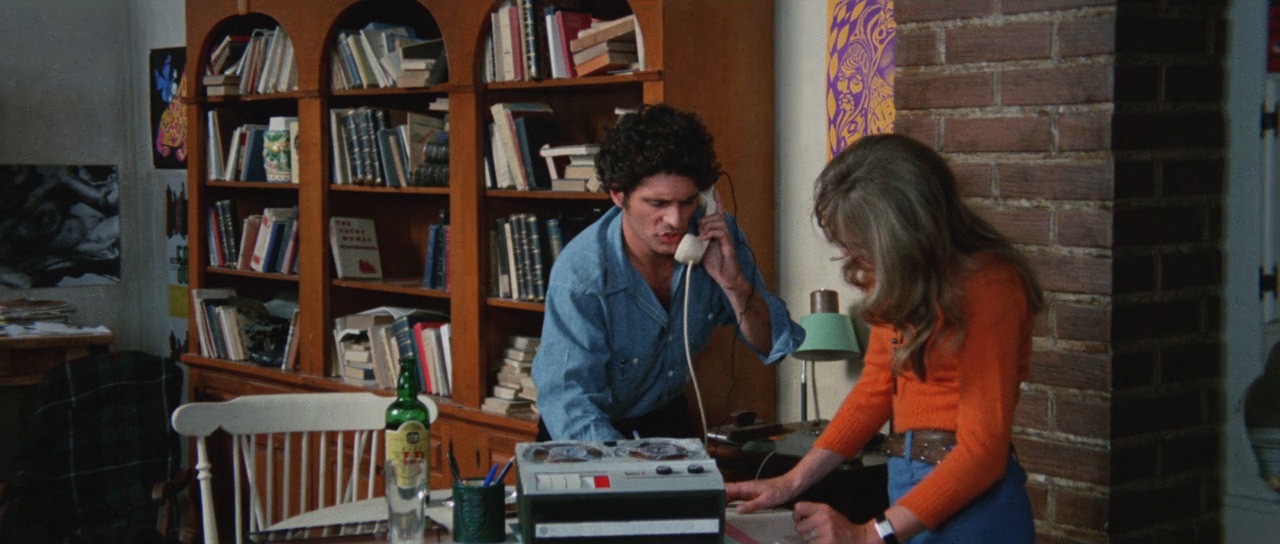
Telephone, recorder and listeners reorganise the domestic room around a threat from elsewhere. The caller cannot be located by looking into the apartment. This is a different version of the gallery problem: the evidence is present, but the source of the action lies outside the available view.
ENLARGE ↗Laboratory equipment gives the recording a visible trace.
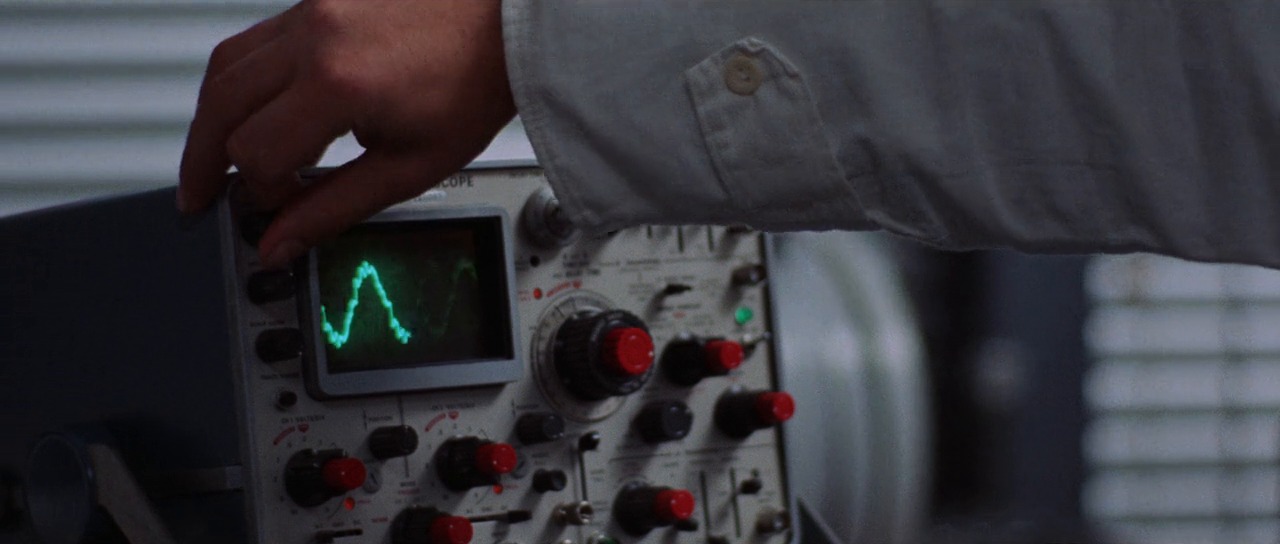
The laboratory replaces the intimate arrangement of the apartment with equipment, operators and controlled playback. The recording is treated as something that can be separated into useful components. The later bird clue will reconnect that abstract investigation with an actual place in the city.
ENLARGE ↗Sam visits the painter’s cluttered retreat.
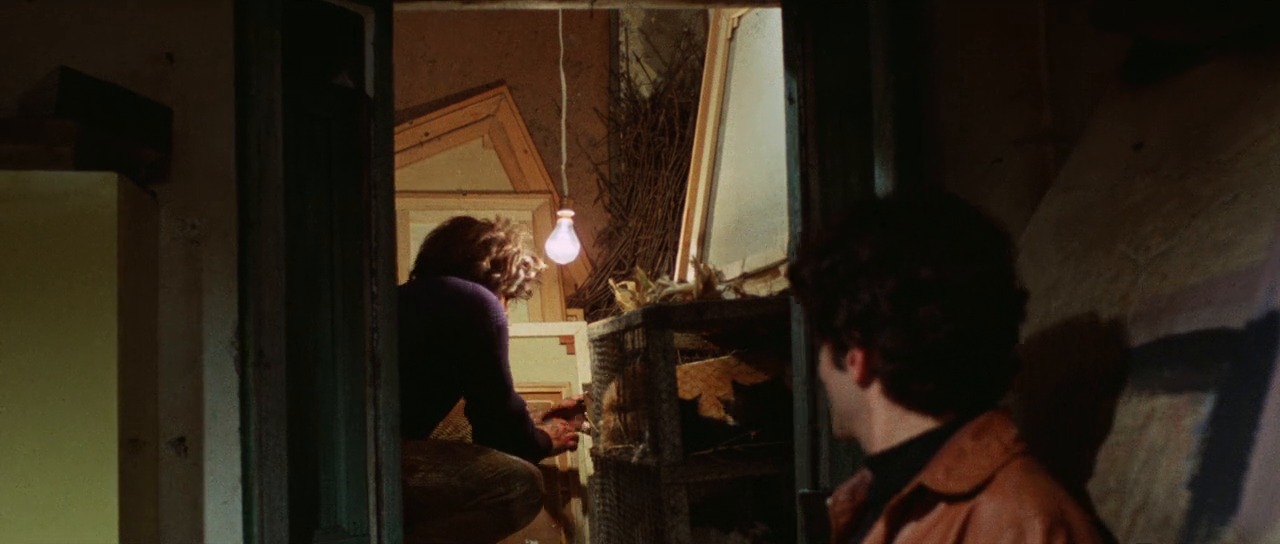
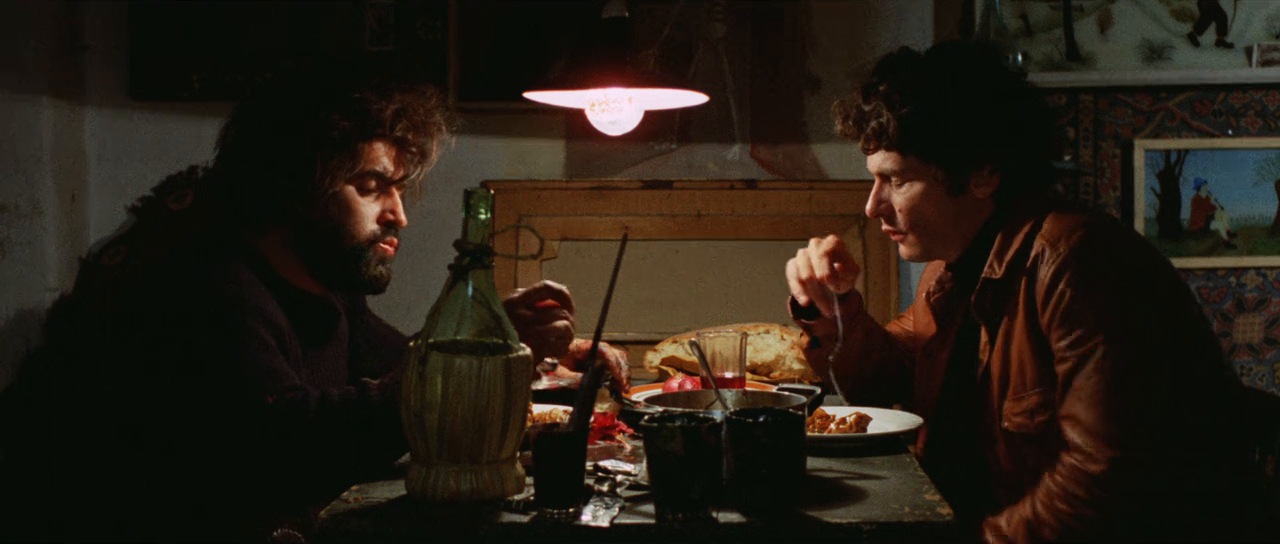
Sam’s visit to the painter carries the investigation into an eccentric domestic world reached by ladder. The meal and conversation interrupt the police film’s orderly procedures. The painting’s maker offers a history for the image, while the setting gives that information a comic and disconcerting frame of its own.
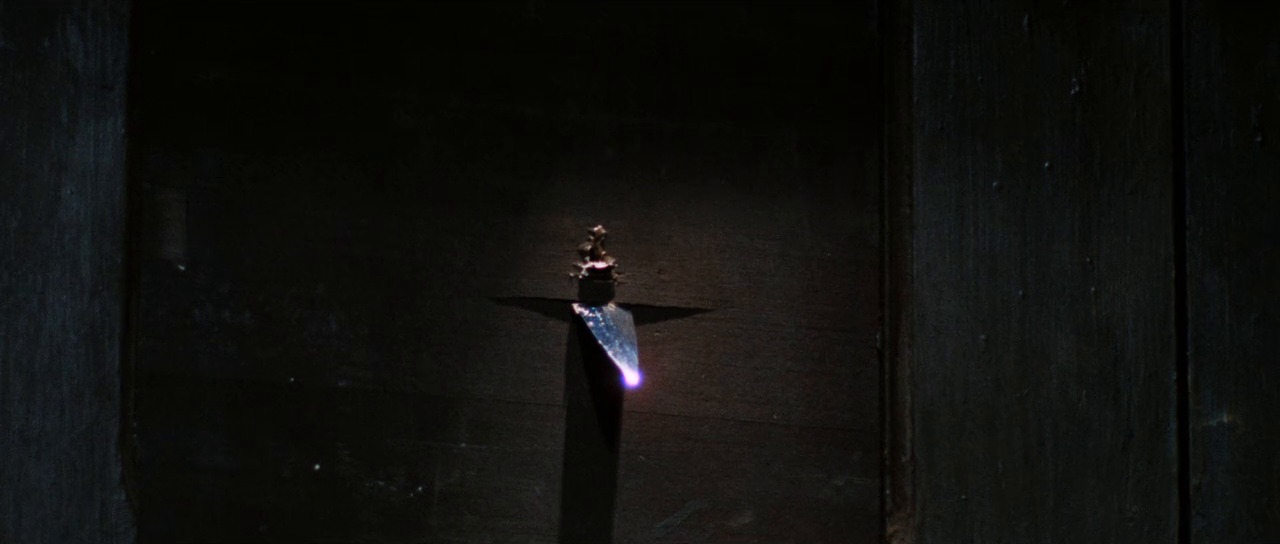
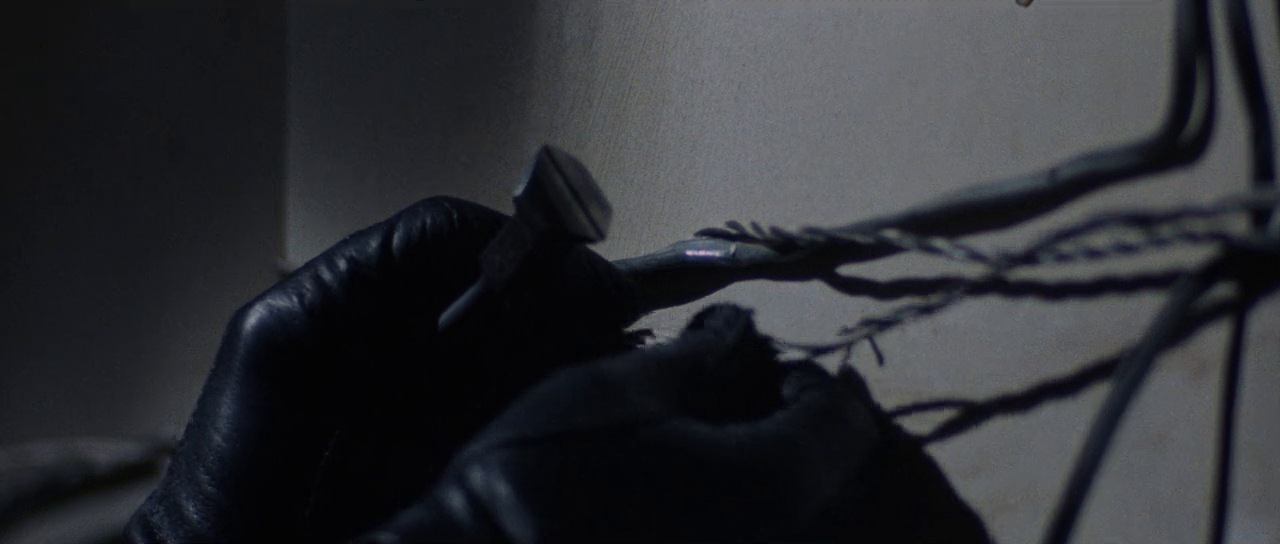
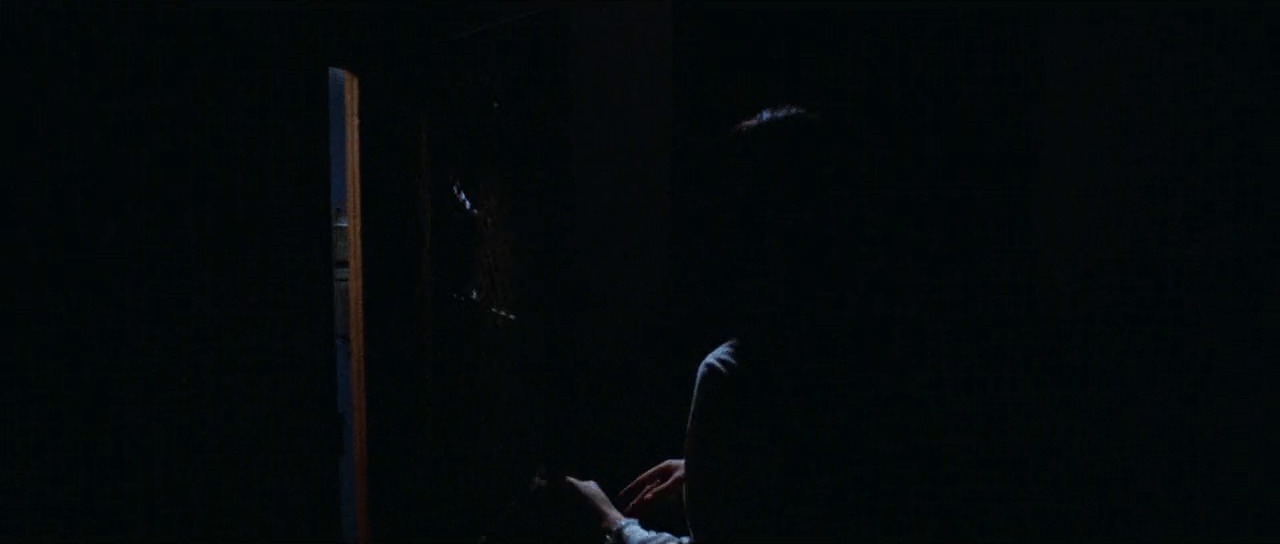
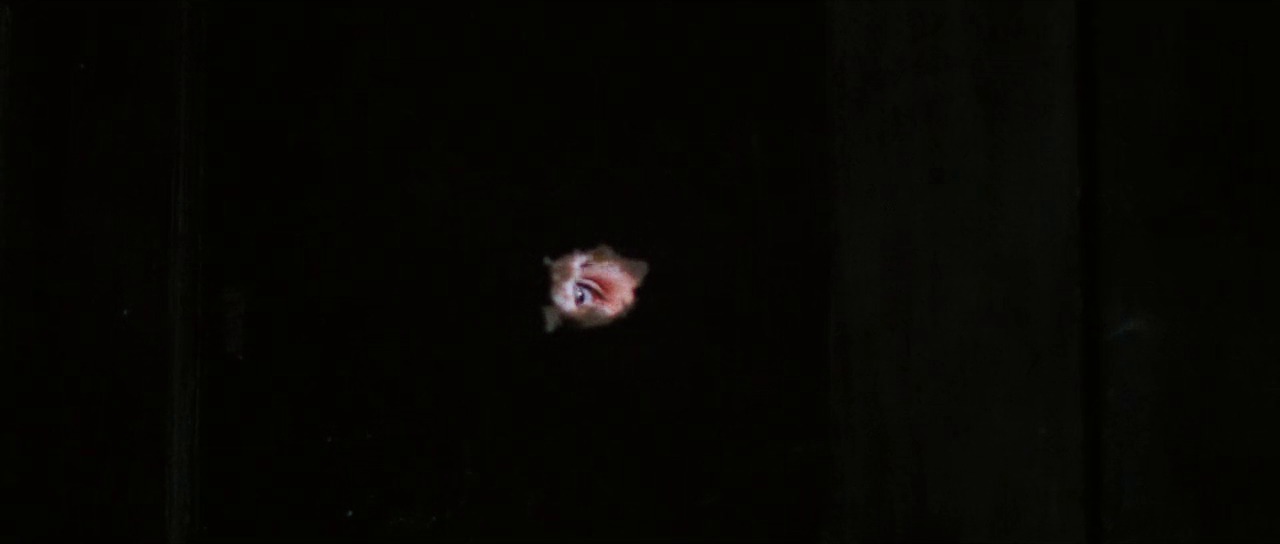
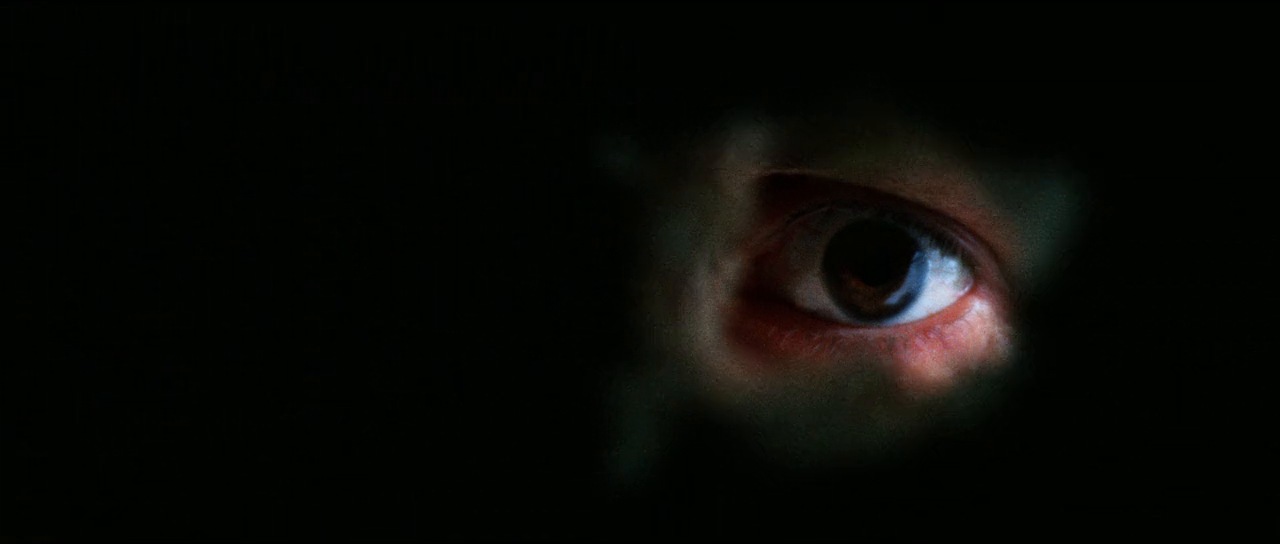
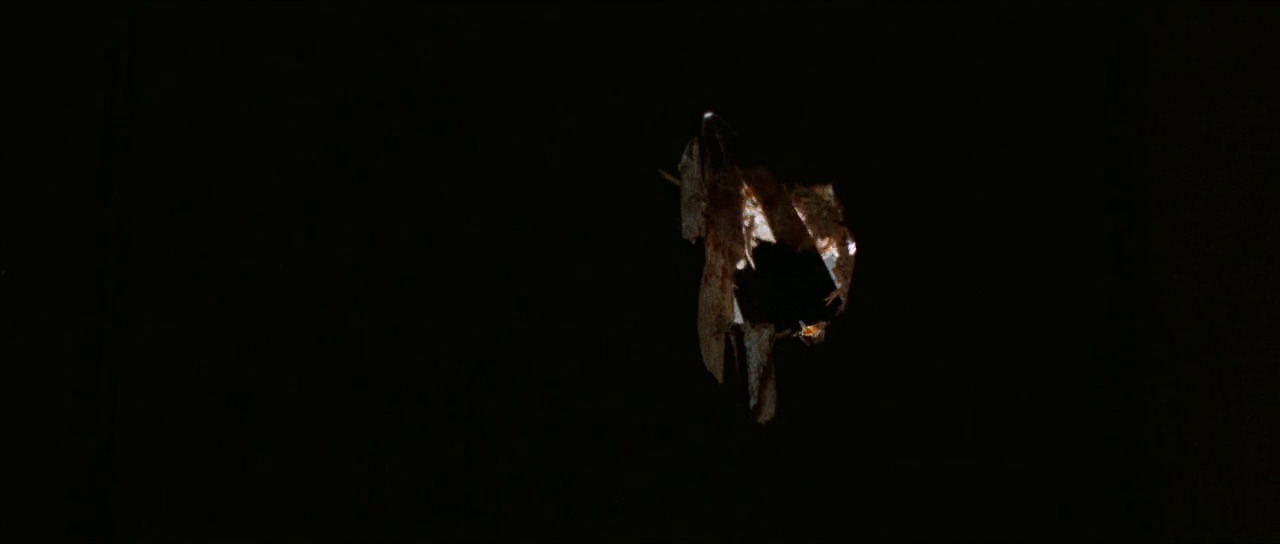
With Sam absent, the apartment becomes a sequence of failed exits and weakened boundaries. The telephone and window offer no simple release. A small puncture in the door then concentrates the threat: darkness, a blade and an eye replace the open room, making the barrier itself the centre of the action.
ENLARGE ↗Sam looks from the zoo toward the nearby building.
The enquiry reaches the zoo, and Sam connects the bird with the Ranieri apartment. The visual route makes the sound clue spatial: cage, adjacent building and remembered telephone position form a relation that the laboratory alone could not provide. An apparently incidental background detail redirects the whole investigation.
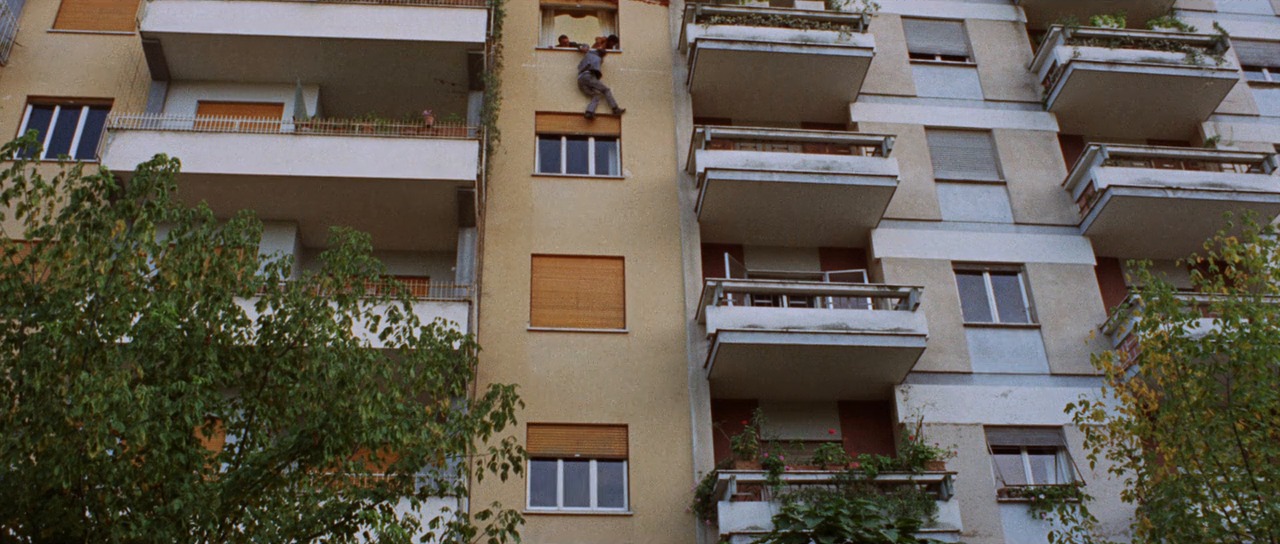
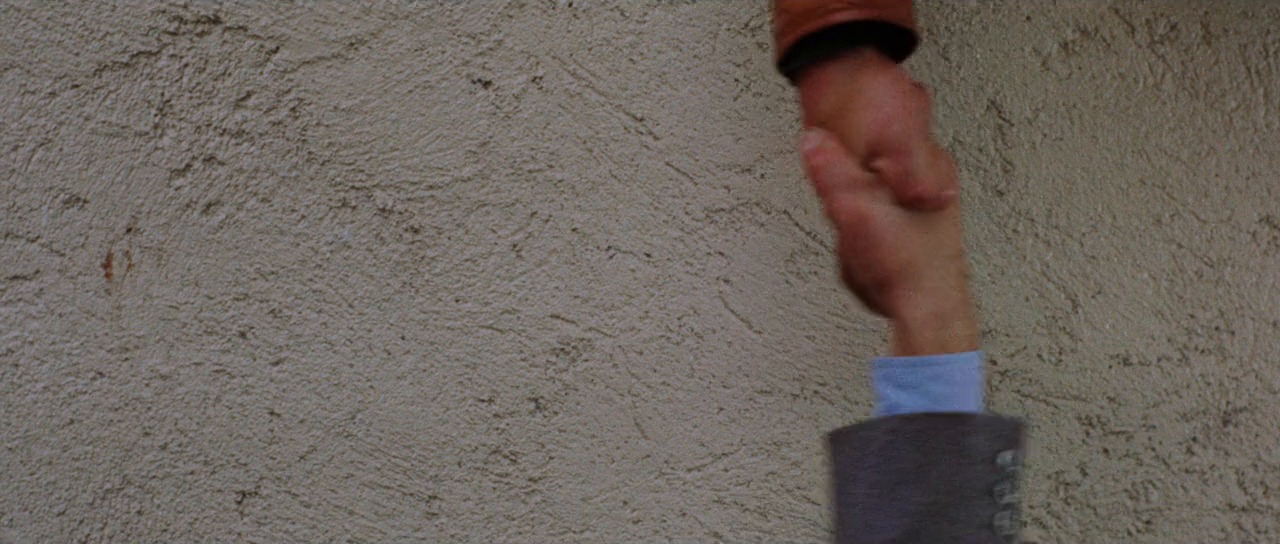
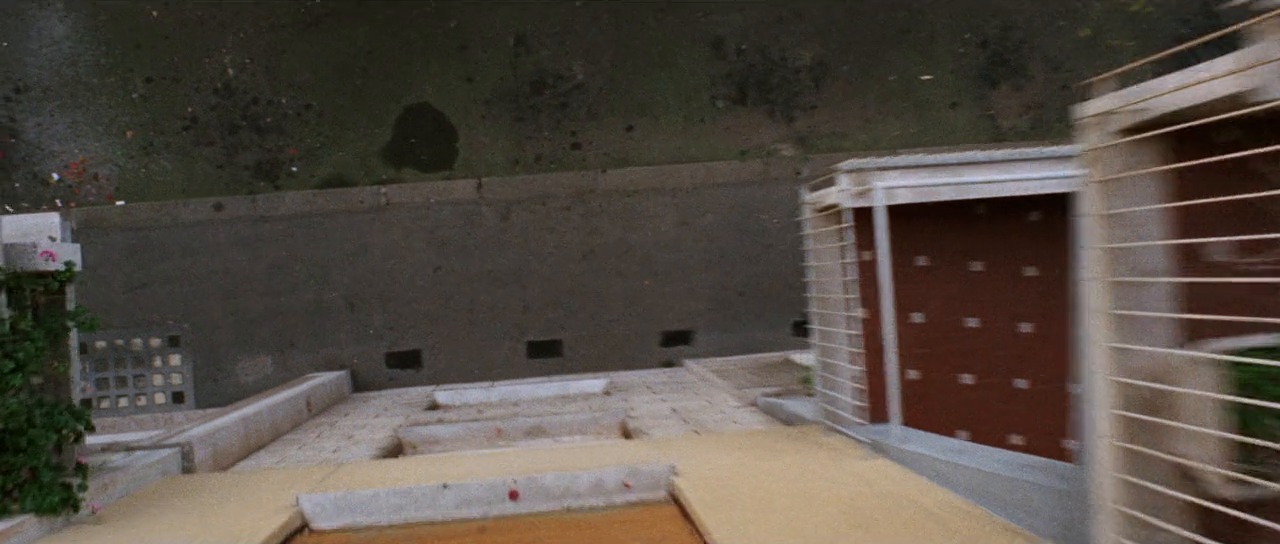
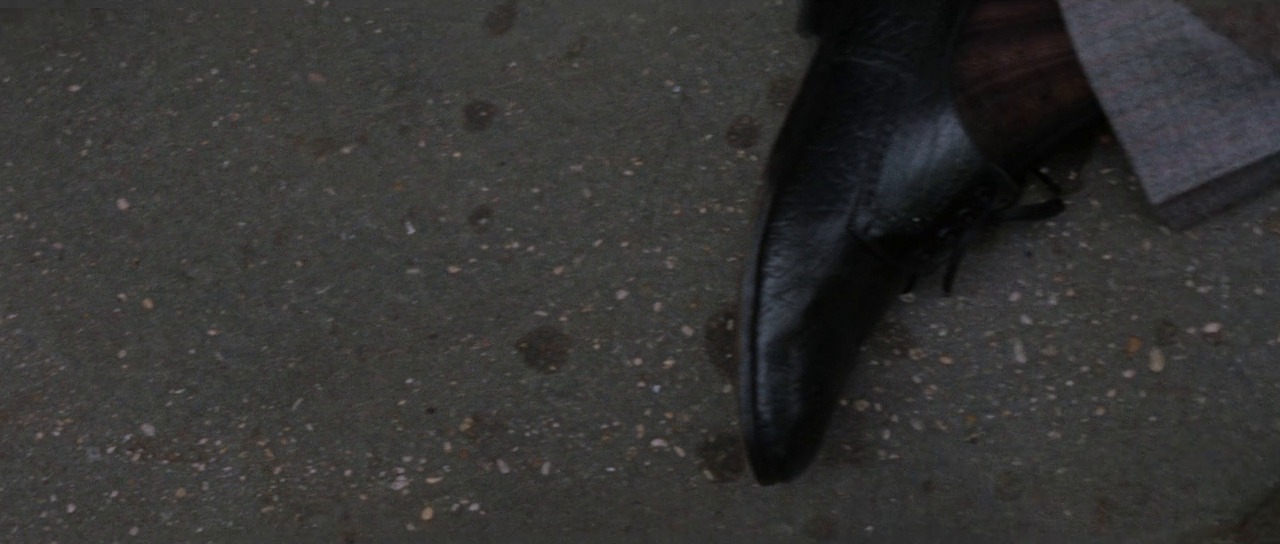
The confrontation at the window breaks into the mechanics of a failing grip: hands, feet, face and the drop below. Street-level fragments replace the sustained action of the fall. The visible injury supplies an apparent endpoint to the pursuit, but it does not settle Sam’s original mistake.
ENLARGE ↗Sam follows Giulia’s trail through the city.
Giulia’s disappearance prevents the investigation from ending with Alberto. Sam leaves the official aftermath and follows another uncertain trail through streets and doorways. The film exchanges a public scene crowded with police and bystanders for an increasingly solitary search.
The returning painting and the discovery of Giulia bring separate strands of the enquiry together. Sam must now look into a dark interior rather than across a bright gallery. The room offers discoveries in pieces, withholding a stable view of who controls the space.
ENLARGE ↗The struggle returns with the knife in Monica’s hand.
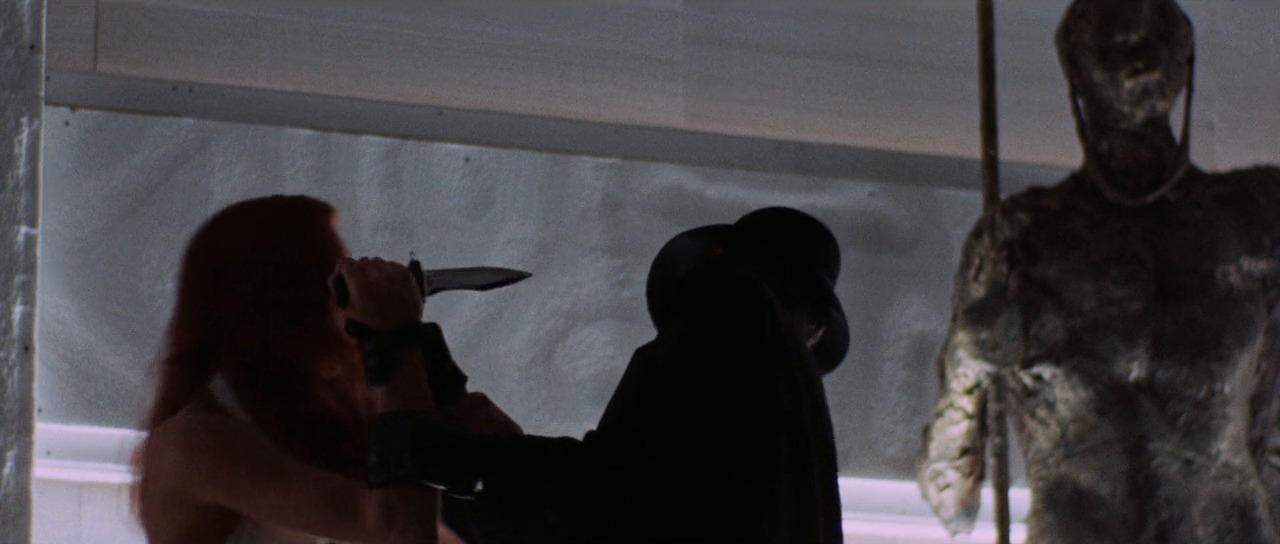
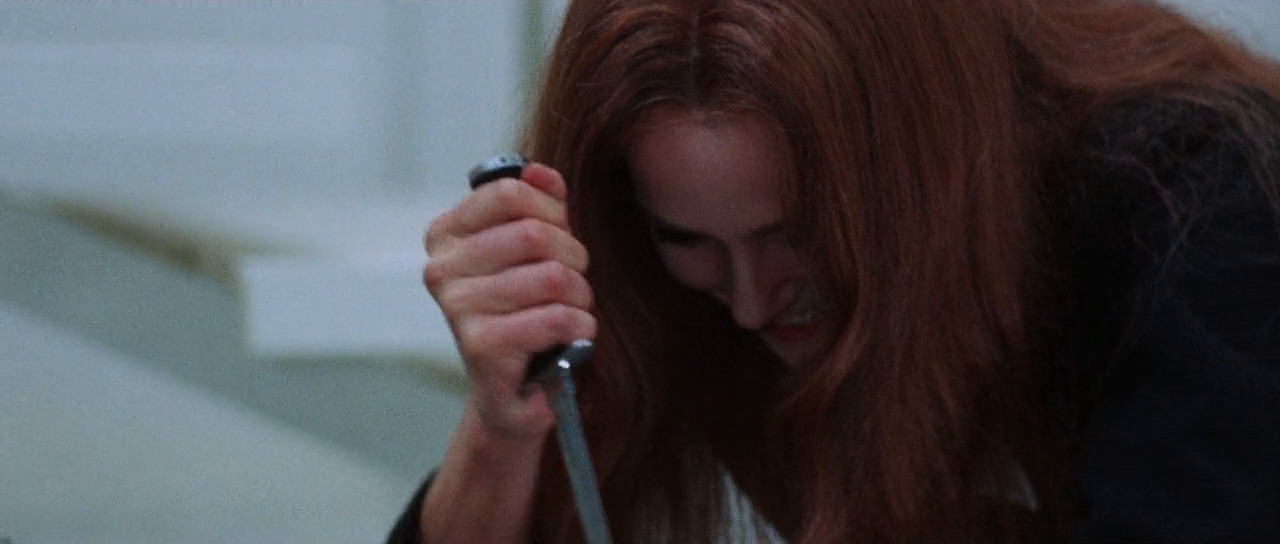
The remembered encounter returns at a scale that changes its meaning. Monica’s relation to the knife can now be seen directly. The revelation does not cancel the earlier blood or Sam’s helplessness; it changes the explanation that he, and the film’s arrangement of viewpoints, encouraged us to give them.
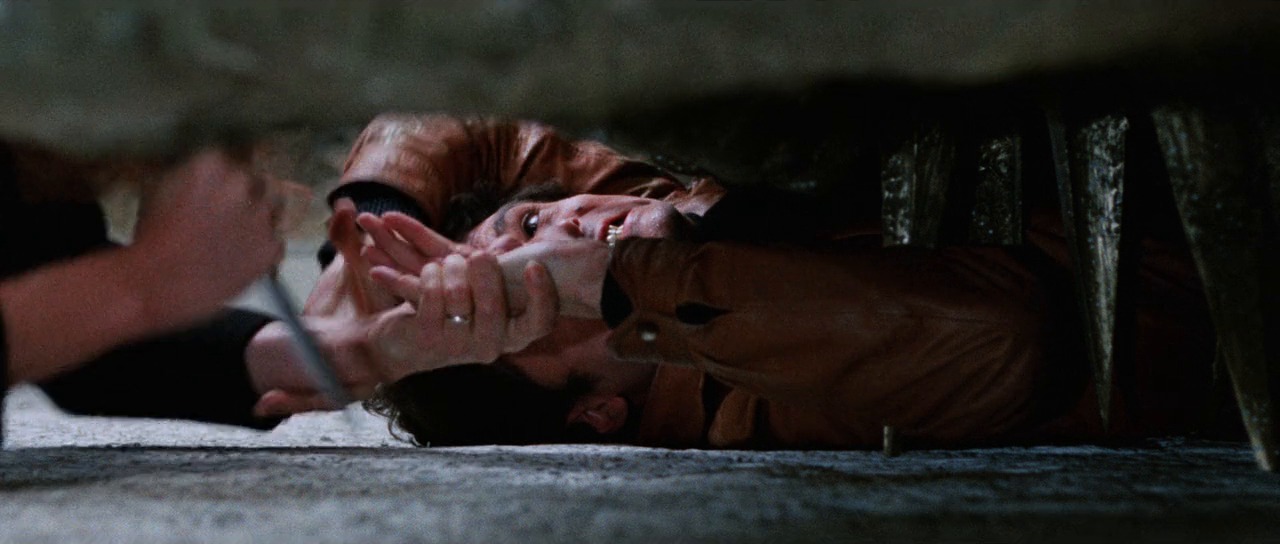
ENLARGE ↗Sam is trapped beneath the gallery sculpture.
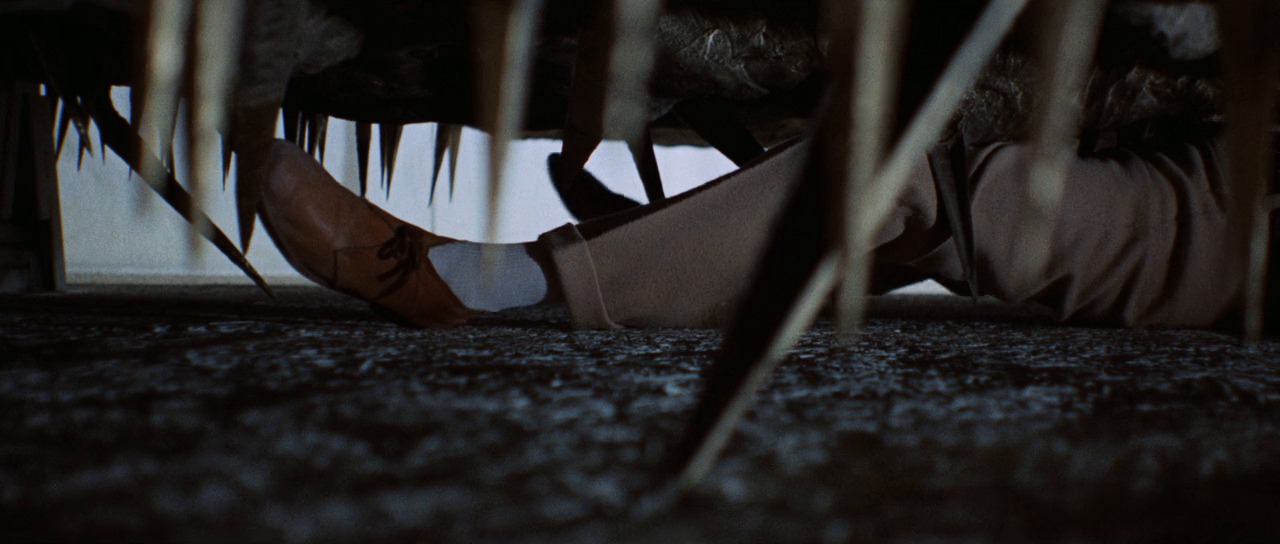
Sam returns to the room where the enquiry began and is pinned beneath a sculptural object. The gallery no longer merely separates him from the action: it acts upon his body. Low details beneath the structure and Monica’s view down toward him make his immobilisation the climax of the film’s obstructed looking.
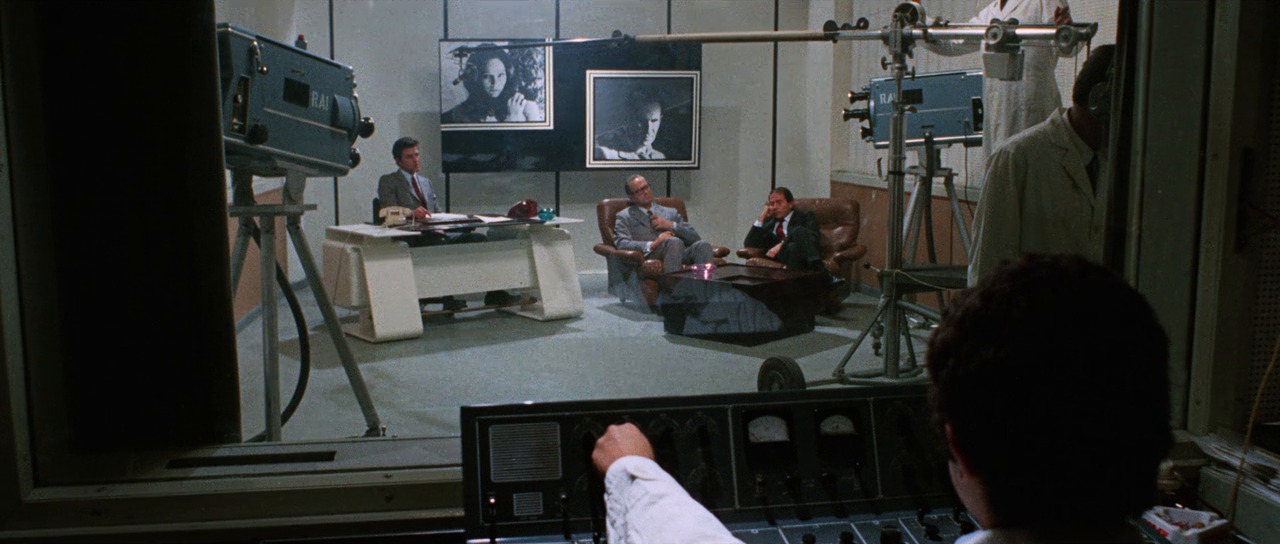
ENLARGE ↗The closing explanation is delivered on television.
The final account of Monica is placed inside a television image before the departure brings the story to a close. That smaller screen gives explanation the form of an authoritative broadcast. Its certainty can be read against the film’s repeated demonstrations that pictures need interpretation—and against the limits of its sensational account of trauma.
Sixteen close studies. Follow the changing viewpoint.
Move from the scene’s larger shape to its individual looks, gestures and reversals. Each study traces a selected sequence; open its shot list to follow the construction in detail.
The opening moves from a woman in the street to photographs, gloves and a typewriter. Its fragments establish an observer before they establish an identity. The camera’s selection of details turns an ordinary walk into a private inventory.
00:47The woman in red appears in profile behind foreground branches. The obstruction gives the view a concealed position.
00:51–00:56The framing drops to the checked skirt and black boots. Credits share the image with the walking body, separating it into recognisable pieces.
00:57–01:01Her face returns. Viewfinder markings turn a passing glance into the act of making a photograph.
01:07–01:13Side views keep following her among pedestrians and hedges. The repeated direction of movement connects otherwise discontinuous views.
01:17A wider view places her across the road. Traffic now becomes a moving screen between watcher and subject.
01:22–01:25A bus fills the foreground and conceals her, then passes. The interruption briefly makes the observer’s access to her uncertain.
01:28Another walker crosses her route. An ordinary crowded pavement still supplies the cover for the surveillance.
01:30The street gives way to black gloves over red fabric. Human presence is reduced to hands and selected objects.
01:46–01:52Photographs are handled and arranged. Images of the woman become objects that can be possessed, reordered and studied.
02:01–02:09Details of dark clothing and the lifted red cloth continue the inventory without identifying its owner.
02:18The typewriter and writing materials occupy the frame as the writer-director credit appears. Image-making and writing meet in the same introductory chain.
02:24–02:39A black transition yields to newspaper headlines and then Carlo reading. Private scrutiny gives way to public reporting of the murders.
02:42–03:02The reverse angle places Sam behind the newspaper. Lowering it reveals him; their walk shifts the film into ordinary conversation.
A commentary perspective
Howarth describes the opening theme as lullaby-like and stresses its contrast with the violence associated with these images. His observation helps explain why the sequence can feel inviting and threatening at once: the visual inventory acquires an unsettlingly gentle musical frame. Troy Howarth commentary, 00:55–01:24 ↗
The gallery encounter builds a chain of apparently useful looks, then frustrates it. Street, vestibule and exhibition floor remain visible to one another, but the doors prevent Sam from turning sight into intervention.
04:25–04:29Sam’s profile and wall shadow alternate with the gallery frontage. The reverse views establish what has arrested his attention.
04:31–04:38The struggle appears deep inside the long gallery. Returns to Sam’s face and an over-shoulder view bind the spectacle to his interpretation.
04:40A closer fragment isolates Monica’s face and the bloodied blade. The detail is visible before its role in the struggle is clear.
04:42–04:49Sam moves into the street, a car crosses his path and he falls. The interruption delays his approach while the struggle continues inside.
04:50–04:53A figure withdraws through the upper gallery. From inside, the reverse view catches Sam running into the glass vestibule.
04:57–05:01Monica’s movement beside the sculpture alternates with Sam looking in. The exhibition objects break up the space between them.
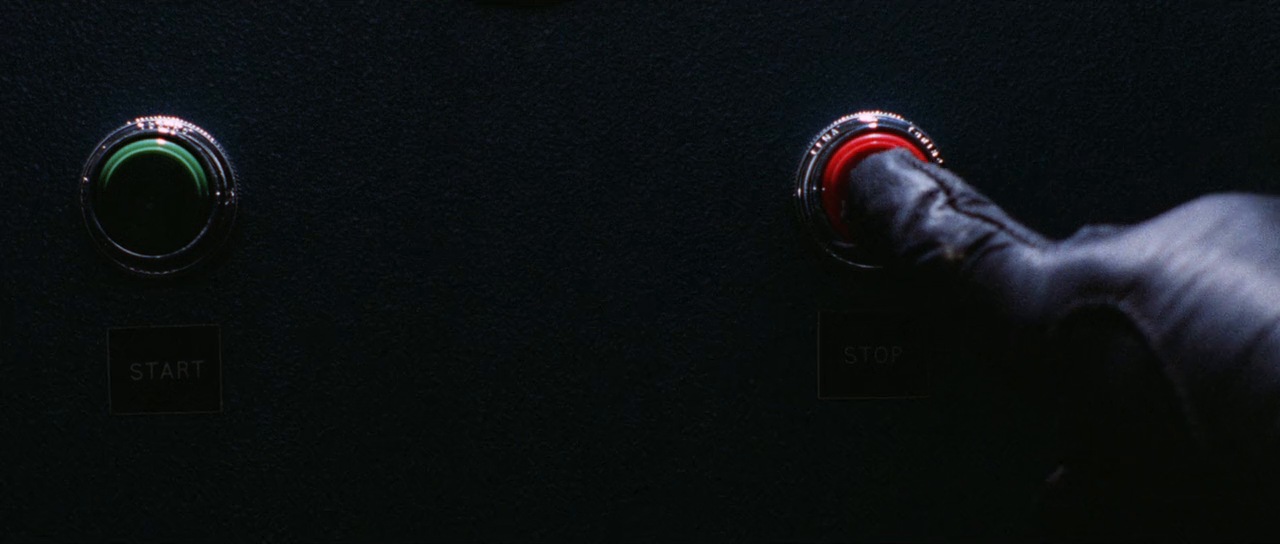
05:02–05:04A black-gloved finger presses the red button; a red wall indicator follows. The electrical action explains the trap before Sam fully tests it.
05:05–05:15The wide frontage gives way to closer views of Sam pulling at the glass. Reflections and frames multiply the barrier around him.
05:18–05:23An overhead view lays out Monica on the floor among the sculptures; Sam holds the door frames. The cut connects two forms of immobilisation.
05:28–05:33Monica props herself against a sculpture. A reverse view keeps Sam beyond the foreground objects, visible but unavailable.
05:37–05:44Her body collapses through overhead and closer views. Sam’s response supplies a witness to movements whose meaning he still cannot resolve.
05:46–05:56She raises her head and the abdominal wound becomes conspicuous. His hands against the glass answer her movement without bridging the distance.
06:00–06:11Sam’s frontal appeals turn toward the street. A passer-by enters the exchange, replacing the sealed gallery with the possibility of outside help.
06:15–06:23Gestures outside alternate with views from near Monica’s position. The composition holds both the injured woman and distant potential rescuers in the same geography.
06:26–06:36Monica reaches outward, lifts a hand and collapses again. Sam’s raised palms repeat her gesture from the other side of the glass.
06:39–07:01Sam surveys the room. Wide views and sculpture details keep asking the viewer to search a space already seen.
07:14–07:20Police arrival changes the activity beyond the doors, but the wide view still leaves Sam enclosed. Help arrives before his position in the scene is understood.
A commentary perspective
Howarth compares the first broad view to a painting and the glass enclosure to an aquarium. The analogy is useful because the trap leaves Sam highly visible: his confinement turns the witness into another exhibited figure. Troy Howarth commentary, 04:30–05:27 ↗
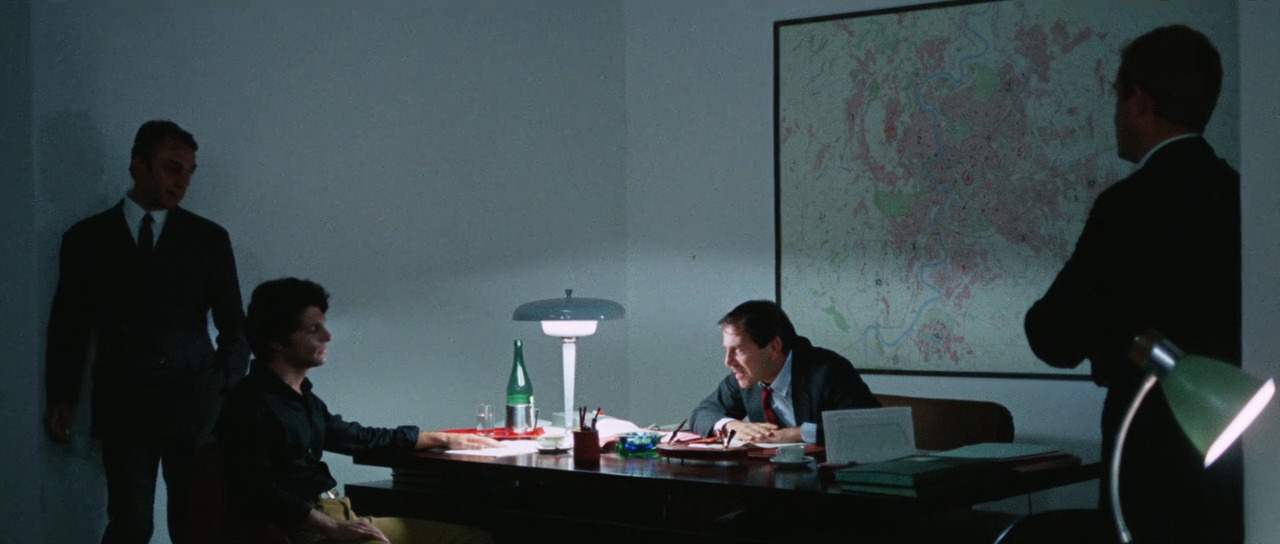
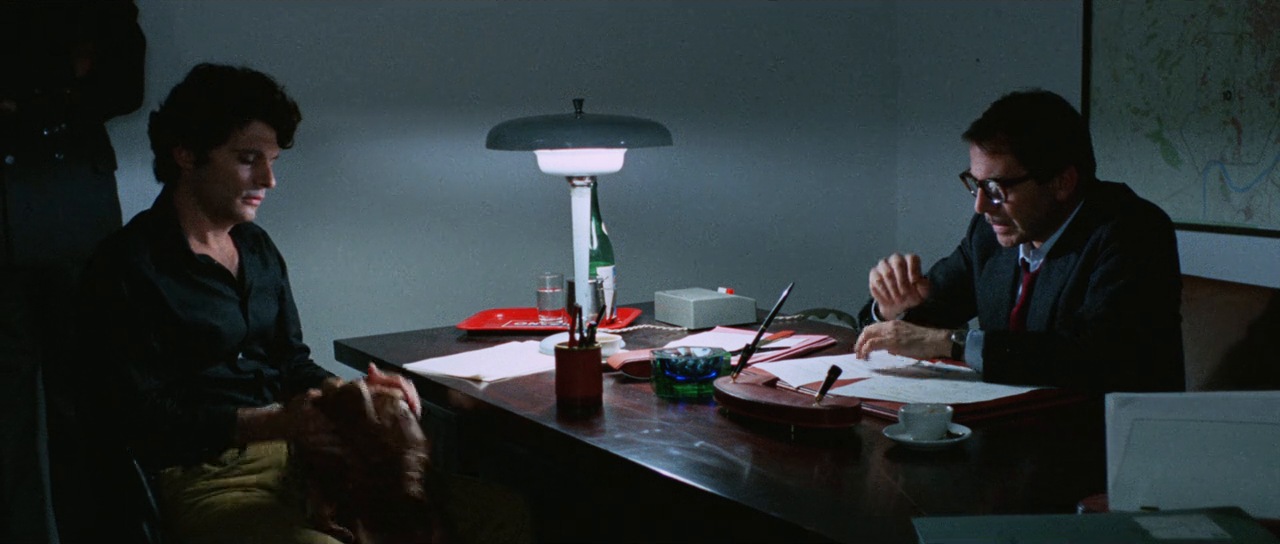
ENLARGE ↗The desk lamp divides witness and inspector.
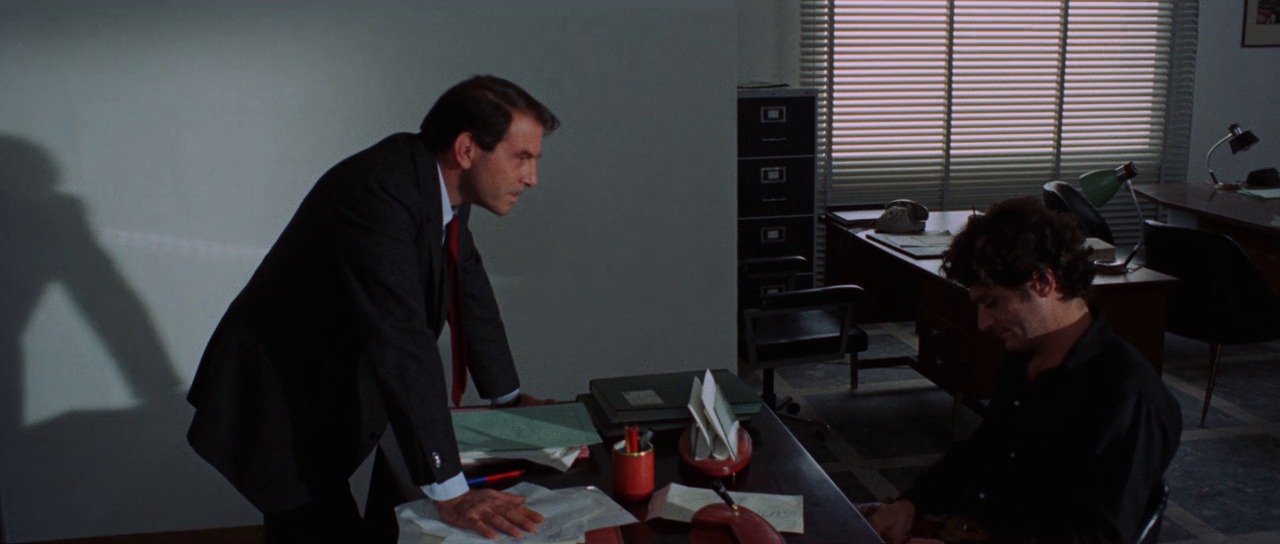
The police first search the gallery, then turn their attention to Sam. The passage replaces the glass enclosure with an interview room: his movement is now restricted by the investigation itself.
10:00–10:09The inspector moves through the sculpture-filled room; an ambulance is visible through the glass before the view returns to Sam.
10:16–10:39Shared views and movement across the gallery bring witness and inspector together. Sculptures repeatedly stand between camera and conversation.
10:48–11:07Floor detail, a crouching investigator and work around the sculpture break the room into sites of examination.
11:11–11:25Views across the upper landing reconnect the room’s levels. The inspector reaches down beside a sculpture.
11:34–11:43Sam’s face alternates with the inspector’s hands examining the black glove. The object becomes evidence through this controlled scrutiny.
11:45–12:00Sam’s tired face appears in a darker room. A wider view places him opposite the inspector across a desk.
12:09–12:19Reverse views distribute the conversation between the two men. The desk lamp provides a bright centre within the subdued room.
12:32The shared desk view holds as the passport exchange develops. The barrier here is administrative rather than architectural.
12:43–12:58Sam’s waiting look alternates with the inspector putting on and wearing glasses. Routine inspection becomes a means of retaining control.
13:02–13:08The alternating faces accompany Sam’s protest over his passport. Being a witness has acquired a practical cost.
13:09–13:28A high, wider view opens the room as the inspector rises and moves away from the desk. Sam remains seated.
13:40–13:55Closer views restore the exchange between faces. The inspector’s account of an apparently ordinary killer redirects suspicion toward everyday appearances.
Reading the sequence
The dialogue moves from Sam’s insistence that he has already described everything to the police’s insistence that something remains unrecognised. Keeping his passport turns an uncertainty about memory into a constraint on his body. The scene continues the gallery’s captivity in a different institutional setting.
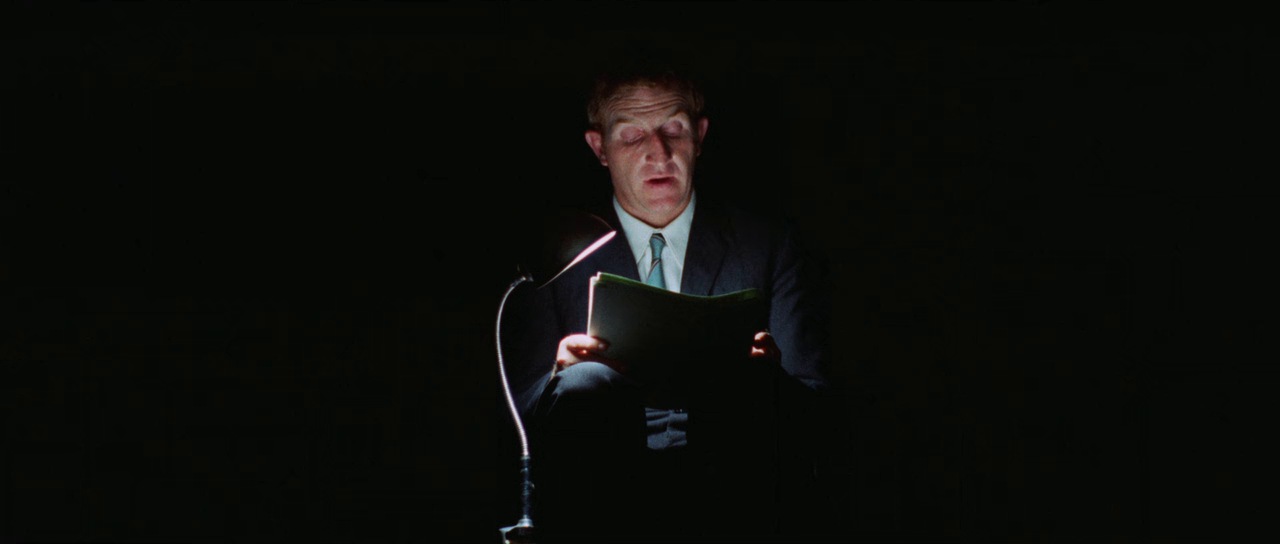
The lineup offers a brightly marked stage to observers seated in darkness. Its promise is that arranging faces clearly will make recognition possible; the scene then shifts from people to photographs and technical evidence.
18:17–18:28The observer’s dark auditorium faces a shuttered stage. The opening shutter changes the screen-like surface into an illuminated display.
18:41A small lamp isolates the official reading from a folder. Authority is presented as a voice attached to paperwork.
18:46–18:51Sam and the inspector watch; a closer view shows two figures against the ruled backdrop. Looking is organised across a clear divide.
18:56–19:02The frame moves across the horizontal markings and returns to the full lineup. The pattern gives each figure a shared visual measure.
19:04–19:11Observer reactions alternate with figures on the stage. Gestures interrupt the orderly arrangement and shift the scene toward comedy.
19:12–19:18Sam’s shadowed face yields to a hand-held document and then the laboratory. The enquiry moves from recognition to demonstration.
19:24A photograph of the glove fills the held sheet. The object from the gallery is now available as a reproducible image.
19:27–19:38The technician, Sam and inspector alternate with further evidence photographs. Faces register the information while the documents supply its visible form.
19:43–19:50A final document view returns to the technician. The machine-filled background gives the explanation a different authority from the lineup’s theatre.
Reading the sequence
The lineup and laboratory are consecutive arrangements for making people and objects readable. Their clarity contrasts with Sam’s uncertainty. The film can organise evidence neatly without thereby giving its witness an adequate explanation.
The shop’s photograph, Sam’s wall and the coloured painting connect separate spaces. The cuts move the same disturbing composition between reproduction and object, allowing it to link the investigation with a room Sam cannot yet identify.
27:00–27:16Sam and the dealer share a shop crowded with lamps, frames and objects. Their movements keep the conversation embedded in the collection.
27:21–27:40A closer exchange gives way to a wider view as the search for the photograph proceeds. The clue emerges through handling and retrieval.
27:47The black-and-white reproduction is fixed to a wall. The cut has moved the image from a commercial interior into Sam’s apartment.
27:56–28:12Wider views locate Sam and Giulia around the photograph. It has become an object they can revisit rather than a fleeting sight.
28:22–28:24The reproduction alternates with Giulia’s face. The insert gives her unease a specific visual object.
28:40A closer view isolates the assault within the painted landscape. The composition’s small figures become the centre of attention.
28:52The coloured painting appears in its frame in another interior. The correspondence supplies a connection without identifying the room’s occupant.
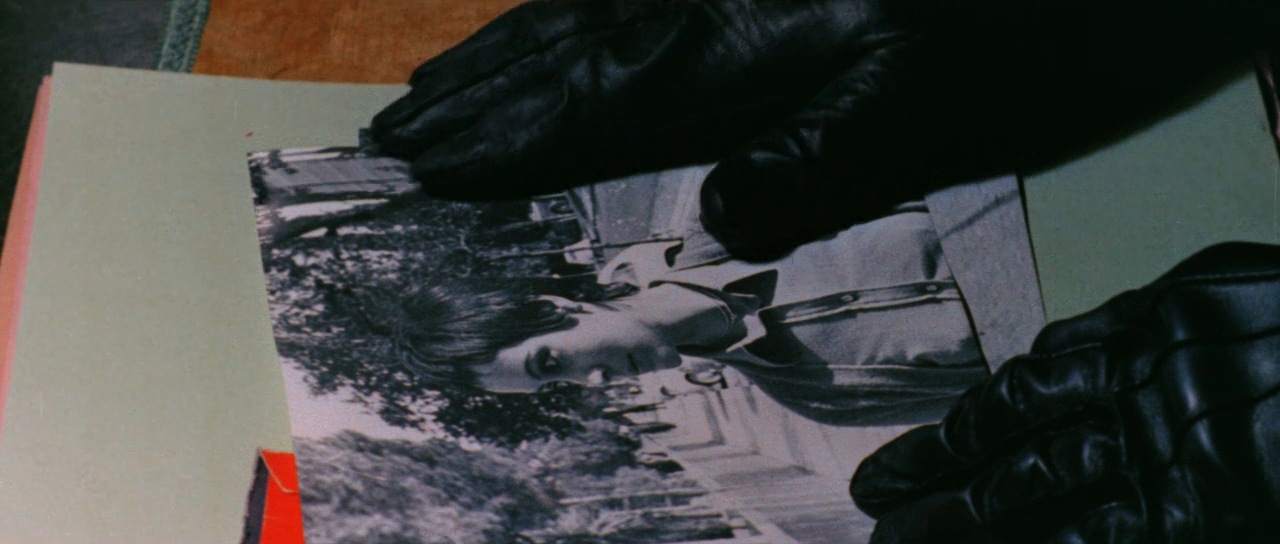
29:01–29:08A black-gloved hand lifts papers to reveal photographs of a woman. The painting is joined by another collection of retained images.
29:13–29:14The wider room holds the painting and a dark-clad presence together. Its ownership remains less clear than its relation to the investigation.
Reading the sequence
The photograph is explicitly described in dialogue as a copy. Treating the black-and-white and coloured views as different appearances of the image makes the editing intelligible: the film links spaces through an object before Sam can connect the people who occupy them.
The attack does not depend on a single continuous view of injury. Domestic preparation slows the approach, then face, gripping hand, weapon and pillow divide the violence among separate pieces of evidence.
30:45–30:46An exterior window gives way to the woman inside at a mirror. The first cut connects an exposed room with a private routine.
31:04–31:12Gloved hands outside interrupt the mirror views. Her movement away from the mirror proceeds without access to the threat the viewer has seen.
31:26–31:27A hand reaches for the bedside light and darkness follows. The familiar action removes the room’s visual security.
31:31–31:51A held view keeps the cigarette in the foreground and the door beyond it. Waiting, rather than cutting, makes the background threatening.
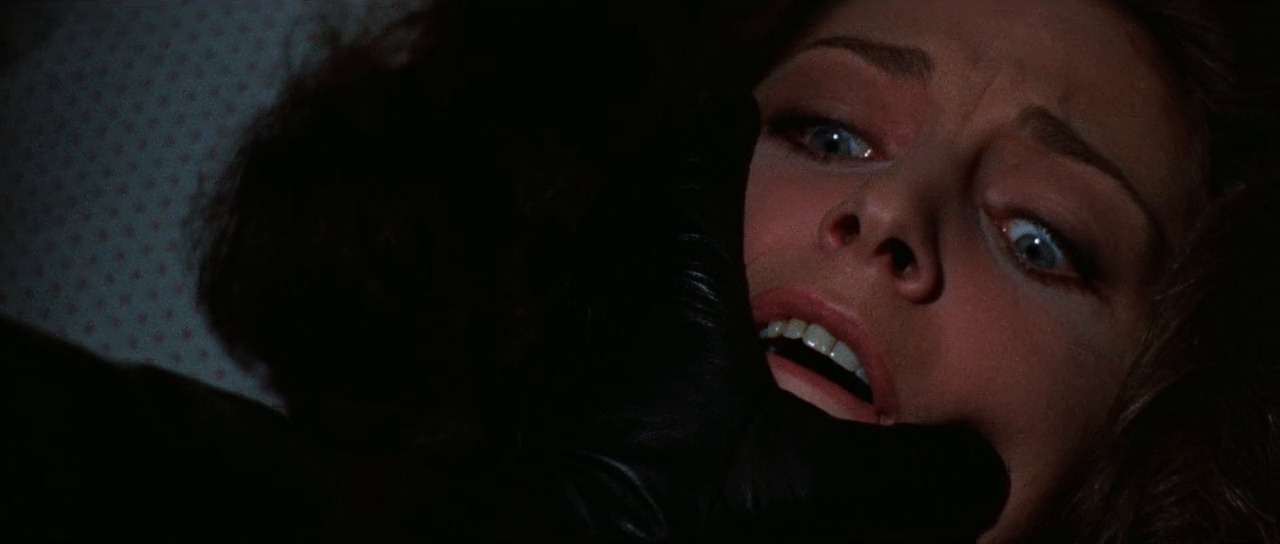
31:51–31:58An extreme mouth detail is followed by black gloves and the wide-eyed face. The assault arrives as a sudden contraction of the frame.
32:01–32:07Wider views of the bed alternate with her face. The sequence establishes bodily confinement without maintaining an uninterrupted master view.
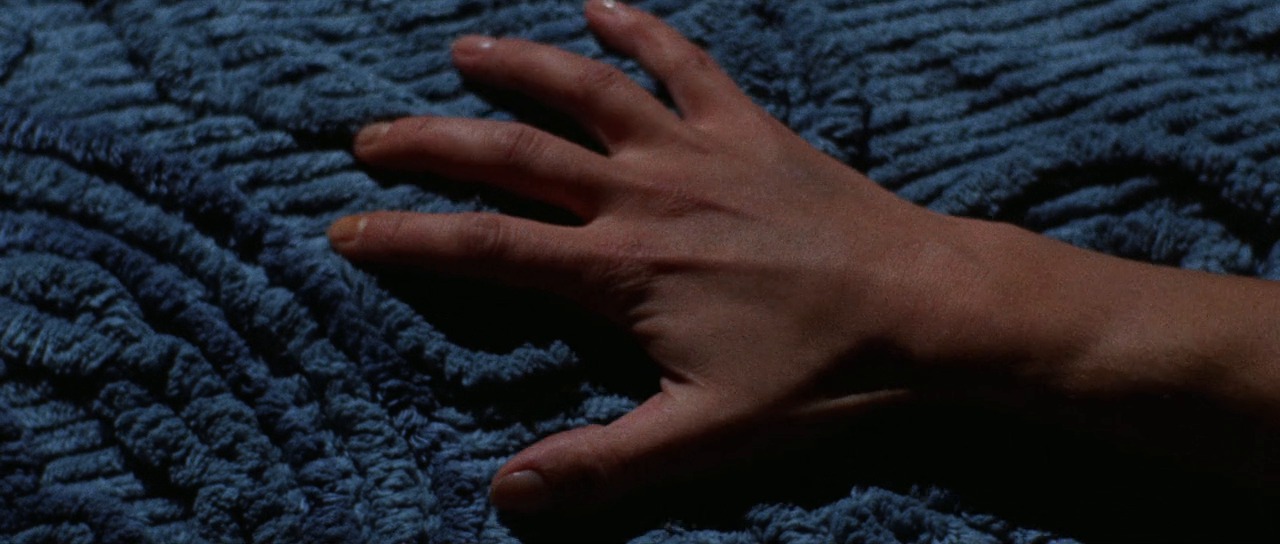
32:09A hand clutches the blue covering. Fabric tension makes the struggle visible away from the face.
32:10–32:17Blade details and the face alternate with the dark-clothed attacker. The weapon’s proximity carries the threat between separate views.
32:19The hand tightens again on the covering. This repeated insert turns a small bodily action into a measure of pressure.
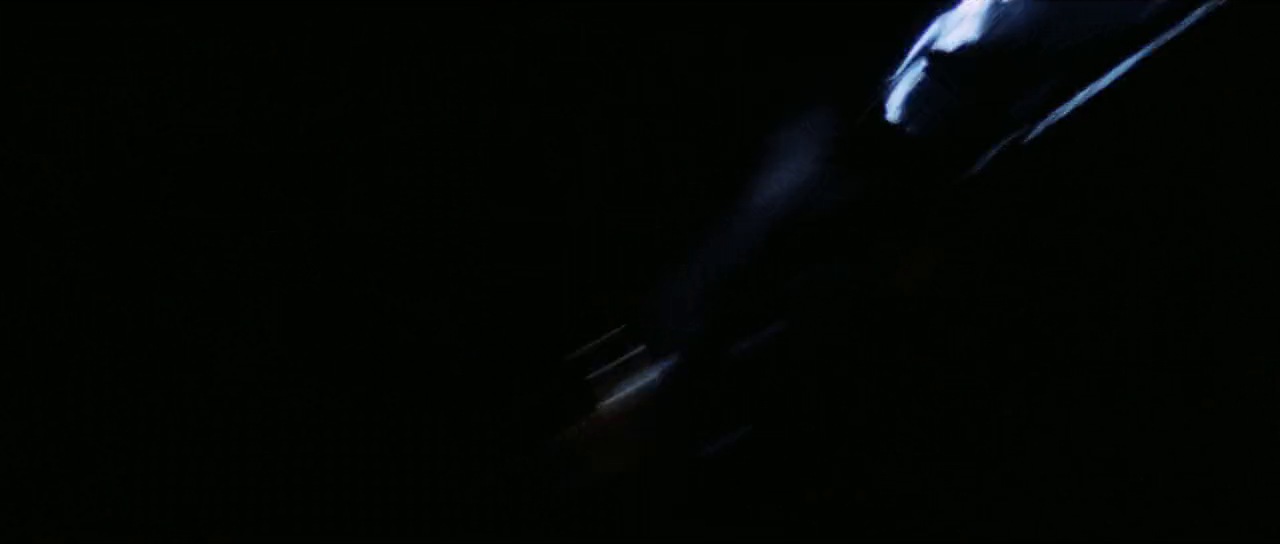
32:21–32:27The raised blade and arm prepare the blow; the weapon briefly flashes through darkness. Movement is concentrated into a short, bright fragment.
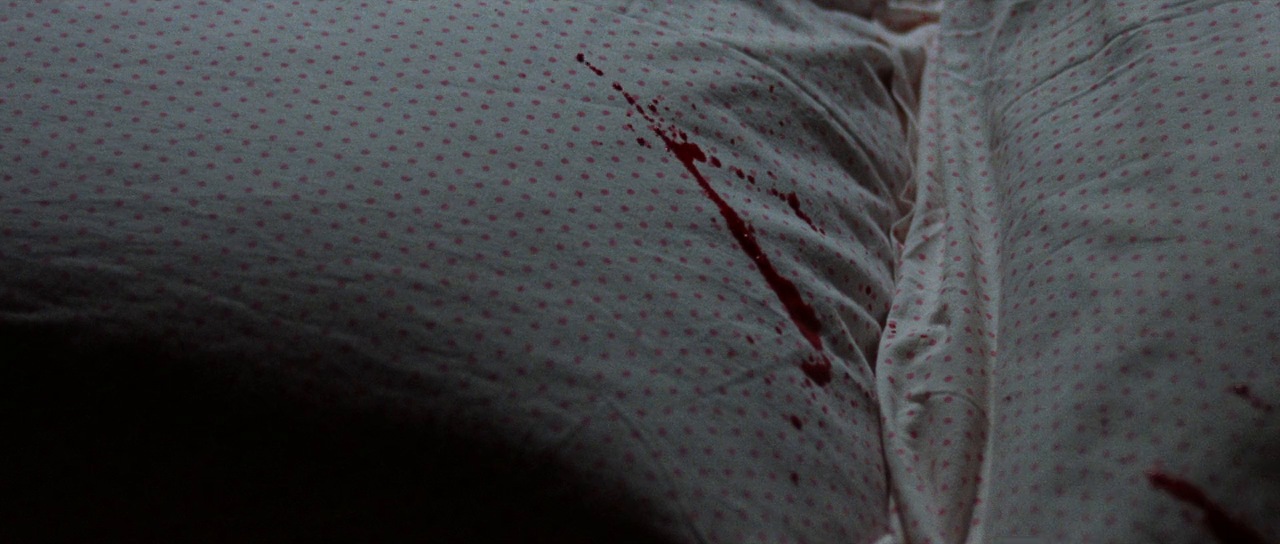
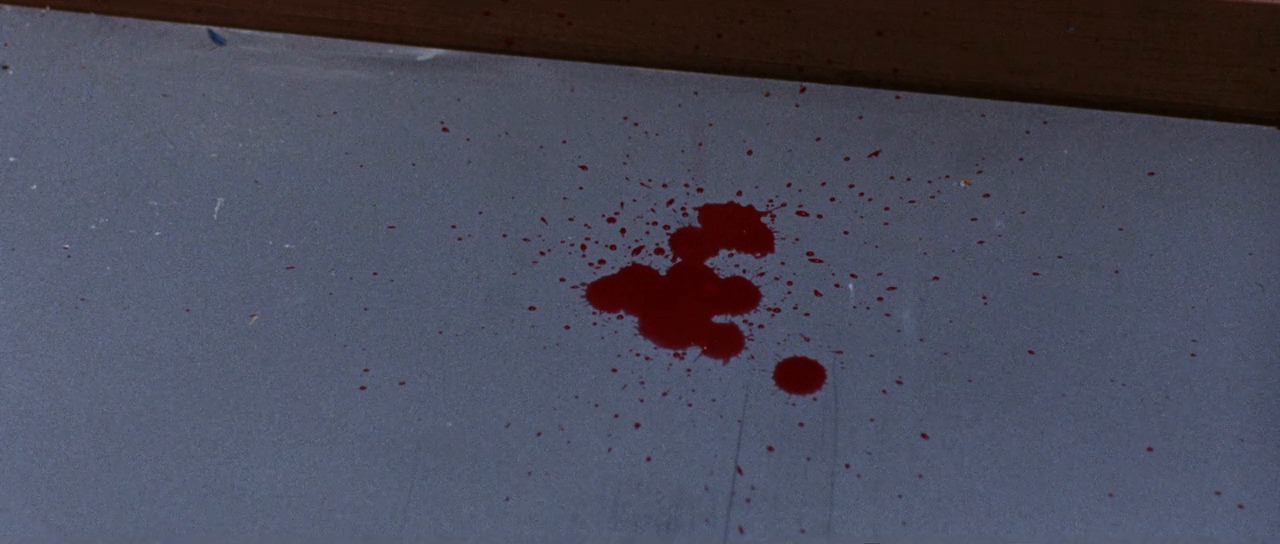
32:27–32:28Blood on the pale pillow supplies the aftermath. The edit completes the action through its trace rather than requiring one continuous view of penetration.
Reading the sequence
The pillow insert is the sequence’s decisive visual punctuation. The spectator joins anticipation, movement and blood across the cut. These are observations about the finished image; the frames alone do not establish how the practical effect was made.
The return visit makes the exhibition room appear ordinary again. Workers handle a large sculpture while Monica thanks Sam. Practical conversation about weight and display quietly establishes the object that will dominate the finale.
38:46The sculptural surface fills the frame before the social encounter is fully re-established. The object receives attention in its own right.
38:56–38:59Close views of Monica and Sam open into a group view with workers behind them. Conversation and installation occupy the same space.
39:15–39:22Monica’s face and Sam’s reverse view concentrate the exchange. Her thanks renew his understanding of the earlier event as a rescue.
39:26–39:29The reverse views continue as she describes her fear. The ordinary conversational form makes her account easy to accept.
39:33–39:35Alberto’s intervention redirects Monica’s attention. A wider view reconnects the conversation to the labour taking place around them.
39:39–39:42Sam looks up toward Alberto and the sculpture’s position. The upper landing again becomes a place from which the room is organised.
39:44–39:50Sam’s look leads back to the sculptural detail, then to him turning away. The object remains after the social exchange has ended.
Reading the sequence
The English dialogue specifies the sculpture’s weight, the need to keep it upright and the way its points catch light when angled. Those remarks establish physical properties through apparently incidental exhibition work. The finale later makes the same properties consequential.
ENLARGE ↗The yellow jacket appears between parked buses.
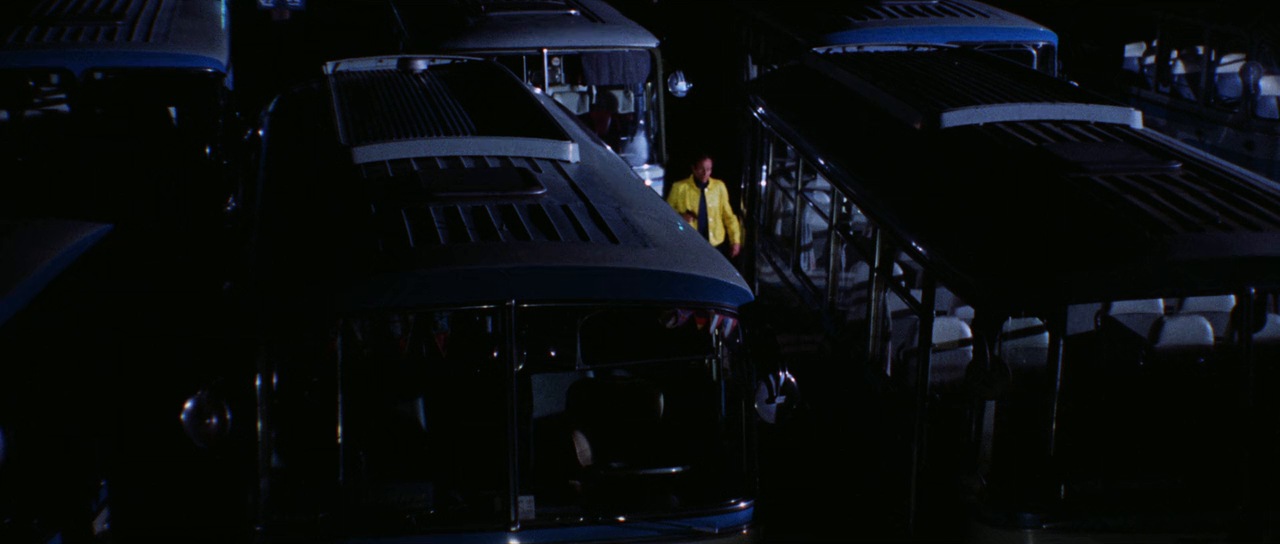
The attack moves from a long, exposed street into narrow routes between parked buses. Headlights, vehicle bodies and changing camera height continually revise what Sam and his pursuer can see.
41:40–41:54A dark figure follows the couple along the wall. Close and wide views place the pursuit within the street’s long perspective.
42:08–42:13Car lights, the figure beside the vehicle and the couple’s response break the street’s steady movement into a sudden disturbance.
42:17–42:28Sam and Giulia run around the corner. The car stops, and the yellow-jacketed man emerges with a weapon.
42:32–42:49Views down the passage alternate with the couple sheltered against a wall. The camera repeatedly checks the route the pursuer must enter.
42:53–43:01The attacker enters the passage, close physical movement interrupts the view, and Sam reaches another doorway. The chase changes direction.
43:03–43:19An empty approach and Sam pressed beside a corrugated barrier alternate with the yellow jacket entering the route. Concealment depends on the edge of the frame.
43:35–43:57A high view discloses rows of buses. Lower views place Sam among their sides, where that overview becomes unavailable.
44:08–44:19Rapid vehicle and weapon details give way to alternating views of pursuer and pursued. The bus bodies repeatedly interrupt the line between them.
44:21–44:33Overhead views locate the yellow jacket in the lanes between roofs. The colour remains conspicuous even when the body is small.
44:43–44:47Feet cross loose material on the ground; the view returns to Sam beside a bus. Ground detail makes the route physically precarious.
44:49–44:55Sam’s movements alternate with an extreme view of the attacker’s eyes. Looking becomes as concentrated as the weapon details.
44:57–45:04A hand operates a vehicle control, headlights brighten the lane and Sam moves between buses. The pursuer raises his weapon within the newly lit space.
45:05–45:19Sam climbs over stored objects and drops beyond them. High and low views separate the scramble, descent and landing.
45:20–45:34The pursuer reaches the obstruction; the film returns to Sam outside and a close weapon detail. The street opens again while the threat remains.
45:37–45:47People beside parked cars interrupt the isolated chase. The attacker’s behaviour changes in the presence of witnesses, making withdrawal possible.
Reading the sequence
The high depot views offer geographical information that neither man consistently possesses. At ground level, buses become opaque partitions. Alternating these scales lets the viewer understand the overall trap while still sharing the uncertainty of each narrow passage.
Sam follows the man who has been pursuing him. The bright jacket appears to make this reversal simple, until a room full of matching clothes turns a useful sign into an obstacle.
45:49–46:10Views of the yellow-jacketed man alternate with Sam following past shop windows. Their relation has reversed while the street remains a chain of partial views.
46:16–46:29The cinema frontage and departing crowd interrupt the pursuit. Sam’s close view is surrounded by other moving faces.
46:33–46:44Sam searches across traffic and the hotel entrance. The next destination is established before he reaches it.
46:54–47:09Lobby activity gives way to closed doors. The pursuit pauses at another surface that hides the room beyond.
47:17–47:24A sliver of yellow appears in the opening, then Sam looks through the doors and sees the first matching jackets.
47:27–47:38His reactions alternate with several groups dressed alike. Each reverse view increases the number of plausible matches.
47:41–47:43The convention sign and passing blue caps provide the social explanation for the repeated costume.
47:44–47:56Sam moves into the crowd. Faces and shoulders repeatedly block the view; the jacket no longer distinguishes one body from another.
48:01–48:12An exit sign gives way to the police corridor. The joke closes the chase without providing Sam with an identified man.
48:20–48:25The discussion briefly returns to the yellow-jacketed attacker outside the travel agency. The recalled image preserves a distinctive face after the costume has failed.
48:28–48:56Group views and the inspector’s reactions return the incident to police discussion. The private chase has become another reported account.
A commentary perspective
Howarth reads this turn as suspense giving way to comedy and identifies the convention song as “Se sei stonato…”. The AMS track list confirms that title. The joke is visual as well as musical: the clue stays perfectly visible while losing its power to identify anyone. Troy Howarth commentary, 47:17–48:07 ↗AMS track listing ↗
The staircase begins as a legible architectural shape. Changing levels and viewpoints turn that apparent order into a maze; darkness then strips away the geography before the attack returns in close fragments.
49:40–49:43Arrival by car leads into an upward triangular view and then a landing. The staircase becomes the sequence’s organising figure.
49:48A narrow upper opening offers only a sliver of another level. The destination is visible without becoming accessible.
49:50–49:57The woman on the landings alternates with upward geometric views. Her movement connects spaces that the camera keeps presenting from new positions.
50:00–50:09The climb continues across a closer figure view and a railing angle. The building repeatedly divides the frame around her.
50:15A high view looks down on the climb. The person is now smaller than the architectural pattern surrounding her.
50:22–50:24A dark opening above precedes the loss of light. The route that has been carefully mapped becomes difficult to read.
50:25–51:17The extended dark passage interrupts the earlier alternation of clear architectural views. Suspense depends on restricted visibility rather than a new spatial explanation.
51:17–51:20Her arm rises over her face. Short reverses to the black-clad attacker divide defence from aggression.
51:21–51:25Attack movements, the blood-marked blouse and her bending body arrive in close succession. The sequence exchanges the staircase’s clean geometry for unstable bodily detail.
51:30–51:32The bloodied blade is followed by spatter on a pale surface. Once again the aftermath is carried by a separate insert.
51:34–51:37The cut to Sam in the prison visiting room abruptly restores a different, orderly interior. It ends the attack without offering a prolonged view of its complete physical space.
A commentary perspective
Howarth’s commentary draws attention to the staircase’s geometry and framing. The progression here makes that geometry dramatic: architecture first tells the viewer where to look, then darkness takes away the coordinates. Troy Howarth commentary, 49:46–50:18 ↗
The painter’s crowded room replaces the orderly police interiors with food, pictures, cages and improvisation. The visit repeatedly delays Sam’s enquiry through hospitality and physical comedy, then makes him reconsider what he has just eaten.
1:08:30–1:08:46Sam at the doorway gives way to the painter at his table. A wider view brings the visitor into a room already crowded with activity.
1:08:54–1:09:02The two men share the low-lit table. Eating and conversation occupy one composition rather than a formal interview arrangement.
1:09:12–1:09:16A plate detail interrupts the shared view. The meal becomes a discrete object before its significance changes.
1:09:26–1:09:42The painter moves toward his pictures while Sam continues eating. A brief food insert connects the two activities across the room.
1:09:50–1:10:07Rapid movements around the table and window fragment the settled encounter. The furniture and stored objects complicate both men’s actions.
1:10:09–1:10:30Sam pauses by a painting while the painter crouches and then moves toward another part of the room. Their positions keep shifting instead of returning immediately to the table.
1:10:41–1:10:59A low-lit close view leads to the animal cages, then to both men together. The cage insert gives a concrete object to the conversation.
1:11:01–1:11:11A wider room view yields to the plate, Sam’s face and the plate again. The repetition makes his recognition visible through editing.
1:11:13–1:11:24The painter’s response and the renewed shared view return to the business of selling a picture. Sam’s reaction has changed the tone of the visit.
1:11:29–1:11:36A large canvas fills the foreground before the film cuts away. The proposed purchase becomes a final obstruction between visitor and host.
Reading the sequence
The painter’s explanation of the cages makes Sam reinterpret the plate already shown. That small comic reversal repeats a larger pattern in the film: seeing an object clearly does not guarantee understanding it. The plate insert gains its force from the new information carried by speech.
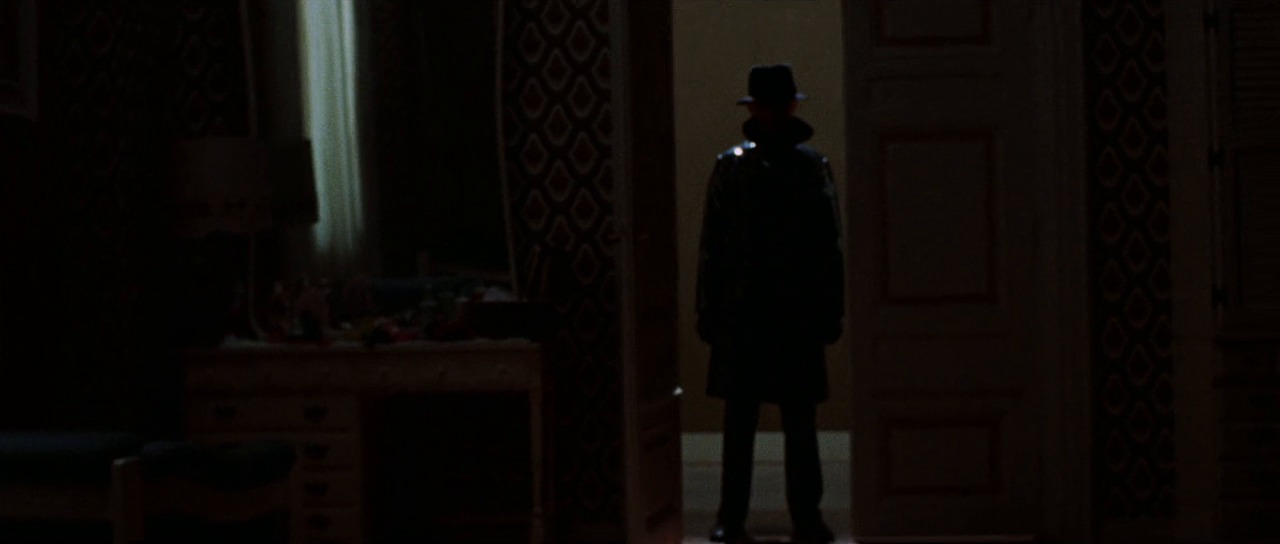
Telephone, window and door offer successive promises of escape or help. The sequence closes each route before reducing the encounter to a tiny opening in wood. Viewpoint itself becomes a threat when an eye occupies that opening.
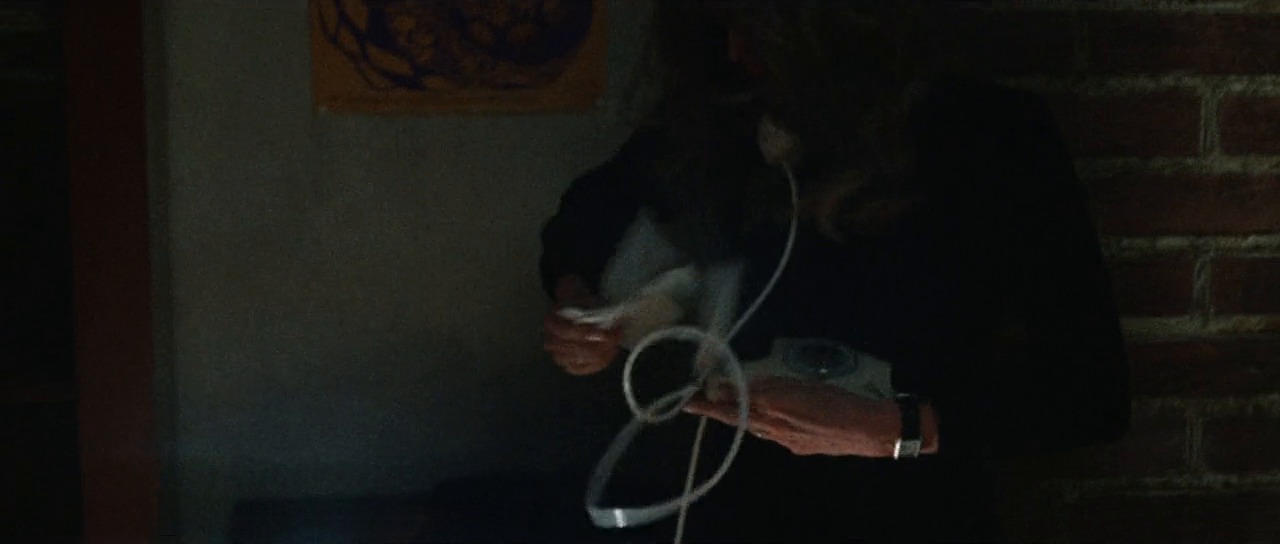
1:14:10–1:14:27Giulia handles the telephone; black gloves at the wiring interrupt her attempts to use it. The cut makes her isolation something actively constructed.
1:14:33–1:14:47Door, face, room and window alternate. These views map possible exits while her movement tests them.
1:15:00Gloved hands cut the wiring. The insert gives a precise physical action to the disruption outside her field of view.
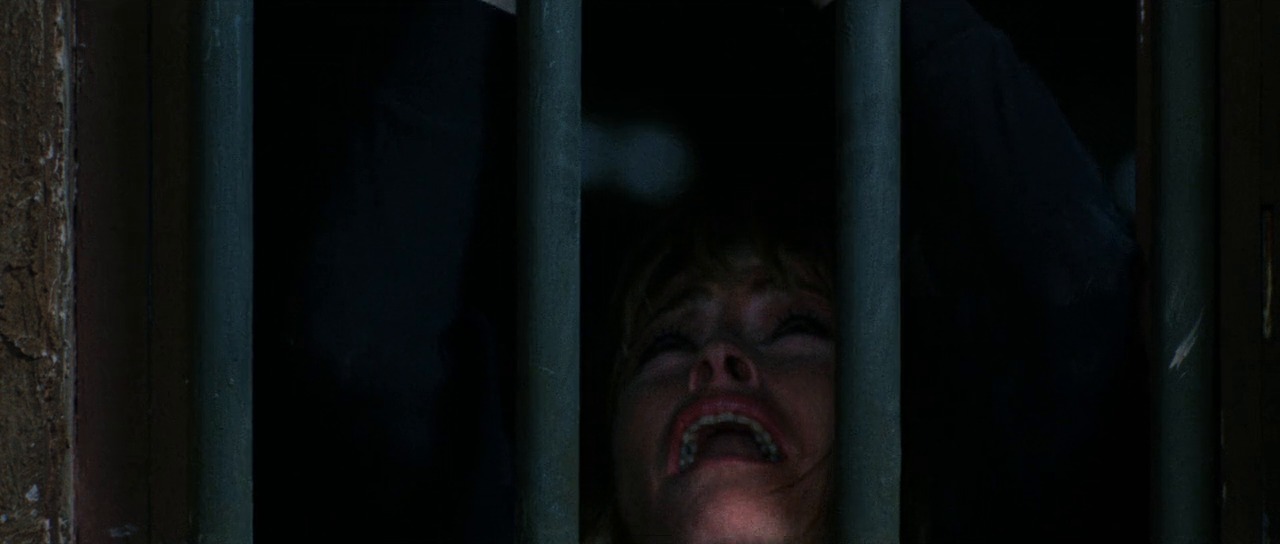
1:15:02–1:15:05Giulia is at the barred window when the light disappears. Bars remain legible as her hands reach them.
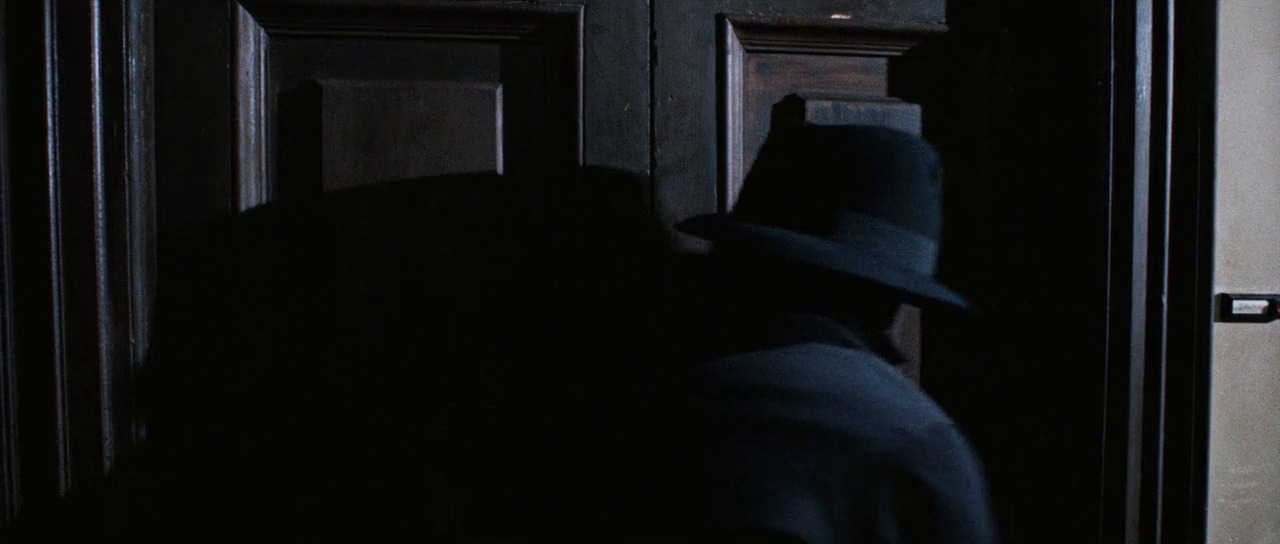
1:15:09–1:15:19Light beneath the door, another window view and the opening doorway lead to the black hat and coat. The room’s entrance becomes the attacker’s route.
1:15:20–1:15:36Her retreat alternates with the figure at the doorway and movement through the furniture. The previously mapped interior now obstructs flight.
1:15:40–1:15:46The bathroom window supplies another barred opening. A closer view of her face makes the repeated obstruction personal.
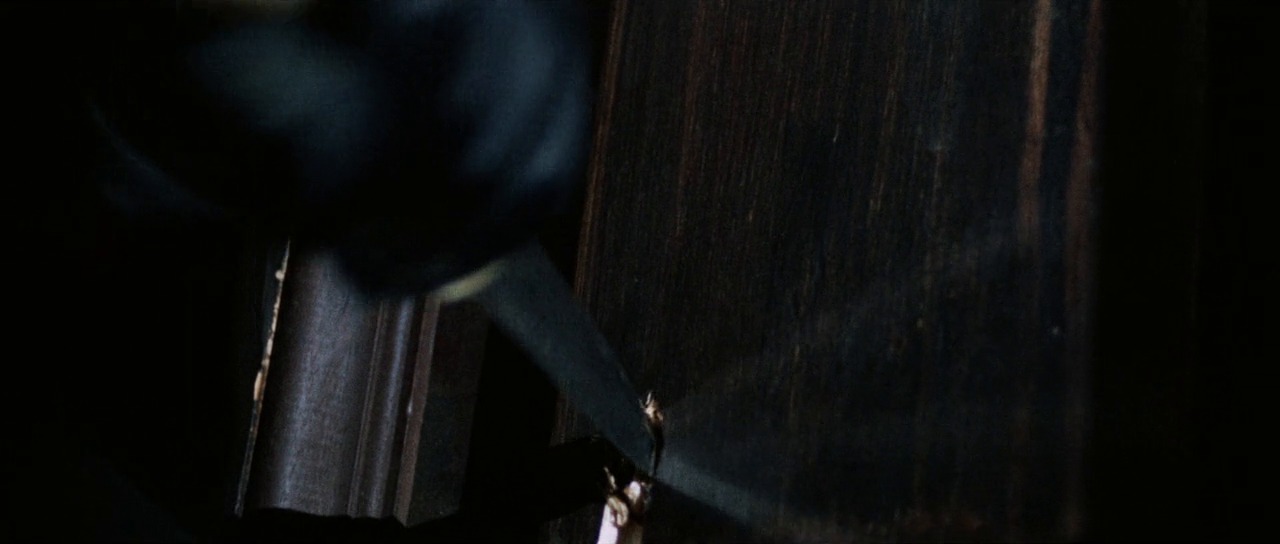
1:15:58–1:16:06The knife enters the wooden door. Cuts to Giulia and back to the blade make the barrier feel thin even while it remains intact.
1:16:09–1:16:18Light through the damaged wood alternates with her face and a wider bathroom view. The opening is first established as a possible line of sight.
1:16:31–1:16:46Dark movement, her tentative look and the broken aperture lead to the protruding knife. Looking through the hole carries a physical risk.
1:16:50–1:16:56Her reaction is answered by an extreme close-up of the eye. Raised arms, blade and face compress the space into a rapid exchange.
1:16:57–1:17:07The opening remains in view after the close encounter, interrupted by a dark figure. Empty space now suggests a change outside her sight.
1:17:09–1:17:19A wide view finds the attacker on the apartment floor. Giulia’s eye at the hole alternates with this newly changed situation.
1:17:23–1:17:25The aperture and a low view through the room keep the rescue tied to partial sight. The threat ends before the scene abandons its restricted viewpoints.
Reading the sequence
The door changes function several times: defence, screen, viewing aperture and target. The eye close-up reverses the gallery encounter. There, glass allowed too much looking without action; here, the smallest opportunity to look brings the danger directly to the face.
Height is assembled from faces, hands and distance.
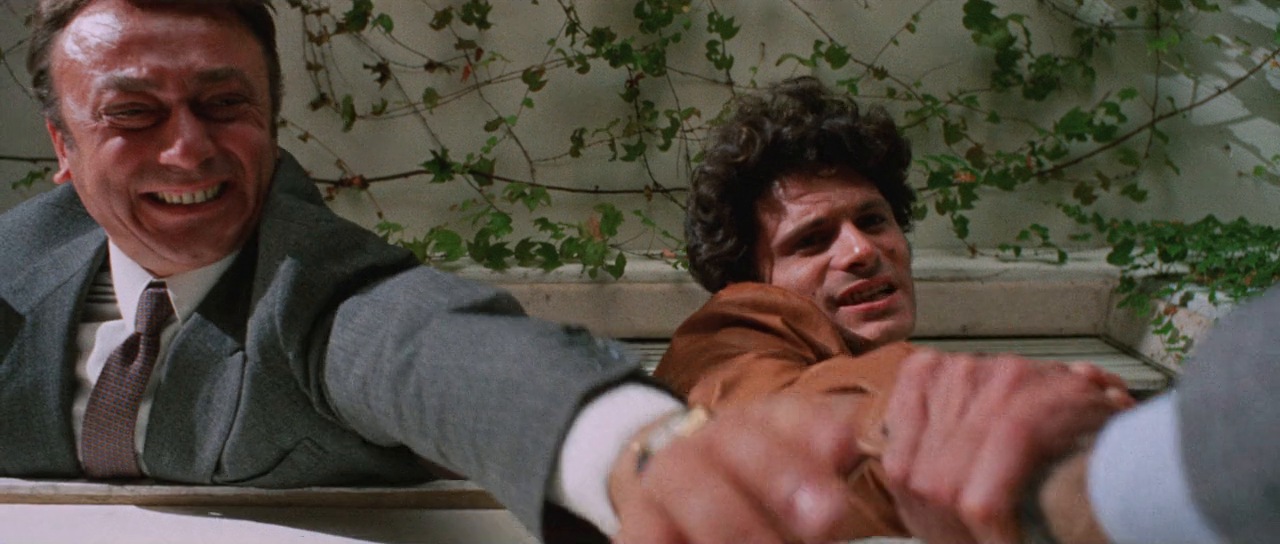
ENLARGE ↗Sam and the inspector struggle to hold on.
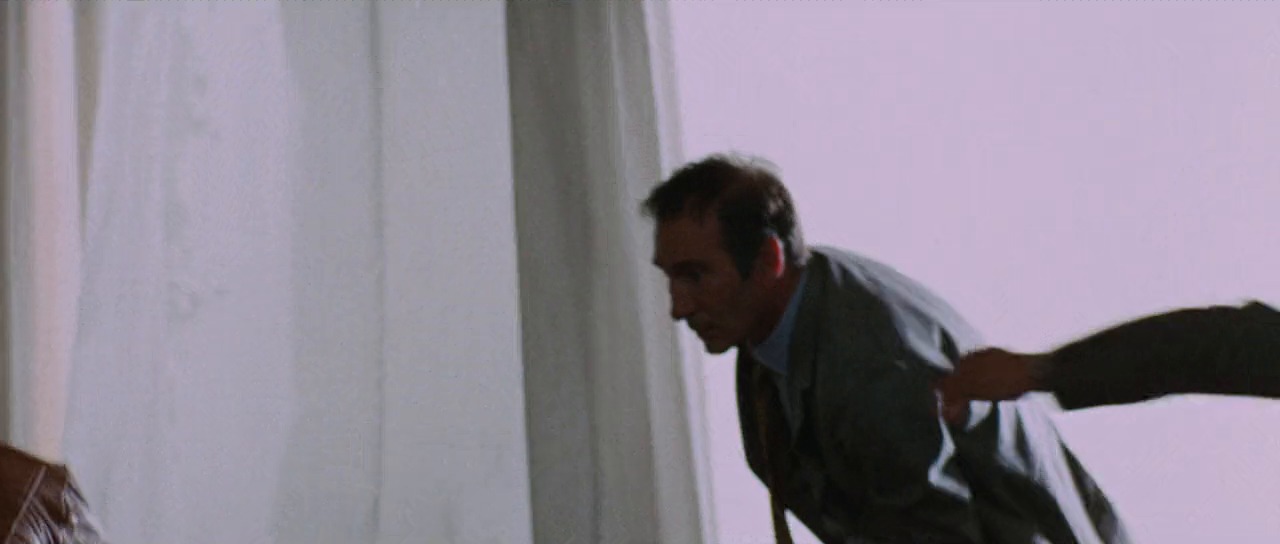
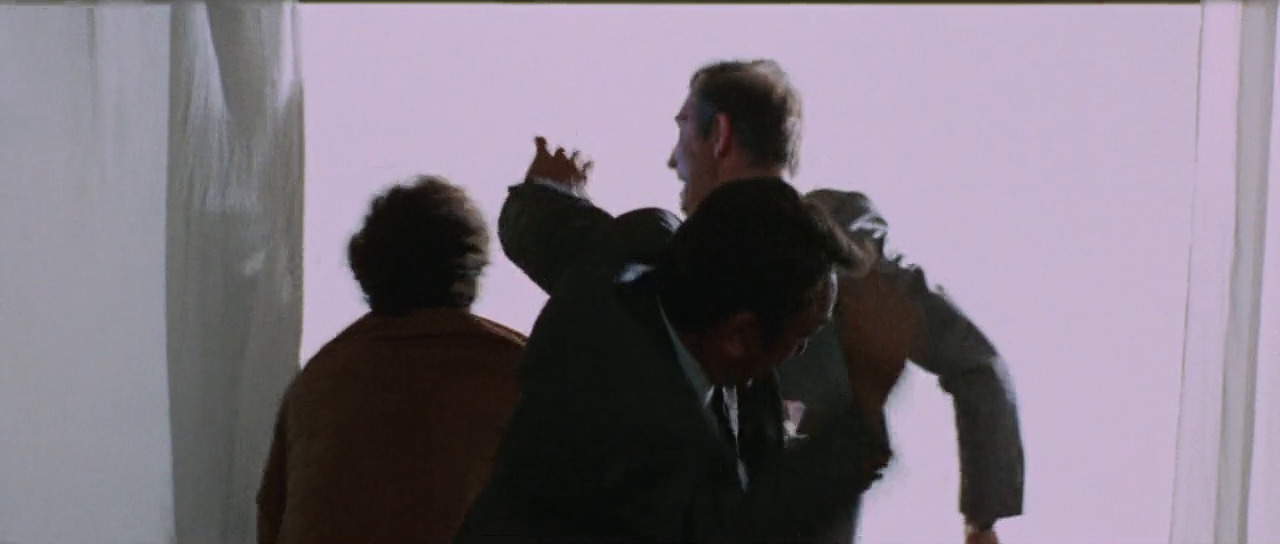
The apartment confrontation becomes a rescue at the window, then an examination at pavement level. Rather than sustaining one view of the fall, the editing distributes the event across effort, slipping contact, the view below and the injured body.
1:20:30–1:20:47Sam leaves the zoo; railings, the stairwell and a crowded doorway accelerate the move into the apartment.
1:20:48–1:20:54The struggle involving Alberto and Monica is followed by a wider view of the arriving men. Several possible directions of movement are established together.
1:20:56–1:21:10Alberto with the knife alternates with Sam, the inspector and Monica. Reactions distribute the threat around the room.
1:21:12–1:21:23Reverse views tighten the confrontation before a wider movement carries Alberto toward the window.
1:21:24–1:21:28Giulia enters, Monica moves toward her and the men cluster at the window. The cut separates the women’s response from the rescue attempt.
1:21:31–1:21:35The men reach outward; the exterior angle shows Sam and the inspector straining together. A distant façade view establishes the height.
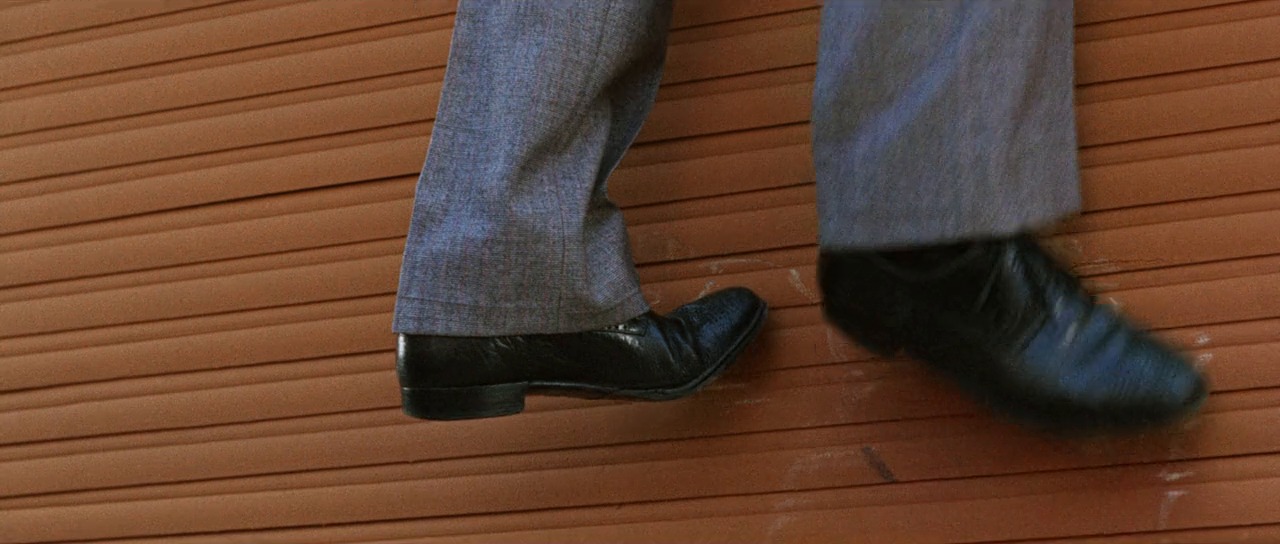
1:21:37–1:21:40Shoes against the shutter, Alberto’s face, the downward view and the men above divide the hanging body into its points of contact.
1:21:41–1:21:48Footing, grip, face and the street below repeat. The returns delay the outcome while making the physical effort increasingly apparent.
1:21:49–1:21:54A close grip insert alternates with Alberto’s face and shoes. The connection finally leaves the frame as the hands separate.
1:21:55–1:22:00The downward movement gives way to the pavement and a shoe. The edit bridges the fall through a change of scale and orientation.
1:22:02–1:22:14Clothing, wrist and bloodied face build the aftermath in parts. The camera gradually supplies the body that the falling view did not show continuously.
1:22:14–1:22:33The recorder, inspector and Alberto’s face alternate. The body becomes the source of a statement the police want to preserve.
1:22:40–1:22:51The inspector examines him; another man photographs the scene. The investigation resumes through hands and recording devices.
1:22:52–1:23:13Sam and the inspector confer near the ambulance. A presumed resolution is discussed while the film retains Sam’s unsettled response.
Reading the sequence
The recorder extends the sequence beyond physical aftermath. A falling body first becomes a collection of visible fragments, then a source of spoken evidence. The police’s ability to retain that statement does not settle the meaning of the original gallery encounter.
The revelation reopens the first encounter rather than replacing it. A series of reverse views in the apartment leads back through the gallery’s exterior to the blade in Monica’s hand. Information already shown gains a different relation to its surroundings.
1:29:15–1:29:23Bodies on the floor and Sam’s rising face lead to a dark portion of the room. The reverse view withholds an obvious threat.
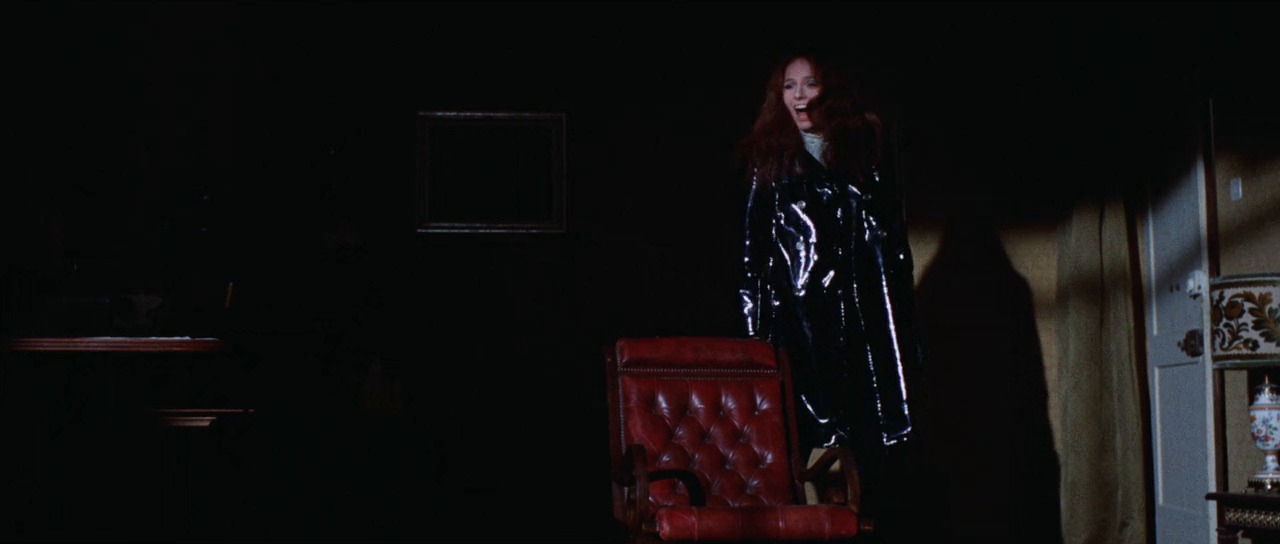
1:29:25–1:29:33The dark space returns, then Monica appears in the black coat. Repetition lets a previously empty area become the source of the revelation.
1:29:35–1:29:45Her face and Sam’s reactions alternate. Her forward movement turns recognition into an immediate threat.
1:29:48The film returns to the gallery frontage. The wider, familiar image gives the recollection a spatial starting point.
1:29:49Closer views move into the struggle on the upper level. Distance is removed in stages rather than by an explanatory title or diagram.
1:29:51The blade in Monica’s hand supplies the crucial reassignment. The opening’s victim-and-attacker arrangement can no longer be read in the same way.
1:29:54–1:29:58Monica’s present face and Sam’s response close the recollection. The corrected interpretation immediately matters to his survival.
1:29:59–1:30:06A charge and rapid movement send Sam toward an exit. The film exchanges concentrated recognition for flight.
1:30:09–1:30:15The doorway struggle returns to hands, frame edges and a pursuing figure. Understanding the image does not free Sam from physical confinement.
Reading the sequence
The flashback changes the viewer’s attribution of the action. It is the arrangement of bodies, weapon and viewpoint that needs rereading. The sequence is a compact example of the film’s larger proposition: an image may be remembered accurately and still be interpreted wrongly.
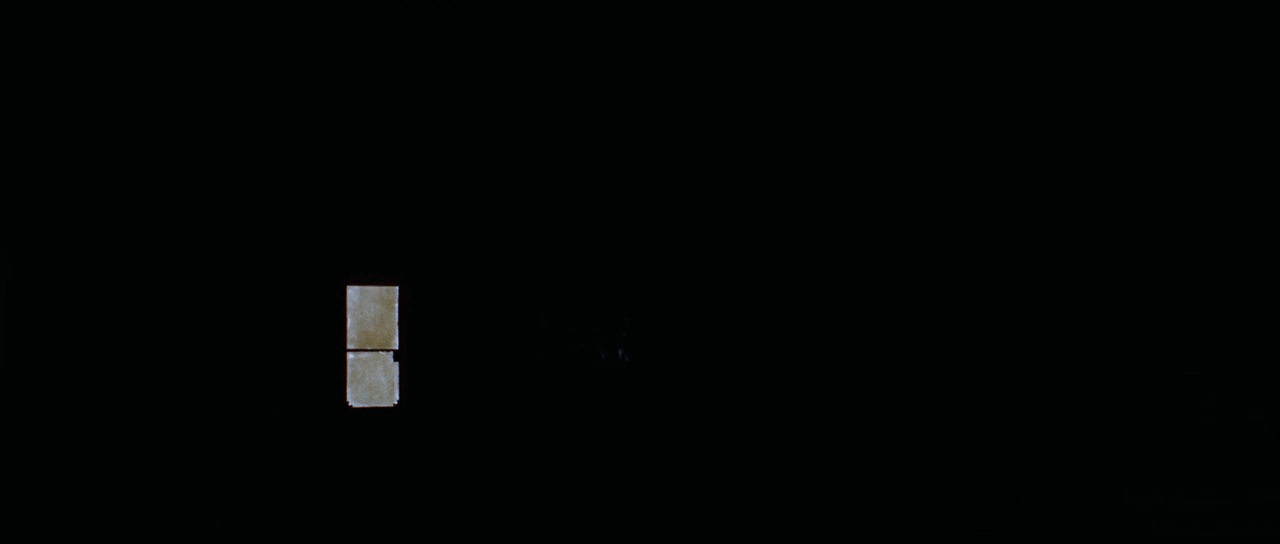
A tiny doorway isolated in black gives way to the bright gallery and a massive sculptural trap. The finale moves between two extremes of scale: a nearly empty frame that swallows a person and a close foreground object that pins him down.
1:30:30–1:30:53Sam’s face at the opening gives way to the small illuminated doorway surrounded by black. The prolonged withdrawal denies the viewer a useful sense of the surrounding room.
1:30:53–1:30:56The broad gallery view, Sam’s face, Monica above and the sculptural surface appear in quick succession. These fragments establish the impending fall from several directions.
1:30:58–1:31:02The sculpture drops into the wider composition. A low view under its points and a closer view of Sam’s head disclose the new trap.
1:31:03–1:31:10Monica advances while views of Sam behind the heavy edge keep his restricted movement visible. Their freedom of action is now radically unequal.
1:31:20–1:31:25Her lunging movement cuts to Sam’s reaction and hands near his face. The attack becomes a close struggle around the sculpture’s edge.
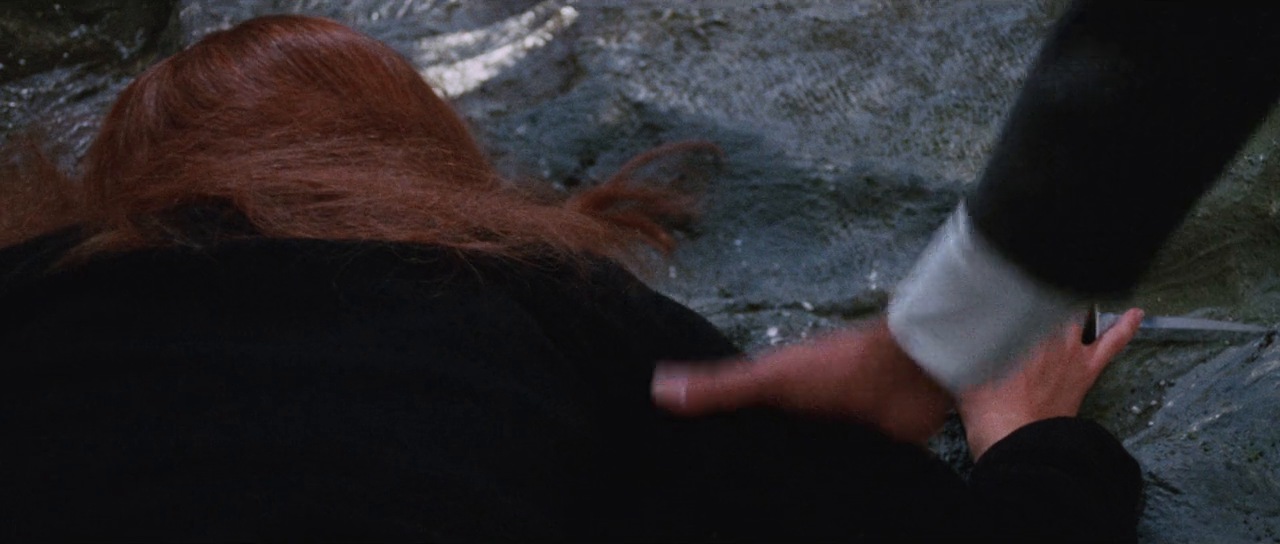
1:31:26–1:31:35A low view through the points alternates with Monica leaning down, Sam’s resistance and a knife near his raised hand. The prop divides access to the body into narrow openings.
1:31:36–1:31:41Face and hands alternate with Monica’s concentrated downward gaze. Small gestures carry the action because Sam cannot reposition himself.
1:31:42–1:31:48A wider view re-establishes her beside the trap; she rises and the low view returns beneath it. The spatial reset renews the imbalance before the next close encounter.
1:31:49–1:31:56Sam’s head behind the sculptural edge alternates with Monica above him. The repeated frame makes his confinement persistent rather than momentary.
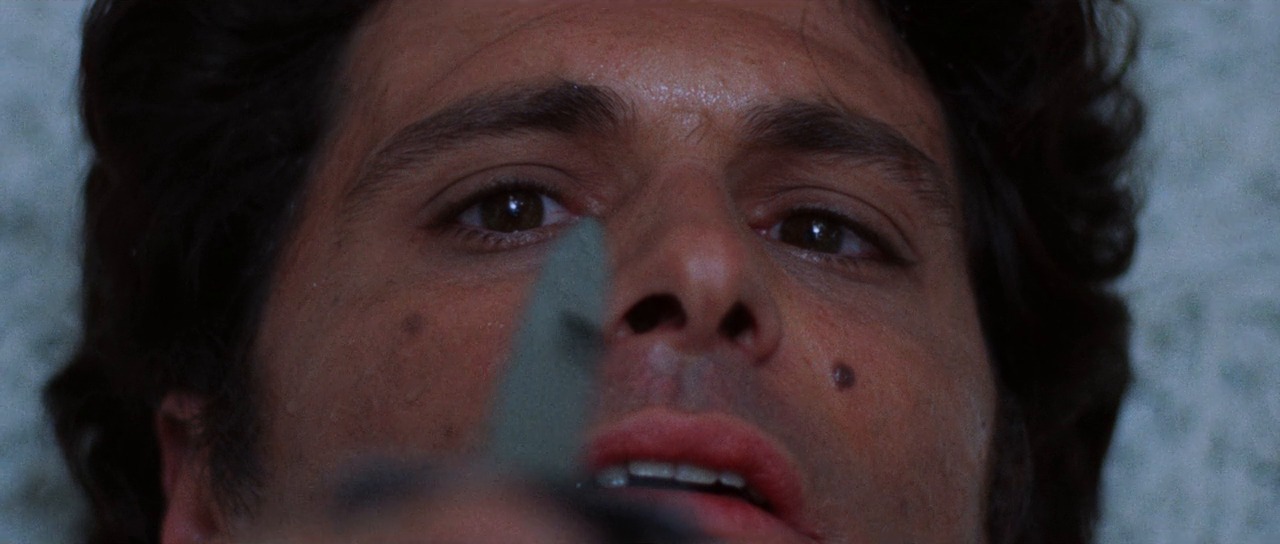
1:32:03–1:32:10The knife enters a close view of his face, then the film returns to the wider gallery. Extreme proximity and the large empty room coexist.
1:32:13–1:32:32The view from the sculpture’s other side turns Sam’s face upside down within the composition. Alternating close-ups sustain the confrontation from this changed orientation.
1:32:35–1:32:44The camera approaches Monica from behind; hands enter and seize her. Rescue arrives as an interruption of her control over the image.
1:32:46–1:32:55Sam beneath the slab, Monica restrained and a restored wide view reconnect the people in a common space. The inspector’s close exchange with Sam completes the release.
A commentary perspective
Howarth singles out the small doorway surrounded by darkness and the later danger embodied by the sculpture. The two devices form a visual reversal of the opening gallery: Sam is no longer standing outside the exhibited objects, but caught underneath one of them. Troy Howarth commentary, 1:30:23–1:31:33 ↗
The explanation continues after its speaker disappears.
ENLARGE ↗The explanation is framed as a television production.
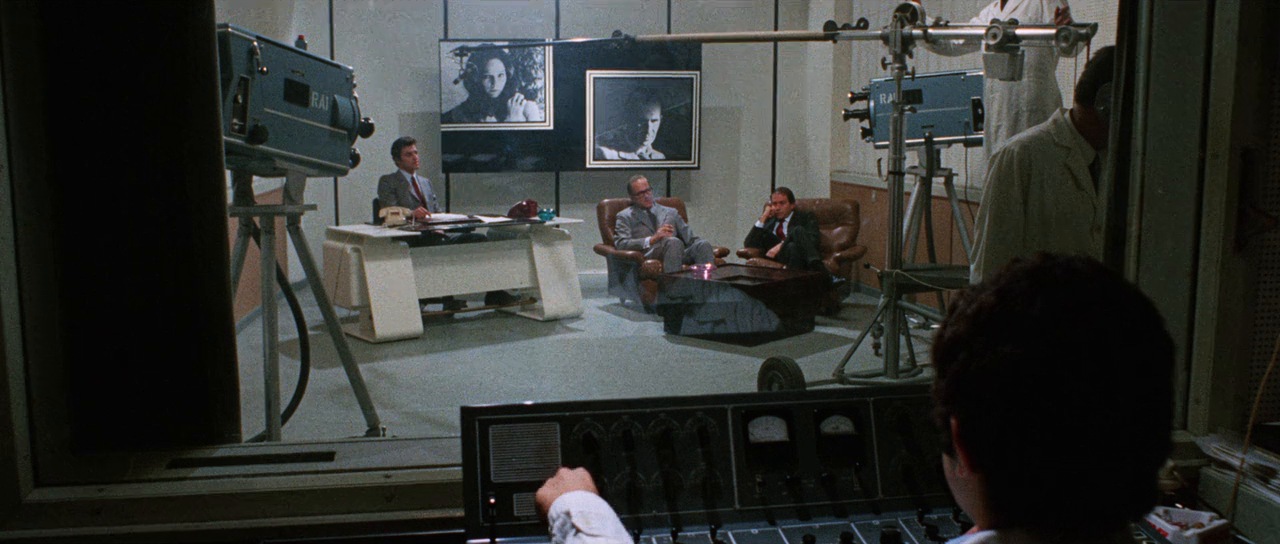
The ending frames its official explanation as a television production, then leaves the studio for the airport while the speech continues. Images of departure acquire a second rhythm underneath an account that is still tying up the story.
1:33:12The studio is seen through the control-room window, with equipment and an operator in the foreground. The explanation is introduced as a produced image.
1:33:22–1:33:28A closer view of the presenter opens toward the seated guests. The question moves from broadcast address into an interview arrangement.
1:33:40–1:34:04The two guests share the frame while the inspector’s tired gestures disturb the formality. The image provides a comic counterpoint to the presenter’s account.
1:34:16The psychiatrist receives the closer framing as he takes over the explanation. Visual authority has been passed to a new speaker.
1:34:24–1:34:40The film cuts to aircraft details and moving planes. The English explanation continues across this change of location.
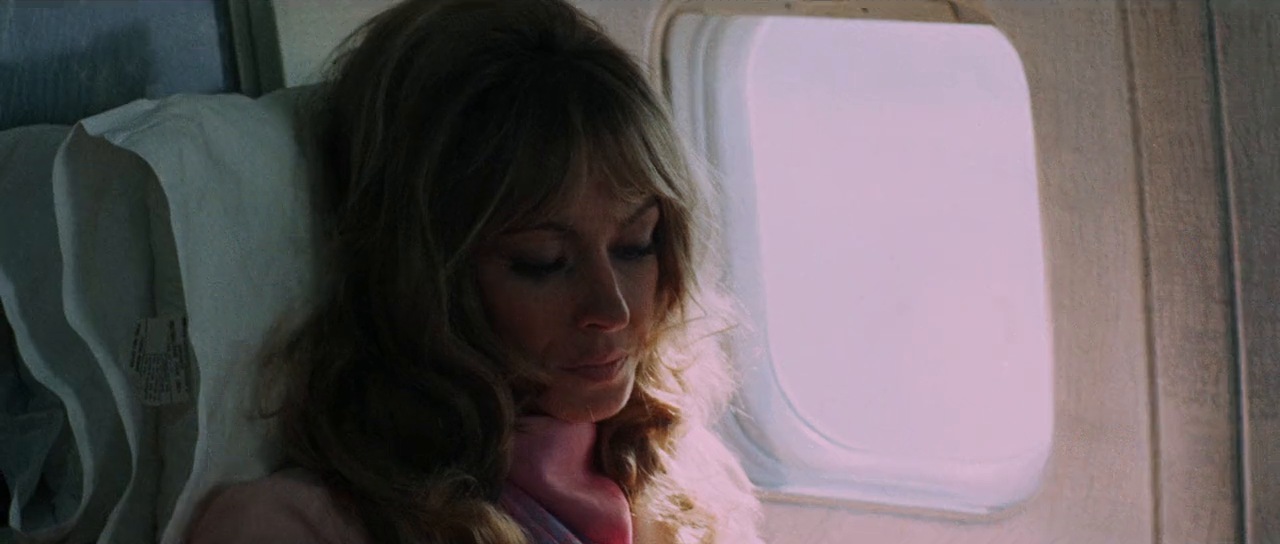
1:34:41–1:34:50Giulia by an aircraft window alternates with further exterior plane views. The characters’ departure is placed inside the airport montage.
1:34:52–1:35:02Sam appears in the terminal between returns to Giulia and the aircraft. Their separation is maintained until boarding.
1:35:05–1:35:08Sam enters the cabin and joins Giulia. Their shared movement replaces the alternating views that kept them apart.
1:35:10–1:35:28The aircraft exterior becomes the background for the end credits. The story’s exit and the film’s credit sequence occupy the same continuing image.
A commentary perspective
Howarth compares the explanatory scene to the conclusion of Psycho and notes the humorous effect of the inspector’s exhaustion. The film then lets images of departure run ahead of the official account: the explanation can continue without keeping its speaker on screen. Troy Howarth commentary, 1:33:12–1:34:53 ↗
A threat becomes a recording. A recording becomes a place.
The English dialogue gives the sound investigation three distinct steps: repetition, comparison and recognition. Each changes what the characters can infer from a recording they already possess.
The caller threatens Giulia and tells Sam to abandon the investigation. Playback shifts attention away from those words and toward the unexplained background sound. Rewinding makes an incidental detail repeatable: the recording preserves more than the caller intends to communicate.
The English SDH captions call it a clicking sound here; the later explanation calls it creaking. Neither provisional description identifies the source. The important change is that a noise has become a question the characters can pursue.
The laboratory compares the recorded calls on an oscilloscope. Its explanation assigns the voices to different speakers, prompting the investigators to consider two killers or a killer with an accomplice. This is the film’s procedural claim, not a demonstration that its dialogue supplies a dependable real-world voice-identification method.
The separate background sound defeats the same apparatus. Staff describe comparisons with machinery, demolition work, electric doors, cranes and domestic appliances without finding a match. The investigation has searched a mechanical category for a sound whose source lies elsewhere.
The explanation identifies the noise as a bird call. The conversation then narrows the search from a supposedly remote habitat to a captive specimen at the zoo. What sounded incidental on the tape becomes a geographical relation.
At the zoo, Sam connects the call to the nearby Ranieri apartment and recalls the telephone beside its window. The decisive step joins a sound with a remembered arrangement of objects. The clue works because the film finally lets hearing and looking correct one another.
Troy Howarth’s commentary describes the opening theme’s lullaby quality and its recurrence as an obsessive motif. Set beside the gloves, blades and surveillance images, that reading emphasises the uneasy relation between musical gentleness and visual threat.
The distinction between score album and film track remains essential. Arrow lists original mono English and Italian soundtracks alongside Howarth’s commentary.
The sculpture is described before it becomes a weapon.
The installation dialogue establishes weight, balance and pointed surfaces while the workers rearrange the gallery. Monica’s thanks then reinforces Sam’s account of the first encounter: she describes herself as the person he saved.
These two strands do different work. Practical remarks prepare the sculpture’s later physical role; social conversation maintains the mistaken assignment of victim and attacker. The image and the spoken account are being prepared for different reversals.
Howarth identifies the song in the convention passage as Se sei stonato… and connects its playfulness with the turn from pursuit to comedy. AMS lists the same title as the fourth track on its soundtrack edition.
The label confirms the track name; the scene placement follows Howarth’s commentary. Read together with the repeated yellow jackets, his observation gives the joke two parts: the threatening costume becomes commonplace, and the musical setting supports the change in tone.
The recorder enters the pavement-level examination as Alberto assumes responsibility for the murders and asks that his wife be cared for. The English dialogue supplies an apparently decisive spoken account beside the visible consequences of the fall.
That account later has to be reinterpreted. The recorder preserves a speaker’s claim; it does not independently establish the claim’s truth. This is the sound investigation’s counterpart to Sam’s original visual mistake.
The psychiatrist begins on screen, but the account continues over aircraft and airport images from about 1:34:24. The English dialogue and SDH timings place the final part of his explanation across these views of departure. Speech connects two locations that the picture has already separated.
His account begins by describing its conclusions as conjectures. The film nevertheless gives that speculative explanation an official setting, then lets Sam and Giulia’s departure proceed beneath it. The later recollection of advice about peaceful Italy supplies a final ironic voiceover rather than another police finding.
Approach. Barrier. Contact. The aftermath in fragments.
Blood is only one part of the construction. Glass, darkness, a splintered door and a failing grip determine what can be seen and when. These galleries follow six sequences through sixty-one selected stages. Open a gallery, then enlarge a frame to move through its images.
SEQUENCE STUDY 01 / 04:31–06:38
The gallery: blood across the glass
ENLARGE ↗Monica reaches forward with a bloodied palm.
The first violence is staged as something witnessed from the wrong side of a boundary. The distant struggle gives way to Monica on the floor, then to the blood on her outstretched palm. Red against the pale gallery makes the injury immediately legible, while the changing viewpoints leave its cause open to misreading. Sam’s raised hands answer Monica’s reaching hand without bringing them into contact. The gallery ends with a body on display and a witness who has acquired an explanation too quickly.
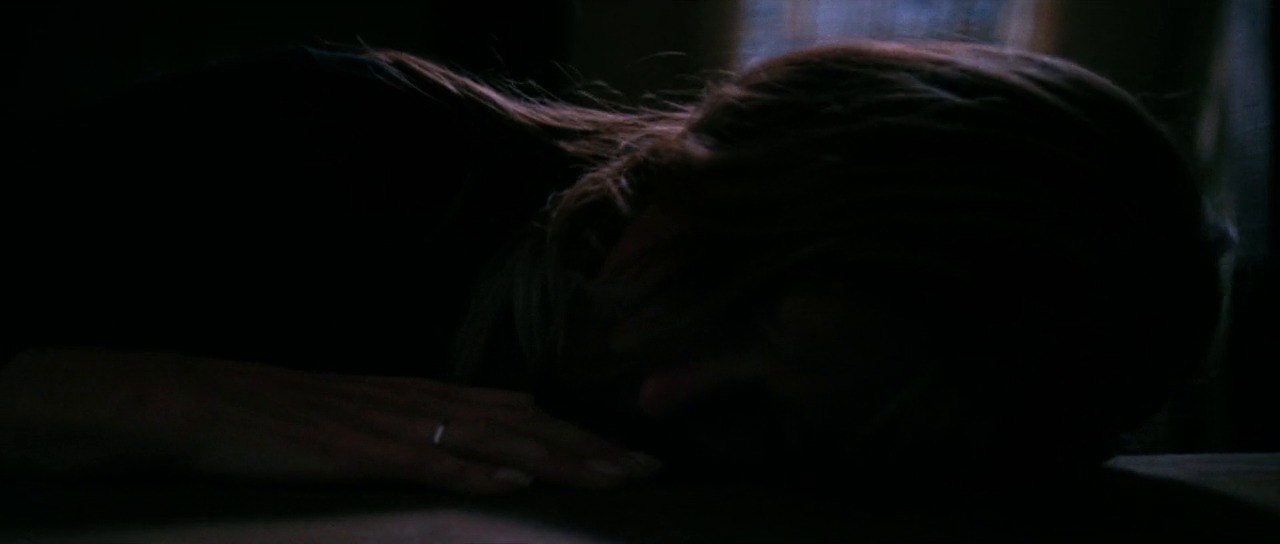
A distant lit window first makes the room an object of surveillance. The bedside cigarette and the doorway establish a fragile sense of ordinary space before the black-clad figure enters it. Close views then distribute the violence across the face, the gloved hand, the blade and the hand gripping fabric. The sequence makes the viewer assemble an attack from these separated details. The ordinary gesture of a hand on fabric becomes the sequence’s most economical sign of bodily distress.
ENLARGE ↗The wounded face replaces the distant figure.
The stairwell is initially a strong geometric form: rails and landings organise the woman’s ascent. The loss of light destroys that confident overview. A face survives in a small illuminated patch before the gloves and knife bring the threat close. The final details move through blade, blouse, bloodied face and the spattered surface. Their succession makes the aftermath explicit after a long approach in which the attacker’s position could not be securely read.
The apartment attack concentrates on damage to a boundary. Giulia checks the telephone, struggles with the barred window and retreats from the door. The blade cuts an opening that can also become a viewpoint. A small patch of light, an eye at the breach and Giulia’s face make the separation between pursuer and victim feel increasingly thin. The sequence’s force comes from extending the threat of contact; the door takes the visible damage while her body remains the threatened destination.
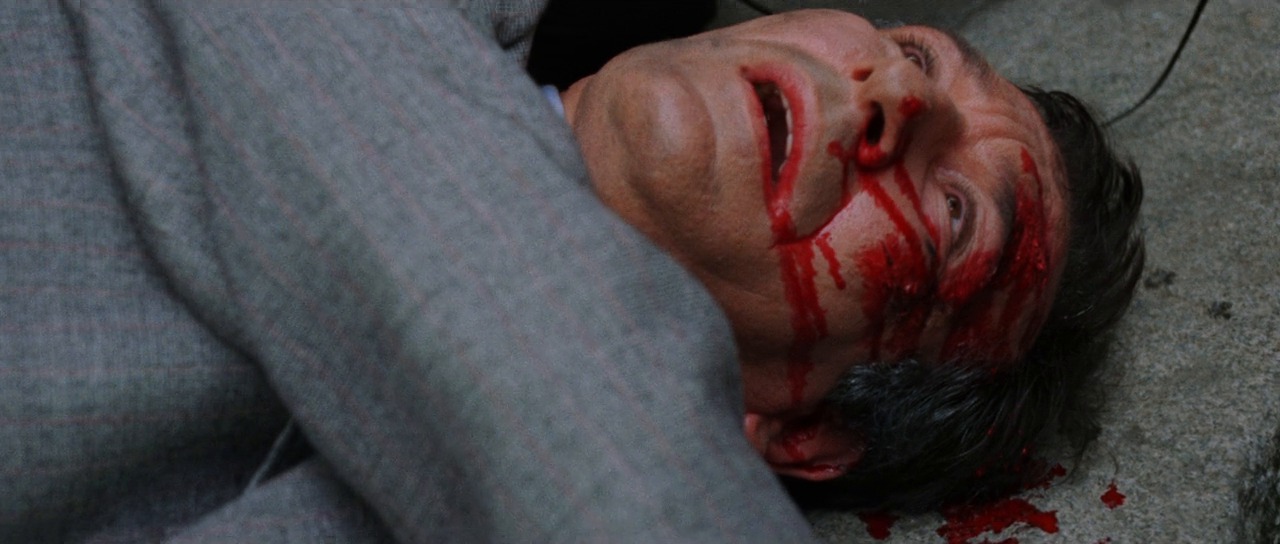
ENLARGE ↗His bloodied face completes the aftermath.
The window struggle is divided into the effort to hold on and the distance below. A low view of the façade establishes the height; hands and shoes bring that height back to the body. The downward view of the street bridges the failing grip and the fragments at pavement level. Shoe, wrist and bloodied face give the fall its aftermath. The sequence’s editing establishes the connection without supplying a continuous view of a body striking the ground.
The sculpture trap: a gallery turned against its witness
ENLARGE ↗Sam struggles in the narrow space below the structure.
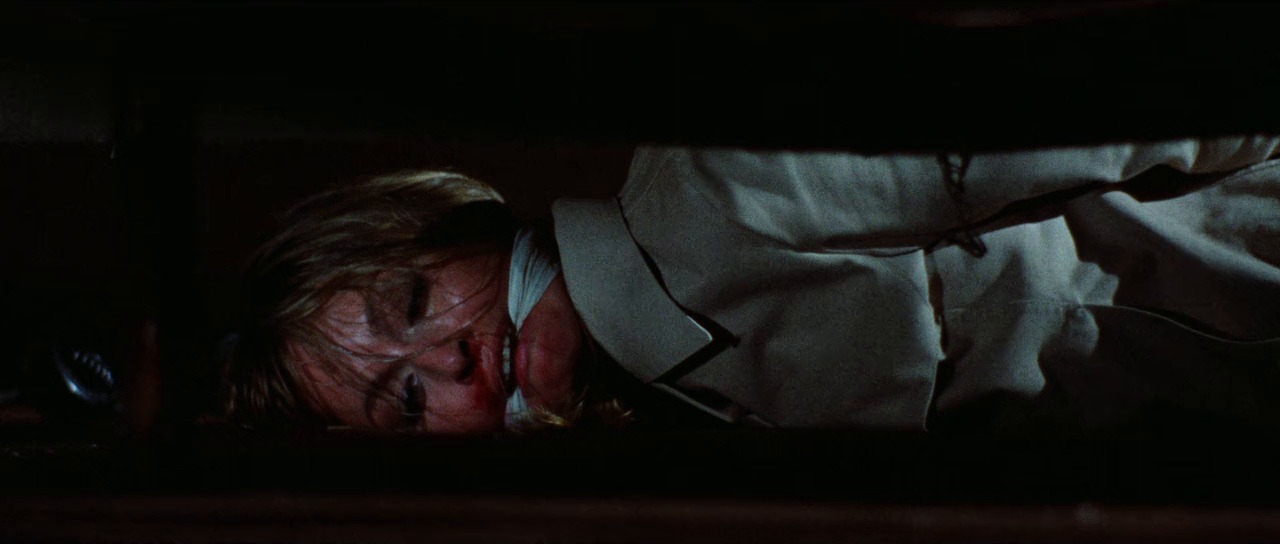
The final encounter reorders the opening before turning its setting into a weapon. Giulia is found bound, Monica is revealed with the knife, and Sam’s memory changes the roles assigned to the first struggle. The gallery sculpture then pins him to the floor. Its weight is communicated by the low view of his trapped body, the restricted space around his face and his attempts to resist Monica’s approach. The rescue breaks that arrangement, but the room’s transformation from display space to physical trap has already completed the film’s argument about helpless spectatorship.
In the late appendix to My Cinema’s second part, Argento recalls meeting Morricone through the connection with his father, Salvatore. The new director arrived with records to explain the music he wanted, ranging across popular and more experimental material. In his telling, the demonstration initially irritated the composer; the difficult introduction nevertheless developed into friendship and collaboration.
The anecdote belongs beside the score’s mixture of lyricism and abstraction. It shows a director trying to communicate a range of desired sensations before there was a common working language. The published credits still distinguish composition, musical direction, recording and effects; Argento’s memory adds the interpersonal negotiation behind the commission.
Source & passage
Dario Argento: My Cinema / Il mio cinema, two-part documentary presented on Severin Films’ Dario Argento’s Deep Cuts, Disc 1. Part Two, 1:02:12–1:03:28.
The discussion paraphrases the English subtitles and distinguishes participant recollections from the documentary’s narration and production footage.
Discussing Testimone oculare, Thompson and Howarth connect its tight door close-ups to The Bird with the Crystal Plumage. The television episode also makes the attacker’s injured hand persist after the immediate danger: pain interrupts the conspirators’ explanation, and the wound complicates their alibi. Following the comparison distinguishes the suspense of a barrier being breached from the later narrative work performed by an injury. Argento and Cozzi also separately recall that the premise of Il tram developed from an unused Bird investigation in which a murder on a crowded tram went unnoticed. Their interviews describe material moving from the feature screenplay into a self-contained television story.
Source & passage
Eyewitness commentary, 49:25–50:06; A Streetcar Named Fear, 07:26–08:48; On the Other Side of the Door, 04:25–05:31. Presented on Disc 2 of Severin Films’ Dario Argento’s Deep Cuts.
2023 programme: Kevin Lyons’s 2018 essay, a November 1970 Monthly Film Bulletin review and compiled credits. These are distinct records, not production paperwork.
Interview conducted March 2018, published 4 March 2020. Bird subsection on budget, viewpoint and collaboration. French-language testimony paraphrased here in English.
Cambridge Scholars Publishing, 2015; printed pp. 26–27 and 112 consulted. Plot explanation and psychoanalytic reading distinguished from direct viewing. Public copy held by Birmingham City University; no book illustrations reproduced.
Review dated 14 October 1970. Used as contemporary criticism of suspense, darkness and helplessness, not as evidence of overall reception or ticket sales.
Provenance of the earlier 600-pixel gallery image, credited to Cinecittà. Preserved in the first-edition research record; replaced on this page with the larger ShotDeck frames.
The visual studies and sequence galleries draw on a 1:36:45 presentation. Their time locators follow that presentation; the stills retain the widescreen picture at 1280 × 544 pixels. The two separately credited ShotDeck images remain in the research essay. The selected scene studies concern the finished film’s images and editing; they do not identify an effects technique or restoration from appearance alone.
The sound-clue studies compare selected English dialogue passages with the English SDH captions and locally prepared speech transcriptions. They analyse the dialogue’s account of the recordings; they do not claim a complete cue-by-cue listening comparison of the English and Italian mixes. Time locators follow the same 1:36:45 presentation used for the visual studies.
Howarth identifies himself in the commentary introduction at 00:20–00:31. Selected passages cover the opening theme, gallery framing, staircase and finale. Arrow’s official edition listing ↗ independently credits his commentary and specifies the original mono English and Italian tracks. The commentary is retrospective interpretation; it is not contemporary production or censorship paperwork.
Further dialogue checks cover the passport questioning, the painting photograph, the sculpture installation, the painter’s meal, Alberto’s statement and the television-to-airport ending. The new commentary references concern the convention’s comic turn and song at 47:17–48:07, and the explanatory ending at 1:33:12–1:34:53. The song title is checked against the AMS label’s published track list. These additions retain the distinction between dialogue analysis, a commentator’s listening observations and a full soundtrack comparison.
Lamberto Bava: 19:11–19:57. Retrospective documentary testimony, paraphrased from the interview and checked against the English subtitles. Source and review method ↗
 ENLARGE ↗