FILM DOSSIERS / 020 · FILM DOSSIER
GialloA genre becomes a name.
The doubled star, the missing sister and the fight over tone. Inside the writing, production and music of Argento’s most self-conscious title.
Identity, reputation & release history
A title that names a tradition and a killer. This expanded dossier follows Giallo through its writing, Brody’s double role, Linda and Celine, the Turin production, Werba’s music, the argument over parody and the film’s delayed circulation.
Spoilers: this study discusses the film’s story and ending.
01 / THE TITLE, THE GENRE & THE SEARCH
A genre becomes a name
Giallo makes its title do two jobs. It names the thriller tradition associated with Argento, and the killer called Yellow. The word promises a return to familiar territory while making that familiarity part of the problem: how much of what we see comes from the film, and how much from our expectations of its director?
The regional film commission’s synopsis follows Linda, played by Emmanuelle Seigner, as she searches for her missing sister Celine, played by Elsa Pataky. Inspector Enzo Avolfi becomes her professional ally; the women targeted by the killer are selected for their beauty. The production synopsis ↗ This gives the investigation two different clocks. The police must identify and locate a criminal; Linda needs someone still alive to be found.
That difference matters more than a catalogue of familiar murder devices. Solving a case and saving a person are related activities, but they are not interchangeable. The relative’s urgency tests the detective’s authority: a convincing explanation may arrive too late to be useful.
Read this way, the title is also a challenge to the audience. Recognition can be pleasurable, yet recognising an Argento convention does not settle whether it creates suspense here. The dossier follows that question through the writing, the doubled star, the production, the music and the unusually divided critical response.
02 / AGNEW, KELLER & A SCREENPLAY’S UNCERTAIN STATUS
Before Turin, a page says Milan
A publicly posted screenplay attributed to Jim Agnew and Sean Keller opens at La Scala in Milan. Its title page dedicates it to Dario. In the indexed opening passages, Keiko leaves the theatre for a club, then enters a taxi that appears to offer safety. The journey instead carries her away from public space. Screenplay text, opening pages ↗
The reversal is economical: the vehicle’s apparent usefulness is what makes it dangerous. A visitor depends on someone else to know the city. A taxi can therefore turn the ordinary act of asking for help into the surrender of control over a route. This is a reading of the available writing, not a shot-by-shot description of the released film.
The online screenplay text sets its opening in Milan, offering a concrete comparison with the Turin story in the production synopsis.
The commission distinguishes Agnew and Keller’s story and screenplay from Argento’s screenplay collaboration. The separate writing credits ↗ That is a better starting point than treating every element as the director’s private invention. An authenticated draft and a writers’ account would let us follow the film’s development rather than infer it backwards from a reputation.
03 / BRODY, SEIGNER, PATAKY & THE BODY AS EVIDENCE
One actor, two claims to power
Adrien Brody plays both the inspector and the killer, with the latter credited as Byron Deidra. James Dennis’s contemporary review identifies the credit as an anagram and reads the doubling as one clue to possible parody. Dennis on performance and the credit ↗ The casting creates a relationship before it supplies an explanation: pursuit and pursued share an actor without becoming the same character.
Martyn Conterio’s later BFI account treats the pairing as a criticism of male obsession. Conterio’s retrospective reading ↗ That offers a useful way to test the detective’s apparent distance from his quarry. Professional authority cannot, by itself, guarantee moral clarity. Equally, a shared performer does not make different acts or responsibilities equivalent.
Linda and Celine prevent the doubled male role from being the only centre of the story. One needs information from the investigator; the other needs release from the captor. Their immediate needs put pressure on the men’s capacity to explain themselves. The interesting question is not simply what has made these men who they are, but what their explanations allow them to do to other people.
The killer’s visibly marked body needs similar care. A thriller can use appearance as a clue while also teaching its audience to treat bodily difference as moral evidence. That is a representational choice to examine, not a medical truth to accept. A later performance study should ask whether particular scenes complicate that association or simply reinforce it, while keeping Pataky’s and Seigner’s responses in view.
04 / THE INSPECTED REPRODUCTION
The detective does not quite control the frame
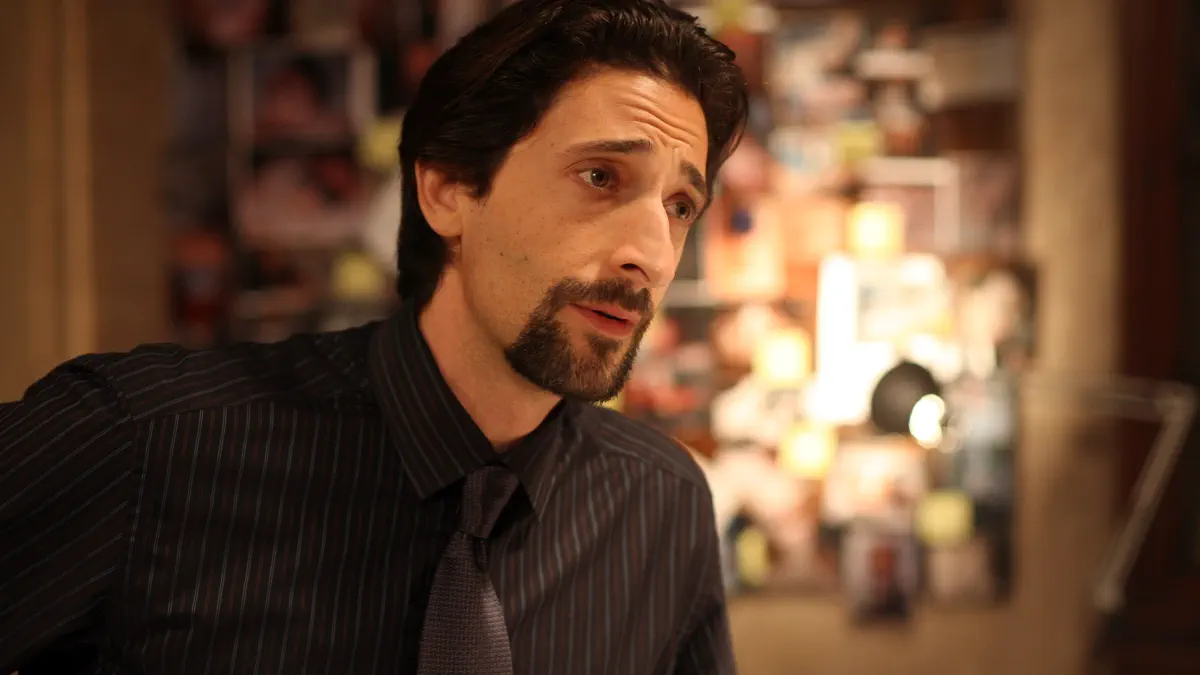
In the supplied Apple image, Brody leans into the frame from the left. His striped dark shirt and tie create a comparatively ordered surface beneath a face turned toward the right. The lifted eyebrows, parted lips and forward posture suggest engagement with someone or something beyond the edge.
Behind him, the room breaks into warm patches of light and indistinct objects. The brightest area lies to the right of his face. It competes for attention without resolving into useful information. The detective is visually available; the space to which he is responding is not.
This makes a productive image for a film about an investigator’s authority. We can inspect the person who is supposed to interpret the world, while remaining unable to inspect the whole situation. His proximity does not give us omniscience. The composition offers an encounter rather than a diagram of the case.
The supplied 1200 × 675 WebP is now served locally, preserving the entire reproduction without enlargement, crop or colour adjustment. Image provenance ↗ This reading concerns the inspected still; it does not identify a lens, camera movement, lighting plan or original theatrical colour standard.
05 / TURIN, THE CREW & PRODUCTION CONTROL
The director’s name is not the whole workshop
The regional record credits Frederic Fasano’s photography, Roberto Silvi’s editing, Davide Bassan’s production design, Stefania Svizzeretto’s costumes, Sergio Stivaletti’s effects and Roberto Sestito’s sound. It records Film Commission Torino Piemonte support in 2008. Crew and regional support ↗ These are different kinds of work, and the city on screen is partly the result of their coordination.
The separation matters particularly in a film whose public identity is so heavily attached to Argento. A location, a designed interior, a costume and an effect can all help organise a viewer’s attention, but they need not have one author. The credits identify departments; they do not identify the maker of every visible detail or establish the exact division of practical and digital work.
In Alex Fitch’s 2009 interview, Argento praises the experience of working with Brody and Seigner but describes difficulty with the American producers. He contrasts their suggestions and desire for cuts with the control he normally associated with producing his own films. Argento’s contemporary account ↗ This is direct testimony about his experience of the collaboration.
It is not an edit history. The interview supplies neither a list of removed scenes nor a comparison between an approved director’s version and a release print. It can help explain why questions of authorship surround Giallo, but cannot be used to excuse every perceived weakness or assign every decision to an absent producer. Those stronger claims need stronger records.
06 / MARCO WERBA, ORCHESTRATION & SPACE
Suspense also depends on when music withdraws
In Randall Larson’s May 2009 interview, reproduced on the composer’s website, Marco Werba describes proposing an orchestral approach closer to Herrmann than to Goblin after seeing a cut with electronic temporary music. He recalls Argento requesting a theme for the predatory taxi; Werba cites Jaws as an inspiration for its effect. Werba’s account of the musical brief ↗
The same account places the recording with the Bulgarian Symphony Orchestra in Sofia, followed by mixing at Forum Music Village in Rome, with Marco Streccioni recording and mixing the score. Those production details distinguish composition, orchestral performance and the recorded result.
Speaking to Emanuela Clari De Julis in 2018, Werba describes a negotiation over quantity: Argento wanted extensive music, while the composer wanted room for it to breathe. His solutions included internal pauses and changing the instrumental combinations between torture scenes. Werba on silence and variation ↗ This is a more revealing question than whether a score sounds sufficiently like an earlier Argento film.
Werba’s reported intentions place absence alongside repetition: a pause can expose a voice, a room or an action that sustained music has partly absorbed, while a recurring musical figure can turn a vehicle into a threat.
07 / LAUGHTER, FAILURE & THE QUESTION OF INTENTION
Who decides whether this is a joke?
Dennis’s August 2009 FrightFest review finds the film extremely funny, but leaves open how much of the effect is intended. He reads straight-faced performances and exaggerated conventions as possible parody rather than resolving the uncertainty. A contemporary response to the humour ↗ That hesitation is part of the evidence and should survive a summary of his review.
Federico Pontiggia, in a June 2011 review excerpt reproduced by Cinematografo, sees failed suspense and involuntary absurdity. Conterio’s 2023 BFI survey instead finds a knowing quality and a critique of obsession. The reprinted Italian judgment ↗ The later reassessment ↗ These are three critical positions across different contexts, not a measured account of the whole audience.
The disagreement cannot be settled by attaching the word “intentional” to everything awkward. Deliberate parody still needs an organising point of view: what convention is being exposed, and what becomes visible when it is exaggerated? Nor does laughter automatically prove failure. A viewer can find an image or line ridiculous while still feeling discomfort about the situation around it.
For this dossier, that unresolved tone is a subject rather than a verdict. The doubled performer, the title’s self-reference and the collision between explanation and urgency give the debate concrete objects. They let us ask how the film works without demanding either a rescue of late Argento or a ritual declaration of decline.
08 / PRODUCTION, FESTIVALS & PRESENTATIONS
Several dates describe different events
The records do not all date the same thing. Filmitalia lists a 2008 production, 2009 festival appearances and an Italian theatrical release on 1 July 2011. Its duration is 90 minutes. Filmitalia’s chronology ↗ The dossier retains 2009 as its film year while keeping the production and later release dates visible.
| Record | Listed event or length | Limit of the evidence |
|---|---|---|
| Filmitalia | 2008 production; 2009 festivals; 90 minutes | Catalogue fields, not a timed inspection of a print. |
| FCTP | 2009; 92 minutes; support in 2008 | Regional production record; no comparison of cuts. |
| Cinematografo | 2010 DVD/Blu-ray circulation; 92 minutes | Home-video history from the catalogue. |
| Italian theatrical release | 1 July 2011; Giallo/Argento | Release date and title, not a new production year. |
Cinematografo reports that home-video circulation preceded the Italian cinema release, which followed the resolution of Brody’s payment dispute with the production. The catalogue’s release-history note ↗ This is an attributed outline of circulation.
The two-minute difference between catalogue durations does not establish missing scenes. Rounding, playback speed and different materials are possibilities to investigate, not explanations already proved. A meaningful version comparison would identify the carrier, territory, language, frame rate and actual opening and closing points before assigning the discrepancy to editing or censorship.
These distinctions also help us read the criticism. A festival screening, a domestic disc and a delayed cinema release place a film before different audiences with different expectations. They can alter the story told about a film even when no change to the film itself has been demonstrated.
FOLLOW THE CONNECTIONS
Another way in.
Read across films, then return
to the evidence for each one.
The Card Player
Compare professional investigators working within rules and information imposed by someone else.
Read the dossier →RELATED DOSSIERThe Stendhal Syndrome
Follow the instability of authority and the relationship between pursuer and pursued.
Read the dossier →THE MATERIAL AFTERLIFEShop & objects
Explore the wider Argento catalogue of prints, theatrical paper and physical media.
Browse the catalogue →THE READING ROOM
Return to the source.
Sources checked 17 October 2026. Production records, participant testimony, screenplay text, criticism and the supplied image retain their distinct roles.
- 01
Filmitalia — Giallo/Argento ↗
Production, festival, release and duration fields. Indexed page text; direct local capture returned 403. No physical presentation.
Return to the dossier ↑ - 02
Film Commission Torino Piemonte — production record ↗
Regional synopsis, department and writing credits, support, year and duration. A production record rather than an exact location or shot register.
Return to the dossier ↑ - 03
Cinematografo — Giallo/Argento ↗
Release chronology, duration and reprinted 2011 criticism. The original newspaper and legal records have not been.
Return to the dossier ↑ - 04
Martyn Conterio — Where to begin with Dario Argento ↗
2023 BFI overview. Its brief retrospective interpretation is attributed, not treated as proof of authorial intention.
Return to the dossier ↑ - 05
Apple TV — supplied Giallo image ↗
Source of the inspected 1200 × 675 reproduction. Served locally unaltered. No current streaming availability is asserted.
Return to the dossier ↑ - 06
Jim Agnew & Sean Keller — publicly posted screenplay text ↗
Selected indexed title and opening passages only, from a PDF listed as 112 pages.
Return to the dossier ↑ - 07
Alex Fitch — Interview with Dario Argento ↗
Electric Sheep, 3 July 2009; conversation at Cine-Excess earlier that year. Contemporary participant testimony about collaboration and production control, not a documented list of edits.
Return to the dossier ↑ - 08
Randall Larson — Symphonic Giallo ↗
18 May 2009 interview reproduced within Werba’s Giallo portfolio page, alongside separately attributed reviews. Used here for the composer’s account, not as our own listening report.
Return to the dossier ↑ - 09
Emanuela Clari De Julis — Marco Werba interview ↗
The Magazyne interview dated 17 February 2018, reproduced among other interviews on Werba’s site. The specific Giallo answer discusses pauses and varying orchestration.
Return to the dossier ↑ - 10
James Dennis — FrightFest 2009 review ↗
31 August 2009. A contemporary critic’s account of performance and possible parody; his uncertainty about intention is retained.
Return to the dossier ↑
KEEP EXPLORING
One film opens another.
Explore the films and collaborators → · Visit the Reading Room → · Find a piece for your collection →