03:15
A childhood below ground
 ENLARGE ↗
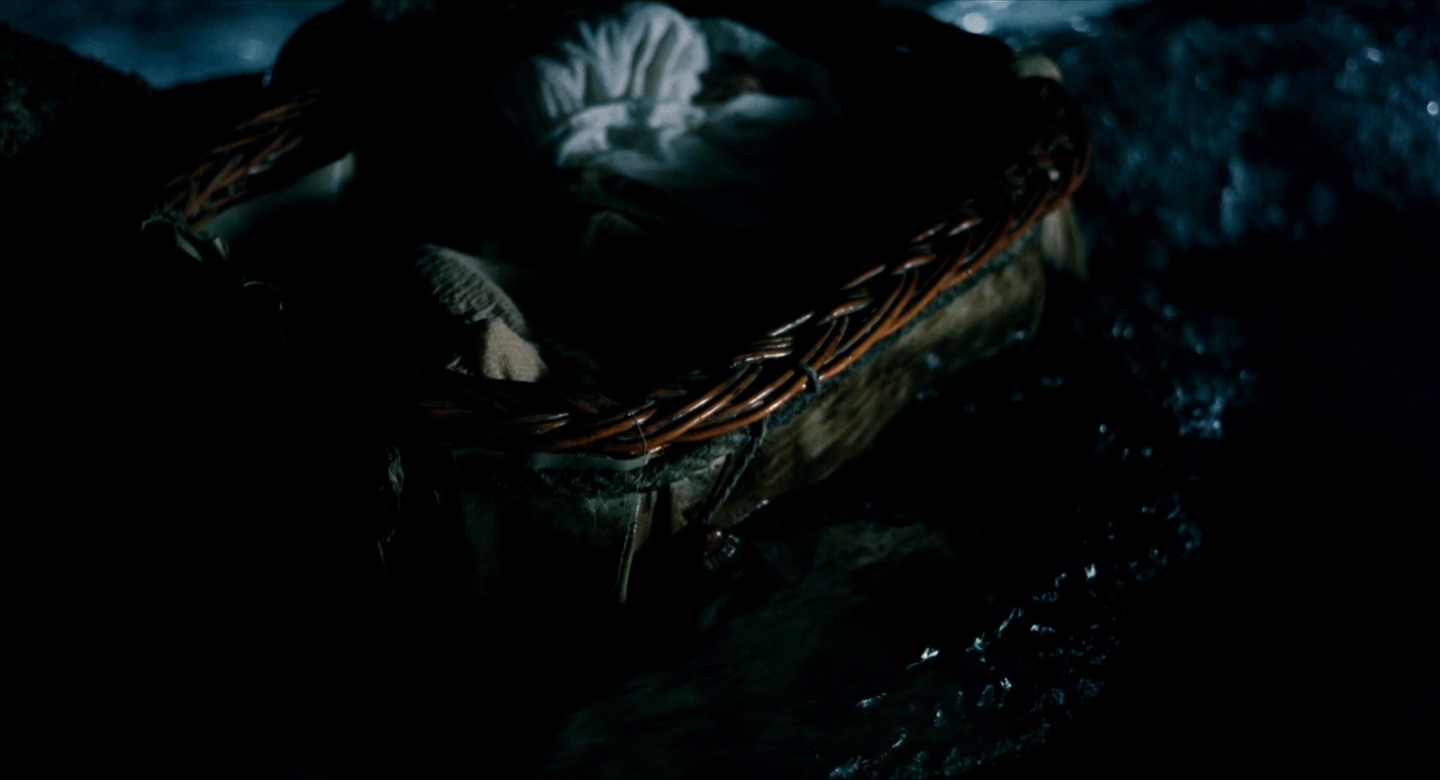
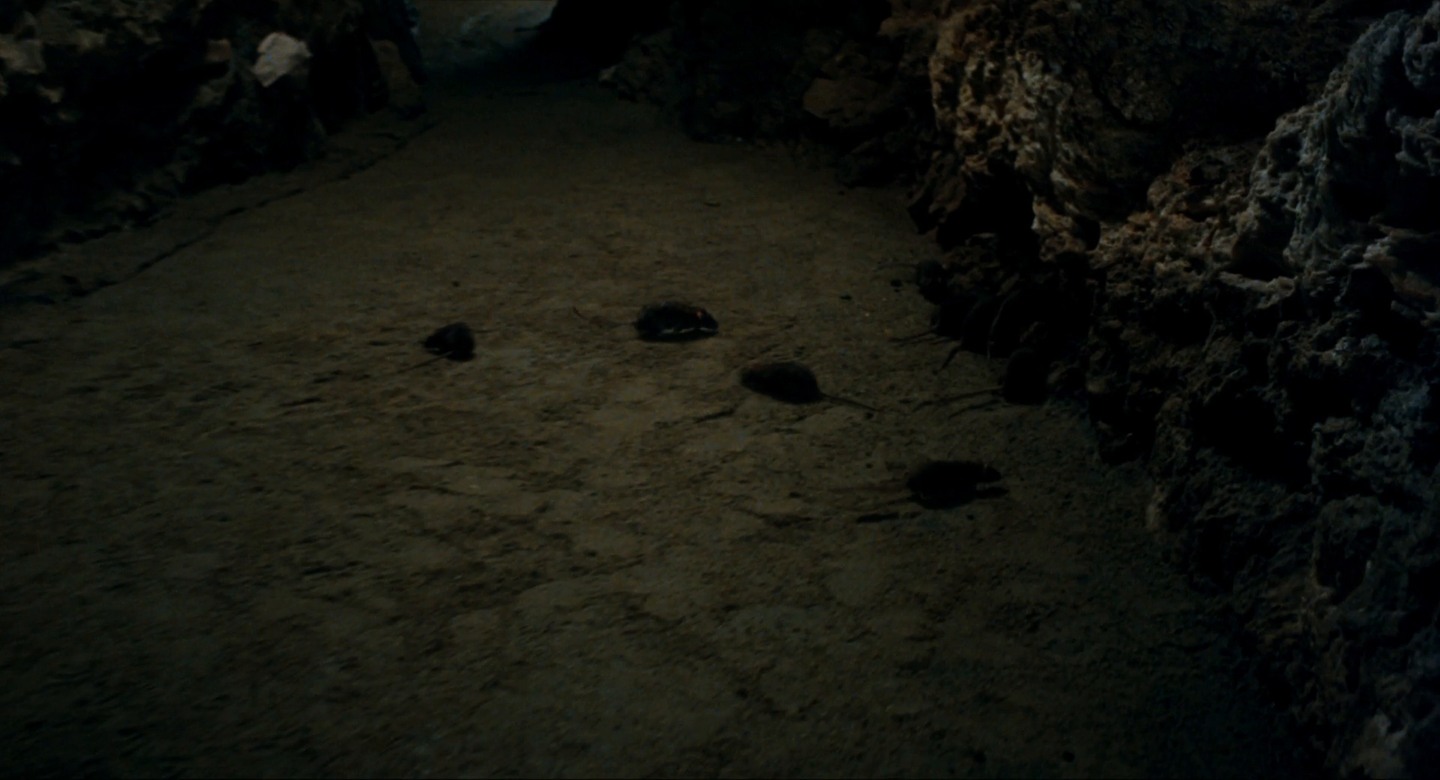
The opening places infancy in the underground world before introducing the theatre. Rats belong to the Phantom’s origin story; the later extermination machinery attacks the inhabitants of his home.
THE FILM DOSSIERS / 013 · FILM DOSSIER
An unmasked Phantom. A performer’s voice. Behind the theatre’s beauty, a promise of love becomes a claim of possession.
THE FILM IN IMAGES
From the opening descent to Christine’s departure.
GORE & EFFECTS
Six expandable galleries follow the effects in stages.
LOOK CLOSER
Faces, sightlines, performances and underground rooms.
VOICE & DIALOGUE
Twelve studies follow what the characters say and demand.
MUSIC & RECORDINGS
The score, operatic repertoire and language tracks.
THE RESEARCH DOSSIER
Leroux, collaborators, music, testimony and editions.
THE PHANTOM OF THE OPERA / THE SCENE GUIDE
Thirty-two illustrated studies follow the film through its auditorium, backstage rooms, roofs and subterranean passages. Follow the images in order or enter a closer effects study.
Includes the ending and graphic violence. Presentation and image notes →
03:15
ENLARGE ↗The opening places infancy in the underground world before introducing the theatre. Rats belong to the Phantom’s origin story; the later extermination machinery attacks the inhabitants of his home.
04:40
 ENLARGE ↗
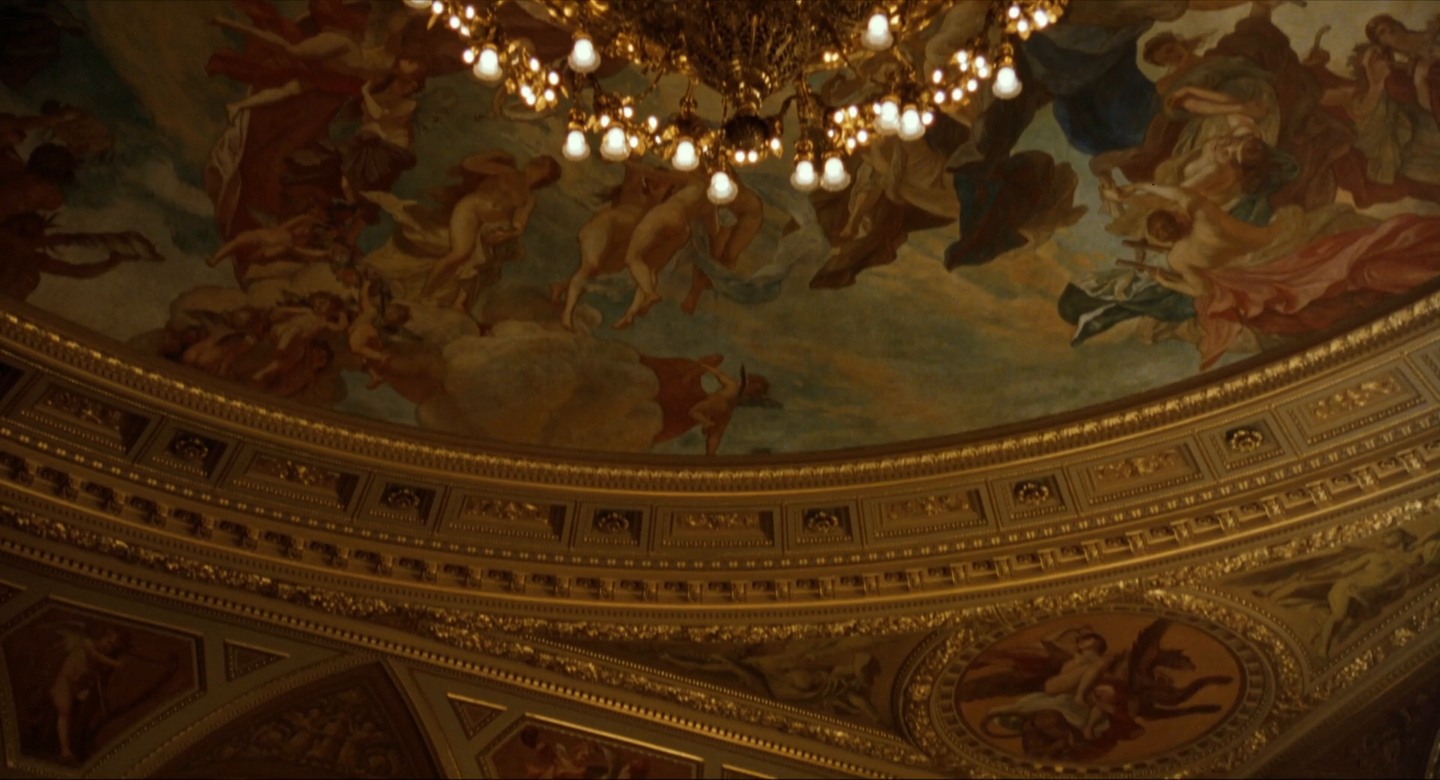
The auditorium gathers ornament, audience and hanging light into one enclosing space. Its ceiling is already part of the drama: what appears to complete the theatre’s splendour will become a source of danger.
05:16
 ENLARGE ↗
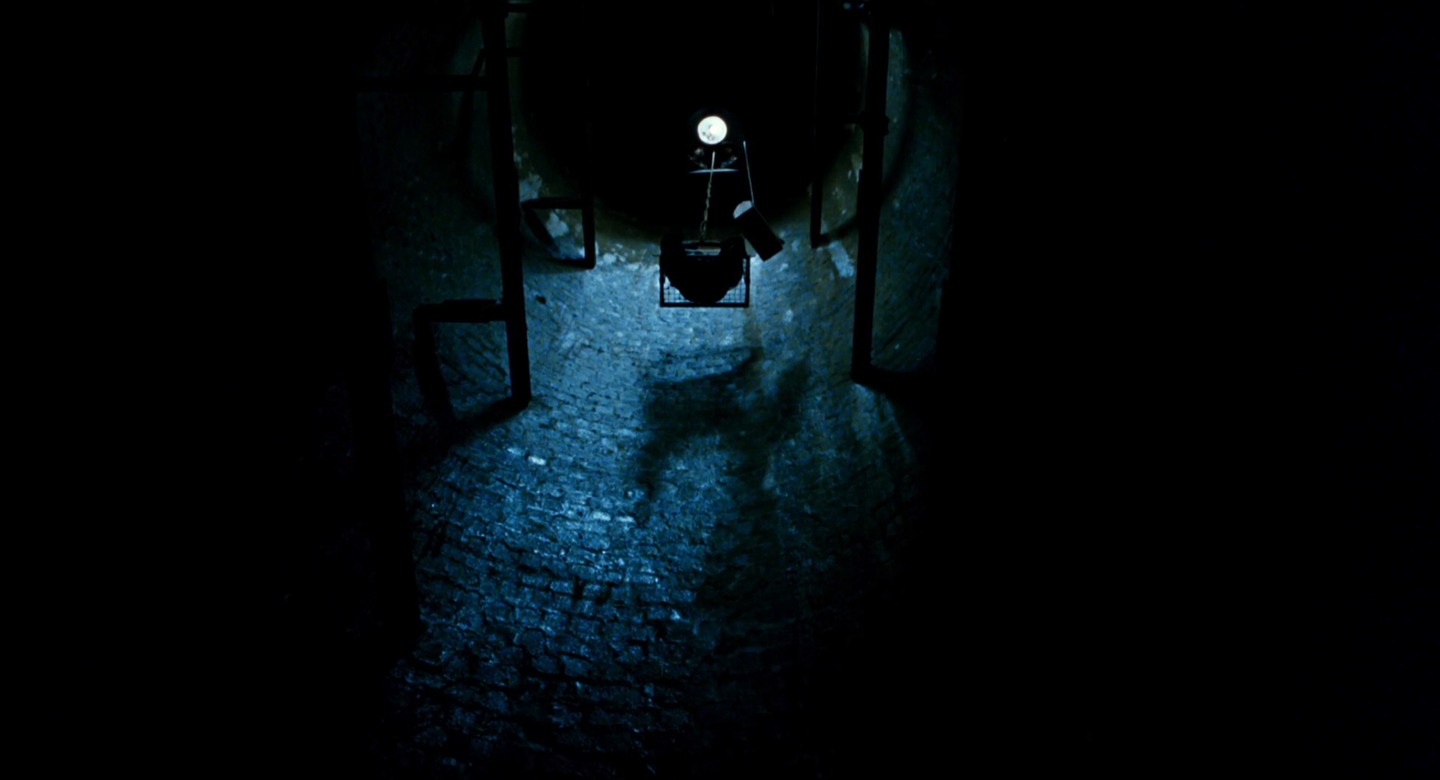
A suspended worker establishes the vertical route beneath the building. The opening violence turns an ordinary maintenance operation into a warning about crossing the boundary below the stage.
Explore the sequence →06:52
 ENLARGE ↗
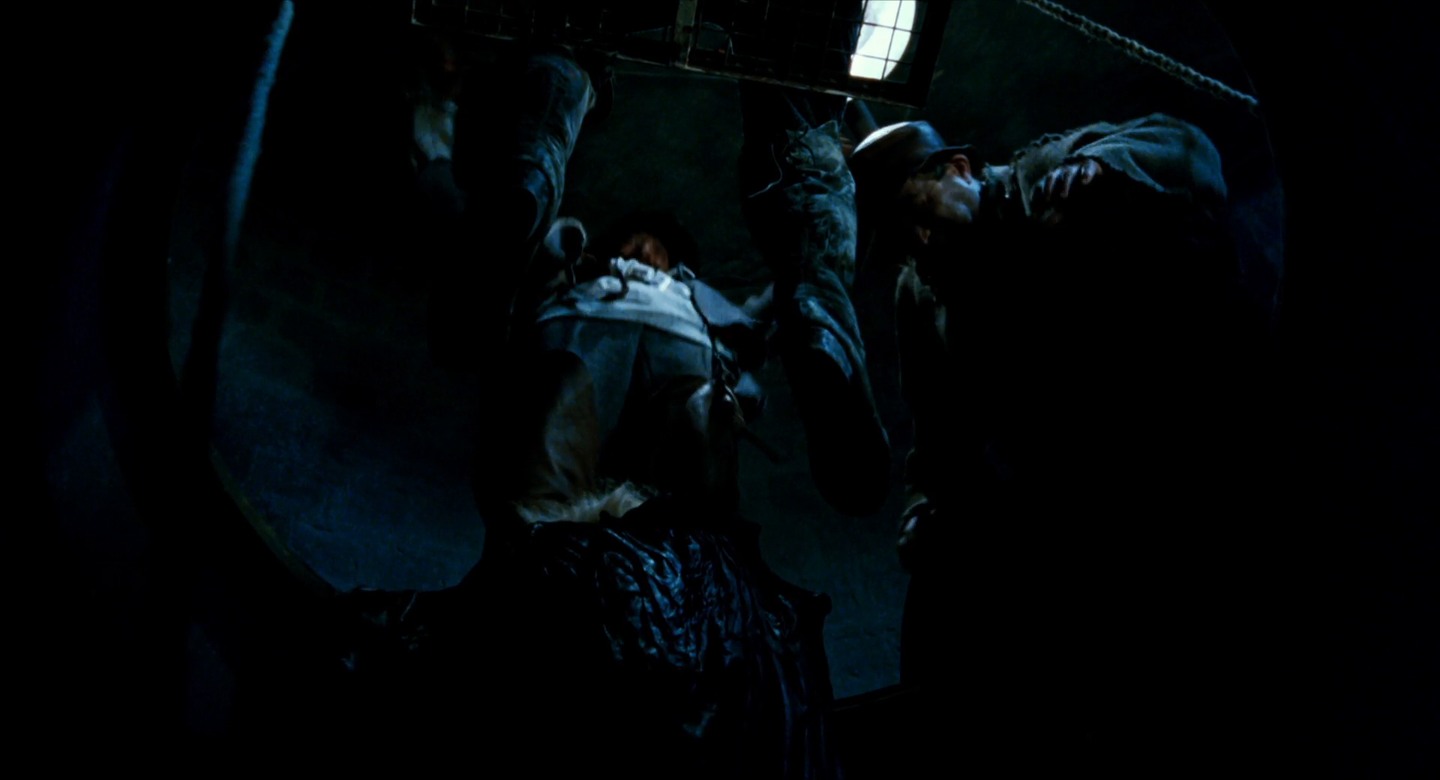
The returning body replaces exploration with evidence. Hands, rope and the narrow opening make the retrieval a physical task, bringing the underground violence into the workers’ shared space.
Explore the sequence →09:15
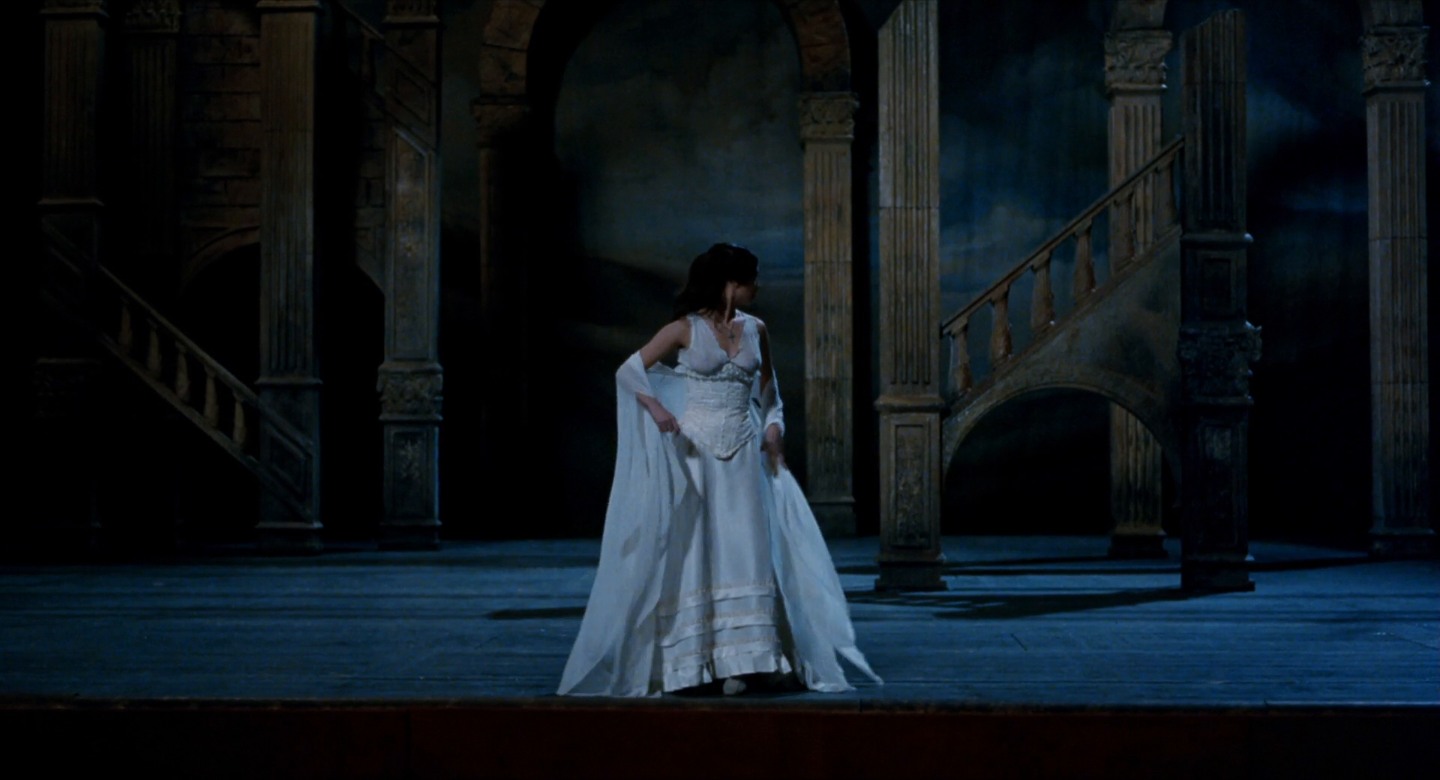
ENLARGE ↗A white dress and a single figure occupy the vast stage. Without the packed audience of the earlier views, the theatre becomes a space for a personal encounter as much as a public performance.
10:45
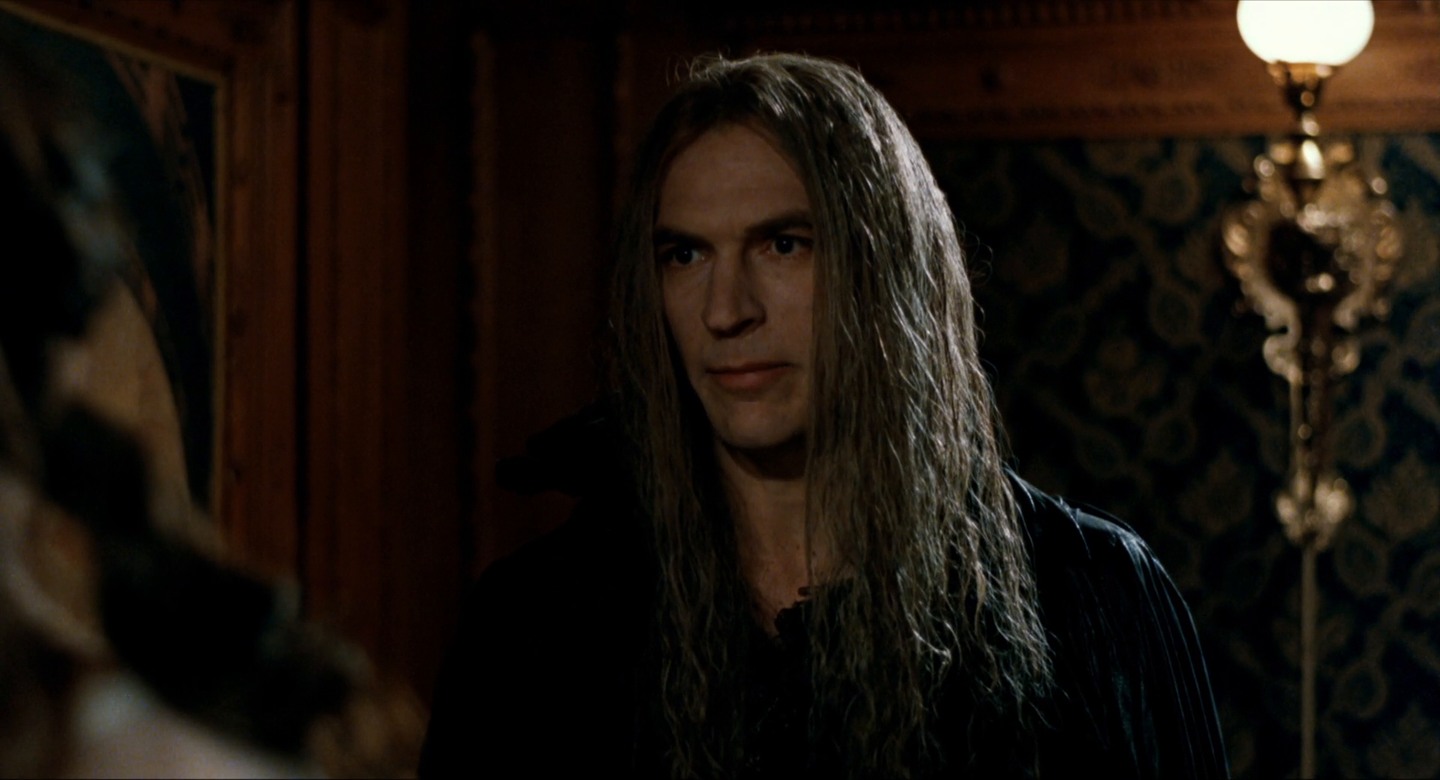
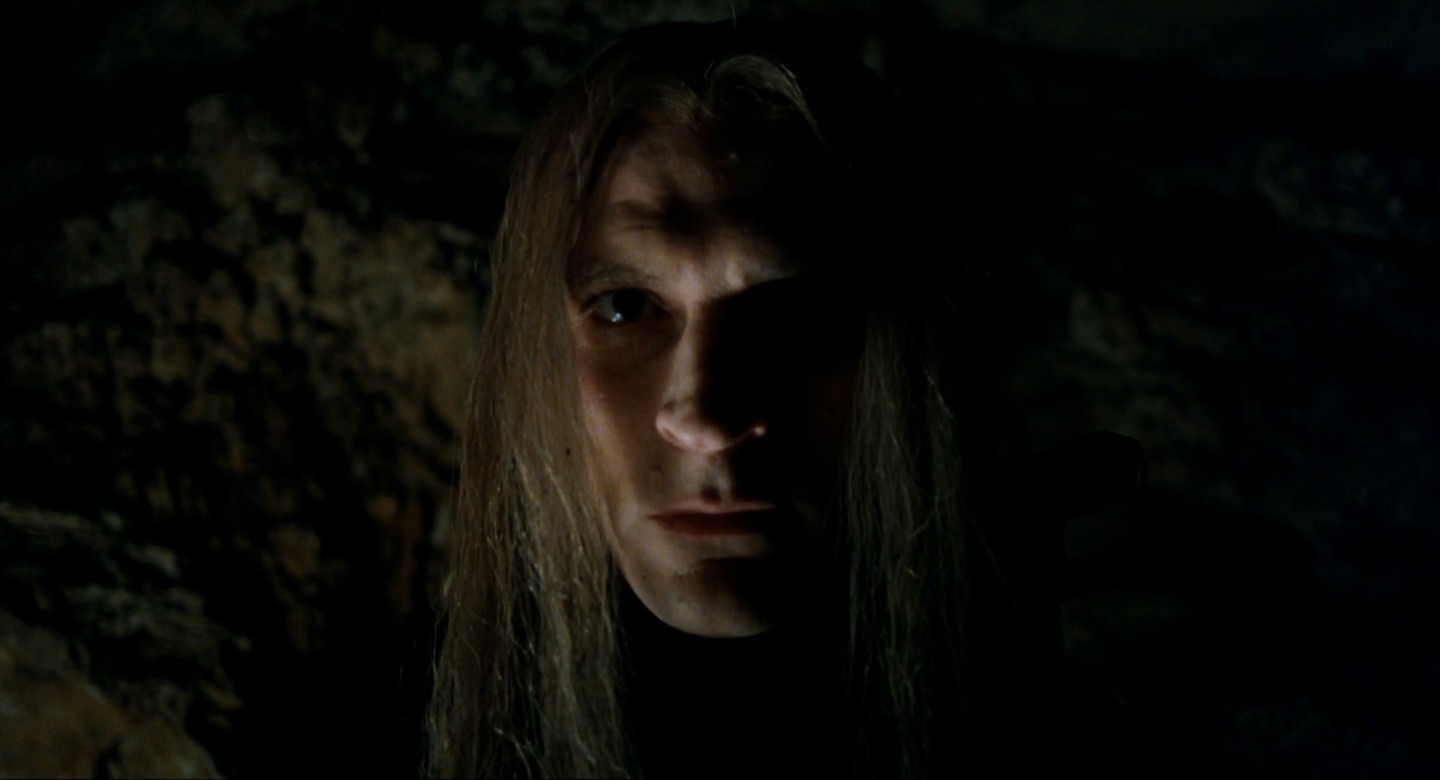
ENLARGE ↗Julian Sands’s uncovered face makes the film’s central adaptation decision immediately visible. Menace must emerge through his actions and the spaces he controls, rather than through a concealed facial deformity.
16:00
 ENLARGE ↗
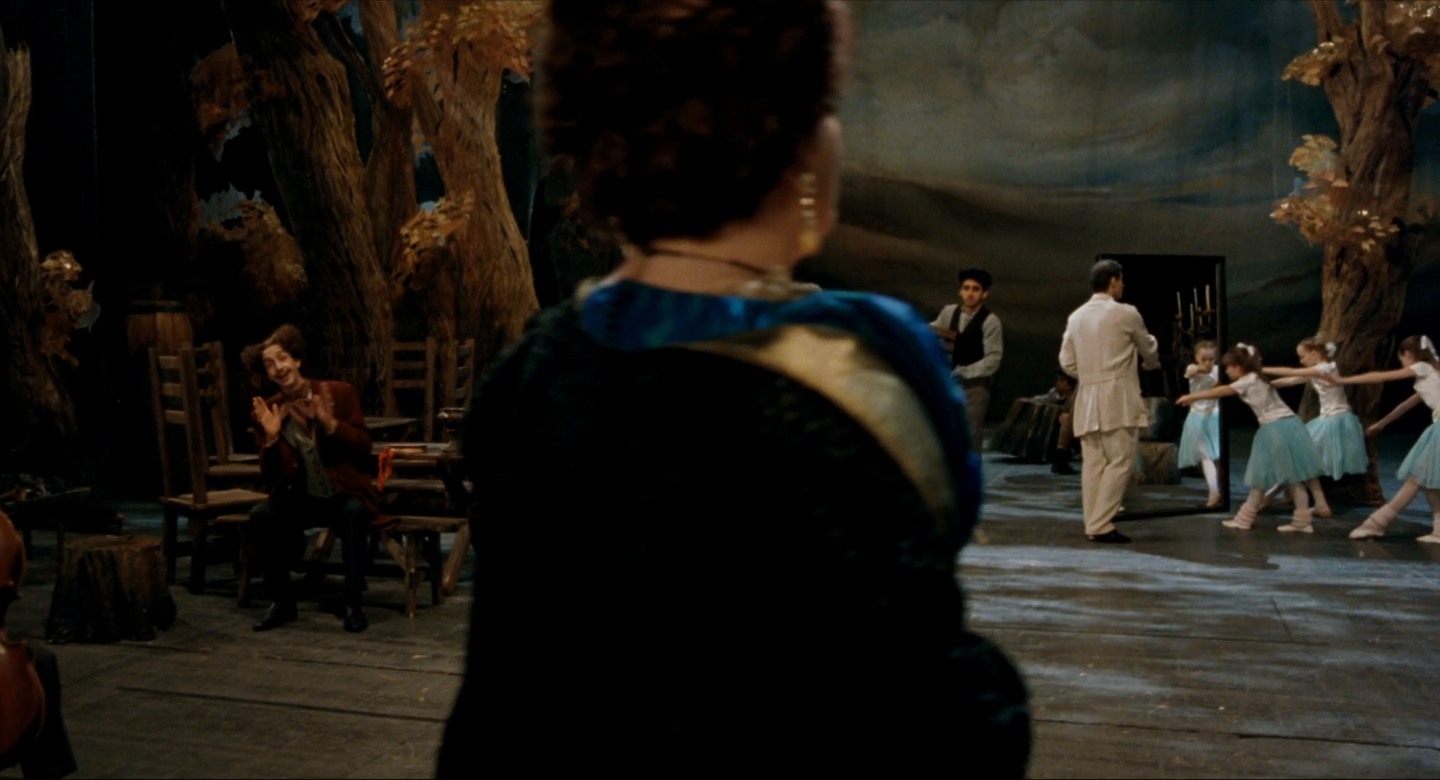
The theatre contains an active working company, with bodies waiting, watching and rehearsing. These communal arrangements give the Phantom’s solitary interventions something concrete to disrupt.
19:00
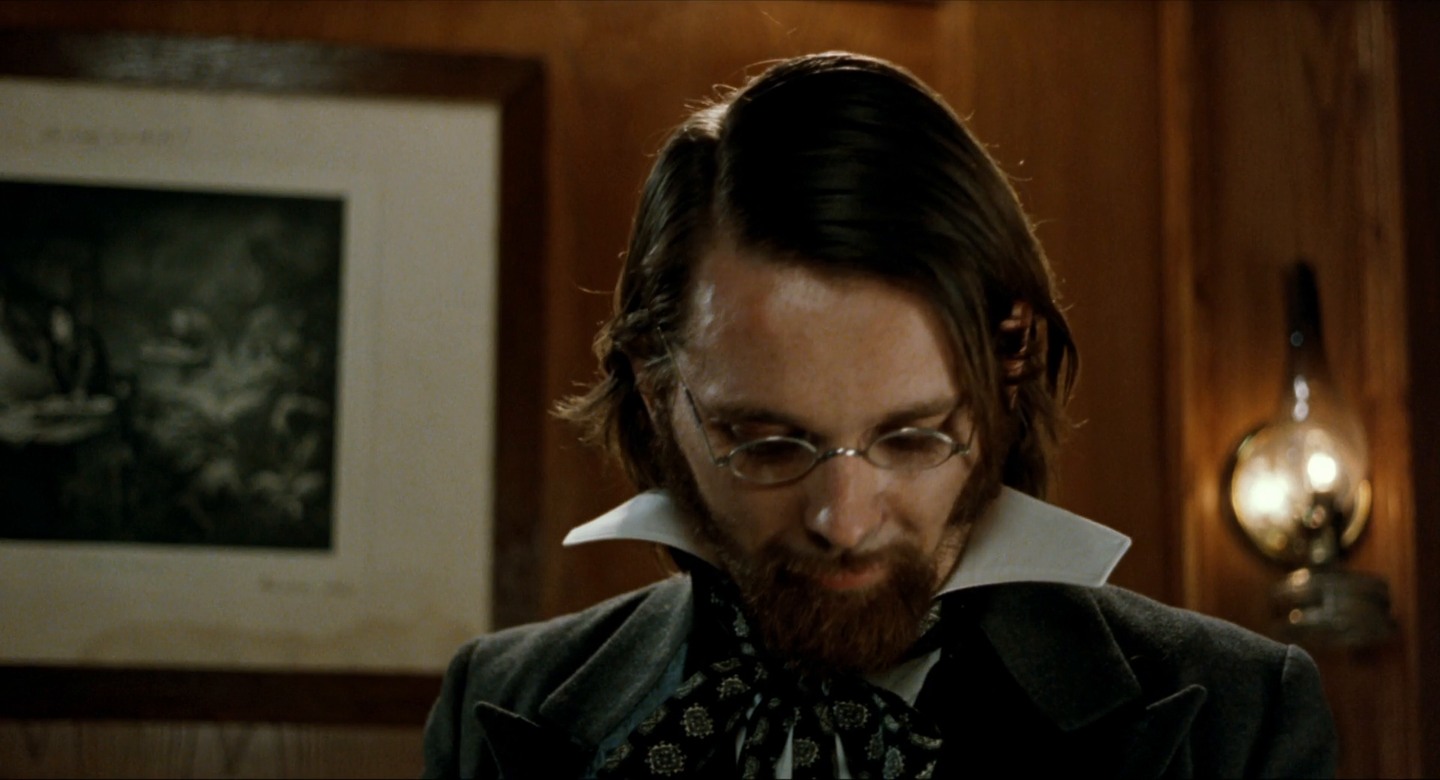 ENLARGE ↗
Desk, costume and written instruction belong to the theatre’s administrative world. Letters allow an unseen resident to intervene in the decisions of people who believe they run the building.
23:30
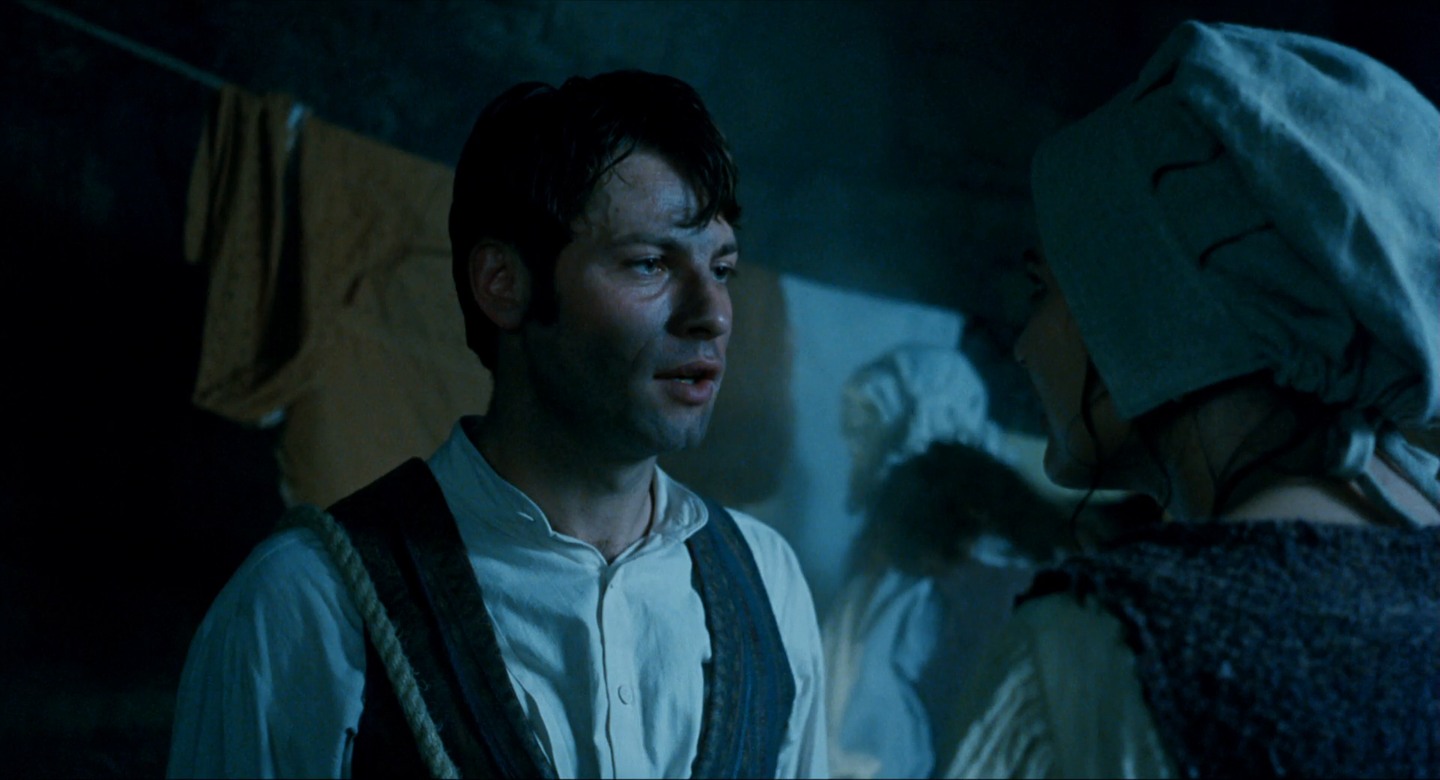 ENLARGE ↗
Backstage passages offer another route into Christine’s world. Raoul’s position among the theatre’s working structures differs from the Phantom’s command of the spaces below them.
28:00
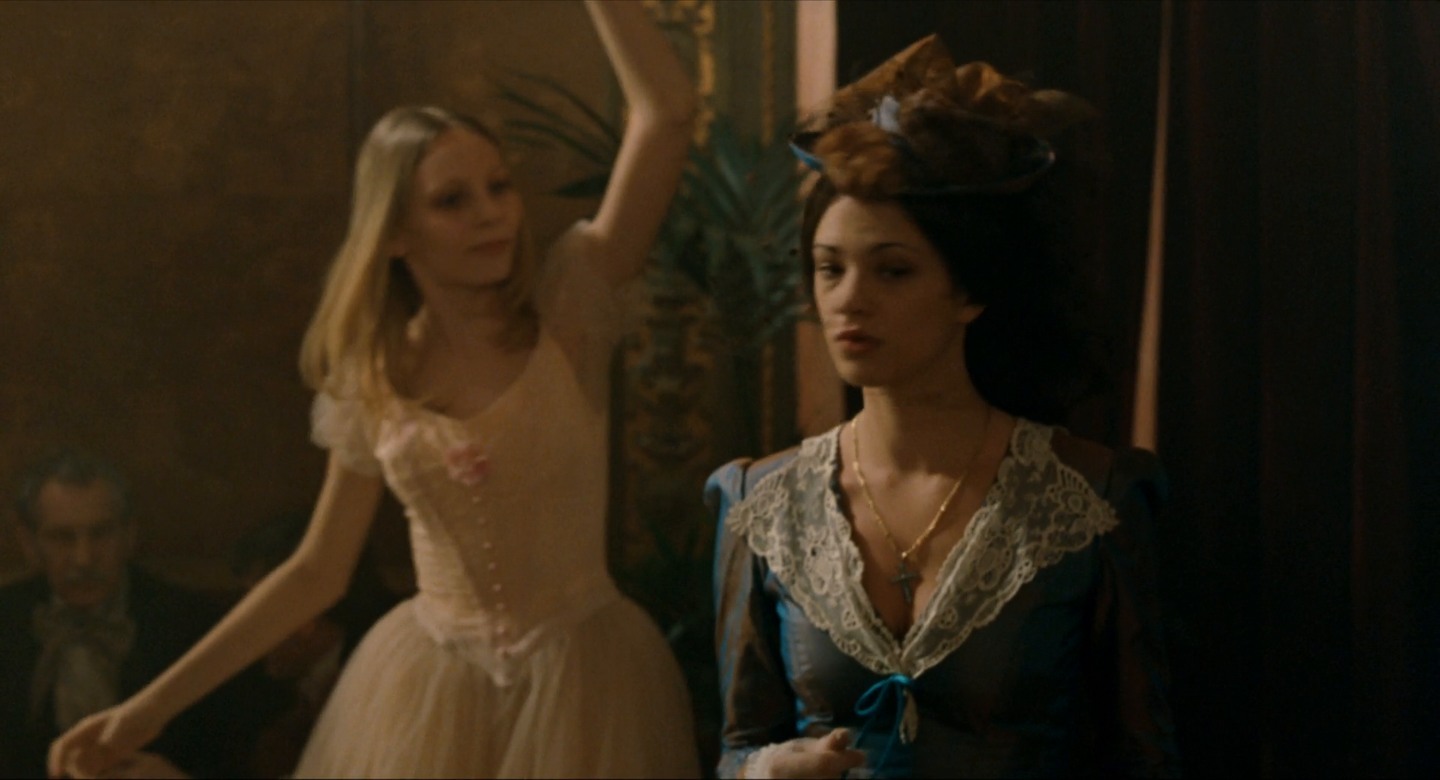 ENLARGE ↗
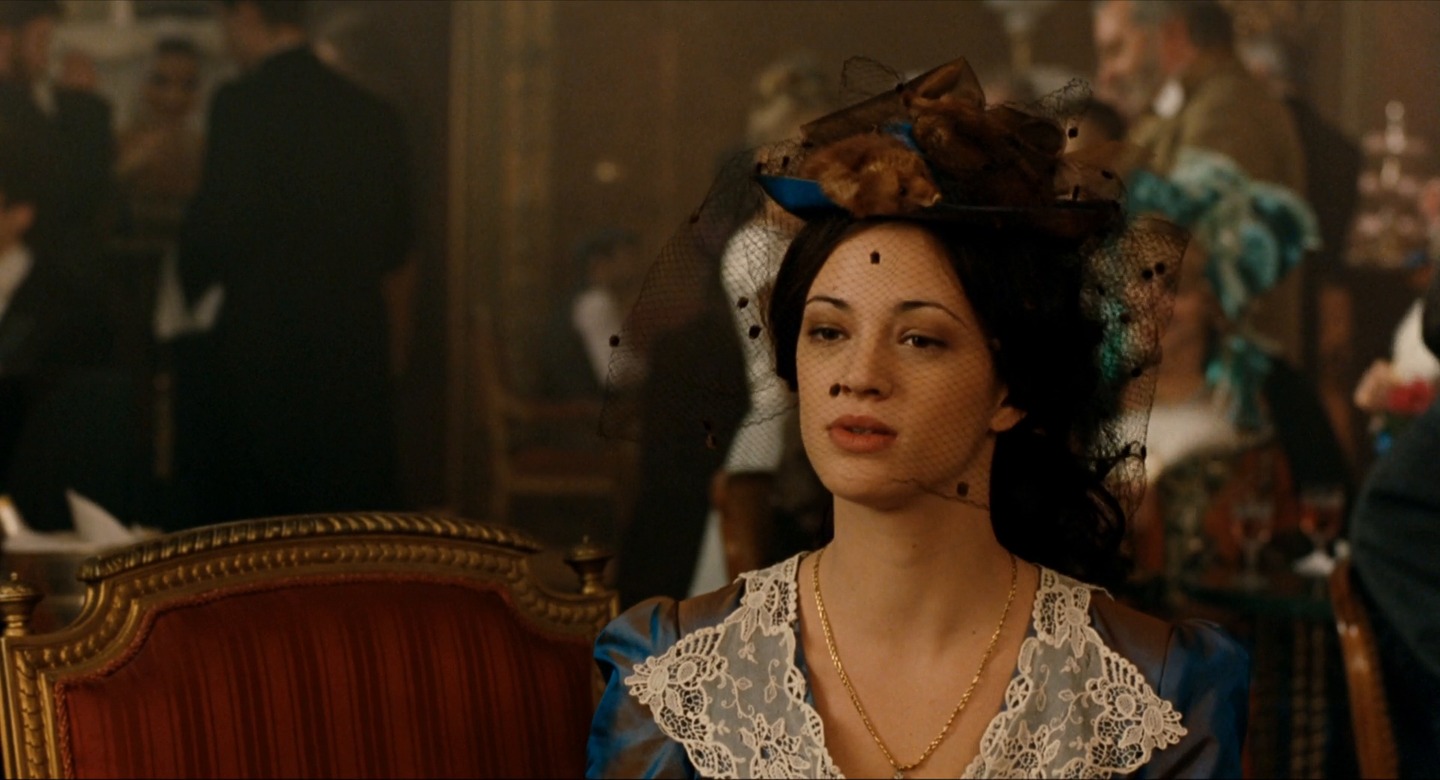
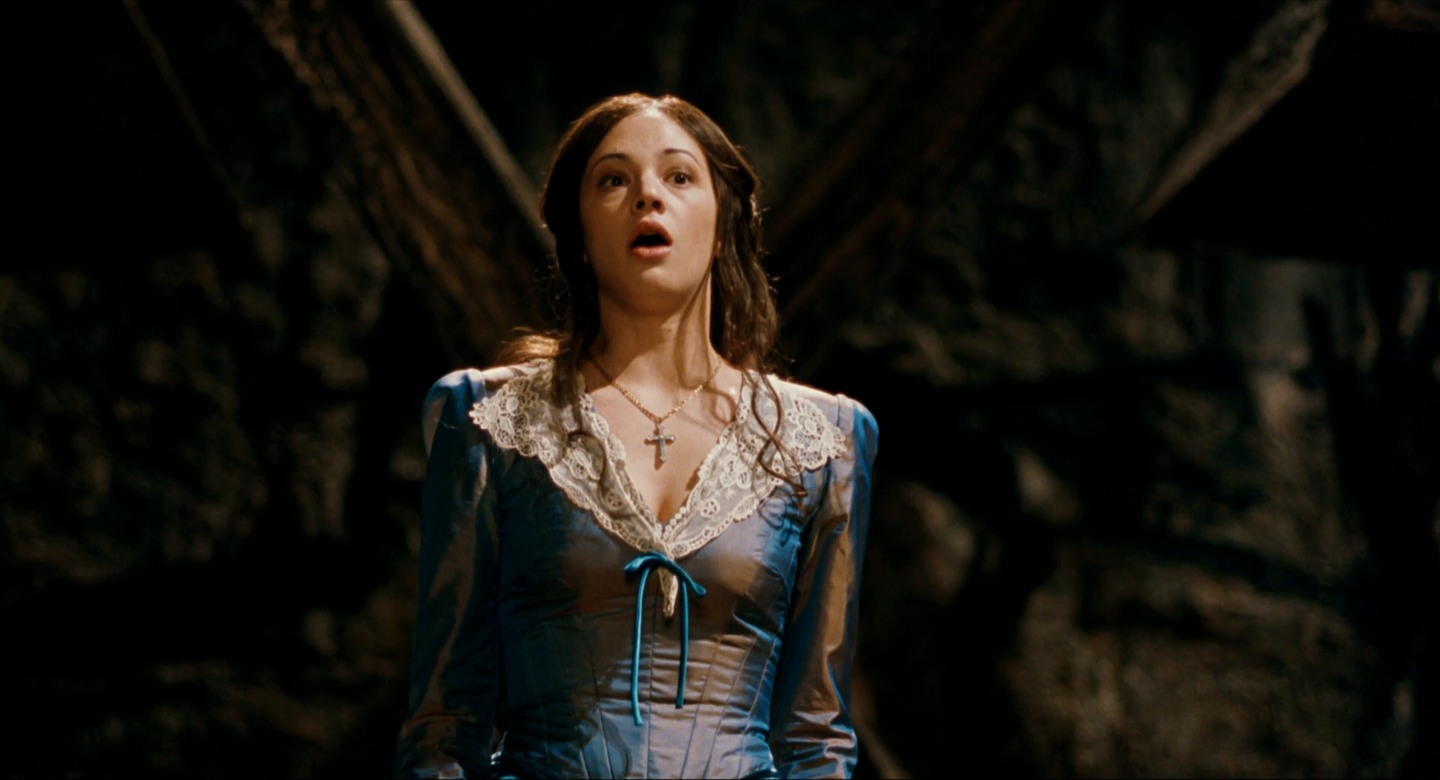
Costume and crowded interiors place Christine within a social theatre beyond the stage. Her isolated encounters with the Phantom are set against rooms where other people watch and judge.
30:10
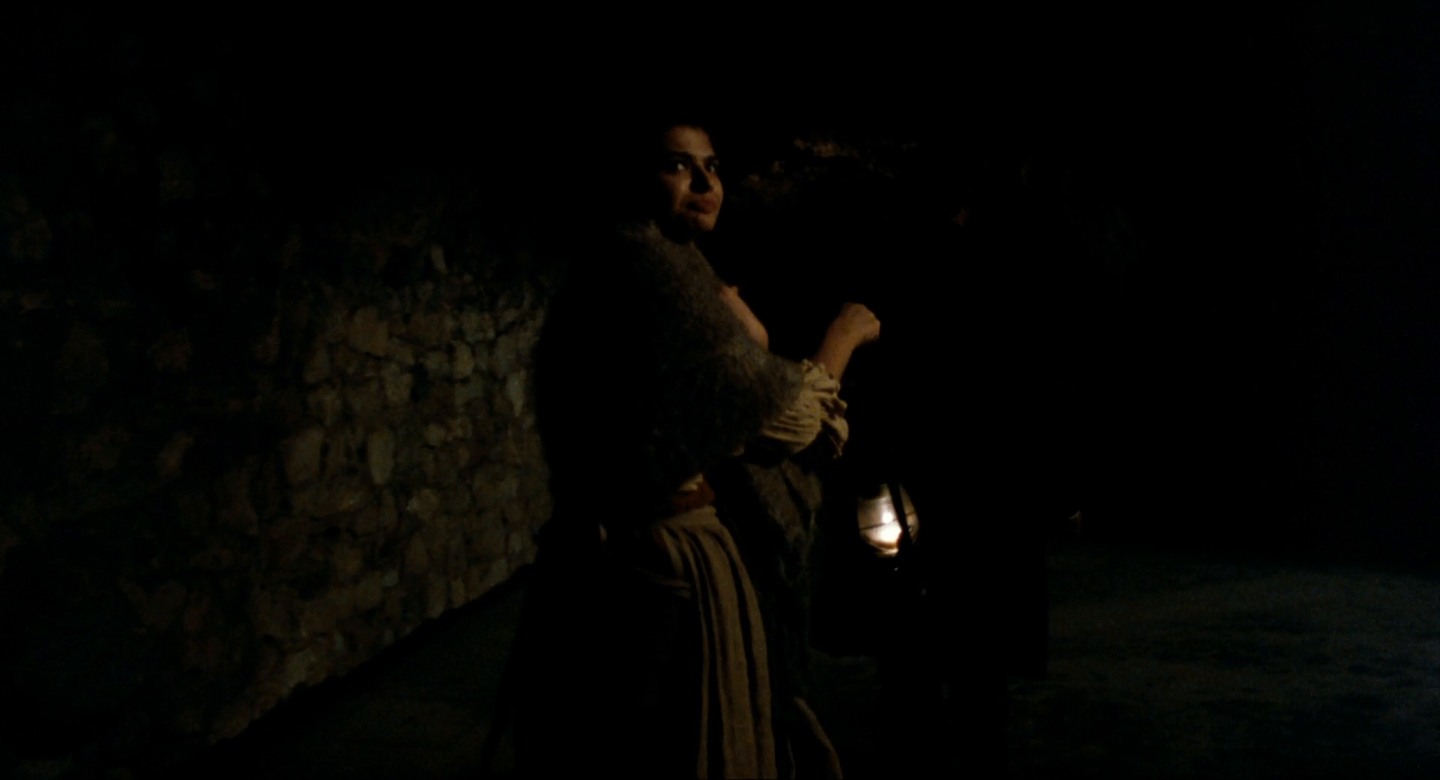 ENLARGE ↗
The small light gives the explorers a limited field of vision. Rock and darkness close around the figures, reversing the wide, ornamented sightlines of the auditorium.
32:58
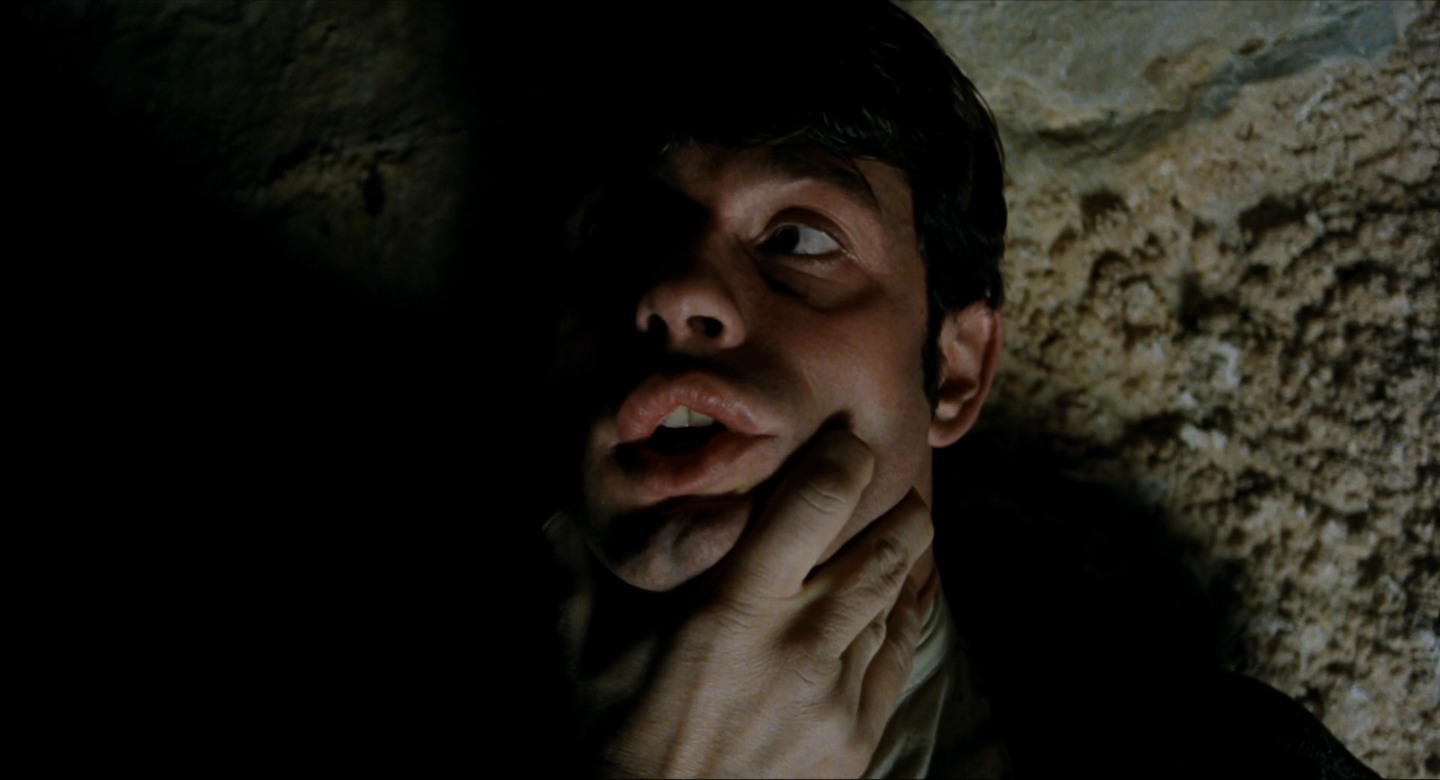 ENLARGE ↗
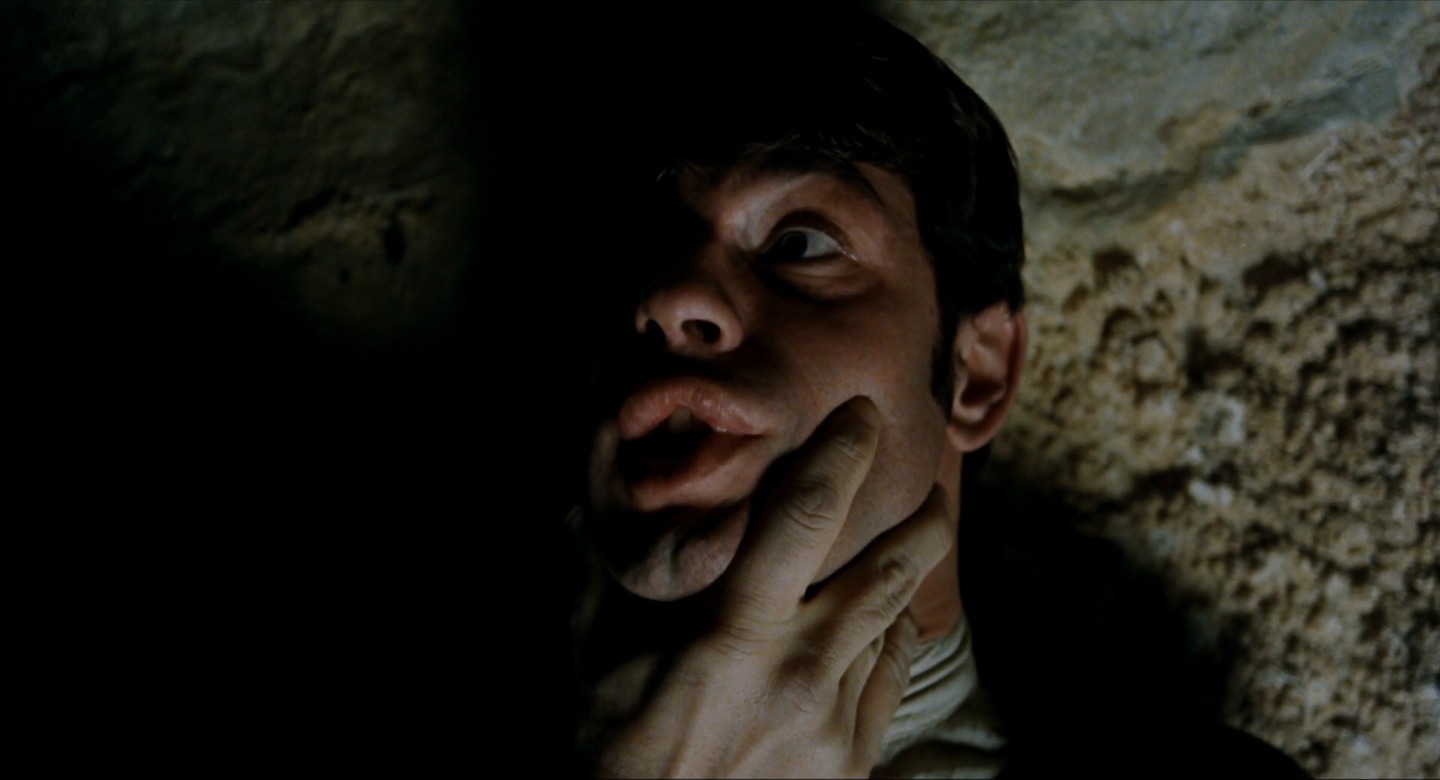
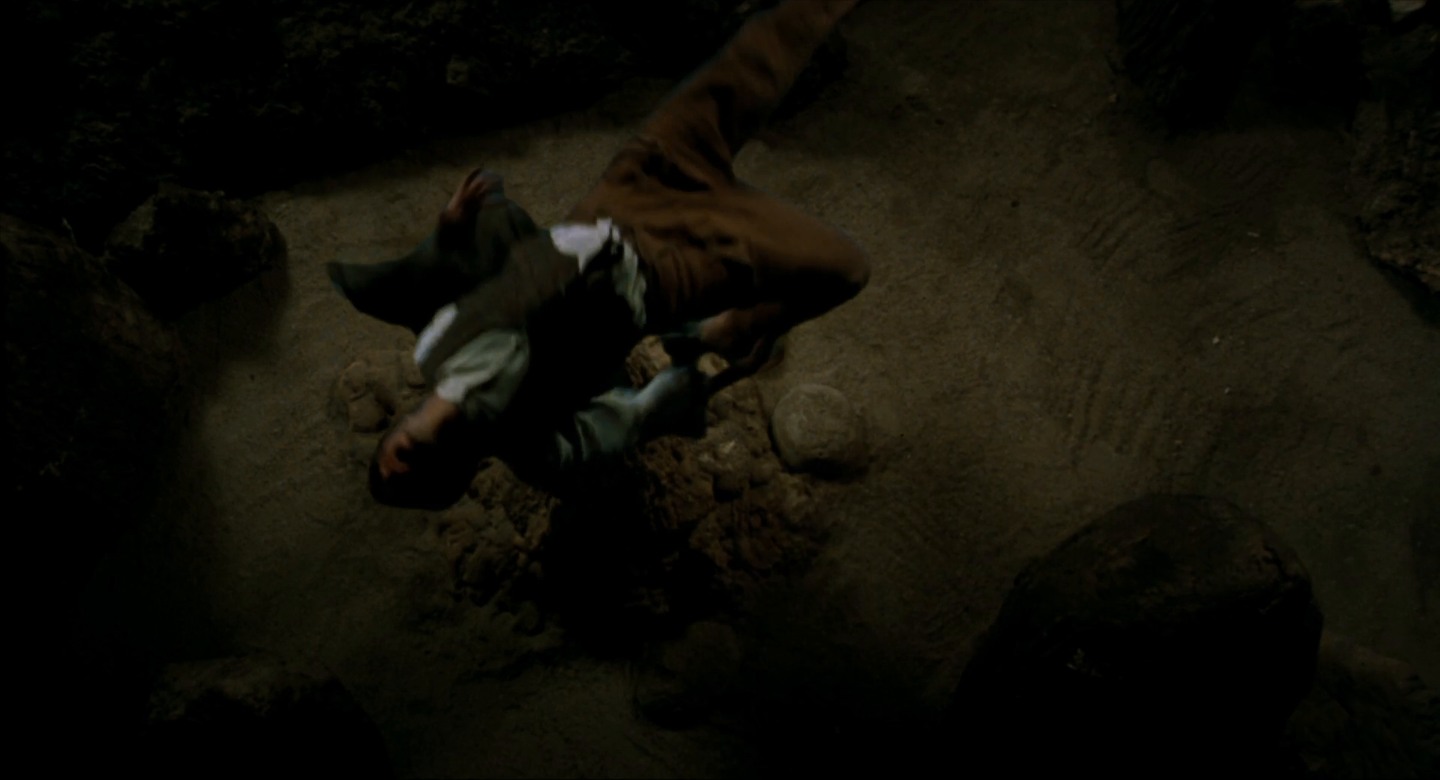
A hand across the face makes bodily control the centre of the attack. The close views concentrate attention on pressure and proximity before the fallen body supplies the result.
Explore the sequence →36:10
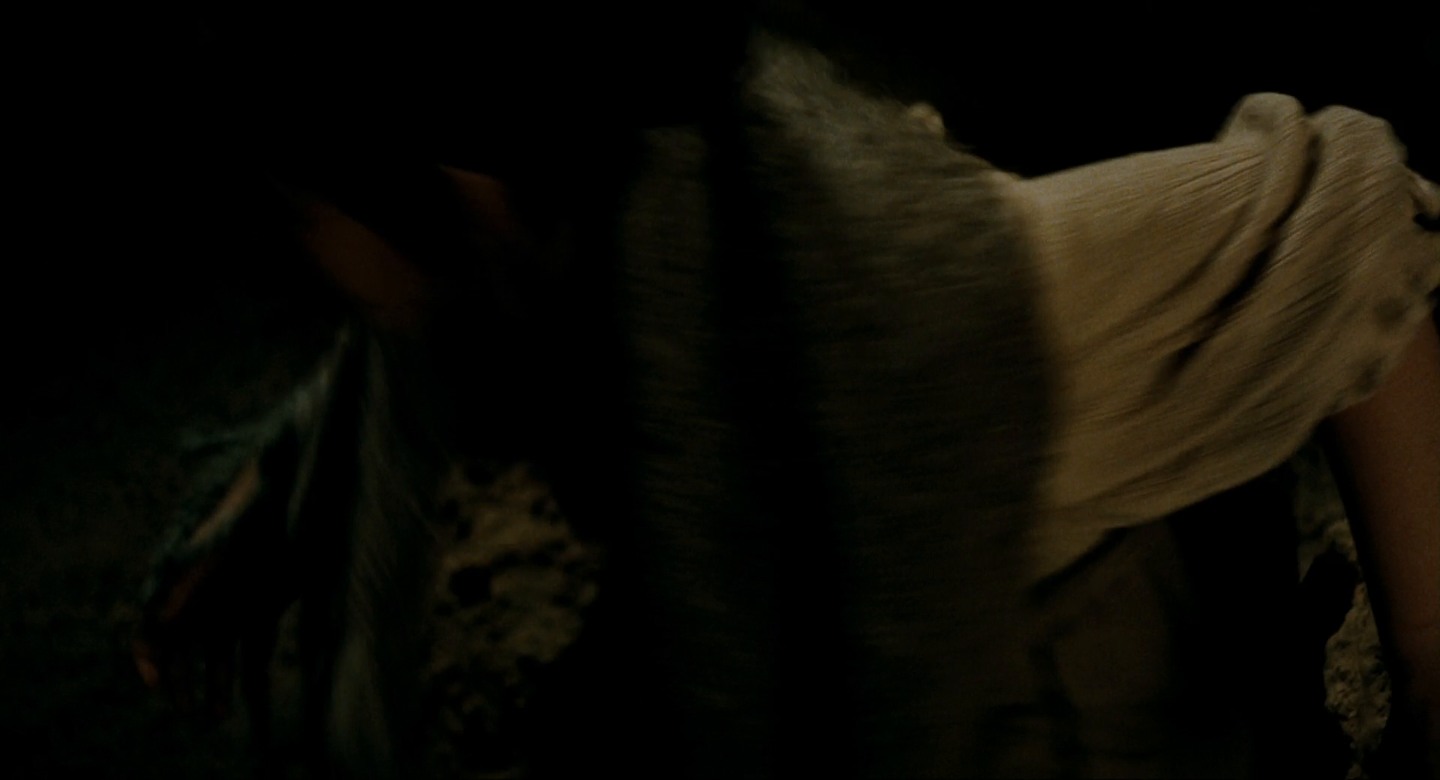 ENLARGE ↗
A corridor that offered a route inward now confines the escape. Outstretched arms and rough walls make the dimensions of the passage part of the threat.
41:30
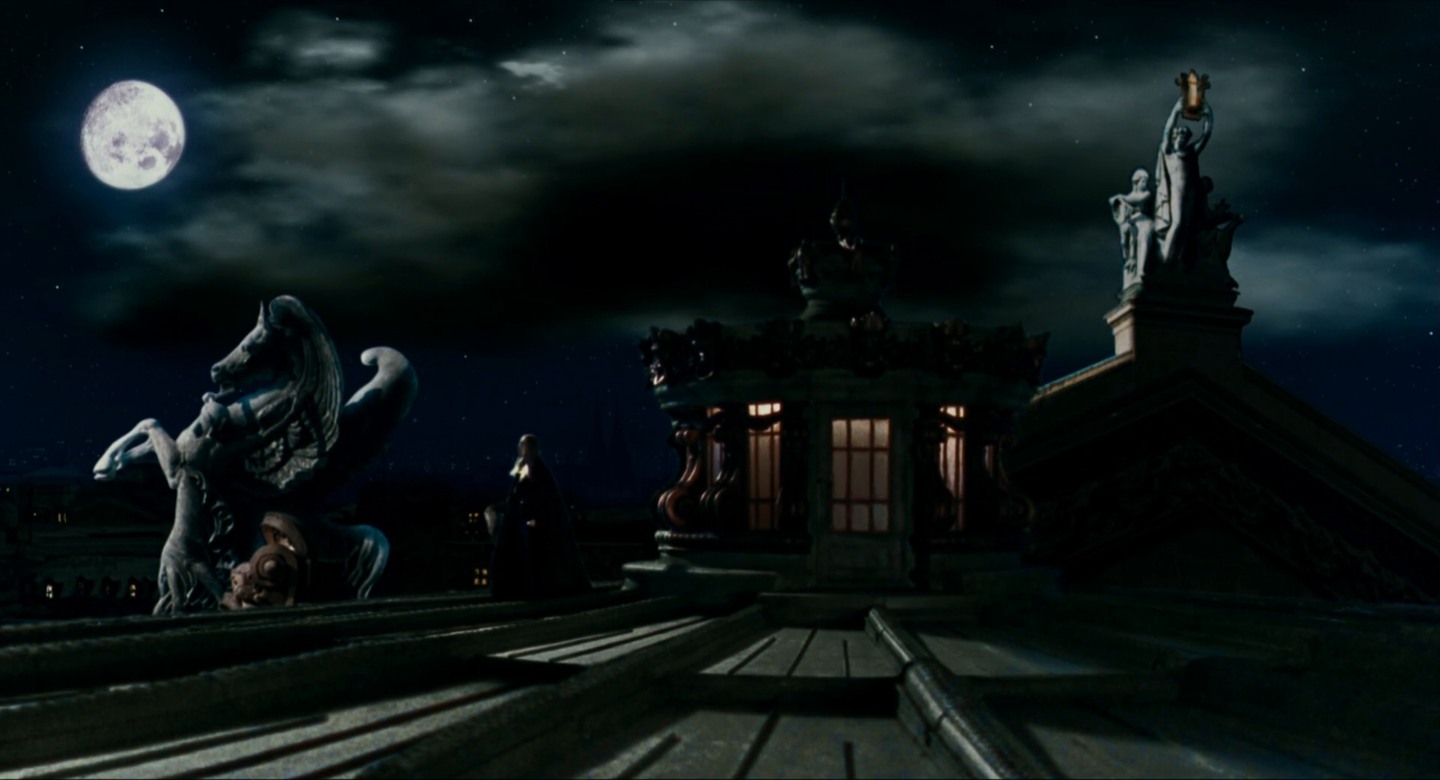
ENLARGE ↗The roof gives the film another extreme of height. Stone figures and a large moon exchange the theatre’s enclosed gold for an exposed, blue-lit skyline.
43:00
ENLARGE ↗The stage places Christine on display while the auditorium holds the people looking toward her. This visual separation is the basis for the film’s repeated movement between performance and private possession.
55:00
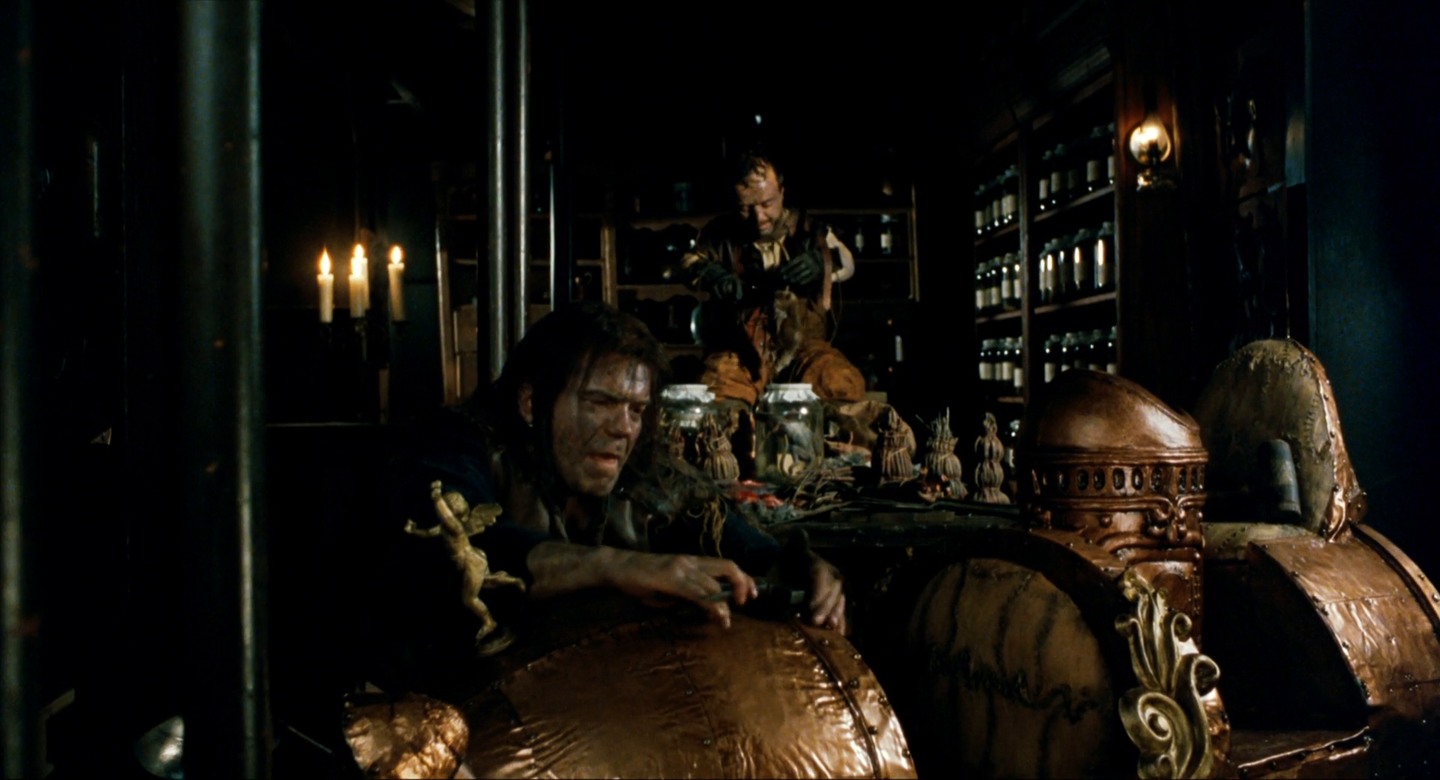
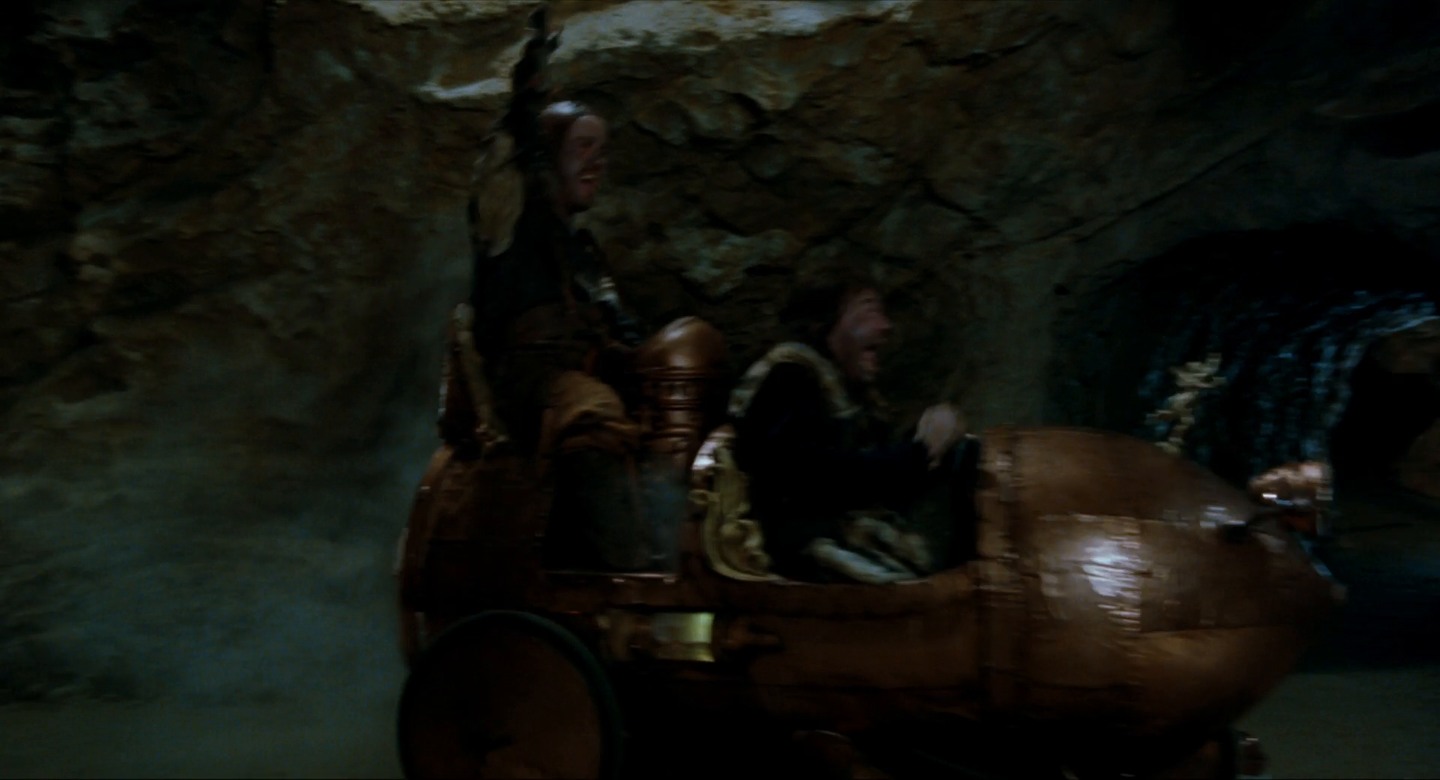
ENLARGE ↗The copper-coloured vehicle gives extermination the scale of a grotesque mechanical spectacle. Riders, wheels and projecting equipment compete for space with the low rock passages.
Explore the sequence →57:15
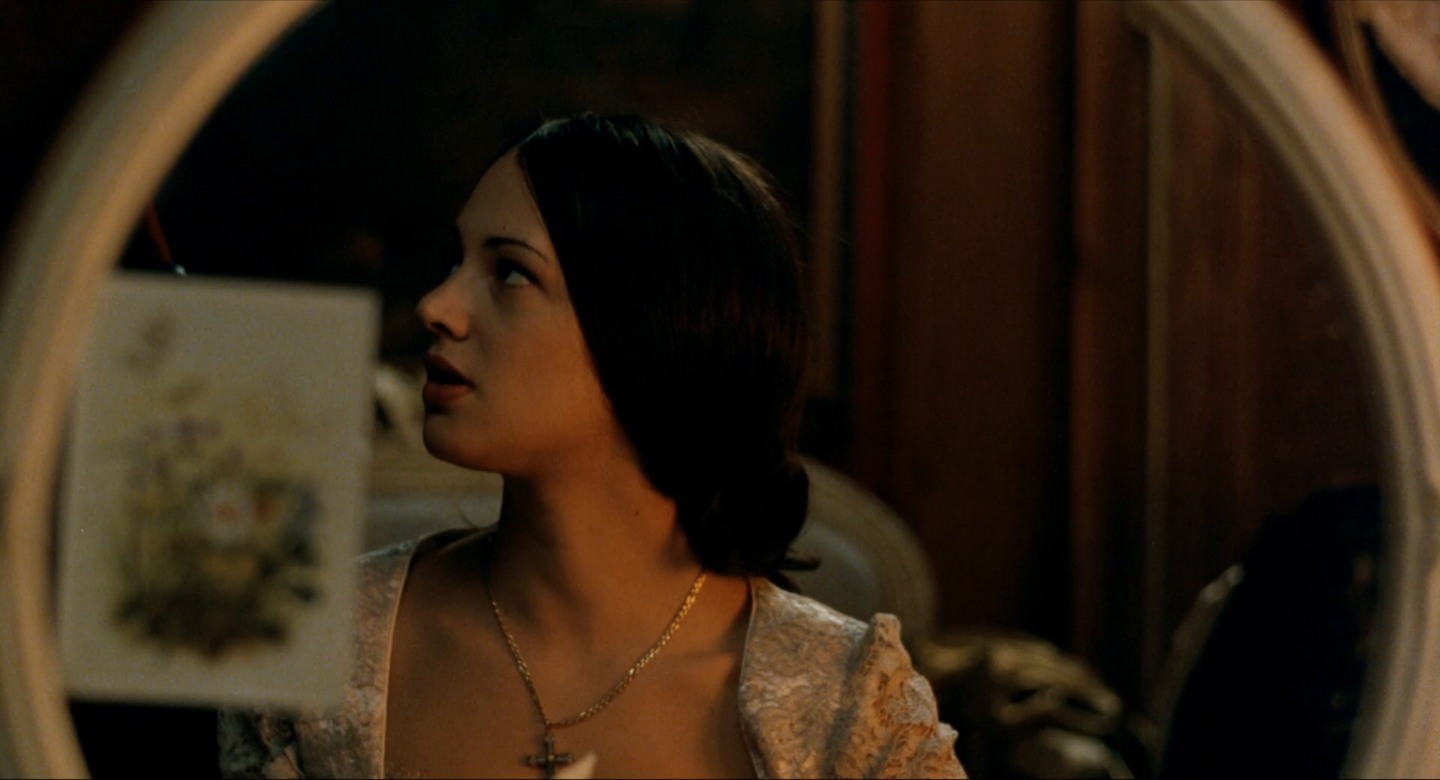 ENLARGE ↗
The dressing-room mirror creates a smaller enclosure inside the decorated room. The reflection connects public appearance to private preparation, a recurring boundary in the film’s treatment of its singer.
59:49
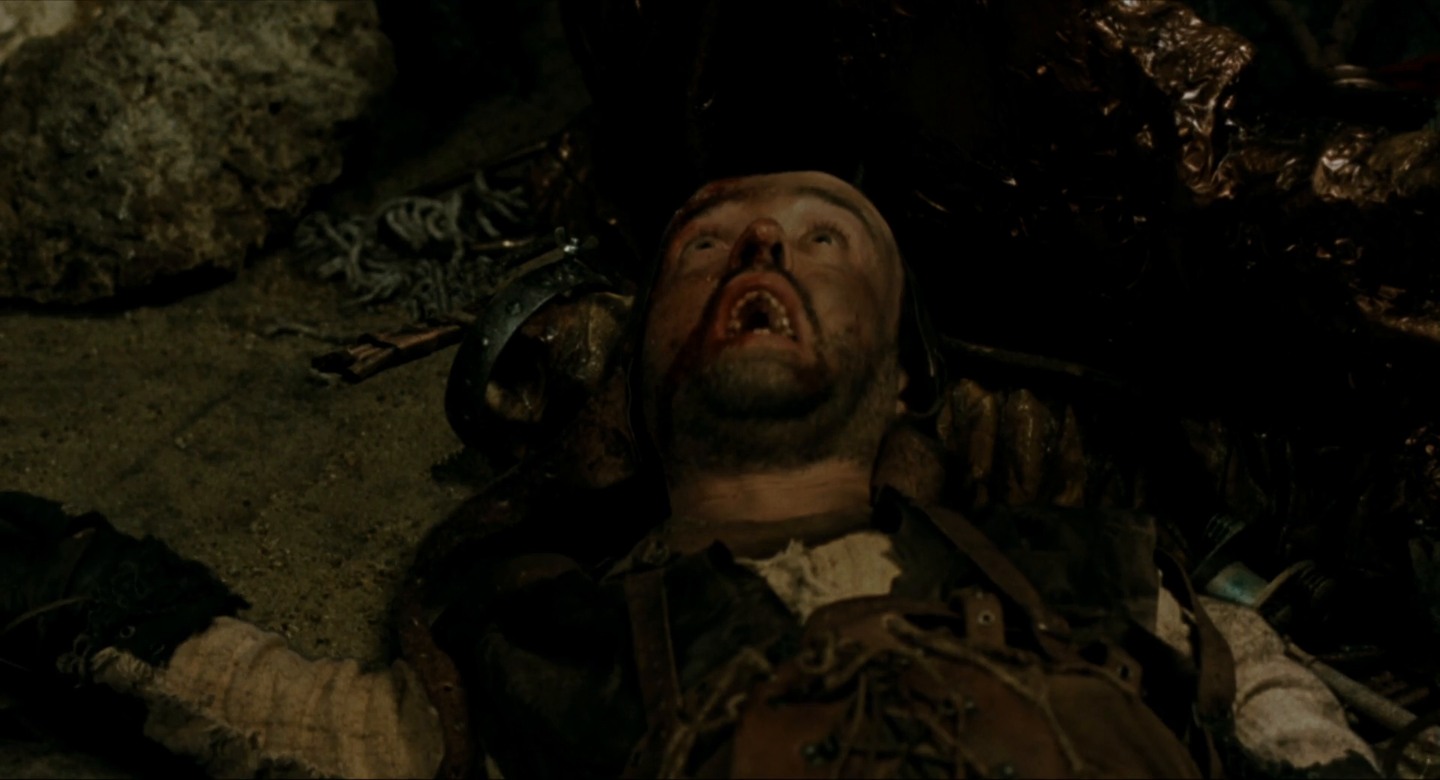 ENLARGE ↗
The journey ends by transferring the violence of the apparatus to its operators. The aftermath holds on damaged faces and equipment, binding the human injury to the machine’s shape.
Explore the sequence →1:00:48
 ENLARGE ↗
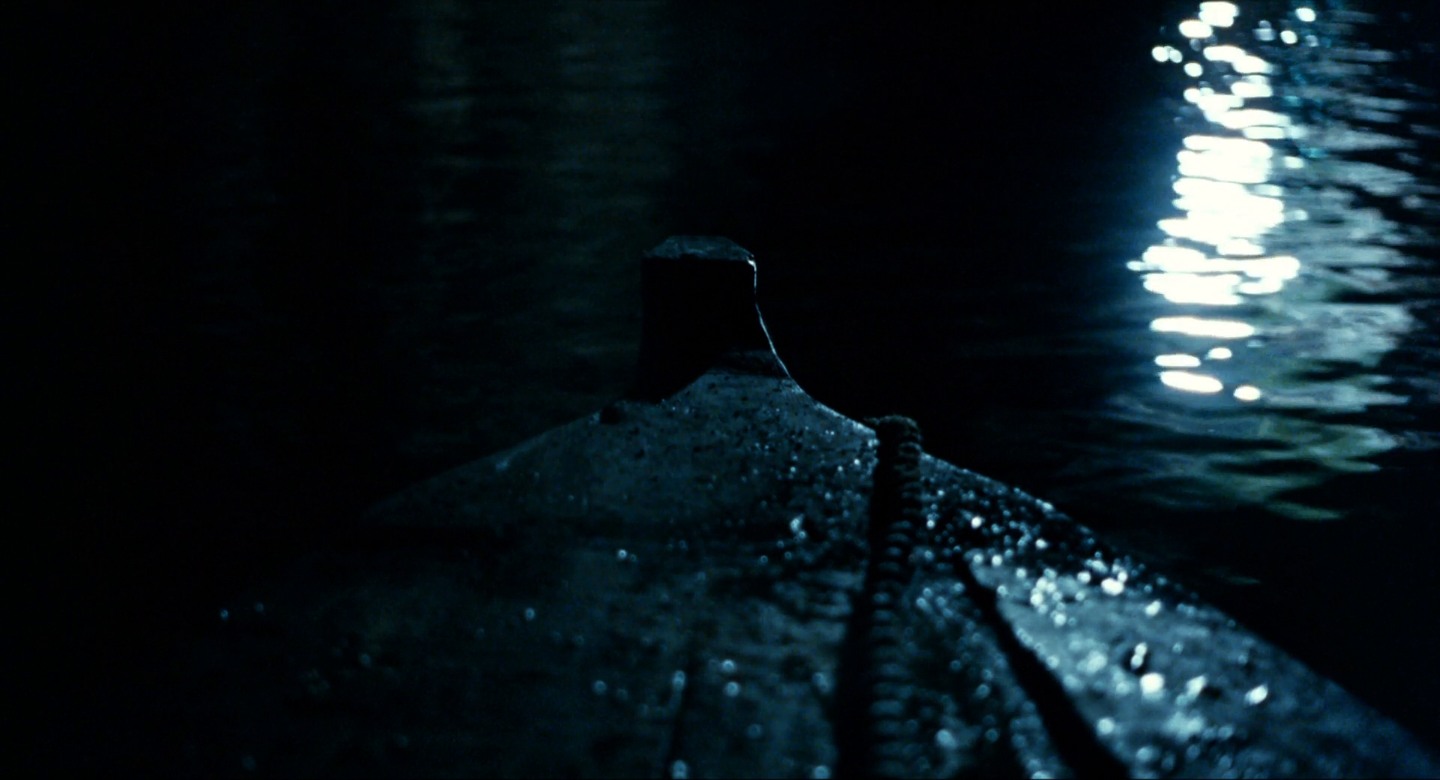
Water replaces the rough ground and machinery of the preceding journey. The boat introduces a slower, ceremonial entrance into the Phantom’s private domain.
1:03:15
 ENLARGE ↗
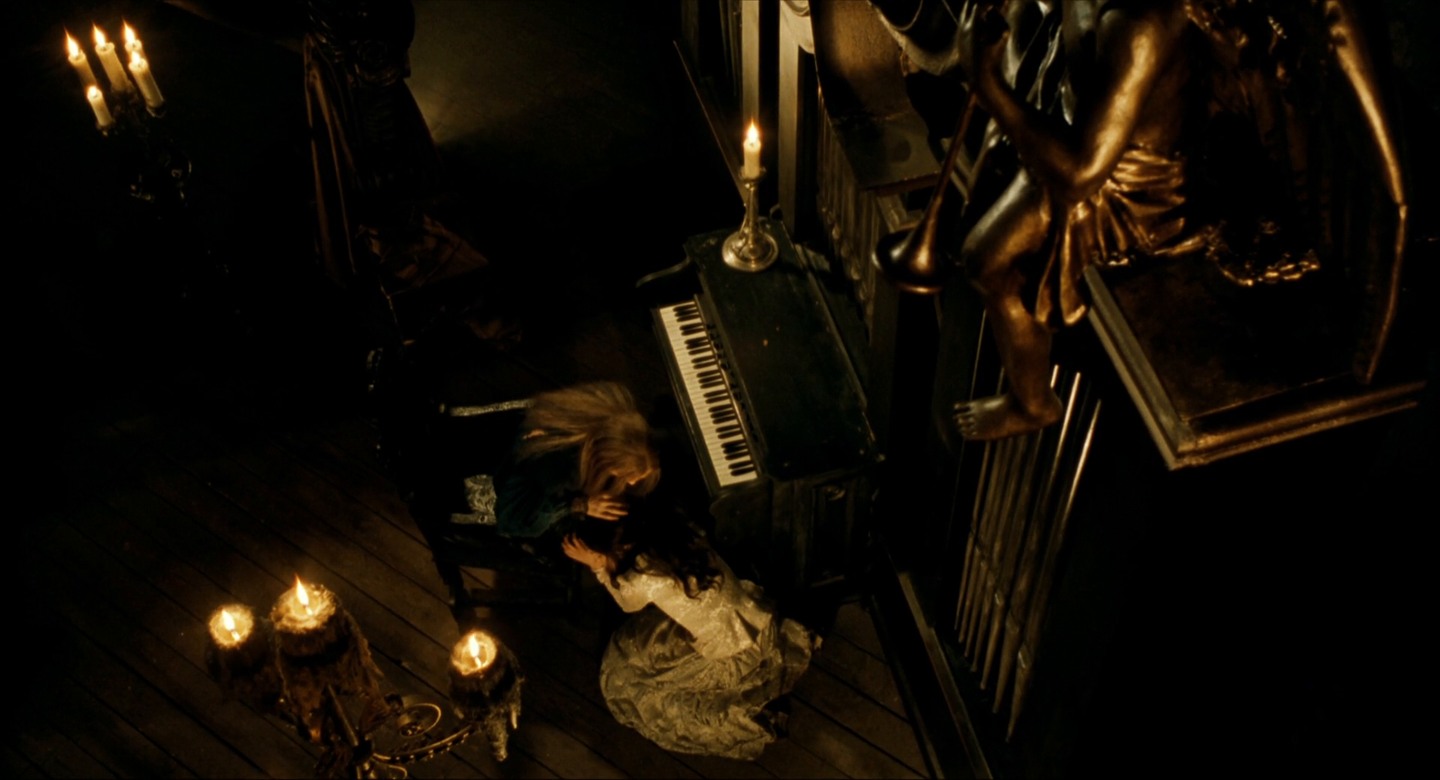
The overhead view brings piano, furniture and a hanging light into the cave. The Phantom reproduces the furnishings of cultivated life beneath the institution from which he remains apart.
1:07:04
 ENLARGE ↗
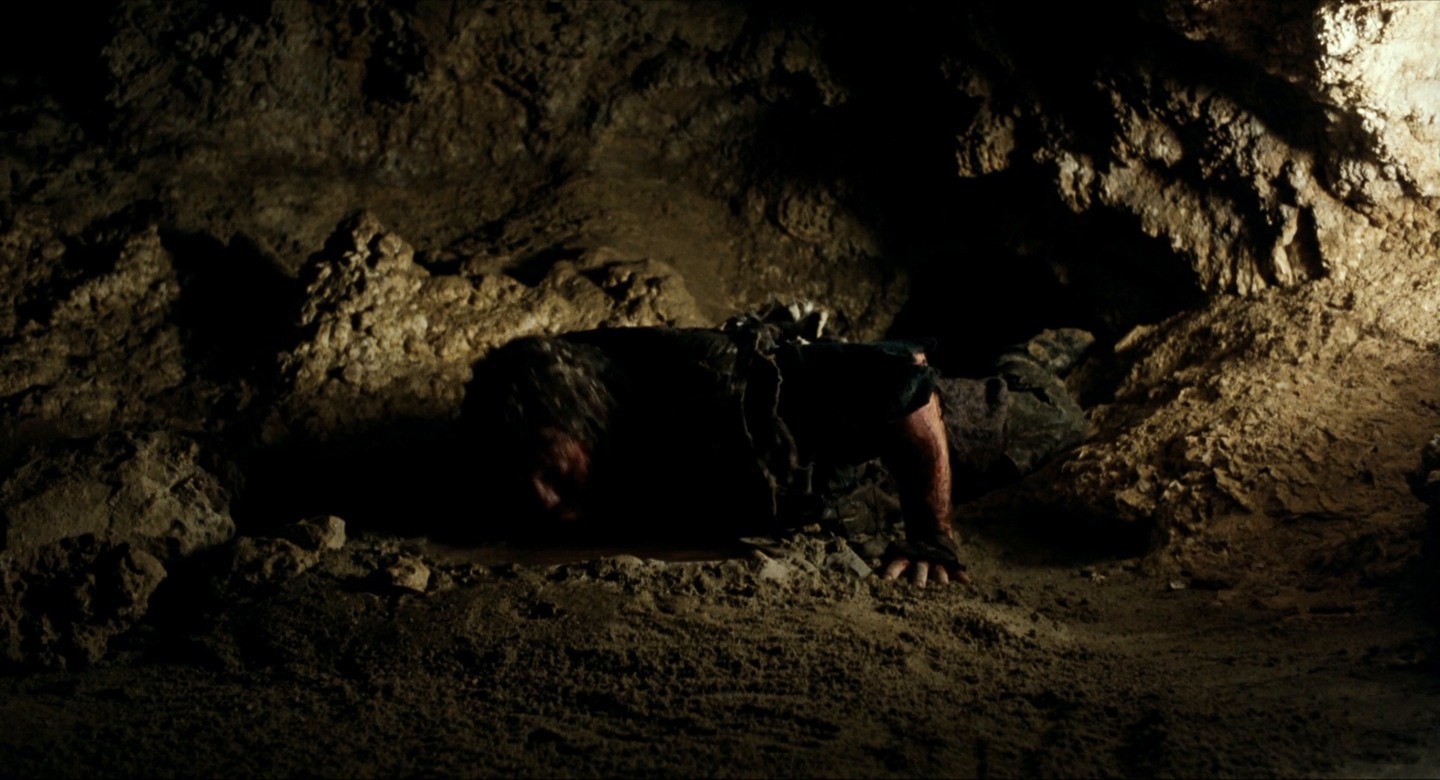
The injury is not confined to a single shock. The survivor’s return gives it a continuing place in the story, carrying the machine sequence’s consequences toward the public performance.
Explore the sequence →1:09:15
 ENLARGE ↗
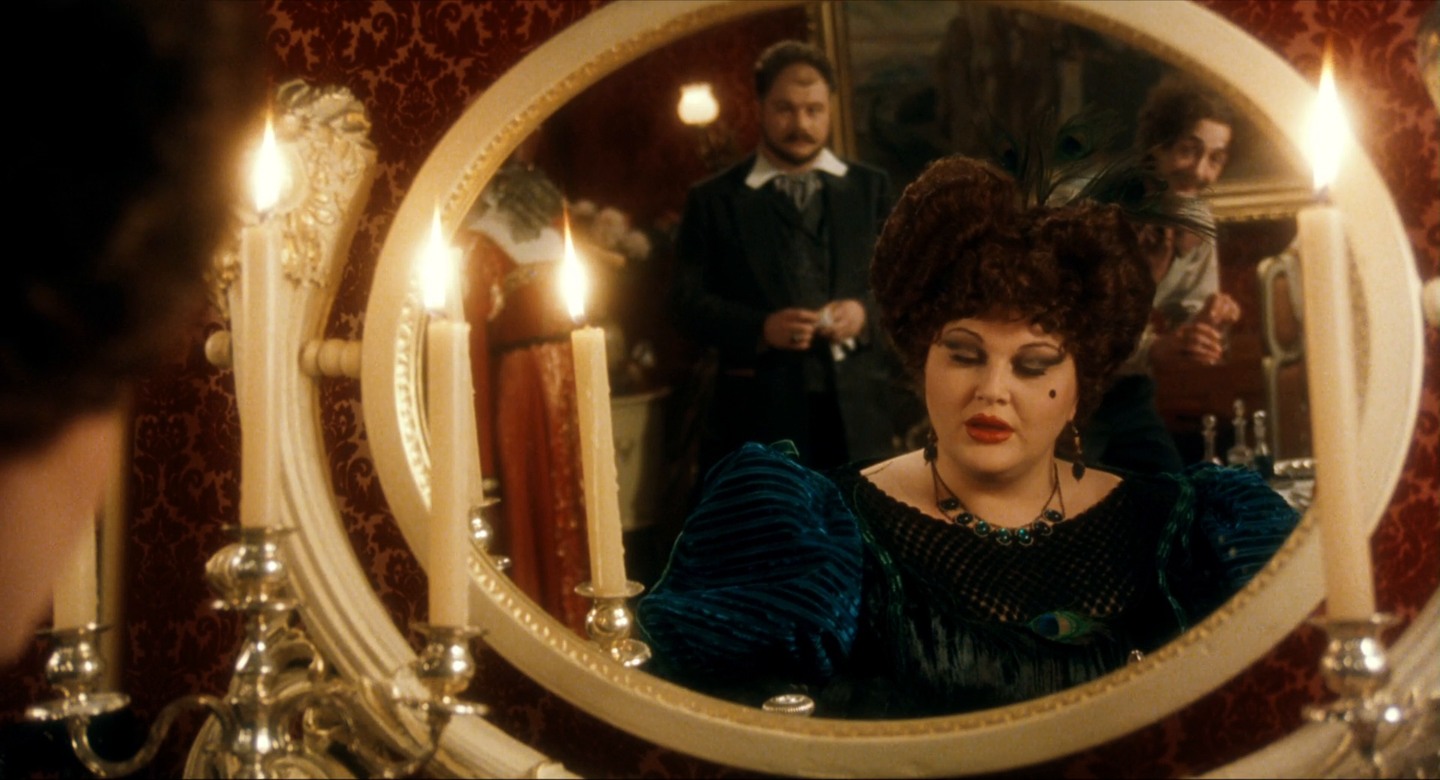
Light bulbs and the mirror surround the established singer with the equipment of performance. Her dressing room becomes another contested threshold between professional authority and the Phantom’s coercion.
1:14:30
 ENLARGE ↗
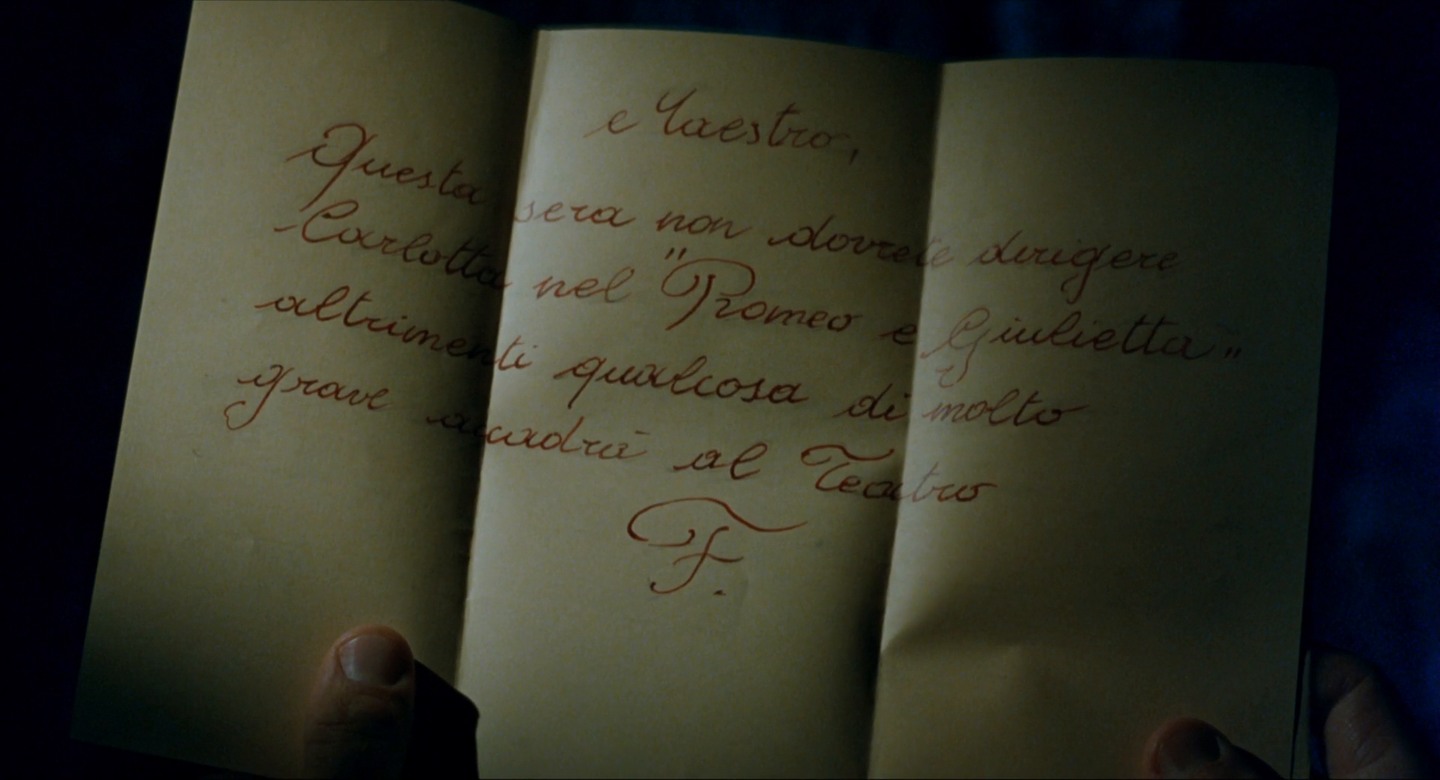
The physical letter connects backstage intimidation with the coming public event. Written demands and spectacular violence are two means of intervening in the theatre’s programme.
1:17:08
 ENLARGE ↗
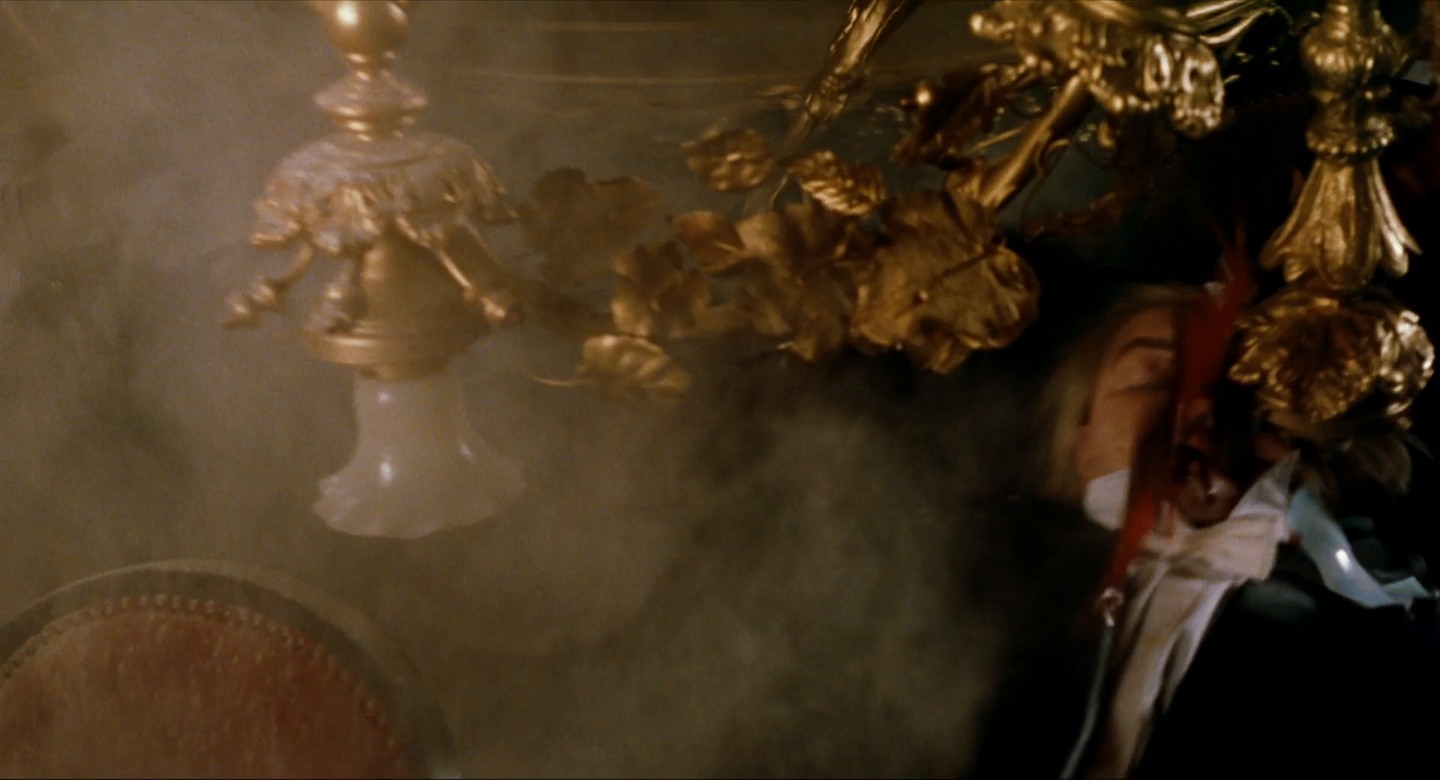
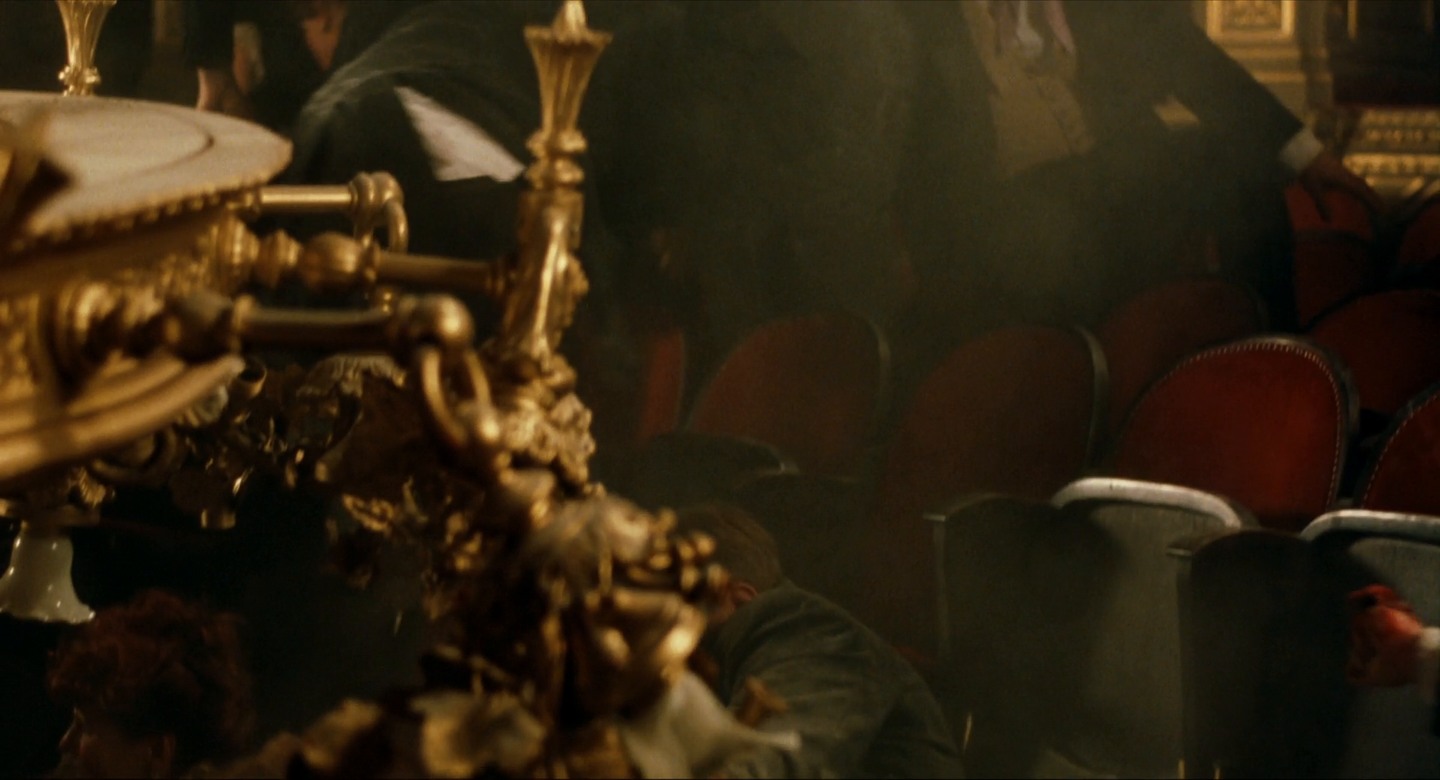
The hanging centrepiece crosses the boundary between decoration and weapon. The sequence spreads the consequences across seats, spectators and stage, turning the whole auditorium into a field of impact.
Explore the sequence →1:17:40
 ENLARGE ↗
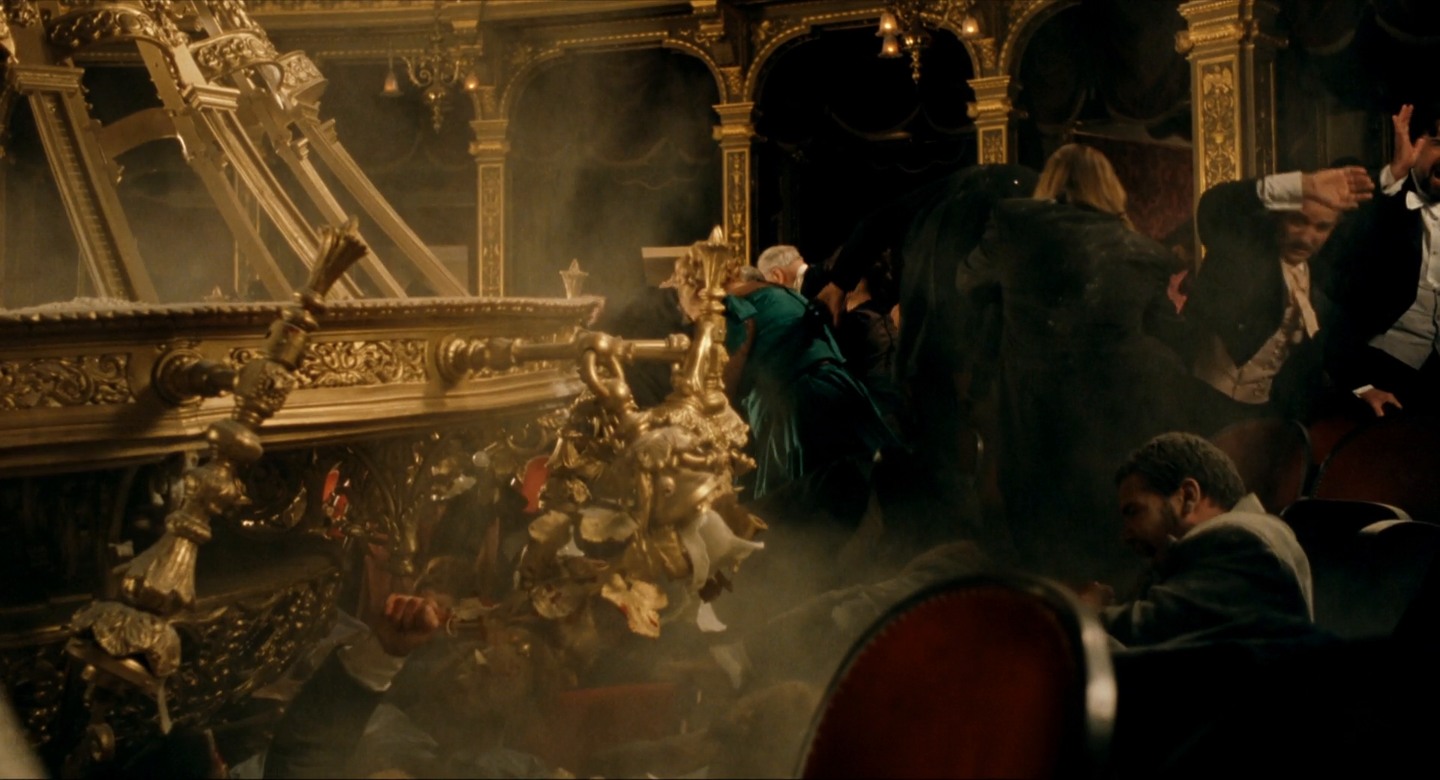
The fallen structure interrupts the orderly rows. What had organised the view upward now obstructs movement below, leaving the audience inside the wreckage of its own spectacle.
Explore the sequence →1:25:00
 ENLARGE ↗
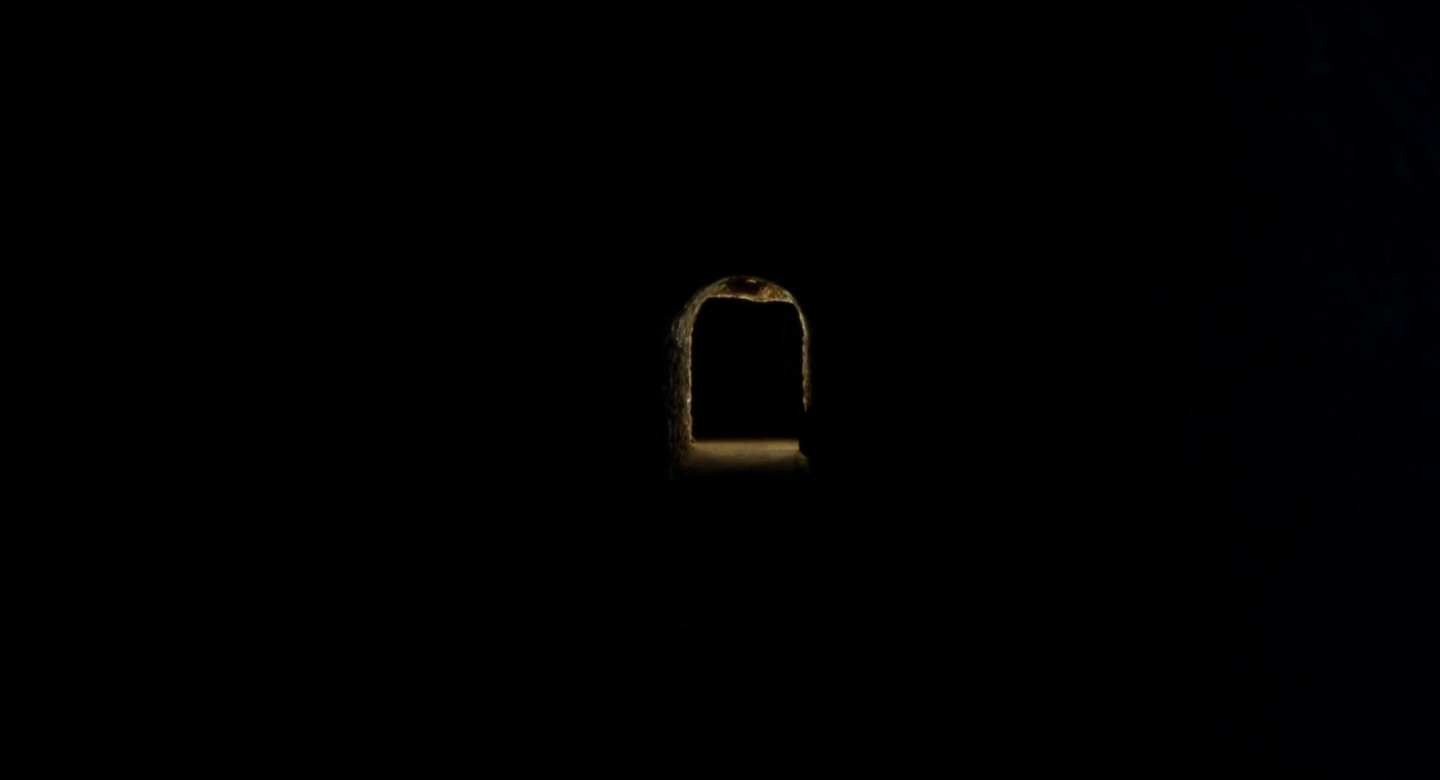
A distant rectangle of light gives the dark passage a clear destination while keeping the intervening space uncertain. The doorway repeats the film’s interest in who can enter, observe or escape.
1:25:45
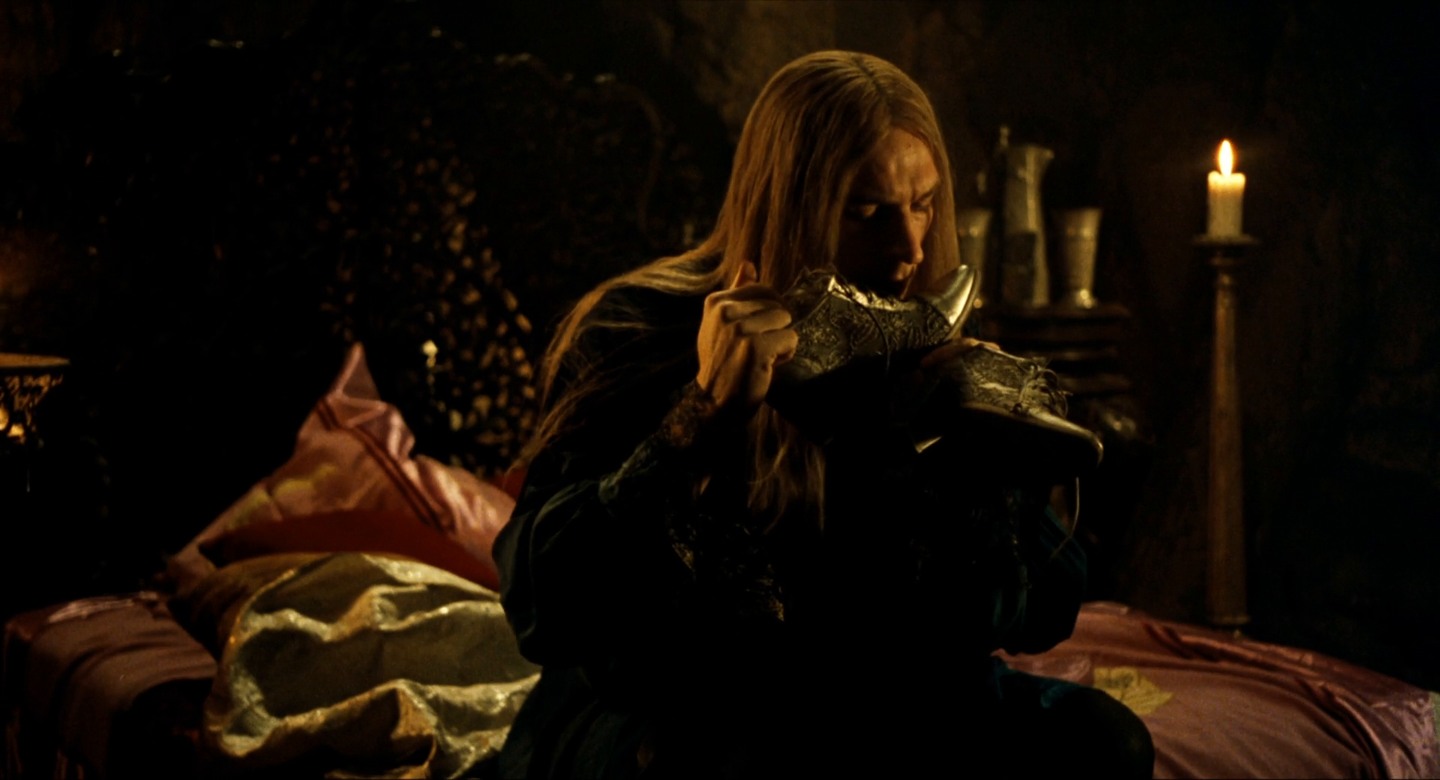 ENLARGE ↗
The animal returns beside the adult figure, connecting him to the opening’s underground childhood. The image also places an intimate attachment beside his destructive treatment of people.
1:30:15
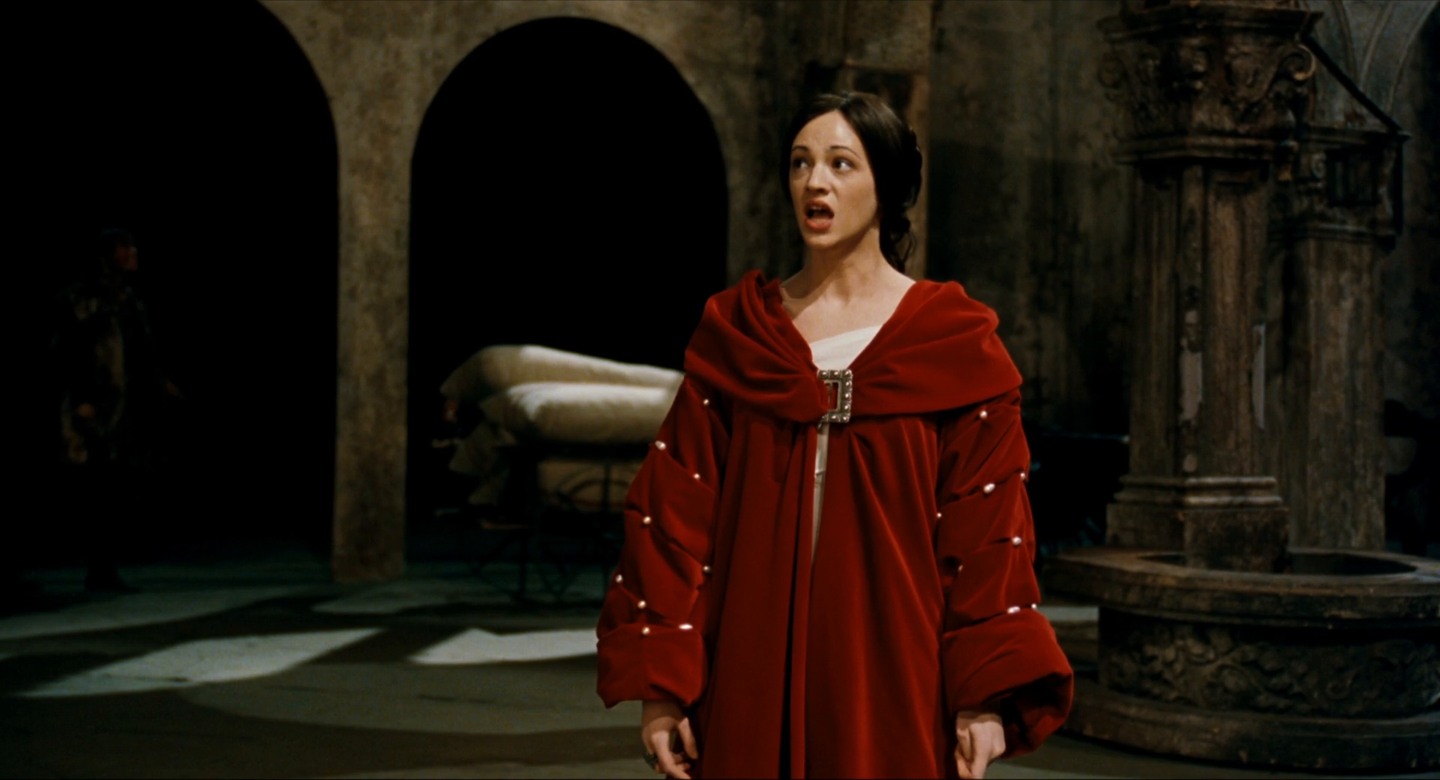 ENLARGE ↗
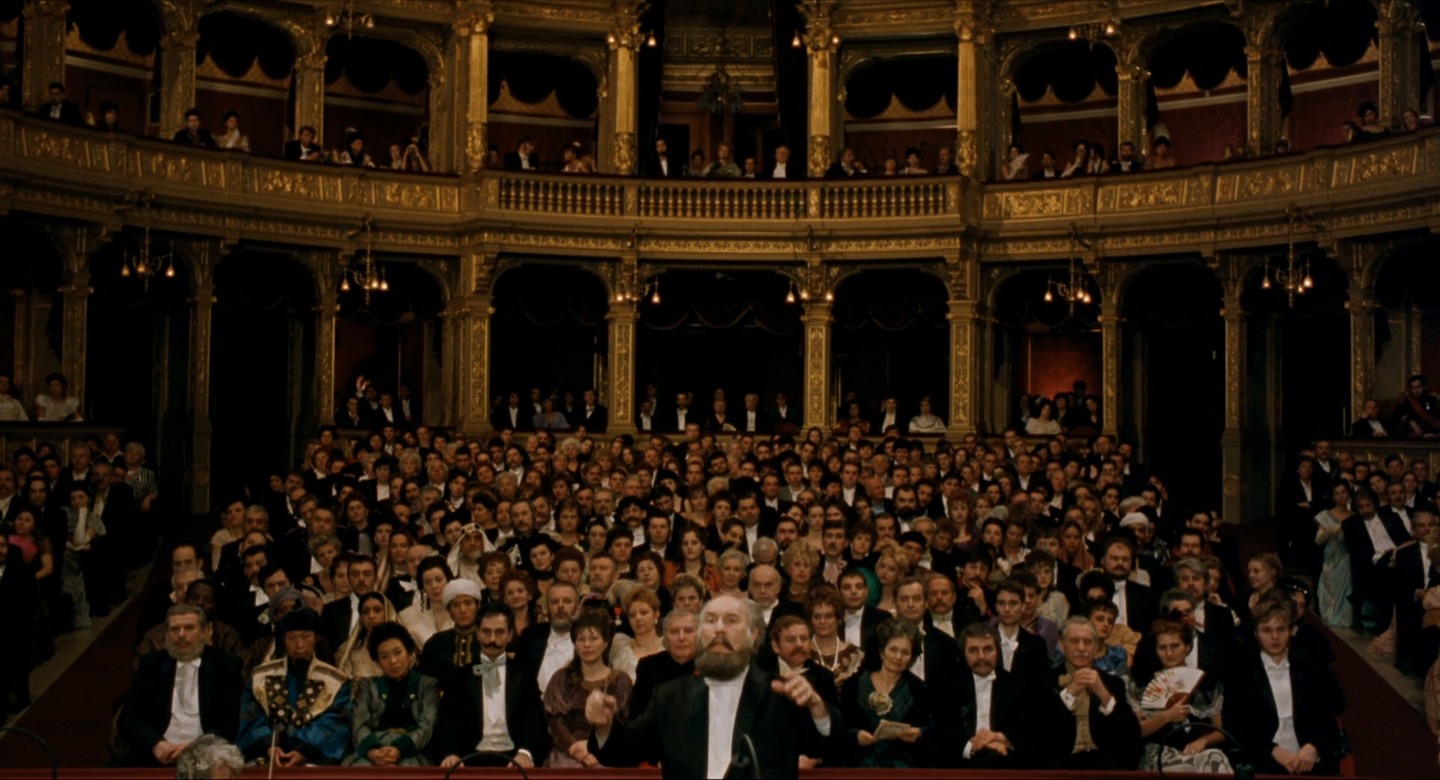
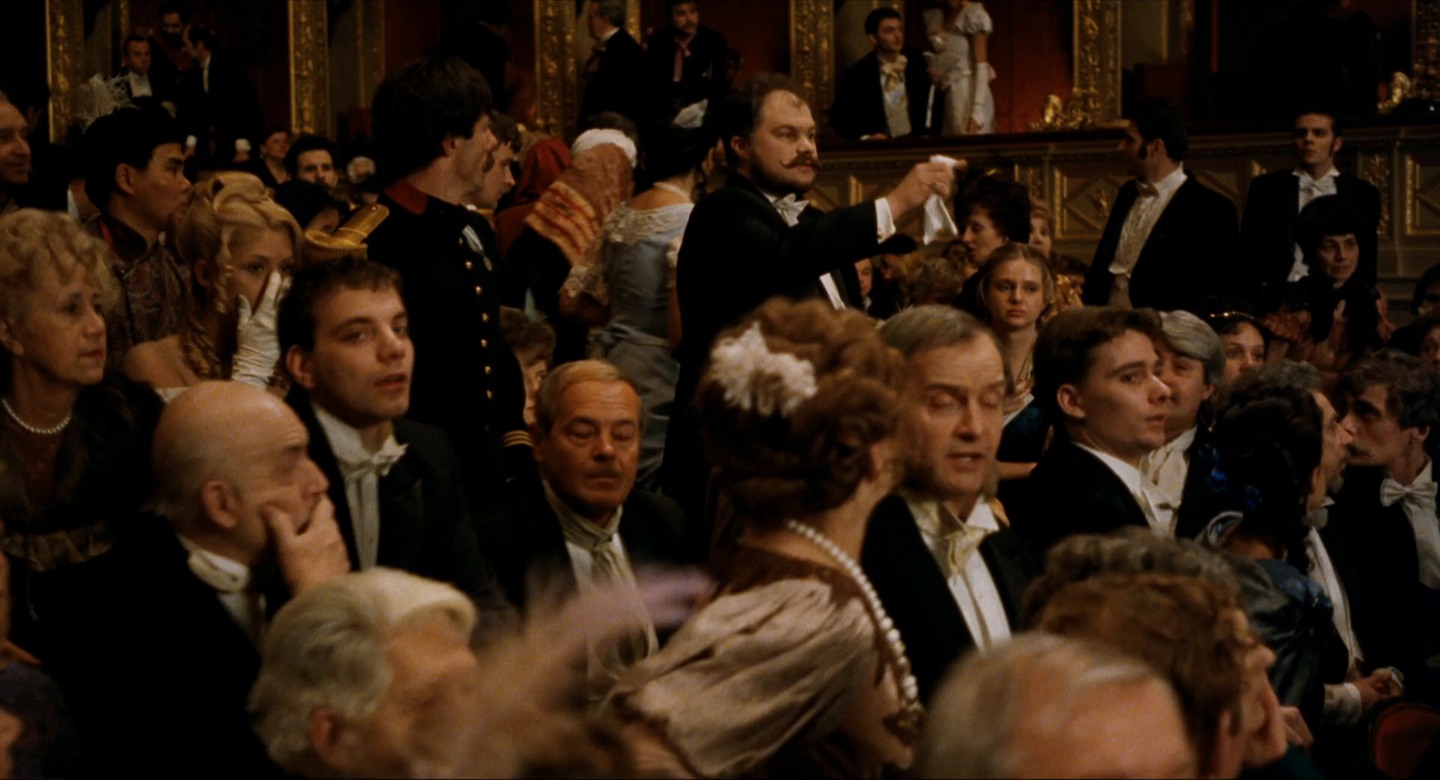
The later performance restores the crowded public theatre. Its apparent order makes the injured ratcatcher’s arrival especially disruptive: the damage hidden underground is about to appear in the room.
1:31:00
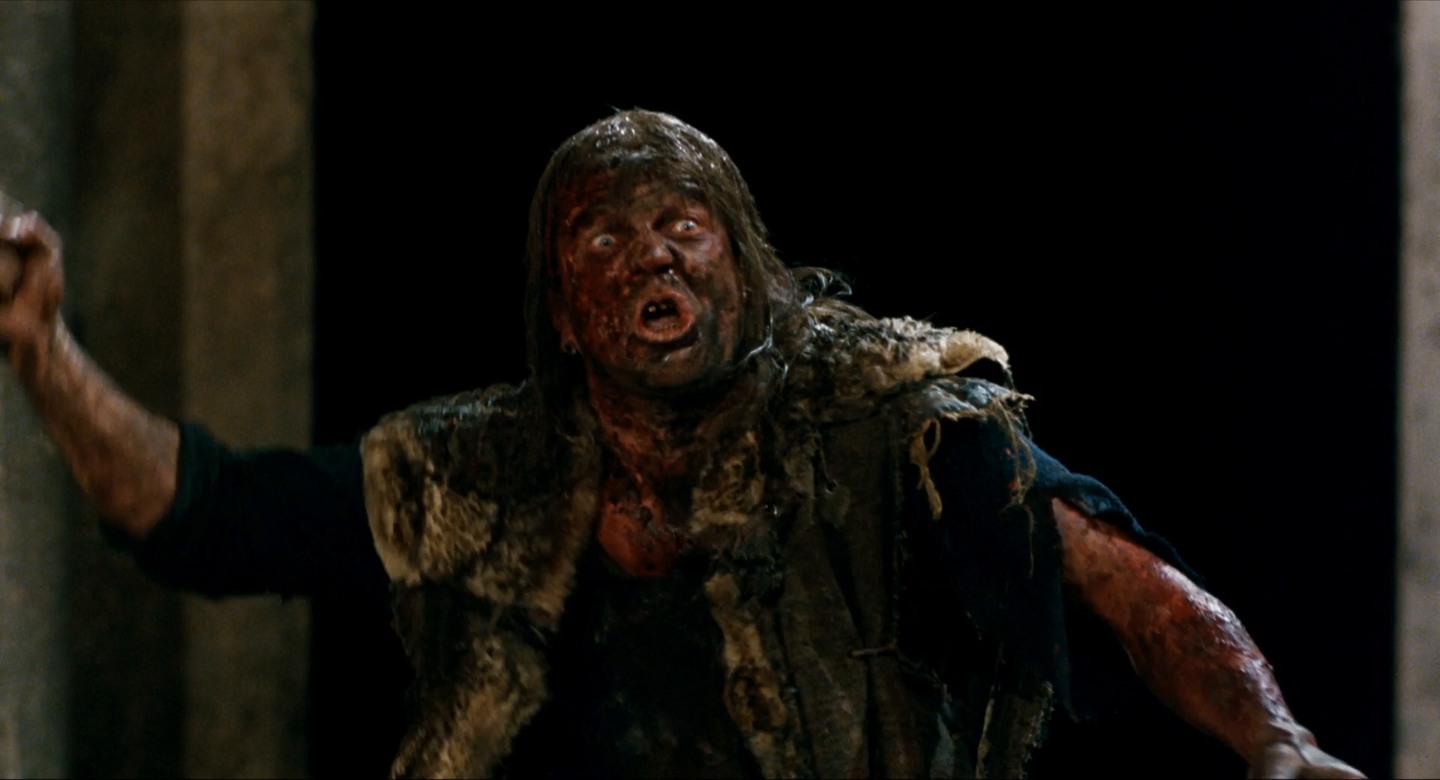 ENLARGE ↗
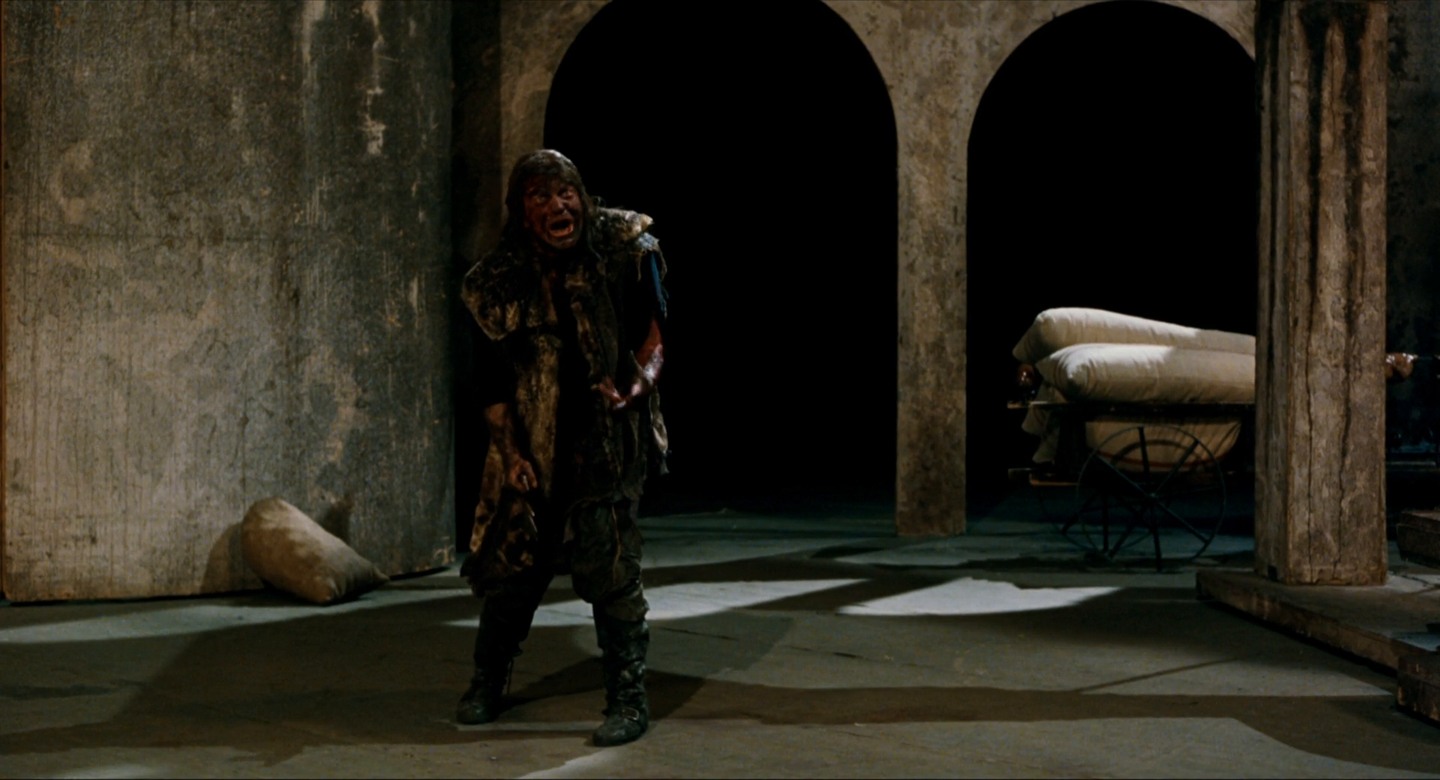
The damaged face is presented to an audience within the film. Reaction views enlarge the effect beyond its physical detail, showing the theatre forced to confront what its polished surfaces exclude.
Explore the sequence →1:34:00
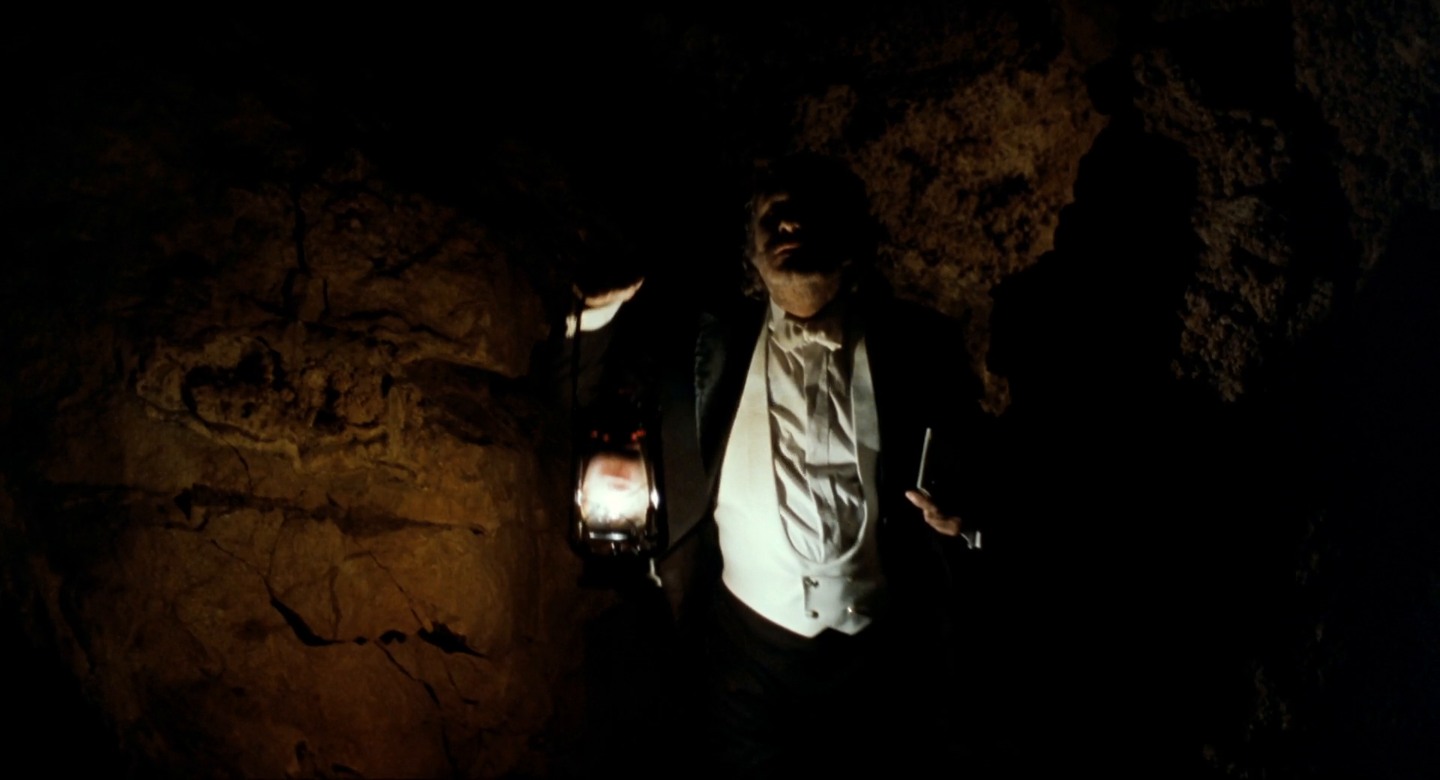 ENLARGE ↗
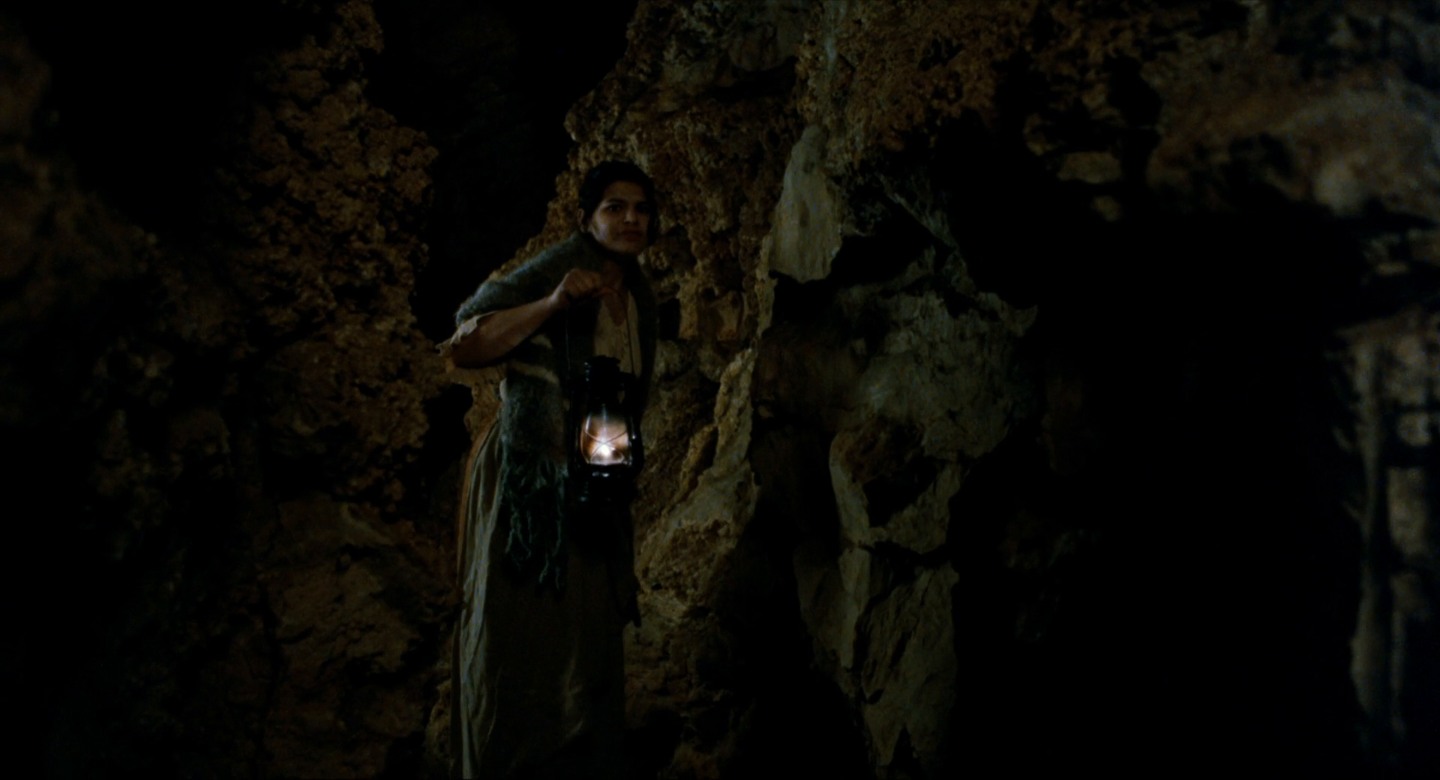
The rescuer enters the same limited visibility that defined the earlier intruders’ passage. The lantern offers a route through the dark without making the underground world fully legible.
1:38:12
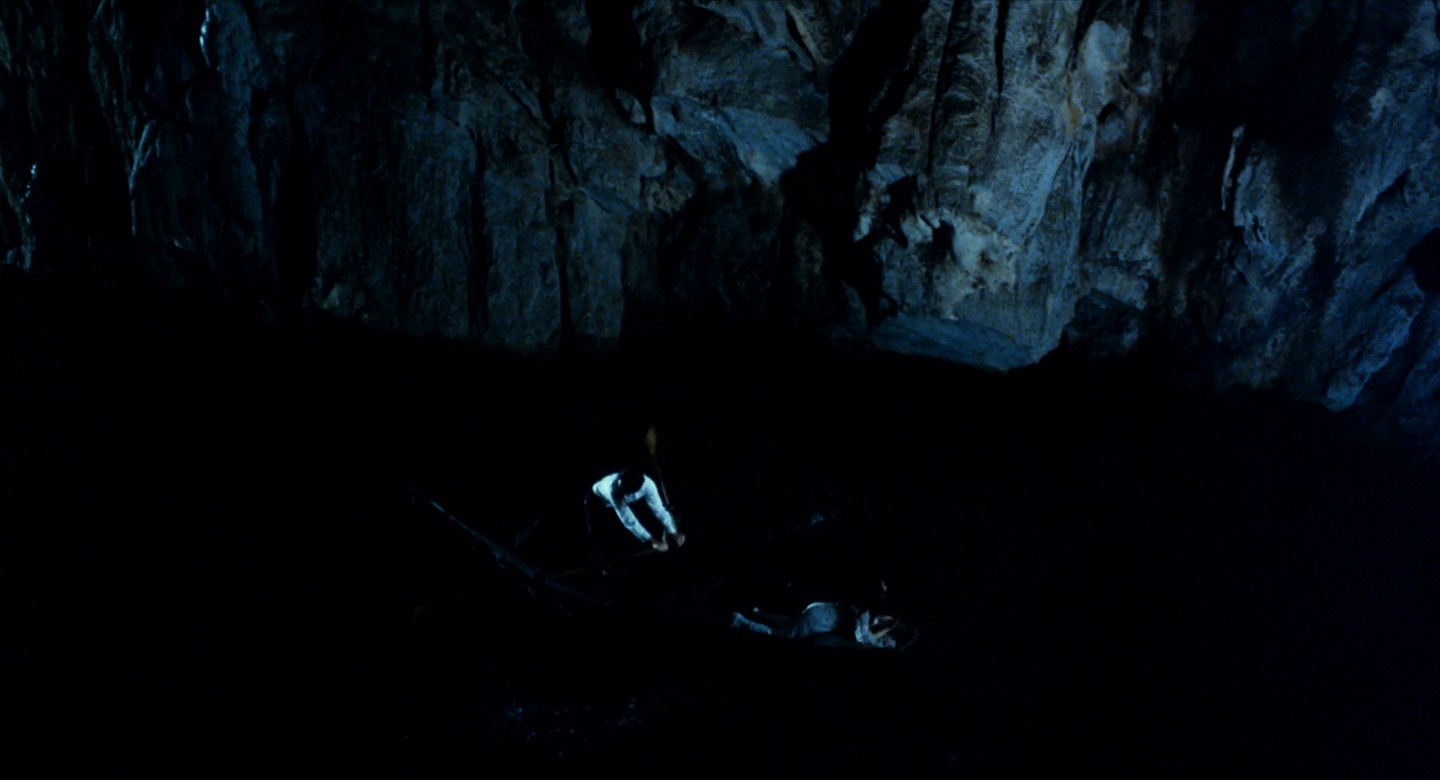 ENLARGE ↗
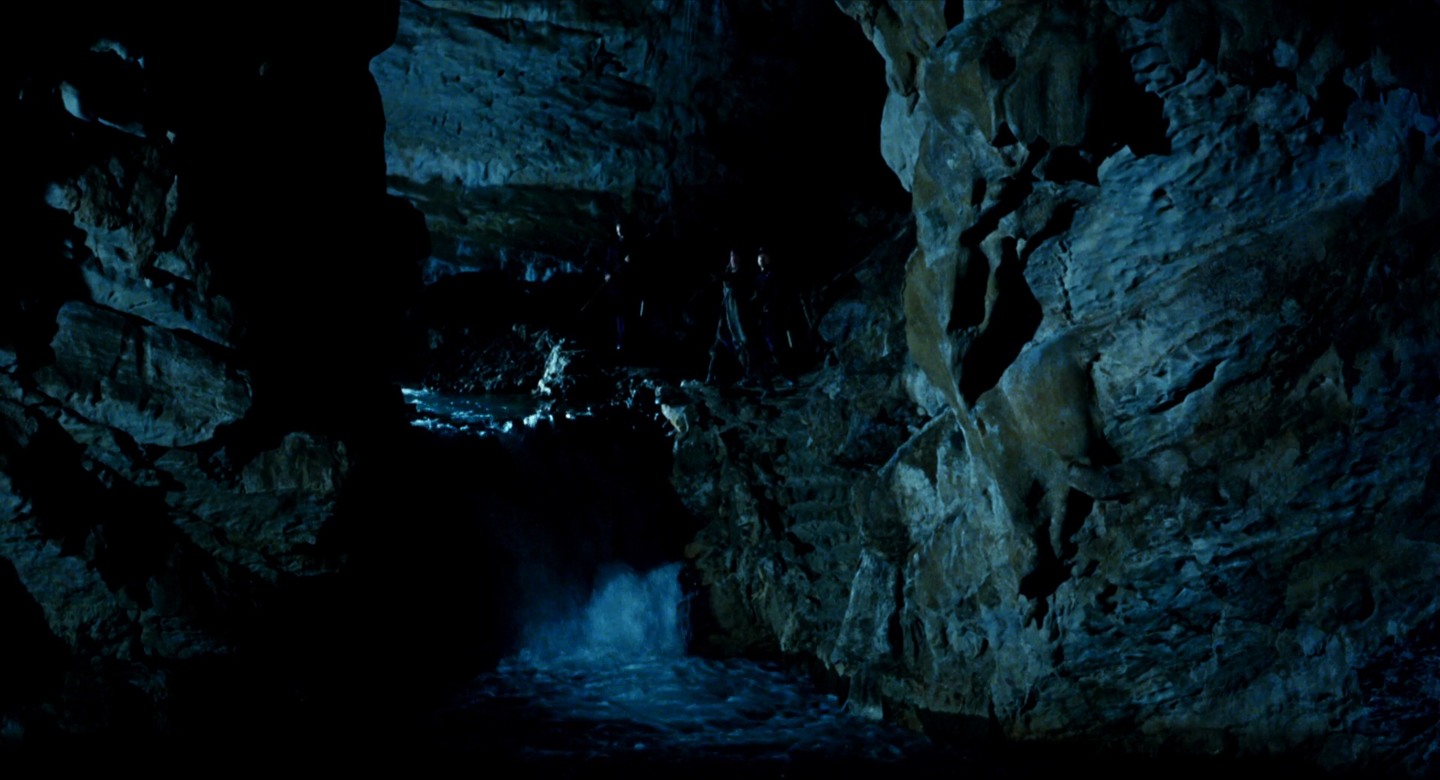
The retreat divides the image into those escaping and the figure left at the edge of the water. Distance begins to replace the physical closeness of the Phantom’s encounters with Christine.
Explore the sequence →1:40:50
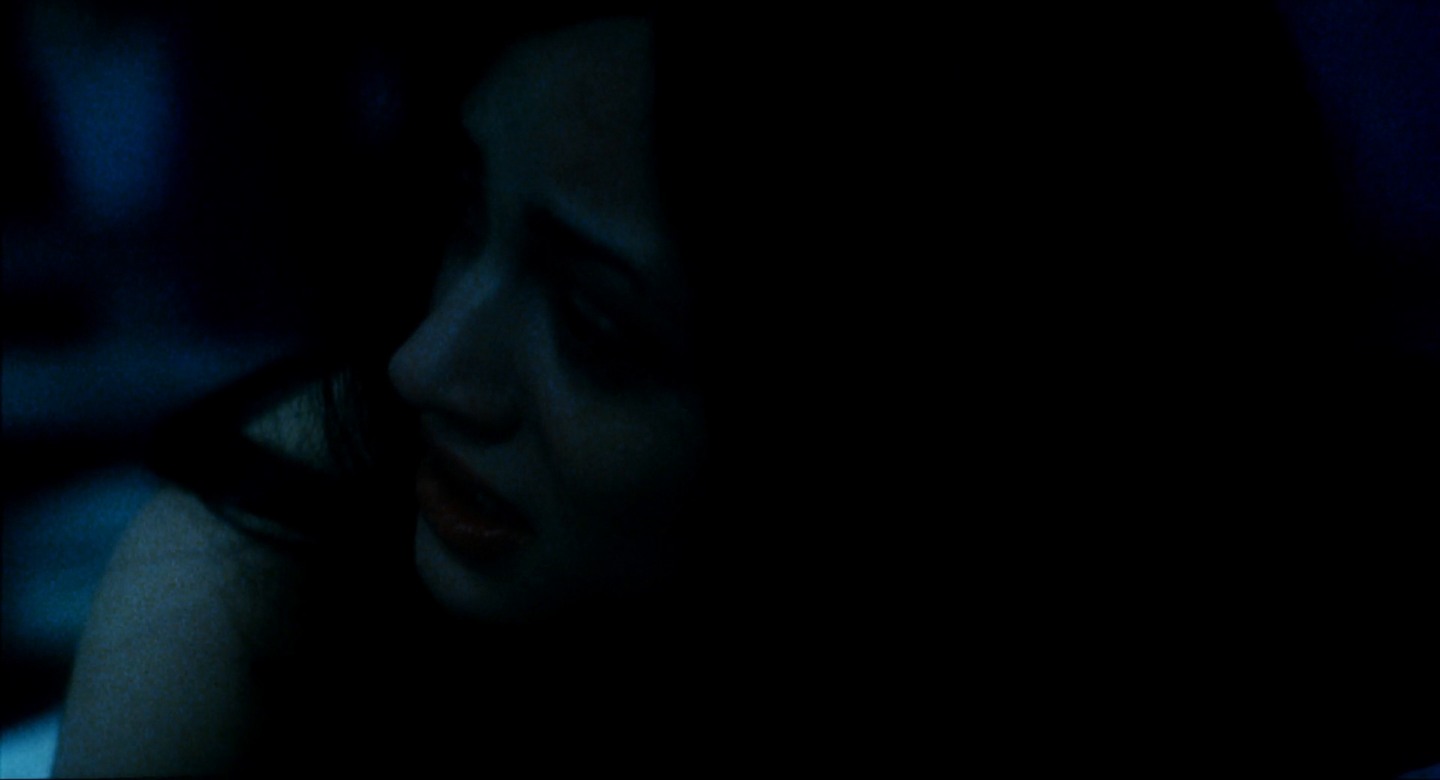 ENLARGE ↗
The final movement belongs to Christine’s response and departure. After the confrontations and gunfire, her face carries the separation between the surviving travellers and the underground world behind them.
Explore the sequence →GORE & EFFECTS
Six studies follow the shaft attack, the cavern confrontation, the rat machine, the falling chandelier, the injured ratcatcher’s return and the final struggle. Each has a main image and an optional stage gallery. Open a sequence, then enlarge a frame to move through it.
05:16–07:10
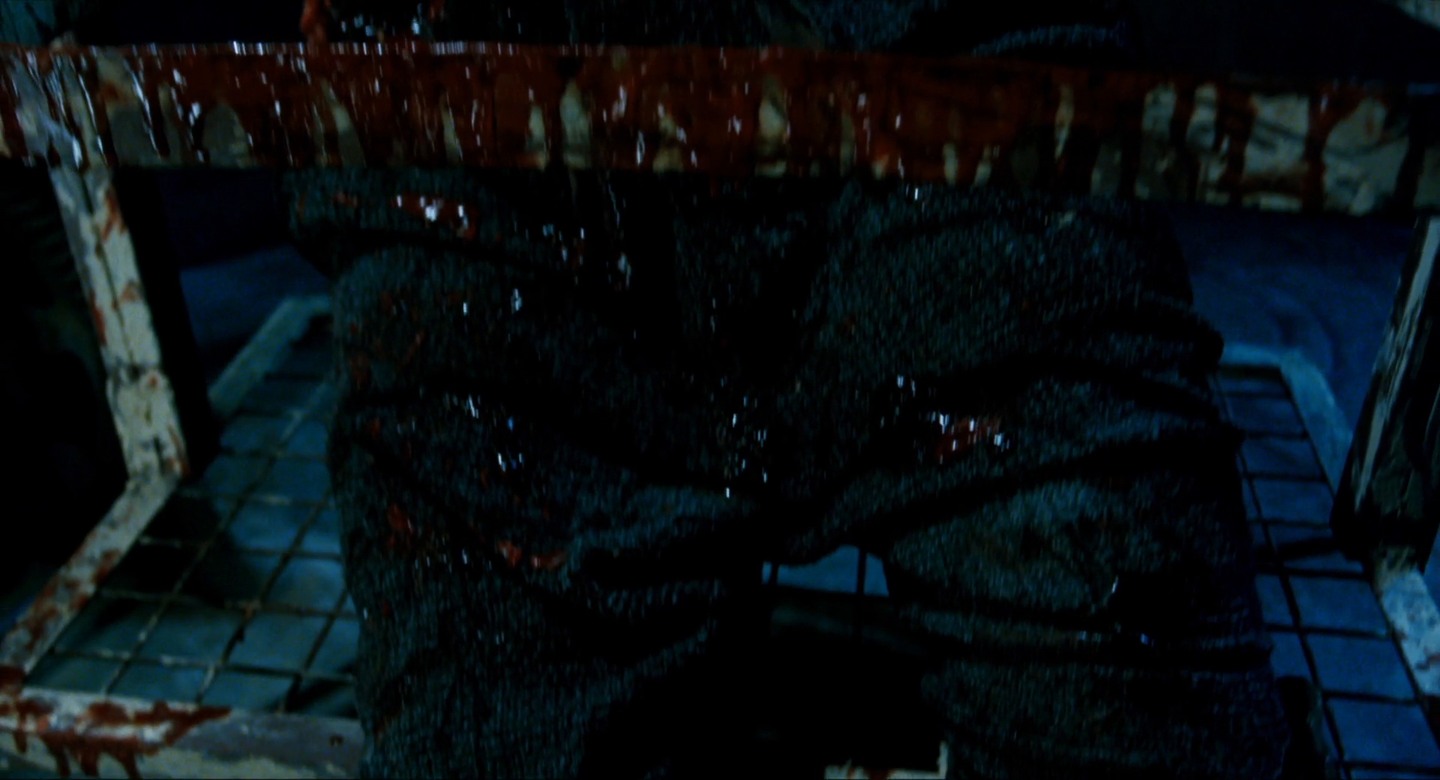
ENLARGE ↗The sequence establishes the practical means of descent before showing the damaged body. Shaft, rope and lifting apparatus keep the violence connected to a recognisable work process.
The most revealing comparison is between the downward journey and the return: the same opening changes from an entrance to a place from which evidence must be hauled. The gallery follows that transformation rather than isolating the wound.
01 · 05:16
ENLARGE ↗02 · 05:40
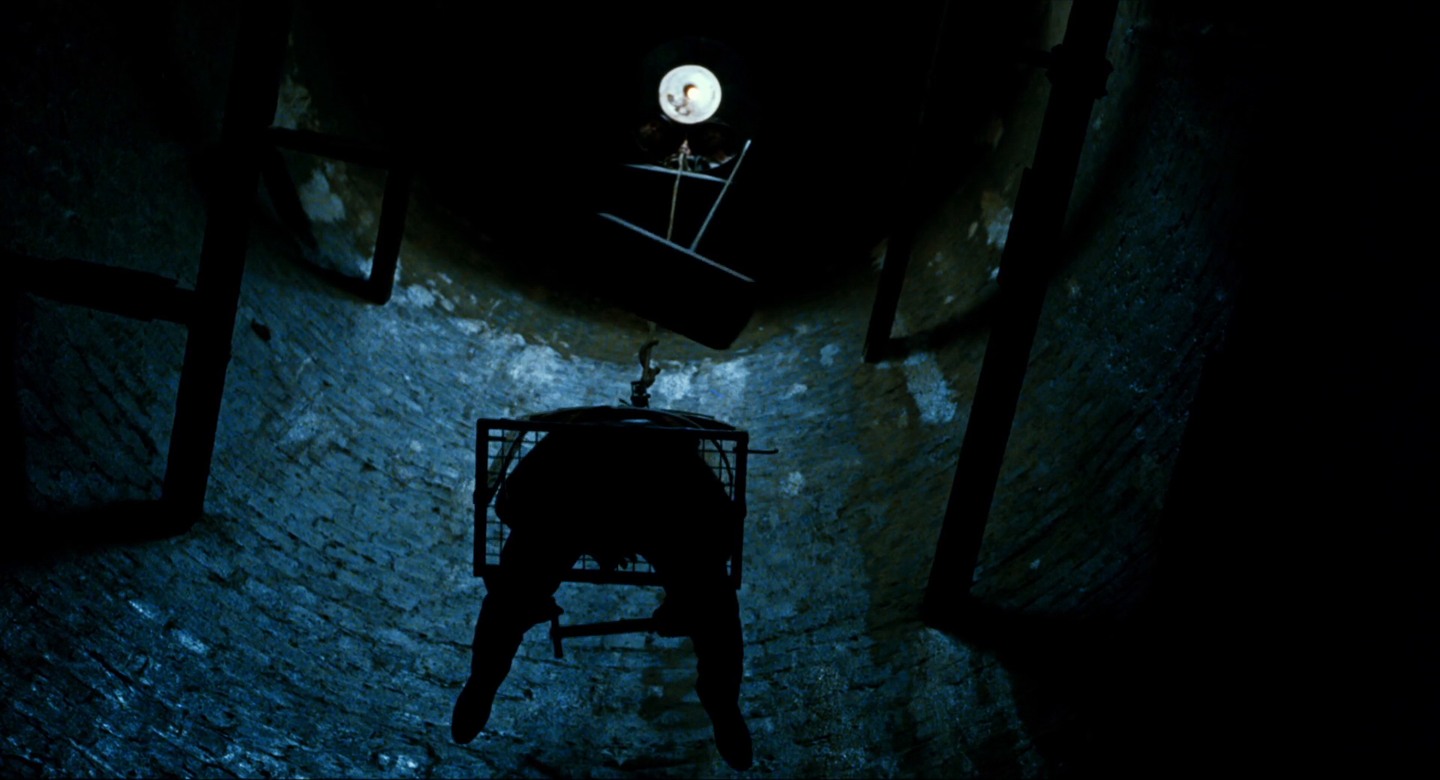 ENLARGE ↗
03 · 05:46
 ENLARGE ↗
04 · 06:16
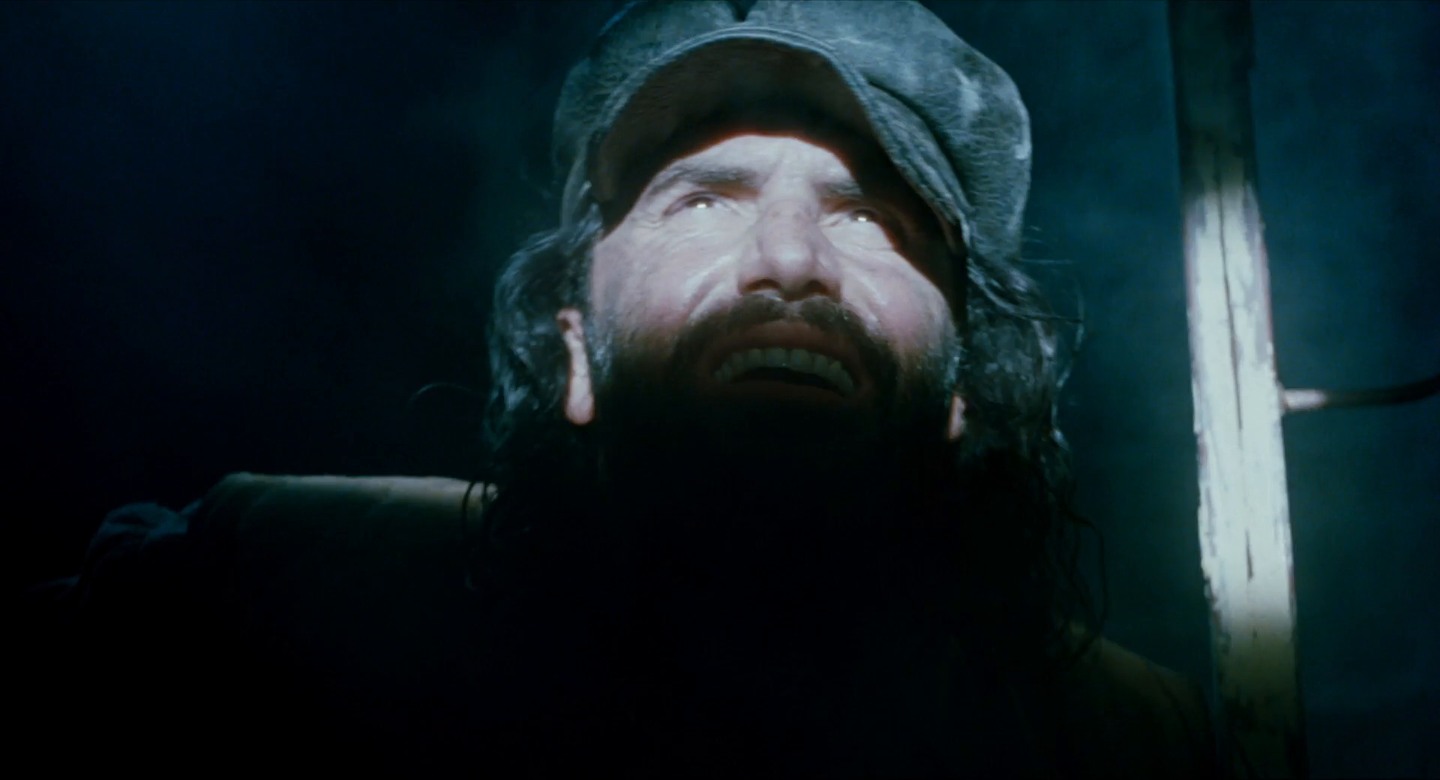 ENLARGE ↗
05 · 06:22
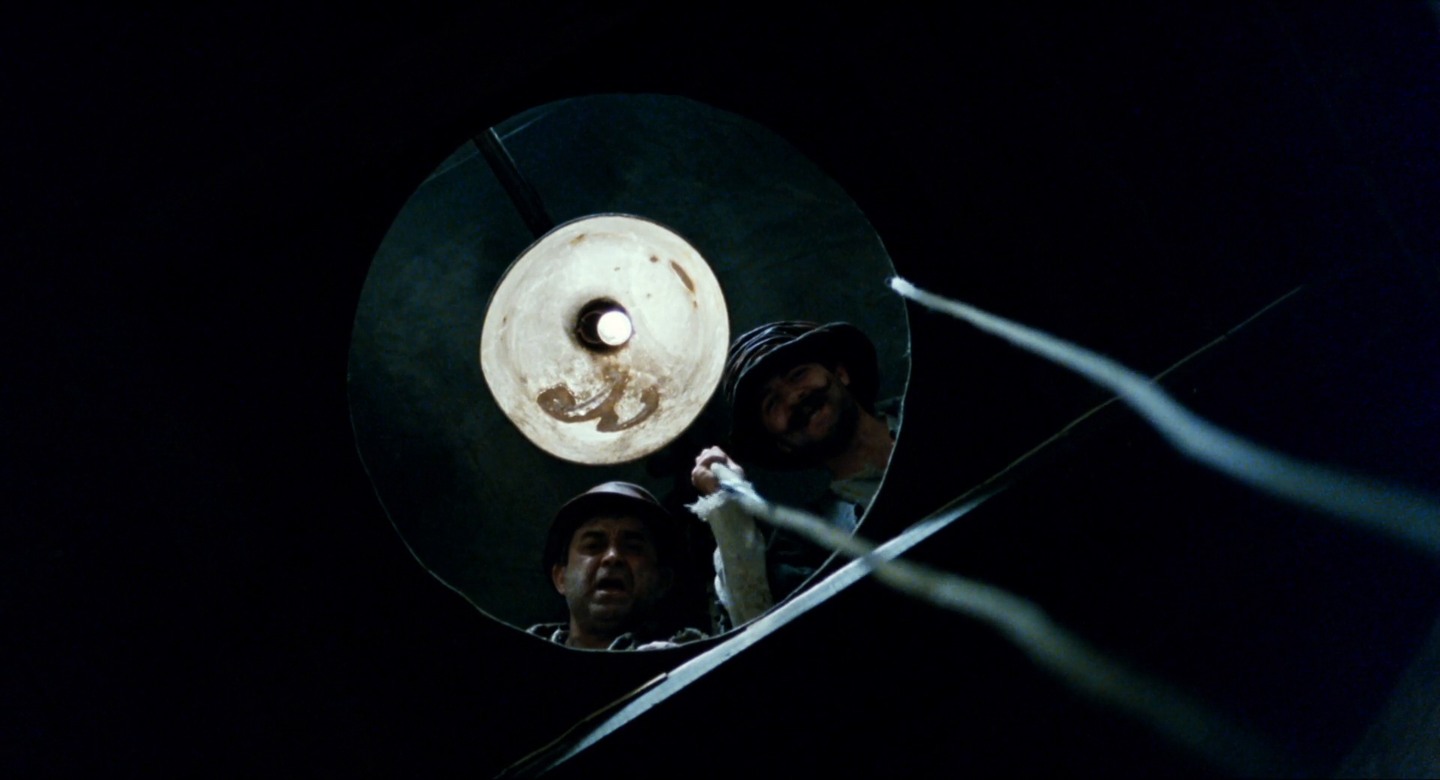 ENLARGE ↗
06 · 06:34
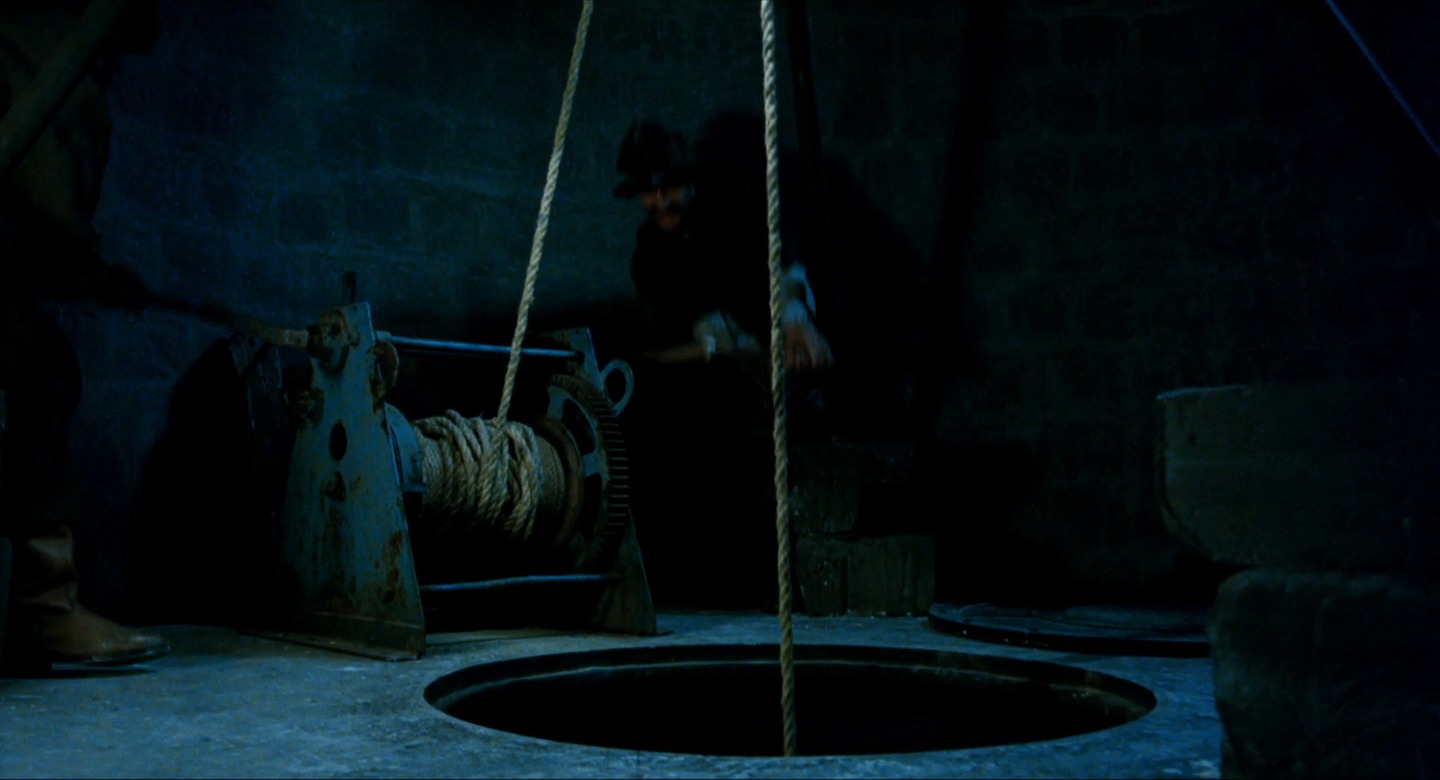 ENLARGE ↗
07 · 06:40
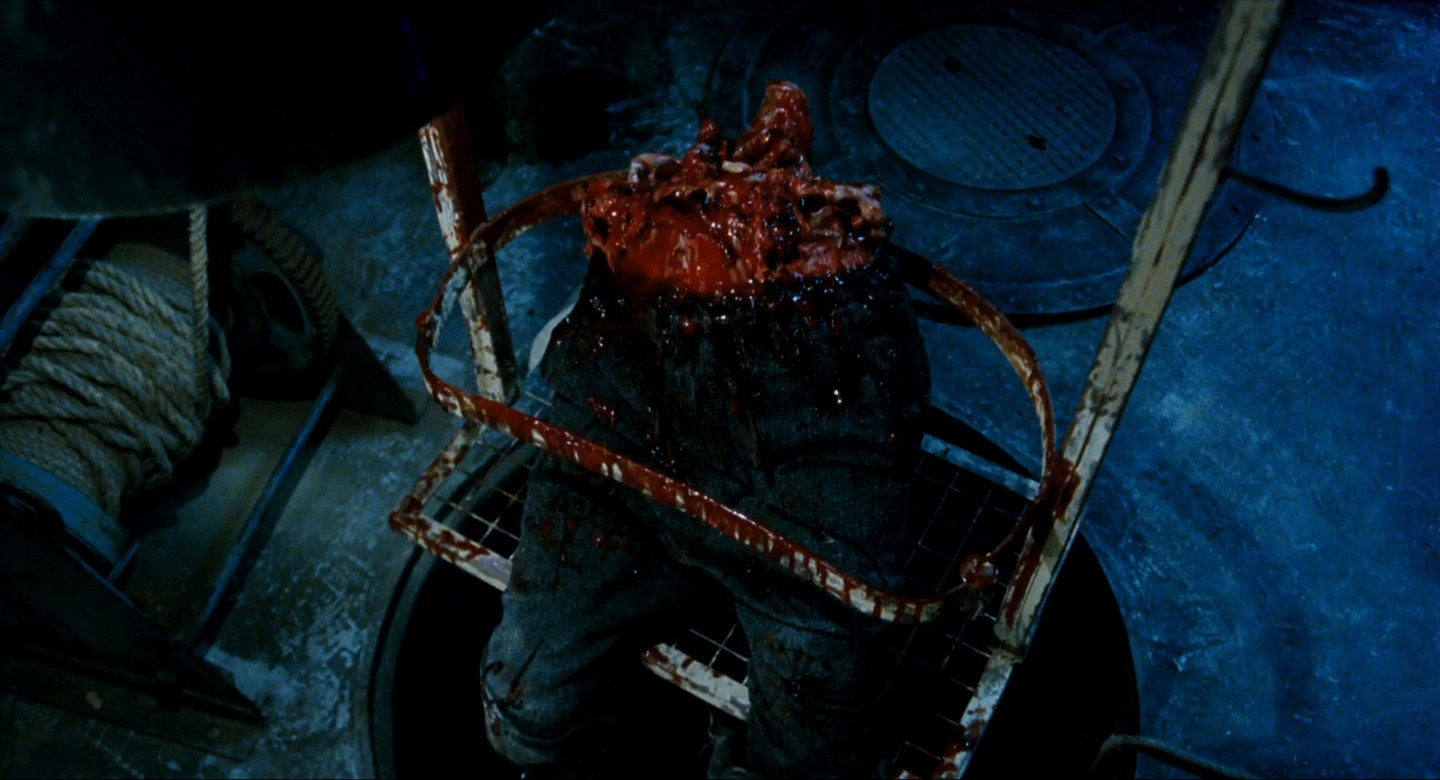 ENLARGE ↗
08 · 06:46
 ENLARGE ↗
09 · 06:52
ENLARGE ↗10 · 07:10
 ENLARGE ↗
32:22–33:58
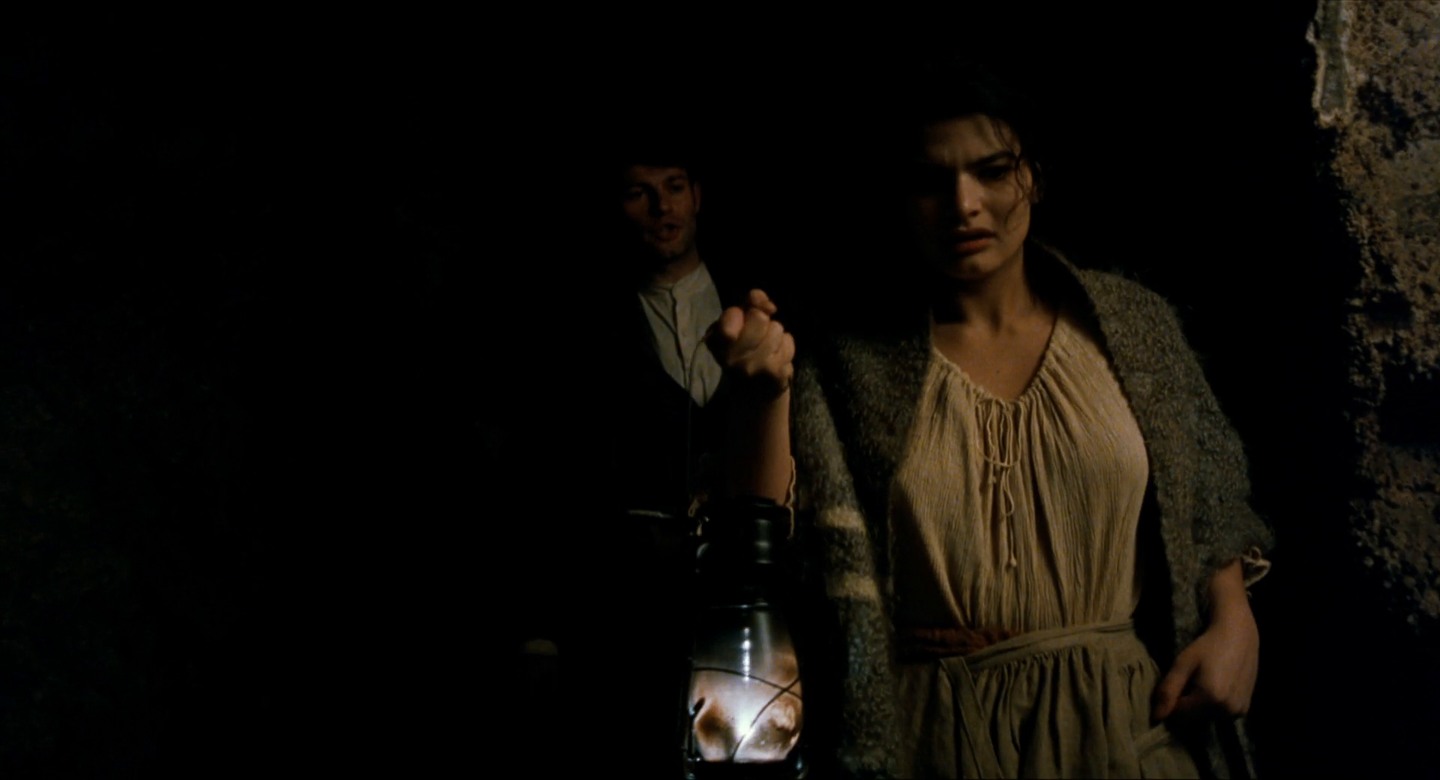
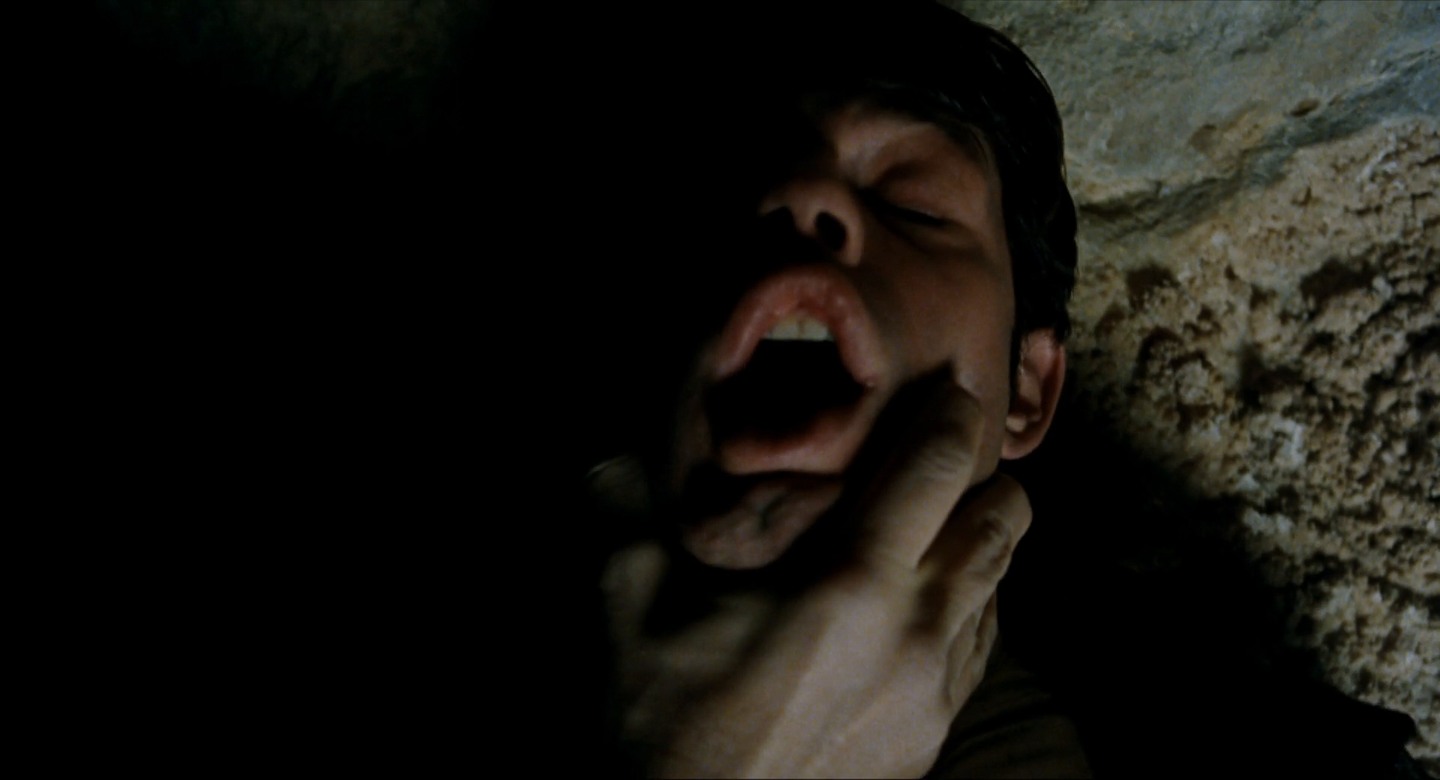
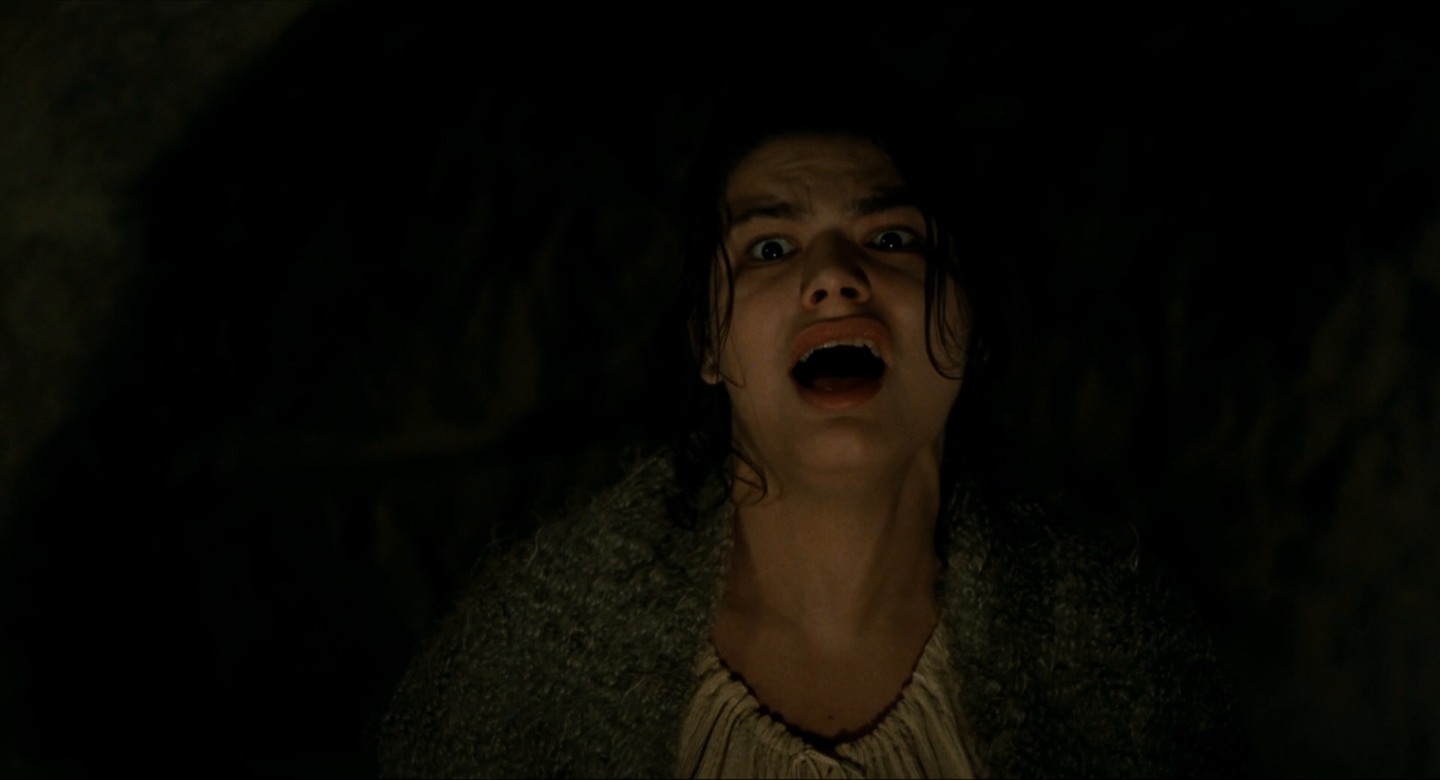
ENLARGE ↗The attack tightens the encounter around a hand and a face. The Phantom’s uncovered features remain available for comparison with the frightened victim, making physical dominance visible without a mask or concealed identity.
Closer views isolate the grip; the fallen body and the companion’s reaction establish its consequence. The sequence’s force lies in this movement from intimate contact to a body left on the ground.
01 · 32:22
 ENLARGE ↗
02 · 32:50
 ENLARGE ↗
03 · 32:52
 ENLARGE ↗
04 · 32:58
ENLARGE ↗05 · 33:14
 ENLARGE ↗
06 · 33:20
 ENLARGE ↗
07 · 33:22
 ENLARGE ↗
08 · 33:58
 ENLARGE ↗
58:46–1:07:04
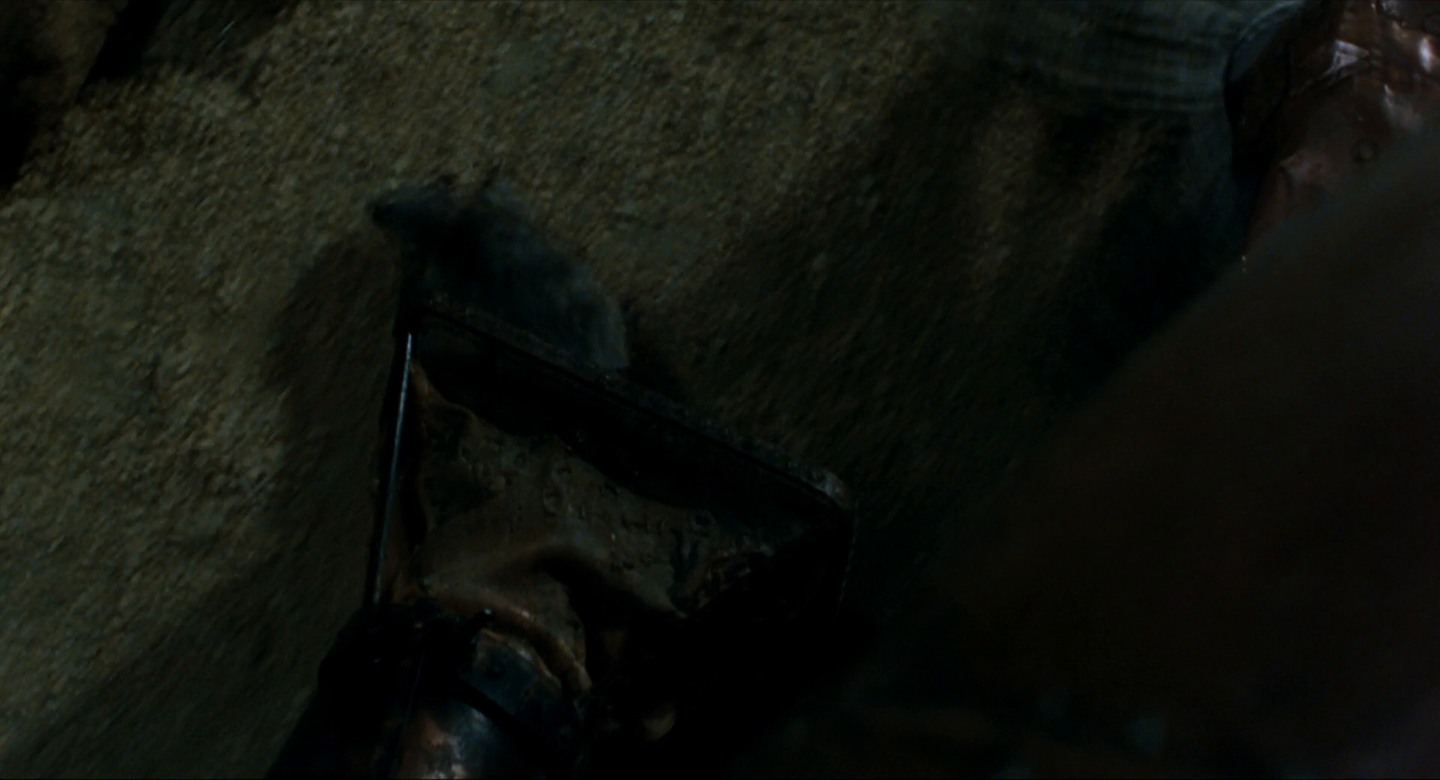
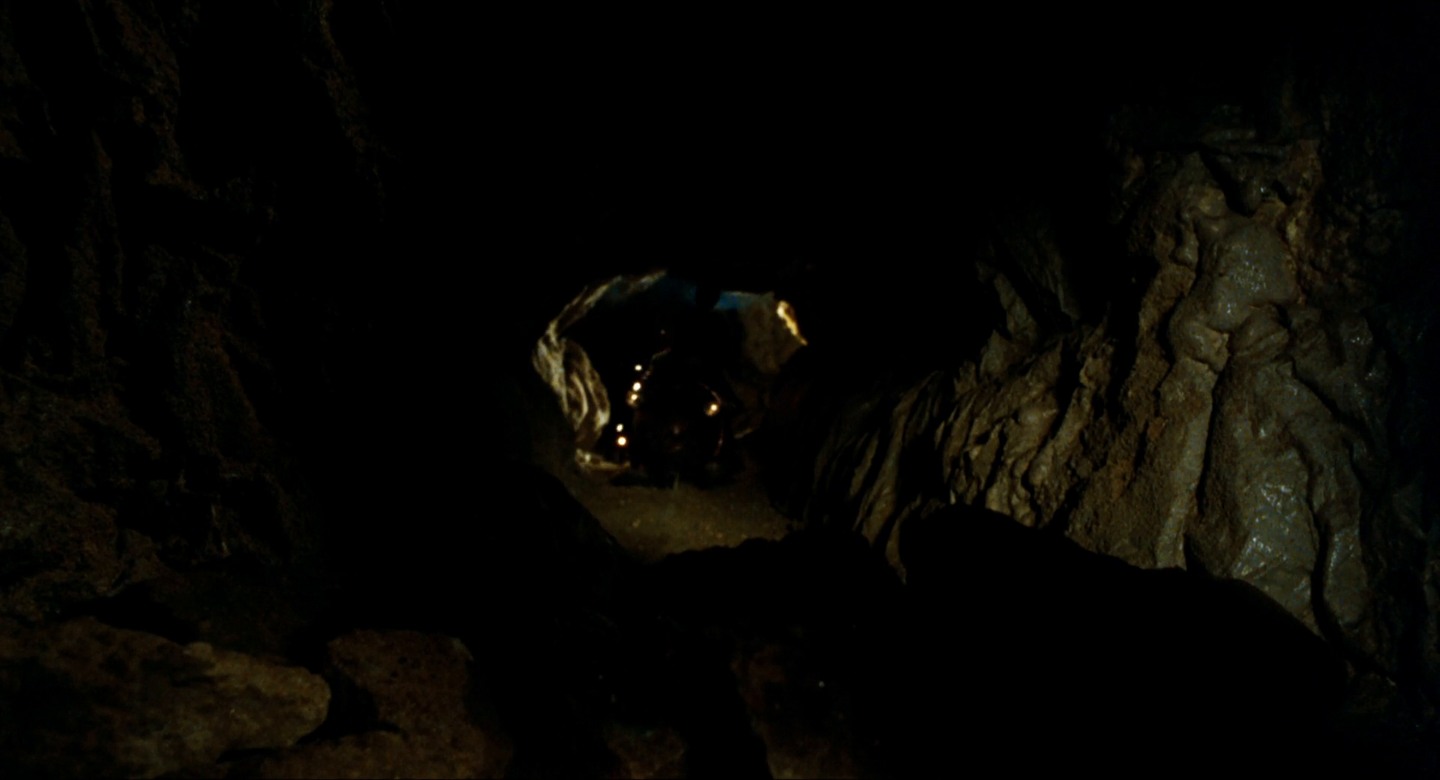
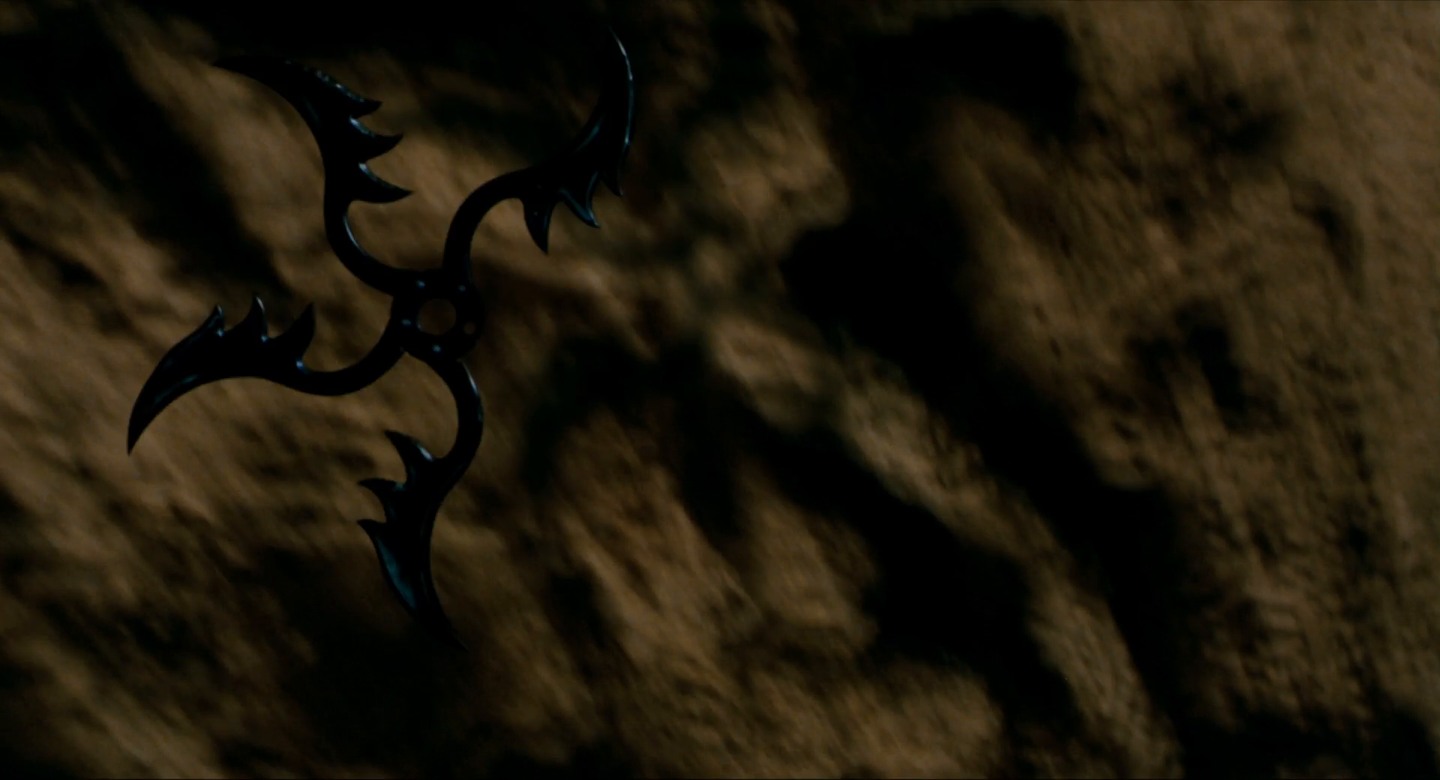
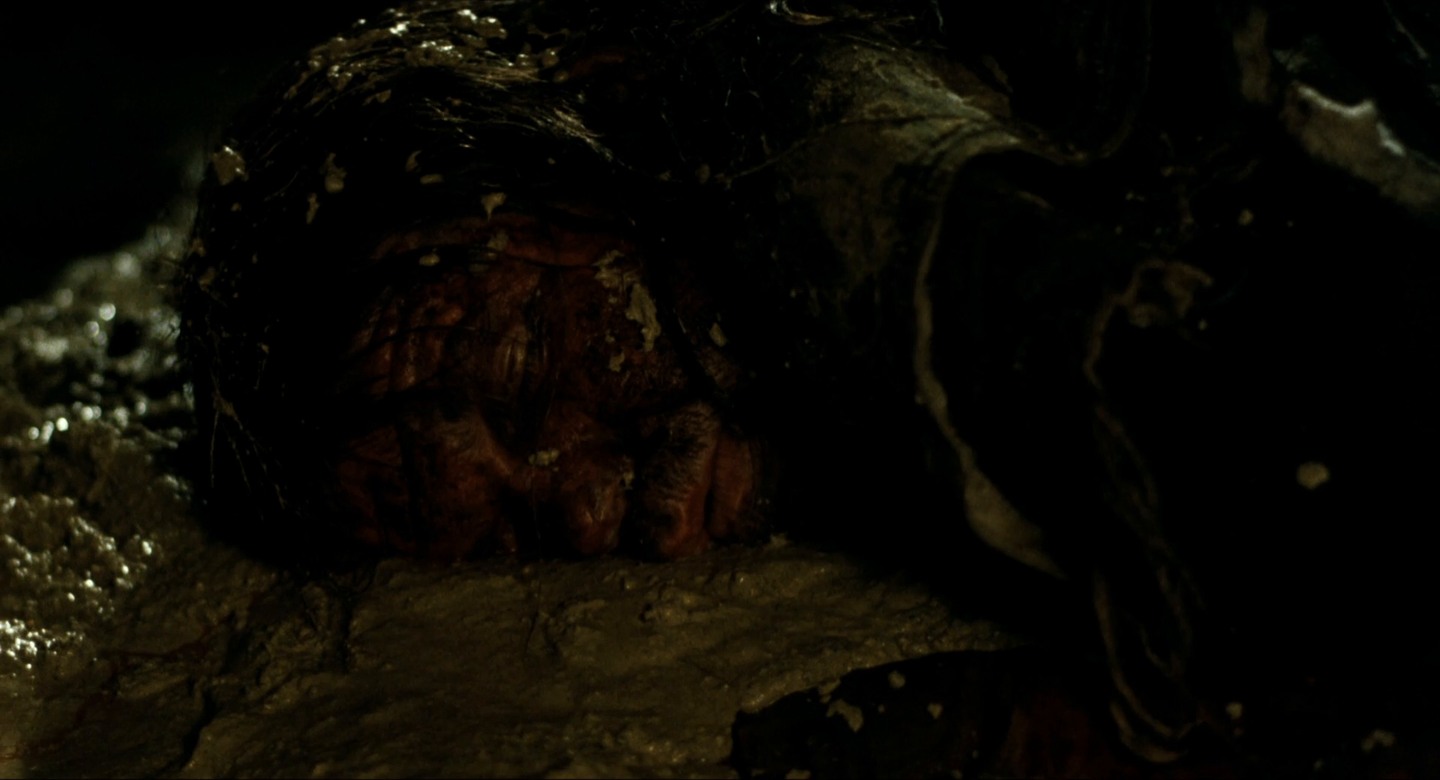
ENLARGE ↗The apparatus mixes industrial menace with grotesque comedy. The broad view allows the eye to separate riders, wheels, scoop and furnace; the closer details then make its actions more aggressive and less controllable.
The low tunnel changes the machine’s relation to its passengers. Injured faces and bloodied metal reverse the exterminators’ position. The closing credits name Simon Blades for the machine’s mechanics, alongside a larger effects team; they do not assign every injury insert to an individual.
01 · 58:46
 ENLARGE ↗
02 · 58:48
 ENLARGE ↗
03 · 58:49
 ENLARGE ↗
04 · 58:58
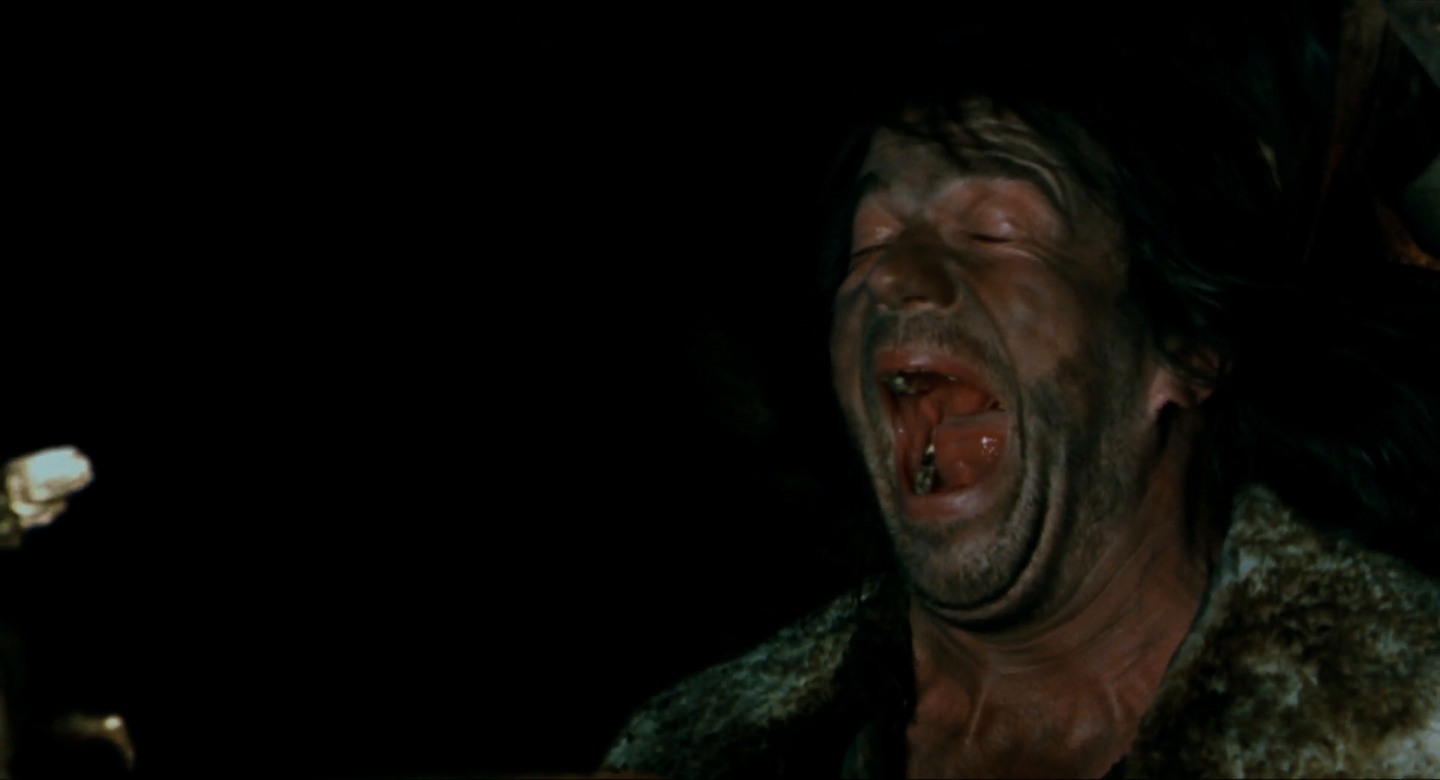 ENLARGE ↗
05 · 59:16
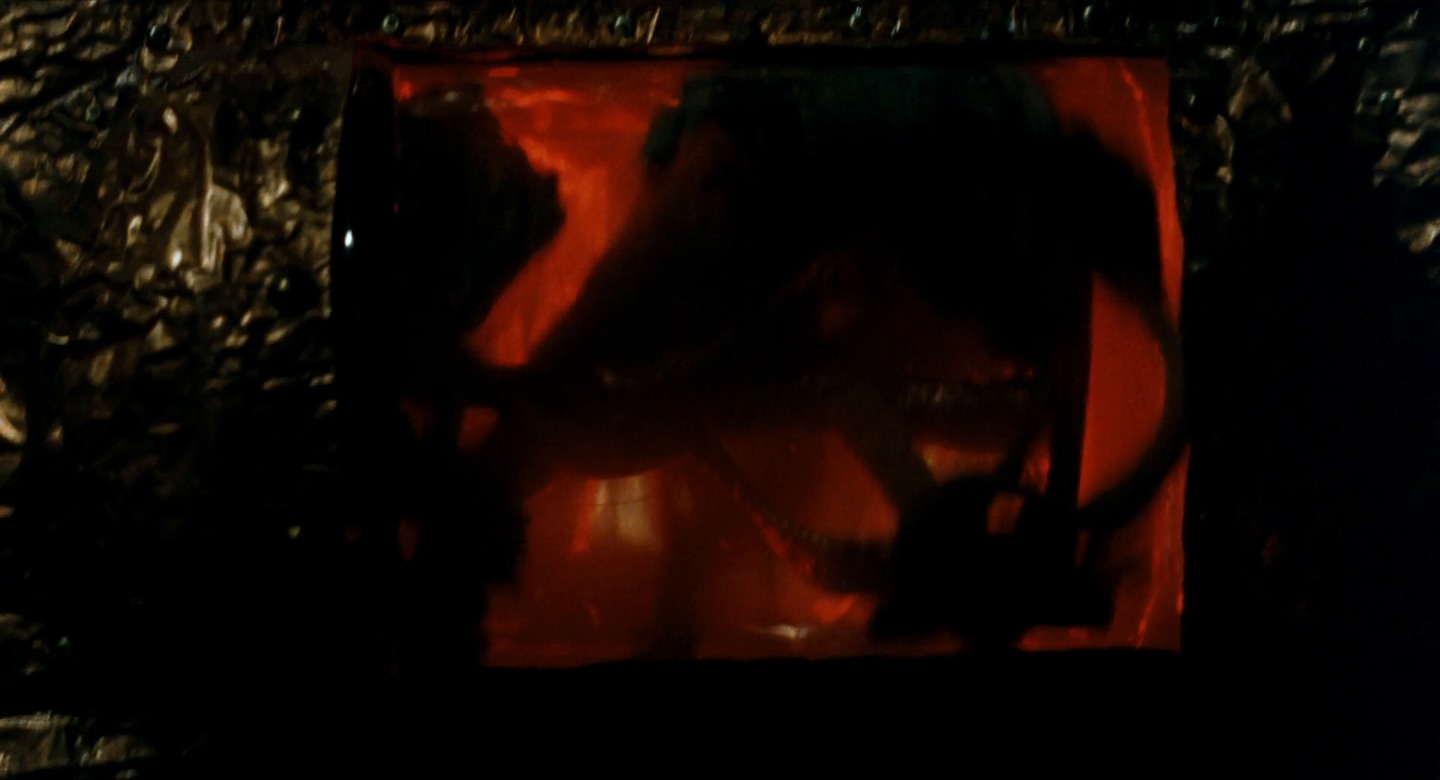 ENLARGE ↗
06 · 59:25
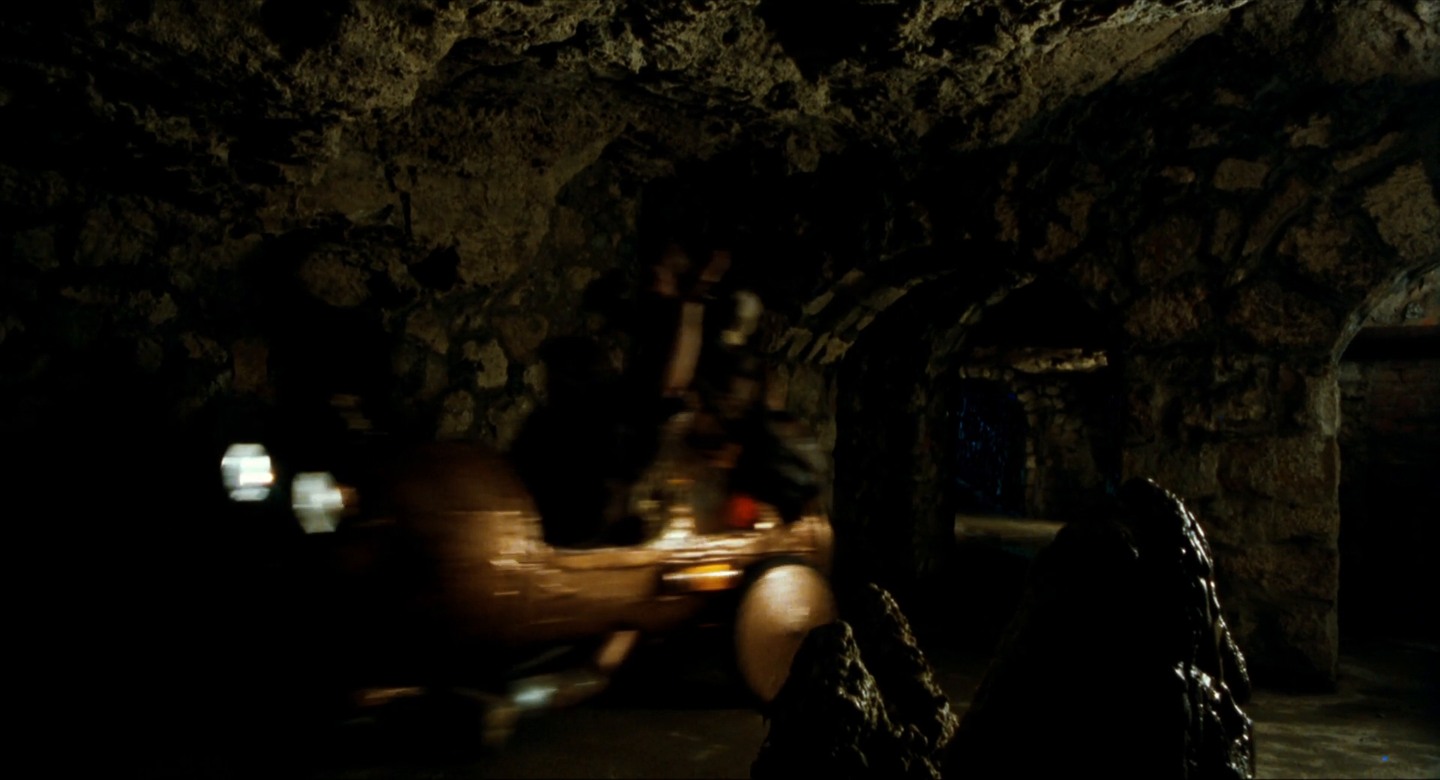 ENLARGE ↗
07 · 59:28
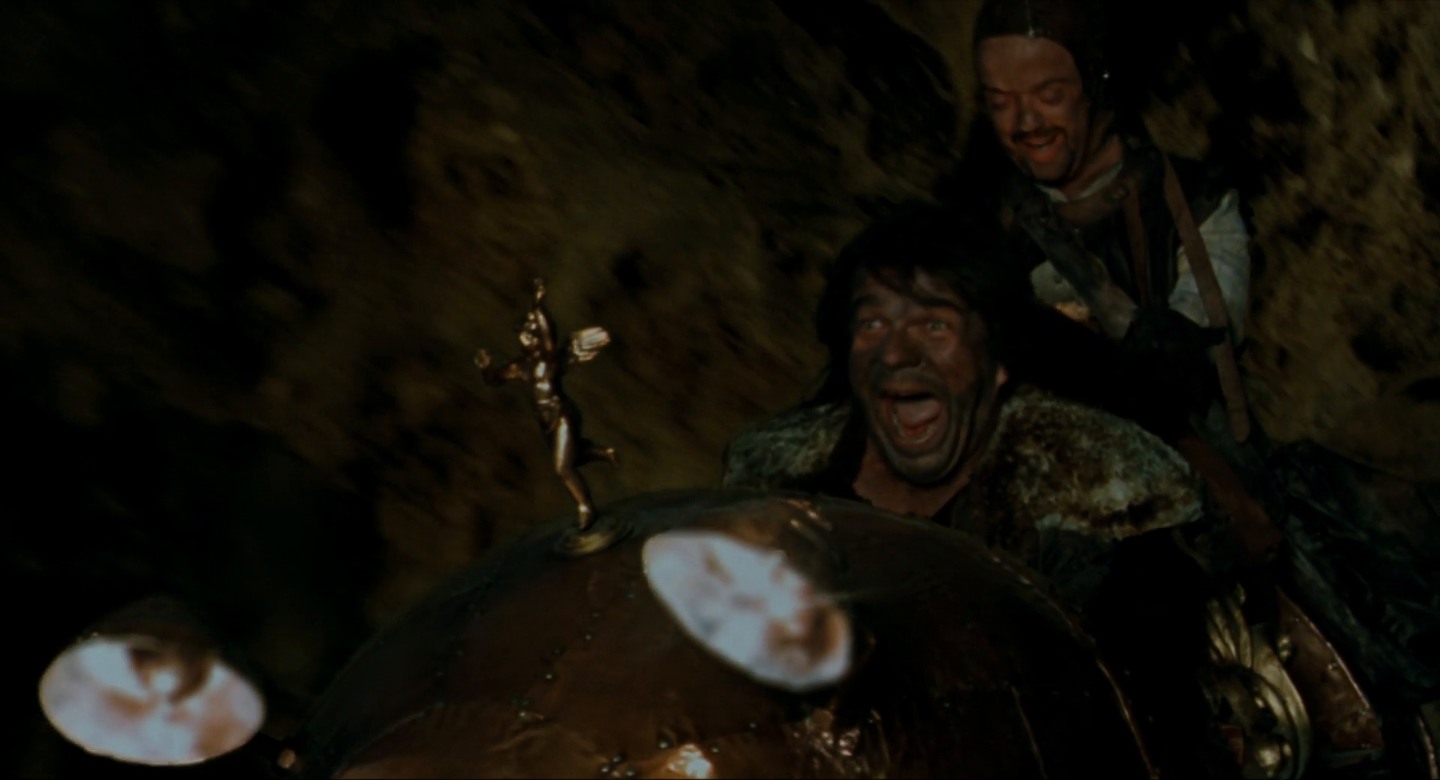 ENLARGE ↗
08 · 59:37
 ENLARGE ↗
09 · 59:46
 ENLARGE ↗
10 · 59:49
ENLARGE ↗11 · 59:55
 ENLARGE ↗
12 · 1:07:04
ENLARGE ↗1:16:00–1:17:44
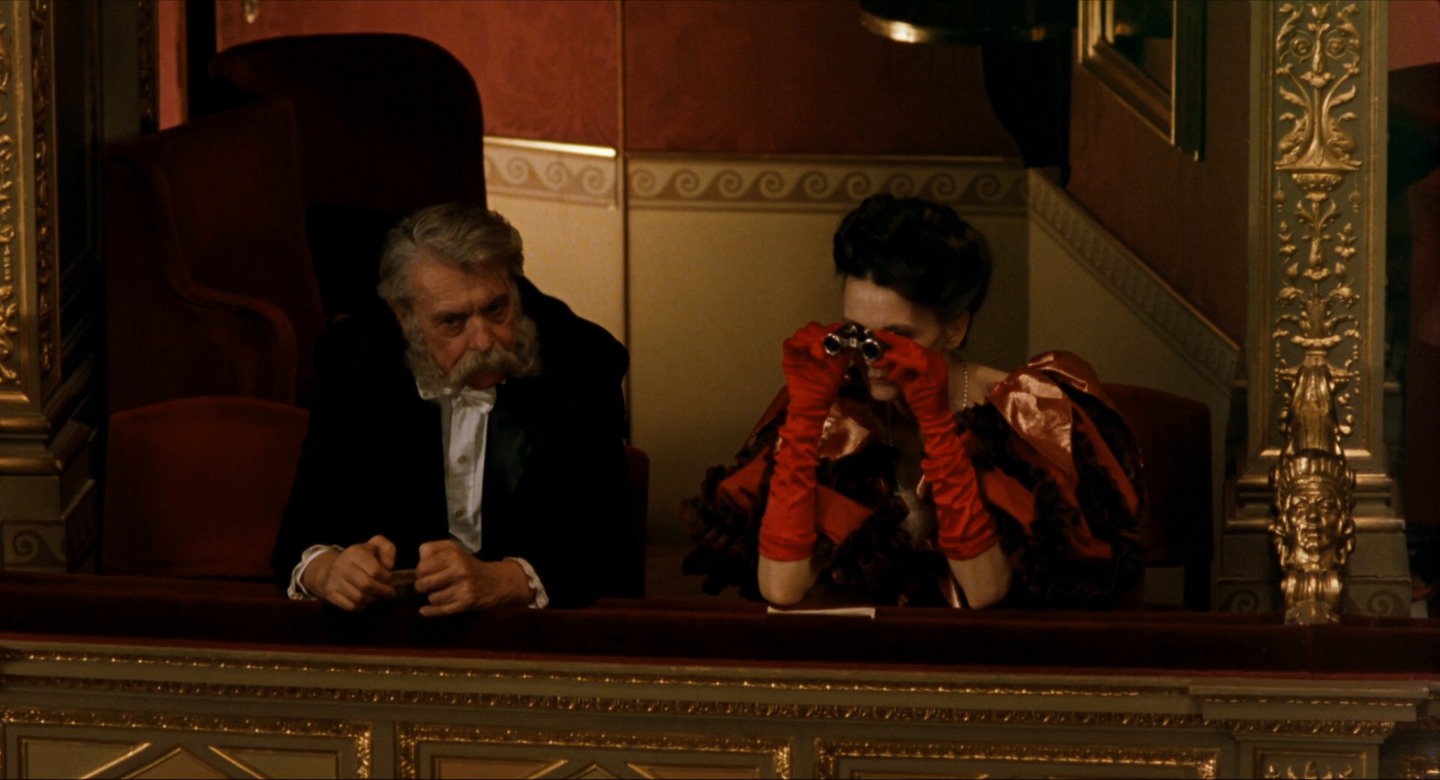
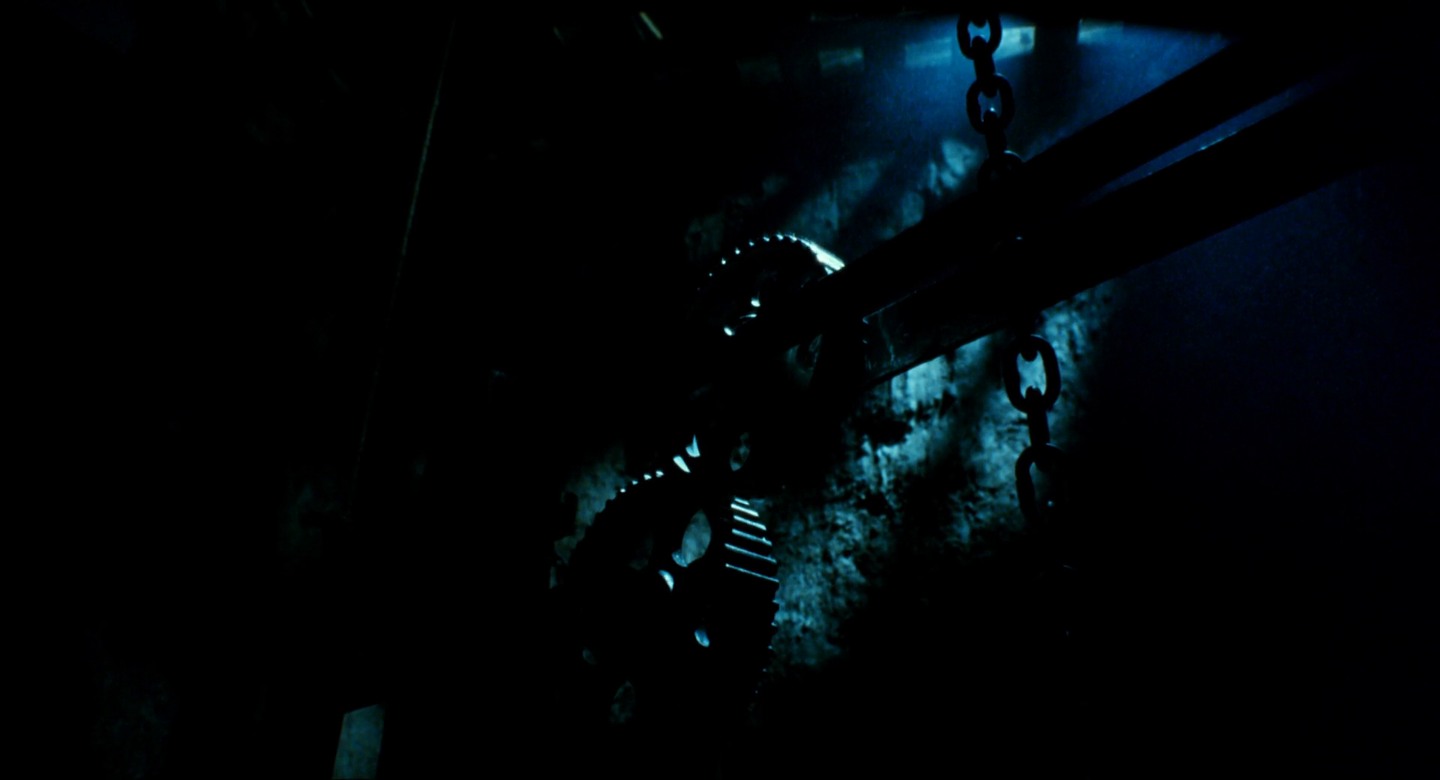
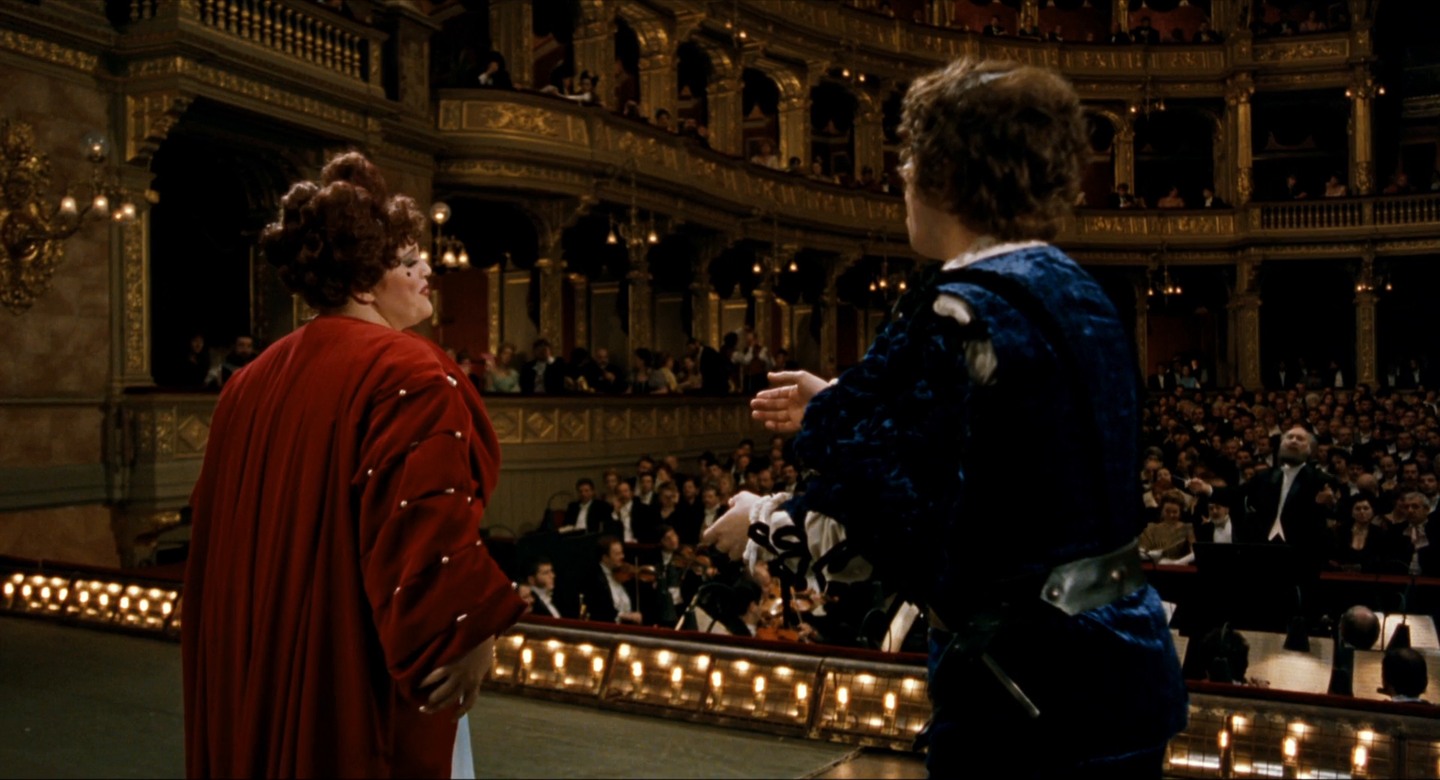
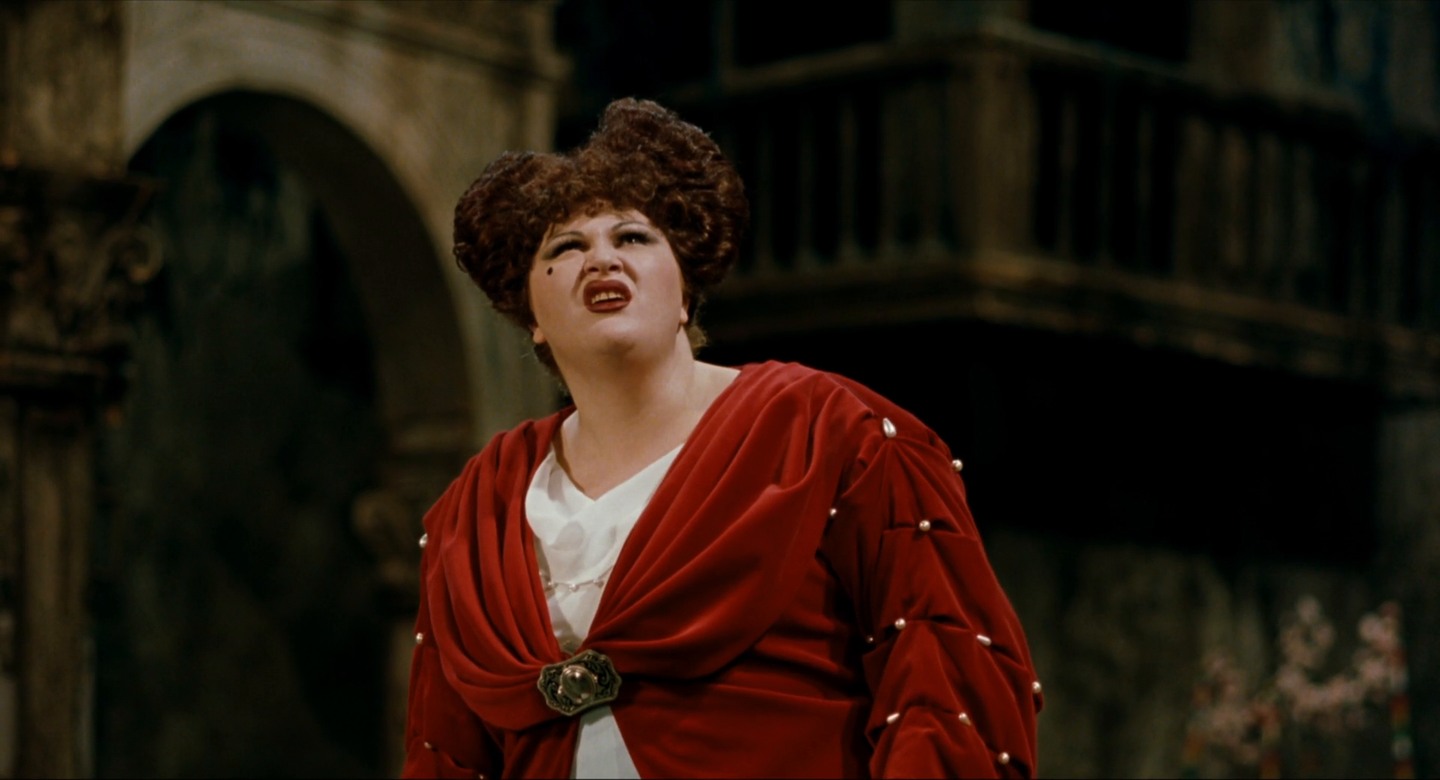
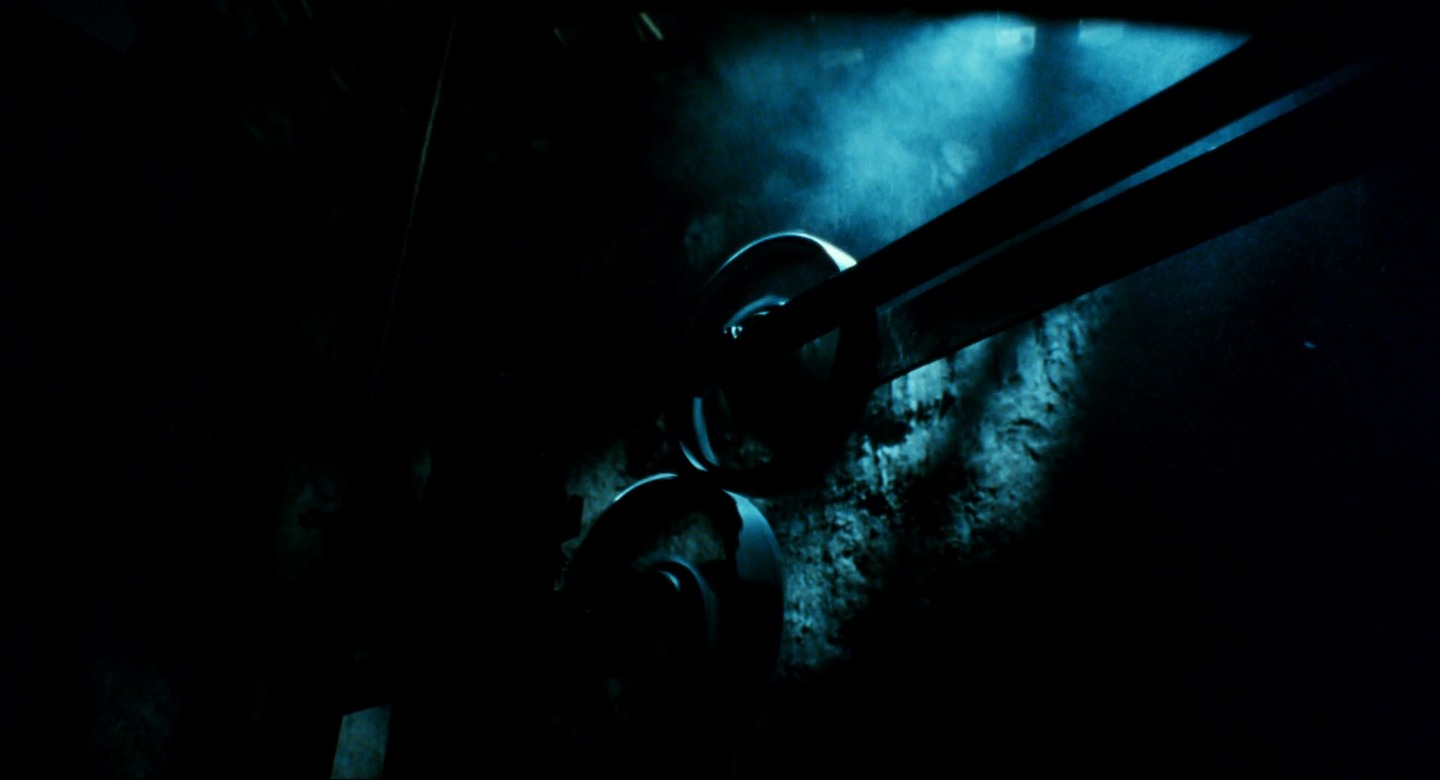
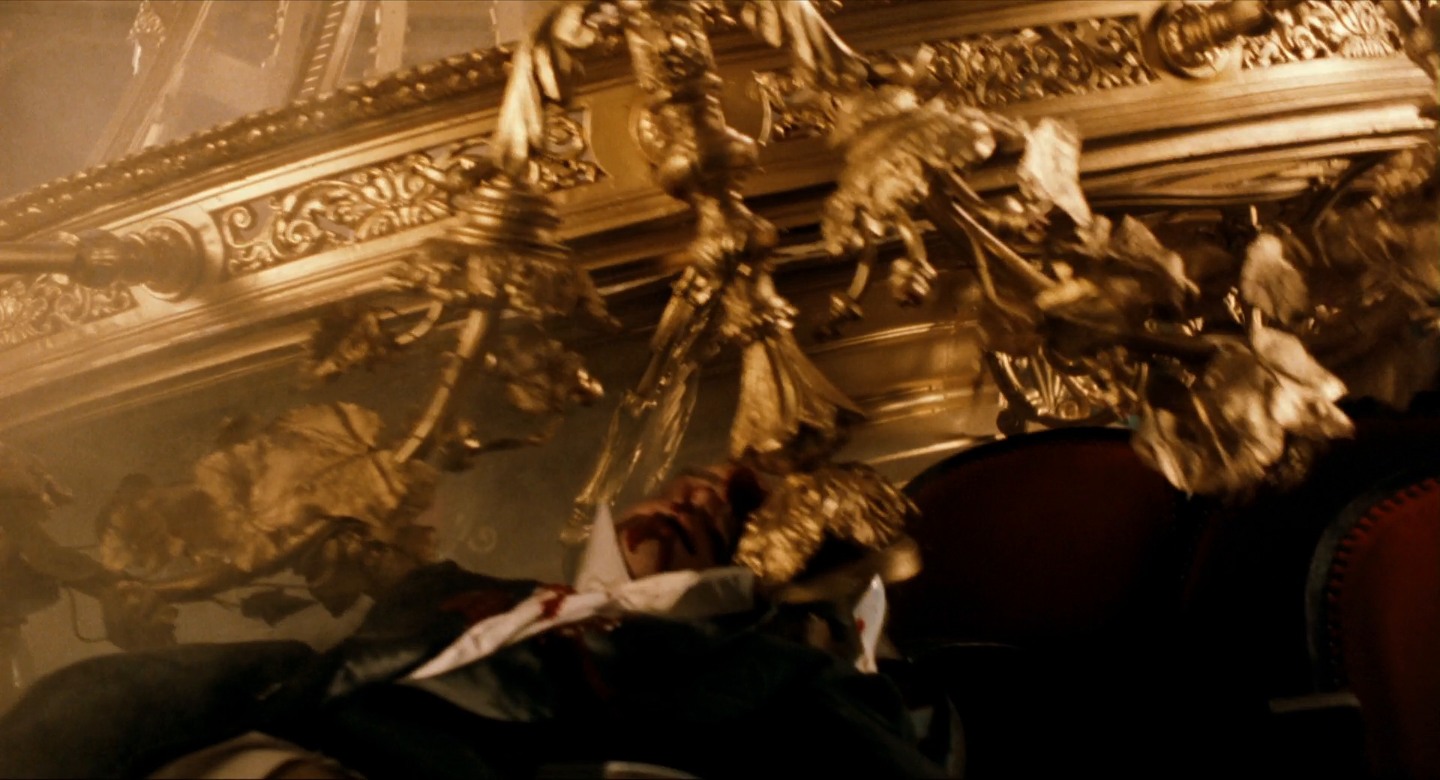
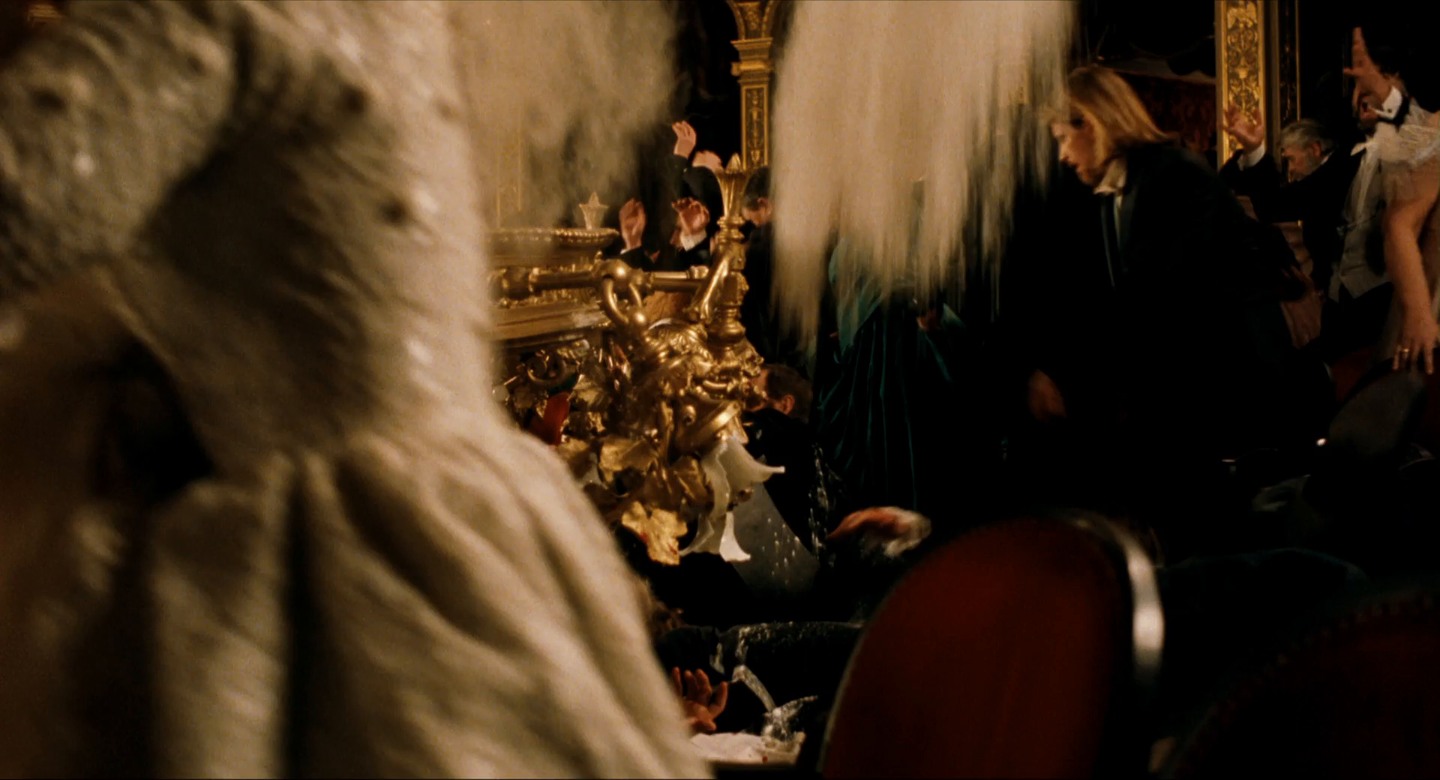
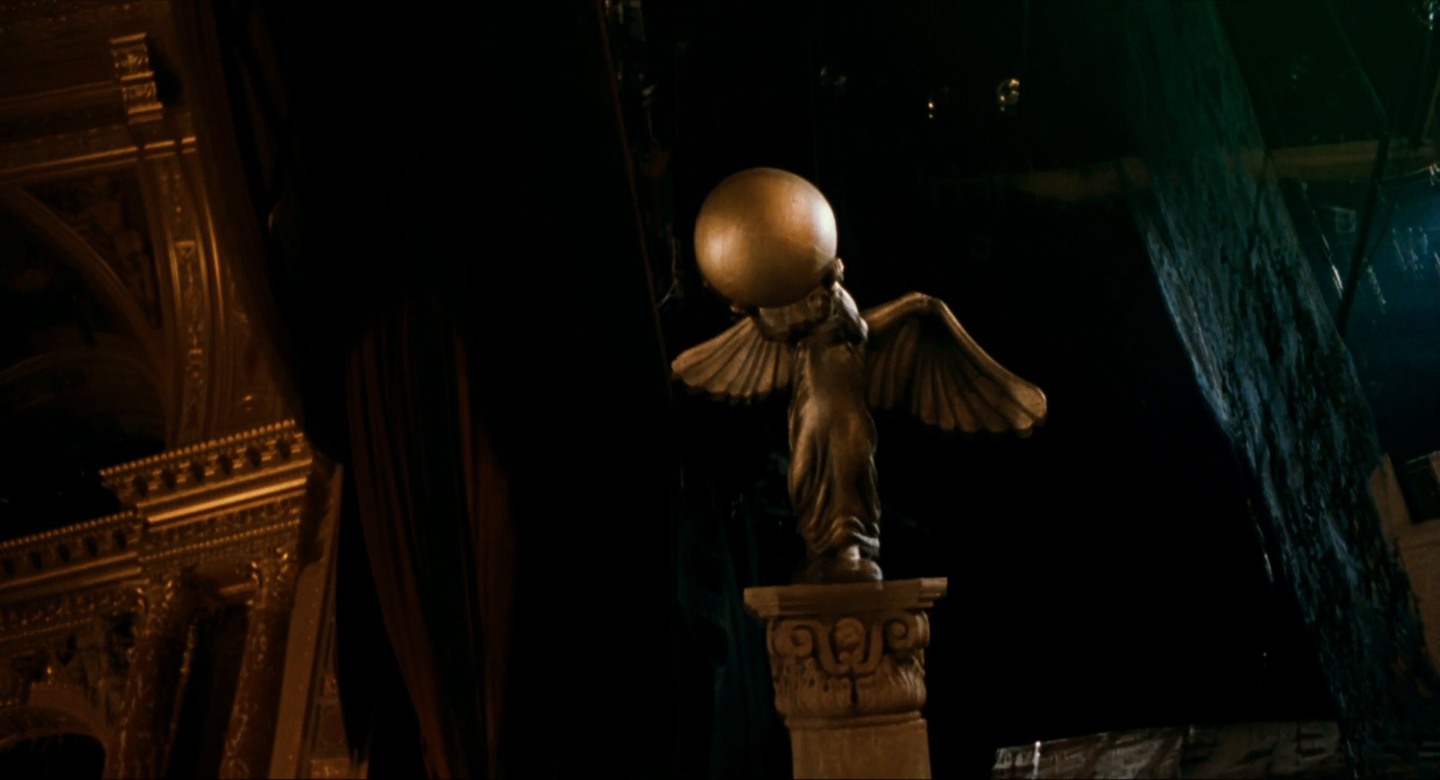
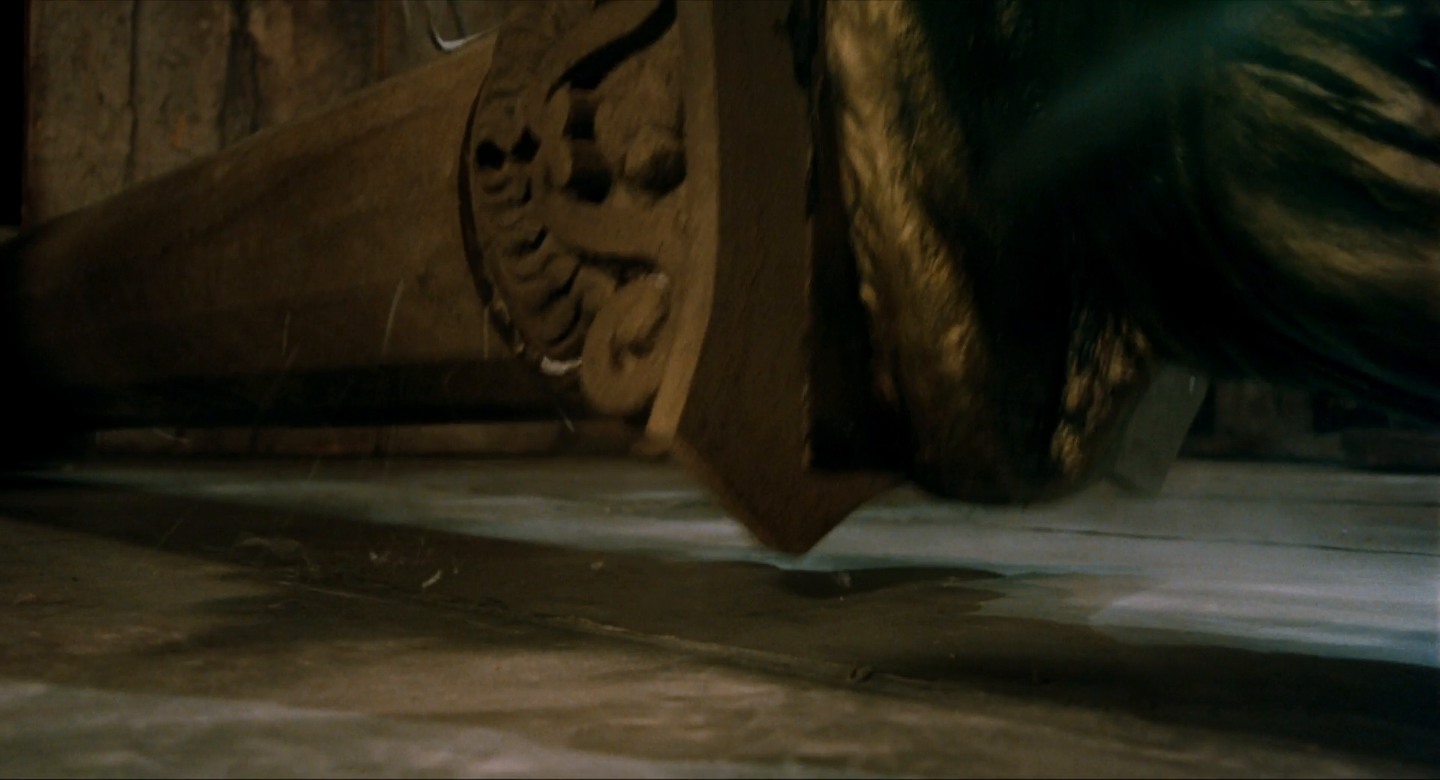
ENLARGE ↗The effect depends on the auditorium being legible before it breaks apart. Performance, audience and concealed support machinery occupy distinct zones; the falling light brings those zones violently together.
The stage gallery follows the collapse into its aftermath, including fleeing spectators, falling decoration and the structure sprawled across the seats. It shows the progression of the screen illusion without assigning undocumented rigging or miniature techniques.
01 · 1:16:00
 ENLARGE ↗
02 · 1:16:04
 ENLARGE ↗
03 · 1:16:08
 ENLARGE ↗
04 · 1:16:40
 ENLARGE ↗
05 · 1:17:04
 ENLARGE ↗
06 · 1:17:08
ENLARGE ↗07 · 1:17:12
 ENLARGE ↗
08 · 1:17:16
 ENLARGE ↗
09 · 1:17:28
 ENLARGE ↗
10 · 1:17:32
 ENLARGE ↗
11 · 1:17:40
ENLARGE ↗12 · 1:17:44
 ENLARGE ↗
1:30:00–1:31:15
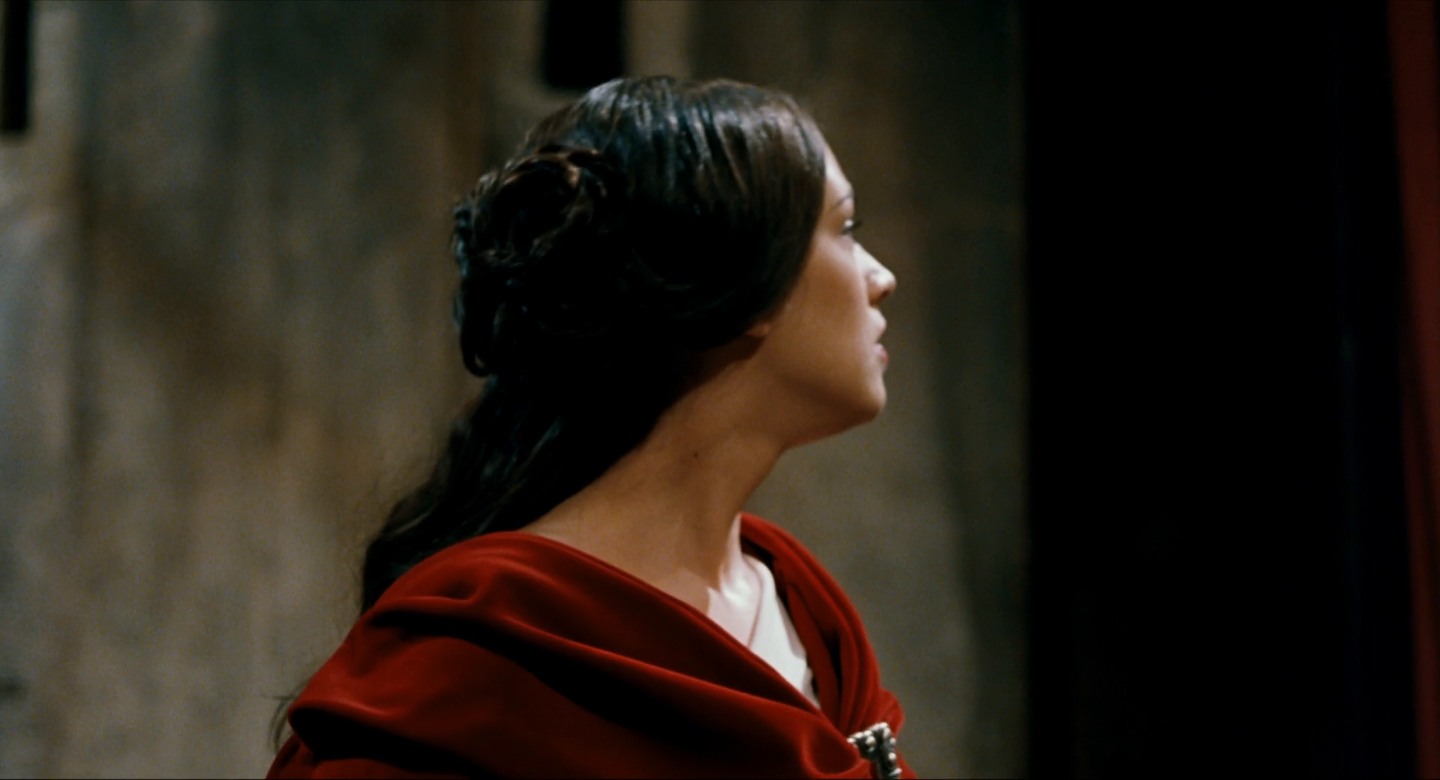
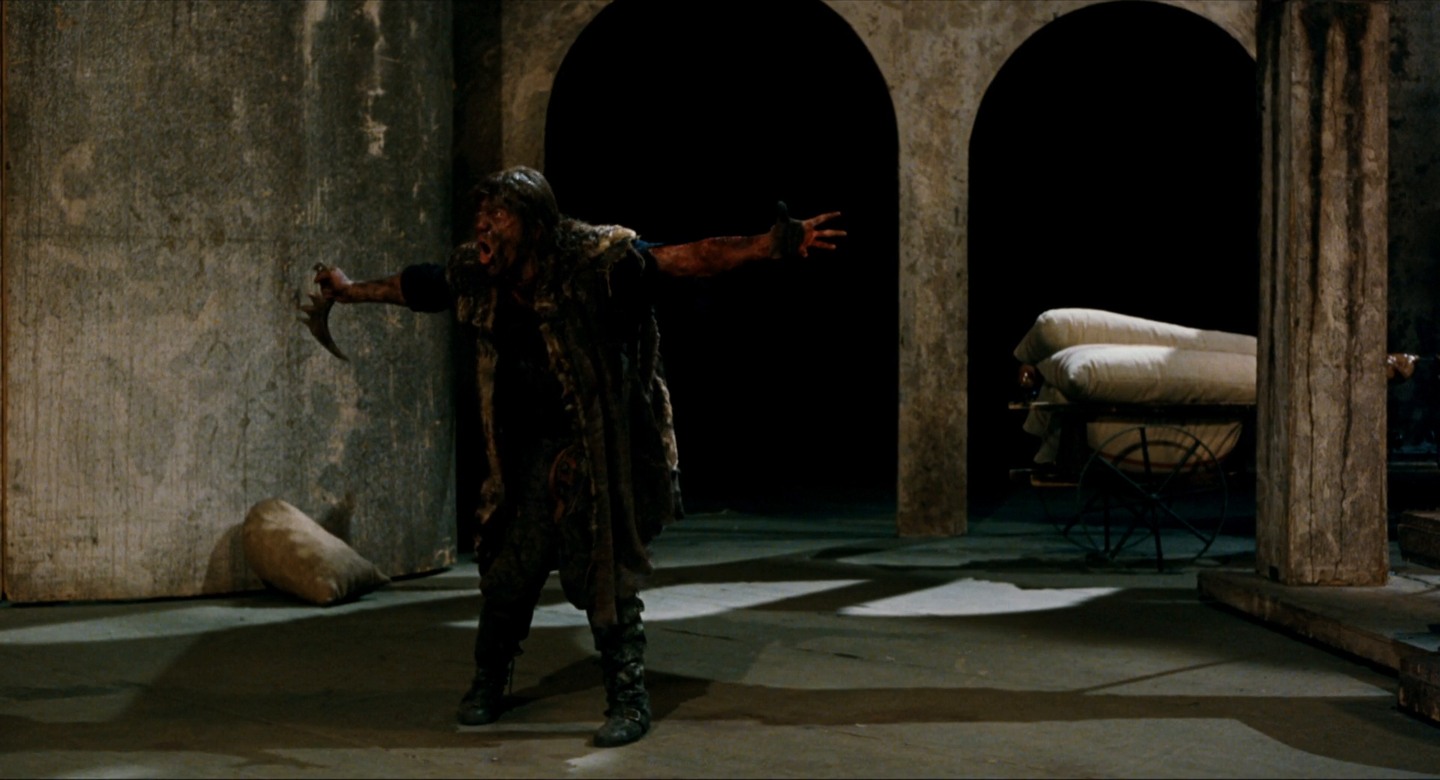
ENLARGE ↗The machine sequence’s damaged face returns in a different setting. Instead of narrow rock and moving equipment, it is surrounded by the theatre’s lights, costumes and spectators.
The changing scale matters: the whole house, the approaching figure, the closer injury and the people looking at it. The wound becomes an interruption to the performance and a visible connection between the theatre and the violence beneath it.
01 · 1:30:00
 ENLARGE ↗
02 · 1:30:10
 ENLARGE ↗
03 · 1:30:15
ENLARGE ↗04 · 1:30:40
 ENLARGE ↗
05 · 1:30:45
 ENLARGE ↗
06 · 1:31:00
ENLARGE ↗07 · 1:31:15
 ENLARGE ↗
1:37:44–1:40:50
 ENLARGE ↗
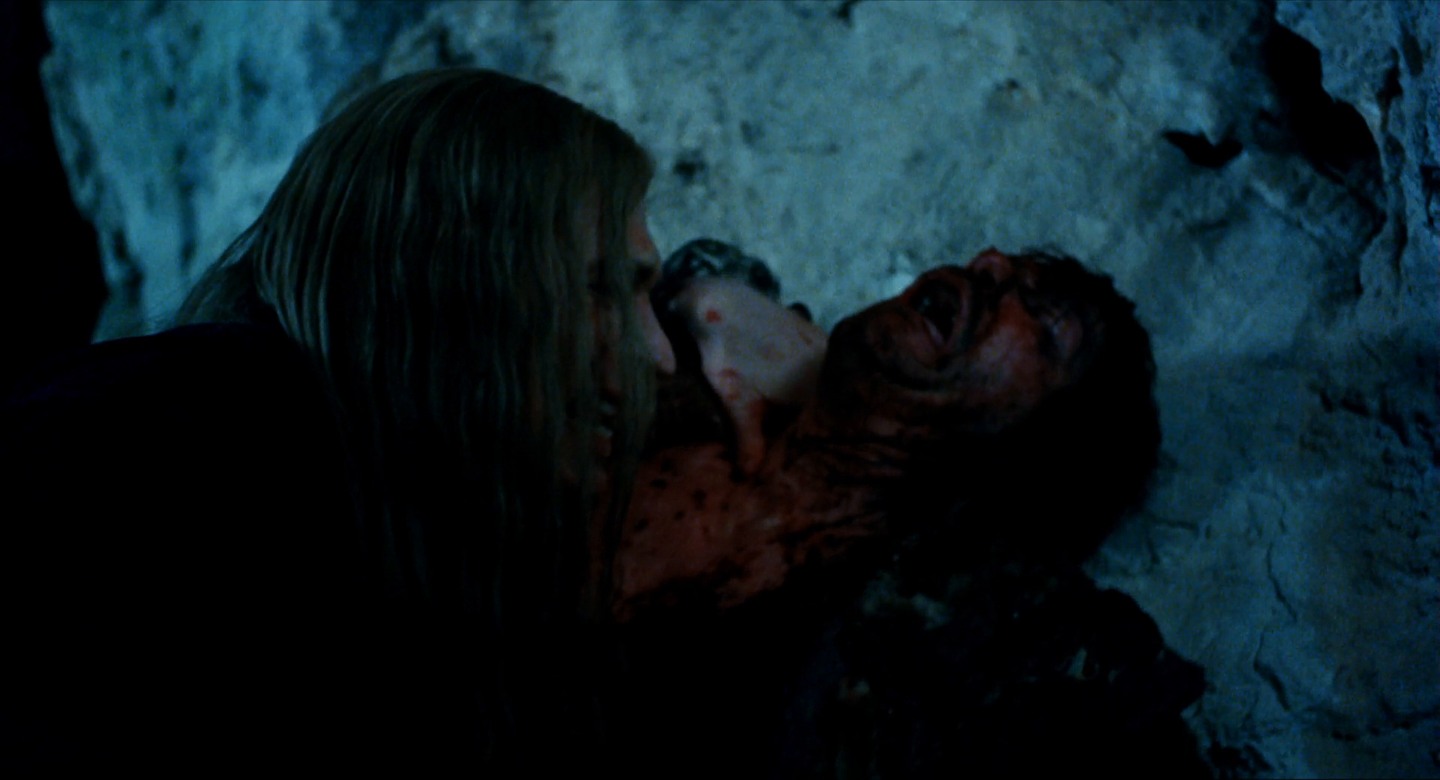
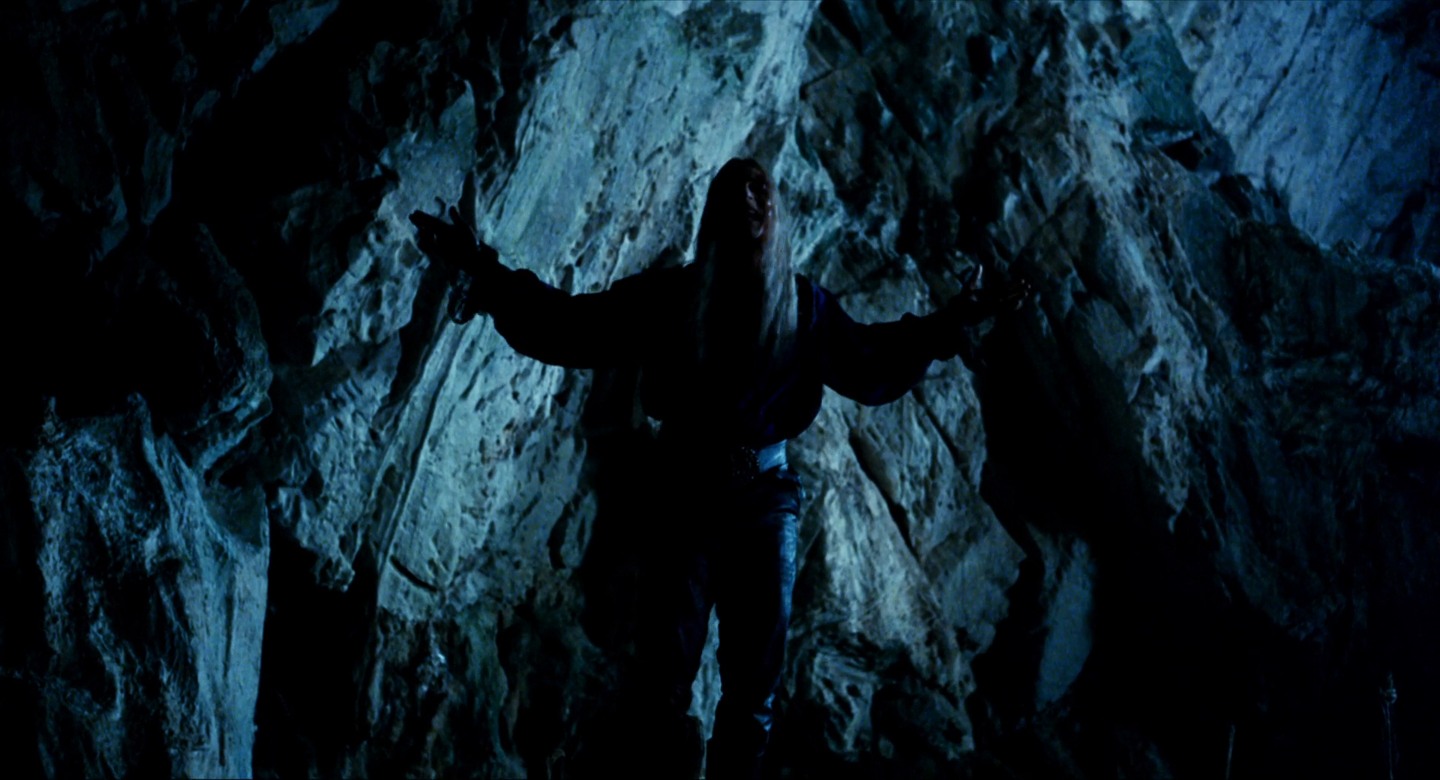
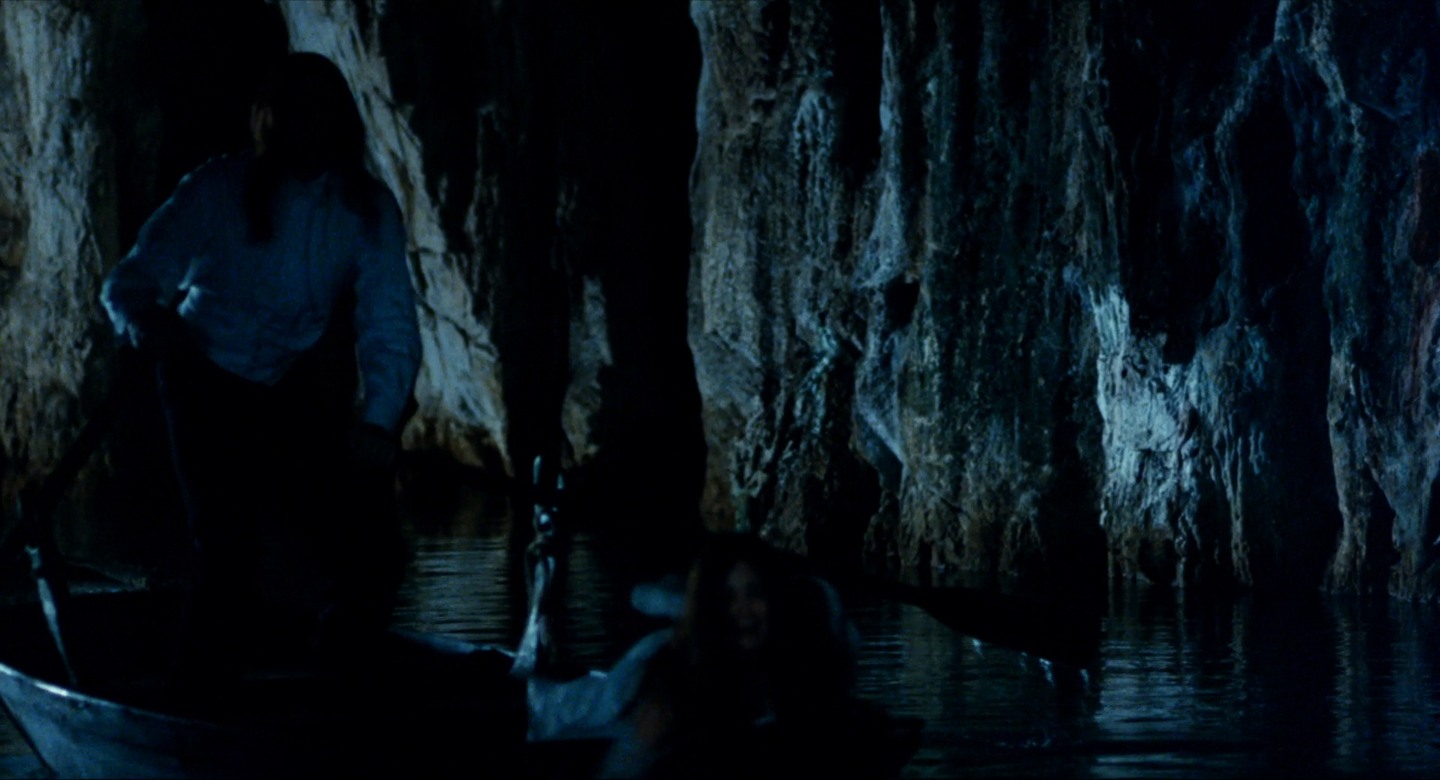
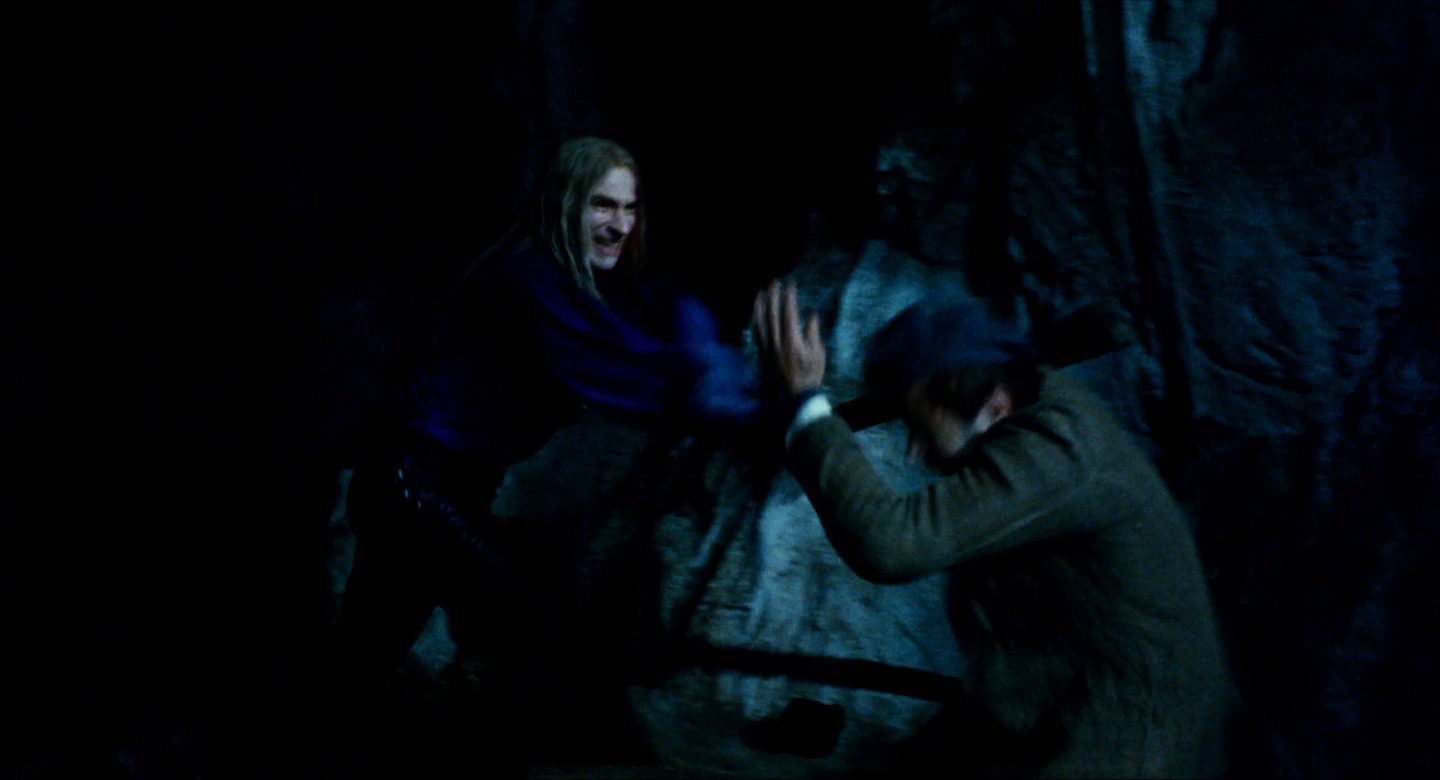
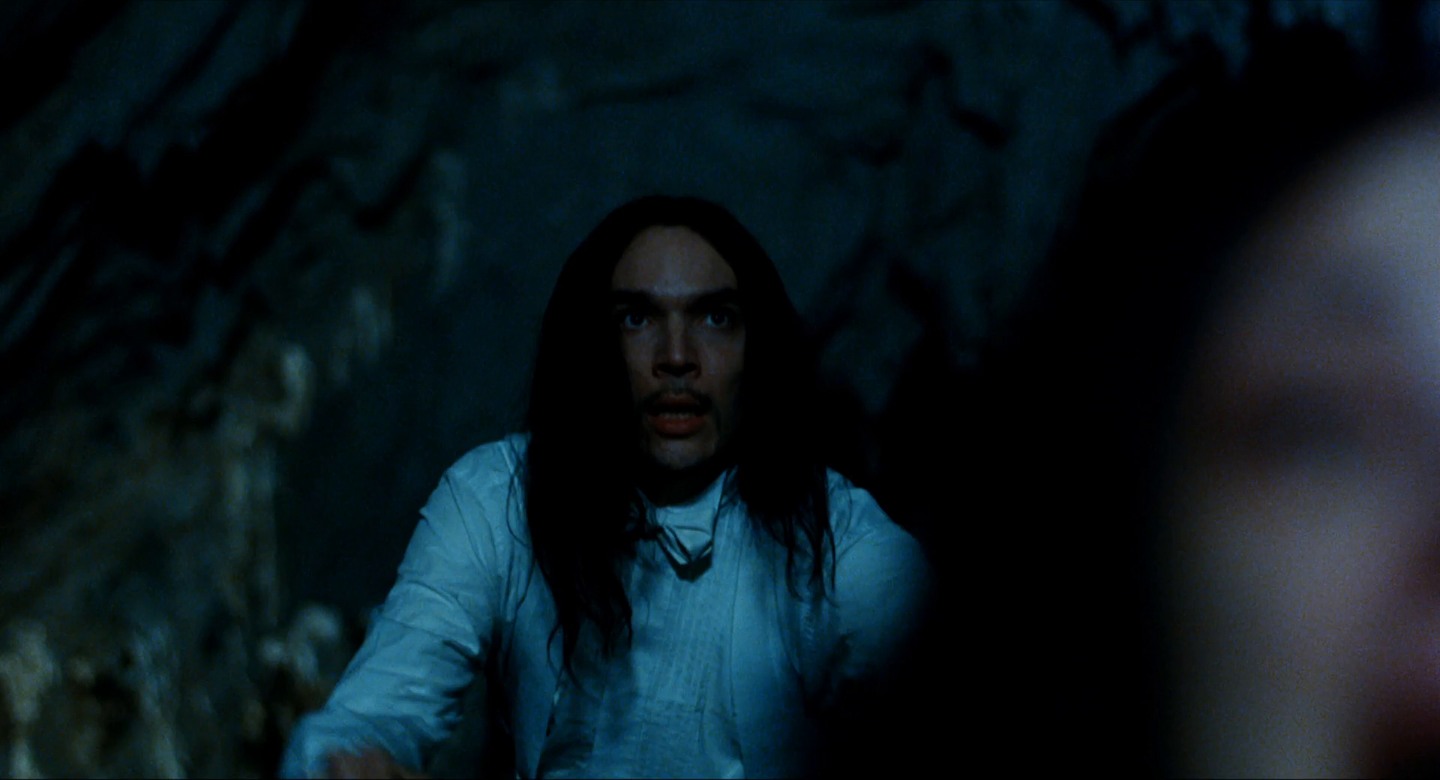
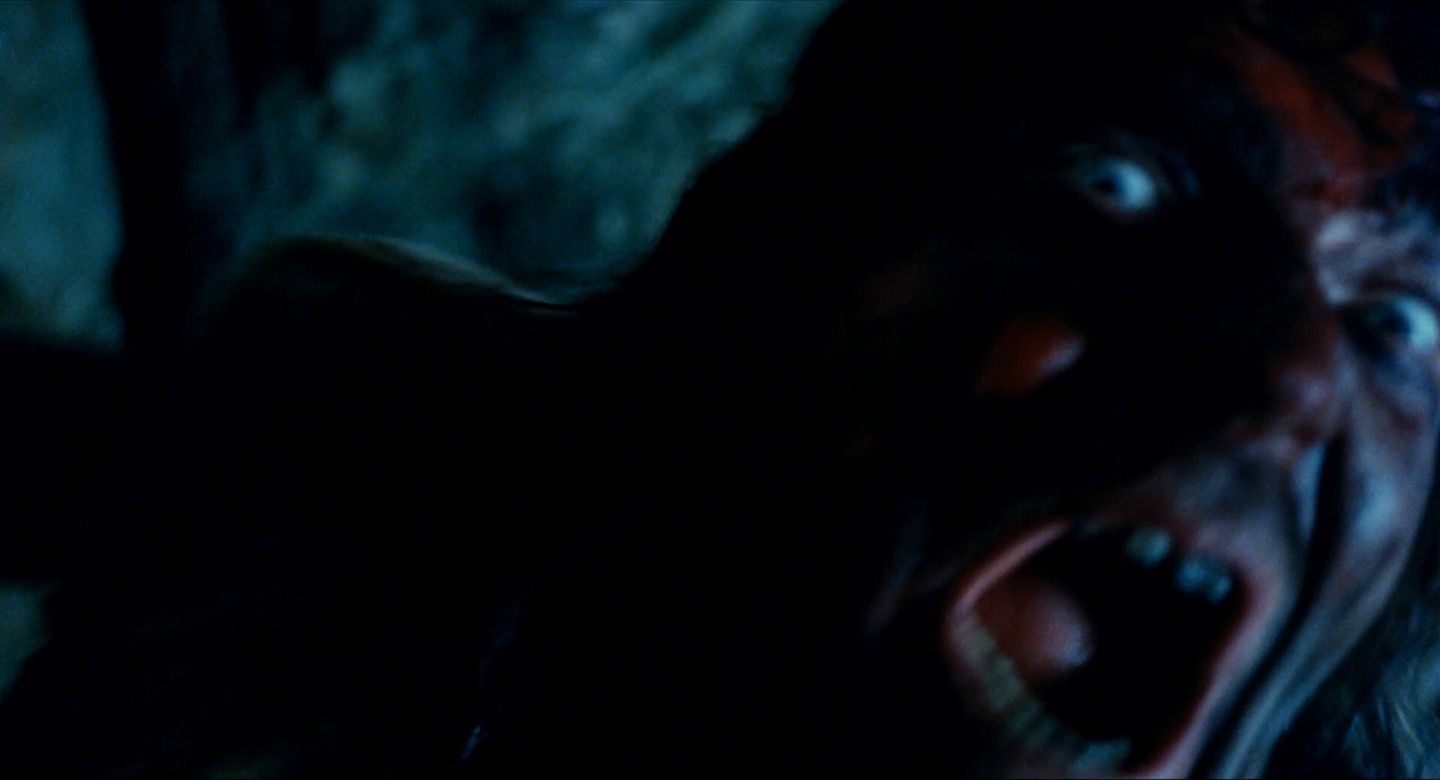
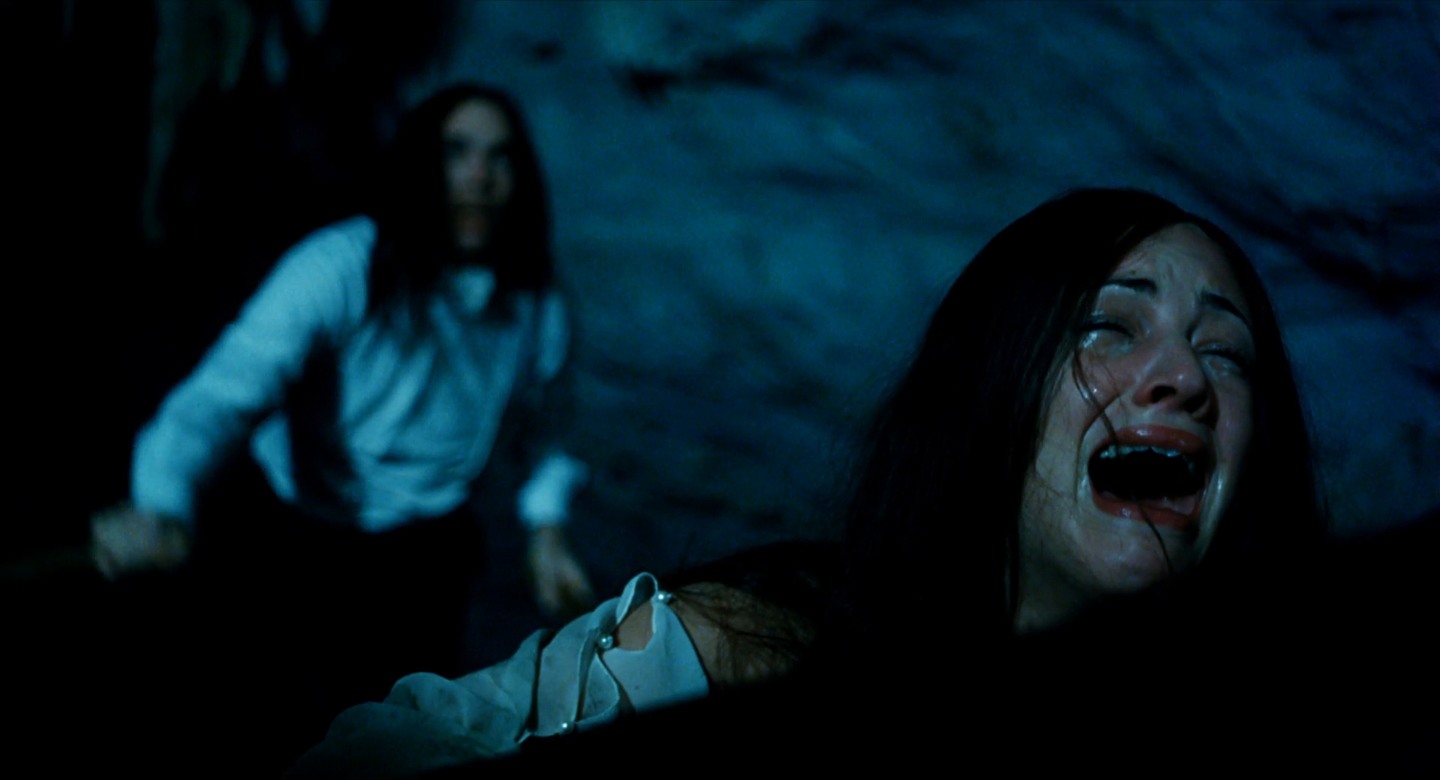
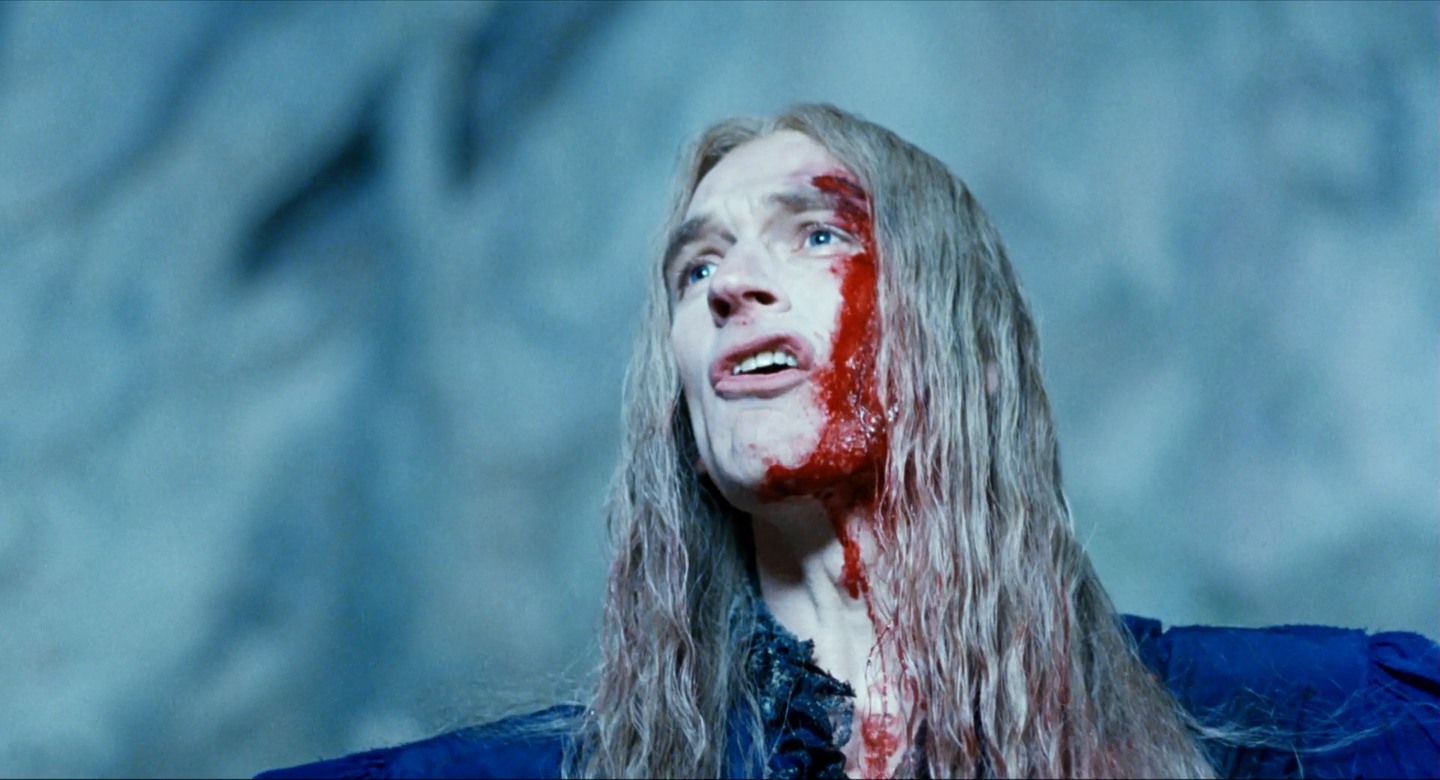
The last confrontation alternates bodies in contact with the boat moving away. The water creates a separation between the escape and the violence remaining on shore.
Bloodied faces, struggling hands and the illuminated gunshot lead into the final view of Christine. The gallery keeps that emotional and spatial progression around the effects, rather than presenting the injuries as detached highlights.
01 · 1:37:44
 ENLARGE ↗
02 · 1:37:48
 ENLARGE ↗
03 · 1:38:08
 ENLARGE ↗
04 · 1:38:12
ENLARGE ↗05 · 1:38:20
 ENLARGE ↗
06 · 1:38:24
 ENLARGE ↗
07 · 1:38:40
 ENLARGE ↗
08 · 1:38:56
 ENLARGE ↗
09 · 1:39:00
ENLARGE ↗10 · 1:39:08
 ENLARGE ↗
11 · 1:39:40
 ENLARGE ↗
12 · 1:40:50
ENLARGE ↗CLOSE VISUAL STUDIES
Follow a visual idea across the film: the underground salon, restricted sightlines, damaged faces and performances interrupted.
ENLARGE ↗Gold and rock establish two apparently separate worlds. Yet the cavern also contains a piano, furniture and its own chandelier. The Phantom’s domain appropriates the theatre’s cultivated beauty while removing the social life around it.
ENLARGE ↗The film repeatedly builds danger out of unequal access to space. Shafts, balconies, mirrors and narrow doorways frame people who cannot see everything around them. Looking is an action governed by the architecture.
ENLARGE ↗The absence of the familiar mask makes the distribution of damage especially striking. The Phantom’s beauty persists beside the injuries inflicted on other bodies. The ratcatcher’s return gives a damaged face a social role: it enters the theatre as evidence.
ENLARGE ↗Rehearsal, Carlotta’s appearance and Christine’s later performance give the stage different audiences. Each arrangement is vulnerable to an intervention from elsewhere in the building. The film’s spectacle includes the people watching it break down.
VOICE & DIALOGUE
Twelve studies follow secret communication, theatrical gossip, promises of success and the struggle to refuse. Open each progression to trace how the language changes across the film.
01 / VOICE & DIALOGUE
ENLARGE ↗The first encounter makes hearing uncertain before it makes love possible. Christine thinks the Phantom has spoken; he describes a thought instead. His praise of her singing establishes an intimate circuit between her voice and his mind, then immediately restricts who may know about it.
02 / VOICE & DIALOGUE
 ENLARGE ↗
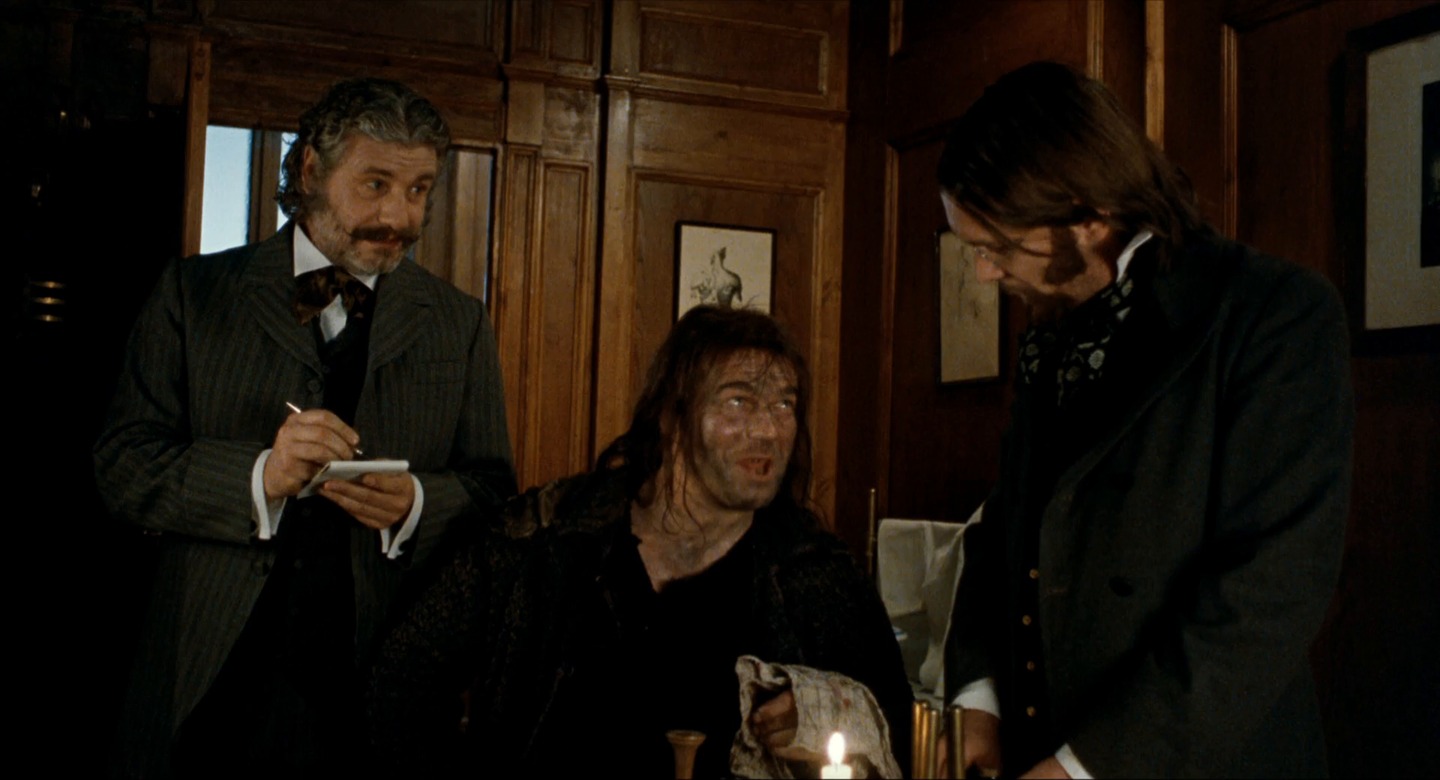
A journalist, a ratcatcher and a witness in a theatre box build competing accounts of the same presence. Certainty and uncertainty sit together: people insist that the Phantom exists, yet retreat from describing exactly what they saw. The dialogue supplies the theatre with a mythology larger than any one encounter.
03 / VOICE & DIALOGUE
ENLARGE ↗Christine’s response to Raoul gives the romantic triangle a vocabulary more precise than a contest between two suitors. Flowers matter less to her than language that seems to recognise her. Later, her admission that she may love both men is followed by another summons from the Phantom: reflection gives way to an invitation she accepts.
04 / VOICE & DIALOGUE
 ENLARGE ↗
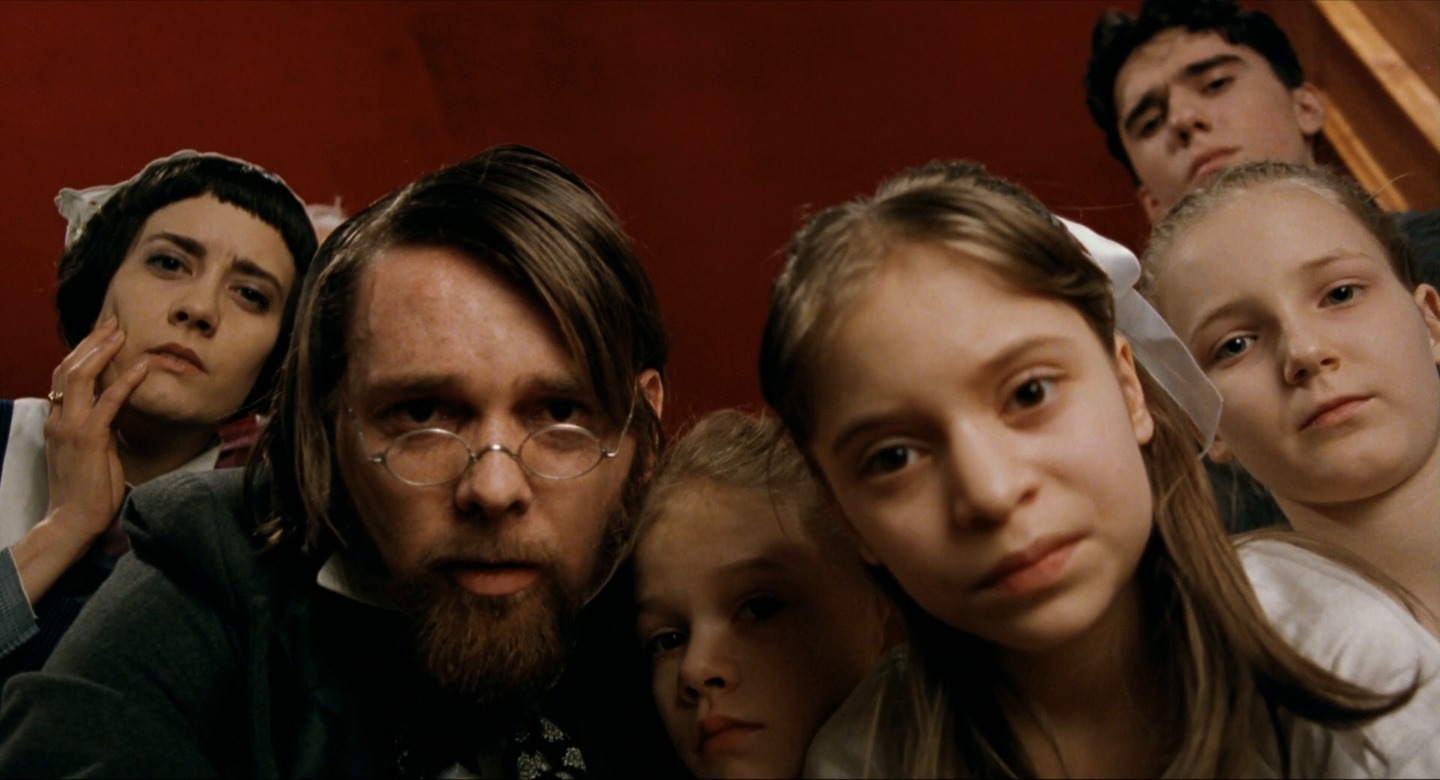
The dialogue surrounding Christine’s performance keeps returning to the physical labour of singing. A damaged throat creates her opportunity; exhaustion follows it. When she later tells the Phantom that she sang for him, professional strain is recast as an intimate offering.
05 / VOICE & DIALOGUE
 ENLARGE ↗
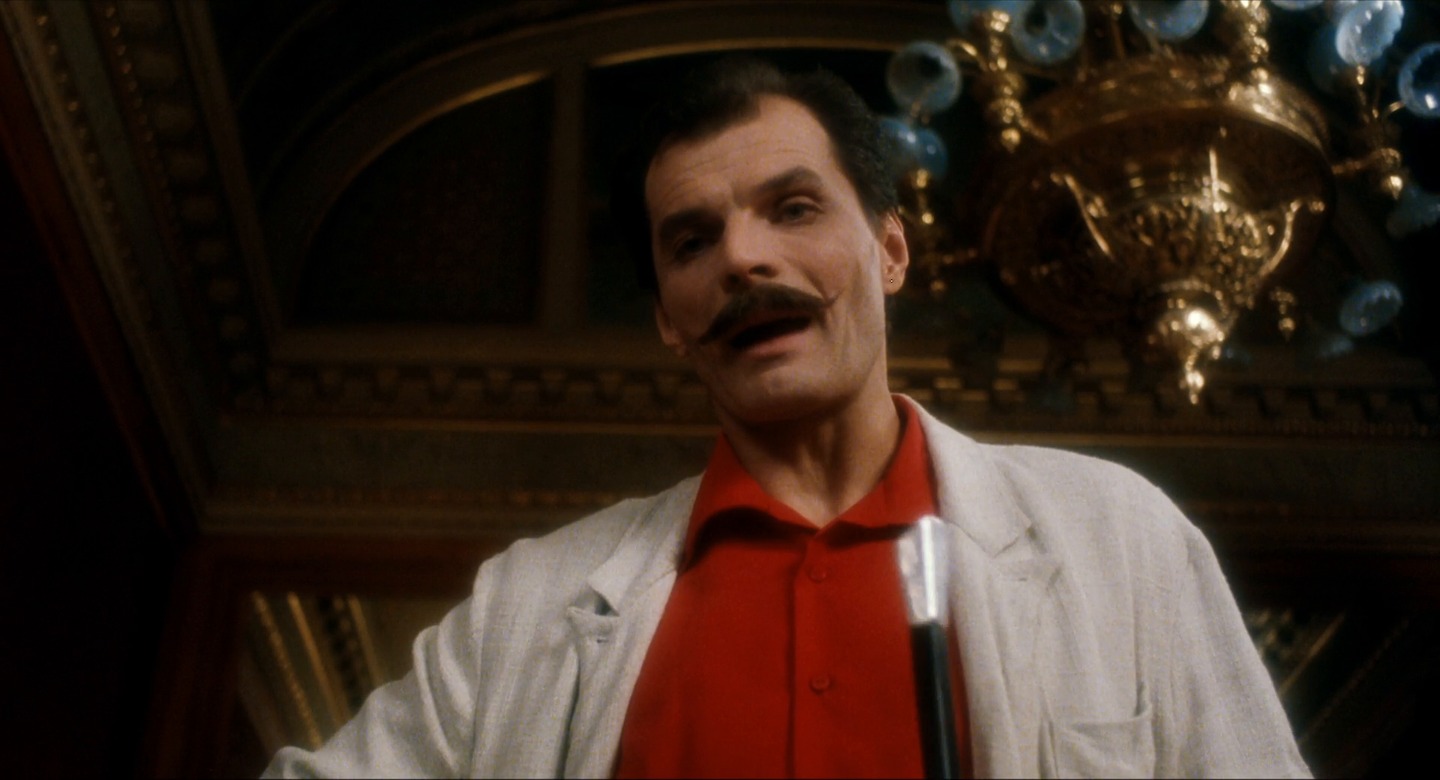
The theatre readily circulates elaborate stories about the Phantom, but dismisses a child who reports an encounter. Marthe’s description complicates the institution’s division between danger and protection: the same figure can be terrifying to an adult and gentle towards her. The adults answer her testimony by policing her behaviour.
06 / VOICE & DIALOGUE
ENLARGE ↗Ignace’s extermination record and the Phantom’s origin story describe the rats from opposite positions. What counts as professional success above ground becomes violence against family below it. This gives the rat machine a place in the film’s argument about belonging, beyond its grotesque design.
07 / VOICE & DIALOGUE
 ENLARGE ↗
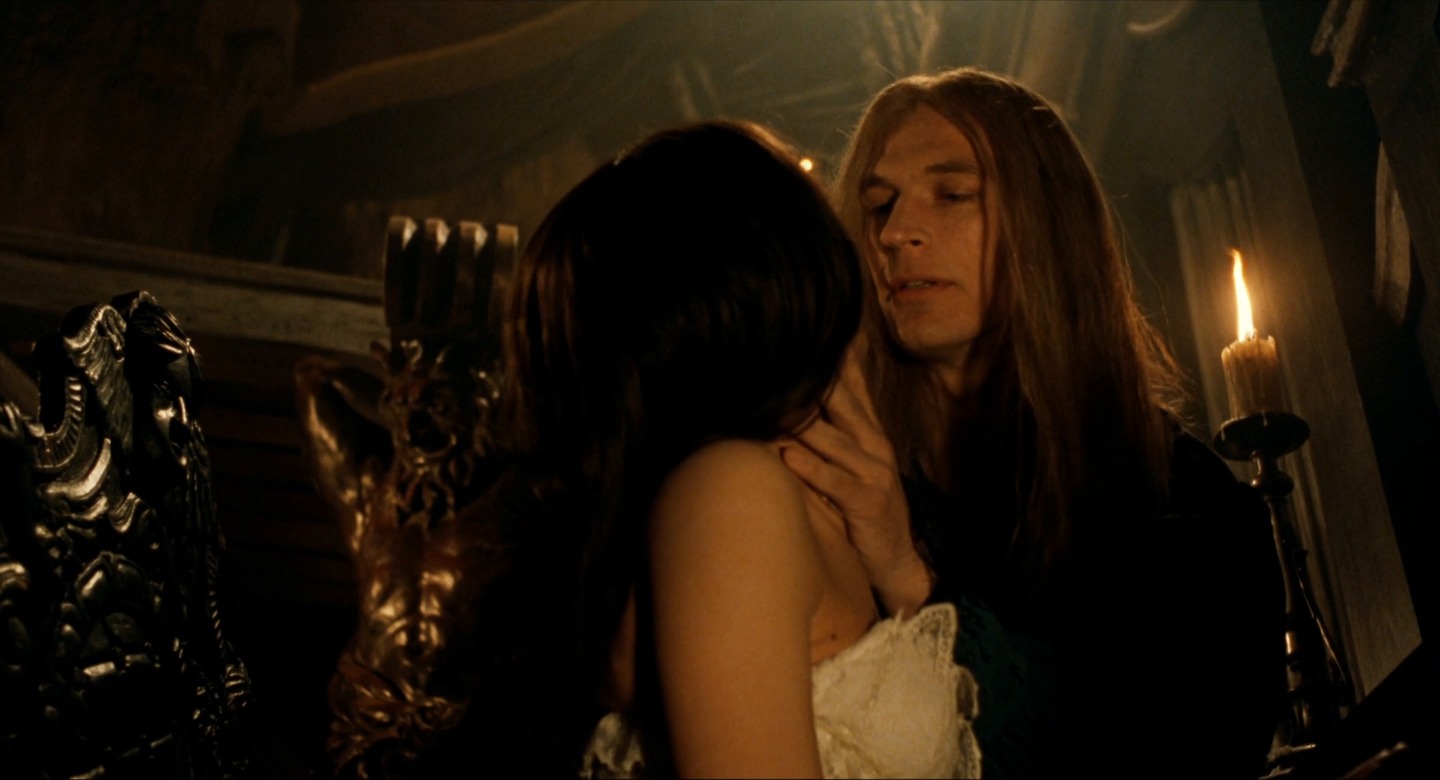
The Phantom promises Christine a leading role while refusing to let her decide where she will stay. His talk of gravity and attraction places romance next to the threat of falling spectacle. The exchange makes coercion explicit before the chandelier catastrophe: her objections are clear, and he overrides them.
08 / VOICE & DIALOGUE
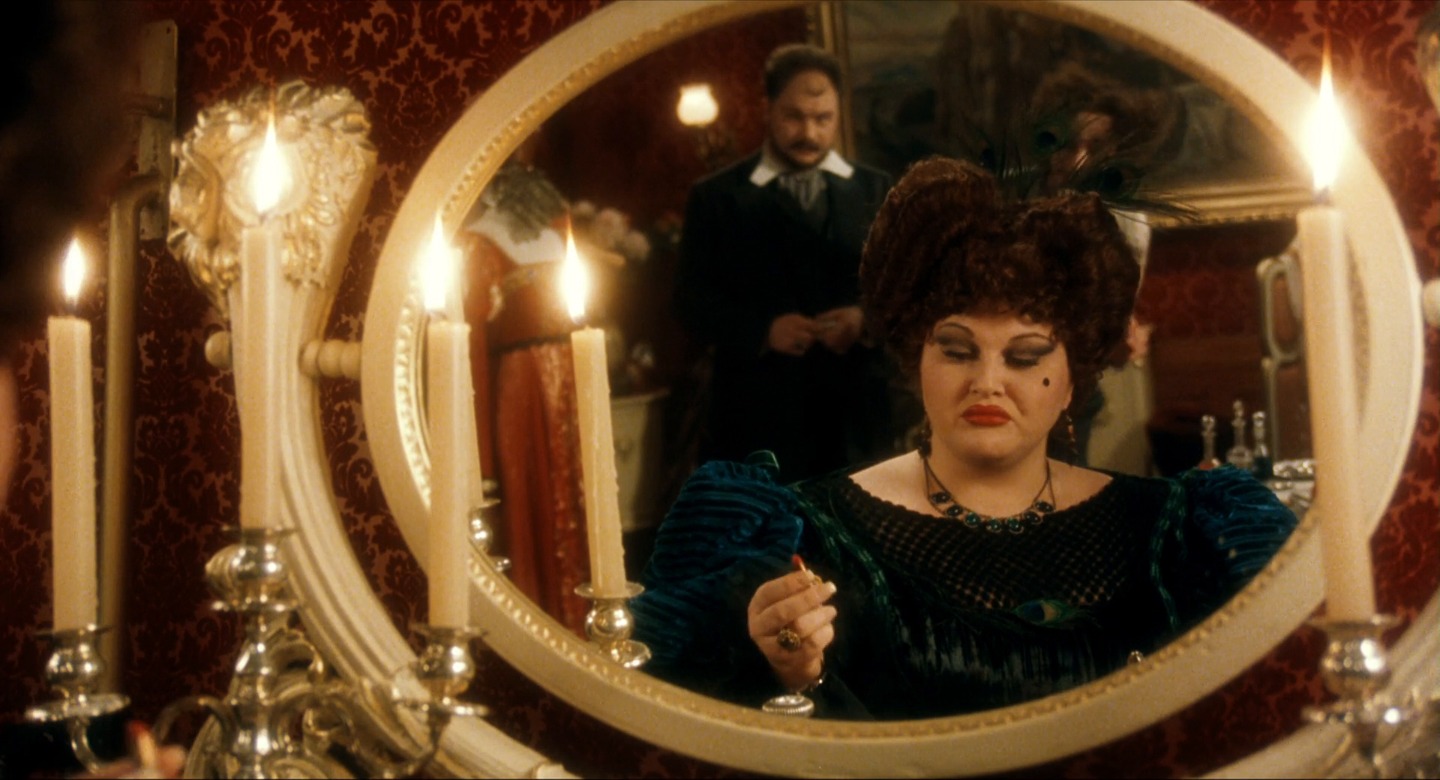 ENLARGE ↗
The dressing-room exchange turns the source of a voice into a practical problem. Carlotta receives a threat but blames Poligny, who denies speaking. Her confidence in what she has heard collides with his denial, and a discussion of contracts becomes an argument about insult and authority.
09 / VOICE & DIALOGUE
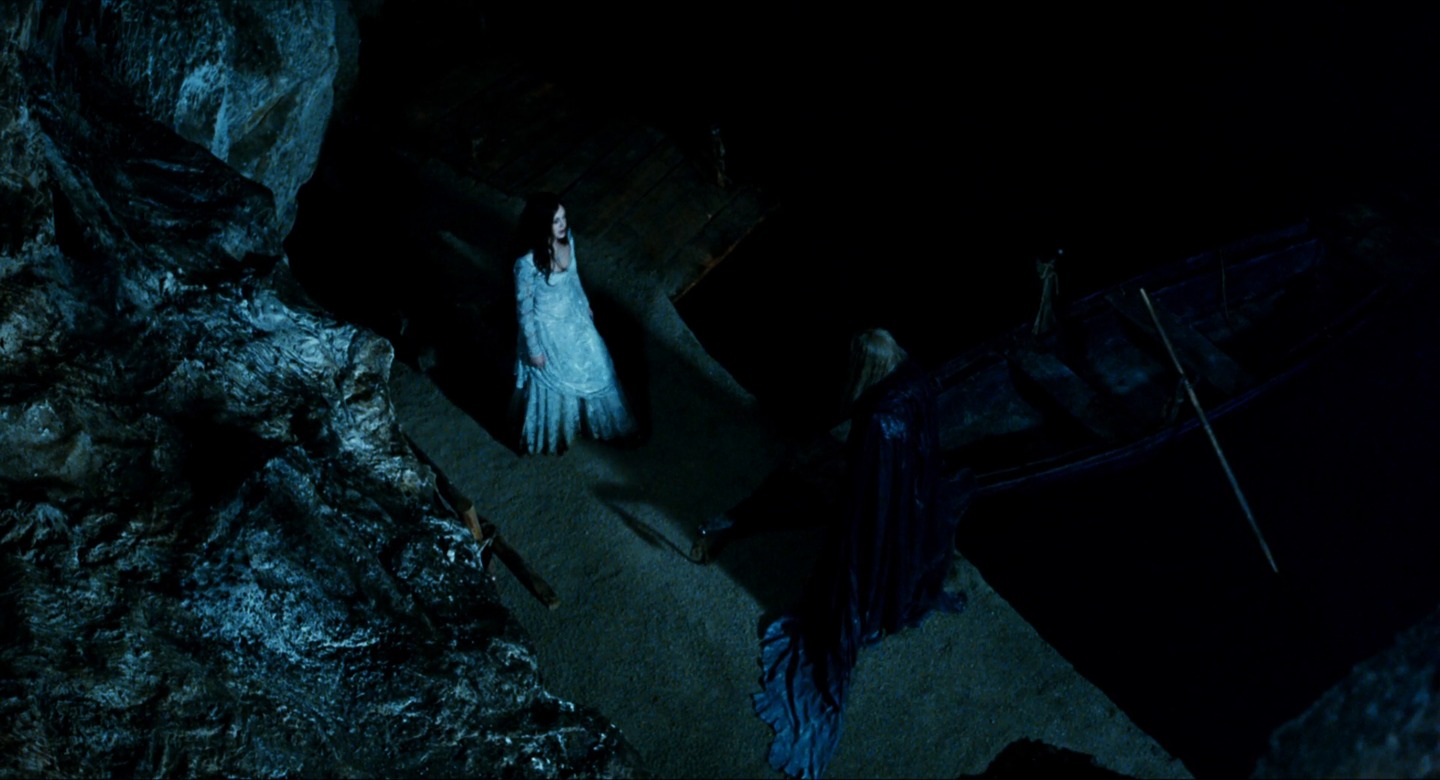 ENLARGE ↗
The Phantom’s warning passes from private intimidation into a written message that the theatre can receive, dismiss and later remember. After the disaster, Christine refuses the promotion he has arranged. Her question about its cost links the romantic plot directly to the lives of the audience.
10 / VOICE & DIALOGUE
ENLARGE ↗Christine’s reunion with Raoul addresses the loss of agency that began as secret understanding. She describes the Phantom as both a real presence and something inside her. Raoul offers love as a defence; the film gives that reassurance the form of a promise, not a demonstrated explanation of supernatural power.
11 / VOICE & DIALOGUE
ENLARGE ↗Ignace’s return transforms a theatrical audience into a public judging Christine. He moves from recognition to sexual accusation and a call for death. Soon afterwards, the Phantom’s claim of ownership gives a private counterpart to that public exposure: Christine is spoken about and claimed by others just as she is trying to escape.
12 / VOICE & DIALOGUE
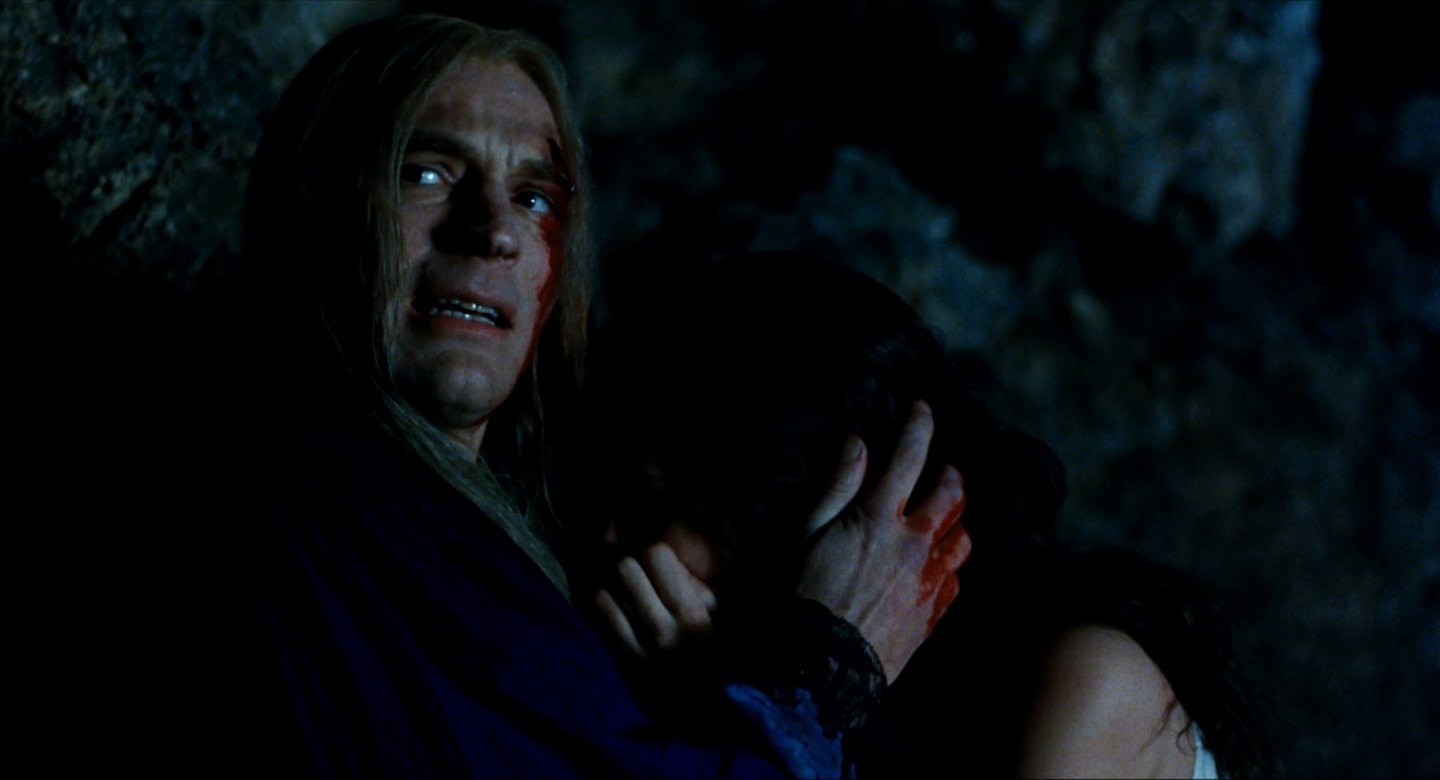 ENLARGE ↗
The final exchange partly reverses the Phantom’s earlier commands. He directs Raoul to help Christine and gives them a route out, accepting the end of his underground world. Yet the last pleas against abandonment prevent this release from becoming an uncomplicated renunciation of possession.
SCORE, OPERA & RECORDINGS
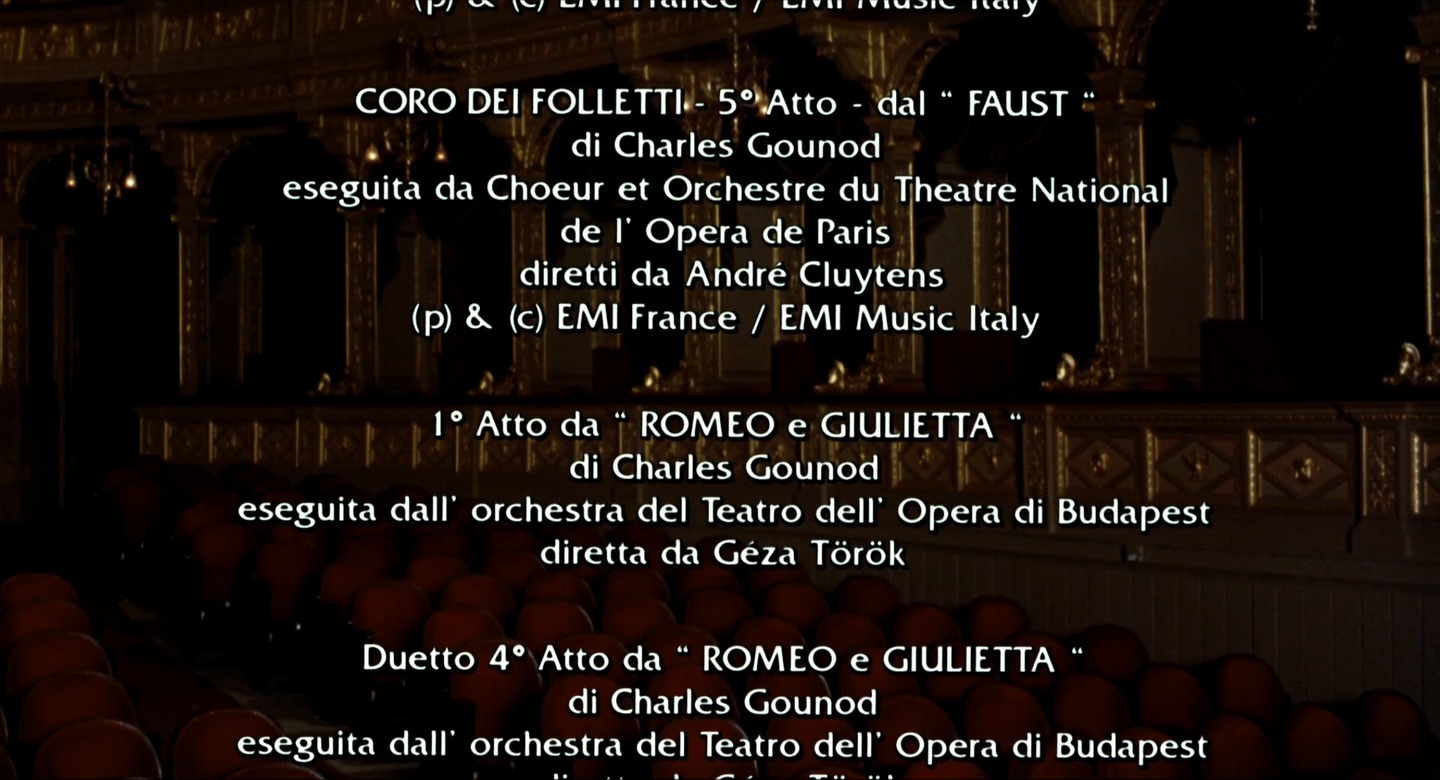
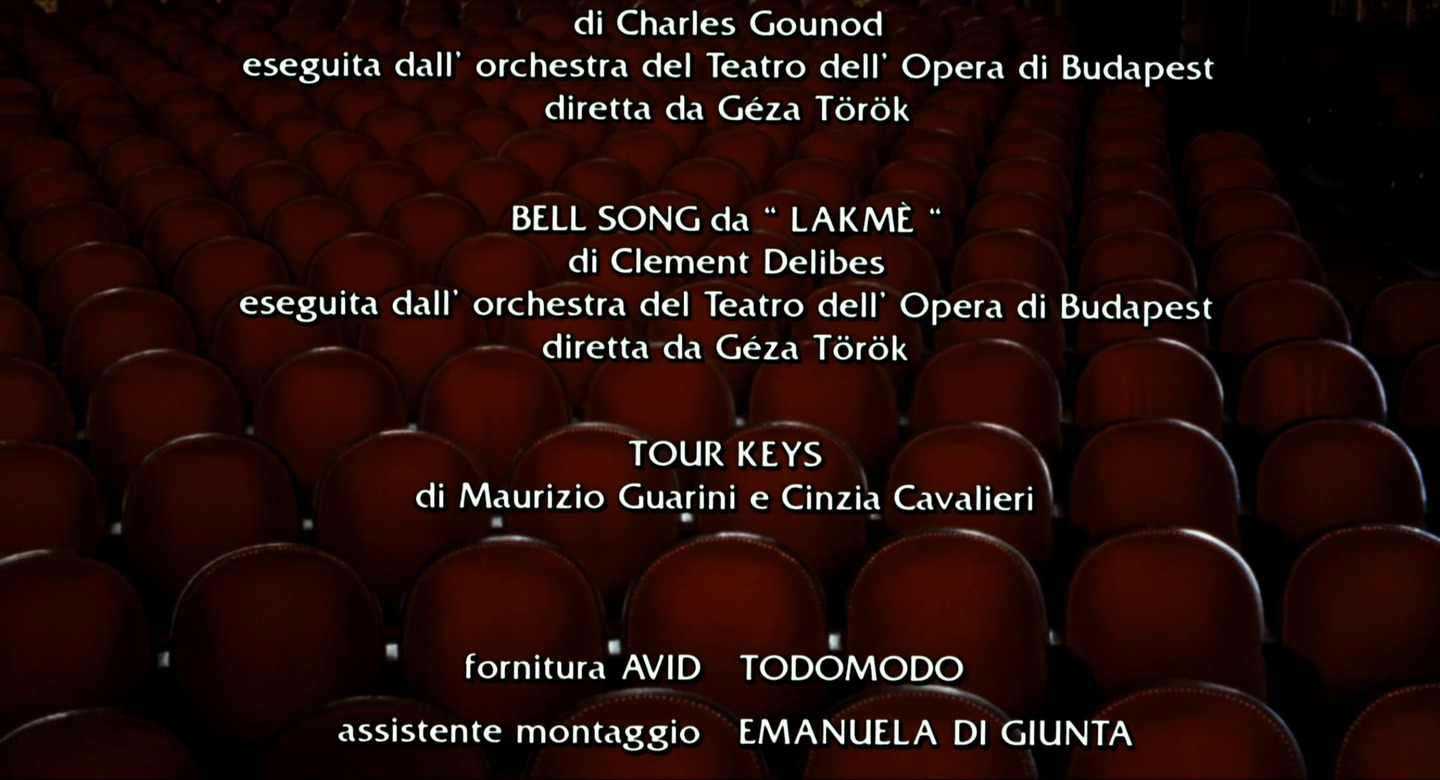
The film joins Morricone’s score to pre-existing repertoire, credited recordings and Christine’s performed singing. The closing roll separates the people and recordings behind these layers.
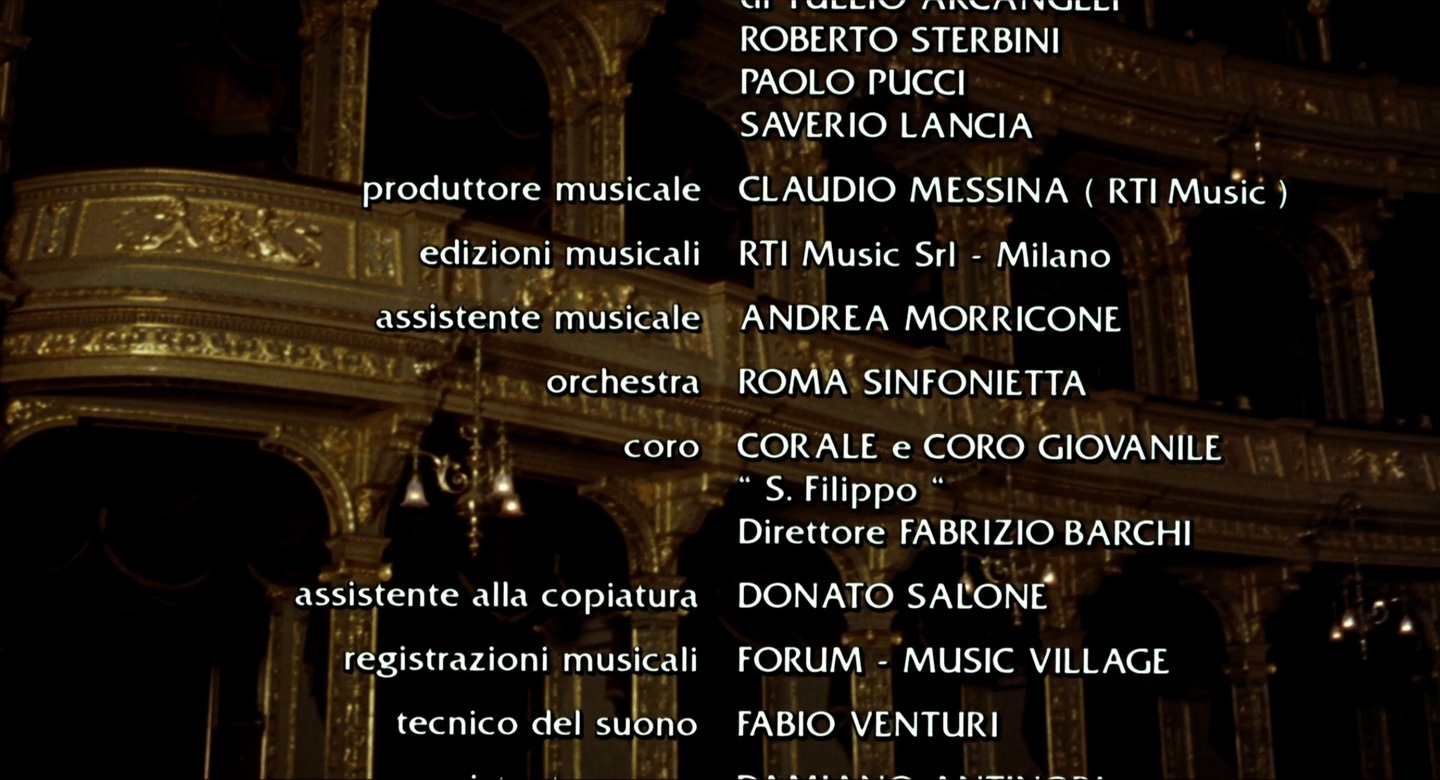 ENLARGE ↗
Alongside Morricone’s composition, orchestration and conducting credit, the closing roll names Roma Sinfonietta and the Corale e Coro Giovanile S. Filippo, directed by Fabrizio Barchi. Andrea Morricone is credited as musical assistant; Claudio Messina as music producer for RTI Music.
The roll identifies Forum–Music Village for recording and Fabio Venturi for sound. These credits describe the music production team; the existing singing-credit study separately identifies Raffaella Milanesi as the performer of the arias represented by Asia Argento.
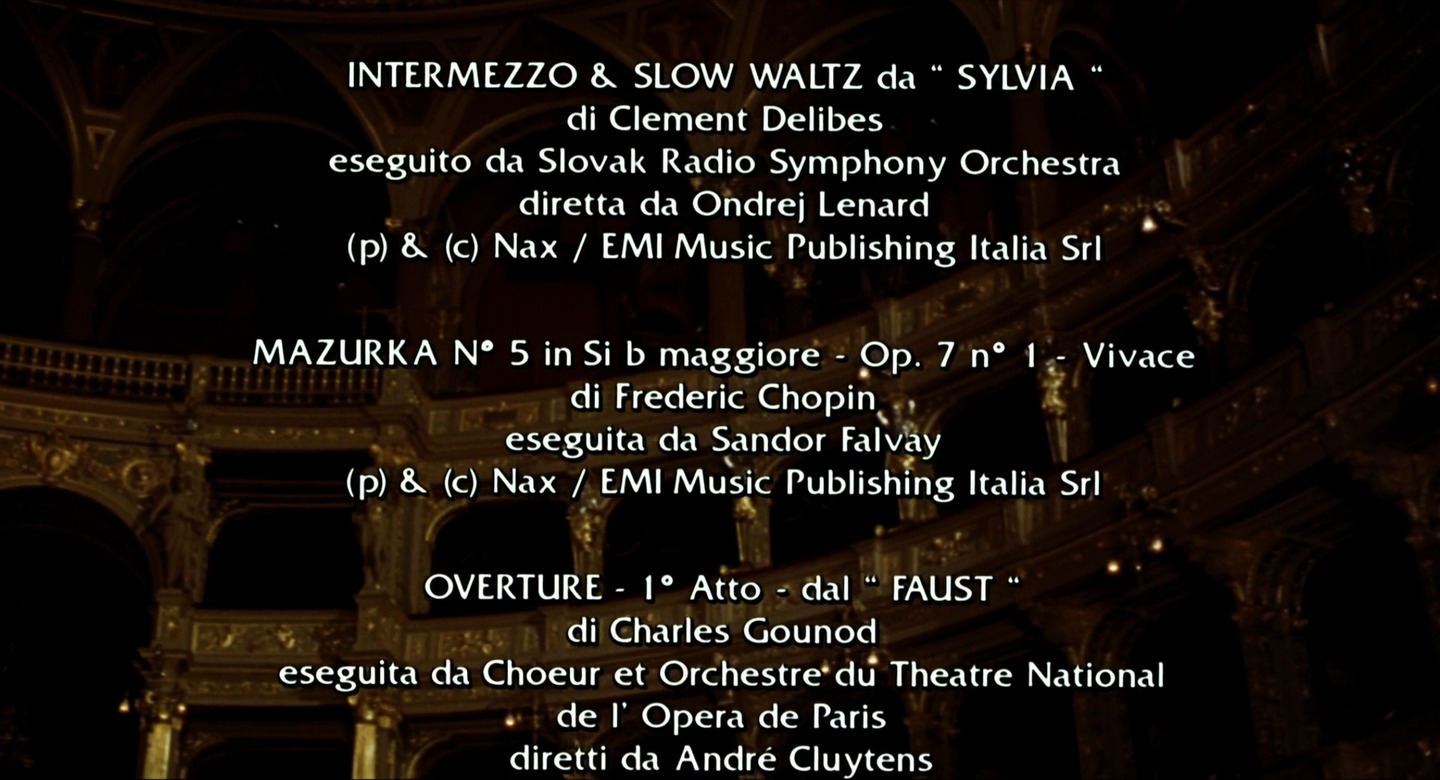 ENLARGE ↗
These are the works and recording credits displayed by the film. They do not by themselves establish where every excerpt begins or ends in the soundtrack. Read the wider music study →
The Image Music album listed by Qobuz contains 15 tracks lasting 54:04. Its programme credits Morricone throughout and includes three entries titled Sospiri e sospiri, alongside such titles as Perduto nel profondo and Specchio interiore.
The album’s track order and repeated titles belong to that release. They should not be used as a film cue sheet or as evidence that a particular version of a cue accompanies a given shot. The opera and piano recordings identified in the closing roll have their own credits. Album catalogue source →
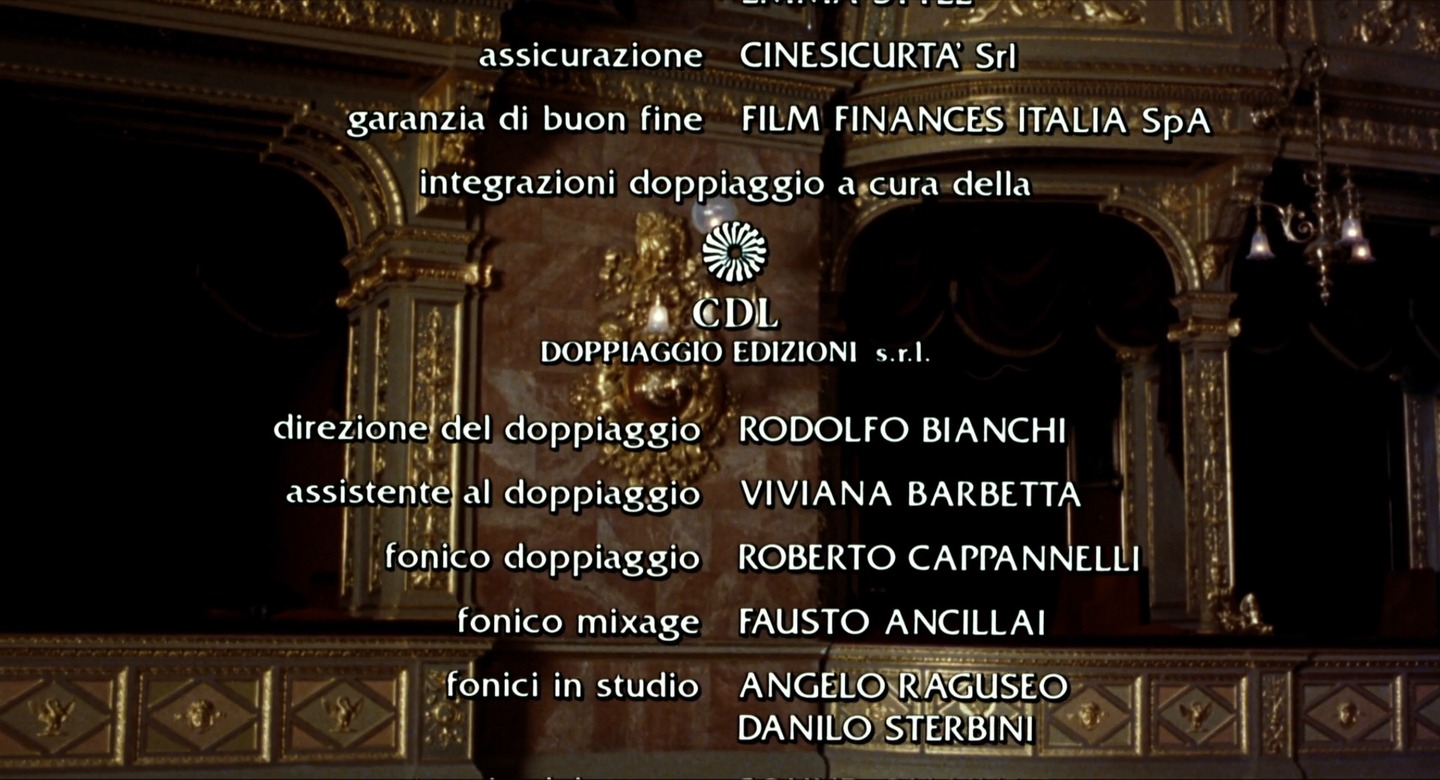 ENLARGE ↗
The closing roll credits dubbing integration to C.D.L. Doppiaggio Edizioni, with Rodolfo Bianchi directing, Viviana Barbetta assisting, Roberto Cappannelli recording and Fausto Ancillai mixing. Angelo Raguseo and Danilo Sterbini are listed as studio sound staff.
The presentation examined contains an English stereo track and an Italian 5.1 track, both at 48 kHz. This describes the available tracks, rather than establishing which mix accompanied the original release. The dubbing credit also does not identify an Italian voice performer for each actor.
THE CRAFT RECORD
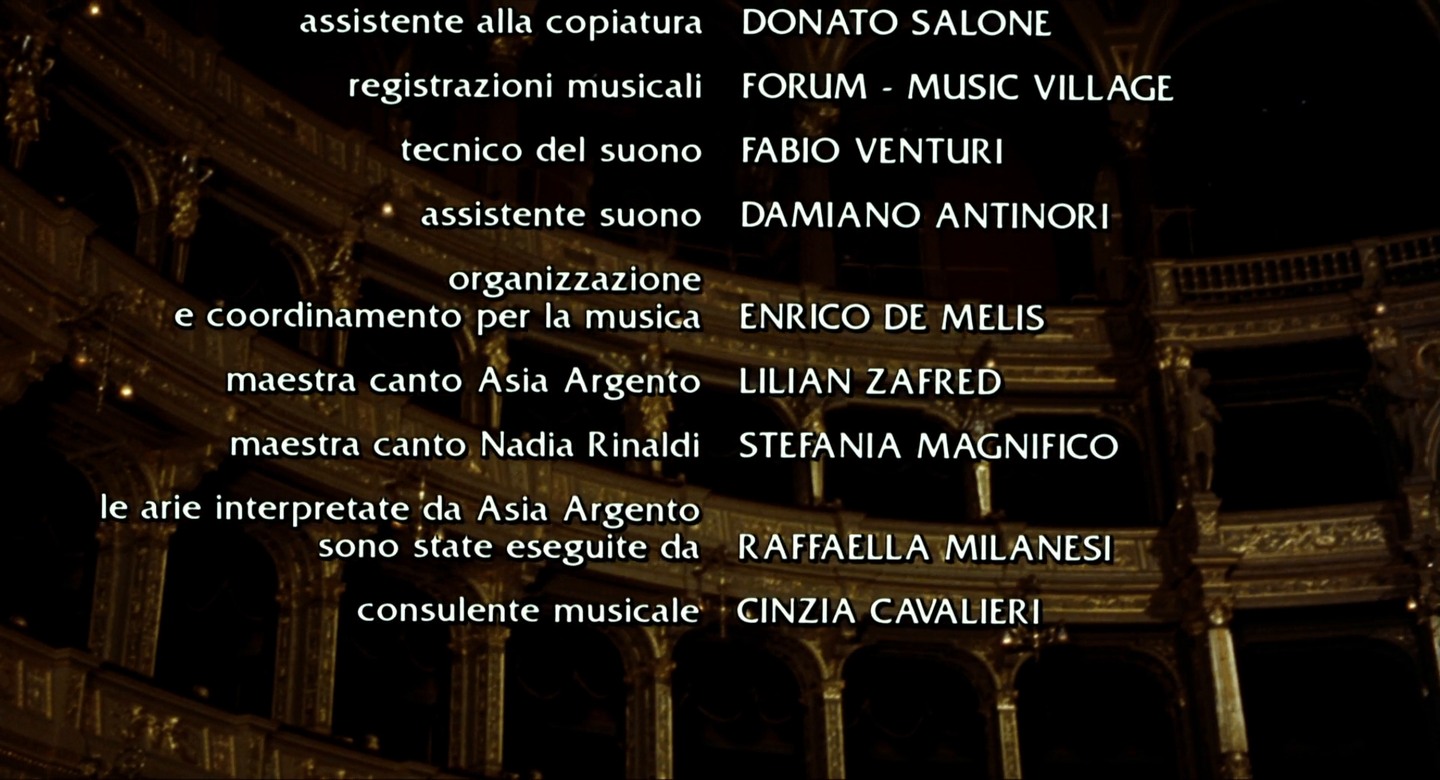 ENLARGE ↗
The closing roll explicitly credits Raffaella Milanesi with performing the arias represented on screen by Asia Argento. It separately identifies Lilian Zafred as Argento’s singing teacher, Stefania Magnifico as Nadia Rinaldi’s singing teacher and Cinzia Cavalieri as musical consultant.
This distinguishes the visible actor, recorded singer and coaching roles within Christine’s performance. Read the music and voices study →
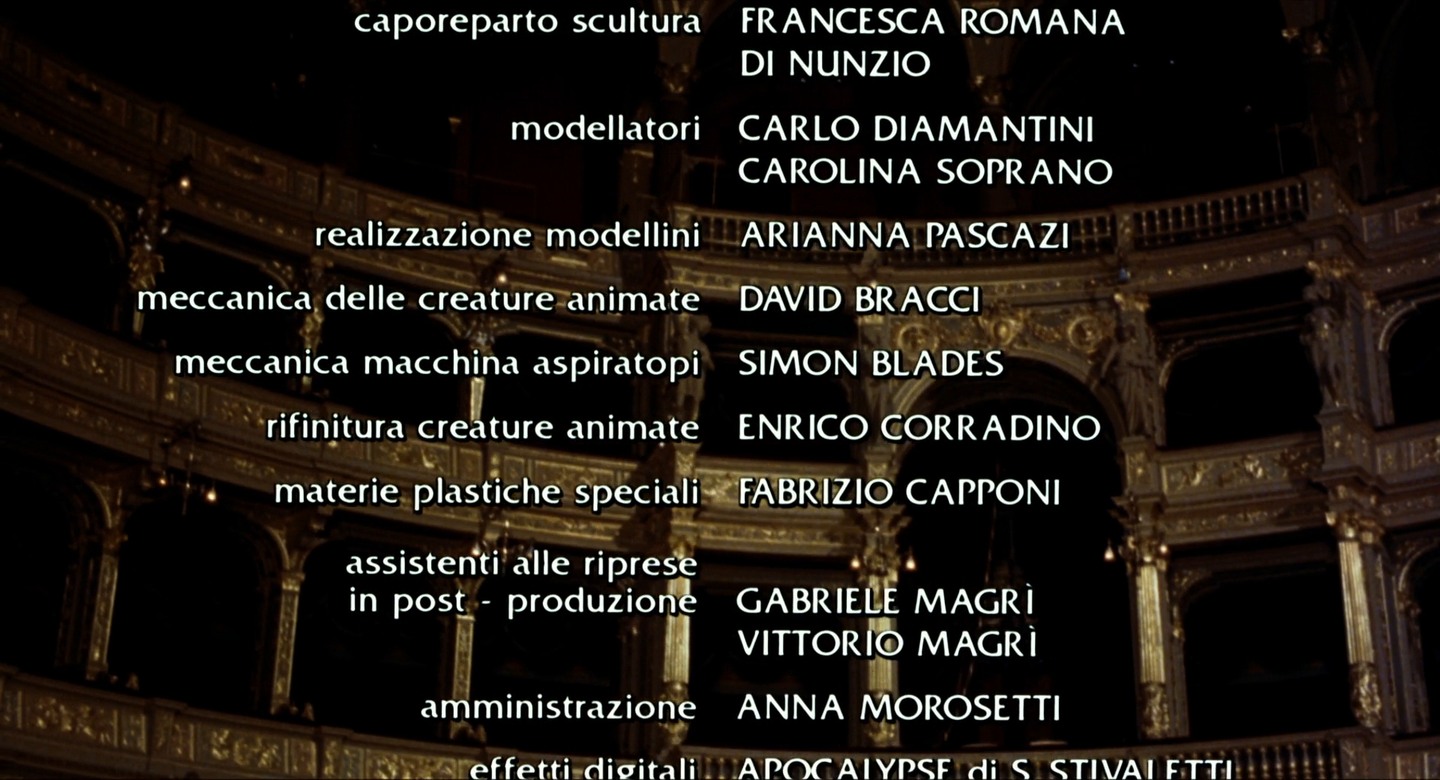 ENLARGE ↗
The credits identify David Bracci for the mechanics of animated creatures and Simon Blades for the rat-catching machine’s mechanics. Enrico Corradino is credited for finishing the animated creatures, and Fabrizio Capponi for special plastic materials.
The separate tasks give the machine gallery a concrete production context. They document credited responsibilities without assigning every visible insert or wound to an individual.
 ENLARGE ↗
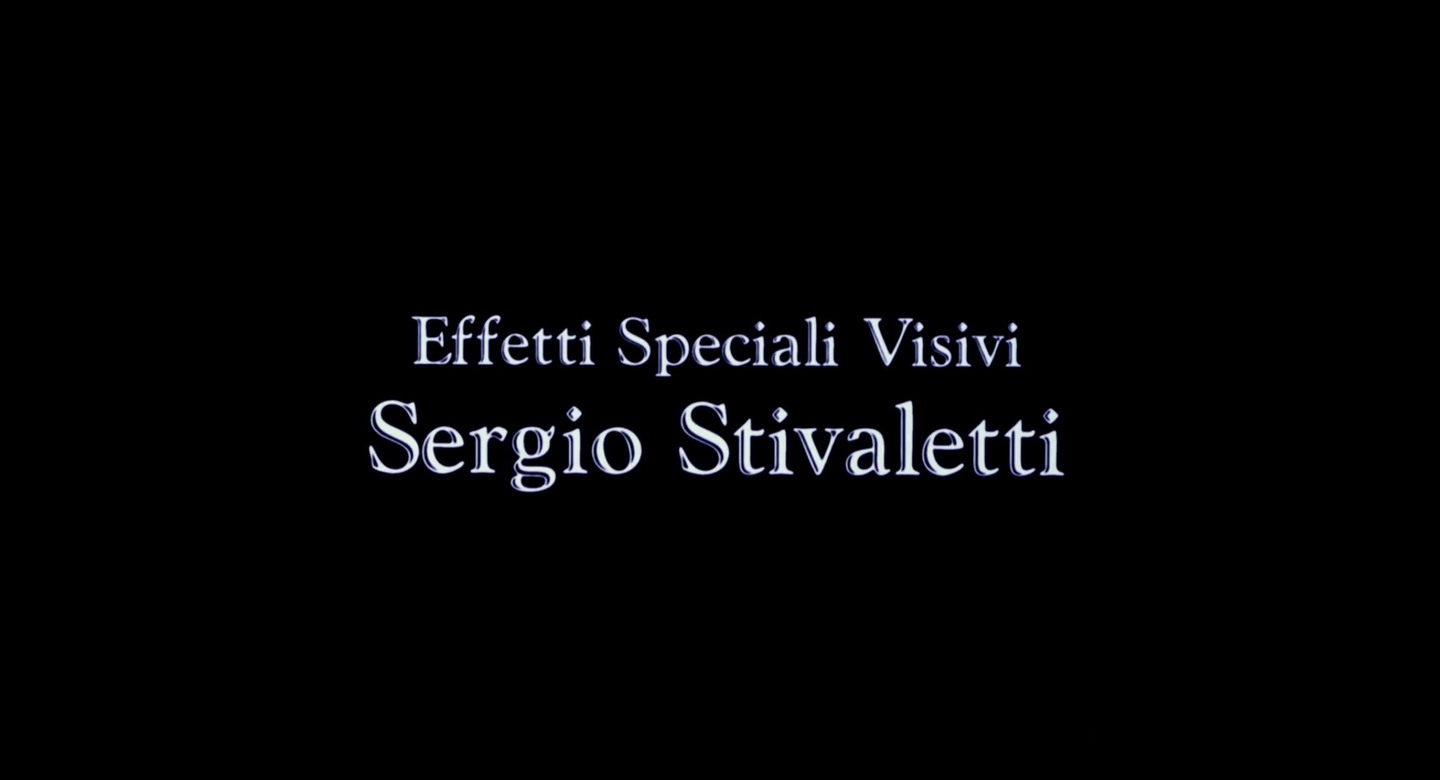
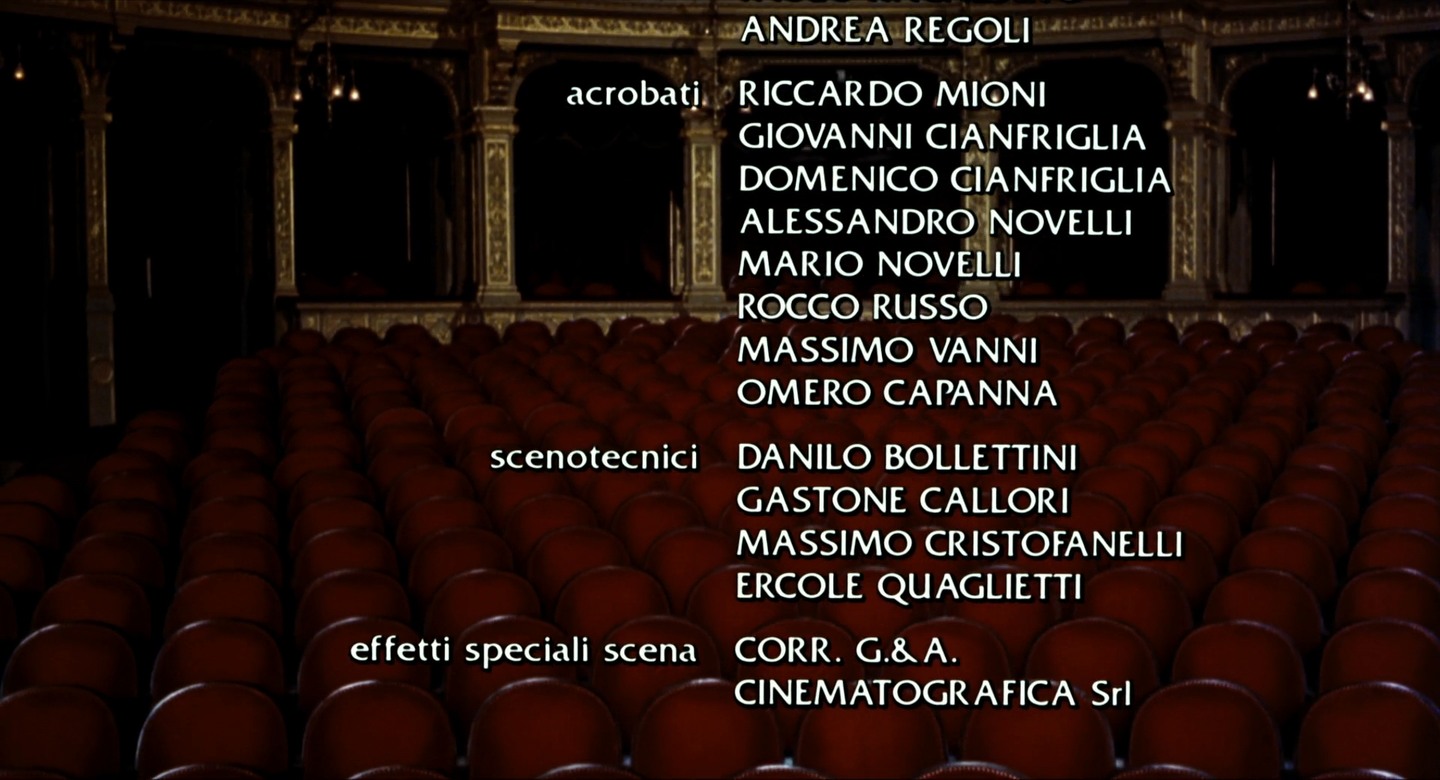
Sergio Stivaletti receives the opening visual-effects credit. The closing roll also names Apocalypse di S. Stivaletti for digital effects and CORR. G.&A. Cinematografica Srl for stage effects.
 ENLARGE ↗
The film’s credit structure separates these contributions instead of presenting its spectacle as the work of one undifferentiated department. Read the production study →
 ENLARGE ↗
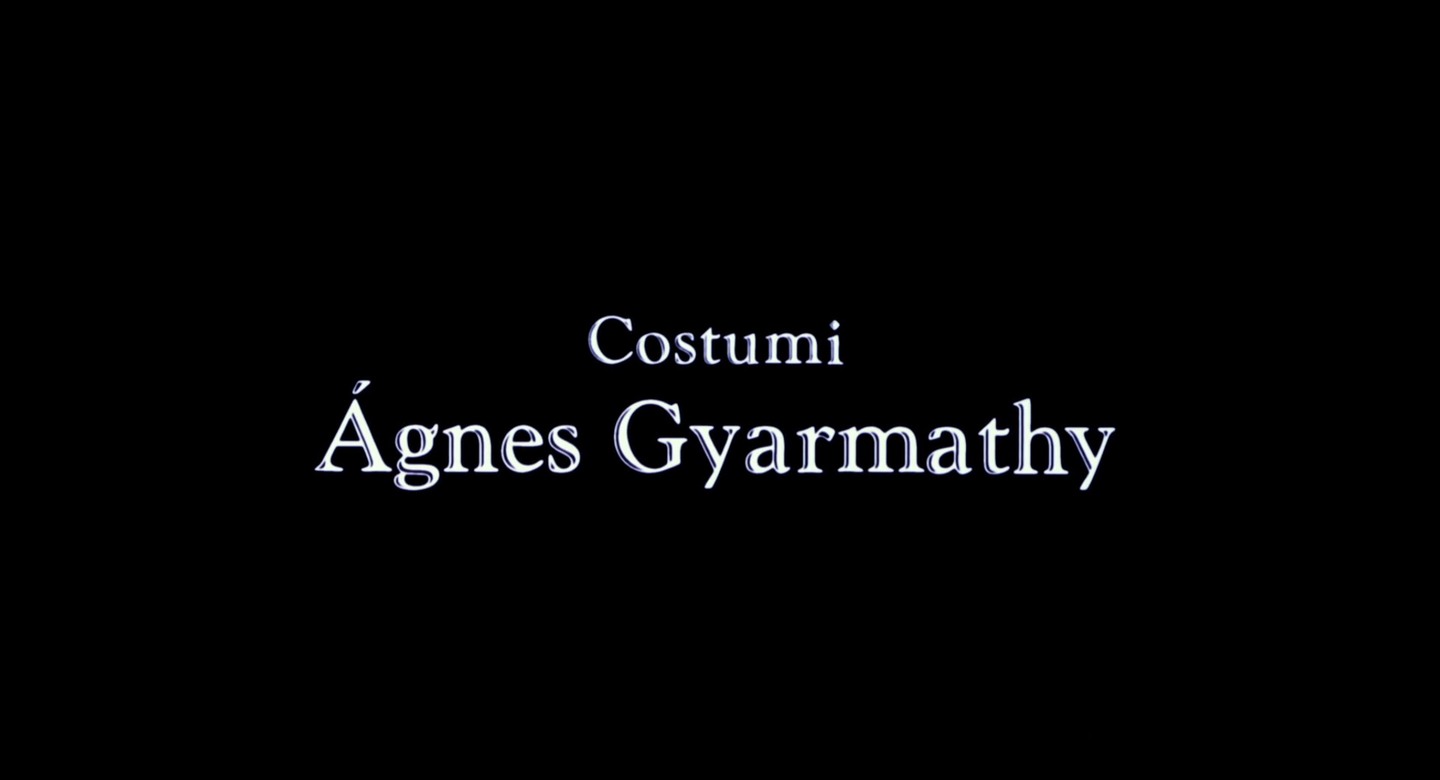
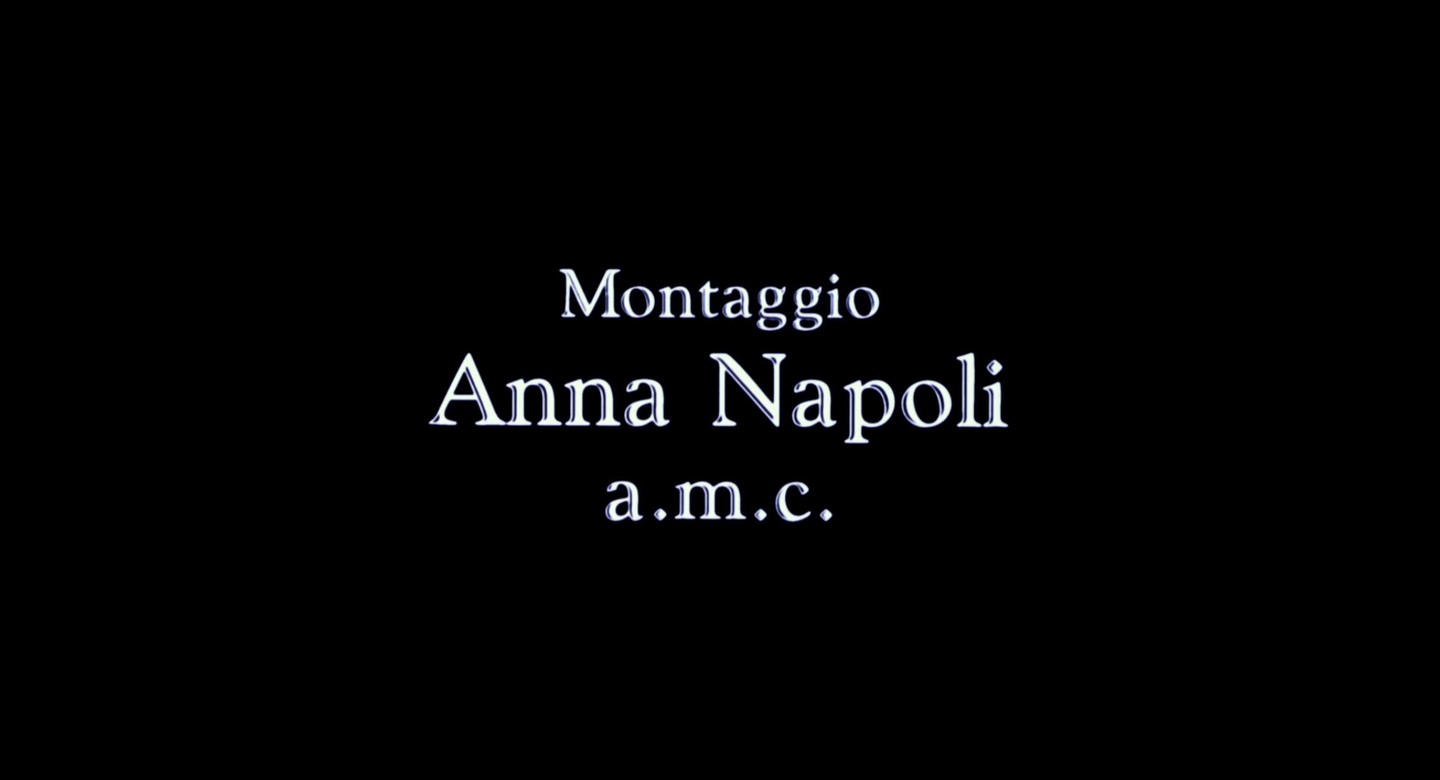
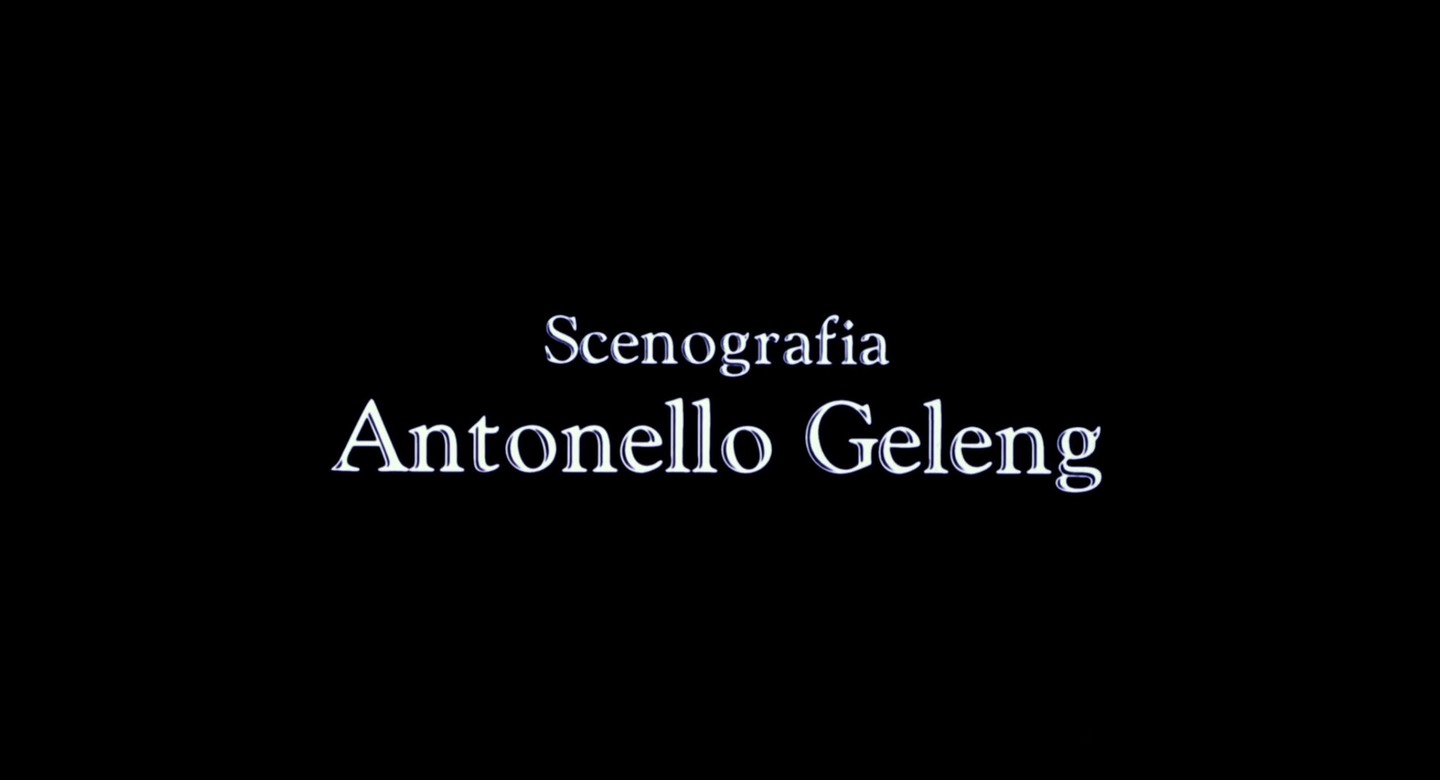
The opening titles name Antonello Geleng for production design, Agnes Gyarmathy for costume and Anna Napoli for editing. Their credited work connects the theatre’s surfaces, the performers’ appearance and the arrangement of the film’s images.
 ENLARGE ↗
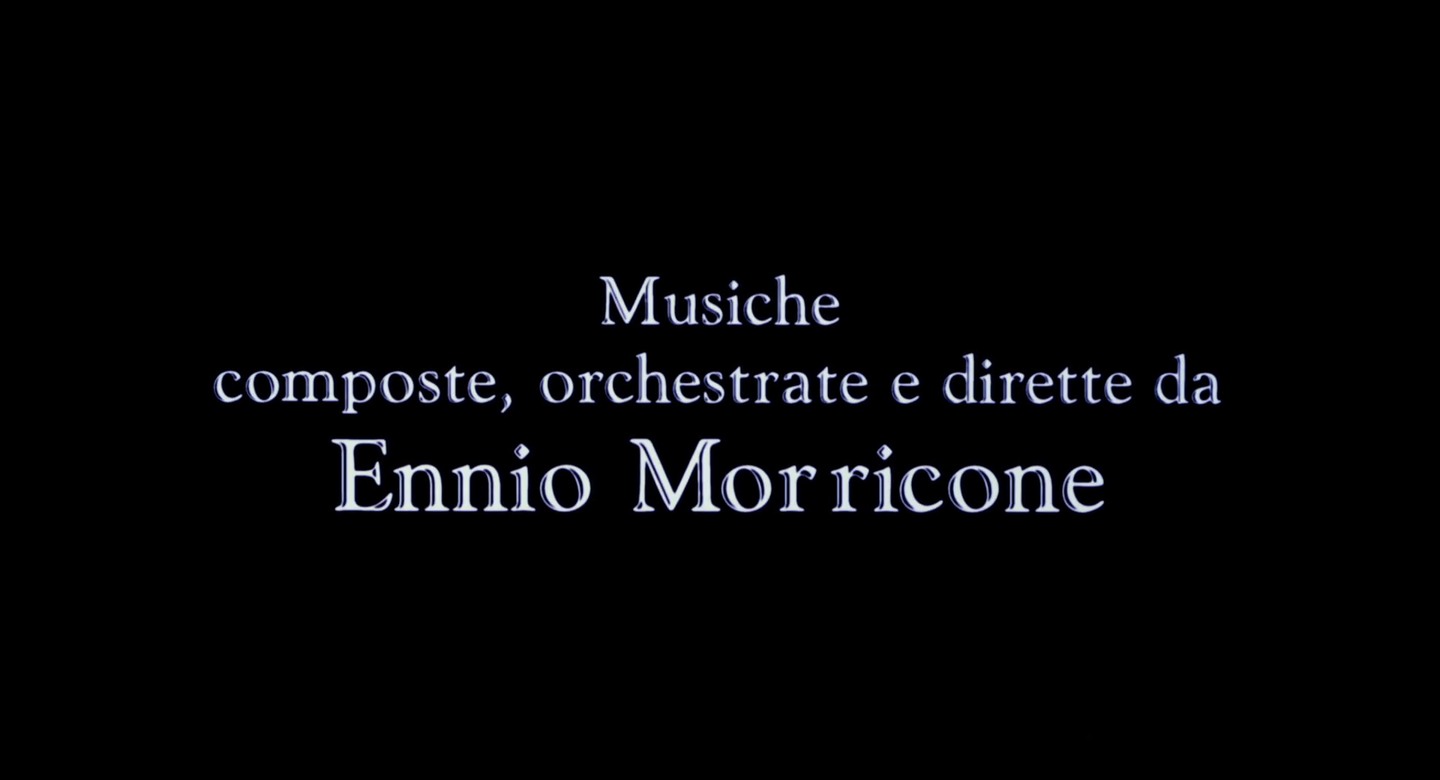
Morricone is credited for composition, orchestration and conducting. The closing roll places Forum–Music Village, sound engineer Fabio Venturi and musical coordination by Enrico De Melis within the music recording credits.
These production roles sit alongside the separately credited aria singer. They help distinguish the score, the operatic performance and the work of recording them.
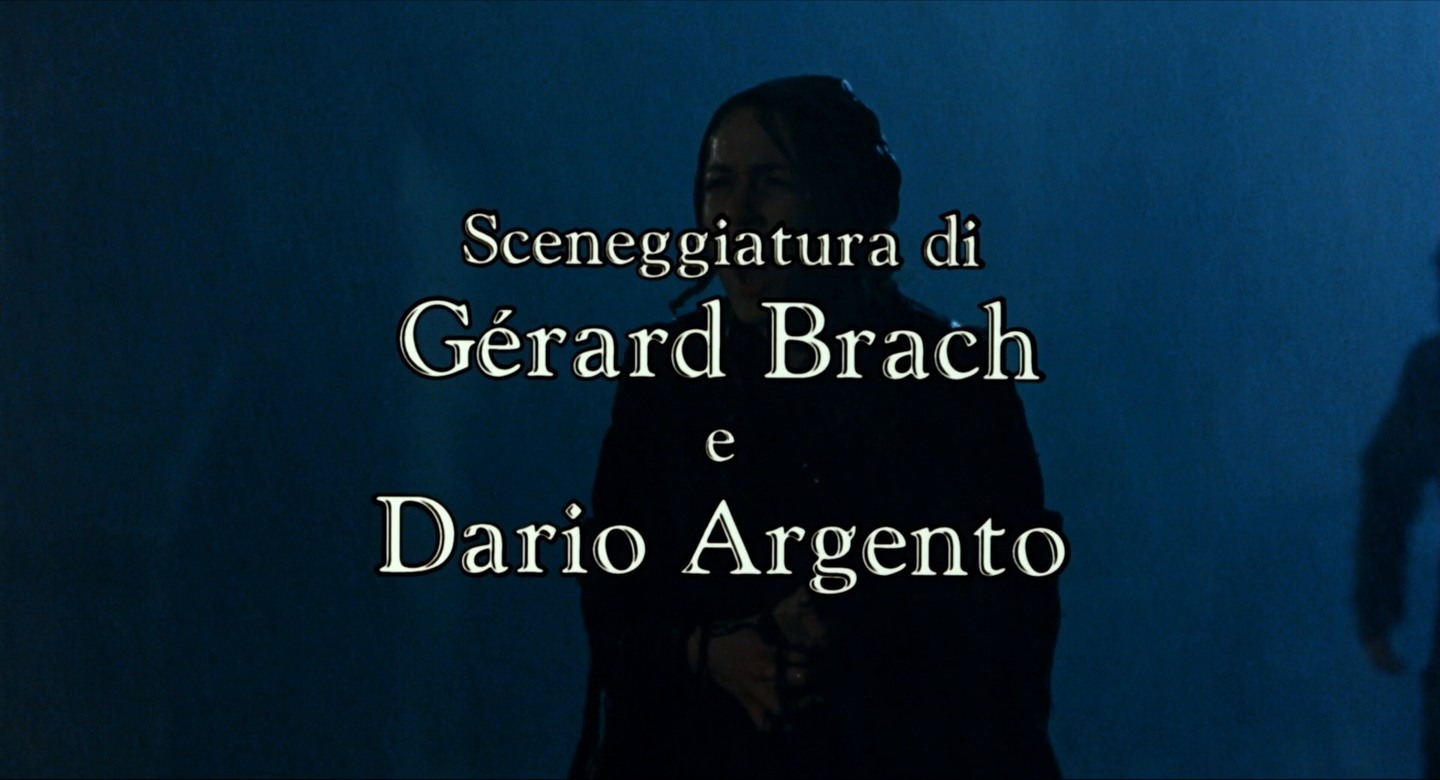 ENLARGE ↗
The screen credit names Gérard Brach and Dario Argento together. It provides a direct reference alongside the dossier’s development history and Argento’s published accounts of changing Leroux’s Phantom. Read the screenplay history →
The illustrated presentation runs 1:43:57 and has a 1920 × 1040 image. The selected stills retain those proportions at 1440 × 780, without added letterbox bars. Time labels locate the illustrated views.
It contains an English stereo track, an Italian 5.1 track and English bitmap subtitles. The screen-credit observations above come from the visible titles and closing roll.
This running time is recorded separately from the BBFC, retrospective and distributor listings below. It does not identify a physical edition or prove the presence of cuts. Compare the edition records →
Adaptation & performance
Argento’s Phantom changes the face through which a familiar story is understood. This expanded dossier follows that choice through Leroux’s novel, Christine’s visibility and voice, the Brach collaboration, the assembled theatre, Morricone’s music and the film’s disputed presentations.
Spoilers: this study discusses the film’s story and ending.
01 / LEROUX & THE CHANGED PHANTOM
Julian Sands’s Phantom has no disfigured face to conceal. In his 2013 conversation with L. Andrew Cooper, Argento describes that beauty as a deliberate change to the inherited story. His stated interest is transformation rather than the reproduction of an established version. The testimony supports an adaptation choice; it does not settle every stage of the screenplay’s development. Argento on changing the tradition ↗
Leroux’s novel makes the relation between appearance and knowledge more complicated than a simple equation of ugliness with evil. In Chapter I, dancers circulate stories about the ghost; Joseph Buquet supplies a description of a skeletal body and skull-like face. A reputation takes shape through repeated testimony, and ordinary mishaps become further evidence of the supposedly supernatural visitor. Chapter I, opening ghost descriptions ↗
Chapter XII supplies a more intimate problem. Christine describes recognising the mysterious voice as the voice of a man, then later removing Erik’s mask while they sing. The sound that has fascinated her and the face she fears belong to the same person. The discovery becomes entangled with his claim that seeing him binds her to him. Chapter XII, Apollo’s Lyre ↗
Removing the disfigurement changes the mechanism of that discovery. A handsome face gives the spectator less reason to anticipate a visible revelation, so conduct, intimacy and access to space carry more of the burden of making danger legible. Beauty does not remove the possibility of coercion; it can make coercion harder to distinguish from an invitation.
The useful comparison is therefore between relationships as well as appearances. What does the Phantom offer Christine? What does he demand in return? What can she refuse? Those questions preserve the novel’s conflict between artistic fascination and possession while allowing the film’s departure from a familiar icon to become something more than a fidelity score.
02 / CHRISTINE, COSTUME & THE SPECTATOR
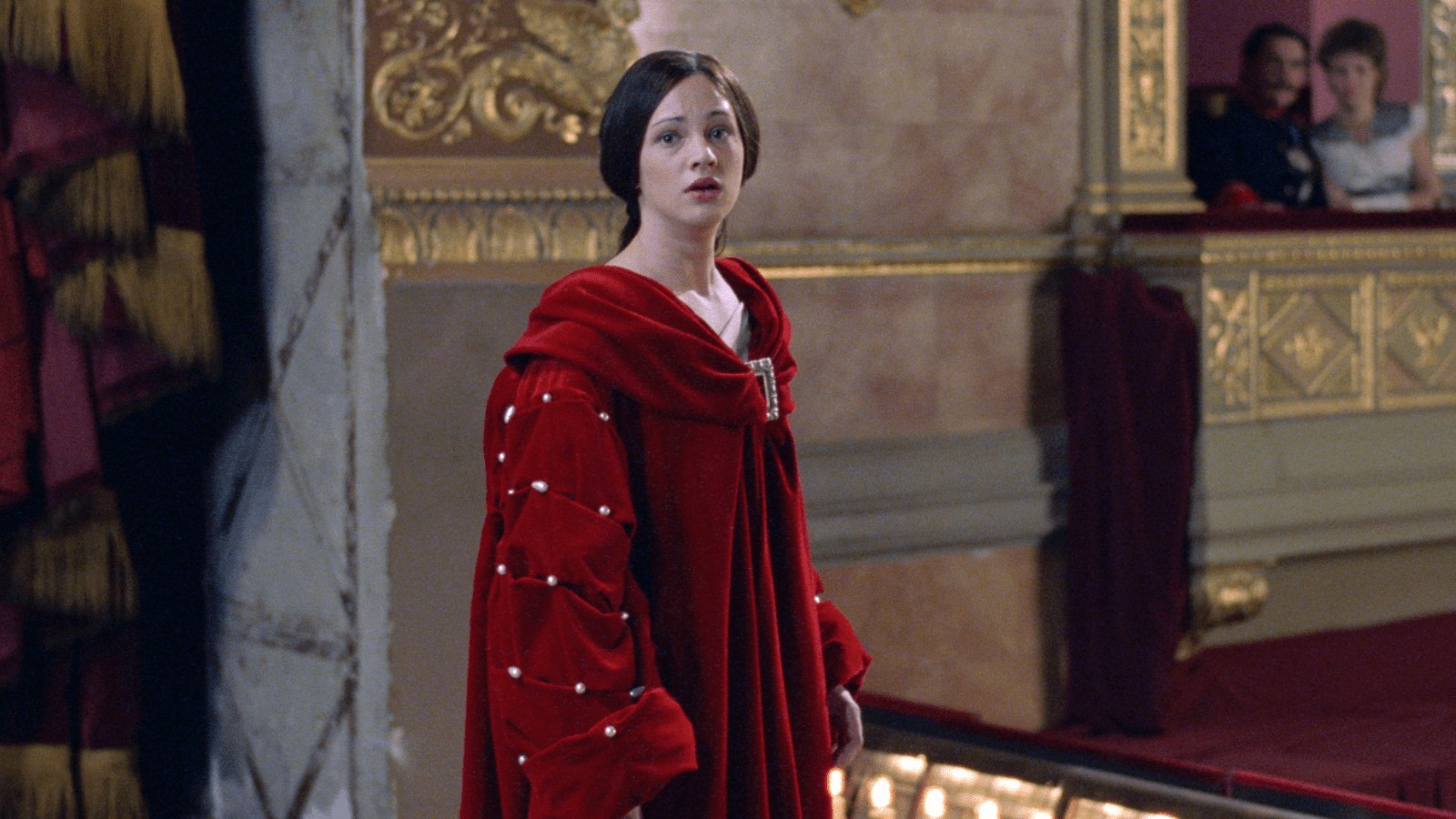
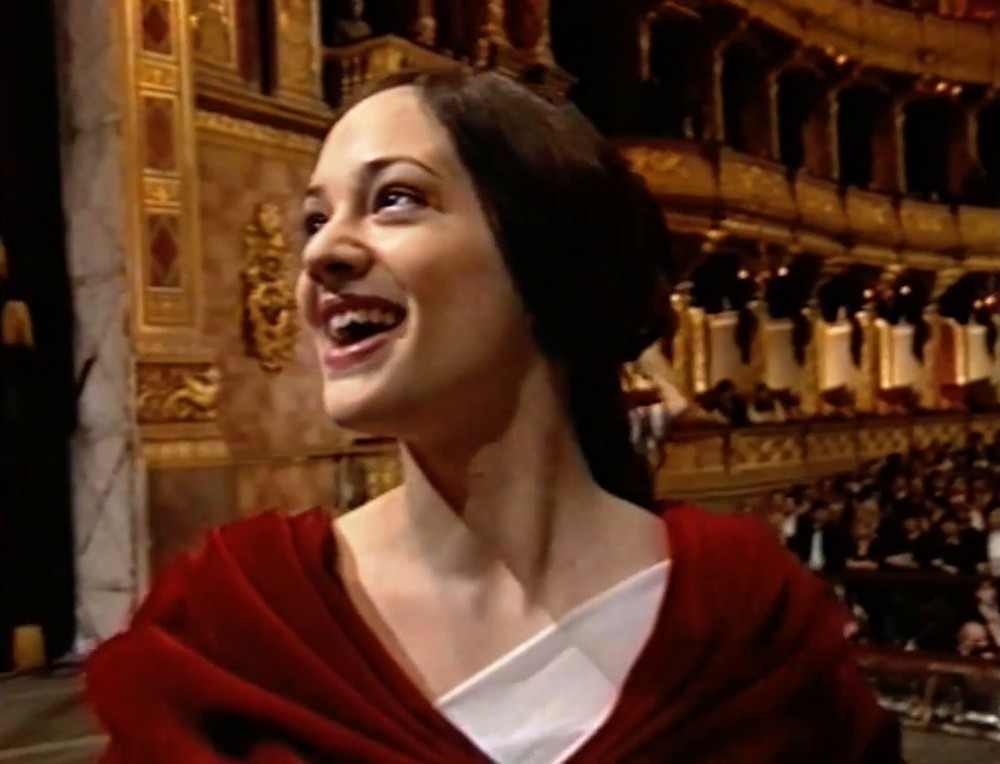
The supplied Film at Lincoln Center image places Christine’s red velvet costume against pale walls and gold ornament. Her sharply legible face occupies the foreground; two spectators are blurred in a box behind her. A dark curtain marks the left edge, and lights appear along the lower right. The image is examined here at its supplied 1600 × 900 dimensions, without a new crop. Programme and image ↗
The costume’s folds and bright sleeve details give the body a distinct surface inside the ornamented room. Gold links the performer’s setting to the privileged space of the watching figures, but the red separates her from it. The image makes theatrical visibility a material arrangement: clothing, lighting and architecture determine who becomes conspicuous.
There are also two positions from which to look. The spectators inside the theatre occupy the background, while we receive a nearer view of Christine. The camera’s access is different from theirs. Her open mouth connects the image with her role as a singer. Its usefulness lies in the visible organisation of attention.
This distinction makes a productive connection to Opera. A theatrical performer is both a working person and an image offered to others. Admiration can recognise that work, or it can treat the performer as an object available for possession. The architecture of a theatre grants spectators access to a performance; it does not grant them ownership of the person producing it.
The composition gives Christine’s exposure a visual form, connecting the theatre around her with the promises made about her career.
03 / CAREER, DESIRE & CONTROL
The Italian Cinema Archive’s synopsis presents the Phantom’s attraction to Christine alongside his determination to make her a leading soprano. Carlotta becomes an obstacle to be removed. The promise of artistic advancement is thus joined to a claim of power over the circumstances in which another woman works. Synopsis ↗
This is a disturbing version of patronage. The helper offers to solve a professional difficulty, but his solution also makes him the person who controls access. The distinction between enabling a performer and controlling her becomes central. A role obtained through another person’s violence cannot be understood solely as a triumph of talent.
The film’s animal history adds a different claim upon the Phantom. FLC describes him as raised by rats and places the Rat Catcher in pursuit of him. That premise connects his private attachments to creatures treated as vermin by the public institution above. It creates a clash between belonging and extermination, rather than merely supplying an unusual origin story. Phantom and Rat Catcher ↗
For the ending, the Catholic film commission’s synopsis records the Phantom’s death under police fire and Christine’s distressed departure with Raoul. That published account supports a distinction between the resolution of immediate danger and the resolution of feeling. Leaving with one man does not necessarily erase attachment to the other. Ending synopsis; spoilers ↗
Such a conclusion need not turn every act of violence into proof of romantic depth. The more revealing tension is between Christine’s emotional experience and the conduct that has brought her to this point. An interpretation can acknowledge grief without accepting the Phantom’s promises as harmless. Attraction and consent, like rescue and freedom, remain different questions.
04 / WRITING & THE LONG-GESTATING PROJECT
Gérard Brach and Argento share the screenplay credit in the Italian Cinema Archive. Naming the collaboration matters because a literary adaptation involves more than selecting incidents: it redistributes explanations, reshapes dialogue and decides which relationships will carry the story. The credit does not tell us which writer proposed each alteration. Screenplay credit ↗
In Giacomo Pellicciotti’s report of an August 1998 Catania appearance, Argento recalls an abandoned plan to place the story in Russia, then a renewed desire to film it after seeing the 1925 adaptation on television while working on Trauma. This is his release-period recollection, preserved in a republication of the newspaper article. It shows a project with changing circumstances, not a single uninterrupted production plan. Pellicciotti report, 5 August 1998 ↗
A contemporary notice supplies a firmer point in the working chronology. The 20 January 1998 issue of l’Unità reports the start of filming in Budapest and names Sands, Asia Argento and Andrea Di Stefano. The brief anchors the production in a dated contemporary report. Primo Ciak notice, printed p. 9 ↗
The difference between an ambition and a shooting script is worth preserving. A remembered Russian setting may reveal what Argento once imagined; it does not establish what survived into the Brach collaboration. Similarly, a statement about changing the Phantom’s face explains an artistic position without proving when that choice entered the drafts.
The meaningful return is to compare dated treatments and scripts with the credited collaborators’ accounts. That could show whether the animal upbringing, Christine’s attraction and the comic material developed together or through separate revisions. Until then, the dossier can interpret the finished premise while leaving the allocation of individual writing decisions open.
In Panico, Argento recalls seeing the Claude Rains Phantom of the Opera as a child during a family holiday in the Dolomites. He remembers encountering an unfamiliar mixture of love and disturbance. This is a different viewing from the later television encounter with the 1925 film that he associated with reviving his own project while working on Trauma. Panico: testimony and passage locators ↗
The distinction gives the adaptation a longer imaginative history without collapsing two versions into one influence. The childhood account concerns an emotional discovery; the release-period account concerns the renewal of a filmmaking ambition. Neither recollection alone dates the changes made with Gérard Brach to the eventual screenplay.
05 / LOCATIONS, DESIGN & EFFECTS
The earlier edition repeated FLC’s shorthand description of a Hungarian studio reconstruction. Argento’s 1998 account is more specific: he names the Budapest Opera, Cinecittà, caves in Slovakia and the caves at Pertosa near Salerno. Those locations require a broader account of how the film’s Parisian world was assembled. Programme wording ↗ Named filming places ↗
The Italian Cinema Archive credits Ronnie Taylor’s photography, Anna Napoli’s editing, Agnes Gyarmathy’s costumes and Antonello Geleng and Paola Riviello’s scene design. Their work belongs in the account of continuity between the sumptuous public theatre and its concealed spaces. A screen connection between rooms is not proof that those rooms occupied the same building. Craft credits ↗
Leroux’s prologue offers a useful counterpart. Its narrator assembles archives, testimony and architectural knowledge to establish the ghost’s existence. The building is both a place to move through and a record to investigate. In film, constructed connections can perform a related task: they make an apparently coherent institution out of spaces whose relationships must be learned. Prologue ↗
The production also had to make its creatures and mechanisms work. Pellicciotti reports Argento saying that unfinished effects and a rat sequence requiring further work prevented a Venice appearance. Effects and Venice explanation ↗
Mondo Digital’s review describes Geleng’s supplement as discussing the rat-catching machine with Sergio Stivaletti, and the newer Stivaletti interview as addressing practical rat effects. These are attributed descriptions of supplements, not interviews newly watched here. They identify a useful division of labour between designed object, mechanism and photographed effect. Geleng and Stivaletti supplement accounts ↗
The extravagance of the machine can be read against the opera house’s respectable surface. Both depend on concealed labour and apparatus. The theatre presents refinement; the underground mechanism exposes an uglier management of bodies. Testing that relation shot by shot remains a focused future task, while the production evidence already prevents the building from becoming an anonymous backdrop.
06 / MORRICONE, REPERTOIRE & VOICES
Ennio Morricone’s score and the opera performed inside the story occupy different positions. The former can guide the film spectator’s response; the latter belongs to a public performance that characters attend, rehearse or manipulate. Their relationship is especially important when the heroine’s voice is both her profession and the object of the Phantom’s fascination.
Argento’s 1998 account names Massenet, Bizet, Delibes and Gounod among the composers whose arias he included. Argento on operatic repertoire ↗
The Image Music album listed by Qobuz contains fifteen tracks credited to Morricone, with a total duration of 54 minutes 4 seconds. Titles including Romantico inquinamento, Burlesca and Nei sotterranei bui suggest contrasting dramatic associations. Album credits and track listing ↗
Keeping these distinctions makes the singing question more precise. The actor visible in a shot, the singer on the recording, the language of spoken dialogue and the music added around the performance may involve different contributors. A screen role does not establish whose sung voice is heard.
The closing screen credits identify Raffaella Milanesi as the performer of the arias represented on screen by Asia Argento. They separately name Lilian Zafred as Argento’s singing teacher and Cinzia Cavalieri as musical consultant. The actor, singer and preparation roles can therefore be distinguished in the production record. View the singing credit →
The archive separately names Roberto Alberghini, Umberto Montesanti and Gilberto Martinelli under sound. That reminds us that the final relationship between speech, music, effects and space also requires sound work beyond composition. Sound credits ↗
The voice and dialogue studies trace how Christine’s singing becomes an offering, a professional opportunity and a means of control. The recording-credit guide distinguishes Morricone’s music team, the named operatic recordings, the soundtrack album and Italian dubbing work. Together they give the performance argument a more precise production and dramatic context.
07 / ROMANCE, GROTESQUE & CRITICAL EXPECTATIONS
The Catholic film commission’s assessment rejects the mixture of literary adaptation and modern effects, arguing that the spectacle lacks psychological depth. Its objection is not simply that the film departs from the book; it is that the departures fail to produce a convincing alternative. Pastoral assessment ↗
Mondo Digital’s later edition review takes a more qualified position, finding visual and romantic interest while questioning the humour and the film’s place in Argento’s work. These are different critical priorities, not points on a single scale of correctness. Critical account ↗
The disagreement is revealing because romance and grotesque comedy make competing demands. Romance asks us to take attachment seriously. An absurd machine or excessive bodily effect can introduce distance, laughter or disgust. Their coexistence may be purposeful without being equally persuasive to every viewer. Intention and achievement need separate judgments.
The familiar mask creates another expectation before the film begins. Removing it changes the anticipated moment of revelation; changing the Phantom’s upbringing changes the explanation for his isolation. A viewer seeking a particular tragic icon and a viewer interested in Argento’s rearrangement of it may therefore encounter quite different disappointments and pleasures.
Cooper’s interview also records Argento resisting the broader idea that his later films represent an abandonment of his earlier style. That is his retrospective self-understanding, not a verdict the dossier must adopt. It is most useful beside the criticism: continuity can be investigated through architecture, desire and spectatorship even when a particular film’s tone changes. Argento on the later work ↗
It identifies the terms of the disagreement and preserves routes to dated Italian and overseas reviews. The question is more useful than a routine declaration of decline or rediscovery: what did each audience expect this Phantom to reveal?
08 / PRESENTATIONS & A CATALOGUE DISCREPANCY
The records now allow the earlier running-time question to be sharpened. Alongside the FLC and publisher listings, there are two British classification submissions and an edition reviewer’s duration. They are records from different contexts, not measurements made on the same copy.
| Record | Duration | Scope |
|---|---|---|
| BBFC / High Fliers, 2001 | 99m 25s | Physical media, classified 3 May 2001. Submission ↗ |
| BBFC / Tartan, 2002 | 99m 30s | Classified 24 June 2002. Submission ↗ |
| FLC, 2022 | 99 minutes | Retrospective listing, Italian/French with English subtitles; Cinecittà restoration credit. Programme ↗ |
| Mondo Digital review | 103m 40s | Header on the review updated 5 February 2026. Edition review ↗ |
| Vinegar Syndrome UHD/Blu-ray | 113 minutes | Current publisher listing; original-negative 4K restoration, 1.85:1, Italian/English 5.1. Publisher specification ↗ |
The presentation used for this dossier’s illustrated scene guide runs 1:43:57. That is an observed duration, not an identification of the disc edition or evidence that one of the listed versions has been cut. The presentation note records image dimensions and track configuration.
The publisher and review list durations nearly ten minutes apart. Each entry retains its own source; these records describe the releases under discussion.
Playback speed is relevant to the shorter figures: the same material lasting about 99½ minutes at 25 frames per second would last about 103½ minutes at 24. That arithmetic explains why a duration difference need not imply missing scenes. It does not establish the playback rate of the FLC presentation or resolve the 113-minute listing.
The Italian Cinema Archive records classification number 93047, dated 17 November 1998. Classification locator ↗
The current release lists alternate English titles and interviews with Napoli, Pieroni, Geleng, Stivaletti and other participants. Those resources give the return pass a practical route into editing, camera movement and effects. The restoration’s element and format are publisher claims; the supplements are located, not newly viewed. Technical details and supplements ↗
Edition work matters here because a voice, an image balance or an altered rhythm can affect the unstable relation between beauty and threat. The goal is a reproducible comparison of named copies, not a declaration of a definitive version based on packaging numbers.
FOLLOW THE CONNECTIONS
Read across films, then return
to the evidence for each one.
Compare theatrical spectatorship and the organisation of performance space.
Read the dossier →RELATED DOSSIERFollow the unstable border between an artwork and the person encountering it.
Read the dossier →OBJECTS IN CIRCULATIONExplore the film’s prints, paper or physical media. Retailer descriptions; catalogue snapshot 14 October 2026.
View objects & retailer links →MY CINEMA / PRODUCTION TESTIMONY
Dario Argento
My Cinema expands the childhood memory discussed in Panico. Argento recalls seeing the Claude Rains Phantom during a mountain holiday and carrying away an overwhelming imaginative experience. When he returned to the older film as an adult, he found something more conventional and moralistic than the work he remembered. He describes his own adaptation as an attempt to remain faithful to the fantasy the earlier viewing had created in him.
That distinction changes the question of fidelity. The point of reference is not only Leroux’s novel or a particular earlier film, but a remembered emotional encounter that had become a different work in the viewer’s mind. The documentary follows the interview with production footage involving Christine and a change of focus through a crystal, placing this account of imagination beside the construction of another optical experience.
Dario Argento: My Cinema / Il mio cinema, two-part documentary presented on Severin Films’ Dario Argento’s Deep Cuts, Disc 1. Part One, 01:24–04:40.
The discussion paraphrases the English subtitles and distinguishes participant recollections from the documentary’s narration and production footage.
Explore both documentaries and follow the related dossiers →
THE READING ROOM
Sources checked 16 October 2026. Contemporary testimony, selected novel passages, the inspected image and edition records retain their different evidential roles.
Programme, 99-minute/language listing, studio shorthand and supplied image. Filming-place account is expanded through contemporary testimony; programme is not a production plan.
Return to the dossier ↑Project Gutenberg English text: prologue, opening Chapter I and selected Chapter XII passages on the voice, lake house and unmasking. Not a complete book comparison or the filmmakers’ identified source edition.
Return to the dossier ↑University of Illinois Press, 30 October 2013. Phantom adaptation and later-style questions inspected as retrospective participant testimony.
Return to the dossier ↑Synopsis, principal craft/sound credits and classification locator 93047 of 17 November 1998. Catalogue, not an inspected ministry file.
Return to the dossier ↑Republication on Sgalambro’s official site, attributed to La Repubblica, 5 August 1998, p. 36. Project origins, named filming places, effects delay and repertoire.
Return to the dossier ↑Printed l’Unità2 p. 9, right-hand Primo Ciak brief: start-of-filming report and cast names visually checked against the PDF. Filename page number differs from the printed page.
Return to the dossier ↑Fifteen-track, 54:04 album listing, composer and publisher fields. Track names are not film cue locators. No audio audition or singer attribution claimed.
Return to the dossier ↑Ending synopsis and assessment.
Return to the dossier ↑Review updated 5 February 2026: 103:40 header, critical account and Geleng/Stivaletti supplement descriptions. No supplements or discs newly viewed.
Return to the dossier ↑113-minute listing, negative-restoration/1.85:1/language specifications and supplements. Runtime discrepancy preserved.
Return to the dossier ↑2001 High Fliers and 2002 Tartan dates and durations checked against the Argento entry. No inference of specific edits from runtime alone.
Return to the dossier ↑The illustrated studies examine selected frames across a 1:43:57 presentation with Italian screen credits. Time labels locate the illustrated views. Closer sampling follows six effects passages and their aftermaths; the scene guide is not a catalogue of every cut.
The craft notes come from the opening titles and closing roll, including the explicit aria-singer and rat-machine credits. The dialogue and recording-credit study extends this visual material; direct listening and comparison of the two mixes remain separate. Vinegar Syndrome’s edition listing was checked on 5 November 2026.
Return to the scene guide ↑The twelve dialogue studies combine a complete processing pass over the English audio with the embedded English subtitles. The selected passages were checked against the visible subtitle images; their time labels refer to that subtitle presentation. The prose paraphrases the exchanges rather than reproducing a transcript or treating the subtitles as a screenplay.
The recording and dubbing attributions were read directly from the closing roll, around 1:42:10–1:42:45. Qobuz’s Image Music album listing was checked separately. English stereo and Italian 5.1 configurations were inspected and both tracks decoded across the presentation.
This is a dialogue and documentary-credit study, not a completed listening audit of music cues, vocal delivery or surround placement. The Italian dialogue and differences between the two mixes have not been verified by listening.
Return to voice and dialogue ↑14 / DOCUMENTARY TESTIMONY
Dario Argento: 08:07–08:39. English paraphrases of retrospective documentary interviews. Source and viewing notes ↗
Return to the testimony ↑KEEP EXPLORING
Explore the films and collaborators → · Visit the Reading Room → · Find a piece for your collection →
Corrections, contributions and enquiries: argentochrome@rareprintsandposters.com