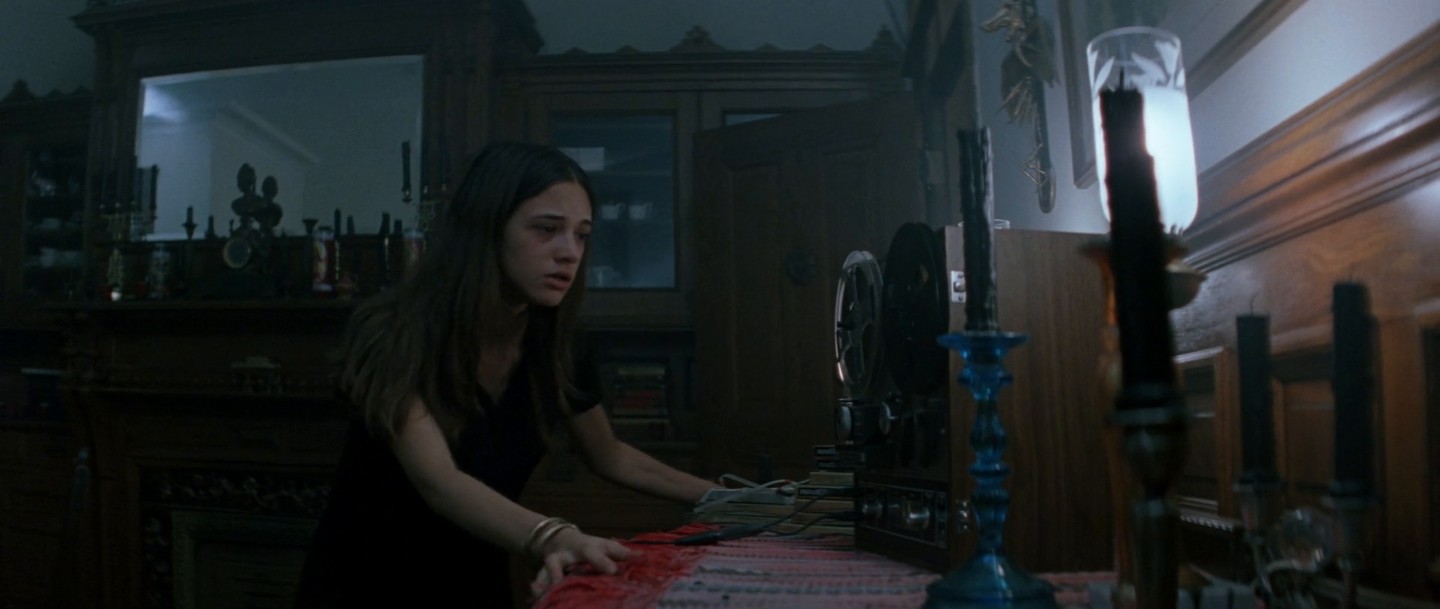
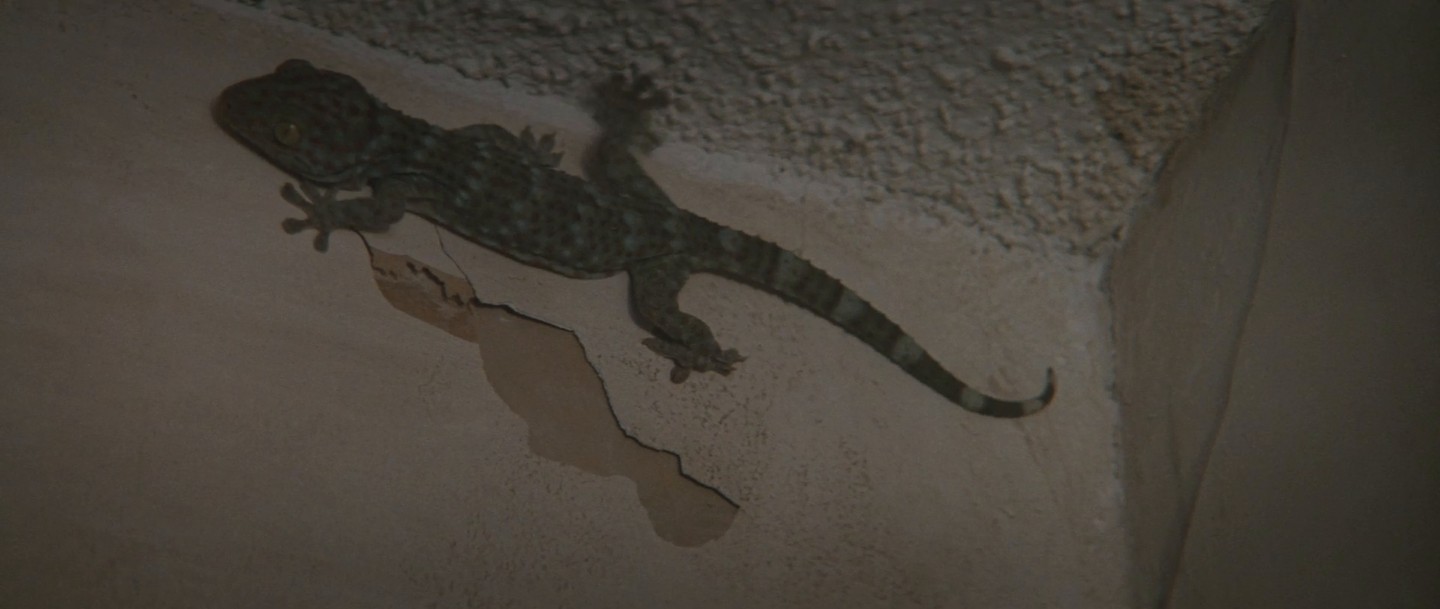
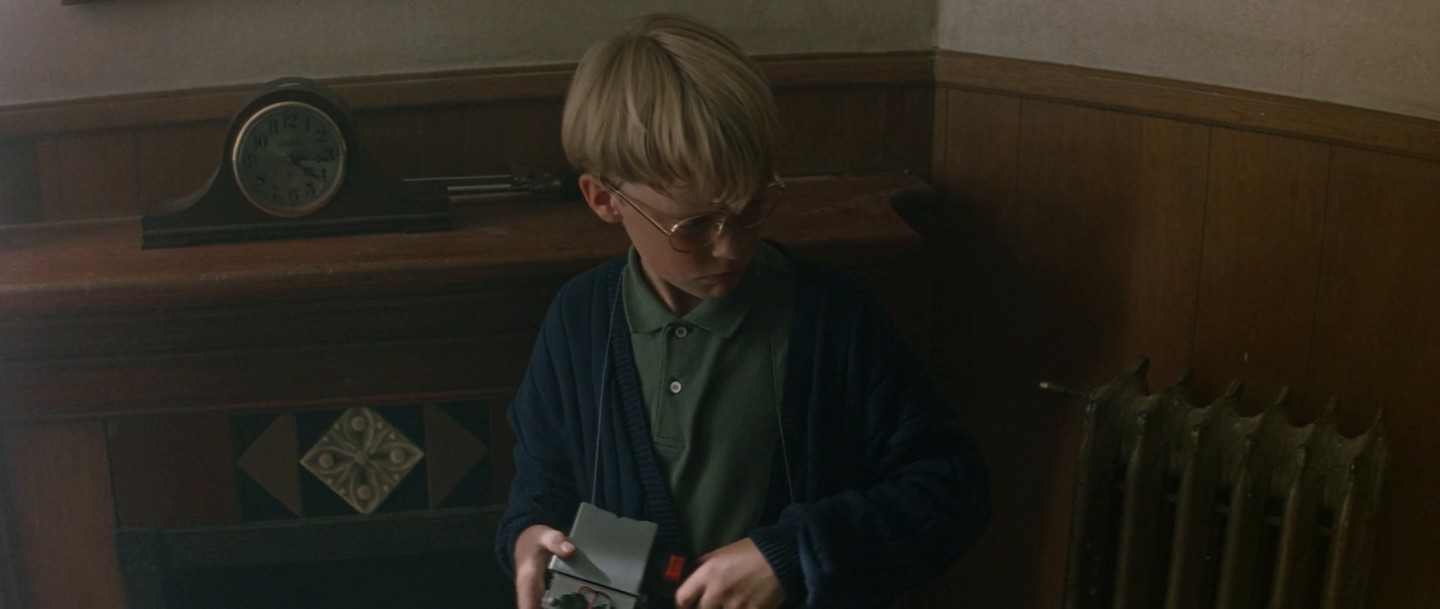
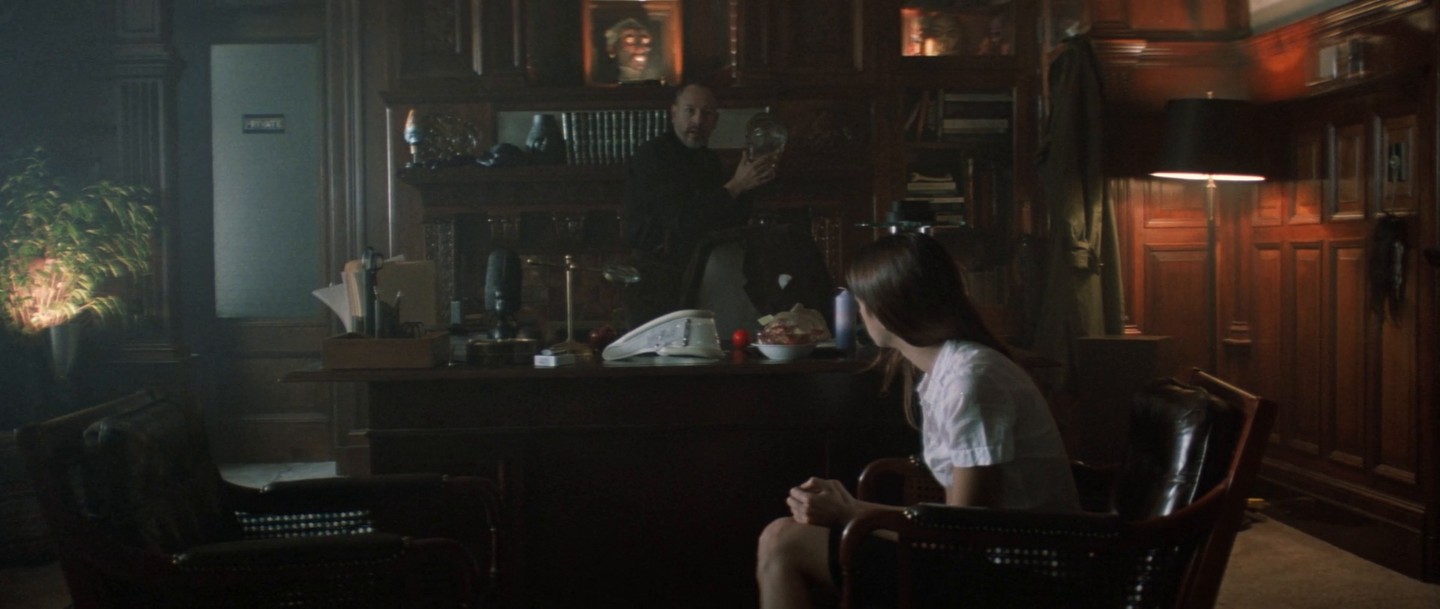
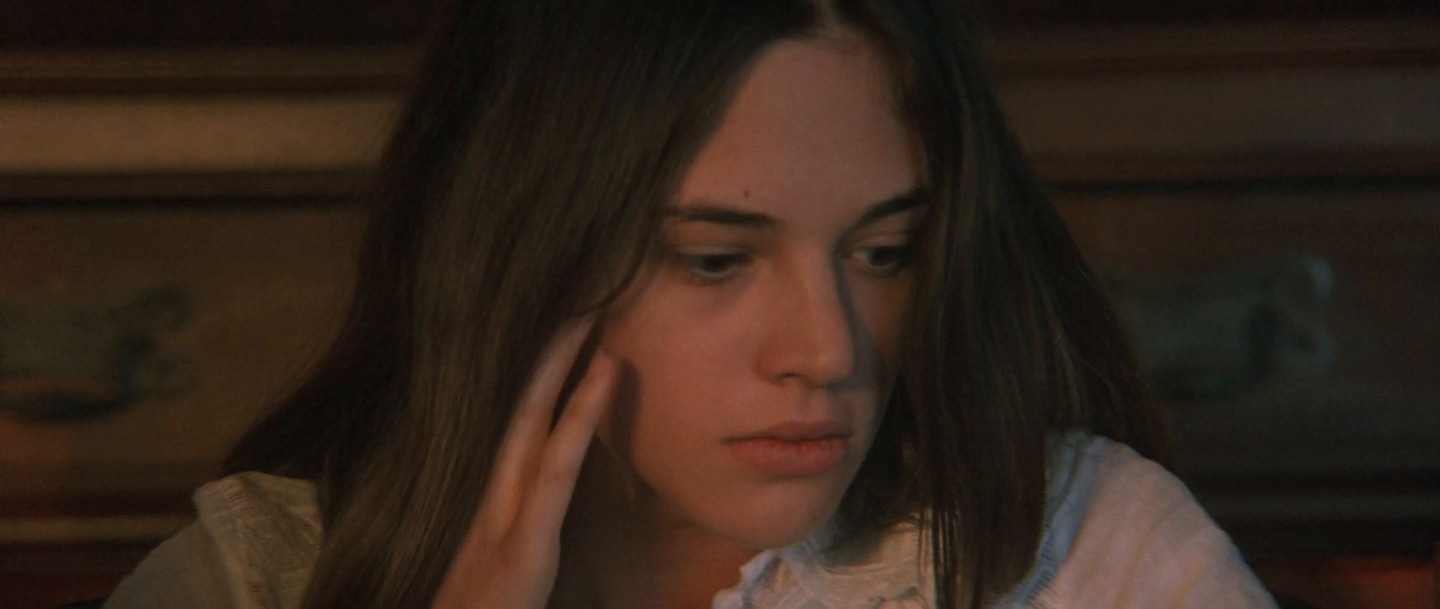
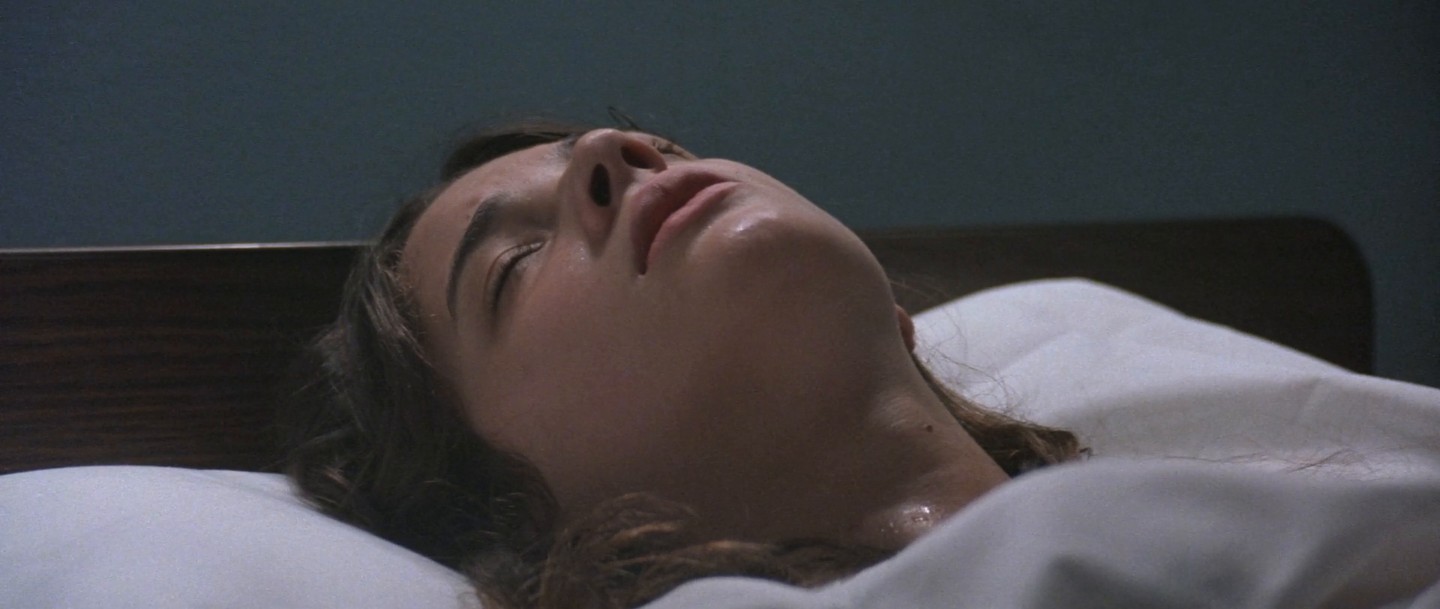
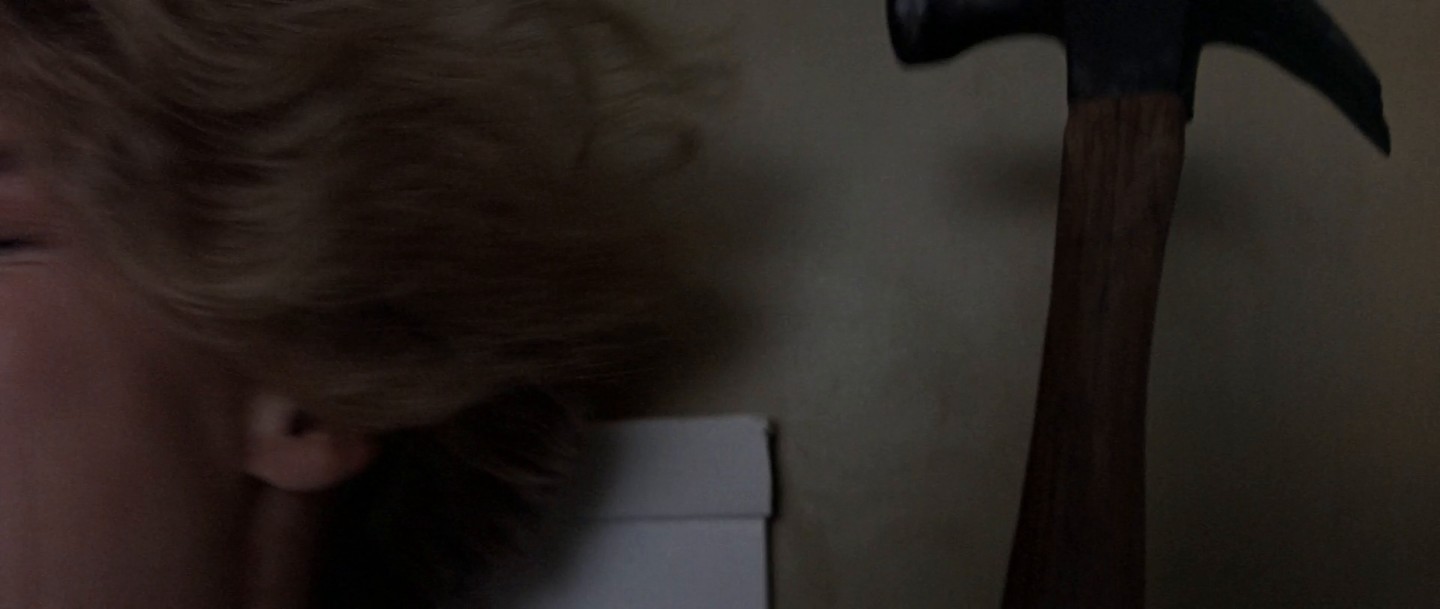
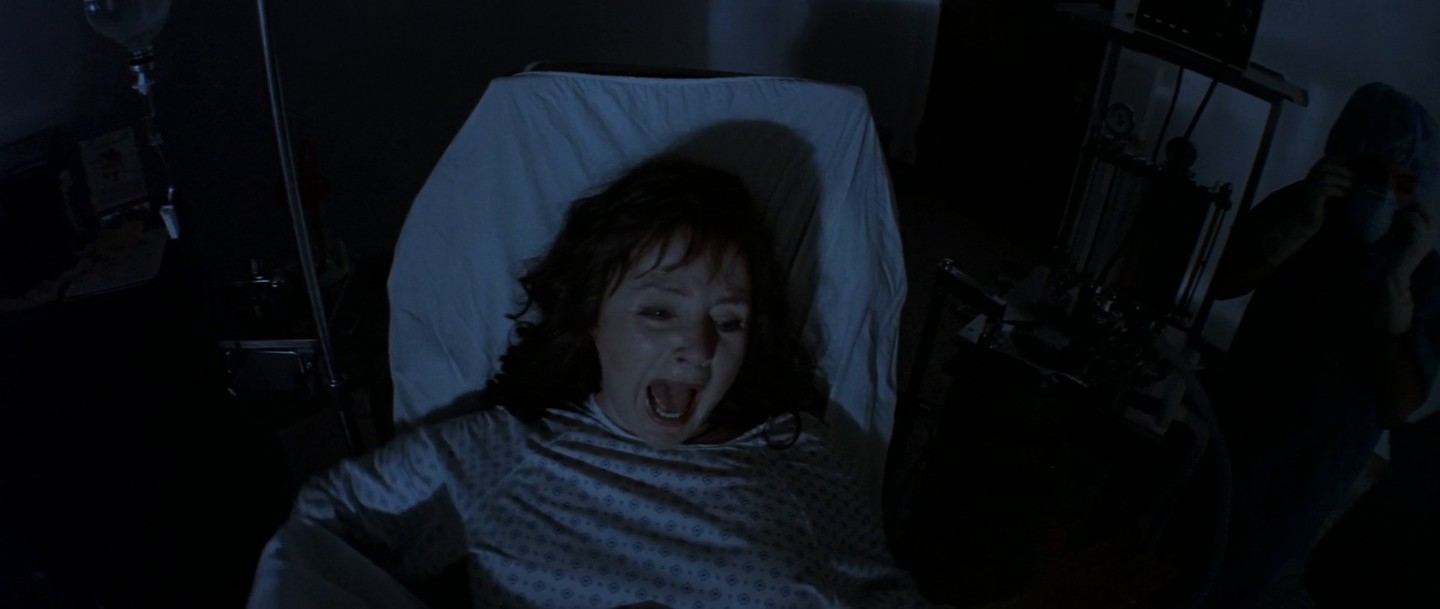
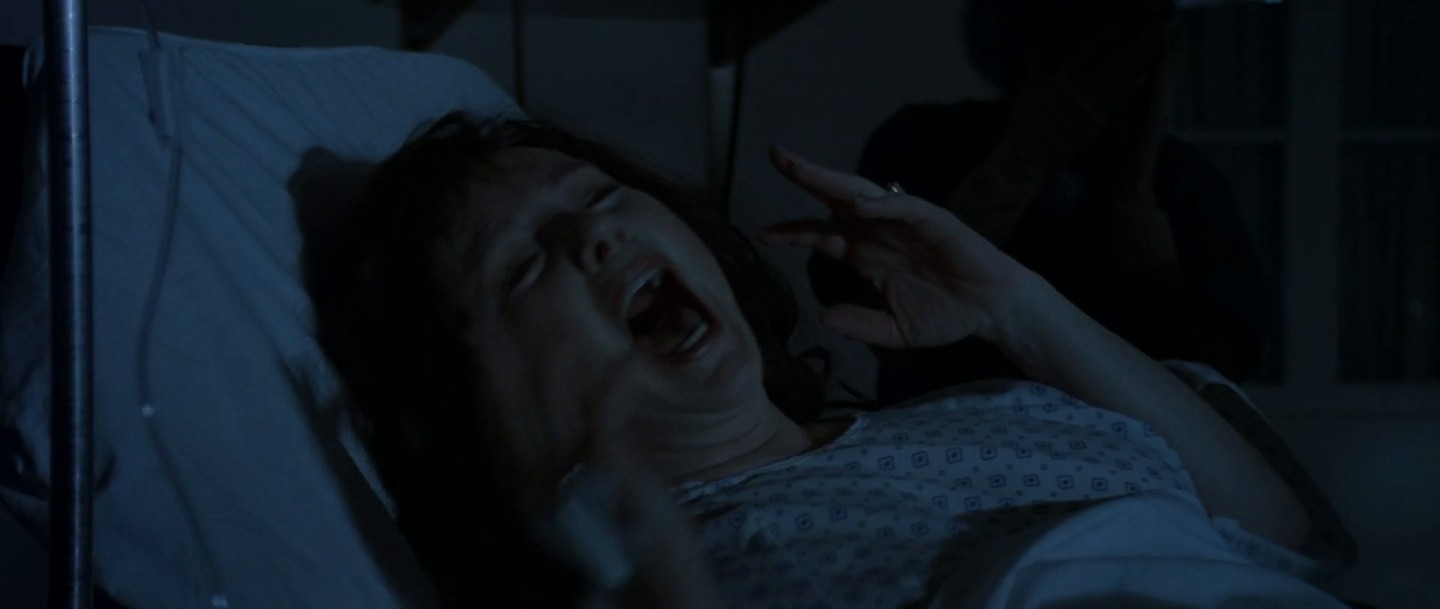
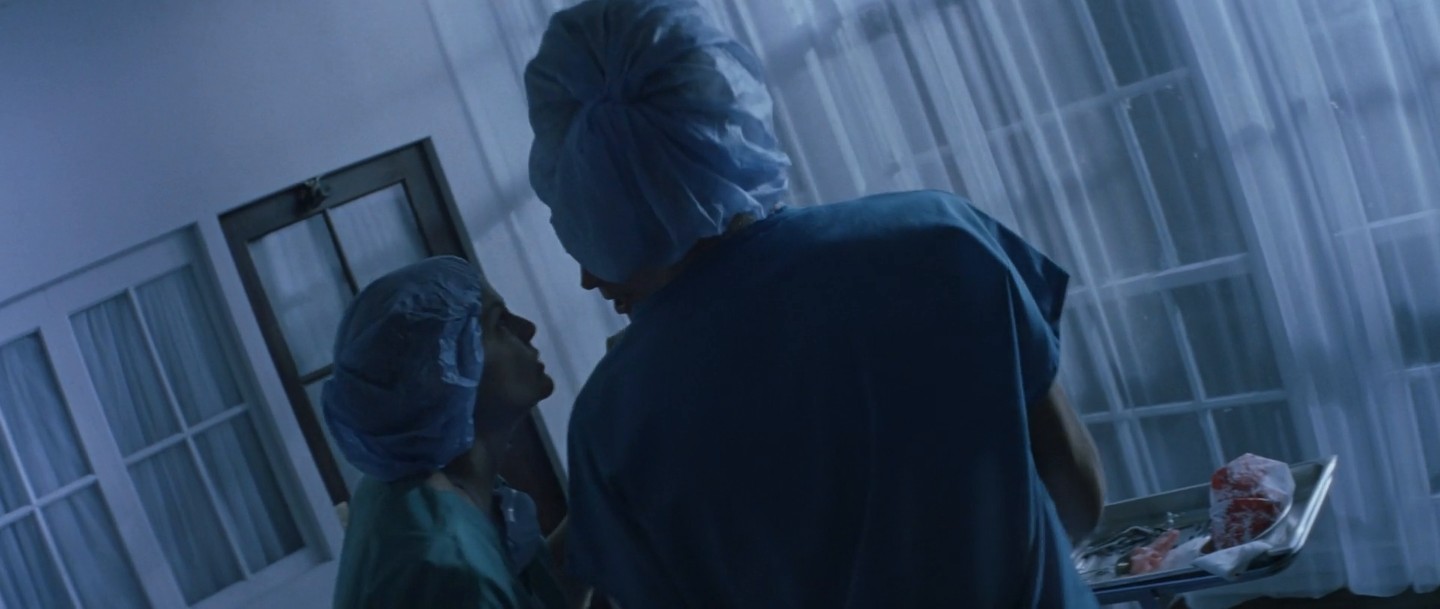
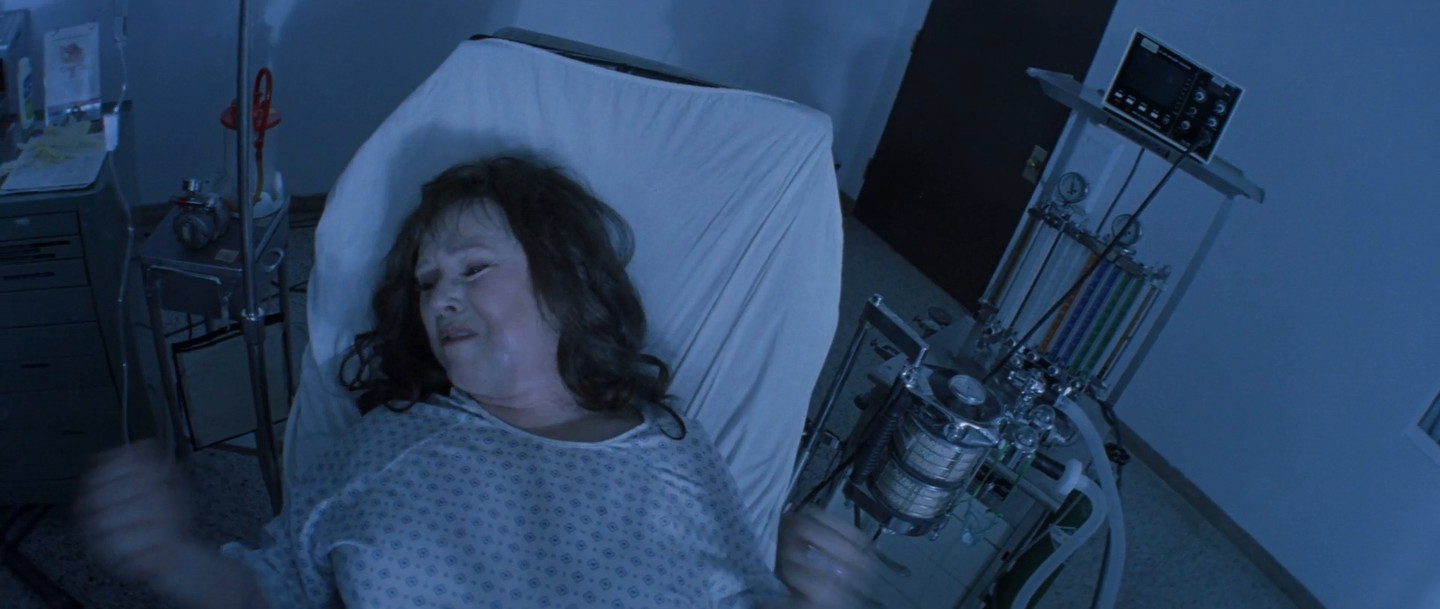
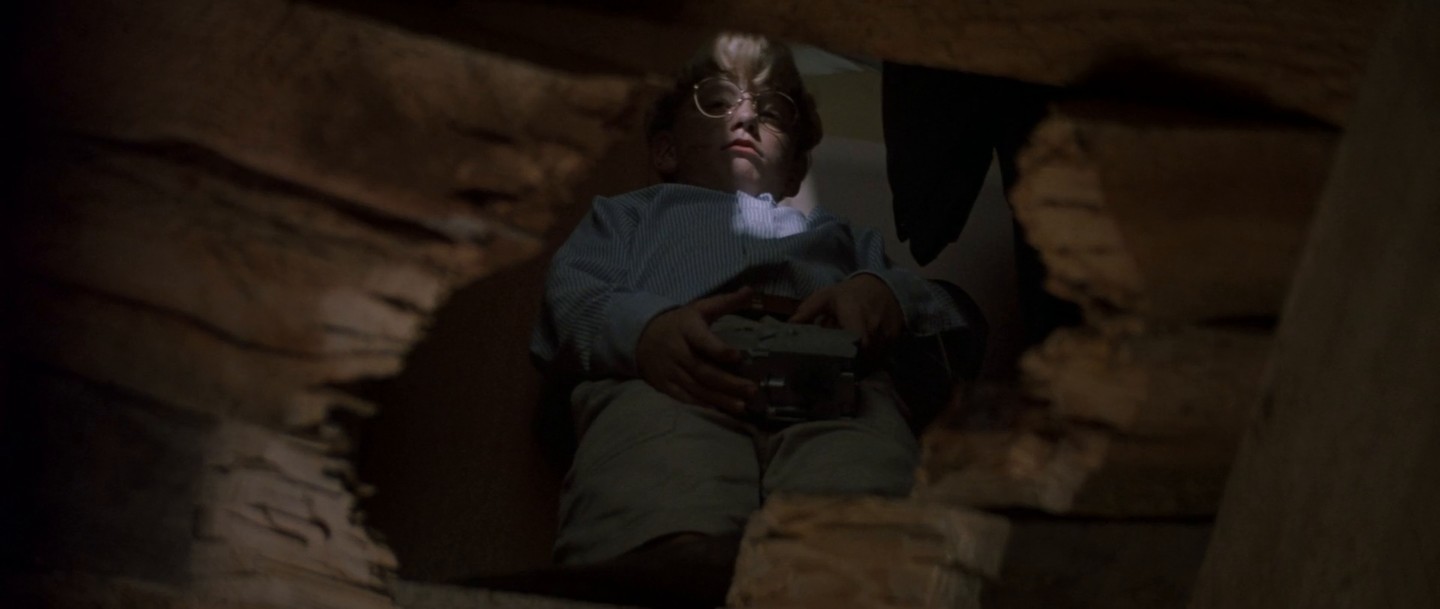
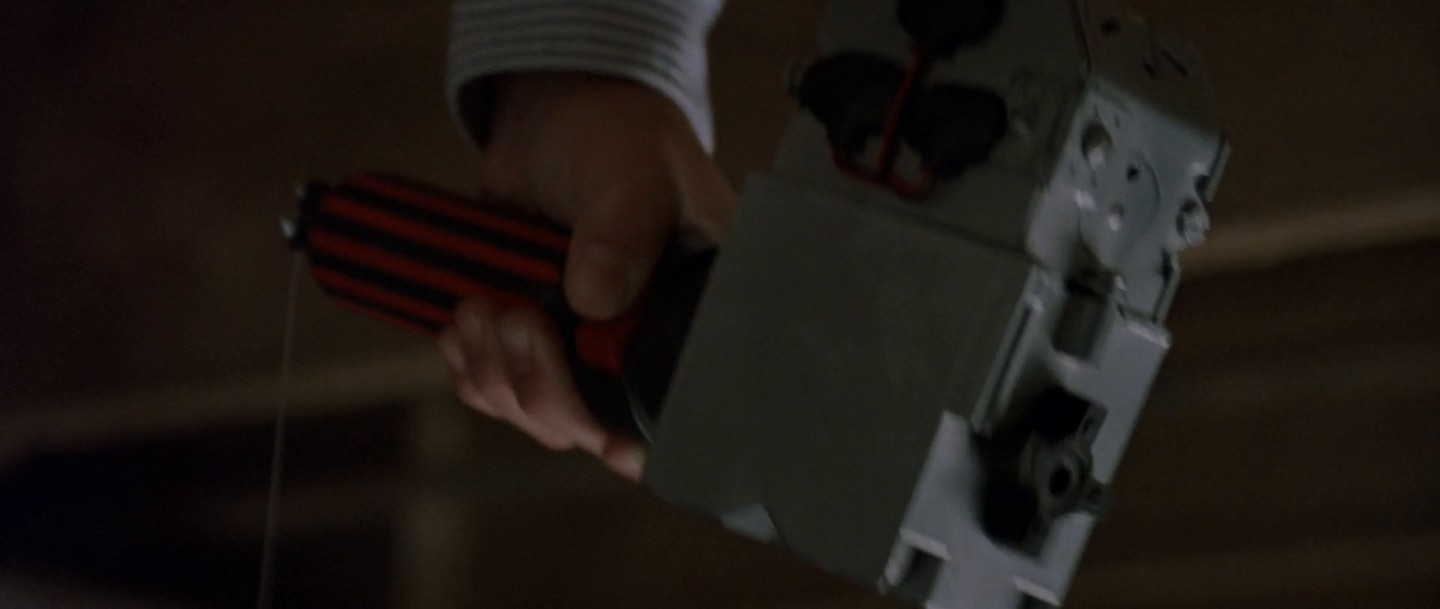
Thirty illustrated studies follow Aura through the family house, clinic, motel and basement. Explore the images in sequence, open a closer effects study, or trace a visual idea across the film.
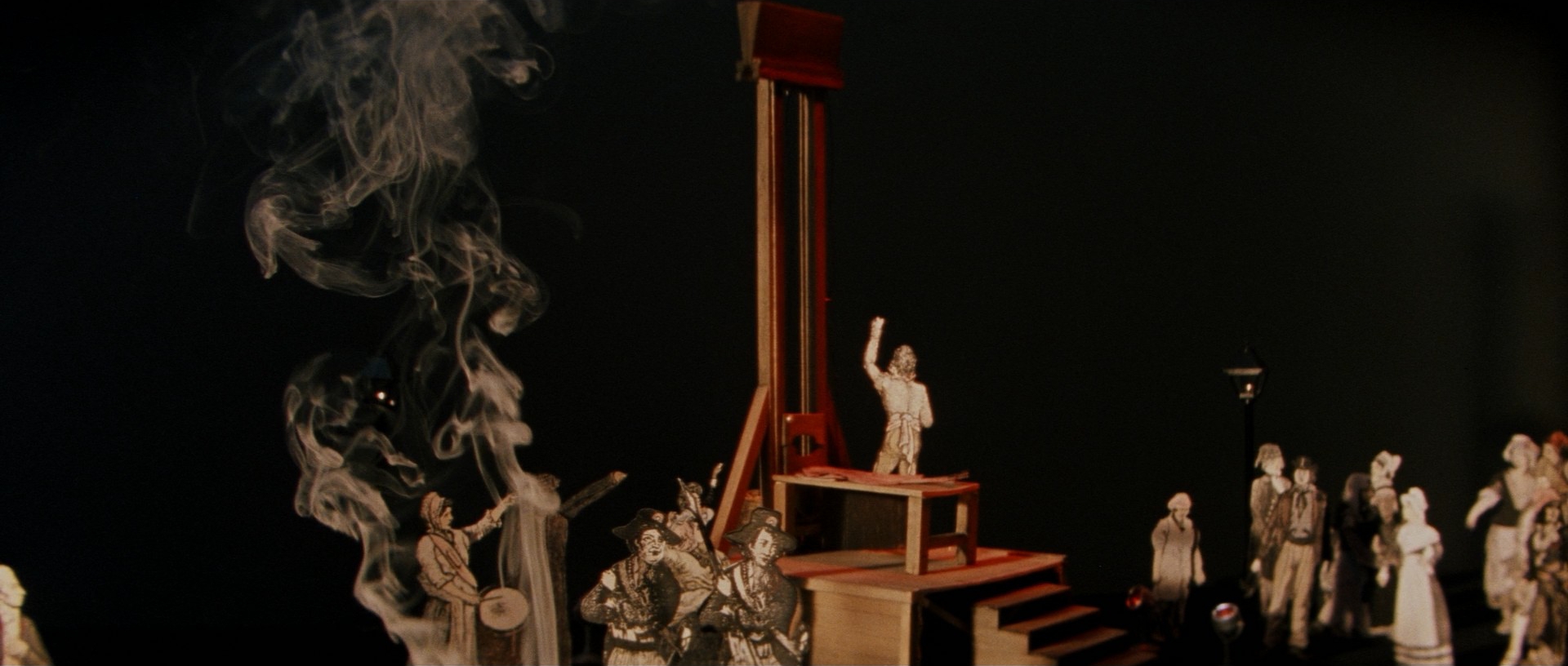
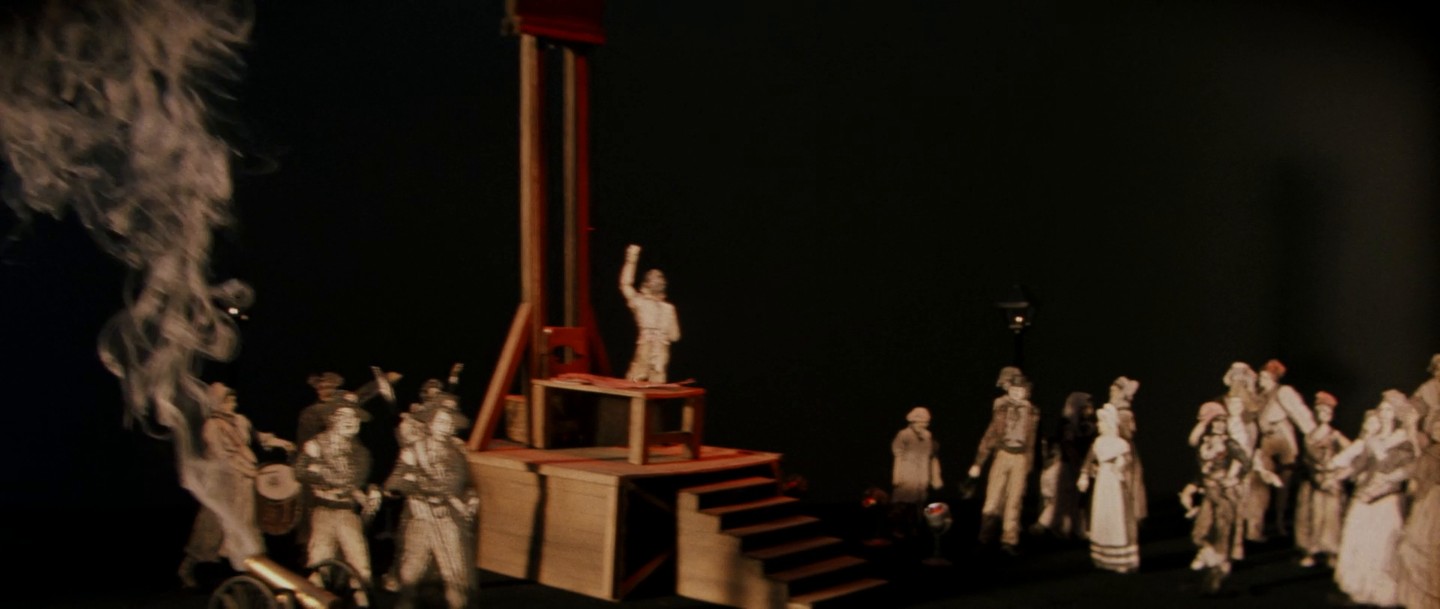
ENLARGE ↗The miniature execution awaits its audience.
Before the first contemporary murder, the film presents an execution in miniature. The little crowd, platform and blade make death an organised spectacle. This opening gives the later discoveries a visual vocabulary before it gives them an explanation.
03:08
The consulting room
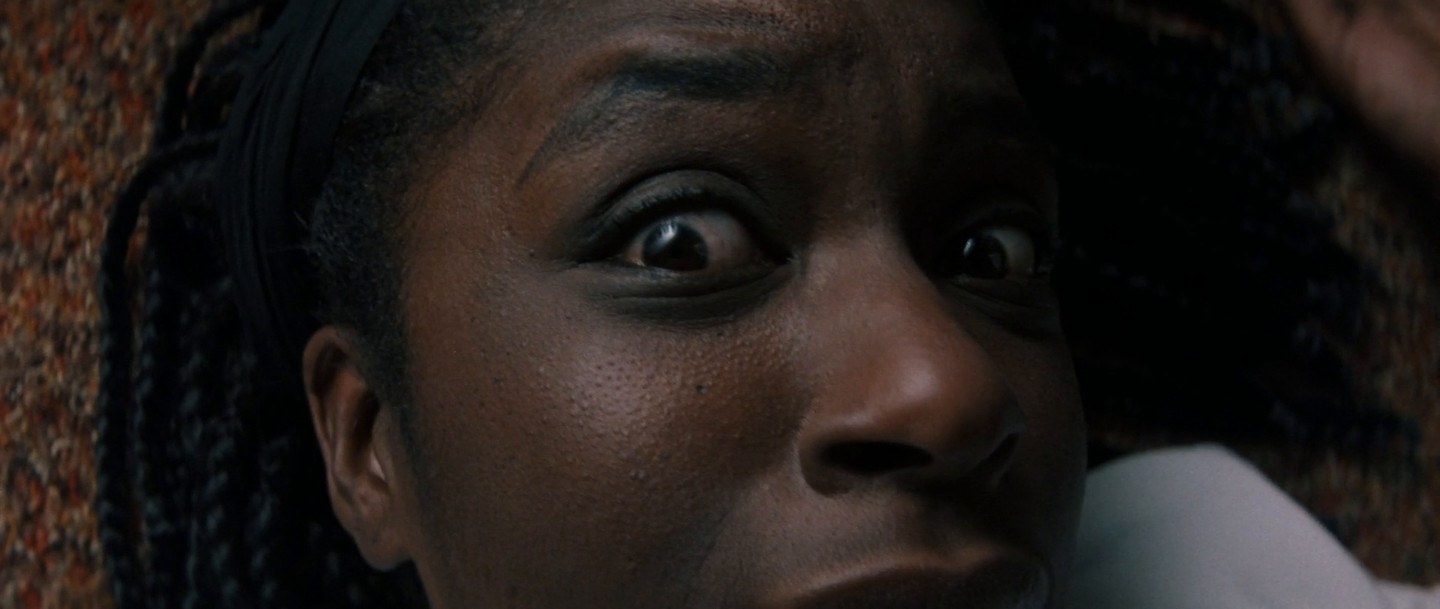
ENLARGE ↗Georgia Jackson turns towards the threat.
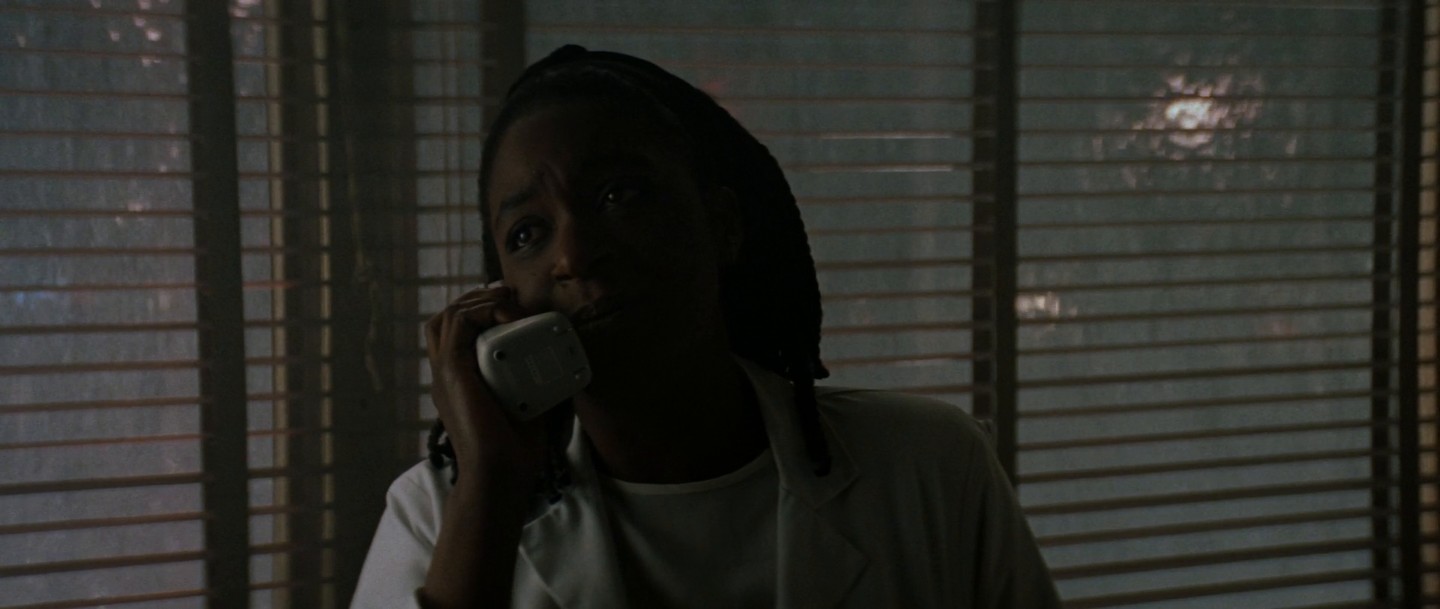
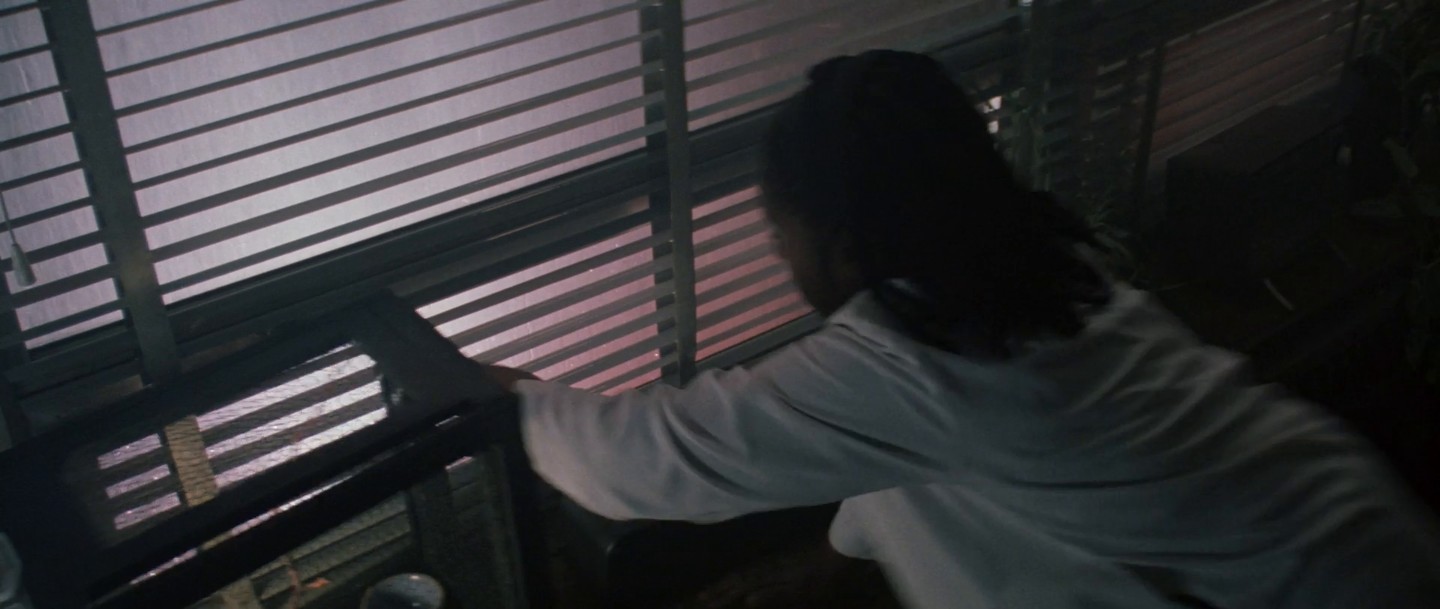
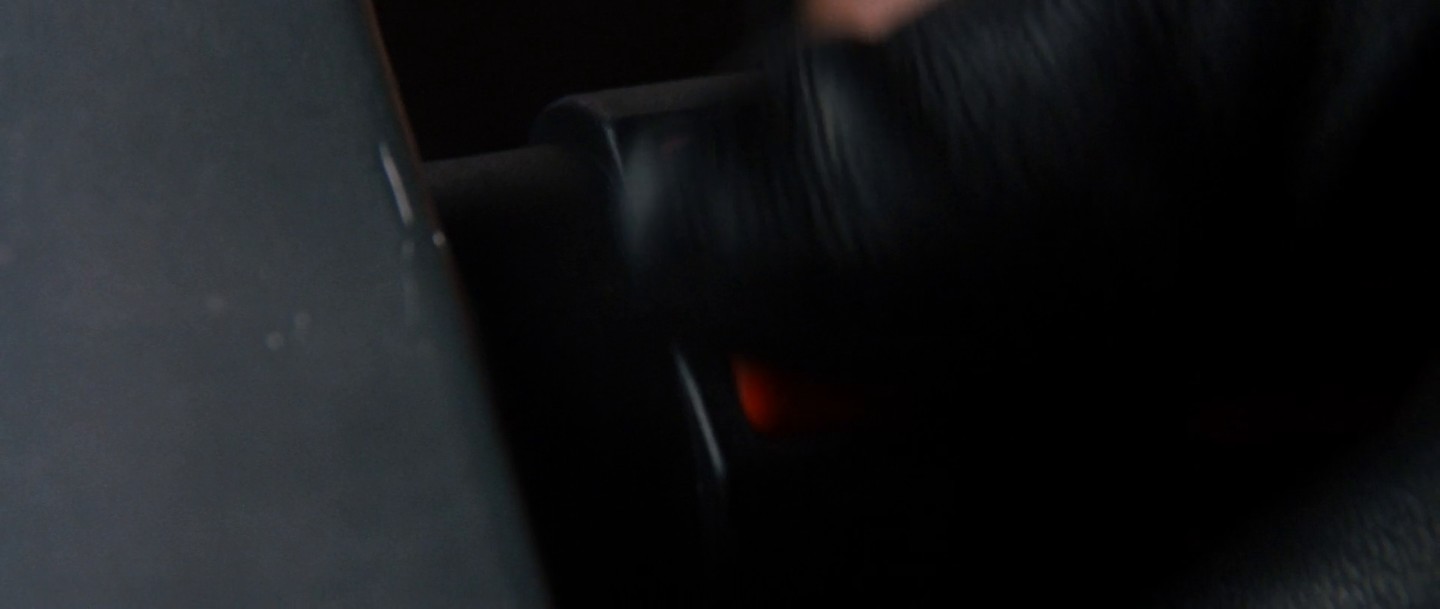
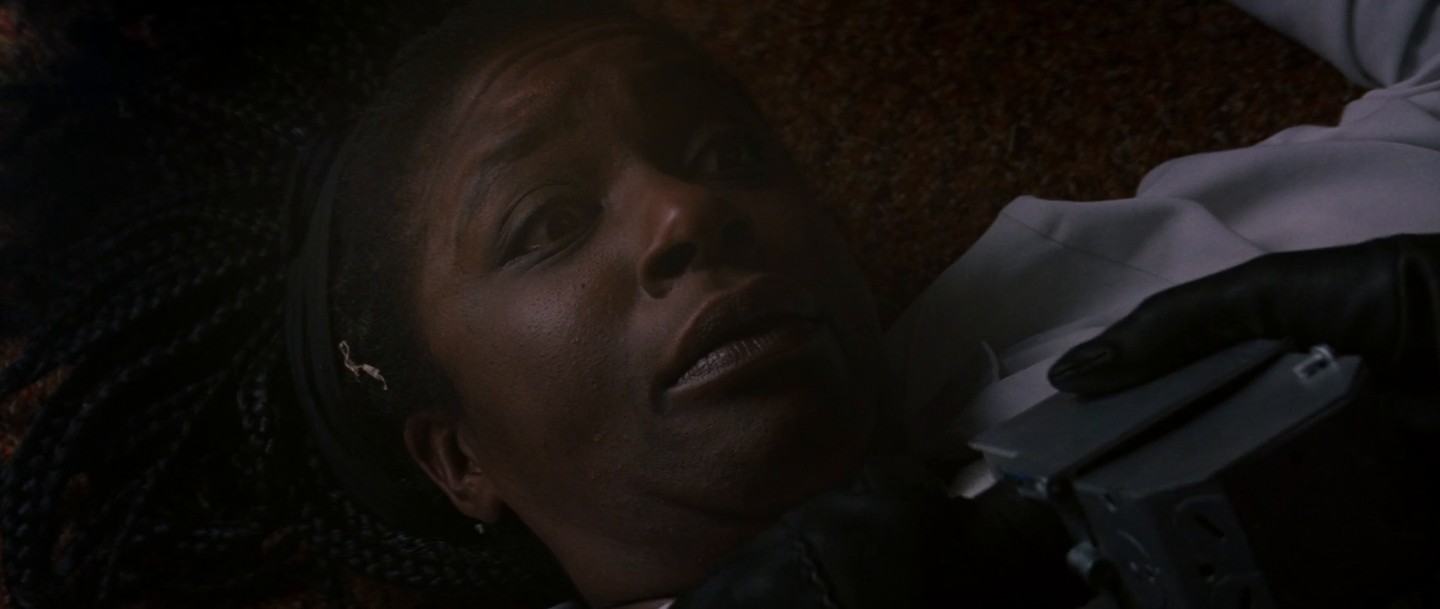
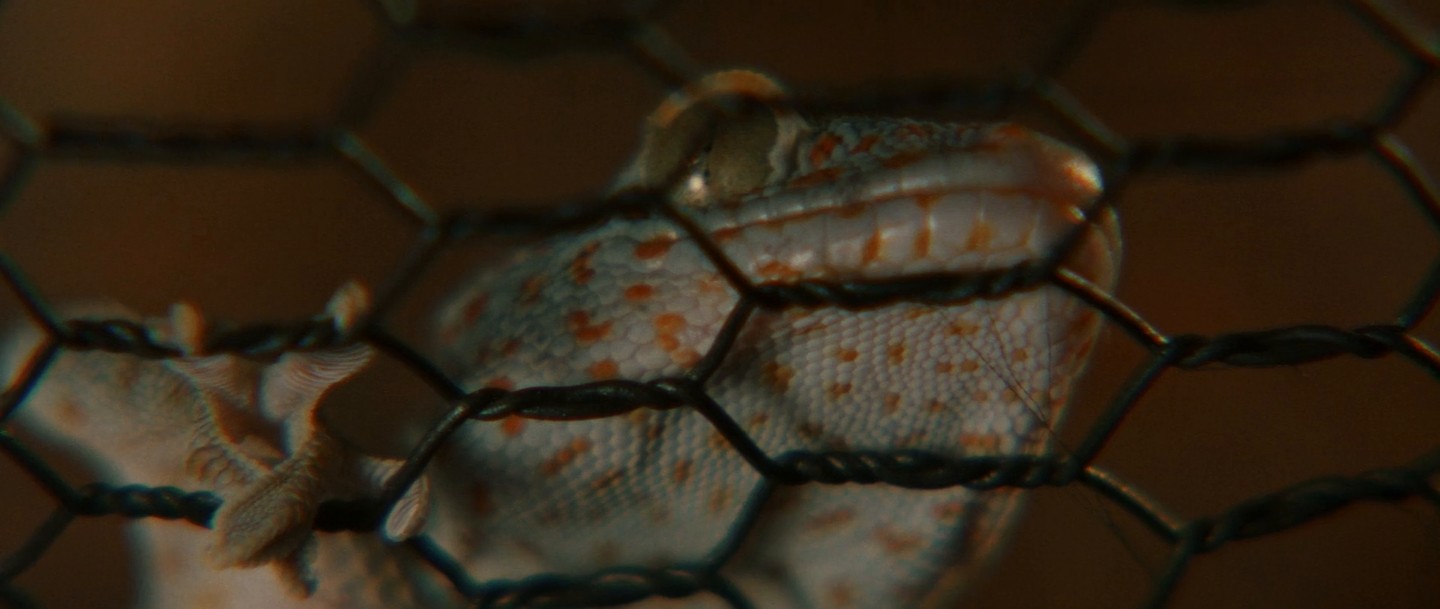
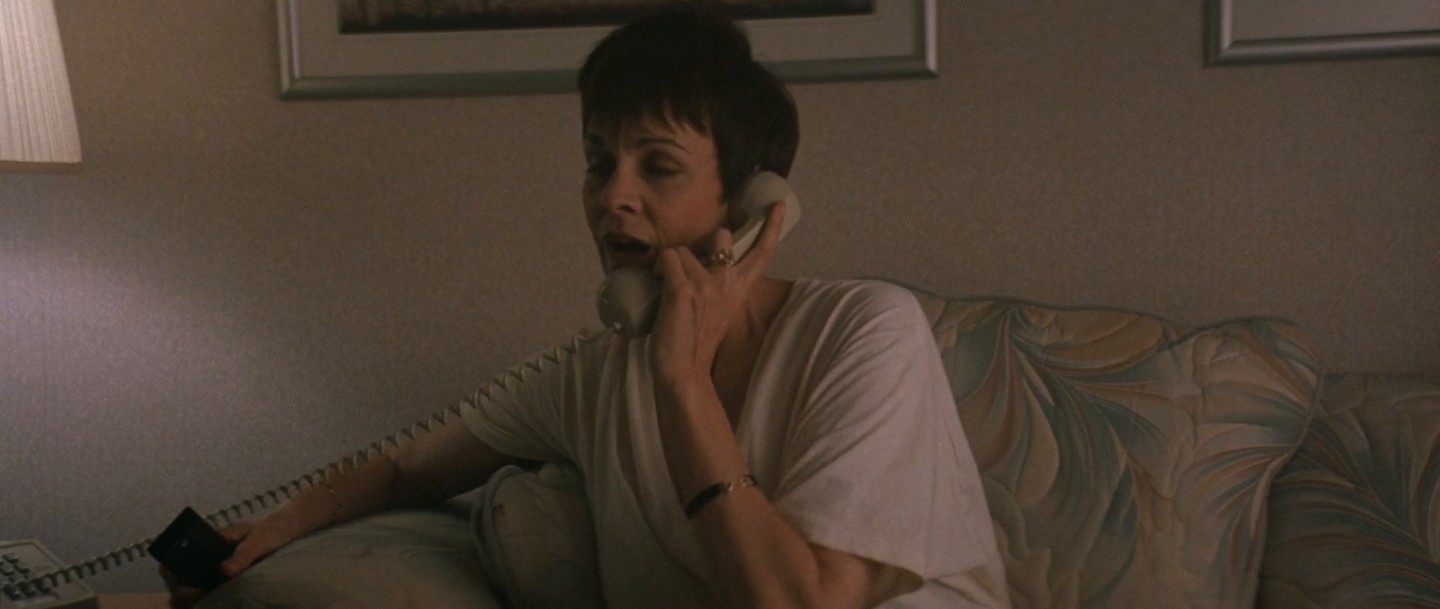
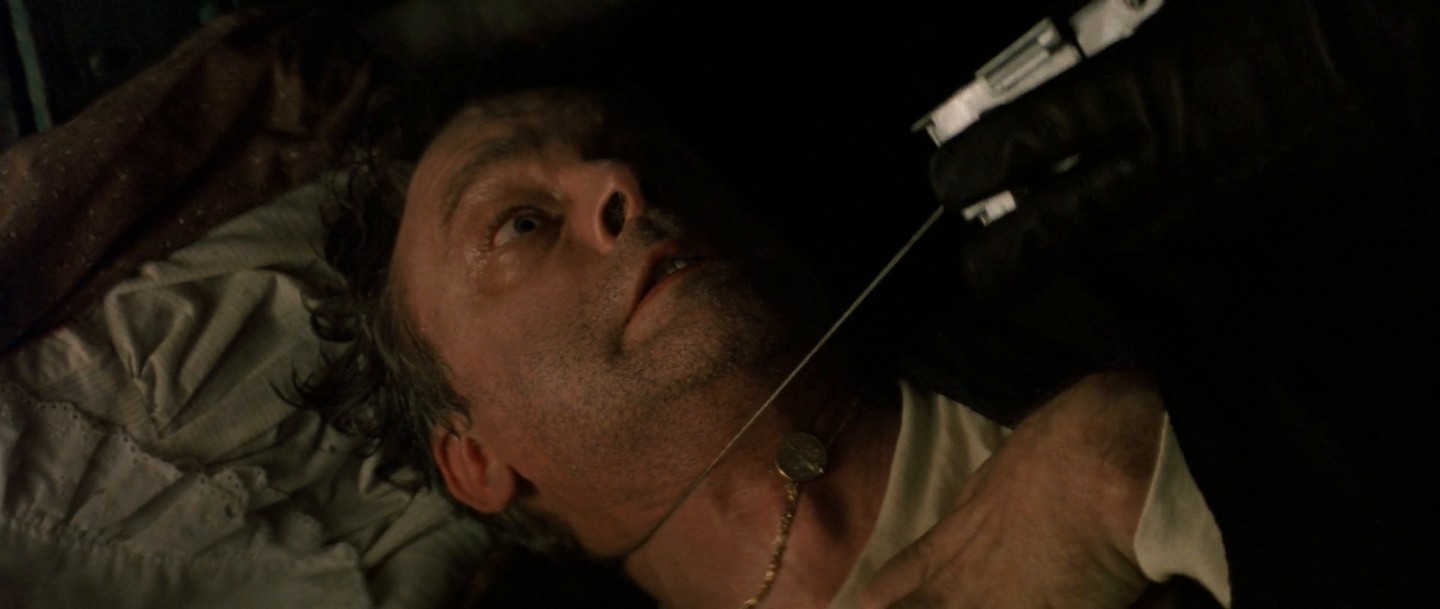
A telephone, venetian blinds and a reptile enclosure furnish an ordinary working room. The attack breaks that room into face, hand, switch and wire. The weapon is introduced as an object with visible moving parts, not simply a flash of steel.
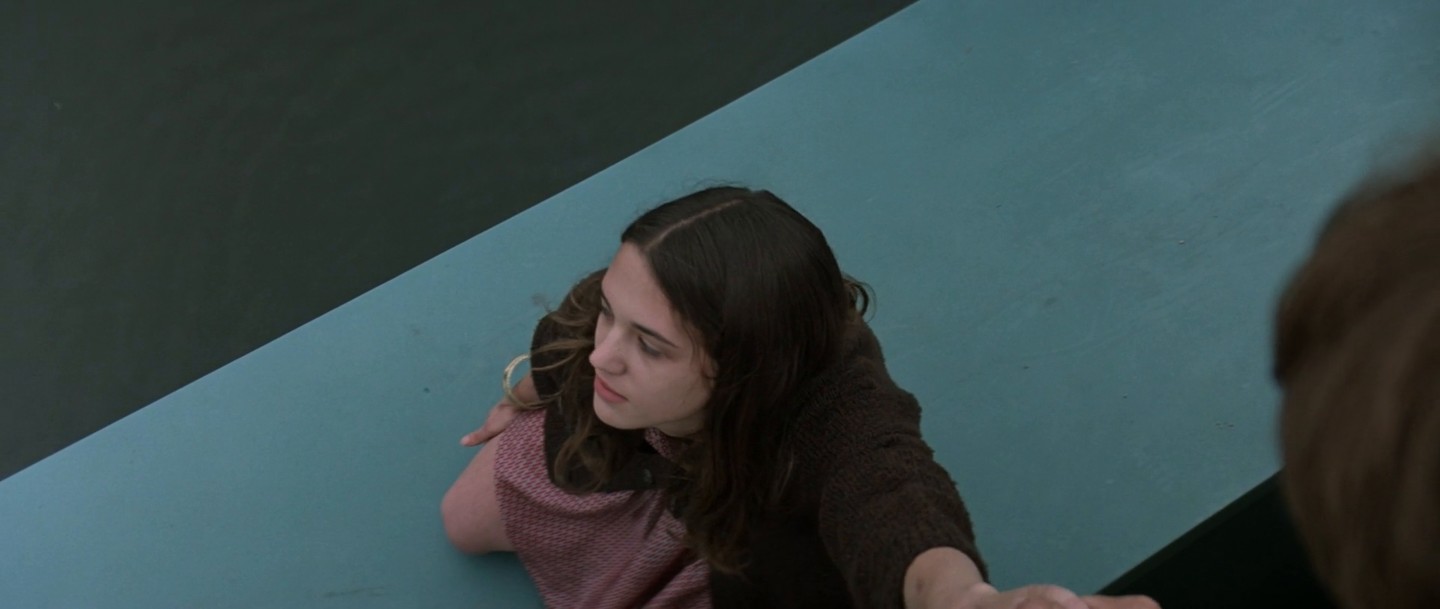
ENLARGE ↗David reaches towards Aura at the bridge.
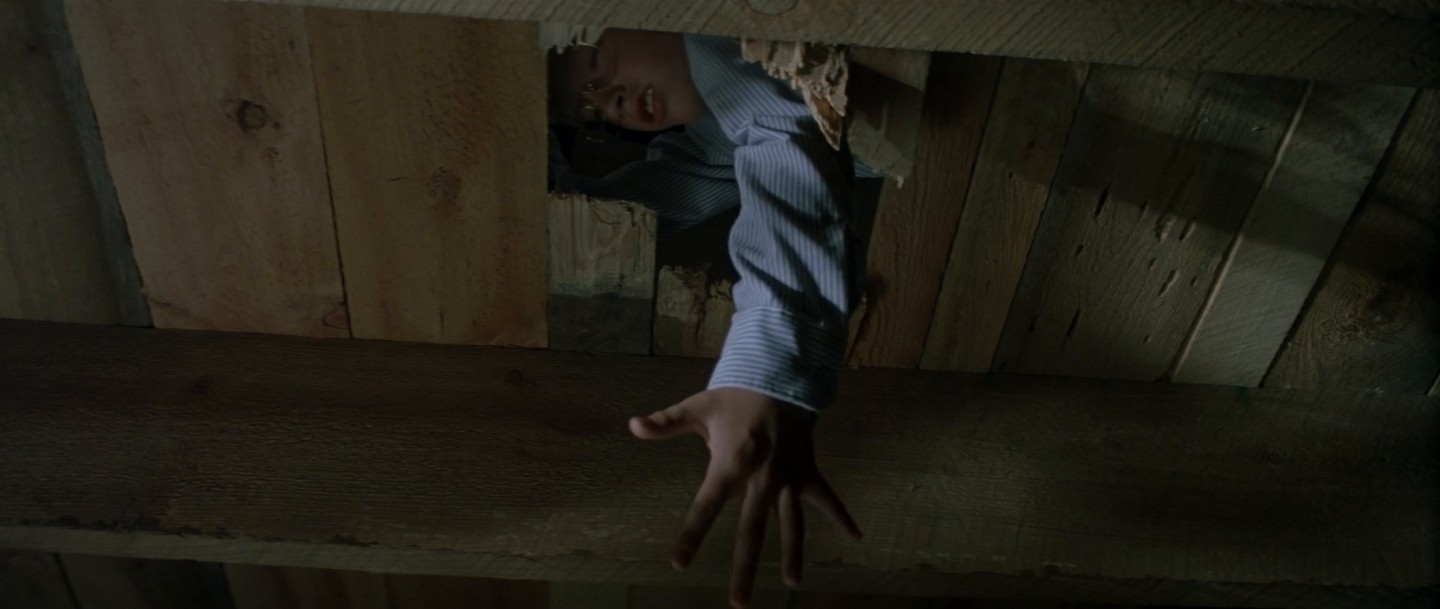
The encounter begins with an unstable division between safety and a fall. A reaching hand establishes the relationship before the two characters know one another. Protection will remain difficult to separate from restraint throughout Aura’s story.
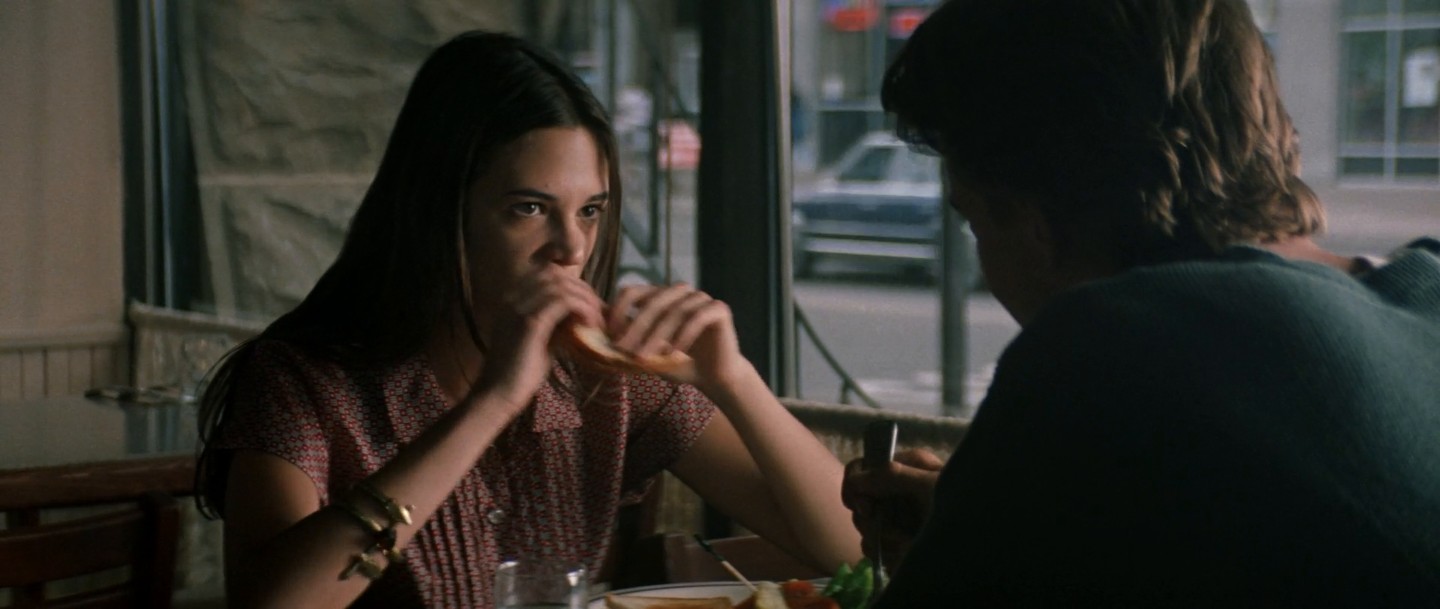
The shared table offers a quieter arrangement than the bridge, but it does not erase the distance between them. Alternating faces give Aura room to look back at the man who has intervened. The film’s central problem—who can speak for her—begins inside an apparently helpful encounter.
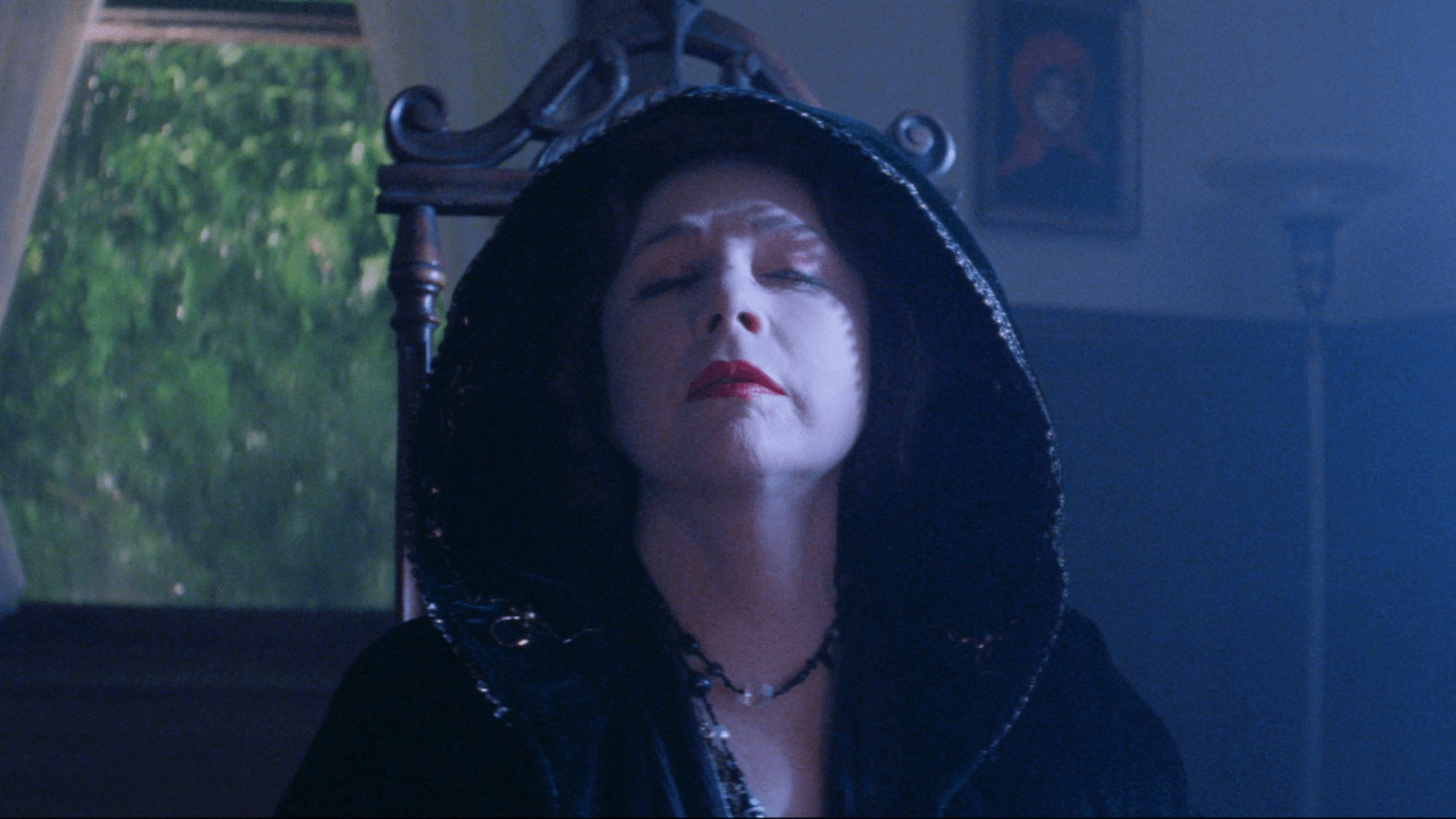
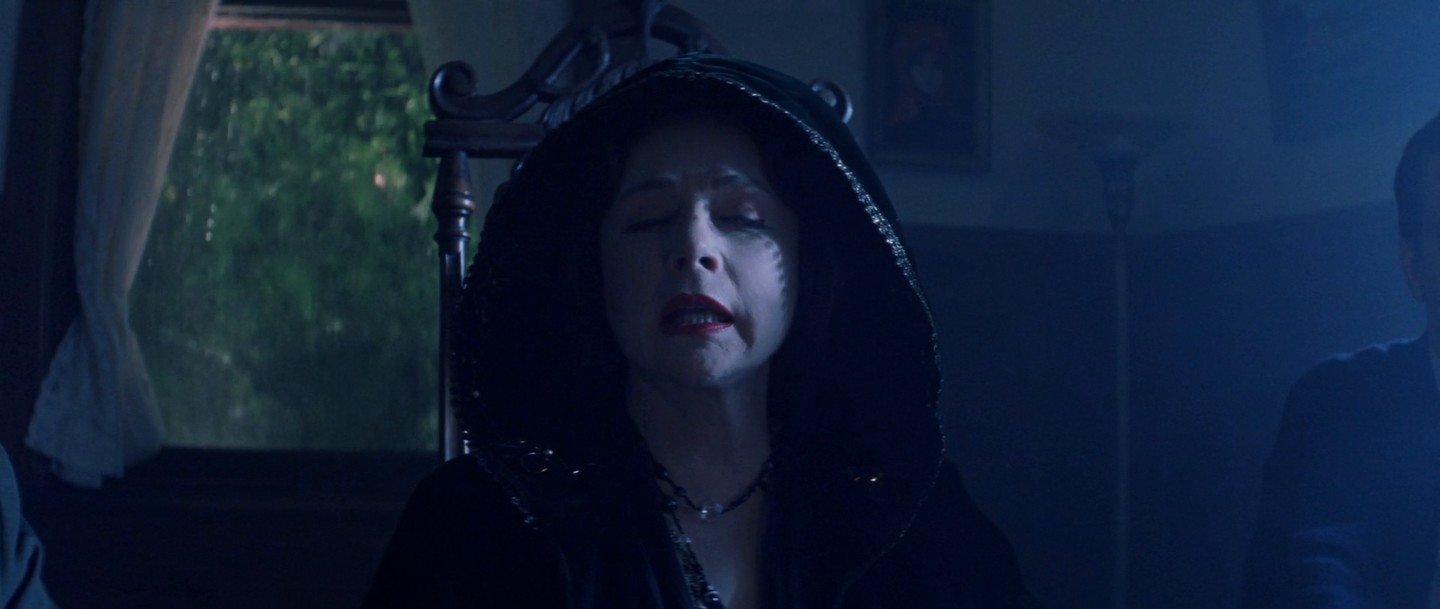
The hood concentrates attention on Adriana’s face while the surrounding room supplies spectators. Hands and reaction shots make the séance a collective act of watching. It is also a rehearsal for the deceptive spectacle that will be staged outside.
16:33
A witness in the storm
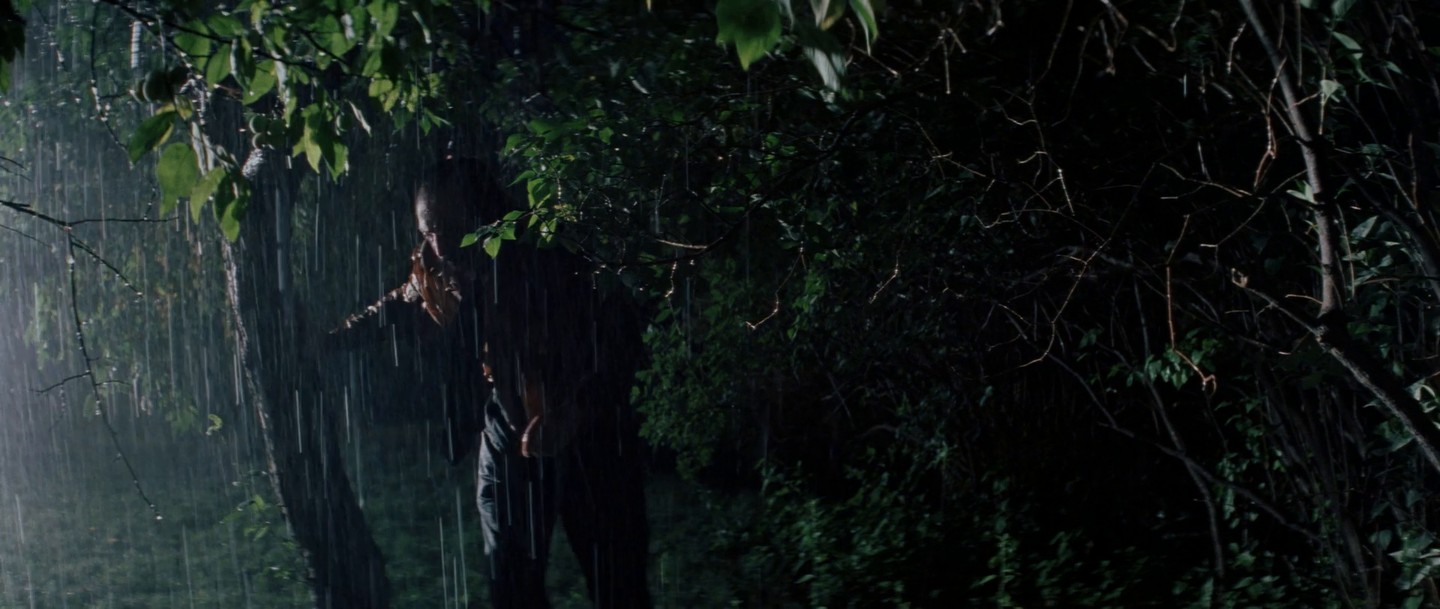
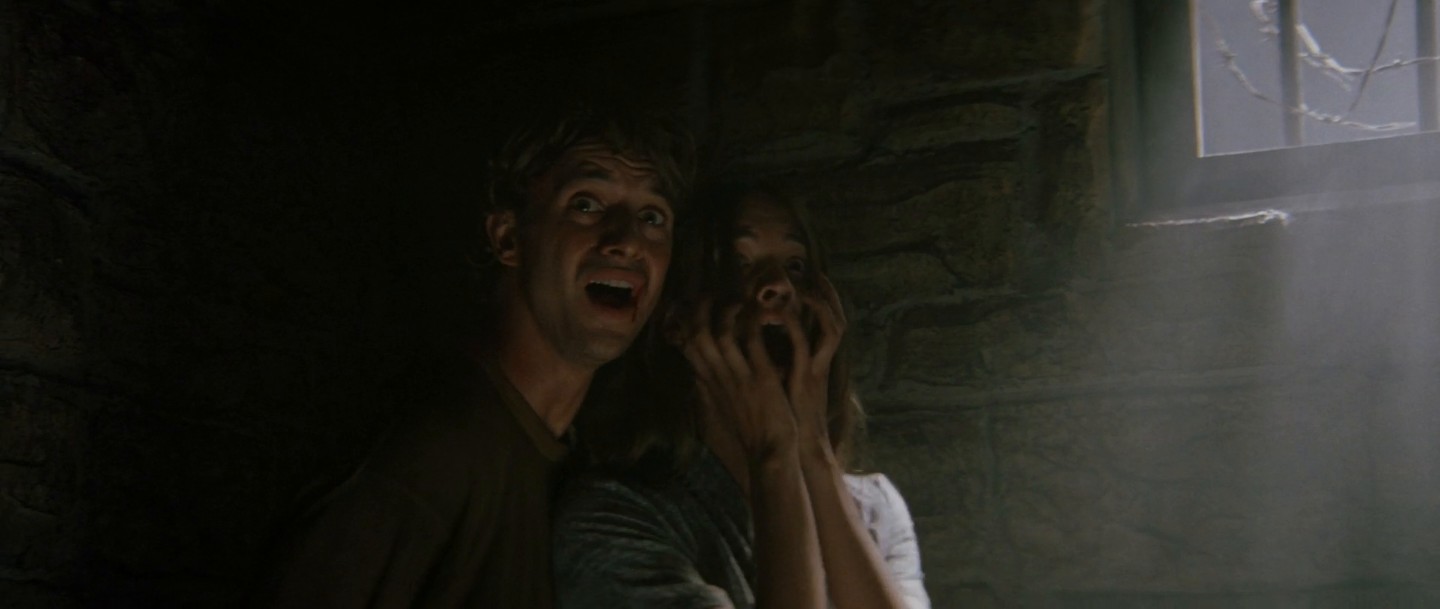
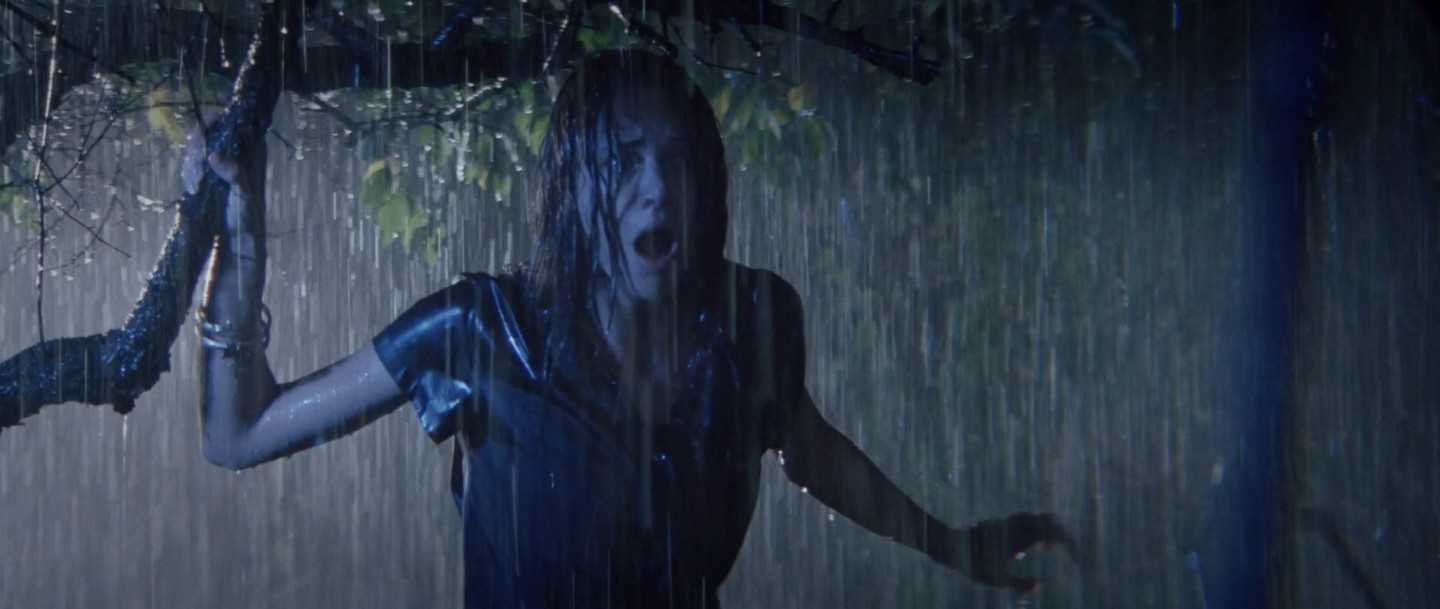
ENLARGE ↗Aura confronts the figure beyond the branches.
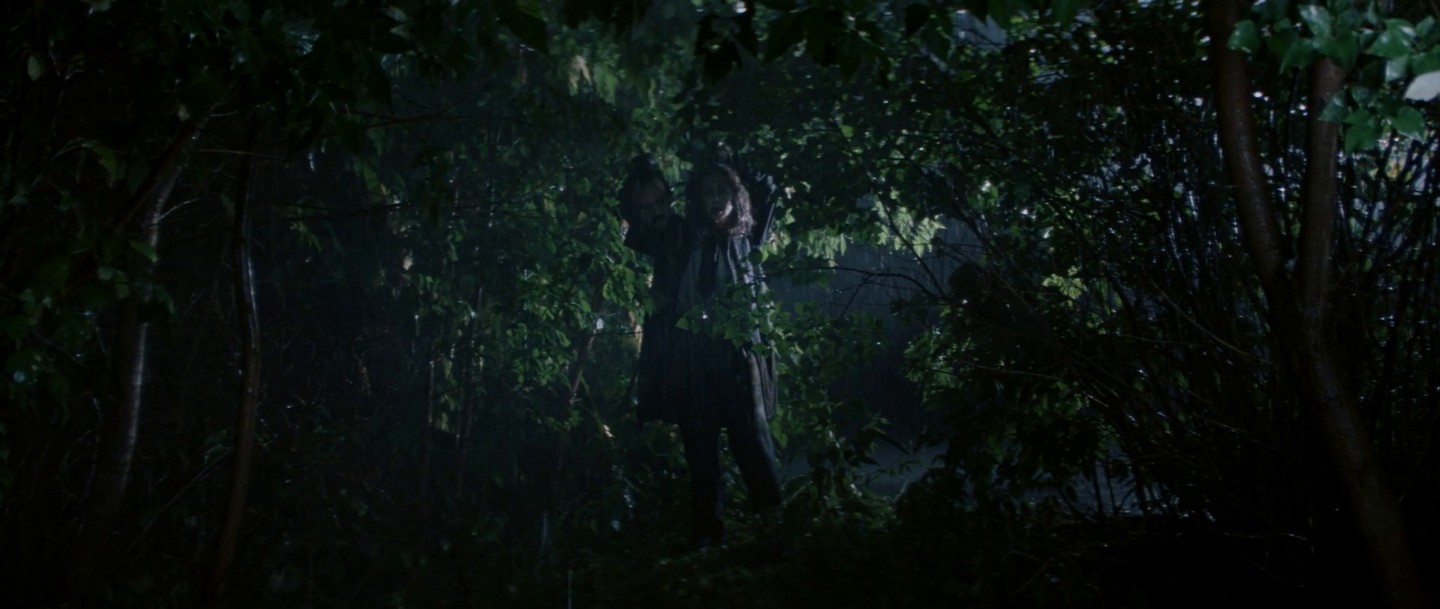
Rain and branches divide the view; flashes of light make the sighting intermittent. The cuts give Aura’s reaction a clarity the distant figure does not receive. What she sees will survive, while the explanation attached to it will have to change.
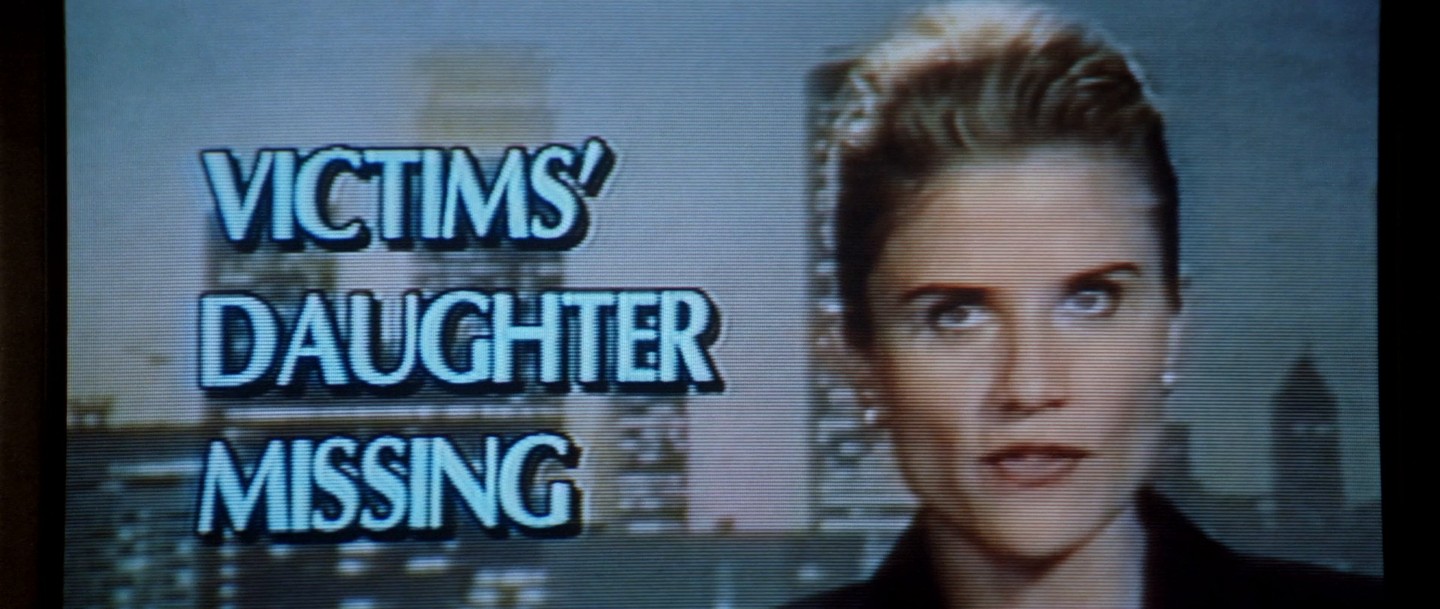
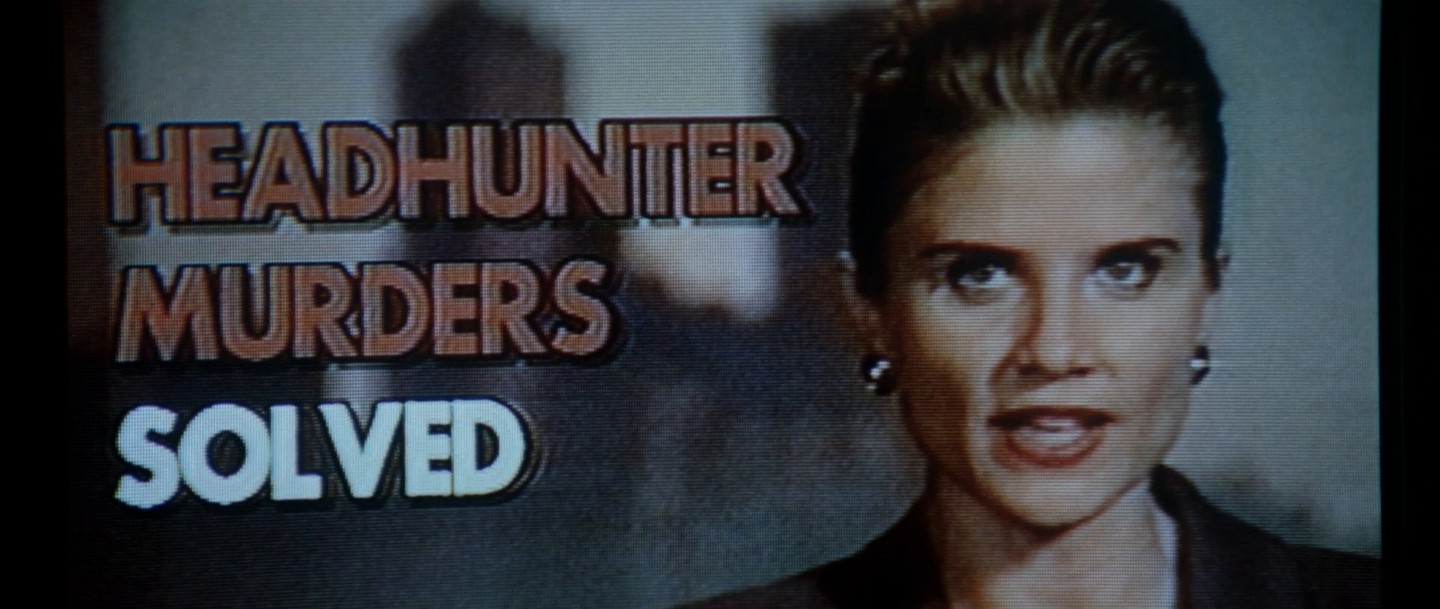
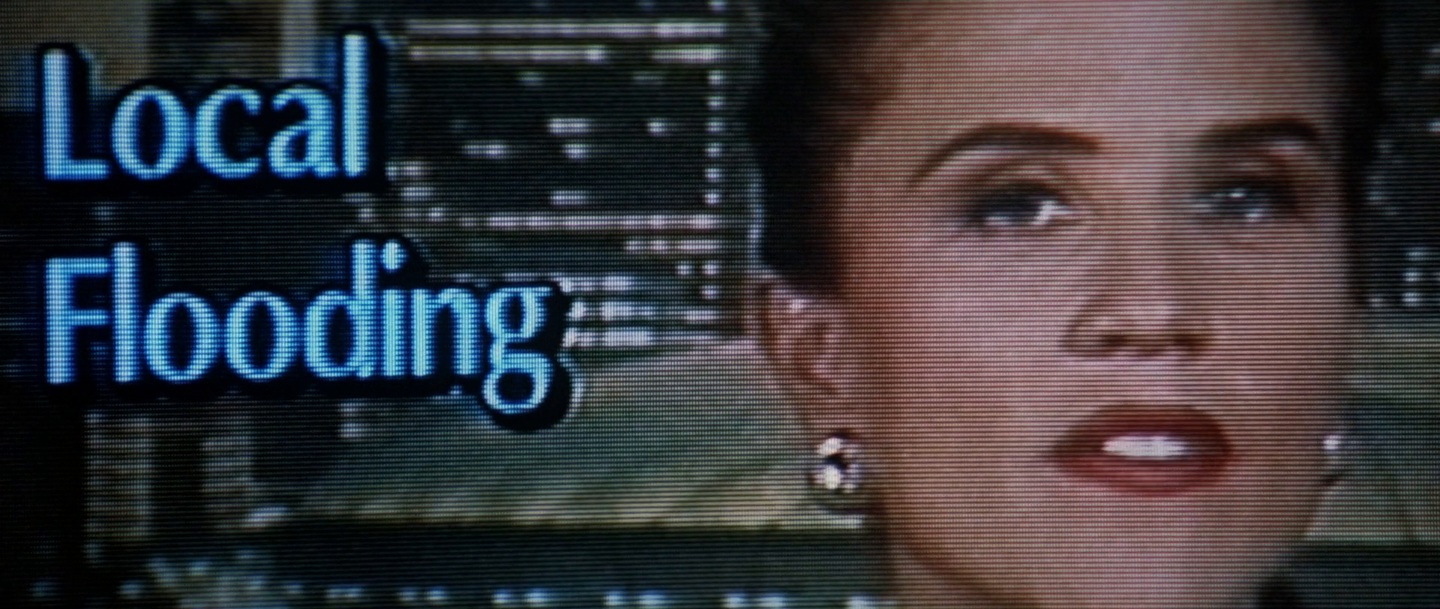
ENLARGE ↗The television reports the missing daughter.
A broadcast turns Aura into a public image while she remains a person hiding in a room. The caption compresses the uncertainty of the night into an apparently settled category. Television repeatedly offers a completed story before the film has earned one.
26:15
Back to the séance table
ENLARGE ↗Candles mark the return to the family room.
Returning to the house changes the room from a site of performance into a place to search. Familiar furnishings can now be examined without the original audience. Investigation begins by revisiting the arrangement, rather than simply collecting a new suspect.
The child’s pursuit of a small animal gives him a different route into the neighbouring house. His scale and curiosity let him encounter things the adults overlook. The film gradually makes this apparently marginal observer essential to its resolution.
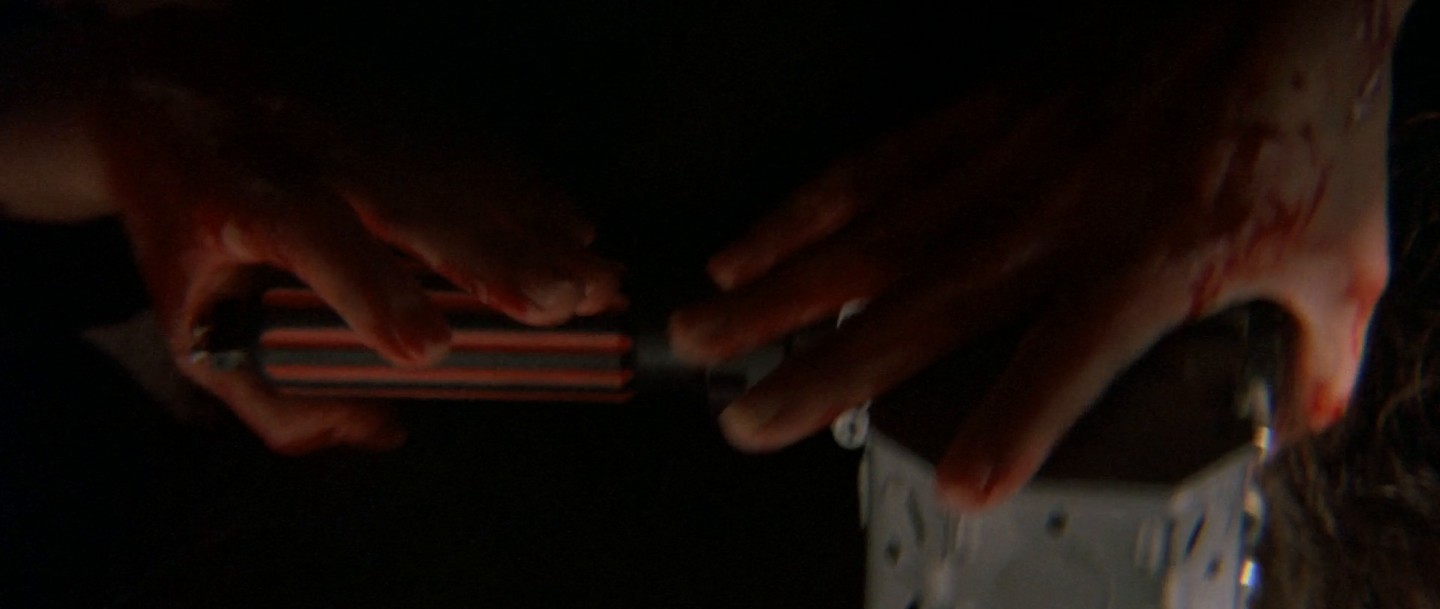
The small apparatus invites the child to investigate its workings. What he can handle as a curious object has already been introduced to the spectator as a weapon. That difference in knowledge turns the encounter into a threat before another attacker appears.
Judd’s authority is expressed through the enclosed room and his control of the encounter. Aura’s face becomes the object of sustained scrutiny. The scene belongs beside the family’s demands and the clinic’s restraints: each gives an adult a reason to take possession of her account.
The questioning gives way to hallucinatory images that disturb the room’s stable arrangement. This departure makes the encounter an assault on perception as well as an exercise of authority. It is a separate kind of effect from the prosthetic injuries: the image itself becomes unreliable.
The bed, drip and straight corridor promise an ordered environment. Yet the patient’s fixed position and the doors around her restrict what she can know. The place that should protect her supplies another structure of confinement.
56:53
A cap falls first
ENLARGE ↗Hilda is struck beside the hospital door.
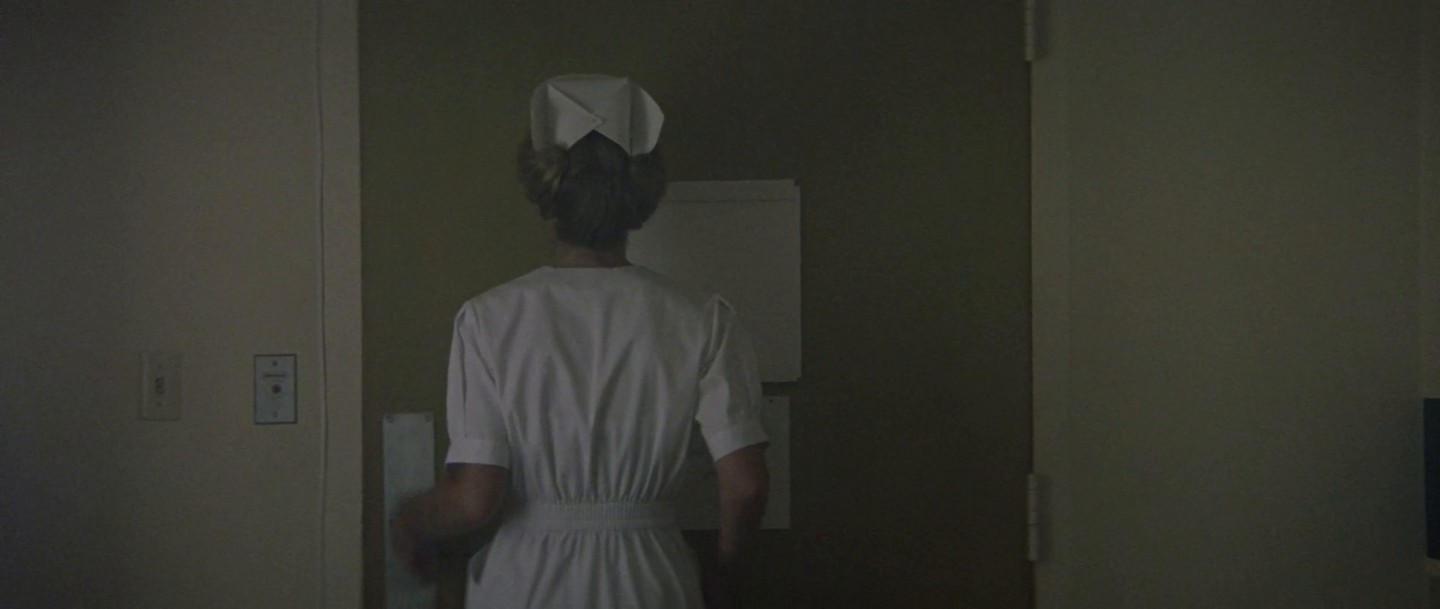
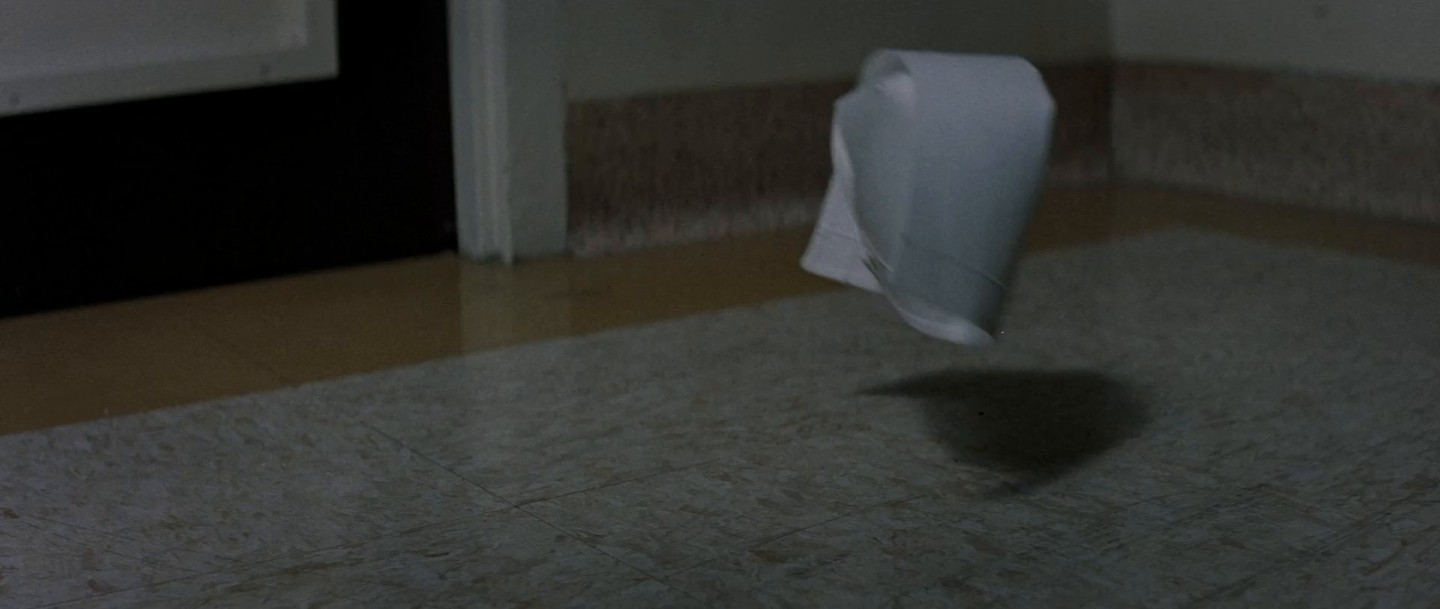
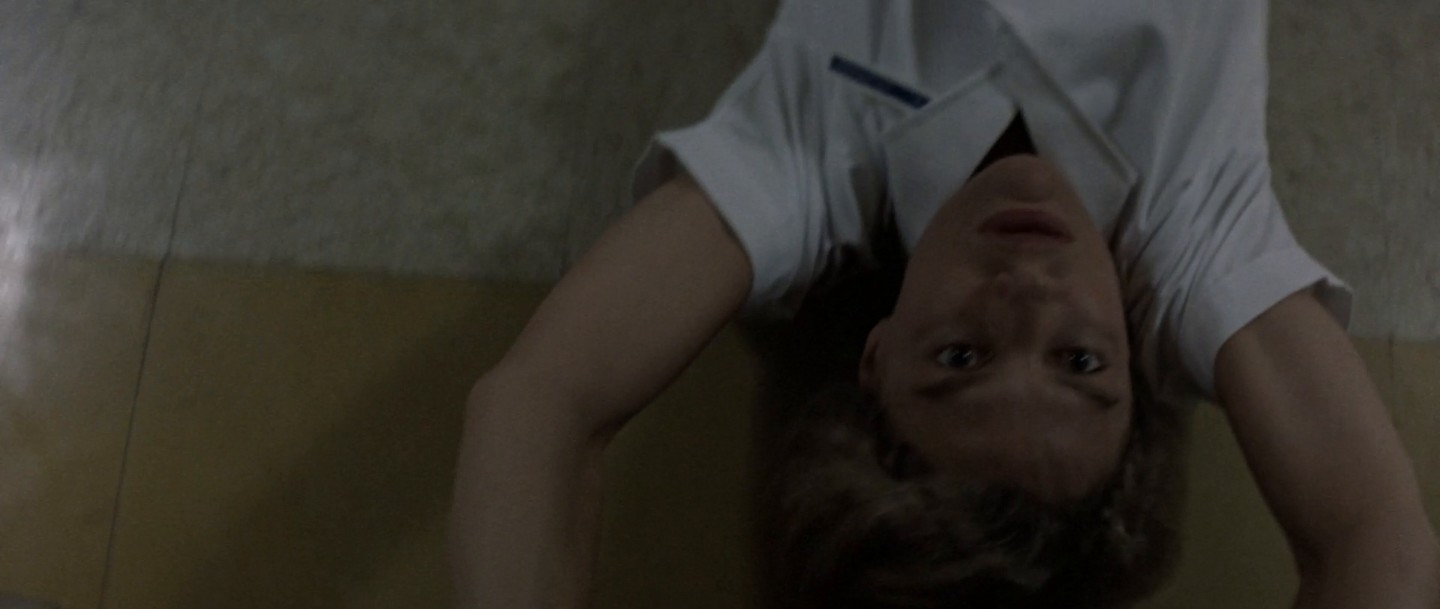
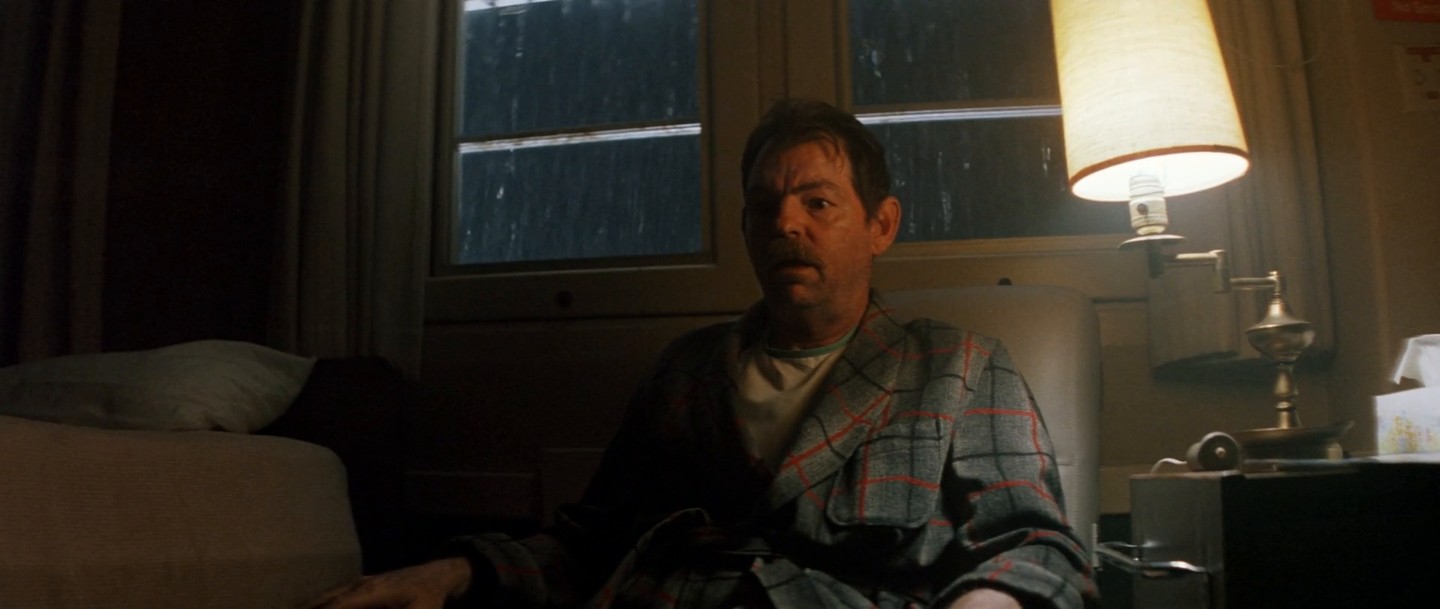
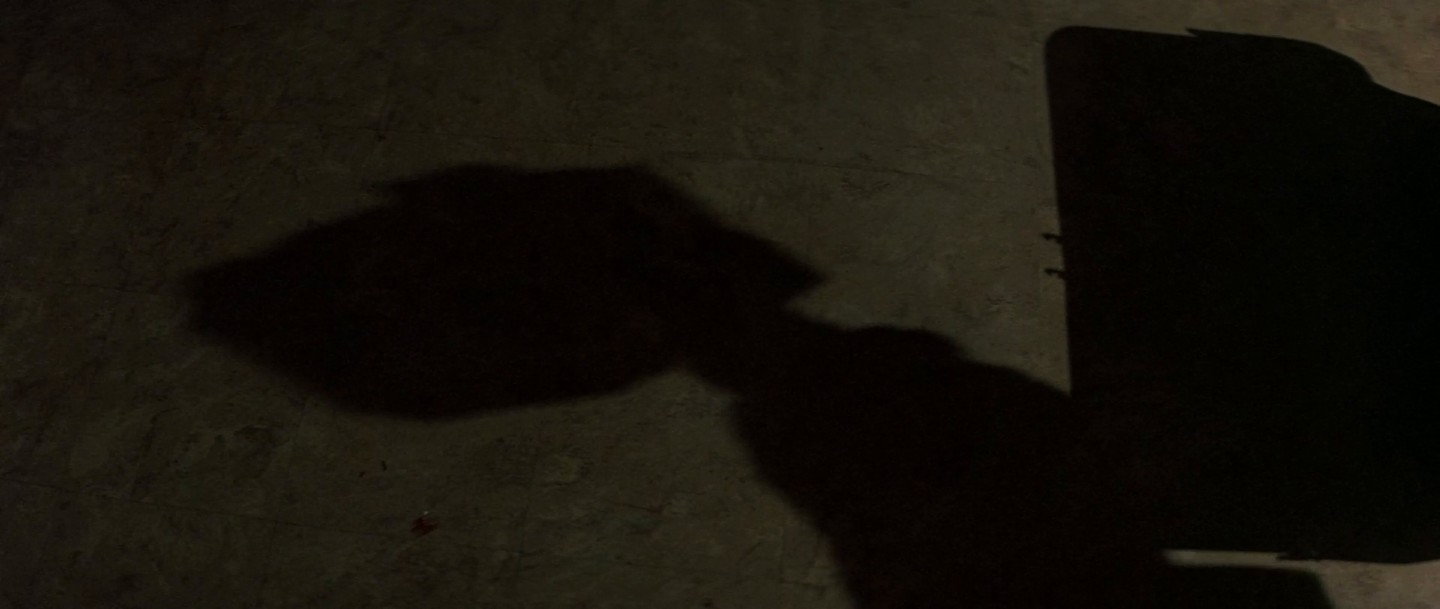
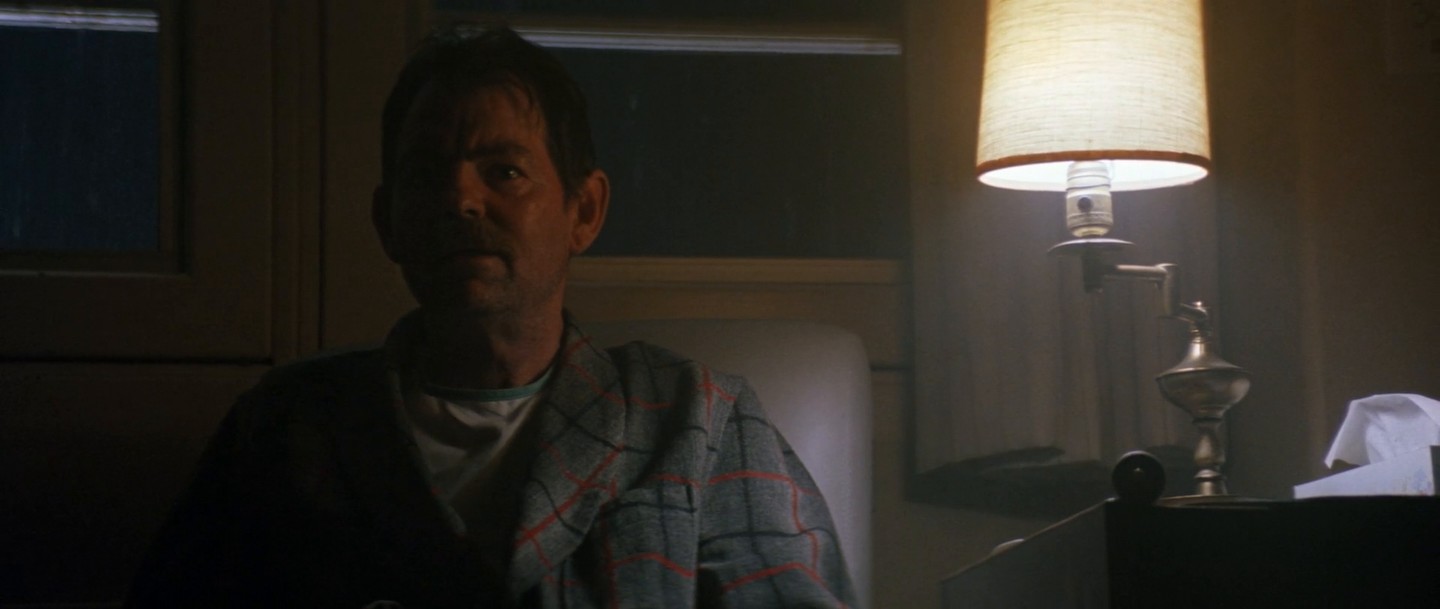
The assault begins with a blunt impact and the displacement of the nurse’s cap. It then migrates into darkness and a shadow on the wall. The adjacent patient becomes an uneasy spectator, changing the rhythm of the violence through his responses.
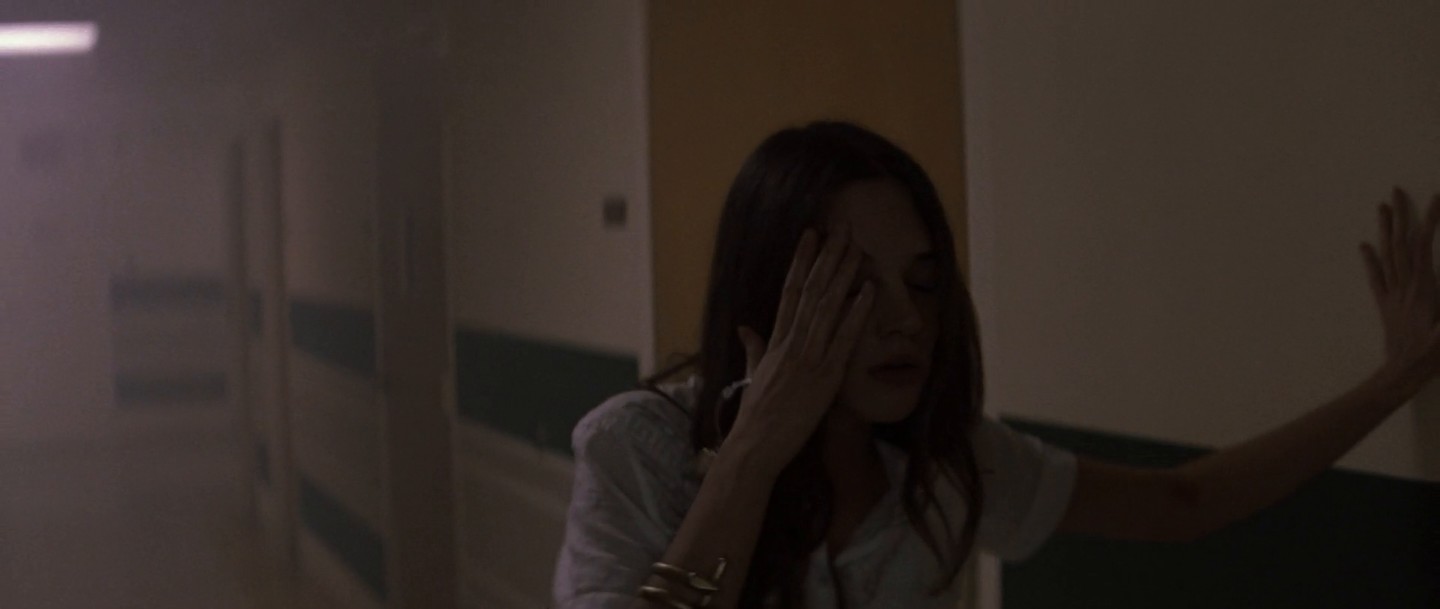
ENLARGE ↗Aura steadies herself against the corridor wall.
The corridor’s long lines make escape look simple until Aura’s unsteady movement defeats that geometry. Her body and the institution no longer move to the same measure. David’s arrival restores contact without making the clinic a safe place.
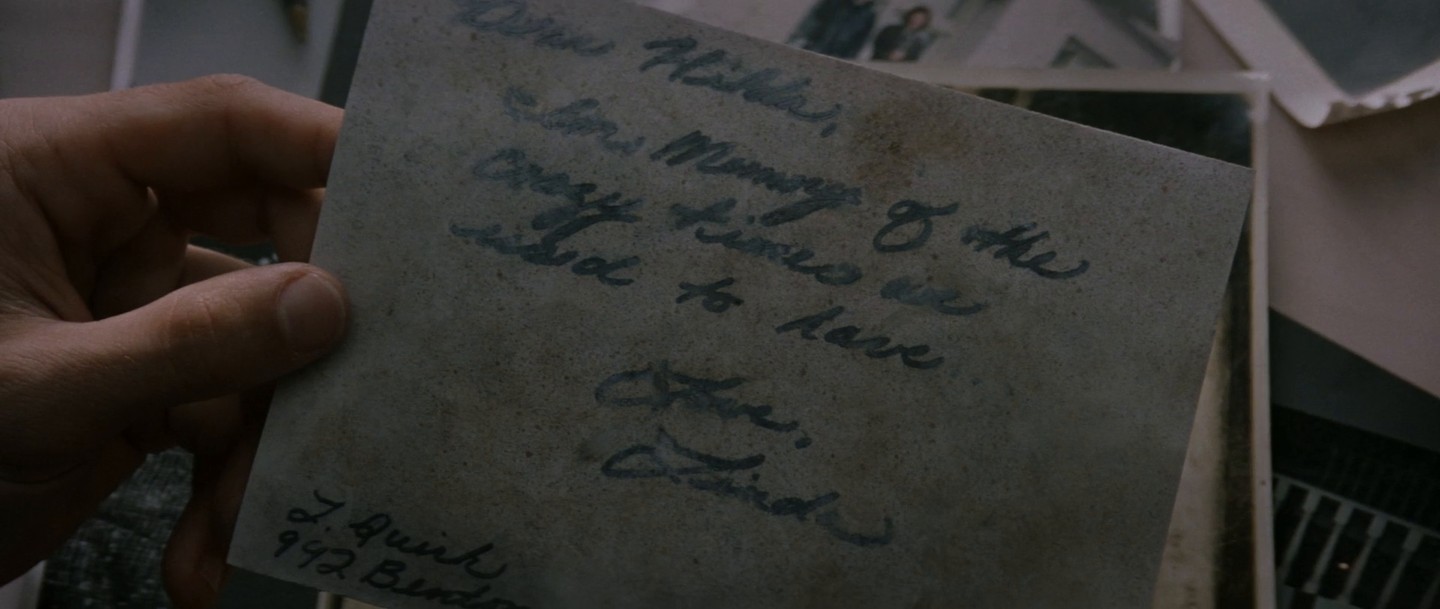
A small piece of writing redirects the search. The close view asks the spectator to attend to an object that can travel between rooms and people. It complements the photographs and personal effects through which the victims acquire a shared history.
1:06:55
The victims become a group
ENLARGE ↗Aura and David examine the material together.
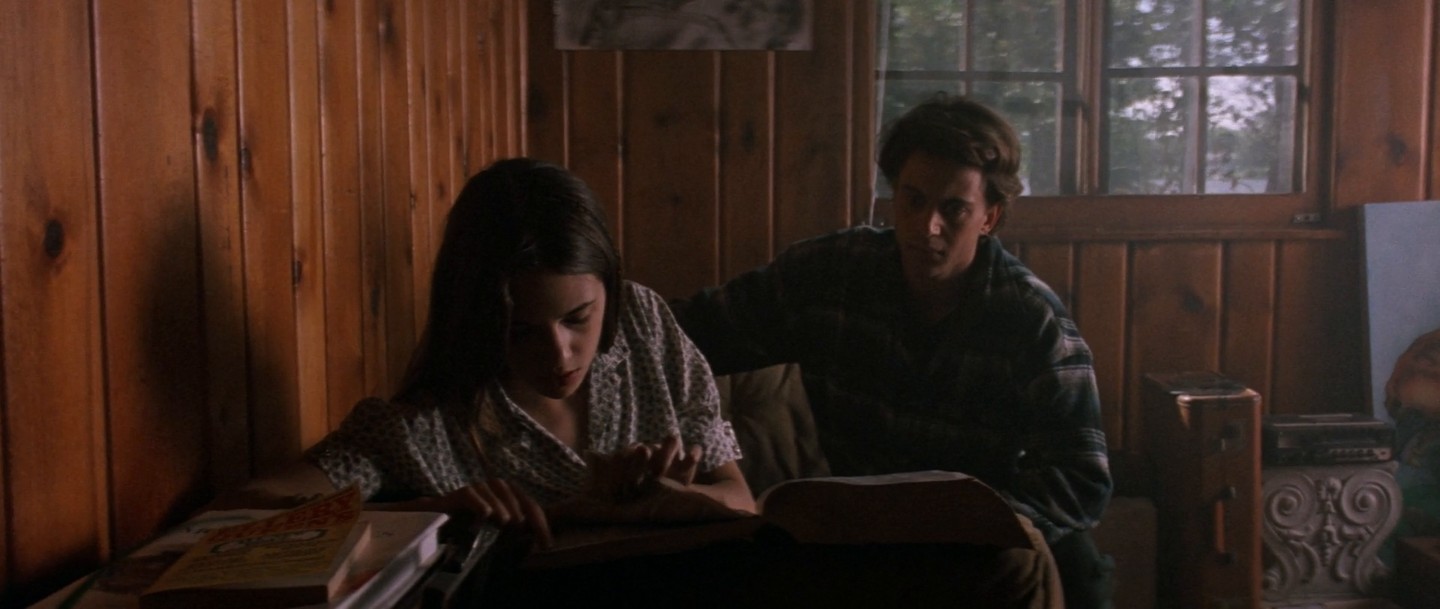
Individual victims begin to form a shared history. The two investigators occupy the same side of the frame, concentrating on the material in front of them. Their cooperation offers a different model of inquiry from the adults who have tried to control Aura’s account.
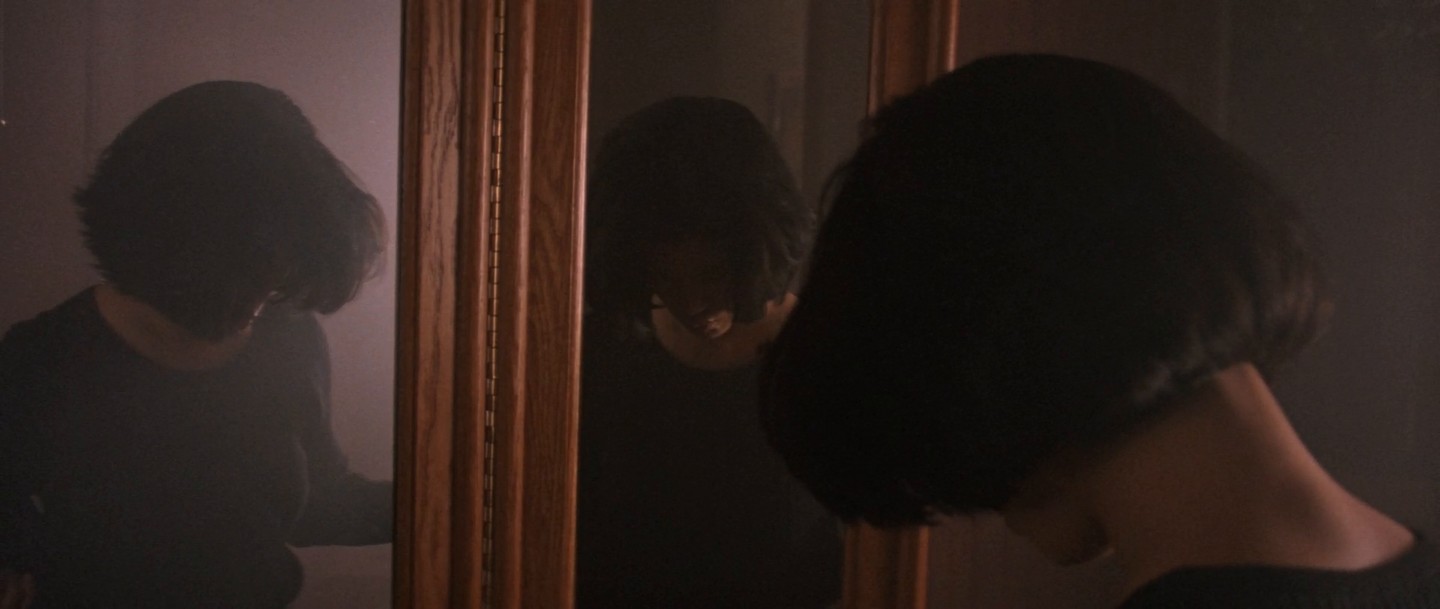
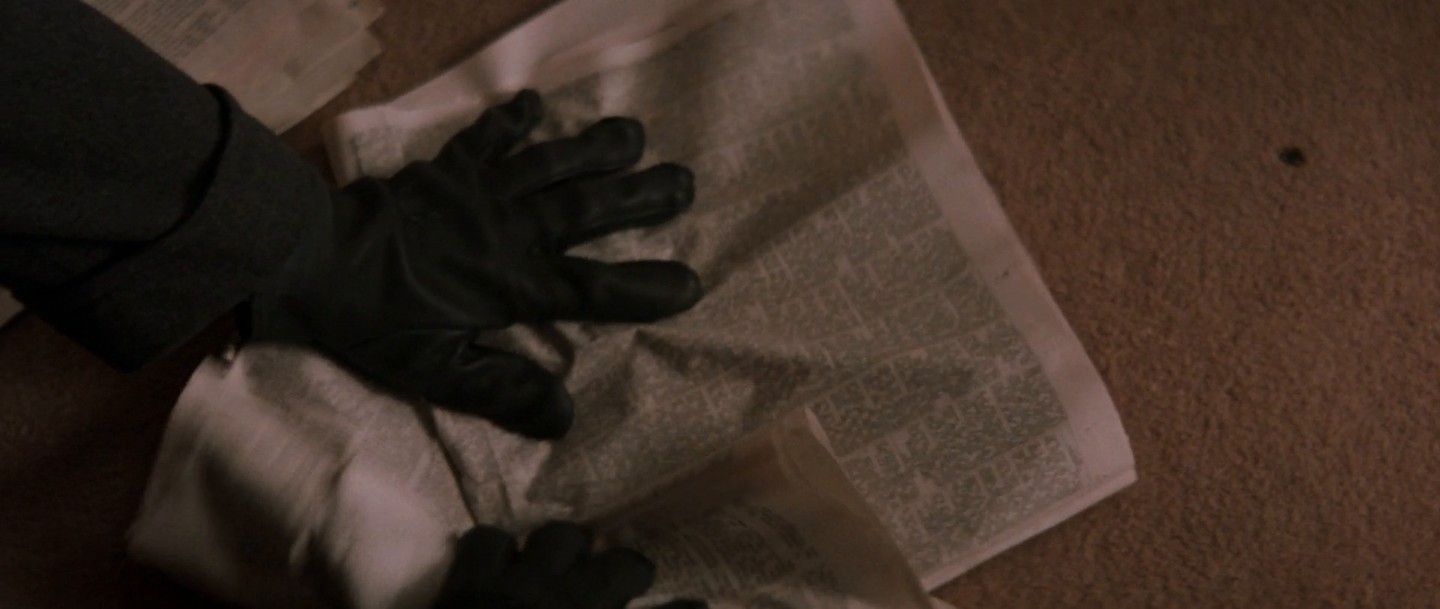
The mirror widens the room while hiding parts of it behind the frame. A gloved hand entering the written message makes information itself vulnerable. The route to the motel depends on who has access to a conversation and its traces.
1:14:56
Two kinds of falling water
ENLARGE ↗The shower curtain turns a body into a silhouette.
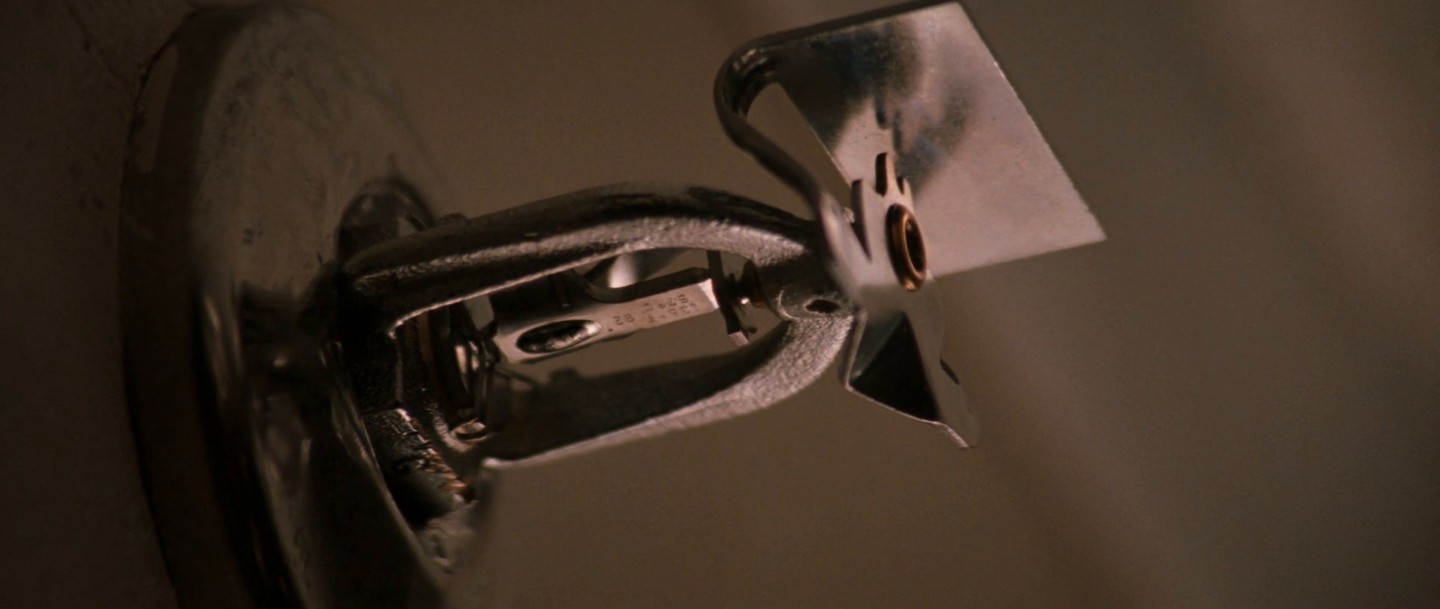
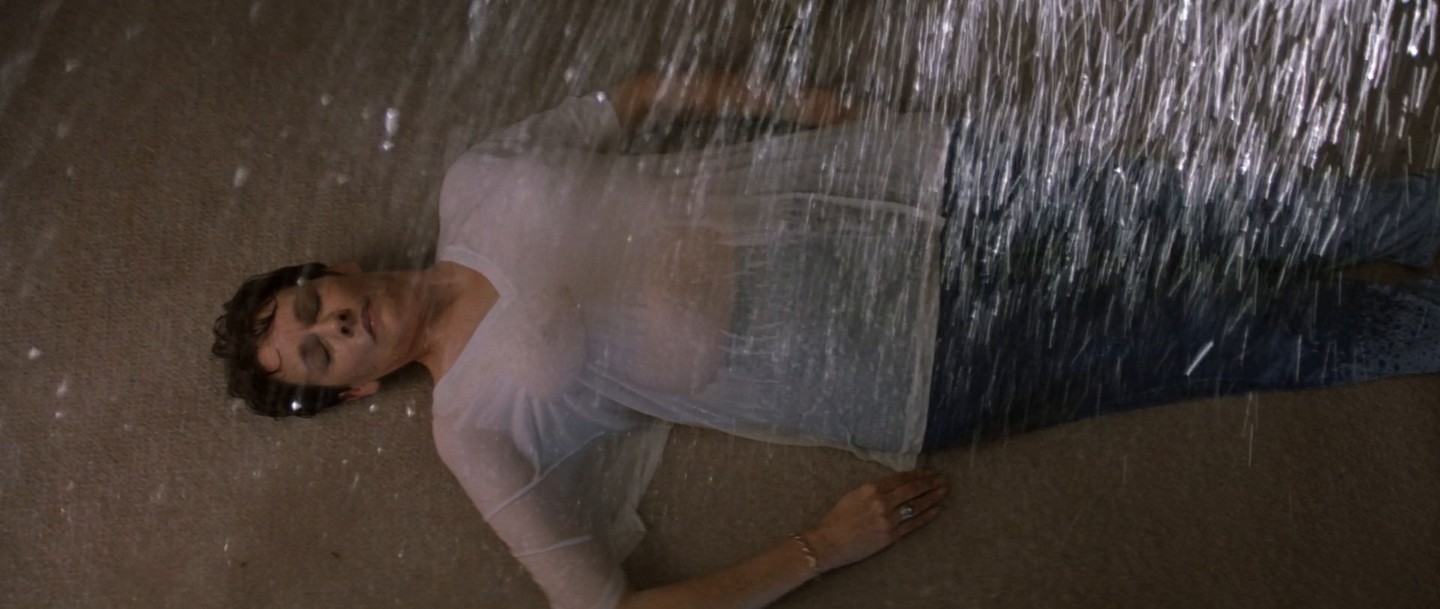
The motel sequence moves between the shower and a sprinkler triggered elsewhere. Similar falling water joins spaces with very different levels of danger. The connection lets the film make an ordinary bathroom image part of the attack’s preparation.
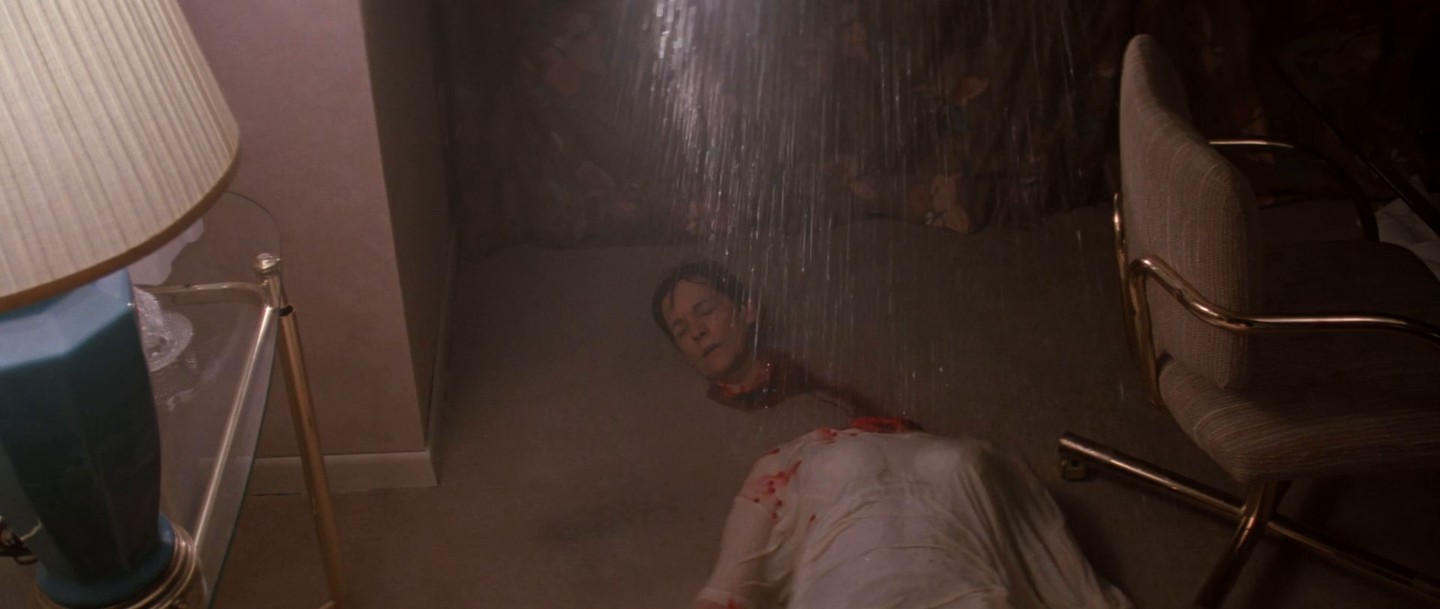
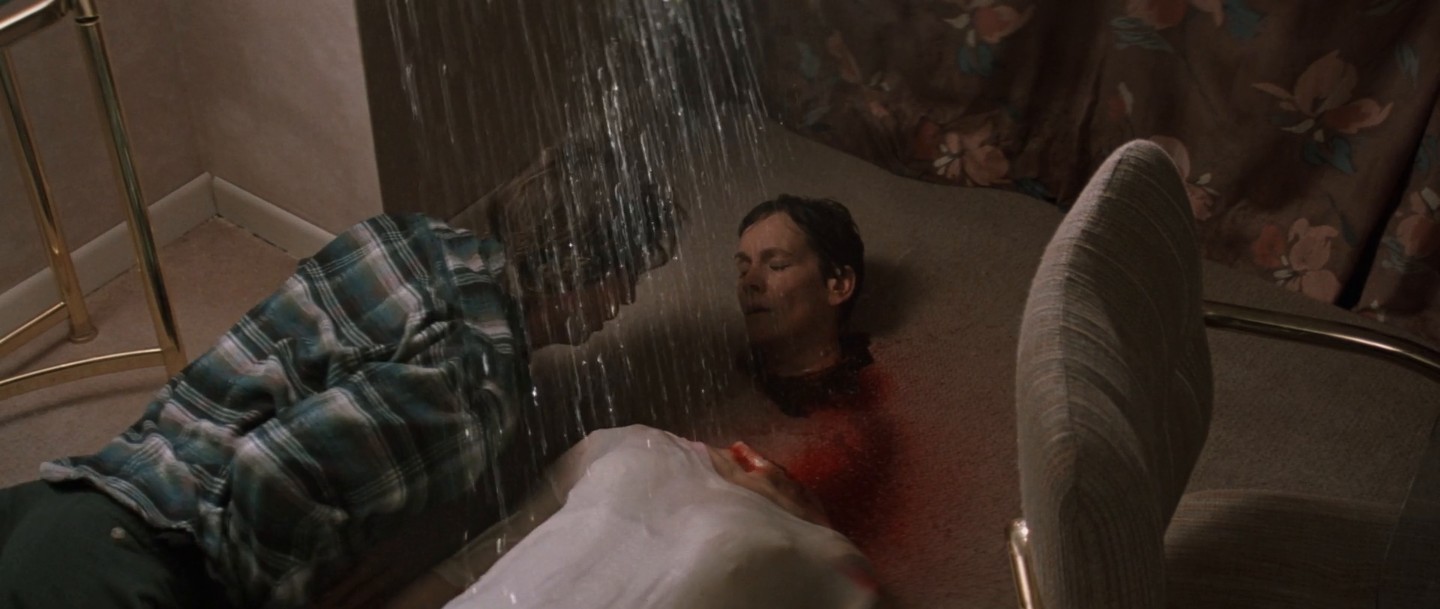
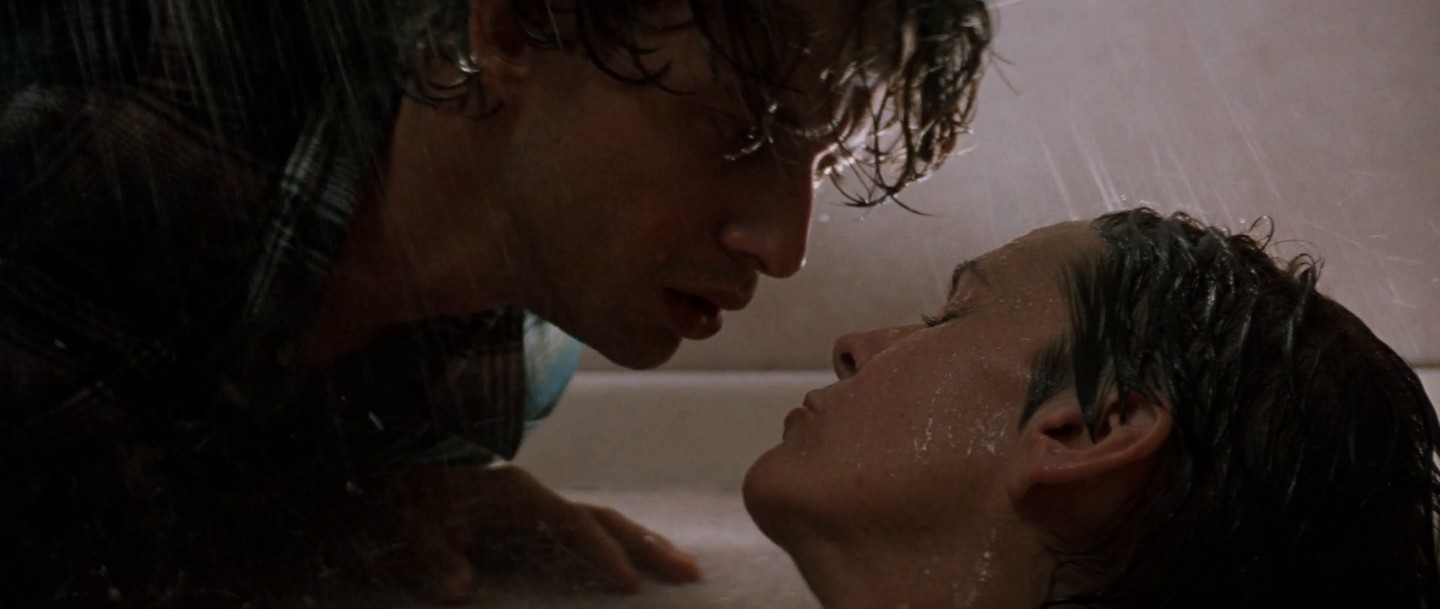
ENLARGE ↗David finds Linda beneath the sprinklers.
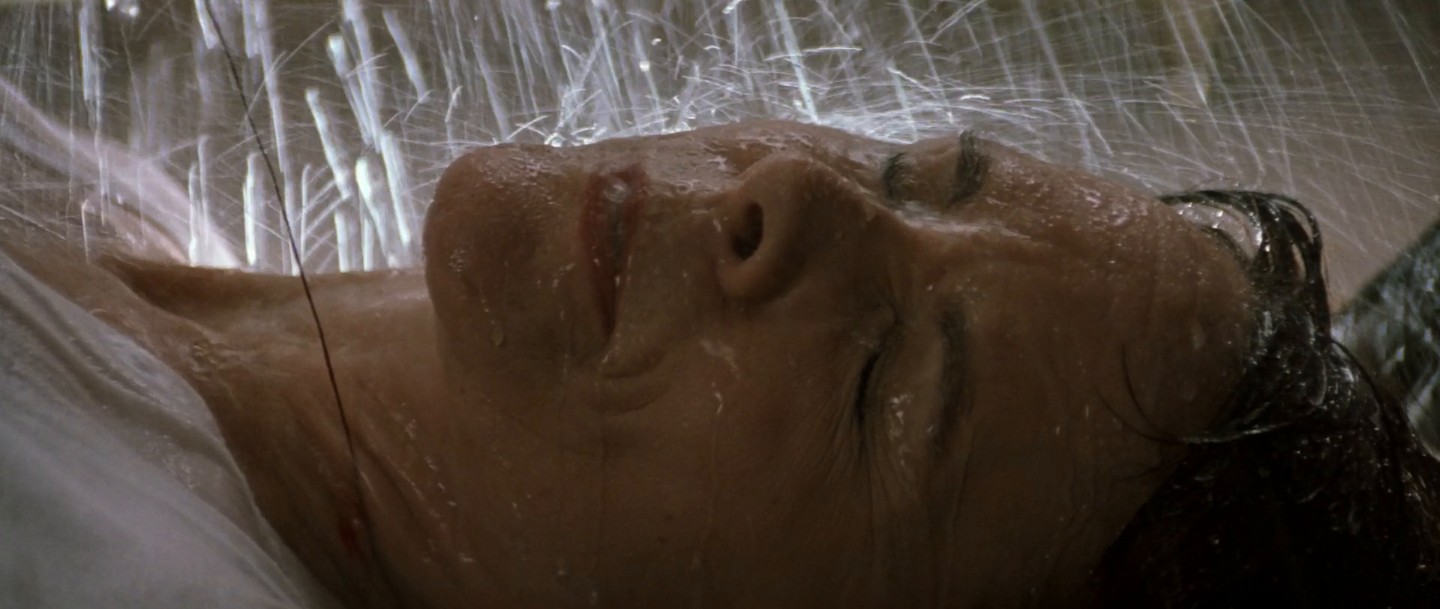
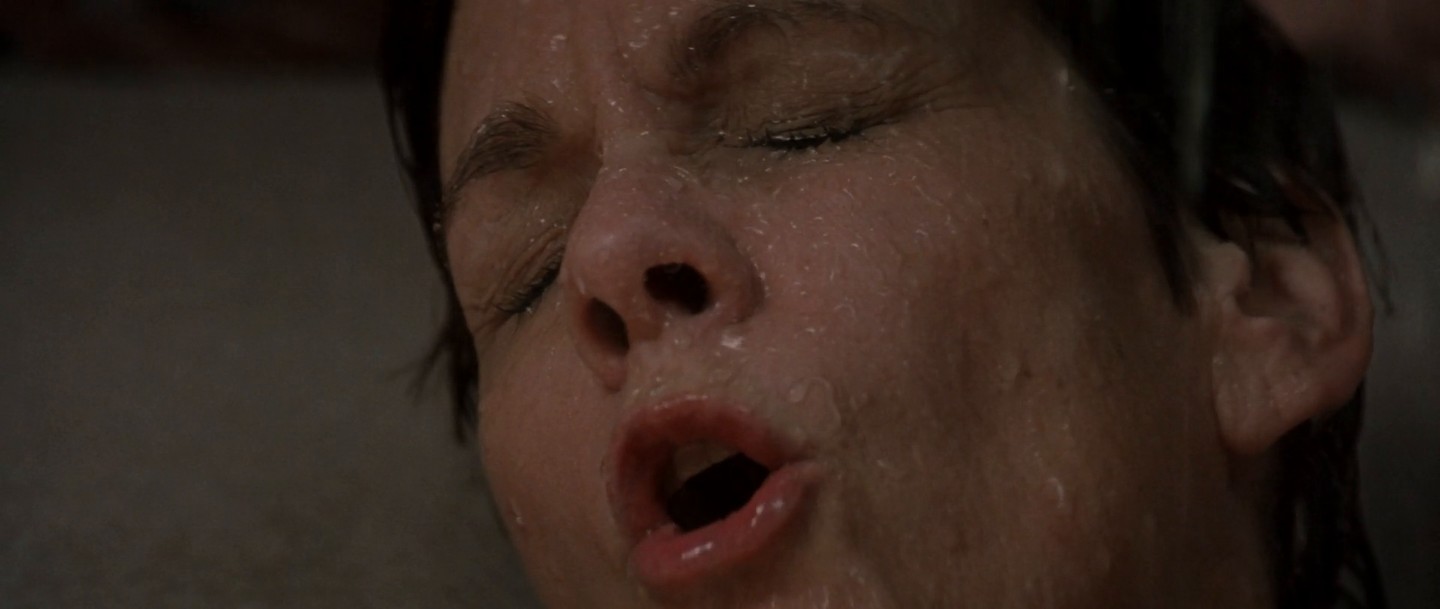
The room first offers a devastating wide view, then returns to the face. David closes the distance to what remains of a possible witness. The grotesque effect is also a narrative delay: knowledge appears to survive the destruction of the body that held it.
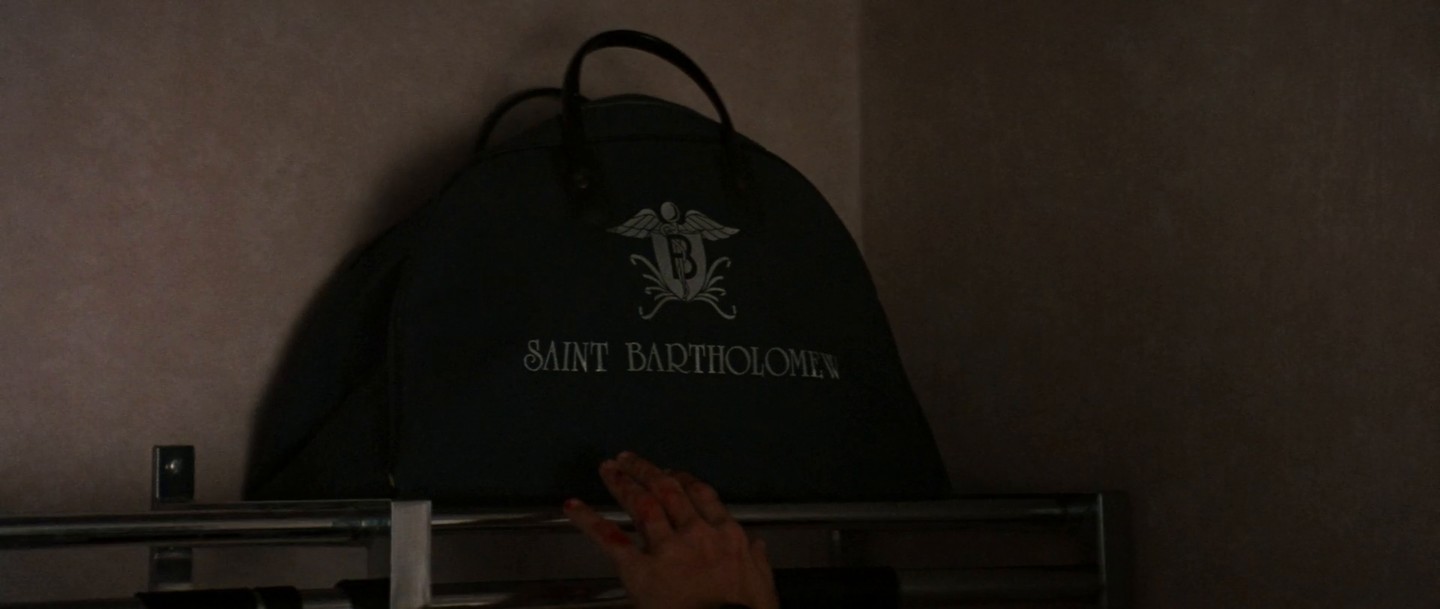
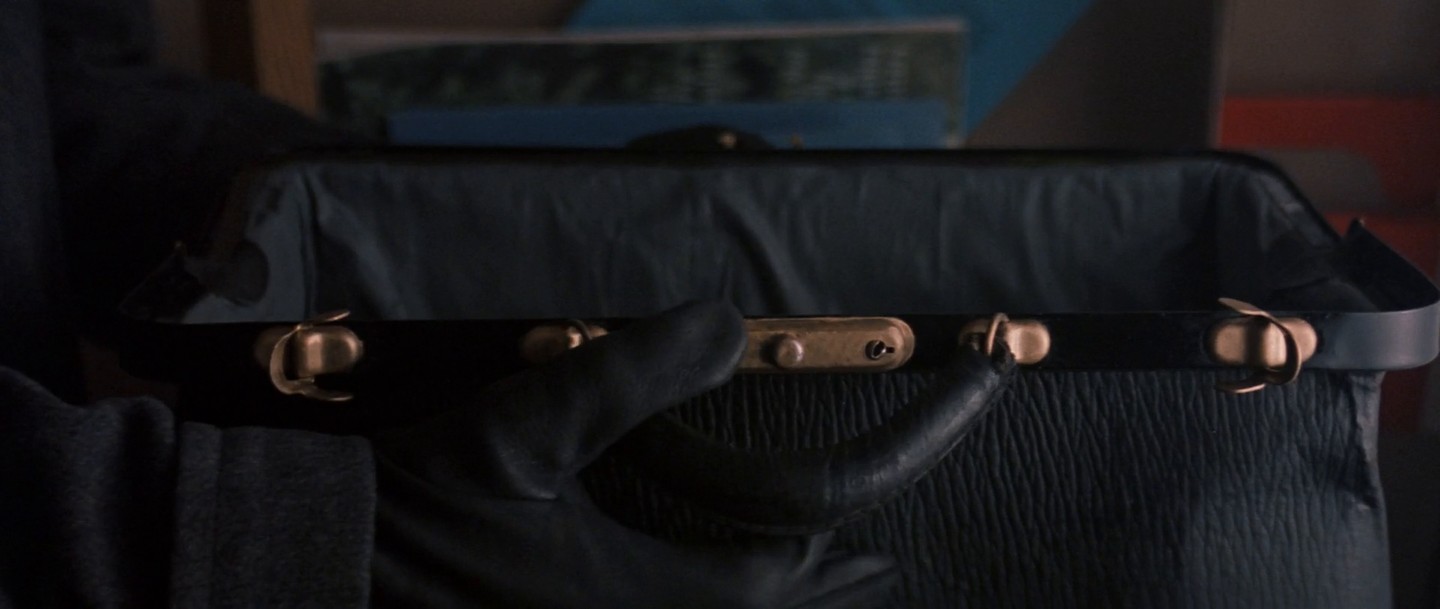
ENLARGE ↗The medical bag carries the next connection.
The institutional name is carried on an object outside the institution. Like the card and photographs, the bag turns a dispersed group of people into a traceable connection. The investigation repeatedly depends on portable evidence.
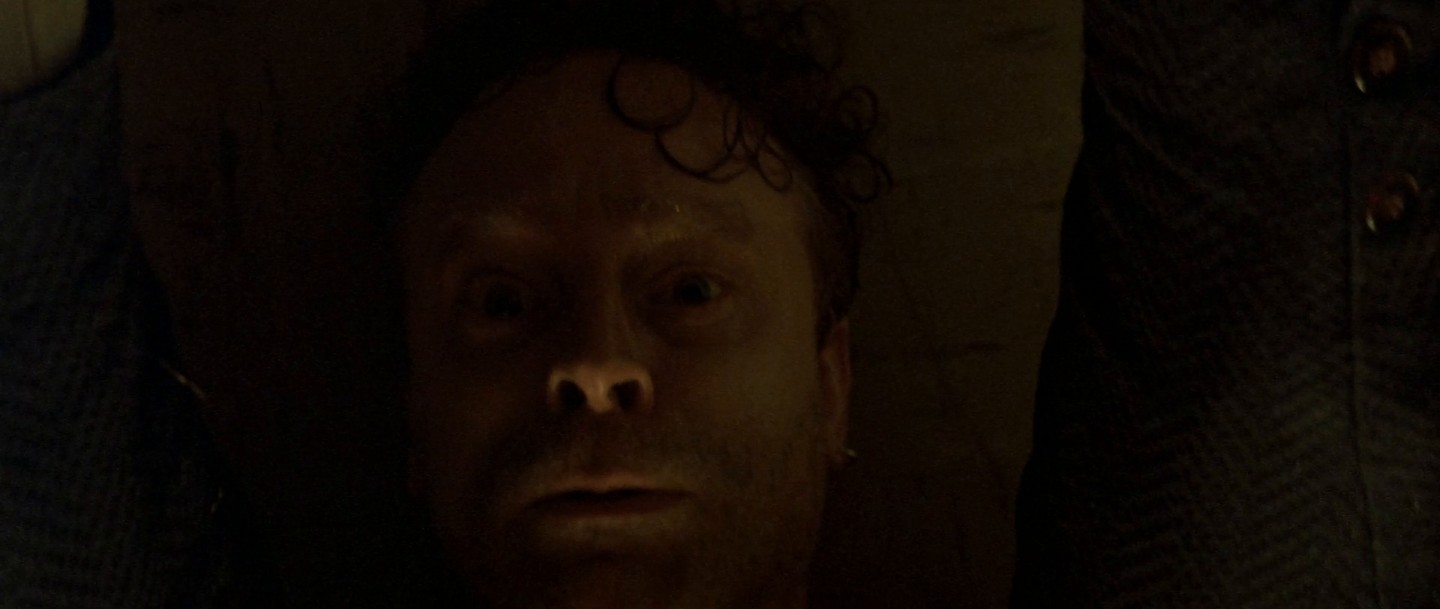
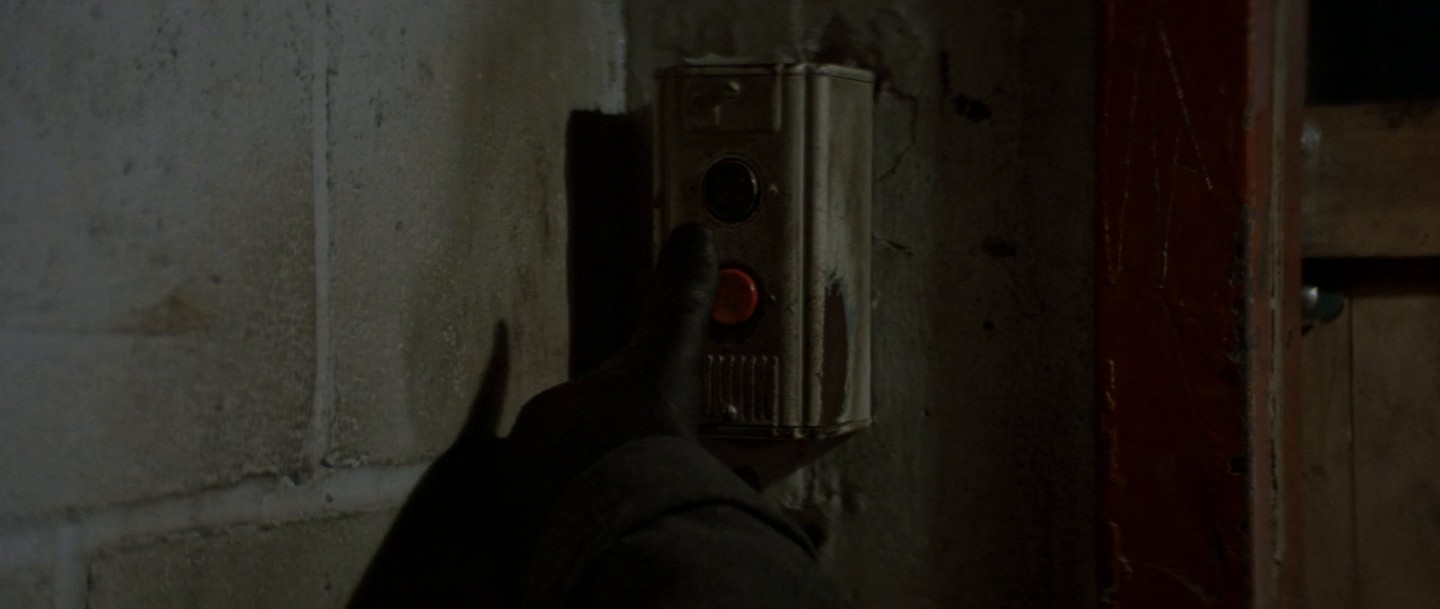
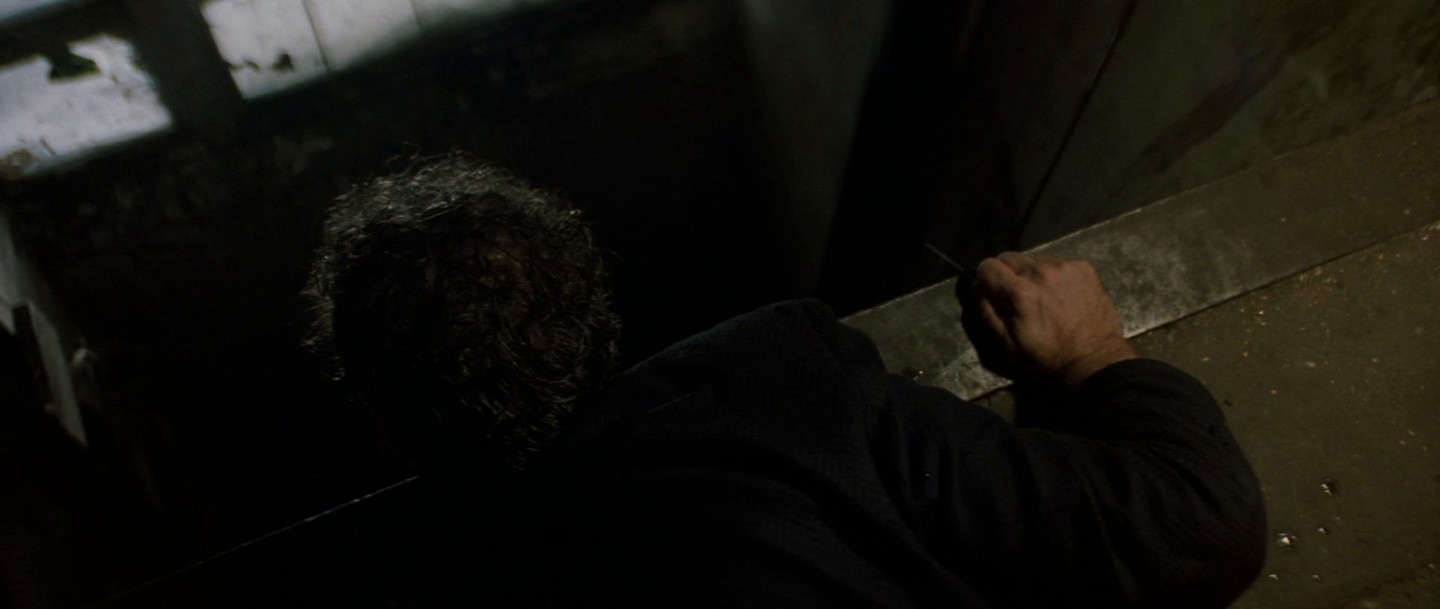
The sequence gives the threatened face time before it gives the final effect. Close inserts of the device shift attention from its power to its difficulty operating. That delay makes the eventual move to the lift feel like a change of plan within the scene.
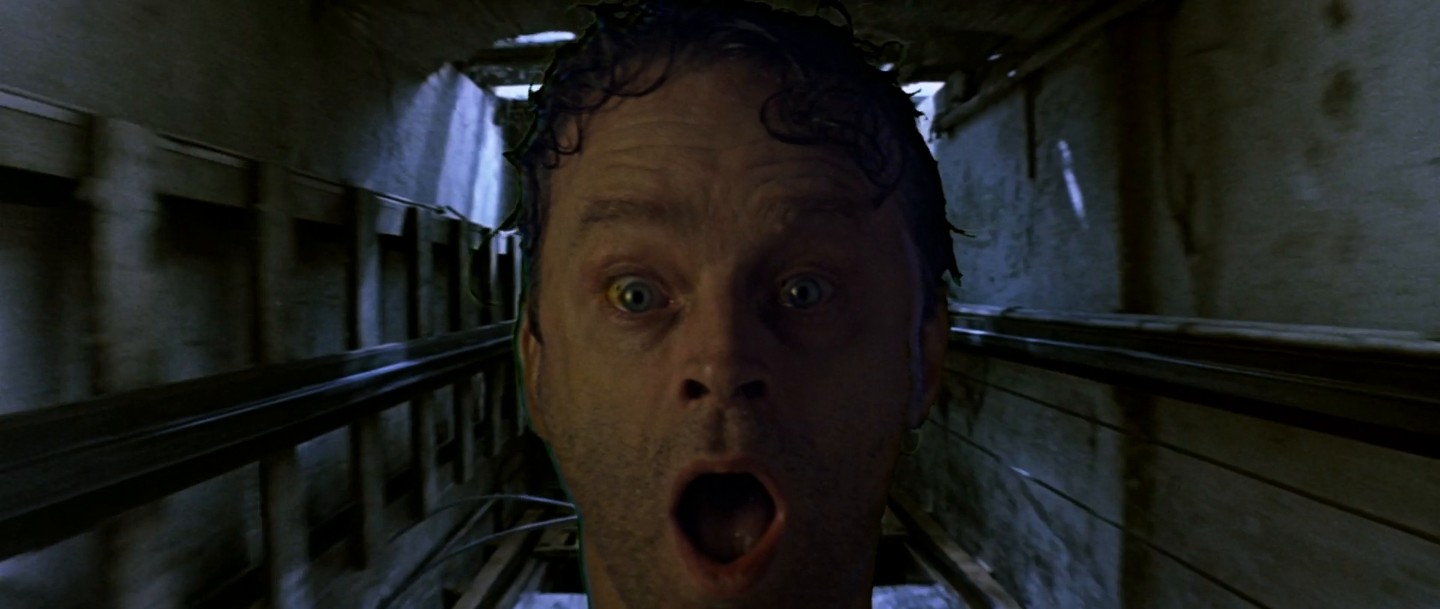
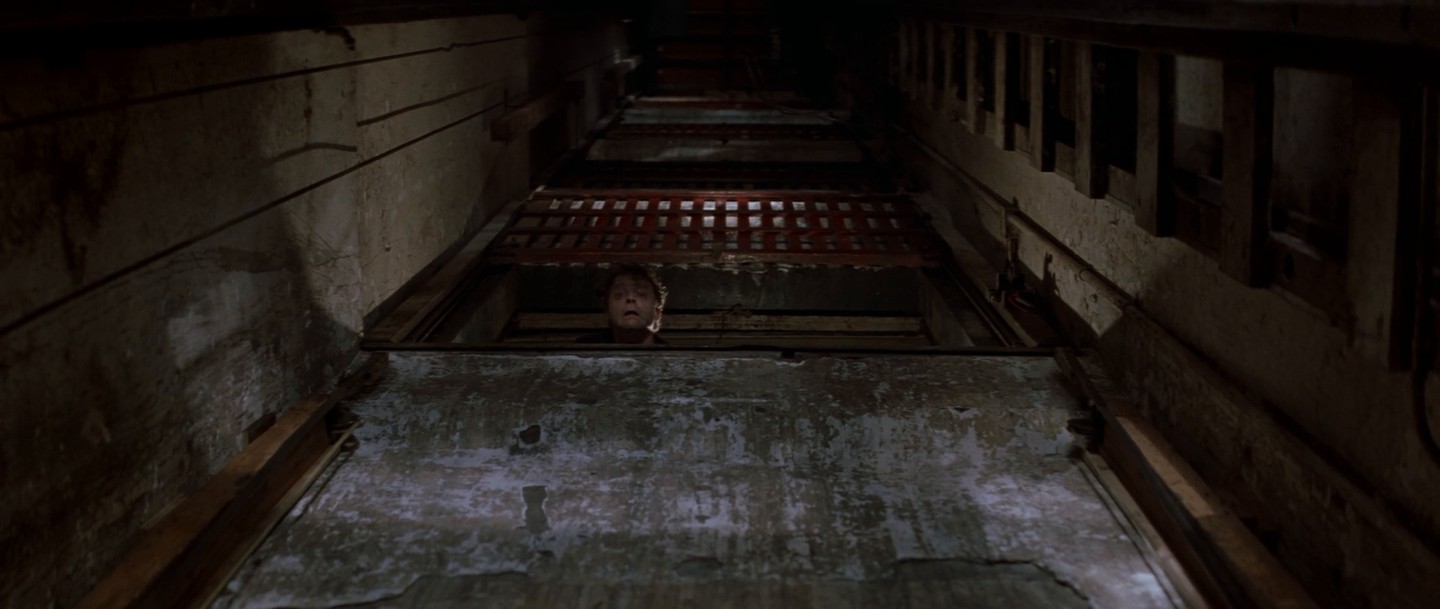
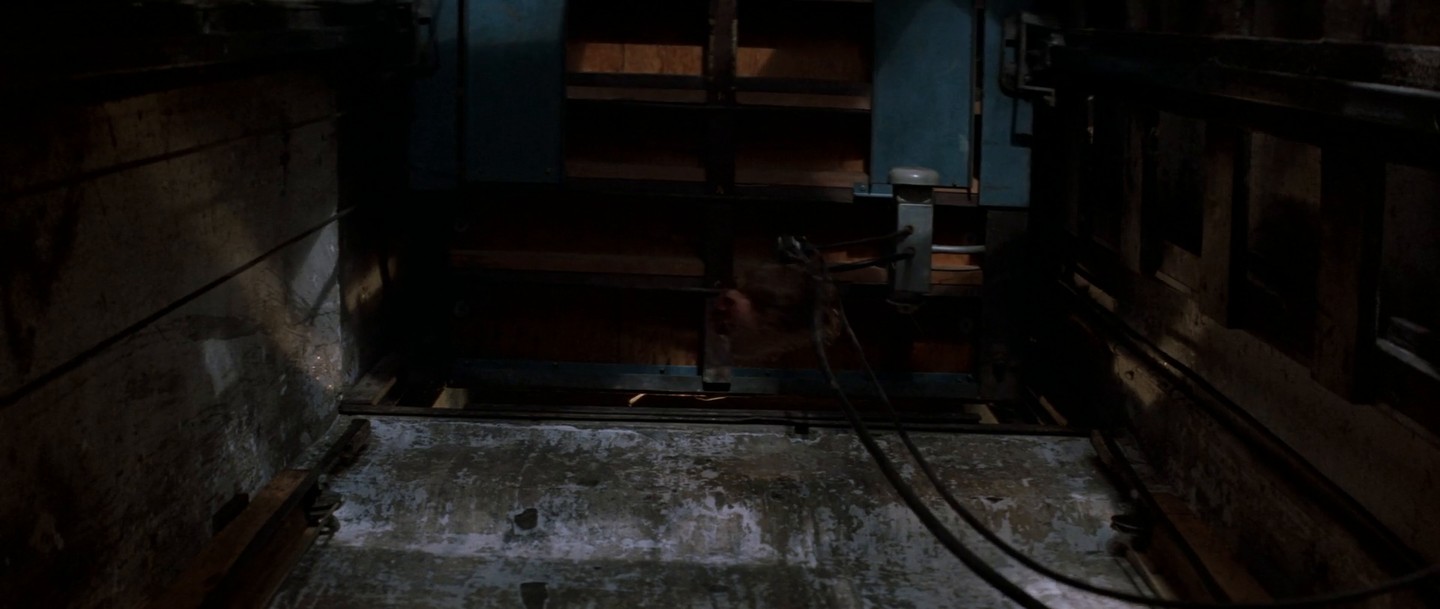
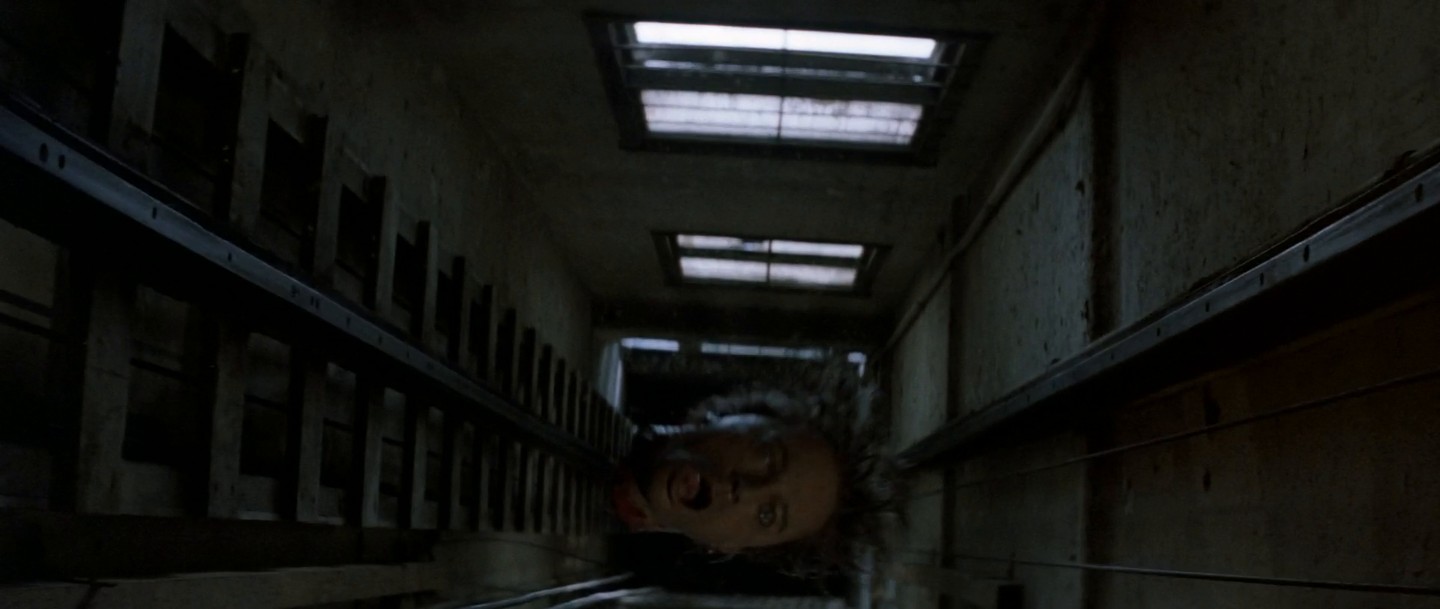
ENLARGE ↗Lloyd’s head falls through the lift shaft.
The shaft turns a small cutting mechanism into an architectural threat. Views down the building’s vertical space alternate with the face in free fall. The effect deliberately exceeds the sober geometry that prepared it.
The television supplies another decisive caption. Its confidence makes the continuing uncertainty around Aura more conspicuous. The official account becomes one more image that the characters must test against what they can actually find.
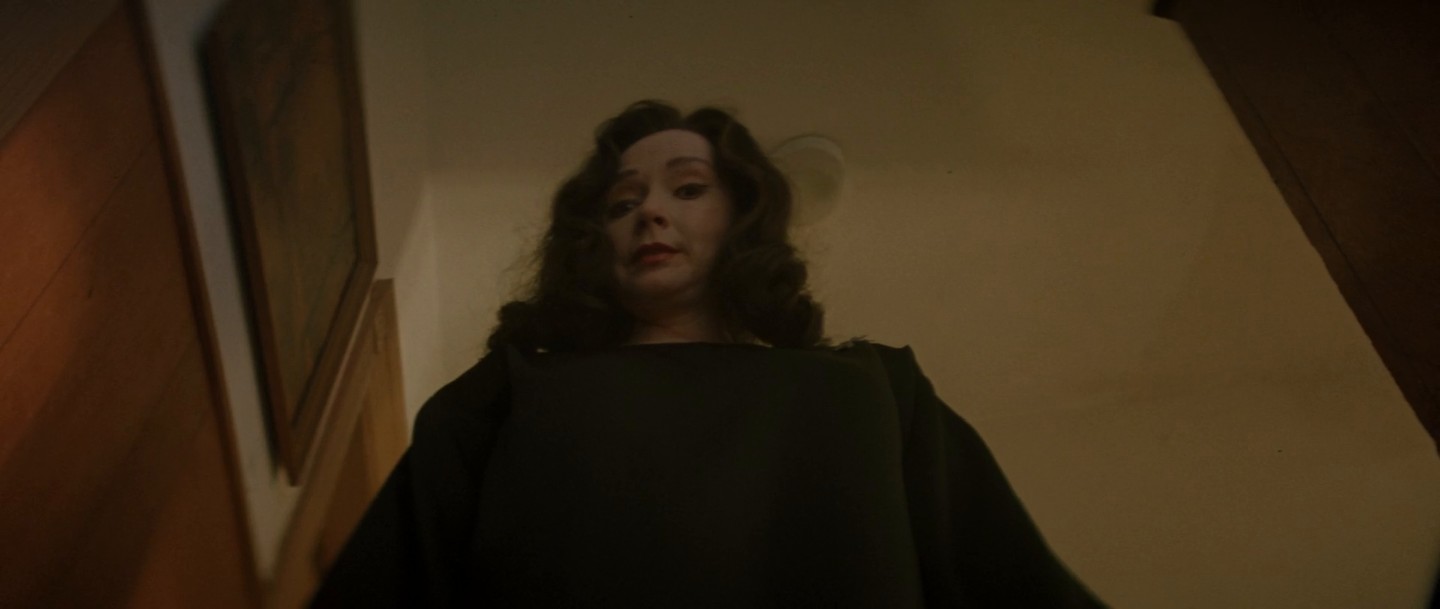
The apparently closed story opens again inside the house. The low view gives Adriana command of the staircase and the person beneath her. Her reappearance is more disruptive than a new clue because it changes the meaning of the earlier deaths.
1:42:24
The family behind a screen
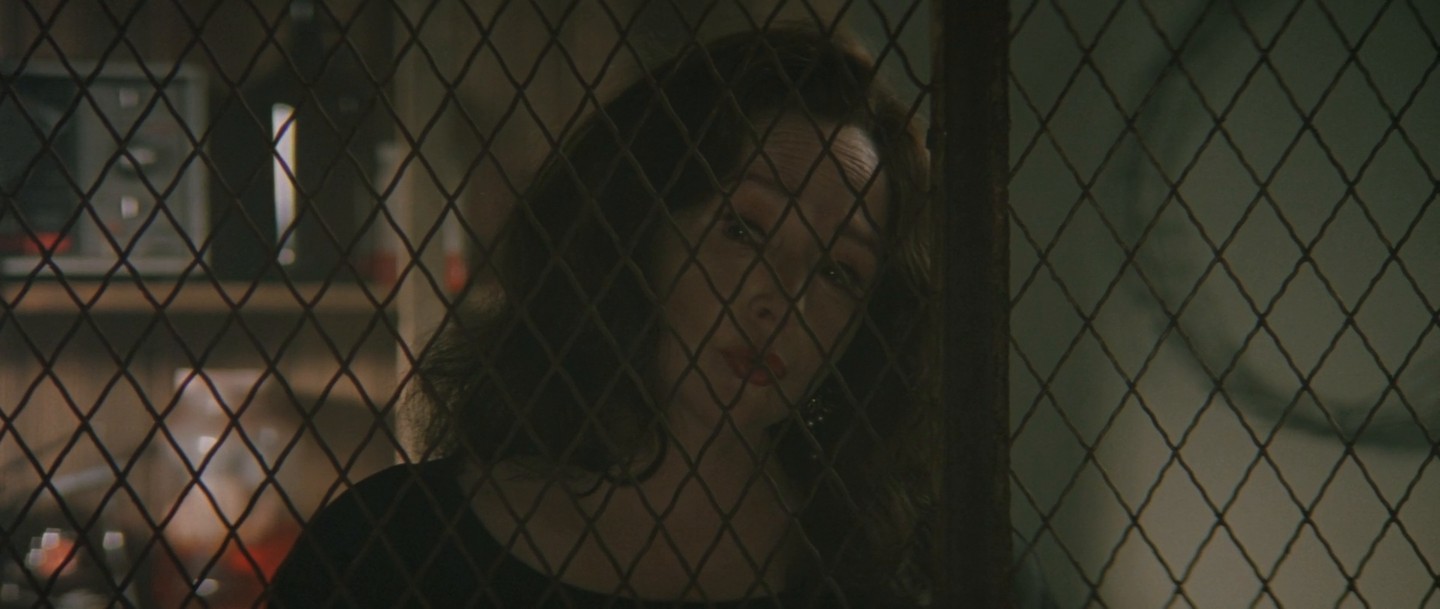
ENLARGE ↗Adriana faces her captives through the mesh.
The mesh divides mother, daughter and witness into separate compartments. Miniatures stand behind Adriana while the living characters occupy the larger enclosure. The basement makes the earlier arrangement of spectators and spectacle into a physical prison.
1:43:52
The buried event
ENLARGE ↗Bloodied hands mark the medical catastrophe.
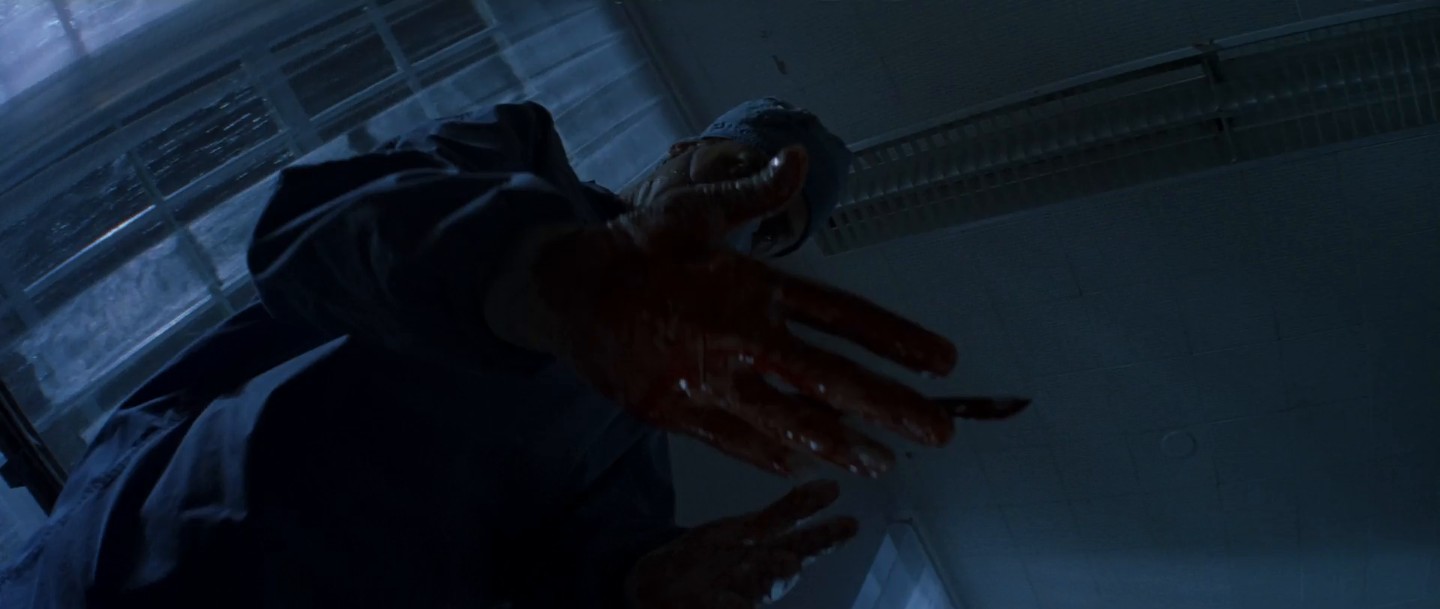
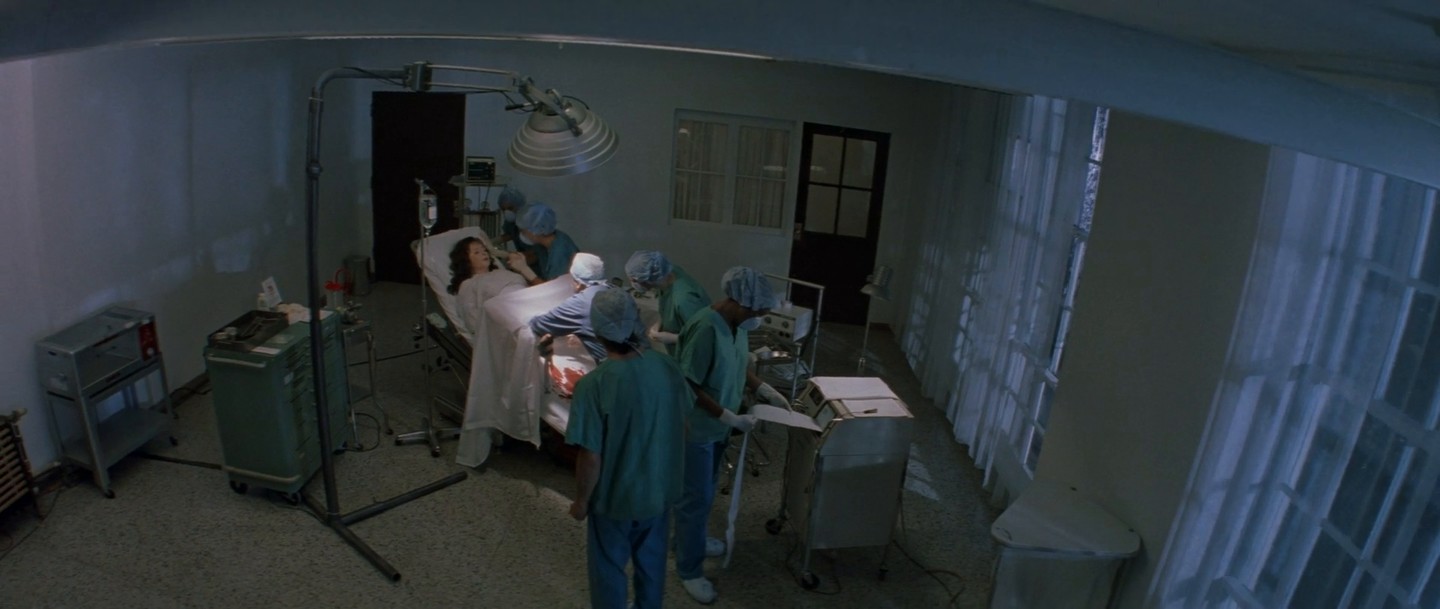
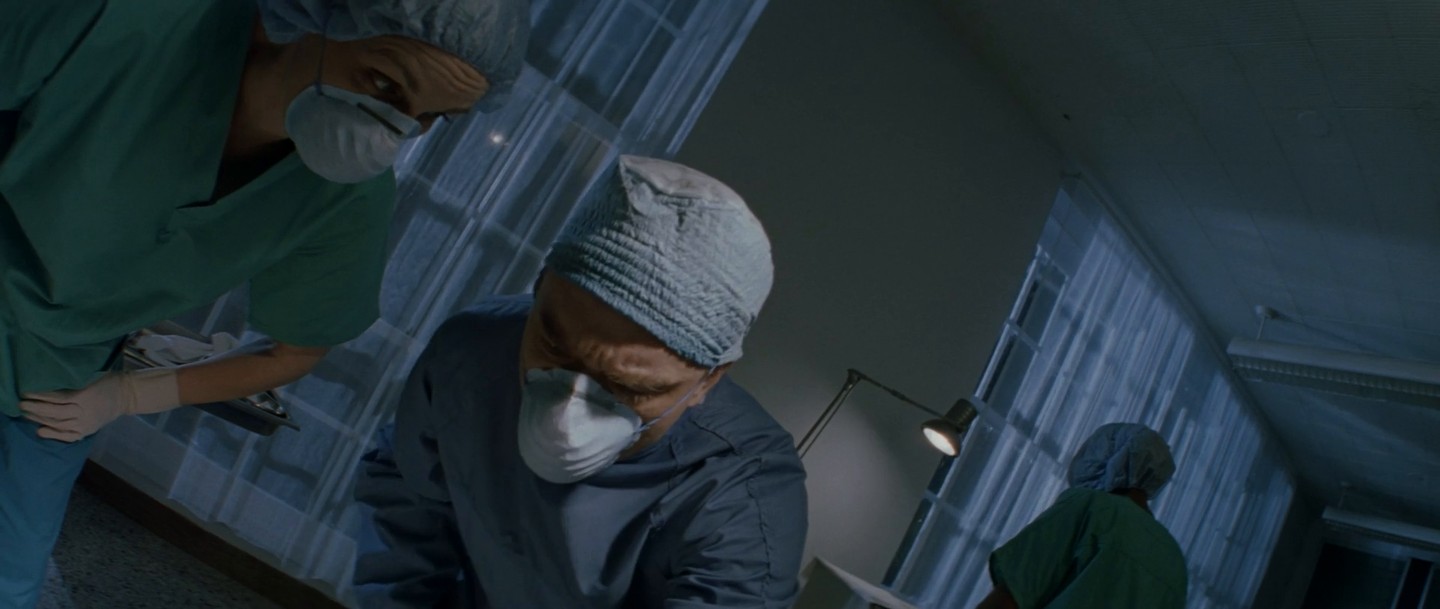
The flashback changes the film’s colour and angle: cold blue light and tilted views replace the basement’s steadier divisions. The failed delivery supplies the earlier violence with a motive. It also returns the film to medical authority at its most destructive.
ENLARGE ↗Adriana reaches for the wire at her throat.
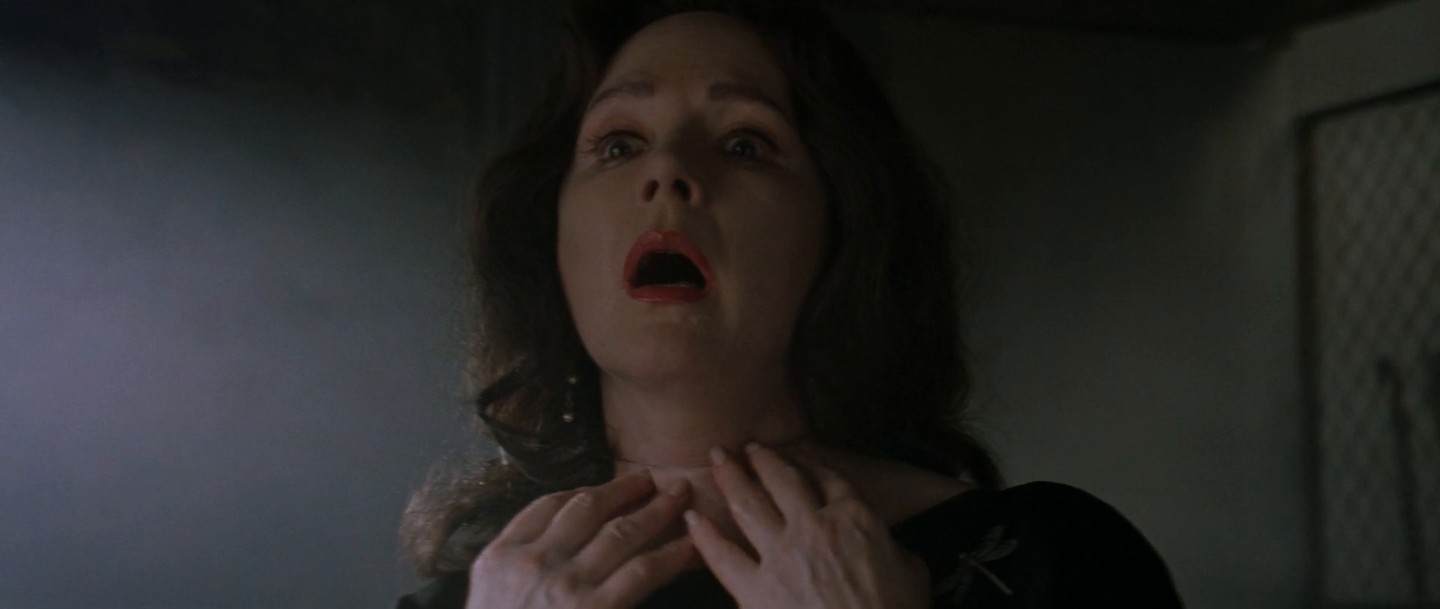
The boy’s intervention reverses the killer’s familiar apparatus. The scene alternates the device, the wounded throat and Aura and David’s reactions. Recognition does not bring a clean release: Aura must witness another violent loss.
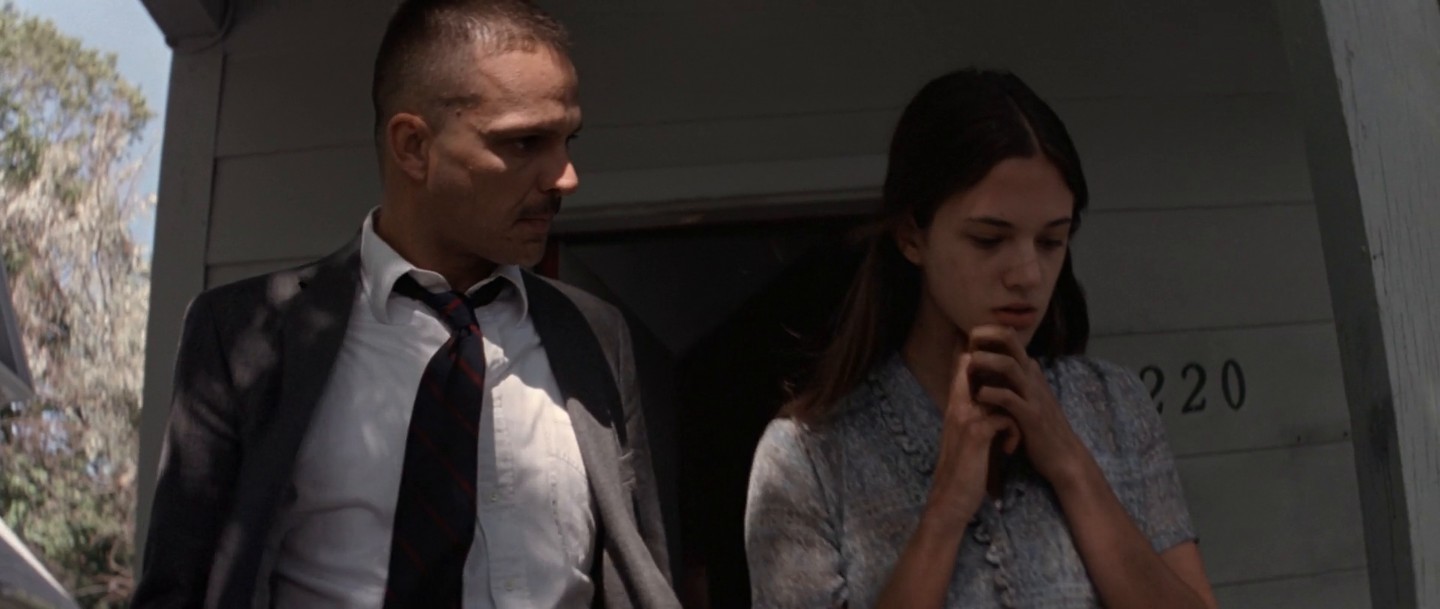
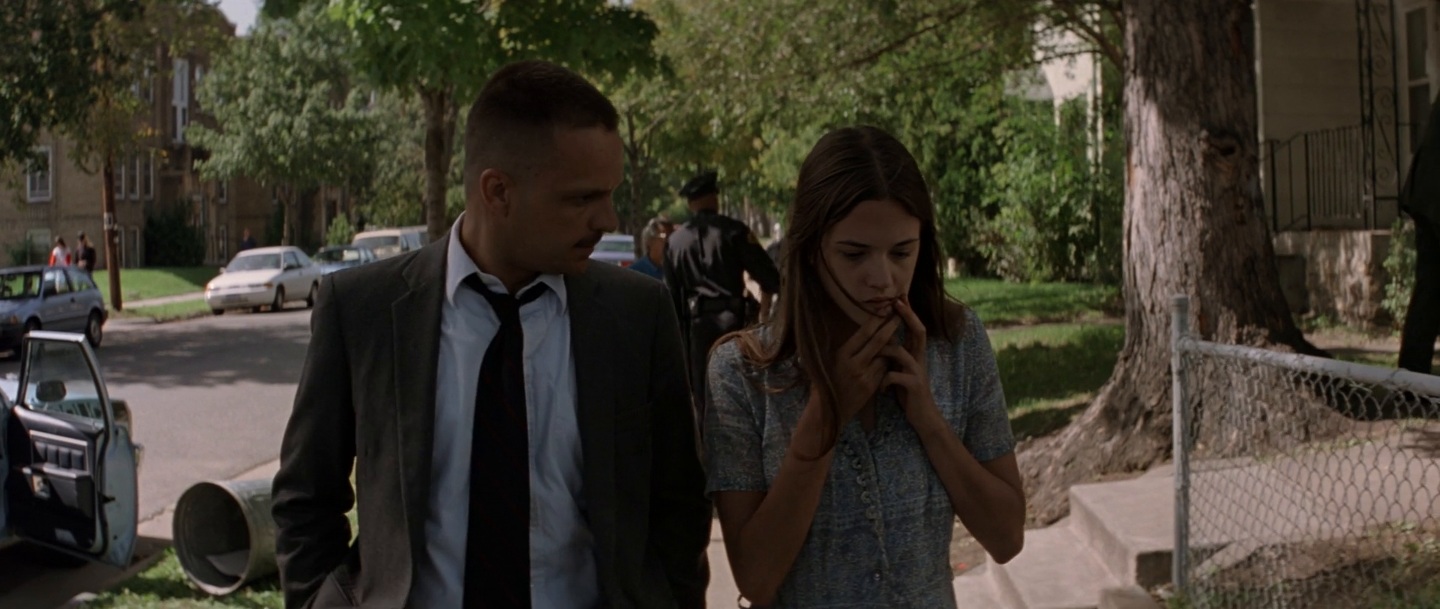
Daylight restores the ordinary street but offers no matching certainty in Aura’s expression. The exterior gives the characters room after the basement’s mesh and walls. The change of space matters more than a simple announcement that the mystery is over.
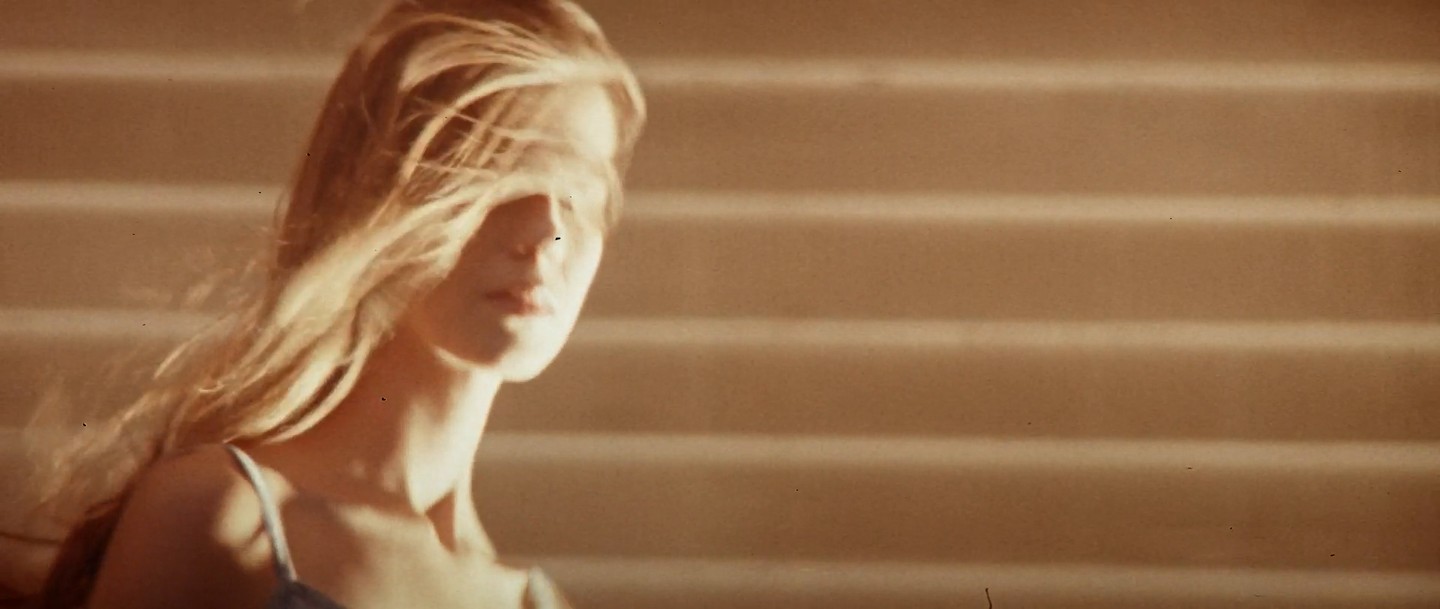
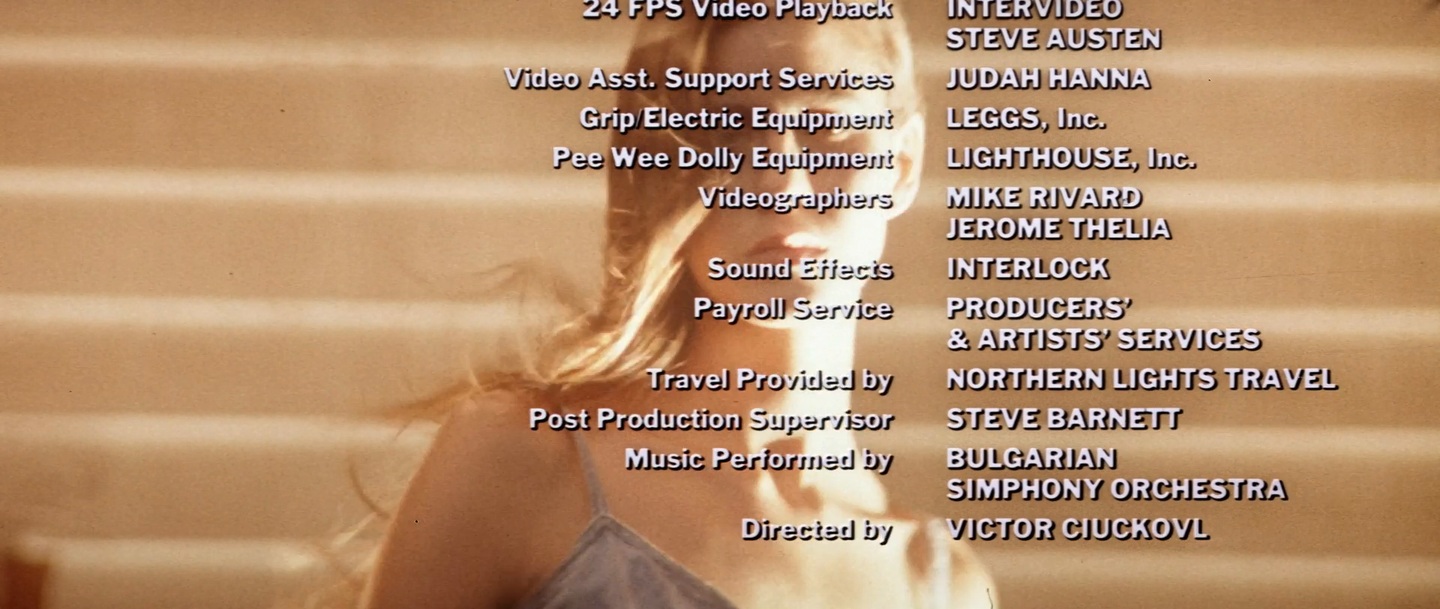
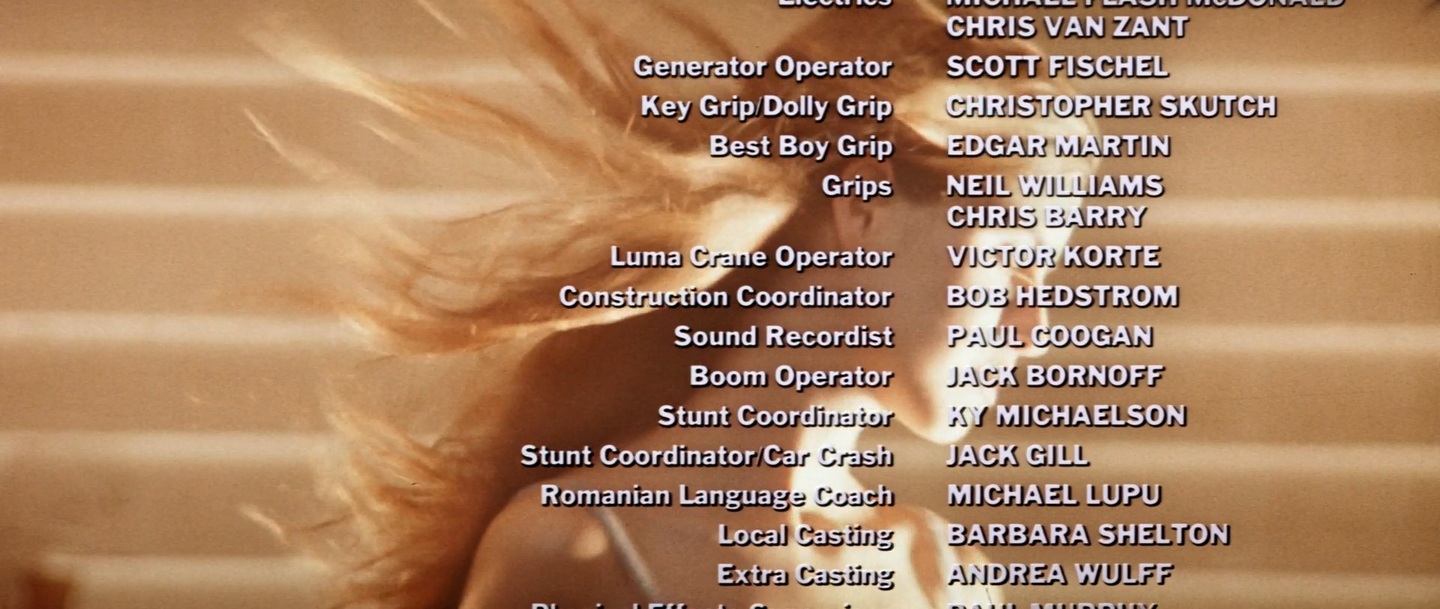
The closing sequence leaves the immediate investigation for a porch performance and a face in warm light. The credits continue over this new centre of attention. After a film of captured and severed heads, the image of bodily movement has an unusually open ending.
Seven studies follow the preparation, effect and aftermath of the film’s central attacks. Each has a main image and an optional stage gallery. Enlarge a frame to move through its sequence.
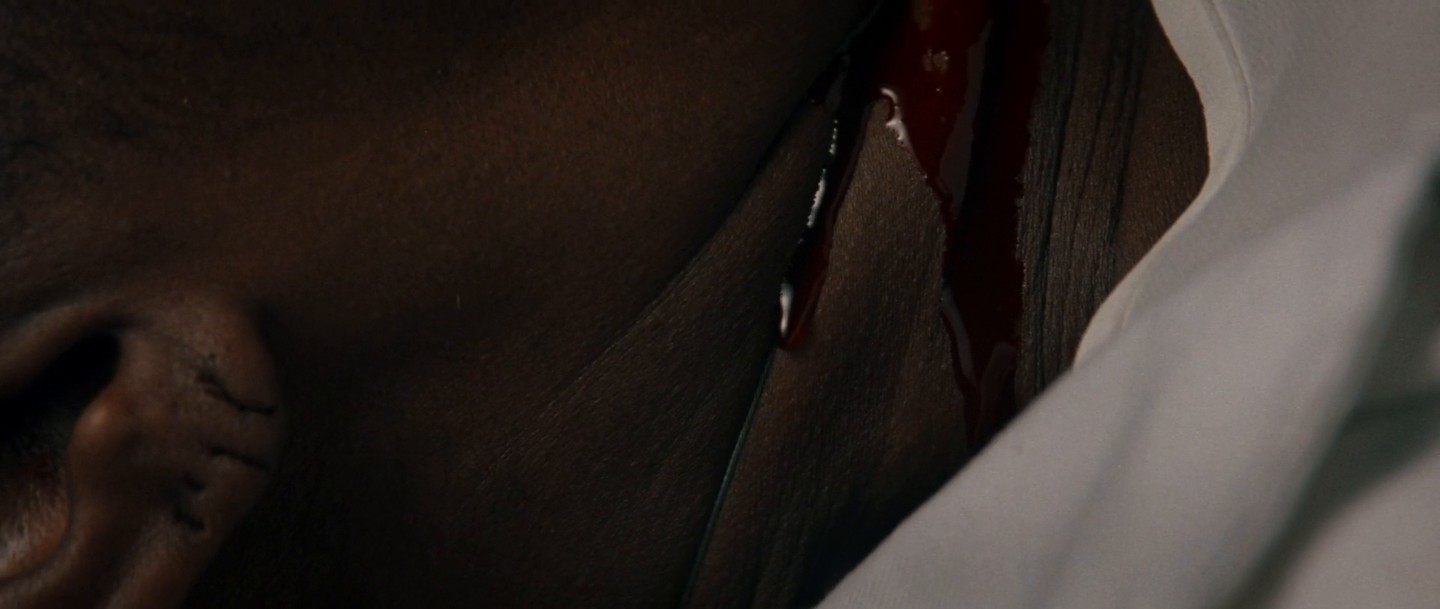
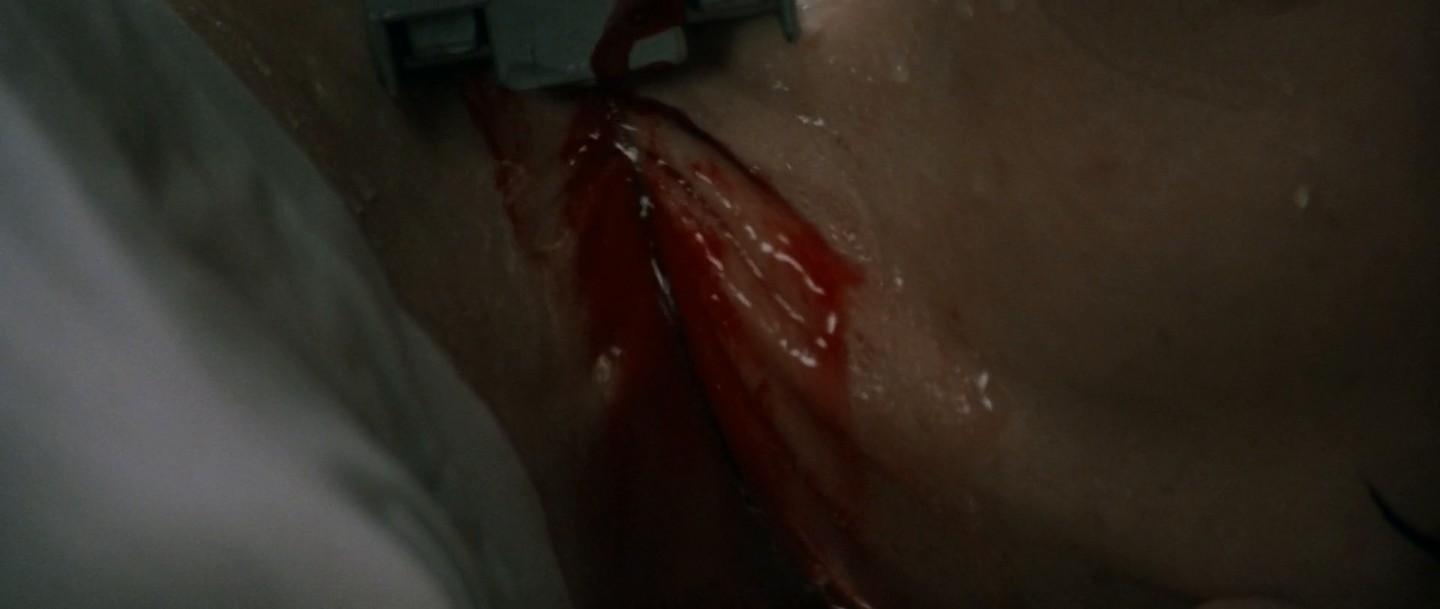
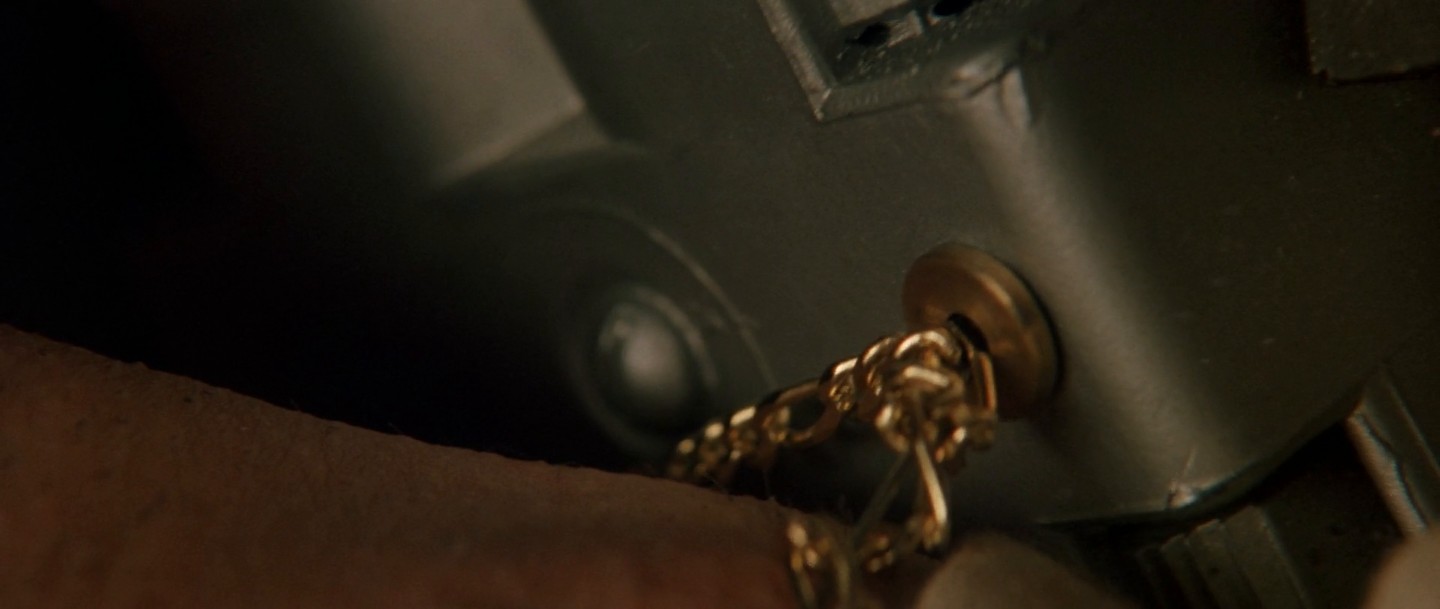
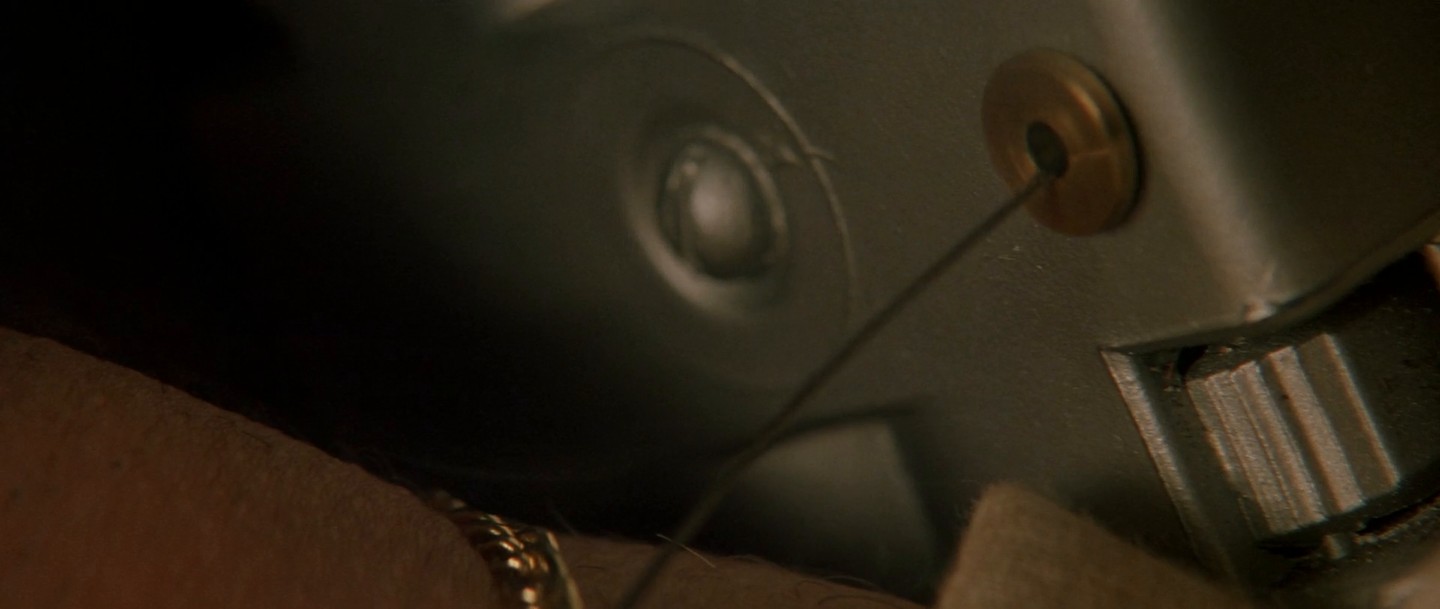
The consultation room gives the weapon a clear visual introduction. Georgia’s turn, the gloved hand and the switch divide the action into small, legible units. The neck insert then translates the mechanism into an injury.
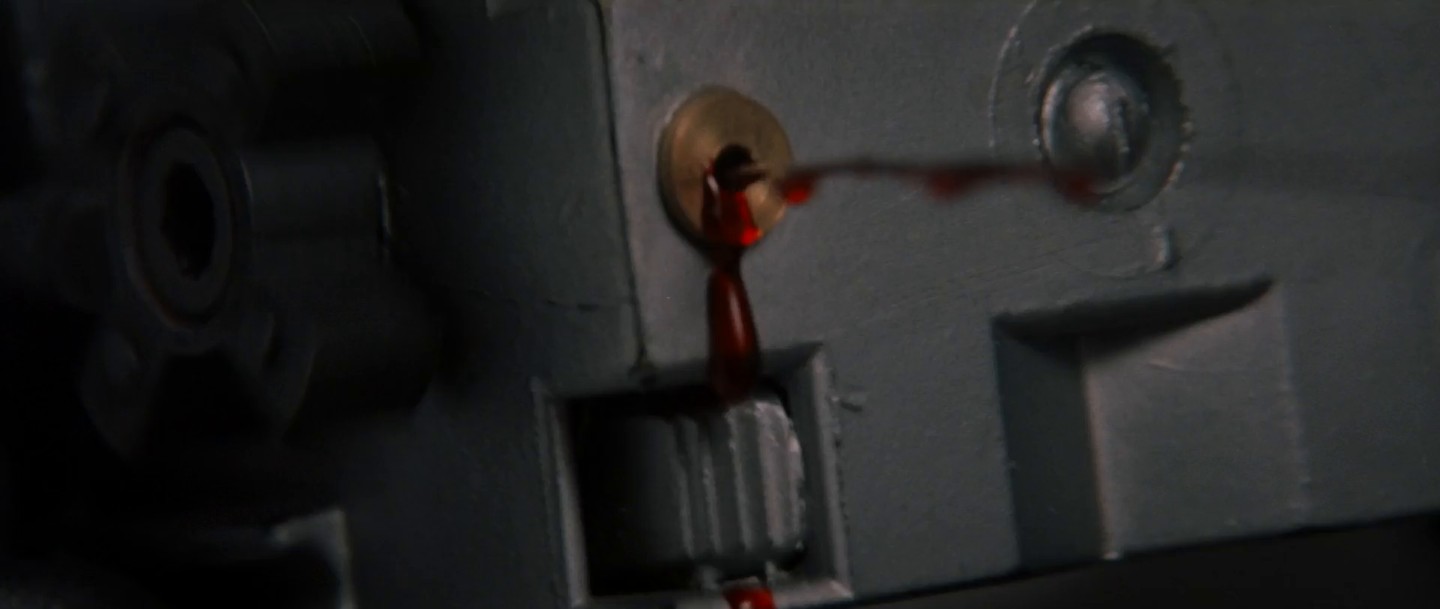
The reptile enclosure supplies an impassive counter-image. Compare the actor’s face with the wound insert and the blood on the machine: the sequence makes those different surfaces work as one event.
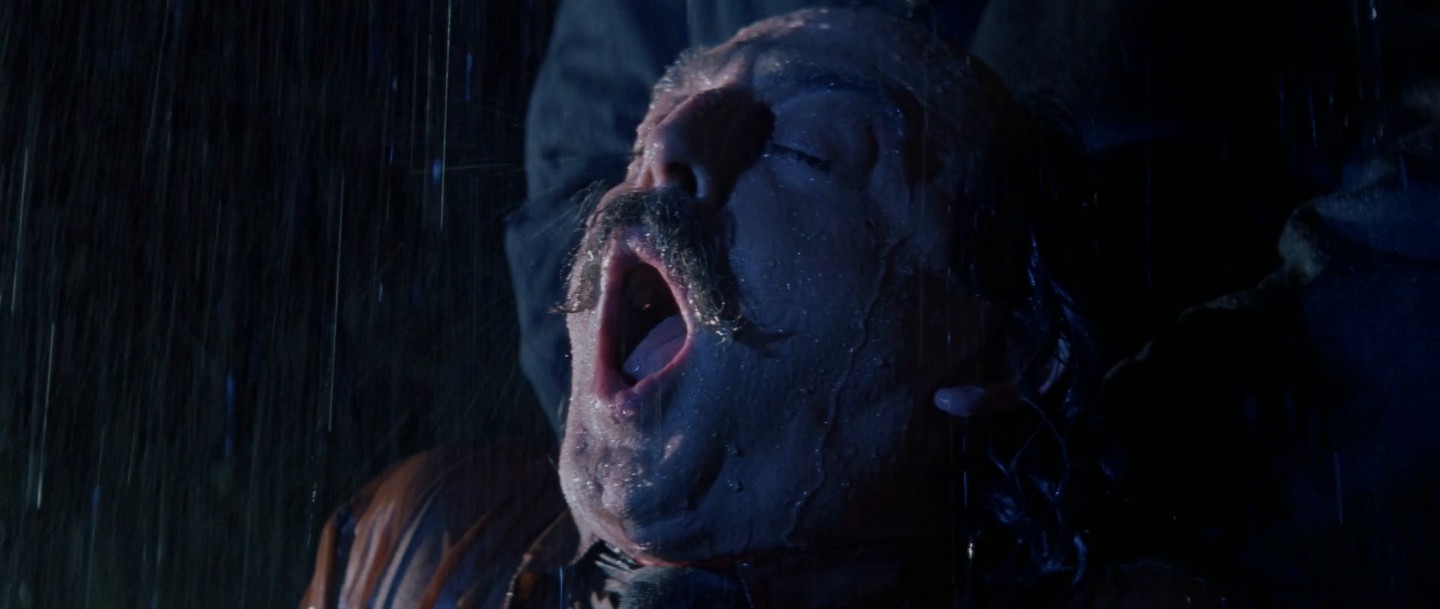
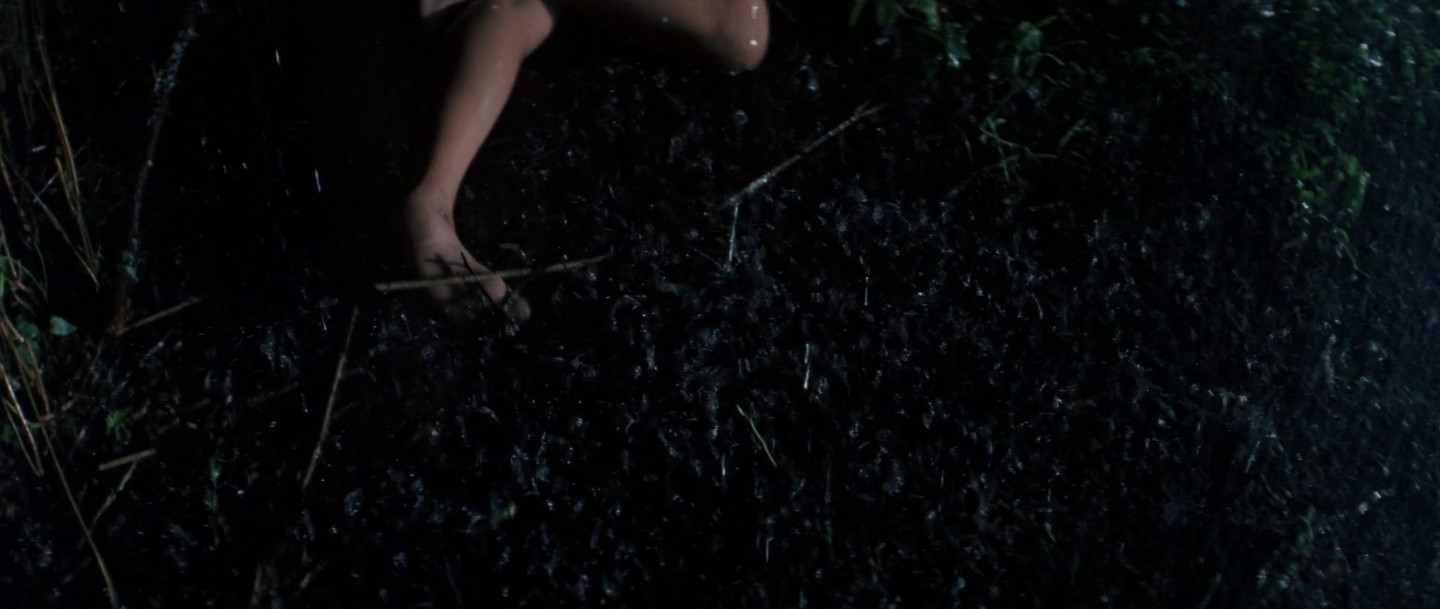
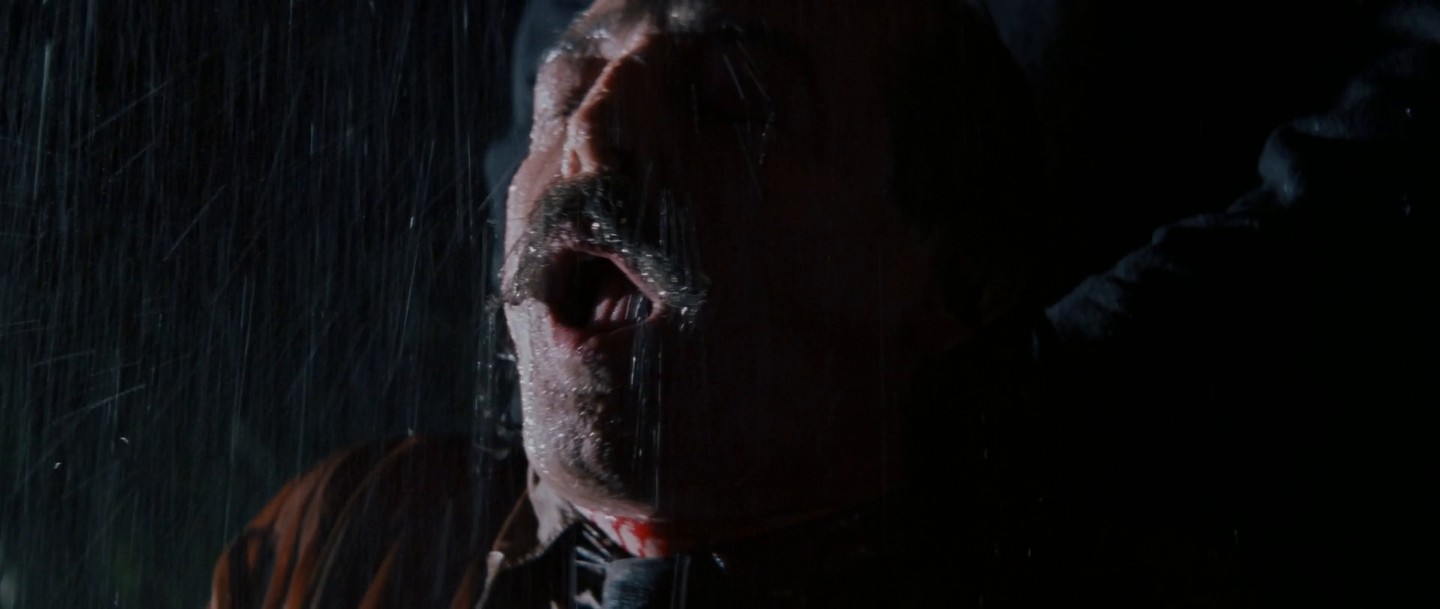
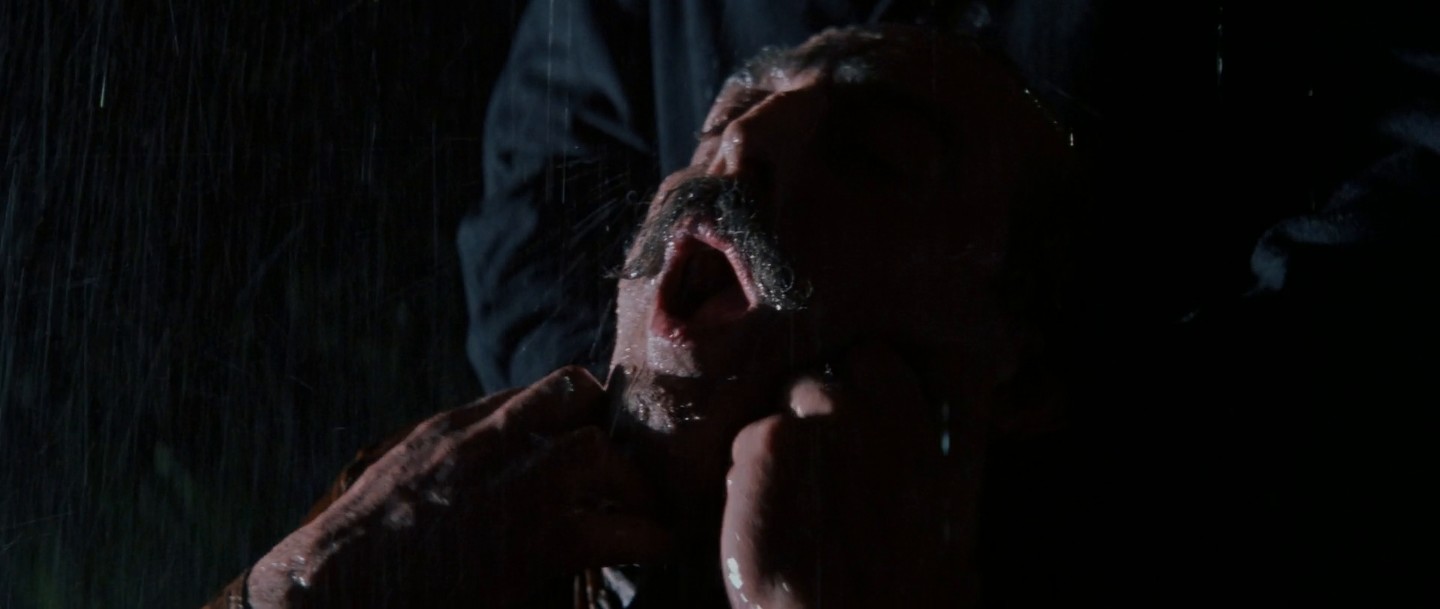
The storm conceals the attacker while exposing Stefan’s face in brief flashes. Close views establish the physical attack; the later distant arrangement offers Aura an explanation that the film will eventually overturn.
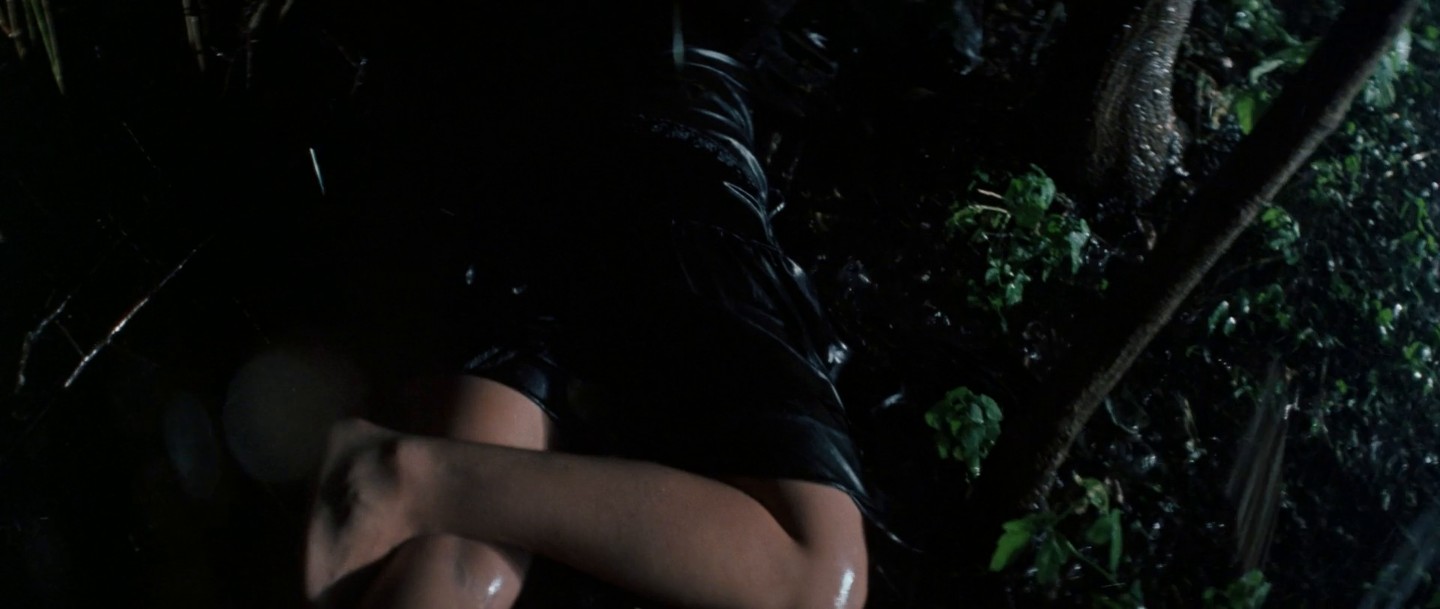
Keep the two scales distinct. A neck and wire can be read at close range, while the apparently paired heads are seen through darkness, rain and foliage. The deception depends on the distance between an event and its interpretation.
A blow beside the hospital door breaks the nurse’s orderly silhouette. Her cap falls separately, giving the impact an immediately readable object. The sequence then shifts away from a direct wound view into a projected profile.
The neighbouring patient’s reactions interrupt the attack. Its changing scale—from cap to body to shadow—lets the film mix alarm with an uncomfortable comic register. The gallery follows what is shown without inventing an unseen prosthetic construction.
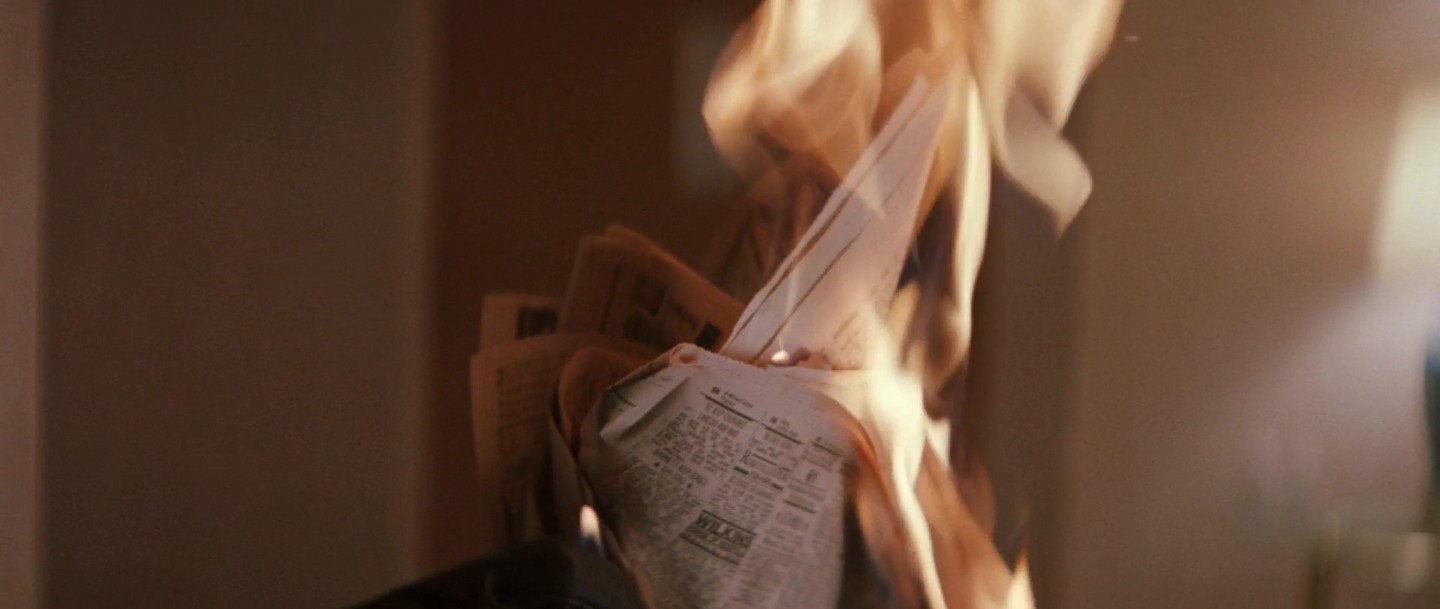
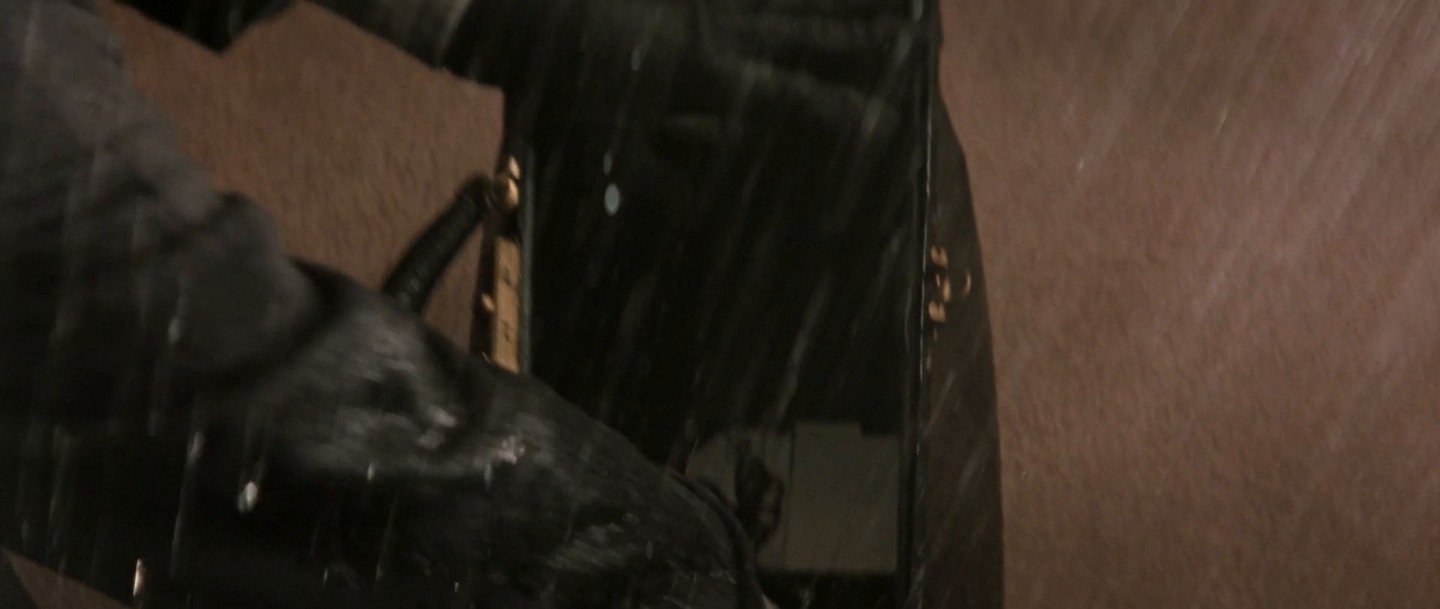
The killer manufactures indoor rain by bringing burning paper to a sprinkler. Water joins the shower elsewhere in the motel to Linda’s suddenly exposed room. The effect is prepared by an environmental change before the wire touches the body.
The aftermath moves from the wide composition to the separated face and David’s approach. These changes of distance turn the spectacle back into an encounter with a witness. The stills show the wound, the spatial arrangement and the expressive face as distinct stages.
ENLARGE ↗Lloyd’s head falls through the lift shaft.
The first attempt depends on the handheld device. The repeated attention to its workings prolongs Lloyd’s fear and makes the killer’s adjustment visible. The lift then supplies a different source of force and a much larger space for the result.
The effect crosses several kinds of image: a restrained actor, a neck at a ledge, a distant shaft and a frontal falling face. Their discontinuity is part of the spectacle. The gallery separates those stages so the extraordinary final view can be read against its preparation.
ENLARGE ↗Bloodied hands mark the medical catastrophe.
The flashback stages the catastrophe through medical personnel, failing light, bloodied hands and Adriana’s response. Its canted room and abrupt changes of brightness make authority look unstable before the consequences are fully disclosed.
The sequence also changes the function of the gore. Earlier wounds created a mystery; this recollected injury explains the pattern of revenge. The gallery concentrates on the staging and reaction rather than treating the infant’s death as a detached spectacle.
The boy reaches down from above while David and Aura remain confined below. The device that organised the earlier murders is turned against its owner. Its small mechanical scale remains visible even as the sequence moves into extreme bodily detail.
A succession of throat inserts advances the effect before the wider body view and falling head. Reactions repeatedly interrupt that progression. The final injury is therefore both a demonstration of the mechanism and the destruction of Aura’s recovered mother.
Four routes connect changes of scale, obstructed witnesses, falling water and faces that outlast the body.
From the miniature crowd to the basement
ENLARGE ↗The miniature execution awaits its audience.
The film does not save its execution imagery for the murders. The opening model supplies a public audience; the child later encounters the actual device; the basement places the living characters beside a collection of figures. These changes of scale make the final room feel prepared long before its occupant is revealed.
Follow the visual progression 5 observations
01:36
A little crowd gathers around the guillotine.
36:15
The boy handles the actual wire device.
1:42:00
The cabinet of figures occupies the space behind Adriana.
1:42:24
Mesh separates the captives from the collector.
1:45:08
The boy looks into the larger enclosure from above.
What the witness can actually see
ENLARGE ↗Aura confronts the figure beyond the branches.
Trauma repeatedly places a witness behind an obstruction: foliage, a window, a curtain, mesh. The question is not whether looking happened, but what the arrangement allowed the person to understand. The spectator receives the same fragments and is invited to complete them too quickly.
Follow the visual progression 7 observations
15:03
Aura looks from an upper window.
16:27
The figure is partly hidden by branches.
16:33
A clear reaction answers an unclear sighting.
1:12:16
The mirror extends the room while concealing its edges.
1:14:56
The shower curtain reduces the body to an outline.
1:37:15
Adriana’s reappearance overturns the apparent solution.
1:42:24
The basement screen gives the final confrontation a visible barrier.
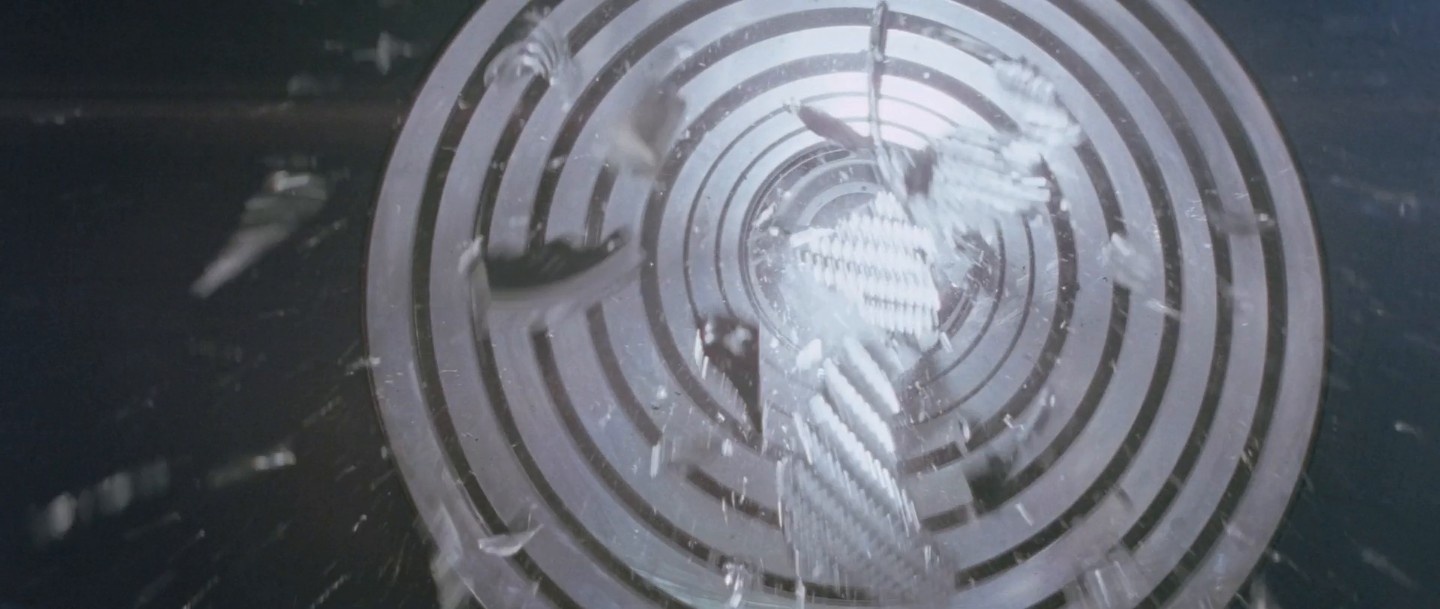
Water is more than atmosphere. The garden uses it to conceal; broadcasts turn it into a repeated expectation; the motel makes it something the killer can produce. The medical flashback gives water another role at the moment the lights fail. The recurring element joins present murders to an earlier catastrophe without making each scene visually identical.
Follow the visual progression 7 observations
15:45
Rain breaks the garden into moving bright lines.
44:15
The television forecasts more rain.
1:14:24
Burning paper prepares an artificial downpour.
1:14:40
The sprinkler becomes the immediate target.
1:14:56
The shower supplies a parallel image of falling water.
1:15:00
The motel room becomes an indoor storm.
1:43:40
Water strikes the surgical light in the flashback.
The film repeatedly preserves the face as a centre of expression after the body has been defeated. Linda’s face delays the disappearance of testimony; Lloyd’s falling face turns terror into an impossible frontal image. Against these spectacles, Aura’s reactions keep the human cost within the same sequence.
Follow the visual progression 7 observations
03:08
The opening victim’s face gives the mechanism a human scale.
16:33
Aura’s reaction determines the force of the garden tableau.
1:15:50
Linda’s face remains expressive after the wide reveal.
1:15:54
David brings his own face close to hers.
1:22:18
Lloyd’s falling face meets the spectator frontally.
1:45:36
Aura’s response interrupts the final throat inserts.
1:46:12
The aftermath stays with Aura’s face in daylight.
VOICE & DIALOGUE
Who gets to tell the story?
A diagnosis borrowed from television. A séance that speaks for the dead. A witness pressed for an answer she cannot give. Trauma’s conversations turn the murder investigation into a struggle over who controls the explanation.
David offers food and shelter, but he also starts interpreting Aura before she has described herself. His questions about her age and schooling lead to an assumption about drugs. He recognizes the marks on her arm through his own history; she rejects the explanation. Their first conversation establishes the film’s recurring conflict between helping a person and deciding what her experience must mean.
The exchange continues in a more coercive form when Aura returns home. Her parents describe the clinic as protection, while reserving the right to decide how long she must stay. Her account of what happens there has less authority than their assurance that it is for her benefit. Care becomes a language through which other people control her movements.
The séance promises access to an absent speaker. Adriana calls Nicholas, then announces that a different soul is trying to reach the gathering. The message describes a severed head and a noose before accusing a killer within the room. It turns the performance into a miniature murder investigation: an unseen victim seems able to name the danger that the living cannot recognize.
The ending changes the status of this speech. Adriana later says that Nicholas ordered the killings. That is her explanation of her actions, not independent confirmation of a supernatural command. The séance and the confession belong to the same structure: she claims authority by speaking for the dead, while controlling what the people around her are allowed to know.
ENLARGE ↗The television reports the missing daughter.
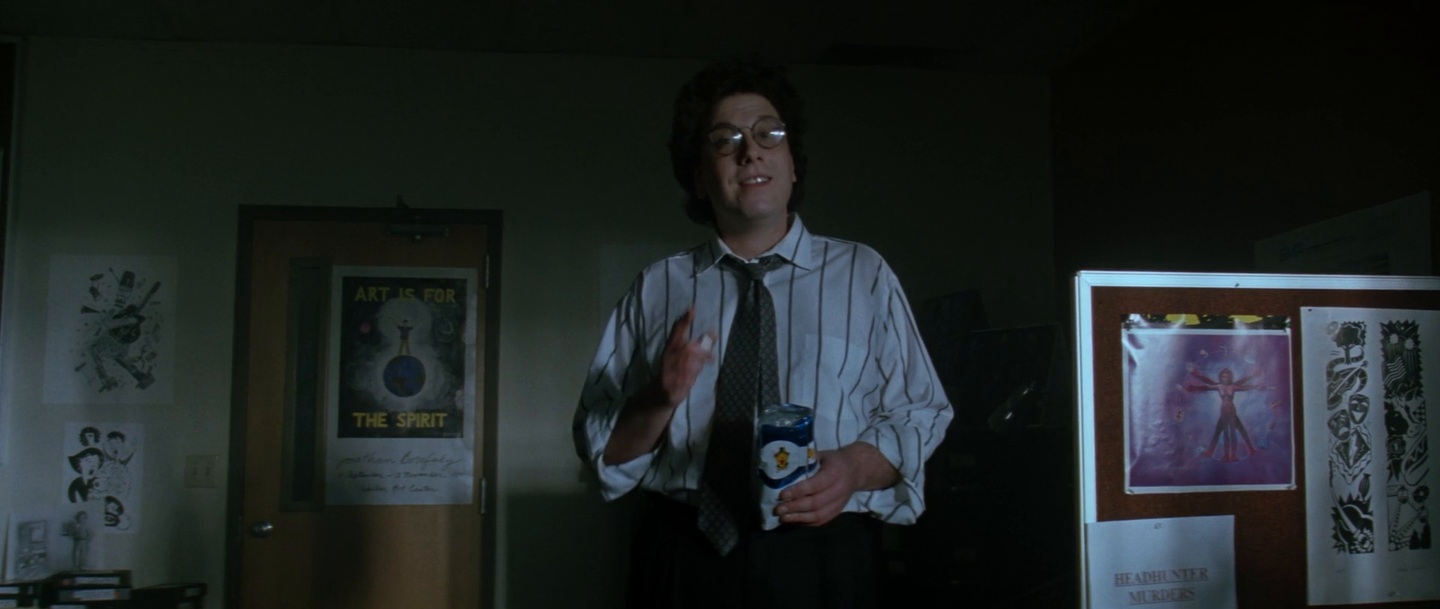
Before the news delivers facts, the newsroom decides how those facts will look. The Head Hunter graphic is discussed as a design problem, with a joke about blood red interrupting the preference for restraint. The instruction to rehearse the ad-libs makes the manufactured spontaneity explicit. Television turns the crimes into a repeatable package.
That package also makes Aura legible to David. The report identifies the missing daughter and gives her situation a public explanation before she has offered him her own. The screen is useful—it connects people and information—but its confidence repeatedly outruns the evidence. This early broadcast prepares the much more consequential false ending announced after Judd’s death.
Arnie offers David an instant account of Aura’s eating disorder, body image and family relations. When asked where his expertise comes from, he points to television talk shows. The confidence of the explanation is part of the scene’s comedy, but it also reveals a problem for the investigation: David can mistake familiarity with a media story for knowledge of this particular person.
The speech later returns over images of Aura. Repetition turns Arnie’s generalizations into an interpretive frame through which David—and the spectator—may read her. His account is a character’s borrowed theory, not the film’s medical evidence. Its placement links the mystery’s unreliable interpretations to the more ordinary habit of fitting someone into an available story.
The news is not only a source of false certainty. David and Arnie make it useful by stopping its forward flow. Rewinding the reports lets them compare dates and weather, turning ordinary broadcast material into a pattern. The discovery comes from reviewing recorded evidence, not from accepting the presenter’s explanation.
David concludes that the killer acts when it rains. Later, outside Linda’s hotel, Aura checks the weather and David reassures her that the day has been clear. The sprinkler attack defeats that reassurance by manufacturing the condition indoors. Rain moves from background atmosphere to an investigative rule, then becomes a rule the killer can reproduce.
Judd’s questioning shifts from therapeutic concern to the information he wants from Aura’s memory. She recognizes that interest and challenges it. His claim to understand her mind gives the exchange an unequal structure before he offers the berry: he names its effect while resisting the label of a drug, then continues despite her reluctance.
The subsequent interrogation asks for a face. Aura’s description places the obstruction—the apparent heads of her parents—between her and the person she was trying to see. Judd presses for an identity that the image cannot straightforwardly supply. The scene makes memory an object other people want to extract, rather than a testimony they are prepared to hear on her terms.
Linda’s conversation with Alice begins to articulate the event linking the victims. She speaks of an accident, of electroshock intended to make someone forget, and of a shared responsibility that has not disappeared. The telephone offers a route to safety but also distributes information that can be intercepted. Linda names her hotel and room; the written message later becomes available to the killer.
After the attack, Linda’s repeated name—Lloyd—turns a grotesque effects scene into a last act of testimony. David follows it to the doctor. Lloyd initially dismisses the deaths, then changes his response when David specifies decapitation. His denial of blame reveals that the method carries a history. The witness can disclose a connection without yet disclosing the complete story.
After Judd’s crash, the news presents the murders as solved. The bodies of evidence are literal: the report says the seven heads have been found in his car. Yet the explanation of motive is far less substantial. Captain Travis offers an occult obsession and closes the case; the broadcast converts that institutional decision into narrative certainty.
Grace’s follow-up makes the contradiction sharp. She lists unanswered questions about Judd and the victims, promotes a future special report, then declares the nightmare over. A mystery that still needs explanation has already been sold as a finished story. The sequence cautions against treating possession of evidence as proof of the story told about it.
ENLARGE ↗Adriana faces her captives through the mesh.
Aura’s explanation revises two assumptions: the corpse was a neighbour’s, and the tableau in the garden contained one severed head, not two. She has not recovered an entirely missing image. She has changed the relationship between the things already visible within it. The distinction lets the daughter explain how her mother’s staged death acquired the force of a fact.
Adriana’s later account supplies the medical catastrophe and her revenge, but it also repeats the family’s pattern of command. At the locked door she moves from maternal reassurance to orders to remove the chain. Her claim that she would never hurt Aura sits beside the threat she is enacting. The confession explains the murders while preserving the violence of the family relationship.
The killer is dead, yet Aura is still being asked to organize someone else’s explanation. Travis questions her about Judd, her mother, a possible partnership and a possible affair. She repeats pieces of his wording rather than producing the clear account he seeks. The scene refuses to equate the solution of the murder plot with the witness’s emotional recovery.
David interrupts the questioning and identifies himself to her. His reassurance changes the purpose of speech: it no longer asks Aura to supply a clue. That shift matters because he began the film by imposing his own explanation on her. The ending gives him a different task—to remain with her when a usable account is precisely what she cannot offer.
The English SDH captions identify sounds that connect the film’s mechanisms to its story. Read alongside the images, these landmarks trace what attracts attention, signals danger and interrupts speech.
44:02–44:29
A voice played backwards
The rewind and backward-speech captions mark a change in the status of the broadcast. Grace’s report becomes material David can stop, repeat and compare. The rain clue emerges through control of a recording, reversing the usual relation between television’s fluent explanation and its viewer.
Keys, groans, thunder, the tool’s whirring and an alarm are separately identified in the captions around Hilda’s attack. The visual sequence divides attention between the victim and the neighbouring patient; the sound descriptions make the hospital a place full of signals without an effective rescue.
Thunder and the shattering light accompany the delivery-room catastrophe. Later, the captions identify electrical buzzing as the medical staff try to subdue Adriana. Her ensuing claim that they tried to make her forget joins physical intervention to the film’s repeated contest over memory.
The tool’s whirring returns in the final reversal, followed by gagging, cries and the falling head. The captions then mark piano music before the daylight questioning. The transition separates the end of the killer’s mechanism from Aura’s continuing distress.
The orchestra’s name is printed as “Bulgarian Simphony Orchestra” in the closing roll.
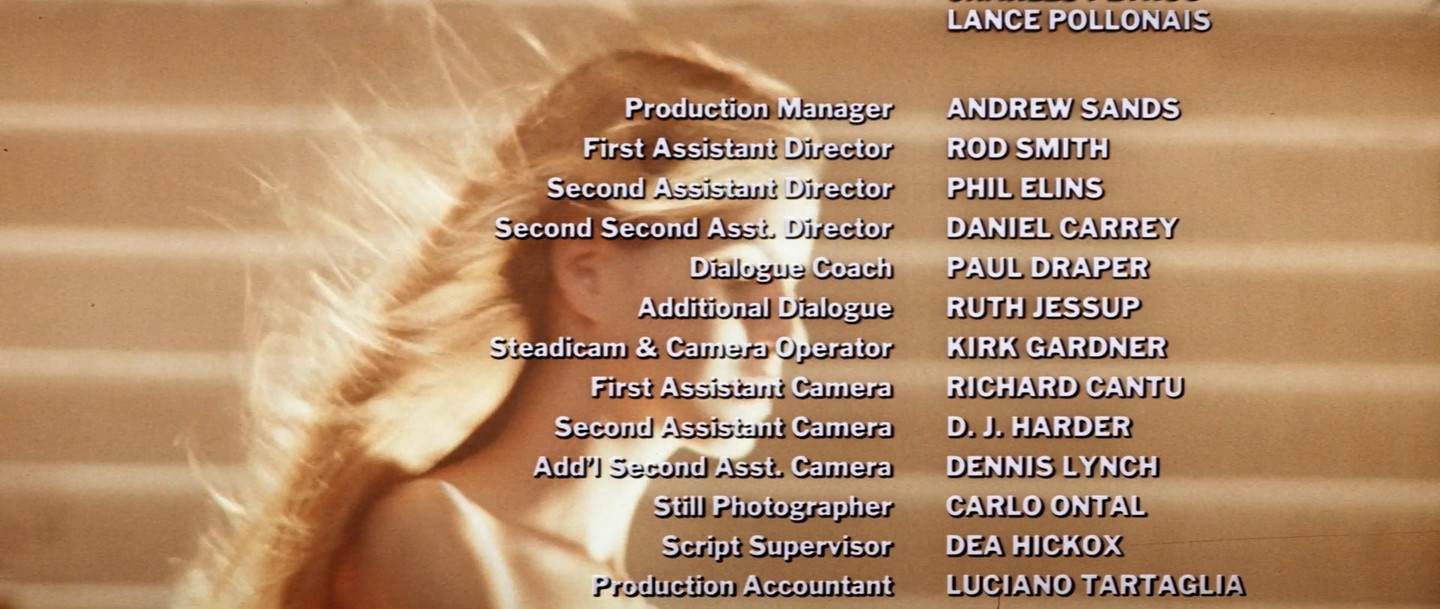
The credits distinguish location recording, language preparation, sound effects and orchestral performance. They extend the existing distinction between Paul Draper’s dialogue-coach credit and Ruth Jessup’s additional dialogue. The film’s voices result from several kinds of work; the roll does not assign every individual line or mechanical effect to a named contributor.
Pino Donaggio’s score remains part of that larger construction. The music study brings together Argento’s contemporary account of humour and the composer’s later description of his range. The screen credits identify the performers without turning those accounts into an unsupported cue-by-cue analysis.
LANGUAGE & PRESENTATION
One English presentation, several sound histories.
The dialogue reference
The presentation used here runs 1:49:37 and carries a two-channel English soundtrack, an English SDH stream and two separate commentary tracks. The dialogue studies follow the feature’s English speech; they do not incorporate the commentaries as testimony.
The file’s soundtrack label is not proof of its original theatrical mix. Its Vinegar Syndrome closing card and the publisher’s English-stereo specification provide useful edition context, while the precise retail package remains a separate question. Publisher’s specification →
Why an edition comparison matters
Mondo Digital’s release history describes different sound presentations and a workprint using temporary music. Those are distinct objects of comparison: an earlier assembly’s soundtrack, a finished feature’s mix and the options supplied on a later disc need not answer the same question.
The critic’s listening judgments retain their attribution. Track configuration and dialogue recognition do not establish the balance, placement or fidelity of an original release. Read the edition history → · Edition review →
THE CRAFT RECORD
Names on the screen.
ENLARGE ↗Dialogue coach and additional-dialogue credits.
Two dialogue roles
Dialogue coach
Paul Draper
Additional dialogue
Ruth Jessup
The closing roll distinguishes the two jobs. This resolves the wording for the presentation examined here and gives the earlier catalogue discrepancy a concrete screen-credit reference.
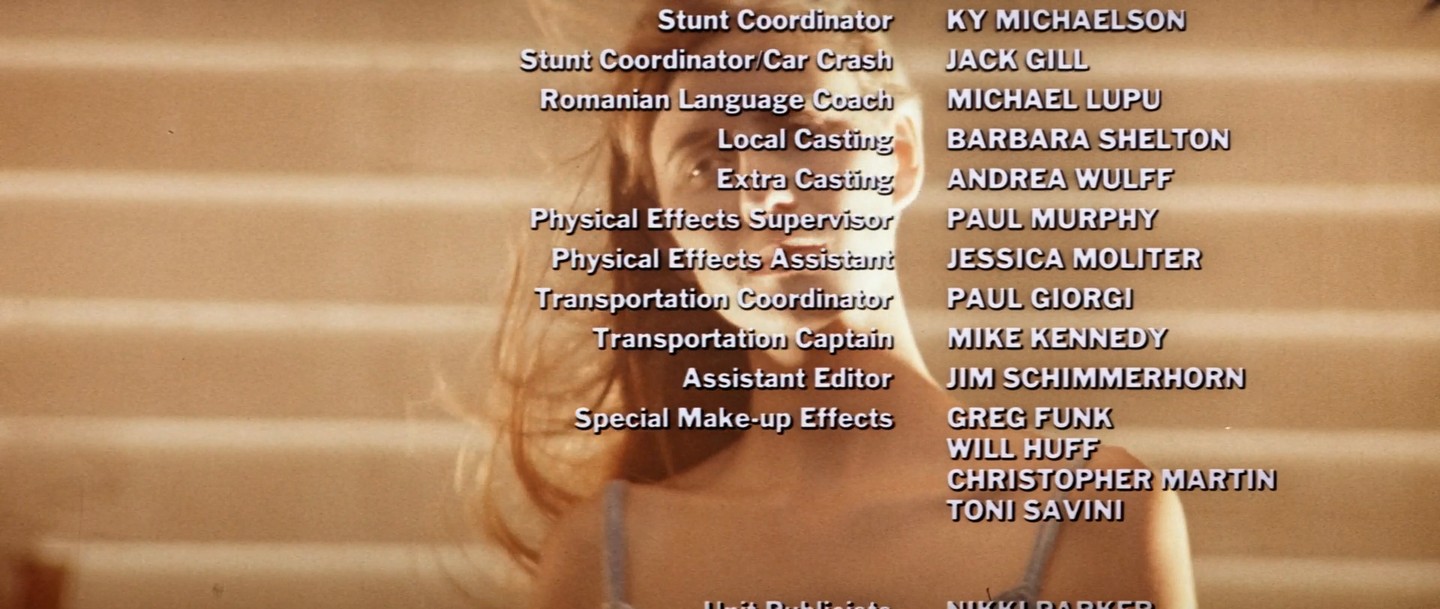
Greg Funk, Will Huff, Christopher Martin and Toni Savini
Physical effects supervisor
Paul Murphy
Physical effects assistant
Jessica Moliter
These names appear in the closing roll. The BFI compilation and Vinegar Syndrome’s Savini interview listing also document Tom Savini’s central involvement. The credits do not assign each individual wound or insert to a particular technician. Compiled credits → · Savini interview listing →
The presentation runs 1:49:37 including the closing distributor card. Its 1920 × 812 image fills the frame without letterbox bars; the selected stills retain that composition.
The Vinegar Syndrome card, English SDH stream and two labelled commentary tracks align with the publisher’s release listing. That listing specifies a 109-minute, 2.35:1 English-stereo Blu-ray restored in 4K from a 35mm interpositive.
The workprint is a separate listed supplement. It has not been substituted for this presentation or treated as a cut-by-cut comparison. Explore the edition history →
Witnesses & authority
Trauma moves Argento’s mystery to Minneapolis, where Aura’s testimony unsettles the people who claim authority over her. This expanded dossier follows the writing, performances, staged images, effects and Donaggio’s music through contemporary testimony, later accounts and the film’s complicated release history.
Spoilers: this study discusses the film’s story and ending.
01 / AURA, DAVID & AUTHORITY
Who gets to be believed?
Trauma places a young woman’s account of violence inside a network of people who claim to know what is best for her. Aura, played by Asia Argento, has an eating disorder and witnesses what appears to be the murder of both her parents. David, played by Christopher Rydell, becomes her ally. The basic premise makes vulnerability and testimony inseparable: a witness needs help, but needing help does not make her observations worthless. FLC programme ↗
Cinematografo’s synopsis describes a particularly disturbing example. Dr Judd gives Aura a hallucinogenic berry while trying to establish whether she recognised the killer. The investigation’s demand for information becomes another intrusion upon the person who holds it. Later, the discovery of Judd’s body allows the police to close the case prematurely. Institutional certainty has arrived before an adequate explanation. Synopsis; spoilers ↗
The ethical question is therefore larger than whether Aura remembers correctly. Who sets the terms on which she can speak? Who decides which part of her experience counts as evidence? A thriller can make a witness’s uncertainty exciting while leaving the authority of those questioning her unexamined. Trauma offers a way to examine both sides of that exchange.
The alliance with David creates a possible alternative to that pressure, but rescue is not automatically equality. Read the relationship through what Aura is allowed to initiate, refuse and discover, rather than treating the male helper’s concern as proof that every decision benefits her. That is also a useful connection to The Stendhal Syndrome: assistance, intimacy and control need to be distinguished even when they arrive together.
The film’s account of illness belongs to its dramatic construction. It is not a clinical explanation, and the dossier does not diagnose either its characters or the people who made it. The important critical task is to examine what the story permits its vulnerable heroine to know and do.
02 / TWO IMAGE STUDIES
A face, a hood and a theatre of death
The Film at Lincoln Center image above isolates a woman with closed eyes inside a dark hood. The carved chair rises behind her head, while a greenish window occupies the left side and blue light crosses the room. Her face is the clearest surface in a setting that otherwise withholds detail. These are observations of the supplied still. Image provenance ↗
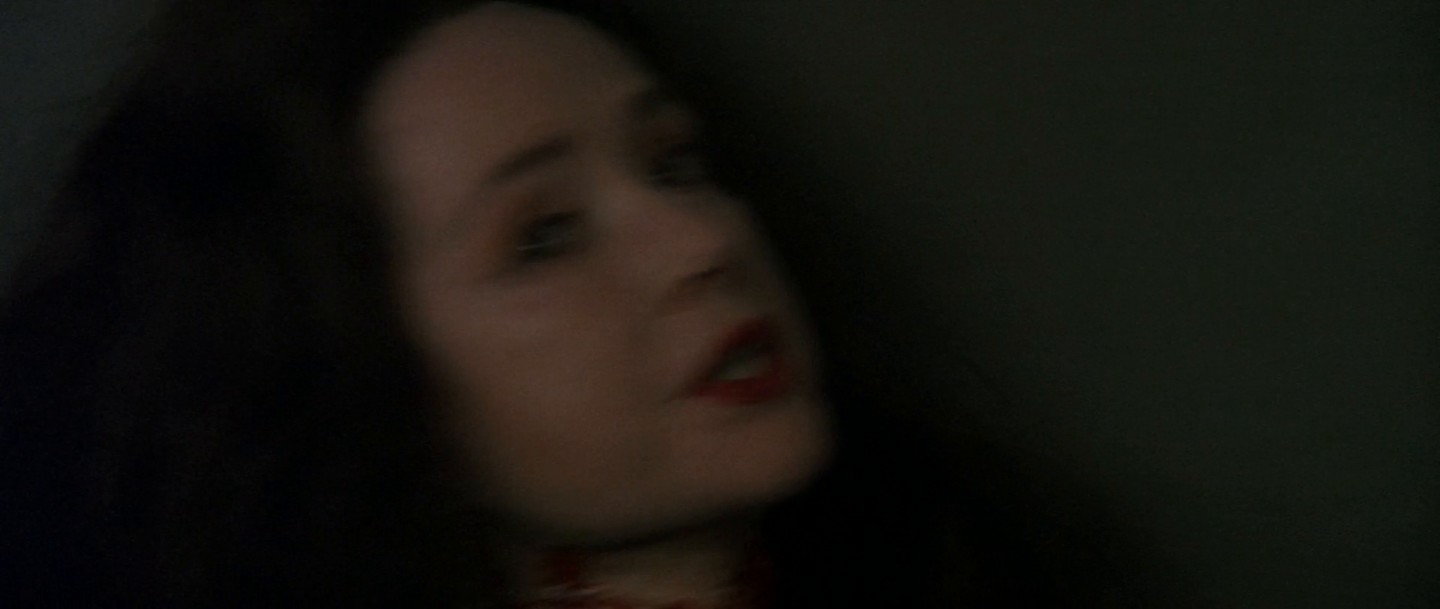
The arrangement gives the face a ceremonial prominence. The hood can suggest concealment, yet it also makes the pale skin more conspicuous. Closed eyes refuse the ordinary exchange of looks between character and spectator: we are watching someone whose attention appears directed elsewhere. The frame makes a useful point of entry into the séance’s theatrical authority without establishing how long the shot lasts or how the camera reaches it.
The second image makes death into a small stage. A red guillotine supplies the dominant vertical line, with paper spectators and a raised platform arranged below. Smoke disrupts the miniature’s crisp edges. The threatening object is plainly artificial, but the photograph gives it weight and atmosphere. Frame and catalogue record ↗
Placed beside the hooded figure, the miniature suggests two forms of staging: a person presented as a channel to hidden knowledge, and a machine presented as public spectacle. Both invite us to consider how an arrangement can persuade a spectator before its mechanism has been understood.
03 / STORY, SCREENPLAY & FAMILY
Several writers, one disputed account
The BFI’s compiled credits distinguish a story by Franco Ferrini, Gianni Romoli and Dario Argento from the screenplay by Argento and T.E.D. Klein. They also name Ruth Jessup for additional dialogue. These separate functions matter: devising the mystery, developing the script and changing its spoken language need not be the same act. Compiled writing credits ↗
There is a small but real discrepancy to retain. Cinematografo names Paul Draper for dialogue, whereas the BFI names Jessup. The closing roll of the presentation examined for the visual studies distinguishes the roles: Paul Draper is the dialogue coach; Ruth Jessup is credited for additional dialogue. This settles the visible wording for this presentation, while the catalogues remain useful evidence of how the credits have circulated. It does not reconstruct uncredited revisions. See the on-screen credit →Catalogue credit difference ↗
The ending turns the apparent family tragedy inside out. The Italian Catholic film commission’s synopsis identifies Adriana as the killer: she has staged her own death and pursued those responsible for the death of her infant son. Aura’s original sighting contains an event whose meaning was incorrectly settled. The new scene studies and final effects gallery follow the visual disclosure alongside that synopsis. Ending synopsis; major spoilers ↗
This gives the mystery two competing family histories. One is the immediate story Aura thinks she has witnessed; the other is an older injury concealed behind it. The solution does more than add a name to a list of suspects. It changes the status of the mother, the meaning of the earlier spectacle and the apparent boundaries between victim and perpetrator.
Such a structure makes the chronology of the writing especially valuable. A revision to the initiating injury could alter the whole moral arrangement without changing the murder device. They are located routes for a return pass, not materials silently treated as already inspected. Ferrini interview listing ↗
04 / MINNEAPOLIS, PERFORMANCE & CRAFT
An American setting, a collaborative image
Kevin Lyons’s retrospective essay identifies Trauma as Argento’s first complete feature shot outside Italy, after his contribution to Two Evil Eyes. Minneapolis therefore marks a change in production circumstances as well as scenery. It need not be judged only by how closely it resembles the director’s Italian cities. Production context ↗
The programme’s credits name Raffaele Mertes for photography, Billy Jett for production design, Nance Derby for art direction, Jacqueline Jacobson for set decoration and Leesa Evans for costume. Bennett Goldberg is credited as editor, with Conrad Gonzalez separately noted as uncredited. Those distinctions preserve a working ensemble behind the image. Camera, design and editing credits ↗
The hooded still demonstrates why that ensemble matters. Clothing frames the face; the chair supplies a second outline; the window gives the room another texture; light distributes visibility across them. No single departmental credit establishes who proposed each detail. The image is evidence of their combined result, while an attribution of a particular decision requires a production account.
In Michele Anselmi’s release-period interview, Argento describes directing Asia as unexpectedly harmonious and says she studied Romanian to make her English-language performance more credible. This is the director’s 1993 account, not a substitute for Asia’s own testimony. It identifies language and preparation as useful lines of enquiry rather than reducing her contribution to the fact that she is his daughter. l’Unità, 3 March 1993, p. 19 ↗
The same distinction applies to the supporting cast. An actor’s conspicuous manner may be a performance choice, a function of the writing, or an effect of editing and presentation. A judgment about whether someone took the work seriously needs better evidence than finding the result excessive. The listed Mertes, Laurie and casting interviews offer concrete ways back to those working choices. Production interview listings ↗
The actor remembers the language work.
Asia Argento’s interview in Panico adds her perspective to the director’s 1993 account. She remembers wanting to work with him after already appearing in other filmmakers’ films, then fearing that she would disappoint him. The role also required her to perform in English with a Romanian accent. Panico: testimony and passage locators ↗
Her recollection makes the language requirement a specific acting task within an emotionally important collaboration. Beside the release-period description of her Romanian study, it gives the performance a history told by both actor and director.
05 / MECHANISMS, EFFECTS & BLACK COMEDY
A household tool becomes an execution machine
Asked about the murder weapon in Anselmi’s interview, Argento links its invention to contemporary electric and battery-powered tools. He also describes the film’s humour as an intentional counterweight to its darker passages. The account makes a useful bridge between the miniature guillotine and the portable device: elaborate punishment has become something that looks perversely compatible with domestic ingenuity. Weapon and humour questions ↗
The miniature makes execution public and ceremonial. A portable mechanism can carry a related threat into an ordinary room. That change of scale matters more than a simple tally of violent moments: the sinister object becomes adaptable to the victim’s environment, and the environment can become part of the attack.
Effects work also has its own revision history. Mondo Digital’s account of the Savini supplement describes unused head effects and alternative designs alongside the finished mechanism. Its review is evidence that these subjects are discussed in the supplement, not a production log independently examined here. Review of Heads Above the Rest ↗
Designing an effect, filming it and retaining it in a release are three separate decisions. A discarded design does not prove censorship, and a prop’s survival does not establish the edit in which it originally appeared. This distinction protects the contribution of effects artists without treating every unused idea as a lost definitive version.
The result can be considered as a tension between dread and absurdity. A contraption may be frightening because it is plausible enough to imagine, then comic because its ingenuity is so excessive. Argento’s stated interest in that tonal contrast gives the dossier a stronger starting point than assuming every incongruous moment is accidental. Whether a particular effect sustains the tension remains a question for the scene and its presentation.
06 / PINO DONAGGIO & TONAL CONTRAST
The score has more than one job
Donaggio’s score belongs in the discussion of humour as well as suspense. In the 1993 interview, Argento explicitly credits the music with reinforcing the comic effect. That is a statement of intended function at release; it does not tell us precisely how a cue operates in every version. Argento on Donaggio ↗
In a later interview published on 4 October 2026, Donaggio describes his work for Argento as occupying a musical space between Goblin and Morricone, including strongly rhythmic material. Read this as the composer’s retrospective account of his range, rather than a claim that the score can be reduced to two other musical identities. Donaggio’s Trauma discussion ↗
The two accounts suggest a useful listening question: when does the music invite fear, and when does it permit distance from the action? A comic inflection can briefly expose a mechanism as a mechanism. A sustained musical pressure can make the same contrivance feel inescapable. Neither function is automatically less serious than the other; each changes the spectator’s relation to the threat.
The workprint adds another complication. Mondo Digital reports temporary music from other films and Enya in that assembly. A workprint’s sound therefore cannot simply be treated as an earlier complete Donaggio score. Its provisional choices and its unfinished dialogue may answer different questions from the eventual release mix. Workprint sound account ↗
The sound landmarks follow the captions’ descriptions of machinery, weather, alarms and the passage into the aftermath. The screen-credit record identifies location sound, effects and orchestral performance, while the presentation guide separates this English dialogue reference from edition-specific listening judgments.
07 / RELEASE EXPECTATIONS & REASSESSMENT
The disagreement is part of the history
Noah Cowan’s 1993 Toronto festival programme note is strikingly enthusiastic about Aura and the film’s visual invention. The text is preserved on his archive site with a link to the original programme scan. This festival note records an appreciative response at release.
The Catholic film commission’s assessment objects to the violence and to narrative implausibilities, particularly when judged as a crime story rather than supernatural horror. Its moral and generic criteria differ from the festival note’s celebration of cinematic excess. The notice’s original publication date is not established on the current archive page. Pastoral assessment ↗
In 2023, Lyons’s BFI-reprinted essay reassesses the film more favourably while retaining substantial reservations. The change in vantage point matters: a viewer can judge a new release against the immediately preceding work, while a retrospective audience encounters it within a longer, uneven career. Lyons’s retrospective assessment ↗
These responses ask different things of the film. Should its plot behave like a coherent investigation? Should its images destabilise ordinary explanations? Is Aura an engaging participant or chiefly a device for generating peril? Such questions make disagreement useful. Simply averaging the verdicts would erase the criteria that produced them.
Presentation complicates that history further. Mondo Digital argues that early cropped video editions and poor sound damaged the experience. That is an edition reviewer’s assessment, not a measured explanation for the film’s reputation. Still, it gives the next comparison a concrete purpose: establish which composition, language and sound presentation a particular critic or audience actually encountered. Early video presentation account ↗
08 / CLASSIFICATION, RESTORATION & WORKPRINT
Several records do not make one definitive cut
The available records establish distinct presentations, but not a complete genealogy. The BBFC explicitly marks the 1994 and 1999 video submissions as having received cuts or alterations. That is firmer evidence than inferring censorship from a shorter running time alone. The public entries do not identify every affected shot. Classification history ↗
Published presentation records, checked 16 October 2026
Record
Listed duration
What the record establishes
BBFC / High Fliers, 1994
101m 53s
Video, classified 10 February; cuts or alterations recorded. Entry ↗
BBFC / Tartan, 1999
101m 54s
Video, classified 1 September; cuts or alterations recorded. Entry ↗
BBFC / Lions Gate, 2010
106m 18s
Classified 19 October; separate physical-media/streaming submission. Entry ↗
2.35:1, English stereo; 4K scan from a 35mm interpositive; workprint supplied separately. Publisher specification ↗
Mondo Digital reports that the longer English presentation uses adjusted workprint audio for restored passages. That makes the sound’s provenance as important as the source of the picture. An interpositive scan describes an element used for restoration; it does not by itself explain every inserted image or reconstructed line. Longer English presentation ↗
Running times require playback rates, logos, credit lengths and actual content to be compared. The festival archive’s transcribed 86-minute listing is another unresolved catalogue anomaly, not sufficient evidence of an otherwise undocumented short cut. The useful next step is to check the original programme and screening record before giving that number a history. Programme transcription ↗
A workprint preserves decisions in progress. Its additional footage can illuminate characterisation or writing changes without becoming the director’s preferred final version. For a focused comparison, match the same opening, Aura introduction and final revelation across two identified releases, then document the differences in image and sound.
FOLLOW THE CONNECTIONS
Another way in.
Read across films, then return to the evidence for each one.
Argento recalls writing Trauma in New York and visiting possible settings before choosing Minneapolis. In My Cinema he describes looking for an American city with a provincial character, then connects that setting to Aura’s position as a Romanian outsider. The location was therefore more than a change of national scenery: it offered a social world in which someone could be present without feeling that she belonged.
This testimony adds a useful counterpart to Asia Argento’s later account of learning to work in another language. The director discusses the environment and the character’s displacement; the performer remembers the language work required to inhabit it. Together they connect the film’s setting to the effort of being understood.
Source & passage
Dario Argento: My Cinema / Il mio cinema, two-part documentary presented on Severin Films’ Dario Argento’s Deep Cuts, Disc 1. Part Two, 48:33–50:39.
The discussion paraphrases the English subtitles and distinguishes participant recollections from the documentary’s narration and production footage.
Contemporary testimony, later accounts, images and edition records. Scene studies, English dialogue and screen-credit evidence expanded 5 November 2026.
Kevin Lyons essay dated 3 February 2023 and separately compiled credits. Retrospective criticism and institutional credit compilation, not original production records.
Synopsis and writing/craft credits. Dialogue attribution differs from the BFI compilation. The new screen-credit study distinguishes Draper’s dialogue-coach role from Jessup’s additional dialogue; draft history remains open.
Printed page 19: weapon invention, intended humour, Donaggio and directing Asia questions read against the scan. Contemporary participant testimony; the interview’s explanations of illness are not medical evidence.
The question introducing Trauma and its answer inspected: rhythmic material and the composer’s retrospective description of his range for Argento. Not a cue analysis.
Review updated 25 November 2021: home-video framing/sound, workprint, restored English audio and descriptions of supplements. The review’s supplement descriptions remain secondary accounts; the new visual studies examine a separate presentation of the feature.
Official 109-minute, 2.35:1, English-stereo Blu-ray specification, 4K interpositive restoration and separate workprint/interview listings, rechecked 5 November 2026. The new image studies examine a presentation bearing the label’s closing card; the listed supplements are not treated as newly watched testimony.
Authenticated catalogue and full 1920 × 816 image. Catalogue locator 00:01:34. Full supplied image preserved without new cropping or colour adjustment.
Trauma — selected scenes, effects and screen credits
The scene guide and effects galleries examine selected frames across a 1:49:37 presentation bearing a Vinegar Syndrome closing card. Closer sampling follows the preparation, injury and aftermath of seven sequences. Time labels locate the illustrated views in this presentation.
These are visual studies of selected passages, not a catalogue of every cut. The closing roll supports the dialogue-role and effects-credit notes. The English dialogue studies extend this visual record through their separately documented speech and subtitle sources. Commentary testimony and direct mix comparisons remain distinct from those studies.
Trauma — English dialogue, sound captions and closing credits
The complete English feature track was processed through local speech recognition and its transcript reviewed from beginning to end. Key exchanges were cross-checked against 631 visually inspected embedded subtitle cues, with closer recognition passes for selected passages. The studies paraphrase the dialogue and use the images to establish its dramatic context. Time labels locate passages in the 1:49:37 presentation.
The sound landmarks cite the English SDH captions; the added craft credits were read directly from the closing roll. This method supports dialogue analysis and captioned sound events. It is not a direct listening audit of musical cues, performance inflection, stereo placement or original-mix fidelity. The two commentary tracks were not included in this speech review.
Asia Argento: 1:15:45–1:16:15. Retrospective documentary testimony, paraphrased from the interview and checked against the English subtitles. Source and review method ↗
 ENLARGE ↗