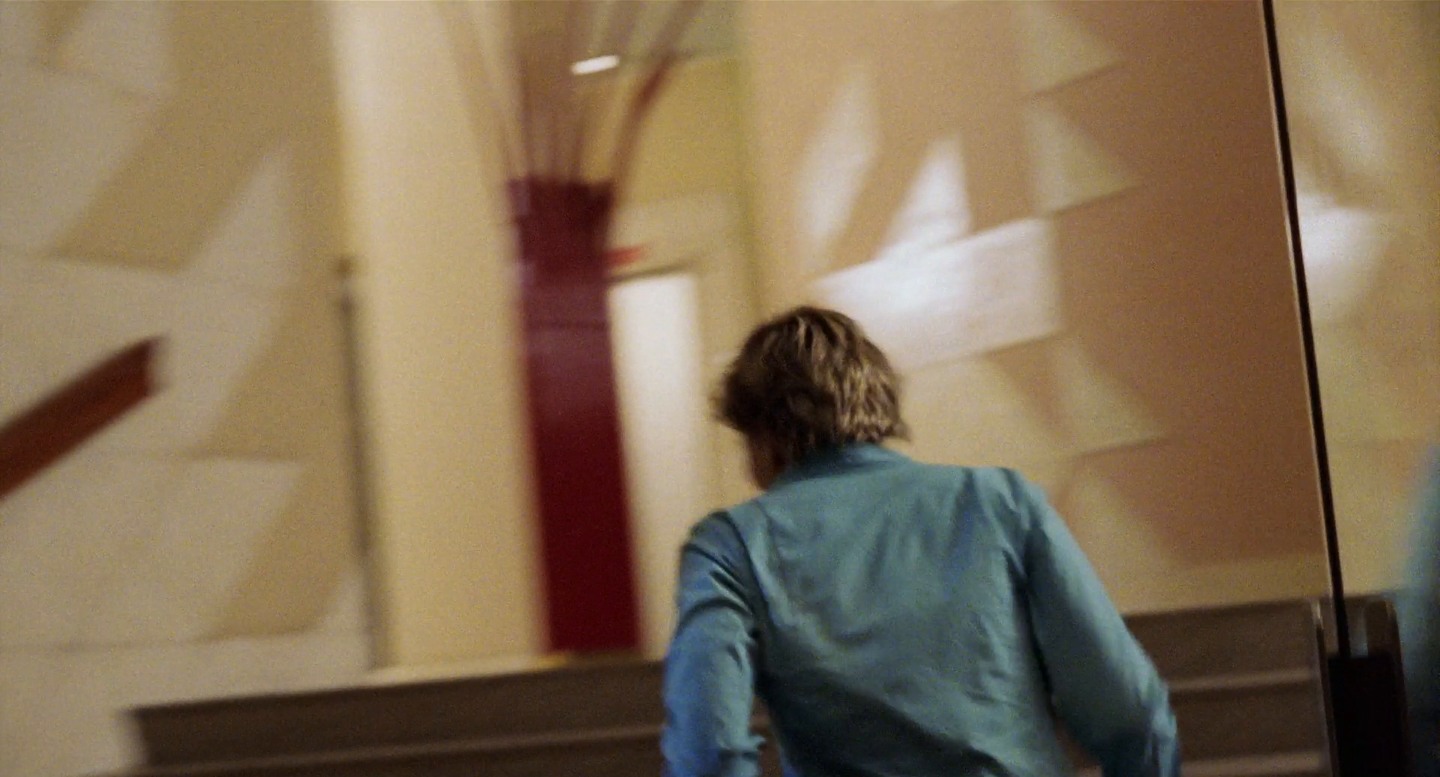
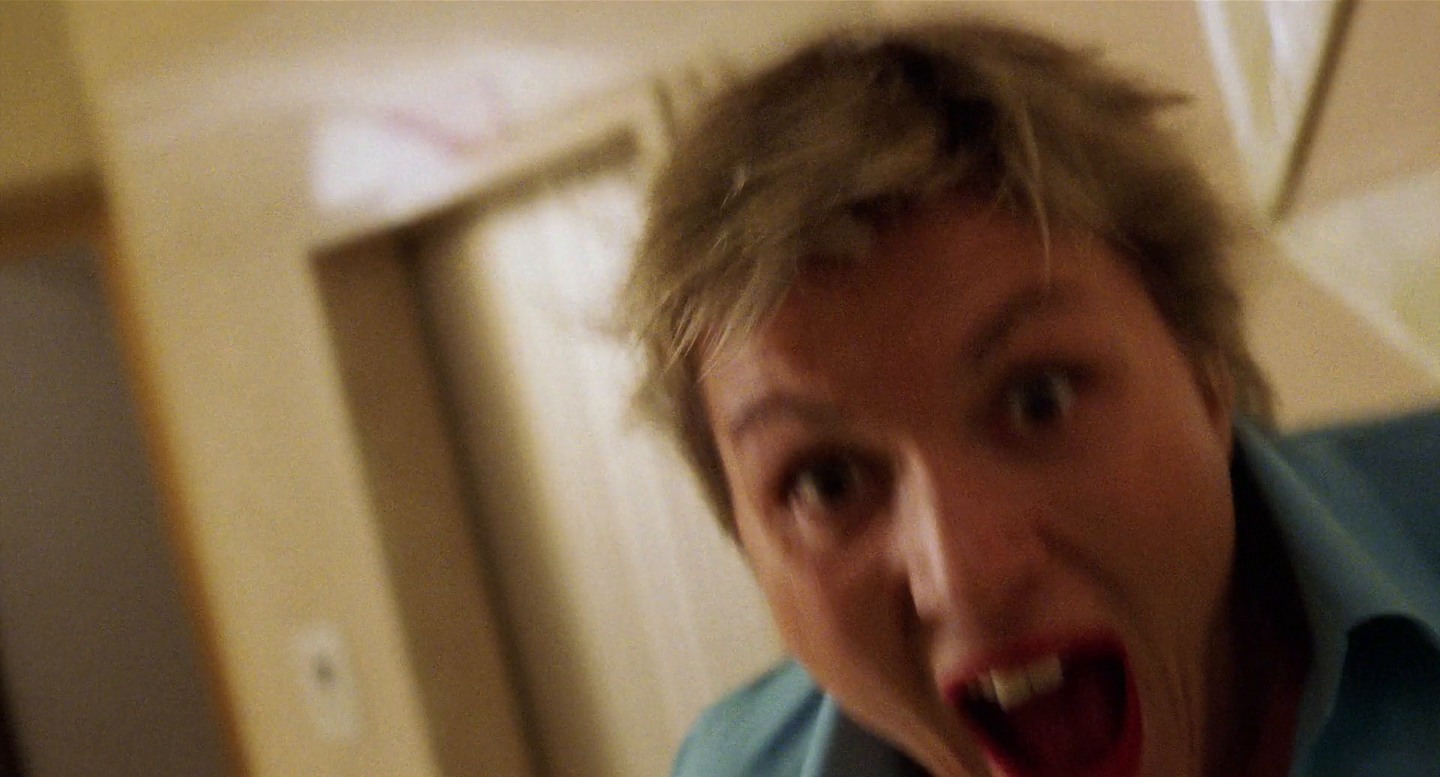
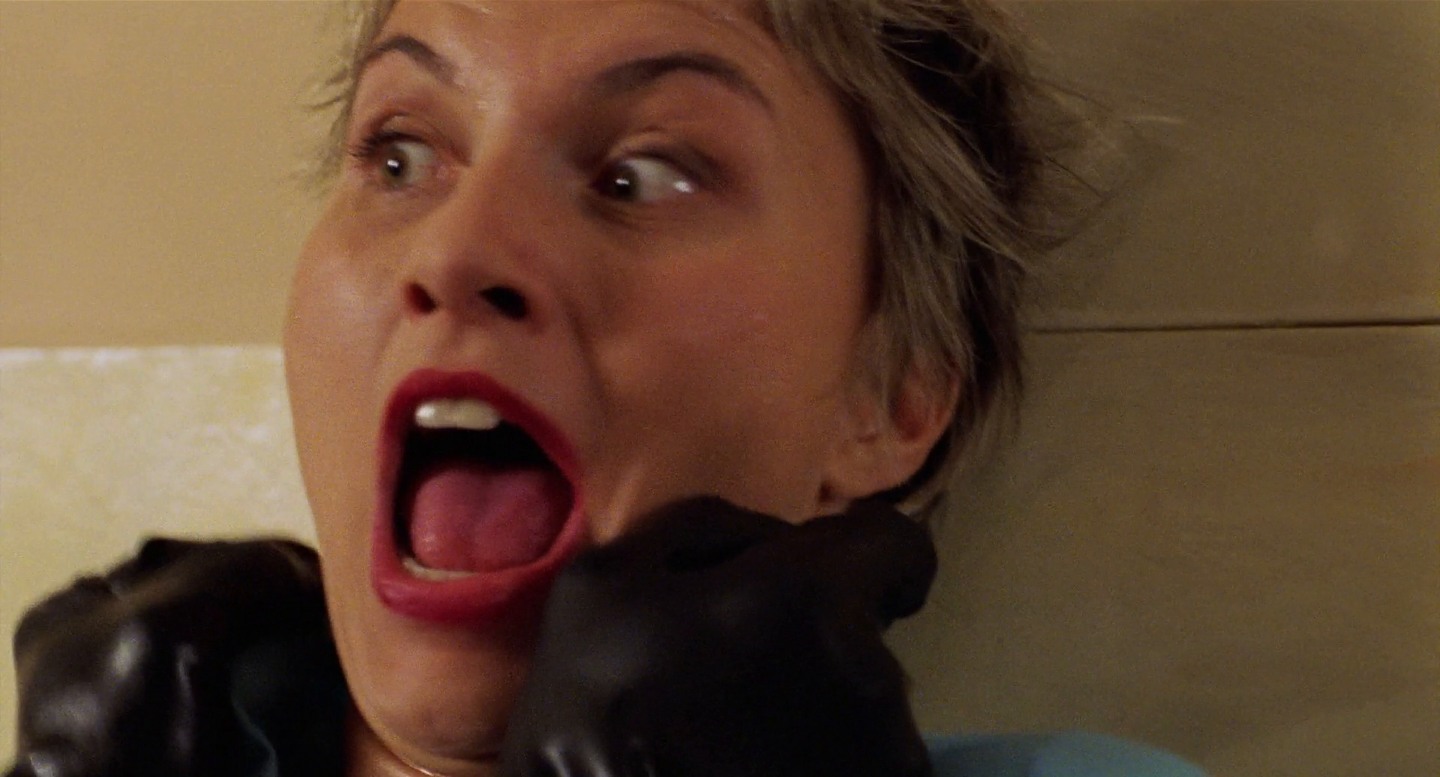
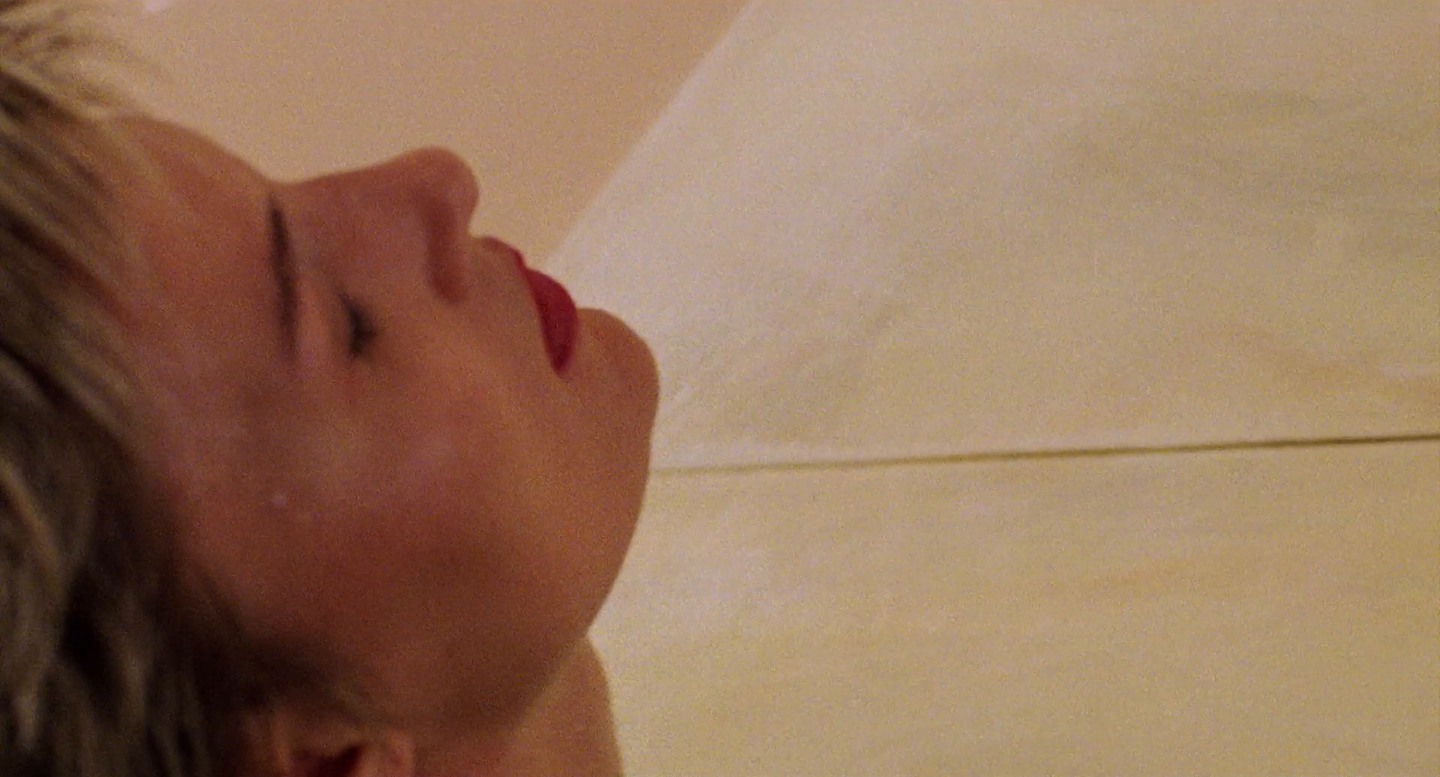
Thirty-two illustrated studies follow the night train, Moretti’s return, the animal pattern and Giacomo’s final recognition. Explore the film in sequence, or enter a closer study of its most elaborate attacks.
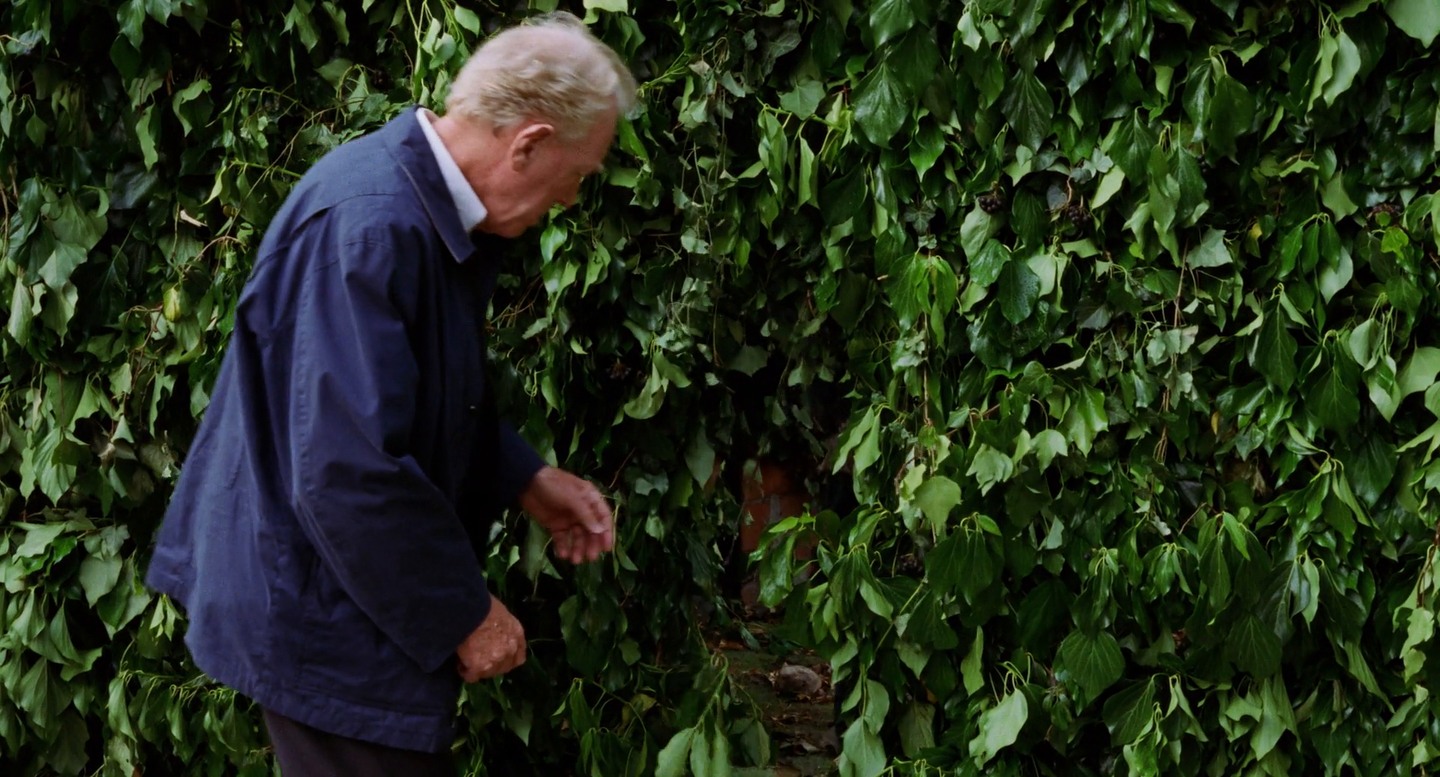
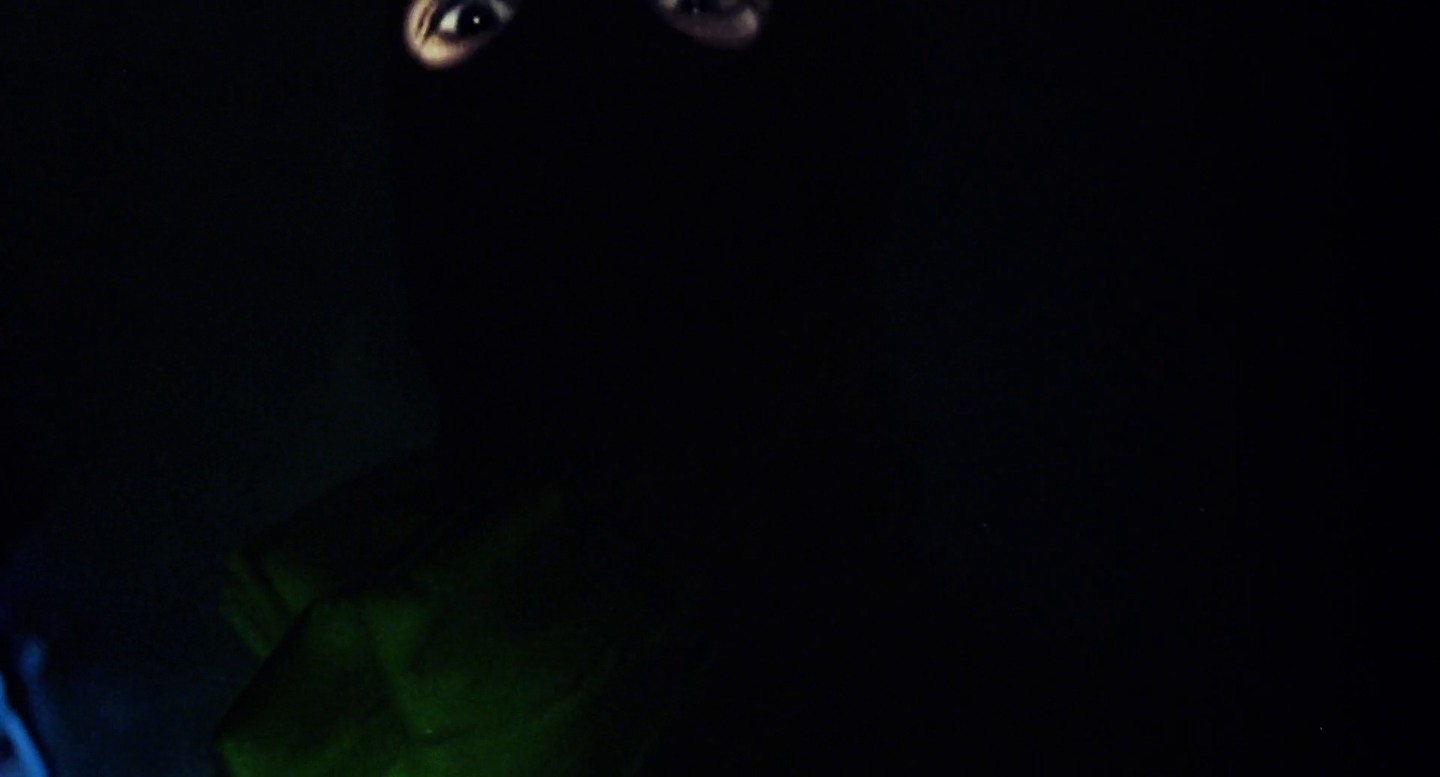
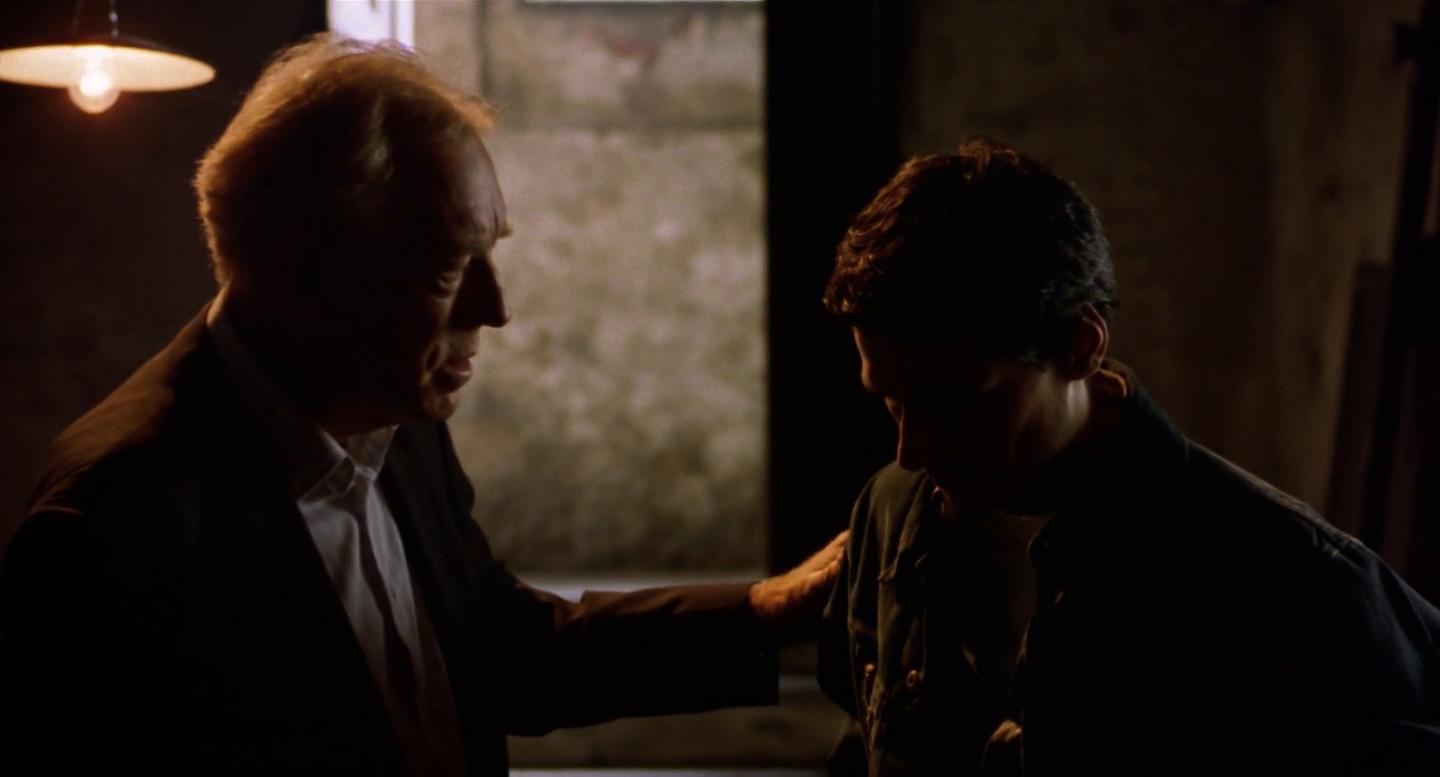
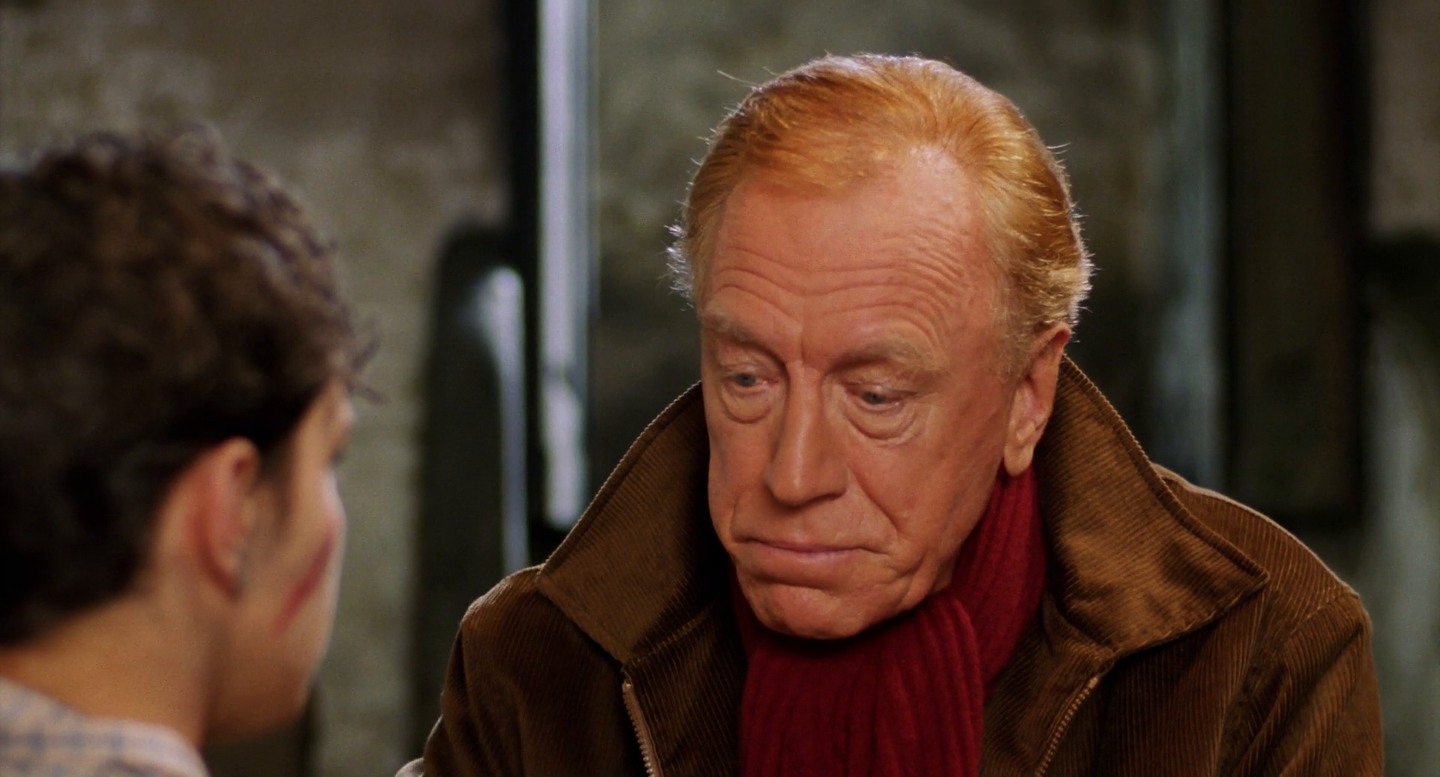
The opening places the detective and child at close range. Moretti’s lowered gaze makes the promise personal before the film expands into its elaborate chase. The later investigation returns to this unequal pairing: the adult who offered reassurance and the boy who could not forget.
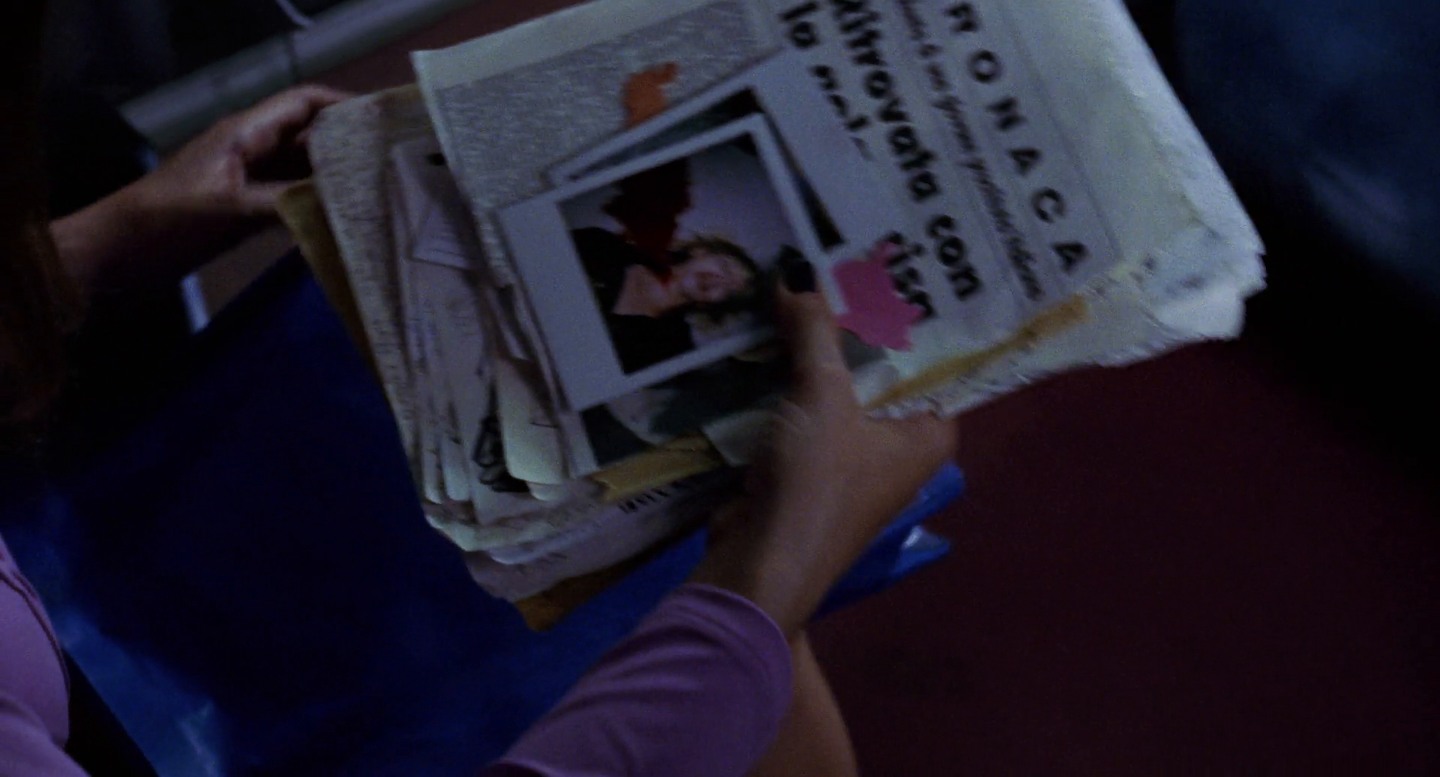
The papers interrupt the journey with another time: photographs and reports bring the 1983 case into Angela’s compartment. These inserts give her fear a material object. The killer is pursuing information as well as a person.
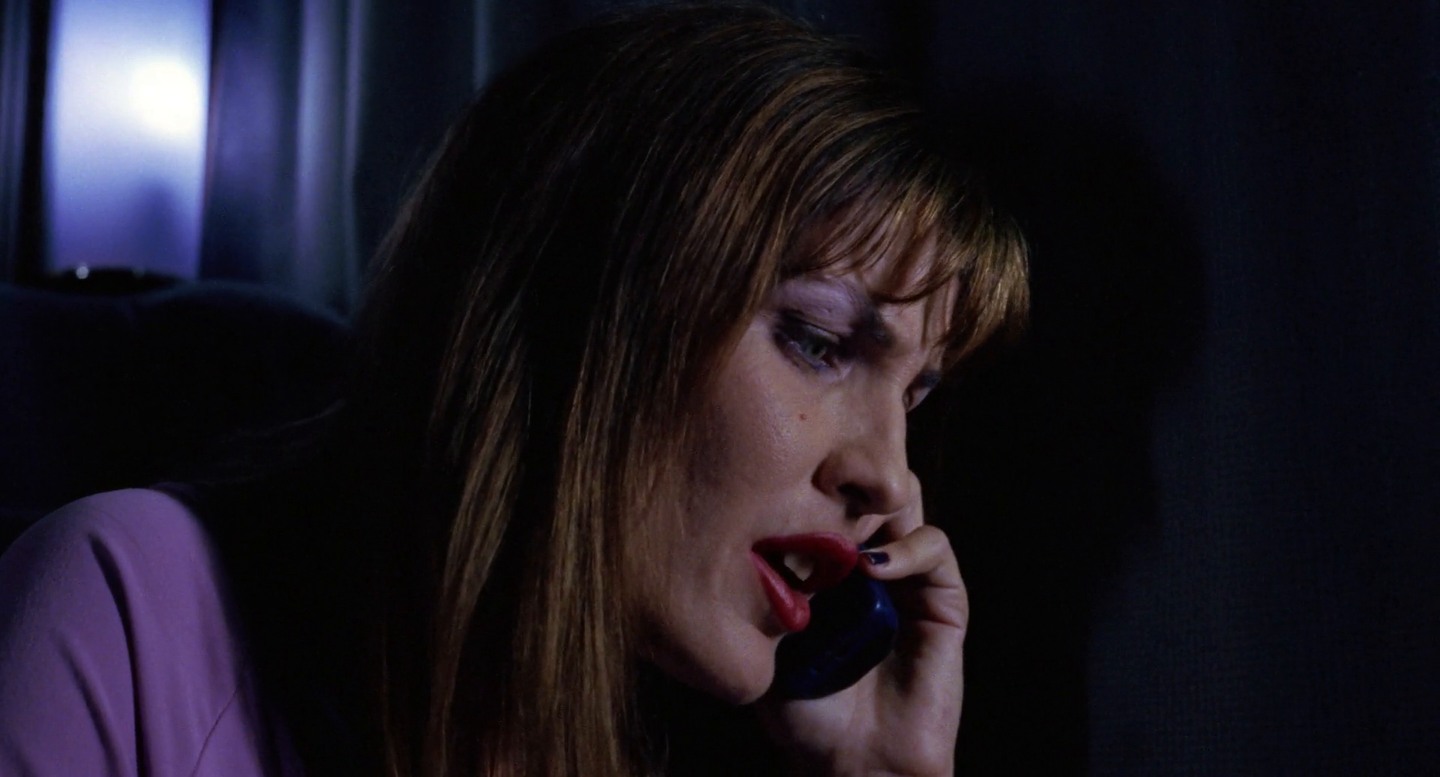
Blue light isolates Angela’s face against the upholstered seat. The telephone appears to connect her to help, but it also brings the pursuer into a space he has not yet visibly entered. Her seated stillness becomes increasingly difficult to sustain.
11:15
Movement without an exit
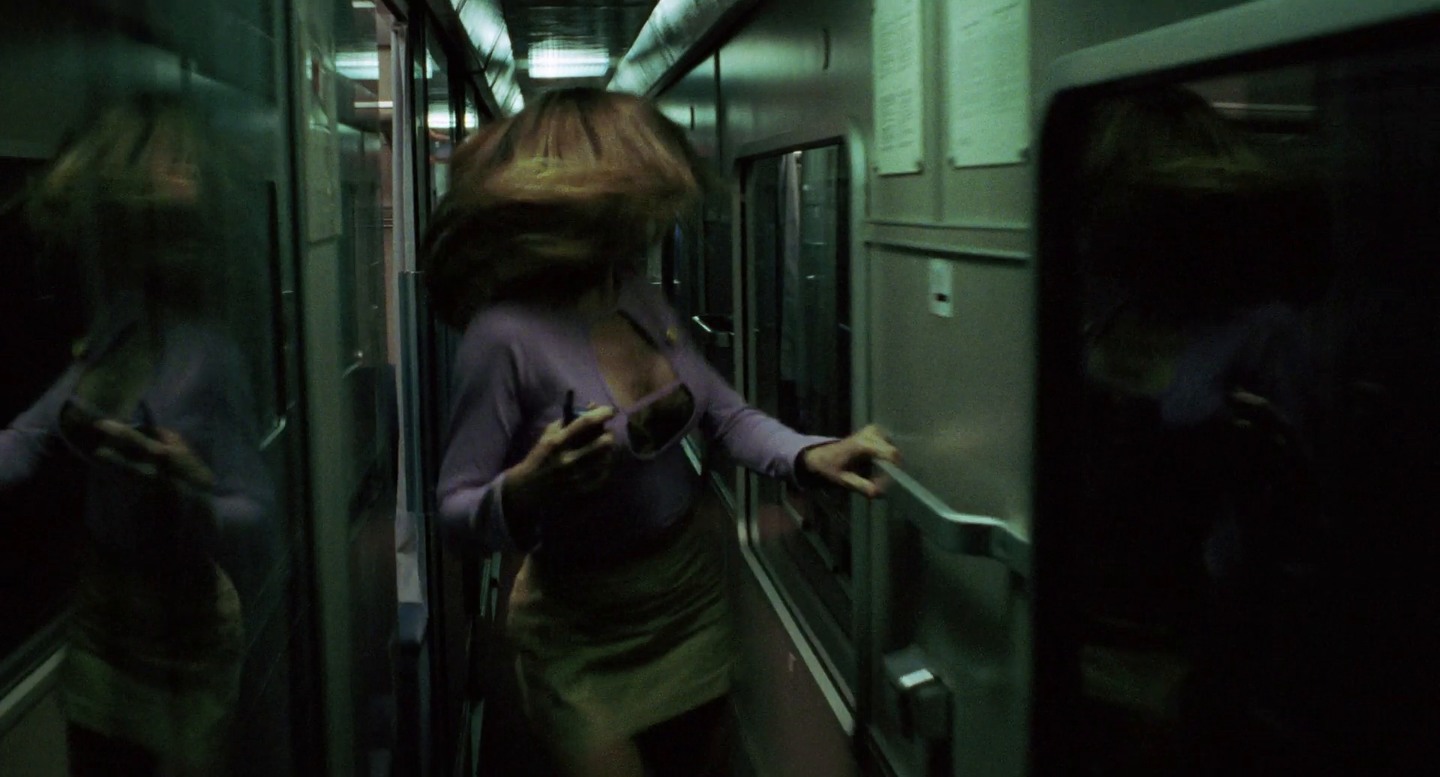
ENLARGE ↗Angela runs through the carriage corridor.
The corridor gives the chase a strong direction while doors keep interrupting it. The repeated vertical frames turn progress into a series of thresholds. Moving forward does not give Angela a clear view of who may be behind the next pane.
15:15
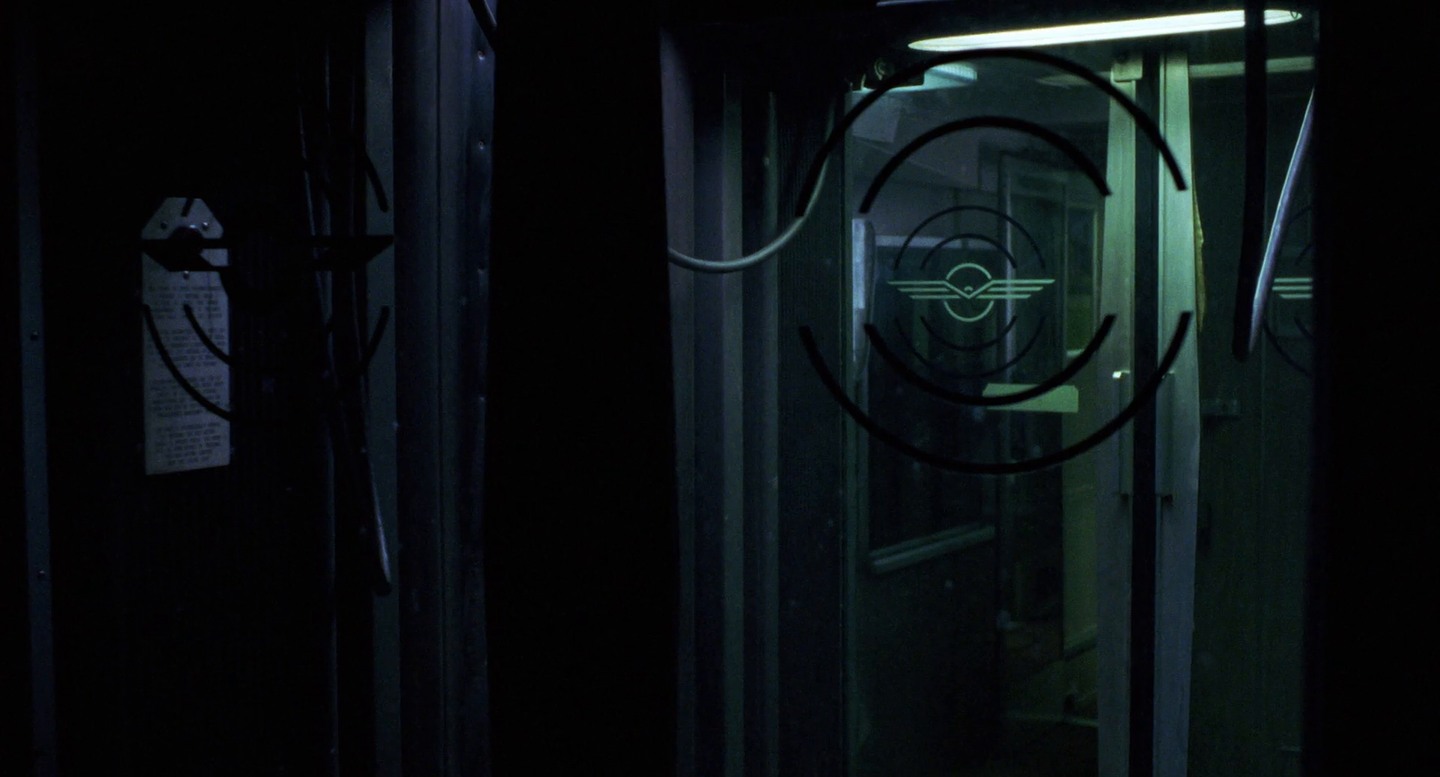
A target drawn in glass
ENLARGE ↗Angela crosses the patterned carriage door.
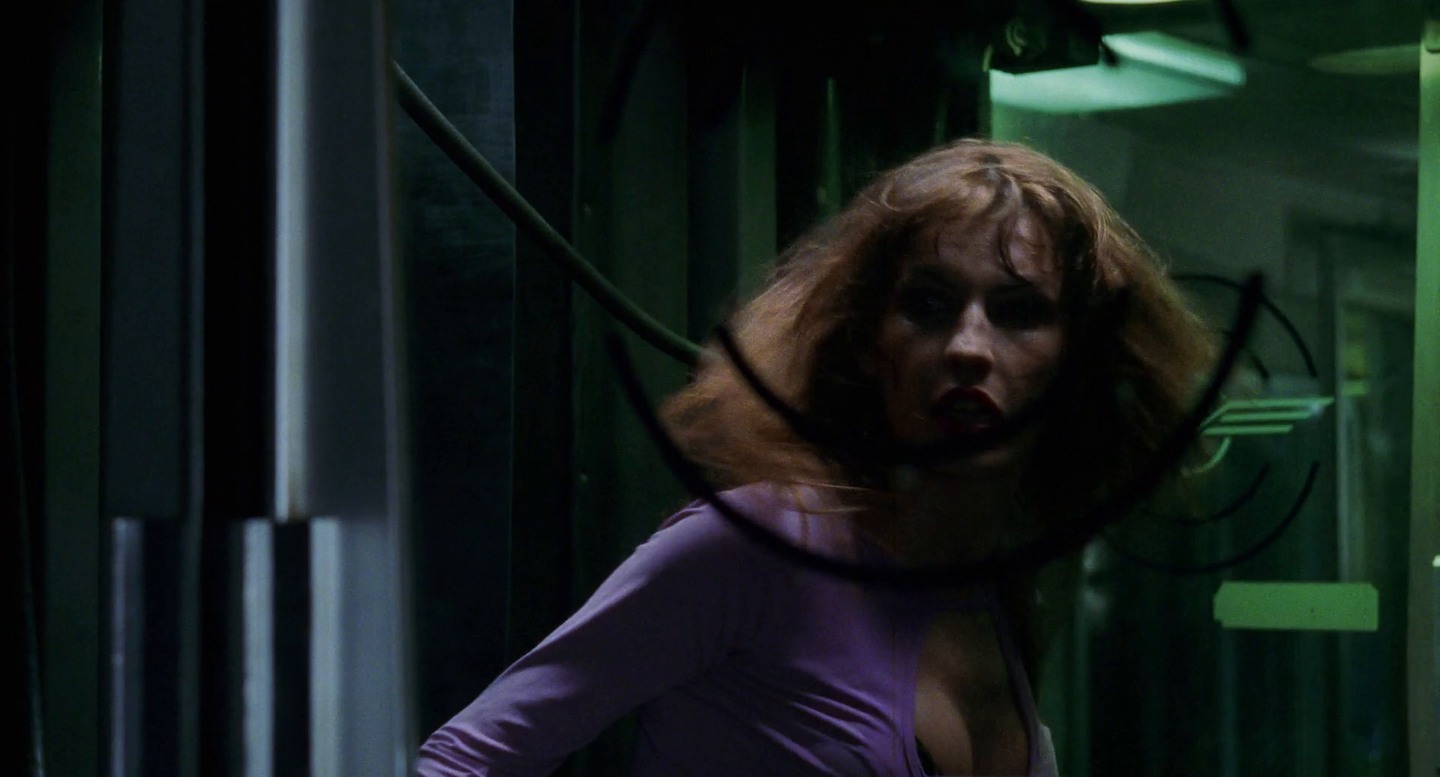
The black curves on the glass gather around Angela’s face and shoulders. The same design first occupies an apparently empty corridor, then encloses her moving body. The train’s decorative surface becomes a way of directing the viewer’s attention.
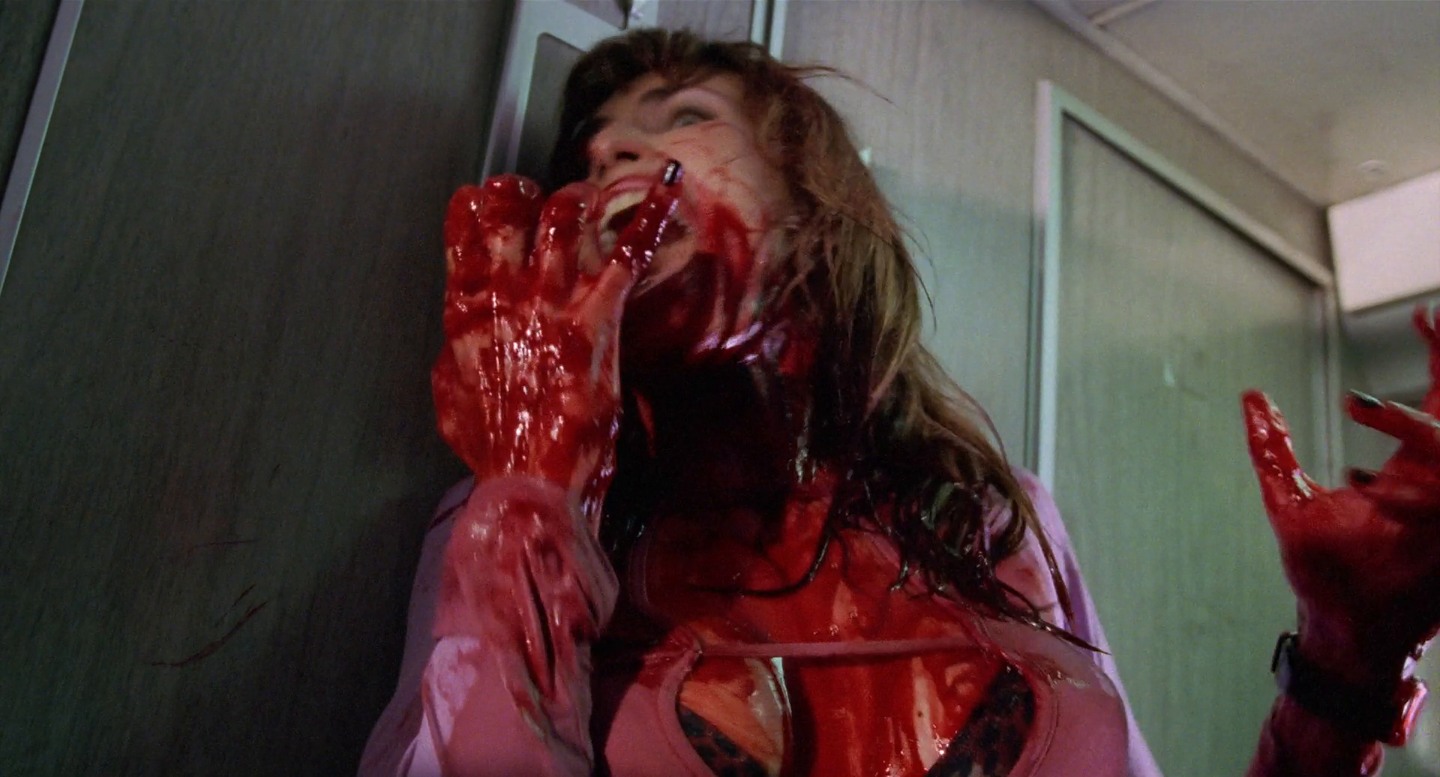
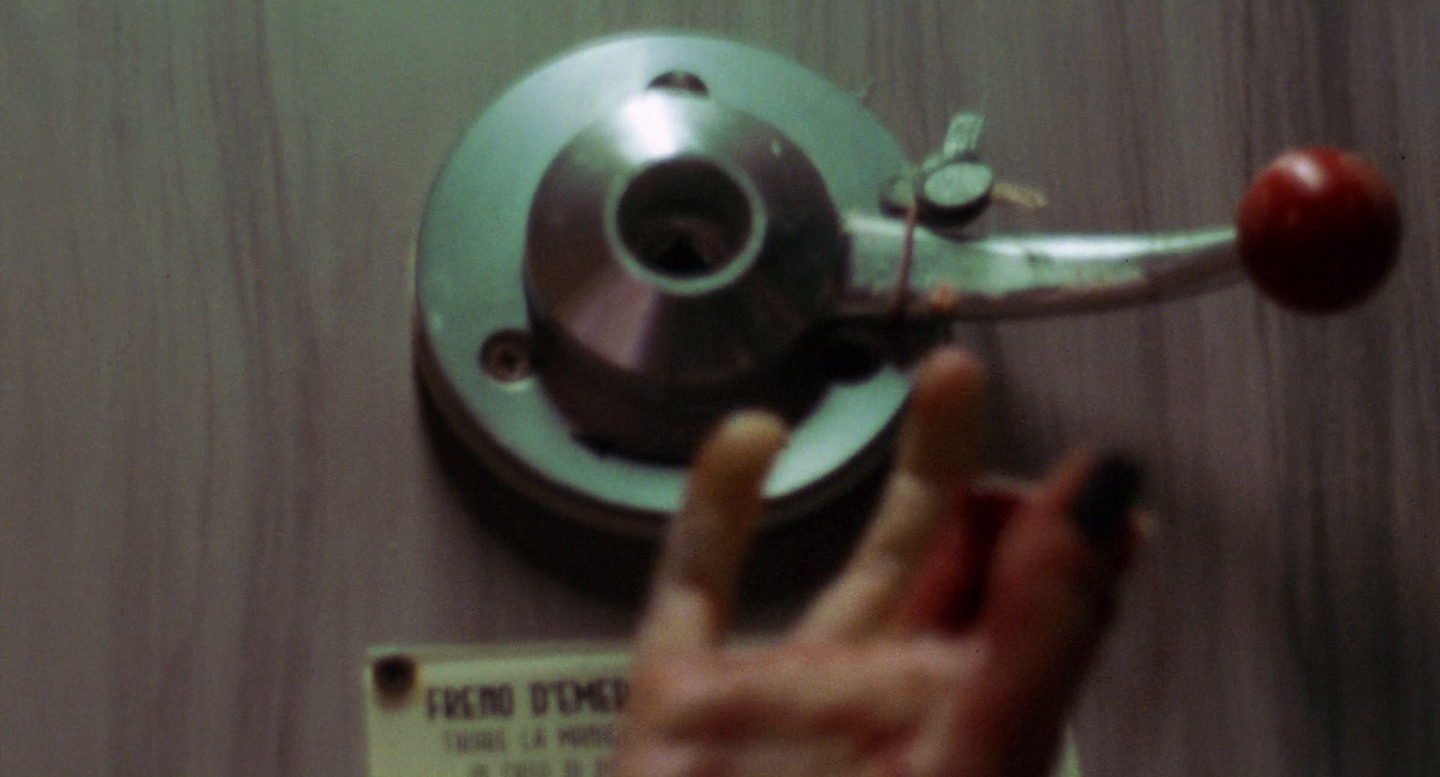
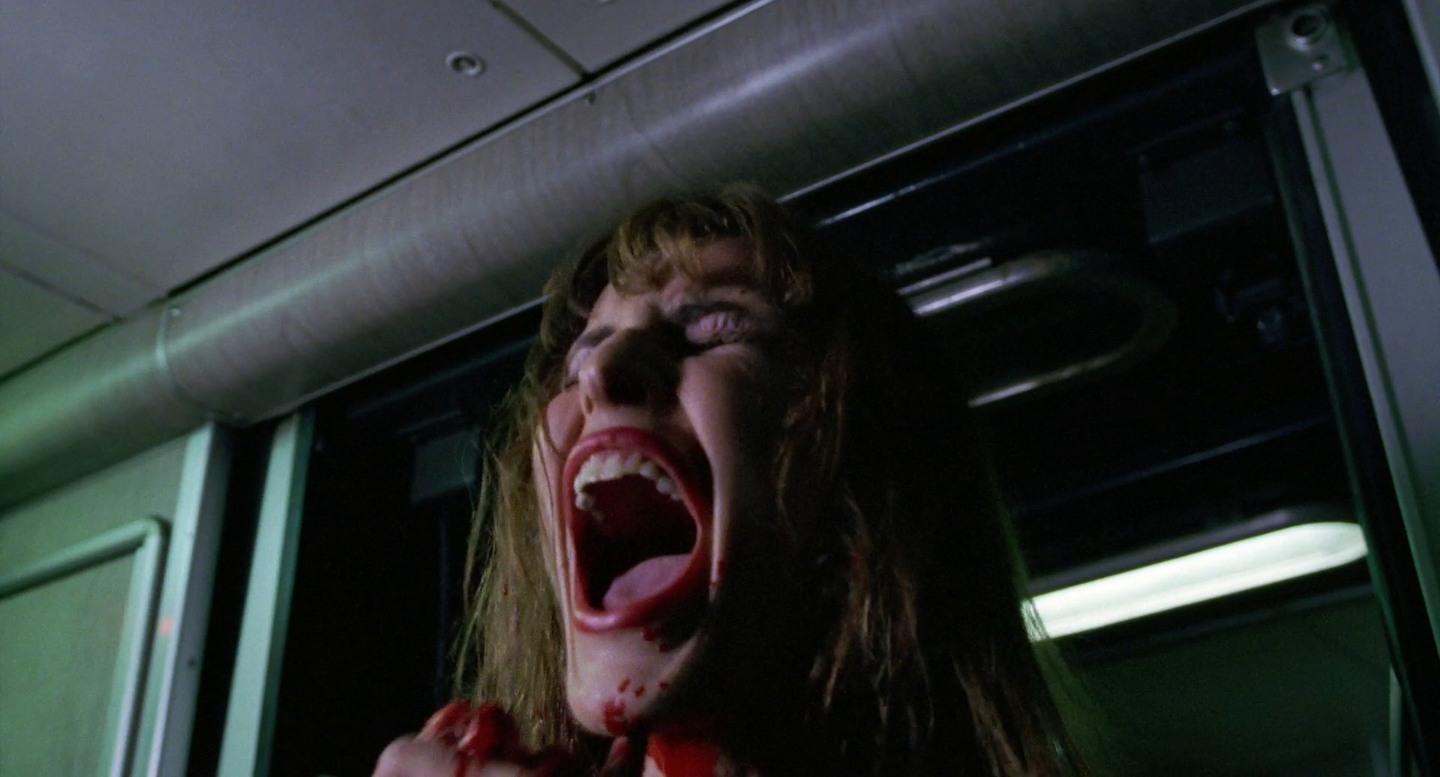
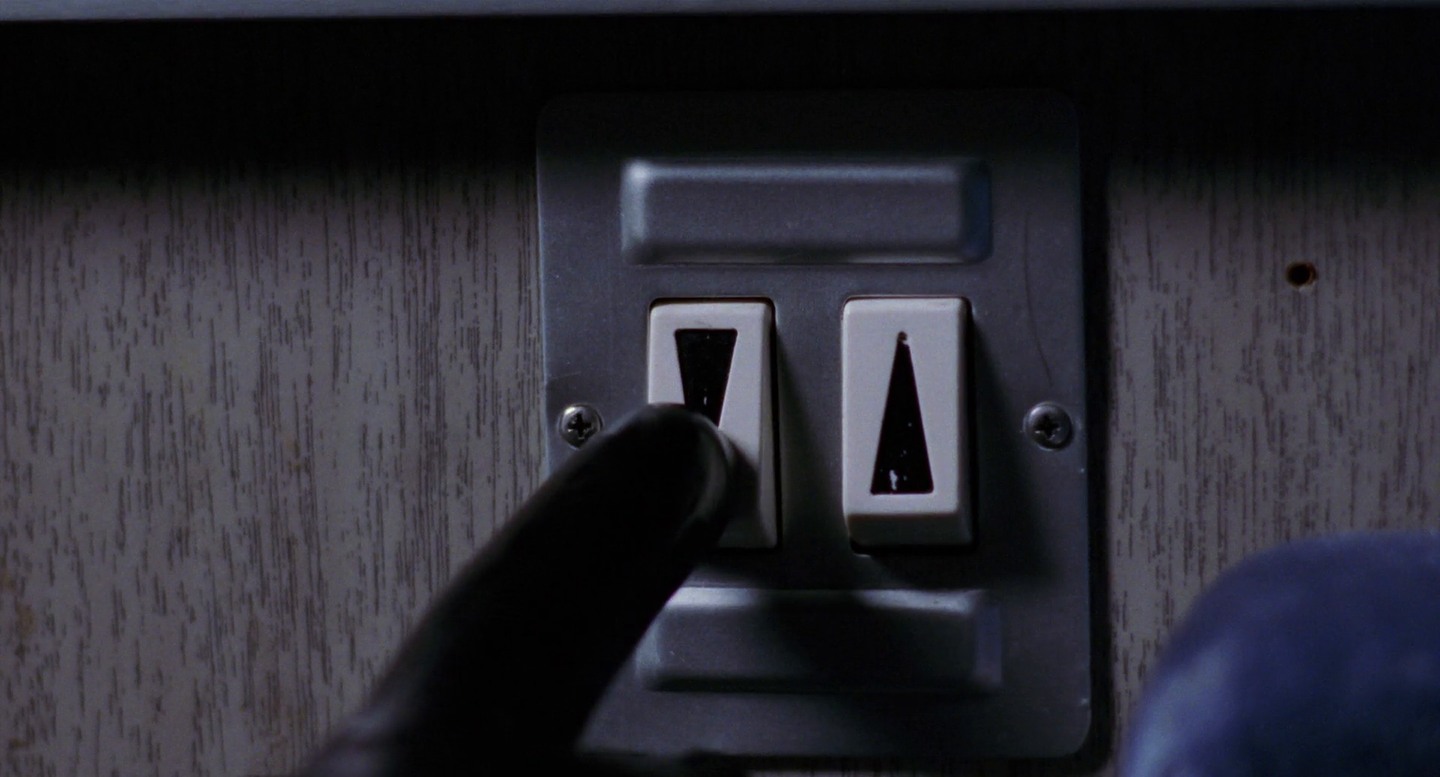
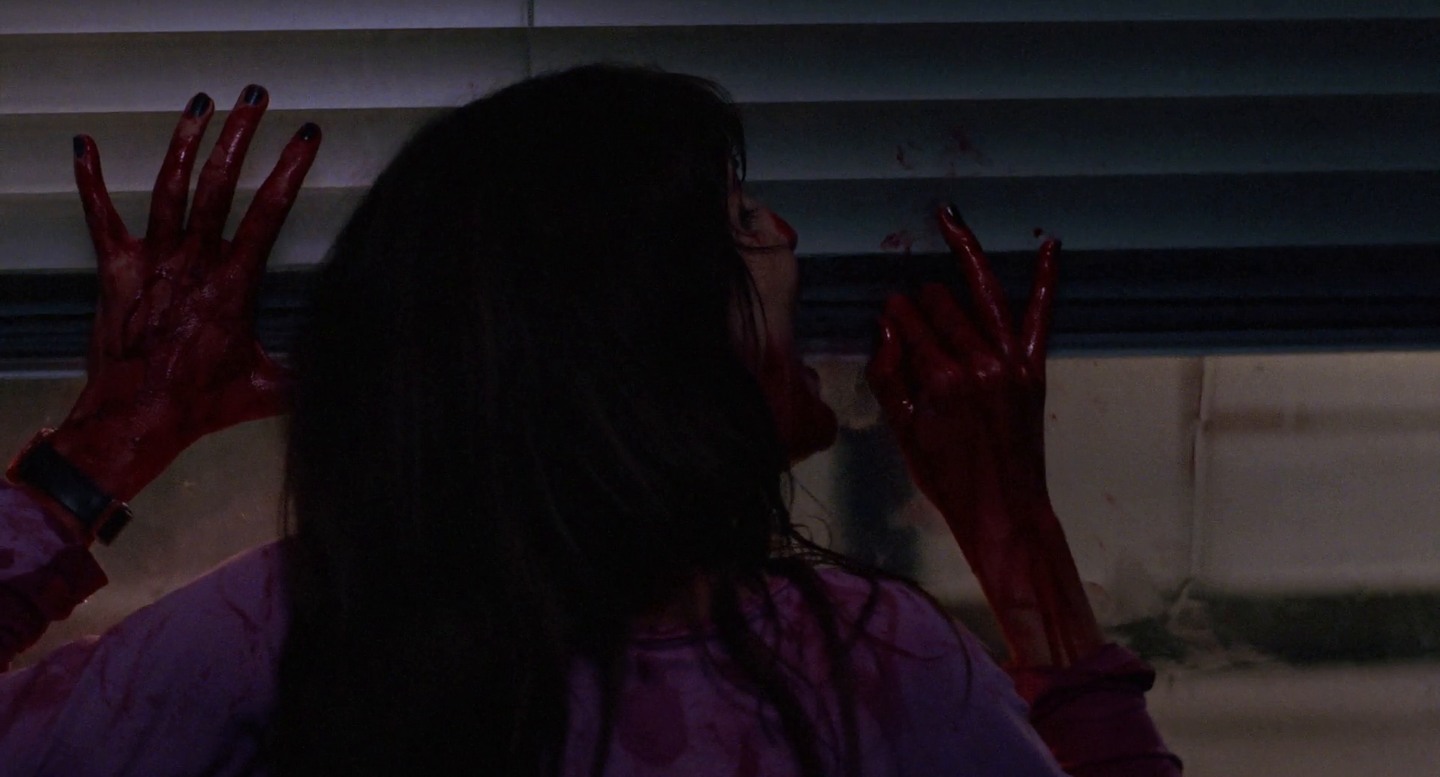
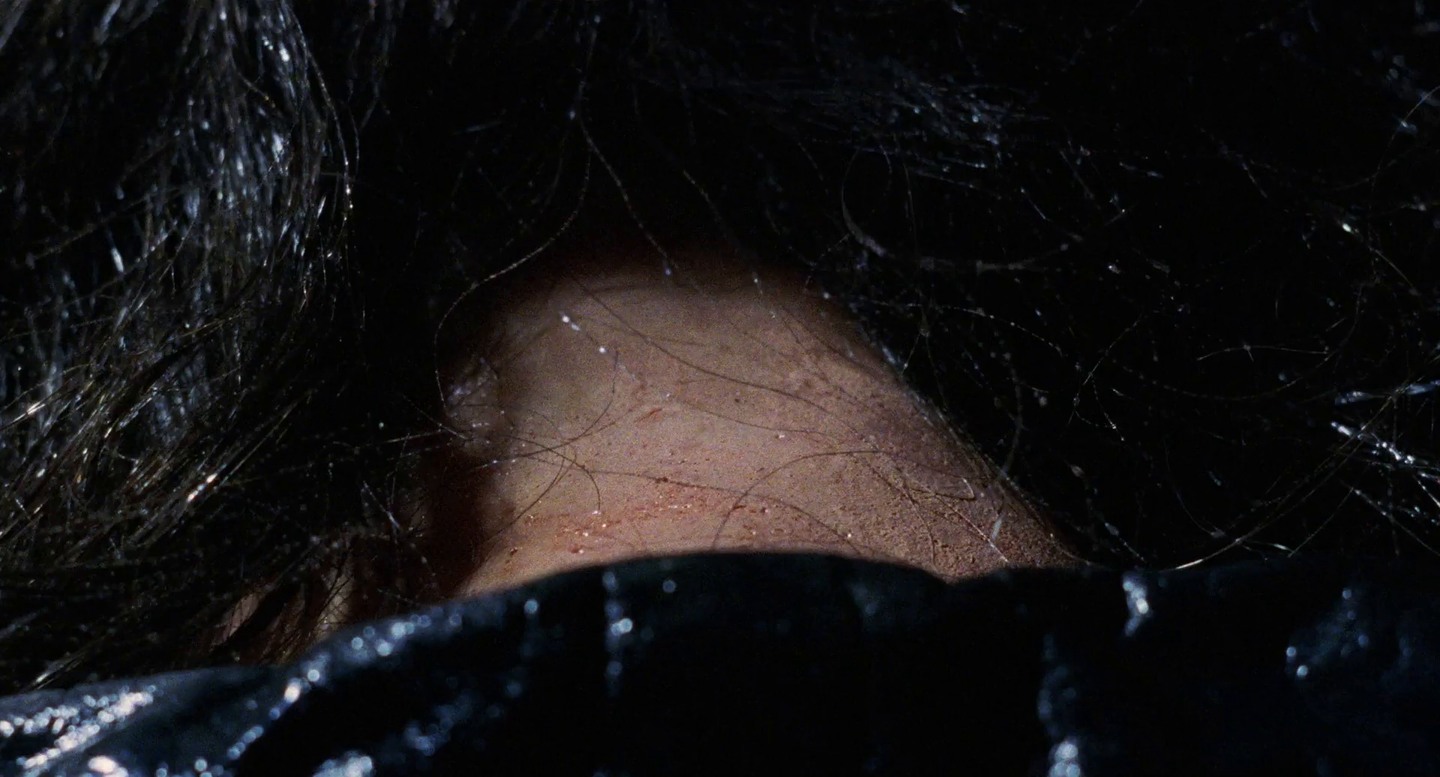
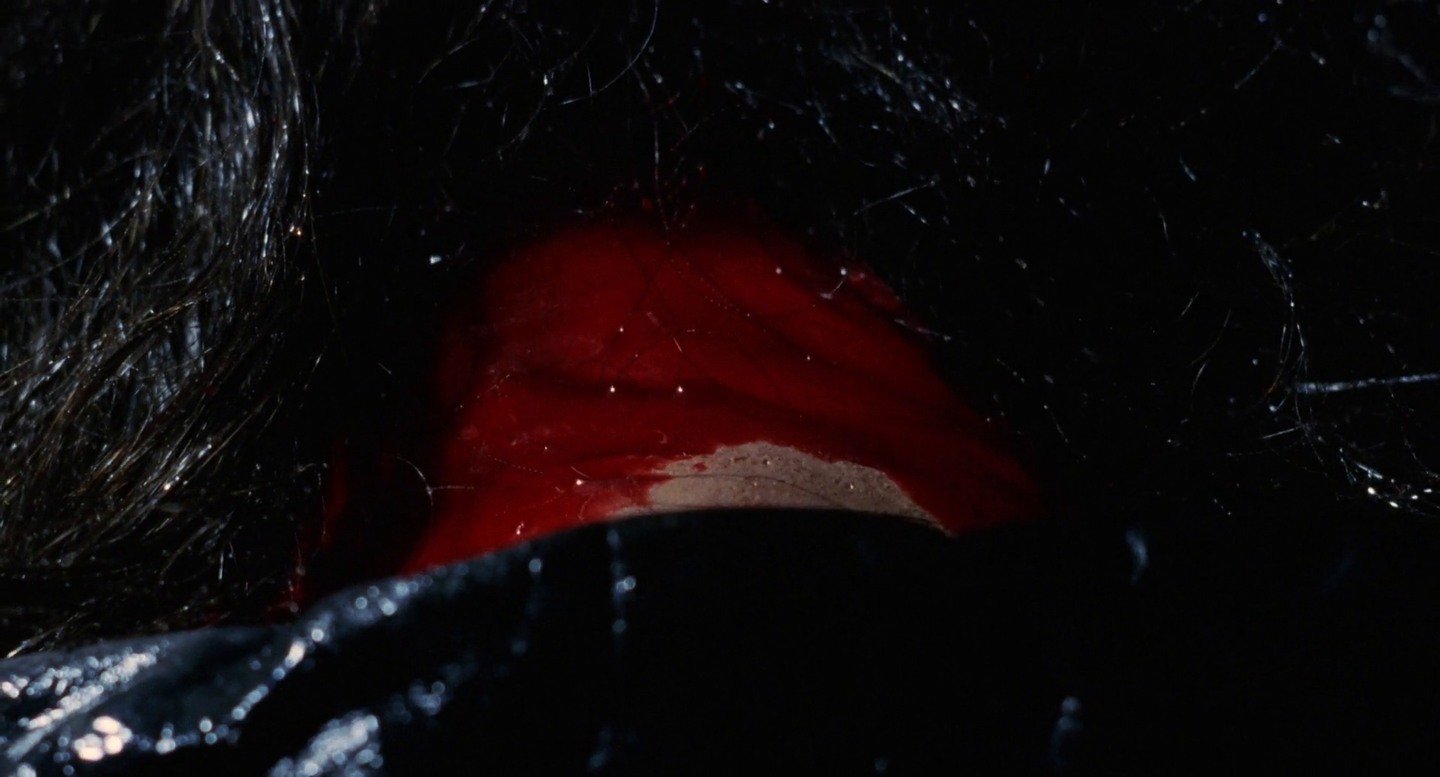
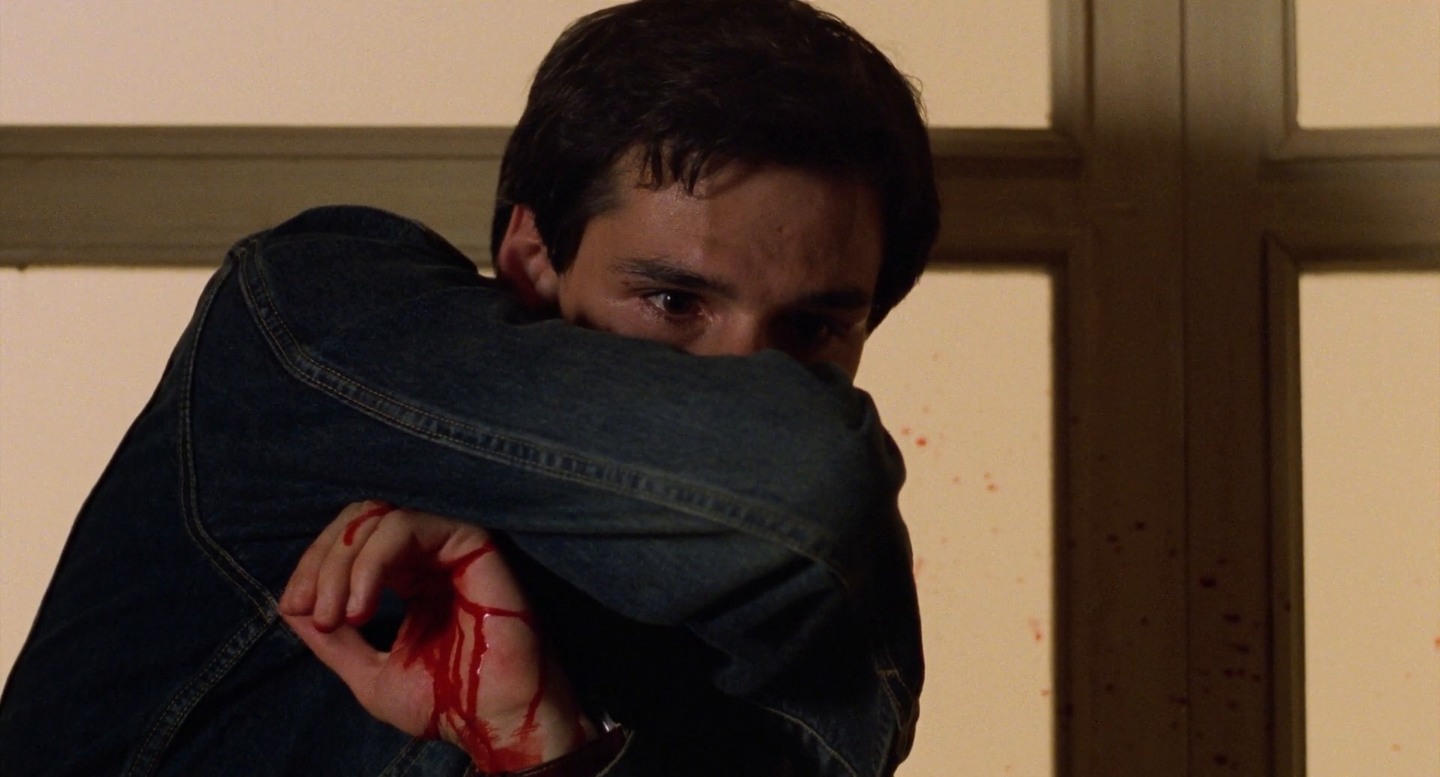
The brake handle promises a way to interrupt the journey. The attack substitutes another kind of interruption: the film moves from the hand at the mechanism to the injured neck, bloodied fingers and knife. The escape device and the wound occupy adjacent moments.
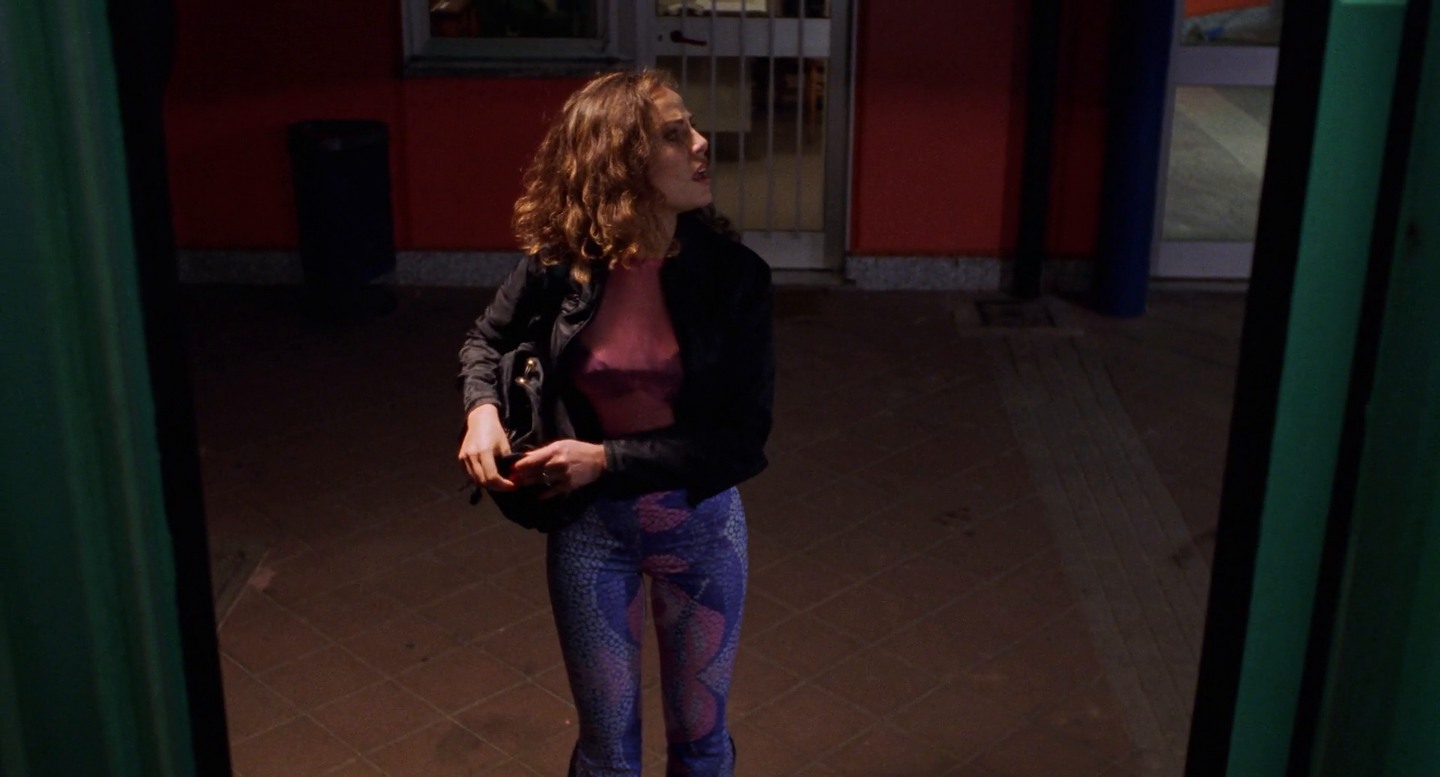
Amanda’s arrival enlarges the station geography after the narrow carriage. Her search transfers the danger from one woman to another. Platform, doorway and compartment now form a route the viewer has already learned to distrust.
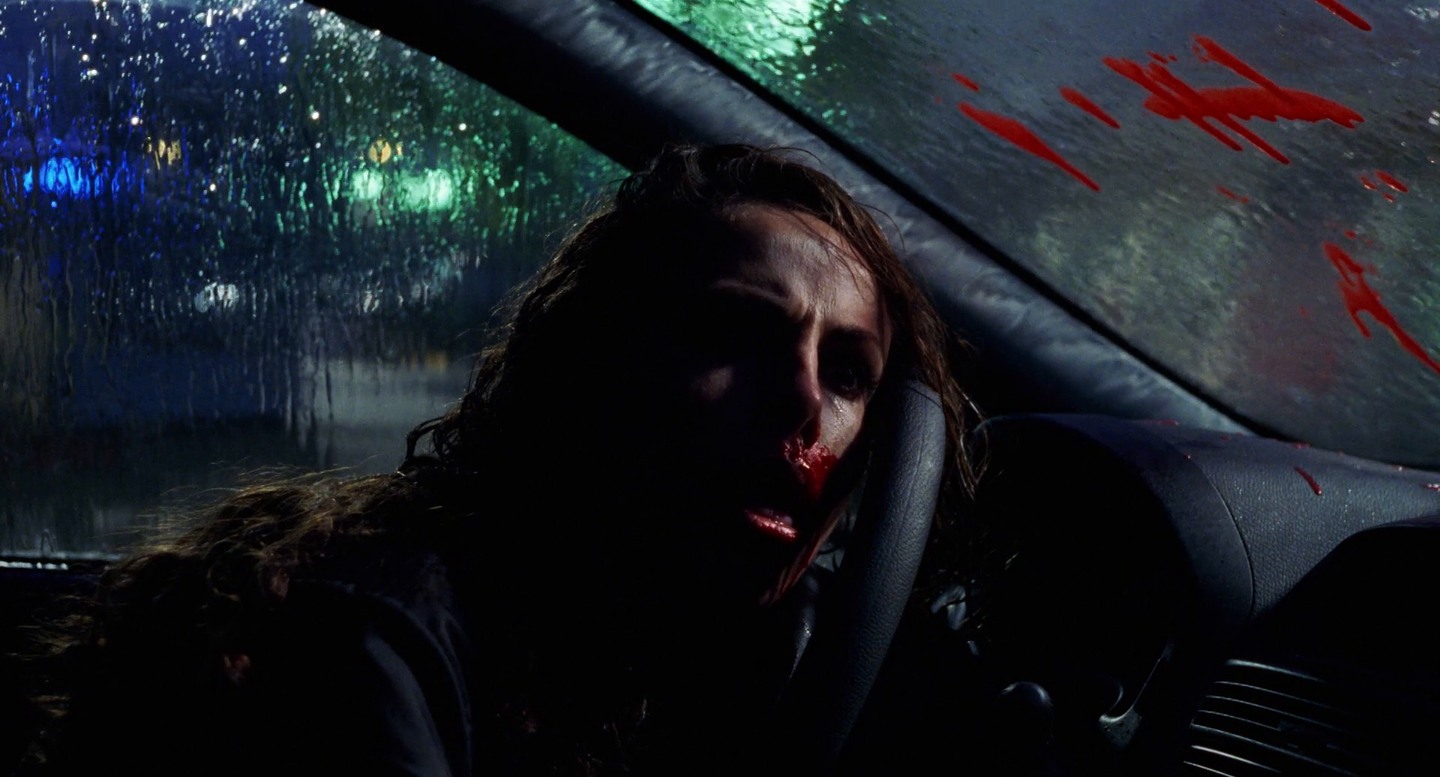
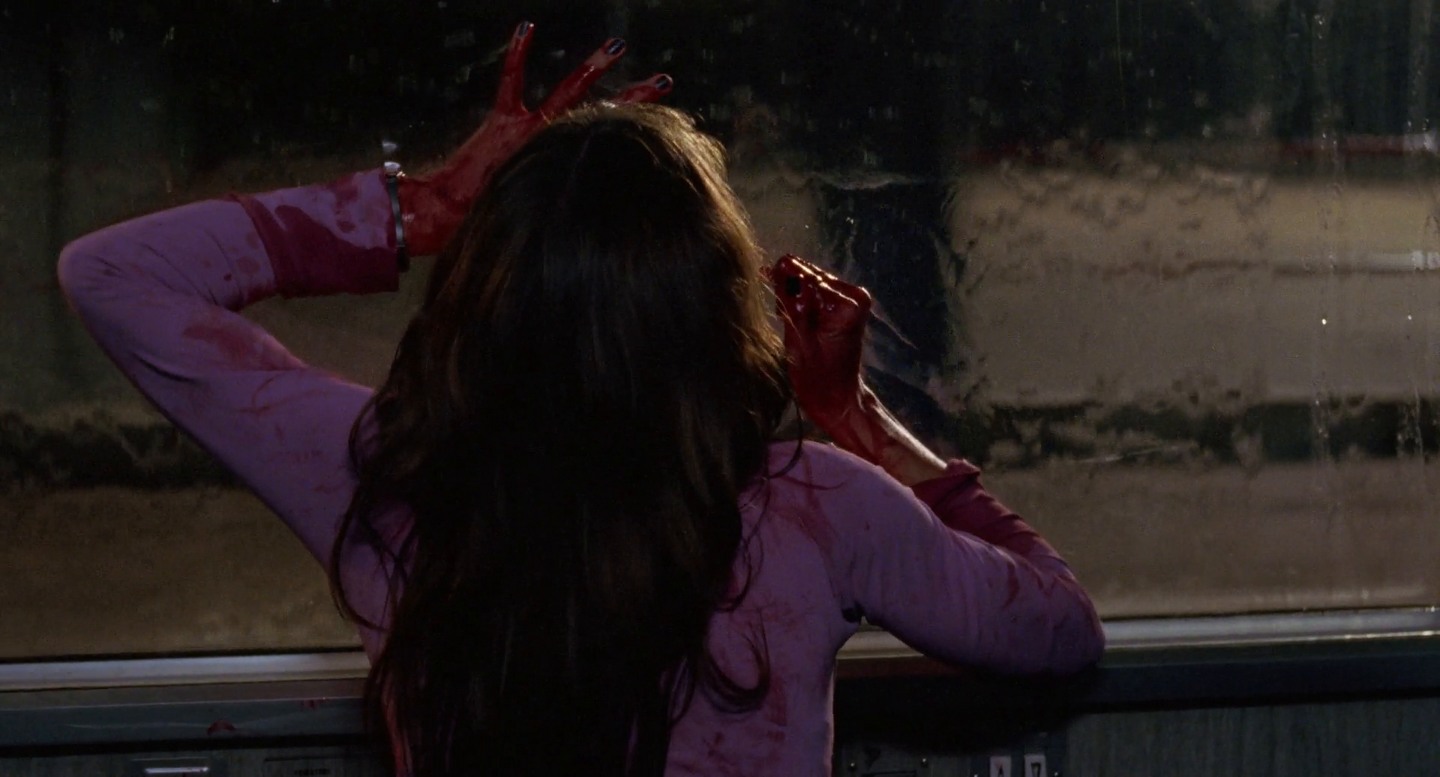
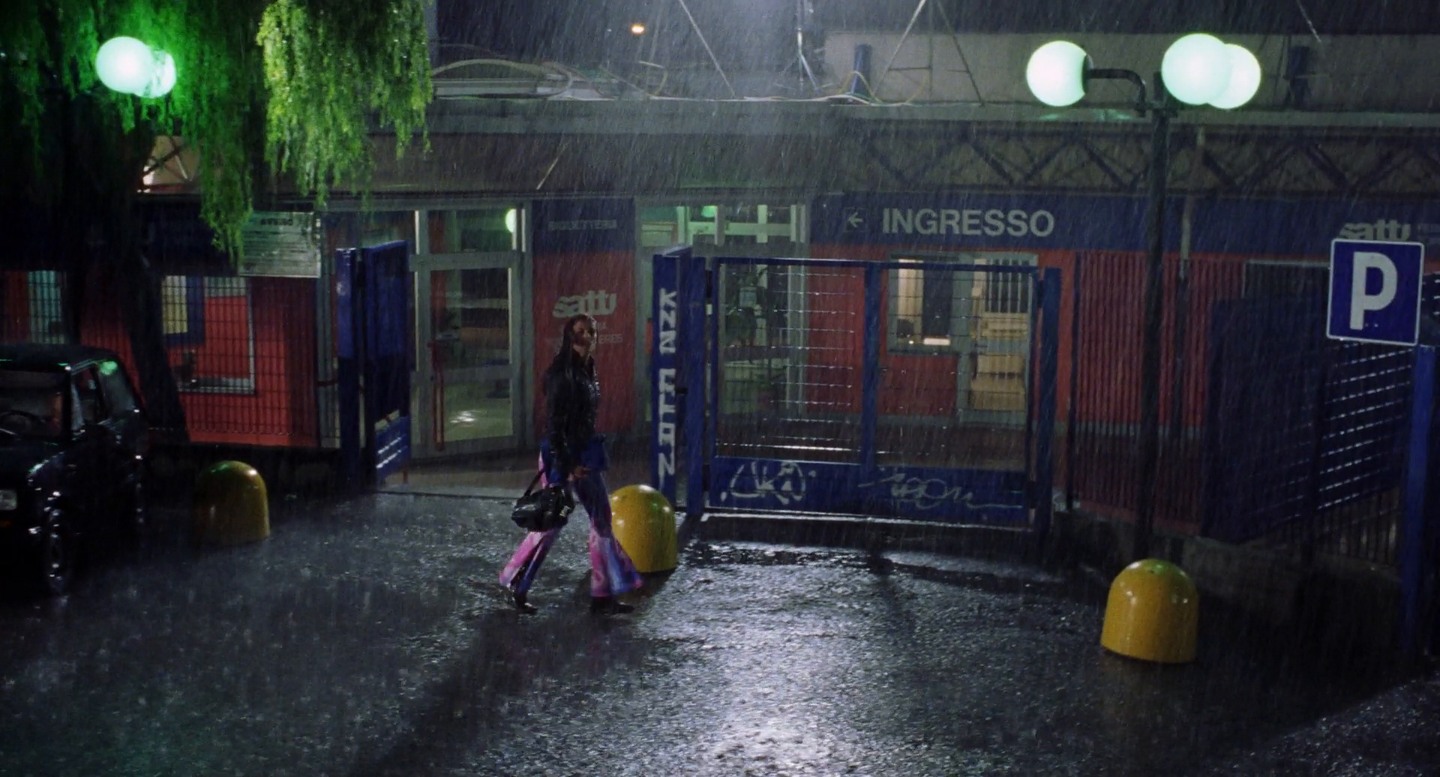
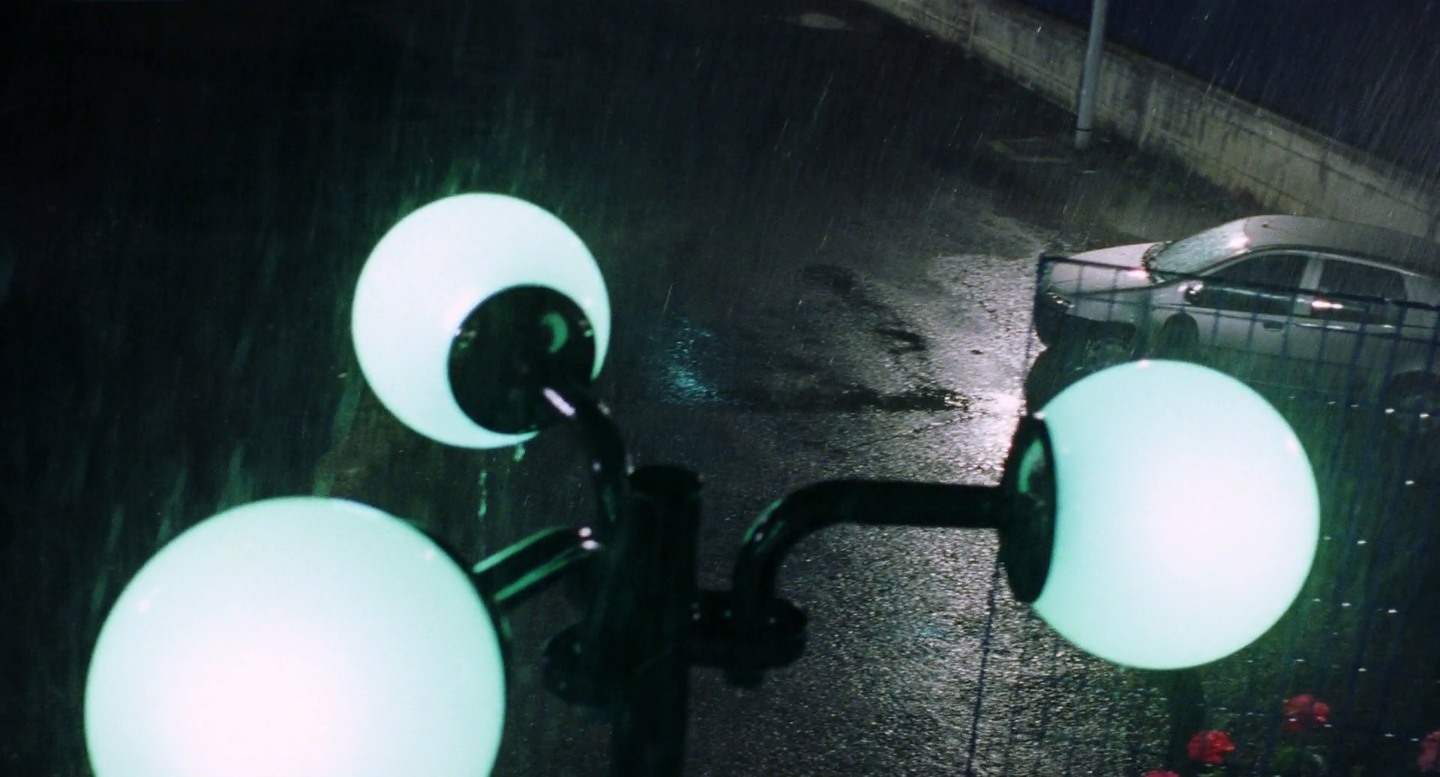
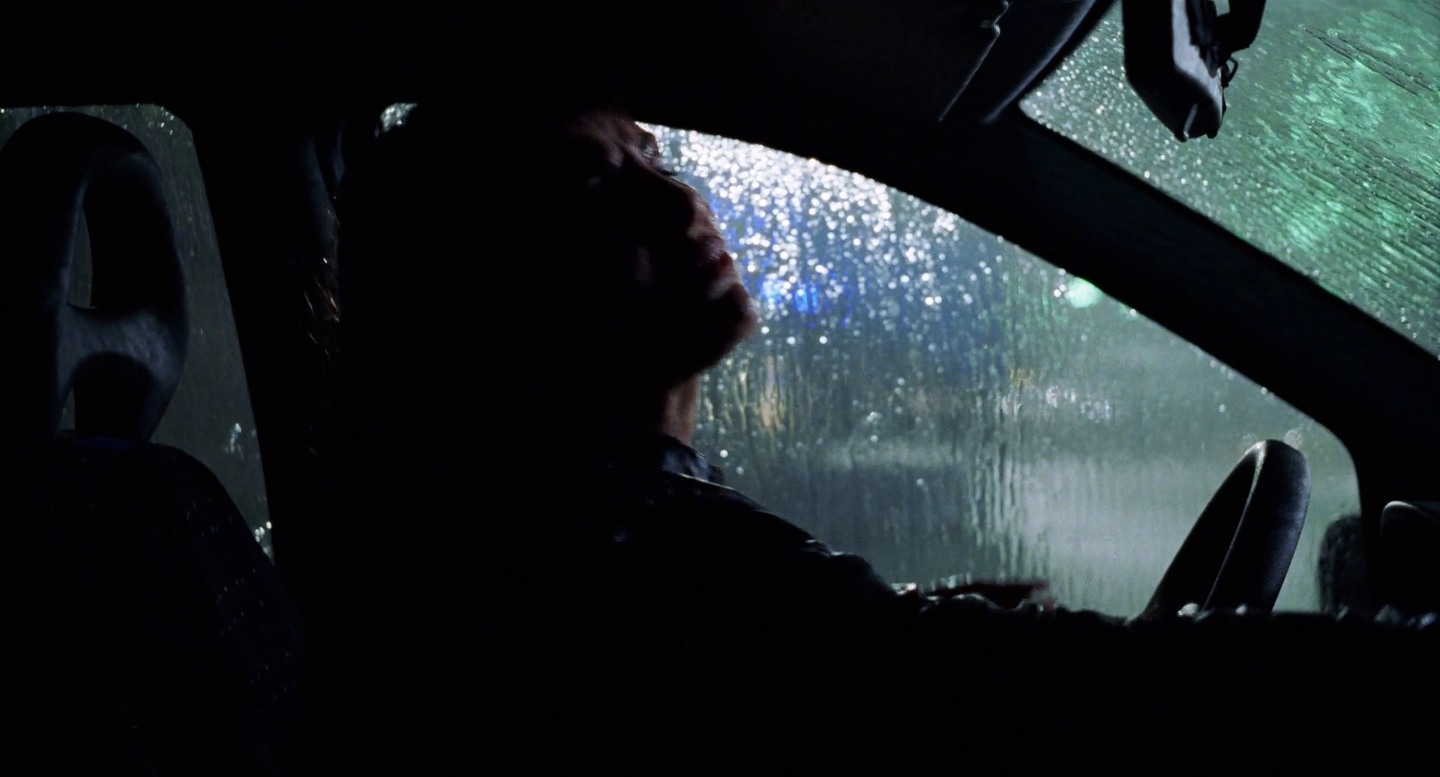
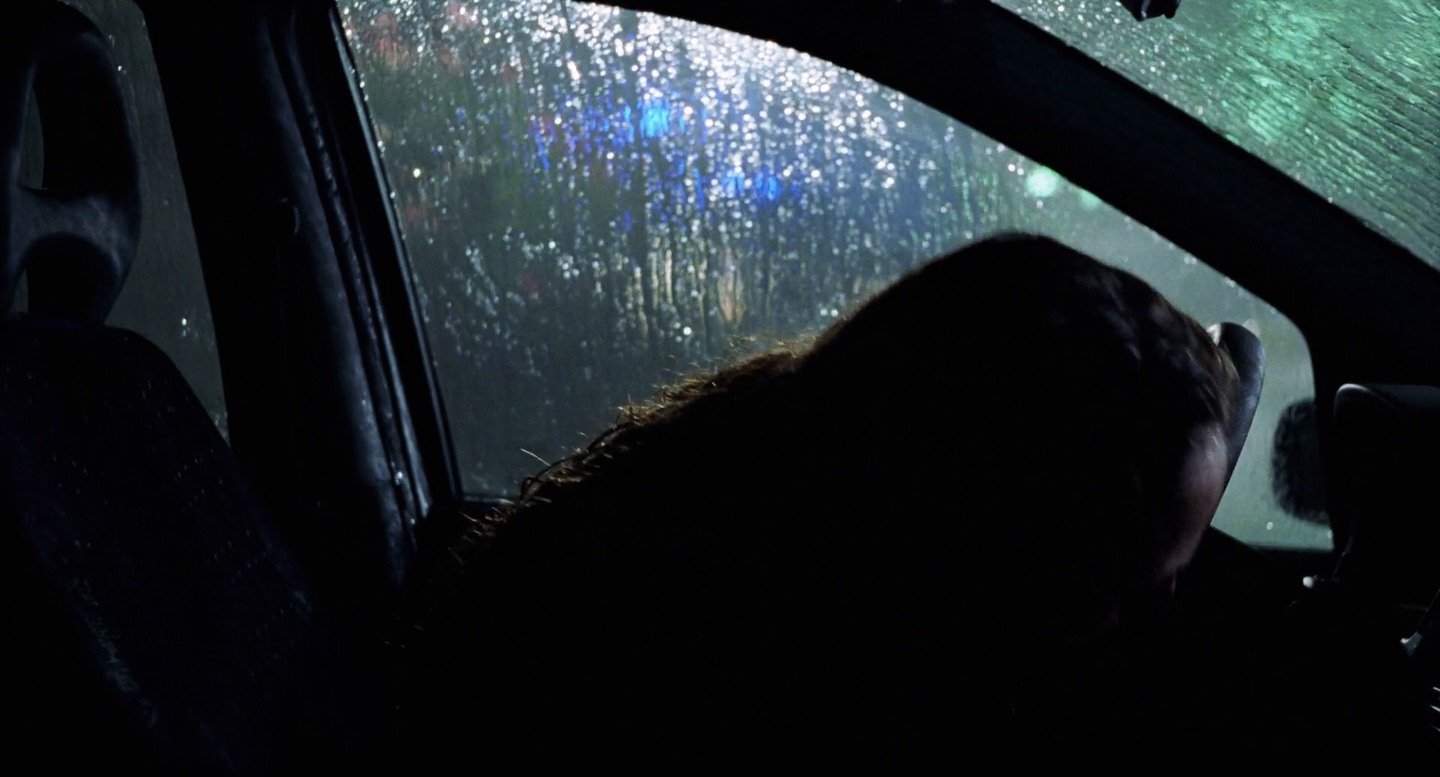
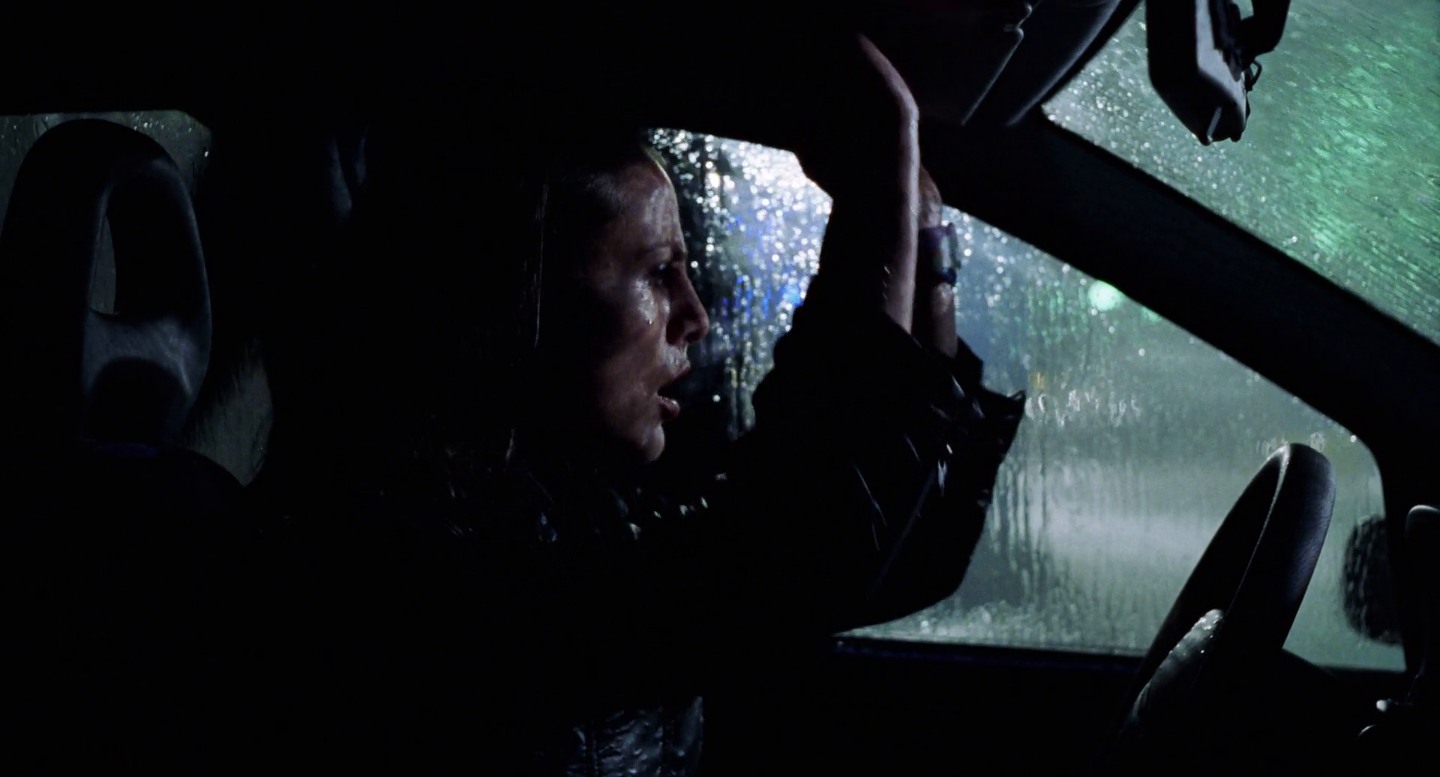
A car offers shelter from the rain but gives the attacker another confined interior. The scene moves from the wider parking area to the constricted space around Amanda’s head. Blood on the windscreen turns a transparent surface into the attack’s visible record.
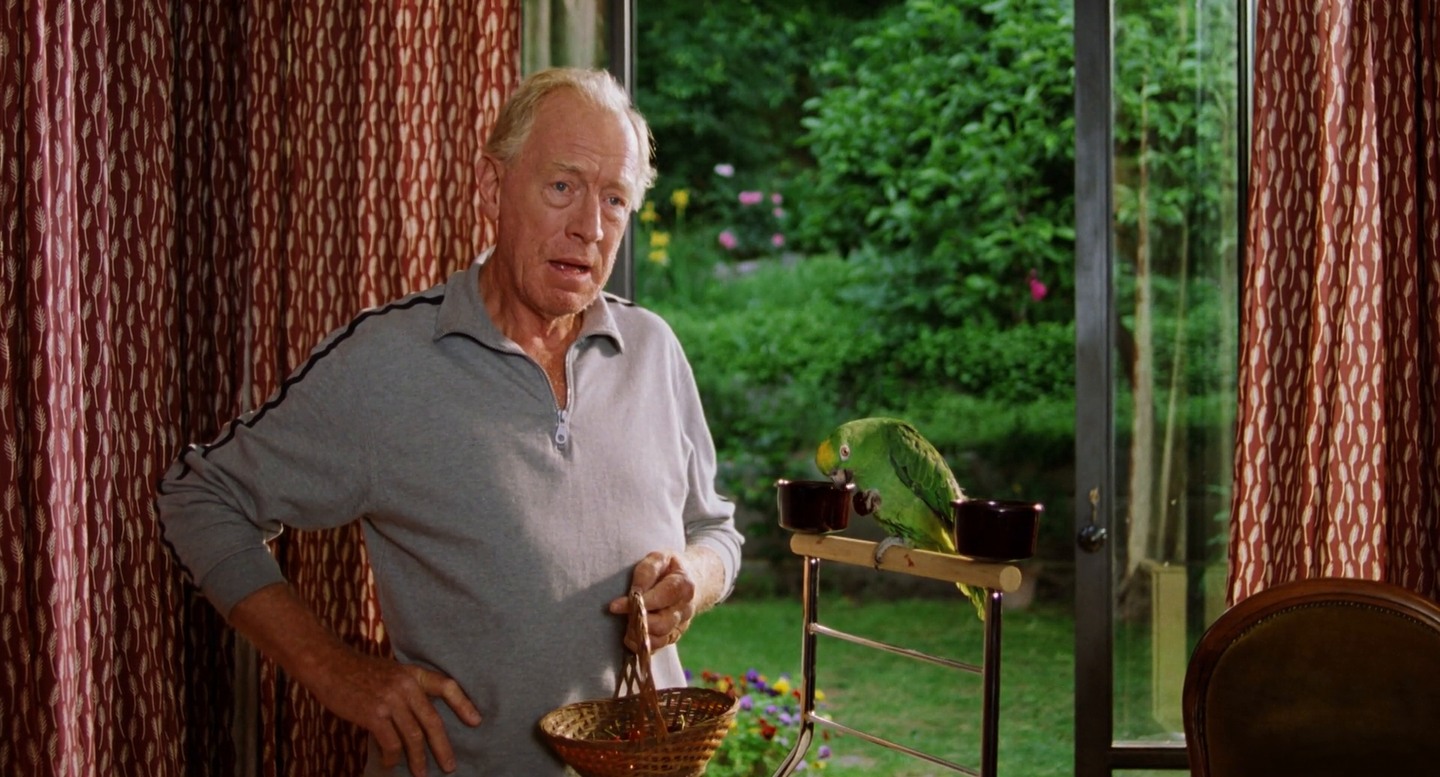
Curtains, plants and the parrot establish a lived-in room rather than an official office. Moretti’s domestic setting changes the scale of the inquiry. The police bring the case to him, and his accumulated habits become part of the investigation.
27:45
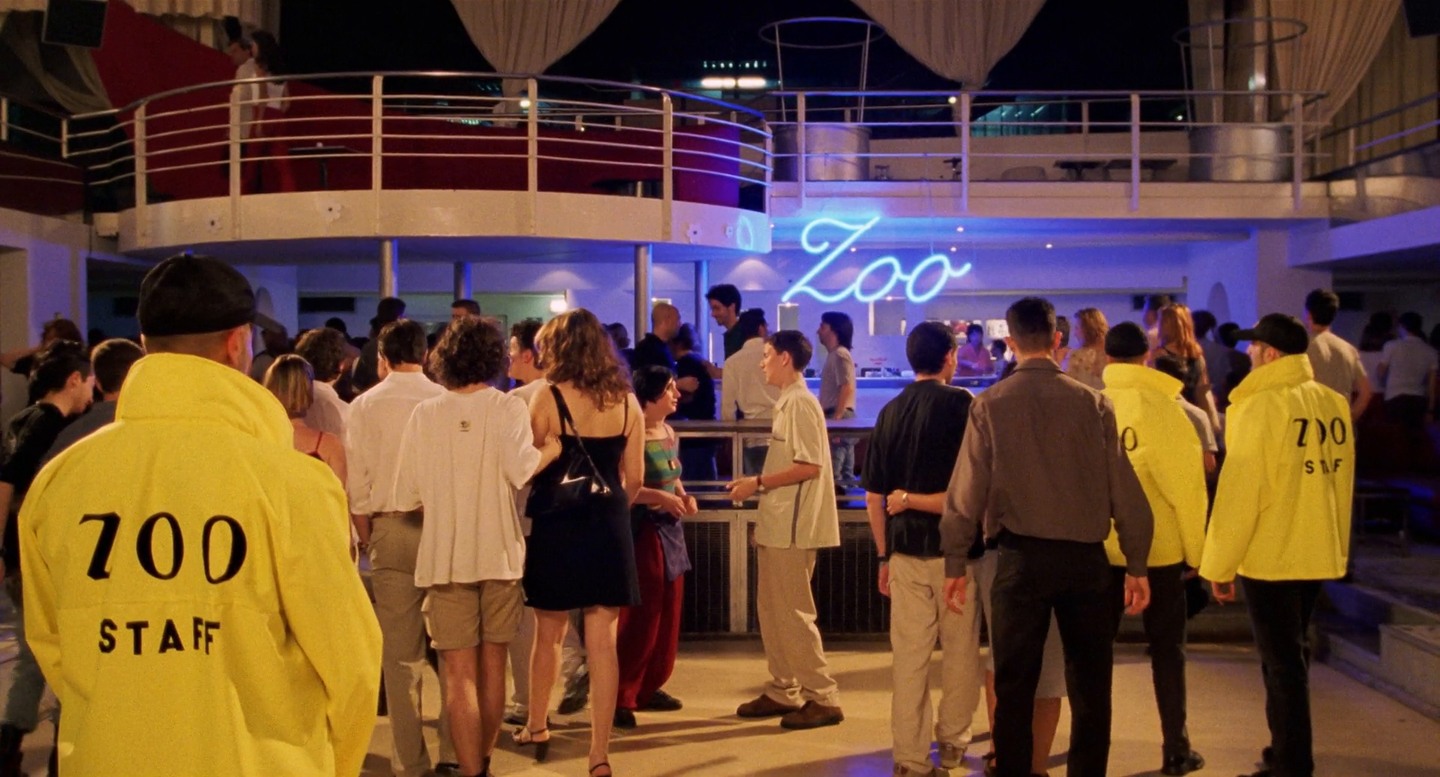
The public face of the nightclub
ENLARGE ↗Staff and customers gather beneath the Zoo sign.
Bright clothes, crowded walkways and the animal name give the club a conspicuous public identity. The following descent strips that social protection away. A workplace full of people opens into service spaces where a woman can be isolated.
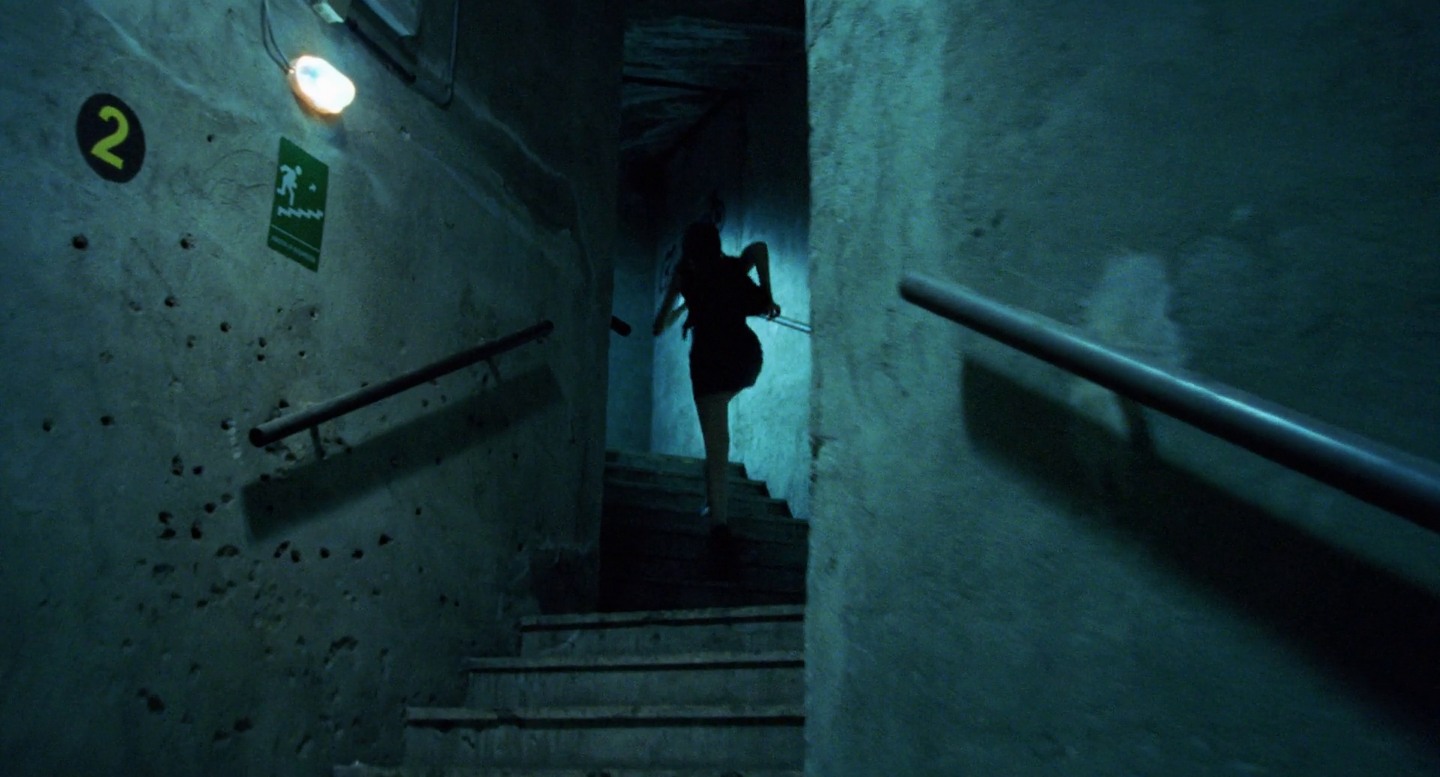
Landings and numbered walls break the staircase into distinct stages. Blue light makes the space legible without making it safe. The rail supplies a strong diagonal that directs movement deeper into the building.
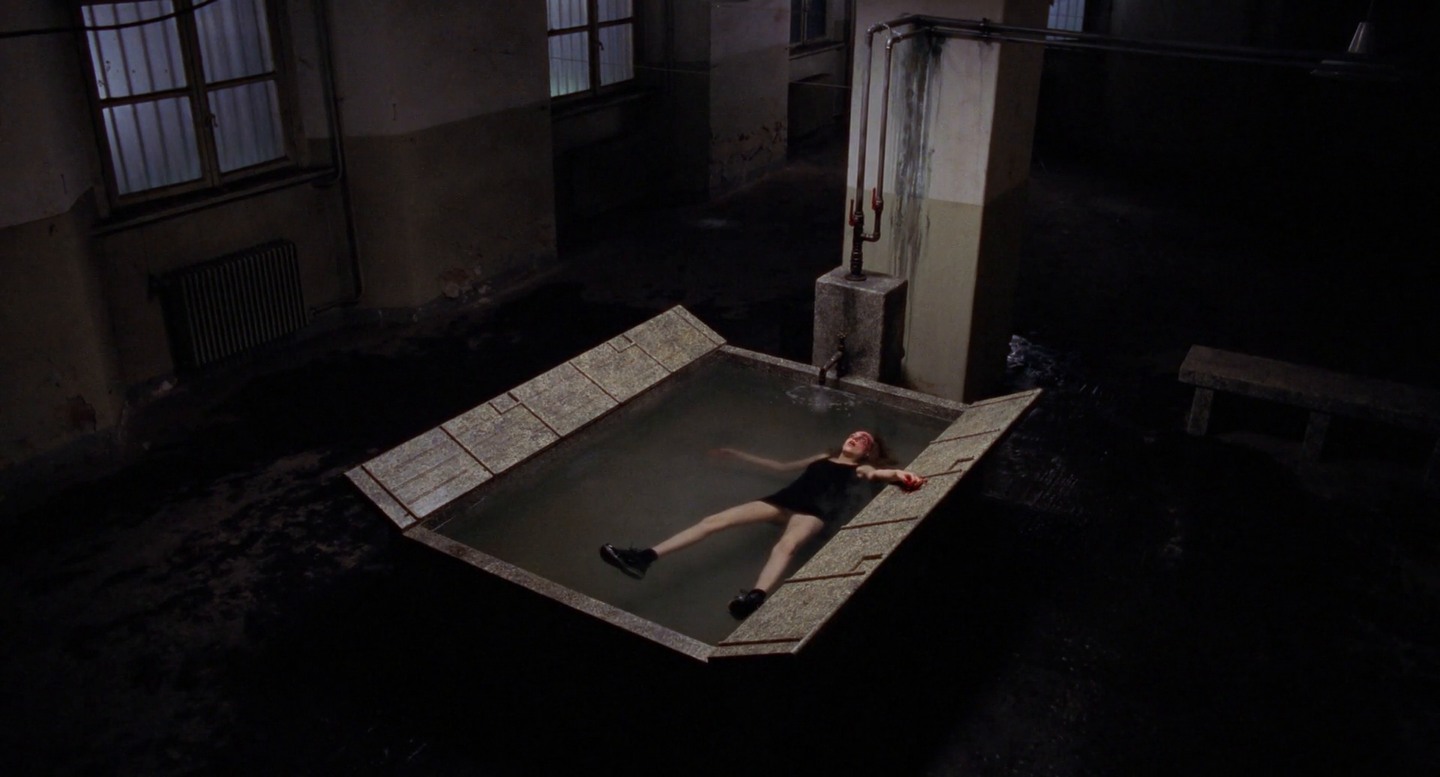
After the close struggle, the wider view restores the architecture. The rectangular basin gives the body a rigid support and makes the room’s emptiness conspicuous. The shift from motion to an arranged aftermath lets the setting hold the violence.
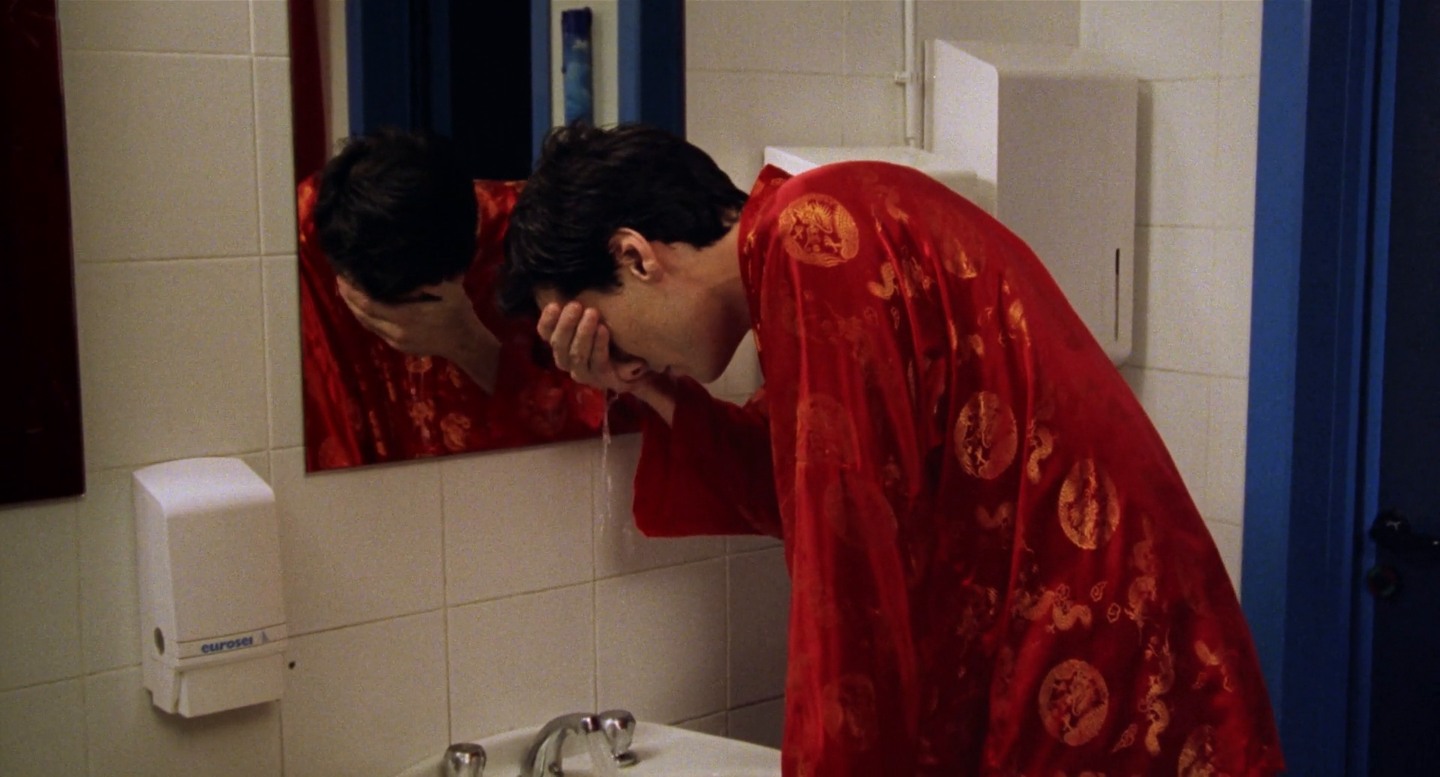
The mirror doubles a man already divided between present life and childhood memory. The red work clothes give this return a different texture from the detective’s domestic browns. His physical reaction interrupts the ordinary routines around him.
40:15
Two ages of the same case
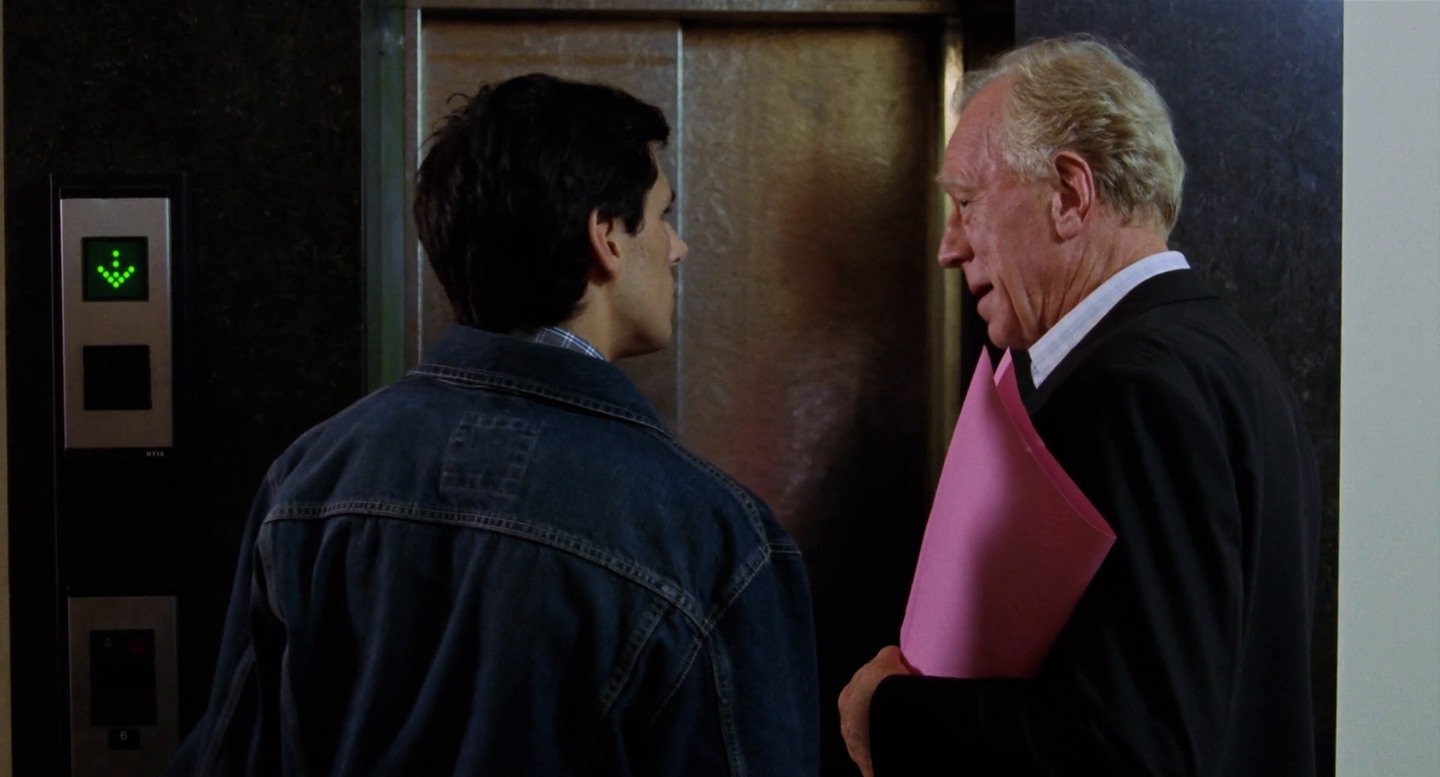
ENLARGE ↗Giacomo and Moretti stand beside the lift.
The grown witness and elderly investigator share a narrow frame at a threshold. Their difference in age remains visible, but neither can complete the inquiry alone. The scene brings the opening promise into the present without erasing the years between them.
41:40
The child’s obstructed view
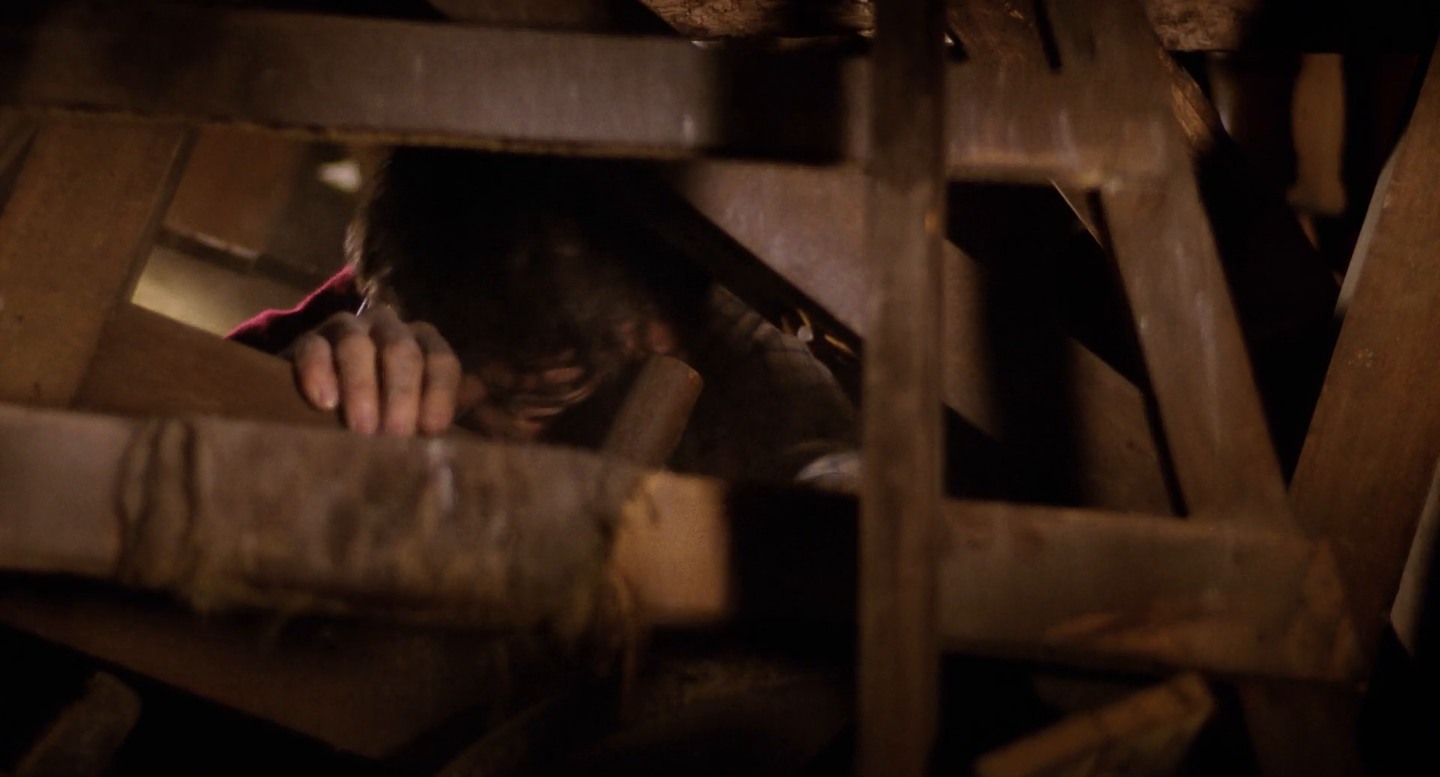
ENLARGE ↗Young Giacomo watches through stacked furniture.
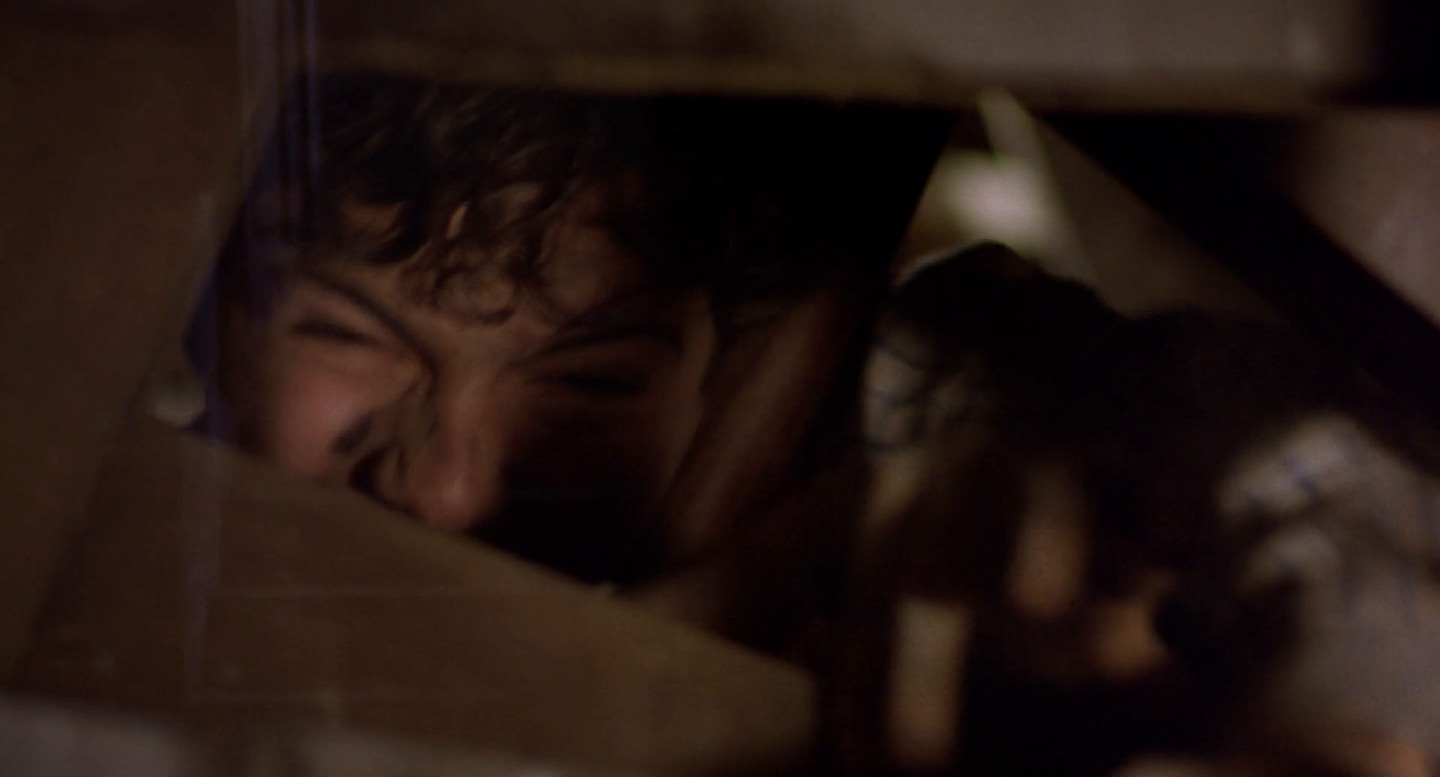
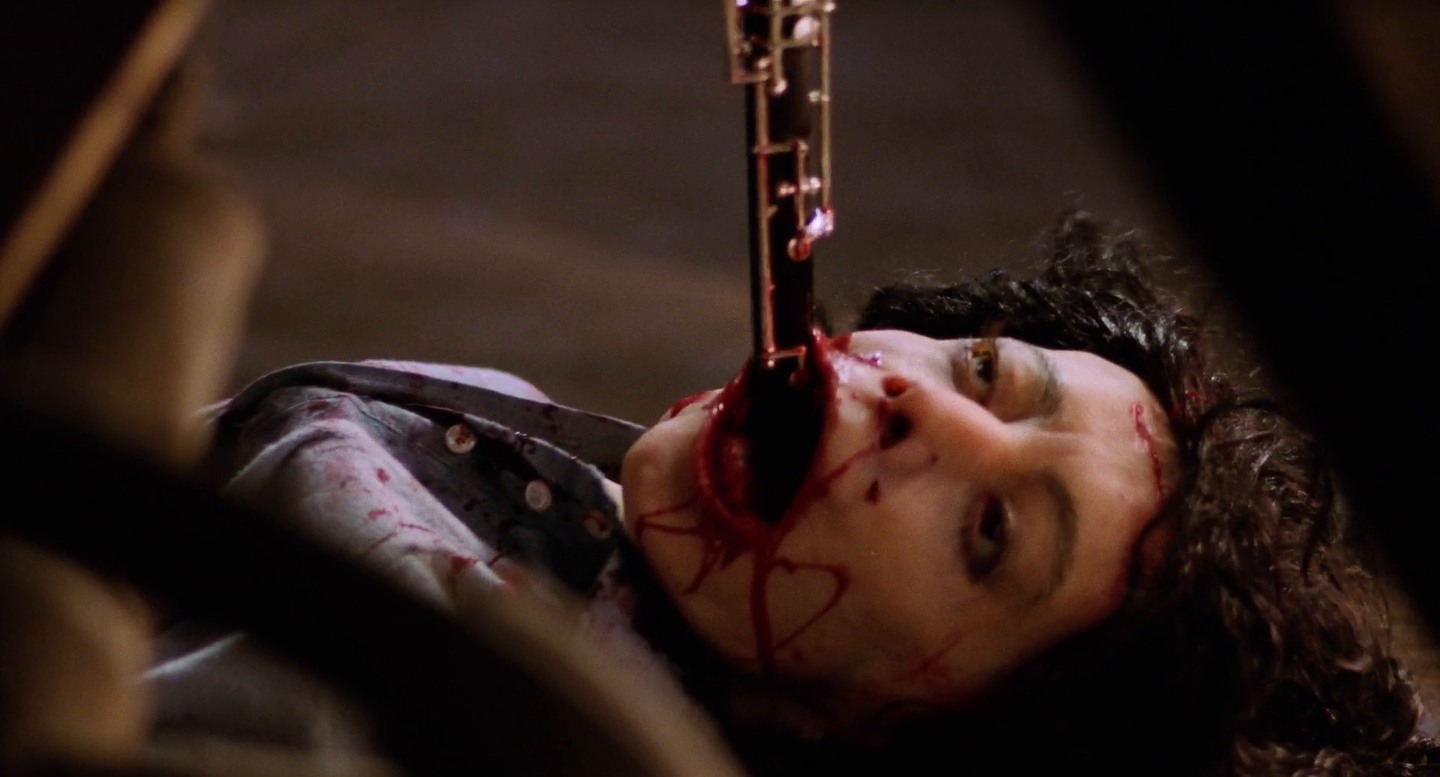
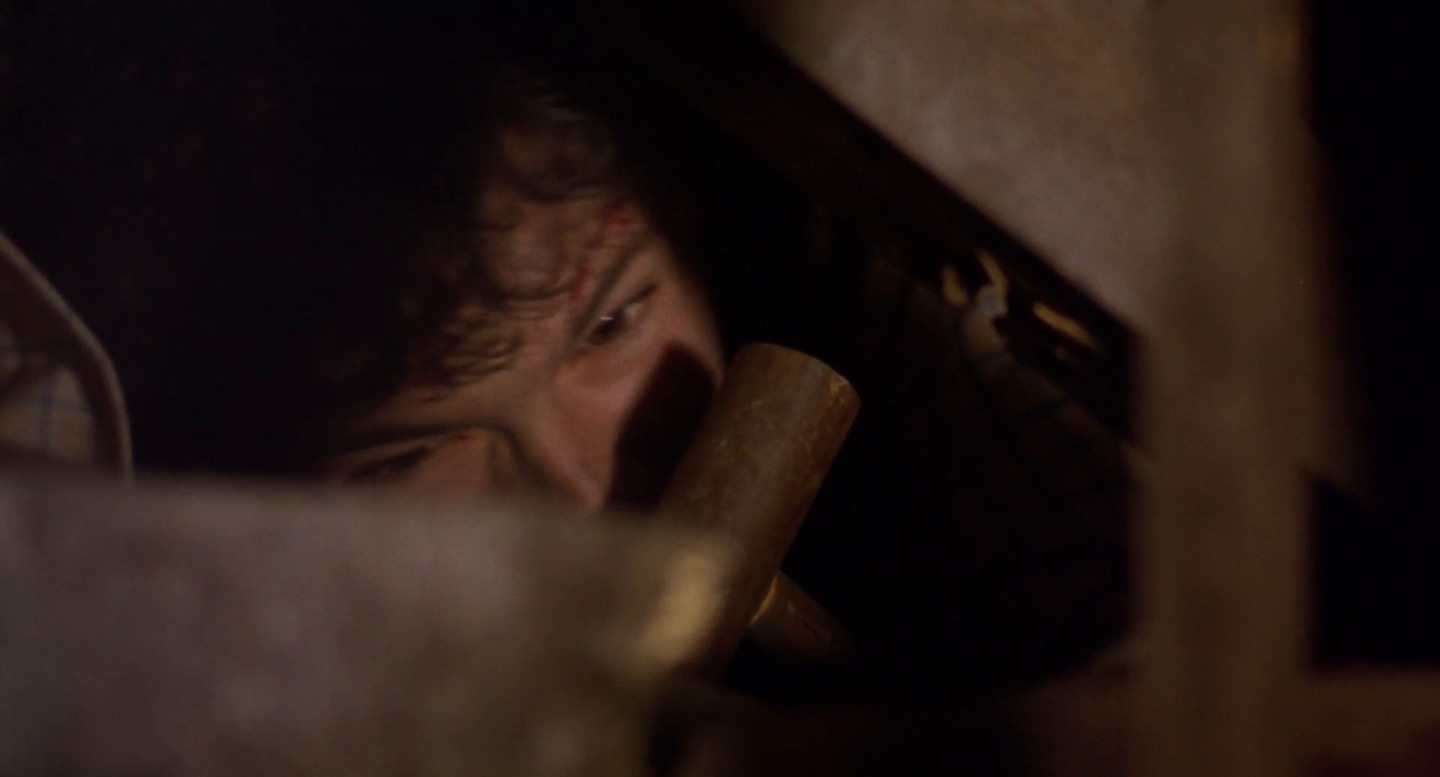
Furniture bars the child’s line of sight. The flashback alternates that partial viewpoint with a much clearer image of the injured mother. What Giacomo could see and what the film now shows are related, but they are not identical vantage points.
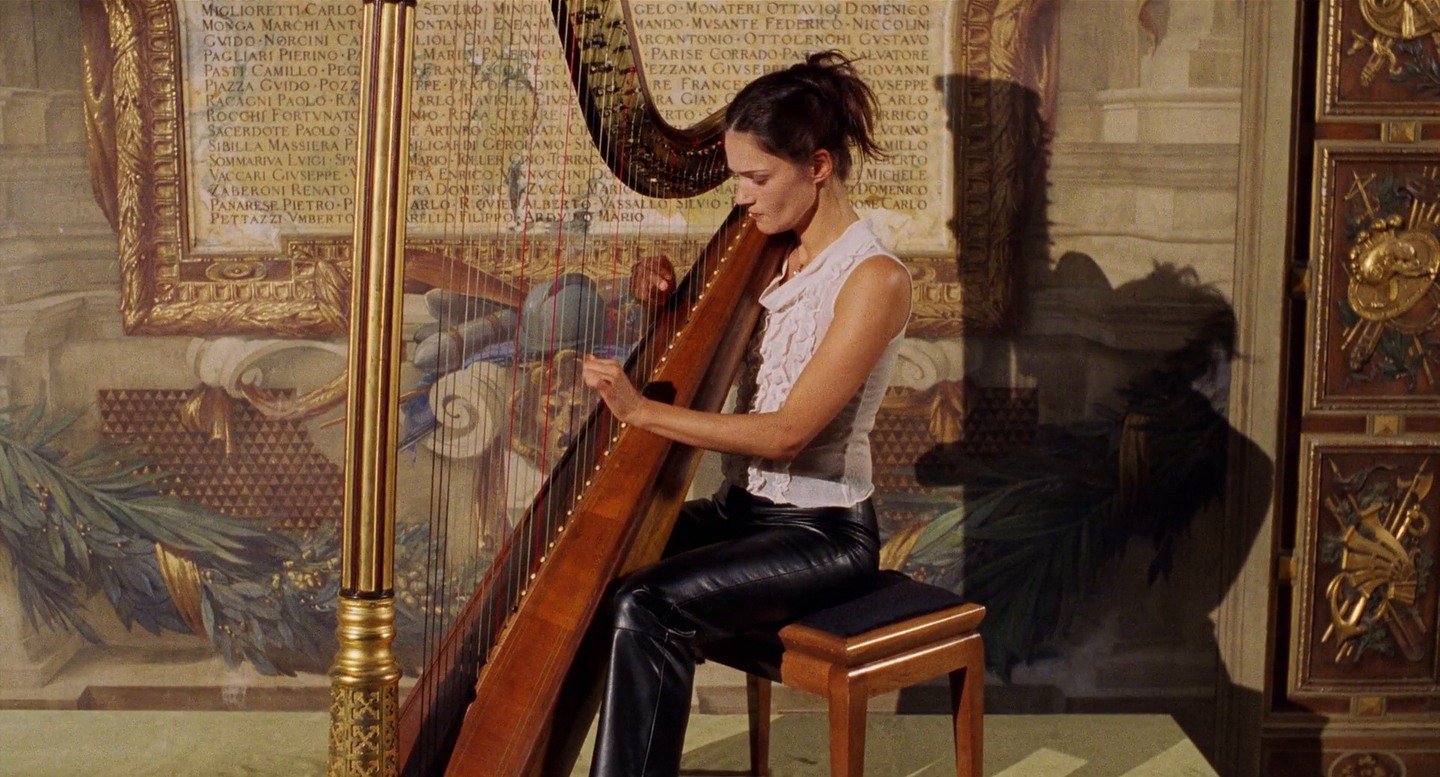
The harp’s upright frame sets a different relationship between body and instrument from the murder memory. Gold surfaces and painted architecture surround a controlled performance. The visual comparison belongs alongside the dossier’s separate discussion of the clue’s ambiguous wording.
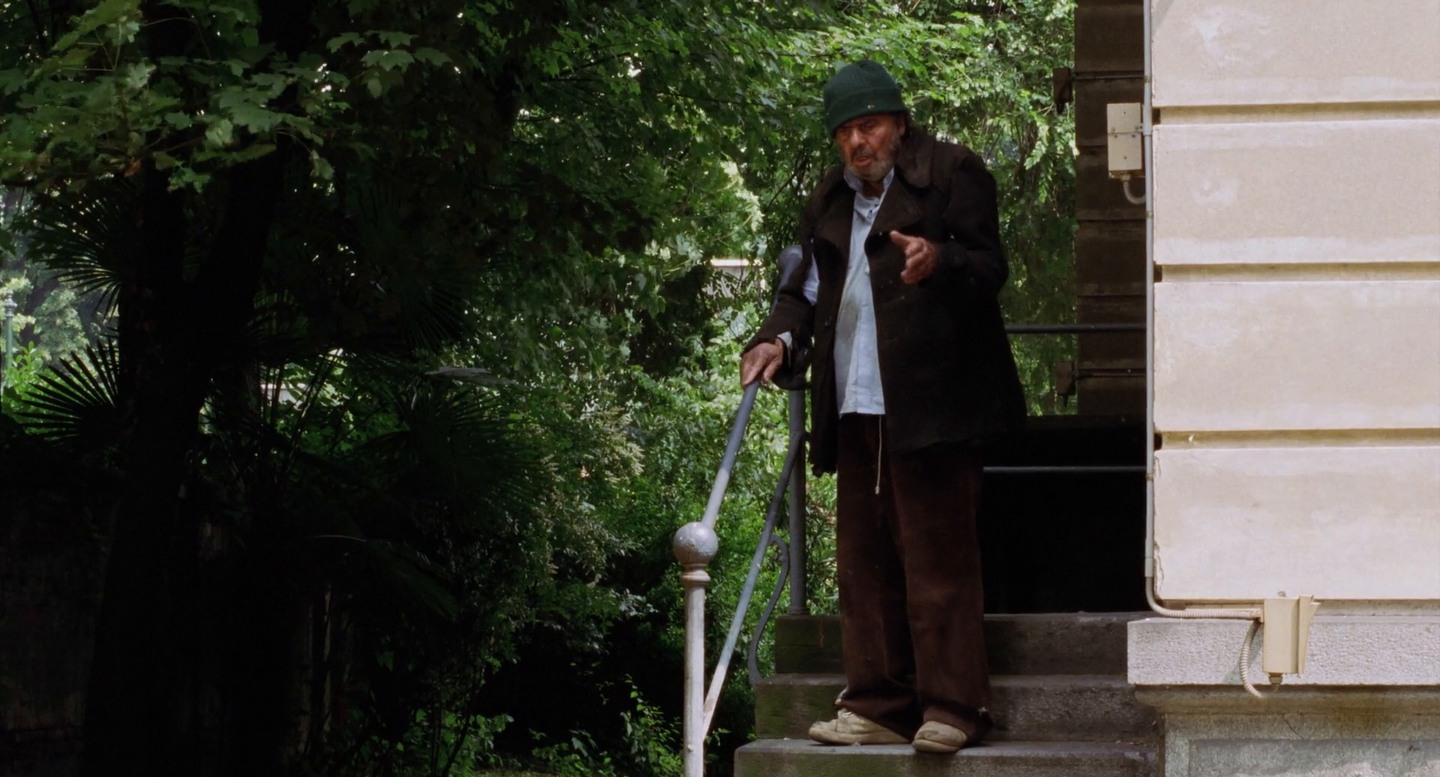
The investigators reach a site whose barriers and vegetation make elapsed time visible. The old case survives in a place that can still be entered, but not simply resumed. The gate gives the return an obstacle before anyone begins explaining it.
Leone’s position at the doorway links him to the building without making him its authoritative interpreter. The surrounding plants and worn surfaces place his testimony among material remnants of the case. He can open a route into the past while also complicating it.
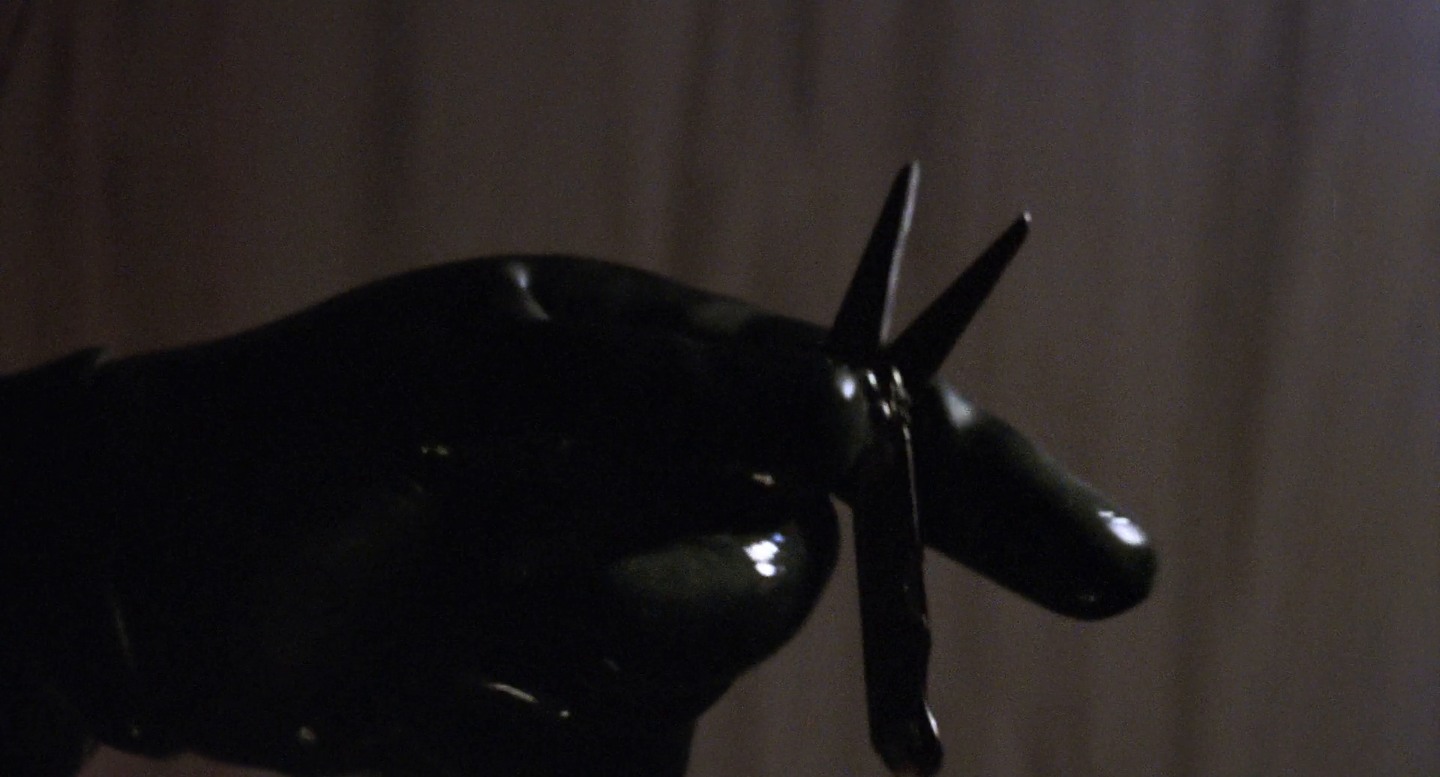
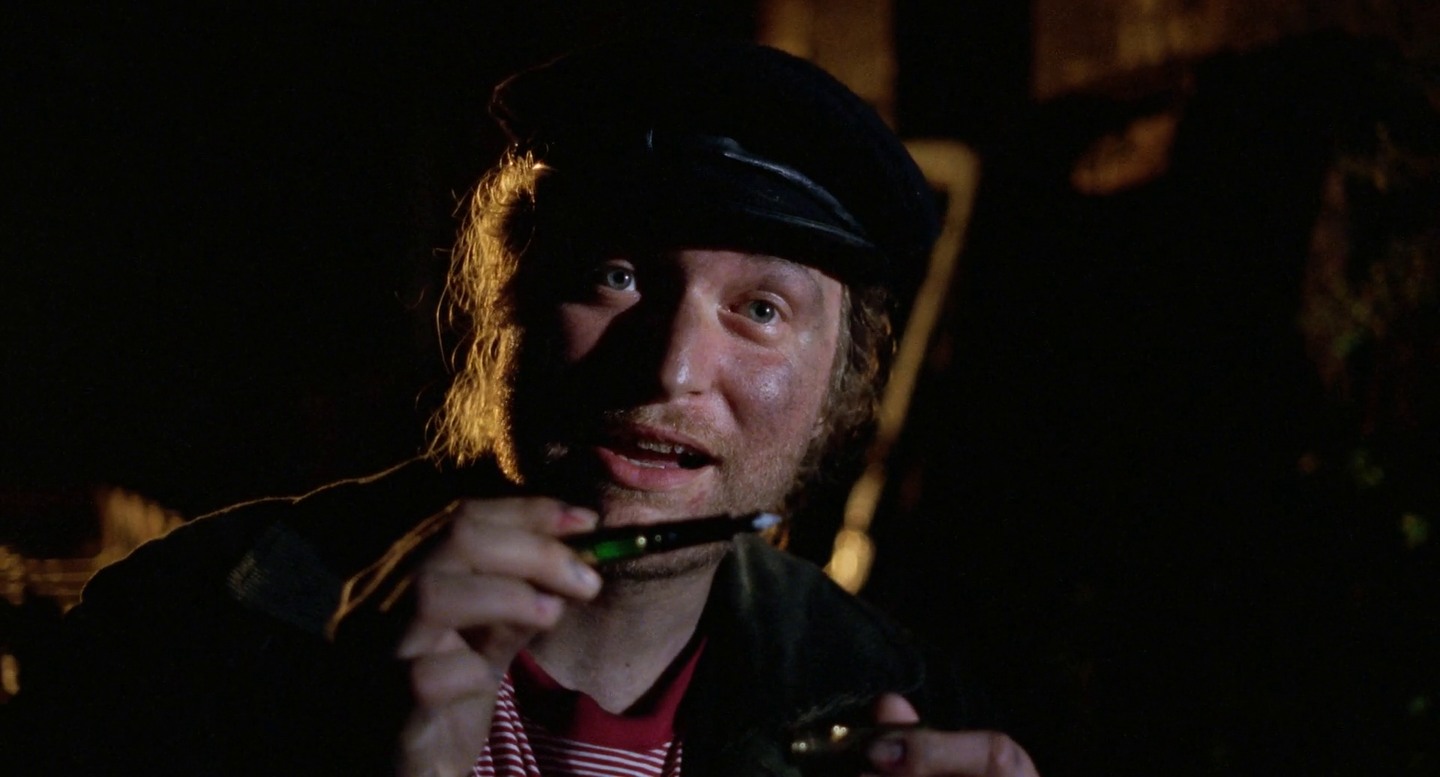
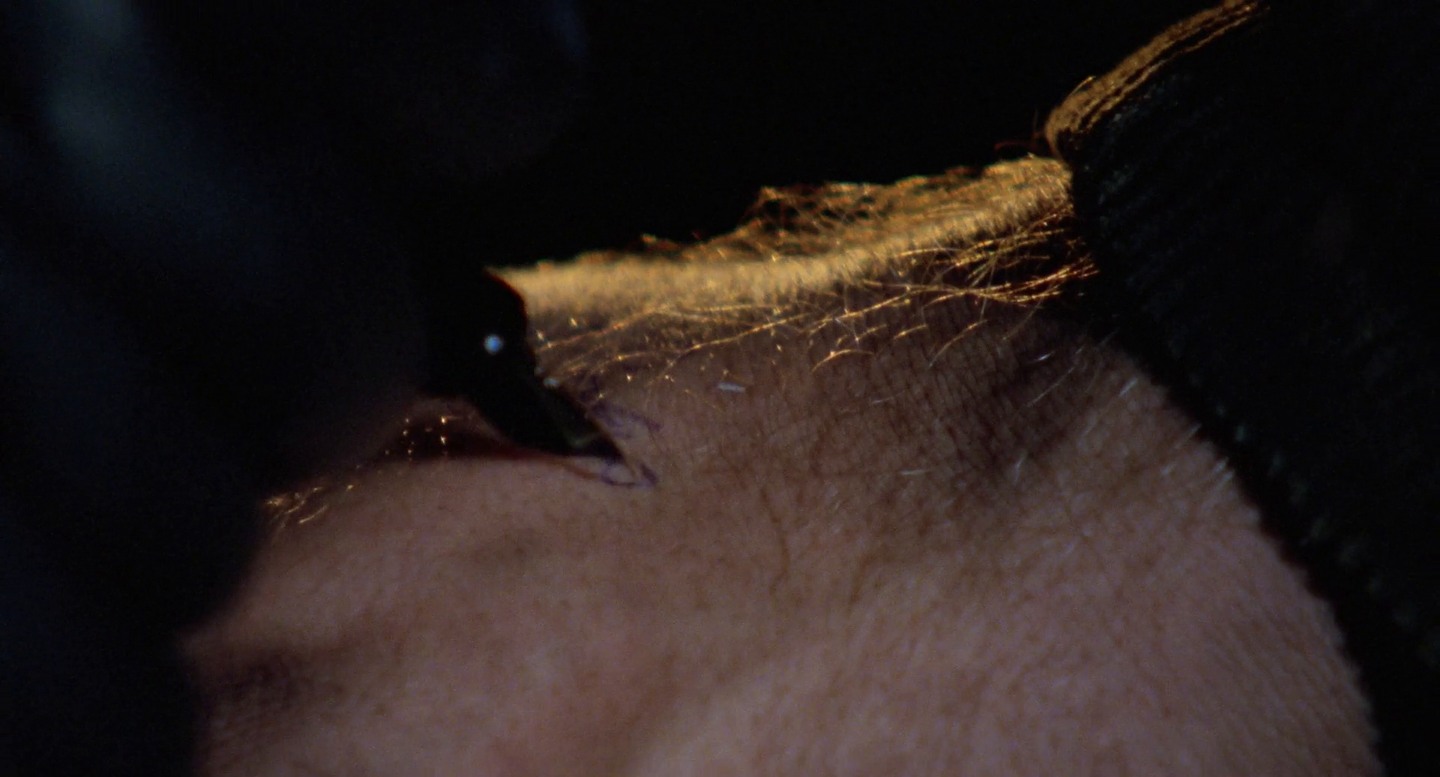
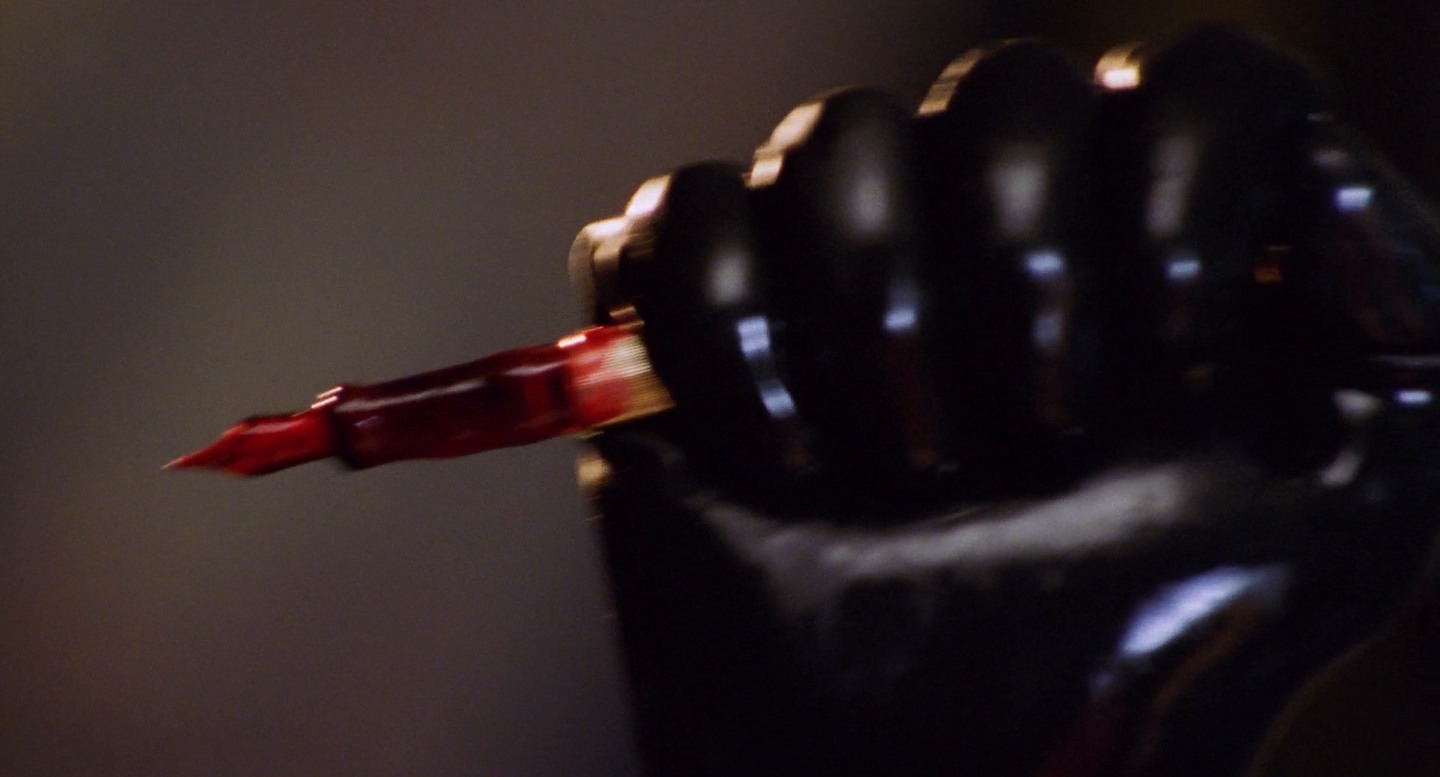
A familiar writing implement becomes the close-up’s threatening object. Its red surface briefly takes over from the face and the surrounding street. The insert compresses a whole attack into an object that the viewer can inspect.
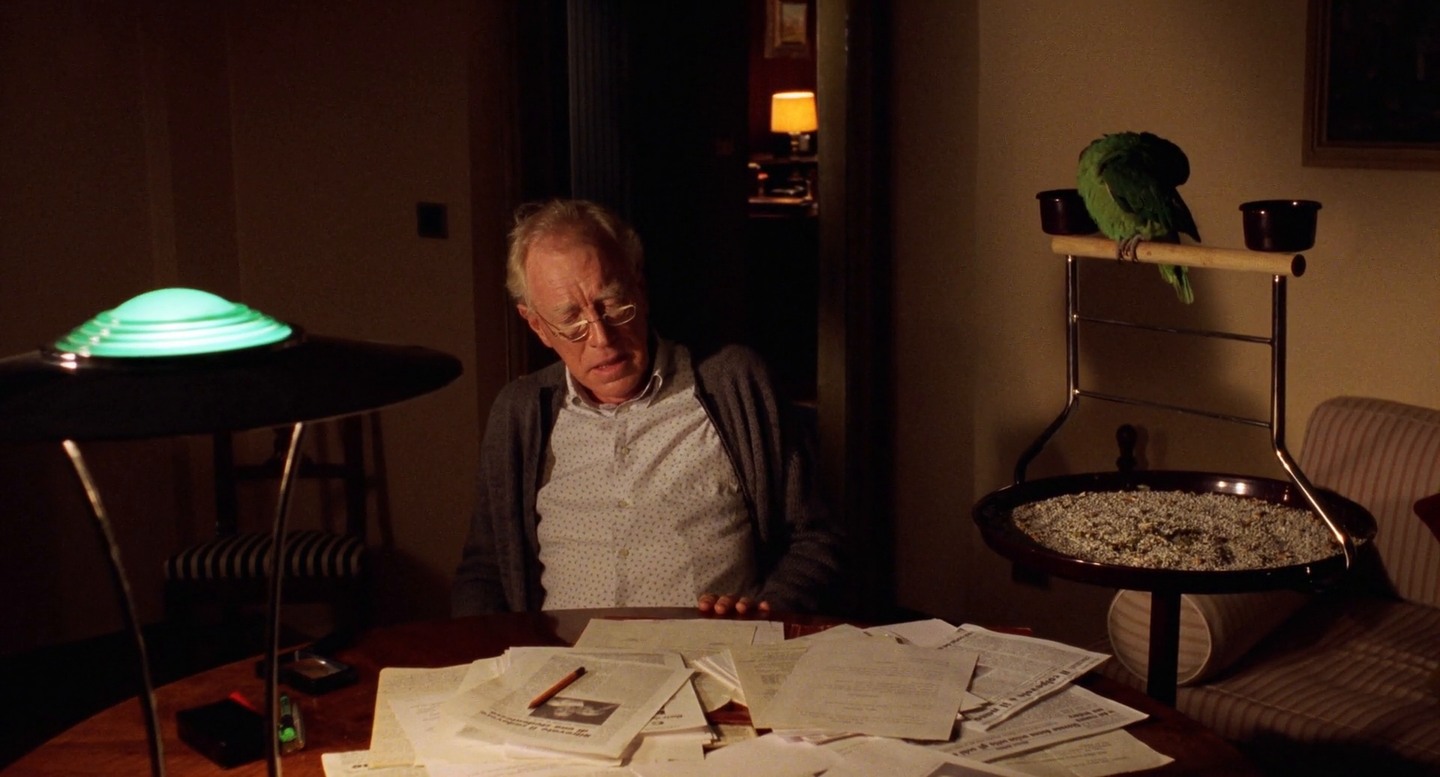
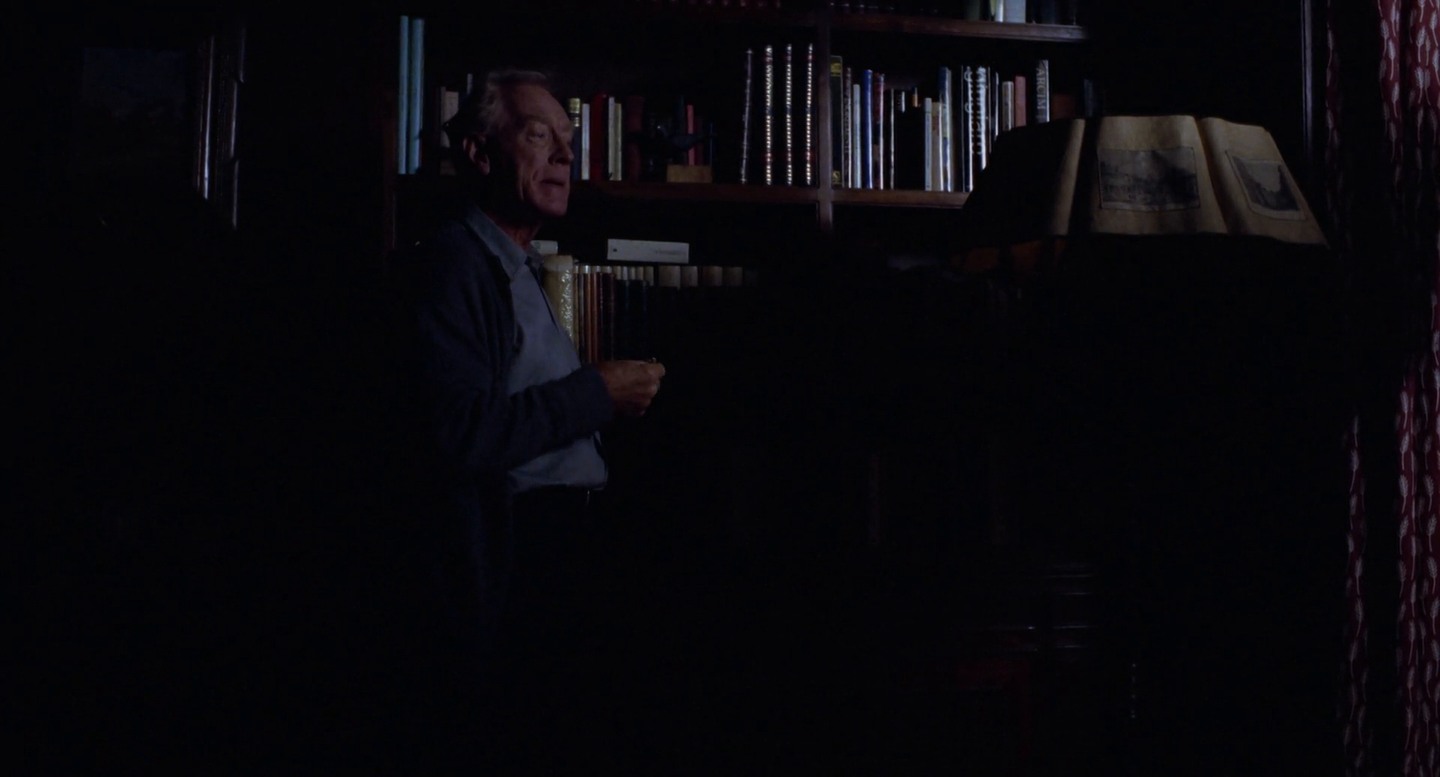
ENLARGE ↗Moretti studies papers beneath the green lamp.
The lamp concentrates the work into a small illuminated area. Books, loose pages and the bird remain close to him: the room is both a home and a makeshift case archive. Its familiarity will make the later intrusion especially disquieting.
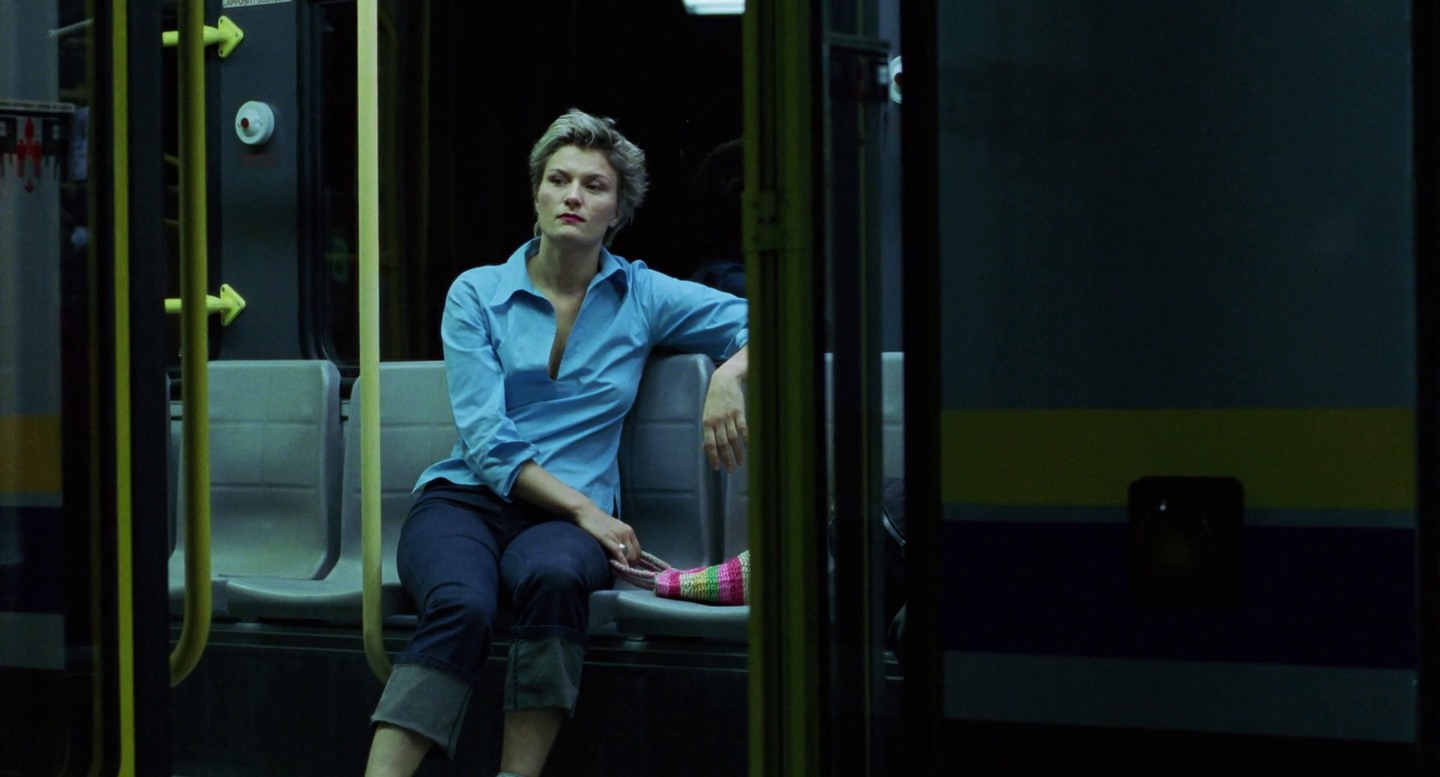
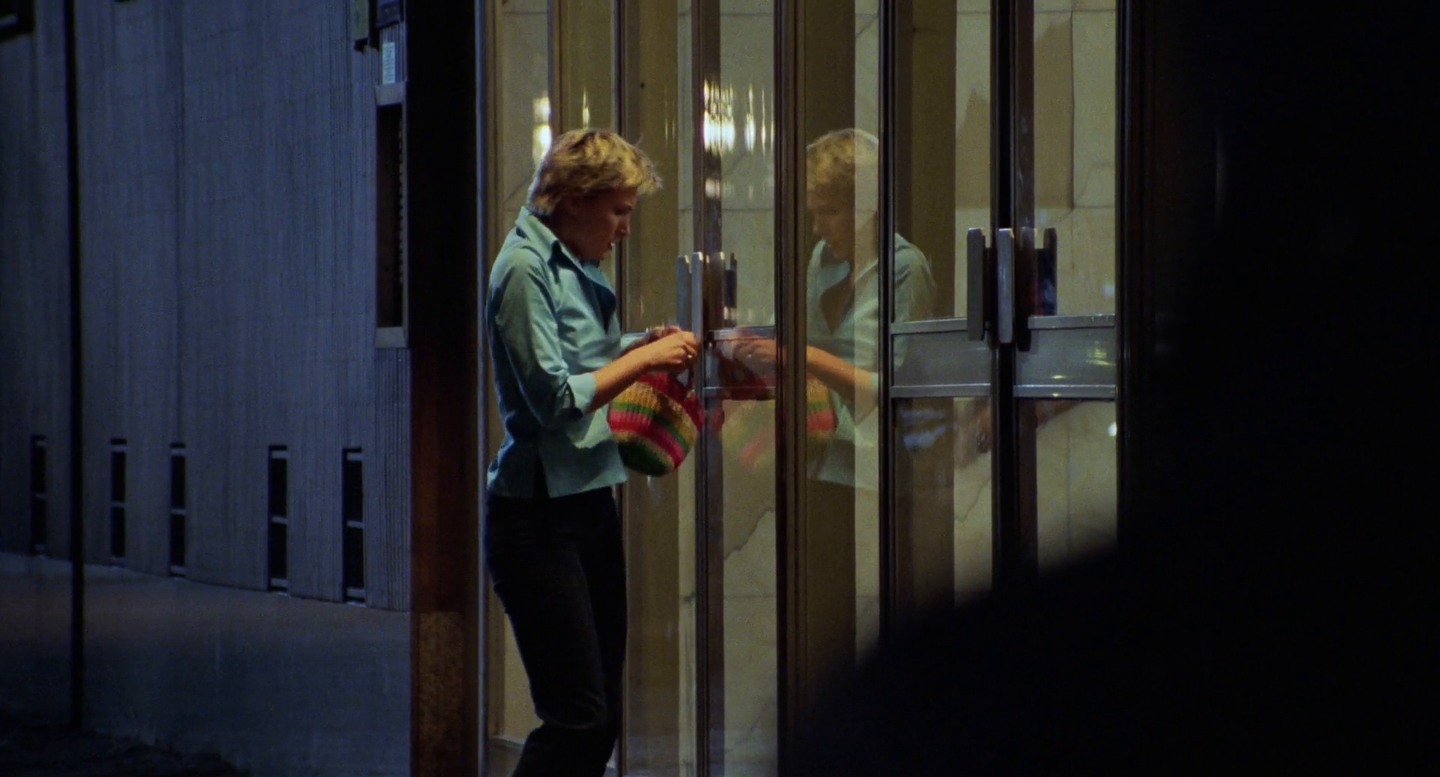
Dora’s blue shirt and the yellow rails stand out against the night. Once again, public transport produces a succession of windows and doors around a solitary woman. The later attack follows her beyond the vehicle rather than taking place inside it.
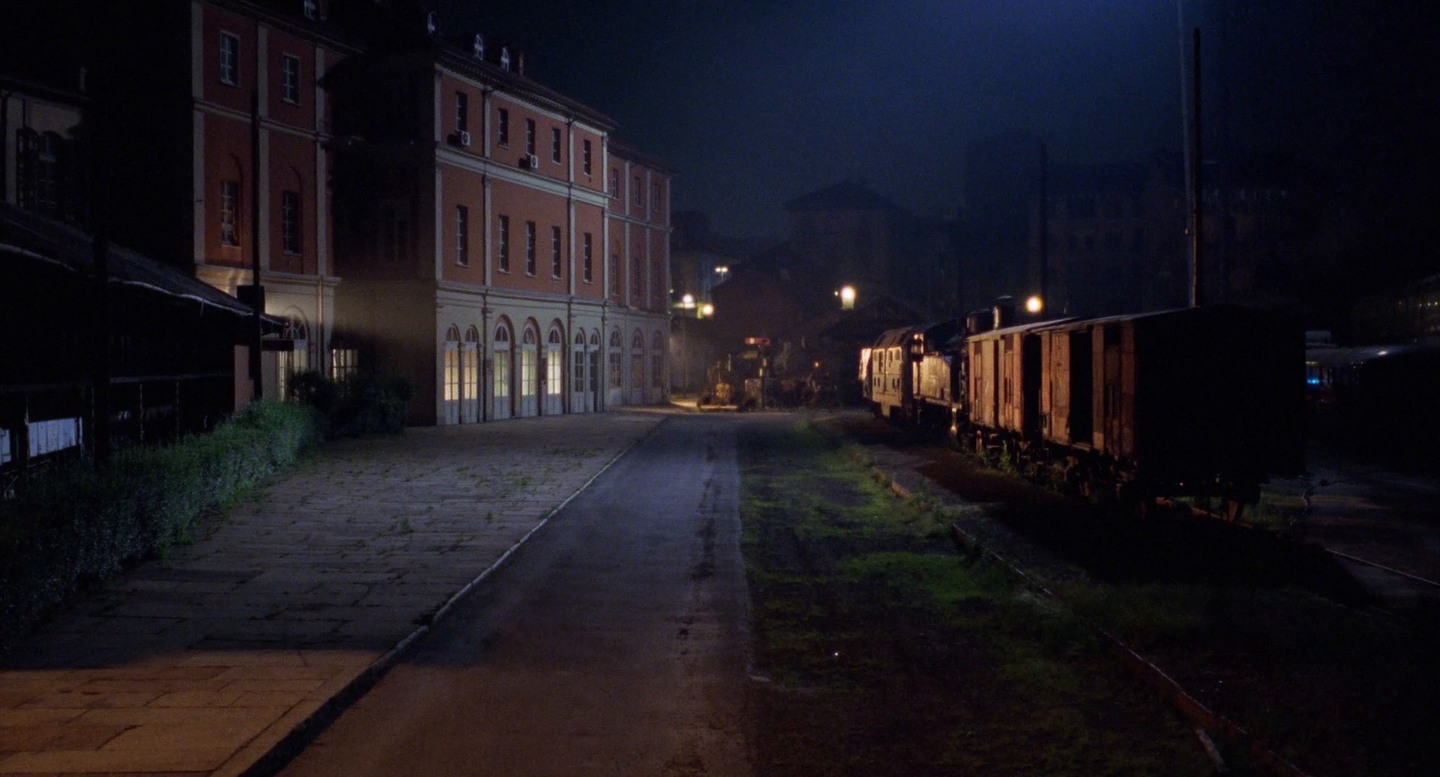
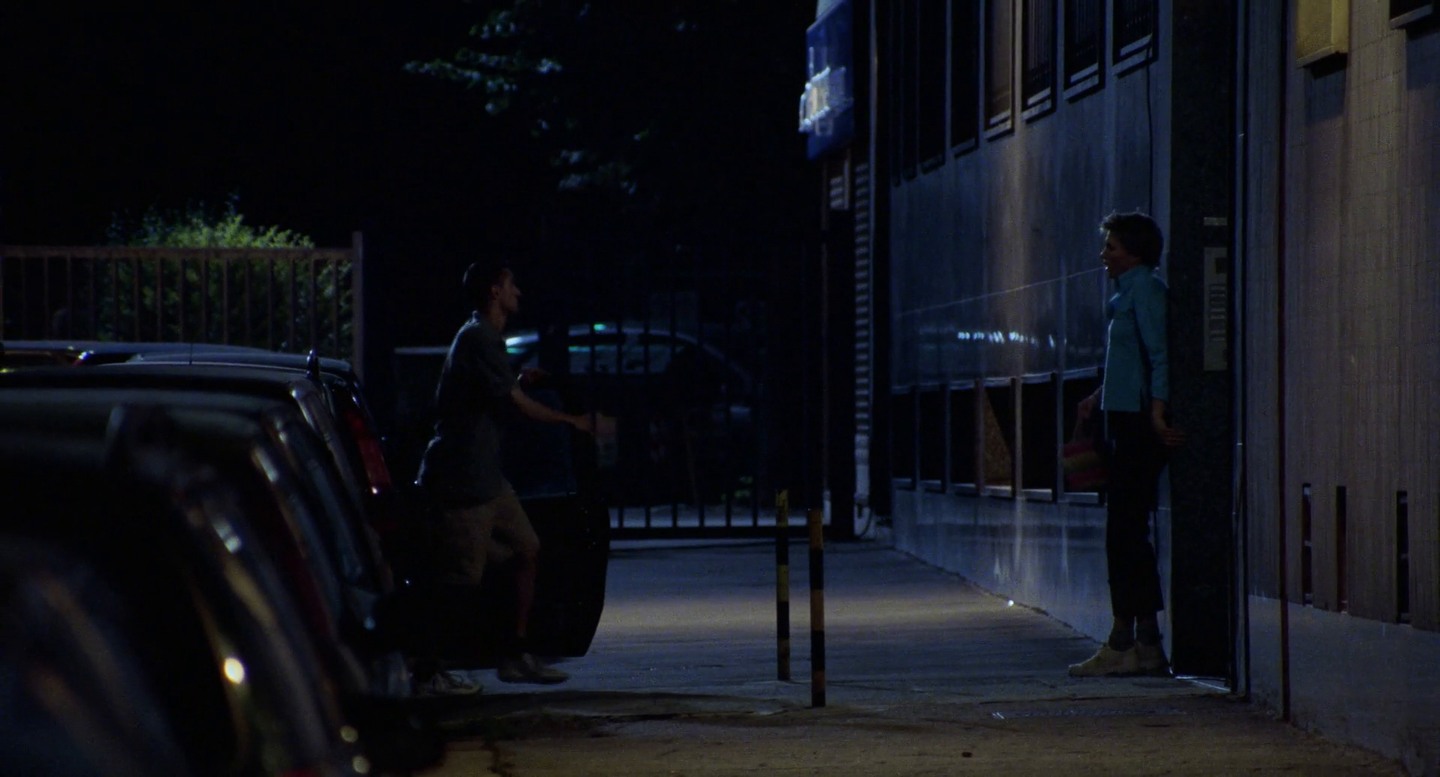
The wide street view leaves room for another figure to enter or leave the composition. The smaller task of finding a key holds Dora in one exposed position. The lock inserts then narrow attention to her hand before the assault takes over.
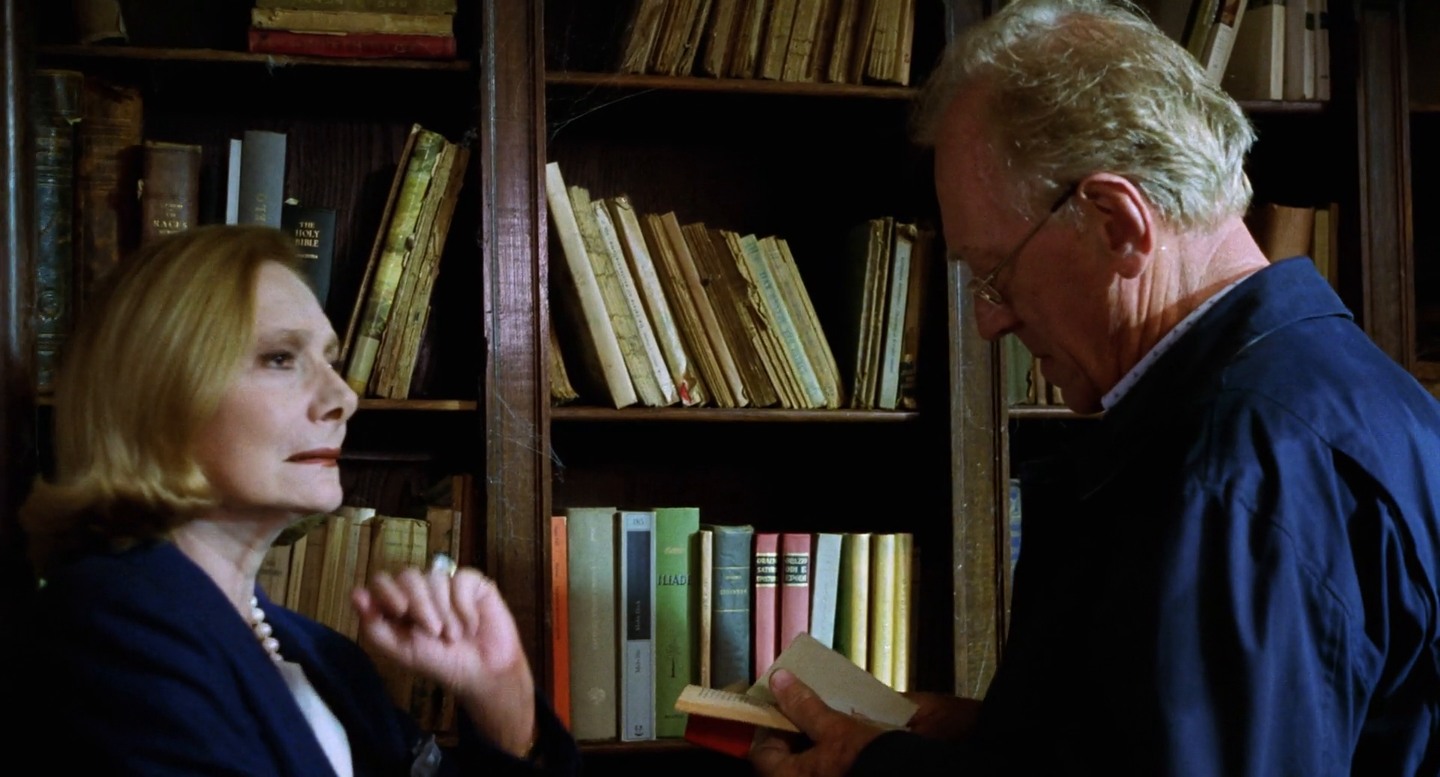
The shelves place the conversation inside the writer’s surviving world. The case is reconstructed through a person and the objects around her, rather than through an anonymous explanatory flashback. Giacomo’s presence keeps the old inquiry tied to the living witness.
1:18:45
Backstage before the reveal
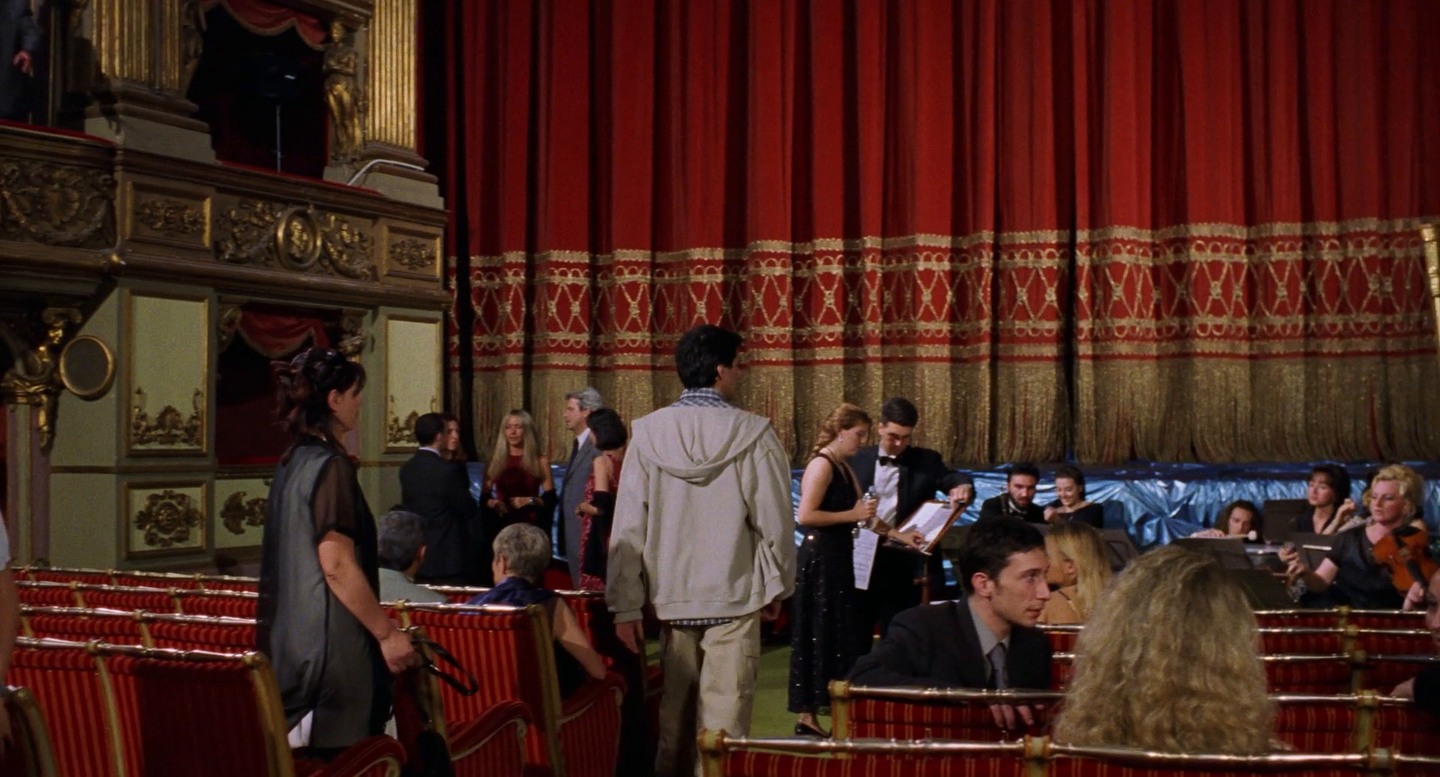
ENLARGE ↗Giacomo crosses the theatre behind the curtain.
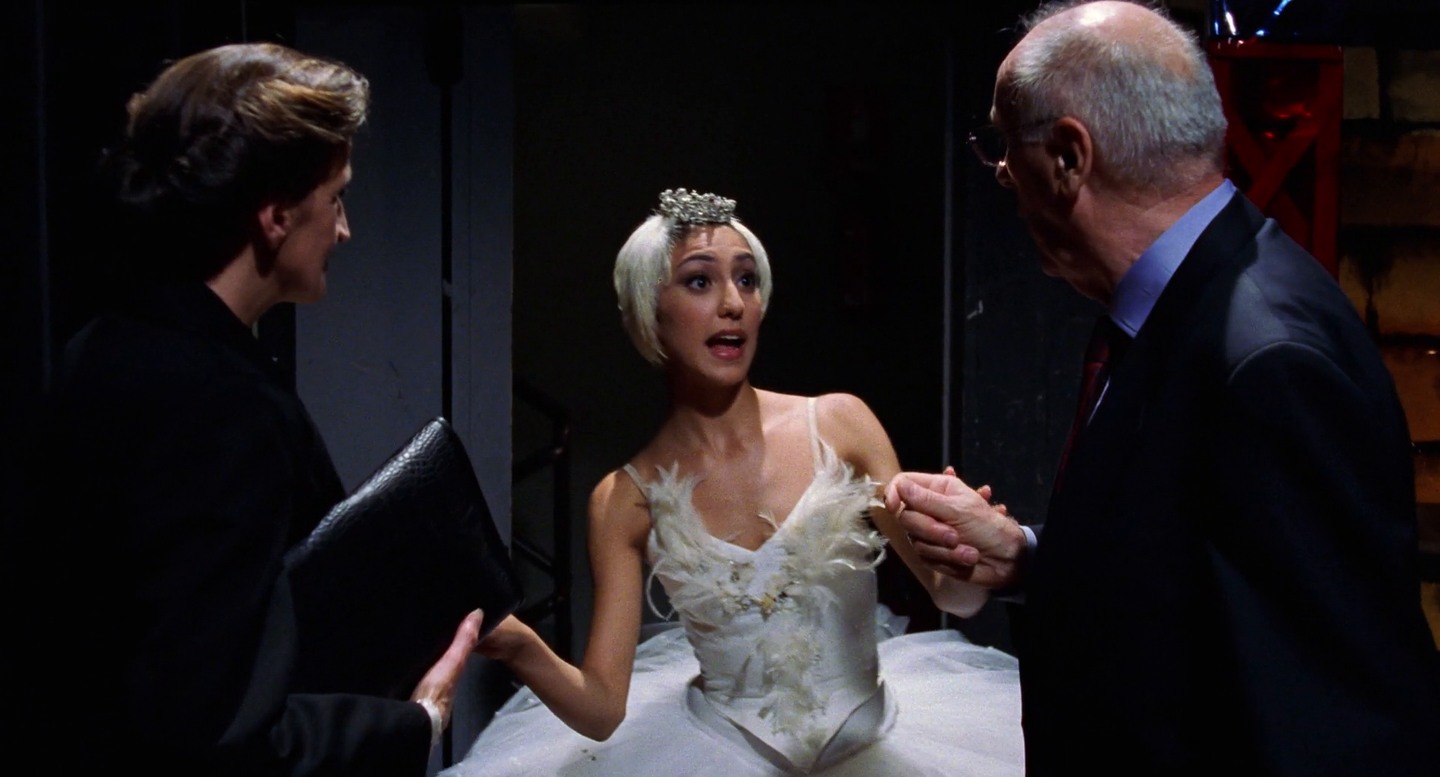
The theatre introduces another interior divided between public activity and hidden passages. The heavy curtain interrupts a view of people at work. This busy environment prepares the carpet sequence, where the camera will refuse to look up at the faces passing it.
1:20:50
A corridor viewed from below
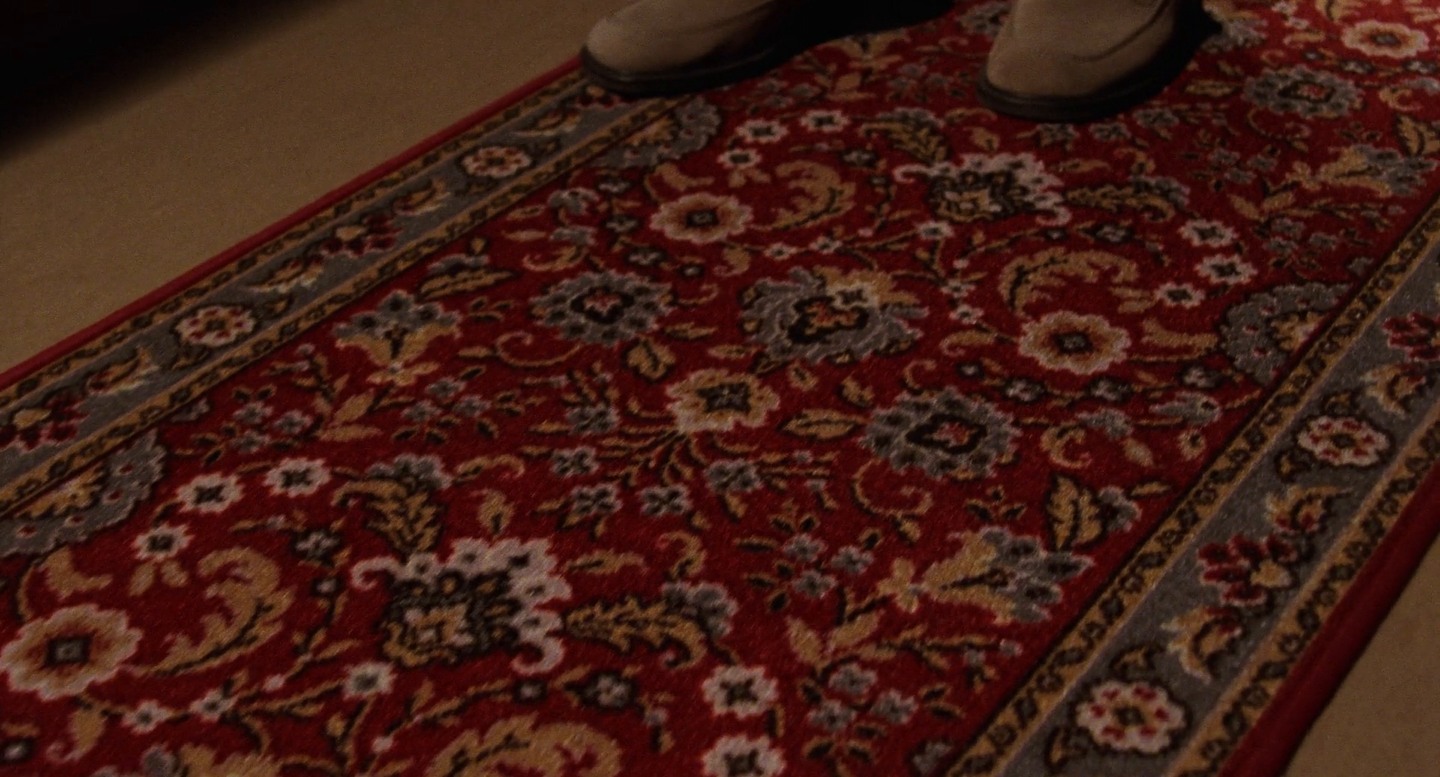
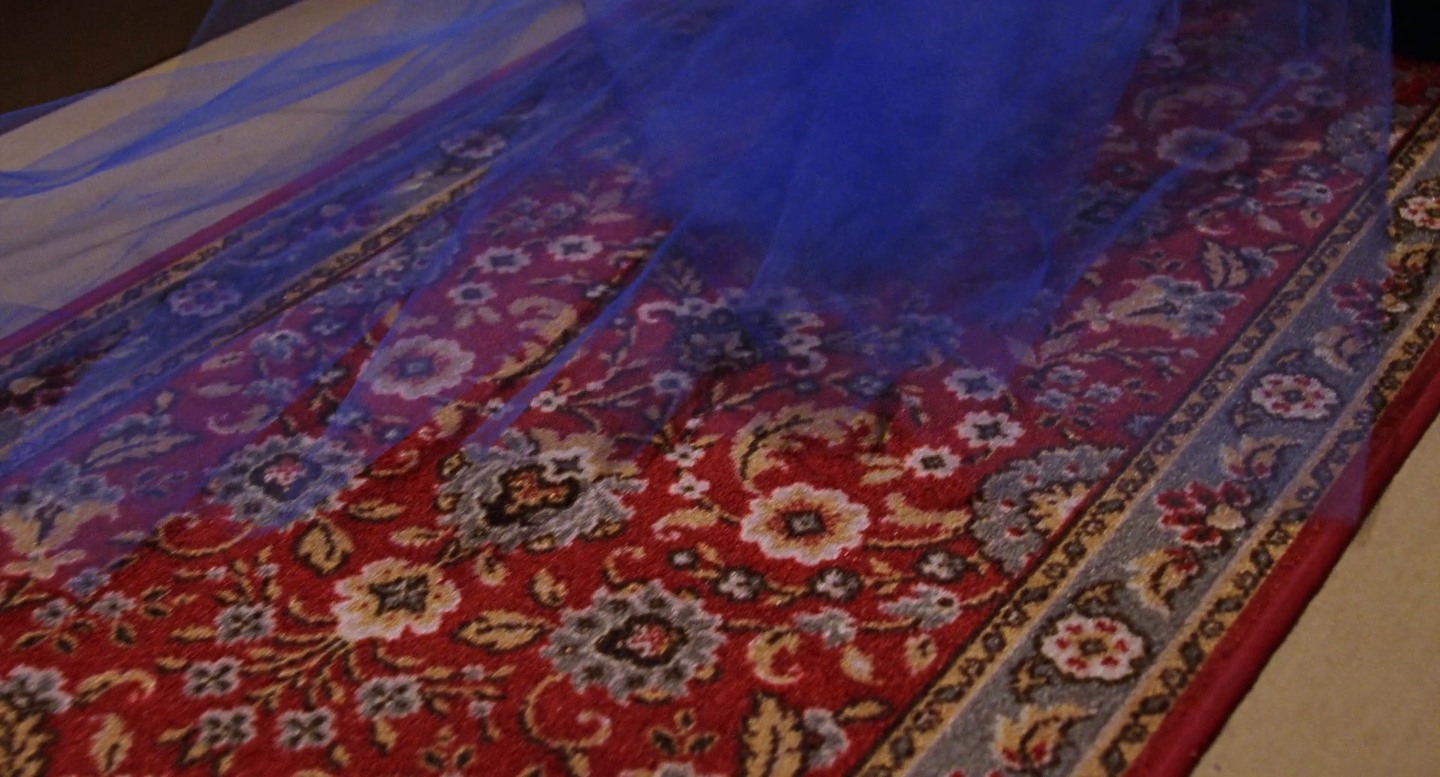
ENLARGE ↗A blue costume crosses the patterned carpet.
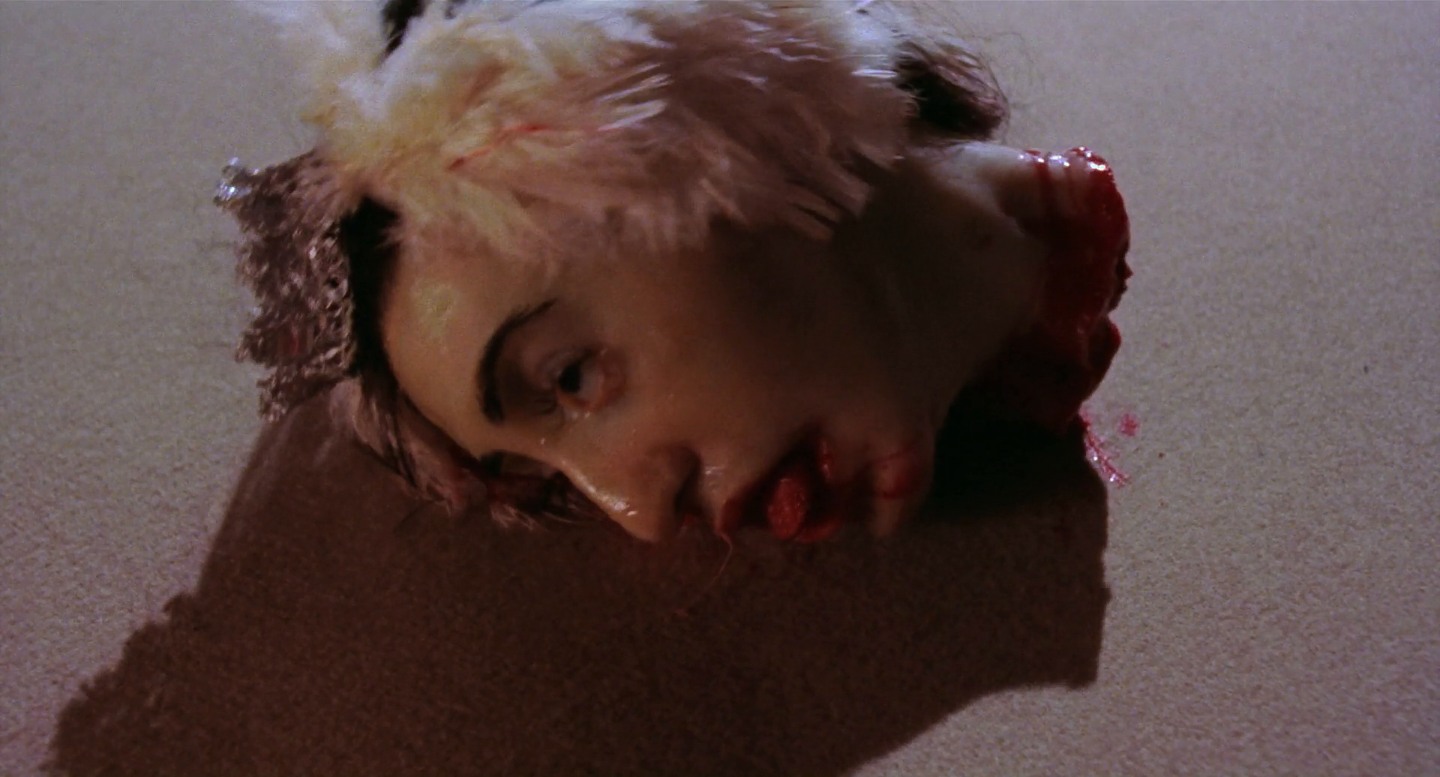
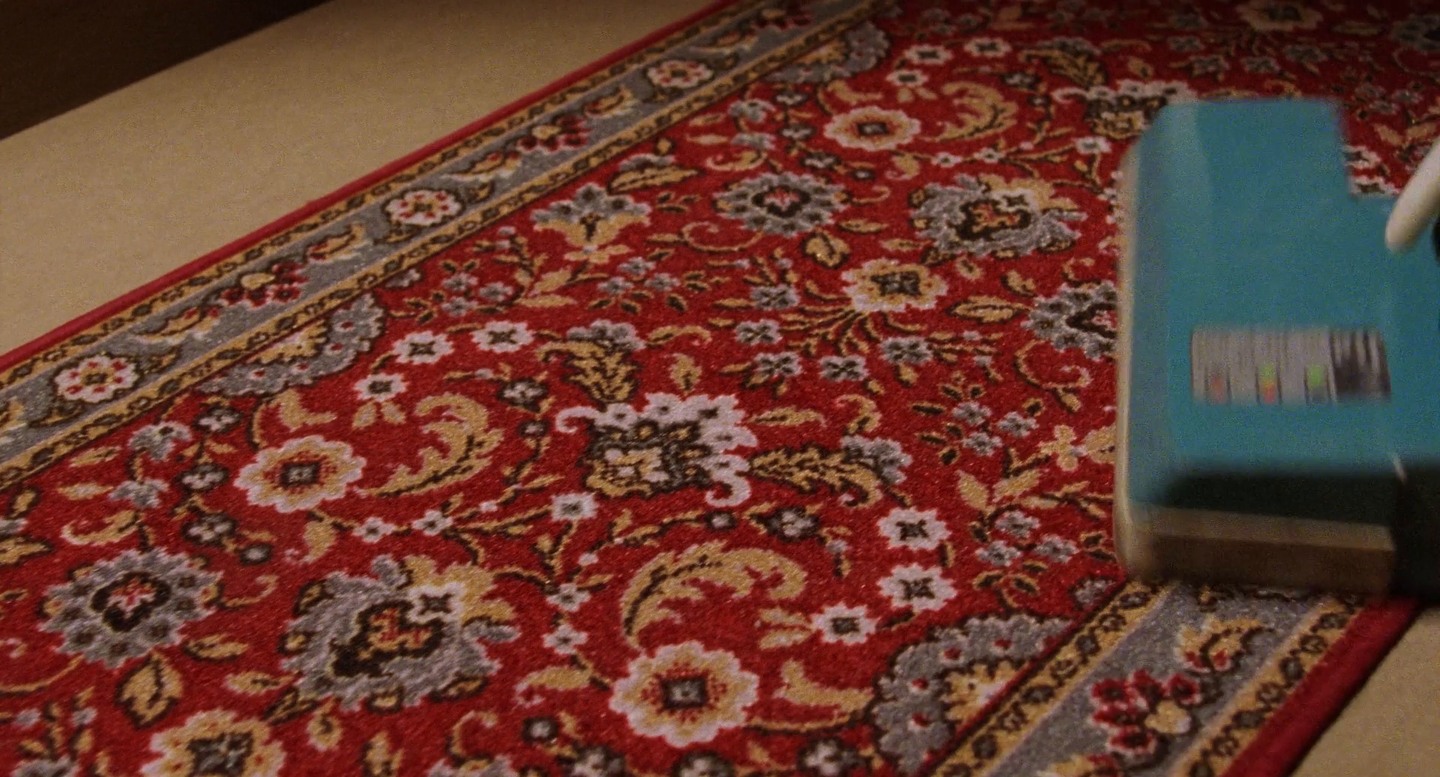
The low view gives passing clothes, shoes, luggage and shadows priority over faces. The pattern continues while the fragments of backstage life change. The eventual severed head is shocking partly because the camera has taught us to expect more ordinary objects at this height.
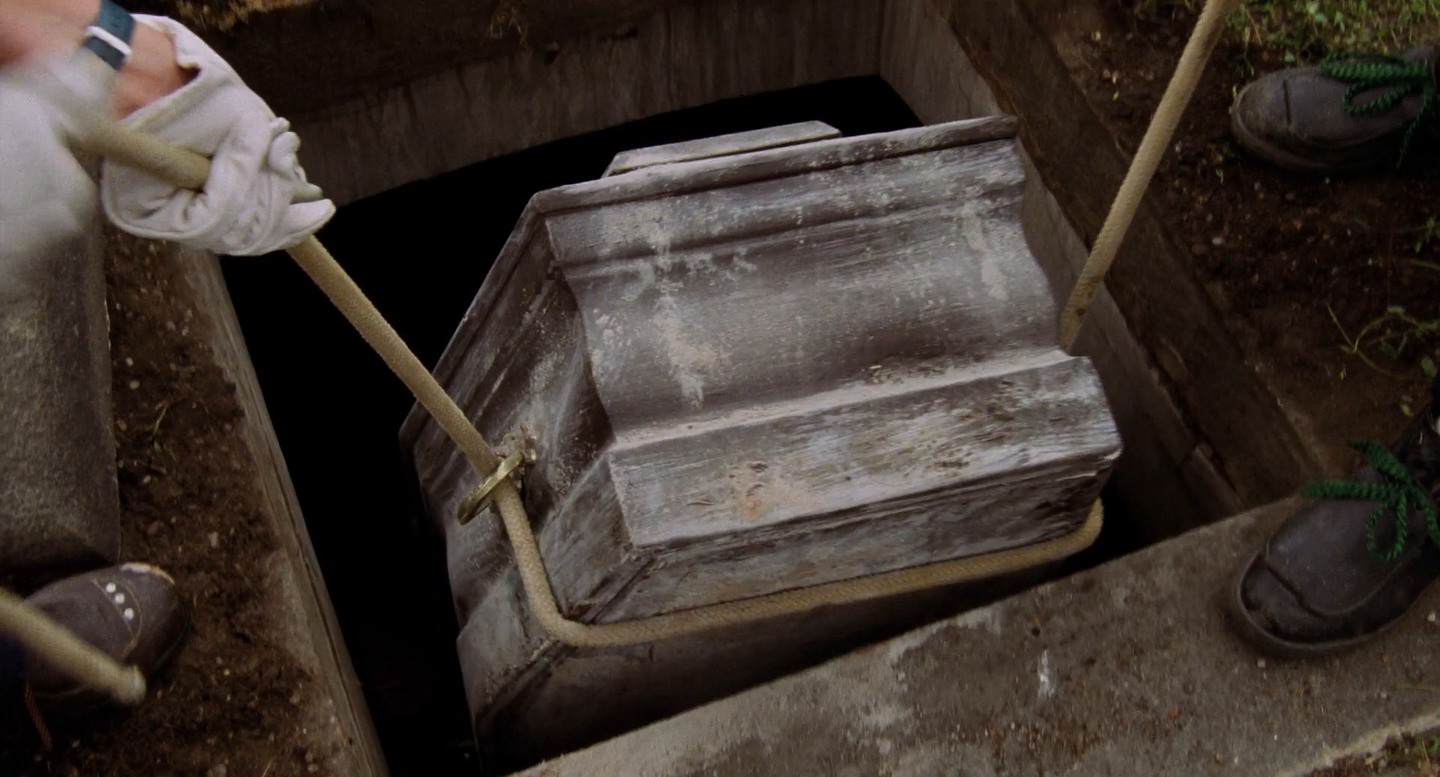
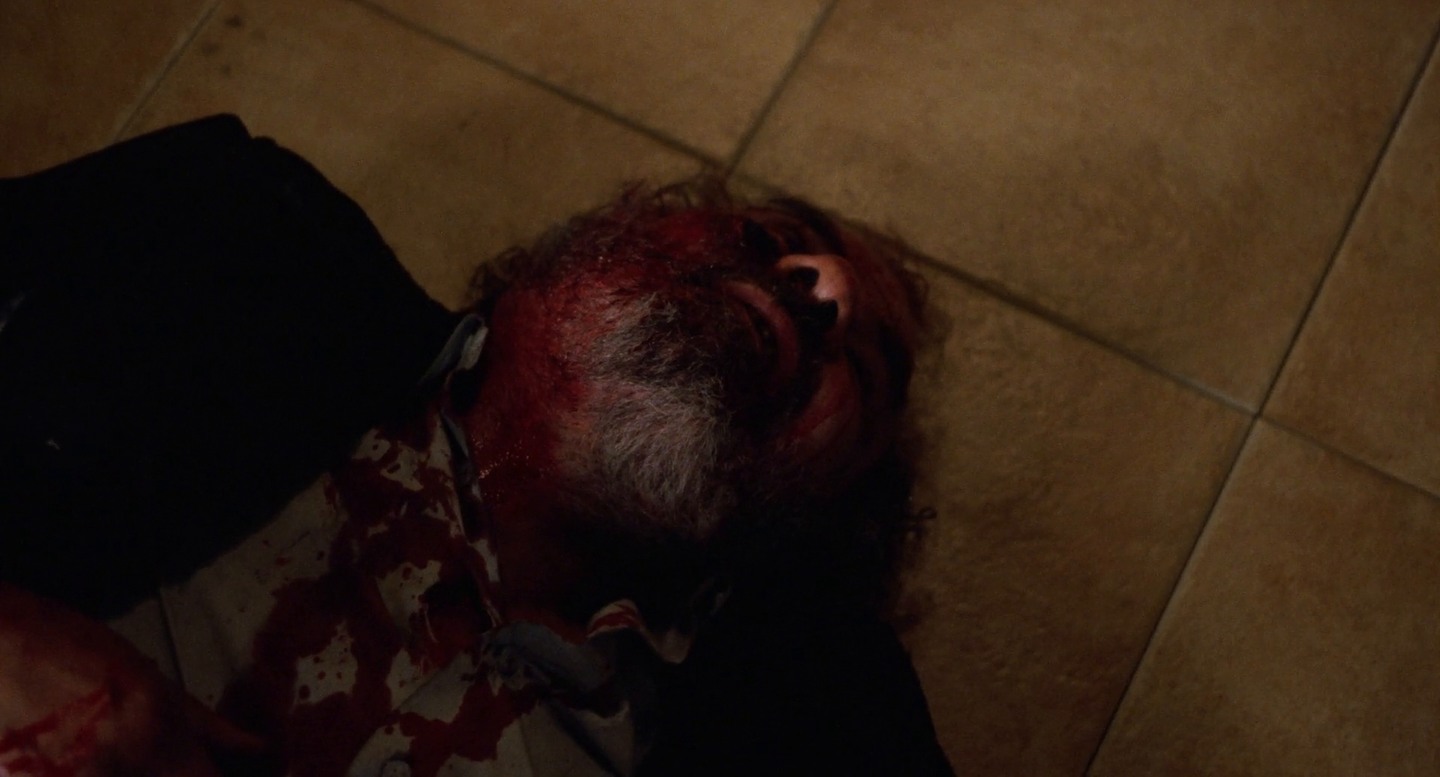
ENLARGE ↗The small coffin is lifted from the grave.
The coffin gives the earlier suspect’s death a physical form. It is another container in a film full of closed rooms and withheld evidence. Opening the case now involves confronting the object on which an earlier sense of closure depended.
1:28:45
The inquiry becomes a wall of clues
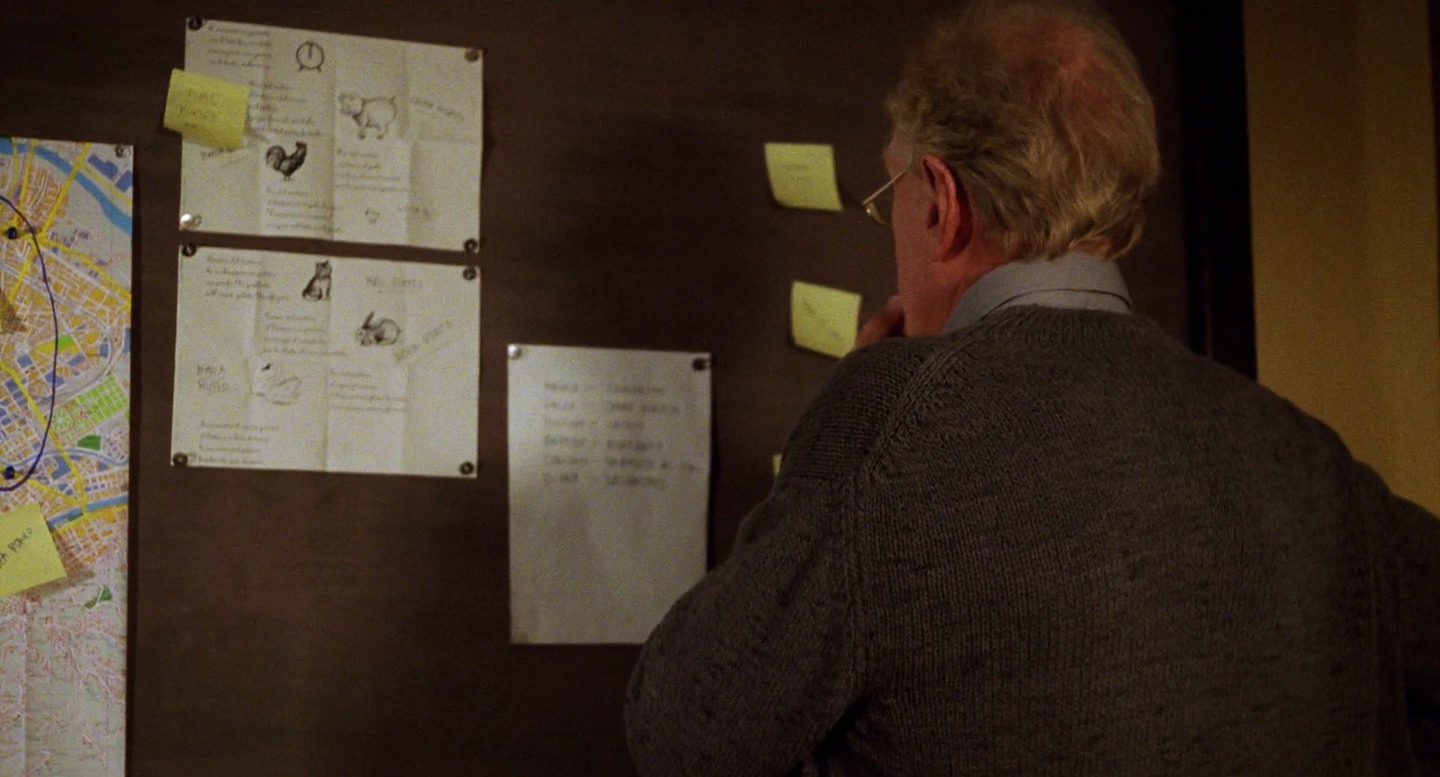
ENLARGE ↗Moretti arranges the evidence in his room.
Pinned pages and notes move the investigation from the desk to the wall. The arrangement makes connections visible but keeps the researcher physically enclosed by his own work. The room’s lamps and shelves return as landmarks during the night intrusion.
The same books and furniture that supported the inquiry now obstruct his view. Low light breaks the room into isolated patches. This passage builds vulnerability around Moretti’s body and attention rather than repeating the explicit wound imagery of the earlier murders.
1:37:45
The clue travels with them
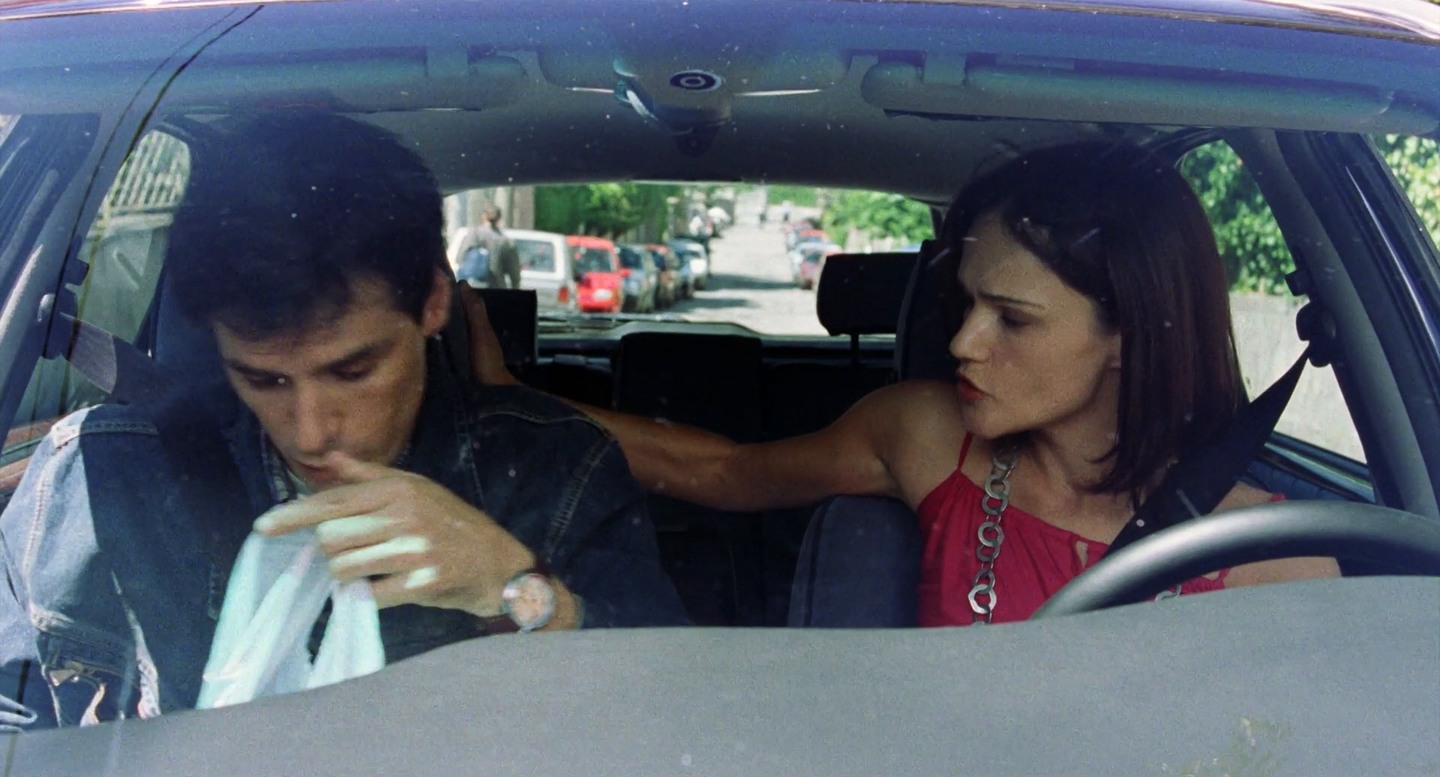
ENLARGE ↗Giacomo and Gloria continue the investigation by car.
The windscreen frames the pair together while the city moves beyond them. Their shared vehicle contrasts with Amanda’s fatal enclosure. Here a conversation and a remembered detail can change the direction of the journey.
Giacomo’s discovery produces an image that appears ready to settle the investigation. The surrounding rooms and the still-active threat prevent the body from functioning as a complete explanation. An apparent conclusion becomes another stage of the trap.
The familiar companion now occupies the attacker’s position behind Gloria. The blade cuts across the close composition, and Giacomo must interpret a face he already knows. The reveal changes the meaning of earlier companionship rather than introducing a stranger at the last moment.
The ending reconnects the enclosed room with the street. The intervention comes through the window, making the outside world decisive at last. After so many doors and panes have delayed help, a line of sight across that boundary ends the immediate threat.
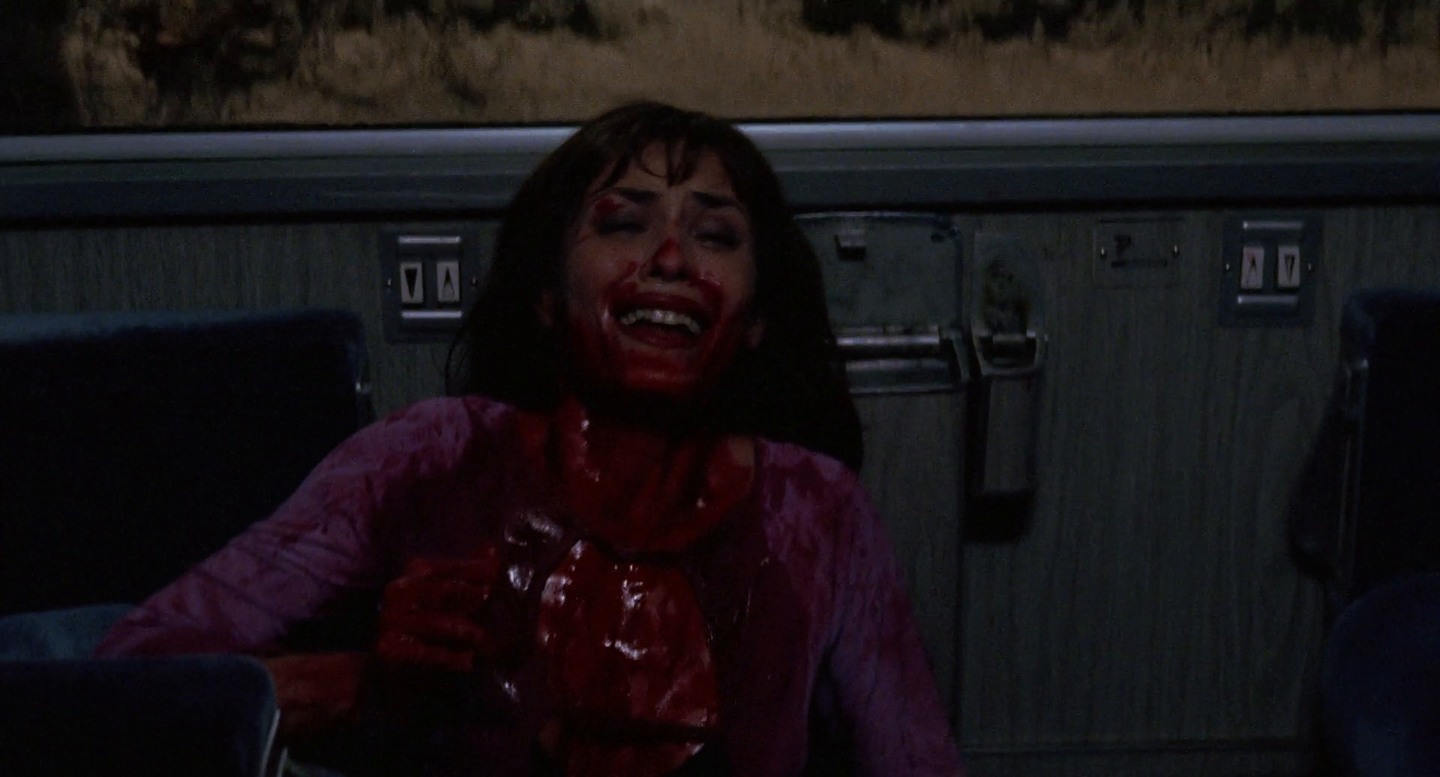
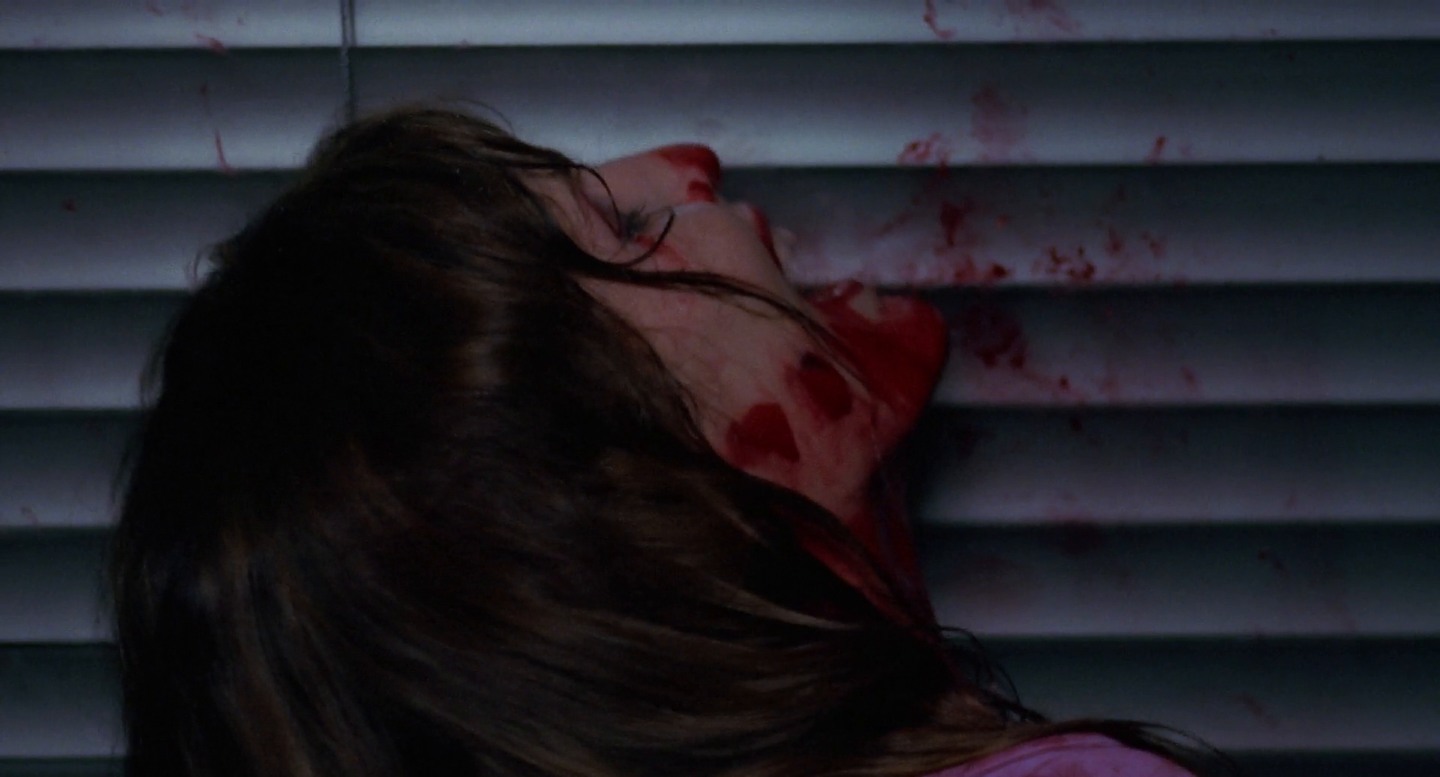
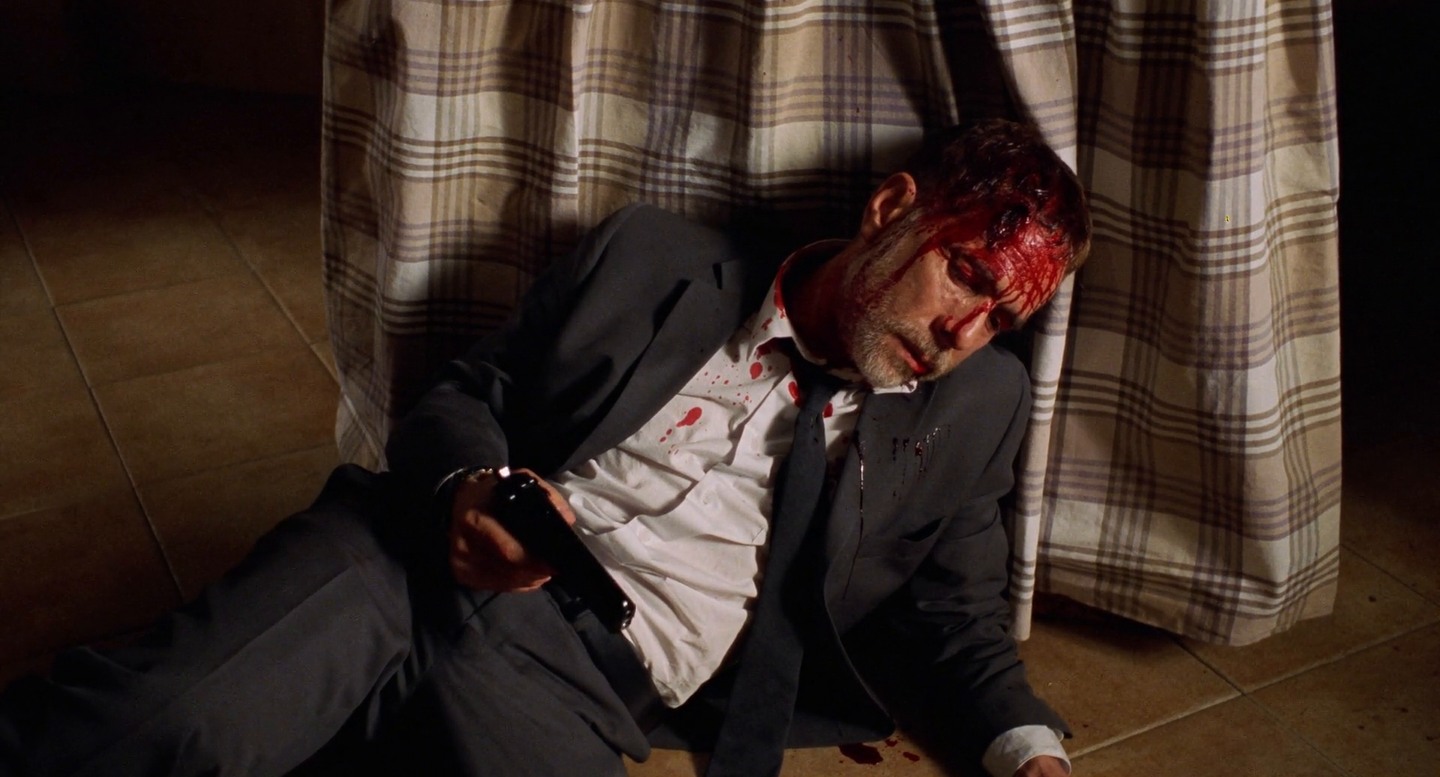
The sequence moves through three kinds of barrier: doors, the emergency brake and the closing window. The throat wound does not end the action. Angela continues to reach for help, so the injury remains attached to a struggling body rather than becoming a single isolated insert.
The gallery follows the visible construction: an apparently empty passage, the victim’s arrival, the wound and knife, then the window’s downward movement. The changes in scale allow the carriage fittings to become active parts of the violence.
Rain and reflected light first obscure the parking area. Once Amanda enters the car, the composition contracts around her head and the attacker’s hand. The scene then cuts to a red internal view before returning to the bloodied face and windscreen.
That internal insert is a sudden change in the film’s access to the body. Its force comes from placement between exterior views of the assault, not from a claim that the camera could occupy a realistic observer’s position.
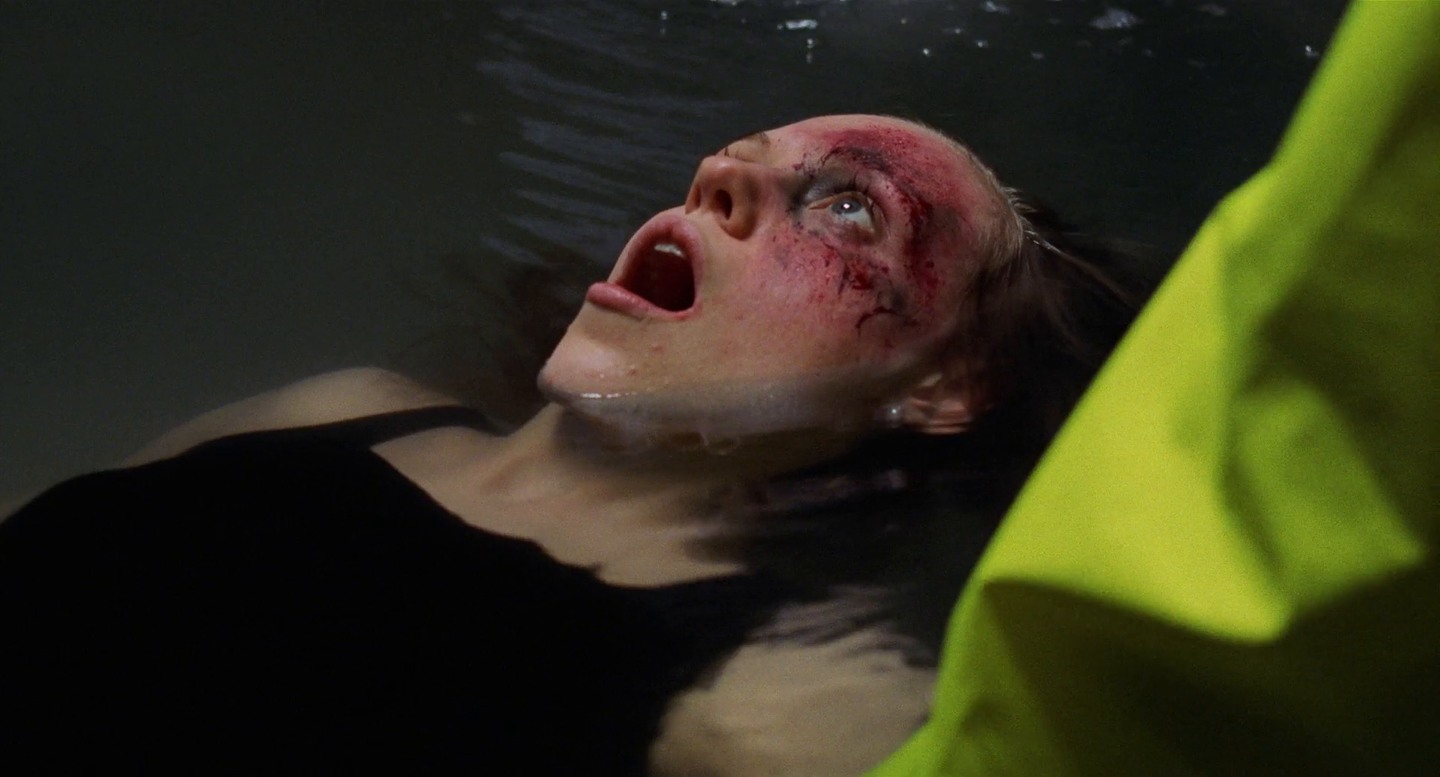
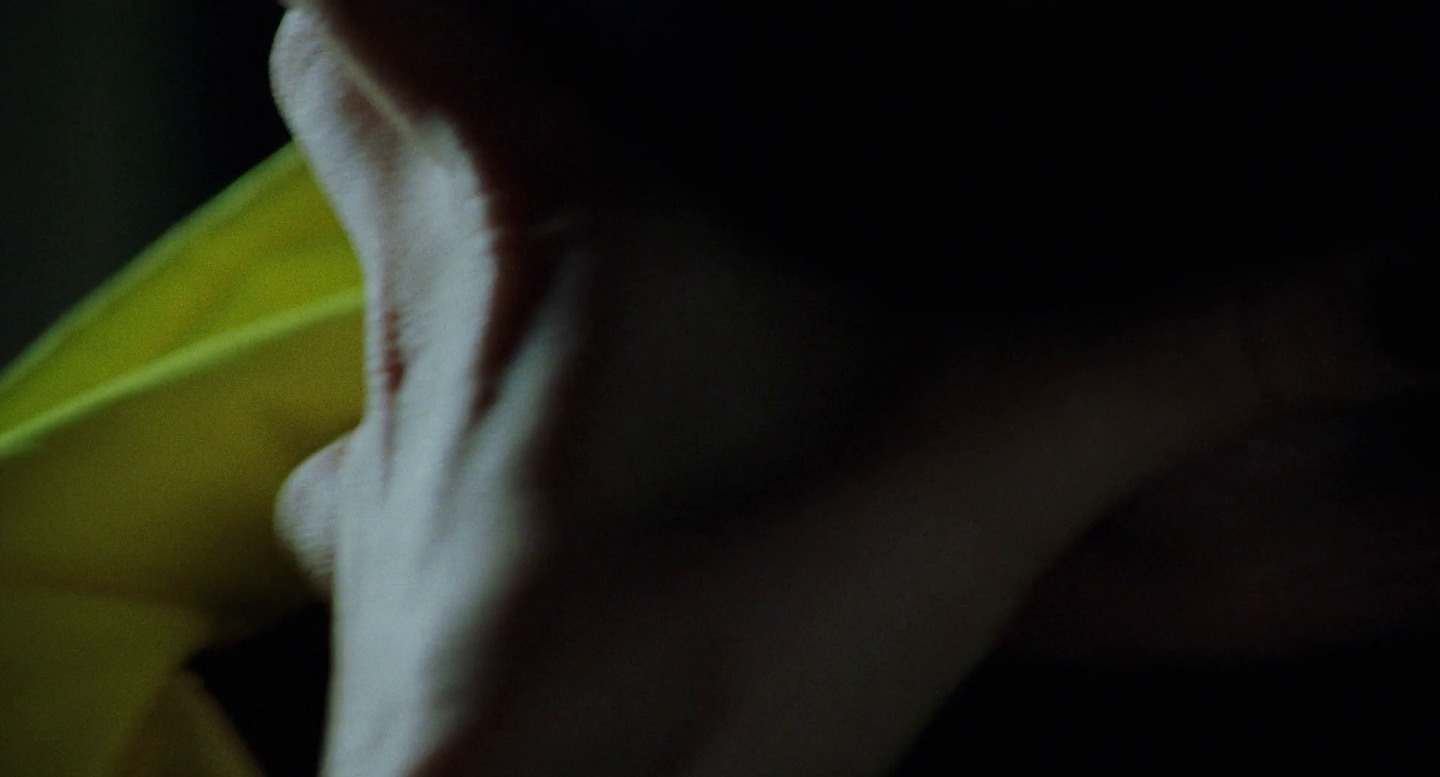
The assault begins in a dark stairwell with the attacker’s bright yellow sleeve sharply separated from the blue walls. Close views isolate the ear and side of the head; the next stage moves the injured woman across the floor and into the basin.
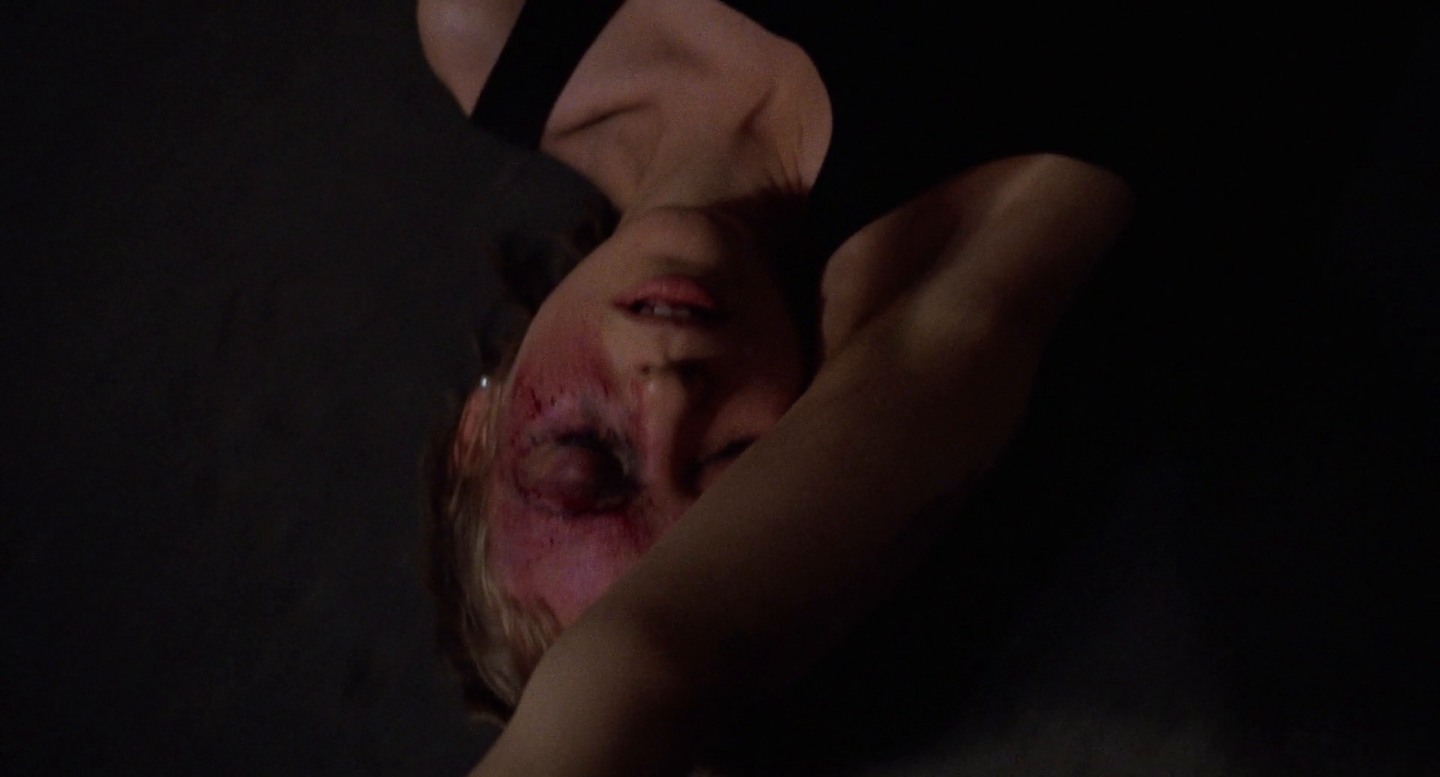
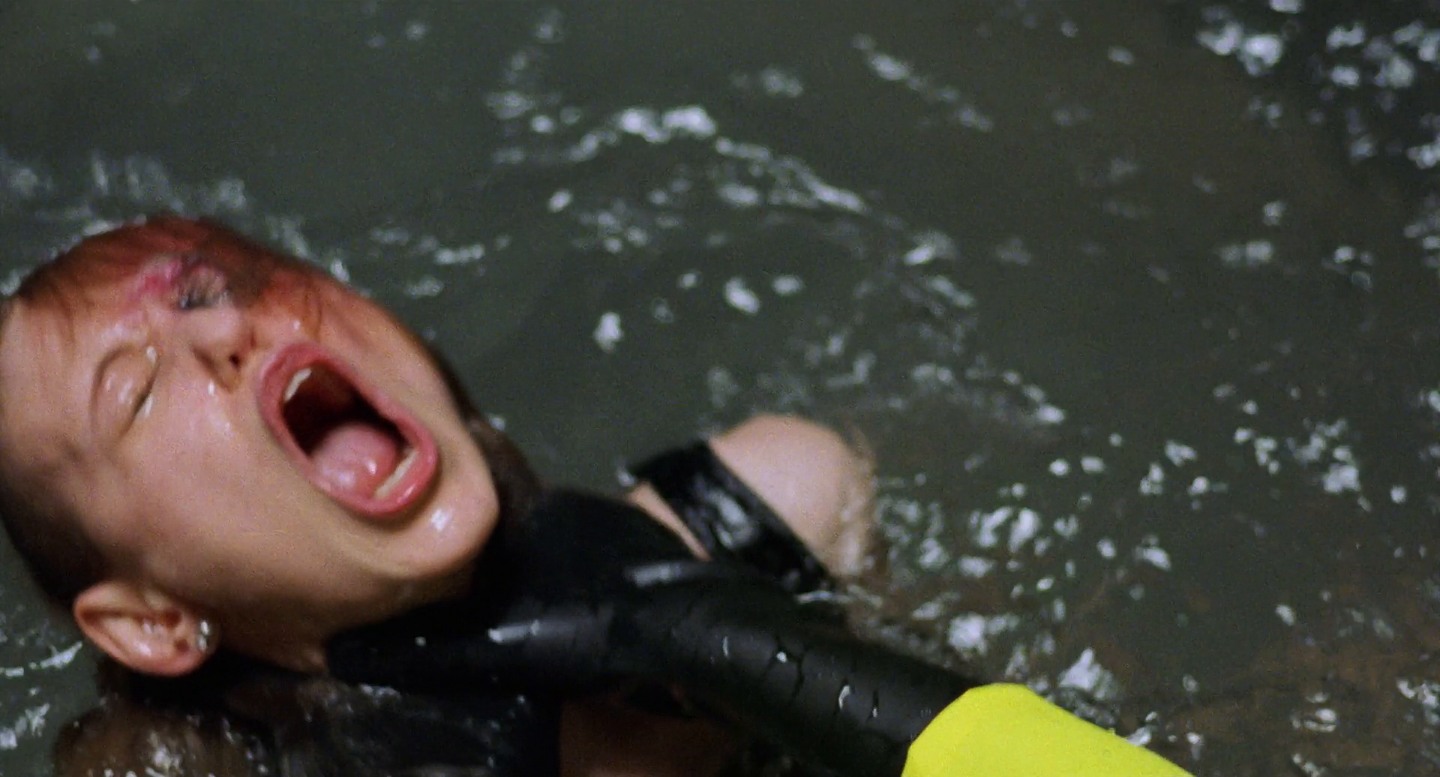
The water supplies moving reflections that partially conceal the face during submersion. When Mel is lifted back against the stone edge, the makeup is visible in a steadier view. The wider aftermath completes the change from pursuit to a body arranged in the room.
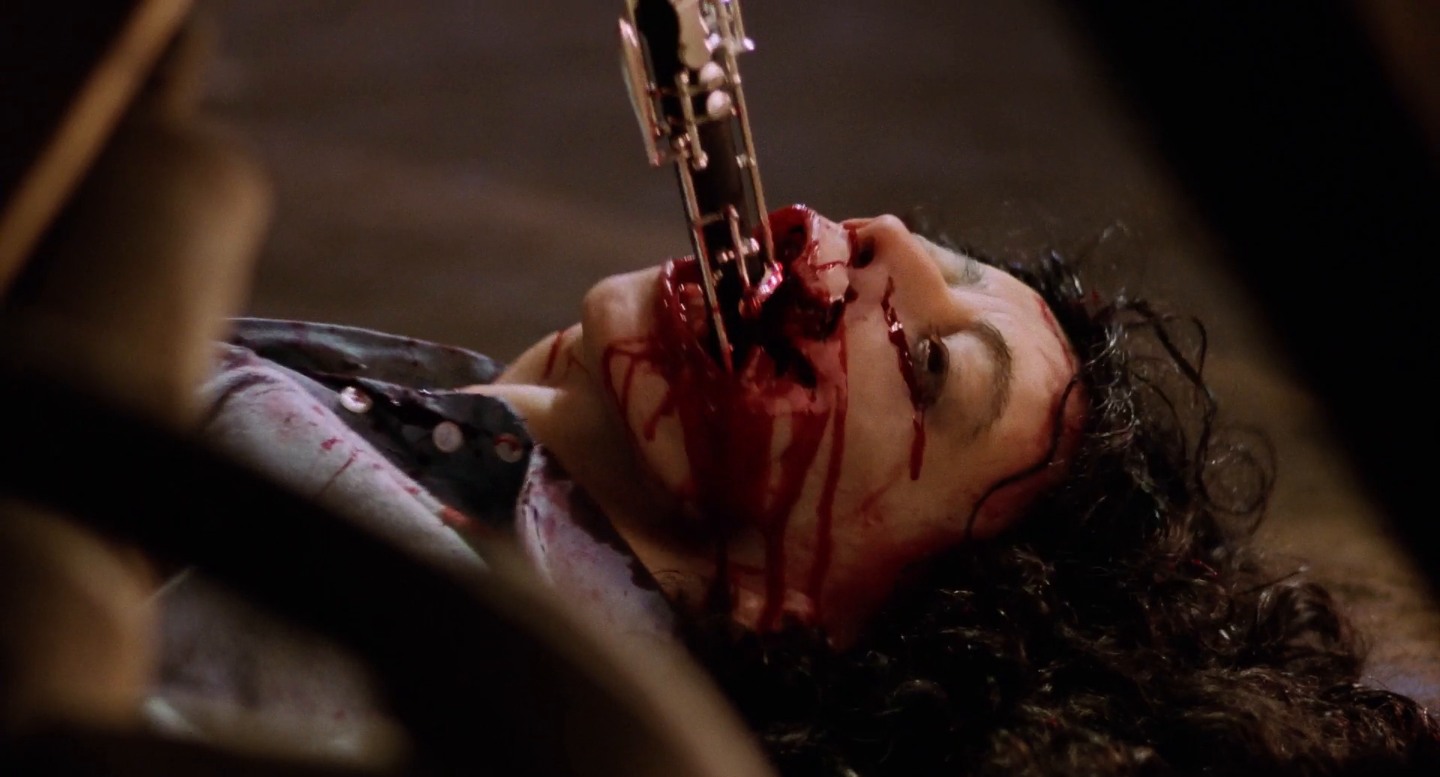
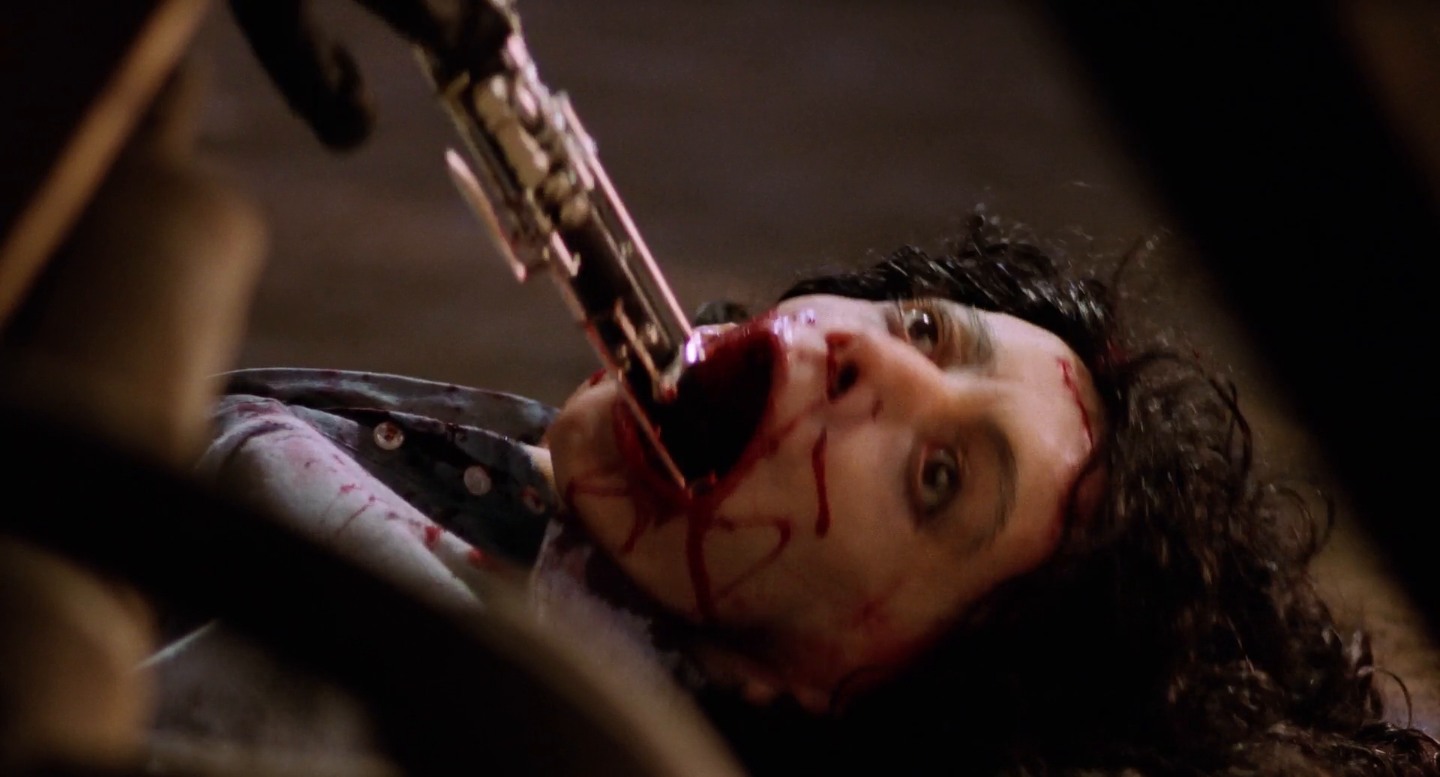
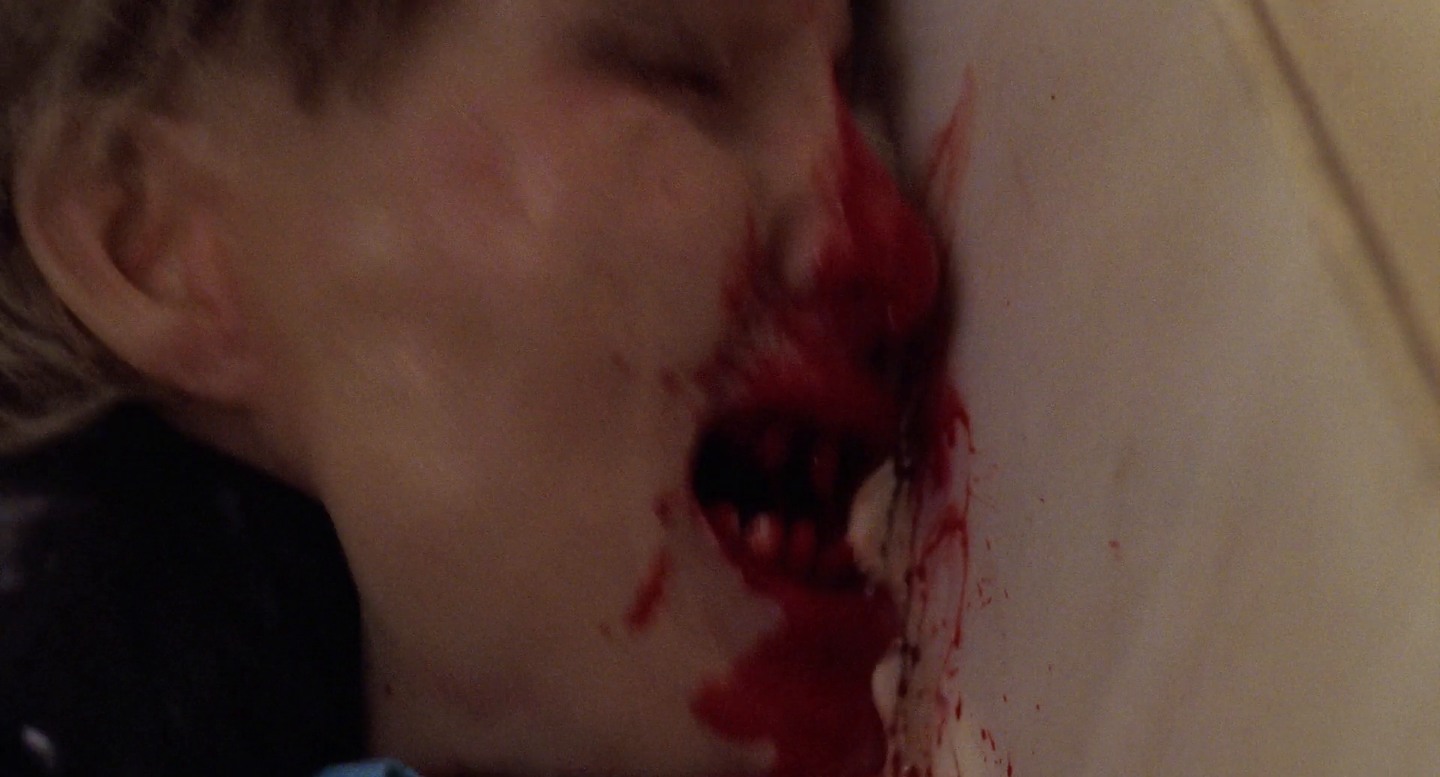
ENLARGE ↗The instrument projects from his mother’s mouth.
The violence is held between two incompatible views: the child trapped behind furniture and the clear wound insert. The keyed woodwind instrument is visible, but the surrounding struggle remains fragmented by the boy’s obstruction and distress.
The sequence makes the remembered object exceptionally vivid. That clarity matters because Giacomo’s later interpretation of the object still has to be tested. A forceful image and a correct explanation are separate things.
Explore the sequence 8 stages
01 · 41:37
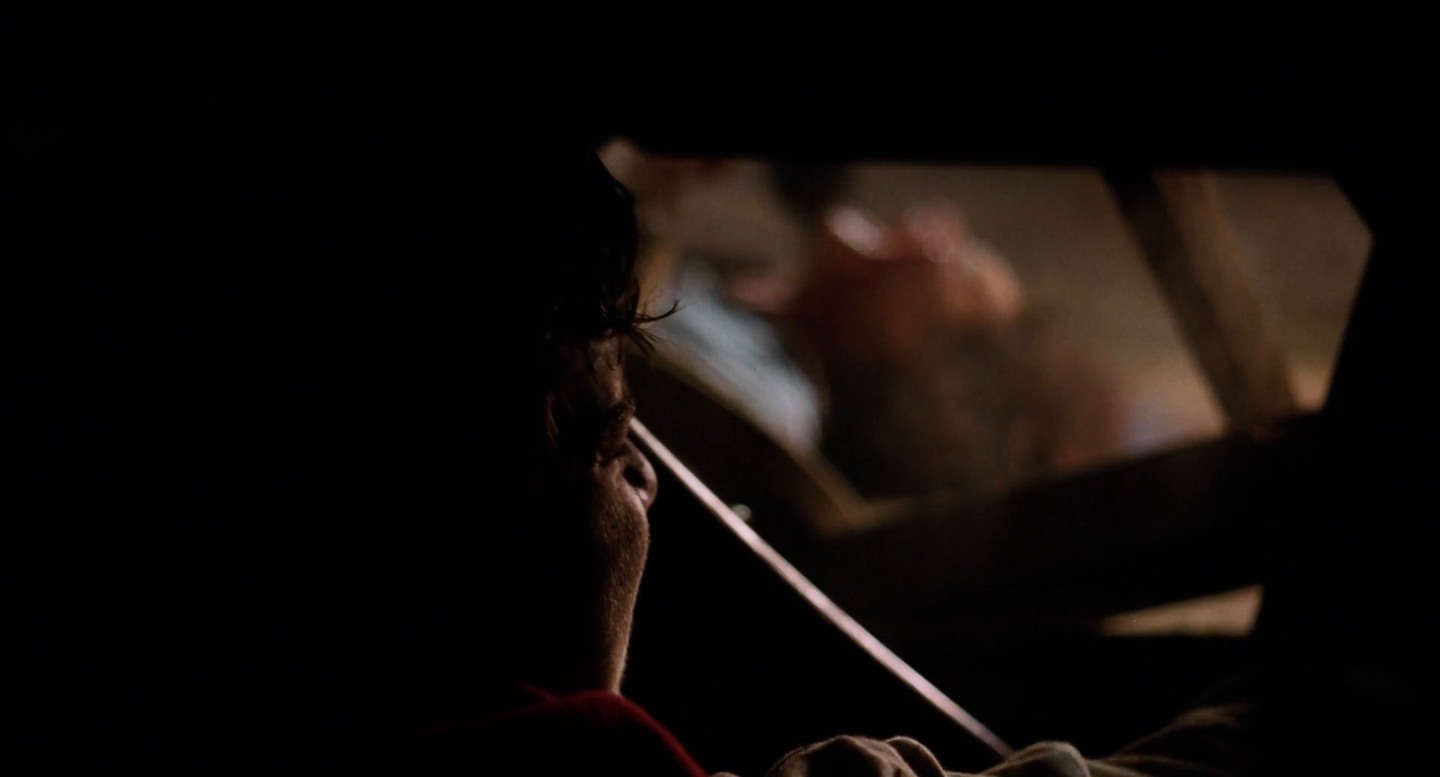
ENLARGE ↗The child’s face is caught behind the furniture.
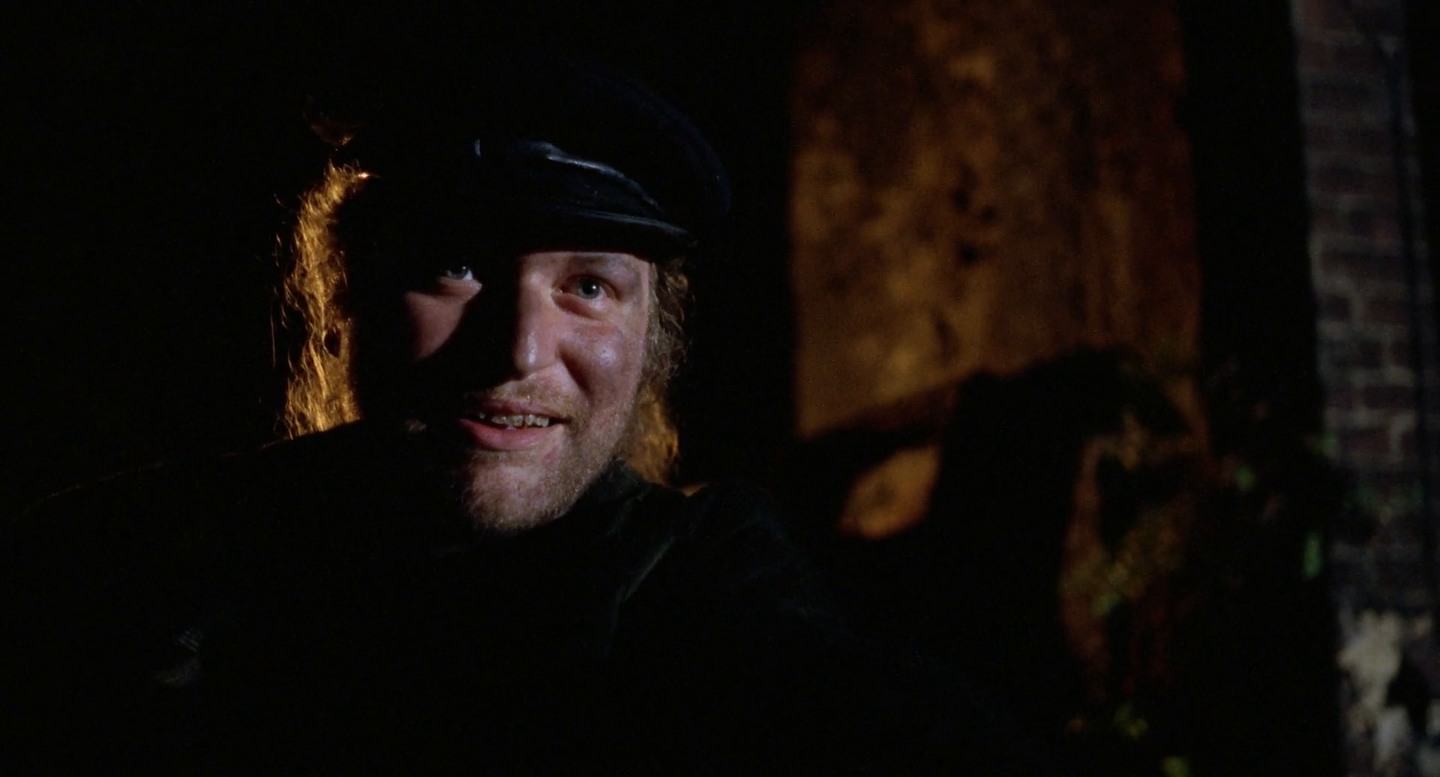
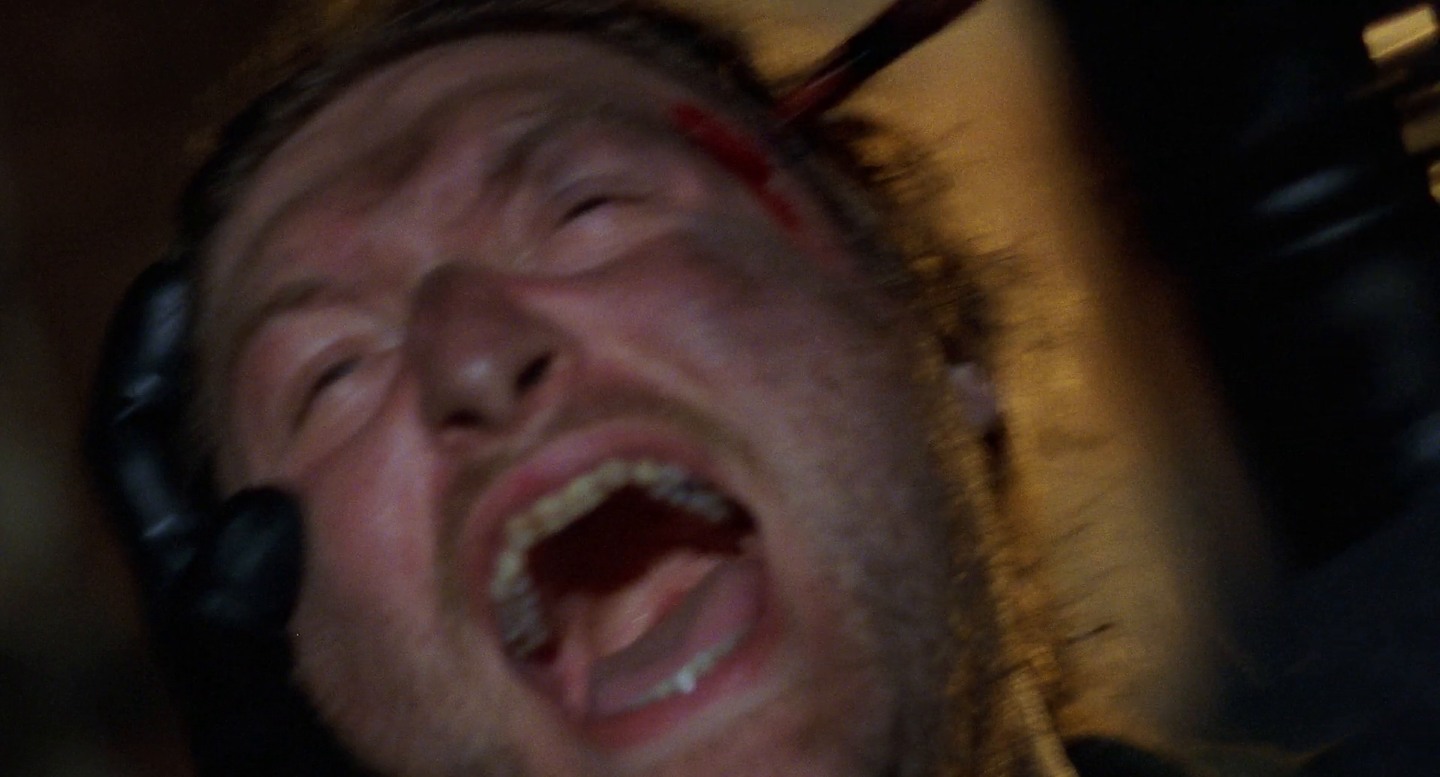
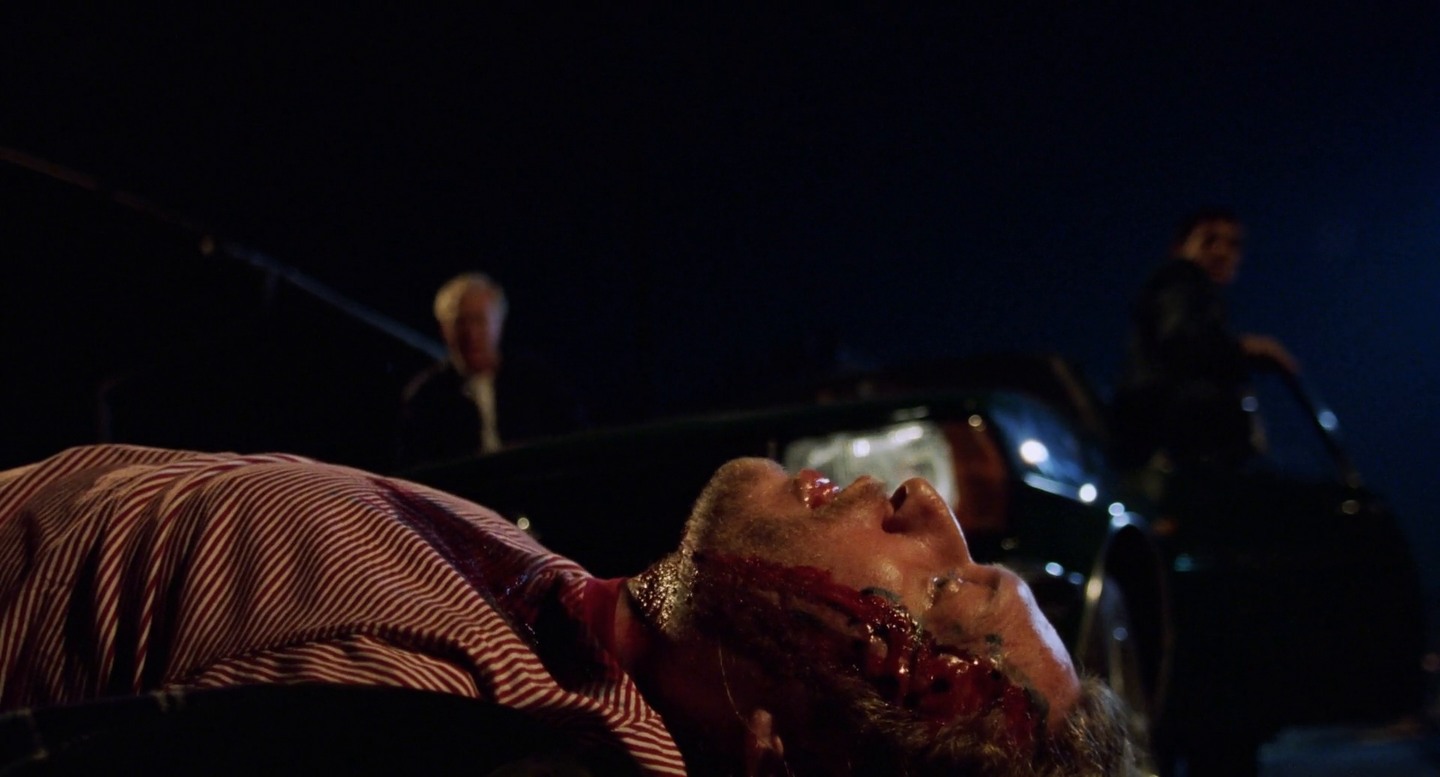
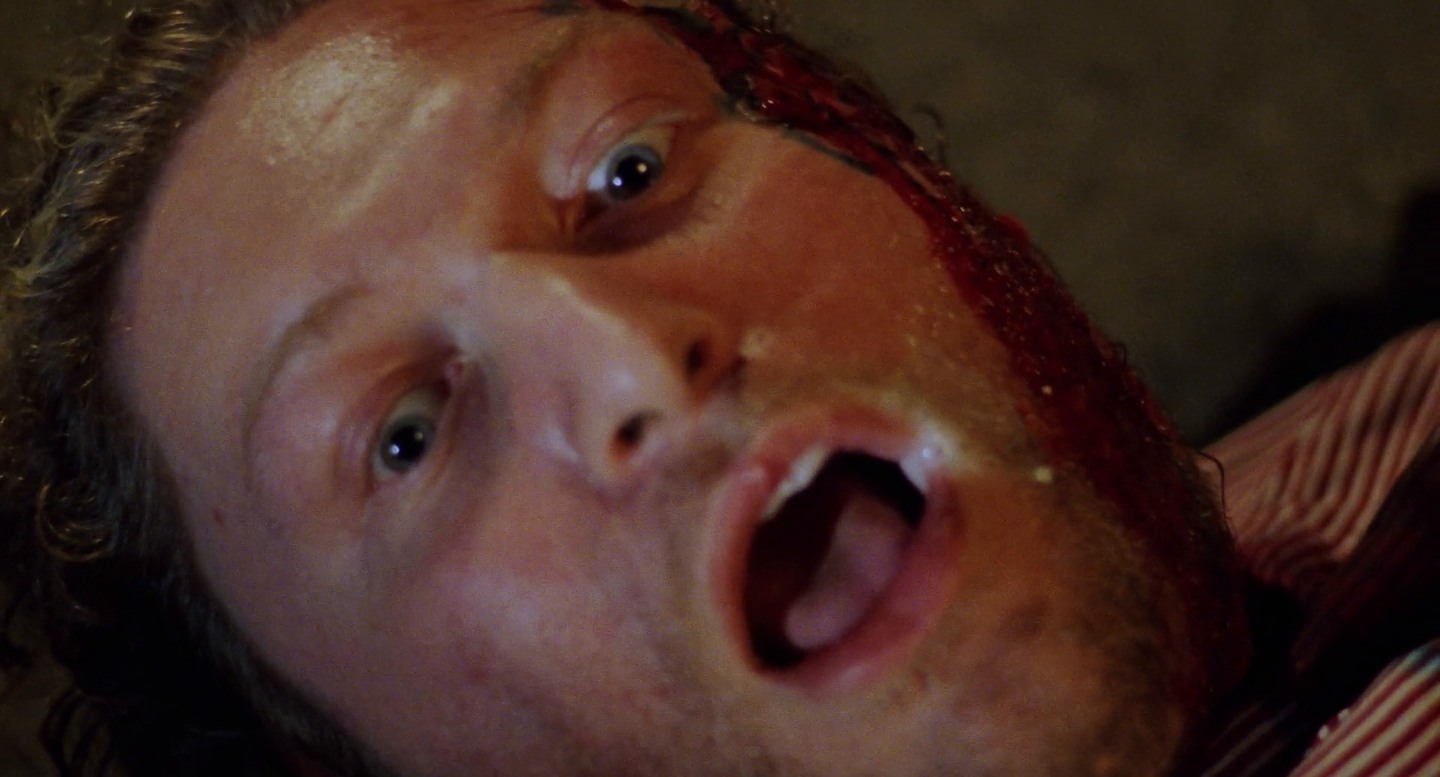
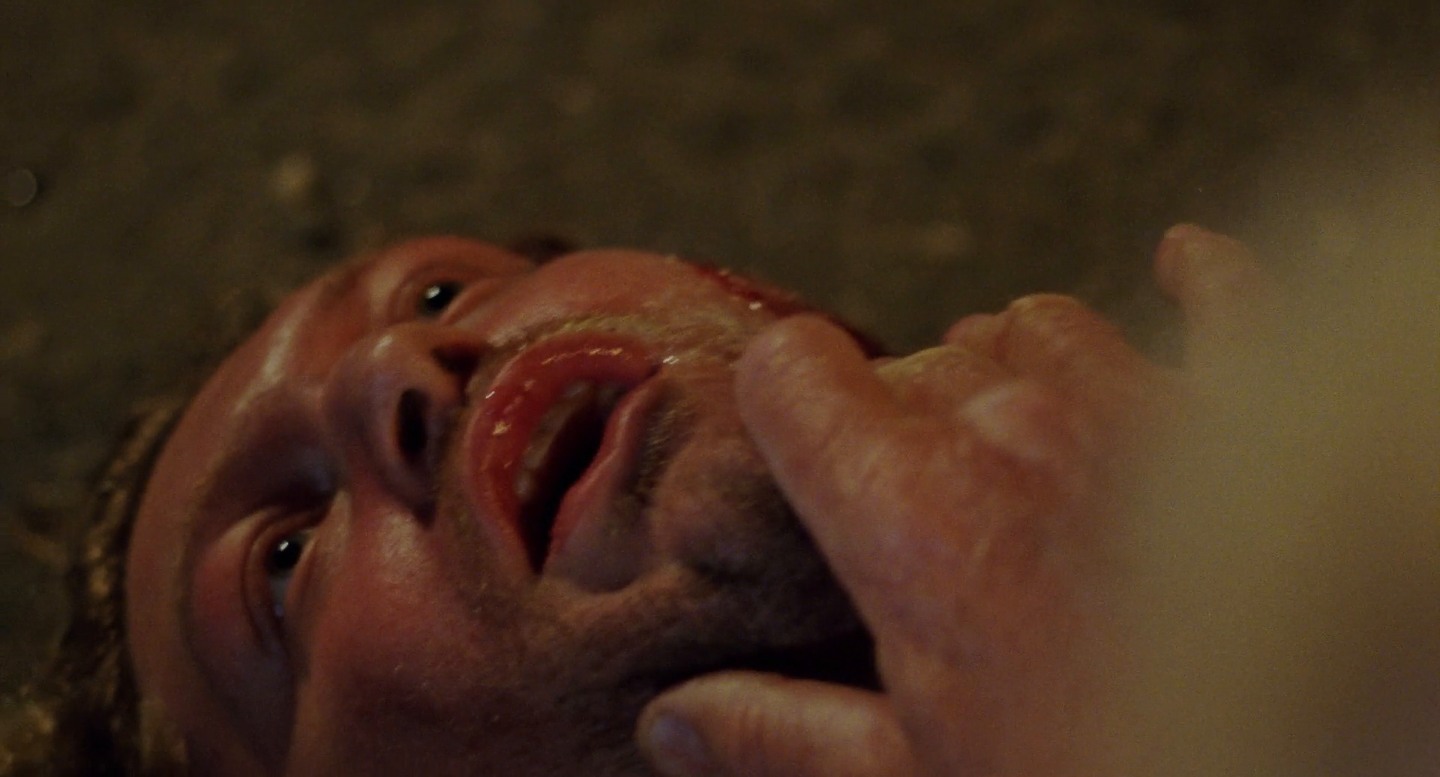
A pen changes from a familiar small object into an explicit weapon. The film alternates Beppe’s face with closer details of the attack, then leaves the immediate struggle for the wider night street.
The return to Beppe on the ground makes the injury part of a discovery as well as an assault. These stages distinguish the weapon insert, the victim’s reaction and the later witness’s view without attributing a particular prosthetic technique that the screen alone cannot establish.
The approach is prolonged through the street and lock. Another pedestrian passes, and the framing keeps Dora occupied with a small practical problem. The assault then exchanges the distant street view for violently close images of her face and the wall.
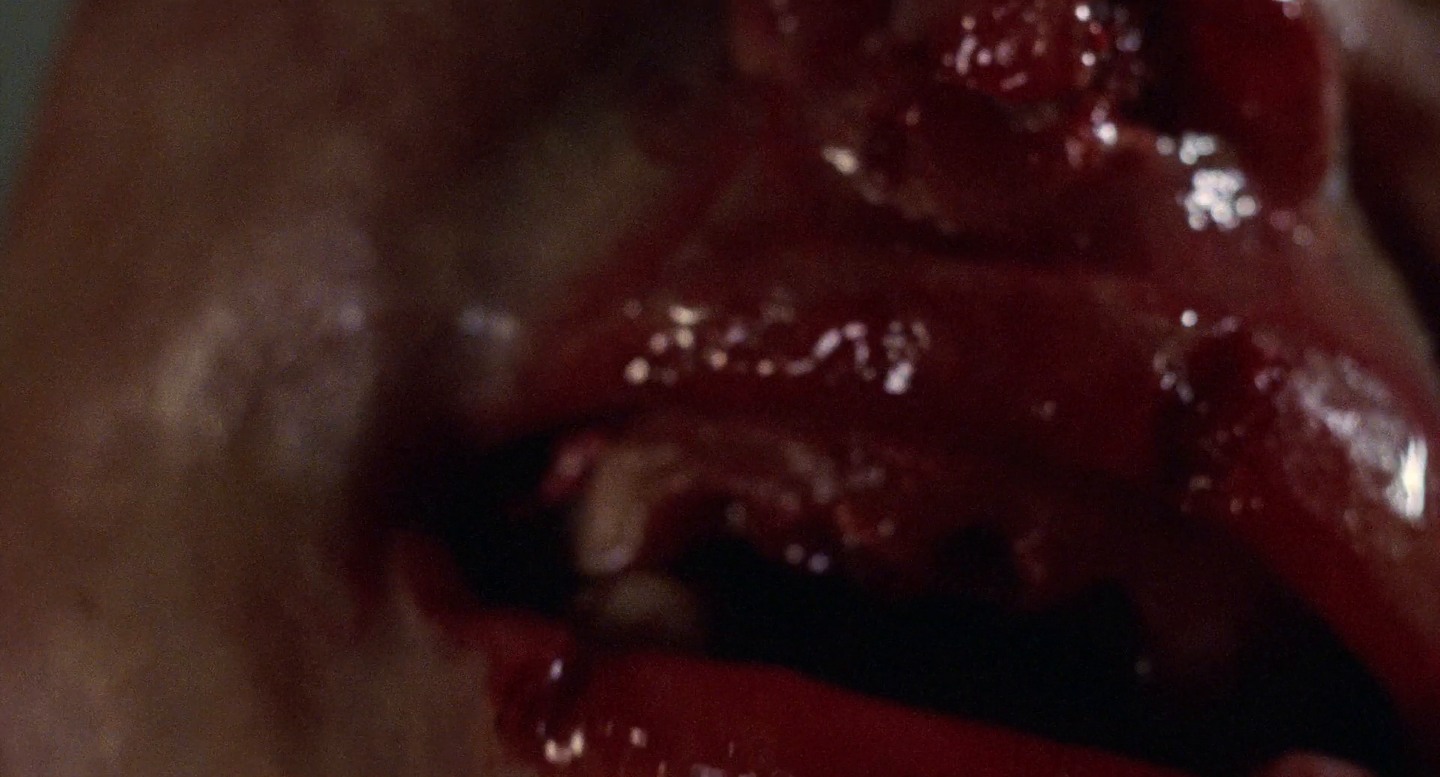
A gloved hand controls the head before the impact. The final mouth insert concentrates the injury into a much smaller area than the earlier wide setup. The sequence’s severity depends on that abrupt contraction of distance.
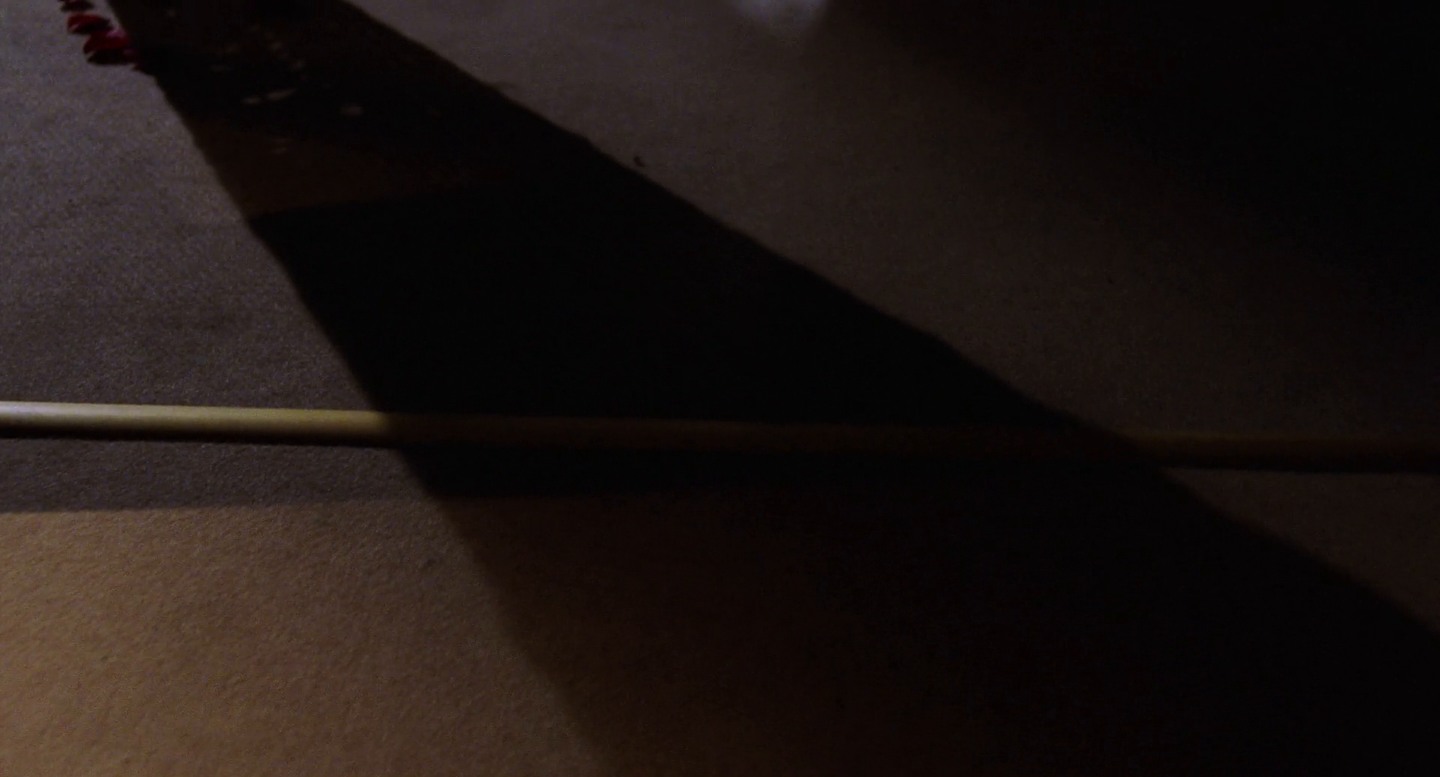
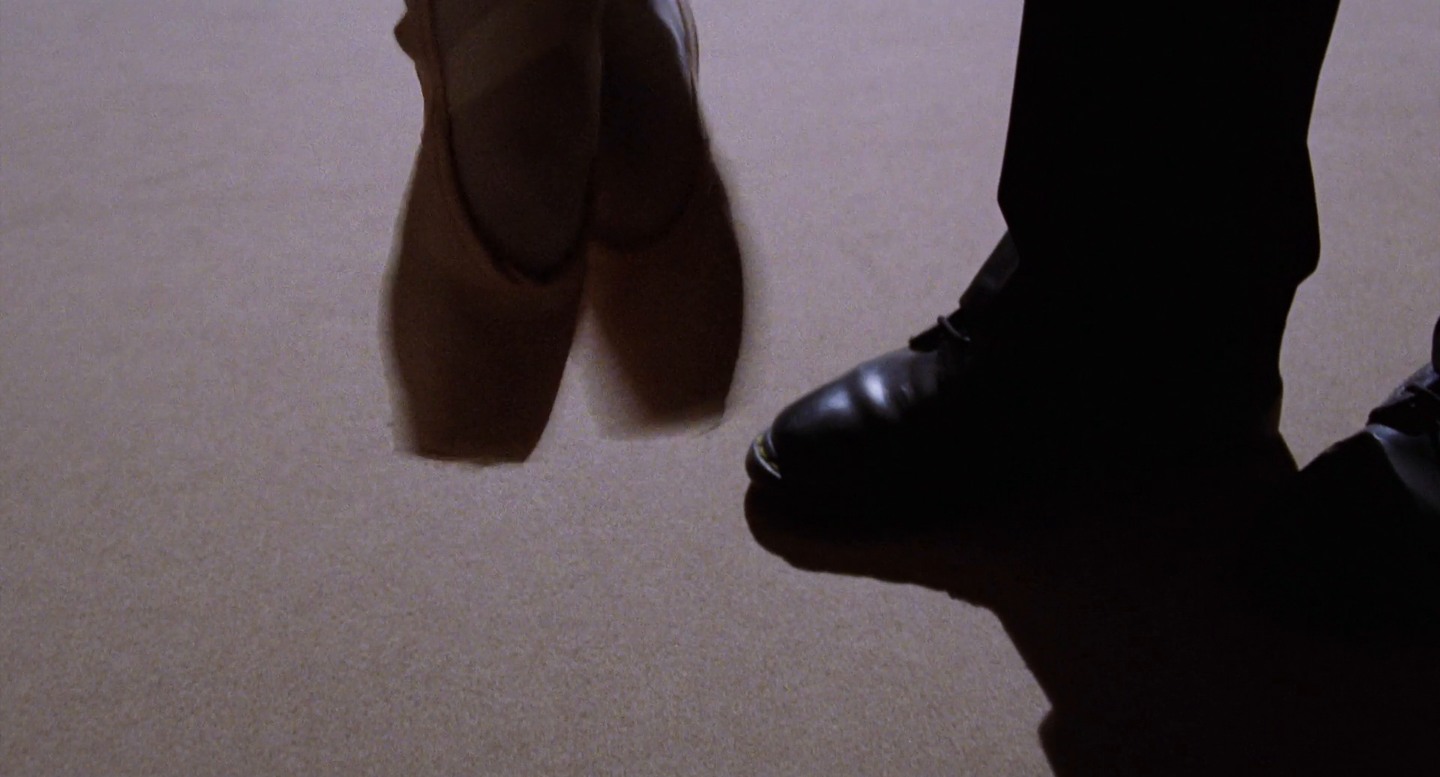
A patterned runner carries an extended passage of shoes, costumes, equipment and shadows. The composition withholds faces and keeps the viewer searching the same low plane. The performer’s pointe shoes finally share that plane with the attacker’s heavy footwear.
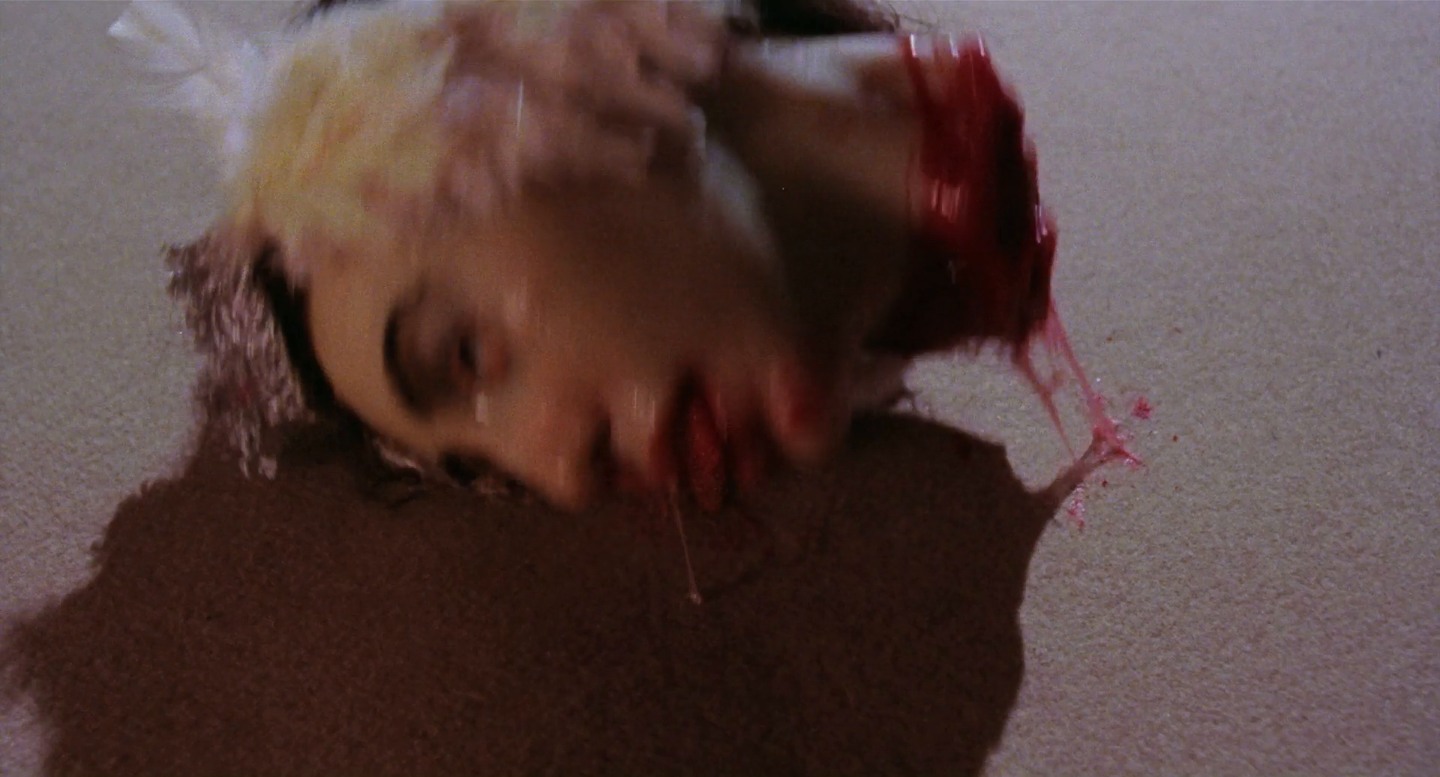
The head enters after the feet have left the frame. The reveal is therefore staged as an arrival into prepared space, not as a continuous view of the entire killing. Feathers and theatrical makeup connect the severed head to the performance world that the carpet passage has been cataloguing.
ENLARGE ↗The shot strikes against the window light.
The last rooms accumulate several kinds of violence: a body on the floor, a wounded gunman, the knife held against Gloria and the shot through the window. The changing arrangement of people matters as much as the individual wounds.
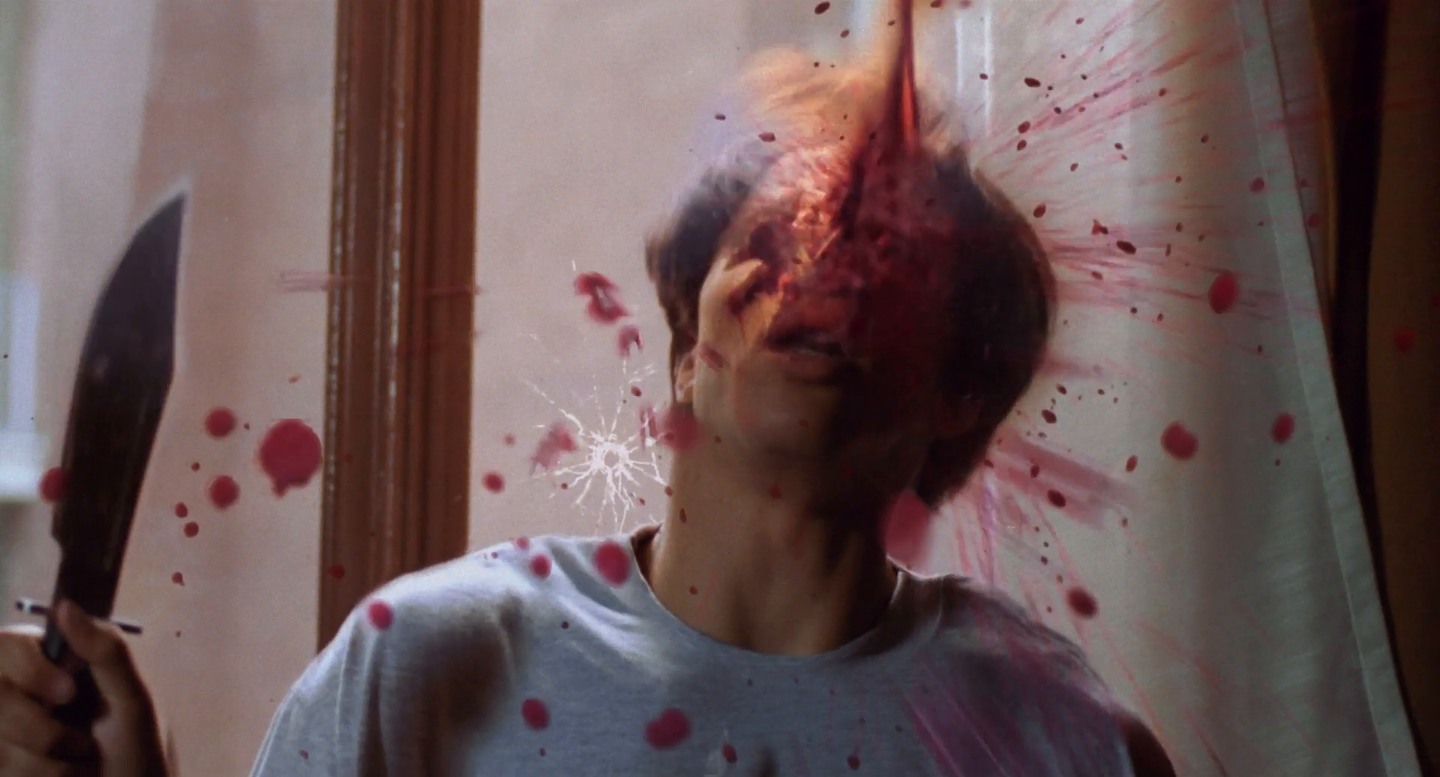
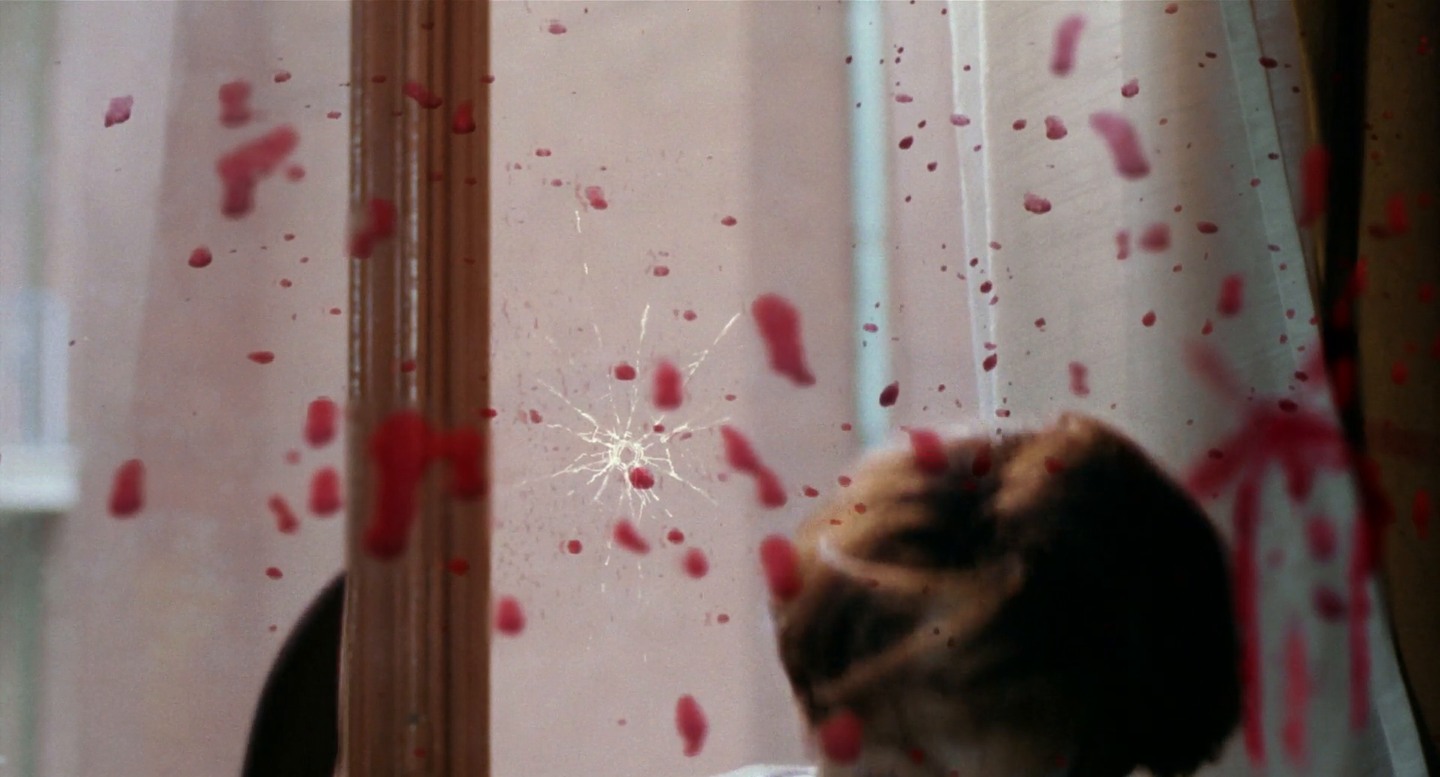
The final impact is staged against pale curtains and window light. Blood and fragments become briefly legible against that bright surface, followed by reaction views and the police below. The closing movement restores the exterior geography that the hostage composition had excluded.
Four paths connect the film’s spaces and objects: threatened thresholds, the theatre’s low viewpoint, Moretti’s changing room and the things that become evidence.
The train, car and street entrance offer different forms of apparent protection. Each sequence first establishes a usable passage or shelter, then changes its meaning through the attacker’s position and the victim’s restricted movement.
Follow the visual progression 6 observations
11:15
The train corridor supplies a direction but repeatedly subdivides the route.
14:45
Patterned glass gives the empty passage a visual target.
16:15
A control button becomes a weapon through its effect on the window.
20:13
The parked car reduces the action to one trapped seated figure.
1:09:10
A bag and a lock delay the transition from street to interior.
1:54:08
The final intervention comes across a window from outside.
The carpet and the withheld face
ENLARGE ↗A blue costume crosses the patterned carpet.
The theatre passage asks the viewer to read a procession of fragments. A runner supplies continuity while anonymous feet and objects pass through it. Keeping the camera low makes the eventual head belong to the same visual plane as the ordinary backstage traffic.
Follow the visual progression 6 observations
1:20:15
A case establishes an everyday object at floor level.
1:20:40
Footwear supplies a person without supplying a face.
1:20:50
Costume fabric adds colour and movement to the repeated pattern.
1:21:25
The pattern gives way to a plainer floor and a long shadow.
1:21:34
Pointe shoes and a heavy boot bring two bodies into the same restricted view.
1:21:40
The first fully isolated face arrives as the sequence’s violent reveal.
Moretti’s scenes give the investigation a recognisable human centre. The film returns to his face and room in different lights: professional reassurance, domestic resistance, concentrated work and physical vulnerability. The shift does not require an entirely new location.
Follow the visual progression 6 observations
02:45
The detective looks down toward the child during the opening promise.
23:45
The present-day room places the retired man among his own belongings.
40:15
The boy has grown into a man who can now stand beside him.
1:01:45
The green lamp gathers the case into a desk-sized pool of light.
1:28:45
The evidence expands from loose pages to a wall display.
1:31:15
Darkness turns the familiar room into an uncertain space.
Documents, instruments and small tools let the film move between explanation and attack. The same close framing that makes evidence readable can make a weapon oppressive. The viewer is asked to recognise an object before deciding what it means.
Follow the visual progression 6 observations
07:15
Clippings make the old crimes physically portable.
26:45
The open book brings a printed text into Moretti’s inquiry.
41:44
The murder memory concentrates on the instrument at the victim’s mouth.
46:15
Gloria’s harp offers a contrasting image of body and instrument.
57:13
A pen fills the frame as a bloodied weapon.
1:21:45
A coffin becomes the material container of an earlier explanation.
VOICES, WORDS & CLUES
What the words give away.
Ten illustrated studies follow the promise, telephone trap, animal rhyme and remembered sound through to the confession and closing police report.
The opening gives Moretti a responsibility that outlasts his career. Giacomo remembers the promise more securely than the man who made it. Their partnership therefore begins with unequal memories, not an infallible detective explaining everything to a passive witness.
Follow the dialogue 4 observations
02:17
The child gives his name before Moretti promises to find the killer. The assurance is addressed to one bereaved person.
40:09
The grown Giacomo returns to the investigator. Recognition has to bridge the years between them.
42:54
Moretti proposes combining what each of them knows and remembers. The investigation becomes a collaboration between incomplete accounts.
43:04
Giacomo repeats the old commitment. Moretti’s failure to remember it immediately makes the promise more consequential for its recipient than for its speaker.
Angela can describe a safe location, but she cannot control what the caller hears behind her words. The telephone turns a possible route to help into a means of locating her. A later call briefly reverses that expectation: the person she fears hearing is not the person actually speaking.
Follow the dialogue 4 observations
09:01
Angela tells Amanda about the blue file and plans to involve the police. Her first account makes the discovered papers portable evidence.
09:59
The threatening caller demands the material. Angela claims to be in a car with her boyfriend, inventing protection as well as a location.
10:24
The caller identifies the train from the background sound. His correction defeats her spoken alibi without requiring her to show herself.
11:33
Angela appeals to railway staff and recalls the old murder case. When Amanda calls, Angela initially reacts as though the pursuer has reached her again: fear has changed how she interprets the telephone.
ENLARGE ↗Young Giacomo watches through stacked furniture.
The childhood memory is not simply a hidden picture waiting to become clear. Giacomo distinguishes his limited view of the attacker from a sound that remained with him. The final recognition makes that distinction essential to the solution.
Follow the dialogue 4 observations
41:59
The murder weapon is identified as a musical instrument, specifically an English horn. Its oddness becomes a question to carry forward.
42:29
Giacomo says he could not see the killer’s face. He instead recalls a strange hiss or whistle amid the struggle and his mother’s cries.
42:38
He connects that sound to recurring dreams. Repetition preserves a sensation without supplying its cause.
1:50:11
At the confrontation, he recognises the hiss of Lorenzo’s allergy spray. The remembered sound acquires a source in the present rather than becoming a recovered view of the murderer’s face.
The conversation repeatedly reduces Vincenzo de Fabritiis to a bodily difference and a supernatural rumour. Restoring his name, pen name and authorship complicates that convenient story. The film also exposes the cruelty concealed inside the friends’ nostalgic recollections.
Follow the dialogue 4 observations
48:07
The discussion briefly insists on the dead writer’s own name rather than only “the Dwarf.” The pen name John McKenzie also returns his authorship to the conversation.
48:31
Recollections of animal cruelty move into admissions about the group’s childhood behaviour. A supposedly shared, harmless past becomes less comfortable.
49:07
The friends repeat the writer’s curse after remembering how they tormented him. The ghost story is inseparable from their own conduct toward him.
1:12:48
Laura confronts the former accusers who now consider her son’s innocence. Her account challenges the public story on which the earlier case was closed.
ENLARGE ↗Moretti studies papers beneath the green lamp.
The nursery rhyme enters as fragments before it becomes an explanatory sequence. Leone remembers an opening, Moretti rehearses it at home, and the animal cut-outs acquire a possible order. This is a process of retrieval and interpretation rather than a single revelation.
Follow the dialogue 4 observations
53:25
Leone recalls the opening verses and says Vincenzo used to sing them. He cannot supply the rest when pressed.
1:01:33
Moretti returns to the midnight opening and connects its animals to the killer’s cut-outs. Addressing Marcello makes the work resemble a conversation even while he is alone with the case.
1:03:50
The animal pattern depends on different kinds of association: an insult, the Gallo surname and a victim’s youth. These are the investigator’s readings of the killer’s system, not neutral descriptions of the women.
1:04:39
A further verse returns to Moretti. Linking the pig to the earlier throat wound gives him a sequence to test against the crimes.
The decisive clue lies in how a word is understood. Reading the rhyme makes the swan suggest an immediate danger; reconsidering “instrument” reveals a much older error. The murderer’s literal interpretation gives the detectives a way to think about his age.
Follow the dialogue 4 observations
1:10:13
Moretti recalls that Vincenzo said someone had stolen his manuscript and was copying its murders. He also admits that he did not believe the explanation at the time.
1:14:37
Pages are missing from the children’s book. A separate copy preserved inside Orwell’s Animal Farm allows the rhyme to be reconstructed.
1:16:44
The verse about the swan and Gloria’s account of wearing a swan costume send Giacomo to the theatre. The language creates urgency before it establishes the correct victim.
1:49:26
Giacomo explains the English-horn discrepancy as a child’s literal reading of “instrument.” The word’s mistaken application matters more than the exotic appearance of the weapon.
ENLARGE ↗The small coffin is lifted from the grave.
The empty coffin appears to revive the old suspect. Laura’s late visit instead produces an account of death, coercion and maternal responsibility. Her testimony has to overcome both the sensational legend and the detectives’ demand for a missing piece of evidence.
Follow the dialogue 4 observations
1:24:57
Laura arrives at an unusual hour. Her sleeplessness connects the title to seventeen years of grief rather than only to the killer’s rhyme.
1:25:27
She anticipates the renewed rumours and objects to the double stigma placed on her son: his body and the murders attributed to him.
1:26:09
She says she killed Vincenzo at his request. This changes the earlier question about suicide without making him the murderer the police had imagined.
1:26:55
Moretti returns to the missing gun. The conversation moves from a declaration of certainty to the material evidence needed to support it.
ENLARGE ↗Moretti arranges the evidence in his room.
Moretti’s recorded message makes his reasoning survive his death. It is not a finished solution: Giacomo receives a set of discrepancies that still need connecting. Gloria’s ordinary reference to her harp then returns one of those discrepancies to everyday speech.
Follow the dialogue 4 observations
1:29:40
Gloria’s answering-machine greeting precedes Moretti’s message for Giacomo. A domestic recording device becomes a store for the detective’s last deductions.
1:29:55
He contrasts the small area of the 1983 murders with the wider spread of the new crimes. Geography is offered as a question rather than an answer.
1:33:41
Playback adds the mismatch with the rhyme and the writing on Beppe’s hand. The surviving message joins separate clues without naming the killer.
1:35:36
Gloria says she must collect her instrument, then specifies the harp. Giacomo repeats the words: an ordinary practical request brings the earlier linguistic problem back into focus.
The final explanation changes the meaning of apparently friendly conversations. The invitation home, the protective father and the apparent poisoning become parts of a managed deception. Lorenzo’s own account is useful evidence of his plan, but it remains the speech of a killer presenting himself as its clever author.
Follow the dialogue 4 observations
45:03
Earlier, Lorenzo describes his allergy and his father sending him abroad. The conversation presents family disappointment where the ending will reveal concealment.
1:49:12
Giacomo links the restricted area of the old crimes to a child’s mobility. The adult killer can now travel across the city.
1:51:06
Asked why he brought Giacomo back, Lorenzo describes the reunion as a game. He also calls the poisoning a trick intended to remove suspicion from himself.
1:53:29
The supposed seventeen-year interruption collapses when Lorenzo implies further crimes in New York and Geneva. The absence of local murders is not the same thing as an absence of killing.
Moretti and Manni represent competing investigative habits, but the closing dialogue prevents a simple victory for either side. The private recognition ends with a police intervention and a fresh attempt to catalogue the scene. Even then, the official account remains provisional.
Follow the dialogue 4 observations
1:22:14
Manni defends the use of automated telephone checks while Moretti questions what a keyword scanner could actually discover. The exchange sets out different ideas about useful information.
1:47:59
Lorenzo claims that a telephone bill led him to the address. Giacomo later reverses the claim: the father, not the son, found the bill.
1:55:30
Over the closing credits, the police report that checking unused telephones finally paid off. The procedural method mocked earlier has produced a result.
1:55:51
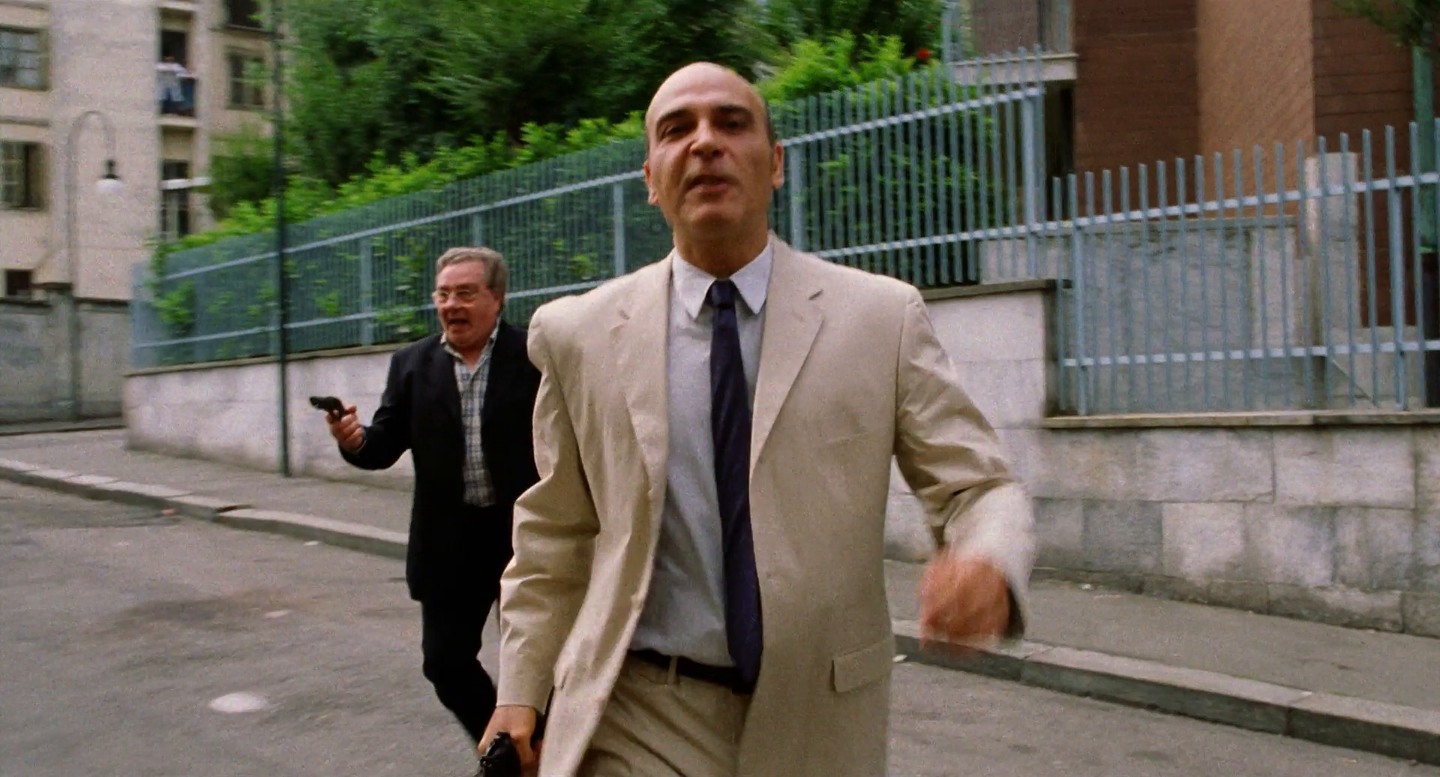
The report identifies Manni’s shooting but describes the other two bodies as an apparent murder-suicide. Set against what the viewer has seen, that wording makes the first official account an incomplete reconstruction.
Goblin’s score, additional music, dubbing and sound effects have distinct credits. The film’s English dialogue and the historians’ commentary also serve different purposes.
Goblin’s score and the other music
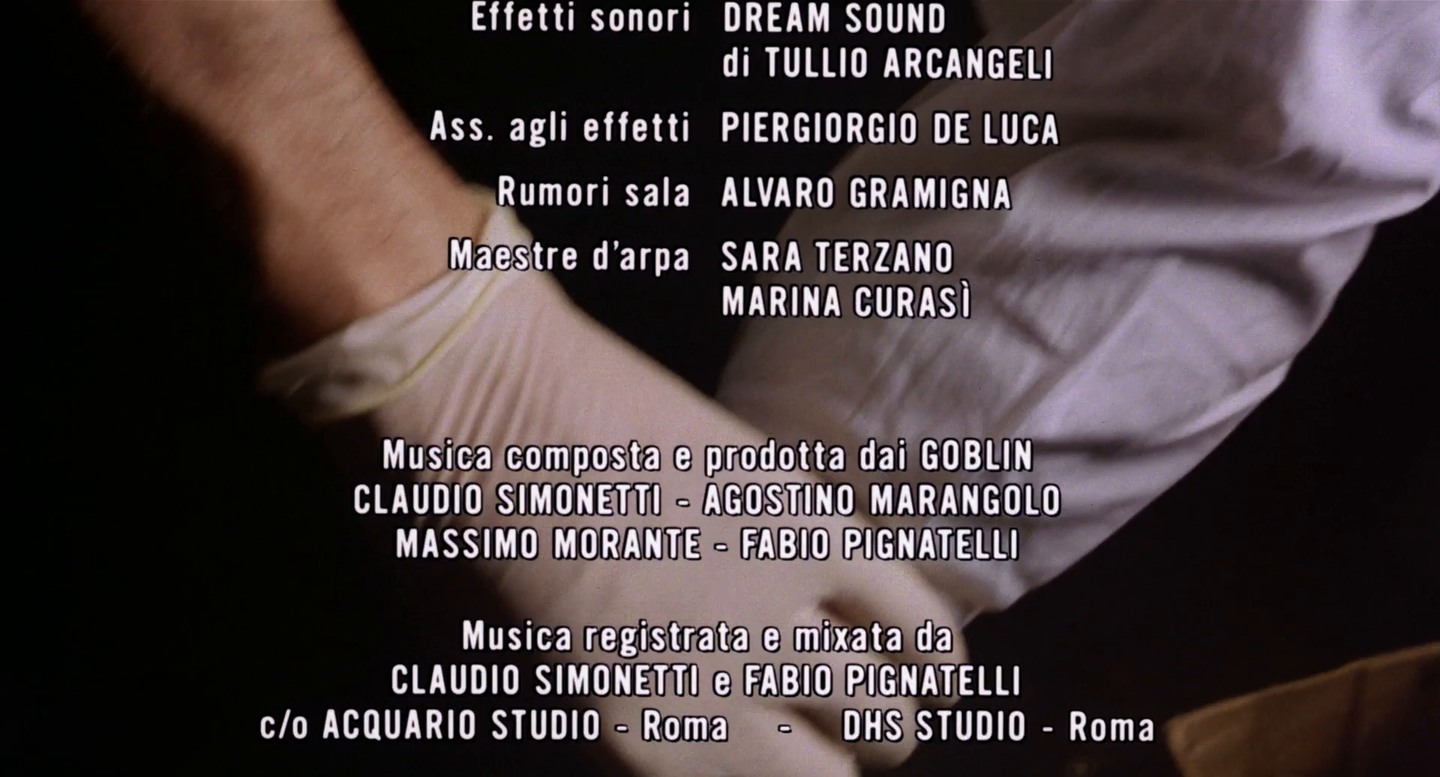
The closing roll credits Goblin’s composition and production to Claudio Simonetti, Agostino Marangolo, Massimo Morante and Fabio Pignatelli. Recording and mixing are separately credited to Simonetti and Pignatelli at Acquario Studio and DHS Studio in Rome. Follow the reunion history →
ENLARGE ↗Goblin’s members and recording studios in the closing roll.
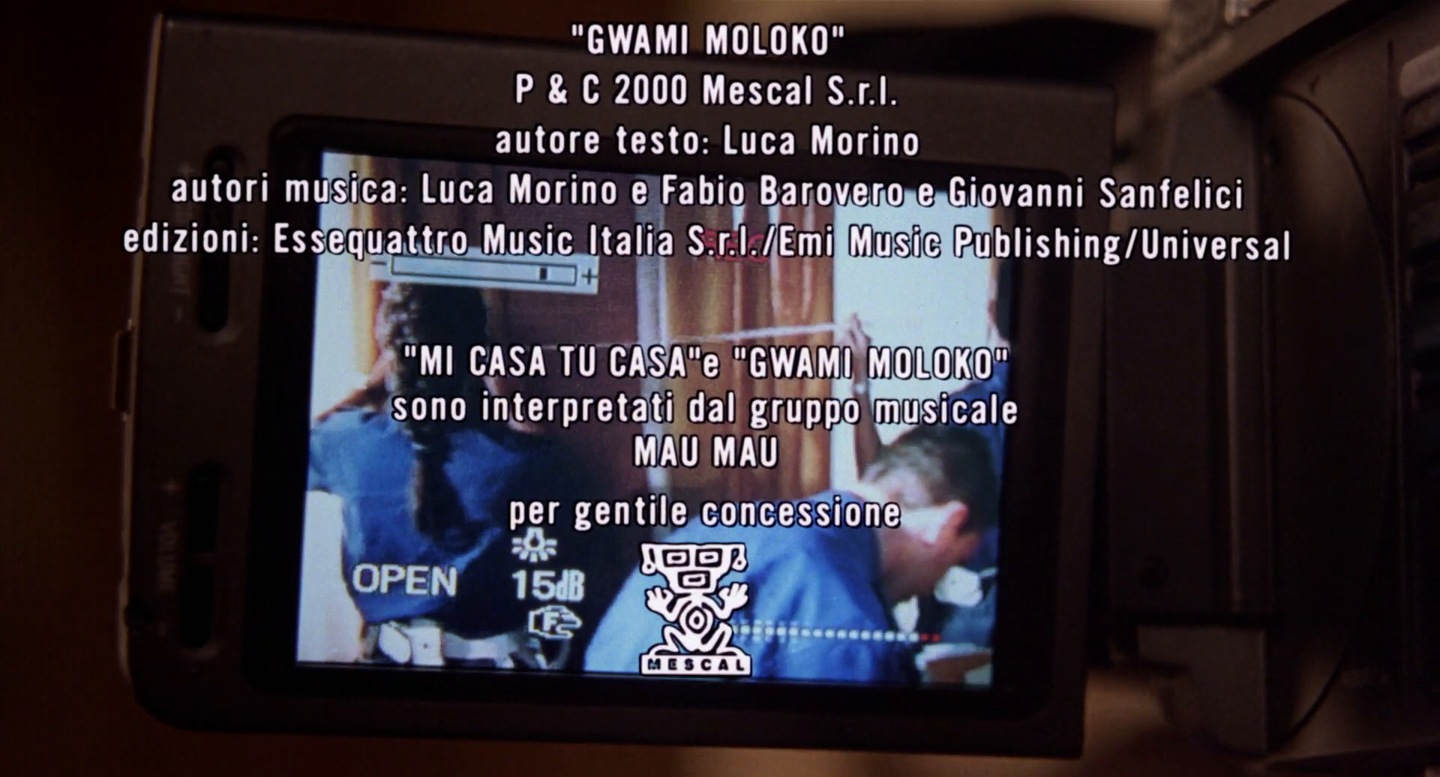
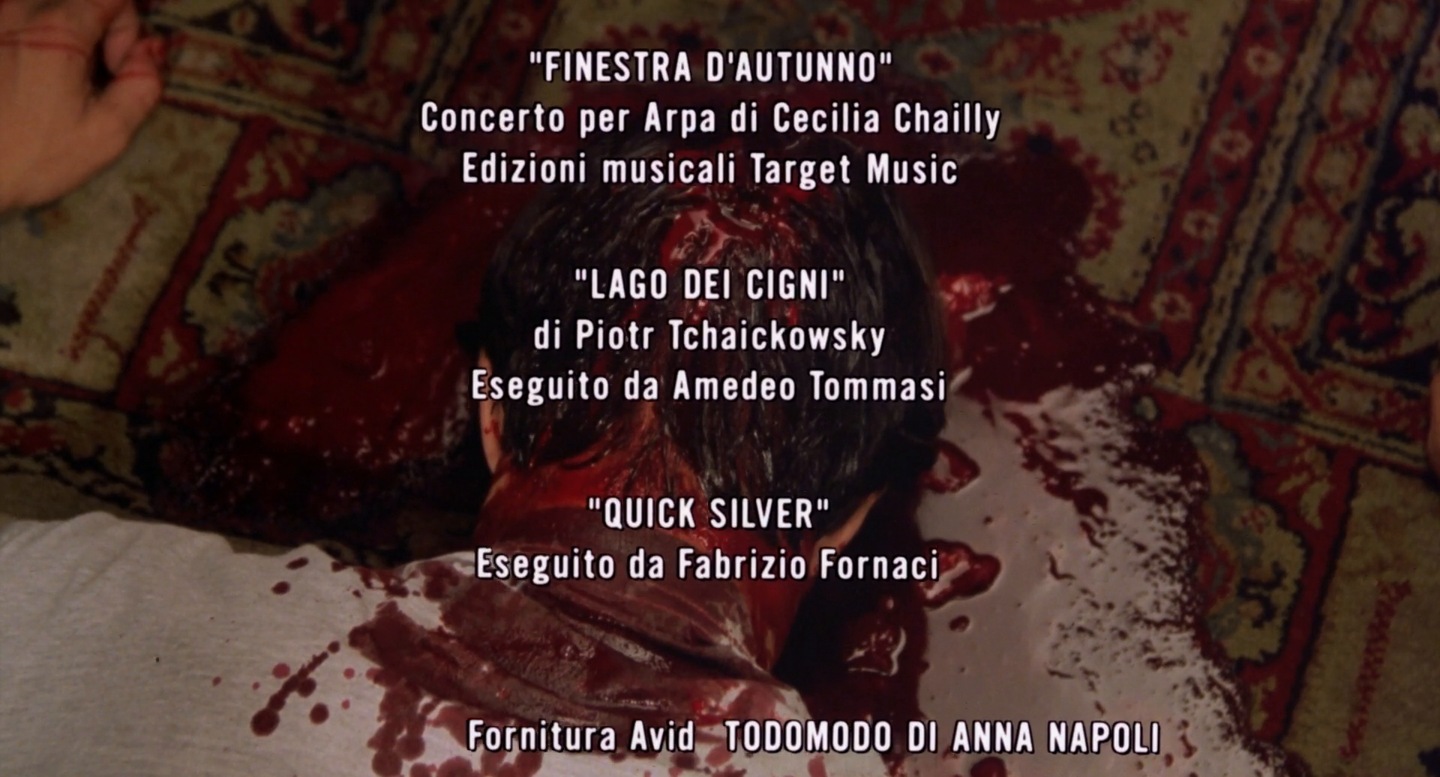
The additional-music credits name Mau Mau’s Mi casa tu casa and Gwami Moloko. They also list Cecilia Chailly’s harp concerto Finestra d’autunno, Tchaikovsky’s Lago dei cigni performed by Amedeo Tommasi, and Quick Silver performed by Fabrizio Fornaci. These entries prevent every musical passage being casually attributed to Goblin; the roll alone does not map each recording to its precise scene.
Read the additional-music creditsENLARGE ↗Mau Mau in the additional-music credits.ENLARGE ↗The harp, ballet and “Quick Silver” credits.
The sound departments
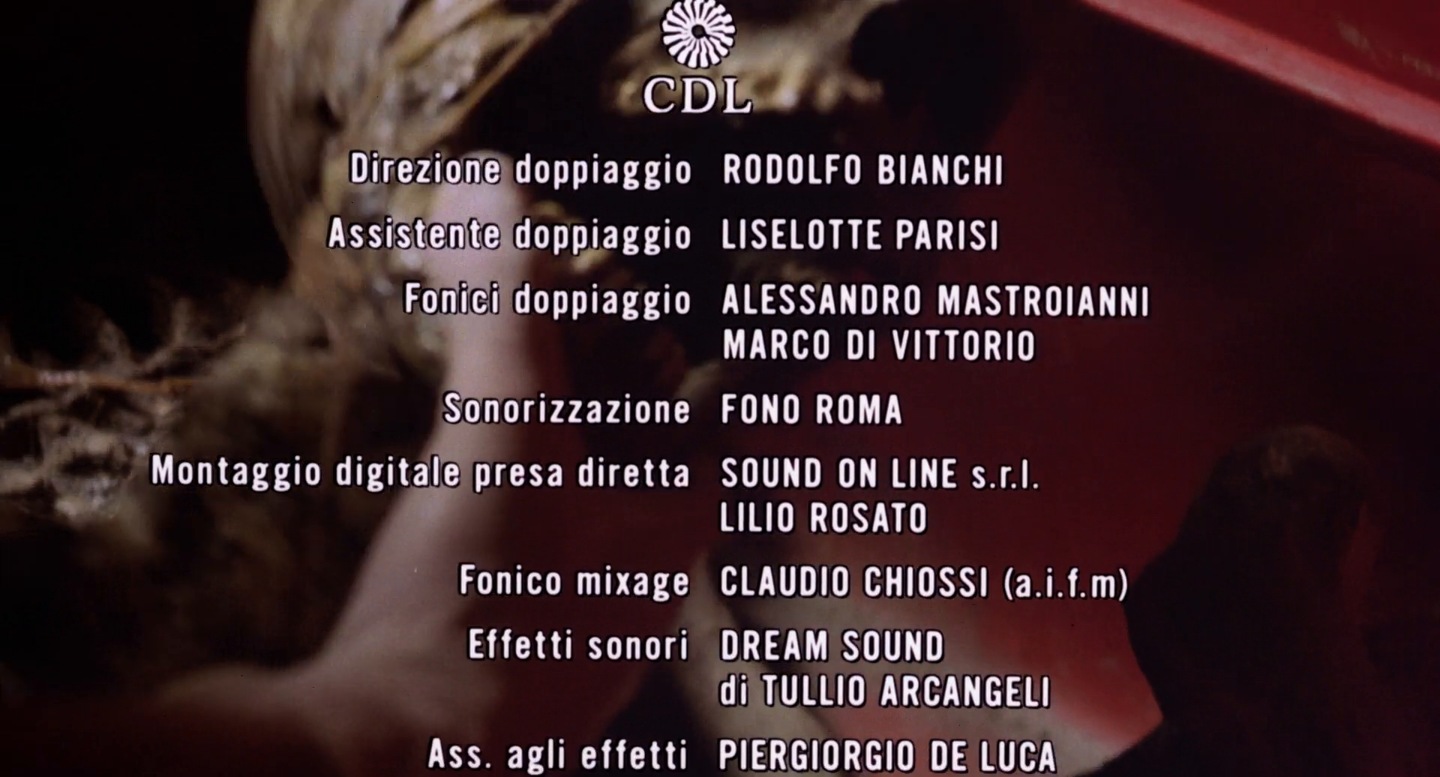
ENLARGE ↗Dubbing and sound departments in the closing credits.
The Italian closing roll lists CDL’s dubbing direction by Rodolfo Bianchi, assisted by Liselotte Parisi, with dubbing engineers Alessandro Mastroianni and Marco Di Vittorio. It names Fono Roma, Sound on Line and Lilio Rosato for their respective post-production sound and editing work, and Claudio Chiossi as mixing engineer.
Sound effects are credited to Dream Sound di Tullio Arcangeli, with Piergiorgio De Luca assisting. Alvaro Gramigna receives the studio-noises credit. These department credits should not be mistaken for an English voice-cast list or a cue-by-cue account of how individual effects were made.
The two tracks in the reviewed presentation
The first track is the English feature soundtrack in 5.1. The second is a stereo commentary: its introduction names Nathaniel Thompson and Troy Howarth. It is not a second dramatic dub of the film.
Vinegar Syndrome’s official listing names the same commentators and lists English and Italian 5.1 feature soundtracks. The commentary identification does not by itself establish which physical release supplied the reviewed presentation. An Italian feature track is not present in this file, so an English–Italian comparison remains separate.
Each example gives sound a different narrative task: locating someone, recognising someone, or carrying information beyond its speaker. The clue is not simply something the audience hears; it is something a character has to interpret.
Inside the Thompson–Howarth commentary
The track offers a critical conversation about the film’s return to giallo, its performances, set pieces and changing reputation. The following routes distinguish the commentators’ judgments from the film’s own evidence and from verified production credits.
Explore the commentary 8 topics
00:10–06:40
A return, with reservations. They frame the film as a regrouping after The Phantom of the Opera, while recognising familiar devices and changes in the later films. This is their reading of its place in the career.
10:50–15:20
Goblin in the film and on the album. Their discussion moves from the train sequence to the reunion and differences between a film cue and a longer album presentation. Their assessment is not a substitute for a matched recording comparison.
20:20–22:25
English and Italian performances. They recommend comparing the language versions and discuss what they value in von Sydow’s English performance. Their preferences are attributed criticism; the present dossier does not claim to have compared an unavailable Italian track.
27:47–28:56
How much does Moretti change?. They question his practical impact while emphasising his presence in the film. The recorded-message study offers a specific way to examine that question: his deductions reach Giacomo after his death.
41:46–43:18
Effects and the duration of a shot. They argue that lingering on some prosthetic work weakens its impact. Compare this critical judgment with the existing staged galleries and the instrument-memory sequence.
59:00–60:10
How video editions shaped reception. They recall the early US presentation and contrast it with access to a better-framed Italian release. This is commentary testimony about distribution, not a newly performed disc comparison.
74:40–76:15
The detective and the literal clue. They question why the rhyme’s connections eluded the earlier investigation, and discuss the misunderstanding of “instrument.” The film’s dialogue lets readers follow the inference without adopting every judgment about its plausibility.
80:11–82:03
The carpet’s comedy and payoff. The conversation considers the floor-level movement, interruptions by backstage activity and the final effect. It supplies an alternative critical angle on the visual study’s account of withheld faces.
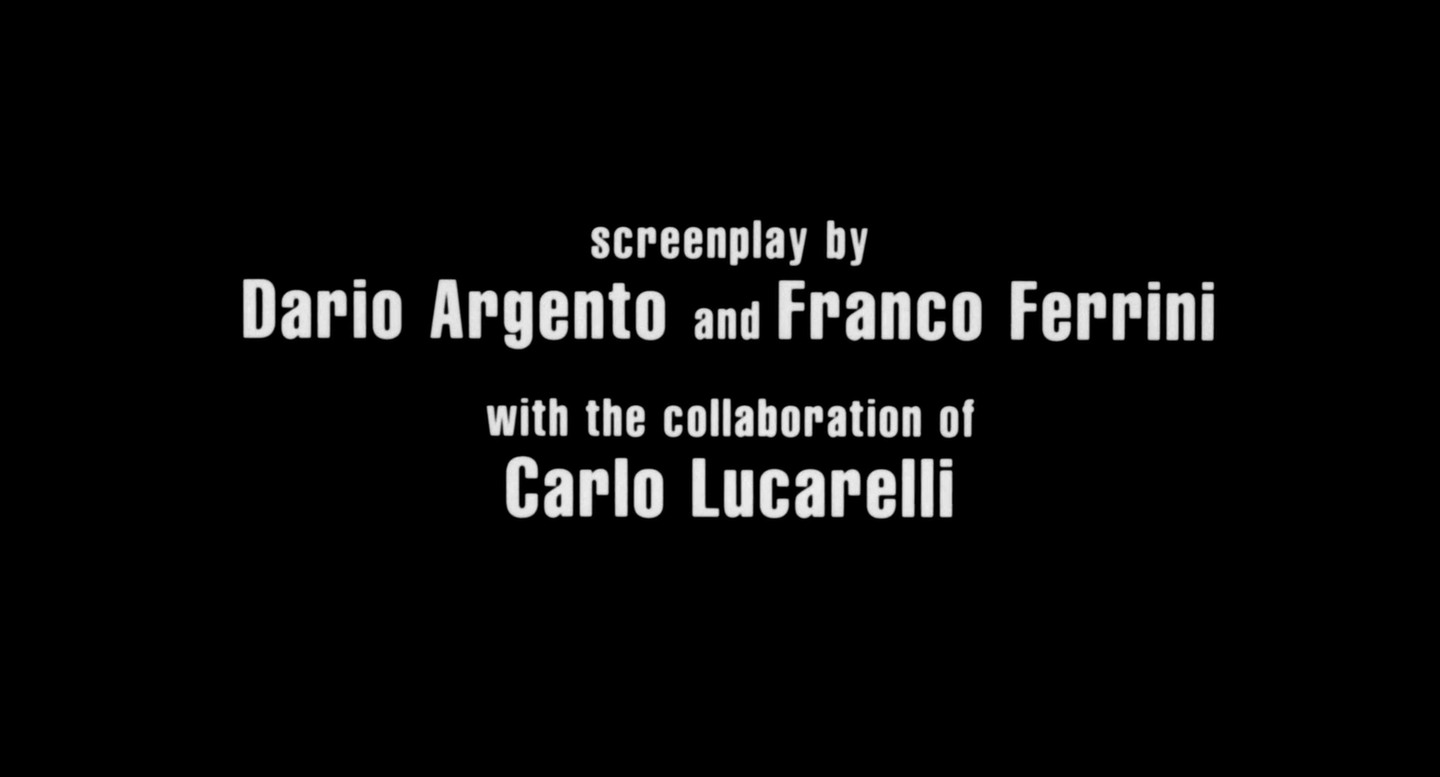
The opening titles credit the screenplay to Dario Argento and Franco Ferrini with the collaboration of Carlo Lucarelli. That distinction agrees with the submitted title list in the Italian ministry file. Read the development history →
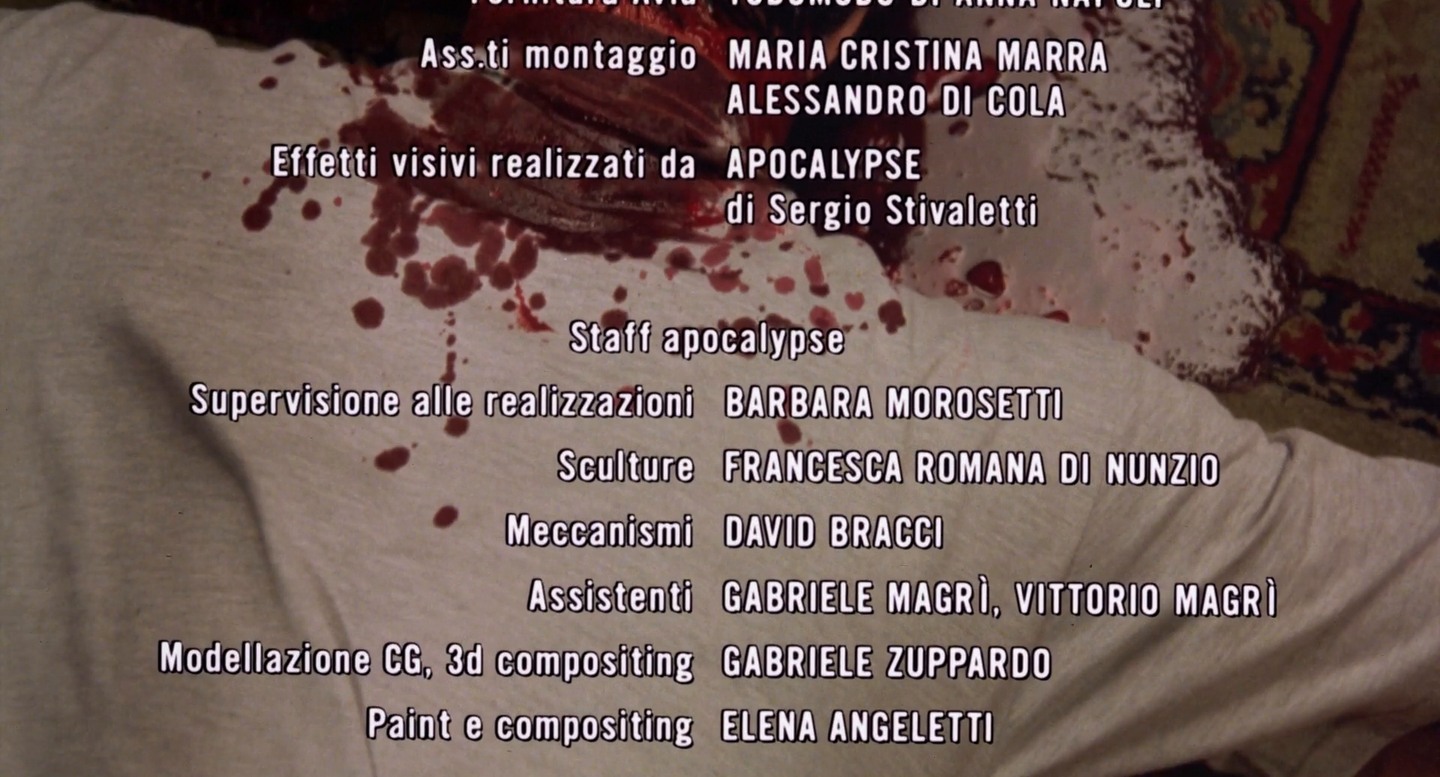
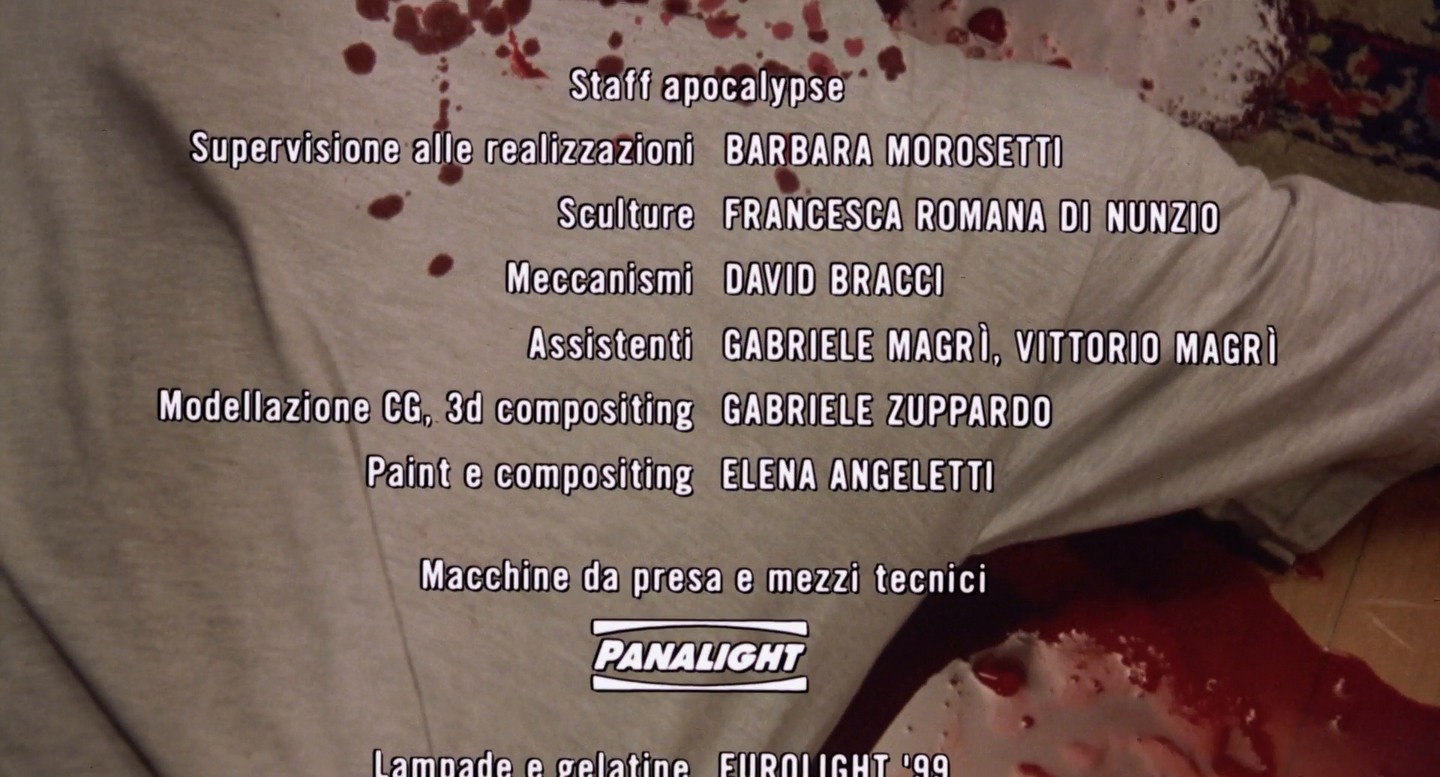
The closing roll credits the visual effects to Apocalypse di Sergio Stivaletti. It then separates supervision, sculpture, mechanics and digital work. This is a production credit, not a frame-by-frame allocation of every wound.
ENLARGE ↗Sculpture, mechanics and digital roles in the effects credits.
Sculpture, mechanics and compositing
The Apocalypse staff list names Barbara Morosetti for supervision, Francesca Romana Di Nunzio for sculpture and David Bracci for mechanics. Gabriele Zuppardo is credited for CG modelling and 3D compositing, and Elena Angeletti for paint and compositing.
ENLARGE ↗Goblin’s members and recording studios in the closing roll.
Goblin and the recording studios
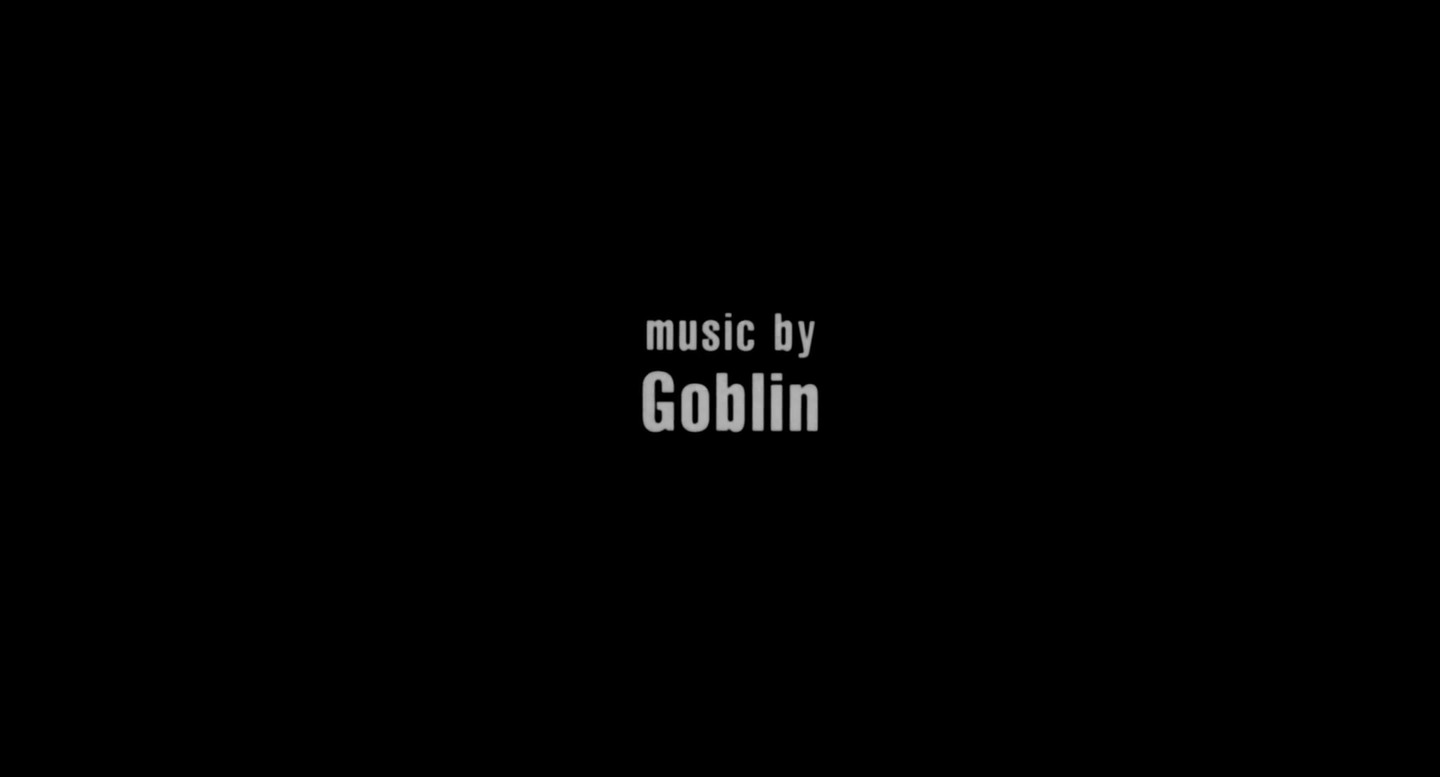
The roll names Claudio Simonetti, Agostino Marangolo, Massimo Morante and Fabio Pignatelli under Goblin’s composition and production credit. It separately credits Simonetti and Pignatelli for recording and mixing at Acquario Studio and DHS Studio in Rome. Read the reunion history →
View Goblin’s opening creditENLARGE ↗Goblin’s opening music credit.
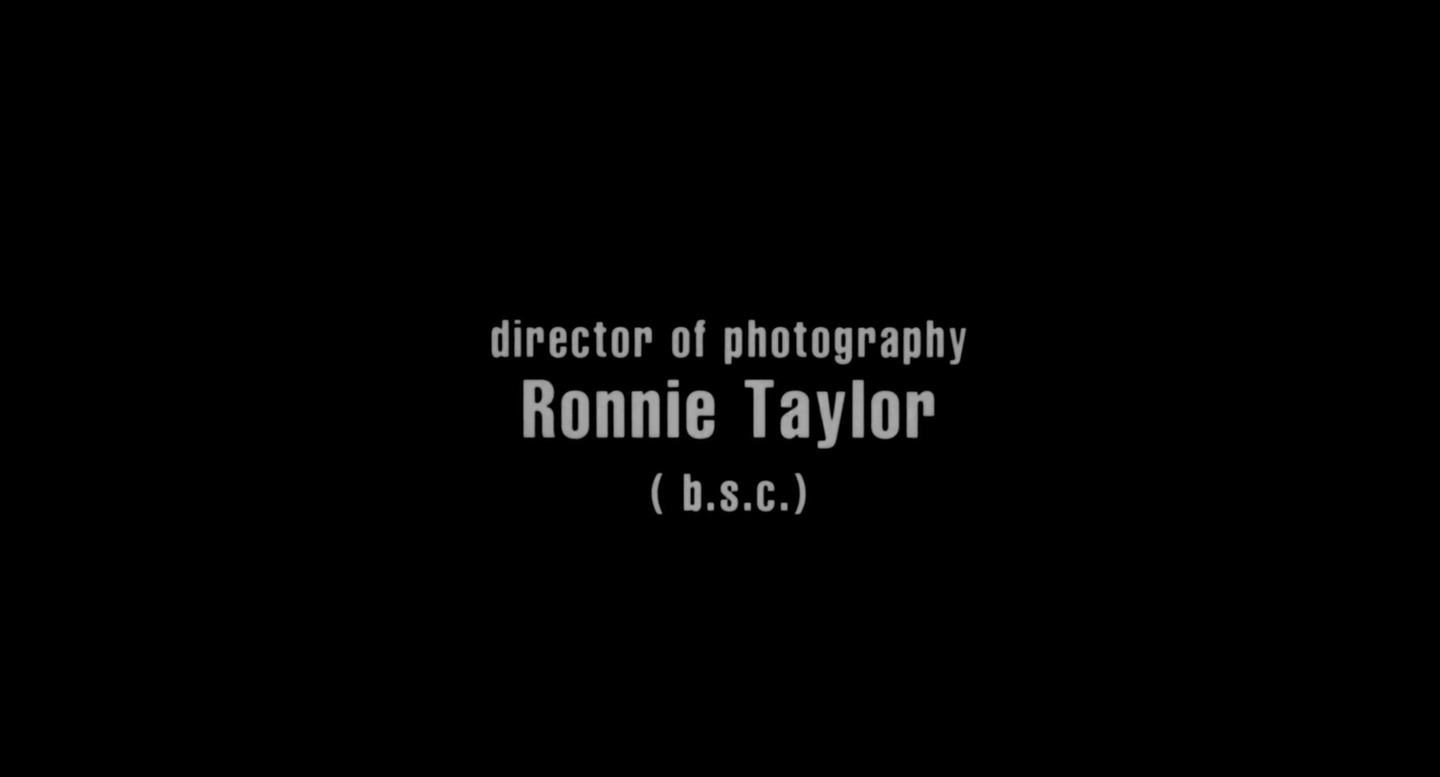
Ronnie Taylor receives the cinematography credit. The scene guide follows the visible contrast between the train’s blue-green interiors, Moretti’s warmer rooms and the brighter daylight investigation. Read the Turin study →
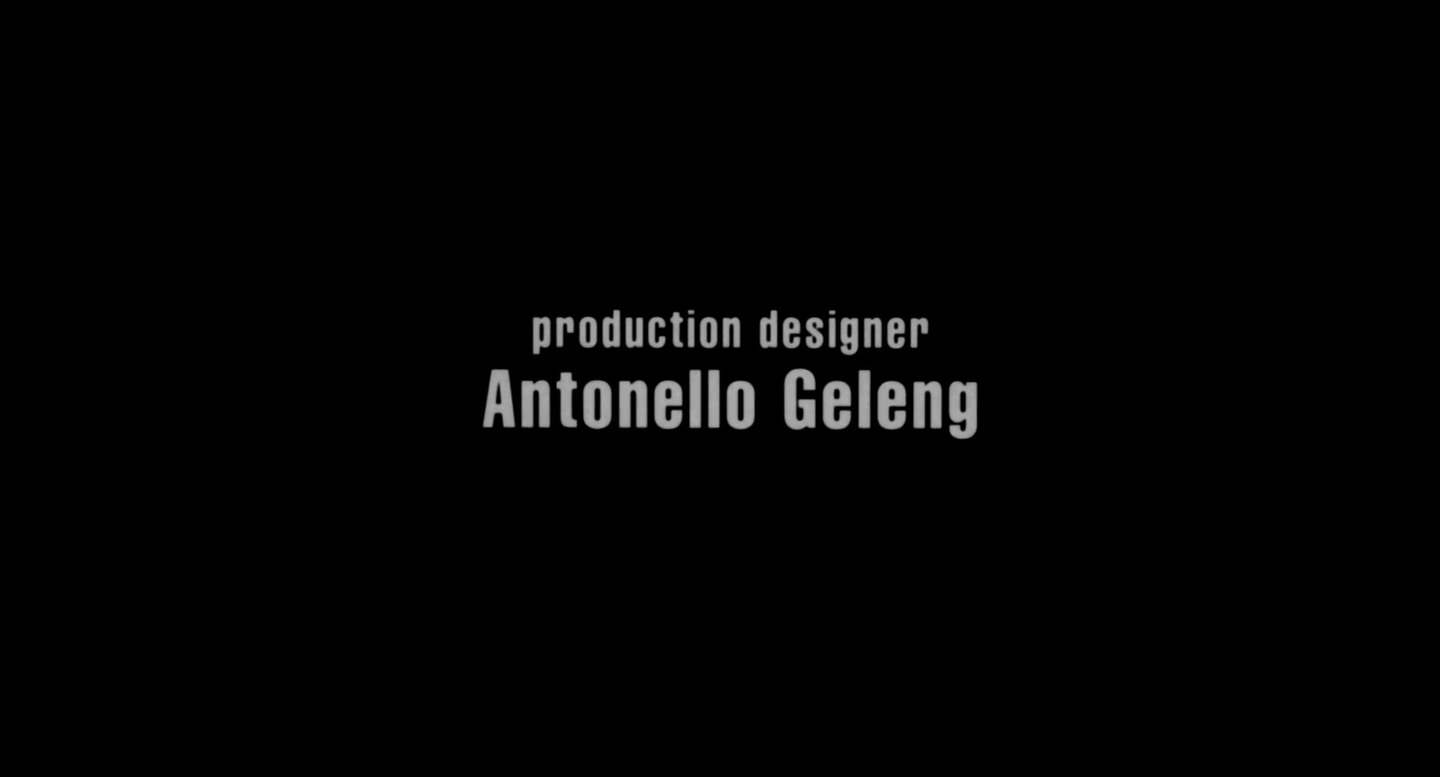
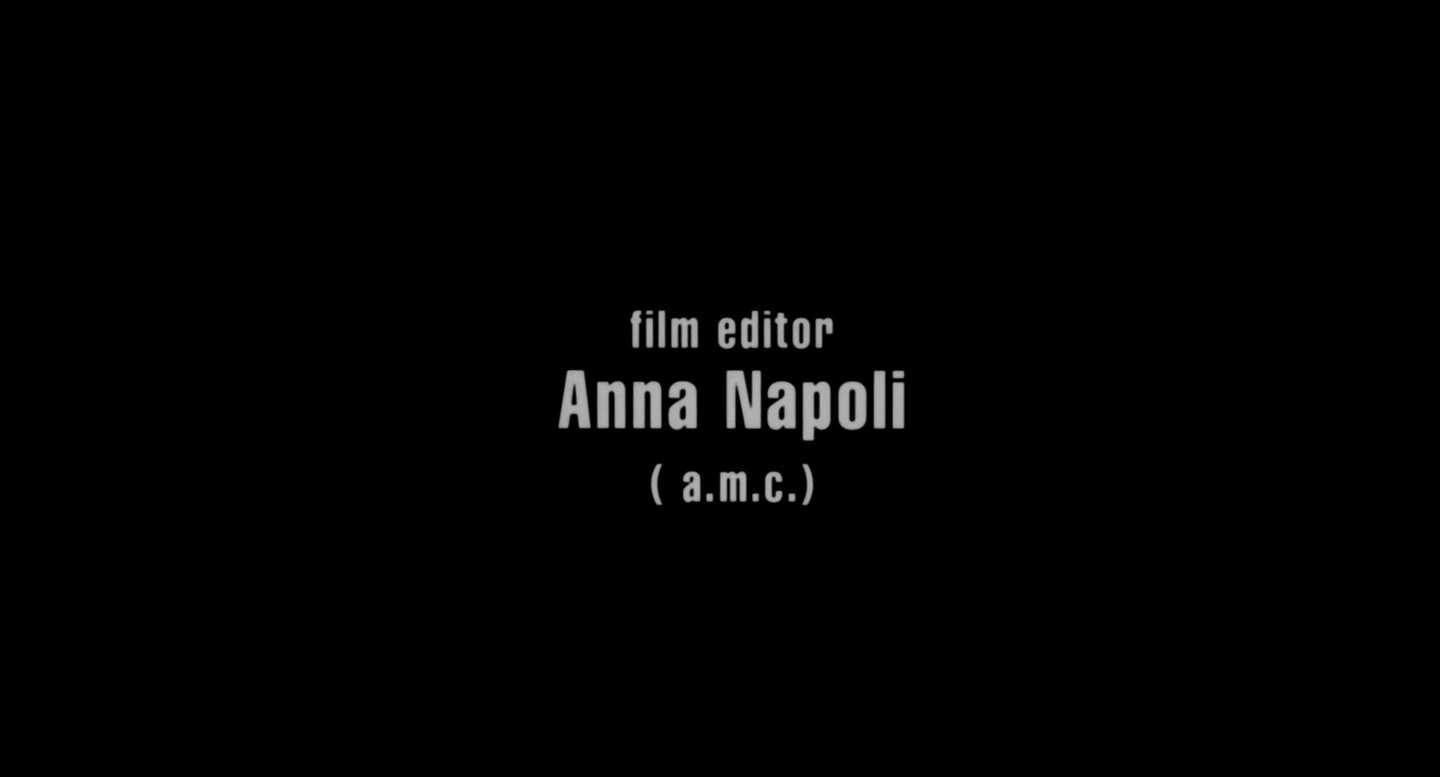
Antonello Geleng receives the production-design credit; Anna Napoli is credited as editor. The theatre, domestic study and transport interiors provide distinct visual systems within the mystery. Follow the carpet passage →
View the editing creditENLARGE ↗Anna Napoli’s editing credit.
The presentation used for the images
The illustrated presentation runs 1:57:02 and carries a 1920 × 1036 picture. These stills preserve that image at 1440 × 777 without added letterbox bars. Time labels locate the illustrated views; they do not designate every cut.
The presentation contains an English 5.1 feature soundtrack and a stereo commentary by Nathaniel Thompson and Troy Howarth, plus English text and bitmap subtitles. The recordings guide distinguishes those tracks and their evidence. Compare the published release records →
Memory & return
Sleepless returns to a mystery whose accepted explanation has outlived the evidence behind it. This expanded dossier follows Moretti and Giacomo through the writing, concealed Turin interiors, the animal rhyme, Goblin’s reunion and the film’s release record. Participant accounts and a surviving ministry file make that return a question of working history as well as style.
Spoilers: this study discusses the film’s story and ending.
01 / MORETTI, GIACOMO & THE PAST
A promise outlives the investigation
In 1983, Giacomo witnesses his mother’s murder. Moretti promises to find the killer. When related murders occur in Turin in 2000, the retired investigator and the grown-up witness return to the case. Cinematografo’s longer synopsis distinguishes their unofficial partnership from Commissioner Manni’s active police investigation. That distinction is useful: Giacomo is the bereaved witness, not simply the young police officer that some abbreviated programme descriptions make him. Narrative record
The case has two kinds of unfinished business. Moretti carries a professional promise; Giacomo carries a childhood experience he could not fully understand. The years between them have not preserved the event in a neutral container. Memory has changed, explanations have hardened, and an old accusation has acquired the authority of a settled answer.
This makes the return more than a search for an overlooked clue. Someone must first be willing to doubt the story that organised the clues. The earlier suspect’s death made closure possible, but it did not necessarily make the explanation true. Reopening the inquiry means asking how a conclusion became convincing and whether the people who accepted it had reasons to stop asking questions.
Max von Sydow’s Moretti gives this problem a human scale. An investigator whose memory is uncertain must find ways to make experience useful without pretending that experience guarantees accuracy. His partnership with Giacomo distributes the work across two different relations to the past. The film’s title can be read in that light: an unresolved obligation persists after the institution has put the case to bed.
02 / THE TRAIN & THE CONFINED FRAME
Motion does not guarantee an escape
The early train pursuit gives the film a second way to think about entrapment. Mondo Digital’s account identifies the murders of two women around a train journey and station as the new crimes that revive the earlier case. A transport system promises movement towards another place; a thriller can turn its compartments, corridors and stopping points into a sequence of restricted choices. Opening narrative account
The illustrated train study follows its successive restrictions: the compartment, patterned glass doors, emergency brake and closing window. The route remains visible while each possible means of escape becomes less useful. The stage gallery brings those fittings into relation with the wound and the victim’s continued movement.
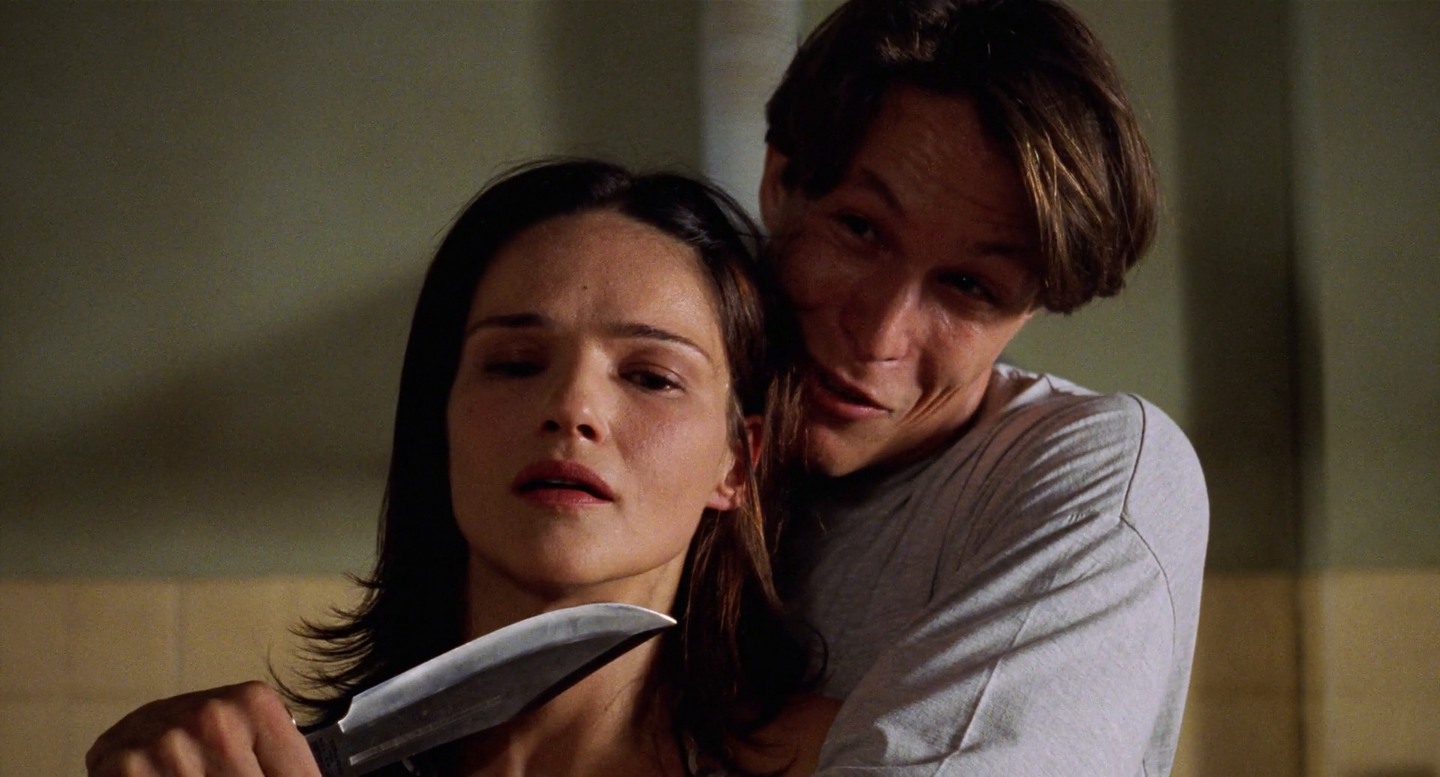
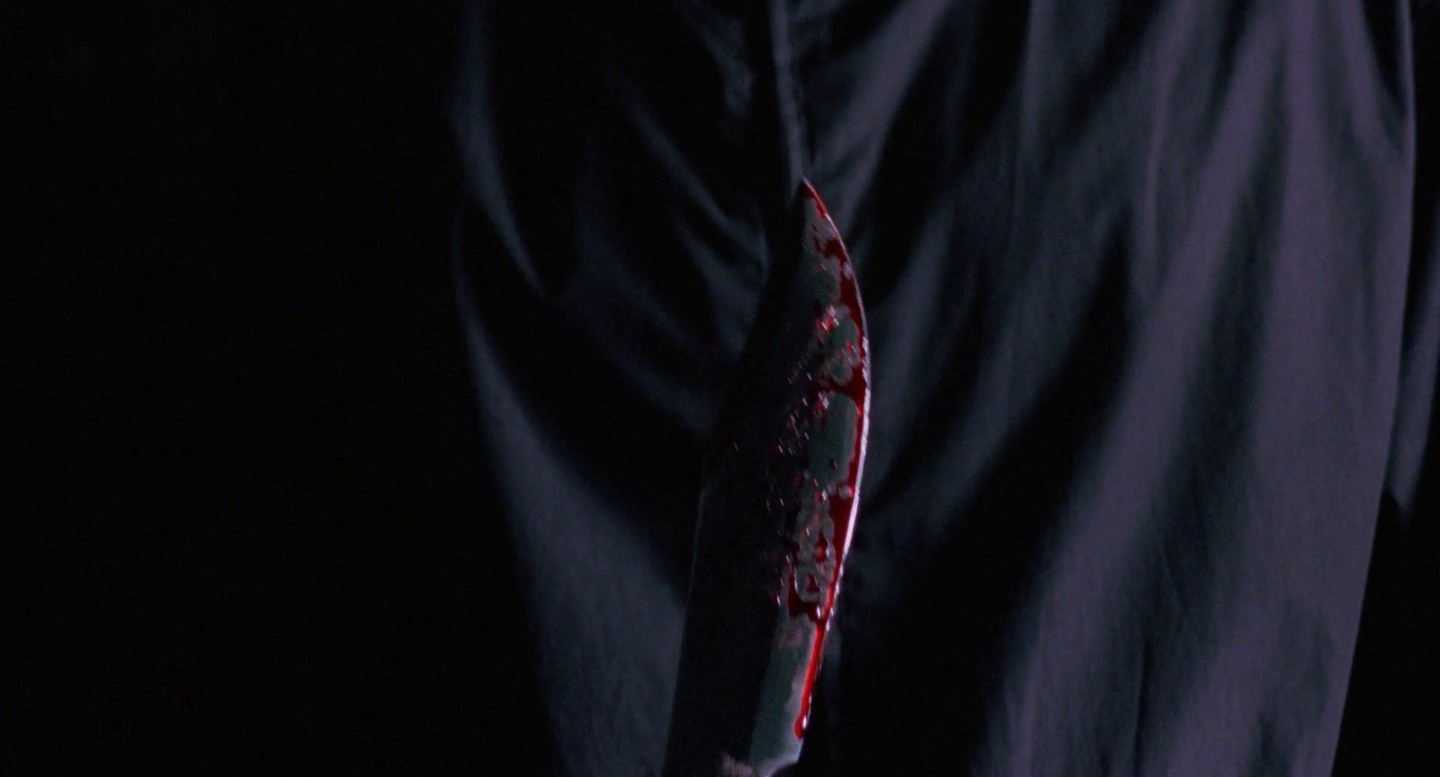
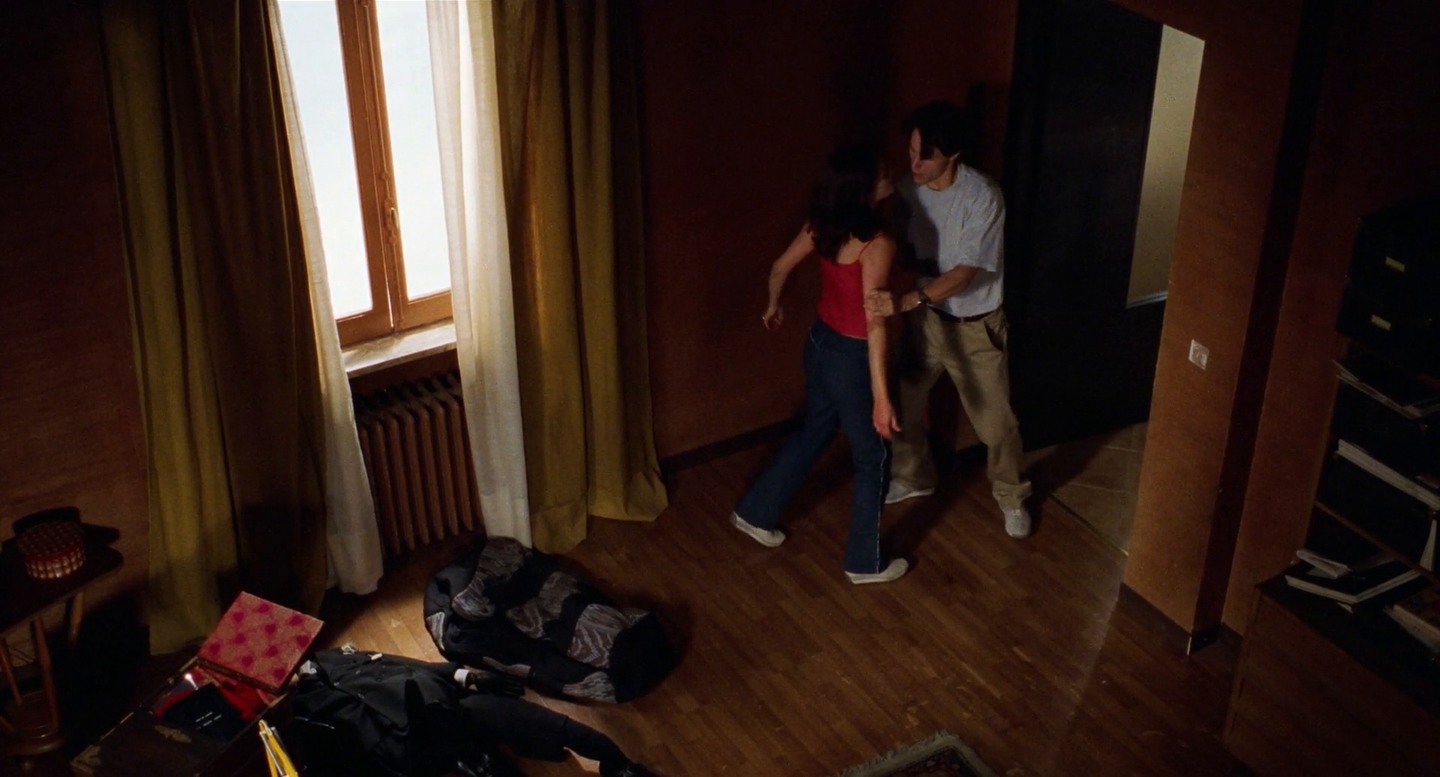
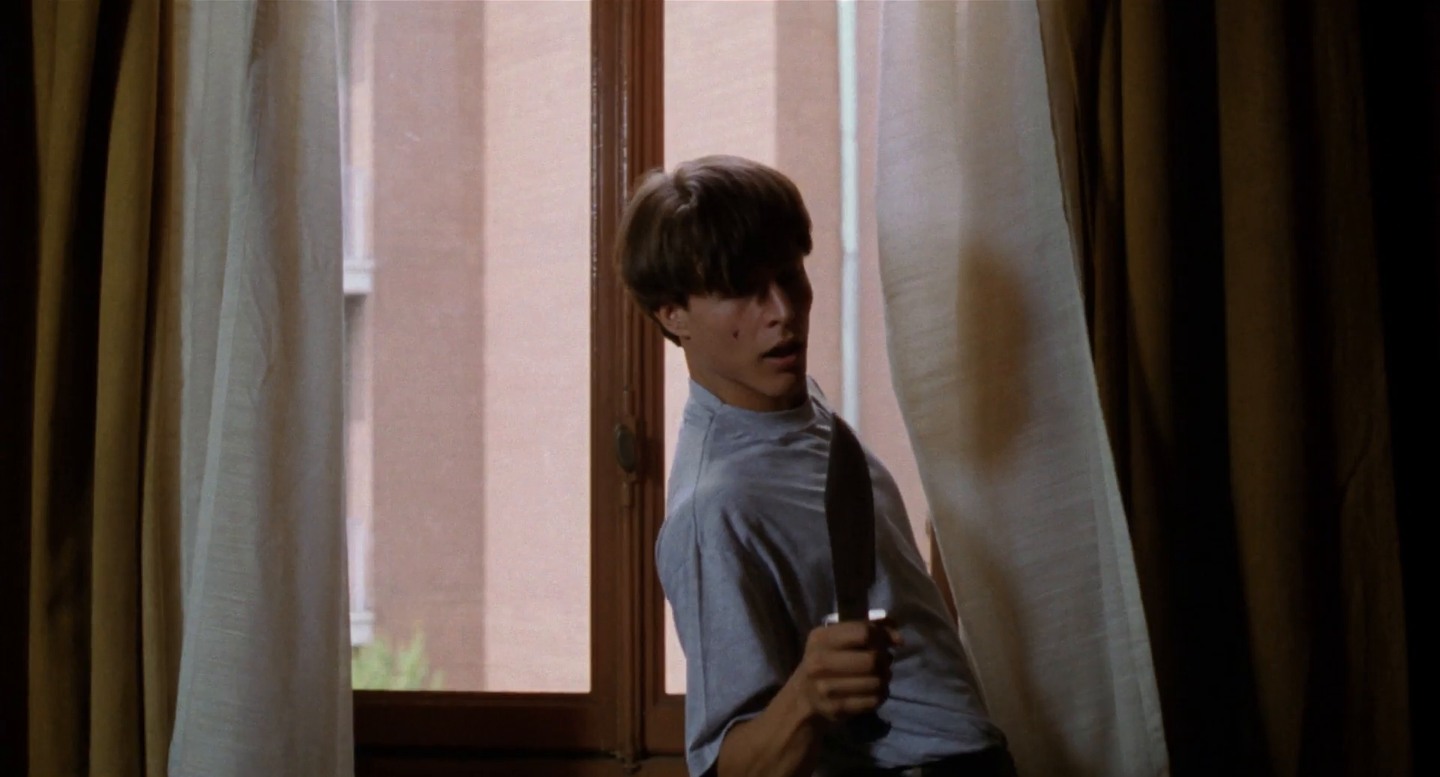
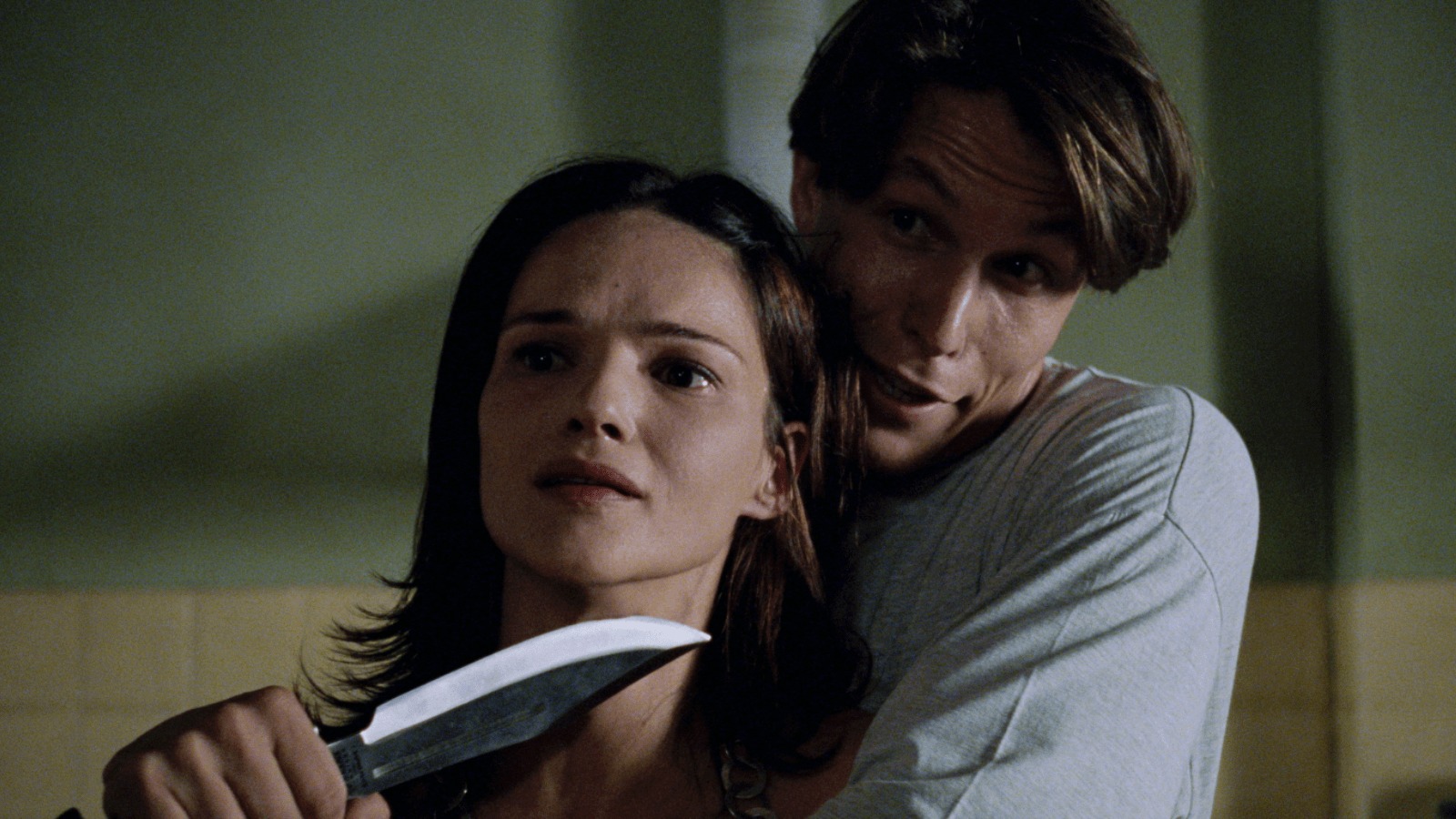
The supplied image above compresses danger differently. A man stands almost directly behind a woman; the bright blade crosses the foreground beneath her face. Their bodies occupy much of the frame, while the room behind them loses definition. The image gives the threat a clear shape before it gives the surrounding space a useful plan.
The final hostage composition makes the threat personal: Lorenzo, already familiar to Giacomo, occupies the position behind Gloria. The close overlap of bodies restricts the imaginable escape routes. The film ultimately reconnects this enclosed confrontation with the street through Manni’s line of fire.
03 / ARGENTO, FERRINI & LUCARELLI
A collaboration with distinct stages
The submitted title list in Italian censorship file 95060 credits the story to Dario Argento and Franco Ferrini, and the screenplay to them with Carlo Lucarelli’s collaboration. This is more precise than treating every writing name as an identical contribution. It records the wording supplied for this version; a complete draft history would require additional evidence. Submitted credits, PDF p. 1
Lucarelli’s account describes Argento contacting him while the film was already being written with Ferrini. He presents his contribution as expertise in detective-story construction and police procedure. In the same exchange, Argento connects the project to Christie, Ellery Queen and especially Cornell Woolrich, while resisting the idea that returning to a genre means repeating an unchanged method. Argento–Lucarelli exchange
These accounts make a useful distinction between a structure and its operation. A mystery needs to organise what happened, but it also needs believable routes by which people learn about it. Police procedure, a witness’s recollection and a writer’s manipulation of suspicion do not perform the same task. Their interaction can create suspense even when the individual ingredients are familiar.
Claudio Questa’s 2022 study reports an earlier draft in which Giacomo was called James Lamb and returned from London rather than Rome. Those are reported draft details, not manuscripts inspected here. They suggest that names, geography and the animal pattern developed together. The next useful step is to identify and date the drafts behind the comparison, rather than turn a retrospective account into a definitive allocation of scenes to individual writers. Reported draft comparison
04 / TURIN, CAMERA & WORKING DEPARTMENTS
The city hides its rooms
Argento’s discussion with Lucarelli describes his interest in Turin’s concealed interiors: ordinary-looking entrances open onto gardens, glass, marble stairs and unexpected halls. The city is valuable because its exterior does not tell the visitor everything about what lies inside. That gives location a role in a mystery built around incomplete knowledge. Argento on Turin
Ronnie Taylor’s photography, Anna Napoli’s editing, Antonello Geleng’s design and Susy Mattolini’s costumes are separately named in the submitted credits. The effects list identifies Apocalypse under Sergio Stivaletti and distinguishes physical mechanisms from computer modelling and compositing. A departmental credit establishes participation; it does not identify the author of every camera position or effect. Submitted credits, PDF pp. 1–2
One specific camera decision has a contemporary account. In Claudio Lugi’s release-period interview, Argento says the theatre-carpet travelling shot was conceived late in production and filmed on the last day, despite technical objections. It gives a concrete question for Taylor’s and Napoli’s contributions: how did the proposed movement become a usable passage in the finished film? Lugi interview, 5 January 2001
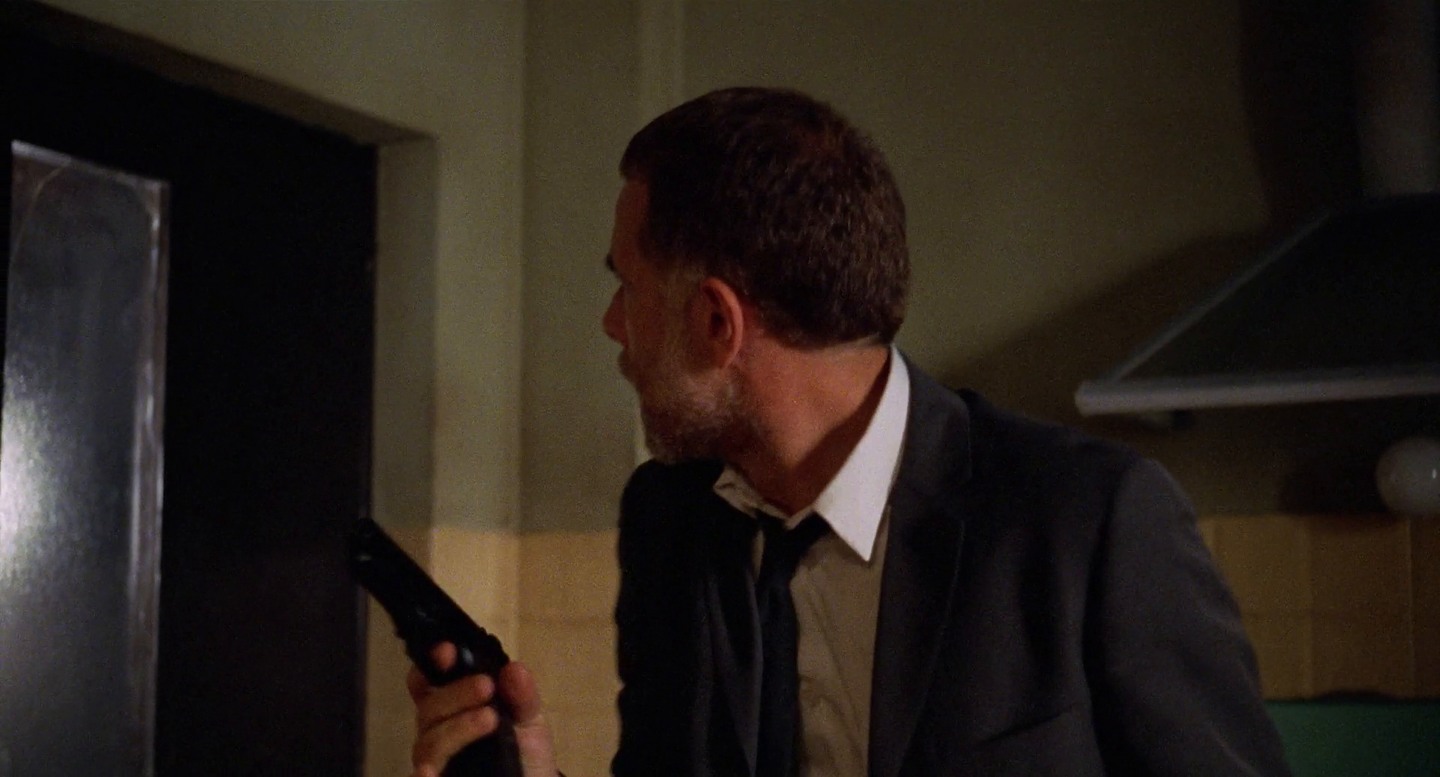
The image’s subdued room and emphatic blade show why these departments belong in the same discussion. Lighting and design determine which surfaces can be read; costume and performance organise the bodies; framing selects the relationships visible at once. Cutting would determine how that arrangement is entered and left. The still supports the first set of observations, while the temporal decisions require the sequence.
The current disc’s interviews with Napoli and Geleng provide targeted routes back to those questions. Including the editor in that return is particularly valuable: a memorable moving shot is only one component of the scene’s eventual rhythm. Available production interviews
05 / WORDS, SOUND & MISIDENTIFICATION
A remembered clue still needs an interpretation
The animal rhyme turns repetition into an apparent plan. Its victims and actions provide a sequence against which the investigation tries to read the killings. The submitted end-credit list explicitly attributes the farmer’s rhyme to Asia Argento. Her contribution is therefore part of the film’s construction even though she does not play its heroine. Rhyme credit, PDF p. 2
Questa identifies a decisive ambiguity in the word strumento: an “instrument” is interpreted too narrowly as a musical instrument. He also discusses the remembered hiss that Giacomo cannot initially place. These are different failures of recognition. One concerns the meaning assigned to a word; the other concerns a sound that survives without a secure explanation. Language and sound clues
The distinction shifts the emphasis away from memory as a recording device. Remembering more clearly is not necessarily enough. A person can retain the evidence and still fit it into the wrong category. A familiar explanation may actually obstruct recognition by making alternative meanings feel unnecessary.
The final identification of Lorenzo turns that problem back towards childhood and family. The person sought is not simply the outsider around whom the old accusation was built. The solution rearranges the relation between apparently familiar people and the earlier violence. Ending account; spoilers
This is also where the film’s use of physical difference needs scrutiny. The old suspect is repeatedly defined through dwarfism. Our account treats that as the story’s mechanism of suspicion, not as evidence of criminal character. The relevant critical question is how a community’s readiness to attach danger to a conspicuous outsider helps an explanation become durable.
06 / GOBLIN & THE SOUND WORK
A reunion does not erase the working history
Goblin’s music credit names Claudio Simonetti, Massimo Morante, Fabio Pignatelli and Agostino Marangolo. The submitted document credits Simonetti and Pignatelli with recording and mixing at Acquario and DHS studios in Rome. It also lists music beyond Goblin, including Mau Mau and Cecilia Chailly’s harp concerto. The musical world is broader than the reunion alone. Music and recording credits, PDF p. 2
Marangolo’s 2011 interview with Gianluca Livi complicates a simple story of restored unity. He recalls disagreements during recording and says the work ended in two camps using Simonetti’s and Pignatelli’s studios. This is a participant’s retrospective account. The two-studio credit is compatible with it, but does not itself prove why the sessions were divided. Marangolo interview, 27 April 2011
The distinction matters because “Goblin returned” can become a substitute for hearing the film or understanding how the music was made. Familiar personnel do not mean identical working circumstances, technologies or dramatic purposes.
Music and a clue-bearing noise also do different narrative work. A score can sustain apprehension without telling the investigator anything. A remembered sound can become evidence only when someone finds an interpretation for it. Sleepless offers a productive meeting point between those functions, but their exact relationship must be checked in an identified language track and mix.
The dialogue studies now trace the train call, remembered hiss and literal reading of the rhyme. The recordings guide adds the sound departments and additional-music credits. A direct comparison of the language versions and mixes, the Simonetti interview and exact musical cue boundaries remains a separate investigation.
07 / RELEASE & CRITICAL HISTORY
What does “return to form” actually mean?
Contemporary responses did not agree on what the familiar elements achieved. Cinematografo preserves Roberto Nepoti’s 6 January 2001 criticism of an overcomplicated plot and uneven acting alongside technical skill. Its excerpt from Lietta Tornabuoni, dated 12 January, finds an old-fashioned, illogical but entertaining spectacle. These are reproduced excerpts, not complete newspaper pages inspected here. Contemporary critical excerpts
In the Lugi interview, Argento describes satisfaction with the response while recalling the criticism directed at his earlier work. His insistence that the new film was being received differently is evidence of how he presented it at release. Release-period self-assessment
Later framing changes the terms again. Film at Lincoln Center’s 2022 retrospective places the film within Argento’s Turin mysteries and literary detective tradition. That context encourages viewers to look across a career rather than treat this single release as a verdict on whether the director had recovered a lost ability. Retrospective programme
The phrase “return to form” can refer to several different things: a whodunit structure, a musical lineup, violent set pieces, a city, or the critic’s remembered pleasure. Separating those meanings makes the judgment more useful. A film can recover one kind of energy while altering another part of its method.
For this dossier, return is most revealing as a problem shared by the production and the story. The investigators return to a case; collaborators return to a working relationship; audiences return to familiar expectations. In each instance, the elapsed years matter. The task is not to pretend they have disappeared, but to examine what has survived and what now requires reinterpretation.
08 / CENSORSHIP & PRESENTATIONS
A dated record, then an edition comparison
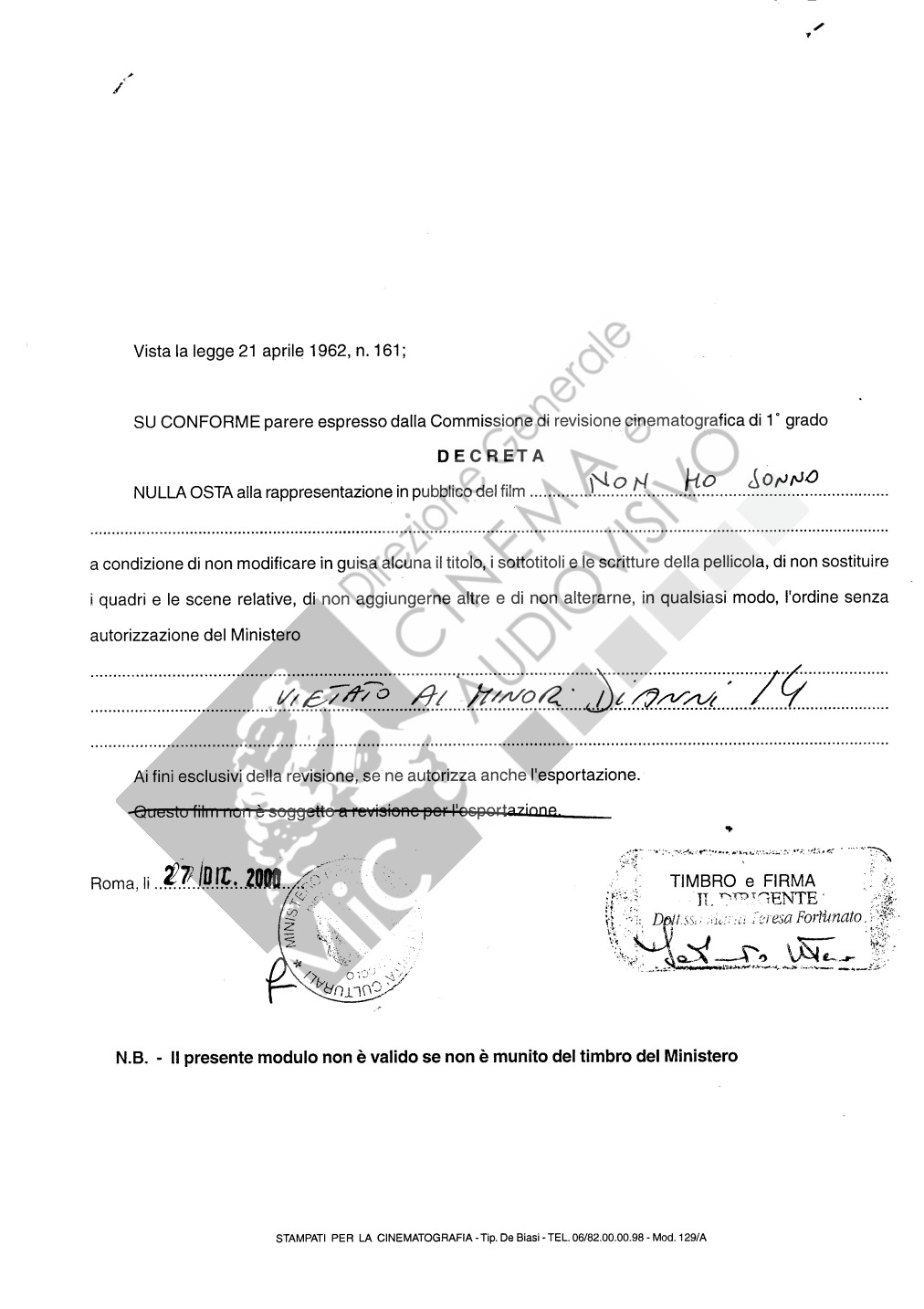
The Italian file supplies a firm date: the decree on PDF page 6 authorises public exhibition with an under-14 restriction on 27 December 2000. Page 7 records 3,300 metres declared and 3,260 ascertained. The difference is recorded here without converting it into an invented list of censored shots. File 95060, PDF pp. 6–7
ENLARGE ↗Italian censorship file 95060 · PDF page 6 · full scanned page, rendered for reading.Original document ↗
Published presentation records, checked 16 October 2026
Record
Listed duration
Scope
FLC, 2022
Listed duration117 minutes
ScopeItalian with English subtitles; screening listing. Programme
BBFC / MIA, 2002
Listed duration112m 21s
ScopeVideo submission classified 8 January 2002. Classification
These are records of presentations, not directly comparable stopwatches. A proper comparison needs the playback rate, source element, language track and inclusion of logos and credits. The two British entries are distinct submissions; their numerical difference does not identify a missing scene.
Mondo Digital’s edition history also stresses the effect of dubbing and describes different home-video framings and sound options. Its judgment is a reason to compare named versions, not a substitute for that comparison. Apparent weaknesses in delivery, colour or composition may belong partly to the presentation through which a viewer encountered the film. Edition review
The useful next step is small and reproducible: choose two identified releases, match the same narrative landmarks, and compare the actual frames and tracks. The ministry scan, British classification entries and publisher’s restoration specification then become evidence around that comparison, rather than numbers used to announce a definitive version prematurely.
FOLLOW THE CONNECTIONS
Another way in.
Read across films, then return to the evidence for each one.
Release-period exchange preserved on Lucarelli’s site: consultancy, literary models, return and concealed Turin interiors. Original print venue/date not established here.
Second interview on this page, credited to GossipNews and dated through Italia Notizie, 5 January 2001. Late writing contribution, theatre-carpet shot and release self-assessment read as Argento’s testimony.
Nine-page digitised ministry file hosted by the University of Milan. PDF pp. 1–2 and 6–7 visually; page 9. Credits, 27 December 2000 decree and declared/ascertained metres. Handwritten deliberations on pp. 3–5 not fully transcribed; no complete censorship history claimed.
Artists and Bands, 27 April 2011. First question on the Non ho sonno reunion and divided recording sessions read as retrospective participant testimony.
Opening narrative and home-video/language comparisons. Critical account, not a continuous viewing or direct disc comparison conducted for this dossier.
Sleepless — selected scenes, effects and screen credits
The visual studies examine selected frames across a 1:57:02 presentation, with closer sampling of eight effects passages. The scene guide follows the film through its ending; it is not a catalogue of every cut or a claim of continuous audio review. Time labels locate the illustrated views.
Craft attributions come from the opening titles and closing roll. The embedded English text subtitles were consulted for names and narrative context; they are not treated as a verified transcription of either audio stream. Cinematografo and Vinegar Syndrome’s official edition listing were rechecked on 6 November 2026. The commentary guide now identifies selected topics in the available track; the separately listed interviews have not been reviewed.
Sleepless — dialogue, commentary and sound credits
The complete English feature and second audio track were decoded and processed locally with speech recognition across the 1:57:02 presentation. The ten dialogue studies compare that machine output with all 750 embedded English text-subtitle cues and the selected visual evidence. They paraphrase narrative content rather than reproduce a screenplay. The second track’s spoken introduction identifies Nathaniel Thompson and Troy Howarth; the official Vinegar Syndrome listing independently names the same pair.
The commentary index is based on the machine-assisted text review, not direct auditory audition. Vocal delivery, musical timbre, precise cue boundaries, channel placement and comparative mix quality remain unverified. The Italian feature track and the publisher’s separate interviews were not supplied. Sound and music attributions above were read directly from the closing roll; approximate time references locate passages in this presentation.
 ENLARGE ↗