FILM & TELEVISION / 023 · FILM DOSSIER
PeltsThe object has a price.
A coat promises success. A gift demands something in return. Desire travels through a workshop, a performance and a story with more than one version.
Desire, objects & interpretation
Pelts turns an object of desire into a problem of responsibility. This expanded dossier follows Jake Feldman’s entitlement, Meat Loaf’s performance, Shanna’s refusal, Wilson and Venne’s adaptation trail, collaborative craft, Simonetti’s music and the episode’s different public presentations.
Spoilers: this study discusses the film’s story and ending.
01 / THE COAT, THE WORKSHOP & THE TRANSACTION
The object connects unequal desires
Jake Feldman wants a beautiful coat to change his business and his relationship with Shanna. The premise joins two ambitions that he treats as compatible: making a valuable commodity and making himself desirable. Apple’s episode description identifies the extraordinary raccoon hides as his hoped-for commercial breakthrough. Episode premise ↗ The garment promises to solve more than one problem because Jake imagines that value can be transferred from the thing he owns to the person who owns it.
Mike Phalin’s contemporary account describes a man who mistreats his workers, ignores boundaries with Shanna and takes the pelts from the scene of the trapper’s death. His priorities remain fixed as the consequences accumulate. Phalin’s narrative account ↗ The supernatural object does not enter a neutral world. It enters a chain of existing demands: someone supplies, someone makes, someone pays, and someone is expected to be grateful.
The workshop makes the coat a collective product even when Jake imagines it as his personal achievement. The people involved do not share his prospective reward. That difference complicates a simple punishment story: proximity to the material and responsibility for exploiting it are not automatically the same thing. The disturbing question is how broadly the cost spreads.
Our reading follows this documented narrative structure. It does not turn the curse into a verified rulebook or claim that every touch, injury and transfer has been checked against the episode.
02 / MEAT LOAF, ELLEN EWUSIE & THE CLAIM OF ENTITLEMENT
An actor can understand a man without excusing him
Meat Loaf offered a precise account of Jake to Chris Chiarella in 2007. He approached the role as an embittered man who believed the world owed him something and blamed other people for his disappointments. He resisted simply playing a generic sleazy character. He also recalled that the production approached him, and described a productive, mutually respectful working relationship with Argento. The actor’s account ↗
That preparation supplies an engine for the behaviour. Jake need not think of himself as someone buying another person; he can imagine that he is finally receiving the affection and status unfairly withheld from him. Understanding that self-description makes the character legible without making it trustworthy.
Ellen Ewusie’s Shanna occupies the other side of his imagined transaction. Phalin’s review identifies her refusal of his offers of money for sex, before the coat becomes an inducement. Phalin’s account of Jake and Shanna ↗ Her refusal matters independently of how sympathetic a critic finds her. It marks a limit that Jake treats as a problem to overcome.
The performance question concerns the distance between intention and reception: what Jake believes he is offering, what Shanna understands, and what the audience is invited to recognise.
03 / ARGENTO, ANIMALS & AUTHORIAL INTENT
The director’s denial does not close the question
In Blake’s interview, published by ScreenAnarchy in August 2007, Argento rejects the suggestion that Pelts is an anti-fur statement. He describes his interest in human behaviour rather than endorsing either side of the fur debate. The conversation is identified as an earlier encounter at the Brussels festival, so the page date should not be mistaken for the interview date. Argento on the proposed message ↗
His answer establishes how he presented the work. It cannot erase the associations created by a story about animal skins and damaged human bodies. Interpretation and intention answer different questions.
The coat makes the issue especially concrete. A finished luxury object usually conceals the processes that produced it; this story makes the material’s history difficult to forget. Skin is both something that can be valued and traded and the boundary through which a living body experiences injury. The film’s premise forces those meanings together.
That reading remains more useful than assigning a single moral slogan. It can accommodate desire, labour and cruelty while leaving room for unequal vulnerability and for pleasure in the horror spectacle itself. The ethical question includes what the story asks its audience to enjoy.
04 / F. PAUL WILSON, MATT VENNE & DIFFERENT TEXTS
The story and the stage version are separate evidence
The Encyclopedia of Science Fiction records Wilson’s Pelts as a Footsteps Press publication from 1990, with Jill Bauman named for the paperback’s artwork. The 1990 publication record ↗
There is an important complication in the obvious collection route. Kirkus’s review of The Barrens and Others identifies its “Pelts” contribution as a one-act stage adaptation, originally intended for a Grand Guignol programme called Screamplay. The collection’s stage-text distinction ↗ A copy of the collection would therefore need to be identified and read as that version; it cannot silently stand in for the prose story.
The film credits Matt Venne with the screenplay. Jane’s account of Venne’s commentary reports discussion of adaptation choices and changes made by Argento during production. The commentary’s documented subjects ↗ The useful comparison has several layers: Wilson’s narrative, his theatrical reworking where relevant, Venne’s dated script and the finished episode. Similarity at one level does not establish the route taken at another.
For a story organised around a circulating object, adaptation can change whose knowledge connects the episodes. Giving one person more time, explanation or anticipation changes how the catastrophe is understood. That is the question the preserved screenplay route can test; specific additions and deletions are not invented here.
05 / THE SUPPLIED FRAME & THE BODY IN THE ROOM
Colour surrounds the man who wants to possess
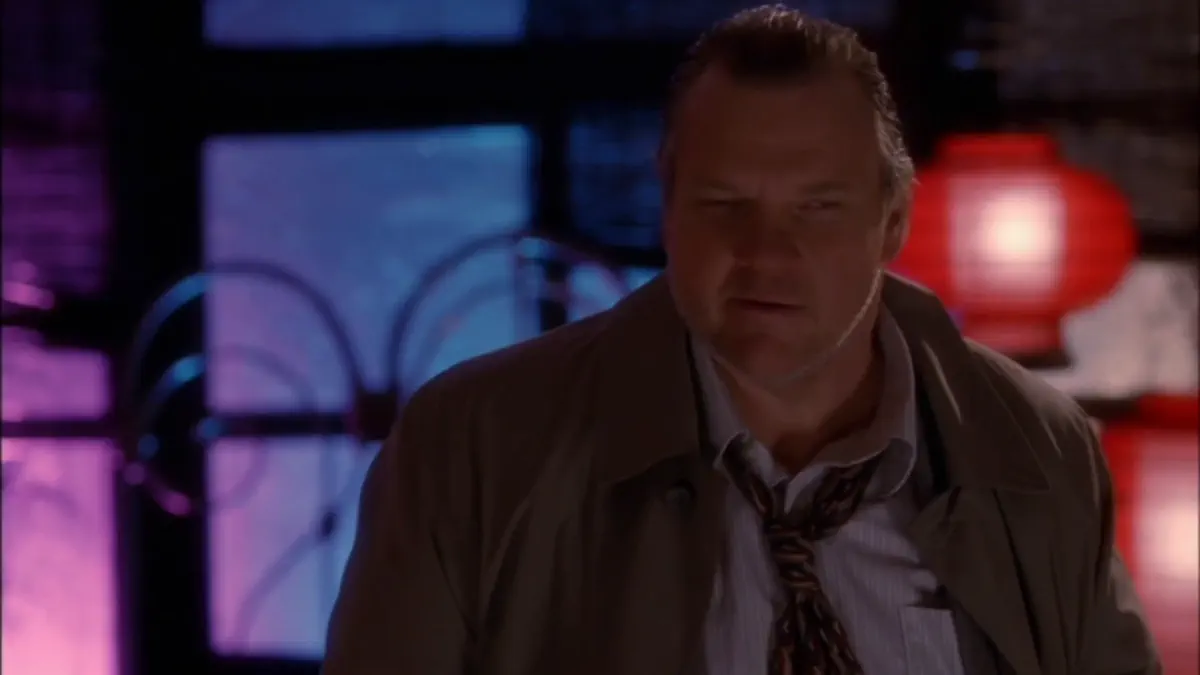
The Apple-supplied image places Jake’s face and upper body against a softened field of blue, violet and red. A bright red lantern sits to the right of his head. Dark window divisions give the background a firmer geometry, while his coat, open collar and loosened tie fill much of the foreground. These features can be inspected in the reproduction above.
His clothing sits unevenly against the decorative setting. The contrast suggests a person physically present in a space whose attractions do not belong to him. Read alongside the narrative, the surroundings can seem to promise a transformation that his body has not yet achieved. This is our reading of the still, not an authenticated account of a designer’s intention.
The image also resists reducing the film to an inventory of effects. Jake’s face remains the point at which a viewer searches for expectation, irritation or recognition. A spectacular object does not eliminate the need to understand the person looking at it.
The full supplied 1200 × 675 composition is retained and served locally without alteration. The published image provides the composition for this visual study.
06 / TELEVISION FREEDOM & COLLABORATIVE CRAFT
Freedom still has to be made by a crew
Argento recalls Masters of Horror as an invitation to recover a degree of ferocity he felt censorship had restricted. In the same interview he describes John Saxon initiating their reunion by telephone during casting. The series and Saxon recollections ↗ These are participant memories, not a contractual guarantee that every version circulated without alteration.
The original 2007 San Sebastián horror-festival catalogue gives the collaboration a more concrete outline. Its page 27 identifies Venne, cinematographer Attila Szalay, composer Claudio Simonetti and producers Lisa Richardson and Tom Rowe. It places Pelts in the official feature selection, out of competition, with a 58-minute duration. Original catalogue, page 27 ↗ The television episode was being presented within a cinema programme; the listing alone does not document the screening that actually took place.
Bietti’s compiled credits name Jacqueline Cambas as editor. Compiled department record ↗ The distinction matters because making an effect involves more than building a prop: performance, framing, the transition between elements and the timing of a reveal all determine what a viewer perceives.
The historical Anchor Bay listing preserves a direct route into that work: All Sewn Up: Mastering the Effects Sequence, Fleshing It Out, storyboards, Venne’s commentary and a DVD-ROM screenplay. Publisher’s supplement inventory ↗ These are identified research objects.
07 / SIMONETTI & THE SOUND OF ANTHOLOGY HORROR
The familiar composer does not imply a familiar method
In the September 2009 portion of OndaRock’s Simonetti interview, the composer describes his orchestral work on Mother of Tears as an experience begun with Jenifer and Pelts. Simonetti’s account of the orchestral direction ↗ It gives the television scores a place in his changing practice rather than treating them as automatic repetitions of Goblin.
The scope of the statement matters. The surrounding answer discusses the later feature’s orchestra, choir and recording process. Those details cannot simply be copied into a personnel or session history for Pelts. The interview supplies a direction of travel, not a complete cue sheet.
Music also participates in the episode’s central ambiguity. A beautiful object needs to attract attention before it can frighten; an accompaniment could sustain the attraction, expose its danger or move between the two. Which role a passage actually performs depends on its placement against voices, effects and the image. Composer identity alone cannot settle that question.
The release records offer named tracks for a later comparison: Apple lists English audio with AAC and Dolby 5.1, while Jane documents English Dolby Digital 2.0 and 5.1 options on the US DVD. Platform audio record ↗ Reviewed disc options ↗
08 / SPECTACLE, CHARACTER & CRITICAL EXPECTATIONS
The disagreement is about what the excess achieves
Ian Jane’s February 2007 review recommends the episode while finding its story underdeveloped. He values the cast and pace but thinks the impact rests too heavily on its effects. Mike Phalin’s review from the same month is much more enthusiastic, reading its bodily spectacle through lust and greed. Jane’s qualified recommendation ↗ Phalin’s enthusiastic reading ↗
The disagreement is more interesting than a ranking of how much gore each reviewer tolerates. One asks whether the story leaves enough behind once the shock has passed; the other treats the shock as an expression of the characters’ priorities. The same excess can register as a substitute for development or as the form the argument takes.
Matteo Marescalco’s later Bietti essay places Pelts in a folk-horror conflict between wilderness and civilisation, alongside the bodily extremity of mid-2000s horror. The retrospective critical frame ↗ That account broadens the context without proving a direct influence or converting a critical category into a production fact.
Together, these readings let us ask what standard is being applied: an Argento career benchmark, an anthology’s compact shock, a coherent ethical fable or a display of collaborative craft. They are selected positions, not a representative audience survey or a settled reception history.
09 / BROADCAST, FESTIVAL & DISC PRESENTATIONS
Different records do not yet establish different cuts
Apple’s Canadian record dates the episode to 1 December 2006 and lists 54 minutes. San Sebastián’s 2007 catalogue lists 58 minutes, as does Bietti’s compiled record. Credits, rounding, playback rate and genuinely different material require identified copies before any conclusion can be drawn.
| Record | Presentation | What it establishes |
|---|---|---|
| Apple TV Canada | 54 minutes | Season 2, episode 6; 1 December 2006 date; English CC. Listing ↗ |
| San Sebastián / 2007 | 58 minutes | Official selection, out of competition. Catalogue ↗ |
| US Anchor Bay / 2007 | 1.78:1 DVD | 13 February release; English 2.0 and 5.1 documented by the reviewer. Review ↗ |
| UK Series 2 Volume 1 | Region 2 PAL set | STZ1030; 15 October 2007. Its 392-minute listing is for the set. Publisher record ↗ |
The UK set’s total must not become an episode duration. Likewise, an “unrated” US disc label is not by itself a comparison with a broadcast master. A precise edition history needs the material, not just the sales vocabulary.
The Anchor Bay page is retained as a historical catalogue record, not a statement of present availability. Its supplement inventory is corroborated by the contemporary reviews.
FOLLOW THE CONNECTIONS
Another way in.
Read across films, then return
to the evidence for each one.
Jenifer
Compare two short-form stories in which desire undermines a character’s account of his own actions.
Read the dossier →RELATED DOSSIERTenebrae
Follow John Saxon’s place in Argento’s acting ensemble, then test the differences between the roles.
Read the dossier →THE MATERIAL AFTERLIFEShop & objects
Explore the wider Argento catalogue of prints, theatrical paper and physical media.
Browse the catalogue →THE READING ROOM
Return to the source.
Sources checked 17 October 2026. Participant accounts, criticism, bibliography, the original festival catalogue and edition records retain their different evidential roles.
- 01
Apple TV Canada — Pelts ↗
Episode date, 54-minute record, language/caption information and supplied image. No playback or mix comparison.
Return to the dossier ↑ - 02
Chris Chiarella — Meat Loaf, Sound & Vision, 2007 ↗
Pelts answers read through web: approach to Jake, recruitment and working relationship. Page says first published 18 May 2007 and displays 18 June.
Return to the dossier ↑ - 03
Blake — Dario Argento interview, ScreenAnarchy, 2 August 2007 ↗
Pelts answers read: the proposed anti-fur message, series freedom and Saxon’s return. Earlier Brussels encounter.
Return to the dossier ↑ - 04
The Encyclopedia of Science Fiction — F. Paul Wilson bibliography ↗
Selected bibliography entry for the 1990 Footsteps Press Pelts.
Return to the dossier ↑ - 05
Kirkus — The Barrens and Others, 1998 ↗
Contemporary review identifies the one-act Pelts adaptation.
Return to the dossier ↑ - 06
San Sebastián horror festival — 2007 catalogue, p. 27 ↗
Original page rendered and visually inspected: credits, 58 minutes, official selection out of competition. Programme evidence, not independent proof of a completed screening.
Return to the dossier ↑ - 07
OndaRock — Claudio Simonetti interview, September 2009 passage ↗
Relevant orchestral-direction answer. The page contains material from different periods; the cited passage is marked September 2009. No direct listening or session-file inspection.
Return to the dossier ↑ - 08
Ian Jane — DVD Talk, 10 February 2007 ↗
Narrative and critical account, US disc specifications and supplement inventory.
Return to the dossier ↑ - 09
Mike Phalin — Dread Central, 5 February 2007 ↗
Narrative, critical response and supplement discussion.
Return to the dossier ↑ - 10
Matteo Marescalco — Masters of Horror, Bietti, 15/2022 ↗
Pelts critical passage and compiled credits.
Return to the dossier ↑ - 11
Anchor Bay — Masters of Horror: Series 2 Volume 1 ↗
Historical catalogue text read: STZ1030, Region 2 PAL, 15 October 2007 and named Pelts extras. The 392 minutes describe the set. Page includes unrelated current material; no present stock or commercial endorsement.
Return to the dossier ↑
KEEP EXPLORING
One film opens another.
Explore the films and collaborators → · Visit the Reading Room → · Find a piece for your collection →