THE FILM DOSSIERS / 019 · FILM DOSSIER
Do You Like Hitchcock?Knowing the films can mislead you.
A borrowed thriller. A neighbour’s window. A film student discovers how easily recognition can become suspicion.
Cinephilia & inference
Do You Like Hitchcock? makes a film lover’s knowledge part of the mystery. This expanded dossier follows Giulio’s borrowed plots, Arianna, Turin’s sightlines, the inspected close-up, the television pilot, Donaggio’s musical memories and the film’s passage through festivals, disc and broadcast.
Spoilers: this study discusses the film’s story and ending.
01 / THE VIDEO SHOP & THE BORROWED PLOT
A familiar story becomes a theory of murder
Giulio does not begin with a crime scene. He begins with other people choosing a film. Cinematografo’s synopsis places Sasha and Federica in a video shop, selecting Strangers on a Train. After Sasha’s mother is murdered, the student suspects an arrangement in which one woman kills for the other. A cultural object becomes the bridge between an observed meeting and an explanation of a death. The video-shop encounter ↗
The shop gives cinephilia a material setting. A film can be borrowed, discussed and taken home. Giulio sees a transaction whose outward details are available to him, while its private significance remains uncertain. His familiarity with the title supplies the missing connection. Recognition feels like discovery because it turns disconnected events into a story he already knows how to follow.
That is both the pleasure and the danger of the premise. Knowledge of a thriller can suggest a useful hypothesis, but a hypothesis needs evidence beyond resemblance. The distinction is especially important when an observer is already attracted to the people he watches. An explanation can satisfy curiosity without yet justifying the intrusion that produced it.
Argento and Franco Ferrini share the writing credit in Filmitalia’s record. Their construction makes a film title function inside the investigation, rather than leaving it as a reference only the audience can recognise. The question is what Giulio does with that recognition: whom he follows, what he overlooks and how quickly he treats an interpretation as a fact. Writing credits ↗
The borrowing is therefore more than a game of naming Hitchcock films. A useful comparison asks what job a reference performs. Here, the rented title gives an amateur detective a model of hidden cooperation. Whether he has correctly identified the participants and their motives is a separate problem.
02 / GIULIO, ARIANNA & THE LIMITS OF LOOKING
The observer can become the person at risk
Elio Germano plays Giulio, with Cristina Brondo as Arianna, Elisabetta Rocchetti as Sasha and Chiara Conti as Federica. Cinematografo describes Giulio following Federica, injuring his leg and becoming confined at home. The change makes his investigative position bodily: he can no longer move as freely through the world he has been trying to interpret. Characters and the injured observer ↗
The window is a useful dividing line. It offers a view while keeping the observer at a distance. Moving beyond it promises more information, but also removes the protection of remaining unseen. When movement is restricted, looking becomes available again as a substitute for action, even as that limitation makes the watcher vulnerable.
Felix Gonzalez Jr.’s 2006 review describes Arianna’s frustration with Giulio’s fixation and the turn toward a threat against him. This is an account of the film’s dramatic relationships, not testimony from the performers. It establishes why the investigation is also a problem within a couple: attention directed outward can become neglect of the person already present. Arianna and Giulio in the DVD review ↗
Arianna’s resistance matters even if an individual suspicion eventually proves useful. Being correct about a clue does not automatically make every act of watching justified. The film’s premise permits those judgments to diverge. Giulio can discover something real while still misjudging what his knowledge entitles him to do.
FLC calls him a reluctant voyeur; Mark R. Hasan’s release-period review instead stresses a persistent habit, extending from a childhood opening to a renewed look at the end. Their different descriptions suggest competing ways of understanding his agency. One presents a person drawn into a mystery; the other sees a pattern that the mystery gives another occasion to repeat. The exact performance and final look remain for a focused sequence comparison. Retrospective characterisation ↗ The repeated act of looking ↗
03 / TURIN, WINDOWS & COLLABORATIVE SPACE
A city becomes a set of sightlines
The Piemonte cinema encyclopedia identifies Turin as the production’s location and Lumiq Studios for interiors. It also preserves Argento’s account of imagining specific places while writing. The record supports a relation between story development and local space, while leaving individual scene-to-location matches to be established. Location record and reproduced testimony ↗
A story about neighbours depends on more than a picturesque address. The distance between windows determines what can plausibly be seen. Doorways and stairs provide routes between public and private space. A courtyard can connect inhabitants visually without bringing them together socially. These relationships are the architecture of the premise: they determine the difference between proximity and access.
Filmitalia credits Frederic Fasano for photography, Walter Fasano for editing, and Francesca Bocca and Valentina Ferroni for production design. Keeping their roles distinct helps explain how a convincing spatial relation may be constructed. A designed interior, a photographed exterior and the cut joining them can each contribute to a view that appears continuous. Photography, editing and design ↗
The useful question is consequently not just where a building stands. It is how the film makes one place visible from another. A verified address would settle geography; a comparison of shots would establish the spectator’s route through that geography. Neither automatically supplies the other.
Turin also offers continuity with Argento’s earlier work without requiring every street to become a quotation. Returning to a city can make its spaces available for a new kind of story. Here the film student’s everyday environment becomes a field of possible signs. The familiar neighbourhood is unsettling because another person’s ordinary movement can suddenly appear to belong to a secret plot.
04 / A FACE WITHOUT ITS REVERSE SHOT
A close-up can withhold as much as it reveals
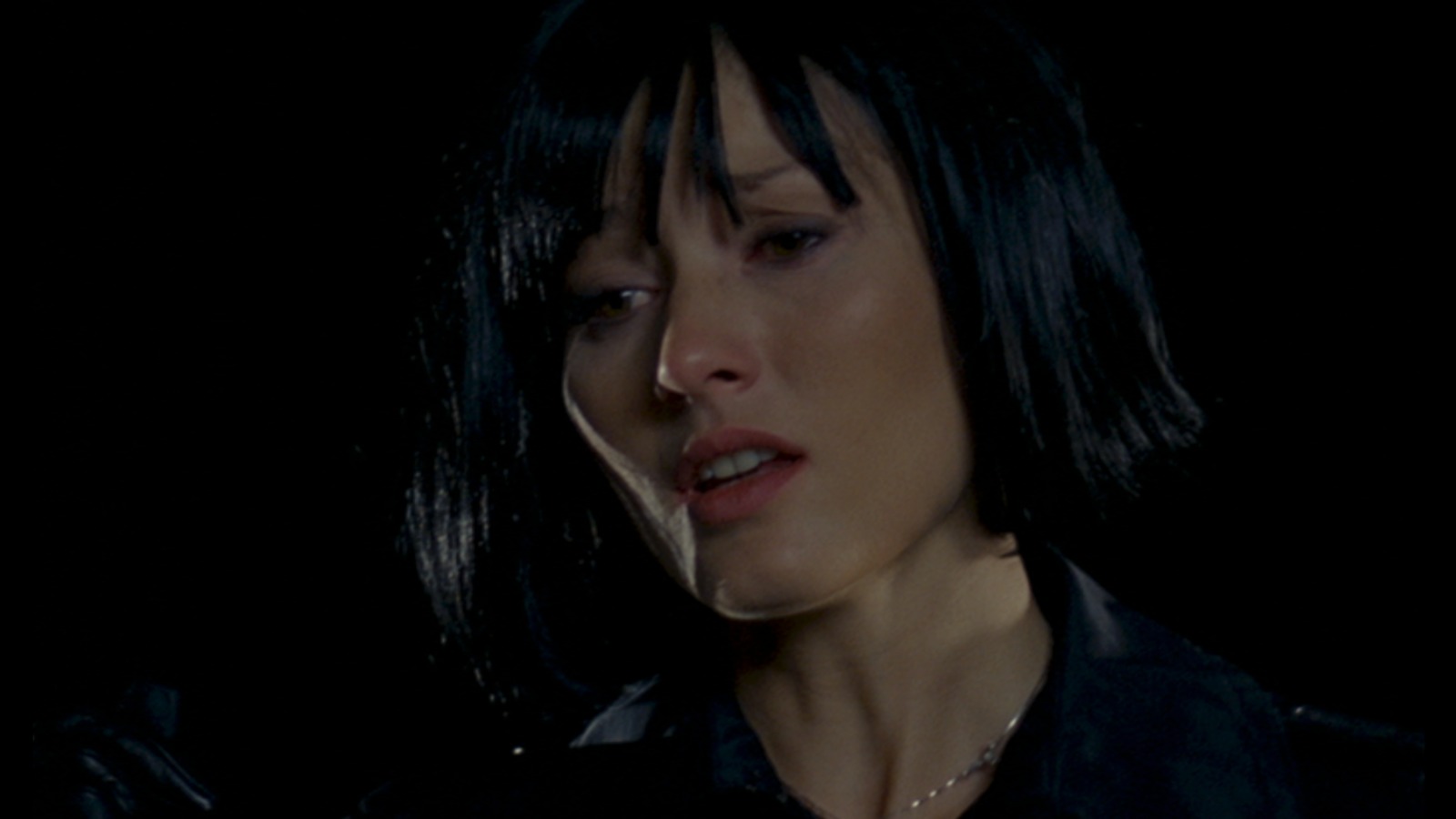
The FLC reproduction isolates a dark-haired woman against a nearly black background. Her bob forms a border around a face angled downward and toward the side. Her mouth is slightly open; a fine necklace crosses the lower part of the image. The full supplied 1600 × 900 composition is retained here. Inspected programme image ↗
The photograph supplies proximity without supplying the encounter. We can see details of the face and clothing, but not the person or object toward which the look is directed. The absence matters: a reverse shot could turn the same visible expression into a response to something reassuring, threatening or merely unexpected.
For a film concerned with interpretation, this is a useful small demonstration. More visible detail does not necessarily produce more reliable knowledge. The viewer may feel close enough to identify an emotion while still lacking the relation that would make that identification persuasive. The dark surroundings intensify the concentration on the face while withholding environmental explanation.
Hair, costume and the direction of the gaze also tempt us to treat appearance as a classification. A film enthusiast may recognise a familiar type before learning what a person has done. That movement resembles Giulio’s use of a remembered plot: recognition arrives quickly, while verification requires another view.
This image study concerns the reproduction itself.
05 / THE PILOT & ITS UNMADE CONTINUATION
Television was the starting condition
In Tgcom24’s 26 November 2004 report, Argento says he has just completed the edit. He describes a series conceived around different forms of fear, with comedy alongside tragedy, and this story chosen as its pilot. His comments place the film inside a proposed programme of work rather than treating its television identity as an explanation invented after release. Argento on the pilot ↗
His stated ambition was to bring cinematic movement and construction to the television project. It does, however, change the question posed to the finished work. A television commission can become an occasion to test how suspense, humour and visual storytelling operate in a domestic viewing setting.
The scale of the planned series is less settled. Argento’s 2013 Panorama interview remembers seven television films; the Piemonte encyclopedia describes six. Both accounts agree that the continuation was not made. The later recollection ↗ The catalogue account ↗
A pilot can be read in two ways at once: as a complete story and as evidence of a possible larger project. The unmade continuation affects production history, but it need not turn this film into an incomplete narrative. Nor does the absence of later entries explain the cause of the project’s closure without commissioning or correspondence records.
There is now a concrete route to those records. Filmoteca de Catalunya’s ICC finding aid lists scripts and correspondence at LL63_B38, a script and pressbook at LL63_B73, and shooting paperwork, scripts and correspondence at LL63_B61. The catalogue pages have been checked; the underlying files have not. Finding aid, pp. 12–13 ↗
06 / DONAGGIO, HERRMANN & MUSICAL VARIETY
Homage leaves room for swing
Pino Donaggio described the score to Movieplayer in 2017 as a tribute to Bernard Herrmann. That first-person statement is stronger evidence of intention than a resemblance inferred from a familiar orchestral sound. It also lets us discuss the homage without pretending to have identified quotations or matched individual cues. Donaggio on the Herrmann tribute ↗
His separate Quinlan interview adds a less obvious detail: he remembers writing a swing piece by adapting the sort of music played by his father’s small orchestra. He also recalls strong percussion for a bath scene. These memories give the score a range that the phrase Hitchcock homage alone would obscure. Swing and the bath-scene recollection ↗
The combination suggests that musical recognition can work at different levels. An audience may associate a broad language of suspense with Hitchcock and Herrmann, while another passage draws on Donaggio’s own musical past. Homage need not require uniform imitation. A film built around borrowed stories can also make room for contrasting rhythms and kinds of pleasure.
Donaggio describes Argento more generally as a director who moves among musical ideas rather than keeping to one continuous style. That is a collaborator’s account of working tendencies, not a cue-by-cue description of this film. Its value here is to keep variety in view when considering how comedy, desire and threat might be differentiated. Working with Argento ↗
An identified edition would allow comparison of the prologue, the recalled swing passage and the bath sequence, with album or cue documentation used to establish names and placements. The published testimony already supports the account of intention and collaboration. Exact instrumentation, synchronisation and the balance between score and effects remain unclaimed.
07 / PLAYFUL THRILLER OR BORROWED EFFECT?
Recognition is only the beginning of the judgment
Gonzalez’s August 2006 DVD review welcomes the combination of suspense and humour, while also criticising the disc’s presentation. Hasan’s review likewise finds pleasure in Argento’s lighter mode and the return of voyeuristic patterns. These are identifiable responses from the home-video release context, not a representative measure of every audience. Gonzalez’s assessment ↗ Hasan’s assessment ↗
The Piemonte encyclopedia preserves a more divided critical record. A passage from the fiction study edited by Milly Buonanno praises the staging while finding the characters and narrative construction weak. That judgment allows a distinction the simpler term homage can conceal: a scene may be visually effective even when the story connecting it to the next scene feels fragile. Reproduced critical discussion ↗
For this particular film, the distinction has an extra twist. Giulio’s knowledge makes him eager to recognise a pattern; the audience is invited to do something similar. Spotting a reference may be pleasurable even when it does not explain the film’s dramatic work. A critical reading should ask how a borrowed situation changes when it belongs to this student, these relationships and this city.
The title addresses the viewer directly. Liking Hitchcock can be the invitation into the film, but it is not a final verdict on Argento’s use of him. A viewer might enjoy the references while questioning the investigation’s coherence, or find a familiar construction newly unsettling because of the person placed inside it.
That leaves a productive standard for the later comparison: identify a specific borrowing, explain what it does in its new context and test whether its consequences are sustained. A list of recognised titles is a starting resource. The film’s achievement depends on what happens after recognition.
08 / FESTIVAL, DVD & THE TELEVISION SCHEDULE
The date depends on which encounter you mean
Filmitalia records the film in 2005 and lists that year’s Brussels festival appearance. The August 2006 Anchor Bay reviews establish an international home-video context. The inspected 24 August 2007 issue of l’Unità then lists Ti piace Hitchcock? in the evening schedule for Rai Due. These are different encounters with the work, not interchangeable release dates. Year and festival record ↗ The 2006 disc review ↗ Contemporary television listing, p. 20 ↗
The newspaper is direct evidence of the announced schedule, rather than an off-air recording or transmission log. The Piemonte encyclopedia independently records the same broadcast date. Taken together, the sources clarify the later television context without requiring us to call 2007 the film’s production year. Broadcast record ↗
| Record | Duration | Format or framing |
|---|---|---|
| Filmitalia | 95 minutes | Digi Beta PAL; 16:9. Record ↗ |
| Cinematografo | 95 minutes | TV film; 16:9 digital-video listing. Record ↗ |
| Anchor Bay / Hasan review | 93 minutes | Region 1 NTSC; 1.66:1; English Dolby 2.0. Reviewed edition ↗ |
| FLC / 2022 retrospective | 93 minutes | Cinecittà 2K restoration; Italian and Spanish with English subtitles. Programme ↗ |
Gonzalez reports softness and ghosting on the Anchor Bay disc, attributing the latter to conversion. These are his observations and explanation. They should not be transferred to every copy of the film, or used to identify the master behind the image reproduced here. Transfer assessment ↗
The difference between 16:9 and 1.66:1 deserves a framing comparison, while the 93- and 95-minute figures need identified copies and playback rates. Neither discrepancy establishes a cut. The 2K restoration credit also says nothing by itself about the precise changes to picture or sound.
That will connect the documented circulation history to the actual images and sounds without turning every catalogue variation into a new version.
FOLLOW THE CONNECTIONS
Another way in.
Read across films, then return
to the evidence for each one.
The Bird with the Crystal Plumage
Return to a witness whose interpretation of what he sees becomes the central problem.
Read the dossier →RELATED DOSSIERTwo Evil Eyes
Compare the authority claimed by an image-maker with a spectator who believes he knows the plot.
Read the dossier →THE MATERIAL AFTERLIFEShop & objects
Explore the wider Argento catalogue of prints, theatrical paper and physical media.
Browse the catalogue →THE READING ROOM
Return to the source.
Sources checked 17 October 2026. Participant testimony, an inspected image, contemporary criticism, a newspaper schedule, an archive finding aid and edition records retain their different evidential roles.
- 01
Film at Lincoln Center — Do You Like Hitchcock?, 2022 ↗
Programme, pilot account, characterisation, 93-minute multilingual listing and Cinecittà 2K credit. Supplied face image; screening copy not viewed.
Return to the dossier ↑ - 02
Cinematografo — Ti piace Hitchcock? ↗
Synopsis, cast, credits, TV designation, 95 minutes and format. Published scene description, not direct viewing evidence.
Return to the dossier ↑ - 03
Cinecittà / Filmitalia — Ti piace Hitchcock? ↗
Writing and craft credits, Italy/Spain, 2005, 95-minute Digi Beta PAL/16:9 and festival record. Technical listing is not a camera report.
Return to the dossier ↑ - 04
Tgcom24 — Torno in tv nel segno di Hitchcock, 26 November 2004 ↗
Contemporary Argento comments on the completed edit, series premise and pilot selection. Development intentions, not commissioning documents.
Return to the dossier ↑ - 05
Marida Caterini — Dario Argento interview, 23 May 2013 ↗
Answer recalling seven planned television films and one completed entry. Retrospective testimony; number differs from Piemonte catalogue.
Return to the dossier ↑ - 06
Enciclopedia del cinema in Piemonte — Ti piace Hitchcock? ↗
Location, broadcast and proposed-series records; selected reproduced Argento statements and critical discussion.
Return to the dossier ↑ - 07
Filmoteca de Catalunya — Fons ICC finding aid, pp. 12–13 ↗
Relevant entries; p. 13 rendered and. LL63_B38, B73 and B61 identify research routes.
Return to the dossier ↑ - 08
Daria Pomponio — Pino Donaggio interview, 13 December 2017 ↗
Film-specific swing and bath-sequence recollections, and adjacent account of working with Argento. No claim to have heard or located the cues.
Return to the dossier ↑ - 09
Valentina D’Amico — Pino Donaggio interview, 17 December 2017 ↗
Statement identifying the Herrmann homage.
Return to the dossier ↑ - 10
Felix Gonzalez Jr. — DVD Review, 9 August 2006 ↗
Story and critical response, Anchor Bay framing, audio and transfer assessment.
Return to the dossier ↑ - 11
Mark R. Hasan — KQEK, 2006 ↗
Character-pattern reading and Anchor Bay 93-minute, 1.66:1 English-track record. Release copy and final book prop not directly.
Return to the dossier ↑ - 12
l’Unità — television listings, 24 August 2007, p. 20 ↗
Original page rendered and visually checked: title appears in Rai Due’s evening schedule. Evidence of announced programming, not a transmission log or a whole-issue reading.
Return to the dossier ↑
KEEP EXPLORING
One film opens another.
Explore the films and collaborators → · Visit the Reading Room → · Find a piece for your collection →