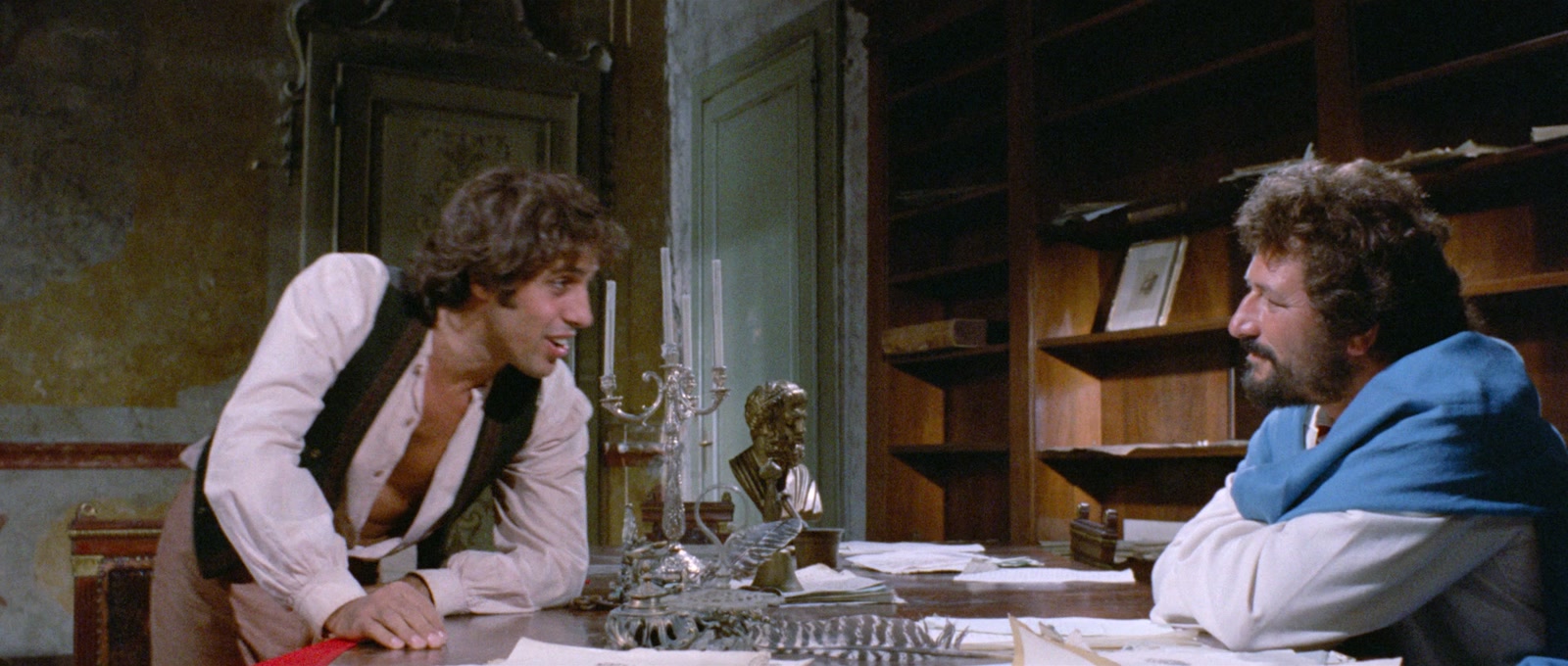
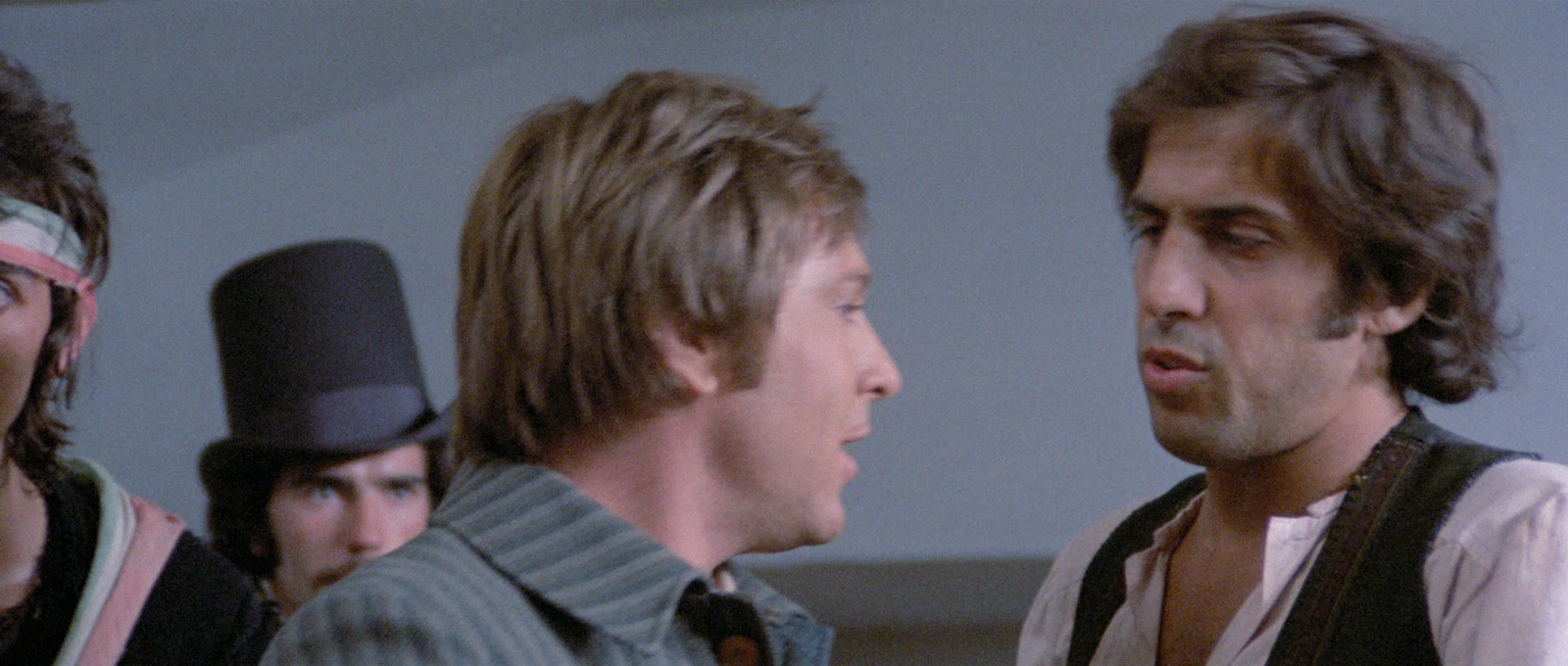
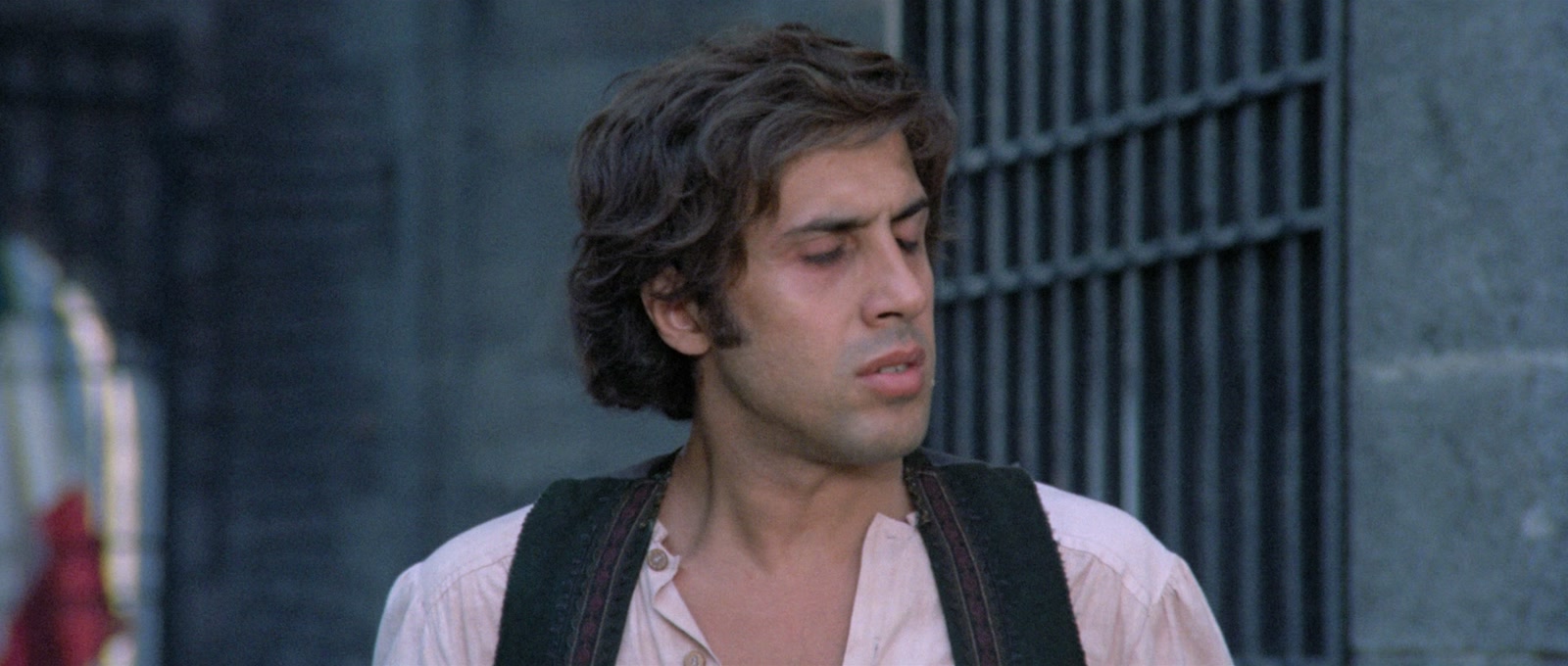
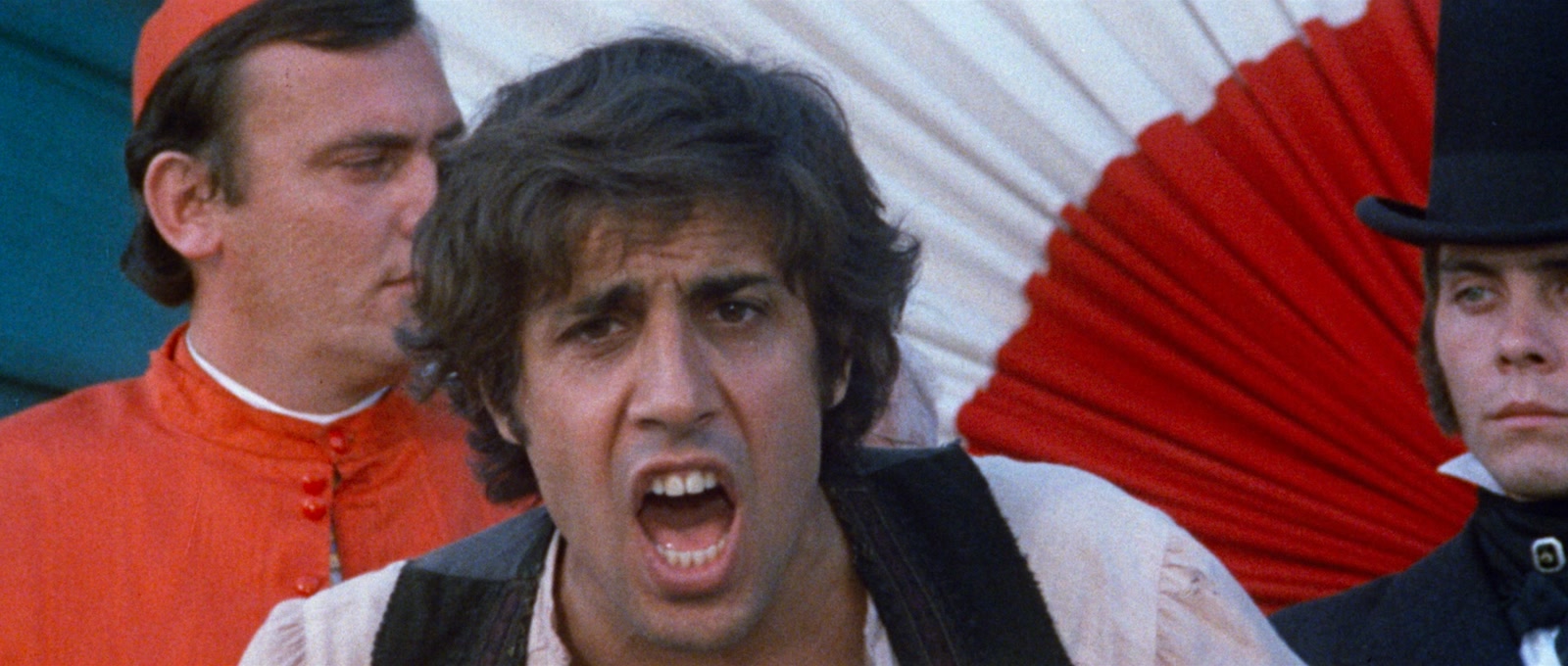
A thief and a baker inside the revolution: illustrated scene studies, physical action, dialogue, filmmaker testimony and the comedy’s unequal consequences.
Milan’s uprising reaches Cainazzo and Romolo as a succession of interruptions: a wall disappears, a workplace collapses, a meal becomes an initiation into class power. Follow the film’s movement from physical comedy to the cost of believing its public promises. These studies discuss the ending.
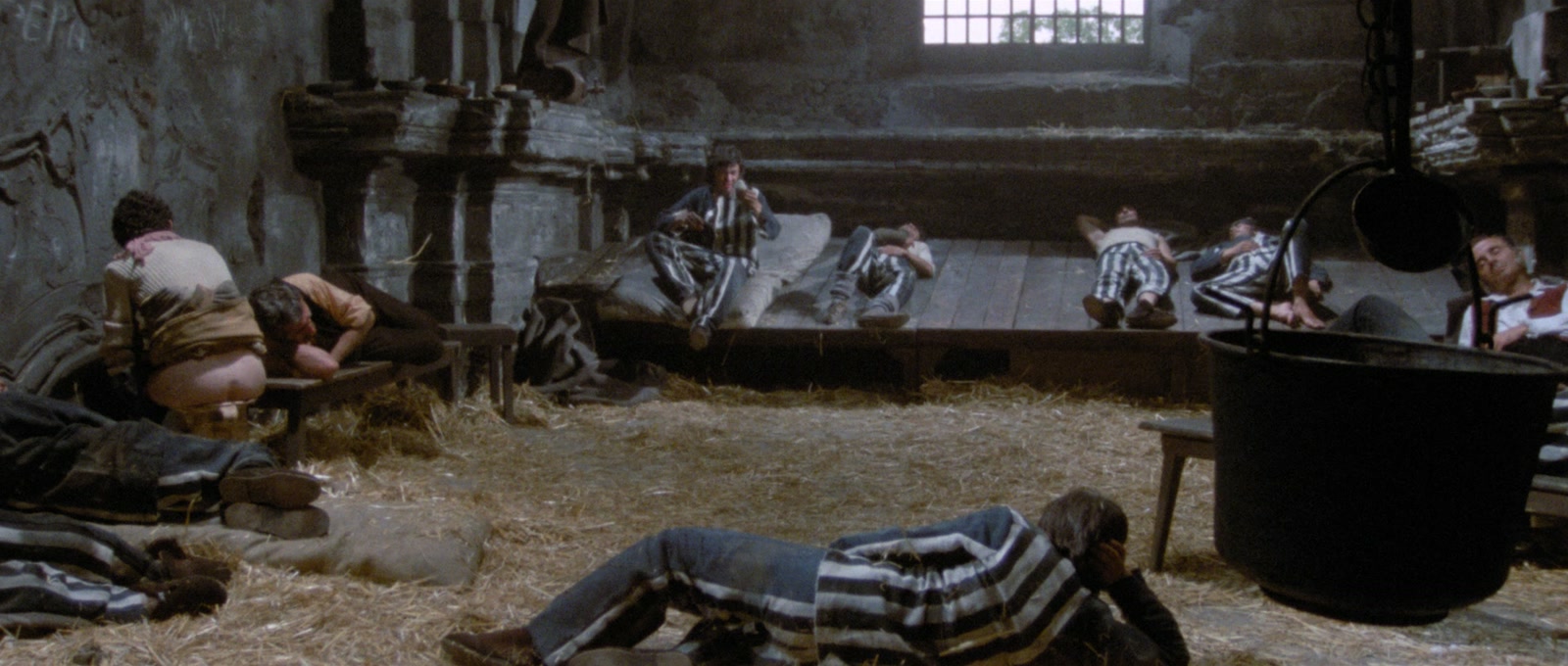
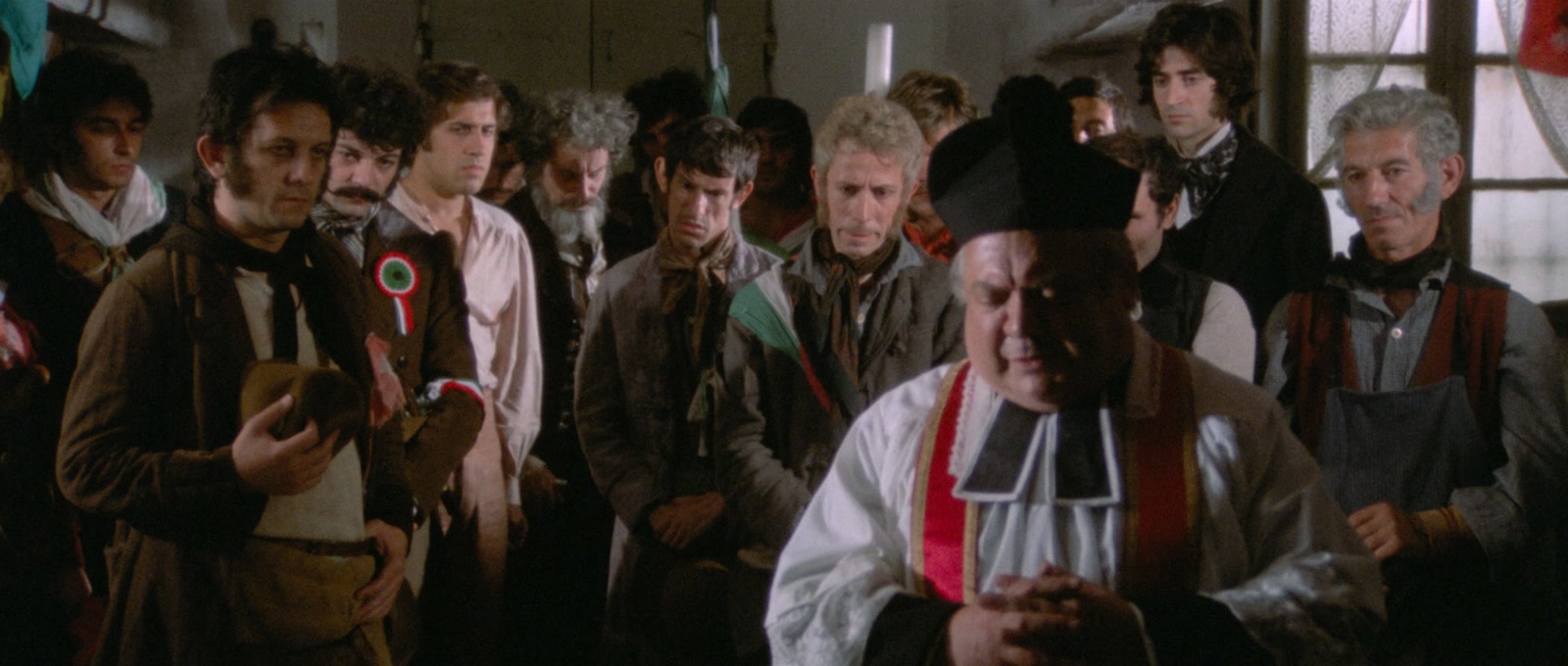
The cannon in the titles gives way to a prison divided by status. The political prisoners insist on a distinction between themselves and ordinary criminals. Cainazzo’s body remains low in the crowded cell while patriotic purpose belongs to somebody else. Before the uprising has freed anyone, its prospective beneficiaries are already policing membership.
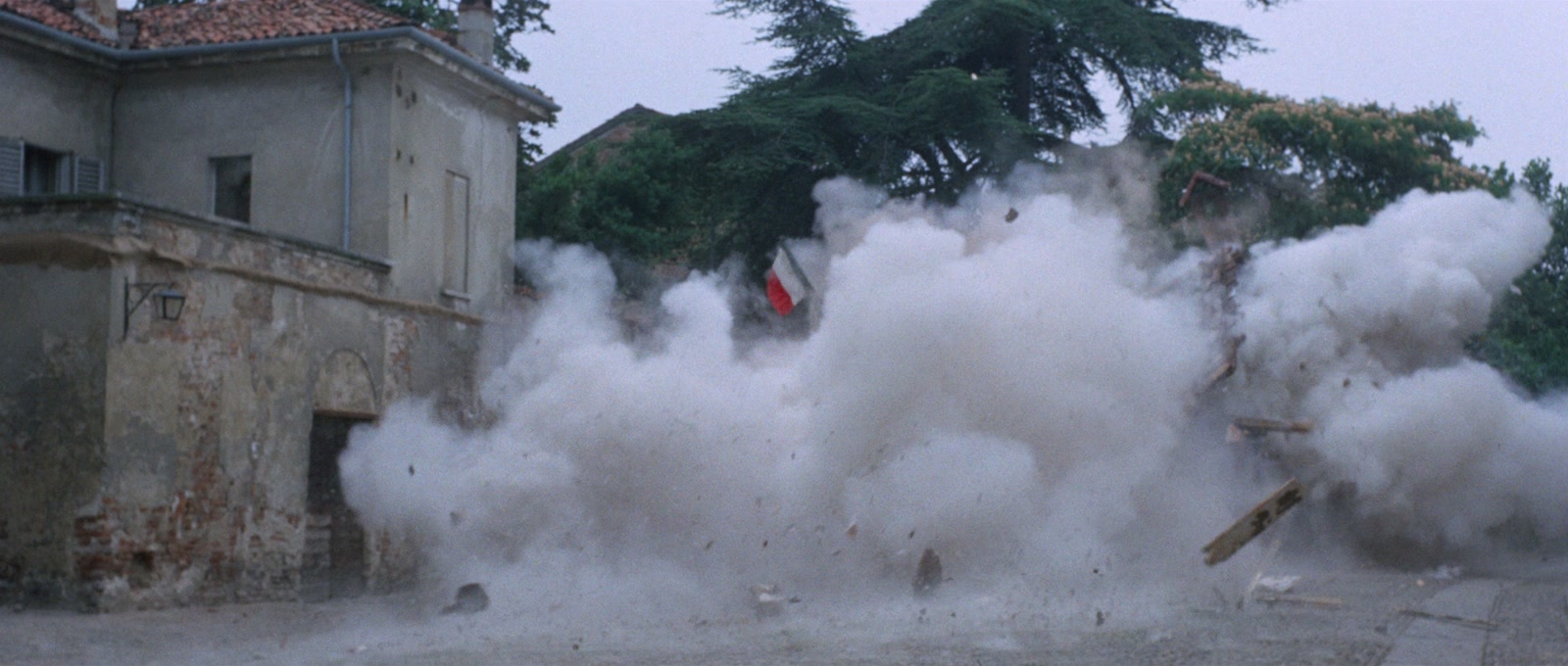
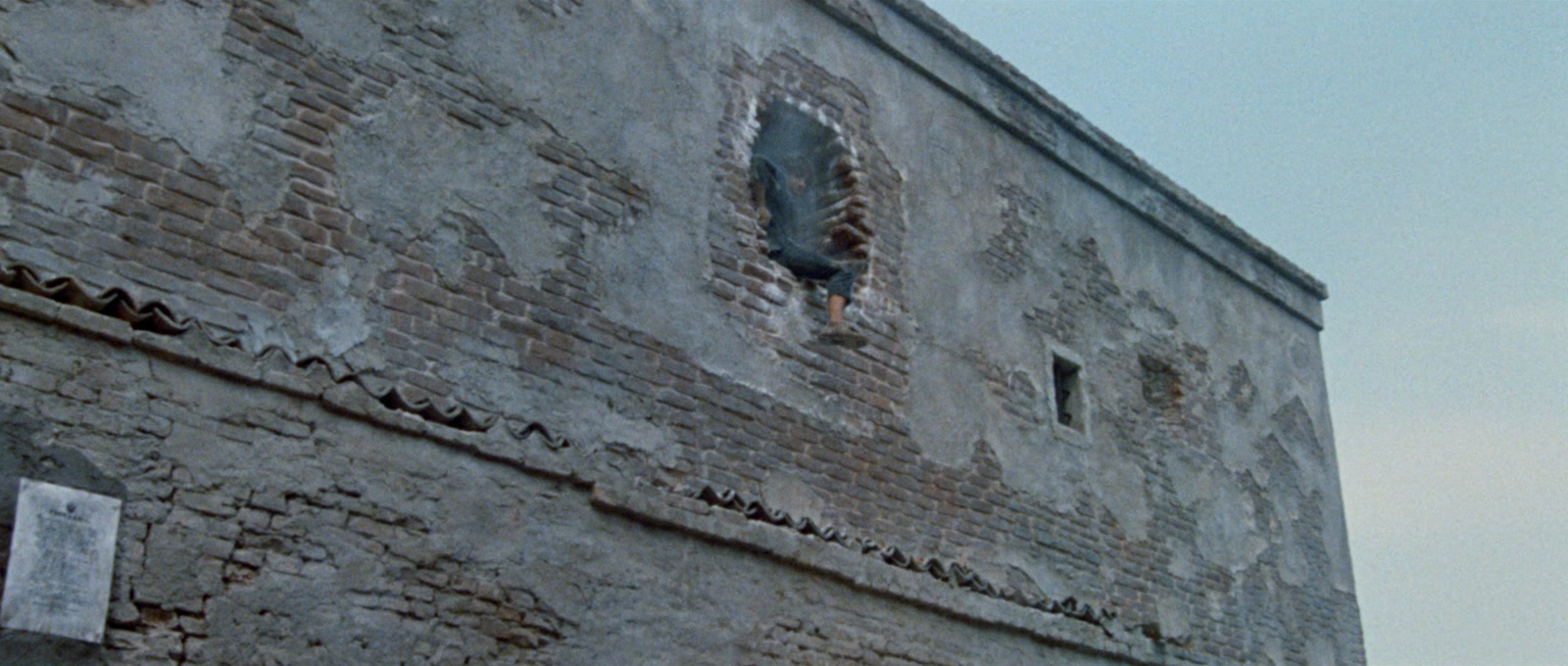
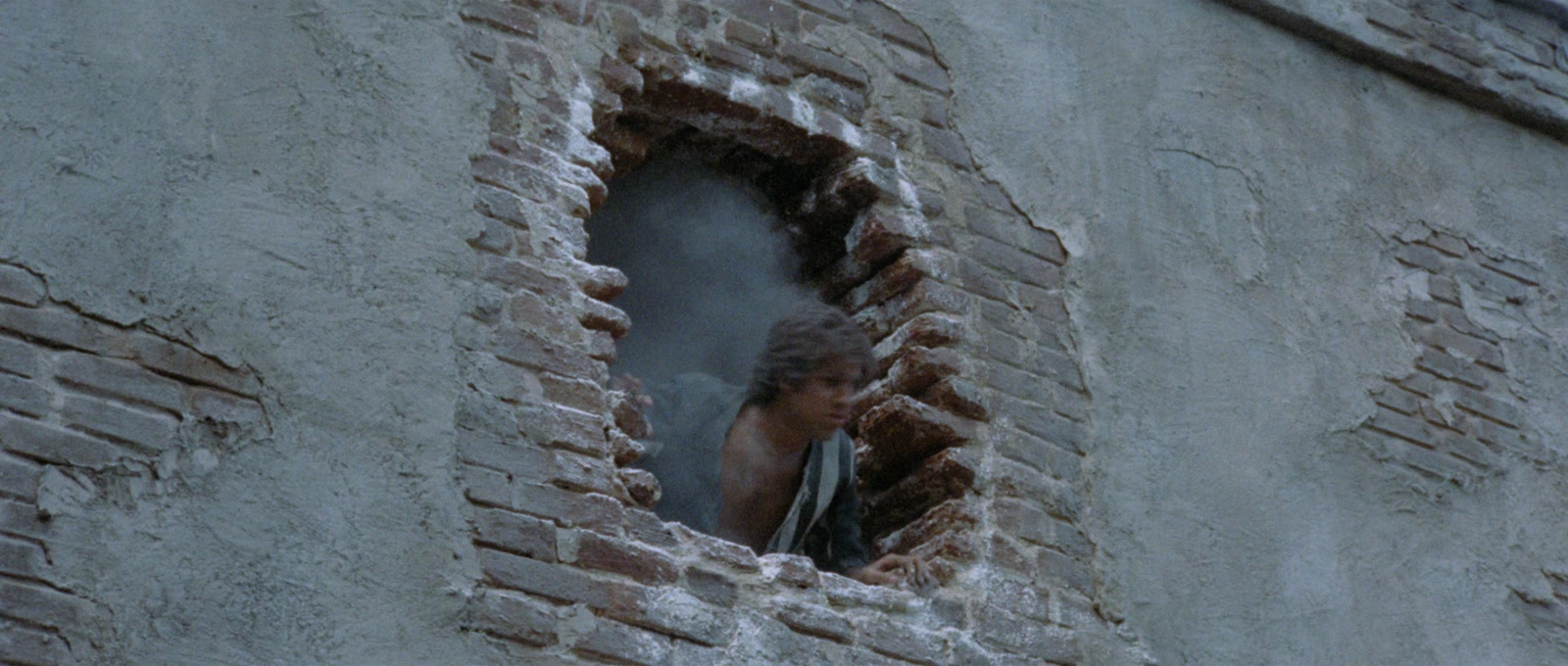
Artillery turns confinement into an opening. Smoke and rubble precede the exterior view of the hole, where escape becomes an awkward bodily task. Cainazzo has not fought his way out or adopted a programme: the war has accidentally released him. The first great historical change is experienced as a practical opportunity. Explore the impact sequence →
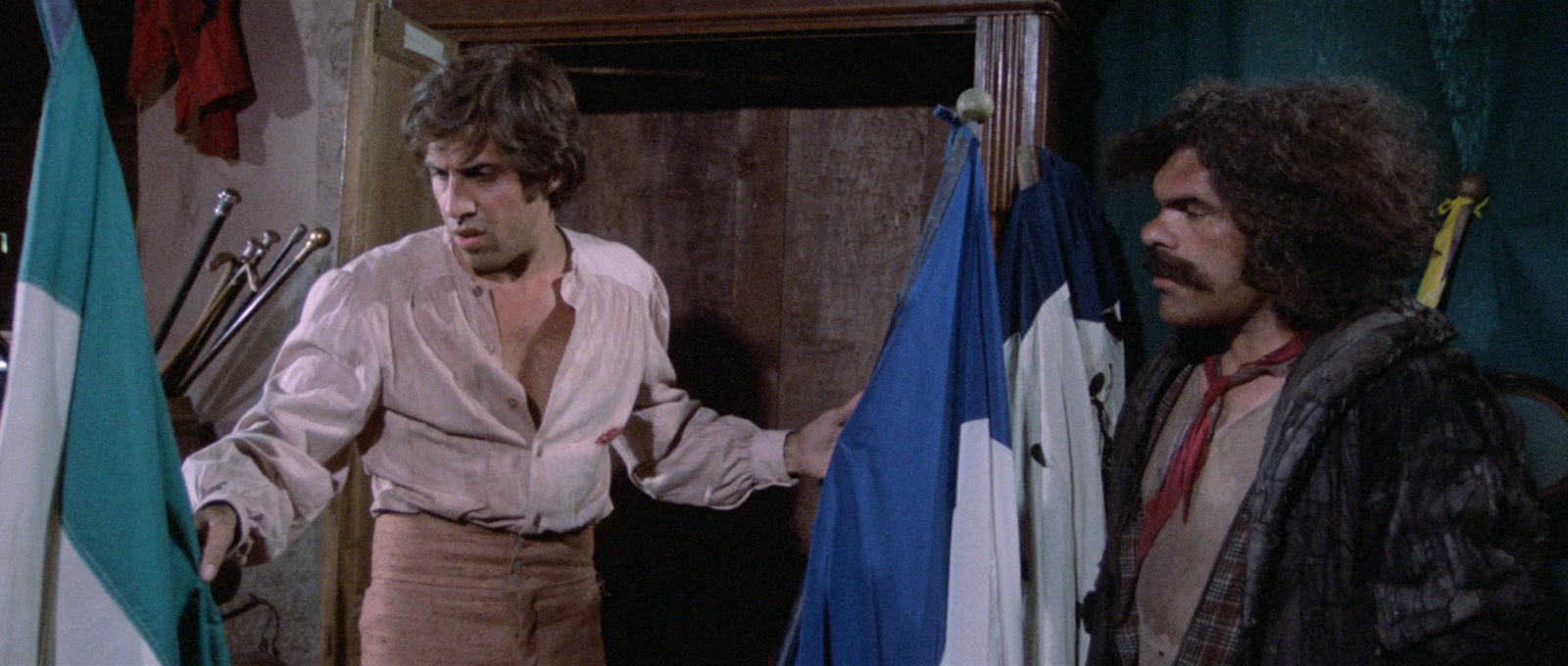
Clothes, shoes and national colours become equipment for getting through the street. Cainazzo’s search for Zampino concerns money owed to him, even when the thief has acquired a revolutionary identity. The confusion over flags makes allegiance a problem of recognition before it becomes a conviction. A changed costume can earn a welcome that a known criminal would not receive.
11:00–14:20
ENLARGE ↗A crowd forms behind the accidental flag-bearer.
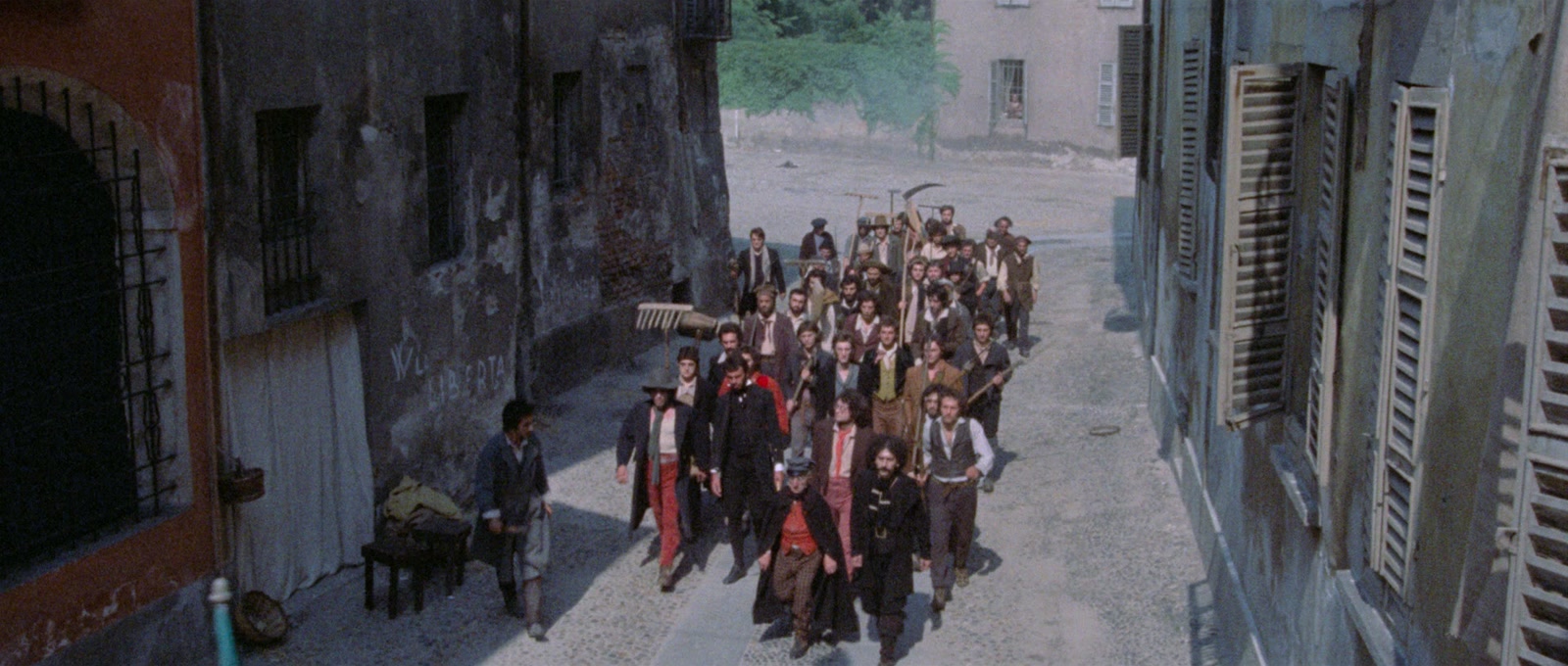
The crowd manufactures a leader.
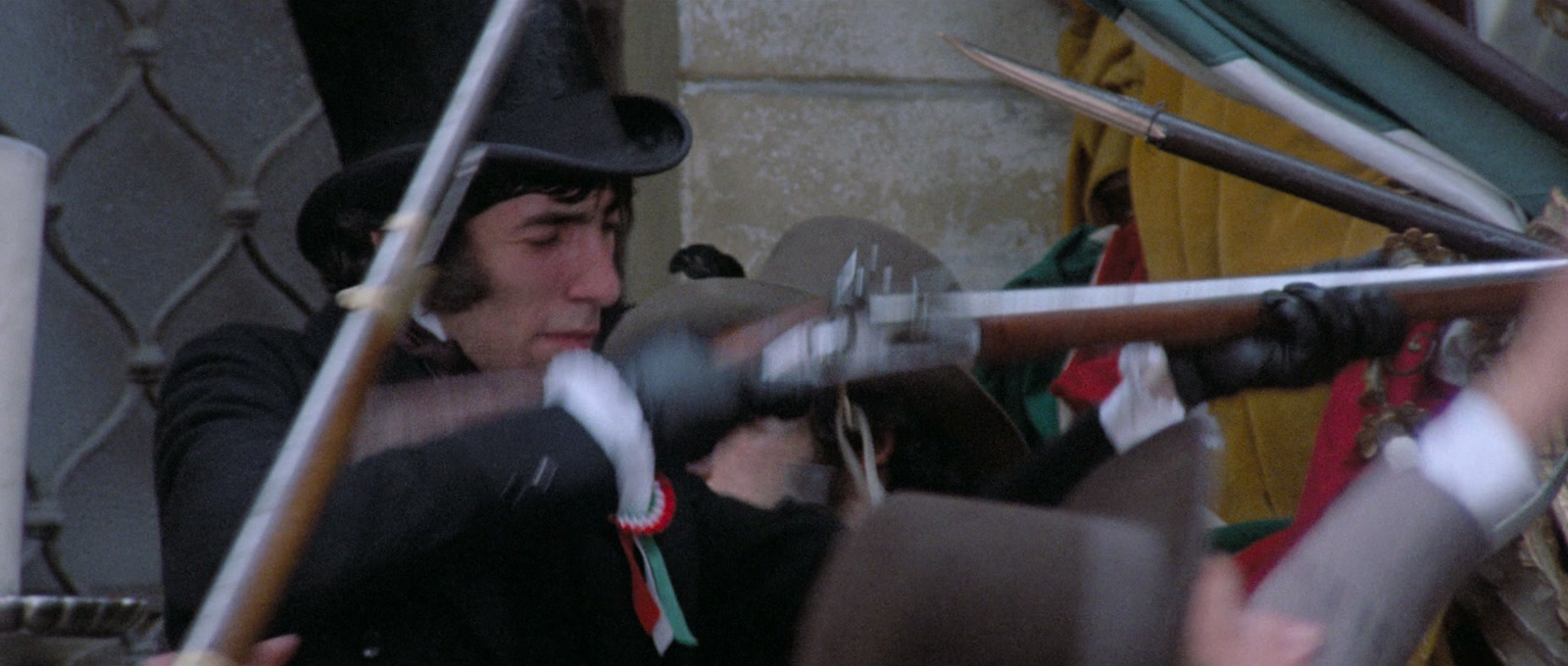
The elevated view reveals the following that Cainazzo has unintentionally collected. A man carrying a flag becomes the head of a procession because others read the image as leadership. His eventual disposal of the flag breaks the identification between public appearance and private intention. The sequence makes political authority look startlingly easy to assemble.
14:20–20:00
ENLARGE ↗The committee disputes the revolution’s future.
Everyone may speak—until someone does.
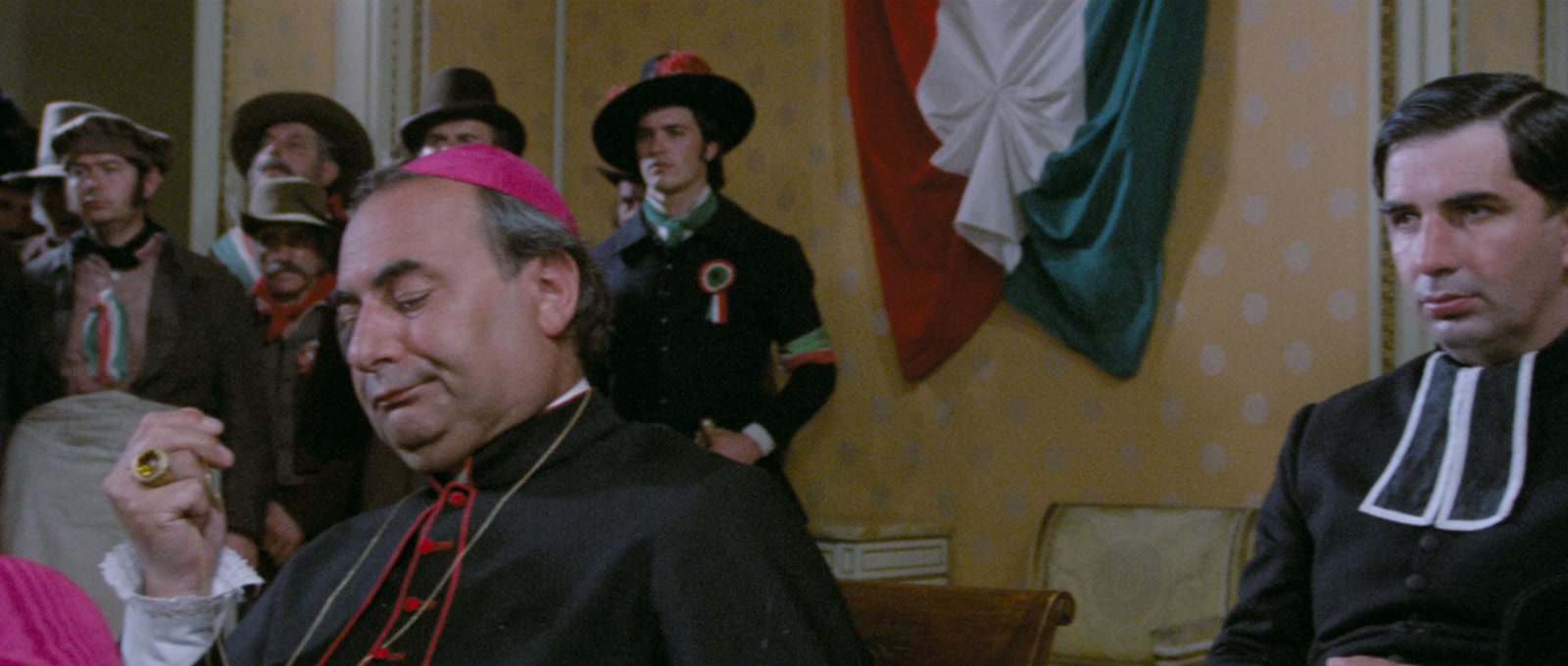
The committee brings clerical, republican and monarchist interests into the same crowded space. Grand claims about the people compete with practical questions that the speakers find inconvenient. The interruption involving the Savoy emblem gives political exchange a graphic, theatrical form. Representation is already becoming an argument about who may define everybody else’s freedom.
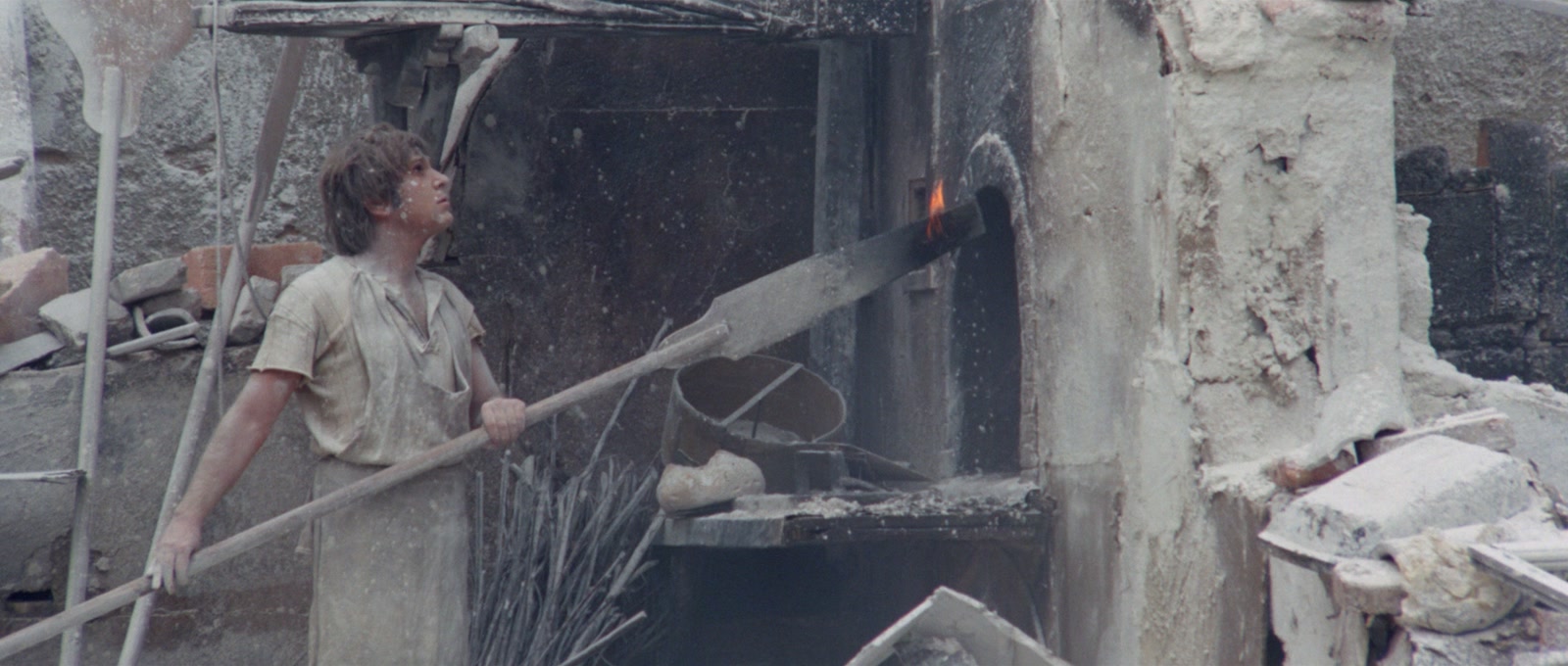
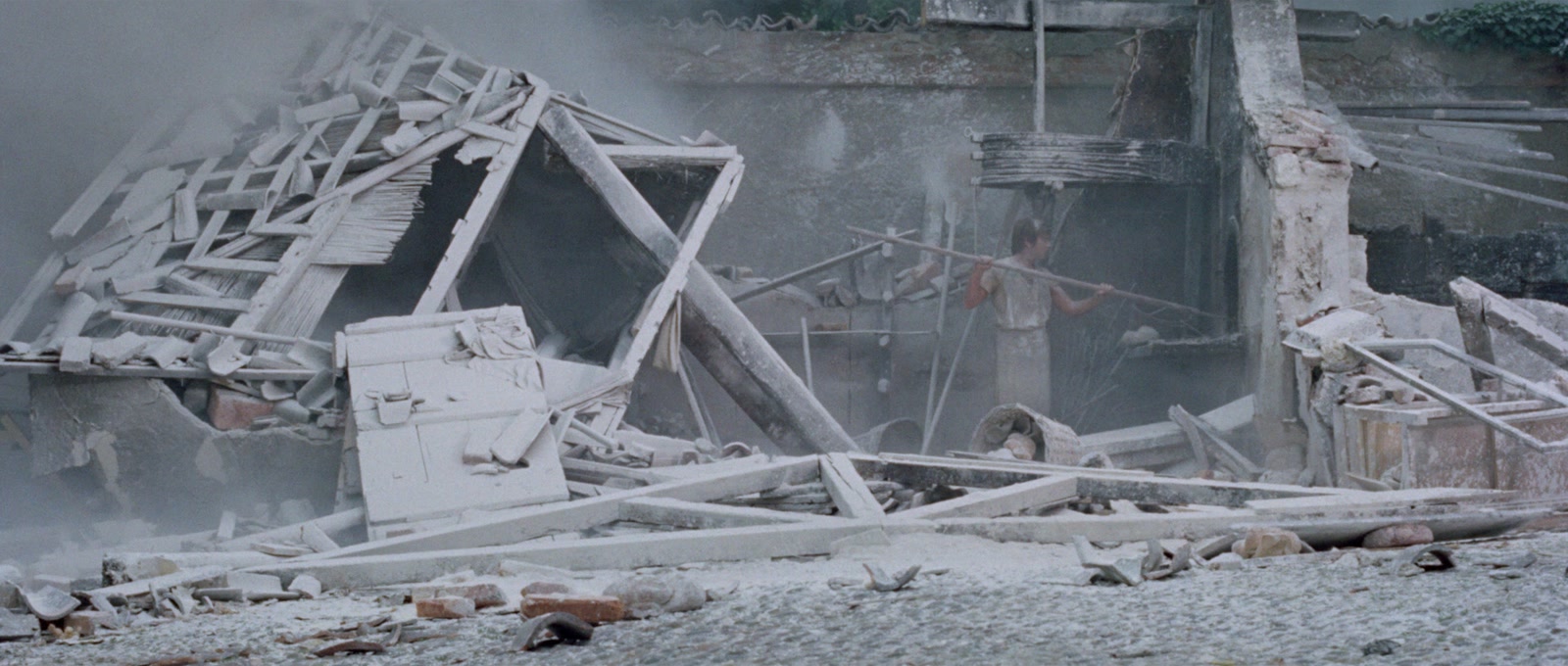
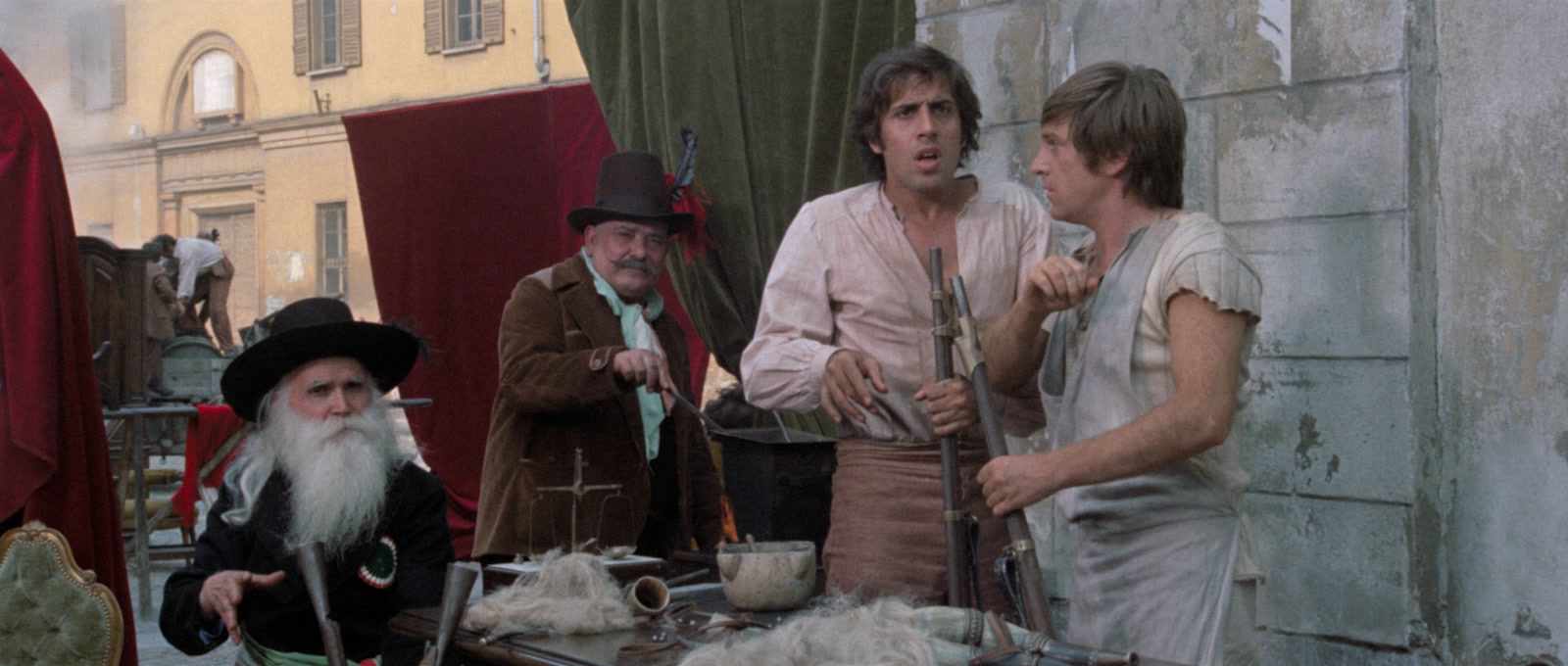
Romolo appears with the tools of a trade whose workplace has just been destroyed. His immediate history is migration for work, not a revolutionary vocation. The explosion joins two men deprived of secure places in the city. Their denials of companionship are contradicted by their continued proximity in the frame. See the bakery collapse →
24:30–27:00
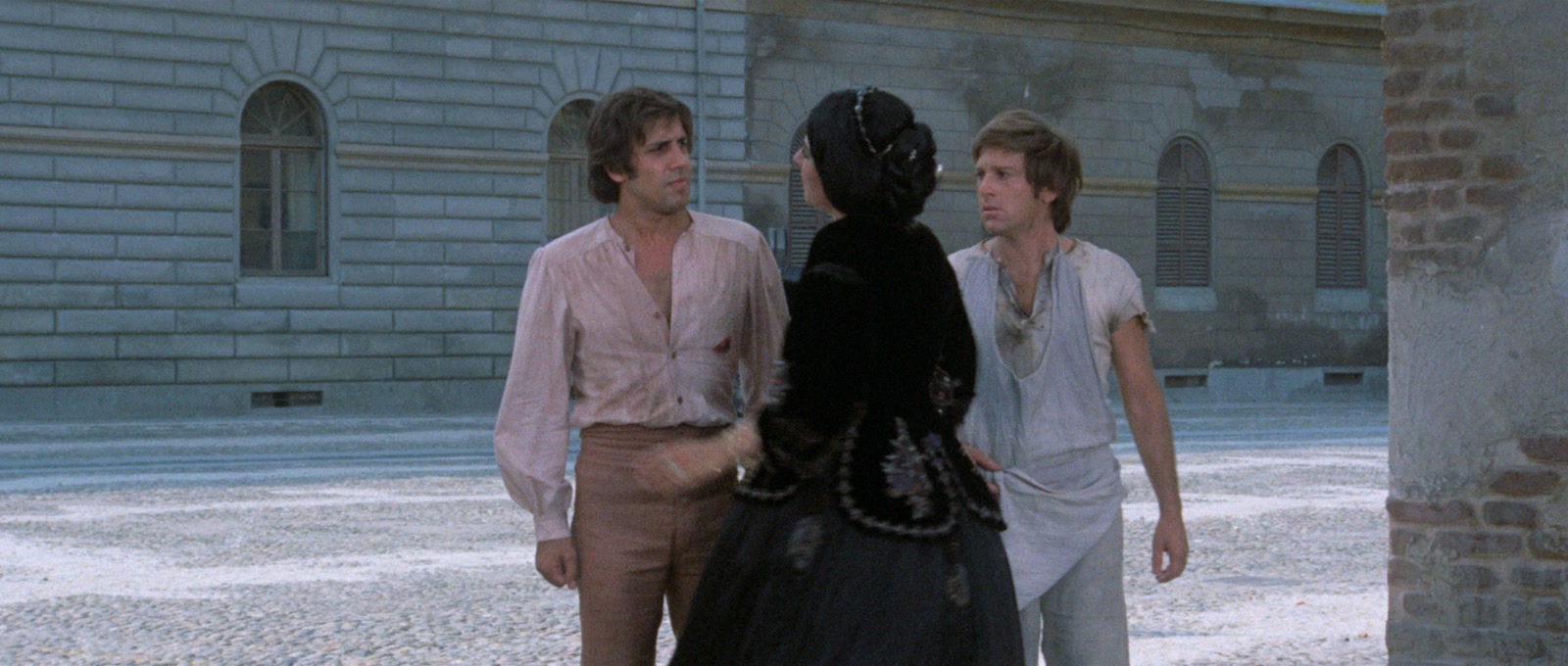
ENLARGE ↗The countess welcomes labour for her barricade.
An aristocrat commissions a revolution.
The countess treats the barricade as an arrangement of furniture, labour and cultural prestige. An architect and the prospect of a painting surround a structure that is supposed to resist military power. The joke preserves class distinctions inside the revolt: some people compose the spectacle while others carry its weight. Argento’s diary research provides a useful companion to the scene.
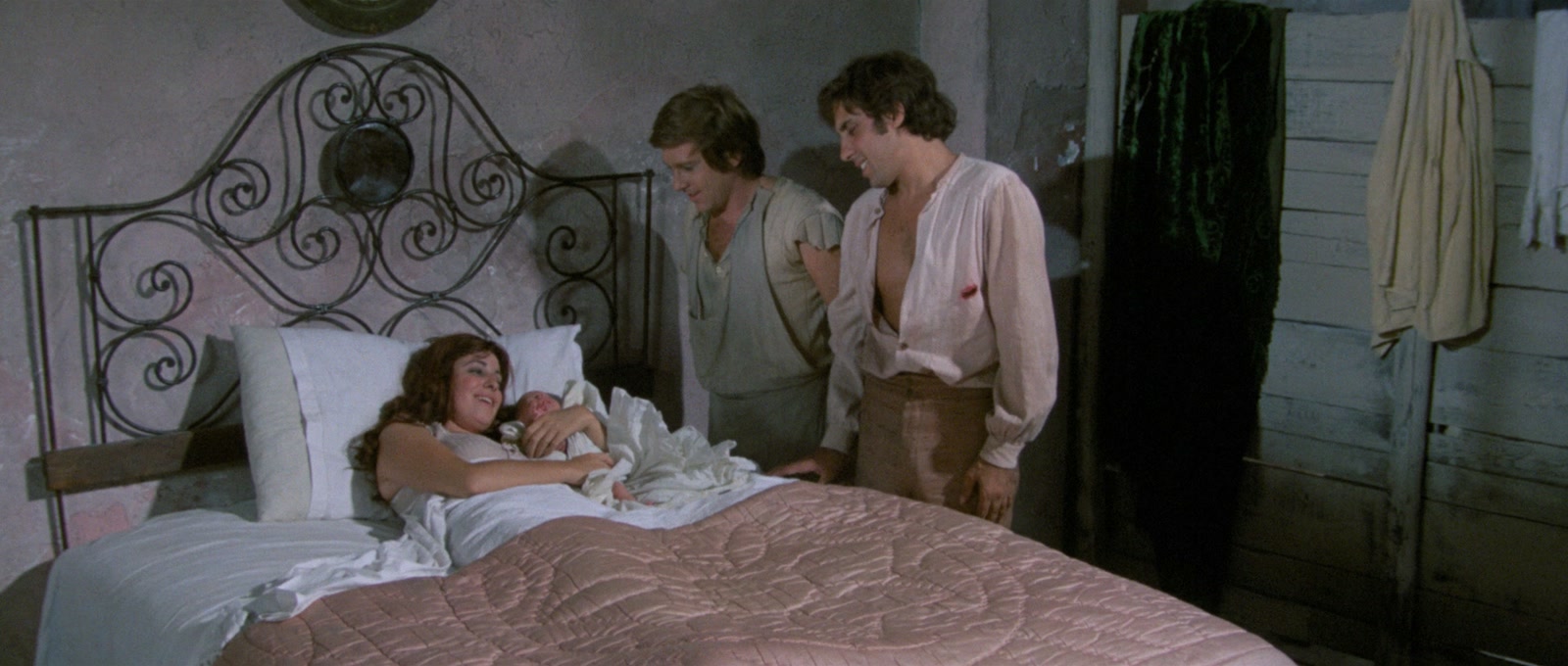
The staircase makes assistance laborious before the bedroom makes the men’s ignorance visible. Cainazzo and Romolo try to escape responsibility, then return. The mother’s instructions organize their activity: practical knowledge overturns the authority the men assume elsewhere. The closing arrangement around the bed briefly replaces public violence with an act of care. De Santis’s interview follows the performance and dubbing behind it.
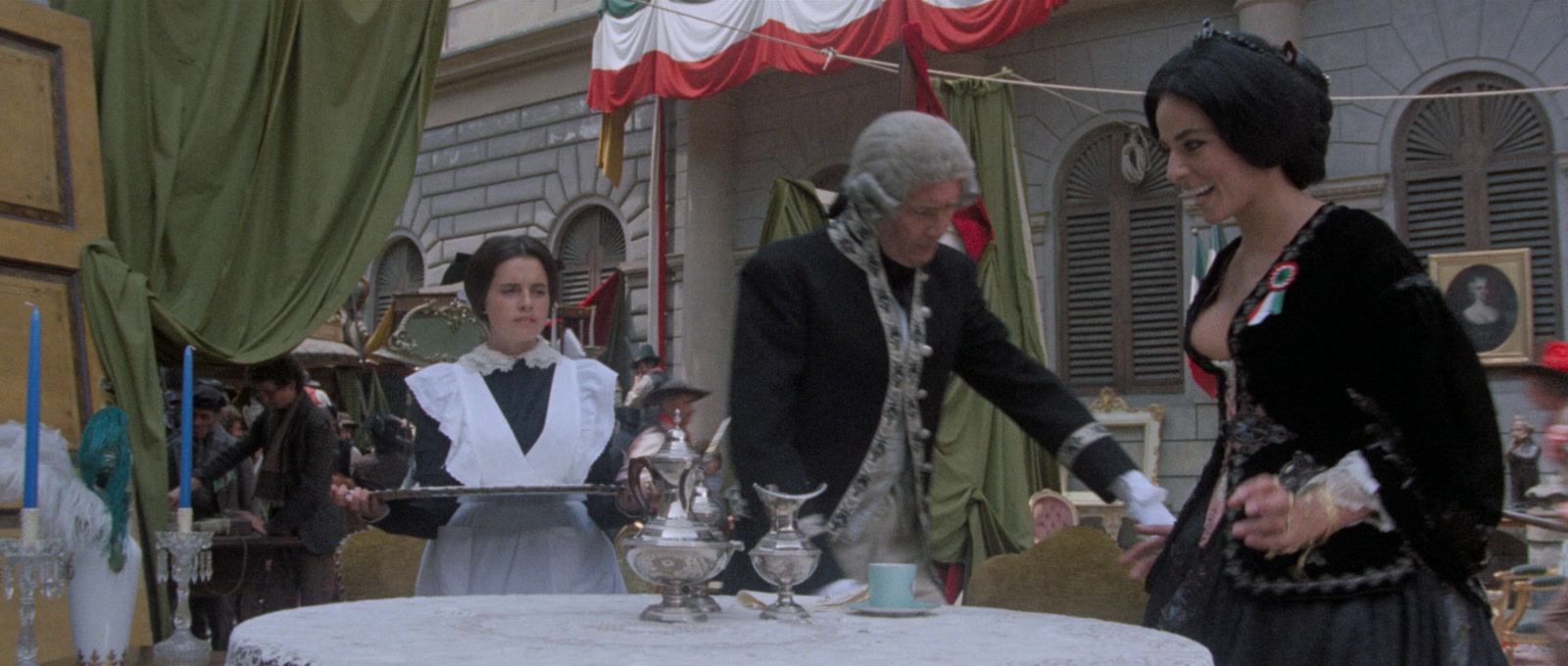
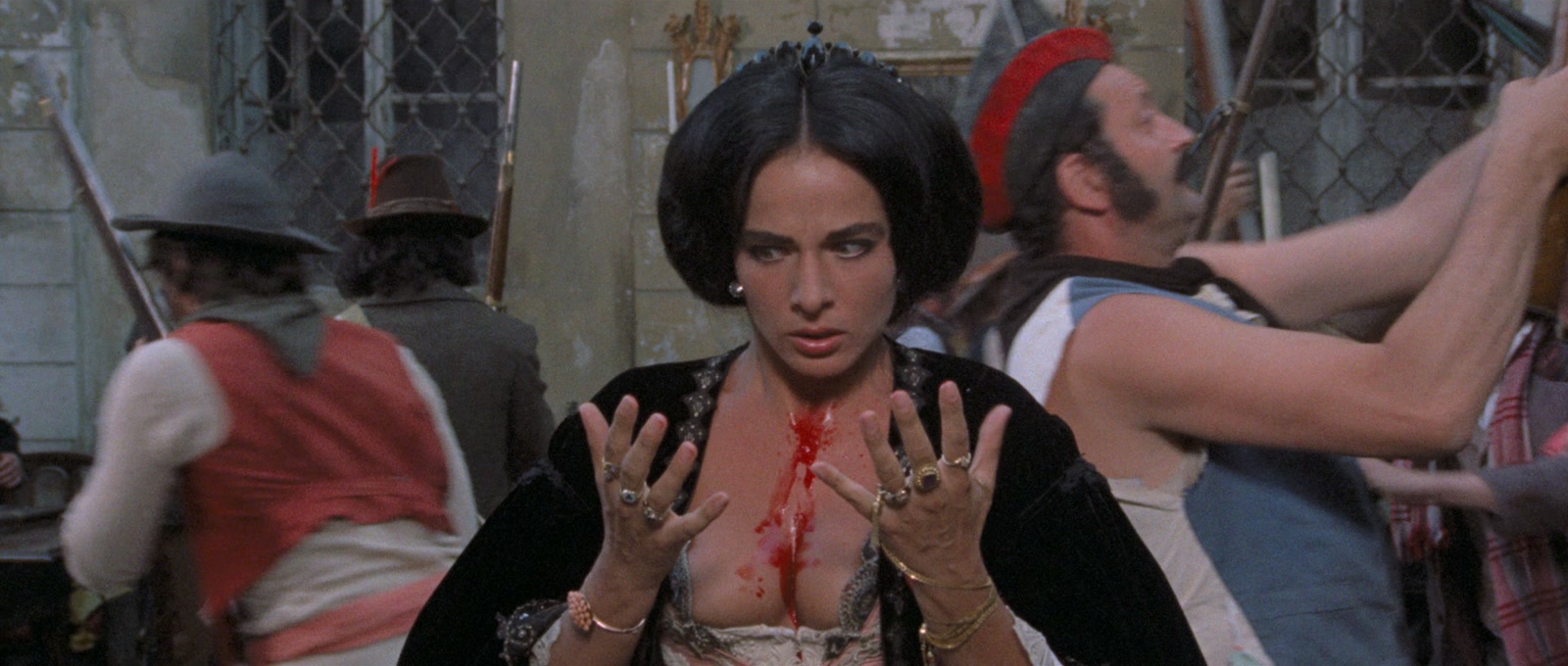
Silverware and a servant’s tray retain their place beside the fighting. The countess’s tea turns the barricade into an extension of her household, even as rifles, smoke and blood invade it. The overloaded weapon supplies a compact comedy of misplaced confidence and blame. The scene repeatedly brings aristocratic comfort and bodily risk into the same image.
45:30–48:15
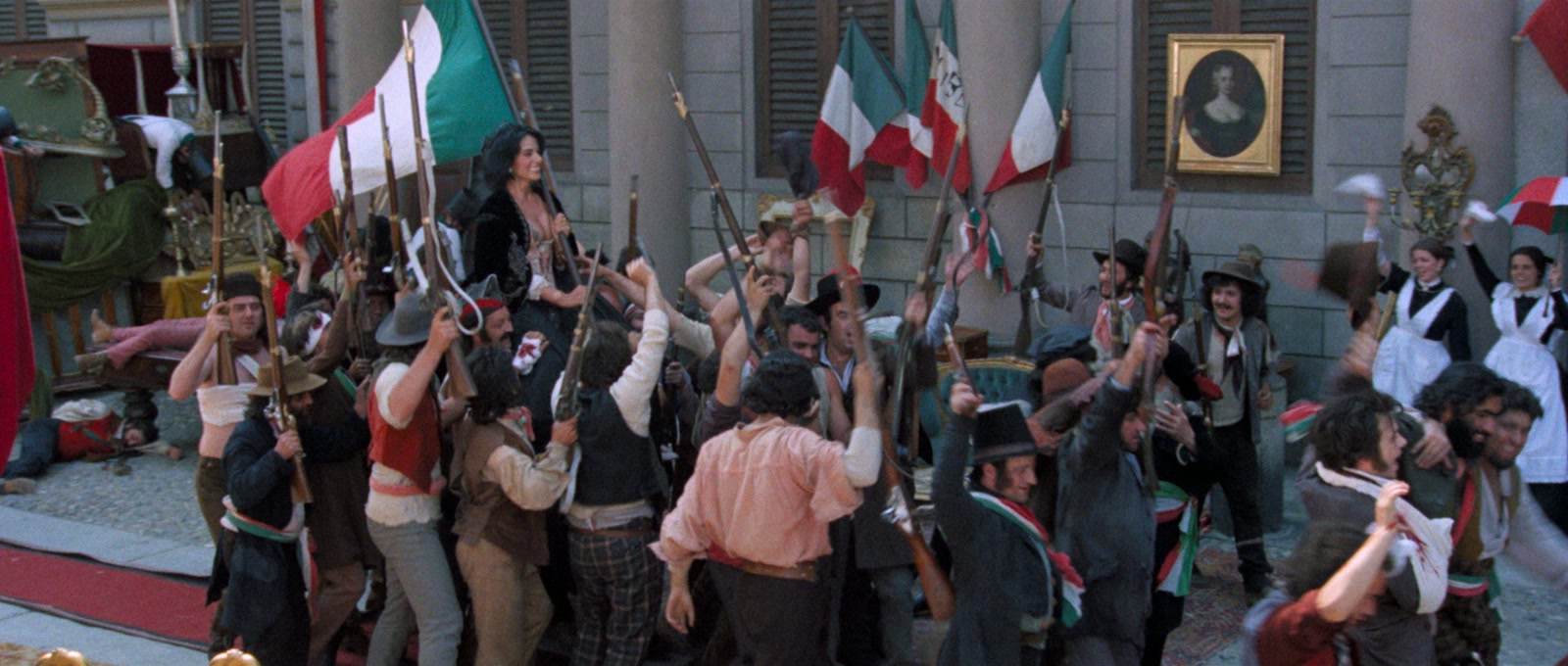
ENLARGE ↗The countess becomes the crowd’s spectacle.
The patron becomes the spectacle.
Raised above the men, the countess occupies the visual position of a figurehead. The subsequent bedroom queue redirects collective enthusiasm into sexual farce. Her appetite is not simply an emblem of liberation: the sequence also turns a woman into an object around which male activity is organized. Its exuberance and its unequal gaze belong in the same reading.
48:15–56:15
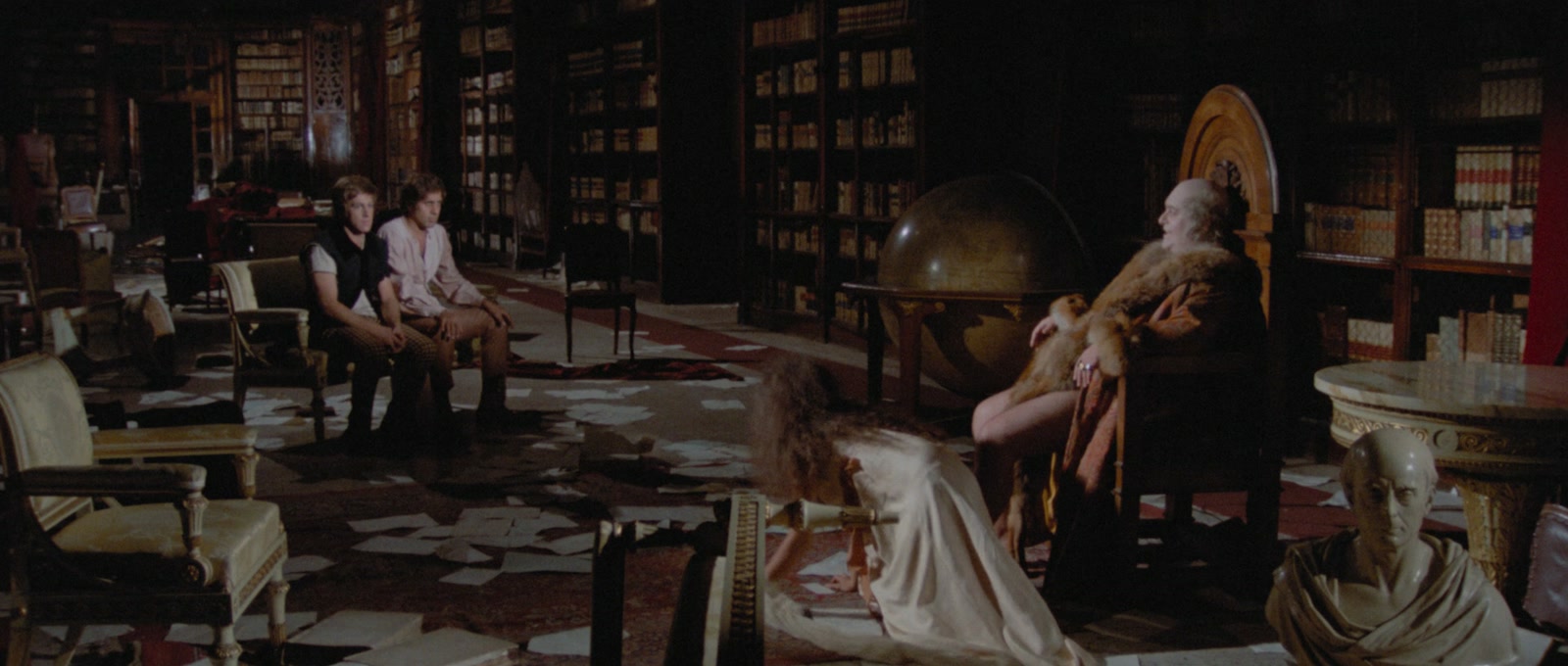
ENLARGE ↗Red shelves surround the encounter with the aristocrat.
The ruling class expects to remain.
The looted palace changes the visual register. Ornate stairs, dark shelves, red fabric and a large globe place the companions inside accumulated wealth. The aristocrat’s confidence that elites will survive the upheaval gives the magnificent interior a political purpose. The room’s ominous theatricality also explains why the commentary connects it with Deep Red.
57:20–1:00:25
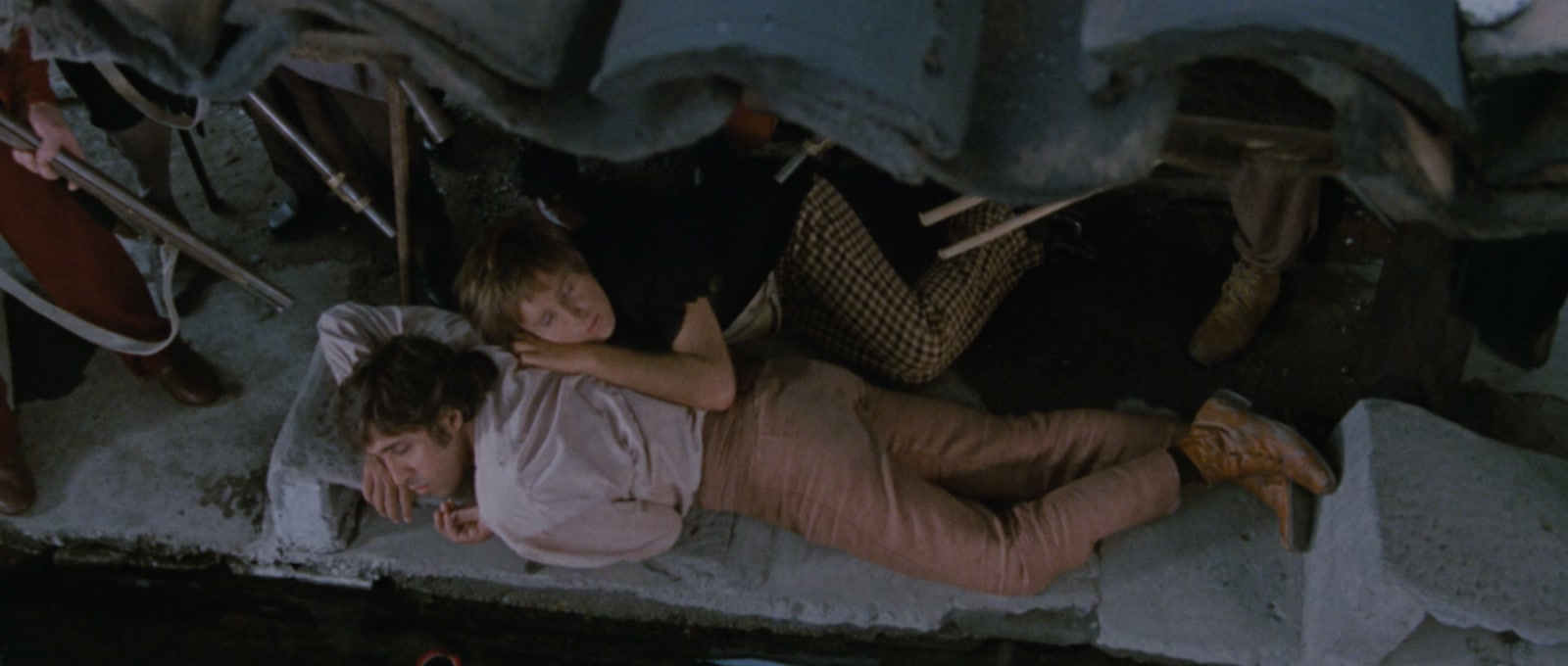
ENLARGE ↗Armed men surround the sleeping companions.
Brotherhood has an armed perimeter.
The overhead arrangement of the sleeping pair and the surrounding boots makes power visible before it is explained. The baron’s rhetoric of fraternity coexists with command, rank and coercion. Cainazzo and Romolo are again absorbed into somebody else’s project. Their closeness is intimate and improvised; the new collective has weapons and rules.
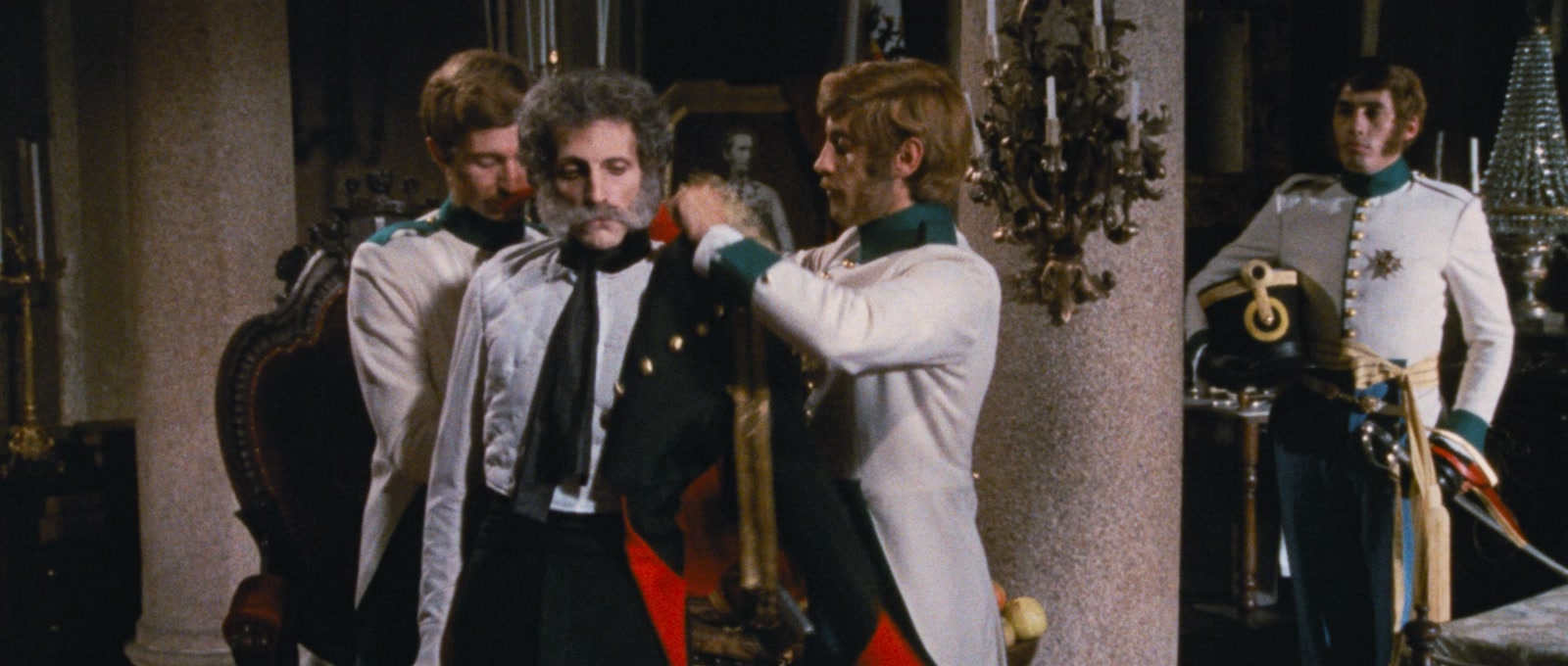
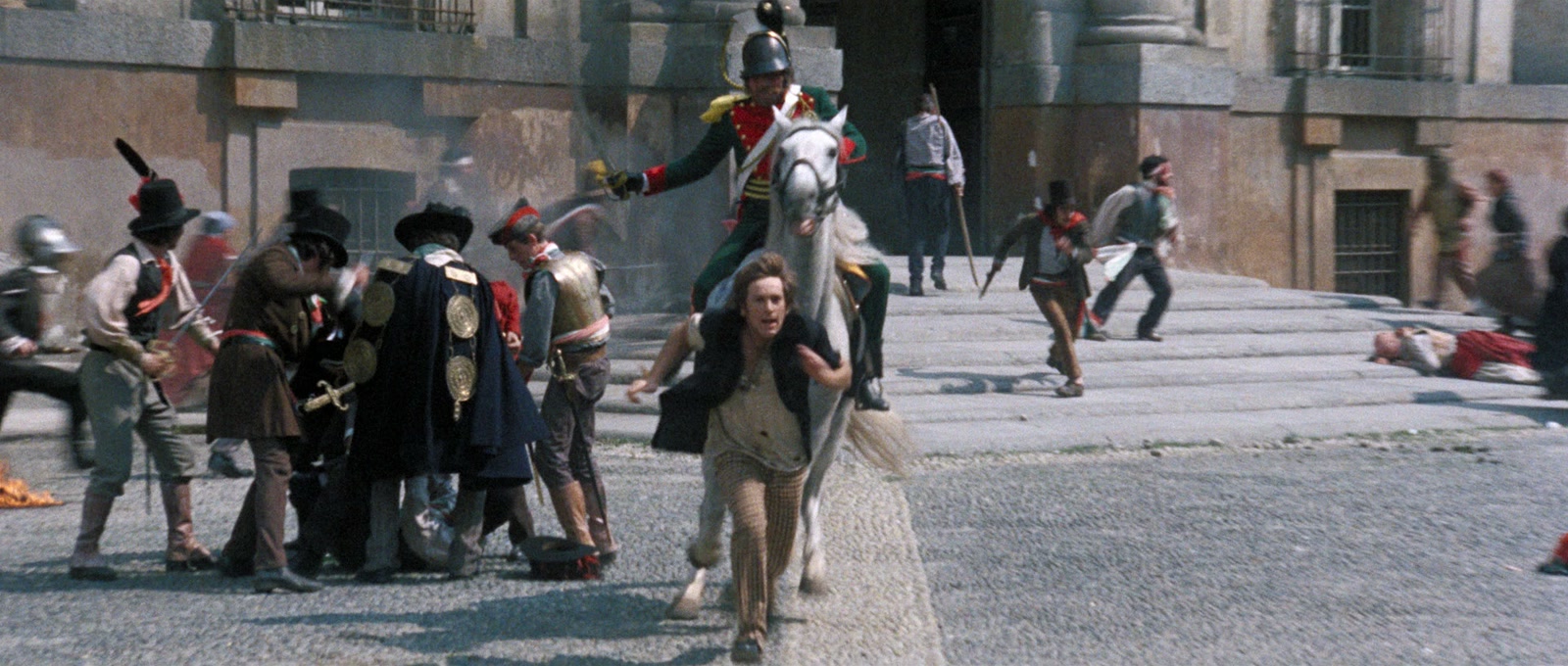
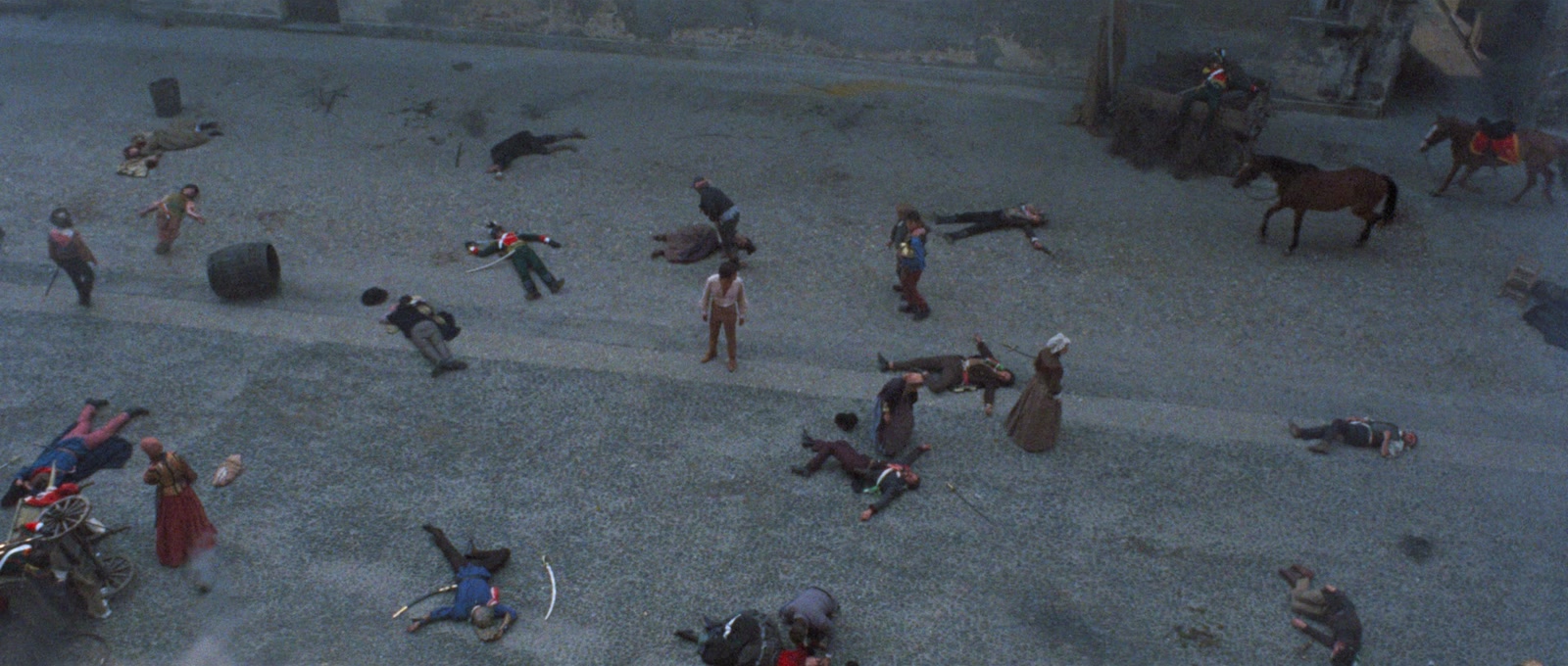
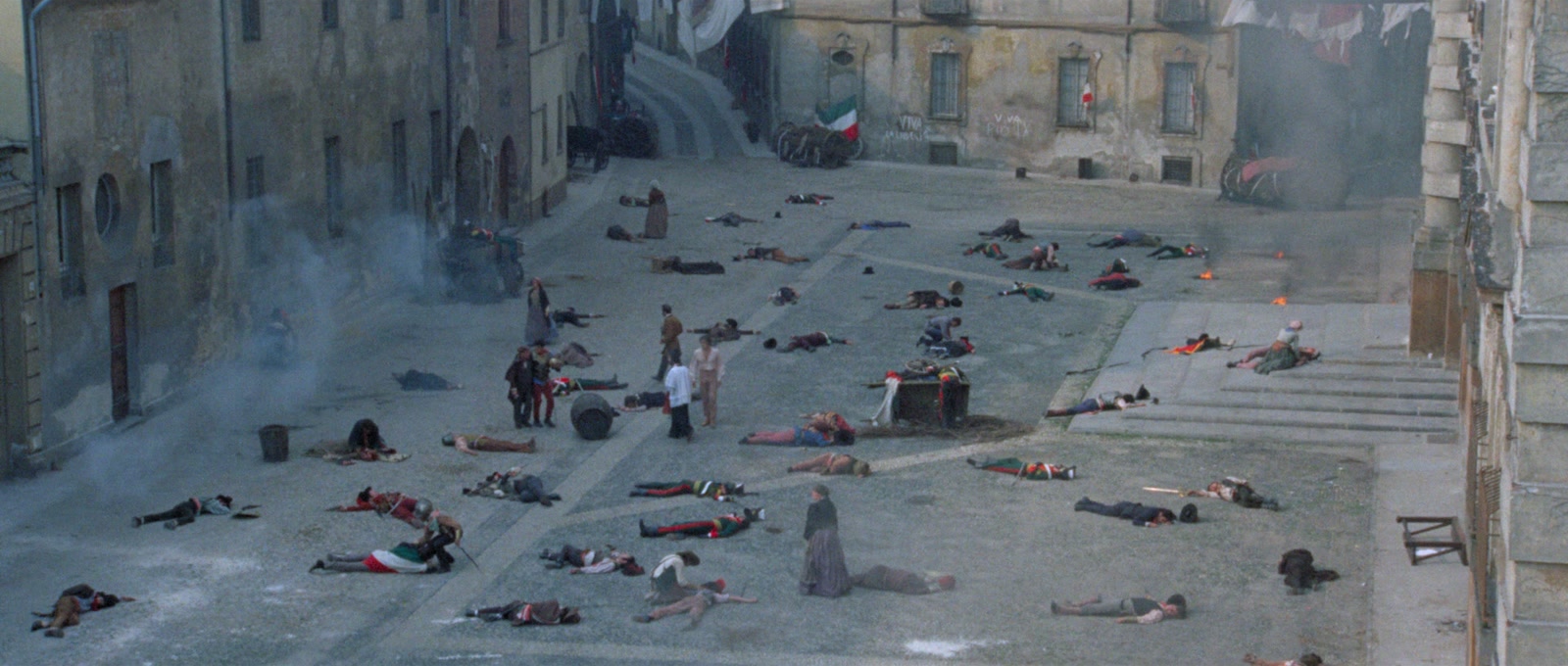
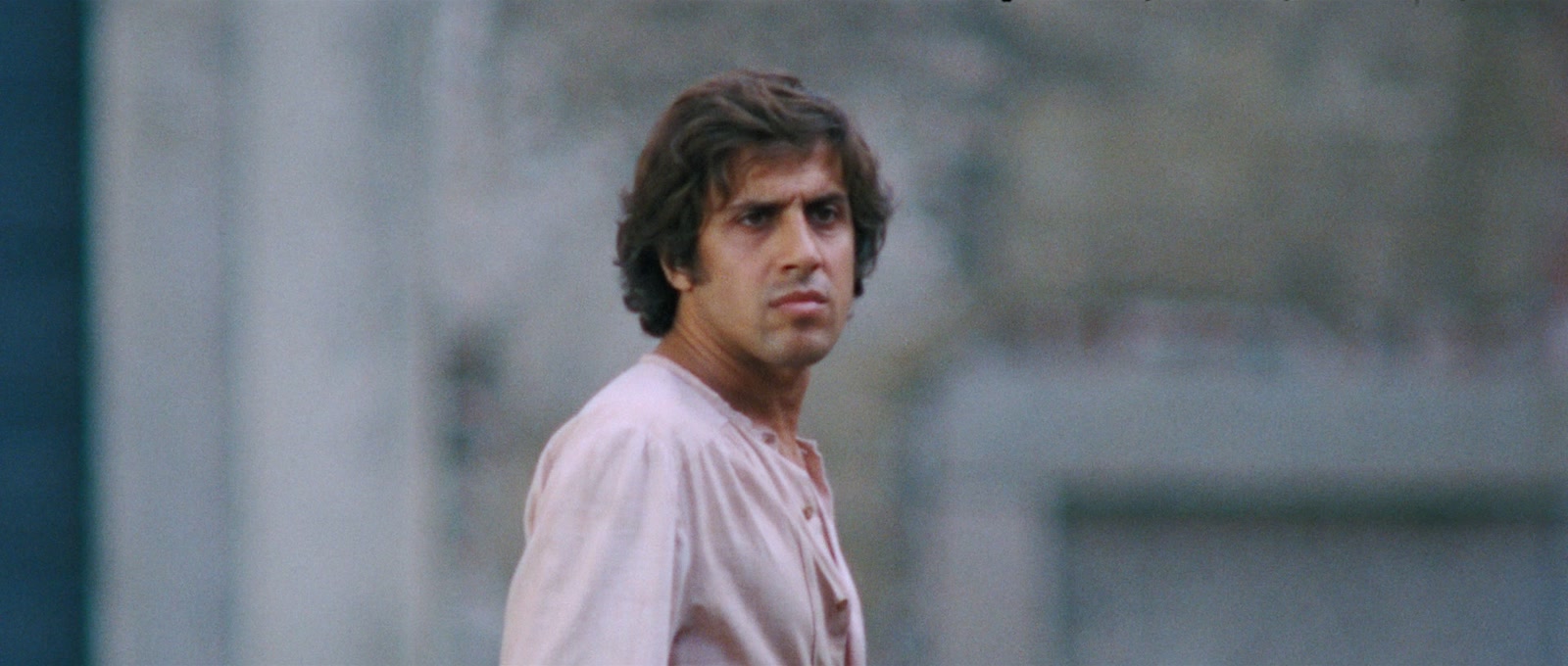
A white flag and the treatment of surrendering soldiers precede the commander’s elaborate dressing. Clothing here assembles military authority piece by piece. The cavalry then turns the square into a space of pursuit, bodies and scattered possessions. Cainazzo’s search for Romolo brings the scale back to one missing person. The baron’s explanation invokes war where Cainazzo sees a moral equivalence. Follow the square sequence →
1:11:05–1:15:15
ENLARGE ↗Witnesses compete over Binetti’s last words.
A dead man is given useful words.
Binetti’s supposed final utterance changes according to the political needs of the witness reporting it. The deathbed becomes a theatre of competing ownership. Ordinary witnesses offer a less edifying account and are inconvenient precisely because they agree. The sequence treats historical testimony as something that can be edited before it has even left the room.
1:15:15–1:21:35
ENLARGE ↗Shoes and hems carry the banquet’s intrigue.
Politics seen from under the table.
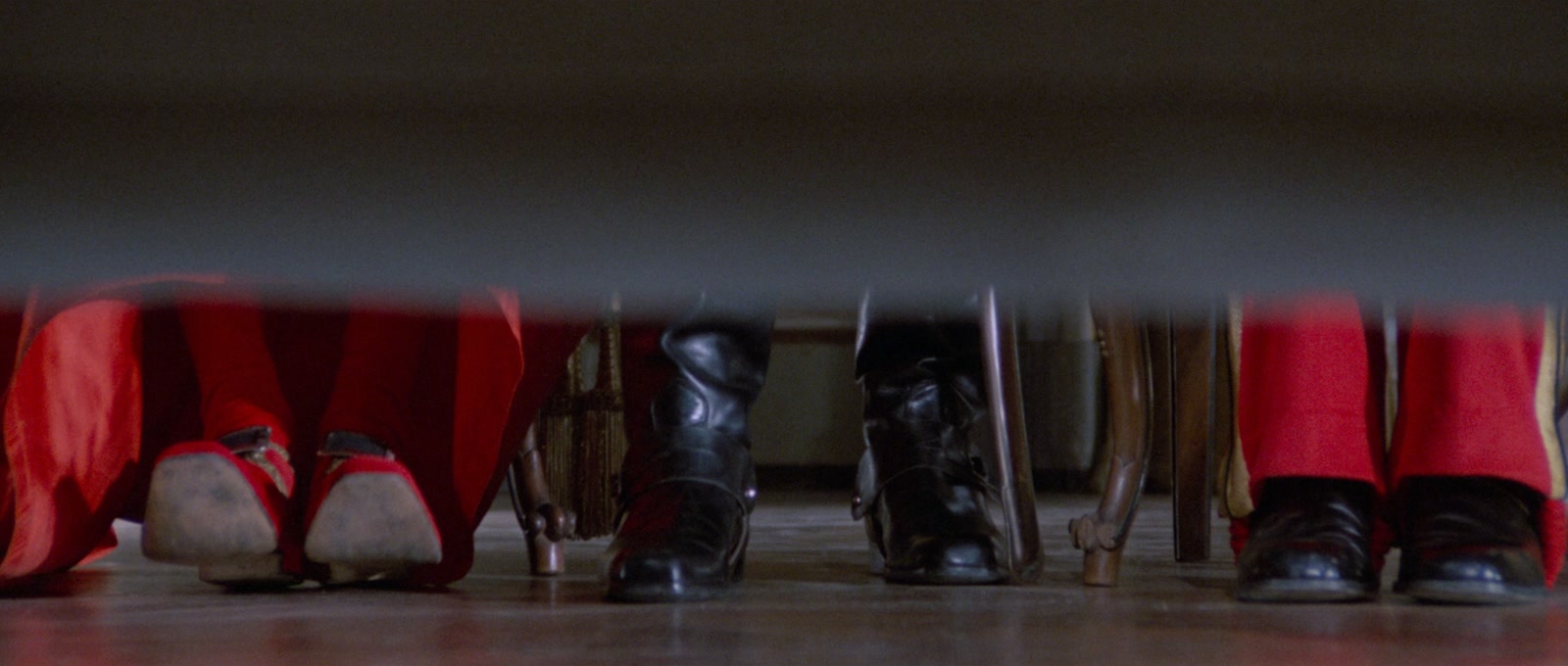
The celebration advertised for the people rejects Romolo’s clothes and admits Cainazzo as a servant. Beneath the table, shoes, hems and covert movements replace the guests’ faces. Cainazzo occupies the low position from which privilege becomes legible. Argento recalls a debt to Keaton in his interview; the commentary connects the framing to his later suspense films.
Cainazzo’s criticism of public authority produces a beating beside a posted announcement. The wall supplies an institutional promise; the crowd supplies its practical limit. Romolo’s return interrupts the punishment with a false alarm about the Austrians. Their reunion gives the friendship a concrete form: one man uses speech to rescue the other from the consequences of speaking.
1:25:20–1:36:45
ENLARGE ↗The widow gives the companions food and shelter.
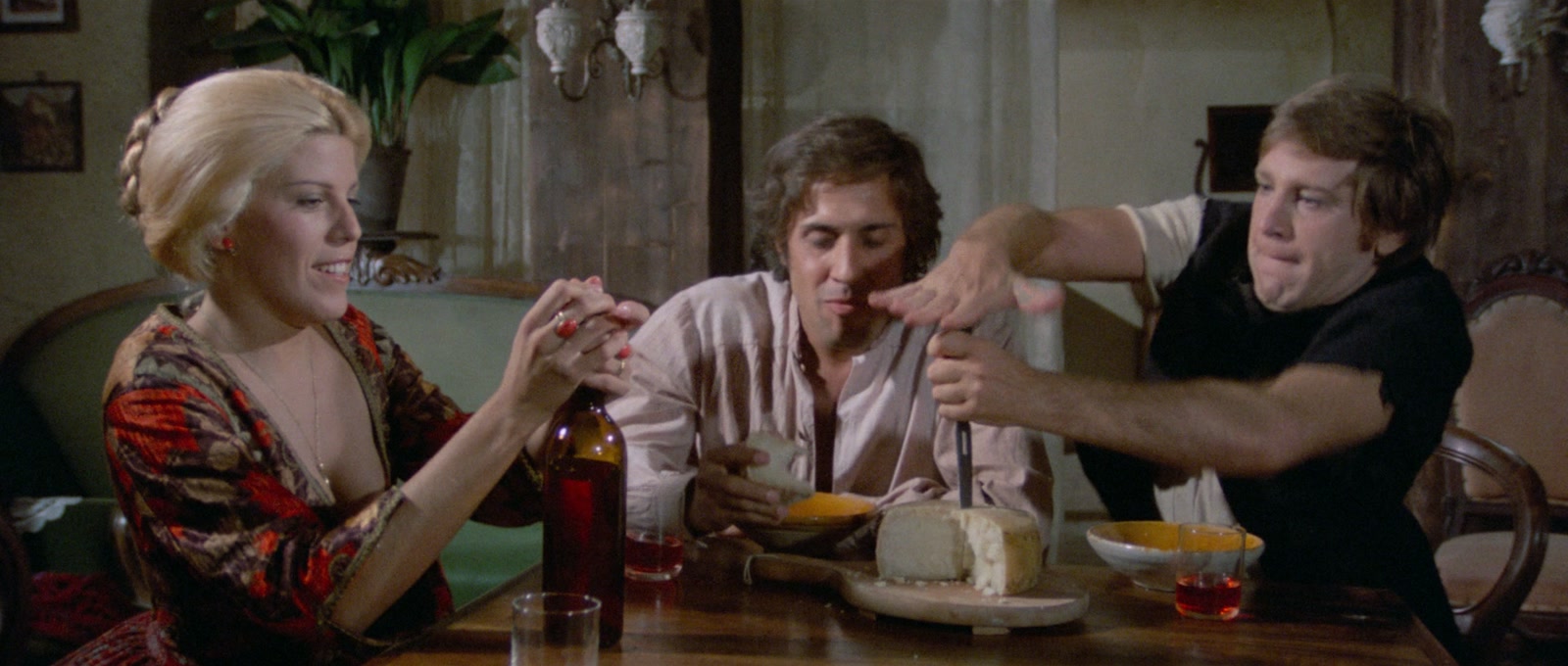
A meal interrupts collective cruelty.
The crowd extends its punishment of an alleged traitor to his widow. Cainazzo and Romolo rescue her by borrowing the manner of the authorities pursuing her. Inside, food, flirtation and the baker’s knowledge replace patriotic accusation. The household provides a temporary refuge, though the comedy keeps its three occupants’ desires out of alignment. Tatò’s interview adds her account of the role and its voice.
1:36:45–1:44:45
ENLARGE ↗Cainazzo faces Zampino in the Austrian court.
Liberty works for the other side.
The man associated with revolutionary freedom reappears inside an Austrian system of punishment. Zampino’s explanation turns political flexibility into business. Cainazzo, who has spent the film stealing and evading obligations, draws a line at profiting from the deaths of his countrymen. The scene gives him an ethical refusal without converting him into an official hero.
The baron’s abuse of a woman exposes the violence concealed by his public authority. Romolo refuses to accept it. His intervention overturns the hierarchy, and the group responds by defending its leader’s status. The film’s harshest reversal follows a simple act of opposition to cruelty: the companion who acts is the one the movement will sacrifice.
1:50:20–1:54:40
ENLARGE ↗Cainazzo confronts the loss of his companion.
Victory passes a dead companion.
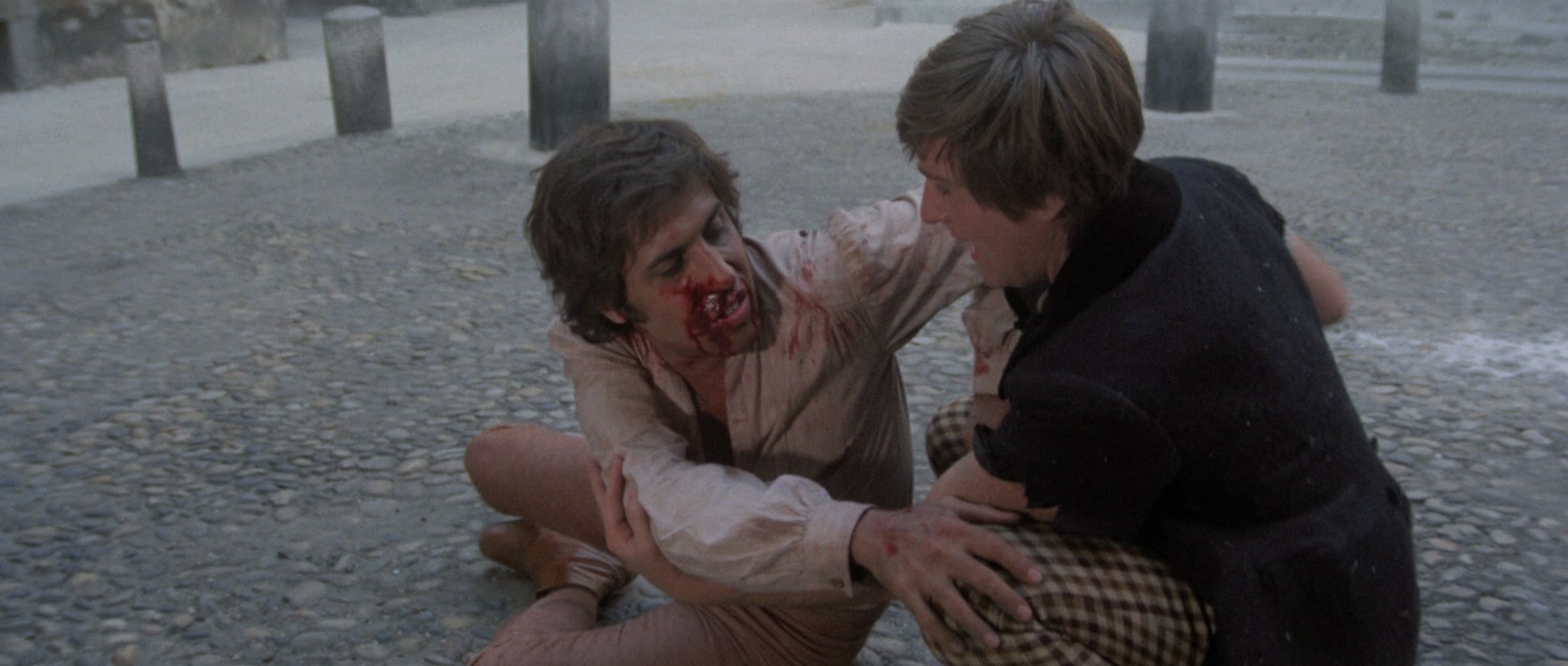
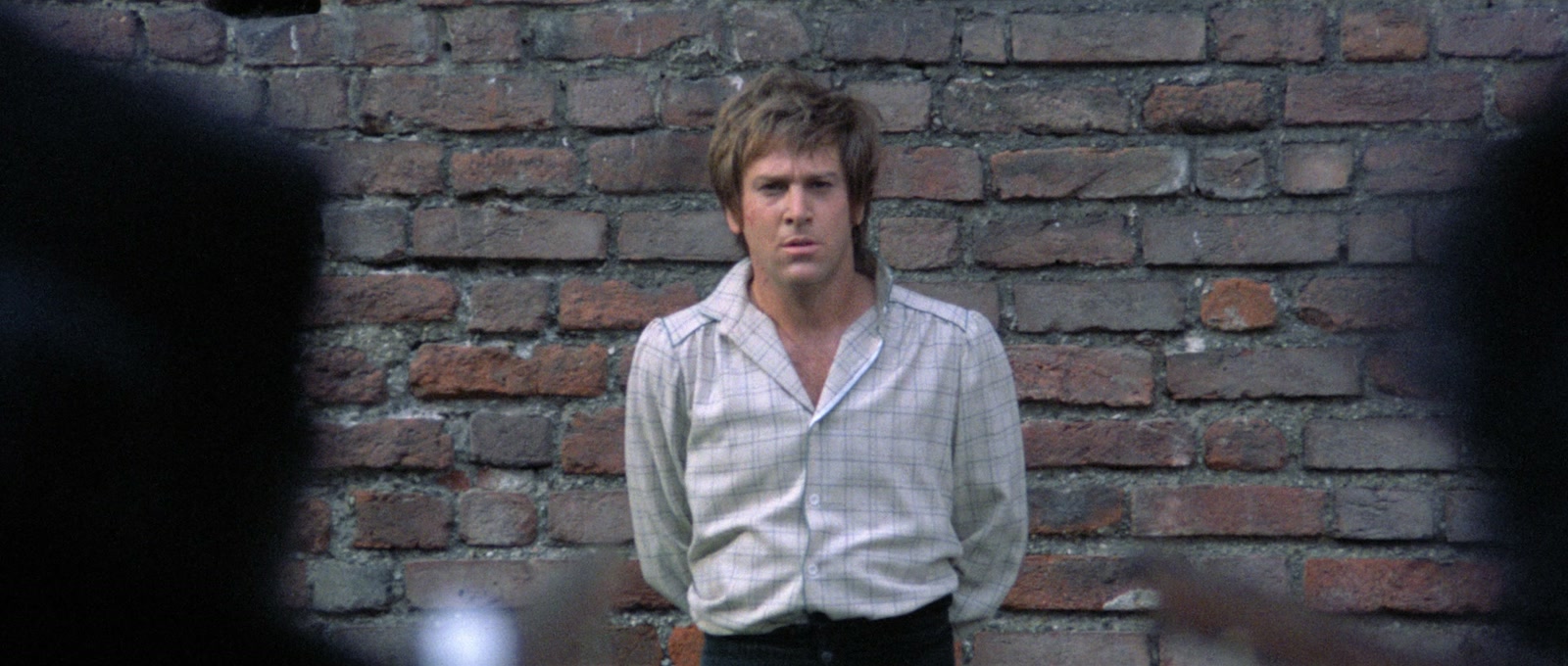
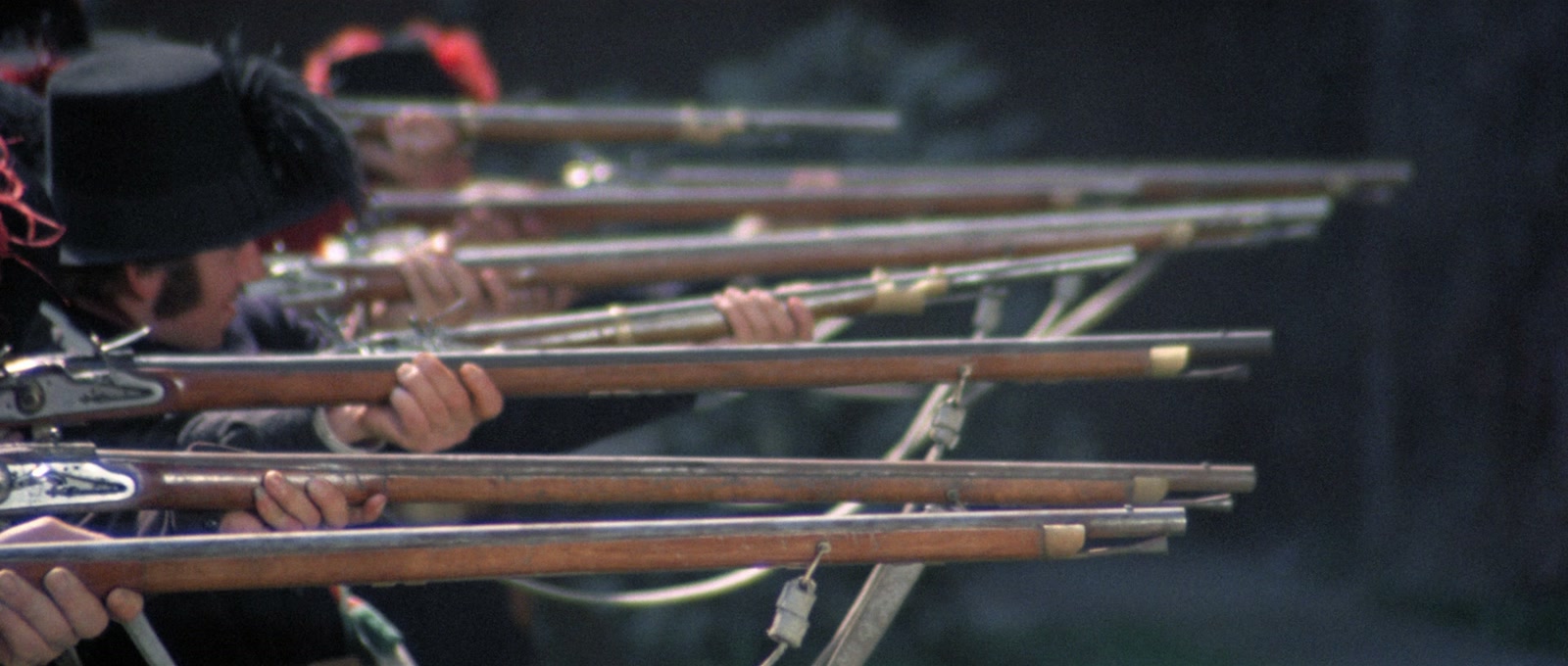
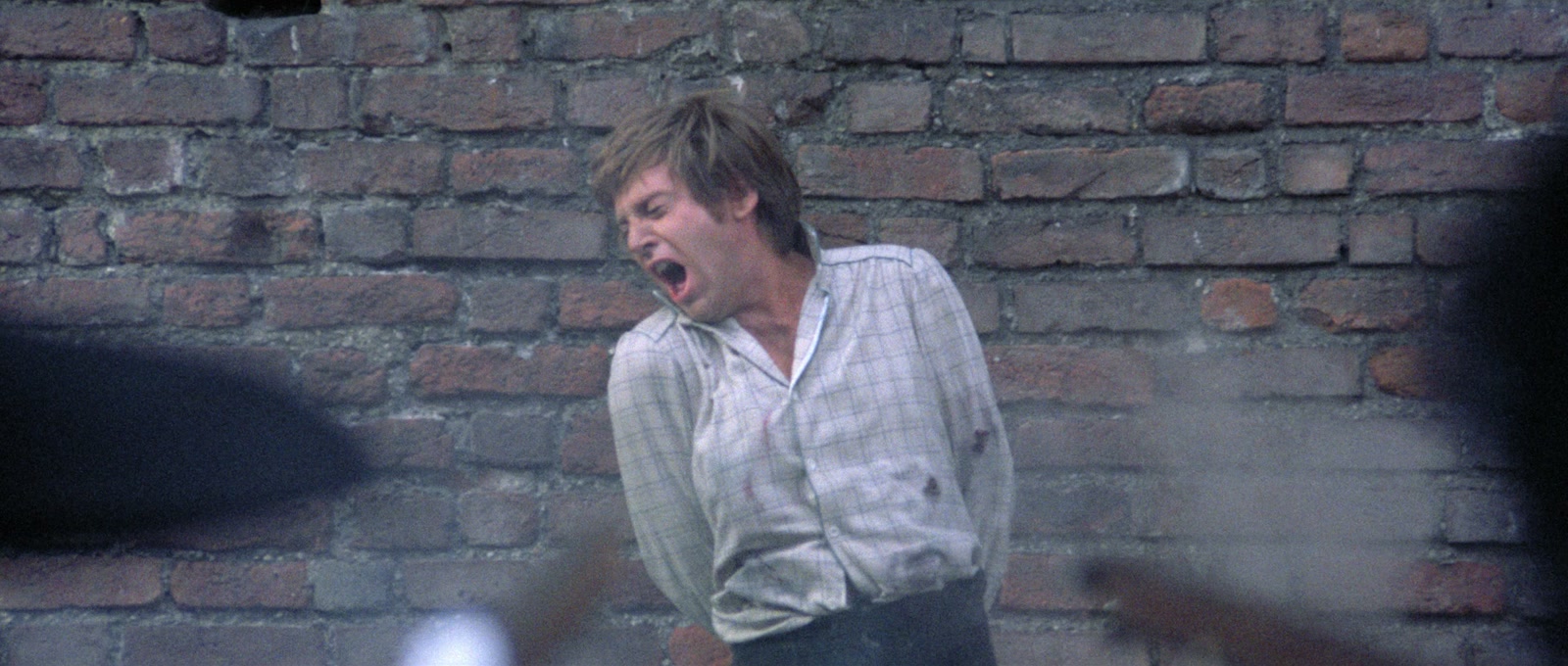
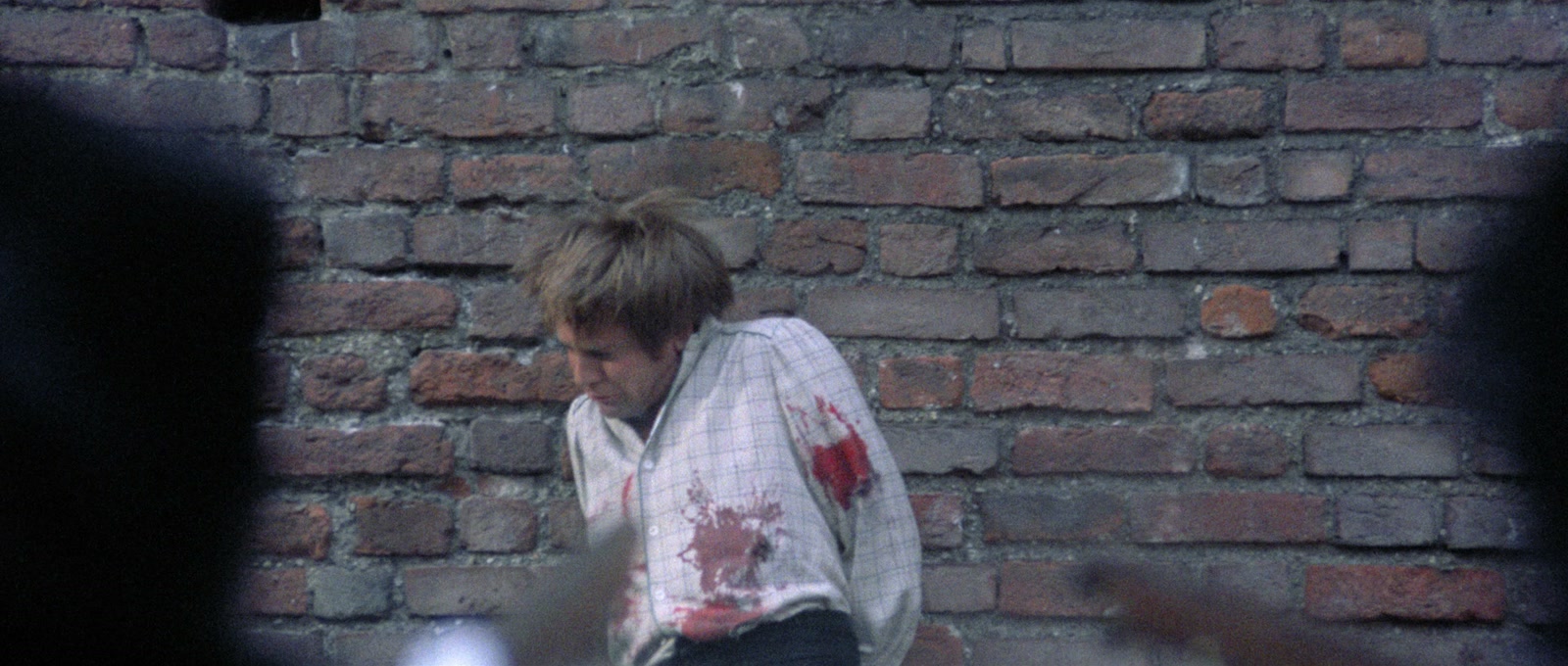
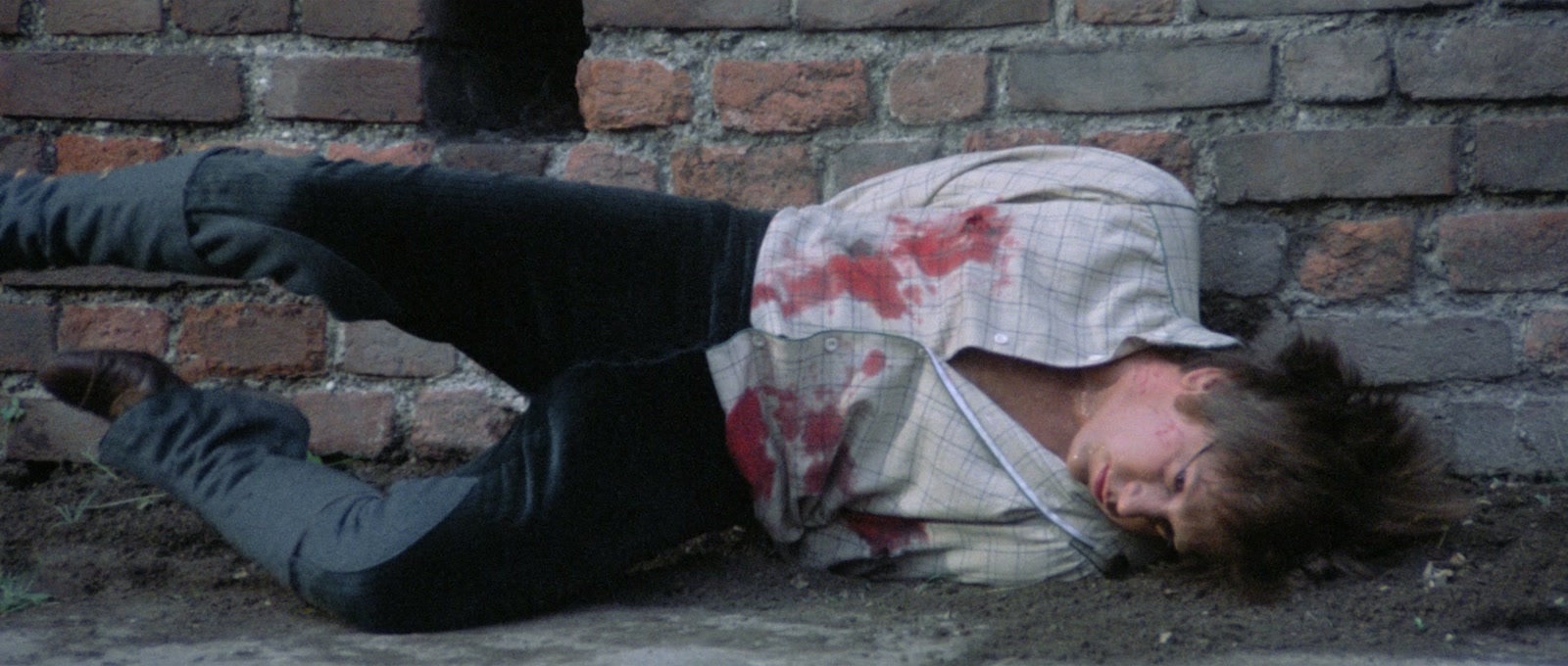
Celebratory movement and the firing line occupy opposing visual worlds. The repeated returns to Romolo against the wall make the public triumph inseparable from its victim. When Cainazzo finds him, the partnership that has organized the film becomes an absence. His explanation that smoke is making him cry cannot restore the comic protection of earlier evasions. Explore the sequence in stages →
1:54:40–2:01:05
ENLARGE ↗Cainazzo addresses the victory gathering.
The invited witness refuses the script.
The final gathering asks an ordinary man to confirm the official story of victory. Cainazzo struggles to find words, then turns the opportunity into an accusation of deception. The increasingly close view gives his refusal a force that the platform’s tricolour decoration cannot contain. Public history has offered him a speaking part; he uses it to reject the ending he was expected to endorse.
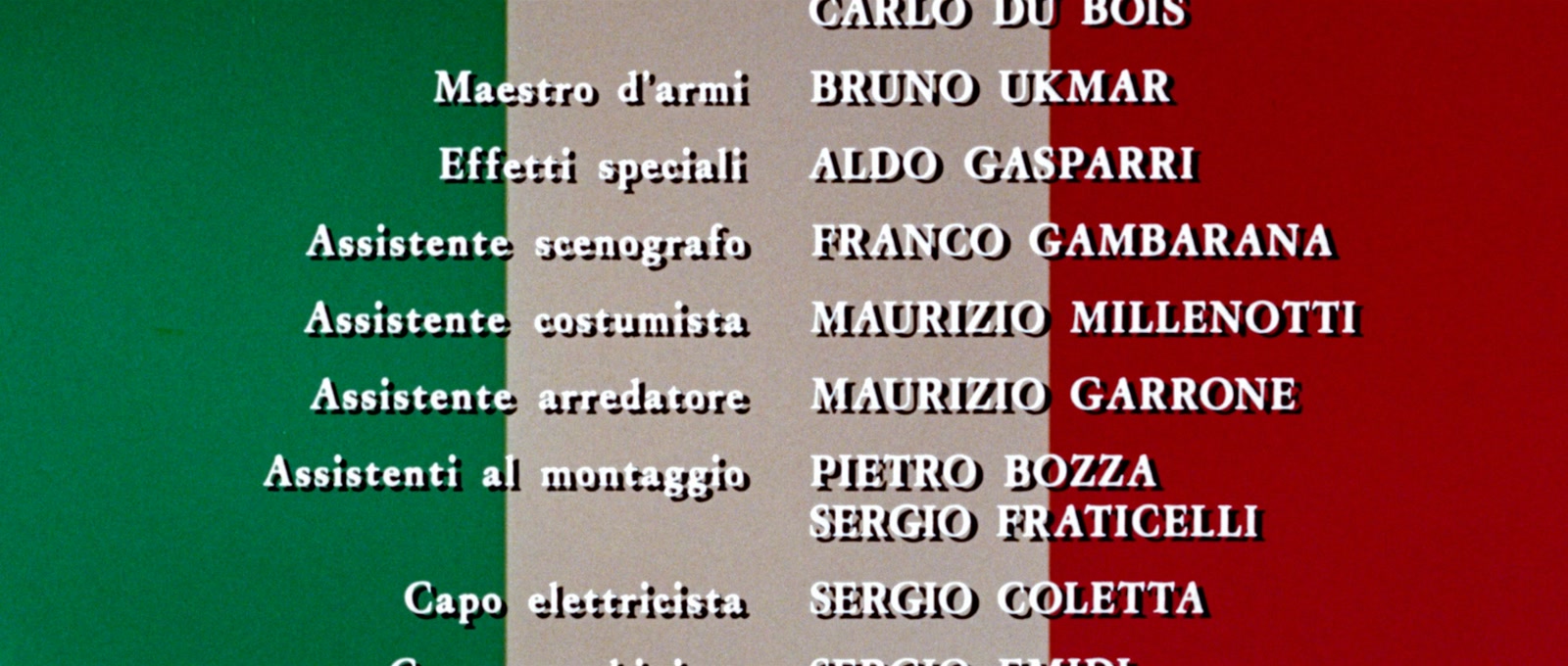
Explosions, weapons, smoke, blood and coordinated movement carry the film’s changes of tone. Each gallery follows a sequence through several stages. The end titles credit Aldo Gasparri for special effects and Bruno Ukmar as maestro d’armi; individual rigs and assignments are not specified in those credits.
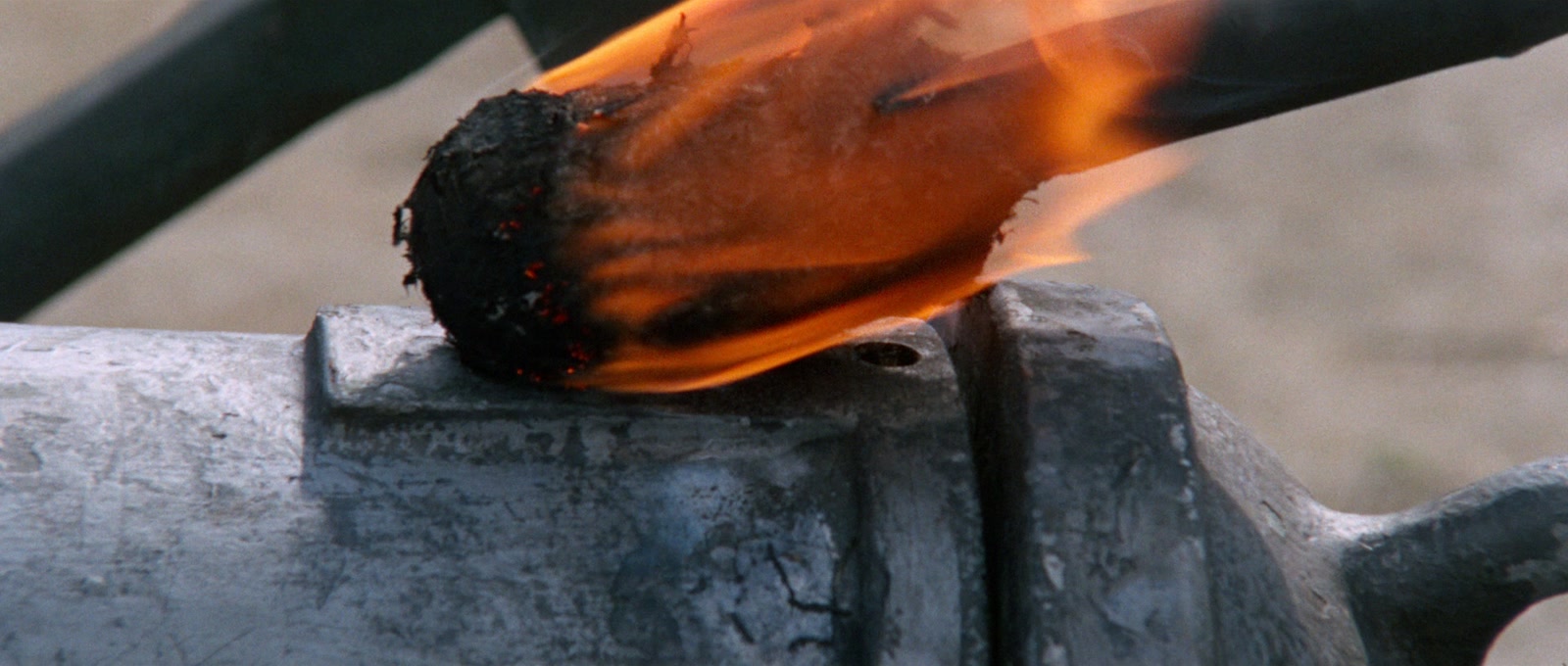
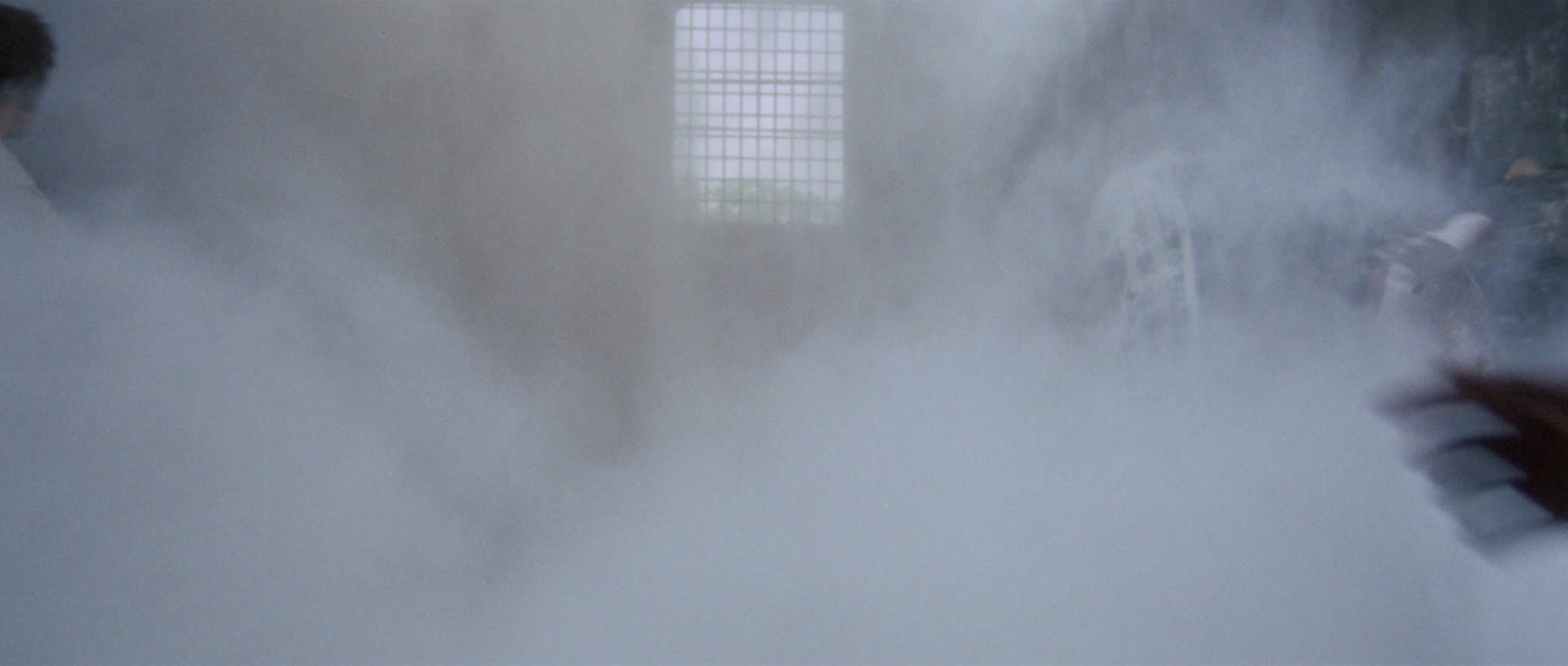
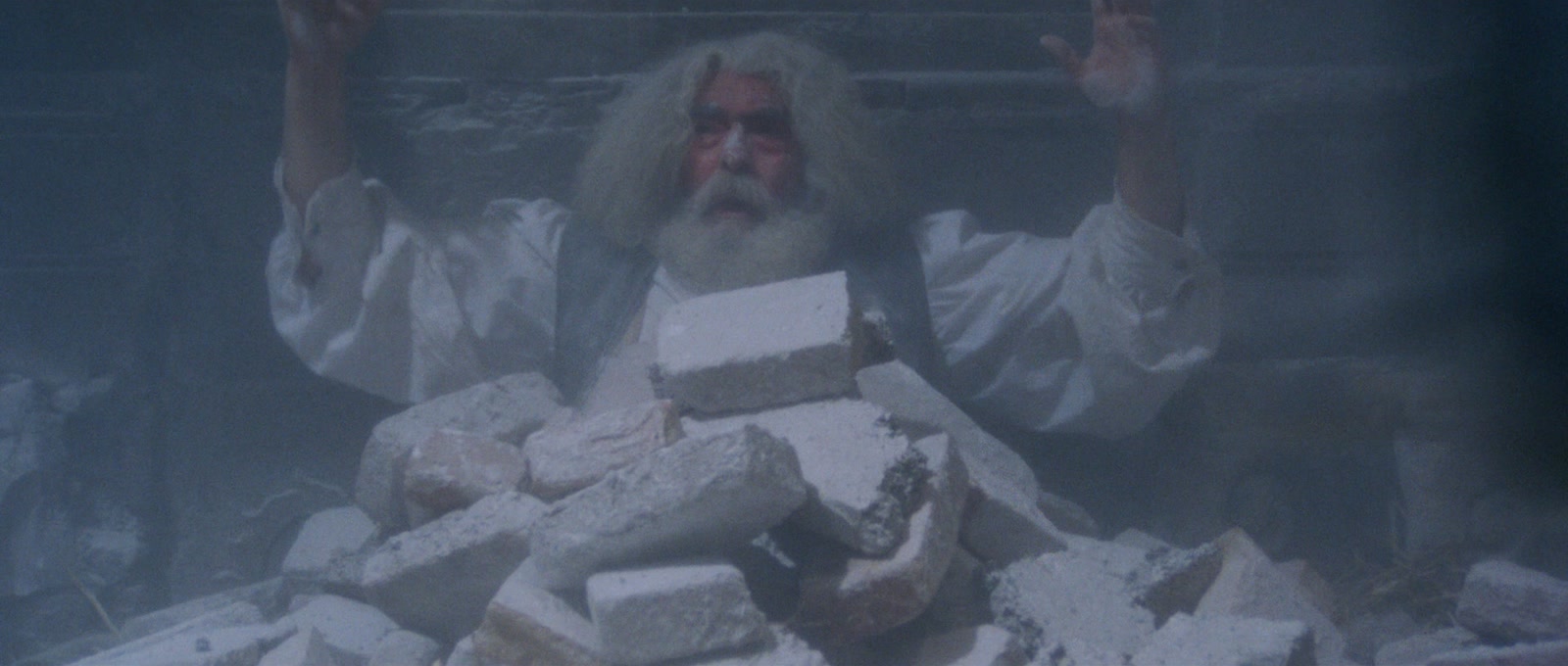
The burning fuse establishes a cause before the cell fills with smoke. Rubble redistributes the prisoners’ bodies; the exterior then reveals the new exit. The gag depends on the contrast between destructive force and an almost bureaucratically useful result. The gallery follows the visible construction of that change, from fuse to aperture.
Explore the sequence · 4 more images
ENLARGE ↗The cannon fuse burns.ENLARGE ↗Smoke fills the prison.ENLARGE ↗A prisoner emerges from the rubble.ENLARGE ↗The cannon has opened the prison wall.
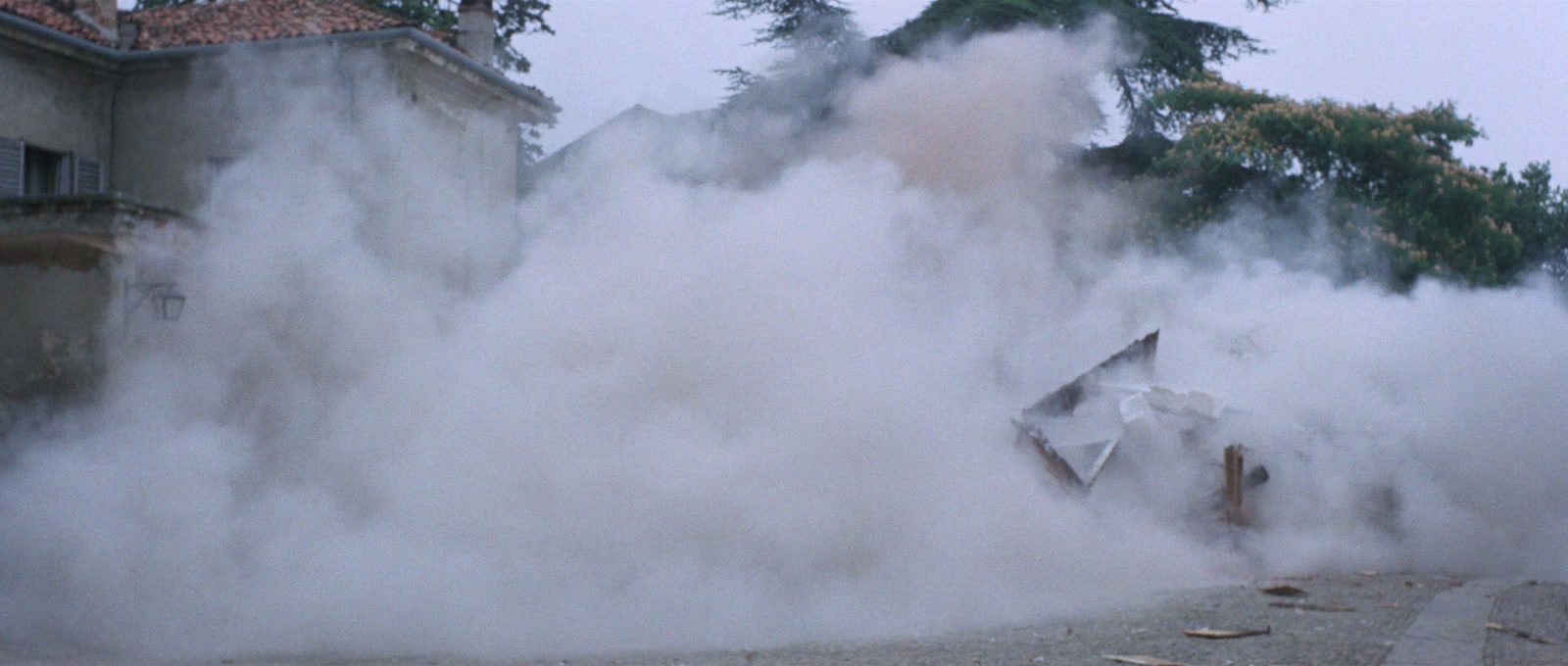
A wide view gives the collapse a readable relationship to the street. Debris emerges through a spreading cloud; the settled view reveals the collapsed timbers, and Romolo’s baker’s peel identifies the human livelihood inside the spectacle. The practical scale matters because the event is both a comic introduction and a material loss.
Explore the sequence · 4 more images
ENLARGE ↗Timbers tumble through the dust.ENLARGE ↗The cleared view reveals the collapsed bakery.ENLARGE ↗Romolo emerges with his baker’s peel.ENLARGE ↗Romolo refuses to be left behind.
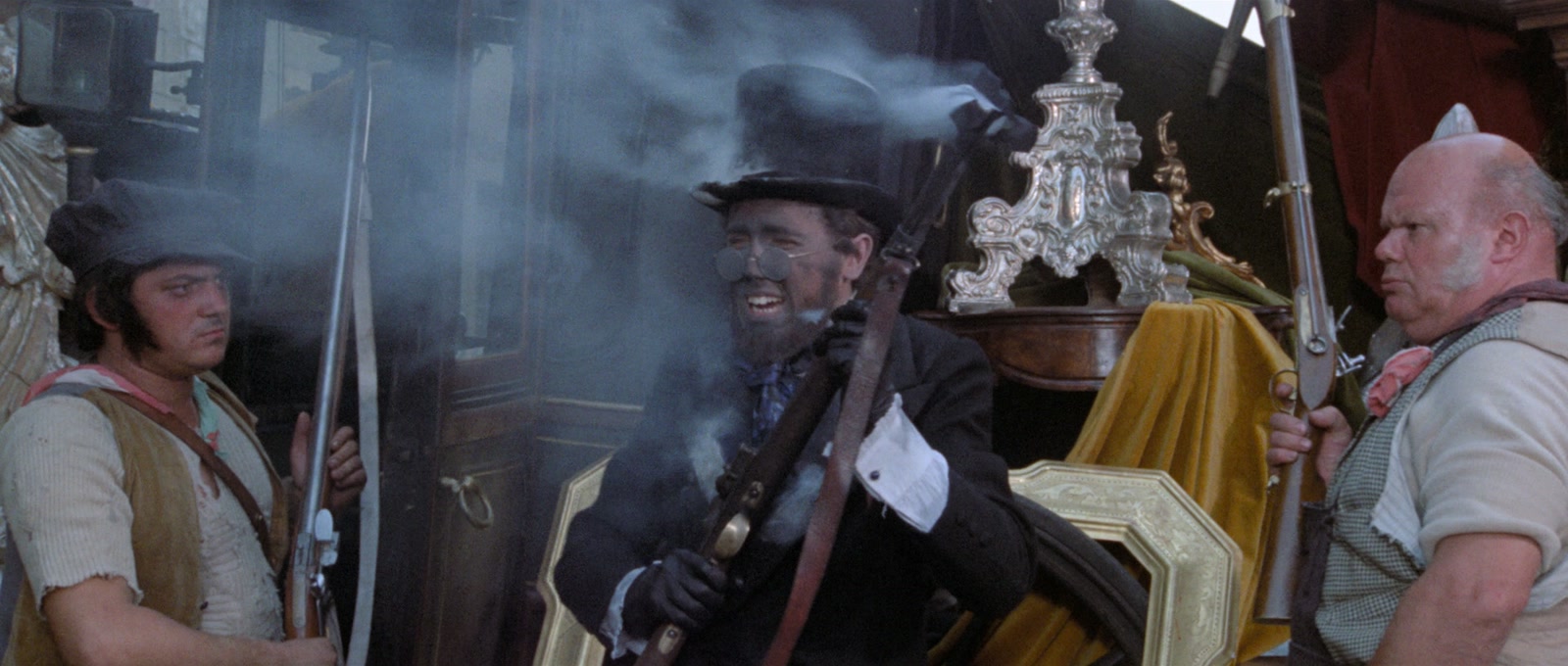
The argument over too much gunpowder is answered by the smoke-covered shooter. The return to Cainazzo and Romolo shifts attention from impact to the allocation of responsibility. Nearby, the countess’s blood-marked clothing interrupts a scene of genteel service. These details allow physical danger and social comedy to occupy the same crowded setting.
Explore the sequence · 4 more images
ENLARGE ↗A rifle is passed along the barricade.ENLARGE ↗Cainazzo points the blame elsewhere.ENLARGE ↗Tea is served beside the fighting.ENLARGE ↗Blood interrupts the countess’s composure.
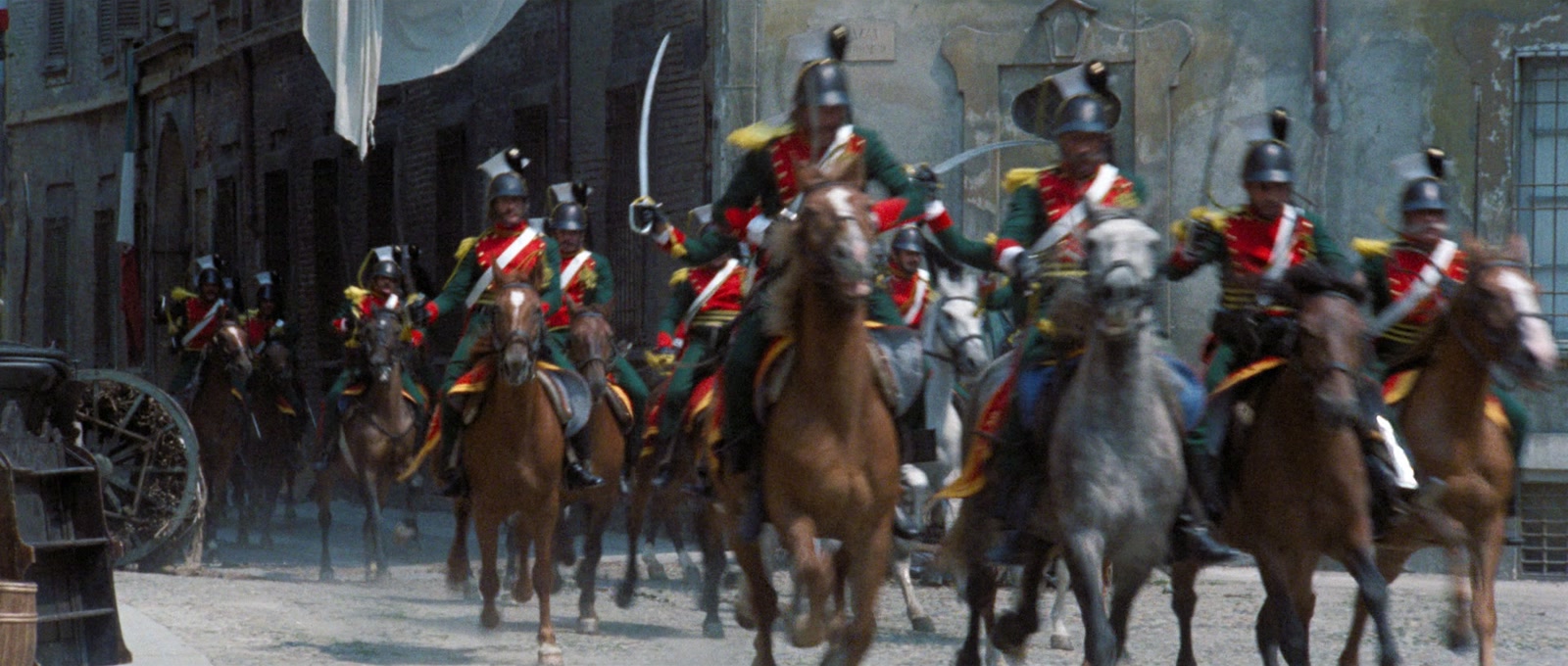
The commander’s preparation leads into organized mounted movement, then into civilians fleeing across the horses’ routes. The high views make the aftermath legible as an arrangement of bodies across a once navigable space. Cainazzo’s isolated reaction interrupts that scale. Iacono’s production recollections provide the companion account of managing the film’s crowd and horse work.
Explore the sequence · 5 more images
ENLARGE ↗The commander is dressed for the reprisal.ENLARGE ↗Civilians flee across the cavalry’s path.ENLARGE ↗The square becomes a field of bodies.ENLARGE ↗The riders leave the devastated square.ENLARGE ↗Cainazzo searches the square.
The aligned rifles and the brick wall establish a controlled killing space. Smoke and blood precede Romolo’s collapse; the fallen body is then answered by Cainazzo’s face. The effect gains its force from the duration of the relationship already built around him. The sequence is the opposite of the prison escape: this discharge closes a life rather than opening a route.
Explore the sequence · 5 more images
ENLARGE ↗The firing line aims.ENLARGE ↗Smoke and blood mark the volley.ENLARGE ↗Romolo begins to fall.ENLARGE ↗Romolo lies beside the wall.ENLARGE ↗Cainazzo confronts the loss of his companion.
LANGUAGE, POWER & PERFORMANCE
Who gets to speak for the people?
Names, slogans and reported words are instruments of power in The Five Days. The English subtitles make the narrative’s verbal contests accessible; the participant interviews also explain why an Italian-language performance need not preserve every actor’s own voice.
Prison, streets and committee · 02:00–20:00
Patriot, thief, citizen.
The same person can be welcomed as a patriot and rejected as a thief. Cainazzo’s shifting reception depends on what others call him, while the committee’s language turns the people into an abstraction it can represent. The street comedy and the institutional debate share a problem: a label can outrun what a person has actually done.
Bakery and childbirth · 21:00–38:35
The people who know how to do something.
Romolo’s identity rests in work, and the mother knows what the two men do not. Their practical vocabulary counters the public vocabulary of heroic sacrifice. The childbirth scene distributes authority through instructions, mistakes and corrections. Its eventual tenderness follows cooperation rather than a declaration of principle.
Binetti’s room · 1:11:05–1:15:15
Four useful versions of a last utterance.
The conflicting deathbed reports allow different factions to hear their own cause ratified. Agreement does not arrive through greater solemnity: it comes from the witnesses whose account is too insulting to serve the ceremony. The episode makes a miniature argument about source criticism inside the fiction itself.
Banquet and proclamation · 1:15:15–1:25:20
Speech above the table, knowledge below it.
The banquet detaches political conversation from visible faces and puts Cainazzo beneath its participants. The next episode reverses the privilege: when he speaks openly beside the proclamation, he is struck. The paired scenes distinguish being allowed to overhear power from being allowed to challenge it.
Court and final address · 1:40:20–1:58:25
Two refusals of an offered role.
Zampino offers Cainazzo participation in a profitable system; the final platform offers him participation in an official memory. He refuses both. The second refusal is harder because it follows Romolo’s death, and because the gathering expects gratitude. The ending turns an apparently inarticulate man into the film’s most consequential speaker.
Voices and production
Who speaks the performance?
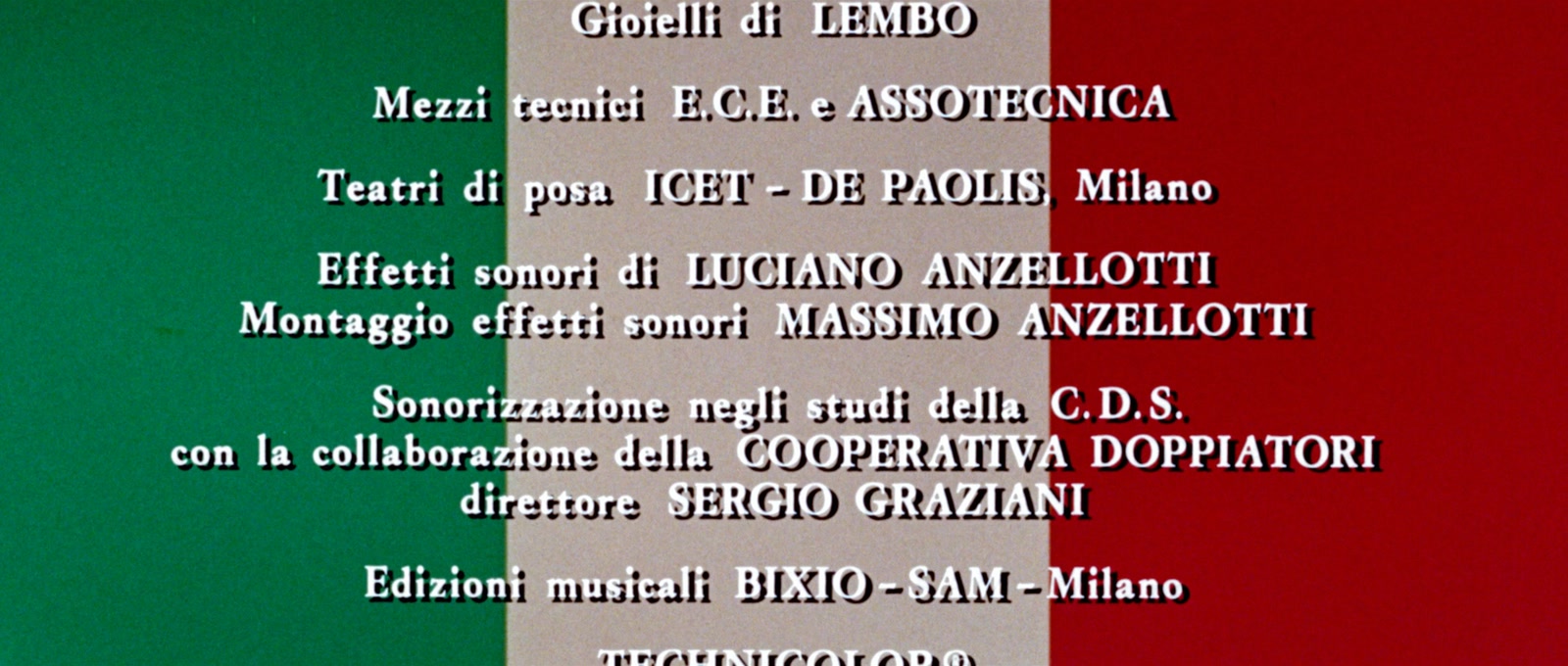
Tatò says she returned to dub her own role. De Santis recalls that another actress supplied her voice because her Roman accent did not fit the character. Their accounts give a concrete counterpart to the commentary’s discussion of Italian dubbing. The end credits name Sergio Graziani as director of the dubbing cooperative’s contribution, alongside studio and sound-effects personnel. See the credited departments →
THE COMMENTARY
Reading the film across genres.
Troy Howarth and Nathaniel Thompson’s commentary treats the film as a substantial part of Argento’s career. The selected passages below follow their critical arguments and distinguish comparisons from documented production history.
01:40–06:25; 20:12–27:45
Comedy belongs inside the filmography.
The commentators connect the film’s grotesque humour with comic passages in the thrillers and place its disenchanted companions beside political picaresques. Their comparisons with Duck, You Sucker! and Rosencrantz and Guildenstern Are Dead offer reading routes, rather than proof of a borrowed scene. They also acknowledge the difficulty of making farce and political anger coexist.
35:20–39:20
Electronic Rossini interrupts the period.
Howarth and Thompson connect the score’s electronic interludes and the accelerated childbirth comedy with the stylistic world of A Clockwork Orange. The film’s own credit independently identifies the ARP synthesizer version of Rossini. Their broader discussion places Gaslini between the Morricone collaborations and the later Goblin sound. Follow the credit and the music research →
46:00–55:20
A period comedy with thriller interiors.
The palace passage draws their attention to Kuveiller’s lighting, heavy drapes, the library and the framing of architectural space. They repeatedly compare the imagery with Deep Red, then notice the globe as a visual connection with Opera. These are formal comparisons across the films, not claims that a particular set or prop was reused.
1:03:50–1:13:45
The tonal changes are the argument.
The commentary resists treating the violent passages as accidental interruptions to an otherwise simple comedy. Its discussion acknowledges unevenness while arguing that the movement between humour and tragedy deserves attention. The mounted reprisal’s stylized tableaux and the ending become central evidence for that reading. The speakers also explain how poor earlier presentations shaped their own first impressions.
1:19:20–1:23:10
Faces are not the only way to stage dialogue.
The feet beneath the banquet table prompt comparisons with the low framing of Deep Red’s opening and the carpet passage in Sleepless. The discussion then turns to impacts created through framing, reaction and sound, including a comparison with The Cat o’ Nine Tails. Their speculation about who performed the feet is not established as a production credit.
1:23:30–1:28:55; 1:40:40–1:47:35
Warmth, regional voices and comic friction.
Cerusico’s warmth makes Romolo’s eventual fate emotionally consequential for the commentators. They connect that attachment with the loss of Arrosio in Four Flies on Grey Velvet. Their later discussion of regional accents and replacement voices is best read beside Tatò and De Santis’s direct accounts, which establish what happened to two performances in this film.
1:50:20–2:00:35
An ending that refuses consolation.
The final stretch concentrates on Cerusico’s execution scene, Celentano’s reaction and the accusation delivered to the victory gathering. Howarth and Thompson place the bleak turn within a wider 1970s cinema willing to frustrate reassurance. Their closing case is for renewed attention to the film’s visual and political intelligence, without requiring every comic episode to be equally successful.
ON SCREEN
The film’s credited workshop.
Direction
Dario Argento
Story
Vincenzo Ungari, Dario Argento and Luigi Cozzi
Screenplay
Dario Argento, with the collaboration of Nanni Balestrini
Photography
Luigi Kuveiller
Editing
Franco Fraticelli
Design / costumes
Giuseppe Bassan / Elena Mannini
Original music
Giorgio Gaslini
Historical supervision
Professor Franco Catalano, contemporary history, Università Statale di Milano
Special effects
Aldo Gasparri
Maestro d’armi
Bruno Ukmar
Sound effects / effects editing
Luciano Anzellotti / Massimo Anzellotti
Dubbing
C.D.S. studios, with the Cooperativa Doppiatori; director Sergio Graziani
Production organization
Angelo Iacono
Executive producer
Claudio Argento
Presentation / production
Salvatore Argento / SEDA Spettacoli
Credits transcribed from the film’s opening and closing titles. The participant interviews add memories of how these collaborations worked.
View the effects and sound credits
ENLARGE ↗Aldo Gasparri and Bruno Ukmar in the end credits.ENLARGE ↗Luciano and Massimo Anzellotti in the sound credits.
THE FILMMAKERS REMEMBER
Seven perspectives on the revolution.
Argento, his collaborators and critic Alan Jones revisit the writing, performances, period streets and disputed reception. Their accounts do not always agree. Follow a speaker, or compare the production memories with the research below.
Talkin’ ’Bout a Revolution · 35:20 · Dario Argento
Dario Argento: diaries, talking feet and a revolution betrayed
ENLARGE ↗Dario Argento recalls the diaries behind the film.
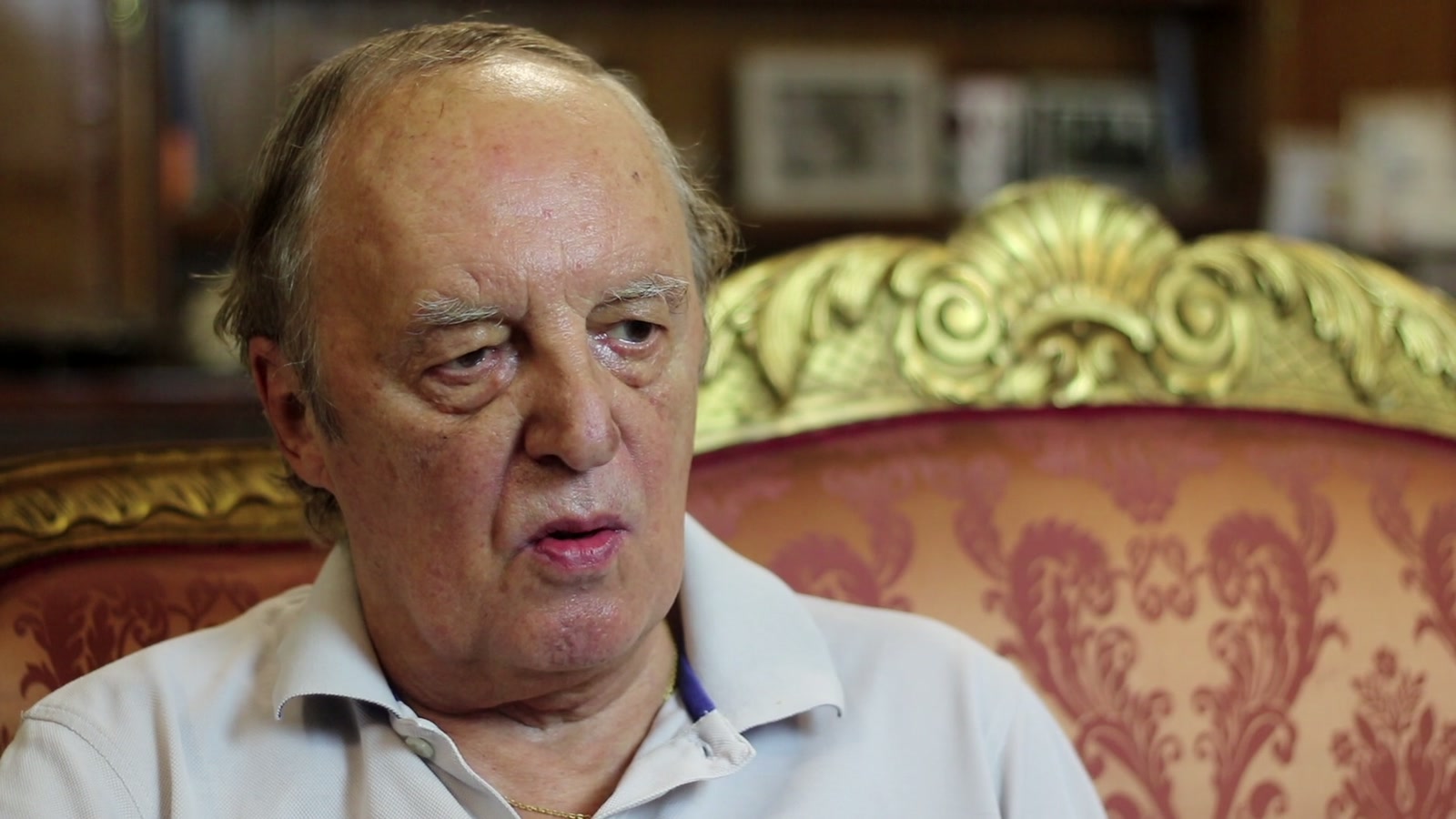
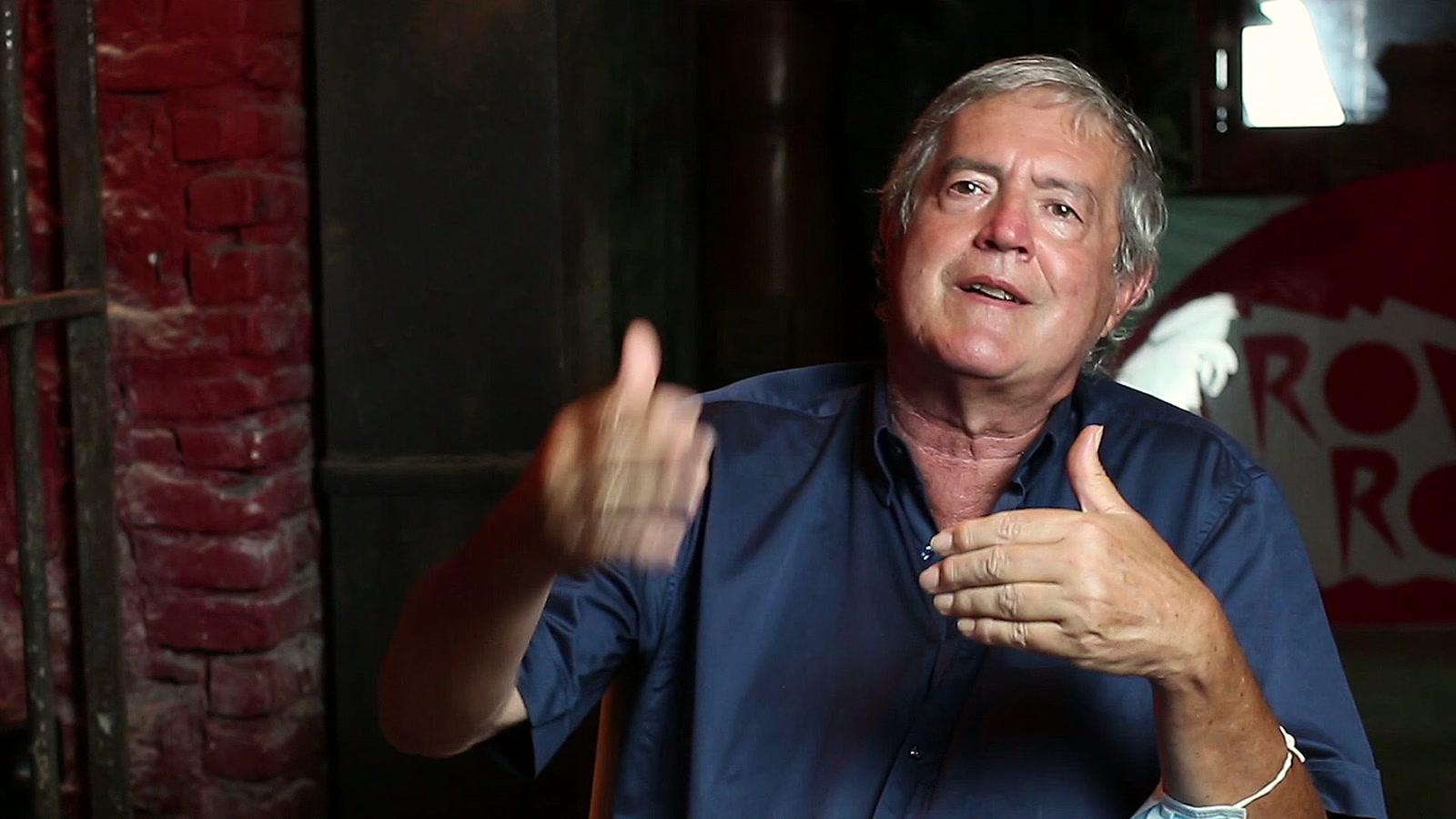
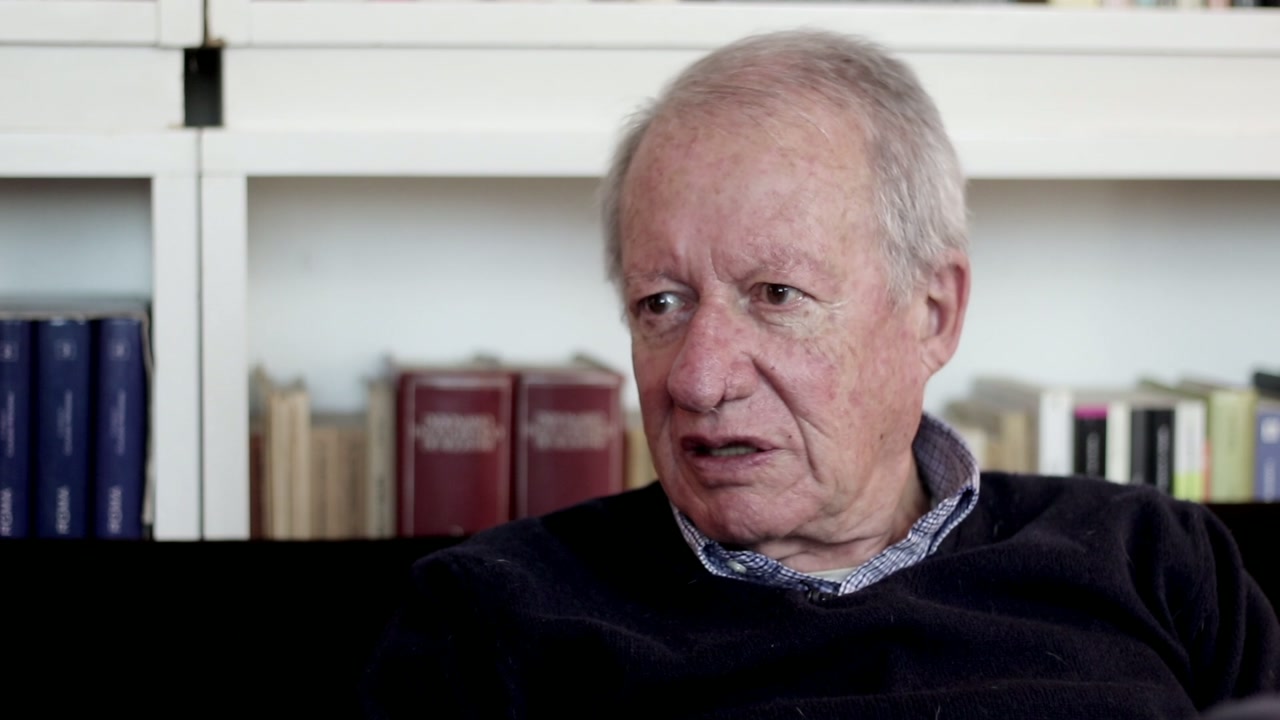
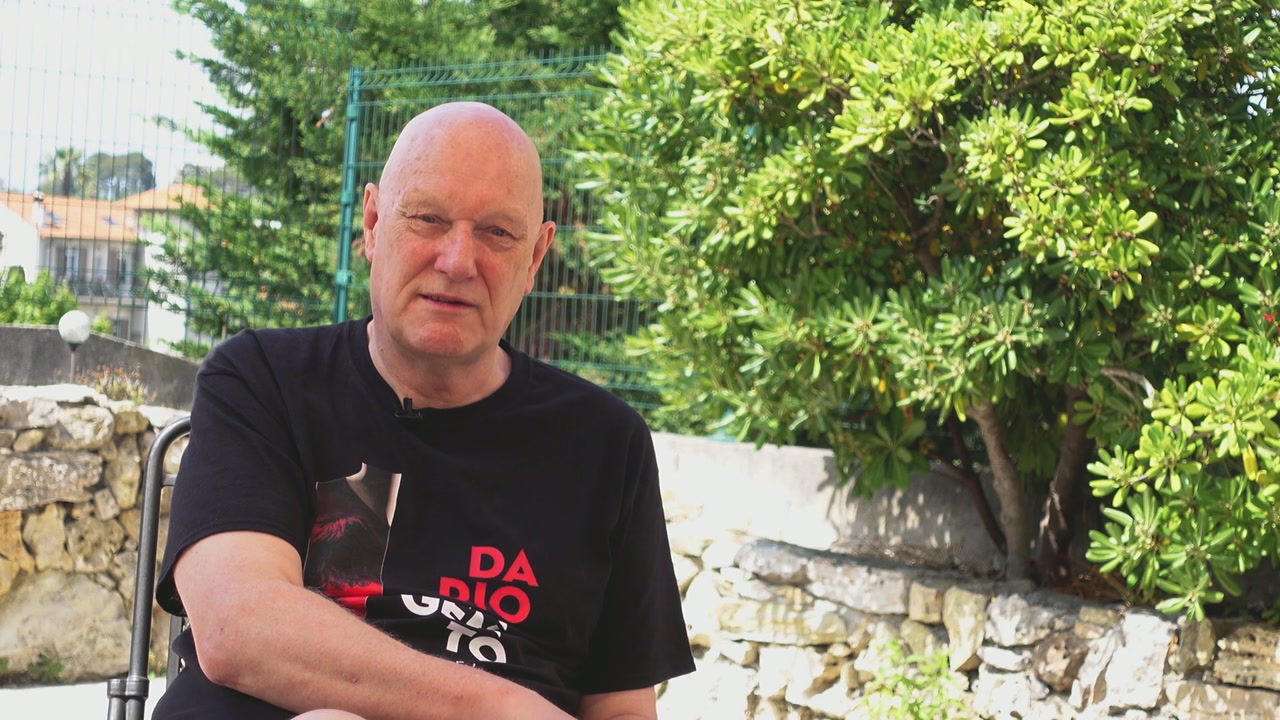
Argento remembers approaching the film as a chance to move beyond thrillers, initially intending to supervise rather than direct it. His most substantial account concerns the research he undertook with Nanni Balestrini in a Milan collection of personal diaries from 1848. He identifies a La Scala violinist’s diary as a source for the childbirth episode and another account as the origin of the countess’s elegant barricade. The interview identifies the route from an anecdote to a scene, although it does not display the manuscripts or name their archival references.
He describes Balestrini as an important collaborator whose historical knowledge helped balance invented episodes with documentary anecdotes. Argento also explicitly connects the film’s politics with the upheavals of contemporary Italy. His version of their work belongs alongside the different emphases of Claudio Argento and Luigi Cozzi, rather than replacing either account.
The period world required alterations to modern streets. Argento recalls covering asphalt with dirt and arranging the removal of television aerials in Pavia, while using quieter August streets for the Milan locations. With cinematographer Luigi Kuveiller, he studied paintings in museums and private collections; he singles out a brick-brown colour as the basis of the film’s palette. That is a specific account of a visual decision, distinct from a general claim that the film looks historical.
Argento confirms the Keaton connection in the scene beneath the leaders’ table: the powerful become shoes and boots seen by somebody excluded from their deliberations. He also explains the contrast between accelerated slapstick and the slow motion that accompanies the film’s movement toward tragedy. The change in speed is part of his account of the film’s changing moral temperature.
On the soundtrack, he remembers Giorgio Gaslini conducting the La Scala players and distinguishes traditional songs discovered in the diaries from songs invented for the production. The apparent folk authenticity of a song therefore cannot, by itself, establish that it dates from 1848. His recollection of Gaslini’s later departure from Deep Red also places this score inside an evolving collaboration.
The final public speech is central to his defence of the film. Cainazzo has seen betrayal and exploitation behind the language of liberation; his refusal to deliver the expected patriotic tribute is, for Argento, the point of the story. He remembers hostile political readings and disappointed commercial expectations, while continuing to defend the finished film. This retrospective account gives the ending an authorial context without reducing its effects to an instruction from its director.
Source passages
00:14–08:51, change of direction, diaries and Balestrini; 11:44–13:22, streets and aerials; 21:19–22:06, Kuveiller and paintings; 23:17–25:37, Keaton and changes of speed; 27:39–30:51, Gaslini and songs; 30:56–34:24, ending and reception.
Luigi Cozzi: Keaton, Chaplin and a changing screenplay
ENLARGE ↗Luigi Cozzi traces the story’s development.
Cozzi traces the project through an early idea for a historical comedy-drama, the success of Er più, proposed casting and repeated delays. He remembers Enzo Cerusico, Ugo Tognazzi and Veruschka being selected while the story was still being developed. His account also places filming at Milan Cathedral ahead of the main production, prompted by news that restoration work would soon make the building unavailable.
His distinction between a short story outline, an expanded treatment and a screenplay gives the writing records a practical context. He remembers the treatments for Four Flies on Grey Velvet and The Five Days running to roughly eighty pages and already containing most of each film. Those are recollections of working documents, not a page count established by the published book.
Cozzi identifies Buster Keaton’s The General as a model for finding comedy inside a violent historical setting. He specifically relates Cainazzo hiding under the leaders’ table to Keaton’s concealed listener among enemy officers. The crowd gathering behind Cainazzo as he carries a flag, he says, came from Chaplin. These comparisons are unusually precise because a story collaborator names both the model and the resulting situation.
His account of Balestrini differs from Claudio Argento’s. Cozzi stresses an already established plot and says Balestrini’s changes concentrated on Milanese speech; Claudio emphasises Balestrini’s leadership in defining the political intention. The credits establish their formal categories, while the interviews expose different memories of how the work was divided. A comparison of surviving drafts would be needed to allocate individual changes.
The television connections are equally concrete. Cozzi recalls Cerusico being tried out under Argento’s direction in Il tram while the feature waited, and explains that his requests for editor Alberto Moro and composer Giorgio Gaslini began with his own Door into Darkness episode. In his account, Moro remained specific to that episode, while Gaslini went on to score all four and then the feature. Follow that production connection →
Source passages
06:23–12:29, development and casting; 12:35–14:44, delays and the cathedral; 14:48–15:55, treatments; 16:00–18:45, silent comedy and Balestrini; 20:04–20:54, Cerusico; 23:59–25:51, Moro and Gaslini.
ENLARGE ↗Claudio Argento recalls his first production assignment.
Claudio Argento remembers The Five Days as his first production assignment for his father and brother after working in film publicity. The change required him to learn a different profession on the job. His account makes the period setting a practical undertaking: costumes, historic streets, cavalry and the placement of crowds all demanded resources beyond those of a small contemporary thriller.
He names Milan, Crema and especially Pavia among the locations, and recalls how buildings that retained their older appearance helped create the historical world. His admiration for Luigi Kuveiller centres on both the images and the cinematographer’s quiet authority. The organisation of extras at the barricades particularly impressed a newcomer to production.
Claudio also credits Nanni Balestrini with giving the screenplay a deliberate political structure. This is a participant’s recollection of the writing process, complementing the distinction between story and screenplay in the registered record. His defence of the film as an underrated work is one voice in its reception history, rather than a verdict shared by every interviewee.
Source passages
00:14–02:29, publicity and production; 03:31–04:18, locations and cost; 04:27–05:04, Balestrini; 06:19–08:11, Kuveiller and the crowds.
Angelo Iacono: preparing the city, managing the spectacle
ENLARGE ↗Angelo Iacono recalls preparing the historical city.
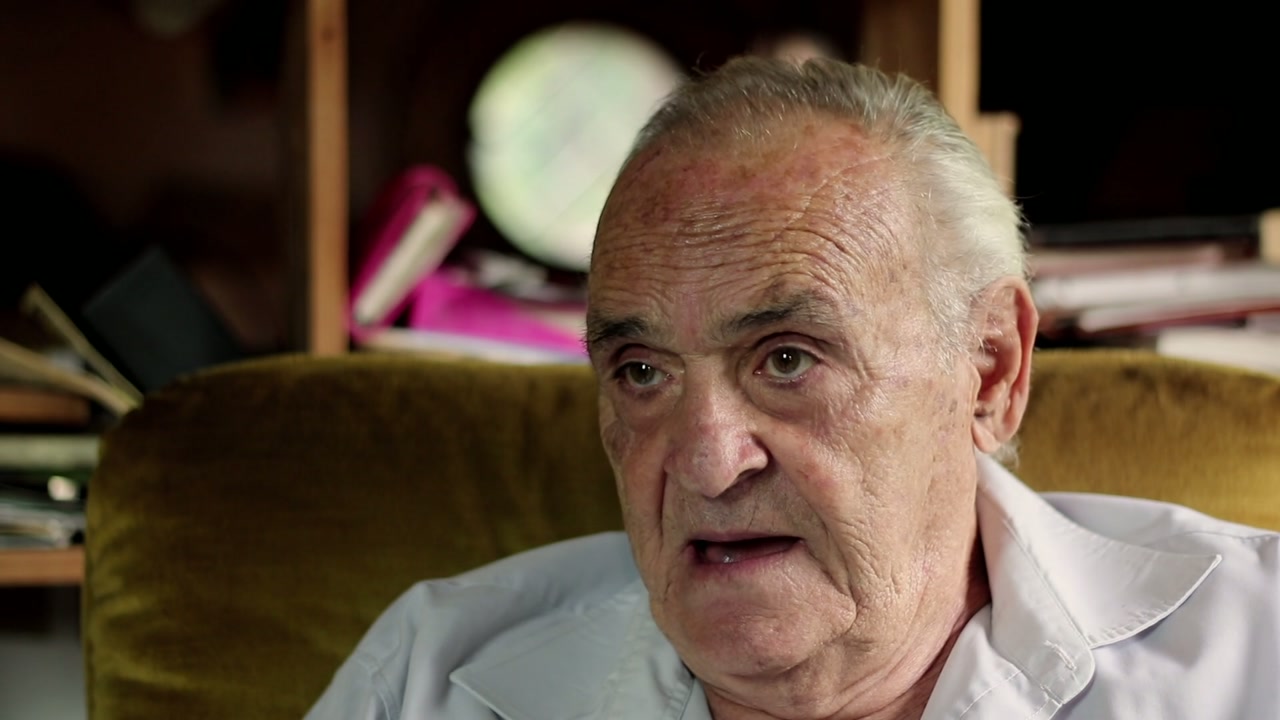
Iacono supplies a detailed production-side account of the change of director. He says he had discussed the project privately with Nanni Loy and prepared a preliminary contract when Argento decided to direct. He distinguishes those conversations from a fully prepared Loy production. He also recalls visiting Ugo Tognazzi with Argento in Paris, finding substantial disagreements about the screenplay, and turning to Celentano afterwards. These memories add names and stages to Argento’s account in My Cinema; the interviews remain retrospective accounts rather than a single surviving chronology.
Pavia is central to his location story. Streets and buildings could suggest the nineteenth century with relatively limited dressing, while Giuseppe Bassan planned the visual environment. Iacono describes negotiating the removal of television aerials from sightlines before filming. His job was to solve such practical problems early enough for Argento to arrive at a prepared location.
He remembers the production staying within its budget despite the demands of period filming and a substantial star salary. This complements Claudio Argento’s emphasis on the expense of costumes and historical reconstruction: a costly undertaking and a controlled production are not mutually exclusive.
For Iacono, the apparent simplicity of an image can conceal extensive preparation. He singles out the cavalry’s hooves, the massacre in the square and Romolo’s execution, identifying the latter’s location as Castello Sforzesco. These recollections help connect the physical action with the organisation of a large production, without assigning an undocumented mechanism to every effect.
He says the final denunciation was filmed as written and remembers watching disappointed spectators leave the Cinema Barberini premiere. His explanation stresses the gap between the filmmakers’ historical interests and the expectations attached to Argento’s name. It is a witness’s impression of that audience, not a survey of every viewer.
Source passages
01:01–03:22, Nanni Loy and the change of director; 03:26–06:03, Tognazzi and Celentano; 07:19–10:51, Pavia, Bassan and preparation; 12:07–13:57, production costs; 21:52–23:09, cavalry and execution; 23:25–26:59, ending and premiere.
ENLARGE ↗Carla Tatò discusses performance and political ambition.
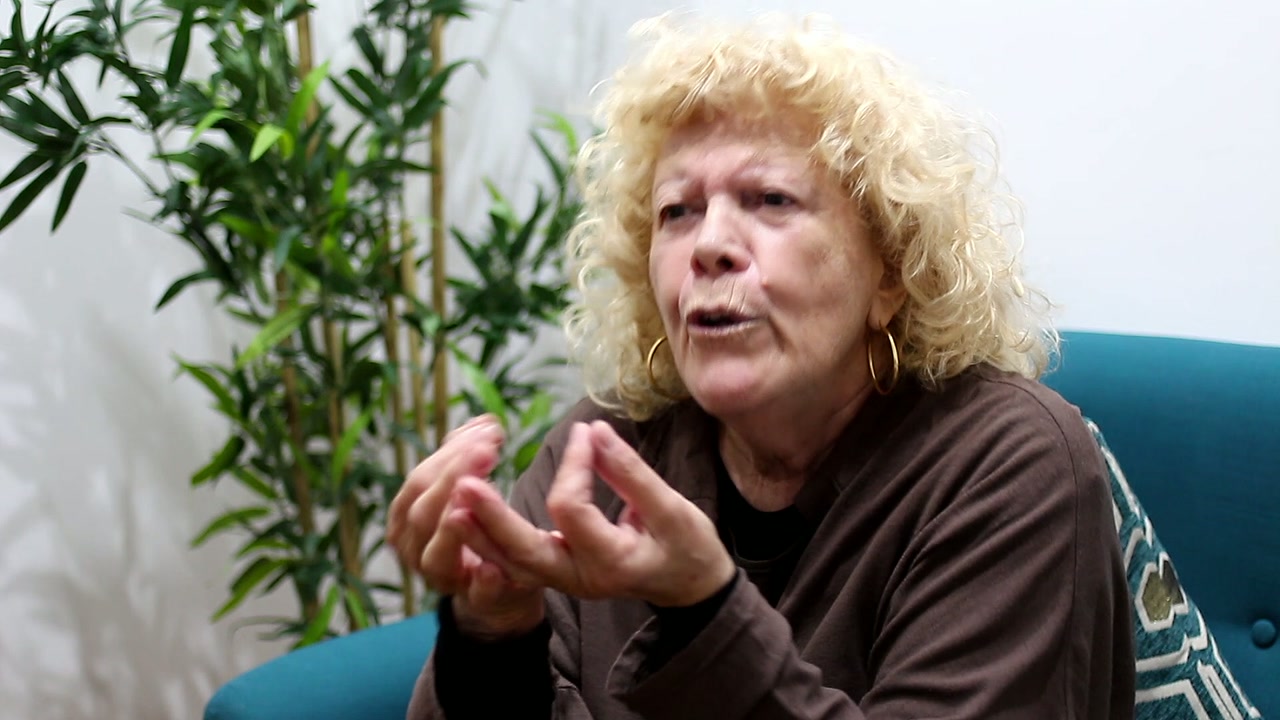
Before joining the film, Tatò spoke with her friend Nanni Balestrini about its ambitions. She remembers the Feltrinelli bookshop in Via del Babuino as a meeting place for reading and discussion, and describes his enthusiasm for telling a national-popular historical story. The film’s politics therefore entered her work through a personal and intellectual relationship as well as a screenplay.
Her account of the set stresses careful preparation, an atmosphere that could be playful without ceasing to be professional, and Argento’s close attention to the actors. Kuveiller’s presence, and his work with Elio Petri, further convinced her that the project had serious artistic ambitions.
Tatò treats costume as part of performance: the nineteenth-century dress helped determine the character’s bearing and behaviour. She is much less comfortable with the requirement to record her dialogue again after filming. For her, replacing the voice separates words from the bodily detail achieved during a take. That objection is valuable evidence of how the finished performance was assembled, even when the same actor returned to the microphone.
She interprets the film’s poor commercial reception as a problem faced by work that departs from established formulas, and welcomes its restoration as delayed recognition. Read beside Alan Jones’s more sceptical assessment, her interview preserves a disagreement about the film’s achievement.
Source passages
02:08–04:02, Balestrini and the project; 04:06–06:43, the set and redubbing; 08:16–12:04, Kuveiller, costume and performance; 12:13–15:19, reception and rediscovery.
Luisa De Santis: the work inside the childbirth comedy
ENLARGE ↗Luisa De Santis remembers the childbirth sequence.
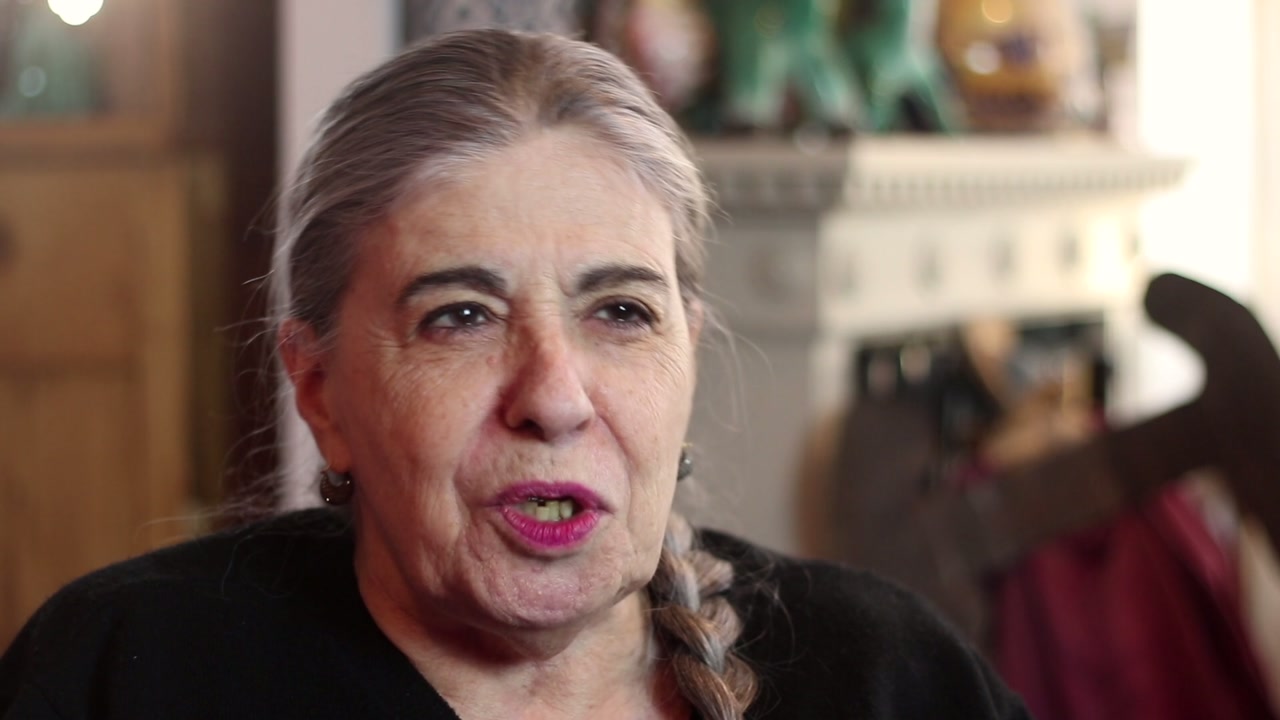
De Santis remembers making the childbirth episode as an unusually happy working experience. She believes Enzo Cerusico recommended her after their earlier cabaret collaboration, while distinguishing that recollection from a casting record. Her portrait of Cerusico is of a skilled, meticulous actor who had helped her when she began performing.
She contrasts his method with Celentano’s instinctive invention of mannerisms. During the scene, the three performers repeatedly struggled to keep from laughing; she can still recognise those efforts when she watches it. The narrow staircase was a practical obstacle too: carrying her upstairs required visible exertion. She remembers an old building, while remaining unsure of the precise location.
Her most specific contribution to the soundtrack history concerns her own voice. She says another actress dubbed the role because her Roman accent did not fit the character. The woman directing the two flustered men during the delivery is consequently a composite performance: De Santis’s face and body, with a separately recorded voice. Her interview does not name that voice performer.
She recalls spending about a week on the production, and speaks warmly of Argento, Kuveiller and Angelo Iacono. Her memories of youthful political optimism also give the restoration an emotional significance: it returns her to a period when changing society seemed possible.
Source passages
01:24–02:47, casting; 04:12–06:28, Celentano and comic performance; 07:38–09:36, Cerusico and the staircase; 10:21–11:11, replacement voice; 14:05–17:05, production memories and political hopes.
Dario Argento: The Man, the Myths & the Magic · 12:52 · Alan Jones
Alan Jones: a dissenting view of the detour
ENLARGE ↗Alan Jones assesses Argento’s change of direction.
Jones places the film between Door into Darkness and Deep Red, interpreting the change of genre as Argento’s attempt to leave a path that imitators were already following. He describes the thief-and-baker journey as picaresque, comparing its passage through social extremes with Candide.
He recalls Argento explaining the historical uprising through the lens of Paris in May 1968. That is Jones’s account of a conversation, distinct from a contemporary statement or a production document. It offers a route into the film’s political disillusion without making every incident a coded reference to one later event.
Jones is markedly less enthusiastic than Claudio Argento and Carla Tatò about the result. He questions the shifts of tone and the comedy’s ability to travel outside Italy, while strongly praising Gaslini’s score. Keeping these opinions together makes the history of rediscovery more interesting: renewed availability does not require everyone to reach the same conclusion.
Source passages
01:43–02:18, the change of direction; 04:00–05:14, research and picaresque form; 07:49–09:14, production and comic tone; 09:27–10:02, the 1968 analogy; 10:15–12:28, music and reassessment.
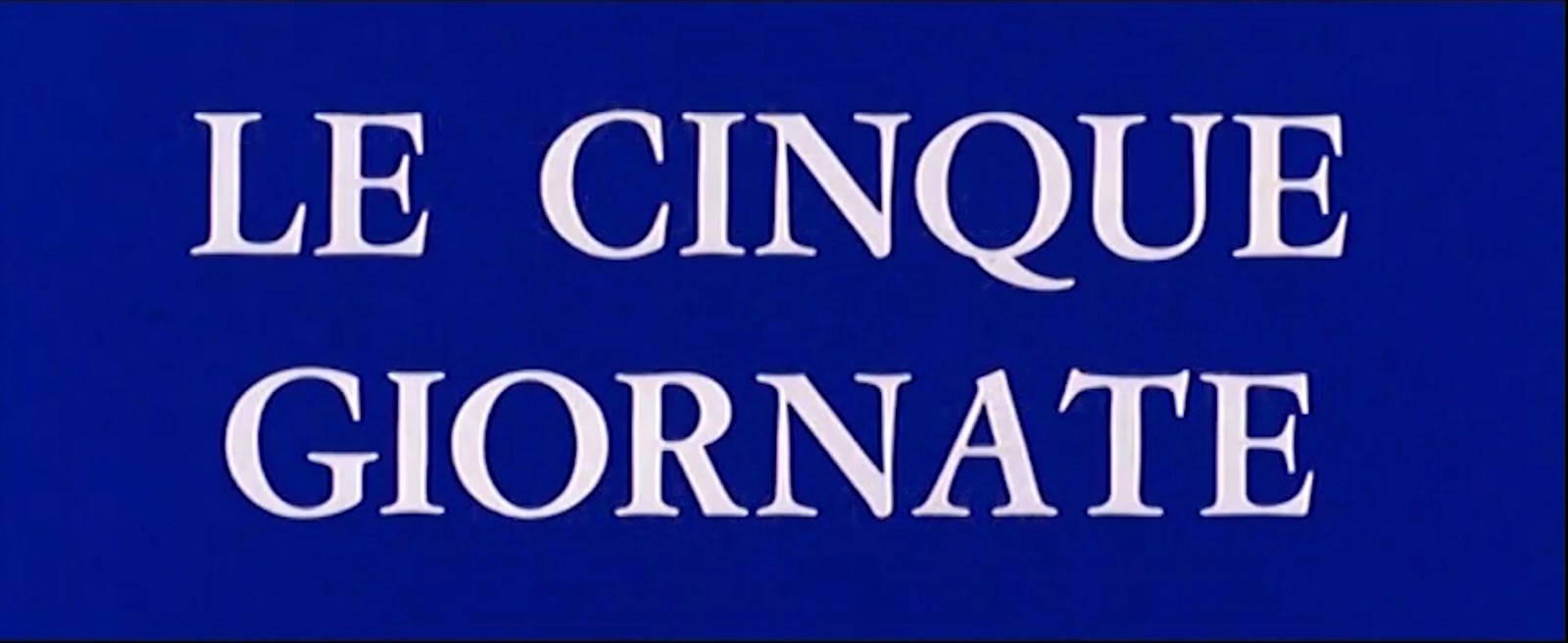
The theatrical trailer alternates the companions’ misadventures with cavalry, crowds and the aftermath of violence. Its blue cards present revolution as a festive meeting of people and promise a Christmas engagement on Italian screens. The closing appeal to happiness and new love is striking beside the film’s disillusioned ending.
ENLARGE ↗The theatrical trailer’s blue title card.ENLARGE ↗The title crosses a tinted image in the TV spots.
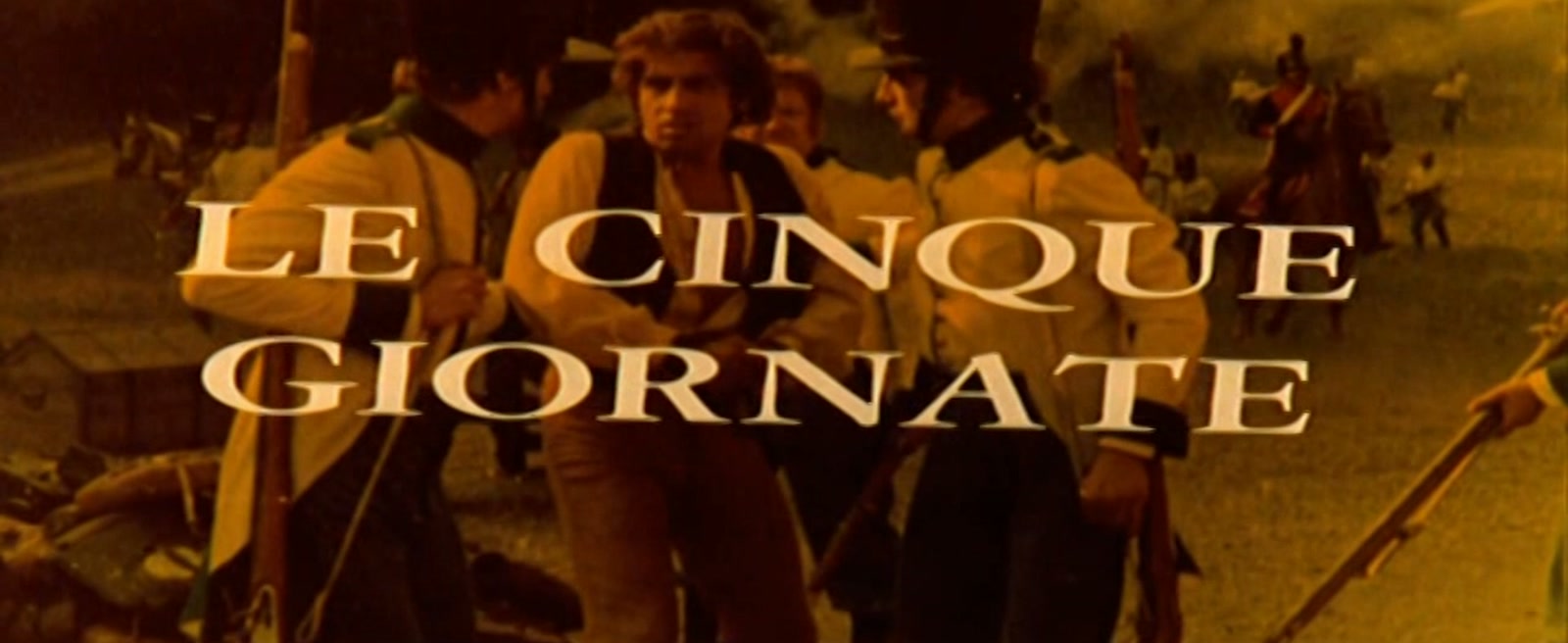
The TV spots use a different graphic language: warm-tinted stills, diagonally moving titles and prominent cast names. They compress slapstick, spectacle and danger into a star-led invitation. The materials preserve how the film was offered to audiences; their promises should not be mistaken for a neutral synopsis.
Sources and passages
Severin Blu-ray: theatrical trailer, 2:18, especially 01:26–02:16; TV spots compilation, 3:26, including tinted title and cast cards at 02:50–03:24. Euro International Films is identified in both presentations.
History & political spectacle
Who gets to define freedom when a crowd takes the street? The Five Days follows Cainazzo and Romolo through a revolution whose promises are tested by hunger, work, violence and friendship. This expanded dossier connects those stakes with the writing record, collective craft, music documentation and later reassessment.
Spoilers: this study discusses the film’s story and ending. Includes discussion of sexual violence.
01 / 1848, SURVIVAL & THE CROWD
The barricade rearranges ownership
A thief and a baker do not enter history with the same resources as a general. They need food, shelter and a way through the next street. In The Five Days, those needs become a means of examining political promises: what does freedom provide for someone whose immediate problem is staying alive?
Cinematografo places Cainazzo and Romolo in Milan’s uprising of 18–22 March 1848. Its synopsis describes household furniture becoming a barricade, a childbirth interrupting the fighting, and Cainazzo being beaten after exercising the freedom of opinion he has heard proclaimed. Setting and narrative record ↗ These incidents make a useful chain. Possessions change use; the body imposes its own emergency; a declared right fails its first practical test.
The furniture is especially exact as a political object. Inside a house, it can mark comfort or status. Outside, it becomes an obstruction which people must defend. Moving it does not, by itself, establish who will own the street afterward. The barricade temporarily changes the distribution of things; the harder question is whether it changes the distribution of power.
Film at Lincoln Center’s 2022 programme reads the film as a warning against nationalist demagogues and the crowds that sustain them. The retrospective’s political framing ↗ Our reading begins one level below that description, with the gap between public language and private consequences.
02 / THE TREATMENT, SCREENPLAY & BOOK
A title survives across different kinds of writing
The paper trail starts before the finished film. The Italian registration bulletin records Le cinque giornate (titolo provvisorio) as a cinematic story treatment on 24 January 1973: entry B.0191988, page 74, naming Dario Argento, Luigi Cozzi and Enzo Ungari, with Seda Spettacoli as publisher. A second entry, C.0042656 on page 2526, dated 18 December, records an assignment to SEDA and uses the name Vincenzo Ungari. The two inspected register pages ↗ These are descriptions of registered material and an agreement; neither is the underlying text.
Cinematografo distinguishes the story credit from the screenplay, which it attributes to Argento and Nanni Balestrini. Separate writing fields ↗ That distinction matters. A story treatment, a shooting script and a book published afterward can contain different structures and emphases even when they share a title.
The Rovigo library catalogue identifies a 1974 Bompiani volume by Argento and Balestrini: 158 pages, Ombre rosse 3, record SBL0567253. The bibliographic record ↗
Luigi Locatelli’s 2022 essay reports Argento’s 2008 discussion of Balestrini, Potere Operaio and the idea of a revolution betrayed by elites. A later account of political intention ↗ The useful task is now a comparison of identifiable texts, rather than assigning every political line to one writer on the strength of a credit.
The published screenplay: May 1974
Libreria Antiquaria Pontremoli describes a first edition issued by Bompiani in Milan in May 1974, credited to Dario Argento and Nanni Balestrini, with 158 numbered pages and two additional pages. The bookseller identifies it as the screenplay and lists the illustrated paperback binding. This adds a month and physical description to the library record; it does not establish how the published text differs from a working draft or the finished film. Bookseller’s bibliographical description ↗
03 / ARGENTO, CELENTANO & THE WORKSHOP
A change of genre still involves a working company
Argento gave Francesco D’Errico a practical explanation in 2022: another director had withdrawn, and Celentano proposed that he take over. He remembered enjoying the experience before returning to the kinds of images that most naturally interested him. Argento’s retrospective account ↗ That written interview does not name the departing director. In the Blu-ray interviews, both Angelo Iacono and Luigi Cozzi identify Nanni Loy, although their memories of the preparatory meetings differ.
In his 2013 conversation with Marida Caterini, Argento had described the film as an excursion into social and political criticism. The earlier interview ↗ The two statements address different questions. One explains a directing assignment; the other describes the finished film’s place in his career. Neither tells us precisely when its political emphasis changed during development.
The compiled department credits name Luigi Kuveiller for photography, Franco Fraticelli for editing, Giuseppe Bassan for design, Elena Mannini for costumes and Giorgio Gaslini for music, with Salvatore Argento producing for Seda. The production catalogue ↗ Several of these collaborators recur in Deep Red. Mannini’s contribution also deserves visibility: clothing is one of the clearest distinctions between the two bodies in the image examined below.
A department credit establishes a responsibility, not authorship of every detail. A costume can differentiate social position while allowing a performer to move; a doorway can stage an encounter while suggesting a historical city. Explaining those decisions requires the collaborators’ work as well as the director’s intentions. The expanded account therefore treats the genre change as a change of tasks for a company of workers, rather than an isolated detour made by one person.
04 / CELENTANO, CERUSICO & THE INSPECTED IMAGE
Two bodies give history a scale
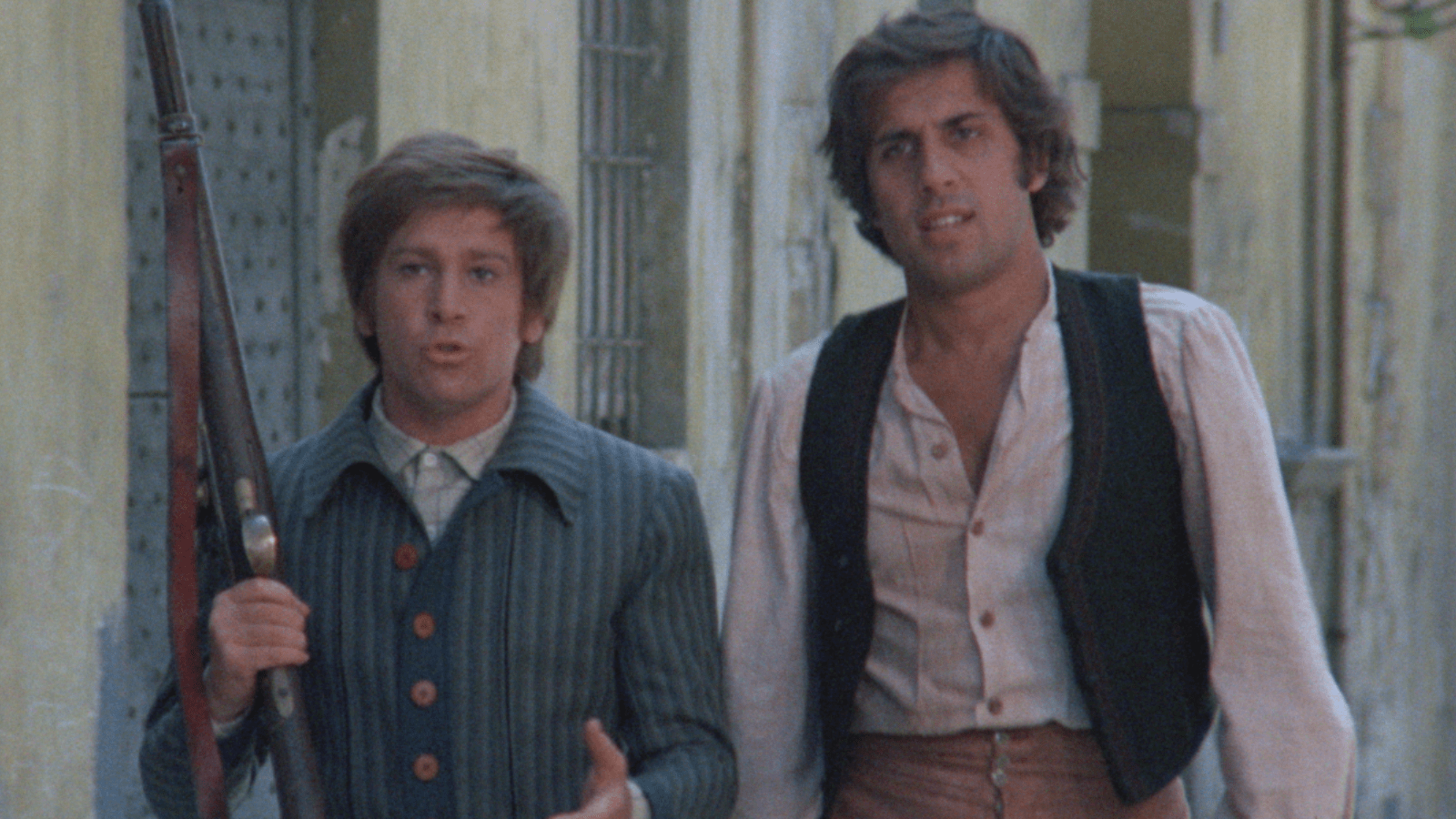
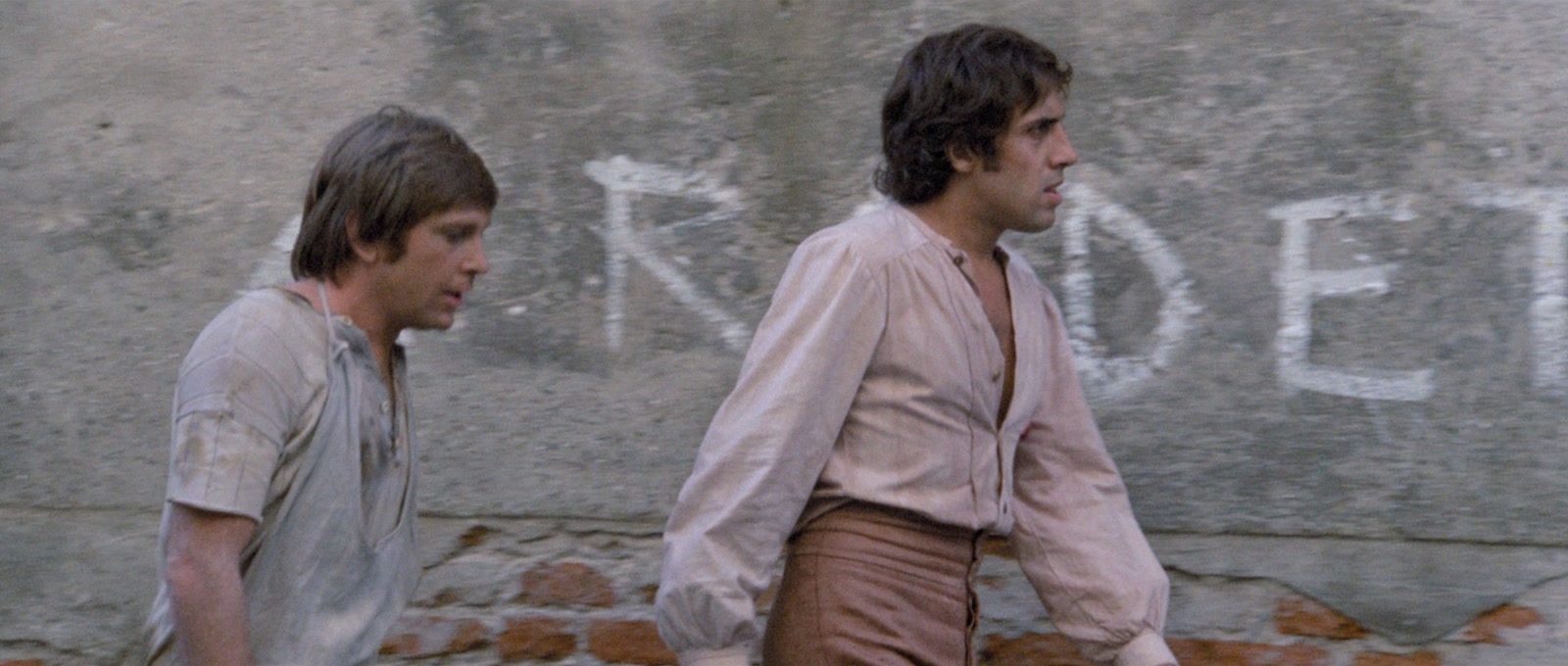
Film at Lincoln Center’s supplied image places the companions against pale masonry and a doorway. The shorter figure at the left wears a striped coat with conspicuous buttons and holds a long gun almost vertically. The taller figure wears an open pale shirt and a dark waistcoat. The contrast is immediately legible: a compact, buttoned shape beside a looser, open one.
The weapon extends beyond the top of the image, but it does not organize the whole frame as a heroic gesture. The hand around it, the faces and the difference in height keep pulling attention back to the pair. Their mouths are slightly open, yet the still gives us no words. It presents two people responding to an occasion whose sound and duration remain absent.
This makes a productive starting point for performance analysis. A partnership need not mean synchronized reactions. One figure can interrupt, hesitate or accept an explanation while the other resists it. The close proximity visible here supplies a shared space; it does not settle how Celentano and Cerusico divide that space over time.
The companions’ solidarity eventually meets an asymmetry that comedy cannot easily absorb. In the catalogue’s account, Romolo intervenes against a noble revolutionary’s sexual violence, kills him unintentionally and is executed. Cainazzo survives to confront the celebration of victory. Narrative outcome; ending spoilers ↗ A principle supposedly shared by the crowd becomes dangerous when a powerless person acts on it.
Read alongside the barricade, that outcome changes the meaning of participation. Providing labour or taking risks does not guarantee a voice in deciding what counts as justice. The crowd can mobilize a person, punish him and then continue its celebration. This is why the film’s movement between farce and cruelty matters politically: laughter can establish a provisional community which the next incident exposes as unequal.
That interpretation does not excuse the film’s own treatment of women. A satire may expose domination while still making a woman’s body an occasion for somebody else’s joke. Locatelli praises parts of the visual invention but finds the countess episode particularly difficult to sustain. A reservation within the reassessment ↗ Political intention cannot settle the question of what an individual scene asks the viewer to enjoy.
The scene studies trace that change of tone, while the physical-action galleries separate the staging of an impact from its consequences. The target of a joke and the person who suffers need not be the same. The execution and final address bring that unequal distribution into the open.
06 / GIORGIO GASLINI & THE MUSIC CREDITS
Period music meets the synthesizer.
ENLARGE ↗Gaslini, Rossini and the ARP synthesizer in the music credits.
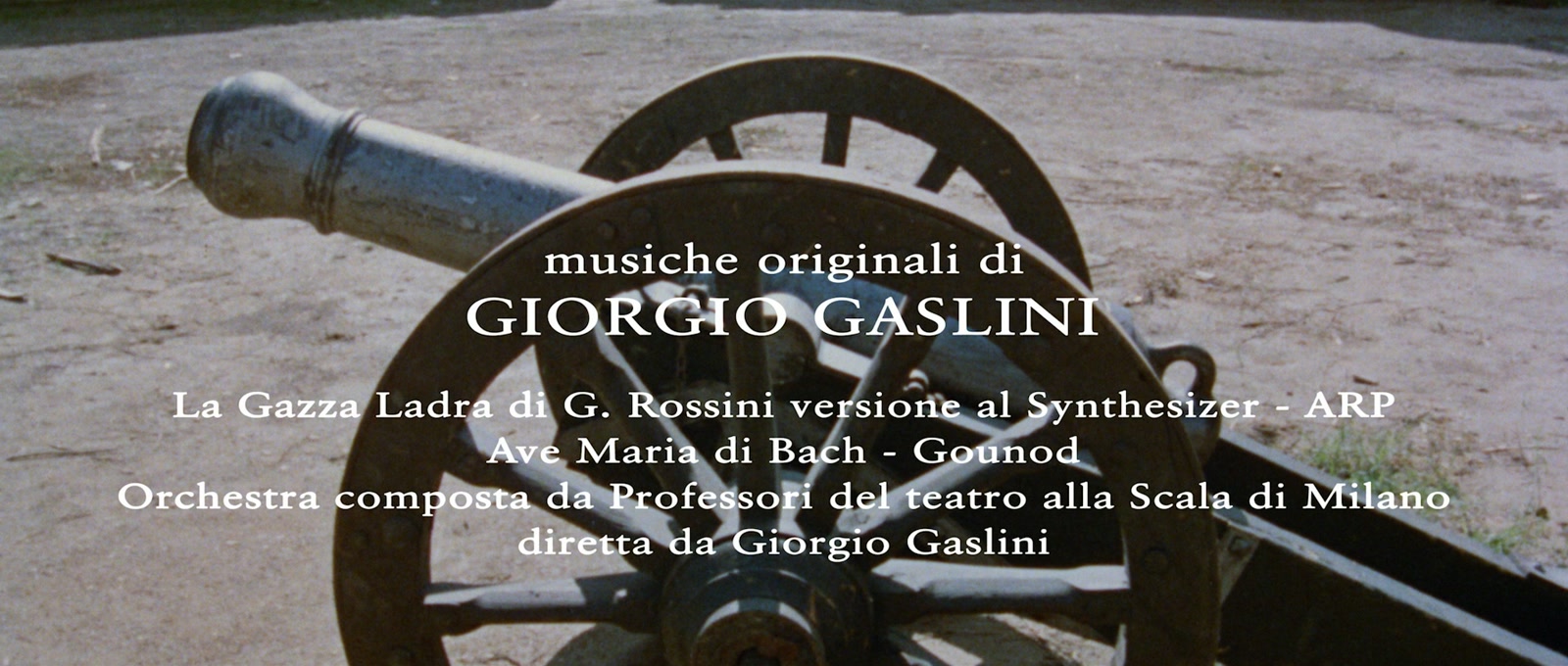
The opening credits name Giorgio Gaslini’s original music alongside Rossini’s La gazza ladra, specifically identified as a version for ARP synthesizer, and the Bach–Gounod Ave Maria. They describe an orchestra composed of players from Milan’s Teatro alla Scala, conducted by Gaslini. The historical setting therefore does not imply an exclusively historical musical vocabulary.
Cinevox’s indexed catalogue identifies the 1973 LP as MDF3371. Its listed material includes Elegia, Il parto, Coro di Radetzki and La rivoluzione inutile. Those titles place lament, childbirth, choral authority and failed revolution beside one another. Label catalogue ↗
Argento recalls working with Gaslini and La Scala musicians, and describes combining songs drawn from the period with newly invented material. The interview study locates that account at 27:39–30:51. Howarth and Thompson, in turn, connect the electronic interludes with the film’s deliberate stylistic disruptions. Commentary discussion →
The album sequence and the film mix remain different objects: a track title does not establish its exact placement against dialogue or a cut. The separate soundtrack CD in Severin’s set provides an additional listening source alongside the feature’s Italian mono track. Edition listing ↗
07 / FROM NEGLECT TO REASSESSMENT
Rediscovery has its own history
The film did not have to wait for a 4K presentation to be reconsidered. In l’Unità on 5 May 2012, Alberto Crespi’s Argenteide column gave it three stars and proposed recovering a comedy overlooked during the celebrations of Italian unification’s 150th anniversary. The home-video listing named Eagle Pictures. Original newspaper, page 41 ↗ This small notice is evidence of renewed attention at a particular moment, not a summary of the original reception.
Ten years later, Locatelli argued that the supposed anomaly contains recognizable Argento preoccupations. He connected bodily vulnerability and an invented geography to the wider work, while retaining objections to parts of the comedy. Locatelli’s 2022 reassessment ↗ His essay makes room for formal invention without requiring every episode to succeed.
FLC’s retrospective similarly placed the film within an Argento programme while foregrounding its political farce. The 2022 programme ↗ A reputation for failure and an audited account of a film’s business are different kinds of evidence.
These returns ask different questions. Crespi asks why the film has been excluded from a historical commemoration. Locatelli asks how it belongs within an artist’s work. A restoration makes it possible for another audience to answer through viewing. None of those acts automatically replaces the reactions of 1973, which remain a separate investigation. Rediscovery is most useful when it expands the available judgments rather than imposing a new unanimous verdict.
08 / PRESENTATIONS & MATERIAL AFTERLIVES
A restoration is a new route to the film
FLC lists a 122-minute Italian-language presentation with English subtitles and credits a Cinecittà 4K digital restoration. Severin describes its own edition as scanned in 4K from the original negative. The exhibition record ↗The publisher’s specification ↗ The wording identifies two presentation records; it does not by itself establish their shared master or grading history.
Presentation and edition records
Record
What is listed
What remains unverified
Cinematografo
1973; 122 minutes
Catalogue duration, not a newly timed print.
FLC, 2022 retrospective
122 minutes; Cinecittà 4K restoration
Festival presentation.
Severin, three-disc edition
Blu-ray feature: 2:01:05 including credits; Italian audio, English subtitles and Howarth–Thompson commentary.
Separate UHD and soundtrack CD are additional items in the set.
The one-minute difference is not evidence of censorship or an alternate cut. Timing boundaries, rounding and different materials need checking before any such conclusion. The catalogue and publisher can help identify a copy; neither replaces examination of that copy.
Severin also advertises interviews with Dario and Claudio Argento, Cozzi, Carla Tatò, Luisa De Santis and production manager Angelo Iacono. Listed participant interviews ↗ The seven illustrated interview studies follow those routes into writing, performance and practical production. Tatò’s account of redubbing herself and De Santis’s account of being voiced by another performer make the actresses central to the film’s production history.
FOLLOW THE CONNECTIONS
Another way in.
Read across films, then return to the evidence for each one.
Argento recalls in My Cinema that The Five Days was initially prepared for another director, with a screenplay and casting work already in place. In his account, an actor made participation conditional on Argento taking over, and he accepted. He looks back on the experience with affection rather than presenting the film simply as an unwanted detour.
The recollection adds a production-stage distinction to the registered writing record: developing a project and becoming its director need not be the same decision. The interview does not identify every participant in that negotiation, so it is most useful as Argento’s account of how his own involvement changed.
Source & passage
Dario Argento: My Cinema / Il mio cinema, two-part documentary presented on Severin Films’ Dario Argento’s Deep Cuts, Disc 1. Part One, 14:09–15:16.
The discussion paraphrases the English subtitles and distinguishes participant recollections from the documentary’s narration and production footage.
Cozzi remembers Enzo Cerusico already being chosen for The Five Days when he was cast in Il tram. Argento separately recalls working with him in anticipation of the feature, and says Marilù Tolo’s energy in Eyewitness led him to cast her in the comedy. These memories make Door into Darkness a useful bridge between the early thrillers and The Five Days: performers and working relationships continued even as the genre changed.
Source & passage
A Streetcar Named Fear, 09:13–09:50 and 17:43–18:31; On the Other Side of the Door, 12:53–13:11. Presented on Disc 2 of Severin Films’ Dario Argento’s Deep Cuts.
Feature and disc studies added 12 November 2026. Film evidence, participant recollections, commentary, registration records and criticism are identified separately below.
Programme framing, 122-minute Italian presentation and Cinecittà restoration credit read in the indexed page; direct retrieval returned 403. Original supplied image; screening copy not viewed.
Original PDF pages visually inspected: B.0191988 (24 January), story treatment; C.0042656 (18 December), assignment entry. Large annual PDF; the second entry is on page 2526.
Indexed bibliographic entry read: Argento/Balestrini, Bompiani 1974, 158 pages, Ombre rosse 3. This is evidence of the publication, not inspection or authentication of its text as a shooting script.
Written answer about taking over direction and Celentano’s encouragement. Later participant recollection; predecessor unnamed. English account is a paraphrase.
Full online essay and notes. Retrospective criticism, including both formal praise and reservations. Its report of Argento’s 2008 remarks is mediated testimony; linked recording unreviewed.
Publisher’s scan, 121-minute duration, framing, audio and supplement specifications. The inserted Blu-ray supplies the feature, commentary, seven interviews and promotional material discussed in this dossier. The separate soundtrack CD and UHD disc are distinct items in the set.
Italian-language participant interviews with English subtitles: Dario Argento, Talkin’ ’Bout a Revolution (35:20); Luigi Cozzi, The Battle for Freedom (29:44); Claudio Argento, For the First Time (10:36); Angelo Iacono, 174 Years Ago (27:41); Carla Tatò, An Italian Story (15:58); Luisa De Santis, Home Delivery (17:48). English-language critical interview: Alan Jones, Dario Argento: The Man, the Myths & the Magic (12:52). The feature studies follow the Italian-language film and English subtitle presentation. The commentary guide discusses Troy Howarth and Nathaniel Thompson’s critical reading. The interview studies paraphrase the speakers and provide passage locators. Theatrical trailer (2:18) and TV spots (3:26).
Bookseller’s first-edition description: Bompiani, Milan, May 1974; Argento and Balestrini; 158 [2] pages. Interior pages were not available in the listing.